
Field Notes From 
Adventures In 
B2B Ecommerce 
Scott DeToffol 
Director, eCommerce 
Navitor, Inc. 
Follow me on Twitter: @detoffol
Let’s Get This Out Of The Way 
Show of hands: 
1.E-commerce 
2.Ecommerce 
3.eCommerce 
4.e commerce
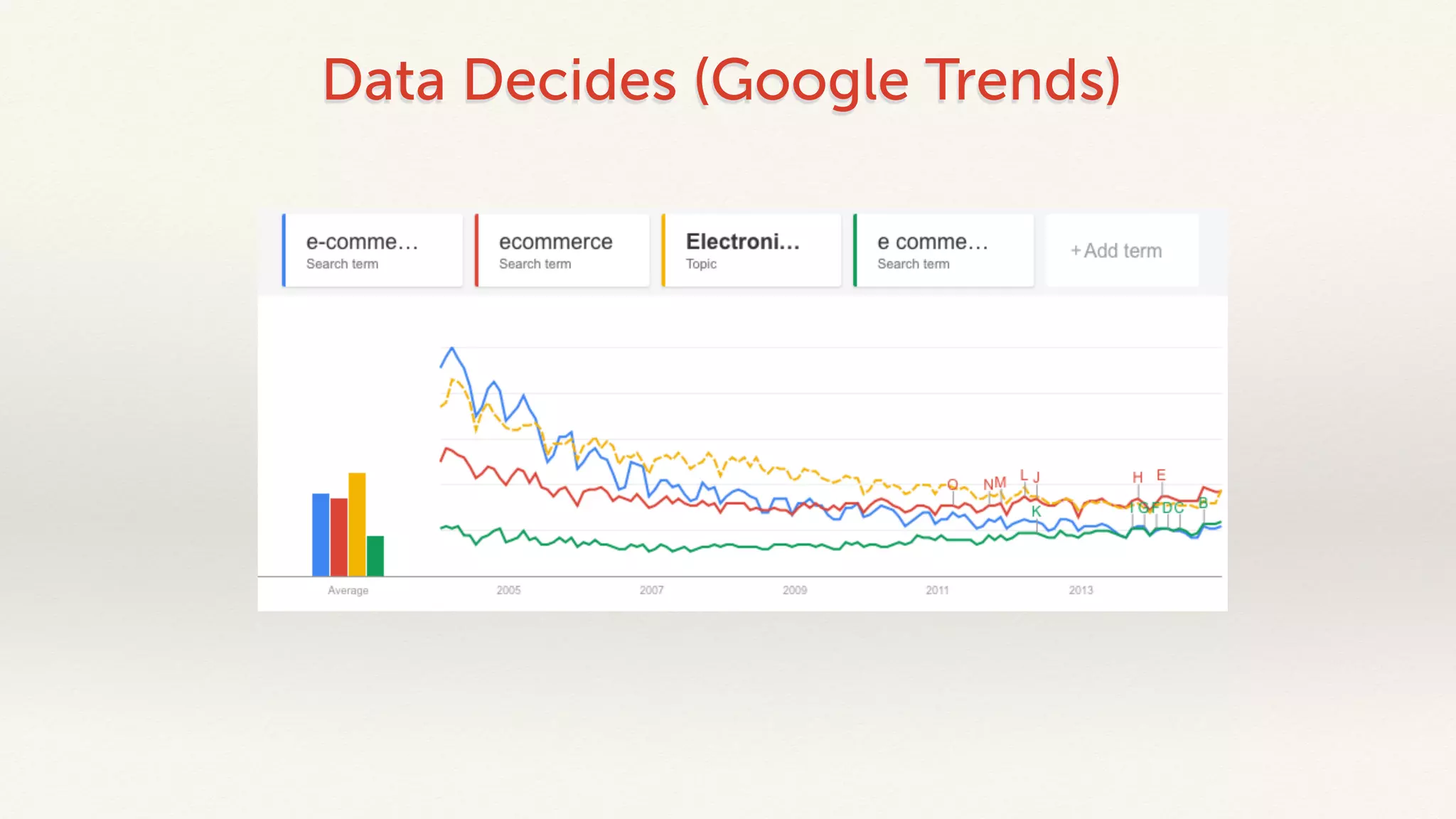
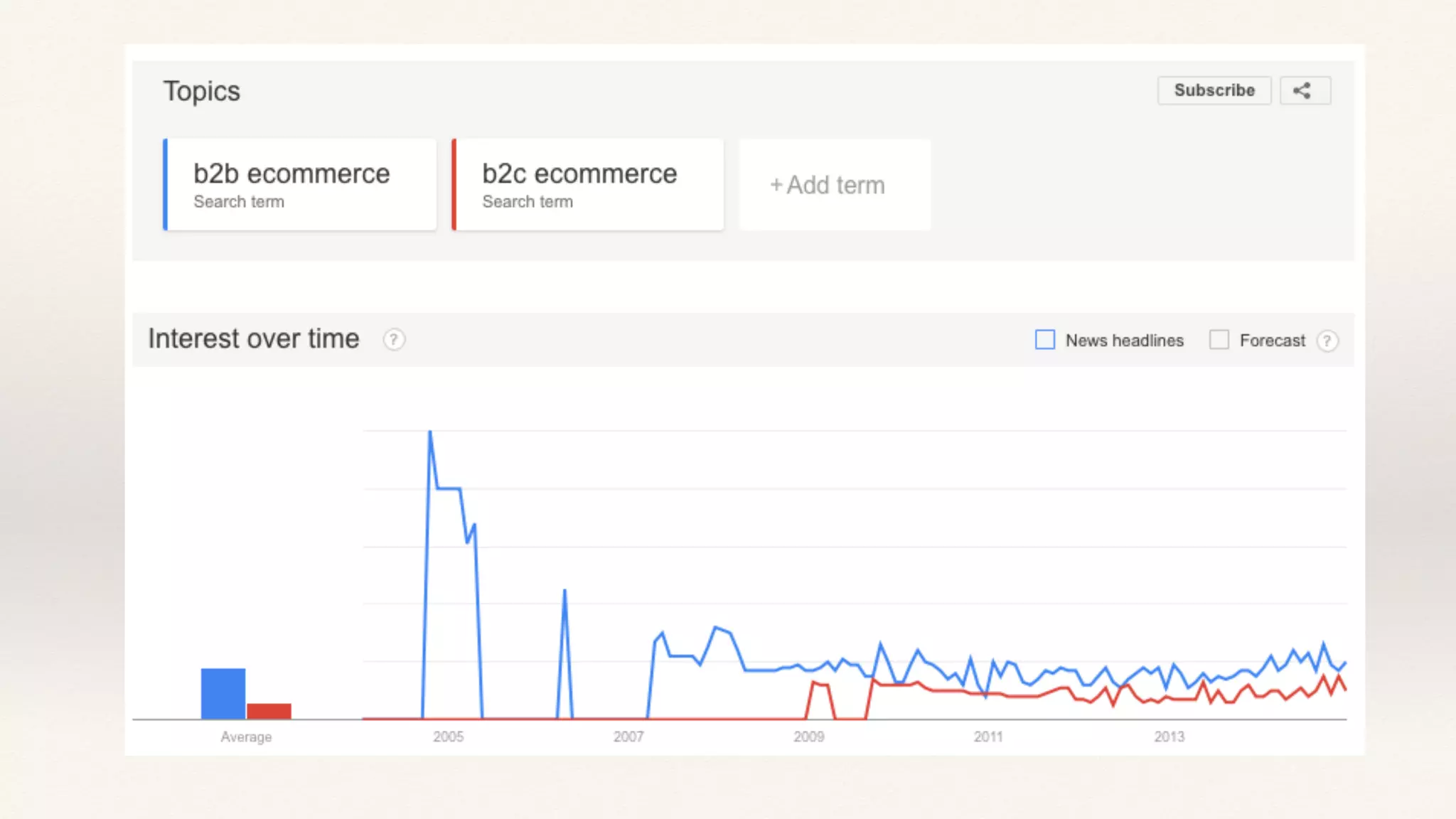
Data Decides (Google Trends)
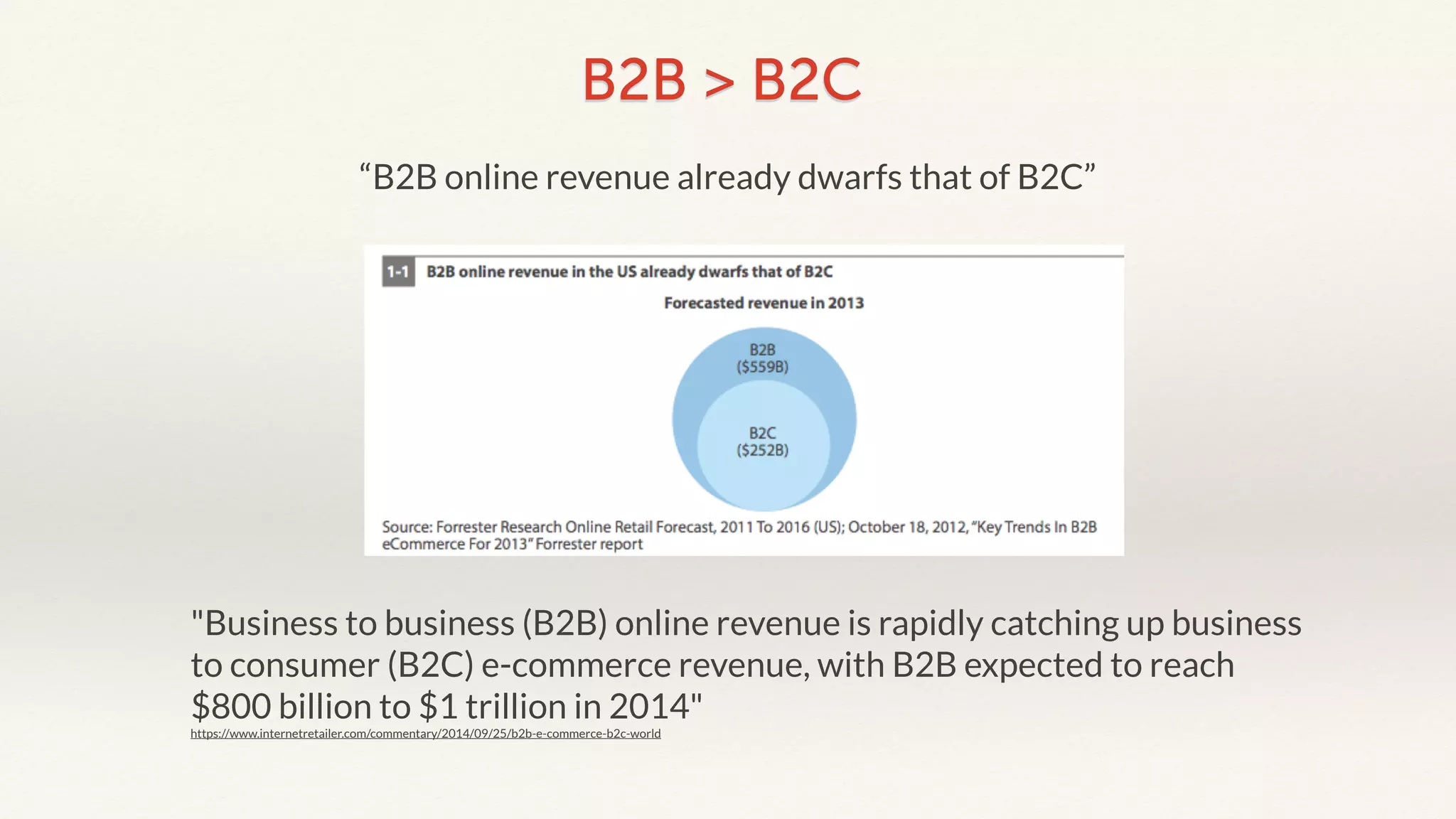
B2B > B2C 
“B2B online revenue already dwarfs that of B2C” 
"Business to business (B2B) online revenue is rapidly catching up business 
to consumer (B2C) e-commerce revenue, with B2B expected to reach 
$800 billion to $1 trillion in 2014" 
https://www.internetretailer.com/commentary/2014/09/25/b2b-e-commerce-b2c-world
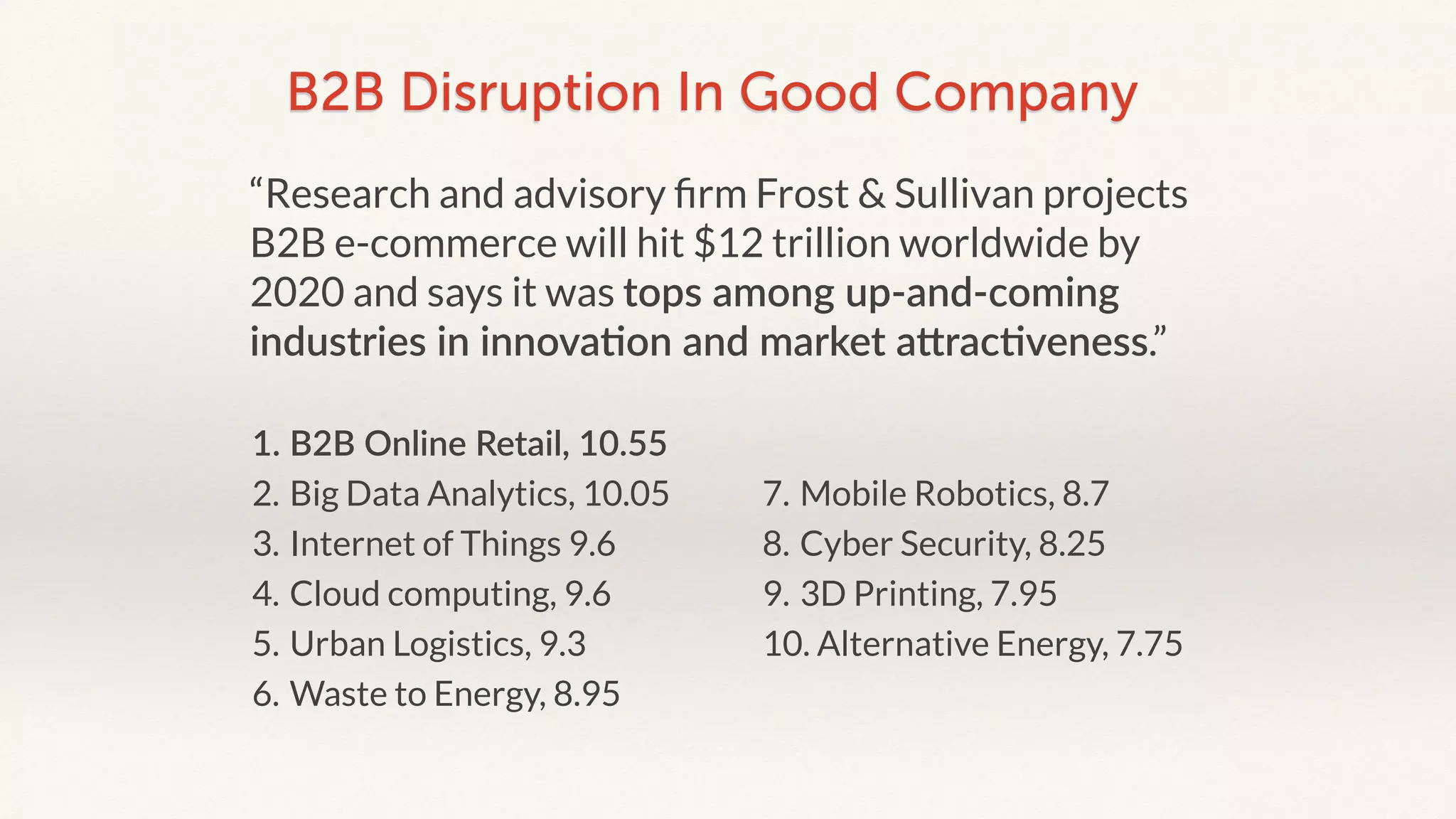
B2B Disruption In Good Company 
“Research and advisory firm Frost & Sullivan projects 
B2B e-commerce will hit $12 trillion worldwide by 
2020 and says it was tops among up-­‐and-­‐coming 
industries in innova2on and market a4rac2veness.” 
1. B2B Online Retail, 10.55 
2. Big Data Analytics, 10.05 
3. Internet of Things 9.6 
4. Cloud computing, 9.6 
5. Urban Logistics, 9.3 
6. Waste to Energy, 8.95 
7. Mobile Robotics, 8.7 
8. Cyber Security, 8.25 
9. 3D Printing, 7.95 
10. Alternative Energy, 7.75
Big Players 
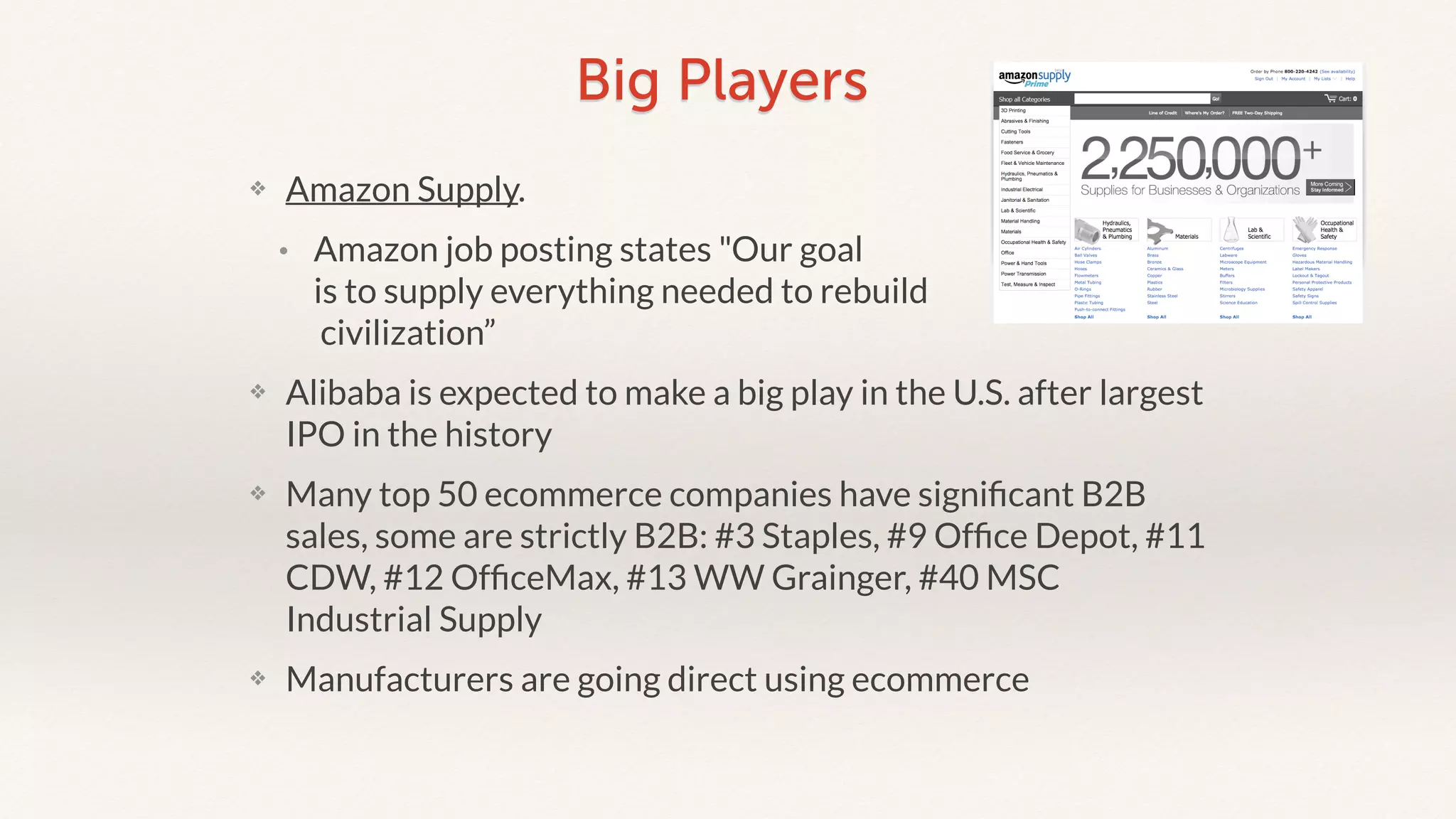
❖ Amazon Supply. 
• Amazon job posting states "Our goal 
is to supply everything needed to rebuild 
civilization” 
❖ Alibaba is expected to make a big play in the U.S. after largest 
IPO in the history 
❖ Many top 50 ecommerce companies have significant B2B 
sales, some are strictly B2B: #3 Staples, #9 Office Depot, #11 
CDW, #12 OfficeMax, #13 WW Grainger, #40 MSC 
Industrial Supply 
❖ Manufacturers are going direct using ecommerce
Distinction Without A Difference? 
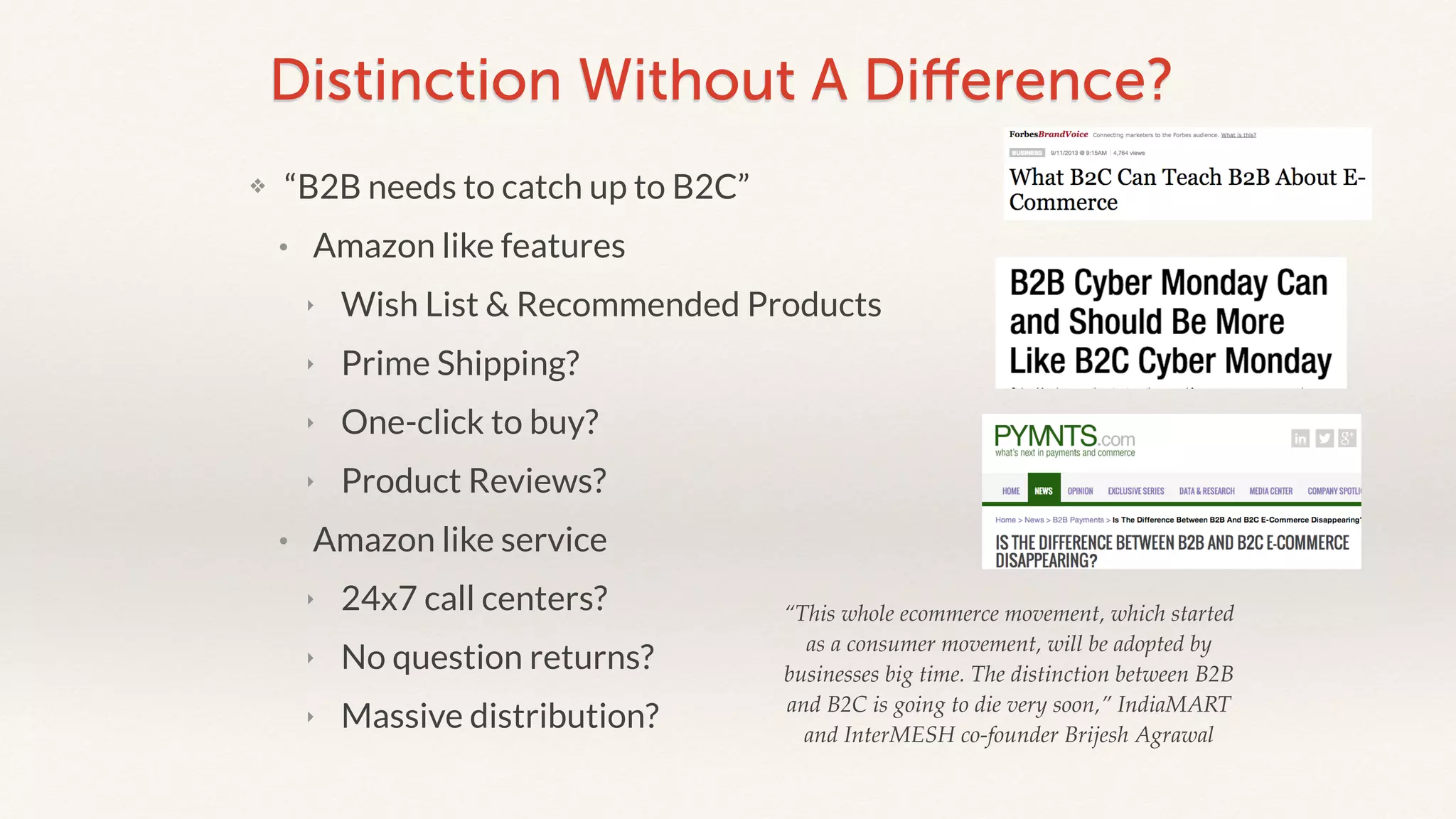
❖ “B2B needs to catch up to B2C” 
• Amazon like features 
‣ Wish List & Recommended Products 
‣ Prime Shipping? 
‣ One-click to buy? 
‣ Product Reviews? 
• Amazon like service 
‣ 24x7 call centers? 
‣ No question returns? 
‣ Massive distribution? 
“This whole ecommerce movement, which started 
as a consumer movement, will be adopted by 
businesses big time. The distinction between B2B 
and B2C is going to die very soon,” IndiaMART 
and InterMESH co-founder Brijesh Agrawal
Selling To Business Complexities 
❖ Multiple users/roles per 
account 
❖ Tiered accounts 
❖ Multi-site 
❖ Tax exempt 
❖ Shipping addresses 
❖ Customized Products and 
Orders 
❖ Discounts, price tiers, 
custom pricing 
❖ Quoting 
❖ Wholesale / Resell 
❖ Arrival times/dates, 
especially when products 
are part of another solution 
(just in time) 
❖ Payment types, Purchase 
Orders 
❖ Credit on Account 
❖ Punchouts 
❖ Approval workflows
Don’t Settle For 
Being ‘As Good As’ B2C
Why Ecommerce? 
❖ Address markets that you can’t reach today with traditional 
sales and service models. 
• Too expensive to sell and service small customers? 
• Geographical reach 
❖ People are changing. They expect/prefer to gather 
information, make decisions and place orders without 
personal contact. 
❖ Need to compete with new entrants who start with 
integrated systems and ecommerce. 
• Uber
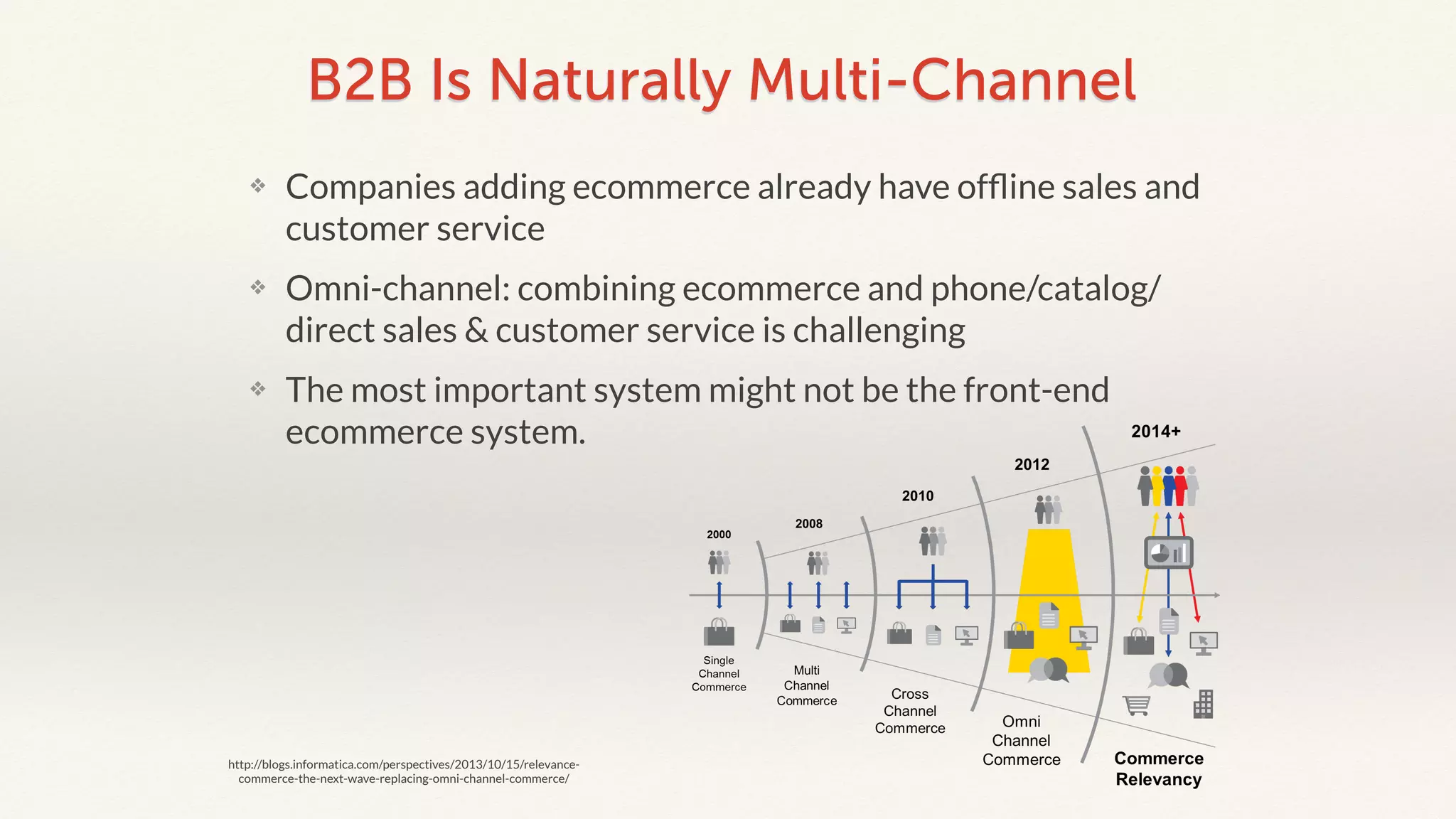
B2B Is Naturally Multi-Channel 
❖ Companies adding ecommerce already have offline sales and 
customer service 
❖ Omni-channel: combining ecommerce and phone/catalog/ 
direct sales & customer service is challenging 
❖ The most important system might not be the front-end 
ecommerce system. 
http://blogs.informatica.com/perspectives/2013/10/15/relevance-commerce- 
the-next-wave-replacing-omni-channel-commerce/
Purchasers Vs. Buyers 
❖ B2B sites can cater to purchasers. Most ecommerce 
platforms are setup for shoppers and buyers. 
❖ Looking to be educated, not inspired. 
❖ They know what they want. Purchasing is not a hobby like 
buying. 
❖ Make the experience efficient, get out of their way. 
❖ Show everything needed for a complete solution. 
❖ One session, less cross-device usage. 
❖ Provide robust cart with complete options 
❖ Price transparency: just the facts ma’am
Address Customer Workflows 
❖ Find a place to innovate all along the supply chain 
❖ Understand buyers unique requirements, limitations, 
regulations, cycles, reorder timelines, resell opportunities, tax 
implications, etc. 
❖ B2B checkout needs can be very particular, depending on the 
type of products, payment requirements, information gathered, 
etc. 
❖ Integrations to customer’s systems can be painful, but will 
result in very sticky relationships 
❖ Follow the money 
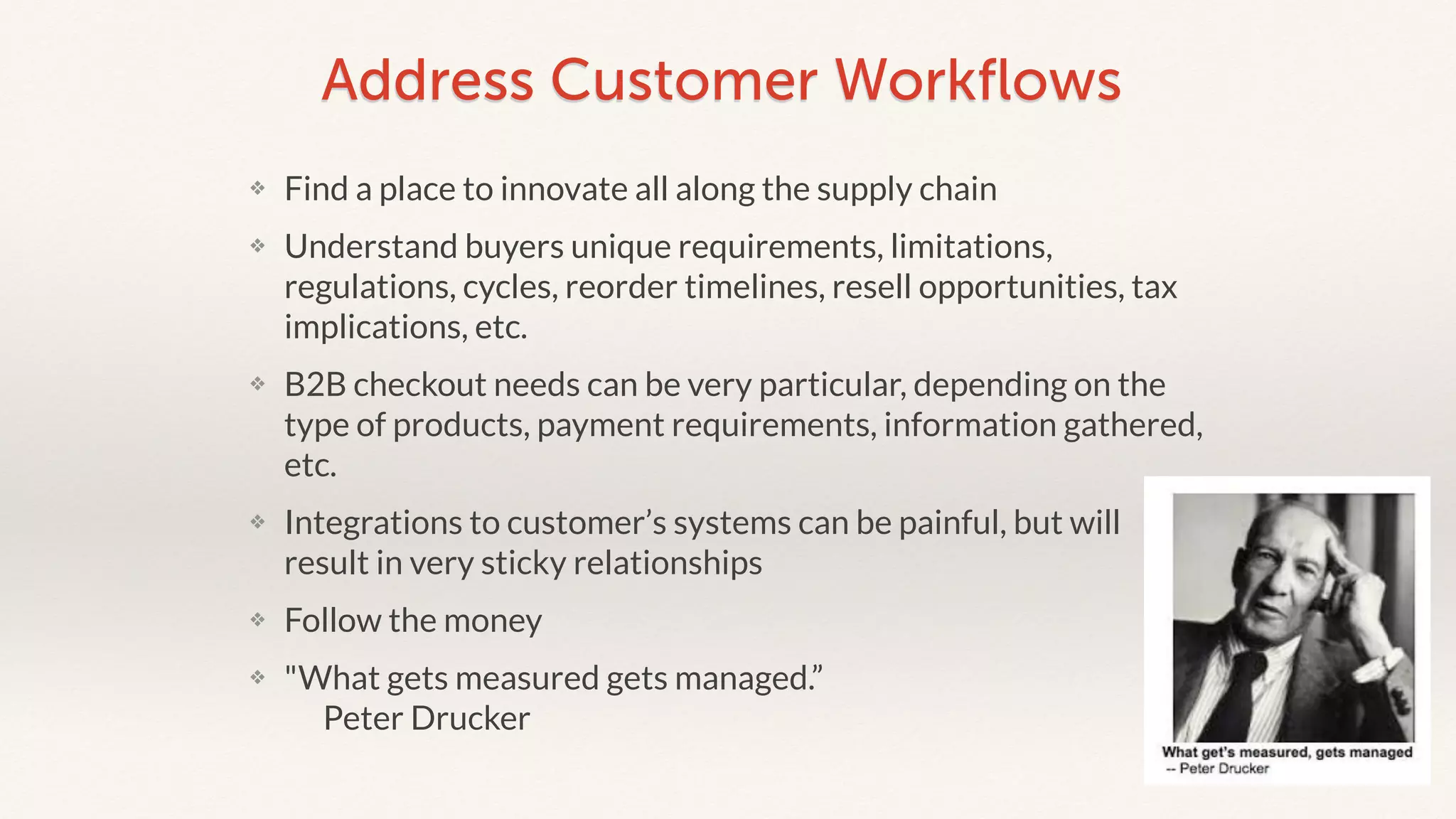
❖ "What gets measured gets managed.” 
Peter Drucker
B2B Ecommerce Technology 
❖ In the next 18 months, 49% of B2B eCommerce pros will 
change or upgrade their platform tech solution. 
❖ They expect to spend almost 7% of online sales on 
technology (licenses, fees, resources) in 2014. 
❖ Decisions 
• Re-platform, greenfield or integrate with existing systems? 
• Adapt off-the-shelf to your business? 
• On premise or SaaS? 
• Use something that integrates with ERP 
• Custom? 
Forrester: Q4 2013 Global B2B eCommerce Online Survey
Marketplaces 
❖ Amazon just launched services.amazon.com/selling-services 
❖ Staples announced Staples Exchange last week: suppliers can 
upload their products and receive orders through numerous 
Staples sites 
• 84% of their sales are from businesses. 77% sales from 
repeat customers. 
‣ Four51: connects suppliers and distributors to buyers 
through private and public purchasing sites 
‣ Challenges: how to get your product information ready
Important For B2C, Not As Much For B2B 
❖ Guest checkout 
❖ Related products 
❖ Product reviews (company reviews may be more 
appropriate) 
❖ Clever copy (tech specs and deep information is important, 
especially in sharable formats) 
❖ Mobile / responsive 
❖ “Modern” designs 
❖ Promotions that incentivize quick sales
B2B Purchasers Have Different Criteria 
❖ Not only WHAT they buy, but more importantly for 
designers of ecommerce, HOW they buy 
❖ Can I do my job easier on site A vs. site B? 
❖ Buy with the head, less with their heart (than B2C) 
❖ Design more about credibility and utility than beauty 
❖ Multiple decision makers 
❖ Desire to buy more from fewer vendors
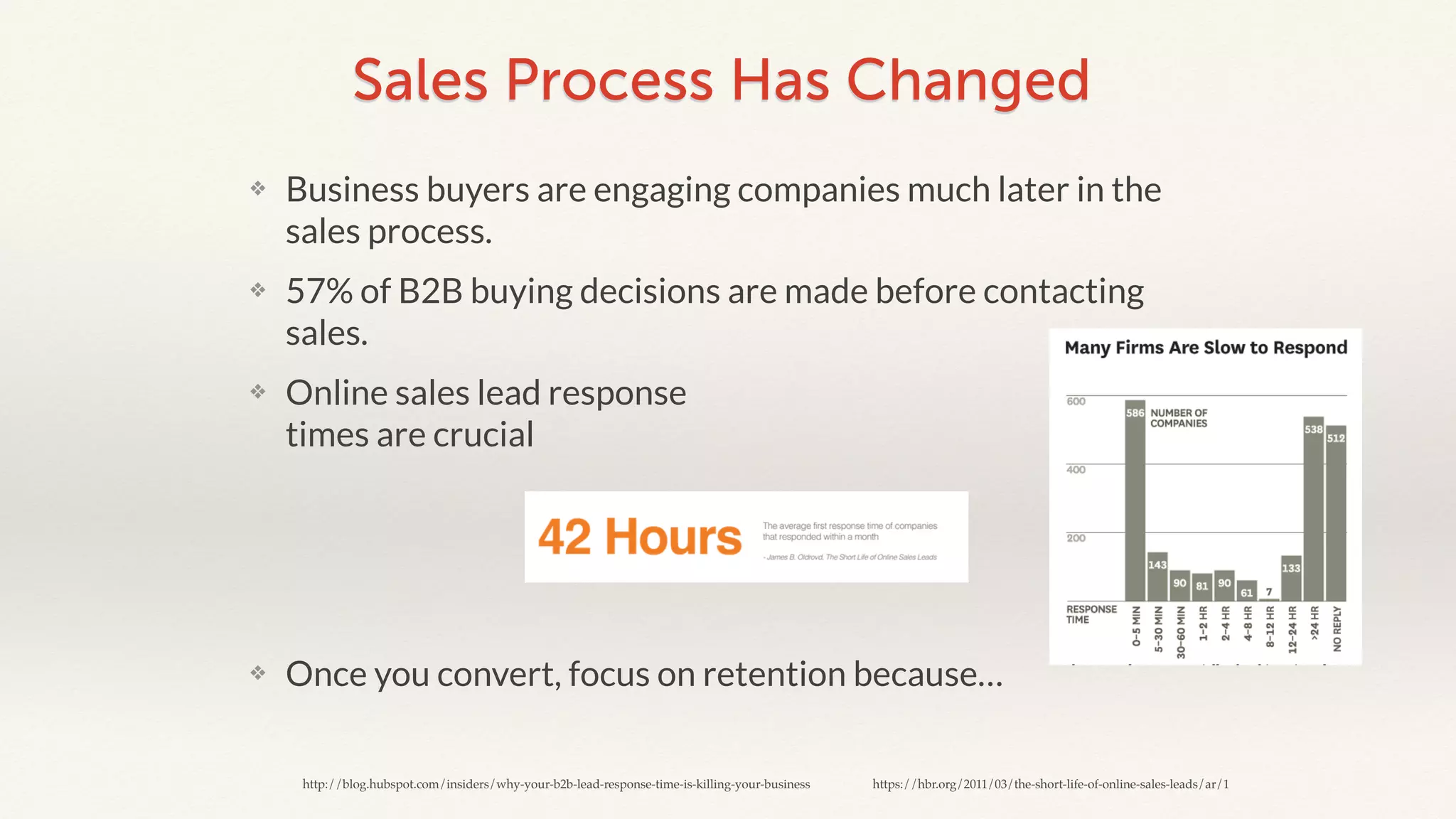
Sales Process Has Changed 
❖ Business buyers are engaging companies much later in the 
sales process. 
❖ 57% of B2B buying decisions are made before contacting 
sales. 
❖ Online sales lead response 
times are crucial 
❖ Once you convert, focus on retention because… 
https://hb http://blog.hubspot.com/insiders/why-your-b2b-lead-response-time-is-killing-your-business r.org/2011/03/the-short-life-of-online-sales-leads/ar/1
TLV & AOV FTW 
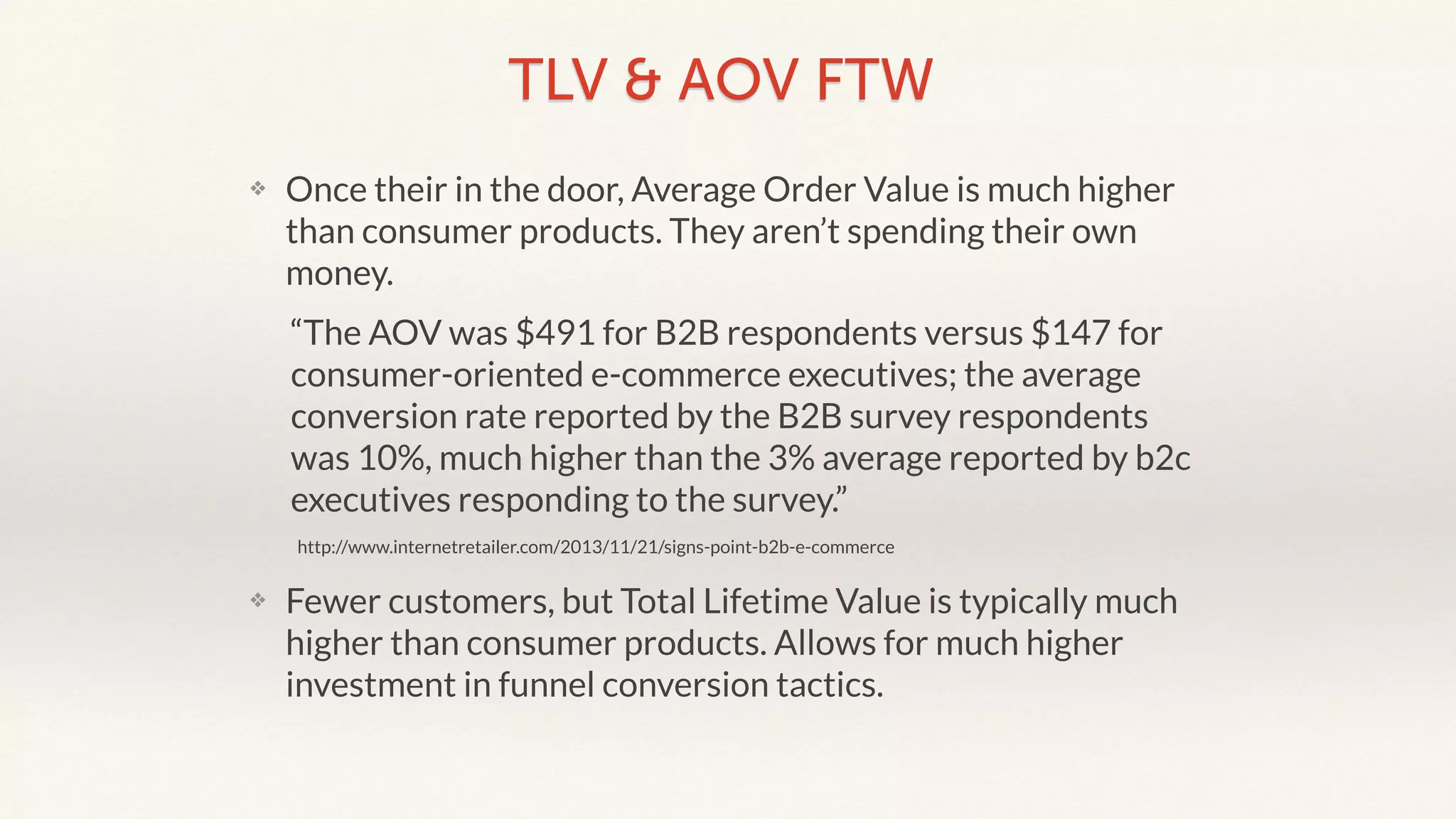
❖ Once their in the door, Average Order Value is much higher 
than consumer products. They aren’t spending their own 
money. 
“The AOV was $491 for B2B respondents versus $147 for 
consumer-oriented e-commerce executives; the average 
conversion rate reported by the B2B survey respondents 
was 10%, much higher than the 3% average reported by b2c 
executives responding to the survey.” 
http://www.internetretailer.com/2013/11/21/signs-point-b2b-e-commerce 
❖ Fewer customers, but Total Lifetime Value is typically much 
higher than consumer products. Allows for much higher 
investment in funnel conversion tactics.
Self Service 
❖ B2B POS = Point of Service 
❖ “83% of respondents see a supplier’s web site as the most popular 
channel for conducting research online, only 37% of procurement 
managers and other procurement professionals … are satisfied with 
the current level of information they find.” 
❖ “Procurement managers also want the freedom of researching 
purchases over the web at their discretion compared with a scheduled 
live sales call or visit. ‘Only 12% of buyers want to meet in person 
with a sales representa2ve,’ the report says. ‘Most respondents—71% 
—prefer to conduct research and purchase on their own with access 
to a sales representative via the phone or online chat when needed.’” 
https://www.internetretailer.com/2014/12/01/b2b-e-commerce-execs-need-beef-content 
❖ If you’re spending time and money on a “content marketing” that is 
exclusive to blogs and social, and leaving your product info stale, 
you’re missing the boat.
Take Aways 
❖ B2B ecommerce is appreciably different 
than B2C 
❖ Big, BIG opportunity for companies 
and professionals 
❖ Still early days 
❖ E-commerce is not cheap, requires investment in people, 
platforms and process 
❖ “Consumerization” of experience is important, but not to the 
exclusion of critical B2B features and integrations

Field Notes From Adventures in B2B eCommerce

  • 1.
    Field Notes From Adventures In B2B Ecommerce Scott DeToffol Director, eCommerce Navitor, Inc. Follow me on Twitter: @detoffol
  • 2.
    Let’s Get ThisOut Of The Way Show of hands: 1.E-commerce 2.Ecommerce 3.eCommerce 4.e commerce
  • 3.
  • 4.
    B2B > B2C “B2B online revenue already dwarfs that of B2C” "Business to business (B2B) online revenue is rapidly catching up business to consumer (B2C) e-commerce revenue, with B2B expected to reach $800 billion to $1 trillion in 2014" https://www.internetretailer.com/commentary/2014/09/25/b2b-e-commerce-b2c-world
  • 6.
    B2B Disruption InGood Company “Research and advisory firm Frost & Sullivan projects B2B e-commerce will hit $12 trillion worldwide by 2020 and says it was tops among up-­‐and-­‐coming industries in innova2on and market a4rac2veness.” 1. B2B Online Retail, 10.55 2. Big Data Analytics, 10.05 3. Internet of Things 9.6 4. Cloud computing, 9.6 5. Urban Logistics, 9.3 6. Waste to Energy, 8.95 7. Mobile Robotics, 8.7 8. Cyber Security, 8.25 9. 3D Printing, 7.95 10. Alternative Energy, 7.75
  • 7.
    Big Players ❖Amazon Supply. • Amazon job posting states "Our goal is to supply everything needed to rebuild civilization” ❖ Alibaba is expected to make a big play in the U.S. after largest IPO in the history ❖ Many top 50 ecommerce companies have significant B2B sales, some are strictly B2B: #3 Staples, #9 Office Depot, #11 CDW, #12 OfficeMax, #13 WW Grainger, #40 MSC Industrial Supply ❖ Manufacturers are going direct using ecommerce
  • 8.
    Distinction Without ADifference? ❖ “B2B needs to catch up to B2C” • Amazon like features ‣ Wish List & Recommended Products ‣ Prime Shipping? ‣ One-click to buy? ‣ Product Reviews? • Amazon like service ‣ 24x7 call centers? ‣ No question returns? ‣ Massive distribution? “This whole ecommerce movement, which started as a consumer movement, will be adopted by businesses big time. The distinction between B2B and B2C is going to die very soon,” IndiaMART and InterMESH co-founder Brijesh Agrawal
  • 9.
    Selling To BusinessComplexities ❖ Multiple users/roles per account ❖ Tiered accounts ❖ Multi-site ❖ Tax exempt ❖ Shipping addresses ❖ Customized Products and Orders ❖ Discounts, price tiers, custom pricing ❖ Quoting ❖ Wholesale / Resell ❖ Arrival times/dates, especially when products are part of another solution (just in time) ❖ Payment types, Purchase Orders ❖ Credit on Account ❖ Punchouts ❖ Approval workflows
  • 10.
    Don’t Settle For Being ‘As Good As’ B2C
  • 11.
    Why Ecommerce? ❖Address markets that you can’t reach today with traditional sales and service models. • Too expensive to sell and service small customers? • Geographical reach ❖ People are changing. They expect/prefer to gather information, make decisions and place orders without personal contact. ❖ Need to compete with new entrants who start with integrated systems and ecommerce. • Uber
  • 12.
    B2B Is NaturallyMulti-Channel ❖ Companies adding ecommerce already have offline sales and customer service ❖ Omni-channel: combining ecommerce and phone/catalog/ direct sales & customer service is challenging ❖ The most important system might not be the front-end ecommerce system. http://blogs.informatica.com/perspectives/2013/10/15/relevance-commerce- the-next-wave-replacing-omni-channel-commerce/
  • 13.
    Purchasers Vs. Buyers ❖ B2B sites can cater to purchasers. Most ecommerce platforms are setup for shoppers and buyers. ❖ Looking to be educated, not inspired. ❖ They know what they want. Purchasing is not a hobby like buying. ❖ Make the experience efficient, get out of their way. ❖ Show everything needed for a complete solution. ❖ One session, less cross-device usage. ❖ Provide robust cart with complete options ❖ Price transparency: just the facts ma’am
  • 14.
    Address Customer Workflows ❖ Find a place to innovate all along the supply chain ❖ Understand buyers unique requirements, limitations, regulations, cycles, reorder timelines, resell opportunities, tax implications, etc. ❖ B2B checkout needs can be very particular, depending on the type of products, payment requirements, information gathered, etc. ❖ Integrations to customer’s systems can be painful, but will result in very sticky relationships ❖ Follow the money ❖ "What gets measured gets managed.” Peter Drucker
  • 15.
    B2B Ecommerce Technology ❖ In the next 18 months, 49% of B2B eCommerce pros will change or upgrade their platform tech solution. ❖ They expect to spend almost 7% of online sales on technology (licenses, fees, resources) in 2014. ❖ Decisions • Re-platform, greenfield or integrate with existing systems? • Adapt off-the-shelf to your business? • On premise or SaaS? • Use something that integrates with ERP • Custom? Forrester: Q4 2013 Global B2B eCommerce Online Survey
  • 16.
    Marketplaces ❖ Amazonjust launched services.amazon.com/selling-services ❖ Staples announced Staples Exchange last week: suppliers can upload their products and receive orders through numerous Staples sites • 84% of their sales are from businesses. 77% sales from repeat customers. ‣ Four51: connects suppliers and distributors to buyers through private and public purchasing sites ‣ Challenges: how to get your product information ready
  • 17.
    Important For B2C,Not As Much For B2B ❖ Guest checkout ❖ Related products ❖ Product reviews (company reviews may be more appropriate) ❖ Clever copy (tech specs and deep information is important, especially in sharable formats) ❖ Mobile / responsive ❖ “Modern” designs ❖ Promotions that incentivize quick sales
  • 18.
    B2B Purchasers HaveDifferent Criteria ❖ Not only WHAT they buy, but more importantly for designers of ecommerce, HOW they buy ❖ Can I do my job easier on site A vs. site B? ❖ Buy with the head, less with their heart (than B2C) ❖ Design more about credibility and utility than beauty ❖ Multiple decision makers ❖ Desire to buy more from fewer vendors
  • 19.
    Sales Process HasChanged ❖ Business buyers are engaging companies much later in the sales process. ❖ 57% of B2B buying decisions are made before contacting sales. ❖ Online sales lead response times are crucial ❖ Once you convert, focus on retention because… https://hb http://blog.hubspot.com/insiders/why-your-b2b-lead-response-time-is-killing-your-business r.org/2011/03/the-short-life-of-online-sales-leads/ar/1
  • 20.
    TLV & AOVFTW ❖ Once their in the door, Average Order Value is much higher than consumer products. They aren’t spending their own money. “The AOV was $491 for B2B respondents versus $147 for consumer-oriented e-commerce executives; the average conversion rate reported by the B2B survey respondents was 10%, much higher than the 3% average reported by b2c executives responding to the survey.” http://www.internetretailer.com/2013/11/21/signs-point-b2b-e-commerce ❖ Fewer customers, but Total Lifetime Value is typically much higher than consumer products. Allows for much higher investment in funnel conversion tactics.
  • 21.
    Self Service ❖B2B POS = Point of Service ❖ “83% of respondents see a supplier’s web site as the most popular channel for conducting research online, only 37% of procurement managers and other procurement professionals … are satisfied with the current level of information they find.” ❖ “Procurement managers also want the freedom of researching purchases over the web at their discretion compared with a scheduled live sales call or visit. ‘Only 12% of buyers want to meet in person with a sales representa2ve,’ the report says. ‘Most respondents—71% —prefer to conduct research and purchase on their own with access to a sales representative via the phone or online chat when needed.’” https://www.internetretailer.com/2014/12/01/b2b-e-commerce-execs-need-beef-content ❖ If you’re spending time and money on a “content marketing” that is exclusive to blogs and social, and leaving your product info stale, you’re missing the boat.
  • 22.
    Take Aways ❖B2B ecommerce is appreciably different than B2C ❖ Big, BIG opportunity for companies and professionals ❖ Still early days ❖ E-commerce is not cheap, requires investment in people, platforms and process ❖ “Consumerization” of experience is important, but not to the exclusion of critical B2B features and integrations