Revisiting garden-based learning in basic education 
International Institute for Educational Planning www.unesco.org/iiep
Revisiting garden-based learning 
in basic education 
Daniel Desmond, James Grieshop, 
Aarti Subramaniam 
International Institute 
for Educational Planning 
Food and Agriculture 
Organization of the 
United Nations 
International Institute for Educational Planning www.unesco.org/iiep
The designations employed and the presentation of material in this information 
product do not imply the expression of any opinion whatsoever on the part of FAO, 
UNESCO or IIEP concerning the legal status of any country, territory, city or area or 
of its authorities, or concerning the delimitation of its frontiers or boundaries. 
All rights reserved. Reproduction and dissemination of material in this 
information product for educational or other non-commercial purposes are authorized 
without any prior written permission from the copyright holders provided the source 
is fully acknowledged. Reproduction of material in this information product for resale 
or other commercial purposes is prohibited without written permission of the 
copyright holders. Applications for such permission should be addressed to the 
Chief, Publishing Management Service, Information Division, FAO, Viale delle Terme 
di Caracalla, 00100 Rome, Italy or by e-mail to copyright@fao.org and to the Chief, 
Communication and Publications Unit, IIEP, 7-9 rue Eugène Delacroix, 75116 Paris, 
France or by e-mail to copyright@iiep.unesco.org. 
Published by: 
Food and Agriculture Organization International Institute 
of the United Nations for Educational Planning 
Viale delle Terme di Caracalla 7-9 rue Eugène Delacroix, 
00100 Rome, Italy 75116 Paris 
e-mail: sdre@fao.org e-mail: information@iiep.unesco.org 
FAO web site: http://www.fao.org IIEP web site: www.unesco.org/iiep 
Cover design: Nathalie Pruneau 
Cover photo: Lavinia Gasperini 
Composition: Linéale Production 
ISBN: 92-803-1251-0 
© FAO and UNESCO-IIEP 2004 
International Institute for Educational Planning www.unesco.org/iiep
5 
Acknowledgements 
This study, commissioned by the Food and Agriculture Organization of the 
United Nations (FAO) and the International Institute for Educational Planning 
(IIEP), was made possible through the collaboration of many organizations 
and individuals. Those who completed surveys and hosted case-study visits 
by authors spent many hours dissecting their programmes in an attempt to 
identify the roots of success and implications for education. Other contributors 
invested countless hours identifying resources, clarifying definitions, and 
reading drafts to ensure clarity of content and meaning. Thank you all for 
your time, energy and input. 
Contributors 
Survey / Case study contributors 
Petter Akerblom MOVIUM, Sweden 
Chelsea Chapman Edible Schoolyard at MLKing, Jr Middle 
School, California 
Henry Falan, Jim Stevenson Yap SEED, Micronesia 
Bonnie Freeman Santa Monica School Garden Program, 
California 
Joyce V. Hastings Treadlight Primary School, Jamaica 
Eileen Hiss-Corliss Santa Monica School Garden Program, 
California 
Sue Humphries Coombes County Infant and Nursery School, 
United Kingdom 
Frances Laurino Kitchen Garden at Collingwood College, 
Australia 
Alonzo Lucero Los Niños, Mexico 
Egidio Paez, ACTAF Havana, Cuba 
Arlene Marturano Summit Parkway Middle School and South 
Carolina GBL Network 
International Institute for Educational Planning www.unesco.org/iiep
Revisiting garden-based learning in basic education 
Jennifer Pearsall Cloud Forest School, Costa Rica 
Illene Pevec Escola Prof. Zelina Monteiro Lemos Elem, 
6 
School, Brazil A Child’s Garden of Peace, 
Brazil 
Grandview/U’UQINAK’UUH Elementary 
School, Canada 
Emelia Icart Hogar Castellana, Havana, Cuba 
A. Lavastida, 
Nastia Moreno Alvarado, 
Evaristo Rodriguez Ramirez Escuela 26 de Julio, Santiago de Cuba 
The Internado de Primaria ‘Abel 
Santamaria Cuadrado’, 
Caney, Santiago de Cuba 
Instituto Politécnico Agricola Jose 
Francisco Costa Velásquez, Mabay in 
Granma Province 
Escuela Especial ‘Ernesto Che Guevara’, 
Reparto Antonio Guiteras , Granma 
David Roschli, 
Solomon Negash, 
Chernet Yilefu Selam Technical and Vocational Center, 
Ethiopia 
Sunanda Sawant Indian Education Society’s Jawaharlal, 
Nehru Port Vidyalaya, India 
Katie Stinson, Fran Wagner Munich International School 
Kelli Wessman Garden of Learning, California 
Lisa Whittlesey National Junior Master Gardener Program, 
Texas 
Other contributors 
Zenobia Barlow Center for Ecoliteracy 
James Brenner University of California, ANR 
Margaret Aumann, 
Deborah Beall, 
Amy Evans, 
International Institute for Educational Planning www.unesco.org/iiep
Acknowledgements 
7 
Mary Lussier, 
Deborah Tammanie, California State Department 
Phoebe Tanner of Education Garden Team 
Rebecca Carver 4-H Youth Development Advisor, 
University of California 
Vijaya Chakravarty Landscape Designer and Educator 
Shauna Cozad School and Community Garden 
Consultant, University of California 
Jane Delgado Executive Director, Life Lab Science 
Program 
Kendall Dunnigan Coordinator for Ecological Agriculture, 
New College of California 
Marcia Eames-Sheavly Cornell University, Horticulture 
Department 
Richard Engel College of Agriculture and Environmental 
Science, 
University of California, Davis 
Lisa Glick Garden Educator/Consultant 
Abby Goldstein Graduate Student, 
University of California, Davis 
Tim Grant Green Teachers, Canada 
Gail Littlejohn, 
Carol Hillhouse Regional School Garden Resource Center, 
University of California, Davis 
Jean Landeen California State Department 
of Education 
Alex Markels Author/Reporter 
Fe Moncloa 4-H Youth Development Advisor, 
University of California 
Lori Nowell Education Coordinator, Carolina Children’s 
Garden 
Mary Ann Patterson American Horticultural Society 
Richard Ponzio 4-H Youth Development Specialist, 
University of California, Davis 
Laurette Rogers The Bay Institute 
International Institute for Educational Planning www.unesco.org/iiep
Revisiting garden-based learning in basic education 
Gina Sanguinetti Jamaica National Environment and 
8 
Planning Agency 
Jennifer Meux White University of California Botanical Garden 
Joan White National Gardening Association 
International Institute for Educational Planning www.unesco.org/iiep
9 
Foreword to the series 
Education for rural people is crucial to achieving both the Education for 
All (EFA) goals, and the Millennium Development Goals (MDGs) of 
eradicating extreme poverty and hunger, ensuring universal primary education 
by 2015, promoting gender equity and ensuring environmental sustainability. 
In 1996, the World Food Summit in Rome stressed increased access to 
education for the poor and members of disadvantaged groups, including rural 
people, as a key to achieving poverty eradication, food security, durable peace 
and sustainable development. The 2002 World Summit on Sustainable 
Development, held in Johannesburg, also emphasized the role of education. 
As the majority of the world’s poor, illiterate and undernourished live in 
rural areas, it is a major challenge to ensure their access to quality education. 
The lack of learning opportunities is both a cause and an effect of rural 
poverty. Hence, education and training strategies need to be integrated within 
all aspects of sustainable rural development, through plans of action that are 
multisectoral and interdisciplinary. This means creating new partnerships 
between people working in agriculture and rural development, and people 
working in education. 
To address this challenge, the Directors-General of FAO and UNESCO 
jointly launched the flagship programme on Education for rural people 
(ERP) in September 2002 (http://www.fao.org/sd/erp/), during the World 
Summit on Sustainable Development. This initiative involves an inter-agency 
approach to facilitate targeted and co-ordinated actions for education in rural 
areas. 
It is within this framework, and to provide inspiration for the flagship 
initiative, that the FAO’s Extension, Education and Communication Service 
and UNESCO’s International Institute for Educational Planning (IIEP) have 
jointly launched a series of publications. This series is co-ordinated and edited 
by David Atchoarena (IIEP) and Lavinia Gasperini (FAO). 
Gudmund Hernes Ester Zulberti 
Director, IIEP Chief, Extension, Education and 
Communication Service, FAO 
International Institute for Educational Planning www.unesco.org/iiep
11 
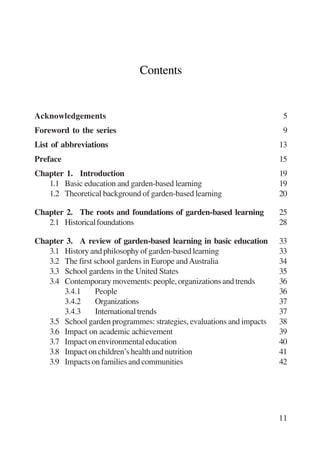
Contents 
Acknowledgements 5 
Foreword to the series 9 
List of abbreviations 13 
Preface 15 
Chapter 1. Introduction 19 
1.1 Basic education and garden-based learning 19 
1.2 Theoretical background of garden-based learning 20 
Chapter 2. The roots and foundations of garden-based learning 25 
2.1 Historical foundations 28 
Chapter 3. A review of garden-based learning in basic education 33 
3.1 History and philosophy of garden-based learning 33 
3.2 The first school gardens in Europe and Australia 34 
3.3 School gardens in the United States 35 
3.4 Contemporary movements: people, organizations and trends 36 
3.4.1 People 36 
3.4.2 Organizations 37 
3.4.3 International trends 37 
3.5 School garden programmes: strategies, evaluations and impacts 38 
3.6 Impact on academic achievement 39 
3.7 Impact on environmental education 40 
3.8 Impact on children’s health and nutrition 41 
3.9 Impacts on families and communities 42 
International Institute for Educational Planning www.unesco.org/iiep
Revisiting garden-based learning in basic education 
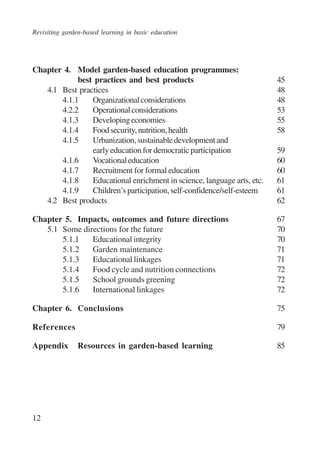
Chapter 4. Model garden-based education programmes: 
12 
best practices and best products 45 
4.1 Best practices 48 
4.1.1 Organizational considerations 48 
4.2.2 Operational considerations 53 
4.1.3 Developing economies 55 
4.1.4 Food security, nutrition, health 58 
4.1.5 Urbanization, sustainable development and 
early education for democratic participation 59 
4.1.6 Vocational education 60 
4.1.7 Recruitment for formal education 60 
4.1.8 Educational enrichment in science, language arts, etc. 61 
4.1.9 Children’s participation, self-confidence/self-esteem 61 
4.2 Best products 62 
Chapter 5. Impacts, outcomes and future directions 67 
5.1 Some directions for the future 70 
5.1.1 Educational integrity 70 
5.1.2 Garden maintenance 71 
5.1.3 Educational linkages 71 
5.1.4 Food cycle and nutrition connections 72 
5.1.5 School grounds greening 72 
5.1.6 International linkages 72 
Chapter 6. Conclusions 75 
References 79 
Appendix Resources in garden-based learning 85 
International Institute for Educational Planning www.unesco.org/iiep
13 
List of abbreviations 
ACTAF Cuban Association of Agriculture and Forestry Professionals 
AEE Association for Experiential Education 
AHS American Horticultural Society 
ANA Australian Natives Association 
ASCD Association for Supervision and Curriculum Development 
CDE California Department of Education 
CFAITC California Foundation for Agriculture in the Classroom 
ESRDF Ethiopian Social Rehabilitation and Development Fund 
FAO Food and Agriculture Organization of the United Nations 
FFA Future Farmers of America 
FLP Food, Land and People 
GBL Garden-based learning 
IPM Integrated Pest Management 
JMG Junior Master Gardener Program 
LLS Life Lab Science Program 
LTL Learning through Landscapes 
MHS Massachusetts Horticultural Society 
MOVIUM Center for the Urban Environment in Sweden 
NAAEE North American Association for Environmental Education 
NAS United States National Academy of Sciences 
NGA National Gardening Association 
PBL Project-based learning 
International Institute for Educational Planning www.unesco.org/iiep
Revisiting garden-based learning in basic education 
PDI Permaculture Drylands Institute 
SEER State Education and Environment Roundtable 
STVC Selam Technical and Vocational Center in Ethiopia 
UNICEF United Nations Children’s Fund 
WHO World Health Organization 
14 
International Institute for Educational Planning www.unesco.org/iiep
15 
Preface 
The connection between garden-based learning (GBL) and basic education 
at one level is easy and straightforward. It appears that any effort to combine 
garden work with basic learning should be logical and natural. But, as one 
digs deeper into the connection, particularly at a practical level, the union 
becomes more complicated. As you consider the multiple and sometimes 
contradictory expectations under which educators in all parts of the world 
must operate, it is quickly seen that to implement a GBL effort requires skill, 
resourcefulness, resources and persistence. Complicating the situation further 
is the question: “What constitutes garden-based learning?” 
One of the challenges of this study was defining the discipline or even 
the practice of GBL. There is, in fact, no single definition. In this study, GBL 
is defined by the practitioners, and this document hopefully serves as a tool 
to move all of us towards a better understanding of GBL and its potential 
contributions to basic education. Despite the challenges, the effort to connect 
GBL and basic education is well worth the effort. 
This document will review the theoretical/conceptual background of GBL 
as it seeks to provide insights into its role and effectiveness in education 
globally. There is no defined discipline of GBL but rather a collection of 
philosophies and practices that draw from a variety of fields. Much of the 
information presented here was collected from the industrialized world where 
research and communication are most accessible. 
However, with a look into some significant GBL programmes in developing 
economies, coupled with a review of its historical role, GBL appears to offer 
an effective strategy for basic education and sustainable development in any 
socio-economic setting. 
International Institute for Educational Planning www.unesco.org/iiep
Revisiting garden-based learning in basic education 
Methods 
16 
A mix of techniques and methods was used to gather the information on 
GBL and basic education. Attempts were made to systematically gather data 
and information from practitioners around the world. A triangulated approach 
was used and included the use of surveys, observations and information from 
literature and other secondary data sources. These techniques involved the 
development and distribution of a questionnaire sent to garden experts/ 
practitioners in both developing and developed countries.1 Over 
50 questionnaires were sent, carried, and/or e-mailed to identified experts/ 
practitioners in Central and Latin America, Asia, Africa, Australia, North 
America and Europe. While we had a relatively good return from respondents 
in the latter three continents, we were disappointed with the return from our 
identified experts in the other sites. We have no way of knowing if the 
questionnaires arrived at their destination, but we do know that we had a low 
response. One author (Daniel Desmond) also visited sites in Africa (Ethiopia), 
Canada and Europe, while another author (James Grieshop) gathered first-hand 
information on GBL and education in Cuba. In addition, the lead author 
has drawn upon his almost 30 years of work in GBL. In that time he has 
established many contacts in North America and Europe and has visited 
multiple sites. Lessons learned during that time are incorporated, as well as 
those noted by our other respondents. Finally, the ever-growing literature on 
gardening, schools, education and learning was a rich source of information 
and experience. 
This document is organized in a manner that takes the reader first to 
some fundamental definitions of basic education and GBL as used by the 
authors. Then it moves on to a description of how GBL is most often integrated 
within educational programming in both formal and non-formal settings 
(Chapter 1). The authors then review the evolution of the practice of GBL 
(Chapter 2) and summarize relevant literature (Chapter 3) in order to set the 
1. We use the terms ‘developing’ and ‘developed’ countries/economies only as a form of 
identification. Other terms such as ‘North’ and ‘South’, ‘Third World’ and ‘First World’, 
and ‘resource rich’ and ‘resource poor’ were considered. For ease of identification we 
chose the former. No implication is intended, nor any inference should be drawn that one 
is better than the other; we must communicate and learn from one another. 
International Institute for Educational Planning www.unesco.org/iiep
Preface 
stage for a review of current practices (Chapter 4) in developed and 
developing countries in several locations around the world. From the analysis 
of cases and related experience, the authors also suggest principles and best 
practices that seem to be common to successful GBL programmes. In addition, 
curricular and other ‘best products’ are detailed. In Chapter 5 of this work, 
results of these programmes are identified (impacts and outcomes) and an 
attempt is made to identify how GBL will continue to evolve within basic 
education and some of the unique needs (future directions). The Appendix 
gives a collection of information of resources, organizations, web sites, etc., 
that can be used to assist practitioners and researchers to continue to explore 
and improve the practice of GBL. 
This document is not a recipe or blueprint for creating a GBL programme. 
Such an objective is far outside the purposes or scope of this work. Rather, it 
is the wish of the authors that this manuscript will provide some ideas for 
creatively and productively linking garden-related work to learning and 
education. In addition, it is our aim that the document will energize practitioners 
and policy-makers to do more, to take action, and to support local and national 
efforts to make GBL a reality. 
17 
Good planting and harvesting! 
International Institute for Educational Planning www.unesco.org/iiep
19 
Chapter 1 
Introduction 
1.1 Basic education and garden-based learning 
In considering the role of GBL in basic education, it seems important to 
first explore some definitions and roles for both concepts. In many societies 
basic education is focused on developing academic skills or capacities 
(cognitive development) through a core curriculum that includes language 
arts, science, maths, social studies and visual/performing arts. In addition, 
we believe that most educators would agree that basic education also includes 
personal, moral and social development. In some cultures education is also 
called upon to provide vocational or subsistence training that allows the 
individual to provide food, clothing and shelter through employment or 
subsistence production. There may be another component of basic education 
that occurs in most cultures either in formal educational institutions or non-formal 
educational settings. This component is frequently referred to as life 
skill education and focuses on skills that allow children to be capable as well 
as competent. This aspect would include skills such as critical thinking, co-operation, 
community service, self-discipline and wise use of resources. In 
reality the concept of basic education is a continuum of educational practice 
that varies from community to community, is dependent on the interests of 
the community and on the various social and political forces (religion, cultural 
norms, and values) that dominate the cultural landscape. 
The approach to basic education offered by the World Conference on 
Education for All (2000) presents another insight into the world of teaching 
and learning. In the past ‘education’ has occasionally been misused as a tool 
for segregation and discrimination (for example, consider the role of education 
in colonial settings). Here, we believe it is critical to focus on a philosophy of 
equality as stressed by the United Nations and one that ensures equal rights 
for all, taking into account the unique needs and culture of each community. 
International Institute for Educational Planning www.unesco.org/iiep
Revisiting garden-based learning in basic education 
20 
GBL can be defined simply as an instructional strategy that utilizes a 
garden as a teaching tool. The pedagogy is based on experiential education, 
which is applied in the living laboratory of the garden. This simple definition, 
however, is misleading in that it does not take into account some of the 
powerful elements of the garden experience. It overlooks the relationship of 
these experiences to educational reform and to the transformation of 
contemporary basic education from a sedentary, sterile experience to one that 
is more engaging of the whole child. It also misses the elements of the garden 
experience that contribute to ecological literacy and sustainable development. 
Hopefully we have captured some of these subtler aspects of the practice in 
the discussion that follows. 
In our view GBL has the potential to enrich basic education in all cultural 
settings. The chapters that follow document the contributions in a number of 
communities around the world. In cases where it is most effective, GBL is a 
pedagogy that is used with all children. It has something to contribute to each 
learning style, and to children at each developmental level. It cannot be viewed 
as a ‘make work’ curriculum for slow learners or socially disenfranchised 
youth, although it has been shown to be a powerful tool in motivating and 
educating youth who have been identified with such labels. 
It is our intention to look at how GBL affects basic education in all of the 
realms mentioned above. By design and necessity, the review is not 
comprehensive. It is limited by the number of responses from practitioners 
and observations by the authors. Nevertheless, these responses and observations 
do help illustrate how the use of GBL can influence different aspects of basic 
education. This is not to suggest that all of the influences are positive, or that 
their impact is significant in all arenas. It is only to point out that the review 
will comment on the influence of GBL on aspects of basic education including 
academic skills, personal development, social and moral development, 
vocational and/or subsistence skills and life skills. 
1.2 Theoretical background of garden-based learning 
Theoretical and methodological approaches to GBL vary greatly across 
the educational landscape. However, the application of the pedagogy within 
International Institute for Educational Planning www.unesco.org/iiep
Introduction 
GBL falls principally under one of two frameworks: experiential education 
and/or environmental education. In theoretical terms GBL finds relevance in 
a number of contemporary educational theories including Howard Gardner’s 
(1983) theory on multiple intelligences, his work on the naturalist intelligence 
(Gardner, 1999), and Daniel Goldman’s (1995) theory of emotional intelligence. 
In addition, the theory of experiential learning as proposed by Kolb (1975, in 
Weatherford and Weatherford, 1987) supports much of GBL as experiential 
education. Two other theoretical approaches are also relevant to GBL – the 
theories about children’s environment proposed by Moore and Young (1978) 
and theories from various developmental psychologists (Tuan, 1978; Cobb, 
1969). 
Theories of intelligence such as Howard Gardner’s theory of multiple 
intelligences and Daniel Goleman’s conceptualization of emotional intelligence 
have contributed to the value of experiential education. They have been applied 
to work in developing linguistic, musical, logical-mathematical, spatial, bodily 
kinaesthetic and personal abilities, as well as emotional skills (Carver, 1998). 
Furthermore, Gardner re-framed his early theory of seven intelligences, making 
additions with one being naturalist intelligence. Intelligence is identified in 
reference to a socially recognized and valued role that appears to rely heavily 
on a particular intellectual capacity (Gardner, 1999). In this way a naturalist 
intelligence is characterized by a person’s ability to recognize and classify his/ 
her natural environment. Gardner claims that just as most children are ready 
to master language at an early age, so too are they predisposed to explore the 
world of nature. 
According to Kolb’s experiential learning model (Kolb, 1975, in 
Weatherford and Weatherford, 1987), concrete experience leads to 
observations and reflections that result in the formation of abstract concepts 
and generalizations of these concepts as well as the capacity to test the 
implications of these concepts in new situations. Piaget and other scientists 
have shown that a child’s understanding is developed through his actions on 
the environment and not merely through language. Another unique point about 
experiential education is that it is based on the intrinsic motivation of the 
learner. 
21 
International Institute for Educational Planning www.unesco.org/iiep
Revisiting garden-based learning in basic education 
22 
In a socio-ecological model of a child’s outdoor landscape (Moore and 
Young, 1978), it is theorized that a child lives simultaneously in three 
interdependent realms of experience. These three are the physiological-psychological 
environment of body/mind, the sociological environment of 
interpersonal relations and cultural values, and the physiographic landscape 
of spaces, objects, persons, and natural and built elements. The freedom of 
the outdoor environment serves as a balance to a child’s supervised indoor 
environment, resulting in vocational learning. 
Developmental psychologists have tried to study children’s relationships 
with nature and whether an innate sense of kinship with nature manifests 
itself by the time children reach a certain age (Tuan, 1978). Edith Cobb 
(1969) wrote that middle childhood, approximately from 5 to 6 years of age 
to 11 or 12 – that is the period between the “strivings of animal infancy and 
the storms of adolescence” – is when the “natural world is experienced in 
some highly evocative way”. Tuan (1978) additionally suggests that children 
have to be taught by adults about their natural environment, as “nature is an 
inarticulate teacher”. Children show a natural curiosity about the world, but 
this curiosity may be easily repressed if adults fail to nurture it. 
At a pedagogical level it is the approaches labelled ‘experiential education’ 
and ‘environmental education’ that are most relevant to GBL. There has 
been a significant growth in interest in experiential education and project-based 
learning (PBL) – as educators recognize the value of hands-on learning. 
In its simplest form experiential education is concisely described by the 
Association for Experiential Education (AEE, 2002) as “a process through 
which a learner constructs knowledge, skill and value from direct 
experiences”. PBL has been at the roots of effective education and was 
called for by early educational philosophers and practitioners. The current 
call to return to this pedagogy is prompted by research on children’s learning 
(Kandel and Hawkins, 1992) and by exemplary projects around the world 
that demonstrate the value of hands-on learning. The pre-schools of Reggio 
Emilia, Italy (Edwards et al., 1993), and models such as the Coombs Infant 
and Nursery School in the United Kingdom as studied by the Center for the 
Urban Environment in Sweden (MOVIUM), clearly demonstrate the unique 
contributions made by PBL. 
International Institute for Educational Planning www.unesco.org/iiep
Introduction 
While experiential education and PBL offer excellent strategies or 
pedagogies, they require a contextual framework or thematic structure in which 
to operate. Environmental education and more specifically GBL can provide 
that context or thematic focus. We will look at some examples of this when 
we examine a few programmes currently in operation around the world. 
Much of the activity in GBL is classified as environmental education. 
One definition of environmental education as proposed by the North American 
Association for Environmental Education (NAAEE, 2002) states: 
“... a process that aims to develop an environmentally literate citizenry 
that can compete in our global economy; has the skills, knowledge and 
inclinations to make well-informed choices; and exercises the rights and 
responsibilities of members of a community.” 
Ecological literacy is a holistic yet applied variation of environmental 
education. It has been defined as the understanding of the principles of 
organization that ecosystems have developed to sustain the web of life along 
with the skills to act on that understanding in one’s daily life to ensure sustainable 
communities that support all forms of life. 
Agricultural literacy and GBL can also be an example of agricultural 
education and a variant of environmental education. The United States National 
Academy of Sciences (NAS), in a 1989 report entitled Understanding 
agriculture – new directions for education, defined agricultural literacy 
“as education about agriculture and was to include a person’s understanding 
of the food and fiber system, its history and current economic, social and 
environmental significance.” This definition encompasses some knowledge 
of food and fibre production, processing and domestic and international 
marketing. 
Agricultural education, in turn, often infers a type of vocational education 
in agriculture which includes the development of the specific skills and 
knowledge necessary to become effectively employed in some aspect of the 
system of commerce that provides a society’s food and fibre. A developing 
country example in agricultural education can be seen at the elementary level 
in the Adopt a Garden programmes of the Selam Technical and Vocational 
23 
International Institute for Educational Planning www.unesco.org/iiep
Revisiting garden-based learning in basic education 
Center in Ethiopia (STVC). Here, the programmes seek to develop the 
necessary skills and knowledge in elementary and secondary students so 
that they can provide vegetables for the family diet. 
24 
Whether GBL occurs under the definition of environmental education, 
ecological literacy, agricultural literacy, or agricultural education, it appears to 
have the potential to contribute to basic education in both developed and 
developing world settings. The practice of GBL must consider rigorous 
guidelines, procedures and practices. For example, to be truly effective, GBL 
programmes must be tied to a comprehensive and cohesive educational plan/ 
programme or garden curriculum that is implemented across grade levels and 
ideally is tied to local, state or national education standards or needs. 
The literature suggests that GBL can be a unique and effective strategy 
to be used in basic education to introduce an experiential component in support 
of the traditional curriculum. It can also be used as an environmental education 
curriculum. As we later look at programmes that utilize GBL (Chapter 4), it 
will be seen that GBL has the potential not only to contribute to academic 
skills, but also to address a child’s development in a social, moral and practical 
or life skills sense. 
But what are the roots of GBL? Also, where lies the foundation for 
GBL? The next chapter provides some answers to those questions. 
International Institute for Educational Planning www.unesco.org/iiep
25 
Chapter 2 
The roots and foundations 
of garden-based learning 
“... educators will need to frame clear rationales for including 
gardening in an already full schedule of mandates.” (Marturano, 
1999) 
Arlene Marturano, educator and co-ordinator of South Carolina GBL 
Network, has written extensively about the philosophical roots of garden-based 
instruction. She has also addressed many of the practical challenges 
that teachers and educators throughout the world face as they attempt to 
combine GBL with all forms of education, including basic education. Those 
challenges may be as basic as developing schedules and times for GBL to 
finding resources such as shovels and seeds, and from issues of how to harvest 
the products of a garden to finding the financial resources needed. 
She also reminds all of us who seek to practise GBL that we must strive 
to understand its philosophical roots, to learn from the past and to appreciate 
the historical foundations of GBL. Those from the past might not be able to 
teach us, but their words should give us pause to think about GBL and its 
potential. Box 1 highlights the thoughts of a mix of GBL philosophers. Take a 
moment to read and reflect on their ideas. 
More contemporary educators and public figures also speak of the value 
of garden-based instruction. For example, Delaine Eastin, former California 
State Superintendent of Schools, as she launched a major effort in 1995 to 
encourage “a garden in every school”, articulated a set of principles or values 
that apply world wide: 
International Institute for Educational Planning www.unesco.org/iiep
Revisiting garden-based learning in basic education 
• Gardens can create opportunities for children to discover fresh food, 
26 
make healthier food choices and become better nourished. 
• Gardens offer dynamic settings in which to integrate every discipline 
including science and maths, language arts, history and social studies, 
and art. 
• Young people can experience deeper understandings of natural systems 
and become better stewards of the earth. 
• School garden projects nurture community spirit and provide numerous 
opportunities to build bridges among students, school staff, families, local 
businesses, and community based organizations. 
• Links with school gardens, school food service programmes, and local 
farms can ensure a fresh nutritious diet for children while teaching about 
sustainable food systems. 
Box 1. Some thoughts on garden-based learning 
Comenius: “[For every school] there should be a garden attached where 
they [students] may feast their eyes on trees, flowers, and plants 
... where they always hope to hear and see something new. Since 
the senses are the most trusty servants of the memory, this method 
[gardens] of sensuous perception will lead to the permanent 
retention of knowledge.” (Comenius, 1967) 
Rousseau: “... since everything that enters into human understanding comes 
through the senses, the first reason of man is a reason of the 
senses. Our first masters of knowledge are our feet, our hands, 
and our eyes.” (Rousseau, 1956) 
Pestalozzi: “Students observe first all of the objects in the classroom, 
observing and naming everything. When this is exhausted, they 
are taken into the garden, into the fields, and woods – where they 
are led to notice objects in greater detail, their permanent and 
changeable qualities, the qualities that are general and those that 
are peculiar to them, their influence, their function, their destiny.” 
(Green, 1969) 
International Institute for Educational Planning www.unesco.org/iiep
The roots and foundations of garden-based learning 
Froebel: “The pupil will get the clearest insight into the character of things, 
of nature and surroundings, if he sees and studies them in their 
natural connection ... the objects that are in closest and most 
constant connection with him, that owe their being to him ... these 
are the things of his nearest surroundings ... the garden, the farm, 
the meadow, the field, the forest, the plain ... Instruction should 
proceed from the nearest and known to the less near and less 
known.” (Froebel, 1826) 
Dewey: “Where schools are equipped with gardens ... opportunities exist 
for reproducing situations of life, and for acquiring and applying 
information and ideas in carrying forward of progressive 
experiences. Gardening need not be taught either for the sake of 
preparing future gardeners, or as an agreeable way of passing 
time. It affords an avenue of approach to [the] knowledge of the 
place farming and horticulture have had in the history of the 
human race and which they occupy in present social organization. 
Carried on in an environment educationally controlled, they 
[gardens] are a means for making a study of the facts of growth, 
the chemistry of soil, the role of light, air, moisture, injurious and 
helpful animal life, etc. There is nothing in the elementary study 
of botany, which cannot be introduced in a vital way in connection 
with caring for the growth of seeds. Instead of a subject belonging 
to a peculiar study called ‘botany,’ it will then belong to life, and 
will find, moreover, its natural correlation with the facts of soil, 
animal life, and human relations ... It is pertinent to note that in 
the history of man, the sciences grew gradually out of useful 
social occupations.” (Dewey, 1944) 
Montessori: “When he [student] knows that the life of the plants that have 
been sown depends upon his care in watering them ... without 
which the little plant dries up, ... the child becomes vigilant, as 
one who is beginning to feel a mission in life.” (Montessori, 1912) 
27 
International Institute for Educational Planning www.unesco.org/iiep
Revisiting garden-based learning in basic education 
28 
While the advice and principles provided by these historical and 
contemporary figures is relevant to other forms of experiential and/or 
environmental education, the garden may be the most basic and sophisticated 
model for such learning. 
2.1 Historical foundations 
Although the history of children’s gardens and GBL in the United States 
from the 1890s to the present is well documented, a similar history of school 
gardens in other parts of the world, and through earlier civilizations, is less 
well documented.2 
Elizabeth Meyer (1997), in a paper entitled Cultivating change – an 
historical overview of the school garden movement, describes the early school 
garden movements, which had their origins in Europe. Meyer discusses the 
Austrian book The school garden, by Erasmus Schwabb, published in 1879 
and translated into English by Horace Mann. This publication illustrates much 
of the early motivation for GBL in Europe. An actual timeline of the early 
development of school gardens in Europe and the Unites States has been 
presented by Kendall Dunnigan (1999) who, following Meyer’s accounts, 
traces gardening in schools from the late 1800s in Europe through to 1997, at 
which time a National Gardening Association (NGA) survey found that over 
3.6 million youth in the United States were gardening in school programmes. 
Dunnigan points out that in 1869, Austrian law mandated a garden in every 
rural school. By 1898 there were 18,000 school gardens in Austria and 
Hungary, and by 1905 over 100,000 school gardens in Europe. Thomas Bassett 
(Bassett, 1979) also documented the early history of school gardens in North 
America. Bassett notes that many American educators were impressed by the 
use of school gardens for nature study in Germany, Sweden and Austria, and 
promoted adoption of the school garden concept. Bassett elaborately describes 
the school garden movement in the United States, including a description of 
the “school garden par excellence” (Greene, 1910) with illustrations from 
school gardens in Canada and the United States. 
2. Hopefully that history will receive a boost from the publication of this study. Other 
studies in the planning stages, such as that of the NGA in the United States will add new 
knowledge and insights to the history and evolution of GBL. 
International Institute for Educational Planning www.unesco.org/iiep
The roots and foundations of garden-based learning 
What is important here is not the chronology of this movement but the 
historical underlying motivations that led educators, parents and public officials 
to embrace the garden as an effective learning environment. An equally 
important question we must address is why this rich early history in GBL did 
not become mainstreamed into the educational curriculum of schools. We 
summarize the motivations here, drawing on the studies previously mentioned, 
along with an article by Brian Trelstad (1997), entitled Little machines in 
their gardens: a history of school gardens in America, 1891 to 1920. He and 
other authors in turn draw from important names in education, child 
development and psychology, such as Dewey, Kilpatrick and Cuban. In addition 
the voice of well-known landscape architects and designers such as Francis 
(1995) and Moore (1995) are drawn upon to offer commentary on garden 
designs appropriate to enrich the learning experience. 
Those who have studied the history of the school garden movement and 
GBL draw a strong connection to the ongoing cycle of educational reform 
(Meyer, 1997). In the United States the school garden movement reached its 
highest points in the following eras and in response to specific reform efforts: 
• Early twentieth century (1900-1930s): progressive education and social 
29 
reform movements encourage GBL. 
• Mid-twentieth century (1960-1970): counter culture and environmental 
movements create a resurgence in school and community gardens. 
• Late twentieth century (1990-2000): rebirth of progressive education 
coupled with renewed interest in environmental education and nutrition/ 
health issues for children. 
There has also always been a vocational and practical side to GBL. 
That aspect of the practice has not shown the cyclical swings seen in the 
more academic settings. In this case, using the garden to teach basic vocational 
skills in plant science, horticulture, agriculture, and environmental science has 
continued virtually uninterrupted in a variety of formal and non-formal 
educational settings. Those settings include such diverse ones as Pioneros in 
Cuba, 4-H and Future Farmers of America (FFA) in the United States, and 
the Adopt a Garden programme at the STVC in Ethiopia. GBL as an informal 
educational practice also occurs throughout the world as communities and 
International Institute for Educational Planning www.unesco.org/iiep
Revisiting garden-based learning in basic education 
families teach succeeding generations to garden as a source of food, fibre, 
and medicinal/social products. 
30 
In addition, as Meyer (1997) states, school gardens were seen as settings 
that “create a sense of community, instil concern for the environment, foster 
a connection with nature, and help students to develop self-confidence, 
discipline, skills in co-operation, and multi-cultural understanding.” 
In summary, from a historical perspective we see that GBL has been 
viewed as contributing to all aspects of basic education, including academic 
skills, personal development, social development, moral development, 
vocational and/or subsistence skills, and life skills. In each era the lure of 
GBL in basic education was premised on its facilitation of educational strategies 
that are universally accepted as valid, if not essential, pedagogical approaches 
to meaningful learning. While certainly related, these concepts – learn-by-doing, 
PBL, real world learning, child-centred learning – clearly focus on 
engaging the learner as the central figure in educational experience and in 
allowing individual and social constructivism. 
If, as these authors suggest, GBL can have a significant positive influence 
in basic education, why has the pedagogy not become institutionalized in the 
educational mainstream? There are several possible explanations. 
One is that the pedagogy has not been critically examined and endorsed 
by educational researchers and practitioners. A second is that there is no 
developed discipline in GBL that makes the connection to PBL, effective 
experiential education, and advancement in academic performance. Related 
to that shortcoming is the lack of infrastructure support for school gardens or 
related GBL efforts. Finally, there is often no local strategy to sustain the 
physical plant of the garden site as a permanent part of the school or programme 
facility. While school athletic facilities often receive significant school and 
community investment there are few examples of similar support in the fields 
of environmental education or GBL. There are significant exceptions to these 
shortcomings, notably programmes such as the Life Lab Science Program 
(LLS) in California, the Junior Master Gardener Program (JMG) out of Texas 
A&M University, and the work of Marcia Eames-Sheavly at Cornell University 
on school garden sustainability. Despite these excellent efforts, a larger 
International Institute for Educational Planning www.unesco.org/iiep
The roots and foundations of garden-based learning 
national and global initiative is necessary to institutionalize the practice in the 
educational mainstream. Major horticulture organizations such as the NGA 
and American Horticultural Society (AHS) are addressing these concerns, 
and hopefully will encourage the partnership of major educational institutions 
such as the Association for Supervision and Curriculum Development (ASCD) 
and other major educational research organizations. 
The history of GBL and its relationship to basic education as represented 
here clearly has a Western bias, and there is a need to look at the history of 
this pedagogy in other cultural settings. The publication of this document by 
IIEP/FAO could contribute to the identification of additional resources to help 
tell the story of GBL globally. 
31 
International Institute for Educational Planning www.unesco.org/iiep
33 
Chapter 3 
A review of garden-based learning 
in basic education 
“... to open the child’s mind to his natural existence, develop his 
sense of responsibility and of self dependence, train him to respect 
the resources of the earth, teach him the obligations of citizenship, 
interest him sympathetically in the occupations of men, touch his 
relation to human life in general, and touch his imagination with 
the spiritual forces of the world.” (Bailey, 1909) 
These early twentieth-century words were expressed with the aim of 
nature study in mind. It can be seen that the idea of incorporating the natural 
outdoors as an integral part of the child’s educational curriculum is not new. 
The philosophy behind garden-based education is actually an amalgamation 
of the philosophies behind experiential education, ecological literacy and 
environmental awareness, and agricultural literacy. In other words, it involves 
teaching children by a method where they learn through personal discovery, 
teaching them in a natural setting where they learn ecological principles that 
govern all life and inculcate an awareness of the physical environment, and 
developing in them a sense of connectedness with their land, and all that 
grows on it. Tracing back these thoughts to their propagators we find some of 
the most prominent philosophers and leaders in the field of education espousing 
their views on experiential and environmental education as well as agricultural 
literacy, subsequently steering the course of school gardens to its present 
status. 
3.1 History and philosophy of garden-based learning 
As far back as the seventeenth century, John Ames Comenius (1592- 
1670) believed that education should be universal, optimistic, practical and 
International Institute for Educational Planning www.unesco.org/iiep
Revisiting garden-based learning in basic education 
innovative, and should focus not only on school and family life but also on 
general social life. He stated: “A school garden should be connected with 
every school, where children can have the opportunity for leisurely gazing 
upon trees, flowers and herbs, and are taught to appreciate them” (Weed, 
1909, cited in Sealy, 2001). A hundred years later, Jean-Jacques Rousseau 
(1712-1771) described the defect of teaching a child ‘about’ things rather 
than the things themselves. He stated: “You think you are teaching what the 
world is like; he is only learning the map.” Rousseau emphasized the importance 
of nature in education, stating that nature was the child’s greatest teacher and 
that “his knowledge of the natural world serves as a foundation for his later 
learning” (cited in Sealy, 2001). Rousseau’s teachings were adopted by Heinrich 
Pestalozzi (1746-1827) who spoke of observation and activity in learning 
rather than learning mere words. Pestalozzi started his school after working 
with 25 orphans using gardening, farming, and home skills as practical 
education. He visualized the balance between the three elements: hands, 
heart and head. Friedrich Froebel (1782-1852) who studied Pestalozzi’s 
fundamental principles, went a step further to emphasize ‘doing’ as well as 
observing in such a way that is not merely mechanical, but rather incorporates 
the creative energies of the child such that the child is “elevated to productive 
activity in the full sense of the word” (Froebel web online, 1998). Froebel 
was one of the most effective proponents of school gardens in the nineteenth 
century (Sealy, 2001). 
3.2 The first school gardens in Europe and Australia 
34 
In 1811 Prussia developed the first compulsory school system that 
included gardening, and in 1869 school gardens became a law. Erasmus 
Schwab, who was hired to enforce this law, published The public school 
garden in 1871 emphasizing that the natural sciences and agricultural and 
vocational sciences could be learned in the garden (Sealy, 2001). New 
educational theories swept the world around the turn of the century and the 
kindergarten movement developed by Froebel started to spread quickly around 
Europe. The schoolchild was no longer considered an “information receptacle” 
but rather a “growing flower” (Robin, 2001). In Australia, the school garden 
movement was strongly influenced by the annual School Garden Conference 
in 1903, sponsored by the Australian Natives Association (ANA). This led to 
International Institute for Educational Planning www.unesco.org/iiep
A review of garden-based learning in basic education 
the propagation of school gardens in the early decades of the twentieth century; 
these were viewed as ideal for integration with the educational curriculum 
and for incorporating the standards of “progressive conservation” with its 
concerns for the responsible stewardship of nature as well as the ideas about 
connections between nature, hard work and moral improvement (Robin, 
2001). 
3.3 School gardens in the United States 
In the United States gardens were first introduced in urban schools as 
aesthetic and educational rather than practical (Sealy, 2001). School gardens 
were thus not intended to create gardeners and farmers. The Massachusetts 
Horticultural Society (MHS) was instrumental in providing educators with a 
background for teaching gardening in schools. In 1891 Henry Lincoln Clapp 
was sent to Europe to study school gardens and on his return he installed the 
first school garden in America at George Putnam School in Roxbury, 
Massachusetts. John Dewey (1915) referred to the reorganization of rural 
schools and the utilization of agriculture in education in the early part of the 
twentieth century, as a “movement towards greater freedom and an 
identification of the child’s school life with his environment and outlook”. 
Maria Montessori (1870-1952) also spoke of “first the education of the senses, 
then the education of the intellect”. She believed that a garden could help 
children in their moral development and appreciation of nature. Van Evrie 
Kilpatrick, who was hired as Director of the School Garden Association of 
New York wrote: “School gardens should be maintained by the city, the city 
owes it to the children whom it has deprived of breathing places and beauty 
spots through want of foresight” (cited in Sealy, 2001). Youth gardening had 
become a national movement, and by 1918 every state in America and every 
province in Canada had at least one school garden (Sealy, 2001). In 1916, 
over 1 million students contributed to the production of food during the war 
effort, following the proclamation by President Woodrow Wilson. However, 
the educational value of school gardens diminished and waned after the First 
World War and their brief resurgence during the Second World War (by the 
growing of Victory Gardens) declined after 1944. Playgrounds and athletic 
fields took over garden plots and schools became more focused on technology 
(Sealy, 2001). 
35 
International Institute for Educational Planning www.unesco.org/iiep
Revisiting garden-based learning in basic education 
36 
The second wave of school gardens in the United States occurred between 
1964 and 1975 as an offshoot of the educational reform strategy for the ‘war 
on poverty’ (Meyer, 1997, cited in Yamamoto, 2000). With the birth of the 
environmental movement, public concern for the environment led to the 
conception of school gardens as a progressive, interactive educational link for 
children to understand and connect with ‘life processes’ and environmental 
understanding. However, school gardens did not gain firm roots in public 
education, weakened by the conservatism of the 1980s (Yamamoto, 2000). 
In the early 1990s there were changes in the trend of education towards 
more innovative ways of learning. The focus on experiential and environmental 
education came together with the interest in agricultural literacy, making this 
decade ripe for school gardens to spread and grow. 
3.4 Contemporary movements: people, organizations and trends 
3.4.1 People 
The contemporary impetus to the school garden movement in the United 
States is largely influenced by the thoughts of educators, environmentalists, 
and agricultural reformists. In 1995, California’s State School Superintendent 
Delaine Eastin mandated “a garden in every school” to “create opportunities 
for our children to discover fresh food, make healthier food choices, and 
become better nourished”. Though this aim has not been fully realized, Eastin’s 
vision gave impetus to the development of gardens in other states as well. 
With regard to the value of outdoor experience on child development, 
David Orr, author of Earth in mind (1994) and Ecological literacy (1992), 
states that children raised in ecologically barren settings are deprived of the 
sensory stimuli and the kind of imaginative experience that can only come 
from biological richness. Robin Moore (1995) suggests that children’s gardening 
can be introduced within the broader frame of reference of sustainable 
development, regenerative design, and bio-design. He argues that children, 
the future consumers and participants of democracy, must interact daily with 
an educational environment containing a diversity of living ecosystems. 
Gardening in the primary grades is “the most feasible” pedagogical approach 
International Institute for Educational Planning www.unesco.org/iiep
A review of garden-based learning in basic education 
for ensuring this type of daily learning experience as well as for “reversing a 
worrisome trend” in the opposite direction. 
Alice Waters, a prominent figure in the school garden and organic 
agricultural movement, as well as the founder of ‘The Edible Schoolyard’ in 
Berkeley, California, believes that having a garden for food production at 
schools will teach compassion, patience and self-discipline. The Edible 
Schoolyard reflects this belief as a model in the education of social responsibility, 
community participation, and sustainable agriculture. The programme involves 
students in all aspects of farming a 1-acre garden, including preparing, serving 
and eating the food harvested. 
3.4.2 Organizations 
One organization that has been especially significant in propagating the 
school garden movement is the AHS that hosts the Children’s Garden 
Conference series. AHS is one of the oldest NGAs in the United States. In 
1993 AHS created the first Youth Garden Symposium in order to educate 
and inspire people to look at garden design as an attempt to reconnect children 
with nature. Another such organization is the NGA that has taken an active 
role in children’s gardening activities and offers resources for starting and 
maintaining children’s gardens in schools. 
3.4.3 International trends 
As one considers trends around the globe, Learning through Landscapes 
(LTL) is noteworthy. LTL is an organization in the United Kingdom that has 
attempted to move school grounds to the top of the educational agenda. Bill 
Lucas, describing the goals of LTL, states that a school garden is as important 
for urban as for rural schools, “helping to bring about a better understanding 
between town and country”, and a “keen power of observation in all things 
alive”. LTL recognizes the importance of gardening by which children gain 
first-hand experience with the seed-to-seed cycle; the joy of the harvest; the 
taste, touch and smell of fruit, vegetables and flowers. 
37 
International Institute for Educational Planning www.unesco.org/iiep
Revisiting garden-based learning in basic education 
38 
In African schools there has been little curricular emphasis in practical 
skills (Horst et al., 1995). However, the scenario is gradually changing with 
gardens being the main elements in Niger’s new educational policy and in 
Sierra Leone where up to 80 per cent of all schools have hands-on gardening 
classes. After gardening in schools, children are more likely to help their 
parents farm at home, eager to show them what they have learned. This 
develops prestige for farming in the minds of children. 
In Bolivia, the Schoolyard Ecology programme conducted by Audubon, 
an organization committed to ecological conservation, uses the schoolyard as 
an extension of the classroom. In this hands-on laboratory, children learn 
about their physical and biological surroundings through exercises that also 
allow them to develop basic academic skills. This form of education is clearly 
setting a new trend as opposed to the standard curriculum of rote recitation of 
multiplication and vocabulary. 
3.5 School garden programmes: 
strategies, evaluations and impacts 
GBL programmes have gained popularity across the international 
educational landscape and there are innumerable programmes in both formal 
as well as informal education with myriad strategies and impacts. Much of the 
literature on garden-based programmes, however, has focused on practical 
approaches for starting and managing school gardens. Proponents of children’s 
garden programmes talk of the multiple developmental benefits that school 
gardens can have on children – namely, emotional, aesthetic and even spiritual, 
in addition to the more obvious social and intellectual benefits. 
Priscilla Logan, educational consultant and permaculture instructor from 
Santa Fe, New Mexico, in The why, what and how’s of outdoor classrooms in 
Branching out, the newsletter for Permaculture Drylands Institute (PDI), 
listed four reasons for using gardens as a teaching method (Sealy, 2001): 
• High retention rate: When children work in gardens, 90 per cent of 
their experience is classified as ‘hands-on’. In a study conducted by 
Bethel Learning Institute on student retention, it was found that learning 
by doing produced 75 per cent retention rate and 90 per cent retention 
International Institute for Educational Planning www.unesco.org/iiep
A review of garden-based learning in basic education 
rate if the student teaches another student, as opposed to 11 per cent for 
lectures. 
• Empowerment: A connection to the earth gives students a sense of 
39 
achievement and motivation. 
• Academics: Science, maths, social studies, art, language and any other 
subject can be taught as life skills using nature as the learning laboratory, 
making these concepts more meaningful. 
• Teamwork: Facilitating co-operation and communication in a real-world 
setting rather than a classroom, makes learning teamwork possible, as 
does the class goal of a successful garden become more significant than 
individual achievement. 
The Nutrition Education and Training Section of the California Department 
of Education (CDE) states five ways in which garden-enhanced nutrition 
education could contribute (Sealy, 2001). These five are (a) building bridges 
between school and community; (b) promoting the transfer of information 
from one generation to another; (c) developing environmental awareness in 
students by caring for a living environment; (d) providing opportunities for 
cultural exchange; and (e) building life skills. 
The developmental impacts of school gardens have, however, been difficult 
to evaluate, and hence there are only few evaluations made in this area. The 
literature ranges from subjective accounts about the importance of gardens 
in the form of self-reports, parents’ and teachers’ observations, as well as 
more empirical assessments of the impact of gardens. 
3.6 Impact on academic achievement 
One well-evaluated study on experiential education has been reported in 
Closing the achievement gap: using the environment as an integrative context 
for learning (Lieberman and Hoody, 1998). Here, the State Education and 
Environment Roundtable (SEER), consisting of 12 state education agencies, 
sought to identify successful environment-based educational programmes and 
conduct evaluations in various domains. The 40 successful programmes that 
use the EIC design share the basic educational strategies of a multidisciplinary 
approach, hands-on learning experience, problem-solving, team teaching, 
individualized design, and an emphasis on developing knowledge, understanding 
International Institute for Educational Planning www.unesco.org/iiep
Revisiting garden-based learning in basic education 
and appreciation for the environment. The documented impacts of the 
programmes were found to be: (a) better performance on standardized 
achievement tests of reading, writing, maths, social studies and science; (b) 
reduced classroom management and discipline problems; (c) increased 
attention and enthusiasm for learning; and (d) greater pride and ownership of 
accomplishments. 
40 
Programmes such as Life Lab have created garden-based projects for 
learning science and connecting it to all areas of learning. Their mission has 
been to encourage respect for life and the environment, an appreciation and 
understanding of ecological systems, and to create an environmental 
stewardship towards a goal of a sustainable future. The LASERS programme, 
a Monterey Bay Science Project (Stoddart et al., 1999), aims to educate 
teachers in the use of a constructivist, inquiry based approach to the teaching 
of science and language. Most of the partnership schools use the Life Lab 
science-based curriculum and are carried out in a classroom grow lab or a 
school garden. Analyses of the data from the previous seven years of LASERS’ 
activities indicate that students who have been with LASERS-trained teachers 
for two consecutive years grow at a faster rate in language and maths when 
compared to students who have not been taught by LASERS-trained teachers. 
3.7 Impact on environmental education 
GBL has been especially beneficial in environmental education (or 
ecological literacy) as well as in teaching scientific concepts. According to the 
North Carolina Environmental Education Plan (1995), hands-on experiences 
are the best way for students to develop an understanding of their complex 
world and their place in it. The Down-to-Earth programme aims to provide 
this kind of learning with the help of school gardens as a knowledge building 
tool (Williamson and Smoak, 1999). The main purpose of the Down-to-Earth 
programme is to introduce youth to sustainable agriculture and environmental 
education using the scientific method as a conceptual and hands-on learning 
process that stresses critical thinking, reasoning and problem-solving. Youth 
educators thus draw on rich mixture of multidisciplinary topics such as 
agriculture, natural resources, environmental management, health and human 
safety, and horticulture. The impact of the Down-to-Earth programme has 
been seen through increased knowledge of scientific methods, plants, fertilizer 
International Institute for Educational Planning www.unesco.org/iiep
A review of garden-based learning in basic education 
and pests, as well as positive attitudinal and behavioural changes, increased 
awareness and facilitation of higher order thinking processes. 
With similar goals of achieving an interdisciplinary approach to 
environmental education, Project Green incorporates the school garden and 
gardening activity into all disciplines, including maths, science, English, history, 
social studies, and art (Skelly and Zajiceck, 1998). An evaluation of the project 
comparing experimental and control groups found that children in the 
experimental group who participated in the garden programme, had more 
positive environmental attitudes, with second graders showing higher scores 
than fourth graders. More specifically, it was found that the more out-door 
related activities a child experienced, the more positive environmental score 
they recorded. 
3.8 Impact on children’s health and nutrition 
School gardens have been used to teach children about nutrition and 
how to make healthier food choices (Lineberger and Zajiceck, 2000). In a 
garden project called Nutrition in the Garden, teachers were guided to integrate 
nutrition education as it relates to fruits and vegetables. Evaluations of students 
participating in the programme showed that their attitudes towards fruit and 
vegetables had become more favourable, and they were also more likely to 
choose fruit or vegetables as snacks than before they participated in the 
gardening programme. 
In a garden project with similar goals described by Irene Canaris, the 
impacts of the garden have led to more benefits than the original aim of 
improving nutrition and nutritional awareness in children (Canaris, 1995). 
The gardening activities enhanced the quality and meaningfulness of their 
learning on a wider level, with children communicating with their communities 
and parents as well as learning mathematical and scientific principles in the 
garden. 
41 
International Institute for Educational Planning www.unesco.org/iiep
Revisiting garden-based learning in basic education 
3.9 Impacts on families and communities 
42 
The Evergreen Elementary School in West Sacramento, California, 
offered small garden plots to families who were non-English-speaking 
immigrants, primarily from Hmong and Mien cultures, who rarely participated 
in their children’s activities. A demonstration garden grew vegetables and 
other plants familiar to the Hmong and Mien participants, thus encouraging 
participation by the parents. This project raised the self-esteem of the children 
as well as the non-English-speaking parents who were then valued as 
teachers. 
Hands-on involvement in children’s designing, creating, caring for, and 
using school nature areas can help improve children’s academic performance 
as well as inculcate the willingness and capacity to work for the communities 
of which they are a part (Bell, 2001). Anne Bell also states that teachers are 
gaining an appreciation for the potential of school ground projects that integrate 
disciplines, produce tangible outcomes and encourage children to build ties 
with their communities. ‘Lived experience’ motivates students and shapes 
their learning in lasting and personally significant ways. 
The Master Gardener Classroom Garden Project provides inner-city 
children in the San Antonio Independent School District with an experiential 
way of learning about horticulture, gardening, themselves and their relationships 
with their peers (Alexander, North and Hendren, 1995). The gardens are used 
as part of the curriculum as well as a reward for hard work during the day. An 
evaluation of the benefits of this project was conducted by collecting data in 
the form of qualitative interviews of second and third graders as well as 
parents, teachers, a master gardener and a school principal. These interviews 
indicate that there were many positive effects of working in the garden. 
According to the researchers, the children had received lessons in moral 
development, enhanced their daily academic curriculum, gained pleasure from 
watching the products of their labour flourish, and had a chance to increase 
interactions with their parents and other adults. In addition, the children learned 
the value of living things, plus the anger and frustration that occurs when 
things of value are harmed out of neglect or violence. 
International Institute for Educational Planning www.unesco.org/iiep
A review of garden-based learning in basic education 
The literature presented here reinforces the value of the idea of 
connecting nature with each child’s educational curriculum and learning. We 
began this chapter with that idea quoting from Liberty Hyde Bailey, a late 
nineteenth-century United States advocate of gardens for children. We close 
the chapter with a similar idea found in a quote by a nineteenth-century 
contemporary of Bailey. Jose Martí, the nineteenth-century Cuban 
revolutionary, expressed a similar idea – to connect nature with a child’s 
education and learning activities – quite simply: 
43 
“Y detras de cada escuela un taller agricola ... 
donde cada estudiante sembrase un arbol.” 
[And behind every school is found a garden ... 
where every student plants a tree.] 
(Martí, n.d., Cuba, on the cover 
of a Cuban student garden journal) 
International Institute for Educational Planning www.unesco.org/iiep
45 
Chapter 4 
Model garden-based education programmes: 
best practices and best products 
During the course of this study several individual programmes were identified for 
a close review of how GBL was being used within the framework of basic 
education. The location of those programmes around the world is shown in 
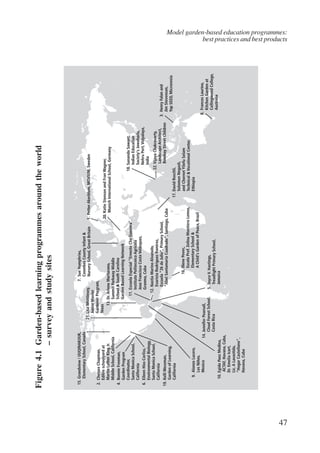
Figure 4.1 and they are listed in the Appendix. They cover a cross-section of 
developmental stages and represent a variety of approaches to incorporating a 
garden within the educational curriculum of the school or programme. Many of 
the case studies were completed using a standard survey format. In the text that 
follows, we examine the responses from selected sections of those surveys. 
These surveys, coupled with recent site visits and years of observation of the 
GBL movement, form the background for the later discussions of best practices 
and products, impacts, outcomes and future directions. 
In attempting to gather information for this document a survey was 
developed and sent to representatives of garden programmes in schools and 
community settings around the world. This survey was coupled with site 
visits by the authors and interviews via e-mail and telephone. The response to 
mailed surveys sent to developing economies was small despite strategies to 
facilitate a response. Gathering information in the developing world is challenging 
and a comprehensive study would require time and resources beyond the 
scope of this document. We do feel, however, that the insights we did gain 
allow us to make some generalizations about the practice of GBL world wide. 
In addition to the case-study sites listed, there are a number of sites across 
the United States and around the world that serve as major models of GBL on a 
broader scale or in a niche sense. These include the 4-H Children’s Garden at 
Michigan State University; the Carolina Children’s Garden; the Life Lab Garden 
at the University of California, Santa Cruz; Adopt a Garden programme at the 
STVC in Ethiopia; the Spiral Garden in Toronto; the Cuban Association of 
International Institute for Educational Planning www.unesco.org/iiep
Revisiting garden-based learning in basic education 
Agriculture and Forestry Professionals (ACTAF) and other garden sites in Cuba; 
and a variety of other programmes that use the garden as a classroom, teaching 
tool, curriculum, and/or a food and fibre source. In some cases these gardens are 
also used for therapy, creative inspiration, motivation, and thoughtful reflection – 
rare commodities in the formal education systems of many developed countries. 
46 
An analysis of the case-study sites listed above combined with historical 
observations of GBL and a review of the literature resulted in the identification 
of a set of ‘core uses’ for GBL. These ‘core uses’ are identified within the 
context of formal education as well as in a broader community context. The 
analysis also resulted in the identification of a set of critical ‘best practices 
and products’ which can serve as an agenda for action in organizing an 
effective GBL programme. These practices and products are at one level 
essential to an effective and sustainable programme and at a deeper level 
hold the key to strengthening basic education in any setting, whether it be in 
rural eastern Africa or inner New York City. Finally, GBL offers one effective 
strategy for implementing the educational reforms identified over the ages 
but implemented in only rare pilot programmes and seldom mainstreamed. 
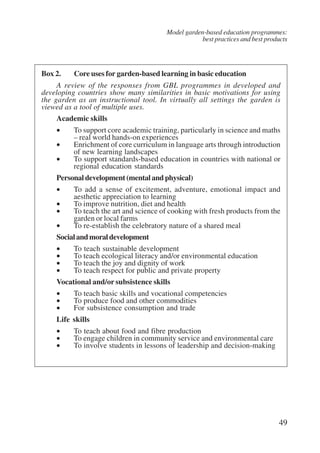
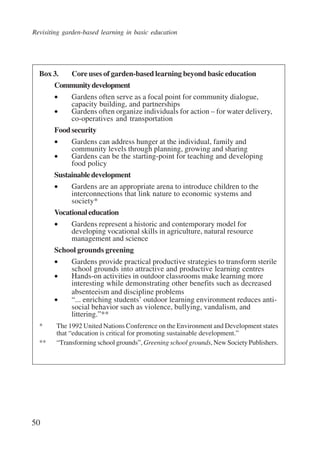
The ‘core uses’ are summarized in Boxes 2 and 3 with a few descriptors 
of how the use may be applied within and beyond basic education. 
It may be useful to consider the way GBL is used in the context of the 
broader society, outside the classroom. It seems clear that this practice makes 
contributions beyond those of basic education, and it may be that the 
contributions outside formal education are equally important to the growth 
and development of a healthy society. 
GBL is a very diverse practice, one that cannot be prescribed but must 
be adapted for each school/community setting. The ‘best practices’ we 
describe here are key elements that should be considered in any setting and 
adopted as appropriate. They were collected from schools and garden 
programmes around the world and reflect ideas for developed and developing 
economies. The ‘best products’ (see later) provide detailed and concrete 
samples of how these practices can be implemented and present ideas and 
examples of methodology, scope and sequence in curricula planning, unit/ 
lesson plans and ideas for scheduling within the school calendar. 
International Institute for Educational Planning www.unesco.org/iiep
Model garden-based education programmes: 
best practices and best products 
47 
Figure 4.1 Garden-based learning programmes around the world 
– survey and study sites 
International Institute for Educational Planning www.unesco.org/iiep
Revisiting garden-based learning in basic education 
4.1 Best practices 
48 
The review of model programmes in developed and developing economies 
has provided some important insights into the practice of GBL. The lessons 
learned point to a collection of best practices in two arenas. The first and 
most important arena involves organizational considerations that must be 
addressed initially before the curriculum is identified and a garden setting is 
considered. The second arena involves operational considerations. These are 
the practices essential for effective, sustainable implementation of the garden 
experience. 
4.1.1 Organizational considerations 
The first step in the establishment of effective programmes in GBL is 
the development of an understanding, appreciation and acceptance of the 
pedagogy. For educators, administrators and parents this requires an 
introduction to the philosophy and history of GBL along with an explanation 
of how this fits into effective contemporary education. It is also important to 
point out the fact that GBL can allow for the implementation of many of the 
educational reforms called for today. We have provided a discussion of these 
elements in the early chapters of this document. If this step is successful what 
will follow is a long-term commitment of support for the effort. The next step 
is the detailed planning, with an emphasis on developing a significant connection 
with the community, and a plan that is focused on long-term sustainability of 
the site and curriculum. The final organizational step is the curriculum selection 
or development. 
International Institute for Educational Planning www.unesco.org/iiep
Model garden-based education programmes: 
best practices and best products 
49 
Box 2. Core uses for garden-based learning in basic education 
A review of the responses from GBL programmes in developed and 
developing countries show many similarities in basic motivations for using 
the garden as an instructional tool. In virtually all settings the garden is 
viewed as a tool of multiple uses. 
Academic skills 
• To support core academic training, particularly in science and maths 
– real world hands-on experiences 
• Enrichment of core curriculum in language arts through introduction 
of new learning landscapes 
• To support standards-based education in countries with national or 
regional education standards 
Personal development (mental and physical) 
• To add a sense of excitement, adventure, emotional impact and 
aesthetic appreciation to learning 
• To improve nutrition, diet and health 
• To teach the art and science of cooking with fresh products from the 
garden or local farms 
• To re-establish the celebratory nature of a shared meal 
Social and moral development 
• To teach sustainable development 
• To teach ecological literacy and/or environmental education 
• To teach the joy and dignity of work 
• To teach respect for public and private property 
Vocational and/or subsistence skills 
• To teach basic skills and vocational competencies 
• To produce food and other commodities 
• For subsistence consumption and trade 
Life skills 
• To teach about food and fibre production 
• To engage children in community service and environmental care 
• To involve students in lessons of leadership and decision-making 
International Institute for Educational Planning www.unesco.org/iiep
Revisiting garden-based learning in basic education 
Box 3. Core uses of garden-based learning beyond basic education 
50 
Community development 
• Gardens often serve as a focal point for community dialogue, 
capacity building, and partnerships 
• Gardens often organize individuals for action – for water delivery, 
co-operatives and transportation 
Food security 
• Gardens can address hunger at the individual, family and 
community levels through planning, growing and sharing 
• Gardens can be the starting-point for teaching and developing 
food policy 
Sustainable development 
• Gardens are an appropriate arena to introduce children to the 
interconnections that link nature to economic systems and 
society* 
Vocational education 
• Gardens represent a historic and contemporary model for 
developing vocational skills in agriculture, natural resource 
management and science 
School grounds greening 
• Gardens provide practical productive strategies to transform sterile 
school grounds into attractive and productive learning centres 
• Hands-on activities in outdoor classrooms make learning more 
interesting while demonstrating other benefits such as decreased 
absenteeism and discipline problems 
• “... enriching students’ outdoor learning environment reduces anti-social 
behavior such as violence, bullying, vandalism, and 
littering.”** 
* The 1992 United Nations Conference on the Environment and Development states 
that “education is critical for promoting sustainable development.” 
** “Transforming school grounds”, Greening school grounds, New Society Publishers. 
International Institute for Educational Planning www.unesco.org/iiep
Model garden-based education programmes: 
best practices and best products 
Practitioners must begin with strategic planning for short (three to five-year) 
and long (five to 10-year) horizons. These plans must include a vision, 
mission, core values and strategic statement of how GBL fits into the overall 
instructional strategy of the school or programme. Does it meet the school 
and community expectations for producing competent and capable youth? 
Does it meet other broader community goals related to food security, 
environmental preservation or restoration, and vocational training? The core 
values of the programme must be articulated and should include concepts 
such as: learn by doing, hands-on instruction, child centred and student directed 
(participatory democracy), inquiry based, gender equity, inclusive, etc. Another 
core value that is evident in the educational philosophy of Cuba is that they 
identify education about the natural world and food as one of the requirements 
to creating a truly ‘cultured child’. 
The planning must also specify a realistic annual operating plan which 
should include a budget and realistic goals in terms of academic performance, 
student attitudes, leadership development and community engagement. The 
plan must address sustainability and strategies for start-up. Marcia Eames- 
Sheavly (1999) at Cornell University has captured some of the best thinking 
along these lines in the publication entitled Sowing the seeds of success. In 
California, the Center for Ecoliteracy also produces an excellent publication 
for creating school gardens as outdoor classrooms. Their publication Getting 
started talks about many of the guiding principles we outline above: garden 
purpose, administrators, connecting to the classroom, theme gardens, 
community involvement, a student-centred environment, etc. 
The plan is best developed with the involvement of school administrators, 
community leaders, parents, and students. This engagement is critical. It 
ensures understanding, recognition and support of GBL as an appropriate and 
necessary element of basic education. It also ensures that these stakeholders 
understand and can articulate the importance of this pedagogical approach. 
Without this level of understanding and support throughout the educational 
community, the practice cannot be mainstreamed into the educational 
bureaucracy and will have a short timeline of sustainability, despite short-term 
51 
success. 
International Institute for Educational Planning www.unesco.org/iiep
Revisiting garden-based learning in basic education 
52 
Once the planning is completed (or concurrently if staff, time and energy 
permit) attention can turn to curriculum considerations. One of the first 
decisions in this arena is whether GBL will be integrated into all core subjects 
using thematic instruction or some other integration strategy. If this is not the 
case, then the GBL instruction must become one of the core subjects, such as 
science, environmental education, or a core garden class that addresses content 
standards at various grade levels. There are successful examples of both 
approaches and the local planning team described above must make the final 
decision on what approach is most effective in their setting. Other important 
considerations for the curriculum include ensuring a high degree of organization, 
while remaining flexible and not dependent on a teacher with a high degree of 
garden knowledge. 
Another curriculum consideration that appeared important was the use 
of real-life learning in which authentic learning experiences are provided. One 
example of this would be teaching based on the food cycle where children are 
directly involved: (a) planting and/or growing a living organism; (b) use of a 
growing medium (soil, water, range land, etc.); (c) stewardship of plants and/ 
or animals, harvesting of crops or products; (d) productive use or consumption 
of products, recycling of by-products; and (e) extensions to different levels of 
plant production in the community (nurseries, farms, forests, etc.). The 
curriculum must adhere to the core values identified in the planning process 
and must also identify its own additional values. Those that seem important in 
case studies are activities that include a sense of fun and adventure, engaging 
all senses, and using garden technology that is appropriate and sustainable 
(an example of which is the non-mechanical drip irrigation used in Adopt a 
Garden programmes in Ethiopia). 
In the developed world, and to a lesser extent the developing economies, 
the experiential learning cycle seems to be the curriculum strategy of choice 
for GBL. This is where students are allowed to construct their own knowledge 
through research, discussion, exploration and application. The application phase 
of this cycle may occur in the school or community, but is most powerful 
when students apply what they have learned in the family home and/or 
community. This offers one of the great opportunities for developing economies 
where children can apply what they have learned about growing food and 
good nutrition in their own backyards. This was the strategy employed by the 
International Institute for Educational Planning www.unesco.org/iiep
Model garden-based education programmes: 
best practices and best products 
Land-Grant Universities in the United States as they attempted to bring about 
earlier adaptation of agricultural innovations. In the developing world there is 
still a reliance on the more didactic system on lecture and drill. One of the 
repeated warnings in the literature about the effective use of GBL is that it 
cannot be a forced add-on, practised on an occasional or seasonal basis, but 
instead must be developed through a thoughtful process, and included on a 
daily basis. Robin Moore at North Carolina State University states that 
“... children (future consumers and participants in democracy) must interact 
daily with an educational environment containing a diversity of living 
ecosystems. Gardening in the primary grades is proposed as one of the most 
feasible pedagogical approaches for ensuring this type of daily learning 
experience ...”. 
4.1.2 Operational considerations 
Once organizational considerations are addressed then attention turns to 
operational details that include issues such as the physical site, teaching 
strategies, community connections, food-system linkages and school grounds 
greening. 
One of the first operational considerations is the growing medium of the 
garden. The size and scale must be appropriate to the curriculum or learning 
objectives. There is considerable variability in practice with regard to garden 
size. Some suggest that a large-scale garden (e.g. half acre or one-fifth 
hectare) is best. Others suggest that container gardening or raised beds can 
have the same impact as the larger garden experience. In our view gardening 
in the earth, exposed to the natural environment, with a garden plan that 
allows multiple plant species, is probably the best model. However, raised 
beds, container gardens or indoor ‘grow-labs’ provide valuable practical 
alternatives when other options are not available. In the ideal world the garden 
space would also include a complete horticultural environment, including native 
plants, fruit trees, vegetables, traditional medicinal and/or ceremonial plants 
and fibre plants. A question that must be answered early in garden development 
is: “Will the garden be organic, IPM (integrated pest management) or 
conventional?” Most school gardens attempt to manage the garden without 
the use of synthetic pesticides or herbicides. They do, however, often use 
53 
International Institute for Educational Planning www.unesco.org/iiep
Revisiting garden-based learning in basic education 
synthetic fertilizers in combination with compost. In working with children 
and volunteers, the safest alternative is probably organic. In settings where 
there is a large student body working the garden, as at Selam in Ethiopia, a 
labour-intensive organic system of gardening seems most appropriate. Related 
to garden scope and scale are the concepts of composting and crop rotation. 
When size and scale permit, composting is always a powerful learning 
experience which closes the loop of the food cycle or growing cycle. Crop 
rotation also teaches a collection of scientific concepts in one simple activity. 
54 
A second operational consideration is the identification of effective 
teaching strategies. This is closely related to curriculum but has more to do 
with day-to-day pedagogical practices in the garden. An initial strategy here is 
to involve the designation of children as garden co-ordinators (working with 
adult mentors or coaches) who manage the garden and products from the 
garden. At Selam, in Ethiopia, this practice engages children in a form of 
vocational education as they manage large garden tracts, oversee the processing 
of significant harvests and prepare the products for consumption in two 
restaurants open to the public on the school grounds. Another successful 
teaching strategy involves active engagement of the students in the garden on 
a daily basis. The educational experience also appears richest when students 
plan, plant, harvest, and prepare a meal or snack from the garden. In non-food 
gardens some other activity can replace the food preparation (e.g. flower 
arrangement, wood gathering, etc.). 
There exists a large collection of unique operational teaching strategies 
for GBL from around the world. Ideas that weave drama into the garden 
through the use of food, or insect puppets, music (recordings from the Banana 
Slug Band in California), and plays or skits are some examples. Other teachers 
use theme gardens which focus on student identified themes, such as insects 
(butterflies), food (pizza or bread), historical or cultural gardens. 
While the practice of GBL is evolving, there is no formal pre-service 
education for prospective teachers. A considerable amount of in-service 
instruction is provided in developing economies through organizations such as 
Evergreen (Canada), LTL (United Kingdom), AHS and NGA (United States). 
International Institute for Educational Planning www.unesco.org/iiep
Model garden-based education programmes: 
best practices and best products 
4.1.3 Developing economies 
Much is to be learned about best practices from sites throughout the 
world. Consequently, we were interested in the lessons to be learned from 
those who practise GBL in developing countries. In exploring GBL in 
developing economies, we looked at programmes in Brazil, Costa Rica, Cuba, 
Ethiopia, India, Jamaica, Mexico and Micronesia. In general the programmes 
reflect the challenges faced by other facets of education and industry within 
these communities, such as the lack of adequate physical resources and shortage 
of technical expertise. Both conditions could be significantly addressed by 
linking GBL efforts in the developed and developing world. Despite these 
challenges there are amazing examples of GBL occurring in developing 
economies. It is informative to mention a number of exemplary programmes. 
In Ethiopia, the STVC in Addis Ababa has one of the best GBL 
programmes we have seen. Elementary and high-school students are engaged 
in on-site gardening. Selam also provides training and technical materials and 
support for other schools interested in garden development. The goals are 
focused on food production, vocational training, and environmental education, 
but staff also see an increase in self-confidence and self-worth of the students. 
At the STVC, students use garden products in two on-site restaurants open 
to the public. One restaurant features traditional Ethiopian cuisine and the 
other an international menu. Students are thus involved in all aspects of the 
food cycle from production through consumption and on to recycling. This is 
clearly a model that could contribute ideas to the movement in developed 
countries, and especially California, where there is a trend towards using 
GBL to teach the entire food cycle. 
Cuba is a country where education is highly valued and where GBL is a 
part of the culture. In the words of one Cuban educator, the goal of Cuban 
education is “to create the most cultured children in the world”. The definition 
of ‘cultured’ here includes an understanding and appreciation of the food 
cycle and its importance to the family, community, and country. Children and 
others who work in the school gardens are seen both as a means to achieve 
food security, and recipients of knowledge important to being a well-educated 
person. Among the values central to the school gardens is that students should 
55 
International Institute for Educational Planning www.unesco.org/iiep
Revisiting garden-based learning in basic education 
learn and work. Expressed in another way: Aprender con la mente y con 
las manos [Learn both with the mind and hands]. In cases where schools do 
not have adequate space for gardens, students will travel to nearby community 
gardens that serve as sites in which these children can learn and work. 
56 
Youth Pioneros (or Pioneers) are a key component to Cuban education. 
This is the out-of-school, non-formal programme to which a remarkable number 
of children (2 million) continue through secondary school. The Pioneros 
programmes are also operated at camps where students learn about nature, 
ecology and agriculture. In every case the garden is used as a learning/work 
site and is designed to establish the cultural value associated with working and 
learning. In this sense the use of the school garden in basic education contributes 
to reaching a prime objective of Cuban education – linking learning to work. 
The Pioneros programme also has interest circles composed of students, 
teachers and other collaborators. One example would be the Urban Agriculture 
Interest Circle. This group works in agricultural sites in Granma Province 
developing medicinal plant gardens, flower gardens and kitchen gardens. Some 
students have even produced a recipe book on medicinal plants, condiments 
and even wines. Thus, in addition to producing food, learning about nature 
and agricultural production, students test out recipes and also write and produce 
material for larger audiences, thereby linking garden work to more academic 
learning. 
In addition to these programmes, Cuba has specialized institutes like the 
Instituto Politécnico Agricola Jose Francisco Costa Velasquez that is dedicated 
to agricultural education and seeks to connect agriculture with basic education 
for youth aged 14 and over. There is a major emphasis on agricultural and 
environmental literacy as they attempt to teach sustainable agriculture to 
produce healthy and adequate supplies of vegetables and livestock. In this 
setting like all educational landscapes across Cuba, there is an effort to ensure 
that learning and work are directly linked. One of the greatest challenges for 
Cuba in these efforts is the lack of adequate technical expertise to support 
school garden programmes. This is similar to the situation faced in other 
developing economies. 
In Cuba, special education students from pre-school ages to those of 
university age are provided special schools that work to develop the abilities 
International Institute for Educational Planning www.unesco.org/iiep
Model garden-based education programmes: 
best practices and best products 
of each student. Of these 26 schools throughout Cuba, some are residential 
while others offer programmes from 8 a.m. in the morning to early evening. 
In each case, the goal is to develop the abilities and skills of these students so 
that they can contribute and be productive. Gardens and agriculture are 
important components of some of these schools and provide for developing 
educational and vocational abilities. Again, the focus is on learn/work. Two 
examples are highlighted: the Hogar Castellana in Havana and the Escuela 
Especial ‘Ernesto Che Guevara’ in Bayamo, Granma. 
The Hogar Castellana, Havana. This is a special education school of 
psychotherapy that provides care and learning programmes for 205 students 
from 4 years of age to adults. Students who attend include those with Down’s 
syndrome and other types of mental and even physical disorders (e.g. blindness 
and deafness). Of these, 53 currently participate in agricultural programmes 
that begin with a focus on learning about plants to more advanced work in 
planting, cultivating and harvesting crops. Throughout the school the focus is 
on the development of manual skills. In addition to agriculture, skill development 
in arts and crafts, cooking and maintenance work is emphasized. In all cases 
the vocational training is combined with intellectual skill development. For 
example, as students learn to harvest crops, they also learn to count. The goal 
of the school is to help develop the abilities of the students so that they are 
capable of functioning outside the school in daily life. To date over 200 students 
have gone through the agricultural programme. The ultimate goal for the 
agricultural education programme is to equip the students with enough skills 
so that they can work in neighbourhood gardens and urban agricultural projects. 
The school, which is administered by the Ministry of Health, works with the 
Ministry of Agriculture and ACTAF to ensure that the agricultural skills and 
resources are appropriate. To date the agricultural programme has built and 
operated seed and plant nurseries, outdoor gardens, and hydroponics 
greenhouse gardens. Teachers work with students who spend five hours a 
day doing gardening work. 
Escuela Especial ‘Ernesto Che Guevara’. This school is located in 
Reparto Antonio Guiteras, Bayamo in the province of Granma. This special 
school provides agricultural training for 190 children who reside at the school. 
The approach here is to help develop the work skills needed through agricultural 
programmes while also producing the food necessary to provide an adequate 
57 
International Institute for Educational Planning www.unesco.org/iiep
Revisiting garden-based learning in basic education 
diet for students, teachers and workers. The support staff includes 20 teachers, 
24 pedagogical aides, two agricultural workers along with eight specialists. 
Before students work to plant, cultivate and harvest crops, they participate in 
technical workshops that seek to develop basic agricultural production skills. 
Students learn and then practise skills related to gardening, composting, 
harvesting, as well as skills needed to attend to animals. The kitchen garden 
is also a work area for the students. From September to June, students work 
12 hours per week on a rotation of 15 days at the school with three days of 
rest. A major outcome of this programme is the production of the food needed 
for the school (auto consumo). In addition, the programme develops 
vocational skills through its attention to the learn/work approach. 
58 
The effective use of GBL with physically and mentally challenged children 
has also been demonstrated in India. For the first time, in 2001, five challenged 
participants took part in India’s National Children’s Science Congress using 
skills and knowledge they had gained while working in a gardening programme 
at the Sanjivani Deep School of the Paraplegic Foundation. Vijaya Chakravarty, 
a landscape designer working at the school, discovered that jobs related to 
gardening, such as soil preparation, digging, watering and harvesting were 
therapeutic and contributed to significant changes in the knowledge, skills and 
behaviour of these children. 
Gardens have also been developed to address other issues and 
possibilities. Again, we have much to learn from practitioners in the so-called 
developing countries throughout the world. What follows are a few summaries 
of promising developments and approaches. 
4.1.4 Food security, nutrition, health 
In the garden settings we investigated in developing economies, the 
production of food was often a key factor in the design of the educational 
programme. Growing food for the students and their families was an end in 
itself and a practical way of making school (and education) a valued asset in 
the community. Teaching the community how to grow their own food in an 
environmentally sound manner was also viewed as an important step towards 
International Institute for Educational Planning www.unesco.org/iiep
Model garden-based education programmes: 
best practices and best products 
sustainable development. The incorporation of fresh vegetables into the diet, 
and learning about food safety, points to GBL as an effective tool for nutrition 
and health education. 
59 
4.1.5 Urbanization, sustainable development 
and early education for democratic participation 
Mary Chambliss, the acting administrator of the United States Foreign 
Agricultural Service, indicates that “the urban population in developing countries 
is expected to double to nearly 4 billion by 2020.” Roger Hart notes in his 
book Children’s participation that when families of developing economies 
leave the land for urban life, there is a tremendous interruption in the child’s 
informal learning about the environment. In order for these citizens to make 
appropriate decisions that will contribute to sustainable development, they 
will have to have access to education and experience with environmental 
issues. Hart, Robin Moore, Gary Nabhan and others have repeatedly called 
for, in Hart’s words, “everyday enjoyment of natural environments close to 
home – wild commonlands, gardens, ponds, city farms, or schoolyards.” Hart 
also suggests that “as they [children] develop they should also have gradually 
expanding opportunities to be directly involved in developing these places 
and caring for them.” This speaks directly of developing a child’s active 
democratic participation in the governance of their communities. In the case 
studies we explored in Brazil, Costa Rica, Cuba and Mexico, interest and 
practice in issues around environmental education and sustainable development 
were clearly evident, and the opportunity to involve children in the planning, 
design, construction, management and monitoring of such activities would be 
an appropriate next step. 
In an informal programme in Bombay, India, designed to introduce 
children to the world of plants, landscape designer Vijaya Chakravarty 
indicates that “... our children are from an urban background and many of 
them live under flyovers and in densely-packed slums – this exposure to 
nature is very stimulating.” 
In Ethiopia, the Ethiopian Social Rehabilitation and Development Fund 
(ESRDF), working with a number of local and international partners, recently 
International Institute for Educational Planning www.unesco.org/iiep
Revisiting garden-based learning in basic education 
sponsored Ethio Forum 2002. This forum was designed for poverty reduction 
through community driven restorative development. Ethiopia is the second 
most populated nation in sub-Saharan Africa with over 60 million inhabitants. 
Over 50 per cent of that population is under 20 years of age. Because of the 
large youth population in Ethiopia, the Ethio Forum organizers place a 
considerable emphasis on youth development and include an eight-day training 
programme for community workers from around the country on 4-H and 
FFA, two models of youth development with an emphasis on education in 
agriculture and the environment. Out of this workshop four regional plans 
were developed. Of those, one involved the development of the Wilbur Primary 
School Garden in Gambella. This plan expressed multiple objectives including: 
(a) to increase recognition of youth as a valuable community asset and engage 
teenage boys and girls in school garden activities; (b) to bring attitudinal change 
in the field of agriculture and leadership skills; (c) to train youth in agricultural 
skills, soil conservation, and laboratory (science) skills; (d) to provide a market 
orientation; and (e) to mobilize local and international resources and materials 
to support the school garden project on a pilot basis through 4-H/FFA youth 
development. 
60 
Other plans that emerged from this training included a community-based 
afforestation Project in Akaki Woreda, soil and water conservation in Goncha 
Woreda, and family planning through 4-H youth development. 
4.1.6 Vocational education 
This element of GBL is a more visible component in developing 
economies and varies significantly in design and intensity. In settings such as 
the STVC, the GBL activities are part of a developmental continuum of 
education and experience moving the student towards knowledge and skills 
that will make them immediately employable. In the Garden of Peace in 
Brazil, the goal is to expose children to the ‘value, dignity, and fun of labour’. 
4.1.7 Recruitment for formal education 
In developing economies specifically at Los Niños in Mexico and the 
Garden of Peace in Brazil, the GBL projects are seen as vehicles for developing 
International Institute for Educational Planning www.unesco.org/iiep
Model garden-based education programmes: 
best practices and best products 
a relationship with parents and children, a first step in directing them to formal 
education. In the words of Vijaya Chakravarty, working with children in India: 
“We also trained children from ARAMBH, an informal school for slum children 
– many of whom have never gone to a regular school. Our programmes are 
used to motivate and enthuse children into joining the educational system.” 
4.1.8 Educational enrichment in science, language arts, etc. 
The identified contributions to basic education are numerous and speak 
to a general enrichment of the existing curriculum. Key points as expressed 
by three practitioners illustrate the approaches: 
• The Zelina Monteiro Lemos Elementary School in Brazil uses gardening 
in order to make “basic education come alive, to have content and meaning, 
and to expand the scope of vision”. 
• The Los Niños programme in Mexicali, Mexico provides “for practical 
61 
environmental education that moves and touches people”. 
• The Cloud Forest School in Costa Rica applies “concepts covered in the 
classroom in a very practical way”. 
4.1.9 Children’s participation, self-confidence/self-esteem 
In reviewing the reported contributions of GBL, a great deal of discussion 
is heard about the opportunity for children to improve their self-confidence 
and self-esteem through successful experiences in the garden, to see tangible 
results of their efforts, to provide support for their families through the growing 
of food, and to participate in community service. In many cases, GBL 
experiences build a capacity in children that is then shared with families and 
community members. 
International Institute for Educational Planning www.unesco.org/iiep
Revisiting garden-based learning in basic education 
4.2 Best products 
62 
This text is designed to articulate the philosophical and historical 
foundations of GBL and to highlight some examples of GBL around the 
world. To detail a curriculum, educational strategy, lesson plans and related 
practical strategies of launching a GBL programme is beyond the scope of 
this document. Nevertheless, the products detailed below coupled with the 
resources (Appendix) and references listed can provide the level of detail 
necessary for programme development and delivery. Most of the products 
listed are from the Western world, but it is our hope that this document will 
generate additions to the list from around the world. 
Growing classroom/garden-based science. This is a teacher sourcebook 
for hands-on science and nutrition education for grades 2 to 6. It is a 
year-long science curriculum made up of a collection of indoor and 
outdoor experiential activities taught within the context of a garden 
laboratory. The curriculum is a product of LLS Program (contact 
www.lifelab.org or at (1) 831-459-2001). 
GrowLab – activities for growing minds. The NGA in the United States is 
a premier resource for ideas, activities, and products that make for 
effective GBL. Their newsletter, Growing ideas – a journal of GBL, 
is full of inspirations to enrich basic education through thoughtful review 
of existing programmes and new publications of interest to teachers and 
non-formal educators. Their GrowLab Indoor Gardens make GBL 
practical in any season and provide ideal conditions for growing plants 
through a full life cycle. Their web site is the passport to all of their GBL 
resources (contact www.kidsgardening.com or at (1) 800-538-7476). 
Junior master gardener (JMG). This is an innovative 4-H youth gardening 
programme with an extensive collection of activities designed to teach 
science, environmental education, leadership, and life skills. Individual 
and group activities are supported by a JMG youth handbook and a teacher/ 
leader guide. Group activities can be held with a school class or after-school 
programme, home school or any group interested in youth gardeners. The 
programme can be accessed via the Web(www.jmgkids.com). 
International Institute for Educational Planning www.unesco.org/iiep
Model garden-based education programmes: 
best practices and best products 
Nutrition to grow on. This curriculum has two main objectives: (a) to teach 
upper elementary schoolchildren and their care-givers the importance of 
making healthful food choices and the ways to do so; and (b) to improve 
children’s preferences for fruits and vegetables by giving them an 
opportunity to work with the land and grow their own produce. The 
curriculum can be obtained from the CDE (contact www.cde.ca.gov/ 
cdepress or at (1) 800-995-4099). 
Project Food, Land and People (FLP). This curriculum contains over 50 
lesson plans for grades pre-K-12. It covers all aspects of food and fibre 
production and consumption. It also weaves environmental concepts into 
each lesson. It is in use throughout the United States and in several 
other countries. Many of the lessons are also available in Spanish. FLP 
can be reached at their United States headquarters in San Francisco 
(contact www.foodlandpeople.org or at (1) 415-561-4445). 
Teams with intergenerational support (TWIGS). This is a 125-page 
curriculum package that consists of 30 field-tested lessons that focus on 
connecting gardening with healthy food choices. Lessons promote 
increased awareness of the wide variety of vegetables and fruits, 
increased knowledge of their nutritive value, and increased willingness 
to taste through planting and harvesting a vegetable garden. Written for 
teachers, after-school care-providers, youth agency staff and volunteers, 
the curriculum is flexible and emphasizes hands-on activities from 
kindergarten to sixth grade. Suggestions are also included on recruiting 
community collaborators from teens, college students and seniors to 
partner with teams of youth participants in programme activity. The 
curriculum can be obtained by contacting the author, Marilyn Johns, in 
California (contact mjjohns@ucdavis.edu or at (1) 650-726-9267). 
Garden of learning. This is a management plan for effective, sustainable 
school gardens. The programme offers a plan to operate and sustain a 
school garden with modest resources. It is made up of four essential 
elements: system, curriculum, materials, and training/consultation. The 
system is described in the Garden of learning owners manual, which 
provides a detailed framework to organize and operate school gardens 
for grades K-6. The curriculum includes more than 50 weekly activity 
63 
International Institute for Educational Planning www.unesco.org/iiep
Revisiting garden-based learning in basic education 
64 
plans designed to integrate with classroom studies in science, maths, 
English, arts, social studies, nutrition and environmental education, whilst 
also getting the garden planted, mulched, weeded and fertilized. The 
materials include sample newsletters, press releases and grant applications. 
It also provides information on how to raise funds and build business 
partnerships. The Garden of Learning also conducts training for staff 
and parents and provides ongoing consultation for member schools. 
Information can be obtained from the author Kelli Wessman (at (1) 530- 
622-2309); no web site is available. 
Guide for supporting California state standards through garden-based 
education. This is a guide for classroom teachers and school administrators 
(principals and school board members) who want to gain a general 
understanding of how a school garden can fit into their educational goals. 
It demonstrates that state standards can be strongly supported through 
GBL activities. The guide also provides an easy way for educators to 
identify garden-based activities in each core subject area appropriate to 
second to sixth grade levels. It also enables educators to focus their 
programme in one or more of the ‘seed-to-table’ content areas: gardening, 
nutrition, cooking, waste management and food systems. It uses nine 
different sets of instructional materials to provide teachers with ideas 
for a variety of materials that they can use to meet their needs while 
addressing state standards. The guide can be obtained from the CDE 
(contact www.cde.ca.gov/cdepress or at (1) 800-995-4099). 
The utilization of GBL in developing and developed countries can 
contribute to basic education and to community development. However, its 
future is precarious not simply because of limited resources but also because 
there is not an accepted framework within which to apply the pedagogy. A 
partnership with schools and programmes between developing and developed 
economies could contribute to a more rapid expansion of the practice. This is 
being attempted on a limited basis by individual schools/programmes and on a 
more broad scale by organizations in the United States. These include 
programmes such as the NGA, the JMG Program, and 4-H. Organizations 
which work in the international arena, such as UNICEF, FAO, AID, WHO 
and the World Bank, could facilitate an expanding dialogue on the role that 
International Institute for Educational Planning www.unesco.org/iiep
Model garden-based education programmes: 
best practices and best products 
GBL can play not only in strengthening basic education, but also in supporting 
global food supply, health and sustainable development. 
The future of GBL in a more general sense is not easy to predict. One 
key element is the future of outdoor and environmental education. If the 
knowledge, appreciation, and application of environmental education can be 
infused into the practice of working teachers and introduced into the 
preparation of new teachers, then it has an opportunity to become a mainstream 
practice within our educational framework. If the environmental education 
were to become a permanent fixture within the schooling framework (much 
as athletics are currently viewed) then there might be a move to hire specially 
trained environmental educators (like athletic coaches) who will design and 
deliver the curriculum, which could easily include a garden. A similar relationship 
may evolve with experiential education or PBL. If this pedagogy becomes a 
mainstream educational practice, then gardens will certainly continue to 
expand as a vehicle to easily implement PBL at the pre-school and elementary 
levels. We made the point earlier in this document that many of the educational 
reforms currently being promoted around the world can be implemented 
through GBL. 
65 
International Institute for Educational Planning www.unesco.org/iiep
67 
Chapter 5 
Impacts, outcomes and future directions 
Earlier chapters of this document looked at the collection of work that 
surrounds GBL, and several specific studies conducted in this arena were 
cited. In this chapter, however, we take a broader view of GBL in an attempt 
to identify some of the results of the practice, as well as some trends and 
needs in the future. 
Impact indicators are the specific information or evidence that can be 
gathered to measure progress towards programme goals (Cornell University). 
Impacts of GBL on basic education have not been examined critically except 
in a few cases such as the Monterey Bay Science Project where Life Lab 
gardens were used to assist teachers in developing a constructivist, inquiry-based 
approach to teaching science and language. Further study is needed in 
order to point to impacts such as improvement in science education or greater 
understanding of ecological cycles. This will require garden programmes 
establish specific goals for their efforts. The outcomes of GBL are observable 
in the many different settings described throughout this document. Outcomes 
are the things that occur as a result of having conducted the programme. 
They can be intended or unintended, positive or negative, and relevant or 
irrelevant. The outcomes cited are predominately based on anecdotal evidence 
and there is little research that demonstrates a clear cause-and-effect relationship 
such as that which has been demonstrated with broader environmental 
education research as in the California student assessment project – the 
effects of environment based education on student achievement. This study, 
reported by the SEER in March 2000, suggests a methodology that could be 
applied (and some would suggest has already been applied) to GBL. 
In many settings around the world a portion of the school day has been 
devoted to GBL. Resources (teacher time, school budget, land, school 
volunteers, etc.) have been redirected from traditional classroom instruction 
International Institute for Educational Planning www.unesco.org/iiep
Revisiting garden-based learning in basic education 
to a more experience-based activity that takes place outdoors or in classroom 
‘growlabs’. The number of students involved in such activities has not been 
carefully studied; however, in the United States the NGA is developing plans 
for a national study of the garden movement in schools. In California, the 
CDE is currently surveying all schools under their jurisdiction to determine 
the level of garden activity. Outside the United States the movement is less 
well defined, or takes on more of a school grounds/greening perspective. In 
Canada, Evergreen has studied and recorded the experience of six schools 
that participated in a school ground naturalization project, many of which 
have included garden development. The outcomes they record are in school 
grounds transformation (e.g. change in area covered by asphalt and grass). 
They do, however, note some related behavioural changes in the school and 
community culture that are a part of our summary finding of outcomes: 
increased eco-literacy, improved sense of school as a community, etc. In 
Vancouver, Canada, the challenges of school gardens can be seen where a 
rising interest in establishing school gardens has surpassed the ability of the 
school district to fund grounds personnel to supervise and/or maintain such 
projects. The interest of schools exceeds the capacity of the school board to 
respond positively, so they have placed a moratorium on all new school 
gardens. 
68 
In developing countries the picture is more variable. In Cuba, school 
gardening, while not studied in the formal sense, can be observed as pervasive, 
as the garden experience exists in almost every educational setting where it is 
an accepted value within the school and community. In Ethiopia, Ghana and 
other African countries the use of school gardens and their contribution to 
basic education varies tremendously. At the STVC in Addis Ababa, the garden 
is a central part of the educational experience, and is used to enhance 
academic performance, teach natural resource conservation (restorative 
development), develop vocational skills, and allow youth and families to 
produce nutritious food for personal consumption. In South America there 
are excellent examples of GBL that share the outcomes stated below, but 
there is no pervasive movement. A cover story in the Audubon Society’s 
November 2001 issue of Audubon describes a growing interest in schoolyard 
ecology, but the goal here seems to be focused on ecological literacy and 
conservation. The case studies we looked at in Brazil demonstrated similar 
International Institute for Educational Planning www.unesco.org/iiep
Impacts, outcomes and future directions 
outcomes to those listed below, however these are small-scale activities even 
though they are locally important programmes. 
The outcomes observed that support basic education occur in schools or 
programmes that follow the ‘best practices’ identified in the previous chapter. 
Those outcomes include shifts in teaching practice towards a greater use of 
experiential education (e.g. project-based and hands-on learning). They also 
make greater use of outdoor school areas for instruction, an important 
consideration for schools with minimal physical infrastructure. There are also 
positive outcomes that improve and expand academic skills. These include an 
increase in environmental education (ecological literacy), enhanced use of the 
scientific process, and improved understanding of scientific principles. 
Outcomes were also observed that contributed to a greater appreciation for 
the environment and concern for human impact on that environment. Related 
to this latter outcome was an increased interest in food and fibre production. 
There were also a set of outcomes related to school community relationships 
with an improved sense of community within the school, and a greater positive 
interaction between the school/programme and community. Finally, for 
students, there is an increased sense of self-esteem and a consensus that 
these children of the garden are a more cultured group of students. 
GBL also generates outcomes that represent challenges for the school or 
programme. Such outcomes usually occur when the best practices noted earlier 
are either ignored or only given superficial attention. When that happens, 
outcomes emerge that create problems for garden development and/or 
maintenance. There can also be challenges related to heavier workloads for 
teachers or programme staff and a distraction from core curriculum objectives 
or standards-based instruction. 
When we look at GBL in developed or developing economies the 
outcomes are similar and their contribution to basic education can be significant 
if the programme is developed and implemented using the best practices 
identified. As with any innovative curriculum introduction, if there is not a 
structured process for planning and implementation then the system is destined 
for marginal outcomes, minimal impacts and eventually failure. Unfortunately 
this has been a pattern in many individual school gardens where the concept, 
69 
International Institute for Educational Planning www.unesco.org/iiep
Revisiting garden-based learning in basic education 
content and implementation are the product of a few individuals, and they do 
not have the support of the larger educational community. 
5.1 Some directions for the future 
70 
For the existing programmes in GBL in Australia, Canada, Europe and 
the United States, there are a few trends that seem to illustrate future directions. 
These trends, and some needs, are summarized below. 
5.1.1 Educational integrity 
In the developed economies, GBL is viewed by some as a more effective 
strategy for basic education. However, to accept this idea requires a general 
improvement of the educational integrity of the practice. There is a need for 
an overall educational strategy statement and implementation guide for GBL 
that articulates the advantages of the pedagogy and makes the connection 
between the practice and various proposals for educational reform (experiential 
education, emotional intelligence, etc.). Such guidelines exist for environmental 
education and agricultural education and could serve as a template for GBL. 
A strong emphasis on improved academic performance in schools within some 
countries has meant that GBL must be tied to the standards and benchmarks 
in core subjects to attain credibility within the educational community. Some 
curricula, such as the JMG Program, have already established the tie to national 
standards. There is a large body of knowledge that suggests that science 
education can be improved though use of an applied, hands-on curriculum. If 
the garden can be ‘marketed’ as a learning laboratory in a credible fashion, 
similar to the LLS Program based in California, then the emergence of school 
gardens could have a significant impact on elementary science education. 
There is also a need for more research on the impacts of GBL on student 
academic achievement, environmental attitudes and self-esteem. Another area 
of research that might contribute to the understanding of GBL may be an 
analysis of the experiences of unique educational environments such as the 
schools of Reggio Emilia and the Waldorf Schools, as well as individual sites 
of exemplary educational innovation such as the Coombs County Infant and 
International Institute for Educational Planning www.unesco.org/iiep
Impacts, outcomes and future directions 
Nursery School in the United Kingdom. Each of these incorporates the child’s 
outdoor environment as a garden of learning. 
Some of the insightful responses to the question “what does GBL 
contribute to basic education?” also offer some opportunities for further 
practical research. Each of the three illustrative responses below creates more 
questions about the depth and breadth of such outcomes. For example: (a) 
the Garden of Learning in California believes gardening “brings basic education 
to life in living color”; (b) the JMG Program, Texas, is concerned over “how 
gardening makes learning real”; and (c) the Munich International School 
(Germany) feels gardening “inspires learning and creativity in all subjects. 
The [children’s] joy is self-evident and the learning experiences are not soon 
forgotten.” 
5.1.2 Garden maintenance 
For schools and programmes with a significant investment in garden 
infrastructure (physical site, equipment, plant material, etc.) there is a growing 
realization that a garden co-ordinator or strategic plan (e.g. Garden of Learning) 
must be in place to effectively engage these resources as educational tools. 
Relying on overworked teachers, custodians, ground-keepers or transient 
volunteers is not a sustainable strategy. The garden must be viewed as an 
integral part of the educational plan for the school (e.g. as a classroom) and 
financed accordingly as a part of the overhead of operations. If this is not the 
case, then long-term sustainability is in jeopardy and the garden becomes a 
burden to the creative energies of staff, parents and community volunteers. 
5.1.3 Educational linkages 
School gardens and GBL in some settings (those following best practices 
identified above) seem to lead to a new sense of community at the school. 
This encourages greater participation by parents and community members, 
not unlike athletics, but perhaps in a more nurturing, less competitive 
environment. This is another rich area for research, and a University of 
California Davis study is currently attempting to analyse parent participation 
in school gardens. 
71 
International Institute for Educational Planning www.unesco.org/iiep
Revisiting garden-based learning in basic education 
72 
5.1.4 Food cycle and nutrition connections 
Increasingly school gardens are being used as vehicles to teach the food 
cycle, nutrition, and culinary science. In California’s Edible School Yard at 
Martin Luther King Jr Middle School, and Australia’s Kitchen Garden at 
Collingwood College, there is a serious investment in using the garden to 
change the attitudes and eating practices (thus nutrition) of students. At the 
same time these schools are attempting to develop a new or renewed cultural 
respect for food, the land that provides it, and the way we enjoy it as a family 
or community. This new emphasis or identification of food, and its origins as 
a cultural imperative to be understood and appreciated by children, is not only 
a developed world phenomena, but is also found in less affluent economies 
such as Cuba. In many schools in California there is a growing movement to 
connect the school garden with the school cafeteria (school food service), and 
with local farms that produce the food. The United States Department of 
Agriculture (USDA) and CDE are actually providing small grants to initiate 
such projects (such as Crunch Lunch), and members of the state legislature 
in California are exploring legislation to institutionalize such garden grants. 
5.1.5 School grounds greening 
Many schools are attempting to recapture an element of the natural 
environment on their school grounds. The reasons for schoolyard greening 
are many and articulated in an excellent new publication by the Green Teacher 
entitled Greening school grounds. Whatever the reason for the growing interest 
in school grounds greening, the garden seems to be one of the most practical 
strategies for achieving a more natural environment. Evergreen, a Canadian-based 
non-profit environmental organization, has published a study of six 
Canadian schools with school ground naturalization initiatives. The study 
identifies the strategies and outcomes of the naturalization experience. 
5.1.6 International linkages 
Many gardens are used to grow the traditional food of a variety of cultures. 
This emphasis on cultural diversity has led a number of programmes to establish 
international linkages for the exchange of ideas, seeds and, hopefully, students. 
International Institute for Educational Planning www.unesco.org/iiep
Impacts, outcomes and future directions 
There are exciting opportunities for the established school gardens of the 
developed economies to partner with the developing world school gardens to 
support their growth. The NGA in the United States has perhaps the best 
database for global children’s gardens and supports efforts to expand this 
network. 
The authors hope that a new action develops and grows in the international 
arena. There is an urgent need for the practitioners of GBL in both the 
‘developed’ and ‘developing’ worlds to learn from one another. People in all 
parts of the world are doing incredible work and the lessons learned, the 
impacts felt, and the outcomes revealed need to be shared with one another. 
If the GBL practices are to grow the connections between and among the 
many players have to be enhanced. 
The electronic medium of the Internet can meet part of this challenge. 
But, only a part! The resources listed in the Appendix include a number of 
web sites and listservs that can be accessed for information and interchange. 
Unfortunately there are many parts of the world that do not have the luxury 
of telecommunications and computer connections. 
The challenge is for an international broker to take on the challenge and 
accelerate the trend of mutual learning. That broker of information will have 
to use a mix of approaches to communicate in addition to the Web. Paper 
documents and video-cassettes filled with information can be effectively used 
to communicate. Just as powerful can be the use of audio-cassettes and radio 
that can efficiently reach most parts of the world. But who will take on that 
challenge? It may be that FAO through IIEP, the sponsors of this work, have 
to consider this new challenge. Or, is it an opportunity? 
73 
International Institute for Educational Planning www.unesco.org/iiep
75 
Chapter 6 
Conclusions 
Although this document is not a recipe or blueprint for creating a GBL 
programme, the hope is that the models, the lessons and the approaches 
included will energize practitioners and policy-makers to do more. It is the 
hope of the authors that this manuscript has provided worthwhile ideas for 
creatively and productively linking garden-related work to learning and 
education. 
The practice of GBL is a global phenomenon. In some settings it is the 
educational curriculum and in others it supports or enriches the curriculum. 
This study takes a quick look at the pedagogy and offers some observations 
that can be useful to practitioners, educational administrators, and researchers. 
The contributions to effective use of GBL have come from developing and 
developed economies. In the developed world the resources to support a 
garden of learning are often more readily available. However, the practices, 
ideas and strategies being used in the developing economies can also make a 
significant contribution to GBL. A unique opportunity exists to further 
investigate GBL globally and to initiate an exchange of ideas and resources 
that can strengthen the practice in all settings. This is a role for an organization 
with a global perspective and connections. 
There is no universal model of GBL that can be applied to every 
community. Each culture or community must design a plan that addresses the 
needs of its learners and educators. Hopefully, the design process will engage 
youth at each step in a developmentally appropriate way, as suggested by 
Roger Hart in Children’s participation. 
Any model should also incorporate the best practices identified here. 
GBL applied while using the best practices can contribute to basic education 
in any society in several ways. Academic performance, ecological literacy, 
International Institute for Educational Planning www.unesco.org/iiep
Revisiting garden-based learning in basic education 
school environment and culture, community linkages, nutrition and health, 
and vocational education, as has been demonstrated, can be impacted. The 
practice of GBL, like most pedagogy, relies on some key concepts of instruction 
to be effective. As has been detailed, hands-on learning and integrated, 
interdisciplinary instruction can be used with GBL. However GBL also makes 
a unique contribution not replicated in other pedagogies. It engages the student 
in a stewardship relationship with other living organisms and teaches not only 
the science of life but also the interconnected nature of the web of life and 
how everyday actions can have profound effects on the long-term health of 
the system. 
76 
GBL can perhaps make its greatest contribution in both developed and 
developing economies by providing a path into ecological literacy. ‘Sustainable 
development’ is a great challenge that continues to lie before us. Such a 
development is hampered by the great urban migration of the past half-century 
and the even greater urban/consumer mentality that has crept into even the 
most rural communities on the globe. GBL can create a greater sensitivity and 
appreciation for life and a deeper understanding of the interconnectedness of 
all living organisms. 
School gardens have evolved through the ages, changing with the 
philosophies of our education systems and the values developed by various 
cultures. It seems reasonable to expect that our current ideals of educating 
children through experiential means, inculcating a sense of ecological awareness 
and connection with their land, and recognizing the unique potentials of every 
child, could be practically realized through the stable establishment of school 
gardens. As Arlene Marturano, co-ordinator of South Carolina Garden-Based 
Learning Network, aptly states: “All children can experience success in a 
school garden” (Marturano, 1999, in Sealy, 2001). 
In the developed world children are increasingly addicted to technology. 
Their world is filled with monitors for television, video games and computers. 
Their daily schedule is programmed and they are absorbed in a virtual reality 
that sometimes isolates them from their biological or ecological roots. This 
virtual world is real and will impact future generations in ways that we are still 
discovering. However, technology alone cannot satisfy all human needs and 
desires. If we listen to educational philosophers of the past and present such 
International Institute for Educational Planning www.unesco.org/iiep
Conclusions 
as Jose Martí, E.O. Wilson, David Orr, and Wendell Berry, we learn that 
there must be a link to nature and nurture in our everyday life. Can we take 
every child into the wilderness? Maybe, but only occasionally! Can we take 
every child into the garden? Most certainly and daily! 
77 
Again, good planting and harvesting! 
International Institute for Educational Planning www.unesco.org/iiep
79 
References 
Alexander, J.; North, M.W.; Hendren, D.K. 1995. “Master garden classroom 
garden project: an evaluation of the benefits to children”. In: Children’s 
Environments, 12(2), 256-263. 
Association for Experiential Education. 2002. Web site: www.aee.org 
Bailey, L.H. 1909. The nature study idea. New York: McMillan. 
Bassett, T. 1979. “Vacant lot cultivation: community gardening in America, 
1893-1978”. Department of Geography, University of California, 
Berkeley: Division of Graduate Studies (unpublished Master’s thesis). 
Bell, A. 2001. “The pedagogical potential of school grounds”. In: T. Grant; 
G. Littlejohn (Eds), Greening school grounds. Creating habitats for 
learning. New York: New Society Publishers. 
Canaris, I. 1995. “Growing foods for growing minds: integrating gardening 
and nutrition education into the total curriculum”. In: Children’s 
Environments, 12(2), 264-270. 
Capra, F. 1997. Web of life. New York: Doubleday. 
Carver, R. 1998. Education for all: from experience, through guidance and 
reflection. Stanford: Stanford University, Division of Education (doctoral 
dissertation). 
Cobb, E. 1969. “The ecology of imagination in childhood”. In: P. Shepard; 
D. McKinley (Eds), The subversive science: essays toward an ecology 
of man. Boston: Houghton Mifflin. 
Comenius, J.A. (Translated by Keating, M.W.). 1967. The great didactic. 
New York: Russell and Russell. 
Dunnigan, K. 1999. A history of gardening. International Agricultural 
Development Graduate Group Seminar. University of California, Davis. 
March 11 (Presentation). 
International Institute for Educational Planning www.unesco.org/iiep
Revisiting garden-based learning in basic education 
Eames-Sheavly, M.M. 1999. Sowing the seeds of success. Vermont: National 
80 
Gardening Association. 
Edwards, C. et al. (Eds). 1993. The hundred languages of children: the 
Reggio Emilia approach to early childhood education. Norwood: Ablex. 
Francis, M. 1995. “Childhood’s garden: memory and meaning of gardens”. 
In: Children’s Environments, 12(2). 
Froebel Web Online. 1998. The education of man. Retrieved 20 January 
2002 from http://members.tripod.com/~FroebelWeb/web7000.html 
Gardner, H. 1983. Frames of mind. New York: Basic Books. 
———. 1999. Intelligence reframed. New York: Basic Books. 
Goleman, D. 1995. Emotional intelligence: Why it can matter more than IQ. 
New York: Bantam Books. 
Grant, T.; Littlejohn, G. 2001. Greening school grounds. Canada: New Society 
Publishers. 
Green, J.A. 1969. The educational ideas of Pestalozzi. New York: Greenwood 
Press. 
Greene, M.L. 1910. Among school gardens. New York: Russell Sage. 
Horst, S.; Morna, C.L.; Jonah, D.O. 1995. “Educating our children to be 
farmers”. In: Children’s environments, 12(2), 192-196. 
Kandel, E.; R.D. Hawkins. 1992. “The biological basis of learning and 
individuality”. In: Scientific American, 267(3), 78-86. 
Lieberman, G.A.; Hoody, L. 1998. Closing the achievement gap: using 
the environment as an integrating context for learning. San Diego: 
State Education and Environment Roundtable. 
Lineberger, S.E.; Zajicek, J.M. 2000. “School gardens: can a hands-on teaching 
tool affect students’ attitudes and behaviors regarding fruit and 
vegetables?” In: Hortechnology, 10(3), 593-597. 
Marturano, A. 1999. “The educational roots of garden-based instruction and 
contemporary gateways to gardening with children”. In: Kindergarten 
Education: Theory, Research, and Practise, 4(1), 55-70. 
International Institute for Educational Planning www.unesco.org/iiep
References 
Meyer, E. 1997. “Cultivating change: a historical overview of the school garden 
movement”. University of California, Davis (unpublished paper from 
graduate seminar on Social and Cultural Studies in Education). 
Montessori, M. (Translated from Italian by Claude A. Claremont). 1969 
81 
[1912]. The absorbent mind. New York: Dell Pub. Co. 
Moore, R.C. 1995. “Children gardening: first steps toward a sustainable 
future”. In: Children’s Environments, 12(2). 
Moore, R.; Young, D. 1978. “Childhood outdoors: toward a social ecology of 
the landscape”. In: I. Altman; J.F. Wohlwill (Eds.), Children and the 
environment. New York, London: Plenum Press. 
North American Association for Environmental Education. 2002. NAAEE 
home page: http://naaee.org 
Robin, L. 2001. “School gardens and beyond: progressive conservation, moral 
imperatives and the local landscape”. In: C. Vernon (Ed.), Studies in the 
history of gardens and designed landscapes. Special Australian issue 
(forthcoming). 
Rousseau, J.J. (Translated by Boyd, W.). 1956. Emile for today: the Emile 
of Jean-Jacques Rousseau. London: Heineman. 
Sealy, M.R. 2001. A garden for children at Family Road Care Center. 
Graduate faculty of Louisiana State University and Agricultural 
Mechanical College: School of Landscape Architecture (unpublished 
Master’s thesis). 
Skelly, S.M.; Zajiceck, J.M. 1998. “The effect of an interdisciplinary garden 
program in the environmental attitudes of elementary school students”. 
In: Hortechnology, 8(4), 579-583. 
Trelstad, B. 1997. “Little machines in their gardens: a history of school gardens 
in America, 1891-1920”. In: Landscape Journal, 16(2). 
Tuan, Y. 1978. “Children and the natural environment”. In: I. Altman and J.F. 
Wohlwill (Eds), Children and the environment. New York: Plenium 
Press. 
International Institute for Educational Planning www.unesco.org/iiep
Revisiting garden-based learning in basic education 
Weatherford, E.; Weatherford, C.G. 1987. A review of theory and research 
82 
found in selected experiential education, life skill development, 
and 4-H Program Impacts literature (printed through the resources 
of North Carolina State University, Extension Service and the National 
4-H Council). 
Weed, C.M.; Emerson, P. 1909. School garden book. New York: Charles 
Scribner’s Sons. 
Williamson, R.; Smoak, E. 1999. “Creating a down-to-earth approach to 
teaching science, math, and technology”. In: Journal of Extension, 37(3). 
Yamamoto, B.T. 2000. But who’s going to water? Complexity and thick 
explanation on a critical ethnographic study of two school garden 
projects. Department of Human and Community Development, 
University of California, Davis: Division of Graduate Studies (unpublished 
Master’s thesis). 
Further reading 
Appadurai, A. 1996. Modernity at large: cultural dimensions of 
globalization. Minnesota: University of Minnesota. 
Babcock, E.B. 1909. Suggestions for garden work in California Schools. 
Berkeley: University of California Press. 
Blakely, E.J. 1989. “Theoretical approaches for a global community”. In: 
J.A. Christenson; J. Robinson (Eds), Community development in 
perspective. Lawrence: University of Kansas Press. 
California State Department of Education and California Energy Commission. 
1994. Environmental education compendium for human communities. 
Sacramento: State Department of Education. 
California State Department of Education, Office of Environmental Education. 
2000. California student assessment project – the effects of environment 
based education on student achievement. Sacramento: State Department 
of Education. 
Center for Ecoliteracy and Life Lab Science Program. 1997. Getting started. 
Berkeley: Center for Ecoliteracy. 
International Institute for Educational Planning www.unesco.org/iiep
References 
Champeau, R. 1992. Environmental education in Wisconsin: Are we 
walking the talk? Stevens Point: University of Wisconsin, Wisconsin 
Center for Environmental Education. 
Cheskey, E. 2001. “How schoolyards influence behavior”. In: T. Grant and 
G. Littlejohn (Eds), Greening school grounds. Creating habitats for 
learning. New York: New Society Publishers. 
Coffey, A. 2001. “Transforming school grounds”. In: T. Grant; G. Littlejohn 
(Eds), Greening school grounds. Creating habitats for learning. New 
York: New Society Publishers. 
Comenius, J.A. 1592-1670. The school of infancy. Ed. with an introd. by 
83 
Ernest M. Eller. Chapel Hill: University of North Carolina Press. 
Dewey, J. 1915. Schools of tomorrow. New York: E.P. Dutton. 
Disinger, J. et al. 1994. Defining environmental education. Ann Arbor: 
University of Michigan (workshop resource manual. Report). 
Evergreen. 2001. Grounds for greening. Toronto: Evergreen. 
Hart, R. 1997. Children’s participation. New York: UNICEF. 
Horst, S.; Morna, C.L.; Jonah, D.O. 1995. “Educating our children to be 
farmers”. In: Children Environments, 12(2), 192-196. 
Iozzi, L.; Marcinkowski, T. 1990. “Assessment of learning outcomes in 
environmental education”. In: M. Maldague (Ed.), Methods and 
techniques for evaluating environmental education. Paris: UNESCO. 
Katz, L. 1990. “Impressions of Reggio Emilia preschools”. In: Young Children, 
45(6). 
Keniry, J.; Trelstad, B. 1992. “Student environmental organizations”. In: New 
Directions for Higher Education, 20(27), 103-112. 
Nabham. G.; Trimble, S. 1994. The geography of childhood. Boston: Beacon 
Press. 
National Academy of Sciences. 1989. Understanding agriculture: new 
directions for education. Washington, DC: National Academy Press. 
International Institute for Educational Planning www.unesco.org/iiep
Revisiting garden-based learning in basic education 
North American Montessori Teachers Association. 1998. Maria Montessori: 
84 
a brief biography. Retrieved 10 January 2002 from 
http://www.montessorinamta.org/generalinfo/biog.html 
Orr, D.W. 1992. Ecological literacy. New York: State University of New 
York Press. 
———. 1994. Earth in mind. Washington, DC: Island Press. 
Patton, M.Q. 1997. Utilization focused evaluation. Thousand Oaks: SAGE 
Publications. 
Pivnick, J. 1994. “Sowing a school garden: reaping an environmental ethic”. 
In: T. Grant; G. Littlejohn (Eds), Greening school grounds. Creating 
habitats for learning. New York: New Society Publishers. 
Rilla, E.; Desmond, D.J. 2000. Connecting children to the land: a review of 
programs in agricultural literacy in California. Oakland: University of 
California, Division of Agriculture and Natural Resources. 
Rilla, E. et al. 1995. Agricultural education feasibility at Walker Creek Ranch. 
Oakland: University of California, Division of Agriculture and Natural 
Resources. 
Salvin, R.E. 1988. Educational psychology – theory into practice. New Jersey: 
Prentice Hall. 
State Education and Environment Roundtable. Closing the achievement gap. 
San Diego, CA. 
Stoddart, T.; Canaday, D.; Clinton, M.; Erai, M.; Gasper, E.; Gershon, A.; 
Lasky, S.; Latzke, M.; Pinales, A.; Ponce, E.; Ryan, J. 1999. Language 
acquisition through science inquiry. Santa Cruz: University of California, 
Santa Cruz (symposium presented at the annual meeting of the American 
Educational Association, Montreal, Canada). 
Waliczek, T.M.; Bradley, J.C.; Lineberger, R.D.; Zajicek, J.M. 2000. “Using 
a web-based survey to research the benefits of children gardening”. In: 
Hortechnology, 10(1), 71-76. 
International Institute for Educational Planning www.unesco.org/iiep
85 
Appendix 
Resources in garden-based learning 
There is a wealth of material available to support GBL. The resource topics 
range from basic gardening, children’s gardens, school gardening, school 
grounds greening, food security and nutrition through environmental education, 
experiential education and project-based learning. Articles that focus on various 
aspects of the garden as a learning tool appear monthly. The intent in this 
Appendix is not to provide a comprehensive list of resources, but to offer a 
few key sources that might be useful in a more targeted search for tools to 
enhance GBL. The hope is that through this, initial document a global dialogue 
will be established to expand the resource base so that GBL can be assessed 
and implemented in a manner that contributes to basic education in any cultural 
setting. Hopefully, those reading this study will contact the authors to add 
their name, organization or resource to the list. 
Organizations 
American Horticultural Society 
7931 East Boulevard Drive 
Alexandria, VA22308 
Tel: 703-768-5700 
Toll free: 800-777-7931 
Fax: 703-768-8700 
Web site: www.ahs.org 
Center for Ecoliteracy 
Zenobia Barlow 
Executive Director 
2522 San Pablo Ave. 
Berkeley, CA 94702 
Tel: 510-845-4595 
International Institute for Educational Planning www.unesco.org/iiep
Revisiting garden-based learning in basic education 
E-mail: zenobia@ecoliteracy.org 
Web site: www.ecoliteracy.org 
Cornell University’s School Garden Program 
Marcia Eames-Sheavely 
Extension Support Specialist 
College of Agriculture and Life Sciences 
Dept. of Fruit and Vegetable Science 
134-A Plan Science Bldg 
Ithaca, NY 14853-5908 
Tel: 607-255-0599 
Evergreen – Canada 
355 Adelaide St. West, 5th Floor 
Toronto, ON M5V 1S2 
Tel: 416-596-1495 
Web site: www.evergreen.ca 
Food and Fiber Systems Literacy Project 
Department of Agricultural Education 
448 Agricultural Hall 
Oklahoma State University 
Stillwater, OK 74078-0484 
Tel: 405-744-8036 
Web site: www.food-fiber.okstate.edu 
Food, Land and People 
Presidio of San Francisco 
P.O. Box 29474 
Tel: 415-561-4445 
Web site: www.foodlandandpeople.org 
Junior Master Gardener Program – 
USA and California 
Susan Gloeckler 
669 County Square Drive, Suite 100 
86 
International Institute for Educational Planning www.unesco.org/iiep
Appendix 
87 
Ventura, CA 93003 
Tel: 805-662-6943 
Fax: 805-645-1474 
E-mail: sygloeckler@ucdavis.edu 
Web site: www.jmgkids.com 
Junior Master Gardener Program – 
International 
JMG Kids 
1515 Emerald Plaza 
College Station, Texas 77845 
Tel: 800-JMG-KIDS 
Web site: www.jmgkids.com 
Learning through Landscapes 
3rd Floor, Southside Offices 
The Law Courts 
Winchester S023 9DL 
United Kingdom 
Life Lab Science Program – USA 
1156 High Street 
Santa Cruz, CA 95064 
Tel: 831-459-2001 
Fax: 831-459-3483 
E-mail: lifelab@zzyx.ucsc.edu 
Web site: www.lifelab.org 
MOVIUM – Center for the Urban Environment – Sweden 
Peeter Akerblom, State Extension Specialist 
Box 54 
Alnarp, Sweden SE-230 53 
E-mail: peeter.akerblom@movium.slu.se 
Web site: www.movium.slu.se 
International Institute for Educational Planning www.unesco.org/iiep
Revisiting garden-based learning in basic education 
National FFA Organization 
P.O. Box 68960 
Indianapolis, IN 46268-0960 
Tel: 317-802-5334 
E-mail: jarmbruster@ffa.org 
Web site: www.ffa.org 
National Gardening Association 
1100 Dorset Street 
Burlington, VT 05403 
Tel: 800-863-5251 
Web site: www.kidsgardening.com 
North American Association for Environmental Education – USA 
410 Tarvin Road 
Rock Spring, GA 30739 
Tel: 706-764-2946 
Fax: 706-764-2094 
E-mail: @naaee.org 
Web sites 
(Many of the web sites cited here were selected from the California Foundation 
for Agriculture in the Classroom’s Teacher Resource Catalog). 
American Botanical Society 
www.herbalgram.org 
Botanical Society of America 
www.botany.org 
California Foundation for Agriculture in the Classroom 
www.cfaitc.org 
Center for Agroecology and Sustainable Food Systems 
zyx.ucsc.edu/casfs 
88 
International Institute for Educational Planning www.unesco.org/iiep
Appendix 
89 
Children’s Gardening 
www.hort.vt.edu/human/Children’G.html 
Common Ground Urban Garden Program 
celosangeles.ucdavis.edu 
Corn World 
www.ohiocorn.org 
Cotton’s Journey 
www.cottonsjourney.com 
Easy Garden 
www.easy-garden.com 
Entomological Society of America 
www.entsoc.org 
Garden Gate Magazine 
www.gardengatemagazine.com 
Garden in Every School Project 
www.cde.ca.gov/nsd/nets/g_index.html 
Gardens for Growing People 
www.svn.net/growpepl 
The Great Plant Escape 
www.urbanext.uiuc.edu/gpe 
Growing Seasons 
www.growingseasons.com 
Historic Tree Nursery 
www.historictrees.org 
Insect Lore 
www.insectlore.com 
Internet Gardening 
www.learning.lib.vt.edu 
Junior Master Gardener Program 
www.jmgkids.com 
International Institute for Educational Planning www.unesco.org/iiep
Revisiting garden-based learning in basic education 
Kids CORNer 
www.ohiocorn.org/kids 
KIDSGARDEN 
www.kidsgardening.com 
Let’s Get Growing! 
www.letsgetgrowing.com 
Life Lab Science Program 
www.lifelab.org 
National Arbor Day Foundation 
www.arborday.org 
National Gardening Association 
www.garden.org 
www.kidsgardening.com 
Pumpkin Circle 
www.pumpkincircle.com 
Seeds of Change Garden 
www.mnh.si.edu/garden 
Shelburne Farms 
www.shelburnefarms.org 
Sid’s Home and Garden Showplace 
www.sidsgreenhouses.com/www/newsltr/ 
Worm Woman 
www.wormwoman.co 
Printed materials 
Resource catalogues / Guides 
University of California 
agriculture and natural resources catalog 
Communication Services 
90 
International Institute for Educational Planning www.unesco.org/iiep
Appendix 
6701 San Pablo Ave., 2nd Floor 
Oakland, CA 94608-1239 
Tel: 510-642-2431 
Toll Free: 800-994-8849 
Web site: www.anrcatalog.ucdavis.edu 
Resources for garden-based education 2002 Catalog 
Gardens for Growing People 
P.O. Box 630 
Point Reyes Station, CA 94956 
Tel/fax: 415-663-9433 
E-mail: growpepl@svn.net 
Web site: www.svn.net/growpepl 
Acorn naturalists 
Tel: 800-422-8886 
Web site: www.acornnaturalist.com 
2002 teacher resource guide: a guide to educational materials about 
agriculture 
California Foundation for Agriculture in the Classroom 
2300 River Plaza Drive 
Sacramento, CA 95833-3293 
Tel: 916-561-5625 
Fax: 916-561-5697 
E-mail: cfaitc@cfbf.com 
Web site:www.cfait.org 
Periodicals 
Green teacher – Canada 
95 Robert Street 
Toronto, ON M5S 2K5 
Tel: 416-960-1244 
E-mail: greentea@web.net 
Web site: www.greenteacher.com 
91 
International Institute for Educational Planning www.unesco.org/iiep
Revisiting garden-based learning in basic education 
Science and children 
National Science Teachers Association 
1840 Wilson Blvd 
Arlington VA 22201-3000 
Tel: 703-243-7100 
E-mail: s&c@nsta.org 
Web site: www.nsta.org 
Newsletters 
Cream of the crop 
California Foundation for Agriculture in the Classroom 
2300 River Plaza Drive 
Sacramento, CA 95833-3293 
Toll Free: 800-700-AIT 
E-mail: cfaitc@cfbf.com 
Growing ideas 
National Gardening Association 
180 Flynn Avenue 
Burlington VT 05401 
Tel: 800-538-7476 
E-mail: eddept@garden.org 
Web site: www.garden.org 
Books 
(Many of the books cited here were selected from the California Foundation 
for Agriculture in the Classroom’s Teacher resource catalog.) 
92 
For teachers and administrators 
Center for Ecoliteracy and Life Lab Science Program. Getting started: a 
guide for creating school gardens as outdoor classrooms. To order this 
publication write to Life Lab Science Program or Center for Ecoliteracy 
(see addresses above). 
International Institute for Educational Planning www.unesco.org/iiep
Appendix 
Hancock, J.M. Biology is outdoors: a comprehensive resource for 
93 
studying school environments. 142 p. J. Weston Walsh. 
Hogan, K. 1994. Eco-inquiry: a guide to ecological learning experiences 
for the upper elementary/middle grades. 392 p. Kendall Hunt. 
Hunken, J. 1994. Ecology for all ages: discovering nature through 
activities for children and adults. 194 p. Globe Pequot Press. 
Kemple, M.; Keifer, J. 1998. Digging deeper: integrating youth gardens 
into schools and communities. Canada: Foodworks. 
Project learning tree: environmental education pre K-8 activity guide. 
1996. 402 p. The American Forest Foundation. 
For primary schools 
Barner, B. 1999. Bugs! Bugs! Bugs! Chronicle Books. 
Brown, L.K. 1995. The vegetable show. Little, Brown and Company. 
Bunting, E. 1996. Sunflower house. Harcourt Brace Company. 
Cole, H. 1995. Jack’s garden. William Morrow and Company. 
Dannenmaier, M. 1998. A child’s garden: enchanting outdoor spaces for 
children and parents. Simon and Schuster Editions. 
Darian, S. 1996. Grandpa’s garden. Dawn Publications. 
Ehlert, L. 1998. Planting a rainbow. Harcourt Brace Jovanovich. 
Ford, M. 1999. My day in the garden. Greenwillow Books. 
Fowler, A. 1996. It could still be a worm. Children’s Press, Inc. 
French, V. 1995. Oliver’s vegetables. Orchard Books. 
Gibbons, G. 1984. The seasons of Arnold’s apple tree. Harcourt Brace 
Jovanoich. 
Glaser, L. 1992. Wonderful worms. Milbrook Press. 
Hart, A.; Hart, M. 1995. Kids garden. Williamson Publishing Co. 
International Institute for Educational Planning www.unesco.org/iiep
Revisiting garden-based learning in basic education 
Herd, M. 1995. Learn and play in the garden: games, crafts, and activities 
94 
for children. Barron’s Educational Series, Inc. 
Hickman, P.; Collins, H. 1997. A seed grows. Kids Can Press Ltd. 
Kalman, B.; Schaub, J. 1992. Squirmy wormy composters. Crabtree 
Publishing Company. 
King, E. 1993. Backyard sunflower. Dutton Children’s Books. 
Krudwig, V.L. 1998. Cucumber soup. Fulcrum Publishing. 
Lavies, B. 1993. Compost critters. Dutton’s Children’s Press. 
Lindhberg, R. 1987. The midnight farm. Dial Books for Young Readers. 
Marzollo, J. 1995. Sun song. Harper/Collins. 
Mcmillan, B. 1991. Eating fractions. Scholastic Press. 
Neuschwander, C. 2001. 88 pounds of tomatoes. Scholastic Inc. 
Pallotta, J.; Thomson, B. 1992. The victory garden alphabet. Charlesbridge. 
Ray, M.L. 1992. Pumpkins. Harcourt Brace and Co. 
Rendon, M.R.; Bellville, C.W. 2001. Farmers’ market. Carolrhoda Books, 
Inc. 
Titherington, J. 1986. Pumpkin pumpkin. Mulberry Books. 
Watts, B. 1989. Tomato. Silver Burdett Press. 
Ziefert, H. 1986. A new cat for Anna. Knopf. 
For intermediate schools 
Badt, K.L. 1994. Good morning, let’s eat. Children’s Press. 
Baldwin, R.F. 1998. This is the sea that feeds us. Dawn Publications. 
Bjork, C.; Anderson, L. 1988. Linnea’s windowsill garden. R and S Books. 
Bourgeois, P. 1990. The amazing apple book. Addison-Wesley Publishing 
Company, Inc. 
International Institute for Educational Planning www.unesco.org/iiep
Appendix 
_____. 1991. The amazing potato book. Addison-Wesley Publishing 
95 
Company, Inc. 
_____. 1993. The amazing dirt book. Addison-Wesley Publishing Company, 
Inc. 
Burn, D.L. 1994. Cranberries: fruit of the bogs. Carolrhoda Books, Inc. 
Caduto, M.J.; Bruchac, J. 1996. Native American gardening: stories, 
projects and recipes for families. Fulcrum Publishing. 
Demi. 1997. One grain of rice. Scholastic Inc. 
Hart, A.; Hart, M. 1995. Kids garden. Williamson Publishing Co. 
Iverson, D. 1999. My favorite tree. Dawn Publications. 
Lavies B. 1993. Compost critters. Dutton’s Children’s Press. 
McMillan, B. 1991. Eating fractions. Scholastic Press. 
Raftery, K.; Raftery, K.G. 1989 Kid’s gardening: a kid’s guide to messing 
around in the dirt. Klutz Press. 
Rushing, F. 1999. New junior garden book. Meredith Books. 
For middle schools 
Caduto, M.J.; Bruchac, J. 1996. Native American gardening: stories, 
projects and recipes for families. Fulcrum Publishing. 
Denee, J. 1995. In the three sisters garden. Common Roots Press, Food 
Works Publisher. 
Julivert, A. 1991. The fascinating world of ants. Barron’s. 
National Gardening Association. 1994. Dictionary of horticulture. Viking. 
Rushing, F. 1999. New junior garden book. Meredith Books. 
International Institute for Educational Planning www.unesco.org/iiep
Revisiting garden-based learning in basic education 
96 
For high schools 
Fleischmann, P. 1997. Seedfolks. Harper/Collins Publishers. 
Hershey, D.R. 1995. Plant biology science projects. John Wiley and Sons, 
Inc. 
Koch, M. 1995. Seed, leaf, flower, fruit. Collins. 
Scheuring, A.F. 1995. Science and service. University of California Division 
of Agriculture and Natural Resources. 
United States Department of Agriculture. 1991. Agriculture and the 
environment: The 1991 yearbook of agriculture. 
Viola, H.J.; Margolis, C. 1991. Seeds of change. Smithsonian. 
International Institute for Educational Planning www.unesco.org/iiep
IIEP publications and documents 
More than 1,200 titles on all aspects of educational planning have been published 
by the International Institute for Educational Planning. A comprehensive catalogue 
is available in the following subject categories: 
Educational planning and global issues 
General studies – global/developmental issues 
Administration and management of education 
Decentralization – participation – distance education – school mapping – teachers 
Economics of education 
Costs and financing – employment – international co-operation 
Quality of education 
Evaluation – innovation – supervision 
Different levels of formal education 
Primary to higher education 
Alternative strategies for education 
Lifelong education – non-formal education – disadvantaged groups – gender education 
Copies of the Catalogue may be obtained on request from: 
IIEP, Communication and Publications Unit 
information@iiep.unesco.org 
Titles of new publications and abstracts may be consulted at the following 
web site: www.unesco.org/iiep 
International Institute for Educational Planning www.unesco.org/iiep
The International Institute for Educational Planning 
The International Institute for Educational Planning (IIEP) is an international centre 
for advanced training and research in the field of educational planning. It was established by 
UNESCO in 1963 and is financed by UNESCO and by voluntary contributions from Member 
States. In recent years the following Member States have provided voluntary contributions to 
the Institute: Denmark, Finland, Germany, Iceland, India, Ireland, Norway, Sweden and 
Switzerland. 
The Institute’s aim is to contribute to the development of education throughout the 
world, by expanding both knowledge and the supply of competent professionals in the field of 
educational planning. In this endeavour the Institute co-operates with interested training and 
research organizations in Member States. The Governing Board of the IIEP, which approves 
the Institute’s programme and budget, consists of a maximum of eight elected members and 
four members designated by the United Nations Organization and certain of its specialized 
agencies and institutes. 
Chairperson: 
Dato’Asiah bt. Abu Samah (Malaysia) 
Director, Lang Education, Kuala Lumpur, Malaysia. 
Designated Members: 
Carlos Fortín 
Assistant Secretary-General, United Nations Conference on Trade and Development 
(UNCTAD), Geneva, Switzerland. 
Thelma Kay 
Chief, Emerging Social Issues, United Nations Economic and Social Commission for Asia 
and the Pacific (UNESCAP), Bangkok, Thailand 
Jean Louis Sarbib 
Senior Vice-President, World Bank, Washington DC, USA. 
Ester Zulberti 
Chief, Extension, Education and Communication for Development (SDRE), Food 
Agriculture Organization (FAO), Rome, Italy. 
Elected Members: 
José Joaquín Brunner (Chile) 
Director, Education Programme, Fundación Chile, Santiago, Chile. 
Klaus Hüfner (Germany) 
Professor, Freie Universität Berlin, Berlin, Germany. 
Zeineb Faïza Kefi (Tunisia) 
Ambassador Extraordinary and Plenipotentiary of Tunisia to France and Permanent 
Delegate of Tunisia to UNESCO. 
Philippe Mehaut (France) 
Deputy Director, Centre d’études et de recherches sur les qualifications (Céreq), 
Marseille, France. 
Teboho Moja (South Africa) 
Professor of Higher Education, New York University, New York, USA. 
Teiichi Sato (Japan) 
Ambassador Extraordinary and Plenipotentiary and Permanent Delegate of Japan to 
UNESCO. 
Tuomas Takala (Finland) 
Professor, University of Tampere, Tampere, Finland. 
Inquiries about the Institute should be addressed to: 
The Office of the Director, International Institute for Educational Planning, 
7-9 rue Eugène Delacroix, 75116 Paris, France. 
International Institute for Educational Planning www.unesco.org/iiep

Revisiting Garden-Based Learning in Basic Education

  • 1.
    Revisiting garden-based learningin basic education International Institute for Educational Planning www.unesco.org/iiep
  • 2.
    International Institute forEducational Planning www.unesco.org/iiep
  • 3.
    Revisiting garden-based learning in basic education Daniel Desmond, James Grieshop, Aarti Subramaniam International Institute for Educational Planning Food and Agriculture Organization of the United Nations International Institute for Educational Planning www.unesco.org/iiep
  • 4.
    The designations employedand the presentation of material in this information product do not imply the expression of any opinion whatsoever on the part of FAO, UNESCO or IIEP concerning the legal status of any country, territory, city or area or of its authorities, or concerning the delimitation of its frontiers or boundaries. All rights reserved. Reproduction and dissemination of material in this information product for educational or other non-commercial purposes are authorized without any prior written permission from the copyright holders provided the source is fully acknowledged. Reproduction of material in this information product for resale or other commercial purposes is prohibited without written permission of the copyright holders. Applications for such permission should be addressed to the Chief, Publishing Management Service, Information Division, FAO, Viale delle Terme di Caracalla, 00100 Rome, Italy or by e-mail to copyright@fao.org and to the Chief, Communication and Publications Unit, IIEP, 7-9 rue Eugène Delacroix, 75116 Paris, France or by e-mail to copyright@iiep.unesco.org. Published by: Food and Agriculture Organization International Institute of the United Nations for Educational Planning Viale delle Terme di Caracalla 7-9 rue Eugène Delacroix, 00100 Rome, Italy 75116 Paris e-mail: sdre@fao.org e-mail: information@iiep.unesco.org FAO web site: http://www.fao.org IIEP web site: www.unesco.org/iiep Cover design: Nathalie Pruneau Cover photo: Lavinia Gasperini Composition: Linéale Production ISBN: 92-803-1251-0 © FAO and UNESCO-IIEP 2004 International Institute for Educational Planning www.unesco.org/iiep
  • 5.
    5 Acknowledgements Thisstudy, commissioned by the Food and Agriculture Organization of the United Nations (FAO) and the International Institute for Educational Planning (IIEP), was made possible through the collaboration of many organizations and individuals. Those who completed surveys and hosted case-study visits by authors spent many hours dissecting their programmes in an attempt to identify the roots of success and implications for education. Other contributors invested countless hours identifying resources, clarifying definitions, and reading drafts to ensure clarity of content and meaning. Thank you all for your time, energy and input. Contributors Survey / Case study contributors Petter Akerblom MOVIUM, Sweden Chelsea Chapman Edible Schoolyard at MLKing, Jr Middle School, California Henry Falan, Jim Stevenson Yap SEED, Micronesia Bonnie Freeman Santa Monica School Garden Program, California Joyce V. Hastings Treadlight Primary School, Jamaica Eileen Hiss-Corliss Santa Monica School Garden Program, California Sue Humphries Coombes County Infant and Nursery School, United Kingdom Frances Laurino Kitchen Garden at Collingwood College, Australia Alonzo Lucero Los Niños, Mexico Egidio Paez, ACTAF Havana, Cuba Arlene Marturano Summit Parkway Middle School and South Carolina GBL Network International Institute for Educational Planning www.unesco.org/iiep
  • 6.
    Revisiting garden-based learningin basic education Jennifer Pearsall Cloud Forest School, Costa Rica Illene Pevec Escola Prof. Zelina Monteiro Lemos Elem, 6 School, Brazil A Child’s Garden of Peace, Brazil Grandview/U’UQINAK’UUH Elementary School, Canada Emelia Icart Hogar Castellana, Havana, Cuba A. Lavastida, Nastia Moreno Alvarado, Evaristo Rodriguez Ramirez Escuela 26 de Julio, Santiago de Cuba The Internado de Primaria ‘Abel Santamaria Cuadrado’, Caney, Santiago de Cuba Instituto Politécnico Agricola Jose Francisco Costa Velásquez, Mabay in Granma Province Escuela Especial ‘Ernesto Che Guevara’, Reparto Antonio Guiteras , Granma David Roschli, Solomon Negash, Chernet Yilefu Selam Technical and Vocational Center, Ethiopia Sunanda Sawant Indian Education Society’s Jawaharlal, Nehru Port Vidyalaya, India Katie Stinson, Fran Wagner Munich International School Kelli Wessman Garden of Learning, California Lisa Whittlesey National Junior Master Gardener Program, Texas Other contributors Zenobia Barlow Center for Ecoliteracy James Brenner University of California, ANR Margaret Aumann, Deborah Beall, Amy Evans, International Institute for Educational Planning www.unesco.org/iiep
  • 7.
    Acknowledgements 7 MaryLussier, Deborah Tammanie, California State Department Phoebe Tanner of Education Garden Team Rebecca Carver 4-H Youth Development Advisor, University of California Vijaya Chakravarty Landscape Designer and Educator Shauna Cozad School and Community Garden Consultant, University of California Jane Delgado Executive Director, Life Lab Science Program Kendall Dunnigan Coordinator for Ecological Agriculture, New College of California Marcia Eames-Sheavly Cornell University, Horticulture Department Richard Engel College of Agriculture and Environmental Science, University of California, Davis Lisa Glick Garden Educator/Consultant Abby Goldstein Graduate Student, University of California, Davis Tim Grant Green Teachers, Canada Gail Littlejohn, Carol Hillhouse Regional School Garden Resource Center, University of California, Davis Jean Landeen California State Department of Education Alex Markels Author/Reporter Fe Moncloa 4-H Youth Development Advisor, University of California Lori Nowell Education Coordinator, Carolina Children’s Garden Mary Ann Patterson American Horticultural Society Richard Ponzio 4-H Youth Development Specialist, University of California, Davis Laurette Rogers The Bay Institute International Institute for Educational Planning www.unesco.org/iiep
  • 8.
    Revisiting garden-based learningin basic education Gina Sanguinetti Jamaica National Environment and 8 Planning Agency Jennifer Meux White University of California Botanical Garden Joan White National Gardening Association International Institute for Educational Planning www.unesco.org/iiep
  • 9.
    9 Foreword tothe series Education for rural people is crucial to achieving both the Education for All (EFA) goals, and the Millennium Development Goals (MDGs) of eradicating extreme poverty and hunger, ensuring universal primary education by 2015, promoting gender equity and ensuring environmental sustainability. In 1996, the World Food Summit in Rome stressed increased access to education for the poor and members of disadvantaged groups, including rural people, as a key to achieving poverty eradication, food security, durable peace and sustainable development. The 2002 World Summit on Sustainable Development, held in Johannesburg, also emphasized the role of education. As the majority of the world’s poor, illiterate and undernourished live in rural areas, it is a major challenge to ensure their access to quality education. The lack of learning opportunities is both a cause and an effect of rural poverty. Hence, education and training strategies need to be integrated within all aspects of sustainable rural development, through plans of action that are multisectoral and interdisciplinary. This means creating new partnerships between people working in agriculture and rural development, and people working in education. To address this challenge, the Directors-General of FAO and UNESCO jointly launched the flagship programme on Education for rural people (ERP) in September 2002 (http://www.fao.org/sd/erp/), during the World Summit on Sustainable Development. This initiative involves an inter-agency approach to facilitate targeted and co-ordinated actions for education in rural areas. It is within this framework, and to provide inspiration for the flagship initiative, that the FAO’s Extension, Education and Communication Service and UNESCO’s International Institute for Educational Planning (IIEP) have jointly launched a series of publications. This series is co-ordinated and edited by David Atchoarena (IIEP) and Lavinia Gasperini (FAO). Gudmund Hernes Ester Zulberti Director, IIEP Chief, Extension, Education and Communication Service, FAO International Institute for Educational Planning www.unesco.org/iiep
  • 10.
    International Institute forEducational Planning www.unesco.org/iiep
  • 11.
    11 Contents Acknowledgements5 Foreword to the series 9 List of abbreviations 13 Preface 15 Chapter 1. Introduction 19 1.1 Basic education and garden-based learning 19 1.2 Theoretical background of garden-based learning 20 Chapter 2. The roots and foundations of garden-based learning 25 2.1 Historical foundations 28 Chapter 3. A review of garden-based learning in basic education 33 3.1 History and philosophy of garden-based learning 33 3.2 The first school gardens in Europe and Australia 34 3.3 School gardens in the United States 35 3.4 Contemporary movements: people, organizations and trends 36 3.4.1 People 36 3.4.2 Organizations 37 3.4.3 International trends 37 3.5 School garden programmes: strategies, evaluations and impacts 38 3.6 Impact on academic achievement 39 3.7 Impact on environmental education 40 3.8 Impact on children’s health and nutrition 41 3.9 Impacts on families and communities 42 International Institute for Educational Planning www.unesco.org/iiep
  • 12.
    Revisiting garden-based learningin basic education Chapter 4. Model garden-based education programmes: 12 best practices and best products 45 4.1 Best practices 48 4.1.1 Organizational considerations 48 4.2.2 Operational considerations 53 4.1.3 Developing economies 55 4.1.4 Food security, nutrition, health 58 4.1.5 Urbanization, sustainable development and early education for democratic participation 59 4.1.6 Vocational education 60 4.1.7 Recruitment for formal education 60 4.1.8 Educational enrichment in science, language arts, etc. 61 4.1.9 Children’s participation, self-confidence/self-esteem 61 4.2 Best products 62 Chapter 5. Impacts, outcomes and future directions 67 5.1 Some directions for the future 70 5.1.1 Educational integrity 70 5.1.2 Garden maintenance 71 5.1.3 Educational linkages 71 5.1.4 Food cycle and nutrition connections 72 5.1.5 School grounds greening 72 5.1.6 International linkages 72 Chapter 6. Conclusions 75 References 79 Appendix Resources in garden-based learning 85 International Institute for Educational Planning www.unesco.org/iiep
  • 13.
    13 List ofabbreviations ACTAF Cuban Association of Agriculture and Forestry Professionals AEE Association for Experiential Education AHS American Horticultural Society ANA Australian Natives Association ASCD Association for Supervision and Curriculum Development CDE California Department of Education CFAITC California Foundation for Agriculture in the Classroom ESRDF Ethiopian Social Rehabilitation and Development Fund FAO Food and Agriculture Organization of the United Nations FFA Future Farmers of America FLP Food, Land and People GBL Garden-based learning IPM Integrated Pest Management JMG Junior Master Gardener Program LLS Life Lab Science Program LTL Learning through Landscapes MHS Massachusetts Horticultural Society MOVIUM Center for the Urban Environment in Sweden NAAEE North American Association for Environmental Education NAS United States National Academy of Sciences NGA National Gardening Association PBL Project-based learning International Institute for Educational Planning www.unesco.org/iiep
  • 14.
    Revisiting garden-based learningin basic education PDI Permaculture Drylands Institute SEER State Education and Environment Roundtable STVC Selam Technical and Vocational Center in Ethiopia UNICEF United Nations Children’s Fund WHO World Health Organization 14 International Institute for Educational Planning www.unesco.org/iiep
  • 15.
    15 Preface Theconnection between garden-based learning (GBL) and basic education at one level is easy and straightforward. It appears that any effort to combine garden work with basic learning should be logical and natural. But, as one digs deeper into the connection, particularly at a practical level, the union becomes more complicated. As you consider the multiple and sometimes contradictory expectations under which educators in all parts of the world must operate, it is quickly seen that to implement a GBL effort requires skill, resourcefulness, resources and persistence. Complicating the situation further is the question: “What constitutes garden-based learning?” One of the challenges of this study was defining the discipline or even the practice of GBL. There is, in fact, no single definition. In this study, GBL is defined by the practitioners, and this document hopefully serves as a tool to move all of us towards a better understanding of GBL and its potential contributions to basic education. Despite the challenges, the effort to connect GBL and basic education is well worth the effort. This document will review the theoretical/conceptual background of GBL as it seeks to provide insights into its role and effectiveness in education globally. There is no defined discipline of GBL but rather a collection of philosophies and practices that draw from a variety of fields. Much of the information presented here was collected from the industrialized world where research and communication are most accessible. However, with a look into some significant GBL programmes in developing economies, coupled with a review of its historical role, GBL appears to offer an effective strategy for basic education and sustainable development in any socio-economic setting. International Institute for Educational Planning www.unesco.org/iiep
  • 16.
    Revisiting garden-based learningin basic education Methods 16 A mix of techniques and methods was used to gather the information on GBL and basic education. Attempts were made to systematically gather data and information from practitioners around the world. A triangulated approach was used and included the use of surveys, observations and information from literature and other secondary data sources. These techniques involved the development and distribution of a questionnaire sent to garden experts/ practitioners in both developing and developed countries.1 Over 50 questionnaires were sent, carried, and/or e-mailed to identified experts/ practitioners in Central and Latin America, Asia, Africa, Australia, North America and Europe. While we had a relatively good return from respondents in the latter three continents, we were disappointed with the return from our identified experts in the other sites. We have no way of knowing if the questionnaires arrived at their destination, but we do know that we had a low response. One author (Daniel Desmond) also visited sites in Africa (Ethiopia), Canada and Europe, while another author (James Grieshop) gathered first-hand information on GBL and education in Cuba. In addition, the lead author has drawn upon his almost 30 years of work in GBL. In that time he has established many contacts in North America and Europe and has visited multiple sites. Lessons learned during that time are incorporated, as well as those noted by our other respondents. Finally, the ever-growing literature on gardening, schools, education and learning was a rich source of information and experience. This document is organized in a manner that takes the reader first to some fundamental definitions of basic education and GBL as used by the authors. Then it moves on to a description of how GBL is most often integrated within educational programming in both formal and non-formal settings (Chapter 1). The authors then review the evolution of the practice of GBL (Chapter 2) and summarize relevant literature (Chapter 3) in order to set the 1. We use the terms ‘developing’ and ‘developed’ countries/economies only as a form of identification. Other terms such as ‘North’ and ‘South’, ‘Third World’ and ‘First World’, and ‘resource rich’ and ‘resource poor’ were considered. For ease of identification we chose the former. No implication is intended, nor any inference should be drawn that one is better than the other; we must communicate and learn from one another. International Institute for Educational Planning www.unesco.org/iiep
  • 17.
    Preface stage fora review of current practices (Chapter 4) in developed and developing countries in several locations around the world. From the analysis of cases and related experience, the authors also suggest principles and best practices that seem to be common to successful GBL programmes. In addition, curricular and other ‘best products’ are detailed. In Chapter 5 of this work, results of these programmes are identified (impacts and outcomes) and an attempt is made to identify how GBL will continue to evolve within basic education and some of the unique needs (future directions). The Appendix gives a collection of information of resources, organizations, web sites, etc., that can be used to assist practitioners and researchers to continue to explore and improve the practice of GBL. This document is not a recipe or blueprint for creating a GBL programme. Such an objective is far outside the purposes or scope of this work. Rather, it is the wish of the authors that this manuscript will provide some ideas for creatively and productively linking garden-related work to learning and education. In addition, it is our aim that the document will energize practitioners and policy-makers to do more, to take action, and to support local and national efforts to make GBL a reality. 17 Good planting and harvesting! International Institute for Educational Planning www.unesco.org/iiep
  • 18.
    International Institute forEducational Planning www.unesco.org/iiep
  • 19.
    19 Chapter 1 Introduction 1.1 Basic education and garden-based learning In considering the role of GBL in basic education, it seems important to first explore some definitions and roles for both concepts. In many societies basic education is focused on developing academic skills or capacities (cognitive development) through a core curriculum that includes language arts, science, maths, social studies and visual/performing arts. In addition, we believe that most educators would agree that basic education also includes personal, moral and social development. In some cultures education is also called upon to provide vocational or subsistence training that allows the individual to provide food, clothing and shelter through employment or subsistence production. There may be another component of basic education that occurs in most cultures either in formal educational institutions or non-formal educational settings. This component is frequently referred to as life skill education and focuses on skills that allow children to be capable as well as competent. This aspect would include skills such as critical thinking, co-operation, community service, self-discipline and wise use of resources. In reality the concept of basic education is a continuum of educational practice that varies from community to community, is dependent on the interests of the community and on the various social and political forces (religion, cultural norms, and values) that dominate the cultural landscape. The approach to basic education offered by the World Conference on Education for All (2000) presents another insight into the world of teaching and learning. In the past ‘education’ has occasionally been misused as a tool for segregation and discrimination (for example, consider the role of education in colonial settings). Here, we believe it is critical to focus on a philosophy of equality as stressed by the United Nations and one that ensures equal rights for all, taking into account the unique needs and culture of each community. International Institute for Educational Planning www.unesco.org/iiep
  • 20.
    Revisiting garden-based learningin basic education 20 GBL can be defined simply as an instructional strategy that utilizes a garden as a teaching tool. The pedagogy is based on experiential education, which is applied in the living laboratory of the garden. This simple definition, however, is misleading in that it does not take into account some of the powerful elements of the garden experience. It overlooks the relationship of these experiences to educational reform and to the transformation of contemporary basic education from a sedentary, sterile experience to one that is more engaging of the whole child. It also misses the elements of the garden experience that contribute to ecological literacy and sustainable development. Hopefully we have captured some of these subtler aspects of the practice in the discussion that follows. In our view GBL has the potential to enrich basic education in all cultural settings. The chapters that follow document the contributions in a number of communities around the world. In cases where it is most effective, GBL is a pedagogy that is used with all children. It has something to contribute to each learning style, and to children at each developmental level. It cannot be viewed as a ‘make work’ curriculum for slow learners or socially disenfranchised youth, although it has been shown to be a powerful tool in motivating and educating youth who have been identified with such labels. It is our intention to look at how GBL affects basic education in all of the realms mentioned above. By design and necessity, the review is not comprehensive. It is limited by the number of responses from practitioners and observations by the authors. Nevertheless, these responses and observations do help illustrate how the use of GBL can influence different aspects of basic education. This is not to suggest that all of the influences are positive, or that their impact is significant in all arenas. It is only to point out that the review will comment on the influence of GBL on aspects of basic education including academic skills, personal development, social and moral development, vocational and/or subsistence skills and life skills. 1.2 Theoretical background of garden-based learning Theoretical and methodological approaches to GBL vary greatly across the educational landscape. However, the application of the pedagogy within International Institute for Educational Planning www.unesco.org/iiep
  • 21.
    Introduction GBL fallsprincipally under one of two frameworks: experiential education and/or environmental education. In theoretical terms GBL finds relevance in a number of contemporary educational theories including Howard Gardner’s (1983) theory on multiple intelligences, his work on the naturalist intelligence (Gardner, 1999), and Daniel Goldman’s (1995) theory of emotional intelligence. In addition, the theory of experiential learning as proposed by Kolb (1975, in Weatherford and Weatherford, 1987) supports much of GBL as experiential education. Two other theoretical approaches are also relevant to GBL – the theories about children’s environment proposed by Moore and Young (1978) and theories from various developmental psychologists (Tuan, 1978; Cobb, 1969). Theories of intelligence such as Howard Gardner’s theory of multiple intelligences and Daniel Goleman’s conceptualization of emotional intelligence have contributed to the value of experiential education. They have been applied to work in developing linguistic, musical, logical-mathematical, spatial, bodily kinaesthetic and personal abilities, as well as emotional skills (Carver, 1998). Furthermore, Gardner re-framed his early theory of seven intelligences, making additions with one being naturalist intelligence. Intelligence is identified in reference to a socially recognized and valued role that appears to rely heavily on a particular intellectual capacity (Gardner, 1999). In this way a naturalist intelligence is characterized by a person’s ability to recognize and classify his/ her natural environment. Gardner claims that just as most children are ready to master language at an early age, so too are they predisposed to explore the world of nature. According to Kolb’s experiential learning model (Kolb, 1975, in Weatherford and Weatherford, 1987), concrete experience leads to observations and reflections that result in the formation of abstract concepts and generalizations of these concepts as well as the capacity to test the implications of these concepts in new situations. Piaget and other scientists have shown that a child’s understanding is developed through his actions on the environment and not merely through language. Another unique point about experiential education is that it is based on the intrinsic motivation of the learner. 21 International Institute for Educational Planning www.unesco.org/iiep
  • 22.
    Revisiting garden-based learningin basic education 22 In a socio-ecological model of a child’s outdoor landscape (Moore and Young, 1978), it is theorized that a child lives simultaneously in three interdependent realms of experience. These three are the physiological-psychological environment of body/mind, the sociological environment of interpersonal relations and cultural values, and the physiographic landscape of spaces, objects, persons, and natural and built elements. The freedom of the outdoor environment serves as a balance to a child’s supervised indoor environment, resulting in vocational learning. Developmental psychologists have tried to study children’s relationships with nature and whether an innate sense of kinship with nature manifests itself by the time children reach a certain age (Tuan, 1978). Edith Cobb (1969) wrote that middle childhood, approximately from 5 to 6 years of age to 11 or 12 – that is the period between the “strivings of animal infancy and the storms of adolescence” – is when the “natural world is experienced in some highly evocative way”. Tuan (1978) additionally suggests that children have to be taught by adults about their natural environment, as “nature is an inarticulate teacher”. Children show a natural curiosity about the world, but this curiosity may be easily repressed if adults fail to nurture it. At a pedagogical level it is the approaches labelled ‘experiential education’ and ‘environmental education’ that are most relevant to GBL. There has been a significant growth in interest in experiential education and project-based learning (PBL) – as educators recognize the value of hands-on learning. In its simplest form experiential education is concisely described by the Association for Experiential Education (AEE, 2002) as “a process through which a learner constructs knowledge, skill and value from direct experiences”. PBL has been at the roots of effective education and was called for by early educational philosophers and practitioners. The current call to return to this pedagogy is prompted by research on children’s learning (Kandel and Hawkins, 1992) and by exemplary projects around the world that demonstrate the value of hands-on learning. The pre-schools of Reggio Emilia, Italy (Edwards et al., 1993), and models such as the Coombs Infant and Nursery School in the United Kingdom as studied by the Center for the Urban Environment in Sweden (MOVIUM), clearly demonstrate the unique contributions made by PBL. International Institute for Educational Planning www.unesco.org/iiep
  • 23.
    Introduction While experientialeducation and PBL offer excellent strategies or pedagogies, they require a contextual framework or thematic structure in which to operate. Environmental education and more specifically GBL can provide that context or thematic focus. We will look at some examples of this when we examine a few programmes currently in operation around the world. Much of the activity in GBL is classified as environmental education. One definition of environmental education as proposed by the North American Association for Environmental Education (NAAEE, 2002) states: “... a process that aims to develop an environmentally literate citizenry that can compete in our global economy; has the skills, knowledge and inclinations to make well-informed choices; and exercises the rights and responsibilities of members of a community.” Ecological literacy is a holistic yet applied variation of environmental education. It has been defined as the understanding of the principles of organization that ecosystems have developed to sustain the web of life along with the skills to act on that understanding in one’s daily life to ensure sustainable communities that support all forms of life. Agricultural literacy and GBL can also be an example of agricultural education and a variant of environmental education. The United States National Academy of Sciences (NAS), in a 1989 report entitled Understanding agriculture – new directions for education, defined agricultural literacy “as education about agriculture and was to include a person’s understanding of the food and fiber system, its history and current economic, social and environmental significance.” This definition encompasses some knowledge of food and fibre production, processing and domestic and international marketing. Agricultural education, in turn, often infers a type of vocational education in agriculture which includes the development of the specific skills and knowledge necessary to become effectively employed in some aspect of the system of commerce that provides a society’s food and fibre. A developing country example in agricultural education can be seen at the elementary level in the Adopt a Garden programmes of the Selam Technical and Vocational 23 International Institute for Educational Planning www.unesco.org/iiep
  • 24.
    Revisiting garden-based learningin basic education Center in Ethiopia (STVC). Here, the programmes seek to develop the necessary skills and knowledge in elementary and secondary students so that they can provide vegetables for the family diet. 24 Whether GBL occurs under the definition of environmental education, ecological literacy, agricultural literacy, or agricultural education, it appears to have the potential to contribute to basic education in both developed and developing world settings. The practice of GBL must consider rigorous guidelines, procedures and practices. For example, to be truly effective, GBL programmes must be tied to a comprehensive and cohesive educational plan/ programme or garden curriculum that is implemented across grade levels and ideally is tied to local, state or national education standards or needs. The literature suggests that GBL can be a unique and effective strategy to be used in basic education to introduce an experiential component in support of the traditional curriculum. It can also be used as an environmental education curriculum. As we later look at programmes that utilize GBL (Chapter 4), it will be seen that GBL has the potential not only to contribute to academic skills, but also to address a child’s development in a social, moral and practical or life skills sense. But what are the roots of GBL? Also, where lies the foundation for GBL? The next chapter provides some answers to those questions. International Institute for Educational Planning www.unesco.org/iiep
  • 25.
    25 Chapter 2 The roots and foundations of garden-based learning “... educators will need to frame clear rationales for including gardening in an already full schedule of mandates.” (Marturano, 1999) Arlene Marturano, educator and co-ordinator of South Carolina GBL Network, has written extensively about the philosophical roots of garden-based instruction. She has also addressed many of the practical challenges that teachers and educators throughout the world face as they attempt to combine GBL with all forms of education, including basic education. Those challenges may be as basic as developing schedules and times for GBL to finding resources such as shovels and seeds, and from issues of how to harvest the products of a garden to finding the financial resources needed. She also reminds all of us who seek to practise GBL that we must strive to understand its philosophical roots, to learn from the past and to appreciate the historical foundations of GBL. Those from the past might not be able to teach us, but their words should give us pause to think about GBL and its potential. Box 1 highlights the thoughts of a mix of GBL philosophers. Take a moment to read and reflect on their ideas. More contemporary educators and public figures also speak of the value of garden-based instruction. For example, Delaine Eastin, former California State Superintendent of Schools, as she launched a major effort in 1995 to encourage “a garden in every school”, articulated a set of principles or values that apply world wide: International Institute for Educational Planning www.unesco.org/iiep
  • 26.
    Revisiting garden-based learningin basic education • Gardens can create opportunities for children to discover fresh food, 26 make healthier food choices and become better nourished. • Gardens offer dynamic settings in which to integrate every discipline including science and maths, language arts, history and social studies, and art. • Young people can experience deeper understandings of natural systems and become better stewards of the earth. • School garden projects nurture community spirit and provide numerous opportunities to build bridges among students, school staff, families, local businesses, and community based organizations. • Links with school gardens, school food service programmes, and local farms can ensure a fresh nutritious diet for children while teaching about sustainable food systems. Box 1. Some thoughts on garden-based learning Comenius: “[For every school] there should be a garden attached where they [students] may feast their eyes on trees, flowers, and plants ... where they always hope to hear and see something new. Since the senses are the most trusty servants of the memory, this method [gardens] of sensuous perception will lead to the permanent retention of knowledge.” (Comenius, 1967) Rousseau: “... since everything that enters into human understanding comes through the senses, the first reason of man is a reason of the senses. Our first masters of knowledge are our feet, our hands, and our eyes.” (Rousseau, 1956) Pestalozzi: “Students observe first all of the objects in the classroom, observing and naming everything. When this is exhausted, they are taken into the garden, into the fields, and woods – where they are led to notice objects in greater detail, their permanent and changeable qualities, the qualities that are general and those that are peculiar to them, their influence, their function, their destiny.” (Green, 1969) International Institute for Educational Planning www.unesco.org/iiep
  • 27.
    The roots andfoundations of garden-based learning Froebel: “The pupil will get the clearest insight into the character of things, of nature and surroundings, if he sees and studies them in their natural connection ... the objects that are in closest and most constant connection with him, that owe their being to him ... these are the things of his nearest surroundings ... the garden, the farm, the meadow, the field, the forest, the plain ... Instruction should proceed from the nearest and known to the less near and less known.” (Froebel, 1826) Dewey: “Where schools are equipped with gardens ... opportunities exist for reproducing situations of life, and for acquiring and applying information and ideas in carrying forward of progressive experiences. Gardening need not be taught either for the sake of preparing future gardeners, or as an agreeable way of passing time. It affords an avenue of approach to [the] knowledge of the place farming and horticulture have had in the history of the human race and which they occupy in present social organization. Carried on in an environment educationally controlled, they [gardens] are a means for making a study of the facts of growth, the chemistry of soil, the role of light, air, moisture, injurious and helpful animal life, etc. There is nothing in the elementary study of botany, which cannot be introduced in a vital way in connection with caring for the growth of seeds. Instead of a subject belonging to a peculiar study called ‘botany,’ it will then belong to life, and will find, moreover, its natural correlation with the facts of soil, animal life, and human relations ... It is pertinent to note that in the history of man, the sciences grew gradually out of useful social occupations.” (Dewey, 1944) Montessori: “When he [student] knows that the life of the plants that have been sown depends upon his care in watering them ... without which the little plant dries up, ... the child becomes vigilant, as one who is beginning to feel a mission in life.” (Montessori, 1912) 27 International Institute for Educational Planning www.unesco.org/iiep
  • 28.
    Revisiting garden-based learningin basic education 28 While the advice and principles provided by these historical and contemporary figures is relevant to other forms of experiential and/or environmental education, the garden may be the most basic and sophisticated model for such learning. 2.1 Historical foundations Although the history of children’s gardens and GBL in the United States from the 1890s to the present is well documented, a similar history of school gardens in other parts of the world, and through earlier civilizations, is less well documented.2 Elizabeth Meyer (1997), in a paper entitled Cultivating change – an historical overview of the school garden movement, describes the early school garden movements, which had their origins in Europe. Meyer discusses the Austrian book The school garden, by Erasmus Schwabb, published in 1879 and translated into English by Horace Mann. This publication illustrates much of the early motivation for GBL in Europe. An actual timeline of the early development of school gardens in Europe and the Unites States has been presented by Kendall Dunnigan (1999) who, following Meyer’s accounts, traces gardening in schools from the late 1800s in Europe through to 1997, at which time a National Gardening Association (NGA) survey found that over 3.6 million youth in the United States were gardening in school programmes. Dunnigan points out that in 1869, Austrian law mandated a garden in every rural school. By 1898 there were 18,000 school gardens in Austria and Hungary, and by 1905 over 100,000 school gardens in Europe. Thomas Bassett (Bassett, 1979) also documented the early history of school gardens in North America. Bassett notes that many American educators were impressed by the use of school gardens for nature study in Germany, Sweden and Austria, and promoted adoption of the school garden concept. Bassett elaborately describes the school garden movement in the United States, including a description of the “school garden par excellence” (Greene, 1910) with illustrations from school gardens in Canada and the United States. 2. Hopefully that history will receive a boost from the publication of this study. Other studies in the planning stages, such as that of the NGA in the United States will add new knowledge and insights to the history and evolution of GBL. International Institute for Educational Planning www.unesco.org/iiep
  • 29.
    The roots andfoundations of garden-based learning What is important here is not the chronology of this movement but the historical underlying motivations that led educators, parents and public officials to embrace the garden as an effective learning environment. An equally important question we must address is why this rich early history in GBL did not become mainstreamed into the educational curriculum of schools. We summarize the motivations here, drawing on the studies previously mentioned, along with an article by Brian Trelstad (1997), entitled Little machines in their gardens: a history of school gardens in America, 1891 to 1920. He and other authors in turn draw from important names in education, child development and psychology, such as Dewey, Kilpatrick and Cuban. In addition the voice of well-known landscape architects and designers such as Francis (1995) and Moore (1995) are drawn upon to offer commentary on garden designs appropriate to enrich the learning experience. Those who have studied the history of the school garden movement and GBL draw a strong connection to the ongoing cycle of educational reform (Meyer, 1997). In the United States the school garden movement reached its highest points in the following eras and in response to specific reform efforts: • Early twentieth century (1900-1930s): progressive education and social 29 reform movements encourage GBL. • Mid-twentieth century (1960-1970): counter culture and environmental movements create a resurgence in school and community gardens. • Late twentieth century (1990-2000): rebirth of progressive education coupled with renewed interest in environmental education and nutrition/ health issues for children. There has also always been a vocational and practical side to GBL. That aspect of the practice has not shown the cyclical swings seen in the more academic settings. In this case, using the garden to teach basic vocational skills in plant science, horticulture, agriculture, and environmental science has continued virtually uninterrupted in a variety of formal and non-formal educational settings. Those settings include such diverse ones as Pioneros in Cuba, 4-H and Future Farmers of America (FFA) in the United States, and the Adopt a Garden programme at the STVC in Ethiopia. GBL as an informal educational practice also occurs throughout the world as communities and International Institute for Educational Planning www.unesco.org/iiep
  • 30.
    Revisiting garden-based learningin basic education families teach succeeding generations to garden as a source of food, fibre, and medicinal/social products. 30 In addition, as Meyer (1997) states, school gardens were seen as settings that “create a sense of community, instil concern for the environment, foster a connection with nature, and help students to develop self-confidence, discipline, skills in co-operation, and multi-cultural understanding.” In summary, from a historical perspective we see that GBL has been viewed as contributing to all aspects of basic education, including academic skills, personal development, social development, moral development, vocational and/or subsistence skills, and life skills. In each era the lure of GBL in basic education was premised on its facilitation of educational strategies that are universally accepted as valid, if not essential, pedagogical approaches to meaningful learning. While certainly related, these concepts – learn-by-doing, PBL, real world learning, child-centred learning – clearly focus on engaging the learner as the central figure in educational experience and in allowing individual and social constructivism. If, as these authors suggest, GBL can have a significant positive influence in basic education, why has the pedagogy not become institutionalized in the educational mainstream? There are several possible explanations. One is that the pedagogy has not been critically examined and endorsed by educational researchers and practitioners. A second is that there is no developed discipline in GBL that makes the connection to PBL, effective experiential education, and advancement in academic performance. Related to that shortcoming is the lack of infrastructure support for school gardens or related GBL efforts. Finally, there is often no local strategy to sustain the physical plant of the garden site as a permanent part of the school or programme facility. While school athletic facilities often receive significant school and community investment there are few examples of similar support in the fields of environmental education or GBL. There are significant exceptions to these shortcomings, notably programmes such as the Life Lab Science Program (LLS) in California, the Junior Master Gardener Program (JMG) out of Texas A&M University, and the work of Marcia Eames-Sheavly at Cornell University on school garden sustainability. Despite these excellent efforts, a larger International Institute for Educational Planning www.unesco.org/iiep
  • 31.
    The roots andfoundations of garden-based learning national and global initiative is necessary to institutionalize the practice in the educational mainstream. Major horticulture organizations such as the NGA and American Horticultural Society (AHS) are addressing these concerns, and hopefully will encourage the partnership of major educational institutions such as the Association for Supervision and Curriculum Development (ASCD) and other major educational research organizations. The history of GBL and its relationship to basic education as represented here clearly has a Western bias, and there is a need to look at the history of this pedagogy in other cultural settings. The publication of this document by IIEP/FAO could contribute to the identification of additional resources to help tell the story of GBL globally. 31 International Institute for Educational Planning www.unesco.org/iiep
  • 32.
    International Institute forEducational Planning www.unesco.org/iiep
  • 33.
    33 Chapter 3 A review of garden-based learning in basic education “... to open the child’s mind to his natural existence, develop his sense of responsibility and of self dependence, train him to respect the resources of the earth, teach him the obligations of citizenship, interest him sympathetically in the occupations of men, touch his relation to human life in general, and touch his imagination with the spiritual forces of the world.” (Bailey, 1909) These early twentieth-century words were expressed with the aim of nature study in mind. It can be seen that the idea of incorporating the natural outdoors as an integral part of the child’s educational curriculum is not new. The philosophy behind garden-based education is actually an amalgamation of the philosophies behind experiential education, ecological literacy and environmental awareness, and agricultural literacy. In other words, it involves teaching children by a method where they learn through personal discovery, teaching them in a natural setting where they learn ecological principles that govern all life and inculcate an awareness of the physical environment, and developing in them a sense of connectedness with their land, and all that grows on it. Tracing back these thoughts to their propagators we find some of the most prominent philosophers and leaders in the field of education espousing their views on experiential and environmental education as well as agricultural literacy, subsequently steering the course of school gardens to its present status. 3.1 History and philosophy of garden-based learning As far back as the seventeenth century, John Ames Comenius (1592- 1670) believed that education should be universal, optimistic, practical and International Institute for Educational Planning www.unesco.org/iiep
  • 34.
    Revisiting garden-based learningin basic education innovative, and should focus not only on school and family life but also on general social life. He stated: “A school garden should be connected with every school, where children can have the opportunity for leisurely gazing upon trees, flowers and herbs, and are taught to appreciate them” (Weed, 1909, cited in Sealy, 2001). A hundred years later, Jean-Jacques Rousseau (1712-1771) described the defect of teaching a child ‘about’ things rather than the things themselves. He stated: “You think you are teaching what the world is like; he is only learning the map.” Rousseau emphasized the importance of nature in education, stating that nature was the child’s greatest teacher and that “his knowledge of the natural world serves as a foundation for his later learning” (cited in Sealy, 2001). Rousseau’s teachings were adopted by Heinrich Pestalozzi (1746-1827) who spoke of observation and activity in learning rather than learning mere words. Pestalozzi started his school after working with 25 orphans using gardening, farming, and home skills as practical education. He visualized the balance between the three elements: hands, heart and head. Friedrich Froebel (1782-1852) who studied Pestalozzi’s fundamental principles, went a step further to emphasize ‘doing’ as well as observing in such a way that is not merely mechanical, but rather incorporates the creative energies of the child such that the child is “elevated to productive activity in the full sense of the word” (Froebel web online, 1998). Froebel was one of the most effective proponents of school gardens in the nineteenth century (Sealy, 2001). 3.2 The first school gardens in Europe and Australia 34 In 1811 Prussia developed the first compulsory school system that included gardening, and in 1869 school gardens became a law. Erasmus Schwab, who was hired to enforce this law, published The public school garden in 1871 emphasizing that the natural sciences and agricultural and vocational sciences could be learned in the garden (Sealy, 2001). New educational theories swept the world around the turn of the century and the kindergarten movement developed by Froebel started to spread quickly around Europe. The schoolchild was no longer considered an “information receptacle” but rather a “growing flower” (Robin, 2001). In Australia, the school garden movement was strongly influenced by the annual School Garden Conference in 1903, sponsored by the Australian Natives Association (ANA). This led to International Institute for Educational Planning www.unesco.org/iiep
  • 35.
    A review ofgarden-based learning in basic education the propagation of school gardens in the early decades of the twentieth century; these were viewed as ideal for integration with the educational curriculum and for incorporating the standards of “progressive conservation” with its concerns for the responsible stewardship of nature as well as the ideas about connections between nature, hard work and moral improvement (Robin, 2001). 3.3 School gardens in the United States In the United States gardens were first introduced in urban schools as aesthetic and educational rather than practical (Sealy, 2001). School gardens were thus not intended to create gardeners and farmers. The Massachusetts Horticultural Society (MHS) was instrumental in providing educators with a background for teaching gardening in schools. In 1891 Henry Lincoln Clapp was sent to Europe to study school gardens and on his return he installed the first school garden in America at George Putnam School in Roxbury, Massachusetts. John Dewey (1915) referred to the reorganization of rural schools and the utilization of agriculture in education in the early part of the twentieth century, as a “movement towards greater freedom and an identification of the child’s school life with his environment and outlook”. Maria Montessori (1870-1952) also spoke of “first the education of the senses, then the education of the intellect”. She believed that a garden could help children in their moral development and appreciation of nature. Van Evrie Kilpatrick, who was hired as Director of the School Garden Association of New York wrote: “School gardens should be maintained by the city, the city owes it to the children whom it has deprived of breathing places and beauty spots through want of foresight” (cited in Sealy, 2001). Youth gardening had become a national movement, and by 1918 every state in America and every province in Canada had at least one school garden (Sealy, 2001). In 1916, over 1 million students contributed to the production of food during the war effort, following the proclamation by President Woodrow Wilson. However, the educational value of school gardens diminished and waned after the First World War and their brief resurgence during the Second World War (by the growing of Victory Gardens) declined after 1944. Playgrounds and athletic fields took over garden plots and schools became more focused on technology (Sealy, 2001). 35 International Institute for Educational Planning www.unesco.org/iiep
  • 36.
    Revisiting garden-based learningin basic education 36 The second wave of school gardens in the United States occurred between 1964 and 1975 as an offshoot of the educational reform strategy for the ‘war on poverty’ (Meyer, 1997, cited in Yamamoto, 2000). With the birth of the environmental movement, public concern for the environment led to the conception of school gardens as a progressive, interactive educational link for children to understand and connect with ‘life processes’ and environmental understanding. However, school gardens did not gain firm roots in public education, weakened by the conservatism of the 1980s (Yamamoto, 2000). In the early 1990s there were changes in the trend of education towards more innovative ways of learning. The focus on experiential and environmental education came together with the interest in agricultural literacy, making this decade ripe for school gardens to spread and grow. 3.4 Contemporary movements: people, organizations and trends 3.4.1 People The contemporary impetus to the school garden movement in the United States is largely influenced by the thoughts of educators, environmentalists, and agricultural reformists. In 1995, California’s State School Superintendent Delaine Eastin mandated “a garden in every school” to “create opportunities for our children to discover fresh food, make healthier food choices, and become better nourished”. Though this aim has not been fully realized, Eastin’s vision gave impetus to the development of gardens in other states as well. With regard to the value of outdoor experience on child development, David Orr, author of Earth in mind (1994) and Ecological literacy (1992), states that children raised in ecologically barren settings are deprived of the sensory stimuli and the kind of imaginative experience that can only come from biological richness. Robin Moore (1995) suggests that children’s gardening can be introduced within the broader frame of reference of sustainable development, regenerative design, and bio-design. He argues that children, the future consumers and participants of democracy, must interact daily with an educational environment containing a diversity of living ecosystems. Gardening in the primary grades is “the most feasible” pedagogical approach International Institute for Educational Planning www.unesco.org/iiep
  • 37.
    A review ofgarden-based learning in basic education for ensuring this type of daily learning experience as well as for “reversing a worrisome trend” in the opposite direction. Alice Waters, a prominent figure in the school garden and organic agricultural movement, as well as the founder of ‘The Edible Schoolyard’ in Berkeley, California, believes that having a garden for food production at schools will teach compassion, patience and self-discipline. The Edible Schoolyard reflects this belief as a model in the education of social responsibility, community participation, and sustainable agriculture. The programme involves students in all aspects of farming a 1-acre garden, including preparing, serving and eating the food harvested. 3.4.2 Organizations One organization that has been especially significant in propagating the school garden movement is the AHS that hosts the Children’s Garden Conference series. AHS is one of the oldest NGAs in the United States. In 1993 AHS created the first Youth Garden Symposium in order to educate and inspire people to look at garden design as an attempt to reconnect children with nature. Another such organization is the NGA that has taken an active role in children’s gardening activities and offers resources for starting and maintaining children’s gardens in schools. 3.4.3 International trends As one considers trends around the globe, Learning through Landscapes (LTL) is noteworthy. LTL is an organization in the United Kingdom that has attempted to move school grounds to the top of the educational agenda. Bill Lucas, describing the goals of LTL, states that a school garden is as important for urban as for rural schools, “helping to bring about a better understanding between town and country”, and a “keen power of observation in all things alive”. LTL recognizes the importance of gardening by which children gain first-hand experience with the seed-to-seed cycle; the joy of the harvest; the taste, touch and smell of fruit, vegetables and flowers. 37 International Institute for Educational Planning www.unesco.org/iiep
  • 38.
    Revisiting garden-based learningin basic education 38 In African schools there has been little curricular emphasis in practical skills (Horst et al., 1995). However, the scenario is gradually changing with gardens being the main elements in Niger’s new educational policy and in Sierra Leone where up to 80 per cent of all schools have hands-on gardening classes. After gardening in schools, children are more likely to help their parents farm at home, eager to show them what they have learned. This develops prestige for farming in the minds of children. In Bolivia, the Schoolyard Ecology programme conducted by Audubon, an organization committed to ecological conservation, uses the schoolyard as an extension of the classroom. In this hands-on laboratory, children learn about their physical and biological surroundings through exercises that also allow them to develop basic academic skills. This form of education is clearly setting a new trend as opposed to the standard curriculum of rote recitation of multiplication and vocabulary. 3.5 School garden programmes: strategies, evaluations and impacts GBL programmes have gained popularity across the international educational landscape and there are innumerable programmes in both formal as well as informal education with myriad strategies and impacts. Much of the literature on garden-based programmes, however, has focused on practical approaches for starting and managing school gardens. Proponents of children’s garden programmes talk of the multiple developmental benefits that school gardens can have on children – namely, emotional, aesthetic and even spiritual, in addition to the more obvious social and intellectual benefits. Priscilla Logan, educational consultant and permaculture instructor from Santa Fe, New Mexico, in The why, what and how’s of outdoor classrooms in Branching out, the newsletter for Permaculture Drylands Institute (PDI), listed four reasons for using gardens as a teaching method (Sealy, 2001): • High retention rate: When children work in gardens, 90 per cent of their experience is classified as ‘hands-on’. In a study conducted by Bethel Learning Institute on student retention, it was found that learning by doing produced 75 per cent retention rate and 90 per cent retention International Institute for Educational Planning www.unesco.org/iiep
  • 39.
    A review ofgarden-based learning in basic education rate if the student teaches another student, as opposed to 11 per cent for lectures. • Empowerment: A connection to the earth gives students a sense of 39 achievement and motivation. • Academics: Science, maths, social studies, art, language and any other subject can be taught as life skills using nature as the learning laboratory, making these concepts more meaningful. • Teamwork: Facilitating co-operation and communication in a real-world setting rather than a classroom, makes learning teamwork possible, as does the class goal of a successful garden become more significant than individual achievement. The Nutrition Education and Training Section of the California Department of Education (CDE) states five ways in which garden-enhanced nutrition education could contribute (Sealy, 2001). These five are (a) building bridges between school and community; (b) promoting the transfer of information from one generation to another; (c) developing environmental awareness in students by caring for a living environment; (d) providing opportunities for cultural exchange; and (e) building life skills. The developmental impacts of school gardens have, however, been difficult to evaluate, and hence there are only few evaluations made in this area. The literature ranges from subjective accounts about the importance of gardens in the form of self-reports, parents’ and teachers’ observations, as well as more empirical assessments of the impact of gardens. 3.6 Impact on academic achievement One well-evaluated study on experiential education has been reported in Closing the achievement gap: using the environment as an integrative context for learning (Lieberman and Hoody, 1998). Here, the State Education and Environment Roundtable (SEER), consisting of 12 state education agencies, sought to identify successful environment-based educational programmes and conduct evaluations in various domains. The 40 successful programmes that use the EIC design share the basic educational strategies of a multidisciplinary approach, hands-on learning experience, problem-solving, team teaching, individualized design, and an emphasis on developing knowledge, understanding International Institute for Educational Planning www.unesco.org/iiep
  • 40.
    Revisiting garden-based learningin basic education and appreciation for the environment. The documented impacts of the programmes were found to be: (a) better performance on standardized achievement tests of reading, writing, maths, social studies and science; (b) reduced classroom management and discipline problems; (c) increased attention and enthusiasm for learning; and (d) greater pride and ownership of accomplishments. 40 Programmes such as Life Lab have created garden-based projects for learning science and connecting it to all areas of learning. Their mission has been to encourage respect for life and the environment, an appreciation and understanding of ecological systems, and to create an environmental stewardship towards a goal of a sustainable future. The LASERS programme, a Monterey Bay Science Project (Stoddart et al., 1999), aims to educate teachers in the use of a constructivist, inquiry based approach to the teaching of science and language. Most of the partnership schools use the Life Lab science-based curriculum and are carried out in a classroom grow lab or a school garden. Analyses of the data from the previous seven years of LASERS’ activities indicate that students who have been with LASERS-trained teachers for two consecutive years grow at a faster rate in language and maths when compared to students who have not been taught by LASERS-trained teachers. 3.7 Impact on environmental education GBL has been especially beneficial in environmental education (or ecological literacy) as well as in teaching scientific concepts. According to the North Carolina Environmental Education Plan (1995), hands-on experiences are the best way for students to develop an understanding of their complex world and their place in it. The Down-to-Earth programme aims to provide this kind of learning with the help of school gardens as a knowledge building tool (Williamson and Smoak, 1999). The main purpose of the Down-to-Earth programme is to introduce youth to sustainable agriculture and environmental education using the scientific method as a conceptual and hands-on learning process that stresses critical thinking, reasoning and problem-solving. Youth educators thus draw on rich mixture of multidisciplinary topics such as agriculture, natural resources, environmental management, health and human safety, and horticulture. The impact of the Down-to-Earth programme has been seen through increased knowledge of scientific methods, plants, fertilizer International Institute for Educational Planning www.unesco.org/iiep
  • 41.
    A review ofgarden-based learning in basic education and pests, as well as positive attitudinal and behavioural changes, increased awareness and facilitation of higher order thinking processes. With similar goals of achieving an interdisciplinary approach to environmental education, Project Green incorporates the school garden and gardening activity into all disciplines, including maths, science, English, history, social studies, and art (Skelly and Zajiceck, 1998). An evaluation of the project comparing experimental and control groups found that children in the experimental group who participated in the garden programme, had more positive environmental attitudes, with second graders showing higher scores than fourth graders. More specifically, it was found that the more out-door related activities a child experienced, the more positive environmental score they recorded. 3.8 Impact on children’s health and nutrition School gardens have been used to teach children about nutrition and how to make healthier food choices (Lineberger and Zajiceck, 2000). In a garden project called Nutrition in the Garden, teachers were guided to integrate nutrition education as it relates to fruits and vegetables. Evaluations of students participating in the programme showed that their attitudes towards fruit and vegetables had become more favourable, and they were also more likely to choose fruit or vegetables as snacks than before they participated in the gardening programme. In a garden project with similar goals described by Irene Canaris, the impacts of the garden have led to more benefits than the original aim of improving nutrition and nutritional awareness in children (Canaris, 1995). The gardening activities enhanced the quality and meaningfulness of their learning on a wider level, with children communicating with their communities and parents as well as learning mathematical and scientific principles in the garden. 41 International Institute for Educational Planning www.unesco.org/iiep
  • 42.
    Revisiting garden-based learningin basic education 3.9 Impacts on families and communities 42 The Evergreen Elementary School in West Sacramento, California, offered small garden plots to families who were non-English-speaking immigrants, primarily from Hmong and Mien cultures, who rarely participated in their children’s activities. A demonstration garden grew vegetables and other plants familiar to the Hmong and Mien participants, thus encouraging participation by the parents. This project raised the self-esteem of the children as well as the non-English-speaking parents who were then valued as teachers. Hands-on involvement in children’s designing, creating, caring for, and using school nature areas can help improve children’s academic performance as well as inculcate the willingness and capacity to work for the communities of which they are a part (Bell, 2001). Anne Bell also states that teachers are gaining an appreciation for the potential of school ground projects that integrate disciplines, produce tangible outcomes and encourage children to build ties with their communities. ‘Lived experience’ motivates students and shapes their learning in lasting and personally significant ways. The Master Gardener Classroom Garden Project provides inner-city children in the San Antonio Independent School District with an experiential way of learning about horticulture, gardening, themselves and their relationships with their peers (Alexander, North and Hendren, 1995). The gardens are used as part of the curriculum as well as a reward for hard work during the day. An evaluation of the benefits of this project was conducted by collecting data in the form of qualitative interviews of second and third graders as well as parents, teachers, a master gardener and a school principal. These interviews indicate that there were many positive effects of working in the garden. According to the researchers, the children had received lessons in moral development, enhanced their daily academic curriculum, gained pleasure from watching the products of their labour flourish, and had a chance to increase interactions with their parents and other adults. In addition, the children learned the value of living things, plus the anger and frustration that occurs when things of value are harmed out of neglect or violence. International Institute for Educational Planning www.unesco.org/iiep
  • 43.
    A review ofgarden-based learning in basic education The literature presented here reinforces the value of the idea of connecting nature with each child’s educational curriculum and learning. We began this chapter with that idea quoting from Liberty Hyde Bailey, a late nineteenth-century United States advocate of gardens for children. We close the chapter with a similar idea found in a quote by a nineteenth-century contemporary of Bailey. Jose Martí, the nineteenth-century Cuban revolutionary, expressed a similar idea – to connect nature with a child’s education and learning activities – quite simply: 43 “Y detras de cada escuela un taller agricola ... donde cada estudiante sembrase un arbol.” [And behind every school is found a garden ... where every student plants a tree.] (Martí, n.d., Cuba, on the cover of a Cuban student garden journal) International Institute for Educational Planning www.unesco.org/iiep
  • 44.
    International Institute forEducational Planning www.unesco.org/iiep
  • 45.
    45 Chapter 4 Model garden-based education programmes: best practices and best products During the course of this study several individual programmes were identified for a close review of how GBL was being used within the framework of basic education. The location of those programmes around the world is shown in Figure 4.1 and they are listed in the Appendix. They cover a cross-section of developmental stages and represent a variety of approaches to incorporating a garden within the educational curriculum of the school or programme. Many of the case studies were completed using a standard survey format. In the text that follows, we examine the responses from selected sections of those surveys. These surveys, coupled with recent site visits and years of observation of the GBL movement, form the background for the later discussions of best practices and products, impacts, outcomes and future directions. In attempting to gather information for this document a survey was developed and sent to representatives of garden programmes in schools and community settings around the world. This survey was coupled with site visits by the authors and interviews via e-mail and telephone. The response to mailed surveys sent to developing economies was small despite strategies to facilitate a response. Gathering information in the developing world is challenging and a comprehensive study would require time and resources beyond the scope of this document. We do feel, however, that the insights we did gain allow us to make some generalizations about the practice of GBL world wide. In addition to the case-study sites listed, there are a number of sites across the United States and around the world that serve as major models of GBL on a broader scale or in a niche sense. These include the 4-H Children’s Garden at Michigan State University; the Carolina Children’s Garden; the Life Lab Garden at the University of California, Santa Cruz; Adopt a Garden programme at the STVC in Ethiopia; the Spiral Garden in Toronto; the Cuban Association of International Institute for Educational Planning www.unesco.org/iiep
  • 46.
    Revisiting garden-based learningin basic education Agriculture and Forestry Professionals (ACTAF) and other garden sites in Cuba; and a variety of other programmes that use the garden as a classroom, teaching tool, curriculum, and/or a food and fibre source. In some cases these gardens are also used for therapy, creative inspiration, motivation, and thoughtful reflection – rare commodities in the formal education systems of many developed countries. 46 An analysis of the case-study sites listed above combined with historical observations of GBL and a review of the literature resulted in the identification of a set of ‘core uses’ for GBL. These ‘core uses’ are identified within the context of formal education as well as in a broader community context. The analysis also resulted in the identification of a set of critical ‘best practices and products’ which can serve as an agenda for action in organizing an effective GBL programme. These practices and products are at one level essential to an effective and sustainable programme and at a deeper level hold the key to strengthening basic education in any setting, whether it be in rural eastern Africa or inner New York City. Finally, GBL offers one effective strategy for implementing the educational reforms identified over the ages but implemented in only rare pilot programmes and seldom mainstreamed. The ‘core uses’ are summarized in Boxes 2 and 3 with a few descriptors of how the use may be applied within and beyond basic education. It may be useful to consider the way GBL is used in the context of the broader society, outside the classroom. It seems clear that this practice makes contributions beyond those of basic education, and it may be that the contributions outside formal education are equally important to the growth and development of a healthy society. GBL is a very diverse practice, one that cannot be prescribed but must be adapted for each school/community setting. The ‘best practices’ we describe here are key elements that should be considered in any setting and adopted as appropriate. They were collected from schools and garden programmes around the world and reflect ideas for developed and developing economies. The ‘best products’ (see later) provide detailed and concrete samples of how these practices can be implemented and present ideas and examples of methodology, scope and sequence in curricula planning, unit/ lesson plans and ideas for scheduling within the school calendar. International Institute for Educational Planning www.unesco.org/iiep
  • 47.
    Model garden-based educationprogrammes: best practices and best products 47 Figure 4.1 Garden-based learning programmes around the world – survey and study sites International Institute for Educational Planning www.unesco.org/iiep
  • 48.
    Revisiting garden-based learningin basic education 4.1 Best practices 48 The review of model programmes in developed and developing economies has provided some important insights into the practice of GBL. The lessons learned point to a collection of best practices in two arenas. The first and most important arena involves organizational considerations that must be addressed initially before the curriculum is identified and a garden setting is considered. The second arena involves operational considerations. These are the practices essential for effective, sustainable implementation of the garden experience. 4.1.1 Organizational considerations The first step in the establishment of effective programmes in GBL is the development of an understanding, appreciation and acceptance of the pedagogy. For educators, administrators and parents this requires an introduction to the philosophy and history of GBL along with an explanation of how this fits into effective contemporary education. It is also important to point out the fact that GBL can allow for the implementation of many of the educational reforms called for today. We have provided a discussion of these elements in the early chapters of this document. If this step is successful what will follow is a long-term commitment of support for the effort. The next step is the detailed planning, with an emphasis on developing a significant connection with the community, and a plan that is focused on long-term sustainability of the site and curriculum. The final organizational step is the curriculum selection or development. International Institute for Educational Planning www.unesco.org/iiep
  • 49.
    Model garden-based educationprogrammes: best practices and best products 49 Box 2. Core uses for garden-based learning in basic education A review of the responses from GBL programmes in developed and developing countries show many similarities in basic motivations for using the garden as an instructional tool. In virtually all settings the garden is viewed as a tool of multiple uses. Academic skills • To support core academic training, particularly in science and maths – real world hands-on experiences • Enrichment of core curriculum in language arts through introduction of new learning landscapes • To support standards-based education in countries with national or regional education standards Personal development (mental and physical) • To add a sense of excitement, adventure, emotional impact and aesthetic appreciation to learning • To improve nutrition, diet and health • To teach the art and science of cooking with fresh products from the garden or local farms • To re-establish the celebratory nature of a shared meal Social and moral development • To teach sustainable development • To teach ecological literacy and/or environmental education • To teach the joy and dignity of work • To teach respect for public and private property Vocational and/or subsistence skills • To teach basic skills and vocational competencies • To produce food and other commodities • For subsistence consumption and trade Life skills • To teach about food and fibre production • To engage children in community service and environmental care • To involve students in lessons of leadership and decision-making International Institute for Educational Planning www.unesco.org/iiep
  • 50.
    Revisiting garden-based learningin basic education Box 3. Core uses of garden-based learning beyond basic education 50 Community development • Gardens often serve as a focal point for community dialogue, capacity building, and partnerships • Gardens often organize individuals for action – for water delivery, co-operatives and transportation Food security • Gardens can address hunger at the individual, family and community levels through planning, growing and sharing • Gardens can be the starting-point for teaching and developing food policy Sustainable development • Gardens are an appropriate arena to introduce children to the interconnections that link nature to economic systems and society* Vocational education • Gardens represent a historic and contemporary model for developing vocational skills in agriculture, natural resource management and science School grounds greening • Gardens provide practical productive strategies to transform sterile school grounds into attractive and productive learning centres • Hands-on activities in outdoor classrooms make learning more interesting while demonstrating other benefits such as decreased absenteeism and discipline problems • “... enriching students’ outdoor learning environment reduces anti-social behavior such as violence, bullying, vandalism, and littering.”** * The 1992 United Nations Conference on the Environment and Development states that “education is critical for promoting sustainable development.” ** “Transforming school grounds”, Greening school grounds, New Society Publishers. International Institute for Educational Planning www.unesco.org/iiep
  • 51.
    Model garden-based educationprogrammes: best practices and best products Practitioners must begin with strategic planning for short (three to five-year) and long (five to 10-year) horizons. These plans must include a vision, mission, core values and strategic statement of how GBL fits into the overall instructional strategy of the school or programme. Does it meet the school and community expectations for producing competent and capable youth? Does it meet other broader community goals related to food security, environmental preservation or restoration, and vocational training? The core values of the programme must be articulated and should include concepts such as: learn by doing, hands-on instruction, child centred and student directed (participatory democracy), inquiry based, gender equity, inclusive, etc. Another core value that is evident in the educational philosophy of Cuba is that they identify education about the natural world and food as one of the requirements to creating a truly ‘cultured child’. The planning must also specify a realistic annual operating plan which should include a budget and realistic goals in terms of academic performance, student attitudes, leadership development and community engagement. The plan must address sustainability and strategies for start-up. Marcia Eames- Sheavly (1999) at Cornell University has captured some of the best thinking along these lines in the publication entitled Sowing the seeds of success. In California, the Center for Ecoliteracy also produces an excellent publication for creating school gardens as outdoor classrooms. Their publication Getting started talks about many of the guiding principles we outline above: garden purpose, administrators, connecting to the classroom, theme gardens, community involvement, a student-centred environment, etc. The plan is best developed with the involvement of school administrators, community leaders, parents, and students. This engagement is critical. It ensures understanding, recognition and support of GBL as an appropriate and necessary element of basic education. It also ensures that these stakeholders understand and can articulate the importance of this pedagogical approach. Without this level of understanding and support throughout the educational community, the practice cannot be mainstreamed into the educational bureaucracy and will have a short timeline of sustainability, despite short-term 51 success. International Institute for Educational Planning www.unesco.org/iiep
  • 52.
    Revisiting garden-based learningin basic education 52 Once the planning is completed (or concurrently if staff, time and energy permit) attention can turn to curriculum considerations. One of the first decisions in this arena is whether GBL will be integrated into all core subjects using thematic instruction or some other integration strategy. If this is not the case, then the GBL instruction must become one of the core subjects, such as science, environmental education, or a core garden class that addresses content standards at various grade levels. There are successful examples of both approaches and the local planning team described above must make the final decision on what approach is most effective in their setting. Other important considerations for the curriculum include ensuring a high degree of organization, while remaining flexible and not dependent on a teacher with a high degree of garden knowledge. Another curriculum consideration that appeared important was the use of real-life learning in which authentic learning experiences are provided. One example of this would be teaching based on the food cycle where children are directly involved: (a) planting and/or growing a living organism; (b) use of a growing medium (soil, water, range land, etc.); (c) stewardship of plants and/ or animals, harvesting of crops or products; (d) productive use or consumption of products, recycling of by-products; and (e) extensions to different levels of plant production in the community (nurseries, farms, forests, etc.). The curriculum must adhere to the core values identified in the planning process and must also identify its own additional values. Those that seem important in case studies are activities that include a sense of fun and adventure, engaging all senses, and using garden technology that is appropriate and sustainable (an example of which is the non-mechanical drip irrigation used in Adopt a Garden programmes in Ethiopia). In the developed world, and to a lesser extent the developing economies, the experiential learning cycle seems to be the curriculum strategy of choice for GBL. This is where students are allowed to construct their own knowledge through research, discussion, exploration and application. The application phase of this cycle may occur in the school or community, but is most powerful when students apply what they have learned in the family home and/or community. This offers one of the great opportunities for developing economies where children can apply what they have learned about growing food and good nutrition in their own backyards. This was the strategy employed by the International Institute for Educational Planning www.unesco.org/iiep
  • 53.
    Model garden-based educationprogrammes: best practices and best products Land-Grant Universities in the United States as they attempted to bring about earlier adaptation of agricultural innovations. In the developing world there is still a reliance on the more didactic system on lecture and drill. One of the repeated warnings in the literature about the effective use of GBL is that it cannot be a forced add-on, practised on an occasional or seasonal basis, but instead must be developed through a thoughtful process, and included on a daily basis. Robin Moore at North Carolina State University states that “... children (future consumers and participants in democracy) must interact daily with an educational environment containing a diversity of living ecosystems. Gardening in the primary grades is proposed as one of the most feasible pedagogical approaches for ensuring this type of daily learning experience ...”. 4.1.2 Operational considerations Once organizational considerations are addressed then attention turns to operational details that include issues such as the physical site, teaching strategies, community connections, food-system linkages and school grounds greening. One of the first operational considerations is the growing medium of the garden. The size and scale must be appropriate to the curriculum or learning objectives. There is considerable variability in practice with regard to garden size. Some suggest that a large-scale garden (e.g. half acre or one-fifth hectare) is best. Others suggest that container gardening or raised beds can have the same impact as the larger garden experience. In our view gardening in the earth, exposed to the natural environment, with a garden plan that allows multiple plant species, is probably the best model. However, raised beds, container gardens or indoor ‘grow-labs’ provide valuable practical alternatives when other options are not available. In the ideal world the garden space would also include a complete horticultural environment, including native plants, fruit trees, vegetables, traditional medicinal and/or ceremonial plants and fibre plants. A question that must be answered early in garden development is: “Will the garden be organic, IPM (integrated pest management) or conventional?” Most school gardens attempt to manage the garden without the use of synthetic pesticides or herbicides. They do, however, often use 53 International Institute for Educational Planning www.unesco.org/iiep
  • 54.
    Revisiting garden-based learningin basic education synthetic fertilizers in combination with compost. In working with children and volunteers, the safest alternative is probably organic. In settings where there is a large student body working the garden, as at Selam in Ethiopia, a labour-intensive organic system of gardening seems most appropriate. Related to garden scope and scale are the concepts of composting and crop rotation. When size and scale permit, composting is always a powerful learning experience which closes the loop of the food cycle or growing cycle. Crop rotation also teaches a collection of scientific concepts in one simple activity. 54 A second operational consideration is the identification of effective teaching strategies. This is closely related to curriculum but has more to do with day-to-day pedagogical practices in the garden. An initial strategy here is to involve the designation of children as garden co-ordinators (working with adult mentors or coaches) who manage the garden and products from the garden. At Selam, in Ethiopia, this practice engages children in a form of vocational education as they manage large garden tracts, oversee the processing of significant harvests and prepare the products for consumption in two restaurants open to the public on the school grounds. Another successful teaching strategy involves active engagement of the students in the garden on a daily basis. The educational experience also appears richest when students plan, plant, harvest, and prepare a meal or snack from the garden. In non-food gardens some other activity can replace the food preparation (e.g. flower arrangement, wood gathering, etc.). There exists a large collection of unique operational teaching strategies for GBL from around the world. Ideas that weave drama into the garden through the use of food, or insect puppets, music (recordings from the Banana Slug Band in California), and plays or skits are some examples. Other teachers use theme gardens which focus on student identified themes, such as insects (butterflies), food (pizza or bread), historical or cultural gardens. While the practice of GBL is evolving, there is no formal pre-service education for prospective teachers. A considerable amount of in-service instruction is provided in developing economies through organizations such as Evergreen (Canada), LTL (United Kingdom), AHS and NGA (United States). International Institute for Educational Planning www.unesco.org/iiep
  • 55.
    Model garden-based educationprogrammes: best practices and best products 4.1.3 Developing economies Much is to be learned about best practices from sites throughout the world. Consequently, we were interested in the lessons to be learned from those who practise GBL in developing countries. In exploring GBL in developing economies, we looked at programmes in Brazil, Costa Rica, Cuba, Ethiopia, India, Jamaica, Mexico and Micronesia. In general the programmes reflect the challenges faced by other facets of education and industry within these communities, such as the lack of adequate physical resources and shortage of technical expertise. Both conditions could be significantly addressed by linking GBL efforts in the developed and developing world. Despite these challenges there are amazing examples of GBL occurring in developing economies. It is informative to mention a number of exemplary programmes. In Ethiopia, the STVC in Addis Ababa has one of the best GBL programmes we have seen. Elementary and high-school students are engaged in on-site gardening. Selam also provides training and technical materials and support for other schools interested in garden development. The goals are focused on food production, vocational training, and environmental education, but staff also see an increase in self-confidence and self-worth of the students. At the STVC, students use garden products in two on-site restaurants open to the public. One restaurant features traditional Ethiopian cuisine and the other an international menu. Students are thus involved in all aspects of the food cycle from production through consumption and on to recycling. This is clearly a model that could contribute ideas to the movement in developed countries, and especially California, where there is a trend towards using GBL to teach the entire food cycle. Cuba is a country where education is highly valued and where GBL is a part of the culture. In the words of one Cuban educator, the goal of Cuban education is “to create the most cultured children in the world”. The definition of ‘cultured’ here includes an understanding and appreciation of the food cycle and its importance to the family, community, and country. Children and others who work in the school gardens are seen both as a means to achieve food security, and recipients of knowledge important to being a well-educated person. Among the values central to the school gardens is that students should 55 International Institute for Educational Planning www.unesco.org/iiep
  • 56.
    Revisiting garden-based learningin basic education learn and work. Expressed in another way: Aprender con la mente y con las manos [Learn both with the mind and hands]. In cases where schools do not have adequate space for gardens, students will travel to nearby community gardens that serve as sites in which these children can learn and work. 56 Youth Pioneros (or Pioneers) are a key component to Cuban education. This is the out-of-school, non-formal programme to which a remarkable number of children (2 million) continue through secondary school. The Pioneros programmes are also operated at camps where students learn about nature, ecology and agriculture. In every case the garden is used as a learning/work site and is designed to establish the cultural value associated with working and learning. In this sense the use of the school garden in basic education contributes to reaching a prime objective of Cuban education – linking learning to work. The Pioneros programme also has interest circles composed of students, teachers and other collaborators. One example would be the Urban Agriculture Interest Circle. This group works in agricultural sites in Granma Province developing medicinal plant gardens, flower gardens and kitchen gardens. Some students have even produced a recipe book on medicinal plants, condiments and even wines. Thus, in addition to producing food, learning about nature and agricultural production, students test out recipes and also write and produce material for larger audiences, thereby linking garden work to more academic learning. In addition to these programmes, Cuba has specialized institutes like the Instituto Politécnico Agricola Jose Francisco Costa Velasquez that is dedicated to agricultural education and seeks to connect agriculture with basic education for youth aged 14 and over. There is a major emphasis on agricultural and environmental literacy as they attempt to teach sustainable agriculture to produce healthy and adequate supplies of vegetables and livestock. In this setting like all educational landscapes across Cuba, there is an effort to ensure that learning and work are directly linked. One of the greatest challenges for Cuba in these efforts is the lack of adequate technical expertise to support school garden programmes. This is similar to the situation faced in other developing economies. In Cuba, special education students from pre-school ages to those of university age are provided special schools that work to develop the abilities International Institute for Educational Planning www.unesco.org/iiep
  • 57.
    Model garden-based educationprogrammes: best practices and best products of each student. Of these 26 schools throughout Cuba, some are residential while others offer programmes from 8 a.m. in the morning to early evening. In each case, the goal is to develop the abilities and skills of these students so that they can contribute and be productive. Gardens and agriculture are important components of some of these schools and provide for developing educational and vocational abilities. Again, the focus is on learn/work. Two examples are highlighted: the Hogar Castellana in Havana and the Escuela Especial ‘Ernesto Che Guevara’ in Bayamo, Granma. The Hogar Castellana, Havana. This is a special education school of psychotherapy that provides care and learning programmes for 205 students from 4 years of age to adults. Students who attend include those with Down’s syndrome and other types of mental and even physical disorders (e.g. blindness and deafness). Of these, 53 currently participate in agricultural programmes that begin with a focus on learning about plants to more advanced work in planting, cultivating and harvesting crops. Throughout the school the focus is on the development of manual skills. In addition to agriculture, skill development in arts and crafts, cooking and maintenance work is emphasized. In all cases the vocational training is combined with intellectual skill development. For example, as students learn to harvest crops, they also learn to count. The goal of the school is to help develop the abilities of the students so that they are capable of functioning outside the school in daily life. To date over 200 students have gone through the agricultural programme. The ultimate goal for the agricultural education programme is to equip the students with enough skills so that they can work in neighbourhood gardens and urban agricultural projects. The school, which is administered by the Ministry of Health, works with the Ministry of Agriculture and ACTAF to ensure that the agricultural skills and resources are appropriate. To date the agricultural programme has built and operated seed and plant nurseries, outdoor gardens, and hydroponics greenhouse gardens. Teachers work with students who spend five hours a day doing gardening work. Escuela Especial ‘Ernesto Che Guevara’. This school is located in Reparto Antonio Guiteras, Bayamo in the province of Granma. This special school provides agricultural training for 190 children who reside at the school. The approach here is to help develop the work skills needed through agricultural programmes while also producing the food necessary to provide an adequate 57 International Institute for Educational Planning www.unesco.org/iiep
  • 58.
    Revisiting garden-based learningin basic education diet for students, teachers and workers. The support staff includes 20 teachers, 24 pedagogical aides, two agricultural workers along with eight specialists. Before students work to plant, cultivate and harvest crops, they participate in technical workshops that seek to develop basic agricultural production skills. Students learn and then practise skills related to gardening, composting, harvesting, as well as skills needed to attend to animals. The kitchen garden is also a work area for the students. From September to June, students work 12 hours per week on a rotation of 15 days at the school with three days of rest. A major outcome of this programme is the production of the food needed for the school (auto consumo). In addition, the programme develops vocational skills through its attention to the learn/work approach. 58 The effective use of GBL with physically and mentally challenged children has also been demonstrated in India. For the first time, in 2001, five challenged participants took part in India’s National Children’s Science Congress using skills and knowledge they had gained while working in a gardening programme at the Sanjivani Deep School of the Paraplegic Foundation. Vijaya Chakravarty, a landscape designer working at the school, discovered that jobs related to gardening, such as soil preparation, digging, watering and harvesting were therapeutic and contributed to significant changes in the knowledge, skills and behaviour of these children. Gardens have also been developed to address other issues and possibilities. Again, we have much to learn from practitioners in the so-called developing countries throughout the world. What follows are a few summaries of promising developments and approaches. 4.1.4 Food security, nutrition, health In the garden settings we investigated in developing economies, the production of food was often a key factor in the design of the educational programme. Growing food for the students and their families was an end in itself and a practical way of making school (and education) a valued asset in the community. Teaching the community how to grow their own food in an environmentally sound manner was also viewed as an important step towards International Institute for Educational Planning www.unesco.org/iiep
  • 59.
    Model garden-based educationprogrammes: best practices and best products sustainable development. The incorporation of fresh vegetables into the diet, and learning about food safety, points to GBL as an effective tool for nutrition and health education. 59 4.1.5 Urbanization, sustainable development and early education for democratic participation Mary Chambliss, the acting administrator of the United States Foreign Agricultural Service, indicates that “the urban population in developing countries is expected to double to nearly 4 billion by 2020.” Roger Hart notes in his book Children’s participation that when families of developing economies leave the land for urban life, there is a tremendous interruption in the child’s informal learning about the environment. In order for these citizens to make appropriate decisions that will contribute to sustainable development, they will have to have access to education and experience with environmental issues. Hart, Robin Moore, Gary Nabhan and others have repeatedly called for, in Hart’s words, “everyday enjoyment of natural environments close to home – wild commonlands, gardens, ponds, city farms, or schoolyards.” Hart also suggests that “as they [children] develop they should also have gradually expanding opportunities to be directly involved in developing these places and caring for them.” This speaks directly of developing a child’s active democratic participation in the governance of their communities. In the case studies we explored in Brazil, Costa Rica, Cuba and Mexico, interest and practice in issues around environmental education and sustainable development were clearly evident, and the opportunity to involve children in the planning, design, construction, management and monitoring of such activities would be an appropriate next step. In an informal programme in Bombay, India, designed to introduce children to the world of plants, landscape designer Vijaya Chakravarty indicates that “... our children are from an urban background and many of them live under flyovers and in densely-packed slums – this exposure to nature is very stimulating.” In Ethiopia, the Ethiopian Social Rehabilitation and Development Fund (ESRDF), working with a number of local and international partners, recently International Institute for Educational Planning www.unesco.org/iiep
  • 60.
    Revisiting garden-based learningin basic education sponsored Ethio Forum 2002. This forum was designed for poverty reduction through community driven restorative development. Ethiopia is the second most populated nation in sub-Saharan Africa with over 60 million inhabitants. Over 50 per cent of that population is under 20 years of age. Because of the large youth population in Ethiopia, the Ethio Forum organizers place a considerable emphasis on youth development and include an eight-day training programme for community workers from around the country on 4-H and FFA, two models of youth development with an emphasis on education in agriculture and the environment. Out of this workshop four regional plans were developed. Of those, one involved the development of the Wilbur Primary School Garden in Gambella. This plan expressed multiple objectives including: (a) to increase recognition of youth as a valuable community asset and engage teenage boys and girls in school garden activities; (b) to bring attitudinal change in the field of agriculture and leadership skills; (c) to train youth in agricultural skills, soil conservation, and laboratory (science) skills; (d) to provide a market orientation; and (e) to mobilize local and international resources and materials to support the school garden project on a pilot basis through 4-H/FFA youth development. 60 Other plans that emerged from this training included a community-based afforestation Project in Akaki Woreda, soil and water conservation in Goncha Woreda, and family planning through 4-H youth development. 4.1.6 Vocational education This element of GBL is a more visible component in developing economies and varies significantly in design and intensity. In settings such as the STVC, the GBL activities are part of a developmental continuum of education and experience moving the student towards knowledge and skills that will make them immediately employable. In the Garden of Peace in Brazil, the goal is to expose children to the ‘value, dignity, and fun of labour’. 4.1.7 Recruitment for formal education In developing economies specifically at Los Niños in Mexico and the Garden of Peace in Brazil, the GBL projects are seen as vehicles for developing International Institute for Educational Planning www.unesco.org/iiep
  • 61.
    Model garden-based educationprogrammes: best practices and best products a relationship with parents and children, a first step in directing them to formal education. In the words of Vijaya Chakravarty, working with children in India: “We also trained children from ARAMBH, an informal school for slum children – many of whom have never gone to a regular school. Our programmes are used to motivate and enthuse children into joining the educational system.” 4.1.8 Educational enrichment in science, language arts, etc. The identified contributions to basic education are numerous and speak to a general enrichment of the existing curriculum. Key points as expressed by three practitioners illustrate the approaches: • The Zelina Monteiro Lemos Elementary School in Brazil uses gardening in order to make “basic education come alive, to have content and meaning, and to expand the scope of vision”. • The Los Niños programme in Mexicali, Mexico provides “for practical 61 environmental education that moves and touches people”. • The Cloud Forest School in Costa Rica applies “concepts covered in the classroom in a very practical way”. 4.1.9 Children’s participation, self-confidence/self-esteem In reviewing the reported contributions of GBL, a great deal of discussion is heard about the opportunity for children to improve their self-confidence and self-esteem through successful experiences in the garden, to see tangible results of their efforts, to provide support for their families through the growing of food, and to participate in community service. In many cases, GBL experiences build a capacity in children that is then shared with families and community members. International Institute for Educational Planning www.unesco.org/iiep
  • 62.
    Revisiting garden-based learningin basic education 4.2 Best products 62 This text is designed to articulate the philosophical and historical foundations of GBL and to highlight some examples of GBL around the world. To detail a curriculum, educational strategy, lesson plans and related practical strategies of launching a GBL programme is beyond the scope of this document. Nevertheless, the products detailed below coupled with the resources (Appendix) and references listed can provide the level of detail necessary for programme development and delivery. Most of the products listed are from the Western world, but it is our hope that this document will generate additions to the list from around the world. Growing classroom/garden-based science. This is a teacher sourcebook for hands-on science and nutrition education for grades 2 to 6. It is a year-long science curriculum made up of a collection of indoor and outdoor experiential activities taught within the context of a garden laboratory. The curriculum is a product of LLS Program (contact www.lifelab.org or at (1) 831-459-2001). GrowLab – activities for growing minds. The NGA in the United States is a premier resource for ideas, activities, and products that make for effective GBL. Their newsletter, Growing ideas – a journal of GBL, is full of inspirations to enrich basic education through thoughtful review of existing programmes and new publications of interest to teachers and non-formal educators. Their GrowLab Indoor Gardens make GBL practical in any season and provide ideal conditions for growing plants through a full life cycle. Their web site is the passport to all of their GBL resources (contact www.kidsgardening.com or at (1) 800-538-7476). Junior master gardener (JMG). This is an innovative 4-H youth gardening programme with an extensive collection of activities designed to teach science, environmental education, leadership, and life skills. Individual and group activities are supported by a JMG youth handbook and a teacher/ leader guide. Group activities can be held with a school class or after-school programme, home school or any group interested in youth gardeners. The programme can be accessed via the Web(www.jmgkids.com). International Institute for Educational Planning www.unesco.org/iiep
  • 63.
    Model garden-based educationprogrammes: best practices and best products Nutrition to grow on. This curriculum has two main objectives: (a) to teach upper elementary schoolchildren and their care-givers the importance of making healthful food choices and the ways to do so; and (b) to improve children’s preferences for fruits and vegetables by giving them an opportunity to work with the land and grow their own produce. The curriculum can be obtained from the CDE (contact www.cde.ca.gov/ cdepress or at (1) 800-995-4099). Project Food, Land and People (FLP). This curriculum contains over 50 lesson plans for grades pre-K-12. It covers all aspects of food and fibre production and consumption. It also weaves environmental concepts into each lesson. It is in use throughout the United States and in several other countries. Many of the lessons are also available in Spanish. FLP can be reached at their United States headquarters in San Francisco (contact www.foodlandpeople.org or at (1) 415-561-4445). Teams with intergenerational support (TWIGS). This is a 125-page curriculum package that consists of 30 field-tested lessons that focus on connecting gardening with healthy food choices. Lessons promote increased awareness of the wide variety of vegetables and fruits, increased knowledge of their nutritive value, and increased willingness to taste through planting and harvesting a vegetable garden. Written for teachers, after-school care-providers, youth agency staff and volunteers, the curriculum is flexible and emphasizes hands-on activities from kindergarten to sixth grade. Suggestions are also included on recruiting community collaborators from teens, college students and seniors to partner with teams of youth participants in programme activity. The curriculum can be obtained by contacting the author, Marilyn Johns, in California (contact mjjohns@ucdavis.edu or at (1) 650-726-9267). Garden of learning. This is a management plan for effective, sustainable school gardens. The programme offers a plan to operate and sustain a school garden with modest resources. It is made up of four essential elements: system, curriculum, materials, and training/consultation. The system is described in the Garden of learning owners manual, which provides a detailed framework to organize and operate school gardens for grades K-6. The curriculum includes more than 50 weekly activity 63 International Institute for Educational Planning www.unesco.org/iiep
  • 64.
    Revisiting garden-based learningin basic education 64 plans designed to integrate with classroom studies in science, maths, English, arts, social studies, nutrition and environmental education, whilst also getting the garden planted, mulched, weeded and fertilized. The materials include sample newsletters, press releases and grant applications. It also provides information on how to raise funds and build business partnerships. The Garden of Learning also conducts training for staff and parents and provides ongoing consultation for member schools. Information can be obtained from the author Kelli Wessman (at (1) 530- 622-2309); no web site is available. Guide for supporting California state standards through garden-based education. This is a guide for classroom teachers and school administrators (principals and school board members) who want to gain a general understanding of how a school garden can fit into their educational goals. It demonstrates that state standards can be strongly supported through GBL activities. The guide also provides an easy way for educators to identify garden-based activities in each core subject area appropriate to second to sixth grade levels. It also enables educators to focus their programme in one or more of the ‘seed-to-table’ content areas: gardening, nutrition, cooking, waste management and food systems. It uses nine different sets of instructional materials to provide teachers with ideas for a variety of materials that they can use to meet their needs while addressing state standards. The guide can be obtained from the CDE (contact www.cde.ca.gov/cdepress or at (1) 800-995-4099). The utilization of GBL in developing and developed countries can contribute to basic education and to community development. However, its future is precarious not simply because of limited resources but also because there is not an accepted framework within which to apply the pedagogy. A partnership with schools and programmes between developing and developed economies could contribute to a more rapid expansion of the practice. This is being attempted on a limited basis by individual schools/programmes and on a more broad scale by organizations in the United States. These include programmes such as the NGA, the JMG Program, and 4-H. Organizations which work in the international arena, such as UNICEF, FAO, AID, WHO and the World Bank, could facilitate an expanding dialogue on the role that International Institute for Educational Planning www.unesco.org/iiep
  • 65.
    Model garden-based educationprogrammes: best practices and best products GBL can play not only in strengthening basic education, but also in supporting global food supply, health and sustainable development. The future of GBL in a more general sense is not easy to predict. One key element is the future of outdoor and environmental education. If the knowledge, appreciation, and application of environmental education can be infused into the practice of working teachers and introduced into the preparation of new teachers, then it has an opportunity to become a mainstream practice within our educational framework. If the environmental education were to become a permanent fixture within the schooling framework (much as athletics are currently viewed) then there might be a move to hire specially trained environmental educators (like athletic coaches) who will design and deliver the curriculum, which could easily include a garden. A similar relationship may evolve with experiential education or PBL. If this pedagogy becomes a mainstream educational practice, then gardens will certainly continue to expand as a vehicle to easily implement PBL at the pre-school and elementary levels. We made the point earlier in this document that many of the educational reforms currently being promoted around the world can be implemented through GBL. 65 International Institute for Educational Planning www.unesco.org/iiep
  • 66.
    International Institute forEducational Planning www.unesco.org/iiep
  • 67.
    67 Chapter 5 Impacts, outcomes and future directions Earlier chapters of this document looked at the collection of work that surrounds GBL, and several specific studies conducted in this arena were cited. In this chapter, however, we take a broader view of GBL in an attempt to identify some of the results of the practice, as well as some trends and needs in the future. Impact indicators are the specific information or evidence that can be gathered to measure progress towards programme goals (Cornell University). Impacts of GBL on basic education have not been examined critically except in a few cases such as the Monterey Bay Science Project where Life Lab gardens were used to assist teachers in developing a constructivist, inquiry-based approach to teaching science and language. Further study is needed in order to point to impacts such as improvement in science education or greater understanding of ecological cycles. This will require garden programmes establish specific goals for their efforts. The outcomes of GBL are observable in the many different settings described throughout this document. Outcomes are the things that occur as a result of having conducted the programme. They can be intended or unintended, positive or negative, and relevant or irrelevant. The outcomes cited are predominately based on anecdotal evidence and there is little research that demonstrates a clear cause-and-effect relationship such as that which has been demonstrated with broader environmental education research as in the California student assessment project – the effects of environment based education on student achievement. This study, reported by the SEER in March 2000, suggests a methodology that could be applied (and some would suggest has already been applied) to GBL. In many settings around the world a portion of the school day has been devoted to GBL. Resources (teacher time, school budget, land, school volunteers, etc.) have been redirected from traditional classroom instruction International Institute for Educational Planning www.unesco.org/iiep
  • 68.
    Revisiting garden-based learningin basic education to a more experience-based activity that takes place outdoors or in classroom ‘growlabs’. The number of students involved in such activities has not been carefully studied; however, in the United States the NGA is developing plans for a national study of the garden movement in schools. In California, the CDE is currently surveying all schools under their jurisdiction to determine the level of garden activity. Outside the United States the movement is less well defined, or takes on more of a school grounds/greening perspective. In Canada, Evergreen has studied and recorded the experience of six schools that participated in a school ground naturalization project, many of which have included garden development. The outcomes they record are in school grounds transformation (e.g. change in area covered by asphalt and grass). They do, however, note some related behavioural changes in the school and community culture that are a part of our summary finding of outcomes: increased eco-literacy, improved sense of school as a community, etc. In Vancouver, Canada, the challenges of school gardens can be seen where a rising interest in establishing school gardens has surpassed the ability of the school district to fund grounds personnel to supervise and/or maintain such projects. The interest of schools exceeds the capacity of the school board to respond positively, so they have placed a moratorium on all new school gardens. 68 In developing countries the picture is more variable. In Cuba, school gardening, while not studied in the formal sense, can be observed as pervasive, as the garden experience exists in almost every educational setting where it is an accepted value within the school and community. In Ethiopia, Ghana and other African countries the use of school gardens and their contribution to basic education varies tremendously. At the STVC in Addis Ababa, the garden is a central part of the educational experience, and is used to enhance academic performance, teach natural resource conservation (restorative development), develop vocational skills, and allow youth and families to produce nutritious food for personal consumption. In South America there are excellent examples of GBL that share the outcomes stated below, but there is no pervasive movement. A cover story in the Audubon Society’s November 2001 issue of Audubon describes a growing interest in schoolyard ecology, but the goal here seems to be focused on ecological literacy and conservation. The case studies we looked at in Brazil demonstrated similar International Institute for Educational Planning www.unesco.org/iiep
  • 69.
    Impacts, outcomes andfuture directions outcomes to those listed below, however these are small-scale activities even though they are locally important programmes. The outcomes observed that support basic education occur in schools or programmes that follow the ‘best practices’ identified in the previous chapter. Those outcomes include shifts in teaching practice towards a greater use of experiential education (e.g. project-based and hands-on learning). They also make greater use of outdoor school areas for instruction, an important consideration for schools with minimal physical infrastructure. There are also positive outcomes that improve and expand academic skills. These include an increase in environmental education (ecological literacy), enhanced use of the scientific process, and improved understanding of scientific principles. Outcomes were also observed that contributed to a greater appreciation for the environment and concern for human impact on that environment. Related to this latter outcome was an increased interest in food and fibre production. There were also a set of outcomes related to school community relationships with an improved sense of community within the school, and a greater positive interaction between the school/programme and community. Finally, for students, there is an increased sense of self-esteem and a consensus that these children of the garden are a more cultured group of students. GBL also generates outcomes that represent challenges for the school or programme. Such outcomes usually occur when the best practices noted earlier are either ignored or only given superficial attention. When that happens, outcomes emerge that create problems for garden development and/or maintenance. There can also be challenges related to heavier workloads for teachers or programme staff and a distraction from core curriculum objectives or standards-based instruction. When we look at GBL in developed or developing economies the outcomes are similar and their contribution to basic education can be significant if the programme is developed and implemented using the best practices identified. As with any innovative curriculum introduction, if there is not a structured process for planning and implementation then the system is destined for marginal outcomes, minimal impacts and eventually failure. Unfortunately this has been a pattern in many individual school gardens where the concept, 69 International Institute for Educational Planning www.unesco.org/iiep
  • 70.
    Revisiting garden-based learningin basic education content and implementation are the product of a few individuals, and they do not have the support of the larger educational community. 5.1 Some directions for the future 70 For the existing programmes in GBL in Australia, Canada, Europe and the United States, there are a few trends that seem to illustrate future directions. These trends, and some needs, are summarized below. 5.1.1 Educational integrity In the developed economies, GBL is viewed by some as a more effective strategy for basic education. However, to accept this idea requires a general improvement of the educational integrity of the practice. There is a need for an overall educational strategy statement and implementation guide for GBL that articulates the advantages of the pedagogy and makes the connection between the practice and various proposals for educational reform (experiential education, emotional intelligence, etc.). Such guidelines exist for environmental education and agricultural education and could serve as a template for GBL. A strong emphasis on improved academic performance in schools within some countries has meant that GBL must be tied to the standards and benchmarks in core subjects to attain credibility within the educational community. Some curricula, such as the JMG Program, have already established the tie to national standards. There is a large body of knowledge that suggests that science education can be improved though use of an applied, hands-on curriculum. If the garden can be ‘marketed’ as a learning laboratory in a credible fashion, similar to the LLS Program based in California, then the emergence of school gardens could have a significant impact on elementary science education. There is also a need for more research on the impacts of GBL on student academic achievement, environmental attitudes and self-esteem. Another area of research that might contribute to the understanding of GBL may be an analysis of the experiences of unique educational environments such as the schools of Reggio Emilia and the Waldorf Schools, as well as individual sites of exemplary educational innovation such as the Coombs County Infant and International Institute for Educational Planning www.unesco.org/iiep
  • 71.
    Impacts, outcomes andfuture directions Nursery School in the United Kingdom. Each of these incorporates the child’s outdoor environment as a garden of learning. Some of the insightful responses to the question “what does GBL contribute to basic education?” also offer some opportunities for further practical research. Each of the three illustrative responses below creates more questions about the depth and breadth of such outcomes. For example: (a) the Garden of Learning in California believes gardening “brings basic education to life in living color”; (b) the JMG Program, Texas, is concerned over “how gardening makes learning real”; and (c) the Munich International School (Germany) feels gardening “inspires learning and creativity in all subjects. The [children’s] joy is self-evident and the learning experiences are not soon forgotten.” 5.1.2 Garden maintenance For schools and programmes with a significant investment in garden infrastructure (physical site, equipment, plant material, etc.) there is a growing realization that a garden co-ordinator or strategic plan (e.g. Garden of Learning) must be in place to effectively engage these resources as educational tools. Relying on overworked teachers, custodians, ground-keepers or transient volunteers is not a sustainable strategy. The garden must be viewed as an integral part of the educational plan for the school (e.g. as a classroom) and financed accordingly as a part of the overhead of operations. If this is not the case, then long-term sustainability is in jeopardy and the garden becomes a burden to the creative energies of staff, parents and community volunteers. 5.1.3 Educational linkages School gardens and GBL in some settings (those following best practices identified above) seem to lead to a new sense of community at the school. This encourages greater participation by parents and community members, not unlike athletics, but perhaps in a more nurturing, less competitive environment. This is another rich area for research, and a University of California Davis study is currently attempting to analyse parent participation in school gardens. 71 International Institute for Educational Planning www.unesco.org/iiep
  • 72.
    Revisiting garden-based learningin basic education 72 5.1.4 Food cycle and nutrition connections Increasingly school gardens are being used as vehicles to teach the food cycle, nutrition, and culinary science. In California’s Edible School Yard at Martin Luther King Jr Middle School, and Australia’s Kitchen Garden at Collingwood College, there is a serious investment in using the garden to change the attitudes and eating practices (thus nutrition) of students. At the same time these schools are attempting to develop a new or renewed cultural respect for food, the land that provides it, and the way we enjoy it as a family or community. This new emphasis or identification of food, and its origins as a cultural imperative to be understood and appreciated by children, is not only a developed world phenomena, but is also found in less affluent economies such as Cuba. In many schools in California there is a growing movement to connect the school garden with the school cafeteria (school food service), and with local farms that produce the food. The United States Department of Agriculture (USDA) and CDE are actually providing small grants to initiate such projects (such as Crunch Lunch), and members of the state legislature in California are exploring legislation to institutionalize such garden grants. 5.1.5 School grounds greening Many schools are attempting to recapture an element of the natural environment on their school grounds. The reasons for schoolyard greening are many and articulated in an excellent new publication by the Green Teacher entitled Greening school grounds. Whatever the reason for the growing interest in school grounds greening, the garden seems to be one of the most practical strategies for achieving a more natural environment. Evergreen, a Canadian-based non-profit environmental organization, has published a study of six Canadian schools with school ground naturalization initiatives. The study identifies the strategies and outcomes of the naturalization experience. 5.1.6 International linkages Many gardens are used to grow the traditional food of a variety of cultures. This emphasis on cultural diversity has led a number of programmes to establish international linkages for the exchange of ideas, seeds and, hopefully, students. International Institute for Educational Planning www.unesco.org/iiep
  • 73.
    Impacts, outcomes andfuture directions There are exciting opportunities for the established school gardens of the developed economies to partner with the developing world school gardens to support their growth. The NGA in the United States has perhaps the best database for global children’s gardens and supports efforts to expand this network. The authors hope that a new action develops and grows in the international arena. There is an urgent need for the practitioners of GBL in both the ‘developed’ and ‘developing’ worlds to learn from one another. People in all parts of the world are doing incredible work and the lessons learned, the impacts felt, and the outcomes revealed need to be shared with one another. If the GBL practices are to grow the connections between and among the many players have to be enhanced. The electronic medium of the Internet can meet part of this challenge. But, only a part! The resources listed in the Appendix include a number of web sites and listservs that can be accessed for information and interchange. Unfortunately there are many parts of the world that do not have the luxury of telecommunications and computer connections. The challenge is for an international broker to take on the challenge and accelerate the trend of mutual learning. That broker of information will have to use a mix of approaches to communicate in addition to the Web. Paper documents and video-cassettes filled with information can be effectively used to communicate. Just as powerful can be the use of audio-cassettes and radio that can efficiently reach most parts of the world. But who will take on that challenge? It may be that FAO through IIEP, the sponsors of this work, have to consider this new challenge. Or, is it an opportunity? 73 International Institute for Educational Planning www.unesco.org/iiep
  • 74.
    International Institute forEducational Planning www.unesco.org/iiep
  • 75.
    75 Chapter 6 Conclusions Although this document is not a recipe or blueprint for creating a GBL programme, the hope is that the models, the lessons and the approaches included will energize practitioners and policy-makers to do more. It is the hope of the authors that this manuscript has provided worthwhile ideas for creatively and productively linking garden-related work to learning and education. The practice of GBL is a global phenomenon. In some settings it is the educational curriculum and in others it supports or enriches the curriculum. This study takes a quick look at the pedagogy and offers some observations that can be useful to practitioners, educational administrators, and researchers. The contributions to effective use of GBL have come from developing and developed economies. In the developed world the resources to support a garden of learning are often more readily available. However, the practices, ideas and strategies being used in the developing economies can also make a significant contribution to GBL. A unique opportunity exists to further investigate GBL globally and to initiate an exchange of ideas and resources that can strengthen the practice in all settings. This is a role for an organization with a global perspective and connections. There is no universal model of GBL that can be applied to every community. Each culture or community must design a plan that addresses the needs of its learners and educators. Hopefully, the design process will engage youth at each step in a developmentally appropriate way, as suggested by Roger Hart in Children’s participation. Any model should also incorporate the best practices identified here. GBL applied while using the best practices can contribute to basic education in any society in several ways. Academic performance, ecological literacy, International Institute for Educational Planning www.unesco.org/iiep
  • 76.
    Revisiting garden-based learningin basic education school environment and culture, community linkages, nutrition and health, and vocational education, as has been demonstrated, can be impacted. The practice of GBL, like most pedagogy, relies on some key concepts of instruction to be effective. As has been detailed, hands-on learning and integrated, interdisciplinary instruction can be used with GBL. However GBL also makes a unique contribution not replicated in other pedagogies. It engages the student in a stewardship relationship with other living organisms and teaches not only the science of life but also the interconnected nature of the web of life and how everyday actions can have profound effects on the long-term health of the system. 76 GBL can perhaps make its greatest contribution in both developed and developing economies by providing a path into ecological literacy. ‘Sustainable development’ is a great challenge that continues to lie before us. Such a development is hampered by the great urban migration of the past half-century and the even greater urban/consumer mentality that has crept into even the most rural communities on the globe. GBL can create a greater sensitivity and appreciation for life and a deeper understanding of the interconnectedness of all living organisms. School gardens have evolved through the ages, changing with the philosophies of our education systems and the values developed by various cultures. It seems reasonable to expect that our current ideals of educating children through experiential means, inculcating a sense of ecological awareness and connection with their land, and recognizing the unique potentials of every child, could be practically realized through the stable establishment of school gardens. As Arlene Marturano, co-ordinator of South Carolina Garden-Based Learning Network, aptly states: “All children can experience success in a school garden” (Marturano, 1999, in Sealy, 2001). In the developed world children are increasingly addicted to technology. Their world is filled with monitors for television, video games and computers. Their daily schedule is programmed and they are absorbed in a virtual reality that sometimes isolates them from their biological or ecological roots. This virtual world is real and will impact future generations in ways that we are still discovering. However, technology alone cannot satisfy all human needs and desires. If we listen to educational philosophers of the past and present such International Institute for Educational Planning www.unesco.org/iiep
  • 77.
    Conclusions as JoseMartí, E.O. Wilson, David Orr, and Wendell Berry, we learn that there must be a link to nature and nurture in our everyday life. Can we take every child into the wilderness? Maybe, but only occasionally! Can we take every child into the garden? Most certainly and daily! 77 Again, good planting and harvesting! International Institute for Educational Planning www.unesco.org/iiep
  • 78.
    International Institute forEducational Planning www.unesco.org/iiep
  • 79.
    79 References Alexander,J.; North, M.W.; Hendren, D.K. 1995. “Master garden classroom garden project: an evaluation of the benefits to children”. In: Children’s Environments, 12(2), 256-263. Association for Experiential Education. 2002. Web site: www.aee.org Bailey, L.H. 1909. The nature study idea. New York: McMillan. Bassett, T. 1979. “Vacant lot cultivation: community gardening in America, 1893-1978”. Department of Geography, University of California, Berkeley: Division of Graduate Studies (unpublished Master’s thesis). Bell, A. 2001. “The pedagogical potential of school grounds”. In: T. Grant; G. Littlejohn (Eds), Greening school grounds. Creating habitats for learning. New York: New Society Publishers. Canaris, I. 1995. “Growing foods for growing minds: integrating gardening and nutrition education into the total curriculum”. In: Children’s Environments, 12(2), 264-270. Capra, F. 1997. Web of life. New York: Doubleday. Carver, R. 1998. Education for all: from experience, through guidance and reflection. Stanford: Stanford University, Division of Education (doctoral dissertation). Cobb, E. 1969. “The ecology of imagination in childhood”. In: P. Shepard; D. McKinley (Eds), The subversive science: essays toward an ecology of man. Boston: Houghton Mifflin. Comenius, J.A. (Translated by Keating, M.W.). 1967. The great didactic. New York: Russell and Russell. Dunnigan, K. 1999. A history of gardening. International Agricultural Development Graduate Group Seminar. University of California, Davis. March 11 (Presentation). International Institute for Educational Planning www.unesco.org/iiep
  • 80.
    Revisiting garden-based learningin basic education Eames-Sheavly, M.M. 1999. Sowing the seeds of success. Vermont: National 80 Gardening Association. Edwards, C. et al. (Eds). 1993. The hundred languages of children: the Reggio Emilia approach to early childhood education. Norwood: Ablex. Francis, M. 1995. “Childhood’s garden: memory and meaning of gardens”. In: Children’s Environments, 12(2). Froebel Web Online. 1998. The education of man. Retrieved 20 January 2002 from http://members.tripod.com/~FroebelWeb/web7000.html Gardner, H. 1983. Frames of mind. New York: Basic Books. ———. 1999. Intelligence reframed. New York: Basic Books. Goleman, D. 1995. Emotional intelligence: Why it can matter more than IQ. New York: Bantam Books. Grant, T.; Littlejohn, G. 2001. Greening school grounds. Canada: New Society Publishers. Green, J.A. 1969. The educational ideas of Pestalozzi. New York: Greenwood Press. Greene, M.L. 1910. Among school gardens. New York: Russell Sage. Horst, S.; Morna, C.L.; Jonah, D.O. 1995. “Educating our children to be farmers”. In: Children’s environments, 12(2), 192-196. Kandel, E.; R.D. Hawkins. 1992. “The biological basis of learning and individuality”. In: Scientific American, 267(3), 78-86. Lieberman, G.A.; Hoody, L. 1998. Closing the achievement gap: using the environment as an integrating context for learning. San Diego: State Education and Environment Roundtable. Lineberger, S.E.; Zajicek, J.M. 2000. “School gardens: can a hands-on teaching tool affect students’ attitudes and behaviors regarding fruit and vegetables?” In: Hortechnology, 10(3), 593-597. Marturano, A. 1999. “The educational roots of garden-based instruction and contemporary gateways to gardening with children”. In: Kindergarten Education: Theory, Research, and Practise, 4(1), 55-70. International Institute for Educational Planning www.unesco.org/iiep
  • 81.
    References Meyer, E.1997. “Cultivating change: a historical overview of the school garden movement”. University of California, Davis (unpublished paper from graduate seminar on Social and Cultural Studies in Education). Montessori, M. (Translated from Italian by Claude A. Claremont). 1969 81 [1912]. The absorbent mind. New York: Dell Pub. Co. Moore, R.C. 1995. “Children gardening: first steps toward a sustainable future”. In: Children’s Environments, 12(2). Moore, R.; Young, D. 1978. “Childhood outdoors: toward a social ecology of the landscape”. In: I. Altman; J.F. Wohlwill (Eds.), Children and the environment. New York, London: Plenum Press. North American Association for Environmental Education. 2002. NAAEE home page: http://naaee.org Robin, L. 2001. “School gardens and beyond: progressive conservation, moral imperatives and the local landscape”. In: C. Vernon (Ed.), Studies in the history of gardens and designed landscapes. Special Australian issue (forthcoming). Rousseau, J.J. (Translated by Boyd, W.). 1956. Emile for today: the Emile of Jean-Jacques Rousseau. London: Heineman. Sealy, M.R. 2001. A garden for children at Family Road Care Center. Graduate faculty of Louisiana State University and Agricultural Mechanical College: School of Landscape Architecture (unpublished Master’s thesis). Skelly, S.M.; Zajiceck, J.M. 1998. “The effect of an interdisciplinary garden program in the environmental attitudes of elementary school students”. In: Hortechnology, 8(4), 579-583. Trelstad, B. 1997. “Little machines in their gardens: a history of school gardens in America, 1891-1920”. In: Landscape Journal, 16(2). Tuan, Y. 1978. “Children and the natural environment”. In: I. Altman and J.F. Wohlwill (Eds), Children and the environment. New York: Plenium Press. International Institute for Educational Planning www.unesco.org/iiep
  • 82.
    Revisiting garden-based learningin basic education Weatherford, E.; Weatherford, C.G. 1987. A review of theory and research 82 found in selected experiential education, life skill development, and 4-H Program Impacts literature (printed through the resources of North Carolina State University, Extension Service and the National 4-H Council). Weed, C.M.; Emerson, P. 1909. School garden book. New York: Charles Scribner’s Sons. Williamson, R.; Smoak, E. 1999. “Creating a down-to-earth approach to teaching science, math, and technology”. In: Journal of Extension, 37(3). Yamamoto, B.T. 2000. But who’s going to water? Complexity and thick explanation on a critical ethnographic study of two school garden projects. Department of Human and Community Development, University of California, Davis: Division of Graduate Studies (unpublished Master’s thesis). Further reading Appadurai, A. 1996. Modernity at large: cultural dimensions of globalization. Minnesota: University of Minnesota. Babcock, E.B. 1909. Suggestions for garden work in California Schools. Berkeley: University of California Press. Blakely, E.J. 1989. “Theoretical approaches for a global community”. In: J.A. Christenson; J. Robinson (Eds), Community development in perspective. Lawrence: University of Kansas Press. California State Department of Education and California Energy Commission. 1994. Environmental education compendium for human communities. Sacramento: State Department of Education. California State Department of Education, Office of Environmental Education. 2000. California student assessment project – the effects of environment based education on student achievement. Sacramento: State Department of Education. Center for Ecoliteracy and Life Lab Science Program. 1997. Getting started. Berkeley: Center for Ecoliteracy. International Institute for Educational Planning www.unesco.org/iiep
  • 83.
    References Champeau, R.1992. Environmental education in Wisconsin: Are we walking the talk? Stevens Point: University of Wisconsin, Wisconsin Center for Environmental Education. Cheskey, E. 2001. “How schoolyards influence behavior”. In: T. Grant and G. Littlejohn (Eds), Greening school grounds. Creating habitats for learning. New York: New Society Publishers. Coffey, A. 2001. “Transforming school grounds”. In: T. Grant; G. Littlejohn (Eds), Greening school grounds. Creating habitats for learning. New York: New Society Publishers. Comenius, J.A. 1592-1670. The school of infancy. Ed. with an introd. by 83 Ernest M. Eller. Chapel Hill: University of North Carolina Press. Dewey, J. 1915. Schools of tomorrow. New York: E.P. Dutton. Disinger, J. et al. 1994. Defining environmental education. Ann Arbor: University of Michigan (workshop resource manual. Report). Evergreen. 2001. Grounds for greening. Toronto: Evergreen. Hart, R. 1997. Children’s participation. New York: UNICEF. Horst, S.; Morna, C.L.; Jonah, D.O. 1995. “Educating our children to be farmers”. In: Children Environments, 12(2), 192-196. Iozzi, L.; Marcinkowski, T. 1990. “Assessment of learning outcomes in environmental education”. In: M. Maldague (Ed.), Methods and techniques for evaluating environmental education. Paris: UNESCO. Katz, L. 1990. “Impressions of Reggio Emilia preschools”. In: Young Children, 45(6). Keniry, J.; Trelstad, B. 1992. “Student environmental organizations”. In: New Directions for Higher Education, 20(27), 103-112. Nabham. G.; Trimble, S. 1994. The geography of childhood. Boston: Beacon Press. National Academy of Sciences. 1989. Understanding agriculture: new directions for education. Washington, DC: National Academy Press. International Institute for Educational Planning www.unesco.org/iiep
  • 84.
    Revisiting garden-based learningin basic education North American Montessori Teachers Association. 1998. Maria Montessori: 84 a brief biography. Retrieved 10 January 2002 from http://www.montessorinamta.org/generalinfo/biog.html Orr, D.W. 1992. Ecological literacy. New York: State University of New York Press. ———. 1994. Earth in mind. Washington, DC: Island Press. Patton, M.Q. 1997. Utilization focused evaluation. Thousand Oaks: SAGE Publications. Pivnick, J. 1994. “Sowing a school garden: reaping an environmental ethic”. In: T. Grant; G. Littlejohn (Eds), Greening school grounds. Creating habitats for learning. New York: New Society Publishers. Rilla, E.; Desmond, D.J. 2000. Connecting children to the land: a review of programs in agricultural literacy in California. Oakland: University of California, Division of Agriculture and Natural Resources. Rilla, E. et al. 1995. Agricultural education feasibility at Walker Creek Ranch. Oakland: University of California, Division of Agriculture and Natural Resources. Salvin, R.E. 1988. Educational psychology – theory into practice. New Jersey: Prentice Hall. State Education and Environment Roundtable. Closing the achievement gap. San Diego, CA. Stoddart, T.; Canaday, D.; Clinton, M.; Erai, M.; Gasper, E.; Gershon, A.; Lasky, S.; Latzke, M.; Pinales, A.; Ponce, E.; Ryan, J. 1999. Language acquisition through science inquiry. Santa Cruz: University of California, Santa Cruz (symposium presented at the annual meeting of the American Educational Association, Montreal, Canada). Waliczek, T.M.; Bradley, J.C.; Lineberger, R.D.; Zajicek, J.M. 2000. “Using a web-based survey to research the benefits of children gardening”. In: Hortechnology, 10(1), 71-76. International Institute for Educational Planning www.unesco.org/iiep
  • 85.
    85 Appendix Resourcesin garden-based learning There is a wealth of material available to support GBL. The resource topics range from basic gardening, children’s gardens, school gardening, school grounds greening, food security and nutrition through environmental education, experiential education and project-based learning. Articles that focus on various aspects of the garden as a learning tool appear monthly. The intent in this Appendix is not to provide a comprehensive list of resources, but to offer a few key sources that might be useful in a more targeted search for tools to enhance GBL. The hope is that through this, initial document a global dialogue will be established to expand the resource base so that GBL can be assessed and implemented in a manner that contributes to basic education in any cultural setting. Hopefully, those reading this study will contact the authors to add their name, organization or resource to the list. Organizations American Horticultural Society 7931 East Boulevard Drive Alexandria, VA22308 Tel: 703-768-5700 Toll free: 800-777-7931 Fax: 703-768-8700 Web site: www.ahs.org Center for Ecoliteracy Zenobia Barlow Executive Director 2522 San Pablo Ave. Berkeley, CA 94702 Tel: 510-845-4595 International Institute for Educational Planning www.unesco.org/iiep
  • 86.
    Revisiting garden-based learningin basic education E-mail: zenobia@ecoliteracy.org Web site: www.ecoliteracy.org Cornell University’s School Garden Program Marcia Eames-Sheavely Extension Support Specialist College of Agriculture and Life Sciences Dept. of Fruit and Vegetable Science 134-A Plan Science Bldg Ithaca, NY 14853-5908 Tel: 607-255-0599 Evergreen – Canada 355 Adelaide St. West, 5th Floor Toronto, ON M5V 1S2 Tel: 416-596-1495 Web site: www.evergreen.ca Food and Fiber Systems Literacy Project Department of Agricultural Education 448 Agricultural Hall Oklahoma State University Stillwater, OK 74078-0484 Tel: 405-744-8036 Web site: www.food-fiber.okstate.edu Food, Land and People Presidio of San Francisco P.O. Box 29474 Tel: 415-561-4445 Web site: www.foodlandandpeople.org Junior Master Gardener Program – USA and California Susan Gloeckler 669 County Square Drive, Suite 100 86 International Institute for Educational Planning www.unesco.org/iiep
  • 87.
    Appendix 87 Ventura,CA 93003 Tel: 805-662-6943 Fax: 805-645-1474 E-mail: sygloeckler@ucdavis.edu Web site: www.jmgkids.com Junior Master Gardener Program – International JMG Kids 1515 Emerald Plaza College Station, Texas 77845 Tel: 800-JMG-KIDS Web site: www.jmgkids.com Learning through Landscapes 3rd Floor, Southside Offices The Law Courts Winchester S023 9DL United Kingdom Life Lab Science Program – USA 1156 High Street Santa Cruz, CA 95064 Tel: 831-459-2001 Fax: 831-459-3483 E-mail: lifelab@zzyx.ucsc.edu Web site: www.lifelab.org MOVIUM – Center for the Urban Environment – Sweden Peeter Akerblom, State Extension Specialist Box 54 Alnarp, Sweden SE-230 53 E-mail: peeter.akerblom@movium.slu.se Web site: www.movium.slu.se International Institute for Educational Planning www.unesco.org/iiep
  • 88.
    Revisiting garden-based learningin basic education National FFA Organization P.O. Box 68960 Indianapolis, IN 46268-0960 Tel: 317-802-5334 E-mail: jarmbruster@ffa.org Web site: www.ffa.org National Gardening Association 1100 Dorset Street Burlington, VT 05403 Tel: 800-863-5251 Web site: www.kidsgardening.com North American Association for Environmental Education – USA 410 Tarvin Road Rock Spring, GA 30739 Tel: 706-764-2946 Fax: 706-764-2094 E-mail: @naaee.org Web sites (Many of the web sites cited here were selected from the California Foundation for Agriculture in the Classroom’s Teacher Resource Catalog). American Botanical Society www.herbalgram.org Botanical Society of America www.botany.org California Foundation for Agriculture in the Classroom www.cfaitc.org Center for Agroecology and Sustainable Food Systems zyx.ucsc.edu/casfs 88 International Institute for Educational Planning www.unesco.org/iiep
  • 89.
    Appendix 89 Children’sGardening www.hort.vt.edu/human/Children’G.html Common Ground Urban Garden Program celosangeles.ucdavis.edu Corn World www.ohiocorn.org Cotton’s Journey www.cottonsjourney.com Easy Garden www.easy-garden.com Entomological Society of America www.entsoc.org Garden Gate Magazine www.gardengatemagazine.com Garden in Every School Project www.cde.ca.gov/nsd/nets/g_index.html Gardens for Growing People www.svn.net/growpepl The Great Plant Escape www.urbanext.uiuc.edu/gpe Growing Seasons www.growingseasons.com Historic Tree Nursery www.historictrees.org Insect Lore www.insectlore.com Internet Gardening www.learning.lib.vt.edu Junior Master Gardener Program www.jmgkids.com International Institute for Educational Planning www.unesco.org/iiep
  • 90.
    Revisiting garden-based learningin basic education Kids CORNer www.ohiocorn.org/kids KIDSGARDEN www.kidsgardening.com Let’s Get Growing! www.letsgetgrowing.com Life Lab Science Program www.lifelab.org National Arbor Day Foundation www.arborday.org National Gardening Association www.garden.org www.kidsgardening.com Pumpkin Circle www.pumpkincircle.com Seeds of Change Garden www.mnh.si.edu/garden Shelburne Farms www.shelburnefarms.org Sid’s Home and Garden Showplace www.sidsgreenhouses.com/www/newsltr/ Worm Woman www.wormwoman.co Printed materials Resource catalogues / Guides University of California agriculture and natural resources catalog Communication Services 90 International Institute for Educational Planning www.unesco.org/iiep
  • 91.
    Appendix 6701 SanPablo Ave., 2nd Floor Oakland, CA 94608-1239 Tel: 510-642-2431 Toll Free: 800-994-8849 Web site: www.anrcatalog.ucdavis.edu Resources for garden-based education 2002 Catalog Gardens for Growing People P.O. Box 630 Point Reyes Station, CA 94956 Tel/fax: 415-663-9433 E-mail: growpepl@svn.net Web site: www.svn.net/growpepl Acorn naturalists Tel: 800-422-8886 Web site: www.acornnaturalist.com 2002 teacher resource guide: a guide to educational materials about agriculture California Foundation for Agriculture in the Classroom 2300 River Plaza Drive Sacramento, CA 95833-3293 Tel: 916-561-5625 Fax: 916-561-5697 E-mail: cfaitc@cfbf.com Web site:www.cfait.org Periodicals Green teacher – Canada 95 Robert Street Toronto, ON M5S 2K5 Tel: 416-960-1244 E-mail: greentea@web.net Web site: www.greenteacher.com 91 International Institute for Educational Planning www.unesco.org/iiep
  • 92.
    Revisiting garden-based learningin basic education Science and children National Science Teachers Association 1840 Wilson Blvd Arlington VA 22201-3000 Tel: 703-243-7100 E-mail: s&c@nsta.org Web site: www.nsta.org Newsletters Cream of the crop California Foundation for Agriculture in the Classroom 2300 River Plaza Drive Sacramento, CA 95833-3293 Toll Free: 800-700-AIT E-mail: cfaitc@cfbf.com Growing ideas National Gardening Association 180 Flynn Avenue Burlington VT 05401 Tel: 800-538-7476 E-mail: eddept@garden.org Web site: www.garden.org Books (Many of the books cited here were selected from the California Foundation for Agriculture in the Classroom’s Teacher resource catalog.) 92 For teachers and administrators Center for Ecoliteracy and Life Lab Science Program. Getting started: a guide for creating school gardens as outdoor classrooms. To order this publication write to Life Lab Science Program or Center for Ecoliteracy (see addresses above). International Institute for Educational Planning www.unesco.org/iiep
  • 93.
    Appendix Hancock, J.M.Biology is outdoors: a comprehensive resource for 93 studying school environments. 142 p. J. Weston Walsh. Hogan, K. 1994. Eco-inquiry: a guide to ecological learning experiences for the upper elementary/middle grades. 392 p. Kendall Hunt. Hunken, J. 1994. Ecology for all ages: discovering nature through activities for children and adults. 194 p. Globe Pequot Press. Kemple, M.; Keifer, J. 1998. Digging deeper: integrating youth gardens into schools and communities. Canada: Foodworks. Project learning tree: environmental education pre K-8 activity guide. 1996. 402 p. The American Forest Foundation. For primary schools Barner, B. 1999. Bugs! Bugs! Bugs! Chronicle Books. Brown, L.K. 1995. The vegetable show. Little, Brown and Company. Bunting, E. 1996. Sunflower house. Harcourt Brace Company. Cole, H. 1995. Jack’s garden. William Morrow and Company. Dannenmaier, M. 1998. A child’s garden: enchanting outdoor spaces for children and parents. Simon and Schuster Editions. Darian, S. 1996. Grandpa’s garden. Dawn Publications. Ehlert, L. 1998. Planting a rainbow. Harcourt Brace Jovanovich. Ford, M. 1999. My day in the garden. Greenwillow Books. Fowler, A. 1996. It could still be a worm. Children’s Press, Inc. French, V. 1995. Oliver’s vegetables. Orchard Books. Gibbons, G. 1984. The seasons of Arnold’s apple tree. Harcourt Brace Jovanoich. Glaser, L. 1992. Wonderful worms. Milbrook Press. Hart, A.; Hart, M. 1995. Kids garden. Williamson Publishing Co. International Institute for Educational Planning www.unesco.org/iiep
  • 94.
    Revisiting garden-based learningin basic education Herd, M. 1995. Learn and play in the garden: games, crafts, and activities 94 for children. Barron’s Educational Series, Inc. Hickman, P.; Collins, H. 1997. A seed grows. Kids Can Press Ltd. Kalman, B.; Schaub, J. 1992. Squirmy wormy composters. Crabtree Publishing Company. King, E. 1993. Backyard sunflower. Dutton Children’s Books. Krudwig, V.L. 1998. Cucumber soup. Fulcrum Publishing. Lavies, B. 1993. Compost critters. Dutton’s Children’s Press. Lindhberg, R. 1987. The midnight farm. Dial Books for Young Readers. Marzollo, J. 1995. Sun song. Harper/Collins. Mcmillan, B. 1991. Eating fractions. Scholastic Press. Neuschwander, C. 2001. 88 pounds of tomatoes. Scholastic Inc. Pallotta, J.; Thomson, B. 1992. The victory garden alphabet. Charlesbridge. Ray, M.L. 1992. Pumpkins. Harcourt Brace and Co. Rendon, M.R.; Bellville, C.W. 2001. Farmers’ market. Carolrhoda Books, Inc. Titherington, J. 1986. Pumpkin pumpkin. Mulberry Books. Watts, B. 1989. Tomato. Silver Burdett Press. Ziefert, H. 1986. A new cat for Anna. Knopf. For intermediate schools Badt, K.L. 1994. Good morning, let’s eat. Children’s Press. Baldwin, R.F. 1998. This is the sea that feeds us. Dawn Publications. Bjork, C.; Anderson, L. 1988. Linnea’s windowsill garden. R and S Books. Bourgeois, P. 1990. The amazing apple book. Addison-Wesley Publishing Company, Inc. International Institute for Educational Planning www.unesco.org/iiep
  • 95.
    Appendix _____. 1991.The amazing potato book. Addison-Wesley Publishing 95 Company, Inc. _____. 1993. The amazing dirt book. Addison-Wesley Publishing Company, Inc. Burn, D.L. 1994. Cranberries: fruit of the bogs. Carolrhoda Books, Inc. Caduto, M.J.; Bruchac, J. 1996. Native American gardening: stories, projects and recipes for families. Fulcrum Publishing. Demi. 1997. One grain of rice. Scholastic Inc. Hart, A.; Hart, M. 1995. Kids garden. Williamson Publishing Co. Iverson, D. 1999. My favorite tree. Dawn Publications. Lavies B. 1993. Compost critters. Dutton’s Children’s Press. McMillan, B. 1991. Eating fractions. Scholastic Press. Raftery, K.; Raftery, K.G. 1989 Kid’s gardening: a kid’s guide to messing around in the dirt. Klutz Press. Rushing, F. 1999. New junior garden book. Meredith Books. For middle schools Caduto, M.J.; Bruchac, J. 1996. Native American gardening: stories, projects and recipes for families. Fulcrum Publishing. Denee, J. 1995. In the three sisters garden. Common Roots Press, Food Works Publisher. Julivert, A. 1991. The fascinating world of ants. Barron’s. National Gardening Association. 1994. Dictionary of horticulture. Viking. Rushing, F. 1999. New junior garden book. Meredith Books. International Institute for Educational Planning www.unesco.org/iiep
  • 96.
    Revisiting garden-based learningin basic education 96 For high schools Fleischmann, P. 1997. Seedfolks. Harper/Collins Publishers. Hershey, D.R. 1995. Plant biology science projects. John Wiley and Sons, Inc. Koch, M. 1995. Seed, leaf, flower, fruit. Collins. Scheuring, A.F. 1995. Science and service. University of California Division of Agriculture and Natural Resources. United States Department of Agriculture. 1991. Agriculture and the environment: The 1991 yearbook of agriculture. Viola, H.J.; Margolis, C. 1991. Seeds of change. Smithsonian. International Institute for Educational Planning www.unesco.org/iiep
  • 97.
    IIEP publications anddocuments More than 1,200 titles on all aspects of educational planning have been published by the International Institute for Educational Planning. A comprehensive catalogue is available in the following subject categories: Educational planning and global issues General studies – global/developmental issues Administration and management of education Decentralization – participation – distance education – school mapping – teachers Economics of education Costs and financing – employment – international co-operation Quality of education Evaluation – innovation – supervision Different levels of formal education Primary to higher education Alternative strategies for education Lifelong education – non-formal education – disadvantaged groups – gender education Copies of the Catalogue may be obtained on request from: IIEP, Communication and Publications Unit information@iiep.unesco.org Titles of new publications and abstracts may be consulted at the following web site: www.unesco.org/iiep International Institute for Educational Planning www.unesco.org/iiep
  • 98.
    International Institute forEducational Planning www.unesco.org/iiep
  • 99.
    The International Institutefor Educational Planning The International Institute for Educational Planning (IIEP) is an international centre for advanced training and research in the field of educational planning. It was established by UNESCO in 1963 and is financed by UNESCO and by voluntary contributions from Member States. In recent years the following Member States have provided voluntary contributions to the Institute: Denmark, Finland, Germany, Iceland, India, Ireland, Norway, Sweden and Switzerland. The Institute’s aim is to contribute to the development of education throughout the world, by expanding both knowledge and the supply of competent professionals in the field of educational planning. In this endeavour the Institute co-operates with interested training and research organizations in Member States. The Governing Board of the IIEP, which approves the Institute’s programme and budget, consists of a maximum of eight elected members and four members designated by the United Nations Organization and certain of its specialized agencies and institutes. Chairperson: Dato’Asiah bt. Abu Samah (Malaysia) Director, Lang Education, Kuala Lumpur, Malaysia. Designated Members: Carlos Fortín Assistant Secretary-General, United Nations Conference on Trade and Development (UNCTAD), Geneva, Switzerland. Thelma Kay Chief, Emerging Social Issues, United Nations Economic and Social Commission for Asia and the Pacific (UNESCAP), Bangkok, Thailand Jean Louis Sarbib Senior Vice-President, World Bank, Washington DC, USA. Ester Zulberti Chief, Extension, Education and Communication for Development (SDRE), Food Agriculture Organization (FAO), Rome, Italy. Elected Members: José Joaquín Brunner (Chile) Director, Education Programme, Fundación Chile, Santiago, Chile. Klaus Hüfner (Germany) Professor, Freie Universität Berlin, Berlin, Germany. Zeineb Faïza Kefi (Tunisia) Ambassador Extraordinary and Plenipotentiary of Tunisia to France and Permanent Delegate of Tunisia to UNESCO. Philippe Mehaut (France) Deputy Director, Centre d’études et de recherches sur les qualifications (Céreq), Marseille, France. Teboho Moja (South Africa) Professor of Higher Education, New York University, New York, USA. Teiichi Sato (Japan) Ambassador Extraordinary and Plenipotentiary and Permanent Delegate of Japan to UNESCO. Tuomas Takala (Finland) Professor, University of Tampere, Tampere, Finland. Inquiries about the Institute should be addressed to: The Office of the Director, International Institute for Educational Planning, 7-9 rue Eugène Delacroix, 75116 Paris, France. International Institute for Educational Planning www.unesco.org/iiep