PLANT SPECIES INFORMATION 
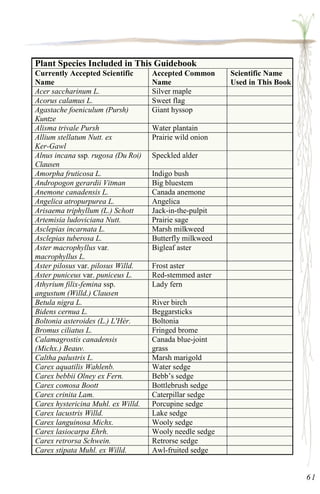
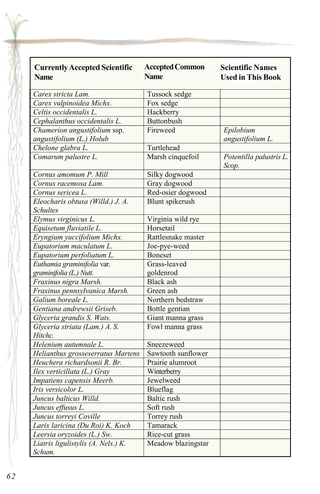
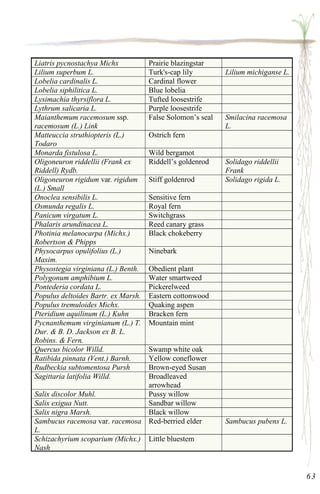
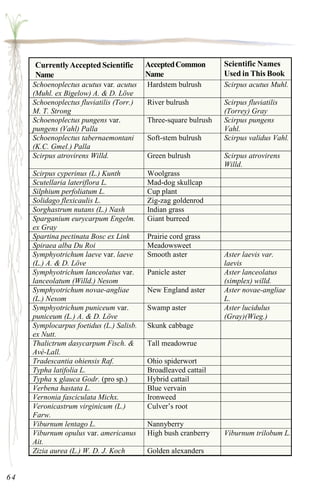
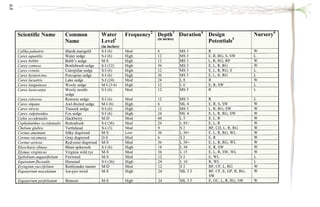
The following table lists plant species included in this guidebook. The 
table presents generally recognized scientific and common names for 
each species as well as the current accepted scientific name 
references and common name references derived from the 
Annotated Checklist of the Flora of Minnesota from the 
University of Minnesota herbarium (available on the herbarium’s Web 
site at http://biosci.cbs.umn.edu/herbarium/checklis2.htm) and from 
the Integrated Taxonomic Information System(ITIS). The ITIS is a 
collaborative effort between taxonomists in the United States, 
Canada and Mexico. The goal of the ITIS is to determine and 
support the most current taxonomic standing for flora and fauna in 
North America. Data records have been confirmed online at http:// 
www.itis.usda.gov. Note that several names were current as of 
January 2003. 
Also included in this section are two pages for each plant species. 
60 
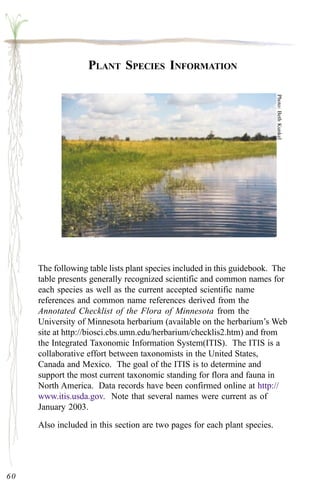
Photo: Beth Kunkel
Plant Species Included in This Guidebook 
Currently Accepted Scientific 
Name 
Accepted Common 
Name 
Scientific Name 
Used in This Book 
Acer saccharinum L. Silver maple 
Acorus calamus L. Sweet flag 
Agastache foeniculum (Pursh) 
Kuntze 
Giant hyssop 
Alisma trivale Pursh Water plantain 
Allium stellatum Nutt. ex 
Ker-Gawl 
Prairie wild onion 
Alnus incana ssp. rugosa (Du Roi) 
Clausen 
Speckled alder 
Amorpha fruticosa L. Indigo bush 
Andropogon gerardii Vitman Big bluestem 
Anemone canadensis L. Canada anemone 
Angelica atropurpurea L. Angelica 
Arisaema triphyllum (L.) Schott Jack-in-the-pulpit 
Artemisia ludoviciana Nutt. Prairie sage 
Asclepias incarnata L. Marsh milkweed 
Asclepias tuberosa L. Butterfly milkweed 
Aster macrophyllus var. 
Bigleaf aster 
macrophyllus L. 
Aster pilosus var. pilosus Willd. Frost aster 
Aster puniceus var. puniceus L. Red-stemmed aster 
Athyrium filix-femina ssp. 
Lady fern 
angustum (Willd.) Clausen 
Betula nigra L. River birch 
Bidens cernua L. Beggarsticks 
Boltonia asteroides (L.) L'Hér. Boltonia 
Bromus ciliatus L. Fringed brome 
Calamagrostis canadensis 
(Michx.) Beauv. 
Canada blue-joint 
grass 
Caltha palustris L. Marsh marigold 
Carex aquatilis Wahlenb. Water sedge 
Carex bebbii Olney ex Fern. Bebb’s sedge 
Carex comosa Boott Bottlebrush sedge 
Carex crinita Lam. Caterpillar sedge 
Carex hystericina Muhl. ex Willd. Porcupine sedge 
Carex lacustris Willd. Lake sedge 
Carex languinosa Michx. Wooly sedge 
Carex lasiocarpa Ehrh. Wooly needle sedge 
Carex retrorsa Schwein. Retrorse sedge 
Carex stipata Muhl. ex Willd. Awl-fruited sedge 
61
62 
Carex stricta Lam. Tussock sedge 
Carex vulpinoidea Michx. Fox sedge 
Celtis occidentalis L. Hackberry 
Cephalanthus occidentalis L. Buttonbush 
Chamerion angustifolium ssp. 
angustifolium (L.) Holub 
Fireweed Epilobium 
angustifolium L. 
Chelone glabra L. Turtlehead 
Comarum palustre L. Marsh cinquefoil Potentilla palustris L. 
Scop. 
Cornus amomum P. Mill Silky dogwood 
Cornus racemosa Lam. Gray dogwood 
Cornus sericea L. Red-osier dogwood 
Eleocharis obtusa (Willd.) J. A. 
Blunt spikerush 
Schultes 
Elymus virginicus L. Virginia wild rye 
Equisetum fluviatile L. Horsetail 
Eryngium yuccifolium Michx. Rattlesnake master 
Eupatorium maculatum L. Joe-pye-weed 
Eupatorium perfoliatum L. Boneset 
Euthamia graminifolia var. 
graminifolia (L.) Nutt. 
Grass-leaved 
goldenrod 
Fraxinus nigra Marsh. Black ash 
Fraxinus pennsylvanica Marsh. Green ash 
Galium boreale L. Northern bedstraw 
Gentiana andrewsii Griseb. Bottle gentian 
Glyceria grandis S. Wats. Giant manna grass 
Glyceria striata (Lam.) A. S. 
Fowl manna grass 
Hitchc. 
Helenium autumnale L. Sneezeweed 
Helianthus grosseserratus Martens Sawtooth sunflower 
Heuchera richardsonii R. Br. Prairie alumroot 
Ilex verticillata (L.) Gray Winterberry 
Impatiens capensis Meerb. Jewelweed 
Iris versicolor L. Blueflag 
Juncus balticus Willd. Baltic rush 
Juncus effusus L. Soft rush 
Juncus torreyi Coville Torrey rush 
Larix laricina (Du Roi) K. Koch Tamarack 
Leersia oryzoides (L.) Sw. Rice-cut grass 
Liatris ligulistylis (A. Nels.) K. 
Schum. 
Meadow blazingstar 
Scientific Names 
Used in This Book 
Currently Accepted Scientific 
Name 
Accepted Common 
Name
63 
Liatris pycnostachya Michx Prairie blazingstar 
Lilium superbum L. Turk's-cap lily Lilium michiganse L. 
Lobelia cardinalis L. Cardinal flower 
Lobelia siphilitica L. Blue lobelia 
Lysimachia thyrsiflora L. Tufted loosestrife 
Lythrum salicaria L. Purple loosestrife 
Maianthemum racemosum ssp. 
False Solomon’s seal Smilacina racemosa 
racemosum (L.) Link 
L. 
Matteuccia struthiopteris (L.) 
Todaro 
Ostrich fern 
Monarda fistulosa L. Wild bergamot 
Oligoneuron riddellii (Frank ex 
Riddell) Rydb. 
Riddell’s goldenrod Solidago riddellii 
Frank 
Oligoneuron rigidum var. rigidum 
(L.) Small 
Stiff goldenrod Solidago rigida L. 
Onoclea sensibilis L. Sensitive fern 
Osmunda regalis L. Royal fern 
Panicum virgatum L. Switchgrass 
Phalaris arundinacea L. Reed canary grass 
Photinia melanocarpa (Michx.) 
Black chokeberry 
Robertson & Phipps 
Physocarpus opulifolius (L.) 
Maxim. 
Ninebark 
Physostegia virginiana (L.) Benth. Obedient plant 
Polygonum amphibium L. Water smartweed 
Pontederia cordata L. Pickerelweed 
Populus deltoides Bartr. ex Marsh. Eastern cottonwood 
Populus tremuloides Michx. Quaking aspen 
Pteridium aquilinum (L.) Kuhn Bracken fern 
Pycnanthemum virginianum (L.) T. 
Mountain mint 
Dur. & B. D. Jackson ex B. L. 
Robins. & Fern. 
Quercus bicolor Willd. Swamp white oak 
Ratibida pinnata (Vent.) Barnh. Yellow coneflower 
Rudbeckia subtomentosa Pursh Brown-eyed Susan 
Sagittaria latifolia Willd. Broadleaved 
arrowhead 
Salix discolor Muhl. Pussy willow 
Salix exigua Nutt. Sandbar willow 
Salix nigra Marsh. Black willow 
Sambucus racemosa var. racemosa 
L. 
Red-berried elder Sambucus pubens L. 
Schizachyrium scoparium (Michx.) 
Nash 
Little bluestem
Schoenoplectus acutus var. acutus 
(Muhl. ex Bigelow) A. & D. Löve 
Hardstem bulrush Scirpus acutus Muhl. 
Schoenoplectus fluviatilis (Torr.) 
M. T. Strong 
River bulrush Scirpus fluviatilis 
(Torrey) Gray 
Schoenoplectus pungens var. 
pungens (Vahl) Palla 
Three-square bulrush Scirpus pungens 
Vahl. 
Schoenoplectus tabernaemontani 
(K.C. Gmel.) Palla 
Soft-stem bulrush Scirpus validus Vahl. 
Scirpus atrovirens Willd. Green bulrush Scirpus atrovirens 
Willd. 
Scirpus cyperinus (L.) Kunth Woolgrass 
Scutellaria lateriflora L. Mad-dog skullcap 
Silphium perfoliatum L. Cup plant 
Solidago flexicaulis L. Zig-zag goldenrod 
Sorghastrum nutans (L.) Nash Indian grass 
Sparganium eurycarpum Engelm. 
Giant burreed 
ex Gray 
Spartina pectinata Bosc ex Link Prairie cord grass 
Spiraea alba Du Roi Meadowsweet 
Symphyotrichum laeve var. laeve 
(L.) A. & D. Löve 
Smooth aster Aster laevis var. 
laevis 
Symphyotrichum lanceolatus var. 
lanceolatum (Willd.) Nesom 
Panicle aster Aster lanceolatus 
(simplex) willd. 
Symphyotrichum novae-angliae 
(L.) Nesom 
New England aster Aster novae-angliae 
L. 
Symphyotrichum puniceum var. 
puniceum (L.) A. & D. Löve 
Swamp aster Aster lucidulus 
(Gray)(Wieg.) 
Symplocarpus foetidus (L.) Salisb. 
ex Nutt. 
Skunk cabbage 
Thalictrum dasycarpum Fisch. & 
Avé-Lall. 
Tall meadowrue 
Tradescantia ohiensis Raf. Ohio spiderwort 
Typha latifolia L. Broadleaved cattail 
Typha x glauca Godr. (pro sp.) Hybrid cattail 
Verbena hastata L. Blue vervain 
Vernonia fasciculata Michx. Ironweed 
Veronicastrum virginicum (L.) 
Culver’s root 
Farw. 
Viburnum lentago L. Nannyberry 
Viburnum opulus var. americanus 
Ait. 
High bush cranberry Viburnum trilobum L. 
Zizia aurea (L.) W. D. J. Koch Golden alexanders 
64 
Scientific Names 
Used in This Book 
Currently Accepted Scientific 
Name 
Accepted Common 
Name
Photo: Jason Husveth 
65 
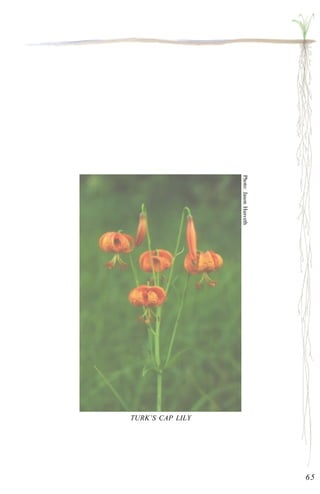
TURK’S CAP LILY
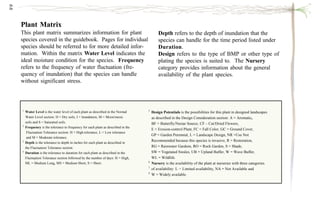
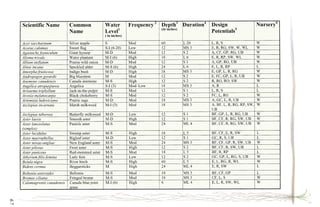
Plant Matrix 
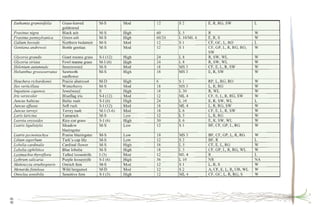
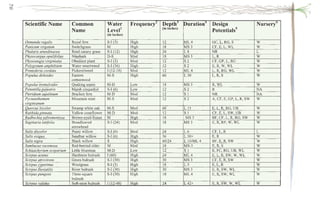
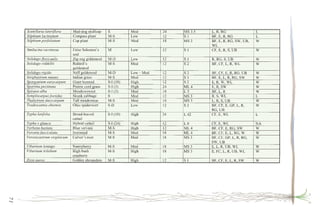
This plant matrix summarizes information for plant 
species covered in the guidebook. Pages for individual 
species should be referred to for more detailed infor-mation. 
Within the matrix Water Level indicates the 
ideal moisture condition for the species. Frequency 
refers to the frequency of water fluctuation (fre-quency 
of inundation) that the species can handle 
without significant stress. 
66 
Depth refers to the depth of inundation that the 
species can handle for the time period listed under 
Duration. 
Design refers to the type of BMP or other type of 
plating the species is suited to. The Nursery 
category provides information about the general 
availability of the plant species. 
1 Water Level is the water level of each plant as described in the Normal 
Water Level section: D = Dry soils, I = Inundation, M = Moist/mesic 
soils and S = Saturated soils. 
2 Frequency is the tolerance to frequency for each plant as described in the 
Fluctuation Tolerance section: H = High tolerance, L = Low tolerance 
and M = Moderate tolerance. 
3 Depth is the tolerance to depth in inches for each plant as described in 
the Fluctuation Tolerance section. 
4 Duration is the tolerance to duration for each plant as described in the 
Fluctuation Tolerance section followed by the number of days: H = High, 
ML = Medium Long, MS = Medium Short, S = Short. 
5 Design Potentials is the possibilities for this plant in designed landscapes 
as described in the Design Consideration section: A = Aromatic, 
BF = Butterfly/Nectar Source, CF – Cut/Dried Flowers, 
E = Erosion-control Plant, FC = Fall Color, GC = Ground Cover, 
GP = Garden Perennial, L = Landscape Design, NR =Use Not 
Recommended because this species is invasive, R = Restoration, 
RG = Rainwater Gardens, RO = Rock Garden, S = Shade, 
SW = Vegetated Swales, UB = Upland Buffer, W = Wave Buffer, 
WL = Wildlife. 
6 Nursery is the availability of the plant at nurseries with three categories 
7 of availability: L = Limited availability, NA = Not Available and 
8 W = Widely available.
67
68
69
70
71
The following section provides detailed information for 131 plant 
species that are well suited to stormwater management practices 
(MPs). This information is intended to help designers narrow their 
species lists down to plants that are adapted to specific site conditions. 
Both wetland and upland species are included to cover a wide range of 
possible hydrologic conditions and to enhance the appearance and 
performance of upland areas adjacent to stormwater MPs. Informa-tion 
provided for each species includes: 
• Habitat/Plant 
• Community and 
Geographic Range 
• Description 
• Normal Water Level 
• Flooding/Fluctuation 
Tolerance 
• Sensitivities or Other 
Tolerances 
• Design Consider-ations 
• Wildlife Use 
• Nursery/Plant 
• Information 
• Planting Techniques 
• Additional Notes 
• Indicator Status 
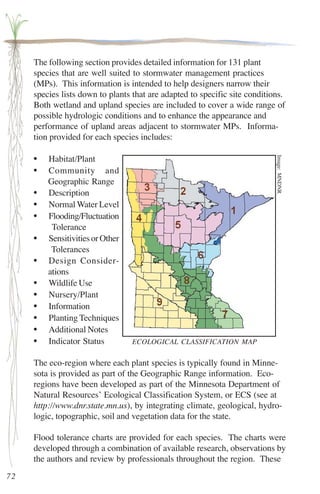
The eco-region where each plant species is typically found in Minne-sota 
is provided as part of the Geographic Range information. Eco-regions 
have been developed as part of the Minnesota Department of 
Natural Resources’ Ecological Classification System, or ECS (see at 
http://www.dnr.state.mn.us), by integrating climate, geological, hydro-logic, 
topographic, soil and vegetation data for the state. 
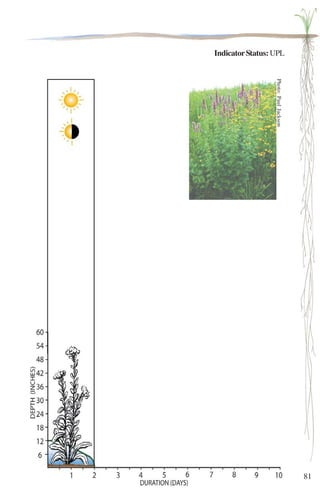
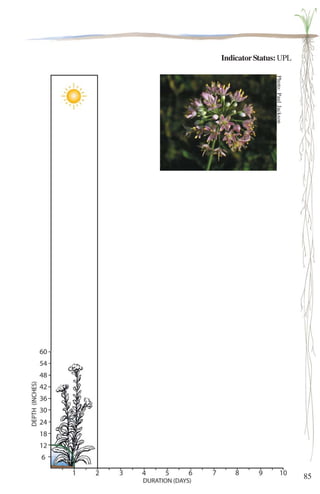
Flood tolerance charts are provided for each species. The charts were 
developed through a combination of available research, observations by 
the authors and review by professionals throughout the region. These 
72 
Image: MNDNR 
ECOLOGICAL CLASSIFICATION MAP
73 
charts are intended to help designers select species that will be well 
adapted to the hydrologic conditions of their projects. The charts show the 
number of days the species can tolerate submersion at a specific water 
level in the middle of the growing season before experiencing “significant 
stress,” or the point where it begins to die. Water level is represented on 
the x-axis of the chart, and the y-axis represents the duration of inunda-tion 
in one-half-day increments. The green line on the chart represents 
tolerances for adult plants, while the blue line represents the normal water 
level for the species. If the species is normally found in saturated-to-dry 
soils, no blue line is represented on the charts. 
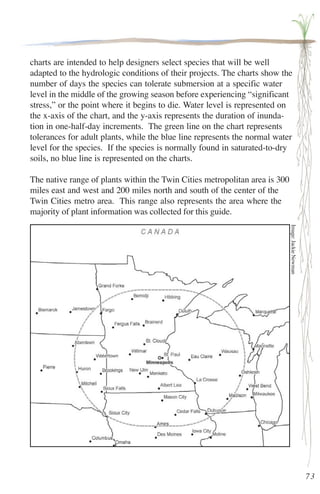
The native range of plants within the Twin Cities metropolitan area is 300 
miles east and west and 200 miles north and south of the center of the 
Twin Cities metro area. This range also represents the area where the 
majority of plant information was collected for this guide. 
Image: Jackie Newman
74 
Botanical Name 
Common Name - a.k.a. – alternative names commonly recognized for this species 
Habitat/Plant Community and Geographic Range 
The habitat/plant community and geographic range for each species is given in this 
section. Eco-Region numbers represent the Minnesota Department of Natural 
Resource ecological regions in Minnesota where the species is commonly found. 
Abbreviations used for compass directions are: c.-central; e.-east, eastern; n.-north, 
northern; nc.-north-central; ne.-northeast, northeastern; s.-south, southern; se.- 
southeast, southeastern; sw.-southwest, southwestern; w-west, western. 
Abbreviations used for geographic locations are: Ala.-Alabama, Alta.-Alberta, Amer.– 
America, Ariz.-Arizona, Ark.-Arkansas, B.C.-British Columbia, Calif.-California, 
Can.-Canada, Colo.-Colorado, Conn.-Connecticut, Del.-Delaware, Fla.-Florida, Ga.- 
Georgia, Ill.-Illinois, Ind.-Indiana, Kan.-Kansas, Ky.-Kentucky, La.-Louisiana, Labr.- 
Labrador, LP-Lower Peninsula, Man.-Manitoba, Mass.-Massachusetts, Md.-Mary-land, 
Me.-Maine, Mex.-Mexico, Mich.-Michigan, Minn.-Minnesota, Miss.-Missis-sippi, 
Mo.-Missouri, Mont.-Montana, N.B.-New Brunswick, N.C.-North Carolina, 
N.D.-North Dakota, Neb.-Nebraska, New Engl.- New England, Nev.-Nevada, Nfld.- 
Newfoundland, N.H.-New Hampshire, N.J.-New Jersey, N.M.-New Mexico, N.S.- 
Nova Scotia, Nw. Terr.-Northwest Territories, N.Y.-New York, Okla.- Oklahoma, 
Ont.-Ontario, Ore.-Oregon, Pa.- Pennsylvania, P.E.I.-Prince Edward Island, Que.- 
Québec, R.I.-Rhode Island, Sask.-Saskatchewan, S.C.-South Carolina, S.D.-South 
Dakota, Tenn.-Tennessee, Tex.-Texas, UP-Upper Peninsula; USA-United States, Va.- 
Virginia, Vt.-Vermont, Wash.-Washington, Wis.-Wisconsin, W.Va.a-West Virginia, 
Wyo.-Wyoming. 
[#] – This symbol represents citation numbers in the Plant Pages Bibliography. 
Description 
The species’ physical features are broken down into eight categories for identification: 
general description, flower, leaf, stem or twig, bark, fruit, root and soil. 
Normal Water Level 
This section describes where the species typically grows relative to soil moisture or 
normal level of inundation. 
Flooding/Fluctuation Tolerances 
This section describes the tolerance to frequency, depth and duration of flooding. 
Special information about the species’ sensitivity to water level fluctuation is given 
here also. 
Sensitivities or Other Tolerances 
Other stresses and tolerances are described here. Stressors include salt, nutrient, siltation, 
insect tolerances as well as the species’ preferred exposure. Tolerances are represented as 
high, medium or low. A high level indicates a high tolerance to the stress. “Unknown” 
indicates that the authors did not find information for that stress. 
Design Considerations 
This section describes the optimal management practices appropriate for the species. 
Design concerns or considerations are presented here also.
75 
Indicator Status: XXX 
Indicator Status Categories: 
FAC (Facultative) — Equally likely to occur in wetlands 
or nonwetlands (estimated probability, or est. prob., 
67-99%). 
FACU (Facultative Upland) — Usually occurs in 
nonwetlands (est. prob. 67-99%), but is occasionally 
found in wetlands (est. prob. 1-33%). 
FACW (Facultative Wetland) — Usually occurs in 
wetlands (est. prob. 67-99%), but is occasionally found 
in nonwetlands. 
OBL (Obligate Wetland) — Under natural conditions, 
occurs almost always (est. prob. >99%) in wetlands. 
UPL (Obligate Upland) — Occurs in wetlands in 
another region, but occurs almost always (est. prob. 
>99%) under natural conditions in nonwetlands in the 
region specified. 
A positive (+) sign indicates that the species is more 
likely to be found in wetlands, and a negative (-) sign 
indicates that it less likely to be found in wetlands. [38] 
NORMAL WATER LEVEL 
Exposure 
Full Sun 
Partial Sun 
Full Shade 
Wildlife Use 
This section describes fauna species for which this plant 
species provides habitat and how the plant is used. 
Nursery/Plant Information 
This section provides information on the species’ availabil-ity 
from nurseries and the types of plant material that are 
available. 
Planting Techniques 
This section provides information on how to establish the 
species. 
Additional Notes 
This section provides information of interest or importance 
for this plant. 
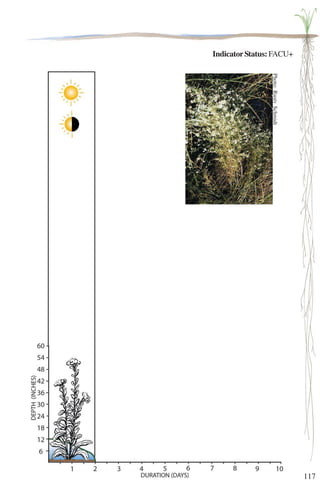
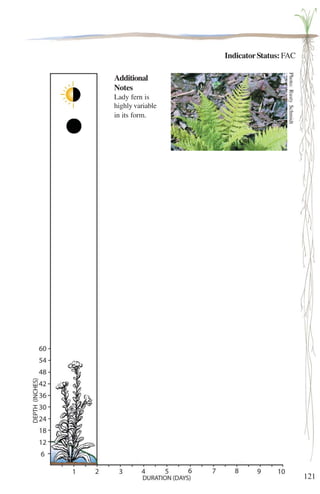
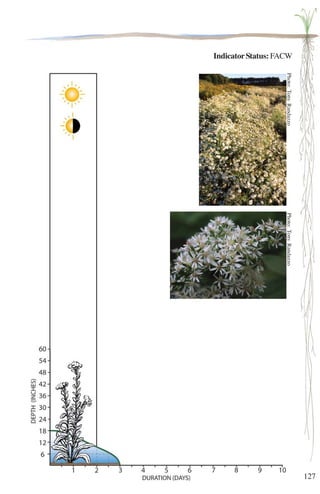
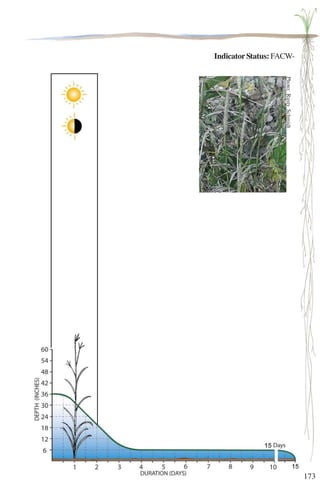
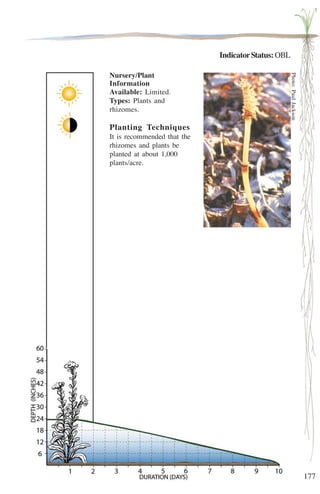
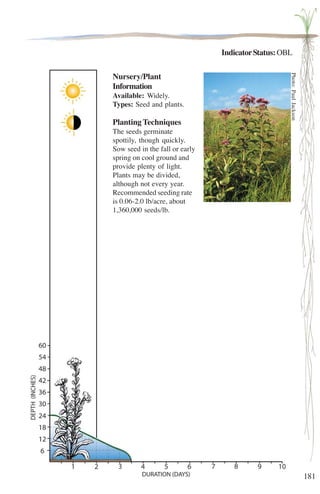
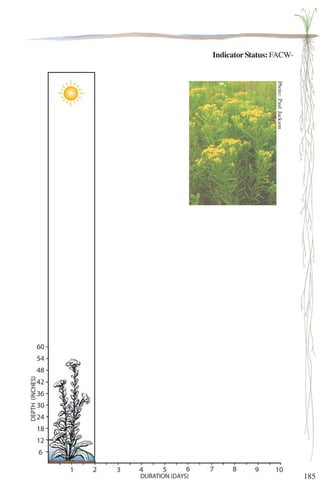
This graphic shows how long the species can remain 
inundated before decline. The left portion of the graphic 
shows the exposure level (depth in inches) and the form of 
the species (tree, shrub, grass or forb). The graphic 
includes a survival line that indicates the depth of standing 
water and how long the species can tolerate the inundation. 
Some graphs will indicate depth of normal water level.
76 
Acer saccharinum 
Silver Maple - a.k.a. Soft Maple, White Maple 
Habitat/Plant Community and Geographic Range 
Habitat/Community: Silver maple is a dominant tree in floodplain forests. It is 
also found in swamps, on stream banks, shores, and low areas of wet to mesic soils. 
It does well in upland plantings and is common in Midwest windbreak and farmstead 
plantings. [7, 11, 22, 32, 36] Range: Minn. (Eco-Regions 1, 2, 4-9), especially se., 
uncommon in far nw. Wis., especially s. LP of Mich.; N.B. and Que. to Minn. and 
e. S.D., s. to Ga., w. Fla., La. and Okla. [7, 21] 
Description 
General: Large, deciduous tree with short, stout trunk, spreading open, irregular 
crown of curving branches that may grow to a height of 90'. This tree is the fastest 
growing native maple. Flower: February to March, usually ¼'' long; clusters; male 
and female are separate. Leaf: Opposite 4-6'' long, broadly ovate, deeply 5-lobed, 
green above and silvery white below. Twigs: light green to reddish, hairless with 
slightly unpleasant odor when crushed. Bark: Gray and smooth in young trees, 
becoming furrowed into long, scaly, shaggy ridges. Fruit: A winged samara. 
Roots: Shallow, very wide spreading, fibrous. Soils: Tolerates wide variety of soils, 
but reaches largest size in moist soils. [7, 11, 22, 36] 
Normal Water Level 
This species prefers wet/saturated conditions. [21, 37] 
Flooding/Fluctuation Tolerances 
Frequency: Moderate. Depth: 5'. Duration: Long – 20 days (decreasing 6''/day for 
8 days, leveling out at 18'' for until the 20th day) during the growing season, although it 
tolerates weeks of inundation in the spring and is very resistant to drought/heat. [1, 22, 
37] 
Sensitivities or Other Tolerances 
Exposure: Full to part sun. Salt: Moderately high for spray and moderately low for 
soil. Nutrient: Manganese chlorosis in calcareous or high-pH soils. Siltation: N/A. 
Insect: Frequent – ocellate leaf gall, cottony maple scale, borers, other scale. 
Other: Resistant to SO2, HCl, Cl, mine spoils and soil compaction. Sensitive to O3 
and alkaline soils, though intermediate to HFl. [1, 2, 10, 22, 24, 37] 
Design Considerations 
Silver maple is frequently used in landscaping as a shade tree because of its rapid 
growth and toleration of a wide variety of soil types. A good tree for wetland use, 
restorations, stream edges and floodplains. Concerns: The branches are very weak 
and damage easily. Other issues are that it does not tolerate dense shade, fruit 
produces litter, and roots may grow at the surface and become exposed, creating 
tripping hazards. [11, 36]
77 
Indicator Status: FACW 
Wildlife Use 
This species provides 
seeds and nesting cover 
for gamebirds, songbirds 
(especially bobwhite 
quail, cardinals, orioles, 
goldfinch and gros-beaks), 
waterbirds and 
Photo:www.cala2.umn.edu/la5574 
waterfowl. Silver maple 
also provides food and 
cover for porcupine, 
raccoon, squirrel, chipmunk, mice, beaver, deer and 
moose. 
[21, 22, 32, 37] 
Nursery/Plant Information 
Available: Widely (though watch out for different 
varieties). Types: Balled-and-burlapped, potted and 
bareroot stock. 
Planting Techniques 
Silver maple is easily transplanted in any season as 
balled-and-burlapped or potted stock. If small, it may 
also be planted in early spring or late fall as bareroot 
stock. [22] 
Additional Notes 
Syrup can be obtained from the sap, but the yield is 
low. [36]
78 
Acorus calamus 
Sweet Flag - a.k.a. Acorus americanus 
Habitat/Plant Community and Geographic Range 
Habitat/Community: Bogs, streambanks, marshes (often with cattails), swamps, 
shallow water, peatlands and sometimes in seasonally inundated wet meadows. 
Usually forming beautiful clumps. [4, 7, 16, 35] Range: Minn. (Eco-Regions: All), 
scattered throughout Wis., Mich. Native, though widely naturalized in N. Amer. 
from N.S. and Que. to Alta., s. to Fla., Tex., Colo., n. Idaho and Wash.; Asia. [7, 
21] 
Description 
General: Perennial, aromatic, emergent herb, growing in clumps or dense beds with 
tall, sword-like leaves. Mature height is 2-6'. Flower: Small, in a dense cluster 
(spadix) near the top of the flattened, leaflike stem. Color is green/brown from May 
25 to June 30. Leaf: Its erect, swordlike leaves are much like those of blue flag, 
except they are yellowish-green and give off a sweet odor when bruised. Stem: The 
spathe is the tapering upper part of the stem with a 2-edged stalk. Fruit: Brown and 
persistent into late fall. Root: Stout, aromatic rhizomes. Soil: pH range 5.9-8.8; 
tolerates most wet soils in inundated conditions. [4, 7, 16, 35, 44] 
Normal Water Level 
This species prefers shallow water of 20'' of inundation or less to wet/saturated 
conditions, though it prefers depths of 6-20''. [21, 37, 44] 
Flooding/Fluctuation Tolerances 
Frequency: Low. Depth: 12''. Duration: Medium short – 3 days (decreasing 
4''/day). Prefers stable water levels and will decrease in abundance with flood depth 
increases, although will tolerate dry periods. [1, 6, 29, 37, 44] 
Sensitivities or Other Tolerances 
Exposure: Partial to full sun. Salt: Low to moderate. Nutrient: Low. 
Siltation: Low. Insect: N/A. Other: Tolerates acidic conditions and moderately 
tolerates general disturbance and stress. [1, 6, 37, 44] 
Design Considerations 
Sweet flag is used in soil stabilization of lower shoreline zones and vegetated swales. 
Rhizomes and roots form a mat in upper 4-8'' of soil, which prevents erosion, stabilizes 
sediment, and mitigates buffering wave action. Good for wetland restoration (wet 
meadow/wet woods) due to its aggressive behavior and rhizomatous growth – though it 
is moderate in spread rate. Good for rainwater and water gardens. Uses may also 
include wildlife cover and a food source. Concerns: This species is considered 
aggressive, although this may be beneficial to some sites. [16, 21, 44] 
Wildlife Use 
Sweet flag provides food (seed) and cover for waterfowl (especially wood ducks). 
Muskrats will eat the rhizomes. Sweet flag is also considered an excellent feeding cover
79 
for woodcock, snipe and 
rodents. This perennial 
grows in clumps that 
provide nesting spots for 
waterfowl and shorebirds. 
[4, 21, 37, 44] 
Nursery/Plant 
Information 
Available: Widely. 
Types: Transplants, rhizomes 
and seeds. 
Planting Techniques 
Rhizomes and transplants 
are generally more success-ful 
Indicator Status: OBL 
than seeds. Expose freshly harvested seed to cold, 
moist stratification for 60-90 days or soak seed in a bucket 
of water outside all winter, let freeze. Seed can be stored 9 
months to 2 years. Fall sowing provides better germina-tion 
than spring sowing by providing this cold treatment 
naturally. Sow in saturated soils. Avoid flooding of newly 
established plants. Transplants can tolerate some bounce 
in water levels. This species requires drawdown until 
plants are established. Seeding rate is .006-0.25 lb/acre or 
spacing of 1-3' centers at minimum of 1,000/acre. 12,000 
seeds/lb. Plant in muddy soils to 1' of water. [4, 16, 44] 
Additional Notes 
Recently, some plant taxonomy authorities have recognized 
two species of Acorus in Minnesota, A. calamus and A. 
americanus. Most nurseries and design professionals have 
not recognized two species of Acorus. A. calamus is 
recognized as a naturalized species, possibly from Europe. 
Gleason and Cronquist (1991) and Chadde (1998) consider 
A. americanus a synonym, as does this book. 
Photo: Jason Husveth
80 
Agastache foeniculum 
Giant Hyssop - a.k.a. Wonder Honey Plant; Fragrant, Fragrant Giant, 
Giant Blue or Anise Hyssop 
Habitat/Plant Community and Geographic Range 
Habitat/Community: Mesic to dry prairies and open or semishady woodlands 
(savanna), often along roads. [16, 17, 35, 41] Range: Minn. (Eco-Region: 1-6, 8, 9), 
Wis. Wis. to n. Iowa and Man., s. to Colo. and Alta., and occasionally e. to Que. 
Endangered in Iowa. [17, 21] 
Description 
General: One of the more ornamental and larger of our native mints. Giant hyssop is 
a perennial, commonly 2-4' tall. Flower: A thick spike with dense, often interrupted, 
whorls of bright blue flowers ¼'' long, June to October. Leaf: Sharply pointed, 
lance-shaped, toothed, opposite, glossy, dark green with fine hairs underneath and 2- 
3'' long. Leaves have an anise or licorice odor when crushed; can be used for tea. 
Stem: Square. Fruit: Light to dark brown. Roots: Fibrous, shallow. Soil: Medium 
(mesic) to dry loam soil. [17, 35, 41, 47] 
Normal Water Level 
This species prefers upland moist/mesic to dry conditions. [21] 
Flooding/Fluctuation Tolerances 
Frequency: Moderate. Depth: 12''. Duration: Short – 2 days (decreasing 6''/day). 
Sensitivities or Other Tolerances 
Exposure: Full to part sun. Salt: Moderate; low to 2,4-D. Nutrient: Unknown. 
Siltation: Unknown. Insect: Infrequent. Other: Giant hyssop has a moderate 
tolerance to general disturbance and stress. [1, 47] 
Design Considerations 
Giant hyssop is an ornamental perennial that grows well in gardens and produces 
excellent cutflowers. This plant has use as an aromatic and as a herb for teas. Will 
work well in shallow rain gardens and upland buffers. Concerns: Giant hyssop self-seeds 
readily and may spread in gardens. It survives poorly in northern Minnesota. 
[41] 
Wildlife Use 
Flowers are very attractive to bees and butterflies throughout the summer. [21, 41] 
Nursery/Plant Information 
Available: Widely. Types: Plants and seed. 
Planting Techniques 
Spreads by producing hundreds of tiny, black seeds. Seeds need no treatment, but 
moist, cold stratification may help. 1,040,000 seeds/lb. [16, 21, 41]
81 
Indicator Status: UPL 
Photo: Paul Jackson
82 
Alisma trivale 
Water Plantain - a.k.a. Common Water Plantain or Mud Plantain 
Habitat/Plant Community and Geographic Range 
Habitat/Community: Shallow water and in saturated soils, marshes, shrub swamps, 
wooded swamps, shores of lakes and streams, and ditches. It rapidly invades 
exposed mud flats and is common in farmed wetlands. [4, 7, 11, 16, 21] 
Range: Minn. (Eco-Region: All), n. Wis., Mich. N.S. to s. B.C., s. to Pa., Mo. 
and Calif. [4, 7, 21] 
Description 
General: A decorative, perennial herb, usually emergent with a mature height of 3-4'. 
Flower: Inflorescence is highly branched with perfect flowers of 3 sepals and 3 white 
or pinkish petals from May to September. Pistils are in a single whorl on a small, 
flat receptacle. Leaf: Broad, flat blades that may be rounded or tapered at the base; 
however, submerged forms with only ribbon-like leaves are also produced. The 
leaves are olive-green in color. Fruit: A group of minute, flat-sided achenes borne in 
a whorl. Achenes are not quite 1/8'' long. Root: Submerged bulb. Soil: The pH 
range is 7.0-8.8. Tolerates saturated to inundated conditions on many soil types. [4, 
7, 11, 16, 44, 47] 
Normal Water Level 
This species prefers shallow water, 6'' or less, to wet/saturated conditions of 36'' of 
inundation or less, though it prefers 0-6'' of water depth. [11, 21, 37, 44] 
Flooding/Fluctuation Tolerances 
Frequency: High. Depth: 18''. Duration: Long – 6 days (decreasing 6''/day). This 
species tolerates periodic inundation of short durations during the early part of the 
growing season. It will increase in abundance with increases in flood depth. Toler-ant 
of late-season drawdowns. [1, 21, 16, 37, 44] 
Sensitivities or Other Tolerances 
Exposure: Full to part sun. Salt: Moderate. Nutrient: Moderate. Siltation: High. 
Insect: Infrequent. Other: It has a moderate-to-high tolerance of general disturbance 
and stress. [1, 44, 47] 
Design Considerations 
Water plantain is well adapted for use in upper and lower shoreline zones, for 
streambank stabilization, and in vegetated swales. It is also well suited for restora-tions 
of wetlands, low spots in wet prairies and wet meadows. Seed is common in 
seedbanks of hydric soils. Well adapted for habitat as wildlife cover and food. 
Concerns: This long-lived species can be invasive. [16, 44] 
Wildlife Use 
Waterfowl (mallard, pintail, scaup, blue-winged and green-winged teal), songbirds, 
pheasants and rodents eat the achenes and tubers. Plants provide shade for fish. 
Rabbits and deer sometimes eat the leaves. The leaves also provide an excellent
83 
Indicator Status: OBL 
feeding cover for frogs. The 
sturdy stalk may become a 
perch for songbirds. [4, 21, 
44] 
Nursery/Plant 
Information 
Available: Widely. 
Types: Achenes, transplants 
and rootstocks. 
Planting Techniques 
Achene production is high, 
about 144,000/plant. 
Achenes require scarification 
to break dormancy, which 
can be done with sandpaper and moist, cold stratification 
for 30 days. Fall sowing provides better germination on 
wet mudflats. Alternating temperatures in moist (underwa-ter) 
conditions and/or light for germination. Achenes retain 
viability when stored in water under cold temperatures for 6 
months and are found in seedbanks in many hydric soils. 
Avoid flooding of newly established plants. Common 
water plantain germinates quickly and favors drawdown 
until plants are established. Seeding rate is .06-0.5 lb/acre 
or plant rootstock or plants 2-5'' in damp soils to 12'' of 
water. 1,122,800 seeds/lb. [4, 16, 37, 39, 42, 44] 
Additional Notes 
Another species that is very similar to A. trivale is A. 
subcordatum, which differs in flower size. Both species are 
found in Minnesota and have overlapping ranges, although 
A. subcordatum occurs more southerly than A. trivale. 
Both species have similar water fluctuation tolerances and 
sensitivities. 
Photo: Dan Shaw
84 
Allium stellatum 
Prairie Wild Onion - a.k.a. Prairie Onion, Cliff Onion 
Habitat/Plant Community and Geographic Range 
Habitat/Community: Prairies, meadows and rocky soils. [16, 17, 35, 41] 
Range: Most common in s. and w. Minn. (Eco-Region: All), Wis. (except for n. ¼), 
Mich. W. Ont. to Ill., w. to Sask., Wyo. and Okla. [17, 21] 
Description 
General: A native perennial herb that grows to 1-2'. The entire plant has a strong 
onion fragrance. Flower: A round cluster, 1-2'' wide, that stands atop a single, erect 
umbel at the end of the stem; pink to rose with yellow centers, summer to fall. 
Leaf: Slender and solid in a basal clump of thin grass-like leaves. Stem: Slender, 
solid stem. Root: A small, papery-scaled bulb. Soil: Moist to dry, sometimes rocky 
soils. [16, 17, 35, 41, 47] 
Normal Water Level 
This species prefers upland moist/mesic to dry conditions, which sometimes are 
rocky. [21] 
Flooding/Fluctuation Tolerances 
Frequency: Moderate. Depth: 12''. Duration: Short – 1 day (decreasing 12'' in 1 day). 
This plant does not tolerate long periods of saturation. 
Sensitivities or Other Tolerances 
Exposure: Full sun. Salt: Moderate. Nutrient: Low. Siltation: Low. 
Insect: Infrequent. Other: N/A. It is tolerant to general disturbance and stressors. [47] 
Design Considerations 
Prairie onion can be used for the edges of rainwater gardens and upland buffers. Plant 
in groups for more visibility. Concerns: Prairie wild onion does not compete well 
with aggressive native grasses. Even though this plant can be used for food, please do 
not pick or dig up this plant from natural conditions. [16, 21] 
Wildlife Use 
This species attracts butterflies and bees and is edible to humans. [16, 21] 
Nursery/Plant Information 
Available: Widely. Types: Plants and seed. 
Planting Techniques 
Seeds need to be moist, cold stratified. Fall planting is ideal. 162,000 seeds/lb. 
Seeds self sow. [16] 
Additional Notes 
The flower always grows on erect stalks, which distinguishes it from the nodding 
onion (A. cernuum), whose flowers always hang downward. [41]
85 
Indicator Status: UPL 
Photo: Paul Jackson
86 
Alnus incana 
Speckled Alder - a.k.a. Alnus rugosa – Hazel, Tag or Gray Alder 
Habitat/Plant Community and Geographic Range 
Habitat/Community: Speckled alder is found in swamps, thickets (especially alder 
thickets), bog margins, shores, moist meadows and is common on stream banks and 
floodplains. This species is also found in lowland wet areas such as openings in low, 
wet woods and low alluvial flats. It may also be present in bogs and coniferous 
swamps on neutral to acidic soils. [7, 11, 22, 36] Range: All but sw. Minn. (Eco- 
Region: 1-8), but local in sw. Wis., and se. Mich. Widespread across Can. from 
Nfld. to Alaska, s. to Md., Ohio, n. Ind., Minn., N.D., N.M., Ariz. and Calif.; 
Eurasia. This is the dominant species in alder thickets of Minn. and Wis. [7, 21] 
Endangered in Illinois. 
Description 
General: A deciduous, thicket-forming shrub or small tree sometimes growing to 16' 
tall. Flower: Tiny; in early spring before leaves. Male in drooping catkins 1½-3'' 
long. Female in cones ¼'' long. Cones: ½-5/8'' long; elliptical, blackish, hard, 
short-stalked. Leaf: Leaves are dull, dark green with network of sunken veins and 
often hairy above; whitish-green with hairy veins beneath. Leaves are alternate, 
simple and elliptical or ovate. Bark: Gray, smooth. Stem: 4'' maximum diameter. 
Twigs: Gray-brown, slender, slightly hairy when young. Fruit: Purple-black fruit 
persisting into winter. Root: Roots are very shallow and narrow spreading. 
Soil: Prefers deep loams to loamy sands that are wet to moist. [7, 11, 22, 36] 
Normal Water Level 
This species prefers upland moist/mesic to wet/saturated conditions and is able to 
tolerate inundation to 6'' or less. [21] 
Flooding/Fluctuation Tolerances 
Frequency: High. Depth: 2'. Duration: Long – 6 days (decrease of 1' in first 2 
days and a steady 6''/2 days thereafter). This species is very tolerant of flooding, 
somewhat tolerant to flood duration, and moderately tolerant to increases in flood 
depth. [1, 2, 22, 25] 
Sensitivities or Other Tolerances 
Exposure: Full to partial sun. Very intolerant to shade. Salt: Moderate. 
Nutrient: Low to moderate. Siltation: Moderate. Insect: frequent – several borers, 
alder bark beetle, tent caterpillar. Other: Sensitive to drought/heat. Sensitive to 
mine spoils, though tolerant to soil compaction. Sensitive to O3. The root system gives 
little wind support, especially in wet, spongy soils; weak wooded. It has a moderate 
tolerance for general disturbance and stress. [1, 22] 
Design Considerations 
This species has been planted as an ornamental at water edges. Its root mass prevents 
erosion on stream banks and enriches soil by making nitrogen available to other 
plants. Use this plant in restorations (see community section above), pond edges and 
acidic soil conditions. Concerns: Weak-wooded, shade-intolerant, insect-damage-
87 
Indicator Status: OBL 
prone and 
sensitive to 
drought and 
heat. [21, 36] 
Wildlife Use 
Wildlife value is 
high for 
songbirds 
(especially the 
seeds for 
redpoles, 
siskins, and goldfinches), gamebirds, waterbirds, small 
mammals (rabbits, muskrats, beavers) and hoofed browsers 
(deer and moose). The thickets provide excellent cover from 
predators and weather for many animals, especially ruffed 
and sharp-tailed grouse. [11, 21, 22, 32, 36] 
Nursery/Plant Information 
Available: Limited. Types: Bareroot and potted plants. 
Planting Techniques 
This species transplants readily as potted or bareroot 
plants in spring or fall. [22] 
Additional Notes 
Roots of speckled alder fix nitrogen. 
Photo: Byron Shaw
88 
Amorpha fruiticosa 
Indigo Bush - a.k.a. False Indigo, Indigo Bush Amorpha, Bastard Indigo 
Habitat/Plant Community and Geographic Range 
Habitat/Community: Wet meadow, stream banks, shores and ditches. This species 
may also be found in bogs, swamps, dunes in lowland wet to wet-mesic conditions of 
flood plain depressions, hummocks, wet clearings and lakeshores. Grows well in 
river bottoms and floodplains. [7, 16, 22] Range: Nw., c. and s. Minn. (Eco-Region: 
3-9); wc. and sw. and along St. Croix and Mississippi rivers of Wis., local in s. LP 
of Mich. Pa. to Sask., s. to Ala. and n. Mex. [7, 21] 
Description 
General: A multiple-branched shrub that can grow 12'' tall. Flower: Attractive, 
purple flower spikes blooming from June to August, turning to a seedpod. 
Leaf: Pinnately compound leaves. Stem: Many branches. Fruit: Interesting brown 
seed pods in autumn. Root: This species has fibrous, shallow lateral roots, some-what 
suckering. Soil: Prefers sandy loams that are wet to dry. [7, 17, 22] 
Normal Water Level 
This species prefers upland moist/mesic to dry conditions, though the soil may be 
saturated in spring. [21, 37] 
Flooding/Fluctuation Tolerances 
Frequency: High. Depth: 18''. Duration: Medium short – 3 days (decreasing 6''/day). 
Indigo bush is very tolerant to floods, especially in the spring, though can handle 
short periods of inundation during the growing season. [22, 37] 
Sensitivities or Other Tolerances 
Exposure: Full to partial sun; intolerant to shade. Salt: Salinity resistant. 
Nutrient: Unknown. Siltation: Unknown. Insect: Occasional – inflorescence galls; 
generally free of insect problems. Other: Sensitive to 2,4-D and resistant to mine 
spoils, drought and heat. It has a moderate tolerance to general disturbance. [1, 22, 
37] 
Design Considerations 
Indigo bush is a good ornamental landscaping plant and is suited well for wetland or 
floodplain restorations. This plant works well in erosion control and rain gardens. 
Concerns: Weak-wooded plant that is easily broken. [16, 21] 
Wildlife Use 
This species provides food and cover for waterfowl, marshbirds, shorebirds and small 
mammals. Its fruits are poisonous to humans. [21, 22, 37] 
Nursery/Plant Information 
Available: Widely. Types: Plants only.
89 
Indicator Status: FACW+ 
Planting Techniques 
The seeds should be scarified or 
hot water treated and prefers fall 
planting (cold treatment gives 
poor results). Cuttings should 
be inoculated. Acid scarifica-tion 
(10-15 min.) can be used 
for large lots. 105,488 seeds/ 
lb. This species transplants 
well. [16, 22] 
Additional Notes 
The roots of indigo bush fix nitrogen. 
Photo: Rusty Schmidt
90 
Andropogon gerardii 
Big Bluestem - a.k.a. A. furcatus, Turkey Foot 
Habitat/Plant Community and Geographic Range 
Habitat/Community: Big bluestem is one of the more dominant of the tallgrass 
prairie grasses in mesic prairies, savannas and woodlands. It often occurs in wet to 
wet-mesic prairies and may occur in calcareous fens and the other extreme of dry sand 
plains and bluffs. This species seems to be limited only by shade and excessive soil 
moisture. [11, 16, 17] Range: Minn. (Eco-Region: All), Wis., Mich. Me., s. Can. 
to Sask., s. to N.M., Tex., n. Fla. [17, 21] 
Description 
General: A perennial, clump-forming, warm-season grass that grows 3-9'. 
Flower: Flowers are arranged in fingerlike spikes that resemble turkey feet. Flower 
color is bronze turning to steely gray-blue as autumn advances. Blooms in July. 
Leaf/Stem: The foliage is purplish on stout stems. The leaves and stems turn bright 
yellow, red, orange or purple in the fall. Fruit: The inflorescence contains 2-10 
finger-like racemes with 2 types of spikelets: perfect, stalkless spikelets and staminate, 
stalked spikelets. Root: Fibrous; can extend over 10' deep. Soil: Wet-dry loam/clay 
soils with a wide pH range. This species will tolerate a variety of soil conditions. [8, 
11, 16, 17, 44, 47] 
Normal Water Level 
This species prefers upland moist/mesic conditions. [21, 44] 
Flooding/Fluctuation Tolerances 
Frequency: Moderate. Depth: 12''. Duration: Short – 2 days (decreasing by 6''/day). 
Big bluestem is not tolerant of flooding, but it is tolerant of saturated soils for short 
periods and is drought tolerant. [1, 8, 44] 
Sensitivities or Other Tolerances 
Exposure: Full to part sun. Salt: Low. Nutrient: Low. Siltation: Low. 
Insect: Unknown. Other: This species will tolerate a variety of soil conditions and is 
moderately tolerant to general disturbance and stress. [1, 44] 
Design Considerations 
This species is used to stabilize soil and slow surface runoff, especially in upland 
buffer zones. Big bluestem is a major grass component in any prairie restoration and 
a successional species. Provides wonderful fall color throughout the winter, making a 
nice touch for landscaping in areas where its height is not a problem, and is becoming 
more common as an ornamental grass in gardens. A good clump former. Will 
perform well in well drained rain garden situations. Concerns: Big bluestem can be 
moderately aggressive. [16, 21, 44] 
Wildlife Use 
Big bluestem provides food for Delaware skipper and forage for antelope, bison, deer and 
livestock. Also provides cover and some food for upland gamebirds and songbirds
91 
Indicator Status: FAC- 
(especially tree and field 
sparrows, finches and 
juncos). [16, 32, 37] 
Nursery/Plant 
Information 
Available: Widely. 
Types: Seeds and plants. 
Photo: Paul Jackson 
Planting Techniques 
Propagation by seed with 
no treatment is easy, although moist, cold stratification 
may help some seed lots. Fall-planted seed germinates 
when the soil temperature reaches 55 degrees F. Other-wise, 
plant in late April to June. This is a self-seeding, 
warm-season grass. In mixed grass plantings for tall grass, 
use up to 75% big bluestem along with Indian grass on 
dry to mesic sites. 131,200 seeds/lb. [16, 44]
92 
Anemone canadensis 
Canada Anemone - a.k.a. Canada Windflower, Round-leaved or Meadow Anemone 
Habitat/Plant Community and Geographic Range 
Habitat/Community: Moist-to-wet openings, stream banks, thickets, wet meadows, 
low prairies (mesic prairies and savannas), ditches, roadsides and railways; usually 
growing in patches. [7, 16, 21, 35, 41] Range: Minn. (Eco-Region: 1-8), Wis., 
Mich. E. from Que. to Alta., s. to Md., W.Va. , Mo., Kan. and N.M. [7, 21] 
Description 
General: A native, perennial herb that grows 1-2' tall from slender rhizomes that 
usually form large patches. Flower: White, arising from a long stem, blooming May 
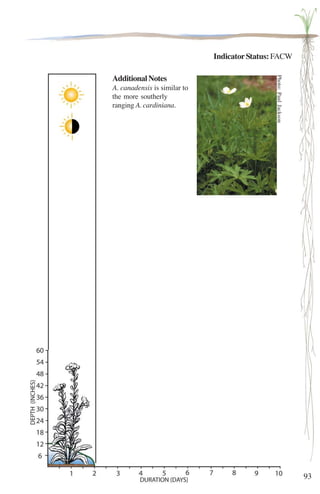
to August. The flowers are 1-1½'' across, have 5 petal-like sepals and a yellow center. 
Leaf: This species has deeply lobed and basal leaves with a long stem with whorled 
leaves forming the flower cluster. Leaves appear hairy, especially on the lower surface. 
Stem: Flowers and leaves arise from a long, hairy stalk. Fruit: Light to dark brown 
late in fall. Root: Rhizomatous. Soil: Medium soil from mesic to wet (hydric). [7, 
35, 41, 47] 
Normal Water Level 
This species does well in moist to wet (saturated) soils, spreading as a good 
groundcover. [21] 
Flooding/Fluctuation Tolerances 
Frequency: High. Depth: 12''. Duration: Short – 2 days (decreasing 6''/day). This 
species is somewhat tolerant to flood duration. [1] 
Sensitivities or Other Tolerances 
Exposure: Partial to full sun. Salt: Low. Nutrient: Low to moderate. 
Siltation: Unknown. Insect: Infrequent. Other: It has a moderate tolerance to 
general disturbance and stress. [1, 47] 
Design Considerations 
A good plant for restorations (wet meadow, low prairies and woodland openings) and 
revegetation sites such as roadsides and vegetated swales. This species has a use in 
rock gardens and rainwater gardens in shallow inundation conditions. Concerns: This 
species is an aggressive underground spreader for gardens and other formal landscaping 
areas, though this may be desirable in restorations. [16] 
Wildlife Use 
This plant is sometimes used by waterfowl, muskrats and small rodents. [21] 
Nursery/Plant Information 
Available: Widely. Types: Seeds and plants. 
Planting Techniques 
The seed should be stored dry for about 180 days. Approximately 97,600 seeds/lb. [16]
93 
Indicator Status: FACW 
Additional Notes 
A. canadensis is similar to 
the more southerly 
ranging A. cardiniana. 
Photo: Paul Jackson
94 
Angelica atropurpurea 
Angelica - a.k.a. Alexanders; Purplestem, Great or Great High Angelica 
Habitat/Plant Community and Geographic Range 
Habitat/Community: Springs, seeps, calcareous fens, stream banks, shores, marshes, 
sedge meadows, wet depressions in forests in calcium-rich soils. [7, 11, 16] Range: E. 
though local in ne. Minn. (Eco-Region: 1,6-8), ec. and s. Wis., mostly s. LP of Mich. 
This species is generally in the n. from Lbdr. to Minn. and s. to Del., W.Va. and Ill. [7, 21] 
Endangered in Iowa. 
Description 
General: A native perennial herb that can grow to 8'' tall, this species is a member of 
the carrot family. Flower: The inflorescence is a large 4'' in diameter, compound 
umbel. Flowers are white or greenish-white and bloom around the first week in June. 
Leaf: Basal leaves are pinnately more than once divided, and upper leaves are 
progressively reduced, with broadly sheathing leaf stalks and serrate, pointed leaflets. 
Stem: The stout, round stems are purplish, aromatic and hollow. Fruit: Thin, flat 
lateral wings occur on the hairless fruit, which fall by midsummer. Root: Fibrous, 
shallow. Soil: This species prefers calcareous-rich soils. [7, 11, 16] 
Normal Water Level 
This species prefers shallow water of 3'' of inundation or less to wet/saturated conditions. 
[21] 
Flooding/Fluctuation Tolerances 
Frequency: Moderate to low. Depth: 18''. Duration: Medium short – 3 days 
(decreasing in water depth 6''/day). Can survive early-summer flooding while 
dormant. 
Sensitivities or Other Tolerances 
Exposure: Full to partial sun. Salt: Low to moderate. Nutrient: Unknown. 
Siltation: Unknown. Insect: Infrequent. Other: This species has a moderate tolerance 
to general disturbance and stress. [1, 47] 
Design Considerations 
This is a good species for wetland restorations (especially in calcareous situations, 
seeps and springs). It is underutilized for landscaping. Concerns: This species can 
be aggressive in some soils, though this may be desirable. [16] 
Wildlife Use 
Angelica provides good habitat for upland gamebirds and songbirds. It is also a bee 
and butterfly attractant. [16, 21] 
Nursery/Plant Information 
Available: Limited. Types: Only seed is widely available.
95 
Indicator Status: OBL 
Planting Techniques 
The seed should be collected 
and planted fresh and 
stratified in moist, cold 
conditions. This plant has 
approximately 105,600 
seeds/lb. [16] 
Photo: MNDNR
96 
Arisaema triphyllum 
Jack-in-the-pulpit - a.k.a. A. atrorubens - Indian Turnip 
Habitat/Plant Community and Geographic Range 
Habitat/Community: Wet, shady, moist deciduous forests and cedar swamps. [7, 16, 
35, 41] Range: Minn. (Eco-Region: All), Wis., Mich.; N.S. to Ont., s. to Fla., La. 
and Kan. [7, 21] 
Description 
General: This native perennial herb of rich, moist woods is an attractive member of 
the arum family. It can grow 1-2' tall. Flower: Small flowers crowd near the base of 
a club-like spadix (Jack) 2-3'' long, enclosed by a narrow, funnel-shaped structure 
(spathe) that has an overhanging flap at the top, the “pulpit.” Leaf: Compound with 
3 pointed leaflets. Stem: Upright, single stem. Fruit: In late summer, the withering 
of the spathe exposes in shiny, green berries that turn bright red. Root: Bitter-tasting 
corm. Soil: Rich, moist woodland soils. [7, 35, 41, 47] 
Normal Water Level 
This species prefers upland moist/mesic to wet/saturated conditions. [21, 37] 
Flooding/Fluctuation Tolerances 
Frequency: Moderate. Depth: 12''. Duration: Short – 1 day (decreasing all 12'' in 
1 day). This species does tolerate seasonal inundation or short, irregularly timed 
periods of inundation. [1, 37] 
Sensitivities or Other Tolerances 
Exposure: Partial sun to full shade. Salt: Low. Nutrient: Low to moderate. 
Siltation: Low. Insect: Infrequent. Other: This species has a moderate tolerance to 
general disturbance and stress. [1, 37, 47] 
Design Considerations 
This plant has been used in landscaping in shady or deciduous woodland areas. It 
may also be used in woodland restorations as a successional species, especially in 
cedar swamps and wet deciduous forests. This species self seeds. Concerns: The 
fresh root is poisonous but edible after it has been cooked. If disturbed or affected by 
other stress, the female plant declines in vigor and may stop producing fruit. [16] 
Wildlife Use: 
Gamebirds (ring-necked pheasants and turkeys), wood thrushes, wood ducks and 
mammals, such as raccoons and chipmunks, eat the fruit and leaves. The fruit is 
toxic to humans. [21, 32, 37] 
Nursery/Plant Information 
Available: Limited. Types: Plants only.
97 
Indicator Status: FACW-Planting 
Techniques 
The seeds need to be 
macerated and fall planted in 
light conditions. They 
should be moist, cold 
stratified for 60 days. Some 
ecotypes may not germinate 
until second year. About 
7,040 seeds/lb. [16] 
Photo: Jeff Shaw
98 
Aronia melanocarpa 
Black Chokeberry - a.k.a. Glossy Black Chokeberry or Indigo Bush 
Habitat/Plant Community and Geographic Range 
Habitat/Community: Tamarack swamps, open bogs, wet thickets, marshes, springs, 
prairies, dunes, old fields, creek banks, and shores. [7, 16, 22] Range: Nc., ne. and 
ec. Minn. (Eco-Regions: 1-3, 5, 6), Wis., Mich. Nfld. and Labr. to Minn., Iowa and 
se. Mo., s. to n. Ga. and Ala. [7, 21] Endangered in Iowa. 
Description 
General: Black chokeberry is a very attractive, spreading shrub of the rose family that 
grows 3-6' tall. Flower: Nice clusters of white flowers in May. Leaf: Excellent, deep 
red fall foliage. Stem: Suckering, upright habit. Fruit: Black to blue-black berries. 
Root: Shallow fibrous, fine textured, suckers profusely. Soil: Wet-to-dry soils, 
although it prefers sandy wet or boggy. [7, 22] 
Normal Water Level 
This species prefers upland moist/mesic to wet/saturated conditions and tolerates dry 
conditions and salty soil and water. [6, 21] 
Flooding/Fluctuation Tolerances 
Frequency: Moderate. Depth: 12''. Duration: Short – 2 days (decreasing 6''/day). 
Black chokeberry is very tolerant to floods early in the season and somewhat tolerant 
to flood duration. [1, 22] 
Sensitivities or Other Tolerances 
Exposure: Full to part sun. Salt: Moderate (Tolerates salty soil and water). 
Nutrient: Low to moderate. Siltation: Moderate. Insect: Infrequent – round-headed 
apple borer; rarely serious. Other: Resistant to drought/heat, compacted soils, mine 
spoils and infrequently damaged by ice and wind. It has a moderate tolerance to 
general disturbance and stress. [1, 6, 22] 
Design Considerations 
This species is excellent for wet, lake edge plantings. Black chokeberry is also used 
as an ornamental for its showy white flowers, black fruit and fall color. Good in 
massing, borders and backgrounds in landscaping. This species does well in rain 
gardens with well drained conditions. Concerns: Black chokeberry Spreads aggressively 
under favorable conditions. [16] 
Wildlife Use 
The fruit are of some importance, as they persistent through the winter. The fruit is 
consumed by upland gamebirds (sharp-tailed and ruffed grouse), songbirds (cedar 
waxwings, chickadees, and meadowlarks), large and small mammals (bear and white-footed 
mice), hoofed browsers eat twigs, leaves, fruits edible to humans. [21, 22]
99 
Indicator Status: FACW-Nursery/ 
Plant 
Photo: www.cala2.umn.edu/la5574/ 
Information 
Available: Widely. 
Types: Available as 
potted and bareroot 
plants. 
Planting Techniques 
This species transplants 
well. The seeds need to 
be macerated and fall 
planted in light conditions. Seeds should also be moist, cold 
stratified for 90 days. Cuttings also work. About 276,000 
seeds/lb. [16, 22]
100 
Artemisia ludoviciana 
Prairie Sage - a.k.a. White Sage or Dark-leaved Mugwort 
Habitat/Plant Community and Geographic Range 
Habitat/Community: Prairie sage often grows in patches in sand and dry prairies, 
primarily near major rivers, pastures and savannas. [16, 17, 35] Range: Especially s. 
and w. Minn. (Eco-Region: All), Wis.; Man. to Ala., s. to Mont., N.M., n. Tex., 
Ark., n. to w. Ind., s. Wis. and Minn. [17, 21] 
Description 
General: Prairie sage is a native perennial that is grown for its silvery gray 
foliage. Flower: The inconspicuous flowers are arranged in an elongated, 
pyramidal influoresence. Leaf: Leaves of this plant are oblong and up to 3'' in 
length. They appear white because they are covered with soft, white hairs on both 
sides. The leaves have an aromatic, sagebrush odor when crushed. Stem: Spread-ing. 
Fruit: Light brown achene at the end of fall. Root: Aggressive, rhizomatous 
roots. Soil: Medium (mesic) to dry (xeric) soils. [17, 35, 47] 
Normal Water Level 
This species prefers upland moist/mesic to dry conditions. [21] 
Flooding/Fluctuation Tolerances 
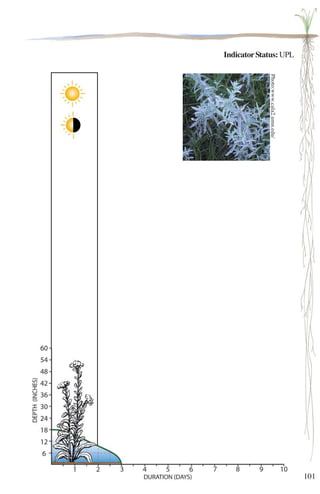
Frequency: Moderate. Depth: 18''. Duration: Medium short – 3 days (decreasing 
6''/day). 
Sensitivities or Other Tolerances 
Exposure: Full to part sun. Salt: Low. Nutrient: Unknown. Siltation: Unknown. 
Insect: Infrequent. Other: This species has a moderate tolerance to general distur-bance 
and stress. [1, 47] 
Design Considerations 
Prairie sage is a good groundcover for sunny, dry slopes because of its aggressive 
habit. This species is also good for restorations, as a contrast plant in landscapes and 
for aromatic use. Concerns: Spreads quickly in gardens. [21] 
Wildlife Use 
Provides habitat and cover in prairies for small birds and mammals. [21, 32] 
Nursery/Plant Information 
Available: Widely. Types: Plants only. 
Planting Techniques 
The seed needs no treatment other than light. [16]
101 
Indicator Status: UPL 
Photo:www.cala2.umn.edu/ 
la5574
102 
Asclepias incarnata 
Marsh Milkweed - a.k.a. Swamp or Red Milkweed 
Habitat/Plant Community and Geographic Range 
Habitat/Community: Marsh milkweed is a common wetland and lakeshore milk-weed 
found in openings in conifer swamps, sedge meadows, shallow marshes, stream 
banks, ditches, open bogs, open fens, often in shallow water and will tolerate moist 
prairie conditions. [7, 11, 16, 35, 41] Range: Minn. (Eco-Region: All), Wis., Mich. 
N.S. to Sask., s. to Fla., Tex. and N.M. [7, 21] 
Description 
General: A common, native, erect, perennial herb usually 3-4' tall that has milky 
juice when the stem or leaf is cut. Often the entire plant is reddish. Flower: Clusters 
of pink to rose-purple flowers from June to August. The inflorescence is comprised of 
several flat umbels, the individual flowers have 5 downward-curving petals and 5 
upward petals, resembling a crown. Leaf: Opposite, lance-shaped to linear to oblong 
on short leaf stalks. Stem: Usually 1 long stem that branches near the top, and is 
erect decorative deep red-brown. Fruit: Pointed 3'' seedpods, which open up in late 
summer with downy, airborne seeds. Root: Thick rhizomes. Soil: Prefers wet to 
moist wetland or loamy soils. [7, 11, 35, 41] 
Normal Water Level 
This species prefers shallow water of 3'' of inundation or less to wet/saturated to 
upland moist conditions. [21, 37] 
Flooding/Fluctuation Tolerances 
Frequency: Moderate. Depth: 18''. Duration: Medium short – 3 days (decreasing 
3''/day). Tolerant of spring flooding when dormant. This species prefers wet 
meadows and tolerates seasonal inundation or short periods of inundation during the 
growing season. [1, 37] 
Sensitivities or Other Tolerances 
Exposure: Full to part sun. Salt: Moderate. Nutrient: Low to moderate. 
Siltation: Moderate. Insect: Infrequent. Other: This species has a moderate to low 
tolerance to general disturbance and stress. [1, 37, 47] 
Design Considerations 
A good plant for butterfly gardens and landscaping due to its aromatic and decorative 
qualities. This species also is used well in restorations of wetlands, wet woods, 
marshes and wet prairies. Also recommended for rain gardens, pond edges and 
vegetated swales. Concerns: This species can be short lived. [16, 21, 41] 
Wildlife Use 
This species is a host and nectar plant for monarch butterflies. Many birds use the 
fibers from old stems to build nests. Many insects use this plant; it is particularly 
attractive to bees and butterflies. Flowers often conceal crab spiders lying in wait for 
pollinators. [11, 37, 41]
103 
Indicator Status: OBL 
Nursery/Plant 
Information 
Available: 
Widely. 
Types: Seeds and 
plants. 
Planting 
Techniques 
Store the seeds 
dry. Seeds should be light GA3, moist, cold stratified for 10 
days. Best when fall planted in saturated soils. Approxi-mately 
50,000-72,000 seeds/lb. [16, 37] 
Photo: Dan Shaw
104 
Asclepias tuberosa 
Butterfly Milkweed - a.k.a. Butterflyweed, Pleurisy Root or Chigger-flower 
Habitat/Plant Community and Geographic Range 
Habitat/Community: Dry, sunny prairies and savannas, prefers sandy soils. Found 
along railroad beds and roadsides high on the outside berm, growing in clumps in 
open places, often on sand. [16, 17, 35, 41] Range: Mostly s. and e. Minn. (Eco- 
Region: 3-9), mostly s. and w. Wis.; Me. to Minn., s. to Ariz., Fla. [17, 21] 
Description 
General: One of the brightest and most conspicuous native perennials, growing 
usually 1-2’ tall. This plant, unlike other milkweeds, has no milky juice, instead, its 
stem and leaves bleed clear sap. Flower: Spreading clusters of flowers ranging from 
bright yellow to blazing orange. Flowers are arranged in a large, flat-topped umbel 2- 
3'' wide, blooming from late June to September. Leaf: Hairy, toothless, narrow, 
alternate leaves 2-6'' long, widen at tip. Stem: Often clumped with a single stem that 
branches only near the top. Fruit: Erect small cluster of narrow pods, 6'' long, 
covered in fine hairs; pods contain large, brown seeds with silken “parachutes.” 
Root: A large taproot. Soil: Sand/loam soils, will tolerate dry, sandy soils. [17, 35, 41] 
Normal Water Level 
This species prefers upland moist/mesic to dry conditions. [21] 
Flooding/Fluctuation Tolerances 
Frequency: Low. Depth: 12''. Duration: Short – 1 day (Inundation is acceptable if 
in sandy soils that infiltrates quickly in less than 1 day). This species is somewhat 
tolerant to flood duration. [1] 
Sensitivities or Other Tolerances 
Exposure: Full to part sun, not tolerating a lot of shade. Salt: Low to 2,4-D; 
moderate to soil salt and high to spray. Nutrient: Low to moderate. Siltation: Low. 
Insect: Infrequent. This species has moderate tolerance to general disturbance and 
stress. [1, 47] 
Design Considerations 
Butterflyweed is a wonderful landscaping garden perennial though it can be short 
lived. As the name indicates, it is a good butterfly garden plant and is used in prairie 
and upland restorations. This plant can be used in rain gardens on the edge or areas 
that are not inundated frequently, dry quickly and do not exceed depths greater than 
3''. Concerns: Many cultivars exist, some of which do not have disease resistance. 
[16, 35] 
Wildlife Use 
A host plant for gray hairstreak and monarch butterfly caterpillars. This species is an 
excellent nectar source for all butterflies, often attracting hords of butterflies. [21, 41]
105 
Indicator Status: UPL 
Nursery/Plant 
Information 
Available: Widely. 
Types: As seed 
and plants. 
Planting 
Techniques 
Butterflyweed can 
be raised from seed 
or root cuttings but the species name, tuberosa, refers to its 
large taproot, which complicates transplanting. Seed has no 
treatment requirements, though moist, cold stratification, 
bottom heat and fall planting is recommended. Approxi-mately 
3,500 seeds/lb. [16, 35, 41] Photo: Jeff Shaw
106 
Aster laevis 
Smooth Aster - a.k.a Smooth Blue Aster 
Habitat/Plant Community and Geographic Range 
Habitat/Community: A beautiful aster of mesic open or brushy places such as 
prairies, savannas, woodlands, swales and roadsides. [16, 17, 35] Range: All but ne. 
Minn. (Eco-Region: All), Wis., Mich. Mass., N.Y., s. Ont., s. Man. to Alaska, s. to 
N.D., S.D., Iowa, Mo., Tenn.; n. to Ohio, Pa., R.I. [7, 21] 
Description 
General: A showy, vibrant blue-flowered perennial herb that has a mature height of 2-4'. 
Flower: Color is lavender-blue, blooms from August to October. The flowers are 1'' 
across with 15 to 25 rays. Leaf: Blue-green, thick leaves that clasp the stem throughout 
the plant. Stem: Upright, single stem. Fruit: Light brown achene at the end of autumn. 
Root: Fibrous, shallow. Soil: The pH range is 5.0 to 6.5, dry to mesic soil. [17, 35, 44, 
47] 
Normal Water Level 
This species prefers upland moist/mesic to dry conditions. [21, 44] 
Flooding/Fluctuation Tolerances 
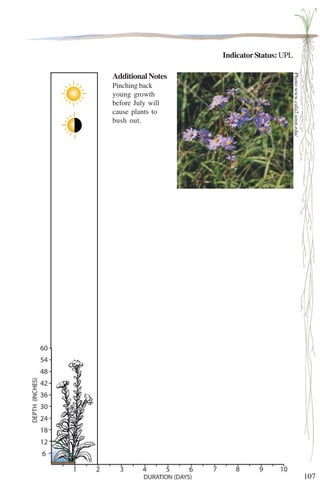
Frequency: High. Depth: 12''. Duration: Short – 1 day (decreases 6'' every 12 
hours). Smooth aster can tolerate wet conditions for short durations and seasonal 
inundation. [1, 44] 
Sensitivities or Other Tolerances: 
Exposure: Full to part sun. Salt: Low. Nutrient: Low to moderate. 
Siltation: Low to moderate. Insect: Infrequent. [1, 44, 47] 
Design Considerations 
Smooth blue aster is well suited for upland slope buffer stabilization, vegetated 
swales, rainwater gardens and stormwater runoff situations that drain well. It is also 
good in landscaping situations for butterflies, cut flowers and birds. Concerns: The 
plant is aggressive, which is favorable for some restorations. Several cultivated 
varieties exist. [16, 35, 44] 
Wildlife Use 
This aster attracts the orange sulphur butterfly. [21, 32, 44] 
Nursery/Plant Information 
Available: Widely. Types: Seeds and plants. Several cultivars exist. 
Planting Techniques 
Smooth aster is easily propagated from seed. No germination treatments are needed. 
Seed should be stored dry and cool. Cuttings can be rooted, and this species self 
sows well. Seeding rate is 0.02-0.125 lb/acre and approximately 768,000 seeds/lb. 
[16, 44]
107 
Indicator Status: UPL 
Photo:www.cala2.umn.edu/ 
la5574 
Additional Notes 
Pinching back 
young growth 
before July will 
cause plants to 
bush out.
108 
Aster lanceolatus (simplex) 
Panicle Aster - a.k.a. Aster simplex – White Panicle, Marsh or Eastern Lined Aster 
Habitat/Plant Community and Geographic Range 
Habitat/Community: Panicled aster is one of our more common asters found in 
drier, open marshes, wet meadows, sedge meadows, fens, swamp openings, low 
prairies, old fields, stream banks and shores. [7, 11, 16, 35] Range: Minn. (Eco- 
Region: All), Wis., Mich. N.S. to N.D., s. to Va. and Tex. [7, 21] 
Description 
General: This large, stout, perennial herb has a mature height of 2-4'' and may form 
dense colonies. Flower: Flowers are about ¾'' wide with 20 or more white rays, 
usually blooming from August to October. The inflorescence is leafy and forms a 
panicle. Although similar to the redstem and swamp asters (A. puniceus and A. 
lucidulus) the ray flowers of white panicle aster are always white and smaller. Leaf: 
Stem leaves are sessile or slightly clasping. Leaf undersides are smooth with the 
exception of occasional small hairs along the margins. Leaves are mostly serrate, 
longer than wide. Stem: Large, stout plant producing multiple branches toward the 
top. Fruit: Light brown achene maturing at the end of fall. Root: Forming colonies 
from long rhizomes. Soil: Prefers moist to saturated soils. [7, 11, 35, 44, 47] 
Normal Water Level 
This species prefers upland moist/mesic to wet/saturated conditions. [21, 44] 
Flooding/Fluctuation Tolerances 
Frequency: Moderate. Depth: 24''. Duration: Medium long – 4 days (decreasing 6'' 
daily). Panicled aster seedlings are killed by 2 days of inundation, though mature 
plants tolerate shallow flooding for short periods. This aster has a better tolerance to 
inundation than New England aster and is moderately to somewhat tolerant to flood 
duration. [1, 44] 
Sensitivities or Other Tolerances 
Exposure: Full to part sun. Salt: Low to moderate. Nutrient: Low to moderate. 
Siltation: High. Insect: Infrequent. Other: This species is moderately tolerant to 
general disturbance and stress. [1, 44, 47] 
Design Considerations 
Panicled aster is used well in the upper shoreline zone and for slope buffer stabiliza-tion. 
It also does well in vegetated swales and restorations. It is used for cutflowers 
and attracts butterflies. This species will work well in infiltration basins and rain 
gardens. Concerns: Can be very weedy and aggressive, though this may be a benefit 
against other invaders in restorations. [16, 44] 
Wildlife Use 
This aster provides waterfowl cover and will attract butterflies and bees. [21, 32, 44]
109 
Indicator Status: FACW 
Nursery/Plant 
Information 
Available: Widely – 
typically listed as A. 
simplex. Types: Trans-plants, 
achenes and 
rootstocks. 
Planting Techniques 
Moist stratification 
benefits germination of 
achenes, but this cold treatment may not be required. Drilling 
or broadcasting achenes in the fall and covering them lightly 
with soil works the best. Mature plants may be divided in 
late fall or early spring. Seeding rate is 0.06 lb/MNDNR 
acre. [16, Photo: 44]
110 
Aster lucidulus 
Swamp Aster - a.k.a. Shining Aster 
Habitat/Plant Community and Geographic Range 
Habitat/Community: One of the more common wetland asters, found in swamps, 
stream banks, shores, sedge meadows, calcareous fens, marshes, thickets, roadsides 
and ditches. This aster sometimes forms large colonies and seems to respond to 
disturbances, such as grazing and drainage by increasing or spreading. [7, 11] 
Range: Minn. (Eco-Region: All), Wis., Mich., w. N.Y. to Minn. and S.D., s. to W.Va. 
and s. Mo. [7] 
Description 
General: Swamp aster is a colonial, perennial herb, which may grow 15''-8' tall. 
Flower: The inflorescence may be hairy or smooth, but does not have glands. Ray 
flowers are usually pale blue to lavender and bloom from August to October. 
Leaf: Stem leaves are lobed at the base and clasp the stem. They are conspicuously 
crowded, especially toward the inflorescence. Stem: Green stems with mahogany 
marks at the nodes, or streaked. The stems are smooth to sparingly covered with 
stiff, straight hair. Fruit: Hairy achenes. Root: Long, creeping rhizomes. 
Soil: Prefers moist-to-saturated soil. [7, 11, 47] 
Normal Water Level 
This species prefers upland moist/mesic to wet/saturated conditions. 
Flooding/Fluctuation Tolerances 
Frequency: High. Depth: 18''. Duration: Long – 5 days (decreasing 6'' the first 
day and 12'' over the next 4 days). 
Sensitivities or Other Tolerances 
Exposure: Full sun to part shade. Salt: Low. Nutrient: Unknown. 
Siltation: Unknown. Insect: Infrequent. Other: Swamp aster has low tolerance to 
general disturbance and stress. [46] 
Design Considerations 
Swamp aster is useful in the wet meadow zone and for slope buffer stabilization. It 
does well in vegetated swales and restorations and infiltration basins. 
Concerns: Swamp aster can be aggressive and form monocultures in grazing- and 
drainage-disturbed areas. 
Wildlife Use 
This aster provides waterfowl cover and will attract butterflies and bees. [32] 
Nursery/Plant Information 
Available: Widely. Types: Seed only.
111 
Indicator Status: FACW+ 
Planting 
Techniques 
Swamp aster is 
easily propagated 
from seed. No 
germination 
treatments are 
needed. Seed 
should be stored 
dry and cool. 
Cuttings can be rooted, and this species self sows well. 
Seeding rate is 0.02-0.125 lb/acre. [16] 
Additional Notes 
A. lucidulus is similar to bristly aster (A. puniceus) and 
some authorities consider it a variety of bristly aster. [7, 11] 
Photo: Paul Jackson
112 
Aster macrophyllus 
Bigleaf Aster - a.k.a Large Leaf Aster 
Habitat/Plant Community and Geographic Range 
Habitat/Community: One of the more common asters found in northern forests, a 
common groundcover in dry, shady savannas, woodlands and forests. May form a 
ground cover. [17, 35, 41] Range: Throughout northern upland forests of Minn. 
(Eco-Region: 1, 2, 5–8), Wis., Mich. N.S., N.B. and Que. to Wis., Minn. and se. 
Man., s. to Pa. and Ky., and in the mountains of Ga. [17, 21] 
Description 
General: Native perennial, with a height of 8-18''. Only a few plants send up flower 
stalks each year. Flower: Influorescence is a loose cluster of lilac-to-purple flowers 
with yellow anthers that turn red with age. Blooms from Aug. to Oct. Leaf: Basal 
leaves are broad heart-shaped; coarsely toothed and rough to the touch, 4-8'' long, that 
are deeply notched where they attach to the stalk. Stem: Long flowering stems, 1-2' 
tall, which are sticky to the touch because of miniature glands. Fruit: Light brown 
achene at the end of the growing season. Root: Rhizomes. Soil: All soil types. [17, 
35, 41, 47] 
Normal Water Level 
This species prefers upland moist/mesic to dry conditions and is usually an indicator 
of the upland side of wetland boundaries. [21] 
Flooding/Fluctuation Tolerances 
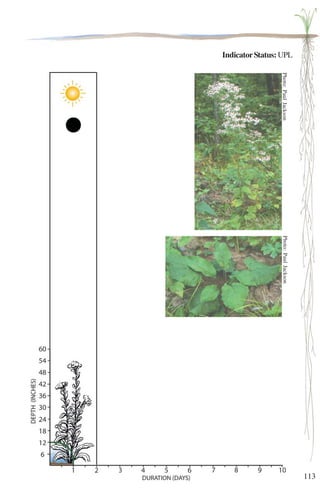
Frequency: Low. Depth: 12''. Duration: Short – 1 day (decreasing all 12'' in 1 
day). This species is somewhat tolerant to flood duration. [1] 
Sensitivities or Other Tolerances 
Exposure: Full sun to shade. Salt: Low. Nutrient: Low to moderate. 
Siltation: Low. Insect: Infrequent. [1, 47] 
Design Considerations 
Bigleaf aster is a great groundcover for shaded slopes or dry, shaded edges of rainwater 
gardens, forested wetlands or upland buffers. Concerns: This species can be aggressive 
and form monocultures within the groundcover of the forest floor. [21] 
Wildlife Use 
This aster provides cover and nesting habitat for songbirds of the forest floor. [21, 32] 
Nursery/Plant Information 
Available: Limited. Types: Only as plants. 
Planting Techniques 
Plant containerized plants in spring or fall.
113 
Indicator Status: UPL 
Photo: Paul Jackson Photo: Paul Jackson
114 
Aster novae-angliae 
New England Aster - a.k.a. False Indigo 
Habitat/Plant Community and Geographic Range 
Habitat/Community: Wet meadow, low prairie, shores, thickets, calcareous fens, and 
roadsides, usually in moist or wet, open areas. This species is a common aster of wet 
to wet-mesic prairies. [7, 11, 16, 35, 41] Range: Mostly w. and s. Minn. (Eco- 
Region: 3-9); Wis., especially s. LP of Mich.; Mass. to N.D. and Wyo., s. to Ala., 
Okla. and N.M. [7, 21] 
Description 
General: A native, perennial herb with clustered stems reaching 1-6½', which is easily 
grown and makes a robust, colorful garden plant. Flower: Individual flowers, flower 
stalks and modified leaves subtending the flowers have hairy glands. The ray flower is 
very variable in color, from amethyst to rosy, rarely blue or white. The distinctive disc 
flower is yellow. The flower heads are 1-2'' wide and bloom from late summer until 
frost. Leaf: Bases of the oblong (lance-shaped) stem leaves are clasping and entire, 
while the lower leaves tend to be deciduous. Stem: Usually clumped and much 
branched and often covered with glandular hairs (use a 10-15X lens). Fruit: The achenes 
are densely covered with stiff hairs. Root: A short rhizome or crown. Soil: Moist to wet 
habitats with a pH range of 5.5-7.0. [7, 11, 35, 41, 44] 
Normal Water Level 
This species prefers upland moist/mesic to wet/saturated conditions. [21, 37] 
Flooding/Fluctuation Tolerances 
Frequency: Moderate. Depth: 24''. Duration: Moderate short – 3 days (decreasing 
1' in the first day and 6'' the following 2 days). Germinating seedlings are killed within 
2 days of inundation. Mature plants appear to be more tolerant of short periods of 
shallow flooding in natural areas but not in reconstructed wet areas. [1, 37, 44] 
Sensitivities or Other Tolerances 
Exposure: Full to partial sun. Salt: Low. Nutrient: Low to moderate. 
Siltation: High. Insect: Infrequent. Other: This species has a moderate-to-high 
tolerance to general disturbance and stress. [1, 37, 44, 45, 47] 
Design Considerations 
New England aster is a good soil stabilizer for prairies, shorelines and upland buffer areas. 
It is often a garden perennial of cultivated varieties. It provides good cut flowers and is 
very good for lakeside plantings. It is also a good butterfly plant. Slight disturbances 
often benefit this aster. Concerns: This species can be aggressive and form monocultures. 
It spreads by seed. Many cultivars exist. [16, 21, 35, 41, 44] 
Wildlife Use 
This aster provides waterfowl cover. A great nectar source because of its long bloom 
time in autumn, during which it is heavily visited by migrating monarch butterflies. 
[21, 32, 41, 44]
115 
Indicator Status: FACW 
Nursery/Plant 
Information 
Available: Widely; often a 
garden perennial with a 
white variety. 
Types: Transplants, seed 
and rootstocks. 
Planting Techniques 
Fresh or dry achenes 
produce 95-100% germina-tion 
in 3-8 days. Moist 
stratification of fresh 
achenes benefits germina-tion. 
Drill or broadcast 
Photo: Paul Jackson 
achenes in the fall and cover 
them lightly with soil for natural stratification. Achenes are 
light and temperature sensitive. Mature plant may be divided 
in late fall or early spring. Spring cuttings of 1.5-2'' may be 
rooted in sand. An April-May drawdown stimulates seed 
germination and plant growth. Seeding rate is 0.03-0.2 lb/acre. 
1,120,000-4,600,000 seeds/lb. [16, 37, 44] 
Additional Notes 
Pinching back young growth before July will cause plants 
to branch.
116 
Aster pilosus 
Frost Aster - a.k.a. Hairy Aster, White Oldfield Aster 
Habitat/Plant Community & Geographic Range 
Habitat/Community: Sandy and gravely shores, interdunal swales, wet meadows, 
widely adapted to prairie habitats and moist-to-wet marshes. This species is often in 
calcium-rich soil, and may become weedy in disturbed fields and roadsides. [7, 16] 
Range: Se. Minn. (Eco-Region: 7-8), Wis., Mich.; N.S. to s. Minn. and Neb., s. to 
n. Fla., La. and Kan. [7] 
General Description 
General: Frost aster is a spreading perennial herb, from a large crown that grows 
between 16-24''. Flower: This species has green-tipped, white ray flowers and yellow 
disc flowers that bloom from August to November. Leaf: Alternate, basal and lower 
leaves oblong lance-shaped, with stalks that soon are deciduous. The upper leaves are 
smaller, linear, stalkless. Leaf margins are entire or slightly toothed and the petioles 
are fringed with hairs. Stem: Sometimes smooth or stems and leaves with spreading 
hairs. Fruit: An achene; pappus white. Root: Fibrous, shallow. Soil: Widely 
adapted to moist-to-wet soils. [7, 16, 17, 47] 
Normal Water Level 
This species prefers upland moist/mesic to wet/saturated conditions. 
Flooding/Fluctuation Tolerances 
Frequency: High. Depth: 12''. Duration: Short – 2 days (decreasing 6''/day). 
This species is somewhat tolerant to flood duration. [1] 
Sensitivities or Other Tolerances 
Exposure: Full to part sun. Salt: Unknown. Nutrient: Low to moderate. 
Siltation: Unknown. Insect: Infreauent. Other: This species has a moderate-to-high 
tolerance to general disturbance and stress. [1, 47] 
Design Considerations 
Frost aster makes wonderful cutflowers and is a good nectar source with strong 
tolerance to sandy and gravel soil types. Concerns: Aggressively self-seeds. May 
become weedy in disturbed sites though it may be used beneficially in restorations to 
defend against invasive plants. [16] 
Wildlife Use 
This aster provides waterfowl cover and will attract butterflies and bees. [7, 32] 
Nursery/Plant Information 
Available: Limited. Types: Plants only. 
Planting Techniques 
Achenes should be kept in dry storage before planting. [16]
117 
Indicator Status: FACU+ 
Photo: Rusty Schmidt
118 
Aster puniceus 
Red-stemmed Aster - a.k.a. Purplestem, Red-stalked, Bristly or 
Swamp Aster 
Habitat/Plant Community and Geographic Range 
Habitat/Community: A stout aster of open and brushy swamps, sedge meadows, 
shrub-carrs, alder thickets, calcareous fens, stream banks, shores and springs. [7, 11, 
35] Range: Minn. (Eco-Region: 1–8), Wis., Mich.; Nfld. to N.D., s. to Ga., Ala., Ill. 
and Neb. [7, 21] 
Description 
General: Large, perennial herb commonly 1-5' tall. Flower: The flower heads have 
pale blue to deep lavender or violet ray flowers and yellow disc flowers. This species 
blooms from August to October. The inflorescence is hairy or smooth, but does not 
have glands. Leaf: Stem leaves are lobed, clasping the stem, and usually toothed. 
The leaves are not conspicuously crowded. Stem: The stem is often reddish, with 
scattered coarse, stiff, white hairs. Fruit: Achenes are smooth. Root: Short rhizomes or 
crowns and sometimes has short stolons. Soil: Hardy and tolerant of wet soils. [7, 11, 
35] 
Normal Water Level 
This species prefers moist/mesic to wet/saturated conditions. [21] 
Flooding/Fluctuation Tolerances 
Frequency: Moderate. Depth: 18''. Duration: Long – 5 days (decrease of 6'' in the 
first day and then 12'' in the next 4 days). This species has a moderate tolerance to 
flood duration. [1] 
Sensitivities or Other Tolerances 
Exposure: Full to part sun. Salt: Unknown. Nutrient: Low to moderate. 
Siltation: Unknown. Insect: Infrequent. Other: This species has a moderate tolerance to 
general disturbance and stress. [1] 
Design Considerations 
Red-stemmed aster is used in wetland restorations as well as in restorations of shores and 
streams. Also consider this plant for stormwater detention areas. This species is a 
wonderful source of nectar. Concerns: Can be very weedy and aggressive, though this 
may be a benefit against other invaders for restorations. [16, 21] 
Wildlife Use 
This aster provides waterfowl cover and will attract butterflies and bees. [21, 32] 
Nursery/Plant Information 
Available: Limited. Types: Seed and plants.
119 
Indicator Status: OBL 
Planting Techniques 
Achenes need moist, cold 
stratification and prefer fall 
planting. Approximately 
1,216,000 seeds/lb.[16] 
Additional Notes 
A. lucidulus is similar. [11] 
Photo: Paul Jackson
120 
Athyrium felix-femina 
Lady Fern - a.k.a. Athyrium angustum 
Habitat/Plant Community and Geographic Range 
Habitat/Community: Moist, rich soils of forests, wooded swamps and a dominant 
fern in midwestern woodlands. [17] Range: Minn. (Eco-Region: All), Wis., Mich.; 
N.S. and N.B. to Ont., Minn.; s. to Ga., La. and Okla. [17, 21] 
Description 
General: A perennial, native fern that may grow to 36''. Leaf: Lady fern is a vigor-ous, 
semi-spreading fern with lime-green, lacy, cut fronds. Fruit: Light brown spore 
in August. Root: Rhizome, short-creeping to suberect. Soil: Moist, rich soils of 
forests. [17, 21, 47] 
Normal Water Level 
This species prefers upland moist/mesic to wet/saturated conditions. [21] 
Flooding/Fluctuation Tolerances 
Frequency: Low. Depth: 12''. Duration: Short – 2 days (decreasing 6''/day). This 
species is moderately tolerant to flood duration. [1] 
Sensitivities or Other Tolerances 
Exposure: Part sun to full shade. Salt: Low. Nutrient: Low to moderate. 
Siltation: Low. Insect: Infrequent. Other: Sensitive to wind. This species has a 
moderate tolerance to general disturbance and stress. [1] 
Design Considerations 
Lady Fern makes a very useful groundcover for shady restorations, gardens, rain water 
gardens and replacement for hostas to deter deer. This species is also a good indicator 
for wetland boundaries in northern woodlands. Concerns: Ferns are susceptible to 
excess wind and sun exposure. [21] 
Wildlife Use 
Ferns are widespread, especially in moist woodlands. Yet as a wildlife food source, 
they are used only to a minor extent. Their leaves are eaten by deer, hares and grouse 
when other green plants are scarce. Ferns are a good cover plant for small mammals 
and songbirds. [21] 
Nursery/Plant Information 
Available: Widely. Types: Available as plants or rhizomes. 
Planting Techniques 
Plants or rhizomes should be planted in the spring or fall and adequately watered. 
Ripened spores can also be spread on top of exposed soil, but this technique is most 
successful under greenhouse conditions.
121 
Indicator Status: FAC 
Additional 
Notes 
Lady fern is 
highly variable 
in its form. 
Photo: Rusty Schmidt
122 
Betula nigra 
River Birch - a.k.a. Red Birch, Black Birch 
Habitat/Plant Community and Geographic Range 
Habitat/Community: Flood plain forest, river banks, swamps, lowland wet and wet 
mesic forests, ox-bows, lakes, swampy bottomlands and low, open sites of recent 
disturbance along streamsides. Its preferred germination sites are sandbars exposed after 
spring floods have receded or silty loam bottomlands. [7, 11, 22, 32, 36] Range: Se. 
along Mississippi River in Minn. (Eco-Region: 7), c. and s. Wis., Mich.; N.H. to 
Ohio and s. Minn., s. to Fla. and Tex. [7, 21] 
Description 
General: Medium-sized tree that may grow to a mature height of 50–75' and width of 
35-40'. Can grow 20-30' in 10 years. Often slightly leaning and forked tree with 
irregular, rounded, spreading crown. Flower: Male yellowish, with 3 stamens, many in 
long, drooping catkins near tip of twigs. Female greenish, in short, upright catkins 
back of tip of same twig during April and May. Leaf: Alternate, simple, deltoid-to-wedge- 
shaped that is doubly serrated. Shiny, dark-green above, whitish and usually 
hairy beneath; turning dull yellow in autumn. Bark: Cinnamon-to-reddish, papery, 
horizontal exfoliation, blocky scales at base; adult trunks, red-brown to black, becoming 
thick, fissured and shaggy. Twigs: Cherry-like, with conspicuous, horizontal striped 
lenticels. Bud: Stalked, woolly through summer, small, just a bit over ½'', light 
chestnut brown. Fruit: Oblong elliptic strobiles, erect, medium green becoming tan-brown 
at maturity. Cones are 1-1½'' long; cylindrical, brownish, upright, short-stalked, 
with many hairy scales and hairy, 2-winged nutlets; maturing in late spring or early 
summer. Root: Shallow, fibrous, wide-spreading roots. Soil: Tolerates most soils, 
including fine, heavy clays that are poor to moderately well drained: prefers wet-to-average 
moisture, acid soils, pH 6.5 or lower. [7, 8, 11, 22, 36] 
Normal Water Level 
This species prefers upland moist/mesic to wet/saturated conditions. [8, 21, 36, 37] 
Flooding/Fluctuation Tolerances 
Frequency: High. Depth: 60''. Duration: Long – 5 days (prefers a rapid water decrease 
of 12''/day). This species can survive dry summer/fall seasons and can tolerate seasonal or 
irregularly inundated-to-saturated conditions. Seedlings somewhat tolerate flood duration 
and flood depth increases, while adults have a moderate tolerance. [1, 8, 22, 37] 
Sensitivities or Other Tolerances 
Exposure: Full sun to part shade. Salt: Low. Nutrient: Moderate. 
Siltation: Moderate. Insect: Infrequent: unlike other birch species not susceptible to 
bronze birch borer. Other: Sensitive to 2,4-D and to lighting. Resistant to drought/heat. 
Resistant to mine spoils and soil compaction. This species has a moderate tolerance to 
oil/grease and metals. It has a moderate tolerance for general disturbance, from which 
seedlings decrease in abundance. [1, 8, 22, 37, 47] 
Design Considerations 
River birch is well suited for bank stabilization, shoreland and floodplain restorations on 
mesic-to-wet soils. Its ability to thrive on moist sites makes it useful for erosion 
control and rain gardens. This species is long lived and fairly disease resistant. It is used 
in yards and landscape designs.
123 
Indicator Status: FACW 
Concerns: This 
tree can be messy 
in manicured 
gardens because 
of its many 
drooping branches 
and because its 
weak wood is 
easily damaged by 
wind and ice. 
[6, 36] 
Wildlife Use 
Wildlife that 
benefit are songbirds (especially cavity nesters, redpolls 
and siskins) and waterfowl. This species provides seeds for 
upland gamebirds (sharp-tailed, ruffed and spruce grouse) and 
songbirds. Moose and white-tailed deer eat the twigs and 
foliage, and beavers, hares and porcupines eat various other 
parts. [6, 21, 22, 37] 
Nursery/Plant Information 
Available: Widely. Types: Balled-and-burlapped, bareroot 
and potted stock. 
Planting Techniques 
This species transplants easily as balled-and burlapped stock 
in early spring or late autumn and can be propagated from 
softwood cuttings. [15, 22, 37] 
Additional Notes 
This is the southernmost-occurring American birch tree. [22] 
Photos:www.cala2.umn.edu/ 
la5574
124 
Bidens cernua 
Beggarsticks – a.k.a. Nodding Beggarsticks, Bur Marigold, Stick-tight, 
Nodding Bur-Marigold 
Habitat/Plant Community and Geographic Range 
Habitat/Community: Exposed, sandy or muddy shores, streambanks, marshes, forest 
depressions, wet meadows, ditches, pond margins and other wet places. [7, 11, 32, 35] 
Range: Minn. (Eco-Range: all), Wis., Mich. N.B. to B.C., s. to N.C., Okla., N.M. 
and Calif.; Eurasia. [7]. 
General Description 
General: Annual species. Mature height is 4'' to 3.3'. Flower: Small, yellow, 
sunflowerlike heads from August to October. Fruit: The elongate achenes end in 2-4 
barbed awns which stick tightly to clothing and fur. The flower heads nod as seeds 
ripen. Leaf: Bases of the opposite simple, sessile, leaves are often joined. Soils: Wet 
soils of a variety of textures. [7, 11, 35, 44] 
Normal Water Level 
This species prefers moist/mesic conditions. [44] 
Flooding/Fluctuation Tolerances 
Frequency: High. Depth: 24''. Duration: Medium-long – 4 days (decreasing 6''/day). 
Species tolerates seasonally flooded conditions for short duration and decreases in 
abundance as flood depth increases or decreases. Do not submerge young plants for more 
than 2 or 3 days in 1-2'' of water. Mature plants have a tolerance for water level fluctua-tion, 
flood duration, and this species thrives in conditions similar to Aster lanceolatus. 
[1, 44] 
Sensitivities or Other Tolerances 
Exposure: Full sun. Salt: Low to moderate. Nutrient: Moderate, though B. cernua is 
intolerant to P levels decreasing. Siltation: Moderate to high. Insect: Infrequent. 
Other: This species has a moderate-to-high tolerance to general disturbance and stress. 
[1, 44, 47] 
Design Considerations 
Beggarsticks is used in upper shoreline zones and in vegetated swales. A good pioneer 
species. Well suited for restorations of all wet, disturbed areas and urban conditions. This 
species may be in the seed bank and respond well to drawdowns. Concerns: This genus 
is considered a nuisance for walkers when the seeds are ripe. It is short-lived. [26, 42, 
44] 
Wildlife Use 
Provides wildlife cover. Waterfowl (especially wood duck), shorebirds, songbirds, and 
small mammals consume achenes. [32, 44] 
Nursery/Plant Information 
Available: Limited. Types: Plants and achenes.
125 
Indicator Status: OBL (B.cernua) 
Planting 
Techniques 
Achenes should be 
broadcast on wet 
mudflats or 
shorelines and 
raked into the soil. 
For best results, 
fall planting after 
drawdown on 
mudflats or 
shorelines to allow 
winter exposure. Drawdown in early summer will cause 
explosive growth from fall-planted achenes. An early, 
shallow, summer flooding followed by a drawdown promotes 
best seed production from established plants. For optimum 
germination, cold (34-36 degrees F.), moist stratification for 
several months before exposure to warm temperatures. 
Seeding rate is 0. 25-0.5 lb/acre. [37,39,44] 
Photo: Tony Randazzo
126 
Boltonia asteroides 
Boltonia - a.k.a. White or Star Boltonia, White False Aster, False Aster 
Habitat/Plant Community and Geographic Range 
Habitat/Community: Seasonally flooded, muddy shores, wet meadows, marshes, 
swamps, low or damp prairies, swales and edges of streams. [7, 35] Range: C. and 
s. Minn. (Eco-Range: 4, 7-9), s. Wis., extreme s. LP of Mich.; N.J. to s. Man., s. to 
Fla. and Tex.; introduced in nw. USA. [7, 21] 
Description 
General: A robust, asterlike, perennial herb, which has branched stems, often in 
clumps and grows 3-5' tall. Flower: The heads are about 1'' across, have yellow, 
hemispherical centers and narrow, usually white rays in the fall (August to October). 
Leaf: Broadly linear-to-lanceolate leaves that reduce towards the top. Fruit: Achenes 
differ from those of the asters and fleabanes by having no tuft of hairs at the end. 
Root: Fibrous-rooted, sometimes with shallow rhizomes. Soil: Moist-to-wet soils. 
[7, 35] 
Normal Water Level 
This species prefers upland moist/mesic to wet/saturated conditions. [21] 
Flooding/Fluctuation Tolerances 
Frequency: Moderate. Depth: 18''. Duration: Medium short – 3 days (decreasing 
6''/day). 
Sensitivities or Other Tolerances 
Exposure: Full to part sun. Salt: Moderate. Nutrient: Unknown. Siltation: 
Unknown. Insect: Unknown. Other: This species has a moderate tolerance to 
general disturbance and stress. [1, 47] 
Design Considerations 
Boltonia makes a great cutflower and attracts butterflies, which makes it a good plant 
for perennial gardens. It may do well in semi-shaded areas. Concerns: This plant 
grows tall and should be planted with other robust species. [35] 
Wildlife Use 
This species is a bee and butterfly magnet. [21] 
Nursery/Plant Information 
Available: Limited. Types: Plants primarily, although achenes are available. 
Planting Techniques 
The species establishes readily from achenes. [21]
127 
Indicator Status: FACW 
Photo: Tony Randazzo Photo: Tony Randazzo
128 
Bromus ciliatus 
Fringed Brome a.k.a. Bromus kalmii - Fringed Brome-grass, Prairie 
Brome, Kalm’s Brome, Wood Chess, Cheat 
Habitat/Plant Community and Geographic Range 
Habitat/Community: Stream banks, shores, thickets, sedge meadows, fens, marshes, 
wet meadows and moist woods and thickets. This species is widely adapted to 
habitats from saturated wetland soils to mesic upland forests and roadsides. [7, 16, 21] 
Range: All but sw. Minn. (Eco-Range: 1-6, 8), Wis., Mich.; Nfld. to Wash., s. to 
N.J., Tenn., Iowa, Tex. and Calif. [7, 21] 
Description 
General: Cool-season, perennial grass that reaches 2-4' in height. It is a bunching, 
short- lived species. Leaf: Green, turning tan in autumn. Flower: Blooms June to 
July, often flowering first year. The influorescences resemble those of wheat. 
Fruit: Delicate, gracefully nodding caryopsis. Root: Fibrous. Soil: Saturated 
wetland soils to mesic upland forests and roadsides. [7, 16, 17, 47] 
Normal Water Level 
This species prefers upland moist/mesic to wet/saturated conditions, although it is 
drought tolerant. [21] 
Flooding/Fluctuation Tolerances 
Frequency: Moderate. Depth: 18''. Duration: Medium short – 3 days (decreasing 
6''/day). This species is somewhat tolerant to flood duration. [1] 
Sensitivities or Other Tolerances 
Exposure: Full sun to shade. Salt: Unknown. Nutrient: Low to moderate. 
Siltation: Unknown. Insect: Infrequent. Other: Drought tolerant and moderate-to-low 
tolerance to general disturbance and stress. [1, 47] 
Design Considerations 
A good restoration plant for shady sites as well as mesic-to-wet conditions. The seed 
head has dried flower uses. This species can be grown as a specimen or in small 
groups. Concerns: This species is not competitive with taller grasses. 
Wildlife Use 
The good-sized seeds are eaten by a number of birds (grouse, partridges, lark spar-rows, 
savannah sparrows and brown towhees) and rodents (chipmunks, gophers, 
ground squirrels, mice and prairie dogs). Hoofed browsers and geese consume the 
leaves or other parts of the plant, especially when young. [32] 
Nursery/Plant Information 
Available: Widely. Types: Seed.
129 
Indicator Status: FACW 
Photo: Paul Jackson 
Planting Techniques 
Store the seed dry for 40-180 
days. It requires moist, cold 
stratification for 30 days and 
light for germination. 
Approximately 283,500 
seeds/lb. [16]
130 
Calamagrostis canadensis 
Canada Blue-joint Grass a.k.a. Blue Joint Grass, Canada Blue-joint 
Grass, Bluejoint, Blue-joint Reedgrass, Reedgrass 
Habitat/Plant Community and Geographic Range 
Habitat/Community: Wet meadow, wet-mesic prairies, shallow-water marshes, 
calcareous fens, stream banks, shrub-carrs and thickets. This species usually occurs as a 
subdominant in sedge meadows, and is the most frequent grass associate of the sedges. 
[7, 11, 16] Range: Common to abundant; Minn. (Eco-Range: All), Wis., Mich. 
Greenland to Alaska, s. to N.J., W.Va., N.C., Mo., Kan., N.M. and Calif. [7, 21] 
Description 
General: Cool-season, perennial grass with a mature height of 2-4' has many very 
slender stems that arise from small rhizomes. Flower: A pretty, open inflorescence of 
tiny flowering spikelets on bluish stems that is a brown color from May to August. 
Leaf: The sheaths are usually hairless. The slender leaves tend to be flat. A distinct, 
thin, dry, papery structure extends beyond the summit of the sheath (the ligule). 
Stem: Nodes often are blue to reddish purple. Fruit: A caryopsis. Root: Creeping 
rhizomes. Soil: The pH range is 5.0-8.0. [7, 11, 44] 
Normal Water Level 
This species prefers upland moist/mesic to wet/saturated conditions, though will 
tolerate 3 to 6'' of inudation. [21, 37, 44] 
Flooding/Fluctuation Tolerances 
Frequency: High. Depth: 6''. Duration: Medium long – 4 days (decreasing 3'' every 2 
days). Canada blue-joint grass can tolerate regularly or seasonally inundated condition to 
6'', but not permanently flooded conditions, but will moderately tolerate flood duration. 
This species is more abundant in wetlands with minimal water level fluctuations and will 
increase in abundance with decreases in flood depth. [1, 23, 37, 44] 
Sensitivities or Other Tolerances 
Exposure: Full to part sun. Salt: Low. Nutrient: Low. Siltation: Moderate. 
Insect: Infrequent. Other: This species has a moderate-to-low tolerance to general 
disturbance and stress. [1, 44, 47] 
Design Considerations 
Canada blue-joint grass is used in upper shoreline zones and in vegetated swales. This 
species also does well in landscaping, restorations especially wetland, wet meadow and 
wet prairie, and mitigation sites. It provides good wildlife habitat for songbirds. 
Concerns: Can spread aggressively by rhizome under optimal conditions, though this 
is desirable in restorations threatened by invasive species. This species may decrease 
with heavy grazing. [14, 16, 21, 37, 44]
131 
Indicator Status: OBL 
Wildlife Use 
Songbirds and waterfowl eat 
the seeds. Geese, moose, 
deer, small mammals and 
muskrats graze on the entire 
plant, especially the young 
shoots. This grass stands up 
well in winter, making it a 
good source of food and 
cover for wildlife, especially 
songbirds. [11, 14, 37, 44] 
Nursery/Plant 
Information 
Available: Widely. 
Types: Plants and seed, although not in large quantities due 
to low seed production and low viability. 
Planting Techniques 
Planting plugs has been most successful. Planting should 
be on ½' centers because the rhizomes spread slowly. Can 
be grown from seed, but is slow to establish. Soil should 
be moist to saturated, but not inundated during planting. 
Seed should be fresh, moist, cold stratified and divided. 
Light is important in germination. Seeding rate is 0.03- 
0.06 lb/acre, approximately 1,512,000 seeds/lb. Established 
stands may be mowed in alternate years for maintenance. 
[16, 44] 
Additional Notes 
This species is abundant in c. to n. Minn. 
Photo: Paul Jackson
132 
Caltha palustris 
Marsh Marigold - a.k.a. Cowslip, Common Marsh-marigold, King-cup 
Habitat/Plant Community and Geographic Range 
Habitat/Community: Shallow water, swamp, hardwood swamps, wet woods, shrub 
swamps, thickets, especially stream banks, sedge meadows, fresh (wet) meadows, 
calcareous fens, marshes and springs. This species is usually associated with peaty 
ground and some flowing water. [7, 11, 16, 35, 41] Range: Common; Minn. (Eco- 
Range: All), throughout Wis., Mich. Circumboreal; s. to N.C., W.Va., Tenn., Ind., 
Ill., Iowa and Neb. [7, 21] 
Description 
General: With its early bloom, marsh marigold is a harbinger of spring. It is a native 
perennial herb, that reaches a height of 1-2'. Flower: Many round, green-and-yellow 
buds open to become a flower with 5-9 bright yellow petals sepals, 1-1½'' wide and 4 
or more pistils surrounded by many stamens; blooms during April and May. 
Leaf: The basal leaves are broadly heart-shaped or rounded, 2-7'' wide, and usually 
coarsely toothed. Stem: Hollow, 8-24'' long. Fruit: A follicle 3/8-5/8'' long with a 
pronounced beak. Root: Fibrous, deep. Soil: Grows in saturated soil and prefers peat. 
[7, 11, 35, 41, 47] 
Normal Water Level 
This species prefers shallow water of 3'' of inundation or less to wet/saturated conditions. 
[21, 37] 
Flooding/Fluctuation Tolerances 
Frequency: Moderate. Depth: 6''. Duration: Medium short – 3 days (decreasing 3'' 
the first 2 days then 3'' more the last day). Marsh marigold will tolerate seasonal to 
regular inundation with a moderate tolerance to duration. [1, 37] 
Sensitivities or Other Tolerances 
Exposure: Part sun to shade. Salt: Low. Nutrient: Low. Siltation: Unknown. 
Insect: Infrequent. Other: This species spreads slowly. It has a moderate tolerance to 
general disturbance and stress, and moderate tolerance to iron concentrations. [1, 37, 
47] 
Design Considerations 
The main use for this plant is in wetland/stream restorations or rehabilitation, espe-cially 
in wet meadows, marsh/bog areas or areas associated with peaty ground and 
some flowing water. This species can be successfully planted on any wet ground, 
although it prefers swamp and peatlands. Concerns: Marsh marigold may not do well 
in nutrient-poor soils. [16] 
Wildlife Use 
Upland game birds eat the seeds and moose eat it as food. It is used by frogs and 
insects as well. However, cattle and deer avoid eating this plant, which may be toxic 
to livestock. [21, 35, 37]
133 
Indicator Status: OBL 
Photo: Dan Shaw 
Nursery/Plant 
Information 
Available: Widely. 
Types: Available in plant 
form and limited 
availability as seed. 
Planting Techniques 
Fresh seed is preferred with moist, cold stratification to break 
dormancy. Fall is the preferred season for seeding. Marsh 
marigolds produce approximately 756,000 seeds/lb. [16]
134 
Carex aquatilis 
Water Sedge 
Habitat/Plant Community and Geographic Range 
Habitat/Community: Wet meadows, marshes, shores, stream banks, kettle lakes, 
ditches and fens. [7] Range: N., c. and infrequently s. Minn. (Eco-Region: 1-6, 8, 
9), e. and n. Wis., local in w. UP of Mich. Circumboreal, s. to N.J., Ind., Iowa, 
Kan., N.M. and Calif. [7, 21] 
Description 
General: This native perennial forms clumps or tufts. One of the lake sedges, Carex 
aquatilis is very similar to tussock sedge (Carex stricta). It may grow to a mature 
height of 2-3'. Flower: Pistillate scales reddish-brown or tawny to often purplish-black, 
usually with a paler midrib, which is generally narrower and often shorter than 
the perigynia. Leaf: Lowest leaves have blades; mature leaves tend to be blue-green. 
Stem: The flowering stems arise centrally; lack basal sheaths with 2 rows of fibers on 
each side of a central fiber. Root: Spreading by many slender rhizomes. Soil: Wet 
soils. [7, 11] 
Normal Water Level 
This species prefers shallow water of 6'' of inundation or less to wet/saturated 
conditions, sometimes in salt marshes. [21, 37] 
Flooding/Fluctuation Tolerances 
Frequency: High. Depth: 12''. Duration: Medium short – 3 days (decreasing in 
depth 6'' in day 1 and 6'' more in days 2 and 3). This species can tolerate seasonal-to- 
regular inundation, with a moderate tolerance to flood duration. It usually 
increases in abundance with flood depth increases. Found in sites with stable water 
levels. [1, 29, 37] 
Sensitivities or Other Tolerances 
Exposure: Partial shade. Salt: Unknown. Nutrient: Unknown. 
Siltation: Unknown. Insect: Infrequent. Other: Water sedge has a moderate rate of 
spread and a moderate-to-low tolerance to general disturbance and stress. [1, 37] 
Design Considerations 
In addition to being a good stream bank stabilizer, this species works well in many 
restoration efforts. Restorations or reestablishment may include wet meadows, shores, 
stream banks, kettle lakes, fens and ditches. This is a good plant for partially sunny 
to shady conditions within rain garden designs. [37] 
Wildlife Use 
Carex species are an essential food source for a wide variety of wildlife. The achenes are 
eaten by many birds, including rails (sora, yellow), grouse (especially ruffed chicks), 
marsh birds, shorebirds, seed-eating songbirds (swamp, tree, song and Lincoln sparrows; 
snow buntings; cardinals; larkspurs and redpolls) and most waterfowl. Sedges also 
provide food for moose, beavers, deer and muskrats. Stands of Carex in shallow water can 
provide valuable spawning habitat. In addition to providing food, sedges also provide
135 
Indicator Status: OBL 
valuable cover for ducks, and 
their tufted growths furnish 
concealment for other 
animals. [4, 32, 37, 44] 
Nursery/Plant 
Information 
Available: Limited. 
Types: Limited plant and 
seed availability. 
Planting Techniques 
Many seeds should be planted as viability may be low. Seeds 
may need moist, cold stratification to maintain viability. 
Additional Notes 
C. aquatilis is similar to C. stricta but does not form as 
high a tussock clump (see C. stricta). 
Photo: Paul Jackson
136 
Carex bebbii 
Bebb’s Sedge - a.k.a. Bebb’s Oval Sedge 
Habitat/Plant Community and Geographic Range 
Habitat/Community: Wet-to-moist meadows, marshes, lake edges, stream banks, 
ditches and calcareous fens. It forms dense clumps on moist-to-saturated soil. [7, 16] 
Range: Common northward; all but s.w. Minn. (Eco-Range: All), Wis., Mich. Nfld. 
to B.C., s. to N.J., Ohio, Ill., Neb. and Colo. [7, 21] Threatened in Indiana. 
Description 
General: This native, cool-season, perennial, grass-like herb forms dense clumps 
with heights of 24-36''. Flower: Green in May to June with 4-12 spikes, 3/16-3/8'' 
long, sessile in a compact, crowded spike or head ½ to 1-3/16''. Bracts inconspicu-ous, 
even the lowest one shorter than the inflorescence. Pistillate scales shorter and 
narrower than the perigynia. Perigynia crowded, stiffly ascending (the beaks often 
standing out from the body of the spike), ovate, 2-3 times as long as wide. 
Leaf: Elongate, mostly 1/16-3/16'' wide; sheaths ventrally hyaline. Fruit: Achene 
lenticular. Soil: Moist-to-saturated soil, especially in calcareous situations. [7, 17] 
Normal Water Level 
This species prefers upland moist/mesic to wet/saturated conditions. [21] 
Flooding/Fluctuation Tolerances 
Frequency: High. Depth: 12''. Duration: Medium short – 3 days (6'' the first day 
then 6'' the following 2 days). 
Sensitivities or Other Tolerances 
Exposure: Full to part sun. Salt: Unknown. Nutrient: Unknown. 
Siltation: Unknown. Insect: Unknown. Other: This species has a moderate tolerance 
to general disturbance and stress. [1] 
Design Considerations 
A good species for wetland restorations and other saturated areas, such as stream banks 
and lake shores. It does exceptionally well in calcareous situations and wet meadows. 
This bunching herb will stay controlled for landscaping situations, rain gardens and 
moist pond areas. Concerns: C. bebbii may decline with competition from robust 
grasses and forbs. [16] 
Wildlife Use 
Carex species are an essential food source for a wide variety of wildlife. The achenes are 
eaten by many birds, including rails (sora, yellow), grouse (especially ruffed chicks), 
marsh birds, shorebirds, seed-eating songbirds (swamp, tree, song and Lincoln spar-rows; 
snow buntings; cardinals; larkspurs and redpolls) and most waterfowl. Sedges 
also provide food for moose, beavers, deer and muskrats. Stands of Carex in shallow 
water can provide valuable spawning habitat. In addition to providing food, sedges 
provide valuable cover for ducks, and their tufted growths furnish concealment for other 
animals. [4, 32, 37, 44]
137 
Indicator Status: OBL 
Nursery/Plant 
Information 
Available: Fairly widely. 
Types: Plant and seeds. 
Planting Techniques 
Seeds need to be moist, 
cold stratified and lighted 
during germination. Fall 
plant for best results. Plant 
roots or seedlings at 
approximately 1,000 plants/ 
acre. About 648,000 seeds/ 
lb. [16] 
Photo: Rusty Schmidt
138 
Carex comosa 
Bottlebrush Sedge - a.k.a. Bristly Sedge 
Habitat/Plant Community and Geographic Range 
Habitat/Community: Shallow marshes, wetland margins, floating mats, bogs, shores 
of ponds, lakes, streams and ditches. [4, 7, 11, 16] Range: Nc. and e. Minn (Eco- 
Regions: 1, 5-9), Wis., Mich. Que. to Minn. and S.D., s. to Fla. and Tex.; also 
Wash. and n. Idaho to Calif. [7, 21] 
Description 
General: One of the region’s more common aquatic sedges. It is a large, native, 
perennial herb, often forming large clumps that may grow to a height of 1½-4'. 
Flower: Green from May to July. The more slender male spike is on a short stalk just 
above the female spikes. It is the female spikes that are nodding and have the bottle 
brush appearance. The sac-like structures around the ovaries called “perigynia” have a 
long beak with two slender teeth that curve away from each other. When these perigynia 
are all clustered together in a spike, the teeth create a “bristly” appearance. The 
perigynium are approximately ¼'' long and strongly ribbed. Leaf: Leaves are ¼-½'' 
wide, M-shaped, septate and rough-margined. Stem: Sharply triangular. Fruit: Tan 
achenes from July to August. Root: Rhizome in a dense cluster. Soil: Grows in very 
shallow water or moist soil. [4, 7, 11, 16, 44, 47] 
Normal Water Level 
This species prefers shallow inundation of 12'' or less to wet/saturated soils. [4, 21, 37, 
44] 
Flooding/Fluctuation Tolerances 
Frequency: High. Depth: 36''. Duration: Medium short – 3 days (12''/day). This 
species tolerates regular and seasonal inundation. [37, 44] 
Sensitivities or Other Tolerances 
Exposure: Full to part sun. Salt: Low. Nutrient: Low. Siltation: Not tolerant. 
Insect: Infrequent. Other: Bottlebrush sedge spreads slowly and is moderately tolerant 
to general disturbance and stress. [1, 44, 47] 
Design Considerations 
Bottlebrush sedge, a good clump former, is used in upper shoreline zones. This species 
does well in restorations, especially in wetlands, shores of lakes, ponds and stream 
banks. A beautiful plant that is excellent in water gardens or other landscape situations. 
Spikes persist into the winter. The dense growth form makes this sedge a valuable 
shoreline stabilizer. It is a successional species that starts in very shallow water and 
moves to deeper areas that are normally arrowhead and pickerel weed habitat. 
Concerns: While it is difficult to establish from seed, this species is important in many 
plant communities and can be established by plants or plugs. [4, 16, 44] 
Wildlife Use 
Carex species are an essential food source for a wide variety of wildlife. The achenes are 
eaten by many birds, including rails (sora, yellow), grouse (especially ruffed chicks,
139 
Indicator Status: OBL 
marsh birds, shorebirds, 
songbirds (swamp, tree, 
song and Lincoln sparrows; 
snow buntings; cardinals; 
larkspurs and redpolls) and 
most waterfowl. Sedges 
also provide food for moose, 
beaver, deer and muskrats. 
Stands of Carex in shallow 
water provide valuable 
spawing habitat. In 
addition to providing food, 
sedges provide valuable 
cover for ducks, and their 
tufted growths furnish 
concealment for other 
animals. [4, 32, 37, 44] 
Nursery/Plant 
Information 
Available: Widely. 
Types: Seed and plants. 
Planting Techniques 
Plugs seem to work better 
than seeding. Plant seedling 
plugs 18'' on center because 
of the slow rate of spread. 
Plant in wet soils to 3'' of 
water. Seed germination has 
been documented on some 
restorations. Seeds need 
cold, moist stratification and 
light during germination. 
Fall seeding is preferred. Recommended seeding rate is 0.125 
lb/acre. Seed viability may be a concern, but this species has 
relatively high viability (80%) for a Carex. Approximately 
453,600 seeds/lb. [4, 16, 44] 
Photo: Paul Jackson Photo: Paul Jackson
140 
Carex crinita 
Caterpillar Sedge - a.k.a. Fringed Sedge, Sickle-grass 
Habitat/Plant Community and Geographic Range 
Habitat/Community: Swamps, alder thickets, wet openings and mesic savannas, 
ditches, lake edges and potholes. [7, 16] Range: Ne. and ec. Minn. (Eco-Range: 1, 
5, 6), n. and c. Wis., Mich. Nfld. and Que. to Minn., s. to Ga. and Tex. 
Threatened in Iowa. [7, 21] 
Description 
General: Large, densely clumped perennial that may grow 2-5' as a cool-season, 
native herb. Flower: Attractive, 4'', nodding spikes that resemble a caterpillar from 
May to June. The flower heads are deep brown, with perigynia silk-green, 2-ribbed, 
otherwise nerveless, smooth, somewhat inflated, nearly circular in x-section, rounded 
to an abrupt, minute beak. Leaf: The leaves are flat, 1- to 3-ribbed, and brownish 
tinged. Main leaves are ¼-½'' wide, the sheaths glabrous, bracts leaf-like, sheathless 
or nearly so, the lowest one 8-22''. Stem: 3- sided, surpassing the leaves. 
Fruit: Achene lenticular, constricted on 1 side or edge, with a bent style. 
Soil: Wet-to-moist soils. [7, 16] 
Normal Water Level 
This species prefers shallow water of 6'' of inundation or less to wet/saturated conditions. 
[21] 
Flooding/Fluctuation Tolerances 
Frequency: High. Depth: 12''. Duration: Medium short – 3 days (decreasing 6'' 
the first day and a total of 6'' the following 2 days). This species has a moderate 
tolerance to flood duration. [1] 
Sensitivities or Other Tolerances 
Exposure: Full to part sun. Salt: Unknown. Nutrient: Low. Siltation: Unknown. 
Insect: Infrequent. Other: This species has a moderate-to-high tolerance to general 
disturbance and stress. [1] 
Design Considerations 
This species is well suited for a wetland restoration especially in semi-shaded 
conditions, such as shrub-carrs or shrub wetlands. It will also do well in water 
gardens in many situations. Due to its bunching habit, this species will look good in 
all landscape scenarios and serves as a good plant for stabilization areas. [16] 
Wildlife Use 
Carex species are an essential food source for a wide variety of wildlife. The achenes are 
eaten by many birds, including rails (sora, yellow), grouse (especially ruffed chicks) marsh 
birds, shorebirds, seed-eating songbirds (swamp, tree, song and Lincoln sparrows; snow 
buntings; cardinals; larkspurs and redpolls) and most waterfowl. Sedges also provide 
food for moose, beaver, deer and muskrats. Stands of Carex in shallow water can provide 
valuable spawning habitat. In addition to providing food, sedges also provide valuable
141 
Indicator Status: FACW+ 
cover for ducks, and 
their tufted growths 
furnish concealment 
for other animals. [4, 
32, 37, 44] 
Nursery/Plant 
Information 
Available: Limited. 
Types: Plants and 
seed. 
Planting Techniques 
Fresh seed is needed, and it prefers moist, cold stratifica-tion. 
Germination requires light. Fall planting is 
preferred. [16] 
Photo: MNDNR
142 
Carex hystericina 
Porcupine Sedge - a.k.a. Bottlebrush Sedge 
Habitat/Plant Community and Geographic Range 
Habitat/Community: Swamps, marshes, alder thickets, wet meadows, lake edges, 
ditches (agricultural) and calcareous fens. [7, 11, 16] Range: Common; Minn. (Eco- 
Region: All), Wis., Mich. N.B. to Wash., s. to Va., Ky., Ark., Tex., N.M. and 
Calif. [7] 
General Description 
General: A slender, native perennial, which often forms large clumps about 2-3 1/2' tall. 
Flower: Bracts of the lowest pistillate spike are generally longer than the inflores-cence, 
which blooms from May to June. The lower spikelets are usually drooping on 
slender stalks. The numerous perigynia are 15-20 nerved, and densely clustered. The 
slender beak of the perigynium is conspicuous and has short, straight teeth. 
Leaf: Leaves are 1/8- 3/8'' wide, M-shaped and not septate. Stem: Triangular. 
Fruit: Achene is trigonous, with a bony style, which becomes flexuous or contorted 
as the achene matures. Root: Clustered on short, stout rhizomes. Soil: Wet-to-moist 
soils at water’s edge and calcareous situations. [7, 11, 16] 
Normal Water Level 
This species prefers shallow water to wet/saturated conditions of 6'' of inundation or less. 
[37] 
Flooding/Fluctuation Tolerances 
Frequency: High. Depth: 36''. Duration: Medium short – 3 days (12''/day). 
Porcupine sedge will tolerate seasonal to regular inundation to 6'' of water with a 
moderate tolerance to duration. [1, 37] 
Sensitivities or Other Tolerances 
Shade: Full sun to part shade. Salt: Moderate. Nutrient: Moderate. 
Siltation: Unknown. Insect: Unknown. Other: Bottlebrush sedge has a moderate 
rate of spread and a moderate tolerance to general disturbance and stress. [1, 37, 47] 
Design Considerations 
This species is a very attractive plant for shoreland restoration and water gardens. It 
may be a good soil stabilizer because of its bunching characteristic. It prefers 
calcareous soils, although it tolerates many soil types and fluctuating water levels. 
[16] 
Wildlife Use 
Carex species are an essential food source for a wide variety of wildlife. Many birds, 
including rails (sora, yellow), grouse (especially ruffed chicks), marsh birds, shorebirds, 
seed-eating songbirds (swamp, tree, song and Lincoln sparrows; snow buntings; 
cardinals; larkspurs and redpolls) and most waterfowl, eat the achenes. Sedges also 
provide food for moose, beaver, deer and muskrat. Stands of Carex in shallow water can 
also provide valuable spawning habitat. In addition to providing food, sedges provide 
valuable cover for ducks, and their tufted growths furnish concealment for other animals. 
[4, 32, 37, 44]
143 
Indicator Status: OBL 
Nursery/Plant 
Information 
Available: Limited. 
Types: Seeds and plants. 
Planting Techniques 
This species requires moist, 
cold stratification and light 
for germination. Fall 
planting is preferred. 
Approximately 477,472 
seeds/lb. Recommended 
planting rate is 1,000 plugs 
or roots/acre. [16] 
Additional Notes 
Porcupine sedge is very similar to bottlebrush sedge (C. 
comosa). 
Photo: Jason Husveth
144 
Carex lacustris 
Lake Sedge - a.k.a. Common Lakeshore or Lake-bank Sedge, Rip Gut 
Habitat/Plant Community and Geographic Range 
Habitat/Community: Swamps, shallow marshes, shrub-carrs, alder thickets, 
wooded swamps, sedge meadows, borders of lakes and streams, kettle wetlands, 
wetland margins (usually in shallow water), low areas in tamarack swamps) and 
sometimes seasonally inundated wet meadows. [7, 11, 16] Range: Common; all 
but sw. and se. Minn. (Eco-Range: 1-8), Wis., Mich. Que. to Sask., s. to Fla. and 
Tex. [7, 21] 
Description 
General: Lake sedge produces large, persistent scattered beds of clones. A cool-season, 
native perennial that can reach a height of 2-3'. Flower: Pistillate spikelets 
numbering 2-4 that are ¾-4'' long, and are sessile or on short stalks. Staminate 
spikelets number 2-4. The perigynium is ¼-5/16'' long, without hairs, distinctly 
ribbed and gradually tapers into a beak, which blooms from May to June. 
Leaf: Coarse leaves that are M-shaped, bluish-green, 3' or more long, and 
5/16-9/16'' wide. It has reddened basal sheaths and open, feather-like (pinnate) fibers. 
Stem: Triangular stems. Fruit: The achene is 3-angled. Root: Scaly rhizomes. Soil: 
Saturated soils. [7, 11, 16] 
Normal Water Level 
This species prefers shallow water of 2' of inundation or less to wet/saturated 
conditions. [21, 37] 
Flooding/Fluctuation Tolerances 
Frequency: Moderate. Depth: 24''. Duration: Long – 8 days (decreasing 
3''/day). Will tolerate seasonal-to-regular inundation to 2', though more abundant in 
wetlands with minimal water level fluctuations. It will tolerate a moderate flood 
duration. [1, 23, 37] 
Sensitivities or Other Tolerances 
Exposure: Full to partial sun. Salt: Moderate. Nutrient: Moderate. 
Siltation: Moderate. Insect: Infrequent. Other: Lake sedge has a rapid rate of spread 
and a moderate tolerance to general disturbance and stress. [1, 37, 46] 
Design Considerations 
Lake sedge is another sedge well-adapted for restorations of shallow marshes, and 
any wooded swamps, thickets or shrub-carrs. It does well in borders of ponds, lakes 
and streams. Concerns: Lake sedge is aggressive, so it would probably not be 
ideal for landscape conditions or rain gardens, although the aggressiveness may be 
preferred for some restoration areas to outcompete invasive species. 
Wildlife Use 
Carex species are an essential food source for a wide variety of wildlife. The achenes are 
eaten by many birds, including rails (sora, yellow), grouse (especially ruffed chicks),
145 
Indicator Status: OBL 
marsh birds, 
shorebirds, 
songbirds (swamp, 
tree, song and 
Lincoln sparrows; 
snow buntings; 
cardinals; larkspurs 
and redpolls) and 
most waterfowl. 
Sedges also 
provide food for 
moose, beaver, deer and 
muskrat. Stands of Carex in 
shallow water provide 
valuable spawning habitat. 
Sedges also provide valuable 
cover for ducks, and their 
tufted growths furnish 
concealment for other 
animals. [4, 32, 37, 44] 
Nursery/Plant 
Information 
Available: Widely. 
Types: Plants and seed. 
Planting Techniques 
Lake sedge needs fresh seed and light for best germina-tion. 
Dividing plants is also a successful propagation 
method. Seed viability is a concern. Maintain in wet, 
cold stratification. Plant in wet soils to 3'' of water at 
1,000 plants/acre. [16, 46] 
Additional Notes 
Similar to the less common shoreline sedge (C. 
hyalinolepis). [7] 
Photo: Dan Shaw Photo: Dan Shaw
146 
Carex languinosa 
Wooly Sedge - a.k.a. Carex lasiocarpa var. latifolia, C. pellita - 
Slender Sedge, Wiregrass Sedge, Hairy-fruited Sedge 
Habitat/Plant Community and Geographic Range 
Habitat/Community: Wet-to-moist meadows and swales, marshes, sandy or marly 
shores and flats, stream banks (often wet places), and characteristic of floating bog-mats 
and minerotrophic sedge-mats. [7, 11] Range: Common; Minn. (Eco-Region: 
All), Wis., Mich. N.B. and Que. to B.C., s. to Va., Tenn., Ark., Tex. and Calif. [7, 
21] 
Description 
General: Colony-forming, native perennial that forms mats with stems 1-3' tall. 
Flower: Green from April to July. Perigynia have bidentate teeth up to 0.5 (0.7) mm 
long and less than half of the body length. Pistillate are usually narrower than the 
perigynia and acute or shortly awn-tipped, with scales party or wholly brownish or 
purplish. Leaf: Glabrous folded along the midrib, blades have revolute margins and 
are 1/16-3/16'' wide. Stem: Triangular. Fruit: Concavely trigonous achene. 
Root: From scaly rhizomes. Soil: Bogs and minerotrophic sedge-mats. [7, 11, 44] 
Normal Water Level 
This species prefers moist soil although it will tolerate shallow water to 3-6'' of inundation 
or less. [21, 37, 44] 
Flooding/Fluctuation Tolerances 
Frequency: High. Depth: 12''. Duration: Long – 6 days (decreasing 4''). 
Woolly sedge will tolerate seasonal or irregular inundation to a depth of 6''. [37, 
44] 
Sensitivities or Other Tolerances 
Exposure: Full sun. Salt: Low. Nutrient: Moderate to high. 
Siltation: Moderate. Insect: Infrequent. Other: Tolerates moderate disturbance 
and stress. [1] 
Design Considerations 
This species is used in upper shoreline zones and in vegetated swales. It will do 
well in some wetland restoration sites and along streams. Concerns: The species 
decreases with moderate grazing. [14, 37, 44] 
Wildlife Use 
Carex species are an essential food source for a wide variety of wildlife. The achenes are 
eaten by many birds, including rails (sora, yellow), grouse (especially ruffed grouse 
chicks) marsh birds, shorebirds, songbirds (swamp, tree, song and Lincoln sparrows; 
snow buntings; cardinals; larkspurs and redpolls) and most waterfowl. Sedges also 
provide food for moose, beaver, deer and muskrat. Stands of Carex in shallow water 
provide valuable spawning habitat. Sedges also provide valuable cover for ducks, and 
their tufted growths furnish concealment for other animals. [4, 32, 37, 44]
147 
Indicator Status: OBL 
Nursery/Plant 
Information 
Available: Limited. 
Types: Plants, 
rhizomes and seeds. 
Planting 
Techniques 
Propagation may be 
accomplished with fresh seed, rhizomes or by dividing 
plants or plugs. Fresh seed should be cold, moist 
stratified. Seeding in the autumn may reduce the need for 
stratification and usually has better results than seeding at 
other times of the year. [44] 
Photo: Paul Jackson
148 
Carex lasiocarpa 
Wooly Needle Sedge -a.k.a. Slender, Wiregrass or Hairy-fruited Sedge 
Habitat/Plant Community and Geographic Range 
Habitat/Community: Peatlands, wet peat soils, open bogs, calcareous fens, shrub-carrs, 
sedge meadows, shallow marshes; frequently in shallow water and on pond margins. 
The well developed, air-filled root and rhizome system makes this sedge one of the 
floating, mat-forming species that create the first stage in bog succession. Persists in 
wetlands with relatively unaltered watersheds, land use and hydrology. [7, 11] 
Range: Common; especially along the hollows in Red Lake peatlands of Minn. (Eco- 
Range: 1-9), Wis., Mich. Circumboreal, Nfld. to Alaska, s. to N.J., Ohio, Iowa, N.D., 
Mont., Idaho and Wash. [7, 21] 
Description 
General: A colony-forming, native perennial reaching over 3' tall. Flower: The 1-3 
pistillate spikelets are 3/8 to 1-1/8'' long and sessile, while the 1-3 staminate spikelets 
are ¾ to 2-3/8'' long. The perigynia are densely fuzzy with an oblong-oval shape and 
sharp teeth. Leaf: Wiry leaves (not over 2 mm wide) are characteristically C-shaped in 
cross section or inrolled, tapering to very slender tips. Stem: Triangular. Fruit: Achene 
concavely trigonous. Root: Air-filled root and long, scaly rhizomes. Soil: Prefers peat 
soils. [7, 11] 
Normal Water Level 
This species prefers shallow water of 6'' of inundation or less to wet/saturated conditions. 
[21] 
Flooding/Fluctuation Tolerances 
Frequency: Moderate. Depth: 12''. Duration: Medium short – 3 days (decreasing 6'' 
the first day and a total of 6'' the next 2). This species has a moderate tolerance to flood 
duration. [1, 23] 
Sensitivities or Other Tolerances 
Exposure: Partial sun. Salt: Unknown. Nutrient: Low. Siltation: Unknown. 
Insect: Unknown. Other: This species has a moderately low tolerance to general 
disturbance and stress. [1, 46] 
Design Considerations: 
Wooly needle sedge will do well in some wetland restoration sites especially peatlands 
and peat soils or in bog conditions. This species create the first stage in bog succession. 
Persist in wetlands with relatively unaltered watersheds land use and hydrology. 
Concerns: This species decreases with moderate grazing. [14] 
Wildlife Use 
Carex species are an essential food source for a wide variety of wildlife. The achenes are 
eaten by many birds, including rails (sora, yellow), grouse (especially ruffed grouse 
chicks), marsh birds, shorebirds, songbirds (swamp, tree, song and Lincoln sparrows; 
snow buntings; cardinals; larkspurs and redpolls) and most waterfowl. Sedges also 
provide food for moose, beaver, deer and muskrat. Stands of Carex in shallow water
149 
Indicator Status: OBL 
provide valuable spawning 
habitat. Sedges also provide 
valuable cover for ducks, and 
their tufted growths furnish 
concealment for other 
animals. [4, 32, 37, 44] 
Photo: Mark Gernes 
Nursery/Plant 
Information 
Available: Limited. 
Types: Seed and roots. 
Planting Techniques 
Knowledge on planting and 
planting techniques is 
limited. If planting plugs, a typical number is 1,000/acre. Seed 
viability can be maintained through dry/warm storage. Cold, 
wet stratification is needed to break dormancy. [46] 
Additional Notes 
C. lasiocarpa is similar to wooly sedge (C. languinosa) but 
has long, inrolled leaves less than 2 mm wide. [7]
150 
Carex retrorsa 
Retrorse Sedge - a.k.a. Deflexed Bottlebrush Sedge, Beaked Sedge 
Habitat/Plant Community and Geographic Range 
Habitat/Community: Flood plain forest, swamps, thickets and marshes. [7, 16] 
Range: Common in n., occassional in s. Minn. (Eco-Range: All), Wis., Mich. Que. 
to B.C., s. to Md., Ind., Iowa and Ore. Endangered in Ind. [7, 21] 
Description 
General: Densely clustered perennial reaching 2-4' tall. Flower: Spikes sheathless, at 
least the lowest one generally several times as long as the inflorescence. Several 
crowded spikes are sessile. Lower spikes are pistillate and upper spikes are staminate. 
Pistillate scales conspicuous, shorter and narrower than the perigynia. Perigynia 
numerous, densely crowded in 8 or more rows, widely spreading or the lowest ones 
retrorse, glabrous, shining, firm-walled but somewhat inflated, ellipsoid and often 
somewhat oblique, narrowed to a prominent, slender, smooth beak 1/16'' long with 
short teeth. Leaf: Septate (especially the sheaths), mostly 1/8-3/8'' wide with the 
leaves subtending the pistillate. Stem: Triangular. Fruit: Achenes dark brownish, 
narrowly trigonous, 1/16'' long; the persistent, bony style becoming contorted with 
maturity. Root: Densely clustered on a very short rhizome. Soil: Wet to mesic soils 
of sandy to mucky conditions. [7, 17] 
Normal Water Level 
This species prefers shallow water to wet/saturated conditions of 6'' of inundation or 
less, although it will tolerate mesic conditions. [21, 37] 
Flooding/Fluctuation Tolerances 
Frequency: Moderate. Depth: 12''. Duration: Medium short – 3 days (decreasing 
6'' the first day and a total of 6'' the following 2 days). Retrorse sedge will tolerate 
regular, seasonal or irregular inundated periods of 6'' or less and is somewhat tolerant 
to flood duration. [1, 37] 
Sensitivities or Other Tolerances 
Exposure: Full sun. Salt: Unknown. Nutrient: Moderate. Siltation: Unknown. 
Insect: Unknown. Other: This species has a moderately low tolerance to general 
disturbance and stress. [1, 37] 
Design Considerations 
Retrorse sedge is used well in wetland restorations of flood plains, thickets and marsh 
conditions. Concerns: This species spreads slowly. 
Wildlife Use 
Carex species are an essential food source for a wide variety of wildlife. The achenes are 
eaten by many birds, including rails (sora, yellow), grouse (especially ruffed grouse 
chicks) marsh birds, shorebirds, songbirds (swamp, tree, song and Lincoln sparrows; 
snow buntings; cardinals; larkspurs and redpolls) and most waterfowl. Sedges also 
provide food for moose, beaver, deer and muskrat. Stands of Carex in shallow water 
provide valuable spawning habitat. Sedges also provide valuable cover for ducks, and
151 
Indicator Status: OBL 
their tufted growths 
furnish concealment 
for other animals. 
[4, 32, 37, 44] 
Nursery/Plant 
Information 
Available: 
Limited. 
Types: Plants and 
seed. 
Planting Techniques 
For best germination, the seed should be fresh and 
stratified in moist, cold conditions. Fall seeding is 
preferred with high light levels. If planting plugs, use 
1,000 plants/acre. [16] 
Photo:Ray Francies Wis. State herbarium
152 
Carex stipata 
Awl-fruited Sedge - a.k.a. Common Fox, Stalk-grain or Soft Sedge 
Habitat/Plant Community and Geographic Range 
Habitat/Community: Flood plain forest, swamps, thickets, wet meadow, wetland 
margins, wet basins, marshes and ditches (usually not in sphagnum bogs). [7, 11, 
16] Range: Common; Minn. (Eco-Range: All), Wis., Mich. Nfld. to s. Alaska, s. 
to Fla., Tex. and Calif. [7, 21] 
Description 
General: Awl-fruited sedge is a somewhat stout, clump-forming sedge that may reach 
3'. It is a cool-season, native, perennial herb that is similar to C. vulpinoidea, but 
slightly more robust with flaccid stems. Flower: Green flower color from May to July. 
Perigynia are 1/8-¼'' long, lance-triangular shaped, sessile and densely aggregated. The 
perigynia has a conspicuous beak that is less than twice as long as the body, but gives 
the large pyramid-shaped inflorescence a prickly appearance. Leaf: M-shaped, coarse, 
green leaves that are usually shorter than the stem. Thin sheaths extend beyond the leaf 
base and are conspicuously cross-wrinkled and whitish. Stem: Clustered, sharply 
triangular. Fruit: Achene lenticular. Soil: Prefers wet-to-moist soils of peat, muck, 
bogs (but not sphagnum) and loams. [7, 11, 44] 
Normal Water Level 
This species prefers moist soil although will tolerate shallow water to wet/saturated 
conditions of 12'' of inundation or less. [21, 37, 44] 
Flooding/Fluctuation Tolerances 
Frequency: High. Depth: 6''. Duration: Medium long – 4 days (decreasing 3'' 
every 2 days). This species will tolerate some seasonal and irregular water fluctua-tions 
and is somewhat tolerant to flood duration. It is tolerant, however, to flood 
depth and frequency increases. [1, 37, 44] 
Sensitivities or Other Tolerances 
Exposure: Full to part sun, although it usually occurs in shaded to partially shaded 
areas. Salt: Low to moderate. Nutrient: High. Siltation: Moderate – although it 
decreases in abundance with high water levels. Insect: Infrequent. Other: Has a slow 
rate of spread. Increased sediment has been shown to decrease biomass of C. stipata, 
and it has a moderately high tolerance to general disturbance and stress. [1, 12, 37, 
44] 
Design Considerations 
Although awl-fruited sedge is well adapted for partially sunny to shaded wet basins 
and marshes, it is used in upper shoreline zones, other open, wet habitats and 
vegetated swales. This species is well suited to calcareous areas and its bunching 
character provides soil stabilization. It is a fast grower for shoreland habitats, 
restorations and revegetation zones in a variety of light conditions. [16, 44]
153 
Indicator Status: OBL 
Wildlife Use 
Carex species are an 
essential food source for a 
wide variety of wildlife. 
The achenes are eaten by 
many birds, including rails 
(sora, yellow), grouse 
(especially ruffed grouse 
chicks) marsh birds, 
shorebirds, songbirds 
(swamp, tree, song and 
Lincoln sparrows; snow 
buntings; cardinals; 
larkspurs, and redpolls) and 
most waterfowl. Sedges 
also provide food for moose, beaver, deer and muskrats. 
Stands of Carex in shallow water provide valuable spawning 
habitat. Sedges also provide valuable cover for ducks, and 
their tufted growths furnish concealment for other animals. 
[4, 32, 37, 44] 
Nursery/Plant Information 
Available: Widely. Types: Plants and seed. 
Planting Techniques 
Seeding works well, and the plants spread quickly. Store 
seeds in dry, cold conditions (14% moisture) and sow the 
following spring, or fall seed with fresh seed. Awlfruited 
sedge is a clump-forming species. Plugs should be planted 
15-18'' on center. Recommended seeding rate is 0.125lb/ 
acre. Approximately 567,000 seeds/lb. [16, 44] 
Photo: MNDNR
154 
Carex stricta 
Tussock Sedge - a.k.a. Common Tussock, Hummock, or Meadow Sedge 
Habitat/Plant Community and Geographic Range 
Habitat/Community: Sedge meadow, marshes, shrub-carrs, calcareous fens, peatlands, 
shores, stream banks and ditches. This is the characteristic sedge of Minnesota and 
Wisconsin sedge meadows. The hummocks may persist for decades, even when 
pastured. [7, 11, 16] Range: Common; Minn. (Eco-Region: All), Wis., Mich.; N.J. to 
Man., s. to Fla., Tex. and Colo. [7, 21] 
Description 
General: Densely clumped, colonial perennial forming large, raised hummocks to 30'' 
tall. Flower: Flowering stems arise laterally. Perigynia are beakless, flat, widest below 
the middle section of the body, and taper to the tip. Blooms from April to June. 
Leaf: Slender and green mature leaves, like the stems, are extremely rough on the edges. 
The flower stem has been reduced to bladeless sheaths on the lowest leaves. The 
reddish-brown basal sheaths disintegrate into 2 rows of fibers on each side of a central 
fiber (pinnate). Pincushion-like young shoots erupt in late summer, persist through 
winter, and grow quickly in early spring into a tuft of bright blue-green leaves. 
Stem: Mostly triangular stems about 15-40'' tall which usually exceed the leaves. 
Fruit: Lenticular achenes. Root: Long, scaly rhizomes. Soil: Prefers wet-to-saturated 
peat and calcareous soils. [7, 11, 17] 
Normal Water Level 
This species prefers shallow water of 6'' of inundation or less to wet/saturated conditions. 
[16, 21, 37] 
Flooding/Fluctuation Tolerances 
Frequency: High. Depth: 12''. Duration: Medium short – 3 days (decreasing 6'' the 
first day and a total of 6'' the following 2 days). It will tolerate regular or seasonal water 
fluctuations, is moderately tolerant to flood duration and will increase in abundance as 
flood depth increases. [1, 23, 37] 
Sensitivities or Other Tolerances 
Exposure: Full to part sun. Salt: Unknown. Nutrient: Moderate. 
Siltation: Moderate, 0-8 cm/year. Insect: Infrequent. Other: This species is acid 
tolerant and has a moderate rate of spread. It has moderate tolerance to general distur-bance 
and stress. [1, 37] 
Design Considerations 
Tussock sedge is used in wetland restorations, and should be used in calcareous, sedge 
meadow, shrub-carr and peat situations. It may be used in shoreland restorations of 
lakes, ponds and streams, and has survived ditches. Persists in wetlands with relatively 
unaltered watershed land use and hydrology and the hummocks may persist for decades, 
even when grazed. It is attractive in landscape and water garden plantings due to its 
bunching form. Concerns: At times, this species has been overspecified in restorations due 
to its availability. [16]
155 
Indicator Status: OBL 
Wildlife Use 
Carex species are an essential 
food source for a wide variety 
of wildlife. The achenes are 
eaten by many birds, 
including rails (sora, yellow), 
grouse (especially ruffed grouse 
chicks) marsh birds, shore-birds, 
songbirds (swamp, tree, 
song and Lincoln sparrows; 
snow buntings; cardinals; 
larkspurs and redpolls) and 
most waterfowl. Sedges also 
provide food for moose, 
beaver, deer and muskrats. 
Stands of Carex in shallow 
water provide valuable 
spawning habitat. Sedges also 
provide valuable cover for 
ducks, and their tufted growths 
furnish concealment for other 
animals. [4, 32, 37, 44] 
Nursery/Plant 
Information 
Available: Widely. Types: Plants, roots and seeds. 
Planting Techniques 
Tussock sedge germinates well when fresh seed is fall planted. 
If storing over winter, the seed should be moist, cold stratified 
and germinated with plenty of light. About 3,000,000 seeds/lb. 
Plant seedlings or plants in wet soils to 3'' of water at a density 
of about 1,000 plants/acre. [16] 
Additional Notes 
Water sedge (C. aquatilis) is very similar to tussock sedge. 
C. aquatilis lacks basal sheaths with 2 rows of fibers on each 
side of a central fiber; the flowering stems arise centrally; 
lowest leaves have blades; mature leaves tend to be blue-green; 
and stems do not form pincushion-like young shoots that 
persist through winter [11]. 
Photo: Paul Jackson Photo: Paul Jackson
156 
Carex vulpinoidea 
Fox Sedge - a.k.a. Brown Fox Sedge 
Habitat/Plant Community and Geographic Range 
Habitat/Community: Wet and moist meadows, marshes, lake shores, stream banks, 
roadsides and ditches (a pioneer species). [7, 11, 16] Range: Common; Minn. (Eco- 
Range: All), Wis., Mich. Nfld. to B.C., s. to Fla., Tex., Colo., Ariz. and Ore. [7, 
21] 
Description 
General: Densely clumped, cool-season, perennial sedge that may reach 3' in height. 
Flower: Green, brown flower color resembling a fox’s tail, blooms from May to July. 
Perigynia are lance-ovate and taper into a beak. Leaf: Generally longer than the stem, 
although the lowest stem leaves are reduced to scales (aphyllopodic). Stem: Slender, 
firm stems about 12-40'' tall that have whitish, thin sheaths that are conspicuously 
cross-wrinkled. Fruit: Achene lenticular. Root: Short rootstocks. Soil: Wet soils of 
all types. [7, 8, 11, 44] 
Normal Water Level 
This species prefers shallow water of 6'' of inundation or less to wet/saturated conditions. 
[21, 37, 44] 
Flooding/Fluctuation Tolerances 
Frequency: High. Depth: 24''. Duration: Medium long – 4 days (decreasing 6'' the 
first day, 12'' the second day, and a total of 6'' the last 2 days). Fox sedge tolerates 
regular and seasonal inundation although it is not tolerant of extended periods of 
flooding. [1, 8, 37, 44] 
Sensitivities or Other Tolerances 
Exposure: Partial to full sun. Salt: Low to moderate. Nutrient: Moderate to high. 
Siltation: Moderate, 0-8 cm/year. Insect: Infrequent. Other: Fox sedge has a slow 
rate of spread and a moderate-to-high tolerance to general disturbance and stress. [1, 8, 
37, 44] 
Design Considerations 
Fox sedge is used in upper shoreline zones, streambank stabilization and vegetated 
swales. It is an excellent colonizer for wetland mitigation sites since it is a pioneer 
species that tends to revegetate wet, open sites soon after disturbance. It will do well in 
landscapes and rain gardens due to its clump form, tolerance to water fluctuation and 
slow rate of spread. The seedhead looks similar to a fox’s tail. Concerns: Fox sedge 
may not be long lived if it is in areas of dense competition. [11, 16, 44] 
Wildlife Use 
Carex species are an essential food source for a wide variety of wildlife. The achenes are 
eaten by many birds, including rails (sora, yellow), grouse (especially ruffed grouse 
chicks) marsh birds, shorebirds, songbirds (swamp, tree, song and Lincoln sparrows; 
snow buntings, cardinals; larkspurs and redpolls) and most waterfowl. Sedges also 
provide food for moose, beaver, deer and muskrat. Stands of Carex in shallow water
157 
Indicator Status: OBL 
provide valuable spawning 
habitat. Sedges also provide 
valuable cover for ducks, and 
their tufted growths furnish 
concealment for other 
animals. [4, 32, 37, 44] 
Nursery/Plant 
Information 
Available: Widely. 
Types: Seeds, rootstocks 
and plants. 
Planting Techniques: 
Fox sedge establishes 
readily from seed, which can 
be moist, cold stratified for later use or sown fresh in late fall. 
Seed needs high levels of light for germination. Seeding rate 
is 0.06-0.5 lb/acre with approximately 2,268,000 seeds/lb. 
Transplants should be planted from early spring to June 15 
on 6-18'' centers due to this species’ slow rate of spread. 
Plant approximately 1,000 plants/acre. [16, 44] 
Photo: Paul Jackson
158 
Celtis occidentalis 
Hackberry - a.k.a. Sugarberry, Nettletree, Common Hackberry 
Habitat/Plant Community and Geographic Range 
Habitat/Community: Flood plain and river valley (first terrace) forest species; 
lowland wet-to-mesic and upland mesic-dry drainage basins, wooded slopes and on 
high, rocky, limestone bluffs bordering streams and windbreaks. [17, 22, 36, 44] 
Range: Minn. (Eco-Region: 4-9), Wis., Mich. Extreme s. Ont., e. to N. England., 
s. to n. Ga., w. to nw. Okla., n. to N.D.; local in s. Que. and s. Man. [17, 21] 
Description 
General: A deciduous tree reaching heights of 50-75', widths of 50-75' and trunk 
diameters of 1½-3'. It usually has a rounded crown of spreading or slightly drooping 
branches, often deformed by bushy growths on the ends of the branches called 
“witches’ brooms.” Flower: Greenish yellow flowers from April to May, with both 
male and female flowers at base of young leaves in early spring. Leaf: Ovate, long, 
pointed leaves in 2 rows, usually sharply toothed, unequal-sided with a rounded base 
and 3 main veins. Shiny green and smooth above, often hairy on veins and paler 
beneath, turning yellow in autumn. Bark: Gray or light brown; smooth with 
conspicuous corky warts or ridges, becoming scaly. Twigs: Light brown, slender, 
mostly hairy, slightly zigzag. Fruit: Persistent small (¼-3/8''), orange-red to 
purplish berries that are 1-seeded drupes; dry and sweet; slender-stalked at leaf bases; 
maturing in autumn. Root: Deep, coarse, wide-spreading lateral roots. Soil: Sandy 
loam to silty clays with a pH range of 6.6-8.0. [17, 22, 36, 44] 
Normal Water Level 
Upland moist-to-dry soils and can tolerate limestone bluffs. [21, 37] 
Flooding/Fluctuation Tolerances 
Frequency: Moderate. Depth: 60''. Duration: Long – 5 days (decreasing 12''/day). 
Seedlings cannot tolerate submergence, yet mature trees can survive irregular or spring 
floods. A permanent high water table will stress the plant. Seedlings are somewhat 
tolerant, saplings are moderately tolerant and trees are tolerant to flood duration and 
flood depth increases. [1, 22, 37, 44] 
Sensitivities or Other Tolerances 
Exposure: Full to part sun. Salt: Moderate to high. Nutrient: Low to moderate. 
Siltation: Low to moderate. Insect: Frequent – hackberry nipple gall, morning cloak 
butterfly, scales. Other: Hackberry is susceptible to witches’ broom, powdery 
mildew and leaf spots. It is resistant to drought, heat, salt, akaline soils and mine 
spoils. It can be impacted occasionally by soil compaction and wind and ice damage. 
A good tree for dry, polluted conditions, it is moderately tolerant to general distur-bance 
and stress. [1, 22, 25, 32, 37, 44] 
Design Considerations 
Hackberry is used in upper shoreline zones, stream bank stabilization, upland slope 
buffers and shelterbelts. It has been used well in polluted urban conditions and as a 
street tree. Hackberry is a hardy tree that can withstand many stresses.
159 
Indicator Status: FAC-Concerns: 
Deformed branches 
may affect form. 
[44] 
Wildlife Use 
During the winter, 
this species’ fruit 
is popular with 
many birds, 
especially cedar 
waxwings, yellow-bellied 
sapsuckers, 
Photo:www.cala2.umn.edu/ 
la5574 
mockingbirds and 
robins. It is also 
an exclusive food source of the hackberry and snout 
butterflies. Small mammals and deer use the tree as a 
source of food and shelter. [21, 22, 32, 36, 37, 44] 
Nursery/Plant Information 
Available: Widely. Types: Bareroot, balled-and-burlapped 
and potted stock. 
Planting Techniques 
Hackberry is easily transplanted in spring or fall as 
bareroot, balled-and-burlapped and larger trees. Seeds 
should be stratified for 60-90 days at 41 degrees F. in a 
moist medium such as sand. The growth rate is moderate, 
about 22-30''/year. [22, 44]
160 
Cephalanthus occidentalis 
Buttonbush - a.k.a. Common Buttonbush, Honey-balls, Globe-flowers 
Habitat/Plant Community and Geographic Range 
Habitat/Community: Hardwood swamp, low alluvial woods, flood plain forest, 
thickets, stream banks, marshes, meadows, prairie sloughs and open bogs (often in 
standing water or muck). [7, 16, 22, 36] Range: Se. Minn. (Eco-Region: 6-8), wc. 
and s. Wis., LP of Mich. N.S., N.B. and Que. to s. Minn, s. to W. Indies and Mex. 
[7, 21] 
Description 
General: A spreading, aquatic shrub or sometimes small tree with many branches 
(often crooked and leaning) and an irregular crown. This shrub can form dense 
thickets 3-12' tall. Flower: White, tubular flowers collectively forming globose balls 
from June to August. Leaf: Opposite or 3 at a node (whorled), ovate, pointed at the 
tip, rounded at the base; without teeth. Paler and sometimes hairy beneath and shiny 
green above. Bark: Gray or brown; becoming deeply furrowed into rough, scaly 
ridges. Twigs: Mostly in 3s; reddish-brown, stout, sometimes hairy, with rings at 
nodes. Fruit: Button-like balls of fruit ¾-1'' in diameter, each 2-seeded and maturing 
in autumn. Root: Fibrous, shallow, lateral roots. Soil: The pH range is 6.0-8.5. 
Tolerates most soils although it prefers lowland wet, wet-mesic, moist peat, and low 
alluvial woodland types. [7, 22, 36, 44] 
Normal Water Level 
Although it will grow in drier areas, this species prefers shallow water of 2-3' of inundation 
or less to wet/saturated conditions. [6, 21, 37, 44] 
Flooding/Fluctuation Tolerances 
Frequency: Moderate. Depth: 24''. Duration: Long – 45+ days (12'' in 3 days and 
12'' for possibly 45 more days). Seedlings that are 10'' tall or less can survive 
complete submergence for up to 45 days in 18'' or less of water. This species will 
tolerate regular, irregular and seasonal flooding of up to 3'' and will tolerate increases 
in flood depth. [1, 13, 22, 37, 44] 
Sensitivities or Other Tolerances 
Exposure: Partial to full sun. Will tolerate full shade but may decline. 
Salt: Moderate to high (will tolerate salty soil and water). Nutrient: Moderate, 
although low for seedlings. Siltation: Moderate. Insect: Infrequent – San Jose scale 
can be troublesome. Other: Buttonbush is damaged infrequently by wind and ice. It 
is sensitive to drought and heat, though resistant to alkaline soils and soil compac-tion. 
It has a moderate-to-low tolerance to general disturbance and stress. [1, 6, 13, 
22, 25, 37, 44] 
Design Considerations 
Buttonbush has been used in stream bank stabilization and in upper and lower 
shoreline zones. It is a nice landscape plant if allowed to be aggressive and soil 
moisture is maintained. A good plant for wetland restorations, especially in flood 
plain forests, meadows, thickets and stream banks. Concerns: This species can be very
161 
Indicator Status: OBL 
aggressive and may 
form monocultures, 
this may be a 
desirable trait if 
invasive species are 
a threat. [16, 44] 
Wildlife Use 
Buttonbush 
provides a good 
nectar source and 
habitat for insects and hummingbirds. Waterfowl (mallard, 
widgeon, shoveller, wood duck, teals) are the principal users 
of its seeds, although they may be eaten also by insects, 
beaver and muskrats. Deer, muskrats and beaver browse it. 
It provides habitat for birds and reptiles. The leaves are 
poisonous to humans and unpalatable to livestock. [6, 22, 32, 
36, 37, 44] 
Nursery/Plant Information 
Available: Widely. Types: Seed and bareroot and potted 
stock. 
Planting Techniques 
Seeds are best germinated in plenty of light on wet 
mudflats and shorelines. Seeds can be collected August to 
September and stored in fresh water at 34 degrees F. if they 
are not planted immediately. This species sprouts easily 
from cuttings and should be rooted prior to flooding. 
Plants transplant well in all forms and should be spaced 5' 
or wider on center, due to the moderate growth rate. There 
are about 96,000-116,000 seeds/lb. [16, 22, 37, 44] 
Photo: Dan Shaw
162 
Chelone glabra 
Turtlehead - a.k.a. White Turtlehead, Snake-head 
Habitat/Plant Community and Geographic Range 
Habitat/Community: Swamp openings, thickets, stream banks, shores, wet 
meadows, marshes, peatlands and calcareous fens. [7, 16, 35, 41] Range: Nc. and e. 
Minn. (Eco-Region: 1-3, 5-9), Wis., Mich. Nfld. to Minn., s. to Ga. and Ala. [7, 
21] 
Description 
General: Robust perennial herb that is 1-3'' tall, and often grows as a single stem 
topped with a cluster of large, white flowers. Flower: It has spikes of white 
(sometimes lavender) flowers that are 2-lipped and 1-1½'' long. The shape of the 
flower suggests the head of a turtle. Blooms from July to October. Leaf: Narrow, 
opposite, elongate (½-1'' wide and 3-6'' long), glossy, dark green and coarsely 
toothed. Stem: Bluntly angled stems are often clumped. Fruit: Seeds flat, subor-bicular, 
with a broad wing. Root: Fibrous, deep. Soil: Wet-to-moist soils of many 
types, although it prefers calcareous soils and peat. [7, 35, 41] 
Normal Water Level 
This species prefers shallow water of 3'' of inundation or less to wet/saturated 
conditions. [21] 
Flooding/Fluctuation Tolerances 
Frequency: Moderate. Depth: 9''. Duration: Short – 2 days (decreasing 6'' the 
first day and 3'' the second). This species has a moderate tolerance to flood duration. 
[1] 
Sensitivities or Other Tolerances 
Exposure: Full to part sun. Salt: Unknown. Nutrient: Low. Siltation: Unknown. 
Insect: Infrequent. Other: This species has a moderate-to-low tolerance to general 
disturbance and stress. [1,47] 
Design Considerations: 
Turtlehead is widely known as a landscape plant for mesic to wet gardens. It is also 
well suited for wetland restorations, rain gardens, and lake-edge restorations, espe-cially 
in calcareous and peaty conditions. It is suited for cutflowers and is a butterfly 
host. Concerns: Loss of habitat has made turtlehead less common. Many cultivars 
have been produced that may be mistakenly used in wetland restorations. [16, 41] 
Wildlife Use 
This species is a host plant for the very rare Baltimore butterfly as well as other 
butterfly larvae and insects. It attracts hummingbirds. With the decline of turtlehead 
habitat, the baltimore butterfly is losing its host. [21, 41]
163 
Indicator Status: OBL 
Nursery/Plant 
Information 
Available: Widely. 
Types: Plants. 
Planting Techniques 
Seeding has been somewhat 
successful, but plugs and 
seedlings have been more 
so. Seeds need to be moist, 
cold stratified for 120 days if 
stored and require light for 
germination. Fresh seed 
can be planted and once a 
plant is established, self-sowing 
continues. Stem 
cuttings and dividing plants work well. White turtlehead 
produces about 1,008,000 seeds/lb. [16] 
Photo: Paul Jackson
164 
Cornus amomum 
Silky Dogwood – a.k.a. C. obliqua 
Habitat/Plant Community and Geographic Range 
Habitat/Community: Conifer swamps, floodplain depressions, ox-bows, low alluvial 
woods, wet thickets, marshes, springs, meadows, open bogs, calcareous fens, lake 
shores, stream banks and wet dunes. Silky dogwood is not as common as red-osier 
dogwood (C. sericea) in shrub-carrs. [7, 11, 22] Range: Common; se. Minn. (Eco- 
Region: 5-9), c. and s. Wis., LP of Mich. (occasional in s. UP). Me. and Que. to 
Minn., s. to Ga., Ala., Ark. and Okla. [7, 21] 
Description 
General: An erect, deciduous shrub that forms a dense cluster of stems usually 6-12' high 
and wide. Flower: Our latest-flowering dogwood. The inflorescence is an open cyme with 
white flowers that bloom from May to July. Leaf: Opposite, ovate-to-elliptic, and 2-3/8 to 
4¾'' long with 4 to 6 pairs of lateral veins. The leaves are dark green on top and silky 
underneath. Stem: Brownish stems and reddish-purple bark. Twigs: Magenta with fine 
hairs and brown pith. Fruit: Mature berry is dark blue; the immature fruit may be white to 
bluish white. Root: Fibrous, shallow lateral roots. Soil: Tolerates most soils. [7, 11, 22] 
Normal Water Level 
This species prefers moist-to-wet/saturated conditions although it is tolerant of more 
upland conditions. [21, 37] 
Flooding/Fluctuation Tolerances 
Frequency: Low. Depth: 36''. Duration: Long – 30+ days (decreasing 24'' in 4 
days and then 12'' in the next 30 days). This species can tolerate seasonal and 
irregular flooding and is moderately to somewhat tolerant to flood duration. [1, 8, 22, 
37] 
Sensitivities or Other Tolerances 
Exposure: Full to part sun. Salt: Low. Nutrient: Low. Siltation: Unknown. 
Insect: Infrequent – borers, scales, dogwood club-gall and leaf miner can be minor 
problems. Other: Infrequent damage from ice and wind, though sensitive to 2,4-D, 
lighting, drought and heat. Silky dogwood is resistant to soil compaction. It has a 
moderate-to-high tolerance to general disturbance and stress. [1, 8, 22, 37] 
Design Considerations 
Silky dogwood has been used often for wildlife cover and in restorations. It is well 
suited for stream bank stabilization and for shrubby thickets adjacent to wooded 
swamps. Other restorations that it would be well suited for are calcareous fens, lake 
shores, marshes and wet dunes. This species should be considered In landscaping 
situations and for rain gardens with low-salt conditions. Concerns: Stressed by drought 
conditions. [11]
165 
Indicator Status: FACW+ 
Wildlife Use 
This is one of the 
better species for 
habitat and beauty. 
The fruit and buds 
are used by wood 
ducks, marsh 
birds, shorebirds, 
songbirds (cardi-nals, 
catbirds, 
evening and pine 
grosbeaks, kingbirds, robins, hermit and wood thrushes, 
common flickers, downy woodpeckers and cedar waxwings) 
and gamebirds (ruffed grouse, wild turkeys). Other major 
users are large and small mammals (deer, moose, rabbits 
and chipmunks). This dogwood is not edible to humans. 
[11, 21, 22, 32] 
Nursery/Plant Information 
Available: Fairly widely. Types: Bareroot and potted plants. 
Planting Techniques 
Silky dogwood transplants easily as bareroot and potted 
plants. Stem cuttings work well. [22] 
Photo: Dan Shaw
166 
Cornus racemosa 
Gray Dogwood - a.k.a. C. foemina, C. paniculata, C. foemina racemosa 
Habitat/Plant Community and Geographic Range 
Habitat/Community: Lake shores, stream banks, swamps, thickets, marshes, low 
prairies, savannas and moist woods (open alluvial woods, rocky wooded hilltops, 
wood’s edge, fence row, rocky ledges, limestone outcrops, glades, oak woods). [7, 16, 
22] Range: Common; all but far ne. Minn (Eco-Range: 1, 3-9), local in nc. Wis., 
LP and occasional in c. and e. UP of Mich. Me. and s. Que. to s. Man., s. to Va., s. 
Ill. and Mo. [7, 21] 
Description 
General: Gray dogwood is a widely adapted, multistemmed shrub that forms large, 
upright, branching stands that may reach heights of 12'. Flower: Showy white flower 
clusters in May to July. Leaf: Lanceolate-to-elliptic leaves that are 1½ to 3-1/8'', 
abruptly acuminate, often whitened beneath, with 3-4 lateral veins to a side. Good 
purple-red fall color. Bark: Old bark mostly smooth and gray, pith white or tan. 
Twigs: Glabrous, at first green, soon becoming tan and eventually gray-brown. 
Fruit: Excellent production of berries that are white, August to September. 
Root: Fibrous, shallow lateral roots; suckers profusely, forming large colonies. 
Soil: Wet-mesic, mesic-dry, dry soil gradient with a pH range of 5.5-8.5, will tolerate 
most soils. [7, 22, 44] 
Normal Water Level 
This species prefers moist/saturated-to-dry conditions, although it persists on 
unfavorable sites. [21, 37, 44] 
Flooding/Fluctuation Tolerances 
Frequency: Moderate. Depth: 6''. Duration: Short – 2 days (decreasing 3''/day). 
This species will tolerate seasonal and irregular inundation of 2-4'' of short duration 
and will decrease in abundance with flood depth decreases. [1, 22, 37, 44] 
Sensitivities or Other Tolerances 
Exposure: Full to part sun. Salt: Low. Nutrient: Moderate to high. 
Siltation: Moderate to high. Insect: Infrequent; none serious. Other: Gray dogwood 
is sensitive to 2,4-D, salt and lighting. It has some resistance to O3, wind/ice 
damage and soil compaction. Gray dogwood is resistant to drought, heat, alkaline 
soils and mine spoils. It has a high tolerance to general disturbance and stress. [1, 2, 
10, 16, 22, 25, 37, 44] 
Design Considerations 
Gray dogwood is commonly used in restorations or revegetation sites and is often 
allowed to form thickets. It has been used in slopes, buffers, fence rows, stream bank 
stabilization, lake edges, and upper shoreline zones. It will increases and become 
denser with disturbance. Concerns: This species suckers and forms thickets that will 
invade surrounding area and become aggressive. This may be a strategy to inhibit 
other species that invade, such as buckthorn and honeysuckle. [16, 44]
167 
Indicator Status: FACW-Wildlife 
Use 
Photo: Paul Jackson Photo: Paul Jackson 
This is one of the 
better species for 
habitat and 
beauty. The 
flowers attract the 
common blue 
butterfly. The 
fruit and buds are 
particularly used 
by wood ducks, 
marsh birds, 
shorebirds, 
songbirds 
(cardinals, 
catbirds, evening 
and pine 
grosbeaks, 
kingbirds, robins, 
hermit and wood 
thrushes, common 
flickers, downy 
woodpeckers and cedar waxwings), and game birds (ruffed 
grouse, pheasants and wild turkeys). Other major users are 
large and small mammals (deer, moose, rabbits, beavers, 
woodchucks, raccoons, squirrels and chipmunks). This 
dogwood is not edible to humans. [21, 22, 32, 37, 44] 
Nursery/Plant Information 
Available: Widely. Types: Bareroot and potted stock. 
Planting Techniques 
The seeds germinate readily if they are scarified. The roots 
sucker well and will spread quickly. Cuttings also root 
easily and grow rapidly. About 12,100 seeds/lb. [16, 22, 44]
168 
Cornus sericea 
Red-osier Dogwood - a.k.a. C. stolonifera - Red Osier, Redosier or 
Red-twigged Dogwood; Kinnikinnik 
Habitat/Plant Community and Geographic Range 
Habitat/Community: Swamps, marshes, shores, stream banks, flood plain forests, 
sedge meadows, wet to wet-mesic prairies, calcareous fens, shrub thickets and sand 
dunes. It is a characteristic shrub of shrub-carrs. It may form dense thickets and may 
invade nonwooded areas in response to water level changes. [7, 11, 16, 22, 36] 
Range: Common; Minn. (Eco-Region: All), Wis., Mich. Nfld. to Alaska, s. to Pa., Ill., Neb. 
and n. Mex. [7, 21] 
Description 
General: Many-stemmed, erect, deciduous shrub, 6-12' tall, forming thickets. 
Flower: Flat-topped clusters of small, creamy white flowers from May to August. 
Leaf: Lanceolate to ovate, without teeth, 1½-3½'' long with 5-7 pairs of lateral veins. 
The leaves are dull green above, whitish green and covered with fine hairs beneath, and 
turn reddish in autumn. Bark: Gray or brown, smooth or slightly furrowed into flat 
plates. Twigs: Reddish to bright red, hairy when young, then lack hairs with rings at 
nodes. Fruit: A cluster of white, juicy, berry-like drupes with 2 seeds; April to Novem-ber. 
Root: Fibrous shallow lateral roots, stoloniferous. Soil: Lowland wet water 
gradient with a pH range of 5.5-8.5. Will tolerate many soil types, including calcare-ous 
and peat. [7, 8, 11, 22, 36, 44] 
Normal Water Level 
This species prefers mesic to wet/saturated conditions. [21, 37, 44] 
Flooding/Fluctuation Tolerances 
Frequency: Moderate. Depth: 36''. Duration: Long – 30+ days (12'' every 2 days 
until the last 12'', which may last up to 30 days). It tolerates constant inundation 
during early spring better than during the growing season, although it will tolerate 
seasonal and irregular fluctuations. [1, 8, 11, 22, 37, 44] 
Sensitivities or Other Tolerances 
Exposure: Full to part sun. Salt: Low. Nutrient: Moderate to high. 
Siltation: Moderate to high. Insect: Occasional – scale, bagworms, other insects. 
Other: Red-osier dogwood spreads slowly by stolons. It is tolerant to drought, heat, 
alkaline soils and soil compaction, although it is intolerant to 2,4-D, O3 and lighting. 
It is also tolerant of oil/grease and metals. It may handle SO2, wind and ice damage. 
It has a moderate tolerance to general disturbance and stress. [1, 2, 8, 10, 22, 25, 37, 
44] 
Design Considerations 
Red-osier dogwood is specified in many plans for restorations, buffers, screens, 
erosion control, stream bank stabilization and landscaping. It will work well in rain 
gardens and other water-fluctuation situations. It provides habitat for wildlife and 
beauty to landscapes. Overall a good plant in many designs. Concerns: There are 
many cultivars and varieties. It may invade sedge meadows, prairies and calcareous
169 
Indicator Status: FACW 
fens as water levels 
change. When deer 
numbers are high, 
this species is 
reduced in size 
and abundance. 
[16, 36, 44] 
Wildlife Use 
This is one of the 
better species for 
habitat and beauty. The flowers attract common blue butterflies. 
The fruit and buds are used particularly by wood ducks, marsh 
birds, shorebirds, songbirds (cardinals, catbirds, evening and pine 
grosbeaks, kingbirds, robins, hermit and wood thrushes, common 
flickers, downy woodpeckers and cedar waxwings), and 
gamebirds (ruffed grouse, pheasants and wild turkeys). Other 
major users are large and small mammals (deer, moose, 
rabbits, beavers, woodchucks, raccoons, squirrels and 
chipmunks). It provides excellent warbler and American 
goldfinch habitat. Its fruit is not edible to humans. [7, 11, 
21, 22, 32, 37, 44] 
Nursery/Plant Information 
Available: Widely. Types: Bareroot and balled-and-burlapped 
plants. 
Planting Techniques 
This species is easily propagated with excellent seedling 
establishment. It will root from cuttings, and spreads by 
stolons. This technique is commonly used for bank 
stabilization. Red-osier dogwood grows rapidly, although 
it is slow to re-establish after disturbance. [22, 44] 
Additional Notes 
With its white fruit and pith, red-osier dogwood is unique 
among dogwoods. [11, 36] 
Photo: MNDNR
170 
Eleocharis obtusa 
Blunt Spikerush - a.k.a. Eleocharis ovata – Blunt Spike Rush 
Habitat/Plant Community and Geographic Range 
Habitat/Community: Wet, sandy or muddy shores, marshes, ditches, mud flats, 
disturbed artificial wetlands and temporary ponds. Commonly found in disturbed, 
saturated soils, such as those of farmed wetlands and wetland creation or restoration 
sites. [7, 11, 16, 44] Range: Mostly ne. and ec. Minn (Eco-Region: 5-9), n. Wis., 
local in w. UP and far n. LP of Mich. Widespread over much of N. Amer. and 
Eurasia. [7, 21] 
Description 
General: A densely tufted, herbaceous annual that is hardy and reaches 12-20''. 
Flower: Brown, from June to October in ovoid spikelets. Stem: The soft stems have 
sheaths that are oblique at the apex. Fruit: Lens-shaped achene with a triangular cap 
(the tubercle) that is a different color and texture than the body of the achene. Bristles 
subtending the achene usually number 6-7 and are as long or longer than the achene. 
Root: Fibrous. Soil: Wet sandy or muddy soils. [7, 11, 24, 44] 
Normal Water Level 
This species prefers shallow water of 6'' of inundation or less to wet/saturated conditions. 
[21, 37, 44] 
Flooding/Fluctuation Tolerances 
Frequency: High. Depth: 18''. Duration: Long – 30 days (decreasing 6''/day for 2 
days, then the last 6'' over 28 days). Blunt spikerush will tolerate regular flooding to 6'' 
of water. Continuous flooding of 15'' or more or increases in flood depth can kill it. It 
has a moderate tolerance to flood duration. [1, 24, 26, 37, 44] 
Sensitivities or Other Tolerances 
Exposure: Prefers full sun. Salt: Low to moderate. Nutrient: Moderate to high and 
unaffected by P increases. Siltation: Low. Insect: Infrequent. Other: Spikerush has a 
high metal uptake and a moderate tolerance to general disturbance and stress. [1, 6, 
24, 37, 44] 
Design Considerations 
Blunt spikerush is commonly found in disturbed, saturated soils, such as farmed or 
created wetlands and restoration sites. It is used in stream bank stabilization, mud 
flat revegetation, vegetated swales and in calcareous situations. A good plant to add 
to many restorations, and may come from the seedbank. Concerns: May decline with 
increased competition. [16, 26, 44] 
Wildlife Use 
Waterfowl (coots, black ducks, mallards, pintails, ring-necked ducks and teal; blue, 
snow and Canada geese; and swans) eat the rhizomes and achenes of this plant. The 
achenes are also eaten by sora and Virginia rails. Prairie voles, muskrats and rabbits 
eat the plant and achenes. [24, 32, 37, 44]
171 
Indicator Status: OBL 
Nursery/Plant 
Information 
Available: Widely. 
Types: Mainly seeds. 
Planting Techniques 
Blunt spikerush is an 
annual that spreads by seed 
where there is little to no 
competition. It requires a 
drawdown to germinate or 
spread on mud flats. Seed 
at a rate of 0.02-0.4 lb/acre. 
This species also does well 
from the seedbank. [16, 26, 44] 
Photo: Paul Jackson
172 
Elymus virginicus 
Virginia Wild Rye - a.k.a. Virginia Wildrye, Terrell-grass 
Habitat/Plant Community and Geographic Range 
Habitat/Community: Flood plain forests, wet savannas, mesic woodlands, thickets 
and stream banks. [7, 16] Range: Common; Minn. (Eco-Region: All), Wis., Mich. 
Nfld. to Alta., s. to Fla. and Ariz. [7, 21] 
Description 
General: A short-lived, cool-season perennial grass that clumps and reaches heights 
up to 3'. Flower: Tan color from June to October. The awn is less than 3 cm long. 
Leaf: Flat, 3/8-9/16'' wide, rough to the touch on both sides, with smooth sheaths. 
Stem: 24-48'' long. Fruit: A caryopsis. Root: Rhizomes. Soil: Moist soil in many 
types. [7, 17, 44] 
Normal Water Level 
This species prefers upland moist to wet/saturated conditions. [21, 44] 
Flooding/Fluctuation Tolerances 
Frequency: Moderate. Depth: 36''. Duration: Long – 15 days (decreasing 12''/day 
for first 2 days, then 6'' on day 3 and last 6'' over 15 days). It will tolerate dry soils 
as well. [44] 
Sensitivities or Other Tolerances 
Exposure: Partial to full sun. Salt: Moderate. Nutrient: Moderate. 
Siltation: Moderate. Insect: Infrequent. Other: This species has a moderate 
tolerance to general disturbance and stress. [1, 44, 47] 
Design Considerations 
Virginia wild rye is used mostly as a forage and haying species. It is also used along 
stream banks for stabilization, slope buffers, vegetated swales and in floodplain forest 
or savanna areas. It is a good landscape plant and dries well for arrangements. 
Consider it for many types of wetland restorations. Concerns: This species can 
become aggressive if it is seeded too heavily. [16, 44] 
Wildlife Use 
Virginia wild rye is grazed and is palatable for many browsers as well as blackbirds 
and quail. [32, 44] 
Nursery/Plant Information 
Available: Widely. Types: Plants and seed. 
Planting Techniques: 
Seeding is best done in spring or fall. Recommended rates are 0.06-1.0 lb/acre. Over 
seeding can be a problem. Approximately 73,000 seeds/lb. [16, 44]
173 
Indicator Status: FACW- 
Photo: Rusty Schmidt
174 
Epilobium angustifolium 
Fireweed - a.k.a. Great Willow Herb or Willow Herb 
Habitat/Plant Community and Geographic Range 
Habitat/Community: Open and brushy uplands, woodlands, forest edge and clear 
cuts, burned areas and common along roadsides. Fireweed grows individually in 
disturbed soils or in large masses after the wind disperses its seeds into burned areas. 
[17, 35, 41] Range: Mostly e. and n. Minn. (Eco-Region: 1-8), n. 2/3 of Wis. 
Circumboreal, s. to N.J., Ohio, n. Ill. (where it is rare), Neb. and N.M. [16, 17, 21] 
Description 
General: Stately, native, northwoods perennial that grows 2-4' tall. A couple of 
plants will spread to form a large stand. Flower: A 6-12''-long tapering spike of rose-purple 
flowers. Individual flowers, 1'' wide with 4 oval petals, open individually 
from the bottom of the spike from June to August. Leaf: Narrow, elongate, alternate 
leaves, faintly toothed, willow-like, that grow up to 8'' long. Stem: Erect, usually 
reddish. Fruit: Slender, pods up to 3'' long that open from the top downward. The 
seeds are wind borne by their tufts of hairs. Root: Coarse, running, rhizome-like 
roots. Soil: Disturbed, wet-to-moist soils associated with woodlands and roadsides, 
although it prefers moist soils rich in humus. Often abundant after fires. [17, 35, 41] 
Normal Water Level 
This species prefers upland moist to wet/saturated conditions. [21] 
Flooding/Fluctuation Tolerances 
Frequency: Moderate. Depth: 12''. Duration: Short – 2 days (decreasing 6''/day). 
This species is somewhat tolerant to flood duration and will decrease in abundance as 
flood depth increases. [1] 
Sensitivities or Other Tolerances 
Exposure: Full to part sun. Salt: Low. Nutrient: Moderate with increases in 
abundance with N increases. Siltation: N/A. Insect: Infrequent. Other: This species 
has a moderately low tolerance to general disturbance. It increases with fire. [1, 47] 
Design Considerations 
Fireweed is used as an early successional species after a major disturbance, such as 
fire, restorations and heavy construction in the northern woodlands. It has wildlife 
use, especially for birds and insects. Concerns: Although it is preferable to other 
invasive, non-native species, fireweed can be very aggressive and may invade sites of 
forest fires, often becoming the most conspicuous plant. [16, 35] 
Wildlife Use 
Mice, deer and moose use this species. It is a good nectar source for many species of 
butterflies, bees and insects and an excellent source of nectar for hummingbirds. [21, 
41]
175 
Indicator Status: FAC 
Nursery/Plant 
Information 
Available: Fairly. 
Types: Plants 
commercially. 
Planting Techniques 
This species is easily 
germinated in fall planting 
with exposure to light. 
Plants may also be divided. 
If storing seed, moist, cold 
stratification is the preferred 
method. Approximately 
10,400,000 seeds/lb. [16] 
Additional Notes 
Fireweed is often one of the first species to colonize newly 
exposed areas, especially after a fire, hence its common 
name. [35, 41] 
Photo: MNDNR
176 
Equisetum fluviatile 
Horsetail - a.k.a. Water-horsetail, Swamp Horsetail, Pewterwort, 
Joint Rush 
Habitat/Plant Community and Geographic Range 
Habitat/Community: In standing water of marshes, muddy shores, bogs, lake edges, 
ponds, peatlands, ditches and swales. [4, 7, 17] Range: All but sw. Minn. (Eco- 
Region: 1-8), common in Wis., Mich. Circumboreal, s. to Pa., W.V., Ohio, n. Ill., 
Iowa, Nebr., nw. Mont. and Ore. [7, 21] 
Description 
General: A rhizomatous perennial with annual stems which, like other horsetails, 
grows in large beds. A dark-green, leafless plant, growing to 3'. Sterile and fertile 
stems look alike, except fertile stems produce a terminal cone. Leaf: Leaves reduced 
to a toothed membrane that encircles the stem at each node. The 15-20 pointed teeth 
are dark brown to black with a pale margin. Stem: Hollow, jointed stems that may 
branch and are ridged and stiff, with a high silica content. A central cavity takes up 
about 80% of the stem’s diameter. Each stem is jointed and can be pulled apart, 
making a snapping sound, like popping bubble wrap. Depending on growing 
conditions, branching may occur at the nodes. Fruit: Oval cone that produces spores 
which will germinate on moist soil. Root: Emerges from a buried rhizome. 
Soil: Muddy to peaty soils preferred in standing water. [4, 7, 17] 
Normal Water Level 
This species prefers deep water of 3' of inundation or less to wet/saturated conditions. 
[4, 7, 21] 
Flooding/Fluctuation Tolerances 
Frequency: High. Depth: 12''. Duration: Long – 10 days (decreasing 2.5''/day). 
This species has a moderate tolerance to flood event duration, although it is very 
tolerant to depth increases. [1] 
Sensitivities or Other Tolerances 
Exposure: Full sun to part shade. Salt: Low to moderate. Nutrient: Low. 
Siltation: Unknown. Insect: Infrequent. Other: This species has a moderate-to-low 
tolerance to general disturbance and stress. [1, 47] 
Design Considerations 
Even though common horsetail regrows from the rhizomes each year, it will work 
well in restorations in peat soils, muddy shores, ponds and mud flats. It provides 
good habitat for fish and other animals. Concerns: May produce large, monotypic 
beds. [4] 
Wildlife Use 
Common horsetail provides good fish cover and habitat, food for geese and is grazed 
by ruffed grouse and moose. Research in Alaska has shown that it is a primary food 
source for trumpeter swans, dominating the diet of both adult and young swans. [4, 
21, 32]
177 
Indicator Status: OBL 
Nursery/Plant 
Information 
Available: Limited. 
Types: Plants and 
rhizomes. 
Planting Techniques 
It is recommended that the 
rhizomes and plants be 
planted at about 1,000 
plants/acre. 
Photo: Paul Jackson
178 
Eryngium yuccifolium 
Rattlesnake Master - a.k.a. Rattlesnake-master, Button Snakeroot 
Habitat/Plant Community and Geographic Range 
Habitat/Community: Mesic and dry, sandy soils of open woods, prairies and 
savannas. [16, 17] Range: Nw., c. and s. Minn. (Eco-Region: 3-5, 7-9), Wis. and 
Mich. S. USA, n. to Va., Ind., Minn. and Kan., and occasionally farther north. 
Special concern species in Minn., endangered in Mich. [17] 
Description 
General: Rattlesnake master’s appearance is reminiscent of the Southwest’s yucca. 
This coarse, spiny, erect perennial stands 28-42'' tall. Flower: Composed of dense 
heads, each head subtended by a bract, each flower by a bractlet. Heads round-ovoid; 
white-to-lilac blooms from July to September. Leaf: Linear,very elongate, parallel-veined 
leaves that are whitish with bristly outer edges. The upper leaves gradually 
reduce. Stem: Usually simple to the inflorescence. Fruit: Round, scaly and about 
1'' in diameter. Root: Fascicled roots. Soil: Prefers wet-to-dry sandy soil in 
uplands. [17] 
Normal Water Level 
This species prefers mesic to dry upland conditions. 
Flooding/Fluctuation Tolerances 
Frequency: Moderate. Depth: 12''. Duration: Short – 2 days (decreasing 
6''/day). It will tolerate drought and heat. 
Sensitivities or Other Tolerances 
Exposure: Full to part sun. Salt: Moderate. Nutrient: Low. Siltation: Low. 
Insect: Infrequent. Other: This species has a moderate tolerance to general distur-bance 
and stress. [1, 47] 
Design Considerations 
A beautiful, distinctive plant that is ideal for landscapes as a contrast or background 
plant. The flowers may be dried for arrangements. It is a butterfly magnet and is a 
tough fast grower for restorations, rain garden edges, and upland buffers. It is an 
early successional species. Concerns: Rattlesnake master is an endangered or 
special concern species in Minnesota and Michigan. Cultivars are starting to be 
produced. [16] 
Wildlife Use 
It is a butterfly host plant and a bee and butterfly magnet. 
Nursery/Plant Information 
Available: Widely. Types: Plants and seed.
179 
Indicator Status: FAC+ 
Photo: Dan Shaw 
Planting Techniques 
For best germination, fall 
plant in cool soils or 
divide plants. Stored seed 
should be cold, moist 
stratified. Approximately 
128,000 seeds/lb. [16].
180 
Eupatorium maculatum 
Joe-pye-weed - a.k.a. Eupatoriadelphus m. - Joe-pye Weed, Spotted Joe Pye 
Weed, Purple Boneset 
Habitat/Plant Community and Geographic Range 
Habitat/Community: Wet meadows, sedge meadows, shrub-carrs, marshes, low 
prairie, shores, stream banks, ditches, cedar swamps, calcareous fens and open bogs. 
[7, 11, 16, 35, 41, 44] Range: Common; Minn. (Eco-Region: All), Wis., Mich. 
Nfld. to B.C., s. to Md., Ohio, Ill., N.M. and Utah. [7, 21] 
Description 
General: Robust, native perennial herb, usually 3-5' tall with 1 to several stems. 
Flower: Deep-rose to light-pink, flat inflorescence that lacks ray flowers and appears 
fuzzy or shaggy, 9-22 disc flowers occur in each head from July through September. 
Hundreds of individual flowers, ¼'' wide, make up each influorescence. 
Leaf: Toothed, lance-shaped leaves generally are in whorls of 4 or 5 and are 3-9'' 
long. Stem: Often spotted with purple. Fruit: Achenes prismatic, mostly 5-angled 
and nerved. Root: Fibrous, shallow. Soil: Moist soils, especially calcareous wet or 
rich loam soils. [7, 11, 35, 41, 44, 47] 
Normal Water Level 
This species prefers moist soil to wet/saturated conditions. [21, 44] 
Flooding/Fluctuation Tolerances 
Frequency: High. Depth: 24''. Duration: Medium long – 3.5 days (6'' the first 
half day and then 6''/day). This species has a moderate tolerance to flood duration 
and will decrease in abundance as flood depth increases. [1, 44] 
Sensitivities or Other Tolerances 
Exposure: Full to part sun. Salt: Low. Nutrient: Low. Siltation: Low. 
Insect: Infrequent. Other: This species has a moderate tolerance to general distur-bance 
and stress. [1, 44] 
Design Considerations 
Joe-pye-weed is used in restorations, vegetated swales, shorelines, lake edges, wet 
prairies and gardens. It is an attractive plant, well suited for the perennial garden, 
rainwater garden and landscape where height is allowed. It provides good 
cutflowers, bird habitat and butterfly food. Joe-pye-weed prefers calcareous and heavy 
soils and is usually a good addition to a prairie garden. Concerns: This species 
may become aggressive, which may be preferable in some situations. Also, many 
cultivars or varieties are available, which may work in a landscape design but are not 
well suited to restorations. [16, 44, 47] 
Wildlife Use: 
This species provides habitat for many species. It attracts butterflies, bees and many 
other insects. It provides cover for small mammals, amphibians and reptiles. 
Swamp sparrows and turkeys eat the seeds. [21, 32, 41, 44]
181 
Indicator Status: OBL 
Nursery/Plant 
Information 
Available: Widely. 
Types: Seed and plants. 
Planting Techniques 
The seeds germinate 
spottily, though quickly. 
Sow seed in the fall or early 
spring on cool ground and 
provide plenty of light. 
Plants may be divided, 
although not every year. 
Recommended seeding rate 
is 0.06-2.0 lb/acre, about 
1,360,000 seeds/lb. 
Photo: Paul Jackson
182 
Eupatorium perfoliatum 
Boneset - a.k.a. Common Boneset, Indian Sage 
Habitat/Plant Community and Geographic Range 
Habitat/Community: Marshes, wet meadows, sedge meadows, low prairies, prairie 
swales, shores, stream banks, ditches, cedar swamps, thickets and calcareous fens. 
Often occurring with Joe-pye-weed (E. maculatum). It is often associated with 
groundwater seepages and tends to be a pioneer species. [7, 11, 16, 35, 41, 44] 
Range: Common; Minn. (Eco-Region: All), Wis., Mich. N.S. and Que. to se. 
Man., s. to Fla. and Tex. [7, 21] 
Description 
General: Coarse, hairy, native, perennial herb that may reach heights of 2-3'. 
Flower: Conspicuous, flattish cluster of small, flowerheads that lack ray flowers. 9-23 
white disc flowers occur in each head; individual flowers are ¼'' in diameter and give 
a fuzzy appearance. Leaf: Opposite, elongate, wrinkly, leaves 4-8'' long, join at the 
base (perfoliate) so that the stem appears to grow through the leaves. Leaves are 
covered in fine, whitish hair. Stem: Stems are coarsely hairy. Fruit: Achenes 
prismatic, mostly 5-angled and nerved. Root: Fibrous. Soil: Prefers moist or wet 
low grounds of rich loam or calcareous soils. [7, 11, 35, 41, 44] 
Normal Water Level 
This species prefers wet/saturated-to-moist conditions. [21, 44] 
Flooding/Fluctuation Tolerances 
Frequency: High. Depth: 24''. Duration: Medium long – 3.5 days (decreasing 6'' 
the first half day and then 6''/day after that). This species has a moderate tolerance to 
flood duration and is unaffected by increases in flood depth. [1, 44] 
Sensitivities or Other Tolerances 
Exposure: Full to part sun. Salt: Low. Nutrient: Low to moderate. Siltation: Low 
to moderate. Insect: Infrequent. Other: This species has a moderate-to-high 
tolerance to general disturbance and stress. [1, 44, 47] 
Design Considerations 
Similar to Joe-pye-weed, boneset is used in restorations, vegetated swales, shorelines, 
and is used to bind soil with its fibrous root system to resist erosion. It is a good 
habitat provider and groundcover. Flower color is not brilliant in gardens but the 2-3' 
plant has an interesting texture. Consideration should be given for this plant in rain 
gardens, lake edges and other landscape designs. Concerns: Leaves are often eaten by 
insects. [16, 44] 
Wildlife Use 
Boneset is an excellent nectar provider for bronze copper, monarch, crescent and 
fritillary butterflies. Turkeys, swamp sparrows and some waterfowl eat the achenes. 
Mallards and ruffed grouse eat the leaves. It also provides cover for small mammals, 
reptiles and amphibians. [21, 32, 41, 44]
183 
Indicator Status: FACW+ 
Nursery/Plant 
Information 
Available: Widely. 
Types: Plants and seed. 
Planting Techniques: 
Seeding works well on cool 
soil surface in the fall or 
spring with high levels of 
light. Cold, moist 
stratification enhances 
germination. This species 
can be propagated by 
dividing the roots or by 
cuttings. Recommended 
seeding rate is 0.125 lb/acre, 
approximately 3,200,000 seeds/lb. [16, 44] 
Photo: Paul Jackson
184 
Euthamia graminifolia 
Grass-leaved Goldenrod - a.k.a. Solidago graminifolia - Bushy, Fragrant, 
Common Flat-topped, or Flat-topped Goldenrod 
Habitat/Plant Community and Geographic Range 
Habitat/Community: Shrub, wet meadows, low prairies, springs, fens, swamps, 
interdunal wetlands, and stream banks (often where sandy or gravelly; also weedy in 
abandoned fields). [7, 17] Range: Common; Minn. (Eco-Region: All), Wis., Mich. 
Nfld. and Que. to B.C., s. to Va., Ala., Tex. and N.M. [7, 21] 
Description 
General: An erect, native, perennial herb that grows 1-3' high. Flower: Yellow disk 
and ray flowers from July to October. It looks more like an aster than a typical 
goldenrod. Leaf: Alternate, linear-to-narrow, lance-shaped leaves usually 1-6'' long with 
3 veins. Stem: Erect stem that has many small, lance-like leaves, usually branched at 
head. Fruit: A finely haired achene. Root: Spreading by rhizomes. Soil: Prefers wet/ 
saturated to moist gravelly or sandy soils. [7, 17] 
Normal Water Level 
This species prefers wet/saturated to moist/upland conditions. [21] 
Flooding/Fluctuation Tolerances 
Frequency: Medium. Depth: 12''. Duration: Short – 2 days (decreasing 6''/day). 
This species has a moderate-to-low tolerance to flood duration. [1] 
Sensitivities or Other Tolerances 
Exposure: Full sun. Salt: Moderate. Nutrient: Low. Siltation: Low, from 0-8 
cm/year. Insect: Infrequent. Other: This species has a moderate-to-high tolerance to 
general disturbance and stress. [1, 46] 
Design Considerations 
A good restoration plant for old fields and meadows, wet prairies, fens and stream 
banks. Its root system helps resist erosion. A good plant for rain gardens due to its 
ability to withstand flooding and dry soils. Concerns: This species can spread 
quickly from rhizomes and become weedy. 
Wildlife Use 
This species provides food and habitat for mice, rabbits, deer, grouse, bees and other 
insects. [21] 
Nursery/Plant Information 
Available: Limited. Types: Plants and seed. 
Planting Techniques 
This species should be planted with other aggressive species such as native gasses. 
There are 350,000 seeds/oz.
185 
Indicator Status: FACW- 
Photo: Paul Jackson

Minnesota - Plants for Rain Gardens & Stormwater Design - Part 2

  • 1.
    PLANT SPECIES INFORMATION The following table lists plant species included in this guidebook. The table presents generally recognized scientific and common names for each species as well as the current accepted scientific name references and common name references derived from the Annotated Checklist of the Flora of Minnesota from the University of Minnesota herbarium (available on the herbarium’s Web site at http://biosci.cbs.umn.edu/herbarium/checklis2.htm) and from the Integrated Taxonomic Information System(ITIS). The ITIS is a collaborative effort between taxonomists in the United States, Canada and Mexico. The goal of the ITIS is to determine and support the most current taxonomic standing for flora and fauna in North America. Data records have been confirmed online at http:// www.itis.usda.gov. Note that several names were current as of January 2003. Also included in this section are two pages for each plant species. 60 Photo: Beth Kunkel
  • 2.
    Plant Species Includedin This Guidebook Currently Accepted Scientific Name Accepted Common Name Scientific Name Used in This Book Acer saccharinum L. Silver maple Acorus calamus L. Sweet flag Agastache foeniculum (Pursh) Kuntze Giant hyssop Alisma trivale Pursh Water plantain Allium stellatum Nutt. ex Ker-Gawl Prairie wild onion Alnus incana ssp. rugosa (Du Roi) Clausen Speckled alder Amorpha fruticosa L. Indigo bush Andropogon gerardii Vitman Big bluestem Anemone canadensis L. Canada anemone Angelica atropurpurea L. Angelica Arisaema triphyllum (L.) Schott Jack-in-the-pulpit Artemisia ludoviciana Nutt. Prairie sage Asclepias incarnata L. Marsh milkweed Asclepias tuberosa L. Butterfly milkweed Aster macrophyllus var. Bigleaf aster macrophyllus L. Aster pilosus var. pilosus Willd. Frost aster Aster puniceus var. puniceus L. Red-stemmed aster Athyrium filix-femina ssp. Lady fern angustum (Willd.) Clausen Betula nigra L. River birch Bidens cernua L. Beggarsticks Boltonia asteroides (L.) L'Hér. Boltonia Bromus ciliatus L. Fringed brome Calamagrostis canadensis (Michx.) Beauv. Canada blue-joint grass Caltha palustris L. Marsh marigold Carex aquatilis Wahlenb. Water sedge Carex bebbii Olney ex Fern. Bebb’s sedge Carex comosa Boott Bottlebrush sedge Carex crinita Lam. Caterpillar sedge Carex hystericina Muhl. ex Willd. Porcupine sedge Carex lacustris Willd. Lake sedge Carex languinosa Michx. Wooly sedge Carex lasiocarpa Ehrh. Wooly needle sedge Carex retrorsa Schwein. Retrorse sedge Carex stipata Muhl. ex Willd. Awl-fruited sedge 61
  • 3.
    62 Carex strictaLam. Tussock sedge Carex vulpinoidea Michx. Fox sedge Celtis occidentalis L. Hackberry Cephalanthus occidentalis L. Buttonbush Chamerion angustifolium ssp. angustifolium (L.) Holub Fireweed Epilobium angustifolium L. Chelone glabra L. Turtlehead Comarum palustre L. Marsh cinquefoil Potentilla palustris L. Scop. Cornus amomum P. Mill Silky dogwood Cornus racemosa Lam. Gray dogwood Cornus sericea L. Red-osier dogwood Eleocharis obtusa (Willd.) J. A. Blunt spikerush Schultes Elymus virginicus L. Virginia wild rye Equisetum fluviatile L. Horsetail Eryngium yuccifolium Michx. Rattlesnake master Eupatorium maculatum L. Joe-pye-weed Eupatorium perfoliatum L. Boneset Euthamia graminifolia var. graminifolia (L.) Nutt. Grass-leaved goldenrod Fraxinus nigra Marsh. Black ash Fraxinus pennsylvanica Marsh. Green ash Galium boreale L. Northern bedstraw Gentiana andrewsii Griseb. Bottle gentian Glyceria grandis S. Wats. Giant manna grass Glyceria striata (Lam.) A. S. Fowl manna grass Hitchc. Helenium autumnale L. Sneezeweed Helianthus grosseserratus Martens Sawtooth sunflower Heuchera richardsonii R. Br. Prairie alumroot Ilex verticillata (L.) Gray Winterberry Impatiens capensis Meerb. Jewelweed Iris versicolor L. Blueflag Juncus balticus Willd. Baltic rush Juncus effusus L. Soft rush Juncus torreyi Coville Torrey rush Larix laricina (Du Roi) K. Koch Tamarack Leersia oryzoides (L.) Sw. Rice-cut grass Liatris ligulistylis (A. Nels.) K. Schum. Meadow blazingstar Scientific Names Used in This Book Currently Accepted Scientific Name Accepted Common Name
  • 4.
    63 Liatris pycnostachyaMichx Prairie blazingstar Lilium superbum L. Turk's-cap lily Lilium michiganse L. Lobelia cardinalis L. Cardinal flower Lobelia siphilitica L. Blue lobelia Lysimachia thyrsiflora L. Tufted loosestrife Lythrum salicaria L. Purple loosestrife Maianthemum racemosum ssp. False Solomon’s seal Smilacina racemosa racemosum (L.) Link L. Matteuccia struthiopteris (L.) Todaro Ostrich fern Monarda fistulosa L. Wild bergamot Oligoneuron riddellii (Frank ex Riddell) Rydb. Riddell’s goldenrod Solidago riddellii Frank Oligoneuron rigidum var. rigidum (L.) Small Stiff goldenrod Solidago rigida L. Onoclea sensibilis L. Sensitive fern Osmunda regalis L. Royal fern Panicum virgatum L. Switchgrass Phalaris arundinacea L. Reed canary grass Photinia melanocarpa (Michx.) Black chokeberry Robertson & Phipps Physocarpus opulifolius (L.) Maxim. Ninebark Physostegia virginiana (L.) Benth. Obedient plant Polygonum amphibium L. Water smartweed Pontederia cordata L. Pickerelweed Populus deltoides Bartr. ex Marsh. Eastern cottonwood Populus tremuloides Michx. Quaking aspen Pteridium aquilinum (L.) Kuhn Bracken fern Pycnanthemum virginianum (L.) T. Mountain mint Dur. & B. D. Jackson ex B. L. Robins. & Fern. Quercus bicolor Willd. Swamp white oak Ratibida pinnata (Vent.) Barnh. Yellow coneflower Rudbeckia subtomentosa Pursh Brown-eyed Susan Sagittaria latifolia Willd. Broadleaved arrowhead Salix discolor Muhl. Pussy willow Salix exigua Nutt. Sandbar willow Salix nigra Marsh. Black willow Sambucus racemosa var. racemosa L. Red-berried elder Sambucus pubens L. Schizachyrium scoparium (Michx.) Nash Little bluestem
  • 5.
    Schoenoplectus acutus var.acutus (Muhl. ex Bigelow) A. & D. Löve Hardstem bulrush Scirpus acutus Muhl. Schoenoplectus fluviatilis (Torr.) M. T. Strong River bulrush Scirpus fluviatilis (Torrey) Gray Schoenoplectus pungens var. pungens (Vahl) Palla Three-square bulrush Scirpus pungens Vahl. Schoenoplectus tabernaemontani (K.C. Gmel.) Palla Soft-stem bulrush Scirpus validus Vahl. Scirpus atrovirens Willd. Green bulrush Scirpus atrovirens Willd. Scirpus cyperinus (L.) Kunth Woolgrass Scutellaria lateriflora L. Mad-dog skullcap Silphium perfoliatum L. Cup plant Solidago flexicaulis L. Zig-zag goldenrod Sorghastrum nutans (L.) Nash Indian grass Sparganium eurycarpum Engelm. Giant burreed ex Gray Spartina pectinata Bosc ex Link Prairie cord grass Spiraea alba Du Roi Meadowsweet Symphyotrichum laeve var. laeve (L.) A. & D. Löve Smooth aster Aster laevis var. laevis Symphyotrichum lanceolatus var. lanceolatum (Willd.) Nesom Panicle aster Aster lanceolatus (simplex) willd. Symphyotrichum novae-angliae (L.) Nesom New England aster Aster novae-angliae L. Symphyotrichum puniceum var. puniceum (L.) A. & D. Löve Swamp aster Aster lucidulus (Gray)(Wieg.) Symplocarpus foetidus (L.) Salisb. ex Nutt. Skunk cabbage Thalictrum dasycarpum Fisch. & Avé-Lall. Tall meadowrue Tradescantia ohiensis Raf. Ohio spiderwort Typha latifolia L. Broadleaved cattail Typha x glauca Godr. (pro sp.) Hybrid cattail Verbena hastata L. Blue vervain Vernonia fasciculata Michx. Ironweed Veronicastrum virginicum (L.) Culver’s root Farw. Viburnum lentago L. Nannyberry Viburnum opulus var. americanus Ait. High bush cranberry Viburnum trilobum L. Zizia aurea (L.) W. D. J. Koch Golden alexanders 64 Scientific Names Used in This Book Currently Accepted Scientific Name Accepted Common Name
  • 6.
    Photo: Jason Husveth 65 TURK’S CAP LILY
  • 7.
    Plant Matrix Thisplant matrix summarizes information for plant species covered in the guidebook. Pages for individual species should be referred to for more detailed infor-mation. Within the matrix Water Level indicates the ideal moisture condition for the species. Frequency refers to the frequency of water fluctuation (fre-quency of inundation) that the species can handle without significant stress. 66 Depth refers to the depth of inundation that the species can handle for the time period listed under Duration. Design refers to the type of BMP or other type of plating the species is suited to. The Nursery category provides information about the general availability of the plant species. 1 Water Level is the water level of each plant as described in the Normal Water Level section: D = Dry soils, I = Inundation, M = Moist/mesic soils and S = Saturated soils. 2 Frequency is the tolerance to frequency for each plant as described in the Fluctuation Tolerance section: H = High tolerance, L = Low tolerance and M = Moderate tolerance. 3 Depth is the tolerance to depth in inches for each plant as described in the Fluctuation Tolerance section. 4 Duration is the tolerance to duration for each plant as described in the Fluctuation Tolerance section followed by the number of days: H = High, ML = Medium Long, MS = Medium Short, S = Short. 5 Design Potentials is the possibilities for this plant in designed landscapes as described in the Design Consideration section: A = Aromatic, BF = Butterfly/Nectar Source, CF – Cut/Dried Flowers, E = Erosion-control Plant, FC = Fall Color, GC = Ground Cover, GP = Garden Perennial, L = Landscape Design, NR =Use Not Recommended because this species is invasive, R = Restoration, RG = Rainwater Gardens, RO = Rock Garden, S = Shade, SW = Vegetated Swales, UB = Upland Buffer, W = Wave Buffer, WL = Wildlife. 6 Nursery is the availability of the plant at nurseries with three categories 7 of availability: L = Limited availability, NA = Not Available and 8 W = Widely available.
  • 8.
  • 9.
  • 10.
  • 11.
  • 12.
  • 13.
    The following sectionprovides detailed information for 131 plant species that are well suited to stormwater management practices (MPs). This information is intended to help designers narrow their species lists down to plants that are adapted to specific site conditions. Both wetland and upland species are included to cover a wide range of possible hydrologic conditions and to enhance the appearance and performance of upland areas adjacent to stormwater MPs. Informa-tion provided for each species includes: • Habitat/Plant • Community and Geographic Range • Description • Normal Water Level • Flooding/Fluctuation Tolerance • Sensitivities or Other Tolerances • Design Consider-ations • Wildlife Use • Nursery/Plant • Information • Planting Techniques • Additional Notes • Indicator Status The eco-region where each plant species is typically found in Minne-sota is provided as part of the Geographic Range information. Eco-regions have been developed as part of the Minnesota Department of Natural Resources’ Ecological Classification System, or ECS (see at http://www.dnr.state.mn.us), by integrating climate, geological, hydro-logic, topographic, soil and vegetation data for the state. Flood tolerance charts are provided for each species. The charts were developed through a combination of available research, observations by the authors and review by professionals throughout the region. These 72 Image: MNDNR ECOLOGICAL CLASSIFICATION MAP
  • 14.
    73 charts areintended to help designers select species that will be well adapted to the hydrologic conditions of their projects. The charts show the number of days the species can tolerate submersion at a specific water level in the middle of the growing season before experiencing “significant stress,” or the point where it begins to die. Water level is represented on the x-axis of the chart, and the y-axis represents the duration of inunda-tion in one-half-day increments. The green line on the chart represents tolerances for adult plants, while the blue line represents the normal water level for the species. If the species is normally found in saturated-to-dry soils, no blue line is represented on the charts. The native range of plants within the Twin Cities metropolitan area is 300 miles east and west and 200 miles north and south of the center of the Twin Cities metro area. This range also represents the area where the majority of plant information was collected for this guide. Image: Jackie Newman
  • 15.
    74 Botanical Name Common Name - a.k.a. – alternative names commonly recognized for this species Habitat/Plant Community and Geographic Range The habitat/plant community and geographic range for each species is given in this section. Eco-Region numbers represent the Minnesota Department of Natural Resource ecological regions in Minnesota where the species is commonly found. Abbreviations used for compass directions are: c.-central; e.-east, eastern; n.-north, northern; nc.-north-central; ne.-northeast, northeastern; s.-south, southern; se.- southeast, southeastern; sw.-southwest, southwestern; w-west, western. Abbreviations used for geographic locations are: Ala.-Alabama, Alta.-Alberta, Amer.– America, Ariz.-Arizona, Ark.-Arkansas, B.C.-British Columbia, Calif.-California, Can.-Canada, Colo.-Colorado, Conn.-Connecticut, Del.-Delaware, Fla.-Florida, Ga.- Georgia, Ill.-Illinois, Ind.-Indiana, Kan.-Kansas, Ky.-Kentucky, La.-Louisiana, Labr.- Labrador, LP-Lower Peninsula, Man.-Manitoba, Mass.-Massachusetts, Md.-Mary-land, Me.-Maine, Mex.-Mexico, Mich.-Michigan, Minn.-Minnesota, Miss.-Missis-sippi, Mo.-Missouri, Mont.-Montana, N.B.-New Brunswick, N.C.-North Carolina, N.D.-North Dakota, Neb.-Nebraska, New Engl.- New England, Nev.-Nevada, Nfld.- Newfoundland, N.H.-New Hampshire, N.J.-New Jersey, N.M.-New Mexico, N.S.- Nova Scotia, Nw. Terr.-Northwest Territories, N.Y.-New York, Okla.- Oklahoma, Ont.-Ontario, Ore.-Oregon, Pa.- Pennsylvania, P.E.I.-Prince Edward Island, Que.- Québec, R.I.-Rhode Island, Sask.-Saskatchewan, S.C.-South Carolina, S.D.-South Dakota, Tenn.-Tennessee, Tex.-Texas, UP-Upper Peninsula; USA-United States, Va.- Virginia, Vt.-Vermont, Wash.-Washington, Wis.-Wisconsin, W.Va.a-West Virginia, Wyo.-Wyoming. [#] – This symbol represents citation numbers in the Plant Pages Bibliography. Description The species’ physical features are broken down into eight categories for identification: general description, flower, leaf, stem or twig, bark, fruit, root and soil. Normal Water Level This section describes where the species typically grows relative to soil moisture or normal level of inundation. Flooding/Fluctuation Tolerances This section describes the tolerance to frequency, depth and duration of flooding. Special information about the species’ sensitivity to water level fluctuation is given here also. Sensitivities or Other Tolerances Other stresses and tolerances are described here. Stressors include salt, nutrient, siltation, insect tolerances as well as the species’ preferred exposure. Tolerances are represented as high, medium or low. A high level indicates a high tolerance to the stress. “Unknown” indicates that the authors did not find information for that stress. Design Considerations This section describes the optimal management practices appropriate for the species. Design concerns or considerations are presented here also.
  • 16.
    75 Indicator Status:XXX Indicator Status Categories: FAC (Facultative) — Equally likely to occur in wetlands or nonwetlands (estimated probability, or est. prob., 67-99%). FACU (Facultative Upland) — Usually occurs in nonwetlands (est. prob. 67-99%), but is occasionally found in wetlands (est. prob. 1-33%). FACW (Facultative Wetland) — Usually occurs in wetlands (est. prob. 67-99%), but is occasionally found in nonwetlands. OBL (Obligate Wetland) — Under natural conditions, occurs almost always (est. prob. >99%) in wetlands. UPL (Obligate Upland) — Occurs in wetlands in another region, but occurs almost always (est. prob. >99%) under natural conditions in nonwetlands in the region specified. A positive (+) sign indicates that the species is more likely to be found in wetlands, and a negative (-) sign indicates that it less likely to be found in wetlands. [38] NORMAL WATER LEVEL Exposure Full Sun Partial Sun Full Shade Wildlife Use This section describes fauna species for which this plant species provides habitat and how the plant is used. Nursery/Plant Information This section provides information on the species’ availabil-ity from nurseries and the types of plant material that are available. Planting Techniques This section provides information on how to establish the species. Additional Notes This section provides information of interest or importance for this plant. This graphic shows how long the species can remain inundated before decline. The left portion of the graphic shows the exposure level (depth in inches) and the form of the species (tree, shrub, grass or forb). The graphic includes a survival line that indicates the depth of standing water and how long the species can tolerate the inundation. Some graphs will indicate depth of normal water level.
  • 17.
    76 Acer saccharinum Silver Maple - a.k.a. Soft Maple, White Maple Habitat/Plant Community and Geographic Range Habitat/Community: Silver maple is a dominant tree in floodplain forests. It is also found in swamps, on stream banks, shores, and low areas of wet to mesic soils. It does well in upland plantings and is common in Midwest windbreak and farmstead plantings. [7, 11, 22, 32, 36] Range: Minn. (Eco-Regions 1, 2, 4-9), especially se., uncommon in far nw. Wis., especially s. LP of Mich.; N.B. and Que. to Minn. and e. S.D., s. to Ga., w. Fla., La. and Okla. [7, 21] Description General: Large, deciduous tree with short, stout trunk, spreading open, irregular crown of curving branches that may grow to a height of 90'. This tree is the fastest growing native maple. Flower: February to March, usually ¼'' long; clusters; male and female are separate. Leaf: Opposite 4-6'' long, broadly ovate, deeply 5-lobed, green above and silvery white below. Twigs: light green to reddish, hairless with slightly unpleasant odor when crushed. Bark: Gray and smooth in young trees, becoming furrowed into long, scaly, shaggy ridges. Fruit: A winged samara. Roots: Shallow, very wide spreading, fibrous. Soils: Tolerates wide variety of soils, but reaches largest size in moist soils. [7, 11, 22, 36] Normal Water Level This species prefers wet/saturated conditions. [21, 37] Flooding/Fluctuation Tolerances Frequency: Moderate. Depth: 5'. Duration: Long – 20 days (decreasing 6''/day for 8 days, leveling out at 18'' for until the 20th day) during the growing season, although it tolerates weeks of inundation in the spring and is very resistant to drought/heat. [1, 22, 37] Sensitivities or Other Tolerances Exposure: Full to part sun. Salt: Moderately high for spray and moderately low for soil. Nutrient: Manganese chlorosis in calcareous or high-pH soils. Siltation: N/A. Insect: Frequent – ocellate leaf gall, cottony maple scale, borers, other scale. Other: Resistant to SO2, HCl, Cl, mine spoils and soil compaction. Sensitive to O3 and alkaline soils, though intermediate to HFl. [1, 2, 10, 22, 24, 37] Design Considerations Silver maple is frequently used in landscaping as a shade tree because of its rapid growth and toleration of a wide variety of soil types. A good tree for wetland use, restorations, stream edges and floodplains. Concerns: The branches are very weak and damage easily. Other issues are that it does not tolerate dense shade, fruit produces litter, and roots may grow at the surface and become exposed, creating tripping hazards. [11, 36]
  • 18.
    77 Indicator Status:FACW Wildlife Use This species provides seeds and nesting cover for gamebirds, songbirds (especially bobwhite quail, cardinals, orioles, goldfinch and gros-beaks), waterbirds and Photo:www.cala2.umn.edu/la5574 waterfowl. Silver maple also provides food and cover for porcupine, raccoon, squirrel, chipmunk, mice, beaver, deer and moose. [21, 22, 32, 37] Nursery/Plant Information Available: Widely (though watch out for different varieties). Types: Balled-and-burlapped, potted and bareroot stock. Planting Techniques Silver maple is easily transplanted in any season as balled-and-burlapped or potted stock. If small, it may also be planted in early spring or late fall as bareroot stock. [22] Additional Notes Syrup can be obtained from the sap, but the yield is low. [36]
  • 19.
    78 Acorus calamus Sweet Flag - a.k.a. Acorus americanus Habitat/Plant Community and Geographic Range Habitat/Community: Bogs, streambanks, marshes (often with cattails), swamps, shallow water, peatlands and sometimes in seasonally inundated wet meadows. Usually forming beautiful clumps. [4, 7, 16, 35] Range: Minn. (Eco-Regions: All), scattered throughout Wis., Mich. Native, though widely naturalized in N. Amer. from N.S. and Que. to Alta., s. to Fla., Tex., Colo., n. Idaho and Wash.; Asia. [7, 21] Description General: Perennial, aromatic, emergent herb, growing in clumps or dense beds with tall, sword-like leaves. Mature height is 2-6'. Flower: Small, in a dense cluster (spadix) near the top of the flattened, leaflike stem. Color is green/brown from May 25 to June 30. Leaf: Its erect, swordlike leaves are much like those of blue flag, except they are yellowish-green and give off a sweet odor when bruised. Stem: The spathe is the tapering upper part of the stem with a 2-edged stalk. Fruit: Brown and persistent into late fall. Root: Stout, aromatic rhizomes. Soil: pH range 5.9-8.8; tolerates most wet soils in inundated conditions. [4, 7, 16, 35, 44] Normal Water Level This species prefers shallow water of 20'' of inundation or less to wet/saturated conditions, though it prefers depths of 6-20''. [21, 37, 44] Flooding/Fluctuation Tolerances Frequency: Low. Depth: 12''. Duration: Medium short – 3 days (decreasing 4''/day). Prefers stable water levels and will decrease in abundance with flood depth increases, although will tolerate dry periods. [1, 6, 29, 37, 44] Sensitivities or Other Tolerances Exposure: Partial to full sun. Salt: Low to moderate. Nutrient: Low. Siltation: Low. Insect: N/A. Other: Tolerates acidic conditions and moderately tolerates general disturbance and stress. [1, 6, 37, 44] Design Considerations Sweet flag is used in soil stabilization of lower shoreline zones and vegetated swales. Rhizomes and roots form a mat in upper 4-8'' of soil, which prevents erosion, stabilizes sediment, and mitigates buffering wave action. Good for wetland restoration (wet meadow/wet woods) due to its aggressive behavior and rhizomatous growth – though it is moderate in spread rate. Good for rainwater and water gardens. Uses may also include wildlife cover and a food source. Concerns: This species is considered aggressive, although this may be beneficial to some sites. [16, 21, 44] Wildlife Use Sweet flag provides food (seed) and cover for waterfowl (especially wood ducks). Muskrats will eat the rhizomes. Sweet flag is also considered an excellent feeding cover
  • 20.
    79 for woodcock,snipe and rodents. This perennial grows in clumps that provide nesting spots for waterfowl and shorebirds. [4, 21, 37, 44] Nursery/Plant Information Available: Widely. Types: Transplants, rhizomes and seeds. Planting Techniques Rhizomes and transplants are generally more success-ful Indicator Status: OBL than seeds. Expose freshly harvested seed to cold, moist stratification for 60-90 days or soak seed in a bucket of water outside all winter, let freeze. Seed can be stored 9 months to 2 years. Fall sowing provides better germina-tion than spring sowing by providing this cold treatment naturally. Sow in saturated soils. Avoid flooding of newly established plants. Transplants can tolerate some bounce in water levels. This species requires drawdown until plants are established. Seeding rate is .006-0.25 lb/acre or spacing of 1-3' centers at minimum of 1,000/acre. 12,000 seeds/lb. Plant in muddy soils to 1' of water. [4, 16, 44] Additional Notes Recently, some plant taxonomy authorities have recognized two species of Acorus in Minnesota, A. calamus and A. americanus. Most nurseries and design professionals have not recognized two species of Acorus. A. calamus is recognized as a naturalized species, possibly from Europe. Gleason and Cronquist (1991) and Chadde (1998) consider A. americanus a synonym, as does this book. Photo: Jason Husveth
  • 21.
    80 Agastache foeniculum Giant Hyssop - a.k.a. Wonder Honey Plant; Fragrant, Fragrant Giant, Giant Blue or Anise Hyssop Habitat/Plant Community and Geographic Range Habitat/Community: Mesic to dry prairies and open or semishady woodlands (savanna), often along roads. [16, 17, 35, 41] Range: Minn. (Eco-Region: 1-6, 8, 9), Wis. Wis. to n. Iowa and Man., s. to Colo. and Alta., and occasionally e. to Que. Endangered in Iowa. [17, 21] Description General: One of the more ornamental and larger of our native mints. Giant hyssop is a perennial, commonly 2-4' tall. Flower: A thick spike with dense, often interrupted, whorls of bright blue flowers ¼'' long, June to October. Leaf: Sharply pointed, lance-shaped, toothed, opposite, glossy, dark green with fine hairs underneath and 2- 3'' long. Leaves have an anise or licorice odor when crushed; can be used for tea. Stem: Square. Fruit: Light to dark brown. Roots: Fibrous, shallow. Soil: Medium (mesic) to dry loam soil. [17, 35, 41, 47] Normal Water Level This species prefers upland moist/mesic to dry conditions. [21] Flooding/Fluctuation Tolerances Frequency: Moderate. Depth: 12''. Duration: Short – 2 days (decreasing 6''/day). Sensitivities or Other Tolerances Exposure: Full to part sun. Salt: Moderate; low to 2,4-D. Nutrient: Unknown. Siltation: Unknown. Insect: Infrequent. Other: Giant hyssop has a moderate tolerance to general disturbance and stress. [1, 47] Design Considerations Giant hyssop is an ornamental perennial that grows well in gardens and produces excellent cutflowers. This plant has use as an aromatic and as a herb for teas. Will work well in shallow rain gardens and upland buffers. Concerns: Giant hyssop self-seeds readily and may spread in gardens. It survives poorly in northern Minnesota. [41] Wildlife Use Flowers are very attractive to bees and butterflies throughout the summer. [21, 41] Nursery/Plant Information Available: Widely. Types: Plants and seed. Planting Techniques Spreads by producing hundreds of tiny, black seeds. Seeds need no treatment, but moist, cold stratification may help. 1,040,000 seeds/lb. [16, 21, 41]
  • 22.
    81 Indicator Status:UPL Photo: Paul Jackson
  • 23.
    82 Alisma trivale Water Plantain - a.k.a. Common Water Plantain or Mud Plantain Habitat/Plant Community and Geographic Range Habitat/Community: Shallow water and in saturated soils, marshes, shrub swamps, wooded swamps, shores of lakes and streams, and ditches. It rapidly invades exposed mud flats and is common in farmed wetlands. [4, 7, 11, 16, 21] Range: Minn. (Eco-Region: All), n. Wis., Mich. N.S. to s. B.C., s. to Pa., Mo. and Calif. [4, 7, 21] Description General: A decorative, perennial herb, usually emergent with a mature height of 3-4'. Flower: Inflorescence is highly branched with perfect flowers of 3 sepals and 3 white or pinkish petals from May to September. Pistils are in a single whorl on a small, flat receptacle. Leaf: Broad, flat blades that may be rounded or tapered at the base; however, submerged forms with only ribbon-like leaves are also produced. The leaves are olive-green in color. Fruit: A group of minute, flat-sided achenes borne in a whorl. Achenes are not quite 1/8'' long. Root: Submerged bulb. Soil: The pH range is 7.0-8.8. Tolerates saturated to inundated conditions on many soil types. [4, 7, 11, 16, 44, 47] Normal Water Level This species prefers shallow water, 6'' or less, to wet/saturated conditions of 36'' of inundation or less, though it prefers 0-6'' of water depth. [11, 21, 37, 44] Flooding/Fluctuation Tolerances Frequency: High. Depth: 18''. Duration: Long – 6 days (decreasing 6''/day). This species tolerates periodic inundation of short durations during the early part of the growing season. It will increase in abundance with increases in flood depth. Toler-ant of late-season drawdowns. [1, 21, 16, 37, 44] Sensitivities or Other Tolerances Exposure: Full to part sun. Salt: Moderate. Nutrient: Moderate. Siltation: High. Insect: Infrequent. Other: It has a moderate-to-high tolerance of general disturbance and stress. [1, 44, 47] Design Considerations Water plantain is well adapted for use in upper and lower shoreline zones, for streambank stabilization, and in vegetated swales. It is also well suited for restora-tions of wetlands, low spots in wet prairies and wet meadows. Seed is common in seedbanks of hydric soils. Well adapted for habitat as wildlife cover and food. Concerns: This long-lived species can be invasive. [16, 44] Wildlife Use Waterfowl (mallard, pintail, scaup, blue-winged and green-winged teal), songbirds, pheasants and rodents eat the achenes and tubers. Plants provide shade for fish. Rabbits and deer sometimes eat the leaves. The leaves also provide an excellent
  • 24.
    83 Indicator Status:OBL feeding cover for frogs. The sturdy stalk may become a perch for songbirds. [4, 21, 44] Nursery/Plant Information Available: Widely. Types: Achenes, transplants and rootstocks. Planting Techniques Achene production is high, about 144,000/plant. Achenes require scarification to break dormancy, which can be done with sandpaper and moist, cold stratification for 30 days. Fall sowing provides better germination on wet mudflats. Alternating temperatures in moist (underwa-ter) conditions and/or light for germination. Achenes retain viability when stored in water under cold temperatures for 6 months and are found in seedbanks in many hydric soils. Avoid flooding of newly established plants. Common water plantain germinates quickly and favors drawdown until plants are established. Seeding rate is .06-0.5 lb/acre or plant rootstock or plants 2-5'' in damp soils to 12'' of water. 1,122,800 seeds/lb. [4, 16, 37, 39, 42, 44] Additional Notes Another species that is very similar to A. trivale is A. subcordatum, which differs in flower size. Both species are found in Minnesota and have overlapping ranges, although A. subcordatum occurs more southerly than A. trivale. Both species have similar water fluctuation tolerances and sensitivities. Photo: Dan Shaw
  • 25.
    84 Allium stellatum Prairie Wild Onion - a.k.a. Prairie Onion, Cliff Onion Habitat/Plant Community and Geographic Range Habitat/Community: Prairies, meadows and rocky soils. [16, 17, 35, 41] Range: Most common in s. and w. Minn. (Eco-Region: All), Wis. (except for n. ¼), Mich. W. Ont. to Ill., w. to Sask., Wyo. and Okla. [17, 21] Description General: A native perennial herb that grows to 1-2'. The entire plant has a strong onion fragrance. Flower: A round cluster, 1-2'' wide, that stands atop a single, erect umbel at the end of the stem; pink to rose with yellow centers, summer to fall. Leaf: Slender and solid in a basal clump of thin grass-like leaves. Stem: Slender, solid stem. Root: A small, papery-scaled bulb. Soil: Moist to dry, sometimes rocky soils. [16, 17, 35, 41, 47] Normal Water Level This species prefers upland moist/mesic to dry conditions, which sometimes are rocky. [21] Flooding/Fluctuation Tolerances Frequency: Moderate. Depth: 12''. Duration: Short – 1 day (decreasing 12'' in 1 day). This plant does not tolerate long periods of saturation. Sensitivities or Other Tolerances Exposure: Full sun. Salt: Moderate. Nutrient: Low. Siltation: Low. Insect: Infrequent. Other: N/A. It is tolerant to general disturbance and stressors. [47] Design Considerations Prairie onion can be used for the edges of rainwater gardens and upland buffers. Plant in groups for more visibility. Concerns: Prairie wild onion does not compete well with aggressive native grasses. Even though this plant can be used for food, please do not pick or dig up this plant from natural conditions. [16, 21] Wildlife Use This species attracts butterflies and bees and is edible to humans. [16, 21] Nursery/Plant Information Available: Widely. Types: Plants and seed. Planting Techniques Seeds need to be moist, cold stratified. Fall planting is ideal. 162,000 seeds/lb. Seeds self sow. [16] Additional Notes The flower always grows on erect stalks, which distinguishes it from the nodding onion (A. cernuum), whose flowers always hang downward. [41]
  • 26.
    85 Indicator Status:UPL Photo: Paul Jackson
  • 27.
    86 Alnus incana Speckled Alder - a.k.a. Alnus rugosa – Hazel, Tag or Gray Alder Habitat/Plant Community and Geographic Range Habitat/Community: Speckled alder is found in swamps, thickets (especially alder thickets), bog margins, shores, moist meadows and is common on stream banks and floodplains. This species is also found in lowland wet areas such as openings in low, wet woods and low alluvial flats. It may also be present in bogs and coniferous swamps on neutral to acidic soils. [7, 11, 22, 36] Range: All but sw. Minn. (Eco- Region: 1-8), but local in sw. Wis., and se. Mich. Widespread across Can. from Nfld. to Alaska, s. to Md., Ohio, n. Ind., Minn., N.D., N.M., Ariz. and Calif.; Eurasia. This is the dominant species in alder thickets of Minn. and Wis. [7, 21] Endangered in Illinois. Description General: A deciduous, thicket-forming shrub or small tree sometimes growing to 16' tall. Flower: Tiny; in early spring before leaves. Male in drooping catkins 1½-3'' long. Female in cones ¼'' long. Cones: ½-5/8'' long; elliptical, blackish, hard, short-stalked. Leaf: Leaves are dull, dark green with network of sunken veins and often hairy above; whitish-green with hairy veins beneath. Leaves are alternate, simple and elliptical or ovate. Bark: Gray, smooth. Stem: 4'' maximum diameter. Twigs: Gray-brown, slender, slightly hairy when young. Fruit: Purple-black fruit persisting into winter. Root: Roots are very shallow and narrow spreading. Soil: Prefers deep loams to loamy sands that are wet to moist. [7, 11, 22, 36] Normal Water Level This species prefers upland moist/mesic to wet/saturated conditions and is able to tolerate inundation to 6'' or less. [21] Flooding/Fluctuation Tolerances Frequency: High. Depth: 2'. Duration: Long – 6 days (decrease of 1' in first 2 days and a steady 6''/2 days thereafter). This species is very tolerant of flooding, somewhat tolerant to flood duration, and moderately tolerant to increases in flood depth. [1, 2, 22, 25] Sensitivities or Other Tolerances Exposure: Full to partial sun. Very intolerant to shade. Salt: Moderate. Nutrient: Low to moderate. Siltation: Moderate. Insect: frequent – several borers, alder bark beetle, tent caterpillar. Other: Sensitive to drought/heat. Sensitive to mine spoils, though tolerant to soil compaction. Sensitive to O3. The root system gives little wind support, especially in wet, spongy soils; weak wooded. It has a moderate tolerance for general disturbance and stress. [1, 22] Design Considerations This species has been planted as an ornamental at water edges. Its root mass prevents erosion on stream banks and enriches soil by making nitrogen available to other plants. Use this plant in restorations (see community section above), pond edges and acidic soil conditions. Concerns: Weak-wooded, shade-intolerant, insect-damage-
  • 28.
    87 Indicator Status:OBL prone and sensitive to drought and heat. [21, 36] Wildlife Use Wildlife value is high for songbirds (especially the seeds for redpoles, siskins, and goldfinches), gamebirds, waterbirds, small mammals (rabbits, muskrats, beavers) and hoofed browsers (deer and moose). The thickets provide excellent cover from predators and weather for many animals, especially ruffed and sharp-tailed grouse. [11, 21, 22, 32, 36] Nursery/Plant Information Available: Limited. Types: Bareroot and potted plants. Planting Techniques This species transplants readily as potted or bareroot plants in spring or fall. [22] Additional Notes Roots of speckled alder fix nitrogen. Photo: Byron Shaw
  • 29.
    88 Amorpha fruiticosa Indigo Bush - a.k.a. False Indigo, Indigo Bush Amorpha, Bastard Indigo Habitat/Plant Community and Geographic Range Habitat/Community: Wet meadow, stream banks, shores and ditches. This species may also be found in bogs, swamps, dunes in lowland wet to wet-mesic conditions of flood plain depressions, hummocks, wet clearings and lakeshores. Grows well in river bottoms and floodplains. [7, 16, 22] Range: Nw., c. and s. Minn. (Eco-Region: 3-9); wc. and sw. and along St. Croix and Mississippi rivers of Wis., local in s. LP of Mich. Pa. to Sask., s. to Ala. and n. Mex. [7, 21] Description General: A multiple-branched shrub that can grow 12'' tall. Flower: Attractive, purple flower spikes blooming from June to August, turning to a seedpod. Leaf: Pinnately compound leaves. Stem: Many branches. Fruit: Interesting brown seed pods in autumn. Root: This species has fibrous, shallow lateral roots, some-what suckering. Soil: Prefers sandy loams that are wet to dry. [7, 17, 22] Normal Water Level This species prefers upland moist/mesic to dry conditions, though the soil may be saturated in spring. [21, 37] Flooding/Fluctuation Tolerances Frequency: High. Depth: 18''. Duration: Medium short – 3 days (decreasing 6''/day). Indigo bush is very tolerant to floods, especially in the spring, though can handle short periods of inundation during the growing season. [22, 37] Sensitivities or Other Tolerances Exposure: Full to partial sun; intolerant to shade. Salt: Salinity resistant. Nutrient: Unknown. Siltation: Unknown. Insect: Occasional – inflorescence galls; generally free of insect problems. Other: Sensitive to 2,4-D and resistant to mine spoils, drought and heat. It has a moderate tolerance to general disturbance. [1, 22, 37] Design Considerations Indigo bush is a good ornamental landscaping plant and is suited well for wetland or floodplain restorations. This plant works well in erosion control and rain gardens. Concerns: Weak-wooded plant that is easily broken. [16, 21] Wildlife Use This species provides food and cover for waterfowl, marshbirds, shorebirds and small mammals. Its fruits are poisonous to humans. [21, 22, 37] Nursery/Plant Information Available: Widely. Types: Plants only.
  • 30.
    89 Indicator Status:FACW+ Planting Techniques The seeds should be scarified or hot water treated and prefers fall planting (cold treatment gives poor results). Cuttings should be inoculated. Acid scarifica-tion (10-15 min.) can be used for large lots. 105,488 seeds/ lb. This species transplants well. [16, 22] Additional Notes The roots of indigo bush fix nitrogen. Photo: Rusty Schmidt
  • 31.
    90 Andropogon gerardii Big Bluestem - a.k.a. A. furcatus, Turkey Foot Habitat/Plant Community and Geographic Range Habitat/Community: Big bluestem is one of the more dominant of the tallgrass prairie grasses in mesic prairies, savannas and woodlands. It often occurs in wet to wet-mesic prairies and may occur in calcareous fens and the other extreme of dry sand plains and bluffs. This species seems to be limited only by shade and excessive soil moisture. [11, 16, 17] Range: Minn. (Eco-Region: All), Wis., Mich. Me., s. Can. to Sask., s. to N.M., Tex., n. Fla. [17, 21] Description General: A perennial, clump-forming, warm-season grass that grows 3-9'. Flower: Flowers are arranged in fingerlike spikes that resemble turkey feet. Flower color is bronze turning to steely gray-blue as autumn advances. Blooms in July. Leaf/Stem: The foliage is purplish on stout stems. The leaves and stems turn bright yellow, red, orange or purple in the fall. Fruit: The inflorescence contains 2-10 finger-like racemes with 2 types of spikelets: perfect, stalkless spikelets and staminate, stalked spikelets. Root: Fibrous; can extend over 10' deep. Soil: Wet-dry loam/clay soils with a wide pH range. This species will tolerate a variety of soil conditions. [8, 11, 16, 17, 44, 47] Normal Water Level This species prefers upland moist/mesic conditions. [21, 44] Flooding/Fluctuation Tolerances Frequency: Moderate. Depth: 12''. Duration: Short – 2 days (decreasing by 6''/day). Big bluestem is not tolerant of flooding, but it is tolerant of saturated soils for short periods and is drought tolerant. [1, 8, 44] Sensitivities or Other Tolerances Exposure: Full to part sun. Salt: Low. Nutrient: Low. Siltation: Low. Insect: Unknown. Other: This species will tolerate a variety of soil conditions and is moderately tolerant to general disturbance and stress. [1, 44] Design Considerations This species is used to stabilize soil and slow surface runoff, especially in upland buffer zones. Big bluestem is a major grass component in any prairie restoration and a successional species. Provides wonderful fall color throughout the winter, making a nice touch for landscaping in areas where its height is not a problem, and is becoming more common as an ornamental grass in gardens. A good clump former. Will perform well in well drained rain garden situations. Concerns: Big bluestem can be moderately aggressive. [16, 21, 44] Wildlife Use Big bluestem provides food for Delaware skipper and forage for antelope, bison, deer and livestock. Also provides cover and some food for upland gamebirds and songbirds
  • 32.
    91 Indicator Status:FAC- (especially tree and field sparrows, finches and juncos). [16, 32, 37] Nursery/Plant Information Available: Widely. Types: Seeds and plants. Photo: Paul Jackson Planting Techniques Propagation by seed with no treatment is easy, although moist, cold stratification may help some seed lots. Fall-planted seed germinates when the soil temperature reaches 55 degrees F. Other-wise, plant in late April to June. This is a self-seeding, warm-season grass. In mixed grass plantings for tall grass, use up to 75% big bluestem along with Indian grass on dry to mesic sites. 131,200 seeds/lb. [16, 44]
  • 33.
    92 Anemone canadensis Canada Anemone - a.k.a. Canada Windflower, Round-leaved or Meadow Anemone Habitat/Plant Community and Geographic Range Habitat/Community: Moist-to-wet openings, stream banks, thickets, wet meadows, low prairies (mesic prairies and savannas), ditches, roadsides and railways; usually growing in patches. [7, 16, 21, 35, 41] Range: Minn. (Eco-Region: 1-8), Wis., Mich. E. from Que. to Alta., s. to Md., W.Va. , Mo., Kan. and N.M. [7, 21] Description General: A native, perennial herb that grows 1-2' tall from slender rhizomes that usually form large patches. Flower: White, arising from a long stem, blooming May to August. The flowers are 1-1½'' across, have 5 petal-like sepals and a yellow center. Leaf: This species has deeply lobed and basal leaves with a long stem with whorled leaves forming the flower cluster. Leaves appear hairy, especially on the lower surface. Stem: Flowers and leaves arise from a long, hairy stalk. Fruit: Light to dark brown late in fall. Root: Rhizomatous. Soil: Medium soil from mesic to wet (hydric). [7, 35, 41, 47] Normal Water Level This species does well in moist to wet (saturated) soils, spreading as a good groundcover. [21] Flooding/Fluctuation Tolerances Frequency: High. Depth: 12''. Duration: Short – 2 days (decreasing 6''/day). This species is somewhat tolerant to flood duration. [1] Sensitivities or Other Tolerances Exposure: Partial to full sun. Salt: Low. Nutrient: Low to moderate. Siltation: Unknown. Insect: Infrequent. Other: It has a moderate tolerance to general disturbance and stress. [1, 47] Design Considerations A good plant for restorations (wet meadow, low prairies and woodland openings) and revegetation sites such as roadsides and vegetated swales. This species has a use in rock gardens and rainwater gardens in shallow inundation conditions. Concerns: This species is an aggressive underground spreader for gardens and other formal landscaping areas, though this may be desirable in restorations. [16] Wildlife Use This plant is sometimes used by waterfowl, muskrats and small rodents. [21] Nursery/Plant Information Available: Widely. Types: Seeds and plants. Planting Techniques The seed should be stored dry for about 180 days. Approximately 97,600 seeds/lb. [16]
  • 34.
    93 Indicator Status:FACW Additional Notes A. canadensis is similar to the more southerly ranging A. cardiniana. Photo: Paul Jackson
  • 35.
    94 Angelica atropurpurea Angelica - a.k.a. Alexanders; Purplestem, Great or Great High Angelica Habitat/Plant Community and Geographic Range Habitat/Community: Springs, seeps, calcareous fens, stream banks, shores, marshes, sedge meadows, wet depressions in forests in calcium-rich soils. [7, 11, 16] Range: E. though local in ne. Minn. (Eco-Region: 1,6-8), ec. and s. Wis., mostly s. LP of Mich. This species is generally in the n. from Lbdr. to Minn. and s. to Del., W.Va. and Ill. [7, 21] Endangered in Iowa. Description General: A native perennial herb that can grow to 8'' tall, this species is a member of the carrot family. Flower: The inflorescence is a large 4'' in diameter, compound umbel. Flowers are white or greenish-white and bloom around the first week in June. Leaf: Basal leaves are pinnately more than once divided, and upper leaves are progressively reduced, with broadly sheathing leaf stalks and serrate, pointed leaflets. Stem: The stout, round stems are purplish, aromatic and hollow. Fruit: Thin, flat lateral wings occur on the hairless fruit, which fall by midsummer. Root: Fibrous, shallow. Soil: This species prefers calcareous-rich soils. [7, 11, 16] Normal Water Level This species prefers shallow water of 3'' of inundation or less to wet/saturated conditions. [21] Flooding/Fluctuation Tolerances Frequency: Moderate to low. Depth: 18''. Duration: Medium short – 3 days (decreasing in water depth 6''/day). Can survive early-summer flooding while dormant. Sensitivities or Other Tolerances Exposure: Full to partial sun. Salt: Low to moderate. Nutrient: Unknown. Siltation: Unknown. Insect: Infrequent. Other: This species has a moderate tolerance to general disturbance and stress. [1, 47] Design Considerations This is a good species for wetland restorations (especially in calcareous situations, seeps and springs). It is underutilized for landscaping. Concerns: This species can be aggressive in some soils, though this may be desirable. [16] Wildlife Use Angelica provides good habitat for upland gamebirds and songbirds. It is also a bee and butterfly attractant. [16, 21] Nursery/Plant Information Available: Limited. Types: Only seed is widely available.
  • 36.
    95 Indicator Status:OBL Planting Techniques The seed should be collected and planted fresh and stratified in moist, cold conditions. This plant has approximately 105,600 seeds/lb. [16] Photo: MNDNR
  • 37.
    96 Arisaema triphyllum Jack-in-the-pulpit - a.k.a. A. atrorubens - Indian Turnip Habitat/Plant Community and Geographic Range Habitat/Community: Wet, shady, moist deciduous forests and cedar swamps. [7, 16, 35, 41] Range: Minn. (Eco-Region: All), Wis., Mich.; N.S. to Ont., s. to Fla., La. and Kan. [7, 21] Description General: This native perennial herb of rich, moist woods is an attractive member of the arum family. It can grow 1-2' tall. Flower: Small flowers crowd near the base of a club-like spadix (Jack) 2-3'' long, enclosed by a narrow, funnel-shaped structure (spathe) that has an overhanging flap at the top, the “pulpit.” Leaf: Compound with 3 pointed leaflets. Stem: Upright, single stem. Fruit: In late summer, the withering of the spathe exposes in shiny, green berries that turn bright red. Root: Bitter-tasting corm. Soil: Rich, moist woodland soils. [7, 35, 41, 47] Normal Water Level This species prefers upland moist/mesic to wet/saturated conditions. [21, 37] Flooding/Fluctuation Tolerances Frequency: Moderate. Depth: 12''. Duration: Short – 1 day (decreasing all 12'' in 1 day). This species does tolerate seasonal inundation or short, irregularly timed periods of inundation. [1, 37] Sensitivities or Other Tolerances Exposure: Partial sun to full shade. Salt: Low. Nutrient: Low to moderate. Siltation: Low. Insect: Infrequent. Other: This species has a moderate tolerance to general disturbance and stress. [1, 37, 47] Design Considerations This plant has been used in landscaping in shady or deciduous woodland areas. It may also be used in woodland restorations as a successional species, especially in cedar swamps and wet deciduous forests. This species self seeds. Concerns: The fresh root is poisonous but edible after it has been cooked. If disturbed or affected by other stress, the female plant declines in vigor and may stop producing fruit. [16] Wildlife Use: Gamebirds (ring-necked pheasants and turkeys), wood thrushes, wood ducks and mammals, such as raccoons and chipmunks, eat the fruit and leaves. The fruit is toxic to humans. [21, 32, 37] Nursery/Plant Information Available: Limited. Types: Plants only.
  • 38.
    97 Indicator Status:FACW-Planting Techniques The seeds need to be macerated and fall planted in light conditions. They should be moist, cold stratified for 60 days. Some ecotypes may not germinate until second year. About 7,040 seeds/lb. [16] Photo: Jeff Shaw
  • 39.
    98 Aronia melanocarpa Black Chokeberry - a.k.a. Glossy Black Chokeberry or Indigo Bush Habitat/Plant Community and Geographic Range Habitat/Community: Tamarack swamps, open bogs, wet thickets, marshes, springs, prairies, dunes, old fields, creek banks, and shores. [7, 16, 22] Range: Nc., ne. and ec. Minn. (Eco-Regions: 1-3, 5, 6), Wis., Mich. Nfld. and Labr. to Minn., Iowa and se. Mo., s. to n. Ga. and Ala. [7, 21] Endangered in Iowa. Description General: Black chokeberry is a very attractive, spreading shrub of the rose family that grows 3-6' tall. Flower: Nice clusters of white flowers in May. Leaf: Excellent, deep red fall foliage. Stem: Suckering, upright habit. Fruit: Black to blue-black berries. Root: Shallow fibrous, fine textured, suckers profusely. Soil: Wet-to-dry soils, although it prefers sandy wet or boggy. [7, 22] Normal Water Level This species prefers upland moist/mesic to wet/saturated conditions and tolerates dry conditions and salty soil and water. [6, 21] Flooding/Fluctuation Tolerances Frequency: Moderate. Depth: 12''. Duration: Short – 2 days (decreasing 6''/day). Black chokeberry is very tolerant to floods early in the season and somewhat tolerant to flood duration. [1, 22] Sensitivities or Other Tolerances Exposure: Full to part sun. Salt: Moderate (Tolerates salty soil and water). Nutrient: Low to moderate. Siltation: Moderate. Insect: Infrequent – round-headed apple borer; rarely serious. Other: Resistant to drought/heat, compacted soils, mine spoils and infrequently damaged by ice and wind. It has a moderate tolerance to general disturbance and stress. [1, 6, 22] Design Considerations This species is excellent for wet, lake edge plantings. Black chokeberry is also used as an ornamental for its showy white flowers, black fruit and fall color. Good in massing, borders and backgrounds in landscaping. This species does well in rain gardens with well drained conditions. Concerns: Black chokeberry Spreads aggressively under favorable conditions. [16] Wildlife Use The fruit are of some importance, as they persistent through the winter. The fruit is consumed by upland gamebirds (sharp-tailed and ruffed grouse), songbirds (cedar waxwings, chickadees, and meadowlarks), large and small mammals (bear and white-footed mice), hoofed browsers eat twigs, leaves, fruits edible to humans. [21, 22]
  • 40.
    99 Indicator Status:FACW-Nursery/ Plant Photo: www.cala2.umn.edu/la5574/ Information Available: Widely. Types: Available as potted and bareroot plants. Planting Techniques This species transplants well. The seeds need to be macerated and fall planted in light conditions. Seeds should also be moist, cold stratified for 90 days. Cuttings also work. About 276,000 seeds/lb. [16, 22]
  • 41.
    100 Artemisia ludoviciana Prairie Sage - a.k.a. White Sage or Dark-leaved Mugwort Habitat/Plant Community and Geographic Range Habitat/Community: Prairie sage often grows in patches in sand and dry prairies, primarily near major rivers, pastures and savannas. [16, 17, 35] Range: Especially s. and w. Minn. (Eco-Region: All), Wis.; Man. to Ala., s. to Mont., N.M., n. Tex., Ark., n. to w. Ind., s. Wis. and Minn. [17, 21] Description General: Prairie sage is a native perennial that is grown for its silvery gray foliage. Flower: The inconspicuous flowers are arranged in an elongated, pyramidal influoresence. Leaf: Leaves of this plant are oblong and up to 3'' in length. They appear white because they are covered with soft, white hairs on both sides. The leaves have an aromatic, sagebrush odor when crushed. Stem: Spread-ing. Fruit: Light brown achene at the end of fall. Root: Aggressive, rhizomatous roots. Soil: Medium (mesic) to dry (xeric) soils. [17, 35, 47] Normal Water Level This species prefers upland moist/mesic to dry conditions. [21] Flooding/Fluctuation Tolerances Frequency: Moderate. Depth: 18''. Duration: Medium short – 3 days (decreasing 6''/day). Sensitivities or Other Tolerances Exposure: Full to part sun. Salt: Low. Nutrient: Unknown. Siltation: Unknown. Insect: Infrequent. Other: This species has a moderate tolerance to general distur-bance and stress. [1, 47] Design Considerations Prairie sage is a good groundcover for sunny, dry slopes because of its aggressive habit. This species is also good for restorations, as a contrast plant in landscapes and for aromatic use. Concerns: Spreads quickly in gardens. [21] Wildlife Use Provides habitat and cover in prairies for small birds and mammals. [21, 32] Nursery/Plant Information Available: Widely. Types: Plants only. Planting Techniques The seed needs no treatment other than light. [16]
  • 42.
    101 Indicator Status:UPL Photo:www.cala2.umn.edu/ la5574
  • 43.
    102 Asclepias incarnata Marsh Milkweed - a.k.a. Swamp or Red Milkweed Habitat/Plant Community and Geographic Range Habitat/Community: Marsh milkweed is a common wetland and lakeshore milk-weed found in openings in conifer swamps, sedge meadows, shallow marshes, stream banks, ditches, open bogs, open fens, often in shallow water and will tolerate moist prairie conditions. [7, 11, 16, 35, 41] Range: Minn. (Eco-Region: All), Wis., Mich. N.S. to Sask., s. to Fla., Tex. and N.M. [7, 21] Description General: A common, native, erect, perennial herb usually 3-4' tall that has milky juice when the stem or leaf is cut. Often the entire plant is reddish. Flower: Clusters of pink to rose-purple flowers from June to August. The inflorescence is comprised of several flat umbels, the individual flowers have 5 downward-curving petals and 5 upward petals, resembling a crown. Leaf: Opposite, lance-shaped to linear to oblong on short leaf stalks. Stem: Usually 1 long stem that branches near the top, and is erect decorative deep red-brown. Fruit: Pointed 3'' seedpods, which open up in late summer with downy, airborne seeds. Root: Thick rhizomes. Soil: Prefers wet to moist wetland or loamy soils. [7, 11, 35, 41] Normal Water Level This species prefers shallow water of 3'' of inundation or less to wet/saturated to upland moist conditions. [21, 37] Flooding/Fluctuation Tolerances Frequency: Moderate. Depth: 18''. Duration: Medium short – 3 days (decreasing 3''/day). Tolerant of spring flooding when dormant. This species prefers wet meadows and tolerates seasonal inundation or short periods of inundation during the growing season. [1, 37] Sensitivities or Other Tolerances Exposure: Full to part sun. Salt: Moderate. Nutrient: Low to moderate. Siltation: Moderate. Insect: Infrequent. Other: This species has a moderate to low tolerance to general disturbance and stress. [1, 37, 47] Design Considerations A good plant for butterfly gardens and landscaping due to its aromatic and decorative qualities. This species also is used well in restorations of wetlands, wet woods, marshes and wet prairies. Also recommended for rain gardens, pond edges and vegetated swales. Concerns: This species can be short lived. [16, 21, 41] Wildlife Use This species is a host and nectar plant for monarch butterflies. Many birds use the fibers from old stems to build nests. Many insects use this plant; it is particularly attractive to bees and butterflies. Flowers often conceal crab spiders lying in wait for pollinators. [11, 37, 41]
  • 44.
    103 Indicator Status:OBL Nursery/Plant Information Available: Widely. Types: Seeds and plants. Planting Techniques Store the seeds dry. Seeds should be light GA3, moist, cold stratified for 10 days. Best when fall planted in saturated soils. Approxi-mately 50,000-72,000 seeds/lb. [16, 37] Photo: Dan Shaw
  • 45.
    104 Asclepias tuberosa Butterfly Milkweed - a.k.a. Butterflyweed, Pleurisy Root or Chigger-flower Habitat/Plant Community and Geographic Range Habitat/Community: Dry, sunny prairies and savannas, prefers sandy soils. Found along railroad beds and roadsides high on the outside berm, growing in clumps in open places, often on sand. [16, 17, 35, 41] Range: Mostly s. and e. Minn. (Eco- Region: 3-9), mostly s. and w. Wis.; Me. to Minn., s. to Ariz., Fla. [17, 21] Description General: One of the brightest and most conspicuous native perennials, growing usually 1-2’ tall. This plant, unlike other milkweeds, has no milky juice, instead, its stem and leaves bleed clear sap. Flower: Spreading clusters of flowers ranging from bright yellow to blazing orange. Flowers are arranged in a large, flat-topped umbel 2- 3'' wide, blooming from late June to September. Leaf: Hairy, toothless, narrow, alternate leaves 2-6'' long, widen at tip. Stem: Often clumped with a single stem that branches only near the top. Fruit: Erect small cluster of narrow pods, 6'' long, covered in fine hairs; pods contain large, brown seeds with silken “parachutes.” Root: A large taproot. Soil: Sand/loam soils, will tolerate dry, sandy soils. [17, 35, 41] Normal Water Level This species prefers upland moist/mesic to dry conditions. [21] Flooding/Fluctuation Tolerances Frequency: Low. Depth: 12''. Duration: Short – 1 day (Inundation is acceptable if in sandy soils that infiltrates quickly in less than 1 day). This species is somewhat tolerant to flood duration. [1] Sensitivities or Other Tolerances Exposure: Full to part sun, not tolerating a lot of shade. Salt: Low to 2,4-D; moderate to soil salt and high to spray. Nutrient: Low to moderate. Siltation: Low. Insect: Infrequent. This species has moderate tolerance to general disturbance and stress. [1, 47] Design Considerations Butterflyweed is a wonderful landscaping garden perennial though it can be short lived. As the name indicates, it is a good butterfly garden plant and is used in prairie and upland restorations. This plant can be used in rain gardens on the edge or areas that are not inundated frequently, dry quickly and do not exceed depths greater than 3''. Concerns: Many cultivars exist, some of which do not have disease resistance. [16, 35] Wildlife Use A host plant for gray hairstreak and monarch butterfly caterpillars. This species is an excellent nectar source for all butterflies, often attracting hords of butterflies. [21, 41]
  • 46.
    105 Indicator Status:UPL Nursery/Plant Information Available: Widely. Types: As seed and plants. Planting Techniques Butterflyweed can be raised from seed or root cuttings but the species name, tuberosa, refers to its large taproot, which complicates transplanting. Seed has no treatment requirements, though moist, cold stratification, bottom heat and fall planting is recommended. Approxi-mately 3,500 seeds/lb. [16, 35, 41] Photo: Jeff Shaw
  • 47.
    106 Aster laevis Smooth Aster - a.k.a Smooth Blue Aster Habitat/Plant Community and Geographic Range Habitat/Community: A beautiful aster of mesic open or brushy places such as prairies, savannas, woodlands, swales and roadsides. [16, 17, 35] Range: All but ne. Minn. (Eco-Region: All), Wis., Mich. Mass., N.Y., s. Ont., s. Man. to Alaska, s. to N.D., S.D., Iowa, Mo., Tenn.; n. to Ohio, Pa., R.I. [7, 21] Description General: A showy, vibrant blue-flowered perennial herb that has a mature height of 2-4'. Flower: Color is lavender-blue, blooms from August to October. The flowers are 1'' across with 15 to 25 rays. Leaf: Blue-green, thick leaves that clasp the stem throughout the plant. Stem: Upright, single stem. Fruit: Light brown achene at the end of autumn. Root: Fibrous, shallow. Soil: The pH range is 5.0 to 6.5, dry to mesic soil. [17, 35, 44, 47] Normal Water Level This species prefers upland moist/mesic to dry conditions. [21, 44] Flooding/Fluctuation Tolerances Frequency: High. Depth: 12''. Duration: Short – 1 day (decreases 6'' every 12 hours). Smooth aster can tolerate wet conditions for short durations and seasonal inundation. [1, 44] Sensitivities or Other Tolerances: Exposure: Full to part sun. Salt: Low. Nutrient: Low to moderate. Siltation: Low to moderate. Insect: Infrequent. [1, 44, 47] Design Considerations Smooth blue aster is well suited for upland slope buffer stabilization, vegetated swales, rainwater gardens and stormwater runoff situations that drain well. It is also good in landscaping situations for butterflies, cut flowers and birds. Concerns: The plant is aggressive, which is favorable for some restorations. Several cultivated varieties exist. [16, 35, 44] Wildlife Use This aster attracts the orange sulphur butterfly. [21, 32, 44] Nursery/Plant Information Available: Widely. Types: Seeds and plants. Several cultivars exist. Planting Techniques Smooth aster is easily propagated from seed. No germination treatments are needed. Seed should be stored dry and cool. Cuttings can be rooted, and this species self sows well. Seeding rate is 0.02-0.125 lb/acre and approximately 768,000 seeds/lb. [16, 44]
  • 48.
    107 Indicator Status:UPL Photo:www.cala2.umn.edu/ la5574 Additional Notes Pinching back young growth before July will cause plants to bush out.
  • 49.
    108 Aster lanceolatus(simplex) Panicle Aster - a.k.a. Aster simplex – White Panicle, Marsh or Eastern Lined Aster Habitat/Plant Community and Geographic Range Habitat/Community: Panicled aster is one of our more common asters found in drier, open marshes, wet meadows, sedge meadows, fens, swamp openings, low prairies, old fields, stream banks and shores. [7, 11, 16, 35] Range: Minn. (Eco- Region: All), Wis., Mich. N.S. to N.D., s. to Va. and Tex. [7, 21] Description General: This large, stout, perennial herb has a mature height of 2-4'' and may form dense colonies. Flower: Flowers are about ¾'' wide with 20 or more white rays, usually blooming from August to October. The inflorescence is leafy and forms a panicle. Although similar to the redstem and swamp asters (A. puniceus and A. lucidulus) the ray flowers of white panicle aster are always white and smaller. Leaf: Stem leaves are sessile or slightly clasping. Leaf undersides are smooth with the exception of occasional small hairs along the margins. Leaves are mostly serrate, longer than wide. Stem: Large, stout plant producing multiple branches toward the top. Fruit: Light brown achene maturing at the end of fall. Root: Forming colonies from long rhizomes. Soil: Prefers moist to saturated soils. [7, 11, 35, 44, 47] Normal Water Level This species prefers upland moist/mesic to wet/saturated conditions. [21, 44] Flooding/Fluctuation Tolerances Frequency: Moderate. Depth: 24''. Duration: Medium long – 4 days (decreasing 6'' daily). Panicled aster seedlings are killed by 2 days of inundation, though mature plants tolerate shallow flooding for short periods. This aster has a better tolerance to inundation than New England aster and is moderately to somewhat tolerant to flood duration. [1, 44] Sensitivities or Other Tolerances Exposure: Full to part sun. Salt: Low to moderate. Nutrient: Low to moderate. Siltation: High. Insect: Infrequent. Other: This species is moderately tolerant to general disturbance and stress. [1, 44, 47] Design Considerations Panicled aster is used well in the upper shoreline zone and for slope buffer stabiliza-tion. It also does well in vegetated swales and restorations. It is used for cutflowers and attracts butterflies. This species will work well in infiltration basins and rain gardens. Concerns: Can be very weedy and aggressive, though this may be a benefit against other invaders in restorations. [16, 44] Wildlife Use This aster provides waterfowl cover and will attract butterflies and bees. [21, 32, 44]
  • 50.
    109 Indicator Status:FACW Nursery/Plant Information Available: Widely – typically listed as A. simplex. Types: Trans-plants, achenes and rootstocks. Planting Techniques Moist stratification benefits germination of achenes, but this cold treatment may not be required. Drilling or broadcasting achenes in the fall and covering them lightly with soil works the best. Mature plants may be divided in late fall or early spring. Seeding rate is 0.06 lb/MNDNR acre. [16, Photo: 44]
  • 51.
    110 Aster lucidulus Swamp Aster - a.k.a. Shining Aster Habitat/Plant Community and Geographic Range Habitat/Community: One of the more common wetland asters, found in swamps, stream banks, shores, sedge meadows, calcareous fens, marshes, thickets, roadsides and ditches. This aster sometimes forms large colonies and seems to respond to disturbances, such as grazing and drainage by increasing or spreading. [7, 11] Range: Minn. (Eco-Region: All), Wis., Mich., w. N.Y. to Minn. and S.D., s. to W.Va. and s. Mo. [7] Description General: Swamp aster is a colonial, perennial herb, which may grow 15''-8' tall. Flower: The inflorescence may be hairy or smooth, but does not have glands. Ray flowers are usually pale blue to lavender and bloom from August to October. Leaf: Stem leaves are lobed at the base and clasp the stem. They are conspicuously crowded, especially toward the inflorescence. Stem: Green stems with mahogany marks at the nodes, or streaked. The stems are smooth to sparingly covered with stiff, straight hair. Fruit: Hairy achenes. Root: Long, creeping rhizomes. Soil: Prefers moist-to-saturated soil. [7, 11, 47] Normal Water Level This species prefers upland moist/mesic to wet/saturated conditions. Flooding/Fluctuation Tolerances Frequency: High. Depth: 18''. Duration: Long – 5 days (decreasing 6'' the first day and 12'' over the next 4 days). Sensitivities or Other Tolerances Exposure: Full sun to part shade. Salt: Low. Nutrient: Unknown. Siltation: Unknown. Insect: Infrequent. Other: Swamp aster has low tolerance to general disturbance and stress. [46] Design Considerations Swamp aster is useful in the wet meadow zone and for slope buffer stabilization. It does well in vegetated swales and restorations and infiltration basins. Concerns: Swamp aster can be aggressive and form monocultures in grazing- and drainage-disturbed areas. Wildlife Use This aster provides waterfowl cover and will attract butterflies and bees. [32] Nursery/Plant Information Available: Widely. Types: Seed only.
  • 52.
    111 Indicator Status:FACW+ Planting Techniques Swamp aster is easily propagated from seed. No germination treatments are needed. Seed should be stored dry and cool. Cuttings can be rooted, and this species self sows well. Seeding rate is 0.02-0.125 lb/acre. [16] Additional Notes A. lucidulus is similar to bristly aster (A. puniceus) and some authorities consider it a variety of bristly aster. [7, 11] Photo: Paul Jackson
  • 53.
    112 Aster macrophyllus Bigleaf Aster - a.k.a Large Leaf Aster Habitat/Plant Community and Geographic Range Habitat/Community: One of the more common asters found in northern forests, a common groundcover in dry, shady savannas, woodlands and forests. May form a ground cover. [17, 35, 41] Range: Throughout northern upland forests of Minn. (Eco-Region: 1, 2, 5–8), Wis., Mich. N.S., N.B. and Que. to Wis., Minn. and se. Man., s. to Pa. and Ky., and in the mountains of Ga. [17, 21] Description General: Native perennial, with a height of 8-18''. Only a few plants send up flower stalks each year. Flower: Influorescence is a loose cluster of lilac-to-purple flowers with yellow anthers that turn red with age. Blooms from Aug. to Oct. Leaf: Basal leaves are broad heart-shaped; coarsely toothed and rough to the touch, 4-8'' long, that are deeply notched where they attach to the stalk. Stem: Long flowering stems, 1-2' tall, which are sticky to the touch because of miniature glands. Fruit: Light brown achene at the end of the growing season. Root: Rhizomes. Soil: All soil types. [17, 35, 41, 47] Normal Water Level This species prefers upland moist/mesic to dry conditions and is usually an indicator of the upland side of wetland boundaries. [21] Flooding/Fluctuation Tolerances Frequency: Low. Depth: 12''. Duration: Short – 1 day (decreasing all 12'' in 1 day). This species is somewhat tolerant to flood duration. [1] Sensitivities or Other Tolerances Exposure: Full sun to shade. Salt: Low. Nutrient: Low to moderate. Siltation: Low. Insect: Infrequent. [1, 47] Design Considerations Bigleaf aster is a great groundcover for shaded slopes or dry, shaded edges of rainwater gardens, forested wetlands or upland buffers. Concerns: This species can be aggressive and form monocultures within the groundcover of the forest floor. [21] Wildlife Use This aster provides cover and nesting habitat for songbirds of the forest floor. [21, 32] Nursery/Plant Information Available: Limited. Types: Only as plants. Planting Techniques Plant containerized plants in spring or fall.
  • 54.
    113 Indicator Status:UPL Photo: Paul Jackson Photo: Paul Jackson
  • 55.
    114 Aster novae-angliae New England Aster - a.k.a. False Indigo Habitat/Plant Community and Geographic Range Habitat/Community: Wet meadow, low prairie, shores, thickets, calcareous fens, and roadsides, usually in moist or wet, open areas. This species is a common aster of wet to wet-mesic prairies. [7, 11, 16, 35, 41] Range: Mostly w. and s. Minn. (Eco- Region: 3-9); Wis., especially s. LP of Mich.; Mass. to N.D. and Wyo., s. to Ala., Okla. and N.M. [7, 21] Description General: A native, perennial herb with clustered stems reaching 1-6½', which is easily grown and makes a robust, colorful garden plant. Flower: Individual flowers, flower stalks and modified leaves subtending the flowers have hairy glands. The ray flower is very variable in color, from amethyst to rosy, rarely blue or white. The distinctive disc flower is yellow. The flower heads are 1-2'' wide and bloom from late summer until frost. Leaf: Bases of the oblong (lance-shaped) stem leaves are clasping and entire, while the lower leaves tend to be deciduous. Stem: Usually clumped and much branched and often covered with glandular hairs (use a 10-15X lens). Fruit: The achenes are densely covered with stiff hairs. Root: A short rhizome or crown. Soil: Moist to wet habitats with a pH range of 5.5-7.0. [7, 11, 35, 41, 44] Normal Water Level This species prefers upland moist/mesic to wet/saturated conditions. [21, 37] Flooding/Fluctuation Tolerances Frequency: Moderate. Depth: 24''. Duration: Moderate short – 3 days (decreasing 1' in the first day and 6'' the following 2 days). Germinating seedlings are killed within 2 days of inundation. Mature plants appear to be more tolerant of short periods of shallow flooding in natural areas but not in reconstructed wet areas. [1, 37, 44] Sensitivities or Other Tolerances Exposure: Full to partial sun. Salt: Low. Nutrient: Low to moderate. Siltation: High. Insect: Infrequent. Other: This species has a moderate-to-high tolerance to general disturbance and stress. [1, 37, 44, 45, 47] Design Considerations New England aster is a good soil stabilizer for prairies, shorelines and upland buffer areas. It is often a garden perennial of cultivated varieties. It provides good cut flowers and is very good for lakeside plantings. It is also a good butterfly plant. Slight disturbances often benefit this aster. Concerns: This species can be aggressive and form monocultures. It spreads by seed. Many cultivars exist. [16, 21, 35, 41, 44] Wildlife Use This aster provides waterfowl cover. A great nectar source because of its long bloom time in autumn, during which it is heavily visited by migrating monarch butterflies. [21, 32, 41, 44]
  • 56.
    115 Indicator Status:FACW Nursery/Plant Information Available: Widely; often a garden perennial with a white variety. Types: Transplants, seed and rootstocks. Planting Techniques Fresh or dry achenes produce 95-100% germina-tion in 3-8 days. Moist stratification of fresh achenes benefits germina-tion. Drill or broadcast Photo: Paul Jackson achenes in the fall and cover them lightly with soil for natural stratification. Achenes are light and temperature sensitive. Mature plant may be divided in late fall or early spring. Spring cuttings of 1.5-2'' may be rooted in sand. An April-May drawdown stimulates seed germination and plant growth. Seeding rate is 0.03-0.2 lb/acre. 1,120,000-4,600,000 seeds/lb. [16, 37, 44] Additional Notes Pinching back young growth before July will cause plants to branch.
  • 57.
    116 Aster pilosus Frost Aster - a.k.a. Hairy Aster, White Oldfield Aster Habitat/Plant Community & Geographic Range Habitat/Community: Sandy and gravely shores, interdunal swales, wet meadows, widely adapted to prairie habitats and moist-to-wet marshes. This species is often in calcium-rich soil, and may become weedy in disturbed fields and roadsides. [7, 16] Range: Se. Minn. (Eco-Region: 7-8), Wis., Mich.; N.S. to s. Minn. and Neb., s. to n. Fla., La. and Kan. [7] General Description General: Frost aster is a spreading perennial herb, from a large crown that grows between 16-24''. Flower: This species has green-tipped, white ray flowers and yellow disc flowers that bloom from August to November. Leaf: Alternate, basal and lower leaves oblong lance-shaped, with stalks that soon are deciduous. The upper leaves are smaller, linear, stalkless. Leaf margins are entire or slightly toothed and the petioles are fringed with hairs. Stem: Sometimes smooth or stems and leaves with spreading hairs. Fruit: An achene; pappus white. Root: Fibrous, shallow. Soil: Widely adapted to moist-to-wet soils. [7, 16, 17, 47] Normal Water Level This species prefers upland moist/mesic to wet/saturated conditions. Flooding/Fluctuation Tolerances Frequency: High. Depth: 12''. Duration: Short – 2 days (decreasing 6''/day). This species is somewhat tolerant to flood duration. [1] Sensitivities or Other Tolerances Exposure: Full to part sun. Salt: Unknown. Nutrient: Low to moderate. Siltation: Unknown. Insect: Infreauent. Other: This species has a moderate-to-high tolerance to general disturbance and stress. [1, 47] Design Considerations Frost aster makes wonderful cutflowers and is a good nectar source with strong tolerance to sandy and gravel soil types. Concerns: Aggressively self-seeds. May become weedy in disturbed sites though it may be used beneficially in restorations to defend against invasive plants. [16] Wildlife Use This aster provides waterfowl cover and will attract butterflies and bees. [7, 32] Nursery/Plant Information Available: Limited. Types: Plants only. Planting Techniques Achenes should be kept in dry storage before planting. [16]
  • 58.
    117 Indicator Status:FACU+ Photo: Rusty Schmidt
  • 59.
    118 Aster puniceus Red-stemmed Aster - a.k.a. Purplestem, Red-stalked, Bristly or Swamp Aster Habitat/Plant Community and Geographic Range Habitat/Community: A stout aster of open and brushy swamps, sedge meadows, shrub-carrs, alder thickets, calcareous fens, stream banks, shores and springs. [7, 11, 35] Range: Minn. (Eco-Region: 1–8), Wis., Mich.; Nfld. to N.D., s. to Ga., Ala., Ill. and Neb. [7, 21] Description General: Large, perennial herb commonly 1-5' tall. Flower: The flower heads have pale blue to deep lavender or violet ray flowers and yellow disc flowers. This species blooms from August to October. The inflorescence is hairy or smooth, but does not have glands. Leaf: Stem leaves are lobed, clasping the stem, and usually toothed. The leaves are not conspicuously crowded. Stem: The stem is often reddish, with scattered coarse, stiff, white hairs. Fruit: Achenes are smooth. Root: Short rhizomes or crowns and sometimes has short stolons. Soil: Hardy and tolerant of wet soils. [7, 11, 35] Normal Water Level This species prefers moist/mesic to wet/saturated conditions. [21] Flooding/Fluctuation Tolerances Frequency: Moderate. Depth: 18''. Duration: Long – 5 days (decrease of 6'' in the first day and then 12'' in the next 4 days). This species has a moderate tolerance to flood duration. [1] Sensitivities or Other Tolerances Exposure: Full to part sun. Salt: Unknown. Nutrient: Low to moderate. Siltation: Unknown. Insect: Infrequent. Other: This species has a moderate tolerance to general disturbance and stress. [1] Design Considerations Red-stemmed aster is used in wetland restorations as well as in restorations of shores and streams. Also consider this plant for stormwater detention areas. This species is a wonderful source of nectar. Concerns: Can be very weedy and aggressive, though this may be a benefit against other invaders for restorations. [16, 21] Wildlife Use This aster provides waterfowl cover and will attract butterflies and bees. [21, 32] Nursery/Plant Information Available: Limited. Types: Seed and plants.
  • 60.
    119 Indicator Status:OBL Planting Techniques Achenes need moist, cold stratification and prefer fall planting. Approximately 1,216,000 seeds/lb.[16] Additional Notes A. lucidulus is similar. [11] Photo: Paul Jackson
  • 61.
    120 Athyrium felix-femina Lady Fern - a.k.a. Athyrium angustum Habitat/Plant Community and Geographic Range Habitat/Community: Moist, rich soils of forests, wooded swamps and a dominant fern in midwestern woodlands. [17] Range: Minn. (Eco-Region: All), Wis., Mich.; N.S. and N.B. to Ont., Minn.; s. to Ga., La. and Okla. [17, 21] Description General: A perennial, native fern that may grow to 36''. Leaf: Lady fern is a vigor-ous, semi-spreading fern with lime-green, lacy, cut fronds. Fruit: Light brown spore in August. Root: Rhizome, short-creeping to suberect. Soil: Moist, rich soils of forests. [17, 21, 47] Normal Water Level This species prefers upland moist/mesic to wet/saturated conditions. [21] Flooding/Fluctuation Tolerances Frequency: Low. Depth: 12''. Duration: Short – 2 days (decreasing 6''/day). This species is moderately tolerant to flood duration. [1] Sensitivities or Other Tolerances Exposure: Part sun to full shade. Salt: Low. Nutrient: Low to moderate. Siltation: Low. Insect: Infrequent. Other: Sensitive to wind. This species has a moderate tolerance to general disturbance and stress. [1] Design Considerations Lady Fern makes a very useful groundcover for shady restorations, gardens, rain water gardens and replacement for hostas to deter deer. This species is also a good indicator for wetland boundaries in northern woodlands. Concerns: Ferns are susceptible to excess wind and sun exposure. [21] Wildlife Use Ferns are widespread, especially in moist woodlands. Yet as a wildlife food source, they are used only to a minor extent. Their leaves are eaten by deer, hares and grouse when other green plants are scarce. Ferns are a good cover plant for small mammals and songbirds. [21] Nursery/Plant Information Available: Widely. Types: Available as plants or rhizomes. Planting Techniques Plants or rhizomes should be planted in the spring or fall and adequately watered. Ripened spores can also be spread on top of exposed soil, but this technique is most successful under greenhouse conditions.
  • 62.
    121 Indicator Status:FAC Additional Notes Lady fern is highly variable in its form. Photo: Rusty Schmidt
  • 63.
    122 Betula nigra River Birch - a.k.a. Red Birch, Black Birch Habitat/Plant Community and Geographic Range Habitat/Community: Flood plain forest, river banks, swamps, lowland wet and wet mesic forests, ox-bows, lakes, swampy bottomlands and low, open sites of recent disturbance along streamsides. Its preferred germination sites are sandbars exposed after spring floods have receded or silty loam bottomlands. [7, 11, 22, 32, 36] Range: Se. along Mississippi River in Minn. (Eco-Region: 7), c. and s. Wis., Mich.; N.H. to Ohio and s. Minn., s. to Fla. and Tex. [7, 21] Description General: Medium-sized tree that may grow to a mature height of 50–75' and width of 35-40'. Can grow 20-30' in 10 years. Often slightly leaning and forked tree with irregular, rounded, spreading crown. Flower: Male yellowish, with 3 stamens, many in long, drooping catkins near tip of twigs. Female greenish, in short, upright catkins back of tip of same twig during April and May. Leaf: Alternate, simple, deltoid-to-wedge- shaped that is doubly serrated. Shiny, dark-green above, whitish and usually hairy beneath; turning dull yellow in autumn. Bark: Cinnamon-to-reddish, papery, horizontal exfoliation, blocky scales at base; adult trunks, red-brown to black, becoming thick, fissured and shaggy. Twigs: Cherry-like, with conspicuous, horizontal striped lenticels. Bud: Stalked, woolly through summer, small, just a bit over ½'', light chestnut brown. Fruit: Oblong elliptic strobiles, erect, medium green becoming tan-brown at maturity. Cones are 1-1½'' long; cylindrical, brownish, upright, short-stalked, with many hairy scales and hairy, 2-winged nutlets; maturing in late spring or early summer. Root: Shallow, fibrous, wide-spreading roots. Soil: Tolerates most soils, including fine, heavy clays that are poor to moderately well drained: prefers wet-to-average moisture, acid soils, pH 6.5 or lower. [7, 8, 11, 22, 36] Normal Water Level This species prefers upland moist/mesic to wet/saturated conditions. [8, 21, 36, 37] Flooding/Fluctuation Tolerances Frequency: High. Depth: 60''. Duration: Long – 5 days (prefers a rapid water decrease of 12''/day). This species can survive dry summer/fall seasons and can tolerate seasonal or irregularly inundated-to-saturated conditions. Seedlings somewhat tolerate flood duration and flood depth increases, while adults have a moderate tolerance. [1, 8, 22, 37] Sensitivities or Other Tolerances Exposure: Full sun to part shade. Salt: Low. Nutrient: Moderate. Siltation: Moderate. Insect: Infrequent: unlike other birch species not susceptible to bronze birch borer. Other: Sensitive to 2,4-D and to lighting. Resistant to drought/heat. Resistant to mine spoils and soil compaction. This species has a moderate tolerance to oil/grease and metals. It has a moderate tolerance for general disturbance, from which seedlings decrease in abundance. [1, 8, 22, 37, 47] Design Considerations River birch is well suited for bank stabilization, shoreland and floodplain restorations on mesic-to-wet soils. Its ability to thrive on moist sites makes it useful for erosion control and rain gardens. This species is long lived and fairly disease resistant. It is used in yards and landscape designs.
  • 64.
    123 Indicator Status:FACW Concerns: This tree can be messy in manicured gardens because of its many drooping branches and because its weak wood is easily damaged by wind and ice. [6, 36] Wildlife Use Wildlife that benefit are songbirds (especially cavity nesters, redpolls and siskins) and waterfowl. This species provides seeds for upland gamebirds (sharp-tailed, ruffed and spruce grouse) and songbirds. Moose and white-tailed deer eat the twigs and foliage, and beavers, hares and porcupines eat various other parts. [6, 21, 22, 37] Nursery/Plant Information Available: Widely. Types: Balled-and-burlapped, bareroot and potted stock. Planting Techniques This species transplants easily as balled-and burlapped stock in early spring or late autumn and can be propagated from softwood cuttings. [15, 22, 37] Additional Notes This is the southernmost-occurring American birch tree. [22] Photos:www.cala2.umn.edu/ la5574
  • 65.
    124 Bidens cernua Beggarsticks – a.k.a. Nodding Beggarsticks, Bur Marigold, Stick-tight, Nodding Bur-Marigold Habitat/Plant Community and Geographic Range Habitat/Community: Exposed, sandy or muddy shores, streambanks, marshes, forest depressions, wet meadows, ditches, pond margins and other wet places. [7, 11, 32, 35] Range: Minn. (Eco-Range: all), Wis., Mich. N.B. to B.C., s. to N.C., Okla., N.M. and Calif.; Eurasia. [7]. General Description General: Annual species. Mature height is 4'' to 3.3'. Flower: Small, yellow, sunflowerlike heads from August to October. Fruit: The elongate achenes end in 2-4 barbed awns which stick tightly to clothing and fur. The flower heads nod as seeds ripen. Leaf: Bases of the opposite simple, sessile, leaves are often joined. Soils: Wet soils of a variety of textures. [7, 11, 35, 44] Normal Water Level This species prefers moist/mesic conditions. [44] Flooding/Fluctuation Tolerances Frequency: High. Depth: 24''. Duration: Medium-long – 4 days (decreasing 6''/day). Species tolerates seasonally flooded conditions for short duration and decreases in abundance as flood depth increases or decreases. Do not submerge young plants for more than 2 or 3 days in 1-2'' of water. Mature plants have a tolerance for water level fluctua-tion, flood duration, and this species thrives in conditions similar to Aster lanceolatus. [1, 44] Sensitivities or Other Tolerances Exposure: Full sun. Salt: Low to moderate. Nutrient: Moderate, though B. cernua is intolerant to P levels decreasing. Siltation: Moderate to high. Insect: Infrequent. Other: This species has a moderate-to-high tolerance to general disturbance and stress. [1, 44, 47] Design Considerations Beggarsticks is used in upper shoreline zones and in vegetated swales. A good pioneer species. Well suited for restorations of all wet, disturbed areas and urban conditions. This species may be in the seed bank and respond well to drawdowns. Concerns: This genus is considered a nuisance for walkers when the seeds are ripe. It is short-lived. [26, 42, 44] Wildlife Use Provides wildlife cover. Waterfowl (especially wood duck), shorebirds, songbirds, and small mammals consume achenes. [32, 44] Nursery/Plant Information Available: Limited. Types: Plants and achenes.
  • 66.
    125 Indicator Status:OBL (B.cernua) Planting Techniques Achenes should be broadcast on wet mudflats or shorelines and raked into the soil. For best results, fall planting after drawdown on mudflats or shorelines to allow winter exposure. Drawdown in early summer will cause explosive growth from fall-planted achenes. An early, shallow, summer flooding followed by a drawdown promotes best seed production from established plants. For optimum germination, cold (34-36 degrees F.), moist stratification for several months before exposure to warm temperatures. Seeding rate is 0. 25-0.5 lb/acre. [37,39,44] Photo: Tony Randazzo
  • 67.
    126 Boltonia asteroides Boltonia - a.k.a. White or Star Boltonia, White False Aster, False Aster Habitat/Plant Community and Geographic Range Habitat/Community: Seasonally flooded, muddy shores, wet meadows, marshes, swamps, low or damp prairies, swales and edges of streams. [7, 35] Range: C. and s. Minn. (Eco-Range: 4, 7-9), s. Wis., extreme s. LP of Mich.; N.J. to s. Man., s. to Fla. and Tex.; introduced in nw. USA. [7, 21] Description General: A robust, asterlike, perennial herb, which has branched stems, often in clumps and grows 3-5' tall. Flower: The heads are about 1'' across, have yellow, hemispherical centers and narrow, usually white rays in the fall (August to October). Leaf: Broadly linear-to-lanceolate leaves that reduce towards the top. Fruit: Achenes differ from those of the asters and fleabanes by having no tuft of hairs at the end. Root: Fibrous-rooted, sometimes with shallow rhizomes. Soil: Moist-to-wet soils. [7, 35] Normal Water Level This species prefers upland moist/mesic to wet/saturated conditions. [21] Flooding/Fluctuation Tolerances Frequency: Moderate. Depth: 18''. Duration: Medium short – 3 days (decreasing 6''/day). Sensitivities or Other Tolerances Exposure: Full to part sun. Salt: Moderate. Nutrient: Unknown. Siltation: Unknown. Insect: Unknown. Other: This species has a moderate tolerance to general disturbance and stress. [1, 47] Design Considerations Boltonia makes a great cutflower and attracts butterflies, which makes it a good plant for perennial gardens. It may do well in semi-shaded areas. Concerns: This plant grows tall and should be planted with other robust species. [35] Wildlife Use This species is a bee and butterfly magnet. [21] Nursery/Plant Information Available: Limited. Types: Plants primarily, although achenes are available. Planting Techniques The species establishes readily from achenes. [21]
  • 68.
    127 Indicator Status:FACW Photo: Tony Randazzo Photo: Tony Randazzo
  • 69.
    128 Bromus ciliatus Fringed Brome a.k.a. Bromus kalmii - Fringed Brome-grass, Prairie Brome, Kalm’s Brome, Wood Chess, Cheat Habitat/Plant Community and Geographic Range Habitat/Community: Stream banks, shores, thickets, sedge meadows, fens, marshes, wet meadows and moist woods and thickets. This species is widely adapted to habitats from saturated wetland soils to mesic upland forests and roadsides. [7, 16, 21] Range: All but sw. Minn. (Eco-Range: 1-6, 8), Wis., Mich.; Nfld. to Wash., s. to N.J., Tenn., Iowa, Tex. and Calif. [7, 21] Description General: Cool-season, perennial grass that reaches 2-4' in height. It is a bunching, short- lived species. Leaf: Green, turning tan in autumn. Flower: Blooms June to July, often flowering first year. The influorescences resemble those of wheat. Fruit: Delicate, gracefully nodding caryopsis. Root: Fibrous. Soil: Saturated wetland soils to mesic upland forests and roadsides. [7, 16, 17, 47] Normal Water Level This species prefers upland moist/mesic to wet/saturated conditions, although it is drought tolerant. [21] Flooding/Fluctuation Tolerances Frequency: Moderate. Depth: 18''. Duration: Medium short – 3 days (decreasing 6''/day). This species is somewhat tolerant to flood duration. [1] Sensitivities or Other Tolerances Exposure: Full sun to shade. Salt: Unknown. Nutrient: Low to moderate. Siltation: Unknown. Insect: Infrequent. Other: Drought tolerant and moderate-to-low tolerance to general disturbance and stress. [1, 47] Design Considerations A good restoration plant for shady sites as well as mesic-to-wet conditions. The seed head has dried flower uses. This species can be grown as a specimen or in small groups. Concerns: This species is not competitive with taller grasses. Wildlife Use The good-sized seeds are eaten by a number of birds (grouse, partridges, lark spar-rows, savannah sparrows and brown towhees) and rodents (chipmunks, gophers, ground squirrels, mice and prairie dogs). Hoofed browsers and geese consume the leaves or other parts of the plant, especially when young. [32] Nursery/Plant Information Available: Widely. Types: Seed.
  • 70.
    129 Indicator Status:FACW Photo: Paul Jackson Planting Techniques Store the seed dry for 40-180 days. It requires moist, cold stratification for 30 days and light for germination. Approximately 283,500 seeds/lb. [16]
  • 71.
    130 Calamagrostis canadensis Canada Blue-joint Grass a.k.a. Blue Joint Grass, Canada Blue-joint Grass, Bluejoint, Blue-joint Reedgrass, Reedgrass Habitat/Plant Community and Geographic Range Habitat/Community: Wet meadow, wet-mesic prairies, shallow-water marshes, calcareous fens, stream banks, shrub-carrs and thickets. This species usually occurs as a subdominant in sedge meadows, and is the most frequent grass associate of the sedges. [7, 11, 16] Range: Common to abundant; Minn. (Eco-Range: All), Wis., Mich. Greenland to Alaska, s. to N.J., W.Va., N.C., Mo., Kan., N.M. and Calif. [7, 21] Description General: Cool-season, perennial grass with a mature height of 2-4' has many very slender stems that arise from small rhizomes. Flower: A pretty, open inflorescence of tiny flowering spikelets on bluish stems that is a brown color from May to August. Leaf: The sheaths are usually hairless. The slender leaves tend to be flat. A distinct, thin, dry, papery structure extends beyond the summit of the sheath (the ligule). Stem: Nodes often are blue to reddish purple. Fruit: A caryopsis. Root: Creeping rhizomes. Soil: The pH range is 5.0-8.0. [7, 11, 44] Normal Water Level This species prefers upland moist/mesic to wet/saturated conditions, though will tolerate 3 to 6'' of inudation. [21, 37, 44] Flooding/Fluctuation Tolerances Frequency: High. Depth: 6''. Duration: Medium long – 4 days (decreasing 3'' every 2 days). Canada blue-joint grass can tolerate regularly or seasonally inundated condition to 6'', but not permanently flooded conditions, but will moderately tolerate flood duration. This species is more abundant in wetlands with minimal water level fluctuations and will increase in abundance with decreases in flood depth. [1, 23, 37, 44] Sensitivities or Other Tolerances Exposure: Full to part sun. Salt: Low. Nutrient: Low. Siltation: Moderate. Insect: Infrequent. Other: This species has a moderate-to-low tolerance to general disturbance and stress. [1, 44, 47] Design Considerations Canada blue-joint grass is used in upper shoreline zones and in vegetated swales. This species also does well in landscaping, restorations especially wetland, wet meadow and wet prairie, and mitigation sites. It provides good wildlife habitat for songbirds. Concerns: Can spread aggressively by rhizome under optimal conditions, though this is desirable in restorations threatened by invasive species. This species may decrease with heavy grazing. [14, 16, 21, 37, 44]
  • 72.
    131 Indicator Status:OBL Wildlife Use Songbirds and waterfowl eat the seeds. Geese, moose, deer, small mammals and muskrats graze on the entire plant, especially the young shoots. This grass stands up well in winter, making it a good source of food and cover for wildlife, especially songbirds. [11, 14, 37, 44] Nursery/Plant Information Available: Widely. Types: Plants and seed, although not in large quantities due to low seed production and low viability. Planting Techniques Planting plugs has been most successful. Planting should be on ½' centers because the rhizomes spread slowly. Can be grown from seed, but is slow to establish. Soil should be moist to saturated, but not inundated during planting. Seed should be fresh, moist, cold stratified and divided. Light is important in germination. Seeding rate is 0.03- 0.06 lb/acre, approximately 1,512,000 seeds/lb. Established stands may be mowed in alternate years for maintenance. [16, 44] Additional Notes This species is abundant in c. to n. Minn. Photo: Paul Jackson
  • 73.
    132 Caltha palustris Marsh Marigold - a.k.a. Cowslip, Common Marsh-marigold, King-cup Habitat/Plant Community and Geographic Range Habitat/Community: Shallow water, swamp, hardwood swamps, wet woods, shrub swamps, thickets, especially stream banks, sedge meadows, fresh (wet) meadows, calcareous fens, marshes and springs. This species is usually associated with peaty ground and some flowing water. [7, 11, 16, 35, 41] Range: Common; Minn. (Eco- Range: All), throughout Wis., Mich. Circumboreal; s. to N.C., W.Va., Tenn., Ind., Ill., Iowa and Neb. [7, 21] Description General: With its early bloom, marsh marigold is a harbinger of spring. It is a native perennial herb, that reaches a height of 1-2'. Flower: Many round, green-and-yellow buds open to become a flower with 5-9 bright yellow petals sepals, 1-1½'' wide and 4 or more pistils surrounded by many stamens; blooms during April and May. Leaf: The basal leaves are broadly heart-shaped or rounded, 2-7'' wide, and usually coarsely toothed. Stem: Hollow, 8-24'' long. Fruit: A follicle 3/8-5/8'' long with a pronounced beak. Root: Fibrous, deep. Soil: Grows in saturated soil and prefers peat. [7, 11, 35, 41, 47] Normal Water Level This species prefers shallow water of 3'' of inundation or less to wet/saturated conditions. [21, 37] Flooding/Fluctuation Tolerances Frequency: Moderate. Depth: 6''. Duration: Medium short – 3 days (decreasing 3'' the first 2 days then 3'' more the last day). Marsh marigold will tolerate seasonal to regular inundation with a moderate tolerance to duration. [1, 37] Sensitivities or Other Tolerances Exposure: Part sun to shade. Salt: Low. Nutrient: Low. Siltation: Unknown. Insect: Infrequent. Other: This species spreads slowly. It has a moderate tolerance to general disturbance and stress, and moderate tolerance to iron concentrations. [1, 37, 47] Design Considerations The main use for this plant is in wetland/stream restorations or rehabilitation, espe-cially in wet meadows, marsh/bog areas or areas associated with peaty ground and some flowing water. This species can be successfully planted on any wet ground, although it prefers swamp and peatlands. Concerns: Marsh marigold may not do well in nutrient-poor soils. [16] Wildlife Use Upland game birds eat the seeds and moose eat it as food. It is used by frogs and insects as well. However, cattle and deer avoid eating this plant, which may be toxic to livestock. [21, 35, 37]
  • 74.
    133 Indicator Status:OBL Photo: Dan Shaw Nursery/Plant Information Available: Widely. Types: Available in plant form and limited availability as seed. Planting Techniques Fresh seed is preferred with moist, cold stratification to break dormancy. Fall is the preferred season for seeding. Marsh marigolds produce approximately 756,000 seeds/lb. [16]
  • 75.
    134 Carex aquatilis Water Sedge Habitat/Plant Community and Geographic Range Habitat/Community: Wet meadows, marshes, shores, stream banks, kettle lakes, ditches and fens. [7] Range: N., c. and infrequently s. Minn. (Eco-Region: 1-6, 8, 9), e. and n. Wis., local in w. UP of Mich. Circumboreal, s. to N.J., Ind., Iowa, Kan., N.M. and Calif. [7, 21] Description General: This native perennial forms clumps or tufts. One of the lake sedges, Carex aquatilis is very similar to tussock sedge (Carex stricta). It may grow to a mature height of 2-3'. Flower: Pistillate scales reddish-brown or tawny to often purplish-black, usually with a paler midrib, which is generally narrower and often shorter than the perigynia. Leaf: Lowest leaves have blades; mature leaves tend to be blue-green. Stem: The flowering stems arise centrally; lack basal sheaths with 2 rows of fibers on each side of a central fiber. Root: Spreading by many slender rhizomes. Soil: Wet soils. [7, 11] Normal Water Level This species prefers shallow water of 6'' of inundation or less to wet/saturated conditions, sometimes in salt marshes. [21, 37] Flooding/Fluctuation Tolerances Frequency: High. Depth: 12''. Duration: Medium short – 3 days (decreasing in depth 6'' in day 1 and 6'' more in days 2 and 3). This species can tolerate seasonal-to- regular inundation, with a moderate tolerance to flood duration. It usually increases in abundance with flood depth increases. Found in sites with stable water levels. [1, 29, 37] Sensitivities or Other Tolerances Exposure: Partial shade. Salt: Unknown. Nutrient: Unknown. Siltation: Unknown. Insect: Infrequent. Other: Water sedge has a moderate rate of spread and a moderate-to-low tolerance to general disturbance and stress. [1, 37] Design Considerations In addition to being a good stream bank stabilizer, this species works well in many restoration efforts. Restorations or reestablishment may include wet meadows, shores, stream banks, kettle lakes, fens and ditches. This is a good plant for partially sunny to shady conditions within rain garden designs. [37] Wildlife Use Carex species are an essential food source for a wide variety of wildlife. The achenes are eaten by many birds, including rails (sora, yellow), grouse (especially ruffed chicks), marsh birds, shorebirds, seed-eating songbirds (swamp, tree, song and Lincoln sparrows; snow buntings; cardinals; larkspurs and redpolls) and most waterfowl. Sedges also provide food for moose, beavers, deer and muskrats. Stands of Carex in shallow water can provide valuable spawning habitat. In addition to providing food, sedges also provide
  • 76.
    135 Indicator Status:OBL valuable cover for ducks, and their tufted growths furnish concealment for other animals. [4, 32, 37, 44] Nursery/Plant Information Available: Limited. Types: Limited plant and seed availability. Planting Techniques Many seeds should be planted as viability may be low. Seeds may need moist, cold stratification to maintain viability. Additional Notes C. aquatilis is similar to C. stricta but does not form as high a tussock clump (see C. stricta). Photo: Paul Jackson
  • 77.
    136 Carex bebbii Bebb’s Sedge - a.k.a. Bebb’s Oval Sedge Habitat/Plant Community and Geographic Range Habitat/Community: Wet-to-moist meadows, marshes, lake edges, stream banks, ditches and calcareous fens. It forms dense clumps on moist-to-saturated soil. [7, 16] Range: Common northward; all but s.w. Minn. (Eco-Range: All), Wis., Mich. Nfld. to B.C., s. to N.J., Ohio, Ill., Neb. and Colo. [7, 21] Threatened in Indiana. Description General: This native, cool-season, perennial, grass-like herb forms dense clumps with heights of 24-36''. Flower: Green in May to June with 4-12 spikes, 3/16-3/8'' long, sessile in a compact, crowded spike or head ½ to 1-3/16''. Bracts inconspicu-ous, even the lowest one shorter than the inflorescence. Pistillate scales shorter and narrower than the perigynia. Perigynia crowded, stiffly ascending (the beaks often standing out from the body of the spike), ovate, 2-3 times as long as wide. Leaf: Elongate, mostly 1/16-3/16'' wide; sheaths ventrally hyaline. Fruit: Achene lenticular. Soil: Moist-to-saturated soil, especially in calcareous situations. [7, 17] Normal Water Level This species prefers upland moist/mesic to wet/saturated conditions. [21] Flooding/Fluctuation Tolerances Frequency: High. Depth: 12''. Duration: Medium short – 3 days (6'' the first day then 6'' the following 2 days). Sensitivities or Other Tolerances Exposure: Full to part sun. Salt: Unknown. Nutrient: Unknown. Siltation: Unknown. Insect: Unknown. Other: This species has a moderate tolerance to general disturbance and stress. [1] Design Considerations A good species for wetland restorations and other saturated areas, such as stream banks and lake shores. It does exceptionally well in calcareous situations and wet meadows. This bunching herb will stay controlled for landscaping situations, rain gardens and moist pond areas. Concerns: C. bebbii may decline with competition from robust grasses and forbs. [16] Wildlife Use Carex species are an essential food source for a wide variety of wildlife. The achenes are eaten by many birds, including rails (sora, yellow), grouse (especially ruffed chicks), marsh birds, shorebirds, seed-eating songbirds (swamp, tree, song and Lincoln spar-rows; snow buntings; cardinals; larkspurs and redpolls) and most waterfowl. Sedges also provide food for moose, beavers, deer and muskrats. Stands of Carex in shallow water can provide valuable spawning habitat. In addition to providing food, sedges provide valuable cover for ducks, and their tufted growths furnish concealment for other animals. [4, 32, 37, 44]
  • 78.
    137 Indicator Status:OBL Nursery/Plant Information Available: Fairly widely. Types: Plant and seeds. Planting Techniques Seeds need to be moist, cold stratified and lighted during germination. Fall plant for best results. Plant roots or seedlings at approximately 1,000 plants/ acre. About 648,000 seeds/ lb. [16] Photo: Rusty Schmidt
  • 79.
    138 Carex comosa Bottlebrush Sedge - a.k.a. Bristly Sedge Habitat/Plant Community and Geographic Range Habitat/Community: Shallow marshes, wetland margins, floating mats, bogs, shores of ponds, lakes, streams and ditches. [4, 7, 11, 16] Range: Nc. and e. Minn (Eco- Regions: 1, 5-9), Wis., Mich. Que. to Minn. and S.D., s. to Fla. and Tex.; also Wash. and n. Idaho to Calif. [7, 21] Description General: One of the region’s more common aquatic sedges. It is a large, native, perennial herb, often forming large clumps that may grow to a height of 1½-4'. Flower: Green from May to July. The more slender male spike is on a short stalk just above the female spikes. It is the female spikes that are nodding and have the bottle brush appearance. The sac-like structures around the ovaries called “perigynia” have a long beak with two slender teeth that curve away from each other. When these perigynia are all clustered together in a spike, the teeth create a “bristly” appearance. The perigynium are approximately ¼'' long and strongly ribbed. Leaf: Leaves are ¼-½'' wide, M-shaped, septate and rough-margined. Stem: Sharply triangular. Fruit: Tan achenes from July to August. Root: Rhizome in a dense cluster. Soil: Grows in very shallow water or moist soil. [4, 7, 11, 16, 44, 47] Normal Water Level This species prefers shallow inundation of 12'' or less to wet/saturated soils. [4, 21, 37, 44] Flooding/Fluctuation Tolerances Frequency: High. Depth: 36''. Duration: Medium short – 3 days (12''/day). This species tolerates regular and seasonal inundation. [37, 44] Sensitivities or Other Tolerances Exposure: Full to part sun. Salt: Low. Nutrient: Low. Siltation: Not tolerant. Insect: Infrequent. Other: Bottlebrush sedge spreads slowly and is moderately tolerant to general disturbance and stress. [1, 44, 47] Design Considerations Bottlebrush sedge, a good clump former, is used in upper shoreline zones. This species does well in restorations, especially in wetlands, shores of lakes, ponds and stream banks. A beautiful plant that is excellent in water gardens or other landscape situations. Spikes persist into the winter. The dense growth form makes this sedge a valuable shoreline stabilizer. It is a successional species that starts in very shallow water and moves to deeper areas that are normally arrowhead and pickerel weed habitat. Concerns: While it is difficult to establish from seed, this species is important in many plant communities and can be established by plants or plugs. [4, 16, 44] Wildlife Use Carex species are an essential food source for a wide variety of wildlife. The achenes are eaten by many birds, including rails (sora, yellow), grouse (especially ruffed chicks,
  • 80.
    139 Indicator Status:OBL marsh birds, shorebirds, songbirds (swamp, tree, song and Lincoln sparrows; snow buntings; cardinals; larkspurs and redpolls) and most waterfowl. Sedges also provide food for moose, beaver, deer and muskrats. Stands of Carex in shallow water provide valuable spawing habitat. In addition to providing food, sedges provide valuable cover for ducks, and their tufted growths furnish concealment for other animals. [4, 32, 37, 44] Nursery/Plant Information Available: Widely. Types: Seed and plants. Planting Techniques Plugs seem to work better than seeding. Plant seedling plugs 18'' on center because of the slow rate of spread. Plant in wet soils to 3'' of water. Seed germination has been documented on some restorations. Seeds need cold, moist stratification and light during germination. Fall seeding is preferred. Recommended seeding rate is 0.125 lb/acre. Seed viability may be a concern, but this species has relatively high viability (80%) for a Carex. Approximately 453,600 seeds/lb. [4, 16, 44] Photo: Paul Jackson Photo: Paul Jackson
  • 81.
    140 Carex crinita Caterpillar Sedge - a.k.a. Fringed Sedge, Sickle-grass Habitat/Plant Community and Geographic Range Habitat/Community: Swamps, alder thickets, wet openings and mesic savannas, ditches, lake edges and potholes. [7, 16] Range: Ne. and ec. Minn. (Eco-Range: 1, 5, 6), n. and c. Wis., Mich. Nfld. and Que. to Minn., s. to Ga. and Tex. Threatened in Iowa. [7, 21] Description General: Large, densely clumped perennial that may grow 2-5' as a cool-season, native herb. Flower: Attractive, 4'', nodding spikes that resemble a caterpillar from May to June. The flower heads are deep brown, with perigynia silk-green, 2-ribbed, otherwise nerveless, smooth, somewhat inflated, nearly circular in x-section, rounded to an abrupt, minute beak. Leaf: The leaves are flat, 1- to 3-ribbed, and brownish tinged. Main leaves are ¼-½'' wide, the sheaths glabrous, bracts leaf-like, sheathless or nearly so, the lowest one 8-22''. Stem: 3- sided, surpassing the leaves. Fruit: Achene lenticular, constricted on 1 side or edge, with a bent style. Soil: Wet-to-moist soils. [7, 16] Normal Water Level This species prefers shallow water of 6'' of inundation or less to wet/saturated conditions. [21] Flooding/Fluctuation Tolerances Frequency: High. Depth: 12''. Duration: Medium short – 3 days (decreasing 6'' the first day and a total of 6'' the following 2 days). This species has a moderate tolerance to flood duration. [1] Sensitivities or Other Tolerances Exposure: Full to part sun. Salt: Unknown. Nutrient: Low. Siltation: Unknown. Insect: Infrequent. Other: This species has a moderate-to-high tolerance to general disturbance and stress. [1] Design Considerations This species is well suited for a wetland restoration especially in semi-shaded conditions, such as shrub-carrs or shrub wetlands. It will also do well in water gardens in many situations. Due to its bunching habit, this species will look good in all landscape scenarios and serves as a good plant for stabilization areas. [16] Wildlife Use Carex species are an essential food source for a wide variety of wildlife. The achenes are eaten by many birds, including rails (sora, yellow), grouse (especially ruffed chicks) marsh birds, shorebirds, seed-eating songbirds (swamp, tree, song and Lincoln sparrows; snow buntings; cardinals; larkspurs and redpolls) and most waterfowl. Sedges also provide food for moose, beaver, deer and muskrats. Stands of Carex in shallow water can provide valuable spawning habitat. In addition to providing food, sedges also provide valuable
  • 82.
    141 Indicator Status:FACW+ cover for ducks, and their tufted growths furnish concealment for other animals. [4, 32, 37, 44] Nursery/Plant Information Available: Limited. Types: Plants and seed. Planting Techniques Fresh seed is needed, and it prefers moist, cold stratifica-tion. Germination requires light. Fall planting is preferred. [16] Photo: MNDNR
  • 83.
    142 Carex hystericina Porcupine Sedge - a.k.a. Bottlebrush Sedge Habitat/Plant Community and Geographic Range Habitat/Community: Swamps, marshes, alder thickets, wet meadows, lake edges, ditches (agricultural) and calcareous fens. [7, 11, 16] Range: Common; Minn. (Eco- Region: All), Wis., Mich. N.B. to Wash., s. to Va., Ky., Ark., Tex., N.M. and Calif. [7] General Description General: A slender, native perennial, which often forms large clumps about 2-3 1/2' tall. Flower: Bracts of the lowest pistillate spike are generally longer than the inflores-cence, which blooms from May to June. The lower spikelets are usually drooping on slender stalks. The numerous perigynia are 15-20 nerved, and densely clustered. The slender beak of the perigynium is conspicuous and has short, straight teeth. Leaf: Leaves are 1/8- 3/8'' wide, M-shaped and not septate. Stem: Triangular. Fruit: Achene is trigonous, with a bony style, which becomes flexuous or contorted as the achene matures. Root: Clustered on short, stout rhizomes. Soil: Wet-to-moist soils at water’s edge and calcareous situations. [7, 11, 16] Normal Water Level This species prefers shallow water to wet/saturated conditions of 6'' of inundation or less. [37] Flooding/Fluctuation Tolerances Frequency: High. Depth: 36''. Duration: Medium short – 3 days (12''/day). Porcupine sedge will tolerate seasonal to regular inundation to 6'' of water with a moderate tolerance to duration. [1, 37] Sensitivities or Other Tolerances Shade: Full sun to part shade. Salt: Moderate. Nutrient: Moderate. Siltation: Unknown. Insect: Unknown. Other: Bottlebrush sedge has a moderate rate of spread and a moderate tolerance to general disturbance and stress. [1, 37, 47] Design Considerations This species is a very attractive plant for shoreland restoration and water gardens. It may be a good soil stabilizer because of its bunching characteristic. It prefers calcareous soils, although it tolerates many soil types and fluctuating water levels. [16] Wildlife Use Carex species are an essential food source for a wide variety of wildlife. Many birds, including rails (sora, yellow), grouse (especially ruffed chicks), marsh birds, shorebirds, seed-eating songbirds (swamp, tree, song and Lincoln sparrows; snow buntings; cardinals; larkspurs and redpolls) and most waterfowl, eat the achenes. Sedges also provide food for moose, beaver, deer and muskrat. Stands of Carex in shallow water can also provide valuable spawning habitat. In addition to providing food, sedges provide valuable cover for ducks, and their tufted growths furnish concealment for other animals. [4, 32, 37, 44]
  • 84.
    143 Indicator Status:OBL Nursery/Plant Information Available: Limited. Types: Seeds and plants. Planting Techniques This species requires moist, cold stratification and light for germination. Fall planting is preferred. Approximately 477,472 seeds/lb. Recommended planting rate is 1,000 plugs or roots/acre. [16] Additional Notes Porcupine sedge is very similar to bottlebrush sedge (C. comosa). Photo: Jason Husveth
  • 85.
    144 Carex lacustris Lake Sedge - a.k.a. Common Lakeshore or Lake-bank Sedge, Rip Gut Habitat/Plant Community and Geographic Range Habitat/Community: Swamps, shallow marshes, shrub-carrs, alder thickets, wooded swamps, sedge meadows, borders of lakes and streams, kettle wetlands, wetland margins (usually in shallow water), low areas in tamarack swamps) and sometimes seasonally inundated wet meadows. [7, 11, 16] Range: Common; all but sw. and se. Minn. (Eco-Range: 1-8), Wis., Mich. Que. to Sask., s. to Fla. and Tex. [7, 21] Description General: Lake sedge produces large, persistent scattered beds of clones. A cool-season, native perennial that can reach a height of 2-3'. Flower: Pistillate spikelets numbering 2-4 that are ¾-4'' long, and are sessile or on short stalks. Staminate spikelets number 2-4. The perigynium is ¼-5/16'' long, without hairs, distinctly ribbed and gradually tapers into a beak, which blooms from May to June. Leaf: Coarse leaves that are M-shaped, bluish-green, 3' or more long, and 5/16-9/16'' wide. It has reddened basal sheaths and open, feather-like (pinnate) fibers. Stem: Triangular stems. Fruit: The achene is 3-angled. Root: Scaly rhizomes. Soil: Saturated soils. [7, 11, 16] Normal Water Level This species prefers shallow water of 2' of inundation or less to wet/saturated conditions. [21, 37] Flooding/Fluctuation Tolerances Frequency: Moderate. Depth: 24''. Duration: Long – 8 days (decreasing 3''/day). Will tolerate seasonal-to-regular inundation to 2', though more abundant in wetlands with minimal water level fluctuations. It will tolerate a moderate flood duration. [1, 23, 37] Sensitivities or Other Tolerances Exposure: Full to partial sun. Salt: Moderate. Nutrient: Moderate. Siltation: Moderate. Insect: Infrequent. Other: Lake sedge has a rapid rate of spread and a moderate tolerance to general disturbance and stress. [1, 37, 46] Design Considerations Lake sedge is another sedge well-adapted for restorations of shallow marshes, and any wooded swamps, thickets or shrub-carrs. It does well in borders of ponds, lakes and streams. Concerns: Lake sedge is aggressive, so it would probably not be ideal for landscape conditions or rain gardens, although the aggressiveness may be preferred for some restoration areas to outcompete invasive species. Wildlife Use Carex species are an essential food source for a wide variety of wildlife. The achenes are eaten by many birds, including rails (sora, yellow), grouse (especially ruffed chicks),
  • 86.
    145 Indicator Status:OBL marsh birds, shorebirds, songbirds (swamp, tree, song and Lincoln sparrows; snow buntings; cardinals; larkspurs and redpolls) and most waterfowl. Sedges also provide food for moose, beaver, deer and muskrat. Stands of Carex in shallow water provide valuable spawning habitat. Sedges also provide valuable cover for ducks, and their tufted growths furnish concealment for other animals. [4, 32, 37, 44] Nursery/Plant Information Available: Widely. Types: Plants and seed. Planting Techniques Lake sedge needs fresh seed and light for best germina-tion. Dividing plants is also a successful propagation method. Seed viability is a concern. Maintain in wet, cold stratification. Plant in wet soils to 3'' of water at 1,000 plants/acre. [16, 46] Additional Notes Similar to the less common shoreline sedge (C. hyalinolepis). [7] Photo: Dan Shaw Photo: Dan Shaw
  • 87.
    146 Carex languinosa Wooly Sedge - a.k.a. Carex lasiocarpa var. latifolia, C. pellita - Slender Sedge, Wiregrass Sedge, Hairy-fruited Sedge Habitat/Plant Community and Geographic Range Habitat/Community: Wet-to-moist meadows and swales, marshes, sandy or marly shores and flats, stream banks (often wet places), and characteristic of floating bog-mats and minerotrophic sedge-mats. [7, 11] Range: Common; Minn. (Eco-Region: All), Wis., Mich. N.B. and Que. to B.C., s. to Va., Tenn., Ark., Tex. and Calif. [7, 21] Description General: Colony-forming, native perennial that forms mats with stems 1-3' tall. Flower: Green from April to July. Perigynia have bidentate teeth up to 0.5 (0.7) mm long and less than half of the body length. Pistillate are usually narrower than the perigynia and acute or shortly awn-tipped, with scales party or wholly brownish or purplish. Leaf: Glabrous folded along the midrib, blades have revolute margins and are 1/16-3/16'' wide. Stem: Triangular. Fruit: Concavely trigonous achene. Root: From scaly rhizomes. Soil: Bogs and minerotrophic sedge-mats. [7, 11, 44] Normal Water Level This species prefers moist soil although it will tolerate shallow water to 3-6'' of inundation or less. [21, 37, 44] Flooding/Fluctuation Tolerances Frequency: High. Depth: 12''. Duration: Long – 6 days (decreasing 4''). Woolly sedge will tolerate seasonal or irregular inundation to a depth of 6''. [37, 44] Sensitivities or Other Tolerances Exposure: Full sun. Salt: Low. Nutrient: Moderate to high. Siltation: Moderate. Insect: Infrequent. Other: Tolerates moderate disturbance and stress. [1] Design Considerations This species is used in upper shoreline zones and in vegetated swales. It will do well in some wetland restoration sites and along streams. Concerns: The species decreases with moderate grazing. [14, 37, 44] Wildlife Use Carex species are an essential food source for a wide variety of wildlife. The achenes are eaten by many birds, including rails (sora, yellow), grouse (especially ruffed grouse chicks) marsh birds, shorebirds, songbirds (swamp, tree, song and Lincoln sparrows; snow buntings; cardinals; larkspurs and redpolls) and most waterfowl. Sedges also provide food for moose, beaver, deer and muskrat. Stands of Carex in shallow water provide valuable spawning habitat. Sedges also provide valuable cover for ducks, and their tufted growths furnish concealment for other animals. [4, 32, 37, 44]
  • 88.
    147 Indicator Status:OBL Nursery/Plant Information Available: Limited. Types: Plants, rhizomes and seeds. Planting Techniques Propagation may be accomplished with fresh seed, rhizomes or by dividing plants or plugs. Fresh seed should be cold, moist stratified. Seeding in the autumn may reduce the need for stratification and usually has better results than seeding at other times of the year. [44] Photo: Paul Jackson
  • 89.
    148 Carex lasiocarpa Wooly Needle Sedge -a.k.a. Slender, Wiregrass or Hairy-fruited Sedge Habitat/Plant Community and Geographic Range Habitat/Community: Peatlands, wet peat soils, open bogs, calcareous fens, shrub-carrs, sedge meadows, shallow marshes; frequently in shallow water and on pond margins. The well developed, air-filled root and rhizome system makes this sedge one of the floating, mat-forming species that create the first stage in bog succession. Persists in wetlands with relatively unaltered watersheds, land use and hydrology. [7, 11] Range: Common; especially along the hollows in Red Lake peatlands of Minn. (Eco- Range: 1-9), Wis., Mich. Circumboreal, Nfld. to Alaska, s. to N.J., Ohio, Iowa, N.D., Mont., Idaho and Wash. [7, 21] Description General: A colony-forming, native perennial reaching over 3' tall. Flower: The 1-3 pistillate spikelets are 3/8 to 1-1/8'' long and sessile, while the 1-3 staminate spikelets are ¾ to 2-3/8'' long. The perigynia are densely fuzzy with an oblong-oval shape and sharp teeth. Leaf: Wiry leaves (not over 2 mm wide) are characteristically C-shaped in cross section or inrolled, tapering to very slender tips. Stem: Triangular. Fruit: Achene concavely trigonous. Root: Air-filled root and long, scaly rhizomes. Soil: Prefers peat soils. [7, 11] Normal Water Level This species prefers shallow water of 6'' of inundation or less to wet/saturated conditions. [21] Flooding/Fluctuation Tolerances Frequency: Moderate. Depth: 12''. Duration: Medium short – 3 days (decreasing 6'' the first day and a total of 6'' the next 2). This species has a moderate tolerance to flood duration. [1, 23] Sensitivities or Other Tolerances Exposure: Partial sun. Salt: Unknown. Nutrient: Low. Siltation: Unknown. Insect: Unknown. Other: This species has a moderately low tolerance to general disturbance and stress. [1, 46] Design Considerations: Wooly needle sedge will do well in some wetland restoration sites especially peatlands and peat soils or in bog conditions. This species create the first stage in bog succession. Persist in wetlands with relatively unaltered watersheds land use and hydrology. Concerns: This species decreases with moderate grazing. [14] Wildlife Use Carex species are an essential food source for a wide variety of wildlife. The achenes are eaten by many birds, including rails (sora, yellow), grouse (especially ruffed grouse chicks), marsh birds, shorebirds, songbirds (swamp, tree, song and Lincoln sparrows; snow buntings; cardinals; larkspurs and redpolls) and most waterfowl. Sedges also provide food for moose, beaver, deer and muskrat. Stands of Carex in shallow water
  • 90.
    149 Indicator Status:OBL provide valuable spawning habitat. Sedges also provide valuable cover for ducks, and their tufted growths furnish concealment for other animals. [4, 32, 37, 44] Photo: Mark Gernes Nursery/Plant Information Available: Limited. Types: Seed and roots. Planting Techniques Knowledge on planting and planting techniques is limited. If planting plugs, a typical number is 1,000/acre. Seed viability can be maintained through dry/warm storage. Cold, wet stratification is needed to break dormancy. [46] Additional Notes C. lasiocarpa is similar to wooly sedge (C. languinosa) but has long, inrolled leaves less than 2 mm wide. [7]
  • 91.
    150 Carex retrorsa Retrorse Sedge - a.k.a. Deflexed Bottlebrush Sedge, Beaked Sedge Habitat/Plant Community and Geographic Range Habitat/Community: Flood plain forest, swamps, thickets and marshes. [7, 16] Range: Common in n., occassional in s. Minn. (Eco-Range: All), Wis., Mich. Que. to B.C., s. to Md., Ind., Iowa and Ore. Endangered in Ind. [7, 21] Description General: Densely clustered perennial reaching 2-4' tall. Flower: Spikes sheathless, at least the lowest one generally several times as long as the inflorescence. Several crowded spikes are sessile. Lower spikes are pistillate and upper spikes are staminate. Pistillate scales conspicuous, shorter and narrower than the perigynia. Perigynia numerous, densely crowded in 8 or more rows, widely spreading or the lowest ones retrorse, glabrous, shining, firm-walled but somewhat inflated, ellipsoid and often somewhat oblique, narrowed to a prominent, slender, smooth beak 1/16'' long with short teeth. Leaf: Septate (especially the sheaths), mostly 1/8-3/8'' wide with the leaves subtending the pistillate. Stem: Triangular. Fruit: Achenes dark brownish, narrowly trigonous, 1/16'' long; the persistent, bony style becoming contorted with maturity. Root: Densely clustered on a very short rhizome. Soil: Wet to mesic soils of sandy to mucky conditions. [7, 17] Normal Water Level This species prefers shallow water to wet/saturated conditions of 6'' of inundation or less, although it will tolerate mesic conditions. [21, 37] Flooding/Fluctuation Tolerances Frequency: Moderate. Depth: 12''. Duration: Medium short – 3 days (decreasing 6'' the first day and a total of 6'' the following 2 days). Retrorse sedge will tolerate regular, seasonal or irregular inundated periods of 6'' or less and is somewhat tolerant to flood duration. [1, 37] Sensitivities or Other Tolerances Exposure: Full sun. Salt: Unknown. Nutrient: Moderate. Siltation: Unknown. Insect: Unknown. Other: This species has a moderately low tolerance to general disturbance and stress. [1, 37] Design Considerations Retrorse sedge is used well in wetland restorations of flood plains, thickets and marsh conditions. Concerns: This species spreads slowly. Wildlife Use Carex species are an essential food source for a wide variety of wildlife. The achenes are eaten by many birds, including rails (sora, yellow), grouse (especially ruffed grouse chicks) marsh birds, shorebirds, songbirds (swamp, tree, song and Lincoln sparrows; snow buntings; cardinals; larkspurs and redpolls) and most waterfowl. Sedges also provide food for moose, beaver, deer and muskrat. Stands of Carex in shallow water provide valuable spawning habitat. Sedges also provide valuable cover for ducks, and
  • 92.
    151 Indicator Status:OBL their tufted growths furnish concealment for other animals. [4, 32, 37, 44] Nursery/Plant Information Available: Limited. Types: Plants and seed. Planting Techniques For best germination, the seed should be fresh and stratified in moist, cold conditions. Fall seeding is preferred with high light levels. If planting plugs, use 1,000 plants/acre. [16] Photo:Ray Francies Wis. State herbarium
  • 93.
    152 Carex stipata Awl-fruited Sedge - a.k.a. Common Fox, Stalk-grain or Soft Sedge Habitat/Plant Community and Geographic Range Habitat/Community: Flood plain forest, swamps, thickets, wet meadow, wetland margins, wet basins, marshes and ditches (usually not in sphagnum bogs). [7, 11, 16] Range: Common; Minn. (Eco-Range: All), Wis., Mich. Nfld. to s. Alaska, s. to Fla., Tex. and Calif. [7, 21] Description General: Awl-fruited sedge is a somewhat stout, clump-forming sedge that may reach 3'. It is a cool-season, native, perennial herb that is similar to C. vulpinoidea, but slightly more robust with flaccid stems. Flower: Green flower color from May to July. Perigynia are 1/8-¼'' long, lance-triangular shaped, sessile and densely aggregated. The perigynia has a conspicuous beak that is less than twice as long as the body, but gives the large pyramid-shaped inflorescence a prickly appearance. Leaf: M-shaped, coarse, green leaves that are usually shorter than the stem. Thin sheaths extend beyond the leaf base and are conspicuously cross-wrinkled and whitish. Stem: Clustered, sharply triangular. Fruit: Achene lenticular. Soil: Prefers wet-to-moist soils of peat, muck, bogs (but not sphagnum) and loams. [7, 11, 44] Normal Water Level This species prefers moist soil although will tolerate shallow water to wet/saturated conditions of 12'' of inundation or less. [21, 37, 44] Flooding/Fluctuation Tolerances Frequency: High. Depth: 6''. Duration: Medium long – 4 days (decreasing 3'' every 2 days). This species will tolerate some seasonal and irregular water fluctua-tions and is somewhat tolerant to flood duration. It is tolerant, however, to flood depth and frequency increases. [1, 37, 44] Sensitivities or Other Tolerances Exposure: Full to part sun, although it usually occurs in shaded to partially shaded areas. Salt: Low to moderate. Nutrient: High. Siltation: Moderate – although it decreases in abundance with high water levels. Insect: Infrequent. Other: Has a slow rate of spread. Increased sediment has been shown to decrease biomass of C. stipata, and it has a moderately high tolerance to general disturbance and stress. [1, 12, 37, 44] Design Considerations Although awl-fruited sedge is well adapted for partially sunny to shaded wet basins and marshes, it is used in upper shoreline zones, other open, wet habitats and vegetated swales. This species is well suited to calcareous areas and its bunching character provides soil stabilization. It is a fast grower for shoreland habitats, restorations and revegetation zones in a variety of light conditions. [16, 44]
  • 94.
    153 Indicator Status:OBL Wildlife Use Carex species are an essential food source for a wide variety of wildlife. The achenes are eaten by many birds, including rails (sora, yellow), grouse (especially ruffed grouse chicks) marsh birds, shorebirds, songbirds (swamp, tree, song and Lincoln sparrows; snow buntings; cardinals; larkspurs, and redpolls) and most waterfowl. Sedges also provide food for moose, beaver, deer and muskrats. Stands of Carex in shallow water provide valuable spawning habitat. Sedges also provide valuable cover for ducks, and their tufted growths furnish concealment for other animals. [4, 32, 37, 44] Nursery/Plant Information Available: Widely. Types: Plants and seed. Planting Techniques Seeding works well, and the plants spread quickly. Store seeds in dry, cold conditions (14% moisture) and sow the following spring, or fall seed with fresh seed. Awlfruited sedge is a clump-forming species. Plugs should be planted 15-18'' on center. Recommended seeding rate is 0.125lb/ acre. Approximately 567,000 seeds/lb. [16, 44] Photo: MNDNR
  • 95.
    154 Carex stricta Tussock Sedge - a.k.a. Common Tussock, Hummock, or Meadow Sedge Habitat/Plant Community and Geographic Range Habitat/Community: Sedge meadow, marshes, shrub-carrs, calcareous fens, peatlands, shores, stream banks and ditches. This is the characteristic sedge of Minnesota and Wisconsin sedge meadows. The hummocks may persist for decades, even when pastured. [7, 11, 16] Range: Common; Minn. (Eco-Region: All), Wis., Mich.; N.J. to Man., s. to Fla., Tex. and Colo. [7, 21] Description General: Densely clumped, colonial perennial forming large, raised hummocks to 30'' tall. Flower: Flowering stems arise laterally. Perigynia are beakless, flat, widest below the middle section of the body, and taper to the tip. Blooms from April to June. Leaf: Slender and green mature leaves, like the stems, are extremely rough on the edges. The flower stem has been reduced to bladeless sheaths on the lowest leaves. The reddish-brown basal sheaths disintegrate into 2 rows of fibers on each side of a central fiber (pinnate). Pincushion-like young shoots erupt in late summer, persist through winter, and grow quickly in early spring into a tuft of bright blue-green leaves. Stem: Mostly triangular stems about 15-40'' tall which usually exceed the leaves. Fruit: Lenticular achenes. Root: Long, scaly rhizomes. Soil: Prefers wet-to-saturated peat and calcareous soils. [7, 11, 17] Normal Water Level This species prefers shallow water of 6'' of inundation or less to wet/saturated conditions. [16, 21, 37] Flooding/Fluctuation Tolerances Frequency: High. Depth: 12''. Duration: Medium short – 3 days (decreasing 6'' the first day and a total of 6'' the following 2 days). It will tolerate regular or seasonal water fluctuations, is moderately tolerant to flood duration and will increase in abundance as flood depth increases. [1, 23, 37] Sensitivities or Other Tolerances Exposure: Full to part sun. Salt: Unknown. Nutrient: Moderate. Siltation: Moderate, 0-8 cm/year. Insect: Infrequent. Other: This species is acid tolerant and has a moderate rate of spread. It has moderate tolerance to general distur-bance and stress. [1, 37] Design Considerations Tussock sedge is used in wetland restorations, and should be used in calcareous, sedge meadow, shrub-carr and peat situations. It may be used in shoreland restorations of lakes, ponds and streams, and has survived ditches. Persists in wetlands with relatively unaltered watershed land use and hydrology and the hummocks may persist for decades, even when grazed. It is attractive in landscape and water garden plantings due to its bunching form. Concerns: At times, this species has been overspecified in restorations due to its availability. [16]
  • 96.
    155 Indicator Status:OBL Wildlife Use Carex species are an essential food source for a wide variety of wildlife. The achenes are eaten by many birds, including rails (sora, yellow), grouse (especially ruffed grouse chicks) marsh birds, shore-birds, songbirds (swamp, tree, song and Lincoln sparrows; snow buntings; cardinals; larkspurs and redpolls) and most waterfowl. Sedges also provide food for moose, beaver, deer and muskrats. Stands of Carex in shallow water provide valuable spawning habitat. Sedges also provide valuable cover for ducks, and their tufted growths furnish concealment for other animals. [4, 32, 37, 44] Nursery/Plant Information Available: Widely. Types: Plants, roots and seeds. Planting Techniques Tussock sedge germinates well when fresh seed is fall planted. If storing over winter, the seed should be moist, cold stratified and germinated with plenty of light. About 3,000,000 seeds/lb. Plant seedlings or plants in wet soils to 3'' of water at a density of about 1,000 plants/acre. [16] Additional Notes Water sedge (C. aquatilis) is very similar to tussock sedge. C. aquatilis lacks basal sheaths with 2 rows of fibers on each side of a central fiber; the flowering stems arise centrally; lowest leaves have blades; mature leaves tend to be blue-green; and stems do not form pincushion-like young shoots that persist through winter [11]. Photo: Paul Jackson Photo: Paul Jackson
  • 97.
    156 Carex vulpinoidea Fox Sedge - a.k.a. Brown Fox Sedge Habitat/Plant Community and Geographic Range Habitat/Community: Wet and moist meadows, marshes, lake shores, stream banks, roadsides and ditches (a pioneer species). [7, 11, 16] Range: Common; Minn. (Eco- Range: All), Wis., Mich. Nfld. to B.C., s. to Fla., Tex., Colo., Ariz. and Ore. [7, 21] Description General: Densely clumped, cool-season, perennial sedge that may reach 3' in height. Flower: Green, brown flower color resembling a fox’s tail, blooms from May to July. Perigynia are lance-ovate and taper into a beak. Leaf: Generally longer than the stem, although the lowest stem leaves are reduced to scales (aphyllopodic). Stem: Slender, firm stems about 12-40'' tall that have whitish, thin sheaths that are conspicuously cross-wrinkled. Fruit: Achene lenticular. Root: Short rootstocks. Soil: Wet soils of all types. [7, 8, 11, 44] Normal Water Level This species prefers shallow water of 6'' of inundation or less to wet/saturated conditions. [21, 37, 44] Flooding/Fluctuation Tolerances Frequency: High. Depth: 24''. Duration: Medium long – 4 days (decreasing 6'' the first day, 12'' the second day, and a total of 6'' the last 2 days). Fox sedge tolerates regular and seasonal inundation although it is not tolerant of extended periods of flooding. [1, 8, 37, 44] Sensitivities or Other Tolerances Exposure: Partial to full sun. Salt: Low to moderate. Nutrient: Moderate to high. Siltation: Moderate, 0-8 cm/year. Insect: Infrequent. Other: Fox sedge has a slow rate of spread and a moderate-to-high tolerance to general disturbance and stress. [1, 8, 37, 44] Design Considerations Fox sedge is used in upper shoreline zones, streambank stabilization and vegetated swales. It is an excellent colonizer for wetland mitigation sites since it is a pioneer species that tends to revegetate wet, open sites soon after disturbance. It will do well in landscapes and rain gardens due to its clump form, tolerance to water fluctuation and slow rate of spread. The seedhead looks similar to a fox’s tail. Concerns: Fox sedge may not be long lived if it is in areas of dense competition. [11, 16, 44] Wildlife Use Carex species are an essential food source for a wide variety of wildlife. The achenes are eaten by many birds, including rails (sora, yellow), grouse (especially ruffed grouse chicks) marsh birds, shorebirds, songbirds (swamp, tree, song and Lincoln sparrows; snow buntings, cardinals; larkspurs and redpolls) and most waterfowl. Sedges also provide food for moose, beaver, deer and muskrat. Stands of Carex in shallow water
  • 98.
    157 Indicator Status:OBL provide valuable spawning habitat. Sedges also provide valuable cover for ducks, and their tufted growths furnish concealment for other animals. [4, 32, 37, 44] Nursery/Plant Information Available: Widely. Types: Seeds, rootstocks and plants. Planting Techniques: Fox sedge establishes readily from seed, which can be moist, cold stratified for later use or sown fresh in late fall. Seed needs high levels of light for germination. Seeding rate is 0.06-0.5 lb/acre with approximately 2,268,000 seeds/lb. Transplants should be planted from early spring to June 15 on 6-18'' centers due to this species’ slow rate of spread. Plant approximately 1,000 plants/acre. [16, 44] Photo: Paul Jackson
  • 99.
    158 Celtis occidentalis Hackberry - a.k.a. Sugarberry, Nettletree, Common Hackberry Habitat/Plant Community and Geographic Range Habitat/Community: Flood plain and river valley (first terrace) forest species; lowland wet-to-mesic and upland mesic-dry drainage basins, wooded slopes and on high, rocky, limestone bluffs bordering streams and windbreaks. [17, 22, 36, 44] Range: Minn. (Eco-Region: 4-9), Wis., Mich. Extreme s. Ont., e. to N. England., s. to n. Ga., w. to nw. Okla., n. to N.D.; local in s. Que. and s. Man. [17, 21] Description General: A deciduous tree reaching heights of 50-75', widths of 50-75' and trunk diameters of 1½-3'. It usually has a rounded crown of spreading or slightly drooping branches, often deformed by bushy growths on the ends of the branches called “witches’ brooms.” Flower: Greenish yellow flowers from April to May, with both male and female flowers at base of young leaves in early spring. Leaf: Ovate, long, pointed leaves in 2 rows, usually sharply toothed, unequal-sided with a rounded base and 3 main veins. Shiny green and smooth above, often hairy on veins and paler beneath, turning yellow in autumn. Bark: Gray or light brown; smooth with conspicuous corky warts or ridges, becoming scaly. Twigs: Light brown, slender, mostly hairy, slightly zigzag. Fruit: Persistent small (¼-3/8''), orange-red to purplish berries that are 1-seeded drupes; dry and sweet; slender-stalked at leaf bases; maturing in autumn. Root: Deep, coarse, wide-spreading lateral roots. Soil: Sandy loam to silty clays with a pH range of 6.6-8.0. [17, 22, 36, 44] Normal Water Level Upland moist-to-dry soils and can tolerate limestone bluffs. [21, 37] Flooding/Fluctuation Tolerances Frequency: Moderate. Depth: 60''. Duration: Long – 5 days (decreasing 12''/day). Seedlings cannot tolerate submergence, yet mature trees can survive irregular or spring floods. A permanent high water table will stress the plant. Seedlings are somewhat tolerant, saplings are moderately tolerant and trees are tolerant to flood duration and flood depth increases. [1, 22, 37, 44] Sensitivities or Other Tolerances Exposure: Full to part sun. Salt: Moderate to high. Nutrient: Low to moderate. Siltation: Low to moderate. Insect: Frequent – hackberry nipple gall, morning cloak butterfly, scales. Other: Hackberry is susceptible to witches’ broom, powdery mildew and leaf spots. It is resistant to drought, heat, salt, akaline soils and mine spoils. It can be impacted occasionally by soil compaction and wind and ice damage. A good tree for dry, polluted conditions, it is moderately tolerant to general distur-bance and stress. [1, 22, 25, 32, 37, 44] Design Considerations Hackberry is used in upper shoreline zones, stream bank stabilization, upland slope buffers and shelterbelts. It has been used well in polluted urban conditions and as a street tree. Hackberry is a hardy tree that can withstand many stresses.
  • 100.
    159 Indicator Status:FAC-Concerns: Deformed branches may affect form. [44] Wildlife Use During the winter, this species’ fruit is popular with many birds, especially cedar waxwings, yellow-bellied sapsuckers, Photo:www.cala2.umn.edu/ la5574 mockingbirds and robins. It is also an exclusive food source of the hackberry and snout butterflies. Small mammals and deer use the tree as a source of food and shelter. [21, 22, 32, 36, 37, 44] Nursery/Plant Information Available: Widely. Types: Bareroot, balled-and-burlapped and potted stock. Planting Techniques Hackberry is easily transplanted in spring or fall as bareroot, balled-and-burlapped and larger trees. Seeds should be stratified for 60-90 days at 41 degrees F. in a moist medium such as sand. The growth rate is moderate, about 22-30''/year. [22, 44]
  • 101.
    160 Cephalanthus occidentalis Buttonbush - a.k.a. Common Buttonbush, Honey-balls, Globe-flowers Habitat/Plant Community and Geographic Range Habitat/Community: Hardwood swamp, low alluvial woods, flood plain forest, thickets, stream banks, marshes, meadows, prairie sloughs and open bogs (often in standing water or muck). [7, 16, 22, 36] Range: Se. Minn. (Eco-Region: 6-8), wc. and s. Wis., LP of Mich. N.S., N.B. and Que. to s. Minn, s. to W. Indies and Mex. [7, 21] Description General: A spreading, aquatic shrub or sometimes small tree with many branches (often crooked and leaning) and an irregular crown. This shrub can form dense thickets 3-12' tall. Flower: White, tubular flowers collectively forming globose balls from June to August. Leaf: Opposite or 3 at a node (whorled), ovate, pointed at the tip, rounded at the base; without teeth. Paler and sometimes hairy beneath and shiny green above. Bark: Gray or brown; becoming deeply furrowed into rough, scaly ridges. Twigs: Mostly in 3s; reddish-brown, stout, sometimes hairy, with rings at nodes. Fruit: Button-like balls of fruit ¾-1'' in diameter, each 2-seeded and maturing in autumn. Root: Fibrous, shallow, lateral roots. Soil: The pH range is 6.0-8.5. Tolerates most soils although it prefers lowland wet, wet-mesic, moist peat, and low alluvial woodland types. [7, 22, 36, 44] Normal Water Level Although it will grow in drier areas, this species prefers shallow water of 2-3' of inundation or less to wet/saturated conditions. [6, 21, 37, 44] Flooding/Fluctuation Tolerances Frequency: Moderate. Depth: 24''. Duration: Long – 45+ days (12'' in 3 days and 12'' for possibly 45 more days). Seedlings that are 10'' tall or less can survive complete submergence for up to 45 days in 18'' or less of water. This species will tolerate regular, irregular and seasonal flooding of up to 3'' and will tolerate increases in flood depth. [1, 13, 22, 37, 44] Sensitivities or Other Tolerances Exposure: Partial to full sun. Will tolerate full shade but may decline. Salt: Moderate to high (will tolerate salty soil and water). Nutrient: Moderate, although low for seedlings. Siltation: Moderate. Insect: Infrequent – San Jose scale can be troublesome. Other: Buttonbush is damaged infrequently by wind and ice. It is sensitive to drought and heat, though resistant to alkaline soils and soil compac-tion. It has a moderate-to-low tolerance to general disturbance and stress. [1, 6, 13, 22, 25, 37, 44] Design Considerations Buttonbush has been used in stream bank stabilization and in upper and lower shoreline zones. It is a nice landscape plant if allowed to be aggressive and soil moisture is maintained. A good plant for wetland restorations, especially in flood plain forests, meadows, thickets and stream banks. Concerns: This species can be very
  • 102.
    161 Indicator Status:OBL aggressive and may form monocultures, this may be a desirable trait if invasive species are a threat. [16, 44] Wildlife Use Buttonbush provides a good nectar source and habitat for insects and hummingbirds. Waterfowl (mallard, widgeon, shoveller, wood duck, teals) are the principal users of its seeds, although they may be eaten also by insects, beaver and muskrats. Deer, muskrats and beaver browse it. It provides habitat for birds and reptiles. The leaves are poisonous to humans and unpalatable to livestock. [6, 22, 32, 36, 37, 44] Nursery/Plant Information Available: Widely. Types: Seed and bareroot and potted stock. Planting Techniques Seeds are best germinated in plenty of light on wet mudflats and shorelines. Seeds can be collected August to September and stored in fresh water at 34 degrees F. if they are not planted immediately. This species sprouts easily from cuttings and should be rooted prior to flooding. Plants transplant well in all forms and should be spaced 5' or wider on center, due to the moderate growth rate. There are about 96,000-116,000 seeds/lb. [16, 22, 37, 44] Photo: Dan Shaw
  • 103.
    162 Chelone glabra Turtlehead - a.k.a. White Turtlehead, Snake-head Habitat/Plant Community and Geographic Range Habitat/Community: Swamp openings, thickets, stream banks, shores, wet meadows, marshes, peatlands and calcareous fens. [7, 16, 35, 41] Range: Nc. and e. Minn. (Eco-Region: 1-3, 5-9), Wis., Mich. Nfld. to Minn., s. to Ga. and Ala. [7, 21] Description General: Robust perennial herb that is 1-3'' tall, and often grows as a single stem topped with a cluster of large, white flowers. Flower: It has spikes of white (sometimes lavender) flowers that are 2-lipped and 1-1½'' long. The shape of the flower suggests the head of a turtle. Blooms from July to October. Leaf: Narrow, opposite, elongate (½-1'' wide and 3-6'' long), glossy, dark green and coarsely toothed. Stem: Bluntly angled stems are often clumped. Fruit: Seeds flat, subor-bicular, with a broad wing. Root: Fibrous, deep. Soil: Wet-to-moist soils of many types, although it prefers calcareous soils and peat. [7, 35, 41] Normal Water Level This species prefers shallow water of 3'' of inundation or less to wet/saturated conditions. [21] Flooding/Fluctuation Tolerances Frequency: Moderate. Depth: 9''. Duration: Short – 2 days (decreasing 6'' the first day and 3'' the second). This species has a moderate tolerance to flood duration. [1] Sensitivities or Other Tolerances Exposure: Full to part sun. Salt: Unknown. Nutrient: Low. Siltation: Unknown. Insect: Infrequent. Other: This species has a moderate-to-low tolerance to general disturbance and stress. [1,47] Design Considerations: Turtlehead is widely known as a landscape plant for mesic to wet gardens. It is also well suited for wetland restorations, rain gardens, and lake-edge restorations, espe-cially in calcareous and peaty conditions. It is suited for cutflowers and is a butterfly host. Concerns: Loss of habitat has made turtlehead less common. Many cultivars have been produced that may be mistakenly used in wetland restorations. [16, 41] Wildlife Use This species is a host plant for the very rare Baltimore butterfly as well as other butterfly larvae and insects. It attracts hummingbirds. With the decline of turtlehead habitat, the baltimore butterfly is losing its host. [21, 41]
  • 104.
    163 Indicator Status:OBL Nursery/Plant Information Available: Widely. Types: Plants. Planting Techniques Seeding has been somewhat successful, but plugs and seedlings have been more so. Seeds need to be moist, cold stratified for 120 days if stored and require light for germination. Fresh seed can be planted and once a plant is established, self-sowing continues. Stem cuttings and dividing plants work well. White turtlehead produces about 1,008,000 seeds/lb. [16] Photo: Paul Jackson
  • 105.
    164 Cornus amomum Silky Dogwood – a.k.a. C. obliqua Habitat/Plant Community and Geographic Range Habitat/Community: Conifer swamps, floodplain depressions, ox-bows, low alluvial woods, wet thickets, marshes, springs, meadows, open bogs, calcareous fens, lake shores, stream banks and wet dunes. Silky dogwood is not as common as red-osier dogwood (C. sericea) in shrub-carrs. [7, 11, 22] Range: Common; se. Minn. (Eco- Region: 5-9), c. and s. Wis., LP of Mich. (occasional in s. UP). Me. and Que. to Minn., s. to Ga., Ala., Ark. and Okla. [7, 21] Description General: An erect, deciduous shrub that forms a dense cluster of stems usually 6-12' high and wide. Flower: Our latest-flowering dogwood. The inflorescence is an open cyme with white flowers that bloom from May to July. Leaf: Opposite, ovate-to-elliptic, and 2-3/8 to 4¾'' long with 4 to 6 pairs of lateral veins. The leaves are dark green on top and silky underneath. Stem: Brownish stems and reddish-purple bark. Twigs: Magenta with fine hairs and brown pith. Fruit: Mature berry is dark blue; the immature fruit may be white to bluish white. Root: Fibrous, shallow lateral roots. Soil: Tolerates most soils. [7, 11, 22] Normal Water Level This species prefers moist-to-wet/saturated conditions although it is tolerant of more upland conditions. [21, 37] Flooding/Fluctuation Tolerances Frequency: Low. Depth: 36''. Duration: Long – 30+ days (decreasing 24'' in 4 days and then 12'' in the next 30 days). This species can tolerate seasonal and irregular flooding and is moderately to somewhat tolerant to flood duration. [1, 8, 22, 37] Sensitivities or Other Tolerances Exposure: Full to part sun. Salt: Low. Nutrient: Low. Siltation: Unknown. Insect: Infrequent – borers, scales, dogwood club-gall and leaf miner can be minor problems. Other: Infrequent damage from ice and wind, though sensitive to 2,4-D, lighting, drought and heat. Silky dogwood is resistant to soil compaction. It has a moderate-to-high tolerance to general disturbance and stress. [1, 8, 22, 37] Design Considerations Silky dogwood has been used often for wildlife cover and in restorations. It is well suited for stream bank stabilization and for shrubby thickets adjacent to wooded swamps. Other restorations that it would be well suited for are calcareous fens, lake shores, marshes and wet dunes. This species should be considered In landscaping situations and for rain gardens with low-salt conditions. Concerns: Stressed by drought conditions. [11]
  • 106.
    165 Indicator Status:FACW+ Wildlife Use This is one of the better species for habitat and beauty. The fruit and buds are used by wood ducks, marsh birds, shorebirds, songbirds (cardi-nals, catbirds, evening and pine grosbeaks, kingbirds, robins, hermit and wood thrushes, common flickers, downy woodpeckers and cedar waxwings) and gamebirds (ruffed grouse, wild turkeys). Other major users are large and small mammals (deer, moose, rabbits and chipmunks). This dogwood is not edible to humans. [11, 21, 22, 32] Nursery/Plant Information Available: Fairly widely. Types: Bareroot and potted plants. Planting Techniques Silky dogwood transplants easily as bareroot and potted plants. Stem cuttings work well. [22] Photo: Dan Shaw
  • 107.
    166 Cornus racemosa Gray Dogwood - a.k.a. C. foemina, C. paniculata, C. foemina racemosa Habitat/Plant Community and Geographic Range Habitat/Community: Lake shores, stream banks, swamps, thickets, marshes, low prairies, savannas and moist woods (open alluvial woods, rocky wooded hilltops, wood’s edge, fence row, rocky ledges, limestone outcrops, glades, oak woods). [7, 16, 22] Range: Common; all but far ne. Minn (Eco-Range: 1, 3-9), local in nc. Wis., LP and occasional in c. and e. UP of Mich. Me. and s. Que. to s. Man., s. to Va., s. Ill. and Mo. [7, 21] Description General: Gray dogwood is a widely adapted, multistemmed shrub that forms large, upright, branching stands that may reach heights of 12'. Flower: Showy white flower clusters in May to July. Leaf: Lanceolate-to-elliptic leaves that are 1½ to 3-1/8'', abruptly acuminate, often whitened beneath, with 3-4 lateral veins to a side. Good purple-red fall color. Bark: Old bark mostly smooth and gray, pith white or tan. Twigs: Glabrous, at first green, soon becoming tan and eventually gray-brown. Fruit: Excellent production of berries that are white, August to September. Root: Fibrous, shallow lateral roots; suckers profusely, forming large colonies. Soil: Wet-mesic, mesic-dry, dry soil gradient with a pH range of 5.5-8.5, will tolerate most soils. [7, 22, 44] Normal Water Level This species prefers moist/saturated-to-dry conditions, although it persists on unfavorable sites. [21, 37, 44] Flooding/Fluctuation Tolerances Frequency: Moderate. Depth: 6''. Duration: Short – 2 days (decreasing 3''/day). This species will tolerate seasonal and irregular inundation of 2-4'' of short duration and will decrease in abundance with flood depth decreases. [1, 22, 37, 44] Sensitivities or Other Tolerances Exposure: Full to part sun. Salt: Low. Nutrient: Moderate to high. Siltation: Moderate to high. Insect: Infrequent; none serious. Other: Gray dogwood is sensitive to 2,4-D, salt and lighting. It has some resistance to O3, wind/ice damage and soil compaction. Gray dogwood is resistant to drought, heat, alkaline soils and mine spoils. It has a high tolerance to general disturbance and stress. [1, 2, 10, 16, 22, 25, 37, 44] Design Considerations Gray dogwood is commonly used in restorations or revegetation sites and is often allowed to form thickets. It has been used in slopes, buffers, fence rows, stream bank stabilization, lake edges, and upper shoreline zones. It will increases and become denser with disturbance. Concerns: This species suckers and forms thickets that will invade surrounding area and become aggressive. This may be a strategy to inhibit other species that invade, such as buckthorn and honeysuckle. [16, 44]
  • 108.
    167 Indicator Status:FACW-Wildlife Use Photo: Paul Jackson Photo: Paul Jackson This is one of the better species for habitat and beauty. The flowers attract the common blue butterfly. The fruit and buds are particularly used by wood ducks, marsh birds, shorebirds, songbirds (cardinals, catbirds, evening and pine grosbeaks, kingbirds, robins, hermit and wood thrushes, common flickers, downy woodpeckers and cedar waxwings), and game birds (ruffed grouse, pheasants and wild turkeys). Other major users are large and small mammals (deer, moose, rabbits, beavers, woodchucks, raccoons, squirrels and chipmunks). This dogwood is not edible to humans. [21, 22, 32, 37, 44] Nursery/Plant Information Available: Widely. Types: Bareroot and potted stock. Planting Techniques The seeds germinate readily if they are scarified. The roots sucker well and will spread quickly. Cuttings also root easily and grow rapidly. About 12,100 seeds/lb. [16, 22, 44]
  • 109.
    168 Cornus sericea Red-osier Dogwood - a.k.a. C. stolonifera - Red Osier, Redosier or Red-twigged Dogwood; Kinnikinnik Habitat/Plant Community and Geographic Range Habitat/Community: Swamps, marshes, shores, stream banks, flood plain forests, sedge meadows, wet to wet-mesic prairies, calcareous fens, shrub thickets and sand dunes. It is a characteristic shrub of shrub-carrs. It may form dense thickets and may invade nonwooded areas in response to water level changes. [7, 11, 16, 22, 36] Range: Common; Minn. (Eco-Region: All), Wis., Mich. Nfld. to Alaska, s. to Pa., Ill., Neb. and n. Mex. [7, 21] Description General: Many-stemmed, erect, deciduous shrub, 6-12' tall, forming thickets. Flower: Flat-topped clusters of small, creamy white flowers from May to August. Leaf: Lanceolate to ovate, without teeth, 1½-3½'' long with 5-7 pairs of lateral veins. The leaves are dull green above, whitish green and covered with fine hairs beneath, and turn reddish in autumn. Bark: Gray or brown, smooth or slightly furrowed into flat plates. Twigs: Reddish to bright red, hairy when young, then lack hairs with rings at nodes. Fruit: A cluster of white, juicy, berry-like drupes with 2 seeds; April to Novem-ber. Root: Fibrous shallow lateral roots, stoloniferous. Soil: Lowland wet water gradient with a pH range of 5.5-8.5. Will tolerate many soil types, including calcare-ous and peat. [7, 8, 11, 22, 36, 44] Normal Water Level This species prefers mesic to wet/saturated conditions. [21, 37, 44] Flooding/Fluctuation Tolerances Frequency: Moderate. Depth: 36''. Duration: Long – 30+ days (12'' every 2 days until the last 12'', which may last up to 30 days). It tolerates constant inundation during early spring better than during the growing season, although it will tolerate seasonal and irregular fluctuations. [1, 8, 11, 22, 37, 44] Sensitivities or Other Tolerances Exposure: Full to part sun. Salt: Low. Nutrient: Moderate to high. Siltation: Moderate to high. Insect: Occasional – scale, bagworms, other insects. Other: Red-osier dogwood spreads slowly by stolons. It is tolerant to drought, heat, alkaline soils and soil compaction, although it is intolerant to 2,4-D, O3 and lighting. It is also tolerant of oil/grease and metals. It may handle SO2, wind and ice damage. It has a moderate tolerance to general disturbance and stress. [1, 2, 8, 10, 22, 25, 37, 44] Design Considerations Red-osier dogwood is specified in many plans for restorations, buffers, screens, erosion control, stream bank stabilization and landscaping. It will work well in rain gardens and other water-fluctuation situations. It provides habitat for wildlife and beauty to landscapes. Overall a good plant in many designs. Concerns: There are many cultivars and varieties. It may invade sedge meadows, prairies and calcareous
  • 110.
    169 Indicator Status:FACW fens as water levels change. When deer numbers are high, this species is reduced in size and abundance. [16, 36, 44] Wildlife Use This is one of the better species for habitat and beauty. The flowers attract common blue butterflies. The fruit and buds are used particularly by wood ducks, marsh birds, shorebirds, songbirds (cardinals, catbirds, evening and pine grosbeaks, kingbirds, robins, hermit and wood thrushes, common flickers, downy woodpeckers and cedar waxwings), and gamebirds (ruffed grouse, pheasants and wild turkeys). Other major users are large and small mammals (deer, moose, rabbits, beavers, woodchucks, raccoons, squirrels and chipmunks). It provides excellent warbler and American goldfinch habitat. Its fruit is not edible to humans. [7, 11, 21, 22, 32, 37, 44] Nursery/Plant Information Available: Widely. Types: Bareroot and balled-and-burlapped plants. Planting Techniques This species is easily propagated with excellent seedling establishment. It will root from cuttings, and spreads by stolons. This technique is commonly used for bank stabilization. Red-osier dogwood grows rapidly, although it is slow to re-establish after disturbance. [22, 44] Additional Notes With its white fruit and pith, red-osier dogwood is unique among dogwoods. [11, 36] Photo: MNDNR
  • 111.
    170 Eleocharis obtusa Blunt Spikerush - a.k.a. Eleocharis ovata – Blunt Spike Rush Habitat/Plant Community and Geographic Range Habitat/Community: Wet, sandy or muddy shores, marshes, ditches, mud flats, disturbed artificial wetlands and temporary ponds. Commonly found in disturbed, saturated soils, such as those of farmed wetlands and wetland creation or restoration sites. [7, 11, 16, 44] Range: Mostly ne. and ec. Minn (Eco-Region: 5-9), n. Wis., local in w. UP and far n. LP of Mich. Widespread over much of N. Amer. and Eurasia. [7, 21] Description General: A densely tufted, herbaceous annual that is hardy and reaches 12-20''. Flower: Brown, from June to October in ovoid spikelets. Stem: The soft stems have sheaths that are oblique at the apex. Fruit: Lens-shaped achene with a triangular cap (the tubercle) that is a different color and texture than the body of the achene. Bristles subtending the achene usually number 6-7 and are as long or longer than the achene. Root: Fibrous. Soil: Wet sandy or muddy soils. [7, 11, 24, 44] Normal Water Level This species prefers shallow water of 6'' of inundation or less to wet/saturated conditions. [21, 37, 44] Flooding/Fluctuation Tolerances Frequency: High. Depth: 18''. Duration: Long – 30 days (decreasing 6''/day for 2 days, then the last 6'' over 28 days). Blunt spikerush will tolerate regular flooding to 6'' of water. Continuous flooding of 15'' or more or increases in flood depth can kill it. It has a moderate tolerance to flood duration. [1, 24, 26, 37, 44] Sensitivities or Other Tolerances Exposure: Prefers full sun. Salt: Low to moderate. Nutrient: Moderate to high and unaffected by P increases. Siltation: Low. Insect: Infrequent. Other: Spikerush has a high metal uptake and a moderate tolerance to general disturbance and stress. [1, 6, 24, 37, 44] Design Considerations Blunt spikerush is commonly found in disturbed, saturated soils, such as farmed or created wetlands and restoration sites. It is used in stream bank stabilization, mud flat revegetation, vegetated swales and in calcareous situations. A good plant to add to many restorations, and may come from the seedbank. Concerns: May decline with increased competition. [16, 26, 44] Wildlife Use Waterfowl (coots, black ducks, mallards, pintails, ring-necked ducks and teal; blue, snow and Canada geese; and swans) eat the rhizomes and achenes of this plant. The achenes are also eaten by sora and Virginia rails. Prairie voles, muskrats and rabbits eat the plant and achenes. [24, 32, 37, 44]
  • 112.
    171 Indicator Status:OBL Nursery/Plant Information Available: Widely. Types: Mainly seeds. Planting Techniques Blunt spikerush is an annual that spreads by seed where there is little to no competition. It requires a drawdown to germinate or spread on mud flats. Seed at a rate of 0.02-0.4 lb/acre. This species also does well from the seedbank. [16, 26, 44] Photo: Paul Jackson
  • 113.
    172 Elymus virginicus Virginia Wild Rye - a.k.a. Virginia Wildrye, Terrell-grass Habitat/Plant Community and Geographic Range Habitat/Community: Flood plain forests, wet savannas, mesic woodlands, thickets and stream banks. [7, 16] Range: Common; Minn. (Eco-Region: All), Wis., Mich. Nfld. to Alta., s. to Fla. and Ariz. [7, 21] Description General: A short-lived, cool-season perennial grass that clumps and reaches heights up to 3'. Flower: Tan color from June to October. The awn is less than 3 cm long. Leaf: Flat, 3/8-9/16'' wide, rough to the touch on both sides, with smooth sheaths. Stem: 24-48'' long. Fruit: A caryopsis. Root: Rhizomes. Soil: Moist soil in many types. [7, 17, 44] Normal Water Level This species prefers upland moist to wet/saturated conditions. [21, 44] Flooding/Fluctuation Tolerances Frequency: Moderate. Depth: 36''. Duration: Long – 15 days (decreasing 12''/day for first 2 days, then 6'' on day 3 and last 6'' over 15 days). It will tolerate dry soils as well. [44] Sensitivities or Other Tolerances Exposure: Partial to full sun. Salt: Moderate. Nutrient: Moderate. Siltation: Moderate. Insect: Infrequent. Other: This species has a moderate tolerance to general disturbance and stress. [1, 44, 47] Design Considerations Virginia wild rye is used mostly as a forage and haying species. It is also used along stream banks for stabilization, slope buffers, vegetated swales and in floodplain forest or savanna areas. It is a good landscape plant and dries well for arrangements. Consider it for many types of wetland restorations. Concerns: This species can become aggressive if it is seeded too heavily. [16, 44] Wildlife Use Virginia wild rye is grazed and is palatable for many browsers as well as blackbirds and quail. [32, 44] Nursery/Plant Information Available: Widely. Types: Plants and seed. Planting Techniques: Seeding is best done in spring or fall. Recommended rates are 0.06-1.0 lb/acre. Over seeding can be a problem. Approximately 73,000 seeds/lb. [16, 44]
  • 114.
    173 Indicator Status:FACW- Photo: Rusty Schmidt
  • 115.
    174 Epilobium angustifolium Fireweed - a.k.a. Great Willow Herb or Willow Herb Habitat/Plant Community and Geographic Range Habitat/Community: Open and brushy uplands, woodlands, forest edge and clear cuts, burned areas and common along roadsides. Fireweed grows individually in disturbed soils or in large masses after the wind disperses its seeds into burned areas. [17, 35, 41] Range: Mostly e. and n. Minn. (Eco-Region: 1-8), n. 2/3 of Wis. Circumboreal, s. to N.J., Ohio, n. Ill. (where it is rare), Neb. and N.M. [16, 17, 21] Description General: Stately, native, northwoods perennial that grows 2-4' tall. A couple of plants will spread to form a large stand. Flower: A 6-12''-long tapering spike of rose-purple flowers. Individual flowers, 1'' wide with 4 oval petals, open individually from the bottom of the spike from June to August. Leaf: Narrow, elongate, alternate leaves, faintly toothed, willow-like, that grow up to 8'' long. Stem: Erect, usually reddish. Fruit: Slender, pods up to 3'' long that open from the top downward. The seeds are wind borne by their tufts of hairs. Root: Coarse, running, rhizome-like roots. Soil: Disturbed, wet-to-moist soils associated with woodlands and roadsides, although it prefers moist soils rich in humus. Often abundant after fires. [17, 35, 41] Normal Water Level This species prefers upland moist to wet/saturated conditions. [21] Flooding/Fluctuation Tolerances Frequency: Moderate. Depth: 12''. Duration: Short – 2 days (decreasing 6''/day). This species is somewhat tolerant to flood duration and will decrease in abundance as flood depth increases. [1] Sensitivities or Other Tolerances Exposure: Full to part sun. Salt: Low. Nutrient: Moderate with increases in abundance with N increases. Siltation: N/A. Insect: Infrequent. Other: This species has a moderately low tolerance to general disturbance. It increases with fire. [1, 47] Design Considerations Fireweed is used as an early successional species after a major disturbance, such as fire, restorations and heavy construction in the northern woodlands. It has wildlife use, especially for birds and insects. Concerns: Although it is preferable to other invasive, non-native species, fireweed can be very aggressive and may invade sites of forest fires, often becoming the most conspicuous plant. [16, 35] Wildlife Use Mice, deer and moose use this species. It is a good nectar source for many species of butterflies, bees and insects and an excellent source of nectar for hummingbirds. [21, 41]
  • 116.
    175 Indicator Status:FAC Nursery/Plant Information Available: Fairly. Types: Plants commercially. Planting Techniques This species is easily germinated in fall planting with exposure to light. Plants may also be divided. If storing seed, moist, cold stratification is the preferred method. Approximately 10,400,000 seeds/lb. [16] Additional Notes Fireweed is often one of the first species to colonize newly exposed areas, especially after a fire, hence its common name. [35, 41] Photo: MNDNR
  • 117.
    176 Equisetum fluviatile Horsetail - a.k.a. Water-horsetail, Swamp Horsetail, Pewterwort, Joint Rush Habitat/Plant Community and Geographic Range Habitat/Community: In standing water of marshes, muddy shores, bogs, lake edges, ponds, peatlands, ditches and swales. [4, 7, 17] Range: All but sw. Minn. (Eco- Region: 1-8), common in Wis., Mich. Circumboreal, s. to Pa., W.V., Ohio, n. Ill., Iowa, Nebr., nw. Mont. and Ore. [7, 21] Description General: A rhizomatous perennial with annual stems which, like other horsetails, grows in large beds. A dark-green, leafless plant, growing to 3'. Sterile and fertile stems look alike, except fertile stems produce a terminal cone. Leaf: Leaves reduced to a toothed membrane that encircles the stem at each node. The 15-20 pointed teeth are dark brown to black with a pale margin. Stem: Hollow, jointed stems that may branch and are ridged and stiff, with a high silica content. A central cavity takes up about 80% of the stem’s diameter. Each stem is jointed and can be pulled apart, making a snapping sound, like popping bubble wrap. Depending on growing conditions, branching may occur at the nodes. Fruit: Oval cone that produces spores which will germinate on moist soil. Root: Emerges from a buried rhizome. Soil: Muddy to peaty soils preferred in standing water. [4, 7, 17] Normal Water Level This species prefers deep water of 3' of inundation or less to wet/saturated conditions. [4, 7, 21] Flooding/Fluctuation Tolerances Frequency: High. Depth: 12''. Duration: Long – 10 days (decreasing 2.5''/day). This species has a moderate tolerance to flood event duration, although it is very tolerant to depth increases. [1] Sensitivities or Other Tolerances Exposure: Full sun to part shade. Salt: Low to moderate. Nutrient: Low. Siltation: Unknown. Insect: Infrequent. Other: This species has a moderate-to-low tolerance to general disturbance and stress. [1, 47] Design Considerations Even though common horsetail regrows from the rhizomes each year, it will work well in restorations in peat soils, muddy shores, ponds and mud flats. It provides good habitat for fish and other animals. Concerns: May produce large, monotypic beds. [4] Wildlife Use Common horsetail provides good fish cover and habitat, food for geese and is grazed by ruffed grouse and moose. Research in Alaska has shown that it is a primary food source for trumpeter swans, dominating the diet of both adult and young swans. [4, 21, 32]
  • 118.
    177 Indicator Status:OBL Nursery/Plant Information Available: Limited. Types: Plants and rhizomes. Planting Techniques It is recommended that the rhizomes and plants be planted at about 1,000 plants/acre. Photo: Paul Jackson
  • 119.
    178 Eryngium yuccifolium Rattlesnake Master - a.k.a. Rattlesnake-master, Button Snakeroot Habitat/Plant Community and Geographic Range Habitat/Community: Mesic and dry, sandy soils of open woods, prairies and savannas. [16, 17] Range: Nw., c. and s. Minn. (Eco-Region: 3-5, 7-9), Wis. and Mich. S. USA, n. to Va., Ind., Minn. and Kan., and occasionally farther north. Special concern species in Minn., endangered in Mich. [17] Description General: Rattlesnake master’s appearance is reminiscent of the Southwest’s yucca. This coarse, spiny, erect perennial stands 28-42'' tall. Flower: Composed of dense heads, each head subtended by a bract, each flower by a bractlet. Heads round-ovoid; white-to-lilac blooms from July to September. Leaf: Linear,very elongate, parallel-veined leaves that are whitish with bristly outer edges. The upper leaves gradually reduce. Stem: Usually simple to the inflorescence. Fruit: Round, scaly and about 1'' in diameter. Root: Fascicled roots. Soil: Prefers wet-to-dry sandy soil in uplands. [17] Normal Water Level This species prefers mesic to dry upland conditions. Flooding/Fluctuation Tolerances Frequency: Moderate. Depth: 12''. Duration: Short – 2 days (decreasing 6''/day). It will tolerate drought and heat. Sensitivities or Other Tolerances Exposure: Full to part sun. Salt: Moderate. Nutrient: Low. Siltation: Low. Insect: Infrequent. Other: This species has a moderate tolerance to general distur-bance and stress. [1, 47] Design Considerations A beautiful, distinctive plant that is ideal for landscapes as a contrast or background plant. The flowers may be dried for arrangements. It is a butterfly magnet and is a tough fast grower for restorations, rain garden edges, and upland buffers. It is an early successional species. Concerns: Rattlesnake master is an endangered or special concern species in Minnesota and Michigan. Cultivars are starting to be produced. [16] Wildlife Use It is a butterfly host plant and a bee and butterfly magnet. Nursery/Plant Information Available: Widely. Types: Plants and seed.
  • 120.
    179 Indicator Status:FAC+ Photo: Dan Shaw Planting Techniques For best germination, fall plant in cool soils or divide plants. Stored seed should be cold, moist stratified. Approximately 128,000 seeds/lb. [16].
  • 121.
    180 Eupatorium maculatum Joe-pye-weed - a.k.a. Eupatoriadelphus m. - Joe-pye Weed, Spotted Joe Pye Weed, Purple Boneset Habitat/Plant Community and Geographic Range Habitat/Community: Wet meadows, sedge meadows, shrub-carrs, marshes, low prairie, shores, stream banks, ditches, cedar swamps, calcareous fens and open bogs. [7, 11, 16, 35, 41, 44] Range: Common; Minn. (Eco-Region: All), Wis., Mich. Nfld. to B.C., s. to Md., Ohio, Ill., N.M. and Utah. [7, 21] Description General: Robust, native perennial herb, usually 3-5' tall with 1 to several stems. Flower: Deep-rose to light-pink, flat inflorescence that lacks ray flowers and appears fuzzy or shaggy, 9-22 disc flowers occur in each head from July through September. Hundreds of individual flowers, ¼'' wide, make up each influorescence. Leaf: Toothed, lance-shaped leaves generally are in whorls of 4 or 5 and are 3-9'' long. Stem: Often spotted with purple. Fruit: Achenes prismatic, mostly 5-angled and nerved. Root: Fibrous, shallow. Soil: Moist soils, especially calcareous wet or rich loam soils. [7, 11, 35, 41, 44, 47] Normal Water Level This species prefers moist soil to wet/saturated conditions. [21, 44] Flooding/Fluctuation Tolerances Frequency: High. Depth: 24''. Duration: Medium long – 3.5 days (6'' the first half day and then 6''/day). This species has a moderate tolerance to flood duration and will decrease in abundance as flood depth increases. [1, 44] Sensitivities or Other Tolerances Exposure: Full to part sun. Salt: Low. Nutrient: Low. Siltation: Low. Insect: Infrequent. Other: This species has a moderate tolerance to general distur-bance and stress. [1, 44] Design Considerations Joe-pye-weed is used in restorations, vegetated swales, shorelines, lake edges, wet prairies and gardens. It is an attractive plant, well suited for the perennial garden, rainwater garden and landscape where height is allowed. It provides good cutflowers, bird habitat and butterfly food. Joe-pye-weed prefers calcareous and heavy soils and is usually a good addition to a prairie garden. Concerns: This species may become aggressive, which may be preferable in some situations. Also, many cultivars or varieties are available, which may work in a landscape design but are not well suited to restorations. [16, 44, 47] Wildlife Use: This species provides habitat for many species. It attracts butterflies, bees and many other insects. It provides cover for small mammals, amphibians and reptiles. Swamp sparrows and turkeys eat the seeds. [21, 32, 41, 44]
  • 122.
    181 Indicator Status:OBL Nursery/Plant Information Available: Widely. Types: Seed and plants. Planting Techniques The seeds germinate spottily, though quickly. Sow seed in the fall or early spring on cool ground and provide plenty of light. Plants may be divided, although not every year. Recommended seeding rate is 0.06-2.0 lb/acre, about 1,360,000 seeds/lb. Photo: Paul Jackson
  • 123.
    182 Eupatorium perfoliatum Boneset - a.k.a. Common Boneset, Indian Sage Habitat/Plant Community and Geographic Range Habitat/Community: Marshes, wet meadows, sedge meadows, low prairies, prairie swales, shores, stream banks, ditches, cedar swamps, thickets and calcareous fens. Often occurring with Joe-pye-weed (E. maculatum). It is often associated with groundwater seepages and tends to be a pioneer species. [7, 11, 16, 35, 41, 44] Range: Common; Minn. (Eco-Region: All), Wis., Mich. N.S. and Que. to se. Man., s. to Fla. and Tex. [7, 21] Description General: Coarse, hairy, native, perennial herb that may reach heights of 2-3'. Flower: Conspicuous, flattish cluster of small, flowerheads that lack ray flowers. 9-23 white disc flowers occur in each head; individual flowers are ¼'' in diameter and give a fuzzy appearance. Leaf: Opposite, elongate, wrinkly, leaves 4-8'' long, join at the base (perfoliate) so that the stem appears to grow through the leaves. Leaves are covered in fine, whitish hair. Stem: Stems are coarsely hairy. Fruit: Achenes prismatic, mostly 5-angled and nerved. Root: Fibrous. Soil: Prefers moist or wet low grounds of rich loam or calcareous soils. [7, 11, 35, 41, 44] Normal Water Level This species prefers wet/saturated-to-moist conditions. [21, 44] Flooding/Fluctuation Tolerances Frequency: High. Depth: 24''. Duration: Medium long – 3.5 days (decreasing 6'' the first half day and then 6''/day after that). This species has a moderate tolerance to flood duration and is unaffected by increases in flood depth. [1, 44] Sensitivities or Other Tolerances Exposure: Full to part sun. Salt: Low. Nutrient: Low to moderate. Siltation: Low to moderate. Insect: Infrequent. Other: This species has a moderate-to-high tolerance to general disturbance and stress. [1, 44, 47] Design Considerations Similar to Joe-pye-weed, boneset is used in restorations, vegetated swales, shorelines, and is used to bind soil with its fibrous root system to resist erosion. It is a good habitat provider and groundcover. Flower color is not brilliant in gardens but the 2-3' plant has an interesting texture. Consideration should be given for this plant in rain gardens, lake edges and other landscape designs. Concerns: Leaves are often eaten by insects. [16, 44] Wildlife Use Boneset is an excellent nectar provider for bronze copper, monarch, crescent and fritillary butterflies. Turkeys, swamp sparrows and some waterfowl eat the achenes. Mallards and ruffed grouse eat the leaves. It also provides cover for small mammals, reptiles and amphibians. [21, 32, 41, 44]
  • 124.
    183 Indicator Status:FACW+ Nursery/Plant Information Available: Widely. Types: Plants and seed. Planting Techniques: Seeding works well on cool soil surface in the fall or spring with high levels of light. Cold, moist stratification enhances germination. This species can be propagated by dividing the roots or by cuttings. Recommended seeding rate is 0.125 lb/acre, approximately 3,200,000 seeds/lb. [16, 44] Photo: Paul Jackson
  • 125.
    184 Euthamia graminifolia Grass-leaved Goldenrod - a.k.a. Solidago graminifolia - Bushy, Fragrant, Common Flat-topped, or Flat-topped Goldenrod Habitat/Plant Community and Geographic Range Habitat/Community: Shrub, wet meadows, low prairies, springs, fens, swamps, interdunal wetlands, and stream banks (often where sandy or gravelly; also weedy in abandoned fields). [7, 17] Range: Common; Minn. (Eco-Region: All), Wis., Mich. Nfld. and Que. to B.C., s. to Va., Ala., Tex. and N.M. [7, 21] Description General: An erect, native, perennial herb that grows 1-3' high. Flower: Yellow disk and ray flowers from July to October. It looks more like an aster than a typical goldenrod. Leaf: Alternate, linear-to-narrow, lance-shaped leaves usually 1-6'' long with 3 veins. Stem: Erect stem that has many small, lance-like leaves, usually branched at head. Fruit: A finely haired achene. Root: Spreading by rhizomes. Soil: Prefers wet/ saturated to moist gravelly or sandy soils. [7, 17] Normal Water Level This species prefers wet/saturated to moist/upland conditions. [21] Flooding/Fluctuation Tolerances Frequency: Medium. Depth: 12''. Duration: Short – 2 days (decreasing 6''/day). This species has a moderate-to-low tolerance to flood duration. [1] Sensitivities or Other Tolerances Exposure: Full sun. Salt: Moderate. Nutrient: Low. Siltation: Low, from 0-8 cm/year. Insect: Infrequent. Other: This species has a moderate-to-high tolerance to general disturbance and stress. [1, 46] Design Considerations A good restoration plant for old fields and meadows, wet prairies, fens and stream banks. Its root system helps resist erosion. A good plant for rain gardens due to its ability to withstand flooding and dry soils. Concerns: This species can spread quickly from rhizomes and become weedy. Wildlife Use This species provides food and habitat for mice, rabbits, deer, grouse, bees and other insects. [21] Nursery/Plant Information Available: Limited. Types: Plants and seed. Planting Techniques This species should be planted with other aggressive species such as native gasses. There are 350,000 seeds/oz.
  • 126.
    185 Indicator Status:FACW- Photo: Paul Jackson