Recent Developments in
Whistleblower Protection Law
1629 K Street, NW Suite 300
Washington DC 20006
www.zuckermanlaw.com
202-262-8959
OSHA Enforcement
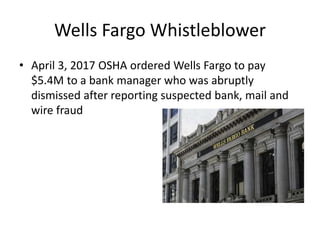
Wells Fargo Whistleblower
• April 3, 2017 OSHA ordered Wells Fargo to pay
$5.4M to a bank manager who was abruptly
dismissed after reporting suspected bank, mail and
wire fraud
“We also have an anonymous
ethics line.”
Wells Fargo former CEO John Stumpf 9-20-2016
Testimony
• “Each team member, no matter where you are in the
organization, is encouraged to raise their hand. If
something is being asked of them that they think is not
right, not consistent with our values and our culture,
they're asked to raise their hand, they're asked to go to
a manager's manager in HR. We also have an
anonymous ethics line. They can speak up and show us
and talk to us about anything going on. We want to
hear from them, because we don't want this behavior.”
Not all employees were
“encouraged to raise their hand.”
I called the Wells Fargo ethics line and was fired,
CNN Money 9-21-2016
“One former Wells Fargo human resources
official even said the bank had a method in place
to retaliate against tipsters. He said that Wells
Fargo would find ways to fire employees ‘in
retaliation for shining light’ on sales issues. It
could be as simple as monitoring the employee
to find a fault, like showing up a few minutes
late on several occasions.”
SOX Jury Verdicts
Wadler v. Bio-Rad
• $14.6M total recovery
• $6M back pay (doubled under Dodd-Frank)
• $5M in punitive damages, due largely to
CEO creating new performance review after
terminating Wadler’s employment
• $3.5M attorney fees
7
Wadler v. Bio-Rad
• In-house counsel of 26 years allegedly fired for
raising concerns about potential FCPA violations
• Outside counsel found no FCPA violation
• Post-hoc justifications
– HR claimed to have performed a threat assessment
– Referred to Wadler as a “monster”
• Is it credible to employ a “monster” for 26 years?
• Discovery revealed that CEO created last
performance review one month after firing
Wadler
Wadler v. Bio-Rad
Wadler v. Bio–Rad Labs., Inc., 2016 WL 7369246 (N.D.
Cal. Dec. 20, 2016)
• Can a former in-house attorney use privileged
information to prosecute a retaliation claim?
• CA Rule 1.6 does not permit disclosure to assert a
claim
• SEC attorney conduct rules (17 C.F.R. Part 205)
preempt California ethics rules
• Privileged information should be reasonably
necessary to any claim or defense
Perez v. Progenics Pharmaceuticals
• Pro se whistleblower recovered nearly
$5M
• Fired one day after writing memo
accusing Progenics of public
misrepresentation about clinical trial
• Refused to reveal how he obtained
confidential document that was the
basis of his disclosure
Perez v. Progenics Pharmaceuticals
• $2.8M front pay award
–Reasonable retirement age of 66
–Applied for work for 7 years
–“manifest hostility” precluded
reinstatement (CEO “condescending,
contemptuous, and patronizing” to Dr.
Perez)
Using Employer Confidential
Information to Prosecute a
Whistleblower Claim
Erhart v. BofI Holding, Inc.
Erhart v. BofI Holding, Inc., 2017 WL 588390 (S.D.Ca. Feb. 14,
2017)
• The public policy protecting whistleblowers from retaliation,
embodied in SOX and Dodd-Frank, clearly outweighs the
interest in the enforcement of BofI’s confidentiality
agreement, and therefore the agreement is unenforceable.
• Whistleblowers permitted to take company documents to
disclose fraud to the government because:
– “[W]histleblowers often need documentary evidence to
substantiate their allegations.”
– “Allowing a whistleblower to appropriate documents
supporting believed wrongdoing also mitigates the
possibility that evidence of the wrongdoing will be
destroyed before an investigation can be conducted.”
Erhart v. BofI Holding, Inc.
• Focus on “the nexus between the confidential
documents in question and the misconduct
alleged by the whistleblower.”
• Burden is on the party seeking to invoke the
public policy exception “to justify why removal
of the documents was reasonably necessary”
to support the allegations of wrongdoing.
Erhart v. BofI Holding, Inc.
• Key facts:
– Erhart was “careful in [selecting] the information [he]
accessed and turned over. Each document was specifically
related to one of the allegations of wrongdoing [he] had
discussed with [his supervisor] and then reported to
federal law enforcement”; and
– Every document Erhart used was “accessed in the course
of performing [his] work as an internal auditor.”
• Where appropriation of confidential documents is
“vast and indiscriminate,” public policy in favor of
whistleblowing might not immunize the whistleblower
from potential liability.
Adverse Actions
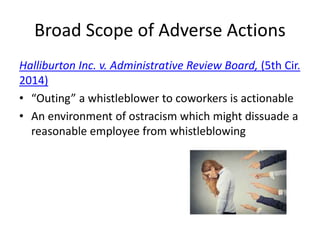
Broad Scope of Adverse Actions
Halliburton Inc. v. Administrative Review Board, (5th Cir.
2014)
• “Outing” a whistleblower to coworkers is actionable
• An environment of ostracism which might dissuade a
reasonable employee from whistleblowing
Broad Scope of Adverse Actions
Becker v. Community Health Systems Inc., 2014-
SOX-00044 (ALJ Nov. 9, 2016)
• No choice but to resign after being “ignored,
threatened and shut out”
• “Circumvention” actionable where employer
excluded Becker from meetings, reduced
communications and assigned his projects to
another employee
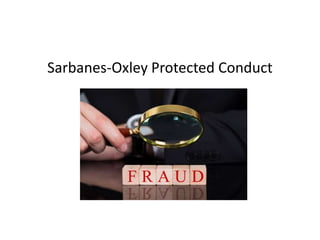
Sarbanes-Oxley Protected Conduct
SOX Protected Conduct
• Federal courts are applying Sylvester v. Parexel:
– Disclosure of potential violation protected
– A complaint need not allege shareholder fraud
– SOX complainants no longer need to show that
their disclosures “definitively and specifically”
relate to the relevant laws
– No magic words required (e.g., fraud or
misrepresentation)
– Reasonable but mistaken belief protected
SOX Protected Conduct
Murray v UBS Securities LLC et al, No. 14-
00927 (S.D.N.Y. April 25, 2017)
• Focus is “on the plaintiff’s state of mind
rather than on the defendant’s conduct.”
• Because “[m]any employees are unlikely to
be trained to recognize legally actionable
conduct by their employers,” an employee’s
“belief” in his employer’s wrongdoing is
“central[]” to the analysis of SOX-protected
conduct.
SOX Protected Conduct
Why protect disclosures about potential violations?
• “UBS’s position implies that, for employees like Mr.
Murray to be protected under SOX, they must ‘actually
capitulate to inappropriate influence, publish
seemingly independent research that is in fact
inaccurate or biased, and then blow the whistle.’ Id. at
24. But since § 806 was ‘designed to encourage insiders
to come forward without fear of retribution,’ ‘[i]t
would frustrate the purpose of Sarbanes-Oxley to
require an employee, who knows that a violation is
imminent, to wait for the actual violation to occur
when an earlier report possibly could have prevented
it. . . ’”
Palmer ARB Decision Clarifying
Burden-Shifting Framework
23
Palmer
• Palmer v. Canadian National Railway, ARB No. 16-
035, ALJ No. 2014-FRS-154 (ARB Sept. 30, 2016) (en
banc)
• “Contributing factor” = protected activity played
some role—even an insignificant or insubstantial
role—in the adverse action
• Decision-maker knowledge of the protected
activity and close temporal proximity will suffice
to prove causation in some cases
• Whistleblower need not prove pretext
24
Palmer
• Employer’s nonretaliatory reasons are not “weighed
against” the employee’s protected activity to determine
which reasons might be weightier.
• “Importantly, if the ALJ believes that the protected activity
and the employer’s nonretaliatory reasons both played a
role, the analysis is over and the employee prevails on the
contributing-factor question . . . Since the employee need
only show that the retaliation played some role, the
employee necessarily prevails at step one if there was more
than one reason and one of those reasons was the protected
activity.”
25
Palmer
• In contrast to Title VII, not a burden of production
• What is “clear and convincing evidence”?
• Not enough for the employer to show that it
could have taken the same action; it must show
that it would have taken the same action
• Quantified, the probabilities might be in the
order of above 70%
26
Work Product Protection for
Whistleblower Disclosures to SEC
BofI Federal Bank v. Erhart, 2016 WL 4150983 (S.D.Ca.
Aug. 5, 2016)
• Whistleblower’s counsel Ms. Gillam “shared a
common interest with the federal regulators to
uncover any alleged wrongdoing by BofI. Further, the
SEC and OCC regulations provide for confidentiality . .
. the agencies will not publicly disclose Ms. Gillam's
work product.”

Zuckerman pli slides on developments in whistleblower law

  • 1.
    Recent Developments in WhistleblowerProtection Law 1629 K Street, NW Suite 300 Washington DC 20006 www.zuckermanlaw.com 202-262-8959
  • 2.
  • 3.
    Wells Fargo Whistleblower •April 3, 2017 OSHA ordered Wells Fargo to pay $5.4M to a bank manager who was abruptly dismissed after reporting suspected bank, mail and wire fraud
  • 4.
    “We also havean anonymous ethics line.” Wells Fargo former CEO John Stumpf 9-20-2016 Testimony • “Each team member, no matter where you are in the organization, is encouraged to raise their hand. If something is being asked of them that they think is not right, not consistent with our values and our culture, they're asked to raise their hand, they're asked to go to a manager's manager in HR. We also have an anonymous ethics line. They can speak up and show us and talk to us about anything going on. We want to hear from them, because we don't want this behavior.”
  • 5.
    Not all employeeswere “encouraged to raise their hand.” I called the Wells Fargo ethics line and was fired, CNN Money 9-21-2016 “One former Wells Fargo human resources official even said the bank had a method in place to retaliate against tipsters. He said that Wells Fargo would find ways to fire employees ‘in retaliation for shining light’ on sales issues. It could be as simple as monitoring the employee to find a fault, like showing up a few minutes late on several occasions.”
  • 6.
  • 7.
    Wadler v. Bio-Rad •$14.6M total recovery • $6M back pay (doubled under Dodd-Frank) • $5M in punitive damages, due largely to CEO creating new performance review after terminating Wadler’s employment • $3.5M attorney fees 7
  • 8.
    Wadler v. Bio-Rad •In-house counsel of 26 years allegedly fired for raising concerns about potential FCPA violations • Outside counsel found no FCPA violation • Post-hoc justifications – HR claimed to have performed a threat assessment – Referred to Wadler as a “monster” • Is it credible to employ a “monster” for 26 years? • Discovery revealed that CEO created last performance review one month after firing Wadler
  • 9.
    Wadler v. Bio-Rad Wadlerv. Bio–Rad Labs., Inc., 2016 WL 7369246 (N.D. Cal. Dec. 20, 2016) • Can a former in-house attorney use privileged information to prosecute a retaliation claim? • CA Rule 1.6 does not permit disclosure to assert a claim • SEC attorney conduct rules (17 C.F.R. Part 205) preempt California ethics rules • Privileged information should be reasonably necessary to any claim or defense
  • 10.
    Perez v. ProgenicsPharmaceuticals • Pro se whistleblower recovered nearly $5M • Fired one day after writing memo accusing Progenics of public misrepresentation about clinical trial • Refused to reveal how he obtained confidential document that was the basis of his disclosure
  • 11.
    Perez v. ProgenicsPharmaceuticals • $2.8M front pay award –Reasonable retirement age of 66 –Applied for work for 7 years –“manifest hostility” precluded reinstatement (CEO “condescending, contemptuous, and patronizing” to Dr. Perez)
  • 12.
    Using Employer Confidential Informationto Prosecute a Whistleblower Claim
  • 13.
    Erhart v. BofIHolding, Inc. Erhart v. BofI Holding, Inc., 2017 WL 588390 (S.D.Ca. Feb. 14, 2017) • The public policy protecting whistleblowers from retaliation, embodied in SOX and Dodd-Frank, clearly outweighs the interest in the enforcement of BofI’s confidentiality agreement, and therefore the agreement is unenforceable. • Whistleblowers permitted to take company documents to disclose fraud to the government because: – “[W]histleblowers often need documentary evidence to substantiate their allegations.” – “Allowing a whistleblower to appropriate documents supporting believed wrongdoing also mitigates the possibility that evidence of the wrongdoing will be destroyed before an investigation can be conducted.”
  • 14.
    Erhart v. BofIHolding, Inc. • Focus on “the nexus between the confidential documents in question and the misconduct alleged by the whistleblower.” • Burden is on the party seeking to invoke the public policy exception “to justify why removal of the documents was reasonably necessary” to support the allegations of wrongdoing.
  • 15.
    Erhart v. BofIHolding, Inc. • Key facts: – Erhart was “careful in [selecting] the information [he] accessed and turned over. Each document was specifically related to one of the allegations of wrongdoing [he] had discussed with [his supervisor] and then reported to federal law enforcement”; and – Every document Erhart used was “accessed in the course of performing [his] work as an internal auditor.” • Where appropriation of confidential documents is “vast and indiscriminate,” public policy in favor of whistleblowing might not immunize the whistleblower from potential liability.
  • 16.
  • 17.
    Broad Scope ofAdverse Actions Halliburton Inc. v. Administrative Review Board, (5th Cir. 2014) • “Outing” a whistleblower to coworkers is actionable • An environment of ostracism which might dissuade a reasonable employee from whistleblowing
  • 18.
    Broad Scope ofAdverse Actions Becker v. Community Health Systems Inc., 2014- SOX-00044 (ALJ Nov. 9, 2016) • No choice but to resign after being “ignored, threatened and shut out” • “Circumvention” actionable where employer excluded Becker from meetings, reduced communications and assigned his projects to another employee
  • 19.
  • 20.
    SOX Protected Conduct •Federal courts are applying Sylvester v. Parexel: – Disclosure of potential violation protected – A complaint need not allege shareholder fraud – SOX complainants no longer need to show that their disclosures “definitively and specifically” relate to the relevant laws – No magic words required (e.g., fraud or misrepresentation) – Reasonable but mistaken belief protected
  • 21.
    SOX Protected Conduct Murrayv UBS Securities LLC et al, No. 14- 00927 (S.D.N.Y. April 25, 2017) • Focus is “on the plaintiff’s state of mind rather than on the defendant’s conduct.” • Because “[m]any employees are unlikely to be trained to recognize legally actionable conduct by their employers,” an employee’s “belief” in his employer’s wrongdoing is “central[]” to the analysis of SOX-protected conduct.
  • 22.
    SOX Protected Conduct Whyprotect disclosures about potential violations? • “UBS’s position implies that, for employees like Mr. Murray to be protected under SOX, they must ‘actually capitulate to inappropriate influence, publish seemingly independent research that is in fact inaccurate or biased, and then blow the whistle.’ Id. at 24. But since § 806 was ‘designed to encourage insiders to come forward without fear of retribution,’ ‘[i]t would frustrate the purpose of Sarbanes-Oxley to require an employee, who knows that a violation is imminent, to wait for the actual violation to occur when an earlier report possibly could have prevented it. . . ’”
  • 23.
    Palmer ARB DecisionClarifying Burden-Shifting Framework 23
  • 24.
    Palmer • Palmer v.Canadian National Railway, ARB No. 16- 035, ALJ No. 2014-FRS-154 (ARB Sept. 30, 2016) (en banc) • “Contributing factor” = protected activity played some role—even an insignificant or insubstantial role—in the adverse action • Decision-maker knowledge of the protected activity and close temporal proximity will suffice to prove causation in some cases • Whistleblower need not prove pretext 24
  • 25.
    Palmer • Employer’s nonretaliatoryreasons are not “weighed against” the employee’s protected activity to determine which reasons might be weightier. • “Importantly, if the ALJ believes that the protected activity and the employer’s nonretaliatory reasons both played a role, the analysis is over and the employee prevails on the contributing-factor question . . . Since the employee need only show that the retaliation played some role, the employee necessarily prevails at step one if there was more than one reason and one of those reasons was the protected activity.” 25
  • 26.
    Palmer • In contrastto Title VII, not a burden of production • What is “clear and convincing evidence”? • Not enough for the employer to show that it could have taken the same action; it must show that it would have taken the same action • Quantified, the probabilities might be in the order of above 70% 26
  • 27.
    Work Product Protectionfor Whistleblower Disclosures to SEC
  • 28.
    BofI Federal Bankv. Erhart, 2016 WL 4150983 (S.D.Ca. Aug. 5, 2016) • Whistleblower’s counsel Ms. Gillam “shared a common interest with the federal regulators to uncover any alleged wrongdoing by BofI. Further, the SEC and OCC regulations provide for confidentiality . . . the agencies will not publicly disclose Ms. Gillam's work product.”