Howard Zinn 1922-2010
EDSS 620
Summer 2013
Biographical Notes
• Zinn was born to a Jewish immigrant family in Brooklyn
• Zinn joined the Army Air Force during World War II and was
assigned as a bombardier in the 490th Bombardment Group. Zinn
later learned that the aerial bombing attacks in which he
participated had killed more than 1000 French civilians as well as
some German soldiers hiding near Royan to await the war's end.
• Before and during his tenure as a political science professor at
Boston University from 1964 to 1988 he wrote more than 20 books,
which included his best-selling and influential A People's History of
the United States.
• In the years since the first edition of A People's History was
published in 1980, it has been used as an alternative to standard
textbooks in many high school and college history courses.
The Zinn Project
• In 2004, Zinn published Voices of a People's History of the United
States with Anthony Arnove. Voices is a sourcebook of speeches,
articles, essays, poetry and song lyrics by the people themselves
whose stories are told in A People's History.
• In 2008, the Zinn Education Project was launched to support
educators using A People's History of the United States as a source
for middle and high school history.
• The Project was started when a former student of Zinn, who
wanted to bring Zinn's lessons to students around the country,
provided the financial backing to allow two other organizations,
Rethinking Schools and Teaching for Change to coordinate the
Project. The Project hosts a website that has over 100 free
downloadable lesson plans to complement A People's History of the
United States.
http://www.rethinkingschools.org/index.shtml
http://www.teachingforchange.org/
History
• “History isn't what happened, but a story of
what happened. And there are always
different versions, different stories, about the
same events.”
• -http://www.historyisaweapon.com/
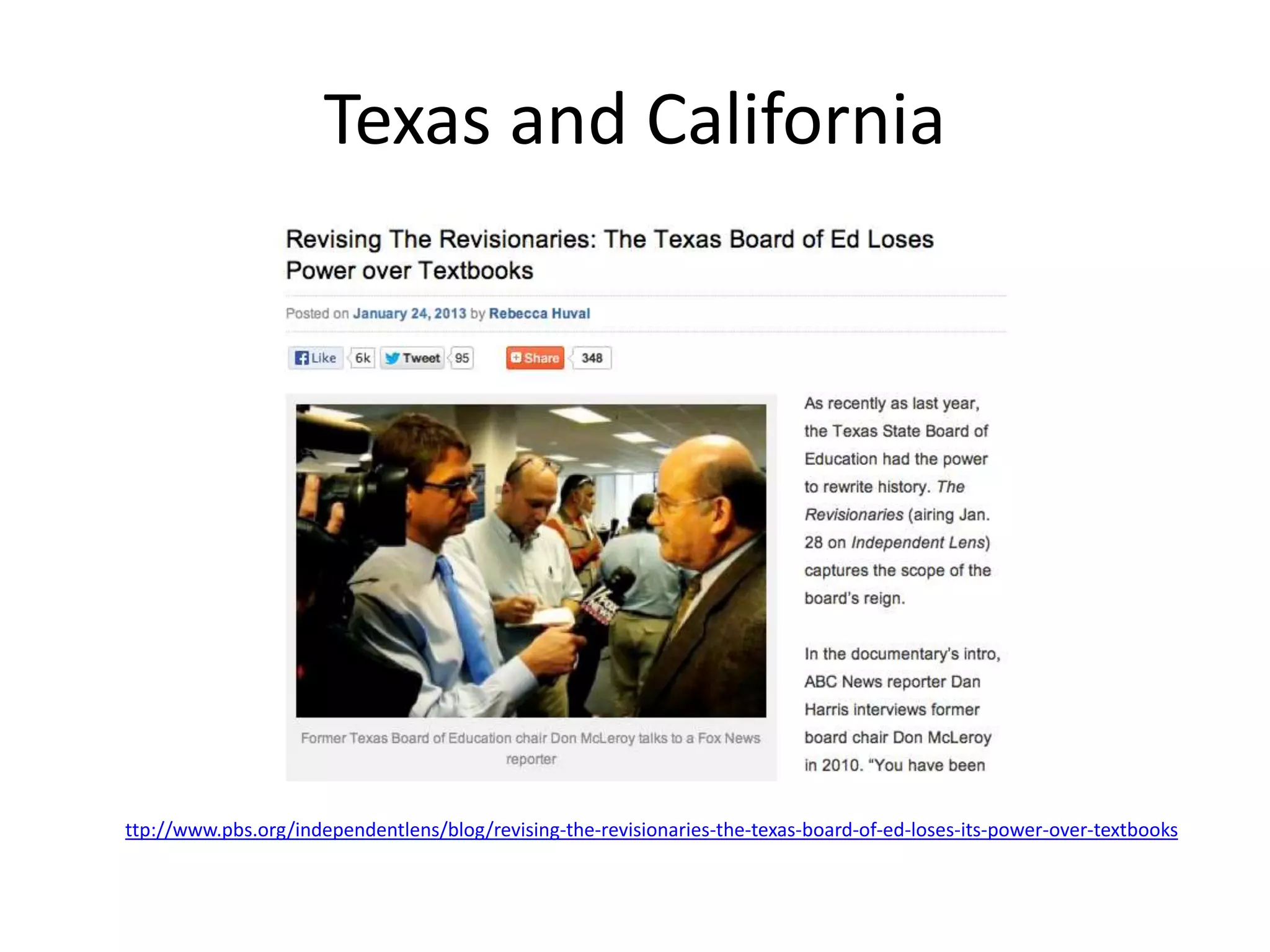
Texas and California
ttp://www.pbs.org/independentlens/blog/revising-the-revisionaries-the-texas-board-of-ed-loses-its-power-over-textbooks
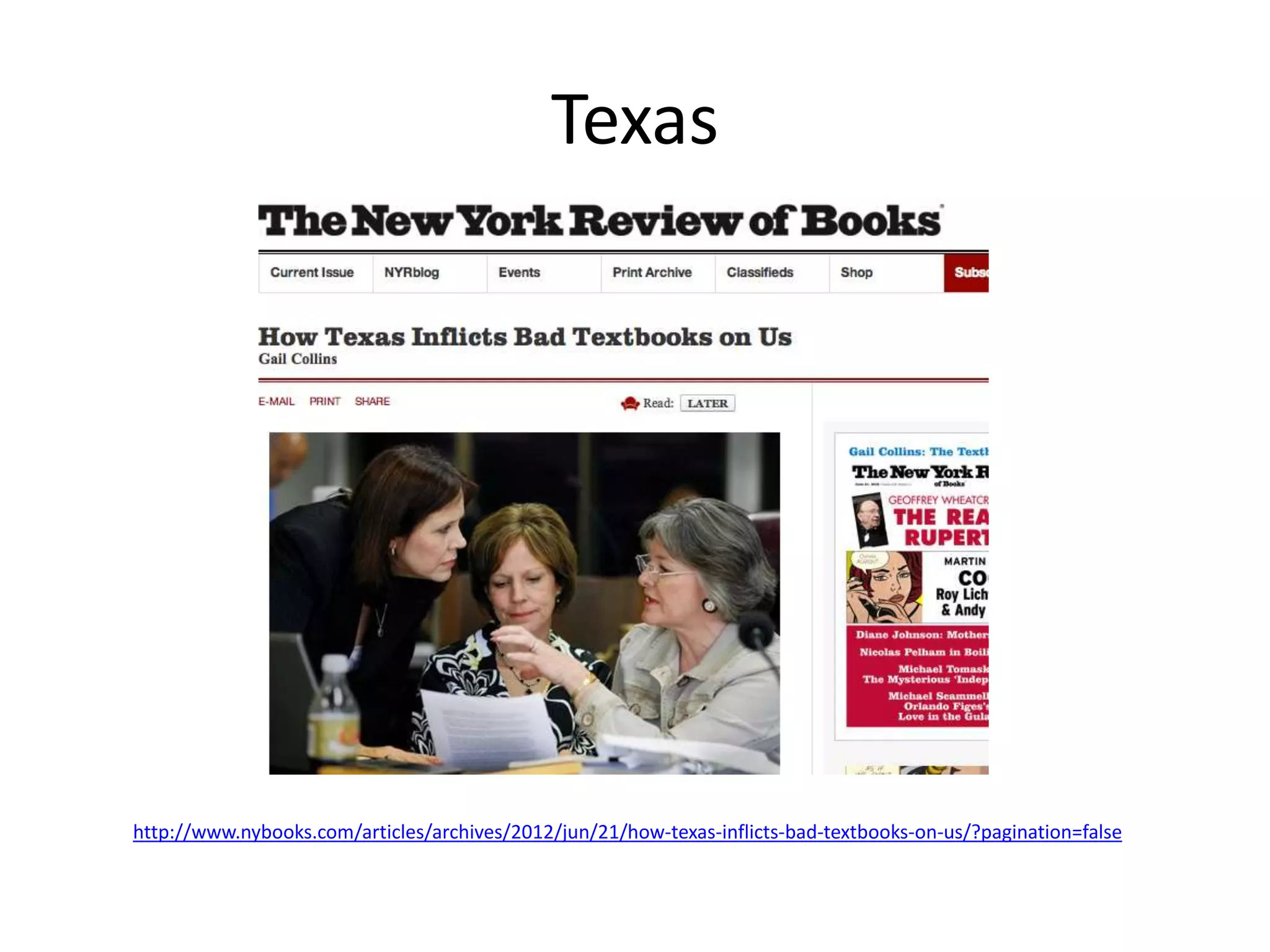
Texas
http://www.nybooks.com/articles/archives/2012/jun/21/how-texas-inflicts-bad-textbooks-on-us/?pagination=false
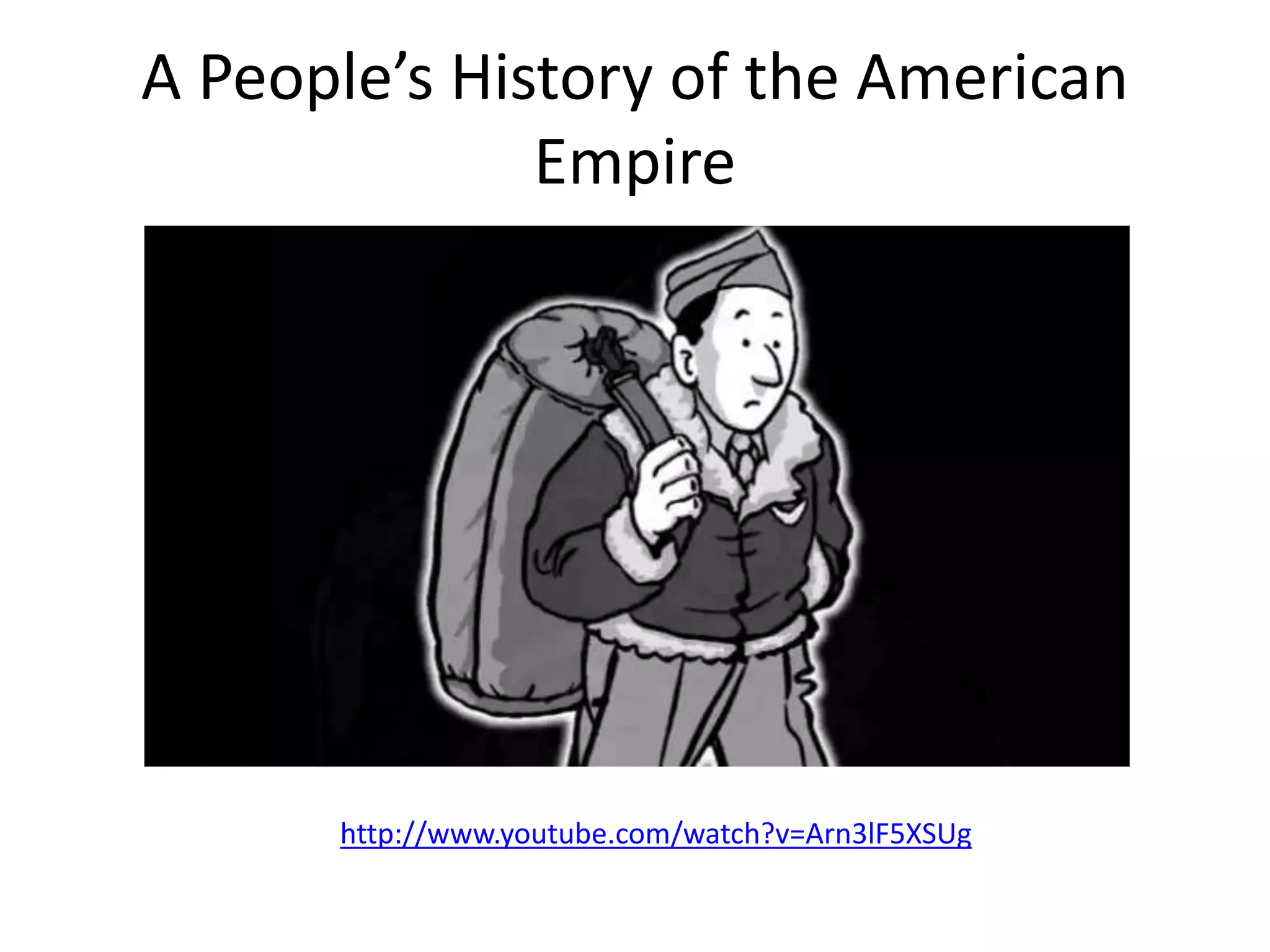
A People’s History of the American
Empire
http://www.youtube.com/watch?v=Arn3lF5XSUg
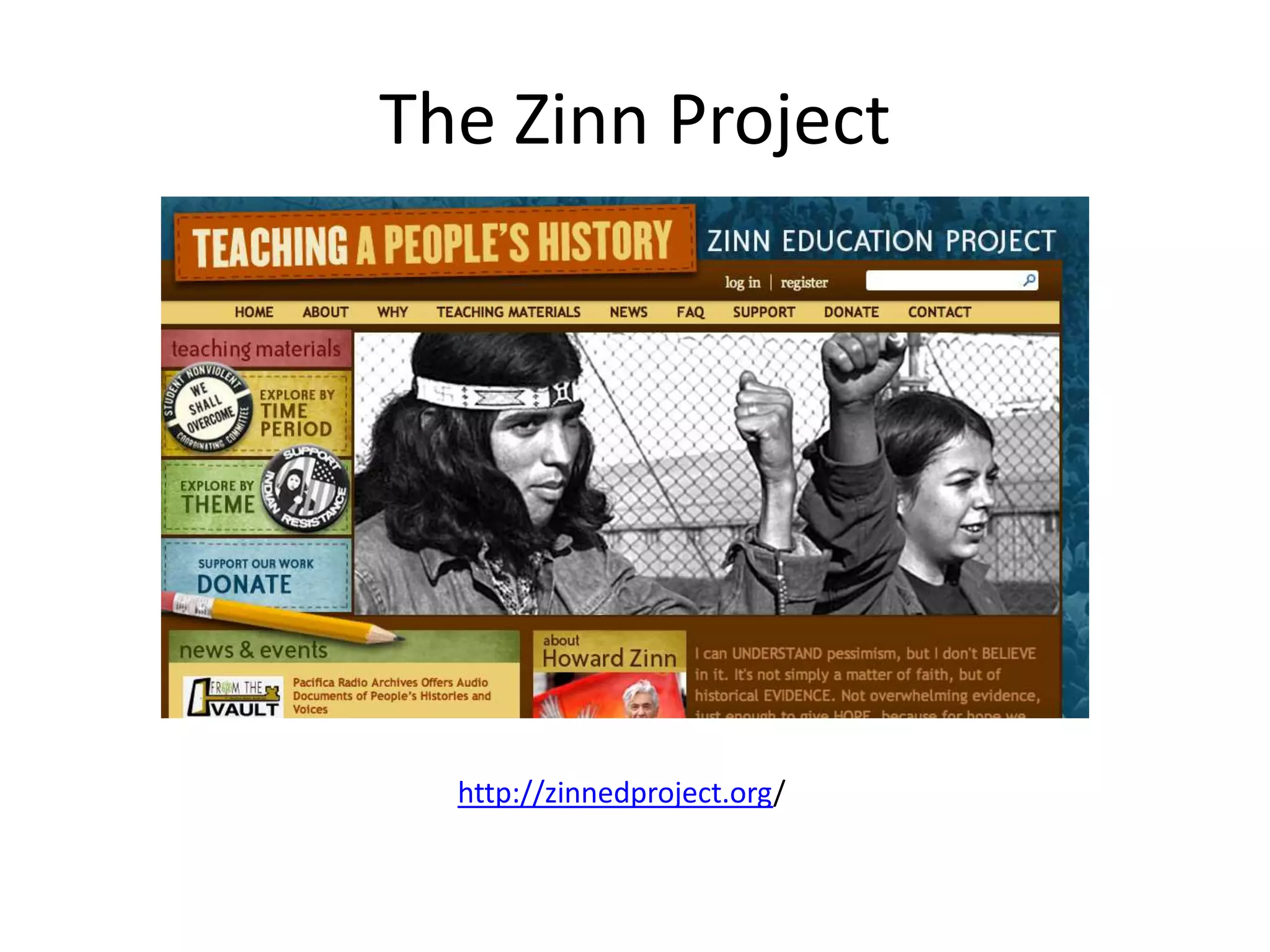
The Zinn Project
http://zinnedproject.org/
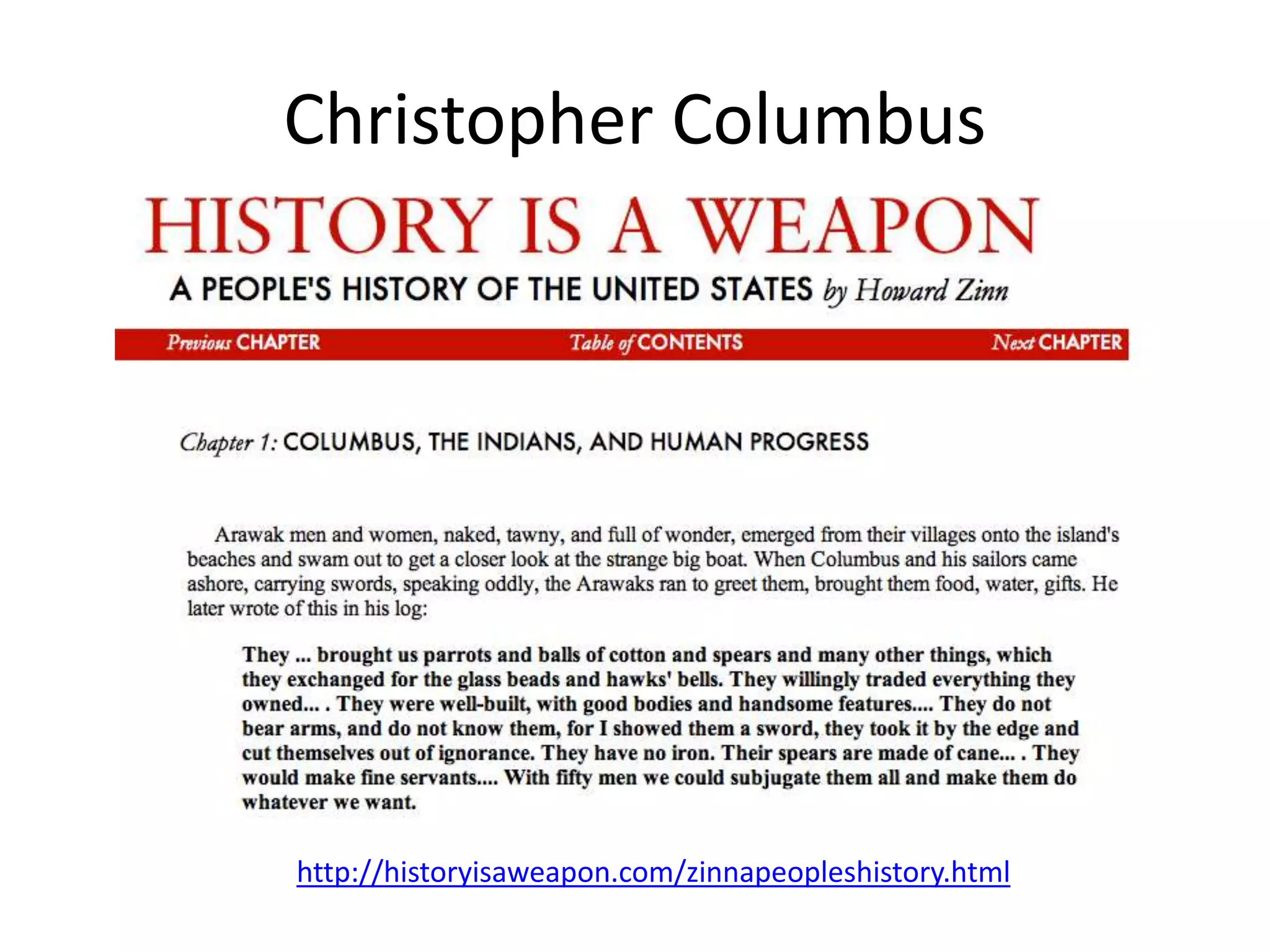
Christopher Columbus
http://historyisaweapon.com/zinnapeopleshistory.html
United States History and New York
History – Holt McDougal
http://www.mrliotta.com/US%20HISTORY%20II/InteractiveStudyGuideBook.pdf
Brown vs. Board of Education
• Brown v. Board of Education, 347 U.S. 483
(1954), was a landmark United States Supreme
Court case in which the Court declared state laws
establishing separate public schools for black and
white students unconstitutional.
• The decision overturned the Plessy v. Ferguson
decision of 1896, which allowed state-sponsored
segregation, insofar as it applied to public
education.
Brown vs. Board of Education
• In 1951, a class action suit was filed against the Board of Education of the
City of Topeka, Kansas in the United States District Court for the District of
Kansas. The plaintiffs were thirteen Topeka parents on behalf of their
twenty children.
• The named plaintiff, Oliver L. Brown, was a parent, a welder in the shops
of the Santa Fe Railroad, an assistant pastor at his local church, and an
African American.
• He was convinced to join the lawsuit by Charles Scott, attorney and a
childhood friend.
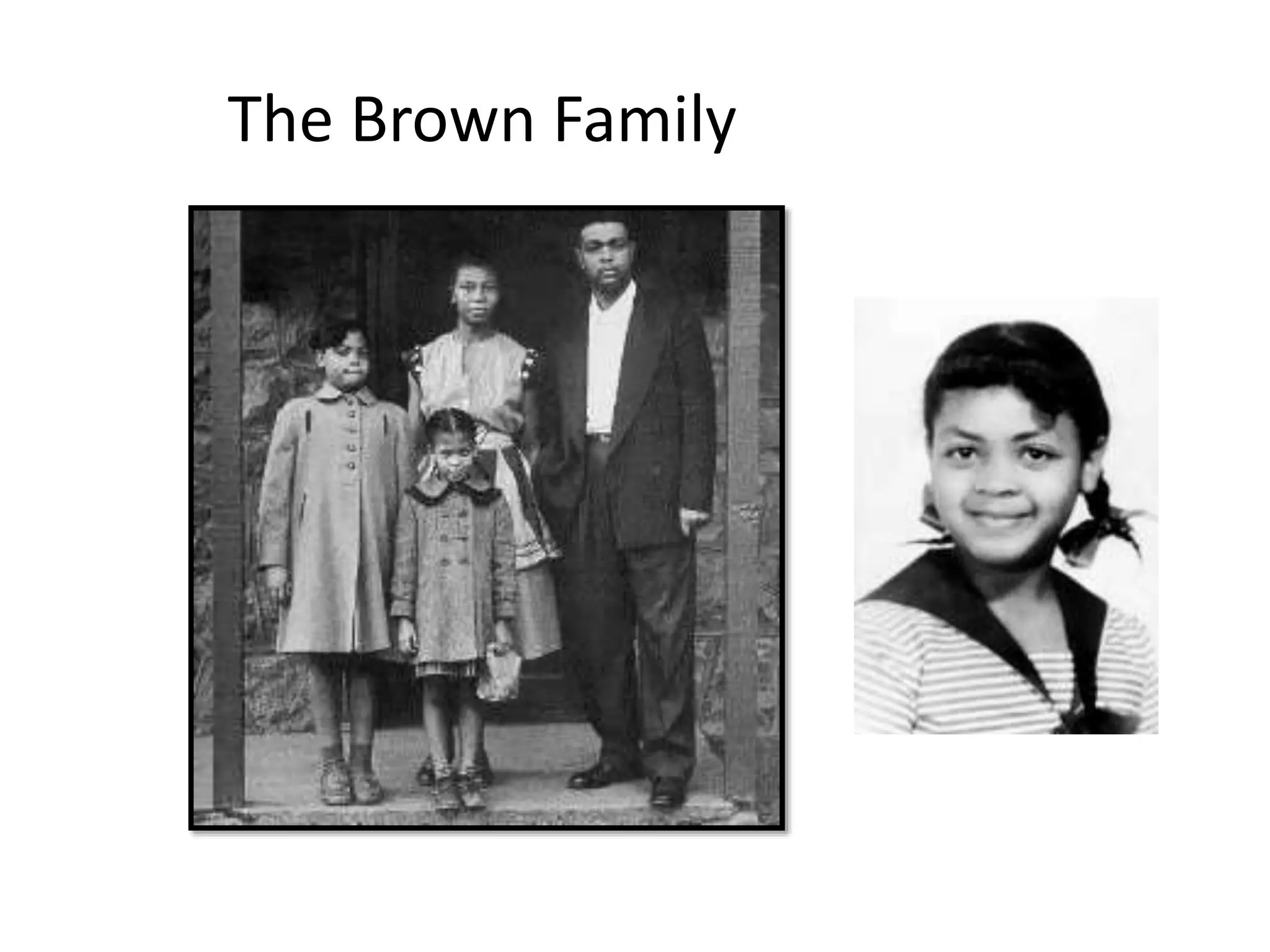
• Brown's daughter Linda, a third grader, had to walk six blocks to her school
bus stop to ride to Monroe Elementary, her segregated black school one
mile (1.6 km) away, while Sumner Elementary, a white school, was seven
blocks from her house.
• The District Court ruled in favor of the Board of Education, citing the U.S.
Supreme Court precedent set in Plessy v. Ferguson, 163 U.S. 537 (1896),
which had upheld a state law requiring "separate but equal" segregated
facilities for blacks and whites in railway cars.
The Brown Family
Brown vs. Board of Education
• The case of Brown v. Board of Education as heard
before the Supreme Court combined five cases: Brown
itself, Briggs v. Elliott (filed in South Carolina), Davis v.
County School Board of Prince Edward County (filed in
Virginia), Gebhart v. Belton (filed in Delaware), and
Bolling v. Sharpe (filed in Washington D.C.).
• The two lead attorneys were Charles H. Houston and
Thurgood Marshall, the architects of the NAACP's legal
strategies. Marshall would later become the nation's
first African American Supreme Court Justice.
Brown vs. Board of Education
• Conference notes and draft decisions illustrate the division of
opinions before the decision was issued. Justices Douglas, Black,
Burton, and Minton were predisposed to overturn Plessy.
• Fred M. Vinson noted that Congress had not issued desegregation
legislation; Stanley F. Reed discussed incomplete cultural
assimilation and states' rights and was inclined to the view that
segregation worked to the benefit of the African-American
community; Tom C. Clark wrote that "we had led the states on to
think segregation is OK and we should let them work it out Felix
Frankfurter and Robert H. Jackson disapproved of segregation, but
were also opposed to judicial activism and expressed concerns
about the proposed decision's enforceability.
• After Vinson died in September 1953, President Dwight D.
Eisenhower appointed Earl Warren as Chief Justice. Warren had
supported the integration of Mexican-American students in
California school systems following Mendez v. Westminster.
Brown vs. Board of Education
• Warren convened a meeting of the justices,
and presented to them the simple argument
that the only reason to sustain segregation
was an honest belief in the inferiority of
Negroes. Warren further submitted that the
Court must overrule Plessy to maintain its
legitimacy as an institution of liberty, and it
must do so unanimously to avoid massive
Southern resistance. He began to build a
unanimous opinion.
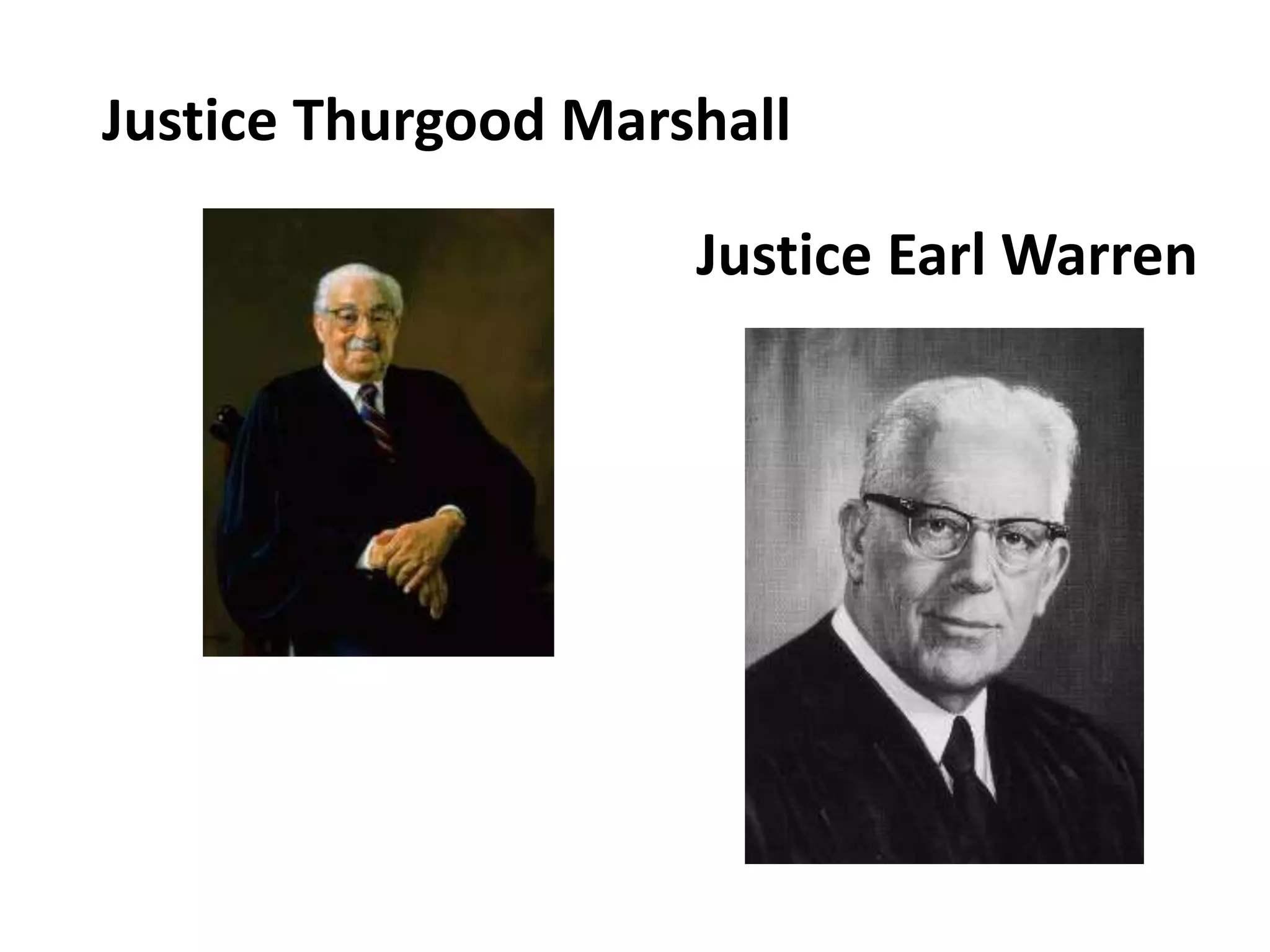
Justice Thurgood Marshall
Justice Earl Warren
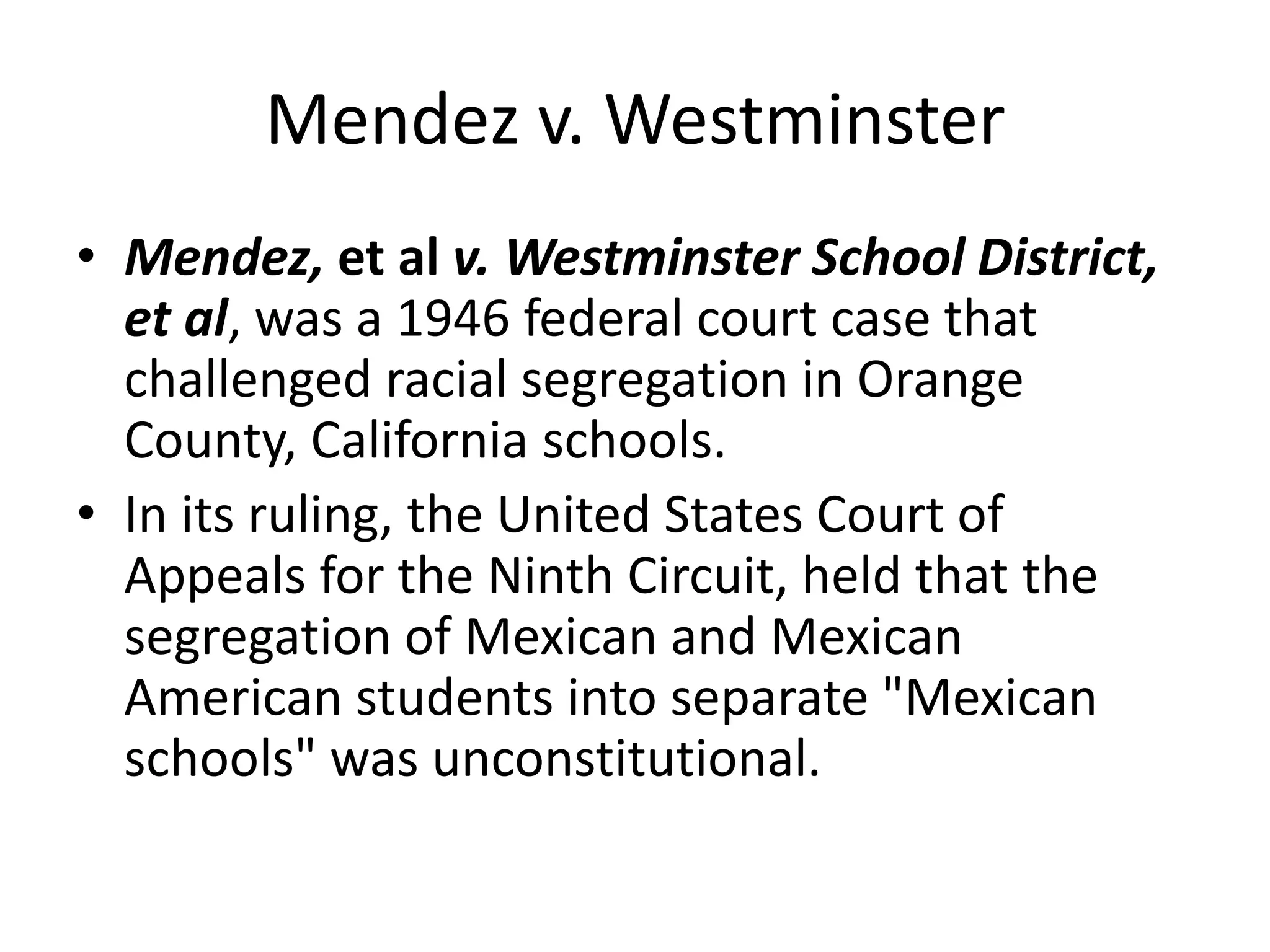
Mendez v. Westminster
• Mendez, et al v. Westminster School District,
et al, was a 1946 federal court case that
challenged racial segregation in Orange
County, California schools.
• In its ruling, the United States Court of
Appeals for the Ninth Circuit, held that the
segregation of Mexican and Mexican
American students into separate "Mexican
schools" was unconstitutional.
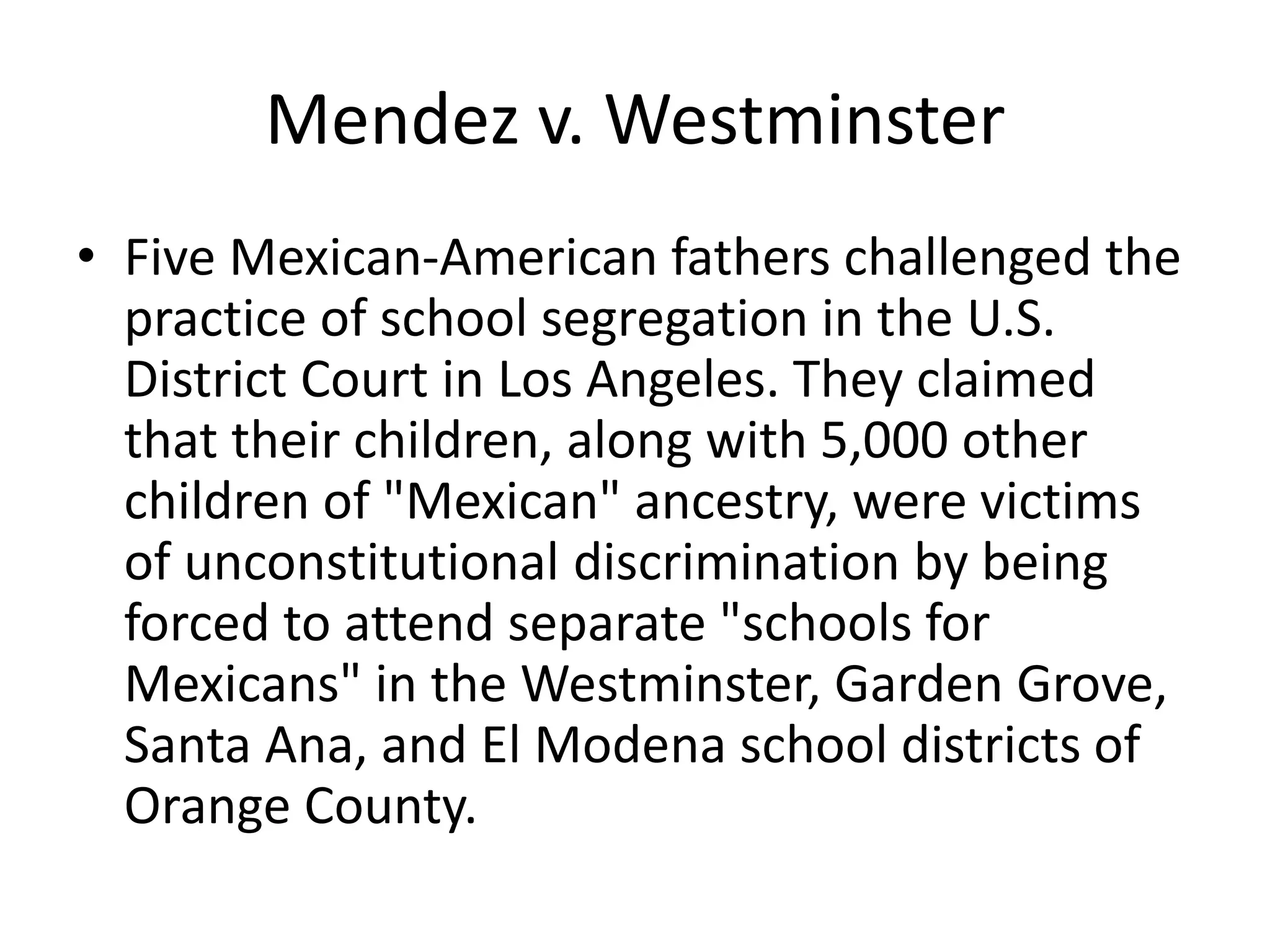
Mendez v. Westminster
• Five Mexican-American fathers challenged the
practice of school segregation in the U.S.
District Court in Los Angeles. They claimed
that their children, along with 5,000 other
children of "Mexican" ancestry, were victims
of unconstitutional discrimination by being
forced to attend separate "schools for
Mexicans" in the Westminster, Garden Grove,
Santa Ana, and El Modena school districts of
Orange County.
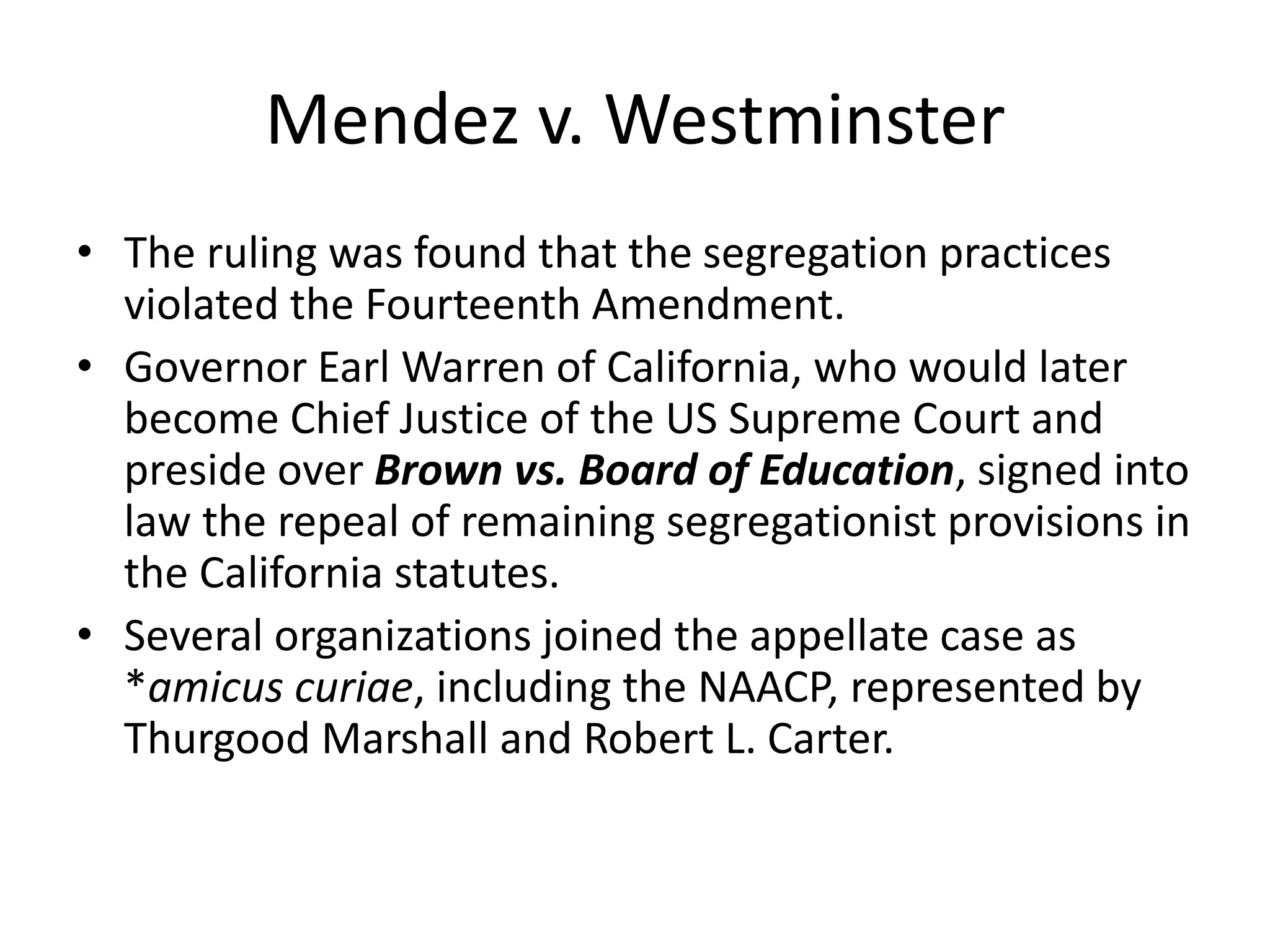
Mendez v. Westminster
• The ruling was found that the segregation practices
violated the Fourteenth Amendment.
• Governor Earl Warren of California, who would later
become Chief Justice of the US Supreme Court and
preside over Brown vs. Board of Education, signed into
law the repeal of remaining segregationist provisions in
the California statutes.
• Several organizations joined the appellate case as
*amicus curiae, including the NAACP, represented by
Thurgood Marshall and Robert L. Carter.
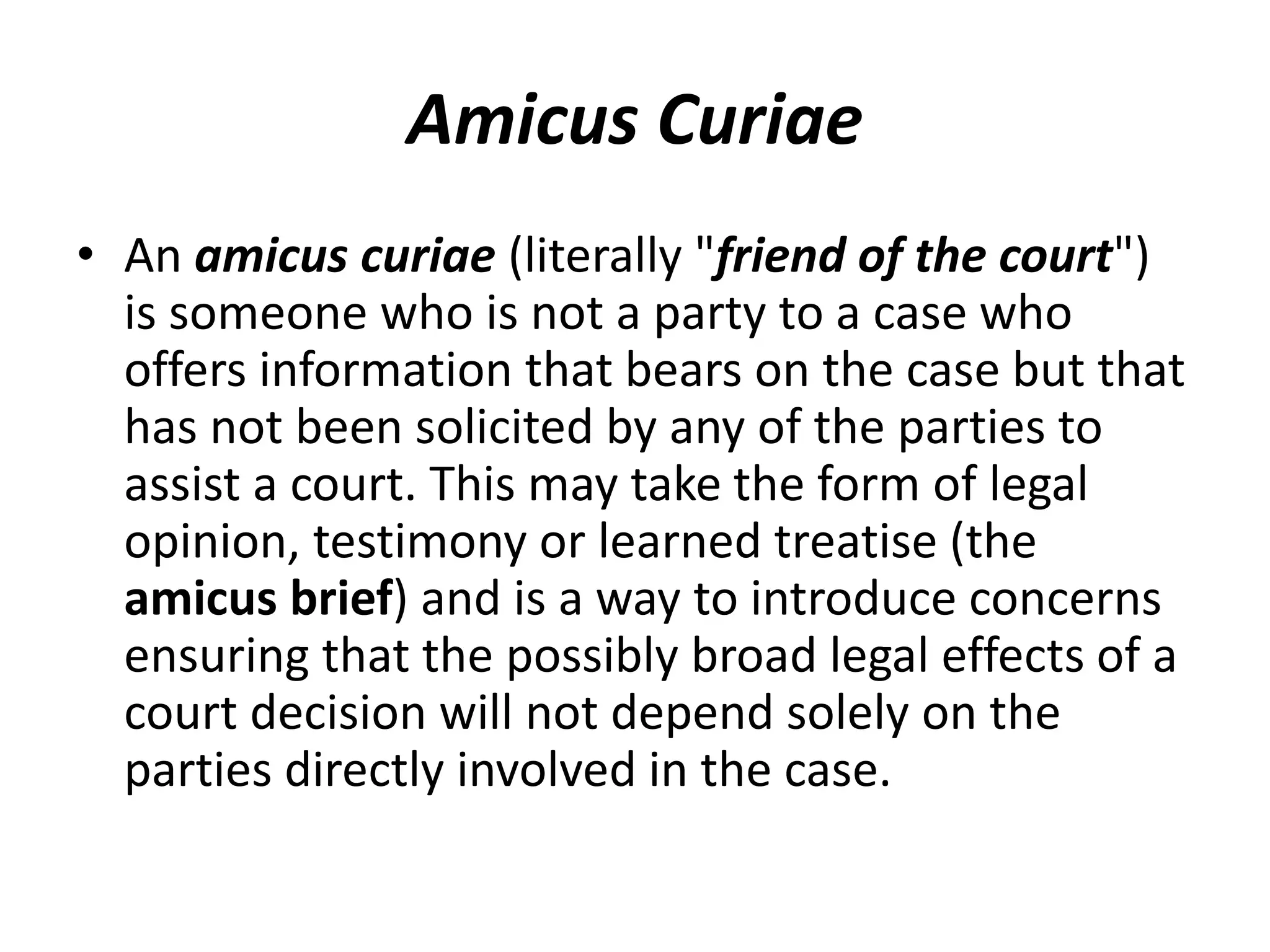
Amicus Curiae
• An amicus curiae (literally "friend of the court")
is someone who is not a party to a case who
offers information that bears on the case but that
has not been solicited by any of the parties to
assist a court. This may take the form of legal
opinion, testimony or learned treatise (the
amicus brief) and is a way to introduce concerns
ensuring that the possibly broad legal effects of a
court decision will not depend solely on the
parties directly involved in the case.
Mendez v. Westminster
• The Ninth Circuit ruled only on the narrow grounds: although
California law provided for segregation of students, it did so only for
"children of Chinese, Japanese or Mongolian parentage." Because
"California law does not include the segregation of school children
because of their Mexican blood," the ruling held that it was
unlawful to segregate the Mexican children.
• This was remedied in California later that same year, on June 14,
1947, when California Governor Earl Warren signed a law repealing
the remaining school segregation statutes in the California
Education Code.
• Seven years later, in Brown v. Board of Education, Earl Warren, by
then the Chief Justice of the United States, wrote the unanimous
decision holding "separate but equal" schools to be unconstitutional
under the 14th Amendment's Equal Protection Clause.
Mendez v. Westminster
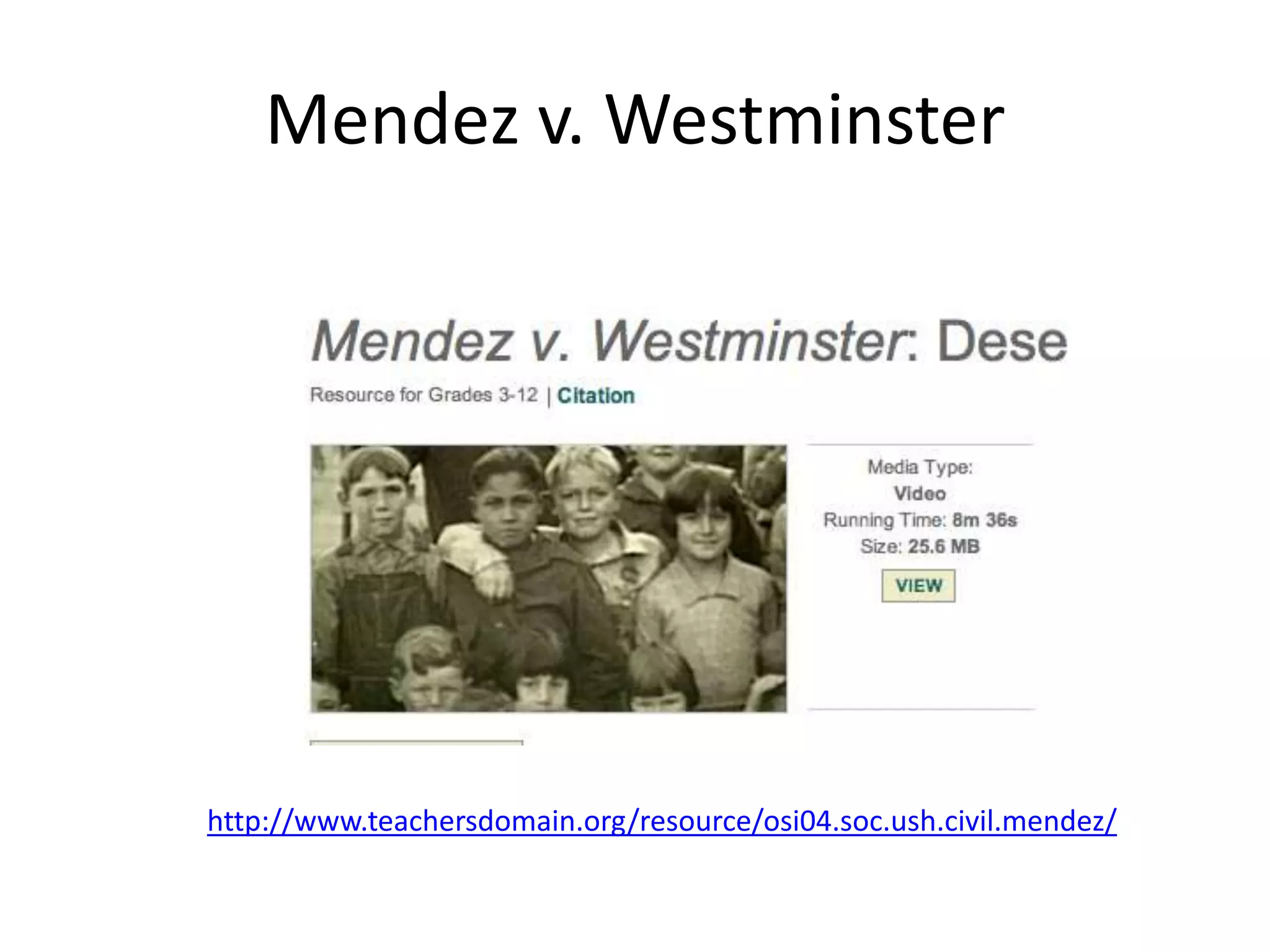
http://www.teachersdomain.org/resource/osi04.soc.ush.civil.mendez/

Zinn project day 3

  • 1.
  • 2.
    Biographical Notes • Zinnwas born to a Jewish immigrant family in Brooklyn • Zinn joined the Army Air Force during World War II and was assigned as a bombardier in the 490th Bombardment Group. Zinn later learned that the aerial bombing attacks in which he participated had killed more than 1000 French civilians as well as some German soldiers hiding near Royan to await the war's end. • Before and during his tenure as a political science professor at Boston University from 1964 to 1988 he wrote more than 20 books, which included his best-selling and influential A People's History of the United States. • In the years since the first edition of A People's History was published in 1980, it has been used as an alternative to standard textbooks in many high school and college history courses.
  • 3.
    The Zinn Project •In 2004, Zinn published Voices of a People's History of the United States with Anthony Arnove. Voices is a sourcebook of speeches, articles, essays, poetry and song lyrics by the people themselves whose stories are told in A People's History. • In 2008, the Zinn Education Project was launched to support educators using A People's History of the United States as a source for middle and high school history. • The Project was started when a former student of Zinn, who wanted to bring Zinn's lessons to students around the country, provided the financial backing to allow two other organizations, Rethinking Schools and Teaching for Change to coordinate the Project. The Project hosts a website that has over 100 free downloadable lesson plans to complement A People's History of the United States. http://www.rethinkingschools.org/index.shtml http://www.teachingforchange.org/
  • 4.
    History • “History isn'twhat happened, but a story of what happened. And there are always different versions, different stories, about the same events.” • -http://www.historyisaweapon.com/
  • 5.
  • 6.
  • 7.
    A People’s Historyof the American Empire http://www.youtube.com/watch?v=Arn3lF5XSUg
  • 8.
  • 9.
  • 10.
    United States Historyand New York History – Holt McDougal http://www.mrliotta.com/US%20HISTORY%20II/InteractiveStudyGuideBook.pdf
  • 11.
    Brown vs. Boardof Education • Brown v. Board of Education, 347 U.S. 483 (1954), was a landmark United States Supreme Court case in which the Court declared state laws establishing separate public schools for black and white students unconstitutional. • The decision overturned the Plessy v. Ferguson decision of 1896, which allowed state-sponsored segregation, insofar as it applied to public education.
  • 12.
    Brown vs. Boardof Education • In 1951, a class action suit was filed against the Board of Education of the City of Topeka, Kansas in the United States District Court for the District of Kansas. The plaintiffs were thirteen Topeka parents on behalf of their twenty children. • The named plaintiff, Oliver L. Brown, was a parent, a welder in the shops of the Santa Fe Railroad, an assistant pastor at his local church, and an African American. • He was convinced to join the lawsuit by Charles Scott, attorney and a childhood friend. • Brown's daughter Linda, a third grader, had to walk six blocks to her school bus stop to ride to Monroe Elementary, her segregated black school one mile (1.6 km) away, while Sumner Elementary, a white school, was seven blocks from her house. • The District Court ruled in favor of the Board of Education, citing the U.S. Supreme Court precedent set in Plessy v. Ferguson, 163 U.S. 537 (1896), which had upheld a state law requiring "separate but equal" segregated facilities for blacks and whites in railway cars.
  • 13.
  • 14.
    Brown vs. Boardof Education • The case of Brown v. Board of Education as heard before the Supreme Court combined five cases: Brown itself, Briggs v. Elliott (filed in South Carolina), Davis v. County School Board of Prince Edward County (filed in Virginia), Gebhart v. Belton (filed in Delaware), and Bolling v. Sharpe (filed in Washington D.C.). • The two lead attorneys were Charles H. Houston and Thurgood Marshall, the architects of the NAACP's legal strategies. Marshall would later become the nation's first African American Supreme Court Justice.
  • 15.
    Brown vs. Boardof Education • Conference notes and draft decisions illustrate the division of opinions before the decision was issued. Justices Douglas, Black, Burton, and Minton were predisposed to overturn Plessy. • Fred M. Vinson noted that Congress had not issued desegregation legislation; Stanley F. Reed discussed incomplete cultural assimilation and states' rights and was inclined to the view that segregation worked to the benefit of the African-American community; Tom C. Clark wrote that "we had led the states on to think segregation is OK and we should let them work it out Felix Frankfurter and Robert H. Jackson disapproved of segregation, but were also opposed to judicial activism and expressed concerns about the proposed decision's enforceability. • After Vinson died in September 1953, President Dwight D. Eisenhower appointed Earl Warren as Chief Justice. Warren had supported the integration of Mexican-American students in California school systems following Mendez v. Westminster.
  • 16.
    Brown vs. Boardof Education • Warren convened a meeting of the justices, and presented to them the simple argument that the only reason to sustain segregation was an honest belief in the inferiority of Negroes. Warren further submitted that the Court must overrule Plessy to maintain its legitimacy as an institution of liberty, and it must do so unanimously to avoid massive Southern resistance. He began to build a unanimous opinion.
  • 17.
  • 18.
    Mendez v. Westminster •Mendez, et al v. Westminster School District, et al, was a 1946 federal court case that challenged racial segregation in Orange County, California schools. • In its ruling, the United States Court of Appeals for the Ninth Circuit, held that the segregation of Mexican and Mexican American students into separate "Mexican schools" was unconstitutional.
  • 19.
    Mendez v. Westminster •Five Mexican-American fathers challenged the practice of school segregation in the U.S. District Court in Los Angeles. They claimed that their children, along with 5,000 other children of "Mexican" ancestry, were victims of unconstitutional discrimination by being forced to attend separate "schools for Mexicans" in the Westminster, Garden Grove, Santa Ana, and El Modena school districts of Orange County.
  • 20.
    Mendez v. Westminster •The ruling was found that the segregation practices violated the Fourteenth Amendment. • Governor Earl Warren of California, who would later become Chief Justice of the US Supreme Court and preside over Brown vs. Board of Education, signed into law the repeal of remaining segregationist provisions in the California statutes. • Several organizations joined the appellate case as *amicus curiae, including the NAACP, represented by Thurgood Marshall and Robert L. Carter.
  • 21.
    Amicus Curiae • Anamicus curiae (literally "friend of the court") is someone who is not a party to a case who offers information that bears on the case but that has not been solicited by any of the parties to assist a court. This may take the form of legal opinion, testimony or learned treatise (the amicus brief) and is a way to introduce concerns ensuring that the possibly broad legal effects of a court decision will not depend solely on the parties directly involved in the case.
  • 22.
    Mendez v. Westminster •The Ninth Circuit ruled only on the narrow grounds: although California law provided for segregation of students, it did so only for "children of Chinese, Japanese or Mongolian parentage." Because "California law does not include the segregation of school children because of their Mexican blood," the ruling held that it was unlawful to segregate the Mexican children. • This was remedied in California later that same year, on June 14, 1947, when California Governor Earl Warren signed a law repealing the remaining school segregation statutes in the California Education Code. • Seven years later, in Brown v. Board of Education, Earl Warren, by then the Chief Justice of the United States, wrote the unanimous decision holding "separate but equal" schools to be unconstitutional under the 14th Amendment's Equal Protection Clause.
  • 23.