Conditionals
Here starts the
lesson!
What’s a conditional
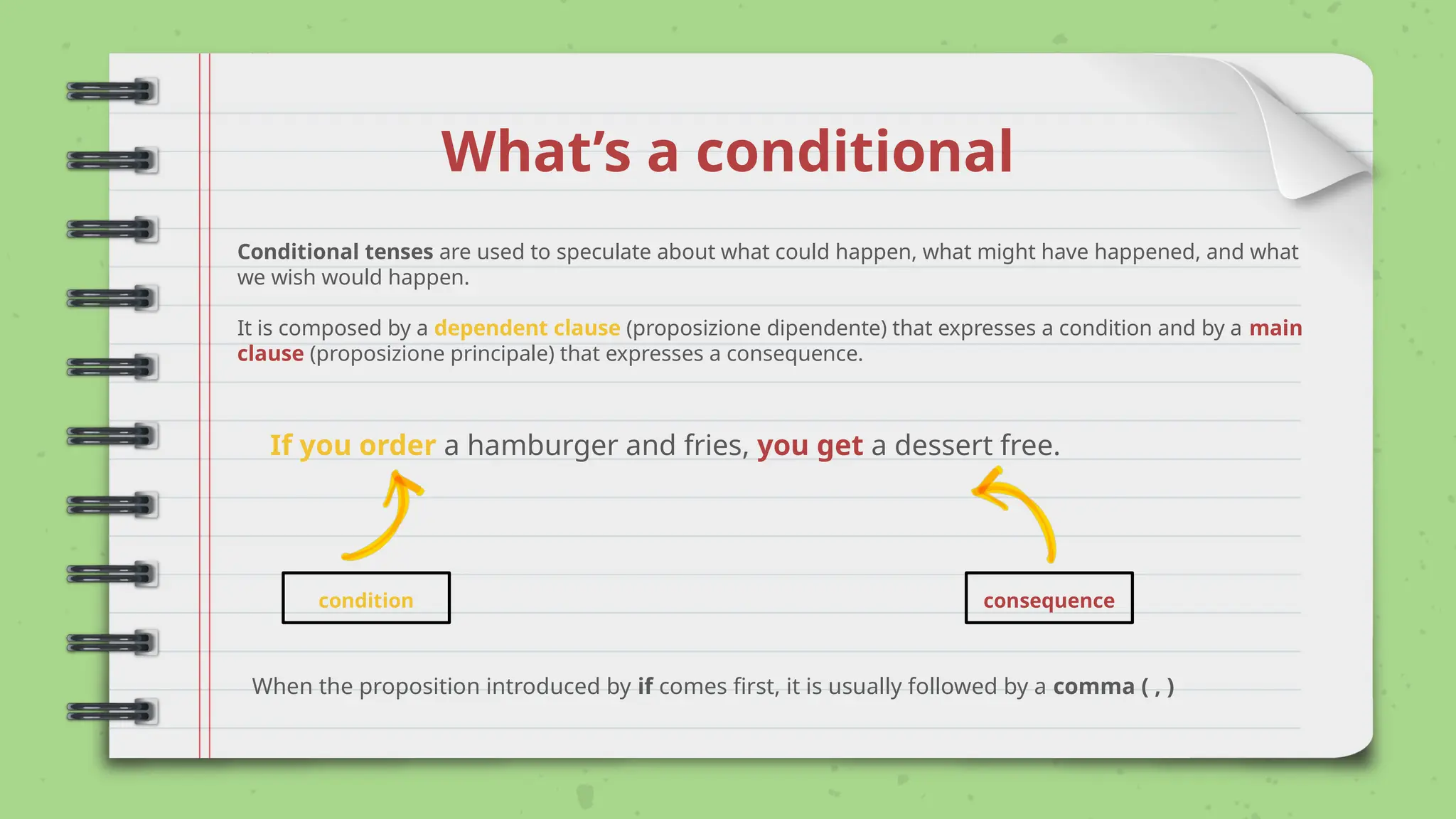
Conditional tenses are used to speculate about what could happen, what might have happened, and what
we wish would happen.
It is composed by a dependent clause (proposizione dipendente) that expresses a condition and by a main
clause (proposizione principale) that expresses a consequence.
If you order a hamburger and fries, you get a dessert free.
condition consequence
When the proposition introduced by if comes first, it is usually followed by a comma ( , )
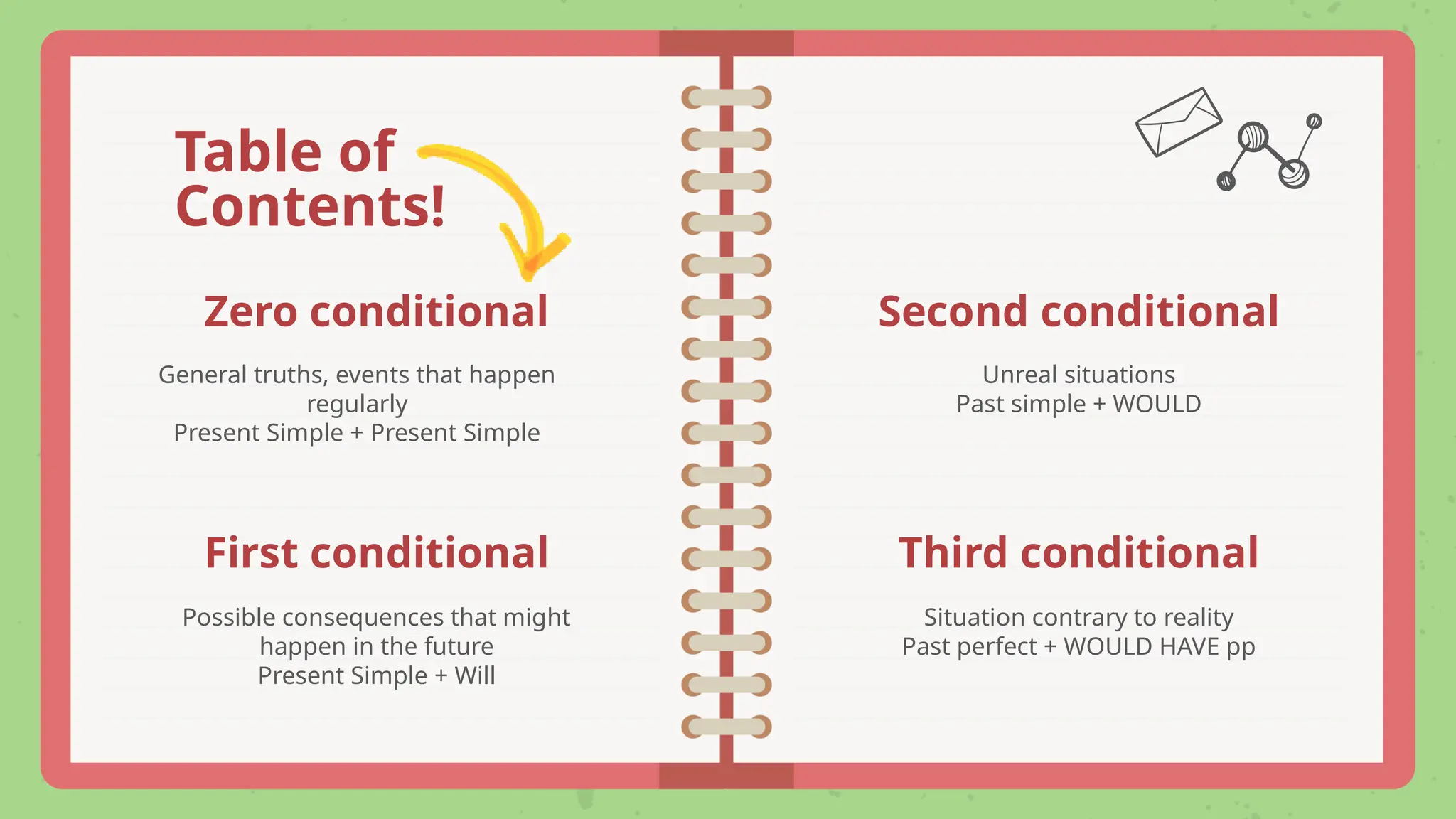
Table of
Contents!
Zero conditional
General truths, events that happen
regularly
Present Simple + Present Simple
Second conditional
Unreal situations
Past simple + WOULD
First conditional
Possible consequences that might
happen in the future
Present Simple + Will
Third conditional
Situation contrary to reality
Past perfect + WOULD HAVE pp
0
Zero
conditional
If you buy one, you get one for free.
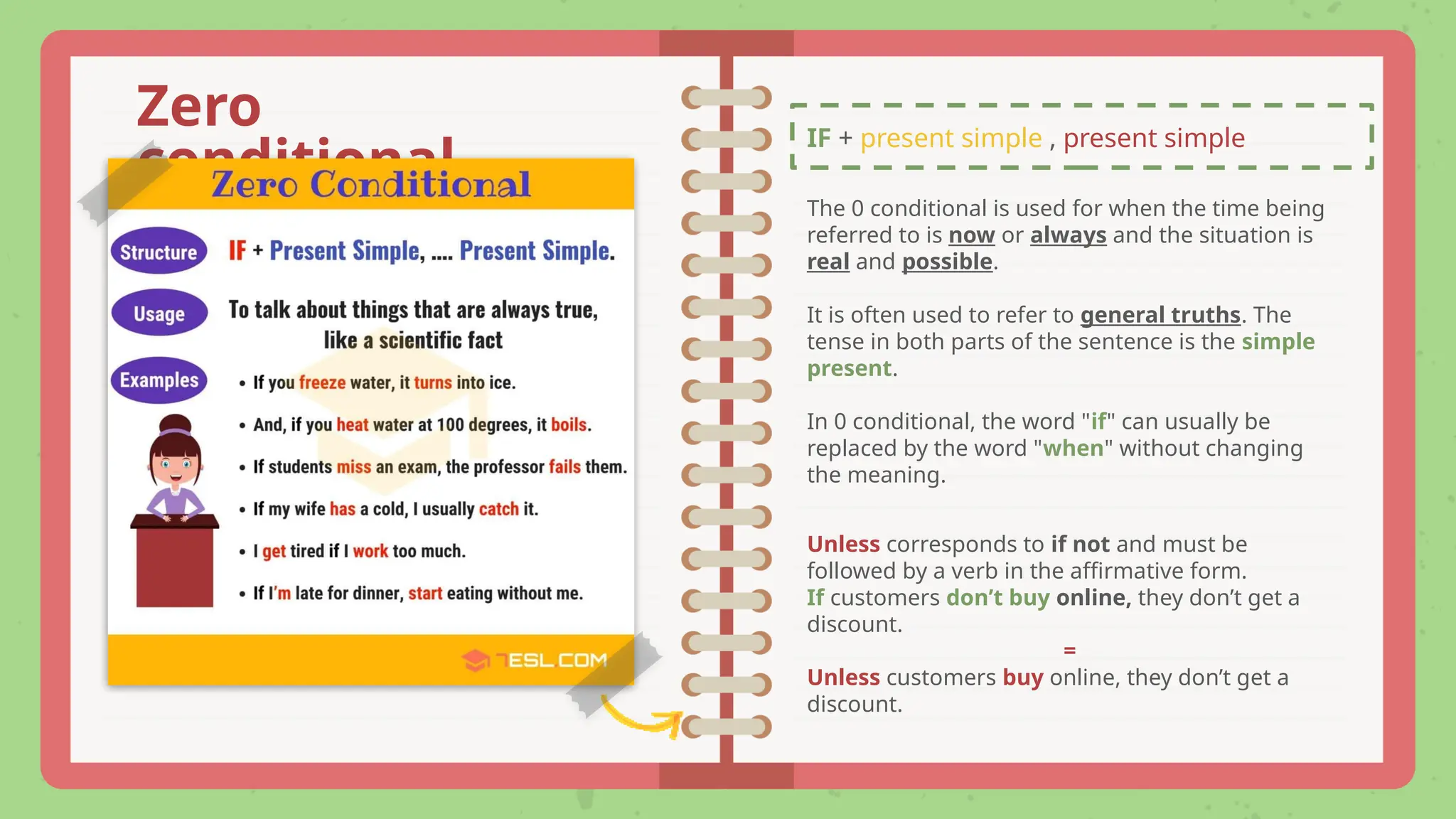
IF + present simple , present simple
Zero
conditional
The 0 conditional is used for when the time being
referred to is now or always and the situation is
real and possible.
It is often used to refer to general truths. The
tense in both parts of the sentence is the simple
present.
In 0 conditional, the word "if" can usually be
replaced by the word "when" without changing
the meaning.
Unless corresponds to if not and must be
followed by a verb in the affirmative form.
If customers don’t buy online, they don’t get a
discount.
=
Unless customers buy online, they don’t get a
discount.
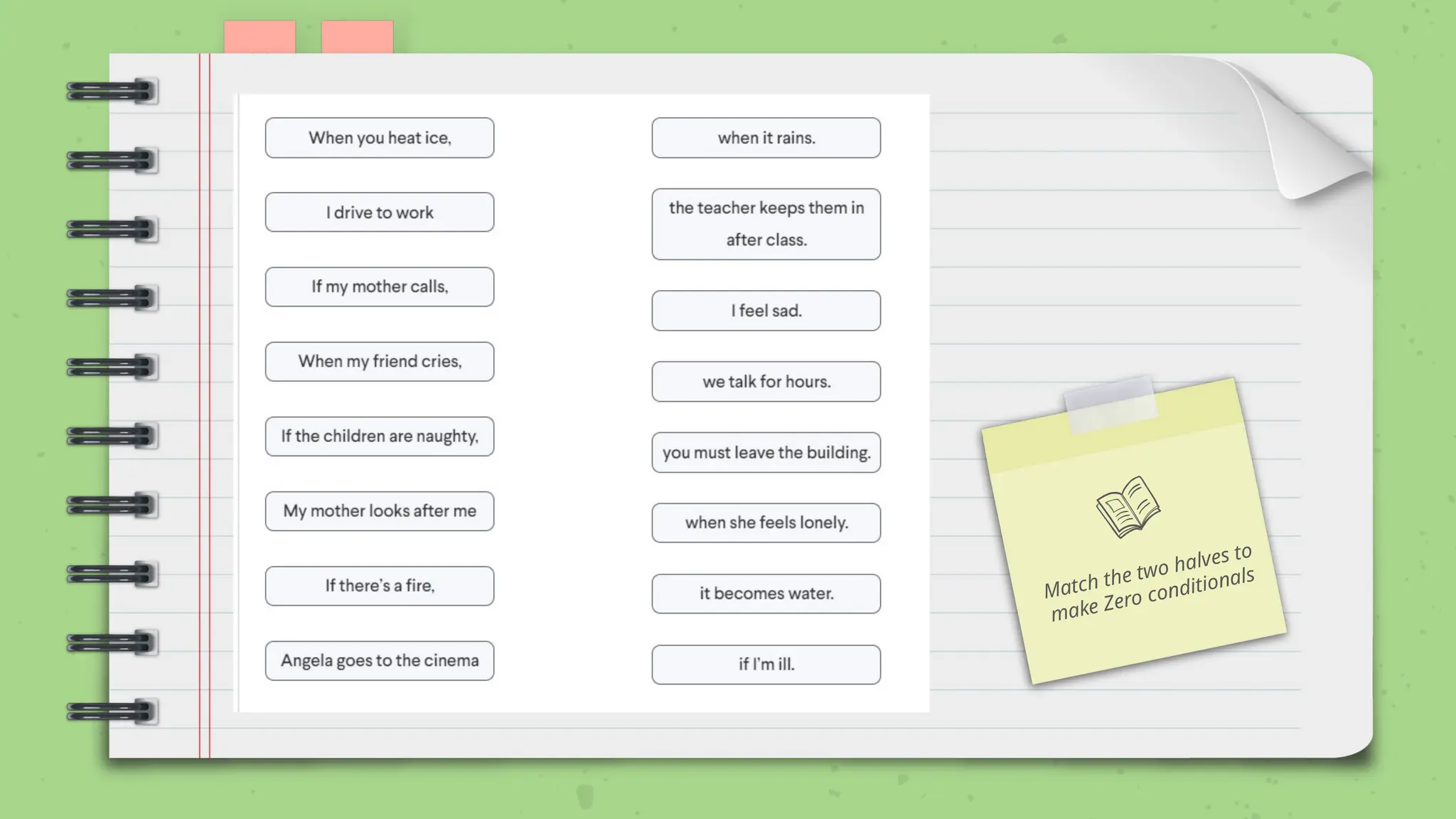
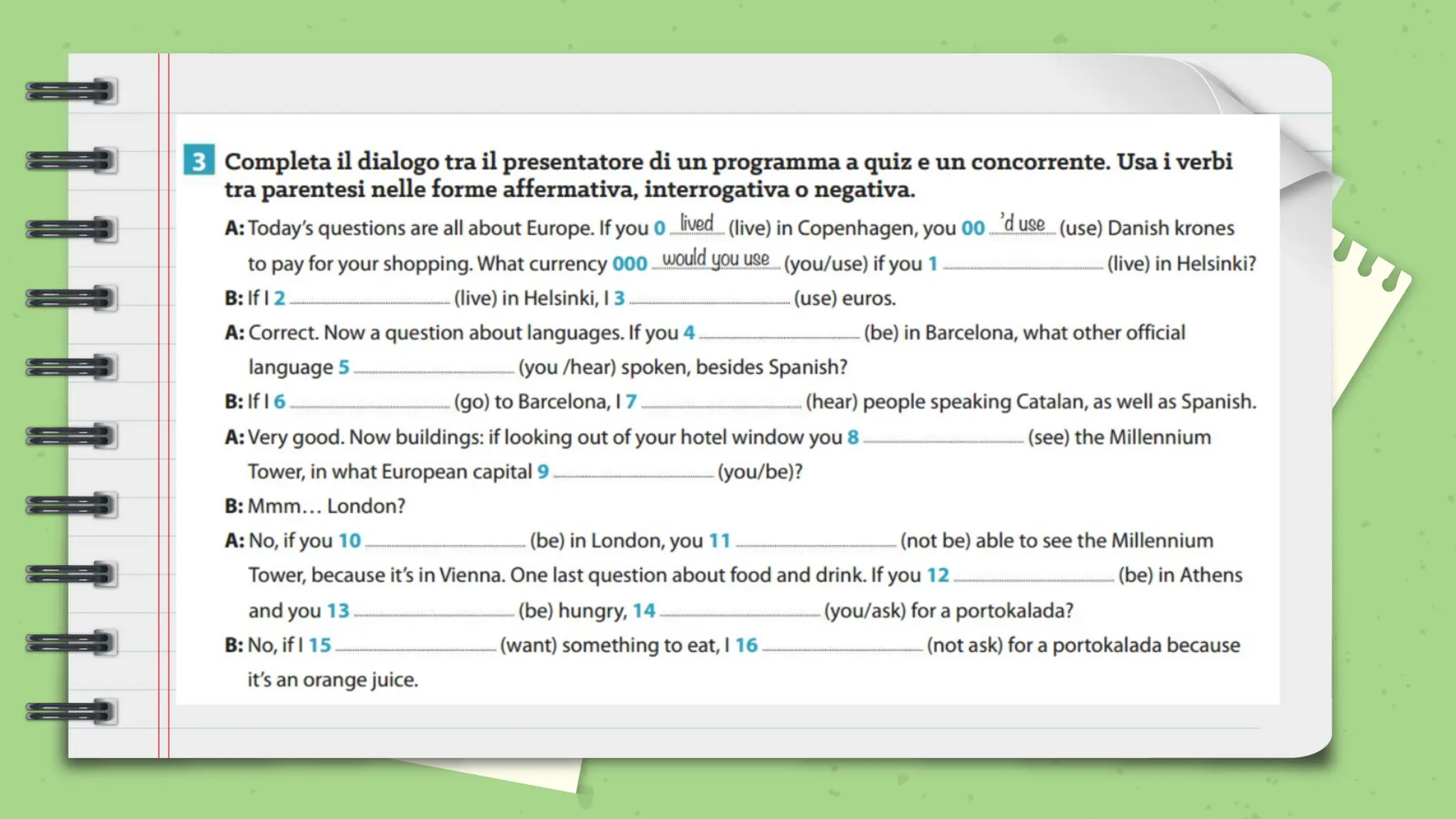
Match the two halves to
make Zero conditionals
1
First
conditionals
If you come to see me next month, I’ll show you
my new car.
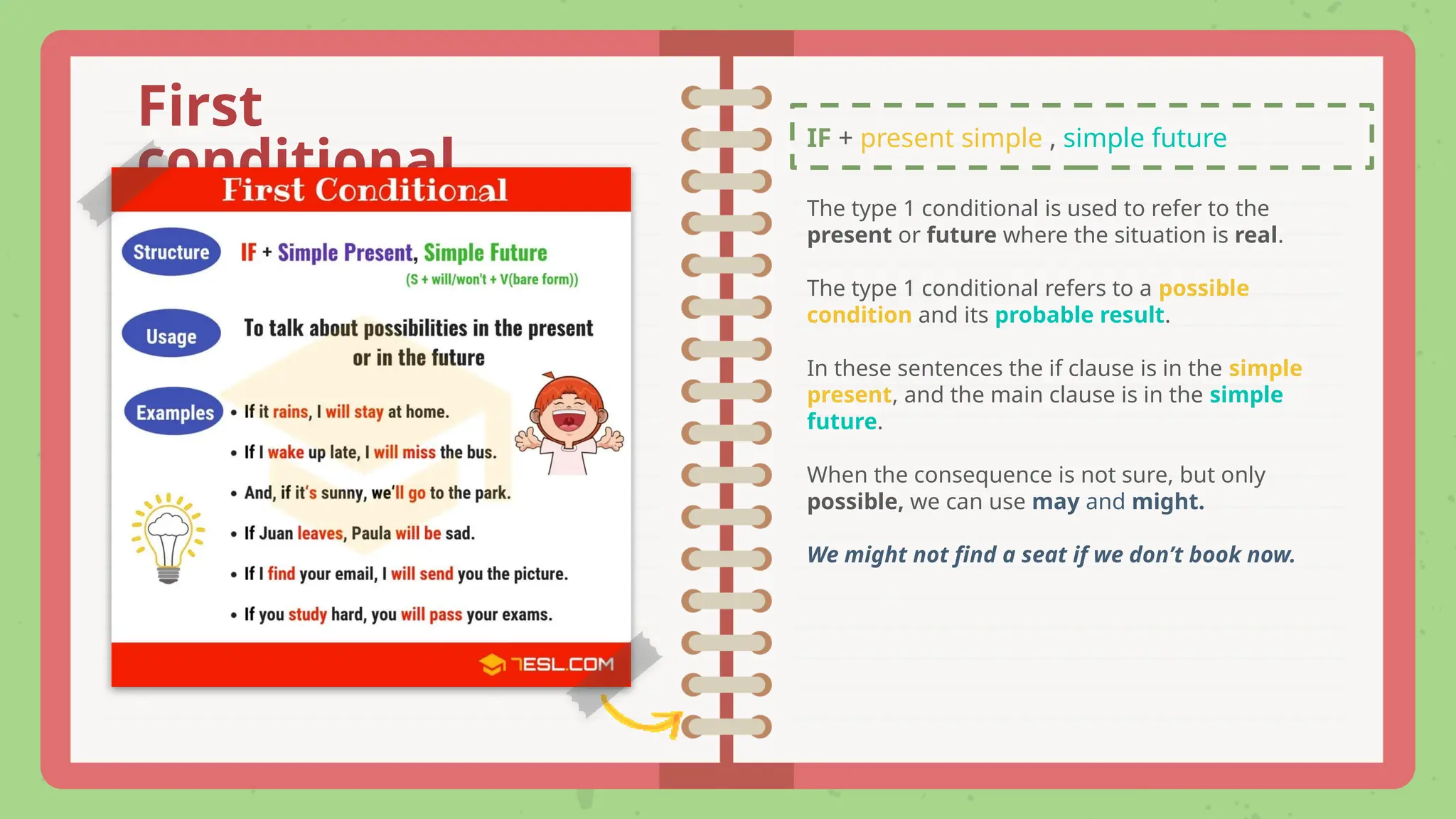
IF + present simple , simple future
First
conditional
The type 1 conditional is used to refer to the
present or future where the situation is real.
The type 1 conditional refers to a possible
condition and its probable result.
In these sentences the if clause is in the simple
present, and the main clause is in the simple
future.
When the consequence is not sure, but only
possible, we can use may and might.
We might not find a seat if we don’t book now.
2
Second
conditional
If we found a bar, I’d have a cold drink.
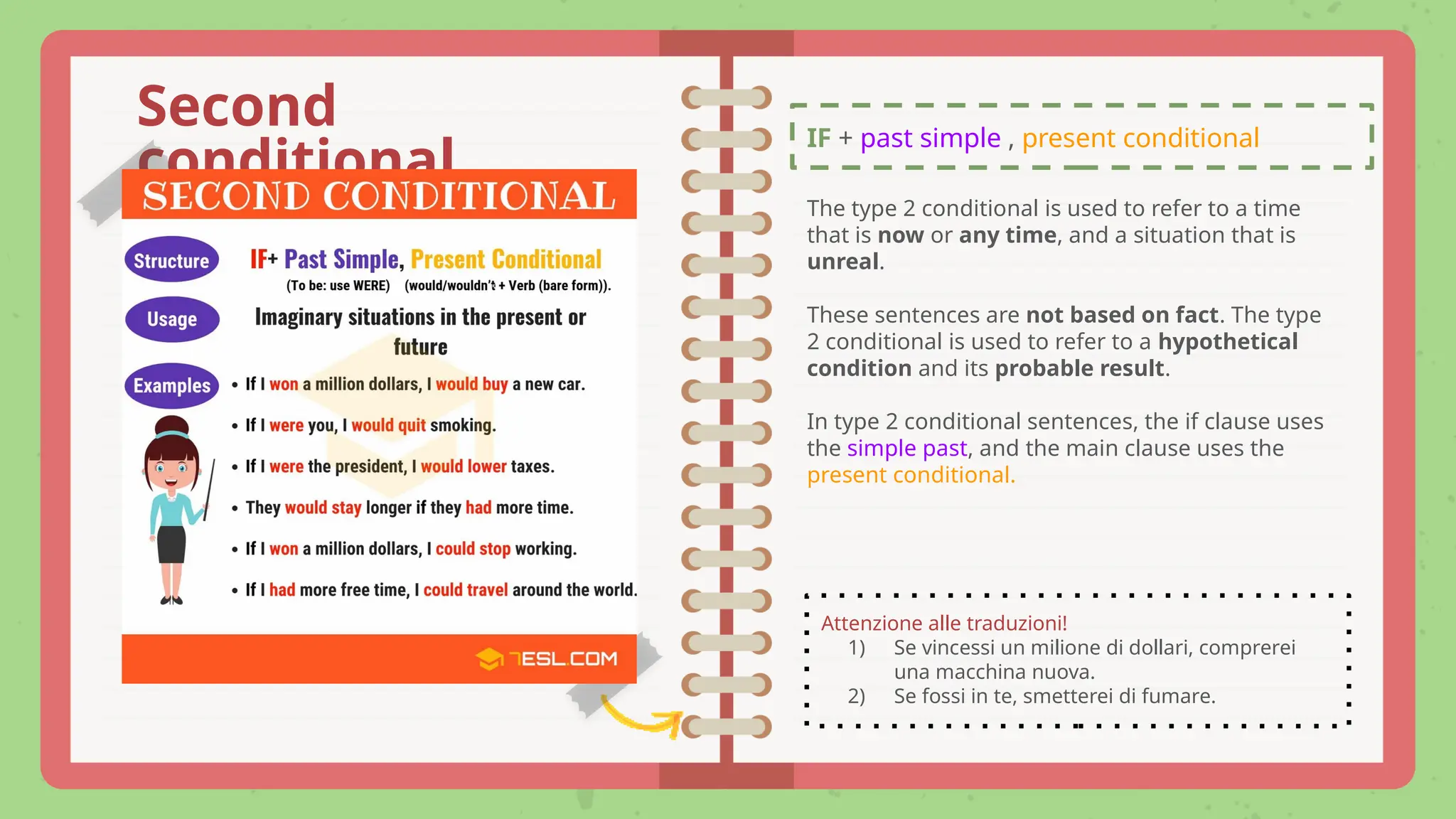
IF + past simple , present conditional
Second
conditional
The type 2 conditional is used to refer to a time
that is now or any time, and a situation that is
unreal.
These sentences are not based on fact. The type
2 conditional is used to refer to a hypothetical
condition and its probable result.
In type 2 conditional sentences, the if clause uses
the simple past, and the main clause uses the
present conditional.
Attenzione alle traduzioni!
1) Se vincessi un milione di dollari, comprerei
una macchina nuova.
2) Se fossi in te, smetterei di fumare.
When if is followed by the verb BE, its form is
WERE for all the persons.
I’d stop if I were tired.
If I were you, I’d quit smoking. (SE FOSSI IN TE…)
Instead of WOULD we can use COULD for ability,
or MIGHT for possibility.
If we had more money, we could change our old
car.
If the economy improved, unemployment might
go down.
Other important things to
know about second
conditional
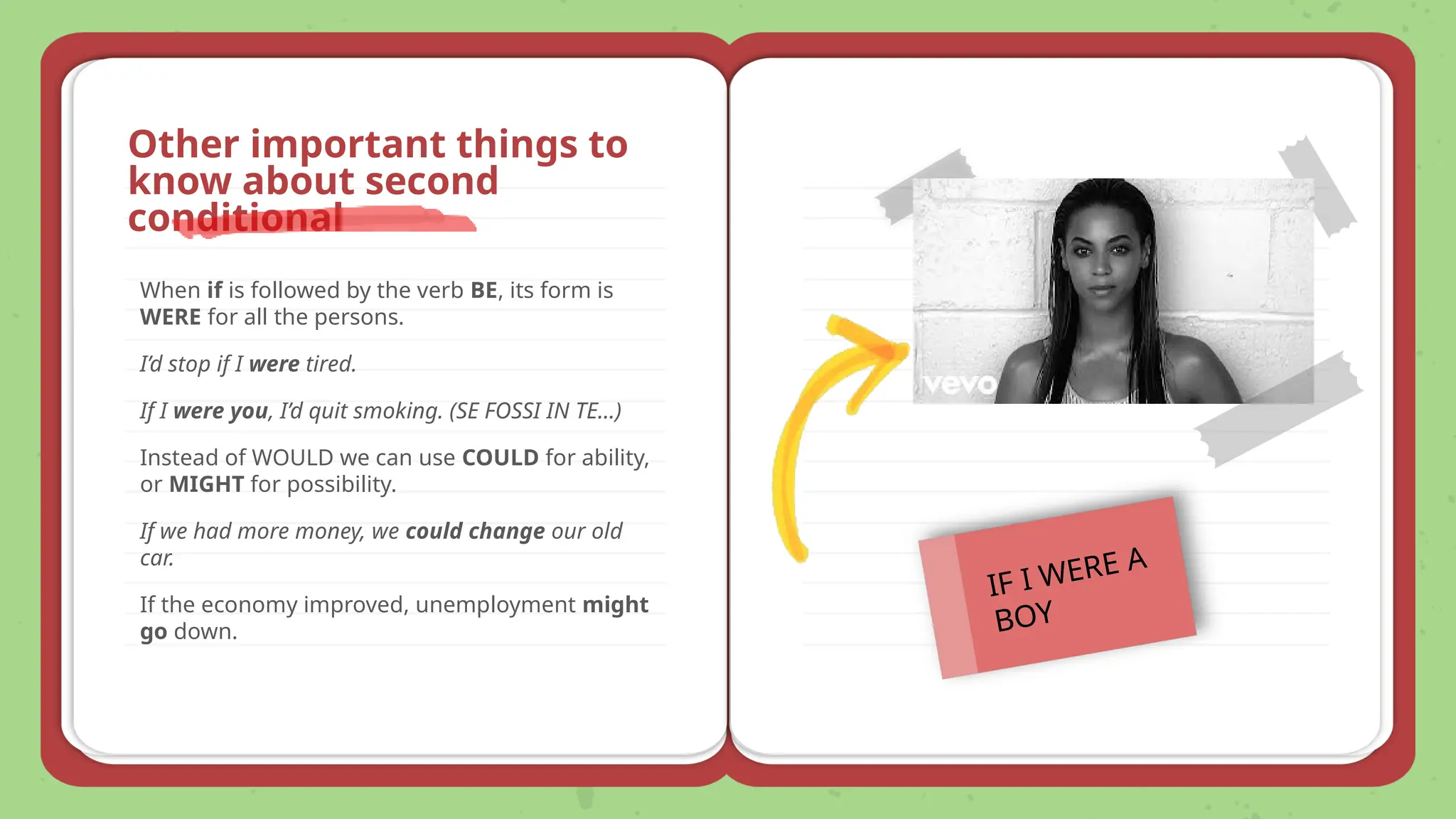
IF I WERE A
BOY
3
Third
conditional
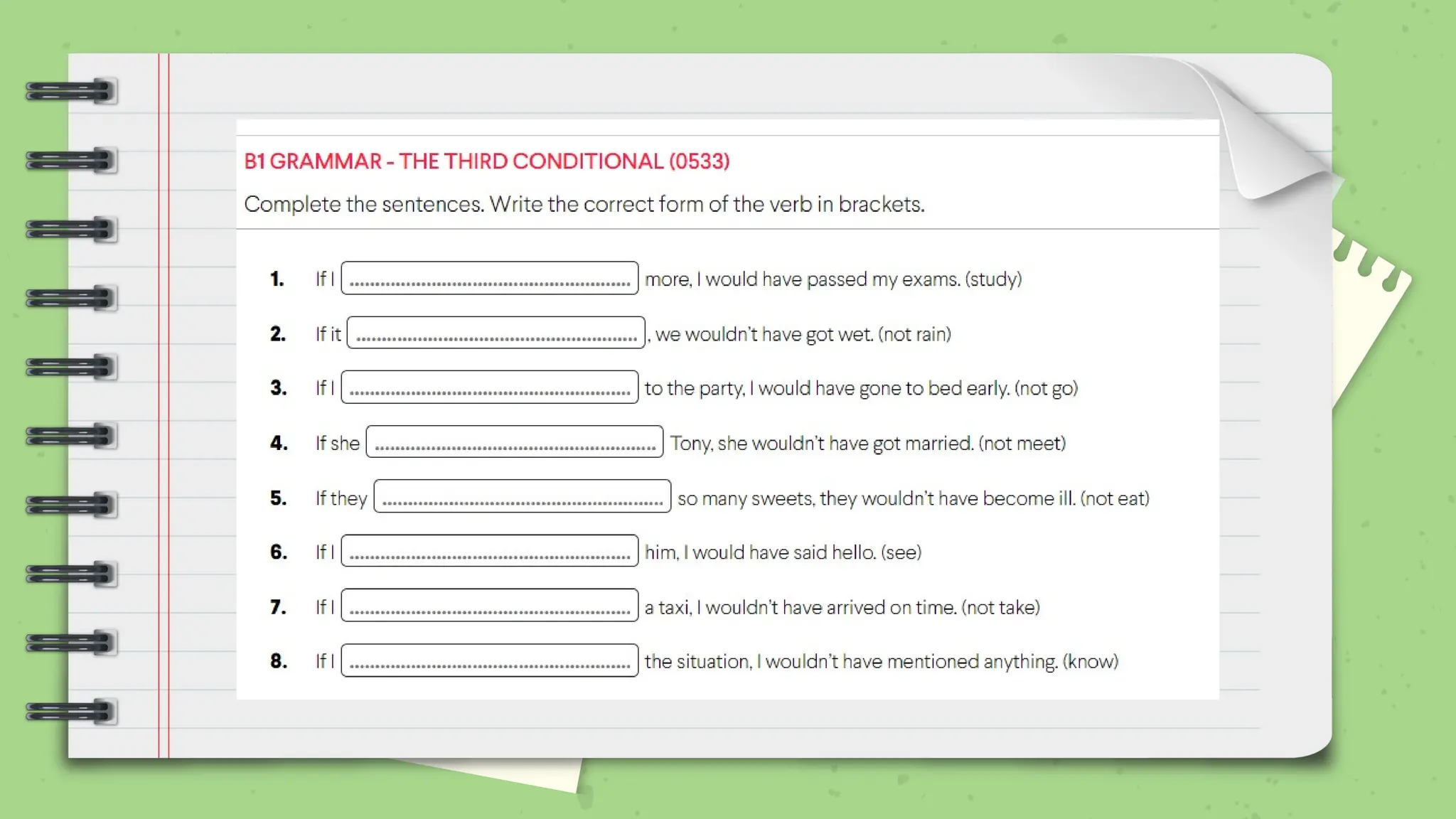
If the storm had hit the city, it would have
caused serious damage.
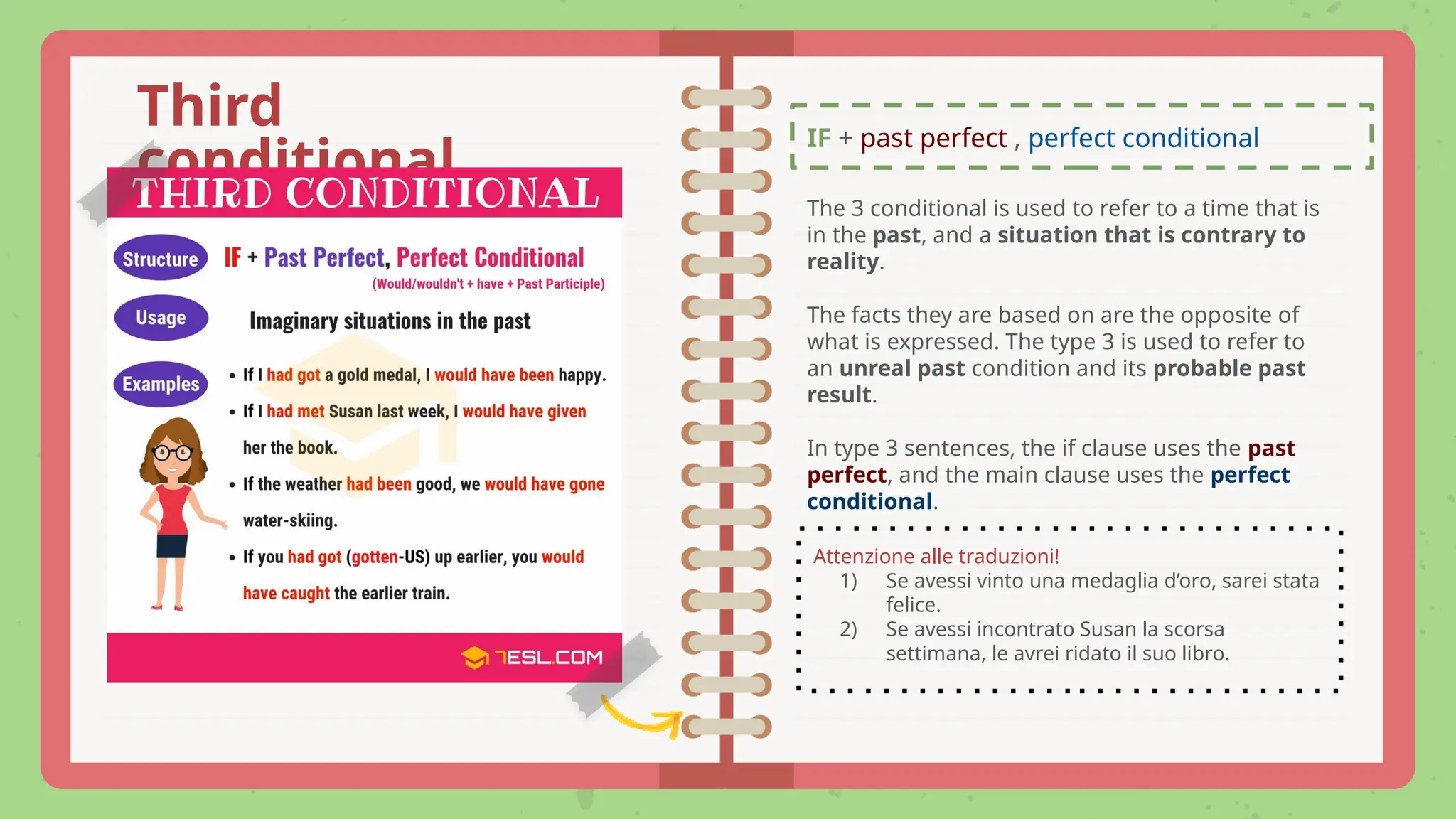
IF + past perfect , perfect conditional
Third
conditional
The 3 conditional is used to refer to a time that is
in the past, and a situation that is contrary to
reality.
The facts they are based on are the opposite of
what is expressed. The type 3 is used to refer to
an unreal past condition and its probable past
result.
In type 3 sentences, the if clause uses the past
perfect, and the main clause uses the perfect
conditional.
Attenzione alle traduzioni!
1) Se avessi vinto una medaglia d’oro, sarei stata
felice.
2) Se avessi incontrato Susan la scorsa
settimana, le avrei ridato il suo libro.
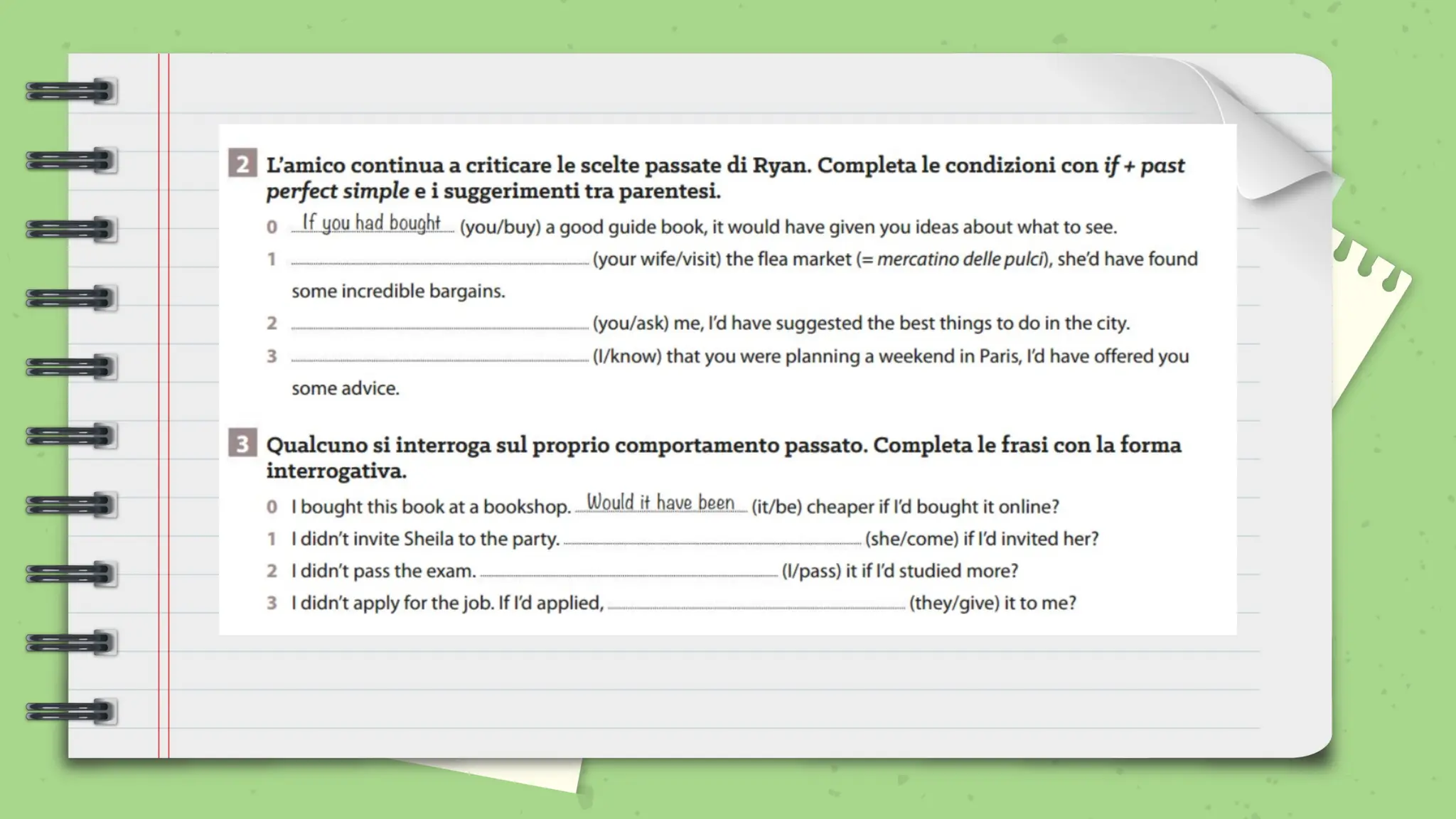
Third conditional can also be used to criticise other
people’s actions and to regret your own actions.
If you had checked your emails, you’d have known about
the strikes.
I wouldn’t have missed the train if i’d got up earlier.
Other important things to
know about third
conditional
Attenzione!
1) L’ausiliare è sempre have anche quando in
italiano utilizziamo ‘essere’.
2) La forma contratta ‘d può sostituire sia would
sia had.
Is this the
end?
Maybe

zero-first-second-and-third-conditional-ppt_157073.pptx

  • 1.
  • 2.
    What’s a conditional Conditionaltenses are used to speculate about what could happen, what might have happened, and what we wish would happen. It is composed by a dependent clause (proposizione dipendente) that expresses a condition and by a main clause (proposizione principale) that expresses a consequence. If you order a hamburger and fries, you get a dessert free. condition consequence When the proposition introduced by if comes first, it is usually followed by a comma ( , )
  • 3.
    Table of Contents! Zero conditional Generaltruths, events that happen regularly Present Simple + Present Simple Second conditional Unreal situations Past simple + WOULD First conditional Possible consequences that might happen in the future Present Simple + Will Third conditional Situation contrary to reality Past perfect + WOULD HAVE pp
  • 4.
    0 Zero conditional If you buyone, you get one for free.
  • 5.
    IF + presentsimple , present simple Zero conditional The 0 conditional is used for when the time being referred to is now or always and the situation is real and possible. It is often used to refer to general truths. The tense in both parts of the sentence is the simple present. In 0 conditional, the word "if" can usually be replaced by the word "when" without changing the meaning. Unless corresponds to if not and must be followed by a verb in the affirmative form. If customers don’t buy online, they don’t get a discount. = Unless customers buy online, they don’t get a discount.
  • 6.
    Match the twohalves to make Zero conditionals
  • 7.
    1 First conditionals If you cometo see me next month, I’ll show you my new car.
  • 8.
    IF + presentsimple , simple future First conditional The type 1 conditional is used to refer to the present or future where the situation is real. The type 1 conditional refers to a possible condition and its probable result. In these sentences the if clause is in the simple present, and the main clause is in the simple future. When the consequence is not sure, but only possible, we can use may and might. We might not find a seat if we don’t book now.
  • 11.
    2 Second conditional If we founda bar, I’d have a cold drink.
  • 12.
    IF + pastsimple , present conditional Second conditional The type 2 conditional is used to refer to a time that is now or any time, and a situation that is unreal. These sentences are not based on fact. The type 2 conditional is used to refer to a hypothetical condition and its probable result. In type 2 conditional sentences, the if clause uses the simple past, and the main clause uses the present conditional. Attenzione alle traduzioni! 1) Se vincessi un milione di dollari, comprerei una macchina nuova. 2) Se fossi in te, smetterei di fumare.
  • 13.
    When if isfollowed by the verb BE, its form is WERE for all the persons. I’d stop if I were tired. If I were you, I’d quit smoking. (SE FOSSI IN TE…) Instead of WOULD we can use COULD for ability, or MIGHT for possibility. If we had more money, we could change our old car. If the economy improved, unemployment might go down. Other important things to know about second conditional IF I WERE A BOY
  • 16.
    3 Third conditional If the stormhad hit the city, it would have caused serious damage.
  • 17.
    IF + pastperfect , perfect conditional Third conditional The 3 conditional is used to refer to a time that is in the past, and a situation that is contrary to reality. The facts they are based on are the opposite of what is expressed. The type 3 is used to refer to an unreal past condition and its probable past result. In type 3 sentences, the if clause uses the past perfect, and the main clause uses the perfect conditional. Attenzione alle traduzioni! 1) Se avessi vinto una medaglia d’oro, sarei stata felice. 2) Se avessi incontrato Susan la scorsa settimana, le avrei ridato il suo libro.
  • 18.
    Third conditional canalso be used to criticise other people’s actions and to regret your own actions. If you had checked your emails, you’d have known about the strikes. I wouldn’t have missed the train if i’d got up earlier. Other important things to know about third conditional Attenzione! 1) L’ausiliare è sempre have anche quando in italiano utilizziamo ‘essere’. 2) La forma contratta ‘d può sostituire sia would sia had.
  • 21.