

Midwest UX
 May 31, 2012
Columbus, Ohio


                 @derrenh
                 @coreyallenbach
                 #mwux12
                 #zenuxplanning
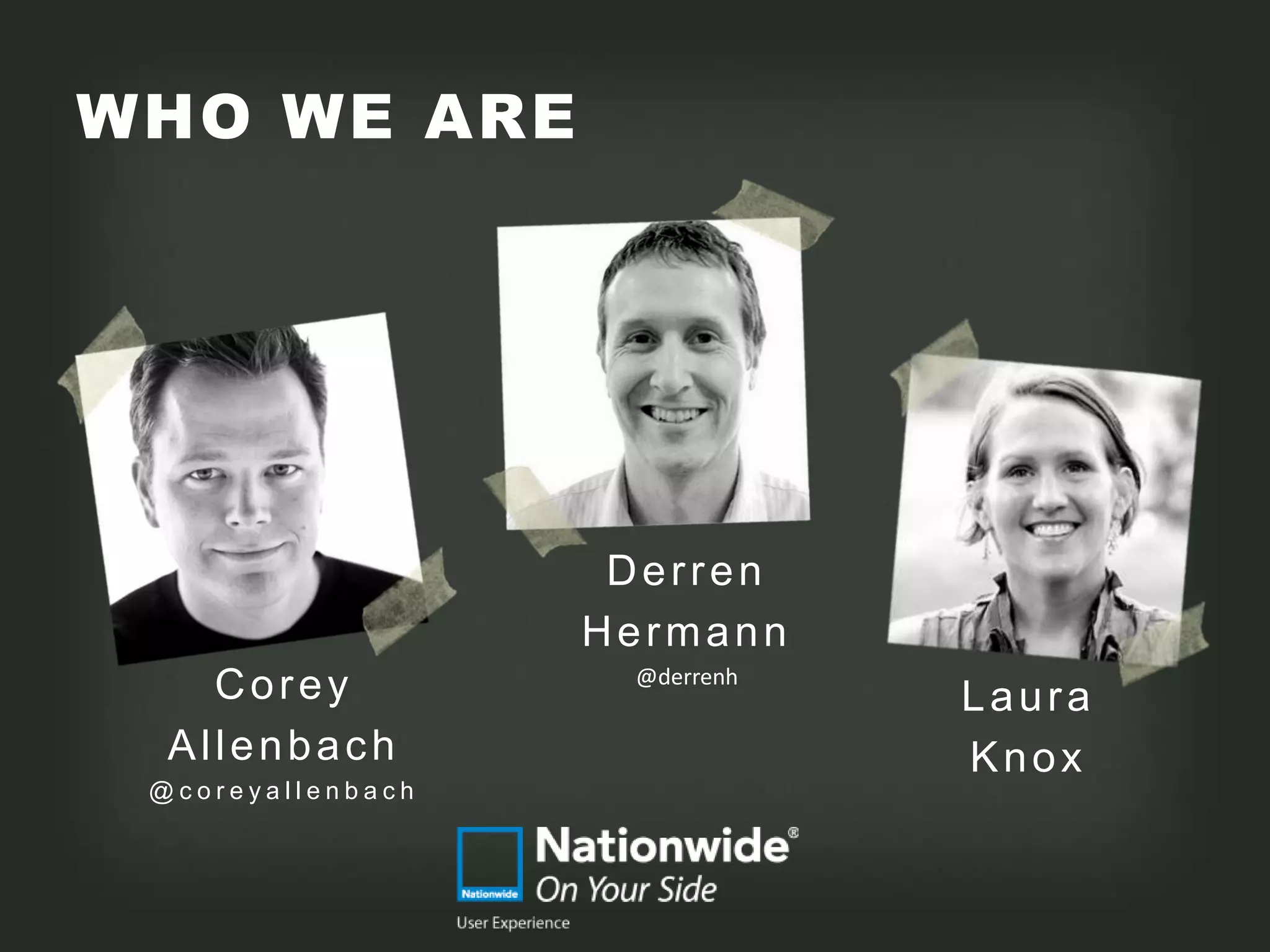
WHO WE ARE


                    Derren
                   Hermann
                    @derrenh
    Corey                      Laura
  Allenbach                    Knox
 @coreyallenbach
TODAY’S AGENDA
9:00 – 9:10            Welcome
9:10 – 9:20            Ice Breaker
9:20 – 9:30            4 Elements & Our Scenario


9:30 – 9:45            Earth: Initial Client Meeting
9:45 – 10:05           Group Activity 1
10:05 – 10:20          Wind: Exploring Approach Options
10:20 – 10:40          Group Activity 2


10:40 – 10:45          Break


1 0 : 4 5 – 11 : 0 0   Water: Approach Summary
11 : 0 0 – 11 : 2 0    Group Activity 3
11 : 2 0 – 11 : 3 5    Fire: Detailed Project Plan
11 : 3 5 – 11 : 5 5    Group Activity 4


11 : 5 5 – 1 2 : 0 0   W r a p U p & T h a n k Yo u
GROUND RULES

1. Have fun
2. Bathrooms & breaks
3. Cell phones
STUFF AT YOUR TABLE

1. Book
2. Packet (Agenda, Templates)
ICE BREAKER

1. D raw your di agram and i ntroduce
   yoursel f (name and super hero
   pow er)

2. Wri te thoughts on post -i ts, di scuss
   and organi ze (What’s chal l enging
   about U X pl anni ng?)

3. Pi ck 3 most common to share w i th
   the room
ICE BREAKER

What were your group’s 3 most
common topics?
THE FOUR ELEMENTS
EARTH
Setting your foundation.
The initial client meeting.


WIND
Exploring approach options.
Listing activities.


WATER
Pulling together your ideas.
Documenting your recommended approach for the client.


FIRE
Forging a detailed project plan.
H a m m e r i n g o u t t h e s c h e d u l e d o w n t o t h e d a y.
TODAY’S SCENARIO

•   National Reality Company
•   Mobile for sales agents
•   Increase sales
•   Start developing soon
•   Ideas for next year too
Initial Client Meeting
INITIAL CLIENT MEETING


                OV E R V I E W


     Gathering everything you need to
           draft an approach.

The initial client meeting is your opportunity
  to accomplish two fundamental goals:
      gather information & gain trust.
INITIAL CLIENT MEETING


              GOALS


 An understanding of project goals,
logisticsand constraints to feed the
        approach document.
INITIAL CLIENT MEETING


                   STEPS


1. Request pre-reads from the client
2. Prepare for the meeting
3. Hold meeting
4. Organize your notes & thoughts
5. Follow up email that includes thanks & set
   expectations.
INITIAL CLIENT MEETING


            TOOLS

Initial Client Meeting Worksheet
INITIAL CLIENT MEETING


                             TIPS

•   Do your homework prior to meeting.

•   Think through additional questions you may have ahead
    of time.

•   Don’t forget to do introductions at start of the meeting...
    explain your role as well as understand the roles of the
    clients.

•   Consider orienting clients to the UX process & value.

•   Have one person facilitate the discussion and at least
    one other take detailed notes. Don’t try to do both
    yourself.

•   Set expectations on possible client involvement needs.

•   Set expectations for immediate next steps and provide a
    same day follow-up email to confirm.
GROUP ACTIVITY #1

1. BLACK markers up front
2. Take notes using the Client
   Interview Worksheet
GROUP ACTIVITY #1

•   What went well?
•   What didn’t?
•   Any questions stand out?
•   Any other thoughts?
Exploring Approach
     Options
EXPLORING APPROACH OPTIONS


                OV E R V I E W


  Listing activities and settling on a plan.

  There are always multiple routes you can
   take. Understanding and exploring your
    options are key to developing a plan.
Involving fellow designers can ensure you’re
         thinking creatively enough.
EXPLORING APPROACH OPTIONS


                 G OA L S


A rough outline of your plan to inform the
          a p p r o a c h s u m m a r y.
EXPLORING APPROACH OPTIONS


                   STEPS


1. Review project overview& goals
2. Determine the User Centered Design phase
3. Map constraints on a timeline
4. Explore methods and activities
5. Sequence activities
6. Determine people
7. Create draft milestones and phases of
   activity
EXPLORING APPROACH OPTIONS


             TO O L S

UX Planning – Methods & Activities
EXPLORING APPROACH OPTIONS


                          TIPS

•   Involve people who will actually be doing the work.

•   The whiteboard is your friend.

•   This is not like normal brainstorming. Be sure to call
    out bad ideas.

•   Explore various levels of cost/commitment.

•   Don’t rush this. It might take an hour or a second
    session.

•   Involve a wide a range of UX roles
    in the session (i.e. project team
    members, managers, directors, account
    managers, etc.).
GROUP ACTIVITY #2

1. GREEN markers
2. Use insights from the client
   meeting to add
   goals, users, constraints to the
   framework
3. List questions, discuss methods
4. Add draft phases of activity
5. Add roles
GROUP ACTIVITY #2

• How did it go?
• Was the framework helpful?
• Any other thoughts?
Approach Summary
APPROACH SUMMARY


               OV E R V I E W


Documenting your recommended approach
             for the client.

Once you’ve settled on your options, you’ll
 need a way to explain to others what you
intend to do, how long it will take and how
much it will cost. Getting the approach on
   paper is a good way to start receiving
    feedback that can help you refine it.
APPROACH SUMMARY


                   G OA L S


A high-level explanation of your plan that will
 help you receive approval and serve as the
     starting point for your detailed plan.
APPROACH SUMMARY


                                STEPS


1 . Tr a n s l a t e t h e r o u g h o u t l i n e o f a c t i v i t i e s
    from brainstorming to a spreadsheet that
    can help you total costs for UX resources.
2. Use data gathered during the initial client
   meeting to create background, objectives
   and assumptions.
3. Use the rough outline of activities
   from brainstorming and the forecast
   spreadsheet to detail your
   approach, deliverables, schedule, team and
   cost.
APPROACH SUMMARY


  TO O L S


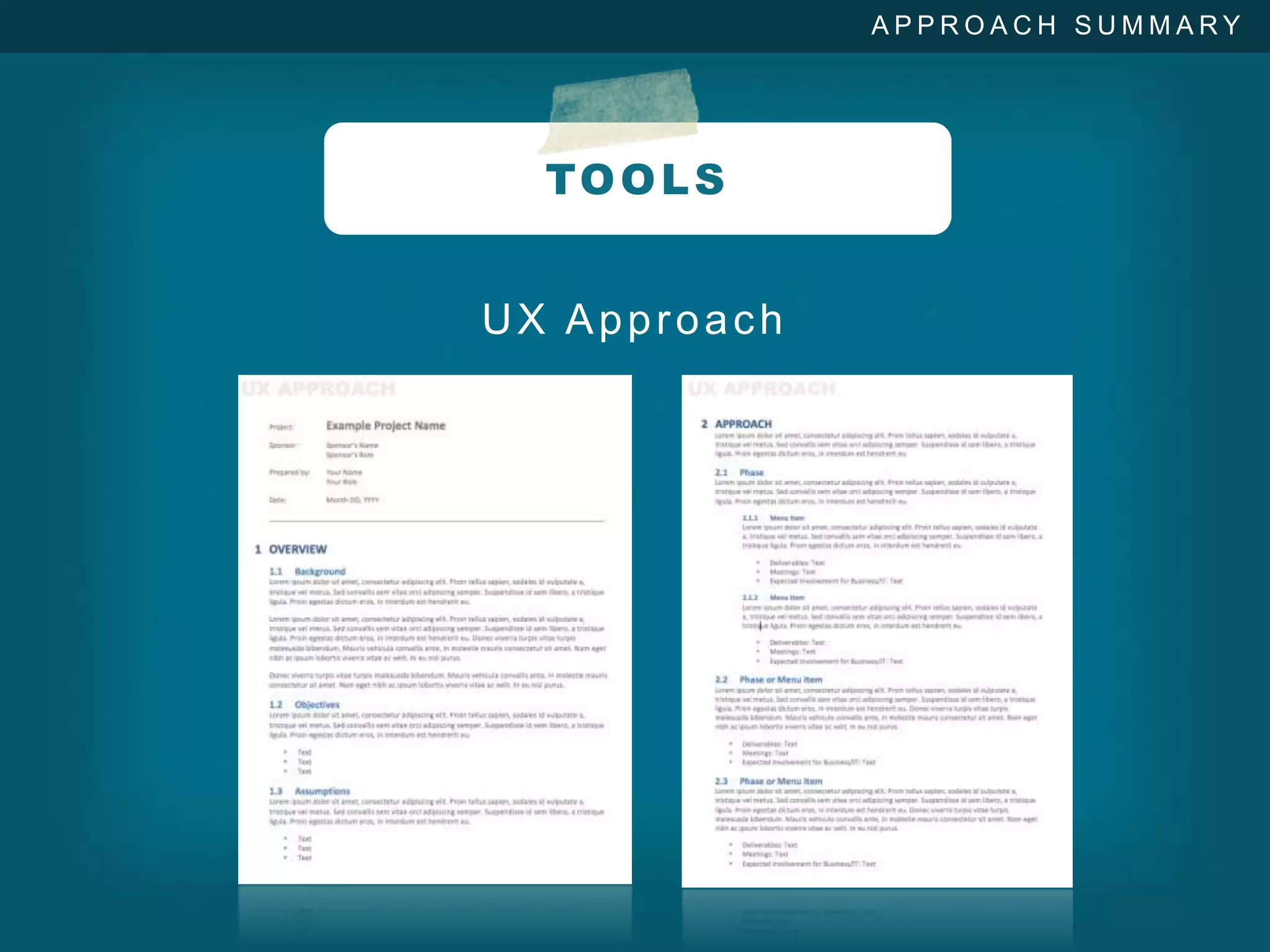
UX Approach
APPROACH SUMMARY


         TO O L S


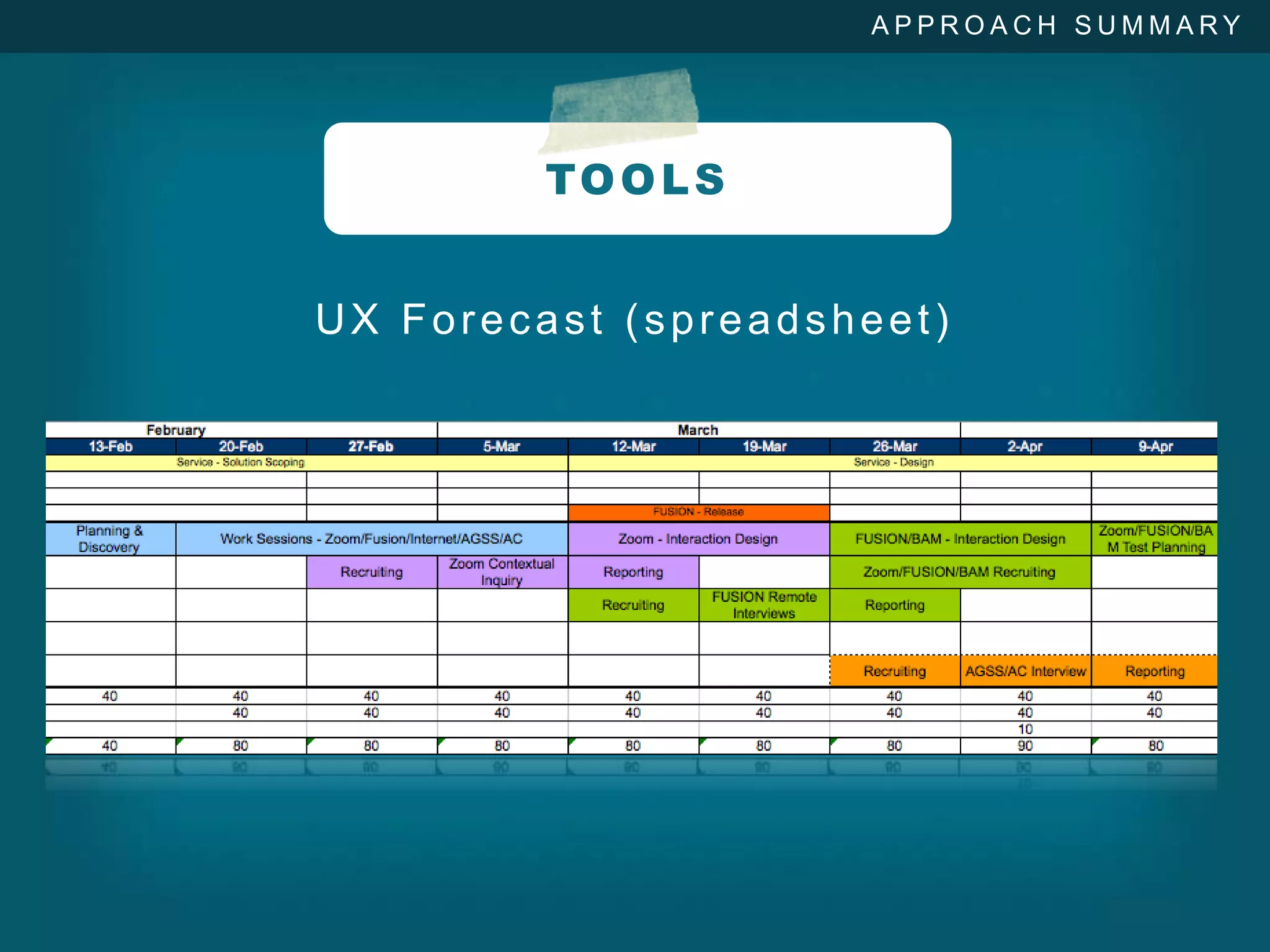
UX Forecast (spreadsheet)
APPROACH SUMMARY


                                          TIPS

•   Be considerate of your audience and don’t use UX lingo.

•   Trip le c h e c k yo u r ma th .
•   Provide a few options if it makes sense.

•   Be sure you can explain the elevator pitch for the project.

•   Iterate by explaining the approach to others.

•   Get as many eyes on this document as possible.
•   Try to p u n c h h o le s in it.

•   Proofread, proofread, proofread.

•   Spend time anticipating questions and concerns that your
    client might have.

•   Be prepared to iterate, this document is often a conversation
    s t a r t e r.

•   R e m e m b e r, t h i s m i g h t b e t h e f i r s t wo r k p r o d u c t a c l i e n t
    sees, so make sure it represents the quality of your work and
    the value of design.
GROUP ACTIVITY #3

1. BLUE markers
2. Step through the Approach
   Summary template in your packets
   and add bulleted content
3. Be sure to discuss each section
   and make sure you know where
   you’ll get that information
GROUP ACTIVITY #3

• What sections were most difficult
  to complete?
• Any other thoughts?
Detailed Project Plan
D E TA I L E D P R O J E C T P L A N


                         OV E R V I E W


H a m m e r i n g o u t t h e s c h e d u l e d o w n t o t h e d a y.

 Attaining Zen in UX project planning requires
attention to the details. A day-by-day schedule
 will help you do a reality check on your plan
          a n d s t a y o n t r a c k t o d e l i v e r.
D E TA I L E D P R O J E C T P L A N


                  G OA L S


A detailed project plan that clearly defines
   what will be accomplished and when.
D E TA I L E D P R O J E C T P L A N


                                  STEPS

1. Use the approach document to set up your
   overall schedule.
2. Gather dependency information from
   p r o j e c t p a r t n e r s ( b u s i n e s s , I T, e t c . ) .
3. Meet with your UX teammates and clearly
   identify activities, durations, milestones
   and responsibilities.
4. Give your UX teammates and project
   p a r t n e r s a c h a n c e t o r e v i e w.
5. Finalize.
D E TA I L E D P R O J E C T P L A N


          TO O L S

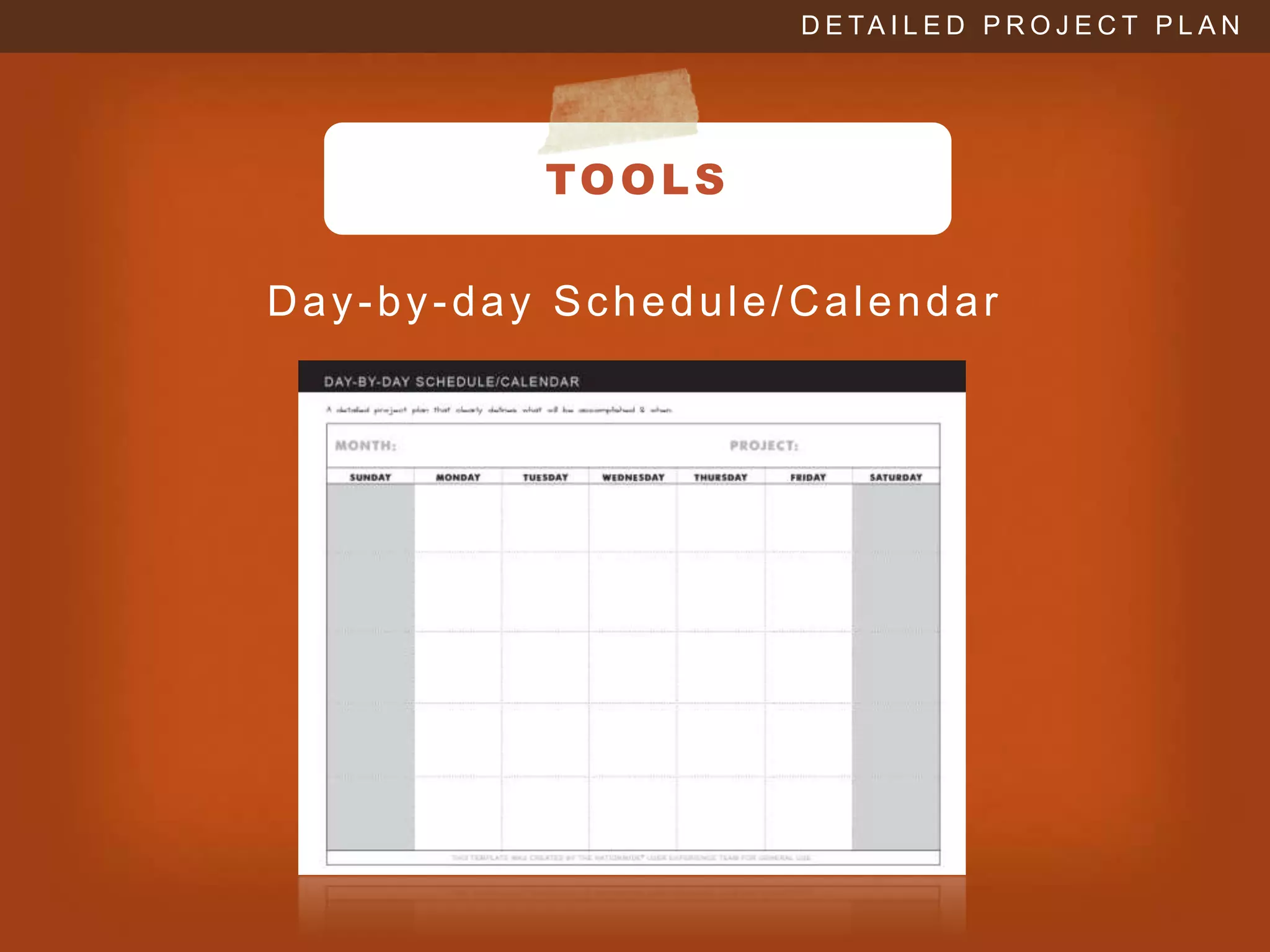
Day-by-day Schedule/Calendar
D E TA I L E D P R O J E C T P L A N


                                      TIPS

•   Think about how you can break up large phases into smaller
    activities

•   Consider different phases of each activity (getting
    started, doing the work, wrapping it up, etc. ).

•   Clearly indicate key UX milestones and inputs or participation
    needed from your client.

•   Include buffers at the appropriate times in the
    schedule, especially at the end.

•   Include all meetings, review and approval touch points, and
    decision points.

•   Realize that this document is organic and will likely change
    over the life of a project. Justbe sure to communicate
    necessary changes to stakeholders as soon as you recognize
    them.

•   Factor in vacations and holidays.
•   Don’t forget about the time it will take to ensure your
    d e l i v e r a b l e s a r e h a n d e d o f f a d e q u a t e l y.
GROUP ACTIVITY #4

1. RED markers
2. Use the blank Calendars in your
   packet to draft 3 months of your
   plan
GROUP ACTIVITY #4

• Anyone find a need to start
  extending their timeline?
• Any other thoughts?
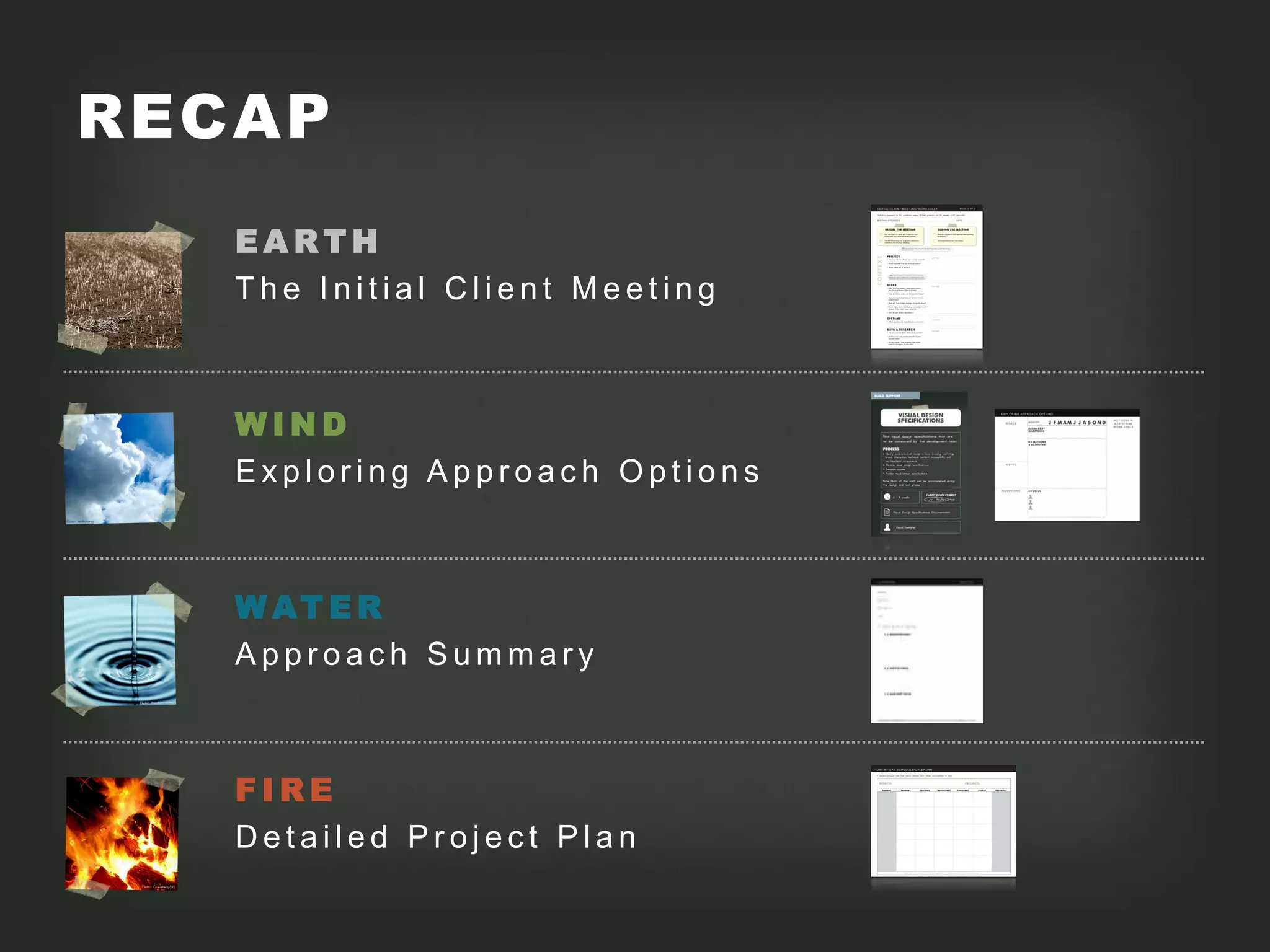
RECAP
   EARTH
   The Initial Client Meeting


   WIND
   Exploring Approach Options


   W AT E R
   Approach Summary


   FIRE
   Detailed Project Plan
Corey Allenbach
c o r e y. a l l e n b a c h @ n a t i o n w i d e . c o m


Derren Hermann
derren.hermann@nationwide.com

Zen and the Art of UX Planning

  • 1.
    Midwest UX May31, 2012 Columbus, Ohio @derrenh @coreyallenbach #mwux12 #zenuxplanning
  • 2.
    WHO WE ARE Derren Hermann @derrenh Corey Laura Allenbach Knox @coreyallenbach
  • 3.
    TODAY’S AGENDA 9:00 –9:10 Welcome 9:10 – 9:20 Ice Breaker 9:20 – 9:30 4 Elements & Our Scenario 9:30 – 9:45 Earth: Initial Client Meeting 9:45 – 10:05 Group Activity 1 10:05 – 10:20 Wind: Exploring Approach Options 10:20 – 10:40 Group Activity 2 10:40 – 10:45 Break 1 0 : 4 5 – 11 : 0 0 Water: Approach Summary 11 : 0 0 – 11 : 2 0 Group Activity 3 11 : 2 0 – 11 : 3 5 Fire: Detailed Project Plan 11 : 3 5 – 11 : 5 5 Group Activity 4 11 : 5 5 – 1 2 : 0 0 W r a p U p & T h a n k Yo u
  • 4.
    GROUND RULES 1. Havefun 2. Bathrooms & breaks 3. Cell phones
  • 5.
    STUFF AT YOURTABLE 1. Book 2. Packet (Agenda, Templates)
  • 6.
    ICE BREAKER 1. Draw your di agram and i ntroduce yoursel f (name and super hero pow er) 2. Wri te thoughts on post -i ts, di scuss and organi ze (What’s chal l enging about U X pl anni ng?) 3. Pi ck 3 most common to share w i th the room
  • 7.
    ICE BREAKER What wereyour group’s 3 most common topics?
  • 9.
    THE FOUR ELEMENTS EARTH Settingyour foundation. The initial client meeting. WIND Exploring approach options. Listing activities. WATER Pulling together your ideas. Documenting your recommended approach for the client. FIRE Forging a detailed project plan. H a m m e r i n g o u t t h e s c h e d u l e d o w n t o t h e d a y.
  • 10.
    TODAY’S SCENARIO • National Reality Company • Mobile for sales agents • Increase sales • Start developing soon • Ideas for next year too
  • 11.
  • 12.
    INITIAL CLIENT MEETING OV E R V I E W Gathering everything you need to draft an approach. The initial client meeting is your opportunity to accomplish two fundamental goals: gather information & gain trust.
  • 13.
    INITIAL CLIENT MEETING GOALS An understanding of project goals, logisticsand constraints to feed the approach document.
  • 14.
    INITIAL CLIENT MEETING STEPS 1. Request pre-reads from the client 2. Prepare for the meeting 3. Hold meeting 4. Organize your notes & thoughts 5. Follow up email that includes thanks & set expectations.
  • 15.
    INITIAL CLIENT MEETING TOOLS Initial Client Meeting Worksheet
  • 16.
    INITIAL CLIENT MEETING TIPS • Do your homework prior to meeting. • Think through additional questions you may have ahead of time. • Don’t forget to do introductions at start of the meeting... explain your role as well as understand the roles of the clients. • Consider orienting clients to the UX process & value. • Have one person facilitate the discussion and at least one other take detailed notes. Don’t try to do both yourself. • Set expectations on possible client involvement needs. • Set expectations for immediate next steps and provide a same day follow-up email to confirm.
  • 17.
    GROUP ACTIVITY #1 1.BLACK markers up front 2. Take notes using the Client Interview Worksheet
  • 18.
    GROUP ACTIVITY #1 • What went well? • What didn’t? • Any questions stand out? • Any other thoughts?
  • 19.
  • 20.
    EXPLORING APPROACH OPTIONS OV E R V I E W Listing activities and settling on a plan. There are always multiple routes you can take. Understanding and exploring your options are key to developing a plan. Involving fellow designers can ensure you’re thinking creatively enough.
  • 21.
    EXPLORING APPROACH OPTIONS G OA L S A rough outline of your plan to inform the a p p r o a c h s u m m a r y.
  • 22.
    EXPLORING APPROACH OPTIONS STEPS 1. Review project overview& goals 2. Determine the User Centered Design phase 3. Map constraints on a timeline 4. Explore methods and activities 5. Sequence activities 6. Determine people 7. Create draft milestones and phases of activity
  • 23.
    EXPLORING APPROACH OPTIONS TO O L S UX Planning – Methods & Activities
  • 24.
    EXPLORING APPROACH OPTIONS TIPS • Involve people who will actually be doing the work. • The whiteboard is your friend. • This is not like normal brainstorming. Be sure to call out bad ideas. • Explore various levels of cost/commitment. • Don’t rush this. It might take an hour or a second session. • Involve a wide a range of UX roles in the session (i.e. project team members, managers, directors, account managers, etc.).
  • 25.
    GROUP ACTIVITY #2 1.GREEN markers 2. Use insights from the client meeting to add goals, users, constraints to the framework 3. List questions, discuss methods 4. Add draft phases of activity 5. Add roles
  • 26.
    GROUP ACTIVITY #2 •How did it go? • Was the framework helpful? • Any other thoughts?
  • 28.
  • 29.
    APPROACH SUMMARY OV E R V I E W Documenting your recommended approach for the client. Once you’ve settled on your options, you’ll need a way to explain to others what you intend to do, how long it will take and how much it will cost. Getting the approach on paper is a good way to start receiving feedback that can help you refine it.
  • 30.
    APPROACH SUMMARY G OA L S A high-level explanation of your plan that will help you receive approval and serve as the starting point for your detailed plan.
  • 31.
    APPROACH SUMMARY STEPS 1 . Tr a n s l a t e t h e r o u g h o u t l i n e o f a c t i v i t i e s from brainstorming to a spreadsheet that can help you total costs for UX resources. 2. Use data gathered during the initial client meeting to create background, objectives and assumptions. 3. Use the rough outline of activities from brainstorming and the forecast spreadsheet to detail your approach, deliverables, schedule, team and cost.
  • 32.
    APPROACH SUMMARY TO O L S UX Approach
  • 33.
    APPROACH SUMMARY TO O L S UX Forecast (spreadsheet)
  • 34.
    APPROACH SUMMARY TIPS • Be considerate of your audience and don’t use UX lingo. • Trip le c h e c k yo u r ma th . • Provide a few options if it makes sense. • Be sure you can explain the elevator pitch for the project. • Iterate by explaining the approach to others. • Get as many eyes on this document as possible. • Try to p u n c h h o le s in it. • Proofread, proofread, proofread. • Spend time anticipating questions and concerns that your client might have. • Be prepared to iterate, this document is often a conversation s t a r t e r. • R e m e m b e r, t h i s m i g h t b e t h e f i r s t wo r k p r o d u c t a c l i e n t sees, so make sure it represents the quality of your work and the value of design.
  • 35.
    GROUP ACTIVITY #3 1.BLUE markers 2. Step through the Approach Summary template in your packets and add bulleted content 3. Be sure to discuss each section and make sure you know where you’ll get that information
  • 36.
    GROUP ACTIVITY #3 •What sections were most difficult to complete? • Any other thoughts?
  • 37.
  • 38.
    D E TAI L E D P R O J E C T P L A N OV E R V I E W H a m m e r i n g o u t t h e s c h e d u l e d o w n t o t h e d a y. Attaining Zen in UX project planning requires attention to the details. A day-by-day schedule will help you do a reality check on your plan a n d s t a y o n t r a c k t o d e l i v e r.
  • 39.
    D E TAI L E D P R O J E C T P L A N G OA L S A detailed project plan that clearly defines what will be accomplished and when.
  • 40.
    D E TAI L E D P R O J E C T P L A N STEPS 1. Use the approach document to set up your overall schedule. 2. Gather dependency information from p r o j e c t p a r t n e r s ( b u s i n e s s , I T, e t c . ) . 3. Meet with your UX teammates and clearly identify activities, durations, milestones and responsibilities. 4. Give your UX teammates and project p a r t n e r s a c h a n c e t o r e v i e w. 5. Finalize.
  • 41.
    D E TAI L E D P R O J E C T P L A N TO O L S Day-by-day Schedule/Calendar
  • 42.
    D E TAI L E D P R O J E C T P L A N TIPS • Think about how you can break up large phases into smaller activities • Consider different phases of each activity (getting started, doing the work, wrapping it up, etc. ). • Clearly indicate key UX milestones and inputs or participation needed from your client. • Include buffers at the appropriate times in the schedule, especially at the end. • Include all meetings, review and approval touch points, and decision points. • Realize that this document is organic and will likely change over the life of a project. Justbe sure to communicate necessary changes to stakeholders as soon as you recognize them. • Factor in vacations and holidays. • Don’t forget about the time it will take to ensure your d e l i v e r a b l e s a r e h a n d e d o f f a d e q u a t e l y.
  • 43.
    GROUP ACTIVITY #4 1.RED markers 2. Use the blank Calendars in your packet to draft 3 months of your plan
  • 44.
    GROUP ACTIVITY #4 •Anyone find a need to start extending their timeline? • Any other thoughts?
  • 45.
    RECAP EARTH The Initial Client Meeting WIND Exploring Approach Options W AT E R Approach Summary FIRE Detailed Project Plan
  • 46.
    Corey Allenbach c or e y. a l l e n b a c h @ n a t i o n w i d e . c o m Derren Hermann derren.hermann@nationwide.com

Editor's Notes

  • #2 Welcome to the Zen and the Art of UX Planning workshop.We’ve got a lot to cover today, so let’s get started.Mention: Twitter and hashtag
  • #3 Talk about the UX team at Nationwide first.Myself, laura, hand off to corey
  • #4 Mention the fact that we’ll be looking at a real word scenario… reality company and you’ll be working in groups to develop a plan for them.- don’t spend time explaining sections, just mention at a high level what we’ll do today.
  • #5 First of all, have fun today.We have 3 hours with only 1 break. So if you need to leave for short breaks, please feel free to do so.Remember to turn off your cell phones.
  • #6 The book is organized by 4 phases and we’ll reference it throughout the day.The templates will be used throughout the day during the exercises we’ll be doing.Mention the markers, big sheets, other materials.
  • #7 We’re going to spend a few minutes getting to know each other… we’d like to take about 10 minutes… and create a group venn diagram with your thoughts about what’s challenging about UX planning.First, everyone at your table will draw some overlapping shapes, like a venn diagram. You’ll write some thoughts on post-its and then we’ll share them out with the room. It will look something like this…OK, so first, go ahead and grab a marker (different color for each person)… draw your overlapping shapes and write your name and super hero power next to them as well.Once that’s done… as a group…you’ll need to… You’ve got 10 minutes… go!
  • #8 OK, so let’s take a few minutes to share out what we came up with… we’ll just hit a few tables… best super power and top 3OK, thank’s everyone… that was fun… now Derren’s going to get us started digging into the presentation for the day.
  • #9 D… add notes here
  • #10 We see 4 foundational elements to successful project planning... they relate to the phases of planning…These may seem pretty straight-forward….however they provide a core framework to help plan for a wide range of projectsToday we’ll be going over this framework and discussing tools & tips to help with your planning…
  • #11 Introduce the scenario at a high level to set the stage for what we’ll work through today…National Reality CompanyImprove mobile capabilities for sales agentsHope it increases salesStart developing soon and have plans for next year too
  • #12 Derren: So next, I’ll hand it off to Corey and he’ll walk you through the first phase of planning.Thanks Derren. The first phase of planning that we’ll cover is the Initial Client Meeting and we chose “Earth” as the element to represent it because it’s such a foundational step.If you all turn to page 6 in your books, you’ll find the information we’re about to walk through.
  • #13 This step in planning is really all about gathering everything you need to know before you can start drafting an approach.It’s an important step because it’s your first chance to start gathering information and gaining trust with the client.
  • #14 The goal of the client meeting is to gain an understanding of…
  • #15 In your books we’ve listed the steps we try to follow each time we hold an initial Client meeting…Request pre-reads… this is going to help you make the most of your timePrepare for the mtg… Based on the material you gather, it’s pretty common for us to bundle up additional clarifying Qs… this can help make you look like you’re really digging into the problem spaceHold the meeting obviouslyI typically need to organize my notes after one of these mtgs… clients tend to jump aroundAnd finally… it’s a good idea to send a follow-up email that reiterates some things
  • #16 So next… in your packets… we’ve included a tool for this step called the “Initial Clinet Meeting Worksheet”.Everyone have that? I’m not going to step through the entire thing, but I do want to call out the structure…At the top, you’ll see some check boxes for things you should be doing prior and during the meeting.The body of the worksheet is a list of questions, think of it as an interview guide, that you can use with the client.The idea here is that if you get answers to these Qs, you should have enough information to start drafting an approach.
  • #17 Finally, in your books, you’ll also find a list of tips for this phase of planning as well.1 and 2 we’ve already discussed a bit.Orienting clinets… for example… a few times I’ve been in an initial client interview and have made the assumption that people know what I do… awkward.
  • #18 OK, so first group activity… I need everyone that used a BLACK marker to come up to the front and sit at this table. You don’t need anything.We’re going to simulate a client interview and you’re going to be our interviewers. BUT don’t worry you’ll have the worksheet…Everyone else…you’re going to take notes on the interview… and we’ll be using the answers gathered in our next activity.[Once seated]OK, so ____, you’re going to start the interview by asking the questions in yellow.... and ____...Got it?OK, let’s get started…
  • #19 Debrief… What went well, what didn’t?
  • #20 Turn to page 10.We’re going to talk about exploring your options for how to meet the clients needs.Just as the wind can blow around a variety of objects and change directions, your exploration of activities will be varied and change.
  • #21 This is often done on a whiteboard with various team members discussing pros and cons.Often you start with a “Cadillac version” and then scale down.
  • #22 You’re really trying to settle on a rough outline that includes the activities, time, and people.
  • #23 Reviewing the project overview and goals is key.Try to figure out where in the UCD process you want/need to start your activities and to what degree you need to cover each phase.Start drafting out your options.
  • #24 Turn to page 21.And reference the packet for this template.This big sheet is not client facing yet… just a way to get started thinking…
  • #25 WhiteboardCall out bad ideasExplore optionsTake your time on thisUse a range of people in this activity if possible
  • #26 OK, so now for the 2nd activity of the day…We’re going to take the insights we learned from our client interview and start exploring approach options.At your tables, you’ll find a big sheet of paper that looks like… [big paper example of whiteboard]You’ll have 15 minutes with your team to draft a high level approach and get it represented on your big sheet.People with GREEN markers… you’ll be responsible for documenting what your team comes up with.Use insights from the client meeting to add goals, users, constraints to the frameworkList questions, discuss methodsAdd draft phases of activityAdd rolesAny questions?
  • #27 OK, let’s wrap up discussion… how’d it go?
  • #28 OK, thanks for sharing those approach ideas… next… we’re going to take a 5 minute break.
  • #29 Alright, everyone, we’re going to go ahead and get started.So we’ve already discussed the Initial Clinet Meeting and sitting down with your team to explore approach options…Next we’re going to discuss documenting your approach for the client…“Water” is the element we chose to represent this phase because at this point, your focus is typically on pulling your thoughts together into something more cohesive, smooth, etc.If you all turn to page 14 in your books, you’ll find the information for this phase of planning.
  • #30 This step in planning is really all about documenting your recommended approach so that you can get reactions out of other people.Eventually, you’ll also need something for the client to approve, like a statement of work… so this is all about creating that.
  • #31 The goal here is to create something that is detailed enough to explain what you’re going to do, but that is not quite as detailed as a day-by-day project plan.
  • #32 It’s common for the client to want a recommendation for your approach and the associated cost... I’m actually going to skip this slide and jump straight to the tool template we’ve provided you with. You can find it in your packet… called the Approach Summary.
  • #33 So let’s take a quick tour of this template…At your tables, you all have an example UX Approach…
  • #34 One way to do this is by using a simple spreadsheet… I know, I know… you might as well be processing TPS reports, but trust me, the spreadsheet is your friend for some things… and quickly figuring out cost and duration of a project is one of them.
  • #36 OK, so now for the 3rd group activity…We’re going to take a stab at drafting an approach summaryPeople with BLUE markers… you’ll be responsible for documenting what your team comes up with.In your packets, you’ll find blank versions of the approach summary template that you can use.The goal here is to step through each section, discuss how you’d come up with the content and move on.You’ll have 15 minutes with your team… any questions?
  • #38 We’re going to talk about crafting a detailed plan. We chose fire for this phase as it represents forging and solidifying the final outcome of your planning…Turn to page 18 in your book.
  • #39 This is where you are getting down to the day-to-day level to map out the details of your plan
  • #40 You need to be clear on exactly what is happening and whenThis will help your team…But also give clear plans and outcomes details to the client.
  • #41 This is where you take your outcomes from the first three steps and use them to inform your final detailed plan.Make sure you understand all dependencies
  • #42 There are a variety of ways to illustrate the detailed project plan. You should use what best suits your situation.You may have a plan that is for internal use only and one that is for your client to view.
  • #43 Break down into smaller activitiesCall out key milestones and inputsInclude padding to handle uncertaintyInclude timing to make sure that deliverable hand offs are handled correctly (internal reviews before client presentation!)Realize that THIS PLAN WILL CHANGE
  • #44 Person with RED marker, you’re the writer, use the calendarYou’re going to work through 3 months of your calendarInclude these things… start dates, milestones, etc.
  • #46 OK, so we’re quite a bit over our end time... But before we finish, I just want to quickly jump through what we covered today.We covered 4 phases and you should now have a framework of activities that you can use when planning a UX project.We spoke about the Initial Clinet Meeting and provided a worksheet that you can use in initial interviews.We talked about exploring approach options and now you have a library of activities that you can use to brainstorm and a framework for the whiteboard to help structure those discussions.We walked through an Approach Summary and you now have a template for that deliverable.And finally… we talked about the importance, despite it’s simplicity, of the day-by-day calendar in documenting a detailed project plan.So…maybe… with these tools… and a little meditation… and a few projects… you’ll be able to say that you’ve mastered the art of UX Project Planning!
  • #47 I want to say thank you from both Derren and I for your time today… and invite you to send any feedback/questions our way.It was a pleasure working with you guys today, thanks again…. Enjoy the remainder of the conference.