
Zeliang
ADITI RAJWAR
ROLL NO- 1 GROUP-4
ART & DESIGN AESTHETICS
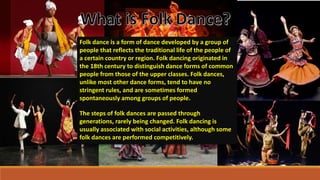
Folk dance is a form of dance developed by a group of
people that reflects the traditional life of the people of
a certain country or region. Folk dancing originated in
the 18th century to distinguish dance forms of common
people from those of the upper classes. Folk dances,
unlike most other dance forms, tend to have no
stringent rules, and are sometimes formed
spontaneously among groups of people.
The steps of folk dances are passed through
generations, rarely being changed. Folk dancing is
usually associated with social activities, although some
folk dances are performed competitively.
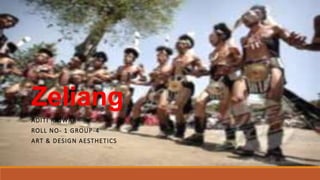
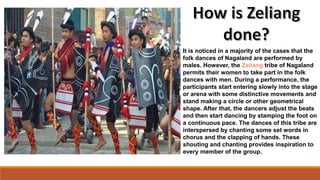
It is noticed in a majority of the cases that the
folk dances of Nagaland are performed by
males. However, the Zeliang tribe of Nagaland
permits their women to take part in the folk
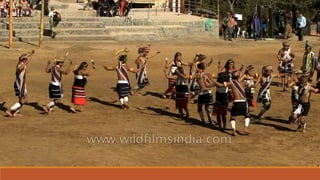
dances with men. During a performance, the
participants start entering slowly into the stage
or arena with some distinctive movements and
stand making a circle or other geometrical
shape. After that, the dancers adjust the beats
and then start dancing by stamping the foot on
a continuous pace. The dances of this tribe are
interspersed by chanting some set words in
chorus and the clapping of hands. These
shouting and chanting provides inspiration to
every member of the group.
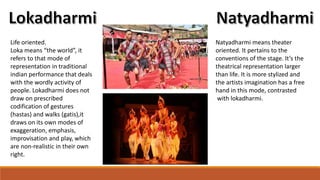
Life oriented.
Loka means “the world”, it
refers to that mode of
representation in traditional
indian performance that deals
with the wordly activity of
people. Lokadharmi does not
draw on prescribed
codification of gestures
(hastas) and walks (gatis),it
draws on its own modes of
exaggeration, emphasis,
improvisation and play, which
are non-realistic in their own
right.
Natyadharmi means theater
oriented. It pertains to the
conventions of the stage. It’s the
theatrical representation larger
than life. It is more stylized and
the artists imagination has a free
hand in this mode, contrasted
with lokadharmi.
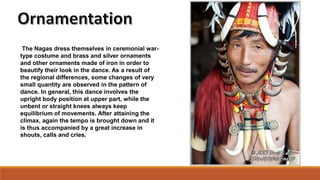
The Nagas dress themselves in ceremonial war-
type costume and brass and silver ornaments
and other ornaments made of iron in order to
beautify their look in the dance. As a result of
the regional differences, some changes of very
small quantity are observed in the pattern of
dance. In general, this dance involves the
upright body position at upper part, while the
unbent or straight knees always keep
equilibrium of movements. After attaining the
climax, again the tempo is brought down and it
is thus accompanied by a great increase in
shouts, calls and cries.
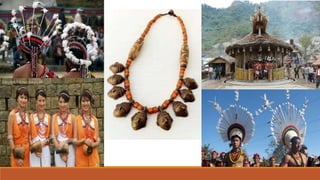
• In the festivals, the men commonly wear most priced
necklaces of red pebbles.It is said that a single stone of this
sort is sometimes valued at five mithuns. On the upper
arm an ornament of brass is commonly worn and above
the calf of the leg numerous rings of cane, very thin, and
generally coloured black, are frequently worn.
• The women too always wear large and heavy earrings and
numerous necklaces. Bracelets of brass are also worn
besides the upper arm and the legs and ankles are bare of
ornaments.
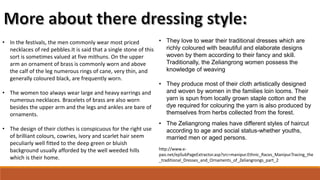
• The design of their clothes is conspicuous for the right use
of brilliant colours, cowries, ivory and scarlet hair seem
peculiarly well fitted to the deep green or bluish
background usually afforded by the well weeded hills
which is their home.
• They love to wear their traditional dresses which are
richly coloured with beautiful and elaborate designs
woven by them according to their fancy and skill.
Traditionally, the Zeliangrong women possess the
knowledge of weaving
• They produce most of their cloth artistically designed
and woven by women in the families loin looms. Their
yarn is spun from locally grown staple cotton and the
dye required for colouring the yarn is also produced by
themselves from herbs collected from the forest.
• The Zeliangrong males have different styles of haircut
according to age and social status-whether youths,
married men or aged persons.
http://www.e-
pao.net/epSubPageExtractor.asp?src=manipur.Ethnic_Races_Manipur.Tracing_the
_traditional_Dresses_and_Ornaments_of_Zeliangrongs_part_2
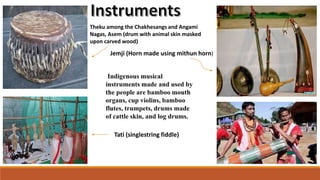
Theku among the Chakhesangs and Angami
Nagas, Asem (drum with animal skin masked
upon carved wood)
Tati (singlestring fiddle)
Jemji (Horn made using mithun horn)
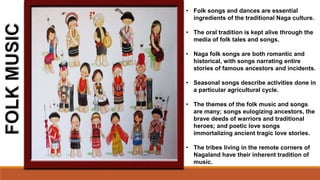
• Folk songs and dances are essential
ingredients of the traditional Naga culture.
• The oral tradition is kept alive through the
media of folk tales and songs.
• Naga folk songs are both romantic and
historical, with songs narrating entire
stories of famous ancestors and incidents.
• Seasonal songs describe activities done in
a particular agricultural cycle.
• The themes of the folk music and songs
are many; songs eulogizing ancestors, the
brave deeds of warriors and traditional
heroes; and poetic love songs
immortalizing ancient tragic love stories.
• The tribes living in the remote corners of
Nagaland have their inherent tradition of
music.
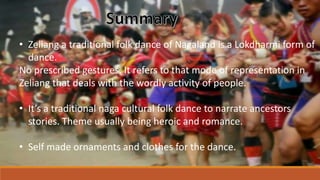
• Zeliang a traditional folk dance of Nagaland is a Lokdharmi form of
dance.
No prescribed gestures. It refers to that mode of representation in
Zeliang that deals with the wordly activity of people.
• It’s a traditional naga cultural folk dance to narrate ancestors
stories. Theme usually being heroic and romance.
• Self made ornaments and clothes for the dance.
http://www.e-
pao.net/epSubPageExtractor.asp?src=manipur.Ethnic_Races_M
anipur.Tracing_the_traditional_Dresses_and_Ornaments_of_Ze
liangrongs_part_2
http://www.e-
pao.net/epSubPageExtractor.asp?src=manipur.Ethnic_Races_M
anipur.Tracing_the_traditional_Dresses_and_Ornaments_of_Ze
liangrongs_part_1
http://dance.about.com/od/DanceTypes/g/Folk-Dance.htm
http://damudrre.blogspot.in/2014/04/h3-margin-bottom-
0_16.html
Zeliang

Zeliang

  • 1.
    Zeliang ADITI RAJWAR ROLL NO-1 GROUP-4 ART & DESIGN AESTHETICS
  • 2.
    Folk dance isa form of dance developed by a group of people that reflects the traditional life of the people of a certain country or region. Folk dancing originated in the 18th century to distinguish dance forms of common people from those of the upper classes. Folk dances, unlike most other dance forms, tend to have no stringent rules, and are sometimes formed spontaneously among groups of people. The steps of folk dances are passed through generations, rarely being changed. Folk dancing is usually associated with social activities, although some folk dances are performed competitively.
  • 3.
    It is noticedin a majority of the cases that the folk dances of Nagaland are performed by males. However, the Zeliang tribe of Nagaland permits their women to take part in the folk dances with men. During a performance, the participants start entering slowly into the stage or arena with some distinctive movements and stand making a circle or other geometrical shape. After that, the dancers adjust the beats and then start dancing by stamping the foot on a continuous pace. The dances of this tribe are interspersed by chanting some set words in chorus and the clapping of hands. These shouting and chanting provides inspiration to every member of the group.
  • 5.
    Life oriented. Loka means“the world”, it refers to that mode of representation in traditional indian performance that deals with the wordly activity of people. Lokadharmi does not draw on prescribed codification of gestures (hastas) and walks (gatis),it draws on its own modes of exaggeration, emphasis, improvisation and play, which are non-realistic in their own right. Natyadharmi means theater oriented. It pertains to the conventions of the stage. It’s the theatrical representation larger than life. It is more stylized and the artists imagination has a free hand in this mode, contrasted with lokadharmi.
  • 6.
    The Nagas dressthemselves in ceremonial war- type costume and brass and silver ornaments and other ornaments made of iron in order to beautify their look in the dance. As a result of the regional differences, some changes of very small quantity are observed in the pattern of dance. In general, this dance involves the upright body position at upper part, while the unbent or straight knees always keep equilibrium of movements. After attaining the climax, again the tempo is brought down and it is thus accompanied by a great increase in shouts, calls and cries.
  • 8.
    • In thefestivals, the men commonly wear most priced necklaces of red pebbles.It is said that a single stone of this sort is sometimes valued at five mithuns. On the upper arm an ornament of brass is commonly worn and above the calf of the leg numerous rings of cane, very thin, and generally coloured black, are frequently worn. • The women too always wear large and heavy earrings and numerous necklaces. Bracelets of brass are also worn besides the upper arm and the legs and ankles are bare of ornaments. • The design of their clothes is conspicuous for the right use of brilliant colours, cowries, ivory and scarlet hair seem peculiarly well fitted to the deep green or bluish background usually afforded by the well weeded hills which is their home. • They love to wear their traditional dresses which are richly coloured with beautiful and elaborate designs woven by them according to their fancy and skill. Traditionally, the Zeliangrong women possess the knowledge of weaving • They produce most of their cloth artistically designed and woven by women in the families loin looms. Their yarn is spun from locally grown staple cotton and the dye required for colouring the yarn is also produced by themselves from herbs collected from the forest. • The Zeliangrong males have different styles of haircut according to age and social status-whether youths, married men or aged persons. http://www.e- pao.net/epSubPageExtractor.asp?src=manipur.Ethnic_Races_Manipur.Tracing_the _traditional_Dresses_and_Ornaments_of_Zeliangrongs_part_2
  • 9.
    Theku among theChakhesangs and Angami Nagas, Asem (drum with animal skin masked upon carved wood) Tati (singlestring fiddle) Jemji (Horn made using mithun horn)
  • 10.
    • Folk songsand dances are essential ingredients of the traditional Naga culture. • The oral tradition is kept alive through the media of folk tales and songs. • Naga folk songs are both romantic and historical, with songs narrating entire stories of famous ancestors and incidents. • Seasonal songs describe activities done in a particular agricultural cycle. • The themes of the folk music and songs are many; songs eulogizing ancestors, the brave deeds of warriors and traditional heroes; and poetic love songs immortalizing ancient tragic love stories. • The tribes living in the remote corners of Nagaland have their inherent tradition of music.
  • 11.
    • Zeliang atraditional folk dance of Nagaland is a Lokdharmi form of dance. No prescribed gestures. It refers to that mode of representation in Zeliang that deals with the wordly activity of people. • It’s a traditional naga cultural folk dance to narrate ancestors stories. Theme usually being heroic and romance. • Self made ornaments and clothes for the dance.
  • 12.