A.Zavada:Defining&DeterminingthePropertiesoftheHumanSleepHomeostat
1
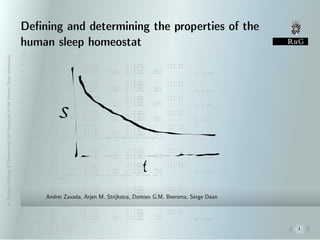
Defining and determining the properties of the
human sleep homeostat
SWA_0 is 54.9339, at page 16
SWA_L is 3.66577, 213 REM pages traversed
========== Pass 1 =============
Stride 1:
In: S_0 = 336.2 fc_R = 0.204 rc = 0.3248 t_a = 6.0
S_1035 = 120.0 rs = 0.761 gc = 0.01018 t_p = 3.0
Out: S_0 = 249.5 : -86/3 fc_R = 0.309 :+1046/0 rc = 0.3974 : +362/3
S_U = 387.3 rs = 0.785 : +60/3 gc = 0.00925 : -233/2 fit: 24.6287
Stride 2:
In: S_0 = 249.5 fc_R = 0.309 rc = 0.3974 t_a = 6.0
S_1035 = 101.4 rs = 0.785 gc = 0.00925 t_p = 3.0
Out: S_0 = 231.5 : -18/0 fc_R = 0.327 : +181/3 rc = 0.4066 : +46/3
S_U = 365.2 rs = 0.721 : -159/3 gc = 0.00764 : -400/3 fit: 23.7065
Stride 3:
In: S_0 = 231.5 fc_R = 0.327 rc = 0.4066 t_a = 6.0
S_1035 = 101.5 rs = 0.721 gc = 0.00764 t_p = 3.0
Out: S_0 = 222.1 : -9/3 fc_R = 0.339 : +114/3 rc = 0.4116 : +24/3
S_U = 360.0 rs = 0.667 : -136/3 gc = 0.00680 : -211/3 fit: 23.4918
Stride 4:
In: S_0 = 222.1 fc_R = 0.339 rc = 0.4116 t_a = 6.0
S_1035 = 103.7 rs = 0.667 gc = 0.00680 t_p = 3.0
Out: S_0 = 219.1 : -3/0 fc_R = 0.353 : +141/3 rc = 0.4311 : +97/3
S_U = 373.4 rs = 0.604 : -157/3 gc = 0.00670 : -24/3 fit: 23.4337
Stride 5:
In: S_0 = 219.1 fc_R = 0.353 rc = 0.4311 t_a = 6.0
S_1035 = 102.7 rs = 0.604 gc = 0.00670 t_p = 3.0
Out: S_0 = 221.1 : +2/0 fc_R = 0.356 : +32/3 rc = 0.4417 : +53/3
S_U = 383.7 rs = 0.584 : -48/3 gc = 0.00668 : -3/3 fit: 23.4253
::Fit good enough (dfit = 0.0357%), but the following required tunable(s) not stable yet: rs.
::this is too many: resuming...
Stride 6:
In: S_0 = 221.1 fc_R = 0.356 rc = 0.4417 t_a = 6.0
S_1035 = 103.5 rs = 0.584 gc = 0.00668 t_p = 3.0
Out: S_0 = 218.8 : -2/3 fc_R = 0.357 : +12/3 rc = 0.4501 : +41/3
S_U = 388.0 rs = 0.563 : -54/3 gc = 0.00665 : -7/3 fit: 23.4100
Stride 7:
In: S_0 = 218.8 fc_R = 0.357 rc = 0.4501 t_a = 6.0
S_1035 = 102.6 rs = 0.563 gc = 0.00665 t_p = 3.0
Out: S_0 = 218.7 : +0/3 fc_R = 0.357 : +1/3 rc = 0.4551 : +25/3
S_U = 392.5 rs = 0.551 : -29/3 gc = 0.00665 : -1/3 fit: 23.4051
::Fit good enough (dfit = 0.0208%), but the following required tunable(s) not stable yet: rs.
::this is too many: resuming...
Stride 8:
In: S_0 = 218.7 fc_R = 0.357 rc = 0.4551 t_a = 6.0
S_1035 = 102.4 rs = 0.551 gc = 0.00665 t_p = 3.0
Out: S_0 = 218.7 : +0/3 fc_R = 0.357 : +1/3 rc = 0.4602 : +25/3
S_U = 396.9 rs = 0.541 : -25/3 gc = 0.00666 : +2/3 fit: 23.4018
::Fit good enough (dfit = 0.0143%), but the following required tunable(s) not stable yet: rs.
::this is too many: resuming...
Stride 9:
In: S_0 = 218.7 fc_R = 0.357 rc = 0.4602 t_a = 6.0
S_1035 = 102.3 rs = 0.541 gc = 0.00666 t_p = 3.0
Out: S_0 = 218.6 : +0/3 fc_R = 0.357 : -2/3 rc = 0.4636 : +17/3
S_U = 399.7 rs = 0.534 : -17/3 gc = 0.00665 : +0/3 fit: 23.3998
::All required tunables stable
::Closest fit on pass 1, with values:
rs = 0.534 min^-1 x1e3
gc = 0.665 min^-1 x1e2
S_0 = 218 %
S_U = 399 %
Andrei Zavada, Arjen M. Strijkstra, Domien G.M. Beersma, Serge Daan
A.Zavada:Defining&DeterminingthePropertiesoftheHumanSleepHomeostat
2
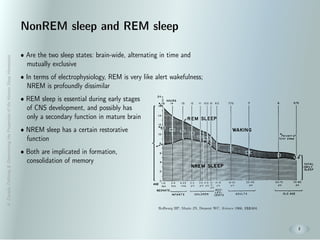
NonREM sleep and REM sleep
• Are the two sleep states: brain-wide, alternating in time and
mutually exclusive
• In terms of electrophysiology, REM is very like alert wakefulness;
NREM is profoundly dissimilar
• REM sleep is essential during early stages
of CNS development, and possibly has
only a secondary function in mature brain
• NREM sleep has a certain restorative
function
• Both are implicated in formation,
consolidation of memory
Roffwarg HP, Muzio JN, Dement WC. Science 1966, 152:604.
A.Zavada:Defining&DeterminingthePropertiesoftheHumanSleepHomeostat
3
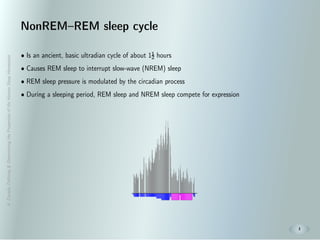
NonREM–REM sleep cycle
• Is an ancient, basic ultradian cycle of about 1½ hours
• Causes REM sleep to interrupt slow-wave (NREM) sleep
• REM sleep pressure is modulated by the circadian process
• During a sleeping period, REM sleep and NREM sleep compete for expression
A.Zavada:Defining&DeterminingthePropertiesoftheHumanSleepHomeostat
4
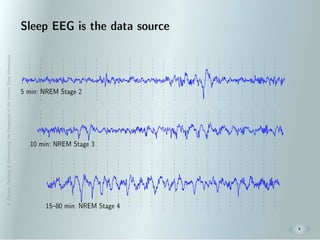
5 min: NREM Stage 2
10 min: NREM Stage 3
15–80 min: NREM Stage 4
Sleep EEG is the data source
A.Zavada:Defining&DeterminingthePropertiesoftheHumanSleepHomeostat
5
Slow Wave Activity
• Is EEG spectral power in the 1–4 Hz range
• Generated in cortex during NREM sleep
• Has a certain restorative function (“synaptic downscaling”)
• Has prominent homeostatic (“hourglass”) characteristics
A.Zavada:Defining&DeterminingthePropertiesoftheHumanSleepHomeostat
6
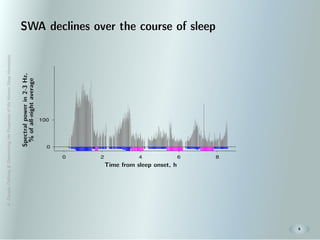
SWA declines over the course of sleep
A.Zavada:Defining&DeterminingthePropertiesoftheHumanSleepHomeostat
7
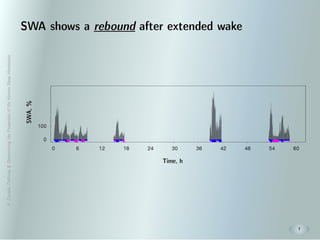
SWA shows a rebound after extended wake
A.Zavada:Defining&DeterminingthePropertiesoftheHumanSleepHomeostat
8
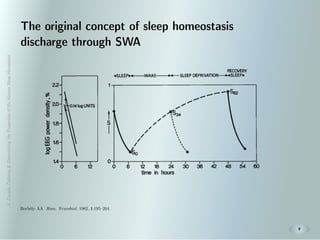
The original concept of sleep homeostasis
discharge through SWA
Borbély AA Hum. Neurobiol. 1982, 1:195–204.
A.Zavada:Defining&DeterminingthePropertiesoftheHumanSleepHomeostat
9
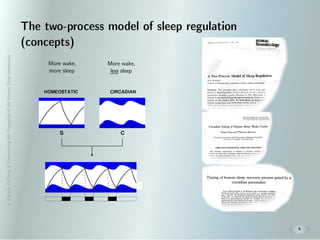
The two-process model of sleep regulation
(concepts)
More wake,
more sleep
More wake,
less sleep
A.Zavada:Defining&DeterminingthePropertiesoftheHumanSleepHomeostat
10
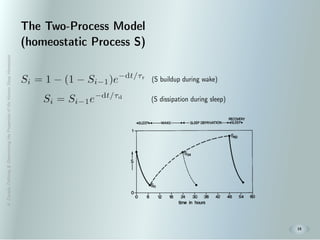
The Two-Process Model
(homeostatic Process S)
(S buildup during wake)
(S dissipation during sleep)
A.Zavada:Defining&DeterminingthePropertiesoftheHumanSleepHomeostat
11
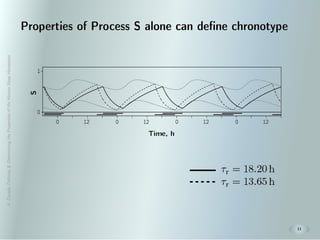
Properties of Process S alone can define chronotype
A.Zavada:Defining&DeterminingthePropertiesoftheHumanSleepHomeostat
12
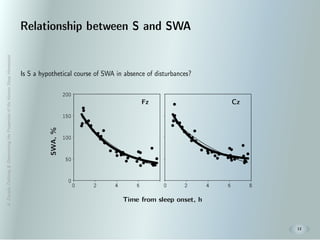
Relationship between S and SWA
Is S a hypothetical course of SWA in absence of disturbances?
A.Zavada:Defining&DeterminingthePropertiesoftheHumanSleepHomeostat
13
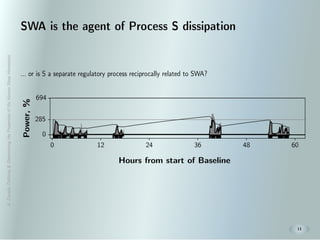
SWA is the agent of Process S dissipation
... or is S a separate regulatory process reciprocally related to SWA?
A.Zavada:Defining&DeterminingthePropertiesoftheHumanSleepHomeostat
14
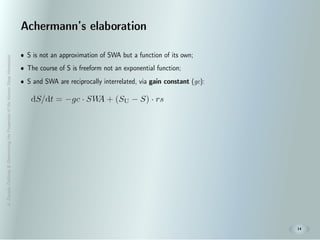
Achermann’s elaboration
• S is not an approximation of SWA but a function of its own;
• The course of S is freeform not an exponential function;
• S and SWA are reciprocally interrelated, via gain constant (gc):
A.Zavada:Defining&DeterminingthePropertiesoftheHumanSleepHomeostat
15
Achermann’s elaboration:
Implementation
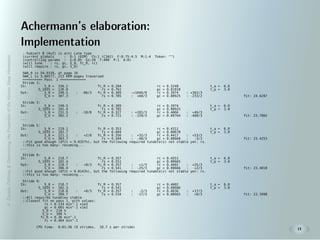
--Subject 8 (AvZ) is a(n) Late type
(current globals : D:1 (DIM) Ch:1 (C3A2) F:0.75-4.5 M:1-4 Token: "")
(controlling params : G:0.05 Gs:20 T:400 P:1 A:0)
(will tune : rs, gc, S_0, fc_R, rc)
(will require : rs, gc, S_0)
SWA_0 is 54.9339, at page 16
SWA_L is 3.66577, 213 REM pages traversed
========== Pass 1 =============
Stride 1:
In: S_0 = 336.2 fc_R = 0.204 rc = 0.3248 t_a = 6.0
S_1035 = 120.0 rs = 0.761 gc = 0.01018 t_p = 3.0
Out: S_0 = 249.5 : -86/3 fc_R = 0.309 :+1046/0 rc = 0.3974 : +362/3
S_U = 387.3 rs = 0.785 : +60/3 gc = 0.00925 : -233/2 fit: 24.6287
Stride 2:
In: S_0 = 249.5 fc_R = 0.309 rc = 0.3974 t_a = 6.0
S_1035 = 101.4 rs = 0.785 gc = 0.00925 t_p = 3.0
Out: S_0 = 231.5 : -18/0 fc_R = 0.327 : +181/3 rc = 0.4066 : +46/3
S_U = 365.2 rs = 0.721 : -159/3 gc = 0.00764 : -400/3 fit: 23.7065
...
Stride 5:
In: S_0 = 219.1 fc_R = 0.353 rc = 0.4311 t_a = 6.0
S_1035 = 102.7 rs = 0.604 gc = 0.00670 t_p = 3.0
Out: S_0 = 221.1 : +2/0 fc_R = 0.356 : +32/3 rc = 0.4417 : +53/3
S_U = 383.7 rs = 0.584 : -48/3 gc = 0.00668 : -3/3 fit: 23.4253
::Fit good enough (dfit = 0.0357%), but the following required tunable(s) not stable yet: rs.
::this is too many: resuming...
...
Stride 8:
In: S_0 = 218.7 fc_R = 0.357 rc = 0.4551 t_a = 6.0
S_1035 = 102.4 rs = 0.551 gc = 0.00665 t_p = 3.0
Out: S_0 = 218.7 : +0/3 fc_R = 0.357 : +1/3 rc = 0.4602 : +25/3
S_U = 396.9 rs = 0.541 : -25/3 gc = 0.00666 : +2/3 fit: 23.4018
::Fit good enough (dfit = 0.0143%), but the following required tunable(s) not stable yet: rs.
::this is too many: resuming...
Stride 9:
In: S_0 = 218.7 fc_R = 0.357 rc = 0.4602 t_a = 6.0
S_1035 = 102.3 rs = 0.541 gc = 0.00666 t_p = 3.0
Out: S_0 = 218.6 : +0/3 fc_R = 0.357 : -2/3 rc = 0.4636 : +17/3
S_U = 399.7 rs = 0.534 : -17/3 gc = 0.00665 : +0/3 fit: 23.3998
::All required tunables stable
::Closest fit on pass 1, with values:
rs = 0.534 min^-1 x1e3
gc = 0.665 min^-1 x1e2
S_0 = 218 %
S_U = 399 %
fc_R = 0.36 min^-1
rc = 0.464 min^-1
CPU time: 0:01:36 (9 strides, 10.7 s per stride)
A.Zavada:Defining&DeterminingthePropertiesoftheHumanSleepHomeostat
16
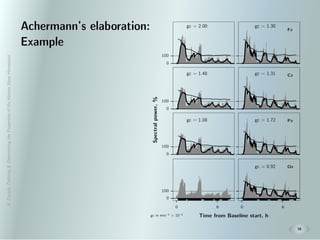
Achermann’s elaboration:
Example
A.Zavada:Defining&DeterminingthePropertiesoftheHumanSleepHomeostat
17
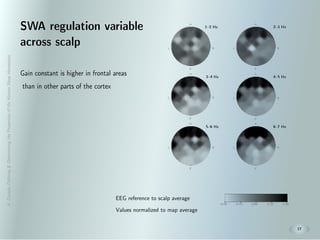
SWA regulation variable
across scalp
EEG reference to scalp average
Values normalized to map average
Gain constant is higher in frontal areas
than in other parts of the cortex
A.Zavada:Defining&DeterminingthePropertiesoftheHumanSleepHomeostat
18
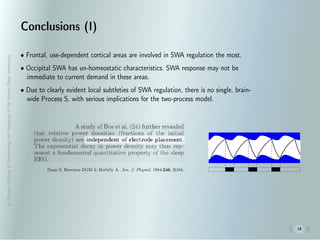
Conclusions (I)
• Frontal, use-dependent cortical areas are involved in SWA regulation the most.
• Occipital SWA has un-homeostatic characteristics. SWA response may not be
immediate to current demand in these areas.
• Due to clearly evident local subtleties of SWA regulation, there is no single, brain-
wide Process S, with serious implications for the two-process model.
Daan S, Beersma DGM & Borbély A Am. J. Physiol. 1984:246, R164.
A.Zavada:Defining&DeterminingthePropertiesoftheHumanSleepHomeostat
19
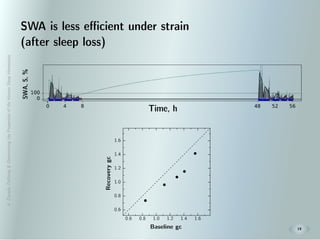
SWA is less efficient under strain
(after sleep loss)
A.Zavada:Defining&DeterminingthePropertiesoftheHumanSleepHomeostat
20
Conclusions (II)
• Lower gain constant in recovery after extended wake can imply the existence
of an upper threshold for SWA,
• and/or of SWA discharge spread over more NREM-REM cycles than required
under normal confitions.
A.Zavada:Defining&DeterminingthePropertiesoftheHumanSleepHomeostat
21
General conclusions
• Through detalisation and optimisation, the Achermann’s
method has become subversive of its own parent model,
• but, in its own right, yielded interesting insights into the
homeostatic aspect of sleep.
• A new parameter, gain constant, provides an individual
measure of SWA self-dissipation efficiency.
• This gain constant is peculiarly variable across scalp
locations, with higher values in frontal, use-dependent areas.
Thanks!

zavada-sussex-2008