Automatic Sleep Staging Using
State Machine-controlled Decision Trees
Syed Anas Imtiaz
Esther Rodriguez-Villegas
IEEE Engineering in Medicine and Biology Conference 2015
2
INTRODUCTION
 Sleep staging has been an active research area for over four decades
 Involves analysis of physiological signals and classification into one of
Wake, N1, N2, N3 or REM stages
 Typically uses ExG (EEG/EOG/EMG) signals
 Actigraphy, HRV and respiratory increasingly used now
 Recent consumer focus with sleep analysis integrated with wearables and
fitness trackers
IEEE Engineering in Medicine and Biology Conference 2015
3
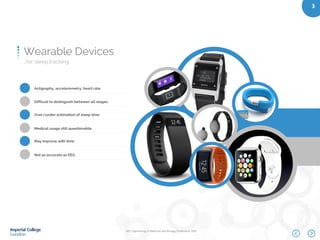
…for sleep tracking
Wearable Devices
Actigraphy, accelerometry, heart rate
Difficult to distinguish between all stages
Over/under estimation of sleep time
Medical usage still questionable
May improve with time
Not as accurate as EEG
IEEE Engineering in Medicine and Biology Conference 2015
4
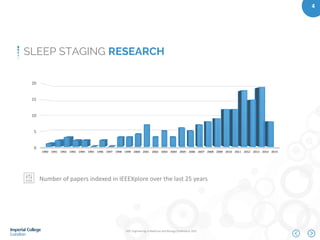
SLEEP STAGING RESEARCH
0
5
10
15
20
1990 1991 1992 1993 1994 1995 1996 1997 1998 1999 2000 2001 2002 2003 2004 2005 2006 2007 2008 2009 2010 2011 2012 2013 2014 2015
Number of papers indexed in IEEEXplore over the last 25 years
IEEE Engineering in Medicine and Biology Conference 2015
5
SLEEP STAGING RESEARCH
 Most algorithms have very good classification accuracy
 However, this performance comes at a cost
 COMPUTATIONAL COMPLEXITY: ANN, SVM, Large number of features, etc.
 On hardware this translates to higher POWER CONSUMPTION
 Limited power budget in wearable systems
IEEE Engineering in Medicine and Biology Conference 2015
6
OUR AIM
To develop an automatic sleep staging algorithm that is
suitable for use in resource-constrained wearable systems“
 Extract spectral features and classify using a decision tree (DT)
 DTs are amongst the simplest of classifiers
 Use small contextually-aware DTs rather than one long tree
 Order of execution controlled by a state machine
IEEE Engineering in Medicine and Biology Conference 2015
7
DATABASE
 PhysioNet Sleep EDF Expanded Database
 61 PSG recordings
 Almost 60,000 epochs of 30-second duration
 31 recordings in training set and 30 in test set
 Two EEG channels: Fpz-Cz and Pz-Oz
IEEE Engineering in Medicine and Biology Conference 2015
8
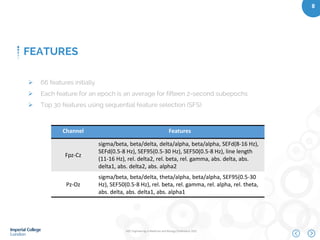
FEATURES
Channel Features
Fpz-Cz
sigma/beta, beta/delta, delta/alpha, beta/alpha, SEFd(8-16 Hz),
SEFd(0.5-8 Hz), SEF95(0.5-30 Hz), SEF50(0.5-8 Hz), line length
(11-16 Hz), rel. delta2, rel. beta, rel. gamma, abs. delta, abs.
delta1, abs. delta2, abs. alpha2
Pz-Oz
sigma/beta, beta/delta, theta/alpha, beta/alpha, SEF95(0.5-30
Hz), SEF50(0.5-8 Hz), rel. beta, rel. gamma, rel. alpha, rel. theta,
abs. delta, abs. delta1, abs. alpha1
 66 features initially
 Each feature for an epoch is an average for fifteen 2-second subepochs
 Top 30 features using sequential feature selection (SFS)
IEEE Engineering in Medicine and Biology Conference 2015
9
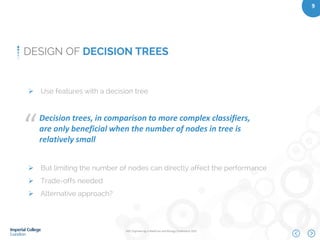
DESIGN OF DECISION TREES
Decision trees, in comparison to more complex classifiers,
are only beneficial when the number of nodes in tree is
relatively small
“
 Use features with a decision tree
 But limiting the number of nodes can directly affect the performance
 Trade-offs needed
 Alternative approach?
IEEE Engineering in Medicine and Biology Conference 2015
10
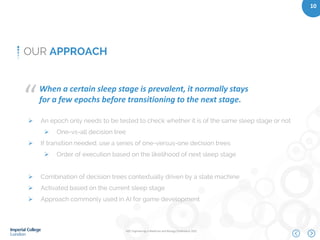
OUR APPROACH
When a certain sleep stage is prevalent, it normally stays
for a few epochs before transitioning to the next stage.“
 An epoch only needs to be tested to check whether it is of the same sleep stage or not
 One-vs-all decision tree
 If transition needed, use a series of one-versus-one decision trees
 Order of execution based on the likelihood of next sleep stage
 Combination of decision trees contextually driven by a state machine
 Activated based on the current sleep stage
 Approach commonly used in AI for game development
IEEE Engineering in Medicine and Biology Conference 2015
11
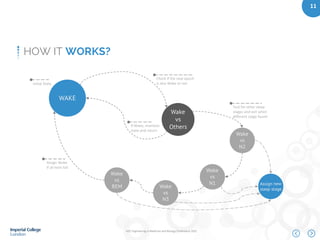
HOW IT WORKS?
Initial State
Check if the new epoch
is also Wake or not
If Wake, maintain
state and return
Assign Wake
if all tests fail
Test for other sleep
stages and exit when
different stage found
IEEE Engineering in Medicine and Biology Conference 2015
12
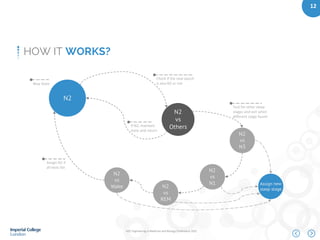
HOW IT WORKS?
New State
Check if the new epoch
is also N2 or not
If N2, maintain
state and return
Assign N2 if
all tests fail
Test for other sleep
stages and exit when
different stage found
13
RESULTS
IEEE Engineering in Medicine and Biology Conference 2015
14
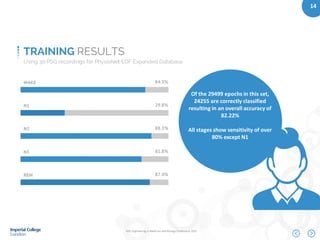
Using 30 PSG recordings for PhysioNet EDF Expanded Database
TRAINING RESULTS
WAKE 84.3%
N1 29.8%
N2 88.5%
N3 81.8%
Of the 29499 epochs in this set,
24255 are correctly classified
resulting in an overall accuracy of
82.22%
All stages show sensitivity of over
80% except N1
REM 87.4%
IEEE Engineering in Medicine and Biology Conference 2015
15
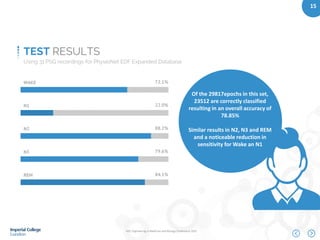
Using 31 PSG recordings for PhysioNet EDF Expanded Database
TEST RESULTS
WAKE 72.1%
N1 22.0%
N2 88.2%
N3 79.6%
Of the 29817epochs in this set,
23512 are correctly classified
resulting in an overall accuracy of
78.85%
Similar results in N2, N3 and REM
and a noticeable reduction in
sensitivity for Wake an N1
REM 84.1%
IEEE Engineering in Medicine and Biology Conference 2015
16
DISCUSSION
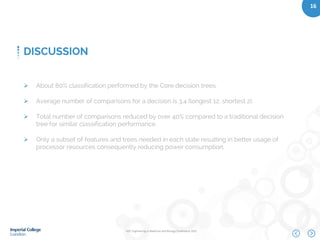
 About 80% classification performed by the Core decision trees.
 Average number of comparisons for a decision is 3.4 (longest 12, shortest 2).
 Total number of comparisons reduced by over 40% compared to a traditional decision
tree for similar classification performance.
 Only a subset of features and trees needed in each state resulting in better usage of
processor resources consequently reducing power consumption.
IEEE Engineering in Medicine and Biology Conference 2015
17
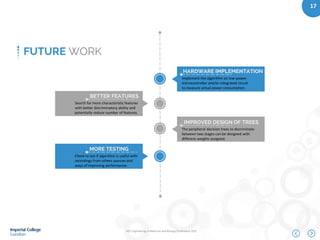
FUTURE WORK
Search for more characteristic features
with better discriminatory ability and
potentially reduce number of features.
BETTER FEATURES
Implement the algorithm on low-power
microcontroller and/or integrated circuit
to measure actual power consumption.
HARDWARE IMPLEMENTATION
The peripheral decision trees to discriminate
between two stages can be designed with
different weights assigned.
IMPROVED DESIGN OF TREES
Check to see if algorithm is useful with
recordings from others sources and
ways of improving performance.
MORE TESTING
Q u e s t i o n s / C o m m e n t s
Thank You

Automatic Sleep Staging Using State Machine-controlled Decision Trees

  • 1.
    Automatic Sleep StagingUsing State Machine-controlled Decision Trees Syed Anas Imtiaz Esther Rodriguez-Villegas
  • 2.
    IEEE Engineering inMedicine and Biology Conference 2015 2 INTRODUCTION  Sleep staging has been an active research area for over four decades  Involves analysis of physiological signals and classification into one of Wake, N1, N2, N3 or REM stages  Typically uses ExG (EEG/EOG/EMG) signals  Actigraphy, HRV and respiratory increasingly used now  Recent consumer focus with sleep analysis integrated with wearables and fitness trackers
  • 3.
    IEEE Engineering inMedicine and Biology Conference 2015 3 …for sleep tracking Wearable Devices Actigraphy, accelerometry, heart rate Difficult to distinguish between all stages Over/under estimation of sleep time Medical usage still questionable May improve with time Not as accurate as EEG
  • 4.
    IEEE Engineering inMedicine and Biology Conference 2015 4 SLEEP STAGING RESEARCH 0 5 10 15 20 1990 1991 1992 1993 1994 1995 1996 1997 1998 1999 2000 2001 2002 2003 2004 2005 2006 2007 2008 2009 2010 2011 2012 2013 2014 2015 Number of papers indexed in IEEEXplore over the last 25 years
  • 5.
    IEEE Engineering inMedicine and Biology Conference 2015 5 SLEEP STAGING RESEARCH  Most algorithms have very good classification accuracy  However, this performance comes at a cost  COMPUTATIONAL COMPLEXITY: ANN, SVM, Large number of features, etc.  On hardware this translates to higher POWER CONSUMPTION  Limited power budget in wearable systems
  • 6.
    IEEE Engineering inMedicine and Biology Conference 2015 6 OUR AIM To develop an automatic sleep staging algorithm that is suitable for use in resource-constrained wearable systems“  Extract spectral features and classify using a decision tree (DT)  DTs are amongst the simplest of classifiers  Use small contextually-aware DTs rather than one long tree  Order of execution controlled by a state machine
  • 7.
    IEEE Engineering inMedicine and Biology Conference 2015 7 DATABASE  PhysioNet Sleep EDF Expanded Database  61 PSG recordings  Almost 60,000 epochs of 30-second duration  31 recordings in training set and 30 in test set  Two EEG channels: Fpz-Cz and Pz-Oz
  • 8.
    IEEE Engineering inMedicine and Biology Conference 2015 8 FEATURES Channel Features Fpz-Cz sigma/beta, beta/delta, delta/alpha, beta/alpha, SEFd(8-16 Hz), SEFd(0.5-8 Hz), SEF95(0.5-30 Hz), SEF50(0.5-8 Hz), line length (11-16 Hz), rel. delta2, rel. beta, rel. gamma, abs. delta, abs. delta1, abs. delta2, abs. alpha2 Pz-Oz sigma/beta, beta/delta, theta/alpha, beta/alpha, SEF95(0.5-30 Hz), SEF50(0.5-8 Hz), rel. beta, rel. gamma, rel. alpha, rel. theta, abs. delta, abs. delta1, abs. alpha1  66 features initially  Each feature for an epoch is an average for fifteen 2-second subepochs  Top 30 features using sequential feature selection (SFS)
  • 9.
    IEEE Engineering inMedicine and Biology Conference 2015 9 DESIGN OF DECISION TREES Decision trees, in comparison to more complex classifiers, are only beneficial when the number of nodes in tree is relatively small “  Use features with a decision tree  But limiting the number of nodes can directly affect the performance  Trade-offs needed  Alternative approach?
  • 10.
    IEEE Engineering inMedicine and Biology Conference 2015 10 OUR APPROACH When a certain sleep stage is prevalent, it normally stays for a few epochs before transitioning to the next stage.“  An epoch only needs to be tested to check whether it is of the same sleep stage or not  One-vs-all decision tree  If transition needed, use a series of one-versus-one decision trees  Order of execution based on the likelihood of next sleep stage  Combination of decision trees contextually driven by a state machine  Activated based on the current sleep stage  Approach commonly used in AI for game development
  • 11.
    IEEE Engineering inMedicine and Biology Conference 2015 11 HOW IT WORKS? Initial State Check if the new epoch is also Wake or not If Wake, maintain state and return Assign Wake if all tests fail Test for other sleep stages and exit when different stage found
  • 12.
    IEEE Engineering inMedicine and Biology Conference 2015 12 HOW IT WORKS? New State Check if the new epoch is also N2 or not If N2, maintain state and return Assign N2 if all tests fail Test for other sleep stages and exit when different stage found
  • 13.
  • 14.
    IEEE Engineering inMedicine and Biology Conference 2015 14 Using 30 PSG recordings for PhysioNet EDF Expanded Database TRAINING RESULTS WAKE 84.3% N1 29.8% N2 88.5% N3 81.8% Of the 29499 epochs in this set, 24255 are correctly classified resulting in an overall accuracy of 82.22% All stages show sensitivity of over 80% except N1 REM 87.4%
  • 15.
    IEEE Engineering inMedicine and Biology Conference 2015 15 Using 31 PSG recordings for PhysioNet EDF Expanded Database TEST RESULTS WAKE 72.1% N1 22.0% N2 88.2% N3 79.6% Of the 29817epochs in this set, 23512 are correctly classified resulting in an overall accuracy of 78.85% Similar results in N2, N3 and REM and a noticeable reduction in sensitivity for Wake an N1 REM 84.1%
  • 16.
    IEEE Engineering inMedicine and Biology Conference 2015 16 DISCUSSION  About 80% classification performed by the Core decision trees.  Average number of comparisons for a decision is 3.4 (longest 12, shortest 2).  Total number of comparisons reduced by over 40% compared to a traditional decision tree for similar classification performance.  Only a subset of features and trees needed in each state resulting in better usage of processor resources consequently reducing power consumption.
  • 17.
    IEEE Engineering inMedicine and Biology Conference 2015 17 FUTURE WORK Search for more characteristic features with better discriminatory ability and potentially reduce number of features. BETTER FEATURES Implement the algorithm on low-power microcontroller and/or integrated circuit to measure actual power consumption. HARDWARE IMPLEMENTATION The peripheral decision trees to discriminate between two stages can be designed with different weights assigned. IMPROVED DESIGN OF TREES Check to see if algorithm is useful with recordings from others sources and ways of improving performance. MORE TESTING
  • 18.
    Q u es t i o n s / C o m m e n t s Thank You