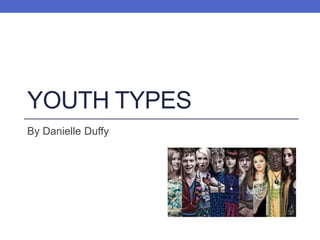
YOUTH TYPES
By Danielle Duffy
Comparative Youth Culture
Michael Brake’s theory divides youths into four different
types:
• Respectable
• Delinquent
• Cultural Rebels
• Politically Militant
Respectable youth
• Conformist or straight youth
• Avoid involvement in teen culture
• Well behaved and polite
Representation in media
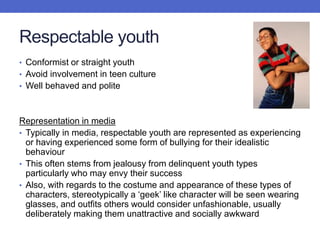
• Typically in media, respectable youth are represented as experiencing
or having experienced some form of bullying for their idealistic
behaviour
• This often stems from jealousy from delinquent youth types
particularly who may envy their success
• Also, with regards to the costume and appearance of these types of
characters, stereotypically a ‘geek’ like character will be seen wearing
glasses, and outfits others would consider unfashionable, usually
deliberately making them unattractive and socially awkward
Delinquent youth
• Usually working class
• Involved in illegal activities such as vandalism, violence and
theft, with some females being sexual deviants
• Trouble makers
• Careless
• Impertinent
Representation in media
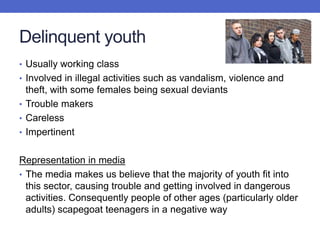
• The media makes us believe that the majority of youth fit into
this sector, causing trouble and getting involved in dangerous
activities. Consequently people of other ages (particularly older
adults) scapegoat teenagers in a negative way
Delinquent youth example
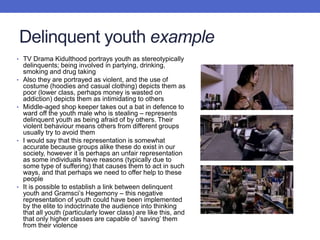
• TV Drama Kidulthood portrays youth as stereotypically
delinquents; being involved in partying, drinking,
smoking and drug taking
• Also they are portrayed as violent, and the use of
costume (hoodies and casual clothing) depicts them as
poor (lower class, perhaps money is wasted on
addiction) depicts them as intimidating to others
• Middle-aged shop keeper takes out a bat in defence to
ward off the youth male who is stealing – represents
delinquent youth as being afraid of by others. Their
violent behaviour means others from different groups
usually try to avoid them
• I would say that this representation is somewhat
accurate because groups alike these do exist in our
society, however it is perhaps an unfair representation
as some individuals have reasons (typically due to
some type of suffering) that causes them to act in such
ways, and that perhaps we need to offer help to these
people
• It is possible to establish a link between delinquent
youth and Gramsci’s Hegemony – this negative
representation of youth could have been implemented
by the elite to indoctrinate the audience into thinking
that all youth (particularly lower class) are like this, and
that only higher classes are capable of ‘saving’ them
from their violence
Cultural Rebels
• Typically middle class
• Involved in bohemian tradition
• Hippies
• Interest in and supporting artists
• Socially unconventional
Representation in media
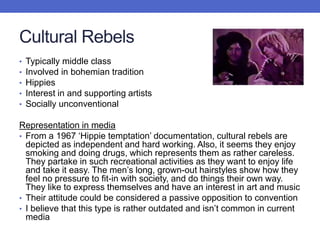
• From a 1967 ‘Hippie temptation’ documentation, cultural rebels are
depicted as independent and hard working. Also, it seems they enjoy
smoking and doing drugs, which represents them as rather careless.
They partake in such recreational activities as they want to enjoy life
and take it easy. The men’s long, grown-out hairstyles show how they
feel no pressure to fit-in with society, and do things their own way.
They like to express themselves and have an interest in art and music
• Their attitude could be considered a passive opposition to convention
• I believe that this type is rather outdated and isn’t common in current
media
Politically Militant youth
• Interest in politics
• Protests for rights e.g. religion, students
Representation in media
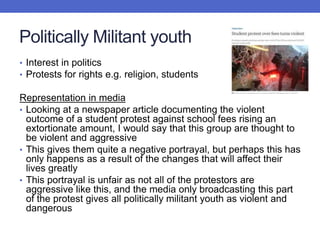
• Looking at a newspaper article documenting the violent
outcome of a student protest against school fees rising an
extortionate amount, I would say that this group are thought to
be violent and aggressive
• This gives them quite a negative portrayal, but perhaps this has
only happens as a result of the changes that will affect their
lives greatly
• This portrayal is unfair as not all of the protestors are
aggressive like this, and the media only broadcasting this part
of the protest gives all politically militant youth as violent and
dangerous

Youth types

  • 1.
  • 2.
    Comparative Youth Culture MichaelBrake’s theory divides youths into four different types: • Respectable • Delinquent • Cultural Rebels • Politically Militant
  • 3.
    Respectable youth • Conformistor straight youth • Avoid involvement in teen culture • Well behaved and polite Representation in media • Typically in media, respectable youth are represented as experiencing or having experienced some form of bullying for their idealistic behaviour • This often stems from jealousy from delinquent youth types particularly who may envy their success • Also, with regards to the costume and appearance of these types of characters, stereotypically a ‘geek’ like character will be seen wearing glasses, and outfits others would consider unfashionable, usually deliberately making them unattractive and socially awkward
  • 4.
    Delinquent youth • Usuallyworking class • Involved in illegal activities such as vandalism, violence and theft, with some females being sexual deviants • Trouble makers • Careless • Impertinent Representation in media • The media makes us believe that the majority of youth fit into this sector, causing trouble and getting involved in dangerous activities. Consequently people of other ages (particularly older adults) scapegoat teenagers in a negative way
  • 5.
    Delinquent youth example •TV Drama Kidulthood portrays youth as stereotypically delinquents; being involved in partying, drinking, smoking and drug taking • Also they are portrayed as violent, and the use of costume (hoodies and casual clothing) depicts them as poor (lower class, perhaps money is wasted on addiction) depicts them as intimidating to others • Middle-aged shop keeper takes out a bat in defence to ward off the youth male who is stealing – represents delinquent youth as being afraid of by others. Their violent behaviour means others from different groups usually try to avoid them • I would say that this representation is somewhat accurate because groups alike these do exist in our society, however it is perhaps an unfair representation as some individuals have reasons (typically due to some type of suffering) that causes them to act in such ways, and that perhaps we need to offer help to these people • It is possible to establish a link between delinquent youth and Gramsci’s Hegemony – this negative representation of youth could have been implemented by the elite to indoctrinate the audience into thinking that all youth (particularly lower class) are like this, and that only higher classes are capable of ‘saving’ them from their violence
  • 6.
    Cultural Rebels • Typicallymiddle class • Involved in bohemian tradition • Hippies • Interest in and supporting artists • Socially unconventional Representation in media • From a 1967 ‘Hippie temptation’ documentation, cultural rebels are depicted as independent and hard working. Also, it seems they enjoy smoking and doing drugs, which represents them as rather careless. They partake in such recreational activities as they want to enjoy life and take it easy. The men’s long, grown-out hairstyles show how they feel no pressure to fit-in with society, and do things their own way. They like to express themselves and have an interest in art and music • Their attitude could be considered a passive opposition to convention • I believe that this type is rather outdated and isn’t common in current media
  • 7.
    Politically Militant youth •Interest in politics • Protests for rights e.g. religion, students Representation in media • Looking at a newspaper article documenting the violent outcome of a student protest against school fees rising an extortionate amount, I would say that this group are thought to be violent and aggressive • This gives them quite a negative portrayal, but perhaps this has only happens as a result of the changes that will affect their lives greatly • This portrayal is unfair as not all of the protestors are aggressive like this, and the media only broadcasting this part of the protest gives all politically militant youth as violent and dangerous