Youth Guide
to Action
on Maternal
Health
Youth Guide to Action on Maternal Health: Introduction

 welcome to tHe women deliver                                           How to Use tHis GUide
 YoUtH GUide to Action on mAternAl HeAltH!                              The Youth Guide to Action on Maternal Health is designed to assist young people in
                                                                        their advocacy and awareness-raising efforts. The goal of this guide is to empower
 We know that young activists like you hold the                         and equip young people with the tools, resources, and knowledge to use and develop
                                                                        messages, projects, and campaigns to increase awareness about young people and
 power to end preventable maternal mortality and                        maternal health issues. The guide will focus on new media and technology. We
                                                                        believe in technology’s potential to empower youth to become leaders. We hope you
 deliver for girls and women. This guide is designed                    will find this guide useful in inspiring, informing and guiding your projects.
 as a resource for informing and inspiring your                         Each section highlights a different step to action, and we hope you will use the
                                                                        sections together and return to the ones that you find most useful as you seek, define,
 work to improve maternal health.                                       and promote political, economic, social/cultural, and technological solutions.


                                                                             paGe 2   1. Get Inspired
                                                                                      Explore what drives you to act and learn about where
                                                                                      other maternal health leaders have found inspiration.

                                                                             paGe 4   2. Get Informed
                                                                                      Test and expand your knowledge of maternal health
                                                                                      facts, strategies, and challenges.

                                                                             paGe 9   3. Get Connected
                                                                                      Learn the basics of networking and using new
                                                                                      technology to connect to other activists and to build
                                                                                      and mobilize your community to action.

 Women Deliver Youth Guide to Action on Maternal Health                     paGe 18   4. Get Moving
                                                                                      Follow the steps here to set goals, plan, and implement
 Published by Women Deliver                                                           a successful project.
 584 Broadway, Suite 306
 New York, NY 10012
 www.womendeliver.org
                                                                            paGe 22   5. Sustain Your Momentum, Make Lasting Change
 info@womendeliver.org                                                                Reflect on your project—What did you achieve?
 Written by: Sarah Blake, Janna Oberdorf, and Mariko Rasmussen                        What challenges did you face? What’s next?
 Designed by: Sandy Zimmerman
 “Maternal Health Guide to Action” used, with permission, information
 from the TakingITGlobal HIV/AIDS Youth Guide to Action.
 Production of the Maternal Health Guide to Action was funded by
 The Summit Foundation and UNFPA.
 © Women Deliver 2010
1. Get Inspired                                                                                                                                                               2


  Get inspired bY tHe leAders of                                                    Get inspired bY tHe words And Actions
  tHe mAternAl HeAltH commUnitY                                                     of YoUr fellow YoUtH AdvocAtes

                                                                                     “the best feeling in the world for me is when i accomplish
                                                                                     something that other people never believed i would
                                                                                     accomplish. there is a saying that goes like this: “when life
     “it is often said that young people are our future. they are                    gives you lemons, make GrApe juice. then, sit back and
     our present, too. it is today, and not tomorrow, that we must                   watch the world as they wonder how you did it!!”
     invest in young people and include them in solving the great
     challenges of our times... now is the time to make greater                      —nAncY leivA, belize
     investments in young people, especially adolescent girls, so                                                       “i am inspired by the women of kenya, who
     they can reach their full potential. investing in young people                                                     despite the harsh conditions they live under,
     today is an investment in a sustainable future.”                                                                   always have a warm smile. i am inspired by people
                                                                                                                        who have worked hard to be where they are, and
     —tHorAYA obAid, execUtive director of
                                                                                                                        beat the odds. i am inspired by people whose life’s
      tHe United nAtions popUlAtion fUnd (UnfpA)
                                                                                                                        mission is to better the lives of others. i believe
                                                                                                                        true fulfillment comes from this.”
                                                                                                                                                     —Anne mUsUvA, kenYA
                               “At women deliver we believe in the core theme:        “the knowledge that by passing along the essential
                               invest in women—it pays! but we also believe           messages of sexual and reproductive health and
                               that investing in young people—in their health,        rights, i can influence the quality of life of a person,
                               their education, and their opportunities—is            a family, and eventually a community, is rewarding.”
                               one of the smartest investments any nation
                               can make. today’s youth are the ones who will          —tHiAGi piYAdAsA, sri lAnkA
                               carry the women deliver movement into the
                               next generation, and they are the ones who will                              “when i see the rate of maternal deaths and the causes, i
                               continue to deliver solutions for girls and women.                           cannot stand aside and do nothing. we need to take actions
                               we must equip them now with the knowledge,                                   and advocate for safe motherhood in the world. A woman is
                               resources, and inspiration to carry that torch.”                             either our mother or sister or aunt, so when we hear about
                               —Jill sHeffield, president of women deliver                                  maternal death, it can be oUr mother or our sister or aunt.
                                                                                                            i believe that every one of us can play his/her role in the
                                                                                                            community to reduce maternal mortality. And this is what
                                                                                                            inspires me every day of my life to work with people of my
                                                                                                            country to advocate for the improvement of maternal health.”
                                                                                                            —frAnÇois zoUnGrAnA, bUrkinA fAso
1. Get Inspired                                                                                                                                                           3


  Who, or what, first inspired you to take action on maternal health? Your              Identify Your Investment, Share Your Story: What have you done so far to act on
  inspiration can come from a personal experience, a community leader, a teacher,       your inspiration? What do you want to do next?
  an organization, or a family member whose words inspired you. Have you read or
  listened to a news story, song, poem, or piece of creative work that made you think
  about maternal health in new ways?
2. Get Informed                                                                                                                                                                   4


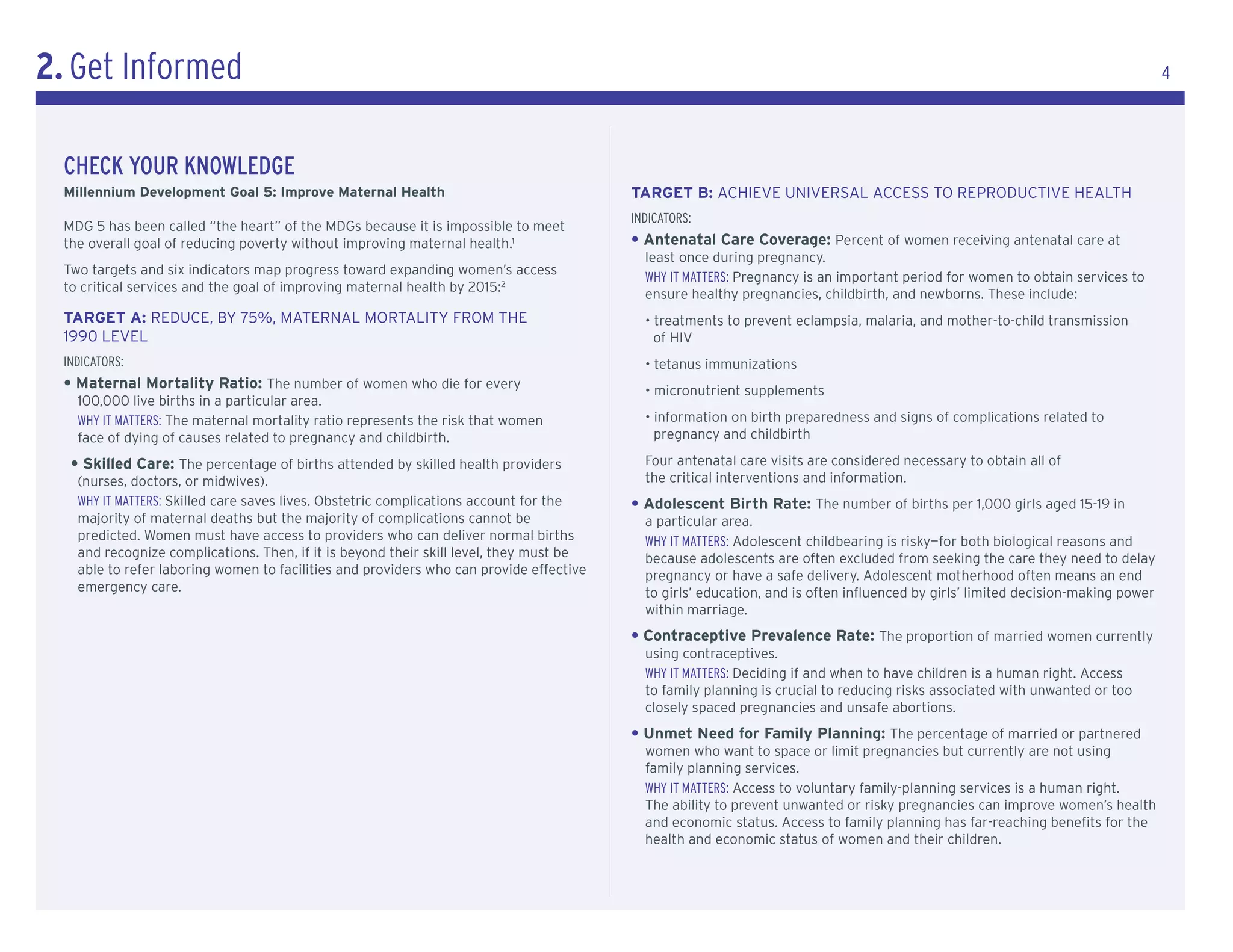
  cHeck YoUr knowledGe
  Millennium Development Goal 5: Improve Maternal Health                                 TarGeT B: AcHIEVE UNIVERSAL AccESS TO REPRODUcTIVE HEALTH
                                                                                         IndICatorS:
  MDG 5 has been called “the heart” of the MDGs because it is impossible to meet
  the overall goal of reducing poverty without improving maternal health.1               • Antenatal Care Coverage: Percent of women receiving antenatal care at
                                                                                           least once during pregnancy.
  Two targets and six indicators map progress toward expanding women’s access
                                                                                           WhY It MatterS: Pregnancy is an important period for women to obtain services to
  to critical services and the goal of improving maternal health by 2015:2
                                                                                           ensure healthy pregnancies, childbirth, and newborns. These include:
  TarGeT a: REDUcE, BY 75%, MATERNAL MORTALITY FROM THE                                    • treatments to prevent eclampsia, malaria, and mother-to-child transmission
  1990 LEVEL                                                                                 of HIV
  IndICatorS:                                                                              • tetanus immunizations
  • Maternal Mortality Ratio: The number of women who die for every                        • micronutrient supplements
    100,000 live births in a particular area.
    WhY It MatterS: The maternal mortality ratio represents the risk that women            • information on birth preparedness and signs of complications related to
    face of dying of causes related to pregnancy and childbirth.                             pregnancy and childbirth

   • Skilled Care: The percentage of births attended by skilled health providers           Four antenatal care visits are considered necessary to obtain all of
    (nurses, doctors, or midwives).                                                        the critical interventions and information.
    WhY It MatterS: Skilled care saves lives. Obstetric complications account for the    • adolescent Birth rate: The number of births per 1,000 girls aged 15-19 in
    majority of maternal deaths but the majority of complications cannot be                a particular area.
    predicted. Women must have access to providers who can deliver normal births           WhY It MatterS: Adolescent childbearing is risky—for both biological reasons and
    and recognize complications. Then, if it is beyond their skill level, they must be     because adolescents are often excluded from seeking the care they need to delay
    able to refer laboring women to facilities and providers who can provide effective     pregnancy or have a safe delivery. Adolescent motherhood often means an end
    emergency care.                                                                        to girls’ education, and is often influenced by girls’ limited decision-making power
                                                                                           within marriage.
                                                                                         • Contraceptive Prevalence Rate: The proportion of married women currently
                                                                                           using contraceptives.
                                                                                           WhY It MatterS: Deciding if and when to have children is a human right. Access
                                                                                           to family planning is crucial to reducing risks associated with unwanted or too
                                                                                           closely spaced pregnancies and unsafe abortions.
                                                                                         • Unmet Need for Family Planning: The percentage of married or partnered
                                                                                           women who want to space or limit pregnancies but currently are not using
                                                                                           family planning services.
                                                                                           WhY It MatterS: Access to voluntary family-planning services is a human right.
                                                                                           The ability to prevent unwanted or risky pregnancies can improve women’s health
                                                                                           and economic status. Access to family planning has far-reaching benefits for the
                                                                                           health and economic status of women and their children.
AT FIRST BIRTH


                                                                               Probability relative to mothers 24 to 26 years
                                                                                                                                2.0
                                                                                                                                                                                                          12-14
                                                                                                                                                                                                          15-17                                        15%                  24%
                                                                                                                                                                                                                                                      Sepsis                Hemorrhage
                                                                                                                                                                                                          18-20


2. Get Informed
                                                                                                                                1.5
                                                                                                                                                                                                                                               12%
                                                                                                                                                                                                                                        Eclampsia &
                                                                                                                                                                                                                                       Hypertensive
                                                                                                                                                                                                                                          Disorders
                                                                                                                                                                                                                                                                                                                                              5
                                                                                                                                1.0
                                                                                                                                                                                                                                                                                 8%
                                                                                                                                                                                                                                                                                 Obstructed
                                                                                                                                                                                                                                                                                 Labor

                                                                                                                                0.5
                                                                                                                                                                                                                                               28% Other               13%
                                                                                                                                                                                                                                                                       Unsafe Abortion


  mdG mAp                                                                                                                       0.0
                                                                                                                                        MORTALITY   UNDERWEIGHT        STUNTING      DIARRHEA      ANEMIA
                                                                                                                                                                                                                                       mAternAl HeAltH fActs, strAteGies, And cHAllenGes
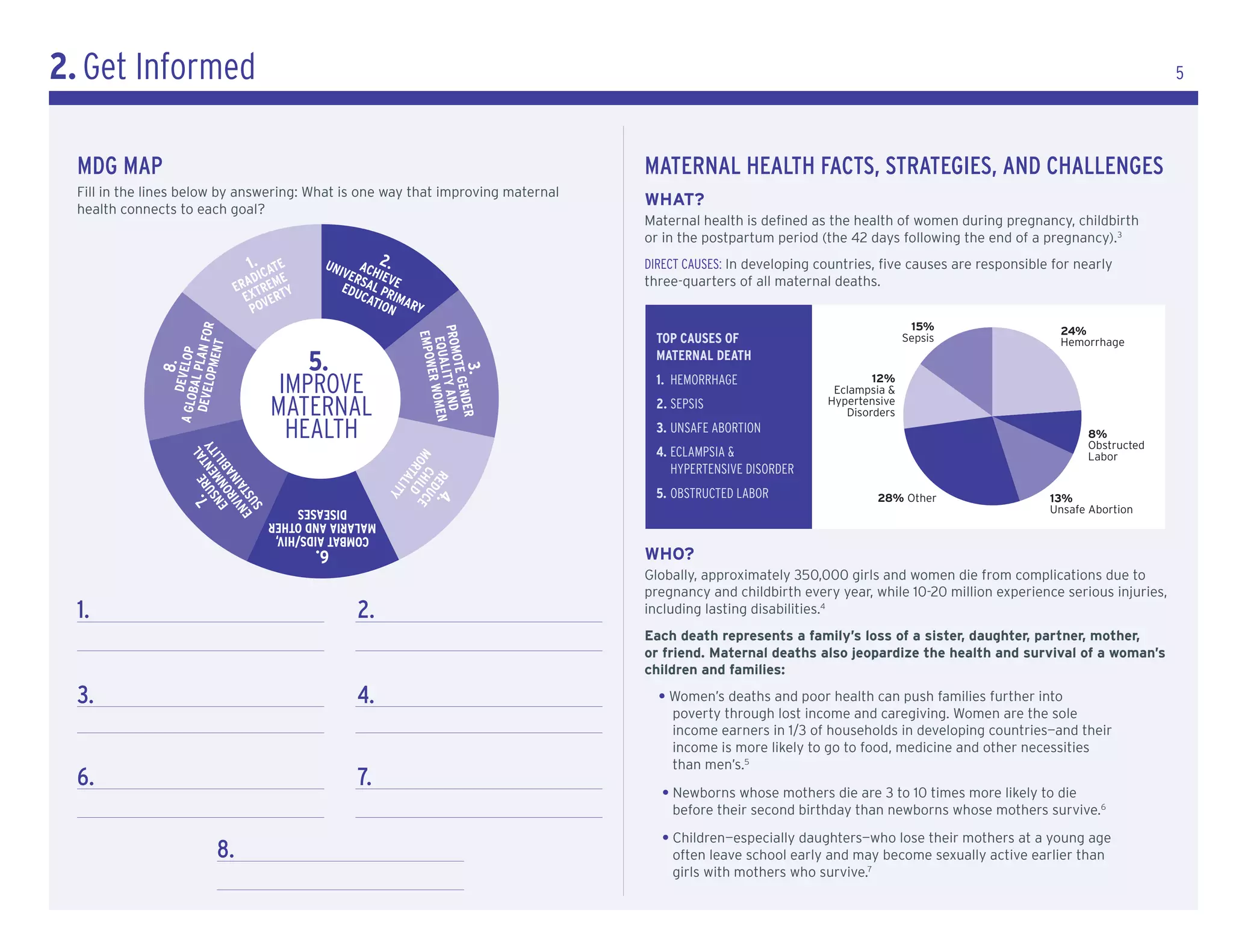
  Fill in the lines below by answering: What is one way that improving maternal
                                                                                                                                                                                                                                       WHaT?
  health connects to each goal?
                                                                                                                                                                                                                                       Maternal health is defined as the health of women during pregnancy, childbirth
                                                                                                                                                                                                                                       or in the postpartum period (the 42 days following the end of a pregnancy).3
                                                                       2.5
                                                                                                                                         1. ATE         UNI AC 2.                                                             AGE OF MOTHER CauSeS: In developing countries, five causes are responsible for nearly
                                                                                                                                                                                                                                      dIreCt
               Probability relative to mothers 24 to 26 years old*


                                                                                                                                                           VER HIEV                                                                       S
                                                                                                                                                                                                                                     KER
                                                                                                                                                                                                                              AT FIRSTthree-quartersCOM maternal deaths.
                                                                                                                                           C
                                                                                                                                        ADI EME
                                                                                                                                      ER TR TY             EDUSAL PR E                                                             A BIRTH
                                                                                                                                                                                                                                 M 12-14
                                                                                                                                                                                                                                                       of all
                                                                                                                                                                                                                                                           MU
                                                                       2.0
                                                                                                                                        EX VER                CAT IMA
                                                                                                                                                                 ION RY                                                        Y                              NI
                                                                                                                                         PO


                                                                                                                                                                                                                          LIC


                                                                                                                                                                                                                                                                        TIE
                                                                                                                                                                                                                                       15-17                                                            15%
                                                                        DEVEL L PLAN FOR


                                                                                                                                                                                                                        PO
                                                                                                                                                                                                                                                                                                                           24%


                                                                                                                                                                                  PROMO LITY AND


                                                                                                                                                                                                                                                                           S
                                                                                                                                                                                                                                       18-20 CAuses of
                                                                                                                                                                                                                                          top                                                          Sepsis


                                                                                                                                                                                   EMPOW
                                                                                                                                                                                                                                                                                                                           Hemorrhage


                                                                                                                                                                                    EQUA R WOMEN
                                                                                    T


                                                                                                                                                5.
                                                                              OPMEN


                                                                                                                                                                                                                                          MAternAl deAtH
                                                                      A GLO DEVELOP


                                                                        1.5
                                                                     8.


                                                                                                                                                                                        TE GEN
                                                                                                                                                                                        3. DER
                                                                                                                                             IMPROVE
                                                                                                                                                                                         E
                                                                                                                                                                                                                                          1. heMorrhaGe


                                                                                                                                                                                                                                                                            LOCAL, REGIONAL
                                                                                                                                                                                                                                                                                              12%


                                                                                                                                                                                                                                                                             & INTERNATIO
                                                                           BA


                                                                                                                                                                                                                                                                                       Eclampsia &
                                                                                                                                            MATERNAL                                                                                      2. SepSIS                                   Hypertensive


                                                                                                                                                                                                                           CARE
                                                                                                                                                                                                                     EA VIDERS
                                                                                                                                                                                                                                                                                         Disorders
                                                                        1.0
                                                                                                                                              HEALTH                                                                                      3. unSafe abortIon                                                                   8%
                                                                                                                                                                                                                                                                                                                               Obstructed
                                                                                   S MEN LITY


                                                                                                                                                                                                                       LTH
                                                                                                                                                                                                                                          4. eCLaMpSIa &
                                                                                           L


                                                                                                                                                                          MO CH UC
                                                                                        TA


                                                                                                                                                                                                                                                                                                                               Labor


                                                                                                                                                                                                                    H O


                                                                                                                                                                                                                                                                                         NAL TION
                                                                                EN ON BI


                                                                                                                                                                            RT ILD E


                                                                                                                                                                                                                                             hYpertenSIve dISorder


                                                                                                                                                                                                                      PR
                                                                                  IR NA


                                                                                                                                                                              RE 4.
                                                                                                                                                                              AL


                                                                                                                                                                                                                                                                                           , NA
                                                                            7. URE

                                                                               NV STAI


                                                                                                                                                                                                                                                                                             ME A
                                                                                                                                                                                D
                                                                                                                                                                                 ITY


                                                                       0.5                                                                                                                                                                5. obStruCted Labor                                       28% Other          13%


                                                                                                                                                                                                                                                                                                D
                                                                              E U


                                                                                                                                                                                                                                                                       IA
                                                                                S


                                                                                                                                                DISEASES                                                                                                                    L                                          Unsafe Abortion
                                                                                                                                            MALARIA AND OTHER                                                                          FAM
                                                                                                                                             COMBAT AIDS/HIV,                                                                              ILY MEMBERS
                                                                       0.0
                                                                                                                                                                                                                                       WHo?
                                                                                                                                                     6.
                                                                                                                                 MORTALITY          UNDERWEIGHT                   STUNTING            DIARRHEA                    ANEMIA
                                                                                                                                                                                                                                        Globally, approximately 350,000 girls and women die from complications due to
                                                                                                                                                                                                                                        pregnancy and childbirth every year, while 10-20 million experience serious injuries,
  1.                                                                                                                                                              2.                                                                    including lasting disabilities.4
                                                                                                                                                                                                                                       Each death represents a family’s loss of a sister, daughter, partner, mother,
                                                                                                                                                                                                                                       or friend. Maternal deaths also jeopardize the health and survival of a woman’s
                                                                                                                                                                                                                                       children and families:

  3.                                                                                           ATE                              1.                         UN4. AC 2.
                                                                                                                                                             IVE HIE                                                                                                                   S
                                                                                                                                                                                                                                           • Women’s deaths and poor health can push families further into
                                                                                            DIC ME
                                                                                         ERA TRE TY
                                                                                                                                                                R      V
                                                                                                                                                              EDUSAL PR E                                                                                                          KER
                                                                                                                                                                                                                                             poverty through lost income and caregiving. Women are the sole
                                                                                                                                                                                                                                                                                 A
                                                                                                                                                                                                                                                                                                                COM
                                                                                                                                                                                                                                                                                                                   MU
                                                                                                                                                                                                                                                                       YM
                                                                                                                                                                                                                                             income earners in 1/3 of households in developing countries—and their
                                                                                           EX VER                                                                 CAT IMA
                                                                                                                                                                     ION RY                                                                  income is more likely to go to food, medicine and other necessities      NI
                                                                                            PO                                                                                                                                               than men’s.5
                                                                                                                                                                                                                                                                 LIC
  6.                                                                                                                                                              7.


                                                                                                                                                                                                                                                                                                                       TIE
         DEVEL L PLAN FOR


                                                                                                                                                                                                                                                               PO
                                                                                                                                                                                                                                            • Newborns whose mothers die are 3 to 10 times more likely to die
                                                                                                                                                                                                PROMO TY AND


                                                                                                                                                                                                                                                                                                                          S
                                                                                                                                                                                                 EMPOW


                                                                                                                                                                                                                                              before their second birthday than newborns whose mothers survive.6
                                                                                                                                                                                                  EQUALI R WOMEN
                     T


                                                                                                                                            5.
               OPMEN
       A GLO DEVELOP


                                                                                                                                                                                                                                            • Children—especially daughters—who lose their mothers at a young age
                                                                                                                                8.
  8.


                                                                                                                                                                                                      TE GEN
                                                                                                                                                                                                                     3.


                                                                                                                                                                                                                                              often leave school early and may become sexually active earlier than

                                                                                                                                         IMPROVE
                                                                                                                                                                                                       E


                                                                                                                                                                                                                                                                                                                                 LOCAL, REG
                                                                                                                                                                                                                                                                                                                                  & INTERNA
                                                                                                                                                                                                                                              girls with mothers who survive.7
            BA


                                                                                                                                        MATERNAL
                                                                                                                                                                                                             DER


                                                                                                                                                                                                                                                ARE
                                                                                                                                                                                                                                                ERS
2. Get Informed                                                                                                                                                                                                                              6


                                                                       Mother’S aGe IS a rISk faCtor for ChILdren’S heaLth probLeMS8                            • Gender norms that disadvantage girls gain prominence in
                                                                 2.5                                                                                              adolescence.11
                                                                                                                                   AGE OF MOTHER
         Probability relative to mothers 24 to 26 years old*


                                                                                                                                   AT FIRST BIRTH               • Adolescent girls are also susceptible to gender-based violence
                                                                                                                                          12-14                   and HIV/AIDS and other STIs.
                                                                 2.0
                                                                                                                                          15-17            The same girls who leave school, marry, and become pregnant in their
                                                                                                                                                                                15%                  24%
                                                                                                                                                                              Sepsis
                                                                                                                                                           teens face the greatest obstacles to getting the care they need once
                                                                                                                                                                                                     Hemorrhage
                                                                                                                                          18-20
                                                                 1.5                                                                                       they become pregnant:
                                                                                                                                                                              12%
                                                                                                                                                                • Pregnancy is riskiest for girls who are poor, live in rural areas, are
                                                                                                                                                                         Eclampsia &
                                                                                                                                                                        Hypertensive
                                                                                                                                                                  out of school are married, reside away from their parents, or belong
                                                                                                                                                                           Disorders
                                                                 1.0                                                                                              to ethnic minorities. Health facilities may be distant; girls may not
                                                                                                                                                                                                                  8%
                                                                                                                                                                  have the means, knowledge, or authority to Obstructed act on healthy
                                                                                                                                                                                                                  make and
                                                                                                                                                                                                                  Labor
                                                                                                                                                                  decisions; and they may face further challenges from care that is
                                                                 0.5                                                                                              not high in quality, appropriate, or treats them with the respect and
                                                                                                                                                                  compassion they Other 12
                                                                                                                                                                                 28% need.                 13%
                                                                                                                                                                                                           Unsafe Abortion

                                                                                                                                                                • Unplanned pregnancy rates continue to be high across the world, and
                                                                 0.0                                                                                              of the 68,000 maternal deaths worldwide due to unsafe abortions,13
                                                                          MORTALITY    UNDERWEIGHT   STUNTING       DIARRHEA        ANEMIA                        almost half of those are women and girls aged under 19.14

                                                                                                                                                           These women must be included in policy making and program planning.
          Adolescent girls are affected. Every year, 14–16 million adolescent girls
          aged 15 to 19 give birth, and pregnancy-related deaths are the leading cause                                                                     WHen?
          of death for girls this age. Adolescent girls who become pregnant are at the                                                                     everY daY: Women become pregnant and give birth every day—and as many as 1,000
          highest risk for developing and suffering lasting consequences from                                                                              women die every day from causes related to pregnancy and childbirth.15
                            TE         UN
          pregnancy-related complications: A                              1.                         2.
                                                                                            IVE CHIE
                                                                           CA
                                                                       ADI E girl              R
                                                               • EveryRyear a ME goes to school delaysVE
                                                                                             EDUS and Rmarriage by a year – which
                                                                     E delayed Y pregnancies AL Plower risk of death during                                            K   ERS              COM
                                                                                                                                                           over tIMe: Every year an estimated 350,000 girls and women die from complications
                                                                                                                                                                                               MU
                                                                                                                                                                    MA
                                                                                                                                                           due to pregnancy and childbirth. Ten million women are lost in every generation.16
                                                                          TR RT first
                                                                 means: X
                                                                       E E
                                                                 pregnancyV
                                                                                                 CAT IMA                                                                                          NI
                                                                                                                                                           Women’s health during pregnancy and access to essential services is crucial to
                                                                                                                                                                Y
                                                                        PO and childbirth, lower risk IofN RY
                                                                                                       O contracting HIV, improved                         ensuring that women are equipped to deliver for themselves and their families,
                                                                                                                                                        LIC


                                                                                                                                                                                                         TIE
                                                                economic prospects, and improved chances that her children will                            communities, and nations.
   DEVEL L PLAN FOR


                                                                                                                                                      PO

                                                                survive and go to school.9
                                                                                                                PROMO TY AND


                                                                                                                                                                                                            S
                                                                                                                 EMPOW


                                                                                                                                                           noW is the time to focus on adolescent girls:
                                                                                                                  EQUALI R WOMEN
               T


                                                       • Quality, accessible, and affordable sexual and reproductive health
                                                                                   5.
         OPMEN
 A GLO DEVELOP


                                                         education and health services can help girls avoid unwanted                                            • The largest generation of adolescents in history is now entering its
8.


                                                                                                                      TE GEN
                                                                                                                      3. DER


                                                                                                                                                                  childbearing years. Half of the world’s population is between 10 and
                                                                                IMPROVE
                                                                                                                       E


                                                         pregnancy, HIV/AIDS, and unsafe abortion. 10


                                                                                                                                                                                                             LOCAL, REGIONAL
                                                                                                                                                                                                              & INTERNATIONA ATIO
                                                                                                                                                                  25 years old, and 85 percent live in the developing world.17 Their
      BA


                                                       • Many health-related habits—from nutrition to sexual and contraceptive                                    health, opportunities, and choices matter.
                                                                               MATERNAL
                                                         behavior—are established in adolescence. Ensuring that young people
                                                                                                                                                         CARE
                                                                                                                                                      LTH ERS


                                                                                 HEALTH
                                                         have what they need to make healthy choices can make the difference
                                                         for their long-term health.
                                                                                                                                                  HE OVID
       7. URE NTAL Y
         S E IT


                                                                                                          MO CHI UCE
                                                                 EN ONM BIL


                                                                                                            RT L


                                                                                                                                                    PR
                                                                        A


                                                                                                                                                    A
                                                                                                              RE 4.
                                                                                                              AL D


                                                                                                                                                                                                                            L
                                                                                                                                                                                                                            ,N
                                                                 VIR IN


                                                                                                                                                                                                                              ME NA
                                                               EN USTA


                                                                                                                D
                                                                                                                ITY


                                                                                                                                                                                                        IA                      D
                                                                 S


                                                                                      DISEASES                                                                                                               L
2. Get Informed                                                                                                                                       2.5
                                                                                                                                                                                                              AGE OF MOTHER
                                                                                                                                                                                                                                                                                                             7


                                                                                                Probability relative to mothers 24 to 26 years old*
                                                                                                                                                                                                              AT FIRST BIRTH
                                                                                                                                                      2.0
                                                                                                                                                                                                                     12-14
                                                                                                                                                                                                                     15-17                                        15%                24%
                                                                                                                                                                                                                                                                 Sepsis              Hemorrhage
                                                                                                                                                                                                                     18-20
                                                                                                                                                      1.5
                                                                                                                                                                                                                                                          12%
                                                                                                                                                                                                                                                   Eclampsia &
                                                                                                                                                                                                                                                  Hypertensive

  WHere?                                                                               WHy?                                                           1.0
                                                                                                                                                                                                                                                     Disorders
                                                                                                                                                                                                                                                                                          8%
                                                                                                                                                                                                                                                                                          Obstructed

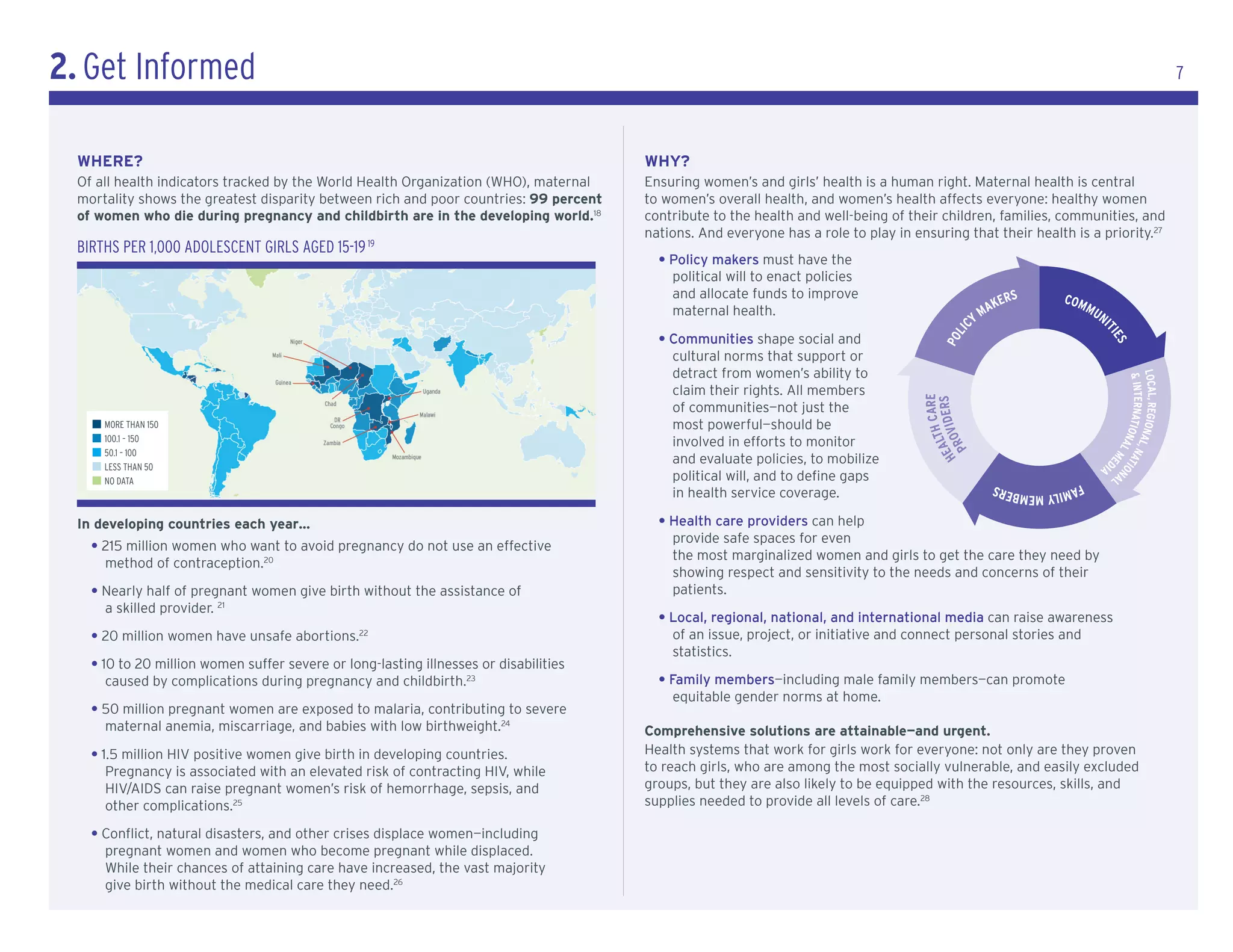
  Of all health indicators tracked by the World Health Organization (WHO), maternal    Ensuring women’s and girls’ health is a human right. Maternal health is central                                                                                                                    Labor


  mortality shows the greatest disparity between rich and poor countries: 99 percent   to women’s overall health, and women’s health affects everyone: healthy women
                                                                                             0.5
                                                                                                                                                                                                                                                          28% Other              13%
                                                                                                                                                                                                                                                                                 Unsafe Abortion

  of women who die during pregnancy and childbirth are in the developing world.18      contribute to the health and well-being of their children, families, communities, and
                                                                                             0.0

                                                                                       nations. And everyone has a role to play in ensuring that their health is a priority.27
                                                                                                 MORTALITY UNDERWEIGHT STUNTING DIARRHEA ANEMIA


  bIrthS per 1,000 adoLeSCent GIrLS aGed 15-19 19
                                                                                             • Policy makers must have the
                                                                                               political will to enact policies
                                                                                                      1. ATE              2
                                                                                               and allocate fundsACHIE.Vimprove
                                                                                                                UNI
                                                                                                                   VER to                                                                                                                             S
                                                                                                   E T
                                                                                                        IC
                                                                                                    RAD REMEY      EDUSAL PR E                                                                                                                A   KER                     COM
                                                                                                                                                                                                                                                                             MU
                                                                                               maternalThealth. CAT IMA
                                                                                                     EX ER
                                                                                                                                                            POV                       ION   RY                                             YM                                   NI


                                                                                                                                                                                                                                   LIC


                                                                                                                                                                                                                                                                                 TIE
                                                                                             • Communities shape social and


                                                                                          DEVEL L PLAN FOR


                                                                                                                                                                                                                                 PO
                                                                                                                                                                                             PROMO LITY AND


                                                                                                                                                                                                                                                                                    S
                                                                                                                                                                                              EMPOW
                                                                                                                                                                                               EQUA R WOMEN
                                                                                                      T
                                                                                               cultural norms that support or
                                                                                                              5.


                                                                                                OPMEN
                                                                                        A GLO DEVELOP
                                                                                       8.


                                                                                                                                                                                                   TE GEN
                                                                                                                                                                                                   3. DER
                                                                                               detract from women’s ability to
                                                                                                         IMPROVEAll members


                                                                                                                                                                                                    E


                                                                                                                                                                                                                                                                                     LOCAL, REGIONAL
                                                                                                                                                                                                                                                                                      & INTERNATIONA ATIO
                                                                                             BA
                                                                                               claim their rights.
                                                                                                       MATERNAL


                                                                                                                                                                                                                                  H CARE
                                                                                                                                                                                                                                      RS
                                                                                               of communities—not just the
                                                                                                          HEALTH


                                                                                                                                                                                                                             HE OVIDE
      More than 150                                                                            most powerful—should be


                                                                                               7. URE NTAL Y
                                                                                                 S E IT


                                                                                                                                                                                        MO CHI UCE


                                                                                                                                                                                                                               ALT
                                                                                              EN NM IL
      100.1 – 150                                                                              involved in efforts to monitor


                                                                                                                                                           O AB


                                                                                                                                                                                          RT LD


                                                                                                                                                                                                                               PR
                                                                                                                                                                                            RE .
                                                                                                                                                                                            AL


                                                                                                                                                                                                                                                                                                    L M NA
                                                                                                                                                                                                                                                                                                    ,N
                                                                                                                                                        VIR IN
      50.1 – 100
                                                                                               and evaluate policies, to mobilize


                                                                                                                                                      EN USTA


                                                                                                                                                                                              D
                                                                                                                                                                                               ITY


                                                                                                                                                                                                                                                                                                       ED
                                                                                                                                                                                                 4
      LeSS than 50
                                                                                                                                                                                                                                                                                IA


                                                                                                                                                        S
                                                                                               political will, and to define gaps
                                                                                                                                                                      DISEASES
      no data
                                                                                                                                                                                                                                                                                     L
                                                                                                                                                                  MALARIA AND OTHER                                                               FAM
                                                                                               in health service coverage.                                         COMBAT AIDS/HIV,
                                                                                                                                                                         6.
                                                                                                                                                                                                                                                      ILY MEMBERS

  In developing countries each year…                                                         • Health care providers can help
                                                                                               provide safe spaces for even
    • 215 million women who want to avoid pregnancy do not use an effective
                                                                                               the most marginalized women and girls to get the care they need by
      method of contraception.20
                                                                                               showing respect and sensitivity to the needs and concerns of their
    • Nearly half of pregnant women give birth without the assistance of                       patients.
      a skilled provider. 21
                                                                                             • Local, regional, national, and international media can raise awareness
    • 20 million women have unsafe abortions.22                                                of an issue, project, or initiative and connect personal stories and
                                                                                               statistics.
    • 10 to 20 million women suffer severe or long-lasting illnesses or disabilities
       caused by complications during pregnancy and childbirth.23                            • Family members—including male family members—can promote
                                                                                                equitable gender norms at home.
    • 50 million pregnant women are exposed to malaria, contributing to severe
      maternal anemia, miscarriage, and babies with low birthweight.24                 Comprehensive solutions are attainable—and urgent.
    • 1.5 million HIV positive women give birth in developing countries.               Health systems that work for girls work for everyone: not only are they proven
       Pregnancy is associated with an elevated risk of contracting HIV, while         to reach girls, who are among the most socially vulnerable, and easily excluded
       HIV/AIDS can raise pregnant women’s risk of hemorrhage, sepsis, and             groups, but they are also likely to be equipped with the resources, skills, and
       other complications.25                                                          supplies needed to provide all levels of care.28

    • Conflict, natural disasters, and other crises displace women—including
      pregnant women and women who become pregnant while displaced.
      While their chances of attaining care have increased, the vast majority
      give birth without the medical care they need.26
2. Get Informed                                                                                                                                                                8


  How to sAve Girls’ And women’s lives                                                    tHree delAYs         30


  Three health systems strategies have been proven to improve girls’ and women’s          Once complications occur, women’s survival depends on whether they are able to
  chances of surviving pregnancy, childbirth, and the critical days after the end of a    get the care that they need. Three delays raise women’s risk of dying:
  pregnancy:29
                                                                                            1. Delay in seeking care: Women and girls may have to get permission

   1   Access to voluntary family planning
       What It IS: Counseling to ensure that women, and couples make informed
                                                                                               from husbands or parents, and women and their families may not
                                                                                               recognize the emergency; some may fear hospital practices. Young
       choices regarding contraception; medical care/services supporting those                 women often experience further delays because of stigma of young
       decisions; and appropriate supplies, such as contraceptive pills, emergency             women’s sexuality and gender-based violence.
       contraceptives, and condoms.
                                                                                            2. Delay in reaching an emergency care facility: Transportation may be
       WhY It MatterS: Ensuring girls, women, and their male partners have access to          unavailable or unaffordable or take too long.
       family planning enables them to avoid high-risk and unintended pregnancies.
                                                                                            3. Delay in receiving care from providers: Richer patients or males may
                                                                                              be seen first and facilities may lack staff, equipment or supplies. In
  2 Access to quality care for pregnancy and childbirth (antenatal
    care; skilled attendance at birth, including emergency obstetric
    and neonatal care; and immediate postnatal care for mothers
                                                                                              addition, care may be unaffordable.

       and newborns, at delivery and in the postpartum period)
       What It IS: Antenatal care includes counseling to prepare women for birth
                                                                                             tAkinG Action for sUstAinAble cHAnGe
       and recognize complications and services to treat syphilis, prevent mother-           Women Deliver has outlined a global action plan31 for governments and
       to-child transmission of HIV, provide tetanus vaccinations, and intervene to          the international community to commit to:
       benefit both mothers and newborns. Skilled care during labor and at delivery
                                                                                              • Increase investment in maternal, newborn, and reproductive health,
       includes 24-hour access to skilled birth attendants, such as doctors, nurses,
                                                                                                 calling for an additional US $12 billion in 2010, increasing annually to an
       and midwives for normal deliveries, and referrals for obstetric emergencies.
                                                                                                 additional US $20 billion in 2015.
       Immediate postnatal care for mothers and newborns includes monitoring of
       excessive bleeding, pain, and infection; counseling on breastfeeding, family           • Strengthen health systems to scale up health interventions and fill
       planning, and nutrition; and newborn care, including identification of danger            gaps—including 2.5 million health care professionals (midwives, nurses,
       signs and treatment or referral for complications.                                       doctors, and specialists) and managers.
       WhY It MatterS: 42 percent of pregnancies everywhere in the world involve              • Strengthen maternal, newborn, and reproductive health programs
       serious complications. Skilled care makes the difference between life and death.         and institutions—ensuring that services and information are
                                                                                                accessible and delivered with respect for women—especially poor and
  3 Access to safe abortion, when legal
       What It IS: Medical or surgical procedures to terminate an unwanted pregnancy,
                                                                                                marginalized women and adolescents.

                                                                                              • Develop monitoring and accountability mechanisms and channels for
       in accordance with the laws of a given country. Services must be provided by
       well-trained personnel, with access to appropriate equipment and supplies and            community engagement that address wider socioeconomic, political,
       supported by the health system infrastructures, policy, and regulations that             and cultural barriers to care, and help improve policies and programs.
       ensure safety.
       WhY It MatterS: Unsafe abortions account for 13 percent of deaths associated       Young leaders like you will make the difference when it comes to sharing key
       with pregnancy and childbirth.                                                     messages, engaging communities, and persuading leaders to invest in women and
                                                                                          girls. Your commitment, energy, and the economic, social/cultural, political, and
                                                                                          technological solutions you define are needed at every level.
3. Get Connected                                                                                                                                                                9


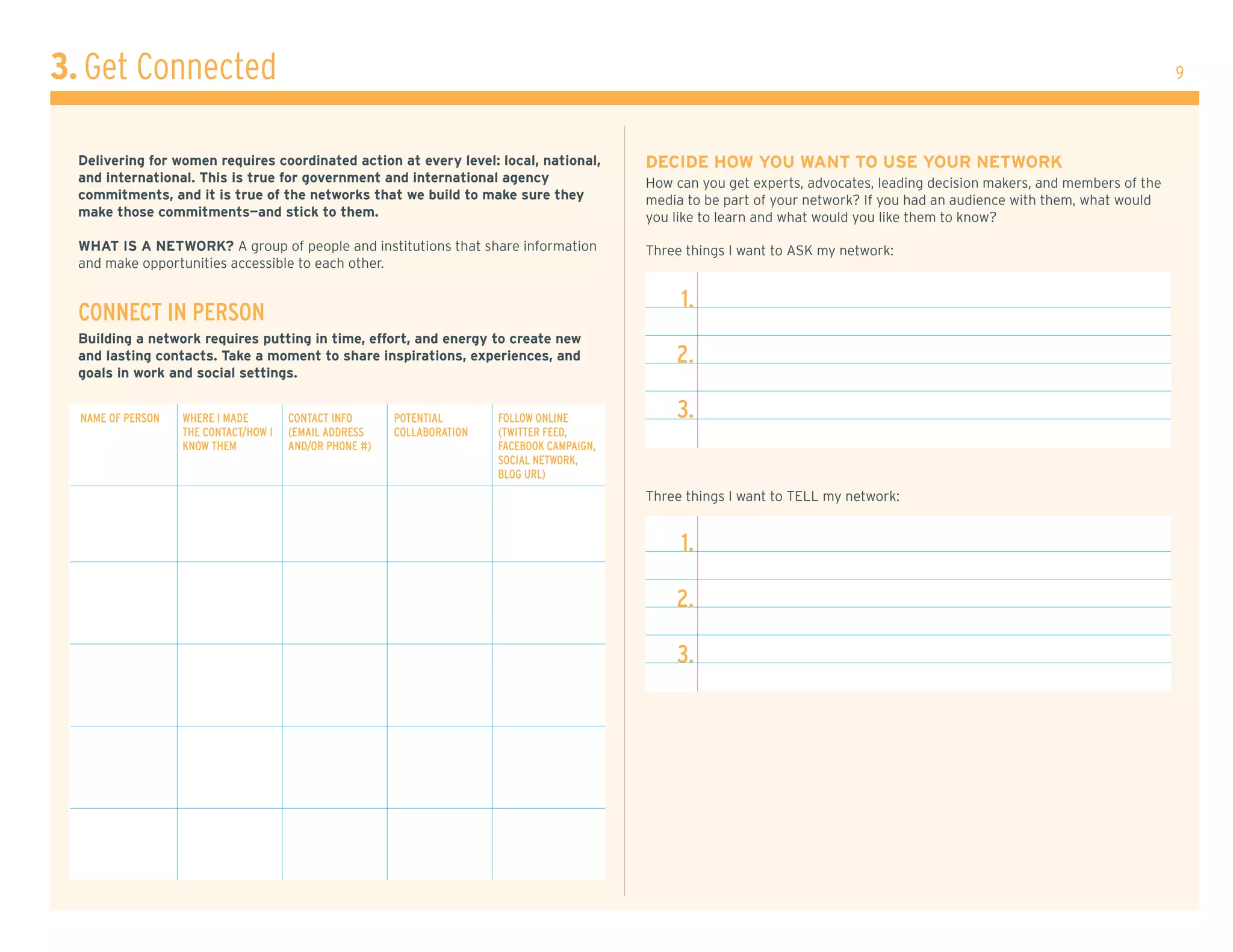
 Delivering for women requires coordinated action at every level: local, national,            DECIDE hoW YoU WANT To USE YoUR NETWoRk
 and international. This is true for government and international agency                      How can you get experts, advocates, leading decision makers, and members of the
 commitments, and it is true of the networks that we build to make sure they                  media to be part of your network? If you had an audience with them, what would
 make those commitments—and stick to them.                                                    you like to learn and what would you like them to know?

 WhAT IS A NETWoRk? A group of people and institutions that share information                 Three things I want to ASk my network:
 and make opportunities accessible to each other.

                                                                                                   1.
 connect in person
 Building a network requires putting in time, effort, and energy to create new
 and lasting contacts. Take a moment to share inspirations, experiences, and                      2.
 goals in work and social settings.


  nAme of person   wHere i mAde        contAct info      potentiAl       follow online            3.
                   tHe contAct/How i   (emAil Address    collAborAtion   (twitter feed,
                   know tHem           And/or pHone #)                   fAcebook cAmpAiGn,
                                                                         sociAl network,
                                                                         bloG Url)
                                                                                              Three things I want to TELL my network:


                                                                                                   1.

                                                                                                  2.

                                                                                                  3.
3. Get Connected                                                                                        10


 connect online
 New media and technology offer ways to stay in touch with other activists, learn
 about major developments in the field, connect your work to larger agendas, and
 let the people who make decisions know what matters:                               Look for links to
                                                                                    previous posts.
 BLoGS
 Blogs offer an informal space to share information, experiences, and insights.
 • READING BLoGS can help you stay up-to-date on
 news, analysis, debate, and discussion, and can help
 inspire you. Many blogs have comment sections, which
 offer the opportunity to share your opinions of a blog
 post, ask questions, and have them answered by the
 blogger. Bloggers include journalists, academics, policy
 makers, and activists. (See Appendix B for a Blogroll list
 of great Maternal Health blogs.)


                                        Tags and categories
                                        help you find what
                                        interests you.


               Make sure you comment to
               keep the conversation going.
3. Get Connected                                                                                                                                 11


 • WrITInG a BloG can help draw attention to your work, and it can be a form
 of activism in its own right.                                                       add media elements,
                                                                                     like photos, videos, or
 Websites like Amplify Your Voice (amplifyyourvoice.org) and Conversations           music, to make your
 for a Better World (conversationsforabetterworld.org) are spaces for sexual                                   Use keywords and phrases that
                                                                                     posts more dynamic.       will encourage your readers to
 and reproductive health activists to express themselves and connect with each
 other. Use them to write your own blog, stay up to date on others, and connect to                             click through to the full post.
 writers and readers. You can also read blog posts and comment on the Deliver for
 Youth blog (d4y.womendeliver.org) to share your thoughts.
 Free, easy to use platforms like Wordpress and Blogger
 offer another option for you to start your own blog from
 scratch. Starting your own blog requires a bit more work
 when it comes to building an audience and tapping into
 a network, but it can be a great way to make a name for
 yourself and your organization.


                     When writing your post, keep
                     it short and link to other
                     websites, articles, and blogs
                     as much as possible.


                                  Use tags & categories to
                                  help your readers find what
                                  they’re interested in.
3. Get Connected                                                                                                                                                    12


 BLoGGING TIPS


   1   Write what you know, but don’t worry about knowing everything!
       In your day-to-day work as an activist, student, or maternal health
       professional, you will run into topics that make great blog posts as
                                                                                 4   Make it visually appealing. Effective, compelling blog posts are more
                                                                                     than words on a page.
                                                                                       • Use pictures, photographs, and other illustrations, to make your
       soon as you start thinking about it. Report on your experiences,
                                                                                         post distinctive and compelling. Flickr.com is a great resource for
       including the events you attend and the work you do; interview your
                                                                                         photos. Search through their creative commons database and
       peers, teachers, and leaders you admire about their experiences; and
                                                                                         follow photographers whose photos you like.
       discuss news, policies, and research in the field and what they mean
       for your work.                                                                  • keep it short. Most blog posts should be 500 words or less.
                                                                                         Of course, there is room for longer posts, but when you start
                                                                                         out, stay concise.

  2    Have a goal. What are you trying to accomplish with each blog post?
       For example, you cannot end maternal mortality with one blog post,
       but you might be able to convince a skeptical reader that maternal
                                                                                       • Use paragraphs, headlines, and sub-headings to break up text
                                                                                         and organize your points.
       mortality can be eradicated.
                                                                                       • Highlight main points—feel free to use bold or italicize text to
                                                                                         highlight a few main points.

  3    know your audience. While you may not know exactly who is reading
       your blog, assume that you are communicating with a variety of
       readers—some who agree with you, some who do not. But mostly,
       you’re communicating with readers who want to learn something new.
                                                                                 5   keep conversations going.
                                                                                       • When you read or learn about an interesting finding, news story, or
                                                                                         new project, use your blog to link to it! It is a great service for your
         • Start with the basics: Who? What? Where? When? Why? How?
                                                                                         readers, and it might lead to new links—and readers—to your blog.
         • Write in a conversational tone, using language that everyone
                                                                                       • After you publish your post, make sure to check back for
           can understand—avoid jargon and abbreviations, and provide
                                                                                         comments and reply in the comment section below.
           definitions of technical terms (feel free to use the definitions in
           the glossary, Appendix A).
         • Make it your own—write in the first-person in present tense, and
           share your opinion—whether you are writing because you are            TIP      Blogging Safety Tips
           excited, frustrated, or confused. Make sure your readers know
           what inspired you to write this post.                                 Privacy – only provide as much personal information on
         • Post often! Your readers are much more likely to become—and           your blog as you want the world to know
           stay—engaged if you publish new posts frequently.
                                                                                 Professionalism – Assume what you publish is permanent,
                                                                                 and accept that some of your readers and commentators
                                                                                 may disagree with your opinions

                                                                                 Legality – Don’t libel or attack others, don’t plagiarize,
                                                                                 and always cite your sources

                                                                                 Caution – Spammers often pose as commentators so
                                                                                 monitor your posts often
3. Get Connected                                                                                     13


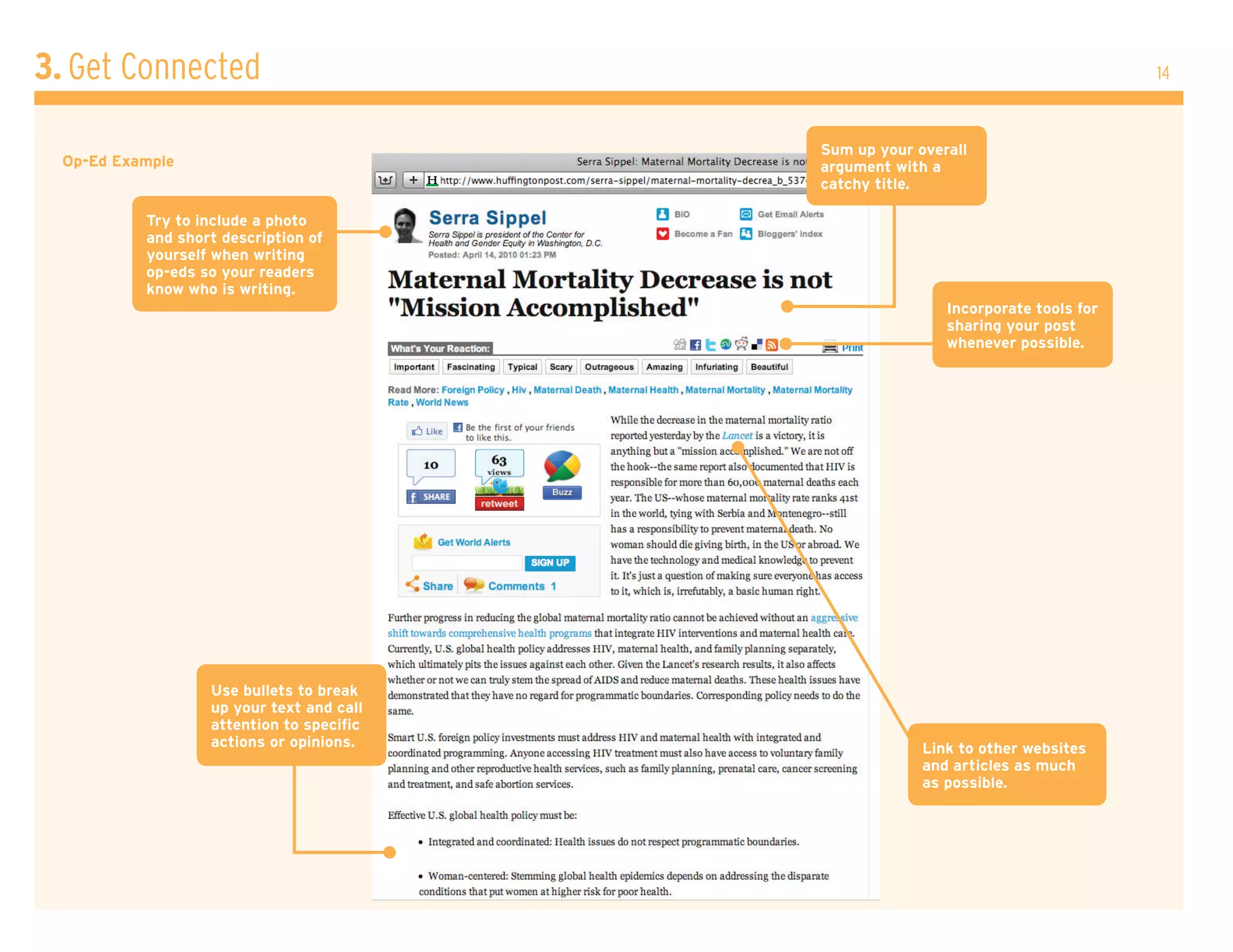
 Two common types of blog posts are the “news roundup” and the “op-ed.”
 check out these examples:


 News Roundup Example


       In the title, explain
       what your news
       round-up is about.


                                                                          Start with a short
                                                                          list of links to various
                                                                          articles & blogs.


       once you’ve listed the links,
       give a brief description of each
       news story and how it applies
       to maternal health issues.
3. Get Connected                                                                  14


                                          Sum up your overall
 op-Ed Example                            argument with a
                                          catchy title.

          Try to include a photo
          and short description of
          yourself when writing
          op-eds so your readers
          know who is writing.
                                                          Incorporate tools for
                                                          sharing your post
                                                          whenever possible.


                  Use bullets to break
                  up your text and call
                  attention to specific
                  actions or opinions.                 Link to other websites
                                                       and articles as much
                                                       as possible.
3. Get Connected                                                                                                                                                           15


 When you find a blog or blogger who cares about maternal health, keep track! You    Twitter is a network for information-sharing in real time.
 can subscribe to their RSS feed, bookmark the page, or just write the url below:
                                                                                      StartInG out: Using Twitter is like blogging, but shorter. Instead of 500 words,
                                                                                      Twitter allows you to share your thoughts, 140 characters at a time. These short
                                                                                      posts—or “Tweets”—are usually one thought, question, or piece of news. As soon as
                                                                                      you Tweet, your thoughts will go out to all of your followers.
                                                                                       • Once you sign up, start exploring—search
                                                                                         for your friends by email address, search                    Join the conversation!
                                                                                         or browse Tweets by topic, search for                        There are hashtags
                                                                                         organizations, and start posting your own          Try       for maternal health
                                                                                         thoughts.                                          IT oUT (#maternalhealth)
                                                                                                                                          and the MDGs (#mdgs) - include
                                                                                       • Use hashtags to make your Tweets easier          them as you Tweet your thoughts,
                                                                                         to find—hashtags let you tag your posts so       reflections, and new ideas on
 SoCIAL NETWoRkS                                                                         that they are grouped with similar posts.        different issues. When you attend
 Social networking websites can help you                 To make the most out of                                                          a meeting, event, or conference,
 connect with other activists around the          TIP social networks, make
                                                                                                                                          ask around to see if there is a
 world, share news, publicize your work,         sure you set out with realistic                                                          shared hashtag you can use.
 and build your audience online and on the       goals and a plan to achieve
 ground. Sign-up is free, though using social    them. For example, aim to Tweet
 networks effectively requires you to invest     on a regular schedule, and add
 some time to set up your profile, make          a number of new contacts.
 connections, and keep your content fresh.       or make a campaign through            A Twitter Success!
                                                 Facebook with consistent links         TweetsGiving was a global celebration that aimed to change the world through
 Examples of social networking websites:         and information. reMeMBer:
                                                                                        the power of gratitude. Using Twitter, they raised $10,000 in 48 hours to build
                                                 keep your content fresh and
 Facebook has over 400 million active            relevant to build your network.
                                                                                        a classroom in Tanzania. Leveraging the US holiday, Thanksgiving, they asked
 users around the world.                                                                people to Tweet anything they were thankful for and include the #TweetsGiving
 StartInG out: Facebook offers several options                                          tag and a link to the site. Second, the project asked for a donation in honor of
 for connecting with other users— personal pages, organizational pages, and Groups      whatever you were grateful for. These donations, done through PayPal, allowed
 and Causes. Explore Facebook to see how others are using these tools—then decide       you to buy a brick in the new classroom for $10 or become a “Top Turkey” for
 which combination works best for you. Some things you might find useful:               $100. And third, to bring the project awareness, it asked that you follow
                                                                                        @TweetsGiving on Twitter and help spread the word.
   • Post links: Use the option to post links to your Facebook wall to notify
     your friends and followers when you post to your blog or find a news
     story, resource, or anything else you want to share. You can also link
     your Facebook to automatically share status updates and links with              other social media websites
                                                                                                                                                     Upload videos and
     your Twitter and other social networks.                                         Facebook and Twitter are just two examples of          TIP      photographs to Flickr,
                                                                                     popular social networks. Though these two have
   • “Share:” When someone else posts a link you think is useful, pass it on!                                                               YouTube, Vimeo and other
                                                                                     a global reach, you might want to focus on the
                                                                                                                                            media-sharing sites to share
   • event Invitations: Use the “Events” option to manage invitations to             networks that are most popular where you live.
                                                                                                                                            your advocacy videos, photo-
     in-person events.                                                                                                                      graphs of your events, and more.
3. Get Connected                                                                                                                                                                      16


 LISTSERVES AND E-NEWSLETTERS                                                               MoBILE PhoNES
 Listserves (or listservs) are, essentially, mailing lists. Listserv subscribers receive,   As mobile phone use expands to over 4.5 billion phones, so too do the uses for
 and send (depending on the individual listserv) email messages related to specific         these phones—and when it comes to maternal health, and organizing, the potential
 concerns and communities. Because you often have to be approved as a member,               is boundless. For health providers, researchers, and activists, phones and handheld
 listserves are most useful for sharing specific information with specific groups.          devices offer enormous possibility for reporting the key pieces of information that
 Also, many international youth-focused organizations have e-newsletters you can            can be used to improve responses to public health challenges—including improving
 subscribe to for updates and information.                                                  maternal health.

 Check out these listservs and networks, and add your own:                                  Different Ways to Connect with Mobile Technology:
                                                                                            to sHAre HeAltH informAtion
         • Deliver For Youth: womendeliver.org/deliver-for-youth/                           SUCCESS SToRY: FrontlineSMS:Medic and Josh Nesbit
                                                                                            In the town of Namitete, Malawi, Josh Nesbit found St. Gabriel’s—a hospital with a
         • IGWG Listserv: igwg.org/listserv.aspx                                            catchment covering 250,000 people over hundreds of square miles. The hospital
                                                                                            had to rely on a network of 450 volunteers across 700 villages to keep tabs on
         • Interagency Youth Working Group: info.k4health.org/youthwg/
                                                                                            the population and report back to the hospital. By teaching the community health
         • Advocates for Youth: advocatesforyouth.org/                                      workers to send text messages containing medical information back to the hospital
                                                                                            staff, 150 patients received emergency care, community health workers saved 1,000
         • Y-PEER: youthpeer.org                                                            hours of travel time which they used to visit more patients, the number of people
         • Youth coalition: youthcoalition.org                                              being treated for Tuberculosis doubled, and the hospital saved $3500 worth of fuel,
                                                                                            which was used to purchase medication, in just 6 months.

                                                                                            to collect, mAp, And visUAlize dAtA
                                                                                            SUCCESS SToRY: Ushadi
                                                                                            After an earthquake devastated Haiti in January 2010, Ushadi emerged as a tool for
                                                                                            capturing and sharing information to map crises and response. The information is
                                                                                            mapped in near real time and gathered from reports coming from inside Haiti via: text
                                                                                            message (SMS), web, email, radio, phone, Twitter, Facebook, television, listservs, live
                                                                                            streams, and situation reports. The platform is designed so any person or organization
                                                                                            can use it to set up their own way to collect and visualize information. The core
                                                                                            platform allows for plug-in and extensions so that it can be customized for different
                                                                                            locales and needs, and it can be downloaded for free. Using text message (SMS) to
                                                                                            gather the info, Ushadi helps bring awareness to crisis situations or other events in
                                                                                            every locale.

                                                                                            to expAnd Access to informAtion
                                                                                            SUCCESS SToRY: Text4baby
                                                                                            Text4baby is a free mobile information service designed to promote maternal and
                                                                                            child health. An educational program of the National Healthy Mothers, Healthy
                                                                                            Babies coalition (HMHB), text4baby provides pregnant women and new moms with
3. Get Connected                                                                                                                                                                17


 information they need to take care of their health and give their babies the best       ADVoCACY VIDEoS
 possible start in life. Women who sign up for the service by texting BABY (or BEBE                                                                  Make sure you pick the
                                                                                         Advocacy videos are a great way to advance           TIP right platform, and be
 for Spanish) to 511411 will receive free (SMS) text messages each week, timed to        important social causes and help viewers see
 their due date or baby’s date of birth.                                                                                                     careful! There are plenty of
                                                                                         problems in new ways. They can leave audiences
                                                                                                                                             secure ways to send money
                                                                                         feeling excited about taking action and joining
 SUCCESS SToRY: Ask Brook                                                                                                                    internationally, but always do
                                                                                         others to make a difference if they make a
 In 2002, The Brook Advisory centre, a Uk charity, launched an enhanced “Ask                                                                 your research—ask around to find
                                                                                         strong argument, involve the viewer, and engage
 Brook” information service providing young people with sexual health knowledge                                                              out what others have used. also
                                                                                         the audience in what happens next. Advocacy
 and support via telephone, the web, and text message. To access the service                                                                 research tax codes, and other
                                                                                         videos are longer than PSAs (Public Service
 via mobile phone, young people text BRk, followed by their postcode, to 81222.                                                              policies that can affect your
                                                                                         Announcements are usually around one minute
 Subsequently, they receive information regarding sexual health services in                                                                  ability to raise and collect funds.
                                                                                         long) but should be shorter than 15 minutes
 their area. They can also select standardized responses to questions relating to        (anything longer and it becomes more of a
 contraception, pregnancy, sexually transmitted disease, and other sexual health         documentary.)
 issues. In 2006 and 2007, the service received an average of 100 text message
 queries per month.                                                                      Do you have access to a video camera? Does your phone take video? What about a
                                                                                         Flip camera? You can make a short, compelling video as a change-oriented tool for
 to rAise AwAreness And fUndinG                                                          maternal health advocacy. Don’t have a camera? Don’t worry. Even if you don’t have
                                                                                         your own footage to draw attention to maternal health, you can still make your own
 SUCCESS SToRY: Make Poverty history                                                     advocacy video at MDGFive.com.
 In 2005, Oxfam GB launched a text message-based outreach initiative as part of its
 role in the Make Poverty History campaign. Advertisements were placed on several        MDGFive.com is an interactive website and online community uniting artists and
 campaign websites and in newspapers urging people to text the keyword “BAND” to         activists in the fight to reach MDG #5 by 2015. MDGFive.com includes creative
 receive a white wristband, the global campaign’s symbol. Users would then receive       content by world-renowned musicians, poets, filmmakers, and photographers. The
 an automatic response requesting their name, street number, and postal code.            site features a “remixer” that can be used to create short videos using a library
 Approximately 50,000 people ordered their white band. The organization is now           of music tracks, spoken word, film, and photos supplied by renowned mixed media
 using the code to encourage people to sign up for various campaigns or set up a         artists from around the world. After you make your video, share it with your friends
 regular gift.                                                                           and colleagues, and encourage them to make one too!

                                                                                         MoRE WAYS To USE TEChNoLoGY
 to Avert crises And connect commUnities
                                                                                           • Reach the established media. If you are working to raise awareness,
 SUCCESS SToRY: PeaceNet                                                                     use the internet to research and contact members of the media who
 When waves of political violence swept through kenya after the December 2007                might do a story on your project.
 presidential election—marred by widespread allegations of vote rigging—human rights
 advocates in the country turned to cell phones to help stem the violence. PeaceNet, a     • Find high-profile people and decision makers online, whether they
 coalition of kenyan NGOs, partnered with Oxfam GB to create a text messaging                have a Twitter account, a website, blog, or Facebook page. Start a
 “nerve center” that served as a vital tool for conflict management and prevention by        conversation with them, and keep at it until they listen to what you
 providing a hub for real-time information about actual and planned attacks between          have to say.
 rival groups. The text messages were then relayed to local “peace committees” that        • As you work on planning a project, consider using online spaces like
 deployed mediators and took other immediate action to stem the violence.                    Yahoo Groups and Google Groups to share calendars, edit documents,
                                                                                             and more.
           ExAMPLE TExT: “Over 400 people with no food or water
           holed in Huruma PcEA church in Eldoret for three days. Help                     • Services like Skype and Google Voice offer ways to make international
           needed immediately.”                                                              phone calls to other users for free.
4. Get Moving                                                                                                                                                            18


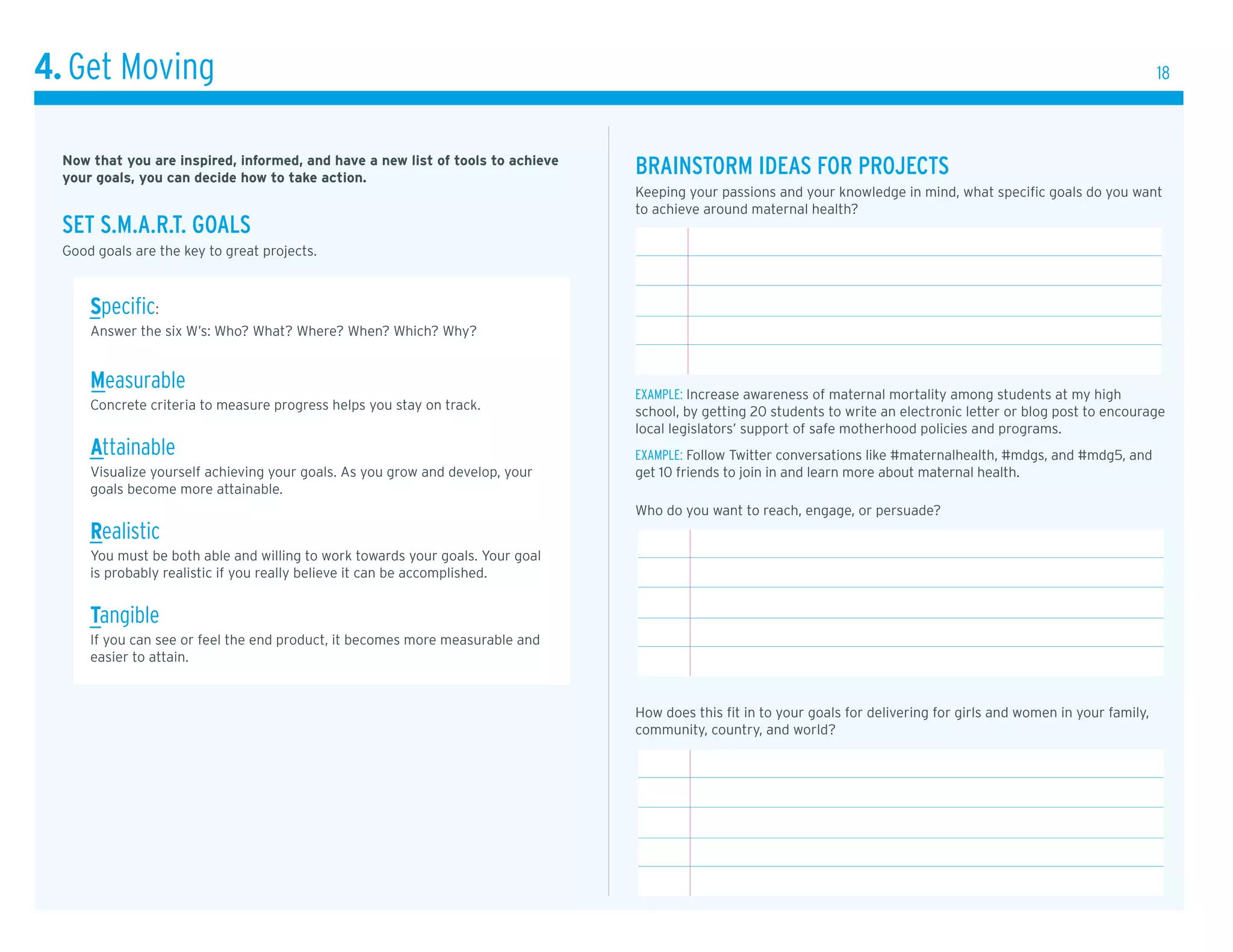
  Now that you are inspired, informed, and have a new list of tools to achieve
  your goals, you can decide how to take action.
                                                                                 brAinstorm ideAs for proJects
                                                                                 Keeping your passions and your knowledge in mind, what specific goals do you want
                                                                                 to achieve around maternal health?
  set s.m.A.r.t. GoAls
  Good goals are the key to great projects.


      specific:
      Answer the six W’s: Who? What? Where? When? Which? Why?


      Measurable                                                                 exaMpLe: Increase awareness of maternal mortality among students at my high
      concrete criteria to measure progress helps you stay on track.             school, by getting 20 students to write an electronic letter or blog post to encourage
                                                                                 local legislators’ support of safe motherhood policies and programs.
      Attainable                                                                 exaMpLe: Follow Twitter conversations like #maternalhealth, #mdgs, and #mdg5, and
      Visualize yourself achieving your goals. As you grow and develop, your     get 10 friends to join in and learn more about maternal health.
      goals become more attainable.
                                                                                 Who do you want to reach, engage, or persuade?
      realistic
      You must be both able and willing to work towards your goals. Your goal
      is probably realistic if you really believe it can be accomplished.


      tangible
      If you can see or feel the end product, it becomes more measurable and
      easier to attain.


                                                                                 How does this fit in to your goals for delivering for girls and women in your family,
                                                                                 community, country, and world?
4. Get Moving                                                                                                                                                            19


 bUild A teAm                                                                       mAke tHe most of YoUr resoUrces
                                                                                    List everything you will need (skills, knowledge, access/network, funds, supplies,
                                                                                    space) to be successful.
   1.   What makes a great team?
                                                                                    What I Need:


   2.   What qualities, skills, and experiences are
        essential to accomplishing your goal?


   3.   How will you recruit your team members?


                                                              Consider your
                                                      TIP     existing resources,
                                                      network, and goals.
                                                      Are there any natural
                                                      connections that you can
                                                      build on or reach out to?
4.Get Moving                                                                                                                                           20


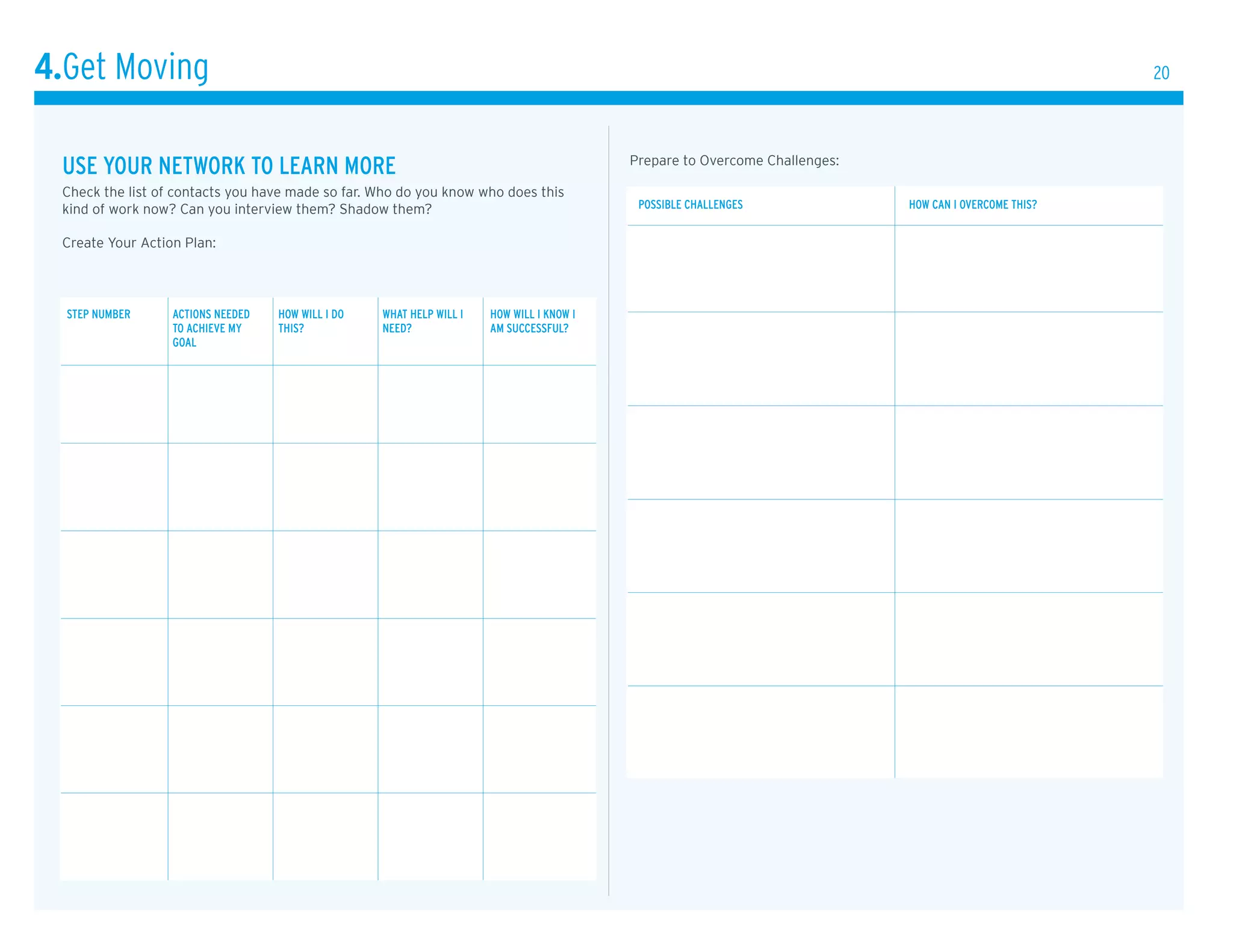
 Use YoUr network to leArn more                                                           Prepare to Overcome challenges:

 check the list of contacts you have made so far. Who do you know who does this
 kind of work now? Can you interview them? Shadow them?                                    possible cHAllenGes              How cAn i overcome tHis?


 create Your Action Plan:


  step nUmber     Actions needed   How will i do   wHAt Help will i   How will i know i
                  to AcHieve mY    tHis?           need?              Am sUccessfUl?
                  GoAl
4. Get Moving                                                                                                                                                            21


 need some ideAs for tAkinG Action?                                                   trAck YoUr proGress
 Get your brainstorm going. Every action makes a difference. Here are some ideas to   Set deadlines and stick to them! Set a deadline for your final goal, and work
 get you started…                                                                     back from there, filling in weekly or monthly deadlines for the steps you need
                                                                                      to reach your goal.
   • Share your knowledge by starting a blog that discusses the challenges
     and opportunities of overcoming maternal deaths in your country.                 overcome challenges: If funding falls short, or you have trouble connecting with
                                                                                      your target audience, getting your message out, or you feel overwhelmed:
   • Educate yourself and get others interested in maternal health by
     signing up for listservs, blogs, websites, Facebook campaigns, and                 • Work with your team to understand challenges and brainstorm
     more.                                                                                solutions.
   • Join the live Twitter or blog feeds of global health conferences to                • Draw on your network for support—use your connections with activists
     make sure maternal health and young people are on the agenda.                        to talk about your challenges, solutions, and lessons you learn along
                                                                                          the way.
   • Attend an event (health conference, panel, etc.) either in person or via
     the Internet, webinar, or mobile phone. Ask one question about young             Monitor your progress as you go. Focus on activities and results.
     people and maternal health.
                                                                                        • Keep track of what you do—and when. Are you meeting your
   • create awareness with your classmates by putting posters around                      deadlines? Are you staying within your budget?
     your school.
                                                                                        • Are you running into challenges? Are they the challenges you
   • Make a short film about maternal health and show it at your school                   expected?
     and upload it to YouTube. If you don’t have your own digital camera or
     digital video recorder, visit MDGFive.com to make an advocacy video                • collect feedback from other team members and activity participants
     using clips, photos, and music from other artists.                                   whenever it is relevant, especially after each activity.

   • Give your opinion about maternal health on a call-in radio show.                   • What were the results/impact of each activity?

   • Write to your MP or Minister and ask him or her to increase access to
     maternal health services.
                                                                                                                                         Define success—and
   • create a special edition of your school newsletter or e-newsletter to                                                         TIP   celebrate it! overcoming
     inform others.
                                                                                                                                  challenges is noteworthy. As
   • Join or start a performance group focused on maternal mortality and                                                          you go, make sure you work
     morbidity awareness.                                                                                                         with your team to share and
                                                                                                                                  celebrate positive developments
   • Volunteer in your community at a maternal health organization and                                                            and achievements.
     promote volunteer opportunities to your friends.
5. SuStaIn Your MoMentuM, Make LaStInG ChanGe                                                                                                                       22


 evAlUAte YoUr proJect And leArn                                                    What is one lesson you learned about leadership or project planning from
                                                                                    the experience of planning, leading, or implementing this project?
 from YoUr experience
 InCLude Your WhoLe teaM In Your evaLuatIon projeCt.

 Did you meet your deadlines?       YES       NO

 Did you achieve your goals?        YES       NO

                                                                                    What is one lesson you learned about what it takes to improve maternal health
 What were the results of your project—did you change minds, raise awareness,
                                                                                    from this experience?
 motivate new activists, gather data for policy makers to use?


                                                                                    Plan for the future: What do you want to do next?
 Did your project have an impact that you didn’t expect?
                                                                                    Use your experience to plan and implement another project: How can the
                                                                                    lessons you learned during this experience inform your future actions?


 Collect lessons learned and list recommendations
 If someone else were going to implement your project in their own community,
                                                                                    Build your network. Are there alliances you can build, or networks you
 or at another conference, what are three things they need to know (that you wish
                                                                                    want to join now that you’ve done this project?
 you had known)?


      1.

     2.
                                                                                    sHAre YoUr experience
     3.                                                                             Use your social media expertise, work with the media, hold meetings,
                                                                                    and make yourself available to others.
Appendix A: Glossary                                                                                                                                                                     23


 kEY TERMS RELATED To MATERNAL hEALTh                                                      FemALe genitAL Cutting: All procedures involving partial or total removal
                                                                                           of the external female genitalia, or other deliberate injury to the female genital
 AntenAtAL CAre: Health care, including screening tests and counseling, provided           organs, whether for cultural, religious or other non-therapeutic reasons.
 to women during pregnancy. Also referred to as prenatal care.
                                                                                           gender: The cultural, social, and economic responsibilities, attributes, and
 AntenAtAL CAre CoverAge: The percentage of women who have given birth                     opportunities associated with being male or female.
 who received antenatal care from a skilled attendant at least once during their
                                                                                           gender-BASed vioLenCe (gBv): Any act threatened or actual act of aggression
 pregnancy.
                                                                                           that targets a person based on their gender. Gender-based violence can occur on
 AntiretrovirAL tHerAPy (Arv): A classification of drugs used to treat HIV.                an individual, community, or societal level.
 Antiretroviral therapy often consists of a combination of medicines referred to as
                                                                                           HemorrHAge: Excessive bleeding or an abnormal blood flow.
 highly active antiretroviral therapy, or HAART, which are more effective than any
 single medication alone.                                                                  HumAn PAPiLLomAviruS (HPv): An extremely common sexually transmitted
                                                                                           virus of numerous strains, some of which can cause genital warts. HPV is the virus
 BirtH ASPHyxiA: A condition in which insufficient oxygen is delivered to the fetus
                                                                                           most commonly linked with cervical cancer.
 during labor and childbirth, leading to risk of stillbirth, neonatal death, or lifelong
 disability in the surviving infant.                                                       HumAn rigHtS: Basic freedoms and rights that all people are entitled to,
                                                                                           regardless of their gender, nationality, ethnicity, socioeconomic class, or other
 CLimAte CHAnge: The gradual changing of weather, temperature, and
                                                                                           factors. In an international context, “human rights” often refers to freedoms
 precipitation as the earth becomes warmer. climate change has a number of
                                                                                           proclaimed in the Universal Declaration of Human Rights by the United Nations in
 important global public health implications, from changing the range and spread
                                                                                           1948. These rights include the right to life, liberty, and security; the right to live free
 of infectious diseases, to changing crop growth, to increasing the frequency of
                                                                                           of torture or cruel and inhumane treatment; and the right to live free of arbitrary
 hurricanes and other events, and women are often disproportionately affected.
                                                                                           arrest.
 Continuum oF CAre: An approach to maternal, newborn, and child health that
                                                                                           mAternAL deAtH: The death of a woman while pregnant or within 42 days of the
 includes integrated service delivery for women and children from before pregnancy
                                                                                           termination of pregnancy, due to complications during pregnancy or childbirth.
 to delivery, the immediate postnatal period, and childhood.
                                                                                           mAternAL HeALtH: The health of women during pregnancy, childbirth, and the
 ContrACePtion: The intentional prevention of pregnancy or conception through
                                                                                           postpartum period.
 hormones, technologies, sexual practices, or surgical procedures.
                                                                                           mAternAL morBidity: Any injury, condition, or symptom that results from, or is
 ContrACePtive PrevALenCe rAte (CPr): The percentage of women of
                                                                                           worsened by pregnancy.
 reproductive age (15-49) who are practicing, or whose sexual partners are
 practicing, any form of contraception.                                                    mAternAL mortALity rAte: The number of maternal deaths during a given
                                                                                           time period per 100,000 women of reproductive age (15 to 49) during that same
 eCLAmPSiA And HyPertenSive diSorderS: These are blood pressure
                                                                                           time period.
 complications, which can cause convulsions and even death for pregnant women
 before, during, or after birth.                                                           mAternAL mortALity rAtio: The number of maternal deaths during a given
                                                                                           time period per 100,000 live births during the same period.
 emergenCy oBStetriC CAre (emoC): Skilled health care to address pregnancy
 and childbirth-related complications, including access to the blood supplies,             mediCAL ABortion: A safe option for terminating a pregnancy using medications
 antibiotics, and other equipment needed.                                                  (e.g., mifepristone and misoprostol or misoprostol alone).
 FAmiLy PLAnning: The conscious effort of couples or individuals to plan the               miCroBiCideS: Creams, gels, films, suppositories, and other products that
 number of their children and to regulate the spacing and timing of their births           a woman can apply to lower the risk of transmission of HIV or other sexually
 through contraception, as well as the treatment of involuntary infertility.               transmitted infections, or in some cases, prevent unintended pregnancy.
Appendix A: Glossary                                                                                                                                                                            24


 miLLennium deveLoPment goALS (mdgS): A series of eight broad                          unmet need For FAmiLy PLAnning: The gap between women’s stated desire to
 development goals established in 2000 and adopted by countries around the             avoid having children and their actual use of contraception. This need is generally
 world, which encompass issues of poverty, education, and health. They are set         expressed in demographic and health surveys as a percentage of currently married
 to be achieved by 2015. Their status was reviewed at the United Nations General       women aged 15-49 with unmet need.
 Assembly Special Session in September 2010.
                                                                                       unSAFe ABortion: The termination of an unintended pregnancy, either by a
 miLLennium deveLoPment goAL (mdg) 5: The goal to improve maternal                     person lacking the necessary skills, in an environment lacking minimal sanitary and
 health; targets for achieving this goal include the reduction of maternal mortality   medical standards, or both.
 by 75% between 1990 and 2015, and the assurance of universal access to
                                                                                       unWAnted/unintended PregnAnCy: A pregnancy that a woman or girl
 reproductive health by 2015.
                                                                                       decides, of her own free will, is undesired.
 neWBorn HeALtH: The health during the first four weeks of a child’s life.
                                                                                       SourCeS:
 oBStetriC FiStuLA: An opening or rupture that occurs as a result of                   United Nations Development Program. What are the millennium development goals? http://www.undp.
 complications during childbirth and prolonged or obstructed labor. It leaves women    org/mdg/basics.shtml
 unable to control their bladder and bowel movements, and often stigmatized by         Amnesty International USA. Universal declaration of human rights. http://www.amnestyusa.org/human-
 their communities. Fistula occurs almost exclusively in the developing world. With    rights/universal-declaration-of-human-rights/page.do?id=1031003
 proper medical treatment, it can almost always be repaired.                           Association of Reproductive Health Professionals. Microbicides: Prevention of HIV/AIDS, STIs, and
                                                                                       unintended pregnancy. June 2008. http://www.arhp.org/publications-and-resources/clinical-fact-sheets/
 oBStruCted LABor: When the fetus cannot pass through the birth canal.                 microbicides
 Prevention oF motHer-to-CHiLd trAnSmiSSion (PmtCt): comprehensive                     Our Bodies, Ourselves. Health resource center: Pregnancy and birth. http://www.ourbodiesourselves.org/
 efforts undertaken to prevent mother-to-child transmission before pregnancy,          book/companion.asp?id=21&compID=31
 during pregnancy and childbirth, and after delivery.                                  Women Deliver. Focus on 5: Women’s health and the MDGs. 2009. http://www.unfpa.org/public/
                                                                                       publications/pid/3888
 reProduCtive HeALtH: The state of complete physical, mental and social
 well-being in all matters relating to the reproductive system, its functions, and
 processes.
 SAFe motHerHood initiAtive: A global initiative launched in 1987 aimed at
 reducing maternal and infant mortality, and improving women’s health in general.
 SePSiS: A severe infection, most common during the postpartum period.
 SexuAL And reProduCtive rigHtS: A series of rights related to sexual
 and reproductive health, including the rights to freely and responsibly decide
 on the number, spacing, and timing of children; to receive the highest standard
 of sexual and reproductive health; to make decisions about reproduction free
 from discrimination, coercion, and violence; and to pursue a safe, satisfying, and
 consensual sex life.
 SkiLLed AttendAntS: Individuals with midwifery skills, such as doctors, nurses,
 and midwives, who have been trained to provide competent care during pregnancy
 and childbirth.
 StoCk-outS: Extreme shortage of contraceptive supplies due to dwindling aid
 budgets, lack of government allocation, or inaccessibility of commodities for any
 other reason.
Appendix B: blogroll                                                                                                                                                  25


 GRoUP BLoGS—JoIN ThE CoNVERSATIoN!                                               GLoBAL hEALTh REPoRTERS’ BLoGS
 Global Voices online: http://globalvoicesonline.org/                             Sarah Boseley—The Guardian: Global Health Blog: http://www.guardian.co.uk/
                                                                                  society/sarah-boseley-global-health
 OneWorld.net: http://us.oneworld.net/
                                                                                  Christine Gorman—Global Health Report: http://globalhealthreport.blogspot.com/
 conversations for A Better World: http://www.conversationsforabetterworld.com/
                                                                                  Nicholas Kristof—New York Times: On the Ground: http://kristof.blogs.nytimes.com/
 Amplify Your Voice: http://www.amplifyyourvoice.org/
                                                                                  IPS Genderwire: http://ipsnews.net/genderwire/

 GLoBAL hEALTh/WoMEN’S RIGhTS BLoGS
 Action for Global Health: http://www.actionforglobalhealth.eu/blog/              PoDCASTS AND VIDEo PoRTALS
 AWID Young Feminist Wire: http://yfa.awid.org/                                   TED Talks—Rethinking Poverty: http://www.ted.com/themes/rethinking_poverty.html

 Center for Global Development—Global Health Policy: http://blogs.cgdev.org/      TED Talks—Medicine Without Borders: http://www.ted.com/themes/medicine_
 globalhealth/                                                                    without_borders.html

 change.org: http://change.org/                                                   The Lancet Podcast: http://www.thelancet.com/audio

 CSIS—Commission on Smart Global Health: http://www.smartglobalhealth.org/blog
 Deliver for Youth: http://d4y.womendeliver.org/                                  NEW MEDIA AND SoCIAL ChANGE
                                                                                  Mashable: http://mashable.com/
 EngenderHealth blog: http://engenderhealthblog.blogspot.com/
                                                                                  Mobile Active: http://mobileactive.org/blog
 The Global Health council: Blog 4 Global Health http://blog4globalhealth.
 wordpress.com/                                                                   NTEN: http://www.nten.org/

 The Global Health Blog: http://www.theglobalhealthblog.org/                      TakingITGlobal: http://www.tigweb.org/

 Global Health Magazine blog: http://www.globalhealthmagazine.com/guest_blog/
 Gender Across Borders: http://genderacrossborders.com/
 International Women’s Health coalition Akimbo Blog: http://blog.iwhc.org/
 knowledge 4 Health blog: http://www.k4health.org/blog/
 Maternal Mortality Daily: http://maternalmortalitydaily.wordpress.com/
 Maternal Health Task Force blog: http://maternalhealthtaskforce.org/discuss/
 wpblog
 RH Reality check: http://www.rhrealitycheck.org/
 Women Deliver blog: http://www.womendeliver.org/updates/category/blog/
endnotes                                                                                                                                                                                                       26


 1. Women deliver, Focus on 5, Briefing Cards. (Women Deliver, New York, 2007) p. 6.                   15. Trends in Maternal Mortality: 1990-2008, WHO, UNICEF, UNFPA, The World Bank, 2010
 2. United Nations, Fact Sheet: Goal 5 (High Level Event on the Millennium Development Goals, 25       16. Trends in Maternal Mortality: 1990-2008, WHO, UNICEF, UNFPA, The World Bank, 2010
     September 2008 http://www.un.org/millenniumgoals/2008highlevel/pdf/newsroom/Goal%20
                                                                                                       17. UNFPA, “Contraceptives Save Lives,” Fact Sheet. (UNFPA, New York, 2010).
     5%20FINAL.pdf); United Nations, The Millennium Development Goals Report 2009 (united
     Nations, New York, 2009) p. 26-30; UNICEF, Progress for Children: A Report Card on Maternal       18. The Millennium Development Goals Report 2009, p. 26-30.
     Mortality. (2008) p. 7-14; and WHO, “Millennium Development Goal 5” (http://www.who.int/          19. M. Temin, R. Levine and N. Ooman. Why It’s the Right Time: Moving on Reproductive Health Goals
     making_pregnancy_safer/topics/mdg/en/index.html)                                                      by Focusing on Adolescent Girls (New York, Women Deliver, 2010) p. 14.
 3. WHO, Health Statistics and Health Information Systems: Maternal Mortality Ratio http://www.who.    20. S. Singh J. Darroch et al., Adding It Up: The Costs and Benefits of Investing in Family Planning.
    int/healthinfo/statistics/indmaternalmortality/en/index.html                                          (The Guttmacher Institute and UNFPA, New York 2009 http://unfpa.org/webdav/site/global/
 4. We Can End Poverty 2015, Goal 5: Improve Maternal Health, un department of Public information         shared/documents/publications/2009/adding_it_up_report.pdf), p. 12.
    DPI/2650 E/Rev.1, September 2010                                                                   21. Millennium Development Goals Report 2009, p. 26.
 5. Jowett, M. “Safe Motherhood Interventions in Low Income Countries: An Economic Justification       22. WHO, Unsafe Abortion: Global and Regional Estimates of the Incidence of Unsafe Abortion and
     and Evidence of Cost-Effectiveness.” Health Policy 53(3): 201-28. 2000. Cited in Women Deliver,      Associated Mortality in 2003, fifth ed., (Geneva: WHO, 2007), cited in Adding It Up, p. 6.
     “Focus on 5” 2007.
                                                                                                       23. UNFPA, “Giving Birth Should Not Be A Matter of Life and Death” Factsheet, (http://www.unfpa.
 6. UNICEF, The State of the World’s Children 2007, (UNICEF, New York, 2007) p. 5.                        org/webdav/site/global/shared/safemotherhood/docs/maternalhealth_factsheet_en.pdf)
 7. M. Temin, R. Levine and N. Ooman. Why It’s the Right Time: Moving on Reproductive Health Goals     24. Progress for Children, p. 6.
     by Focusing on Adolescent Girls (New York, Women Deliver, 2010) p. 9.
                                                                                                       25. Ibid.
 8. Ibid., p. 14-15.
                                                                                                       26. Millennium Development Goals Report 2009, p. 30.
 9. UNICEF, The State of the World’s Children 2007, (UNICEF, New York, 2007) p.4-6.
                                                                                                       27. Focus on 5, p. 5 and Why It’s the Right Time, p. 18, 26-28, 41.
 10. M. Temin, R. Levine and N. Ooman. Why It’s the Right Time: Moving on Reproductive Health Goals
     by Focusing on Adolescent Girls (New York, Women Deliver, 2010), p. 23.                           28. M. Temin, R. Levine and N. Ooman. Why It’s the Right Time: Moving on Reproductive Health Goals
                                                                                                          by Focusing on Adolescent Girls (New York, Women Deliver, 2010) p. 16-17.
 11. Ibid., p. 2.
                                                                                                       29. UNFPA, “Giving Birth Should Not Be a Matter of Life and Death” Fact Sheet. (UNFPA, New
 12. Ibid., p. 16.                                                                                        york. http://www.unfpa.org/webdav/site/global/shared/safemotherhood/docs/maternalhealth_
 13. WHO Regional Office for Europe (Sexuality and Family Planning) & UNFPA (Division for Arab            factsheet_en.pdf), Millennium Development Goals Report 2009. p. 26-30 and Adding it Up.
     States and europe). From abortion to contraception. Family planning and reproductive health in    30. See diagram: UNFPA, “Providing Emergency Obstetric and Newborn Care to All in Need.”
     CCEE/NIS. (Copenhagen, WHO, Regional Office for Europe, 1997).                                       (http://149.120.32.2/mothers/obstetric.htm)
 14. WHo. Unsafe abortion: global and regional estimates of the incidence of unsafe abortion and       31. Women Deliver, Focus on 5, Briefing Cards. (Women Deliver, New York, 2007), p. 4.
     associated mortality in 2003. Fifth Edition. (World Health Organization, 2007), p. 19.
Youth Guide to Maternal Health

Youth Guide to Maternal Health

  • 1.
    Youth Guide to Action onMaternal Health
  • 2.
    Youth Guide toAction on Maternal Health: Introduction welcome to tHe women deliver How to Use tHis GUide YoUtH GUide to Action on mAternAl HeAltH! The Youth Guide to Action on Maternal Health is designed to assist young people in their advocacy and awareness-raising efforts. The goal of this guide is to empower We know that young activists like you hold the and equip young people with the tools, resources, and knowledge to use and develop messages, projects, and campaigns to increase awareness about young people and power to end preventable maternal mortality and maternal health issues. The guide will focus on new media and technology. We believe in technology’s potential to empower youth to become leaders. We hope you deliver for girls and women. This guide is designed will find this guide useful in inspiring, informing and guiding your projects. as a resource for informing and inspiring your Each section highlights a different step to action, and we hope you will use the sections together and return to the ones that you find most useful as you seek, define, work to improve maternal health. and promote political, economic, social/cultural, and technological solutions. paGe 2 1. Get Inspired Explore what drives you to act and learn about where other maternal health leaders have found inspiration. paGe 4 2. Get Informed Test and expand your knowledge of maternal health facts, strategies, and challenges. paGe 9 3. Get Connected Learn the basics of networking and using new technology to connect to other activists and to build and mobilize your community to action. Women Deliver Youth Guide to Action on Maternal Health paGe 18 4. Get Moving Follow the steps here to set goals, plan, and implement Published by Women Deliver a successful project. 584 Broadway, Suite 306 New York, NY 10012 www.womendeliver.org paGe 22 5. Sustain Your Momentum, Make Lasting Change info@womendeliver.org Reflect on your project—What did you achieve? Written by: Sarah Blake, Janna Oberdorf, and Mariko Rasmussen What challenges did you face? What’s next? Designed by: Sandy Zimmerman “Maternal Health Guide to Action” used, with permission, information from the TakingITGlobal HIV/AIDS Youth Guide to Action. Production of the Maternal Health Guide to Action was funded by The Summit Foundation and UNFPA. © Women Deliver 2010
  • 3.
    1. Get Inspired 2 Get inspired bY tHe leAders of Get inspired bY tHe words And Actions tHe mAternAl HeAltH commUnitY of YoUr fellow YoUtH AdvocAtes “the best feeling in the world for me is when i accomplish something that other people never believed i would accomplish. there is a saying that goes like this: “when life “it is often said that young people are our future. they are gives you lemons, make GrApe juice. then, sit back and our present, too. it is today, and not tomorrow, that we must watch the world as they wonder how you did it!!” invest in young people and include them in solving the great challenges of our times... now is the time to make greater —nAncY leivA, belize investments in young people, especially adolescent girls, so “i am inspired by the women of kenya, who they can reach their full potential. investing in young people despite the harsh conditions they live under, today is an investment in a sustainable future.” always have a warm smile. i am inspired by people who have worked hard to be where they are, and —tHorAYA obAid, execUtive director of beat the odds. i am inspired by people whose life’s tHe United nAtions popUlAtion fUnd (UnfpA) mission is to better the lives of others. i believe true fulfillment comes from this.” —Anne mUsUvA, kenYA “At women deliver we believe in the core theme: “the knowledge that by passing along the essential invest in women—it pays! but we also believe messages of sexual and reproductive health and that investing in young people—in their health, rights, i can influence the quality of life of a person, their education, and their opportunities—is a family, and eventually a community, is rewarding.” one of the smartest investments any nation can make. today’s youth are the ones who will —tHiAGi piYAdAsA, sri lAnkA carry the women deliver movement into the next generation, and they are the ones who will “when i see the rate of maternal deaths and the causes, i continue to deliver solutions for girls and women. cannot stand aside and do nothing. we need to take actions we must equip them now with the knowledge, and advocate for safe motherhood in the world. A woman is resources, and inspiration to carry that torch.” either our mother or sister or aunt, so when we hear about —Jill sHeffield, president of women deliver maternal death, it can be oUr mother or our sister or aunt. i believe that every one of us can play his/her role in the community to reduce maternal mortality. And this is what inspires me every day of my life to work with people of my country to advocate for the improvement of maternal health.” —frAnÇois zoUnGrAnA, bUrkinA fAso
  • 4.
    1. Get Inspired 3 Who, or what, first inspired you to take action on maternal health? Your Identify Your Investment, Share Your Story: What have you done so far to act on inspiration can come from a personal experience, a community leader, a teacher, your inspiration? What do you want to do next? an organization, or a family member whose words inspired you. Have you read or listened to a news story, song, poem, or piece of creative work that made you think about maternal health in new ways?
  • 5.
    2. Get Informed 4 cHeck YoUr knowledGe Millennium Development Goal 5: Improve Maternal Health TarGeT B: AcHIEVE UNIVERSAL AccESS TO REPRODUcTIVE HEALTH IndICatorS: MDG 5 has been called “the heart” of the MDGs because it is impossible to meet the overall goal of reducing poverty without improving maternal health.1 • Antenatal Care Coverage: Percent of women receiving antenatal care at least once during pregnancy. Two targets and six indicators map progress toward expanding women’s access WhY It MatterS: Pregnancy is an important period for women to obtain services to to critical services and the goal of improving maternal health by 2015:2 ensure healthy pregnancies, childbirth, and newborns. These include: TarGeT a: REDUcE, BY 75%, MATERNAL MORTALITY FROM THE • treatments to prevent eclampsia, malaria, and mother-to-child transmission 1990 LEVEL of HIV IndICatorS: • tetanus immunizations • Maternal Mortality Ratio: The number of women who die for every • micronutrient supplements 100,000 live births in a particular area. WhY It MatterS: The maternal mortality ratio represents the risk that women • information on birth preparedness and signs of complications related to face of dying of causes related to pregnancy and childbirth. pregnancy and childbirth • Skilled Care: The percentage of births attended by skilled health providers Four antenatal care visits are considered necessary to obtain all of (nurses, doctors, or midwives). the critical interventions and information. WhY It MatterS: Skilled care saves lives. Obstetric complications account for the • adolescent Birth rate: The number of births per 1,000 girls aged 15-19 in majority of maternal deaths but the majority of complications cannot be a particular area. predicted. Women must have access to providers who can deliver normal births WhY It MatterS: Adolescent childbearing is risky—for both biological reasons and and recognize complications. Then, if it is beyond their skill level, they must be because adolescents are often excluded from seeking the care they need to delay able to refer laboring women to facilities and providers who can provide effective pregnancy or have a safe delivery. Adolescent motherhood often means an end emergency care. to girls’ education, and is often influenced by girls’ limited decision-making power within marriage. • Contraceptive Prevalence Rate: The proportion of married women currently using contraceptives. WhY It MatterS: Deciding if and when to have children is a human right. Access to family planning is crucial to reducing risks associated with unwanted or too closely spaced pregnancies and unsafe abortions. • Unmet Need for Family Planning: The percentage of married or partnered women who want to space or limit pregnancies but currently are not using family planning services. WhY It MatterS: Access to voluntary family-planning services is a human right. The ability to prevent unwanted or risky pregnancies can improve women’s health and economic status. Access to family planning has far-reaching benefits for the health and economic status of women and their children.
  • 6.
    AT FIRST BIRTH Probability relative to mothers 24 to 26 years 2.0 12-14 15-17 15% 24% Sepsis Hemorrhage 18-20 2. Get Informed 1.5 12% Eclampsia & Hypertensive Disorders 5 1.0 8% Obstructed Labor 0.5 28% Other 13% Unsafe Abortion mdG mAp 0.0 MORTALITY UNDERWEIGHT STUNTING DIARRHEA ANEMIA mAternAl HeAltH fActs, strAteGies, And cHAllenGes Fill in the lines below by answering: What is one way that improving maternal WHaT? health connects to each goal? Maternal health is defined as the health of women during pregnancy, childbirth or in the postpartum period (the 42 days following the end of a pregnancy).3 2.5 1. ATE UNI AC 2. AGE OF MOTHER CauSeS: In developing countries, five causes are responsible for nearly dIreCt Probability relative to mothers 24 to 26 years old* VER HIEV S KER AT FIRSTthree-quartersCOM maternal deaths. C ADI EME ER TR TY EDUSAL PR E A BIRTH M 12-14 of all MU 2.0 EX VER CAT IMA ION RY Y NI PO LIC TIE 15-17 15% DEVEL L PLAN FOR PO 24% PROMO LITY AND S 18-20 CAuses of top Sepsis EMPOW Hemorrhage EQUA R WOMEN T 5. OPMEN MAternAl deAtH A GLO DEVELOP 1.5 8. TE GEN 3. DER IMPROVE E 1. heMorrhaGe LOCAL, REGIONAL 12% & INTERNATIO BA Eclampsia & MATERNAL 2. SepSIS Hypertensive CARE EA VIDERS Disorders 1.0 HEALTH 3. unSafe abortIon 8% Obstructed S MEN LITY LTH 4. eCLaMpSIa & L MO CH UC TA Labor H O NAL TION EN ON BI RT ILD E hYpertenSIve dISorder PR IR NA RE 4. AL , NA 7. URE NV STAI ME A D ITY 0.5 5. obStruCted Labor 28% Other 13% D E U IA S DISEASES L Unsafe Abortion MALARIA AND OTHER FAM COMBAT AIDS/HIV, ILY MEMBERS 0.0 WHo? 6. MORTALITY UNDERWEIGHT STUNTING DIARRHEA ANEMIA Globally, approximately 350,000 girls and women die from complications due to pregnancy and childbirth every year, while 10-20 million experience serious injuries, 1. 2. including lasting disabilities.4 Each death represents a family’s loss of a sister, daughter, partner, mother, or friend. Maternal deaths also jeopardize the health and survival of a woman’s children and families: 3. ATE 1. UN4. AC 2. IVE HIE S • Women’s deaths and poor health can push families further into DIC ME ERA TRE TY R V EDUSAL PR E KER poverty through lost income and caregiving. Women are the sole A COM MU YM income earners in 1/3 of households in developing countries—and their EX VER CAT IMA ION RY income is more likely to go to food, medicine and other necessities NI PO than men’s.5 LIC 6. 7. TIE DEVEL L PLAN FOR PO • Newborns whose mothers die are 3 to 10 times more likely to die PROMO TY AND S EMPOW before their second birthday than newborns whose mothers survive.6 EQUALI R WOMEN T 5. OPMEN A GLO DEVELOP • Children—especially daughters—who lose their mothers at a young age 8. 8. TE GEN 3. often leave school early and may become sexually active earlier than IMPROVE E LOCAL, REG & INTERNA girls with mothers who survive.7 BA MATERNAL DER ARE ERS
  • 7.
    2. Get Informed 6 Mother’S aGe IS a rISk faCtor for ChILdren’S heaLth probLeMS8 • Gender norms that disadvantage girls gain prominence in 2.5 adolescence.11 AGE OF MOTHER Probability relative to mothers 24 to 26 years old* AT FIRST BIRTH • Adolescent girls are also susceptible to gender-based violence 12-14 and HIV/AIDS and other STIs. 2.0 15-17 The same girls who leave school, marry, and become pregnant in their 15% 24% Sepsis teens face the greatest obstacles to getting the care they need once Hemorrhage 18-20 1.5 they become pregnant: 12% • Pregnancy is riskiest for girls who are poor, live in rural areas, are Eclampsia & Hypertensive out of school are married, reside away from their parents, or belong Disorders 1.0 to ethnic minorities. Health facilities may be distant; girls may not 8% have the means, knowledge, or authority to Obstructed act on healthy make and Labor decisions; and they may face further challenges from care that is 0.5 not high in quality, appropriate, or treats them with the respect and compassion they Other 12 28% need. 13% Unsafe Abortion • Unplanned pregnancy rates continue to be high across the world, and 0.0 of the 68,000 maternal deaths worldwide due to unsafe abortions,13 MORTALITY UNDERWEIGHT STUNTING DIARRHEA ANEMIA almost half of those are women and girls aged under 19.14 These women must be included in policy making and program planning. Adolescent girls are affected. Every year, 14–16 million adolescent girls aged 15 to 19 give birth, and pregnancy-related deaths are the leading cause WHen? of death for girls this age. Adolescent girls who become pregnant are at the everY daY: Women become pregnant and give birth every day—and as many as 1,000 highest risk for developing and suffering lasting consequences from women die every day from causes related to pregnancy and childbirth.15 TE UN pregnancy-related complications: A 1. 2. IVE CHIE CA ADI E girl R • EveryRyear a ME goes to school delaysVE EDUS and Rmarriage by a year – which E delayed Y pregnancies AL Plower risk of death during K ERS COM over tIMe: Every year an estimated 350,000 girls and women die from complications MU MA due to pregnancy and childbirth. Ten million women are lost in every generation.16 TR RT first means: X E E pregnancyV CAT IMA NI Women’s health during pregnancy and access to essential services is crucial to Y PO and childbirth, lower risk IofN RY O contracting HIV, improved ensuring that women are equipped to deliver for themselves and their families, LIC TIE economic prospects, and improved chances that her children will communities, and nations. DEVEL L PLAN FOR PO survive and go to school.9 PROMO TY AND S EMPOW noW is the time to focus on adolescent girls: EQUALI R WOMEN T • Quality, accessible, and affordable sexual and reproductive health 5. OPMEN A GLO DEVELOP education and health services can help girls avoid unwanted • The largest generation of adolescents in history is now entering its 8. TE GEN 3. DER childbearing years. Half of the world’s population is between 10 and IMPROVE E pregnancy, HIV/AIDS, and unsafe abortion. 10 LOCAL, REGIONAL & INTERNATIONA ATIO 25 years old, and 85 percent live in the developing world.17 Their BA • Many health-related habits—from nutrition to sexual and contraceptive health, opportunities, and choices matter. MATERNAL behavior—are established in adolescence. Ensuring that young people CARE LTH ERS HEALTH have what they need to make healthy choices can make the difference for their long-term health. HE OVID 7. URE NTAL Y S E IT MO CHI UCE EN ONM BIL RT L PR A A RE 4. AL D L ,N VIR IN ME NA EN USTA D ITY IA D S DISEASES L
  • 8.
    2. Get Informed 2.5 AGE OF MOTHER 7 Probability relative to mothers 24 to 26 years old* AT FIRST BIRTH 2.0 12-14 15-17 15% 24% Sepsis Hemorrhage 18-20 1.5 12% Eclampsia & Hypertensive WHere? WHy? 1.0 Disorders 8% Obstructed Of all health indicators tracked by the World Health Organization (WHO), maternal Ensuring women’s and girls’ health is a human right. Maternal health is central Labor mortality shows the greatest disparity between rich and poor countries: 99 percent to women’s overall health, and women’s health affects everyone: healthy women 0.5 28% Other 13% Unsafe Abortion of women who die during pregnancy and childbirth are in the developing world.18 contribute to the health and well-being of their children, families, communities, and 0.0 nations. And everyone has a role to play in ensuring that their health is a priority.27 MORTALITY UNDERWEIGHT STUNTING DIARRHEA ANEMIA bIrthS per 1,000 adoLeSCent GIrLS aGed 15-19 19 • Policy makers must have the political will to enact policies 1. ATE 2 and allocate fundsACHIE.Vimprove UNI VER to S E T IC RAD REMEY EDUSAL PR E A KER COM MU maternalThealth. CAT IMA EX ER POV ION RY YM NI LIC TIE • Communities shape social and DEVEL L PLAN FOR PO PROMO LITY AND S EMPOW EQUA R WOMEN T cultural norms that support or 5. OPMEN A GLO DEVELOP 8. TE GEN 3. DER detract from women’s ability to IMPROVEAll members E LOCAL, REGIONAL & INTERNATIONA ATIO BA claim their rights. MATERNAL H CARE RS of communities—not just the HEALTH HE OVIDE More than 150 most powerful—should be 7. URE NTAL Y S E IT MO CHI UCE ALT EN NM IL 100.1 – 150 involved in efforts to monitor O AB RT LD PR RE . AL L M NA ,N VIR IN 50.1 – 100 and evaluate policies, to mobilize EN USTA D ITY ED 4 LeSS than 50 IA S political will, and to define gaps DISEASES no data L MALARIA AND OTHER FAM in health service coverage. COMBAT AIDS/HIV, 6. ILY MEMBERS In developing countries each year… • Health care providers can help provide safe spaces for even • 215 million women who want to avoid pregnancy do not use an effective the most marginalized women and girls to get the care they need by method of contraception.20 showing respect and sensitivity to the needs and concerns of their • Nearly half of pregnant women give birth without the assistance of patients. a skilled provider. 21 • Local, regional, national, and international media can raise awareness • 20 million women have unsafe abortions.22 of an issue, project, or initiative and connect personal stories and statistics. • 10 to 20 million women suffer severe or long-lasting illnesses or disabilities caused by complications during pregnancy and childbirth.23 • Family members—including male family members—can promote equitable gender norms at home. • 50 million pregnant women are exposed to malaria, contributing to severe maternal anemia, miscarriage, and babies with low birthweight.24 Comprehensive solutions are attainable—and urgent. • 1.5 million HIV positive women give birth in developing countries. Health systems that work for girls work for everyone: not only are they proven Pregnancy is associated with an elevated risk of contracting HIV, while to reach girls, who are among the most socially vulnerable, and easily excluded HIV/AIDS can raise pregnant women’s risk of hemorrhage, sepsis, and groups, but they are also likely to be equipped with the resources, skills, and other complications.25 supplies needed to provide all levels of care.28 • Conflict, natural disasters, and other crises displace women—including pregnant women and women who become pregnant while displaced. While their chances of attaining care have increased, the vast majority give birth without the medical care they need.26
  • 9.
    2. Get Informed 8 How to sAve Girls’ And women’s lives tHree delAYs 30 Three health systems strategies have been proven to improve girls’ and women’s Once complications occur, women’s survival depends on whether they are able to chances of surviving pregnancy, childbirth, and the critical days after the end of a get the care that they need. Three delays raise women’s risk of dying: pregnancy:29 1. Delay in seeking care: Women and girls may have to get permission 1 Access to voluntary family planning What It IS: Counseling to ensure that women, and couples make informed from husbands or parents, and women and their families may not recognize the emergency; some may fear hospital practices. Young choices regarding contraception; medical care/services supporting those women often experience further delays because of stigma of young decisions; and appropriate supplies, such as contraceptive pills, emergency women’s sexuality and gender-based violence. contraceptives, and condoms. 2. Delay in reaching an emergency care facility: Transportation may be WhY It MatterS: Ensuring girls, women, and their male partners have access to unavailable or unaffordable or take too long. family planning enables them to avoid high-risk and unintended pregnancies. 3. Delay in receiving care from providers: Richer patients or males may be seen first and facilities may lack staff, equipment or supplies. In 2 Access to quality care for pregnancy and childbirth (antenatal care; skilled attendance at birth, including emergency obstetric and neonatal care; and immediate postnatal care for mothers addition, care may be unaffordable. and newborns, at delivery and in the postpartum period) What It IS: Antenatal care includes counseling to prepare women for birth tAkinG Action for sUstAinAble cHAnGe and recognize complications and services to treat syphilis, prevent mother- Women Deliver has outlined a global action plan31 for governments and to-child transmission of HIV, provide tetanus vaccinations, and intervene to the international community to commit to: benefit both mothers and newborns. Skilled care during labor and at delivery • Increase investment in maternal, newborn, and reproductive health, includes 24-hour access to skilled birth attendants, such as doctors, nurses, calling for an additional US $12 billion in 2010, increasing annually to an and midwives for normal deliveries, and referrals for obstetric emergencies. additional US $20 billion in 2015. Immediate postnatal care for mothers and newborns includes monitoring of excessive bleeding, pain, and infection; counseling on breastfeeding, family • Strengthen health systems to scale up health interventions and fill planning, and nutrition; and newborn care, including identification of danger gaps—including 2.5 million health care professionals (midwives, nurses, signs and treatment or referral for complications. doctors, and specialists) and managers. WhY It MatterS: 42 percent of pregnancies everywhere in the world involve • Strengthen maternal, newborn, and reproductive health programs serious complications. Skilled care makes the difference between life and death. and institutions—ensuring that services and information are accessible and delivered with respect for women—especially poor and 3 Access to safe abortion, when legal What It IS: Medical or surgical procedures to terminate an unwanted pregnancy, marginalized women and adolescents. • Develop monitoring and accountability mechanisms and channels for in accordance with the laws of a given country. Services must be provided by well-trained personnel, with access to appropriate equipment and supplies and community engagement that address wider socioeconomic, political, supported by the health system infrastructures, policy, and regulations that and cultural barriers to care, and help improve policies and programs. ensure safety. WhY It MatterS: Unsafe abortions account for 13 percent of deaths associated Young leaders like you will make the difference when it comes to sharing key with pregnancy and childbirth. messages, engaging communities, and persuading leaders to invest in women and girls. Your commitment, energy, and the economic, social/cultural, political, and technological solutions you define are needed at every level.
  • 10.
    3. Get Connected 9 Delivering for women requires coordinated action at every level: local, national, DECIDE hoW YoU WANT To USE YoUR NETWoRk and international. This is true for government and international agency How can you get experts, advocates, leading decision makers, and members of the commitments, and it is true of the networks that we build to make sure they media to be part of your network? If you had an audience with them, what would make those commitments—and stick to them. you like to learn and what would you like them to know? WhAT IS A NETWoRk? A group of people and institutions that share information Three things I want to ASk my network: and make opportunities accessible to each other. 1. connect in person Building a network requires putting in time, effort, and energy to create new and lasting contacts. Take a moment to share inspirations, experiences, and 2. goals in work and social settings. nAme of person wHere i mAde contAct info potentiAl follow online 3. tHe contAct/How i (emAil Address collAborAtion (twitter feed, know tHem And/or pHone #) fAcebook cAmpAiGn, sociAl network, bloG Url) Three things I want to TELL my network: 1. 2. 3.
  • 11.
    3. Get Connected 10 connect online New media and technology offer ways to stay in touch with other activists, learn about major developments in the field, connect your work to larger agendas, and let the people who make decisions know what matters: Look for links to previous posts. BLoGS Blogs offer an informal space to share information, experiences, and insights. • READING BLoGS can help you stay up-to-date on news, analysis, debate, and discussion, and can help inspire you. Many blogs have comment sections, which offer the opportunity to share your opinions of a blog post, ask questions, and have them answered by the blogger. Bloggers include journalists, academics, policy makers, and activists. (See Appendix B for a Blogroll list of great Maternal Health blogs.) Tags and categories help you find what interests you. Make sure you comment to keep the conversation going.
  • 12.
    3. Get Connected 11 • WrITInG a BloG can help draw attention to your work, and it can be a form of activism in its own right. add media elements, like photos, videos, or Websites like Amplify Your Voice (amplifyyourvoice.org) and Conversations music, to make your for a Better World (conversationsforabetterworld.org) are spaces for sexual Use keywords and phrases that posts more dynamic. will encourage your readers to and reproductive health activists to express themselves and connect with each other. Use them to write your own blog, stay up to date on others, and connect to click through to the full post. writers and readers. You can also read blog posts and comment on the Deliver for Youth blog (d4y.womendeliver.org) to share your thoughts. Free, easy to use platforms like Wordpress and Blogger offer another option for you to start your own blog from scratch. Starting your own blog requires a bit more work when it comes to building an audience and tapping into a network, but it can be a great way to make a name for yourself and your organization. When writing your post, keep it short and link to other websites, articles, and blogs as much as possible. Use tags & categories to help your readers find what they’re interested in.
  • 13.
    3. Get Connected 12 BLoGGING TIPS 1 Write what you know, but don’t worry about knowing everything! In your day-to-day work as an activist, student, or maternal health professional, you will run into topics that make great blog posts as 4 Make it visually appealing. Effective, compelling blog posts are more than words on a page. • Use pictures, photographs, and other illustrations, to make your soon as you start thinking about it. Report on your experiences, post distinctive and compelling. Flickr.com is a great resource for including the events you attend and the work you do; interview your photos. Search through their creative commons database and peers, teachers, and leaders you admire about their experiences; and follow photographers whose photos you like. discuss news, policies, and research in the field and what they mean for your work. • keep it short. Most blog posts should be 500 words or less. Of course, there is room for longer posts, but when you start out, stay concise. 2 Have a goal. What are you trying to accomplish with each blog post? For example, you cannot end maternal mortality with one blog post, but you might be able to convince a skeptical reader that maternal • Use paragraphs, headlines, and sub-headings to break up text and organize your points. mortality can be eradicated. • Highlight main points—feel free to use bold or italicize text to highlight a few main points. 3 know your audience. While you may not know exactly who is reading your blog, assume that you are communicating with a variety of readers—some who agree with you, some who do not. But mostly, you’re communicating with readers who want to learn something new. 5 keep conversations going. • When you read or learn about an interesting finding, news story, or new project, use your blog to link to it! It is a great service for your • Start with the basics: Who? What? Where? When? Why? How? readers, and it might lead to new links—and readers—to your blog. • Write in a conversational tone, using language that everyone • After you publish your post, make sure to check back for can understand—avoid jargon and abbreviations, and provide comments and reply in the comment section below. definitions of technical terms (feel free to use the definitions in the glossary, Appendix A). • Make it your own—write in the first-person in present tense, and share your opinion—whether you are writing because you are TIP Blogging Safety Tips excited, frustrated, or confused. Make sure your readers know what inspired you to write this post. Privacy – only provide as much personal information on • Post often! Your readers are much more likely to become—and your blog as you want the world to know stay—engaged if you publish new posts frequently. Professionalism – Assume what you publish is permanent, and accept that some of your readers and commentators may disagree with your opinions Legality – Don’t libel or attack others, don’t plagiarize, and always cite your sources Caution – Spammers often pose as commentators so monitor your posts often
  • 14.
    3. Get Connected 13 Two common types of blog posts are the “news roundup” and the “op-ed.” check out these examples: News Roundup Example In the title, explain what your news round-up is about. Start with a short list of links to various articles & blogs. once you’ve listed the links, give a brief description of each news story and how it applies to maternal health issues.
  • 15.
    3. Get Connected 14 Sum up your overall op-Ed Example argument with a catchy title. Try to include a photo and short description of yourself when writing op-eds so your readers know who is writing. Incorporate tools for sharing your post whenever possible. Use bullets to break up your text and call attention to specific actions or opinions. Link to other websites and articles as much as possible.
  • 16.
    3. Get Connected 15 When you find a blog or blogger who cares about maternal health, keep track! You Twitter is a network for information-sharing in real time. can subscribe to their RSS feed, bookmark the page, or just write the url below: StartInG out: Using Twitter is like blogging, but shorter. Instead of 500 words, Twitter allows you to share your thoughts, 140 characters at a time. These short posts—or “Tweets”—are usually one thought, question, or piece of news. As soon as you Tweet, your thoughts will go out to all of your followers. • Once you sign up, start exploring—search for your friends by email address, search Join the conversation! or browse Tweets by topic, search for There are hashtags organizations, and start posting your own Try for maternal health thoughts. IT oUT (#maternalhealth) and the MDGs (#mdgs) - include • Use hashtags to make your Tweets easier them as you Tweet your thoughts, to find—hashtags let you tag your posts so reflections, and new ideas on SoCIAL NETWoRkS that they are grouped with similar posts. different issues. When you attend Social networking websites can help you To make the most out of a meeting, event, or conference, connect with other activists around the TIP social networks, make ask around to see if there is a world, share news, publicize your work, sure you set out with realistic shared hashtag you can use. and build your audience online and on the goals and a plan to achieve ground. Sign-up is free, though using social them. For example, aim to Tweet networks effectively requires you to invest on a regular schedule, and add some time to set up your profile, make a number of new contacts. connections, and keep your content fresh. or make a campaign through A Twitter Success! Facebook with consistent links TweetsGiving was a global celebration that aimed to change the world through Examples of social networking websites: and information. reMeMBer: the power of gratitude. Using Twitter, they raised $10,000 in 48 hours to build keep your content fresh and Facebook has over 400 million active relevant to build your network. a classroom in Tanzania. Leveraging the US holiday, Thanksgiving, they asked users around the world. people to Tweet anything they were thankful for and include the #TweetsGiving StartInG out: Facebook offers several options tag and a link to the site. Second, the project asked for a donation in honor of for connecting with other users— personal pages, organizational pages, and Groups whatever you were grateful for. These donations, done through PayPal, allowed and Causes. Explore Facebook to see how others are using these tools—then decide you to buy a brick in the new classroom for $10 or become a “Top Turkey” for which combination works best for you. Some things you might find useful: $100. And third, to bring the project awareness, it asked that you follow @TweetsGiving on Twitter and help spread the word. • Post links: Use the option to post links to your Facebook wall to notify your friends and followers when you post to your blog or find a news story, resource, or anything else you want to share. You can also link your Facebook to automatically share status updates and links with other social media websites Upload videos and your Twitter and other social networks. Facebook and Twitter are just two examples of TIP photographs to Flickr, popular social networks. Though these two have • “Share:” When someone else posts a link you think is useful, pass it on! YouTube, Vimeo and other a global reach, you might want to focus on the media-sharing sites to share • event Invitations: Use the “Events” option to manage invitations to networks that are most popular where you live. your advocacy videos, photo- in-person events. graphs of your events, and more.
  • 17.
    3. Get Connected 16 LISTSERVES AND E-NEWSLETTERS MoBILE PhoNES Listserves (or listservs) are, essentially, mailing lists. Listserv subscribers receive, As mobile phone use expands to over 4.5 billion phones, so too do the uses for and send (depending on the individual listserv) email messages related to specific these phones—and when it comes to maternal health, and organizing, the potential concerns and communities. Because you often have to be approved as a member, is boundless. For health providers, researchers, and activists, phones and handheld listserves are most useful for sharing specific information with specific groups. devices offer enormous possibility for reporting the key pieces of information that Also, many international youth-focused organizations have e-newsletters you can can be used to improve responses to public health challenges—including improving subscribe to for updates and information. maternal health. Check out these listservs and networks, and add your own: Different Ways to Connect with Mobile Technology: to sHAre HeAltH informAtion • Deliver For Youth: womendeliver.org/deliver-for-youth/ SUCCESS SToRY: FrontlineSMS:Medic and Josh Nesbit In the town of Namitete, Malawi, Josh Nesbit found St. Gabriel’s—a hospital with a • IGWG Listserv: igwg.org/listserv.aspx catchment covering 250,000 people over hundreds of square miles. The hospital had to rely on a network of 450 volunteers across 700 villages to keep tabs on • Interagency Youth Working Group: info.k4health.org/youthwg/ the population and report back to the hospital. By teaching the community health • Advocates for Youth: advocatesforyouth.org/ workers to send text messages containing medical information back to the hospital staff, 150 patients received emergency care, community health workers saved 1,000 • Y-PEER: youthpeer.org hours of travel time which they used to visit more patients, the number of people • Youth coalition: youthcoalition.org being treated for Tuberculosis doubled, and the hospital saved $3500 worth of fuel, which was used to purchase medication, in just 6 months. to collect, mAp, And visUAlize dAtA SUCCESS SToRY: Ushadi After an earthquake devastated Haiti in January 2010, Ushadi emerged as a tool for capturing and sharing information to map crises and response. The information is mapped in near real time and gathered from reports coming from inside Haiti via: text message (SMS), web, email, radio, phone, Twitter, Facebook, television, listservs, live streams, and situation reports. The platform is designed so any person or organization can use it to set up their own way to collect and visualize information. The core platform allows for plug-in and extensions so that it can be customized for different locales and needs, and it can be downloaded for free. Using text message (SMS) to gather the info, Ushadi helps bring awareness to crisis situations or other events in every locale. to expAnd Access to informAtion SUCCESS SToRY: Text4baby Text4baby is a free mobile information service designed to promote maternal and child health. An educational program of the National Healthy Mothers, Healthy Babies coalition (HMHB), text4baby provides pregnant women and new moms with
  • 18.
    3. Get Connected 17 information they need to take care of their health and give their babies the best ADVoCACY VIDEoS possible start in life. Women who sign up for the service by texting BABY (or BEBE Make sure you pick the Advocacy videos are a great way to advance TIP right platform, and be for Spanish) to 511411 will receive free (SMS) text messages each week, timed to important social causes and help viewers see their due date or baby’s date of birth. careful! There are plenty of problems in new ways. They can leave audiences secure ways to send money feeling excited about taking action and joining SUCCESS SToRY: Ask Brook internationally, but always do others to make a difference if they make a In 2002, The Brook Advisory centre, a Uk charity, launched an enhanced “Ask your research—ask around to find strong argument, involve the viewer, and engage Brook” information service providing young people with sexual health knowledge out what others have used. also the audience in what happens next. Advocacy and support via telephone, the web, and text message. To access the service research tax codes, and other videos are longer than PSAs (Public Service via mobile phone, young people text BRk, followed by their postcode, to 81222. policies that can affect your Announcements are usually around one minute Subsequently, they receive information regarding sexual health services in ability to raise and collect funds. long) but should be shorter than 15 minutes their area. They can also select standardized responses to questions relating to (anything longer and it becomes more of a contraception, pregnancy, sexually transmitted disease, and other sexual health documentary.) issues. In 2006 and 2007, the service received an average of 100 text message queries per month. Do you have access to a video camera? Does your phone take video? What about a Flip camera? You can make a short, compelling video as a change-oriented tool for to rAise AwAreness And fUndinG maternal health advocacy. Don’t have a camera? Don’t worry. Even if you don’t have your own footage to draw attention to maternal health, you can still make your own SUCCESS SToRY: Make Poverty history advocacy video at MDGFive.com. In 2005, Oxfam GB launched a text message-based outreach initiative as part of its role in the Make Poverty History campaign. Advertisements were placed on several MDGFive.com is an interactive website and online community uniting artists and campaign websites and in newspapers urging people to text the keyword “BAND” to activists in the fight to reach MDG #5 by 2015. MDGFive.com includes creative receive a white wristband, the global campaign’s symbol. Users would then receive content by world-renowned musicians, poets, filmmakers, and photographers. The an automatic response requesting their name, street number, and postal code. site features a “remixer” that can be used to create short videos using a library Approximately 50,000 people ordered their white band. The organization is now of music tracks, spoken word, film, and photos supplied by renowned mixed media using the code to encourage people to sign up for various campaigns or set up a artists from around the world. After you make your video, share it with your friends regular gift. and colleagues, and encourage them to make one too! MoRE WAYS To USE TEChNoLoGY to Avert crises And connect commUnities • Reach the established media. If you are working to raise awareness, SUCCESS SToRY: PeaceNet use the internet to research and contact members of the media who When waves of political violence swept through kenya after the December 2007 might do a story on your project. presidential election—marred by widespread allegations of vote rigging—human rights advocates in the country turned to cell phones to help stem the violence. PeaceNet, a • Find high-profile people and decision makers online, whether they coalition of kenyan NGOs, partnered with Oxfam GB to create a text messaging have a Twitter account, a website, blog, or Facebook page. Start a “nerve center” that served as a vital tool for conflict management and prevention by conversation with them, and keep at it until they listen to what you providing a hub for real-time information about actual and planned attacks between have to say. rival groups. The text messages were then relayed to local “peace committees” that • As you work on planning a project, consider using online spaces like deployed mediators and took other immediate action to stem the violence. Yahoo Groups and Google Groups to share calendars, edit documents, and more. ExAMPLE TExT: “Over 400 people with no food or water holed in Huruma PcEA church in Eldoret for three days. Help • Services like Skype and Google Voice offer ways to make international needed immediately.” phone calls to other users for free.
  • 19.
    4. Get Moving 18 Now that you are inspired, informed, and have a new list of tools to achieve your goals, you can decide how to take action. brAinstorm ideAs for proJects Keeping your passions and your knowledge in mind, what specific goals do you want to achieve around maternal health? set s.m.A.r.t. GoAls Good goals are the key to great projects. specific: Answer the six W’s: Who? What? Where? When? Which? Why? Measurable exaMpLe: Increase awareness of maternal mortality among students at my high concrete criteria to measure progress helps you stay on track. school, by getting 20 students to write an electronic letter or blog post to encourage local legislators’ support of safe motherhood policies and programs. Attainable exaMpLe: Follow Twitter conversations like #maternalhealth, #mdgs, and #mdg5, and Visualize yourself achieving your goals. As you grow and develop, your get 10 friends to join in and learn more about maternal health. goals become more attainable. Who do you want to reach, engage, or persuade? realistic You must be both able and willing to work towards your goals. Your goal is probably realistic if you really believe it can be accomplished. tangible If you can see or feel the end product, it becomes more measurable and easier to attain. How does this fit in to your goals for delivering for girls and women in your family, community, country, and world?
  • 20.
    4. Get Moving 19 bUild A teAm mAke tHe most of YoUr resoUrces List everything you will need (skills, knowledge, access/network, funds, supplies, space) to be successful. 1. What makes a great team? What I Need: 2. What qualities, skills, and experiences are essential to accomplishing your goal? 3. How will you recruit your team members? Consider your TIP existing resources, network, and goals. Are there any natural connections that you can build on or reach out to?
  • 21.
    4.Get Moving 20 Use YoUr network to leArn more Prepare to Overcome challenges: check the list of contacts you have made so far. Who do you know who does this kind of work now? Can you interview them? Shadow them? possible cHAllenGes How cAn i overcome tHis? create Your Action Plan: step nUmber Actions needed How will i do wHAt Help will i How will i know i to AcHieve mY tHis? need? Am sUccessfUl? GoAl
  • 22.
    4. Get Moving 21 need some ideAs for tAkinG Action? trAck YoUr proGress Get your brainstorm going. Every action makes a difference. Here are some ideas to Set deadlines and stick to them! Set a deadline for your final goal, and work get you started… back from there, filling in weekly or monthly deadlines for the steps you need to reach your goal. • Share your knowledge by starting a blog that discusses the challenges and opportunities of overcoming maternal deaths in your country. overcome challenges: If funding falls short, or you have trouble connecting with your target audience, getting your message out, or you feel overwhelmed: • Educate yourself and get others interested in maternal health by signing up for listservs, blogs, websites, Facebook campaigns, and • Work with your team to understand challenges and brainstorm more. solutions. • Join the live Twitter or blog feeds of global health conferences to • Draw on your network for support—use your connections with activists make sure maternal health and young people are on the agenda. to talk about your challenges, solutions, and lessons you learn along the way. • Attend an event (health conference, panel, etc.) either in person or via the Internet, webinar, or mobile phone. Ask one question about young Monitor your progress as you go. Focus on activities and results. people and maternal health. • Keep track of what you do—and when. Are you meeting your • create awareness with your classmates by putting posters around deadlines? Are you staying within your budget? your school. • Are you running into challenges? Are they the challenges you • Make a short film about maternal health and show it at your school expected? and upload it to YouTube. If you don’t have your own digital camera or digital video recorder, visit MDGFive.com to make an advocacy video • collect feedback from other team members and activity participants using clips, photos, and music from other artists. whenever it is relevant, especially after each activity. • Give your opinion about maternal health on a call-in radio show. • What were the results/impact of each activity? • Write to your MP or Minister and ask him or her to increase access to maternal health services. Define success—and • create a special edition of your school newsletter or e-newsletter to TIP celebrate it! overcoming inform others. challenges is noteworthy. As • Join or start a performance group focused on maternal mortality and you go, make sure you work morbidity awareness. with your team to share and celebrate positive developments • Volunteer in your community at a maternal health organization and and achievements. promote volunteer opportunities to your friends.
  • 23.
    5. SuStaIn YourMoMentuM, Make LaStInG ChanGe 22 evAlUAte YoUr proJect And leArn What is one lesson you learned about leadership or project planning from the experience of planning, leading, or implementing this project? from YoUr experience InCLude Your WhoLe teaM In Your evaLuatIon projeCt. Did you meet your deadlines? YES NO Did you achieve your goals? YES NO What is one lesson you learned about what it takes to improve maternal health What were the results of your project—did you change minds, raise awareness, from this experience? motivate new activists, gather data for policy makers to use? Plan for the future: What do you want to do next? Did your project have an impact that you didn’t expect? Use your experience to plan and implement another project: How can the lessons you learned during this experience inform your future actions? Collect lessons learned and list recommendations If someone else were going to implement your project in their own community, Build your network. Are there alliances you can build, or networks you or at another conference, what are three things they need to know (that you wish want to join now that you’ve done this project? you had known)? 1. 2. sHAre YoUr experience 3. Use your social media expertise, work with the media, hold meetings, and make yourself available to others.
  • 24.
    Appendix A: Glossary 23 kEY TERMS RELATED To MATERNAL hEALTh FemALe genitAL Cutting: All procedures involving partial or total removal of the external female genitalia, or other deliberate injury to the female genital AntenAtAL CAre: Health care, including screening tests and counseling, provided organs, whether for cultural, religious or other non-therapeutic reasons. to women during pregnancy. Also referred to as prenatal care. gender: The cultural, social, and economic responsibilities, attributes, and AntenAtAL CAre CoverAge: The percentage of women who have given birth opportunities associated with being male or female. who received antenatal care from a skilled attendant at least once during their gender-BASed vioLenCe (gBv): Any act threatened or actual act of aggression pregnancy. that targets a person based on their gender. Gender-based violence can occur on AntiretrovirAL tHerAPy (Arv): A classification of drugs used to treat HIV. an individual, community, or societal level. Antiretroviral therapy often consists of a combination of medicines referred to as HemorrHAge: Excessive bleeding or an abnormal blood flow. highly active antiretroviral therapy, or HAART, which are more effective than any single medication alone. HumAn PAPiLLomAviruS (HPv): An extremely common sexually transmitted virus of numerous strains, some of which can cause genital warts. HPV is the virus BirtH ASPHyxiA: A condition in which insufficient oxygen is delivered to the fetus most commonly linked with cervical cancer. during labor and childbirth, leading to risk of stillbirth, neonatal death, or lifelong disability in the surviving infant. HumAn rigHtS: Basic freedoms and rights that all people are entitled to, regardless of their gender, nationality, ethnicity, socioeconomic class, or other CLimAte CHAnge: The gradual changing of weather, temperature, and factors. In an international context, “human rights” often refers to freedoms precipitation as the earth becomes warmer. climate change has a number of proclaimed in the Universal Declaration of Human Rights by the United Nations in important global public health implications, from changing the range and spread 1948. These rights include the right to life, liberty, and security; the right to live free of infectious diseases, to changing crop growth, to increasing the frequency of of torture or cruel and inhumane treatment; and the right to live free of arbitrary hurricanes and other events, and women are often disproportionately affected. arrest. Continuum oF CAre: An approach to maternal, newborn, and child health that mAternAL deAtH: The death of a woman while pregnant or within 42 days of the includes integrated service delivery for women and children from before pregnancy termination of pregnancy, due to complications during pregnancy or childbirth. to delivery, the immediate postnatal period, and childhood. mAternAL HeALtH: The health of women during pregnancy, childbirth, and the ContrACePtion: The intentional prevention of pregnancy or conception through postpartum period. hormones, technologies, sexual practices, or surgical procedures. mAternAL morBidity: Any injury, condition, or symptom that results from, or is ContrACePtive PrevALenCe rAte (CPr): The percentage of women of worsened by pregnancy. reproductive age (15-49) who are practicing, or whose sexual partners are practicing, any form of contraception. mAternAL mortALity rAte: The number of maternal deaths during a given time period per 100,000 women of reproductive age (15 to 49) during that same eCLAmPSiA And HyPertenSive diSorderS: These are blood pressure time period. complications, which can cause convulsions and even death for pregnant women before, during, or after birth. mAternAL mortALity rAtio: The number of maternal deaths during a given time period per 100,000 live births during the same period. emergenCy oBStetriC CAre (emoC): Skilled health care to address pregnancy and childbirth-related complications, including access to the blood supplies, mediCAL ABortion: A safe option for terminating a pregnancy using medications antibiotics, and other equipment needed. (e.g., mifepristone and misoprostol or misoprostol alone). FAmiLy PLAnning: The conscious effort of couples or individuals to plan the miCroBiCideS: Creams, gels, films, suppositories, and other products that number of their children and to regulate the spacing and timing of their births a woman can apply to lower the risk of transmission of HIV or other sexually through contraception, as well as the treatment of involuntary infertility. transmitted infections, or in some cases, prevent unintended pregnancy.
  • 25.
    Appendix A: Glossary 24 miLLennium deveLoPment goALS (mdgS): A series of eight broad unmet need For FAmiLy PLAnning: The gap between women’s stated desire to development goals established in 2000 and adopted by countries around the avoid having children and their actual use of contraception. This need is generally world, which encompass issues of poverty, education, and health. They are set expressed in demographic and health surveys as a percentage of currently married to be achieved by 2015. Their status was reviewed at the United Nations General women aged 15-49 with unmet need. Assembly Special Session in September 2010. unSAFe ABortion: The termination of an unintended pregnancy, either by a miLLennium deveLoPment goAL (mdg) 5: The goal to improve maternal person lacking the necessary skills, in an environment lacking minimal sanitary and health; targets for achieving this goal include the reduction of maternal mortality medical standards, or both. by 75% between 1990 and 2015, and the assurance of universal access to unWAnted/unintended PregnAnCy: A pregnancy that a woman or girl reproductive health by 2015. decides, of her own free will, is undesired. neWBorn HeALtH: The health during the first four weeks of a child’s life. SourCeS: oBStetriC FiStuLA: An opening or rupture that occurs as a result of United Nations Development Program. What are the millennium development goals? http://www.undp. complications during childbirth and prolonged or obstructed labor. It leaves women org/mdg/basics.shtml unable to control their bladder and bowel movements, and often stigmatized by Amnesty International USA. Universal declaration of human rights. http://www.amnestyusa.org/human- their communities. Fistula occurs almost exclusively in the developing world. With rights/universal-declaration-of-human-rights/page.do?id=1031003 proper medical treatment, it can almost always be repaired. Association of Reproductive Health Professionals. Microbicides: Prevention of HIV/AIDS, STIs, and unintended pregnancy. June 2008. http://www.arhp.org/publications-and-resources/clinical-fact-sheets/ oBStruCted LABor: When the fetus cannot pass through the birth canal. microbicides Prevention oF motHer-to-CHiLd trAnSmiSSion (PmtCt): comprehensive Our Bodies, Ourselves. Health resource center: Pregnancy and birth. http://www.ourbodiesourselves.org/ efforts undertaken to prevent mother-to-child transmission before pregnancy, book/companion.asp?id=21&compID=31 during pregnancy and childbirth, and after delivery. Women Deliver. Focus on 5: Women’s health and the MDGs. 2009. http://www.unfpa.org/public/ publications/pid/3888 reProduCtive HeALtH: The state of complete physical, mental and social well-being in all matters relating to the reproductive system, its functions, and processes. SAFe motHerHood initiAtive: A global initiative launched in 1987 aimed at reducing maternal and infant mortality, and improving women’s health in general. SePSiS: A severe infection, most common during the postpartum period. SexuAL And reProduCtive rigHtS: A series of rights related to sexual and reproductive health, including the rights to freely and responsibly decide on the number, spacing, and timing of children; to receive the highest standard of sexual and reproductive health; to make decisions about reproduction free from discrimination, coercion, and violence; and to pursue a safe, satisfying, and consensual sex life. SkiLLed AttendAntS: Individuals with midwifery skills, such as doctors, nurses, and midwives, who have been trained to provide competent care during pregnancy and childbirth. StoCk-outS: Extreme shortage of contraceptive supplies due to dwindling aid budgets, lack of government allocation, or inaccessibility of commodities for any other reason.
  • 26.
    Appendix B: blogroll 25 GRoUP BLoGS—JoIN ThE CoNVERSATIoN! GLoBAL hEALTh REPoRTERS’ BLoGS Global Voices online: http://globalvoicesonline.org/ Sarah Boseley—The Guardian: Global Health Blog: http://www.guardian.co.uk/ society/sarah-boseley-global-health OneWorld.net: http://us.oneworld.net/ Christine Gorman—Global Health Report: http://globalhealthreport.blogspot.com/ conversations for A Better World: http://www.conversationsforabetterworld.com/ Nicholas Kristof—New York Times: On the Ground: http://kristof.blogs.nytimes.com/ Amplify Your Voice: http://www.amplifyyourvoice.org/ IPS Genderwire: http://ipsnews.net/genderwire/ GLoBAL hEALTh/WoMEN’S RIGhTS BLoGS Action for Global Health: http://www.actionforglobalhealth.eu/blog/ PoDCASTS AND VIDEo PoRTALS AWID Young Feminist Wire: http://yfa.awid.org/ TED Talks—Rethinking Poverty: http://www.ted.com/themes/rethinking_poverty.html Center for Global Development—Global Health Policy: http://blogs.cgdev.org/ TED Talks—Medicine Without Borders: http://www.ted.com/themes/medicine_ globalhealth/ without_borders.html change.org: http://change.org/ The Lancet Podcast: http://www.thelancet.com/audio CSIS—Commission on Smart Global Health: http://www.smartglobalhealth.org/blog Deliver for Youth: http://d4y.womendeliver.org/ NEW MEDIA AND SoCIAL ChANGE Mashable: http://mashable.com/ EngenderHealth blog: http://engenderhealthblog.blogspot.com/ Mobile Active: http://mobileactive.org/blog The Global Health council: Blog 4 Global Health http://blog4globalhealth. wordpress.com/ NTEN: http://www.nten.org/ The Global Health Blog: http://www.theglobalhealthblog.org/ TakingITGlobal: http://www.tigweb.org/ Global Health Magazine blog: http://www.globalhealthmagazine.com/guest_blog/ Gender Across Borders: http://genderacrossborders.com/ International Women’s Health coalition Akimbo Blog: http://blog.iwhc.org/ knowledge 4 Health blog: http://www.k4health.org/blog/ Maternal Mortality Daily: http://maternalmortalitydaily.wordpress.com/ Maternal Health Task Force blog: http://maternalhealthtaskforce.org/discuss/ wpblog RH Reality check: http://www.rhrealitycheck.org/ Women Deliver blog: http://www.womendeliver.org/updates/category/blog/
  • 27.
    endnotes 26 1. Women deliver, Focus on 5, Briefing Cards. (Women Deliver, New York, 2007) p. 6. 15. Trends in Maternal Mortality: 1990-2008, WHO, UNICEF, UNFPA, The World Bank, 2010 2. United Nations, Fact Sheet: Goal 5 (High Level Event on the Millennium Development Goals, 25 16. Trends in Maternal Mortality: 1990-2008, WHO, UNICEF, UNFPA, The World Bank, 2010 September 2008 http://www.un.org/millenniumgoals/2008highlevel/pdf/newsroom/Goal%20 17. UNFPA, “Contraceptives Save Lives,” Fact Sheet. (UNFPA, New York, 2010). 5%20FINAL.pdf); United Nations, The Millennium Development Goals Report 2009 (united Nations, New York, 2009) p. 26-30; UNICEF, Progress for Children: A Report Card on Maternal 18. The Millennium Development Goals Report 2009, p. 26-30. Mortality. (2008) p. 7-14; and WHO, “Millennium Development Goal 5” (http://www.who.int/ 19. M. Temin, R. Levine and N. Ooman. Why It’s the Right Time: Moving on Reproductive Health Goals making_pregnancy_safer/topics/mdg/en/index.html) by Focusing on Adolescent Girls (New York, Women Deliver, 2010) p. 14. 3. WHO, Health Statistics and Health Information Systems: Maternal Mortality Ratio http://www.who. 20. S. Singh J. Darroch et al., Adding It Up: The Costs and Benefits of Investing in Family Planning. int/healthinfo/statistics/indmaternalmortality/en/index.html (The Guttmacher Institute and UNFPA, New York 2009 http://unfpa.org/webdav/site/global/ 4. We Can End Poverty 2015, Goal 5: Improve Maternal Health, un department of Public information shared/documents/publications/2009/adding_it_up_report.pdf), p. 12. DPI/2650 E/Rev.1, September 2010 21. Millennium Development Goals Report 2009, p. 26. 5. Jowett, M. “Safe Motherhood Interventions in Low Income Countries: An Economic Justification 22. WHO, Unsafe Abortion: Global and Regional Estimates of the Incidence of Unsafe Abortion and and Evidence of Cost-Effectiveness.” Health Policy 53(3): 201-28. 2000. Cited in Women Deliver, Associated Mortality in 2003, fifth ed., (Geneva: WHO, 2007), cited in Adding It Up, p. 6. “Focus on 5” 2007. 23. UNFPA, “Giving Birth Should Not Be A Matter of Life and Death” Factsheet, (http://www.unfpa. 6. UNICEF, The State of the World’s Children 2007, (UNICEF, New York, 2007) p. 5. org/webdav/site/global/shared/safemotherhood/docs/maternalhealth_factsheet_en.pdf) 7. M. Temin, R. Levine and N. Ooman. Why It’s the Right Time: Moving on Reproductive Health Goals 24. Progress for Children, p. 6. by Focusing on Adolescent Girls (New York, Women Deliver, 2010) p. 9. 25. Ibid. 8. Ibid., p. 14-15. 26. Millennium Development Goals Report 2009, p. 30. 9. UNICEF, The State of the World’s Children 2007, (UNICEF, New York, 2007) p.4-6. 27. Focus on 5, p. 5 and Why It’s the Right Time, p. 18, 26-28, 41. 10. M. Temin, R. Levine and N. Ooman. Why It’s the Right Time: Moving on Reproductive Health Goals by Focusing on Adolescent Girls (New York, Women Deliver, 2010), p. 23. 28. M. Temin, R. Levine and N. Ooman. Why It’s the Right Time: Moving on Reproductive Health Goals by Focusing on Adolescent Girls (New York, Women Deliver, 2010) p. 16-17. 11. Ibid., p. 2. 29. UNFPA, “Giving Birth Should Not Be a Matter of Life and Death” Fact Sheet. (UNFPA, New 12. Ibid., p. 16. york. http://www.unfpa.org/webdav/site/global/shared/safemotherhood/docs/maternalhealth_ 13. WHO Regional Office for Europe (Sexuality and Family Planning) & UNFPA (Division for Arab factsheet_en.pdf), Millennium Development Goals Report 2009. p. 26-30 and Adding it Up. States and europe). From abortion to contraception. Family planning and reproductive health in 30. See diagram: UNFPA, “Providing Emergency Obstetric and Newborn Care to All in Need.” CCEE/NIS. (Copenhagen, WHO, Regional Office for Europe, 1997). (http://149.120.32.2/mothers/obstetric.htm) 14. WHo. Unsafe abortion: global and regional estimates of the incidence of unsafe abortion and 31. Women Deliver, Focus on 5, Briefing Cards. (Women Deliver, New York, 2007), p. 4. associated mortality in 2003. Fifth Edition. (World Health Organization, 2007), p. 19.