BUILDING A YOUTH
DEVELOPMENT SYSTEM
IN YOUR COMMUNITY
John J. Heldrich Center for Workforce Development
Rutgers, the State University of NewJersey
National Youth Employment Coalition
Sar Levitan Center for Social Policy Studies
Johns Hopkins University
May 2000
Building a Youth Development
System: An Overview
Youth Development Concepts & Principles

A Youth Development System
Definition

Menu of Services
Essential Characteristics

System-Building Processes & Strategies
2
Youth Development is...
the process of moving from
adolescence to adulthood.
Positive youth development
builds a young person’s
cognitive, social, moral,
emotional, physical and
vocational competencies.

3
Youth Development
has...

a dual focus on building competencies for
adulthood and meeting basic developmental
needs for:

•Safety and structure
•Belonging and membership
•Self-worth and an ability to contribute
•Independence and control
•Several nurturing relationships
•Competence and mastery
4
Principles of Youth
Development
• Communicate high expectations.
• Build a sense of group membership.
• Develop leadership ability.
• Foster a sense of personal identity.
• Broaden perspective; develop skills.
• Provide structure and safe
surroundings.

5
Principles of Youth
Development
(cont’d)
• Focus on the centrality of work.
• Cultivate positive peer support.

• Connect youth with caring adults;
maintain the continuity of contact.
• Offer sustained supports over an
extended period of time.

6
A Youth Development System

• Definition
• Menu of Services
• Essential Characteristics

7
A Youth Development System is...

a series of partnerships or
connections among
organizations to plan and
deliver a menu of services
based on youth development
principles.
8
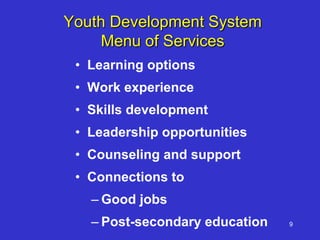
Youth Development System
Menu of Services
• Learning options

• Work experience
• Skills development
• Leadership opportunities
• Counseling and support
• Connections to

– Good jobs
– Post-secondary education

9
Youth Development System
Essential Characteristics
Unified vision and strategic plan
Active participation of youth in shaping the
system
Individual service strategy for each young
person
Coordinated access to all services
A follow-up capacity
Information sharing
Effective case management system
Accountability system with a continuous 10
improvement mechanism
The Challenge

How can community
partners work
together to build a
youth development
system?
11
First Steps
1. Recruit and convene the key
stakeholders in the community
 Build on previous, existing or
evolving collaborative efforts,
OR
 Form a new group
12
First Steps
2. Garner political support. Work
closely with:
 Local elected officials
 Municipal, county and state
government organizations and
agencies
13
First Steps
3. Create a shared vision
Who are the youth to be
served?
What is the purpose of the
youth service system?
What does the system hope to
accomplish?
14
First Steps
4. Collect and use data and
information for decision-making
What are the characteristics of
the youth in the community?
What do they want? What are
their experiences?
15
First Steps
5. Map and assess community services
and resources:
Services:
•What services are currently provided?
•Who provides them?
•Where are they located?
•How effective are the services?
•What are the gaps in service?
•What is the capacity of the service
16
First Steps
5. Map and assess community services
and resources (con’t) :
Resources:
•What are the total employment and
training resources?
•What are the total resources?
•Who controls them?
•How flexible are the resources?
•Are there additional resource
17
First Steps
6. Develop a strategic plan
Identify the goals that will be met
Develop strategies to achieve
goals
Create a timetable or action plan
Articulate roles and
responsibilities

18
System-Building Techniques and
Tips
 Use the Youth Council as a

community collaborative for
leadership, planning, leveraging
resources, implementation and
oversight.
 Keep all partners actively
engaged.
 Identify customized strategies for
working with employers, the school
19
System-Building Techniques and
Tips
 Overcome “turf” issues and
institutional barriers.
 Clearly define partner roles.
 Use existing resources
creatively.
 Provide consistent leadership.
 Create a system of
neighborhood hubs to reach out to

20
System-Building Techniques and
Tips
 Identify or develop an intermediary to

work with employers.
 Design and implement a capacity
building strategy for technical assistance
and provider development.
 Build systems and relationships
incrementally.
 Think BIG…but start small…but
START.
21
One Last
Thought…………..

Always remember that the
challenges you are facing are not
more difficult than the lives of the
many young people on whose
behalf you are working.
Karen Sitnick
Baltimore Office of
Employment

22

Youth development

  • 1.
    BUILDING A YOUTH DEVELOPMENTSYSTEM IN YOUR COMMUNITY John J. Heldrich Center for Workforce Development Rutgers, the State University of NewJersey National Youth Employment Coalition Sar Levitan Center for Social Policy Studies Johns Hopkins University May 2000
  • 2.
    Building a YouthDevelopment System: An Overview Youth Development Concepts & Principles A Youth Development System Definition Menu of Services Essential Characteristics System-Building Processes & Strategies 2
  • 3.
    Youth Development is... theprocess of moving from adolescence to adulthood. Positive youth development builds a young person’s cognitive, social, moral, emotional, physical and vocational competencies. 3
  • 4.
    Youth Development has... a dualfocus on building competencies for adulthood and meeting basic developmental needs for: •Safety and structure •Belonging and membership •Self-worth and an ability to contribute •Independence and control •Several nurturing relationships •Competence and mastery 4
  • 5.
    Principles of Youth Development •Communicate high expectations. • Build a sense of group membership. • Develop leadership ability. • Foster a sense of personal identity. • Broaden perspective; develop skills. • Provide structure and safe surroundings. 5
  • 6.
    Principles of Youth Development (cont’d) •Focus on the centrality of work. • Cultivate positive peer support. • Connect youth with caring adults; maintain the continuity of contact. • Offer sustained supports over an extended period of time. 6
  • 7.
    A Youth DevelopmentSystem • Definition • Menu of Services • Essential Characteristics 7
  • 8.
    A Youth DevelopmentSystem is... a series of partnerships or connections among organizations to plan and deliver a menu of services based on youth development principles. 8
  • 9.
    Youth Development System Menuof Services • Learning options • Work experience • Skills development • Leadership opportunities • Counseling and support • Connections to – Good jobs – Post-secondary education 9
  • 10.
    Youth Development System EssentialCharacteristics Unified vision and strategic plan Active participation of youth in shaping the system Individual service strategy for each young person Coordinated access to all services A follow-up capacity Information sharing Effective case management system Accountability system with a continuous 10 improvement mechanism
  • 11.
    The Challenge How cancommunity partners work together to build a youth development system? 11
  • 12.
    First Steps 1. Recruitand convene the key stakeholders in the community  Build on previous, existing or evolving collaborative efforts, OR  Form a new group 12
  • 13.
    First Steps 2. Garnerpolitical support. Work closely with:  Local elected officials  Municipal, county and state government organizations and agencies 13
  • 14.
    First Steps 3. Createa shared vision Who are the youth to be served? What is the purpose of the youth service system? What does the system hope to accomplish? 14
  • 15.
    First Steps 4. Collectand use data and information for decision-making What are the characteristics of the youth in the community? What do they want? What are their experiences? 15
  • 16.
    First Steps 5. Mapand assess community services and resources: Services: •What services are currently provided? •Who provides them? •Where are they located? •How effective are the services? •What are the gaps in service? •What is the capacity of the service 16
  • 17.
    First Steps 5. Mapand assess community services and resources (con’t) : Resources: •What are the total employment and training resources? •What are the total resources? •Who controls them? •How flexible are the resources? •Are there additional resource 17
  • 18.
    First Steps 6. Developa strategic plan Identify the goals that will be met Develop strategies to achieve goals Create a timetable or action plan Articulate roles and responsibilities 18
  • 19.
    System-Building Techniques and Tips Use the Youth Council as a community collaborative for leadership, planning, leveraging resources, implementation and oversight.  Keep all partners actively engaged.  Identify customized strategies for working with employers, the school 19
  • 20.
    System-Building Techniques and Tips Overcome “turf” issues and institutional barriers.  Clearly define partner roles.  Use existing resources creatively.  Provide consistent leadership.  Create a system of neighborhood hubs to reach out to 20
  • 21.
    System-Building Techniques and Tips Identify or develop an intermediary to work with employers.  Design and implement a capacity building strategy for technical assistance and provider development.  Build systems and relationships incrementally.  Think BIG…but start small…but START. 21
  • 22.
    One Last Thought………….. Always rememberthat the challenges you are facing are not more difficult than the lives of the many young people on whose behalf you are working. Karen Sitnick Baltimore Office of Employment 22