   Introductions

   CCEDNet’s Emerging Leaders

   Aboriginal Youth and CED in Canada

   How to make it happen in your own
    community

   Closing remarks & questions
Your   Name

   What you do/ Where you work

   Tell us something about youth in your community

One    thing you’d like to take away from this session
PURPOSE:
  “…to increase the number
  and quality of young
  practitioners entering into the
  CED field and ensuring an
  active and meaningful voice
  in CCEDNet.”
GOAL:
  “…to build a national
  movement of youth who are
  passionate about the future
  of their communities”
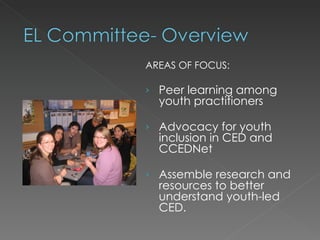
AREAS OF FOCUS:

›   Peer learning among
    youth practitioners

›   Advocacy for youth
    inclusion in CED and
    CCEDNet

›   Assemble research and
    resources to better
    understand youth-led
    CED.
Peer Learning Network
   Approximately 200 members

Standing Committee of CCEDNet
   Members volunteer for 1 year terms (June to
    June)
   In 2008-2009: 15 Members & 1 Support Staff
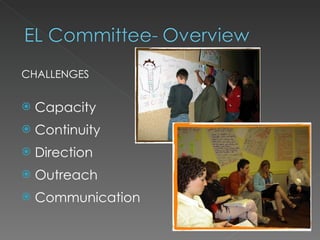
CHALLENGES


   Capacity
   Continuity
   Direction
   Outreach
   Communication
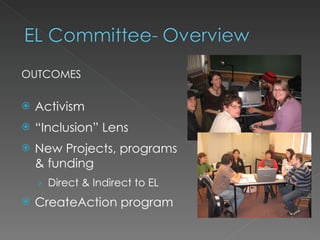
OUTCOMES

   Activism
   “Inclusion” Lens
   New Projects, programs
    & funding
    › Direct & Indirect to EL
   CreateAction program
   2008 CED National Conference
    › Exploring youth engagement in social
     enterprise in Canada with:
       “Youth and Social Enterprise in Canada”
       “Youth Engagement and Leadership in CED”


   4th World Youth Congress, Quebec City
    › “Youth and Social Enterprise in Canada”
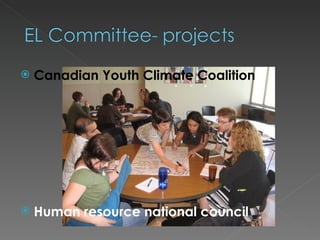
   Canadian Youth Climate Coalition


   Human resource national council
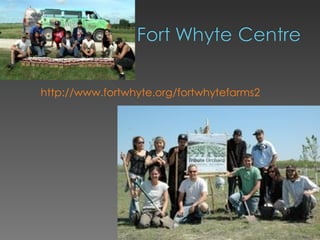
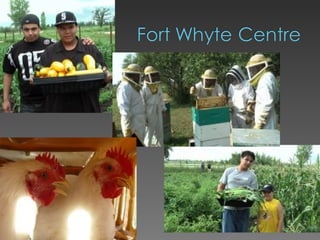
 Fort Whyte Centre in Winnipeg, Manitoba


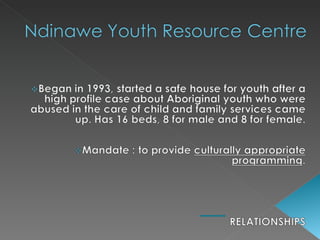
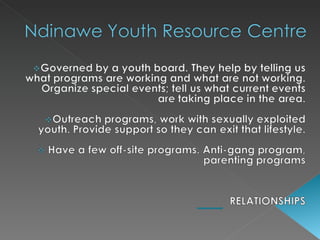
Ndinawe Youth Resource Centre in Manitoba


Garden River First Nations in Garden River,
 Ontario
http://www.fortwhyte.org/fortwhytefarms2
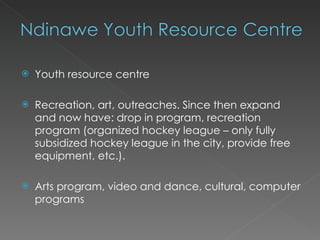
   Youth resource centre

   Recreation, art, outreaches. Since then expand
    and now have: drop in program, recreation
    program (organized hockey league – only fully
    subsidized hockey league in the city, provide free
    equipment, etc.).

   Arts program, video and dance, cultural, computer
    programs
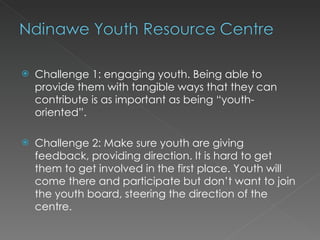
   Challenge 1: engaging youth. Being able to
    provide them with tangible ways that they can
    contribute is as important as being “youth-
    oriented”.

   Challenge 2: Make sure youth are giving
    feedback, providing direction. It is hard to get
    them to get involved in the first place. Youth will
    come there and participate but don’t want to join
    the youth board, steering the direction of the
    centre.
   Success factor: being able to sustain themselves,
    instead of focusing on programs, outputs, inputs,
    tangible measurable things, focus on relationships.
    Every staff person – programming is secondary.

   First role is to build healthy relationships with youth
    and show that we genuinely and legitimately care
    about them. On an average basis have 80-100 kids
    who come into the programs. Know the kids well.
   That social activity was great to get people out
    and start to realize that we have a lot of strengths
    in community, worthwhile.
 
   It was driven by negative things coming into the
    forefront. Parents having to pay respects to
    children – didn’t want to have to get to point to
    having to say goodbye to children because they
    are dying. A lot of people are quick to step up to
    the plate in terms of changes. Since then a few
    different committees that have started up.
 
   Having a consistent bi-weekly meeting and being
    able to maintain the community is important. All of
    the representatives from the leadership right down
    to youth. Great experience so far, hasn’t been all
    rosy because struggles at the end of the day.

   Energy level isn’t as high as it used to be. Try to be
    more persistent and steadfast in keeping this type
    of group together to help with programming and
    healthy alternatives for kids but also the parents,
    elders … all offer positive things that we can use in
    terms of building healthy communities.
   Break into small groups

Identify which of the 3 highlighted projects could
work in your community

Role    Play- Talking to Funders and Community Partners

       How to ask questions and build relationships

   Share it with the rest of us!
Aboriginal Youth And CED in Canada