Welcome to Social Media Fire Prevention
Learning Objectives
• Overview of what should be included in a Social Media Policy (Guidelines)
• Examples of what policy should and should not include
• Case study examples
• Resources to help you create a social media policy
• Ways to educate employees about the security risks of using social networking
• Best practices for implementing a social media policy
Virtual
Reality
Is now a
reality!
Drones
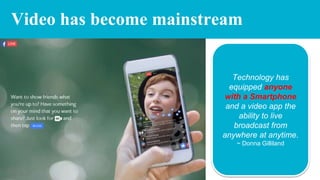
Video has become mainstream
Technology has
equipped anyone
with a Smartphone
and a video app the
ability to live
broadcast from
anywhere at anytime.
~ Donna Gilliland
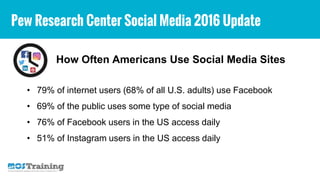
Pew Research Center Social Media 2016 Update
• 79% of internet users (68% of all U.S. adults) use Facebook
• 69% of the public uses some type of social media
• 76% of Facebook users in the US access daily
• 51% of Instagram users in the US access daily
How Often Americans Use Social Media Sites
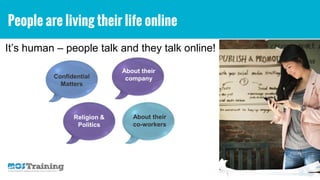
It’s human – people talk and they talk online!
People are living their life online
Confidential
Matters
About their
company
Religion &
Politics
About their
co-workers
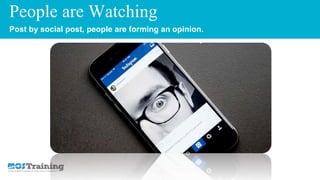
People are Watching
Post by social post, people are forming an opinion.
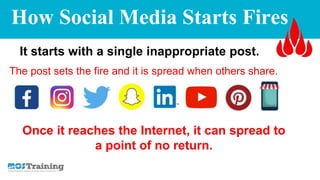
How Social Media Starts Fires
It starts with a single inappropriate post.
The post sets the fire and it is spread when others share.
Once it reaches the Internet, it can spread to
a point of no return.
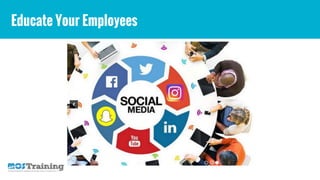
Educate Your Employees
Reasons to Educate Employees
• Legal and security risks to both the company
and the employee
• Appropriate use of social media at work
• Do’s and Don’ts of posting and commenting
• Who to contact within the company when in
doubt about posting
Teach Your Employees
Social Fundamentals
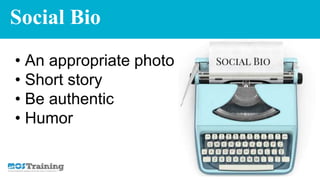
Social Bio
• An appropriate photo
• Short story
• Be authentic
• Humor
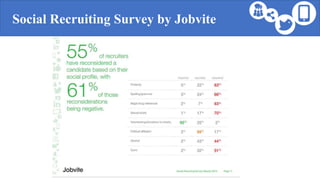
Social Recruiting Survey by Jobvite
Professional Photos
Don’t post these type photos
Think before you post.
What would your Mother say?
Friends have friends
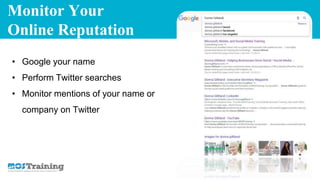
Monitor Your
Online Reputation
• Google your name
• Perform Twitter searches
• Monitor mentions of your name or
company on Twitter
Social Profile General Guidelines
• A picture speaks a 1000 words.
Include an appropriate photo.
Dress appropriately.
• Check existing social profiles for content that could
be viewed inappropriate.
Write your bio with thought.
Never make negative comments about your
personal life or friends.
Don’t reveal confidential information about your
company’s business operations.
Be positive about your company and co-workers.
Avoid name calling and criticism of others.
General Posting Guidelines
1
2
3
4
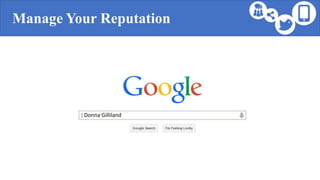
Manage Your Reputation
Donna Gilliland
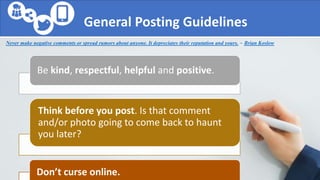
General Posting Guidelines
Be kind, respectful, helpful and positive.
Think before you post. Is that comment
and/or photo going to come back to haunt
you later?
Don’t curse online.
Never make negative comments or spread rumors about anyone. It depreciates their reputation and yours. ~ Brian Koslow
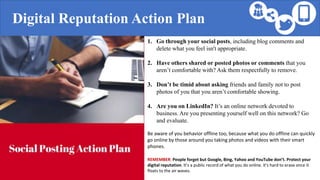
Digital Reputation Action Plan
1. Go through your social posts, including blog comments and
delete what you feel isn't appropriate.
2. Have others shared or posted photos or comments that you
aren’t comfortable with? Ask them respectfully to remove.
3. Don’t be timid about asking friends and family not to post
photos of you that you aren’t comfortable showing.
4. Are you on LinkedIn? It’s an online network devoted to
business. Are you presenting yourself well on this network? Go
and evaluate.
Be aware of you behavior offline too, because what you do offline can quickly
go online by those around you taking photos and videos with their smart
phones.
REMEMBER: People forget but Google, Bing, Yahoo and YouTube don’t. Protect your
digital reputation. It's a public record of what you do online. It's hard to erase once it
floats to the air waves.
Do you need a Social Media Policy
if your company isn’t using social
media?
YES
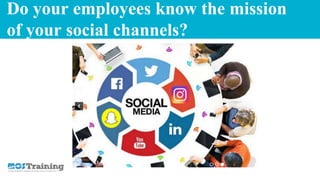
Do your employees know the mission
of your social channels?
Small or Large
Social Media Policies and Guidelines are Important
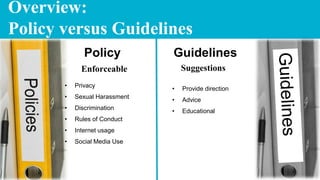
Overview:
Policy versus Guidelines
Policy Guidelines
• Privacy
• Sexual Harassment
• Discrimination
• Rules of Conduct
• Internet usage
• Social Media Use
SuggestionsEnforceable
• Provide direction
• Advice
• Educational
Why have a
social media
policy?
What the legal experts say…
• Educate Employees
• Protect your company from possible
litigation
• Protect your employees
Benefits
• Protect your company’s reputation.
• Clearly define how your company is
using social media.
• Protect your company from possible
litigation by covering legal issues.
• Code of Conduct.
• Define reporting roles.
• Guidelines for social media managers
on to how to handle negative online
commentary.
• Use of social media on company time.
• Define ways employees can help the
company raise brand awareness.
Know the Laws
There are a number of Federal laws that are
associated with the use of online tools, such as
social media. Seek legal counsel so that you know
those laws before implementing a policy with
restrictions that are unlawful.
National Labor Relations Board
& Social Media
The NLRB and Social Media
The National Labor Relations Act protects the rights
of employees to act together to address conditions at
work, with or without a union. This protection extends
to certain work-related conversations conducted on
social media, such as Facebook and Twitter.
~ National Labor Relations Board Article
Protected Concerted Activity
NLRB Social Media Report
•Employer policies should not be so sweeping that they prohibit the
kinds of activity protected by federal labor law, such as the
discussion of wages or working conditions among employees.
•An employee’s comments on social media are generally not
protected if they are mere gripes not made in relation to group
activity among employees.
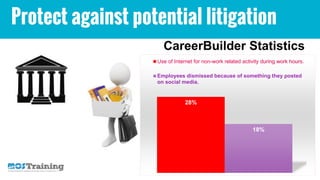
Protect against potential litigation
CareerBuilder Statistics
28%
18%
Use of Internet for non-work related activity during work hours.
Employees dismissed because of something they posted
on social media.
Keep your social media policies and guidelines updated
• Technology is constantly changing.
• New ways to use existing social platforms are evolving rapidly.
• Update policies to address new technologies and new features of
existing social platforms.
• New issues that weren’t covered in prior policy.
Example: Live streaming can violate copyright laws. For example, are your
employees filming an event? That can be a copyright infringement.
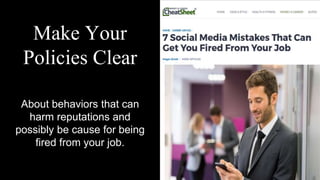
Make Your
Policies Clear
About behaviors that can
harm reputations and
possibly be cause for being
fired from your job.
Ways to Provide
Education
Why it’s necessary
• Meet with employees to go over
current social media policy.
• The benefits and negatives to what
they posting.
• How your company uses social
networks.
• How employees can assist.
“Having a social media policy—and training employees to follow it—
are critical practices for every organization.”
~ Aliah D. Wright, Editor/Manager for SHRM Online (Society for Human Resource
Management)
Ways to Educate
Employees
• New Hire orientation
• Ongoing professional development
workshops
• E-book
• Training videos that are accessible
to all employees
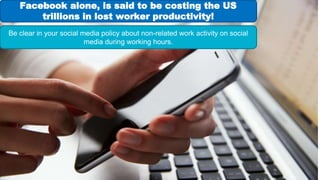
Facebook alone, is said to be costing the US
trillions in lost worker productivity!
Be clear in your social media policy about non-related work activity on social
media during working hours.
Social Media Policy Case
Study
Wal-Mart
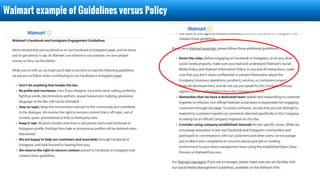
Walmart example of Guidelines versus Policy
The Don’ts
Social Media Policy
• Don’t restrict concerted activity.*
• Don’t ignore the privacy laws.**
** Several US States have passed legislation banning employer
access to workers’ social media accounts. This list will
probably continue to grow.
* See National Labor Relations Board (NLRB)
UPS Case Study
Social Media Policy and Guidelines
UPS
Social Media
Guideline Goals
• Provide direction for employees
who post content on the Internet.
• Establish guidelines for behavior.
• Ensure that employees’ post will not
expose either the employee of the
company to legal problems or
embarrassment.
• When an employee should identify
himself/herself as a representative of
the company on a social networking
web site, as well as what types of
information can be shared.
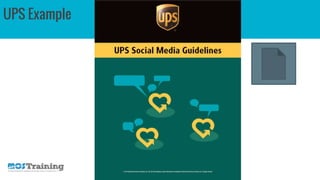
UPS Example
Education Points
• Meet with employees to go over
current social media policy.
• The benefits and negatives to what
they are posting.
• How your company uses social
networks.
• How employees can assist.
• Social Media Lunch and Learns.
• Video Training.
• Invite Speakers versed in social
media training.
Additional Ways
to Educate
• New Hire orientation
• Ongoing professional development
workshops
• E-book
• Training videos that are accessible
to all employees
Development
Resources
• SBA (Small Business Administration)
• SHRM (Society for Human Resource Management)
• Social Media 101 Policy by SHRM
• Jaffe PR Social Media Policy Template
• UPS Social Media Guidelines
Blog Articles
Social Media Policy
• SproutSocial’s Your Guide to
Creating a Social Media Policy
• HootSuite’s How to Write a Social
Media Policy for Employees
• HootSuite’s How to Create Social
Media Guidelines for Your
Business
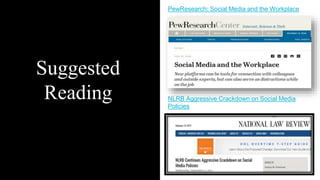
Suggested
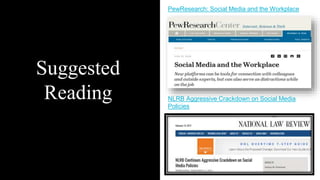
Reading NLRB Aggressive Crackdown on Social Media
Policies
PewResearch: Social Media and the Workplace
Sources
• SBA (Small Business Administration)
• SHRM (Society for Human Resource Management)
• Social Media Governance
Suggested
Reading NLRB Aggressive Crackdown on Social Media
Policies
PewResearch: Social Media and the Workplace
Legal E’s
• Review the National Labor Relations
Act
• Make certain your Social Media
guidelines don’t violate the NLRA
• Send your SMP to an attorney for legal
review
Suggestions
Legal Disclaimer
LEGAL DISCLAIMER:
The training provided in this session is not to be interpreted as legal advice.
The goal of this training is to educate businesses to the importance of educating employees in
the use of social media and creating a Social Media Policy to provide employees
Let’s Review
Review Points
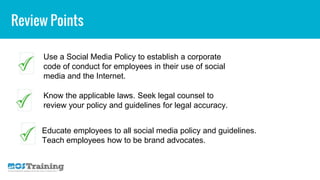
Use a Social Media Policy to establish a corporate
code of conduct for employees in their use of social
media and the Internet.
Know the applicable laws. Seek legal counsel to
review your policy and guidelines for legal accuracy.
Educate employees to all social media policy and guidelines.
Teach employees how to be brand advocates.
Review Points Continued…
Use resources such as the SBA and SHRM to stay
up-to-date on labor relations laws and regulations.
Keep your social media policies and guidelines
updated.
Let’s Stay Connected…
www.MOSTraining.com
Train@MOSTraining.com

Social Media Fire Prevention

  • 1.
    Welcome to SocialMedia Fire Prevention
  • 2.
    Learning Objectives • Overviewof what should be included in a Social Media Policy (Guidelines) • Examples of what policy should and should not include • Case study examples • Resources to help you create a social media policy • Ways to educate employees about the security risks of using social networking • Best practices for implementing a social media policy
  • 3.
  • 4.
  • 5.
    Video has becomemainstream Technology has equipped anyone with a Smartphone and a video app the ability to live broadcast from anywhere at anytime. ~ Donna Gilliland
  • 6.
    Pew Research CenterSocial Media 2016 Update • 79% of internet users (68% of all U.S. adults) use Facebook • 69% of the public uses some type of social media • 76% of Facebook users in the US access daily • 51% of Instagram users in the US access daily How Often Americans Use Social Media Sites
  • 7.
    It’s human –people talk and they talk online! People are living their life online Confidential Matters About their company Religion & Politics About their co-workers
  • 8.
    People are Watching Postby social post, people are forming an opinion.
  • 9.
    How Social MediaStarts Fires It starts with a single inappropriate post. The post sets the fire and it is spread when others share. Once it reaches the Internet, it can spread to a point of no return.
  • 10.
  • 11.
    Reasons to EducateEmployees • Legal and security risks to both the company and the employee • Appropriate use of social media at work • Do’s and Don’ts of posting and commenting • Who to contact within the company when in doubt about posting
  • 12.
  • 13.
    Social Bio • Anappropriate photo • Short story • Be authentic • Humor
  • 14.
  • 15.
  • 16.
    Don’t post thesetype photos
  • 17.
    Think before youpost. What would your Mother say?
  • 18.
  • 19.
    Monitor Your Online Reputation •Google your name • Perform Twitter searches • Monitor mentions of your name or company on Twitter
  • 20.
    Social Profile GeneralGuidelines • A picture speaks a 1000 words. Include an appropriate photo. Dress appropriately. • Check existing social profiles for content that could be viewed inappropriate. Write your bio with thought.
  • 21.
    Never make negativecomments about your personal life or friends. Don’t reveal confidential information about your company’s business operations. Be positive about your company and co-workers. Avoid name calling and criticism of others. General Posting Guidelines 1 2 3 4
  • 22.
  • 23.
    General Posting Guidelines Bekind, respectful, helpful and positive. Think before you post. Is that comment and/or photo going to come back to haunt you later? Don’t curse online. Never make negative comments or spread rumors about anyone. It depreciates their reputation and yours. ~ Brian Koslow
  • 24.
    Digital Reputation ActionPlan 1. Go through your social posts, including blog comments and delete what you feel isn't appropriate. 2. Have others shared or posted photos or comments that you aren’t comfortable with? Ask them respectfully to remove. 3. Don’t be timid about asking friends and family not to post photos of you that you aren’t comfortable showing. 4. Are you on LinkedIn? It’s an online network devoted to business. Are you presenting yourself well on this network? Go and evaluate. Be aware of you behavior offline too, because what you do offline can quickly go online by those around you taking photos and videos with their smart phones. REMEMBER: People forget but Google, Bing, Yahoo and YouTube don’t. Protect your digital reputation. It's a public record of what you do online. It's hard to erase once it floats to the air waves.
  • 25.
    Do you needa Social Media Policy if your company isn’t using social media? YES
  • 26.
    Do your employeesknow the mission of your social channels?
  • 27.
    Small or Large SocialMedia Policies and Guidelines are Important
  • 28.
    Overview: Policy versus Guidelines PolicyGuidelines • Privacy • Sexual Harassment • Discrimination • Rules of Conduct • Internet usage • Social Media Use SuggestionsEnforceable • Provide direction • Advice • Educational
  • 29.
    Why have a socialmedia policy? What the legal experts say… • Educate Employees • Protect your company from possible litigation • Protect your employees
  • 30.
    Benefits • Protect yourcompany’s reputation. • Clearly define how your company is using social media. • Protect your company from possible litigation by covering legal issues. • Code of Conduct. • Define reporting roles. • Guidelines for social media managers on to how to handle negative online commentary. • Use of social media on company time. • Define ways employees can help the company raise brand awareness.
  • 31.
    Know the Laws Thereare a number of Federal laws that are associated with the use of online tools, such as social media. Seek legal counsel so that you know those laws before implementing a policy with restrictions that are unlawful.
  • 32.
    National Labor RelationsBoard & Social Media The NLRB and Social Media The National Labor Relations Act protects the rights of employees to act together to address conditions at work, with or without a union. This protection extends to certain work-related conversations conducted on social media, such as Facebook and Twitter. ~ National Labor Relations Board Article Protected Concerted Activity
  • 33.
    NLRB Social MediaReport •Employer policies should not be so sweeping that they prohibit the kinds of activity protected by federal labor law, such as the discussion of wages or working conditions among employees. •An employee’s comments on social media are generally not protected if they are mere gripes not made in relation to group activity among employees.
  • 34.
    Protect against potentiallitigation CareerBuilder Statistics 28% 18% Use of Internet for non-work related activity during work hours. Employees dismissed because of something they posted on social media.
  • 35.
    Keep your socialmedia policies and guidelines updated • Technology is constantly changing. • New ways to use existing social platforms are evolving rapidly. • Update policies to address new technologies and new features of existing social platforms. • New issues that weren’t covered in prior policy. Example: Live streaming can violate copyright laws. For example, are your employees filming an event? That can be a copyright infringement.
  • 36.
    Make Your Policies Clear Aboutbehaviors that can harm reputations and possibly be cause for being fired from your job.
  • 37.
    Ways to Provide Education Whyit’s necessary • Meet with employees to go over current social media policy. • The benefits and negatives to what they posting. • How your company uses social networks. • How employees can assist. “Having a social media policy—and training employees to follow it— are critical practices for every organization.” ~ Aliah D. Wright, Editor/Manager for SHRM Online (Society for Human Resource Management)
  • 38.
    Ways to Educate Employees •New Hire orientation • Ongoing professional development workshops • E-book • Training videos that are accessible to all employees
  • 39.
    Facebook alone, issaid to be costing the US trillions in lost worker productivity! Be clear in your social media policy about non-related work activity on social media during working hours.
  • 40.
    Social Media PolicyCase Study Wal-Mart
  • 42.
    Walmart example ofGuidelines versus Policy
  • 43.
    The Don’ts Social MediaPolicy • Don’t restrict concerted activity.* • Don’t ignore the privacy laws.** ** Several US States have passed legislation banning employer access to workers’ social media accounts. This list will probably continue to grow. * See National Labor Relations Board (NLRB)
  • 44.
    UPS Case Study SocialMedia Policy and Guidelines
  • 45.
    UPS Social Media Guideline Goals •Provide direction for employees who post content on the Internet. • Establish guidelines for behavior. • Ensure that employees’ post will not expose either the employee of the company to legal problems or embarrassment. • When an employee should identify himself/herself as a representative of the company on a social networking web site, as well as what types of information can be shared.
  • 46.
  • 47.
    Education Points • Meetwith employees to go over current social media policy. • The benefits and negatives to what they are posting. • How your company uses social networks. • How employees can assist. • Social Media Lunch and Learns. • Video Training. • Invite Speakers versed in social media training.
  • 48.
    Additional Ways to Educate •New Hire orientation • Ongoing professional development workshops • E-book • Training videos that are accessible to all employees
  • 49.
    Development Resources • SBA (SmallBusiness Administration) • SHRM (Society for Human Resource Management) • Social Media 101 Policy by SHRM • Jaffe PR Social Media Policy Template • UPS Social Media Guidelines
  • 50.
    Blog Articles Social MediaPolicy • SproutSocial’s Your Guide to Creating a Social Media Policy • HootSuite’s How to Write a Social Media Policy for Employees • HootSuite’s How to Create Social Media Guidelines for Your Business
  • 51.
    Suggested Reading NLRB AggressiveCrackdown on Social Media Policies PewResearch: Social Media and the Workplace
  • 52.
    Sources • SBA (SmallBusiness Administration) • SHRM (Society for Human Resource Management) • Social Media Governance
  • 53.
    Suggested Reading NLRB AggressiveCrackdown on Social Media Policies PewResearch: Social Media and the Workplace
  • 54.
    Legal E’s • Reviewthe National Labor Relations Act • Make certain your Social Media guidelines don’t violate the NLRA • Send your SMP to an attorney for legal review Suggestions
  • 55.
    Legal Disclaimer LEGAL DISCLAIMER: Thetraining provided in this session is not to be interpreted as legal advice. The goal of this training is to educate businesses to the importance of educating employees in the use of social media and creating a Social Media Policy to provide employees
  • 56.
  • 57.
    Review Points Use aSocial Media Policy to establish a corporate code of conduct for employees in their use of social media and the Internet. Know the applicable laws. Seek legal counsel to review your policy and guidelines for legal accuracy. Educate employees to all social media policy and guidelines. Teach employees how to be brand advocates.
  • 58.
    Review Points Continued… Useresources such as the SBA and SHRM to stay up-to-date on labor relations laws and regulations. Keep your social media policies and guidelines updated.
  • 60.

Editor's Notes

  • #6 Smartphones have enabled people to have a TV in their pocket that they can turn on and broadcast at anytime.
  • #7 People on social media without knowledge. They post without thought or purpose. Many post whatever is on their mind, without realizing that potential harm them personally as well as to their company.
  • #8 It’s human – people talk. They talk about their likes and dislikes, about their company, the people within, the products they produce and about confidential matters that can result in a serious security breach. The digital age has given anyone with a smartphone and a social media account the ability to release their conversations to the world in a matter of seconds. Every tweet, like, share, photo and video sent out via social channels is going live and staying online for years. A social media policy can help protect your brand, minimize litigation issues and educate your to company guidelines for use of social media where it involves the company. Social Media Guidelines should be written to protect both the Company and the Employee.
  • #10 Like a fire starts with a single match, a social fire can start with a single post. They don’t always stay contained, they often reach the Web where it spreads like wild fire every where.
  • #12 Trade secrets, security
  • #16 Drinking
  • #17 Drinking
  • #28 Whether your are a company of 1 or 1000, having a set of operating guidelines for social media is important. Rather than wait until issues arise, document now how they should be handled by you or anyone that you might employ, even if the employ is a contractor. via social media policy and associated guidelines. If you are just starting your business and you are new to social media, it is critical that you obtain the training needed to become skilled in the use of digital media.
  • #30 Source Article: https://lawpath.com.au/blog/why-you-should-have-a-social-media-policy NOTE: Lawpath is a legal agency and one of their areas of expertise is helping companies create social media policies. This article should be no means be considered as a promotion for Lawpath. This article has been included as a learning resource for you as you move forward with creating your Social Media Policy/Guidelines. Legal questions should be referred to your own legal counsel. Educate Employees
  • #31 Various industries have their own set of laws to abide by and these legal issues should be covered within the Social Media Policy. Laws about financial disclosures, banks have Federal regulations to abide by. Policy should address legal issues unique to the industry and how those laws can be upheld by those using social media. Cover the legal issues associated with copyrighted materials from the Web.
  • #33 Article: https://www.nlrb.gov/news-outreach/fact-sheets/nlrb-and-social-media
  • #35 In fact, 28 percent of employers report that they've fired people for using the Internet for non-work-related activity (such as shopping online or checking out Facebook, for example) during the workday and 18 percent have dismissed employees because of something they posted on social media, according to CareerBuilder. http://www.cnbc.com/2016/02/05/how-using-social-media-can-get-you-fired.html Published in February of 2016.
  • #37 Source CheatSheet: http://www.cheatsheet.com/money-career/7-social-media-mistakes-that-can-get-you-fired-from-your-job.html/
  • #38 It cannot be assumed that your employees understand the benefits and negatives to using social media networks. Inform employees what types of posts would be in violation of company policy and security.
  • #43 http://corporate.walmart.com/policies
  • #44 Article Reference: http://www.managedbenefits.com/compliance-news/the-dos-and-donts-of-social-media-policy
  • #46 UPS Social Media Guideline Goals Quote: Social media guidelines provide direction for employees who post content on the Internet either as part of their job or as a private person. The goal of these guidelines is to set expectations for appropriate behavior and ensure that our employees’ posts will not expose either the employee or UPS to legal problems or public embarrassment. These guidelines address when an employee should identify himself/herself as a representative of the company on a social networking web site, as well as what types of information can be shared. ~ UPS
  • #47 UPS created a Social Media Guidelines eBook which employees can download.
  • #48 It cannot be assumed that your employees understand the benefits and negatives to using social media networks. Inform employees what types of posts would be in violation of company policy and security.
  • #50 https://www.sba.gov/blogs/how-craft-social-media-policy-your-small-business http://www.jaffepr.com/policy-templates/social-media-policy-template
  • #52 Pew Research Center: http://www.pewinternet.org/2016/06/22/social-media-and-the-workplace/
  • #53 https://www.sba.gov/blogs/how-craft-social-media-policy-your-small-business http://socialmediagovernance.com/policies/ Coca-Cola official spokes people are required to go through a Social Media Certification program. Coca-Cola encourages simplicity. Empower assoicates to be able to communicate and not to much rope to than theirselves. NOTE: how to interact with people online that say something about your company. UPS: http://makeupsdeliver.org/wp-content/uploads/UPS_Social_Media_Guidelines.pdf has a Guidelines PDF
  • #54 Pew Research Center: http://www.pewinternet.org/2016/06/22/social-media-and-the-workplace/ National Law Review http://www.natlawreview.com/article/nlrb-continues-aggressive-crackdown-social-media-policies
  • #55 Photo of Law symbol Image of people on smartphones social media The Law is still evolving where social media is concerned. Unless we are an attorney, experienced in law, among which would include the National Labor Relations Act, we are at a higher risk of unknowingly writing rules that infringe upon free speech and writing polices that are too broad for interpretation. rules for employees, which might not stand up in a court of law if sued. Lawsuits have been won on the basis that terminology was too broad for an employee to have clarity as to whether they were breaking a company rule. Examples of vague wording as ruled by the NLRA: "An employee should not refer to the company if the employee’s posting is inconsistent with or would harm the company’s brand or reputation.“ "Even if conducted off company property and on personal time, any posting that has the potential to have a negative impact on the company, might be subject to disciplinary action.“ "Videos and/or photos which are recorded on the company’s premises may not be posted without the company’s permission." Source article: https://www.entrepreneur.com/article/232473 Title: Writing Social Media Guidelines for Your Company? Tread Carefully. Author: https://www.entrepreneur.com/author/arkady-bukh