







Your browser, my storage
a new approach on data storing   (v.1.3)


Francesco Fullone
ff AT ideato.it
Who am I

Francesco Fullone aka Fullo

- PHP developer since 1999
-               President
-         and     Evangelist
- CEO @
- founder @
- Nerd and geek
What we want is a lot of storage space, on
the client, that persists beyond a page
refresh and isn’t transmitted to the server.


                                ~ M. Pilgrim
Persistent local storage is one of
     the areas where client
  applications traditionally win
    against web applications.
A jump in the past
http://qrurl.it/r/3l


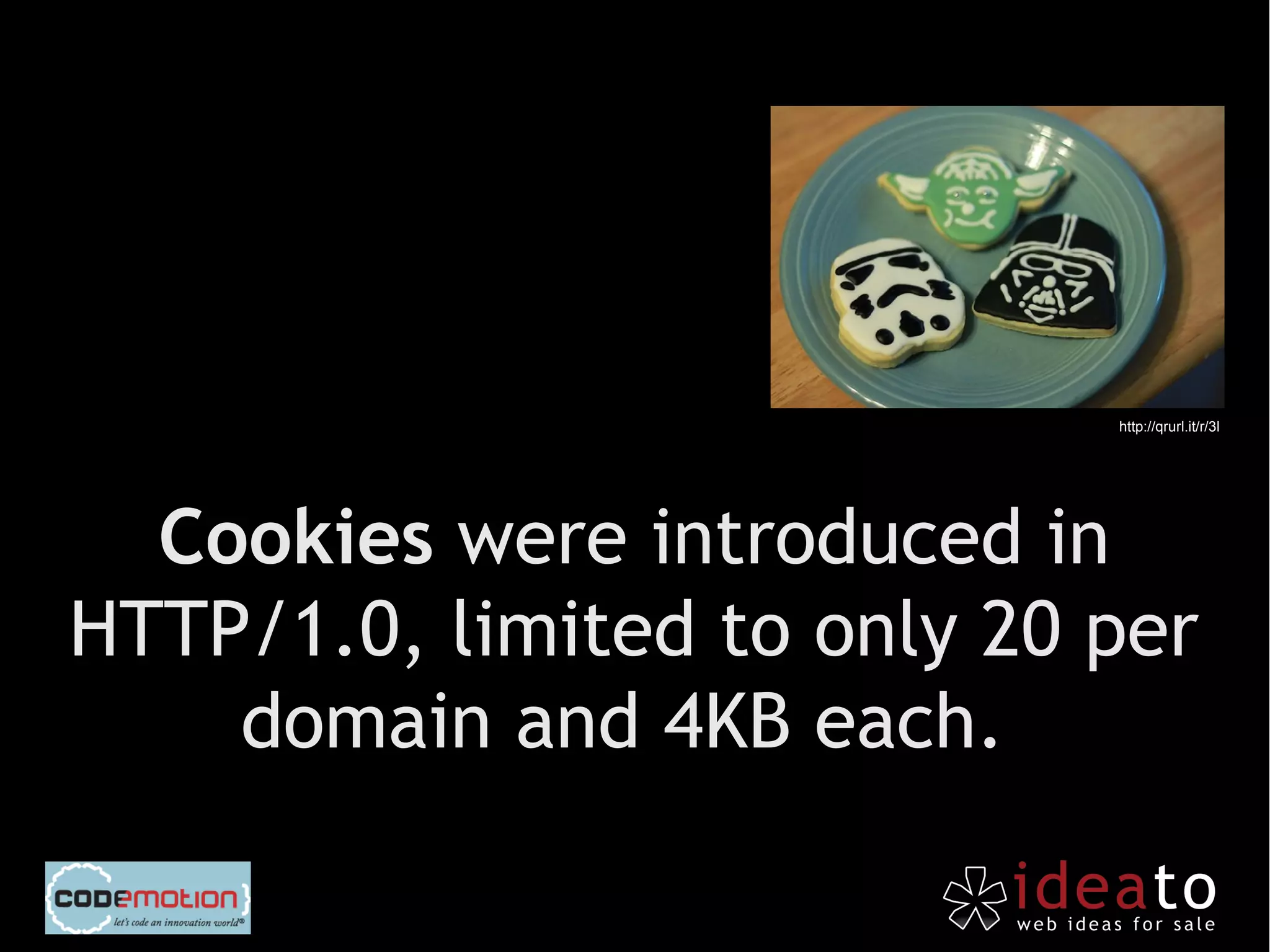
  Cookies were introduced in
HTTP/1.0, limited to only 20 per
    domain and 4KB each.
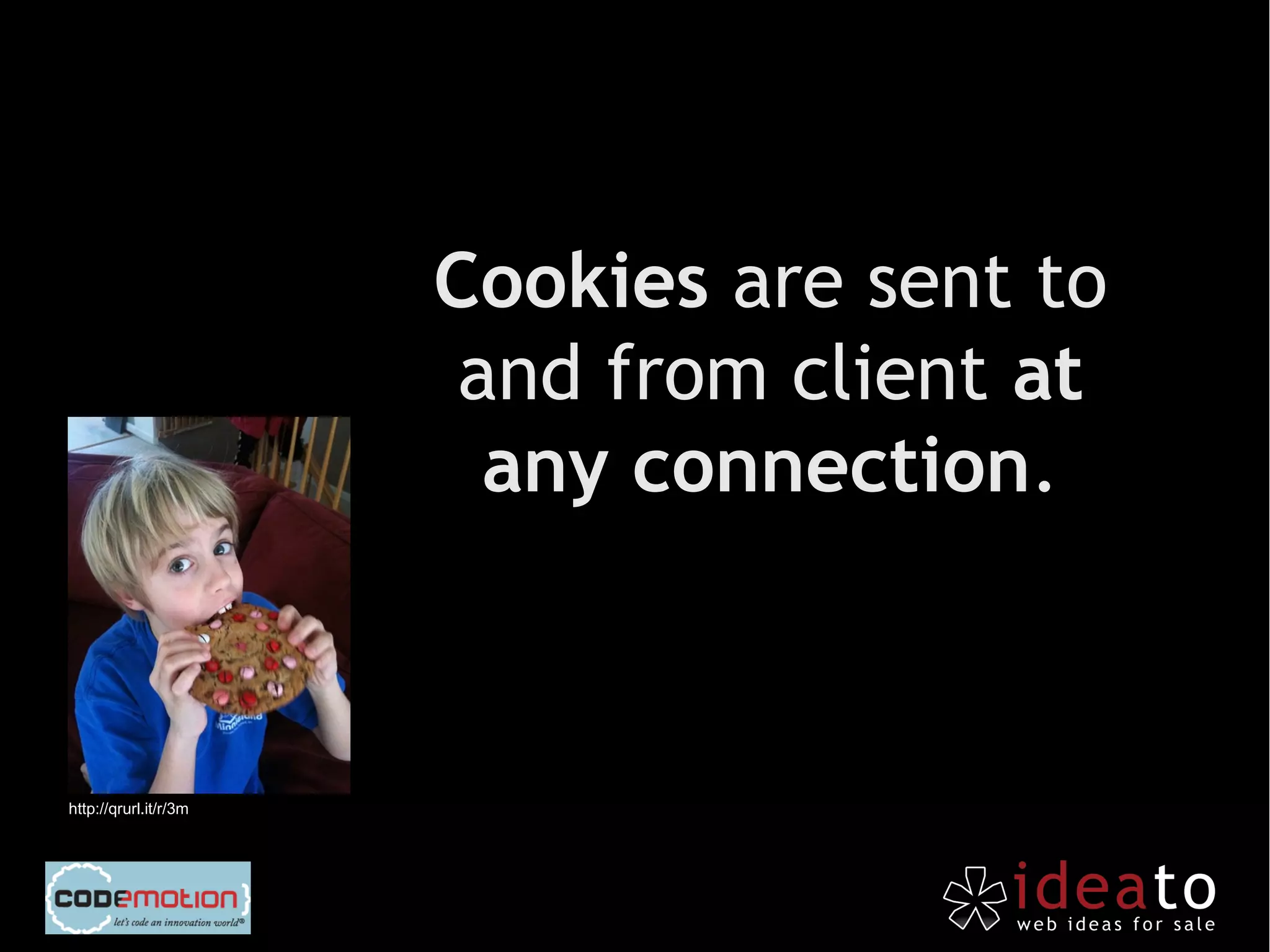
Cookies are sent to
                        and from client at
                         any connection.


http://qrurl.it/r/3m
Microsoft with Internet Explorer 6
   introduced dHTML and the
userData API to store up to 64KB
             of data
Mozilla introduced with Firefox 2
the DOM Storage API, it will then
     know as Web Storage.
In 2002 Adobe
                          created the
                    Flash Cookies aka
  “Local Shared Objects” for Flash 6
Data storage increased to 100KB but it
              was difficult to be used
With Flash 8, in 2006,
 Adobe introduced the
  ExternalInterface
 to allow Js to access
to the stored resources.
Between 2005 and 2007
 dojox.storage was written by
  Brad Neuberg as a Js->Flash
bridge to manage bigger chunks
           of data

      (with user prompt over 1MB).
Google created Gears in 2007,
 that introduced a database
paradigm (based on SQLite) to
  solve the storage problem.
BUT
All these storage systems had
  different APIs, a common
platform is needed by all the
       browser vendors.
The two approaches of storing:
      Application Cache
       Offline storage
Application Caching involves
saving the application's core logic
       and user-interface.

           http://qrurl.it/r/3g
It is enabled by a file .appcache
  that declares which resources
     have to be saved locally.

       (theoretically limited to 5MB).
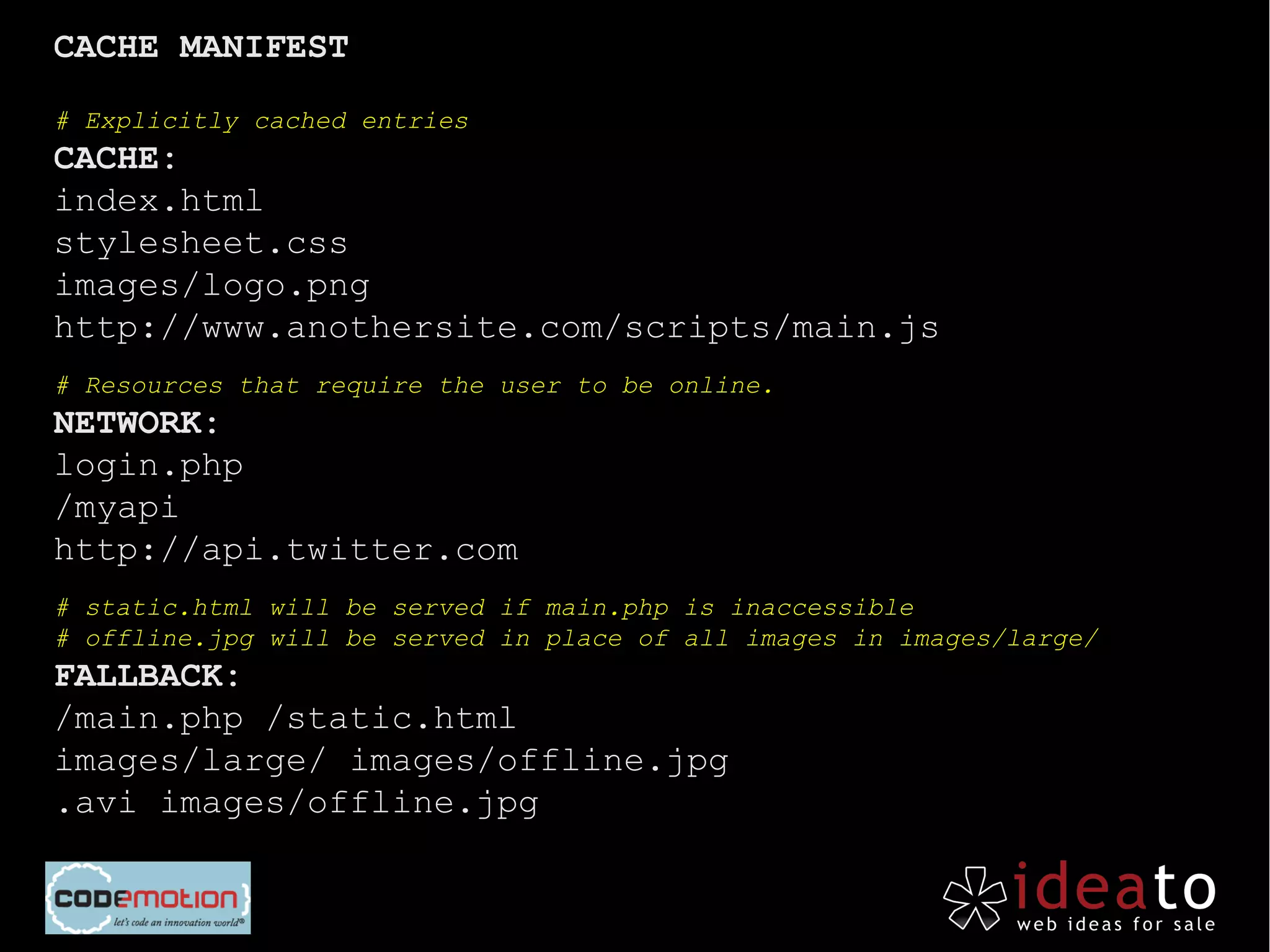
CACHE MANIFEST

# Explicitly cached entries
CACHE:
index.html
stylesheet.css
images/logo.png
http://www.anothersite.com/scripts/main.js
# Resources that require the user to be online.
NETWORK:
login.php
/myapi
http://api.twitter.com
# static.html will be served if main.php is inaccessible
# offline.jpg will be served in place of all images in images/large/
FALLBACK:
/main.php /static.html
images/large/ images/offline.jpg
.avi images/offline.jpg
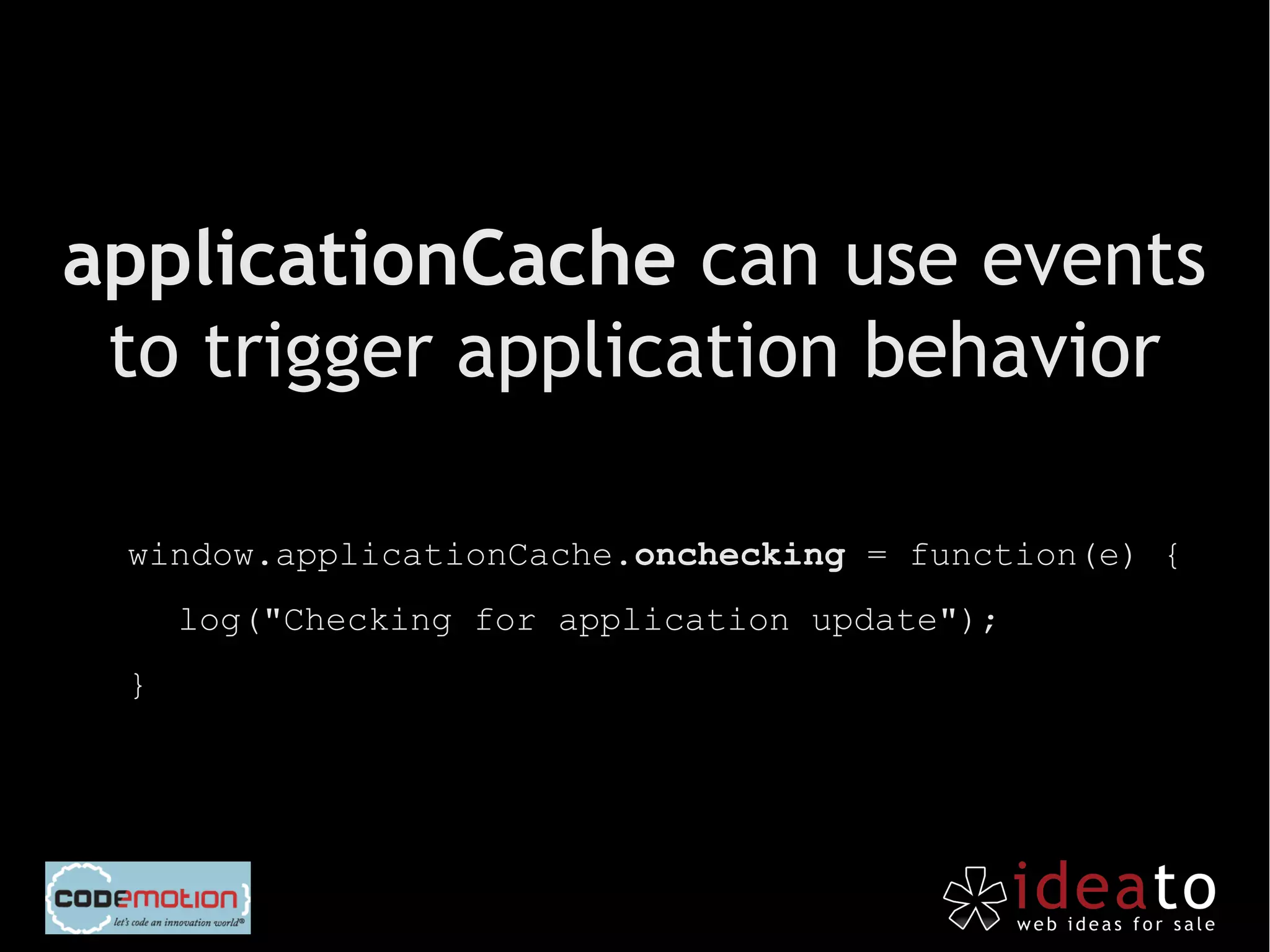
applicationCache can use events
 to trigger application behavior

 window.applicationCache.onchecking = function(e) {
     log("Checking for application update");
 }
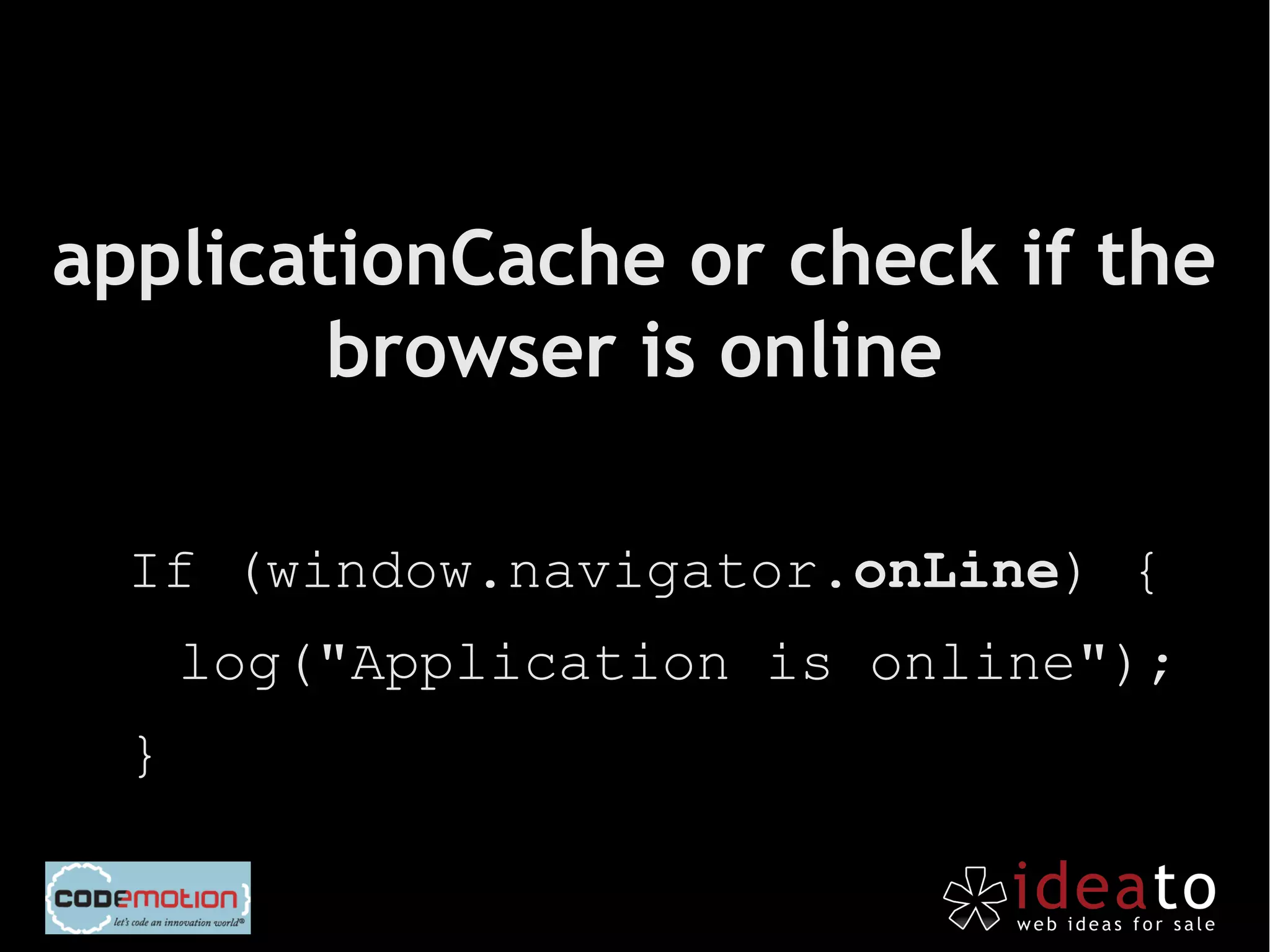
applicationCache or check if the
        browser is online

  If (window.navigator.onLine) {
      log("Application is online");
  }
Chrome/Chromium doesn't support
window.navigator.onLine attribute and...


   It doesn't have a real offline mode!
As stated in the specs:
“window.navigator.onLine is inherently
unreliable. A computer can be connected
    to a network without having Internet
                                 access.”
If you change a
                       resource and you
                     don't update (rev)
                     the .appcache file
                   the browser may not
                 download the new file!
(yes! cached resources have priority on the online ones)
Data storage is about
                         capturing specific
                       data, or resources the
                        user has expressed
                            interest in.
http://qrurl.it/r/3n
Approaches to
Data Storage
Web Storage is the simpler
implementation of the Data
    Storage paradigm.

       http://qrurl.it/r/3h
Web Storage is based on a
structure of key-value pairs like
     any JavaScript object.

localStorage.setItem("bar", foo);
Web Storage can save up to 5MB
but only as strings. So we have
 to force a casting if needed.

var bar = parseInt(localStorage["bar"]);
Web Storage should be local
 based or session based.

 var bar = localStorage["bar"];
var foo = sessionStorage["foo"];
sessionStorage mantains a
storage area that's available for
the duration of the web session.

 Opening a new window/tab will create a new
                  session.
localStorage relies only on
  client, so we have to track
changes and use storage.events
  to sync server and client if
            needed.
Web SQL Database is WAS just
an offline SQL implementation,
        based on SQLite.

         http://qrurl.it/r/3i
this.db = openDatabase('geomood', '1.0', 'Geo', 8192);
this.db.transaction(function(tx) {
  tx.executeSql("create table if not exists checkins(id
               integer primary key asc, time integer,
               latitude float, longitude float, mood
               string)",
               [],
                function() { console.log("siucc"); }
          »   );
});
Web SQL Database is not
 supported by Microsoft and
Mozilla, it is on browsers based
           on webkit.
But ...
Web SQL Database is dead!
  as being dropped by W3C from 18/11/10


             why bother more?
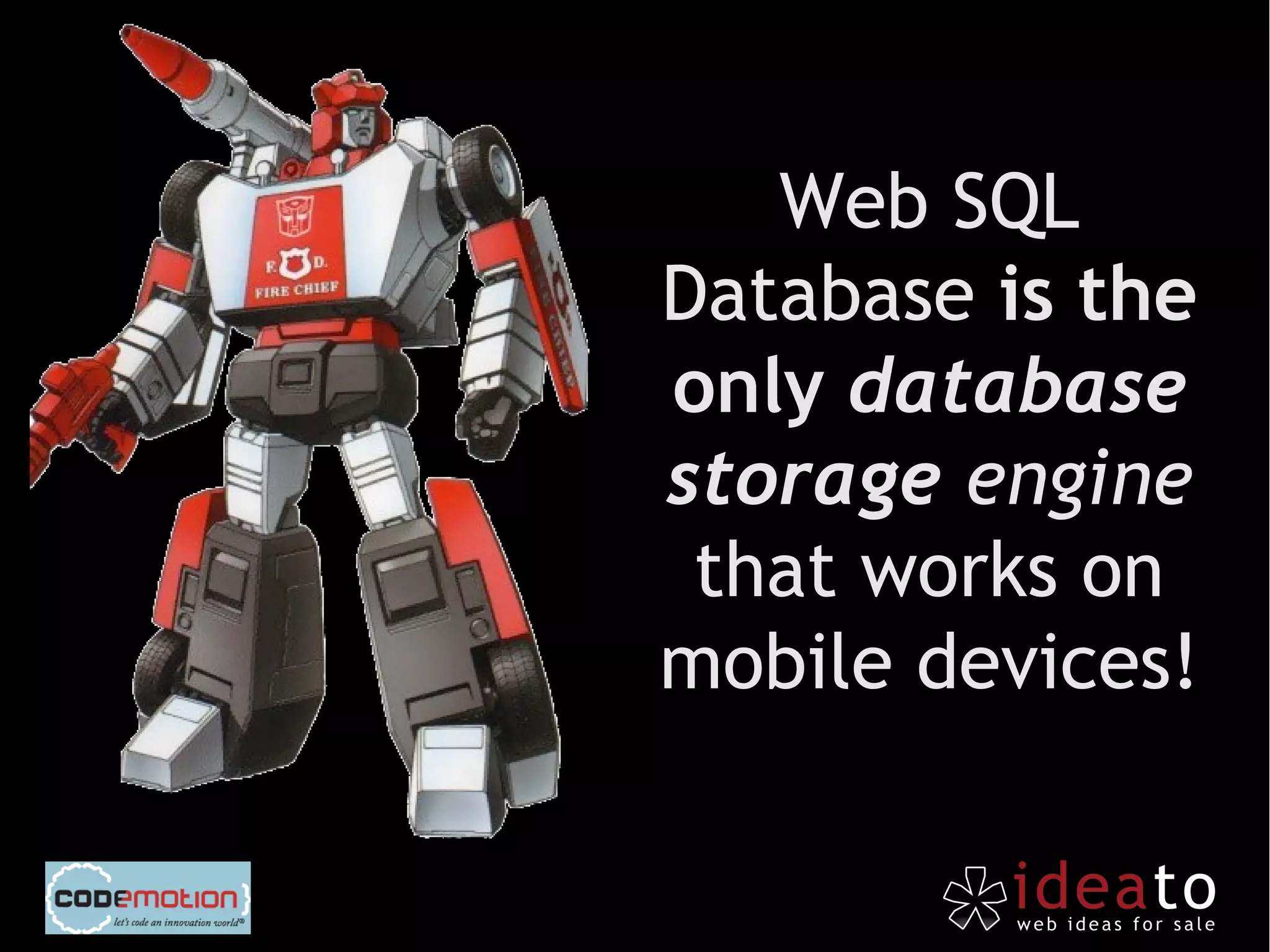
Web SQL
Database is the
only database
storage engine
 that works on
mobile devices!
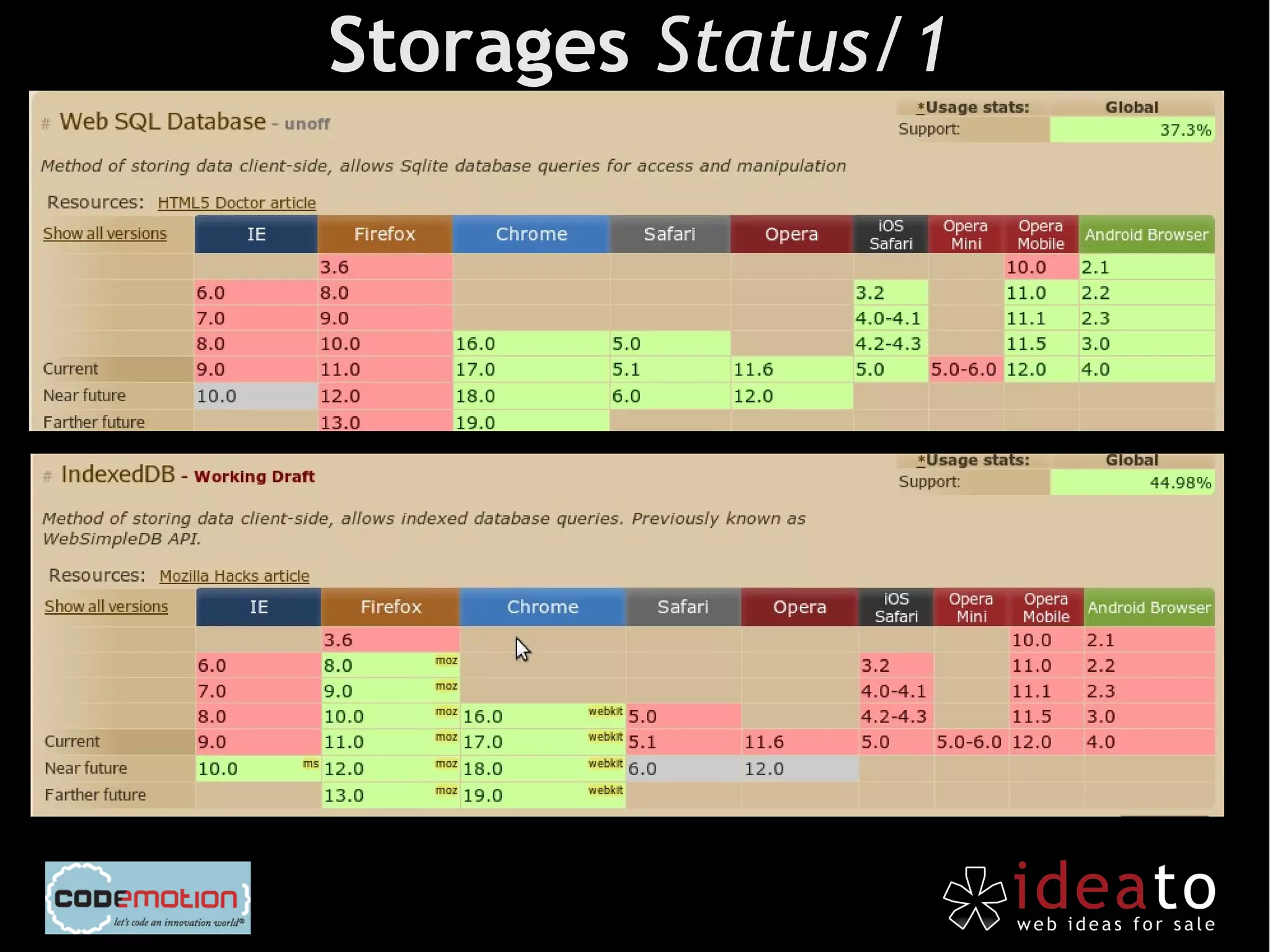
IndexedDB is a nice compromise
 between Web Storage and Web
        SQL Database.

         http://qrurl.it/r/3j
IndexedDB allows to create an
index on a certain field stored in
 a standard key->value mapping.
IndexedDB is promoted by all
browsers vendor, but is not yet
    fully supported by all

  Firefox 4, Chrome 11, have full implementation.
             Safari 5.1 and IE 10 will have
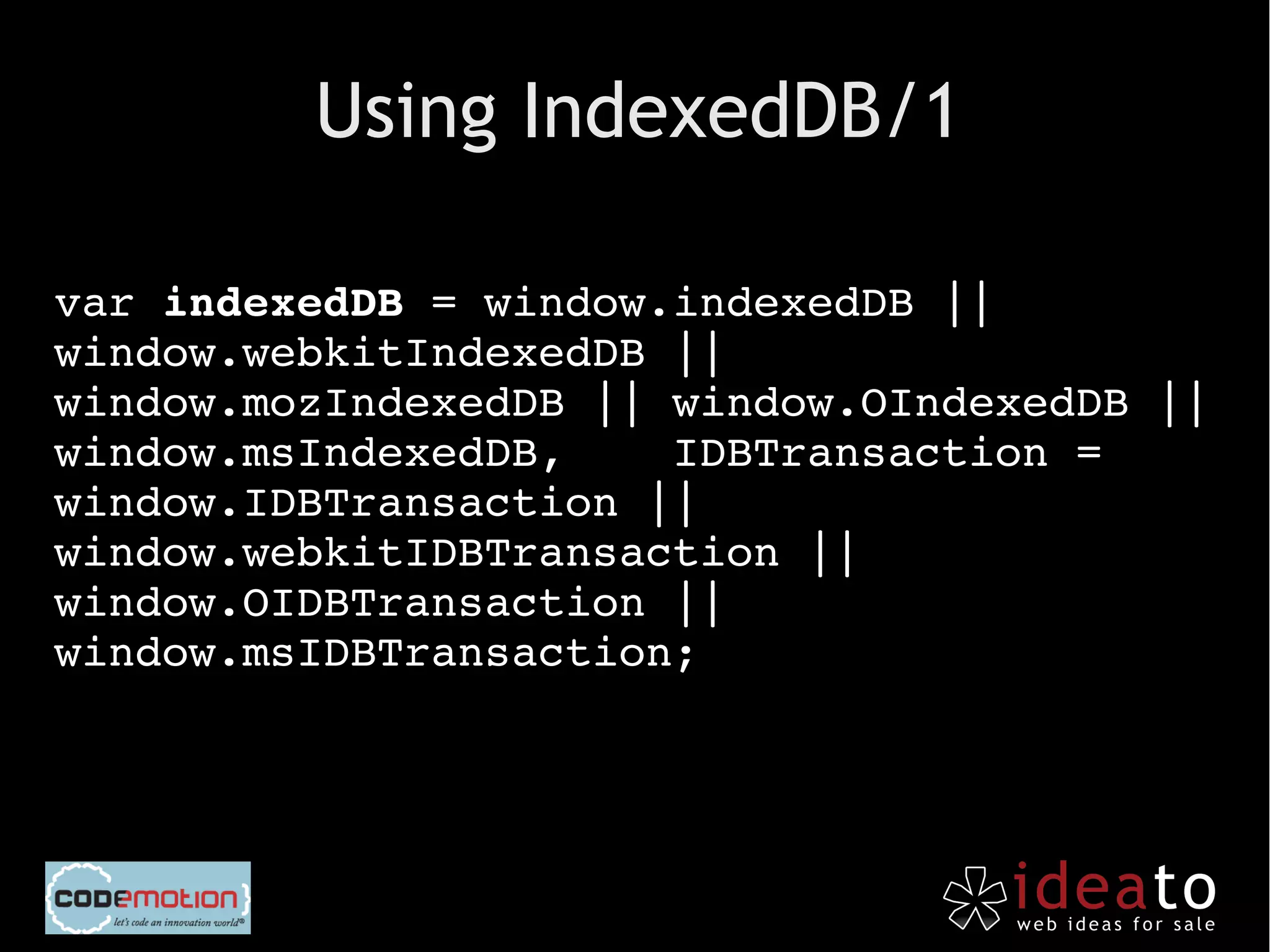
Using IndexedDB/1

var indexedDB = window.indexedDB || 
window.webkitIndexedDB || 
window.mozIndexedDB || window.OIndexedDB || 
window.msIndexedDB,    IDBTransaction = 
window.IDBTransaction || 
window.webkitIDBTransaction || 
window.OIDBTransaction || 
window.msIDBTransaction;
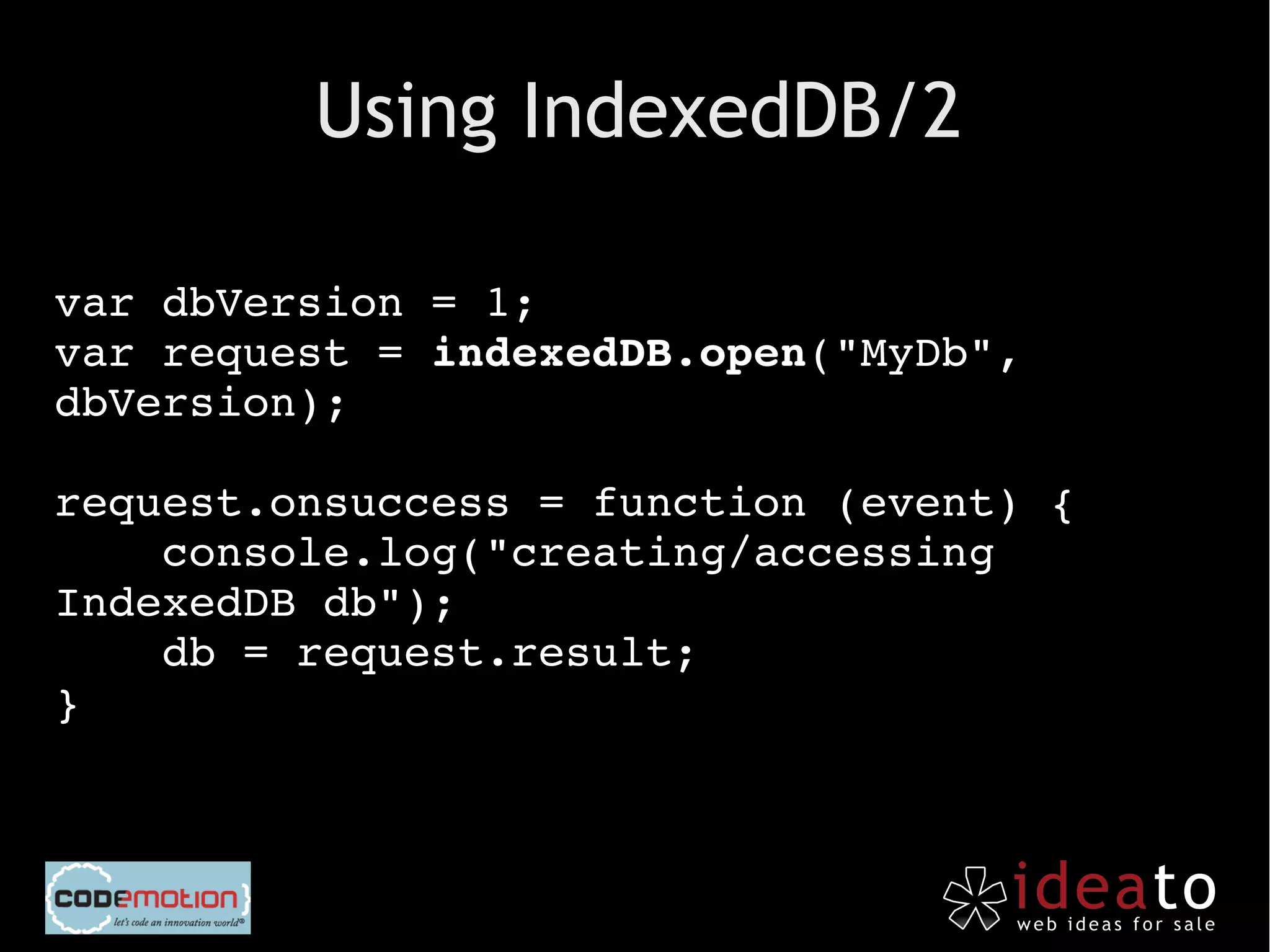
Using IndexedDB/2

var dbVersion = 1;
var request = indexedDB.open("MyDb", 
dbVersion);

request.onsuccess = function (event) {
    console.log("creating/accessing 
IndexedDB db");
    db = request.result;
}
Using IndexedDB/3

var transaction = db.transaction(["todo"], 
IDBTransaction.READ_WRITE);
var store = transaction.objectStore("todo");

var data = {
  "text": “text to be saved”,
  "timeStamp": new Date().getTime()
};

var put = store.put(data);
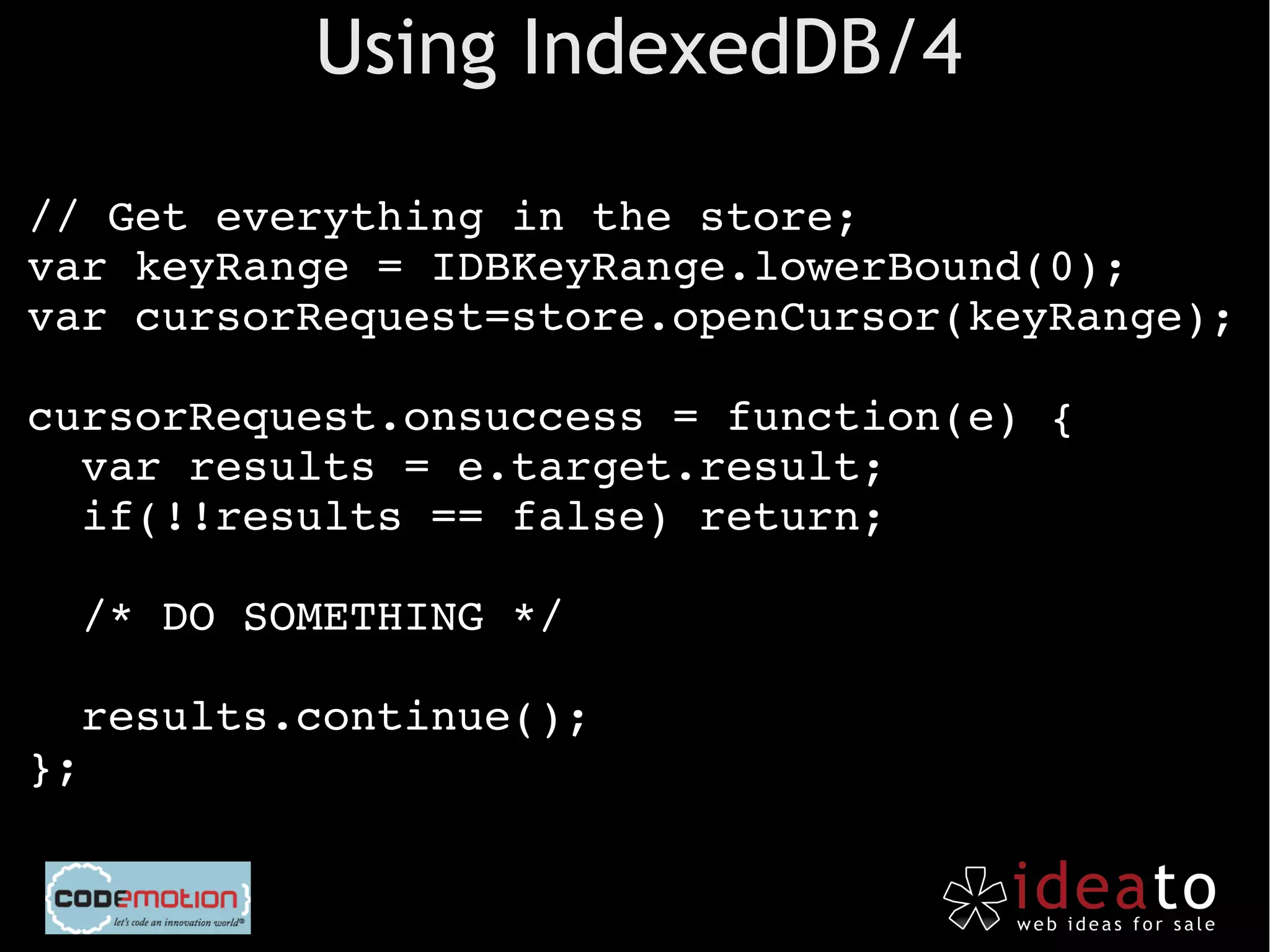
Using IndexedDB/4
  
// Get everything in the store;
var keyRange = IDBKeyRange.lowerBound(0);
var cursorRequest=store.openCursor(keyRange);

cursorRequest.onsuccess = function(e) {
  var results = e.target.result;
  if(!!results == false) return;

  /* DO SOMETHING */

  results.continue();
};
FileAPI allows to manipulate file
       objects, as well as
  programmatically select them
      and access their data.

          http://qrurl.it/r/3k
File API includes FileReader and
         FileWriter APIs.

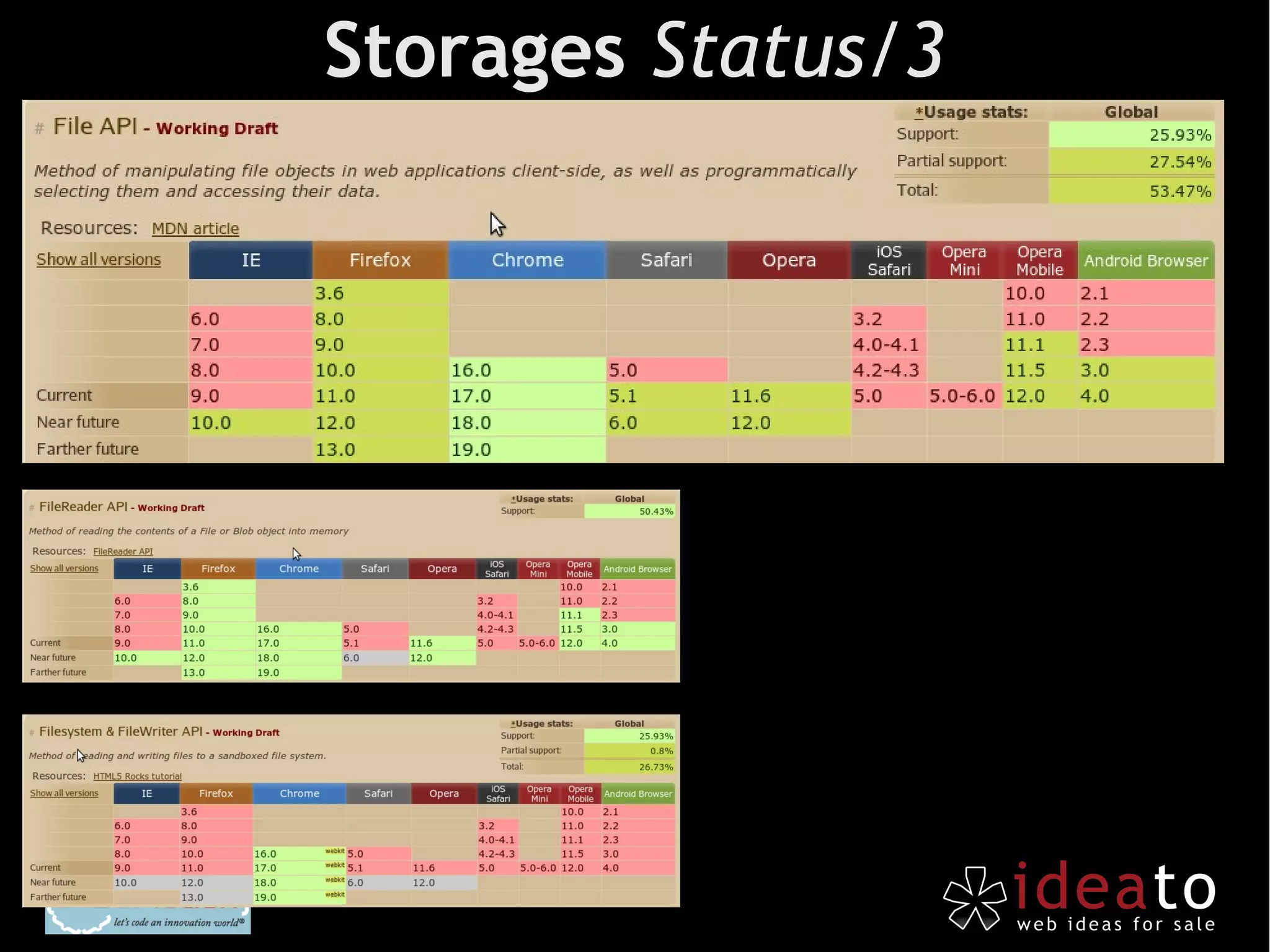
       Actually is supported by Chrome,
    Firefox > 3.6, Safari > 5.1, Opera > 11.1.
filer.js
http://qrurl.it/r/c3


webFS.js
http://qrurl.it/r/c4
First steps on
                          offline storage
                          development.

http://flic.kr/p/5PnRQr
Storages Status/1
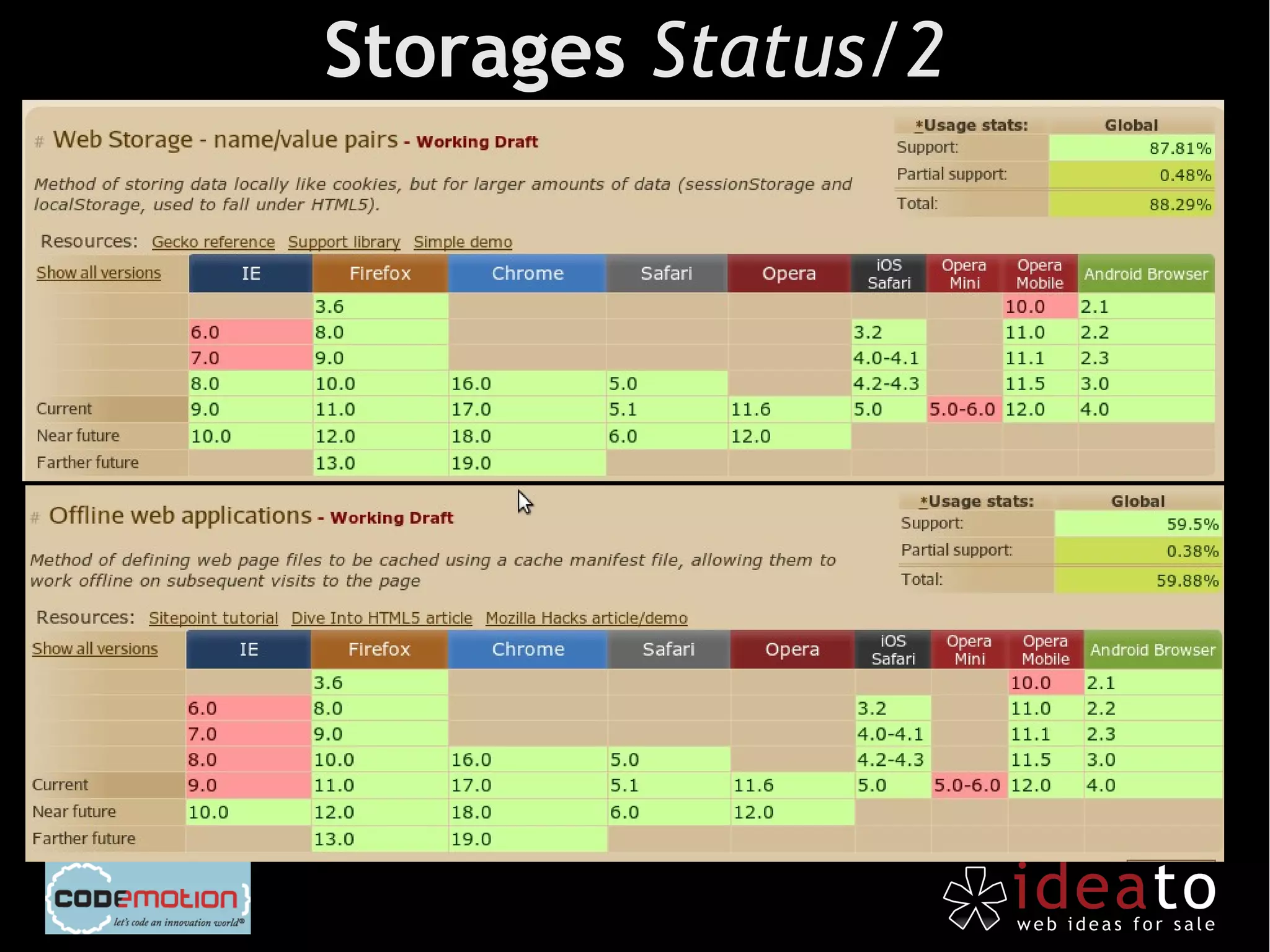
Storages Status/2
Storages Status/3
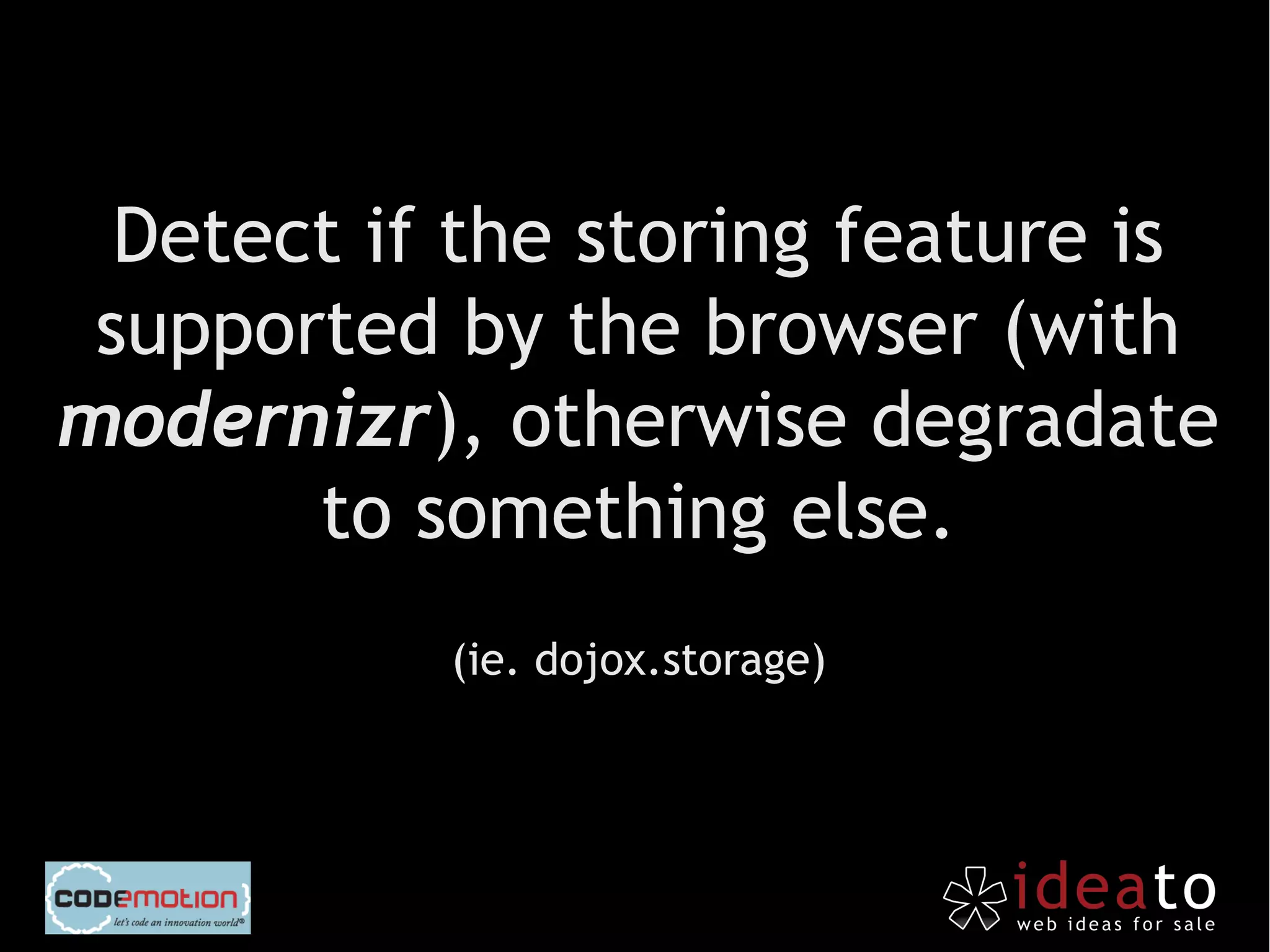
Detect if the storing feature is
 supported by the browser (with
modernizr), otherwise degradate
       to something else.
           (ie. dojox.storage)
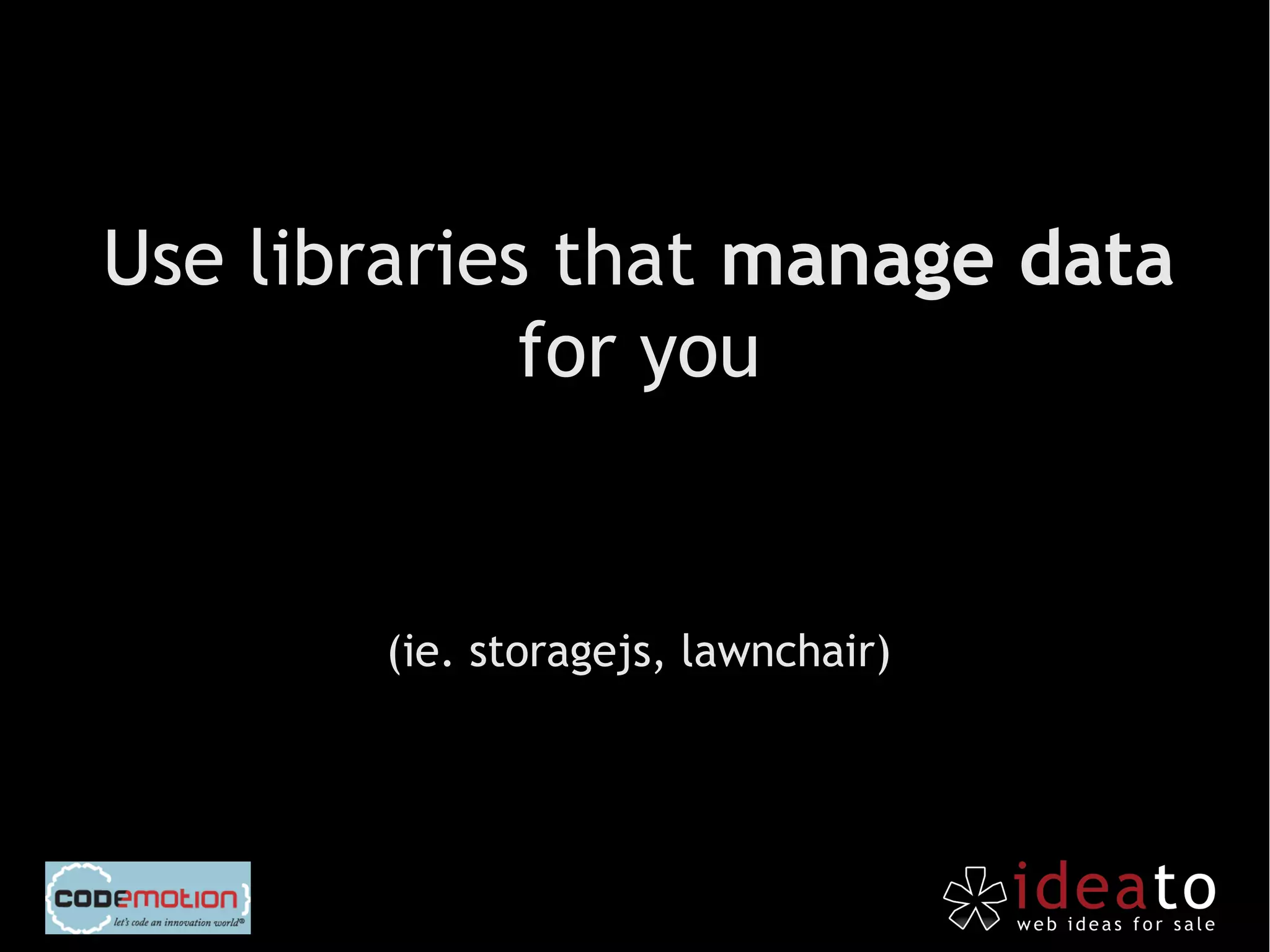
Use libraries that manage data
             for you


       (ie. storagejs, lawnchair)
http://qrurl.it/r/3o


Protect against lost data,
  sync automatically.
http://qrurl.it/r/3p


                Automatically detect when
                    users are online.
Do not exceed in storing data,
you can store binary data base64
  encoded but remember the
    pitfalls in performance.
Avoid race conditions.
If possible use WebSQL to use its
     transactions features.
use local storage to help your
application to become faster.
basket.js
http://qrurl.it/r/c2
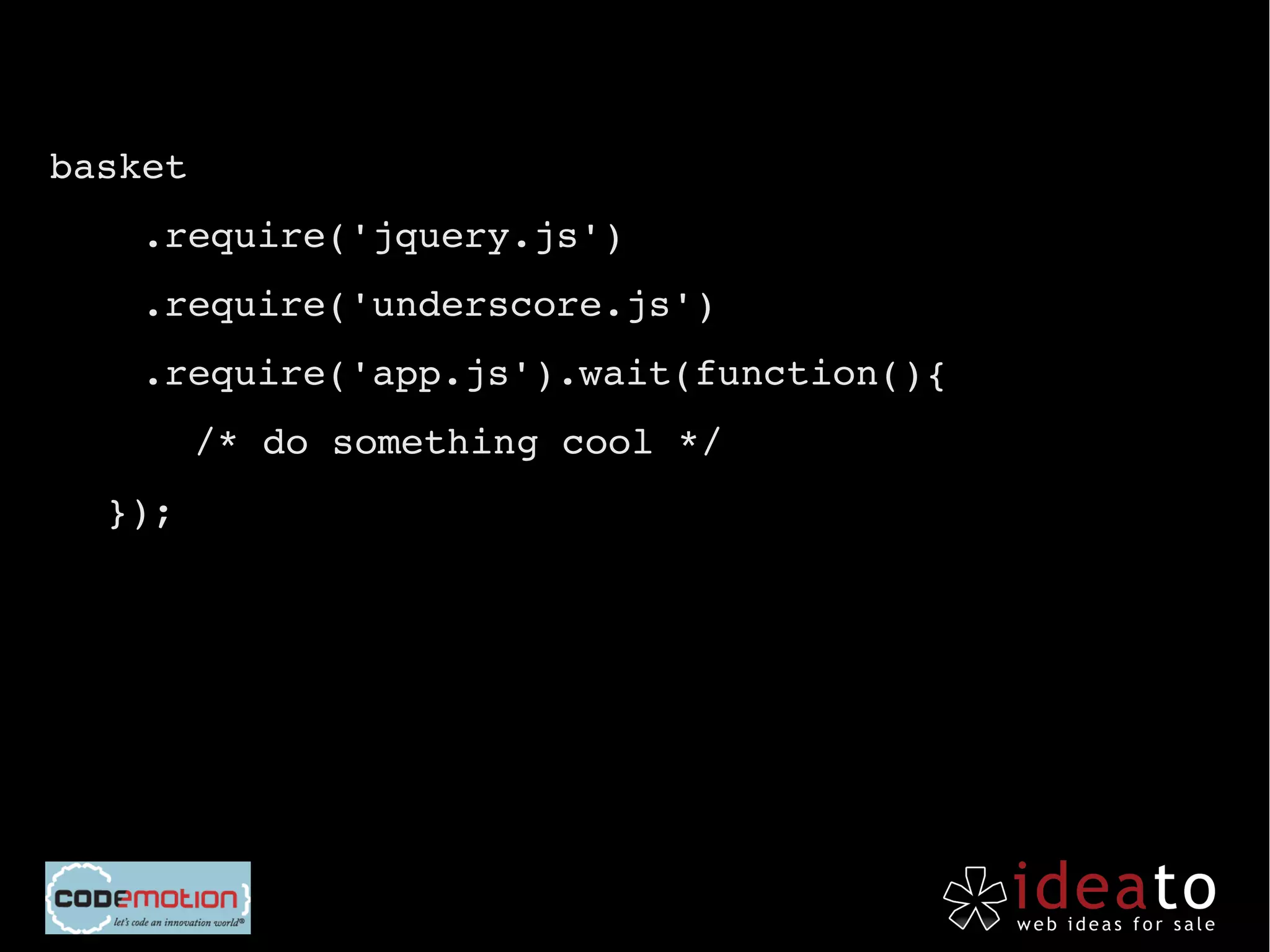
basket
    .require('jquery.js')
    .require('underscore.js')
    .require('app.js').wait(function(){
    • /* do something cool */
  });
?
jsDay + phpDay 2012
 16-19 Maggio 2012 Verona
     www.phpday.it
Francesco Fullone
    ff@ideato.it
       @fullo


  via Quinto Bucci 205
   47023 Cesena (FC)
    info AT ideato.it
     www.ideato.it

your browser, my storage

Editor's Notes

  • #21 - Chrome you can change the cache limits with – disk-cache-size=N - Opera crashes if the cache is filled chrome: about:appcache-internals firefox: about:cache
  • #23 window.applicationCache.onchecking = function(e) { log("Checking for application update"); } window.applicationCache.onnoupdate = function(e) { log("No application update found"); } window.applicationCache.onupdateready = function(e) { log("Application update ready"); //Now connect the browser to use the new cache window.applicationCache.swapCache(); } window.applicationCache.onobsolete = function(e) { log("Application obsolete"); } window.applicationCache.ondownloading = function(e) { log("Downloading application update"); } window.applicationCache.oncached = function(e) { log("Application cached"); } window.applicationCache.onerror = function(e) { log("Application cache error"); } window.applicationCache.onprogress = function(e) { log("Application Cache progress"); }
  • #24 window.applicationCache.onchecking = function(e) { log("Checking for application update"); } window.applicationCache.onnoupdate = function(e) { log("No application update found"); } window.applicationCache.onupdateready = function(e) { log("Application update ready"); //Now connect the browser to use the new cache window.applicationCache.swapCache(); } window.applicationCache.onobsolete = function(e) { log("Application obsolete"); } window.applicationCache.ondownloading = function(e) { log("Downloading application update"); } window.applicationCache.oncached = function(e) { log("Application cached"); } window.applicationCache.onerror = function(e) { log("Application cache error"); } window.applicationCache.onprogress = function(e) { log("Application Cache progress"); }