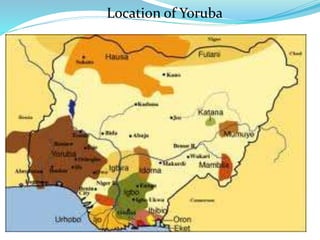
Location of Yoruba
In 1960, Nigeria became an independent
country. Ten thousand Yoruba were known to
live in Nigeria at that time among many other
ethnic groups. They lived in large towns and
cities and some in their extended family
dwelling. Their daily lives depend largely on
carving, blacksmithing, farming, weaving and
leatherworks.
They have influenced the world greatly in their
field of art, food, agriculture and trading.
Poultry, goats, sheep, pigs are raised as livestock
which provides employment for the people. The
natural resources like rivers, lagoons and oceans
provide fish for them. Potters, blacksmiths,
weavers, bead makers are important to Yoruba
because they contribute to the economy.
The Yoruba tribes are worshippers of the
Goddess of the Earth. They create ornaments
with complex symbols and designs to show their
status and beliefs. Ancient ritual procedures of
elevation and separation are central in Yoruba
beliefs and practices, many of the rituals are still
practiced today. For instance, at particular
moments the feet of a ruler or chief must not be
in contact with the earth.
To convey their superhuman status the chief would
wear beaded shoes and place their feet on beaded
cushions. The Yoruba tribe believes that women have a
dual spiritual force that can make them either mothers
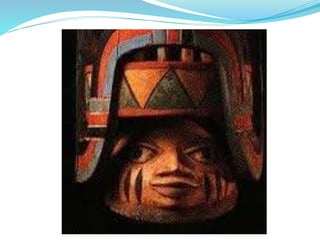
or sorcerers. Festivals are held wearing Gelede masks to
evoke the beneficent image of the role of women. The
Gelede masks are worn on top of the head and bear
human facial features, on top of the head it is carved
forming an elaborate coiffure or representation of some
kind of human activity.
Gelede masks have decorative facial scars and almond
eyes which are typical of Yoruba women. In northern
Yoruba kingdoms, another mask, the epa mask is
found. The Epacult wears these masks during funerals
or rite of passage ceremonies, epa masks can differ
greatly depending on the area or village in which they
appear. When not worn these face masks are kept in
shrines where they are honored with libations and
prayers.
Egungun headdresses are worn during the
annual Egungun masquerade, but are also worn
during funerary ceremonies held after the death
of an important dignitary and in initiation
ceremonies. They are representative of heavenly
creatures, known as Ara Orun, capable of
bringing good fortune or punishing the guilty.
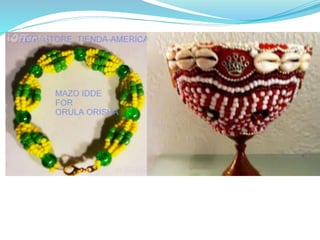
Beads serve as symbols of status, tools for
history review, protective charms, seduction
accessories, and declaration of beliefs. Beads
have been a trade item since early times. The
Yoruba of Nigeria were some of the earliest
makers of glass beads in the region. Beads can
represent temperament, empowerment, desire,
wealth, and well-being. When threaded together
beads stand for unity and togetherness.
When encircling parts of the body (head, neck,
arms, wrists, waist, legs, ankles, and toes) beads
secure the spiritual essence of the person. Beads
were originally made from shell, bone, wood,
seeds, and clay. Later they were made from metal,
ivory, glass, and stone. Beads made from certain
materials represented specific wants, beliefs, and
status.
The grant land snail is one of the oldest, most
easily attained and abundant food sources for
the Yoruba. Wearing its shell symbolizes the
hope of a long and peaceful life. Beadwork was
used to decorate jewelry, belts, shoes, cushions,
furniture, sculptures, paintings, clothing, and
head coverings. The veil on many beaded head
coverings covers the face of a chief to protect
commoners from looking directly at a so
powerful being. Beadwork in metal, glass, and
stone was used to distinguish its owner in both
life and death.
The Yoruba tribe is known for their work in metal,
particularly brass. There is a close symbolic association
between metal and power. Bronze collars are a
currency exchange for wives, livestock, and food.
Married women wear the collars permanently for the
prestige they confer. Brass casters created many
elaborate items such as stools, large statues, staffs,
bells, and currency.
The Yoruba tribe is also known for their art in
ivory. Their ivory pieces can be distinguished by
their facial features. Some of the features are
separated lips, half-lowered eyelids, a flattened
wide nose, and an indented hairline. Often the
decorations appear flat or carved in low relief.
Yoruba ivory often has decorative textured
patterns.
Yoruba Kingdoms
There were about 20 Yoruba kingdoms at one
time with a different king ruling over each one.
Ife was known as the center of cultural and
religious life.
Oyo was the strongest kingdom with the
largest military and political system.
Oyo kingdom
 The kingdom of Oyo was close to the Niger River.
The rich soil in Oyo allowed the people to grow
more crops than they needed.
 According to traditions, Oyo derived from a great
Yoruba ancestor and hero, Oduduwa, who came
from the east to settle at Ile-Ife and whose son
became the first alafin, or ruler, of Oyo. Linguistic
evidence suggests that two waves of immigrants
came into Yorubaland between 700 and 1000, the
second settling at Oyo in the open country north of
the Guinea forest. This second state became
preeminent among all Yoruba states because of its
favourable trading position, its natural resources,
and the industry of its inhabitants.
Early in the 16th century Oyo was a minor
state, powerless before its northern
neighbours Borgu and Nupe—by whom
it was conquered in 1550. The power of
Oyo was already growing by the end of
the century, however, thanks to the alafin
Orompoto, who used the wealth derived
from trade to establish a cavalry force and
to maintain a trained army.
 Oyo subjugated the kingdom of Dahomey in the
west in two phases (1724–30, 1738–48) and traded
with European merchants on the coast through
the port of Ajase (Porto-Novo). As Oyo's wealth
increased, so did its leaders' political options;
some wished to concentrate on amassing wealth,
while others advocated the use of wealth for
territorial expansion. This difference was not
resolved until the alafin Abiodun (reigned c.
1770–89) conquered his opponents in a bitter
civil war and pursued a policy of economic
development based primarily on the coastal trade
with European merchants.
 Abiodun's neglect of everything but the economy weakened the
army, and thus the means by which the central government
maintained control. His successor, the alafin Awole, inherited
local revolts, an administration tenuously maintained by a
complex system of public service, and a decline in the power of
tributary chiefs. The decline was exacerbated by quarrels
between the alafin and his advisers; it continued throughout the
18th century and into the 19th, when Oyo began to lose control of
its trade routes to the coast. Oyo was invaded by the newly risen
Fon of Dahomey, and soon after 1800 it was captured by militant
Fulani Muslims from Hausaland in the northeast.
In the 18th century, European countries were beginning to
create colonies all over the world. Europeans were taking
villagers from West Africa and bringing them to the New
World to be slaves in the new colonies. The British came to
Yorubaland in 1852. By 1884 European nations were meeting
to discuss how they would break-up Africa into different
colonies. The British were granted the right by the other
European nations to colonize Yorubaland, and in 1893 Yoruba
land became part of a larger colony known officially as
Nigeria.
This helped the kingdom of Oyo to easily trade
with neighboring groups. They also created a
strong military. Oyo was in control of 6,600
towns and villages by the end of the 18th
century. Internal wars and fighting with
neighboring groups, along with the beginning
of the slave trade, eventually led to the decline
of these great kingdoms.
Food, Agriculture and Trade
Yams are the most important food for the Yoruba in
their homeland of Nigeria. Grains, plantains, corn,
beans, meat, and fish are also eaten. Poultry, goats,
sheep, pigs, and cattle are raised as livestock. Large
rivers, lagoons and the ocean provide fish and shrimp
for the Yoruba. Fishermen sell fresh and dried fish
through traders at the local markets. Palm oil from
the nuts of the palm oil tree is often used to cook
with.
Every country has an economy. People create economies
through employment, trade, and the buying and selling of
goods. Around 1900 cacao became the most important crop
that Nigeria sold to other countries in order to earn money.
Cotton and indigo were also grown and sold. Today natural
resources like crude oil, coal, palm oil, peanuts, cotton,
rubber, wood, corn, rice, millet, cassava, and yams are
exported. Many men are employed as farmers. Women are
responsible for selling goods at the markets.
Potters, blacksmiths, carvers, and leather and bead
workers are important to Yoruba society because they
all contribute to the economy. The goods that they
produce are made to be used and also have great
artistic value.
Sculpture
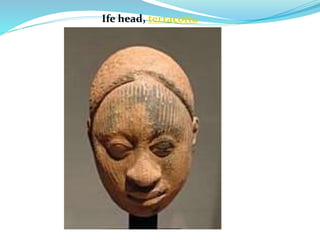
The Yoruba began creating magnificent
sculpture out of terra cotta clay in the
12th through 14th centuries. Bronze
figures were made during the 14th and
15th centuries.
Ife head, terracotta
Techniques/ styles of bronze work
•To create bronze sculptures, artists first made models out of
clay. When the clay dried they would put a thin layer of
beeswax over the clay and engrave details in the wax.
•Next, they covered the wax with more layers of clay until
they created a thick mold.
•The mold would then be heated over a fire until the middle
layer of wax melted.
• The artist poured the bronze into the top of the mold
through cubes.
•The bronze now took on the form of the wax that was once
there.
•When the bronze cooled and hardened the outer layer of
clay was broken off and the sculpture was completed. This
life like sculptures may represent kings and gods.
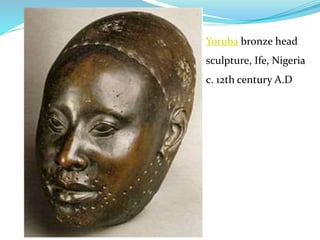
Yoruba bronze head
sculpture, Ife, Nigeria
c. 12th century A.D
Pottery
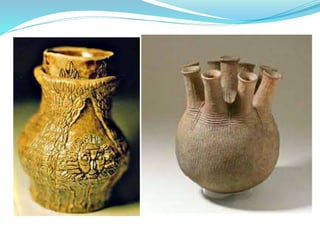
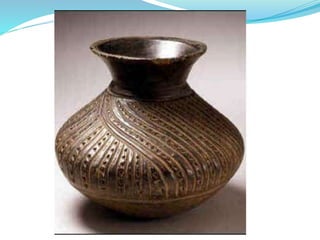
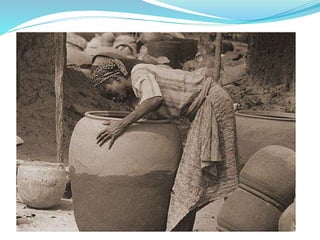
•Women are the potters in Yoruba society.
•They make many different types of pottery including
pots for cooking, eating, and storage of wine and
water.
• Palm oil lamps are also crafted.
•Unique pots are made in honor of Yoruba deities.
•Pottery is only made in towns where clay is available.
It is sold to neighboring towns that do not have access
to clay hence source of income generation.
Blacksmiths and Calabash Carvers
•Blacksmiths are very important to local towns
and are responsible for making tools that many
other professions use, such as hoes, axes,
knives, chains and hammers.
• Calabashes (dried gourds) are carved by men
and are used to serve food or drink.
• Goods carried to markets are often carved
from calabashes. They are also used as
containers for storing medicines and food.
•Calabashes are also carved into musical rattles.
Leather and Beadwork
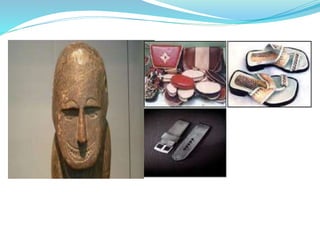
•Men are responsible for leather and beadwork.
• Goat, sheep, and antelope skins are used to make
things like bags, cushions, and sandals. Leather
scraps in different colors are often pieced together
to form designs.
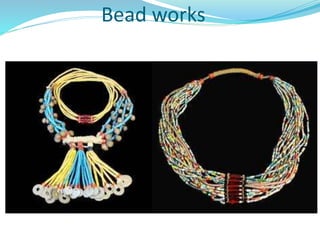
• Beads are used to decorate crowns, hats, bags, and
other items worn by kings and babalawo. Popular
bead designs include human faces, birds, and
flowers.
Bead works
Characteristics of Yoruba figures
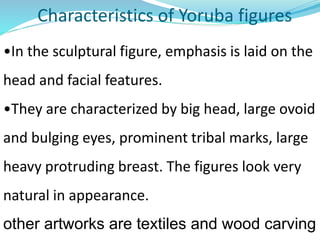
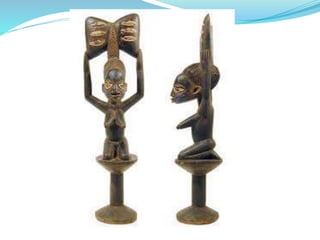
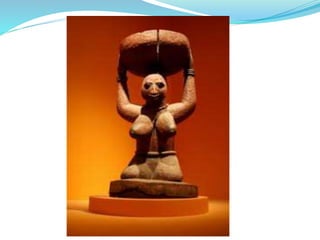
•In the sculptural figure, emphasis is laid on the
head and facial features.
•They are characterized by big head, large ovoid
and bulging eyes, prominent tribal marks, large
heavy protruding breast. The figures look very
natural in appearance.
other artworks are textiles and wood carving
Religious Beliefs
 Traditional Yoruba beliefs that the world made up of two
connected realms.
 The visible world of the living is called Aye, and the
spiritual world of the Orisas.
 The ancestors and spirits, is called Orun.
 Ase is the life force that is given to everything by the
Creator of the universe.
 Ase is in everything: plants, animals, people, prayers,
songs, rocks, and rivers.
 Existence is dependent upon Ase because Ase is the power
to make things happen and change.
 The Yoruba believe in the Creator who rules over the entire
universe along with many other gods that serve underneath
him.
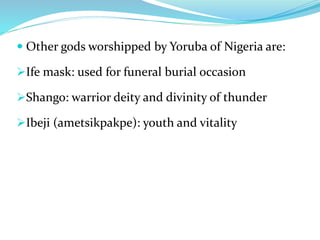
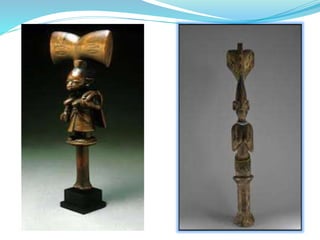
 Other gods worshipped by Yoruba of Nigeria are:
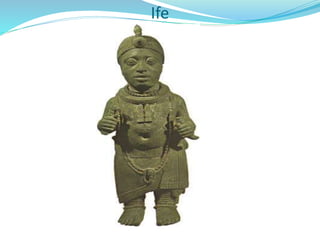
Ife mask: used for funeral burial occasion
Shango: warrior deity and divinity of thunder
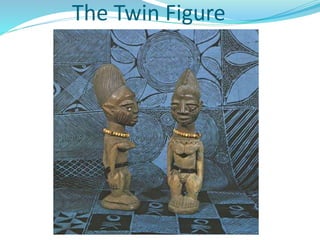
Ibeji (ametsikpakpe): youth and vitality
The Twin Figure
Ife
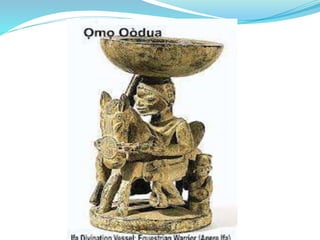
Ifa Divination
 Divination is a method of solving problems
and foretelling the future. It has existed for
thousands of years throughout the world in
different forms. Ifa divination is a traditional
way to solve problems among the Yoruba.
Divination helps to explain why certain
misfortunes are happening to someone.
 For example, if a farmer’s crops are not growing or
if someone in the family is ill they would seek the
help of a diviner. Ifa diviners are called babalawo
(fathers of ancient wisdom). The function of the
Ifa diviner is to determine the reasons that are
causing a person’s misfortune. He does this by
performing a ritual with the person which reveals
the source of the problem.
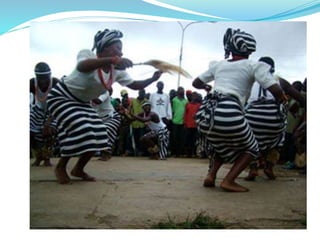
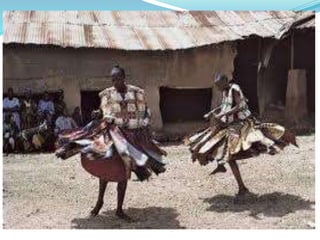
Music and Dance
 Music and dance have always been an important part of
Yoruba culture for those living in Nigeria as well as in the
Diaspora. Yoruba music and dance are used for many
different occasions in life such as religious festivals, royal
occasions, and entertainment.
 Yoruba traditional music focuses on Yoruba deities.
Drums and singing are the main elements of Yoruba
music. Instruments such as metal bells and wind
instruments are sometimes used. Yoruba is a tonal
language. Words must be pronounced in the appropriate
tone (pitch) in order to understand speech in its correct
meaning. There are three major tones: high, mid, and
low. Most of Yoruba music is based on these tonal
patterns of speech.
 The most well known of Yoruba popular music is
Juju. Juju emerged in the 1920’s and is the most
well known form of Yoruba popular music in
Nigeria. Juju has its roots in traditional Yoruba
drum based music. Juju is dance music played by
large ensembles centered around guitars and
drumming. Singing is a major part of Juju music
and is inspired by Yoruba poetry, proverbs, praise
songs, and the musical character of the language.
REFERENCE
References
Adams, Laurie Schneider (1999), Art Across Time, Vol.
1&2, USA.
Gilbert Rita (1998), Living with Art 3rd and 5th Ed.
Gardener, Helen, Art through the Ages 9th Ed.
Johnson H.W (1997), History of Art, Thames and
Hudson, USA.
Willet Frank (1971), Africa Art an introduction, Thomas
and Hudson, London.
file:///D:/yoruba/Yoruba%20art%20-
%20Wikipedia,%20the%20free%20encyclopedia.html
THANK
YOU
Yoruba

Yoruba

  • 1.
  • 2.
    In 1960, Nigeriabecame an independent country. Ten thousand Yoruba were known to live in Nigeria at that time among many other ethnic groups. They lived in large towns and cities and some in their extended family dwelling. Their daily lives depend largely on carving, blacksmithing, farming, weaving and leatherworks.
  • 3.
    They have influencedthe world greatly in their field of art, food, agriculture and trading. Poultry, goats, sheep, pigs are raised as livestock which provides employment for the people. The natural resources like rivers, lagoons and oceans provide fish for them. Potters, blacksmiths, weavers, bead makers are important to Yoruba because they contribute to the economy.
  • 4.
    The Yoruba tribesare worshippers of the Goddess of the Earth. They create ornaments with complex symbols and designs to show their status and beliefs. Ancient ritual procedures of elevation and separation are central in Yoruba beliefs and practices, many of the rituals are still practiced today. For instance, at particular moments the feet of a ruler or chief must not be in contact with the earth.
  • 5.
    To convey theirsuperhuman status the chief would wear beaded shoes and place their feet on beaded cushions. The Yoruba tribe believes that women have a dual spiritual force that can make them either mothers or sorcerers. Festivals are held wearing Gelede masks to evoke the beneficent image of the role of women. The Gelede masks are worn on top of the head and bear human facial features, on top of the head it is carved forming an elaborate coiffure or representation of some kind of human activity.
  • 6.
    Gelede masks havedecorative facial scars and almond eyes which are typical of Yoruba women. In northern Yoruba kingdoms, another mask, the epa mask is found. The Epacult wears these masks during funerals or rite of passage ceremonies, epa masks can differ greatly depending on the area or village in which they appear. When not worn these face masks are kept in shrines where they are honored with libations and prayers.
  • 7.
    Egungun headdresses areworn during the annual Egungun masquerade, but are also worn during funerary ceremonies held after the death of an important dignitary and in initiation ceremonies. They are representative of heavenly creatures, known as Ara Orun, capable of bringing good fortune or punishing the guilty.
  • 8.
    Beads serve assymbols of status, tools for history review, protective charms, seduction accessories, and declaration of beliefs. Beads have been a trade item since early times. The Yoruba of Nigeria were some of the earliest makers of glass beads in the region. Beads can represent temperament, empowerment, desire, wealth, and well-being. When threaded together beads stand for unity and togetherness.
  • 9.
    When encircling partsof the body (head, neck, arms, wrists, waist, legs, ankles, and toes) beads secure the spiritual essence of the person. Beads were originally made from shell, bone, wood, seeds, and clay. Later they were made from metal, ivory, glass, and stone. Beads made from certain materials represented specific wants, beliefs, and status.
  • 10.
    The grant landsnail is one of the oldest, most easily attained and abundant food sources for the Yoruba. Wearing its shell symbolizes the hope of a long and peaceful life. Beadwork was used to decorate jewelry, belts, shoes, cushions, furniture, sculptures, paintings, clothing, and head coverings. The veil on many beaded head coverings covers the face of a chief to protect commoners from looking directly at a so powerful being. Beadwork in metal, glass, and stone was used to distinguish its owner in both life and death.
  • 11.
    The Yoruba tribeis known for their work in metal, particularly brass. There is a close symbolic association between metal and power. Bronze collars are a currency exchange for wives, livestock, and food. Married women wear the collars permanently for the prestige they confer. Brass casters created many elaborate items such as stools, large statues, staffs, bells, and currency.
  • 12.
    The Yoruba tribeis also known for their art in ivory. Their ivory pieces can be distinguished by their facial features. Some of the features are separated lips, half-lowered eyelids, a flattened wide nose, and an indented hairline. Often the decorations appear flat or carved in low relief. Yoruba ivory often has decorative textured patterns.
  • 13.
    Yoruba Kingdoms There wereabout 20 Yoruba kingdoms at one time with a different king ruling over each one. Ife was known as the center of cultural and religious life. Oyo was the strongest kingdom with the largest military and political system.
  • 14.
    Oyo kingdom  Thekingdom of Oyo was close to the Niger River. The rich soil in Oyo allowed the people to grow more crops than they needed.  According to traditions, Oyo derived from a great Yoruba ancestor and hero, Oduduwa, who came from the east to settle at Ile-Ife and whose son became the first alafin, or ruler, of Oyo. Linguistic evidence suggests that two waves of immigrants came into Yorubaland between 700 and 1000, the second settling at Oyo in the open country north of the Guinea forest. This second state became preeminent among all Yoruba states because of its favourable trading position, its natural resources, and the industry of its inhabitants.
  • 15.
    Early in the16th century Oyo was a minor state, powerless before its northern neighbours Borgu and Nupe—by whom it was conquered in 1550. The power of Oyo was already growing by the end of the century, however, thanks to the alafin Orompoto, who used the wealth derived from trade to establish a cavalry force and to maintain a trained army.
  • 16.
     Oyo subjugatedthe kingdom of Dahomey in the west in two phases (1724–30, 1738–48) and traded with European merchants on the coast through the port of Ajase (Porto-Novo). As Oyo's wealth increased, so did its leaders' political options; some wished to concentrate on amassing wealth, while others advocated the use of wealth for territorial expansion. This difference was not resolved until the alafin Abiodun (reigned c. 1770–89) conquered his opponents in a bitter civil war and pursued a policy of economic development based primarily on the coastal trade with European merchants.
  • 17.
     Abiodun's neglectof everything but the economy weakened the army, and thus the means by which the central government maintained control. His successor, the alafin Awole, inherited local revolts, an administration tenuously maintained by a complex system of public service, and a decline in the power of tributary chiefs. The decline was exacerbated by quarrels between the alafin and his advisers; it continued throughout the 18th century and into the 19th, when Oyo began to lose control of its trade routes to the coast. Oyo was invaded by the newly risen Fon of Dahomey, and soon after 1800 it was captured by militant Fulani Muslims from Hausaland in the northeast.
  • 18.
    In the 18thcentury, European countries were beginning to create colonies all over the world. Europeans were taking villagers from West Africa and bringing them to the New World to be slaves in the new colonies. The British came to Yorubaland in 1852. By 1884 European nations were meeting to discuss how they would break-up Africa into different colonies. The British were granted the right by the other European nations to colonize Yorubaland, and in 1893 Yoruba land became part of a larger colony known officially as Nigeria.
  • 19.
    This helped thekingdom of Oyo to easily trade with neighboring groups. They also created a strong military. Oyo was in control of 6,600 towns and villages by the end of the 18th century. Internal wars and fighting with neighboring groups, along with the beginning of the slave trade, eventually led to the decline of these great kingdoms.
  • 20.
    Food, Agriculture andTrade Yams are the most important food for the Yoruba in their homeland of Nigeria. Grains, plantains, corn, beans, meat, and fish are also eaten. Poultry, goats, sheep, pigs, and cattle are raised as livestock. Large rivers, lagoons and the ocean provide fish and shrimp for the Yoruba. Fishermen sell fresh and dried fish through traders at the local markets. Palm oil from the nuts of the palm oil tree is often used to cook with.
  • 21.
    Every country hasan economy. People create economies through employment, trade, and the buying and selling of goods. Around 1900 cacao became the most important crop that Nigeria sold to other countries in order to earn money. Cotton and indigo were also grown and sold. Today natural resources like crude oil, coal, palm oil, peanuts, cotton, rubber, wood, corn, rice, millet, cassava, and yams are exported. Many men are employed as farmers. Women are responsible for selling goods at the markets.
  • 22.
    Potters, blacksmiths, carvers,and leather and bead workers are important to Yoruba society because they all contribute to the economy. The goods that they produce are made to be used and also have great artistic value.
  • 23.
    Sculpture The Yoruba begancreating magnificent sculpture out of terra cotta clay in the 12th through 14th centuries. Bronze figures were made during the 14th and 15th centuries.
  • 24.
  • 25.
    Techniques/ styles ofbronze work •To create bronze sculptures, artists first made models out of clay. When the clay dried they would put a thin layer of beeswax over the clay and engrave details in the wax. •Next, they covered the wax with more layers of clay until they created a thick mold. •The mold would then be heated over a fire until the middle layer of wax melted. • The artist poured the bronze into the top of the mold through cubes. •The bronze now took on the form of the wax that was once there. •When the bronze cooled and hardened the outer layer of clay was broken off and the sculpture was completed. This life like sculptures may represent kings and gods.
  • 26.
    Yoruba bronze head sculpture,Ife, Nigeria c. 12th century A.D
  • 27.
    Pottery •Women are thepotters in Yoruba society. •They make many different types of pottery including pots for cooking, eating, and storage of wine and water. • Palm oil lamps are also crafted. •Unique pots are made in honor of Yoruba deities. •Pottery is only made in towns where clay is available. It is sold to neighboring towns that do not have access to clay hence source of income generation.
  • 31.
    Blacksmiths and CalabashCarvers •Blacksmiths are very important to local towns and are responsible for making tools that many other professions use, such as hoes, axes, knives, chains and hammers. • Calabashes (dried gourds) are carved by men and are used to serve food or drink. • Goods carried to markets are often carved from calabashes. They are also used as containers for storing medicines and food. •Calabashes are also carved into musical rattles.
  • 32.
    Leather and Beadwork •Menare responsible for leather and beadwork. • Goat, sheep, and antelope skins are used to make things like bags, cushions, and sandals. Leather scraps in different colors are often pieced together to form designs. • Beads are used to decorate crowns, hats, bags, and other items worn by kings and babalawo. Popular bead designs include human faces, birds, and flowers.
  • 35.
  • 37.
    Characteristics of Yorubafigures •In the sculptural figure, emphasis is laid on the head and facial features. •They are characterized by big head, large ovoid and bulging eyes, prominent tribal marks, large heavy protruding breast. The figures look very natural in appearance. other artworks are textiles and wood carving
  • 40.
    Religious Beliefs  TraditionalYoruba beliefs that the world made up of two connected realms.  The visible world of the living is called Aye, and the spiritual world of the Orisas.  The ancestors and spirits, is called Orun.  Ase is the life force that is given to everything by the Creator of the universe.  Ase is in everything: plants, animals, people, prayers, songs, rocks, and rivers.  Existence is dependent upon Ase because Ase is the power to make things happen and change.  The Yoruba believe in the Creator who rules over the entire universe along with many other gods that serve underneath him.
  • 41.
     Other godsworshipped by Yoruba of Nigeria are: Ife mask: used for funeral burial occasion Shango: warrior deity and divinity of thunder Ibeji (ametsikpakpe): youth and vitality
  • 43.
  • 44.
  • 45.
    Ifa Divination  Divinationis a method of solving problems and foretelling the future. It has existed for thousands of years throughout the world in different forms. Ifa divination is a traditional way to solve problems among the Yoruba. Divination helps to explain why certain misfortunes are happening to someone.
  • 46.
     For example,if a farmer’s crops are not growing or if someone in the family is ill they would seek the help of a diviner. Ifa diviners are called babalawo (fathers of ancient wisdom). The function of the Ifa diviner is to determine the reasons that are causing a person’s misfortune. He does this by performing a ritual with the person which reveals the source of the problem.
  • 48.
    Music and Dance Music and dance have always been an important part of Yoruba culture for those living in Nigeria as well as in the Diaspora. Yoruba music and dance are used for many different occasions in life such as religious festivals, royal occasions, and entertainment.  Yoruba traditional music focuses on Yoruba deities. Drums and singing are the main elements of Yoruba music. Instruments such as metal bells and wind instruments are sometimes used. Yoruba is a tonal language. Words must be pronounced in the appropriate tone (pitch) in order to understand speech in its correct meaning. There are three major tones: high, mid, and low. Most of Yoruba music is based on these tonal patterns of speech.
  • 49.
     The mostwell known of Yoruba popular music is Juju. Juju emerged in the 1920’s and is the most well known form of Yoruba popular music in Nigeria. Juju has its roots in traditional Yoruba drum based music. Juju is dance music played by large ensembles centered around guitars and drumming. Singing is a major part of Juju music and is inspired by Yoruba poetry, proverbs, praise songs, and the musical character of the language.
  • 52.
    REFERENCE References Adams, Laurie Schneider(1999), Art Across Time, Vol. 1&2, USA. Gilbert Rita (1998), Living with Art 3rd and 5th Ed. Gardener, Helen, Art through the Ages 9th Ed. Johnson H.W (1997), History of Art, Thames and Hudson, USA. Willet Frank (1971), Africa Art an introduction, Thomas and Hudson, London. file:///D:/yoruba/Yoruba%20art%20- %20Wikipedia,%20the%20free%20encyclopedia.html
  • 53.