ASHWIN K SHAJI
MS Computer Science
Fall 23
1
2
3
4
5
Drones
Application
Computer
Vision
Yolo
Conclusion
CONTENT
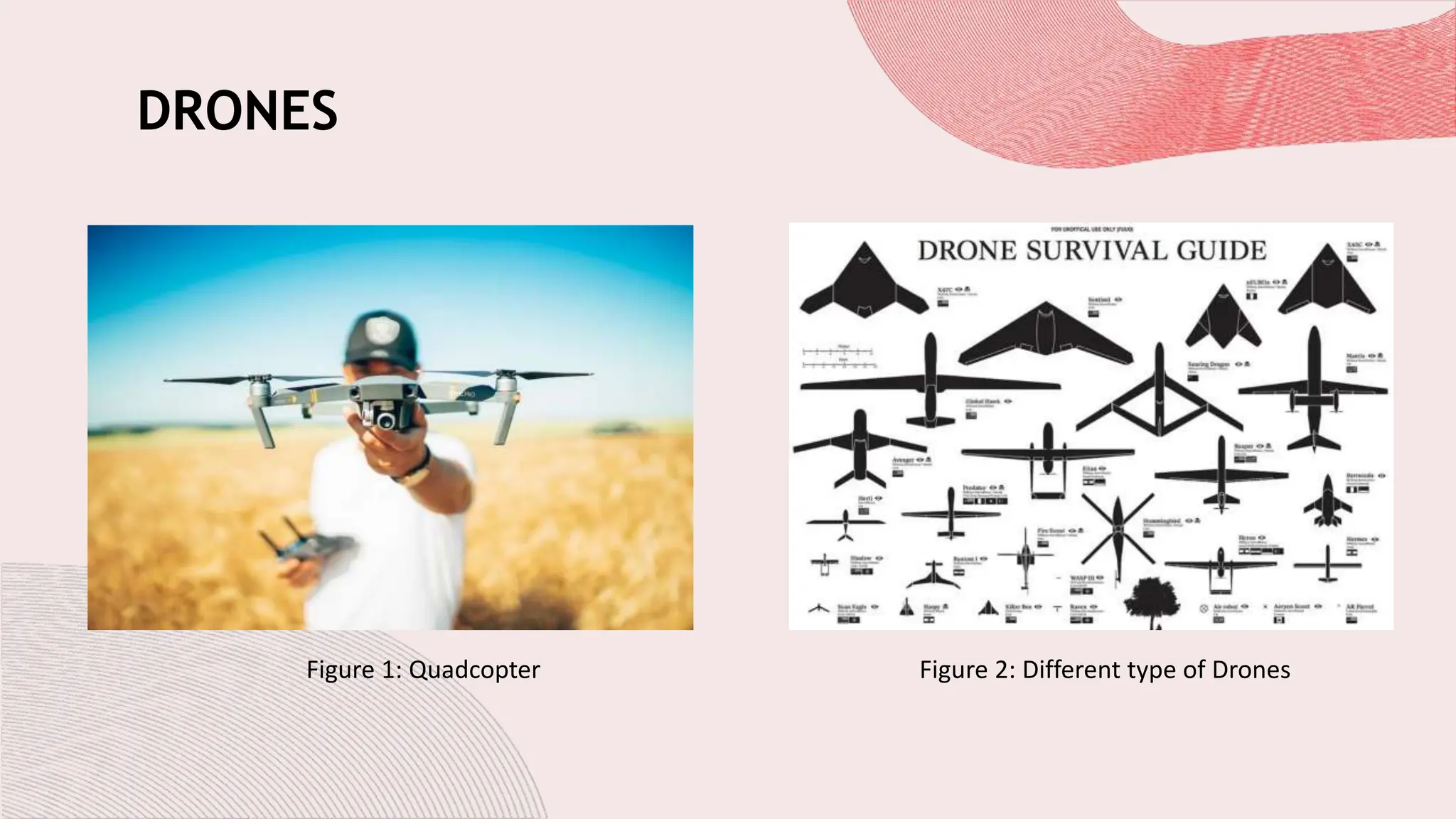
DRONES
Figure 1: Quadcopter Figure 2: Different type of Drones
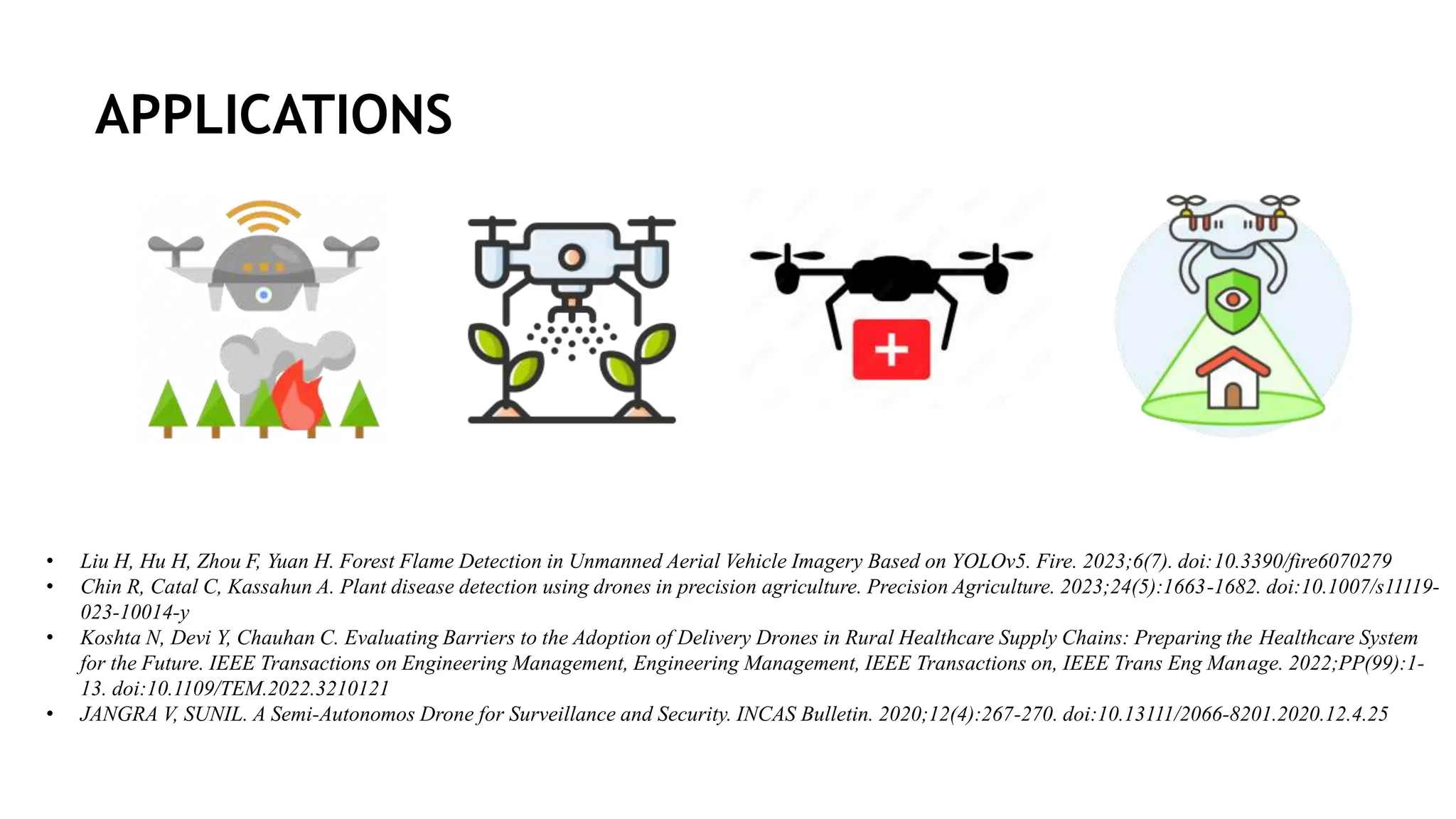
APPLICATIONS
• Liu H, Hu H, Zhou F, Yuan H. Forest Flame Detection in Unmanned Aerial Vehicle Imagery Based on YOLOv5. Fire. 2023;6(7). doi:10.3390/fire6070279
• Chin R, Catal C, Kassahun A. Plant disease detection using drones in precision agriculture. Precision Agriculture. 2023;24(5):1663-1682. doi:10.1007/s11119-
023-10014-y
• Koshta N, Devi Y, Chauhan C. Evaluating Barriers to the Adoption of Delivery Drones in Rural Healthcare Supply Chains: Preparing the Healthcare System
for the Future. IEEE Transactions on Engineering Management, Engineering Management, IEEE Transactions on, IEEE Trans Eng Manage. 2022;PP(99):1-
13. doi:10.1109/TEM.2022.3210121
• JANGRA V, SUNIL. A Semi-Autonomos Drone for Surveillance and Security. INCAS Bulletin. 2020;12(4):267-270. doi:10.13111/2066-8201.2020.12.4.25
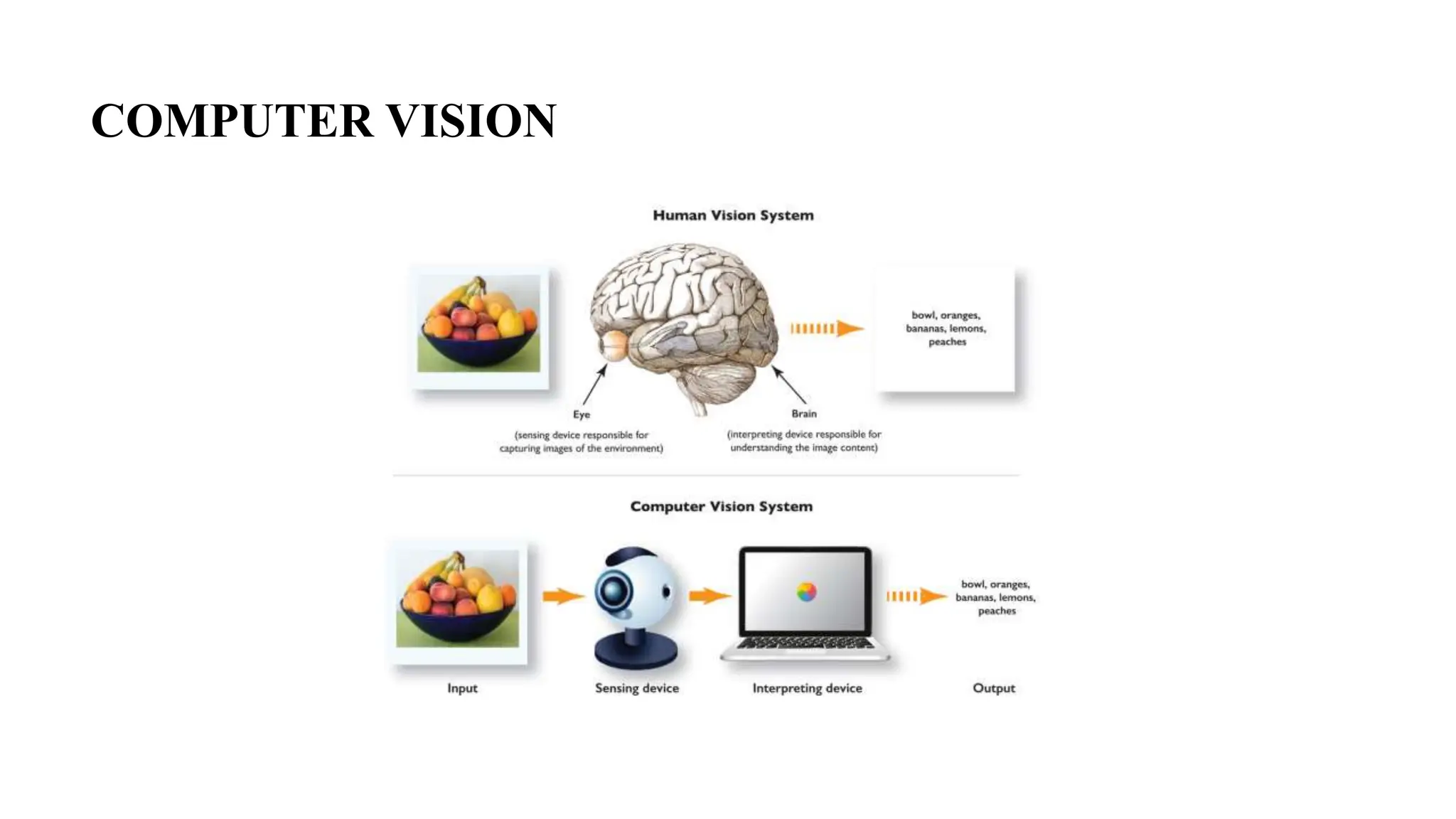
COMPUTER VISION
MACHINE LEARNING MODEL
Hong S-J, Han Y, Kim S-Y, Lee A-Y, Kim G. Application of Deep-Learning Methods to Bird Detection Using Unmanned Aerial Vehicle Imagery. Sensors (Basel, Switzerland). 2019;19(7).
doi:10.3390/s19071651
Bird detection results of Faster R-CNN Resnet 101 model. All birds are successfully detected regardless of the flying altitude of the birds.
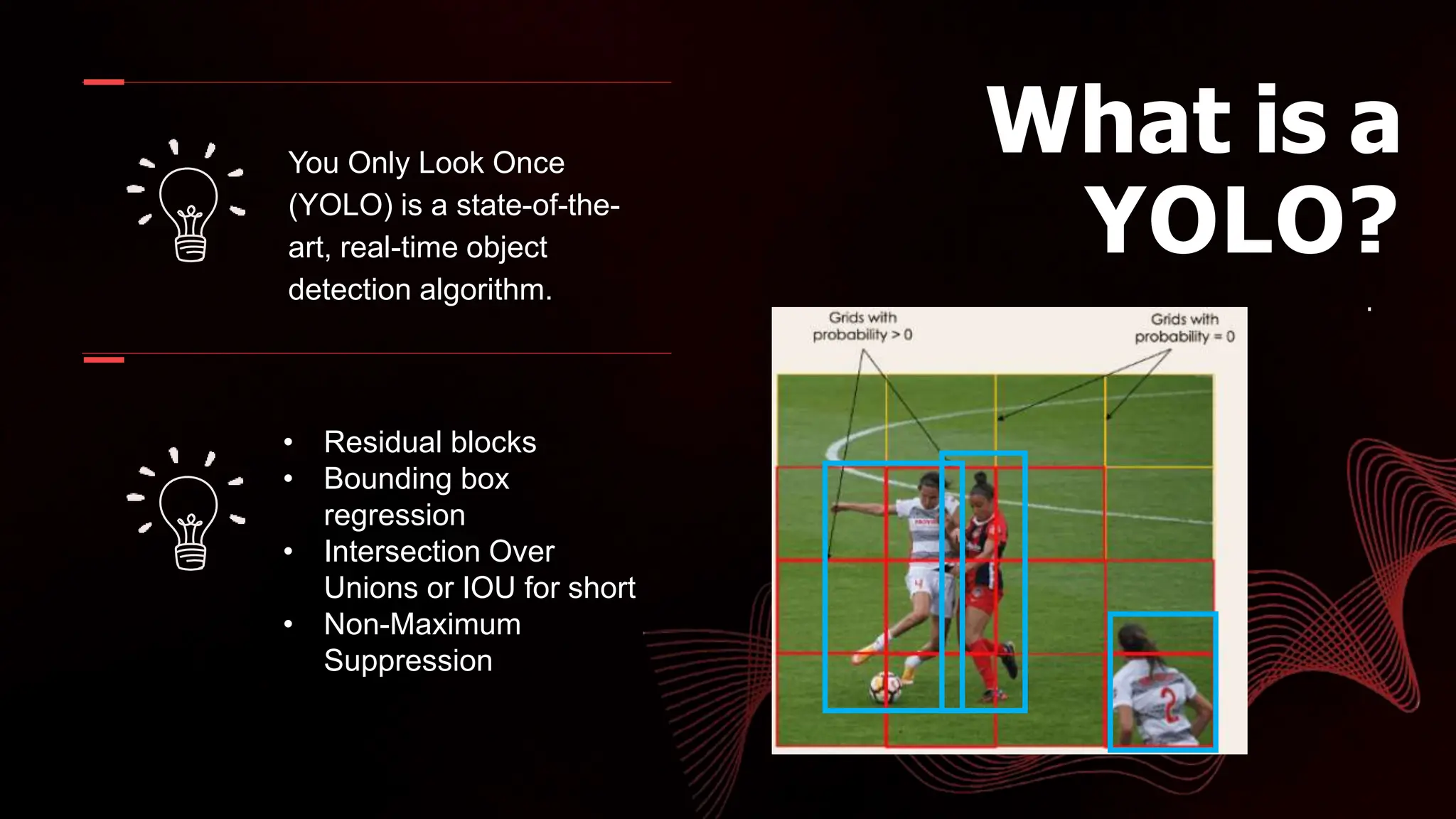
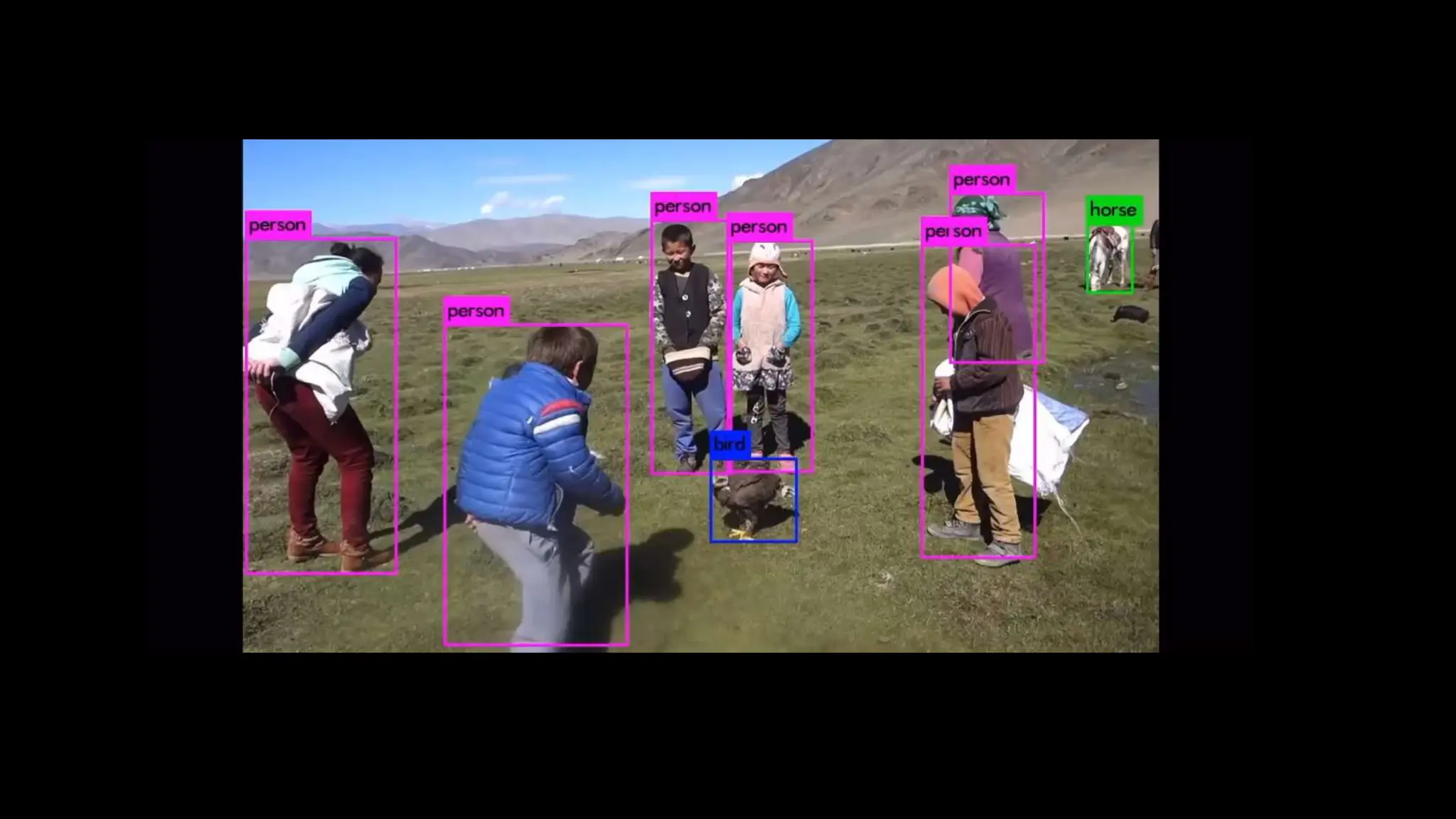
You Only Look Once
(YOLO) is a state-of-the-
art, real-time object
detection algorithm.
• Residual blocks
• Bounding box
regression
• Intersection Over
Unions or IOU for short
• Non-Maximum
Suppression
What is a
YOLO?
.
You Only Look Once: Unified, Real-Time Object Detection
Joseph Redmon, Santosh Divvala, Ross Girshick , Ali Farhadi. You Only Look Once: Unified, Real-Time Object Detection (University of Washington , Allen Institute
for AI , Facebook AI Research, 8 Jun 2015 ) https://arxiv.org/abs/1506.02640
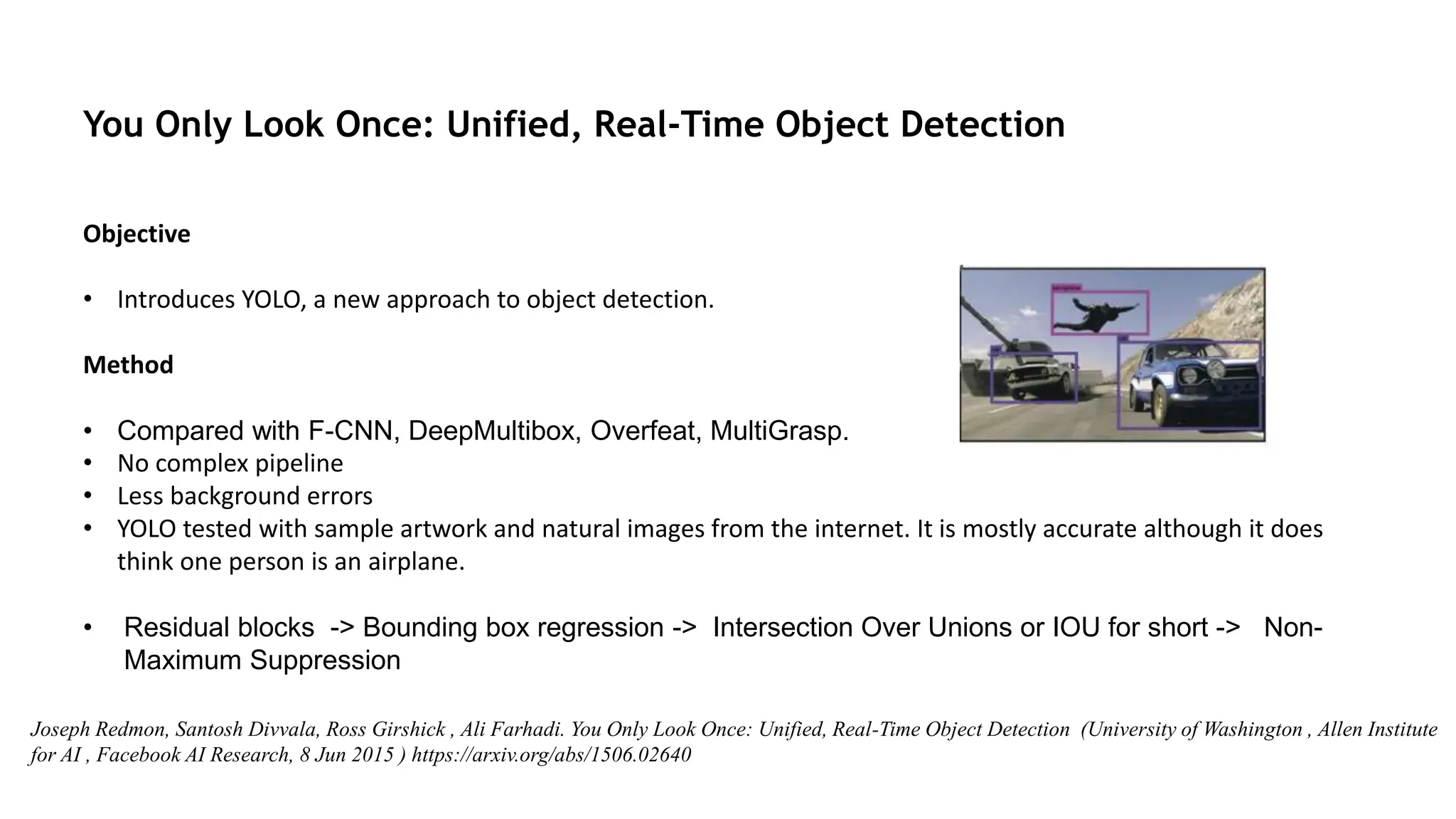
Objective
• Introduces YOLO, a new approach to object detection.
Method
• Compared with F-CNN, DeepMultibox, Overfeat, MultiGrasp.
• No complex pipeline
• Less background errors
• YOLO tested with sample artwork and natural images from the internet. It is mostly accurate although it does
think one person is an airplane.
• Residual blocks -> Bounding box regression -> Intersection Over Unions or IOU for short -> Non-
Maximum Suppression
You Only Look Once: Unified, Real-Time Object Detection
Joseph Redmon, Santosh Divvala, Ross Girshick , Ali Farhadi. You Only Look Once: Unified, Real-Time Object Detection (University of Washington , Allen Institute
for AI , Facebook AI Research, 8 Jun 2015 ) https://arxiv.org/abs/1506.02640
Comparison of RetinaNet, SSD, and YOLO v3 for real-time pill identification
Lu Tan, Tianran Huangfu, Liyao Wu, & Wenying Chen. (2021). Comparison of RetinaNet, SSD, and YOLO v3 for real-time pill identification. BMC Medical
Informatics and Decision Making, 21(1), 1–11. https://0-doi.org.pacificatclassic.pacific.edu/10.1186/s12911-021-01691-8
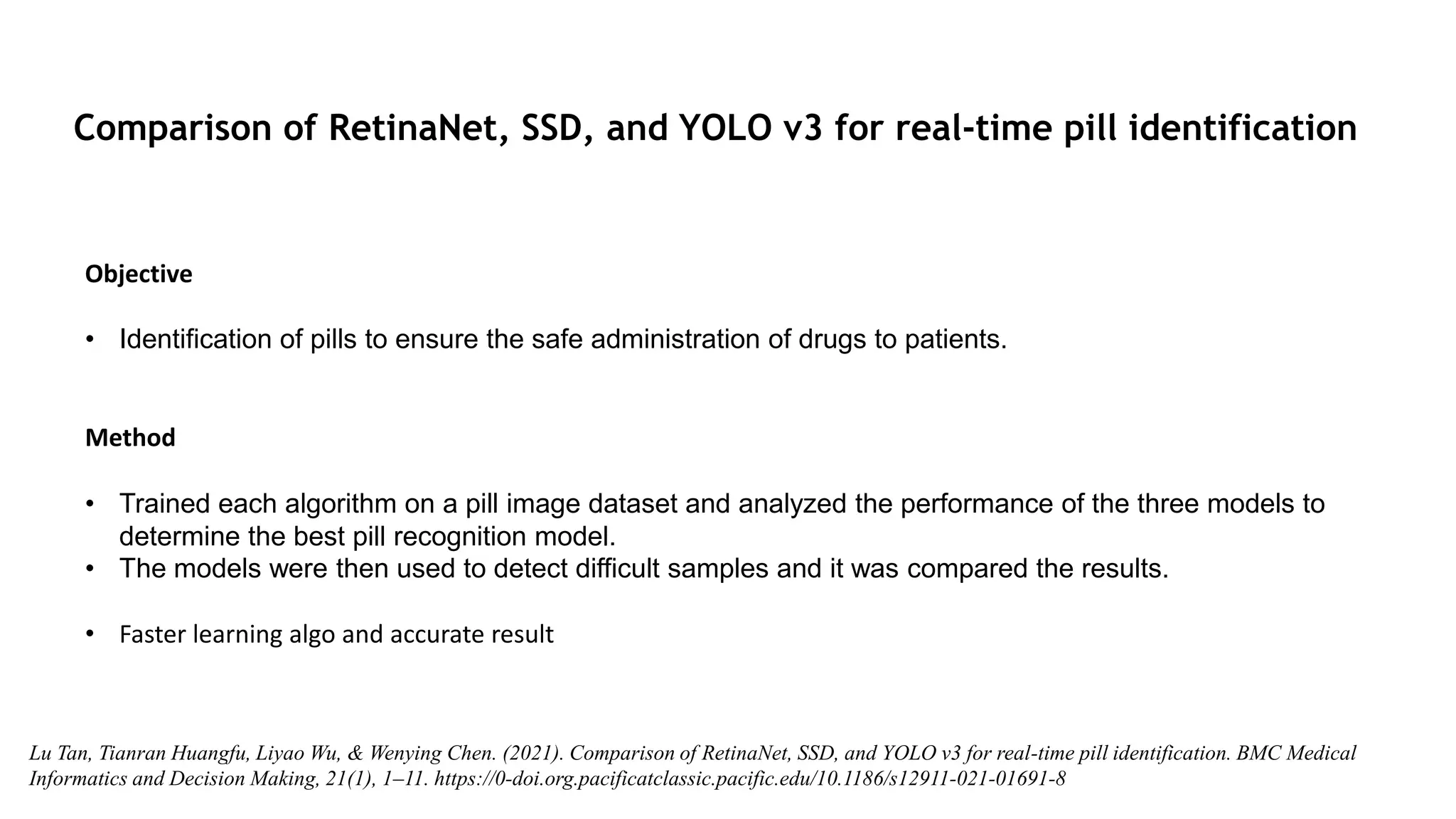
Objective
• Identification of pills to ensure the safe administration of drugs to patients.
Method
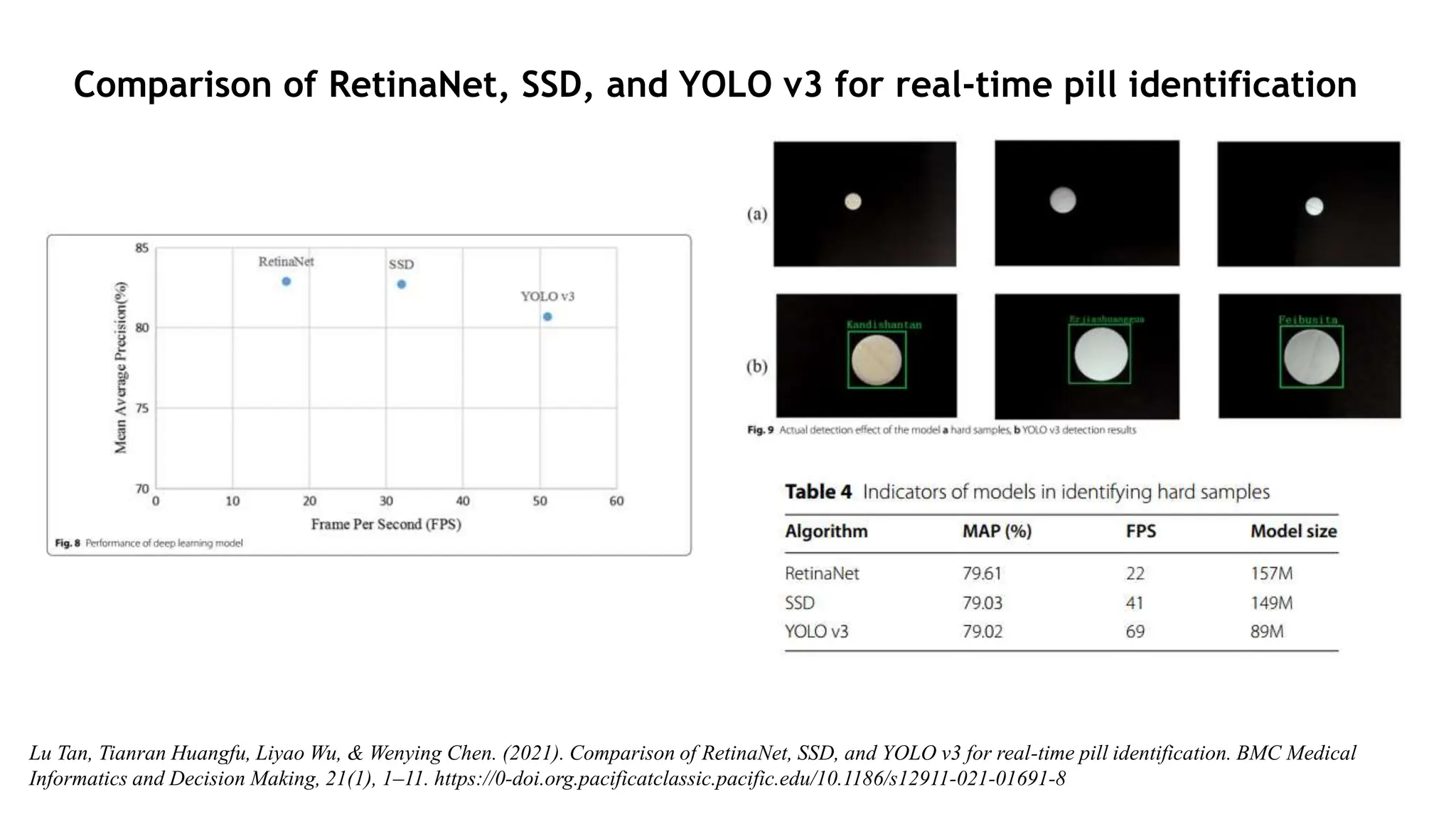
• Trained each algorithm on a pill image dataset and analyzed the performance of the three models to
determine the best pill recognition model.
• The models were then used to detect difficult samples and it was compared the results.
• Faster learning algo and accurate result
Lu Tan, Tianran Huangfu, Liyao Wu, & Wenying Chen. (2021). Comparison of RetinaNet, SSD, and YOLO v3 for real-time pill identification. BMC Medical
Informatics and Decision Making, 21(1), 1–11. https://0-doi.org.pacificatclassic.pacific.edu/10.1186/s12911-021-01691-8
Comparison of RetinaNet, SSD, and YOLO v3 for real-time pill identification
Classification of Actors in an Animated Video using a Novel Yolo Framework in
Comparison with SVM Algorithm
V., S., & S., M. kumar. (2022). Classification of Actors in an Animated Video using a Novel Yolo Framework in Comparison with SVM Algorithm. Journal of
Pharmaceutical Negative Results, 13, 1566–1572. https://0-doi.org.pacificatclassic.pacific.edu/10.47750/pnr.2022.13.S04.187
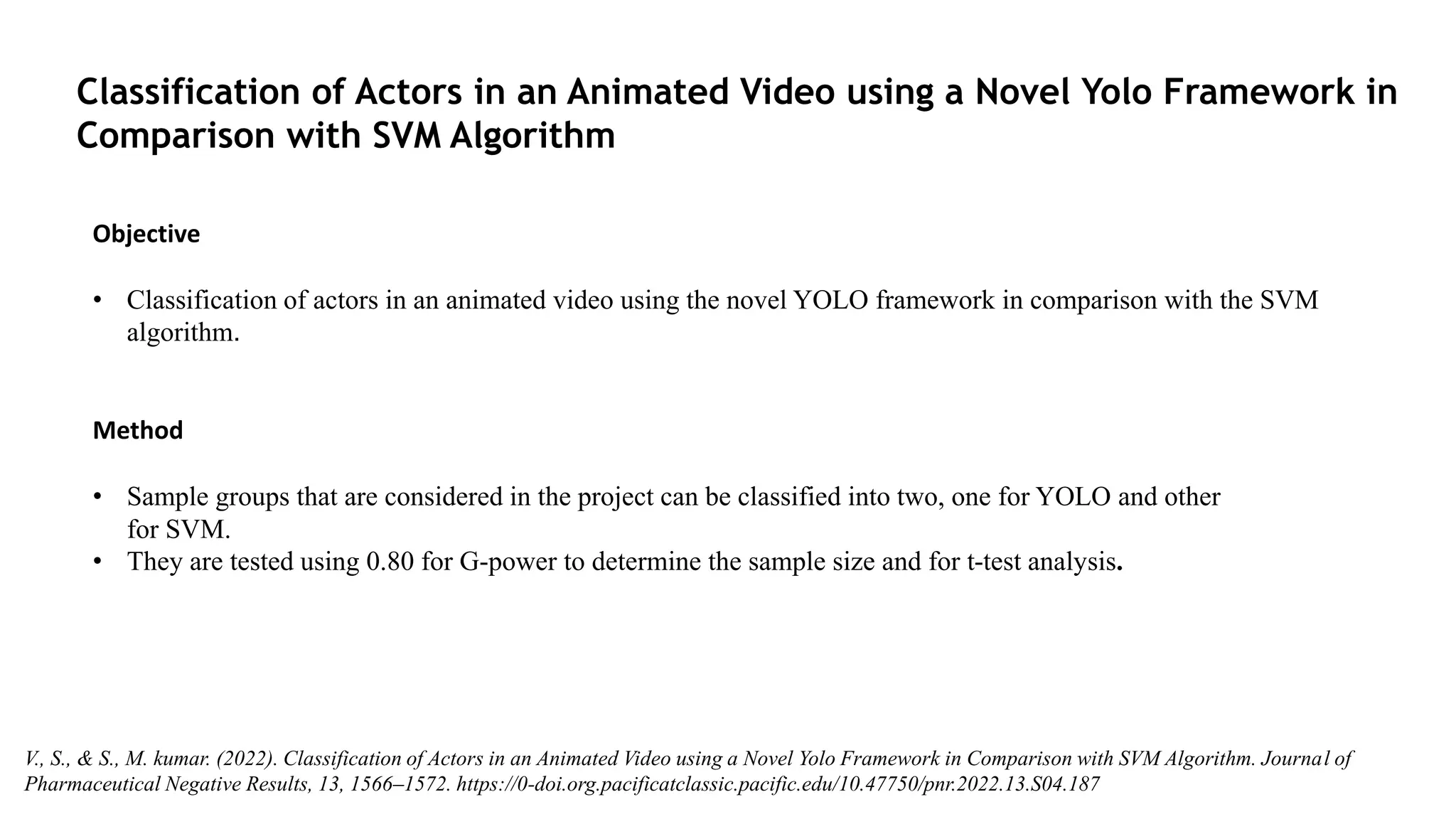
Objective
• Classification of actors in an animated video using the novel YOLO framework in comparison with the SVM
algorithm.
Method
• Sample groups that are considered in the project can be classified into two, one for YOLO and other
for SVM.
• They are tested using 0.80 for G-power to determine the sample size and for t-test analysis.
Classification of Actors in an Animated Video using a Novel Yolo Framework in
Comparison with SVM Algorithm
V., S., & S., M. kumar. (2022). Classification of Actors in an Animated Video using a Novel Yolo Framework in Comparison with SVM Algorithm. Journal of
Pharmaceutical Negative Results, 13, 1566–1572. https://0-doi.org.pacificatclassic.pacific.edu/10.47750/pnr.2022.13.S04.187
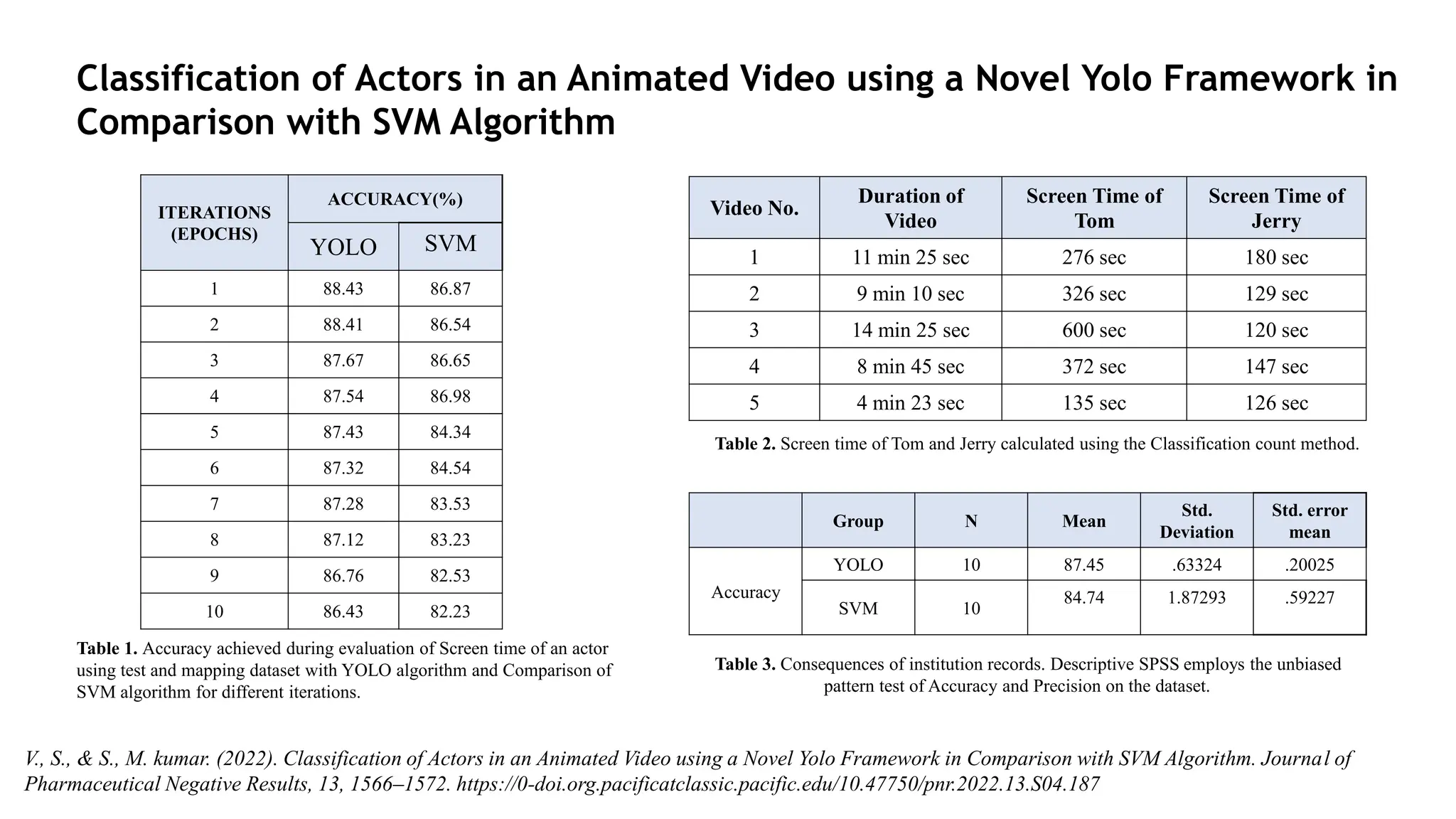
ITERATIONS
(EPOCHS)
ACCURACY(%)
YOLO SVM
1 88.43 86.87
2 88.41 86.54
3 87.67 86.65
4 87.54 86.98
5 87.43 84.34
6 87.32 84.54
7 87.28 83.53
8 87.12 83.23
9 86.76 82.53
10 86.43 82.23
Video No.
Duration of
Video
Screen Time of
Tom
Screen Time of
Jerry
1 11 min 25 sec 276 sec 180 sec
2 9 min 10 sec 326 sec 129 sec
3 14 min 25 sec 600 sec 120 sec
4 8 min 45 sec 372 sec 147 sec
5 4 min 23 sec 135 sec 126 sec
Group N Mean
Std.
Deviation
Std. error
mean
Accuracy
YOLO 10 87.45 .63324 .20025
SVM 10
84.74 1.87293 .59227
Table 2. Screen time of Tom and Jerry calculated using the Classification count method.
Table 3. Consequences of institution records. Descriptive SPSS employs the unbiased
pattern test of Accuracy and Precision on the dataset.
Table 1. Accuracy achieved during evaluation of Screen time of an actor
using test and mapping dataset with YOLO algorithm and Comparison of
SVM algorithm for different iterations.
C onclusion
• YOLO Model perform better in
real time object detection
• High Speed Model training
• Detection accuracy high
• Open-source, multiple versions
available
• It can be used in drones for real
time object detection
References
1
.
. Joseph Redmon, Santosh Divvala, Ross Girshick , Ali Farhadi. You Only Look Once: Unified,
Real-Time Object Detection (University of Washington , Allen Institute for AI , Facebook AI
Research, 8 Jun 2015 ) https://arxiv.org/abs/1506.02640
2.
Lu Tan, Tianran Huangfu, Liyao Wu, & Wenying Chen. (2021). Comparison of RetinaNet, SSD,
and YOLO v3 for real-time pill identification. BMC Medical Informatics and Decision Making,
21(1), 1–11. https://0-doi.org.pacificatclassic.pacific.edu/10.1186/s12911-021-01691-8
3.
V., S., & S., M. kumar. (2022). Classification of Actors in an Animated Video using a Novel Yolo
Framework in Comparison with SVM Algorithm. Journal of Pharmaceutical Negative Results, 13,
1566–1572. https://0-doi.org.pacificatclassic.pacific.edu/10.47750/pnr.2022.13.S04.187
4.
Chin, R., Catal, C., & Kassahun, A. (2023). Plant disease detection using drones in precision
agriculture. Precision Agriculture, 24(5), 1663–1682. https://0-
doi.org.pacificatclassic.pacific.edu/10.1007/s11119-023-10014-y
5.
Koshta, N., Devi, Y., & Chauhan, C. (2022). Evaluating Barriers to the Adoption of Delivery
Drones in Rural Healthcare Supply Chains: Preparing the Healthcare System for the Future.
IEEE Transactions on Engineering Management, Engineering Management, IEEE Transactions
on, IEEE Trans. Eng. Manage, PP(99), 1–13. https://0-
doi.org.pacificatclassic.pacific.edu/10.1109/TEM.2022.3210121
6.
VISHAL JANGRA; SUNIL. A Semi-Autonomos Drone for Surveillance and Security. INCAS
Bulletin, [s. l.], v. 12, n. 4, p. 267–270, 2020. DOI 10.13111/2066-8201.2020.12.4.25. Disponível
em: https://0-research.ebsco.com.pacificatclassic.pacific.edu/linkprocessor/plink?id=85093a8e-
ab79-34ba-ad0e-65410347a06d. Acesso em: 19 out. 2023.
7.
Liu, H., Hu, H., Zhou, F., & Yuan, H. (2023). Forest Flame Detection in Unmanned Aerial
Vehicle Imagery Based on YOLOv5. Fire, 6(7).
https://0-doi.org.pacificatclassic.pacific.edu/10.3390/fire6070279
8.
Suk-Ju Hong, Yunhyeok Han, Sang-Yeon Kim, Ah-Yeong Lee, & Ghiseok Kim. (2019). Application
of Deep-Learning Methods to Bird Detection Using Unmanned Aerial Vehicle Imagery. Sensors,
19(7), 1651. https://0-doi.org.pacificatclassic.pacific.edu/10.3390/s19071651
Thank You

YOLO: An Efficient Real Time Object Detection Algorithm.pptx

  • 1.
    ASHWIN K SHAJI MSComputer Science Fall 23
  • 2.
  • 3.
    DRONES Figure 1: QuadcopterFigure 2: Different type of Drones
  • 4.
    APPLICATIONS • Liu H,Hu H, Zhou F, Yuan H. Forest Flame Detection in Unmanned Aerial Vehicle Imagery Based on YOLOv5. Fire. 2023;6(7). doi:10.3390/fire6070279 • Chin R, Catal C, Kassahun A. Plant disease detection using drones in precision agriculture. Precision Agriculture. 2023;24(5):1663-1682. doi:10.1007/s11119- 023-10014-y • Koshta N, Devi Y, Chauhan C. Evaluating Barriers to the Adoption of Delivery Drones in Rural Healthcare Supply Chains: Preparing the Healthcare System for the Future. IEEE Transactions on Engineering Management, Engineering Management, IEEE Transactions on, IEEE Trans Eng Manage. 2022;PP(99):1- 13. doi:10.1109/TEM.2022.3210121 • JANGRA V, SUNIL. A Semi-Autonomos Drone for Surveillance and Security. INCAS Bulletin. 2020;12(4):267-270. doi:10.13111/2066-8201.2020.12.4.25
  • 6.
  • 7.
    MACHINE LEARNING MODEL HongS-J, Han Y, Kim S-Y, Lee A-Y, Kim G. Application of Deep-Learning Methods to Bird Detection Using Unmanned Aerial Vehicle Imagery. Sensors (Basel, Switzerland). 2019;19(7). doi:10.3390/s19071651 Bird detection results of Faster R-CNN Resnet 101 model. All birds are successfully detected regardless of the flying altitude of the birds.
  • 8.
    You Only LookOnce (YOLO) is a state-of-the- art, real-time object detection algorithm. • Residual blocks • Bounding box regression • Intersection Over Unions or IOU for short • Non-Maximum Suppression What is a YOLO? .
  • 10.
    You Only LookOnce: Unified, Real-Time Object Detection Joseph Redmon, Santosh Divvala, Ross Girshick , Ali Farhadi. You Only Look Once: Unified, Real-Time Object Detection (University of Washington , Allen Institute for AI , Facebook AI Research, 8 Jun 2015 ) https://arxiv.org/abs/1506.02640 Objective • Introduces YOLO, a new approach to object detection. Method • Compared with F-CNN, DeepMultibox, Overfeat, MultiGrasp. • No complex pipeline • Less background errors • YOLO tested with sample artwork and natural images from the internet. It is mostly accurate although it does think one person is an airplane. • Residual blocks -> Bounding box regression -> Intersection Over Unions or IOU for short -> Non- Maximum Suppression
  • 11.
    You Only LookOnce: Unified, Real-Time Object Detection Joseph Redmon, Santosh Divvala, Ross Girshick , Ali Farhadi. You Only Look Once: Unified, Real-Time Object Detection (University of Washington , Allen Institute for AI , Facebook AI Research, 8 Jun 2015 ) https://arxiv.org/abs/1506.02640
  • 12.
    Comparison of RetinaNet,SSD, and YOLO v3 for real-time pill identification Lu Tan, Tianran Huangfu, Liyao Wu, & Wenying Chen. (2021). Comparison of RetinaNet, SSD, and YOLO v3 for real-time pill identification. BMC Medical Informatics and Decision Making, 21(1), 1–11. https://0-doi.org.pacificatclassic.pacific.edu/10.1186/s12911-021-01691-8 Objective • Identification of pills to ensure the safe administration of drugs to patients. Method • Trained each algorithm on a pill image dataset and analyzed the performance of the three models to determine the best pill recognition model. • The models were then used to detect difficult samples and it was compared the results. • Faster learning algo and accurate result
  • 13.
    Lu Tan, TianranHuangfu, Liyao Wu, & Wenying Chen. (2021). Comparison of RetinaNet, SSD, and YOLO v3 for real-time pill identification. BMC Medical Informatics and Decision Making, 21(1), 1–11. https://0-doi.org.pacificatclassic.pacific.edu/10.1186/s12911-021-01691-8 Comparison of RetinaNet, SSD, and YOLO v3 for real-time pill identification
  • 14.
    Classification of Actorsin an Animated Video using a Novel Yolo Framework in Comparison with SVM Algorithm V., S., & S., M. kumar. (2022). Classification of Actors in an Animated Video using a Novel Yolo Framework in Comparison with SVM Algorithm. Journal of Pharmaceutical Negative Results, 13, 1566–1572. https://0-doi.org.pacificatclassic.pacific.edu/10.47750/pnr.2022.13.S04.187 Objective • Classification of actors in an animated video using the novel YOLO framework in comparison with the SVM algorithm. Method • Sample groups that are considered in the project can be classified into two, one for YOLO and other for SVM. • They are tested using 0.80 for G-power to determine the sample size and for t-test analysis.
  • 15.
    Classification of Actorsin an Animated Video using a Novel Yolo Framework in Comparison with SVM Algorithm V., S., & S., M. kumar. (2022). Classification of Actors in an Animated Video using a Novel Yolo Framework in Comparison with SVM Algorithm. Journal of Pharmaceutical Negative Results, 13, 1566–1572. https://0-doi.org.pacificatclassic.pacific.edu/10.47750/pnr.2022.13.S04.187 ITERATIONS (EPOCHS) ACCURACY(%) YOLO SVM 1 88.43 86.87 2 88.41 86.54 3 87.67 86.65 4 87.54 86.98 5 87.43 84.34 6 87.32 84.54 7 87.28 83.53 8 87.12 83.23 9 86.76 82.53 10 86.43 82.23 Video No. Duration of Video Screen Time of Tom Screen Time of Jerry 1 11 min 25 sec 276 sec 180 sec 2 9 min 10 sec 326 sec 129 sec 3 14 min 25 sec 600 sec 120 sec 4 8 min 45 sec 372 sec 147 sec 5 4 min 23 sec 135 sec 126 sec Group N Mean Std. Deviation Std. error mean Accuracy YOLO 10 87.45 .63324 .20025 SVM 10 84.74 1.87293 .59227 Table 2. Screen time of Tom and Jerry calculated using the Classification count method. Table 3. Consequences of institution records. Descriptive SPSS employs the unbiased pattern test of Accuracy and Precision on the dataset. Table 1. Accuracy achieved during evaluation of Screen time of an actor using test and mapping dataset with YOLO algorithm and Comparison of SVM algorithm for different iterations.
  • 16.
    C onclusion • YOLOModel perform better in real time object detection • High Speed Model training • Detection accuracy high • Open-source, multiple versions available • It can be used in drones for real time object detection
  • 17.
    References 1 . . Joseph Redmon,Santosh Divvala, Ross Girshick , Ali Farhadi. You Only Look Once: Unified, Real-Time Object Detection (University of Washington , Allen Institute for AI , Facebook AI Research, 8 Jun 2015 ) https://arxiv.org/abs/1506.02640 2. Lu Tan, Tianran Huangfu, Liyao Wu, & Wenying Chen. (2021). Comparison of RetinaNet, SSD, and YOLO v3 for real-time pill identification. BMC Medical Informatics and Decision Making, 21(1), 1–11. https://0-doi.org.pacificatclassic.pacific.edu/10.1186/s12911-021-01691-8 3. V., S., & S., M. kumar. (2022). Classification of Actors in an Animated Video using a Novel Yolo Framework in Comparison with SVM Algorithm. Journal of Pharmaceutical Negative Results, 13, 1566–1572. https://0-doi.org.pacificatclassic.pacific.edu/10.47750/pnr.2022.13.S04.187 4. Chin, R., Catal, C., & Kassahun, A. (2023). Plant disease detection using drones in precision agriculture. Precision Agriculture, 24(5), 1663–1682. https://0- doi.org.pacificatclassic.pacific.edu/10.1007/s11119-023-10014-y 5. Koshta, N., Devi, Y., & Chauhan, C. (2022). Evaluating Barriers to the Adoption of Delivery Drones in Rural Healthcare Supply Chains: Preparing the Healthcare System for the Future. IEEE Transactions on Engineering Management, Engineering Management, IEEE Transactions on, IEEE Trans. Eng. Manage, PP(99), 1–13. https://0- doi.org.pacificatclassic.pacific.edu/10.1109/TEM.2022.3210121 6. VISHAL JANGRA; SUNIL. A Semi-Autonomos Drone for Surveillance and Security. INCAS Bulletin, [s. l.], v. 12, n. 4, p. 267–270, 2020. DOI 10.13111/2066-8201.2020.12.4.25. Disponível em: https://0-research.ebsco.com.pacificatclassic.pacific.edu/linkprocessor/plink?id=85093a8e- ab79-34ba-ad0e-65410347a06d. Acesso em: 19 out. 2023. 7. Liu, H., Hu, H., Zhou, F., & Yuan, H. (2023). Forest Flame Detection in Unmanned Aerial Vehicle Imagery Based on YOLOv5. Fire, 6(7). https://0-doi.org.pacificatclassic.pacific.edu/10.3390/fire6070279 8. Suk-Ju Hong, Yunhyeok Han, Sang-Yeon Kim, Ah-Yeong Lee, & Ghiseok Kim. (2019). Application of Deep-Learning Methods to Bird Detection Using Unmanned Aerial Vehicle Imagery. Sensors, 19(7), 1651. https://0-doi.org.pacificatclassic.pacific.edu/10.3390/s19071651
  • 18.