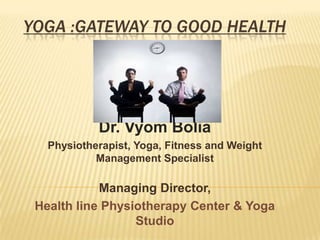
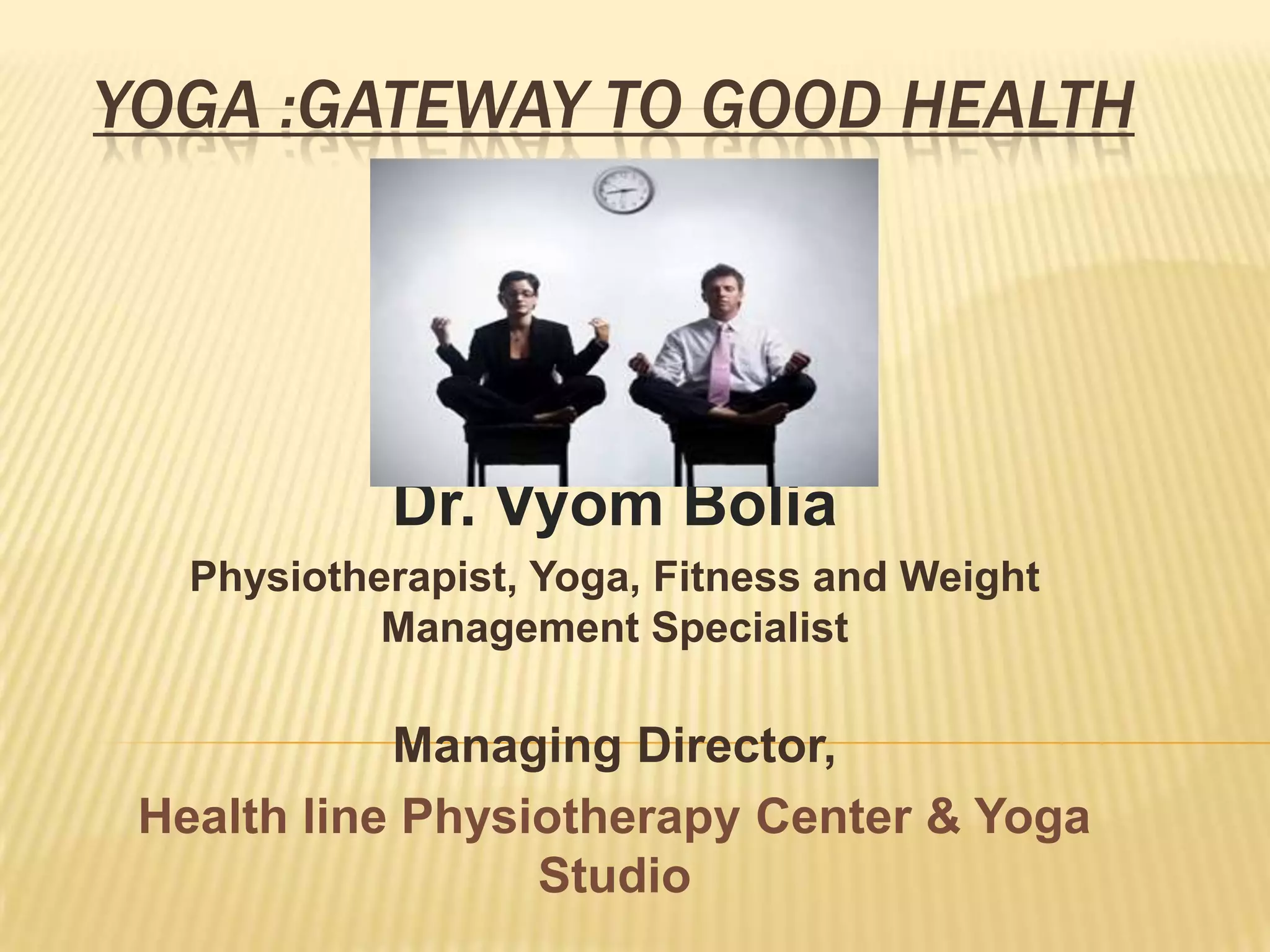
YOGA :GATEWAY TO GOOD HEALTHDr. Vyom BoliaPhysiotherapist, Yoga, Fitness and Weight Management Specialist Managing Director, Health line Physiotherapy Center & Yoga Studio
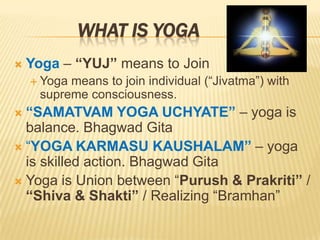
What is YogaYoga– “YUJ” means to JoinYoga means to join individual (“Jivatma”) with supreme consciousness.“SAMATVAM YOGA UCHYATE” – yoga is balance. Bhagwad Gita“YOGA KARMASU KAUSHALAM” – yoga is skilled action. Bhagwad GitaYoga is Union between “Purush & Prakriti” / “Shiva & Shakti” / Realizing “Bramhan”
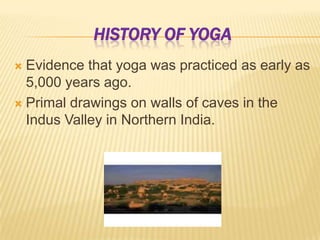
History of YogaEvidence that yoga was practiced as early as 5,000 years ago.Primal drawings on walls of caves in the Indus Valley in Northern India.
PATANJALIPATANJALI “Father of Yoga” WROTE THE YOGA SUTRAS AROUND SECOND CENTURY IN AN ATTEMPT TO DEFINE AND STANDARDIZE CLASSICAL YOGA IT COMPRISES 195 SUTRAS OR THREADS AS WELL AS AN EIGHT FOLD PATH
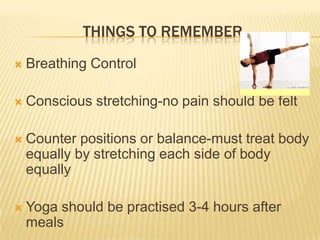
Things to rememberBreathing ControlConscious stretching-no pain should be feltCounter positions or balance-must treat body equally by stretching each side of body equallyYoga should be practised 3-4 hours after meals
Aim of yogaThe aim of Yoga is to bring balance into the body physically, mentally and emotionally. By connecting to ourselves through the breath, we can bring our bodies from a state of turbulence to a place of health.
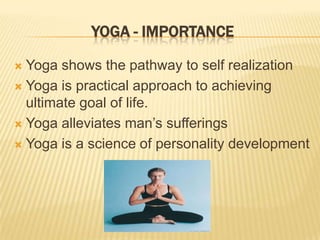
Yoga - ImportanceYoga shows the pathway to self realizationYoga is practical approach to achieving ultimate goal of life.Yoga alleviates man’s sufferingsYoga is a science of personality development
Types of Yoga	Ashtanga Yoga – Discipline of MindHatha Yoga – Discipline of Body and PranaBhakti Yoga – Discipline of EmotionsKarma Yoga – Discipline of ActionsGyan Yoga – Discipline of IntellectMantra YogaKundalini Yoga Swara Yoga, Nada yoga, Laya yoga etc.
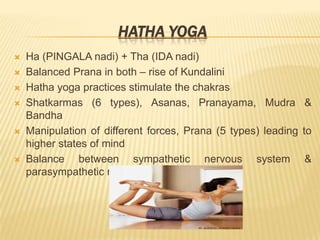
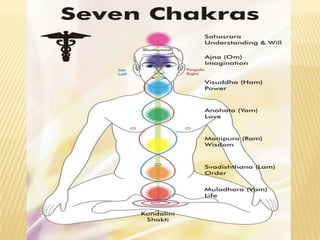
Hatha YogaHa (PINGALA nadi) + Tha (IDA nadi) Balanced Prana in both – rise of KundaliniHatha yoga practices stimulate the chakrasShatkarmas (6 types), Asanas, Pranayama, Mudra & BandhaManipulation of different forces, Prana (5 types) leading to higher states of mindBalance between sympathetic nervous system & parasympathetic nervous system
Benefits of yogaRegular practice of yogic postures enhances the ability  to concentrate ,to deal with impulsive behavior to think more clearlyMental equilibrium & self controlReduces stress & release tension Helps develop  life long health habits (mental & physical)acquaints them with option of healthy daily exercises for the brain and body
A unique aspect of yoga is the mental focus and attention it requires while doing the exercise while doing the postures the result is toning up of both mind and bodyIn adapting and maintaining a posture there is a coordination between the nervous system &muscular system that influence the physical and mental behaviors it Increases FLEXIBILITY which prevents joint pain and injury
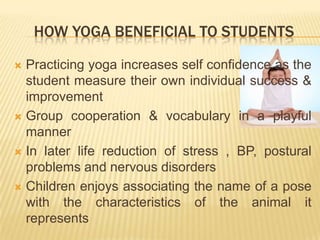
     How yoga beneficial to studentsPracticing yoga increases self confidence as the student measure their own individual success & improvementGroup cooperation & vocabulary in a playful mannerIn later life reduction of stress , BP, postural problems and nervous disordersChildren enjoys associating the name of a pose with the characteristics of the animal it represents
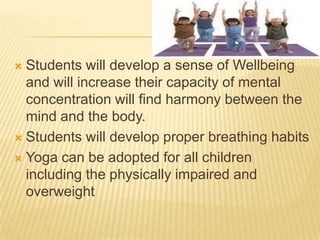
Students will develop a sense of Wellbeing and will increase their capacity of mental concentration will find harmony between the mind and the body.Students will develop proper breathing habitsYoga can be adopted for all children including the physically impaired and overweight
Why YOGA is unique?It costs virtually nothing to set up a time for yoga lessons a 45 min yoga session per day is adequate. there is no need for any equipment any open classroom is sufficient for holding a yoga class it is not a religious practice nor does it conflict with any religionYoga is beneficial to circulation system ,digestive system &endocrine system  yoga postures massages internal organs and glands
     EIGHT LIMBS OF CLASSICAL YOGA YAMA: SOCIAL RESTRAINTS OR ETHICAL VALUESNIYAMA: PERSONAL OBSERVANCE OF PURITY,TOLERANCE AND STUDYASANA PHYSICAL EXERCISESPRANAYAM: BREATH CONTROL OR REGULATIPONPRATYAHARA: SENSE WITHDRAWL IN PREPRATION FOR MEDITATIONDHARNA: CONCENTRATIONDHYANA: MEDITATIONSAMADHI: ECSTASY
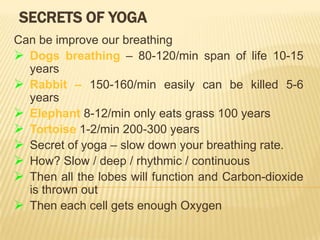
Secrets of yogaCan be improve our breathingDogs breathing – 80-120/min span of life 10-15 years
Rabbit – 150-160/min easily can be killed 5-6 years
Elephant 8-12/min only eats grass 100 years
Tortoise 1-2/min 200-300 years
Secret of yoga – slow down your breathing rate.
How? Slow / deep / rhythmic / continuous
Then all the lobes will function and Carbon-dioxide is thrown out
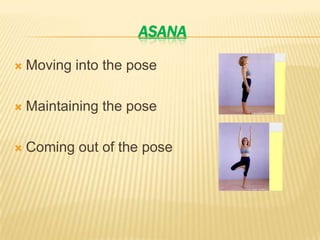
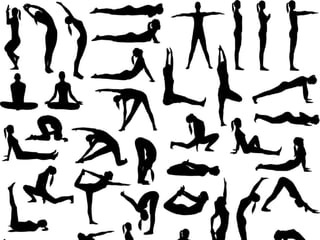
Then each cell gets enough OxygenAsanaMoving into the poseMaintaining the poseComing out of the pose
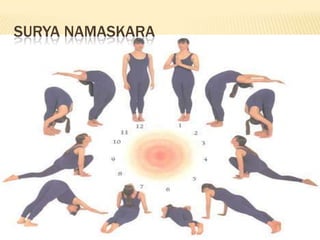
SURYA NAMASKARA
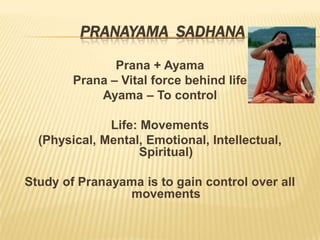
Pranayama SadhanaPrana + AyamaPrana – Vital force behind lifeAyama– To controlLife: Movements(Physical, Mental, Emotional, Intellectual, Spiritual)Study of Pranayama is to gain control over all movements
Pranayama Sadhana  Control of Prana is through the control of the breathBreathing is a continuous process, from the time of birth to the time of death                  (It is the “Indication of Life”)Breathing is automatically controlled by the Autonomous Nervous SystemBreathing can be controlled by our willWe can take control of the A.N.S through Pranayamic practices.
Pranayama SadhanaBreathing Process                 			         Inhalation & ExhalationRoll of oxygen in bodyTidal air ---- 600 c.c.Air utilised ---- 450 c.c.Dead space ---- 150 c.c.Oxygen content is 21%
Pranayama SadhanaBreathing RateNormal – 15 to 18 breaths/mini.e. Inhalation 2 sec  &  Exhalation 2 secDeep Breathing Ratio 5:10i.e. Inhalation 5 sec  &  Exhalation 10 secBreathing Rate – 4/min         Life span increases because of greater supply of          oxygen
Pranayama SadhanaPranayama = Holding of Breath = KumbhakInhalation (Purak) – Pause (Kumbhak) – Exhalation (Rechak)Pause (Kumbhak)Practice of Pranayama is the practice of KumbhakPractice of Kumbhak requires the practice of Purak& RechakPractice of Purak & Rechak is easy & effectiveThe practice of Kumbhak is difficult & dangerous if not practiced properly
Pranayama SadhanaStudy of Purak & RechakControl must beSLOW SMOOTHUNIFORMSTEADY
Important PranayamBhastrikaKapalbhatiBahyaPranayamaAgnisarUjjayeeAnulomVilomBhramariUdgeeth
Pranayama and its benefitsPhysically, Pranayama appears to be a systematic exercise of respiration, which makes the lungs stronger, improves blood circulation, makes the man healthier and bestows upon him the boon of a long life. Pranayama does not mean just breathing in, keeping the breathed air in and exhaling it. It also means establishing control on the entire breathing process, and maintaining mental equilibrium, and concentration of mind.Most of the people do not have the habit of breathing deeply with the result that only one-fourth part of the lungs is brought into action and 75 percent remains idle.The inefficient functioning of the lungs affects the process of blood purification. It is for this reason that the importance of Pranayama has come to be recognised, for a healthy long life.Several diseases can be averted by regular practice of Pranayama. Mental disturbances like excitement, anxiety, fear, anger, and disappointment can be calmed down by regular practice of Pranayama.Another benefit of Pranayama is that by its regular practice, habit of deep breathing is developed which results in several health benefits.
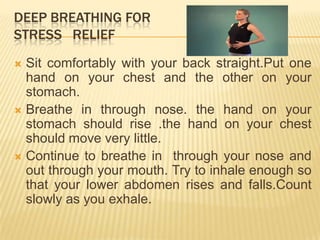
DEEP BREATHING FOR STRESS   RELIEFSit comfortably with your back straight.Put one hand on your chest and the other on your stomach.Breathe in through nose. the hand on your stomach should rise .the hand on your chest should move very little.Continue to breathe in  through your nose and out through your mouth. Try to inhale enough so that your lower abdomen rises and falls.Count slowly as you exhale.
WE KNOW THAT LIFE BEGINS WITH THE FIRST BREATH AND ENDS WITH THE LAST BUT IT IS HOW WE BREATHE IN BETWEEN THAT GREATLY IMPACTS HOW WILL WE LIVE THIS LIFE
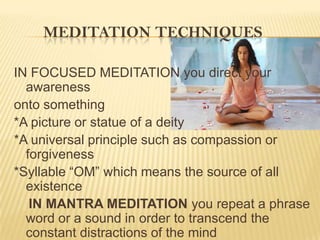
MEDITATION TECHNIQUES IN FOCUSED MEDITATION you direct your awarenessonto something*A picture or statue of a deity*A universal principle such as compassion or forgiveness*Syllable “OM” which means the source of all existence    IN MANTRA MEDITATION you repeat a phrase word or a sound in order to transcend the constant distractions of the mind
ANY QUESTIONS

Yoga and health: PhysioYog.Com

  • 1.
    YOGA :GATEWAY TOGOOD HEALTHDr. Vyom BoliaPhysiotherapist, Yoga, Fitness and Weight Management Specialist Managing Director, Health line Physiotherapy Center & Yoga Studio
  • 2.
    What is YogaYoga–“YUJ” means to JoinYoga means to join individual (“Jivatma”) with supreme consciousness.“SAMATVAM YOGA UCHYATE” – yoga is balance. Bhagwad Gita“YOGA KARMASU KAUSHALAM” – yoga is skilled action. Bhagwad GitaYoga is Union between “Purush & Prakriti” / “Shiva & Shakti” / Realizing “Bramhan”
  • 3.
    History of YogaEvidencethat yoga was practiced as early as 5,000 years ago.Primal drawings on walls of caves in the Indus Valley in Northern India.
  • 4.
    PATANJALIPATANJALI “Father ofYoga” WROTE THE YOGA SUTRAS AROUND SECOND CENTURY IN AN ATTEMPT TO DEFINE AND STANDARDIZE CLASSICAL YOGA IT COMPRISES 195 SUTRAS OR THREADS AS WELL AS AN EIGHT FOLD PATH
  • 5.
    Things to rememberBreathingControlConscious stretching-no pain should be feltCounter positions or balance-must treat body equally by stretching each side of body equallyYoga should be practised 3-4 hours after meals
  • 6.
    Aim of yogaTheaim of Yoga is to bring balance into the body physically, mentally and emotionally. By connecting to ourselves through the breath, we can bring our bodies from a state of turbulence to a place of health.
  • 7.
    Yoga - ImportanceYogashows the pathway to self realizationYoga is practical approach to achieving ultimate goal of life.Yoga alleviates man’s sufferingsYoga is a science of personality development
  • 8.
    Types of Yoga AshtangaYoga – Discipline of MindHatha Yoga – Discipline of Body and PranaBhakti Yoga – Discipline of EmotionsKarma Yoga – Discipline of ActionsGyan Yoga – Discipline of IntellectMantra YogaKundalini Yoga Swara Yoga, Nada yoga, Laya yoga etc.
  • 9.
    Hatha YogaHa (PINGALAnadi) + Tha (IDA nadi) Balanced Prana in both – rise of KundaliniHatha yoga practices stimulate the chakrasShatkarmas (6 types), Asanas, Pranayama, Mudra & BandhaManipulation of different forces, Prana (5 types) leading to higher states of mindBalance between sympathetic nervous system & parasympathetic nervous system
  • 10.
    Benefits of yogaRegularpractice of yogic postures enhances the ability to concentrate ,to deal with impulsive behavior to think more clearlyMental equilibrium & self controlReduces stress & release tension Helps develop life long health habits (mental & physical)acquaints them with option of healthy daily exercises for the brain and body
  • 11.
    A unique aspectof yoga is the mental focus and attention it requires while doing the exercise while doing the postures the result is toning up of both mind and bodyIn adapting and maintaining a posture there is a coordination between the nervous system &muscular system that influence the physical and mental behaviors it Increases FLEXIBILITY which prevents joint pain and injury
  • 12.
    How yoga beneficial to studentsPracticing yoga increases self confidence as the student measure their own individual success & improvementGroup cooperation & vocabulary in a playful mannerIn later life reduction of stress , BP, postural problems and nervous disordersChildren enjoys associating the name of a pose with the characteristics of the animal it represents
  • 13.
    Students will developa sense of Wellbeing and will increase their capacity of mental concentration will find harmony between the mind and the body.Students will develop proper breathing habitsYoga can be adopted for all children including the physically impaired and overweight
  • 14.
    Why YOGA isunique?It costs virtually nothing to set up a time for yoga lessons a 45 min yoga session per day is adequate. there is no need for any equipment any open classroom is sufficient for holding a yoga class it is not a religious practice nor does it conflict with any religionYoga is beneficial to circulation system ,digestive system &endocrine system yoga postures massages internal organs and glands
  • 15.
    EIGHT LIMBS OF CLASSICAL YOGA YAMA: SOCIAL RESTRAINTS OR ETHICAL VALUESNIYAMA: PERSONAL OBSERVANCE OF PURITY,TOLERANCE AND STUDYASANA PHYSICAL EXERCISESPRANAYAM: BREATH CONTROL OR REGULATIPONPRATYAHARA: SENSE WITHDRAWL IN PREPRATION FOR MEDITATIONDHARNA: CONCENTRATIONDHYANA: MEDITATIONSAMADHI: ECSTASY
  • 16.
    Secrets of yogaCanbe improve our breathingDogs breathing – 80-120/min span of life 10-15 years
  • 17.
    Rabbit – 150-160/mineasily can be killed 5-6 years
  • 18.
    Elephant 8-12/min onlyeats grass 100 years
  • 19.
  • 20.
    Secret of yoga– slow down your breathing rate.
  • 21.
    How? Slow /deep / rhythmic / continuous
  • 22.
    Then all thelobes will function and Carbon-dioxide is thrown out
  • 23.
    Then each cellgets enough OxygenAsanaMoving into the poseMaintaining the poseComing out of the pose
  • 26.
  • 27.
    Pranayama SadhanaPrana +AyamaPrana – Vital force behind lifeAyama– To controlLife: Movements(Physical, Mental, Emotional, Intellectual, Spiritual)Study of Pranayama is to gain control over all movements
  • 28.
    Pranayama Sadhana Control of Prana is through the control of the breathBreathing is a continuous process, from the time of birth to the time of death (It is the “Indication of Life”)Breathing is automatically controlled by the Autonomous Nervous SystemBreathing can be controlled by our willWe can take control of the A.N.S through Pranayamic practices.
  • 29.
    Pranayama SadhanaBreathing Process  Inhalation & ExhalationRoll of oxygen in bodyTidal air ---- 600 c.c.Air utilised ---- 450 c.c.Dead space ---- 150 c.c.Oxygen content is 21%
  • 30.
    Pranayama SadhanaBreathing RateNormal– 15 to 18 breaths/mini.e. Inhalation 2 sec & Exhalation 2 secDeep Breathing Ratio 5:10i.e. Inhalation 5 sec & Exhalation 10 secBreathing Rate – 4/min Life span increases because of greater supply of oxygen
  • 31.
    Pranayama SadhanaPranayama =Holding of Breath = KumbhakInhalation (Purak) – Pause (Kumbhak) – Exhalation (Rechak)Pause (Kumbhak)Practice of Pranayama is the practice of KumbhakPractice of Kumbhak requires the practice of Purak& RechakPractice of Purak & Rechak is easy & effectiveThe practice of Kumbhak is difficult & dangerous if not practiced properly
  • 32.
    Pranayama SadhanaStudy ofPurak & RechakControl must beSLOW SMOOTHUNIFORMSTEADY
  • 33.
  • 34.
    Pranayama and itsbenefitsPhysically, Pranayama appears to be a systematic exercise of respiration, which makes the lungs stronger, improves blood circulation, makes the man healthier and bestows upon him the boon of a long life. Pranayama does not mean just breathing in, keeping the breathed air in and exhaling it. It also means establishing control on the entire breathing process, and maintaining mental equilibrium, and concentration of mind.Most of the people do not have the habit of breathing deeply with the result that only one-fourth part of the lungs is brought into action and 75 percent remains idle.The inefficient functioning of the lungs affects the process of blood purification. It is for this reason that the importance of Pranayama has come to be recognised, for a healthy long life.Several diseases can be averted by regular practice of Pranayama. Mental disturbances like excitement, anxiety, fear, anger, and disappointment can be calmed down by regular practice of Pranayama.Another benefit of Pranayama is that by its regular practice, habit of deep breathing is developed which results in several health benefits.
  • 35.
    DEEP BREATHING FORSTRESS RELIEFSit comfortably with your back straight.Put one hand on your chest and the other on your stomach.Breathe in through nose. the hand on your stomach should rise .the hand on your chest should move very little.Continue to breathe in through your nose and out through your mouth. Try to inhale enough so that your lower abdomen rises and falls.Count slowly as you exhale.
  • 36.
    WE KNOW THATLIFE BEGINS WITH THE FIRST BREATH AND ENDS WITH THE LAST BUT IT IS HOW WE BREATHE IN BETWEEN THAT GREATLY IMPACTS HOW WILL WE LIVE THIS LIFE
  • 37.
    MEDITATION TECHNIQUES INFOCUSED MEDITATION you direct your awarenessonto something*A picture or statue of a deity*A universal principle such as compassion or forgiveness*Syllable “OM” which means the source of all existence IN MANTRA MEDITATION you repeat a phrase word or a sound in order to transcend the constant distractions of the mind
  • 38.