




































Preparatory Training
Presented by: Germán Henao
“ “There are lots of places
in the world that still
don’t know you
Your First EURES Job
About Gi Group
5	
  
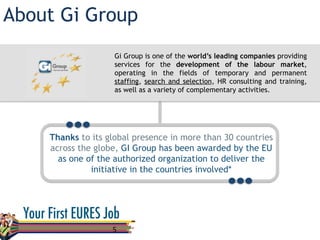
Gi Group is one of the world’s leading companies providing
services for the development of the labour market,
operating in the fields of temporary and permanent
staffing, search and selection, HR consulting and training,
as well as a variety of complementary activities.
Thanks to its global presence in more than 30 countries
across the globe, GI Group has been awarded by the EU
as one of the authorized organization to deliver the
initiative in the countries involved*
About Your First EURES Job
6	
  
Your First EURES Job is an European Commission free of charge
program delivered by Gi Group with the aim to help European
young people find the right job and to help employers find the
right workers in other EU countries.
It is one of the key actions to address
youth unemployment and boost youth
labour mobility. The goal is to help
financially directly around 5,000 young
people find a job in any EU country
other than their country of residence.
Who can join?
7	
  
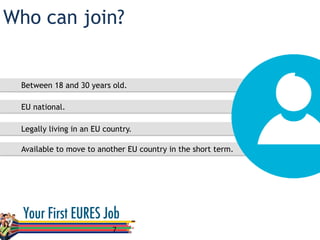
Between 18 and 30 years old.
EU national.
Legally living in an EU country.
Available to move to another EU country in the short term.
Benefits for you
8	
  
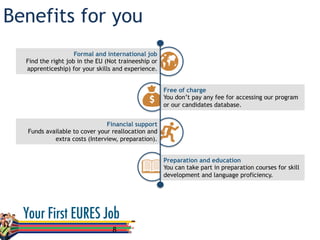
Free of charge
You don’t pay any fee for accessing our program
or our candidates database.
Preparation and education
You can take part in preparation courses for skill
development and language proficiency.
Formal and international job
Find the right job in the EU (Not traineeship or
apprenticeship) for your skills and experience.
Financial support
Funds available to cover your reallocation and
extra costs (Interview, preparation).
Process flow
9	
  
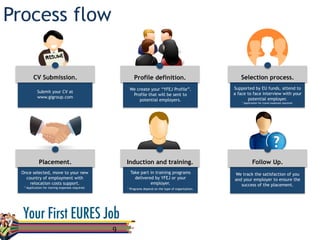
We track the satisfaction of you
and your employer to ensure the
success of the placement.
Take part in training programs
delivered by YFEJ or your
employer.
* Programs depend on the type of organization.
Once selected, move to your new
country of employment with
relocation costs support.
* Application for moving expenses required.
Supported by EU funds, attend to
a face to face interview with your
potential employer.
* Application for travel expenses required.
We create your “YFEJ Profile”.
Profile that will be sent to
potential employers.
CV Submission. Profile definition. Selection process.
Placement. Induction and training. Follow Up.
Submit your CV at
www.gigroup.com
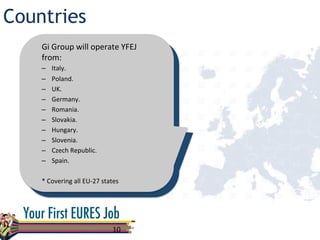
Countries
10	
  
Gi	
  Group	
  will	
  operate	
  YFEJ	
  
from:	
  
–  Italy.	
  
–  Poland.	
  
–  UK.	
  
–  Germany.	
  
–  Romania.	
  
–  Slovakia.	
  
–  Hungary.	
  
–  Slovenia. 	
  	
  
–  Czech	
  Republic.	
  
–  Spain.	


*	
  Covering	
  all	
  EU-­‐27	
  states	
  
Your CV
How to write a CV that differentiates you from other
candidates.
Research
1
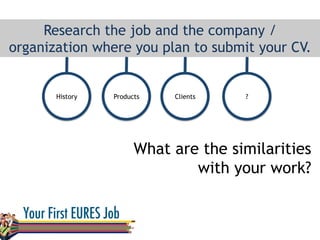
Research the job and the company /
organization where you plan to submit your CV.
History Products Clients ?
What are the similarities
with your work?
Choose	
  3	
  to	
  6	
  experiences	
  that	
  will	
  tailor	
  your	
  resume	
  
to	
  this	
  job	
  
Decide	
  the	
  best	
  way	
  to	
  format	
  your	
  resume	
  according	
  
to	
  the	
  job	
  and	
  your	
  experience.	
  
Chronological?
Grouping?
Structure
2
Format your resume in a professional way.
Font, size, space, headlines.
Format your resume in a professional way.
Write a "qualifications", or "executive summary" section.
Years of experience, major accomplishments, promotions and skills.
Format your resume in a professional way.
Write a "qualifications", or "executive summary" section.
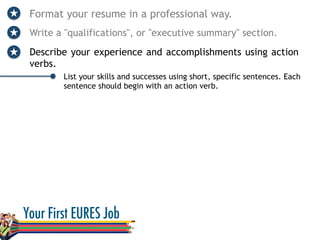
Describe your experience and accomplishments using action
verbs.
List your skills and successes using short, specific sentences. Each
sentence should begin with an action verb.
Format your resume in a professional way.
Write a "qualifications", or "executive summary" section.
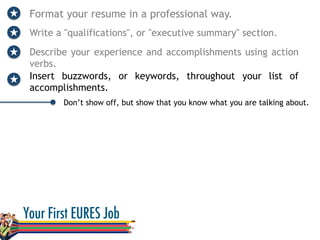
Describe your experience and accomplishments using action
verbs.
Don’t show off, but show that you know what you are talking about.
Insert buzzwords, or keywords, throughout your list of
accomplishments.
Format your resume in a professional way.
Write a "qualifications", or "executive summary" section.
Describe your experience and accomplishments using action
verbs.
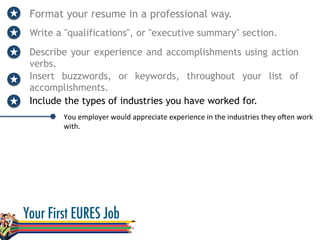
You	
  employer	
  would	
  appreciate	
  experience	
  in	
  the	
  industries	
  they	
  oVen	
  work	
  
with.	
  
Insert buzzwords, or keywords, throughout your list of
accomplishments.
Include the types of industries you have worked for.
Format your resume in a professional way.
Write a "qualifications", or "executive summary" section.
Describe your experience and accomplishments using action
verbs.
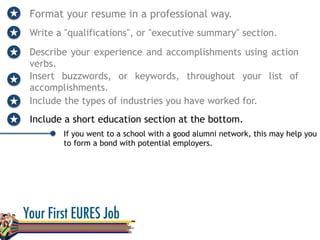
If you went to a school with a good alumni network, this may help you
to form a bond with potential employers.
Insert buzzwords, or keywords, throughout your list of
accomplishments.
Include the types of industries you have worked for.
Include a short education section at the bottom.
Format your resume in a professional way.
Write a "qualifications", or "executive summary" section.
Describe your experience and accomplishments using action
verbs.
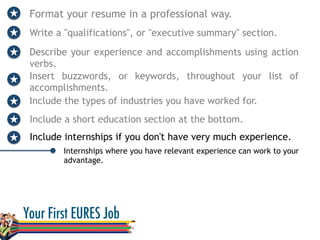
Internships where you have relevant experience can work to your
advantage.
Insert buzzwords, or keywords, throughout your list of
accomplishments.
Include the types of industries you have worked for.
Include a short education section at the bottom.
Include internships if you don't have very much experience.
Format your resume in a professional way.
Write a "qualifications", or "executive summary" section.
Describe your experience and accomplishments using action
verbs.
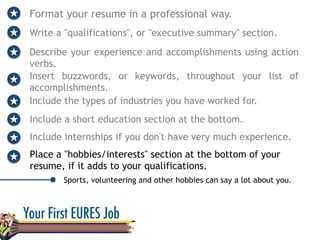
Sports, volunteering and other hobbies can say a lot about you.
Insert buzzwords, or keywords, throughout your list of
accomplishments.
Include the types of industries you have worked for.
Include a short education section at the bottom.
Include internships if you don't have very much experience.
Place a "hobbies/interests" section at the bottom of your
resume, if it adds to your qualifications.
Format your resume in a professional way.
Write a "qualifications", or "executive summary" section.
Describe your experience and accomplishments using action
verbs.
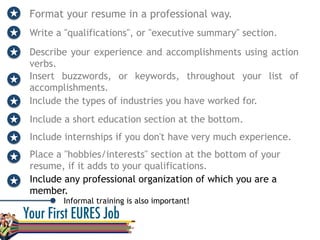
Informal training is also important!	
  
Insert buzzwords, or keywords, throughout your list of
accomplishments.
Include the types of industries you have worked for.
Include a short education section at the bottom.
Include internships if you don't have very much experience.
Place a "hobbies/interests" section at the bottom of your
resume, if it adds to your qualifications.
Include any professional organization of which you are a
member.
Format your resume in a professional way.
Write a "qualifications", or "executive summary" section.
Describe your experience and accomplishments using action
verbs.
Insert buzzwords, or keywords, throughout your list of
accomplishments.
Include the types of industries you have worked for.
Include a short education section at the bottom.
Include internships if you don't have very much experience.
Place a "hobbies/interests" section at the bottom of your
resume, if it adds to your qualifications.
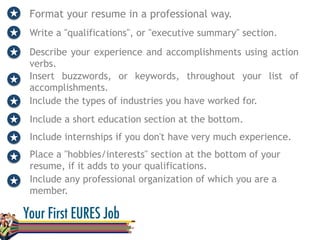
Include any professional organization of which you are a
member.
Finishing touches
3
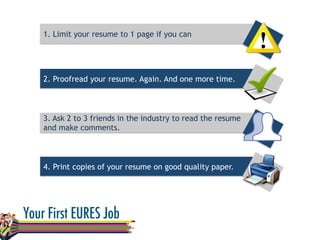
1. Limit your resume to 1 page if you can
2. Proofread your resume. Again. And one more time.
3. Ask 2 to 3 friends in the industry to read the resume
and make comments.
4. Print copies of your resume on good quality paper.
KeyWords
*
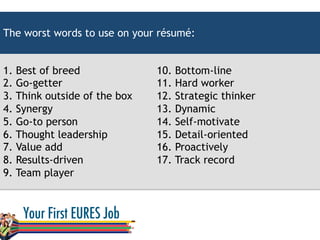
1. Best of breed
2. Go-getter
3. Think outside of the box
4. Synergy
5. Go-to person
6. Thought leadership
7. Value add
8. Results-driven
9. Team player
10. Bottom-line
11. Hard worker
12. Strategic thinker
13. Dynamic
14. Self-motivate
15. Detail-oriented
16. Proactively
17. Track record
The worst words to use on your résumé:
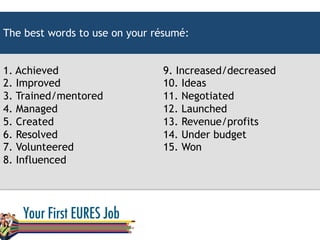
The best words to use on your résumé:
1. Achieved
2. Improved
3. Trained/mentored
4. Managed
5. Created
6. Resolved
7. Volunteered
8. Influenced
9. Increased/decreased
10. Ideas
11. Negotiated
12. Launched
13. Revenue/profits
14. Under budget
15. Won
!There are many ways to
show what you can do, not
only a CV
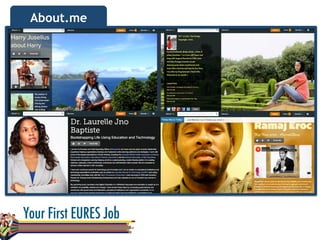
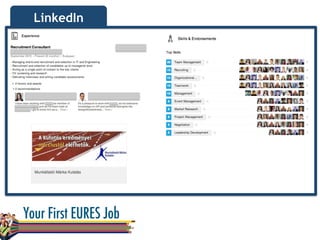
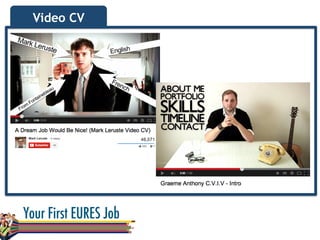
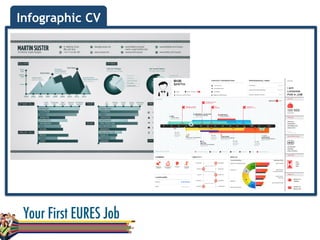
About.me
LinkedIn
Video CV
Infographic CV
?How are we going
so far
Interview
How to make them say “I want you”!
?What’s the purpose
of an interview
Showing that you’re
the best.
Creating empathy
with the employer
Before During After
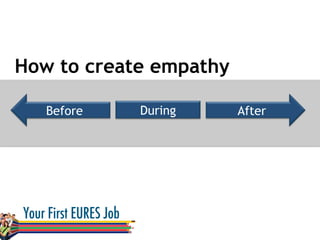
How to create empathy
Before During After
- Research.
Before During After
- Research.
- Prepare your outfit.
Before During After
- Research.
- Prepare your outfit.
- Study and prepare your CV.
Before During After
- Be likable.
Before During After
- Be likable.
- Set a hook.
Before During After
- Be likable.
- Set a hook.
- Use examples and stories.
Before During After
- Be likable.
- Set a hook.
- Don’t create negative bites.
- Use examples and stories.
Before During After
- Be likable.
- Set a hook.
- Don’t create negative bites.
- Know what you can offer…
and offer it!
- Use examples and stories.
Before During After
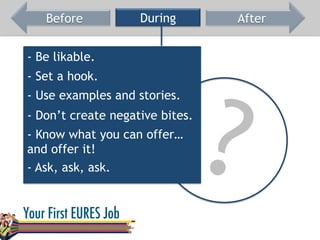
- Be likable.
- Set a hook.
- Don’t create negative bites.
- Know what you can offer…
and offer it!
- Ask, ask, ask.
- Use examples and stories.
?
Before During After
- Follow up!
So, about the
questions…
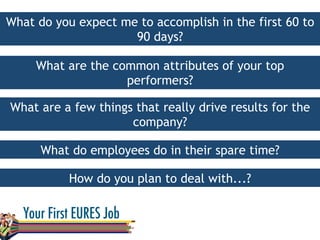
What do you expect me to accomplish in the first 60 to
90 days?
What are the common attributes of your top
performers?
What are a few things that really drive results for the
company?
What do employees do in their spare time?
How do you plan to deal with...?
!Remember:
They aren’t for the one
who is the best but for the
one who fits the most.
Cultural Shock
What happens when you go abroad?
Have you ever lived abroad?
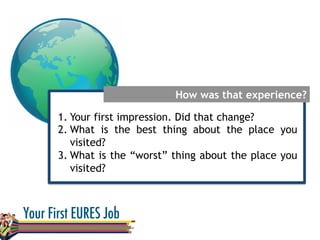
How was that experience?
1. Your first impression. Did that change?
2. What is the best thing about the place you
visited?
3. What is the “worst” thing about the place you
visited?
!Some advice…
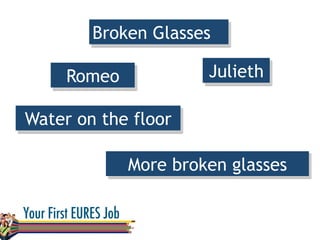
Broken Glasses
More broken glasses
Water on the floor
Romeo Julieth
1. Avoid
mindsets!
Changing midsets...
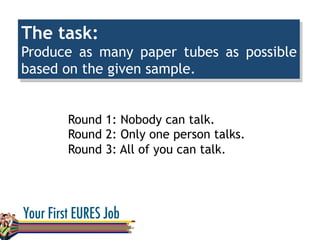
The task:
Produce as many paper tubes as possible
based on the given sample.
Round 1: Nobody can talk.
Round 2: Only one person talks.
Round 3: All of you can talk.
2. Listen and
observe!
3. Be aware!
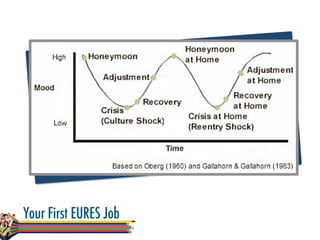
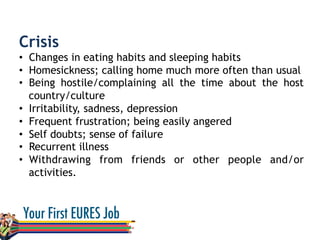
Crisis
•  Changes in eating habits and sleeping habits
•  Homesickness; calling home much more often than usual
•  Being hostile/complaining all the time about the host
country/culture
•  Irritability, sadness, depression
•  Frequent frustration; being easily angered
•  Self doubts; sense of failure
•  Recurrent illness
•  Withdrawing from friends or other people and/or
activities.
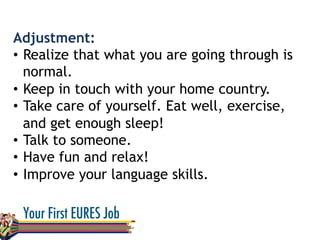
Adjustment:
•  Realize that what you are going through is
normal.
•  Keep in touch with your home country.
•  Take care of yourself. Eat well, exercise,
and get enough sleep!
•  Talk to someone.
•  Have fun and relax!
•  Improve your language skills.
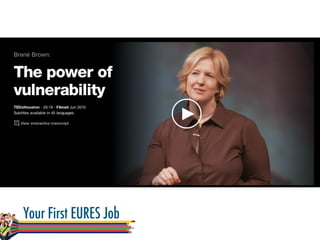
The power of vulnerability
Let’s see some examples…
Starting a conversation:
In the UK it is considered
impolite to ask someone
about their age, religion,
political views or how much
money they earn.
Formal addressing:
Italians are more formal in
addressing new acquaintances
and colleagues. Using an
informal greeting like 'ciao' to
someone you’ve just met will be
interpreted as rudeness.
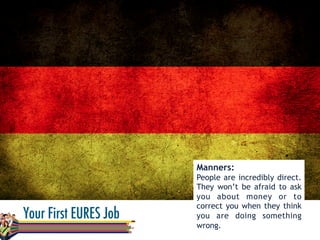
Manners:
People are incredibly direct.
They won’t be afraid to ask
you about money or to
correct you when they think
you are doing something
wrong.
Homeless speak English:
It’s surprising how many
Hungarian students don’t
speak English but you can
find homeless people having
fluent English conversations
any time.
How to communicate
Understand relativism
Some things are relative to some particular frame or
reference, such as a language or a culture.
Understand that people from other cultures might have
entirely differently value systems than yours, but still not
be explicitly wrong.
Give proper personal space:
Different cultures have different norms regarding what
personal space is public (in which other humans can stand
and converse with you) and private (reserved only for your
dear ones).
Know relationship differences:
Many foreigners think American relationships are
superficial (with a brief "Hi, Jim", and never a backward
glance). Americans might think relationships in other
cultures are too sentimental. So, know that if a person
strikes you as too voluble or withdrawn, it may be
considered normal in his culture.
Ask:
There is no better tool for effective communication. If
something strikes you as funny or inappropriate, if you
feel the other person is neglecting you or is offended,
simply ask him what you can do to remedy the problem.
Grievances are like silence- broken when they are spoken
out.
!Put yourself out there to
appreciate what you have
in here.
?Thank you…
Is there any question left?
Germán Henao
About us.
Zita Kulcsar
zita.kulcsar@gigroup.com
FB: Zita Kulcsar
TW: @talentMESHwork
ghenao@gigroup.com
FB: Germán Henao
TW: @GermanHenao

YFEJ - Preparatory Training

  • 1.
  • 2.
    “ “There arelots of places in the world that still don’t know you
  • 3.
  • 5.
    About Gi Group 5   Gi Group is one of the world’s leading companies providing services for the development of the labour market, operating in the fields of temporary and permanent staffing, search and selection, HR consulting and training, as well as a variety of complementary activities. Thanks to its global presence in more than 30 countries across the globe, GI Group has been awarded by the EU as one of the authorized organization to deliver the initiative in the countries involved*
  • 6.
    About Your FirstEURES Job 6   Your First EURES Job is an European Commission free of charge program delivered by Gi Group with the aim to help European young people find the right job and to help employers find the right workers in other EU countries. It is one of the key actions to address youth unemployment and boost youth labour mobility. The goal is to help financially directly around 5,000 young people find a job in any EU country other than their country of residence.
  • 7.
    Who can join? 7   Between 18 and 30 years old. EU national. Legally living in an EU country. Available to move to another EU country in the short term.
  • 8.
    Benefits for you 8   Free of charge You don’t pay any fee for accessing our program or our candidates database. Preparation and education You can take part in preparation courses for skill development and language proficiency. Formal and international job Find the right job in the EU (Not traineeship or apprenticeship) for your skills and experience. Financial support Funds available to cover your reallocation and extra costs (Interview, preparation).
  • 9.
    Process flow 9   Wetrack the satisfaction of you and your employer to ensure the success of the placement. Take part in training programs delivered by YFEJ or your employer. * Programs depend on the type of organization. Once selected, move to your new country of employment with relocation costs support. * Application for moving expenses required. Supported by EU funds, attend to a face to face interview with your potential employer. * Application for travel expenses required. We create your “YFEJ Profile”. Profile that will be sent to potential employers. CV Submission. Profile definition. Selection process. Placement. Induction and training. Follow Up. Submit your CV at www.gigroup.com
  • 10.
    Countries 10   Gi  Group  will  operate  YFEJ   from:   –  Italy.   –  Poland.   –  UK.   –  Germany.   –  Romania.   –  Slovakia.   –  Hungary.   –  Slovenia.     –  Czech  Republic.   –  Spain.     *  Covering  all  EU-­‐27  states  
  • 11.
    Your CV How towrite a CV that differentiates you from other candidates.
  • 12.
  • 13.
    Research the joband the company / organization where you plan to submit your CV. History Products Clients ? What are the similarities with your work?
  • 14.
    Choose  3  to  6  experiences  that  will  tailor  your  resume   to  this  job  
  • 15.
    Decide  the  best  way  to  format  your  resume  according   to  the  job  and  your  experience.   Chronological? Grouping?
  • 16.
  • 17.
    Format your resumein a professional way. Font, size, space, headlines.
  • 18.
    Format your resumein a professional way. Write a "qualifications", or "executive summary" section. Years of experience, major accomplishments, promotions and skills.
  • 19.
    Format your resumein a professional way. Write a "qualifications", or "executive summary" section. Describe your experience and accomplishments using action verbs. List your skills and successes using short, specific sentences. Each sentence should begin with an action verb.
  • 20.
    Format your resumein a professional way. Write a "qualifications", or "executive summary" section. Describe your experience and accomplishments using action verbs. Don’t show off, but show that you know what you are talking about. Insert buzzwords, or keywords, throughout your list of accomplishments.
  • 21.
    Format your resumein a professional way. Write a "qualifications", or "executive summary" section. Describe your experience and accomplishments using action verbs. You  employer  would  appreciate  experience  in  the  industries  they  oVen  work   with.   Insert buzzwords, or keywords, throughout your list of accomplishments. Include the types of industries you have worked for.
  • 22.
    Format your resumein a professional way. Write a "qualifications", or "executive summary" section. Describe your experience and accomplishments using action verbs. If you went to a school with a good alumni network, this may help you to form a bond with potential employers. Insert buzzwords, or keywords, throughout your list of accomplishments. Include the types of industries you have worked for. Include a short education section at the bottom.
  • 23.
    Format your resumein a professional way. Write a "qualifications", or "executive summary" section. Describe your experience and accomplishments using action verbs. Internships where you have relevant experience can work to your advantage. Insert buzzwords, or keywords, throughout your list of accomplishments. Include the types of industries you have worked for. Include a short education section at the bottom. Include internships if you don't have very much experience.
  • 24.
    Format your resumein a professional way. Write a "qualifications", or "executive summary" section. Describe your experience and accomplishments using action verbs. Sports, volunteering and other hobbies can say a lot about you. Insert buzzwords, or keywords, throughout your list of accomplishments. Include the types of industries you have worked for. Include a short education section at the bottom. Include internships if you don't have very much experience. Place a "hobbies/interests" section at the bottom of your resume, if it adds to your qualifications.
  • 25.
    Format your resumein a professional way. Write a "qualifications", or "executive summary" section. Describe your experience and accomplishments using action verbs. Informal training is also important!   Insert buzzwords, or keywords, throughout your list of accomplishments. Include the types of industries you have worked for. Include a short education section at the bottom. Include internships if you don't have very much experience. Place a "hobbies/interests" section at the bottom of your resume, if it adds to your qualifications. Include any professional organization of which you are a member.
  • 26.
    Format your resumein a professional way. Write a "qualifications", or "executive summary" section. Describe your experience and accomplishments using action verbs. Insert buzzwords, or keywords, throughout your list of accomplishments. Include the types of industries you have worked for. Include a short education section at the bottom. Include internships if you don't have very much experience. Place a "hobbies/interests" section at the bottom of your resume, if it adds to your qualifications. Include any professional organization of which you are a member.
  • 27.
  • 28.
    1. Limit yourresume to 1 page if you can 2. Proofread your resume. Again. And one more time. 3. Ask 2 to 3 friends in the industry to read the resume and make comments. 4. Print copies of your resume on good quality paper.
  • 29.
  • 30.
    1. Best ofbreed 2. Go-getter 3. Think outside of the box 4. Synergy 5. Go-to person 6. Thought leadership 7. Value add 8. Results-driven 9. Team player 10. Bottom-line 11. Hard worker 12. Strategic thinker 13. Dynamic 14. Self-motivate 15. Detail-oriented 16. Proactively 17. Track record The worst words to use on your résumé:
  • 31.
    The best wordsto use on your résumé: 1. Achieved 2. Improved 3. Trained/mentored 4. Managed 5. Created 6. Resolved 7. Volunteered 8. Influenced 9. Increased/decreased 10. Ideas 11. Negotiated 12. Launched 13. Revenue/profits 14. Under budget 15. Won
  • 32.
    !There are manyways to show what you can do, not only a CV
  • 33.
  • 34.
  • 35.
  • 36.
  • 37.
    ?How are wegoing so far
  • 38.
    Interview How to makethem say “I want you”!
  • 39.
  • 40.
  • 41.
  • 42.
    Before During After Howto create empathy
  • 43.
  • 44.
    Before During After -Research. - Prepare your outfit.
  • 45.
    Before During After -Research. - Prepare your outfit. - Study and prepare your CV.
  • 46.
  • 47.
    Before During After -Be likable. - Set a hook.
  • 48.
    Before During After -Be likable. - Set a hook. - Use examples and stories.
  • 49.
    Before During After -Be likable. - Set a hook. - Don’t create negative bites. - Use examples and stories.
  • 50.
    Before During After -Be likable. - Set a hook. - Don’t create negative bites. - Know what you can offer… and offer it! - Use examples and stories.
  • 51.
    Before During After -Be likable. - Set a hook. - Don’t create negative bites. - Know what you can offer… and offer it! - Ask, ask, ask. - Use examples and stories. ?
  • 52.
  • 53.
  • 54.
    What do youexpect me to accomplish in the first 60 to 90 days? What are the common attributes of your top performers? What are a few things that really drive results for the company? What do employees do in their spare time? How do you plan to deal with...?
  • 55.
    !Remember: They aren’t forthe one who is the best but for the one who fits the most.
  • 56.
    Cultural Shock What happenswhen you go abroad?
  • 57.
    Have you everlived abroad?
  • 58.
    How was thatexperience? 1. Your first impression. Did that change? 2. What is the best thing about the place you visited? 3. What is the “worst” thing about the place you visited?
  • 59.
  • 61.
    Broken Glasses More brokenglasses Water on the floor Romeo Julieth
  • 62.
  • 63.
  • 65.
    The task: Produce asmany paper tubes as possible based on the given sample. Round 1: Nobody can talk. Round 2: Only one person talks. Round 3: All of you can talk.
  • 66.
  • 70.
  • 71.
    Crisis •  Changes ineating habits and sleeping habits •  Homesickness; calling home much more often than usual •  Being hostile/complaining all the time about the host country/culture •  Irritability, sadness, depression •  Frequent frustration; being easily angered •  Self doubts; sense of failure •  Recurrent illness •  Withdrawing from friends or other people and/or activities.
  • 72.
    Adjustment: •  Realize thatwhat you are going through is normal. •  Keep in touch with your home country. •  Take care of yourself. Eat well, exercise, and get enough sleep! •  Talk to someone. •  Have fun and relax! •  Improve your language skills.
  • 74.
    The power ofvulnerability
  • 76.
    Let’s see someexamples…
  • 77.
    Starting a conversation: Inthe UK it is considered impolite to ask someone about their age, religion, political views or how much money they earn.
  • 78.
    Formal addressing: Italians aremore formal in addressing new acquaintances and colleagues. Using an informal greeting like 'ciao' to someone you’ve just met will be interpreted as rudeness.
  • 79.
    Manners: People are incrediblydirect. They won’t be afraid to ask you about money or to correct you when they think you are doing something wrong.
  • 80.
    Homeless speak English: It’ssurprising how many Hungarian students don’t speak English but you can find homeless people having fluent English conversations any time.
  • 81.
  • 82.
    Understand relativism Some thingsare relative to some particular frame or reference, such as a language or a culture. Understand that people from other cultures might have entirely differently value systems than yours, but still not be explicitly wrong.
  • 83.
    Give proper personalspace: Different cultures have different norms regarding what personal space is public (in which other humans can stand and converse with you) and private (reserved only for your dear ones).
  • 84.
    Know relationship differences: Manyforeigners think American relationships are superficial (with a brief "Hi, Jim", and never a backward glance). Americans might think relationships in other cultures are too sentimental. So, know that if a person strikes you as too voluble or withdrawn, it may be considered normal in his culture.
  • 85.
    Ask: There is nobetter tool for effective communication. If something strikes you as funny or inappropriate, if you feel the other person is neglecting you or is offended, simply ask him what you can do to remedy the problem. Grievances are like silence- broken when they are spoken out.
  • 86.
    !Put yourself outthere to appreciate what you have in here.
  • 87.
    ?Thank you… Is thereany question left?
  • 88.
    Germán Henao About us. ZitaKulcsar zita.kulcsar@gigroup.com FB: Zita Kulcsar TW: @talentMESHwork ghenao@gigroup.com FB: Germán Henao TW: @GermanHenao