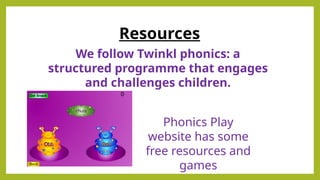
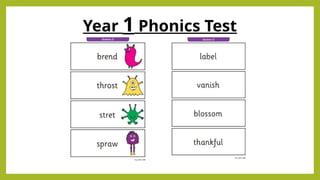
• Teaching ofphonics follows a structured route
for most children to meet or exceed the
expected standard in the Year One Phonics
Screening Check
Lime: Levels 1-4
Larch: Level 5
Programme Overview
3.
• Learning phonicswill help your child to
become a good reader and writer.
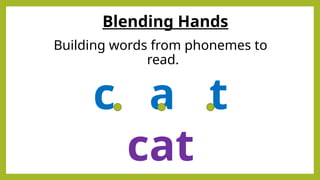
• Children need to be able to hear the separate
sounds in a word and then blend them
together to say the whole word.
The Importance Of Phonics
4.
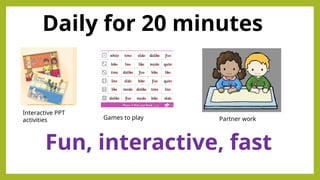
Daily for 20minutes
Fun, interactive, fast
Interactive PPT
activities Games to play Partner work
5.
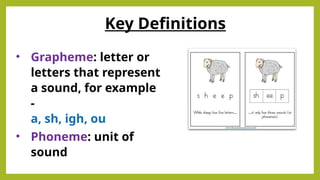
• Grapheme: letteror
letters that represent
a sound, for example
-
a, sh, igh, ou
• Phoneme: unit of
sound
Key Definitions
6.
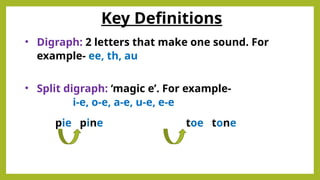
• Digraph: 2letters that make one sound. For
example- ee, th, au
• Split digraph: ‘magic e’. For example-
i-e, o-e, a-e, u-e, e-e
pie pine toe tone
Key Definitions
For those childrenthat
don’t pass they will repeat
the year’s phonics
teaching in Year 2.
12.
Helpful tips!
• Tryand read every night with your child. If they are
reluctant share the book, look at the pictures and discuss
the story.
• If your child is struggling: before they start to read discuss
the pictures, highlighting different characters and objects
you can see where the word appears in the text. Together
think about the phonemes (sounds) in that word and find
the word in the text.
• Encourage children to break down words and use their
blending hands.
• Reread pages together.
13.
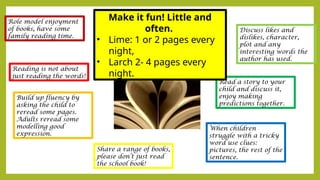
Discuss likes and
dislikes,character,
plot and any
interesting words the
author has used.
Developing a love of
reading
Read a story to your
child and discuss it,
enjoy making
predictions together.
When children
struggle with a tricky
word use clues:
pictures, the rest of the
sentence.
Role model enjoyment
of books, have some
family reading time.
Reading is not about
just reading the words!
Build up fluency by
asking the child to
reread some pages.
Adults reread some
modelling good
expression.
Share a range of books,
please don’t just read
the school book!
Make it fun! Little and
often.
• Lime: 1 or 2 pages every
night,
• Larch 2- 4 pages every
night.
14.
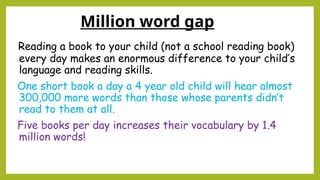
Million word gap
Readinga book to your child (not a school reading book)
every day makes an enormous difference to your child’s
language and reading skills.
One short book a day a 4 year old child will hear almost
300,000 more words than those whose parents didn’t
read to them at all.
Five books per day increases their vocabulary by 1.4
million words!