Swedbank – Interim report January-September 2014 Page 1 of 61 
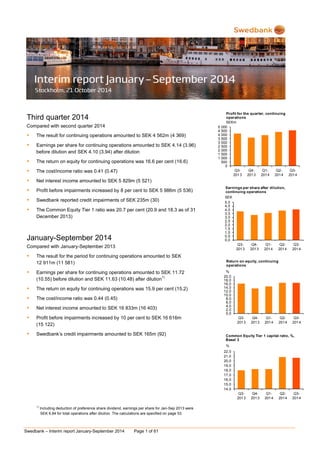
Third quarter 2014 
Compared with second quarter 2014 
 The result for continuing operations amounted to SEK 4 562m (4 369) 
 Earnings per share for continuing operations amounted to SEK 4.14 (3.96) 
before dilution and SEK 4.10 (3.94) after dilution 
 The return on equity for continuing operations was 16.6 per cent (16.6) 
 The cost/income ratio was 0.41 (0.47) 
 Net interest income amounted to SEK 5 829m (5 521) 
 Profit before impairments increased by 8 per cent to SEK 5 986m (5 536) 
 Swedbank reported credit impairments of SEK 235m (30) 
 The Common Equity Tier 1 ratio was 20.7 per cent (20.9 and 18.3 as of 31 
December 2013) 
January-September 2014 
Compared with January-September 2013 
 The result for the period for continuing operations amounted to SEK 
12 911m (11 581) 
 Earnings per share for continuing operations amounted to SEK 11.72 
(10.55) before dilution and SEK 11.63 (10.48) after dilution1) 
 The return on equity for continuing operations was 15.9 per cent (15.2) 
 The cost/income ratio was 0.44 (0.45) 
 Net interest income amounted to SEK 16 833m (16 403) 
 Profit before impairments increased by 10 per cent to SEK 16 616m 
(15 122) 
 Swedbank’s credit impairments amounted to SEK 165m (92) 
1) Including deduction of preference share dividend, earnings per share for Jan-Sep 2013 were 
SEK 6.84 for total operations after dilution. The calculations are specified on page 53. 
0 
500 
1 000 
1 500 
2 000 
2 500 
3 000 
3 500 
4 000 
4 500 
5 000 
Q3- 
2013 
Q4- 
2013 
Q1- 
2014 
Q2- 
2014 
Q3- 
2014 
SEKm 
Profit for the quarter, continuing 
operations 
0,0 
0,5 
1,0 
1,5 
2,0 
2,5 
3,0 
3,5 
4,0 
4,5 
5,0 
Q3- 
2013 
Q4- 
2013 
Q1- 
2014 
Q2- 
2014 
Q3- 
2014 
SEK 
Earnings per share after dilution, 
continuing operations 
0,0 
2,0 
4,0 
6,0 
8,0 
10,0 
12,0 
14,0 
16,0 
18,0 
20,0 
Q3- 
2013 
Q4- 
2013 
Q1- 
2014 
Q2- 
2014 
Q3- 
2014 
% 
Return on equity, continuing 
operations 
14,0 
15,0 
16,0 
17,0 
18,0 
19,0 
20,0 
21,0 
22,0 
Q3- 
2013 
Q4- 
2013 
Q1- 
2014 
Q2- 
2014 
Q3- 
2014 
% 
Common Equity Tier 1 capital ratio, %, 
Basel 3
Swedbank – Interim report January-September 2014 Page 2 of 61 
CEO Comment 
Market 
The global recovery is out of step. The US economy 
continues to grow, while weaker growth in parts of 
Europe is creating uncertainty about the eurozone’s 
recovery. Sweden’s economy is relatively strong, but 
low inflation is raising pressure on the Riksbank to 
further reduce interest rates. Although we have not yet 
seen any financial effects on our Baltic operations from 
the turmoil in Russia and Ukraine, the fragile global 
economy could affect growth in our four home markets. 
Strong result 
The real estate market in Sweden continues to grow. In 
our Swedish operations this is reflected in lending 
growth, especially in major urban areas. Our lending 
business has strengthened among large corporates as 
well. This raised net interest income during the quarter, 
whilst coming under pressure from falling interest rates. 
Net commission income was stable. In our Baltic 
operations the service model and multi-channel strategy 
have paved the way for new business. In the Swedish 
operations seasonally higher card commissions 
contributed to the result at the same time that we are 
seeing margin pressure on new sales in the savings 
area. Expenses decreased, mainly as a result of lower 
one-off expenses, but also due to lower staff costs 
within central functions. As a whole, our result for the 
third quarter was strong. 
Customers are our most important driving force 
The strong result gives us good opportunities, but we 
have to continue to work with internal efficiencies. The 
banking sector is undergoing major change, not least 
due to rapid technological development. Furthermore, 
new regulations are opening up parts of the financial 
market to new players and strengthening consumer 
power by making it easier to compare and choose 
between competing offers. More customers are realising 
the value of managing their finances through digital 
channels and appreciate services that make their lives 
simpler. Babs Micro and Swish for businesses are 
examples of services that simplify payment flows for 
small businesses. Swish, which has attracted 3 600 
business customers of Swedbank and the savings 
banks since its launch in June, provides a 
comprehensive overview of their customers and can 
help them to grow their businesses. 
To provide our 8 million private customers and 600 000 
corporate customers with broad-based access to 
competitively priced services, we have to create room 
for more and better designed customer solutions. This, 
coupled with the low inflation rate and low interest rate 
environment, means we have to cut our costs. Our 
intention is to lower total expenses for 2016 towards 
SEK 16bn. 
Savings will be achieved through cost synergies from 
the integration of Sparbanken Öresund and lower 
expenses due to digitisation and changing distribution 
forms, as well as through staff reductions. During the 
next two years 600-800 employees will leave the bank 
mainly through attrition. Outside recruitments will only 
be made in exceptional circumstances, which will put 
significant demands on internal mobility and flexibility. 
We will therefore focus on competence building and 
further development for our employees. This will 
improve the opportunities for career development in the 
bank. 
These competence-building measures and our 
employees’ experience from various parts of the bank 
will help us to develop smart and effective solutions – 
and make us even better at meeting customer 
expectations. We want to give our customers more in 
the form of freedom of choice and greater transparency, 
through the potential offered by technology, to make it 
easier for them to compare our products and services 
with those of others. Our customers should feel 
confident that they receive competitive offers from 
Swedbank – from both a Swedish and international 
perspective. 
Housing issue remains important 
The high debt levels of Swedish households remain an 
important topic of debate among politicians and 
authorities as well as banks. Further measures were 
taken during the third quarter to ease the growing debt 
problem by requiring mortgage borrowers to amortise 
and raising the risk weight floor on mortgages. However, 
addressing the underlying problem of a housing 
shortage will require further action. 
Michael Wolf 
President and CEO
Swedbank – Interim report January-September 2014 Page 3 of 61 
Table of contents 
Page 
Financial summary 
4 
Overview 
5 
Market 
5 
Important to note 
5 
Third quarter 2014 compared with second quarter 2014 
5 
Result 
5 
January-September 2014 compared with January-September 2013 
6 
Result 
6 
Credit and asset quality 
7 
Funding and liquidity 
8 
Ratings 
8 
Capital and capital adequacy 
8 
Operational risks 
10 
Other events 
10 
Events after 30 September 2014 
10 
Business segments 
Swedish Banking 
11 
Large Corporates & Institutions 
13 
Baltic Banking 
15 
Group Functions & Other 
17 
Eliminations 
19 
Product areas 
20 
Financial information 
Group 
Income statement, condensed 
25 
Statement of comprehensive income, condensed 
26 
Key ratios 
27 
Balance sheet, condensed 
28 
Statement of changes in equity, condensed 
29 
Cash flow statement, condensed 
30 
Notes 
30 
Parent company 
55 
Signatures of the Board of Directors and the President 
60 
Review report 
60 
Contact information 
61 
More detailed information can be found in Swedbank’s fact book, www.swedbank.com/ir, under Financial information and publications.
Swedbank – Interim report January-September 2014 Page 4 of 61 
Financial summary 
Income statement Q3 Q2 Q3 Jan-Sep Jan-Sep 
SEKm 2014 2014 % 2013 % 2014 2013 % 
Net interest income 5 829 5 521 6 5 641 3 16 833 16 403 3 
Net commission income 2 816 2 813 0 2 520 12 8 322 7 433 12 
Net gains and losses on financial items at fair value 799 773 3 170 1 917 1 023 87 
Other income 706 1 348 -48 894 -21 2 853 2 427 18 
Total income 10 150 10 455 -3 9 225 10 29 925 27 286 10 
Staff costs 2 469 2 901 -15 2 328 6 7 807 7 077 10 
Other expenses 1 695 2 018 -16 1 667 2 5 502 5 087 8 
Total expenses 4 164 4 919 -15 3 995 4 13 309 12 164 9 
Profit before impairments 5 986 5 536 8 5 230 14 16 616 15 122 10 
Impairment of intangible assets 0 1 0 1 170 -99 
Impairment of tangible assets 19 69 -72 95 -80 223 382 -42 
Credit impairments 235 30 -56 165 92 79 
Operating profit 5 732 5 436 5 5 191 10 16 227 14 478 12 
Tax expense 1 164 1 063 10 998 17 3 301 2 887 14 
Profit for the period from continuing operations 4 568 4 373 4 4 193 9 12 926 11 591 12 
Profit for the period from discontinued operations, after tax -2 -230 -99 -15 -87 -259 -2 292 -89 
Profit for the period 4 566 4 143 10 4 178 9 12 667 9 299 36 
Profit for the period attributable to the shareholders of 
Swedbank AB 4 560 4 139 10 4 172 9 12 652 9 289 36 
Q3 Q2 Q3 Jan-Sep Jan-Sep 
Key ratios and data per share 2014 2014 2013 2014 2013 
Return on equity, continuing operations, % 16.6 16.6 16.2 15.9 15.2 
Return on equity, total operations, % 16.6 15.8 16.1 15.6 12.2 
Earnings per share before dilution, 
continuing operations, SEK 1) 4.14 3.96 3.82 11.72 10.55 
Earnings per share after dilution, 
continuing operations, SEK 1) 4.10 3.94 3.79 11.63 10.48 
Cost/income ratio 0.41 0.47 0.43 0.44 0.45 
Loan/deposit ratio, % 193 189 202 193 202 
Common Equity Tier 1 capital ratio, %, Basel 3 2) 
20.7 20.9 18.0 20.7 18.0 
Tier 1 capital ratio, %, Basel 3 2) 
21.9 22.1 19.3 21.9 19.3 
Total capital ratio, %, Basel 3 2) 
24.9 25.3 20.4 24.9 20.4 
Credit impairment ratio, % 0.07 0.01 -0.02 0.02 0.01 
Share of impaired loans, gross, % 0.47 0.44 0.69 0.47 0.69 
Total provision ratio for impaired loans, % 55 56 53 55 53 
Balance sheet data 30 Sep 31 Dec 30 Sep 
SEKbn 2014 2013 % 2013 % 
Loans to the public 1 341 1 265 6 1 248 7 
Deposits and borrowings from the public 686 621 11 624 10 
Shareholders' equity 111 110 2 106 5 
Total assets 2 078 1 824 14 1 836 13 
Risk exposure amount, Basel 3 2) 
410 441 -7 446 -8 
1) Including deduction of the preference share dividend, earnings per share for January-September 2013 were SEK 6.84 for total operations after dilution. 
The calculations are specified on page 53. 
2) The capital ratios for 2013 are based on Swedbank’s knowledge of the new regulations at that point in time. 
The key ratios are based on profit and shareholders’ equity attributable to shareholders of Swedbank. 
Key ratios and text comments regarding lending and deposits relate to volumes excluding Swedish National Debt Office and repos.
Swedbank – Interim report January-September 2014 Page 5 of 61 
Overview 
Market 
The global economy sent mixed signals with several 
new geopolitical risks. US growth was stronger than 
expected during the second quarter at the same time 
that the labour market improved. At the same time 
uncertainty about the strength of the recovery persists, 
and with it the timing of a US rate hike. In China a 
number of measures were taken to prevent a bigger 
economic slowdown. Weaker growth in Germany, 
France and Italy created increased uncertainty about 
the recovery in the eurozone despite the ECB cutting its 
benchmark rates and introducing further monetary 
stimuli during the autumn. 
The Swedish economy grew by 2.6 per cent during the 
second quarter year-on-year. The picture was mixed, 
however. The higher growth was driven by increased 
private consumption and a significant rise in residential 
construction, while the export industry was limited by 
weak international demand. Sweden’s economic growth 
is being jeopardised by a shaky global economy and 
uncertainty about the new government’s economic 
policies and weak parliamentary support. The Swedish 
krona weakened against the dollar in the wake of the 
Federal Reserve’s tapering monetary stimulus and 
stronger US growth. At the same time the krona 
appreciated against the euro, which raised pressure on 
the Riksbank to take further action to reduce the risk of 
a continuing decline in inflation. Sweden’s low inflation, 
which in September was negative for the second 
consecutive month, is raising the pressure on the 
Riksbank to cut the repo rate in the fourth quarter from 
the current 0.25 per cent. In addition to falling 
commodity prices and growing international competition, 
digitisation is adding to Sweden’s low inflation. Low 
global inflation, increased geopolitical risks and 
expectations of continued low interest rates contributed 
to a decline in long-term bond yields during the third 
quarter, not least in Europe. 
Future growth is also uncertain in the Baltic region due 
to the conflict between Russia and Ukraine and 
geopolitical risks. There is no quick solution to the 
conflict, and the outlook for the Russian economy is 
weak in both the short and long term. 
Growth in the Baltic countries was still relatively strong 
during the second quarter at 3.3 per cent in Lithuania, 
2.4 per cent in Estonia and 2.3 per cent in Latvia. With 
weak demand from key export markets, domestic 
demand continued to drive growth. Exports to Russia 
decreased at the same time that the effects of the 
Russian sanctions in August were limited to a few 
manufacturing industries. Thus far the slowdown in 
exports to Russia has been offset by increased demand 
from other markets. Investments fell slightly, but are 
likely to be more affected during the second half-year. 
Household consumption growth was sustained by 
increased disposable incomes, although consumer 
confidence weakened at the end of the third quarter, 
indicating the possibility of greater cautiousness. 
The Stockholm stock exchange (OMXSPI) gained 6 per 
cent during the first nine months. The Tallinn stock 
exchange (OMXTGI) fell by 6 per cent and the Riga 
stock exchange (OMXRGI) by 8 per cent, while the 
Vilnius stock exchange (OMXVGI) gained 9 per cent. 
Important to note 
Increased digitisation is producing greater competition, 
and with it price pressure. At the same time banking 
products and services are becoming more similar, 
making it essential that the bank maintains competitive 
prices. Because of this, we have to work continuously to 
cut costs. The intention for 2016 is to lower the cost 
level towards SEK 16bn. The savings consist of cost 
synergies related to the acquisition of Sparbanken 
Öresund, lower expenses due to digitisation and 
changing distribution forms, as well as reduced staff 
mainly in central functions. The staff reduction is 
expected to be achieved primarily through normal 
attrition. 
Beginning with the third quarter the Sparbanken 
Öresund acquisition can no longer be followed 
separately in Swedbank’s financial reports. 
Third quarter 2014 
Compared with second quarter 2014 
Result 
The third quarterly result rose by 10 per cent to SEK 
4 560m (4 139). Income and expenses decreased. 
Excluding one-off income of SEK 461m associated with 
the acquisition of Sparbanken Öresund during the 
second quarter, income increased. Credit impairments 
rose during the third quarter due to larger provisions for 
a few commitments. Profit for continuing operations 
amounted to SEK 4 562m (4 369). Discontinued 
operations generated a loss of SEK -2m (-230). During 
the second quarter a negative exchange rate difference 
of SEK 223m was reclassified to the income statement 
from other comprehensive income related to the winding 
down of the Russian operations. 
Profit before impairments increased by 8 per cent to 
SEK 5 986m (5 536). Group Functions & Other, 
primarily Group Treasury, contributed to the increase. 
Other business areas reported slightly lower profit. 
Profit before 
impairments 
by business segment 
excl FX effects Q3 Q2 Q3 
SEKm 2014 2014 2013 
Swedish Banking 2 986 3 037 3 114 
Large Corporates & 
Institutions 992 1 153 1 016 
Baltic Banking 898 986 888 
Group Functions & Other 1 110 385 278 
Total excl FX effects 5 986 5 561 5 296 
FX effects 0 -25 -66 
Total 5 986 5 536 5 230 
Credit impairments amounted to SEK 235m (30). LC&I 
provided the increase, while Baltic Banking’s net 
recoveries rose slightly. Credit impairments related to 
increased provisions for a few problem loans. Credit 
impairments within Swedish Banking remained low. 
Tangible asset writedowns continued to decrease to 
SEK 19m (69) and primarily relate to writedowns in 
Ektornet. Property repossessions by Ektornet 
decreased to SEK 916m (1 382).
Swedbank – Interim report January-September 2014 Page 6 of 61 
The return on equity for continuing operations was 
16.6 per cent (16.6). The cost/income ratio was 0.41 
(0.47). The cost/income ratio during the second quarter 
was negatively affected by the acquisition of 
Sparbanken Öresund. 
Income decreased by 3 per cent to SEK 10 150m (10 
455). The second quarter contained two major sources 
of one-off income: SEK 461m in connection with the 
acquisition of Sparbanken Öresund and SEK 230m 
related to the associated company Entercard. Net 
interest income increased, while net commission income 
and net gains and losses on financial items at fair value 
were stable. 
Net interest income increased by 6 per cent to SEK 
5 829m (5 521). Net interest income was stable in every 
business segment except Group Treasury within Group 
Functions & Other, where it increased. Group 
Treasury’s net interest income benefited from falling 
interest rates, whereas it negatively affected net interest 
income within Swedish Banking and Baltic Banking. 
Higher lending volumes within Swedish Banking and 
LC&I contributed positively. The new capital adequacy 
requirements in the form of higher risk weights on 
mortgages increased the margins to cover the bank’s 
higher expenses for the Swedish mortgage portfolio. 
Sparbanken Öresund, which was not consolidated until 
21 May, contributed positively in a comparison between 
quarters, as did the additional interest day in the third 
quarter. 
Net commission income was stable at SEK 2 816m 
(2 813). LC&I contributed positively, while the net was 
slightly lower in Swedish Banking and Baltic Banking. 
Card commissions were seasonally higher and 
commissions from corporate finance were lower. 
Net gains and losses on financial items at fair value 
were stable at SEK 799m (773). Group Treasury 
benefited from the positive effects of falling interest 
rates. Net gains and losses on financial items at fair 
value within LC&I decreased due to seasonally lower 
activity and low volatility in the financial markets. 
Other income decreased by 48 per cent to SEK 706m 
(1 348). A bargain purchase gain of SEK 461m 
associated with the Sparbanken Öresund acquisition 
was recognised during the second quarter, as was one-off 
income of SEK 230m related to Entercard. 
Expenses decreased by 15 per cent to SEK 4 164m 
(4 919). Expenses also decreased excluding one-off 
expenses of SEK 615m attributable to the acquisition of 
Sparbanken Öresund during the second quarter. 
Expenses decreased mainly within Group Functions & 
Other but also within Baltic Banking and Swedish 
Banking. Expenses within LC&I rose slightly. Staff costs 
decreased due to, among other things, fewer employees 
in Group Functions & Other. Expenses for IT, premises 
and marketing decreased on a seasonal basis. SEK 
57m was expensed during the second quarter for the 
move of the head office to Sundbyberg. 
The number of full-time employees decreased by 78 
during the quarter, mainly within Group Functions & 
Other. 
The tax expense amounted to SEK 1 164m (1 063), 
corresponding to an effective tax rate of 20.3 per cent 
(19.6). The second quarter was positively affected by 
the acquisition of Sparbanken Öresund. The bargain 
purchase gain is not taxable. 
January-September 2014 
Compared with January-September 2013 
Result 
The result for the period rose by 36 per cent to 
SEK 12 652m (9 289). Income, expenses and credit 
impairments increased, while other impairments fell. 
Fluctuations in exchange rates, primarily the 
depreciation of the Swedish krona against the euro and 
the Lithuanian litas, raised profit by SEK 139m. The 
result for continuing operations was SEK 12 911m 
(11 591) and for discontinued operations was 
SEK -259m (-2 292). During the first nine months of 
2013 SEK -1 875m was reclassified to the income 
statement from other comprehensive income related to 
the sale of the Ukrainian operations, compared with a 
corresponding reclassification of SEK -223m during the 
first nine months of this year for the winding down of the 
Russian operations. 
Profit before impairments increased by 10 per cent to 
SEK 16 616m (15 112). Profit increased mainly in Group 
Treasury within Group Functions & Other, but Baltic 
Banking and LC&I also improved their results. Profit 
within Swedish Banking was stable. 
Credit impairments of SEK 165m (92) were posted 
during the nine-month period. LC&I reported higher 
credit impairments, while Swedish Banking’s credit 
impairments were lower. Baltic Banking recognised 
recoveries, but at a lower level than in 2013. Tangible 
asset writedowns amounted to SEK 223m (382), a 
decrease attributable to Ektornet. Intangible asset 
writedowns decreased to SEK 1m (170). 
Profit before 
impairments 
by business segment 
excl FX effects Jan-Sep Jan-Sep Δ 
SEKm 2014 2013 SEKm 
Swedish Banking 9 002 9 017 -15 
Large Corporates & 
Institutions 3 398 3 185 213 
Baltic Banking 2 731 2 452 279 
Group Functions & Other 1 485 631 854 
Total excl FX effects 16 616 15 285 1 331 
FX effects 0 -163 163 
Total 16 616 15 122 1 494 
The return on equity for continuing operations improved 
to 15.9 per cent (15.2). The cost/income ratio was 0.44 
(0.45). 
Income rose by 10 per cent to SEK 29 925m (27 286). 
All business segments contributed to the higher income. 
The acquisition of Sparbanken Öresund increased 
income, where SEK 461m was one-off income during 
the second quarter. Stronger commission income and 
net gains and losses on financial items contributed the 
most. Net interest income also increased, while other 
income excluding one-off effects decreased. Changes in 
exchange rates increased income by SEK 239m. 
Net interest income rose by 3 per cent to SEK 16 833m 
(16 403). In Baltic Banking, repricing, increased deposit
Swedbank – Interim report January-September 2014 Page 7 of 61 
volumes and higher average market interest rates contributed positively. Group Treasury’s net interest income improved slightly. Within LC&I higher lending volumes and origination fees contributed positively. Swedish Banking’s net interest income was stable, but decreased slightly excluding the acquisition of Sparbanken Öresund. Margin pressure on deposits was offset by the positive effects of higher lending volumes and higher mortgage margins. Fluctuations in exchange rates increased net interest income by SEK 120m. 
Net commission income rose by 12 per cent to SEK 
8 322m (7 433). Higher commission income from asset management due to a favourable stock market climate contributed the most to the increase. Loan-related income and income from corporate finance within LC&I increased as well. Card commissions also improved. 
Net gains and losses on financial items at fair value increased by 87 per cent to SEK 1 917m (1 023). Group Treasury in Group Functions & Other rebounded from a negative to a positive net result. The main reason was the positive effects of falling interest rates. In 2014 net gains and losses in Group Treasury contained positive one-off effects of SEK 158m, while in 2013 the offer to repurchase state-guaranteed bonds affected net gains and losses negatively. Net gains and losses on financial items at fair value within LC&I were stable. 
Other income increased by 18 per cent to SEK 2 853m (2 427). The acquisition of Sparbanken Öresund in the second quarter 2014 resulted in a bargain purchase gain of SEK 461m. One-off income of SEK 230m was recognised in the share of the profit or loss of the associated company Entercard. Sales activity within Ektornet was lower during the nine-month period than in the previous year since the portfolio is now significantly smaller. This negatively affected other income. 
Expenses increased by 9 per cent to SEK 13 309m (12 164), mainly as a result of the Sparbanken Öresund acquisition, where one-off expenses of SEK 615m attributable to the acquisition were recognised during the second quarter 2014. Expenses increased within LC&I and Swedish Banking. Baltic Banking’s expenses decreased slightly in local currency. The Group’s staff costs rose as a result of a higher number of customer advisors and IT-related staff as well as salary adjustments. IT development expenses rose as well. Reduced cash handling and the outsourcing of ATMs reduced expenses for transport and security. In 2014 SEK 136m was expensed for the move of the head office. Changes in exchange rates raised expenses by SEK 75m. 
The number of full-time employees increased year-on- year by 340, mainly as a result of the acquisition of Sparbanken Öresund. Baltic Banking reduced its full- time employees by 194. Ektornet (Group Functions & Other) also reduced its staff. IT-related staff within Group Functions & Other and the number of full-time employees within Swedish Banking and LC&I increased. 
The tax expense amounted to SEK 3 301m (2 887), corresponding to an effective tax rate of 20.3 per cent (19.9). Since the first quarter 2014 the tax expense has been higher due to the new policy on profit distributions from the Baltic operations. About 60 per cent of profits generated by the Baltic subsidiaries from 2014 onwards will be distributed to the parent company, Swedbank AB. Profit in Estonia is not taxed until its distribution. This means that deferred tax is already recognised on the estimated distribution from Estonia, even though it will not be paid out until the first quarter 2015. At the same time the tax expense was positively affected by the acquisition of Sparbanken Öresund. Profit posted from the bargain purchase is not taxable. 
Credit and asset quality 
Political and economic tensions have continued around the world, with sanctions against Russia and slower growth in Europe. The bank’s credit portfolio is distinguished by customers with low risk, however, making it resilient in the event of an economic downturn. 
Credit impairments remained low during the nine-month period, but increased slightly during the quarter due to individual provisions for anticipated credit impairments. While the political tensions in Russia and Ukraine have not affected its credit quality, the bank continues to discuss preventive measures with customers who have business connections in the region and could be affected if the conflict continues. The bank’s direct credit exposure to Russia continues to decrease and as of 30 September amounted to SEK 0.8bn. The bank has no direct credit exposures to Ukraine. 
Swedbank’s lending increased by SEK 73bn or 6 per cent during the nine-month period to SEK 1 287bn, of which SEK 6bn is due to currency effects. Of the increase, SEK 21bn related to the third quarter. Mortgage lending in Sweden rose by SEK 26bn during the year. Corporate lending within Swedish Banking and LC&I increased by a total of SEK 39bn. The highest activity was in property management, shipping and offshore. The acquisition of Sparbanken Öresund in the second quarter increased lending by SEK 16.5bn, of which SEK 5.0bn was private lending and SEK 11.5bn was corporate lending. Baltic Banking’s lending portfolio grew slightly in Estonia and Lithuania, measured in local currency, but decreased slightly in Latvia. 
The Swedish Bankers’ Association’s current recommendation on the amortisation of new mortgages has been extended as of 1 July to include mortgages with a loan-to-value ratio over 70 per cent. During the last 12 months 72 per cent of new mortgages granted in Sweden with a loan-to-value ratio over 70 per cent are being amortised. Annual contractual amortisations in the Swedish mortgage portfolio amount to about SEK 8.6bn. The average loan-to-value ratio for Swedbank’s mortgages in Sweden was 60.4 per cent (62.2 as of 31 December), based on property level as of 30 September. For more information on Swedbank’s mortgage portfolios, see page 56 of the fact book. 
The share of Swedish mortgages past due by more than 60 days remained low at 0.08 per cent of the portfolio (0.09). The share of impaired mortgages in Baltic Banking fell, even though Latvia and Lithuania are still affected by problem loans from the crisis years, however. The share of mortgages past due by more than 60 days was 0.6 per cent in Estonia (0.7), 6.3 per cent in Latvia (7.4) and 3.5 per cent in Lithuania (4.4). 
Impaired loans have decreased during the year by SEK 0.8bn to SEK 6.7bn and correspond to 0.47 per cent (0.55) of total lending. Baltic Banking’s impaired loans decreased by SEK 0.8bn to SEK 4.2bn, mainly due to the winding down of problem loans from 2008- 2009 and improved quality in the loan portfolio. The acquisition of Sparbanken Öresund in the second quarter increased impaired loans within Swedish
Swedbank – Interim report January-September 2014 Page 8 of 61 
Banking by SEK 0.3bn. The provision ratio for impaired 
loans was 38 per cent. The total provision ratio i.e. 
including portfolio provisions, was 55 per cent (54). 
Impaired loans, 
by business segment Q3 Q2 Q3 
SEKm 2014 2014 2013 
Swedish Banking 1 523 1 522 1 774 
Large Corporates & 
Institutions 955 279 1 116 
Baltic Banking 4 248 4 511 6 322 
Estonia 1 346 1 297 1 652 
Latvia 1 590 1 837 3 019 
Lithuania 1 312 1 377 1 651 
Total 6 726 6 312 9 212 
Credit impairments amounted to SEK 165m (92) during 
the first nine months of the year and arose during the 
third quarter. Credit impairments relate to new 
provisions for anticipated credit impairments within LC&I 
and Swedish Banking. The provisions relate to a few 
commitments. The credit impairment ratio remains low 
from a historical perspective. Baltic Banking reported 
continued recoveries, though at a lower level. 
Credit impairments, net 
by business segment Q3 Q2 Q3 
SEKm 2014 2014 2013 
Swedish Banking 43 25 107 
Large Corporates & 
Institutions 270 21 7 
Baltic Banking -59 -16 -147 
Estonia -3 -25 -38 
Latvia -42 13 -70 
Lithuania -14 -4 -39 
Group Functions & Other -19 0 -23 
Total 235 30 -56 
Repossessed assets amounted to SEK 1 110m on 30 
September, nearly half the amount at the beginning of 
the year. Ektornet accounted for SEK 916m of the 
repossessed assets. Ektornet’s property values were 
written down by SEK 220m (375) during the nine-month 
period, mainly related to Ukraine and the US, of which 
SEK 16m was in the third quarter. The sale of the last 
US asset in Ektornet’s property portfolio was finalised in 
the third quarter. The remaining repossessed properties 
in Ukraine amounted to SEK 106m on 30 September. 
On the same date the number of properties, including 
apartments and suchlike, was 893 (1 366), of which 425 
were in Latvia (783). For more information on 
repossessed assets, see page 35 of the fact book. 
Funding and liquidity 
During the first nine months of 2014 Swedbank issued a 
total of SEK 89bn in long-term debt instruments, of 
which SEK 68bn related to covered bonds and SEK 
21bn to senior unsecured debt. During the third quarter 
a total of SEK 21bn in long-term debt instruments was 
issued, including SEK 20bn in covered bonds and 
SEK 1bn in senior unsecured debt. For the full-year 
2014 Swedbank plans to issue a total of about SEK 
120bn to meet maturing long-term funding with a 
nominal value of SEK 103bn measured from the 
beginning of the year. Liquidity over and above the 
refinancing need is used in day-to-day management to 
repurchase covered bonds. 
The average maturity of all capital market funding 
arranged through the bank’s short- and long-term 
programmes was 27 months on 30 September 2014 (29 
as of 31 December 2013). The average maturity of long-term 
funding issued during the nine-month period was 
60 months. Demand for Swedbank’s short-term debt 
instruments remained high and the outstanding volume 
of short-term funding increased by SEK 109bn during 
the nine-month period to SEK 209bn. 
The main liquidity measure used by the Board of 
Directors and executive management is the so-called 
survival horizon, which shows that the bank would 
survive more than 12 months with the capital markets 
completely shut down. This applies to total liquidity as 
well as liquidity in USD and EUR. Swedbank’s liquidity 
reserve, which is reported in accordance with the 
Swedish Bankers’ Association’s definition for liquidity 
reporting, amounted to SEK 263bn as of 30 September 
2014 (281 as of 30 June). In addition to the liquidity 
reserve, liquid securities in other parts of the Group 
amounted to SEK 63bn (52 as of 30 June). The liquidity 
reserve and Liquidity Coverage Ratio (LCR) will 
fluctuate over time depending on, among other things, 
the maturity structure of the bank’s issued securities. 
The Group’s LCR was 132 per cent on 30 September 
(123 as of 30 June). Distributed by USD and EUR, LCR 
was 287 per cent (195 as of 30 June) and 227 per cent 
(293 as of 30 June). In early 2013 the Basel Committee 
published a new definition of LCR. According to 
Swedbank’s interpretation, LCR would have been 135 
per cent as of 30 September (132 as of 31 March). 
According to Swedbank’s interpretation of the Basel 
Committee’s latest proposed revisions to the definition 
from January 2014, the Group’s Net Stable Funding 
Ratio (NSFR) was 102 per cent as of 30 September 
(102 as of 30 June). For more information on the above, 
see page 68 of the fact book. 
Ratings 
No ratings events during the quarter. 
Capital and capital adequacy 
The Common Equity Tier 1 ratio was 20.7 per cent on 
30 September (20.9 per cent on 30 June and 18.3 per 
cent on 31 December 2013). 
Common Equity Tier 1 capital decreased by SEK 0.2bn 
during the third quarter to SEK 84.7bn. This was mainly 
due to the remeasurement of the estimated pension 
liability according to IAS 19, which reduced Common 
Equity Tier 1 capital by about SEK 0.9bn due to the 
declining discount rate. The bank’s profit after deducting 
the anticipated dividend positively affected Common 
Equity Tier 1 capital.
Swedbank – Interim report January-September 2014 Page 9 of 61 
Change in Common Equity Tier 1 capital Basel 3, third 
quarter 2014, Swedbank consolidated situation 
80.8 
84.7 
-0.9 -0.2 
4.5 
-3.6 
84.9 
50 
55 
60 
65 
70 
75 
80 
85 
90 
95 
100 
SEKbn 
Increase Decrease 
The risk exposure amount (REA) increased by just 
under SEK 3bn during the third quarter to SEK 409.6bn 
on 30 September (406.7 as of 30 June). The REA for 
credit risks rose by SEK 2.9bn. Increased exposures, 
mainly to corporate customers in Swedish Banking and 
LC&I, raised the REA by SEK 12bn. Positive rating 
migrations reduced it by SEK 0.6bn, updated valuations 
of collateral by SEK 5.5bn and additional exposures with 
SME discounts by SEK 0.7bn (under other credit risk). A 
few new overdue corporate exposures reduced the REA 
by SEK 0.4bn. Fluctuations in exchange rates, mainly 
attributable to the Baltic credit portfolio, reduced the 
REA for credit risks by SEK 0.2bn due to the 
appreciation of the Swedish krona against the euro. 
Other reductions in the REA for credit risks include 
reductions related to Ektornet of SEK 0.6bn. 
The REA for credit valuation adjustment (CVA risk) 
increased as a result of increased exposures. The REA 
for market risks decreased, mainly due to a reduced 
holdings of bonds with long maturities. The REA for 
operational risks was unchanged during the quarter. 
Change in REA Basel 3, third quarter 2014, Swedbank 
consolidated situation 
12.0 
-0.6 
-5.5 -0.2 
-2.8 
0.9 
-1.0 
440.6 
406.7 
409.6 
360 
370 
380 
390 
400 
410 
420 
430 
440 
450 
SEKbn 
Increase Decrease 
The new Basel 3 capital adequacy rules were 
introduced within the EU on 1 January 2014, while the 
sections that required introduction in Swedish legislation 
did not take effect until August. In early September the 
Swedish Financial Supervisory Authority (SFSA) 
decided which capital requirements would apply to 
Swedish banks beyond the minimum level of 7 per cent 
Common Equity Tier 1 capital in accordance with the 
EU rules. The SFSA’s requirements were in line with 
those presented before the summer and can be 
summarised as follows: 
 As of 1 January 2015 the four major Swedish banks 
are assigned a systemic risk buffer of 3 per cent in 
Common Equity Tier 1 capital within the framework of 
Pillar 1 and a further 2 per cent within the framework 
of Pillar 2. 
 The risk weight floor for Swedish mortgages was 
raised from the date of SFSA’s decision in September 
from 15 to 25 per cent within the framework of Pillar 2. 
 SFSA does not intend to make a formal decision on 
the capital requirement for individual institutions in 
Pillar 2. As long as a formal decision has not been 
made, the capital requirement under Pillar 2 does not 
affect the level at which automatic restrictions on 
dividend and coupon payments take effect. 
 The countercyclical buffer will be 1 per cent from 13 
September 2015. 
A clarification of SFSA’s view of standardised models 
and capital requirements for Pillar 2 is still needed 
before the Board of Directors can determine an internal 
capital target. 
Due to the increase in the risk weight floor for the 
Swedish mortgage portfolio from 15 to 25 per cent and 
the addition of a countercyclical buffer as of September 
2015, Swedbank has to maintain additional Common 
Equity Tier 1 capital of SEK 20.4bn for Swedish 
mortgages within the framework of Pillar 2 
corresponding to 5.0 percentage points of the Common 
Equity Tier 1 ratio according to Pillar 1. In its internal 
controls Swedbank allocates capital to its mortgage 
business equivalent to a 25 per cent risk weight floor as 
from the fourth quarter 2014.
Swedbank – Interim report January-September 2014 Page 10 of 61 
Swedbank’s leverage ratio was 4.4 per cent on 30 September (4.3 on 30 June 2014 and 4.6 per cent on 31 December 2013). In early October the EU Commission clarified the definition, which is reflected in Swedbank’s reported figures as of 30 September. According to the EU’s rules, the measure will be evaluated by the authorities prior to the possible introduction of a minimum requirement in 2018. 
Operational risks 
No major incidents occurred during the third quarter 2014. The bank’s direct losses attributable to operational risks remained low. 
For more information on market risks, see Note 23 and see page 89 of the fact book. 
Other events 
Swedbank’s Annual General Meeting will be held in Stockholm on Thursday, 26 March 2015. 
The Nomination Committee comprises the following members: Lennart Anderberg, appointed by owner- group Föreningen Sparbanksintressenter, Chair of the Nomination Committee; Ramsay Brufer, appointed by Alecta; Jens Henriksson, appointed by owner-group Folksam; Johan Sidenmark, appointed by AMF Försäkring och Fonder; and Anders Sundström, Chair of the Board of Directors of Swedbank AB. 
Shareholders who wish to submit a proposal to the Nomination Committee must do so no later than 19 December 2014 either by e-mail to valberedningen@swedbank.se or by mail to: 
Valberedningen c/o Swedbank AB Valberedningens sekreterare, Group Legal SE-105 34 Stockholm, Sweden 
Events after 30 September 2014 
In October the Swedish Bankers’ Association extended its recommendation on mortgage amortisation to include all new loans with a loan-to-value ratio over 50 per cent. Relevant authorities have been consulted on the proper rate of amortisation. The bank intends to follow the recommendation.
Swedbank – Interim report January-September 2014 Page 11 of 61 
. 
Swedish Banking 
 Further increase in loan volumes 
 Higher mortgage margins as a result of increased capital requirements 
 Lower deposit margins due to declining interest rates 
Income statement 
Q3 Q2 Q3 Jan-Sep Jan-Sep 
SEKm 2014 2014 % 2013 % 2014 2013 % 
Net interest income 3 372 3 362 0 3 473 -3 10 048 10 172 -1 
Net commission income 1 746 1 790 -2 1 577 11 5 185 4 715 10 
Net gains and losses on financial items at fair value 47 54 -13 28 68 151 95 59 
Share of profit or loss of associates 220 410 -46 239 -8 886 640 38 
Other income 182 613 -70 174 5 948 563 68 
Total income 5 567 6 229 -11 5 491 1 17 218 16 185 6 
Staff costs 971 1 360 -29 877 11 3 250 2 609 25 
Variable staff costs 55 52 6 48 15 158 163 -3 
Other expenses 1 506 1 746 -14 1 423 6 4 694 4 307 9 
Depreciation/amortisation 49 34 44 29 69 114 89 28 
Total expenses 2 581 3 192 -19 2 377 9 8 216 7 168 15 
Profit before impairments 2 986 3 037 -2 3 114 -4 9 002 9 017 0 
Credit impairments 43 25 72 107 -60 99 198 -50 
Operating profit 2 943 3 012 -2 3 007 -2 8 903 8 819 1 
Tax expense 645 563 15 647 0 1 848 1 901 -3 
Profit for the period 2 298 2 449 -6 2 360 -3 7 055 6 918 2 
Profit for the period attributable to the shareholders of 
Swedbank AB 2 292 2 445 -6 2 354 -3 7 041 6 909 2 
Non-controlling interests 6 4 50 6 0 14 9 56 
Return on allocated equity, % 25.9 29.7 28.6 28.0 28.1 
Loan/deposit ratio, % 250 246 244 250 244 
Credit impairment ratio, % 0.02 0.01 0.05 0.01 0.03 
Cost/income ratio 0.46 0.51 0.43 0.48 0.44 
Loans, SEKbn 1 005 987 2 925 9 1 005 925 9 
Deposits, SEKbn 402 401 0 378 6 402 378 6 
Full-time employees 5 448 5 446 0 4 961 10 5 448 4 961 10 
Development January - September 
The result for the nine month period amounted to SEK 
7 041m, an increase of 2 per cent. Income and 
expenses both increased, mainly as a result of the 
acquisition of Sparbanken Öresund. Income was also 
positively affected by one-off effects related to the 
associated company Entercard during the second 
quarter. Credit impairments were lower. 
Net interest income fell slightly compared with the first 
nine months of 2013 as a result of lower deposit 
margins, which were adversely affected by declining 
market interest rates, but largely offset by higher lending 
volumes. The increased capital adequacy requirements 
in the form of higher risk weights on mortgages 
increased the margins to cover the bank’s increased 
expenses for the Swedish mortgage portfolio. 
Compared with the second quarter net interest income 
was stable. Increased lending margins and improved 
mortgage margins during the quarter offset lower 
deposit margins owing to falling market interest rates. 
The acquisition of Sparbanken Öresund contributed 
positively in comparison with the second quarter, since 
the consolidation did not occur until 21 May. 
Household deposit volumes increased by SEK 11bn 
since the beginning of the year, with volumes from the 
acquisition of Sparbanken Öresund in the second 
quarter accounting for SEK 8bn. Swedbank’s share of 
household deposits was 21 per cent at the end of the 
period (21 as of 31 December 2013). Corporate 
deposits within Swedish Banking increased by SEK 6bn 
since the beginning of the year, or by 5 per cent. 
Sparbanken Öresund accounted for SEK 4bn. 
Swedbank’s market share, including corporate deposits 
within LC&I, was 20 per cent as of 31 August (18 per 
cent as of 31 December 2013). 
Household mortgage lending volume increased by 
SEK 26bn since the beginning of the year, of which 
SEK 9bn during the third quarter. Swedbank’s share of 
new sales continued to improve during the quarter, and 
its share of net growth was 24 per cent during the period 
January-August 2014. Swedbank’s share of the total 
market was 25 per cent (25 as of 31 December 2013). 
The Swedish Bankers’ Association’s current 
recommendation requiring new mortgage borrowers to 
amortise has been extended to include mortgages with 
a loan-to-value ratio over 70 per cent. During the last 12 
months 72 per cent of newly granted mortgages in 
Sweden with a loan-to-value ratio over 70 per cent were 
being amortised. Corporate lending volume increased 
by SEK 33bn since the beginning of the year, with the 
acquisition of Sparbanken Öresund accounting for SEK 
11bn. Swedbank’s market share, including corporate
Swedbank – Interim report January-September 2014 Page 12 of 61 
lending within LC&I, was 18 per cent (17 per cent as of 31 December 2013). 
Net commission income rose by 10 per cent compared with the same period in 2013. The increase was mainly due to higher fund management commissions resulting from increased volumes in the wake of stock market gains and increased net inflows. Swedbank’s market share in terms of assets under management was 23 per cent (24 as of 31 December 2013). Increased lending and guarantee commissions as well as revenue from real estate brokerage and equity trading also contributed to the increase. Card usage continues to rise. As of 31 August the total number of retail purchases by card increased by 9 per cent, and the aggregate value by 7 per cent year-on-year. During the third quarter net commission income decreased by 2 per cent, mainly due to lower activity during the summer months, which led to lower income from lending and guarantee commissions as well as securities trading. This has been partly offset by seasonally higher card commissions. 
The share of associates’ profit decreased compared with the second quarter, when one-off income of SEK 230m was recognised by the credit card company Entercard. 
Other income was positively affected during the first nine months by the acquisition of Sparbanken Öresund. During the second quarter 2014 a bargain purchase gain of SEK 461m was recognised. 
Expenses for the nine-month period increased, mainly due to the acquisition of Sparbanken Öresund, in connection with which a one-off expense of SEK 615m was recognised, mainly relating to a restructuring reserve covering, among other things, system solutions and the divestment of branches. Staff costs were higher due to the hiring of more advisors and higher salary costs. Cash handling expenses fell. Expenses for the third quarter decreased slightly, mainly due to seasonal variations, including lower marketing and IT development costs. Surplus values that arose through the acquisition of Sparbanken Öresund led to higher depreciations. The cost-income ratio decreased during the nine-month period to 0.48 (0.44) due to the Sparbanken Öresund acquisition. 
Credit quality remained good. Credit impairments decreased year-on-year. They increased slightly during the third quarter, but the level remains low. The share of impaired loans was 0.15 per cent (0.16). 
The REA was SEK 181.2bn, an increase of SEK 2.5bn during the quarter. The biggest increase was in the REA for credit risks, mainly as a result of increased corporate lending. 
A number of services with new or improved functions were launched in the bank's digital channels at the end of the second quarter. A business version of Swish that allows small companies, organisations and associations to manage payment flows between consumers and companies has attracted 3 600 companies since its launch in early June. Babs Micro - a new mobile card acceptance terminal – for small businesses was launched. Since its launch in May, over 600 companies have signed up for the service. Further improvements have been made to the Mobile Bank to offer the same functionality as the Internet Bank. 
Use of Swedbank’s digital channels continues to grow. The Internet Bank had 3.7 million users as of 30 September, an increase of 94 000 during the year. The Mobile Bank had 1.9 million (+309 000) and the iPad Bank had 489 000 (+109 000). Digitisation strongly contributed to a year-on-year decrease of 15 per cent in the number of teller transactions in branches. 
As of 30 September there were 1.7 million Swish users across Swedish banks, an increase of 900 000 in 2014. Swedbank and the savings banks’ share was 42 per cent. 
Sweden is Swedbank’s largest market, with around 4 million private customers and more than 250 000 corporate customers. This makes it Sweden’s largest bank by number of customers. Through our digital channels (Telephone Bank, Internet Bank and Mobile Bank) and branches, and with the support of savings banks and franchisees, we are always available. Swedbank is part of the local community. Our branch managers have a strong mandate to act in their local communities. The bank’s presence and engagement are expressed in various ways. A project called “Young Jobs”, which has created several thousand trainee positions for young people, has played an important part in recent years. Swedbank has 318 branches in Sweden. The various product areas are described on page 20.
Swedbank – Interim report January-September 2014 Page 13 of 61 
Large Corporates & Institutions 
 The strategy to deepen customer relationships generated increased business 
 Lending increased through the addition of new large corporate customers 
 Seasonally lower activity 
Income statement 
Q3 Q2 Q3 Jan-Sep Jan-Sep 
SEKm 2014 2014 % 2013 % 2014 2013 % 
Net interest income 876 846 4 864 1 2 589 2 498 4 
Net commission income 561 496 13 468 20 1 687 1 410 20 
Net gains and losses on financial items at fair value 354 575 -38 387 -9 1 494 1 469 2 
Share of profit or loss of associates 0 0 0 0 0 
Other income 36 28 29 39 -8 101 119 -15 
Total income 1 827 1 945 -6 1 758 4 5 871 5 496 7 
Staff costs 338 323 5 271 25 983 852 15 
Variable staff costs 71 75 -5 99 -28 221 291 -24 
Other expenses 411 392 5 377 9 1 218 1 148 6 
Depreciation/amortisation 15 14 7 16 -6 51 41 24 
Total expenses 835 804 4 763 9 2 473 2 332 6 
Profit before impairments 992 1 141 -13 995 0 3 398 3 164 7 
Impairment of intangible assets 0 0 0 0 56 
Credit impairments 270 21 7 261 175 49 
Operating profit 722 1 120 -36 988 -27 3 137 2 933 7 
Tax expense 150 225 -33 209 -28 667 682 -2 
Profit for the period 572 895 -36 779 -27 2 470 2 251 10 
Profit for the period attributable to the shareholders of 
Swedbank AB 572 895 -36 779 -27 2 470 2 251 10 
Return on allocated equity, % 13.8 23.1 18.3 21.2 16.6 
Loan/deposit ratio, % 154 161 208 154 208 
Credit impairment ratio, % 0.46 0.04 0.01 0.16 0.10 
Cost/income ratio 0.46 0.41 0.43 0.42 0.42 
Loans, SEKbn 161 157 3 148 9 161 148 9 
Deposits, SEKbn 104 98 6 71 46 104 71 46 
Full-time employees 1 142 1 120 2 1 068 7 1 142 1 068 7 
Development January - September 
The result for the period amounted to SEK 2 470m, an 
increase of 10 per cent year-on-year. The result was 
positively affected by increased lending-related income 
as well as income from IPOs and bond issues. The 
long-term strategy to strengthen expertise in specific 
industrial sectors and deepen customer relationships in 
these areas has produced results in the form of 
increased business and new customers during the year. 
Net interest income increased by 4 per cent compared 
with the first nine months of 2013. Higher average 
lending volumes and origination fees also contributed to 
the improvement. Margins in the lending portfolio were 
stable. Lending volume was 9 per cent higher year-on-year, 
an increase of SEK 13bn. During the third quarter 
net interest income increased by 4 per cent, mainly due 
to higher lending and one additional interest day 
compared with the second quarter. The lending increase 
during the third quarter was a result of a higher take-up 
rate on existing commitments as well as new business 
mainly in the shipping and industrial sectors. Changes in 
exchange rates also contributed to the volume increase. 
The refinancing of maturing loans continued during the 
third quarter, and activity in the lending market was 
high. Swedbank participated in a number of major loan 
syndicates in the service and manufacturing sectors. 
The lending margin on the loan portfolio was stable 
during the quarter, while pressure on new loan margins 
continued. Deposit volumes have risen continuously in 
the last 12 months. In the third quarter deposits rose by 
SEK 6bn. Transaction flows from large corporates and 
financial institutions have increased since 2013 as a 
result of the strategy to deepen the bank’s customer 
relationships. 
Net commission income rose by 20 per cent year-on-year 
to SEK 1 687m. The current low interest rate 
environment and high stock prices have led to higher 
activity among the bank’s corporate customers, which 
has increased income from corporate finance and 
lending. Swedbank participated in five of ten IPOs in 
Sweden during the period January-September, making 
it one of the two market leaders. During the third quarter 
net commission income rose by 13 per cent. Higher 
credit limits led to increased lending commissions, and 
higher activity increased card payment commissions. 
Activity and earnings from IPOs and bond issues were 
seasonally lower. During the third quarter Swedbank 
was a leading advisor in the real estate company 
Akelius’s offering of preference shares. The bank’s 
market share for Swedish issues was 18 per cent (19) in 
2014. The corresponding figure in Norway was 15.5 per 
cent (15). This made Swedbank the third largest player 
in both Sweden and Norway.
Swedbank – Interim report January-September 2014 Page 14 of 61 
Net gains and losses on financial items at fair value increased by 2 per cent year-on-year. During the third quarter customer activity in the markets was seasonally lower and net gains and losses on financial items decreased by 38 per cent. FX trading trended higher during the third quarter, while fixed income and equity trading was adversely affected by continued low volatility in the market. Income from bond trading decreased due to a slower pace of corporate bond issues. In addition, earnings from bond trading were negatively affected by the low interest rate environment. 
Total expenses increased by 6 per cent compared with the same period in 2013. Staff costs rose as a result of salary revisions and because of a conscious effort to expand advisory services for bond issues and corporate finance. New product development, investments in the cash management area and IT investments in the wake of increased regulatory requirements raised expenses for IT and IT-related staff. Expenses increased by 4 per cent compared with the previous quarter, mainly related to staff, IT operations and consultants. 
Credit impairments amounted to SEK 270m during the third quarter. The loss was attributable to increased provisions for a single, previously known problem loan in the retail sector. The share of impaired loans was 0.36 per cent (0.38). Credit quality in the loan portfolio has remained good. 
The REA increased by SEK 2bn during the quarter to SEK 119bn. The REA for credit risks rose by SEK 2.3bn, mainly due to increased corporate lending. The REA for market risks decreased by SEK 0.8bn, and the credit valuation adjustment (CVA risk) increased the amount by SEK 0.5bn. 
Large Corporates & Institutions is responsible for Swedbank’s offering to customers with revenues above SEK 2 billion and those whose needs are considered complex due to multinational operations or a need for sophisticated financing solutions. The business segment is also responsible for developing corporate and capital market products for other parts of the bank and the Swedish savings banks. LC&I works closely with customers, who receive advice on decisions that create sustainable profits and growth. The business segment has around 1 100 employees at branches in Sweden, Norway, Estonia, Latvia, Lithuania, Finland, Luxembourg, China and the US.
Swedbank – Interim report January-September 2014 Page 15 of 61 
Baltic Banking 
 Lower interest rates adversely affected net interest income for the quarter 
 Good business activity is easing income pressure from euro introduction 
 No financial impact from conflict between Russia and Ukraine 
Income statement 
Q3 Q2 Q3 Jan-Sep Jan-Sep 
SEKm 2014 2014 % 2013 % 2014 2013 % 
Net interest income 865 894 -3 807 7 2 633 2 312 14 
Net commission income 500 522 -4 446 12 1 451 1 279 13 
Net gains and losses on financial items at fair value 60 62 -3 98 -39 175 232 -25 
Other income 88 118 -25 102 -14 315 290 9 
Total income 1 513 1 596 -5 1 453 4 4 574 4 113 11 
Staff costs 186 193 -4 184 1 566 578 -2 
Variable staff costs 19 19 0 19 0 58 46 26 
Other expenses 374 374 0 373 0 1 112 1 069 4 
Depreciation/amortisation 36 35 3 33 9 107 99 8 
Total expenses 615 621 -1 609 1 1 843 1 792 3 
Profit before impairments 898 975 -8 844 6 2 731 2 321 18 
Impairment of intangible assets 0 1 0 1 0 
Impairment of tangible assets 3 3 0 1 1 7 -86 
Credit impairments -59 -16 -147 -60 -176 -260 -32 
Operating profit 954 987 -3 990 -4 2 905 2 574 13 
Tax expense 142 158 -10 84 69 437 211 
Profit for the period 812 829 -2 906 -10 2 468 2 363 4 
Profit for the period attributable to the shareholders of 
Swedbank AB 812 829 -2 906 -10 2 468 2 363 4 
Return on allocated equity, % 15.7 15.6 16.5 15.5 14.1 
Loan/deposit ratio, % 97 99 106 97 106 
Credit impairment ratio, % -0.19 -0.06 -0.50 -0.20 -0.30 
Cost/income ratio 0.41 0.39 0.42 0.40 0.44 
Loans, SEKbn 121 122 -1 117 3 121 117 3 
Deposits, SEKbn 125 122 2 110 14 125 110 14 
Full-time employees 3 846 3 822 1 4 040 -5 3 846 4 040 -5 
Development January - September 
Profit for the nine-month period amounted to SEK 
2 468m (2 363), an increase of 4 per cent. Income rose 
year-on-year, mainly due to increased business activity 
and repricing, while expenses in local currency 
decreased. Recoveries were lower. Tax expenses 
increased. Changes in exchange rates improved profit 
for the period by SEK 116m. 
Net interest income increased by 8 per cent in local 
currency compared with the nine-month period in 2013 
and was positively affected by repricing, increased 
deposit volumes and higher average Euribor rates. 
Changes in exchange rates increased net interest 
income by SEK 125m. Net interest income in local 
currency dropped 4 per cent in the third quarter, mainly 
due to significantly lower market interest rates. 
Lending volumes were stable in local currency 
compared with 31 December 2013. Consumer lending 
increased and corporate lending was stable, while 
leasing and private mortgages decreased. The lending 
portfolio increased in Lithuania, was stable in Estonia 
and decreased in Latvia. During the third quarter the 
loan portfolio grew slightly despite geopolitical concerns. 
Swedbank’s market share for lending was 29 per cent 
as of 30 June (28 as of 31 December 2013). 
Deposit volumes increased by 2 per cent in local 
currency during the nine-month period. Volumes 
increased in Estonia and Lithuania, while in Latvia they 
have been stable since the transition to the euro at the 
beginning of the year. Swedbank’s market share in 
deposits was 29 per cent as of 30 June (28 per cent as 
of 31 December 2013). The loan-to-deposit ratio was 97 
per cent (100 per cent as of 31 December 2013). 
Net commission income rose by 8 per cent in local 
currency compared with the nine-month period 2013. 
The improvement was mainly due to increased 
customer activity, as reflected by increased card related 
income and higher asset management volumes 
following the stock market’s positive performance. The 
number of active customers has increased by 63 000 
since 30 September 2013 to 2.6 million. Net commission 
income was negatively affected during the nine-month 
period by about SEK 59m by the euro transition in 
Latvia, which resulted in fewer international payments. 
During the second quarter one-off income of SEK 35m 
was posted for the reversal of a previous provision for a 
fine levied on the Lithuanian operations. 
Net gains and losses on financial items at fair value 
decreased by 28 per cent in local currency compared 
with the same period in 2013. The decrease was mainly 
due to lower income of SEK 56m from the Latvian FX 
trading business – a result of the euro transition. 
During the first nine months other income rose by 4 per 
cent in local currency compared with the same period in 
2013. Due to a VAT refund of SEK 16m on transfer
Swedbank – Interim report January-September 2014 Page 16 of 61 
pricing of invoices in Latvia during the second quarter. Insurance-related income decreased. 
Total expenses decreased by 2 per cent in local currency year-on-year. Expenses for staff and premises decreased, while IT and regulatory expenses increased. The number of full time employees was 5 per cent lower than on 30 September 2013 and the number of branches has been reduced by 13 to 170 in the last 12 months, of which 40 are now cash-smart branches (6 on 30 September 2013) with a focus on advisory services. On 23 July Lithuania formally received approval for euro adoption on 1 January 2015. Expenses related to euro conversion in Lithuania and Latvia are estimated at SEK 84m in 2014, of which SEK 46m has been recognised thus far this year. The cost-income ratio improved during the nine-month period to 0.40 (0.44). 
Net recoveries amounted to SEK 176m, compared with SEK 260m in the first nine months of 2013. All three countries reported recoveries. Swedbank is taking preventive measures to help its customers that could be affected by the current geopolitical situation. No major spillover effects have been observed on business activity or customers’ finances. 
Impaired loans continued to decrease in all three countries during the nine-month period to SEK 4.2bn (5.0 as of 31 December 2013). Credit quality has improved to such a level that impaired loans are now decreasing at a more moderate pace than in the last two years. 
The REA decreased by SEK 1bn during the quarter to SEK 82.3bn. The REA for credit risks accounted for the decrease. Positive rating migrations, mainly of large corporates, and updated market valuations reduced the REA for private mortgages, mainly in Latvia. A few new overdue corporate loans in Estonia also contributed to the decrease. Higher lending led to an increase in the REA, where the largest change related to corporate lending in Lithuania. 
In 2014 Swedbank adopted a new policy on profit distributions from the Baltic operations, whereby around 60 per cent of earnings generated in the Baltic subsidiaries as of 2014 will be distributed to the parent company, Swedbank AB. Profit in Estonia is not taxed until distribution, which means that deferred tax is now recognised on the estimated distribution from Estonia, even though it will not be paid until the first quarter 2015. For the first nine months of 2014 deferred tax of SEK 158m has been recognised for future distributions. 
During the third quarter Swedbank came fourth in an annual Baltic survey of “Most Loved Brands”, which includes global companies. The three companies ahead of Swedbank were Google, Facebook and Gmail. In the category of favourite brand in the Baltic financial sector, Swedbank was the highest-ranked company. 
Swedbank is the largest bank by number of customers in Estonia, Latvia and Lithuania, with around 4 million private customers and more than 250 000 corporate customers. According to surveys, Swedbank is also the most respected company in the financial sector. Through its digital channels (Telephone Bank, Internet Bank and Mobile Bank) and branches, the bank is always available. Swedbank is part of the local community. Its local social engagement is expressed in many ways, with initiatives to promote education, entrepreneurship and social welfare. Swedbank has 50 branches in Estonia, 51 in Latvia and 69 in Lithuania. The various product areas are described on page 20.
Swedbank – Interim report January-September 2014 Page 17 of 61 
Group Functions & Other 
Income statement 
Q3 Q2 Q3 Jan-Sep Jan-Sep 
SEKm 2014 2014 % 2013 % 2014 2013 % 
Net interest income 716 419 71 498 44 1 559 1 419 10 
Net commission income -10 -14 -29 3 -55 -34 62 
Net gains and losses on financial items at fair value 338 82 -343 97 -773 
Share of profit or loss of associates 1 0 1 0 1 3 -67 
Other income 248 249 0 434 -43 819 1 055 -22 
Total income 1 293 736 76 593 2 421 1 670 45 
Staff costs 772 819 -6 783 -1 2 401 2 368 1 
Variable staff costs 57 60 -5 47 21 170 170 0 
Other expenses -733 -615 19 -615 19 -1 901 -1 777 -7 
Depreciation/amortisation 87 89 -2 101 -14 266 289 -8 
Total expenses 183 353 -48 316 -42 936 1 050 -11 
Profit before impairments 1 110 383 277 1 485 620 
Impairment of intangible assets 0 0 0 0 114 
Impairment of tangible assets 16 66 -76 94 -83 222 375 -41 
Credit impairments -19 0 -23 -17 -19 -21 -10 
Operating profit 1 113 317 206 1 282 152 
Tax expense 227 117 94 58 349 93 
Profit for the period from continuing operations 886 200 148 933 59 
Profit for the period from discontinued operations, after tax -2 -230 -99 -15 -87 -259 -2 292 -89 
Profit for the period 884 -30 133 674 -2 233 
Profit for the period attributable to the shareholders of 
Swedbank AB 884 -30 133 673 -2 234 
Non-controlling interests 0 0 0 1 1 0 
Full-time employees 4 168 4 294 -3 4 195 -1 4 168 4 195 -1 
Development January - September 
Income for Group Functions & Other consists of net 
interest income and net gains and losses on financial 
items, which mainly come from Group Treasury. Other 
income primarily consists of revenue from the savings 
banks as well as sales revenue and operating income 
from Ektornet. Income amounted to SEK 2 421m 
(1 670). Net gains and losses on financial items at fair 
value within Group Treasury improved mainly due to the 
effects of falling interest rates and lower credit spreads. 
Sales activity within Ektornet has slowed since the 
portfolio has already been largely sold off, which has 
reduced other income. 
Expenses for Group Functions & Other decreased by 
11 per cent to SEK 936m (1 050) compared with the 
same period in 2013. Excluding the net of services 
purchased and sold internally, expenses increased by 1 
per cent to SEK 5 021m (4 953). The increase was 
mainly due to one-off expenses of SEK 136m in 
connection with the move of the head office and higher 
IT development expenses and staff costs. This was 
partly offset by lower expenses in Ektornet, where 
property management expenses are dropping as the 
portfolio is divested. 
Ektornet’s property values were written down by 
SEK 220m (375) during the year, of which SEK 16m 
related to the third quarter. The writedowns are 
attributable to Ukraine and the US. 
Group Products 
Swedbank’s product operations, Group Products (GP), 
are centralised at the Group level to create a more 
responsive and customer-driven product range and an 
efficient product organisation. Consisting of around 
1 700 employees in Sweden, Estonia, Latvia and 
Lithuania, GP is responsible for a large part of 
Swedbank’s product areas. It is also tasked with 
supporting the business areas by reducing the 
complexity of the product range and simplifying sales in 
the various distribution channels. The product areas GP 
is responsible for – lending and deposits, payments, 
cards, asset management and insurance – are 
described in more detail starting on page 20. GP also 
comprises the subsidiary Swedbank Franchise AB, 
which in turn includes the real estate (Fastighetsbyrån 
and Svensk Fastighetsförmedling) and business 
brokerages (Företagsförmedling) and a legal service 
provider (Juristbyrån). 
In GP’s revenue and expense model, revenue from 
Swedbank’s customers is posted by each business 
segment and GP receives compensation from them to 
cover its expenses. GP’s external revenue largely 
comes from the savings banks. 
Expenses, excluding the net of services purchased and 
sold internally, amounted to SEK 2 445m (2 367) for the 
nine-month period. The cost increase was mainly due to 
increased expenses for IT, marketing and depreciation. 
Group Treasury 
Group Treasury is responsible for the bank’s funding, 
liquidity and capital planning. The Group’s equity is 
allocated to each business segment on the basis of 
capital adequacy rules and how much capital is needed 
based on the bank's Internal Capital Adequacy 
Assessment Process (ICAAP). Group Treasury prices 
all internal deposit and loan flows in the Group through 
internal interest rates, where the most important 
parameters are maturity, interest fixing period, currency 
and need for liquidity reserves.
Swedbank – Interim report January-September 2014 Page 18 of 61 
Group Treasury’s result over time should be nearly nil, with the exception of earnings that may arise in debt and liquidity management within given risk mandates. Risk hedging by Group Treasury is generally achieved with financial instruments. The volatility in results over time is largely due to accounting-based fluctuations in these hedges. 
Net interest income for the nine-month period 2014 increased to SEK 1 646m, compared with SEK 1 517m in the same period in 2013. Falling market interest rates, especially in the second and third quarters, have benefited net interest income in 2014. During the third quarter net interest income improved to SEK 742m (457), which can be attributed to falling interest rates. 
Net gains and losses on financial items at fair value for the nine-month period amounted to SEK 161m, compared with SEK -783m in the same period in the previous year. The main reasons for the improved result were falling interest rates, lower credit spreads and lower repurchase volumes. During the third quarter a positive one-off currency effect of SEK 78m was posted, while the second quarter was positively affected by a change in the value of a strategic shareholding of SEK 80m. Net gains and losses for the third quarter amounted to SEK 327m, compared with SEK 81m in the second quarter. The third quarter also benefited from the positive effects from falling interest rates. 
Profit for the nine-month period for Group Treasury amounted to SEK 1 377m (493). 
Russia 
The Russian operations are reported since 2013 as discontinued operations. The result for discontinued operations for the period January-September was SEK -267m (-2 299). In the first half of 2013 the Ukrainian operations were included in discontinued operations and affected the result by SEK -2 236m, of which SEK -1 875m was reclassified to the income statement from other comprehensive income when the business was sold. A corresponding reclassification of SEK -223m was made during the second quarter 2014 for the winding down of the Russian operations. 
Swedbank’s net lending in Russia (including leasing) amounted to SEK 0.8bn as of 30 September. The lending portfolio in Russia, mainly consisting of good quality corporate loans, is decreasing as customers amortise their loans. 
Group Functions & Other consists of centralised business support units: Group Products, Group Staffs, and the remains of previous operations in Russia. Group staffs, which comprise Accounting & Finance (including Group Treasury and Communications), Risk, IT, Compliance, Public Affairs, HR and Legal, operate across business areas and serve as strategic and administrative support.
Swedbank – Interim report January-September 2014 Page 19 of 61 
Eliminations 
Income statement 
Q3 Q2 Q3 Jan-Sep Jan-Sep 
SEKm 2014 2014 % 2013 % 2014 2013 % 
Net interest income 0 0 -1 4 2 100 
Net commission income 19 19 0 26 -27 54 63 -14 
Net gains and losses on financial items at fair value 0 0 0 0 0 
Other income -69 -70 1 -95 27 -217 -243 11 
Total income -50 -51 2 -70 -29 -159 -178 11 
Staff costs 0 0 0 0 0 
Variable staff costs 0 0 0 0 0 
Other expenses -50 -51 2 -70 -29 -159 -178 11 
Depreciation/amortisation 0 0 0 0 0 
Total expenses -50 -51 2 -70 -29 -159 -178 11 
Group eliminations mainly consist of eliminations of internal transactions between Group Functions and the other 
business segments.
Swedbank – Interim report January-September 2014 Page 20 of 61 
Product areas 
Swedbank is a market leader in many product areas, including asset management, cards, payments and mortgage 
lending. Responsibility for the product units rests with Group Products (Group Functions & Other), but the results are 
reported in several legal units and in the three business segments. 
Lending/deposits 
Swedbank’s lending operations are concentrated in 
Sweden, Estonia, Latvia, Lithuania and Norway. 
Lending products account for 62 per cent of the assets 
on Swedbank’s balance sheet. Swedbank’s total lending 
to private customers and corporations amounted to SEK 
1 287bn as of 30 September (1 215 as of 31 December 
2013). Household lending represented the largest part, 
with mortgages to private customers in Sweden 
accounting for about 56 per cent. Swedbank is also a 
major player in corporate lending in Sweden, with 
lending of SEK 365bn. Its market share was 18 per cent 
as of 31 August (17 per cent as of 31 December 2013). 
Swedbank has a dominant position in property-related 
lending, which accounts for SEK 157bn, as well as in 
the forestry and agricultural sector, which accounts for 
SEK 68bn. In the Baltic countries Swedbank is the 
largest lender, with market shares of 19-34 per cent. 
Estonia, where Swedbank has a market share of slightly 
over 34 per cent, accounts for nearly half of the Baltic 
loan portfolio. Of Swedbank’s total lending, the Baltic 
countries account for 9 per cent. Lending in the Baltic 
countries amounted to SEK 121bn, about half of which 
is to households and half to companies. Major sectors 
for corporate lending in the Baltic countries include 
commercial real estate and manufacturing. 
Strong growth in the Swedish mortgage market has 
continued in 2014, with an annual growth rate of 5.8 per 
cent as of 31 August. Swedbank’s aggregate market 
share was 25 per cent as of 31 August. Its share of 
market growth was 24 per cent for the first eight months 
of the year. Lending is geographically spread throughout 
the country. 
Higher capital requirements for mortgages, coupled with 
a growing demand for transparency from customers and 
authorities, are creating new opportunities for Swedish 
mortgage lenders. For customers this means that 
Swedbank will be clearer about the factors that 
determine how we price mortgages, making it easier for 
them to see how they can affect their mortgage costs. 
Through the Swedish Bankers’ Association, Sweden’s 
banks promote a sound lending culture. At mid-year 
2014 the association tightened its amortisation 
recommendation for mortgages, requiring borrowers to 
amortise down to a 70 per cent loan-to-value ratio 
(previously 75 per cent) within 10-15 years. As a result, 
Swedbank is seeing an increasing share of amortising 
customers with a loan-to-value ratio over 70 per cent. 
Swedbank is also a major player in deposits in its home 
markets. Total deposit volumes as of 30 September 
amounted to SEK 667bn (599), of which SEK 358bn 
(341) was to private customers and SEK 309bn (258) to 
corporate customers. Nearly 75 per cent of Swedbank’s 
total deposit volumes are in Sweden. 
For more information on Swedbank’s lending and 
deposits, see each business segment. 
Payment operations 
Swedbank is a leader in payment and cash 
management products in its four home markets. Growth 
in the payment area is a function of economic growth 
and customers’ increasing use of payment means other 
than cash. For example, Swish, a mobile payment 
service shared with other Swedish banks, is growing 
steadily and is now used by 1.7 million private 
customers. Since its launch in June, a new version of 
Swish for small businesses and organisations has 
attracted 3 600 business customers of Swedbank and 
the savings banks. 
The payment area is strongly affected by changes in the 
operating environment. Rapid technological 
developments are creating a challenge in the form of 
increased competition, especially from e-commerce 
companies. Swedbank is well equipped in this regard in 
terms of infrastructure, economies of scale and its long 
track record of strong consumer protection, an important 
factor as e-commerce grows. Over time regulatory 
changes will increase competition in selected parts of 
the payment area, which will have to be addressed 
mainly with cost efficiencies. 
A growing share of customers is managing their 
payments digitally. Today over 3 million of the bank’s 
customers in Sweden and 2.2 million in the Baltic 
countries have access to payment services through the 
Internet Bank and the Mobile Bank. The number of 
transactions through these channels grew by 13 per 
cent during the first nine months of 2014 year-on-year. 
Users of Mobile BankID, which facilitates online and 
mobile payments, are steadily increasing in number and 
now exceed 1 200 000, compared with 760 000 on 30 
September 2013. 
During the third quarter Swedbank launched a trade 
finance solution that simplifies complex international 
transactions for companies by allowing them to use a 
single system even when multiple banks are involved. 
Payments Jan-Sep Jan-Sep 
Net commission income, SEKm 2014 2013 % 
Net commission income 707 737 -4 
of which Nordic countries 293 367 -20 
of which Baltic countries 414 370 12 
Net commission income from payments decreased by 4 
per cent year-on-year. The main reason was the 
outsourcing of ATMs in the second quarter 2013 to 
Bankomat AB, which is jointly owned by the five largest 
Swedish banks. This is reducing net commission 
income; however, excluding the cost increases related 
to the outsourcing, net commission income for 
payments is increasing. 
Domestic payments saw volume growth of 4 per cent, 
while income related to domestic payments in Sweden 
and the Baltic countries rose by 4 per cent and 12 per 
cent, respectively.
Swedbank – Interim report January-September 2014 Page 21 of 61 
Commission income from international payments 
decreased by 4 per cent in Sweden and 16 per cent in 
the Baltic countries. The large decrease in the Baltic 
countries relates to the euro adoption in Latvia. 
Commission expenses for international payments 
decreased due to lower processing expenses. 
Commission income from other payments (e.g. e-payments) 
increased by 12 per cent in the Baltic 
countries but decreased by 3 per cent in the Nordic 
countries. 
Payments Jan-Sep Jan-Sep 
Key figures 2014 2013 % 
International payments (million) 7.8 7.4 5 
of which Sweden 3.5 3.3 6 
of which Baltic countries 4.3 4.1 5 
Domestic payments (million) 1) 
648.2 624.8 4 
of which Sweden 479.7 461.5 4 
of which Baltic countries 168.5 163.3 3 
E-services payments (million) 2) 246.4 133.7 84 
of which Sweden 218.4 117.2 86 
of which Baltic countries 28.0 16.6 69 
Factoring portfolio, SEKm 4 198 4 227 -1 
of which Sweden 2 274 2 201 3 
of which Baltic countries 1 924 2 026 -5 
1) Domestic payments include salary and mass payments, giro 
payments, direct debit payments, internet payments. 
2) E-payments include e-invoices, bank link payments, mobile phone top-up 
transactions, number of signed transactions and ID transactions 
through E-ID/BankID. 
Card business 
Swedbank issues cards to the public and acquires card 
payments from merchants via card terminals and online 
payments in all its home markets as well as in Norway, 
Denmark and Finland. Swedbank is Europe’s fifth 
largest card payment acquirer based on the number of 
transactions. Market shares in the bank’s home markets 
range from 50 to 70 per cent. Swedbank is also the 11th 
largest card issuer in Europe based on number of 
transactions. 
Customers are increasingly making retail purchases by 
card. In Sweden 80 per cent of retail purchases are by 
card, the highest percentage in the EU. In Estonia the 
corresponding figure is 50 per cent and in Lithuania and 
Latvia it is lower but steadily growing. The Swedish and 
Estonian markets are expected to continue to grow by 
about 9 per cent. In Latvia and Lithuania growth is 
estimated at 20 to 30 per cent annually. During the first 
nine months of the year the value of payments with 
Swedbank cards in Sweden grew by 8 per cent 
compared with the same period in 2013. During the 
same period ATM transactions decreased by 6 per cent 
in both number and volume. The trend in Estonia is 
similar. In Lithuania, where Swedbank created a 
programme to encourage greater card use, card 
payments are increasing significantly (28 per cent), 
while cash withdrawals are declining. While card 
payments are seeing increased growth, competition in 
the market is increasing as well. This is leading to price 
pressure, which in turn requires simpler internal 
processes and smarter, more cost-effective solutions. 
In card issuance the biggest growth opportunities in the 
bank’s home markets are in the area of corporate cards, 
where Swedbank has traditionally been weaker. The 
bank’s large number of small business customers 
provides good potential to grow this business. 
As digitisation increases, so does e-commerce, an 
important growth area for Swedbank. E-payments with 
Swedbank’s debit cards increased by 14 per cent during 
the first nine months of the year, compared with an 
increase of 8 per cent for brick-and-mortar purchases. 
Mobile phones are also being used increasingly for e-commerce 
and card payments. In April Swedbank 
launched Babs Micro, a mobile card acceptance 
terminal that allows small businesses and associations 
to accept card payments by mobile phone. Since its 
launch in May, over 600 companies have signed up for 
the service. 
Large international companies also recognise the value 
of mobile online payments. Apple is launching a new 
service this year in the US – Apple Pay – based on 
payments by MasterCard, Visa or American Express on 
the new Apple iPhones. This service is expected to 
reach Europe in 2016, when Swedbank cardholders 
with the latest iPhone versions should be able to link 
their Swedbank card to Apple Pay. 
Card related income Jan-Sep Jan-Sep 
SEKm 2014 2013 % 
Total income, SEKm 2 578 2 238 15 
of which Nordic countries 1 332 1 288 3 
of which Baltic countries 609 531 15 
of which Entercard1) 
638 419 52 
1) Swedbank's share of the profit or loss of the associated company 
Entercard. 
Total card income increased by 15 per cent year-on-year. 
Card issuance income in Sweden rose by SEK 
80m, in line with an increase in transactions of 10 per 
cent. Card issuance income rose in the Baltic countries, 
by SEK 75m, owing to increased card usage. 
Income from the card payment acquisition business in 
the Nordic region decreased slightly due to price 
pressure and higher expenses for interbank fees as a 
result of increased credit card volumes and increased 
expenses to Visa and MasterCard. 
Jan-Sep Jan-Sep 
Key ratios, cards 2014 2013 % 
Acquired transactions, million 1 445 1 310 10 
of which Nordic countries 1 224 1 108 10 
of which Baltic countries 220 202 9 
Acquired volumes, SEKbn 353 323 9 
of which Nordic countries 321 295 9 
of which Baltic countries 32 28 15 
Issued cards, millon 7.7 7.8 -1 
of which Nordic countries 3.9 3.9 0 
of which Baltic countries 3.8 3.9 -3 
Number of card purchases, million 979 887 10 
of which Nordic countries 723 664 9 
of which Baltic countries 256 223 15
Swedbank – Interim report January-September 2014 Page 22 of 61 
Asset management business 
Asset management operations are conducted through 
the Swedbank Robur group in Swedbank’s four home 
markets and in Norway. Robur is the leader in Sweden, 
with a market share of 22.9 per cent in terms of assets 
under management. Fund assets under management 
amounted to SEK 677bn (581) on 30 September, of 
which the Swedish operations accounted for SEK 
649bn. Discretionary assets under management 
amounted to SEK 319bn (266). 
Of the total net inflow to the Swedish fund market, the 
majority was to fixed income funds (SEK 66bn) and 
mixed funds (SEK 39bn) during the nine-month period. 
Equity funds reported a positive inflow of SEK 4bn 
during the same period. The inflow to equity funds with 
passive management and lower management fees was 
SEK 8bn. The third quarter’s flows showed similar 
trends, with inflows to fixed income funds and mixed 
funds and slight outflows from equity funds. 
The total net inflow to Swedbank Robur’s funds in 
Sweden was SEK 16bn, including SEK 3bn during the 
third quarter. This includes inflows to fixed income funds 
(SEK 3bn) and mixed funds (SEK 2bn), while equity 
funds posted a further outflow of SEK 3bn. Swedbank’s 
market share of net inflows has improved to 13.4 per 
cent (10.4) during the first nine months, which is still 
lower than the share of assets under management. The 
inflow to discretionary asset management was SEK 
28bn during the nine-month period. 
Asset management Jan-Sep Jan-Sep 
Key ratios, SEKbn 2014 2013 % 
Total income, SEKm 3 348 3 003 11 
Assets under management 677 581 17 
of which Sweden 649 560 16 
of which Baltic countries 23 19 25 
of which Norway 5 2 
Discretionary asset management 319 266 20 
of which Sweden 317 264 20 
of which Baltic countries 2 2 0 
Income from asset management products during the 
nine-month period increased by 11 per cent year-on-year. 
The improvement is mainly due to the market’s 
positive development, which increased average assets 
under management by 17 per cent. At the same time 
income has come under pressure from the shift to 
lower-margin products. Compared with the second 
quarter income increased by SEK 8m, mainly due to a 
positive stock market. 
Insurance business 
Swedbank has life insurance operations in all its home 
markets. In the Swedish market it is the seventh largest 
company, with a market share of about 7 per cent in 
terms of premium income. In Estonia and Lithuania 
Swedbank is the largest life insurance company, with 
market shares of 36 and 21 per cent respectively. Its 
market share in Latvia is 18 per cent. Non-life insurance 
is offered in the Baltic countries as well, with solutions 
primarily for private customers. Here the market share is 
14 per cent in Estonia and 3 per cent in Latvia. In 
Lithuania, where the non-life business was launched in 
2011, the market share is 1 per cent. Non-life insurance 
is offered in Sweden via a third-party solution through 
the insurance company Tre Kronor. Insurance products 
are sold through the distribution channels of Swedbank 
and the savings banks. 
Premium payments Jan-Sep Jan-Sep 
SEKm 2014 2013 % 
Sweden 11 563 10 730 8 
of which collective occupational 
pensions 3 317 2 986 11 
of which endowment insurance 5 556 5 290 5 
of which occupational pensions 1 649 1 479 11 
of which risk insurance 558 504 11 
of which other 484 470 3 
Baltic countries 888 750 18 
of which life insurance 547 463 18 
of which non-life insurance 342 287 19 
During the nine-month period premium income in the life 
insurance business increased by 8 per cent compared 
with the same period in 2013. Demand for pension and 
insurance products will remain high for the foreseeable 
future, because of which there is potential to increase 
sales among existing customers, since only 20 per cent 
of the corporate customers of Swedbank and the 
savings banks have an occupational pension solution 
from Swedbank Försäkring. Premium payments from 
occupational pensions, including collective occupational 
pensions, increased by 11 per cent year-on-year. This is 
partly because the portfolio has grown and partly due to 
transfers from other insurers, which have risen by 49 
per cent to SEK 1 134m, of which SEK 441m is capital 
transferred from collective occupational pensions. 
Swedbank is positive to the debate on expanded rights 
to transfer pension capital. Expanded transfer rights, 
combined with a simplified process, will increase the 
potential for further growth among existing customers. 
Swedbank’s share of the total transfer market is nearly 7 
per cent, making us the eighth largest company in this 
market. 
Although parts of the insurance market (mainly 
customised occupational pension solutions) have high 
margins, a large part of new savings will be in low-margin 
products. To offer competitive services in the 
long term, Swedbank has made efficiencies and 
automation of internal processes a priority. Swedbank 
does not consider the fees currently charged in parts of 
the occupational pension market to be sustainable in the 
current low interest rate environment. 
The collectively negotiated ITP plan’s 1.5 million private 
sector employees are one of the fastest growing areas 
of the occupational pension market. Since July 2013, 
when Swedbank became a provider of choice, around
Swedbank – Interim report January-September 2014 Page 23 of 61 
12 000 new agreements have been signed and SEK 
468m has been transferred from other insurers. 
Baltic countries 
The number of savings products sold by Swedbank in 
the Baltic countries rose by 30 per cent year-on-year. 
The corresponding increase for risk products is 45 per 
cent. More new saving products sold mean higher 
premium income, which rose by 12 per cent in local 
currency compared with the same period in 2013. To 
meet the increased demand, Swedbank is the only life 
insurance company in the Baltic countries to offer its 
customers internet-based solutions for electronic 
identification, which make it possible to apply for and 
revise insurance policies and file claims. 
Premium income for non-life insurance in the Baltic 
operations grew by 13 per cent in local currency year-on- 
year. Increases were reported for every product, but 
especially home insurance, where advertising 
campaigns and more active sales by bank branches 
have led to higher volumes. 
Assets under management 
Assets under management 30 Sep 31 Dec 
SEKbn 2014 2013 % 
Sweden 130.8 118.2 11 
of which collective occupational 
pensions 54.9 47.6 15 
of which endowment insurance 52.7 49.6 6 
of which occupational pensions 14.2 12.4 14 
of which other 8.9 8.6 4 
Baltic countries 3.8 3.1 20 
of which life insurance 3.8 3.1 20 
Assets under management in the Swedish insurance 
operations rose by 11 per cent to SEK 130.8bn during 
the nine-month period, of which SEK 114.0bn relates to 
unit linked and deposit insurance. The increase was due 
to higher stock prices and a positive net inflow. Assets 
under management in the Baltic life insurance company 
rose by 7 per cent in local currency, mainly due to 
increased unit linked insurance. 
Income 
Insurance related income Jan-Sep Jan-Sep 
SEKm 2014 2013 % 
Sweden 1 095 1 101 -1 
of which life insurance 1 056 1 049 1 
of which non-life insurance 39 52 -25 
Baltic countries 287 284 1 
of which life insurance 130 146 -11 
of which non-life insurance 157 138 14 
Total insurance related income 1 383 1 385 0 
Swedbank’s total insurance related income amounted to 
SEK 1 383m (1 385). Income from the Swedish life 
business rose by 1 per cent, with higher assets under 
management resulting in increased income from 
savings products. At the same time the result for risk 
products and the return on equity decreased. The result 
for risk products was lower because 2013 contained a 
reversal of risk reserves due to revised assumptions 
about future claims. The return on equity has declined 
due to lower interest rates. The decrease in Swedish 
non-life insurance is the result of positive one-off effects 
in 2013. 
Income for the Baltic life business amounted to SEK 
130m, a decrease of 15 per cent in local currency year-on- 
year. The decrease is mainly because low interest 
rates have led to higher provisions to cover guaranteed 
returns in traditional asset management. The result from 
the company’s core business, savings and risk, 
continues to rise. Income for the Baltic non-life business 
increased mainly due to an improved risk result, mainly 
because of a mild and relatively snow-free winter. The 
claims ratio for the period was 55 per cent, compared 
with 57 per cent in the same period of 2013.
Swedbank – Interim report January-September 2014 Page 24 of 61 
Financial information - contents 
Group 
Page 
Income statement, condensed 
25 
Statement of comprehensive income, condensed 
26 
Key ratios 
27 
Balance sheet, condensed 
28 
Statement of changes in equity, condensed 
29 
Cash flow statement, condensed 
30 
Notes 
Note 1 Accounting policies 
30 
Note 2 Critical accounting estimates 
31 
Note 3 Changes in the Group structure 
32 
Note 4 Operating segments (business areas) 
33 
Note 5 Net interest income 
35 
Note 6 Net commission income 
36 
Note 7 Net gains and losses on financial items at fair value 
37 
Note 8 Other expenses 
38 
Note 9 Credit impairments 
38 
Note 10 Loans 
39 
Note 11 Impaired loans etc. 
40 
Note 12 Assets taken over for protection of claims and cancelled leases 
40 
Note 13 Credit exposures 
40 
Note 14 Intangible assets 
41 
Note 15 Amounts owed to credit institutions 
42 
Note 16 Deposits and borrowings from the public 
42 
Note 17 Debt securities in issue 
42 
Note 18 Derivatives 
43 
Note 19 Financial instruments carried at fair value 
43 
Note 20 Pledged collateral 
46 
Note 21 Offsetting financial assets and liabilities 
46 
Note 22 Capital adequacy consolidated situation 
47 
Note 23 Risks and uncertainties 
50 
Note 24 Business combinations 
51 
Note 25 Discontinued operations 
52 
Note 26 Related-party transactions 
52 
Note 27 Swedbank’s share 
53 
Note 28 Effects of changes in accounting policies 
54 
Parent company 
Income statement, condensed 
55 
Statement of comprehensive income, condensed 
55 
Balance sheet, condensed 
56 
Statement of changes in equity, condensed 
57 
Cash flow statement, condensed 
57 
Capital adequacy 
58 
More detailed information can be found in Swedbank’s fact book, www.swedbank.com/ir, under Financial information and publications.
Swedbank – Interim report January-September 2014 Page 25 of 61 
Income statement, condensed 
Group Q3 Q2 Q3 Jan-Sep Jan-Sep 
SEKm 2014 2014 % 2013 % 2014 2013 % 
Interest income 10 343 10 461 -1 10 867 -5 31 343 33 049 -5 
Interest expenses -4 514 -4 940 -9 -5 226 -14 -14 510 -16 646 -13 
Net interest income (note 5) 5 829 5 521 6 5 641 3 16 833 16 403 3 
Commission income 4 150 4 060 2 3 683 13 12 084 10 735 13 
Commission expenses -1 334 -1 247 7 -1 163 15 -3 762 -3 302 14 
Net commission income (note 6) 2 816 2 813 0 2 520 12 8 322 7 433 12 
Net gains and losses on financial items at fair value (note 7) 799 773 3 170 1 917 1 023 87 
Insurance premiums 422 471 -10 376 12 1 386 1 293 7 
Insurance provisions -299 -337 -11 -247 21 -979 -827 18 
Net insurance 123 134 -8 129 -5 407 466 -13 
Share of profit or loss of associates 221 410 -46 240 -8 887 643 38 
Other income 362 804 -55 525 -31 1 559 1 318 18 
Total income 10 150 10 455 -3 9 225 10 29 925 27 286 10 
Staff costs 2 469 2 901 -15 2 328 6 7 807 7 077 10 
Other expenses (note 8) 1 508 1 846 -18 1 488 1 4 964 4 569 9 
Depreciation/amortisation 187 172 9 179 4 538 518 4 
Total expenses 4 164 4 919 -15 3 995 4 13 309 12 164 9 
Profit before impairments 5 986 5 536 8 5 230 14 16 616 15 122 10 
Impairment of intangible assets (note 14) 0 1 0 1 170 -99 
Impairment of tangible assets 19 69 -72 95 -80 223 382 -42 
Credit impairments (note 9) 235 30 -56 165 92 79 
Operating profit 5 732 5 436 5 5 191 10 16 227 14 478 12 
Tax expense 1 164 1 063 10 998 17 3 301 2 887 14 
Profit for the period from continuing operations 4 568 4 373 4 4 193 9 12 926 11 591 12 
Profit for the period from discontinued operations, after tax -2 -230 -99 -15 -87 -259 -2 292 -89 
Profit for the period 4 566 4 143 10 4 178 9 12 667 9 299 36 
Profit for the period attributable to the 
shareholders of Swedbank AB 4 560 4 139 10 4 172 9 12 652 9 289 36 
of which profit for the period from continuing operations 4 562 4 369 4 4 187 9 12 911 11 581 11 
of which profit for the period from discontinued operations -2 -230 -99 -15 -87 -259 -2 292 -89 
Non-controlling interests 6 4 50 6 0 15 10 50 
of which profit for the period from continuing operations 6 4 50 6 0 15 10 50 
of which profit for the period from discontinued operations 0 0 0 0 0
Swedbank – Interim report January-September 2014 Page 26 of 61 
Statement of comprehensive income, condensed 
Group Q3 Q2 Q3 Jan-Sep Jan-Sep 
SEKm 2014 2014 % 2013 % 2014 2013 % 
Profit for the period reported via income statement 4 566 4 143 10 4 178 9 12 667 9 299 36 
Items that will not be reclassified to the income statement 0 0 0 
Remeasurements of defined benefit pension plans -1 090 337 506 -974 2 582 
Share related to associates -28 -6 13 -41 22 
Income tax 246 -72 -114 224 -571 
Total -872 259 405 -791 2 033 
Items that may be reclassified to the income statement 0 0 0 
Exchange differences, foreign operations 0 0 0 
Gains/losses arising during the period -225 1 065 -669 -66 997 73 
Reclassification adjustments to income statement, 
profit for the period from discontinued operation 0 508 0 508 1 875 -73 
Hedging of net investments in foreign operations: 0 0 0 0 0 
Gains/losses arising during the period 140 -853 576 -76 -861 17 
Reclassification adjustments to income statement, profit for the 
period from discontinued operations 0 -365 0 -365 0 
Cash flow hedges: 0 0 0 0 0 
Gains/losses arising during the period 69 3 -32 -7 -98 93 
Reclassification adjustments to income statement, 
net interest income -23 4 24 -14 71 
Share of other comprehensive income of associates 45 1 -43 74 -105 
Income tax 
Income tax -39 178 -123 -68 193 2 
Reclassification adjustments to income statement, profit for the 
period from discontinued operations 0 80 0 80 0 
Total -33 621 -267 -88 605 1 835 
Other comprehensive income for the period, net of tax -905 880 138 -186 3 868 
Total comprehensive income for the period 3 661 5 023 -27 4 316 -15 12 481 13 167 -5 
Total comprehensive income attributable to the 
shareholders of Swedbank AB 3 655 5 019 -27 4 310 -15 12 466 13 157 -5 
Non-controlling interests 6 4 50 6 0 15 10 50 
For 2014 a cumulative expense of SEK 791m (income of SEK 2 033) has been recognised in other comprehensive 
income after tax, including the remeasurements of defined benefit pension plans in associates. Since the beginning of the 
year market interest rates have fallen significantly, because of which the discount rate used to calculate the closing 
pension obligation was lowered from 3.44% to 2.66%. Declining interest rates, primarily during the second quarter, meant 
that the inflation assumption used in the same calculation had to be reassessed. Previously the Riksbank’s inflation target 
of 2.00% had been used. As of 1 July 2014 the inflation assumption is instead based on a weighted average of an 
inflation assumption for each cash flow’s maturity that the debt represents. For maturities where liquid nominal and index 
linked government bonds exist, the inflation assumption is measured as the difference between the nominal and index 
linked market rate. For the period beyond the bonds’ maturities, the inflation assumption is gradually adapted to the 
Riksbank’s inflation target. Taken together, this led to a reduction in the inflation assumption to 1.68% as of 30 September 
2014. As a result of the revised inflation assumption, the nominal assumption used for annual wage increases was 
reduced as well, to 3.68% as of 30 September 2014 from 4.00% at the beginning of the year. The lower inflation 
assumption offsets the effect of a lower discount rate in the debt calculation. The revised assumptions as of 30 
September 2014 do not, however, affect the estimated pension cost recognised in the income statement for 2014. 
Cumulatively for 2014 a positive exchange difference of SEK 997m (73) was recognised for the Group's foreign net 
investments in subsidiaries. In addition, an exchange rate difference of SEK 73m for the Group's foreign net investments 
in associates is included in Share related to associates. The income from subsidiaries and associates arose due to the 
depreciation of the Swedish krona against the euro, the Lithuanian currency (which is correlated with the euro) and the 
Norwegian krone. The net income of SEK 1 070m is not taxable. Since the large part of the Group's foreign net assets is 
hedged against currency risk, a loss of SEK 861m (17) before tax arose related to the hedging instruments. The Group’s 
Russian operations have been reported as discontinued operations since 2013. During the second quarter 2014 the 
majority of the Russian net assets in roubles were discontinued as a result of sales and repayments. As a result, the 
cumulative exchange rate differences on the net assets amounting to SEK -508m and the cumulative currency result for 
hedging instruments amounting to SEK 365m before tax were reclassified from other comprehensive income the income 
statement. 
The revaluation of defined benefit pension plans and translation of net investments in foreign operations could be volatile 
in some periods due to discount rate, inflation and exchange rates movements.
Swedbank – Interim report January-September 2014 Page 27 of 61 
Key ratios 
Group Q3 Q2 Q3 Jan-Sep Jan-Sep 
2014 2014 2013 2014 2013 
Earnings per share, continuing operations, SEK 4.14 3.96 3.82 11.72 10.55 
after dilution 4.10 3.94 3.79 11.63 10.48 
Earnings per share, discontinued operations, SEK 0.00 -0.21 -0.02 -0.23 -2.09 
after dilution 0.00 -0.21 -0.02 -0.23 -2.09 
Earnings per share, total operations, SEK1) 4.14 3.75 3.80 11.49 8.46 
after dilution1) 4.10 3.73 3.77 11.40 8.39 
Equity per share, SEK 101.08 97.65 96.29 101.08 96.29 
Return on equity, continuing operations, % 16.6 16.6 16.2 15.9 15.2 
Return on equity, total operations, % 16.6 15.8 16.1 15.6 12.2 
Credit impairment ratio, % 0.07 0.01 -0.02 0.02 0.01 
1) Including deduction of the preference share dividend, earnings per share for Jan-Sep 2013 were SEK 6.84 for total operations after dilution. The 
calculations are specified on page 53.
Swedbank – Interim report January-September 2014 Page 28 of 61 
Balance sheet, condensed 
Group 30 Sep 31 Dec 30 Sep 
SEKm 2014 2013 % 2013 % 
Assets 
Cash and balance with central banks 158 041 59 382 132 001 20 
Loans to credit institutions (note 10) 95 818 82 278 16 75 743 27 
Loans to the public (note 10) 1 340 580 1 264 910 6 1 248 266 7 
Value change of interest hedged item in portfolio hedge 994 62 -200 
Interest-bearing securities 193 665 182 399 6 152 609 27 
Financial assets for which customers bear the investment risk 137 138 122 743 12 118 694 16 
Shares and participating interests 10 689 7 109 50 6 782 58 
Investments in associates 4 973 3 640 37 3 376 47 
Derivatives (note 18) 93 697 64 352 46 62 804 49 
Intangible fixed assets (note 14) 13 969 13 658 2 13 333 5 
Investment properties 159 685 -77 1 190 -87 
Tangible assets 2 904 3 140 -8 3 565 -19 
Current tax assets 1 062 895 19 1 322 -20 
Deferred tax assets 623 417 49 425 47 
Other assets 16 335 9 578 71 6 586 
Prepaid expenses and accrued income 6 720 6 992 -4 7 075 -5 
Group of assets classified as held for sale (note 25) 1 106 1 862 -41 2 000 -45 
Total assets 2 078 473 1 824 102 14 1 835 571 13 
Liabilities and equity 
Amounts owed to credit institutions (note 15) 142 658 121 621 17 119 358 20 
Deposits and borrowings from the public (note 16) 686 426 620 608 11 623 550 10 
Debt securities in issue (note 17) 826 826 726 275 14 742 632 11 
Financial liabilities for which customers bear the investment risk 139 887 125 548 11 121 069 16 
Derivatives (note 18) 73 287 55 011 33 58 488 25 
Current tax liabilities 265 1 893 -86 1 148 -77 
Deferred tax liabilities 2 301 2 383 -3 2 861 -20 
Short positions, securities 25 183 17 519 44 15 276 65 
Other liabilities 31 749 14 269 16 563 92 
Accrued expenses and prepaid income 12 312 14 194 -13 14 193 -13 
Provisions 7 467 4 698 59 4 381 70 
Subordinated liabilities 18 395 10 159 81 9 996 84 
Liabilities directly associated with group of assets classified 
as held for sale (note 25) 122 219 -44 225 -46 
Equity 111 595 109 705 2 105 831 5 
of which non-controlling interests 175 165 6 159 10 
of which attributable to shareholders of Swedbank AB 111 420 109 540 2 105 672 5 
Total liabilities and equity 2 078 473 1 824 102 14 1 835 571 13
Swedbank – Interim report January-September 2014 Page 29 of 61 
Statement of changes in equity, condensed 
Group Non-controlling Total 
SEKm interests equity 
Share 
capital 
Other 
contri-buted 
equity1) 
Exchange 
differences, 
subsidiaries 
and associates 
Hedging of net 
investments in 
foreign 
operations 
Cash 
flow 
hedges 
Retained 
earnings Total 
January-September 2013 
Opening balance 1 January 2013 24 904 17 275 -3 848 1 001 -42 63 742 103 032 154 103 186 
Dividends 0 0 0 0 0 -10 880 -10 880 -5 -10 885 
Share based payments to employees 0 0 0 0 0 323 323 0 323 
Deferred tax related to share based payments to 
employees 0 0 0 0 0 40 40 0 40 
Associates' acquisition of shares in Swedbank AB 0 0 0 0 0 -14 -14 0 -14 
Associates' disposal of shares in Swedbank AB 0 0 0 0 0 14 14 0 14 
Total comprehensive income for the period 0 0 1 841 13 -19 11 322 13 157 10 13 167 
Closing balance 30 September 2013 24 904 17 275 -2 007 1 014 -61 64 547 105 672 159 105 831 
January-December 2013 
Opening balance 1 January 2013 24 904 17 275 -3 848 1 001 -42 63 742 103 032 154 103 186 
Dividends 0 0 0 0 0 -10 880 -10 880 -5 -10 885 
Share based payments to employees 0 0 0 0 0 418 418 0 418 
Deferred tax related to share based payments to 
employees 0 0 0 0 0 83 83 0 83 
Associates' acquisition of shares in Swedbank AB 0 0 0 0 0 -14 -14 0 -14 
Associates' disposal of shares in Swedbank AB 0 0 0 0 0 14 14 0 14 
Total comprehensive income for the period 0 0 3 015 -708 -97 14 677 16 887 16 16 903 
Closing balance 31 December 2013 24 904 17 275 -833 293 -139 68 040 109 540 165 109 705 
January-September 2014 
Opening balance 1 January 2014 24 904 17 275 -833 293 -139 68 040 109 540 165 109 705 
Dividends 0 0 0 0 0 -11 133 -11 133 -5 -11 138 
Share based payments to employees 0 0 0 0 0 347 347 0 347 
Deferred tax related to share based payments to 
employees 0 0 0 0 0 -8 -8 0 -8 
Current tax related to share based payments to 
employees 0 0 0 0 0 42 42 0 42 
Associates' disposal of shares in Swedbank AB 0 0 0 0 0 166 166 0 166 
Total comprehensive income for the period 0 0 1 577 -958 -15 11 862 12 466 15 12 481 
Closing balance 30 September 2014 24 904 17 275 744 -665 -154 69 316 111 420 175 111 595 
Shareholders' 
equity 
1) Other contributed equity consists mainly of share premiums.
Swedbank – Interim report January-September 2014 Page 30 of 61 
Cash flow statement, condensed 
Group Jan-Sep Full-year Jan-Sep 
SEKm 2014 2013 2013 
Operating activities 
Operating profit 16 227 19 355 14 478 
Profit for the period from discontinued operations -259 -2 340 -2 292 
Adjustments for non-cash items in operating activities -1 004 -500 -215 
Taxes paid -5 172 -2 961 -2 705 
Increase/decrease in loans to credit institutions -8 942 2 597 8 767 
Increase/decrease in loans to the public -65 492 -28 775 -15 573 
Increase/decrease in holdings of securities for trading -11 610 -46 814 -16 978 
Increase/decrease in deposits and borrowings from the public including retail bonds 49 965 37 772 43 884 
Increase/decrease in amounts owed to credit institutions 18 412 -1 811 -2 888 
Increase/decrease in other assets -26 261 32 732 35 013 
Increase/decrease in other liabilities 69 375 -35 606 -35 700 
Cash flow from operating activities 35 239 -26 351 25 791 
Investing activities 
Business combinations -2 918 -213 0 
Business disposals -744 119 119 
Acquisitions of and contributions to associates -814 -4 -2 
Acquisitions of other fixed assets and strategic financial assets -1 125 -835 -241 
Disposals/maturity of other fixed assets and strategic financial assets 830 2 482 1 417 
Cash flow from investing activities -4 771 1 549 1 293 
Financing activities 
Issuance of interest-bearing securities 96 259 103 085 88 703 
Redemption of interest-bearing securities -116 277 -126 236 -118 504 
Issuance of commercial paper etc. 545 265 493 982 379 934 
Redemption of commercial paper etc. -446 595 -506 627 -364 530 
Dividends paid -11 138 -10 885 -10 885 
Cash flow from financing activities 67 514 -46 681 -25 282 
Cash flow for the period 97 982 -71 483 1 802 
Cash and cash equivalents at the beginning of the period 59 382 130 058 130 058 
Cash flow for the period 97 982 -71 483 1 802 
Exchange rate differences on cash and cash equivalents 677 807 141 
Cash and cash equivalents at end of the period 158 041 59 382 132 001 
During the first half-year 2014 Sparbanken Öresund AB was acquired for SEK 2 938m. Acquired cash and cash 
equivalents amounted to SEK 20m. In connection with the acquisition a number of bank branches were sold to 
Sparbanken Skåne AB. The proceeds, together with payment of the net debt assumed by the acquirer, amounted to a 
cash disbursement of SEK 913m. 
Note 1 Accounting policies 
The interim report has been prepared in accordance 
with IAS 34, Interim Financial Reporting. The 
condensed consolidated financial statements have also 
been prepared in accordance with the recommendations 
and statements of the Financial Reporting Council, the 
Annual Accounts Act for Credit Institutions and 
Securities Companies and the directives of the Swedish 
Financial Supervisory Authority. 
The Parent Company report has been prepared in 
accordance with the Annual Accounts Act for Credit 
Institutions and Securities Companies, the directives of 
the Swedish Financial Supervisory Authority and 
recommendation RFR 2 of the Financial Reporting 
Council. 
The accounting policies applied in the interim report 
conform to those applied in the Annual Report for 2013, 
which was prepared in accordance with International 
Financial Reporting Standards as adopted by the 
European Union and interpretations thereof. There have 
been no significant changes to the Group’s Accounting 
policies set out in the Annual Report for 2013, except for 
the adoption of new and revised standards as set out 
below. 
Consolidated financial statements (IFRS 10) 
IFRS 10 replaces the rules on consolidation in IAS 27, 
Consolidated and Separate Financial Statements and 
SIC 12, Consolidation - Special Purpose Entities. The 
new standard established a single definition of control 
and requires companies to consolidate the entities it 
controls. Control over another entity exists when the 
reporting company is capable of managing the other 
entity, is exposed or entitled to a variable return and is 
able to use its power over the entity to affect the return. 
The implementation of IFRS 10 resulted in the 
consolidation of an investment fund that was previously 
not consolidated. See Note 28 for the impacts of 
adoption.
Swedbank – Interim report January-September 2014 Page 31 of 61 
Other IFRS changes 
Other new or amended standards or interpretations which have been adopted did not have a significant effect on the financial position, results or disclosures of the Group or the parent company. For more information, refer to pages 74 and 75 of the Annual Report for 2013. 
Future changes to IFRS 
Annual improvements 2010-2012, 2011-2013 and 2012-2014 
The annual improvements amend the current standards for presentation, recognition or measurement and other editorial corrections. The improvements apply to financial years beginning on or after 1 July 2014 (2010- 2012 and 2011-2013) and 1 January 2016 (2012-2014) and have not yet been approved by the EU. Adoption is not expected to have a significant effect on the Group’s financial position or results. 
Revenue from Contracts with Customers (IFRS 15) 
IFRS 15 was issued in May 2014 and establishes the principles for reporting useful information about the nature, amount, timing, and uncertainty of revenue and cash flows arising from a contract with a customer. The standard introduces a five-step model with the recognition and measurement requirements and new disclosures. The standard is applicable from 1 January 2017 and has not yet been approved by the EU. The impacts on the Group’s financial reports are still being assessed by the Group. 
Financial instruments (IFRS 9) 
IFRS 9 is the replacement of IAS 39 Financial Instruments: Recognition and Measurement and was issued on 24 July 2014. The standard includes requirements for recognition, classification and measurement, impairment, derecognition and general hedge accounting. The standard has been issued in phases, with the 2014 version replacing all previous versions. IFRS 9 is mandatorily effective from 1 January 2018, with early adoption permitted. The standard has not been approved by the EU and there is no current timetable on when endorsement is expected. The impacts on the Group’s financial reports are still being assessed by the Group. 
New rules on the classification and measurement of financial assets reduce the number of valuation categories and instead focus on the company’s business model with respect to how its financial assets are used and whether contractual cash flows represent only nominal amounts and interest. IFRS 9 also introduces an anticipated credit loss model, which eliminates the requirement to identify default events. The new model takes a three-stage approach based on whether significant changes in credit risk have occurred. 
The rules for financial liabilities are essentially unchanged compared with IAS 39. The biggest change is that fair value movements due to own credit risk in financial liabilities that have irrevocably been designated as at fair value may be recognized in other comprehensive income rather than in profit or loss. The new general rules on hedge accounting allow entities to better reflect their risk management activities in financial reports. 
For more detail on the changes, refer to page 75 of the Annual Report for 2013. 
Effect on capital requirements, etc. 
The annual improvements are not expected to materially affect the Group’s capital requirements, the capital base or large exposures. 
Note 2 Critical accounting estimates 
Presentation of consolidated financial statements in conformity with IFRS requires the executive management to make judgments and estimates that affect the recognised amounts for assets, liabilities and disclosures of contingent assets and liabilities as of the closing day as well as the recognised income and expenses during the report period. The executive management continuously evaluates these judgments and estimates, including: assessing control over investment funds; fair value of financial instruments, provisions for credit impairments; impairment testing of goodwill, investment properties and owner-occupied properties, net realisable value of properties recognised as inventory, deferred taxes, defined benefit pension provisions and shared-based payment costs. With the exception of tax for the Estonian subsidiary as outlined below, there have been no significant changes to the basis upon which the critical accounting policies and judgments have been determined compared to 31 December 2013. 
Tax 
For the parent company’s Estonian subsidiary, Swedbank AS, income taxation is triggered only if dividends are paid. The parent company determines the dividend payment. For profits generated from 1 January 2014, the parent company has introduced a dividend policy in respect of Swedbank AS that approximately 60 per cent of the profit before tax will be distributed as a dividend. Hence, a deferred tax liability is recognised on these profits. For profits generated prior to 1 January 2014, a dividend is as previously not expected to be paid in the foreseeable future; therefore the Group continues to not recognise a deferred tax liability.
Swedbank – Interim report January-September 2014 Page 32 of 61 
Note 3 Changes in the Group structure 
External 
During the first quarter 2014, the wholly owned Latvian subsidiary Ektornet Kr. Valdemara was sold. The company’s principal asset was a property in Moscow, Russia. The proceeds from the sale of the company amounted to SEK 139m and a capital gain of SEK 83m was recognised. 
On 20 May, Swedbank AB acquired all the shares in Sparbanken Öresund AB for SEK 2 938m. On the same date, immediately after the share purchase, Sparbanken Öresund AB sold a number of bank branches to Sparbanken Skåne AB for SEK 1 847m with no capital gain or loss. See note 24 Business combination.
Swedbank – Interim report January-September 2014 Page 33 of 61 
Note 4 Operating segments (business areas) 
Jan-Sep Large Group 
2014 Swedish Corporates & Baltic Functions 
SEKm Banking Institutions Banking & Other Eliminations Group 
Income statement 
Net interest income 10 048 2 589 2 633 1 559 4 16 833 
Net commission income 5 185 1 687 1 451 -55 54 8 322 
Net gains and losses on financial items at fair value 151 1 494 175 97 0 1 917 
Share of profit or loss of associates 886 0 0 1 0 887 
Other income 948 101 315 819 -217 1 966 
Total income 17 218 5 871 4 574 2 421 -159 29 925 
of which internal income 132 -2 0 -355 225 0 
Staff costs 3 250 983 566 2 401 0 7 200 
Variable staff costs 158 221 58 170 0 607 
Other expenses 4 694 1 218 1 112 -1 901 -159 4 964 
Depreciation/amortisation 114 51 107 266 0 538 
Total expenses 8 216 2 473 1 843 936 -159 13 309 
Profit before impairments 9 002 3 398 2 731 1 485 0 16 616 
Impairment of intangible assets 0 0 1 0 0 1 
Impairment of tangible assets 0 0 1 222 0 223 
Credit impairments 99 261 -176 -19 0 165 
Operating profit 8 903 3 137 2 905 1 282 0 16 227 
Tax expense 1 848 667 437 349 0 3 301 
Profit for the period from continuing operations 7 055 2 470 2 468 933 0 12 926 
Profit for the period from discontinued 
operations, after tax 0 0 0 -259 0 -259 
Profit for the period 7 055 2 470 2 468 674 0 12 667 
Profit for the period attributable to the 
shareholders of Swedbank AB 7 041 2 470 2 468 673 0 12 652 
Non-controlling interests 14 0 0 1 0 15 
Balance sheet, SEKbn 
Cash and balances with central banks 0 5 2 151 0 158 
Loans to credit institutions 43 287 0 201 -435 96 
Loans to the public 1 005 214 121 1 0 1 341 
Bonds and other interest-bearing securities 0 72 1 129 -8 194 
Financial assets for which customers bear inv. risk 136 0 2 0 -1 137 
Investments in associates 3 0 0 2 0 5 
Derivatives 0 108 0 40 -54 94 
Total tangible and intangible assets 3 0 11 3 0 17 
Other assets 8 27 13 712 -724 36 
Total assets 1 198 713 150 1 239 -1 222 2 078 
Amounts owed to credit institutions 78 223 0 271 -429 143 
Deposits and borrowings from the public 405 120 125 42 -6 686 
Debt securities in issue 2 14 1 822 -12 827 
Financial liabilities for which customers bear inv. risk 137 0 3 0 0 140 
Derivatives 0 105 0 22 -54 73 
Other liabilities 540 235 0 26 -721 80 
Subordinated liabilities 0 0 0 18 0 18 
Total liabilities 1 162 697 129 1 201 -1 222 1 967 
Allocated equity 36 16 21 38 0 111 
Total liabilities and equity 1 198 713 150 1 239 -1 222 2 078 
Key figures 
Return on allocated equity, continuing operations, % 28.0 21.2 15.5 3.3 15.9 
Return on allocated equity, total operations, % 28.0 21.2 15.5 2.4 15.6 
Cost/income ratio 0.48 0.42 0.40 0.39 0.44 
Credit impairment ratio, % 0.01 0.16 -0.20 -0.57 0.02 
Loan/deposit ratio, % 250 154 97 1 193 
Loans, SEKbn 1 005 161 121 0 1 287 
Deposits, SEKbn 402 104 125 36 667 
Risk exposure amount, Basel 3, SEKbn 181 120 82 27 410 
Full-time employees 5 448 1 142 3 846 4 168 14 604
Swedbank – Interim report January-September 2014 Page 34 of 61 
Jan-Sep Large Group 
2013 Swedish Corporates & Baltic Functions 
SEKm Banking Institutions Banking & Other Eliminations Group 
Income statement 
Net interest income 10 172 2 498 2 312 1 419 2 16 403 
Net commission income 4 715 1 410 1 279 -34 63 7 433 
Net gains and losses on financial items at fair value 95 1 469 232 -773 1 023 
Share of profit or loss of associates 640 0 0 3 643 
Other income 563 119 290 1 055 -243 1 784 
Total income 16 185 5 496 4 113 1 670 -178 27 286 
of which internal income 147 3 3 -444 291 
Staff costs 2 609 852 578 2 368 0 6 407 
Variable staff costs 163 291 46 170 0 670 
Other expenses 4 307 1 148 1 069 -1 777 -178 4 569 
Depreciation/amortisation 89 41 99 289 518 
Total expenses 7 168 2 332 1 792 1 050 -178 12 164 
Profit before impairments 9 017 3 164 2 321 620 15 122 
Impairment of intangible assets 0 56 0 114 170 
Impairment of tangible assets 0 0 7 375 382 
Credit impairments 198 175 -260 -21 92 
Operating profit 8 819 2 933 2 574 152 14 478 
Tax expense 1 901 682 211 93 2 887 
Profit for the period from continuing operations 6 918 2 251 2 363 59 11 591 
Profit for the period from discontinued 
operations, after tax 0 0 0 -2 292 -2 292 
Profit for the period 6 918 2 251 2 363 -2 233 9 299 
Profit for the period attributable to the 
shareholders of Swedbank AB 6 909 2 251 2 363 -2 234 9 289 
Non-controlling interests 9 0 1 10 
Balance sheet, SEKbn 
Cash and balances with central banks 0 5 2 125 0 132 
Loans to credit institutions 37 311 1 186 -459 76 
Loans to the public 925 201 117 5 0 1 248 
Bonds and other interest-bearing securities 0 48 1 110 -6 153 
Financial assets for which customers bear inv. risk 117 0 2 0 0 119 
Investments in associates 2 0 0 1 0 3 
Derivatives 0 83 0 22 -42 63 
Total tangible and intangible assets 3 0 10 6 0 19 
Other assets 8 18 2 709 -714 23 
Total assets 1 092 666 135 1 164 -1 221 1 836 
Amounts owed to credit institutions 77 195 0 301 -454 119 
Deposits and borrowings from the public 378 103 110 37 -4 624 
Debt securities in issue 0 15 1 740 -13 743 
Financial liabilities for which customers bear inv. risk 119 0 2 0 0 121 
Derivatives 0 79 0 22 -43 58 
Other liabilities 486 259 0 17 -707 55 
Subordinated liabilities 0 0 0 10 0 10 
Total liabilities 1 060 651 113 1 127 -1 221 1 730 
Allocated equity 32 15 22 37 106 
Total liabilities and equity 1 092 666 135 1 164 -1 221 1 836 
Key figures 
Return on allocated equity, continuing operations, % 28.1 16.6 14.1 0.3 15.2 
Return on allocated equity, total operations, % 28.1 16.6 14.1 -10.4 12.2 
Cost/income ratio 0.44 0.42 0.44 0.63 0.00 0.45 
Credit impairment ratio, % 0.03 0.10 -0.30 -0.10 0.01 
Loan/deposit ratio, % 244 208 106 14 202 
Loans, SEKbn 925 148 117 5 1 195 
Deposits, SEKbn 378 71 110 33 592 
Risk exposure amount, Basel 2, SEKbn 200 128 87 27 442 
Full-time employees 4 961 1 068 4 040 4 195 14 264
Swedbank – Interim report January-September 2014 Page 35 of 61 
Operating segments’ accounting policies 
The operating segment reporting is based on Swedbank’s accounting policies, organisation and management accounts. 
Market-based transfer prices are applied between operating segments, while all expenses within Group Functions are 
transfer priced at cost to the operating segments. The net of services purchased and sold internally is recognised as other 
expenses in the income statements of the operating segments. Cross-border transfer pricing is applied according to OECD 
transfer pricing guidelines. 
The Group’s equity attributable to shareholders is allocated to each operating segment taking into account capital adequacy 
rules and estimated capital requirements based on the bank’s Internal Capital Adequacy Assessment Process (ICAAP). 
The return on equity for the operating segments is based on operating profit less estimated tax and non-controlling interests 
in relation to average allocated equity. 
Note 5 Net interest income 
Group Q3 Q2 Q3 Jan-Sep Jan-Sep 
SEKm 2014 2014 % 2013 % 2014 2013 % 
Interest income 
Loans to credit institutions 174 222 -22 175 -1 596 581 3 
Loans to the public 9 758 9 864 -1 10 369 -6 29 443 31 244 -6 
Interest-bearing securities 635 642 -1 516 23 1 843 1 542 20 
Derivatives -125 -42 -55 -308 167 
Other 197 176 12 106 86 544 340 60 
Total interest income 10 639 10 862 -2 11 111 -4 32 118 33 874 -5 
of which interest income reported in net gains and losses on 
financial items at fair value 296 401 -26 244 21 775 825 -6 
Interest income according to income statement 10 343 10 461 -1 10 867 -5 31 343 33 049 -5 
Interest expenses 
Amounts owed to credit institutions -93 -177 -47 -181 -49 -400 -534 -25 
Deposits and borrowings from the public -684 -964 -29 -1 207 -43 -2 632 -3 815 -31 
of which deposit guarantee fees -147 -138 7 -129 14 -429 -416 3 
Debt securities in issue -4 118 -4 321 -5 -4 438 -7 -12 919 -14 089 -8 
of which commissions for government 
guaranteed funding 0 -12 -21 -31 -109 -72 
Subordinated liabilities -205 -201 2 -126 63 -547 -502 9 
Derivatives 664 670 -1 619 7 1 964 1 965 0 
Other -164 -144 14 -147 12 -451 -421 7 
of which government stabilisation fund fee -140 -133 5 -131 7 -405 -377 7 
Total interest expenses -4 600 -5 137 -10 -5 480 -16 -14 985 -17 396 -14 
of which interest income reported in net gains and losses on 
financial items at fair value -86 -197 -56 -254 -66 -475 -750 -37 
Interest expense according to income statement -4 514 -4 940 -9 -5 226 -14 -14 510 -16 646 -13 
Net interest income 5 829 5 521 6 5 641 3 16 833 16 403 3 
Net interest margin 1.16 1.13 1.21 1.14 1.16
Swedbank – Interim report January-September 2014 Page 36 of 61 
Note 6 Net commission income 
Group Q3 Q2 Q3 Jan-Sep Jan-Sep 
SEKm 2014 2014 % 2013 % 2014 2013 % 
Commission income 
Payment processing 439 438 0 442 -1 1 317 1 293 2 
Card commissions 1 203 1 107 9 1 089 10 3 294 3 013 9 
Service concepts 123 122 1 112 10 370 328 13 
Asset management and custody fees 1 462 1 442 1 1 284 14 4 240 3 747 13 
Life insurance 131 128 2 129 2 383 384 0 
Brokerage and other securities 144 180 -20 109 32 512 399 28 
Corporate finance 56 124 -55 54 4 306 187 64 
Lending 259 242 7 211 23 756 626 21 
Guarantees 56 58 -3 46 22 160 136 18 
Deposits 40 12 33 21 99 98 1 
Real estate brokerage 79 83 -5 46 72 228 126 81 
Non-life insurance 20 21 -5 17 18 58 62 -6 
Other commission income 138 103 34 111 24 361 336 7 
Total commission income 4 150 4 060 2 3 683 13 12 084 10 735 13 
Commission expenses 
Payment processing -269 -224 20 -258 4 -746 -673 11 
Card commissions -570 -520 10 -510 12 -1 568 -1 383 13 
Service concepts -4 -4 0 -4 0 -12 -12 0 
Asset management and custody fees -320 -309 4 -253 26 -893 -744 20 
Life insurance -56 -61 -8 -56 0 -171 -168 2 
Brokerage and other securities -58 -85 -32 -42 38 -218 -198 10 
Lending and guarantees -19 -11 73 -13 46 -44 -41 7 
Other commission expenses -38 -33 15 -27 41 -110 -83 33 
Total commission expenses -1 334 -1 247 7 -1 163 15 -3 762 -3 302 14 
Total Net commission income 2 816 2 813 0 2 520 12 8 322 7 433 12
Swedbank – Interim report January-September 2014 Page 37 of 61 
Note 7 Net gains and losses on financial items at fair value 
Group Q3 Q2 Q3 Jan-Sep Jan-Sep 
SEKm 2014 2014 % 2013 % 2014 2013 % 
Valuation category, fair value through profit or loss 
Shares and share related derivatives 55 185 -70 -131 204 38 
of which dividend 6 187 -97 10 -40 302 245 23 
Interest-bearing securities and interest related derivatives 1 613 6 169 -74 -3 968 9 083 3 082 
Loans 377 687 -45 -3 1 519 -2 725 
Financial liabilities -1 952 -6 444 -70 3 907 -9 864 -235 
Other financial instruments -2 -1 100 -1 100 -4 8 
Total fair value through profit or loss 91 596 -85 -196 938 168 
Hedge accounting 
Ineffective part in hedge accounting at fair value 38 -52 -25 -5 -47 -89 
of which hedging instruments 1 584 2 755 -43 -654 5 910 -7 674 
of which hedged items -1 546 -2 807 -45 629 -5 915 7 627 
Ineffective part in hedging of net investments in 
foreign operations 0 8 -8 10 -44 
Total hedge accounting 38 -44 -33 5 -91 
Loan receivables at amortised cost 113 0 45 113 103 10 
Financial liabilities valued at amortised cost -66 36 0 -2 -131 -98 
Trading related interest 
Interest income 295 402 -27 244 21 775 825 -6 
Interest expense -87 -197 -56 -254 -66 -476 -750 -37 
Total trading related interest 208 205 1 -10 299 75 
Change in exchange rates 415 -20 364 14 564 899 -37 
Total net gains and losses on financial items 
at fair value 799 773 3 170 1 917 1 023 87 
Distribution by business purpose 
Financial instruments for trading related business 55 806 -93 404 -86 1 379 1 525 -10 
Financial instruments intended to be held to contractual 
maturity 744 -33 -234 538 -502 
Total 799 773 3 170 1 917 1 023 87
Swedbank – Interim report January-September 2014 Page 38 of 61 
Note 8 Other expenses 
Group Q3 Q2 Q3 Jan-Sep Jan-Sep 
SEKm 2014 2014 % 2013 % 2014 2013 % 
Premises and rents 274 422 -35 293 -6 1 060 874 21 
IT expenses 445 463 -4 404 10 1 347 1 159 16 
Telecommunications and postage 34 42 -19 32 6 118 107 10 
Advertising, PR and marketing 92 104 -12 71 30 270 240 13 
Consultants 72 188 -62 49 47 324 178 82 
Compensation to savings banks 192 180 7 168 14 541 500 8 
Other purchased services 144 159 -9 157 -8 470 469 0 
Security transport and alarm systems 22 19 16 45 -51 62 186 -67 
Supplies 20 26 -23 29 -31 84 88 -5 
Travel 42 57 -26 38 11 152 134 13 
Entertainment 13 11 18 11 18 35 32 9 
Repair/maintenance of inventories 32 33 -3 47 -32 94 118 -20 
Other expenses 126 142 -11 144 -13 407 484 -16 
Total other expenses 1 508 1 846 -18 1 488 1 4 964 4 569 9 
Note 9 Credit impairments 
Group Q3 Q2 Q3 Jan-Sep Jan-Sep 
SEKm 2014 2014 % 2013 % 2014 2013 % 
Provision for loans individually assessed 
as impaired 
Provisions 556 164 2 767 263 
Reversal of previous provisions -88 -68 29 -73 21 -259 -263 -2 
Provision for homogenous groups of impaired loans, net -144 -101 43 -73 97 -335 -164 
Total 324 -5 -144 173 -164 
Portfolio provisions for loans individually assessed 
as not impaired -39 -18 -90 -57 -58 -165 -65 
Write-offs 
Established losses 298 351 -15 550 -46 961 1 891 -49 
Utilisation of previous provisions -149 -208 -28 -248 -40 -545 -1 126 -52 
Recoveries -181 -78 -98 85 -335 -263 27 
Total -32 65 204 81 502 -84 
Credit impairments for contingent liabilities and other 
credit risk exposures -18 -12 50 -26 -31 -31 -81 -62 
Credit impairments 235 30 -56 165 92 79 
Credit impairment ratio, % 0.07 0.01 -0.02 0.02 0.01
Swedbank – Interim report January-September 2014 Page 39 of 61 
Note 10 Loans 
31 Dec 2013 30 Sep 2013 
Loans after Loans after Loans after 
provisions provisions provisions 
Group Loans before Carrying Carrying Carrying 
SEKm provisions Provisions amount amount % amount % 
Loans to credit institutions 
Banks 69 810 64 69 746 73 218 -5 68 725 1 
Repurchase agreements, banks 11 234 0 11 234 5 498 6 759 66 
Other credit institutions 8 453 0 8 453 1 342 77 
Repurchase agreements, other credit institutions 6 385 0 6 385 2 220 182 
Loans to credit institutions 95 882 64 95 818 82 278 16 75 743 27 
Loans to the public 
Private customers 813 947 1 373 812 574 775 762 5 766 402 6 
Private, mortgage 684 195 984 683 211 656 031 4 648 390 5 
Housing cooperatives 94 828 40 94 788 87 135 9 85 353 11 
Private,other 34 924 349 34 575 32 596 6 32 659 6 
Corporate customers 477 114 2 257 474 857 438 953 8 428 102 11 
Agriculture, forestry, fishing 71 763 115 71 648 67 912 6 67 592 6 
Manufacturing 40 454 291 40 163 37 676 7 36 491 10 
Public sector and utilities 22 783 30 22 753 21 410 6 20 798 9 
Construction 17 217 76 17 141 14 531 18 14 469 18 
Retail 31 221 607 30 614 28 816 6 30 304 1 
Transportation 12 799 57 12 742 12 190 5 12 776 0 
Shipping and offshore 26 926 165 26 761 25 472 5 24 105 11 
Hotels and restaurants 6 638 50 6 588 5 937 11 5 917 11 
Information and communications 5 812 12 5 800 4 509 29 2 944 97 
Finance and insurance 12 078 14 12 064 17 670 -32 17 347 -30 
Property management 188 797 431 188 366 165 480 14 157 632 19 
Residential properties 49 156 116 49 040 46 248 6 44 137 11 
Commercial 77 506 69 77 437 71 814 8 69 996 11 
Industrial and Warehouse 39 057 26 39 031 30 054 30 26 150 49 
Other 23 078 220 22 858 17 364 32 17 349 32 
Professional services 17 034 249 16 785 14 548 15 14 357 17 
Other corporate lending 23 592 160 23 432 22 802 3 23 370 0 
Loans to the public excluding the Swedish National Debt 
Office and repurchase agreements 1 291 061 3 630 1 287 431 1 214 715 6 1 194 504 8 
Swedish National Debt Office 2 332 0 2 332 2 257 3 2 603 -10 
Repurchase agreements, 
Swedish National Debt Office 0 0 0 11 163 0 
Repurchase agreements, public 50 817 0 50 817 36 775 38 51 159 -1 
Loans to the public 1 344 210 3 630 1 340 580 1 264 910 6 1 248 266 7 
Loans to the public and credit institutions 1 440 092 3 694 1 436 398 1 347 188 7 1 324 009 8 
30 Sep 2014
Swedbank – Interim report January-September 2014 Page 40 of 61 
Note 11 Impaired loans etc. 
Group 30 Sep 31 Dec 30 Sep 
SEKm 2014 2013 % 2013 % 
Impaired loans, gross 6 726 7 499 -10 9 212 -27 
Provisions for individually assessed impaired loans 1 550 1 509 3 1 905 -19 
Provision for homogenous groups of impaired loans 999 1 309 -24 1 665 -40 
Impaired loans, net 4 177 4 681 -11 5 642 -26 
of which private customers 1 835 2 073 -11 2 358 -22 
of which corporate customers 2 342 2 608 -10 3 284 -29 
Portfolio provisions for loans individually assessed as not impaired 1 145 1 256 -9 1 325 -14 
Share of impaired loans, gross, % 0.47 0.55 0.00 0.69 0.00 
Share of impaired loans, net, % 0.29 0.35 0.00 0.43 0.00 
Provision ratio for impaired loans, % 38 38 0 39 0 
Total provision ratio for impaired loans, % 1) 
55 54 0 53 0 
Past due loans that are not impaired 3 883 4 969 -22 5 250 -26 
of which past due 5-30 days 2 490 2 956 -16 3 146 -21 
of which past due 31-60 days 1 141 1 059 8 1 261 -10 
of which past due 61 days or more 252 954 -74 843 -70 
1) Total provision i.e. all provisions for claims in relation to impaired loans, gross. 
Note 12 Assets taken over for protection of claims and cancelled leases 
Group 30 Sep 31 Dec 30 Sep 
SEKm 2014 2013 % 2013 % 
Buildings and land 1 035 2 010 -49 2 962 -65 
Shares and participating interests 17 22 -23 32 -47 
Other property taken over 14 19 -26 21 -33 
Total assets taken over for protection of claims 1 066 2 051 -48 3 015 -65 
Cancelled leases 44 63 -30 85 -48 
Total assets taken over for protection of claims 
and cancelled leases 1 110 2 114 -47 3 100 -64 
of which acquired by Ektornet 916 1 856 -51 2 772 -67 
Note 13 Credit exposures 
Group 30 Sep 31 Dec 30 Sep 
SEKm 2014 2013 % 2013 % 
Assets 
Cash and balances with central banks 158 041 59 382 132 001 20 
Interest-bearing securities 193 665 182 399 6 152 609 27 
Loans to credit institutions 95 818 82 278 16 75 743 27 
Loans to the public 1 340 580 1 264 910 6 1 248 266 7 
Derivatives 93 697 64 352 46 62 804 49 
Other financial assets 21 516 15 403 40 12 218 76 
Total assets 1 903 317 1 668 724 14 1 683 641 13 
Contingent liabilities and commitments 
Loan guarantees 26 998 21 937 23 21 793 24 
Loan commitments 229 716 198 209 16 193 031 19 
Total contingent liabilities and commitments 256 714 220 146 17 214 824 19 
Total credit exposures 2 160 031 1 888 870 14 1 898 465 14
Swedbank – Interim report January-September 2014 Page 41 of 61 
Note 14 Intangible assets 
Group 30 Sep 31 Dec 30 Sep 
SEKm 2014 2013 % 2013 % 
With indefinite useful life 
Goodwill 11 972 11 760 2 11 501 4 
Total 11 972 11 760 2 11 501 4 
With finite useful life 
Customer base 876 856 2 875 0 
Internally developed software 395 386 2 536 -26 
Other 726 656 11 421 72 
Total 1 997 1 898 5 1 832 9 
Total intangible assets 13 969 13 658 2 13 333 5 
Jan-Sep Full year Jan-Sep 
Goodwill 2014 2013 % 2013 % 
Cost 
Opening balance 13 701 15 682 15 682 
Additions through business combinations 0 19 0 
Disposals 0 -2 394 -2 394 
Exchange rate differences 445 394 106 
Closing balance 14 146 13 701 13 394 
Accumulated amortisation and impairments 
Opening balance -1 941 -4 230 -4 230 
Impairments 0 0 0 
Disposals 0 2 394 2 394 
Exchange rate differences -233 -105 -57 
Closing balance -2 174 -1 941 -1 893 
Carrying amount 11 972 11 760 11 501 
Impairment testing of intangible assets 
Goodwill and other intangible assets are tested for impairment annually or when there are indications that the recoverable 
amount of the assets is lower than their carrying amount. The recoverable amount is the higher of fair value less costs to 
sell and value in use. Swedbank calculates value in use by estimating an asset’s future cash flows and calculating them 
at present value with a discount rate. Estimated cash flows and discount rates are derived from external sources 
whenever possible and appropriate, but must in large part be determined based on executive management’s own 
assumptions. Executive management also determines whether there is any need for a new test during the year. 
The annual test in 2013 did not lead to any impairment. As of 30 September 2014 there were no indications that 
warranted a new impairment test of goodwill. 
In the second quarter 2013 internally developed software was impaired by SEK 170m.
Swedbank – Interim report January-September 2014 Page 42 of 61 
Note 15 Amounts owed to credit institutions 
Group 30 Sep 31 Dec 30 Sep 
SEKm 2014 2013 % 2013 % 
Amounts owed to credit institutions 
Central banks 10 242 7 618 34 9 349 10 
Banks 118 670 102 591 16 98 091 21 
Other credit institutions 1 058 3 289 -68 3 015 -65 
Repurchase agreements - banks 10 586 7 873 34 8 722 21 
Repurchase agreements - other credit institutions 2 102 250 181 
Amounts owed to credit institutions 142 658 121 621 17 119 358 20 
Note 16 Deposits and borrowings from the public 
Group 30 Sep 31 Dec 30 Sep 
SEKm 2014 2013 % 2013 % 
Deposits from the public 
Private customers 358 308 340 533 5 334 905 7 
Corporate customers 308 741 258 132 20 257 274 20 
Deposits from the public excluding the Swedish National Debt Office 
and repurchase agreements 667 049 598 665 11 592 179 13 
Swedish National Debt Office 1 2 -50 1 0 
Repurchase agreements - Swedish National Debt Office 0 7 829 2 154 
Repurchase agreements - public 19 376 14 112 37 29 216 -34 
Deposits and borrowings from the public 686 426 620 608 11 623 550 10 
Note 17 Debt securities in issue 
Group 30 Sep 31 Dec 30 Sep 
SEKm 2014 2013 % 2013 % 
Commercial paper 209 049 100 170 127 204 64 
Covered bonds 490 903 510 930 -4 499 754 -2 
recalculations according to IFRS 10 0 -1 431 -1 352 
Government guaranteed bonds 0 8 578 9 209 
Senior unsecured bonds 113 490 92 898 22 93 007 22 
Structured retail bonds 13 384 13 699 -2 13 458 -1 
Total debt securities in issue 826 826 726 275 14 742 632 11 
Jan-Sep Full-year Jan-Sep 
Turnover during the period 2014 2013 % 2013 % 
Opening balance 726 275 767 454 -5 767 454 -5 
Issued 634 690 597 067 6 468 637 35 
Business combination 2 028 0 0 
Repurchased -31 440 -46 476 -32 -44 234 -29 
Repaid -531 429 -582 361 -9 -434 773 22 
Change in market value 13 173 -2 803 -5 360 
Changes in exchange rates 13 529 -5 175 0 -7 740 0 
Recalculations according to IFRS 10 0 -1 431 -1 352 
Closing balance 826 826 726 275 14 742 632 11
Swedbank – Interim report January-September 2014 Page 43 of 61 
Note 18 Derivatives 
The Group trades derivatives in the normal course of business and to hedge certain positions with regard to the value of equities, 
interests and currencies. 
Group 2014 2013 2014 2013 2014 2013 
SEKm < 1 yr. 1-5 yrs. > 5 yrs. 30 Sep 31 Dec 30 Sep 31 Dec 30 Sep 31 Dec 
Derivatives in fair value hedges 77 694 260 587 52 161 390 442 391 918 20 060 15 208 574 1 196 
Derivatives in portfolio fair value 
hedges 24 100 31 500 2 950 58 550 52 850 2 38 1 373 414 
Derivatives in cash flow hedges 12 13 776 9 044 22 832 23 748 2 0 2 653 3 115 
Derivatives in hedges of net 
investment in foreign operations 210 0 0 210 1 510 6 9 0 0 
Other derivatives 6 336 821 5 652 141 566 858 12 555 820 14 563 942 79 809 54 245 75 730 55 434 
Offset amount 0 0 0 0 0 -6 182 -5 148 -7 043 -5 148 
Total 6 438 837 5 958 004 631 013 13 027 854 15 033 968 93 697 64 352 73 287 55 011 
of which cleared 2 348 510 2 514 750 90 361 4 953 621 3 090 375 1 494 1 696 1 629 2 364 
Nominal amount 30 Sep 2014 
Remaining contractual maturity Nominal amount Positive fair value Negative fair value 
The amounts offset for derivative assets and derivative liabilities include cash collateral offsets of SEK 1 456m and SEK 595m, 
respectively. 
Note 19 Financial instruments carried at fair value 
Group Fair Carrying Fair Carrying 
SEKm value amount Difference value amount Difference 
Assets 
Financial assets covered by IAS 39 
Cash and balances with central banks 158 041 158 041 0 59 382 59 382 0 
Treasury bills etc. 60 033 59 960 73 56 852 56 814 38 
Loans to credit institutions 95 818 95 818 0 82 231 82 278 -47 
Loans to the public 1 348 199 1 340 580 7 619 1 270 138 1 264 910 5 228 
Value change of interest hedged items in portfolio hedge 994 994 0 62 62 0 
Bonds and interest-bearing securities 133 712 133 705 7 125 579 125 585 -6 
Financial assets for which the customers bear the 
investment risk 137 138 137 138 0 122 743 122 743 0 
Shares and participating interest 10 689 10 689 0 7 109 7 109 0 
Derivatives 93 697 93 697 0 64 352 64 352 0 
Other financial assets 21 517 21 517 0 15 403 15 403 0 
Total 2 059 838 2 052 139 7 699 1 803 851 1 798 638 5 213 
Investment in associates 4 973 3 640 0 
Non-financial assets 21 363 21 824 0 
Total 2 078 475 1 824 102 
Liabilities 
Financial liabilities covered by IAS 39 
Amounts owed to credit institutions 142 658 142 658 0 121 621 121 621 0 
Deposits and borrowings from the public 686 409 686 426 -17 620 571 620 608 -37 
Debt securities in issue 834 901 826 826 8 075 732 125 726 275 5 850 
Financial liabilities for which the customers bear the investment risk 139 887 139 887 0 125 548 125 548 0 
Subordinated liabilities 18 375 18 395 -20 10 072 10 159 -87 
Derivatives 73 287 73 287 0 55 011 55 011 0 
Short positions securities 25 183 25 183 0 17 519 17 519 0 
Other financial liabilities 40 507 40 507 0 24 987 24 987 0 
Total 1 961 207 1 953 169 8 038 1 707 454 1 701 728 5 726 
Non-financial liabilities 13 706 12 669 
Total 1 966 875 1 714 397 
30 Sep 2014 31 Dec 2013
Swedbank – Interim report January-September 2014 Page 44 of 61 
Valuation Valuation 
Instruments with techniques techniques 
quoted market using using non- 
Group prices in active observable observable 
30 Sep 2014 markets market data market data 
SEKm (Level 1) (Level 2) (Level 3) Total 
Determination of fair value from quoted market prices or valuation techniques 
Assets 
Treasury bills etc. 34 230 25 249 0 59 479 
Loans to credit institutions 0 17 619 0 17 619 
Loans to the public 0 352 684 0 352 684 
Bonds and other interest-bearing securities 87 493 44 901 0 132 394 
Financial assets for which the customers bear 
the investment risk 137 138 0 0 137 138 
Shares and participating interests 10 494 117 78 10 689 
Derivatives 1 266 92 351 80 93 697 
Total 270 621 532 921 158 803 700 
Liabilities 
Amounts owed to credit institutions 0 12 688 0 12 688 
Deposits and borrowings from the public 0 20 027 0 20 027 
Debt securities in issue 15 551 25 278 0 40 829 
Financial liabilities for which the customers bear 
the investment risk 139 887 0 139 887 
Derivatives 1 397 71 890 0 73 287 
Short positions, securities 25 164 19 25 183 
Total 42 112 269 789 0 311 901 
The table above contains financial instruments measured at fair value by valuation level. The Group uses various methods to 
determine the fair value for financial instruments depending on the degree of observable market data in the valuation and activity 
in the market. Activity is continuously evaluated by analysing factors such as trading volumes and differences in bid and ask 
prices. 
The methods are divided into three different levels: 
• Level 1: Unadjusted, quoted price on an active market 
• Level 2: Adjusted, quoted price or valuation model with valuation parameters derived from an active market 
• Level 3: Valuation model where a majority of valuation parameters are non-observable and based on internal assumptions. 
When financial assets and financial liabilities in active markets have market risks that offset each other, an average of bid and 
ask prices is used as a basis to determine the fair values of the risk positions that offset each other. For any open net positions, 
bid rates are applied for long positions and ask rates for short positions. 
The Group has a continuous process whereby financial instruments that indicate a high level of internal estimates or low level of 
observable market data are captured. The process determines the way to calculate and how the internal assumptions are 
expected to affect the valuation. In cases where internal assumptions have a material impact on fair value, the financial 
instrument is reported in level 3. The process also includes an analysis and evaluation based on the quality of the valuation data, 
if a type of financial instrument is to be transferred between levels. There were no transfers of financial instruments between 
valuation levels 1 and 2 during the quarter. 
Valuation Valuation 
Instruments with techniques techniques 
quoted market using using non- 
Group prices in an observable observable 
31 Dec 2013 active market market data market data 
SEKm (Level 1) (Level 2) (Level 3) Total 
Determination of fair value from quoted market prices or valuation techniques 
Assets 
Treasury bills etc. 29 265 26 994 0 56 259 
Loans to credit institutions 0 7 718 0 7 718 
Loans to the public 0 371 354 0 371 354 
Bonds and other interest-bearing securities 92 285 32 347 0 124 632 
Financial assets for which the customers bear 
the investment risk 122 743 0 0 122 743 
Shares and participating interests 6 912 140 57 7 109 
Derivatives 93 64 126 133 64 352 
Total 251 298 502 679 190 754 167 
Liabilities 
Amounts owed to credit institutions 0 8 123 0 8 123 
Deposits and borrowings from the public 0 24 407 0 24 407 
Debt securities in issue 27 950 26 294 0 54 244 
Financial liabilities for which the customers bear 
the investment risk 0 125 548 0 125 548 
Derivatives 762 54 230 19 55 011 
Short positions, securities 17 519 0 0 17 519 
Total 46 231 238 602 19 284 852
Swedbank – Interim report January-September 2014 Page 45 of 61 
Changes in level 3 
Group Debt Equity 
SEKm securities instruments Derivatives Total Derivatives 
January-September 2014 
Opening balance 1 January 2014 0 57 133 190 19 
Purchases 0 21 0 21 0 
Sale of assets 0 -2 0 -2 0 
Transferred from Level 2 to Level 3 0 3 16 19 0 
Transferred from Level 3 to Level 2 0 0 -104 -104 -25 
Gains or losses 0 -1 35 34 6 
of which in the income statement, net gains and losses on financial 
items at fair value 0 -1 35 34 6 
of which changes in unrealised gains or losses 
for items held at closing day 0 -1 16 15 0 
Closing balance 30 September 2014 0 78 80 158 0 
Assets Liabilities 
Level 3 primarily contains unlisted equity instruments and illiquid options. The options hedge changes in the market value of 
hybrid debt instruments, so-called structured products. The structured products consist of a corresponding option element as well 
as a host contract, which in principle is an ordinary interest-bearing bond. When the Group determines the level on which the 
financial instruments will be reported, they are measured in their entirety on an individual basis. Since the bond part of the 
structured products is essentially the financial instrument’s fair value, the internal assumptions normally used to value the illiquid 
option element do not have a material impact on the valuation. The financial instrument is thus reported on level 2. Internal 
assumptions are of greater importance to individual options that hedge structured products, because of which several are 
reported as derivatives on level 3. In general, the Group always hedges market risks that arise in structured products, because of 
which differences between the carrying amount of assets and liabilities on level 3 do not reflect differences in the use of internal 
assumptions in valuations. 
To estimate the sensitivity in the volatility of the illiquid options, two types of shifts have been used. The shifts are based on the 
type of product and are considered reasonable changes. A decrease in volatility of 20 per cent would reduce the fair value of all 
options in level 3 by approximately SEK 16m. An increase in volatility of 20 per cent would raise the fair value of all options in 
level 3 by approximately SEK 21m. The corresponding pair of value changes arises for financial instruments reported in level 2. 
Financial instruments are transferred to or from level 3 depending on whether the internal assumptions have changed in 
importance to the valuation. 
Changes in level 3 
Group Debt Equity 
SEKm securities instruments Derivatives Total Derivatives 
January-September 2013 
Opening balance 1 January 2013 342 14 63 419 0 
Settlements -342 0 0 -342 0 
Transferred from Level 2 to Level 3 0 0 120 120 26 
Gains or losses 0 0 -40 -40 -8 
of which in the income statement, net gains and losses on financial 
items at fair value 0 0 -40 -40 -8 
of which changes in unrealised gains or losses 
for items held at closing day 0 0 -40 -40 0 -8 
Closing balance 30 September 2013 0 14 143 157 0 18 
Assets Liabilities
Swedbank – Interim report January-September 2014 Page 46 of 61 
Note 20 Pledged collateral 
Group 30 Sep 31 Dec 30 Sep 
SEKm 2014 2013 % 2013 % 
Loan receivables 767 835 740 215 4 731 343 5 
Financial assets pledged for policyholders 131 227 118 627 11 114 256 15 
Other assets pledged 68 396 41 376 65 39 344 74 
Pledged collateral 967 458 900 218 7 884 943 9 
Note 21 Offsetting financial assets and liabilities 
The disclosures below refer to reported financial instruments that have been offset in the balance sheet or are subject to legally 
binding netting agreements, even when they have not been offset in the balance sheet, as well as to related rights to financial 
collateral. As of the closing day these financial instruments related to derivatives, repos (including reverse), security settlement 
claims and securities lending. 
Group 30 Sep 31 Dec 30 Sep 31 Dec 
SEKm 2014 2013 % 2014 2013 % 
Financial assets and liabilities, which have been offset or are subject to netting or 
similar agreements 
Gross amount 166 978 128 021 30 112 532 94 332 19 
Offset amount -8 793 -10 454 -16 -9 654 -10 454 -8 
Net amounts presented in the balance sheet 158 185 117 567 35 102 878 83 878 23 
Related amounts not offset in the balance sheet 
Financial instruments, netting arrangements 83 177 59 977 39 83 177 59 977 39 
Financial Instruments, collateral 40 659 40 093 1 7 694 14 455 -47 
Cash, collateral 19 196 10 757 78 10 154 7 440 36 
Total amount not offset in the balance sheet 143 032 110 827 29 101 025 81 872 23 
Net amount 15 153 6 740 1 853 2 006 -8 
Assets Liabilities 
The amounts offset for derivative assets and derivative liabilities include cash collateral offsets of SEK 1 456m and SEK 595m, 
respectively.
Swedbank – Interim report January-September 2014 Page 47 of 61 
Note 22 Capital adequacy consolidated situation 
Capital adequacy Basel 31) 30 Sep 31 Dec % or 30 Sep % or 
SEKm 2014 2013 pp 2013 pp 
Common Equity Tier 1 capital 84 667 80 826 5 80 433 5 
Additional Tier 1 capital 5 024 5 545 -9 5 664 -11 
Tier 1 capital 89 691 86 371 4 86 097 4 
Tier 2 capital 12 288 4 655 4 724 
Total capital base 101 979 91 026 12 90 821 12 
Risk exposure amount 409 637 440 620 -7 445 960 -8 
Common Equity Tier 1 capital ratio, % 20.7 18.3 2.3 18.0 2.6 
Tier 1 capital ratio, % 21.9 19.6 2.3 19.3 2.6 
Total capital ratio, % 24.9 20.7 4.2 20.4 4.5 
Basel 3 Basel 2 Basel 2 
Capital adequacy2) 30 Sep 31 Dec 30 Sep 
SEKm 2014 2013 2013 
Shareholders' equity according to the Group's balance sheet 111 420 109 540 0 105 672 0 
Non-controlling interests 41 165 0 159 0 
Anticipated dividend -9 656 -11 100 0 -8 374 0 
Deconsolidation of insurance companies -2 006 -1 982 0 -2 504 0 
Associated companies consolidated according to purchase method 0 2 251 0 2 216 0 
Value changes in own financial liabilities 76 92 0 82 0 
Cash flow hedges 153 139 0 62 0 
Goodwill -12 064 -11 198 0 -10 940 0 
Deferred tax assets -171 -399 0 -440 0 
Intangible assets -1 716 -1 943 0 -1 839 0 
Net provisions for reported IRB credit exposures -1 410 -959 0 -931 0 
Common Equity Tier 1 capital 84 667 84 606 0 83 163 0 
Tier 1 capital contributions 5 024 5 536 0 5 504 0 
Shares deducted from Tier 1 capital 0 -1 527 0 -1 488 0 
Total Tier 1 capital 89 691 88 615 0 87 179 0 
Tier 2 instrument 12 288 4 643 0 4 511 0 
Net provisions for reported IRB credit exposures 0 -959 0 -931 0 
Shares deducted from Tier 2 capital 0 -1 527 0 -1 488 0 
Total Tier 2 capital 12 288 2 157 0 2 092 0 
Total capital base 101 979 90 772 0 89 271 0 
Capital requirement for credit risks, standardised approach 3 751 1 936 0 1 815 0 
Capital requirement for credit risks, IRB 22 186 28 041 0 27 535 0 
Capital requirement for credit risk, default fund contribution 3 0 0 0 0 
Capital requirement for settlement risks 5 3 0 5 0 
Capital requirement for market risks 1 401 1 688 0 1 488 0 
Trading book 1 195 1 095 0 867 0 
of which VaR and SVaR 619 530 0 421 0 
of which risks outside VaR and SVaR 576 565 0 446 0 
FX risk other operations 206 593 0 621 0 
Capital requirement for credit value adjustment 680 0 0 0 0 
Capital requirement for operational risks 4 745 4 486 0 4 486 0 
Capital requirement 32 771 36 154 0 35 329 0 
Risk exposure amount credit risks 324 243 374 711 0 366 871 0 
Risk exposure amount settlement risks 62 40 0 64 0 
Risk exposure amount market risks 17 516 21 103 0 18 599 0 
Risk exposure amount credit value adjustment 8 506 0 0 0 0 
Risk exposure amount operational risks 59 310 56 077 0 56 077 0 
Risk exposure amount 409 637 451 931 0 441 611 0 
Common Equity Tier 1 capital ratio, % 20.7 18.7 0 18.8 0 
Tier 1 capital ratio, % 21.9 19.6 0 19.7 0 
Total capital ratio, % 24.9 20.1 0 20.2 0 
Capital buffer requirement3) 30 Sep 
% 2014 
Institution specific CET 1 requirement 7.0 0 0 0 0 
of which capital conservation buffer 2.5 0 0 0 0 
of which countercyclical capital buffer 0 0 0 0 0 
of which systemic risk buffer 0 0 0 0 0 
CET1 capital available to meet Institution specific CET1 capital requirement4) 
20.4 0 0 0 0 
1) Figures for 2013 according to Swedbank’s previous calculations under the new framework. From 1 January, 2014 according to current regulation (Basel 3). 
2) Reporting as of 30 Sep 2014 according to current regulation (Basel 3). Comparative figures for 2013 according to previous regulation (Basel 2). 
3) New buffer requirement according to Swedish implementation of CRD IV. 
4) CET1 capital as reported, less any CET1 items used to meet the Tier 1 and total capital requirements.
Swedbank – Interim report January-September 2014 Page 48 of 61 
Capital adequacy Basel 1 floor 30 Sep 31 Dec % or 30 Sep % or 
SEKm 2014 2013 pp 2013 pp 
Capital requirement Basel 1 floor 67 239 64 768 4 63 157 6 
Own funds Basel 3 adjusted according to rules for Basel 1 floor 103 389 92 690 12 91 133 13 
Surplus of capital according to Basel 1 floor 36 150 27 922 29 27 976 29 
The consolidated situation for Swedbank as of 30 
September 2014 comprised the Swedbank Group with 
the exception of insurance companies. The Entercard 
Group was included as well through the proportionate 
consolidation method. 
The note contains the information made public 
according to the Swedish Financial Supervisory 
Authority Regulation FFFS 2014:12, chap. 8. Additional 
periodic information according to Regulation (EU) No 
575/2013 of the European Parliament and of the Council 
on supervisory requirements for credit institutions and 
Implementing Regulation (EU) No 1423/2014 of the 
European Commission can be found on Swedbank’s 
website: http://www.swedbank.com/investor-relations/ 
risk-and-capital-adequacy/risk-report/ 
index.htm. 
Swedbank 
Consolidated situation 1) Basel 3 Basel 2 Basel 3 Basel 2 Basel 3 Basel 2 
Credit risk, IRB 30 Sep 31 Dec 30 Sep 31 Dec 30 Sep 31 Dec 
SEKm 2014 2013 2014 2013 2014 2013 
Institutional exposures 134 868 121 698 15 13 1 628 1 294 
Corporate exposures 431 802 436 375 40 57 13 820 19 752 
Retail exposures 919 369 896 994 8 9 6 083 6 226 
of which mortgage lending 809 564 825 644 6 6 3 761 3 916 
of which other lending 109 805 71 350 26 40 2 322 2 310 
Securitisation 793 941 11 11 7 8 
Exposures without counterparties 56 600 11 890 14 80 648 761 
Total credit risks, IRB 1 543 432 1 467 898 18 24 22 186 28 041 
requirement 
Exposure 
value risk weighting, % 
Average Capital 
1) Reporting as of 30 Sep 2014 according to current regulation (Basel 3). Comparative figures for 2013 according to previous regulation (Basel 2).
Swedbank – Interim report January-September 2014 Page 49 of 61 
Risk exposure amount and Own funds requirement, consolidated situation 
30 Sep 2014 
SEKm 
Risk exposure 
amount 
Own funds 
requirement 
Credit risks, STD 46 887 3 751 
Central government or central banks exposures 365 29 
Regional governments or local authorities exposures 400 32 
Public sector entities exposures 14 1 
Multilateral development banks exposures 0 0 
International organisation exposures 0 0 
Institutional exposures 1 130 90 
Corporate exposures 10 416 833 
Retail exposures 12 875 1 030 
Exposures secured by mortgages on immovable property 2 492 199 
Exposures in default 694 56 
Exposures associated with particularly high risk 21 2 
Exposures in the form of covered bonds 8 1 
Items representing securitisation positions 238 19 
Exposures to institutions and corporates with a short-term credit assessment 0 0 
Exposures in the form of units or shares in collective investment undertakings 0 0 
Equity exposures 14 632 1 171 
Other items 3 602 288 
Credit risks, IRB 277 322 22 186 
Institutional exposures 20 355 1 628 
Corporate exposures 172 745 13 820 
of which specialized lending in category 1 32 3 
of which specialized lending in category 2 356 28 
of which specialized lending in category 3 585 47 
of which specialized lending in category 4 1 264 101 
of which specialized lending in category 5 0 0 
Retail exposures 76 038 6 083 
of which mortgage lending 47 017 3 761 
of which other lending 29 021 2 322 
Securitisation 86 7 
Exposures without counterparties 8 098 648 
Credit risks, Default fund contribution 34 3 
Settlement risks 62 5 
Market risks 17 516 1 401 
Trading book 14 943 1 195 
of which VaR and SVaR 7 743 619 
of which risks outside VaR and SVaR 7 200 576 
FX risk other operations 2 573 206 
Credit value adjustment 8 506 680 
Operational risks 59 310 4 745 
of which Basic indicator approach 1 432 115 
of which Standardised approach 57 878 4 630 
Total 409 637 32 771 
Credit risks 
The Internal Ratings-Based Approach (IRB) is applied 
within the Swedish part of Swedbank’s consolidated 
situation, including the branch offices in New York and 
Oslo but excluding EnterCard, several small 
subsidiaries and certain exposure classes such as 
exposures to national governments and municipalities. 
IRB is also applied for the majority of Swedbank’s 
exposure classes in the Baltic countries. 
The standardised approach is applied for exposures, 
excluding capital requirements for default fund 
contribution, which are not calculated according to IRB. 
Market risks 
Under current regulations, capital adequacy for market 
risks can be based on either a standardised approach or 
an internal Value at Risk model, which requires the 
approval of the Swedish Financial Supervisory Authority 
(SFSA). The parent company has received such 
approval and uses its internal VaR model for general 
interest rate risks, general and specific share price risks 
and currency risks in the trading book. The approval 
also covers operations in the Baltic countries with 
respect to general interest rate risks and currency risks 
in the trading book. Exchange rates risks outside the 
trading book, i.e. in other operations, are mainly of a 
structural and strategic nature and are less suited to a 
VaR model. 
These risks are instead estimated according to the 
standardised approach, as per the Group’s internal 
approach to managing these risks. 
Strategic currency risks mainly arise through risks 
associated with holdings in foreign operations. 
Credit valuation adjustment 
The risk of a credit valuation adjustment is estimated 
according to the standardised approach and was added 
after the implementation of the new EU regulation 
(CRR).
Swedbank – Interim report January-September 2014 Page 50 of 61 
Operational risk 
Swedbank calculates operational risk mainly using the 
standardised approach. SFSA has stated that 
Swedbank meets the qualitative requirements to apply 
this method. 
Basel 1 floor 
The transition rules state that the minimum capital 
requirement must not fall below 80 per cent of the 
requirement according to the Basel 1 rules. 
Note 23 Risks and uncertainties 
Swedbank’s earnings are affected by changes in 
the global marketplace over which it has no control, 
including macroeconomic factors such as GDP, 
asset prices and unemployment as well as changes 
in interest rates, equity prices and exchange rates. 
In addition to what is stated in this interim report, 
detailed descriptions are provided in Swedbank’s 2013 
annual report and in the annual disclosure on risk 
management and capital adequacy according to Basel 2 
rules, available on www.swedbank.com. 
Effect on value of assets and liabilities in SEK and foreign currency, including derivatives 
if interest rates increase by 100 bps, 30 Sep 2014 
Group 
SEKm < 5 years 5-10 years >10 years Total 
Swedbank, 
the Group 130 244 -110 264 
of which SEK 102 89 -89 102 
of which UVAL 28 155 -21 162 
Of which positions at market value 
in the Group -827 282 -68 -613 
of which SEK -824 113 -62 -773 
of which UVAL -3 169 -6 160
Swedbank – Interim report January-September 2014 Page 51 of 61 
Note 24 Business combination 
On 20 May Swedbank AB acquired all the shares in 
Sparbanken Öresund AB. On the same date, 
immediately after the share purchase, Sparbanken 
Öresund AB sold a number of bank branches to 
Sparbanken Skåne AB. Because certain assets and 
liabilities in the combination were acquired to be 
immediately divested, they were classified as held for 
sale on the acquisition date. 
Carrying amount 
in the Group at 
Group acquisition date 
SEKm 20 May 2014 
Cash and balances with central banks 20 
Loans to credit institutions 4 461 
Loans to the public 16 331 
Interest-bearing securities 1 973 
Shares and participating interests 33 
Investments in associates 60 
Derivatives 26 
Intangible fixed assets 205 
Tangible assets 113 
Other assets 219 
Prepaid expenses and accrued income 134 
Group of assets classified as held for sale 10 503 
Total assets 34 078 
Amounts owed to credit institutions 2 841 
Deposits and borrowings from the public 11 596 
Debt securities in issue 2 028 
Derivatives 49 
Deferred tax liabilities 176 
Other liabilities 1 626 
Subordinated liabilities 947 
Liabilities directly associated with group of assets classified as held for sale 11 417 
Total liabilities 30 679 
Total identifiable net assets 3 398 
Acquistion cost, cash 2 938 
Bargain purchase, reported as other income 461 
The gain recognised on the acquisition was a result of the fact that Swedbank must make extensive changes in the 
acquired operations, including the divestment of branches and associated system solutions. For this reason, a 
restructuring reserve has been recognised and immediately after the acquisition amounted to SEK 591m. 
Carrying amount 
in the Group at 
Group acquisition date 
SEKm 20 May 2014 
Cash flow 
Cash and cash equivalents in the acquired company 20 
Acquistion cost, cash -2 938 
Net -2 918 
Acquired loans, fair value 16 331 
Acquired loans, gross contracutal amounts 16 654 
Acquired loans, best estimate of the contractual cash 258 
As from the acquisition date the acquired company contributed SEK 246m to income and SEK 30m to profit after tax, 
excluding the bargain purchase gain. If the company had been acquired at the beginning of the 2014 financial year, 
consolidated income through September 2014 would have amounted to SEK 30 278m instead of SEK 29 925m. The 
Group’s profit after tax would have amounted to SEK 12 665m instead of SEK 12 667m.
Swedbank – Interim report January-September 2014 Page 52 of 61 
Note 25 Discontinued operations 
Group 
SEKm Russia Ukraine Lithuania Total Russia Ukraine Lithuania Total 
Profit from discontinued operations 
Income 83 0 192 275 101 22 172 295 
Expenses 59 0 184 243 100 65 164 329 
Profit before impairments 24 0 8 32 1 -43 8 -34 
Impairments -60 0 0 -60 -64 -2 0 -66 
Operating profit -36 0 8 -28 -63 -45 8 -100 
Tax expense -8 0 0 -8 0 24 -1 23 
Post-tax profit for the period of discontinued 
operations -44 0 8 -36 -63 -21 7 -77 
Post-tax profit for the period recognised on the 
measurement at fair value less sale costs 0 0 0 0 0 -340 0 -340 
0 0 0 0 0 0 0 0 
Reclassification adjustments to income statement -223 0 0 -223 0 -1 875 0 -1 875 
of which exchange differences foreign operations -508 0 0 -508 0 -1 875 0 -1 875 
of which hedging of net investments in foreign 
operations 365 0 0 365 0 0 0 0 
of which income tax -80 0 0 -80 0 0 0 0 
Profit for the period from discontinued operations, 
after tax -267 0 8 -259 -63 -2 236 7 -2 292 
Group of assets classified as held for sale Russia Ukraine Lithuania Total Russia Ukraine Lithuania Total 
Loans to the public 826 0 0 826 1 111 0 0 1 111 
of which impaired loans, gross 241 0 0 241 358 0 0 358 
of which individual provisions -141 0 0 -141 -213 0 0 -213 
of which impaired loans, net 100 0 0 100 145 0 0 145 
of which portfolio provisions -51 0 0 -51 -38 0 0 -38 
Non-current tangible assets 0 0 97 97 2 0 101 103 
Other assets 73 0 110 183 645 0 141 786 
Total assets 899 0 207 1 106 1 758 0 242 2 000 
Liabilities directly associated with group of assets 
classified as held for sale 
Amounts owed to credit institutions 0 0 0 0 0 0 0 0 
Other liabilities 48 0 74 122 111 0 114 225 
Total liabilities 48 0 74 122 111 0 114 225 
Jan-Sep 2014 Jan-Sep 2013 
30 Sep 2014 30 Sep 2013 
During the first quarter 2013 the Group’s Russian operations were classified as discontinued operations. The assets in 
these operations have gradually been divested. During the second quarter 2014 most of the Group’s foreign net assets in 
roubles was paid to Swedbank AB. In connection with the repayment related translation differences, effects of currency 
hedges and related taxes were reclassified from other comprehensive income to the income statement.
Swedbank – Interim report January-September 2014 Page 53 of 61 
Note 26 Related-party transactions 
During the period normal business transactions were executed 
between companies in the Group, including other related 
companies such as associates. Partly-owned savings banks are 
major associates. During the second quarter 2014 the former 
Färs & Frosta Sparbank AB sold its entire holding of Swedbank 
shares. The Group’s interest in these shares has increased 
equity in the consolidated statements by SEK 166m. The holding 
generated a net gain of SEK 50m. 
Other significant relations include Swedbank’s pension 
funds and Sparinstitutens Pensionskassa SPK, which 
safeguard employees’ post-employment benefits. These 
related parties use Swedbank for customary banking 
services. 
Note 27 Swedbank’s share 
30 Sep 31 Dec 30 Sep 
2014 2013 % 2013 % 
SWED A 
Share price, SEK 181.70 181.00 0 149.70 21 
Number of outstanding ordinary shares 1 102 255 145 1 099 005 722 0 1 099 005 722 0 
Market capitalisation, SEKm 200 280 198 920 1 164 521 22 
30 Sep 31 Dec 30 Sep 
Number of outstanding shares 2014 2013 2013 
Issued shares 
SWED A 1 132 005 722 1 132 005 722 1 132 005 722 
Repurchased shares 
SWED A -29 750 577 -33 000 000 -33 000 000 
Swedbank's share of associates' holding of shares 
SWED A -1 599 000 -1 599 000 
Number of outstanding shares on the closing day 1 102 255 145 1 097 406 722 1 097 406 722 
Q3 Q2 Q3 Jan-Sep Jan-Sep 
Earnings per share 2014 2014 2013 2014 2013 
Average number of shares 
Average number of shares before dilution 1 102 254 633 1 101 384 228 1 097 406 722 1 100 945 076 1 097 373 389 
Weighted average number of shares for potential ordinary shares that 
incur a dilutive effect due to share-based compensation programme 8 495 543 7 370 491 8 190 074 9 043 905 8 635 171 
Average number of shares after dilution 1 110 750 176 1 108 754 719 1 105 596 796 1 109 988 981 1 106 008 560 
Profit, SEKm 
Profit for the period attributable to shareholders of Swedbank 4 560 4 139 4 172 12 652 9 289 
Preference dividends on non-cumulative preference shares declared in 
respect of the period 0 0 0 0 1 722 
Earnings for the purpose of calculating earnings per share 4 560 4 139 4 172 12 652 7 567 
Earnings per share, SEK 
Earnings per share before dilution without dividends on non-cumulative 
preference shares 4.14 3.75 3.80 11.49 8.46 
Earnings per share after dilution without dividends on non-cumulative 
preference shares 4.10 3.73 3.77 11.40 8.39 
Earnings per share before dilution 1) 
4.14 3.75 3.80 11.49 6.90 
Earnings per share after dilution 1) 
4.10 3.73 3.77 11.40 6.84 
Within Swedbank's share-based compensation programme, Swedbank AB has during 2014 transferred 3 
249 423 shares, at no cost to employees. 
1) When calculating earnings per share according to IAS 33, the non-cumulative preference share dividend is deducted from profit in the period the dividend is 
declared. Refers to Jan-Sep 2013.
Swedbank – Interim report January-September 2014 Page 54 of 61 
Note 28 Effects of changes in accounting policies 
Balance sheet, condensed New Previous New Previous 
reporting reporting reporting reporting 
Group 30 Sep 30 Sep 31 Dec 31 Dec 
SEKm 2013 IFRS 10 2013 2013 IFRS 10 2013 
Assets 
Cash and balance with central banks 132 001 0 132 001 59 382 0 59 382 
Loans to credit institutions (note 10) 75 743 0 75 743 82 278 0 82 278 
Loans to the public (note 10) 1 248 266 0 1 248 266 1 264 910 0 1 264 910 
Value change of interest hedged item in portfolio hedge -200 0 -200 62 0 62 
Interest-bearing securities 152 609 0 152 609 182 399 0 182 399 
Financial assets for which customers bear the 
investment risk 118 694 3 522 115 172 122 743 3 295 119 448 
Shares and participating interests 6 782 0 6 782 7 109 0 7 109 
Investments in associates 3 376 0 3 376 3 640 0 3 640 
Derivatives (note 18) 62 804 0 62 804 64 352 0 64 352 
Intangible fixed assets (note 14) 13 333 0 13 333 13 658 0 13 658 
Investment properties 1 190 0 1 190 685 0 685 
Tangible assets 3 565 0 3 565 3 140 0 3 140 
Current tax assets 1 322 0 1 322 895 0 895 
Deferred tax assets 425 0 425 417 0 417 
Other assets 6 586 0 6 586 9 578 0 9 578 
Prepaid expenses and accrued income 7 075 0 7 075 6 992 0 6 992 
Group of assets classified as held for sale 2 000 0 2 000 1 862 0 1 862 
Total assets 1 835 571 3 522 1 832 049 1 824 102 3 295 1 820 807 
Liabilities and equity 0 
Amounts owed to credit institutions (note 15) 119 358 0 119 358 121 621 0 121 621 
Deposits and borrowings from the public (note 16) 623 550 -170 623 720 620 608 -245 620 853 
Debt securities in issue (note 17) 742 632 -1 352 743 984 726 275 -1 431 727 706 
Financial liabilities for which customers bear the investment 
risk 121 069 5 044 116 025 125 548 4 971 120 577 
Derivatives (note 18) 58 488 0 58 488 55 011 0 55 011 
Current tax liabilities 1 148 0 1 148 1 893 0 1 893 
Deferred tax liabilities 2 861 0 2 861 2 383 0 2 383 
Short positions, securities 15 276 0 15 276 17 519 0 17 519 
Other liabilities 16 563 0 16 563 14 269 0 14 269 
Accrued expenses and prepaid income 14 193 0 14 193 14 194 0 14 194 
Provisions 4 381 0 4 381 4 698 0 4 698 
Subordinated liabilities 9 996 0 9 996 10 159 0 10 159 
Liabilities directly associated with group of assets classified as 
held for sale 225 0 225 219 0 219 
Equity 105 831 0 105 831 109 705 0 109 705 
of which non-controlling interests 159 0 159 165 0 165 
of which attributable to shareholders of Swedbank AB 105 672 0 105 672 109 540 0 109 540 
Total liabilities and equity 1 835 571 3 522 1 832 049 1 824 102 3 295 1 820 807 
The consolidation of an investment fund has increased financial assets and liabilities where customers bear the investment 
risk. Because the investment fund is invested in interest-bearing instruments issued by Swedbank, outstanding liabilities 
are reduced as well. 
For more information, see note 1 Accounting policies.
Swedbank – Interim report January-September 2014 Page 55 of 61 
Swedbank AB 
Income statement, condensed 
Parent company Q3 Q2 Q3 Jan-Sep Jan-Sep 
SEKm 2014 2014 % 2013 % 2014 2013 % 
Interest income 4 084 4 560 -10 4 634 -12 12 914 14 608 -12 
Interest expenses -1 600 -2 012 -20 -1 981 -19 -5 529 -6 643 -17 
Net interest income 2 484 2 548 -3 2 653 -6 7 385 7 965 -7 
Dividends received 1 066 2 629 -59 889 20 8 764 5 568 57 
Commission income 1 689 1 710 -1 1 541 10 5 180 4 685 11 
Commission expenses -394 -389 1 -370 6 -1 185 -1 048 13 
Net commission income 1 295 1 321 -2 1 171 11 3 995 3 637 10 
Net gains and losses on financial items at fair value 76 165 -54 389 -80 870 1 182 -26 
Other income 315 319 -1 336 -6 969 980 -1 
Total income 5 236 6 982 -25 5 438 -4 21 983 19 332 14 
Staff costs 1 944 1 953 0 1 820 7 5 843 5 492 6 
Other expenses 955 1 105 -14 938 2 3 128 2 901 8 
Depreciation/amortisation 135 129 5 129 5 400 388 3 
Total expenses 3 034 3 187 -5 2 887 5 9 371 8 781 7 
Profit before impairments 2 202 3 795 -42 2 551 -14 12 612 10 551 20 
Impairment of financial fixed assets 90 23 0 313 1 973 -84 
Credit impairments 261 34 109 298 354 -16 
Operating profit 1 851 3 738 -50 2 442 -24 12 001 8 224 46 
Appropriations -15 -16 -6 3 -46 1 
Tax expense 463 607 -24 611 -24 1 590 1 813 -12 
Profit for the period 1 403 3 147 -55 1 828 -23 10 457 6 410 63 
Statement of comprehensive income, condensed 
Parent company Q3 Q2 Q3 Jan-Sep Jan-Sep 
SEKm 2014 2014 % 2013 % 2014 2013 % 
Profit for the period reported via income statement 1 403 3 147 -55 1 828 -23 10 457 6 410 63 
Items that will not be reclassified to the income statement 
Remeasurements of defined benefit pension plans 3 -3 5 -40 0 5 
Income tax 0 1 -1 1 -1 
Total 3 -2 4 -25 1 4 -75 
Items that may be reclassified to the income statement 
Cash flow hedges: 
Gains/losses arising during the period 22 -5 -21 13 -44 
Reclassification adjustments to income statement, 
net interest income -22 4 24 -13 71 
Income tax 0 0 1 0 -6 0 
Total 0 -1 4 0 21 
Other comprehensive income for the period, net of tax 3 -3 8 -63 1 25 -96 
Total comprehensive income for the period 1 406 3 144 -55 1 836 -23 10 458 6 435 63
Swedbank – Interim report January-September 2014 Page 56 of 61 
Balance sheet, condensed 
Parent company 30 Sep 31 Dec 30 Sep 
SEKm 2014 2013 % 2013 % 
Assets 
Cash and balance with central banks 149 157 32 439 115 098 30 
Loans to credit institutions 434 017 388 521 12 330 508 31 
Loans to the public 366 329 346 320 6 343 258 7 
Interest-bearing securities 182 705 166 735 10 148 016 23 
Shares and participating interests 69 394 63 197 10 62 713 11 
Derivatives 106 447 83 323 28 83 178 28 
Other assets 22 264 19 645 13 13 352 67 
Total assets 1 330 313 1 100 180 21 1 096 123 21 
Liabilities and equity 
Amounts owed to credit institutions 205 836 195 096 6 156 738 31 
Deposits and borrowings from the public 549 574 501 294 10 512 328 7 
Debt securities in issue 331 131 214 605 54 239 431 38 
Derivatives 98 464 74 408 32 74 567 32 
Other liabilities and provisions 57 518 34 006 69 36 420 58 
Subordinated liabilities 17 448 10 083 73 9 922 76 
Untaxed reserves 6 259 6 305 -1 6 299 -1 
Equity 64 083 64 383 0 60 418 6 
Total liabilities and equity 1 330 313 1 100 180 21 1 096 123 21 
Pledged collateral 69 626 38 819 79 48 600 43 
Other assets pledged 5 485 3 206 71 288 
Contingent liabilities 518 688 538 949 -4 528 298 -2 
Commitments 205 903 180 548 14 176 358 17
Swedbank – Interim report January-September 2014 Page 57 of 61 
Statement of changes in equity, condensed 
Parent company 
SEKm 
Share capital 
Share premium 
reserve 
Statutory 
reserve 
Cash flow 
hedges 
Retained 
earnings Total 
January-September 2013 
Opening balance 1 January 2013 24 904 13 206 5 968 -32 20 459 64 505 
Dividend -10 880 -10 880 
Share based payments to employees 0 323 323 
Deferred tax related to share based payments to 
employees 35 35 
Total comprehensive income for the period 21 6 414 6 435 
Closing balance 30 September 2013 24 904 13 206 5 968 -11 16 351 60 418 
January-December 2013 
Opening balance 1 January 2013 24 904 13 206 5 968 -32 20 459 64 505 
Dividend -10 880 -10 880 
Share based payments to employees 418 418 
Deferred tax related to share based payments to 
employees 73 73 
Total comprehensive income for the period 25 10 242 10 267 
Closing balance 31 December 2013 24 904 13 206 5 968 -7 20 312 64 383 
January-September 2014 
Opening balance 1 January 2014 24 904 13 206 5 968 -7 20 312 64 383 
Dividend -11 133 -11 133 
Share based payments to employees 347 347 
Deferred tax related to share based payments to 
employees -14 -14 
Current tax related to share based payments to 
employees 42 42 
Total comprehensive income for the period 10 458 10 458 
Closing balance 30 September 2014 24 904 13 206 5 968 -7 20 012 64 083 
Cash flow statement, condensed 
Parent company Jan-Sep Full-year Jan-Sep 
SEKm 2014 2013 2013 
Cash flow from operating activities 5 608 -39 750 16 539 
Cash flow from investing activities 3 199 5 045 5 412 
Cash flow from financing activities 107 911 -42 754 -16 750 
Cash flow for the period 116 718 -77 459 5 201 
Cash and cash equivalents at beginning of period 32 439 109 898 109 898 
Cash flow for the period 116 718 -77 459 5 201 
Cash and cash equivalents at end of period 149 157 32 439 115 099
Swedbank – Interim report January-September 2014 Page 58 of 61 
Capital adequacy 
Capital adequacy, Parent company1) Basel 3 Basel 2 Basel 2 
30 Sep 31 Dec 30 Sep 
SEKm 2014 2013 2013 
Common Equity Tier 1 capital 57 562 56 147 54 929 
Additional Tier 1 capital 5 017 4 041 4 045 
Tier 1 capital 62 579 60 188 58 974 
Tier 2 capital 11 915 2 560 2 488 
Total capital base 74 494 62 748 61 462 
Capital requirement 23 758 25 831 25 220 
Risk exposure amount 296 977 322 882 315 254 
Common Equity Tier 1 capital ratio, % 19.4 17.4 17.4 
Tier 1 capital ratio, % 21.1 18.6 18.7 
Total capital ratio, % 25.1 19.4 19.5 
Capital buffer requirement2) 2014 
% 30 Sep 
Institution specific CET 1 requirement 7.0 
of which capital conservation buffer 2.5 
of which countercyclical capital buffer 0.0 
of which systemic risk buffer 0.0 
CET1 capital available to meet Institution specific CET1 capital requirement3) 
19.4 
Capital adequacy transition rules Basel 1 floor 2014 2013 % or 2013 % or 
SEKm 30 Sep 31 Dec pp 30 Sep pp 
Capital requirement Basel 1 floor 25 699 25 831 -1 25 220 2 
Own funds Basel 3 adjusted according to rules for Basel 1 floor 75 032 63 723 18 62 392 20 
Surplus of capital according to Basel 1 floor 49 333 37 892 30 37 172 33 
1) Reporting as of 30 Sep 2014 according to current regulation (Basel 3). Comparative figures for 2013 according to previous regulation (Basel 2). 
2) New capital buffer requirements according to Swedish implementation of CRD IV. 
3) CET1 capital as reported, less any CET1 items used to meet the Tier 1 and total capital requirements.
Swedbank – Interim report January-September 2014 Page 59 of 61 
Risk exposure amount and Own funds requirement, parent company30 Sep 2014SEKmRisk exposure amountOwn funds requirementCredit risks, STD82 0266 562Central government or central banks exposures20116Regional governments or local authorities exposures343Public sector entities exposures00Multilateral development banks exposures00International organisation exposures00Institutional exposures3 432275Corporate exposures5 270422Retail exposures2 959237Exposures secured by mortgages on immovable property57746Exposures in default716Exposures associated with particularly high risk00Exposures in the form of covered bonds00Items representing securitisation positions00Exposures to institutions and corporates with a short-term credit assessment00Exposures in the form of units or shares in collective investment undertakings00Equity exposures69 4825 559Other items00Credit risks, IRB158 61112 689Institutional exposures21 2611 701Corporate exposures114 4139 153of which specialized lending00Retail exposures20 5641 645of which mortgage lending30of which other lending20 5611 645Securitisation867Exposures without counterparties2 287183Credit risks, Default fund contribution343Settlement risks625Market risks16 3771 310Trading book14 1751 134of which VaR and SVaR7 237579of which risks outside VaR and SVaR6 938555FX risk other operations2 202176Credit value adjustment8 517681Operational risks31 3502 508Standardised approach31 3502 508Total296 97723 758
Swedbank – Interim report January-September 2014 Page 60 of 61 
Signatures of the Board of Directors and the President 
The Board of Directors and the President certify that the interim report for January-September 2014 provides a fair and accurate overview of the operations, position and results of the parent company and the Group and describes the significant risks and uncertainties faced by the parent company and the companies in the Group. 
Stockholm, 20 October 2014 
Anders Sundström Lars Idermark 
Chair Deputy Chair 
Ulrika Francke Göran Hedman Anders Igel 
Board Member Board Member Board Member 
Pia Rudengren Karl-Henrik Sundström Siv Svensson 
Board Member Board Member Board Member 
Maj-Charlotte Wallin Kristina Kjell Jimmy Johnsson 
Board Member Board Member Board Member 
Employee Representative Employee Representative 
Michael Wolf 
President 
Review report 
Introduction 
We have reviewed the interim report for Swedbank AB (publ) for the period 1 January to 30 September 2014. The Board of Directors and the President are responsible for the preparation and presentation of this interim report in accordance with IAS 34 and the Annual Accounts Act for Credit Institutions and Securities Companies. Our responsibility is to express a conclusion on this interim report based on our review. 
Scope of review 
We conducted our review in accordance with the International Standard on Review Engagements (ISRE) 2410 Review of Interim Financial Information performed by the company’s auditors. A review consists of making inquiries, primarily with persons responsible for financial and accounting matters, and applying analytical and other review procedures. A review is substantially less in scope than an audit conducted in accordance with ISA and other generally accepted auditing practices. The procedures performed in a review do not enable us to obtain a level of assurance that would make us aware of all significant matters that might be identified in an audit. Therefore, the conclusion expressed based on a review does not give the same level of assurance as a conclusion expressed based on an audit. 
Conclusion 
Based on our review, nothing has come to our attention that causes us to believe that the interim report for the Group is not, in all material aspects, in accordance with IAS 34 and the Annual Accounts Act for Credit Institutions and Securities Companies and as regards the parent company in accordance the Annual Accounts Act for Credit Institutions and Securities Companies. 
Stockholm, 20 October 2014 
Deloitte AB 
Svante Forsberg 
Authorised Public Accountant
Swedbank – Interim report January-September 2014 Page 61 of 61 
Publication of financial information 
The Group’s financial reports can be found on www.swedbank.com/ir or www.swedbank.com 
Financial calendar 2015 
Year-end report 2014 3 February 
Annual General Meeting 26 March, Stockholm 
Interim report for the first quarter 2015 28 April 
Interim report for the second quarter 2015 16 July 
Interim report for the third quarter 2015 on 20 October 
For further information, please contact: 
Michael Wolf 
President and CEO Telephone +46 8 585 926 66 
Göran Bronner 
CFO 
Telephone +46 8 585 906 67 
Gregori Karamouzis 
Head of Investor Relations 
Telephone +46 8 585 930 31 +46 72 740 63 38 
Cecilia Hernqvist 
Head of Communications 
Telephone +46 8 585 907 41 
Anna Sundblad 
Group Press Manager 
Telephone +46 8 585 921 07 
+46 70 321 39 95 
Information on Swedbank’s strategy, values and share is also available on www.swedbank.com 
Swedbank AB (publ) 
Registration no. 502017-7753 
Landsvägen 40 
105 34 Stockholm 
Telephone +46 8 585 900 00 
www.swedbank.com 
info@swedbank.se

Swedbank's Interim Report Q3 2014

  • 1.
    Swedbank – Interimreport January-September 2014 Page 1 of 61 Third quarter 2014 Compared with second quarter 2014  The result for continuing operations amounted to SEK 4 562m (4 369)  Earnings per share for continuing operations amounted to SEK 4.14 (3.96) before dilution and SEK 4.10 (3.94) after dilution  The return on equity for continuing operations was 16.6 per cent (16.6)  The cost/income ratio was 0.41 (0.47)  Net interest income amounted to SEK 5 829m (5 521)  Profit before impairments increased by 8 per cent to SEK 5 986m (5 536)  Swedbank reported credit impairments of SEK 235m (30)  The Common Equity Tier 1 ratio was 20.7 per cent (20.9 and 18.3 as of 31 December 2013) January-September 2014 Compared with January-September 2013  The result for the period for continuing operations amounted to SEK 12 911m (11 581)  Earnings per share for continuing operations amounted to SEK 11.72 (10.55) before dilution and SEK 11.63 (10.48) after dilution1)  The return on equity for continuing operations was 15.9 per cent (15.2)  The cost/income ratio was 0.44 (0.45)  Net interest income amounted to SEK 16 833m (16 403)  Profit before impairments increased by 10 per cent to SEK 16 616m (15 122)  Swedbank’s credit impairments amounted to SEK 165m (92) 1) Including deduction of preference share dividend, earnings per share for Jan-Sep 2013 were SEK 6.84 for total operations after dilution. The calculations are specified on page 53. 0 500 1 000 1 500 2 000 2 500 3 000 3 500 4 000 4 500 5 000 Q3- 2013 Q4- 2013 Q1- 2014 Q2- 2014 Q3- 2014 SEKm Profit for the quarter, continuing operations 0,0 0,5 1,0 1,5 2,0 2,5 3,0 3,5 4,0 4,5 5,0 Q3- 2013 Q4- 2013 Q1- 2014 Q2- 2014 Q3- 2014 SEK Earnings per share after dilution, continuing operations 0,0 2,0 4,0 6,0 8,0 10,0 12,0 14,0 16,0 18,0 20,0 Q3- 2013 Q4- 2013 Q1- 2014 Q2- 2014 Q3- 2014 % Return on equity, continuing operations 14,0 15,0 16,0 17,0 18,0 19,0 20,0 21,0 22,0 Q3- 2013 Q4- 2013 Q1- 2014 Q2- 2014 Q3- 2014 % Common Equity Tier 1 capital ratio, %, Basel 3
  • 2.
    Swedbank – Interimreport January-September 2014 Page 2 of 61 CEO Comment Market The global recovery is out of step. The US economy continues to grow, while weaker growth in parts of Europe is creating uncertainty about the eurozone’s recovery. Sweden’s economy is relatively strong, but low inflation is raising pressure on the Riksbank to further reduce interest rates. Although we have not yet seen any financial effects on our Baltic operations from the turmoil in Russia and Ukraine, the fragile global economy could affect growth in our four home markets. Strong result The real estate market in Sweden continues to grow. In our Swedish operations this is reflected in lending growth, especially in major urban areas. Our lending business has strengthened among large corporates as well. This raised net interest income during the quarter, whilst coming under pressure from falling interest rates. Net commission income was stable. In our Baltic operations the service model and multi-channel strategy have paved the way for new business. In the Swedish operations seasonally higher card commissions contributed to the result at the same time that we are seeing margin pressure on new sales in the savings area. Expenses decreased, mainly as a result of lower one-off expenses, but also due to lower staff costs within central functions. As a whole, our result for the third quarter was strong. Customers are our most important driving force The strong result gives us good opportunities, but we have to continue to work with internal efficiencies. The banking sector is undergoing major change, not least due to rapid technological development. Furthermore, new regulations are opening up parts of the financial market to new players and strengthening consumer power by making it easier to compare and choose between competing offers. More customers are realising the value of managing their finances through digital channels and appreciate services that make their lives simpler. Babs Micro and Swish for businesses are examples of services that simplify payment flows for small businesses. Swish, which has attracted 3 600 business customers of Swedbank and the savings banks since its launch in June, provides a comprehensive overview of their customers and can help them to grow their businesses. To provide our 8 million private customers and 600 000 corporate customers with broad-based access to competitively priced services, we have to create room for more and better designed customer solutions. This, coupled with the low inflation rate and low interest rate environment, means we have to cut our costs. Our intention is to lower total expenses for 2016 towards SEK 16bn. Savings will be achieved through cost synergies from the integration of Sparbanken Öresund and lower expenses due to digitisation and changing distribution forms, as well as through staff reductions. During the next two years 600-800 employees will leave the bank mainly through attrition. Outside recruitments will only be made in exceptional circumstances, which will put significant demands on internal mobility and flexibility. We will therefore focus on competence building and further development for our employees. This will improve the opportunities for career development in the bank. These competence-building measures and our employees’ experience from various parts of the bank will help us to develop smart and effective solutions – and make us even better at meeting customer expectations. We want to give our customers more in the form of freedom of choice and greater transparency, through the potential offered by technology, to make it easier for them to compare our products and services with those of others. Our customers should feel confident that they receive competitive offers from Swedbank – from both a Swedish and international perspective. Housing issue remains important The high debt levels of Swedish households remain an important topic of debate among politicians and authorities as well as banks. Further measures were taken during the third quarter to ease the growing debt problem by requiring mortgage borrowers to amortise and raising the risk weight floor on mortgages. However, addressing the underlying problem of a housing shortage will require further action. Michael Wolf President and CEO
  • 3.
    Swedbank – Interimreport January-September 2014 Page 3 of 61 Table of contents Page Financial summary 4 Overview 5 Market 5 Important to note 5 Third quarter 2014 compared with second quarter 2014 5 Result 5 January-September 2014 compared with January-September 2013 6 Result 6 Credit and asset quality 7 Funding and liquidity 8 Ratings 8 Capital and capital adequacy 8 Operational risks 10 Other events 10 Events after 30 September 2014 10 Business segments Swedish Banking 11 Large Corporates & Institutions 13 Baltic Banking 15 Group Functions & Other 17 Eliminations 19 Product areas 20 Financial information Group Income statement, condensed 25 Statement of comprehensive income, condensed 26 Key ratios 27 Balance sheet, condensed 28 Statement of changes in equity, condensed 29 Cash flow statement, condensed 30 Notes 30 Parent company 55 Signatures of the Board of Directors and the President 60 Review report 60 Contact information 61 More detailed information can be found in Swedbank’s fact book, www.swedbank.com/ir, under Financial information and publications.
  • 4.
    Swedbank – Interimreport January-September 2014 Page 4 of 61 Financial summary Income statement Q3 Q2 Q3 Jan-Sep Jan-Sep SEKm 2014 2014 % 2013 % 2014 2013 % Net interest income 5 829 5 521 6 5 641 3 16 833 16 403 3 Net commission income 2 816 2 813 0 2 520 12 8 322 7 433 12 Net gains and losses on financial items at fair value 799 773 3 170 1 917 1 023 87 Other income 706 1 348 -48 894 -21 2 853 2 427 18 Total income 10 150 10 455 -3 9 225 10 29 925 27 286 10 Staff costs 2 469 2 901 -15 2 328 6 7 807 7 077 10 Other expenses 1 695 2 018 -16 1 667 2 5 502 5 087 8 Total expenses 4 164 4 919 -15 3 995 4 13 309 12 164 9 Profit before impairments 5 986 5 536 8 5 230 14 16 616 15 122 10 Impairment of intangible assets 0 1 0 1 170 -99 Impairment of tangible assets 19 69 -72 95 -80 223 382 -42 Credit impairments 235 30 -56 165 92 79 Operating profit 5 732 5 436 5 5 191 10 16 227 14 478 12 Tax expense 1 164 1 063 10 998 17 3 301 2 887 14 Profit for the period from continuing operations 4 568 4 373 4 4 193 9 12 926 11 591 12 Profit for the period from discontinued operations, after tax -2 -230 -99 -15 -87 -259 -2 292 -89 Profit for the period 4 566 4 143 10 4 178 9 12 667 9 299 36 Profit for the period attributable to the shareholders of Swedbank AB 4 560 4 139 10 4 172 9 12 652 9 289 36 Q3 Q2 Q3 Jan-Sep Jan-Sep Key ratios and data per share 2014 2014 2013 2014 2013 Return on equity, continuing operations, % 16.6 16.6 16.2 15.9 15.2 Return on equity, total operations, % 16.6 15.8 16.1 15.6 12.2 Earnings per share before dilution, continuing operations, SEK 1) 4.14 3.96 3.82 11.72 10.55 Earnings per share after dilution, continuing operations, SEK 1) 4.10 3.94 3.79 11.63 10.48 Cost/income ratio 0.41 0.47 0.43 0.44 0.45 Loan/deposit ratio, % 193 189 202 193 202 Common Equity Tier 1 capital ratio, %, Basel 3 2) 20.7 20.9 18.0 20.7 18.0 Tier 1 capital ratio, %, Basel 3 2) 21.9 22.1 19.3 21.9 19.3 Total capital ratio, %, Basel 3 2) 24.9 25.3 20.4 24.9 20.4 Credit impairment ratio, % 0.07 0.01 -0.02 0.02 0.01 Share of impaired loans, gross, % 0.47 0.44 0.69 0.47 0.69 Total provision ratio for impaired loans, % 55 56 53 55 53 Balance sheet data 30 Sep 31 Dec 30 Sep SEKbn 2014 2013 % 2013 % Loans to the public 1 341 1 265 6 1 248 7 Deposits and borrowings from the public 686 621 11 624 10 Shareholders' equity 111 110 2 106 5 Total assets 2 078 1 824 14 1 836 13 Risk exposure amount, Basel 3 2) 410 441 -7 446 -8 1) Including deduction of the preference share dividend, earnings per share for January-September 2013 were SEK 6.84 for total operations after dilution. The calculations are specified on page 53. 2) The capital ratios for 2013 are based on Swedbank’s knowledge of the new regulations at that point in time. The key ratios are based on profit and shareholders’ equity attributable to shareholders of Swedbank. Key ratios and text comments regarding lending and deposits relate to volumes excluding Swedish National Debt Office and repos.
  • 5.
    Swedbank – Interimreport January-September 2014 Page 5 of 61 Overview Market The global economy sent mixed signals with several new geopolitical risks. US growth was stronger than expected during the second quarter at the same time that the labour market improved. At the same time uncertainty about the strength of the recovery persists, and with it the timing of a US rate hike. In China a number of measures were taken to prevent a bigger economic slowdown. Weaker growth in Germany, France and Italy created increased uncertainty about the recovery in the eurozone despite the ECB cutting its benchmark rates and introducing further monetary stimuli during the autumn. The Swedish economy grew by 2.6 per cent during the second quarter year-on-year. The picture was mixed, however. The higher growth was driven by increased private consumption and a significant rise in residential construction, while the export industry was limited by weak international demand. Sweden’s economic growth is being jeopardised by a shaky global economy and uncertainty about the new government’s economic policies and weak parliamentary support. The Swedish krona weakened against the dollar in the wake of the Federal Reserve’s tapering monetary stimulus and stronger US growth. At the same time the krona appreciated against the euro, which raised pressure on the Riksbank to take further action to reduce the risk of a continuing decline in inflation. Sweden’s low inflation, which in September was negative for the second consecutive month, is raising the pressure on the Riksbank to cut the repo rate in the fourth quarter from the current 0.25 per cent. In addition to falling commodity prices and growing international competition, digitisation is adding to Sweden’s low inflation. Low global inflation, increased geopolitical risks and expectations of continued low interest rates contributed to a decline in long-term bond yields during the third quarter, not least in Europe. Future growth is also uncertain in the Baltic region due to the conflict between Russia and Ukraine and geopolitical risks. There is no quick solution to the conflict, and the outlook for the Russian economy is weak in both the short and long term. Growth in the Baltic countries was still relatively strong during the second quarter at 3.3 per cent in Lithuania, 2.4 per cent in Estonia and 2.3 per cent in Latvia. With weak demand from key export markets, domestic demand continued to drive growth. Exports to Russia decreased at the same time that the effects of the Russian sanctions in August were limited to a few manufacturing industries. Thus far the slowdown in exports to Russia has been offset by increased demand from other markets. Investments fell slightly, but are likely to be more affected during the second half-year. Household consumption growth was sustained by increased disposable incomes, although consumer confidence weakened at the end of the third quarter, indicating the possibility of greater cautiousness. The Stockholm stock exchange (OMXSPI) gained 6 per cent during the first nine months. The Tallinn stock exchange (OMXTGI) fell by 6 per cent and the Riga stock exchange (OMXRGI) by 8 per cent, while the Vilnius stock exchange (OMXVGI) gained 9 per cent. Important to note Increased digitisation is producing greater competition, and with it price pressure. At the same time banking products and services are becoming more similar, making it essential that the bank maintains competitive prices. Because of this, we have to work continuously to cut costs. The intention for 2016 is to lower the cost level towards SEK 16bn. The savings consist of cost synergies related to the acquisition of Sparbanken Öresund, lower expenses due to digitisation and changing distribution forms, as well as reduced staff mainly in central functions. The staff reduction is expected to be achieved primarily through normal attrition. Beginning with the third quarter the Sparbanken Öresund acquisition can no longer be followed separately in Swedbank’s financial reports. Third quarter 2014 Compared with second quarter 2014 Result The third quarterly result rose by 10 per cent to SEK 4 560m (4 139). Income and expenses decreased. Excluding one-off income of SEK 461m associated with the acquisition of Sparbanken Öresund during the second quarter, income increased. Credit impairments rose during the third quarter due to larger provisions for a few commitments. Profit for continuing operations amounted to SEK 4 562m (4 369). Discontinued operations generated a loss of SEK -2m (-230). During the second quarter a negative exchange rate difference of SEK 223m was reclassified to the income statement from other comprehensive income related to the winding down of the Russian operations. Profit before impairments increased by 8 per cent to SEK 5 986m (5 536). Group Functions & Other, primarily Group Treasury, contributed to the increase. Other business areas reported slightly lower profit. Profit before impairments by business segment excl FX effects Q3 Q2 Q3 SEKm 2014 2014 2013 Swedish Banking 2 986 3 037 3 114 Large Corporates & Institutions 992 1 153 1 016 Baltic Banking 898 986 888 Group Functions & Other 1 110 385 278 Total excl FX effects 5 986 5 561 5 296 FX effects 0 -25 -66 Total 5 986 5 536 5 230 Credit impairments amounted to SEK 235m (30). LC&I provided the increase, while Baltic Banking’s net recoveries rose slightly. Credit impairments related to increased provisions for a few problem loans. Credit impairments within Swedish Banking remained low. Tangible asset writedowns continued to decrease to SEK 19m (69) and primarily relate to writedowns in Ektornet. Property repossessions by Ektornet decreased to SEK 916m (1 382).
  • 6.
    Swedbank – Interimreport January-September 2014 Page 6 of 61 The return on equity for continuing operations was 16.6 per cent (16.6). The cost/income ratio was 0.41 (0.47). The cost/income ratio during the second quarter was negatively affected by the acquisition of Sparbanken Öresund. Income decreased by 3 per cent to SEK 10 150m (10 455). The second quarter contained two major sources of one-off income: SEK 461m in connection with the acquisition of Sparbanken Öresund and SEK 230m related to the associated company Entercard. Net interest income increased, while net commission income and net gains and losses on financial items at fair value were stable. Net interest income increased by 6 per cent to SEK 5 829m (5 521). Net interest income was stable in every business segment except Group Treasury within Group Functions & Other, where it increased. Group Treasury’s net interest income benefited from falling interest rates, whereas it negatively affected net interest income within Swedish Banking and Baltic Banking. Higher lending volumes within Swedish Banking and LC&I contributed positively. The new capital adequacy requirements in the form of higher risk weights on mortgages increased the margins to cover the bank’s higher expenses for the Swedish mortgage portfolio. Sparbanken Öresund, which was not consolidated until 21 May, contributed positively in a comparison between quarters, as did the additional interest day in the third quarter. Net commission income was stable at SEK 2 816m (2 813). LC&I contributed positively, while the net was slightly lower in Swedish Banking and Baltic Banking. Card commissions were seasonally higher and commissions from corporate finance were lower. Net gains and losses on financial items at fair value were stable at SEK 799m (773). Group Treasury benefited from the positive effects of falling interest rates. Net gains and losses on financial items at fair value within LC&I decreased due to seasonally lower activity and low volatility in the financial markets. Other income decreased by 48 per cent to SEK 706m (1 348). A bargain purchase gain of SEK 461m associated with the Sparbanken Öresund acquisition was recognised during the second quarter, as was one-off income of SEK 230m related to Entercard. Expenses decreased by 15 per cent to SEK 4 164m (4 919). Expenses also decreased excluding one-off expenses of SEK 615m attributable to the acquisition of Sparbanken Öresund during the second quarter. Expenses decreased mainly within Group Functions & Other but also within Baltic Banking and Swedish Banking. Expenses within LC&I rose slightly. Staff costs decreased due to, among other things, fewer employees in Group Functions & Other. Expenses for IT, premises and marketing decreased on a seasonal basis. SEK 57m was expensed during the second quarter for the move of the head office to Sundbyberg. The number of full-time employees decreased by 78 during the quarter, mainly within Group Functions & Other. The tax expense amounted to SEK 1 164m (1 063), corresponding to an effective tax rate of 20.3 per cent (19.6). The second quarter was positively affected by the acquisition of Sparbanken Öresund. The bargain purchase gain is not taxable. January-September 2014 Compared with January-September 2013 Result The result for the period rose by 36 per cent to SEK 12 652m (9 289). Income, expenses and credit impairments increased, while other impairments fell. Fluctuations in exchange rates, primarily the depreciation of the Swedish krona against the euro and the Lithuanian litas, raised profit by SEK 139m. The result for continuing operations was SEK 12 911m (11 591) and for discontinued operations was SEK -259m (-2 292). During the first nine months of 2013 SEK -1 875m was reclassified to the income statement from other comprehensive income related to the sale of the Ukrainian operations, compared with a corresponding reclassification of SEK -223m during the first nine months of this year for the winding down of the Russian operations. Profit before impairments increased by 10 per cent to SEK 16 616m (15 112). Profit increased mainly in Group Treasury within Group Functions & Other, but Baltic Banking and LC&I also improved their results. Profit within Swedish Banking was stable. Credit impairments of SEK 165m (92) were posted during the nine-month period. LC&I reported higher credit impairments, while Swedish Banking’s credit impairments were lower. Baltic Banking recognised recoveries, but at a lower level than in 2013. Tangible asset writedowns amounted to SEK 223m (382), a decrease attributable to Ektornet. Intangible asset writedowns decreased to SEK 1m (170). Profit before impairments by business segment excl FX effects Jan-Sep Jan-Sep Δ SEKm 2014 2013 SEKm Swedish Banking 9 002 9 017 -15 Large Corporates & Institutions 3 398 3 185 213 Baltic Banking 2 731 2 452 279 Group Functions & Other 1 485 631 854 Total excl FX effects 16 616 15 285 1 331 FX effects 0 -163 163 Total 16 616 15 122 1 494 The return on equity for continuing operations improved to 15.9 per cent (15.2). The cost/income ratio was 0.44 (0.45). Income rose by 10 per cent to SEK 29 925m (27 286). All business segments contributed to the higher income. The acquisition of Sparbanken Öresund increased income, where SEK 461m was one-off income during the second quarter. Stronger commission income and net gains and losses on financial items contributed the most. Net interest income also increased, while other income excluding one-off effects decreased. Changes in exchange rates increased income by SEK 239m. Net interest income rose by 3 per cent to SEK 16 833m (16 403). In Baltic Banking, repricing, increased deposit
  • 7.
    Swedbank – Interimreport January-September 2014 Page 7 of 61 volumes and higher average market interest rates contributed positively. Group Treasury’s net interest income improved slightly. Within LC&I higher lending volumes and origination fees contributed positively. Swedish Banking’s net interest income was stable, but decreased slightly excluding the acquisition of Sparbanken Öresund. Margin pressure on deposits was offset by the positive effects of higher lending volumes and higher mortgage margins. Fluctuations in exchange rates increased net interest income by SEK 120m. Net commission income rose by 12 per cent to SEK 8 322m (7 433). Higher commission income from asset management due to a favourable stock market climate contributed the most to the increase. Loan-related income and income from corporate finance within LC&I increased as well. Card commissions also improved. Net gains and losses on financial items at fair value increased by 87 per cent to SEK 1 917m (1 023). Group Treasury in Group Functions & Other rebounded from a negative to a positive net result. The main reason was the positive effects of falling interest rates. In 2014 net gains and losses in Group Treasury contained positive one-off effects of SEK 158m, while in 2013 the offer to repurchase state-guaranteed bonds affected net gains and losses negatively. Net gains and losses on financial items at fair value within LC&I were stable. Other income increased by 18 per cent to SEK 2 853m (2 427). The acquisition of Sparbanken Öresund in the second quarter 2014 resulted in a bargain purchase gain of SEK 461m. One-off income of SEK 230m was recognised in the share of the profit or loss of the associated company Entercard. Sales activity within Ektornet was lower during the nine-month period than in the previous year since the portfolio is now significantly smaller. This negatively affected other income. Expenses increased by 9 per cent to SEK 13 309m (12 164), mainly as a result of the Sparbanken Öresund acquisition, where one-off expenses of SEK 615m attributable to the acquisition were recognised during the second quarter 2014. Expenses increased within LC&I and Swedish Banking. Baltic Banking’s expenses decreased slightly in local currency. The Group’s staff costs rose as a result of a higher number of customer advisors and IT-related staff as well as salary adjustments. IT development expenses rose as well. Reduced cash handling and the outsourcing of ATMs reduced expenses for transport and security. In 2014 SEK 136m was expensed for the move of the head office. Changes in exchange rates raised expenses by SEK 75m. The number of full-time employees increased year-on- year by 340, mainly as a result of the acquisition of Sparbanken Öresund. Baltic Banking reduced its full- time employees by 194. Ektornet (Group Functions & Other) also reduced its staff. IT-related staff within Group Functions & Other and the number of full-time employees within Swedish Banking and LC&I increased. The tax expense amounted to SEK 3 301m (2 887), corresponding to an effective tax rate of 20.3 per cent (19.9). Since the first quarter 2014 the tax expense has been higher due to the new policy on profit distributions from the Baltic operations. About 60 per cent of profits generated by the Baltic subsidiaries from 2014 onwards will be distributed to the parent company, Swedbank AB. Profit in Estonia is not taxed until its distribution. This means that deferred tax is already recognised on the estimated distribution from Estonia, even though it will not be paid out until the first quarter 2015. At the same time the tax expense was positively affected by the acquisition of Sparbanken Öresund. Profit posted from the bargain purchase is not taxable. Credit and asset quality Political and economic tensions have continued around the world, with sanctions against Russia and slower growth in Europe. The bank’s credit portfolio is distinguished by customers with low risk, however, making it resilient in the event of an economic downturn. Credit impairments remained low during the nine-month period, but increased slightly during the quarter due to individual provisions for anticipated credit impairments. While the political tensions in Russia and Ukraine have not affected its credit quality, the bank continues to discuss preventive measures with customers who have business connections in the region and could be affected if the conflict continues. The bank’s direct credit exposure to Russia continues to decrease and as of 30 September amounted to SEK 0.8bn. The bank has no direct credit exposures to Ukraine. Swedbank’s lending increased by SEK 73bn or 6 per cent during the nine-month period to SEK 1 287bn, of which SEK 6bn is due to currency effects. Of the increase, SEK 21bn related to the third quarter. Mortgage lending in Sweden rose by SEK 26bn during the year. Corporate lending within Swedish Banking and LC&I increased by a total of SEK 39bn. The highest activity was in property management, shipping and offshore. The acquisition of Sparbanken Öresund in the second quarter increased lending by SEK 16.5bn, of which SEK 5.0bn was private lending and SEK 11.5bn was corporate lending. Baltic Banking’s lending portfolio grew slightly in Estonia and Lithuania, measured in local currency, but decreased slightly in Latvia. The Swedish Bankers’ Association’s current recommendation on the amortisation of new mortgages has been extended as of 1 July to include mortgages with a loan-to-value ratio over 70 per cent. During the last 12 months 72 per cent of new mortgages granted in Sweden with a loan-to-value ratio over 70 per cent are being amortised. Annual contractual amortisations in the Swedish mortgage portfolio amount to about SEK 8.6bn. The average loan-to-value ratio for Swedbank’s mortgages in Sweden was 60.4 per cent (62.2 as of 31 December), based on property level as of 30 September. For more information on Swedbank’s mortgage portfolios, see page 56 of the fact book. The share of Swedish mortgages past due by more than 60 days remained low at 0.08 per cent of the portfolio (0.09). The share of impaired mortgages in Baltic Banking fell, even though Latvia and Lithuania are still affected by problem loans from the crisis years, however. The share of mortgages past due by more than 60 days was 0.6 per cent in Estonia (0.7), 6.3 per cent in Latvia (7.4) and 3.5 per cent in Lithuania (4.4). Impaired loans have decreased during the year by SEK 0.8bn to SEK 6.7bn and correspond to 0.47 per cent (0.55) of total lending. Baltic Banking’s impaired loans decreased by SEK 0.8bn to SEK 4.2bn, mainly due to the winding down of problem loans from 2008- 2009 and improved quality in the loan portfolio. The acquisition of Sparbanken Öresund in the second quarter increased impaired loans within Swedish
  • 8.
    Swedbank – Interimreport January-September 2014 Page 8 of 61 Banking by SEK 0.3bn. The provision ratio for impaired loans was 38 per cent. The total provision ratio i.e. including portfolio provisions, was 55 per cent (54). Impaired loans, by business segment Q3 Q2 Q3 SEKm 2014 2014 2013 Swedish Banking 1 523 1 522 1 774 Large Corporates & Institutions 955 279 1 116 Baltic Banking 4 248 4 511 6 322 Estonia 1 346 1 297 1 652 Latvia 1 590 1 837 3 019 Lithuania 1 312 1 377 1 651 Total 6 726 6 312 9 212 Credit impairments amounted to SEK 165m (92) during the first nine months of the year and arose during the third quarter. Credit impairments relate to new provisions for anticipated credit impairments within LC&I and Swedish Banking. The provisions relate to a few commitments. The credit impairment ratio remains low from a historical perspective. Baltic Banking reported continued recoveries, though at a lower level. Credit impairments, net by business segment Q3 Q2 Q3 SEKm 2014 2014 2013 Swedish Banking 43 25 107 Large Corporates & Institutions 270 21 7 Baltic Banking -59 -16 -147 Estonia -3 -25 -38 Latvia -42 13 -70 Lithuania -14 -4 -39 Group Functions & Other -19 0 -23 Total 235 30 -56 Repossessed assets amounted to SEK 1 110m on 30 September, nearly half the amount at the beginning of the year. Ektornet accounted for SEK 916m of the repossessed assets. Ektornet’s property values were written down by SEK 220m (375) during the nine-month period, mainly related to Ukraine and the US, of which SEK 16m was in the third quarter. The sale of the last US asset in Ektornet’s property portfolio was finalised in the third quarter. The remaining repossessed properties in Ukraine amounted to SEK 106m on 30 September. On the same date the number of properties, including apartments and suchlike, was 893 (1 366), of which 425 were in Latvia (783). For more information on repossessed assets, see page 35 of the fact book. Funding and liquidity During the first nine months of 2014 Swedbank issued a total of SEK 89bn in long-term debt instruments, of which SEK 68bn related to covered bonds and SEK 21bn to senior unsecured debt. During the third quarter a total of SEK 21bn in long-term debt instruments was issued, including SEK 20bn in covered bonds and SEK 1bn in senior unsecured debt. For the full-year 2014 Swedbank plans to issue a total of about SEK 120bn to meet maturing long-term funding with a nominal value of SEK 103bn measured from the beginning of the year. Liquidity over and above the refinancing need is used in day-to-day management to repurchase covered bonds. The average maturity of all capital market funding arranged through the bank’s short- and long-term programmes was 27 months on 30 September 2014 (29 as of 31 December 2013). The average maturity of long-term funding issued during the nine-month period was 60 months. Demand for Swedbank’s short-term debt instruments remained high and the outstanding volume of short-term funding increased by SEK 109bn during the nine-month period to SEK 209bn. The main liquidity measure used by the Board of Directors and executive management is the so-called survival horizon, which shows that the bank would survive more than 12 months with the capital markets completely shut down. This applies to total liquidity as well as liquidity in USD and EUR. Swedbank’s liquidity reserve, which is reported in accordance with the Swedish Bankers’ Association’s definition for liquidity reporting, amounted to SEK 263bn as of 30 September 2014 (281 as of 30 June). In addition to the liquidity reserve, liquid securities in other parts of the Group amounted to SEK 63bn (52 as of 30 June). The liquidity reserve and Liquidity Coverage Ratio (LCR) will fluctuate over time depending on, among other things, the maturity structure of the bank’s issued securities. The Group’s LCR was 132 per cent on 30 September (123 as of 30 June). Distributed by USD and EUR, LCR was 287 per cent (195 as of 30 June) and 227 per cent (293 as of 30 June). In early 2013 the Basel Committee published a new definition of LCR. According to Swedbank’s interpretation, LCR would have been 135 per cent as of 30 September (132 as of 31 March). According to Swedbank’s interpretation of the Basel Committee’s latest proposed revisions to the definition from January 2014, the Group’s Net Stable Funding Ratio (NSFR) was 102 per cent as of 30 September (102 as of 30 June). For more information on the above, see page 68 of the fact book. Ratings No ratings events during the quarter. Capital and capital adequacy The Common Equity Tier 1 ratio was 20.7 per cent on 30 September (20.9 per cent on 30 June and 18.3 per cent on 31 December 2013). Common Equity Tier 1 capital decreased by SEK 0.2bn during the third quarter to SEK 84.7bn. This was mainly due to the remeasurement of the estimated pension liability according to IAS 19, which reduced Common Equity Tier 1 capital by about SEK 0.9bn due to the declining discount rate. The bank’s profit after deducting the anticipated dividend positively affected Common Equity Tier 1 capital.
  • 9.
    Swedbank – Interimreport January-September 2014 Page 9 of 61 Change in Common Equity Tier 1 capital Basel 3, third quarter 2014, Swedbank consolidated situation 80.8 84.7 -0.9 -0.2 4.5 -3.6 84.9 50 55 60 65 70 75 80 85 90 95 100 SEKbn Increase Decrease The risk exposure amount (REA) increased by just under SEK 3bn during the third quarter to SEK 409.6bn on 30 September (406.7 as of 30 June). The REA for credit risks rose by SEK 2.9bn. Increased exposures, mainly to corporate customers in Swedish Banking and LC&I, raised the REA by SEK 12bn. Positive rating migrations reduced it by SEK 0.6bn, updated valuations of collateral by SEK 5.5bn and additional exposures with SME discounts by SEK 0.7bn (under other credit risk). A few new overdue corporate exposures reduced the REA by SEK 0.4bn. Fluctuations in exchange rates, mainly attributable to the Baltic credit portfolio, reduced the REA for credit risks by SEK 0.2bn due to the appreciation of the Swedish krona against the euro. Other reductions in the REA for credit risks include reductions related to Ektornet of SEK 0.6bn. The REA for credit valuation adjustment (CVA risk) increased as a result of increased exposures. The REA for market risks decreased, mainly due to a reduced holdings of bonds with long maturities. The REA for operational risks was unchanged during the quarter. Change in REA Basel 3, third quarter 2014, Swedbank consolidated situation 12.0 -0.6 -5.5 -0.2 -2.8 0.9 -1.0 440.6 406.7 409.6 360 370 380 390 400 410 420 430 440 450 SEKbn Increase Decrease The new Basel 3 capital adequacy rules were introduced within the EU on 1 January 2014, while the sections that required introduction in Swedish legislation did not take effect until August. In early September the Swedish Financial Supervisory Authority (SFSA) decided which capital requirements would apply to Swedish banks beyond the minimum level of 7 per cent Common Equity Tier 1 capital in accordance with the EU rules. The SFSA’s requirements were in line with those presented before the summer and can be summarised as follows:  As of 1 January 2015 the four major Swedish banks are assigned a systemic risk buffer of 3 per cent in Common Equity Tier 1 capital within the framework of Pillar 1 and a further 2 per cent within the framework of Pillar 2.  The risk weight floor for Swedish mortgages was raised from the date of SFSA’s decision in September from 15 to 25 per cent within the framework of Pillar 2.  SFSA does not intend to make a formal decision on the capital requirement for individual institutions in Pillar 2. As long as a formal decision has not been made, the capital requirement under Pillar 2 does not affect the level at which automatic restrictions on dividend and coupon payments take effect.  The countercyclical buffer will be 1 per cent from 13 September 2015. A clarification of SFSA’s view of standardised models and capital requirements for Pillar 2 is still needed before the Board of Directors can determine an internal capital target. Due to the increase in the risk weight floor for the Swedish mortgage portfolio from 15 to 25 per cent and the addition of a countercyclical buffer as of September 2015, Swedbank has to maintain additional Common Equity Tier 1 capital of SEK 20.4bn for Swedish mortgages within the framework of Pillar 2 corresponding to 5.0 percentage points of the Common Equity Tier 1 ratio according to Pillar 1. In its internal controls Swedbank allocates capital to its mortgage business equivalent to a 25 per cent risk weight floor as from the fourth quarter 2014.
  • 10.
    Swedbank – Interimreport January-September 2014 Page 10 of 61 Swedbank’s leverage ratio was 4.4 per cent on 30 September (4.3 on 30 June 2014 and 4.6 per cent on 31 December 2013). In early October the EU Commission clarified the definition, which is reflected in Swedbank’s reported figures as of 30 September. According to the EU’s rules, the measure will be evaluated by the authorities prior to the possible introduction of a minimum requirement in 2018. Operational risks No major incidents occurred during the third quarter 2014. The bank’s direct losses attributable to operational risks remained low. For more information on market risks, see Note 23 and see page 89 of the fact book. Other events Swedbank’s Annual General Meeting will be held in Stockholm on Thursday, 26 March 2015. The Nomination Committee comprises the following members: Lennart Anderberg, appointed by owner- group Föreningen Sparbanksintressenter, Chair of the Nomination Committee; Ramsay Brufer, appointed by Alecta; Jens Henriksson, appointed by owner-group Folksam; Johan Sidenmark, appointed by AMF Försäkring och Fonder; and Anders Sundström, Chair of the Board of Directors of Swedbank AB. Shareholders who wish to submit a proposal to the Nomination Committee must do so no later than 19 December 2014 either by e-mail to valberedningen@swedbank.se or by mail to: Valberedningen c/o Swedbank AB Valberedningens sekreterare, Group Legal SE-105 34 Stockholm, Sweden Events after 30 September 2014 In October the Swedish Bankers’ Association extended its recommendation on mortgage amortisation to include all new loans with a loan-to-value ratio over 50 per cent. Relevant authorities have been consulted on the proper rate of amortisation. The bank intends to follow the recommendation.
  • 11.
    Swedbank – Interimreport January-September 2014 Page 11 of 61 . Swedish Banking  Further increase in loan volumes  Higher mortgage margins as a result of increased capital requirements  Lower deposit margins due to declining interest rates Income statement Q3 Q2 Q3 Jan-Sep Jan-Sep SEKm 2014 2014 % 2013 % 2014 2013 % Net interest income 3 372 3 362 0 3 473 -3 10 048 10 172 -1 Net commission income 1 746 1 790 -2 1 577 11 5 185 4 715 10 Net gains and losses on financial items at fair value 47 54 -13 28 68 151 95 59 Share of profit or loss of associates 220 410 -46 239 -8 886 640 38 Other income 182 613 -70 174 5 948 563 68 Total income 5 567 6 229 -11 5 491 1 17 218 16 185 6 Staff costs 971 1 360 -29 877 11 3 250 2 609 25 Variable staff costs 55 52 6 48 15 158 163 -3 Other expenses 1 506 1 746 -14 1 423 6 4 694 4 307 9 Depreciation/amortisation 49 34 44 29 69 114 89 28 Total expenses 2 581 3 192 -19 2 377 9 8 216 7 168 15 Profit before impairments 2 986 3 037 -2 3 114 -4 9 002 9 017 0 Credit impairments 43 25 72 107 -60 99 198 -50 Operating profit 2 943 3 012 -2 3 007 -2 8 903 8 819 1 Tax expense 645 563 15 647 0 1 848 1 901 -3 Profit for the period 2 298 2 449 -6 2 360 -3 7 055 6 918 2 Profit for the period attributable to the shareholders of Swedbank AB 2 292 2 445 -6 2 354 -3 7 041 6 909 2 Non-controlling interests 6 4 50 6 0 14 9 56 Return on allocated equity, % 25.9 29.7 28.6 28.0 28.1 Loan/deposit ratio, % 250 246 244 250 244 Credit impairment ratio, % 0.02 0.01 0.05 0.01 0.03 Cost/income ratio 0.46 0.51 0.43 0.48 0.44 Loans, SEKbn 1 005 987 2 925 9 1 005 925 9 Deposits, SEKbn 402 401 0 378 6 402 378 6 Full-time employees 5 448 5 446 0 4 961 10 5 448 4 961 10 Development January - September The result for the nine month period amounted to SEK 7 041m, an increase of 2 per cent. Income and expenses both increased, mainly as a result of the acquisition of Sparbanken Öresund. Income was also positively affected by one-off effects related to the associated company Entercard during the second quarter. Credit impairments were lower. Net interest income fell slightly compared with the first nine months of 2013 as a result of lower deposit margins, which were adversely affected by declining market interest rates, but largely offset by higher lending volumes. The increased capital adequacy requirements in the form of higher risk weights on mortgages increased the margins to cover the bank’s increased expenses for the Swedish mortgage portfolio. Compared with the second quarter net interest income was stable. Increased lending margins and improved mortgage margins during the quarter offset lower deposit margins owing to falling market interest rates. The acquisition of Sparbanken Öresund contributed positively in comparison with the second quarter, since the consolidation did not occur until 21 May. Household deposit volumes increased by SEK 11bn since the beginning of the year, with volumes from the acquisition of Sparbanken Öresund in the second quarter accounting for SEK 8bn. Swedbank’s share of household deposits was 21 per cent at the end of the period (21 as of 31 December 2013). Corporate deposits within Swedish Banking increased by SEK 6bn since the beginning of the year, or by 5 per cent. Sparbanken Öresund accounted for SEK 4bn. Swedbank’s market share, including corporate deposits within LC&I, was 20 per cent as of 31 August (18 per cent as of 31 December 2013). Household mortgage lending volume increased by SEK 26bn since the beginning of the year, of which SEK 9bn during the third quarter. Swedbank’s share of new sales continued to improve during the quarter, and its share of net growth was 24 per cent during the period January-August 2014. Swedbank’s share of the total market was 25 per cent (25 as of 31 December 2013). The Swedish Bankers’ Association’s current recommendation requiring new mortgage borrowers to amortise has been extended to include mortgages with a loan-to-value ratio over 70 per cent. During the last 12 months 72 per cent of newly granted mortgages in Sweden with a loan-to-value ratio over 70 per cent were being amortised. Corporate lending volume increased by SEK 33bn since the beginning of the year, with the acquisition of Sparbanken Öresund accounting for SEK 11bn. Swedbank’s market share, including corporate
  • 12.
    Swedbank – Interimreport January-September 2014 Page 12 of 61 lending within LC&I, was 18 per cent (17 per cent as of 31 December 2013). Net commission income rose by 10 per cent compared with the same period in 2013. The increase was mainly due to higher fund management commissions resulting from increased volumes in the wake of stock market gains and increased net inflows. Swedbank’s market share in terms of assets under management was 23 per cent (24 as of 31 December 2013). Increased lending and guarantee commissions as well as revenue from real estate brokerage and equity trading also contributed to the increase. Card usage continues to rise. As of 31 August the total number of retail purchases by card increased by 9 per cent, and the aggregate value by 7 per cent year-on-year. During the third quarter net commission income decreased by 2 per cent, mainly due to lower activity during the summer months, which led to lower income from lending and guarantee commissions as well as securities trading. This has been partly offset by seasonally higher card commissions. The share of associates’ profit decreased compared with the second quarter, when one-off income of SEK 230m was recognised by the credit card company Entercard. Other income was positively affected during the first nine months by the acquisition of Sparbanken Öresund. During the second quarter 2014 a bargain purchase gain of SEK 461m was recognised. Expenses for the nine-month period increased, mainly due to the acquisition of Sparbanken Öresund, in connection with which a one-off expense of SEK 615m was recognised, mainly relating to a restructuring reserve covering, among other things, system solutions and the divestment of branches. Staff costs were higher due to the hiring of more advisors and higher salary costs. Cash handling expenses fell. Expenses for the third quarter decreased slightly, mainly due to seasonal variations, including lower marketing and IT development costs. Surplus values that arose through the acquisition of Sparbanken Öresund led to higher depreciations. The cost-income ratio decreased during the nine-month period to 0.48 (0.44) due to the Sparbanken Öresund acquisition. Credit quality remained good. Credit impairments decreased year-on-year. They increased slightly during the third quarter, but the level remains low. The share of impaired loans was 0.15 per cent (0.16). The REA was SEK 181.2bn, an increase of SEK 2.5bn during the quarter. The biggest increase was in the REA for credit risks, mainly as a result of increased corporate lending. A number of services with new or improved functions were launched in the bank's digital channels at the end of the second quarter. A business version of Swish that allows small companies, organisations and associations to manage payment flows between consumers and companies has attracted 3 600 companies since its launch in early June. Babs Micro - a new mobile card acceptance terminal – for small businesses was launched. Since its launch in May, over 600 companies have signed up for the service. Further improvements have been made to the Mobile Bank to offer the same functionality as the Internet Bank. Use of Swedbank’s digital channels continues to grow. The Internet Bank had 3.7 million users as of 30 September, an increase of 94 000 during the year. The Mobile Bank had 1.9 million (+309 000) and the iPad Bank had 489 000 (+109 000). Digitisation strongly contributed to a year-on-year decrease of 15 per cent in the number of teller transactions in branches. As of 30 September there were 1.7 million Swish users across Swedish banks, an increase of 900 000 in 2014. Swedbank and the savings banks’ share was 42 per cent. Sweden is Swedbank’s largest market, with around 4 million private customers and more than 250 000 corporate customers. This makes it Sweden’s largest bank by number of customers. Through our digital channels (Telephone Bank, Internet Bank and Mobile Bank) and branches, and with the support of savings banks and franchisees, we are always available. Swedbank is part of the local community. Our branch managers have a strong mandate to act in their local communities. The bank’s presence and engagement are expressed in various ways. A project called “Young Jobs”, which has created several thousand trainee positions for young people, has played an important part in recent years. Swedbank has 318 branches in Sweden. The various product areas are described on page 20.
  • 13.
    Swedbank – Interimreport January-September 2014 Page 13 of 61 Large Corporates & Institutions  The strategy to deepen customer relationships generated increased business  Lending increased through the addition of new large corporate customers  Seasonally lower activity Income statement Q3 Q2 Q3 Jan-Sep Jan-Sep SEKm 2014 2014 % 2013 % 2014 2013 % Net interest income 876 846 4 864 1 2 589 2 498 4 Net commission income 561 496 13 468 20 1 687 1 410 20 Net gains and losses on financial items at fair value 354 575 -38 387 -9 1 494 1 469 2 Share of profit or loss of associates 0 0 0 0 0 Other income 36 28 29 39 -8 101 119 -15 Total income 1 827 1 945 -6 1 758 4 5 871 5 496 7 Staff costs 338 323 5 271 25 983 852 15 Variable staff costs 71 75 -5 99 -28 221 291 -24 Other expenses 411 392 5 377 9 1 218 1 148 6 Depreciation/amortisation 15 14 7 16 -6 51 41 24 Total expenses 835 804 4 763 9 2 473 2 332 6 Profit before impairments 992 1 141 -13 995 0 3 398 3 164 7 Impairment of intangible assets 0 0 0 0 56 Credit impairments 270 21 7 261 175 49 Operating profit 722 1 120 -36 988 -27 3 137 2 933 7 Tax expense 150 225 -33 209 -28 667 682 -2 Profit for the period 572 895 -36 779 -27 2 470 2 251 10 Profit for the period attributable to the shareholders of Swedbank AB 572 895 -36 779 -27 2 470 2 251 10 Return on allocated equity, % 13.8 23.1 18.3 21.2 16.6 Loan/deposit ratio, % 154 161 208 154 208 Credit impairment ratio, % 0.46 0.04 0.01 0.16 0.10 Cost/income ratio 0.46 0.41 0.43 0.42 0.42 Loans, SEKbn 161 157 3 148 9 161 148 9 Deposits, SEKbn 104 98 6 71 46 104 71 46 Full-time employees 1 142 1 120 2 1 068 7 1 142 1 068 7 Development January - September The result for the period amounted to SEK 2 470m, an increase of 10 per cent year-on-year. The result was positively affected by increased lending-related income as well as income from IPOs and bond issues. The long-term strategy to strengthen expertise in specific industrial sectors and deepen customer relationships in these areas has produced results in the form of increased business and new customers during the year. Net interest income increased by 4 per cent compared with the first nine months of 2013. Higher average lending volumes and origination fees also contributed to the improvement. Margins in the lending portfolio were stable. Lending volume was 9 per cent higher year-on-year, an increase of SEK 13bn. During the third quarter net interest income increased by 4 per cent, mainly due to higher lending and one additional interest day compared with the second quarter. The lending increase during the third quarter was a result of a higher take-up rate on existing commitments as well as new business mainly in the shipping and industrial sectors. Changes in exchange rates also contributed to the volume increase. The refinancing of maturing loans continued during the third quarter, and activity in the lending market was high. Swedbank participated in a number of major loan syndicates in the service and manufacturing sectors. The lending margin on the loan portfolio was stable during the quarter, while pressure on new loan margins continued. Deposit volumes have risen continuously in the last 12 months. In the third quarter deposits rose by SEK 6bn. Transaction flows from large corporates and financial institutions have increased since 2013 as a result of the strategy to deepen the bank’s customer relationships. Net commission income rose by 20 per cent year-on-year to SEK 1 687m. The current low interest rate environment and high stock prices have led to higher activity among the bank’s corporate customers, which has increased income from corporate finance and lending. Swedbank participated in five of ten IPOs in Sweden during the period January-September, making it one of the two market leaders. During the third quarter net commission income rose by 13 per cent. Higher credit limits led to increased lending commissions, and higher activity increased card payment commissions. Activity and earnings from IPOs and bond issues were seasonally lower. During the third quarter Swedbank was a leading advisor in the real estate company Akelius’s offering of preference shares. The bank’s market share for Swedish issues was 18 per cent (19) in 2014. The corresponding figure in Norway was 15.5 per cent (15). This made Swedbank the third largest player in both Sweden and Norway.
  • 14.
    Swedbank – Interimreport January-September 2014 Page 14 of 61 Net gains and losses on financial items at fair value increased by 2 per cent year-on-year. During the third quarter customer activity in the markets was seasonally lower and net gains and losses on financial items decreased by 38 per cent. FX trading trended higher during the third quarter, while fixed income and equity trading was adversely affected by continued low volatility in the market. Income from bond trading decreased due to a slower pace of corporate bond issues. In addition, earnings from bond trading were negatively affected by the low interest rate environment. Total expenses increased by 6 per cent compared with the same period in 2013. Staff costs rose as a result of salary revisions and because of a conscious effort to expand advisory services for bond issues and corporate finance. New product development, investments in the cash management area and IT investments in the wake of increased regulatory requirements raised expenses for IT and IT-related staff. Expenses increased by 4 per cent compared with the previous quarter, mainly related to staff, IT operations and consultants. Credit impairments amounted to SEK 270m during the third quarter. The loss was attributable to increased provisions for a single, previously known problem loan in the retail sector. The share of impaired loans was 0.36 per cent (0.38). Credit quality in the loan portfolio has remained good. The REA increased by SEK 2bn during the quarter to SEK 119bn. The REA for credit risks rose by SEK 2.3bn, mainly due to increased corporate lending. The REA for market risks decreased by SEK 0.8bn, and the credit valuation adjustment (CVA risk) increased the amount by SEK 0.5bn. Large Corporates & Institutions is responsible for Swedbank’s offering to customers with revenues above SEK 2 billion and those whose needs are considered complex due to multinational operations or a need for sophisticated financing solutions. The business segment is also responsible for developing corporate and capital market products for other parts of the bank and the Swedish savings banks. LC&I works closely with customers, who receive advice on decisions that create sustainable profits and growth. The business segment has around 1 100 employees at branches in Sweden, Norway, Estonia, Latvia, Lithuania, Finland, Luxembourg, China and the US.
  • 15.
    Swedbank – Interimreport January-September 2014 Page 15 of 61 Baltic Banking  Lower interest rates adversely affected net interest income for the quarter  Good business activity is easing income pressure from euro introduction  No financial impact from conflict between Russia and Ukraine Income statement Q3 Q2 Q3 Jan-Sep Jan-Sep SEKm 2014 2014 % 2013 % 2014 2013 % Net interest income 865 894 -3 807 7 2 633 2 312 14 Net commission income 500 522 -4 446 12 1 451 1 279 13 Net gains and losses on financial items at fair value 60 62 -3 98 -39 175 232 -25 Other income 88 118 -25 102 -14 315 290 9 Total income 1 513 1 596 -5 1 453 4 4 574 4 113 11 Staff costs 186 193 -4 184 1 566 578 -2 Variable staff costs 19 19 0 19 0 58 46 26 Other expenses 374 374 0 373 0 1 112 1 069 4 Depreciation/amortisation 36 35 3 33 9 107 99 8 Total expenses 615 621 -1 609 1 1 843 1 792 3 Profit before impairments 898 975 -8 844 6 2 731 2 321 18 Impairment of intangible assets 0 1 0 1 0 Impairment of tangible assets 3 3 0 1 1 7 -86 Credit impairments -59 -16 -147 -60 -176 -260 -32 Operating profit 954 987 -3 990 -4 2 905 2 574 13 Tax expense 142 158 -10 84 69 437 211 Profit for the period 812 829 -2 906 -10 2 468 2 363 4 Profit for the period attributable to the shareholders of Swedbank AB 812 829 -2 906 -10 2 468 2 363 4 Return on allocated equity, % 15.7 15.6 16.5 15.5 14.1 Loan/deposit ratio, % 97 99 106 97 106 Credit impairment ratio, % -0.19 -0.06 -0.50 -0.20 -0.30 Cost/income ratio 0.41 0.39 0.42 0.40 0.44 Loans, SEKbn 121 122 -1 117 3 121 117 3 Deposits, SEKbn 125 122 2 110 14 125 110 14 Full-time employees 3 846 3 822 1 4 040 -5 3 846 4 040 -5 Development January - September Profit for the nine-month period amounted to SEK 2 468m (2 363), an increase of 4 per cent. Income rose year-on-year, mainly due to increased business activity and repricing, while expenses in local currency decreased. Recoveries were lower. Tax expenses increased. Changes in exchange rates improved profit for the period by SEK 116m. Net interest income increased by 8 per cent in local currency compared with the nine-month period in 2013 and was positively affected by repricing, increased deposit volumes and higher average Euribor rates. Changes in exchange rates increased net interest income by SEK 125m. Net interest income in local currency dropped 4 per cent in the third quarter, mainly due to significantly lower market interest rates. Lending volumes were stable in local currency compared with 31 December 2013. Consumer lending increased and corporate lending was stable, while leasing and private mortgages decreased. The lending portfolio increased in Lithuania, was stable in Estonia and decreased in Latvia. During the third quarter the loan portfolio grew slightly despite geopolitical concerns. Swedbank’s market share for lending was 29 per cent as of 30 June (28 as of 31 December 2013). Deposit volumes increased by 2 per cent in local currency during the nine-month period. Volumes increased in Estonia and Lithuania, while in Latvia they have been stable since the transition to the euro at the beginning of the year. Swedbank’s market share in deposits was 29 per cent as of 30 June (28 per cent as of 31 December 2013). The loan-to-deposit ratio was 97 per cent (100 per cent as of 31 December 2013). Net commission income rose by 8 per cent in local currency compared with the nine-month period 2013. The improvement was mainly due to increased customer activity, as reflected by increased card related income and higher asset management volumes following the stock market’s positive performance. The number of active customers has increased by 63 000 since 30 September 2013 to 2.6 million. Net commission income was negatively affected during the nine-month period by about SEK 59m by the euro transition in Latvia, which resulted in fewer international payments. During the second quarter one-off income of SEK 35m was posted for the reversal of a previous provision for a fine levied on the Lithuanian operations. Net gains and losses on financial items at fair value decreased by 28 per cent in local currency compared with the same period in 2013. The decrease was mainly due to lower income of SEK 56m from the Latvian FX trading business – a result of the euro transition. During the first nine months other income rose by 4 per cent in local currency compared with the same period in 2013. Due to a VAT refund of SEK 16m on transfer
  • 16.
    Swedbank – Interimreport January-September 2014 Page 16 of 61 pricing of invoices in Latvia during the second quarter. Insurance-related income decreased. Total expenses decreased by 2 per cent in local currency year-on-year. Expenses for staff and premises decreased, while IT and regulatory expenses increased. The number of full time employees was 5 per cent lower than on 30 September 2013 and the number of branches has been reduced by 13 to 170 in the last 12 months, of which 40 are now cash-smart branches (6 on 30 September 2013) with a focus on advisory services. On 23 July Lithuania formally received approval for euro adoption on 1 January 2015. Expenses related to euro conversion in Lithuania and Latvia are estimated at SEK 84m in 2014, of which SEK 46m has been recognised thus far this year. The cost-income ratio improved during the nine-month period to 0.40 (0.44). Net recoveries amounted to SEK 176m, compared with SEK 260m in the first nine months of 2013. All three countries reported recoveries. Swedbank is taking preventive measures to help its customers that could be affected by the current geopolitical situation. No major spillover effects have been observed on business activity or customers’ finances. Impaired loans continued to decrease in all three countries during the nine-month period to SEK 4.2bn (5.0 as of 31 December 2013). Credit quality has improved to such a level that impaired loans are now decreasing at a more moderate pace than in the last two years. The REA decreased by SEK 1bn during the quarter to SEK 82.3bn. The REA for credit risks accounted for the decrease. Positive rating migrations, mainly of large corporates, and updated market valuations reduced the REA for private mortgages, mainly in Latvia. A few new overdue corporate loans in Estonia also contributed to the decrease. Higher lending led to an increase in the REA, where the largest change related to corporate lending in Lithuania. In 2014 Swedbank adopted a new policy on profit distributions from the Baltic operations, whereby around 60 per cent of earnings generated in the Baltic subsidiaries as of 2014 will be distributed to the parent company, Swedbank AB. Profit in Estonia is not taxed until distribution, which means that deferred tax is now recognised on the estimated distribution from Estonia, even though it will not be paid until the first quarter 2015. For the first nine months of 2014 deferred tax of SEK 158m has been recognised for future distributions. During the third quarter Swedbank came fourth in an annual Baltic survey of “Most Loved Brands”, which includes global companies. The three companies ahead of Swedbank were Google, Facebook and Gmail. In the category of favourite brand in the Baltic financial sector, Swedbank was the highest-ranked company. Swedbank is the largest bank by number of customers in Estonia, Latvia and Lithuania, with around 4 million private customers and more than 250 000 corporate customers. According to surveys, Swedbank is also the most respected company in the financial sector. Through its digital channels (Telephone Bank, Internet Bank and Mobile Bank) and branches, the bank is always available. Swedbank is part of the local community. Its local social engagement is expressed in many ways, with initiatives to promote education, entrepreneurship and social welfare. Swedbank has 50 branches in Estonia, 51 in Latvia and 69 in Lithuania. The various product areas are described on page 20.
  • 17.
    Swedbank – Interimreport January-September 2014 Page 17 of 61 Group Functions & Other Income statement Q3 Q2 Q3 Jan-Sep Jan-Sep SEKm 2014 2014 % 2013 % 2014 2013 % Net interest income 716 419 71 498 44 1 559 1 419 10 Net commission income -10 -14 -29 3 -55 -34 62 Net gains and losses on financial items at fair value 338 82 -343 97 -773 Share of profit or loss of associates 1 0 1 0 1 3 -67 Other income 248 249 0 434 -43 819 1 055 -22 Total income 1 293 736 76 593 2 421 1 670 45 Staff costs 772 819 -6 783 -1 2 401 2 368 1 Variable staff costs 57 60 -5 47 21 170 170 0 Other expenses -733 -615 19 -615 19 -1 901 -1 777 -7 Depreciation/amortisation 87 89 -2 101 -14 266 289 -8 Total expenses 183 353 -48 316 -42 936 1 050 -11 Profit before impairments 1 110 383 277 1 485 620 Impairment of intangible assets 0 0 0 0 114 Impairment of tangible assets 16 66 -76 94 -83 222 375 -41 Credit impairments -19 0 -23 -17 -19 -21 -10 Operating profit 1 113 317 206 1 282 152 Tax expense 227 117 94 58 349 93 Profit for the period from continuing operations 886 200 148 933 59 Profit for the period from discontinued operations, after tax -2 -230 -99 -15 -87 -259 -2 292 -89 Profit for the period 884 -30 133 674 -2 233 Profit for the period attributable to the shareholders of Swedbank AB 884 -30 133 673 -2 234 Non-controlling interests 0 0 0 1 1 0 Full-time employees 4 168 4 294 -3 4 195 -1 4 168 4 195 -1 Development January - September Income for Group Functions & Other consists of net interest income and net gains and losses on financial items, which mainly come from Group Treasury. Other income primarily consists of revenue from the savings banks as well as sales revenue and operating income from Ektornet. Income amounted to SEK 2 421m (1 670). Net gains and losses on financial items at fair value within Group Treasury improved mainly due to the effects of falling interest rates and lower credit spreads. Sales activity within Ektornet has slowed since the portfolio has already been largely sold off, which has reduced other income. Expenses for Group Functions & Other decreased by 11 per cent to SEK 936m (1 050) compared with the same period in 2013. Excluding the net of services purchased and sold internally, expenses increased by 1 per cent to SEK 5 021m (4 953). The increase was mainly due to one-off expenses of SEK 136m in connection with the move of the head office and higher IT development expenses and staff costs. This was partly offset by lower expenses in Ektornet, where property management expenses are dropping as the portfolio is divested. Ektornet’s property values were written down by SEK 220m (375) during the year, of which SEK 16m related to the third quarter. The writedowns are attributable to Ukraine and the US. Group Products Swedbank’s product operations, Group Products (GP), are centralised at the Group level to create a more responsive and customer-driven product range and an efficient product organisation. Consisting of around 1 700 employees in Sweden, Estonia, Latvia and Lithuania, GP is responsible for a large part of Swedbank’s product areas. It is also tasked with supporting the business areas by reducing the complexity of the product range and simplifying sales in the various distribution channels. The product areas GP is responsible for – lending and deposits, payments, cards, asset management and insurance – are described in more detail starting on page 20. GP also comprises the subsidiary Swedbank Franchise AB, which in turn includes the real estate (Fastighetsbyrån and Svensk Fastighetsförmedling) and business brokerages (Företagsförmedling) and a legal service provider (Juristbyrån). In GP’s revenue and expense model, revenue from Swedbank’s customers is posted by each business segment and GP receives compensation from them to cover its expenses. GP’s external revenue largely comes from the savings banks. Expenses, excluding the net of services purchased and sold internally, amounted to SEK 2 445m (2 367) for the nine-month period. The cost increase was mainly due to increased expenses for IT, marketing and depreciation. Group Treasury Group Treasury is responsible for the bank’s funding, liquidity and capital planning. The Group’s equity is allocated to each business segment on the basis of capital adequacy rules and how much capital is needed based on the bank's Internal Capital Adequacy Assessment Process (ICAAP). Group Treasury prices all internal deposit and loan flows in the Group through internal interest rates, where the most important parameters are maturity, interest fixing period, currency and need for liquidity reserves.
  • 18.
    Swedbank – Interimreport January-September 2014 Page 18 of 61 Group Treasury’s result over time should be nearly nil, with the exception of earnings that may arise in debt and liquidity management within given risk mandates. Risk hedging by Group Treasury is generally achieved with financial instruments. The volatility in results over time is largely due to accounting-based fluctuations in these hedges. Net interest income for the nine-month period 2014 increased to SEK 1 646m, compared with SEK 1 517m in the same period in 2013. Falling market interest rates, especially in the second and third quarters, have benefited net interest income in 2014. During the third quarter net interest income improved to SEK 742m (457), which can be attributed to falling interest rates. Net gains and losses on financial items at fair value for the nine-month period amounted to SEK 161m, compared with SEK -783m in the same period in the previous year. The main reasons for the improved result were falling interest rates, lower credit spreads and lower repurchase volumes. During the third quarter a positive one-off currency effect of SEK 78m was posted, while the second quarter was positively affected by a change in the value of a strategic shareholding of SEK 80m. Net gains and losses for the third quarter amounted to SEK 327m, compared with SEK 81m in the second quarter. The third quarter also benefited from the positive effects from falling interest rates. Profit for the nine-month period for Group Treasury amounted to SEK 1 377m (493). Russia The Russian operations are reported since 2013 as discontinued operations. The result for discontinued operations for the period January-September was SEK -267m (-2 299). In the first half of 2013 the Ukrainian operations were included in discontinued operations and affected the result by SEK -2 236m, of which SEK -1 875m was reclassified to the income statement from other comprehensive income when the business was sold. A corresponding reclassification of SEK -223m was made during the second quarter 2014 for the winding down of the Russian operations. Swedbank’s net lending in Russia (including leasing) amounted to SEK 0.8bn as of 30 September. The lending portfolio in Russia, mainly consisting of good quality corporate loans, is decreasing as customers amortise their loans. Group Functions & Other consists of centralised business support units: Group Products, Group Staffs, and the remains of previous operations in Russia. Group staffs, which comprise Accounting & Finance (including Group Treasury and Communications), Risk, IT, Compliance, Public Affairs, HR and Legal, operate across business areas and serve as strategic and administrative support.
  • 19.
    Swedbank – Interimreport January-September 2014 Page 19 of 61 Eliminations Income statement Q3 Q2 Q3 Jan-Sep Jan-Sep SEKm 2014 2014 % 2013 % 2014 2013 % Net interest income 0 0 -1 4 2 100 Net commission income 19 19 0 26 -27 54 63 -14 Net gains and losses on financial items at fair value 0 0 0 0 0 Other income -69 -70 1 -95 27 -217 -243 11 Total income -50 -51 2 -70 -29 -159 -178 11 Staff costs 0 0 0 0 0 Variable staff costs 0 0 0 0 0 Other expenses -50 -51 2 -70 -29 -159 -178 11 Depreciation/amortisation 0 0 0 0 0 Total expenses -50 -51 2 -70 -29 -159 -178 11 Group eliminations mainly consist of eliminations of internal transactions between Group Functions and the other business segments.
  • 20.
    Swedbank – Interimreport January-September 2014 Page 20 of 61 Product areas Swedbank is a market leader in many product areas, including asset management, cards, payments and mortgage lending. Responsibility for the product units rests with Group Products (Group Functions & Other), but the results are reported in several legal units and in the three business segments. Lending/deposits Swedbank’s lending operations are concentrated in Sweden, Estonia, Latvia, Lithuania and Norway. Lending products account for 62 per cent of the assets on Swedbank’s balance sheet. Swedbank’s total lending to private customers and corporations amounted to SEK 1 287bn as of 30 September (1 215 as of 31 December 2013). Household lending represented the largest part, with mortgages to private customers in Sweden accounting for about 56 per cent. Swedbank is also a major player in corporate lending in Sweden, with lending of SEK 365bn. Its market share was 18 per cent as of 31 August (17 per cent as of 31 December 2013). Swedbank has a dominant position in property-related lending, which accounts for SEK 157bn, as well as in the forestry and agricultural sector, which accounts for SEK 68bn. In the Baltic countries Swedbank is the largest lender, with market shares of 19-34 per cent. Estonia, where Swedbank has a market share of slightly over 34 per cent, accounts for nearly half of the Baltic loan portfolio. Of Swedbank’s total lending, the Baltic countries account for 9 per cent. Lending in the Baltic countries amounted to SEK 121bn, about half of which is to households and half to companies. Major sectors for corporate lending in the Baltic countries include commercial real estate and manufacturing. Strong growth in the Swedish mortgage market has continued in 2014, with an annual growth rate of 5.8 per cent as of 31 August. Swedbank’s aggregate market share was 25 per cent as of 31 August. Its share of market growth was 24 per cent for the first eight months of the year. Lending is geographically spread throughout the country. Higher capital requirements for mortgages, coupled with a growing demand for transparency from customers and authorities, are creating new opportunities for Swedish mortgage lenders. For customers this means that Swedbank will be clearer about the factors that determine how we price mortgages, making it easier for them to see how they can affect their mortgage costs. Through the Swedish Bankers’ Association, Sweden’s banks promote a sound lending culture. At mid-year 2014 the association tightened its amortisation recommendation for mortgages, requiring borrowers to amortise down to a 70 per cent loan-to-value ratio (previously 75 per cent) within 10-15 years. As a result, Swedbank is seeing an increasing share of amortising customers with a loan-to-value ratio over 70 per cent. Swedbank is also a major player in deposits in its home markets. Total deposit volumes as of 30 September amounted to SEK 667bn (599), of which SEK 358bn (341) was to private customers and SEK 309bn (258) to corporate customers. Nearly 75 per cent of Swedbank’s total deposit volumes are in Sweden. For more information on Swedbank’s lending and deposits, see each business segment. Payment operations Swedbank is a leader in payment and cash management products in its four home markets. Growth in the payment area is a function of economic growth and customers’ increasing use of payment means other than cash. For example, Swish, a mobile payment service shared with other Swedish banks, is growing steadily and is now used by 1.7 million private customers. Since its launch in June, a new version of Swish for small businesses and organisations has attracted 3 600 business customers of Swedbank and the savings banks. The payment area is strongly affected by changes in the operating environment. Rapid technological developments are creating a challenge in the form of increased competition, especially from e-commerce companies. Swedbank is well equipped in this regard in terms of infrastructure, economies of scale and its long track record of strong consumer protection, an important factor as e-commerce grows. Over time regulatory changes will increase competition in selected parts of the payment area, which will have to be addressed mainly with cost efficiencies. A growing share of customers is managing their payments digitally. Today over 3 million of the bank’s customers in Sweden and 2.2 million in the Baltic countries have access to payment services through the Internet Bank and the Mobile Bank. The number of transactions through these channels grew by 13 per cent during the first nine months of 2014 year-on-year. Users of Mobile BankID, which facilitates online and mobile payments, are steadily increasing in number and now exceed 1 200 000, compared with 760 000 on 30 September 2013. During the third quarter Swedbank launched a trade finance solution that simplifies complex international transactions for companies by allowing them to use a single system even when multiple banks are involved. Payments Jan-Sep Jan-Sep Net commission income, SEKm 2014 2013 % Net commission income 707 737 -4 of which Nordic countries 293 367 -20 of which Baltic countries 414 370 12 Net commission income from payments decreased by 4 per cent year-on-year. The main reason was the outsourcing of ATMs in the second quarter 2013 to Bankomat AB, which is jointly owned by the five largest Swedish banks. This is reducing net commission income; however, excluding the cost increases related to the outsourcing, net commission income for payments is increasing. Domestic payments saw volume growth of 4 per cent, while income related to domestic payments in Sweden and the Baltic countries rose by 4 per cent and 12 per cent, respectively.
  • 21.
    Swedbank – Interimreport January-September 2014 Page 21 of 61 Commission income from international payments decreased by 4 per cent in Sweden and 16 per cent in the Baltic countries. The large decrease in the Baltic countries relates to the euro adoption in Latvia. Commission expenses for international payments decreased due to lower processing expenses. Commission income from other payments (e.g. e-payments) increased by 12 per cent in the Baltic countries but decreased by 3 per cent in the Nordic countries. Payments Jan-Sep Jan-Sep Key figures 2014 2013 % International payments (million) 7.8 7.4 5 of which Sweden 3.5 3.3 6 of which Baltic countries 4.3 4.1 5 Domestic payments (million) 1) 648.2 624.8 4 of which Sweden 479.7 461.5 4 of which Baltic countries 168.5 163.3 3 E-services payments (million) 2) 246.4 133.7 84 of which Sweden 218.4 117.2 86 of which Baltic countries 28.0 16.6 69 Factoring portfolio, SEKm 4 198 4 227 -1 of which Sweden 2 274 2 201 3 of which Baltic countries 1 924 2 026 -5 1) Domestic payments include salary and mass payments, giro payments, direct debit payments, internet payments. 2) E-payments include e-invoices, bank link payments, mobile phone top-up transactions, number of signed transactions and ID transactions through E-ID/BankID. Card business Swedbank issues cards to the public and acquires card payments from merchants via card terminals and online payments in all its home markets as well as in Norway, Denmark and Finland. Swedbank is Europe’s fifth largest card payment acquirer based on the number of transactions. Market shares in the bank’s home markets range from 50 to 70 per cent. Swedbank is also the 11th largest card issuer in Europe based on number of transactions. Customers are increasingly making retail purchases by card. In Sweden 80 per cent of retail purchases are by card, the highest percentage in the EU. In Estonia the corresponding figure is 50 per cent and in Lithuania and Latvia it is lower but steadily growing. The Swedish and Estonian markets are expected to continue to grow by about 9 per cent. In Latvia and Lithuania growth is estimated at 20 to 30 per cent annually. During the first nine months of the year the value of payments with Swedbank cards in Sweden grew by 8 per cent compared with the same period in 2013. During the same period ATM transactions decreased by 6 per cent in both number and volume. The trend in Estonia is similar. In Lithuania, where Swedbank created a programme to encourage greater card use, card payments are increasing significantly (28 per cent), while cash withdrawals are declining. While card payments are seeing increased growth, competition in the market is increasing as well. This is leading to price pressure, which in turn requires simpler internal processes and smarter, more cost-effective solutions. In card issuance the biggest growth opportunities in the bank’s home markets are in the area of corporate cards, where Swedbank has traditionally been weaker. The bank’s large number of small business customers provides good potential to grow this business. As digitisation increases, so does e-commerce, an important growth area for Swedbank. E-payments with Swedbank’s debit cards increased by 14 per cent during the first nine months of the year, compared with an increase of 8 per cent for brick-and-mortar purchases. Mobile phones are also being used increasingly for e-commerce and card payments. In April Swedbank launched Babs Micro, a mobile card acceptance terminal that allows small businesses and associations to accept card payments by mobile phone. Since its launch in May, over 600 companies have signed up for the service. Large international companies also recognise the value of mobile online payments. Apple is launching a new service this year in the US – Apple Pay – based on payments by MasterCard, Visa or American Express on the new Apple iPhones. This service is expected to reach Europe in 2016, when Swedbank cardholders with the latest iPhone versions should be able to link their Swedbank card to Apple Pay. Card related income Jan-Sep Jan-Sep SEKm 2014 2013 % Total income, SEKm 2 578 2 238 15 of which Nordic countries 1 332 1 288 3 of which Baltic countries 609 531 15 of which Entercard1) 638 419 52 1) Swedbank's share of the profit or loss of the associated company Entercard. Total card income increased by 15 per cent year-on-year. Card issuance income in Sweden rose by SEK 80m, in line with an increase in transactions of 10 per cent. Card issuance income rose in the Baltic countries, by SEK 75m, owing to increased card usage. Income from the card payment acquisition business in the Nordic region decreased slightly due to price pressure and higher expenses for interbank fees as a result of increased credit card volumes and increased expenses to Visa and MasterCard. Jan-Sep Jan-Sep Key ratios, cards 2014 2013 % Acquired transactions, million 1 445 1 310 10 of which Nordic countries 1 224 1 108 10 of which Baltic countries 220 202 9 Acquired volumes, SEKbn 353 323 9 of which Nordic countries 321 295 9 of which Baltic countries 32 28 15 Issued cards, millon 7.7 7.8 -1 of which Nordic countries 3.9 3.9 0 of which Baltic countries 3.8 3.9 -3 Number of card purchases, million 979 887 10 of which Nordic countries 723 664 9 of which Baltic countries 256 223 15
  • 22.
    Swedbank – Interimreport January-September 2014 Page 22 of 61 Asset management business Asset management operations are conducted through the Swedbank Robur group in Swedbank’s four home markets and in Norway. Robur is the leader in Sweden, with a market share of 22.9 per cent in terms of assets under management. Fund assets under management amounted to SEK 677bn (581) on 30 September, of which the Swedish operations accounted for SEK 649bn. Discretionary assets under management amounted to SEK 319bn (266). Of the total net inflow to the Swedish fund market, the majority was to fixed income funds (SEK 66bn) and mixed funds (SEK 39bn) during the nine-month period. Equity funds reported a positive inflow of SEK 4bn during the same period. The inflow to equity funds with passive management and lower management fees was SEK 8bn. The third quarter’s flows showed similar trends, with inflows to fixed income funds and mixed funds and slight outflows from equity funds. The total net inflow to Swedbank Robur’s funds in Sweden was SEK 16bn, including SEK 3bn during the third quarter. This includes inflows to fixed income funds (SEK 3bn) and mixed funds (SEK 2bn), while equity funds posted a further outflow of SEK 3bn. Swedbank’s market share of net inflows has improved to 13.4 per cent (10.4) during the first nine months, which is still lower than the share of assets under management. The inflow to discretionary asset management was SEK 28bn during the nine-month period. Asset management Jan-Sep Jan-Sep Key ratios, SEKbn 2014 2013 % Total income, SEKm 3 348 3 003 11 Assets under management 677 581 17 of which Sweden 649 560 16 of which Baltic countries 23 19 25 of which Norway 5 2 Discretionary asset management 319 266 20 of which Sweden 317 264 20 of which Baltic countries 2 2 0 Income from asset management products during the nine-month period increased by 11 per cent year-on-year. The improvement is mainly due to the market’s positive development, which increased average assets under management by 17 per cent. At the same time income has come under pressure from the shift to lower-margin products. Compared with the second quarter income increased by SEK 8m, mainly due to a positive stock market. Insurance business Swedbank has life insurance operations in all its home markets. In the Swedish market it is the seventh largest company, with a market share of about 7 per cent in terms of premium income. In Estonia and Lithuania Swedbank is the largest life insurance company, with market shares of 36 and 21 per cent respectively. Its market share in Latvia is 18 per cent. Non-life insurance is offered in the Baltic countries as well, with solutions primarily for private customers. Here the market share is 14 per cent in Estonia and 3 per cent in Latvia. In Lithuania, where the non-life business was launched in 2011, the market share is 1 per cent. Non-life insurance is offered in Sweden via a third-party solution through the insurance company Tre Kronor. Insurance products are sold through the distribution channels of Swedbank and the savings banks. Premium payments Jan-Sep Jan-Sep SEKm 2014 2013 % Sweden 11 563 10 730 8 of which collective occupational pensions 3 317 2 986 11 of which endowment insurance 5 556 5 290 5 of which occupational pensions 1 649 1 479 11 of which risk insurance 558 504 11 of which other 484 470 3 Baltic countries 888 750 18 of which life insurance 547 463 18 of which non-life insurance 342 287 19 During the nine-month period premium income in the life insurance business increased by 8 per cent compared with the same period in 2013. Demand for pension and insurance products will remain high for the foreseeable future, because of which there is potential to increase sales among existing customers, since only 20 per cent of the corporate customers of Swedbank and the savings banks have an occupational pension solution from Swedbank Försäkring. Premium payments from occupational pensions, including collective occupational pensions, increased by 11 per cent year-on-year. This is partly because the portfolio has grown and partly due to transfers from other insurers, which have risen by 49 per cent to SEK 1 134m, of which SEK 441m is capital transferred from collective occupational pensions. Swedbank is positive to the debate on expanded rights to transfer pension capital. Expanded transfer rights, combined with a simplified process, will increase the potential for further growth among existing customers. Swedbank’s share of the total transfer market is nearly 7 per cent, making us the eighth largest company in this market. Although parts of the insurance market (mainly customised occupational pension solutions) have high margins, a large part of new savings will be in low-margin products. To offer competitive services in the long term, Swedbank has made efficiencies and automation of internal processes a priority. Swedbank does not consider the fees currently charged in parts of the occupational pension market to be sustainable in the current low interest rate environment. The collectively negotiated ITP plan’s 1.5 million private sector employees are one of the fastest growing areas of the occupational pension market. Since July 2013, when Swedbank became a provider of choice, around
  • 23.
    Swedbank – Interimreport January-September 2014 Page 23 of 61 12 000 new agreements have been signed and SEK 468m has been transferred from other insurers. Baltic countries The number of savings products sold by Swedbank in the Baltic countries rose by 30 per cent year-on-year. The corresponding increase for risk products is 45 per cent. More new saving products sold mean higher premium income, which rose by 12 per cent in local currency compared with the same period in 2013. To meet the increased demand, Swedbank is the only life insurance company in the Baltic countries to offer its customers internet-based solutions for electronic identification, which make it possible to apply for and revise insurance policies and file claims. Premium income for non-life insurance in the Baltic operations grew by 13 per cent in local currency year-on- year. Increases were reported for every product, but especially home insurance, where advertising campaigns and more active sales by bank branches have led to higher volumes. Assets under management Assets under management 30 Sep 31 Dec SEKbn 2014 2013 % Sweden 130.8 118.2 11 of which collective occupational pensions 54.9 47.6 15 of which endowment insurance 52.7 49.6 6 of which occupational pensions 14.2 12.4 14 of which other 8.9 8.6 4 Baltic countries 3.8 3.1 20 of which life insurance 3.8 3.1 20 Assets under management in the Swedish insurance operations rose by 11 per cent to SEK 130.8bn during the nine-month period, of which SEK 114.0bn relates to unit linked and deposit insurance. The increase was due to higher stock prices and a positive net inflow. Assets under management in the Baltic life insurance company rose by 7 per cent in local currency, mainly due to increased unit linked insurance. Income Insurance related income Jan-Sep Jan-Sep SEKm 2014 2013 % Sweden 1 095 1 101 -1 of which life insurance 1 056 1 049 1 of which non-life insurance 39 52 -25 Baltic countries 287 284 1 of which life insurance 130 146 -11 of which non-life insurance 157 138 14 Total insurance related income 1 383 1 385 0 Swedbank’s total insurance related income amounted to SEK 1 383m (1 385). Income from the Swedish life business rose by 1 per cent, with higher assets under management resulting in increased income from savings products. At the same time the result for risk products and the return on equity decreased. The result for risk products was lower because 2013 contained a reversal of risk reserves due to revised assumptions about future claims. The return on equity has declined due to lower interest rates. The decrease in Swedish non-life insurance is the result of positive one-off effects in 2013. Income for the Baltic life business amounted to SEK 130m, a decrease of 15 per cent in local currency year-on- year. The decrease is mainly because low interest rates have led to higher provisions to cover guaranteed returns in traditional asset management. The result from the company’s core business, savings and risk, continues to rise. Income for the Baltic non-life business increased mainly due to an improved risk result, mainly because of a mild and relatively snow-free winter. The claims ratio for the period was 55 per cent, compared with 57 per cent in the same period of 2013.
  • 24.
    Swedbank – Interimreport January-September 2014 Page 24 of 61 Financial information - contents Group Page Income statement, condensed 25 Statement of comprehensive income, condensed 26 Key ratios 27 Balance sheet, condensed 28 Statement of changes in equity, condensed 29 Cash flow statement, condensed 30 Notes Note 1 Accounting policies 30 Note 2 Critical accounting estimates 31 Note 3 Changes in the Group structure 32 Note 4 Operating segments (business areas) 33 Note 5 Net interest income 35 Note 6 Net commission income 36 Note 7 Net gains and losses on financial items at fair value 37 Note 8 Other expenses 38 Note 9 Credit impairments 38 Note 10 Loans 39 Note 11 Impaired loans etc. 40 Note 12 Assets taken over for protection of claims and cancelled leases 40 Note 13 Credit exposures 40 Note 14 Intangible assets 41 Note 15 Amounts owed to credit institutions 42 Note 16 Deposits and borrowings from the public 42 Note 17 Debt securities in issue 42 Note 18 Derivatives 43 Note 19 Financial instruments carried at fair value 43 Note 20 Pledged collateral 46 Note 21 Offsetting financial assets and liabilities 46 Note 22 Capital adequacy consolidated situation 47 Note 23 Risks and uncertainties 50 Note 24 Business combinations 51 Note 25 Discontinued operations 52 Note 26 Related-party transactions 52 Note 27 Swedbank’s share 53 Note 28 Effects of changes in accounting policies 54 Parent company Income statement, condensed 55 Statement of comprehensive income, condensed 55 Balance sheet, condensed 56 Statement of changes in equity, condensed 57 Cash flow statement, condensed 57 Capital adequacy 58 More detailed information can be found in Swedbank’s fact book, www.swedbank.com/ir, under Financial information and publications.
  • 25.
    Swedbank – Interimreport January-September 2014 Page 25 of 61 Income statement, condensed Group Q3 Q2 Q3 Jan-Sep Jan-Sep SEKm 2014 2014 % 2013 % 2014 2013 % Interest income 10 343 10 461 -1 10 867 -5 31 343 33 049 -5 Interest expenses -4 514 -4 940 -9 -5 226 -14 -14 510 -16 646 -13 Net interest income (note 5) 5 829 5 521 6 5 641 3 16 833 16 403 3 Commission income 4 150 4 060 2 3 683 13 12 084 10 735 13 Commission expenses -1 334 -1 247 7 -1 163 15 -3 762 -3 302 14 Net commission income (note 6) 2 816 2 813 0 2 520 12 8 322 7 433 12 Net gains and losses on financial items at fair value (note 7) 799 773 3 170 1 917 1 023 87 Insurance premiums 422 471 -10 376 12 1 386 1 293 7 Insurance provisions -299 -337 -11 -247 21 -979 -827 18 Net insurance 123 134 -8 129 -5 407 466 -13 Share of profit or loss of associates 221 410 -46 240 -8 887 643 38 Other income 362 804 -55 525 -31 1 559 1 318 18 Total income 10 150 10 455 -3 9 225 10 29 925 27 286 10 Staff costs 2 469 2 901 -15 2 328 6 7 807 7 077 10 Other expenses (note 8) 1 508 1 846 -18 1 488 1 4 964 4 569 9 Depreciation/amortisation 187 172 9 179 4 538 518 4 Total expenses 4 164 4 919 -15 3 995 4 13 309 12 164 9 Profit before impairments 5 986 5 536 8 5 230 14 16 616 15 122 10 Impairment of intangible assets (note 14) 0 1 0 1 170 -99 Impairment of tangible assets 19 69 -72 95 -80 223 382 -42 Credit impairments (note 9) 235 30 -56 165 92 79 Operating profit 5 732 5 436 5 5 191 10 16 227 14 478 12 Tax expense 1 164 1 063 10 998 17 3 301 2 887 14 Profit for the period from continuing operations 4 568 4 373 4 4 193 9 12 926 11 591 12 Profit for the period from discontinued operations, after tax -2 -230 -99 -15 -87 -259 -2 292 -89 Profit for the period 4 566 4 143 10 4 178 9 12 667 9 299 36 Profit for the period attributable to the shareholders of Swedbank AB 4 560 4 139 10 4 172 9 12 652 9 289 36 of which profit for the period from continuing operations 4 562 4 369 4 4 187 9 12 911 11 581 11 of which profit for the period from discontinued operations -2 -230 -99 -15 -87 -259 -2 292 -89 Non-controlling interests 6 4 50 6 0 15 10 50 of which profit for the period from continuing operations 6 4 50 6 0 15 10 50 of which profit for the period from discontinued operations 0 0 0 0 0
  • 26.
    Swedbank – Interimreport January-September 2014 Page 26 of 61 Statement of comprehensive income, condensed Group Q3 Q2 Q3 Jan-Sep Jan-Sep SEKm 2014 2014 % 2013 % 2014 2013 % Profit for the period reported via income statement 4 566 4 143 10 4 178 9 12 667 9 299 36 Items that will not be reclassified to the income statement 0 0 0 Remeasurements of defined benefit pension plans -1 090 337 506 -974 2 582 Share related to associates -28 -6 13 -41 22 Income tax 246 -72 -114 224 -571 Total -872 259 405 -791 2 033 Items that may be reclassified to the income statement 0 0 0 Exchange differences, foreign operations 0 0 0 Gains/losses arising during the period -225 1 065 -669 -66 997 73 Reclassification adjustments to income statement, profit for the period from discontinued operation 0 508 0 508 1 875 -73 Hedging of net investments in foreign operations: 0 0 0 0 0 Gains/losses arising during the period 140 -853 576 -76 -861 17 Reclassification adjustments to income statement, profit for the period from discontinued operations 0 -365 0 -365 0 Cash flow hedges: 0 0 0 0 0 Gains/losses arising during the period 69 3 -32 -7 -98 93 Reclassification adjustments to income statement, net interest income -23 4 24 -14 71 Share of other comprehensive income of associates 45 1 -43 74 -105 Income tax Income tax -39 178 -123 -68 193 2 Reclassification adjustments to income statement, profit for the period from discontinued operations 0 80 0 80 0 Total -33 621 -267 -88 605 1 835 Other comprehensive income for the period, net of tax -905 880 138 -186 3 868 Total comprehensive income for the period 3 661 5 023 -27 4 316 -15 12 481 13 167 -5 Total comprehensive income attributable to the shareholders of Swedbank AB 3 655 5 019 -27 4 310 -15 12 466 13 157 -5 Non-controlling interests 6 4 50 6 0 15 10 50 For 2014 a cumulative expense of SEK 791m (income of SEK 2 033) has been recognised in other comprehensive income after tax, including the remeasurements of defined benefit pension plans in associates. Since the beginning of the year market interest rates have fallen significantly, because of which the discount rate used to calculate the closing pension obligation was lowered from 3.44% to 2.66%. Declining interest rates, primarily during the second quarter, meant that the inflation assumption used in the same calculation had to be reassessed. Previously the Riksbank’s inflation target of 2.00% had been used. As of 1 July 2014 the inflation assumption is instead based on a weighted average of an inflation assumption for each cash flow’s maturity that the debt represents. For maturities where liquid nominal and index linked government bonds exist, the inflation assumption is measured as the difference between the nominal and index linked market rate. For the period beyond the bonds’ maturities, the inflation assumption is gradually adapted to the Riksbank’s inflation target. Taken together, this led to a reduction in the inflation assumption to 1.68% as of 30 September 2014. As a result of the revised inflation assumption, the nominal assumption used for annual wage increases was reduced as well, to 3.68% as of 30 September 2014 from 4.00% at the beginning of the year. The lower inflation assumption offsets the effect of a lower discount rate in the debt calculation. The revised assumptions as of 30 September 2014 do not, however, affect the estimated pension cost recognised in the income statement for 2014. Cumulatively for 2014 a positive exchange difference of SEK 997m (73) was recognised for the Group's foreign net investments in subsidiaries. In addition, an exchange rate difference of SEK 73m for the Group's foreign net investments in associates is included in Share related to associates. The income from subsidiaries and associates arose due to the depreciation of the Swedish krona against the euro, the Lithuanian currency (which is correlated with the euro) and the Norwegian krone. The net income of SEK 1 070m is not taxable. Since the large part of the Group's foreign net assets is hedged against currency risk, a loss of SEK 861m (17) before tax arose related to the hedging instruments. The Group’s Russian operations have been reported as discontinued operations since 2013. During the second quarter 2014 the majority of the Russian net assets in roubles were discontinued as a result of sales and repayments. As a result, the cumulative exchange rate differences on the net assets amounting to SEK -508m and the cumulative currency result for hedging instruments amounting to SEK 365m before tax were reclassified from other comprehensive income the income statement. The revaluation of defined benefit pension plans and translation of net investments in foreign operations could be volatile in some periods due to discount rate, inflation and exchange rates movements.
  • 27.
    Swedbank – Interimreport January-September 2014 Page 27 of 61 Key ratios Group Q3 Q2 Q3 Jan-Sep Jan-Sep 2014 2014 2013 2014 2013 Earnings per share, continuing operations, SEK 4.14 3.96 3.82 11.72 10.55 after dilution 4.10 3.94 3.79 11.63 10.48 Earnings per share, discontinued operations, SEK 0.00 -0.21 -0.02 -0.23 -2.09 after dilution 0.00 -0.21 -0.02 -0.23 -2.09 Earnings per share, total operations, SEK1) 4.14 3.75 3.80 11.49 8.46 after dilution1) 4.10 3.73 3.77 11.40 8.39 Equity per share, SEK 101.08 97.65 96.29 101.08 96.29 Return on equity, continuing operations, % 16.6 16.6 16.2 15.9 15.2 Return on equity, total operations, % 16.6 15.8 16.1 15.6 12.2 Credit impairment ratio, % 0.07 0.01 -0.02 0.02 0.01 1) Including deduction of the preference share dividend, earnings per share for Jan-Sep 2013 were SEK 6.84 for total operations after dilution. The calculations are specified on page 53.
  • 28.
    Swedbank – Interimreport January-September 2014 Page 28 of 61 Balance sheet, condensed Group 30 Sep 31 Dec 30 Sep SEKm 2014 2013 % 2013 % Assets Cash and balance with central banks 158 041 59 382 132 001 20 Loans to credit institutions (note 10) 95 818 82 278 16 75 743 27 Loans to the public (note 10) 1 340 580 1 264 910 6 1 248 266 7 Value change of interest hedged item in portfolio hedge 994 62 -200 Interest-bearing securities 193 665 182 399 6 152 609 27 Financial assets for which customers bear the investment risk 137 138 122 743 12 118 694 16 Shares and participating interests 10 689 7 109 50 6 782 58 Investments in associates 4 973 3 640 37 3 376 47 Derivatives (note 18) 93 697 64 352 46 62 804 49 Intangible fixed assets (note 14) 13 969 13 658 2 13 333 5 Investment properties 159 685 -77 1 190 -87 Tangible assets 2 904 3 140 -8 3 565 -19 Current tax assets 1 062 895 19 1 322 -20 Deferred tax assets 623 417 49 425 47 Other assets 16 335 9 578 71 6 586 Prepaid expenses and accrued income 6 720 6 992 -4 7 075 -5 Group of assets classified as held for sale (note 25) 1 106 1 862 -41 2 000 -45 Total assets 2 078 473 1 824 102 14 1 835 571 13 Liabilities and equity Amounts owed to credit institutions (note 15) 142 658 121 621 17 119 358 20 Deposits and borrowings from the public (note 16) 686 426 620 608 11 623 550 10 Debt securities in issue (note 17) 826 826 726 275 14 742 632 11 Financial liabilities for which customers bear the investment risk 139 887 125 548 11 121 069 16 Derivatives (note 18) 73 287 55 011 33 58 488 25 Current tax liabilities 265 1 893 -86 1 148 -77 Deferred tax liabilities 2 301 2 383 -3 2 861 -20 Short positions, securities 25 183 17 519 44 15 276 65 Other liabilities 31 749 14 269 16 563 92 Accrued expenses and prepaid income 12 312 14 194 -13 14 193 -13 Provisions 7 467 4 698 59 4 381 70 Subordinated liabilities 18 395 10 159 81 9 996 84 Liabilities directly associated with group of assets classified as held for sale (note 25) 122 219 -44 225 -46 Equity 111 595 109 705 2 105 831 5 of which non-controlling interests 175 165 6 159 10 of which attributable to shareholders of Swedbank AB 111 420 109 540 2 105 672 5 Total liabilities and equity 2 078 473 1 824 102 14 1 835 571 13
  • 29.
    Swedbank – Interimreport January-September 2014 Page 29 of 61 Statement of changes in equity, condensed Group Non-controlling Total SEKm interests equity Share capital Other contri-buted equity1) Exchange differences, subsidiaries and associates Hedging of net investments in foreign operations Cash flow hedges Retained earnings Total January-September 2013 Opening balance 1 January 2013 24 904 17 275 -3 848 1 001 -42 63 742 103 032 154 103 186 Dividends 0 0 0 0 0 -10 880 -10 880 -5 -10 885 Share based payments to employees 0 0 0 0 0 323 323 0 323 Deferred tax related to share based payments to employees 0 0 0 0 0 40 40 0 40 Associates' acquisition of shares in Swedbank AB 0 0 0 0 0 -14 -14 0 -14 Associates' disposal of shares in Swedbank AB 0 0 0 0 0 14 14 0 14 Total comprehensive income for the period 0 0 1 841 13 -19 11 322 13 157 10 13 167 Closing balance 30 September 2013 24 904 17 275 -2 007 1 014 -61 64 547 105 672 159 105 831 January-December 2013 Opening balance 1 January 2013 24 904 17 275 -3 848 1 001 -42 63 742 103 032 154 103 186 Dividends 0 0 0 0 0 -10 880 -10 880 -5 -10 885 Share based payments to employees 0 0 0 0 0 418 418 0 418 Deferred tax related to share based payments to employees 0 0 0 0 0 83 83 0 83 Associates' acquisition of shares in Swedbank AB 0 0 0 0 0 -14 -14 0 -14 Associates' disposal of shares in Swedbank AB 0 0 0 0 0 14 14 0 14 Total comprehensive income for the period 0 0 3 015 -708 -97 14 677 16 887 16 16 903 Closing balance 31 December 2013 24 904 17 275 -833 293 -139 68 040 109 540 165 109 705 January-September 2014 Opening balance 1 January 2014 24 904 17 275 -833 293 -139 68 040 109 540 165 109 705 Dividends 0 0 0 0 0 -11 133 -11 133 -5 -11 138 Share based payments to employees 0 0 0 0 0 347 347 0 347 Deferred tax related to share based payments to employees 0 0 0 0 0 -8 -8 0 -8 Current tax related to share based payments to employees 0 0 0 0 0 42 42 0 42 Associates' disposal of shares in Swedbank AB 0 0 0 0 0 166 166 0 166 Total comprehensive income for the period 0 0 1 577 -958 -15 11 862 12 466 15 12 481 Closing balance 30 September 2014 24 904 17 275 744 -665 -154 69 316 111 420 175 111 595 Shareholders' equity 1) Other contributed equity consists mainly of share premiums.
  • 30.
    Swedbank – Interimreport January-September 2014 Page 30 of 61 Cash flow statement, condensed Group Jan-Sep Full-year Jan-Sep SEKm 2014 2013 2013 Operating activities Operating profit 16 227 19 355 14 478 Profit for the period from discontinued operations -259 -2 340 -2 292 Adjustments for non-cash items in operating activities -1 004 -500 -215 Taxes paid -5 172 -2 961 -2 705 Increase/decrease in loans to credit institutions -8 942 2 597 8 767 Increase/decrease in loans to the public -65 492 -28 775 -15 573 Increase/decrease in holdings of securities for trading -11 610 -46 814 -16 978 Increase/decrease in deposits and borrowings from the public including retail bonds 49 965 37 772 43 884 Increase/decrease in amounts owed to credit institutions 18 412 -1 811 -2 888 Increase/decrease in other assets -26 261 32 732 35 013 Increase/decrease in other liabilities 69 375 -35 606 -35 700 Cash flow from operating activities 35 239 -26 351 25 791 Investing activities Business combinations -2 918 -213 0 Business disposals -744 119 119 Acquisitions of and contributions to associates -814 -4 -2 Acquisitions of other fixed assets and strategic financial assets -1 125 -835 -241 Disposals/maturity of other fixed assets and strategic financial assets 830 2 482 1 417 Cash flow from investing activities -4 771 1 549 1 293 Financing activities Issuance of interest-bearing securities 96 259 103 085 88 703 Redemption of interest-bearing securities -116 277 -126 236 -118 504 Issuance of commercial paper etc. 545 265 493 982 379 934 Redemption of commercial paper etc. -446 595 -506 627 -364 530 Dividends paid -11 138 -10 885 -10 885 Cash flow from financing activities 67 514 -46 681 -25 282 Cash flow for the period 97 982 -71 483 1 802 Cash and cash equivalents at the beginning of the period 59 382 130 058 130 058 Cash flow for the period 97 982 -71 483 1 802 Exchange rate differences on cash and cash equivalents 677 807 141 Cash and cash equivalents at end of the period 158 041 59 382 132 001 During the first half-year 2014 Sparbanken Öresund AB was acquired for SEK 2 938m. Acquired cash and cash equivalents amounted to SEK 20m. In connection with the acquisition a number of bank branches were sold to Sparbanken Skåne AB. The proceeds, together with payment of the net debt assumed by the acquirer, amounted to a cash disbursement of SEK 913m. Note 1 Accounting policies The interim report has been prepared in accordance with IAS 34, Interim Financial Reporting. The condensed consolidated financial statements have also been prepared in accordance with the recommendations and statements of the Financial Reporting Council, the Annual Accounts Act for Credit Institutions and Securities Companies and the directives of the Swedish Financial Supervisory Authority. The Parent Company report has been prepared in accordance with the Annual Accounts Act for Credit Institutions and Securities Companies, the directives of the Swedish Financial Supervisory Authority and recommendation RFR 2 of the Financial Reporting Council. The accounting policies applied in the interim report conform to those applied in the Annual Report for 2013, which was prepared in accordance with International Financial Reporting Standards as adopted by the European Union and interpretations thereof. There have been no significant changes to the Group’s Accounting policies set out in the Annual Report for 2013, except for the adoption of new and revised standards as set out below. Consolidated financial statements (IFRS 10) IFRS 10 replaces the rules on consolidation in IAS 27, Consolidated and Separate Financial Statements and SIC 12, Consolidation - Special Purpose Entities. The new standard established a single definition of control and requires companies to consolidate the entities it controls. Control over another entity exists when the reporting company is capable of managing the other entity, is exposed or entitled to a variable return and is able to use its power over the entity to affect the return. The implementation of IFRS 10 resulted in the consolidation of an investment fund that was previously not consolidated. See Note 28 for the impacts of adoption.
  • 31.
    Swedbank – Interimreport January-September 2014 Page 31 of 61 Other IFRS changes Other new or amended standards or interpretations which have been adopted did not have a significant effect on the financial position, results or disclosures of the Group or the parent company. For more information, refer to pages 74 and 75 of the Annual Report for 2013. Future changes to IFRS Annual improvements 2010-2012, 2011-2013 and 2012-2014 The annual improvements amend the current standards for presentation, recognition or measurement and other editorial corrections. The improvements apply to financial years beginning on or after 1 July 2014 (2010- 2012 and 2011-2013) and 1 January 2016 (2012-2014) and have not yet been approved by the EU. Adoption is not expected to have a significant effect on the Group’s financial position or results. Revenue from Contracts with Customers (IFRS 15) IFRS 15 was issued in May 2014 and establishes the principles for reporting useful information about the nature, amount, timing, and uncertainty of revenue and cash flows arising from a contract with a customer. The standard introduces a five-step model with the recognition and measurement requirements and new disclosures. The standard is applicable from 1 January 2017 and has not yet been approved by the EU. The impacts on the Group’s financial reports are still being assessed by the Group. Financial instruments (IFRS 9) IFRS 9 is the replacement of IAS 39 Financial Instruments: Recognition and Measurement and was issued on 24 July 2014. The standard includes requirements for recognition, classification and measurement, impairment, derecognition and general hedge accounting. The standard has been issued in phases, with the 2014 version replacing all previous versions. IFRS 9 is mandatorily effective from 1 January 2018, with early adoption permitted. The standard has not been approved by the EU and there is no current timetable on when endorsement is expected. The impacts on the Group’s financial reports are still being assessed by the Group. New rules on the classification and measurement of financial assets reduce the number of valuation categories and instead focus on the company’s business model with respect to how its financial assets are used and whether contractual cash flows represent only nominal amounts and interest. IFRS 9 also introduces an anticipated credit loss model, which eliminates the requirement to identify default events. The new model takes a three-stage approach based on whether significant changes in credit risk have occurred. The rules for financial liabilities are essentially unchanged compared with IAS 39. The biggest change is that fair value movements due to own credit risk in financial liabilities that have irrevocably been designated as at fair value may be recognized in other comprehensive income rather than in profit or loss. The new general rules on hedge accounting allow entities to better reflect their risk management activities in financial reports. For more detail on the changes, refer to page 75 of the Annual Report for 2013. Effect on capital requirements, etc. The annual improvements are not expected to materially affect the Group’s capital requirements, the capital base or large exposures. Note 2 Critical accounting estimates Presentation of consolidated financial statements in conformity with IFRS requires the executive management to make judgments and estimates that affect the recognised amounts for assets, liabilities and disclosures of contingent assets and liabilities as of the closing day as well as the recognised income and expenses during the report period. The executive management continuously evaluates these judgments and estimates, including: assessing control over investment funds; fair value of financial instruments, provisions for credit impairments; impairment testing of goodwill, investment properties and owner-occupied properties, net realisable value of properties recognised as inventory, deferred taxes, defined benefit pension provisions and shared-based payment costs. With the exception of tax for the Estonian subsidiary as outlined below, there have been no significant changes to the basis upon which the critical accounting policies and judgments have been determined compared to 31 December 2013. Tax For the parent company’s Estonian subsidiary, Swedbank AS, income taxation is triggered only if dividends are paid. The parent company determines the dividend payment. For profits generated from 1 January 2014, the parent company has introduced a dividend policy in respect of Swedbank AS that approximately 60 per cent of the profit before tax will be distributed as a dividend. Hence, a deferred tax liability is recognised on these profits. For profits generated prior to 1 January 2014, a dividend is as previously not expected to be paid in the foreseeable future; therefore the Group continues to not recognise a deferred tax liability.
  • 32.
    Swedbank – Interimreport January-September 2014 Page 32 of 61 Note 3 Changes in the Group structure External During the first quarter 2014, the wholly owned Latvian subsidiary Ektornet Kr. Valdemara was sold. The company’s principal asset was a property in Moscow, Russia. The proceeds from the sale of the company amounted to SEK 139m and a capital gain of SEK 83m was recognised. On 20 May, Swedbank AB acquired all the shares in Sparbanken Öresund AB for SEK 2 938m. On the same date, immediately after the share purchase, Sparbanken Öresund AB sold a number of bank branches to Sparbanken Skåne AB for SEK 1 847m with no capital gain or loss. See note 24 Business combination.
  • 33.
    Swedbank – Interimreport January-September 2014 Page 33 of 61 Note 4 Operating segments (business areas) Jan-Sep Large Group 2014 Swedish Corporates & Baltic Functions SEKm Banking Institutions Banking & Other Eliminations Group Income statement Net interest income 10 048 2 589 2 633 1 559 4 16 833 Net commission income 5 185 1 687 1 451 -55 54 8 322 Net gains and losses on financial items at fair value 151 1 494 175 97 0 1 917 Share of profit or loss of associates 886 0 0 1 0 887 Other income 948 101 315 819 -217 1 966 Total income 17 218 5 871 4 574 2 421 -159 29 925 of which internal income 132 -2 0 -355 225 0 Staff costs 3 250 983 566 2 401 0 7 200 Variable staff costs 158 221 58 170 0 607 Other expenses 4 694 1 218 1 112 -1 901 -159 4 964 Depreciation/amortisation 114 51 107 266 0 538 Total expenses 8 216 2 473 1 843 936 -159 13 309 Profit before impairments 9 002 3 398 2 731 1 485 0 16 616 Impairment of intangible assets 0 0 1 0 0 1 Impairment of tangible assets 0 0 1 222 0 223 Credit impairments 99 261 -176 -19 0 165 Operating profit 8 903 3 137 2 905 1 282 0 16 227 Tax expense 1 848 667 437 349 0 3 301 Profit for the period from continuing operations 7 055 2 470 2 468 933 0 12 926 Profit for the period from discontinued operations, after tax 0 0 0 -259 0 -259 Profit for the period 7 055 2 470 2 468 674 0 12 667 Profit for the period attributable to the shareholders of Swedbank AB 7 041 2 470 2 468 673 0 12 652 Non-controlling interests 14 0 0 1 0 15 Balance sheet, SEKbn Cash and balances with central banks 0 5 2 151 0 158 Loans to credit institutions 43 287 0 201 -435 96 Loans to the public 1 005 214 121 1 0 1 341 Bonds and other interest-bearing securities 0 72 1 129 -8 194 Financial assets for which customers bear inv. risk 136 0 2 0 -1 137 Investments in associates 3 0 0 2 0 5 Derivatives 0 108 0 40 -54 94 Total tangible and intangible assets 3 0 11 3 0 17 Other assets 8 27 13 712 -724 36 Total assets 1 198 713 150 1 239 -1 222 2 078 Amounts owed to credit institutions 78 223 0 271 -429 143 Deposits and borrowings from the public 405 120 125 42 -6 686 Debt securities in issue 2 14 1 822 -12 827 Financial liabilities for which customers bear inv. risk 137 0 3 0 0 140 Derivatives 0 105 0 22 -54 73 Other liabilities 540 235 0 26 -721 80 Subordinated liabilities 0 0 0 18 0 18 Total liabilities 1 162 697 129 1 201 -1 222 1 967 Allocated equity 36 16 21 38 0 111 Total liabilities and equity 1 198 713 150 1 239 -1 222 2 078 Key figures Return on allocated equity, continuing operations, % 28.0 21.2 15.5 3.3 15.9 Return on allocated equity, total operations, % 28.0 21.2 15.5 2.4 15.6 Cost/income ratio 0.48 0.42 0.40 0.39 0.44 Credit impairment ratio, % 0.01 0.16 -0.20 -0.57 0.02 Loan/deposit ratio, % 250 154 97 1 193 Loans, SEKbn 1 005 161 121 0 1 287 Deposits, SEKbn 402 104 125 36 667 Risk exposure amount, Basel 3, SEKbn 181 120 82 27 410 Full-time employees 5 448 1 142 3 846 4 168 14 604
  • 34.
    Swedbank – Interimreport January-September 2014 Page 34 of 61 Jan-Sep Large Group 2013 Swedish Corporates & Baltic Functions SEKm Banking Institutions Banking & Other Eliminations Group Income statement Net interest income 10 172 2 498 2 312 1 419 2 16 403 Net commission income 4 715 1 410 1 279 -34 63 7 433 Net gains and losses on financial items at fair value 95 1 469 232 -773 1 023 Share of profit or loss of associates 640 0 0 3 643 Other income 563 119 290 1 055 -243 1 784 Total income 16 185 5 496 4 113 1 670 -178 27 286 of which internal income 147 3 3 -444 291 Staff costs 2 609 852 578 2 368 0 6 407 Variable staff costs 163 291 46 170 0 670 Other expenses 4 307 1 148 1 069 -1 777 -178 4 569 Depreciation/amortisation 89 41 99 289 518 Total expenses 7 168 2 332 1 792 1 050 -178 12 164 Profit before impairments 9 017 3 164 2 321 620 15 122 Impairment of intangible assets 0 56 0 114 170 Impairment of tangible assets 0 0 7 375 382 Credit impairments 198 175 -260 -21 92 Operating profit 8 819 2 933 2 574 152 14 478 Tax expense 1 901 682 211 93 2 887 Profit for the period from continuing operations 6 918 2 251 2 363 59 11 591 Profit for the period from discontinued operations, after tax 0 0 0 -2 292 -2 292 Profit for the period 6 918 2 251 2 363 -2 233 9 299 Profit for the period attributable to the shareholders of Swedbank AB 6 909 2 251 2 363 -2 234 9 289 Non-controlling interests 9 0 1 10 Balance sheet, SEKbn Cash and balances with central banks 0 5 2 125 0 132 Loans to credit institutions 37 311 1 186 -459 76 Loans to the public 925 201 117 5 0 1 248 Bonds and other interest-bearing securities 0 48 1 110 -6 153 Financial assets for which customers bear inv. risk 117 0 2 0 0 119 Investments in associates 2 0 0 1 0 3 Derivatives 0 83 0 22 -42 63 Total tangible and intangible assets 3 0 10 6 0 19 Other assets 8 18 2 709 -714 23 Total assets 1 092 666 135 1 164 -1 221 1 836 Amounts owed to credit institutions 77 195 0 301 -454 119 Deposits and borrowings from the public 378 103 110 37 -4 624 Debt securities in issue 0 15 1 740 -13 743 Financial liabilities for which customers bear inv. risk 119 0 2 0 0 121 Derivatives 0 79 0 22 -43 58 Other liabilities 486 259 0 17 -707 55 Subordinated liabilities 0 0 0 10 0 10 Total liabilities 1 060 651 113 1 127 -1 221 1 730 Allocated equity 32 15 22 37 106 Total liabilities and equity 1 092 666 135 1 164 -1 221 1 836 Key figures Return on allocated equity, continuing operations, % 28.1 16.6 14.1 0.3 15.2 Return on allocated equity, total operations, % 28.1 16.6 14.1 -10.4 12.2 Cost/income ratio 0.44 0.42 0.44 0.63 0.00 0.45 Credit impairment ratio, % 0.03 0.10 -0.30 -0.10 0.01 Loan/deposit ratio, % 244 208 106 14 202 Loans, SEKbn 925 148 117 5 1 195 Deposits, SEKbn 378 71 110 33 592 Risk exposure amount, Basel 2, SEKbn 200 128 87 27 442 Full-time employees 4 961 1 068 4 040 4 195 14 264
  • 35.
    Swedbank – Interimreport January-September 2014 Page 35 of 61 Operating segments’ accounting policies The operating segment reporting is based on Swedbank’s accounting policies, organisation and management accounts. Market-based transfer prices are applied between operating segments, while all expenses within Group Functions are transfer priced at cost to the operating segments. The net of services purchased and sold internally is recognised as other expenses in the income statements of the operating segments. Cross-border transfer pricing is applied according to OECD transfer pricing guidelines. The Group’s equity attributable to shareholders is allocated to each operating segment taking into account capital adequacy rules and estimated capital requirements based on the bank’s Internal Capital Adequacy Assessment Process (ICAAP). The return on equity for the operating segments is based on operating profit less estimated tax and non-controlling interests in relation to average allocated equity. Note 5 Net interest income Group Q3 Q2 Q3 Jan-Sep Jan-Sep SEKm 2014 2014 % 2013 % 2014 2013 % Interest income Loans to credit institutions 174 222 -22 175 -1 596 581 3 Loans to the public 9 758 9 864 -1 10 369 -6 29 443 31 244 -6 Interest-bearing securities 635 642 -1 516 23 1 843 1 542 20 Derivatives -125 -42 -55 -308 167 Other 197 176 12 106 86 544 340 60 Total interest income 10 639 10 862 -2 11 111 -4 32 118 33 874 -5 of which interest income reported in net gains and losses on financial items at fair value 296 401 -26 244 21 775 825 -6 Interest income according to income statement 10 343 10 461 -1 10 867 -5 31 343 33 049 -5 Interest expenses Amounts owed to credit institutions -93 -177 -47 -181 -49 -400 -534 -25 Deposits and borrowings from the public -684 -964 -29 -1 207 -43 -2 632 -3 815 -31 of which deposit guarantee fees -147 -138 7 -129 14 -429 -416 3 Debt securities in issue -4 118 -4 321 -5 -4 438 -7 -12 919 -14 089 -8 of which commissions for government guaranteed funding 0 -12 -21 -31 -109 -72 Subordinated liabilities -205 -201 2 -126 63 -547 -502 9 Derivatives 664 670 -1 619 7 1 964 1 965 0 Other -164 -144 14 -147 12 -451 -421 7 of which government stabilisation fund fee -140 -133 5 -131 7 -405 -377 7 Total interest expenses -4 600 -5 137 -10 -5 480 -16 -14 985 -17 396 -14 of which interest income reported in net gains and losses on financial items at fair value -86 -197 -56 -254 -66 -475 -750 -37 Interest expense according to income statement -4 514 -4 940 -9 -5 226 -14 -14 510 -16 646 -13 Net interest income 5 829 5 521 6 5 641 3 16 833 16 403 3 Net interest margin 1.16 1.13 1.21 1.14 1.16
  • 36.
    Swedbank – Interimreport January-September 2014 Page 36 of 61 Note 6 Net commission income Group Q3 Q2 Q3 Jan-Sep Jan-Sep SEKm 2014 2014 % 2013 % 2014 2013 % Commission income Payment processing 439 438 0 442 -1 1 317 1 293 2 Card commissions 1 203 1 107 9 1 089 10 3 294 3 013 9 Service concepts 123 122 1 112 10 370 328 13 Asset management and custody fees 1 462 1 442 1 1 284 14 4 240 3 747 13 Life insurance 131 128 2 129 2 383 384 0 Brokerage and other securities 144 180 -20 109 32 512 399 28 Corporate finance 56 124 -55 54 4 306 187 64 Lending 259 242 7 211 23 756 626 21 Guarantees 56 58 -3 46 22 160 136 18 Deposits 40 12 33 21 99 98 1 Real estate brokerage 79 83 -5 46 72 228 126 81 Non-life insurance 20 21 -5 17 18 58 62 -6 Other commission income 138 103 34 111 24 361 336 7 Total commission income 4 150 4 060 2 3 683 13 12 084 10 735 13 Commission expenses Payment processing -269 -224 20 -258 4 -746 -673 11 Card commissions -570 -520 10 -510 12 -1 568 -1 383 13 Service concepts -4 -4 0 -4 0 -12 -12 0 Asset management and custody fees -320 -309 4 -253 26 -893 -744 20 Life insurance -56 -61 -8 -56 0 -171 -168 2 Brokerage and other securities -58 -85 -32 -42 38 -218 -198 10 Lending and guarantees -19 -11 73 -13 46 -44 -41 7 Other commission expenses -38 -33 15 -27 41 -110 -83 33 Total commission expenses -1 334 -1 247 7 -1 163 15 -3 762 -3 302 14 Total Net commission income 2 816 2 813 0 2 520 12 8 322 7 433 12
  • 37.
    Swedbank – Interimreport January-September 2014 Page 37 of 61 Note 7 Net gains and losses on financial items at fair value Group Q3 Q2 Q3 Jan-Sep Jan-Sep SEKm 2014 2014 % 2013 % 2014 2013 % Valuation category, fair value through profit or loss Shares and share related derivatives 55 185 -70 -131 204 38 of which dividend 6 187 -97 10 -40 302 245 23 Interest-bearing securities and interest related derivatives 1 613 6 169 -74 -3 968 9 083 3 082 Loans 377 687 -45 -3 1 519 -2 725 Financial liabilities -1 952 -6 444 -70 3 907 -9 864 -235 Other financial instruments -2 -1 100 -1 100 -4 8 Total fair value through profit or loss 91 596 -85 -196 938 168 Hedge accounting Ineffective part in hedge accounting at fair value 38 -52 -25 -5 -47 -89 of which hedging instruments 1 584 2 755 -43 -654 5 910 -7 674 of which hedged items -1 546 -2 807 -45 629 -5 915 7 627 Ineffective part in hedging of net investments in foreign operations 0 8 -8 10 -44 Total hedge accounting 38 -44 -33 5 -91 Loan receivables at amortised cost 113 0 45 113 103 10 Financial liabilities valued at amortised cost -66 36 0 -2 -131 -98 Trading related interest Interest income 295 402 -27 244 21 775 825 -6 Interest expense -87 -197 -56 -254 -66 -476 -750 -37 Total trading related interest 208 205 1 -10 299 75 Change in exchange rates 415 -20 364 14 564 899 -37 Total net gains and losses on financial items at fair value 799 773 3 170 1 917 1 023 87 Distribution by business purpose Financial instruments for trading related business 55 806 -93 404 -86 1 379 1 525 -10 Financial instruments intended to be held to contractual maturity 744 -33 -234 538 -502 Total 799 773 3 170 1 917 1 023 87
  • 38.
    Swedbank – Interimreport January-September 2014 Page 38 of 61 Note 8 Other expenses Group Q3 Q2 Q3 Jan-Sep Jan-Sep SEKm 2014 2014 % 2013 % 2014 2013 % Premises and rents 274 422 -35 293 -6 1 060 874 21 IT expenses 445 463 -4 404 10 1 347 1 159 16 Telecommunications and postage 34 42 -19 32 6 118 107 10 Advertising, PR and marketing 92 104 -12 71 30 270 240 13 Consultants 72 188 -62 49 47 324 178 82 Compensation to savings banks 192 180 7 168 14 541 500 8 Other purchased services 144 159 -9 157 -8 470 469 0 Security transport and alarm systems 22 19 16 45 -51 62 186 -67 Supplies 20 26 -23 29 -31 84 88 -5 Travel 42 57 -26 38 11 152 134 13 Entertainment 13 11 18 11 18 35 32 9 Repair/maintenance of inventories 32 33 -3 47 -32 94 118 -20 Other expenses 126 142 -11 144 -13 407 484 -16 Total other expenses 1 508 1 846 -18 1 488 1 4 964 4 569 9 Note 9 Credit impairments Group Q3 Q2 Q3 Jan-Sep Jan-Sep SEKm 2014 2014 % 2013 % 2014 2013 % Provision for loans individually assessed as impaired Provisions 556 164 2 767 263 Reversal of previous provisions -88 -68 29 -73 21 -259 -263 -2 Provision for homogenous groups of impaired loans, net -144 -101 43 -73 97 -335 -164 Total 324 -5 -144 173 -164 Portfolio provisions for loans individually assessed as not impaired -39 -18 -90 -57 -58 -165 -65 Write-offs Established losses 298 351 -15 550 -46 961 1 891 -49 Utilisation of previous provisions -149 -208 -28 -248 -40 -545 -1 126 -52 Recoveries -181 -78 -98 85 -335 -263 27 Total -32 65 204 81 502 -84 Credit impairments for contingent liabilities and other credit risk exposures -18 -12 50 -26 -31 -31 -81 -62 Credit impairments 235 30 -56 165 92 79 Credit impairment ratio, % 0.07 0.01 -0.02 0.02 0.01
  • 39.
    Swedbank – Interimreport January-September 2014 Page 39 of 61 Note 10 Loans 31 Dec 2013 30 Sep 2013 Loans after Loans after Loans after provisions provisions provisions Group Loans before Carrying Carrying Carrying SEKm provisions Provisions amount amount % amount % Loans to credit institutions Banks 69 810 64 69 746 73 218 -5 68 725 1 Repurchase agreements, banks 11 234 0 11 234 5 498 6 759 66 Other credit institutions 8 453 0 8 453 1 342 77 Repurchase agreements, other credit institutions 6 385 0 6 385 2 220 182 Loans to credit institutions 95 882 64 95 818 82 278 16 75 743 27 Loans to the public Private customers 813 947 1 373 812 574 775 762 5 766 402 6 Private, mortgage 684 195 984 683 211 656 031 4 648 390 5 Housing cooperatives 94 828 40 94 788 87 135 9 85 353 11 Private,other 34 924 349 34 575 32 596 6 32 659 6 Corporate customers 477 114 2 257 474 857 438 953 8 428 102 11 Agriculture, forestry, fishing 71 763 115 71 648 67 912 6 67 592 6 Manufacturing 40 454 291 40 163 37 676 7 36 491 10 Public sector and utilities 22 783 30 22 753 21 410 6 20 798 9 Construction 17 217 76 17 141 14 531 18 14 469 18 Retail 31 221 607 30 614 28 816 6 30 304 1 Transportation 12 799 57 12 742 12 190 5 12 776 0 Shipping and offshore 26 926 165 26 761 25 472 5 24 105 11 Hotels and restaurants 6 638 50 6 588 5 937 11 5 917 11 Information and communications 5 812 12 5 800 4 509 29 2 944 97 Finance and insurance 12 078 14 12 064 17 670 -32 17 347 -30 Property management 188 797 431 188 366 165 480 14 157 632 19 Residential properties 49 156 116 49 040 46 248 6 44 137 11 Commercial 77 506 69 77 437 71 814 8 69 996 11 Industrial and Warehouse 39 057 26 39 031 30 054 30 26 150 49 Other 23 078 220 22 858 17 364 32 17 349 32 Professional services 17 034 249 16 785 14 548 15 14 357 17 Other corporate lending 23 592 160 23 432 22 802 3 23 370 0 Loans to the public excluding the Swedish National Debt Office and repurchase agreements 1 291 061 3 630 1 287 431 1 214 715 6 1 194 504 8 Swedish National Debt Office 2 332 0 2 332 2 257 3 2 603 -10 Repurchase agreements, Swedish National Debt Office 0 0 0 11 163 0 Repurchase agreements, public 50 817 0 50 817 36 775 38 51 159 -1 Loans to the public 1 344 210 3 630 1 340 580 1 264 910 6 1 248 266 7 Loans to the public and credit institutions 1 440 092 3 694 1 436 398 1 347 188 7 1 324 009 8 30 Sep 2014
  • 40.
    Swedbank – Interimreport January-September 2014 Page 40 of 61 Note 11 Impaired loans etc. Group 30 Sep 31 Dec 30 Sep SEKm 2014 2013 % 2013 % Impaired loans, gross 6 726 7 499 -10 9 212 -27 Provisions for individually assessed impaired loans 1 550 1 509 3 1 905 -19 Provision for homogenous groups of impaired loans 999 1 309 -24 1 665 -40 Impaired loans, net 4 177 4 681 -11 5 642 -26 of which private customers 1 835 2 073 -11 2 358 -22 of which corporate customers 2 342 2 608 -10 3 284 -29 Portfolio provisions for loans individually assessed as not impaired 1 145 1 256 -9 1 325 -14 Share of impaired loans, gross, % 0.47 0.55 0.00 0.69 0.00 Share of impaired loans, net, % 0.29 0.35 0.00 0.43 0.00 Provision ratio for impaired loans, % 38 38 0 39 0 Total provision ratio for impaired loans, % 1) 55 54 0 53 0 Past due loans that are not impaired 3 883 4 969 -22 5 250 -26 of which past due 5-30 days 2 490 2 956 -16 3 146 -21 of which past due 31-60 days 1 141 1 059 8 1 261 -10 of which past due 61 days or more 252 954 -74 843 -70 1) Total provision i.e. all provisions for claims in relation to impaired loans, gross. Note 12 Assets taken over for protection of claims and cancelled leases Group 30 Sep 31 Dec 30 Sep SEKm 2014 2013 % 2013 % Buildings and land 1 035 2 010 -49 2 962 -65 Shares and participating interests 17 22 -23 32 -47 Other property taken over 14 19 -26 21 -33 Total assets taken over for protection of claims 1 066 2 051 -48 3 015 -65 Cancelled leases 44 63 -30 85 -48 Total assets taken over for protection of claims and cancelled leases 1 110 2 114 -47 3 100 -64 of which acquired by Ektornet 916 1 856 -51 2 772 -67 Note 13 Credit exposures Group 30 Sep 31 Dec 30 Sep SEKm 2014 2013 % 2013 % Assets Cash and balances with central banks 158 041 59 382 132 001 20 Interest-bearing securities 193 665 182 399 6 152 609 27 Loans to credit institutions 95 818 82 278 16 75 743 27 Loans to the public 1 340 580 1 264 910 6 1 248 266 7 Derivatives 93 697 64 352 46 62 804 49 Other financial assets 21 516 15 403 40 12 218 76 Total assets 1 903 317 1 668 724 14 1 683 641 13 Contingent liabilities and commitments Loan guarantees 26 998 21 937 23 21 793 24 Loan commitments 229 716 198 209 16 193 031 19 Total contingent liabilities and commitments 256 714 220 146 17 214 824 19 Total credit exposures 2 160 031 1 888 870 14 1 898 465 14
  • 41.
    Swedbank – Interimreport January-September 2014 Page 41 of 61 Note 14 Intangible assets Group 30 Sep 31 Dec 30 Sep SEKm 2014 2013 % 2013 % With indefinite useful life Goodwill 11 972 11 760 2 11 501 4 Total 11 972 11 760 2 11 501 4 With finite useful life Customer base 876 856 2 875 0 Internally developed software 395 386 2 536 -26 Other 726 656 11 421 72 Total 1 997 1 898 5 1 832 9 Total intangible assets 13 969 13 658 2 13 333 5 Jan-Sep Full year Jan-Sep Goodwill 2014 2013 % 2013 % Cost Opening balance 13 701 15 682 15 682 Additions through business combinations 0 19 0 Disposals 0 -2 394 -2 394 Exchange rate differences 445 394 106 Closing balance 14 146 13 701 13 394 Accumulated amortisation and impairments Opening balance -1 941 -4 230 -4 230 Impairments 0 0 0 Disposals 0 2 394 2 394 Exchange rate differences -233 -105 -57 Closing balance -2 174 -1 941 -1 893 Carrying amount 11 972 11 760 11 501 Impairment testing of intangible assets Goodwill and other intangible assets are tested for impairment annually or when there are indications that the recoverable amount of the assets is lower than their carrying amount. The recoverable amount is the higher of fair value less costs to sell and value in use. Swedbank calculates value in use by estimating an asset’s future cash flows and calculating them at present value with a discount rate. Estimated cash flows and discount rates are derived from external sources whenever possible and appropriate, but must in large part be determined based on executive management’s own assumptions. Executive management also determines whether there is any need for a new test during the year. The annual test in 2013 did not lead to any impairment. As of 30 September 2014 there were no indications that warranted a new impairment test of goodwill. In the second quarter 2013 internally developed software was impaired by SEK 170m.
  • 42.
    Swedbank – Interimreport January-September 2014 Page 42 of 61 Note 15 Amounts owed to credit institutions Group 30 Sep 31 Dec 30 Sep SEKm 2014 2013 % 2013 % Amounts owed to credit institutions Central banks 10 242 7 618 34 9 349 10 Banks 118 670 102 591 16 98 091 21 Other credit institutions 1 058 3 289 -68 3 015 -65 Repurchase agreements - banks 10 586 7 873 34 8 722 21 Repurchase agreements - other credit institutions 2 102 250 181 Amounts owed to credit institutions 142 658 121 621 17 119 358 20 Note 16 Deposits and borrowings from the public Group 30 Sep 31 Dec 30 Sep SEKm 2014 2013 % 2013 % Deposits from the public Private customers 358 308 340 533 5 334 905 7 Corporate customers 308 741 258 132 20 257 274 20 Deposits from the public excluding the Swedish National Debt Office and repurchase agreements 667 049 598 665 11 592 179 13 Swedish National Debt Office 1 2 -50 1 0 Repurchase agreements - Swedish National Debt Office 0 7 829 2 154 Repurchase agreements - public 19 376 14 112 37 29 216 -34 Deposits and borrowings from the public 686 426 620 608 11 623 550 10 Note 17 Debt securities in issue Group 30 Sep 31 Dec 30 Sep SEKm 2014 2013 % 2013 % Commercial paper 209 049 100 170 127 204 64 Covered bonds 490 903 510 930 -4 499 754 -2 recalculations according to IFRS 10 0 -1 431 -1 352 Government guaranteed bonds 0 8 578 9 209 Senior unsecured bonds 113 490 92 898 22 93 007 22 Structured retail bonds 13 384 13 699 -2 13 458 -1 Total debt securities in issue 826 826 726 275 14 742 632 11 Jan-Sep Full-year Jan-Sep Turnover during the period 2014 2013 % 2013 % Opening balance 726 275 767 454 -5 767 454 -5 Issued 634 690 597 067 6 468 637 35 Business combination 2 028 0 0 Repurchased -31 440 -46 476 -32 -44 234 -29 Repaid -531 429 -582 361 -9 -434 773 22 Change in market value 13 173 -2 803 -5 360 Changes in exchange rates 13 529 -5 175 0 -7 740 0 Recalculations according to IFRS 10 0 -1 431 -1 352 Closing balance 826 826 726 275 14 742 632 11
  • 43.
    Swedbank – Interimreport January-September 2014 Page 43 of 61 Note 18 Derivatives The Group trades derivatives in the normal course of business and to hedge certain positions with regard to the value of equities, interests and currencies. Group 2014 2013 2014 2013 2014 2013 SEKm < 1 yr. 1-5 yrs. > 5 yrs. 30 Sep 31 Dec 30 Sep 31 Dec 30 Sep 31 Dec Derivatives in fair value hedges 77 694 260 587 52 161 390 442 391 918 20 060 15 208 574 1 196 Derivatives in portfolio fair value hedges 24 100 31 500 2 950 58 550 52 850 2 38 1 373 414 Derivatives in cash flow hedges 12 13 776 9 044 22 832 23 748 2 0 2 653 3 115 Derivatives in hedges of net investment in foreign operations 210 0 0 210 1 510 6 9 0 0 Other derivatives 6 336 821 5 652 141 566 858 12 555 820 14 563 942 79 809 54 245 75 730 55 434 Offset amount 0 0 0 0 0 -6 182 -5 148 -7 043 -5 148 Total 6 438 837 5 958 004 631 013 13 027 854 15 033 968 93 697 64 352 73 287 55 011 of which cleared 2 348 510 2 514 750 90 361 4 953 621 3 090 375 1 494 1 696 1 629 2 364 Nominal amount 30 Sep 2014 Remaining contractual maturity Nominal amount Positive fair value Negative fair value The amounts offset for derivative assets and derivative liabilities include cash collateral offsets of SEK 1 456m and SEK 595m, respectively. Note 19 Financial instruments carried at fair value Group Fair Carrying Fair Carrying SEKm value amount Difference value amount Difference Assets Financial assets covered by IAS 39 Cash and balances with central banks 158 041 158 041 0 59 382 59 382 0 Treasury bills etc. 60 033 59 960 73 56 852 56 814 38 Loans to credit institutions 95 818 95 818 0 82 231 82 278 -47 Loans to the public 1 348 199 1 340 580 7 619 1 270 138 1 264 910 5 228 Value change of interest hedged items in portfolio hedge 994 994 0 62 62 0 Bonds and interest-bearing securities 133 712 133 705 7 125 579 125 585 -6 Financial assets for which the customers bear the investment risk 137 138 137 138 0 122 743 122 743 0 Shares and participating interest 10 689 10 689 0 7 109 7 109 0 Derivatives 93 697 93 697 0 64 352 64 352 0 Other financial assets 21 517 21 517 0 15 403 15 403 0 Total 2 059 838 2 052 139 7 699 1 803 851 1 798 638 5 213 Investment in associates 4 973 3 640 0 Non-financial assets 21 363 21 824 0 Total 2 078 475 1 824 102 Liabilities Financial liabilities covered by IAS 39 Amounts owed to credit institutions 142 658 142 658 0 121 621 121 621 0 Deposits and borrowings from the public 686 409 686 426 -17 620 571 620 608 -37 Debt securities in issue 834 901 826 826 8 075 732 125 726 275 5 850 Financial liabilities for which the customers bear the investment risk 139 887 139 887 0 125 548 125 548 0 Subordinated liabilities 18 375 18 395 -20 10 072 10 159 -87 Derivatives 73 287 73 287 0 55 011 55 011 0 Short positions securities 25 183 25 183 0 17 519 17 519 0 Other financial liabilities 40 507 40 507 0 24 987 24 987 0 Total 1 961 207 1 953 169 8 038 1 707 454 1 701 728 5 726 Non-financial liabilities 13 706 12 669 Total 1 966 875 1 714 397 30 Sep 2014 31 Dec 2013
  • 44.
    Swedbank – Interimreport January-September 2014 Page 44 of 61 Valuation Valuation Instruments with techniques techniques quoted market using using non- Group prices in active observable observable 30 Sep 2014 markets market data market data SEKm (Level 1) (Level 2) (Level 3) Total Determination of fair value from quoted market prices or valuation techniques Assets Treasury bills etc. 34 230 25 249 0 59 479 Loans to credit institutions 0 17 619 0 17 619 Loans to the public 0 352 684 0 352 684 Bonds and other interest-bearing securities 87 493 44 901 0 132 394 Financial assets for which the customers bear the investment risk 137 138 0 0 137 138 Shares and participating interests 10 494 117 78 10 689 Derivatives 1 266 92 351 80 93 697 Total 270 621 532 921 158 803 700 Liabilities Amounts owed to credit institutions 0 12 688 0 12 688 Deposits and borrowings from the public 0 20 027 0 20 027 Debt securities in issue 15 551 25 278 0 40 829 Financial liabilities for which the customers bear the investment risk 139 887 0 139 887 Derivatives 1 397 71 890 0 73 287 Short positions, securities 25 164 19 25 183 Total 42 112 269 789 0 311 901 The table above contains financial instruments measured at fair value by valuation level. The Group uses various methods to determine the fair value for financial instruments depending on the degree of observable market data in the valuation and activity in the market. Activity is continuously evaluated by analysing factors such as trading volumes and differences in bid and ask prices. The methods are divided into three different levels: • Level 1: Unadjusted, quoted price on an active market • Level 2: Adjusted, quoted price or valuation model with valuation parameters derived from an active market • Level 3: Valuation model where a majority of valuation parameters are non-observable and based on internal assumptions. When financial assets and financial liabilities in active markets have market risks that offset each other, an average of bid and ask prices is used as a basis to determine the fair values of the risk positions that offset each other. For any open net positions, bid rates are applied for long positions and ask rates for short positions. The Group has a continuous process whereby financial instruments that indicate a high level of internal estimates or low level of observable market data are captured. The process determines the way to calculate and how the internal assumptions are expected to affect the valuation. In cases where internal assumptions have a material impact on fair value, the financial instrument is reported in level 3. The process also includes an analysis and evaluation based on the quality of the valuation data, if a type of financial instrument is to be transferred between levels. There were no transfers of financial instruments between valuation levels 1 and 2 during the quarter. Valuation Valuation Instruments with techniques techniques quoted market using using non- Group prices in an observable observable 31 Dec 2013 active market market data market data SEKm (Level 1) (Level 2) (Level 3) Total Determination of fair value from quoted market prices or valuation techniques Assets Treasury bills etc. 29 265 26 994 0 56 259 Loans to credit institutions 0 7 718 0 7 718 Loans to the public 0 371 354 0 371 354 Bonds and other interest-bearing securities 92 285 32 347 0 124 632 Financial assets for which the customers bear the investment risk 122 743 0 0 122 743 Shares and participating interests 6 912 140 57 7 109 Derivatives 93 64 126 133 64 352 Total 251 298 502 679 190 754 167 Liabilities Amounts owed to credit institutions 0 8 123 0 8 123 Deposits and borrowings from the public 0 24 407 0 24 407 Debt securities in issue 27 950 26 294 0 54 244 Financial liabilities for which the customers bear the investment risk 0 125 548 0 125 548 Derivatives 762 54 230 19 55 011 Short positions, securities 17 519 0 0 17 519 Total 46 231 238 602 19 284 852
  • 45.
    Swedbank – Interimreport January-September 2014 Page 45 of 61 Changes in level 3 Group Debt Equity SEKm securities instruments Derivatives Total Derivatives January-September 2014 Opening balance 1 January 2014 0 57 133 190 19 Purchases 0 21 0 21 0 Sale of assets 0 -2 0 -2 0 Transferred from Level 2 to Level 3 0 3 16 19 0 Transferred from Level 3 to Level 2 0 0 -104 -104 -25 Gains or losses 0 -1 35 34 6 of which in the income statement, net gains and losses on financial items at fair value 0 -1 35 34 6 of which changes in unrealised gains or losses for items held at closing day 0 -1 16 15 0 Closing balance 30 September 2014 0 78 80 158 0 Assets Liabilities Level 3 primarily contains unlisted equity instruments and illiquid options. The options hedge changes in the market value of hybrid debt instruments, so-called structured products. The structured products consist of a corresponding option element as well as a host contract, which in principle is an ordinary interest-bearing bond. When the Group determines the level on which the financial instruments will be reported, they are measured in their entirety on an individual basis. Since the bond part of the structured products is essentially the financial instrument’s fair value, the internal assumptions normally used to value the illiquid option element do not have a material impact on the valuation. The financial instrument is thus reported on level 2. Internal assumptions are of greater importance to individual options that hedge structured products, because of which several are reported as derivatives on level 3. In general, the Group always hedges market risks that arise in structured products, because of which differences between the carrying amount of assets and liabilities on level 3 do not reflect differences in the use of internal assumptions in valuations. To estimate the sensitivity in the volatility of the illiquid options, two types of shifts have been used. The shifts are based on the type of product and are considered reasonable changes. A decrease in volatility of 20 per cent would reduce the fair value of all options in level 3 by approximately SEK 16m. An increase in volatility of 20 per cent would raise the fair value of all options in level 3 by approximately SEK 21m. The corresponding pair of value changes arises for financial instruments reported in level 2. Financial instruments are transferred to or from level 3 depending on whether the internal assumptions have changed in importance to the valuation. Changes in level 3 Group Debt Equity SEKm securities instruments Derivatives Total Derivatives January-September 2013 Opening balance 1 January 2013 342 14 63 419 0 Settlements -342 0 0 -342 0 Transferred from Level 2 to Level 3 0 0 120 120 26 Gains or losses 0 0 -40 -40 -8 of which in the income statement, net gains and losses on financial items at fair value 0 0 -40 -40 -8 of which changes in unrealised gains or losses for items held at closing day 0 0 -40 -40 0 -8 Closing balance 30 September 2013 0 14 143 157 0 18 Assets Liabilities
  • 46.
    Swedbank – Interimreport January-September 2014 Page 46 of 61 Note 20 Pledged collateral Group 30 Sep 31 Dec 30 Sep SEKm 2014 2013 % 2013 % Loan receivables 767 835 740 215 4 731 343 5 Financial assets pledged for policyholders 131 227 118 627 11 114 256 15 Other assets pledged 68 396 41 376 65 39 344 74 Pledged collateral 967 458 900 218 7 884 943 9 Note 21 Offsetting financial assets and liabilities The disclosures below refer to reported financial instruments that have been offset in the balance sheet or are subject to legally binding netting agreements, even when they have not been offset in the balance sheet, as well as to related rights to financial collateral. As of the closing day these financial instruments related to derivatives, repos (including reverse), security settlement claims and securities lending. Group 30 Sep 31 Dec 30 Sep 31 Dec SEKm 2014 2013 % 2014 2013 % Financial assets and liabilities, which have been offset or are subject to netting or similar agreements Gross amount 166 978 128 021 30 112 532 94 332 19 Offset amount -8 793 -10 454 -16 -9 654 -10 454 -8 Net amounts presented in the balance sheet 158 185 117 567 35 102 878 83 878 23 Related amounts not offset in the balance sheet Financial instruments, netting arrangements 83 177 59 977 39 83 177 59 977 39 Financial Instruments, collateral 40 659 40 093 1 7 694 14 455 -47 Cash, collateral 19 196 10 757 78 10 154 7 440 36 Total amount not offset in the balance sheet 143 032 110 827 29 101 025 81 872 23 Net amount 15 153 6 740 1 853 2 006 -8 Assets Liabilities The amounts offset for derivative assets and derivative liabilities include cash collateral offsets of SEK 1 456m and SEK 595m, respectively.
  • 47.
    Swedbank – Interimreport January-September 2014 Page 47 of 61 Note 22 Capital adequacy consolidated situation Capital adequacy Basel 31) 30 Sep 31 Dec % or 30 Sep % or SEKm 2014 2013 pp 2013 pp Common Equity Tier 1 capital 84 667 80 826 5 80 433 5 Additional Tier 1 capital 5 024 5 545 -9 5 664 -11 Tier 1 capital 89 691 86 371 4 86 097 4 Tier 2 capital 12 288 4 655 4 724 Total capital base 101 979 91 026 12 90 821 12 Risk exposure amount 409 637 440 620 -7 445 960 -8 Common Equity Tier 1 capital ratio, % 20.7 18.3 2.3 18.0 2.6 Tier 1 capital ratio, % 21.9 19.6 2.3 19.3 2.6 Total capital ratio, % 24.9 20.7 4.2 20.4 4.5 Basel 3 Basel 2 Basel 2 Capital adequacy2) 30 Sep 31 Dec 30 Sep SEKm 2014 2013 2013 Shareholders' equity according to the Group's balance sheet 111 420 109 540 0 105 672 0 Non-controlling interests 41 165 0 159 0 Anticipated dividend -9 656 -11 100 0 -8 374 0 Deconsolidation of insurance companies -2 006 -1 982 0 -2 504 0 Associated companies consolidated according to purchase method 0 2 251 0 2 216 0 Value changes in own financial liabilities 76 92 0 82 0 Cash flow hedges 153 139 0 62 0 Goodwill -12 064 -11 198 0 -10 940 0 Deferred tax assets -171 -399 0 -440 0 Intangible assets -1 716 -1 943 0 -1 839 0 Net provisions for reported IRB credit exposures -1 410 -959 0 -931 0 Common Equity Tier 1 capital 84 667 84 606 0 83 163 0 Tier 1 capital contributions 5 024 5 536 0 5 504 0 Shares deducted from Tier 1 capital 0 -1 527 0 -1 488 0 Total Tier 1 capital 89 691 88 615 0 87 179 0 Tier 2 instrument 12 288 4 643 0 4 511 0 Net provisions for reported IRB credit exposures 0 -959 0 -931 0 Shares deducted from Tier 2 capital 0 -1 527 0 -1 488 0 Total Tier 2 capital 12 288 2 157 0 2 092 0 Total capital base 101 979 90 772 0 89 271 0 Capital requirement for credit risks, standardised approach 3 751 1 936 0 1 815 0 Capital requirement for credit risks, IRB 22 186 28 041 0 27 535 0 Capital requirement for credit risk, default fund contribution 3 0 0 0 0 Capital requirement for settlement risks 5 3 0 5 0 Capital requirement for market risks 1 401 1 688 0 1 488 0 Trading book 1 195 1 095 0 867 0 of which VaR and SVaR 619 530 0 421 0 of which risks outside VaR and SVaR 576 565 0 446 0 FX risk other operations 206 593 0 621 0 Capital requirement for credit value adjustment 680 0 0 0 0 Capital requirement for operational risks 4 745 4 486 0 4 486 0 Capital requirement 32 771 36 154 0 35 329 0 Risk exposure amount credit risks 324 243 374 711 0 366 871 0 Risk exposure amount settlement risks 62 40 0 64 0 Risk exposure amount market risks 17 516 21 103 0 18 599 0 Risk exposure amount credit value adjustment 8 506 0 0 0 0 Risk exposure amount operational risks 59 310 56 077 0 56 077 0 Risk exposure amount 409 637 451 931 0 441 611 0 Common Equity Tier 1 capital ratio, % 20.7 18.7 0 18.8 0 Tier 1 capital ratio, % 21.9 19.6 0 19.7 0 Total capital ratio, % 24.9 20.1 0 20.2 0 Capital buffer requirement3) 30 Sep % 2014 Institution specific CET 1 requirement 7.0 0 0 0 0 of which capital conservation buffer 2.5 0 0 0 0 of which countercyclical capital buffer 0 0 0 0 0 of which systemic risk buffer 0 0 0 0 0 CET1 capital available to meet Institution specific CET1 capital requirement4) 20.4 0 0 0 0 1) Figures for 2013 according to Swedbank’s previous calculations under the new framework. From 1 January, 2014 according to current regulation (Basel 3). 2) Reporting as of 30 Sep 2014 according to current regulation (Basel 3). Comparative figures for 2013 according to previous regulation (Basel 2). 3) New buffer requirement according to Swedish implementation of CRD IV. 4) CET1 capital as reported, less any CET1 items used to meet the Tier 1 and total capital requirements.
  • 48.
    Swedbank – Interimreport January-September 2014 Page 48 of 61 Capital adequacy Basel 1 floor 30 Sep 31 Dec % or 30 Sep % or SEKm 2014 2013 pp 2013 pp Capital requirement Basel 1 floor 67 239 64 768 4 63 157 6 Own funds Basel 3 adjusted according to rules for Basel 1 floor 103 389 92 690 12 91 133 13 Surplus of capital according to Basel 1 floor 36 150 27 922 29 27 976 29 The consolidated situation for Swedbank as of 30 September 2014 comprised the Swedbank Group with the exception of insurance companies. The Entercard Group was included as well through the proportionate consolidation method. The note contains the information made public according to the Swedish Financial Supervisory Authority Regulation FFFS 2014:12, chap. 8. Additional periodic information according to Regulation (EU) No 575/2013 of the European Parliament and of the Council on supervisory requirements for credit institutions and Implementing Regulation (EU) No 1423/2014 of the European Commission can be found on Swedbank’s website: http://www.swedbank.com/investor-relations/ risk-and-capital-adequacy/risk-report/ index.htm. Swedbank Consolidated situation 1) Basel 3 Basel 2 Basel 3 Basel 2 Basel 3 Basel 2 Credit risk, IRB 30 Sep 31 Dec 30 Sep 31 Dec 30 Sep 31 Dec SEKm 2014 2013 2014 2013 2014 2013 Institutional exposures 134 868 121 698 15 13 1 628 1 294 Corporate exposures 431 802 436 375 40 57 13 820 19 752 Retail exposures 919 369 896 994 8 9 6 083 6 226 of which mortgage lending 809 564 825 644 6 6 3 761 3 916 of which other lending 109 805 71 350 26 40 2 322 2 310 Securitisation 793 941 11 11 7 8 Exposures without counterparties 56 600 11 890 14 80 648 761 Total credit risks, IRB 1 543 432 1 467 898 18 24 22 186 28 041 requirement Exposure value risk weighting, % Average Capital 1) Reporting as of 30 Sep 2014 according to current regulation (Basel 3). Comparative figures for 2013 according to previous regulation (Basel 2).
  • 49.
    Swedbank – Interimreport January-September 2014 Page 49 of 61 Risk exposure amount and Own funds requirement, consolidated situation 30 Sep 2014 SEKm Risk exposure amount Own funds requirement Credit risks, STD 46 887 3 751 Central government or central banks exposures 365 29 Regional governments or local authorities exposures 400 32 Public sector entities exposures 14 1 Multilateral development banks exposures 0 0 International organisation exposures 0 0 Institutional exposures 1 130 90 Corporate exposures 10 416 833 Retail exposures 12 875 1 030 Exposures secured by mortgages on immovable property 2 492 199 Exposures in default 694 56 Exposures associated with particularly high risk 21 2 Exposures in the form of covered bonds 8 1 Items representing securitisation positions 238 19 Exposures to institutions and corporates with a short-term credit assessment 0 0 Exposures in the form of units or shares in collective investment undertakings 0 0 Equity exposures 14 632 1 171 Other items 3 602 288 Credit risks, IRB 277 322 22 186 Institutional exposures 20 355 1 628 Corporate exposures 172 745 13 820 of which specialized lending in category 1 32 3 of which specialized lending in category 2 356 28 of which specialized lending in category 3 585 47 of which specialized lending in category 4 1 264 101 of which specialized lending in category 5 0 0 Retail exposures 76 038 6 083 of which mortgage lending 47 017 3 761 of which other lending 29 021 2 322 Securitisation 86 7 Exposures without counterparties 8 098 648 Credit risks, Default fund contribution 34 3 Settlement risks 62 5 Market risks 17 516 1 401 Trading book 14 943 1 195 of which VaR and SVaR 7 743 619 of which risks outside VaR and SVaR 7 200 576 FX risk other operations 2 573 206 Credit value adjustment 8 506 680 Operational risks 59 310 4 745 of which Basic indicator approach 1 432 115 of which Standardised approach 57 878 4 630 Total 409 637 32 771 Credit risks The Internal Ratings-Based Approach (IRB) is applied within the Swedish part of Swedbank’s consolidated situation, including the branch offices in New York and Oslo but excluding EnterCard, several small subsidiaries and certain exposure classes such as exposures to national governments and municipalities. IRB is also applied for the majority of Swedbank’s exposure classes in the Baltic countries. The standardised approach is applied for exposures, excluding capital requirements for default fund contribution, which are not calculated according to IRB. Market risks Under current regulations, capital adequacy for market risks can be based on either a standardised approach or an internal Value at Risk model, which requires the approval of the Swedish Financial Supervisory Authority (SFSA). The parent company has received such approval and uses its internal VaR model for general interest rate risks, general and specific share price risks and currency risks in the trading book. The approval also covers operations in the Baltic countries with respect to general interest rate risks and currency risks in the trading book. Exchange rates risks outside the trading book, i.e. in other operations, are mainly of a structural and strategic nature and are less suited to a VaR model. These risks are instead estimated according to the standardised approach, as per the Group’s internal approach to managing these risks. Strategic currency risks mainly arise through risks associated with holdings in foreign operations. Credit valuation adjustment The risk of a credit valuation adjustment is estimated according to the standardised approach and was added after the implementation of the new EU regulation (CRR).
  • 50.
    Swedbank – Interimreport January-September 2014 Page 50 of 61 Operational risk Swedbank calculates operational risk mainly using the standardised approach. SFSA has stated that Swedbank meets the qualitative requirements to apply this method. Basel 1 floor The transition rules state that the minimum capital requirement must not fall below 80 per cent of the requirement according to the Basel 1 rules. Note 23 Risks and uncertainties Swedbank’s earnings are affected by changes in the global marketplace over which it has no control, including macroeconomic factors such as GDP, asset prices and unemployment as well as changes in interest rates, equity prices and exchange rates. In addition to what is stated in this interim report, detailed descriptions are provided in Swedbank’s 2013 annual report and in the annual disclosure on risk management and capital adequacy according to Basel 2 rules, available on www.swedbank.com. Effect on value of assets and liabilities in SEK and foreign currency, including derivatives if interest rates increase by 100 bps, 30 Sep 2014 Group SEKm < 5 years 5-10 years >10 years Total Swedbank, the Group 130 244 -110 264 of which SEK 102 89 -89 102 of which UVAL 28 155 -21 162 Of which positions at market value in the Group -827 282 -68 -613 of which SEK -824 113 -62 -773 of which UVAL -3 169 -6 160
  • 51.
    Swedbank – Interimreport January-September 2014 Page 51 of 61 Note 24 Business combination On 20 May Swedbank AB acquired all the shares in Sparbanken Öresund AB. On the same date, immediately after the share purchase, Sparbanken Öresund AB sold a number of bank branches to Sparbanken Skåne AB. Because certain assets and liabilities in the combination were acquired to be immediately divested, they were classified as held for sale on the acquisition date. Carrying amount in the Group at Group acquisition date SEKm 20 May 2014 Cash and balances with central banks 20 Loans to credit institutions 4 461 Loans to the public 16 331 Interest-bearing securities 1 973 Shares and participating interests 33 Investments in associates 60 Derivatives 26 Intangible fixed assets 205 Tangible assets 113 Other assets 219 Prepaid expenses and accrued income 134 Group of assets classified as held for sale 10 503 Total assets 34 078 Amounts owed to credit institutions 2 841 Deposits and borrowings from the public 11 596 Debt securities in issue 2 028 Derivatives 49 Deferred tax liabilities 176 Other liabilities 1 626 Subordinated liabilities 947 Liabilities directly associated with group of assets classified as held for sale 11 417 Total liabilities 30 679 Total identifiable net assets 3 398 Acquistion cost, cash 2 938 Bargain purchase, reported as other income 461 The gain recognised on the acquisition was a result of the fact that Swedbank must make extensive changes in the acquired operations, including the divestment of branches and associated system solutions. For this reason, a restructuring reserve has been recognised and immediately after the acquisition amounted to SEK 591m. Carrying amount in the Group at Group acquisition date SEKm 20 May 2014 Cash flow Cash and cash equivalents in the acquired company 20 Acquistion cost, cash -2 938 Net -2 918 Acquired loans, fair value 16 331 Acquired loans, gross contracutal amounts 16 654 Acquired loans, best estimate of the contractual cash 258 As from the acquisition date the acquired company contributed SEK 246m to income and SEK 30m to profit after tax, excluding the bargain purchase gain. If the company had been acquired at the beginning of the 2014 financial year, consolidated income through September 2014 would have amounted to SEK 30 278m instead of SEK 29 925m. The Group’s profit after tax would have amounted to SEK 12 665m instead of SEK 12 667m.
  • 52.
    Swedbank – Interimreport January-September 2014 Page 52 of 61 Note 25 Discontinued operations Group SEKm Russia Ukraine Lithuania Total Russia Ukraine Lithuania Total Profit from discontinued operations Income 83 0 192 275 101 22 172 295 Expenses 59 0 184 243 100 65 164 329 Profit before impairments 24 0 8 32 1 -43 8 -34 Impairments -60 0 0 -60 -64 -2 0 -66 Operating profit -36 0 8 -28 -63 -45 8 -100 Tax expense -8 0 0 -8 0 24 -1 23 Post-tax profit for the period of discontinued operations -44 0 8 -36 -63 -21 7 -77 Post-tax profit for the period recognised on the measurement at fair value less sale costs 0 0 0 0 0 -340 0 -340 0 0 0 0 0 0 0 0 Reclassification adjustments to income statement -223 0 0 -223 0 -1 875 0 -1 875 of which exchange differences foreign operations -508 0 0 -508 0 -1 875 0 -1 875 of which hedging of net investments in foreign operations 365 0 0 365 0 0 0 0 of which income tax -80 0 0 -80 0 0 0 0 Profit for the period from discontinued operations, after tax -267 0 8 -259 -63 -2 236 7 -2 292 Group of assets classified as held for sale Russia Ukraine Lithuania Total Russia Ukraine Lithuania Total Loans to the public 826 0 0 826 1 111 0 0 1 111 of which impaired loans, gross 241 0 0 241 358 0 0 358 of which individual provisions -141 0 0 -141 -213 0 0 -213 of which impaired loans, net 100 0 0 100 145 0 0 145 of which portfolio provisions -51 0 0 -51 -38 0 0 -38 Non-current tangible assets 0 0 97 97 2 0 101 103 Other assets 73 0 110 183 645 0 141 786 Total assets 899 0 207 1 106 1 758 0 242 2 000 Liabilities directly associated with group of assets classified as held for sale Amounts owed to credit institutions 0 0 0 0 0 0 0 0 Other liabilities 48 0 74 122 111 0 114 225 Total liabilities 48 0 74 122 111 0 114 225 Jan-Sep 2014 Jan-Sep 2013 30 Sep 2014 30 Sep 2013 During the first quarter 2013 the Group’s Russian operations were classified as discontinued operations. The assets in these operations have gradually been divested. During the second quarter 2014 most of the Group’s foreign net assets in roubles was paid to Swedbank AB. In connection with the repayment related translation differences, effects of currency hedges and related taxes were reclassified from other comprehensive income to the income statement.
  • 53.
    Swedbank – Interimreport January-September 2014 Page 53 of 61 Note 26 Related-party transactions During the period normal business transactions were executed between companies in the Group, including other related companies such as associates. Partly-owned savings banks are major associates. During the second quarter 2014 the former Färs & Frosta Sparbank AB sold its entire holding of Swedbank shares. The Group’s interest in these shares has increased equity in the consolidated statements by SEK 166m. The holding generated a net gain of SEK 50m. Other significant relations include Swedbank’s pension funds and Sparinstitutens Pensionskassa SPK, which safeguard employees’ post-employment benefits. These related parties use Swedbank for customary banking services. Note 27 Swedbank’s share 30 Sep 31 Dec 30 Sep 2014 2013 % 2013 % SWED A Share price, SEK 181.70 181.00 0 149.70 21 Number of outstanding ordinary shares 1 102 255 145 1 099 005 722 0 1 099 005 722 0 Market capitalisation, SEKm 200 280 198 920 1 164 521 22 30 Sep 31 Dec 30 Sep Number of outstanding shares 2014 2013 2013 Issued shares SWED A 1 132 005 722 1 132 005 722 1 132 005 722 Repurchased shares SWED A -29 750 577 -33 000 000 -33 000 000 Swedbank's share of associates' holding of shares SWED A -1 599 000 -1 599 000 Number of outstanding shares on the closing day 1 102 255 145 1 097 406 722 1 097 406 722 Q3 Q2 Q3 Jan-Sep Jan-Sep Earnings per share 2014 2014 2013 2014 2013 Average number of shares Average number of shares before dilution 1 102 254 633 1 101 384 228 1 097 406 722 1 100 945 076 1 097 373 389 Weighted average number of shares for potential ordinary shares that incur a dilutive effect due to share-based compensation programme 8 495 543 7 370 491 8 190 074 9 043 905 8 635 171 Average number of shares after dilution 1 110 750 176 1 108 754 719 1 105 596 796 1 109 988 981 1 106 008 560 Profit, SEKm Profit for the period attributable to shareholders of Swedbank 4 560 4 139 4 172 12 652 9 289 Preference dividends on non-cumulative preference shares declared in respect of the period 0 0 0 0 1 722 Earnings for the purpose of calculating earnings per share 4 560 4 139 4 172 12 652 7 567 Earnings per share, SEK Earnings per share before dilution without dividends on non-cumulative preference shares 4.14 3.75 3.80 11.49 8.46 Earnings per share after dilution without dividends on non-cumulative preference shares 4.10 3.73 3.77 11.40 8.39 Earnings per share before dilution 1) 4.14 3.75 3.80 11.49 6.90 Earnings per share after dilution 1) 4.10 3.73 3.77 11.40 6.84 Within Swedbank's share-based compensation programme, Swedbank AB has during 2014 transferred 3 249 423 shares, at no cost to employees. 1) When calculating earnings per share according to IAS 33, the non-cumulative preference share dividend is deducted from profit in the period the dividend is declared. Refers to Jan-Sep 2013.
  • 54.
    Swedbank – Interimreport January-September 2014 Page 54 of 61 Note 28 Effects of changes in accounting policies Balance sheet, condensed New Previous New Previous reporting reporting reporting reporting Group 30 Sep 30 Sep 31 Dec 31 Dec SEKm 2013 IFRS 10 2013 2013 IFRS 10 2013 Assets Cash and balance with central banks 132 001 0 132 001 59 382 0 59 382 Loans to credit institutions (note 10) 75 743 0 75 743 82 278 0 82 278 Loans to the public (note 10) 1 248 266 0 1 248 266 1 264 910 0 1 264 910 Value change of interest hedged item in portfolio hedge -200 0 -200 62 0 62 Interest-bearing securities 152 609 0 152 609 182 399 0 182 399 Financial assets for which customers bear the investment risk 118 694 3 522 115 172 122 743 3 295 119 448 Shares and participating interests 6 782 0 6 782 7 109 0 7 109 Investments in associates 3 376 0 3 376 3 640 0 3 640 Derivatives (note 18) 62 804 0 62 804 64 352 0 64 352 Intangible fixed assets (note 14) 13 333 0 13 333 13 658 0 13 658 Investment properties 1 190 0 1 190 685 0 685 Tangible assets 3 565 0 3 565 3 140 0 3 140 Current tax assets 1 322 0 1 322 895 0 895 Deferred tax assets 425 0 425 417 0 417 Other assets 6 586 0 6 586 9 578 0 9 578 Prepaid expenses and accrued income 7 075 0 7 075 6 992 0 6 992 Group of assets classified as held for sale 2 000 0 2 000 1 862 0 1 862 Total assets 1 835 571 3 522 1 832 049 1 824 102 3 295 1 820 807 Liabilities and equity 0 Amounts owed to credit institutions (note 15) 119 358 0 119 358 121 621 0 121 621 Deposits and borrowings from the public (note 16) 623 550 -170 623 720 620 608 -245 620 853 Debt securities in issue (note 17) 742 632 -1 352 743 984 726 275 -1 431 727 706 Financial liabilities for which customers bear the investment risk 121 069 5 044 116 025 125 548 4 971 120 577 Derivatives (note 18) 58 488 0 58 488 55 011 0 55 011 Current tax liabilities 1 148 0 1 148 1 893 0 1 893 Deferred tax liabilities 2 861 0 2 861 2 383 0 2 383 Short positions, securities 15 276 0 15 276 17 519 0 17 519 Other liabilities 16 563 0 16 563 14 269 0 14 269 Accrued expenses and prepaid income 14 193 0 14 193 14 194 0 14 194 Provisions 4 381 0 4 381 4 698 0 4 698 Subordinated liabilities 9 996 0 9 996 10 159 0 10 159 Liabilities directly associated with group of assets classified as held for sale 225 0 225 219 0 219 Equity 105 831 0 105 831 109 705 0 109 705 of which non-controlling interests 159 0 159 165 0 165 of which attributable to shareholders of Swedbank AB 105 672 0 105 672 109 540 0 109 540 Total liabilities and equity 1 835 571 3 522 1 832 049 1 824 102 3 295 1 820 807 The consolidation of an investment fund has increased financial assets and liabilities where customers bear the investment risk. Because the investment fund is invested in interest-bearing instruments issued by Swedbank, outstanding liabilities are reduced as well. For more information, see note 1 Accounting policies.
  • 55.
    Swedbank – Interimreport January-September 2014 Page 55 of 61 Swedbank AB Income statement, condensed Parent company Q3 Q2 Q3 Jan-Sep Jan-Sep SEKm 2014 2014 % 2013 % 2014 2013 % Interest income 4 084 4 560 -10 4 634 -12 12 914 14 608 -12 Interest expenses -1 600 -2 012 -20 -1 981 -19 -5 529 -6 643 -17 Net interest income 2 484 2 548 -3 2 653 -6 7 385 7 965 -7 Dividends received 1 066 2 629 -59 889 20 8 764 5 568 57 Commission income 1 689 1 710 -1 1 541 10 5 180 4 685 11 Commission expenses -394 -389 1 -370 6 -1 185 -1 048 13 Net commission income 1 295 1 321 -2 1 171 11 3 995 3 637 10 Net gains and losses on financial items at fair value 76 165 -54 389 -80 870 1 182 -26 Other income 315 319 -1 336 -6 969 980 -1 Total income 5 236 6 982 -25 5 438 -4 21 983 19 332 14 Staff costs 1 944 1 953 0 1 820 7 5 843 5 492 6 Other expenses 955 1 105 -14 938 2 3 128 2 901 8 Depreciation/amortisation 135 129 5 129 5 400 388 3 Total expenses 3 034 3 187 -5 2 887 5 9 371 8 781 7 Profit before impairments 2 202 3 795 -42 2 551 -14 12 612 10 551 20 Impairment of financial fixed assets 90 23 0 313 1 973 -84 Credit impairments 261 34 109 298 354 -16 Operating profit 1 851 3 738 -50 2 442 -24 12 001 8 224 46 Appropriations -15 -16 -6 3 -46 1 Tax expense 463 607 -24 611 -24 1 590 1 813 -12 Profit for the period 1 403 3 147 -55 1 828 -23 10 457 6 410 63 Statement of comprehensive income, condensed Parent company Q3 Q2 Q3 Jan-Sep Jan-Sep SEKm 2014 2014 % 2013 % 2014 2013 % Profit for the period reported via income statement 1 403 3 147 -55 1 828 -23 10 457 6 410 63 Items that will not be reclassified to the income statement Remeasurements of defined benefit pension plans 3 -3 5 -40 0 5 Income tax 0 1 -1 1 -1 Total 3 -2 4 -25 1 4 -75 Items that may be reclassified to the income statement Cash flow hedges: Gains/losses arising during the period 22 -5 -21 13 -44 Reclassification adjustments to income statement, net interest income -22 4 24 -13 71 Income tax 0 0 1 0 -6 0 Total 0 -1 4 0 21 Other comprehensive income for the period, net of tax 3 -3 8 -63 1 25 -96 Total comprehensive income for the period 1 406 3 144 -55 1 836 -23 10 458 6 435 63
  • 56.
    Swedbank – Interimreport January-September 2014 Page 56 of 61 Balance sheet, condensed Parent company 30 Sep 31 Dec 30 Sep SEKm 2014 2013 % 2013 % Assets Cash and balance with central banks 149 157 32 439 115 098 30 Loans to credit institutions 434 017 388 521 12 330 508 31 Loans to the public 366 329 346 320 6 343 258 7 Interest-bearing securities 182 705 166 735 10 148 016 23 Shares and participating interests 69 394 63 197 10 62 713 11 Derivatives 106 447 83 323 28 83 178 28 Other assets 22 264 19 645 13 13 352 67 Total assets 1 330 313 1 100 180 21 1 096 123 21 Liabilities and equity Amounts owed to credit institutions 205 836 195 096 6 156 738 31 Deposits and borrowings from the public 549 574 501 294 10 512 328 7 Debt securities in issue 331 131 214 605 54 239 431 38 Derivatives 98 464 74 408 32 74 567 32 Other liabilities and provisions 57 518 34 006 69 36 420 58 Subordinated liabilities 17 448 10 083 73 9 922 76 Untaxed reserves 6 259 6 305 -1 6 299 -1 Equity 64 083 64 383 0 60 418 6 Total liabilities and equity 1 330 313 1 100 180 21 1 096 123 21 Pledged collateral 69 626 38 819 79 48 600 43 Other assets pledged 5 485 3 206 71 288 Contingent liabilities 518 688 538 949 -4 528 298 -2 Commitments 205 903 180 548 14 176 358 17
  • 57.
    Swedbank – Interimreport January-September 2014 Page 57 of 61 Statement of changes in equity, condensed Parent company SEKm Share capital Share premium reserve Statutory reserve Cash flow hedges Retained earnings Total January-September 2013 Opening balance 1 January 2013 24 904 13 206 5 968 -32 20 459 64 505 Dividend -10 880 -10 880 Share based payments to employees 0 323 323 Deferred tax related to share based payments to employees 35 35 Total comprehensive income for the period 21 6 414 6 435 Closing balance 30 September 2013 24 904 13 206 5 968 -11 16 351 60 418 January-December 2013 Opening balance 1 January 2013 24 904 13 206 5 968 -32 20 459 64 505 Dividend -10 880 -10 880 Share based payments to employees 418 418 Deferred tax related to share based payments to employees 73 73 Total comprehensive income for the period 25 10 242 10 267 Closing balance 31 December 2013 24 904 13 206 5 968 -7 20 312 64 383 January-September 2014 Opening balance 1 January 2014 24 904 13 206 5 968 -7 20 312 64 383 Dividend -11 133 -11 133 Share based payments to employees 347 347 Deferred tax related to share based payments to employees -14 -14 Current tax related to share based payments to employees 42 42 Total comprehensive income for the period 10 458 10 458 Closing balance 30 September 2014 24 904 13 206 5 968 -7 20 012 64 083 Cash flow statement, condensed Parent company Jan-Sep Full-year Jan-Sep SEKm 2014 2013 2013 Cash flow from operating activities 5 608 -39 750 16 539 Cash flow from investing activities 3 199 5 045 5 412 Cash flow from financing activities 107 911 -42 754 -16 750 Cash flow for the period 116 718 -77 459 5 201 Cash and cash equivalents at beginning of period 32 439 109 898 109 898 Cash flow for the period 116 718 -77 459 5 201 Cash and cash equivalents at end of period 149 157 32 439 115 099
  • 58.
    Swedbank – Interimreport January-September 2014 Page 58 of 61 Capital adequacy Capital adequacy, Parent company1) Basel 3 Basel 2 Basel 2 30 Sep 31 Dec 30 Sep SEKm 2014 2013 2013 Common Equity Tier 1 capital 57 562 56 147 54 929 Additional Tier 1 capital 5 017 4 041 4 045 Tier 1 capital 62 579 60 188 58 974 Tier 2 capital 11 915 2 560 2 488 Total capital base 74 494 62 748 61 462 Capital requirement 23 758 25 831 25 220 Risk exposure amount 296 977 322 882 315 254 Common Equity Tier 1 capital ratio, % 19.4 17.4 17.4 Tier 1 capital ratio, % 21.1 18.6 18.7 Total capital ratio, % 25.1 19.4 19.5 Capital buffer requirement2) 2014 % 30 Sep Institution specific CET 1 requirement 7.0 of which capital conservation buffer 2.5 of which countercyclical capital buffer 0.0 of which systemic risk buffer 0.0 CET1 capital available to meet Institution specific CET1 capital requirement3) 19.4 Capital adequacy transition rules Basel 1 floor 2014 2013 % or 2013 % or SEKm 30 Sep 31 Dec pp 30 Sep pp Capital requirement Basel 1 floor 25 699 25 831 -1 25 220 2 Own funds Basel 3 adjusted according to rules for Basel 1 floor 75 032 63 723 18 62 392 20 Surplus of capital according to Basel 1 floor 49 333 37 892 30 37 172 33 1) Reporting as of 30 Sep 2014 according to current regulation (Basel 3). Comparative figures for 2013 according to previous regulation (Basel 2). 2) New capital buffer requirements according to Swedish implementation of CRD IV. 3) CET1 capital as reported, less any CET1 items used to meet the Tier 1 and total capital requirements.
  • 59.
    Swedbank – Interimreport January-September 2014 Page 59 of 61 Risk exposure amount and Own funds requirement, parent company30 Sep 2014SEKmRisk exposure amountOwn funds requirementCredit risks, STD82 0266 562Central government or central banks exposures20116Regional governments or local authorities exposures343Public sector entities exposures00Multilateral development banks exposures00International organisation exposures00Institutional exposures3 432275Corporate exposures5 270422Retail exposures2 959237Exposures secured by mortgages on immovable property57746Exposures in default716Exposures associated with particularly high risk00Exposures in the form of covered bonds00Items representing securitisation positions00Exposures to institutions and corporates with a short-term credit assessment00Exposures in the form of units or shares in collective investment undertakings00Equity exposures69 4825 559Other items00Credit risks, IRB158 61112 689Institutional exposures21 2611 701Corporate exposures114 4139 153of which specialized lending00Retail exposures20 5641 645of which mortgage lending30of which other lending20 5611 645Securitisation867Exposures without counterparties2 287183Credit risks, Default fund contribution343Settlement risks625Market risks16 3771 310Trading book14 1751 134of which VaR and SVaR7 237579of which risks outside VaR and SVaR6 938555FX risk other operations2 202176Credit value adjustment8 517681Operational risks31 3502 508Standardised approach31 3502 508Total296 97723 758
  • 60.
    Swedbank – Interimreport January-September 2014 Page 60 of 61 Signatures of the Board of Directors and the President The Board of Directors and the President certify that the interim report for January-September 2014 provides a fair and accurate overview of the operations, position and results of the parent company and the Group and describes the significant risks and uncertainties faced by the parent company and the companies in the Group. Stockholm, 20 October 2014 Anders Sundström Lars Idermark Chair Deputy Chair Ulrika Francke Göran Hedman Anders Igel Board Member Board Member Board Member Pia Rudengren Karl-Henrik Sundström Siv Svensson Board Member Board Member Board Member Maj-Charlotte Wallin Kristina Kjell Jimmy Johnsson Board Member Board Member Board Member Employee Representative Employee Representative Michael Wolf President Review report Introduction We have reviewed the interim report for Swedbank AB (publ) for the period 1 January to 30 September 2014. The Board of Directors and the President are responsible for the preparation and presentation of this interim report in accordance with IAS 34 and the Annual Accounts Act for Credit Institutions and Securities Companies. Our responsibility is to express a conclusion on this interim report based on our review. Scope of review We conducted our review in accordance with the International Standard on Review Engagements (ISRE) 2410 Review of Interim Financial Information performed by the company’s auditors. A review consists of making inquiries, primarily with persons responsible for financial and accounting matters, and applying analytical and other review procedures. A review is substantially less in scope than an audit conducted in accordance with ISA and other generally accepted auditing practices. The procedures performed in a review do not enable us to obtain a level of assurance that would make us aware of all significant matters that might be identified in an audit. Therefore, the conclusion expressed based on a review does not give the same level of assurance as a conclusion expressed based on an audit. Conclusion Based on our review, nothing has come to our attention that causes us to believe that the interim report for the Group is not, in all material aspects, in accordance with IAS 34 and the Annual Accounts Act for Credit Institutions and Securities Companies and as regards the parent company in accordance the Annual Accounts Act for Credit Institutions and Securities Companies. Stockholm, 20 October 2014 Deloitte AB Svante Forsberg Authorised Public Accountant
  • 61.
    Swedbank – Interimreport January-September 2014 Page 61 of 61 Publication of financial information The Group’s financial reports can be found on www.swedbank.com/ir or www.swedbank.com Financial calendar 2015 Year-end report 2014 3 February Annual General Meeting 26 March, Stockholm Interim report for the first quarter 2015 28 April Interim report for the second quarter 2015 16 July Interim report for the third quarter 2015 on 20 October For further information, please contact: Michael Wolf President and CEO Telephone +46 8 585 926 66 Göran Bronner CFO Telephone +46 8 585 906 67 Gregori Karamouzis Head of Investor Relations Telephone +46 8 585 930 31 +46 72 740 63 38 Cecilia Hernqvist Head of Communications Telephone +46 8 585 907 41 Anna Sundblad Group Press Manager Telephone +46 8 585 921 07 +46 70 321 39 95 Information on Swedbank’s strategy, values and share is also available on www.swedbank.com Swedbank AB (publ) Registration no. 502017-7753 Landsvägen 40 105 34 Stockholm Telephone +46 8 585 900 00 www.swedbank.com info@swedbank.se