Global Connections
A Guided Inquiry Design unit of work
Mrs Catherine Havenaar
& Mrs Alinda Sheerman
with Year 5
Key Focus
What impact does Australia have on the
world stage through our global
connections?
Contributing Questions:
• In what different arenas does Australia
contribute to the world?
• What are our responsibilities in making
sure all people are treated with respect
Planning
Teaching team met to plan:
• Programme of work following the GID steps :
http://guidedinquiryoz.edublogs.org/practice-2/primary-
guided-inquiry-units/
• Assessment for learning, in learning and of learning
• Group work and sharing of knowledge enables the whole
class to gain understanding of the whole topic area.
• Technology and learning platform: Edmodo
• Specific Differentiation needed: ‘text to speech’ for one
student
Step 1 OPEN
OPEN: Create a powerful ‘open’
that invites students to engage
in the inquiry topic.
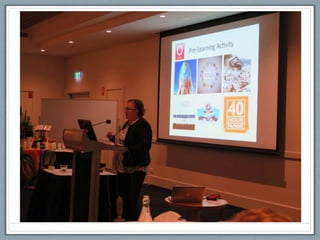
OPEN: Prior knowledge of global organisations that
the students recognised.
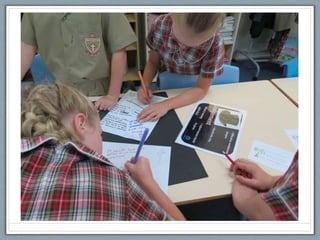
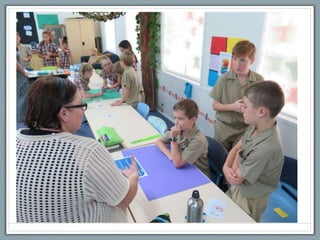
• Activity 1: Complete pre-test to determine knowledge
levels about Australia’s connection to other countries.
Provide students with a question and answer sheet that
they will complete as they move around 10 stations. Each
station has a visual prompt relating to a different idea of
global connection. Students have four minutes at each
station and identify the prompt they know least about.
• Other Activities: Watch “Global Connections” video on
ClickView; Read book – “Around the world by lunch”;
CDRom “The Global Village” – oral activities
Learning Scenario - Students
Learning scenario
You have seen an overview of a couple of health issues as an introductory session.
You will now investigate, through Guided Inquiry, a health issue and relate it to an individual or group of
people.
Select a person or group of people affected with a health issue
Pose an inquiry question
Form an Inquiry Circle with others who have similar questions/issues and discuss your initial findings.
Conduct research and write a report to answer your question:
Describe the issue, factors, strategies and actions that could promote a healthy change and finally write a
conclusion covering:
What health promotion approaches have been used previously in relation to your inquiry area.
How successful have these approaches been?
Do you think the principles of social justice been considered in previous health promotion strategies?
Explain why/ why not
In writing your report remember the SEXY acronym
S= State your argument
E= Explain your point
X= eXample to demonstrate
Y= whY
Share this conclusion with your Inquiry Circle
You will finally share your report findings on “The Hot Seat” relating your issue and
health program to the Ottowa Charter and encourage questions which you will
endeavour to answer.
Step 2 Immerse
IMMERSE: Students build their
background knowledge by immersion in
the content. Students reflect on the
content and select a topic for further
investigation.
Immerse
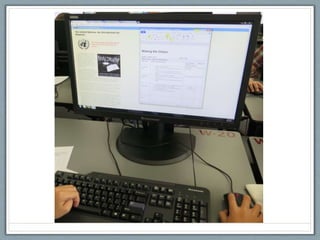
• Students discussed Article 25 of poster of The
Universal Declaration of Human Rights and
recapped the importance of Australia’s role in
providing aid and humanitarian support.
• Students then selected an organisation and drew its
logo with a description of its elements and meaning.
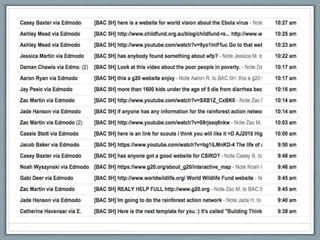
• Links to all the organisations selected were put onto
a Diigo sites and used from the class Edmodo
learning platform. Students also enjoyed sharing
sites they found.
Step 3 Explore
EXPLORE: Students browse and scan
through a wide range and variety of
resources to explore interesting ideas
around their selected topic. “Go broad”
Explore
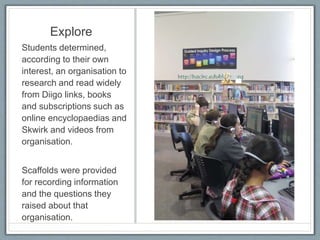
Students determined,
according to their own
interest, an organisation to
research and read widely
from Diigo links, books
and subscriptions such as
online encyclopaedias and
Skwirk and videos from
organisation.
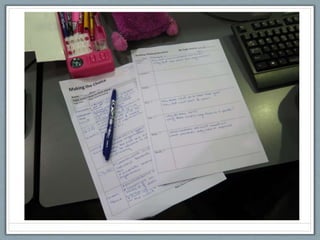
Scaffolds were provided
for recording information
and the questions they
raised about that
organisation.
Step 4 Identify
IDENTIFY: Students develop an inquiry
question or questions and form a focus for
their research. The question or questions will
frame the rest of the inquiry.
Identify
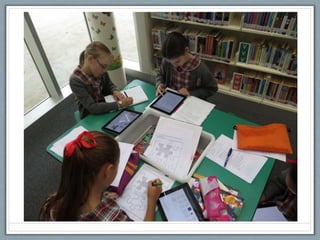
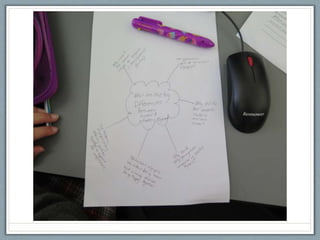
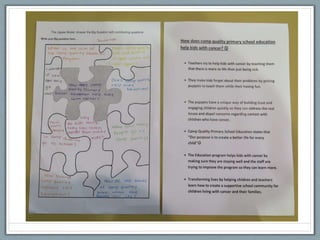
• Students wrote a research question (with
help from the teaching team) to focus their
exploration and then four contributing
questions which were placed into a jigsaw
scaffold and a mind map.
Step 5 Gather
GATHER: collect detailed information
from a variety of information sources –
“Go deep”
Gather
• Answers were gathered in their books and
throughout students were assisted with
aspects of information literacy by the teacher
librarian – everything from determining best
sources of information to writing a
Bibliography.
Step 6 Create
CREATE: Organise their gathered
information to create their product
Now for the real fun!
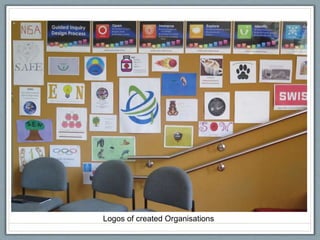
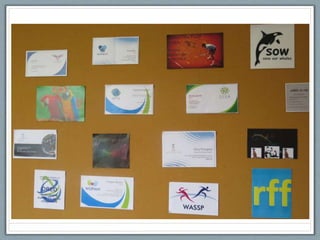
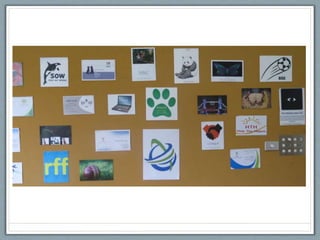
Students created an organisation of their own based on the tenets
of the one they had been researching. They had to create a name,
logo, slogan, aims, goals and a script for a one minute infomercial
which featured the student introducing their agency. Because they
had selected an organisation originally based on their own interest
we had organisations created for everything from wildlife
conservation to soccer. This also integrated their Visual Arts and
Writing programs: http://guidedinquiryoz.edublogs.org/practice-2/primary-guided-
inquiry-units/)
Getting right
into the
‘Third Space’!
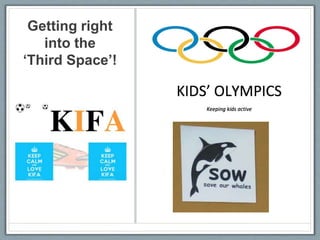
Logos of created Organisations
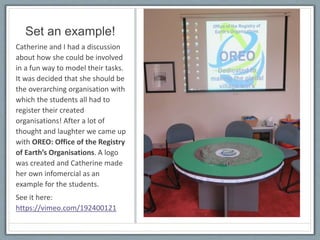
Set an example!
Catherine and I had a discussion
about how she could be involved
in a fun way to model their tasks.
It was decided that she should be
the overarching organisation with
which the students all had to
register their created
organisations! After a lot of
thought and laughter we came up
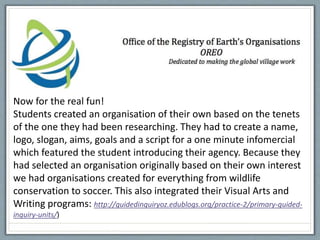
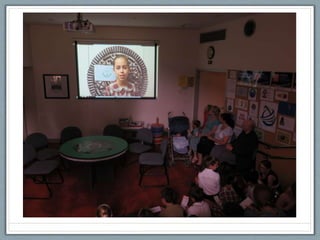
with OREO: Office of the Registry
of Earth’s Organisations. A logo
was created and Catherine made
her own infomercial as an
example for the students.
See it here:
https://vimeo.com/192400121
Step 7 Share
SHARE: “Tell the story”
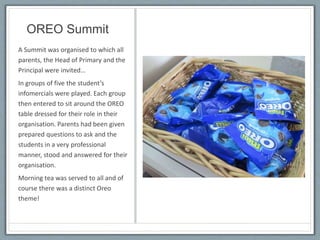
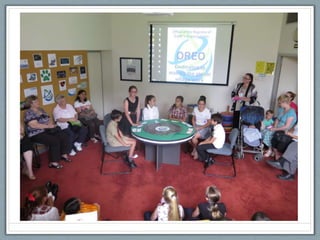
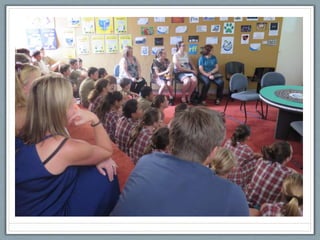
OREO Summit
A Summit was organised to which all
parents, the Head of Primary and the
Principal were invited…
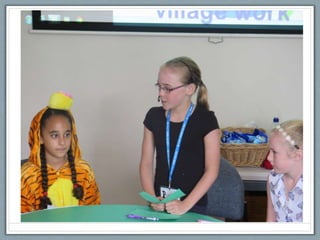
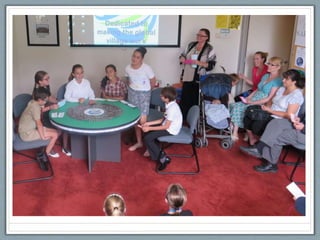
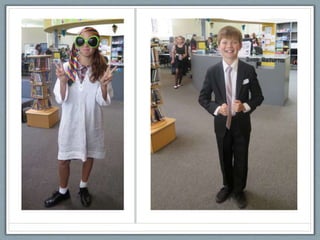
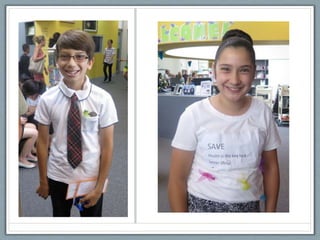
In groups of five the student’s
infomercials were played. Each group
then entered to sit around the OREO
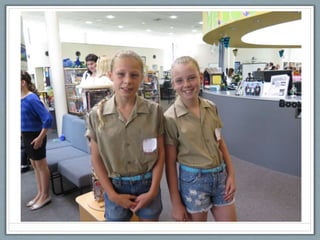
table dressed for their role in their
organisation. Parents had been given
prepared questions to ask and the
students in a very professional
manner, stood and answered for their
organisation.
Morning tea was served to all and of
course there was a distinct Oreo
theme!
Step 8 Evaluate
Students (and teacher team) reflect on
their content learning and the progress
through the inquiry process.
Evaluate
Teaching Team:
• Catherine and I discussed at length what went well and what
needed fixing. I interviewed her and her responses have been
recorded here:
• Student achievements: https://vimeo.com/128838865
• Student Engagement: https://vimeo.com/128838303
• Integration and evaluation: https://vimeo.com/128837052
• Teacher Librarian Collaboration: https://vimeo.com/128837051
• Integration and ‘Thinking’ Questions:
https://vimeo.com/128837050
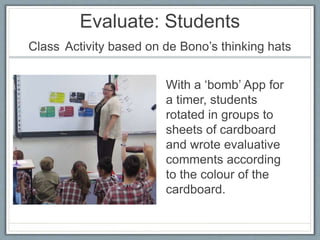
Evaluate: Students
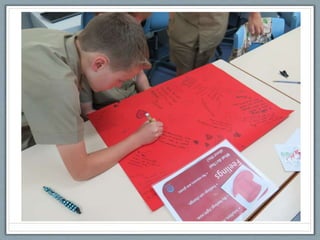
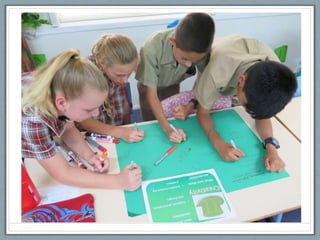
Class Activity based on de Bono’s thinking hats
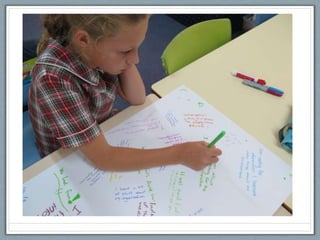
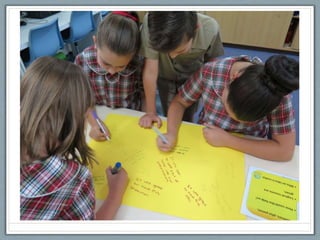
With a ‘bomb’ App for
a timer, students
rotated in groups to
sheets of cardboard
and wrote evaluative
comments according
to the colour of the
cardboard.
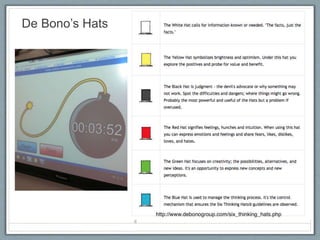
De Bono’s Hats
Evaluate: Parents:
• The Year 5 parents were amazed by the
enthusiasm of their children throughout this
whole unit of work and after the “Summit” a few
contacted the school with comments about the
enthusiastic learning of the students
• The number of parents who came to the Summit
and morning tea indicated their support that was
evident throughout.
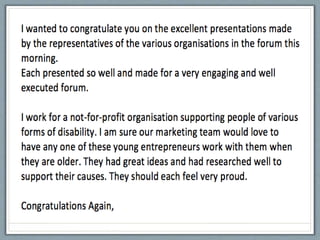
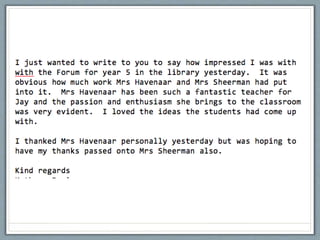
• The following emails were received from
parents:
Share Again – Widely!
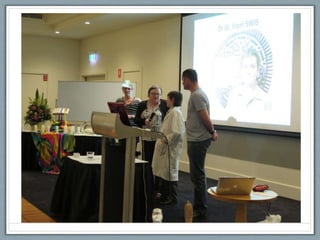
• Last year I was invited to speak at the NSW annual
conference of the Teacher Librarian Professional
Learning Community. The topic I had to speak on was TL
– changing pedagogy to increase student engagement
and learning.
• I decided that I should invite along Catherine and also a
student with his parents. I gave them half the time and we
all spoke about our learning experience on this unit.
• Needless to say, a number of teacher librarians were
enthused to learn more and use Guided Inquiry Design
collaboratively taught with the assistance of the teacher
librarian certainly to engage students and increase their
learning.
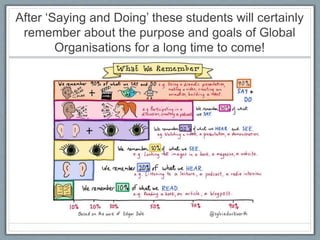
After ‘Saying and Doing’ these students will certainly
remember about the purpose and goals of Global
Organisations for a long time to come!

Year 5 - Global Connections

  • 1.
    Global Connections A GuidedInquiry Design unit of work Mrs Catherine Havenaar & Mrs Alinda Sheerman with Year 5
  • 3.
    Key Focus What impactdoes Australia have on the world stage through our global connections? Contributing Questions: • In what different arenas does Australia contribute to the world? • What are our responsibilities in making sure all people are treated with respect
  • 4.
    Planning Teaching team metto plan: • Programme of work following the GID steps : http://guidedinquiryoz.edublogs.org/practice-2/primary- guided-inquiry-units/ • Assessment for learning, in learning and of learning • Group work and sharing of knowledge enables the whole class to gain understanding of the whole topic area. • Technology and learning platform: Edmodo • Specific Differentiation needed: ‘text to speech’ for one student
  • 5.
    Step 1 OPEN OPEN:Create a powerful ‘open’ that invites students to engage in the inquiry topic.
  • 6.
    OPEN: Prior knowledgeof global organisations that the students recognised. • Activity 1: Complete pre-test to determine knowledge levels about Australia’s connection to other countries. Provide students with a question and answer sheet that they will complete as they move around 10 stations. Each station has a visual prompt relating to a different idea of global connection. Students have four minutes at each station and identify the prompt they know least about. • Other Activities: Watch “Global Connections” video on ClickView; Read book – “Around the world by lunch”; CDRom “The Global Village” – oral activities
  • 7.
    Learning Scenario -Students Learning scenario You have seen an overview of a couple of health issues as an introductory session. You will now investigate, through Guided Inquiry, a health issue and relate it to an individual or group of people. Select a person or group of people affected with a health issue Pose an inquiry question Form an Inquiry Circle with others who have similar questions/issues and discuss your initial findings. Conduct research and write a report to answer your question: Describe the issue, factors, strategies and actions that could promote a healthy change and finally write a conclusion covering: What health promotion approaches have been used previously in relation to your inquiry area. How successful have these approaches been? Do you think the principles of social justice been considered in previous health promotion strategies? Explain why/ why not In writing your report remember the SEXY acronym S= State your argument E= Explain your point X= eXample to demonstrate Y= whY Share this conclusion with your Inquiry Circle You will finally share your report findings on “The Hot Seat” relating your issue and health program to the Ottowa Charter and encourage questions which you will endeavour to answer.
  • 8.
    Step 2 Immerse IMMERSE:Students build their background knowledge by immersion in the content. Students reflect on the content and select a topic for further investigation.
  • 9.
    Immerse • Students discussedArticle 25 of poster of The Universal Declaration of Human Rights and recapped the importance of Australia’s role in providing aid and humanitarian support. • Students then selected an organisation and drew its logo with a description of its elements and meaning. • Links to all the organisations selected were put onto a Diigo sites and used from the class Edmodo learning platform. Students also enjoyed sharing sites they found.
  • 12.
    Step 3 Explore EXPLORE:Students browse and scan through a wide range and variety of resources to explore interesting ideas around their selected topic. “Go broad”
  • 13.
    Explore Students determined, according totheir own interest, an organisation to research and read widely from Diigo links, books and subscriptions such as online encyclopaedias and Skwirk and videos from organisation. Scaffolds were provided for recording information and the questions they raised about that organisation.
  • 15.
    Step 4 Identify IDENTIFY:Students develop an inquiry question or questions and form a focus for their research. The question or questions will frame the rest of the inquiry.
  • 16.
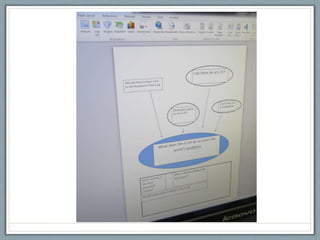
    Identify • Students wrotea research question (with help from the teaching team) to focus their exploration and then four contributing questions which were placed into a jigsaw scaffold and a mind map.
  • 19.
    Step 5 Gather GATHER:collect detailed information from a variety of information sources – “Go deep”
  • 20.
    Gather • Answers weregathered in their books and throughout students were assisted with aspects of information literacy by the teacher librarian – everything from determining best sources of information to writing a Bibliography.
  • 22.
    Step 6 Create CREATE:Organise their gathered information to create their product
  • 23.
    Now for thereal fun! Students created an organisation of their own based on the tenets of the one they had been researching. They had to create a name, logo, slogan, aims, goals and a script for a one minute infomercial which featured the student introducing their agency. Because they had selected an organisation originally based on their own interest we had organisations created for everything from wildlife conservation to soccer. This also integrated their Visual Arts and Writing programs: http://guidedinquiryoz.edublogs.org/practice-2/primary-guided- inquiry-units/)
  • 24.
  • 25.
    Logos of createdOrganisations
  • 28.
    Set an example! Catherineand I had a discussion about how she could be involved in a fun way to model their tasks. It was decided that she should be the overarching organisation with which the students all had to register their created organisations! After a lot of thought and laughter we came up with OREO: Office of the Registry of Earth’s Organisations. A logo was created and Catherine made her own infomercial as an example for the students. See it here: https://vimeo.com/192400121
  • 29.
    Step 7 Share SHARE:“Tell the story”
  • 30.
    OREO Summit A Summitwas organised to which all parents, the Head of Primary and the Principal were invited… In groups of five the student’s infomercials were played. Each group then entered to sit around the OREO table dressed for their role in their organisation. Parents had been given prepared questions to ask and the students in a very professional manner, stood and answered for their organisation. Morning tea was served to all and of course there was a distinct Oreo theme!
  • 39.
    Step 8 Evaluate Students(and teacher team) reflect on their content learning and the progress through the inquiry process.
  • 40.
    Evaluate Teaching Team: • Catherineand I discussed at length what went well and what needed fixing. I interviewed her and her responses have been recorded here: • Student achievements: https://vimeo.com/128838865 • Student Engagement: https://vimeo.com/128838303 • Integration and evaluation: https://vimeo.com/128837052 • Teacher Librarian Collaboration: https://vimeo.com/128837051 • Integration and ‘Thinking’ Questions: https://vimeo.com/128837050
  • 41.
    Evaluate: Students Class Activitybased on de Bono’s thinking hats With a ‘bomb’ App for a timer, students rotated in groups to sheets of cardboard and wrote evaluative comments according to the colour of the cardboard.
  • 42.
  • 49.
    Evaluate: Parents: • TheYear 5 parents were amazed by the enthusiasm of their children throughout this whole unit of work and after the “Summit” a few contacted the school with comments about the enthusiastic learning of the students • The number of parents who came to the Summit and morning tea indicated their support that was evident throughout. • The following emails were received from parents:
  • 52.
    Share Again –Widely! • Last year I was invited to speak at the NSW annual conference of the Teacher Librarian Professional Learning Community. The topic I had to speak on was TL – changing pedagogy to increase student engagement and learning. • I decided that I should invite along Catherine and also a student with his parents. I gave them half the time and we all spoke about our learning experience on this unit. • Needless to say, a number of teacher librarians were enthused to learn more and use Guided Inquiry Design collaboratively taught with the assistance of the teacher librarian certainly to engage students and increase their learning.
  • 55.
    After ‘Saying andDoing’ these students will certainly remember about the purpose and goals of Global Organisations for a long time to come!

Editor's Notes

  • #2 When I was first asked to help Catherine with an integrated Year 5 unit on ‘Global Connections’, I was initially a little cautious about how we would achieve the integrated English and Humanities outcomes. The first step of any unit of Guided Inquiry, however is to plan with the teaching team. By the end of the first session I knew we were on a winner. Right from the start Catherine and I bounced off each other with ideas and this continued throughout the unit until it actually became an exhaustingly huge project. However, because the students all joined in the ‘fun’ of learning together it was an experience never to be forgotten. The fact that the G20 Summit was taking place in Brisbane at the time was such a bonus. Having world leaders right here in Australia and on the news, made ‘global connectedness’ so relevant to the students.
  • #3 G20 Summit in Brisbane created curiosity…
  • #8 It’s important students are informed about the learning process and their assessment requirements at the beginning. Students were given a Summary of Learning tasks via the class Edmodo Group.
  • #9 Using pdfs on computers or the hardcopy ‘Issues’ books students began to immerse themselves in the topic. At this stage the first scaffold was issued through a folder of scaffolds on Edmodo – giving them structure and support for the whole topic background and their preference for a particular area to study.
  • #16 This step is where the students decide exactly what they want to investigate and compose a personal research question. More assistance is needed now than at any other time
  • #20 Information from previous scaffolds can form part of this collection. At this stage students are reminded to also gather their Bibliography that has been attached to notes along the way.
  • #23 Students wrote up their report or essay on their selected Issue.
  • #40 At specific stages throughout this unit Survey Monkey questionnaires were completed to use for assessing their growth of knowledge and where support was needed. A final evaluative survey was given from which data can be used to analyse this unit of work and to plan any changes for another. This gives data for Action Research.