The 2007 Dealer eBusiness
                              Performance Study:

                             THE NEW BUYING INFLUENCES


In partnernship with:
2007 Dealer eBusiness
Key Contributors                                   Performance Study


                   Kevin Root, Vice President, Applications and Services
                   Ken Pfau, Director, Training and Consulting, CRM Planning
                   Matt Muilenburg, Director, Search Strategy and Product Planning
                   Eliza Kelly, Senior Project Manager
                   Debra Sims, Project Manager
                   Tyler Anderson, Project Contributor

                   Yahoo!
                   David Schwartz, Local Category Director
                   Edwin Wong, Director, Consumer Insights Organization

                   R. L. Polk & Co.
                   Andrew Price, Vice President, Dealer Solutions
                   Brad Korner, Account Director, Automotive Retail Solutions


                   The Cobalt Group
                   2200 First Avenue South
                   Seattle, WA 98134
                   800.909.8244
                   www.cobalt.com
3      | Pre-selection Phase


                                                                                                                      2007 Dealer eBusiness
Table of Contents                                                                                                        Performance Study


                                                                            Key Contributors                                                   2

                                                                            Corporate Headquarters                                             2

                                                                            Overview                                                           4

                                                                            Executive Summary                                                  5

                                                                            Introduction                                                       9

                                                                            Pre-selection Phase                                               10

                                                                            Research conducted online

                                                                            Offline shopping still important

                                                                            Multiple sources used for quote submission

                                                                            Engagement Phase                                                  14

                                                                            Lost opportunity for dealers remains high

                                                                            Brand defection is increasing

                                                                            What consumers are buying and when

                                                                            Dealer response to leads is poor

                                                                            Gap between dealer performance and consumer expectations

                                                                            What high-performing dealers are doing to succeed

                                                                            Purchase Phase                                                    22

                                                                            Experiences influence other buyers

                                                                            Reviews and rankings becoming more pervasive

                                                                            Positive comments outweigh negative

                                                                            Five attributes in dealer selection


                                                                            Implications of Key Findings                                      34

                                                                            Manufacturer Comparative Data                                     35

                                                                            Appendix A – Research Methodologies                               36

                                                                            Appendix B – Geographic Distribution
                                                                                                                                              38
                                                                            of Dealerships in Lead Analysis

                                                                            Appendix C – eMystery Shopping Scorecard                          39


2007 Dealer eBusiness Performance Study: The New Buying Influences
© 2 0 0 8 T h e C o bal t G r o u p, p r op r i e ta r y a nd c o n fi de n t ial . All ri g h t s r e s e r ve d .
4      | Pre-selection Phase


                                                                                                                          2007 Dealer eBusiness
Overview                                                                                                                     Performance Study


                                                                                 The Cobalt Group, in partnership with Yahoo! and R.L. Polk & Co.,
                                                                                 conducted the 2007 Dealer eBusiness Performance Study: The New Buying
                                                                                 Influences to better understand current automotive dealership Internet
                                                                                 lead handling and the impact of search and consumer-generated media
                                                                                 on vehicle shopping and purchase behavior. Using a variety of research
                                                                                 methods, the companies set out to answer the following questions:


                                                                                               How are consumers utilizing the Internet, search and online
                                                                                               consumer-generated media to shop and select a dealership?
                                                                                               How do online dealership reviews and reputation, lead response and
                                                                                               professionalism of sales staff impact consumer purchase decisions?
                                                                                               What are the current dealership ebusiness performance levels?
                                                                                               How much Internet lost opportunity occurs at dealerships and what
                                                                                               are the causes?
                                                                                               What are high-performing dealerships doing to meet consumer
                                                                                               expectations and successfully convert Internet opportunities?

                                                                                 The result is a comprehensive report on the state of automotive car
                                                                                 shopping today and is meant to inform and guide automotive
                                                                                 manufacturers, dealer groups and dealership employees on the current
                                                                                 state of the industry, important trends and what they can do to maximize
                                                                                 business opportunities in an Internet-driven marketplace.


2007 Dealer eBusiness Performance Study: The New Buying Influences                                                                                4/Overview
© 2 0 0 8 T h e C o bal t G r o u p, p r op r i e ta r y a nd c o n fi de n t ial . All ri g h t s r e s e r ve d .
2007 Dealer eBusiness
Executive Summary                                                                                                        Performance Study


                                                                                 The Internet has transformed how consumers live, work and most notably,
                                                                                 how they shop for products and services. The introduction of search
                                                                                 and social networking has fueled the growth of Internet use by making
                                                                                 information more accessible and connecting users with other "like"
                                                                                 consumers to hear about their opinions and experiences. This explosive
                                                                                 growth—combined with a decrease in model, brand and dealership
                                                                                 loyalty—has led car shoppers to consider more makes, models and
                                                                                 dealerships at the start of the shopping process, effectively broadening
                                                                                 the top of the traditional automotive purchase funnel.

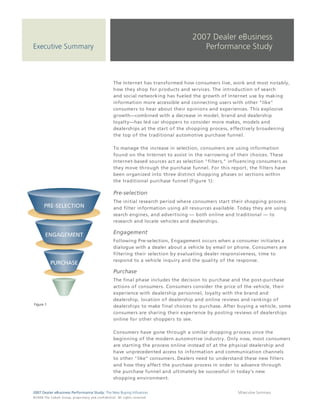
                                                                                 To manage the increase in selection, consumers are using information
                                                                                 found on the Internet to assist in the narrowing of their choices. These
                                                                                 Internet-based sources act as selection "filters," influencing consumers as
                                                                                 they move through the purchase funnel. For this report, the filters have
                                                                                 been organized into three distinct shopping phases or sections within
                                                                                 the traditional purchase funnel (Figure 1):

                                                                                 Pre-selection
                                                                                 The initial research period where consumers start their shopping process
                                                                                 and filter information using all resources available. Today they are using
                                                                                 search engines, and advertising — both online and traditional — to
                                                                                 research and locate vehicles and dealerships.

                                                                                 Engagement
                                                                                 Following Pre-selection, Engagement occurs when a consumer initiates a
                                                                                 dialogue with a dealer about a vehicle by email or phone. Consumers are
                                                                                 filtering their selection by evaluating dealer responsiveness, time to
                                                                                 respond to a vehicle inquiry and the quality of the response.

                                                                                 Purchase
                                                                                 The final phase includes the decision to purchase and the post-purchase
                                                                                 actions of consumers. Consumers consider the price of the vehicle, their
                                                                                 experience with dealership personnel, loyalty with the brand and
                                                                                 dealership, location of dealership and online reviews and rankings of
 Figure 1
                                                                                 dealerships to make final choices to purchase. After buying a vehicle, some
                                                                                 consumers are sharing their experience by posting reviews of dealerships
                                                                                 online for other shoppers to see.

                                                                                 Consumers have gone through a similar shopping process since the
                                                                                 beginning of the modern automotive industry. Only now, most consumers
                                                                                 are starting the process online instead of at the physical dealership and
                                                                                 have unprecedented access to information and communication channels
                                                                                 to other "like" consumers. Dealers need to understand these new filters
                                                                                 and how they affect the purchase process in order to advance through
                                                                                 the purchase funnel and ultimately be successful in today's new
                                                                                 shopping environment.


2007 Dealer eBusiness Performance Study: The New Buying Influences                                                                    5/Executive Summary
© 2 0 0 8 T h e C o bal t G r o u p, p r op r i e ta r y a nd c o n fi de n t ial . All ri g h t s r e s e r ve d .
Pre-selection
                                                                                 Most consumers start their vehicle shopping process online using Internet-
                                                                                 based resources to filter information and opportunities. Eighty-three
                                                                                 percent of car shoppers used the Internet to research vehicles and 79%
                                                                                 used search to research dealerships. When comparing reliance on
                                                                                 traditional media vs. online media, consumers are turning more to online
                                                                                 advertising sources while conducting their research. Forty-eight percent
                                                                                 referred to a dealership's website to view what models and vehicles were
                                                                                 available versus 20% that called the dealership to see what vehicles were in
                                                                                 stock. For finding a dealership, 31% used dealer websites and 29% used
                                                                                 OEM websites versus 19% used yellow pages and 17% used radio ads.
                                                                                 Dealers who evaluate their advertising to ensure they're getting maximum
                                                                                 exposure to these consumers will benefit.

                                                                                 Most consumers are choosing to initiate a conversation with a dealership
                                                                                 online as well. Sixty-three percent of new car shoppers submitted a
                                                                                 purchase inquiry or lead to a dealership via email with 67% having
                                                                                 submitted through the dealership website, 42% through a third party
                                                                                 portal and 36% via an OEM website. With two-thirds of consumers
                                                                                 initiating dialogue through email, dealers need to establish processes
                                                                                 to answer these lead inquiries promptly and completely.

                                                                                 Consumers are willing to travel further for a dealership they feel is going
                                                                                 to provide the right experience. Thirty-two percent traveled more than
                                                                                 20 miles from home to physically visit a dealership. Search advertising can
                                                                                 level the playing field and give dealerships outside of larger markets the
                                                                                 chance to compete for these customers.

                                                                                 Walking into a dealership's showroom is still an important part of the
                                                                                 shopping process. On average, consumers physically visited 6 dealerships
                                                                                 prior to purchasing a vehicle. As the overall quality of vehicles increase,
                                                                                 shoppers are actively considering multiple brands and using the Internet
                                                                                 to filter which dealership they will visit for a demonstration drive. The
                                                                                 consumer’s experience with a dealer’s website can therefore have a large
                                                                                 impact on getting selected as the dealership for that brand. Most
                                                                                 importantly, consumers typically select only one dealership of each
                                                                                 brand to physically visit. That means the choice to buy one brand over
                                                                                 another can rest solely on the interaction with one dealership. Dealers
                                                                                 may have one shot at selling to a consumer or they can lose the sale for
                                                                                 the entire brand.


2007 Dealer eBusiness Performance Study: The New Buying Influences                                                                    6/Executive Summary
© 2 0 0 8 T h e C o bal t G r o u p, p r op r i e ta r y a nd c o n fi de n t ial . All ri g h t s r e s e r ve d .
Engagement
                                                                                 Fifty-five percent of approximately one million de-duplicated new vehicle
                                                                                 leads from a third-party portal resulted in a sale of a new or used vehicle.
                                                                                 Of those 55%, 10% were sold at the "intended dealer" or the dealer to
                                                                                 which the lead was initially sent. The other 90% closed at a dealer other
                                                                                 than the intended dealer. This 90% represents the "lost opportunity"
                                                                                 dealerships are experiencing because they had the opportunity to convert
                                                                                 the lead but lost the sale to another dealership.

                                                                                 Of the 90% of new vehicle leads that closed at an other dealer, 23%
                                                                                 purchased a new vehicle of the same brand specified in the initial lead.
                                                                                 Forty-one percent purchased a used vehicle and 36% bought a new vehicle
                                                                                 of a different brand. This represents a 6% increase in brand defection
                                                                                 since the study in 2005. This confirms the findings above that consumers
                                                                                 are considering multiple models and brands right up to the point
                                                                                 of purchase.

                                                                                 Of the leads that resulted in a sale, 24% closed within 10 days and 68%
                                                                                 closed within 90 days. Once consumers initiate a dialogue, dealers who
                                                                                 respond promptly will have a better chance with consumers who have a
                                                                                 short purchase timeframe.

                                                                                 Cobalt's national 2007 eMystery shop showed an overall decline in how
                                                                                 dealers are responding to online leads across almost all key performance
                                                                                 areas since the 2005 national eMystery shop. Specifically, these areas of
                                                                                 decline include whether or not dealers responded to a lead and the
                                                                                 quality of the dealer's response to the lead. Most dealers are performing
                                                                                 at levels below what consumers have come to expect, creating an alarming
                                                                                 gap between consumer reliance on the Internet and dealer performance in
                                                                                 handling these consumers.

                                                                                 Top-performing dealers recognize the importance of prompt, complete
                                                                                 and transparent communication with consumers. Eighty-three percent of
                                                                                 these dealerships have processes in place to phone immediately after
                                                                                 receiving an email lead and 95% provide price and vehicle information
                                                                                 as part of an initial response. All of the participating dealers credited
                                                                                 having management support of Internet sales efforts and strong processes
                                                                                 to ensure they are able to communicate promptly, completely and
                                                                                 transparently with consumers.


2007 Dealer eBusiness Performance Study: The New Buying Influences                                                                    7/Executive Summary
© 2 0 0 8 T h e C o bal t G r o u p, p r op r i e ta r y a nd c o n fi de n t ial . All ri g h t s r e s e r ve d .
Purchase
                                                                                 Reliance on online dealership reviews and rankings written by
                                                                                 independent consumers is rapidly increasing and the impact of these
                                                                                 reviews on purchase experiences is becoming more substantial. Of those
                                                                                 consumers that looked at reviews and rankings of dealerships, 21%
                                                                                 changed their dealership selection and 23% decided to look at a different
                                                                                 make/brand based on what they read in the reviews. Forty-three percent
                                                                                 used information from reviews to select a dealership.

                                                                                 Adoption rates for reviews and rankings are high and projected to
                                                                                 increase dramatically. A total of 73% of consumers said they would be
                                                                                 likely to use dealership reviews and rankings for future vehicle purchases.
                                                                                 When people have a good experience, they want to tell others. Eighty-six
                                                                                 percent of the consumers who posted reviews provided positive comments
                                                                                 about their experience. Dealers who embrace online reviews and rankings
                                                                                 by investing in the customer experience and implementing processes to
                                                                                 respond promptly and transparently to all communication will benefit
                                                                                 as their customers will be more likely to write positive reviews.

                                                                                 A comparative variable conjoint analysis was conducted to measure the
                                                                                 relative importance of five primary dealership attributes that influence
                                                                                 consumers to purchase: location of the dealership, loyalty (of a consumer
                                                                                 to a dealership), price of the vehicle, professionalism of sales staff and
                                                                                 online reviews and rankings of the dealership. The analysis revealed that
                                                                                 while the price of a vehicle is the most important attribute for consumers,
                                                                                 the professionalism of sales staff ranks in almost equal importance. Online
                                                                                 dealership reviews and rankings were shown to have medium-high
                                                                                 importance and have significant "pull" on consumers considering one
                                                                                 dealer over another. Proximity of the dealership and loyalty both had low
                                                                                 levels of importance among the attributes.

                                                                                 The analysis shows that consumers value a good buying experience from
                                                                                 a professional sales staff nearly as much as a low price and in some cases
                                                                                 are willing to forgo the absolute lowest price in order to have a better
                                                                                 buying experience with the dealership sales staff. These findings dispel
                                                                                 the commonly held belief that lowest price and dealership location are
                                                                                 the primary attributes that lead consumers to choose one dealership
                                                                                 over another.

                                                                                 It also illustrates the growing importance of dealer reputation. If a
                                                                                 dealership promotes an environment of professionalism by investing in
                                                                                 the customer experience through their sales staff combined with offering
                                                                                 a competitive price, strong online reviews from customers will naturally
                                                                                 result thus establishing a system of reciprocity where strengthening one
                                                                                 attribute will benefit the others.


2007 Dealer eBusiness Performance Study: The New Buying Influences                                                                    8/Executive Summary
© 2 0 0 8 T h e C o bal t G r o u p, p r op r i e ta r y a nd c o n fi de n t ial . All ri g h t s r e s e r ve d .
2007 Dealer eBusiness
Introduction                                                                                                                  Performance Study


                                                                                 This study was modeled after The Cobalt Group's 2005 Industry and Dealership
                                                                                 eBusiness Performance Study and used similar methodologies to gain
                                                                                 insight into dealer performance trends. As a result of requests from
                                                                                 customers wanting to know what influences consumers to buy a vehicle,
                                                                                 two Internet-based surveys were added to this study to examine how
                                                                                 consumers are researching, pre-shopping and purchasing vehicles.

                                                                                 Results from a total of five "sub-studies" make up this report: a lead
                                                                                 match and closure analysis of approximately one million Internet new car
                                                                                 leads representing 35 brands over a 15-month period; two Internet-based
                                                                                 surveys of 1,550 car shoppers and purchasers; a mystery shopping
                                                                                 campaign directed at more than 2,100 dealerships; and onsite interviews
                                                                                 with more than 20 "high-performing" dealerships to determine processes
                                                                                 and practices that contribute to their success. Details on methodologies
                                                                                 used can be found in Appendix A. The scope of research methodologies
                                                                                 and conclusions makes this the largest and most comprehensive study of
                                                                                 automotive ebusiness in the industry to date.

                                                                                 The following findings are organized within three distinct phases of the
                                                                                 purchase funnel: Pre-selection, Purchase and Engagement.


                                                                  Terminology
                                                                                 In order to understand the findings in this document, definitions for key
                                                                                 terminology are provided below:
                                                                                               Intended dealership - The dealership to which the lead was initially sent
                                                                                               Other dealership - Any dealership other than the intended dealership
                                                                                               Intended make (new) or intended brand - The vehicle make and model
                                                                                               described in the initial lead
                                                                                               Other make (new) or other brand - Any make other than the intended
                                                                                               make as specified in the lead


2007 Dealer eBusiness Performance Study: The New Buying Influences                                                                                    9/Introduction
© 2 0 0 8 T h e C o bal t G r o u p, p r op r i e ta r y a nd c o n fi de n t ial . All ri g h t s r e s e r ve d .
Pre-selection Phase


                                                                  Research conducted online
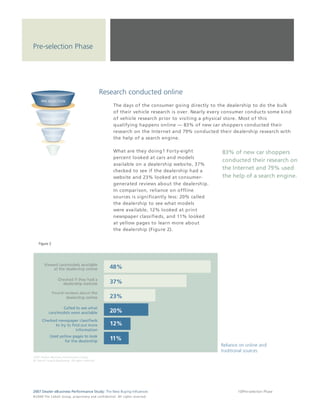
                                                                                 The days of the consumer going directly to the dealership to do the bulk
                                                                                 of their vehicle research is over. Nearly every consumer conducts some kind
                                                                                 of vehicle research prior to visiting a physical store. Most of this
                                                                                 qualifying happens online — 83% of new car shoppers conducted their
                                                                                 research on the Internet and 79% conducted their dealership research with
                                                                                 the help of a search engine.

                                                                                 What are they doing? Forty-eight             83% of new car shoppers
                                                                                 percent looked at cars and models
                                                                                                                              conducted their research on
                                                                                 available on a dealership website, 37%
                                                                                 checked to see if the dealership had a
                                                                                                                              the Internet and 79% used
                                                                                 website and 23% looked at consumer-          the help of a search engine.
                                                                                 generated reviews about the dealership.
                                                                                 In comparison, reliance on offline
                                                                                 sources is significantly less: 20% called
                                                                                 the dealership to see what models
                                                                                 were available, 12% looked at print
                                                                                 newspaper classifieds, and 11% looked
                                                                                 at yellow pages to learn more about
                                                                                 the dealership (Figure 2).


     Figure 2


2007 Dealer eBusiness Performance Study: The New Buying Influences                                                                   10/Pre-selection Phase
© 2 0 0 8 T h e C o bal t G r o u p, p r op r i e ta r y a nd c o n fi de n t ial . All ri g h t s r e s e r ve d .
This data shows more than twice as many consumers referred to the
                                                                                 website to see inventory than called the dealer to ask what they had in
                                                                                 stock. Consumers are using the dealership website as a central point of
                                                                                 reference making it a direct extension of the physical store. Consumers
                                                                                 are filtering dealers during the pre-selection phase by using the
                                                                                 information they find online to make a decision whether to physically
                                                                                 visit the dealership. If a dealer's website isn't well maintained and has
                                                                                 dated promotions or inventory, to online visitors it is indicative of the
                                                                                 dealer not caring about earning their business. If a website is crowded
                                                                                 with oversized flashing banners, obtrusive promotional coupons popping
                                                                                 up, and video of talking heads launching automatically, consumers will
                                                                                 assume this is the kind of treatment they will get if they physically visit
                                                                                 the showroom—overbearing and uninvited sales tactics. Conversely, a
                                                                                 website that is well maintained with current inventory, user controlled
                                                                                 multi-media and well-timed promotional offerings (service coupon on the
                                                                                 service section of the site, etc.) indicates the consumer will be treated
                                                                                 respectfully and professionally upon visiting the physical store.

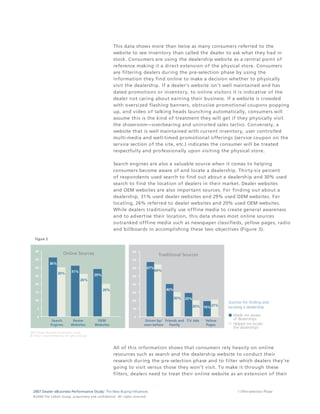
                                                                                 Search engines are also a valuable source when it comes to helping
                                                                                 consumers become aware of and locate a dealership. Thirty-six percent
                                                                                 of respondents used search to find out about a dealership and 30% used
                                                                                 search to find the location of dealers in their market. Dealer websites
                                                                                 and OEM websites are also important sources. For finding out about a
                                                                                 dealership, 31% used dealer websites and 29% used OEM websites. For
                                                                                 locating, 26% referred to dealer websites and 20% used OEM websites.
                                                                                 While dealers traditionally use offline media to create general awareness
                                                                                 and to advertise their location, this data shows most online sources
                                                                                 outranked offline media such as newspaper classifieds, yellow pages, radio
                                                                                 and billboards in accomplishing these two objectives (Figure 3).

  Figure 3


                                                                                 All of this information shows that consumers rely heavily on online
                                                                                 resources such as search and the dealership website to conduct their
                                                                                 research during the pre-selection phase and to filter which dealers they're
                                                                                 going to visit versus those they won't visit. To make it through these
                                                                                 filters, dealers need to treat their online website as an extension of their


2007 Dealer eBusiness Performance Study: The New Buying Influences                                                                    11/Pre-selection Phase
© 2 0 0 8 T h e C o bal t G r o u p, p r op r i e ta r y a nd c o n fi de n t ial . All ri g h t s r e s e r ve d .
brand. They need to consider the appearance and attractiveness of their
                                                                                 website the same way they do their physical store including offering an
                                                                                 attractive display of current inventory complete with pictures. Dealers also
                                                                                 benefit by being well situated on search engines and by reallocating
                                                                                 advertising budgets from offline to online media to ensure they have a
                                                                                 presence online where consumers can find them.


                                                                  Offline shopping still important
                                                                                 New car shoppers are very active offline as well as online. Physically
                                                                                 visiting dealerships is still a significant part of the research process for
                                                                                 consumers. Commonly held assumptions state that consumers physically
                                                                                 visit 3 to 4 dealerships prior to purchasing a vehicle. Furthermore, it's
                                                                                 believed these dealerships represent the same brand indicating consumers
                                                                                 determine which brand they are going to purchase and shop multiple
                                                                                 dealers of the same brand to find a car to purchase. This study revealed
                                                                                 that on average, consumers physically visited 6 dealerships prior to
                                                                                 purchasing a vehicle. Most interesting is these consumers tended to visit
                                                                                 dealerships of different brands as opposed to multiple dealers of the same
                                                                                 brand. Well into the shopping process, consumers are actively considering
                                                                                 multiple brands and using the Internet to filter and select one dealership
                                                                                 of each brand to physically visit. Furthermore, this illustrates the
                                                                                 propensity to buy one brand over another can rest solely on the
                                                                                 performance of one dealership. Dealers may have one shot at selling to a
                                                                                 consumer or they can lose the sale for the entire brand. Given the quality
                                                                                 and breadth of products on the market and the online tools to engage
                                                                                 consumers as they research, new car shoppers can be marketed to and
                                                                                 swayed right up until the point of purchase.

                                                                                 While consumers are conducting their vehicle research online, they are
                                                                                 also gaining a sense of the in-person experience they will get from each
                                                                                 dealership. Consumers determine this by evaluating variables such as
                                                                                 vehicle availability, price and dealer response to email inquiries. The study
                                                                                 revealed that consumers are willing to travel further for a dealership they
                                                                                 feel is going to provide the right experience. Even within the large DMAs
                                                                                 which often contain 10 or more dealerships per brand, 32% traveled more
                                                                                 than 20 miles from home to physically visit a dealership. For dealerships
                                                                                 located outside of larger markets, search advertising can become a
                                                                                 significant equalizer.


                                                                  Multiple sources used for quote submission
                                                                                 As more and more consumers conduct research online, they are choosing
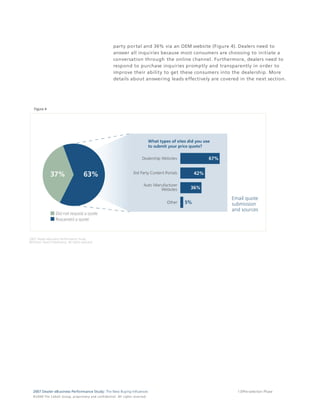
                                                                                 to initiate their interaction with dealers online as well. Sixty-three percent
                                                                                 of new car shoppers submitted purchase inquiries or leads to a dealership
                                                                                 online with 67% having submitted via the dealership website. While
                                                                                 dealership websites are the source of the majority of purchase inquiries,
                                                                                 third-party automotive portals and OEM websites also deliver significant
                                                                                 opportunities with 42% submitting a purchase inquiry through a third-


2007 Dealer eBusiness Performance Study: The New Buying Influences                                                                     12/Pre-selection Phase
© 2 0 0 8 T h e C o bal t G r o u p, p r op r i e ta r y a nd c o n fi de n t ial . All ri g h t s r e s e r ve d .
party portal and 36% via an OEM website (Figure 4). Dealers need to
                                                                                   answer all inquiries because most consumers are choosing to initiate a
                                                                                   conversation through the online channel. Furthermore, dealers need to
                                                                                   respond to purchase inquiries promptly and transparently in order to
                                                                                   improve their ability to get these consumers into the dealership. More
                                                                                   details about answering leads effectively are covered in the next section.


   Figure 4


                                                                                                                                     Email quote
                                                                                                                                     submission
                                                                                                                                     and sources


2007 Dealer eBusiness Performance Study,
©Yahoo! Search Marketing. All rights reserved.


  2007 Dealer eBusiness Performance Study: The New Buying Influences                                                                    13/Pre-selection Phase
  © 2 0 0 8 T h e C o bal t G r o u p, p r op r i e ta r y a nd c o n fi de n t ial . All ri g h t s r e s e r ve d .
Engagement Phase


                                                                                 As discussed in the pre-selection phase, 63% of car shoppers are
                                                                                 submitting purchase inquiries online. The dealer's initial response to a
                                                                                 lead is a pivotal point of contact for a consumer. This initial dialogue
                                                                                 represents the engagement phase. Dealer response — both in terms of
                                                                                 time to respond and quality of response — is critical to keeping that
                                                                                 consumer engaged, getting them into the dealership, and selling them a
                                                                                 vehicle. To fully understand how consumers filter at this stage, an
                                                                                 understanding of the current level of dealer sales performance is needed.


                                                                  Lost opportunity for dealers remains high
                                                                                 The lead match analysis of approximately one million leads over a 15- month
                                                                                 period was performed by R.L Polk & Co. and compared to the 2005 lead
                                                                                 match analysis to reveal performance levels over time. The results showed
                                                                                 that dealers are still converting a very small percentage of the leads they
                                                                                 receive. Stated differently, the amount of "lost opportunity" dealers are
                                                                                 experiencing is still high. In addition, brand defection has increased,
                                                                                 meaning more consumers are purchasing a different brand than the one
                                                                                 they initially submitted a lead for. Results of the lead match analysis and
                                                                                 implications are discussed below.

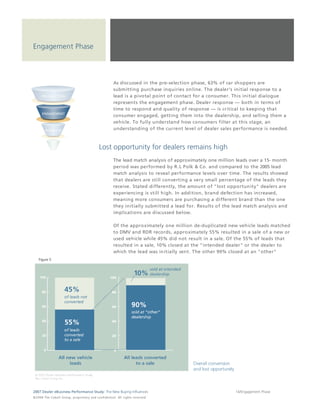
                                                                                 Of the approximately one million de-duplicated new vehicle leads matched
                                                                                 to DMV and RDR records, approximately 55% resulted in a sale of a new or
                                                                                 used vehicle while 45% did not result in a sale. Of the 55% of leads that
                                                                                 resulted in a sale, 10% closed at the "intended dealer" or the dealer to
                                                                                 which the lead was initially sent. The other 90% closed at an "other"
     Figure 5


2007 Dealer eBusiness Performance Study: The New Buying Influences                                                                   14/Engagement Phase
© 2 0 0 8 T h e C o bal t G r o u p, p r op r i e ta r y a nd c o n fi de n t ial . All ri g h t s r e s e r ve d .
dealer than the lead was originally sent to (Figure 5, previous page). This
                                                                                 90% represents the amount of dealership "lost opportunity" dealerships
                                                                                 are experiencing because they had the opportunity to convert the lead
                                                                                 but lost the sale to another dealership.

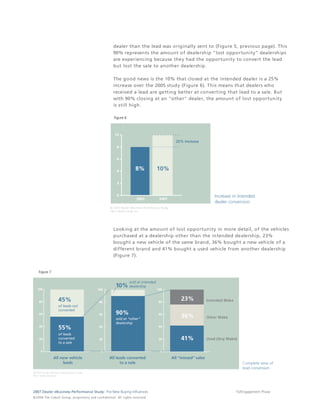
                                                                                 The good news is the 10% that closed at the intended dealer is a 25%
                                                                                 increase over the 2005 study (Figure 6). This means that dealers who
                                                                                 received a lead are getting better at converting that lead to a sale. But
                                                                                 with 90% closing at an "other" dealer, the amount of lost opportunity
                                                                                 is still high.

                                                                                  Figure 6


                                                                                 Looking at the amount of lost opportunity in more detail, of the vehicles
                                                                                 purchased at a dealership other than the intended dealership, 23%
                                                                                 bought a new vehicle of the same brand, 36% bought a new vehicle of a
                                                                                 different brand and 41% bought a used vehicle from another dealership
                                                                                 (Figure 7).


     Figure 7


2007 Dealer eBusiness Performance Study: The New Buying Influences                                                                   15/Engagement Phase
© 2 0 0 8 T h e C o bal t G r o u p, p r op r i e ta r y a nd c o n fi de n t ial . All ri g h t s r e s e r ve d .
Brand defection is increasing
                                                                                 Of those people that submitted a lead, 36% bought a new vehicle of
                                                                                 a different brand than specified in the initial lead. This represents a
                                                                                 6% increase in brand defection and supports findings discussed in the
                                                                                 previous section that consumers are visiting multiple dealerships of
                                                                                 different brands and can be swayed right up to the point of purchase.

                                                                                 The financial impact of brand defection on OEMs can be high. Based on
                                                                                 2007 NADA Data, aggregate brand defection across all brands represents
                                                                                 $5 billion in lost sales or $298 million in lost gross profit. * While it is
                                                                                 difficult to quantify exactly how much brand defection an OEM is
                                                                                 incurring, considering the amount of lost opportunity at the dealer level
                                                                                 is 90%, undoubtedly many OEMs are experiencing a significant amount
                                                                                 of loss to other OEMs.


                                                                  What consumers are buying and when
                                                                                 The 2005 Industry and Dealership eBusiness Performance Study analyzed sales
                                                                                 conversion within 30, 60, 90 and 91+ day increments. In order to gain a
                                                                                 greater understanding of how quickly leads are converting, additional
                                                                                 increments were added within the 30-day purchase window as part of the
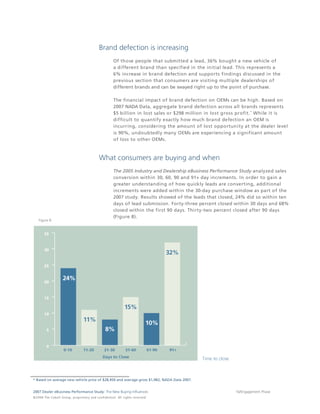
                                                                                 2007 study. Results showed of the leads that closed, 24% did so within ten
                                                                                 days of lead submission. Forty-three percent closed within 30 days and 68%
                                                                                 closed within the first 90 days. Thirty-two percent closed after 90 days
                                                                                 (Figure 8).
     Figure 8


* Based on average new vehicle price of $28,450 and average gross $1,482, NADA Data 2007.


2007 Dealer eBusiness Performance Study: The New Buying Influences                                                                    16/Engagement Phase
© 2 0 0 8 T h e C o bal t G r o u p, p r op r i e ta r y a nd c o n fi de n t ial . All ri g h t s r e s e r ve d .
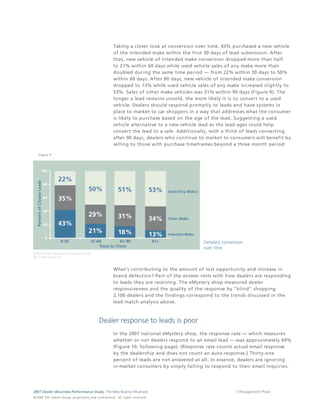
Taking a closer look at conversion over time, 43% purchased a new vehicle
                                                                                 of the intended make within the first 30 days of lead submission. After
                                                                                 that, new vehicle of intended make conversion dropped more than half
                                                                                 to 21% within 60 days while used vehicle sales of any make more than
                                                                                 doubled during the same time period — from 22% within 30 days to 50%
                                                                                 within 60 days. After 90 days, new vehicle of intended make conversion
                                                                                 dropped to 13% while used vehicle sales of any make increased slightly to
                                                                                 53%. Sales of other make vehicles was 31% within 90 days (Figure 9). The
                                                                                 longer a lead remains unsold, the more likely it is to convert to a used
                                                                                 vehicle. Dealers should respond promptly to leads and have systems in
                                                                                 place to market to car shoppers in a way that addresses what the consumer
                                                                                 is likely to purchase based on the age of the lead. Suggesting a used
                                                                                 vehicle alternative to a new vehicle lead as the lead ages could help
                                                                                 convert the lead to a sale. Additionally, with a third of leads converting
                                                                                 after 90 days, dealers who continue to market to consumers will benefit by
                                                                                 selling to those with purchase timeframes beyond a three month period.

     Figure 9


                                                                                 What's contributing to the amount of lost opportunity and increase in
                                                                                 brand defection? Part of the answer rests with how dealers are responding
                                                                                 to leads they are receiving. The eMystery shop measured dealer
                                                                                 responsiveness and the quality of the response by "blind" shopping
                                                                                 2,100 dealers and the findings correspond to the trends discussed in the
                                                                                 lead match analysis above.


                                                                  Dealer response to leads is poor
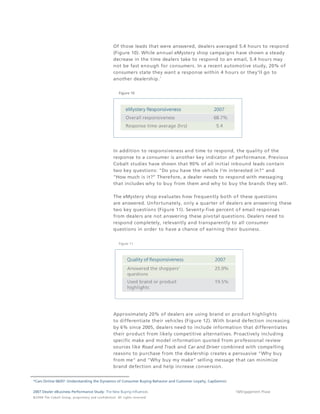
                                                                                 In the 2007 national eMystery shop, the response rate — which measures
                                                                                 whether or not dealers respond to an email lead — was approximately 69%
                                                                                 (Figure 10, following page). (Response rate counts actual email response
                                                                                 by the dealership and does not count an auto-response.) Thirty-one
                                                                                 percent of leads are not answered at all. In essence, dealers are ignoring
                                                                                 in-market consumers by simply failing to respond to their email inquiries.


2007 Dealer eBusiness Performance Study: The New Buying Influences                                                                 17/Engagement Phase
© 2 0 0 8 T h e C o bal t G r o u p, p r op r i e ta r y a nd c o n fi de n t ial . All ri g h t s r e s e r ve d .
Of those leads that were answered, dealers averaged 5.4 hours to respond
                                                                                 (Figure 10). While annual eMystery shop campaigns have shown a steady
                                                                                 decrease in the time dealers take to respond to an email, 5.4 hours may
                                                                                 not be fast enough for consumers. In a recent automotive study, 20% of
                                                                                 consumers state they want a response within 4 hours or they'll go to
                                                                                 another dealership. *


                                                                                      Figure 10


                                                                                 In addition to responsiveness and time to respond, the quality of the
                                                                                 response to a consumer is another key indicator of performance. Previous
                                                                                 Cobalt studies have shown that 90% of all initial inbound leads contain
                                                                                 two key questions: "Do you have the vehicle I'm interested in?" and
                                                                                 "How much is it?” Therefore, a dealer needs to respond with messaging
                                                                                 that includes why to buy from them and why to buy the brands they sell.

                                                                                 The eMystery shop evaluates how frequently both of these questions
                                                                                 are answered. Unfortunately, only a quarter of dealers are answering these
                                                                                 two key questions (Figure 11). Seventy-five percent of email responses
                                                                                 from dealers are not answering these pivotal questions. Dealers need to
                                                                                 respond completely, relevantly and transparently to all consumer
                                                                                 questions in order to have a chance of earning their business.


                                                                                      Figure 11


                                                                                 Approximately 20% of dealers are using brand or product highlights
                                                                                 to differentiate their vehicles (Figure 12). With brand defection increasing
                                                                                 by 6% since 2005, dealers need to include information that differentiates
                                                                                 their product from likely competitive alternatives. Proactively including
                                                                                 specific make and model information quoted from professional review
                                                                                 sources like Road and Track and Car and Driver combined with compelling
                                                                                 reasons to purchase from the dealership creates a persuasive "Why buy
                                                                                 from me" and "Why buy my make" selling message that can minimize
                                                                                 brand defection and help increase conversion.


*Cars Online 06/07: Understanding the Dynamics of Consumer Buying Behavior and Customer Loyalty, CapGemini.

2007 Dealer eBusiness Performance Study: The New Buying Influences                                                                   18/Engagement Phase
© 2 0 0 8 T h e C o bal t G r o u p, p r op r i e ta r y a nd c o n fi de n t ial . All ri g h t s r e s e r ve d .
While poor response to a lead can negatively impact the dealer, what is
                                                                                 known now is that it can also cost the brand. In the Internet-based survey
                                                                                 of 1000 car purchasers, of those that purchased a brand different than the
                                                                                 brand they initially sent a lead for, 23% did so because of poor dealer
                                                                                 interaction. Breaking it down, 14% switched because of poor or no
                                                                                 response from the dealer and 9% switched brands because of a bad
                                                                                 experience with the dealer. Both OEMs and dealers would benefit from
                                                                                 instituting email response protocols that foster prompt, relevant and
                                                                                 transparent communication with consumers.


                                                                  Gap between dealer performance and
                                                                  consumer expectations
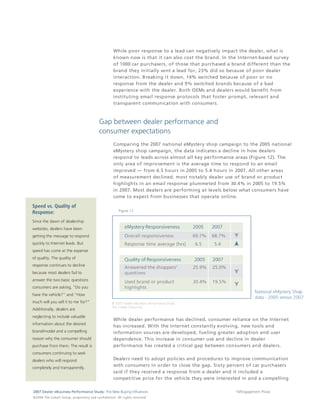
                                                                                 Comparing the 2007 national eMystery shop campaign to the 2005 national
                                                                                 eMystery shop campaign, the data indicates a decline in how dealers
                                                                                 respond to leads across almost all key performance areas (Figure 12). The
                                                                                 only area of improvement is the average time to respond to an email
                                                                                 improved — from 6.5 hours in 2005 to 5.4 hours in 2007. All other areas
                                                                                 of measurement declined, most notably dealer use of brand or product
                                                                                 highlights in an email response plummeted from 30.4% in 2005 to 19.5%
                                                                                 in 2007. Most dealers are performing at levels below what consumers have
                                                                                 come to expect from businesses that operate online.

Speed vs. Quality of
                                                                                      Figure 12
Response:
Since the dawn of dealership
websites, dealers have been
getting the message to respond
quickly to Internet leads. But
speed has come at the expense
of quality. The quality of
response continues to decline
because most dealers fail to
answer the two basic questions
consumers are asking, "Do you
have the vehicle?" and "How
much will you sell it to me for?"
Additionally, dealers are
neglecting to include valuable
                                                                                 While dealer performance has declined, consumer reliance on the Internet
information about the desired
                                                                                 has increased. With the Internet constantly evolving, new tools and
brand/model and a compelling                                                     information sources are developed, fueling greater adoption and user
reason why the consumer should                                                   dependence. This increase in consumer use and decline in dealer
purchase from them. The result is                                                performance has created a critical gap between consumers and dealers.
consumers continuing to seek
dealers who will respond                                                         Dealers need to adopt policies and procedures to improve communication
completely and transparently.
                                                                                 with consumers in order to close the gap. Sixty percent of car purchasers
                                                                                 said if they received a response from a dealer and it included a
                                                                                 competitive price for the vehicle they were interested in and a compelling

2007 Dealer eBusiness Performance Study: The New Buying Influences                                                                  19/Engagement Phase
© 2 0 0 8 T h e C o bal t G r o u p, p r op r i e ta r y a nd c o n fi de n t ial . All ri g h t s r e s e r ve d .
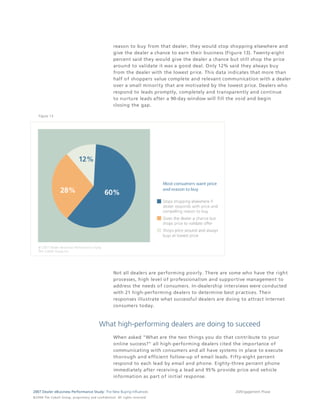
reason to buy from that dealer, they would stop shopping elsewhere and
                                                                                 give the dealer a chance to earn their business (Figure 13). Twenty-eight
                                                                                 percent said they would give the dealer a chance but still shop the price
                                                                                 around to validate it was a good deal. Only 12% said they always buy
                                                                                 from the dealer with the lowest price. This data indicates that more than
                                                                                 half of shoppers value complete and relevant communication with a dealer
                                                                                 over a small minority that are motivated by the lowest price. Dealers who
                                                                                 respond to leads promptly, completely and transparently and continue
                                                                                 to nurture leads after a 90-day window will fill the void and begin
                                                                                 closing the gap.

     Figure 13


                                                                                 Not all dealers are performing poorly. There are some who have the right
                                                                                 processes, high level of professionalism and supportive management to
                                                                                 address the needs of consumers. In-dealership interviews were conducted
                                                                                 with 21 high-performing dealers to determine best practices. Their
                                                                                 responses illustrate what successful dealers are doing to attract Internet
                                                                                 consumers today.


                                                                  What high-performing dealers are doing to succeed
                                                                                 When asked "What are the two things you do that contribute to your
                                                                                 online success?" all high-performing dealers cited the importance of
                                                                                 communicating with consumers and all have systems in place to execute
                                                                                 thorough and efficient follow-up of email leads. Fifty-eight percent
                                                                                 respond to each lead by email and phone. Eighty-three percent phone
                                                                                 immediately after receiving a lead and 95% provide price and vehicle
                                                                                 information as part of initial response.


2007 Dealer eBusiness Performance Study: The New Buying Influences                                                                  20/Engagement Phase
© 2 0 0 8 T h e C o bal t G r o u p, p r op r i e ta r y a nd c o n fi de n t ial . All ri g h t s r e s e r ve d .
These dealerships also utilize systems to ensure long term follow-up with
                                                                                 each consumer. Forty-three percent use ongoing email and newsletters
                                                                                 and 89% use a CRM tool for follow-up. This use of a CRM system is a 63%
                                                                                 increase over the 2005 study. Referring back to the lead analysis where
                                                                                 32% of leads close after 90 days, following up over the long term pays off
                                                                                 by keeping in touch and increasing the likelihood of turning prospects
                                                                                 into customers.

                                                                                 Internet sales representatives
                                                                                 and dealership sales
                                                                                 management were interviewed
                                                                                 to determine their practices for
                                                                                 success and many commonalities
                                                                                 across dealerships came to light.
                                                                                 The top practices heard most
                                                                                 from Internet sales representatives include:
                                                                                               Prompt, relevant and transparent communication by both phone
                                                                                               and email;
                                                                                               Tell the dealership's story and why they're unique;
                                                                                               Honest and transparent communication that includes price and
                                                                                               availability;
                                                                                               Use of tools to maintain communication beyond 90 days.

                                                                                 Top common practices of dealership sales management include:
                                                                                               Investing in the sales staff and instituting "best practices" processes;
                                                                                               Training sales staff to respond fully to leads;
                                                                                               Empowering sales staff to provide a competitive price up front.

                                                                                 When asked "Why do you think many dealers still struggle with the online
                                                                                 customer?" more than three quarters of the of high performers stated
                                                                                 that it was due to lack of management support for taking the Internet
                                                                                 seriously and not providing a competitive price.

                                                                                 Many of these dealers cited the best practices released in the 2005 Industry
                                                                                 and Dealership eBusiness Performance Study as catalyst in how they changed
                                                                                 the way they processed leads and targeted lead responses.


2007 Dealer eBusiness Performance Study: The New Buying Influences                                                                               21/Engagement Phase
© 2 0 0 8 T h e C o bal t G r o u p, p r op r i e ta r y a nd c o n fi de n t ial . All ri g h t s r e s e r ve d .
Purchase Phase


                                                                  Experiences influence other buyers
                                                                                 Consumers are bombarded with marketing messages. A recent study
                                                                                 noted that in the 1970s, a person living in a city was exposed to 500 to
                                                                                 2,000 messages a day. Today, it's between 3,000 and 5,000.* As a result,
                                                                                 consumers are becoming desensitized to traditional advertising and
                                                                                 increasingly turning to other consumers for input and advice on products
                                                                                 and services. This demand for consumer insight regarding purchase
                                                                                 experience has generated reviews and rankings of businesses and
                                                                                 dealerships. These reviews and rankings are being displayed on major
                                                                                 search engines and specific consumer-review websites such as Yelp,
                                                                                 InsiderPages, and Dealer Rater.

                                                                                 Nowhere is this trend growing faster
                                                                                 than the automotive industry. During        “Advertising is so ubiquitous
                                                                                 the purchase phase, consumers use           that it’s turning people off,
                                                                                 reviews and rankings from other
                                                                                                                             it’s desensitizing people to
                                                                                 shoppers to filter what vehicle and
                                                                                 from whom they will purchase. While
                                                                                                                             the message”.
                                                                                                                                      - Rance Crain, Editor-in-chief, Ad Age
                                                                                 this technology is still very new, the
                                                                                 impact on purchase decisions is
                                                                                 already substantial and projected to grow quickly. Some analysts believe
                                                                                 online reviews and rankings will change the automotive industry more
                                                                                 than the introduction of the Internet did in the 1990s.


                                                                  Reviews and rankings becoming more pervasive
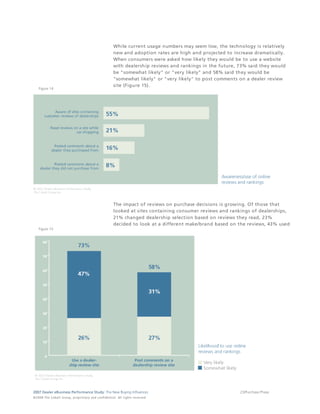
                                                                                 Of those consumers that submitted a lead to a third-party portal and
                                                                                 purchased a vehicle, 55% were aware of sites containing consumer reviews
                                                                                 of dealerships, 21% read reviews on a website while car shopping, 16%
                                                                                 posted comments about the dealership they purchased from and 8%
                                                                                 posted comments about a dealer they did not purchase from (Figure 14,
                                                                                 following page).


*Product Placement—You Can’t Escape It”, October 10, 2006, USA Today.


2007 Dealer eBusiness Performance Study: The New Buying Influences                                                                            22/Purchase Phase
© 2 0 0 8 T h e C o bal t G r o u p, p r op r i e ta r y a nd c o n fi de n t ial . All ri g h t s r e s e r ve d .
While current usage numbers may seem low, the technology is relatively
                                                                                 new and adoption rates are high and projected to increase dramatically.
                                                                                 When consumers were asked how likely they would be to use a website
                                                                                 with dealership reviews and rankings in the future, 73% said they would
                                                                                 be "somewhat likely" or "very likely" and 58% said they would be
                                                                                 "somewhat likely" or "very likely" to post comments on a dealer review
                                                                                 site (Figure 15).
     Figure 14


                                                                                 The impact of reviews on purchase decisions is growing. Of those that
                                                                                 looked at sites containing consumer reviews and rankings of dealerships,
                                                                                 21% changed dealership selection based on reviews they read, 23%
                                                                                 decided to look at a different make/brand based on the reviews, 43% used
     Figure 15


2007 Dealer eBusiness Performance Study: The New Buying Influences                                                                   23/Purchase Phase
© 2 0 0 8 T h e C o bal t G r o u p, p r op r i e ta r y a nd c o n fi de n t ial . All ri g h t s r e s e r ve d .
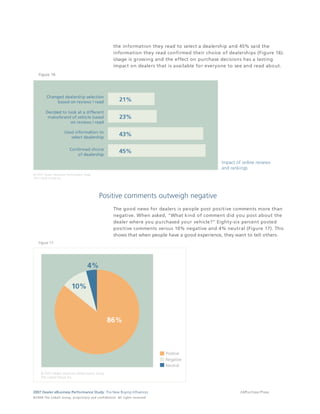
the information they read to select a dealership and 45% said the
                                                                                 information they read confirmed their choice of dealerships (Figure 16).
                                                                                 Usage is growing and the effect on purchase decisions has a lasting
                                                                                 impact on dealers that is available for everyone to see and read about.
     Figure 16


                                                                  Positive comments outweigh negative
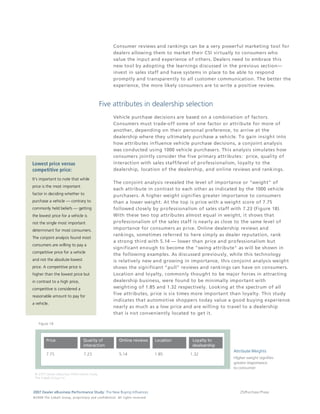
                                                                                 The good news for dealers is people post positive comments more than
                                                                                 negative. When asked, "What kind of comment did you post about the
                                                                                 dealer where you purchased your vehicle?" Eighty-six percent posted
                                                                                 positive comments versus 10% negative and 4% neutral (Figure 17). This
                                                                                 shows that when people have a good experience, they want to tell others.
     Figure 17


2007 Dealer eBusiness Performance Study: The New Buying Influences                                                                    24/Purchase Phase
© 2 0 0 8 T h e C o bal t G r o u p, p r op r i e ta r y a nd c o n fi de n t ial . All ri g h t s r e s e r ve d .
Consumer reviews and rankings can be a very powerful marketing tool for
                                                                                 dealers allowing them to market their CSI virtually to consumers who
                                                                                 value the input and experience of others. Dealers need to embrace this
                                                                                 new tool by adopting the learnings discussed in the previous section—
                                                                                 invest in sales staff and have systems in place to be able to respond
                                                                                 promptly and transparently to all customer communication. The better the
                                                                                 experience, the more likely consumers are to write a positive review.


                                                                  Five attributes in dealership selection
                                                                                 Vehicle purchase decisions are based on a combination of factors.
                                                                                 Consumers must trade-off some of one factor or attribute for more of
                                                                                 another, depending on their personal preference, to arrive at the
                                                                                 dealership where they ultimately purchase a vehicle. To gain insight into
                                                                                 how attributes influence vehicle purchase decisions, a conjoint analysis
                                                                                 was conducted using 1000 vehicle purchasers. This analysis simulates how
                                                                                 consumers jointly consider the five primary attributes: price, quality of
Lowest price versus                                                              interaction with sales staff/level of professionalism, loyalty to the
competitive price:                                                               dealership, location of the dealership, and online reviews and rankings.

It's important to note that while
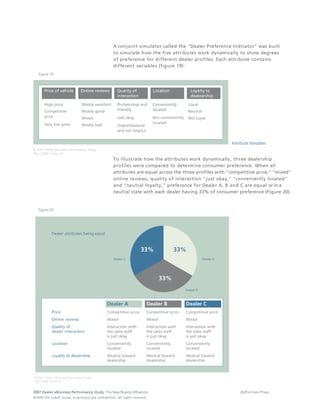
                                                                                 The conjoint analysis revealed the level of importance or "weight" of
price is the most important
                                                                                 each attribute in contrast to each other as indicated by the 1000 vehicle
factor in deciding whether to                                                    purchasers. A higher weight signifies greater importance to consumers
purchase a vehicle — contrary to                                                 than a lower weight. At the top is price with a weight score of 7.75
commonly held beliefs — getting                                                  followed closely by professionalism of sales staff with 7.23 (Figure 18).
the lowest price for a vehicle is                                                With these two top attributes almost equal in weight, it shows that
not the single most important                                                    professionalism of the sales staff is nearly as close to the same level of
determinant for most consumers.                                                  importance for consumers as price. Online dealership reviews and
                                                                                 rankings, sometimes referred to here simply as dealer reputation, rank
The conjoint analysis found most
                                                                                 a strong third with 5.14 — lower than price and professionalism but
consumers are willing to pay a
                                                                                 significant enough to become the "swing attribute" as will be shown in
competitive price for a vehicle
                                                                                 the following examples. As discussed previously, while this technology
and not the absolute lowest                                                      is relatively new and growing in importance, this conjoint analysis weight
price. A competitive price is                                                    shows the significant "pull" reviews and rankings can have on consumers.
higher than the lowest price but                                                 Location and loyalty, commonly thought to be major forces in attracting
in contrast to a high price,                                                     dealership business, were found to be minimally important with
competitive is considered a                                                      weighting of 1.85 and 1.32 respectively. Looking at the spectrum of all
                                                                                 five attributes, price is six times more important than loyalty. This study
reasonable amount to pay for
                                                                                 indicates that automotive shoppers today value a good buying experience
a vehicle.
                                                                                 nearly as much as a low price and are willing to travel to a dealership
                                                                                 that is not conveniently located to get it.

     Figure 18


2007 Dealer eBusiness Performance Study: The New Buying Influences                                                                    25/Purchase Phase
© 2 0 0 8 T h e C o bal t G r o u p, p r op r i e ta r y a nd c o n fi de n t ial . All ri g h t s r e s e r ve d .
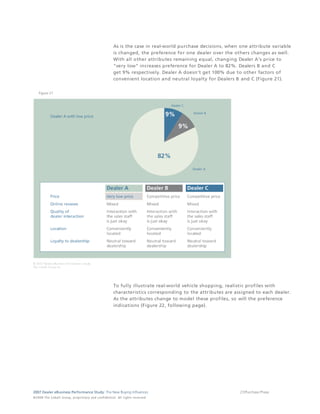
A conjoint simulator called the "Dealer Preference Indicator" was built
                                                                                 to simulate how the five attributes work dynamically to show degrees
                                                                                 of preference for different dealer profiles. Each attribute contains
                                                                                 different variables (figure 19):
     Figure 19


                                                                                 To illustrate how the attributes work dynamically, three dealership
                                                                                 profiles were compared to determine consumer preference. When all
                                                                                 attributes are equal across the three profiles with "competitive price," "mixed"
                                                                                 online reviews, quality of interaction "just okay," "conveniently located"
                                                                                 and "neutral loyalty," preference for Dealer A, B and C are equal or in a
                                                                                 neutral state with each dealer having 33% of consumer preference (Figure 20).


     Figure 20


2007 Dealer eBusiness Performance Study: The New Buying Influences                                                                        26/Purchase Phase
© 2 0 0 8 T h e C o bal t G r o u p, p r op r i e ta r y a nd c o n fi de n t ial . All ri g h t s r e s e r ve d .
As is the case in real-world purchase decisions, when one attribute variable
                                                                                 is changed, the preference for one dealer over the others changes as well.
                                                                                 With all other attributes remaining equal, changing Dealer A's price to
                                                                                 "very low" increases preference for Dealer A to 82%. Dealers B and C
                                                                                 get 9% respectively. Dealer A doesn't get 100% due to other factors of
                                                                                 convenient location and neutral loyalty for Dealers B and C (Figure 21).


     Figure 21


                                                                                 To fully illustrate real-world vehicle shopping, realistic profiles with
                                                                                 characteristics corresponding to the attributes are assigned to each dealer.
                                                                                 As the attributes change to model these profiles, so will the preference
                                                                                 indications (Figure 22, following page).


2007 Dealer eBusiness Performance Study: The New Buying Influences                                                                     27/Purchase Phase
© 2 0 0 8 T h e C o bal t G r o u p, p r op r i e ta r y a nd c o n fi de n t ial . All ri g h t s r e s e r ve d .
Figure 22


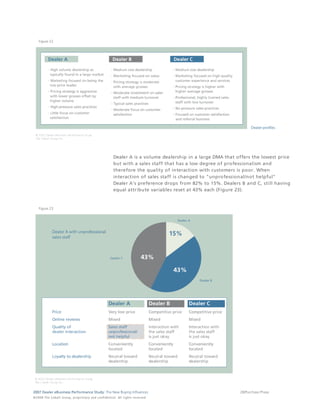
                                                                                 Dealer A is a volume dealership in a large DMA that offers the lowest price
                                                                                 but with a sales staff that has a low degree of professionalism and
                                                                                 therefore the quality of interaction with customers is poor. When
                                                                                 interaction of sales staff is changed to "unprofessional/not helpful"
                                                                                 Dealer A's preference drops from 82% to 15%. Dealers B and C, still having
                                                                                 equal attribute variables reset at 43% each (Figure 23).


     Figure 23


2007 Dealer eBusiness Performance Study: The New Buying Influences                                                                    28/Purchase Phase
© 2 0 0 8 T h e C o bal t G r o u p, p r op r i e ta r y a nd c o n fi de n t ial . All ri g h t s r e s e r ve d .
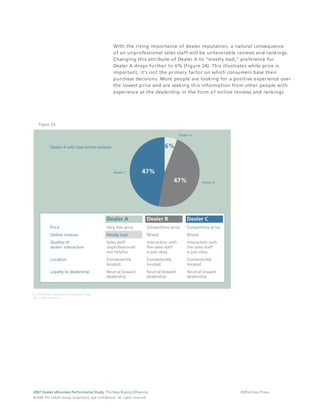
With the rising importance of dealer reputation, a natural consequence
                                                                                 of an unprofessional sales staff will be unfavorable reviews and rankings.
                                                                                 Changing this attribute of Dealer A to "mostly bad," preference for
                                                                                 Dealer A drops further to 6% (Figure 24). This illustrates while price is
                                                                                 important, it's not the primary factor on which consumers base their
                                                                                 purchase decisions. More people are looking for a positive experience over
                                                                                 the lowest price and are seeking this information from other people with
                                                                                 experience at the dealership in the form of online reviews and rankings.


     Figure 24


2007 Dealer eBusiness Performance Study: The New Buying Influences                                                                   29/Purchase Phase
© 2 0 0 8 T h e C o bal t G r o u p, p r op r i e ta r y a nd c o n fi de n t ial . All ri g h t s r e s e r ve d .
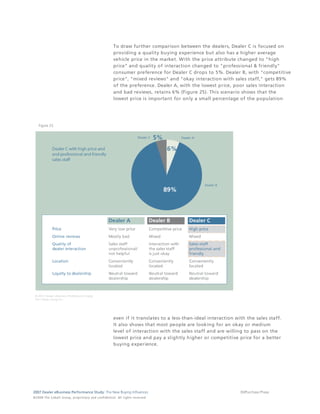
To draw further comparison between the dealers, Dealer C is focused on
                                                                                 providing a quality buying experience but also has a higher average
                                                                                 vehicle price in the market. With the price attribute changed to "high
                                                                                 price" and quality of interaction changed to "professional & friendly"
                                                                                 consumer preference for Dealer C drops to 5%. Dealer B, with "competitive
                                                                                 price", "mixed reviews" and "okay interaction with sales staff," gets 89%
                                                                                 of the preference. Dealer A, with the lowest price, poor sales interaction
                                                                                 and bad reviews, retains 6% (Figure 25). This scenario shows that the
                                                                                 lowest price is important for only a small percentage of the population


     Figure 25


                                                                                 even if it translates to a less-than-ideal interaction with the sales staff.
                                                                                 It also shows that most people are looking for an okay or medium
                                                                                 level of interaction with the sales staff and are willing to pass on the
                                                                                 lowest price and pay a slightly higher or competitive price for a better
                                                                                 buying experience.


2007 Dealer eBusiness Performance Study: The New Buying Influences                                                                        30/Purchase Phase
© 2 0 0 8 T h e C o bal t G r o u p, p r op r i e ta r y a nd c o n fi de n t ial . All ri g h t s r e s e r ve d .
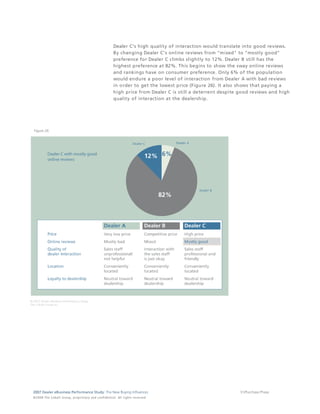
Dealer C's high quality of interaction would translate into good reviews.
                                                                                 By changing Dealer C's online reviews from "mixed" to "mostly good"
                                                                                 preference for Dealer C climbs slightly to 12%. Dealer B still has the
                                                                                 highest preference at 82%. This begins to show the sway online reviews
                                                                                 and rankings have on consumer preference. Only 6% of the population
                                                                                 would endure a poor level of interaction from Dealer A with bad reviews
                                                                                 in order to get the lowest price (Figure 26). It also shows that paying a
                                                                                 high price from Dealer C is still a deterrent despite good reviews and high
                                                                                 quality of interaction at the dealership.


 Figure 26


2007 Dealer eBusiness Performance Study: The New Buying Influences                                                                    31/Purchase Phase
© 2 0 0 8 T h e C o bal t G r o u p, p r op r i e ta r y a nd c o n fi de n t ial . All ri g h t s r e s e r ve d .
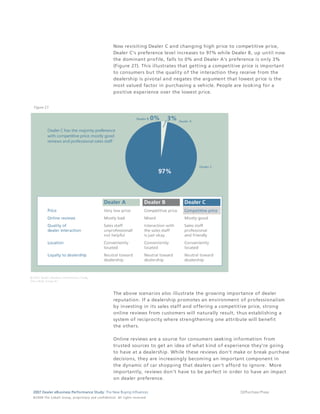
Now revisiting Dealer C and changing high price to competitive price,
                                                                                 Dealer C's preference level increases to 97% while Dealer B, up until now
                                                                                 the dominant profile, falls to 0% and Dealer A's preference is only 3%
                                                                                 (Figure 27). This illustrates that getting a competitive price is important
                                                                                 to consumers but the quality of the interaction they receive from the
                                                                                 dealership is pivotal and negates the argument that lowest price is the
                                                                                 most valued factor in purchasing a vehicle. People are looking for a
                                                                                 positive experience over the lowest price.


 Figure 27


                                                                                 The above scenarios also illustrate the growing importance of dealer
                                                                                 reputation. If a dealership promotes an environment of professionalism
                                                                                 by investing in its sales staff and offering a competitive price, strong
                                                                                 online reviews from customers will naturally result, thus establishing a
                                                                                 system of reciprocity where strengthening one attribute will benefit
                                                                                 the others.

                                                                                 Online reviews are a source for consumers seeking information from
                                                                                 trusted sources to get an idea of what kind of experience they're going
                                                                                 to have at a dealership. While these reviews don't make or break purchase
                                                                                 decisions, they are increasingly becoming an important component in
                                                                                 the dynamic of car shopping that dealers can't afford to ignore. More
                                                                                 importantly, reviews don't have to be perfect in order to have an impact
                                                                                 on dealer preference.

2007 Dealer eBusiness Performance Study: The New Buying Influences                                                                      32/Purchase Phase
© 2 0 0 8 T h e C o bal t G r o u p, p r op r i e ta r y a nd c o n fi de n t ial . All ri g h t s r e s e r ve d .
They just need to be mostly positive in order for consumers to be
                                                                                 reassured they will be treated well and not regret giving the dealer
                                                                                 their business.

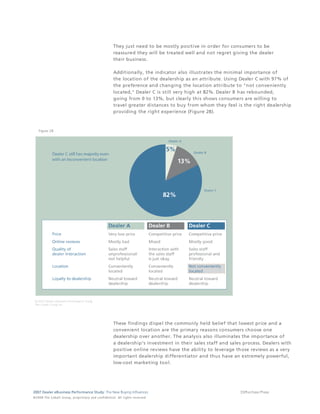
                                                                                 Additionally, the indicator also illustrates the minimal importance of
                                                                                 the location of the dealership as an attribute. Using Dealer C with 97% of
                                                                                 the preference and changing the location attribute to "not conveniently
                                                                                 located," Dealer C is still very high at 82%. Dealer B has rebounded,
                                                                                 going from 0 to 13%, but clearly this shows consumers are willing to
                                                                                 travel greater distances to buy from whom they feel is the right dealership
                                                                                 providing the right experience (Figure 28).


     Figure 28


                                                                                 These findings dispel the commonly held belief that lowest price and a
                                                                                 convenient location are the primary reasons consumers choose one
                                                                                 dealership over another. The analysis also illuminates the importance of
                                                                                 a dealership's investment in their sales staff and sales process. Dealers with
                                                                                 positive online reviews have the ability to leverage those reviews as a very
                                                                                 important dealership differentiator and thus have an extremely powerful,
                                                                                 low-cost marketing tool.


2007 Dealer eBusiness Performance Study: The New Buying Influences                                                                      33/Purchase Phase
© 2 0 0 8 T h e C o bal t G r o u p, p r op r i e ta r y a nd c o n fi de n t ial . All ri g h t s r e s e r ve d .
Implications of
Key Findings


                                                                                 Dealers need to invest in their online presence as much as their
                                                                                 physical dealership
                                                                                 With most consumers using the Internet as a primary source during their
                                                                                 shopping process, dealers should put as much effort and investment in
                                                                                 maintaining their dealership website as they do their physical dealership.
                                                                                 Leads sent from online sources are a valuable source of business
                                                                                 opportunities. Dealers need to have processes in place to respond to leads
                                                                                 promptly and transparently in order to have a better chance at converting
                                                                                 these leads. Dealers also benefit by being well situated on search engines
                                                                                 and reevaluating their advertising budgets to emphasize online media so
                                                                                 consumers can find them online.

                                                                                 Lost opportunity remains high and brand defection is increasing
                                                                                 The extent of lost opportunity and the financial implications associated
                                                                                 with it should be a red flag for all dealership management. A mishandled
                                                                                 Internet lead needs to be treated the same way an unanswered phone call
                                                                                 or a walk-up customer receiving no sales assistance would. Persuasive
                                                                                 communication that differentiates their brand from likely competitive
                                                                                 alternatives will also help stem brand defection.

                                                                                 Consumer reliance on the Internet is increasing while dealer
                                                                                 performance is flat
                                                                                 A large gap exists with consumers relying more and more on the Internet
                                                                                 as a resource for vehicle shopping and dealers under performing when
                                                                                 responding to these consumers. Management that invests in their sales
                                                                                 staff and training and institutes guidelines and processes to respond to
                                                                                 these consumers will be able to close the gap.

                                                                                 Online reviews and rankings of dealerships are becoming
                                                                                 more pervasive
                                                                                 The rapid adoption of online consumer reviews and rankings shows
                                                                                 consumers are turning to other people for insight into the type of
                                                                                 experience they can expect from a dealership. Dealers who invest in their
                                                                                 sales staff and grow a strong, positive review base can build a very
                                                                                 powerful marketing tool.

                                                                                 Positive buying experience is more important than lowest price
                                                                                 Most consumers are willing to pay a competitive price over the lowest
                                                                                 price in order to get a positive buying experience. Loyalty and convenient
                                                                                 location no longer have the "pull" they once did in attracting business.
                                                                                 Dealers who foster a welcoming and respectful sales environment where
                                                                                 the customer is treated respectfully and transparently may make more
                                                                                 gross because they don't have to sell at the lowest price.


2007 Dealer eBusiness Performance Study: The New Buying Influences                                                             34/Implications of Key Findings
© 2 0 0 8 T h e C o bal t G r o u p, p r op r i e ta r y a nd c o n fi de n t ial . All ri g h t s r e s e r ve d .
Manufacturer
Comparative Data


                                                                                 The third-party lead analysis also includes comparative performance data
                                                                                 of 35 manufacturers (OEMs) in the area of new vehicle lead conversion.
                                                                                 This analysis shows there is a wide variance among brands and how
                                                                                 third-party leads are converted to sales. Examples of these findings are
                                                                                 provided below:
                                                                                               When leads are segmented by manufacturer, there is a wide variance
                                                                                               in the likelihood a lead will ultimately convert to a sale of the
                                                                                               brand specified in the initial lead. This rate of conversion to the
                                                                                               intended brand is also representative of the degree of loyalty
                                                                                               consumers submitting a lead may have to a specific brand. The
                                                                                               highest manufacturer intended brand conversion was 56% and the
                                                                                               lowest was 19%. Average intended brand conversion across all 35
                                                                                               manufacturers represented in the study was 37%. For example, if a
                                                                                               lead is submitted for a Brand A vehicle and converts to a sale, this
                                                                                               data illustrates the percentage of those sales that are converted to
                                                                                               a Brand A vehicle.
                                                                                               Analysis of leads segmented by manufacturer also illustrates
                                                                                               intended dealer conversion or the rate at which a lead is converted
                                                                                               at the dealership to which the lead was initially sent. The highest
                                                                                               manufacturer had a 6.8% intended dealer conversion rate while the
                                                                                               lowest had 2.6%. Average intended dealer conversion across all
                                                                                               manufacturers was 4%. For example, if a lead is submitted for new
                                                                                               Brand A vehicle at Dealership A and converts to a sale, this data
                                                                                               illustrates the percentage of those sales that converted to a new
                                                                                               Brand A vehicle at Dealership A.
                                                                                               There is also interesting insight into how well manufacturers are
                                                                                               doing at winning new customers by selling a consumer a brand of
                                                                                               vehicle different than the brand specified in the consumer's initial
                                                                                               lead. There is a wide range in performance among manufacturers
                                                                                               in achieving these "conquest sales" with the highest converting
                                                                                               15% and the lowest converting less than 1%. Average conquest
                                                                                               sales across all manufacturers was 3%. For example, this data
                                                                                               illustrates the percent of leads Brand A converted that were initially
                                                                                               intended for another brand.

                                                                                 Additional manufacturer performance data is in the Cobalt report,
                                                                                 eBusiness Performance and the OEM — A Companion Report to the 2007 Dealer
                                                                                 eBusiness Performance Study. Manufacturers interested in this report should
                                                                                 contact their Cobalt representative at 800-909-8244 for more details.


2007 Dealer eBusiness Performance Study: The New Buying Influences                                                                   35/Manufacturer Comparative Data
© 2 0 0 8 T h e C o bal t G r o u p, p r op r i e ta r y a nd c o n fi de n t ial . All ri g h t s r e s e r ve d .
Appendix A:


                                                                  Research Methodology
                                                                                 Lead Analysis
                                                                                 Approximately 1,500 new car franchise dealerships subscribing to a third-
                                                                                 party lead provider were identified for inclusion in the study. Of the
                                                                                 1,500 dealerships, R.L Polk & Co. matched 1,140 representing 35 brands
                                                                                 geographically located throughout the 48 contiguous states (map in
                                                                                 appendix) with selling dealership data. These 1,140 dealers received a
                                                                                 total of 1,087,287 purchase inquiries or leads during the study period of
                                                                                 October 1, 2005 through September 30, 2006. Duplicate leads were
                                                                                 removed in order to ensure an accurate match rate. Leads were considered
                                                                                 duplicates if the make, model, dealership to which the lead was sent,
                                                                                 consumer name, address and lead date were the same.

                                                                                 R.L Polk & Co. conducted a matching analysis of the leads to determine
                                                                                 which leads resulted in a vehicle sale. The results of the lead match
                                                                                 revealed close rates, time to close and whether or not leads were closed
                                                                                 at the dealership receiving the lead. The methodology is closely aligned
Criteria for determining                                                         with the methodology used in the 2005 Industry and Dealership eBusiness
duplicate leads:                                                                 Performance Study in order to draw performance comparisons over time.
· If John Doe sends two leads for
                                                                                 Additional measures were taken to validate the lead match results. A
a 2007 Ford Explorer on January
                                                                                 separate analysis was conducted on leads from dealership websites and
1, and provides the same address
                                                                                 revealed that close rates were similar to the third-party lead analysis.
on each lead, only one lead from
                                                                                 In addition, a select group of manufacturers reviewed the findings and
John Doe was included in the                                                     concurred that their dealership close metrics were in the same range as
lead analysis.                                                                   the third-party lead match. Due to the high number of leads included
                                                                                 in the third-party lead analysis, the error interval is +/- .06% and the
· If John Doe sends a lead for a
                                                                                 confidence level is 99%. As a result of these validations, the lead match
2007 Ford Explorer on January 1
                                                                                 analysis is an accurate representation of industry performance today.
and a lead for a 2007 Ford
Explorer on January 2, both leads                                                Online surveys
are counted as unique leads and                                                  Two Internet-based surveys were conducted by The Cobalt Group and
included in the lead analysis                                                    Yahoo! to examine the consumer car shopping process including shopping
regardless of address provided.                                                  behavior, marketing and media influences on shopping decisions,
                                                                                 consumer behavior in response to dealership communication and what
                                                                                 factors motivate people to physically visit a dealership. A total of 1,550 car
                                                                                 shoppers participated in the two surveys.

                                                                                 The first survey was a 25 minute online questionnaire with 550
                                                                                 participants. The sample was made up of approximately half intending to
                                                                                 purchase a vehicle within the next six months and half already purchased
                                                                                 within the previous three months. All participants lived in major
                                                                                 metropolitan areas and had physically visited a dealership during their
                                                                                 shopping process.


2007 Dealer eBusiness Performance Study: The New Buying Influences                                                                         36/Appendix A
© 2 0 0 8 T h e C o bal t G r o u p, p r op r i e ta r y a nd c o n fi de n t ial . All ri g h t s r e s e r ve d .
The second survey was a 25 minute online questionnaire with a sample
                                                                                 size of 1000. All participants in this survey submitted a new vehicle lead
                                                                                 through a third-party automotive portal and had purchased a vehicle
                                                                                 within the previous six months.

                                                                                 eMystery shop
                                                                                 Cobalt conducted a nationwide eMystery shop campaign of 2,100 new car
                                                                                 dealers representing 20 brands. Performance was determined by evaluating
                                                                                 responsiveness, response time and the quality of the response in
                                                                                 addressing shoppers' key questions: "Do you have the vehicle I'm
                                                                                 interested in?" and "How much will you sell it to me for?" The 2007
                                                                                 national eMystery shop was compared to the 2005 national eMystery shop
                                                                                 to assess performance trends.

                                                                                 Onsite dealership evaluations
                                                                                 Of the 1,140 dealerships evaluated, Cobalt visited 21 of the high-performing
                                                                                 dealerships as determined by dealership close rates in the lead match
                                                                                 analysis and conducted interviews to better understand business processes
                                                                                 and discover common practices that contribute to their success.


2007 Dealer eBusiness Performance Study: The New Buying Influences                                                                         37/Appendix A
© 2 0 0 8 T h e C o bal t G r o u p, p r op r i e ta r y a nd c o n fi de n t ial . All ri g h t s r e s e r ve d .
Appendix B:


                                                                  Geographic Distribution of Dealerships in Lead Analysis


2007 Dealer eBusiness Performance Study: The New Buying Influences                                                    38/Appendix B
© 2 0 0 8 T h e C o bal t G r o u p, p r op r i e ta r y a nd c o n fi de n t ial . All ri g h t s r e s e r ve d .
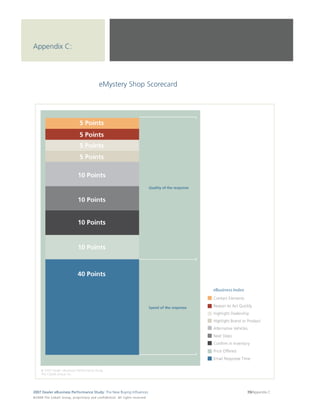
Appendix C:


                                                                  eMystery Shop Scorecard


2007 Dealer eBusiness Performance Study: The New Buying Influences                                                    39/Appendix C
© 2 0 0 8 T h e C o bal t G r o u p, p r op r i e ta r y a nd c o n fi de n t ial . All ri g h t s r e s e r ve d .

Yahoo cobaltstudy newcarbuyinginfluencers2007

  • 1.
    The 2007 DealereBusiness Performance Study: THE NEW BUYING INFLUENCES In partnernship with:
  • 2.
    2007 Dealer eBusiness KeyContributors Performance Study Kevin Root, Vice President, Applications and Services Ken Pfau, Director, Training and Consulting, CRM Planning Matt Muilenburg, Director, Search Strategy and Product Planning Eliza Kelly, Senior Project Manager Debra Sims, Project Manager Tyler Anderson, Project Contributor Yahoo! David Schwartz, Local Category Director Edwin Wong, Director, Consumer Insights Organization R. L. Polk & Co. Andrew Price, Vice President, Dealer Solutions Brad Korner, Account Director, Automotive Retail Solutions The Cobalt Group 2200 First Avenue South Seattle, WA 98134 800.909.8244 www.cobalt.com
  • 3.
    3 | Pre-selection Phase 2007 Dealer eBusiness Table of Contents Performance Study Key Contributors 2 Corporate Headquarters 2 Overview 4 Executive Summary 5 Introduction 9 Pre-selection Phase 10 Research conducted online Offline shopping still important Multiple sources used for quote submission Engagement Phase 14 Lost opportunity for dealers remains high Brand defection is increasing What consumers are buying and when Dealer response to leads is poor Gap between dealer performance and consumer expectations What high-performing dealers are doing to succeed Purchase Phase 22 Experiences influence other buyers Reviews and rankings becoming more pervasive Positive comments outweigh negative Five attributes in dealer selection Implications of Key Findings 34 Manufacturer Comparative Data 35 Appendix A – Research Methodologies 36 Appendix B – Geographic Distribution 38 of Dealerships in Lead Analysis Appendix C – eMystery Shopping Scorecard 39 2007 Dealer eBusiness Performance Study: The New Buying Influences © 2 0 0 8 T h e C o bal t G r o u p, p r op r i e ta r y a nd c o n fi de n t ial . All ri g h t s r e s e r ve d .
  • 4.
    4 | Pre-selection Phase 2007 Dealer eBusiness Overview Performance Study The Cobalt Group, in partnership with Yahoo! and R.L. Polk & Co., conducted the 2007 Dealer eBusiness Performance Study: The New Buying Influences to better understand current automotive dealership Internet lead handling and the impact of search and consumer-generated media on vehicle shopping and purchase behavior. Using a variety of research methods, the companies set out to answer the following questions: How are consumers utilizing the Internet, search and online consumer-generated media to shop and select a dealership? How do online dealership reviews and reputation, lead response and professionalism of sales staff impact consumer purchase decisions? What are the current dealership ebusiness performance levels? How much Internet lost opportunity occurs at dealerships and what are the causes? What are high-performing dealerships doing to meet consumer expectations and successfully convert Internet opportunities? The result is a comprehensive report on the state of automotive car shopping today and is meant to inform and guide automotive manufacturers, dealer groups and dealership employees on the current state of the industry, important trends and what they can do to maximize business opportunities in an Internet-driven marketplace. 2007 Dealer eBusiness Performance Study: The New Buying Influences 4/Overview © 2 0 0 8 T h e C o bal t G r o u p, p r op r i e ta r y a nd c o n fi de n t ial . All ri g h t s r e s e r ve d .
  • 5.
    2007 Dealer eBusiness ExecutiveSummary Performance Study The Internet has transformed how consumers live, work and most notably, how they shop for products and services. The introduction of search and social networking has fueled the growth of Internet use by making information more accessible and connecting users with other "like" consumers to hear about their opinions and experiences. This explosive growth—combined with a decrease in model, brand and dealership loyalty—has led car shoppers to consider more makes, models and dealerships at the start of the shopping process, effectively broadening the top of the traditional automotive purchase funnel. To manage the increase in selection, consumers are using information found on the Internet to assist in the narrowing of their choices. These Internet-based sources act as selection "filters," influencing consumers as they move through the purchase funnel. For this report, the filters have been organized into three distinct shopping phases or sections within the traditional purchase funnel (Figure 1): Pre-selection The initial research period where consumers start their shopping process and filter information using all resources available. Today they are using search engines, and advertising — both online and traditional — to research and locate vehicles and dealerships. Engagement Following Pre-selection, Engagement occurs when a consumer initiates a dialogue with a dealer about a vehicle by email or phone. Consumers are filtering their selection by evaluating dealer responsiveness, time to respond to a vehicle inquiry and the quality of the response. Purchase The final phase includes the decision to purchase and the post-purchase actions of consumers. Consumers consider the price of the vehicle, their experience with dealership personnel, loyalty with the brand and dealership, location of dealership and online reviews and rankings of Figure 1 dealerships to make final choices to purchase. After buying a vehicle, some consumers are sharing their experience by posting reviews of dealerships online for other shoppers to see. Consumers have gone through a similar shopping process since the beginning of the modern automotive industry. Only now, most consumers are starting the process online instead of at the physical dealership and have unprecedented access to information and communication channels to other "like" consumers. Dealers need to understand these new filters and how they affect the purchase process in order to advance through the purchase funnel and ultimately be successful in today's new shopping environment. 2007 Dealer eBusiness Performance Study: The New Buying Influences 5/Executive Summary © 2 0 0 8 T h e C o bal t G r o u p, p r op r i e ta r y a nd c o n fi de n t ial . All ri g h t s r e s e r ve d .
  • 6.
    Pre-selection Most consumers start their vehicle shopping process online using Internet- based resources to filter information and opportunities. Eighty-three percent of car shoppers used the Internet to research vehicles and 79% used search to research dealerships. When comparing reliance on traditional media vs. online media, consumers are turning more to online advertising sources while conducting their research. Forty-eight percent referred to a dealership's website to view what models and vehicles were available versus 20% that called the dealership to see what vehicles were in stock. For finding a dealership, 31% used dealer websites and 29% used OEM websites versus 19% used yellow pages and 17% used radio ads. Dealers who evaluate their advertising to ensure they're getting maximum exposure to these consumers will benefit. Most consumers are choosing to initiate a conversation with a dealership online as well. Sixty-three percent of new car shoppers submitted a purchase inquiry or lead to a dealership via email with 67% having submitted through the dealership website, 42% through a third party portal and 36% via an OEM website. With two-thirds of consumers initiating dialogue through email, dealers need to establish processes to answer these lead inquiries promptly and completely. Consumers are willing to travel further for a dealership they feel is going to provide the right experience. Thirty-two percent traveled more than 20 miles from home to physically visit a dealership. Search advertising can level the playing field and give dealerships outside of larger markets the chance to compete for these customers. Walking into a dealership's showroom is still an important part of the shopping process. On average, consumers physically visited 6 dealerships prior to purchasing a vehicle. As the overall quality of vehicles increase, shoppers are actively considering multiple brands and using the Internet to filter which dealership they will visit for a demonstration drive. The consumer’s experience with a dealer’s website can therefore have a large impact on getting selected as the dealership for that brand. Most importantly, consumers typically select only one dealership of each brand to physically visit. That means the choice to buy one brand over another can rest solely on the interaction with one dealership. Dealers may have one shot at selling to a consumer or they can lose the sale for the entire brand. 2007 Dealer eBusiness Performance Study: The New Buying Influences 6/Executive Summary © 2 0 0 8 T h e C o bal t G r o u p, p r op r i e ta r y a nd c o n fi de n t ial . All ri g h t s r e s e r ve d .
  • 7.
    Engagement Fifty-five percent of approximately one million de-duplicated new vehicle leads from a third-party portal resulted in a sale of a new or used vehicle. Of those 55%, 10% were sold at the "intended dealer" or the dealer to which the lead was initially sent. The other 90% closed at a dealer other than the intended dealer. This 90% represents the "lost opportunity" dealerships are experiencing because they had the opportunity to convert the lead but lost the sale to another dealership. Of the 90% of new vehicle leads that closed at an other dealer, 23% purchased a new vehicle of the same brand specified in the initial lead. Forty-one percent purchased a used vehicle and 36% bought a new vehicle of a different brand. This represents a 6% increase in brand defection since the study in 2005. This confirms the findings above that consumers are considering multiple models and brands right up to the point of purchase. Of the leads that resulted in a sale, 24% closed within 10 days and 68% closed within 90 days. Once consumers initiate a dialogue, dealers who respond promptly will have a better chance with consumers who have a short purchase timeframe. Cobalt's national 2007 eMystery shop showed an overall decline in how dealers are responding to online leads across almost all key performance areas since the 2005 national eMystery shop. Specifically, these areas of decline include whether or not dealers responded to a lead and the quality of the dealer's response to the lead. Most dealers are performing at levels below what consumers have come to expect, creating an alarming gap between consumer reliance on the Internet and dealer performance in handling these consumers. Top-performing dealers recognize the importance of prompt, complete and transparent communication with consumers. Eighty-three percent of these dealerships have processes in place to phone immediately after receiving an email lead and 95% provide price and vehicle information as part of an initial response. All of the participating dealers credited having management support of Internet sales efforts and strong processes to ensure they are able to communicate promptly, completely and transparently with consumers. 2007 Dealer eBusiness Performance Study: The New Buying Influences 7/Executive Summary © 2 0 0 8 T h e C o bal t G r o u p, p r op r i e ta r y a nd c o n fi de n t ial . All ri g h t s r e s e r ve d .
  • 8.
    Purchase Reliance on online dealership reviews and rankings written by independent consumers is rapidly increasing and the impact of these reviews on purchase experiences is becoming more substantial. Of those consumers that looked at reviews and rankings of dealerships, 21% changed their dealership selection and 23% decided to look at a different make/brand based on what they read in the reviews. Forty-three percent used information from reviews to select a dealership. Adoption rates for reviews and rankings are high and projected to increase dramatically. A total of 73% of consumers said they would be likely to use dealership reviews and rankings for future vehicle purchases. When people have a good experience, they want to tell others. Eighty-six percent of the consumers who posted reviews provided positive comments about their experience. Dealers who embrace online reviews and rankings by investing in the customer experience and implementing processes to respond promptly and transparently to all communication will benefit as their customers will be more likely to write positive reviews. A comparative variable conjoint analysis was conducted to measure the relative importance of five primary dealership attributes that influence consumers to purchase: location of the dealership, loyalty (of a consumer to a dealership), price of the vehicle, professionalism of sales staff and online reviews and rankings of the dealership. The analysis revealed that while the price of a vehicle is the most important attribute for consumers, the professionalism of sales staff ranks in almost equal importance. Online dealership reviews and rankings were shown to have medium-high importance and have significant "pull" on consumers considering one dealer over another. Proximity of the dealership and loyalty both had low levels of importance among the attributes. The analysis shows that consumers value a good buying experience from a professional sales staff nearly as much as a low price and in some cases are willing to forgo the absolute lowest price in order to have a better buying experience with the dealership sales staff. These findings dispel the commonly held belief that lowest price and dealership location are the primary attributes that lead consumers to choose one dealership over another. It also illustrates the growing importance of dealer reputation. If a dealership promotes an environment of professionalism by investing in the customer experience through their sales staff combined with offering a competitive price, strong online reviews from customers will naturally result thus establishing a system of reciprocity where strengthening one attribute will benefit the others. 2007 Dealer eBusiness Performance Study: The New Buying Influences 8/Executive Summary © 2 0 0 8 T h e C o bal t G r o u p, p r op r i e ta r y a nd c o n fi de n t ial . All ri g h t s r e s e r ve d .
  • 9.
    2007 Dealer eBusiness Introduction Performance Study This study was modeled after The Cobalt Group's 2005 Industry and Dealership eBusiness Performance Study and used similar methodologies to gain insight into dealer performance trends. As a result of requests from customers wanting to know what influences consumers to buy a vehicle, two Internet-based surveys were added to this study to examine how consumers are researching, pre-shopping and purchasing vehicles. Results from a total of five "sub-studies" make up this report: a lead match and closure analysis of approximately one million Internet new car leads representing 35 brands over a 15-month period; two Internet-based surveys of 1,550 car shoppers and purchasers; a mystery shopping campaign directed at more than 2,100 dealerships; and onsite interviews with more than 20 "high-performing" dealerships to determine processes and practices that contribute to their success. Details on methodologies used can be found in Appendix A. The scope of research methodologies and conclusions makes this the largest and most comprehensive study of automotive ebusiness in the industry to date. The following findings are organized within three distinct phases of the purchase funnel: Pre-selection, Purchase and Engagement. Terminology In order to understand the findings in this document, definitions for key terminology are provided below: Intended dealership - The dealership to which the lead was initially sent Other dealership - Any dealership other than the intended dealership Intended make (new) or intended brand - The vehicle make and model described in the initial lead Other make (new) or other brand - Any make other than the intended make as specified in the lead 2007 Dealer eBusiness Performance Study: The New Buying Influences 9/Introduction © 2 0 0 8 T h e C o bal t G r o u p, p r op r i e ta r y a nd c o n fi de n t ial . All ri g h t s r e s e r ve d .
  • 10.
    Pre-selection Phase Research conducted online The days of the consumer going directly to the dealership to do the bulk of their vehicle research is over. Nearly every consumer conducts some kind of vehicle research prior to visiting a physical store. Most of this qualifying happens online — 83% of new car shoppers conducted their research on the Internet and 79% conducted their dealership research with the help of a search engine. What are they doing? Forty-eight 83% of new car shoppers percent looked at cars and models conducted their research on available on a dealership website, 37% checked to see if the dealership had a the Internet and 79% used website and 23% looked at consumer- the help of a search engine. generated reviews about the dealership. In comparison, reliance on offline sources is significantly less: 20% called the dealership to see what models were available, 12% looked at print newspaper classifieds, and 11% looked at yellow pages to learn more about the dealership (Figure 2). Figure 2 2007 Dealer eBusiness Performance Study: The New Buying Influences 10/Pre-selection Phase © 2 0 0 8 T h e C o bal t G r o u p, p r op r i e ta r y a nd c o n fi de n t ial . All ri g h t s r e s e r ve d .
  • 11.
    This data showsmore than twice as many consumers referred to the website to see inventory than called the dealer to ask what they had in stock. Consumers are using the dealership website as a central point of reference making it a direct extension of the physical store. Consumers are filtering dealers during the pre-selection phase by using the information they find online to make a decision whether to physically visit the dealership. If a dealer's website isn't well maintained and has dated promotions or inventory, to online visitors it is indicative of the dealer not caring about earning their business. If a website is crowded with oversized flashing banners, obtrusive promotional coupons popping up, and video of talking heads launching automatically, consumers will assume this is the kind of treatment they will get if they physically visit the showroom—overbearing and uninvited sales tactics. Conversely, a website that is well maintained with current inventory, user controlled multi-media and well-timed promotional offerings (service coupon on the service section of the site, etc.) indicates the consumer will be treated respectfully and professionally upon visiting the physical store. Search engines are also a valuable source when it comes to helping consumers become aware of and locate a dealership. Thirty-six percent of respondents used search to find out about a dealership and 30% used search to find the location of dealers in their market. Dealer websites and OEM websites are also important sources. For finding out about a dealership, 31% used dealer websites and 29% used OEM websites. For locating, 26% referred to dealer websites and 20% used OEM websites. While dealers traditionally use offline media to create general awareness and to advertise their location, this data shows most online sources outranked offline media such as newspaper classifieds, yellow pages, radio and billboards in accomplishing these two objectives (Figure 3). Figure 3 All of this information shows that consumers rely heavily on online resources such as search and the dealership website to conduct their research during the pre-selection phase and to filter which dealers they're going to visit versus those they won't visit. To make it through these filters, dealers need to treat their online website as an extension of their 2007 Dealer eBusiness Performance Study: The New Buying Influences 11/Pre-selection Phase © 2 0 0 8 T h e C o bal t G r o u p, p r op r i e ta r y a nd c o n fi de n t ial . All ri g h t s r e s e r ve d .
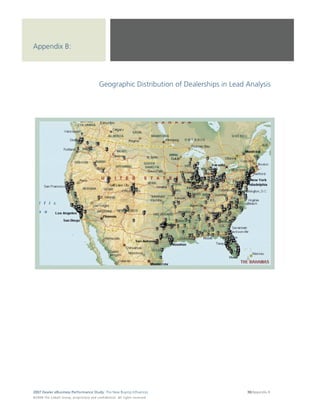
  • 12.
    brand. They needto consider the appearance and attractiveness of their website the same way they do their physical store including offering an attractive display of current inventory complete with pictures. Dealers also benefit by being well situated on search engines and by reallocating advertising budgets from offline to online media to ensure they have a presence online where consumers can find them. Offline shopping still important New car shoppers are very active offline as well as online. Physically visiting dealerships is still a significant part of the research process for consumers. Commonly held assumptions state that consumers physically visit 3 to 4 dealerships prior to purchasing a vehicle. Furthermore, it's believed these dealerships represent the same brand indicating consumers determine which brand they are going to purchase and shop multiple dealers of the same brand to find a car to purchase. This study revealed that on average, consumers physically visited 6 dealerships prior to purchasing a vehicle. Most interesting is these consumers tended to visit dealerships of different brands as opposed to multiple dealers of the same brand. Well into the shopping process, consumers are actively considering multiple brands and using the Internet to filter and select one dealership of each brand to physically visit. Furthermore, this illustrates the propensity to buy one brand over another can rest solely on the performance of one dealership. Dealers may have one shot at selling to a consumer or they can lose the sale for the entire brand. Given the quality and breadth of products on the market and the online tools to engage consumers as they research, new car shoppers can be marketed to and swayed right up until the point of purchase. While consumers are conducting their vehicle research online, they are also gaining a sense of the in-person experience they will get from each dealership. Consumers determine this by evaluating variables such as vehicle availability, price and dealer response to email inquiries. The study revealed that consumers are willing to travel further for a dealership they feel is going to provide the right experience. Even within the large DMAs which often contain 10 or more dealerships per brand, 32% traveled more than 20 miles from home to physically visit a dealership. For dealerships located outside of larger markets, search advertising can become a significant equalizer. Multiple sources used for quote submission As more and more consumers conduct research online, they are choosing to initiate their interaction with dealers online as well. Sixty-three percent of new car shoppers submitted purchase inquiries or leads to a dealership online with 67% having submitted via the dealership website. While dealership websites are the source of the majority of purchase inquiries, third-party automotive portals and OEM websites also deliver significant opportunities with 42% submitting a purchase inquiry through a third- 2007 Dealer eBusiness Performance Study: The New Buying Influences 12/Pre-selection Phase © 2 0 0 8 T h e C o bal t G r o u p, p r op r i e ta r y a nd c o n fi de n t ial . All ri g h t s r e s e r ve d .
  • 13.
    party portal and36% via an OEM website (Figure 4). Dealers need to answer all inquiries because most consumers are choosing to initiate a conversation through the online channel. Furthermore, dealers need to respond to purchase inquiries promptly and transparently in order to improve their ability to get these consumers into the dealership. More details about answering leads effectively are covered in the next section. Figure 4 Email quote submission and sources 2007 Dealer eBusiness Performance Study, ©Yahoo! Search Marketing. All rights reserved. 2007 Dealer eBusiness Performance Study: The New Buying Influences 13/Pre-selection Phase © 2 0 0 8 T h e C o bal t G r o u p, p r op r i e ta r y a nd c o n fi de n t ial . All ri g h t s r e s e r ve d .
  • 14.
    Engagement Phase As discussed in the pre-selection phase, 63% of car shoppers are submitting purchase inquiries online. The dealer's initial response to a lead is a pivotal point of contact for a consumer. This initial dialogue represents the engagement phase. Dealer response — both in terms of time to respond and quality of response — is critical to keeping that consumer engaged, getting them into the dealership, and selling them a vehicle. To fully understand how consumers filter at this stage, an understanding of the current level of dealer sales performance is needed. Lost opportunity for dealers remains high The lead match analysis of approximately one million leads over a 15- month period was performed by R.L Polk & Co. and compared to the 2005 lead match analysis to reveal performance levels over time. The results showed that dealers are still converting a very small percentage of the leads they receive. Stated differently, the amount of "lost opportunity" dealers are experiencing is still high. In addition, brand defection has increased, meaning more consumers are purchasing a different brand than the one they initially submitted a lead for. Results of the lead match analysis and implications are discussed below. Of the approximately one million de-duplicated new vehicle leads matched to DMV and RDR records, approximately 55% resulted in a sale of a new or used vehicle while 45% did not result in a sale. Of the 55% of leads that resulted in a sale, 10% closed at the "intended dealer" or the dealer to which the lead was initially sent. The other 90% closed at an "other" Figure 5 2007 Dealer eBusiness Performance Study: The New Buying Influences 14/Engagement Phase © 2 0 0 8 T h e C o bal t G r o u p, p r op r i e ta r y a nd c o n fi de n t ial . All ri g h t s r e s e r ve d .
  • 15.
    dealer than thelead was originally sent to (Figure 5, previous page). This 90% represents the amount of dealership "lost opportunity" dealerships are experiencing because they had the opportunity to convert the lead but lost the sale to another dealership. The good news is the 10% that closed at the intended dealer is a 25% increase over the 2005 study (Figure 6). This means that dealers who received a lead are getting better at converting that lead to a sale. But with 90% closing at an "other" dealer, the amount of lost opportunity is still high. Figure 6 Looking at the amount of lost opportunity in more detail, of the vehicles purchased at a dealership other than the intended dealership, 23% bought a new vehicle of the same brand, 36% bought a new vehicle of a different brand and 41% bought a used vehicle from another dealership (Figure 7). Figure 7 2007 Dealer eBusiness Performance Study: The New Buying Influences 15/Engagement Phase © 2 0 0 8 T h e C o bal t G r o u p, p r op r i e ta r y a nd c o n fi de n t ial . All ri g h t s r e s e r ve d .
  • 16.
    Brand defection isincreasing Of those people that submitted a lead, 36% bought a new vehicle of a different brand than specified in the initial lead. This represents a 6% increase in brand defection and supports findings discussed in the previous section that consumers are visiting multiple dealerships of different brands and can be swayed right up to the point of purchase. The financial impact of brand defection on OEMs can be high. Based on 2007 NADA Data, aggregate brand defection across all brands represents $5 billion in lost sales or $298 million in lost gross profit. * While it is difficult to quantify exactly how much brand defection an OEM is incurring, considering the amount of lost opportunity at the dealer level is 90%, undoubtedly many OEMs are experiencing a significant amount of loss to other OEMs. What consumers are buying and when The 2005 Industry and Dealership eBusiness Performance Study analyzed sales conversion within 30, 60, 90 and 91+ day increments. In order to gain a greater understanding of how quickly leads are converting, additional increments were added within the 30-day purchase window as part of the 2007 study. Results showed of the leads that closed, 24% did so within ten days of lead submission. Forty-three percent closed within 30 days and 68% closed within the first 90 days. Thirty-two percent closed after 90 days (Figure 8). Figure 8 * Based on average new vehicle price of $28,450 and average gross $1,482, NADA Data 2007. 2007 Dealer eBusiness Performance Study: The New Buying Influences 16/Engagement Phase © 2 0 0 8 T h e C o bal t G r o u p, p r op r i e ta r y a nd c o n fi de n t ial . All ri g h t s r e s e r ve d .
  • 17.
    Taking a closerlook at conversion over time, 43% purchased a new vehicle of the intended make within the first 30 days of lead submission. After that, new vehicle of intended make conversion dropped more than half to 21% within 60 days while used vehicle sales of any make more than doubled during the same time period — from 22% within 30 days to 50% within 60 days. After 90 days, new vehicle of intended make conversion dropped to 13% while used vehicle sales of any make increased slightly to 53%. Sales of other make vehicles was 31% within 90 days (Figure 9). The longer a lead remains unsold, the more likely it is to convert to a used vehicle. Dealers should respond promptly to leads and have systems in place to market to car shoppers in a way that addresses what the consumer is likely to purchase based on the age of the lead. Suggesting a used vehicle alternative to a new vehicle lead as the lead ages could help convert the lead to a sale. Additionally, with a third of leads converting after 90 days, dealers who continue to market to consumers will benefit by selling to those with purchase timeframes beyond a three month period. Figure 9 What's contributing to the amount of lost opportunity and increase in brand defection? Part of the answer rests with how dealers are responding to leads they are receiving. The eMystery shop measured dealer responsiveness and the quality of the response by "blind" shopping 2,100 dealers and the findings correspond to the trends discussed in the lead match analysis above. Dealer response to leads is poor In the 2007 national eMystery shop, the response rate — which measures whether or not dealers respond to an email lead — was approximately 69% (Figure 10, following page). (Response rate counts actual email response by the dealership and does not count an auto-response.) Thirty-one percent of leads are not answered at all. In essence, dealers are ignoring in-market consumers by simply failing to respond to their email inquiries. 2007 Dealer eBusiness Performance Study: The New Buying Influences 17/Engagement Phase © 2 0 0 8 T h e C o bal t G r o u p, p r op r i e ta r y a nd c o n fi de n t ial . All ri g h t s r e s e r ve d .
  • 18.
    Of those leadsthat were answered, dealers averaged 5.4 hours to respond (Figure 10). While annual eMystery shop campaigns have shown a steady decrease in the time dealers take to respond to an email, 5.4 hours may not be fast enough for consumers. In a recent automotive study, 20% of consumers state they want a response within 4 hours or they'll go to another dealership. * Figure 10 In addition to responsiveness and time to respond, the quality of the response to a consumer is another key indicator of performance. Previous Cobalt studies have shown that 90% of all initial inbound leads contain two key questions: "Do you have the vehicle I'm interested in?" and "How much is it?” Therefore, a dealer needs to respond with messaging that includes why to buy from them and why to buy the brands they sell. The eMystery shop evaluates how frequently both of these questions are answered. Unfortunately, only a quarter of dealers are answering these two key questions (Figure 11). Seventy-five percent of email responses from dealers are not answering these pivotal questions. Dealers need to respond completely, relevantly and transparently to all consumer questions in order to have a chance of earning their business. Figure 11 Approximately 20% of dealers are using brand or product highlights to differentiate their vehicles (Figure 12). With brand defection increasing by 6% since 2005, dealers need to include information that differentiates their product from likely competitive alternatives. Proactively including specific make and model information quoted from professional review sources like Road and Track and Car and Driver combined with compelling reasons to purchase from the dealership creates a persuasive "Why buy from me" and "Why buy my make" selling message that can minimize brand defection and help increase conversion. *Cars Online 06/07: Understanding the Dynamics of Consumer Buying Behavior and Customer Loyalty, CapGemini. 2007 Dealer eBusiness Performance Study: The New Buying Influences 18/Engagement Phase © 2 0 0 8 T h e C o bal t G r o u p, p r op r i e ta r y a nd c o n fi de n t ial . All ri g h t s r e s e r ve d .
  • 19.
    While poor responseto a lead can negatively impact the dealer, what is known now is that it can also cost the brand. In the Internet-based survey of 1000 car purchasers, of those that purchased a brand different than the brand they initially sent a lead for, 23% did so because of poor dealer interaction. Breaking it down, 14% switched because of poor or no response from the dealer and 9% switched brands because of a bad experience with the dealer. Both OEMs and dealers would benefit from instituting email response protocols that foster prompt, relevant and transparent communication with consumers. Gap between dealer performance and consumer expectations Comparing the 2007 national eMystery shop campaign to the 2005 national eMystery shop campaign, the data indicates a decline in how dealers respond to leads across almost all key performance areas (Figure 12). The only area of improvement is the average time to respond to an email improved — from 6.5 hours in 2005 to 5.4 hours in 2007. All other areas of measurement declined, most notably dealer use of brand or product highlights in an email response plummeted from 30.4% in 2005 to 19.5% in 2007. Most dealers are performing at levels below what consumers have come to expect from businesses that operate online. Speed vs. Quality of Figure 12 Response: Since the dawn of dealership websites, dealers have been getting the message to respond quickly to Internet leads. But speed has come at the expense of quality. The quality of response continues to decline because most dealers fail to answer the two basic questions consumers are asking, "Do you have the vehicle?" and "How much will you sell it to me for?" Additionally, dealers are neglecting to include valuable While dealer performance has declined, consumer reliance on the Internet information about the desired has increased. With the Internet constantly evolving, new tools and brand/model and a compelling information sources are developed, fueling greater adoption and user reason why the consumer should dependence. This increase in consumer use and decline in dealer purchase from them. The result is performance has created a critical gap between consumers and dealers. consumers continuing to seek dealers who will respond Dealers need to adopt policies and procedures to improve communication completely and transparently. with consumers in order to close the gap. Sixty percent of car purchasers said if they received a response from a dealer and it included a competitive price for the vehicle they were interested in and a compelling 2007 Dealer eBusiness Performance Study: The New Buying Influences 19/Engagement Phase © 2 0 0 8 T h e C o bal t G r o u p, p r op r i e ta r y a nd c o n fi de n t ial . All ri g h t s r e s e r ve d .
  • 20.
    reason to buyfrom that dealer, they would stop shopping elsewhere and give the dealer a chance to earn their business (Figure 13). Twenty-eight percent said they would give the dealer a chance but still shop the price around to validate it was a good deal. Only 12% said they always buy from the dealer with the lowest price. This data indicates that more than half of shoppers value complete and relevant communication with a dealer over a small minority that are motivated by the lowest price. Dealers who respond to leads promptly, completely and transparently and continue to nurture leads after a 90-day window will fill the void and begin closing the gap. Figure 13 Not all dealers are performing poorly. There are some who have the right processes, high level of professionalism and supportive management to address the needs of consumers. In-dealership interviews were conducted with 21 high-performing dealers to determine best practices. Their responses illustrate what successful dealers are doing to attract Internet consumers today. What high-performing dealers are doing to succeed When asked "What are the two things you do that contribute to your online success?" all high-performing dealers cited the importance of communicating with consumers and all have systems in place to execute thorough and efficient follow-up of email leads. Fifty-eight percent respond to each lead by email and phone. Eighty-three percent phone immediately after receiving a lead and 95% provide price and vehicle information as part of initial response. 2007 Dealer eBusiness Performance Study: The New Buying Influences 20/Engagement Phase © 2 0 0 8 T h e C o bal t G r o u p, p r op r i e ta r y a nd c o n fi de n t ial . All ri g h t s r e s e r ve d .
  • 21.
    These dealerships alsoutilize systems to ensure long term follow-up with each consumer. Forty-three percent use ongoing email and newsletters and 89% use a CRM tool for follow-up. This use of a CRM system is a 63% increase over the 2005 study. Referring back to the lead analysis where 32% of leads close after 90 days, following up over the long term pays off by keeping in touch and increasing the likelihood of turning prospects into customers. Internet sales representatives and dealership sales management were interviewed to determine their practices for success and many commonalities across dealerships came to light. The top practices heard most from Internet sales representatives include: Prompt, relevant and transparent communication by both phone and email; Tell the dealership's story and why they're unique; Honest and transparent communication that includes price and availability; Use of tools to maintain communication beyond 90 days. Top common practices of dealership sales management include: Investing in the sales staff and instituting "best practices" processes; Training sales staff to respond fully to leads; Empowering sales staff to provide a competitive price up front. When asked "Why do you think many dealers still struggle with the online customer?" more than three quarters of the of high performers stated that it was due to lack of management support for taking the Internet seriously and not providing a competitive price. Many of these dealers cited the best practices released in the 2005 Industry and Dealership eBusiness Performance Study as catalyst in how they changed the way they processed leads and targeted lead responses. 2007 Dealer eBusiness Performance Study: The New Buying Influences 21/Engagement Phase © 2 0 0 8 T h e C o bal t G r o u p, p r op r i e ta r y a nd c o n fi de n t ial . All ri g h t s r e s e r ve d .
  • 22.
    Purchase Phase Experiences influence other buyers Consumers are bombarded with marketing messages. A recent study noted that in the 1970s, a person living in a city was exposed to 500 to 2,000 messages a day. Today, it's between 3,000 and 5,000.* As a result, consumers are becoming desensitized to traditional advertising and increasingly turning to other consumers for input and advice on products and services. This demand for consumer insight regarding purchase experience has generated reviews and rankings of businesses and dealerships. These reviews and rankings are being displayed on major search engines and specific consumer-review websites such as Yelp, InsiderPages, and Dealer Rater. Nowhere is this trend growing faster than the automotive industry. During “Advertising is so ubiquitous the purchase phase, consumers use that it’s turning people off, reviews and rankings from other it’s desensitizing people to shoppers to filter what vehicle and from whom they will purchase. While the message”. - Rance Crain, Editor-in-chief, Ad Age this technology is still very new, the impact on purchase decisions is already substantial and projected to grow quickly. Some analysts believe online reviews and rankings will change the automotive industry more than the introduction of the Internet did in the 1990s. Reviews and rankings becoming more pervasive Of those consumers that submitted a lead to a third-party portal and purchased a vehicle, 55% were aware of sites containing consumer reviews of dealerships, 21% read reviews on a website while car shopping, 16% posted comments about the dealership they purchased from and 8% posted comments about a dealer they did not purchase from (Figure 14, following page). *Product Placement—You Can’t Escape It”, October 10, 2006, USA Today. 2007 Dealer eBusiness Performance Study: The New Buying Influences 22/Purchase Phase © 2 0 0 8 T h e C o bal t G r o u p, p r op r i e ta r y a nd c o n fi de n t ial . All ri g h t s r e s e r ve d .
  • 23.
    While current usagenumbers may seem low, the technology is relatively new and adoption rates are high and projected to increase dramatically. When consumers were asked how likely they would be to use a website with dealership reviews and rankings in the future, 73% said they would be "somewhat likely" or "very likely" and 58% said they would be "somewhat likely" or "very likely" to post comments on a dealer review site (Figure 15). Figure 14 The impact of reviews on purchase decisions is growing. Of those that looked at sites containing consumer reviews and rankings of dealerships, 21% changed dealership selection based on reviews they read, 23% decided to look at a different make/brand based on the reviews, 43% used Figure 15 2007 Dealer eBusiness Performance Study: The New Buying Influences 23/Purchase Phase © 2 0 0 8 T h e C o bal t G r o u p, p r op r i e ta r y a nd c o n fi de n t ial . All ri g h t s r e s e r ve d .
  • 24.
    the information theyread to select a dealership and 45% said the information they read confirmed their choice of dealerships (Figure 16). Usage is growing and the effect on purchase decisions has a lasting impact on dealers that is available for everyone to see and read about. Figure 16 Positive comments outweigh negative The good news for dealers is people post positive comments more than negative. When asked, "What kind of comment did you post about the dealer where you purchased your vehicle?" Eighty-six percent posted positive comments versus 10% negative and 4% neutral (Figure 17). This shows that when people have a good experience, they want to tell others. Figure 17 2007 Dealer eBusiness Performance Study: The New Buying Influences 24/Purchase Phase © 2 0 0 8 T h e C o bal t G r o u p, p r op r i e ta r y a nd c o n fi de n t ial . All ri g h t s r e s e r ve d .
  • 25.
    Consumer reviews andrankings can be a very powerful marketing tool for dealers allowing them to market their CSI virtually to consumers who value the input and experience of others. Dealers need to embrace this new tool by adopting the learnings discussed in the previous section— invest in sales staff and have systems in place to be able to respond promptly and transparently to all customer communication. The better the experience, the more likely consumers are to write a positive review. Five attributes in dealership selection Vehicle purchase decisions are based on a combination of factors. Consumers must trade-off some of one factor or attribute for more of another, depending on their personal preference, to arrive at the dealership where they ultimately purchase a vehicle. To gain insight into how attributes influence vehicle purchase decisions, a conjoint analysis was conducted using 1000 vehicle purchasers. This analysis simulates how consumers jointly consider the five primary attributes: price, quality of Lowest price versus interaction with sales staff/level of professionalism, loyalty to the competitive price: dealership, location of the dealership, and online reviews and rankings. It's important to note that while The conjoint analysis revealed the level of importance or "weight" of price is the most important each attribute in contrast to each other as indicated by the 1000 vehicle factor in deciding whether to purchasers. A higher weight signifies greater importance to consumers purchase a vehicle — contrary to than a lower weight. At the top is price with a weight score of 7.75 commonly held beliefs — getting followed closely by professionalism of sales staff with 7.23 (Figure 18). the lowest price for a vehicle is With these two top attributes almost equal in weight, it shows that not the single most important professionalism of the sales staff is nearly as close to the same level of determinant for most consumers. importance for consumers as price. Online dealership reviews and rankings, sometimes referred to here simply as dealer reputation, rank The conjoint analysis found most a strong third with 5.14 — lower than price and professionalism but consumers are willing to pay a significant enough to become the "swing attribute" as will be shown in competitive price for a vehicle the following examples. As discussed previously, while this technology and not the absolute lowest is relatively new and growing in importance, this conjoint analysis weight price. A competitive price is shows the significant "pull" reviews and rankings can have on consumers. higher than the lowest price but Location and loyalty, commonly thought to be major forces in attracting in contrast to a high price, dealership business, were found to be minimally important with competitive is considered a weighting of 1.85 and 1.32 respectively. Looking at the spectrum of all five attributes, price is six times more important than loyalty. This study reasonable amount to pay for indicates that automotive shoppers today value a good buying experience a vehicle. nearly as much as a low price and are willing to travel to a dealership that is not conveniently located to get it. Figure 18 2007 Dealer eBusiness Performance Study: The New Buying Influences 25/Purchase Phase © 2 0 0 8 T h e C o bal t G r o u p, p r op r i e ta r y a nd c o n fi de n t ial . All ri g h t s r e s e r ve d .
  • 26.
    A conjoint simulatorcalled the "Dealer Preference Indicator" was built to simulate how the five attributes work dynamically to show degrees of preference for different dealer profiles. Each attribute contains different variables (figure 19): Figure 19 To illustrate how the attributes work dynamically, three dealership profiles were compared to determine consumer preference. When all attributes are equal across the three profiles with "competitive price," "mixed" online reviews, quality of interaction "just okay," "conveniently located" and "neutral loyalty," preference for Dealer A, B and C are equal or in a neutral state with each dealer having 33% of consumer preference (Figure 20). Figure 20 2007 Dealer eBusiness Performance Study: The New Buying Influences 26/Purchase Phase © 2 0 0 8 T h e C o bal t G r o u p, p r op r i e ta r y a nd c o n fi de n t ial . All ri g h t s r e s e r ve d .
  • 27.
    As is thecase in real-world purchase decisions, when one attribute variable is changed, the preference for one dealer over the others changes as well. With all other attributes remaining equal, changing Dealer A's price to "very low" increases preference for Dealer A to 82%. Dealers B and C get 9% respectively. Dealer A doesn't get 100% due to other factors of convenient location and neutral loyalty for Dealers B and C (Figure 21). Figure 21 To fully illustrate real-world vehicle shopping, realistic profiles with characteristics corresponding to the attributes are assigned to each dealer. As the attributes change to model these profiles, so will the preference indications (Figure 22, following page). 2007 Dealer eBusiness Performance Study: The New Buying Influences 27/Purchase Phase © 2 0 0 8 T h e C o bal t G r o u p, p r op r i e ta r y a nd c o n fi de n t ial . All ri g h t s r e s e r ve d .
  • 28.
    Figure 22 Dealer A is a volume dealership in a large DMA that offers the lowest price but with a sales staff that has a low degree of professionalism and therefore the quality of interaction with customers is poor. When interaction of sales staff is changed to "unprofessional/not helpful" Dealer A's preference drops from 82% to 15%. Dealers B and C, still having equal attribute variables reset at 43% each (Figure 23). Figure 23 2007 Dealer eBusiness Performance Study: The New Buying Influences 28/Purchase Phase © 2 0 0 8 T h e C o bal t G r o u p, p r op r i e ta r y a nd c o n fi de n t ial . All ri g h t s r e s e r ve d .
  • 29.
    With the risingimportance of dealer reputation, a natural consequence of an unprofessional sales staff will be unfavorable reviews and rankings. Changing this attribute of Dealer A to "mostly bad," preference for Dealer A drops further to 6% (Figure 24). This illustrates while price is important, it's not the primary factor on which consumers base their purchase decisions. More people are looking for a positive experience over the lowest price and are seeking this information from other people with experience at the dealership in the form of online reviews and rankings. Figure 24 2007 Dealer eBusiness Performance Study: The New Buying Influences 29/Purchase Phase © 2 0 0 8 T h e C o bal t G r o u p, p r op r i e ta r y a nd c o n fi de n t ial . All ri g h t s r e s e r ve d .
  • 30.
    To draw furthercomparison between the dealers, Dealer C is focused on providing a quality buying experience but also has a higher average vehicle price in the market. With the price attribute changed to "high price" and quality of interaction changed to "professional & friendly" consumer preference for Dealer C drops to 5%. Dealer B, with "competitive price", "mixed reviews" and "okay interaction with sales staff," gets 89% of the preference. Dealer A, with the lowest price, poor sales interaction and bad reviews, retains 6% (Figure 25). This scenario shows that the lowest price is important for only a small percentage of the population Figure 25 even if it translates to a less-than-ideal interaction with the sales staff. It also shows that most people are looking for an okay or medium level of interaction with the sales staff and are willing to pass on the lowest price and pay a slightly higher or competitive price for a better buying experience. 2007 Dealer eBusiness Performance Study: The New Buying Influences 30/Purchase Phase © 2 0 0 8 T h e C o bal t G r o u p, p r op r i e ta r y a nd c o n fi de n t ial . All ri g h t s r e s e r ve d .
  • 31.
    Dealer C's highquality of interaction would translate into good reviews. By changing Dealer C's online reviews from "mixed" to "mostly good" preference for Dealer C climbs slightly to 12%. Dealer B still has the highest preference at 82%. This begins to show the sway online reviews and rankings have on consumer preference. Only 6% of the population would endure a poor level of interaction from Dealer A with bad reviews in order to get the lowest price (Figure 26). It also shows that paying a high price from Dealer C is still a deterrent despite good reviews and high quality of interaction at the dealership. Figure 26 2007 Dealer eBusiness Performance Study: The New Buying Influences 31/Purchase Phase © 2 0 0 8 T h e C o bal t G r o u p, p r op r i e ta r y a nd c o n fi de n t ial . All ri g h t s r e s e r ve d .
  • 32.
    Now revisiting DealerC and changing high price to competitive price, Dealer C's preference level increases to 97% while Dealer B, up until now the dominant profile, falls to 0% and Dealer A's preference is only 3% (Figure 27). This illustrates that getting a competitive price is important to consumers but the quality of the interaction they receive from the dealership is pivotal and negates the argument that lowest price is the most valued factor in purchasing a vehicle. People are looking for a positive experience over the lowest price. Figure 27 The above scenarios also illustrate the growing importance of dealer reputation. If a dealership promotes an environment of professionalism by investing in its sales staff and offering a competitive price, strong online reviews from customers will naturally result, thus establishing a system of reciprocity where strengthening one attribute will benefit the others. Online reviews are a source for consumers seeking information from trusted sources to get an idea of what kind of experience they're going to have at a dealership. While these reviews don't make or break purchase decisions, they are increasingly becoming an important component in the dynamic of car shopping that dealers can't afford to ignore. More importantly, reviews don't have to be perfect in order to have an impact on dealer preference. 2007 Dealer eBusiness Performance Study: The New Buying Influences 32/Purchase Phase © 2 0 0 8 T h e C o bal t G r o u p, p r op r i e ta r y a nd c o n fi de n t ial . All ri g h t s r e s e r ve d .
  • 33.
    They just needto be mostly positive in order for consumers to be reassured they will be treated well and not regret giving the dealer their business. Additionally, the indicator also illustrates the minimal importance of the location of the dealership as an attribute. Using Dealer C with 97% of the preference and changing the location attribute to "not conveniently located," Dealer C is still very high at 82%. Dealer B has rebounded, going from 0 to 13%, but clearly this shows consumers are willing to travel greater distances to buy from whom they feel is the right dealership providing the right experience (Figure 28). Figure 28 These findings dispel the commonly held belief that lowest price and a convenient location are the primary reasons consumers choose one dealership over another. The analysis also illuminates the importance of a dealership's investment in their sales staff and sales process. Dealers with positive online reviews have the ability to leverage those reviews as a very important dealership differentiator and thus have an extremely powerful, low-cost marketing tool. 2007 Dealer eBusiness Performance Study: The New Buying Influences 33/Purchase Phase © 2 0 0 8 T h e C o bal t G r o u p, p r op r i e ta r y a nd c o n fi de n t ial . All ri g h t s r e s e r ve d .
  • 34.
    Implications of Key Findings Dealers need to invest in their online presence as much as their physical dealership With most consumers using the Internet as a primary source during their shopping process, dealers should put as much effort and investment in maintaining their dealership website as they do their physical dealership. Leads sent from online sources are a valuable source of business opportunities. Dealers need to have processes in place to respond to leads promptly and transparently in order to have a better chance at converting these leads. Dealers also benefit by being well situated on search engines and reevaluating their advertising budgets to emphasize online media so consumers can find them online. Lost opportunity remains high and brand defection is increasing The extent of lost opportunity and the financial implications associated with it should be a red flag for all dealership management. A mishandled Internet lead needs to be treated the same way an unanswered phone call or a walk-up customer receiving no sales assistance would. Persuasive communication that differentiates their brand from likely competitive alternatives will also help stem brand defection. Consumer reliance on the Internet is increasing while dealer performance is flat A large gap exists with consumers relying more and more on the Internet as a resource for vehicle shopping and dealers under performing when responding to these consumers. Management that invests in their sales staff and training and institutes guidelines and processes to respond to these consumers will be able to close the gap. Online reviews and rankings of dealerships are becoming more pervasive The rapid adoption of online consumer reviews and rankings shows consumers are turning to other people for insight into the type of experience they can expect from a dealership. Dealers who invest in their sales staff and grow a strong, positive review base can build a very powerful marketing tool. Positive buying experience is more important than lowest price Most consumers are willing to pay a competitive price over the lowest price in order to get a positive buying experience. Loyalty and convenient location no longer have the "pull" they once did in attracting business. Dealers who foster a welcoming and respectful sales environment where the customer is treated respectfully and transparently may make more gross because they don't have to sell at the lowest price. 2007 Dealer eBusiness Performance Study: The New Buying Influences 34/Implications of Key Findings © 2 0 0 8 T h e C o bal t G r o u p, p r op r i e ta r y a nd c o n fi de n t ial . All ri g h t s r e s e r ve d .
  • 35.
    Manufacturer Comparative Data The third-party lead analysis also includes comparative performance data of 35 manufacturers (OEMs) in the area of new vehicle lead conversion. This analysis shows there is a wide variance among brands and how third-party leads are converted to sales. Examples of these findings are provided below: When leads are segmented by manufacturer, there is a wide variance in the likelihood a lead will ultimately convert to a sale of the brand specified in the initial lead. This rate of conversion to the intended brand is also representative of the degree of loyalty consumers submitting a lead may have to a specific brand. The highest manufacturer intended brand conversion was 56% and the lowest was 19%. Average intended brand conversion across all 35 manufacturers represented in the study was 37%. For example, if a lead is submitted for a Brand A vehicle and converts to a sale, this data illustrates the percentage of those sales that are converted to a Brand A vehicle. Analysis of leads segmented by manufacturer also illustrates intended dealer conversion or the rate at which a lead is converted at the dealership to which the lead was initially sent. The highest manufacturer had a 6.8% intended dealer conversion rate while the lowest had 2.6%. Average intended dealer conversion across all manufacturers was 4%. For example, if a lead is submitted for new Brand A vehicle at Dealership A and converts to a sale, this data illustrates the percentage of those sales that converted to a new Brand A vehicle at Dealership A. There is also interesting insight into how well manufacturers are doing at winning new customers by selling a consumer a brand of vehicle different than the brand specified in the consumer's initial lead. There is a wide range in performance among manufacturers in achieving these "conquest sales" with the highest converting 15% and the lowest converting less than 1%. Average conquest sales across all manufacturers was 3%. For example, this data illustrates the percent of leads Brand A converted that were initially intended for another brand. Additional manufacturer performance data is in the Cobalt report, eBusiness Performance and the OEM — A Companion Report to the 2007 Dealer eBusiness Performance Study. Manufacturers interested in this report should contact their Cobalt representative at 800-909-8244 for more details. 2007 Dealer eBusiness Performance Study: The New Buying Influences 35/Manufacturer Comparative Data © 2 0 0 8 T h e C o bal t G r o u p, p r op r i e ta r y a nd c o n fi de n t ial . All ri g h t s r e s e r ve d .
  • 36.
    Appendix A: Research Methodology Lead Analysis Approximately 1,500 new car franchise dealerships subscribing to a third- party lead provider were identified for inclusion in the study. Of the 1,500 dealerships, R.L Polk & Co. matched 1,140 representing 35 brands geographically located throughout the 48 contiguous states (map in appendix) with selling dealership data. These 1,140 dealers received a total of 1,087,287 purchase inquiries or leads during the study period of October 1, 2005 through September 30, 2006. Duplicate leads were removed in order to ensure an accurate match rate. Leads were considered duplicates if the make, model, dealership to which the lead was sent, consumer name, address and lead date were the same. R.L Polk & Co. conducted a matching analysis of the leads to determine which leads resulted in a vehicle sale. The results of the lead match revealed close rates, time to close and whether or not leads were closed at the dealership receiving the lead. The methodology is closely aligned Criteria for determining with the methodology used in the 2005 Industry and Dealership eBusiness duplicate leads: Performance Study in order to draw performance comparisons over time. · If John Doe sends two leads for Additional measures were taken to validate the lead match results. A a 2007 Ford Explorer on January separate analysis was conducted on leads from dealership websites and 1, and provides the same address revealed that close rates were similar to the third-party lead analysis. on each lead, only one lead from In addition, a select group of manufacturers reviewed the findings and John Doe was included in the concurred that their dealership close metrics were in the same range as lead analysis. the third-party lead match. Due to the high number of leads included in the third-party lead analysis, the error interval is +/- .06% and the · If John Doe sends a lead for a confidence level is 99%. As a result of these validations, the lead match 2007 Ford Explorer on January 1 analysis is an accurate representation of industry performance today. and a lead for a 2007 Ford Explorer on January 2, both leads Online surveys are counted as unique leads and Two Internet-based surveys were conducted by The Cobalt Group and included in the lead analysis Yahoo! to examine the consumer car shopping process including shopping regardless of address provided. behavior, marketing and media influences on shopping decisions, consumer behavior in response to dealership communication and what factors motivate people to physically visit a dealership. A total of 1,550 car shoppers participated in the two surveys. The first survey was a 25 minute online questionnaire with 550 participants. The sample was made up of approximately half intending to purchase a vehicle within the next six months and half already purchased within the previous three months. All participants lived in major metropolitan areas and had physically visited a dealership during their shopping process. 2007 Dealer eBusiness Performance Study: The New Buying Influences 36/Appendix A © 2 0 0 8 T h e C o bal t G r o u p, p r op r i e ta r y a nd c o n fi de n t ial . All ri g h t s r e s e r ve d .
  • 37.
    The second surveywas a 25 minute online questionnaire with a sample size of 1000. All participants in this survey submitted a new vehicle lead through a third-party automotive portal and had purchased a vehicle within the previous six months. eMystery shop Cobalt conducted a nationwide eMystery shop campaign of 2,100 new car dealers representing 20 brands. Performance was determined by evaluating responsiveness, response time and the quality of the response in addressing shoppers' key questions: "Do you have the vehicle I'm interested in?" and "How much will you sell it to me for?" The 2007 national eMystery shop was compared to the 2005 national eMystery shop to assess performance trends. Onsite dealership evaluations Of the 1,140 dealerships evaluated, Cobalt visited 21 of the high-performing dealerships as determined by dealership close rates in the lead match analysis and conducted interviews to better understand business processes and discover common practices that contribute to their success. 2007 Dealer eBusiness Performance Study: The New Buying Influences 37/Appendix A © 2 0 0 8 T h e C o bal t G r o u p, p r op r i e ta r y a nd c o n fi de n t ial . All ri g h t s r e s e r ve d .
  • 38.
    Appendix B: Geographic Distribution of Dealerships in Lead Analysis 2007 Dealer eBusiness Performance Study: The New Buying Influences 38/Appendix B © 2 0 0 8 T h e C o bal t G r o u p, p r op r i e ta r y a nd c o n fi de n t ial . All ri g h t s r e s e r ve d .
  • 39.
    Appendix C: eMystery Shop Scorecard 2007 Dealer eBusiness Performance Study: The New Buying Influences 39/Appendix C © 2 0 0 8 T h e C o bal t G r o u p, p r op r i e ta r y a nd c o n fi de n t ial . All ri g h t s r e s e r ve d .