. - . *
LESSONPLAN AND HOMESURVEY-~RI:!
WITHFACTSHEETS& HOMEACTIONGUIDE
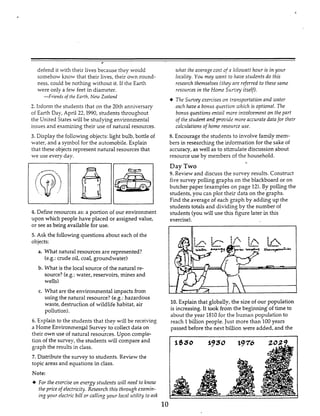
.
Wording on National Financial Sponsorship
c K-12 Program
Funds for the development, printing and distribution of the
K-12 Lesson Plan and Home Survey was generously donated
by the following co-sponsors:
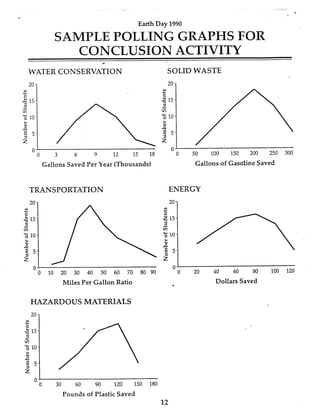
The Rockefeller Foundation
ESPRIT de CORP
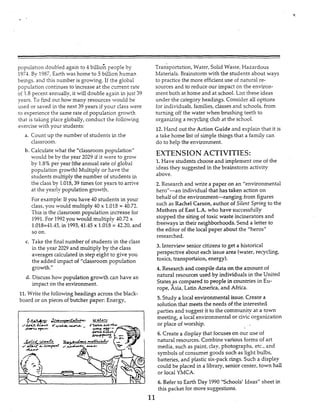
L
LESSONPLANAND HOMESURVEY-GRADES7-12
ENERGY,SOLIDWASTE/RECYCLING,TOXICSI TRANSPORTATION
AND WATERWITH FACTSHEETSAND ACTIONGUIDE
-
AMYHOLMES-SHUETTAND GREGSHUEIT,PRINCIPALWRITERS
ABBYRUSKEY,COORDINATOR
ENWWEDBY:
The American Federation of Teachers
The National Education Association
National Association of State Boards of Education
EARTHDAY1990
P.O. Box AA
STAXFORD UNIVERSITY, CA 94309
Earth Day 1990
ACKNOWLEDGEMENTS
LESSON PLANS, HOME SURVEYSAND FOLLOW-UP ACTIVITIES-K-12
PROGRAM DEVELOPMENT
K-6 CURRICULUM DESIGNER
CarolieSly,%ience/EnvironmentaI Education Curriculum
Designer, Alameda CountyOfficeof Education and Coordi-
nator of the award winning Cdifomia State Encironmental
Edrication Giiidz.
Leslie C o m e s and Celia Cuomo co-wrote the Cdifoornb
State Environmental Education Guide from which the K-6
curriculum is adapted. Leslie Comnes was the Principal
Writer for Toxics:TakingChrgefrom which the toxicslesson
plans were adapted.
7-12 LESSON PLAN WRITERS
Amy Holmes-Schuett, Environmental Education Curricu-
lum and Teacher TrainingConsultant,Orange County, CA
Greg Schuett, Environmental Education Curriculum and
Teacher Training Consultant, iManager of Environmental
Field Study Program, Orange County Office of Education
7-12 SURVEY WRITERS
SethZuckeman,Environmental and NaturalResourceCon-
sultant, Berkeley, CA
Kim Taylor, Environmental Consultant, Energy and Re-
sources Group, E.C. Berkeley, Berkeley,CA
Mark Valentine, Director of Issues, Earth Day 1990
ACTION GUIDE
Peter Drekmeier, Issues Coordinator, Earth Day 1990
Mark Valentine, Director of Issues, Earth Day 1990
Diana Aldridge, Director of Communications, Earth Day
1990
EARTH DAY 1990 FACT SHEETS AND SCHOOL
IDEAS SHEET
Peter Dreheier, Issues Coordinator, Earth Day 1990
PUBLICIIY AND OUTREACH
Diana Aldridge, Director of Communications, Earth Day
1990
ILLUSTRATIONS
All illustrations (except where noted) by Nancy Gorrell,
Additional illustrations: Hope Epstein, Artist and Elemen-
tary School Teacher, Oakland,- CA
GRAPHIC DESIGN AND PRODUCTION
Kristin Prentice, Sphinx Graphics, Berkeley,CA
COVER ART
Original colordrawingbyJonathonParker, Artist, Berkeley,
CA. Redrafted in pen by Nancy Gorrell.
Earth Day 1990is responsible for the entirecontentsof the
K-12 Lesson Plan and Home Survey Program. Earth Day
1990 makes no restrictions on the non-commercial repro-
duction or use of this publication.
K-12 LESSON PLAN AND HOME SURVEY
' L I L 1 d . Y I . UArCicC anrl FlomontaryI*C...* ...- ^ . Srhnnl Teacher Berkeley,CA
Earth Day 1990 is grateful to the American Federation of Teachers. *e
National Education Association and the National Association of State
Boards of Education tor their ourreach efforts regarding the Each Day 19%
curridurn. Earth Day 1990 also appreciates the supvrt-tnioncept of !he
National Parent Teachers Association and their asststance in tnvol-,%g
parents and xhoois in the K-12 ?rogam.
The following people, by kindly volunteering their time and knowledge.
helped assure that the curriculum was on the right course, educationally
and environmentally:
Dale Boahvright. Environmental Educahon Director.American Federation
of Teachers, Washington, D.C.
Mark Dawson, Environmental Snginrmng Candidate, UC Berkeley. C.i
Kathy Donald, Education Consultant. Oakland. C.4
Paula Figdor. Teacher, Burckhaiter EIrmentary, Oakland C.4
Michael Gordon, Dir..Innovanve Community EntrTnses, Netv York. hT
Brian Hirsh, DevelopmentCoordinator, LnnovativeCommunity Enterprises.
New York. iW
Lisa Klimeck, Entlronmental Ed. Coordinator. San hfateo County, C h
Cathy Liu, High khool Teacher at Westmorc.Hi$ Sihool, Daly City. C.4
Cathy Liu's 2nd and 3rd period Earth Siences students
Gil Masters, Prof. of Civll Engmwring, Stanford Lniversiy. C.4
Diana Nicols. Pnndple, Harker .Academy, San Jose.CA
Betsv Olson, Coordinator, Enlronmentai Educanon Grant Program. Cdii-
fomia State Department ui Education
Nancy Peer, Vice President, Parent Teachers hssocatmn, Kensington E i c
menta?, Kensinston. CA
Pam Wassetman, Education Coordinator, Zero Popuiahon Growth. Wash-
ington, D.C.
These people have supported the project through organizational support,
consultation and referral:
Or. Alberta Arthurs, Rockefeller Foundahon, New York. NY
Ron Boehm, Intellemation, Santa Barbara. CA
Patty Bumess. Aide tocalif.StareSuperintendent of Schools. LViiliamHorug
Susan C'nurcher, City of Palo Alto, Rmeahon Coordinator
Melanie Engles. LA.Earth Day 19% Education Committee
Clare Hertel, Media Relahons-Educatlon Outreach, Shaklee Corpratxon.
San Francisco. C.4
Bam, Jamcjon,.uYDept. oi Education, Environmental Educanon Unit
Gary Nakagiri, ScienceEducation Coordinator, San Mateo County Otfce of
Education, San Mateo, CA
-AnPansing, Colorado State Board of Educahon
Karin Topping, Media Relations-Eduation Outreach. ShakieeCo~orstton.
San Francisco,C.4
Bnan Tuller. Exec. Bd. Member. %Itionaf Parent Teachers Assoclarion
Stuart Volkow, Intellemation. Santa Barbara. C.4
Gene Wtlhoit. Exec. Dir., Xationai .4>5oclaiiOiI of Stat? bard; oi EducXion
Thanks to the tireless and devoted statf at the Earth Day 1990International
Headquarters and especially those who volunteered long hours to re
search, phone, enter data, proof read. sfamp, stuff and seal the K-12
program:
MaryAnne Barit
Dan Brillheart
LMarsha Carter
Craig Cordova
Michelle Quintman
L.yn Wherehauser
Dana Zworakowski
Special thanks to Earth Day 1990 Regional, Area 3nd K-12Coordinators
across the county who are distributing and implementing the program.
..11
Earth Day 1990
TABLE OF CONTENTS
LESSON PLAN AND HOME SURVEY-GRADES 7-12
ACKNOWLEDGEMENTS
11
LETTER TO EDUCATORS
V
INTRODUCTION-GRADES 7-12
v11
LESSON PLAN
9
SAMPLE POLLNG GRAPHS
12
SURVEY
13
ACTION GUIDE
18
BACKGROUND INFORMATION-FACT SHEETS
The Automobile
20
Energy
22
Global Warming
24
Household Hazards
26
Population Growth
28
.A
Recycling
30
Tree Planting
32
Water Conservation
34
ENVIRONMENTAL EDUCATION RESOURCES GUIDE
36
SCHOOLS' IDEAS SHEET
3s
Y
.A
Dear Educator:
Twenty years ago, on the first Earth day, 20 million Americans tumed out to demonstrate
their concem for a better environment. Students and educators throughout the nation
played a significant role in the success and effectiveness of the first Earth Day. Campuses
and schools across the country orchestrated thousands of educational teach-ins and special
classroom instruction.
In the ensuing twenty years, a number of the problems that fueled the original Earth Day
have been addressed effectively. Following Earth Day, 1970, the Environmental Protection
Agency was created and Congress passed the Clean Air and Water Acts. Envifonmental
consciousness was raised nation-wide. And many of the participants who were children or
youth then are working for the health of the planet today.
Despite the environmental progress that has been made, the past two decades have seen
many of our environmental problems worsen, and our planet now facesa diverse array of
new ills. On April 22,1990, the 20th anniversary of the first Earth Day, 100million people
demanding action for our endangered earth are expected to participate in the United States
and in more than 120countries around the world. The primary objective of Earth Day 1990
has been to launch a decade for the environment through a public education campaign
and events encouraging individuals to make a difference in their schools, homes,
workplaces and communities.
To further our objective of individual responsibility and empowerment through education,
Earth Day 1990is pleased to present the attached Earth Day 1990K-12 Lesson Plan and
Home Survey exercises. This education project has been designed to help equip the next
generation of the earth’s caretakers with an awareness of how their daily actions, and those
Thank you for your interest in the Earth Day 1990curriculum. Your participation and that
of K-12 educators across the nation will not only guarantee the success of this exercise, but
is vita! tc? om p ! s of greater exvironnenta! iiwarenessand lasting change.
Sincerely,
of their families, affect the health of the planet. -A
Denis Hayes Chris Desser AbbyRuskey uChair, Earth Day 1990 Executive Director, Earth Dav 1990 K-12 Coordinator
V
Earth Day 1990
INTRODUCTION
LESSON PLAN AND HOME SURVEY-GRADES 7-12
c
Purpose of Cumculum
The purpose of the Earth Day 7-12 Cumculum is to
provide teachers and other educators with a class-
room lesson and home survey that is a starting
point for understanding five signhcant environ-
mental issues-water, toxics, enersy, transportation
and solid waste/recycling. Whde each of these
environmental issues are complex and have far-
reaching implications,the lesson and home survey
can serve as a way for teachers, students, and
families to begin thnlung about these issues in
relationship to their own lives. hlost important, the
lessons are designed to give students a sense of
their own power to bring about change.
Students are introduced to each of the five issues in
class and then take home a survey which they
complete, if possible,with other family members.
They return to school with their completed surveys
and discuss the results.
How the Curriculum is Organized
The Earth Day 19907-12 cumculum is broken down
into four components: Background information,
Lesson Plan, Home Survey and Action Guide.
The Background Information is provided in the
form of fact sheet issued by Earth Day 1990.There
is a fact sheet for every issue area covered inby the
lesson pIan and home survey; energy, water, toxics,
solid waste/recycling and transportation. Addi-
tional, but related fact sheets also are included for
the teachers use.
The Lesson Plan itself takes two-days, 43 minutes
per day. The Day One lesson plan is a discussion of
natural resources;the oriljins of and environmental
costs involved with their.use. Students are then
introdiuced tn, and as a class, review the HDme
Survey. During the Day Two lesson pIan, the class
discusses survey results. To aid in the discussion,
the teacher and or studenG poll and chart all of the
students surveys. The class then calculates the
impact of population growth on the environment
and brainstorms soIutions to en-ironmental prob-
lems that they as individuals and as a class can act
upon.
All teachers will also receive the Earth Day 1990
Action Guide to pass out to aLI students at the
conclusion of their Day Two discussion. The Action
Guide is a listing of simple tips to help the environ-
-
ment for parents and students to work on together
in their homes.
The Role of ParentdGuardians
It is optimal to have the participation of parents and
other f a d y members in the completion of the
home survey. However ,aiven the busy lifestylesof
today's familiesmany children will have to fill the
survey out on their own. Ths is why the 7-12 home
survey was written in a way that students could
answer the questions independently.
A sample letter to parents is included to help the
teacher communicate the purposes and procedures
of the home surveys and to encourage family
participation. The teacher should add detail where
they feel it is necessary.
Community Outreach
To inform your local community about what your
class is doing for Earth Day, teachers may want to
notify local newspapers, post graphs and pictures in
libraries, YMCA's, city hall or senior centers and/or
create displays for your schools's sciencefair.
vii
c
Learning More About the Environment
For teachers who are interested in pursing further
lessons in environmental education, the Environ-
mental Education Resource Guide included in this
packet listsadditional environmental education
curriculum as well as multi-media and organiza-
tional resources.
...
...V l l l
Earth Day 1990
HOME ENVIRONMENTAL
LESSON PLAN-GRADES 7-12
SUMMARY OF ACTIVI~Y:
Studentsin grades 7-12 will participate in a class
discussion about natural resources and the environ-
ment. They will be given a Home Environmental
Survey in order to study their own and their
families’ use of energy, transportation, water, and
practices of solid waste and hazardous materials
disposal. A follow-up discussion in the classroom
will focus on ways that students can use natural
resources more efficientlyand the impact of the
population growth on resources.
BACKGROUND INFORMATION:
See Earth Day 1990fact sheets included in this
packet.
Time: Two 45-minute class periods
Setting: Classroom, home
Materials:
+ Home EnvironmentalSurvey (included).
+ Sampieof Survey Graphs (included).
+ Light bulb.
+ Bottle of water.
+ Symbol for car (modelor photograph).
+ Blackboard and/or poster boards.
+ Chalk and/or markers.
OBJECTIVES:
In celebration of the 20th anniversary of Earth Day
on April 22,1990, students throughout the United
States will be participating in this activity. A brief,
but important pre-survey discussion in the class-
room will set the stage for the students to complete
the work at home. The Home Environmental
Survey can be given as an overnight assignment or
as part of a larger unit of study, depending on your
students’ academic Ievel(s)and subject(s1that you
teach. Upon completion of the survey, a graphing
activity will show how the aggregate of individual
actions can affect the environment in a positive or
negative manner. A brainstorming discussion will
focuson other ways for individuals to use resources
more wisely to benefit their environment.
Students will:
1.Define natural resources.
2. Idenhfy the origin of natural resources that the
community uses and the environmentalcosts asso-
ciated with their use.
3. Conduct a Home Environmental Survey.
4. Compare and graph the survey results.
5. Brainstormways to enhance the efficient use of
natural resources and to reduce our negative impact
on the environment.
PROCEDURE:
Day One
1.To focusyour students on a discussion about the
environmentand natural resources, read the
followingpassage:
If the Earth were onlv a few feet in diameter,
floating a few feet above a field somewhere,
people would come from everywhere to marvel
at it. People wouid walk around it, marvelling at
its big pools of water, its little pools and the
water flowing between the pools. People would
marvel at the bumps on it, and the holes in it,
and they would mame1 at the very thin layer of
gas surrounding it and the water suspended in
gas. The people would marvel at all the creatures
walking around the surfaceof the ball, and at the
creatures in the water. The people would declare
it as sacred because it was the only one, and they
would protect it so that it would not be hurt. The
ball would be the greatest wonder known, and
people would come to pray to it, to be healed, to
gain knowledge, to know beauty and to wonder
how it could be. People would love it, and
9
defend it with their lives because they would
somehow know that their lives, their own round-
ness, could be nothing without it. If the Earth
were only a few feet in diameter.
-Friends of the Earth, Nrw Zealand
2. Inform the students that on the 20th anniversary
of Earth Day, April 22,1990, students throughout
the United States will be studying environmental
issues and examining their use of natural resources.
3. Display the following objects:light bulb, bottle of
water, and a symbol for the automobile. Explain
that these objects represent natural resources that
we use every day.
4. Define resourcesas: a portion of our environment
upon which people have placed or assigned value,
or see as being available for use.
5. Ask the followingquestions about each of the
objects:
a. What natural resources are represented?
(e.g.: crude oil, coal, groundwater)
b. What is the local source of the natural re-
source?(e.g.: water, reservoirs, mines and
wells)
c. What are the environmental impacts from
using the natural resource? (e.8.: hazardous
waste, destruction of wildlife habitat, air
pollution).
6. Explain to the students that they will be receiving
a Home EnvironmenkalSurvey to collect data on
their own use of natural resources. Upon comple-
tion of the survey, the students will compare and
graph the results in class.
7. Distribute the survey to students. Review the
topic areas and equations in class.
Note:
+ For the exercise on energy stzirfentsi d 1 need to know
the price of electricity. Rrsenrch this through e.rnmin-
Ing your electric bilfor cnlZing yozrr locnl utility toask
what the average cost of!^ .kilozuntthozir is in your
locality. You may xnnt to have students do this
research themselves (they nre referred to these same
resources in the Home Sur,'ey itself).
The Survey exercises on transportation and aster
ench have a bonus question iuhich is optional.13re
bonus questionsentnil more inziolvement on the part
of the studenf and prmidr more accurate data for their
calcztlations of home resource use.
8. Encourage the students to involve family mem-
bers in researching the information for the sake of
accuracy, as well as to stimulate discussion about
resource use by members of the household.
Day Two
9. Review and discuss the survey results. Construct
five survey polling graphs on the blackboard or on
butcher paper (exampleson page 12). By polling the
students, you can plot their data on the graphs.
Find the average of each graph by adding up the
studentstotals and dividing by the number of
students(you will use this figure later in this
exercise).
-
I IC
10.Explain that globally, the size of our population
is increasing.It took from the beginning of time to
about the year 18iOfor the humaii populatioit to
reach 1billion people. Just more than 100years
passed before the next billion were added, and the
1830 $930 1976
10
Y
population doubled again to 4billio: people by
1974. By 1987, Earth was home to 5 billion human
bemgs, and this number is growing. If the global
population continues to increase at the current rate
oi 1.3pecent annually, it will double again in just 39
years. To find out how many resources would be
used or saved in the next 39 years if your class were
to experience the same rate of population growth
that IS talung place globally, conduct the following
exercise with your students:
a. Count up the number of students in the
classroom.
b. Calculate what the “classroom population”
would be by the year 2029 if it were to grow
by 1.8%per year (theannual rate of global
population growth)Multiply or have the
students multiply the number of students in
the class by 1.018,39 times (or years to amve
at the yearly population gowth.
For example:If you have 40 students in your
class,you would multiply 40 x 1.018 = 40.72.
This is the classroom population increase for
1991.For 1992you would multiply 40.72 x
1.018=41.45,in 1993,41.45x 1.015= 42-20,and
so on.
c. Take the final number of students in the class
in the year 2029 and multiply by the class
averages calculated in step eight to give you
the added impact of ”ciassroom population
growth.”
d. Discuss how population growth can have an
impact on the environment.
11.Write the following headings across the black-
board or on pieces ofbutcher paper: Energy,
Transportation,Water, Solid Waste, Hazardous
Materials. Brainstormwith the students about ways
to practice the more efficientuse of natural re-
sources and to reduce our impact on the environ-
ment both at home and at school. List these ideas
under the category headings. Consider all options
for individuals, families, classes and schools, from
turning off the water when brushing teeth to
organizing a recyclingclub at the school.
12. Hand out the Action Guide and explain that it is
a take home list ofsimple things that a family can
do to help the environment.
EXTENSION ACTIVITIES:
1.Have students chooseand implement one of the
ideas they suggested in the brainstorm activity
above.
2. Research and write a paper on an “environmental
hero”-an individual that has taken action on
behalf of the environment-ranging from figures
such as Rachel Carson,author of Silent Spring to the
Mothers of East L.A. who have successfully
stopped the siting of toxic waste incinerators and
freeways in their neighborhoods. Send a letter to
the editor of the local paper about the ”heros”
researched.
3. Interview senior citizens to get a historical
perspective about each issue area (water, recycling,
toxics, transportaion, energy).
4. Research and compile data on the amount of
natural resources used by individuals in the United
States-Fscornpared to peopIe in countries in Eu-
rope, Asia, Latin America,and Africa.
5. Study a local environmental issue. Create a
solution that meets the needs of the interested
parties and suggest it to the community at a town
meeting, a local environmental or civicorganization
or place of worship.
6. Create a display that focuseson our use of
natural resources. Combinevarious forms of art
media, such as paint, clay, photographs, etc., and
symbols of consumer goods such as light bulbs,
batteries, and plastic six-pack rings. Such a display
could be placed in a library, senior center, town hall
or local YMCA.
6. Refer to Earth Day 1990 “Schools’ Ideas” sheet in
this packet for more suggestions.
11
Earth Day 1990
20- 20-
‘15-15-
mY
mY
E;
zd
;10-
Y
‘5!
m v3
% 10-
9
z z
.d
L.
aJ
L.
Q,
P
E 55 5-
SAMPLE POLLING GRAPHS FOR
4
CONCLUSION ACTIVITY
a% -
WATER CONSERVATION SOLIDWASTE
20
mY
E;
3
m
4 15
Y
:10
E 5
L
aJ
P
z
50 100 150 200 250 300
0
0 3 6 9 12 15 18 0
0
Gallons Saved Per Year (Thousands) Gallons of Gasoline Saved
TRANSPORTATION ENERGY
HAZARDOUS MATERIALS
L
0 ’
0 30 60 90 120 150 180
Pounds of Plastic Saved
12
Earth Day 1990
SURVEY-7-12
c
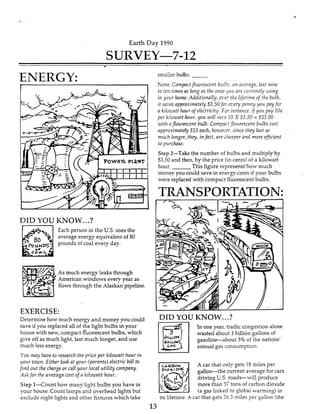
ENERGY:
DID YOU KNOW...?
' -
Each person in the US. uses the
average energy equivalent of 80
pounds of coal every day.
As much energy leaks through
American windows every year as
flows through the Alaskan pipeline.
EXERCISE:
Determine how much energy and money you could
save if you replaced all of the light bulbs in your
house with new, compact fluorescent bulbs, which
give off as much light, last much Ionger, and use
much less energy.
Yori may haae to research the price per kilowatt hour in
vow town.Either lookat your (parents)electric bill to
hncl out the charge or call your local utility company.
A& for the averagecost of a kiiozuatfhour.
Step I-Count how many light bulbs you have in
vow house. Count lamps and overhead lights but
&clude night lights and other fixtures which take
1
smaller bulbs.
Note: Compnctjfuorescent b x l k ,on ricerage, iast nine
fo ten times as long as fheones ?ori are currenfly using
in yorir home. Additionally, OZ'U fheiifeetime of the buib,
it smes approximately $3.50for Ken! penny yo11pay for
a kilowatt how ojelectricify.FJr instance, if ;oil pay ZOe
per kriouwtt hour, you mill sa;'? I O XS3.50 = S35.00
with a flourescent bulb. Compact lori ire scent briibs cost
approximately515 each, hoicczr, since they iast so
much longer, they, in fact, are circaperand more e,@cient
to purchase.
Step 2-Take the number of bulbs and multiply by
$3.50 and then, by the price (incents)of a hlowatt
hour. This figure represents-how much
money you could save in enersy costs if your bulbs
were replaced with compact fluorescent bulbs.
TRANSPORTATION:
DID YOU KNOW...?
In one year, traffic congestion alone
wasted about 3 billion gallons of
gasotine-about 3%of the nations'
annual gas consumption.
A car that onIy gets IS miles per
driving L.S. roads-will produce
more than 57 tons of carbon dioxide
(a gas linked to $obal warming) in
its lifetime.A car that gets 33.5 miles per Sallon (the
gallon-the current average for cars
.3
I
standard set for 1989 automobiles)will emit 20 tons
less.
EXERCISE:
Calculatehow efficiently your family uses energy
for its daily transportation needs. For the purposes
of this exercise, we will focus on the miles per
gallon (mpg)figure.
Step I-Idenhfy how the
various members of your
family get to and from
work and/or schooI.
Who takes the bus?
Subway? Does anyone
carpool? Who travels by
themselves in a car?You
will interview each,or as
many people as possible
in your family to find out
their PMPG (Personal
Miles Per GaIIon).PSlPG
is a way of seeing how
efficiently we travel. People who get the most out of
their fuel have high PMPG’s.Those of us who are
gas guzzlershave low PbIPG’s!To find out how
your family rates, go on to Step 2.
Step 2 -To determine the PMPG for those mem-
bers of your family who travel by car, find out how
many miles per gallon (mpg’s) each car in your
familygets. If you don’t know this information, ask
a parent or guardian. (also,see Bonus Question,
below) If the person(s1who drive travels alone,
then their PMPG figure is the same as the figure for
the car. However, if they carpool, then multiply the
car‘s mpg figure by the number of passengers in the
car. This figure represents the PMPG for each
person in the car.
For example:if one of your parents drives to work
with two other people in a car that gets 25 miles per
gallon, then each person in the car is getting 75
miles per gallon. Each person has a PMPG of 75.
Step >Determine the PMPC figures for those
members of your family who use mass transit.
Buses, on average, get 4 miles per gallon. Subways
get, on average, 1.5mpg. Commuter trains get ap-
proximately 1.25mpg (all figures caIculated for
gasoline).To calculate the PMPG for people who
take mass transit, ask them how many people
usually ride the bus or subway. If they are unavail-
able, simply estimate the number of people that ride
the bus or subway with them. lLlultiply that figure
by the mpg figure for the bus, train, or subway. The
product, as in the carpool example,gives you the
PMPG figure for these people. For example, if a bus
gets 5 mpg and 44l people ride it to school in the
morning, each person is getting 200 d e s per
gallon.
Family Member Form of Transportation Personal MPG
Step M o m p a r e the PMPG ratings of your family
members. CircIe the ones with the highest and
lowest PMPG ratings. The person with the highest
rating uses energy most efficiently.
Note: If you or your parents bike or walk to work or
-gchoolthen you are PMPG superstars and off our
scale!
BONUS EXERCISE:
You can find out the mpg rating of your familiescar
by looking up the mode1and year in Consumer
Reportsjournals. The mpg figure listed in these
reports are not the most accuratebecause they
represent the mpg’s of new cars. If you want to
figure out the exact mpg of the carts)in your family,
divide the miles the car(s)itself travels between fill-
ups by the number of gallons of gas you put in at
the second fill-yp. Calculate the PMPC’s of family
members who drive after you have discovered this
accurate figure.
14
SOLID WASTE/
RECYCLING:
DID YOU KNOW...?
Every year, we throw away 28
billion glass bottles and jars-
enough to fill the twin towers of
New York‘s World Trade Center
every two weeks.
MD.’
Recycling a ton of paper save 13
trees, prevents 3 cubic yards of
waste paper (enough to fill a
large pick-up truck) from going to
the dump, and uses 64 ‘3 less
energy than manufacturing
paper from wood pulp. .,
EXERCISE:
Determine how much your family could save in the
course of a year through recycling aluminum cans
and glass bottles.
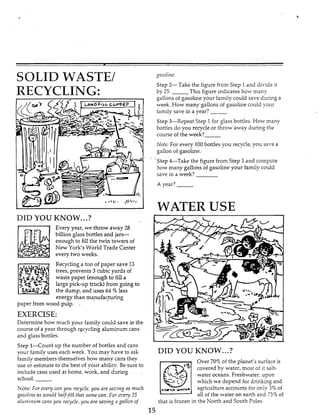
Step l-Count up the number of bottles and cans
vour familyuses each week. You may have to ask
family members themselves how many cans they
use or estimate to the best of your ability. Be sure to
include cans used at home, work, and during .
school.
Note: For every can yoii recycle, you Lire sazing ns much
gasoline as cuould half-fill that Same can. For c e r y 3
irlriminiim cans you recycle,yori are saving gallon of
gasoline.
Step 2-Take the figure from Step 1and divide it
by 25. This figure indicates how many
gallons of gasoline your family could save during a
week. How many gallons of gasoline could your
family save in a year?
Step %Repeat Step 1for glass bottles. How many
bottles do you recycle or throw away during the
course of the week?
Note: For every 100bottles you recycle,you save a
gallon of gasoline.
‘Step &-Take the figure from Step 3 and compute
how many gallons of gasoline your hmily could
save in a week?
A year?
WATER USE
DID YOU KNOW...?
Over 70% of the planet’s surface is
covered by water, most of it salt-
water oceans. Freshwater, upon
piwhich we depend for drinkmg and
agriculture accounts for only 3% of
all of the water on earth and 75% of
that is frozen in the North and South Poles.
F,ztS)r
c
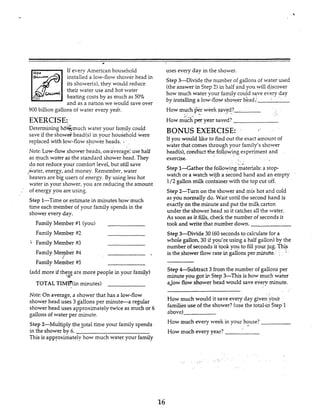
If every American household
installed a low-flow shower head in
its shower(s1,they would reduce
their water use and hot water
' &uuM
heating costs by as much as 50%
and as a nation we would save over
uses every day in the shower.
Step &Divide the number of gallons of water used
(theanswer in Step 2) in half and you will discover
how much water your family could save every day
by installing a low-flow shower h&ad,'
900 billion gallons of water every ye&-.
EXERCISE:
How much per week saved?
How mu& per year saved?
I '
BONUS EXERCISE:Determining h6Gmuch water your family could
save if the show& head(s)in your household were
replaced with low-flow shower heads. . If you would like to find out the exact amount of
water that comes through your family's shower
Note: Low-flow shower heads, owaverage: use half
as much water as the standard shower head. They
head(s),conduct the folkwing experiment and
exercise.
do not reduce your comfort level,but still save
,.&water, energy, and money. Remember, water
heaters are big users of energy. By using less hot
water in your shower, you are reducing the amount
Step l-Gather the following materials: a stop-
watch or a watch wifha second hand and an empty
1/2 gallon milk container with the top cut off.
,. of energy you are using. Step 2-Tum on the shower and mix hot and cold-
as y"u normally do. Wait until the second hand is
exactlyon the minute and put the milk carton
under the shower head so it catchesall the water.
As soon as it fills,check the number of seconds it
Step 1-Time or estimate in minutes how much
time each member of your family spends in the
shower every day.
Family Member #l(you)
Family Member $2
Family Member $3
Family Member W
Family Member $5
took and write that number down.
Step +Divide 30 (60 seconds to calculatefor a
whole gallon, 30 if you're using a half gallon) by the
number of seconds it'took you to fillyour jug. Th$
is the shower flow rate irc gallons per,mlrte. ,
I
Step &Subtract 3 from the number of gallons per
minute you got ir!Step>-This is how much water
aJow Row shower head would save every minute.
(add more if thezz are more people in your family)
-
TOTAL TIh.fF(inminutes)
Note:On average, a shower that has a low-fiow . ,
How much would it save every day given four
familiesuse of the shower?(usethe totaliin Step 1
i3bGVd
How much every week in your house?
How much every year?
shower head uses 3 gallons per minute-a regular
shower head uses approximately twice as much or 6
gallons of water per minute.
Step 2-Multiply the total time your family spends
in the shower by 6.
This is approximately how much water your family
16
F A C T S H E E T
Global Warming
Tnisfacfsheet UXISprepared wifhthe
assistance of the World Resources Insti-
tute. Gus Speth, W ' s President, isa
member of Earth Day 1990's Board of
Directors.
W h a tIs Global Warming?
Over the past century, the human
species has turned the Earth into one
huge unplanned experiment. By
releasing unprecedented amounts of
greenhouse gases (carbondioxide,
methane, chlorofluorocarbons, nitrous
oxide and gases that create tropo-
spheric ozone)into the atmosphere, we
have in effect, turned up the global
thermostat. Greenhouse gases act in a
fashionsimilar to the windshield of a
car parked in the sun, allowing light-
energy to pass through, but then
trapping the re-emitted heat. The
greenhouse effectoccurs naturally and
without it the Earth would be ice-
covered and uninhabitable. However,
over the past century, human practices
have led to an increased buildup of
greenhouse gases.
Scientistsalready have detected a 1
degree F temperature rise, which may
be due to the greenhouse effect. They
predict a further increaseof between 4
arid 9 degrees F by the middle of the
next century if greenhouse gasemis-
I
sions grow at expected rates. The 6
warmest years of the century have
been in the 1980s,with 1987and 1988
being the hottest on record. As
world population and fossilfuel use
grow, greater quantities of green-
house gases will be released into the
atmosphere. Although the U.S.has
only 5percent of the world's popula-
tion, we are responsible for 25
percent of the carbon dioxidethat is
released from burning fossil fuels.
Carbon dioxide (which accounts for
approximately half of the global
warming trend), nitrous oxideand
troposphericozone are by-products
of burning fossil fueis (coal, oil and
gas)and wood. It is important to
note that burning natural gas releases
70 percent as much carbon dioxide per
unit of energy as oil, and half that of
coal. Forests and oceans are natural
sinks for carbon dioxide, but are
unable to absorb the quantities cur-
rently being emitted. Deforestation
releaseslarge quantitiesof carbon
dioxide as well as methane, carbon
monoxide, ozone and nitrous oxide.
Methane, which accounts for 18per-
cent of the greenhouseeffects,also is
produced by swamps, cattle, rice pad-
dies, landfills, termites, swamps and
fossil fuels. Chlorofluorocarbons
(CFCs),used in refrigerators and air
conditioners, as foam blowers, as
circuit board cleaners and as aerosol
propellants, account for 17percent of
the greenhouse effect.
Scientistspredict that asglobal tem-
peratures rise, lifeon Earth will facea
seriesof potentially disastrous threats.
Precipitation will decline in some
areas, leading to crop failure and ex-
panding deserts. Elsewhere, rainfall
will increase,causing flooding and
erosion. Changes in habitat could lead
to mass extinctions of plants and
animals that are unable to migrate to
more compatibIeclimates. And sea
levels will rise, flooding coastalareas
and causing salt water intrusion into
coastal aquifers.
"Global warming is one of the gravest threats facing our planet. The
buildup of carbon dioxide and other heat-trapping gases in the at-
mosphere threatens far-reaching climatic change. Although there is
increasing awareness that our environmental problems are very
serious, only modest efforts have been launched to deal with them.
Earth Day 1990 offers an opportunity for unprecedented individual
action as well as national and international efforts on a scale equal to
today's challenges."
-Gus Speth, President,World Resources Institute
nighways and parking lots for auto- Can DO For proper driving and mainte-
mobiles, and hvo-thirds of LOSAnge- nance:- - If your car has an air condi-
tioner, make sure the CFG are
recycled anytime it is serviced
and before the car is scrapped.
- Have your car smog checked
and install pollution-control
equipment if necessary.
- Keep your car tuned up and
the tires properly inflated.
- Call ahead before shopping
and consolidate errands.
- Avoid quick accelerationand
deceleration and keep your
speed Cnder 60.
- Avoid "drive-through" lines
where your car engine must
idle for long periods.
- Recycleused motor oil,
transmission fluid, brake fluid
and antifreeze.
- Tum in your old battery when
you buy a new one.
Walk or bike for doseerrands.es is paved.
Arrange for a carpool with your co-
The Solution workers.
Use public transportation when-
Raising the fuel efficiencystandard for ever possible.
automobiles will cut down on air pol- If iVs reasonable, ask your em-
Luhon by requinng less gasoline to be ployer to allow you to work at
burned per mile dnven. There are home one or twodays a week.
already cars on the market that get 50 Encourage your employer to offer
miles per gallon or more. Converting a financial incentive in place of a
segments of our transportation system parking permit.
to cleaner burning fuels, such as Take a job close to your home or
compressed natural gas, methanol and move closer to your place of work.
ethanol, may also improve air quality. Enjoy local recreahonal activities
However, methanol is a questionable rather than traveling long distances
fuel because when it is derived from forentertainment.
coal it releases twice as much carbon Urge your local officialsto improve
dioxide as oil. Furthermore, altema- and promote public transportation,
tive fuels do not address the problem carpooling programs and bicycle
of trafficcongestion and highway lanes.
expansion. The true solution to our Write your elected officialsand
transportation problem lies with urge them to support legislation to
improvements in public transportation raise the fuel effiaency standard
and carpooling programs, and in- for automobiles and to put funding
creased interest in biking and walking. towards public transportation
rather than highway expansion. WorldwatchInstitute
According to the American Public If you are buying an automobile, 1776MassachusettsAve., N W
Trans1t Association,commuting on consider a model that: Washington, DC 20036
hydrocarbon emissions that produce least 35 miles per gallon). American PublicTransit
smogby 90 percent, carbon monoxide - Doesn't have an air condi- Association
emissionsby more than 75 percent,
and nitrogen oxides emissions by u p
to 75 percent. Despite these impres-
sive figures,only one penny of the Environmental Action
nine cents per gallon federal gasoline
tax is used to improve mass transit.
RaiIwav Ace maeazine points out that
a single highway lane can accommo-
date 2,250 people per hour in automo-
biles, 9,000 in buses, 15,000on a light
rail line and 34,000 people per hour on
a heavy rail line. The newest French
train is capable of traveling at a speed
of more than 180miles per hour while
saving energy and providing a safe,
For More Inf OlWIation
mass transit in place of driving cuts - Gets good gas mileage (at (202)452-1999
tioner.
- Has radial tires with a high
tread rating for longer use.
1201New York Ave., NW, Suite 400
Washington, DC 20005
(202)898-4000
1525New Hampshire Ave., NW
Washington, DC 20036
(202)7454870
National AssociationofRailroad
Passengers
236 Massachusetts Ave., NE
Suite603
Washington, DC 20002
(202)546-1550
Sierra Club
730 Polk St.
San Francisco,CA 94109
comfortable ride. (415) 776-2211
P.O. BOX A A STANFORD,CA 94309(415) 321-1990
f i a t You CanDo
Cut down on your energy con-
sumption by using energy more ef-
ficiently. Someutility companies
offer free home energy audits and
may even provide cost-freeinstalla-
tion of energy efficient devices.
Toconsene energy, buy products
in recyclable containers and recycIe
or reuse them.
Plant at least one tree per year and
nurture it until it is able to survive
on its own. Trees absorb carbon
dioxide and shade buildings.
Urge your local g o v e m e n t to
come up with a pian to encourage
public transportation, carpooling,
biking and walking.
Write elected offiaals urging them
to supportlegislation promoting
energy efficiency and renewable
energy (soIar, wind and geother-
mal).
fumace,consider a model that op-
erates on natural gas.
PreventCFCsfrombeing released
into the atmosphereby immediately
repairing leaks in your refrigerator
and car air conditioner and making
sure the CFG are recycIed when
the units are serviced or scrapped.
Promote familyplanning world-
wide.
When purchasingan oven or
Energy ConsemationEps
TRANSPORTATION:
Use public transportation, carpool,
bike or walk.
Purchase a car with high gas
mileage (atleast 35 mpg).
Keep your car tuned up and run-
ning well.
Cut down on unnecessary driving
by living close to your place of
work, callingahead before shop
' ping and consolidating errands.
4
Avoid "drivethrough" lines where
your car engine must idle for long
periods.
INTHE HOME:
Heating and Cooling(70% of typiCal
energy use insingle-family residences):
Insulate and weatherstrip your
house.
Install a "time-ofdaf' thennostat to
avoid unnecessary operation.
Install double-paned windows and
draw curtains at night. In colder
climates install storm windows and
insulating shades or shutters.
Closedoors to room seldom used
and turn off the heat or air condi-
tioning in these areas.
WaterHeater (20% ofhousehold ~ r g y ) :
Insulate hot water heater and
storage tank, including piping.
Set water heater no higher than 120
degrees F. Mostdishwashersneed
140degrees F, soyou may need a
preheater.
blinimize hot water use (forex-
ample, take showers rather than
baths and use water-efficientshow-
erheads).
Install a solar heating system.
Appliances (10%ofhousehold energy):
Turn off appliances whe9 not in
Replace incandescentbulbs with
e When purchasingan appliance,
use.
screw-in compact fluorescentbulbs.
compare energy-use information
and shop for efficiency.
Wash cIothes in cold water.
Dry clothes in the sun.
€or More InformationJ
World Resources Institute
1709New York Ave., NW
Washington, DC 20006
(202)638-6300
Environmental Defensi?Fund
257 ParkAve. S
New York, NY 10010
Friends of the Earth
218DStreet, SE
Washington, DC 20003
(202)544-2600
NationalAuaubon sodety
950Third Ave.
New York, M 10022
NationalWildlifeFederation
140016thSt., NW
Washington,DC 20036
(703)790-4321
NaturalResourcesDefense
council
122E. 42nd St.
New York, NY 10168
PublicCitizen
215PennsylvaniaAve., SE
Washington,DC 20003
(202)546-4996
SierraClub
730PoIkSt.
SanFrancisco,CA 94109
(415)776-2211
Union of Concerned Scientists
26ChurchSt.
Cambridge,MA 02238
(6i7:547-5332
WorldwatchInstitute
1776MassachusettsAve.,Nw
Washington,DC 20036
(202)452-1999
World WildlifeFund
125024thSt., NW
Washington,DC 20037
(202)2934800
Zero PopulationGrowth
142016thStreet, NW,Suite320
Washington,DC 20036
(212)505-2100
(202)832-3200
(212)727-2700
(202)332-2200
P.O. BOX AA. STANFORD.CA 94309(415) 321-1990
-
F A C T S H E E T
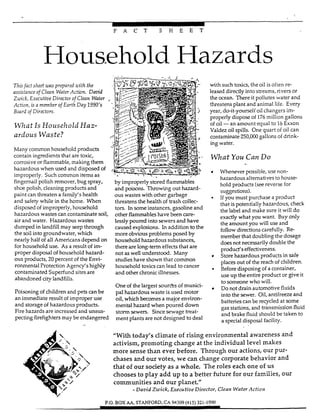
Household Hazards
Thisfact she-4 ux7-sprepared uith the
assistanceof Clean WaterAction. Dmid
Ziuick,ExecutiveDirectorof Clean Wafer
Action, isa memberofEarth Day 1990's
Board of Directors.
W h a tIs Household Haz-
ardous Waste?
Many common household products
contain ingredients that aretoxic,
corrosive or flammable, mabng them
hazardous when used and disposed of
improperly. Such common items as
fingernail polish remover, bug spray,
shoe polish, cleaning products and
paint can threaten a famiifs health
and =fey while in the home. When
disposed of improperly, household
hazardous wastes can contaminate soil
air and water. Hazardous wastes
dumped in landfill may seep through
the soil intogroundwater, which
nearly half of all Americans depend on
for household use. As a result of im-
proper disposal of household hazard-
ous products, 20 percent of the Envi-
ronmental Protection Agency's highly
contaminated Superfund sites are
abandoned city landfills.
Poisoning of children and pets can be
an immediate result of improper use
and storage of hazardous products.
Fire hazards are increased and unsus-
pecting firefighters may be endangerec
-
by improperly stored flammables
and poisons. Throwingout hazard-
ous wastes with other garbage
threatens the health of trash collec-
tors. In someinstances, gasoline and
other flammableshave been care-
lesslypoured into Sewersand have
caused explosions. In addition to the
more obviousproblems posed by
household hazardous substances,
there are long-term effects that are
not as well understood. Many
studies have shown that common
household toxicscan lead to cancer
and other chronicillnesses.
One of the largest sourks of munici-
pal hazardous waste is used motor
oil, which becomes a major environ-
mental hazard when poured down
storm sewers. Sincesewage treat-
ment plants are not designed to deal
with such toxics, the oil is often re-
leased directly into streams, rivers or
the ocean. There it pollutes water and
threatens plant and animal life. Every
year, do-it-yourself oil changers im-
properly dispose of 176million gallons
of oil -an amount equal to 16Exxon
Valdez oil spills. One quart of oil can
contaminate 250,ooO gallons of drink-
ing water.
W h a t You Can Do
Whenever possible, use non-
hazardous alternatives to house-
hold products (seereverse for
suzestions).
If you must purchase a product
that is potentially hazardous, check
the label and make sure it will do
exactly what you want. Buy only
the amount you will use and
followdirections carefully. Re-
member that doubling the dosage
does not necessarilydouble the
product's effectiveness.
Store hazardous products in safe
places out of the reach of children.
Before disposing of a container,
use up the entire product or give it
to someone who will.
Do not drain automotive fluids
into the sewer. Oil, antifreeze and
batteries can be reqcled at some
"eas stations, and transmission fluid
and brake fluid should be taken to
a special disposal facility.
"With today's climate of rising environmental awareness and
activism, promoting change at the individual level makes
more sense than ever before. Through our actions, our pur-
chases and our votes, we can change corporate behavior and
that of our society as a whole. The roles each one of us
chooses to play add up to a better future for our families, our
communities and our planet"
-David Zwick, ExecutiveDirector, Clean WaferAction
P.O.BOXAA.STANFORD.CX94309(415) 321-1990
f i a t You Can Do
*Cutdown on your energy con-
sumption by using energy more ef-
ficiently. Someutility companies
offer free home energy audits and
may even provide cost-free instalIa-
tion of energy efficientdevices.
To conserve energy,buy products
in recyclable containers and recycle
or reuse them.
Plant at least one treep r year and
nurture it until it is able to survive
on its own. Trees absorb carbon
dioxide and shade buildings.
Urge your local government to
come up with a plan to encourage
public transportation, carpooling,
biking and walking.
Write elected officialsurging them
to support legislationpromoting
energy efficiency and renewable
energy (solar,wind and geother-
mal).
furnace, consider a model that o p
erates on natural gas.
Prevent CFCsfrombeing released
into the atmosphereby immediately
repairing leaks inyour refrigerator
and car air conditioner and making
sure the CFGare recycled when
.the units are serviced or scrapped.
Promote familyplanning world-
When purchasingan oven or
wide.
Energy Conservation Eps
TRANSPORTATION.
Use public transportation, carpool,
bike or walk.
Purchase a car with high gas
mileage (at least 35 mpg).
Keep your car tuned up and run-
ning well.
Cut down on unnecessary driving
by living close to your place of
work, callingahead before shop-
ping and consolidating errands.
Avoid “drive-through” lines where
your car engine must idle for long
periods.
IN THE HOME
Heating and Cooling(70% of fypical
energy use insingle-family residences):
Insulate and weatherstrip your
house.
Install a ”time-ofdaf’ thermostat to
avoid unnecessary operation.
Install double-paned windows and
draw curtains at night. In colder
climates instau storm windows and
insulating shades or shutters.
Close doors tormms seldom used
and turn off the heat or air condi-
tioning in these areas.
Wafer Heafer (20%ofhousehold energy):
InsuIate hot water heater and
storage tank, incIudingpiping.
Set water heater no higher than 120
degrees F. Mostdishwashersneed
140degrees F, so you may need a
preheakr.
Minimizehot water use (forex-
ample, take showers rather than
baths and use water-efficient show-
erheads).
Install a solar heating system.
Appliances (10% ofhouseholdenergy):
Tum off appliances whe9 not in
Replaceincandexentbulbs with
W h e ~pwchasing afiappliance,
use.
screw-in compact fluorescentbulbs.
compareenergy-use information
and shop for efficiency.
Wash clothes in cold water.
Dry clothesin the sun.
For More Information
World ResourcesInstitute
1709 New YorkAve., NW
Washington, DC 20006
(202)638-6300
Environmental DefenseFund
257 Park Ave. S
New York, NY 10010
(212)505-2100
Friendsof theEarth
218 D Street,SE
Washington, DC 20003
(202)544-2600
NationalAdubon sodety
950Third Ave.
New York, NY 10022
(202)832-3200
NationalWildlifeFederation
140016thSt., NW
Washington,DC 20036
(703)790-4321
Natural ResourcesDefense
council
122E. 42nd St
New York, NY 10268
PublicCitizen
215Pennsylvania Ave., SE
Washington, DC 20003
(202)546-4996
SierraClub
730Polk St.
SanFrancisco,CA 94109
(415)776-2211
Unionof Concernedscientists
26ChurchSt.
Cambridge,MA 02238
$33547-5552
WoridwatchInstitute
1776MassachusettsAve.,W
Washington,DC 20036
World Wildlife Fund
125024th St., NW
Washington, DC 20037
(202)2934800
Zero PopulationGrowth
142016thStreet,NW,Suite320
Washington,DC 20036
(212)727-2700
(202)452-1999
(202)332-2200
P.0. BOX AA. STANFORD,CA 94309(415) 321-1990
~
F A C T S H E E T
Household Hazards
Thisfactshetrt wa5 prepared zifhthe
assis:arue of Clean WatcrAction. David
Z-uick, Executive Director of Clean Water ,
Action,isa member of Earth Day 1990s
Bcurd of Direcfors.
What Is Household Haz-
ardous Waste?
Many common household products
contain ingredients that are toxic,
corrosive or flammable, making them
hazardous when used and disposed of
improperly. Such common items as
fingernail polish remover, bug spray,
shoe polish, cleaning products and
paint can threaten a familfs health
and safety while in the home. When
disposed of improperly, household
hazardous wastes can contaminate soil,
air and water. Hazardous wastes
dumped in landfill may seep through
the soil into groundwater, which
nearly half of all Americans depend on
for household use. As a result of im-
proper disposal of household hazard-
ous products, 20percent of the Envi-
ronmental Protection Agency's highly
contaminated Superfund sites are
abandoned city landfills.
Poisoning of children and pets can be
an immediate result of improper use
and storage of hazardous produds.
Fire hazards are increased and unsus-
pecting firefighters may be endangered
-
with such toxics, the oil is often re-
leased directly into streams, rivers or
the ocean. There it pollutes water and
threatens plant and animal life. Every
year, do-it-yourself oil changers im-
properly dispose of 176million gallons
of oil -an amount equal to 16Exxon
VaIdez oil spills. One quart of oil can
contaminate 250,OOO gallons of drink-
ing water.
-
j
.
a - W h a t You Can Do
-
Whenever possible, use non-
hazardous altematives to house-
hold products (seereverse for
suggestions)-
If you must purchase a product
that is potentially hazardous, check
the label and make sure it will do
exactly what you want. Buy only
the amount you will use and
followdirections carefully. Re-
member that doubling the dosage
does not necessarily double the
product's effectiveness.
Storehazardous products in safe
places out of the reach of chiIdren.
Beforedisposing ofa container,
use up the entire product or give it
by improperly stored flammables
and poisons. Throwingout hazard-
ous wastes with other garbage
threatens the health of trash collec-
tors. In someinstances, gasoline and
other flammableshave been care-
lessly poured intosewersand have
caused explosions. In addition to the
more obvious problems posed by
household hazardous substances,
there are long-term effects that are
not aswell understood. Many
studies have shown that common
househoId toxicscan lead to cancer
and other chronic illnesses.
*
.
to someone who will.
Do not drain automotivefluids
into the sewer. Oil, antifreeze and
batteries can be recycled at some
gas stations, and transmission fluid
and brake fluid should be taken to
a specialdisposal facility.
One of the largest sourcks of munici-
pal hazardous waste is used motor
oil, which becomes a major environ-
mental hazard when poured down
stormsewers. Sincesewage treat-
ment plants are not designed to deal
"With today's dimate of rising environmental awareness and
activism, promoting change at the individual level makes
more sense than ever before. Through our actions, OUT p u -
chases and our votes, we can change corporate behavior and
that of our society as a whole. The roles each one of US
chooses to play add up to a better future for our families, OUT
communities and OUT planet"
- David Zwick, Executive Director, Clean Water Action
If a hazardous product cannot be "
used up or recycled, take it to a
hazardous waste disposal faality.
Check with your local fire depart-
ment to find out if such a service is
available locally.
Avoid disposable products when-
ever possible. rlastics and poly-
styrene (Styrofoam)are manufac-
tured using extremely hazardous
chemicals, and if they are inaner-
ated release toxics into the air.
lhouse well ventilated.
Batteries (Use rechargeable baneries.
Chlorine bleacn lUse dry bleach or borax.
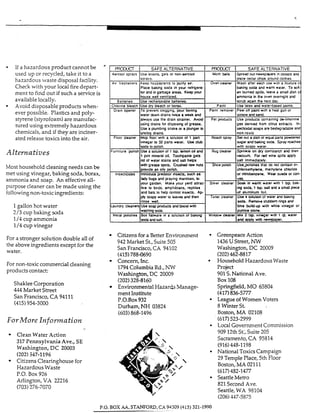
Alternatives
ammnia in the oven overntght and
scrut~aqain me next dav.
Paint [use latex and wateraasa Dams.
Most household cleaning needs can be
met using vinegar, baking soda, borax,
ammonia and soap. An effective all-
purpose cleaner can be made using the
followingnon-toxic ingredients:
water dcwn drains hnca a week and
always use Ihe dram strainer. Avoid
using drains for dispowng of grease.
IUse a Numbing snake or a Nunper b
1gallon hot water
2/3 cup baking soda
1/4 cup ammonia
1/4 cup vinegar
scrarx,andsand
Use products containing &-limonine
gas &rwed from a m extracts. In-
sectiodal soaps am bodegradableand
Pet prodms
For a stronger sohtion double all of
the above ingredients except for the
water.
Roar deaner
:urniture polish
For non-toxic commercial cleaning
products contact:
. .
unclog drains. non-toxlc
Mop Hoor WUI a soluuon ot t pan
vinegar to 32 pans water. Use dub
soda IOwlish.
Use a solution of 1 trp. lemon oil and
1 pint mineral oil. Toothpaste gets
rid of water stains and salt helps
with grease spots. Crushad raw nuts
Roamspay Sei out a dish ot ecpa pans powderad
SWar M d baking sodk %ay WathES
with soaov water.
Sprinkle on dty mmstarCn and then
vwum. For rod vine spills apply
salt h"diately.
Usegolisnes that 0 not contain tri-
Rug deaner
Shoe polsh
ShakleeCorporation
444 Market Street
San Francisco, CA 94111
(415)954-3000
aunory cleaners
Mela! poJisher
For More Information
lady bugs and praying mandsus. b
your garden. Make your yard anrac-
live lo birds. amphbians. reptiles
and bats to help mmrol insectf. A p
phl soapy water to leaves and then
rinse well.
Use map products and boost W&I
Bad tlaware in a salmon ot bakmg
soda and salt.
VaS.
Siber deaner Soak in warm water wrth 1 Up. bak-
ing soda. 1tsp.sal! anda mait piece
of aluminum 1011.
Toilet cteaner Use a s o l u m ot water ar.~baktng
sub. Remove s t u t b m r q s and
llme build-up with vhite vinegar or
washingso&. pumice S".
WIMOW cleaner Mix 2 tsp. VIMQV wim 1 a. water
and m@ywith r " r .
-
Clean Water Action
317 PennsylvaniaAve., SE
Washington, DC 20003
(202) 547-1196
Citizens Clearinghouse for
Hazardous Waste
P.O. Box 926
Arlington, VX 22216
(703)276-7070
PRccuCTl SAFE ALTERNATIVE I P R X U C T I SAFE ALTERNATlVE
Aerosol sprays lUse btions. gels or non-aerosd 1 Moth balk ISptead wt n- in dosets a~
soravs. I Iplace oedar Chim m n d cbthes.
Air fresneners Keep houseplants IO mniy au. Oven 08m IWasn afier e m use w i n a m i x " o
Ichbroethylene. methylene chknde
Ior nrtrobenzene. WEW suede or can-
lprwide an oily Dolish.
lnseaicides llnlroducepedator insects. such as
Citizens fora Better Environment
942 Market St., Suite 505
San Francisco, CA 94102
(115)788-0690
1794Columbia Rd., NW
Washington, DC 20009
Concern, Inc.
(202)328-8160
Environmental Hazards Manage-
ment Institute
P.O.Box 932
Durham, NH 03824
(603)868-1496
Greenpeace Action
1436U Street, NW
Washington, DC 20009
Household Hazardous Waste
Project
901S.National Ave.
Box 108
SpringfieId,A40 65801
Leagueof Women Voters
8 Winter St.
Boston, MA 02108
Local Government Commission
909 12th St.', Suite 205
Sacramento,CA 95811
National Toxics Campaign
29 Temple Place, 5th Floor
Boston, MA 02111
SeattleMetro
821Second Ave.
Seattle,WA 98104
(202)462-8817
(417)836-5777
(617)523-2999
(916)448-1198
(617)452-1477
(206)447-5875
P.O. BOX U,STANFORD.CX 94309 (415) 321-1990~~~~ ~
-
I
F A C T S H E E T
Population Growth
Thisfact sheet cas prepared zuifhthe
assistance of Zero Population Growth.
Susan LVeber, ExecufiveDirector of ZPG,
is a mmber of Earth Day 1990's Board of
Direct0rs.
V f l z y is Population Growth
an EnvironmenfalIssue?
The size of the human population
affects virtually every environmental
condition facing our planet. As our
population grows, demands for
resources increase,leading to pollution
and waste. More energy is used,
escalating the problems of global
warming, acid rain, oil spills and
nuclear waste. More land is required
for agriculture, contributing to defores-
tation and soil erosion. More homes,
factories and roads must be built, occu-
pying habitat lost by other species that
share the planet, often leading to their
extinction. Simply put, the more
people inhabiting our finite planet, the
greater the stress on its resources.
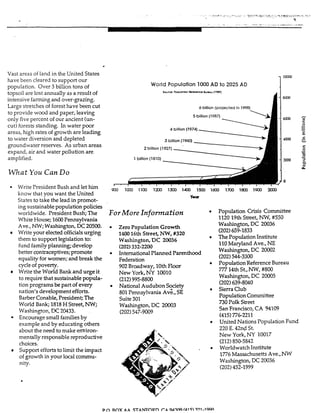
It took from the beginning of time to
about the year 1810for the human
population to reach 1billion people.
Just more than 100years passed before
the next billion were added, and the
population doubIed again to 4 billion
people by 1974. By 1987,Earth was
home to 5 biiiion human beings, and
Contrary to some people's belief, the
population explosion has not stopped.
In 1990we expect to add another 95
million people to the Earth, more than
in any previous year. At this rate, the
world's population would easily
surpass 10billion and could exceed 14
billion people late in the next century.
No realizable amount of improvement
in agriculture, pollution control, en-
ergy efficiencyor other areas would be
able to keep up with this pace of
growth. Today%5.2 billion humans is
already more than our planet can
handle.
this number isgrowing. If the global
Wuulation continues to increaseat Population Growtlz in theI .
the current rate of 1.8percent annu-
ally, it will doubIe again in just 39
years.
pOpu1UtiOfland SUStaiYta-
bility
United States
The major consumers of the Earth's
resources are the developed countries,
such as the United States. While these
countries contain less than 20 percent
of the world's people, they consume 80
A society is not sustainable when it
consumes renewable resources faster
than they can be replenished. In
other words, an overpopuiated
society clears forests and uses water
supplies faster than they.jtre re-
newed, or pollutes faster khan the en-
vironment can adapt to sustain life.
By these measures, the U.S.and most
othm nations of the world are over-
populated.
percent of its resources. Although the
United States is home to just five
percent of the human population, we
use one quarter of the total energy.
The current population of the United
States is about 250 million people. At
the current rate of growth we are ex-
pected to add 60 milIion more people
in the next 50years -210 times as
many people as now live in Boston.
"Overpopulation does not happen only in the Third World.
Each year, the U.S.adds the equivalent of another Los Artgeles
to its population. In just 35 years, the industrialized nations
together will add another U.S.for the Earth to support. The
future depends on o w putting the brakes on now."
-Susan Weber, Executive Director, Zero Population Growth
P.O. BOX AA. STANFORD,CA 94309(415) 321-1990
P
Vast areas ofland in the United States
population. Over 3 billion tons of
intensive farming and over-grazing.
Large stretches of forest have been cut
to provide wood and paper, leaving
only fivepercent of our ancient (un-
cut)forests standing. In water poor
areas, hgh rates of growth are leading
groundwater reserves. As urban areas
expand, air and water pollution are
amplified.
have been cleared to support our
topsoil are lost annually as a result of
loax,
World Population locW AD to 2025 AD
SzWLx RmuPllon lhlaelrC.3 eulea" (loep1
6 billion (projectedin 19%)
6 o o O z
C
0
----
E
to water diversion and depleted 4 m g
m 2
C
0-'6-
0
P
W h a t You Can Do
0
WritePresidentBushandlethim sw ,m,l,M ,a30 1300 14x3 1~ lcoo ,7a3 laoo lFa) 2023
know that you want the United
States to take the Iead in promot-
ing sustainable population policies
worldwide. President Bush; The ForMore hformation Population Gisis Committee
White House; 1600Pennsylvania
Ave., Nw;Washington, Dc 20500. ZeroPopulation Grow&
Write your elected officialsurging
them to support legislation to:
better contraceptives; promote International Planned Parenthood
equality for women; and break the Federation
cycleof poverty. 902Broadway, 10thFloor
Write the World Bank and urge it New York, NY 10010
to require that sustainable popula- (212)995-8800
tion programs be part ofevery National Audubon society
nation's developmentefforts. 801Pennsylvania A&, SE
BarberConable, President; The Suite 301
World Bank; 1818H Street, NW; Washington, DC 20003
Y-
112019th Street, NW,#550
Washington, DC 20036
(202)659-1833140016th Sheet, LW,#320
Washington, DC 20036
The Population Institute
110MaryIand Ave., NE
Washington, DC 20002
(202)544-3300
777'14thSt., NW, #800
Washington, DC 20005
(202)639-8040
fund family planning; develop (202)332-2200
Population ReferenceBureau
Sierra Club
Population Committee
730Polk Street
San Francisco, CA ?41@?
(415)776-2211
220 E. 42nd St.
New York, NY 10017
Worldwatch Institute
Washington, 2M33. (202)547-9008
Encourage small familiesby
United Nations Population Fundexample and by educating others
about the need to make environ-
mentally responsible reproductive
choices.
Support effortsto limit the impact
of growth in your local commu-
nity.
(212)850-5842
1776Massachusetts Ave., NW
Washington, K 20036
(202)452-1999
c
4
F A C T S H E E T
Recycling
Tnis fact sheet -mprepared with the
assistanceof the Institute for Local Self-
Reliance. Neil Seldman, President of the
lnstifutefor Local Self-Reliance, isa
member of Earth Day 7990's Enmron-
mental Adoisoy Coum'l.
Why Recycle?
Recyclingsaves energy, natural
resources and landfill space. In 1990,it
is projected that Americans tvill throw
away over 1million tons of aluminum
cans and foil, more than 11million tons
of glass bottles and jars, over 4 and a
half million tons of office paper, and
nearly 10million tons ofnewspaper.
Almost all of this material could be re-
cycled, cutting down on the environ-
mental damage caused by mining,
logging,and manufacturingraw
materials, whiIe decreasing the amount
ofgarbage being dumped. n e aver-
age Americangenerates 3 5 pounds of
garbage every day for a national total
of over
80 percent of this waste could be re-
cycled using existing technologies.
Global warming, add rain, and oil
spills are problems directly related to
our extravagant use of energy. Three
percent of our nation's energy is used
to produce packaging materials, such
as bottlesand cans. By recycling d ~ -
it ispossible to Save95
percent of the energy that it would
take to rn~~-~ufacturenew products
from raw materials. In other words,
throwing away an aluminum can
wastes as much energy as if the can
were half full of-line- Americans
throw away about 35billion d u d -
"-icans everyyea- Lf all these
C a n s were recycled, we would save
an amount of energy equivalent
150ExxonVaIdez oil spillsannually.
In 1988,Americans set an all time
highby recycling425 billion cans.
This alone saved enough energy to
Supply power for the CityOf Ebton
foronefull ye-.
For every ton of paper that is "I-
fzct.6rd fiOm rW,ded FUlp, 17
million tons per year. Over
aresaved and 3cubic yards of waste
paper avoid being landfilled. Since
paper comprises over 40 percent of our
municipal waste stream, recycling
could extend the lives of our existing
dumps considerably. For recycling to
work, however, it is important that
there is a market for the new product.
The US. uses about 40 percent of the
world's newsprint supply, yet only 14
percent of this paper is made from
recycled fiber. Recycled paper uses up
to 64percent lessenergy to manufac-
ture than virgin paper and produces
only one-quarter the air pollution.
At present, more newspapers are
recyded than recycled newsprint
bought, causing a glut in the market
for recycled newsprint. Barriers to
increased recyclinginclude federal
subsidiesto the timber industry that
make the price of virgin paper artifi-
ciallylow. A tax credit for those
manufacturers who use recycled
materials could offset this perverse in-
centive for using virgin materials. A
worldwide paper shortageis creating
opportunitiesfor community economic
development through s d l scale
paper manufacturing plants located
near the source of supply for waste
paper. For every million Americans
who recycle, some l,5Qomanufacturing
jobs are created.
'We are recycling not only to protect the environment, but for
economic reasons as well. Disposal issimply too costly and too
dangerous. The challenge is to redirect the flow of raw materi-
alsgoing to landfill into strengthening our declining local
economies. The solutionto pollution isself-reliant cities and
counties."
-Neil Seldman, President,Institutefor Loca2 Self-Reliance
P.O. BOX AA. STIWFORD,CA94309(415) 321-1990
What You Can Do Recycle all materials possible. Many
Reduce the amount of garbage you
generate by purchasing and using
products wisely.
'Trecycle" by purchasing p ~ ~ i -
ucts in recyclable containers, such
as aluminum, steel, glass, paper
and cardboard.
Purchase foodsin bulk or concen-
trate.
Avoid plastic and polystyrene
(Styrofoam)products that are nei-
ther reusable nor easily recyclabIe,
such as disposable diapers,
lighters, razors and plastic uten-
sils. (Plasticsmake up 25 percent
of our garbage by volume.)
Make two-sided photocopies.
Borrow items rather than buy
them.
Share magazine and newspaper
subscriptions with fnends.
Keep a cloth towel next to the sink
to be used instead of paper towels.
Reduce the amount of junk mail
you receive by contacting Direct
Market Association, 6 E. 43rd St.,
New York, NY 10017,(202)689-
4977.
Reuse products whenever ucssible.
Use products that are r k d e to be
used many times, such as cloth
diapers, cloth napkins, towels and
rags, sponges, dishes, silverware,
rechargeable batteries, etc.
Carry a coffee mug with you to
use in place of polystyrene cups.
Bring your grocery and produce
bags back to the supermarket and
reuse them.
Use the blank back sides of paper
to take notes and do scratch work.
Mend clothes and repair broken
appliances.
Take care of belongings to help
them last longer.
Lookinto purchasing used goods
at second hand stores and junk
yards.
communitieshave established pro-
grams to recyclealuminum, steeI,
@ass,newspaper and cardboard. It is
also possible to recycle magazines,
colored paper, wood, oil and some
plastics.
Support a bottle bill that estab-
lishesa deposit on beverage
containers. Bottle bills that call for
rewashing and reusing bottles are
superior to traditional bottle bilk.
Help establish and promote a
curbside recycling program if one
does not already exist in your
Organize a recycling program at
your school, office, apartment
building, church or local govem-
ment office.
Make a compost pile to recycle
food scraps and yard trimmings.
Kitchen and yard wastes make up
onequarter of our waste stream.
Recycleyour used motor oil and
car batteries at a local service
station.
Joingrassroots organizations that
have led the way to increased re-
cycling. (Seebelow)
community.
Encourage the use of recycled prod-
ucts:
When shopping, look for the
recyclingsymbol (threearrows
forming a circle),inditating that
the packaging was made from
recycled materiaIs.
Use recycled paper at home and in
your office. For every 23 reams of
recycled paper you use in place of
virginpaper, one pulp tree is
saved. For recycled paper contact:
Conservatree P a p r Co.
10Lombard St., Suite250
San Francisco, C.4 94111
(415)433-1000
P.O. Box 3335
Madison,WI 53704
(608)256-5522
Earth Care Paper Co.
Encourageyour Imal newspaper
to use recycled newsprint.
Encourage companies you do
business with to use recycled
products.
For More Information
Institute forLocal Self-Reliance
242S 18thSt,NW
Washington,DC 20009
(202)2324108
Californians Against Waste
909 12thSt,Suite 201
Sacramento,CA 95814
CleanWater Action
317Pennsylvania Ave., SE
Washington, DC 20003
(202)546-6616
Environmental Action
1525New Hampshire Ave., NW
Washington, DC 20036
(202)745-4870
Environmental DefenseFund
257Park Ave., South
New York, NY 10010
Kentuckiansfor the Common-
wealth
425 W. Muhammed Ali Blvd.
Suite328
Louisville,KY 40205
LongBranch Environmental
EducationCenter
Route 2, Box 132
Leichester,NY 28748
(916)443-8317
(212)505-2100
(502)585-3279
(704)683-3662
P.O. BOX AA, STANFORD,CA 94309 (415) 321-1990
F A C T S H E E T
Tree Planting
Thisfad sheet was prepared with the
assistanceof Global &Leaf. T.AZlan
COT, the National Coordinatorof Global
ReLaf, isa member of Earth Day 1990's
Environmenfal Adzrkoy CounciZ.
Why Plant Trees?
Trees not oniy provide us with wood,
paper, fruit, nuts, shade, natural
beauty and a buffer against noise, they
play an important role in Earth's
natural cycles. Trees remove carbon
dioxide from the atmosphere and store
it until they they dieand decompose or
are burned. Sincecarbon dioxide is a
gas responsible for half of the green-
house effect, trees act as a natural
control against global warming. A
typical healthy treeremoves between
25 and 45 pounds of carbon from the
air every year. Trees also help prevent
flooding and help control soil erosion.
Although trees are necessary for our
survival, forestsarebeing destroyed at
a rate farfaster than our current efforts
to replace them. In American cities,
four trees are removed for every one
planted.
Because trees are such an important
part of nature's balance, Earth Day
1990is proposing the planting of 1
billion trees worldwide. Through
urban treeplanting projectswe can
bring down city temperatures and
save energy by reducing the need for
air-conditioning. Well-psitioned
treescan shade buildings and reduce
their energy consumption by up to50
percent. As l w coal, oil and gasare
burned to provide the energy used
by air conditioners, less carbon
dioxide is released into the air where
it contributes to gIobaI warming.
By planting fruitand nqt trees in
backyards and community gardens it
is possible to reduce the need to
transport such items fiom remote
rural areas. TIus further saves on
energy use.
Planting and Care
Beforeplanting a tmr!it is important to
choose a species that will thrive under
local conditions. An area with high
temperatures and little water, for ex-
ample, requires a tree that is drought
tolerant. Likewise, in areas of high
precipitation it is wise to plant trees
that demand large amounts of mois-
ture. Different trees thrive under dif-
ferent conditions. By planting trees
that grow naturally in your area, you
can be pretty sure they will be success-
ful. Consult a local nursery for suges-
tions on trees that will thrive where
you live.
Location is another important consid-
eration when planting trees. Choose
spotswith adequate sunlight and
water, and make sure the trws are prc-
tected from possible pests. A few
stakesand a mesh fence can do much
to prevent dogs and other animals
from injuring your sapling. Generally,
treesshould be watered deeply and on
a regular basis. Letting a hose drip at
the base of the tree forseveral hours
will allow the water to soak deep into
the soil and encourage deep rooting.
Thiswill give the tree a better chance
of surviving drought. Treesare most
vulnerable in their fintcouple of years
of life and shouid be tended with
special care.
"Let Earth Day 1990be your chance to bring some Global
ReLeaf. Plant a tree yourself today and more with your
friends tomorrow. Bring shelter, sustenance, beauty, and
renewal to a planet sorely in need of your help."
-T.Allan Comp,Nat'I Coordinator, Global ReLeaf
P.O. BOX iM.STANFORD.CA 94309.1415) 321-1990
.._ ._......... . . . . .
--
c
Many personal decisions go into tree
planting. In areas with hot summers
and cold winters it isbest to plant
deciduous trees. These trees will
provide shade in the suITuIIer but will
allow desired sunlight to pass through
in colder months. Some trees are
better than others for providing a
buffer against noise and unsightly
views. Also,personal expectations
should be considered. Do you want
trees that produce shade, food, fire-
wood, or just a beautifuI scene?
I
TreePlantinP Grouvs
Magic, Inc.
P.O. Box 5894
Stanford,CA 94309
(415)323-7333
City BeautificationBoard
4527Shemood Trace
Gainesville, FL 32605
(904)378-3671
Children's Rainforest
Florida's International University
Miami, FL 33199
(309)554-3083
Outdoor ActivitiesCenter
V I~ ~
Global ReLeaf
American ForestryAssociation
P.O. Box 2000
1442Richland Rd., SW
Atlanta, GA 30310
(404)752-5385
Washington, DC 20013
(202)667-3300 TreesAtlanta
96 Poplar St., NW
Tucson Clean and Beautiful
P.O. Box 27210 .
Tucson,AZ 85726
(602) 791-3109
TreePeople
12601Mulholland Dr.
Beverly Hills, CA 90210
(818)769-2663
Friends of the Urban Forest
783 Buena Vista West
Atlanta, GA 30303
(404)522-4097
SavannahTree Foundation
12730Rockwell Ave.
Savannah, GA 31419
(912)925-7250
TmsForever
519042nd St., NE
Cedar Rapids, LA 52403
(319)393-6930
.A
San Francisco,CA 94117
Mid-Western Urban Forestry
Center
(415)391-7544
SacnmentoTree Foundation
1550River Parks, #208
Sacramento, CA 95815 -
179South Home
Franklin, IN 46131
(317)736-9500
-(916)924-8733
People for Trees
4%3 Muir Ave.
San Diego, CA 92107
(619)450-3957
Orange Co. CatholicWorker
311S. Main St.
Sanh Ana, CA 92701
(714)835-6304
Trees for Life, Inc.
1103Jefferson
Wichita, KS 67203
(316)263-7294
Division of Planning
200 E. Main St.
Lexington,KY 40507
(606)258-3160
Trees,Inc.
401 Fiscal Court Bldg.
LouisvilIe,KY 40202
(502)625-5783
Western MLEnv. Action Council
1432Wealthy,SE
Grand Rapids, MI 49506
(616)451-3051
Minneapolis ShadeTree Adv.
CO".
1201Marquette Ave.
Minneapolis, MN 55.103
(612)332-1184
NYC StreetTree Consortium, Inc.
15W. 61st St.
New York, NY 10023
(212)830-7992
0 TreefoIks, Inc.
1710Eva St
Austin,TX 78704
(512)447-9706
DallasPark Foundation
400 S. Record, 6th Floor
CommunicationsCenter
Dallas, TX 75265
(214)977-6653
Salt Lake Tree Trust
736 East 800South
Salt Lake City, UT 84102
(8011355-2265
The WinMer BotanicalPreserve
1900N. Beauregard
Alexandria,VA 22311
(703)998-0400
P.0. BOX AA. STANFORD,CA W309,(415) 321-1990
.i- ,
F A C T S H E E T
Water Conservation
Thisfact sheet was prepared with the
assistance of the Rocky Mountain Insti-
trrte. Amoy Louins,RMI’s Director of
Rzsmrch, is a member of Earth Day 1990’s
Board of Directors.
IVhy Conserve Water?
Conserving water saves energy and
money and preserves fresh water
habitat. Much energy goes into trans-
porting water to your residence, and
then more is used to heat water for
bathroom and kitchen uses. By con-
serving water it is possible to prevent
some of the pollution caused by exces-
sive energy use, such as global warm-
ing and acid rain.
blany of the prob1em relating to water
use can be attributed to development
in areas where there is an insufficient
water supply. For example, although
the Southwest has only six percent of
the country’s fresh water, 31percent of
our water is used to meet the demands
of heavy fanningand urbanization in
this area. As a result, increasing
amounts of water are diverted from the
Colorado River, and now only a
limited amount ofwater-heavy with
pesticides and fertilizer-reaches the
sea.
this happens, the food supply for the
millions ofbirds that use Mono Lake as
a stopover in their migration routes
will be destroyed.
Much of the water we consume comes
from underground reserves. If this
water is used faster than it is replen-
ished, it can cause land to sink, a
process called subsidence. In Florida a
few years ago, houses and cars were
swallowed by$& holes. Once subsi-
dence occurs, the underground aqui-
fers where water was stored cannot bc
reformed. According to the U.S.Geo-
logicalSurvey, 35 states are pumping
groundwater faster than it isbeing re-
plenished.
ways to COnSe7TcteWf3ter
The United States uses two to four
times as much water per person as the
countries of Europe. Fortunately, there
are a number of water-saving appli-
ancesavailable at your local hardware
store that save water without causing
inconvenience. The bathroom is a
good place to start with water conser-
vation since this is where 70 percent of
indoor household water is used. See
reverse for some suggestions on ways
to save water.
Water diversion often leads to the
destruction of wildlife. When rivers
shrink, fishcan no longer follow their
xm-”m Pa& of migration to spawn
and may fail to reproduce- Diverting
water also has a heavy impact on Our
di-isfingwetlands, destroying
animal habitat- In CaIifo~a,huge
tu-x”nb oftvaterareking diverted
fromMon0Lake’s tributaries tobe
Used in LaS hgeles County- Mono
Lake’s water isnaturally very
but as increased amountsof fresh
Wateraredivedd, the Glt content
has risen. Soon levelsmay be too
high for brine shrimp to survive. If
“By installing a few simple water-saving devices, costing less
than $30, the average household can save more than 30,000
gallons of waterand over$60 in waterand energycosts eachyear.
If everyAmericanmade this investment as an Earth Dayproject,
together we would save enough water to cover a football field
1,500 miles high, energy equivalent to 7 huge power plants, and
over $1.3 billion per year.”
-Amory Looins,Diredor of Research, Rocky Mountain Institute
P.O. BOX M,STXNFORD.CA 94309(415) 321-1990
-.
r
Toilet Use
Toilet Leakage
c] Bathing
Dishwashers
Faucets
ea Washing Mac!”
i
Bat h oom: - Kitchen and Laundry:
Take showers rather than baths.
Showers use about a third as
much water.
Install a low-flow shower head
with an on/off valve.
Install a spaceuccupierin your
toilet to minimize water use per
ilush. Or install an ultra-low-
ilow toilet wluch uses 1 to 1.6
gallons per flush instead of 3.5 to
6 gallons per flush.
Install faucetaerators on all
sinks. They mix air with the
stream of water so that less is
Used.
Use the dishwasher and washing
machine only with full loads.
Front-loading washingmachines
use up to 40 percent less water
than toploading models.
Avoid running water to wash
vegetables and rinse dishes.
* Check water line connections, Wnfm*ng:
pipes, faucets and toilets for
leaks. (It is possible to determine
whether you have any leaks by
turning off all the water in the
Plant native or drought-tolerant
piants.
Water lawnsin the morning to
avoid evaporation.
houseand then checkingyour
water meter. If the reading
changes in fifteen minutes then
Water slowly, deeply and infre-
quently to encourage deep
rooting. A slow drip for an b u r
once a week should be sufficient
for most trees. Putting your
sprinkleron a timer and using a
drip imgation system can savea
lot of water.
you probably have a leak some-
where. One small leak can waste
20 gallons of water per day, over
7,000gallonsper year.) If you
determine there is a leak:
1) Check faucets for leaks
and replace washers if
necessary.
2) Check the toilet for leaks
by addingfood coloring
to the water in the tank. If
within fifteen minutes rhe
water in the bowl is
colored, then you have a
leak. (A leaky toilet can
waste as much as 100gal-
Ions per day.) -
4
Most importantly, think “water
conservation” and make it a
habit. Take shorter showers,
avoid leavingthe water running
while shaving and brushing
teeth, and don’t use the toilet as
an ashtray.
Keep grass at least 3 inches high
to shade roots.
Use mulch or ground-covering
plants to prevent excessive
evaporation.
Use waste water from the house
to water your garden.
Outdoor Cleaning:
Usea broom rather than the hose
to clean off walkways, patios and
other outdoor areas.
When washing your car, use a
bucket of water or a hose with an
automaticshut-off nozzle instead
of letting the hose run.
U.S. Averaqe Indoor Water Use
P.O. BOX AA, STtWF0R.D. CA 94309 (415) 321-1990
F
ENVIRONMENTAL EDUCATION
RESOURCE GUIDE
c
There are a number of environmental education re-
sources availablearound the countryand many right
in town.Webelieve that theresources listedbeloware
some of the best that are availableand hope that you
will be abIeto uhIize them. Please let us know if there
are any that we missed.
Local Sources
Some of the best resources for environmental educa-
tion may exist right under your nose. Contact your
county or State Department of Education, Resource
Agencies, State Energy Office,or EnvironmentalPro-
tectionAgency to find outif materialsorprogramsare
available. Some states-such as California, Wiscon-
sin,Michgan, Washington, New York, and Florida-
and many County Departmentsof Educationhave,or
are developing, environmental education programs.
Also, be sure to check into: local museums or nature
centersto seeif they sponsorany fieldtrips or teacher
trainings; local zoos which sometimes sponsor envi-
ronmental education or wildlife habitat programs;
local, county, state and national parks that sponsor
nature walks and other programs and; local environ-
mental organizations and centers that carry educa-
tional materials.
Organizationsand Guides OfferingLesson
Plans and School Activities
Alliance of Environmental Educators carry a variety of
environmentaleducationcurricula.2111WilsonBlvd.,
Suite 701, Arlington, VA 33301.
AmericnnNatureSLudySocietypromotesenvironmental
education through Nature Study magazine, meet-
ings,workshops, and fieldtrips.5881Cold Brook Rd.,
Homer, NY 13077.Phone: (607)749-3635.
Biological Science Curriculum Study (BSCS)variety of
materials for teacheis and students including text-
books,laboratorymanuals,subjectmodules,andfilms.
Contact BSCS, The €olorado College, Colorado
Springs, CO80903. Phone: (303)473-2233.
Consemation and Renewable Energy Information Referral
Service.Publicinquiriesandbibliographies on renew-
able and non-renewable energy. Phone: 1-(800) 523-
2929.
GlobalTomorrow CoaWon carries environmental edu-
cationcuniculaon tropicalforests,marineandcoastal
pollution and otherglobalissues. 1325G-Street,N.W.,
Washington, DC 20005. Phone: (202)6254016.
Institutefor Earth Education "Earthkeepers" an educa-
tional program for helping young people live in har-
mony with the earth and other resources. P. 0.Box
288, Warrenville,IL 60555.
Notional Geographic Society two filmstrip sets about
energyand pollution: "Challenges to a Healthy Envi-
ronment" (Advanced)and "ThisWorld of Energy:11"
(Intermediate and Advanced). EducationaI Services,
Dept. 90, Washmgton, DC 20036.
NationalAudubon Societypublishesnewsletters,news-
papers, and posters for a fee. New unit available on
wetlands. Education Division, 950 Thxd Ave., NY,
NY 10022.Phone: (212)532-3200.
Notional Wildlife Federntion nature education catalog
listsscienceactivityseries,projectkits,books, videos,
etc. Attn: School Programs, 8925 Leesburg Pike, Vi-
enna, VA 22184-0001.
Science and Environmental Education Resorirce Guide,
2989 directory of national scienceand environmental
education resources. California State Department of
Education,721 CapitalMall, Sacramento,CA 95814.
SierraClub- provides freeteachersnewsletter,list of
environmental educationmaterials, filmstrips, slides
and videos and a literature list for children. 703 Polk
St., San Francisco, CA 94109 Phone: (415)776-2211.
US.Environmental Protecfion Agency directory of
environmental education materials for grades K-12.
Office of Community and Intergovernmental Rela-
tions, MaiI Code A-IO8 EA, US.Environmental Pro-
tection Agency, 401 M Street, SW, Washington, DC
20460. Phone: (202)382-4454.
Zero Population Growthteacher trainingprograms and
K-12 curriculum. Population Growth Education Pro-
gram, 1400 16thStreet, WN, Suite 320, Washington,
DC 20036. Phone: (202)332-2200.
Lesson Plan and School Activities
A-Way with Waste curriculum guide about recycling
for grades K-12. Washington Dept. of Ecology,'350
150thAve., NE, Redmond, WA 98052.
California State Enuironmental Education Guide (1987)
eight instructionalunits and six action projects (K-6).
(517.95) Alameda County Office of Education, Li-
brary Dept., EG, 313 W. Winton Avenue, Hayward,
CA 9454-I 198.
36
a.
C.zii!ornia Energy Extension Su-uice-Enerq Action in
Schools-annotated bibliography of sample energy
education materials, K-6 and 7-12. Governors Office
of Planning and Research,140010thStreet,Room 209,
Sacramento, CA 95Sl4.
Green Box set of 178activity cards for environmental
educators (K-SI. Cost is approx. S O . Contact Hum-
boldt County Office of Education, Environmental
Education Program, 901 Myrtle Avenue, Eureka, C-4
95301. Phone: (707)445-5411.
Lning Lightly in the City (K-6).Living Lightly on fhe
Planef (7-12). Schlitz Audubon Center, 1111 East
Brown DeerRoad,Milwaukee, WI53217.Phone:(414)
357-3880.
Outdoor Biology Insfrzicfional Strategies (OBIS)set of
activitycards forgrades4-9. Contact Delta Education,
Inc., P.O. Box bl, Nashua, NH 03061.
Project WLD wiIdlife education program for school
teachers. Western Regional Environmental Educa-
tion Council, BouIder, CO; Western Association of
Fish and Wildlife Agencies(WAFWA);or your State
Fish and Game Department.
ProlectLenmingTreePLT)activitymanualandteacher
training workshops for environmental educators (K-
12) focusing on plant life. American Forest Institute,
1619MassachusettsAve.,NW, Washington,DC20036.
kzinboio Child Programs K-6 earth awareness lesson
plansand teacher trainingworkshops.Rainbow Child
Programs, 1705 Balsam Lane, Villanova, PA 19085.
Phone: (215)5251133.
Shring Nature with Children and Listening to Nature
two books by Joseph Come11 Workshops. Ananda
Publications, 14618TylerFooteRd., Nevada City,CA
95959. Phone-!?16)292-3225 or (1300) 843-3272.
Toxics in My Home? You Bef! curriculum units on
Household Hazardous wgste, K-12 (also in Spanish)
Golden Empire Health Planning Center, 2100 21st
Street, Sacramento,CA 95818. Phone: (916)731-5050.
Toxics: Tiiking Charge, a unit for grades 4-6. Supple-
ment to the California State Environmentni ELfucntion
Curife. Alameda County Office of Education, 313 W.
Winton Avenue, Hayward, CA 94554-1198.
Films, Videos and Plays
Bullfrog Films, lnc. rents films and videos with envi-
ronmental themes. Bullfrog Films, Oley, PA 19547.
37
Phone:(313)779-8226.
Corporation for Public Broadcnsting 1990 -Year of the
Environment-Environmental ResourceCompendium,
S10. PBS, Elementary and Secondary Service, 1320
Braddock Place, Alexandria, VA 22314 Phone: (202)
Earth Child asimpleone actplay/musical designed to
be a center-piecefora 2-1week mini-unit on the envi-
ronment. K-12 Peace Child International, 397i Chain
Bridge Road, Fairfax, Virginia 22030. Phone: (703)
385-4494.
Facets-video distribution center which cames hard-
to-find environmentaleducationvideos.1517W. Mer-
ton Avenue, Chcago, IL 60614. Phone: 1-(SOO) 311-
6197.
Film DisfributionCenterrentsenvironmentalfilmsand
videos. 13500 NE 124 Street, Suite 2, Kirkland, WA
98034-3010. Phone: (206)820-2592.
TheLorax.Animated filmaboutdestructionof natural
resources and pollution (also, see the Dr. Seuss book
by this title-RandomHouse, 1971).All ages. The Film
andVideoLibrary,UniversityofMichigan,400Fourth
St., Ann Arbor, MI 481033516, or Population Refer-
ence Bureau, Inc., 77714thSt., NW, Suite 800, Wash-
ington, DC 20005.
Media Netiiork-environmental education films and
videos.AlsodistributesGreenjems,guidelistingavail-
able environmentaIfilmsand videos. $6.30 individu-
als, $9.50 institutions. 121 Fulton, 5th Floor, New
York, NY,10038.Phone: (212)619-3455.
Worldlink: Spaceship Earth: Our Global Environment.
First in a series of video travels around the world to
present segments on environmental probIems and
sohtions. Hosted entirely by young people rncludes
teacher guide.8755W. CoIgateAvenue, Los Angeles,
CA 90048. Phone: (213)273-2636.
Electronic Bulletin Boards
National GeographicKids Network.Grades 4-6. Contact
Dorothy Perreca, Project Manager, Kids Network,
Educational Media Division, National Geographic
Society, Washington, DC 20036. Phone: (202) 775-
6580.
Eco-net is an electronic network for environmental
information.Write: Institute for Global Communica-
tion, 3228 SacramentoSt., San Francisco, CX 94115.
Phone: (415)923-0900.
933-5110.
. v , , ?
Earth Day 1990 School Ideas *
Earth Day 1990, P.O. Box AA, Stanford, CA 94309
( 4 1 5 ) 3 2 1- 1 99 0
n
L e s s o n s
Use the Earth Day 1990 Lesson Plan and Home Survey in your class.
Integrate environmental issues into all lessons.
Organize an essay contest with an environmental theme, such as what the environment
could be like on Earth Day 2000.
Show movies about nature, such as National Geographic specials, "Never Cry Wolf" or "Call
of the Wild." For other ideas contact: Bullfrog Films; 1-800-543-FROG.
Read stones with environmental themes. such as The Lorax by Dr. Seuss.
Educating Others
Organize a "pledge drive" to encourage people to sign the Earth Day 1990 -Green Pledge.
Challenge other classes and/or schools to see who can sign up the most people.
Hold an environmental fair, with the proceeds going to creating a school environmental
organization, setting up a recycling program or buying environmental books.
Bring in speakers to talk about environmental issues.
Have students write letters to elected officials asking them to suppon a specific local
environmental project. Ask an elected official to come speak on the issue.
Start an environmental club or newsletter for your school.
Talk to your school's janitor or purchasing department about using non-toxic cleaners.
Contact: Shaklee Corporation: 443 market St.; San Francisco, CA 94111; (415) 954-3000.
Schoolvard Activities
Plant trees in the schoolyard.
Grow trees from seeds.
Set up an organic garden at your school complete with a compost pile. Contact: The New
Alchemy Institute; 237 Hatchville Rd.; East FaImouth, MA 02536; (508) 564-6301.
Learn about how plants are the "producers" and '!caretakers" of the environment. For a
special kit from the California Association of Nurserymen, contact: Barbara David: Creative
Consulting; P.O. Box 160602: Sacramento, CA 95816.
Survey how many different kinds of plants, animals and insects Iive in your schoolyard
and draw pictwes of them.
Build birdhouses and feeders for the schoolyard.
Organize a cleanup of the schoolyard or a local park.
Contact: Global ReLeaf; P.O. Box 2000; Washington, DC 20013;
Contact: Trees For Life; 1103 Jefferson St.; Wichita, KS 67203: (316)
(202) 667-3300.
263-7294.
Recycling
Organize a schooI recycling program with collection bins in the cafeteria and other areas
where waste is generated.
Set up a paper recycling area in your classroom.
box to be reused as scratch paper.
paper and a third box for colored paper.
Have the students draw up and circulate a petition asking the administration to use
recycled paper. For information on recycled paper, contact: Conservatree Paper Co.; 10
Lombard St.. Suite 250: San Francisco, CA 94111: (415) 433-1000.
Look through your classroom's garbage and discuss which materials are recyclable.
Contact: Audubon Adventures; Route 4; Sharon, CT 06069; (203)
364-0520.
Paper with one good side can go into a
Another box should be used for non-reusable white
~
F A C T S H E E T
Global Warming
Tnisfact sheet was prepared with the
assistanceof the World Resources Insti-
tute. Gus Spefh, W ' s President, isa
member of Earth Day 1990's Board of
Directors.
W h a tIs Global Warming?
Over the past century, the human
specieshas turned the Earth into one
huge unplanned experiment. By
releasing unprecedented amounts of
greenhouse gases (carbondioxide,
methane, chlorofluorocarbons, nitrous
oxide and gases that create tropo-
spheric ozone)into the atmosphere, we
have in effect, turned up the global
thermostat. Greenhouse gases act in a
fashionsimilar to the windshield of a
car parked in the sun, allowing light-
energy to pass through, but then
trapping the re-emitted heat. The
greenhouse effect occurs naturally and
without it the Earth would be ice-
covered and uninhabitable. However,
over the past century, human practices
have led to an increased buiIdup of
greenhousegases.
Scientistsalready have detected a 1
degree F temperature rise, which may
bedue to the greenhouse effect. They
predict a further increase of between 4
and 9 degrezs F by the middie of the
next century if greenhouse gas emis-
sionsgrow at expected rates. The 6
warmest years of the century have
been in the 1980s,with 1987and 1988
being the hottest on record. As
world population and fossil fuel use
grow, greater quantities of green-
house gaseswill be released into the
atmosphere. Although the US.has
only 5percent of the world's popula-
tion, we are responsible for 25
percent of the carbon dioxide that is
released from burning fossii fuels.
Carbon dioxide (which accounts for
approximately half of the global
warming trend), nitrous oxide and
tropospheric ozoneare by-products
of burning fossiifuels (coal,oil and
gas) and wood. It is important to
note that burning natural gas releases
70 percent as much carbon dioxide per
unit of energy as oil, and half that of
coal. Forests and oceans are natural
sinksfor carbon dioxide, but are
unable to absorb the quantities cur-
rently being emitted. Deforestation
releases large quantities of carbon
dioxide as well as methane, carbon
monoxide, ozone and nitrous oxide.
Methane, which accounts for 18per-
cent of the greenhouse effects, also is
produced by swamps, cattle, rice pad-
dies, landfills, tennites, swamps and
fossil fuels. Chlorofluorocarbons
(CFCs),used in refrigerators and air
conditioners,as foam blowers, as
circuit board cleaners and as aerosol
propellants, account for 17percent of
the greenhouse effect.
Scientistspredict that as global tem-
peratures rise,lifeon Earth will facea
series of potentially disastrous threats.
Precipitation will decline in some
areas, leading to crop failureand ex-
panding deserts. Elsewhere, rainfall
will increase, causing flooding and
erosion. Changes in habitat could lead
to mass extinctions of plants and
animals that are unabIe to migrate to
more compatible climates. And sea
levels will rise, flooding coastalareas
and causingsalt water intrusion into
coastal aquifers.
"Global warming is one of the gravest threats facing our planet. The
buildup of carbon dioxide and other heat-trapping gases in the at-
mosphere threatens far-reaching climatic change. Although there is
increasing awareness that our environmental problems are very
serious, only modest efforts have been launched to deal with them.
Earth Day 1990 offers an opportunity for unprecedented individual
action aswell as national and international efforts on a scale equal to
today's challenges."
-Gus Speth, President, World Resources Institute
-
ughways and parking lots for auto-
nobiles, and hvo-thirds of LOSh g e -
= m a tYo14 Can DO
es is paved.
Z7ze Solution
iaising the fuel efficiencystandard for
iutomobiles will cut down on air pol-
ution by requiring lessgasoline to be
mmed per mile driven. There are
ilready cars on the market that get 50
niles per gallon or more. Converting
;egments of our transportation system
:ocleaner burning fuels, such as
iompressed natural gas, methanol and
3thano1, may also improve air quality.
Sowever, methanol is a questionable
fuel because when it is derived from
:oal it releases twice as much carbon
dioxide as oil. Furthermore, altema-
5ve fuels do not address the problem
3f traffic congestion and highway
spansion. The true solution to our
ransportation problem lies with
improvements in public transportation
and carpooling programs, and in-
xeased interest in biking and walking.
According to the American Public
Transit Association,commuting on
mass transit in place of driving cuts
hydrocarbon emissions that produce
smog by 90 percent, carbon monoxide
emissions by more than 75 percent,
and nitrogen oxides emissions by up
to 75 percent. Despite these impres-
sive figures,only one penny of the
nine cents per gallon federal gasoline
tax is used to improve mass transit.
Walk or bike for dose errands.
Arrange for a carpool with your co-
workers.
Usepublic transportation when-
ever possible.
If iVs reasonable, ask your em-
ployer to allow you to work at
home one or two days a week.
Encourage your employer to offer
a financialincentive in place of a
parking permit.
Take a job close to your home or
move closer to your place of work.
Enjoy local recreational activities
rather than traveling long distances
for entertainment.
Urge your local officials to improve
and promote public transportation,
carpoolingprograms and bicycle
lanes.
Write your elected officialsand
urge them to support legislation to
raise the fuel effiaency standard
for automobiles and to put funding
towards public transportation
rather than highway expansion.
If you are buying an automobile,
consider a model that:
- Gets good gas mileage (at
least 35 milesper gallon).
- Doesn't have an air condi-
tioner.
- Has radial tires with a high
tread rating for longer use.
Railwav Age maeazine points out that
a single highway lane can accommo-
date 2,250 people per hour in automo-
biles,9,000 in buses, 15,000 on a light
rail line and 34,000people per hour on
a heavy rail line. The newest French
train is capable of traveling at a speed
of more than 180miles per hour while
saving energy and providing a safe,
comfortable ride.
For proper driving and mainte-
nance:
- If your car has an air condi-
tioner, make sure the CFCs are
recycled anytime it is serviced
and before the car is scrapped.
- Have your car smog checked
and install pollution-control
equipment if necessary.
- Keep your car tuned up and
the tires properly inflated.
- Call ahead before shopping
and consolidate errands.
- Avoid quick acceleration and
deceleration and keep your
speed under 60.
- Avoid'"drive-through" lines
where your car engine must
idle for long periods.
- Recycle used motor oil,
transmission fluid, brake fluid
and antifreeze.
- Tum in your old battery when
you buy a new one.
€orMore Information
Worldwatch Institute
1776Massachusetts Ave., NW
Washington, DC 20036
American PublicTransit
(202)452-1999
Association
1201New York Ave., NW, Suite 400
Washington, DC 20005
(202)898-4000
1525New Hampshire Ave., NW
Washington, DC 20036
(202)745-4870
National Association of Railroad
Passengers
236MassachusettsAve., NE
Suite 603
Washington, DC 20002
(202)546-1550
SierraClub
730 Polk St.
San Francisco,CA 94109
Environmental Action
(415)776-2211
P.0. BOX AA, STAWORD,CA 94309(415) 321-1990
.. . - . ...p .,...r: ,.:, : ..,,...
- .. .. .. .. ....__"_r-.-_...
What You Can Do
*Cutdown on your energy con-
sumption by using energy more ef-
ficiently. Someutility companies
offer free home energy audits and
may even provide cost-freeinstalla-
tion of energy efficient devices.
To conserve energy,buy products
in recyclablecontainers and recycle
or reuse them.
Plant at least one treeper year and
nurture it until it is able to survive
on its own. Trees absorbcarbon
dioxide and shade buildings.
Urge your local government to
come up with a plan to encourage
public transportation, carpooling,
biking and walking.
Write electedofficialsurging them
to supportlegislationpromoting
energyefficiencyand renewable
energy (solar,wind and geother-
mal).
furnace,consider a model that o p
erates on natural gas.
Prevent CFCsfrombeing released
into the atmosphereby immediately
repairing leaks in your refrigerator
and car air conditioner and making
sure the CFGare recycled when
the units are serviced or scrapped.
Promote familyplanning world-
wide.
When purchasing an oven or
Energy Conservation Tips
TR~A.NSPORTATION:
Use public transportation, carpool,
bike or walk. -
Purchase a car with high gas
mileage (at least 35 mpg).
Keep your car tuned up and run-
ning welI.
Cut down on unnecessary driving
by living close to your place of
work, calling ahead before shop-
. ping and consolidating errands.
Avoid "drivethrough" lines where
your car engine must idle for long
periods.
IN THE HOME:
Heating and Cooling(70% of typical
energy use insinglefamily residences):
Insulate and weatherstrip your
house.
Install a "time-of-day" thermostat to
avoid unnecessaryoperation.
Installdouble-paned windows and
draw curtains at night. In colder
cIimates installstormwindows and
insulating shades or shutters.
Closedoors torooms seldom used
and turn off the heat or air condi-
tioning in these areas.
Water Heater (20% of household energy):
Insulate hot water heater and
storage tank, including piping.
Set water heater no higher than 120
degrees F. Mostdishwashersneed
140degreesF, soyou may need a
preheater.
hlinimize hot water use (forex-
ample, take showersrather than
baths and use water-efficient show-
erheads).
* Install a solarheating system.
Appliances (10% ofhousehold energy):
Tum off appliances whe2 not in
Replace incandescentbulbs with
When purchasingan appliance,
use.
screw-in compact fluorescentbulbs.
compare energy-use information
and shop €orefficiency.
Wash clothes in cold water.
Dry clothes in the sun.
For More Information
World Resources Institute
1709 NewYork Ave., NW
Washington, DC 20006
(202)6384300
257ParkAve. S
New York,NY 10010
(212)505-2100
Friendsof the Earth
218DStreet,SE
Washington, DC 20003
(202)544-2600
NationalAu&bon Society
950Third Ave.
New York, NY 10022
Environmental Defense Fund
(202)832-3200
0
-..e
0
NationalWildlifeFederation
140016thSt.,NW
Washington, DC 20036
(703)790-4321
NaturalResourcesDefense
C O W r d
122E. 42ndSt.
NewYork, "Y 10168
PublicCitizen
215Pennsylvania Ave.,SE
Washington, DC 20003
(202)546-4996
SierraClub
730PolkSt.
SanFrancisco, CA 94109
(413776-2211
Unionof Concerned Scientists
26ChurchSt.
Cambridge,MA 02238
(617:547-5552
WorldwatchInstitute
1776MassachusettsAve.,NW
Washington, DC 20036
(202)452-1999
World WildlifeFund
125024thSt., Nw
Washington, DC 20037
(202) B3-1800
ZeroPopulationGrowth
140016thStreet, NW,Suite320
Washington, DC 20036
(212)727-2700
(202)332-2200
P.O. BOX AA. STANFORD,CA 94309(415) 321-1990
*
F A C T S H E E T
Household Hazards
Thisfact sheie was prepard uifh fhe
assz3:ance of Clean Wafer Ac,cion. Daaid
Zivick, Execufive Director of Clem Water
Action, is a member of Earth Day 1990's
Board of Direcfors.
W h a tIs Household Haz-
ardous Waste?
Many common household products
contain ingredients that are toxic,
corrosive or flammable,making them
hazardous when used and disposed of
improperly. Such common item as
fingernail polish remover, bug spray,
shoe polish, cleaning products and
paint can threaten a family's health
and safety while in the home. When
disposed of improperly, household
hazardous wastes can contaminate soil,
air and water. Hazardous wastes
dumped in landfill may seep through
the soil into groundwater, which
nearly half of all Americansdepend on
for household use. As a result of im-
proper disposal of household hazard-
ous products, 20percent of the Envi-
ronmental Protection Agency's highly
contaminated Superfund sites are
abandoned city landfills.
Poisoning of children and pets can be
an immediate result of improper use
and storage of hazardous products.
Fire hazards are increased and unsus-
pecting firefighters may be endangered
by improperly stored flammables
and poison~.Throwing out hazard-
ous wastes with other garbage
threatens the health of brash collec-
tors. In some instances, gasoline and
other flammabIeshave been care-
lesslypoured into sewersand have
caused explosions. In addition to the
more obviousproblem posed by
household hazardous substances,
there are Iong-term effects that are
not as well understood. Many
studies have shown that common
household toxicscan lead to cancer
and other chronic illnesses.
One of the largest sourhs of munici-
pal hazardous waste is used motor
oil, which becomes a major environ-
mental hazard when poured down
stom sewers. Sincesewage treat-
ment plants are not designed to deal
with such toxics, the oil is often re-
leased directly into streams, rivers or
the ocean. There it pollutes water and
threatens plant and animal life. Every
year, do-it-yourself oil changers im-
properly dispose of 176million gallons
of oil -an amount equal to 16Exxon
Valdez oil spills. One quart of oil can
contaminate 250,oOO gallons of drink-
ing water.
Whaf You Can Do
-
Whenever possible, use non-
hazardous altematives to house-
hold products (seereverse for
suaestions).
Ifyou must purchase a product
that is potentially hazardous, check
the label and make sure it will do
exactlywhat you want. Buy ody
the amount you will use and
follow directions carefully. Re-
member that doubling the dosage
does not necessarilydouble the
product's effectiveness.
Storehazardous products in safe
places out of the reach of children.
Beforedisposing of a container,
use up the entire product or give it
to someone who wiIl.
Do not drain automotive fluids
into the sewer. Oil, antifreeze and
batteries can be recycled at wme
gas stations, and transmission fluid
and brake fluid should be taken to
a special disposal facility.
"With today's climate of rising environmental awareness and
activism, promoting change at the individual level makes
more sense than ever before. Through our actions, our pur-
chases and our votes, we can change corporate behavior and
that of our society as a whole. The roles each one of us
chooses to pIay add up to a better future for our families, our
communities and our planet."
-David Zwick, Erecutive Director, Clean Water Action
P.O. BOX ILW. STANFORD,CA 94309(415) 321-1990

Earth Day 1990 grades 7-12 curriculum

  • 1.
    . - .* LESSONPLAN AND HOMESURVEY-~RI:! WITHFACTSHEETS& HOMEACTIONGUIDE
  • 2.
    . Wording on NationalFinancial Sponsorship c K-12 Program Funds for the development, printing and distribution of the K-12 Lesson Plan and Home Survey was generously donated by the following co-sponsors: The Rockefeller Foundation ESPRIT de CORP L
  • 3.
    LESSONPLANAND HOMESURVEY-GRADES7-12 ENERGY,SOLIDWASTE/RECYCLING,TOXICSI TRANSPORTATION ANDWATERWITH FACTSHEETSAND ACTIONGUIDE - AMYHOLMES-SHUETTAND GREGSHUEIT,PRINCIPALWRITERS ABBYRUSKEY,COORDINATOR ENWWEDBY: The American Federation of Teachers The National Education Association National Association of State Boards of Education EARTHDAY1990 P.O. Box AA STAXFORD UNIVERSITY, CA 94309
  • 4.
    Earth Day 1990 ACKNOWLEDGEMENTS LESSONPLANS, HOME SURVEYSAND FOLLOW-UP ACTIVITIES-K-12 PROGRAM DEVELOPMENT K-6 CURRICULUM DESIGNER CarolieSly,%ience/EnvironmentaI Education Curriculum Designer, Alameda CountyOfficeof Education and Coordi- nator of the award winning Cdifomia State Encironmental Edrication Giiidz. Leslie C o m e s and Celia Cuomo co-wrote the Cdifoornb State Environmental Education Guide from which the K-6 curriculum is adapted. Leslie Comnes was the Principal Writer for Toxics:TakingChrgefrom which the toxicslesson plans were adapted. 7-12 LESSON PLAN WRITERS Amy Holmes-Schuett, Environmental Education Curricu- lum and Teacher TrainingConsultant,Orange County, CA Greg Schuett, Environmental Education Curriculum and Teacher Training Consultant, iManager of Environmental Field Study Program, Orange County Office of Education 7-12 SURVEY WRITERS SethZuckeman,Environmental and NaturalResourceCon- sultant, Berkeley, CA Kim Taylor, Environmental Consultant, Energy and Re- sources Group, E.C. Berkeley, Berkeley,CA Mark Valentine, Director of Issues, Earth Day 1990 ACTION GUIDE Peter Drekmeier, Issues Coordinator, Earth Day 1990 Mark Valentine, Director of Issues, Earth Day 1990 Diana Aldridge, Director of Communications, Earth Day 1990 EARTH DAY 1990 FACT SHEETS AND SCHOOL IDEAS SHEET Peter Dreheier, Issues Coordinator, Earth Day 1990 PUBLICIIY AND OUTREACH Diana Aldridge, Director of Communications, Earth Day 1990 ILLUSTRATIONS All illustrations (except where noted) by Nancy Gorrell, Additional illustrations: Hope Epstein, Artist and Elemen- tary School Teacher, Oakland,- CA GRAPHIC DESIGN AND PRODUCTION Kristin Prentice, Sphinx Graphics, Berkeley,CA COVER ART Original colordrawingbyJonathonParker, Artist, Berkeley, CA. Redrafted in pen by Nancy Gorrell. Earth Day 1990is responsible for the entirecontentsof the K-12 Lesson Plan and Home Survey Program. Earth Day 1990 makes no restrictions on the non-commercial repro- duction or use of this publication. K-12 LESSON PLAN AND HOME SURVEY ' L I L 1 d . Y I . UArCicC anrl FlomontaryI*C...* ...- ^ . Srhnnl Teacher Berkeley,CA Earth Day 1990 is grateful to the American Federation of Teachers. *e National Education Association and the National Association of State Boards of Education tor their ourreach efforts regarding the Each Day 19% curridurn. Earth Day 1990 also appreciates the supvrt-tnioncept of !he National Parent Teachers Association and their asststance in tnvol-,%g parents and xhoois in the K-12 ?rogam. The following people, by kindly volunteering their time and knowledge. helped assure that the curriculum was on the right course, educationally and environmentally: Dale Boahvright. Environmental Educahon Director.American Federation of Teachers, Washington, D.C. Mark Dawson, Environmental Snginrmng Candidate, UC Berkeley. C.i Kathy Donald, Education Consultant. Oakland. C.4 Paula Figdor. Teacher, Burckhaiter EIrmentary, Oakland C.4 Michael Gordon, Dir..Innovanve Community EntrTnses, Netv York. hT Brian Hirsh, DevelopmentCoordinator, LnnovativeCommunity Enterprises. New York. iW Lisa Klimeck, Entlronmental Ed. Coordinator. San hfateo County, C h Cathy Liu, High khool Teacher at Westmorc.Hi$ Sihool, Daly City. C.4 Cathy Liu's 2nd and 3rd period Earth Siences students Gil Masters, Prof. of Civll Engmwring, Stanford Lniversiy. C.4 Diana Nicols. Pnndple, Harker .Academy, San Jose.CA Betsv Olson, Coordinator, Enlronmentai Educanon Grant Program. Cdii- fomia State Department ui Education Nancy Peer, Vice President, Parent Teachers hssocatmn, Kensington E i c menta?, Kensinston. CA Pam Wassetman, Education Coordinator, Zero Popuiahon Growth. Wash- ington, D.C. These people have supported the project through organizational support, consultation and referral: Or. Alberta Arthurs, Rockefeller Foundahon, New York. NY Ron Boehm, Intellemation, Santa Barbara. CA Patty Bumess. Aide tocalif.StareSuperintendent of Schools. LViiliamHorug Susan C'nurcher, City of Palo Alto, Rmeahon Coordinator Melanie Engles. LA.Earth Day 19% Education Committee Clare Hertel, Media Relahons-Educatlon Outreach, Shaklee Corpratxon. San Francisco. C.4 Bam, Jamcjon,.uYDept. oi Education, Environmental Educanon Unit Gary Nakagiri, ScienceEducation Coordinator, San Mateo County Otfce of Education, San Mateo, CA -AnPansing, Colorado State Board of Educahon Karin Topping, Media Relations-Eduation Outreach. ShakieeCo~orstton. San Francisco,C.4 Bnan Tuller. Exec. Bd. Member. %Itionaf Parent Teachers Assoclarion Stuart Volkow, Intellemation. Santa Barbara. C.4 Gene Wtlhoit. Exec. Dir., Xationai .4>5oclaiiOiI of Stat? bard; oi EducXion Thanks to the tireless and devoted statf at the Earth Day 1990International Headquarters and especially those who volunteered long hours to re search, phone, enter data, proof read. sfamp, stuff and seal the K-12 program: MaryAnne Barit Dan Brillheart LMarsha Carter Craig Cordova Michelle Quintman L.yn Wherehauser Dana Zworakowski Special thanks to Earth Day 1990 Regional, Area 3nd K-12Coordinators across the county who are distributing and implementing the program. ..11
  • 5.
    Earth Day 1990 TABLEOF CONTENTS LESSON PLAN AND HOME SURVEY-GRADES 7-12 ACKNOWLEDGEMENTS 11 LETTER TO EDUCATORS V INTRODUCTION-GRADES 7-12 v11 LESSON PLAN 9 SAMPLE POLLNG GRAPHS 12 SURVEY 13 ACTION GUIDE 18 BACKGROUND INFORMATION-FACT SHEETS The Automobile 20 Energy 22 Global Warming 24 Household Hazards 26 Population Growth 28 .A Recycling 30 Tree Planting 32 Water Conservation 34 ENVIRONMENTAL EDUCATION RESOURCES GUIDE 36 SCHOOLS' IDEAS SHEET 3s
  • 6.
  • 7.
    Dear Educator: Twenty yearsago, on the first Earth day, 20 million Americans tumed out to demonstrate their concem for a better environment. Students and educators throughout the nation played a significant role in the success and effectiveness of the first Earth Day. Campuses and schools across the country orchestrated thousands of educational teach-ins and special classroom instruction. In the ensuing twenty years, a number of the problems that fueled the original Earth Day have been addressed effectively. Following Earth Day, 1970, the Environmental Protection Agency was created and Congress passed the Clean Air and Water Acts. Envifonmental consciousness was raised nation-wide. And many of the participants who were children or youth then are working for the health of the planet today. Despite the environmental progress that has been made, the past two decades have seen many of our environmental problems worsen, and our planet now facesa diverse array of new ills. On April 22,1990, the 20th anniversary of the first Earth Day, 100million people demanding action for our endangered earth are expected to participate in the United States and in more than 120countries around the world. The primary objective of Earth Day 1990 has been to launch a decade for the environment through a public education campaign and events encouraging individuals to make a difference in their schools, homes, workplaces and communities. To further our objective of individual responsibility and empowerment through education, Earth Day 1990is pleased to present the attached Earth Day 1990K-12 Lesson Plan and Home Survey exercises. This education project has been designed to help equip the next generation of the earth’s caretakers with an awareness of how their daily actions, and those Thank you for your interest in the Earth Day 1990curriculum. Your participation and that of K-12 educators across the nation will not only guarantee the success of this exercise, but is vita! tc? om p ! s of greater exvironnenta! iiwarenessand lasting change. Sincerely, of their families, affect the health of the planet. -A Denis Hayes Chris Desser AbbyRuskey uChair, Earth Day 1990 Executive Director, Earth Dav 1990 K-12 Coordinator V
  • 9.
    Earth Day 1990 INTRODUCTION LESSONPLAN AND HOME SURVEY-GRADES 7-12 c Purpose of Cumculum The purpose of the Earth Day 7-12 Cumculum is to provide teachers and other educators with a class- room lesson and home survey that is a starting point for understanding five signhcant environ- mental issues-water, toxics, enersy, transportation and solid waste/recycling. Whde each of these environmental issues are complex and have far- reaching implications,the lesson and home survey can serve as a way for teachers, students, and families to begin thnlung about these issues in relationship to their own lives. hlost important, the lessons are designed to give students a sense of their own power to bring about change. Students are introduced to each of the five issues in class and then take home a survey which they complete, if possible,with other family members. They return to school with their completed surveys and discuss the results. How the Curriculum is Organized The Earth Day 19907-12 cumculum is broken down into four components: Background information, Lesson Plan, Home Survey and Action Guide. The Background Information is provided in the form of fact sheet issued by Earth Day 1990.There is a fact sheet for every issue area covered inby the lesson pIan and home survey; energy, water, toxics, solid waste/recycling and transportation. Addi- tional, but related fact sheets also are included for the teachers use. The Lesson Plan itself takes two-days, 43 minutes per day. The Day One lesson plan is a discussion of natural resources;the oriljins of and environmental costs involved with their.use. Students are then introdiuced tn, and as a class, review the HDme Survey. During the Day Two lesson pIan, the class discusses survey results. To aid in the discussion, the teacher and or studenG poll and chart all of the students surveys. The class then calculates the impact of population growth on the environment and brainstorms soIutions to en-ironmental prob- lems that they as individuals and as a class can act upon. All teachers will also receive the Earth Day 1990 Action Guide to pass out to aLI students at the conclusion of their Day Two discussion. The Action Guide is a listing of simple tips to help the environ- - ment for parents and students to work on together in their homes. The Role of ParentdGuardians It is optimal to have the participation of parents and other f a d y members in the completion of the home survey. However ,aiven the busy lifestylesof today's familiesmany children will have to fill the survey out on their own. Ths is why the 7-12 home survey was written in a way that students could answer the questions independently. A sample letter to parents is included to help the teacher communicate the purposes and procedures of the home surveys and to encourage family participation. The teacher should add detail where they feel it is necessary. Community Outreach To inform your local community about what your class is doing for Earth Day, teachers may want to notify local newspapers, post graphs and pictures in libraries, YMCA's, city hall or senior centers and/or create displays for your schools's sciencefair. vii
  • 10.
    c Learning More Aboutthe Environment For teachers who are interested in pursing further lessons in environmental education, the Environ- mental Education Resource Guide included in this packet listsadditional environmental education curriculum as well as multi-media and organiza- tional resources. ... ...V l l l
  • 11.
    Earth Day 1990 HOMEENVIRONMENTAL LESSON PLAN-GRADES 7-12 SUMMARY OF ACTIVI~Y: Studentsin grades 7-12 will participate in a class discussion about natural resources and the environ- ment. They will be given a Home Environmental Survey in order to study their own and their families’ use of energy, transportation, water, and practices of solid waste and hazardous materials disposal. A follow-up discussion in the classroom will focus on ways that students can use natural resources more efficientlyand the impact of the population growth on resources. BACKGROUND INFORMATION: See Earth Day 1990fact sheets included in this packet. Time: Two 45-minute class periods Setting: Classroom, home Materials: + Home EnvironmentalSurvey (included). + Sampieof Survey Graphs (included). + Light bulb. + Bottle of water. + Symbol for car (modelor photograph). + Blackboard and/or poster boards. + Chalk and/or markers. OBJECTIVES: In celebration of the 20th anniversary of Earth Day on April 22,1990, students throughout the United States will be participating in this activity. A brief, but important pre-survey discussion in the class- room will set the stage for the students to complete the work at home. The Home Environmental Survey can be given as an overnight assignment or as part of a larger unit of study, depending on your students’ academic Ievel(s)and subject(s1that you teach. Upon completion of the survey, a graphing activity will show how the aggregate of individual actions can affect the environment in a positive or negative manner. A brainstorming discussion will focuson other ways for individuals to use resources more wisely to benefit their environment. Students will: 1.Define natural resources. 2. Idenhfy the origin of natural resources that the community uses and the environmentalcosts asso- ciated with their use. 3. Conduct a Home Environmental Survey. 4. Compare and graph the survey results. 5. Brainstormways to enhance the efficient use of natural resources and to reduce our negative impact on the environment. PROCEDURE: Day One 1.To focusyour students on a discussion about the environmentand natural resources, read the followingpassage: If the Earth were onlv a few feet in diameter, floating a few feet above a field somewhere, people would come from everywhere to marvel at it. People wouid walk around it, marvelling at its big pools of water, its little pools and the water flowing between the pools. People would marvel at the bumps on it, and the holes in it, and they would mame1 at the very thin layer of gas surrounding it and the water suspended in gas. The people would marvel at all the creatures walking around the surfaceof the ball, and at the creatures in the water. The people would declare it as sacred because it was the only one, and they would protect it so that it would not be hurt. The ball would be the greatest wonder known, and people would come to pray to it, to be healed, to gain knowledge, to know beauty and to wonder how it could be. People would love it, and 9
  • 12.
    defend it withtheir lives because they would somehow know that their lives, their own round- ness, could be nothing without it. If the Earth were only a few feet in diameter. -Friends of the Earth, Nrw Zealand 2. Inform the students that on the 20th anniversary of Earth Day, April 22,1990, students throughout the United States will be studying environmental issues and examining their use of natural resources. 3. Display the following objects:light bulb, bottle of water, and a symbol for the automobile. Explain that these objects represent natural resources that we use every day. 4. Define resourcesas: a portion of our environment upon which people have placed or assigned value, or see as being available for use. 5. Ask the followingquestions about each of the objects: a. What natural resources are represented? (e.g.: crude oil, coal, groundwater) b. What is the local source of the natural re- source?(e.g.: water, reservoirs, mines and wells) c. What are the environmental impacts from using the natural resource? (e.8.: hazardous waste, destruction of wildlife habitat, air pollution). 6. Explain to the students that they will be receiving a Home EnvironmenkalSurvey to collect data on their own use of natural resources. Upon comple- tion of the survey, the students will compare and graph the results in class. 7. Distribute the survey to students. Review the topic areas and equations in class. Note: + For the exercise on energy stzirfentsi d 1 need to know the price of electricity. Rrsenrch this through e.rnmin- Ing your electric bilfor cnlZing yozrr locnl utility toask what the average cost of!^ .kilozuntthozir is in your locality. You may xnnt to have students do this research themselves (they nre referred to these same resources in the Home Sur,'ey itself). The Survey exercises on transportation and aster ench have a bonus question iuhich is optional.13re bonus questionsentnil more inziolvement on the part of the studenf and prmidr more accurate data for their calcztlations of home resource use. 8. Encourage the students to involve family mem- bers in researching the information for the sake of accuracy, as well as to stimulate discussion about resource use by members of the household. Day Two 9. Review and discuss the survey results. Construct five survey polling graphs on the blackboard or on butcher paper (exampleson page 12). By polling the students, you can plot their data on the graphs. Find the average of each graph by adding up the studentstotals and dividing by the number of students(you will use this figure later in this exercise). - I IC 10.Explain that globally, the size of our population is increasing.It took from the beginning of time to about the year 18iOfor the humaii populatioit to reach 1billion people. Just more than 100years passed before the next billion were added, and the 1830 $930 1976 10
  • 13.
    Y population doubled againto 4billio: people by 1974. By 1987, Earth was home to 5 billion human bemgs, and this number is growing. If the global population continues to increase at the current rate oi 1.3pecent annually, it will double again in just 39 years. To find out how many resources would be used or saved in the next 39 years if your class were to experience the same rate of population growth that IS talung place globally, conduct the following exercise with your students: a. Count up the number of students in the classroom. b. Calculate what the “classroom population” would be by the year 2029 if it were to grow by 1.8%per year (theannual rate of global population growth)Multiply or have the students multiply the number of students in the class by 1.018,39 times (or years to amve at the yearly population gowth. For example:If you have 40 students in your class,you would multiply 40 x 1.018 = 40.72. This is the classroom population increase for 1991.For 1992you would multiply 40.72 x 1.018=41.45,in 1993,41.45x 1.015= 42-20,and so on. c. Take the final number of students in the class in the year 2029 and multiply by the class averages calculated in step eight to give you the added impact of ”ciassroom population growth.” d. Discuss how population growth can have an impact on the environment. 11.Write the following headings across the black- board or on pieces ofbutcher paper: Energy, Transportation,Water, Solid Waste, Hazardous Materials. Brainstormwith the students about ways to practice the more efficientuse of natural re- sources and to reduce our impact on the environ- ment both at home and at school. List these ideas under the category headings. Consider all options for individuals, families, classes and schools, from turning off the water when brushing teeth to organizing a recyclingclub at the school. 12. Hand out the Action Guide and explain that it is a take home list ofsimple things that a family can do to help the environment. EXTENSION ACTIVITIES: 1.Have students chooseand implement one of the ideas they suggested in the brainstorm activity above. 2. Research and write a paper on an “environmental hero”-an individual that has taken action on behalf of the environment-ranging from figures such as Rachel Carson,author of Silent Spring to the Mothers of East L.A. who have successfully stopped the siting of toxic waste incinerators and freeways in their neighborhoods. Send a letter to the editor of the local paper about the ”heros” researched. 3. Interview senior citizens to get a historical perspective about each issue area (water, recycling, toxics, transportaion, energy). 4. Research and compile data on the amount of natural resources used by individuals in the United States-Fscornpared to peopIe in countries in Eu- rope, Asia, Latin America,and Africa. 5. Study a local environmental issue. Create a solution that meets the needs of the interested parties and suggest it to the community at a town meeting, a local environmental or civicorganization or place of worship. 6. Create a display that focuseson our use of natural resources. Combinevarious forms of art media, such as paint, clay, photographs, etc., and symbols of consumer goods such as light bulbs, batteries, and plastic six-pack rings. Such a display could be placed in a library, senior center, town hall or local YMCA. 6. Refer to Earth Day 1990 “Schools’ Ideas” sheet in this packet for more suggestions. 11
  • 14.
    Earth Day 1990 20-20- ‘15-15- mY mY E; zd ;10- Y ‘5! m v3 % 10- 9 z z .d L. aJ L. Q, P E 55 5- SAMPLE POLLING GRAPHS FOR 4 CONCLUSION ACTIVITY a% - WATER CONSERVATION SOLIDWASTE 20 mY E; 3 m 4 15 Y :10 E 5 L aJ P z 50 100 150 200 250 300 0 0 3 6 9 12 15 18 0 0 Gallons Saved Per Year (Thousands) Gallons of Gasoline Saved TRANSPORTATION ENERGY HAZARDOUS MATERIALS L 0 ’ 0 30 60 90 120 150 180 Pounds of Plastic Saved 12
  • 15.
    Earth Day 1990 SURVEY-7-12 c ENERGY: DIDYOU KNOW...? ' - Each person in the US. uses the average energy equivalent of 80 pounds of coal every day. As much energy leaks through American windows every year as flows through the Alaskan pipeline. EXERCISE: Determine how much energy and money you could save if you replaced all of the light bulbs in your house with new, compact fluorescent bulbs, which give off as much light, last much Ionger, and use much less energy. Yori may haae to research the price per kilowatt hour in vow town.Either lookat your (parents)electric bill to hncl out the charge or call your local utility company. A& for the averagecost of a kiiozuatfhour. Step I-Count how many light bulbs you have in vow house. Count lamps and overhead lights but &clude night lights and other fixtures which take 1 smaller bulbs. Note: Compnctjfuorescent b x l k ,on ricerage, iast nine fo ten times as long as fheones ?ori are currenfly using in yorir home. Additionally, OZ'U fheiifeetime of the buib, it smes approximately $3.50for Ken! penny yo11pay for a kilowatt how ojelectricify.FJr instance, if ;oil pay ZOe per kriouwtt hour, you mill sa;'? I O XS3.50 = S35.00 with a flourescent bulb. Compact lori ire scent briibs cost approximately515 each, hoicczr, since they iast so much longer, they, in fact, are circaperand more e,@cient to purchase. Step 2-Take the number of bulbs and multiply by $3.50 and then, by the price (incents)of a hlowatt hour. This figure represents-how much money you could save in enersy costs if your bulbs were replaced with compact fluorescent bulbs. TRANSPORTATION: DID YOU KNOW...? In one year, traffic congestion alone wasted about 3 billion gallons of gasotine-about 3%of the nations' annual gas consumption. A car that onIy gets IS miles per driving L.S. roads-will produce more than 57 tons of carbon dioxide (a gas linked to $obal warming) in its lifetime.A car that gets 33.5 miles per Sallon (the gallon-the current average for cars .3
  • 16.
    I standard set for1989 automobiles)will emit 20 tons less. EXERCISE: Calculatehow efficiently your family uses energy for its daily transportation needs. For the purposes of this exercise, we will focus on the miles per gallon (mpg)figure. Step I-Idenhfy how the various members of your family get to and from work and/or schooI. Who takes the bus? Subway? Does anyone carpool? Who travels by themselves in a car?You will interview each,or as many people as possible in your family to find out their PMPG (Personal Miles Per GaIIon).PSlPG is a way of seeing how efficiently we travel. People who get the most out of their fuel have high PMPG’s.Those of us who are gas guzzlershave low PbIPG’s!To find out how your family rates, go on to Step 2. Step 2 -To determine the PMPG for those mem- bers of your family who travel by car, find out how many miles per gallon (mpg’s) each car in your familygets. If you don’t know this information, ask a parent or guardian. (also,see Bonus Question, below) If the person(s1who drive travels alone, then their PMPG figure is the same as the figure for the car. However, if they carpool, then multiply the car‘s mpg figure by the number of passengers in the car. This figure represents the PMPG for each person in the car. For example:if one of your parents drives to work with two other people in a car that gets 25 miles per gallon, then each person in the car is getting 75 miles per gallon. Each person has a PMPG of 75. Step >Determine the PMPC figures for those members of your family who use mass transit. Buses, on average, get 4 miles per gallon. Subways get, on average, 1.5mpg. Commuter trains get ap- proximately 1.25mpg (all figures caIculated for gasoline).To calculate the PMPG for people who take mass transit, ask them how many people usually ride the bus or subway. If they are unavail- able, simply estimate the number of people that ride the bus or subway with them. lLlultiply that figure by the mpg figure for the bus, train, or subway. The product, as in the carpool example,gives you the PMPG figure for these people. For example, if a bus gets 5 mpg and 44l people ride it to school in the morning, each person is getting 200 d e s per gallon. Family Member Form of Transportation Personal MPG Step M o m p a r e the PMPG ratings of your family members. CircIe the ones with the highest and lowest PMPG ratings. The person with the highest rating uses energy most efficiently. Note: If you or your parents bike or walk to work or -gchoolthen you are PMPG superstars and off our scale! BONUS EXERCISE: You can find out the mpg rating of your familiescar by looking up the mode1and year in Consumer Reportsjournals. The mpg figure listed in these reports are not the most accuratebecause they represent the mpg’s of new cars. If you want to figure out the exact mpg of the carts)in your family, divide the miles the car(s)itself travels between fill- ups by the number of gallons of gas you put in at the second fill-yp. Calculate the PMPC’s of family members who drive after you have discovered this accurate figure. 14
  • 17.
    SOLID WASTE/ RECYCLING: DID YOUKNOW...? Every year, we throw away 28 billion glass bottles and jars- enough to fill the twin towers of New York‘s World Trade Center every two weeks. MD.’ Recycling a ton of paper save 13 trees, prevents 3 cubic yards of waste paper (enough to fill a large pick-up truck) from going to the dump, and uses 64 ‘3 less energy than manufacturing paper from wood pulp. ., EXERCISE: Determine how much your family could save in the course of a year through recycling aluminum cans and glass bottles. Step l-Count up the number of bottles and cans vour familyuses each week. You may have to ask family members themselves how many cans they use or estimate to the best of your ability. Be sure to include cans used at home, work, and during . school. Note: For every can yoii recycle, you Lire sazing ns much gasoline as cuould half-fill that Same can. For c e r y 3 irlriminiim cans you recycle,yori are saving gallon of gasoline. Step 2-Take the figure from Step 1and divide it by 25. This figure indicates how many gallons of gasoline your family could save during a week. How many gallons of gasoline could your family save in a year? Step %Repeat Step 1for glass bottles. How many bottles do you recycle or throw away during the course of the week? Note: For every 100bottles you recycle,you save a gallon of gasoline. ‘Step &-Take the figure from Step 3 and compute how many gallons of gasoline your hmily could save in a week? A year? WATER USE DID YOU KNOW...? Over 70% of the planet’s surface is covered by water, most of it salt- water oceans. Freshwater, upon piwhich we depend for drinkmg and agriculture accounts for only 3% of all of the water on earth and 75% of that is frozen in the North and South Poles. F,ztS)r
  • 18.
    c If every Americanhousehold installed a low-flow shower head in its shower(s1,they would reduce their water use and hot water ' &uuM heating costs by as much as 50% and as a nation we would save over uses every day in the shower. Step &Divide the number of gallons of water used (theanswer in Step 2) in half and you will discover how much water your family could save every day by installing a low-flow shower h&ad,' 900 billion gallons of water every ye&-. EXERCISE: How much per week saved? How mu& per year saved? I ' BONUS EXERCISE:Determining h6Gmuch water your family could save if the show& head(s)in your household were replaced with low-flow shower heads. . If you would like to find out the exact amount of water that comes through your family's shower Note: Low-flow shower heads, owaverage: use half as much water as the standard shower head. They head(s),conduct the folkwing experiment and exercise. do not reduce your comfort level,but still save ,.&water, energy, and money. Remember, water heaters are big users of energy. By using less hot water in your shower, you are reducing the amount Step l-Gather the following materials: a stop- watch or a watch wifha second hand and an empty 1/2 gallon milk container with the top cut off. ,. of energy you are using. Step 2-Tum on the shower and mix hot and cold- as y"u normally do. Wait until the second hand is exactlyon the minute and put the milk carton under the shower head so it catchesall the water. As soon as it fills,check the number of seconds it Step 1-Time or estimate in minutes how much time each member of your family spends in the shower every day. Family Member #l(you) Family Member $2 Family Member $3 Family Member W Family Member $5 took and write that number down. Step +Divide 30 (60 seconds to calculatefor a whole gallon, 30 if you're using a half gallon) by the number of seconds it'took you to fillyour jug. Th$ is the shower flow rate irc gallons per,mlrte. , I Step &Subtract 3 from the number of gallons per minute you got ir!Step>-This is how much water aJow Row shower head would save every minute. (add more if thezz are more people in your family) - TOTAL TIh.fF(inminutes) Note:On average, a shower that has a low-fiow . , How much would it save every day given four familiesuse of the shower?(usethe totaliin Step 1 i3bGVd How much every week in your house? How much every year? shower head uses 3 gallons per minute-a regular shower head uses approximately twice as much or 6 gallons of water per minute. Step 2-Multiply the total time your family spends in the shower by 6. This is approximately how much water your family 16
  • 19.
    F A CT S H E E T Global Warming Tnisfacfsheet UXISprepared wifhthe assistance of the World Resources Insti- tute. Gus Speth, W ' s President, isa member of Earth Day 1990's Board of Directors. W h a tIs Global Warming? Over the past century, the human species has turned the Earth into one huge unplanned experiment. By releasing unprecedented amounts of greenhouse gases (carbondioxide, methane, chlorofluorocarbons, nitrous oxide and gases that create tropo- spheric ozone)into the atmosphere, we have in effect, turned up the global thermostat. Greenhouse gases act in a fashionsimilar to the windshield of a car parked in the sun, allowing light- energy to pass through, but then trapping the re-emitted heat. The greenhouse effectoccurs naturally and without it the Earth would be ice- covered and uninhabitable. However, over the past century, human practices have led to an increased buildup of greenhouse gases. Scientistsalready have detected a 1 degree F temperature rise, which may be due to the greenhouse effect. They predict a further increaseof between 4 arid 9 degrees F by the middle of the next century if greenhouse gasemis- I sions grow at expected rates. The 6 warmest years of the century have been in the 1980s,with 1987and 1988 being the hottest on record. As world population and fossilfuel use grow, greater quantities of green- house gases will be released into the atmosphere. Although the U.S.has only 5percent of the world's popula- tion, we are responsible for 25 percent of the carbon dioxidethat is released from burning fossil fuels. Carbon dioxide (which accounts for approximately half of the global warming trend), nitrous oxideand troposphericozone are by-products of burning fossil fueis (coal, oil and gas)and wood. It is important to note that burning natural gas releases 70 percent as much carbon dioxide per unit of energy as oil, and half that of coal. Forests and oceans are natural sinks for carbon dioxide, but are unable to absorb the quantities cur- rently being emitted. Deforestation releaseslarge quantitiesof carbon dioxide as well as methane, carbon monoxide, ozone and nitrous oxide. Methane, which accounts for 18per- cent of the greenhouseeffects,also is produced by swamps, cattle, rice pad- dies, landfills, termites, swamps and fossil fuels. Chlorofluorocarbons (CFCs),used in refrigerators and air conditioners, as foam blowers, as circuit board cleaners and as aerosol propellants, account for 17percent of the greenhouse effect. Scientistspredict that asglobal tem- peratures rise, lifeon Earth will facea seriesof potentially disastrous threats. Precipitation will decline in some areas, leading to crop failure and ex- panding deserts. Elsewhere, rainfall will increase,causing flooding and erosion. Changes in habitat could lead to mass extinctions of plants and animals that are unable to migrate to more compatibIeclimates. And sea levels will rise, flooding coastalareas and causing salt water intrusion into coastal aquifers. "Global warming is one of the gravest threats facing our planet. The buildup of carbon dioxide and other heat-trapping gases in the at- mosphere threatens far-reaching climatic change. Although there is increasing awareness that our environmental problems are very serious, only modest efforts have been launched to deal with them. Earth Day 1990 offers an opportunity for unprecedented individual action as well as national and international efforts on a scale equal to today's challenges." -Gus Speth, President,World Resources Institute
  • 20.
    nighways and parkinglots for auto- Can DO For proper driving and mainte- mobiles, and hvo-thirds of LOSAnge- nance:- - If your car has an air condi- tioner, make sure the CFG are recycled anytime it is serviced and before the car is scrapped. - Have your car smog checked and install pollution-control equipment if necessary. - Keep your car tuned up and the tires properly inflated. - Call ahead before shopping and consolidate errands. - Avoid quick accelerationand deceleration and keep your speed Cnder 60. - Avoid "drive-through" lines where your car engine must idle for long periods. - Recycleused motor oil, transmission fluid, brake fluid and antifreeze. - Tum in your old battery when you buy a new one. Walk or bike for doseerrands.es is paved. Arrange for a carpool with your co- The Solution workers. Use public transportation when- Raising the fuel efficiencystandard for ever possible. automobiles will cut down on air pol- If iVs reasonable, ask your em- Luhon by requinng less gasoline to be ployer to allow you to work at burned per mile dnven. There are home one or twodays a week. already cars on the market that get 50 Encourage your employer to offer miles per gallon or more. Converting a financial incentive in place of a segments of our transportation system parking permit. to cleaner burning fuels, such as Take a job close to your home or compressed natural gas, methanol and move closer to your place of work. ethanol, may also improve air quality. Enjoy local recreahonal activities However, methanol is a questionable rather than traveling long distances fuel because when it is derived from forentertainment. coal it releases twice as much carbon Urge your local officialsto improve dioxide as oil. Furthermore, altema- and promote public transportation, tive fuels do not address the problem carpooling programs and bicycle of trafficcongestion and highway lanes. expansion. The true solution to our Write your elected officialsand transportation problem lies with urge them to support legislation to improvements in public transportation raise the fuel effiaency standard and carpooling programs, and in- for automobiles and to put funding creased interest in biking and walking. towards public transportation rather than highway expansion. WorldwatchInstitute According to the American Public If you are buying an automobile, 1776MassachusettsAve., N W Trans1t Association,commuting on consider a model that: Washington, DC 20036 hydrocarbon emissions that produce least 35 miles per gallon). American PublicTransit smogby 90 percent, carbon monoxide - Doesn't have an air condi- Association emissionsby more than 75 percent, and nitrogen oxides emissions by u p to 75 percent. Despite these impres- sive figures,only one penny of the Environmental Action nine cents per gallon federal gasoline tax is used to improve mass transit. RaiIwav Ace maeazine points out that a single highway lane can accommo- date 2,250 people per hour in automo- biles, 9,000 in buses, 15,000on a light rail line and 34,000 people per hour on a heavy rail line. The newest French train is capable of traveling at a speed of more than 180miles per hour while saving energy and providing a safe, For More Inf OlWIation mass transit in place of driving cuts - Gets good gas mileage (at (202)452-1999 tioner. - Has radial tires with a high tread rating for longer use. 1201New York Ave., NW, Suite 400 Washington, DC 20005 (202)898-4000 1525New Hampshire Ave., NW Washington, DC 20036 (202)7454870 National AssociationofRailroad Passengers 236 Massachusetts Ave., NE Suite603 Washington, DC 20002 (202)546-1550 Sierra Club 730 Polk St. San Francisco,CA 94109 comfortable ride. (415) 776-2211 P.O. BOX A A STANFORD,CA 94309(415) 321-1990
  • 21.
    f i at You CanDo Cut down on your energy con- sumption by using energy more ef- ficiently. Someutility companies offer free home energy audits and may even provide cost-freeinstalla- tion of energy efficient devices. Toconsene energy, buy products in recyclable containers and recycIe or reuse them. Plant at least one tree per year and nurture it until it is able to survive on its own. Trees absorb carbon dioxide and shade buildings. Urge your local g o v e m e n t to come up with a pian to encourage public transportation, carpooling, biking and walking. Write elected offiaals urging them to supportlegislation promoting energy efficiency and renewable energy (soIar, wind and geother- mal). fumace,consider a model that op- erates on natural gas. PreventCFCsfrombeing released into the atmosphereby immediately repairing leaks in your refrigerator and car air conditioner and making sure the CFG are recycIed when the units are serviced or scrapped. Promote familyplanning world- wide. When purchasingan oven or Energy ConsemationEps TRANSPORTATION: Use public transportation, carpool, bike or walk. Purchase a car with high gas mileage (atleast 35 mpg). Keep your car tuned up and run- ning well. Cut down on unnecessary driving by living close to your place of work, callingahead before shop ' ping and consolidating errands. 4 Avoid "drivethrough" lines where your car engine must idle for long periods. INTHE HOME: Heating and Cooling(70% of typiCal energy use insingle-family residences): Insulate and weatherstrip your house. Install a "time-ofdaf' thennostat to avoid unnecessary operation. Install double-paned windows and draw curtains at night. In colder climates install storm windows and insulating shades or shutters. Closedoors to room seldom used and turn off the heat or air condi- tioning in these areas. WaterHeater (20% ofhousehold ~ r g y ) : Insulate hot water heater and storage tank, including piping. Set water heater no higher than 120 degrees F. Mostdishwashersneed 140degrees F, soyou may need a preheater. blinimize hot water use (forex- ample, take showers rather than baths and use water-efficientshow- erheads). Install a solar heating system. Appliances (10%ofhousehold energy): Turn off appliances whe9 not in Replace incandescentbulbs with e When purchasingan appliance, use. screw-in compact fluorescentbulbs. compare energy-use information and shop for efficiency. Wash cIothes in cold water. Dry clothes in the sun. €or More InformationJ World Resources Institute 1709New York Ave., NW Washington, DC 20006 (202)638-6300 Environmental Defensi?Fund 257 ParkAve. S New York, NY 10010 Friends of the Earth 218DStreet, SE Washington, DC 20003 (202)544-2600 NationalAuaubon sodety 950Third Ave. New York, M 10022 NationalWildlifeFederation 140016thSt., NW Washington,DC 20036 (703)790-4321 NaturalResourcesDefense council 122E. 42nd St. New York, NY 10168 PublicCitizen 215PennsylvaniaAve., SE Washington,DC 20003 (202)546-4996 SierraClub 730PoIkSt. SanFrancisco,CA 94109 (415)776-2211 Union of Concerned Scientists 26ChurchSt. Cambridge,MA 02238 (6i7:547-5332 WorldwatchInstitute 1776MassachusettsAve.,Nw Washington,DC 20036 (202)452-1999 World WildlifeFund 125024thSt., NW Washington,DC 20037 (202)2934800 Zero PopulationGrowth 142016thStreet, NW,Suite320 Washington,DC 20036 (212)505-2100 (202)832-3200 (212)727-2700 (202)332-2200 P.O. BOX AA. STANFORD.CA 94309(415) 321-1990
  • 22.
    - F A CT S H E E T Household Hazards Thisfact she-4 ux7-sprepared uith the assistanceof Clean WaterAction. Dmid Ziuick,ExecutiveDirectorof Clean Wafer Action, isa memberofEarth Day 1990's Board of Directors. W h a tIs Household Haz- ardous Waste? Many common household products contain ingredients that aretoxic, corrosive or flammable, mabng them hazardous when used and disposed of improperly. Such common items as fingernail polish remover, bug spray, shoe polish, cleaning products and paint can threaten a famiifs health and =fey while in the home. When disposed of improperly, household hazardous wastes can contaminate soil air and water. Hazardous wastes dumped in landfill may seep through the soil intogroundwater, which nearly half of all Americans depend on for household use. As a result of im- proper disposal of household hazard- ous products, 20 percent of the Envi- ronmental Protection Agency's highly contaminated Superfund sites are abandoned city landfills. Poisoning of children and pets can be an immediate result of improper use and storage of hazardous products. Fire hazards are increased and unsus- pecting firefighters may be endangerec - by improperly stored flammables and poisons. Throwingout hazard- ous wastes with other garbage threatens the health of trash collec- tors. In someinstances, gasoline and other flammableshave been care- lesslypoured into Sewersand have caused explosions. In addition to the more obviousproblems posed by household hazardous substances, there are long-term effects that are not as well understood. Many studies have shown that common household toxicscan lead to cancer and other chronicillnesses. One of the largest sourks of munici- pal hazardous waste is used motor oil, which becomes a major environ- mental hazard when poured down storm sewers. Sincesewage treat- ment plants are not designed to deal with such toxics, the oil is often re- leased directly into streams, rivers or the ocean. There it pollutes water and threatens plant and animal life. Every year, do-it-yourself oil changers im- properly dispose of 176million gallons of oil -an amount equal to 16Exxon Valdez oil spills. One quart of oil can contaminate 250,ooO gallons of drink- ing water. W h a t You Can Do Whenever possible, use non- hazardous alternatives to house- hold products (seereverse for suzestions). If you must purchase a product that is potentially hazardous, check the label and make sure it will do exactly what you want. Buy only the amount you will use and followdirections carefully. Re- member that doubling the dosage does not necessarilydouble the product's effectiveness. Store hazardous products in safe places out of the reach of children. Before disposing of a container, use up the entire product or give it to someone who will. Do not drain automotive fluids into the sewer. Oil, antifreeze and batteries can be reqcled at some "eas stations, and transmission fluid and brake fluid should be taken to a special disposal facility. "With today's climate of rising environmental awareness and activism, promoting change at the individual level makes more sense than ever before. Through our actions, our pur- chases and our votes, we can change corporate behavior and that of our society as a whole. The roles each one of us chooses to play add up to a better future for our families, our communities and our planet" -David Zwick, ExecutiveDirector, Clean WaferAction P.O.BOXAA.STANFORD.CX94309(415) 321-1990
  • 23.
    f i at You Can Do *Cutdown on your energy con- sumption by using energy more ef- ficiently. Someutility companies offer free home energy audits and may even provide cost-free instalIa- tion of energy efficientdevices. To conserve energy,buy products in recyclable containers and recycle or reuse them. Plant at least one treep r year and nurture it until it is able to survive on its own. Trees absorb carbon dioxide and shade buildings. Urge your local government to come up with a plan to encourage public transportation, carpooling, biking and walking. Write elected officialsurging them to support legislationpromoting energy efficiency and renewable energy (solar,wind and geother- mal). furnace, consider a model that o p erates on natural gas. Prevent CFCsfrombeing released into the atmosphereby immediately repairing leaks inyour refrigerator and car air conditioner and making sure the CFGare recycled when .the units are serviced or scrapped. Promote familyplanning world- When purchasingan oven or wide. Energy Conservation Eps TRANSPORTATION. Use public transportation, carpool, bike or walk. Purchase a car with high gas mileage (at least 35 mpg). Keep your car tuned up and run- ning well. Cut down on unnecessary driving by living close to your place of work, callingahead before shop- ping and consolidating errands. Avoid “drive-through” lines where your car engine must idle for long periods. IN THE HOME Heating and Cooling(70% of fypical energy use insingle-family residences): Insulate and weatherstrip your house. Install a ”time-ofdaf’ thermostat to avoid unnecessary operation. Install double-paned windows and draw curtains at night. In colder climates instau storm windows and insulating shades or shutters. Close doors tormms seldom used and turn off the heat or air condi- tioning in these areas. Wafer Heafer (20%ofhousehold energy): InsuIate hot water heater and storage tank, incIudingpiping. Set water heater no higher than 120 degrees F. Mostdishwashersneed 140degrees F, so you may need a preheakr. Minimizehot water use (forex- ample, take showers rather than baths and use water-efficient show- erheads). Install a solar heating system. Appliances (10% ofhouseholdenergy): Tum off appliances whe9 not in Replaceincandexentbulbs with W h e ~pwchasing afiappliance, use. screw-in compact fluorescentbulbs. compareenergy-use information and shop for efficiency. Wash clothes in cold water. Dry clothesin the sun. For More Information World ResourcesInstitute 1709 New YorkAve., NW Washington, DC 20006 (202)638-6300 Environmental DefenseFund 257 Park Ave. S New York, NY 10010 (212)505-2100 Friendsof theEarth 218 D Street,SE Washington, DC 20003 (202)544-2600 NationalAdubon sodety 950Third Ave. New York, NY 10022 (202)832-3200 NationalWildlifeFederation 140016thSt., NW Washington,DC 20036 (703)790-4321 Natural ResourcesDefense council 122E. 42nd St New York, NY 10268 PublicCitizen 215Pennsylvania Ave., SE Washington, DC 20003 (202)546-4996 SierraClub 730Polk St. SanFrancisco,CA 94109 (415)776-2211 Unionof Concernedscientists 26ChurchSt. Cambridge,MA 02238 $33547-5552 WoridwatchInstitute 1776MassachusettsAve.,W Washington,DC 20036 World Wildlife Fund 125024th St., NW Washington, DC 20037 (202)2934800 Zero PopulationGrowth 142016thStreet,NW,Suite320 Washington,DC 20036 (212)727-2700 (202)452-1999 (202)332-2200 P.0. BOX AA. STANFORD,CA 94309(415) 321-1990
  • 24.
    ~ F A CT S H E E T Household Hazards Thisfactshetrt wa5 prepared zifhthe assis:arue of Clean WatcrAction. David Z-uick, Executive Director of Clean Water , Action,isa member of Earth Day 1990s Bcurd of Direcfors. What Is Household Haz- ardous Waste? Many common household products contain ingredients that are toxic, corrosive or flammable, making them hazardous when used and disposed of improperly. Such common items as fingernail polish remover, bug spray, shoe polish, cleaning products and paint can threaten a familfs health and safety while in the home. When disposed of improperly, household hazardous wastes can contaminate soil, air and water. Hazardous wastes dumped in landfill may seep through the soil into groundwater, which nearly half of all Americans depend on for household use. As a result of im- proper disposal of household hazard- ous products, 20percent of the Envi- ronmental Protection Agency's highly contaminated Superfund sites are abandoned city landfills. Poisoning of children and pets can be an immediate result of improper use and storage of hazardous produds. Fire hazards are increased and unsus- pecting firefighters may be endangered - with such toxics, the oil is often re- leased directly into streams, rivers or the ocean. There it pollutes water and threatens plant and animal life. Every year, do-it-yourself oil changers im- properly dispose of 176million gallons of oil -an amount equal to 16Exxon VaIdez oil spills. One quart of oil can contaminate 250,OOO gallons of drink- ing water. - j . a - W h a t You Can Do - Whenever possible, use non- hazardous altematives to house- hold products (seereverse for suggestions)- If you must purchase a product that is potentially hazardous, check the label and make sure it will do exactly what you want. Buy only the amount you will use and followdirections carefully. Re- member that doubling the dosage does not necessarily double the product's effectiveness. Storehazardous products in safe places out of the reach of chiIdren. Beforedisposing ofa container, use up the entire product or give it by improperly stored flammables and poisons. Throwingout hazard- ous wastes with other garbage threatens the health of trash collec- tors. In someinstances, gasoline and other flammableshave been care- lessly poured intosewersand have caused explosions. In addition to the more obvious problems posed by household hazardous substances, there are long-term effects that are not aswell understood. Many studies have shown that common househoId toxicscan lead to cancer and other chronic illnesses. * . to someone who will. Do not drain automotivefluids into the sewer. Oil, antifreeze and batteries can be recycled at some gas stations, and transmission fluid and brake fluid should be taken to a specialdisposal facility. One of the largest sourcks of munici- pal hazardous waste is used motor oil, which becomes a major environ- mental hazard when poured down stormsewers. Sincesewage treat- ment plants are not designed to deal "With today's dimate of rising environmental awareness and activism, promoting change at the individual level makes more sense than ever before. Through our actions, OUT p u - chases and our votes, we can change corporate behavior and that of our society as a whole. The roles each one of US chooses to play add up to a better future for our families, OUT communities and OUT planet" - David Zwick, Executive Director, Clean Water Action
  • 25.
    If a hazardousproduct cannot be " used up or recycled, take it to a hazardous waste disposal faality. Check with your local fire depart- ment to find out if such a service is available locally. Avoid disposable products when- ever possible. rlastics and poly- styrene (Styrofoam)are manufac- tured using extremely hazardous chemicals, and if they are inaner- ated release toxics into the air. lhouse well ventilated. Batteries (Use rechargeable baneries. Chlorine bleacn lUse dry bleach or borax. Alternatives ammnia in the oven overntght and scrut~aqain me next dav. Paint [use latex and wateraasa Dams. Most household cleaning needs can be met using vinegar, baking soda, borax, ammonia and soap. An effective all- purpose cleaner can be made using the followingnon-toxic ingredients: water dcwn drains hnca a week and always use Ihe dram strainer. Avoid using drains for dispowng of grease. IUse a Numbing snake or a Nunper b 1gallon hot water 2/3 cup baking soda 1/4 cup ammonia 1/4 cup vinegar scrarx,andsand Use products containing &-limonine gas &rwed from a m extracts. In- sectiodal soaps am bodegradableand Pet prodms For a stronger sohtion double all of the above ingredients except for the water. Roar deaner :urniture polish For non-toxic commercial cleaning products contact: . . unclog drains. non-toxlc Mop Hoor WUI a soluuon ot t pan vinegar to 32 pans water. Use dub soda IOwlish. Use a solution of 1 trp. lemon oil and 1 pint mineral oil. Toothpaste gets rid of water stains and salt helps with grease spots. Crushad raw nuts Roamspay Sei out a dish ot ecpa pans powderad SWar M d baking sodk %ay WathES with soaov water. Sprinkle on dty mmstarCn and then vwum. For rod vine spills apply salt h"diately. Usegolisnes that 0 not contain tri- Rug deaner Shoe polsh ShakleeCorporation 444 Market Street San Francisco, CA 94111 (415)954-3000 aunory cleaners Mela! poJisher For More Information lady bugs and praying mandsus. b your garden. Make your yard anrac- live lo birds. amphbians. reptiles and bats to help mmrol insectf. A p phl soapy water to leaves and then rinse well. Use map products and boost W&I Bad tlaware in a salmon ot bakmg soda and salt. VaS. Siber deaner Soak in warm water wrth 1 Up. bak- ing soda. 1tsp.sal! anda mait piece of aluminum 1011. Toilet cteaner Use a s o l u m ot water ar.~baktng sub. Remove s t u t b m r q s and llme build-up with vhite vinegar or washingso&. pumice S". WIMOW cleaner Mix 2 tsp. VIMQV wim 1 a. water and m@ywith r " r . - Clean Water Action 317 PennsylvaniaAve., SE Washington, DC 20003 (202) 547-1196 Citizens Clearinghouse for Hazardous Waste P.O. Box 926 Arlington, VX 22216 (703)276-7070 PRccuCTl SAFE ALTERNATIVE I P R X U C T I SAFE ALTERNATlVE Aerosol sprays lUse btions. gels or non-aerosd 1 Moth balk ISptead wt n- in dosets a~ soravs. I Iplace oedar Chim m n d cbthes. Air fresneners Keep houseplants IO mniy au. Oven 08m IWasn afier e m use w i n a m i x " o Ichbroethylene. methylene chknde Ior nrtrobenzene. WEW suede or can- lprwide an oily Dolish. lnseaicides llnlroducepedator insects. such as Citizens fora Better Environment 942 Market St., Suite 505 San Francisco, CA 94102 (115)788-0690 1794Columbia Rd., NW Washington, DC 20009 Concern, Inc. (202)328-8160 Environmental Hazards Manage- ment Institute P.O.Box 932 Durham, NH 03824 (603)868-1496 Greenpeace Action 1436U Street, NW Washington, DC 20009 Household Hazardous Waste Project 901S.National Ave. Box 108 SpringfieId,A40 65801 Leagueof Women Voters 8 Winter St. Boston, MA 02108 Local Government Commission 909 12th St.', Suite 205 Sacramento,CA 95811 National Toxics Campaign 29 Temple Place, 5th Floor Boston, MA 02111 SeattleMetro 821Second Ave. Seattle,WA 98104 (202)462-8817 (417)836-5777 (617)523-2999 (916)448-1198 (617)452-1477 (206)447-5875 P.O. BOX U,STANFORD.CX 94309 (415) 321-1990~~~~ ~
  • 26.
    - I F A CT S H E E T Population Growth Thisfact sheet cas prepared zuifhthe assistance of Zero Population Growth. Susan LVeber, ExecufiveDirector of ZPG, is a mmber of Earth Day 1990's Board of Direct0rs. V f l z y is Population Growth an EnvironmenfalIssue? The size of the human population affects virtually every environmental condition facing our planet. As our population grows, demands for resources increase,leading to pollution and waste. More energy is used, escalating the problems of global warming, acid rain, oil spills and nuclear waste. More land is required for agriculture, contributing to defores- tation and soil erosion. More homes, factories and roads must be built, occu- pying habitat lost by other species that share the planet, often leading to their extinction. Simply put, the more people inhabiting our finite planet, the greater the stress on its resources. It took from the beginning of time to about the year 1810for the human population to reach 1billion people. Just more than 100years passed before the next billion were added, and the population doubIed again to 4 billion people by 1974. By 1987,Earth was home to 5 biiiion human beings, and Contrary to some people's belief, the population explosion has not stopped. In 1990we expect to add another 95 million people to the Earth, more than in any previous year. At this rate, the world's population would easily surpass 10billion and could exceed 14 billion people late in the next century. No realizable amount of improvement in agriculture, pollution control, en- ergy efficiencyor other areas would be able to keep up with this pace of growth. Today%5.2 billion humans is already more than our planet can handle. this number isgrowing. If the global Wuulation continues to increaseat Population Growtlz in theI . the current rate of 1.8percent annu- ally, it will doubIe again in just 39 years. pOpu1UtiOfland SUStaiYta- bility United States The major consumers of the Earth's resources are the developed countries, such as the United States. While these countries contain less than 20 percent of the world's people, they consume 80 A society is not sustainable when it consumes renewable resources faster than they can be replenished. In other words, an overpopuiated society clears forests and uses water supplies faster than they.jtre re- newed, or pollutes faster khan the en- vironment can adapt to sustain life. By these measures, the U.S.and most othm nations of the world are over- populated. percent of its resources. Although the United States is home to just five percent of the human population, we use one quarter of the total energy. The current population of the United States is about 250 million people. At the current rate of growth we are ex- pected to add 60 milIion more people in the next 50years -210 times as many people as now live in Boston. "Overpopulation does not happen only in the Third World. Each year, the U.S.adds the equivalent of another Los Artgeles to its population. In just 35 years, the industrialized nations together will add another U.S.for the Earth to support. The future depends on o w putting the brakes on now." -Susan Weber, Executive Director, Zero Population Growth P.O. BOX AA. STANFORD,CA 94309(415) 321-1990
  • 27.
    P Vast areas oflandin the United States population. Over 3 billion tons of intensive farming and over-grazing. Large stretches of forest have been cut to provide wood and paper, leaving only fivepercent of our ancient (un- cut)forests standing. In water poor areas, hgh rates of growth are leading groundwater reserves. As urban areas expand, air and water pollution are amplified. have been cleared to support our topsoil are lost annually as a result of loax, World Population locW AD to 2025 AD SzWLx RmuPllon lhlaelrC.3 eulea" (loep1 6 billion (projectedin 19%) 6 o o O z C 0 ---- E to water diversion and depleted 4 m g m 2 C 0-'6- 0 P W h a t You Can Do 0 WritePresidentBushandlethim sw ,m,l,M ,a30 1300 14x3 1~ lcoo ,7a3 laoo lFa) 2023 know that you want the United States to take the Iead in promot- ing sustainable population policies worldwide. President Bush; The ForMore hformation Population Gisis Committee White House; 1600Pennsylvania Ave., Nw;Washington, Dc 20500. ZeroPopulation Grow& Write your elected officialsurging them to support legislation to: better contraceptives; promote International Planned Parenthood equality for women; and break the Federation cycleof poverty. 902Broadway, 10thFloor Write the World Bank and urge it New York, NY 10010 to require that sustainable popula- (212)995-8800 tion programs be part ofevery National Audubon society nation's developmentefforts. 801Pennsylvania A&, SE BarberConable, President; The Suite 301 World Bank; 1818H Street, NW; Washington, DC 20003 Y- 112019th Street, NW,#550 Washington, DC 20036 (202)659-1833140016th Sheet, LW,#320 Washington, DC 20036 The Population Institute 110MaryIand Ave., NE Washington, DC 20002 (202)544-3300 777'14thSt., NW, #800 Washington, DC 20005 (202)639-8040 fund family planning; develop (202)332-2200 Population ReferenceBureau Sierra Club Population Committee 730Polk Street San Francisco, CA ?41@? (415)776-2211 220 E. 42nd St. New York, NY 10017 Worldwatch Institute Washington, 2M33. (202)547-9008 Encourage small familiesby United Nations Population Fundexample and by educating others about the need to make environ- mentally responsible reproductive choices. Support effortsto limit the impact of growth in your local commu- nity. (212)850-5842 1776Massachusetts Ave., NW Washington, K 20036 (202)452-1999 c
  • 28.
    4 F A CT S H E E T Recycling Tnis fact sheet -mprepared with the assistanceof the Institute for Local Self- Reliance. Neil Seldman, President of the lnstifutefor Local Self-Reliance, isa member of Earth Day 7990's Enmron- mental Adoisoy Coum'l. Why Recycle? Recyclingsaves energy, natural resources and landfill space. In 1990,it is projected that Americans tvill throw away over 1million tons of aluminum cans and foil, more than 11million tons of glass bottles and jars, over 4 and a half million tons of office paper, and nearly 10million tons ofnewspaper. Almost all of this material could be re- cycled, cutting down on the environ- mental damage caused by mining, logging,and manufacturingraw materials, whiIe decreasing the amount ofgarbage being dumped. n e aver- age Americangenerates 3 5 pounds of garbage every day for a national total of over 80 percent of this waste could be re- cycled using existing technologies. Global warming, add rain, and oil spills are problems directly related to our extravagant use of energy. Three percent of our nation's energy is used to produce packaging materials, such as bottlesand cans. By recycling d ~ - it ispossible to Save95 percent of the energy that it would take to rn~~-~ufacturenew products from raw materials. In other words, throwing away an aluminum can wastes as much energy as if the can were half full of-line- Americans throw away about 35billion d u d - "-icans everyyea- Lf all these C a n s were recycled, we would save an amount of energy equivalent 150ExxonVaIdez oil spillsannually. In 1988,Americans set an all time highby recycling425 billion cans. This alone saved enough energy to Supply power for the CityOf Ebton foronefull ye-. For every ton of paper that is "I- fzct.6rd fiOm rW,ded FUlp, 17 million tons per year. Over aresaved and 3cubic yards of waste paper avoid being landfilled. Since paper comprises over 40 percent of our municipal waste stream, recycling could extend the lives of our existing dumps considerably. For recycling to work, however, it is important that there is a market for the new product. The US. uses about 40 percent of the world's newsprint supply, yet only 14 percent of this paper is made from recycled fiber. Recycled paper uses up to 64percent lessenergy to manufac- ture than virgin paper and produces only one-quarter the air pollution. At present, more newspapers are recyded than recycled newsprint bought, causing a glut in the market for recycled newsprint. Barriers to increased recyclinginclude federal subsidiesto the timber industry that make the price of virgin paper artifi- ciallylow. A tax credit for those manufacturers who use recycled materials could offset this perverse in- centive for using virgin materials. A worldwide paper shortageis creating opportunitiesfor community economic development through s d l scale paper manufacturing plants located near the source of supply for waste paper. For every million Americans who recycle, some l,5Qomanufacturing jobs are created. 'We are recycling not only to protect the environment, but for economic reasons as well. Disposal issimply too costly and too dangerous. The challenge is to redirect the flow of raw materi- alsgoing to landfill into strengthening our declining local economies. The solutionto pollution isself-reliant cities and counties." -Neil Seldman, President,Institutefor Loca2 Self-Reliance P.O. BOX AA. STIWFORD,CA94309(415) 321-1990
  • 29.
    What You CanDo Recycle all materials possible. Many Reduce the amount of garbage you generate by purchasing and using products wisely. 'Trecycle" by purchasing p ~ ~ i - ucts in recyclable containers, such as aluminum, steel, glass, paper and cardboard. Purchase foodsin bulk or concen- trate. Avoid plastic and polystyrene (Styrofoam)products that are nei- ther reusable nor easily recyclabIe, such as disposable diapers, lighters, razors and plastic uten- sils. (Plasticsmake up 25 percent of our garbage by volume.) Make two-sided photocopies. Borrow items rather than buy them. Share magazine and newspaper subscriptions with fnends. Keep a cloth towel next to the sink to be used instead of paper towels. Reduce the amount of junk mail you receive by contacting Direct Market Association, 6 E. 43rd St., New York, NY 10017,(202)689- 4977. Reuse products whenever ucssible. Use products that are r k d e to be used many times, such as cloth diapers, cloth napkins, towels and rags, sponges, dishes, silverware, rechargeable batteries, etc. Carry a coffee mug with you to use in place of polystyrene cups. Bring your grocery and produce bags back to the supermarket and reuse them. Use the blank back sides of paper to take notes and do scratch work. Mend clothes and repair broken appliances. Take care of belongings to help them last longer. Lookinto purchasing used goods at second hand stores and junk yards. communitieshave established pro- grams to recyclealuminum, steeI, @ass,newspaper and cardboard. It is also possible to recycle magazines, colored paper, wood, oil and some plastics. Support a bottle bill that estab- lishesa deposit on beverage containers. Bottle bills that call for rewashing and reusing bottles are superior to traditional bottle bilk. Help establish and promote a curbside recycling program if one does not already exist in your Organize a recycling program at your school, office, apartment building, church or local govem- ment office. Make a compost pile to recycle food scraps and yard trimmings. Kitchen and yard wastes make up onequarter of our waste stream. Recycleyour used motor oil and car batteries at a local service station. Joingrassroots organizations that have led the way to increased re- cycling. (Seebelow) community. Encourage the use of recycled prod- ucts: When shopping, look for the recyclingsymbol (threearrows forming a circle),inditating that the packaging was made from recycled materiaIs. Use recycled paper at home and in your office. For every 23 reams of recycled paper you use in place of virginpaper, one pulp tree is saved. For recycled paper contact: Conservatree P a p r Co. 10Lombard St., Suite250 San Francisco, C.4 94111 (415)433-1000 P.O. Box 3335 Madison,WI 53704 (608)256-5522 Earth Care Paper Co. Encourageyour Imal newspaper to use recycled newsprint. Encourage companies you do business with to use recycled products. For More Information Institute forLocal Self-Reliance 242S 18thSt,NW Washington,DC 20009 (202)2324108 Californians Against Waste 909 12thSt,Suite 201 Sacramento,CA 95814 CleanWater Action 317Pennsylvania Ave., SE Washington, DC 20003 (202)546-6616 Environmental Action 1525New Hampshire Ave., NW Washington, DC 20036 (202)745-4870 Environmental DefenseFund 257Park Ave., South New York, NY 10010 Kentuckiansfor the Common- wealth 425 W. Muhammed Ali Blvd. Suite328 Louisville,KY 40205 LongBranch Environmental EducationCenter Route 2, Box 132 Leichester,NY 28748 (916)443-8317 (212)505-2100 (502)585-3279 (704)683-3662 P.O. BOX AA, STANFORD,CA 94309 (415) 321-1990
  • 30.
    F A CT S H E E T Tree Planting Thisfad sheet was prepared with the assistanceof Global &Leaf. T.AZlan COT, the National Coordinatorof Global ReLaf, isa member of Earth Day 1990's Environmenfal Adzrkoy CounciZ. Why Plant Trees? Trees not oniy provide us with wood, paper, fruit, nuts, shade, natural beauty and a buffer against noise, they play an important role in Earth's natural cycles. Trees remove carbon dioxide from the atmosphere and store it until they they dieand decompose or are burned. Sincecarbon dioxide is a gas responsible for half of the green- house effect, trees act as a natural control against global warming. A typical healthy treeremoves between 25 and 45 pounds of carbon from the air every year. Trees also help prevent flooding and help control soil erosion. Although trees are necessary for our survival, forestsarebeing destroyed at a rate farfaster than our current efforts to replace them. In American cities, four trees are removed for every one planted. Because trees are such an important part of nature's balance, Earth Day 1990is proposing the planting of 1 billion trees worldwide. Through urban treeplanting projectswe can bring down city temperatures and save energy by reducing the need for air-conditioning. Well-psitioned treescan shade buildings and reduce their energy consumption by up to50 percent. As l w coal, oil and gasare burned to provide the energy used by air conditioners, less carbon dioxide is released into the air where it contributes to gIobaI warming. By planting fruitand nqt trees in backyards and community gardens it is possible to reduce the need to transport such items fiom remote rural areas. TIus further saves on energy use. Planting and Care Beforeplanting a tmr!it is important to choose a species that will thrive under local conditions. An area with high temperatures and little water, for ex- ample, requires a tree that is drought tolerant. Likewise, in areas of high precipitation it is wise to plant trees that demand large amounts of mois- ture. Different trees thrive under dif- ferent conditions. By planting trees that grow naturally in your area, you can be pretty sure they will be success- ful. Consult a local nursery for suges- tions on trees that will thrive where you live. Location is another important consid- eration when planting trees. Choose spotswith adequate sunlight and water, and make sure the trws are prc- tected from possible pests. A few stakesand a mesh fence can do much to prevent dogs and other animals from injuring your sapling. Generally, treesshould be watered deeply and on a regular basis. Letting a hose drip at the base of the tree forseveral hours will allow the water to soak deep into the soil and encourage deep rooting. Thiswill give the tree a better chance of surviving drought. Treesare most vulnerable in their fintcouple of years of life and shouid be tended with special care. "Let Earth Day 1990be your chance to bring some Global ReLeaf. Plant a tree yourself today and more with your friends tomorrow. Bring shelter, sustenance, beauty, and renewal to a planet sorely in need of your help." -T.Allan Comp,Nat'I Coordinator, Global ReLeaf P.O. BOX iM.STANFORD.CA 94309.1415) 321-1990
  • 31.
    .._ ._......... .. . . . -- c Many personal decisions go into tree planting. In areas with hot summers and cold winters it isbest to plant deciduous trees. These trees will provide shade in the suITuIIer but will allow desired sunlight to pass through in colder months. Some trees are better than others for providing a buffer against noise and unsightly views. Also,personal expectations should be considered. Do you want trees that produce shade, food, fire- wood, or just a beautifuI scene? I TreePlantinP Grouvs Magic, Inc. P.O. Box 5894 Stanford,CA 94309 (415)323-7333 City BeautificationBoard 4527Shemood Trace Gainesville, FL 32605 (904)378-3671 Children's Rainforest Florida's International University Miami, FL 33199 (309)554-3083 Outdoor ActivitiesCenter V I~ ~ Global ReLeaf American ForestryAssociation P.O. Box 2000 1442Richland Rd., SW Atlanta, GA 30310 (404)752-5385 Washington, DC 20013 (202)667-3300 TreesAtlanta 96 Poplar St., NW Tucson Clean and Beautiful P.O. Box 27210 . Tucson,AZ 85726 (602) 791-3109 TreePeople 12601Mulholland Dr. Beverly Hills, CA 90210 (818)769-2663 Friends of the Urban Forest 783 Buena Vista West Atlanta, GA 30303 (404)522-4097 SavannahTree Foundation 12730Rockwell Ave. Savannah, GA 31419 (912)925-7250 TmsForever 519042nd St., NE Cedar Rapids, LA 52403 (319)393-6930 .A San Francisco,CA 94117 Mid-Western Urban Forestry Center (415)391-7544 SacnmentoTree Foundation 1550River Parks, #208 Sacramento, CA 95815 - 179South Home Franklin, IN 46131 (317)736-9500 -(916)924-8733 People for Trees 4%3 Muir Ave. San Diego, CA 92107 (619)450-3957 Orange Co. CatholicWorker 311S. Main St. Sanh Ana, CA 92701 (714)835-6304 Trees for Life, Inc. 1103Jefferson Wichita, KS 67203 (316)263-7294 Division of Planning 200 E. Main St. Lexington,KY 40507 (606)258-3160 Trees,Inc. 401 Fiscal Court Bldg. LouisvilIe,KY 40202 (502)625-5783 Western MLEnv. Action Council 1432Wealthy,SE Grand Rapids, MI 49506 (616)451-3051 Minneapolis ShadeTree Adv. CO". 1201Marquette Ave. Minneapolis, MN 55.103 (612)332-1184 NYC StreetTree Consortium, Inc. 15W. 61st St. New York, NY 10023 (212)830-7992 0 TreefoIks, Inc. 1710Eva St Austin,TX 78704 (512)447-9706 DallasPark Foundation 400 S. Record, 6th Floor CommunicationsCenter Dallas, TX 75265 (214)977-6653 Salt Lake Tree Trust 736 East 800South Salt Lake City, UT 84102 (8011355-2265 The WinMer BotanicalPreserve 1900N. Beauregard Alexandria,VA 22311 (703)998-0400 P.0. BOX AA. STANFORD,CA W309,(415) 321-1990
  • 32.
    .i- , F AC T S H E E T Water Conservation Thisfact sheet was prepared with the assistance of the Rocky Mountain Insti- trrte. Amoy Louins,RMI’s Director of Rzsmrch, is a member of Earth Day 1990’s Board of Directors. IVhy Conserve Water? Conserving water saves energy and money and preserves fresh water habitat. Much energy goes into trans- porting water to your residence, and then more is used to heat water for bathroom and kitchen uses. By con- serving water it is possible to prevent some of the pollution caused by exces- sive energy use, such as global warm- ing and acid rain. blany of the prob1em relating to water use can be attributed to development in areas where there is an insufficient water supply. For example, although the Southwest has only six percent of the country’s fresh water, 31percent of our water is used to meet the demands of heavy fanningand urbanization in this area. As a result, increasing amounts of water are diverted from the Colorado River, and now only a limited amount ofwater-heavy with pesticides and fertilizer-reaches the sea. this happens, the food supply for the millions ofbirds that use Mono Lake as a stopover in their migration routes will be destroyed. Much of the water we consume comes from underground reserves. If this water is used faster than it is replen- ished, it can cause land to sink, a process called subsidence. In Florida a few years ago, houses and cars were swallowed by$& holes. Once subsi- dence occurs, the underground aqui- fers where water was stored cannot bc reformed. According to the U.S.Geo- logicalSurvey, 35 states are pumping groundwater faster than it isbeing re- plenished. ways to COnSe7TcteWf3ter The United States uses two to four times as much water per person as the countries of Europe. Fortunately, there are a number of water-saving appli- ancesavailable at your local hardware store that save water without causing inconvenience. The bathroom is a good place to start with water conser- vation since this is where 70 percent of indoor household water is used. See reverse for some suggestions on ways to save water. Water diversion often leads to the destruction of wildlife. When rivers shrink, fishcan no longer follow their xm-”m Pa& of migration to spawn and may fail to reproduce- Diverting water also has a heavy impact on Our di-isfingwetlands, destroying animal habitat- In CaIifo~a,huge tu-x”nb oftvaterareking diverted fromMon0Lake’s tributaries tobe Used in LaS hgeles County- Mono Lake’s water isnaturally very but as increased amountsof fresh Wateraredivedd, the Glt content has risen. Soon levelsmay be too high for brine shrimp to survive. If “By installing a few simple water-saving devices, costing less than $30, the average household can save more than 30,000 gallons of waterand over$60 in waterand energycosts eachyear. If everyAmericanmade this investment as an Earth Dayproject, together we would save enough water to cover a football field 1,500 miles high, energy equivalent to 7 huge power plants, and over $1.3 billion per year.” -Amory Looins,Diredor of Research, Rocky Mountain Institute P.O. BOX M,STXNFORD.CA 94309(415) 321-1990
  • 33.
    -. r Toilet Use Toilet Leakage c]Bathing Dishwashers Faucets ea Washing Mac!” i Bat h oom: - Kitchen and Laundry: Take showers rather than baths. Showers use about a third as much water. Install a low-flow shower head with an on/off valve. Install a spaceuccupierin your toilet to minimize water use per ilush. Or install an ultra-low- ilow toilet wluch uses 1 to 1.6 gallons per flush instead of 3.5 to 6 gallons per flush. Install faucetaerators on all sinks. They mix air with the stream of water so that less is Used. Use the dishwasher and washing machine only with full loads. Front-loading washingmachines use up to 40 percent less water than toploading models. Avoid running water to wash vegetables and rinse dishes. * Check water line connections, Wnfm*ng: pipes, faucets and toilets for leaks. (It is possible to determine whether you have any leaks by turning off all the water in the Plant native or drought-tolerant piants. Water lawnsin the morning to avoid evaporation. houseand then checkingyour water meter. If the reading changes in fifteen minutes then Water slowly, deeply and infre- quently to encourage deep rooting. A slow drip for an b u r once a week should be sufficient for most trees. Putting your sprinkleron a timer and using a drip imgation system can savea lot of water. you probably have a leak some- where. One small leak can waste 20 gallons of water per day, over 7,000gallonsper year.) If you determine there is a leak: 1) Check faucets for leaks and replace washers if necessary. 2) Check the toilet for leaks by addingfood coloring to the water in the tank. If within fifteen minutes rhe water in the bowl is colored, then you have a leak. (A leaky toilet can waste as much as 100gal- Ions per day.) - 4 Most importantly, think “water conservation” and make it a habit. Take shorter showers, avoid leavingthe water running while shaving and brushing teeth, and don’t use the toilet as an ashtray. Keep grass at least 3 inches high to shade roots. Use mulch or ground-covering plants to prevent excessive evaporation. Use waste water from the house to water your garden. Outdoor Cleaning: Usea broom rather than the hose to clean off walkways, patios and other outdoor areas. When washing your car, use a bucket of water or a hose with an automaticshut-off nozzle instead of letting the hose run. U.S. Averaqe Indoor Water Use P.O. BOX AA, STtWF0R.D. CA 94309 (415) 321-1990
  • 34.
    F ENVIRONMENTAL EDUCATION RESOURCE GUIDE c Thereare a number of environmental education re- sources availablearound the countryand many right in town.Webelieve that theresources listedbeloware some of the best that are availableand hope that you will be abIeto uhIize them. Please let us know if there are any that we missed. Local Sources Some of the best resources for environmental educa- tion may exist right under your nose. Contact your county or State Department of Education, Resource Agencies, State Energy Office,or EnvironmentalPro- tectionAgency to find outif materialsorprogramsare available. Some states-such as California, Wiscon- sin,Michgan, Washington, New York, and Florida- and many County Departmentsof Educationhave,or are developing, environmental education programs. Also, be sure to check into: local museums or nature centersto seeif they sponsorany fieldtrips or teacher trainings; local zoos which sometimes sponsor envi- ronmental education or wildlife habitat programs; local, county, state and national parks that sponsor nature walks and other programs and; local environ- mental organizations and centers that carry educa- tional materials. Organizationsand Guides OfferingLesson Plans and School Activities Alliance of Environmental Educators carry a variety of environmentaleducationcurricula.2111WilsonBlvd., Suite 701, Arlington, VA 33301. AmericnnNatureSLudySocietypromotesenvironmental education through Nature Study magazine, meet- ings,workshops, and fieldtrips.5881Cold Brook Rd., Homer, NY 13077.Phone: (607)749-3635. Biological Science Curriculum Study (BSCS)variety of materials for teacheis and students including text- books,laboratorymanuals,subjectmodules,andfilms. Contact BSCS, The €olorado College, Colorado Springs, CO80903. Phone: (303)473-2233. Consemation and Renewable Energy Information Referral Service.Publicinquiriesandbibliographies on renew- able and non-renewable energy. Phone: 1-(800) 523- 2929. GlobalTomorrow CoaWon carries environmental edu- cationcuniculaon tropicalforests,marineandcoastal pollution and otherglobalissues. 1325G-Street,N.W., Washington, DC 20005. Phone: (202)6254016. Institutefor Earth Education "Earthkeepers" an educa- tional program for helping young people live in har- mony with the earth and other resources. P. 0.Box 288, Warrenville,IL 60555. Notional Geographic Society two filmstrip sets about energyand pollution: "Challenges to a Healthy Envi- ronment" (Advanced)and "ThisWorld of Energy:11" (Intermediate and Advanced). EducationaI Services, Dept. 90, Washmgton, DC 20036. NationalAudubon Societypublishesnewsletters,news- papers, and posters for a fee. New unit available on wetlands. Education Division, 950 Thxd Ave., NY, NY 10022.Phone: (212)532-3200. Notional Wildlife Federntion nature education catalog listsscienceactivityseries,projectkits,books, videos, etc. Attn: School Programs, 8925 Leesburg Pike, Vi- enna, VA 22184-0001. Science and Environmental Education Resorirce Guide, 2989 directory of national scienceand environmental education resources. California State Department of Education,721 CapitalMall, Sacramento,CA 95814. SierraClub- provides freeteachersnewsletter,list of environmental educationmaterials, filmstrips, slides and videos and a literature list for children. 703 Polk St., San Francisco, CA 94109 Phone: (415)776-2211. US.Environmental Protecfion Agency directory of environmental education materials for grades K-12. Office of Community and Intergovernmental Rela- tions, MaiI Code A-IO8 EA, US.Environmental Pro- tection Agency, 401 M Street, SW, Washington, DC 20460. Phone: (202)382-4454. Zero Population Growthteacher trainingprograms and K-12 curriculum. Population Growth Education Pro- gram, 1400 16thStreet, WN, Suite 320, Washington, DC 20036. Phone: (202)332-2200. Lesson Plan and School Activities A-Way with Waste curriculum guide about recycling for grades K-12. Washington Dept. of Ecology,'350 150thAve., NE, Redmond, WA 98052. California State Enuironmental Education Guide (1987) eight instructionalunits and six action projects (K-6). (517.95) Alameda County Office of Education, Li- brary Dept., EG, 313 W. Winton Avenue, Hayward, CA 9454-I 198. 36
  • 35.
    a. C.zii!ornia Energy ExtensionSu-uice-Enerq Action in Schools-annotated bibliography of sample energy education materials, K-6 and 7-12. Governors Office of Planning and Research,140010thStreet,Room 209, Sacramento, CA 95Sl4. Green Box set of 178activity cards for environmental educators (K-SI. Cost is approx. S O . Contact Hum- boldt County Office of Education, Environmental Education Program, 901 Myrtle Avenue, Eureka, C-4 95301. Phone: (707)445-5411. Lning Lightly in the City (K-6).Living Lightly on fhe Planef (7-12). Schlitz Audubon Center, 1111 East Brown DeerRoad,Milwaukee, WI53217.Phone:(414) 357-3880. Outdoor Biology Insfrzicfional Strategies (OBIS)set of activitycards forgrades4-9. Contact Delta Education, Inc., P.O. Box bl, Nashua, NH 03061. Project WLD wiIdlife education program for school teachers. Western Regional Environmental Educa- tion Council, BouIder, CO; Western Association of Fish and Wildlife Agencies(WAFWA);or your State Fish and Game Department. ProlectLenmingTreePLT)activitymanualandteacher training workshops for environmental educators (K- 12) focusing on plant life. American Forest Institute, 1619MassachusettsAve.,NW, Washington,DC20036. kzinboio Child Programs K-6 earth awareness lesson plansand teacher trainingworkshops.Rainbow Child Programs, 1705 Balsam Lane, Villanova, PA 19085. Phone: (215)5251133. Shring Nature with Children and Listening to Nature two books by Joseph Come11 Workshops. Ananda Publications, 14618TylerFooteRd., Nevada City,CA 95959. Phone-!?16)292-3225 or (1300) 843-3272. Toxics in My Home? You Bef! curriculum units on Household Hazardous wgste, K-12 (also in Spanish) Golden Empire Health Planning Center, 2100 21st Street, Sacramento,CA 95818. Phone: (916)731-5050. Toxics: Tiiking Charge, a unit for grades 4-6. Supple- ment to the California State Environmentni ELfucntion Curife. Alameda County Office of Education, 313 W. Winton Avenue, Hayward, CA 94554-1198. Films, Videos and Plays Bullfrog Films, lnc. rents films and videos with envi- ronmental themes. Bullfrog Films, Oley, PA 19547. 37 Phone:(313)779-8226. Corporation for Public Broadcnsting 1990 -Year of the Environment-Environmental ResourceCompendium, S10. PBS, Elementary and Secondary Service, 1320 Braddock Place, Alexandria, VA 22314 Phone: (202) Earth Child asimpleone actplay/musical designed to be a center-piecefora 2-1week mini-unit on the envi- ronment. K-12 Peace Child International, 397i Chain Bridge Road, Fairfax, Virginia 22030. Phone: (703) 385-4494. Facets-video distribution center which cames hard- to-find environmentaleducationvideos.1517W. Mer- ton Avenue, Chcago, IL 60614. Phone: 1-(SOO) 311- 6197. Film DisfributionCenterrentsenvironmentalfilmsand videos. 13500 NE 124 Street, Suite 2, Kirkland, WA 98034-3010. Phone: (206)820-2592. TheLorax.Animated filmaboutdestructionof natural resources and pollution (also, see the Dr. Seuss book by this title-RandomHouse, 1971).All ages. The Film andVideoLibrary,UniversityofMichigan,400Fourth St., Ann Arbor, MI 481033516, or Population Refer- ence Bureau, Inc., 77714thSt., NW, Suite 800, Wash- ington, DC 20005. Media Netiiork-environmental education films and videos.AlsodistributesGreenjems,guidelistingavail- able environmentaIfilmsand videos. $6.30 individu- als, $9.50 institutions. 121 Fulton, 5th Floor, New York, NY,10038.Phone: (212)619-3455. Worldlink: Spaceship Earth: Our Global Environment. First in a series of video travels around the world to present segments on environmental probIems and sohtions. Hosted entirely by young people rncludes teacher guide.8755W. CoIgateAvenue, Los Angeles, CA 90048. Phone: (213)273-2636. Electronic Bulletin Boards National GeographicKids Network.Grades 4-6. Contact Dorothy Perreca, Project Manager, Kids Network, Educational Media Division, National Geographic Society, Washington, DC 20036. Phone: (202) 775- 6580. Eco-net is an electronic network for environmental information.Write: Institute for Global Communica- tion, 3228 SacramentoSt., San Francisco, CX 94115. Phone: (415)923-0900. 933-5110.
  • 36.
    . v ,, ? Earth Day 1990 School Ideas * Earth Day 1990, P.O. Box AA, Stanford, CA 94309 ( 4 1 5 ) 3 2 1- 1 99 0 n L e s s o n s Use the Earth Day 1990 Lesson Plan and Home Survey in your class. Integrate environmental issues into all lessons. Organize an essay contest with an environmental theme, such as what the environment could be like on Earth Day 2000. Show movies about nature, such as National Geographic specials, "Never Cry Wolf" or "Call of the Wild." For other ideas contact: Bullfrog Films; 1-800-543-FROG. Read stones with environmental themes. such as The Lorax by Dr. Seuss. Educating Others Organize a "pledge drive" to encourage people to sign the Earth Day 1990 -Green Pledge. Challenge other classes and/or schools to see who can sign up the most people. Hold an environmental fair, with the proceeds going to creating a school environmental organization, setting up a recycling program or buying environmental books. Bring in speakers to talk about environmental issues. Have students write letters to elected officials asking them to suppon a specific local environmental project. Ask an elected official to come speak on the issue. Start an environmental club or newsletter for your school. Talk to your school's janitor or purchasing department about using non-toxic cleaners. Contact: Shaklee Corporation: 443 market St.; San Francisco, CA 94111; (415) 954-3000. Schoolvard Activities Plant trees in the schoolyard. Grow trees from seeds. Set up an organic garden at your school complete with a compost pile. Contact: The New Alchemy Institute; 237 Hatchville Rd.; East FaImouth, MA 02536; (508) 564-6301. Learn about how plants are the "producers" and '!caretakers" of the environment. For a special kit from the California Association of Nurserymen, contact: Barbara David: Creative Consulting; P.O. Box 160602: Sacramento, CA 95816. Survey how many different kinds of plants, animals and insects Iive in your schoolyard and draw pictwes of them. Build birdhouses and feeders for the schoolyard. Organize a cleanup of the schoolyard or a local park. Contact: Global ReLeaf; P.O. Box 2000; Washington, DC 20013; Contact: Trees For Life; 1103 Jefferson St.; Wichita, KS 67203: (316) (202) 667-3300. 263-7294. Recycling Organize a schooI recycling program with collection bins in the cafeteria and other areas where waste is generated. Set up a paper recycling area in your classroom. box to be reused as scratch paper. paper and a third box for colored paper. Have the students draw up and circulate a petition asking the administration to use recycled paper. For information on recycled paper, contact: Conservatree Paper Co.; 10 Lombard St.. Suite 250: San Francisco, CA 94111: (415) 433-1000. Look through your classroom's garbage and discuss which materials are recyclable. Contact: Audubon Adventures; Route 4; Sharon, CT 06069; (203) 364-0520. Paper with one good side can go into a Another box should be used for non-reusable white
  • 37.
    ~ F A CT S H E E T Global Warming Tnisfact sheet was prepared with the assistanceof the World Resources Insti- tute. Gus Spefh, W ' s President, isa member of Earth Day 1990's Board of Directors. W h a tIs Global Warming? Over the past century, the human specieshas turned the Earth into one huge unplanned experiment. By releasing unprecedented amounts of greenhouse gases (carbondioxide, methane, chlorofluorocarbons, nitrous oxide and gases that create tropo- spheric ozone)into the atmosphere, we have in effect, turned up the global thermostat. Greenhouse gases act in a fashionsimilar to the windshield of a car parked in the sun, allowing light- energy to pass through, but then trapping the re-emitted heat. The greenhouse effect occurs naturally and without it the Earth would be ice- covered and uninhabitable. However, over the past century, human practices have led to an increased buiIdup of greenhousegases. Scientistsalready have detected a 1 degree F temperature rise, which may bedue to the greenhouse effect. They predict a further increase of between 4 and 9 degrezs F by the middie of the next century if greenhouse gas emis- sionsgrow at expected rates. The 6 warmest years of the century have been in the 1980s,with 1987and 1988 being the hottest on record. As world population and fossil fuel use grow, greater quantities of green- house gaseswill be released into the atmosphere. Although the US.has only 5percent of the world's popula- tion, we are responsible for 25 percent of the carbon dioxide that is released from burning fossii fuels. Carbon dioxide (which accounts for approximately half of the global warming trend), nitrous oxide and tropospheric ozoneare by-products of burning fossiifuels (coal,oil and gas) and wood. It is important to note that burning natural gas releases 70 percent as much carbon dioxide per unit of energy as oil, and half that of coal. Forests and oceans are natural sinksfor carbon dioxide, but are unable to absorb the quantities cur- rently being emitted. Deforestation releases large quantities of carbon dioxide as well as methane, carbon monoxide, ozone and nitrous oxide. Methane, which accounts for 18per- cent of the greenhouse effects, also is produced by swamps, cattle, rice pad- dies, landfills, tennites, swamps and fossil fuels. Chlorofluorocarbons (CFCs),used in refrigerators and air conditioners,as foam blowers, as circuit board cleaners and as aerosol propellants, account for 17percent of the greenhouse effect. Scientistspredict that as global tem- peratures rise,lifeon Earth will facea series of potentially disastrous threats. Precipitation will decline in some areas, leading to crop failureand ex- panding deserts. Elsewhere, rainfall will increase, causing flooding and erosion. Changes in habitat could lead to mass extinctions of plants and animals that are unabIe to migrate to more compatible climates. And sea levels will rise, flooding coastalareas and causingsalt water intrusion into coastal aquifers. "Global warming is one of the gravest threats facing our planet. The buildup of carbon dioxide and other heat-trapping gases in the at- mosphere threatens far-reaching climatic change. Although there is increasing awareness that our environmental problems are very serious, only modest efforts have been launched to deal with them. Earth Day 1990 offers an opportunity for unprecedented individual action aswell as national and international efforts on a scale equal to today's challenges." -Gus Speth, President, World Resources Institute
  • 38.
    - ughways and parkinglots for auto- nobiles, and hvo-thirds of LOSh g e - = m a tYo14 Can DO es is paved. Z7ze Solution iaising the fuel efficiencystandard for iutomobiles will cut down on air pol- ution by requiring lessgasoline to be mmed per mile driven. There are ilready cars on the market that get 50 niles per gallon or more. Converting ;egments of our transportation system :ocleaner burning fuels, such as iompressed natural gas, methanol and 3thano1, may also improve air quality. Sowever, methanol is a questionable fuel because when it is derived from :oal it releases twice as much carbon dioxide as oil. Furthermore, altema- 5ve fuels do not address the problem 3f traffic congestion and highway spansion. The true solution to our ransportation problem lies with improvements in public transportation and carpooling programs, and in- xeased interest in biking and walking. According to the American Public Transit Association,commuting on mass transit in place of driving cuts hydrocarbon emissions that produce smog by 90 percent, carbon monoxide emissions by more than 75 percent, and nitrogen oxides emissions by up to 75 percent. Despite these impres- sive figures,only one penny of the nine cents per gallon federal gasoline tax is used to improve mass transit. Walk or bike for dose errands. Arrange for a carpool with your co- workers. Usepublic transportation when- ever possible. If iVs reasonable, ask your em- ployer to allow you to work at home one or two days a week. Encourage your employer to offer a financialincentive in place of a parking permit. Take a job close to your home or move closer to your place of work. Enjoy local recreational activities rather than traveling long distances for entertainment. Urge your local officials to improve and promote public transportation, carpoolingprograms and bicycle lanes. Write your elected officialsand urge them to support legislation to raise the fuel effiaency standard for automobiles and to put funding towards public transportation rather than highway expansion. If you are buying an automobile, consider a model that: - Gets good gas mileage (at least 35 milesper gallon). - Doesn't have an air condi- tioner. - Has radial tires with a high tread rating for longer use. Railwav Age maeazine points out that a single highway lane can accommo- date 2,250 people per hour in automo- biles,9,000 in buses, 15,000 on a light rail line and 34,000people per hour on a heavy rail line. The newest French train is capable of traveling at a speed of more than 180miles per hour while saving energy and providing a safe, comfortable ride. For proper driving and mainte- nance: - If your car has an air condi- tioner, make sure the CFCs are recycled anytime it is serviced and before the car is scrapped. - Have your car smog checked and install pollution-control equipment if necessary. - Keep your car tuned up and the tires properly inflated. - Call ahead before shopping and consolidate errands. - Avoid quick acceleration and deceleration and keep your speed under 60. - Avoid'"drive-through" lines where your car engine must idle for long periods. - Recycle used motor oil, transmission fluid, brake fluid and antifreeze. - Tum in your old battery when you buy a new one. €orMore Information Worldwatch Institute 1776Massachusetts Ave., NW Washington, DC 20036 American PublicTransit (202)452-1999 Association 1201New York Ave., NW, Suite 400 Washington, DC 20005 (202)898-4000 1525New Hampshire Ave., NW Washington, DC 20036 (202)745-4870 National Association of Railroad Passengers 236MassachusettsAve., NE Suite 603 Washington, DC 20002 (202)546-1550 SierraClub 730 Polk St. San Francisco,CA 94109 Environmental Action (415)776-2211 P.0. BOX AA, STAWORD,CA 94309(415) 321-1990
  • 39.
    .. . -. ...p .,...r: ,.:, : ..,,... - .. .. .. .. ....__"_r-.-_... What You Can Do *Cutdown on your energy con- sumption by using energy more ef- ficiently. Someutility companies offer free home energy audits and may even provide cost-freeinstalla- tion of energy efficient devices. To conserve energy,buy products in recyclablecontainers and recycle or reuse them. Plant at least one treeper year and nurture it until it is able to survive on its own. Trees absorbcarbon dioxide and shade buildings. Urge your local government to come up with a plan to encourage public transportation, carpooling, biking and walking. Write electedofficialsurging them to supportlegislationpromoting energyefficiencyand renewable energy (solar,wind and geother- mal). furnace,consider a model that o p erates on natural gas. Prevent CFCsfrombeing released into the atmosphereby immediately repairing leaks in your refrigerator and car air conditioner and making sure the CFGare recycled when the units are serviced or scrapped. Promote familyplanning world- wide. When purchasing an oven or Energy Conservation Tips TR~A.NSPORTATION: Use public transportation, carpool, bike or walk. - Purchase a car with high gas mileage (at least 35 mpg). Keep your car tuned up and run- ning welI. Cut down on unnecessary driving by living close to your place of work, calling ahead before shop- . ping and consolidating errands. Avoid "drivethrough" lines where your car engine must idle for long periods. IN THE HOME: Heating and Cooling(70% of typical energy use insinglefamily residences): Insulate and weatherstrip your house. Install a "time-of-day" thermostat to avoid unnecessaryoperation. Installdouble-paned windows and draw curtains at night. In colder cIimates installstormwindows and insulating shades or shutters. Closedoors torooms seldom used and turn off the heat or air condi- tioning in these areas. Water Heater (20% of household energy): Insulate hot water heater and storage tank, including piping. Set water heater no higher than 120 degrees F. Mostdishwashersneed 140degreesF, soyou may need a preheater. hlinimize hot water use (forex- ample, take showersrather than baths and use water-efficient show- erheads). * Install a solarheating system. Appliances (10% ofhousehold energy): Tum off appliances whe2 not in Replace incandescentbulbs with When purchasingan appliance, use. screw-in compact fluorescentbulbs. compare energy-use information and shop €orefficiency. Wash clothes in cold water. Dry clothes in the sun. For More Information World Resources Institute 1709 NewYork Ave., NW Washington, DC 20006 (202)6384300 257ParkAve. S New York,NY 10010 (212)505-2100 Friendsof the Earth 218DStreet,SE Washington, DC 20003 (202)544-2600 NationalAu&bon Society 950Third Ave. New York, NY 10022 Environmental Defense Fund (202)832-3200 0 -..e 0 NationalWildlifeFederation 140016thSt.,NW Washington, DC 20036 (703)790-4321 NaturalResourcesDefense C O W r d 122E. 42ndSt. NewYork, "Y 10168 PublicCitizen 215Pennsylvania Ave.,SE Washington, DC 20003 (202)546-4996 SierraClub 730PolkSt. SanFrancisco, CA 94109 (413776-2211 Unionof Concerned Scientists 26ChurchSt. Cambridge,MA 02238 (617:547-5552 WorldwatchInstitute 1776MassachusettsAve.,NW Washington, DC 20036 (202)452-1999 World WildlifeFund 125024thSt., Nw Washington, DC 20037 (202) B3-1800 ZeroPopulationGrowth 140016thStreet, NW,Suite320 Washington, DC 20036 (212)727-2700 (202)332-2200 P.O. BOX AA. STANFORD,CA 94309(415) 321-1990
  • 40.
    * F A CT S H E E T Household Hazards Thisfact sheie was prepard uifh fhe assz3:ance of Clean Wafer Ac,cion. Daaid Zivick, Execufive Director of Clem Water Action, is a member of Earth Day 1990's Board of Direcfors. W h a tIs Household Haz- ardous Waste? Many common household products contain ingredients that are toxic, corrosive or flammable,making them hazardous when used and disposed of improperly. Such common item as fingernail polish remover, bug spray, shoe polish, cleaning products and paint can threaten a family's health and safety while in the home. When disposed of improperly, household hazardous wastes can contaminate soil, air and water. Hazardous wastes dumped in landfill may seep through the soil into groundwater, which nearly half of all Americansdepend on for household use. As a result of im- proper disposal of household hazard- ous products, 20percent of the Envi- ronmental Protection Agency's highly contaminated Superfund sites are abandoned city landfills. Poisoning of children and pets can be an immediate result of improper use and storage of hazardous products. Fire hazards are increased and unsus- pecting firefighters may be endangered by improperly stored flammables and poison~.Throwing out hazard- ous wastes with other garbage threatens the health of brash collec- tors. In some instances, gasoline and other flammabIeshave been care- lesslypoured into sewersand have caused explosions. In addition to the more obviousproblem posed by household hazardous substances, there are Iong-term effects that are not as well understood. Many studies have shown that common household toxicscan lead to cancer and other chronic illnesses. One of the largest sourhs of munici- pal hazardous waste is used motor oil, which becomes a major environ- mental hazard when poured down stom sewers. Sincesewage treat- ment plants are not designed to deal with such toxics, the oil is often re- leased directly into streams, rivers or the ocean. There it pollutes water and threatens plant and animal life. Every year, do-it-yourself oil changers im- properly dispose of 176million gallons of oil -an amount equal to 16Exxon Valdez oil spills. One quart of oil can contaminate 250,oOO gallons of drink- ing water. Whaf You Can Do - Whenever possible, use non- hazardous altematives to house- hold products (seereverse for suaestions). Ifyou must purchase a product that is potentially hazardous, check the label and make sure it will do exactlywhat you want. Buy ody the amount you will use and follow directions carefully. Re- member that doubling the dosage does not necessarilydouble the product's effectiveness. Storehazardous products in safe places out of the reach of children. Beforedisposing of a container, use up the entire product or give it to someone who wiIl. Do not drain automotive fluids into the sewer. Oil, antifreeze and batteries can be recycled at wme gas stations, and transmission fluid and brake fluid should be taken to a special disposal facility. "With today's climate of rising environmental awareness and activism, promoting change at the individual level makes more sense than ever before. Through our actions, our pur- chases and our votes, we can change corporate behavior and that of our society as a whole. The roles each one of us chooses to pIay add up to a better future for our families, our communities and our planet." -David Zwick, Erecutive Director, Clean Water Action P.O. BOX ILW. STANFORD,CA 94309(415) 321-1990