FROM DANIDA’S EVALUATION DEPARTMENT – DEVELOPMENT COOPERATION, APRIL 2009 
ADDRESSING THE UNDERLYING AND BASIC 
CAUSES OF CHILD UNDERNUTRITION IN 
DEVELOPING COUNTRIES: 
WHAT WORKS AND WHY? 
EVALUATION STUDY 2009/2
Addressing the Underlying and Basic Causes of 
Child Undernutrition in Developing Countries: 
What Works and Why? 
April 2009 
Dr. Pat Pridmore and Professor Roy Carr Hill, Institute of Education, University of 
London 
Disclaimer: The views expressed are those of the authors and do not necessarily 
represent the views of the Ministry of Foreign Affairs of Denmark. Errors and 
omissions are the responsibility of the authors.
2 
Contents 
1. Introduction ...................................................................................................................................... 6 
1.1 Problem Statement and Rationale .................................................................................6 
1.2 Objective and methodology ...........................................................................................9 
1.3 Overview of relevant concepts and frameworks ...................................................... 12 
1.4 Undernutrition and HIV/AIDS ................................................................................. 15 
1.5 Assistance to nutrition ................................................................................................. 17 
1.6 Costing challenges ........................................................................................................ 23 
1.7 Organisation of the Study ............................................................................................ 24 
2. Synthesis of available evidence .................................................................................................. 25 
2.1 Evidence on short route interventions ...................................................................... 25 
2.2 Evidence on long route interventions to address underlying causes ..................... 28 
2.2.1 Increasing household food/nutrient production and Micronutrient 
consumption ........................................................................................................ 28 
2.2.2 Improving the quality of care given to young children .................................. 31 
2.2.3 Increasing access to and use of health services, water and sanitation .......... 37 
2.3 Evidence on long route interventions to address the basic causes ........................ 40 
2.3.1 Strengthening governance to create an enabling environment ..................... 41 
2.3.2 Increasing community influence over decision-making ................................. 43 
2.3.3 Raising women‟s status ....................................................................................... 45 
2.3.4 Social protection policies .................................................................................... 47 
2.3.5 Macro-economic policy reforms ....................................................................... 48 
3. Discussion ........................................................................................................................................ 52 
3.1 Challenges of going to scale with effective interventions ....................................... 52 
3.2 Choosing an Approach in Different Contexts ......................................................... 59 
3.3 Cost-effectiveness of interventions ............................................................................ 63 
4. Conclusion ....................................................................................................................................... 67 
4.1 Synthesis of main findings on what works (or does not work) and why .............. 67 
4.2 What needs to be done and what are the facilitators and impediments? .............. 70 
4.3 Research Recommendations ....................................................................................... 72 
4.4 Final recommendations and conclusions .................................................................. 74 
References………………………………………………………………………….. 76 
Appendixes ............................................................................................................................ 84 
Appendix 1 Actions needed within a comprehensive, multisectoral approach to address 
HIV, food security and nutrition .......................................................................................... 84
Appendix 2 Cost effectiveness analyses ……………………………………… ........ 86 
Appendix 3 Lessons learned from successful community-based food and nutrition 
programmes ............................................................................................................................ 95 
Appendix 4 Examples of public policy that has successfully improved women's status97 
Figures 
Figure 1 Underweight prevalence in children under five by region (2000-2006) ...........7 
Figure 2 Methodology for selection and analysis of evaluations and studies ................. 11 
Figure 3 Indicators of undernutrition ................................................................................. 13 
Figure 4 Conceptual framework for the causes of child nutrition, health and survival 14 
Figure 5 Evidence for the effectiveness of short route interventions to reduce child 
undernutrition ....................................................................................................................... 28 
Figure 6 Lessons learned from China's success in rapidly reducing undernutrition 50 
Figure 7 SWOC analysis of the international nutrition architecture. ............................... 54 
Figure 8 Opportunities, Costs, Incentives and Transaction Costs .................................. 72 
Tables 
Table 1 Assistance to nutrition ............................................................................................. 22 
Table 2 Relative roles of different agencies in providing assistance to nutrition ........... 22 
Table 3 The cost-benefit ratios for nutrition programmes ............................................... 66 
3
4 
List of Acronyms 
AFD Agence Francaise Developpment 
AIDS Acquired Immune Deficiency Syndrome 
CCT Conditional Cash Transfer programmes 
CIDA The Canadian International Development Agency 
CRS Catholic Relief Services 
DANIDA Danish International Development Assistance 
DFID The Department for International Development 
EU European Union 
FANTA Food and Nutrition Technical Assistance (FANTA) Project 
FAO Food and Agriculture Organization of the United Nations 
GAIN Global Alliance for Improved Nutrition 
GTZ Deutsche Gesellschaft für Technische Zusammenarbeit 
HIV Human Immunodeficiency Virus 
HKI Helen Keller International 
HNP Health, Nutrition and Population Strategy 
IADB Inter-American Development Bank 
MDG‟s Millennium Development Goals 
NORAD The Norwegian Agency for Development Cooperation 
ODI Overseas Development Institute 
OECD Organization for Economic Cooperation and Development 
NGO Non Governmental Organisation 
PHC Primary Health Care 
SCF Save the Children 
SDH Social Determinants of Health 
SIDA Swedish International Development Cooperation Agency 
UDHR Universal Declaration of Human Rights 
UN United Nations 
UNAIDS Joint United Nations Programme on HIV/AIDS 
UNCRC United Nations Convention on the Rights of the Child 
UNGASS United national General Assembly Special Session 
UNICEF United Nations International Children Education Fund
UN SCN United Nations Standing Committee on Nutrition 
USAID U.S. Agency for International Development 
WB World Bank 
WFP World Food Programme 
WHO World Health Organisation 
5
6 
1. Introduction 
1.1 Problem statement and rationale 
This is a very important moment in time. The combination of the food, fuel and 
financial crises coming together is threatening the livelihoods and food security of 
millions of people in developing countries and heightening political interest in 
undernutrition. Repositioning nutrition as central to development has opened a 
window of opportunity to catalyse change in the international nutrition architecture 
and increase aid effectiveness in line with the Paris Declaration1. 
Political interest in nutrition has been further heightened by concern that the 
Millennium Development Goals (MDG‟s) are unlikely to be achieved by the target 
date of 2015 and growing recognition that adequate nutrition is a crucial input to help 
get five out of the eight Goals back on track2. The central role of nutrition in 
development was also recognized in the 2005 Report of the Commission for Africa3 
and at Copenhagen Consensus 2008 when the expert panel of economists identified 
undernutrition as the biggest challenge facing the world and delivery of 
micronutrients as the most cost-effective intervention that could be made4. 
The current crises have exacerbated the impact of long-standing underinvestment in 
nutrition programming; and child undernutrition is now highly prevalent in low-income 
and middle-income countries, resulting in substantial increases in mortality 
and overall disease burden5. New estimates for the year 2004 found that stunting, 
severe wasting, and foetal growth restriction together were responsible for 2.2 million 
deaths of children under five years. Deficiencies of vitamin A and zinc were estimated 
to be responsible for 0.6 million and 0.4 million deaths, respectively; and suboptimum 
breastfeeding for 1.4 million deaths. In an analysis that accounted for co-exposure of 
1 The Paris Declaration, endorsed on 2 March 2005, is an international agreement to which over one hundred 
Ministers, Heads of Agencies and other Senior Officials adhered and committed their countries 
and organisations to continue to increase efforts in harmonisation, alignment and managing aid for results with 
a set of monitorable actions and indicators. See 
http://www.gc21.de/ibt/alumni/ibt/docs/Paris_Declaration_en.pdf 
2See SCF (2009) „The Food Crisis: A window of opportunity for making nutrition everybody‟s responsibility‟. 
Unpublished briefing paper prepared by Save the Children, UK, for the high level nutrition seminar held in 
February 2009 in London). 
3 http://www.commissionforafrica.org/english/report/thereport/english/11-03-05_cr_report.pdf 
4 http://www.copenhagenconsensus.com/CCC%20Home%20Page.aspx 
5In this Report the term undernutrition is used throughout rather than malnutrition for the reasons given in 
Section 1.3.1, p.5.
these nutrition-related factors, it was estimated that they were together responsible 
for about 35% of child deaths and 11% of the total global disease burden (Black et 
al., 2008). The level of human suffering represented by these statistics makes a 
compelling case for increased assistance to nutrition programming. 
Action can also be supported in the interests of strengthening human capital and 
national development. It has been estimated that as many as 200 million children 
under 5 years old fail to reach their potential in cognitive development because of 
poverty, poor health and nutrition, and deficient care. This loss of human potential 
has been estimated to result in a 20% deficit in adult income and to have implications 
for national development (Grantham-McGregor et al., 2007). There is also strong 
evidence that undernourished children are more likely to be below average height 
when they reach adulthood, to have lower educational achievement, to give birth to 
smaller infants and have lower economic status in adulthood, with effects that spill 
over to future generations (Victora et al., 2008). These findings are a wake-up call to 
finance ministries and development agencies in countries with a high burden of 
undernutrition, showing that adequate nutrition in early life is a prerequisite for 
human capital formation and economic development. 
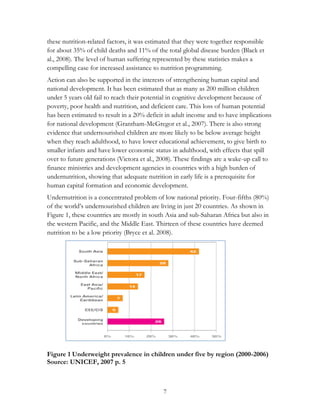
Undernutrition is a concentrated problem of low national priority. Four-fifths (80%) 
of the world‟s undernourished children are living in just 20 countries. As shown in 
Figure 1, these countries are mostly in south Asia and sub-Saharan Africa but also in 
the western Pacific, and the Middle East. Thirteen of these countries have deemed 
nutrition to be a low priority (Bryce et al. 2008). 
Figure 1 Underweight prevalence in children under five by region (2000-2006) 
Source: UNICEF, 2007 p. 5 
7
In terms of under-5 mortality rates, the most immediate needs are in Afghanistan, 
Democratic Republic of Congo, Nigeria, Ethiopia, Uganda, Tanzania, Madagascar, 
Kenya, Yemen, and Burma. There is little difference in underweight prevalence 
between girls and boys but children in rural areas are twice as likely to be underweight 
as children in urban areas (UNICEF, 2007). However, such urban/rural comparisons 
can mask the large differentials that exist among socioeconomic groups in urban 
areas where stunting in the poorest urban quintile has been found to be almost on par 
with that of poor rural dwellers. These differentials can be linked to the high rates of 
globalization and urbanization. In such contexts targeting of nutrition programs to 
the poorest segments of the urban population is critical to their success and cost-effectiveness 
(Menon, Ruel, & Morris, 2000). While the number underweight is 
decreasing globally, in areas such as Eastern and Southern Africa and conflict regions 
of the Middle East and North Africa, the number underweight are rising. 
Furthermore, recent rapid increases in prices of staple foods are likely to exacerbate 
the problem among the most vulnerable in situations governed by woefully 
inadequate social safety nets (Horton, Alderman, & Rivera, 2008). 
High levels of child undernutrition, stalled progress towards health-related MDGs, 
the rise of chronic diseases driving households below the poverty line, and the need 
for prevention to address causes outside the health sector6 have forced a hard look at 
the reasons for past failures and stimulated a search for new pathways to health equity 
and social justice. New pathways are identified in the final report of the WHO 
Commission on Social Determinants of Health (SDH). This report highlights the 
urgent need to address the structural drivers of poor nutrition and health, which are 
inequitable distribution of power, money and resources, and argues for greater 
attention to nutrition and health in all government policies in all sectors (WHO, 
2008b). The report champions Primary Health Care (PHC) as a model for a health 
system that acts on these drivers and the WHO have subsequently launched a strategy 
for reviving Primary Health Care and developed a new framework for health 
promotion and chronic diseases (WHO, 2008c). Due to its multisectoral nature, 
nutrition could be an appropriate entry point for these new pathways. 
Calls for more attention to be paid to addressing the structural causes of 
undernutrition and ill-health together with the need to take urgent action to stem the 
rise in child undernutrition have led to questions being raised as to what works and 
why in relation to nutrition programming. Whilst a consensus has recently been 
reached on available interventions with proven effectiveness to reduce stunting, 
6 The health sector is the part of the economy dealing with health-related issues in society. It includes the drug 
manufacturers, medical devices, institutional services, and drug wholesalers. 
8
micronutrient deficiencies and child deaths in the short term there is no such 
consensus on how best to address the deeper causes of undernutrition for which 
there are no magic technological bullets. These deeper causes govern the amount, 
control and use of human, economic and organizational resources that are available 
to households and communities. The need to evaluate the evidence base on the 
effectiveness of interventions to address these causes has been recognized (Ruel, 
2008) and the present Study is a response to this need. 
1.2 Objective and methodology 
The primary objective of this Study is to synthesise the available evidence on what 
works (or does not work) and why in nutrition programming to address the 
underlying and basic causes7 of undernutrition in high burden countries; and to 
discuss key issues to consider when designing, implementing and assessing nutrition 
programmes at micro, meso and macro levels. A secondary objective is to identify 
policy relevant topics that need further research. 
Searching the literature 
A structured electronic search was conducted of relevant data bases8 to identify good 
quality evaluations and studies published in English from 19989 to 2008 which could 
inform the evidence base on a sub-set of issues important to consider when 
designing, implementing and assessing nutrition programmes using single- or multi-sector 
approaches as an entry point10 in different contexts and environments. This 
search resulted in 357 references.11 
Significant efforts were also made to identify further studies in the “grey literature” 
through searching the websites of the relevant development agencies and also Google 
Scholar. This search identified 200+ reports and documents. A number of experts 
from various international organizations and universities were contacted through e-mail 
to ask for copies of reports documenting their experiences. Further publications 
were obtained by going through the references of the retained publications to identify 
those that were relevant. All the papers, articles, reports, reviews, books etc. were 
7 Underlying and basic causes are discussed further in Figure 4. 
8 These data bases were: MEDLINE, Social Science Citation Index (SSCI). Health Management Information 
Consortium (HMIC), International Bibliography of the Social Sciences (IBSS) NHS EED, and the British 
Library online catalogue. 
9 Programme evaluations and studies dated pre-1998 were excluded to preference more up-to-date reports. One 
exception was made to include the evaluation of the Hearth Nutrition Model by Wollinka et al. (1997) and a 
few earlier references were included in the discussion section. 
10 An entry point is a particular setting for the application of activities that aim to reduce undernutrition. 
11 Full details of the search strategy and string of search terms that were tested and found to be most effective 
in identifying the relevant literature can be obtained from the authors. 
9
subjected to a title and abstract scan for relevance and a total of 734 were found to be 
relevant and put into the Master EndNote library. 
Selection criteria 
From this Master list a short list of 58 evaluations and studies to be analysed were 
selected using the following criteria: 
 Up-to-date (1998-2008); 
 Offering a representative aspect of a range of different interventions: (sector-based) 
agricultural, broad-based, community-based; (approach-based) mother 
and child programmes (maternal education); gender equality etc.; 
 Offering a range of different donors/NGO e.g. World Bank; Save the 
Children and UNICEF; Country-led, partnership of two or more of the above 
etc.; 
 Methodologically sound programme evaluations, including programmes 
deemed unsuccessful as well as successful, where the reasons for success or 
lack thereof were identified and analysed; 
 Methodologically sound studies (surveys, reviews etc) of a particular aspect of 
(under) nutrition and especially the underlying causes of this; 
 Addressing broader policy or strategic objectives, such as the 
planning/prioritising of a national governmental programme of aid. 
Forty further readings were selected to provide background and inform the 
Introduction and Discussion Sections of the Study. 
10
Framework for analysis of selected evaluations and studies 
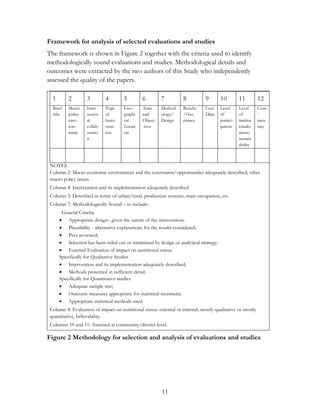
The framework is shown in Figure 2 together with the criteria used to identify 
methodologically sound evaluations and studies. Methodological details and 
outcomes were extracted by the two authors of this Study who independently 
assessed the quality of the papers. 
1 2 3 4 5 6 7 8 9 10 11 12 
Brief 
title 
11 
Macro 
policy 
envi-ron-ment 
Inter-sector-al 
collab-oratio 
n 
Type 
of 
Inter-vent-ion 
Geo-graphi 
cal 
Locati 
on 
Aims 
and 
Object 
-ives 
Method-ology/ 
Design 
Results 
/Out-comes 
Cost 
Data 
Level 
of 
partici-pation 
Level 
of 
institut 
ionalis 
ation/ 
sustain 
ability 
Com 
- 
men 
tary 
NOTES 
Column 2: Macro-economic environment and the constraints/opportunities adequately described; other 
macro policy issues 
Column 4: Intervention and its implementation adequately described 
Column 5: Described in terms of urban/rural, production systems, main occupation, etc. 
Column 7: Methodologically Sound – to include: 
General Criteria 
 Appropriate design– given the nature of the intervention; 
 Plausibility - alternative explanations for the results considered; 
 Peer reviewed; 
 Selection has been ruled out or minimized by design or analytical strategy; 
 External Evaluation of impact on nutritional status. 
Specifically for Qualitative Studies 
 Intervention and its implementation adequately described; 
 Methods presented in sufficient detail. 
Specifically for Quantitative studies 
 Adequate sample size; 
 Outcome measures appropriate for statistical treatment; 
 Appropriate statistical methods used. 
Column 8: Evaluation of impact on nutritional status: external or internal; mostly qualitative or mostly 
quantitative, believability. 
Columns 10 and 11: Assessed at community/district level. 
Figure 2 Methodology for selection and analysis of evaluations and studies
1.3 Overview of relevant concepts and frameworks 
Concepts 
Nutritional status can be defined as the physiological condition of an individual that 
results from the balance between nutrient requirements and intake and the ability of 
the body to use these nutrients. 
Undernutrition is a condition in which the body does not have enough of the right 
kind of food to meet its energy, macronutrient (proteins, carbohydrates and fats) and 
micronutrient (vitamins and minerals) needs. Children can still be undernourished 
even if they have enough food to meet their energy requirements if that food lacks 
essential micronutrients. Overnutrition is a condition where the body has too much 
food, especially fats and sugars. 
Both under- and overnutrition are forms of malnutrition. However, the term 
malnutrition is still widely used in the development literature and amongst the 
international development community to refer to undernutrition and micronutrient 
deficiency. This is confusing because the number of malnourished children who are 
overweight and obese is rising sharply in developed countries and in some developing 
countries, such as Brazil, there are now more over- than under-nourished children. 
To avoid confusion the term undernutrition and not malnutrition will therefore be 
used throughout the present Study. 
Undernutrition leads to children being overall undernourished (low weight for age), 
too thin/wasted (low weight for height) or too short/stunted (low height for age). 
Wasting usually results from an acute, significant food shortage and/or disease; it is a 
strong predictor of mortality among children under five years. Stunting usually results 
from mild chronic undernutrition; it is increasingly used as the key measure of 
nutritional status in under two year olds because it can lead to irreversible cognitive 
damage. 
Prevalence of underweight, stunting and wasting in children under five years is 
estimated by comparing actual measurements to an international standard reference 
population. The new WHO Child Growth Standards12 confirm that children born 
anywhere in the world who are given the optimum start in life have the potential to 
develop to within the same range of height and weight. Differences in children's 
growth to age five are therefore more influenced by nutrition, feeding practices, 
environment, and health care than genetics or ethnicity. The indicators of 
undernutrition among these children are given in Figure 3. 
12 These standards were released in 2006 and are available at http://www.who.int/childgrowth/en/ 
12
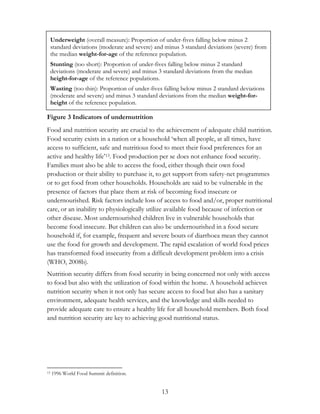
Underweight (overall measure): Proportion of under-fives falling below minus 2 
standard deviations (moderate and severe) and minus 3 standard deviations (severe) from 
the median weight-for-age of the reference population. 
Stunting (too short): Proportion of under-fives falling below minus 2 standard 
deviations (moderate and severe) and minus 3 standard deviations from the median 
height-for-age of the reference populations. 
Wasting (too thin): Proportion of under-fives falling below minus 2 standard deviations 
(moderate and severe) and minus 3 standard deviations from the median weight-for-height 
13 
of the reference population. 
Figure 3 Indicators of undernutrition 
Food and nutrition security are crucial to the achievement of adequate child nutrition. 
Food security exists in a nation or a household „when all people, at all times, have 
access to sufficient, safe and nutritious food to meet their food preferences for an 
active and healthy life‟13. Food production per se does not enhance food security. 
Families must also be able to access the food, either though their own food 
production or their ability to purchase it, to get support from safety-net programmes 
or to get food from other households. Households are said to be vulnerable in the 
presence of factors that place them at risk of becoming food insecure or 
undernourished. Risk factors include loss of access to food and/or, proper nutritional 
care, or an inability to physiologically utilize available food because of infection or 
other disease. Most undernourished children live in vulnerable households that 
become food insecure. But children can also be undernourished in a food secure 
household if, for example, frequent and severe bouts of diarrhoea mean they cannot 
use the food for growth and development. The rapid escalation of world food prices 
has transformed food insecurity from a difficult development problem into a crisis 
(WHO, 2008b). 
Nutrition security differs from food security in being concerned not only with access 
to food but also with the utilization of food within the home. A household achieves 
nutrition security when it not only has secure access to food but also has a sanitary 
environment, adequate health services, and the knowledge and skills needed to 
provide adequate care to ensure a healthy life for all household members. Both food 
and nutrition security are key to achieving good nutritional status. 
13 1996 World Food Summit definition.
Frameworks for understanding and acting on child undernutrition 
This Study is informed by three frameworks. Firstly, the United Nations Convention 
on the Rights of the Child (UNCRC) which clearly states that every government has a 
responsibility to combat disease and undernutrition through the provision of 
adequate nutritious food. This is important because it makes governments legally 
accountable for the nutritional status of their people and can be used to actively 
advance the political agenda around the right to adequate nutritional status at national 
and global levels. This framework builds on the International Human Rights 
Framework, based on the 1948 Universal Declaration of Human Rights (UDHR), 
which states that „Everyone has the right to a standard of living adequate for the 
health and well-being of himself and his family ...‟ (UN, 1948 Article 25). The 
inclusion of food and nutrition within this right to health has been explicitly affirmed 
(UN Committee on Economic Social and Cultural Rights, 2000). 
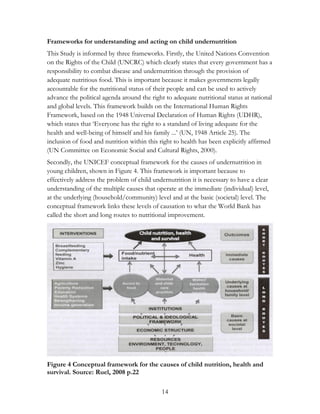
Secondly, the UNICEF conceptual framework for the causes of undernutrition in 
young children, shown in Figure 4. This framework is important because to 
effectively address the problem of child undernutrition it is necessary to have a clear 
understanding of the multiple causes that operate at the immediate (individual) level, 
at the underlying (household/community) level and at the basic (societal) level. The 
conceptual framework links these levels of causation to what the World Bank has 
called the short and long routes to nutritional improvement. 
Figure 4 Conceptual framework for the causes of child nutrition, health and 
survival. Source: Ruel, 2008 p.22 
14
The short route addresses the immediate causes which are inadequate dietary intake 
and infection. Infection reduces appetite and increases nutrient requirements whilst 
inadequate intake of food of the right quantity and quality makes the body more 
susceptible to infection. When lack of food and infection are combined a synergistic 
interaction can precipitate or worsen undernutrition. The long route acknowledges 
that beneath the immediate causes there are three main underlying causes (i) 
inadequate access to food and or/poor use of available food (ii) inadequate child care 
practices and (iii) poor water and sanitation and inadequate health services. These 
underlying causes frequently interact with each other and are themselves underpinned 
by more basic or root causes which reach down deep into the political, economic, 
cultural and religious systems and institutional structures that govern society. They 
control the amount and use of potential human, economic and organizational 
resources available at the household level and determine the degree of social justice in 
society and the status and autonomy of women. 
Thirdly, the conceptual framework developed to guide the work of the WHO 
Commission on Social Determinants of Health (WHO, 2008b). This framework 
recognizes that strengthening health equity means addressing the fundamental global 
and national structures of social hierarchy and the socially determined conditions 
these create. This requires taking action not only on the daily circumstances of life 
(food, water, social cohesion, empowerment etc) but also on the structural drivers 
that influence them. These drivers include the nature and degree of social 
stratification in society that determine social position and disparities of power and 
control that underpin biases, norms and values and are link to gender, education, 
ethnicity/race and income. They also include the global and national macroeconomic 
and social and health policy and the processes of governance at the global, national, 
and local level (WHO, 2008b p.43). 
Taken together these three frameworks not only illustrate the complex, multi-level 
causation of child undernutrition but also highlight the need for multidimensional, 
cross-sectoral interventions to sustain nutritional improvements in the long term. 
This is challenging, both conceptually and empirically when trying to evaluate the 
effectiveness of such interventions on health equity. 
1.4 Undernutrition and HIV/AIDS 
Interactions 
HIV impairs the human immune system leading to increased risk of infection and 
reduced appetite. The immediate cause of undernutrition in people living with HIV 
and AIDS is therefore insufficient food intake and infection. HIV also decreases 
15
absorption and use of nutrients from the food eaten and increases the body‟s normal 
energy requirements by 10-30% in adults and 50-100% in children (UNAIDS, 2008a). 
At the underlying and basic levels of causation, HIV and AIDS causes food and 
nutritional insecurity because people are frequently sick, or are caring for the sick, and 
unable to work which threatens their livelihoods. Food and nutritional insecurity can 
in turn increase risk and vulnerability to HIV infection, hasten the onset of AIDS, 
prevent effective treatment and undermine efforts to provide care and support. This 
is because lack of food security increases short-term mobility and migration and 
places people who are away from home and in need of food in risky situations. It 
exacerbates gender inequality within the household which can lead to hungry women 
and girls seeking food elsewhere, which may force them into high risk situations, e.g. 
transactional or commercial sex. Food and nutrition insecurity also increases risk of 
undernutrition, which can increase risk of infection. Intrahousehold clustering of 
infection can lead to poor households facing reduced access to information on how 
to prevent HIV and also reduce their ability to use such information. Several scholarly 
reviews of the research evidence are available to support these claims (Edström & 
Samuels, 2007; Friis, 2006; Gillespie & Kadiyala, 2005; Raiten, Grinspoon, & Arpadi, 
2005). Two briefing papers summarise the findings and make suggestions for 
programming (ODI, 2006; UNAIDS, 2008b). 
Within HIV-affected households children are especially vulnerable to the combined 
impact of undernutrition and HIV. There is evidence from Tanzania that stunting is 
significantly higher among orphans than other children, even if other factors are 
controlled for (Ainsworth & Semali, 2000) and there is evidence from Uganda that 
fostered children have reduced access to health services (Deininger, Garcia, & 
Subbarao, 2003). Even where orphans are not treated inequitably they may be 
undernourished along with the other members in their family due to the impact of 
AIDS on family food production. A study in Malawi showed that reduced food 
production was greatest when the father falls sick because female family members are 
expected to care for him, which reduces female labour and less food and cash crops 
are produced (Thangata, Hildebrand, & Kwesiga, 2007). There is evidence from many 
countries that HIV-affected children, especially maternal orphans, are missing out on 
schooling, which can further increase their risk of HIV infection (Coombe & Kelly 
2001). Education appears to exert a protective effect through a combination of 
delayed sexual debut, higher rates of condom use, lower levels of coercive and 
transactional sex, and a smaller age difference between partners (Pridmore, 2008; 
WFP, 2006). 
16
Policy context 
Access to food, health care and education as a basic human right is enshrined in the 
MDGs to which all member states of the United Nations (UN) committed 
themselves in 2000. The MDGs provide a strong mandate for action to support food 
and nutrition programming although the role of nutrition in achieving most of the 
goals is not well recognized. Both Article 28 of the Political Statement on HIV/AIDS 
Declaration of Commitment by the United Nations General Assembly Special 
Session (UNGASS) (UN, 2006 p.4) and a resolution passed by the Fifty-ninth World 
Health Assembly in 200614 encouraged countries to include nutrition as an integral 
part of their response to HIV. 
Actions needed 
It is well recognized that food security is a key element in HIV treatment and care 
(including strategies to promote adherence to and efficacy of Anti-Retroviral 
Therapy) but far less recognized that actions to address the root causes of food 
insecurity are also an essential part of HIV prevention, treatment and support. Such 
actions include supportive economic policies and employment creation that open up 
opportunities for less risky, less susceptible livelihoods, providing alternative 
pathways to learning for HIV-affected children who cannot go to school regularly 
and improving women‟s status and autonomy. A summary of recommended actions 
for governments, international development partners and civil society recommended 
is presented in Appendix 1. 
1.5 Assistance to nutrition 
As a background to the Discussion and Conclusion Sections of this report Table 1 
provides an overview of current assistance to nutrition programming including an 
indication of the relative roles of the different development cooperation agencies and 
the approaches used. Further reference can be made to the World Bank (2006) report 
on „Repositioning Nutrition as Central to Development‟ which includes an extensive 
technical annex titled „Mandate and focus of development partners in nutrition‟ (pp. 
174-200) and also to Levine and Kuczynsk (2008) who reviewed more than 60 
international organizations to identify major players and key functions carried out by 
organizations. 
Donor Short Description of Approach 
17 
MULTILATERALS 
AfDB Food distribution to low income groups, and behaviour 
14 see http://www.who.int/gb/ebwha/pdf_files/WHA59/A59_R11-en.pdf
change through mass media community education. 
ADB Focus on food fortification, refugee and emergency feeding; 
but also holistic solutions to poverty reduction; and 
development of food storage facilities and institutional 
strengthening. 
EU Applies a nutrition lens to its other programmes in the health 
sector and is one of the major donors to nutrition through 
EuropeAid. 
FAO Operates via the Food Insecurity and Vulnerability 
Information Mapping Systems (FIVIMS) to help countries 
using evidence-based information and analysis to advocate for 
the formulation and implementation of policies and 
programmes enhancing food security. 
IADB Focus on undernutrition; and on research and training to 
produce higher quality foods. 
IFAD Takes a multi-lateral and multi-sectoral approach, focusing on 
country-specific solutions for rural populations, 
SCN Promotes cooperation among UN agencies and partners in 
support of community, national, regional, and international 
efforts to end undernutrition, by refining the direction, 
increasing the scale and strengthening the coherence and 
impact of actions worldwide. 
UNICEF Uses a holistic rights-based approach to improve nutritional 
status of both mother and child. Focuses on short route 
interventions from conception to 3 years of age. Views 
poverty as the main underlying cause of preventable child 
deaths and hunger. 
WB Major nutrition donor. Nutrition incorporated within its 
overall multi-sectoral Health, Nutrition and Population 
Strategy (HNP). Views nutrition as central to development 
and has batch recruited for 6 senior nutrition positions to 
strengthen its response. Explicit connection to economic 
determinants and consequences of undernutrition, importance 
of balancing demand-side and supply-side interventions with a 
strong focus on importance of country commitment and 
interventions for children under 2 years. 
WFP School feeding programmes, sometimes with fortified foods, 
18
with a focus on adolescent girls 
WHO Focuses on household food and nutrition security as a basic 
human right. The Landscape Analysis, launched in November 
2007, was part of the WHO-led interagency effort to 
strengthen progress towards the MDGs (especially MDG 1, 4 
and 5). Focuses on institutional strengthening, developing the 
evidence base, and includes attention to obesity. 
BILATERALS 
CIDA Major nutrition donor. Its focus on the role of nutrition in 
susceptibility to disease and cognitive development is largely 
multi-sectoral and limited to a small number of countries to 
achieve the greatest impact. 
DANIDA Indirect support through focus on democracy and human 
rights including gender equality and women‟s rights and 
opportunities; also support for climate change initiatives. 
DFID Has developed a draft Action Plan for Nutrition (out for 
consultation as of November 2008). Conclusions imply there 
should be an emphasis on food security within a broader 
development arena including governance; a careful balance 
between short and long term routes; monitoring and 
evaluation; and on delivery services and partnerships and 
institutional configurations. Explicit connection to economic 
determinants and consequences of undernutrition. 
IRELAND Does not have a nutrition plan but Ireland‟s Hunger Task 
Force report advocates for improving smallholder 
productivity in Africa; enhancing efforts to tackle maternal 
and infant undernutrition; and delivering on existing 
commitments and ensuring coherence in the international 
architecture to address hunger, again including a focus on 
governance. 
FRANCE Activities focus on reducing poverty and inequalities, 
promoting sustainable economic growth, and protecting 
“Global Public Goods” including the fight against climate 
change and pandemics; the preservation of biodiversity; the 
promotion of social and environmental responsibility; as well 
as aid to countries weakened by strife, war and natural 
disasters. Concerned with establishing a commercial 
19
equilibrium so that everyone has essential services including 
food. 
GTZ Promotes nutritional aid /food security within the National 
Poverty Reduction frameworks and are essentially multi-sectoral 
and cross sectional in approach. 
NETHERLANDS Strives towards a holistic approach to Early Childhood 
Development through intersectoral and interministerial 
cooperation. Attention is given to integrating health, nutrition, 
protection, emotional and cognitive development and 
integrates these. 
NORAD There is no „stand-alone‟ policy on nutrition in development 
assistance. Takes a multisectoral approach and addresses 
nutrition as a cross-cutting in reports, action plans and 
strategies that focus on other singular sectors. 
SIDA Programme of humanitarian assistance provides support for 
food security, health, water and sanitation, shelter, emergency 
education and coordination. Contributions are guided by a set 
of sectoral or cross-cutting strategies and guidelines which 
were synthesized into a humanitarian policy in 2003. 
SPAIN Has signed a series of aid agreements with West African 
countries, hoping to fight poverty and improve cooperation in 
controlling the flow of departing migrants. 
USAID A major donor to nutrition. The Bureau for Global Health 
supports field health programmes, research and innovation 
and transfer of new technologies to the field. Nutrition 
programmes focus on micronutrient supplementation and 
fortification (MOST), improved infant and young child 
feeding), and measures to improve household food security. 
Under Title II Food Aid, supports community-based 
approaches to build capacity to monitor and improve child 
nutrition. 
PRIVATE AND VOLUNTARY CONTRIBUTIONS 
CRS Focuses on improving household food security in the short, 
medium and long term. 
GAIN Implements programmes in partnership between government, 
business and civil society organizations with a focus on social 
mobilisation. Provides financial and technical support for 
20
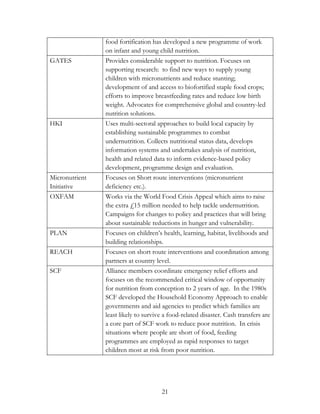
food fortification has developed a new programme of work 
on infant and young child nutrition. 
GATES Provides considerable support to nutrition. Focuses on 
supporting research: to find new ways to supply young 
children with micronutrients and reduce stunting; 
development of and access to biofortified staple food crops; 
efforts to improve breastfeeding rates and reduce low birth 
weight. Advocates for comprehensive global and country-led 
nutrition solutions. 
HKI Uses multi-sectoral approaches to build local capacity by 
establishing sustainable programmes to combat 
undernutrition. Collects nutritional status data, develops 
information systems and undertakes analysis of nutrition, 
health and related data to inform evidence-based policy 
development, programme design and evaluation. 
21 
Micronutrient 
Initiative 
Focuses on Short route interventions (micronutrient 
deficiency etc.). 
OXFAM Works via the World Food Crisis Appeal which aims to raise 
the extra £15 million needed to help tackle undernutrition. 
Campaigns for changes to policy and practices that will bring 
about sustainable reductions in hunger and vulnerability. 
PLAN Focuses on children‟s health, learning, habitat, livelihoods and 
building relationships. 
REACH Focuses on short route interventions and coordination among 
partners at country level. 
SCF Alliance members coordinate emergency relief efforts and 
focuses on the recommended critical window of opportunity 
for nutrition from conception to 2 years of age. In the 1980s 
SCF developed the Household Economy Approach to enable 
governments and aid agencies to predict which families are 
least likely to survive a food-related disaster. Cash transfers are 
a core part of SCF work to reduce poor nutrition. In crisis 
situations where people are short of food, feeding 
programmes are employed as rapid responses to target 
children most at risk from poor nutrition.
22 
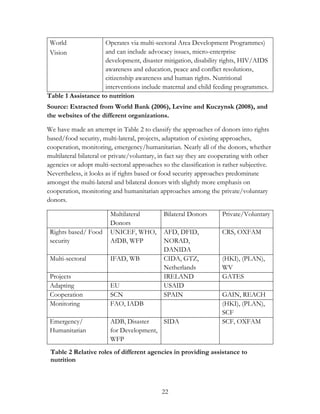
World 
Vision 
Operates via multi-sectoral Area Development Programmes) 
and can include advocacy issues, micro-enterprise 
development, disaster mitigation, disability rights, HIV/AIDS 
awareness and education, peace and conflict resolutions, 
citizenship awareness and human rights. Nutritional 
interventions include maternal and child feeding programmes. 
Table 1 Assistance to nutrition 
Source: Extracted from World Bank (2006), Levine and Kuczynsk (2008), and 
the websites of the different organizations. 
We have made an attempt in Table 2 to classify the approaches of donors into rights 
based/food security, multi-lateral, projects, adaptation of existing approaches, 
cooperation, monitoring, emergency/humanitarian. Nearly all of the donors, whether 
multilateral bilateral or private/voluntary, in fact say they are cooperating with other 
agencies or adopt multi-sectoral approaches so the classification is rather subjective. 
Nevertheless, it looks as if rights based or food security approaches predominate 
amongst the multi-lateral and bilateral donors with slightly more emphasis on 
cooperation, monitoring and humanitarian approaches among the private/voluntary 
donors. 
Multilateral 
Donors 
Bilateral Donors Private/Voluntary 
Rights based/ Food 
security 
UNICEF, WHO, 
AfDB, WFP 
AFD, DFID, 
NORAD, 
DANIDA 
CRS, OXFAM 
Multi-sectoral IFAD, WB CIDA, GTZ, 
Netherlands 
(HKI), (PLAN), 
WV 
Projects IRELAND GATES 
Adapting EU USAID 
Cooperation SCN SPAIN GAIN, REACH 
Monitoring FAO, IADB (HKI), (PLAN), 
SCF 
Emergency/ 
Humanitarian 
ADB, Disaster 
for Development, 
WFP 
SIDA SCF, OXFAM 
Table 2 Relative roles of different agencies in providing assistance to 
nutrition
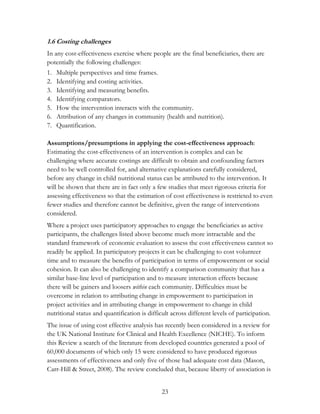
1.6 Costing challenges 
In any cost-effectiveness exercise where people are the final beneficiaries, there are 
potentially the following challenges: 
1. Multiple perspectives and time frames. 
2. Identifying and costing activities. 
3. Identifying and measuring benefits. 
4. Identifying comparators. 
5. How the intervention interacts with the community. 
6. Attribution of any changes in community (health and nutrition). 
7. Quantification. 
Assumptions/presumptions in applying the cost-effectiveness approach: 
Estimating the cost-effectiveness of an intervention is complex and can be 
challenging where accurate costings are difficult to obtain and confounding factors 
need to be well controlled for, and alternative explanations carefully considered, 
before any change in child nutritional status can be attributed to the intervention. It 
will be shown that there are in fact only a few studies that meet rigorous criteria for 
assessing effectiveness so that the estimation of cost effectiveness is restricted to even 
fewer studies and therefore cannot be definitive, given the range of interventions 
considered. 
Where a project uses participatory approaches to engage the beneficiaries as active 
participants, the challenges listed above become much more intractable and the 
standard framework of economic evaluation to assess the cost effectiveness cannot so 
readily be applied. In participatory projects it can be challenging to cost volunteer 
time and to measure the benefits of participation in terms of empowerment or social 
cohesion. It can also be challenging to identify a comparison community that has a 
similar base-line level of participation and to measure interaction effects because 
there will be gainers and loosers within each community. Difficulties must be 
overcome in relation to attributing change in empowerment to participation in 
project activities and in attributing change in empowerment to change in child 
nutritional status and quantification is difficult across different levels of participation. 
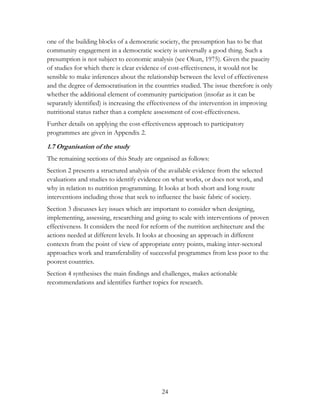
The issue of using cost effective analysis has recently been considered in a review for 
the UK National Institute for Clinical and Health Excellence (NICHE). To inform 
this Review a search of the literature from developed countries generated a pool of 
60,000 documents of which only 15 were considered to have produced rigorous 
assessments of effectiveness and only five of those had adequate cost data (Mason, 
Carr-Hill & Street, 2008). The review concluded that, because liberty of association is 
23
one of the building blocks of a democratic society, the presumption has to be that 
community engagement in a democratic society is universally a good thing. Such a 
presumption is not subject to economic analysis (see Okun, 1975). Given the paucity 
of studies for which there is clear evidence of cost-effectiveness, it would not be 
sensible to make inferences about the relationship between the level of effectiveness 
and the degree of democratisation in the countries studied. The issue therefore is only 
whether the additional element of community participation (insofar as it can be 
separately identified) is increasing the effectiveness of the intervention in improving 
nutritional status rather than a complete assessment of cost-effectiveness. 
Further details on applying the cost-effectiveness approach to participatory 
programmes are given in Appendix 2. 
1.7 Organisation of the study 
The remaining sections of this Study are organised as follows: 
Section 2 presents a structured analysis of the available evidence from the selected 
evaluations and studies to identify evidence on what works, or does not work, and 
why in relation to nutrition programming. It looks at both short and long route 
interventions including those that seek to influence the basic fabric of society. 
Section 3 discusses key issues which are important to consider when designing, 
implementing, assessing, researching and going to scale with interventions of proven 
effectiveness. It considers the need for reform of the nutrition architecture and the 
actions needed at different levels. It looks at choosing an approach in different 
contexts from the point of view of appropriate entry points, making inter-sectoral 
approaches work and transferability of successful programmes from less poor to the 
poorest countries. 
Section 4 synthesises the main findings and challenges, makes actionable 
recommendations and identifies further topics for research. 
24
25 
2. Synthesis of available evidence 
This section starts with a brief review of available evidence on short route 
interventions to reduce child undernutrition in young children. It then moves on to 
synthesize available evidence on long route interventions, which are the central 
concern of this Study. It reviews evidence on interventions using both single- and 
multi-sector entry points, different approaches to food and nutrition security and top-down 
versus bottom up approaches to programme design and implementation. 
2.1 Evidence on short route interventions 
Great advances have recently been made in understanding what works to address the 
immediate causes of undernutrition in young children at the level of the individual 
child. These causes are inadequate food/nutrient intake and poor health. On the 
strength of the accumulated evidence there is now technical consensus on a package 
of single-shot, targeted interventions that „work‟ not only in randomized control trials 
but also in limited field projects. 
This evidence has been synthesized by Bhutta et al. in the 2008 Lancet series on 
Maternal and Child Undernutrition and is presented in Figure 5 together with 
findings from other key evaluations and studies. There are some surprises in these 
findings for national nutrition leaders. For example, Bhutta et al. (2008) found that 
interventions to reduce malaria infection in pregnant women are effective in reducing 
undernutrition and should be addressed in both national and subnational nutrition 
strategies. They also found that three long-standing interventions promoted as 
benefiting nutrition were not supported by evidence showing a direct effect on 
stunting. These interventions were growth monitoring (unless linked to adequate 
nutrition counselling and referrals), preschool feeding programmes targeting children 
over 24 months of age; and school feeding programmes targeting children older than 
5 years of age. 
The evidence can be briefly summarised for policy makers in the following message: 
“A small menu of effective actions now exists that if implemented at sufficient scale to reach 
99% of targeted populations during pregnancy and up to the child’s second birthday could reduce 
undernutrition-related mortality and disease-burden by 25%. These actions are: promotion and 
support of exclusive breastfeeding, complementary feeding, vitamin A and zinc supplementation
for children and hygiene interventions; together with multiple micronutrient supplementation for 
pregnant women and universal iodization of salt. Each of these actions has been shown to be 
cost effective but the relative cost effectiveness varies widely according to context.” 
There is also strong evidence that highly cost-effective interventions exist that can 
dramatically improve young child development, particularly for the disadvantaged, 
through integrating food supplementation with maternal education to increase child 
stimulation (Engle et al., 2007). Educating mothers about responsive care giving also 
appears to be effective in reducing maternal distress linked to depression, which has 
been shown to have a serious impact on infant growth and development (Engle, 
2009). 
Going along the short route to achieve quick nutritional gains still leaves us with the 
puzzle of how to create sustainable impacts. To find the answer we have to address 
the deeper levels of causation. As Ruel (2008) points out, it is important that the 
consensus on short route interventions should not preclude financing of long route 
interventions that are needed to sustain nutritional gains over time. The rest of 
Section 2 is devoted to synthesizing the evidence on these long route interventions. 
Bhutta et al. (2008) conducted a meta-analysis to assess the potential effect of 
technological interventions on child mortality related to stunting. They found that 
the interventions with the greatest potential were breastfeeding promotion, 
appropriate complementary feeding, supplementation with vitamin A and Zinc and 
appropriate management of severe acute undernutrition. Multi-micronutrient 
supplementation especially to reduce iron and iodine deficiency is important for 
maternal survival. Behaviour change interventions directed at feeding practices and 
accompanied by supportive measures such as conditional cash transfers can also be 
effective. If implemented at sufficient scale, it has been estimated that this menu of 
interventions would reduce all child deaths by about a quarter. 
Dewey and Adu-Afarwuah (2008) conducted a systematic literature review to 
assess the efficacy and effectiveness of complementary feeding interventions. The 
findings suggest that complementary feeding interventions, by themselves, cannot 
change the underlying conditions of poverty and poor sanitation that contribute to 
child undernutrition. They need to be implemented in conjunction with a larger 
strategy that includes improved water and sanitation, better health care and adequate 
housing. 
Dubowitz et al. (2007) conducted an impact assessment of the Dular Programme 
in India that aimed to overlay the Government‟s Integrated Child Development 
Services (ICDS) programme and develop a network of neighbourhood resource 
26
persons to track the health status of women and under 3 year olds. The findings 
showed differences between Dular and non-Dular villages in antenatal and birthing 
practices, colostrum delivery, delivery of breastmilk as first food, reported use of 
iodized salt, measured iodized salt status, immunization and weight-for-age z-scores. 
Young children in Dular areas had a 45% lower prevalence of severe undernutrition 
and were four times more likely to receive colostrum than those in non-Dular 
villages. 
Hoddinot et al. (2008) examined the impact of supplementary feeding in early 
childhood on adult economic productivity and income in Guatemala using linear 
regression models. Exposure to the nutritious supplement from 0 to 2 years, was 
associated with a 46 % increase in average wages for men (but not for women) in 
the intervention group compared to the control group. 
Tofail et al. (2008) carried out a large randomised trial to determine the effects of 
prenatal food and micronutrient supplementation on infant development in 
Bangladesh. Small benefits from early food and multi-micronutrient 
supplementation were found in infants of low-BMI but not of high BMI-mothers. 
The researchers concluded, that the benefits were of doubtful functional 
importance, 
Gartner et al. (2007) conducted a controlled evaluation of a community-based 
nutrition project in Senegal that targeted underweight 6-36 month olds and provided 
6 months of growth monitoring, food supplements and nutrition education for 
mothers. The findings recorded no impact despite satisfactory decrease in 
undernutrition in intervention children because the same or larger decrease was 
observed in control children, The researchers suggest this may be explained in part 
by weaknesses in the process, which probably interfered with a potential impact, and 
by the high degree of population mobility, which could have interfered with 
efficiency assessed on a geographic scale. 
Lechtig et al. (2006) used data from the Integrated Food Security Program (PISA) 
in Peru to assess the cost parameters and cost-effectiveness of a weekly multi-micronutrient 
supplementation program to women, adolescent girls and children 
under five. They found that the annual cost per community member was USD 1.51 
and the cost-effectiveness ratio was USD 0.12 per 1% of prevented anaemia per 
community member. They point out that these costs are relatively high but will 
notably decrease when such programmes are integrated into health packages and 
participation by women increases. They suggest that higher doses of micronutrients 
or longer implementation could be protective and notably reduce the prevalence of 
anaemia and other micronutrient deficiencies at little extra cost because the major 
27
part of the cost is transportation not the ingredients. 
Victora, et al. (2005) conducted a systematic review to determine long term effects 
of undernutrition. They found stunting in the first 2 years of life leads to irreversible 
damage into adult life and reduces children‟s cognitive development, educability and 
future economic productivity. 
Colecraft et al. (2004) carried out a longitudinal assessment of diet and growth of 
undernourished children participating in nutrition rehabilitation centres in Ghana. 
The findings showed that the nutrition education failed to improve children‟s diets 
in the home after discharge due to lack of preparation, knowledge or money, child 
preferences and the practice of purchasing ready-to-eat foods. 
Figure 5 Evidence for the effectiveness of short route interventions to reduce 
child undernutrition 
2.2 Evidence on long route interventions to address underlying causes 
Long route interventions seek to address underlying causes of undernutrition at the 
household level in three main ways: 
1. By increasing household food/nutrient production and consumption; 
2. By improving the quality of care given to young children; 
3. By Increasing access to and appropriate use of adequate health services, water 
28 
and sanitation. 
These interventions are more complex and consequently, the evidence is much less 
clear as to what works, to what extent and why, than with the short route technical 
fixes. 
2.2.1 Increasing household food/nutrient production and micronutrient 
consumption 
Biofortification 
The sustainable route to long term reduction in micronutrient deficiencies is through 
increased food consumption and greater diversity of diets but rapidly increasing food 
prices mean that this is not a feasible option for the poorest families. Biofortification, 
the breeding of staple food crops to increase the density and bioavailability of 
micronutrients, is therefore being viewed as a highly promising intervention, which 
could also be a way to reach families with poor access to health care systems. 
Predictive cost-benefit analyses show that biofortification has the potential to provide 
continuing micronutrient benefits at a fraction of the recurring cost of either 
supplementation or postproduction fortification (McClafferty & Russell, 2002;
Nestel, Bouis, Meenakshi, & Pfeiffer, 2006). Potts and Nagujja (2007), however, point 
out the need to demonstrate the on-the-ground cost-effectiveness of biofortified 
crops grown and consumed by households as a sustainable means of meeting their 
micronutrient needs, in comparison to alternative interventions. 
Research and breeding programs are now underway to enrich the major food staples 
in developing countries with the most important micronutrients: iron, provitamin A, 
zinc and folate. A notable example is HarvestPlus15 which is developing and trialing 
beans, cassava, maize, rice, sweet potatoes and wheat in the first phase. One of the 
challenges is to get producers and consumers to accept biofortified crops and 
increase their intake of micronutrients. Nestell et al. (2006) claim that this can be 
achieved with the advent of good seed systems, the development of markets and 
products, and demand creation. 
There is some evidence to support this claim. The World Bank (2007) presents a case 
study of a two year biofortification intervention in rural Mozambique to reduce 
vitamin A deficiency by promotion of home production and consumption of orange-fleshed 
sweet potato (OFSP). In the Towards Sustainable Nutrition Improvement 
Research Project integrated agriculture and nutrition extension services aimed to 
increase farmers‟ access to OFSP vines and roots, increase nutrition knowledge and 
create demand for OFSP and ensure sustainability through market development. The 
evaluation, based on a prospective quasi-experimental design, showed a marked 
decrease in vitamin A deficiency (using serum retinol) among intervention 
households, from 60% to 38%, compared to no decrease in control households. 
However, the findings are limited by the possibility of bias due to farmers self-selecting 
to join the intervention, and little attention was paid to sustainability. 
Horticulture and home gardening 
Whilst biofortification holds great potential, evidence has already accumulated from 
small scale interventions to show that horticultural or home gardening projects can 
improve both the quality and quantity of food produced and consumed in the home. 
They can also offer opportunities for empowerment of women and integration of 
agriculture and primary health services. 
Bhattacharjee et al. (2007) used quantitative and semi-quantitative surveys and case 
studies to evaluate the food-based nutrition component of the Integrated 
Horticulture and Nutrition Development Project (IHNDP) in Bangladesh. This 
Project aimed to provide rural farmers with necessary knowledge, technology and 
15 HarvestPlus has been formed by the Consultative Group for International Agricultural Research (CGIAR) 
and is coordinated by International Centre for Tropical Agriculture (CIAT) and the International Food Policy 
Research Institute (IFPRI). 
29
skills to make nutritious food available to their community improve household dietary 
quality and reduce undernutrition. Participatory nutrition education activities and 
mass media communications were used to promote consumption of fruit and 
vegetables along with simple agro-processing technologies to reduce micronutrient 
losses, increase shelf life and, supplementing nutrient intake. The findings showed a 
significantly higher level of food and nutrition security amongst project households 
compared to non-project households and significantly higher intake of energy, 
protein and micronutrients from increased fruit and vegetable consumption. More 
than half the project households started complementary feeding with infants between 
five to seven months old along with breast feeding, as compared to only a third of 
non-project households. 
Opportunities for women‟s empowerment as well as increased food production are 
reported by the World Bank (2007) in an evaluation of the Soils, Food and Health 
Communities Project in Northern Malawi. Participatory approaches were used 
throughout the project to increase production and consumption of legumes, gender 
issues and other social relations were carefully assessed and addressed and nutrition 
education aimed to ensure impacts on child diets. The project has attracted a large 
number of women farmers and succeeded in nearly tripling the frequency of legume 
consumption by young children, relative to controls. This is a promising intervention 
but no data on nutritional impact are yet available and there is insufficient detail on 
the use of a quasi experimental design and random sampling for quantitative surveys. 
Increased empowerment of women was also recorded in an evaluation of the 
Gardening and Nutrition Education Surveillance Project in Bangladesh, by 
Bushamuka et al. (2005). The evaluation, carried out three years after programme 
support finished, found significantly higher garden production and income levels in 
the intervention group compared to the control group; and significantly more women 
in these households perceived that participation had increased their economic 
contribution to their households and that they had gained more influence in 
household-decision-making. 
A controlled evaluation of a small scale home gardening intervention by Faber et al. 
(2002) in KwaZulu-Natal, South Africa was selected by the World Bank (2007) to 
highlight successful coordination among multidisciplinary groups of 
agriculturalists, nutritionists, and the community to integrate agricultural and primary 
health activities. The findings showed significantly improved vitamin A status and 
increased habitual intake of targeted garden crops among 2-5 year olds in the 
intervention group compared to the control group. But the evaluation had some 
weaknesses in that the evaluation and control groups were not randomised and the 
30
effect of the intervention was assessed using a cross-sectional survey. Self-selection of 
households (i.e. to participate or not) was not controlled for. 
2.2.2 Improving the quality of care given to young children 
There are several studies of educational programmes aiming to reduce undernutrition 
through influencing the adoption of better child care practices such as early initiation 
of breastfeeding and increased dietary diversity, and a few of the process variables 
that mediate between quality of care and the outcomes. There is also a well 
established body of research, starting with the work of Caldwell (1979) which links 
maternal education (usually measured as years of schooling) with improved child 
health and nutritional outcomes. The evidence suggests that maternal education is the 
single most important factor in explaining differentials in child health outcomes but 
the notion of a causal relationship is contested. (Possible pathways linking maternal 
education and child nutrition are explored further in a study by Frost et al. (2005). 
Behaviour change 
A survey of infants in rural Sichuan, China, in 1990 confirmed that poor infant 
feeding practices rather than inadequate household food resources were responsible 
for growth faltering. A one year community-based pilot nutrition education 
intervention was then undertaken in four townships with more than 250 infants each 
in Education and Control groups. The intervention included the training and 
mobilizing of village nutrition educators who made monthly growth monitoring and 
complementary feeding counselling visits to all pregnant women and families with 
infants born during the intervention in the study villages. Guldan et al. (2000) found 
that the education group mothers had significantly higher nutrition knowledge and 
better reported infant feeding practices than their control group counterparts. Also, 
the education group infants were significantly heavier and longer (but only at 12 
months), had higher breast-feeding rates overall and lower anaemia rates than the 
control group infants. The control group had more income from agricultural 
production and the overall rate of breast feeding was initially higher in the education 
group. No amounts are given but the intervention is reported to be low cost. There 
was only weak supervision of township and village educators. Complete 
randomization of the townships in the intervention and control groups was not 
possible. Instead they were matched geographically and socioeconomically. 
Walsh et al. (2002) carried out initial and follow-up studies of the impact of a 
nutrition education programme on the nutritional status of mixed-race children aged 
between 2 and 5 years in South Africa. They compared two study areas with two 
control areas over two years. Their study illustrates the difficulty of interpreting 
31
community studies because of mobility with 536 children measured at baseline and, 
after two years of intervention, 815 children measured. Although there were some 
improvements in weight-for-age and weight-for-height, there was no significant 
improvement in height-for-age in any area. The authors concluded that integrated 
interventions including sanitation, housing, literacy and employment were needed to 
reduce stunting. 
Sheikholeslam et al. (2004) report on a randomized controlled trial of a multi-disciplinary 
educational intervention for reducing undernutrition among children in 
Iran, implemented through local NGOs. It included not only educating mothers 
about child care, growth and hygiene, but also a strengthened literacy programme for 
women, promoting home gardening and consumption of healthy foods. Rural co-operative 
stores were established as well as improved employment and income 
generation programmes and inputs provided to improve water and sanitation. 
Training workshops were conducted for mothers through provincial health centres 
and all relevant government sectors were actively involved in educating the people in 
the villages. Three years into the intervention, all indicators of undernutrition had 
consistently decreased in all intervention areas and the prevalence of underweight and 
stunting was significantly lower. Control areas showed a mixed pattern of small 
increases and decreases in undernutrition indicators. 
Improving the health environment of the child 
Hossain et al. (2005) review the effectiveness of the Bangladesh Integrated Nutrition 
Project (BINP), a US$ 60 million nutrition programme funded by the World Bank, 
after 5 years of its operation. The Project aimed to reduce the prevalence of 
underweight among children under 24 months of age through education to improve 
the capacity of individuals, households, communities and national institutions to 
prevent and alleviate undernutrition. Supplementary food was given to children with 
severe undernutrition or with growth failure. The evaluation study involved an ex-post 
cross-sectional survey in six thanas (a locality with a population between 200 
000–450 000 people). Participants were 6820 households (4554 in the project areas 
and 2266 in the non-project areas) including 7183 children aged 6–59 months 
selected using a two-stage stratified cluster sampling frame. 
Clean anthropometric data were collected for 2388 children aged 6–23 months and 
6815 children aged 6–59 months. No significant difference was found between the 
socio-economic status of households in project and non-project areas. No significant 
difference was found in the prevalence of either severe or moderate underweight 
(weight-for-age) in children in project and non-project areas even though mothers in 
project areas reported significantly better caring practices than in non-project areas. 
32
The study concluded that there is urgent need to review the evidence behind 
investments based on growth monitoring and promotion. 
Despite this poor result, another intervention on top of the BINP normal services did 
have an effect. Roy et al. (2007) report on the effectiveness of an intensive nutrition 
education package based on a randomized, controlled trial conducted among 605 
normal and mildly undernourished children aged 6 to 9 months in 121 Community 
Nutrition Centres (CNCs) of the BINP in four regions of Bangladesh from 2000 to 
2002. The intervention group received weekly nutrition education based on the 
nutrition triangle concept of UNICEF for 6 months, whereas the control group 
received regular BINP services. Both groups were observed for a further 6 months to 
assess the sustainability of the effects. A significant increase in the frequency of 
complementary feeding was observed in the intervention group as compared with the 
control group, and the increase was sustained throughout the observation period. The 
intervention group had a higher weight gain than the control group after the end of 
the observation period but not immediately after the end of the intervention. 
Nutrition education successfully prevented undernutrition in all four areas, although 
the effects did vary between areas. The total cost of preventing undernutrition varied 
between US$19 and US$37 per child in the four districts. 
Penny et al. (2005) report on a cluster-randomised trial of an educational intervention 
in a poor peri-urban area (i.e. shanty town) of Peru. The intervention aimed to 
introduce an accreditation system in six government health facilities compared with 
six control facilities. A birth cohort of 187 infants from the catchment areas of 
intervention centers and 190 from control areas were examined. Caregivers in 
intervention areas were more likely to report receiving nutrition advice from the 
health service than were caregivers in control health facilities. At 6 months more 
babies in intervention areas were fed nutrient-dense thick foods at lunch (a 
recommended complementary feeding practice) than were controls. Fewer children in 
intervention areas failed to meet dietary requirements for energy, iron, and zinc than 
did controls. Children in control areas were more likely to have stunted growth at 18 
months than children in intervention groups. Adjusted mean changes in weight gain, 
length gain, and Z scores16 were all significantly better in the intervention area than in 
the control area. The researchers concluded that improvement of nutrition education 
delivered through health services can decrease the prevalence of stunted growth in 
16 Z-scores can be used to describe how far a child's weight or height is from the average weight or height of a 
child of the same height in the reference data. This "distance" is called a z-score. It is expressed in multiples of 
the standard deviation and is derived as follows: 
weight-for-height z-score = observed weight - median weight 
standard deviation 
33
childhood in areas where access to food is not a limiting factor. Waters et al. (2006) 
using activity based costing, estimated the costs of the intervention at US$15 per 
child reached and US$138 per case of stunting prevented; and, after allowing for the 
fixed costs of health care staff, the marginal costs at US$6 and US$55 respectively. 
These were relatively high compared to the extant literature; but there is no 
standardised methodology for costing, and the authors suggest that their approach 
was perhaps more comprehensive. 
Salehi et al. (2004) carried out a before-after experimental design in Iran trying to 
evaluate change in the nutritional behaviour of the intervention group (N = 406) 
compared to the control group (N= 405) by giving instruction for 12 months to 
families on how to follow different methods of food preparation and cooking 
practices. Children in the study group gained more in weight-for-age Z scores, height-for- 
age Z scores and weight-for-height Z scores and all the differences were 
statistically significant (P<0.05).They conclude that educational interventions are 
important in influencing the feeding of children energy- and protein- enriched, 
hygienic, simple and cheap foods; and that such practices could improve child growth 
even under conditions of poverty. 
Swindale et al. (2004) review the evidence on the impact of MHCN Title II programs 
covering about 6.6 million children mostly under 2 years of age on the prevalence of 
stunting and underweight in their target populations, for which final evaluation or 
annual reports with data on anthropometry were available. Few evaluations included a 
comparison group, except where there had been phased implementation. Most (16 of 
18) evaluations reported on stunting documenting a reduction in prevalence of 
stunting between baseline and final evaluation at an average rate of 2.4% per year 
(over a median period of 4 years), from an average baseline prevalence of 53 %. 
However, averages do mask considerable variability in results. 
These programmes mostly address the immediate causes of undernutrition but some 
also seek to create linkages between health and nutrition activities and the agriculture 
sector so that improvements in agricultural productivity and income may translate 
into better nutrition among households. The most rigorous study in this area is that 
of Galasso and Umpathi (2007) who reviewed the SEECALINE Project in 
Madagascar that started in 1999 and was scaled up until 2002 to cover more than half 
the country‟s districts. The Project focuses on improving the quality of nutritional 
and child care inputs during the first three years of life and nutrition of pregnant and 
lactating mothers in the targeted project areas. The project is contracted out to local 
NGOs for implementation with services delivered locally by a community nutrition 
worker (agent communautaire de la nutrition, ACN), who is usually a woman elected from 
34
the targeted community. SEECALINE adopts a preventive approach to combat 
undernutrition and the Project revolves around a monthly growth monitoring and 
promotion activity as a focal point. 
The empirical strategy deployed a combination of double-difference (before-after, 
between intervention and control communities) with matching estimators in a 
longitudinal survey to address the purposive placement of participating communities. 
There were 4,480 and 7,887 households in the intervention and control groups 
respectively at follow-up. They show that the programme helped 0-5 year old children 
in the participating communities to bridge the gap in weight-for-age Z-scores and the 
incidence of underweight. The program also had significant effects in protecting long-term 
outcomes (height-for-age Z-scores and incidence of stunting) against an 
underlying negative trend in the absence of the program due to economic decline. 
They identified the effect of the information channel of the education effect and also 
isolated the responsiveness to information. The results were suggestive of important 
complementarities among child care, maternal education, and community 
infrastructure. Importantly, the effect of the program exhibits substantial 
heterogeneity: gains in nutritional outcomes are larger for more educated mothers and 
for villages with better infrastructure. Unfortunately, there is no information about 
the nature and length of the „intense training‟ given to the ACN. 
Wollinka and Keeley (1997) report on the Hearth model which is the basis of large 
scale programmes in Bangladesh, Haiti and Vietnam. The focus of the model is on 
energizing volunteer mothers to rehabilitate undernourished children using local, 
affordable, nutritious foods for two weeks in the context of a growth monitoring and 
counselling program. Positive deviance is key to the approach which involves 
identifying mothers who, while typically poor, are feeding, caring for, and/or seeking 
health care for their children in more effective ways than others in the community; 
learning about the nutritious local foods and child-care practices they use; and 
involving these „model‟ mothers in teaching others the positive practice they have 
been using. The only evaluation reported was from the programme in Haiti which 
used a quasi experimental panel design, with pre- and post- measurements of 
simultaneous program (N = 192) and comparison (N = 185) groups. A multivariate 
analysis of anthropometric data showed that the program prevented nutritional 
deterioration in mildly underweight children relative to the comparisons, but not 
severely underweight children. However, the authors themselves acknowledge that 
they were unable to control for several possible confounders. 
35
Strengthening networks and validating the pathways 
One of the main factors contributing to the variability of success reported in the 
previous sub-sub-section is the lack of qualitative detail on the strength of networks 
between mothers and on the precise pathways through which mostly education 
interventions affect behaviour and practice. 
Moestue et al. (2007) studied the composition of mothers‟ networks in India. They 
examined their association with child nutrition, and assessed whether health 
knowledge is shared within networks in Andhra Pradesh. The findings showed that 
there was a positive association between child‟s height-for-age Z-score and mother‟s 
network size and network literacy rate. The association with network literacy was 
stronger among the poorest households. Women commonly reported seeking or 
receiving health advice from network members. The authors conclude that big and 
literate social networks are associated with better child nutrition, especially among the 
poor; and that the dissemination of health knowledge between network members is a 
plausible way in which social networks benefit child nutrition in India. This is a weak 
study: cross-sectional only so that causality cannot be inferred especially as there are 
many possible confounders not controlled for; small sample size (N = 282) means 
that only strong effects will be identified; and the timing difference in the collection 
of data on child anthropometry and network characteristics may have led to unknown 
confounding if mothers of malnourished children set out to expand their networks. 
Robert et al. (2006) focused on evaluating the expected intervention pathway leading 
to improvements in infant nutrition in the Peruvian intervention (see Penny et al 
2005). They looked at the dose delivered (the percentage of intervention activities 
completed by health personnel of the total expected); fidelity (the percentage of those 
that adhered to intervention protocol); exposure or dose received (the percentage 
recall of exposure to intervention activities by caregivers); and message recall (the 
percentage recall of key message content by caregivers). Based on exit interviews with 
108 in each of intervention and control groups, they found that health centre 
implementation positively influenced caregiver exposure, caregiver exposure 
positively influenced caregiver key message recall, and caregiver key message recall 
positively influenced initial key feeding behaviours of caregivers. 
Frost et al. (2005) use logistic regression on a large national sample of children (N = 
5,562) from the 1998 Bolivia Demographic and Health Survey to model various 
pathways linking maternal education and child nutritional status. The findings suggest 
that socioeconomic factors are the most important pathways and that modern 
attitudes about health care also explain the impact of education. Health care 
knowledge accounts for less of the effect of maternal education on child nutritional 
36
status, with autonomy being the weakest pathway. Other pathways, such as 
reproductive behaviours, appear to influence nutritional status independent of 
maternal education. These findings suggest that given an environment with sufficient 
resources, maternal education can influence child nutritional status by promoting the 
utilization of modern health care, as well as improving health care knowledge and 
reproductive behaviours. The authors identify the need for improved measures in 
different context to clarify further the mechanisms through which maternal education 
influences child nutritional status. 
2.2.3 Increasing access to and use of health services, water and sanitation 
Bryce et al. (2008) in their review of action at a national level showcase, among other 
countries, Brazil which has succeeded in gaining substantial improvements in 
coverage for primary health care, water and sanitation services, and women‟s 
education, with resulting declines in stunting. These improvements have occurred 
despite economic stagnation and important losses in purchasing power - especially 
among the poorest - that occurred at the same time. 
Increasing uptake of maternal and child health services 
Conditional cash transfer (CCT) programmes are rapidly gaining support as a 
promising policy instrument. These programmes combine traditional cash transfers 
with financial incentives for families to invest in human capital of children (health, 
education and nutrition). CCT programmes are well established in South America 
(including Mexico, Argentina, Brazil, Columbia, Honduras and Nicaragua) and are 
now being implemented in Asia and Africa. 
Gertler and Boyce (2003) use a controlled randomized study design (Intervention N 
= 7,142, Control N = 5,285) with household panel data to investigate the impact of 
the seminal large-scale CCT programme in Mexico, PROGRESA (now called 
Oportunidades), on nutrition and health outcomes. In order to receive the cash transfer, 
families selected on socio economic criteria are required to obtain preventive health 
care, participate in growth monitoring and nutrition supplementation programmes for 
children aged 4 to 23 months, and attend education programmes about health and 
hygiene. The findings show that the programme significantly increased utilization of 
public health clinics for preventive care and reduced the number of inpatient 
hospitalizations and visits to private providers. There was a significant improvement 
in the health of both children and adults. Children had about a 23% reduction in the 
incidence of illness, a 1% to 4% increase in height, and an 18% reduction in anaemia. 
Similar programmes have been implemented in Nicaragua, Columbia, Honduras, and 
in Brazil. 
37
A systematic literature review of ten CCT programmes from inception to 2006 by 
Lagarde, Haines and Palmer (2007) found that, overall, the evidence suggests that 
CCTs programs are effective in increasing the use of preventive services but that they 
are only sometimes effective in improving nutritional and health status (see also Ruel, 
2008). Stunting was reduced in both the Mexican programme, PROGRESA 
(corroborating the findings of Gertler and Boyce (2003), and Rivera (2004) and in the 
Nicaragua pilot programme Red de Protección Social 12. But the Colombia programme, 
Familias en Acción 16, only reduced stunting in under 2 year olds and the Brazilian 
programme Bolsa Alimentac, had no effect on stunting or on weight-for-age. The 
authors conclude that these findings highlight the need for a supply of adequate and 
effective health services for CCT programmes to have a more reliable effect on health 
outcomes. 
A range of methodological limitations were identified in the studies reviewed by 
Lagarde, Haines and Palmer and full references for these studies are given in their 
paper. Some of the studies used self-reported outcomes which may be unreliable, in 
particular when respondents believed that their answers could affect their enrolment 
in a program. In the Honduras study there were discrepancies between health cards 
and reports by mothers on their use of child growth monitoring services, explained 
by self-report. In the Mexican study some lack of specificity of survey instruments 
may have led the researchers to overestimate the effects of the program on 
immunization. Some studies had problems with the quality of their randomization. In 
the Mexican study there was leakage (within and between clusters) and selective 
distribution of the limited nutritional supplements to older children deemed by health 
workers to have poor nutritional status that weakened the study design. 
Several biases were detected in the nutritional subsample of the study in Mexico. In 
addition to the lack of a baseline study and an important attrition bias of the follow-up 
survey, there were significant differences in the characteristics of control and 
treatment children, causing bias toward overrepresentation of children with poor 
nutrition in treatment groups. In the nonrandomized study, the lack of comparability 
between control and intervention sites may have led to spurious conclusions. 
However, all studies used rigorous statistical methods to address the specificities of 
some study designs (clustering effects) or to control for potential biases stemming 
from flawed implementation or design. Lagarde, Haines and Palmer comment that 
„Due to the variety of methods used to analyze the effects of the interventions and 
the different ways each paper reported results, synthesis and sometimes even 
comparisons between publications on the same program were difficult‟ (p.1903). This 
38
is the reason why we ourselves have not carried out a meta analysis of the data 
available from these CCT programmes. 
Sepulveda et al. (2007) sought to explain the steady improvements in child, infant and 
neonatal mortality rates and young child nutrition seen in Mexico over the past 25 
years, using census data, mortality registries, the nominal registry of children, and 
national nutrition surveys. They found that the CCT programme PROGRESA was 
just one of a series of highly cost-effective interventions implemented incrementally 
bridging clinics and homes. Other interventions were the Universal Vaccination 
Programme, the Clean Water Programme, vitamin A distribution and a programme to 
reduce maternal and perinatal mortality with community participation. Although a 
causal link to reduction of child mortality was not possible to establish, they saw 
evidence of temporal association and biological plausibility to the high level of 
coverage of public health interventions, as well as significant association to the 
investments in women‟s education, social protection, water, and sanitation. 
Leadership and continuity of public health policies, along with investments on 
institutions and human resources strengthening, were also seen as important. 
In sum, though promising, CCT programmes are not a panacea against 
undernutrition and social exclusion. Their impact is dependent on the adequate 
supply of quality, accessible health and education services. They are facing many 
challenges as they evolve from reaching vulnerable groups to fostering transparency 
and accountability, especially at the community level. Where they have proved to be 
effective they have formed part of comprehensive social and economic policy 
strategies and been applied carefully in the different policy contexts (see also 3.2.3 
below). 
Strengthening health systems 
There is a growing consensus that in resource poor settings health systems may need 
strengthening as a prerequisite for success with CCTs and other programmes that 
seek to increase uptake of maternal and child health services. There is much less 
agreement on quite how to strengthen them because the evidence base remains 
remarkably weak, despite the substantial body of literature in this field of study (see 
for example Bhatia & Mossialos, 2004; Mills & Bennett, 2001). Evidence for the 
important of social determinants of health (WHO, 2008a) means that health systems 
also need strengthening to give local people a voice and to build community social 
capital and cohesion. Pridmore et al. (2007) contend that this will require no less than 
a wholesale „retooling and rebalancing of the public health workforce so that the 
individualistic biomedical and economic view of the world is complemented with a 
collective, social science focus on community and social structures‟ (p.1140). 
39
In some cases health system strengthening has been carried out with specific 
reference to nutritional improvement. For example, Walker, Marini et al. (2007) show 
how Ecuador has established the Integrated System for Feeding and Nutrition 
Programs (Sistema Integrado de Alimentación y Nutrición, SIAN), to strengthen nutritional 
policies and improve program effectiveness. The Ministry of Health (MoH) has 
prioritized nutrition related actions in the country‟s 198 poorest parishes, and the 
Human Development Grant (BDH) program is introducing conditions related to the 
participation in primary health care protocols, which are highly relevant to nutrition 
outcomes; and specifically a commitment to guarantee access to a full package of 
primary health services for pregnant mothers and children in the first two years of 
life. 
2.3 Evidence on long route interventions to address the basic causes 
When evaluating the impact of interventions to address the basic causes of 
undernutrition the situation is even more ambiguous. This is because the political, 
economic, cultural and religious systems and institutional structures which govern 
society, influence women‟s status, and control the availability of potential human, 
economic and organizational resources at the household level, are simply a 
description of the major features by which one would describe any society. 
Nevertheless, evidence has been slowly accumulating to show that interventions to 
address the basic causes can influence child nutrition indirectly through public and 
private investments in the underlying causes. 
In this section evidence is briefly reviewed on the relative contribution of underlying 
and basic causes to observed reduction in the prevalence of underweight in 
developing countries. Available evidence is then presented in relation to governance, 
community ownership and control over decision-making and policy development; 
women‟s status; leadership for nutrition programming; and macroeconomic policies 
and employment creation. 
Relative contribution of underlying and basic causes 
Smith and Haddad (2000) conducted a cross-country analysis published by IFPRI 
using high quality data from 63 developing countries to explain the relative 
contribution of underlying and basic causes of undernutrition to the reductions in 
average prevalence of underweight (from 46.5% to 31%) observed in these countries 
between 1970 and 1995. The relative contribution of the underlying causes to the 
total reduction in undernutrition was found to be distributed as follows: 43% came 
from improvements in child care as represented by women‟s education measured by 
40
female enrolment at school; 26% came from increases in per capita food availability; 
19% came from improvements in the health environment measured by access to safe 
water; and 12% came from improvements in women‟s status measured by female to 
male life expectancy. The low contribution of women‟s status, despite its potentially 
strong impact, was due to the potential not being realised because women‟s status had 
improved little over 1970–1995 in the countries studied. 
In relation to the basic causes they found that increases in per capita national income 
had accounted for roughly 50% of the total reduction in undernutrition. No 
reduction due to overall improvements in democracy was identified despite the 
potentially powerful influence that democracy can exert by giving people a voice in 
how government resources are allocated and ensuring some level of accountability. 
But public accountability had not improved over the period for the developing 
countries as a whole. The study concludes that actions in sectors that have not been 
the traditional focus of nutrition interventions can result in significant achievements 
towards reducing undernutrition. Moreover, if improvements in national incomes and 
democracy can be realised they are likely to yield major improvements in nutritional 
status in developing countries in the future. The authors note, however, that this 
requires increased awareness of the roles that these basic causes play in reducing 
undernutrition and political commitment to do so. 
2.3.1 Strengthening governance to create an enabling environment 
By challenging the hitherto assumption that nutrition was not a governance issue, the 
WHO Commission on the Social Determinants of Health has opened the way for 
increased political commitment for nutrition at international and national levels. In 
their final report the Commission concludes that „Social Injustice is Killing Adults 
and Children on a Grand Scale‟ (WHO, 2008a p.248) and identifies an urgent need to 
tackle the inequitable distribution of power, money and resources in society through 
strengthening democratic governance. The report argues that good governance17 is 
needed: 
to provide legitimacy, space, and support for civil society, for an accountable private sector, and 
for people across society to agree public interests and reinvest in the value of collective 
action…..in a globalized world, the need for governance dedicated to equity applies equally 
from the community level to global institutions.(p.2) 
17 Good governance can be defined as promoting rule of law and seeking to ensure that political, social and 
economic priorities are based on broad consensus in society and that the voices of the poorest and most 
vulnerable are heard in decision making over the allocation of resources. 
41
To assess the contribution of governance to nutrition outcomes in developing 
countries, Rokx (2006) carried out a quantitative analysis of cross-sectional data at 
country level and then developed an in-depth case-study of governance and nutrition 
policies and programs in Madagascar. The quantitative analysis involved a cross-country, 
multivariate analysis of macro level governance indices since 1996 and 
undernutrition outcomes in which the units of analysis were individual countries and 
the dependent variable was underweight outcomes. The relationship between 
governance indices and public-accountability for nutrition18 and investment in 
nutrition interventions was also evaluated. The findings showed that there was a 
positive significant correlation between nutritional outcomes and the four governance 
indices19 that are used to measure progress on governance across countries. Countries 
that are politically stable are more likely to have lower undernutrition rates than 
countries where political stability is perceived as being low. Countries with better 
scores on government effectiveness do better on undernutrition outcomes. The 
correlations between the rule of law and control of corruption indexes and 
undernutrition were found to be positive and significant at the 5% and 10% 
confidence level respectively. The Madagascar case study showed that it is possible to 
create „voice‟ through building local support and creating demand for improved 
nutrition and that impressive reduction in nutrition can be achieved with political 
commitment, accountability, voice, and financing for nutrition. 
These findings support20 the importance of good governance to reducing 
undernutrition and imply that governance could be an effective entry point for 
change. The specific factors of governance that appear most important include 
government effectiveness, political stability and rule of law. The case study 
demonstrates that good governance contributes to the creation of an enabling 
environment in which public accountability for reducing undernutrition can be built 
and investment in nutrition interventions is more likely. It also points out that whilst 
community participation has long been recognized as important to the design and 
implementation of nutrition programmes, the case study has demonstrated its value 
as an accountability building instrument. 
18 Public Accountability for nutrition is defined in this study as the public sector being responsive to 
undernutrition problems by not only raising awareness to create knowledge and public demand, but also taking 
action to address the problem and providing information on how, why, what, and for whom, to the population 
at large, and the poorest in particular. 
19 These indices were voice (demand) and accountability, political stability, government effectiveness, regulatory 
quality rule of law and control of corruption. 
20 No macro quantitative study can yield definitive conclusions on the influence of the reformed processes 
implied by the term „good governance‟. 
42
2.3.2 Increasing community influence over decision-making 
Participatory methodologies have been developed to strengthen governance by 
enabling the voices of the poorest and most vulnerable to be heard in decision-making 
and policy development, however, there are many pitfalls and misconceptions 
around the use of these methodologies. One common misconception is that 
community-based nutrition programmes are necessarily participatory in nature when 
in reality most of them simply inform community members of what is to happen and 
expect them to be compliant. This is not community participation. (For a typology of 
community participation see Popay et al. (2006)). To achieve meaningful community 
participation the methodologies used must lead to a shift in power relationships so 
that community people become more empowered to drive initiatives and make their 
own choices. 
A cluster randomised controlled trial of a community based intervention by 
Manandhar et al. (2004) in Nepal shows the potential of participatory approaches to 
empower women and improve child health outcomes. In each intervention cluster 
(average population 7000), a local woman facilitator convened nine, monthly 
women's group meetings during which she supported the groups through an action 
learning cycle in which they identified local perinatal problems and formulated 
strategies to overcome them. This participatory methodology harnessed the creativity, 
self interest, and self organising activities of poor women and seemed to bring about 
changes in home-care practices and health-care seeking. The intervention reduced 
neonatal mortality by 30%. Maternal mortality was also significantly lower in 
intervention areas. 
A multisectoral community-driven programme supported by Danida known as the 
Community based Nutrition Programme was implemented through the Ministry 
responsible for Social Development in Kenya. The Programme aimed to reduce child 
undernutrition by using a participatory process to facilitate community empowerment 
and increase access to basic services and was eventually implemented at scale. A study 
by Havemann (2005) evaluated the Programme in two communities where the 
activities had been implemented for three years. Data were gathered using 
anthropometric measurements from baseline and follow up surveys together with 
semi-structured interviews and innovative participatory tools, within a quasi 
experimental design. Findings from the anthropometric data showed a significant 
reduction in undernutrition in 1-5 year olds in one of the intervention communities, 
both over time and compared to the control. This was not the case in the other 
community. Social cohesion and the role of gatekeepers in both horizontal and 
vertical structures were identified as being key to nutritional outcomes. The overall 
43
running expenses of the “core” program were calculated to be around US $9 per 
person per year for the three years of the project rising to US $27 per person per year 
if start-up expenses and local consultancy fees are added. Costs in the replication 
phase dropped to US $0.6 per person per year because a variety of forms of diffusion 
had occurred (both geographical and technical) within the neighbourhood of the 
implementation areas. 
Ismail et al. (2003) conducted an in-depth assessment of community based food and 
nutrition programmes considered to be successful to find out what works, what does 
not work, why, and how21. The analysis was based on three programme cases per 
region (Africa, Asia, and Latin America) and three desk reviews. Each programme 
had at least five years programme experience in at least two sectors plus community 
participation, large scale coverage of young children and the ability to offer insights 
into institutionalization. The findings showed that although levels of community 
participation varied widely from passive co-operation to active involvement in 
decision-making, over time many of the programmes appeared to have achieved 
some level of community empowerment. The researchers identify seven key factors 
that may have influenced the rate of this empowerment: 
1. Stage of development of the community at the start of the exercise; 
2. Level of literacy; 
3. Position of women (iv) economic conditions of the community; 
4. Pre-existence of a strong representative community group; 
5. A culture of working together for the common good rather than as 
44 
individuals; 
6. Degree of homogeneity of the community and; 
7. Degree of geographic or social isolation of the community. 
They conclude that although there are no shortcuts and many pitfalls and setbacks in 
the application of the participatory methodology, much can be achieved and once 
achieved the nutritional improvements are likely to become permanent. Lessons 
learned for success include crucially a strong macro policy environment and technical 
expertise at national and subnational level, meaningful participation, systematic 
planning using a comprehensive framework, and institutionalization of nutrition 
activities within government structures at all levels. They point out that successful and 
sustainable community-based nutrition programmes are not stand alone „island of 
excellence‟ but are embedded within an enabling environment provided by policies 
and actions at all levels. (See Appendix 3 fur further details of the lessons learned.) 
21 This study was commissioned by the Food and Agriculture Organisation of the United Nations (FAO)
2.3.3 Raising women’s status 
There is a strong and well established link between low status of women and child 
undernutrition. An extensive study by Smith et al. (2003) using Demographic and 
Health Survey data on 117,242 children under three years of age from 36 developing 
countries (in South Asia, Sub-Saharan Africa, and Latin America and the Caribbean), 
found that increasing the status of women had a significant, positive effect on 
children‟s nutritional status in all three regions. The findings also showed that the 
very high rates of child undernutrition in South Asia, compared to sub-Saharan 
Africa, are associated with the much lower status or women in South 
Asia. Combined with the impact of poor sanitation, and rapid urbanization, this 
lower status has a strong impact on undernutrition. 
The pattern to improved child nutrition identified in South Asia is women‟s 
nutritional status (as measured by body mass index), prenatal and birthing care for 
women, complementary feeding practices for children, treatment of illness and 
immunization of children, and the quality of substitute child caretakers. The pattern is 
the same in sub-Saharan Africa except that higher women‟s status improves child 
nutrition only for women with very little relative decision-making power. In Latin 
America and the Caribbean women‟s status has a positive effect only on children‟s 
short-term nutritional status and only in those households in which women‟s relative 
decision-making power is very low. 
This study (Smith et al. 2003) identifies a range of interventions that have successfully 
improved women‟s status through reducing discrimination and proactively promoting 
catch-up in women‟s status. These interventions include reform of legislation and 
delivery of basic services to equalize rights and access, improving access to child care 
and CCT programmes. (Further details of successful interventions are given in 
Appendix 5.) The study concludes that policy development to improve women‟s 
status can produce significant benefits. Not only does a woman‟s own nutritional 
status improve but so too does the nutritional status of her young children. This 
conclusion is endorsed by the findings from a three-group cross-sectional survey by 
Doocy et al. (2005) of 819 households conducted in Ethiopia which showed that in 
the primary survey site, Sodo, female clients of the WISDOM Microfinance 
Institution and their children had significantly better nutritional status and 
significantly better household food and nutrition security than those in the 
comparison groups. Male clients of the programme and community controls were 
approximately twice as likely to have received food aid during the past year compared 
to female clients. The authors conclude that targeting the provision of credit to 
women can reduce undernutrition but acknowledge that additional research 
45
employing stronger designs with cohorts of microfinance participants in multiple 
locations would provide more conclusive evidence. 
Some of these findings are further endorsed in a paper by the economists King, 
Klasen and Porter (2008) entitled „Women and Development‟ prepared for 
Copenhagen Consensus 2008. The authors identify four priority policy options for 
improving gender equity based on a review of successful interventions that have been 
well evaluated and have credible evidence to show that within a short period of time 
women have been empowered. They also carry out cost-benefit analyses on each of 
these policy options, whilst acknowledging that costs are chronically badly measured 
in development interventions partly because they are difficult to categorize and 
delineate. These policy options are: 
1. Microfinance targeted to women. (Average cost-benefit ratio 6.2); 
2. Cash transfers targeted to women conditional on girls‟ attendance at school 
(Cost-benefit ratios range between 3.0 and 26.1); 
3. The reservation of positions for women in legislative bodies. (Cost-benefit 
ratios range from 2 to 18, assuming that a 30% share of women in local 
political positions could be achieved in 20 years) 
4. Providing support for women‟s reproductive role for a combination of family 
planning and maternal health initiatives. (Cost-benefit ratios vary from 7.8 to 
10.6.) 
The authors conclude that if all four options were implemented together the benefits 
would be increased due to interconnection leading to positive synergies. In a critical 
response to this paper Lawrence Haddad22 agrees that on the basis of available 
evidence the four policy options chosen by King, Klassen and Porter are sensible and 
will give good returns on investment; but challenges the narrow econometric lens 
applied in their analysis and their implicit assumption that individual agency is the 
only way to effect change. He points out their complete lack of reference to social 
development literature on the way that power can be shifted through the use of 
participatory methodologies, to strengthen social capital and create spaces for 
negotiation and contestation to enable women to have a voice. He concludes that 
more economists need to recognize that gender relations are about power and politics 
and work with those who will challenge their assumptions. 
There is also evidence from an analysis based on microsimulations in eight Latin 
American countries that increasing poor women‟s participation in the labour market 
has the potential to lead to significant reduction in poverty, growth in income and 
decline in inequality. An important means of increasing women‟s participation might 
22 The response was in the form of a discussion paper also prepared for Copenhagen Consensus 2008. 
46
be to provide childcare facilities, especially to poor women (Costa, Silva, & Vaz, 
2009). 
2.3.4 Social protection policies 
A wide range of social protection interventions involving the transfer of money have 
been developed to support nutrition in addition to CCT programmes. These 
interventions include food assistance/security, food subsidies, old age pensions and 
school bursaries. The effectiveness of such interventions has been examined by 
Devereux, Ellis and White (2007a; 2007b) through an analysis of a set of twenty social 
transfer case studies developed in Lesotho, Malawi, Zambia, Swaziland, Zimbabwe 
and Mozambique23. Each study looked at vulnerability, targeting, co-ordination and 
coverage, cost effectiveness, market effects, and asset building. 
The findings showed that in most study countries effective central strategic co-ordination, 
guidance and monitoring for social protection interventions was lacking. 
Attempts to build social capital/cohesion and support traditional social norms of 
community solidarity and reciprocity showed varied results because targeted transfers 
to poor communities could be socially divisive and beneficiaries could lose previous 
support from family or community; and transfers could fall victim to „elite capture‟ 
despite strengthening of community participatory selection. More positively, the 
findings showed that old-age pensions were used as household income and could 
increase the nutritional status of children and the food security and medical access of 
all family members. CCTs were relatively empowering because they provided 
recipients with choice over how they used the cash transfer. 
The researchers draw out the following lessons learned to maximize the potential of 
social protection programmes: 
1. The need to increase empowerment through enabling individual or collective 
choice and strengthen community level cohesion and institutions; 
2. The need to ensure inclusion of deprived social groups that are in danger of 
being socially excluded, such as orphans and vulnerable children, and to target 
intended beneficiaries successfully by using categorical targeting with a simple 
criterion e.g. children under 5 years; 
3. The need to ensure cost efficiency in delivery, and effectiveness in achieving 
sustainable long term outcomes (especially for livelihood building 
programmes) and to support rather than undermine local markets; 
23 The case studies form the Regional Evidence building Agenda (REBA) of the Regional Hunger and 
Vulnerability Programme (RHVP). 
47
4. The need to ensure predictability and continuity in project or programme 
funding and coverage and support partnerships between states and NGOs in 
scaled up social protection that go beyond short duration, project oriented, 
activities; 
5. The need to establish legal rights to certain types of social transfer such as 
48 
pensions; 
6. The need to support programmes that emerge out of domestic political 
agendas and have electoral appeal to attract government buy-in and also 
respond to local conceptualisations and prioritizations rather than using 
imported projectised interventions. 
The researchers found several examples of social transfers in the case studies in sub- 
Saharan Africa where food may be more appropriate than cash as a way of ensuring 
the desired impact of the transfer. For example, in Mozambique the school feeding 
and nutrition support to AIDS patients appeared to be more efficient and effective 
than cash transfers although they did not measure the impact on child nutrition in 
AIDS affected families. 
2.3.5 Macro-economic policy reforms 
Macro-economic policy reforms that have successfully stimulated economic growth 
and reduced poverty have been associated with rapid improvements in child 
nutritional status in many developing countries. Programmes have included reform of 
fiscal and food-price policies to increase poor people‟s purchasing power for 
nutritious foods, of economic and social policies to address poverty and trade 
(together with employment creation to improve the incomes of the poor) and of food 
and agricultural policies to increase supply of safer and healthier foods. The following 
examples show how macro-economic policy reforms have paved the way for reform 
of other sectors to develop complementary policies to improve access to education, 
health services, water and sanitation. 
Bryce et al. (2008) review the macro-economic reform programmes in China, which 
started in 1978, to support the process of moving from a centrally planned economy 
to a more socialist, market-based economy with limited state controls. They show 
how economic policies addressing poverty, trade, and agriculture can be associated 
with the country‟s rapid economic growth, poverty reduction, increased agricultural 
production and rapid improvement in nutritional status. The lessons learned on anti-poverty 
policies, land tenure reform, public investments in agriculture, market and 
price liberalization, and open door trade policies are drawn out in Figure 6. Ruel 
(2008) points out that China‟s economic policy reforms were complemented by
policies to address other determinants of child undernutrition which led to large scale 
implementation of effective nutrition, health, family-planning, water and sanitation 
and education interventions. 
Ruel (2008) analysed policy reform processes in Thailand (between 1982 and 1986) 
and Brazil (from 1975 to 1989) when these countries achieved dramatic reductions in 
child undernutrition. In Thailand she identified the 2nd National Health and 
Nutrition Policy (1982–86) as the key policy instrument associated with this success. 
This policy focused on targeted nutrition interventions to eliminate severe 
undernutrition, and behaviour change and communication to prevent mild to 
moderate undernutrition. It used social mobilization and relied on community-based 
primary health care as a delivery system for nutrition and health interventions. Health 
volunteers underwent extensive training and massively increased in numbers, reaching 
a ratio of 1 health volunteer for 20 households. The targeted and achieved coverage 
was high. Other factors identified as contributing to the success of the country‟s 
multisectoral nutrition programme were: 
 Effective leadership; 
 Integration of nutrition within the National Economic and Social 
49 
Development Plan; 
 Linkages between agriculture and nutrition for sustainability; 
 Successful social mobilization and community-level involvement; 
 Strong local, action-oriented surveillance system allowing for monitoring and 
evaluating progress; 
 Large investment, accounting for approximately 20% of total government 
expenditure on health and a similarly high percentage on education during 
these years. 
Anti-poverty policies: Both central and local governments are committed to 
poverty alleviation in rural China. Since the early 1980s, tremendous progress has 
been made in addressing China‟s poverty problem with much of the credit attributed 
to the rapid rural economic growth resulting from better incentives and the 
government‟s rural reform programmes. China‟s Township and Village Enterprises 
have had a major role in raising rural income, absorbing labour surplus, promoting 
rural market development, and stimulating structural changes in the rural economy. 
Land tenure reform: The establishment of the Household Responsibility System in 
1981 granted production decision-making power to farm households and allowed 
farmers to sell surplus crops freely at market-determined prices after they had
fulfilled their obligations under the state order system. The system has generated 
substantial incentives for farmers, linking rewards closely with their performance. As 
a result, China‟s agriculture has been dramatically revived and agricultural production 
has substantially increased. 
Public investments in agriculture : China has emphasised the importance of 
public investment in agriculture, including investments in rural infrastructure and 
loans and credits for agricultural production. Irrigation, land reclamation, and flood 
controls have been the top priorities of government investments. Additionally, 
public investment in agricultural research and extension has contributed to 
agricultural growth. Technological advances, in particular the development of high-yielding 
seed varieties and improved farming practices, have increased agricultural 
productivity substantially. 
Market and price liberalization: Although initial reforms in agriculture centered 
on decollectivisation and increasing incentives to farmers, later reforms have 
attempted to gradually liberalise markets and prices. China now allows most 
agricultural prices to be set by market forces, although the government intervenes 
occasionally to stabilise markets. Greater market liberalisation reduces price 
distortions and brings about improved incentives for market participants. 
Open door policy: China‟s open door policy has contributed to the rapid growth of 
its economy. Trade liberalisation coupled with a falling exchange rate has stimulated 
agricultural exports, especially value added and labour-intensive commodities. China 
has also encouraged foreign direct investment, which introduces capital, advanced 
technology, and management and marketing skills to assist in transition of 
agriculture from traditional to modern operations. 
Figure 6 Lessons learned from China's success in rapidly reducing 
undernutrition. Source Bryce et al, 2008, p.513. 
Ruel (2008) also analysed the policy reform processes in Brazil. She found that there 
was a lagged response of about five years between the economic growth and poverty 
reduction resulting from macroeconomic reforms and improvements in child 
undernutrition and infant mortality. Economic policies were again complemented by 
policies to support major investments in direct nutrition inputs (food programmes) 
and in social sector spending on water and sanitation, health services, and education. 
The World Bank (2006) report „Repositioning Nutrition as Central to Development‟ 
points out that macroeconomic policies can have negative as well as positive impacts 
on child undernutrition. The report argues that there is need for more analysis of the 
impacts of macroeconomic policies on nutritional status and the development of 
50
ways to enhance their positive effects and mitigate their negative ones. It cites the 
example of Senegal in the mid 1990s where compensatory nutrition programmes 
were developed when the CFA franc was devalued, to cushion the effect of rising 
food prices on the poor. More recently attention has turned to the experience of 
India where massive economic growth has not resulted in a reduction in child 
undernutrition showing that although hunger is strongly linked to poverty it is only 
weakly linked to economic growth. 
51
3. Discussion 
So far this study has dealt with the Why and What of nutrition programming. It has 
shown how the drivers of child undernutrition, which are poverty and social injustice, 
can be addressed through effective programming and identified different entry points 
for change. We have reported on mistakes and failures that have been made in 
nutrition programming and also identified a menu of short route interventions that 
can bring quick nutritional gains and can be relatively cost-effective. It has argued that 
implementing these short-route interventions should not preclude investing in the 
effective long route interventions that can offer sustained nutritional gains over time. 
We now turn to the How of nutrition programming and discuss key issues to 
consider when designing, implementing and assessing nutrition programmes at the 
macro (national and global) meso (local government/district) and micro (individual 
/family/household) levels. This Section firstly, addresses the challenges of going to 
scale with nutrition interventions of proven effectiveness. Secondly, it looks at 
choosing an effective approach in different contexts. Thirdly, it addresses the issue of 
cost-effectiveness. 
3.1 Challenges of going to scale with effective interventions 
A wide range of approaches has been shown to be effective in relatively small scale 
studies. The issue now is one of going to scale with these interventions, and this 
raises all the challenges of effective management and implementation of complex 
interventions. In countries with a high prevalence of HIV these challenges are 
exacerbated by the impact of AIDS. 
Levine and Kuczynski (2008) analysed successful nutrition-related programmes that 
have gone to scale in the past and identified six factors that must all be present 
together to create the enabling environment needed: 
1. Adequate, reliable and long term funding; 
2. Champions at international and national levels; 
3. Technological innovation within effective delivery systems; 
4. Technical consensus on what works; 
5. Good management on the ground; 
6. Effective use of information for awareness creation, monitoring, learning and 
52 
evaluation.
What would it need to put these factors in place? There is growing consensus that the 
answer lies in a thorough overhaul of the nutrition architecture to develop an 
environment in which there is mutual accountability at all levels; and undernutrition is 
no longer regarded as an „institutional orphan‟ that is „everyone‟s problem but no-one‟ 
53 
s main responsibility‟. 
At the global level the nutrition architecture comprises a broad set of actors that work 
to support efforts to eliminate maternal and child undernutrition in high-burden 
countries. The major actors, which include international donor organisations, 
academia, civil society, and the private sector, and the roles of some of the key 
organisations have been outlined in Section 1.5. Financial, intellectual, and personal 
linkages bind these actors loosely together into a nutrition system whose resources 
help to shape the public policy agenda, and influence prices of food and nutrition-related 
products. They can act in ways that strengthen „respectful‟ global-to-country 
capacity building and knowledge sharing to support effective nutrition-related actions 
at the local and national levels; or they can create inefficiencies and distortions that 
inhibit progress. 
Actions needed at the global level 
The case for an overhaul of the nutrition architecture is clearly set out in the Centre 
for Global Development‟s Review of the Global Nutrition Landscape (Levine & 
Kuczynski, 2008) and also elaborated in the fifth paper in the Lancet Series on 
Maternal and Child Undernutrition by Morris et al. (2008). 
Levine and Kuczynski (2008) draw on the literature and data from key informant 
interviews to develop a SWOC24 analysis of the nutrition architecture, an updated 
version of which, is shown in Figure 725. The weaknesses identified have led the 
authors to conclude that the actors are a loose collection of entities more akin to an 
„ecosystem‟ which lacks internal coherence, rather than a fixed an easily defined 
„architecture‟. They contend that these entities are „focused largely on their own 
survival without an overriding logic or plan behind the division of responsibilities 
among them. As such their roles and activities sometimes overlap, sometimes 
compete, sometimes leave gaps‟ (p.5). Building on the strengths and opportunities 
identified in their analysis they identify five strategic steps to reform the architecture: 
1. Strengthening of in-house capacities; 
2. Trust-building across institutions; 
24 SWOC (Strengths, Weaknesses, Opportunities and Challenges) 
25 This version was presented by Ruth Levine at a high level nutrition meeting convened by Save the Children, 
UK, on February 11th 2009.
3. Creation of communities and coordination mechanisms among 
organizations of the same type (research, donor, technical assistance, etc.); 
4. Development of shared priorities for knowledge creation and action; 
5. Resource mobilization and organization of funding. 
54 
Strengths: 
 A track record of success in 
identifying effective and affordable 
nutrition interventions; 
 Improved co-ordination and 
engagement at national level (for 
example through REACH); 
 Promising new partnerships being 
developed including new ways of 
working with the private sector (e.g. 
MI and GAIN); 
 Increasing visibility of nutrition. 
Weaknesses: 
 Limited institutional leadership and 
few nutrition champions; 
 Lack of capacity and clear roles to 
fulfil global functions; 
 Challenges in conceptualising and 
articulating multisectoral issues; 
weak links to medicine and public 
health; unclear measurement and 
standards, lack inadequacy of data 
and capacity for monitoring and 
accountability purposes; 
 Competing messages about shared 
goals and priorities; 
 Lack of practical, costed, pragmatic 
priorities and co-ordination of 
implementation; 
 Weak multisectoral links to 
nutrition-related sectors and the 
broad development agenda;; 
 Fragmented, competitive technical 
communities (tensions between 
those working on micronutrient 
efficiencies and those working on 
delivery strategies); 
 Uncertain resources and limited 
environment; 
 Difficulties in engagement with the 
private sector (due, for example, to 
past clashes over breaches of the 
Infant Feeding Code by Nestle; 
weak counterparts at the national 
level. 
Opportunities: 
 The technical consensus around 
some key messages; 
 Responding to high level interest; 
 Connecting to nutrition related 
crises (food fuel, financial, climate 
change); 
 Participation in the renewal of the 
UN system. 
Challenges 
 Identifying and bringing in leaders 
and civil society from involved 
countries 
 Penetrating the crowded 
environment with fresh ideas and a 
sense of urgency moving to a spirit 
of collective action. 
Figure 7 SWOC analysis of the international nutrition architecture. 
Source: Adapted from Levine and Kuczynski (2008).
Morris et al. (2008) use quantitative and qualitative data from various sources to 
assess the performance of the current nutrition system and their findings are similar 
to those of Levine and Kaczynski (2008). They call for a review of post-graduate 
training courses to better reach out to diverse disciplines, recruit multidisciplinary 
teams and enhance the motivation and ability of professionals from other sectors to 
address the nutritional problems, as well as equipping nutrition professionals to 
contribute to broader development issues. They suggest that the new architecture 
should deliver on the following five accounts: 
1. A new global governance structure that would more effectively represent 
supranational organisations, the private sector, and civil society, as well as 
facilitating dialogue with national actors from high-burden countries; 
2. A more effective UN system in which the UN Standing Committee on 
Nutrition would become a forum that makes individual UN agencies 
accountable for results; 
3. Less parallel organisations, but fewer mandate gaps; 
4. More investment in capacity strengthening in high-burden countries; 
5. Research leadership in areas that matter such as scaling up of successful 
nutrition projects, programmes, and policy initiatives. 
Whilst the actions identified in these two studies (Levine & Kuczynski, 2008; Morris 
et al., 2008) should not at this point be interpreted as representing any type of 
consensus view they have informed a series of high level meetings to help develop 
such a consensus. The meeting convened by Save the Children, UK, in February 2009 
moved the debate forward by agreeing that any change in the nutrition architecture 
should ensure the removal of the current fragmentation of the nutrition agenda 
between short (direct) and long (indirect) approaches or between humanitarian and 
development nutrition. It was also agreed that any change should ensure the creation 
of networks of individuals at country and global levels to share experience and ideas 
and build on good local practice; more effective integration at multiple levels with 
better co-ordination; and a more focused nutrition agenda with clear message to 
harness political commitment and mobilise resources. 
At this meeting there was also some agreement that a useful starting point could be to 
focus on three themes: the window of opportunity from conception to 2 years of age; 
20-36 high burden countries; and using both short and long route interventions. The 
need for leadership from high burden countries to drive the reform process was 
identified as the top priority; and it was noted that discussions on reform have so far 
been almost exclusively at international level with very little involvement of countries 
themselves. It was suggested that whoever leads the process should be mandated to 
55
do so, to ensure that all relevant parties participate in the process; and that a 
prominent government could be approached to call for reform of the nutrition 
architecture26. 
Actions needed at the country level 
The challenge of building strategic and operational capacity at this level has been 
highlighted in the fourth paper in the Lancet Series on Maternal and Child 
Undernutrition by Bryce et al. (2008). The authors found that many high burden 
countries lacked the human resources and institutional capacity needed to plan, 
implement, manage and evaluate effective nutrition focused interventions at scale. 
They define and report on the following seven key challenges for addressing 
undernutrition at national level: getting nutrition on the list of priorities and keeping 
it there; doing the right things; not doing the wrong things; acting at scale; reaching 
those in need; data-based decision-making; and building strategic and operational 
capacity. They argue that these challenges explain, at least in part, why nutrition 
programmes at national level and below have been ineffective and consider weak 
leadership and vision at the international level to be an important contributor. Along 
with the lack of evidence from scientific and programme assessments, this leads to a 
situation where the nutrition community gives ambiguous messages about what needs 
to be done. 
Drawing on the evidence presented in the earlier papers in the Series (reported in 
Section 2.1) the authors make the following recommendations 
 Nutrition leaders at country level need to review existing country strategies 
and programmes to ensure that priority is given to interventions with proven 
effectiveness and to develop feasible strategies for increasing public demand 
for these interventions and delivering them at scale during the window of 
opportunity from pregnancy to 2 years, 
 Nutrition resources should not be used to support actions unlikely to be 
effective in the context of country or local realities or to support actions that 
have not been proven to have a direct effect on undernutrition (such as stand-alone 
growth monitoring or school feeding programmes); 
 In addition to health and nutrition interventions, economic and social policies 
addressing poverty, trade, and agriculture that have been associated with rapid 
improvements in nutritional status should be implemented; 
26 A summary note of this meeting is available from Save the Children, UK. 
56
 The reservoir of important experience and expertise in individual countries 
(about how to build commitment, develop and monitor nutrition programmes, 
move toward acting at scale, reform or phase-out ineffective programmes, 
etc.) needs to be formalised, shared, and used as the basis for setting priorities 
in problem-solving research for nutrition; 
 Nutrition leaders at international level need to act immediately to support 
countries in assessing their readiness to act at scale, to identify gaps, and to 
build sufficient capacity at national level to develop and maintain a functional 
nutrition system able to accept responsibility for accelerating progress. 
It is difficult to disagree with the importance of these recommendations but it is also 
important to be realistic. Whilst it is relatively easy to obtain rhetorical commitments 
to action at both the international and national level, actual implementation of many 
of the needed changes and in particular the last two challenges of using data 
systematically to inform decision making and capacity building can be much more 
problematic. De Stefano and Crouch (2005 p.25) point out that „countries already 
have many more data than they are using. Data use is currently far more constrained 
by demand and by the lack of technical skill and imagination in using what is already 
gathered, than it is by the supply of data‟. 
A culture of using information for decision making needs to be embedded in the 
relevant Ministries. In principle, this is accomplished through the traditional route of 
capacity building, through a management emphasis on the importance of 
coordination to improve consistency of data, and through an audit/review of current 
data management processes. But international experience has shown that the 
multiplication of officials trained in the basic techniques of data analysis, a repeated 
emphasis on coordination and or audit/reviews to demonstrate the errors or gaps in 
current databases has not in fact led to change; managers still rarely look at the 
evidence from routine monitoring reports (where those exist) when making 
management decisions. Many analysts have observed that, whilst there are many 
complaints about the inconsistency and lack of quality of the data being collected or 
of gaps in the data that is being collected, there is very little use that is being made of 
the data that are already being produced. 
This situation is not unique to developing countries, and whilst the functioning of 
democracies in developed societies is far from perfect, the overall tone of political 
competition for control of resources, openness (sometimes forced) of bureaucracy to 
quantitative public and media scrutiny, tension and competition between executive and 
powerful legislative branches of government, and the existence of relatively simple and 
transparent forms of measurement leads to debate and a derived demand for data 
57
(Crouch, 1997). This overall tone leads to a style of response to citizen, legislative-branch, 
and elected executive query that is often data-based, because this provides the 
most unambiguous form of rationalization or, hopefully, rationality. 
In developing countries, the implicit donor assumption has typically been that officials 
are managerially/politically accountable about what goes on in communities or, if not 
accountable, are at least trying to eliminate or reduce hunger and undernutrition out of 
ethical commitment. But, in many countries, the central managers are concerned with 
macro-policy issues (arguments with other Ministries) rather than with responding to 
children and communities. Moreover, as Crouch (1997) says, government and 
bureaucracy cannot be assumed to be benevolent and rational out of human good 
will,but this is often simply assumed by technicians working for donor agencies. 
There are well known problems with capacity building: 
 Targeting training at individual officials and administrators tends to be „one 
off‟ rather than ongoing. The high staff turnover of these individuals means 
capacity can easily be lost, which implies the need to focus on building 
capacity at an institutional level rather than at the level of individual teams. 
 Training has to have an output that contributes to the overall goals and 
objectives. Therefore training should provide not only specific skills, but also 
promote better understanding of the whole cycle of activities in general, and 
overcome any tendency for those trained to focus only on their skill whilst 
ignoring the wider context. 
 The views of the participants (the potential trainees) on what needs to be 
included in the training have to be taken into account, at least in terms of 
assessing the likely success of any programme. The problem is that many of 
the principal stakeholders are demanding that capacity is built and training 
provided in financial management, monitoring and evaluation 
The required infrastructure and logistics is often in place to deliver the volume of 
training that is laid out in this component. But, as the Organization for Economic 
Cooperation and Development (OECD) 27 points out effective capacity building 
requires attention not only to skills and organisational procedures, but also to issues 
of incentives and governance. The point here is that there needs to be an emphasis 
on realised capacity, i.e. on the actual performance of the officials (whose capacity 
has been built capacity) in their day to day work. The output of a training activity 
training has to be more than simply a completed training activity. It is the behaviour 
change of the officials as a result of receiving the training that would be the output. 
27 Organisation for Economic Cooperation and Development, The Challenge of Capacity Development: Working 
Towards Good Practice, OECD, Paris, 2006. 
58
This emphasis on „real‟ outputs and the corresponding indicators implies targets that 
are more difficult to attain than the completion of the activity. 
This also has implications for programme indicators. Current indicators are simple 
output indicators – i.e. the numbers trained – and no attempt has yet been made to 
define outcome or result indicators for capacity building activities. Essentially, whilst 
one could go on training people forever, the purpose of the training is to ensure 
capability in the required tasks, i.e. that they can actually do the job which contributes 
to the overall goals and objectives of the organisation. 
Actions needed at the local level 
At this level the local government is responsible for implementation and for meeting 
the governance aspects of demands and supply. This is possibly the most difficult 
step. The implementation of well designed plans on a large scale in non-experimental 
and non-study contexts means that there has to be local capacity to monitor and 
report on that implementation. There also has to be district or regional capacity to 
collate, monitor and analyse the reports they make and a culture, among the district 
and regional decision makers, of using those analyses to make appropriate 
modifications to the implementation of the programme. In addition, there has to be 
space for local voice and the flexibility to respond to it. All this requires a very 
substantial and sustainable infrastructure. Two specific issues are considered here. 
First, for local level action to be sustainable, it has to be held accountable. This again 
raises the issue of governance but on a very local level: rather than on the macro, 
national level. Second, nearly all the evidence reviewed claims to be community based 
but, as explained in sub-section 2.3.2, this may mean little more than passive 
attendance at a nutrition education programme. Some of the programmes reviewed 
emphasise the importance of „real‟ community involvement; but, whilst the reports 
are usually clear about the process of recruiting and selecting the (paid) facilitators, 
there is much less information – if any at all – on the process by which community 
members emerge or are chosen or even recruited to be the active community 
volunteers. In many ways, it does not matter, but in some large scale programmes, the 
„community‟ itself may be large and then there may be an issue of local power and 
tensions which will limit the effectiveness of the programme. 
3.2 Choosing an approach in different contexts 
There are at least three issues here: 
1. Appropriate entry points. 
2. Making inter-sectoral approaches work. 
59
3. Transferability of a programme that works between cultures or countries with 
60 
different income levels. 
Appropriate entry points 
There are two sub-issues here: Which sector (agriculture, health, social development) 
is the most appropriate starting point? At what level should entry be made? The 
answer to the first question seems pretty clear: it depends on the context as to which 
of the sectors is most effective at the local level. What is important is to ensure that 
the intervention or package of interventions is culturally appropriate for the target 
population (Roy et al., 2007). 
The answer to the second question is less clear. The literature reviewed in section 
2.3.5 emphasised the importance of national government policies and of high level 
political commitment. At the same time the literature reviewed in section 2.3.2 shows 
that without some buy-in at the local level by community members, a programme will 
not be sustainable. 
Challenges to the use of single sector agricultural approaches have also been 
documented. A study by Orozco, Cole et al. (2007) using a multiple case study design 
with qualitative and quantitative data collection examined intensive potato production 
amongst small Andean potato farmers in Ecuador. The findings showed that 
although intensive farming methods produced high incomes and reduced levels of 
stunting, deficits in protein and vitamin B intake were more common among children 
in communities using these methods; and frequent use of highly hazardous pesticides 
was associated with adverse health effects. The researchers conclude that agricultural 
development programs need to work more cross-sectorally to realize the potential 
nutrition and health benefits associated with intensification of production. 
Making inter-sectoral approaches work 
The history of making inter-sectoral approaches work is not promising. For example, 
an approach called „zero based budgeting‟ was introduced in the US during the 1960s 
in which every programme from whatever sector was asked to apply for, and justify, 
its entire budget from scratch. This was rapidly abandoned in the US and other 
countries precisely because it put every programme from whatever sector on a level 
playing fieldThe Integrated Rural Development Programmes in developing countries 
of the 1970s failed because they did not address the horizontal integration of vertical 
programmes at the local or district level. At a national level, Ministries tend to view 
proposed collaboration and cooperation through the lens of their gains or losses. The 
fundamental issue of course is the reluctance of any director or manager at whatever 
level to give up the power they have.
These again, are familiar themes. Maxwell and Conway (2000) make the following 
recommendations: 
On planning 
 Articulate a clear long-term vision to structure goals and activity planning; 
 Set specific short-term goals and work toward them. Focus on the task; 
 Train the team to work together, with training in communication, conflict-resolution, 
and multidisciplinary skills; 
 Build team cohesion through collaborative fieldwork and participative 
61 
leadership; 
 Stay close to the customer and build in participation. 
On implementation 
 Build in a bias to action. Start small and grow; 
 Take risks and innovate. Embrace error; 
 Downgrade overt integration. Apply integrated planning but independent 
implementation. 
On evaluation and public relations 
 Build in constant iteration between planning, execution, and evaluation. Be 
flexible; 
 Monitor progress. Be publicly accountable for targets; 
 Raise the profile of the topic. Raise consciousness. 
Davies (1994) suggests caution, however, citing Moore (1993) to the effect that many 
African countries may need to (re)create a public service that meets minimal 
Weberian requirements for competence and accountability before adopting more 
complex and appropriate systems. „Paradoxically,‟ Davies concludes, „overcoming 
institutional constraints may therefore necessitate the establishment of a minimal 
level of apparently old style bureaucracies before these can then be reformed to 
respond to the complex needs of linking relief and development‟ (p. 52). 
An exception to all this pessimism is reported in section 2.2.2 where a controlled 
evaluation by Sheikholeslam, Kimiagar et al. (2004) found that a multidisciplinary 
educational intervention to reduce child undernutrition in Iran seemed to work. In 
addition to maternal education to improve child care the intervention included efforts 
to strengthen women‟s literacy, increase nutrition security, improve employment 
opportunities and household income. All relevant government sectors were actively 
involved in educating the people in the villages and training workshops were 
conducted for them through provincial health centres.
Benson (2008) reports on a qualitative institutional study in Ghana, Mozambique, 
Nigeria, and Uganda to determine what it is about national-level policymaking, 
nutrition, and the issue of nutrition in policymaking circles that makes it difficult for 
governments to target undernutrition as a national development priority. Given that 
the underlying determinants improved child nutritional status fall across several 
sectors, and much more so than for most other development challenges, the routine 
operations of government through sector-specific actions are unlikely to succeed in 
comprehensively eliminating undernutrition. The key constraint appears to be the 
absence of effective nutrition advocacy coalitions in the study countries to build 
national commitment to overcoming undernutrition. As such, there is little demand 
to hold government agencies in each sector accountable for assisting the 
undernourished. Whilst not minimizing the difficulties, the author suggests several 
actions that advocacy coalitions can take to raise the profile of undernutrition as a 
national development problem. 
Another example of successful innovation in working across sectors is the Leadership 
Programme of the Agriculture-Nutrition Advantage Project, which has been 
implemented in Ghana, Kenya, Mozambique, Nigeria and Uganda, with support from 
USAID. This programme was designed in response to the findings from a study by 
IFPRI and ICRW, which identified four reasons why different sectors fail to work 
together: (i) the „silo mentality‟ means that nutritionists tend to work in the Ministry 
of Health and use single biomedical interventions (ii) institutions operate vertically 
and funding streams do likewise (iii) technical experts have not learned how to apply 
gender methodologies to the design and implementation of interventions and 
therefore miss opportunities to make the links and (iv) broad-based support for these 
links is present but nascent, not articulated and not acted upon. The Leadership 
Programme aimed to address these challenges by identifying a network of expert 
leaders and advocates from relevant sectors and institutions in each country; and 
supporting them to gather evidence to promote the link between agriculture and 
nutrition whilst also accounting for gender. 
A study by Johnson-Welch, MacQuarrie et al. (2005) used documentary evidence to 
show that after 3 years of implementation, the Leadership Programme had 
established active, informed and skilled networks of more than 30 leaders in each 
Programme country; and all teams had analysed projects and found local evidence for 
advocacy28. The study concluded that the leadership networks were successful 
because their members were widely respected, and used evidence from their own 
28 For example a controlled study in Kenya showed that children whose mothers attended a programme that 
promoted the adoption of orange-fleshed sweet potato varieties plus health and nutrition education showed 
greater intake of Vitamin A rich foods than those in the agriculture only group. 
62
country projects and from the literature, framed in the context of national priorities 
to make their case. The leadership networks were also skilled in participatory 
approaches and action-oriented advocacy, and had strengthened their members‟ 
capacity through knowledge of nutrition-agriculture links and gender analysis. Strong 
leadership for nutrition has also been identified as a key success factor in countries 
such as China and Thailand, which have been able to reduce their child 
undernutrition prevalence rates by half (Ruel, 2008). 
Transferability of Conditional Cash Transfer programmes to Lower Income 
Countries 
Under CCT programmes, the flows of money required may be significant. This may 
pose problems for transferability to lower income countries. First, the cost-effectiveness 
of CCT programmes compared with classic supply-side interventions 
(e.g., improving quantity and quality of infrastructure and services) has not been 
examined. This is because most CCT programmes have so far been implemented in 
settings with relatively adequate (health) infrastructures. Monetary transfers (and 
compulsory education workshops) may well be the most relevant strategies to address 
demand-side barriers (e.g., financial or cultural ones). But in more resource-poor 
settings where public spending on health is low and access to effective interventions 
very limited, supply-side obstacles such as geographical inaccessibility or poor quality 
of services are critical as well. In such settings, it is likely that expanding health system 
capacity may be a preliminary step before the introduction of CCT programmes. 
Second, the size of the transfers needed in different settings requires more attention 
(de Janvry & Sadoulet, 2005). On the one hand, such programs can yield very high 
costs per marginal visit/change induced, because money is given to all targeted 
individuals, regardless of their possible previous compliance with the conditionality of 
the programmes. Consequently the positive outcomes of conditional cash transfer 
programs should be weighed against their cost-effectiveness, in particular when both 
monetary incentives and initial uptake of services in the target population are already 
high. On the other hand, the existence of possible threshold effects of incentive levels 
may lead to inefficiency because the cash transfers will either be too high or too low 
to induce the conditional action. 
3.3 Cost-effectiveness of interventions 
The evidence on the effectiveness of „short‟ routes is clear; but the evidence on the 
effectiveness of interventions to tackle the underlying and basic causes is more 
ambiguous and, in the studies examined, always context specific. There is surprisingly 
63
little systematic cost data to complement the evidence of effectiveness, and even less 
on costing community contributions. Specific problems that have been reported are: 
 The preferred design for measuring effectiveness is a longitudinal study 
preferably of individuals (households) OR, failing that, of geographically 
defined (and matched) communities. In both cases, migration makes 
measuring effectiveness difficult because individuals are lost to follow-up or 
because the composition of the target &/or control communities changes over 
time; but it also means that coherent costing is difficult, because the costs 
might be incurred at the beginning by one group and the benefits received by 
another. 
 Projects or programmes that involve food supplementation are generally too 
expensive to be sustainable – even if donor funding is available long term. In 
contrast, for sustainability, there has to be a large element of community 
effort, raising again the problem of costing community contributions. 
 For a medium or large scale intervention, the costs of the intervention may 
well – and the costs of monitoring certainly will - vary widely according to the 
pre-existing infrastructures. In addition to community organisation and 
governance issues, for example, the physical environment will play an 
important role in determining the type of activities that can be undertaken by 
rural households, and will therefore affect the returns to those activities 
because of variations in transport costs. The ranges can be very wide. 
The first point has already been covered in the reviews of the effectiveness of 
interventions in section 2; here the focus is on the latter two, which are interlinked. 
Sustainability 
Donors often support high-visibility and high-impact programmes, in order to raise 
the profile of nutrition (e.g. SEECALINE in Madagascar). When such large-scale, 
costly programmes are planned, the funders themselves have a responsibility to 
ensure that a clear plan of financial handover is in place for the programme‟s 
recurrent costs. The well regarded programme in Mexico (PROGRESA) is a costly, 
welfare-type programme, and specifically the administrative and monitoring costs are 
very high. 
In Bangladesh, an economic evaluation was conducted to provide a basis for cost-minimization 
and national level scale-up of the BINP model. The evaluation 
indicated that: (a) food supplementation costs accounted for about 80% of program 
costs; (b) community contributions in kind could be valued at about 8% of the total 
program costs; (c) most expenditures on community-based services were procured 
64
locally; and (d) there was limited willingness to pay for services, except in the case of 
growth faltering children. In the second phase the food supplementation was 
dropped and per capita costs fell to US$4-$7, but again on doubtful costing 
assumptions. 
SCF reviewed several of the World Bank intervention studies and, in addition to 
criticising their effectiveness, were also critical of their implementation. The African 
projects relied on inadequately trained, under-supervised and poorly paid nutrition 
workers to implement a complex intervention. The per capita costs of the projects 
reviewed (between US$5 and $10) outweigh the level of investment in health 
provision in all three countries. The specific nutrition services were implemented in 
parallel to existing systems in Bangladesh and Uganda and therefore unlikely to be 
sustainable. In addition they noted that the IFPRI study acknowledged that there was 
a lack of information on the relative costs of interventions to improve the health 
environment, to increase access to education for women and to increase food 
availability. 
Variability 
Friedman et al. (2006) provide a careful analysis of nutrition programmes in 
Indonesia. Cost information was collected separately for each nutrition activity. 
Reported program delivery costs were classified into four broad categories: (1) 
variable or recurrent costs (such as for various supplies and the costs for meetings, 
reports, and staff monitoring); (2) fixed costs (such as for equipment and initial staff 
training); (3) what they called off-budget costs (which attempts to value donated 
services such as volunteer times); and (4) the cost of additional relevant extra 
activities that vary across districts. 
In the Indonesian programmes, off-budget costs, largely the opportunity costs of 
volunteer services, made up a substantial component of total costs for micronutrient 
distribution programs, ranging from 58% to 83% across four provinces. First this 
means that cost estimates based on on-budget costs only will lead to significant 
overestimation of cost-effectiveness for some programmes; and second that it is 
difficult to be precise. The latter point is underlined by the very wide spread of cost-benefit 
ratios recorded by Behrman et al. (2004) for the immediate intervention 
programmes (see Table 4). Horton (1999) estimated community participation in 
terms of the cost per death averted for interventions focusing on protein energy 
malnutrition, iron, and vitamin A supplementation in the Asian region. A 
considerable diversity across countries was suggested: the highest versus lowest ratios 
were 10.8, 18.9 and 6.5, respectively. 
65
It is unsurprising that any estimates of cost effectiveness for the more diffuse 
programme – which will rely even more on participation of the community - will be 
even more diverse. Assessing cost effectiveness is therefore difficult; and assessing 
cost effectiveness of real community participation more so, partly because of the lack 
of real cost data but mostly because of the difficulties of identifying the beneficiaries. 
The large cost-benefit ratios for interventions to raise women‟s status cited in sub-section 
2.3.3 also suffer from these problems of measurement. These very wide 
ranges and the identification problems discussed raise the issue of whether or not a 
different approach is required for programmes with a substantial degree of 
community/people involvement (Mason et al., 2008). 
Intervention programs Cost-benefit 
66 
 Breastfeeding promotion 
in hospitals 
 Integrated child care 
programs 
 Iodine supplementation 
(women) 
 Vitamin A 
supplementation (children 
< 6 years) 
 Iron fortification (per 
capita) 
 Iron supplementation (per 
pregnant woman) 
5-67 
9-16 
15-520 
4-43 
176-200 
6-14 
Table 3 The cost-benefit ratios for nutrition programmes 
Source: Behrman, Alderman, & Hoddinott, 2004, p. 42
4. Conclusion 
At the start of this Study we set out to synthesise the available evidence on what 
works (or does not work) and why in nutrition programming to address the 
underlying and basic causes of undernutrition in high burden countries; and to 
discuss key issues that are important to consider when designing, implementing and 
assessing nutrition programmes at micro, meso and macro levels. In this final section 
we will firstly present a synthesis of the key findings from the Study and then 
consider what needs to be done and what are the impediments. We will identify areas 
for further research and make final recommendations and conclusions. 
4.1 Synthesis of main findings on what works (or does not work) and why 
The evidence presented in this study confirms that success in nutrition 
programming is highly contextual. However, it suggests that: 
 A small menu of effective actions now exists that if implemented at sufficient 
scale to reach 99% of targeted populations during pregnancy and up to the 
child‟s second birthday could reduce undernutrition-related mortality and 
disease-burden by 25%. These actions are: promotion and support of exclusive 
breastfeeding, complementary feeding, vitamin A and zinc supplementation for 
children and hygiene interventions; together with multiple micronutrient 
supplementation for pregnant women and universal iodization of salt. Each of 
these actions has been shown to be cost effective but the relative cost 
effectiveness varies widely according to context. 
The key challenge is that interventions are not yet being adequately delivered at scale because 
implementing them is difficult and influenced by multiple constraints. 
 Any comprehensive strategy must include not only these short route technical 
interventions to achieve quick nutritional gains but also crucially the long route 
interventions with proven effectiveness to create the foundations and the enabling 
environment needed to support and sustain these nutritional gains over time. 
The key challenge is to raise awareness and increase support for investing in the long-route 
interventions through evidence-based advocacy. 
 The causes of child undernutrition are complex and cannot be addressed by any 
single sector alone. Multisectoral programmes are needed to link food, nutrition 
67
and health interventions and build on the synergies to improve child nutrition. The 
choice of entry point will depend on the context. The agriculture and health 
sectors have both been used as entry points for successful multisectoral 
programmes. However, evidence for the importance of social determinants of 
health and the need for meaningful participation to give local people a voice and 
strengthen social capital and cohesion points to social development being an 
effective entry point. 
The key challenge is how to achieve a more aggressive involvement of the nutrition community in 
overcoming past problems and finding new ways to work more effectively across sectors so that 
collaborative approaches can be designed and implemented. There is much useful experience in 
countries that needs to be shared. 
 In respect of the long route interventions identified to address underlying causes 
68 
of child undernutrition: 
o Biofortification of staple food crops promises to be highly cost effective but 
programmes are still at the experimental stage. There is evidence to support 
home gardening interventions to increase the diversity of children‟s diets and 
reduce stunting but only from small scale interventions. 
The challenge is to get producers and consumers to accept biofortified crops and increase their 
intake of micronutrients and to use home gardening interventions at scale to empower women. 
o Maternal education to improve child care practices are not necessarily effective 
on their own but do seem to be effective where participatory approaches are 
used and networks of women‟s groups are supportive. 
The key challenge is to further clarify the type of networks and other pathways that support the 
translation of maternal education into improved child nutrition. 
o Conditional cash transfer programmes that increase uptake of health and 
nutritional services are promising but they have only been shown to reduce 
stunting in middle income countries. 
The key challenge is to demonstrate the cost-effectiveness of CCTs in a range of low income 
countries where health services may need strengthening as a prerequisite for delivery of 
adequate, quality services for which the CCT is being offered and the threshold value needed 
for the cash transfer to deliver nutritional benefits is not yet known. 
 In respect of the long route interventions identified to address basic causes of 
child undernutrition:
o Macro-economic and social policies addressing poverty, trade, and agriculture 
that have been associated with rapid improvements in nutritional status also 
need to be implemented to reduce poverty, increase food and nutrition security, 
strengthen health systems and to strengthen governance and participation. 
The key challenges are to use evidence based advocacy to increase recognition of the link 
between these interventions and child undernutrition; to gain acceptance of nutrition as a 
governance issue; and to increase demand side factors to make governments accountable for 
undernutrition. 
o It has long been known that improvements in women‟s status and access to 
education are associated with reduced child mortality; the specific message here 
is that these improvements are crucial in reducing child undernutrition. 
The key challenge is to mainstream adult literacy programmes for women both in government 
programmes and in the minds of stakeholders at all levels; to adapt CCT programmes 
conditional on girls’ attendance at school to low income country contexts; and to cost-effective 
key interventions to improve women’s income. 
o Specific attention must be paid to the impediments to effective long-route 
interventions such as HIV/AIDS and weak infrastructure 
The key challenge is to be able to balance the short route interventions designed to promote 
quick, cost effective nutrition gains with long route interventions addressing the underlying and 
basic causes, and also with the interventions which address the impediments to effective action. 
 In respect to the nutrition architecture, which is weak and lacks internal coherence, 
there is need for a major overhaul to close the gap between the current reality and 
the ideal vision of nutrition as central to development. The new architecture needs 
to deliver stronger leadership, greater policy visibility, better coordination, effective 
technical support, significantly more financial resources and stronger linkages into 
country systems. 
The key challenge is to develop evidence-based advocacy to raise the visibility of nutrition and 
exploit current political interest to focus efforts on finding and cultivating effective leadership from 
high burden countries to drive the reform process and ensure the participation of relevant actors at 
all levels. There is also a need to develop multidisciplinary networks in countries and build their 
capacity for nutrition advocacy. 
 In respect of cost–effectiveness the evidence on the short route interventions is 
clear; but the evidence on long route interventions is more ambiguous and, in the 
studies examined, always context specific. 
69
The challenge is to collect systematic cost data in different contexts to complement the evidence of 
effectiveness, and to identify feasible ways to cost community contributions; but the variability of 
cost-effectiveness ratios that have been observed for apparently very similar programmes obtained 
suggest that the calculation of formal cost-effectiveness ratios may not be appropriate. 
 In respect of interventions that do not work in any context three long-standing 
interventions have been identified that are not supported by evidence showing a 
direct effect on stunting. These interventions are stand alone growth monitoring 
(unless linked to adequate nutrition counselling and referrals); preschool feeding 
programmes targeting children over 24 months of age; and school feeding 
programmes targeting children older than 5 years of age - although school feeding 
has been shown to increase children‟s body mass index. There is also a need to be 
on the outlook for programmes that reduce stunting but have adverse health 
effects on children in the areas where they are practiced such as the use of 
intensive farming methods to deliver high crop yields requiring frequent use of 
highly hazardous pesticides. 
4.2 What needs to be done and what are the facilitators and impediments? 
In addition to the short route, technical fixes, the majority of the good quality studies 
do support elements of the conceptual framework shown in Figure 4 which was 
originally developed by UNICEF but is now agreed to by most stakeholders. 
However, the evidence for the whole package of interventions is mixed precisely 
because such a package is highly context specific. 
Instead of looking at the implementation of the whole package we suggest that the 
problem of what to do and how to promote facilitation and avoid impediments 
should be viewed within the SWOC-like framework – recast as Opportunities, Costs, 
Incentives and Transaction Costs shown in Figure 8. 
70
71 
Opportunities 
Short route interventions: technical 
consensus on a given set of targeted 
nutrition interventions will result in 
substantial reductions in maternal and 
child undernutrition, mortality and 
disability in the short term if they can be 
implemented at scale. 
Underlying causes: development of and 
political interest in biofortification. . 
Basic causes: political interest following 
Report on SDH and revitalization of 
PHC; increasing emphasis on good 
governance. 
Cost & benefits 
Short route interventions: the Lancet Series 
on Maternal and Child Undernutrition 
confirms that these interventions are 
cost-effective. 
Underlying causes: Although the 
permanent solution to micronutrient 
deficiencies is diversifying diets through 
higher consumption of pulses, fruits, 
vegetables, fish, and animal products, 
rising food prices mean that this will not 
be feasible for the poor in the foreseeable 
future; in the short term present 
biofortified staple food crops promise to 
be a highly cost-effective intervention. 
CCTs may also be cost-effective 
depending on the threshold value of the 
cash transfer needed for the benefits to 
materialise and the cost of strengthening 
the health system to deliver adequate, 
quality services. 
Basic causes: Given the problems of 
costing community participation it is not 
surprising that few community driven 
programmes have been subjected to cost-benefit 
analyses. However, the little 
evidence there is suggests that they can 
be cost effective. Cost-benefit analyses 
on interventions to increase women‟s 
Incentives 
Short route interventions: Using CCTs 
to encourage compliance with short-term 
technical fixes. 
Underlying causes: CCTs provide an 
incentive for improving child nutrition. 
Basic causes: Increasing demand side 
factors to encourage governments to be 
more accountable for undernutrition; 
developing infrastructure for delivery of 
adequate quality health services should 
provide an incentive for increased up 
take.
72 
Transaction cost 
Short route interventions: Increased 
uptake of the technological fixes incurs 
transaction costs for the mother/career. 
Long route interventions: Introduction of 
more sophisticated governance structures 
brings with it delays and possible 
indecisiveness? 
status suggest that they can also be cost-effective 
although the range reported is 
very wide. 
Figure 8 Opportunities, costs, incentives and transaction costs 
4.3 Research recommendations 
Dissemination 
Research is needed in three key areas: 
 To synthesize and disseminate the reservoir of important experience in individual 
countries about how to build commitment, develop and monitor nutrition 
programmes, move towards acting at scale, reform or phase-out ineffective 
programmes, and other challenges. 
 To better document successes - not just impact, but impact-pathways using well 
defined programme theory frameworks. 
 To develop simple instruments and/or a tool box to show policy makers, the 
benefits of supporting nutrition from a political win-win situation, good 
governance, macro-economic/financial benefits and economic benefits from a 
livelihoods/peoples perspective etc. 
Methodology 
Research is needed to address the following methodological challenges: 
1. It is difficult for researchers to carry out fully randomised controlled trails and 
longitudinal trials of community-based interventions on a large scale (even of the 
short route technical fixes) because of in and out migration and the difficulty of 
making precise estimates of cost-effectiveness. It is, therefore, important to 
develop more of a consensus on procedures for costing, especially where there is 
real community participation, and for making those cost effectiveness estimates. 
2. There is need for greater recognition of the impossibility of using randomised 
controlled trials to assess the importance of most of 'underlying' causes and some 
of 'basic' causes of child undernutrition; and therefore the importance of agreeing
on an attainable minimum of rigor, rather than to continually demand perfection 
which will not be delivered. 
3. In their reports, researchers should clarify what they mean by the term 
community involvement and relate their understanding to a typology because of 
the importance of factoring in community participation as a valued democratic 
outcome in itself. 
4. There is a need for further development and assessment of valid indicators and 
methodologies that can be used at national level and below to provide rapid 
feedback on progress in generating political commitment, strategic and 
operational capacities, coverage, and effect. 
Recommendations for substantive research 
In this section recommendations will be presented in the form of questions that may 
be useful in defining developmental work in different areas. In each area there is a 
need to document and share developing country experiences; and also to create new 
knowledge in different country contexts. 
Research questions relevant to the underlying causes 
1. What is the on-the-ground cost-effectiveness of biofortified crops produced and 
73 
consumed by households? 
2. How can biofortified foods be made more acceptable to producers and consumers 
so that they increase their intake? 
3. What is the cost-effectiveness of CCTs linked to uptake of maternal and child 
health services in improving child nutritional status in different low income 
countries? 
4. How can the targeting of CCTs avoid both „elite capture‟ and further 
stigmatization of the poorest and most vulnerable (including those affected by 
HIV)? 
5. What type of networks and other pathways support the translation of maternal 
education into improved child nutrition in different contexts? 
Research questions relevant to the basic causes 
1. What are the economic/financial costs and benefits for policy dialogue on 
resource allocation to reduced child undernutrition? 
2. What strategies are effective in strengthening the demand side of governance at the 
local government level?
3. How can people‟s participation be assessed and ensured from the organisational 
and legal aspect, including ensuring access to data? 
4. What are the capacities, strategies and, tactics present in countries that have been 
successful in advancing national nutrition agendas and actions, to guide national 
and international investments? 
5. What approaches are effective for working with men on inequalities between men 
74 
and women? 
6. How can cost-effective approaches to increasing women‟s status (such as 
microfinance targeted to women and cash transfers targeted to women conditional 
on girls‟ attendance) be implemented at scale? 
7. What are the policy processes and the political and social conditions that 
contribute to nutrition impact? 
8. What is the effect of changes in agricultural technologies and policy on nutritional 
outcomes in children? 
9. What are the linkages between nutrition outcomes and global change processes 
such as climate change, trade liberalisation, international migration and 
remittances, and long-term trends in fuel prices? 
Research on Implementation questions 
1. What multisectoral strategies can be used to effectively integrate long and short 
routes to improved child nutrition? 
2. How can capacity be built to deliver effective programmes at scale using different 
aid modalities/public-private partnerships? 
4.4 Final recommendations and conclusions 
The final recommendations are based on the best evidence we have found bearing in 
mind the limitations in the available evidence (especially on costs and benefits and 
transferability) and the need for experiences to be adapted to national contexts. But it 
is already clear that major improvements will come about only through aligned 
actions by members of poor households, their communities, subnational and national 
governments, NGOs and businesses and international donors. Specifically: 
1. At the international (super-macro) level, donors need to keep to their 
commitments both in dollar terms and in terms of the Paris Declaration in order 
to ensure the most effective use of international aid.
2. At the national (macro) level, whilst some of the material shortfalls cannot be 
solved immediately, governance structures and institutions need to be in place 
which support an enabling environment for nutrition. Such an environment 
requires a culture of evidence based decision-making, accountability at all levels, 
inclusivity of private and voluntary sectors, promotion of the equal rights of all 
and efforts to especially redress the inferior status of women in many societies. 
3. At the meso (sub-national) level, well trained personnel need to be given the space 
to use their local knowledge in order to generate the best solutions for 
implementation, in exchange for being accountable to the local population. 
4. At the micro level, the chains of accountability have to be transparent; and the 
active involvement of households in decision-making processes is essential for the 
sustainability of any proposed intervention. 
Child undernutrition is – after war – the world‟s most embarrassing issue. It need not 
happen, it should not happen, we know how to solve it, but it is still there. There is 
consensus on the framework of thinking about the causes of undernutrition but the 
law of low hanging fruit intervenes. Policy-makers – and researchers – pick on the 
easy interventions and topics, without addressing the underlying and basic causes. 
This Evaluation Study has confirmed that we do know the technical solutions to the 
problem of undernutrition. We are fairly sure in general, if we take local context into 
account, about how to provide a supporting infrastructure in terms of increased 
access to food, appropriate maternal education to sustain good maternal and child 
care practices, and a functioning and sustainable health care system and water and 
sanitation services. We are also fairly sure that, although we know the general 
contours of the correct approach to addressing the basic causes (appropriate 
institutions, a conducive political and ideological framework, a functioning economic 
structure, and adequate resources and technology with a supportive environment and 
capable people) implementation is highly context specific and much more difficult to 
sustain. 
But all these caveats are just that – caveats to a holistic package of programmes which 
is out there and ready-made to implement – and what we are lacking is the political 
will and leadership needed. 
75
References 
Ainsworth, M., & Semali, I. (2000). The impact of adult deaths on child health in 
Northwestern Tanzania. Washington,: World Bank. 
Behrman, Alderman, & Hoddinott. (2004). Nutrition and Hunger. In B. Lomborg 
(Ed.), Global Crises, Global Solutions. Cambridge, UK: Cambridge University 
Press. 
Behrman, J., Alderman, H., & Hoddinott, J. (2004). Hunger and malnutrition. In B. 
Lomborg (Ed.), Global crises, global solutions. Cambridge: Cambridge University 
Press. 
Benson, T. (Ed.). (2008). Improving nutrition as a development priority : addressing 
undernutrition in national policy processes in Sub-Saharan Africa. Washington DC: 
International Food Policy Research Institute. 
Bhatia, M., & Mossialos, E. (2004). Health systems in developing countries In A. 
Midgely (Ed.), Social Policy for Development. London: SAGE. 
Bhattacharjee, L., Kumar, S. K., & Nandi, B. (2007). Food-based nutrition strategies in 
Bangladesh: Experience of integrated horticulture and nutrition development 
Bangkok: FAO, Regional Office for Asia and the Pacific. 
Bhutta, Z. A., Ahmed, T., Black, R. E., Cousens, S., Dewey, K., Morris, S. S., 
Sachdev, S. P. S., & Shekar, M. (2008). What works? Interventions for 
maternal and child undernutrition and survival. Lancet. 371, 417-440. 
Black, R. E., Allen, L. H., Bhutta, Z. A., Caulfield, L. E., de Onis, M., Ezzati, M., 
Mathers, C., Rivera, J., Maternal, & Child Undernutrition Study, G. (2008). 
Maternal and child undernutrition: global and regional exposures and health 
consequences. Lancet, 371243-260. 
Bryce, J., Coitinho, D., Darnton-Hill, I., Pelletier, D., & Pinstrup-Andersen, P. (2008). 
Maternal and child undernutrition: effective action at national level. Lancet. 
371, 510-526. 
Bryce, J., Coitinho, D., Darnton-Hill, I., Pelletier, D., Pinstrup-Andersen, P., & 
Maternal Child Undernutrition Study Group. (2008). Maternal and child 
undernutrition: effective action at national level. Lancet, 371, 510-526. 
Bushamuka, V. N., de Pee, S., Talukder, A., Kiess, L., Panagides, D., Taher, A., & 
Bloem, M. (2005). Impact of a homestead gardening program on household 
food security and empowerment of women in Bangladesh. Food and Nutrition 
Bulletin, 26(2), 17-25. 
76
Caldwell, J. C. (1979). Education as a factor in mortality decline: An examination of 
Nigerian data. . Population Studies, 33(3), 395–413. 
Colecraft, E. K., Marquis, G. S., Bartolucci, A. A., Pulley, L., Owusu, W. B., & Maetz, 
H. M. (2004). A longitudinal assessment of the diet and growth of 
malnourished children participating in nutrition rehabilitation centres in Accra, 
Ghana. Public Health Nutrition, 7(4), 487-494. 
Coombe C. & Kelly, M. (2001) Education and a Vehicle for Combating HIV/AIDS. 
77 
Prospects, Vol. 31, 435-446. 
Costa, J., Silva, E., & Vaz, F. (2009). The role of gender inequalities in explaining income 
growth, poverty and inequality: Evidence from Latin American countries. Brazil: UNDP, 
International Policy Centre for inclusive Growth. . 
Davies, S. (1994). Public Institutions, People, and Famine Mitigation. IDS Bulletin, 25, 
46-54. 
de Janvry, A., & Sadoulet, E. (2005). Conditional cash transfer programs for child 
human capital development: Lessons derived from experience in Mexico and 
Brazil. , Paper presented at GRADE 5th Anniversary Conference in Lima, November 
15-17, 2005. Mimeo 23 pp. 
Deininger, K., Garcia, M., & Subbarao, K. (2003). AIDS-Induced Orphanhood as a 
Systemic Shock: Magnitude, Impact, and Program Interventions in Africa 
World Development,, 31, 1201-1220. 
DeStefano, J., & Crouch, L. (2005). Education Reform Support Today. New York: 
USAID and Equip2. 
Devereux, S., F., E., & White, P. (2007a). Introduction: Themes and Patterns’, Case Study 
Briefs, Regional Evidence Building Agenda. Johannesburg: Regional Hunger and 
Vulnerability programme (RHVP). 
Devereux, S., Ellis, F., & White, P. (2007b). Regional Lesson Learning from the Case 
Studies’, Case Study Briefs, Regional Evidence Building Agenda. Johannesburg: 
Regional Hunger and Vulnerability programme (RHVP) 
Dewey, K. G., & Adu-Afarwuah, S. (2008). Systematic review of the efficacy and 
effectiveness of complementary feeding interventions in developing countries. 
Maternal and Child Nutrition, 24-85. 
Doocy, S., Teferra, S., Norell, D., & Burnham, G. (2005). Credit program outcomes: 
coping capacity and nutritional status in the food insecure context of Ethiopia. 
Social Science & Medicine, 60(10), 2371-2382. 
Dubowitz, T., Levinson, D., Peterman, J. N., Verma, G., Jacob, S., & Schultink, W. 
(2007). Intensifying efforts to reduce child malnutrition in India: an evaluation 
of the Dular program in Jharkhand, India. Food & Nutrition Bulletin, 28(3), 266- 
273.
Edström, J., & Samuels, F. (2007). HIV, nutrition, food and livelihoods in sub-Saharan 
Africa: evidence, debates and reflections for guidance. London. 
Engle, P. (2009). Maternal mental health: program and policy implications P.American 
Journal of Clinical Nutrition, 89(3), 963S-966S. 
Engle, P. L., Black, M. M., Behrman, J. R., Cabral de Mello, M., Gertler, P. J., 
Kapiriri, L., Martorell, R., Young, M. E., & International Child Development 
Steering, G. (2007). Strategies to avoid the loss of developmental potential in 
more than 200 million children in the developing world. Lancet, 369(9557), 
229-242. 
Faber, M., Phungula, M. A. S., Venter, S. L., Dhansay, M. A., & Benade, A. J. S. 
(2002). Home gardens focusing on the production of yellow and dark-green 
leafy vegetables increase the serum retinol concentrations of 2-5-y-old children 
in South Africa. American Journal of Clinical Nutrition, 76(5), 1048-1054. 
Friedman, J., Heywood, P. F., Marks, G., Saadah, F., & Choi, Y. (2006). Health sector 
decentralization and Indonesia's nutrition programs: opportunities and challenges. 
Washington DC: World Bank. 
Friis, H. (2006). Micronutrient intervention and HIV infection: a review of current 
evidence. Tropical Medicine & International Health, 11(12), 1-9. 
Frost, M., B., Forste, R., & Haas, D. W. (2005). Maternal education and child 
nutritional status in Bolivia: finding the links. Social Science & Medicine 60, 395– 
407. 
Galasso, E., & Umapathi, N. (2007). Improving nutritional status through behavioral change: 
lessons from Madagascar. Washington DC: World Bank. 
Gartner, A., Kameli, Y., Traissac, P., Dhur, A., Delpeuch, F., & Maire, B. (2007). Has 
the first implementation phase of the Community Nutrition Project in urban 
Senegal had an impact? Nutrition, 23(3), 219-228. 
Gertler, P. J., & Boyce, S. (2003). An experiment in incentive-based welfare: the impact of 
78 
PROGRESA on health in Mexico. 
Gillespie, S., & Kadiyala, S. (2005). HIV/AIDS and food and nutrition security: from 
evidence to action. Washington DC: International Food Policy Research Institute. 
Grantham-McGregor, S., Cheung, Y. B., Cueta, S., Glewwe, P., L., R., Strupp, B., 
Group, T. I. C. D. S., & (2007). Developmental potential in the first 5 years 
for children in developing countries. Lancet, 368, 60-70. 
Guldan, G. S., Fan, H. C., Ma, X., Ni, Z. Z., Xiang, X., & Tang, M. Z. (2000). 
Culturally appropriate nutrition education improves infant feeding and growth 
in rural Sichuan, China. Journal of Nutrition, 130(5), 1204-1211. 
Havemann, K. (2005). Effective Participation for Health Development. Institute of 
Education, University of London, London.
Hoddinott, J., Maluccio, J., Behrman, J., Flores, R., & Martorell, R. (2008). Effect of a 
nutrition intervention during early childhood on economic productivity in 
Guatemalan adults. Lancet, 371(9610), 411-416. 
Horton, S. (1999). Opportunities for Investments in Nutrition in Low-income Asia. 
Asian Development Review, 17, 246-273. 
Horton, S., Alderman, H., & Rivera, J. A. (2008). Copenhagen Consensus 2008 Challenge 
Paper, Hunger and Malnutrition. . Copenhagen: Copenhagen Consensus. 
Hossain, S. M. M., Duffield, A., & Taylor, A. (2005). An evaluation of the impact of a 
US$60 million nutrition programme in Bangladesh [erratum appears in Health 
Policy Plan. 2005 May;20(3):197]. Health Policy & Planning, 20(1), 35-40. 
Ismail, S., Immink, M., Mazar, I., & Nantel, G. (2003). Community-based food and 
nutrition programmes: what makes them successful. Rome: Food and Agriculture 
Organization of the United Nations. 
Johnson-Welch, C., MacQuarrie, K., & Bunch, S. (2005). A Leadership Strategy for 
Reducing Hunger and Malnutrition in Africa: The Agriculture-Nutrition Advantage. 
Washington, D.C: International Center for Research on Women. 
King, E., Klasen, S., & Porter, M. (2008). Women and Development. Copenhagen: 
79 
Copenhagen Consensus Centre. 
Lagarde, M. H., A. Palmer, N. . (2007). Conditional cash transfers for improving 
uptake of health interventions in low-and middle income countries. A 
systematic review. Journal of American Medical Association, 298 (16), 1900-1910. 
Lechtig, A., Gross, R., Paulini, J., & de Romaa, D. L. (2006). Costs of the 
multimicronutrient supplementation program in Chiclayo, Peru. Food & 
Nutrition Bulletin, 27(4 Suppl Peru), S151-159. 
Levine, R., & Kuczynski. (2008). Review of the Global Nutrition Landscape. Washington, 
DC: Centre for Global Development. 
Manandhar, D., Osrin, D., Shrestha, B., Mesko, N., Morrison, J., & Tumbahangphe, 
K. e. a. (2004). The effect of a participatory intervention with women's groups 
on birth outcomes in Nepal: cluster randomized controlled trial. Lancet, 364: 
970-369. 
Mason, A., Carr-Hill, R., & Street, A. (2008). Establishing the economics of engaging 
communities in health promotion; what is desirable, what is feasible? . Critical 
Public Health, 18(3), 285-297. 
Maxwell, S., & Conway, T. (2000). New approaches to planning. Washington DC: World 
Bank. 
McClafferty, B., & Russell, N. (2002). Biofortification: harnessing agricultural technology to 
improve health of the poor. Washington DC: International Food Policy research 
Institute (IFPRI).
Menon, P., Ruel, M., & Morris, S. (2000). Socio-economic differentials in child stunting are 
consistently larger in urban than rural areas. Washington: International Food Policy 
Research Institute (IFPRI) 
Mills, A., & Bennett, S. (2001). The Challenge of Health Sector reform: what must 
governments do? London: Macmillan. 
Moestue, H., Huttly, S., Sarella, L., & Galab, S. (2007). 'The bigger the better' - 
mothers' social networks and child nutrition in Andhra Pradesh. Public Health 
Nutrition, 10(11), 1274-1282. 
Moore, M. (1993). Competition and pluralism in public bureaucracies. IDS Bulletin, 
80 
23, 51-55. 
Morris, S. S., Cogill, B., Uauy, R., Maternal, & Child Undernutrition Study Group. 
(2008). Effective international action against undernutrition: why has it proven 
so difficult and what can be done to accelerate progress? Lancet, 371(9612), 
608-621. 
Nestel, P., Bouis, H., Meenakshi, J., & Pfeiffer, W. (2006). Biofortification of staple 
food crops. Journal of Nutrition, 136(4), 1064-1067. 
ODI (2006). Food, Nutrition and HIV: What next? London: Overseas Development 
Institute. 
Okun, Arthur M., Equality and Efficiency: The Big Tradeoff: Washington, D. C.: 
Brookings Institution, 1975 
Orozco, F., Cole, D. C., Munoz, V., Altamirano, A., Wanigaratne, S., Espinosa, P., & 
Munoz, F. (2007). Relationships among production systems, preschool 
nutritional status, and pesticide-related toxicity in seven Ecuadorian 
communities: a multi-case study approach. Food & Nutrition Bulletin, 28 (2 
Suppl), p. 247-257. 
Penny, M. E., Creed-Kanashiro, H. M., Robert, R. C., Narro, M. R., Caulfield, L. E., 
& Black, R. E. (2005). Effectiveness of an educational intervention delivered 
through the health services to improve nutrition in young children: a cluster-randomised 
controlled trial. Lancet, 365(9474), 1863-1872. 
Popay, J., & et al. (2006). Community Engagement For Health Improvement: Questions Of 
Definition, Outcomes And Evaluation. March 1st 2006. 
Potts, M. J., & Nagujja, S. (2007). A Review of Agriculture and Health Policies in Uganda 
with Implications for the Dissemination of Biofortified Crops. Washington DC: 
HarvestPlus. 
Pridmore, P. (2008). Access to conventional schooling for children and young people affected by 
HIV and AIDS in sub-Saharan Africa: A cross-national review of recent research 
evidence. Institute of Education, University of London. Available: 
http://www.ioe.ac.uk/sofie/publications/PridmoreReviewPaper.pdf.
Pridmore, P., Thomas, L., Haveman, K., Sapag, J., & Wood, L. (2007). Social Capital 
and Healthy Urbanization in a Globalized World. Journal of Urban Health, 84(1), 
1130-1143. 
Raiten, D. J., Grinspoon, S., & Arpadi, S. (2005). Nutritional considerations in the use of 
81 
ART in resource-limited settings. 
Rivera, J. A., Sotres-Alvarez, D., Habicht, J.P. shamah, T., Villalpando, S. . (2004). 
Impact of the Mexican program for education, health, and nutrition (Progresa) 
on rates of growth and anemia in infants and young children: a randomized 
effectiveness study. Journal of American Medical Association, 291(21), 2563-2570. 
Robert, R. C., Gittelsohn, J., Creed-Kanashiro, H. M., Penny, M. E., Caulfield, L. E., 
Narro, M. R., & Black, R. E. (2006). Process evaluation determines the 
pathway of success for a health center-delivered, nutrition education 
intervention for infants in Trujillo, Peru. Journal of Nutrition, 136(3), 634-641. 
Rokx, C. (2006). Governance and Malnutrition: Exploring the Contribution of ‘Good 
Governance’ to Malnutrition Reduction in Developing Countries. University of 
Maarstricht, The Netherlands., Enschede, . 
Roy, S. K., Jolly, S. P., Shafique, S., Fuchs, G. J., Mahmud, Z., Chakraborty, B., & 
Roy, S. (2007). Prevention of malnutrition among young children in rural 
Bangladesh by a food-health-care educational intervention: a randomized, 
controlled trial. Food and nutrition bulletin, 28(4), 375-383. 
Ruel, M. T. (2008). Addressing the underlying determinants of undernutrition: 
Examples of successful integration of nutrition in poverty-reduction and 
agriculture strategies. UN ACC/SCN News(36), 18-21. 
Salehi, M,Kimiagar, S.M.,Shahbazi, M.,Mehrabi, Y.&Kolahi, A.A.(2004) Assessing the 
impact of nutrition education on growth indices of Iranian nomadic children: 
an application of a modified beliefs, attitudes, subjective-norms and enabling-factors 
model, British Jounrnal of Nutrition, 91, 779–787. 
Sepulveda, J., Bustreo, F., Tapia, R., Rivera, J., Lozano, R., Olaiz, G., Partida, V., 
Garcia-Garcia, M. D., & Voldespino, J. L. (2007). Improvement of child 
survival in Mexico: the diagonal approach. Salud Publica De Mexico, 49, S110- 
S125. 
Sheikholeslam, R., Kimiagar, M., Siasi, F., Abdollahi, Z., Jazayeri, A., Keyghobadi, K., 
Ghaffarpoor, M., Noroozi, F., Kalantari, M., Minaei, N., Eslami, F., & 
Hormozdyari, H. (2004). Multidisciplinary intervention for reducing 
malnutrition among children in the Islamic Republic of Iran. Eastern 
Mediterranean health journal 10(6), 844-852.
Smith, & Haddad, L. (2000). Overcoming Child Malnutrition in Developing Countries: Past 
Achievements and Future Choices. Washington DC.: International Food Policy 
Research Institute. 
Smith, L. C., Ramakrishnan, U., Ndiaye, A., Haddad, L., & Martorell, R. (2003). The 
importance of women’s status for child nutrition in developing countries. Washington, 
D.C.: IFPRI. 
Thangata, P. H., Hildebrand, P. E., & Kwesiga, I. F. (2007). Predicted impact of 
HIV/AIDS on improved fallow adoption and rural household food security in 
Malawi. Sustainable Development, 15, 205 - 215. 
Tofail, F., Persson, L. A., El Arifeen, S., Hamadani, J. D., Mehrin, F., Ridout, D., 
Ekstrom, E.-C., Huda, S. N., & Grantham-McGregor, S. M. (2008). Effects of 
prenatal food and micronutrient supplementation on infant development: a 
randomized trial from the Maternal and Infant Nutrition Interventions, 
Matlab (MINIMat) study. American Journal of Clinical Nutrition, 87(3), 704-711. 
UN. (1948). Universal Declaration of Human Rights. 
http://www.un.org/Overview/rights.html. 
UN. (2006). United Nations General Assembly Resolution 60/262 (2006). Political 
Declaration on HIV/AIDS. 15 June 2006. Article 28 New York: United Nations. 
(http://data.unaids.org/pub/Report/2006/20060615_HLM_PoliticalDeclarat 
ion_ARES60262_en.pdf). 
UN Committee on Economic Social and Cultural Rights. (2000). General comment 
number 14: on the right to the highest attainable standard of health. Para 4. . Geneva: 
UN Committee on Economic Social and Cultural Rights. 
http://www.unhchr.ch/tbs/doc.nsf/(symbol)/E.C.12.2000.4.En. 
UNAIDS. (2008a). HIV. Food Security and Nutrition: Policy Brief. Geneva: USAID. 
UNAIDS. (2008b). Policy Brief: HIV, Food Security and Nutrition. New York: UNAIDS. 
http://data.unaids.org/pub/Manual/2008/jc1515a_policybrief_nutrition_en. 
pdf. 
UNICEF. (2007). Progress for Children: A World Fit for Children Statistical Review. Geneva: 
82 
UNICEF. 
Victora, C., Adair, L., Fall, C., Hallal, P. C., Martorell, R., Richter, L., & Sachdev, H. 
S. (2008). Maternal and child undernutrition: consequences for adult health 
and human capital. Lancet 371(9609), 340 - 357. 
Victora, C. G., Fenn, B., Bryce, J., & Kirkwood, B. R. (2005). Coverage of 
preventative interventions and implications for child-survival strategies: 
evidence from national surveys. Lancet, 366(9495), 1460-1466.
Walker, I., Marini, A., Lucchetti, L., Waters, W., Lastra, A., Levinson, J., & Bassett, L. 
(2007). Nutritional failure in Ecuador : causes, consequences, and solutions. Washington 
DC: World Bank. 
Walsh, C. M., Dannhauser, A., & Joubert, G. (2002). The impact of a nutrition 
education programme on the anthropometric nutritional status of low-income 
children in South Africa. Public Health Nutrition, 5(1), 3-9. 
Waters, H. R., Penny, M. E., Creed-Kanashiro, H. M., Robert, R. C., Narro, R., Willis, 
J., Caulfield, L. E., & Black, R. E. (2006). The cost-effectiveness of a child 
nutrition education programme in Peru. Health Policy and Planning, 257-264. 
WFP. (2006). HIV/AIDS school feeding: children at risk. Rome: World Food 
83 
Programme. 
WHO. (2008a). Closing the Gap in a Generation: Final Report of the Commission on the Social 
Determinants of Health. Geneva: World Health Organisation. 
WHO. (2008b). Closing the gap in a generation: Health equity through action on the social 
determinants of health: Final report of the Commission on Social Determinants of Health. 
Geneva: World Health Organisation 
WHO. (2008c). The World Health Report 2008: Primary Health Care - Now More Than 
Ever. Geneva: World Health Organisation. 
Wollinka, O., Keeley, E., Burkhalter, B. R., & Bashir, N. (Eds.). (1997). Hearth 
Nutrition Model: Applications in Haiti, Vietnam, and Bangladesh. Arlington, VA: US 
Agency for International Development and World Relief Corporation by the 
Basic Support for Institutionalizing Child Survival (BASICS) Project. 
World Bank. (2006). Repositioning Nutrition as Central to Development: A Strategy for Large- 
Scale Action. Washington, DC: World Bank. 
World Bank, & IFPRI. (2007). From Agriculture to Nutrition: Pathways, Synergies and 
Outcomes. . Washington, DC: World Bank
84 
Appendixes 
Appendix 1 Actions needed within a comprehensive, multisectoral 
approach to address HIV, food security and nutrition 
The following actions are recommended within a comprehensive, multisectoral 
approach to address HIV, food security and nutrition by UNAIDS, WFP and WHO 
(Benson 2008, p.15) 
Actions for governments 
1. Use poverty reduction strategies, social protection policies and sector, district 
and local plans, including disaster preparedness plans to sustain livelihoods; 
integrate approaches to food security and nutrition with responses to HIV. 
2. Incorporate nutrition indicators into HIV monitoring and evaluation activities, 
including monitoring and evaluation of the national AIDS strategy. 
3. Work across departments and sectors and with civil society and people living 
with HIV to reach the most vulnerable, ensuring that food and nutrition 
assistance is relevant, appropriate and does not fuel stigma and discrimination. 
4. Integrate HIV and food and nutrition programmes by, for example: expanding 
nutritional support, including for pregnant and lactating women and children; 
emphasizing appropriate infant feeding as part of the prevention of mother-to- 
child transmission of HIV; supporting adequate dietary and nutritional 
intake as a part of successful treatment programmes, including through 
provision of nutritional counselling and linking individuals to services. 
5. Engage the private sector in developing local food fortification initiatives that 
generate income and in linking these initiatives to treatment interventions. 
6. Ensure agricultural policies and programmes are HIV responsive by, for 
example: improving livelihood options in and around the community, thereby 
reducing the need to migrate; integrating HIV information into agricultural 
extension programmes; enabling affected households to participate in 
agricultural production and marketing by accommodating the need to be near 
home to care for sick relatives; using cooperatives and farmers organizations 
as entry points for mitigation, care and support activities, such as establishing 
community health insurance funds or social funds to provide care and support 
to orphans and other children made vulnerable by AIDS. 
Actions for International Partners 
1. Fund and support multisectoral HIV programming that incorporates effective 
food and nutrition interventions as a way of reducing vulnerability to HIV
infection and increasing resilience to AIDS. 
2. Recognize and support (with technical assistance and funding) initiatives 
tailored to specific contexts such as school feeding, home or communal 
gardens, cash transfers, income-generation activities, and actions to increase 
agricultural production. 
3. Support governments in programmes that incorporate nutrition and food and 
livelihood security in line with scale-up towards universal access to prevention, 
treatment, care and support by 2010. 
85 
Actions for Civil Society 
1. Advocate policies and programmes incorporating nutrition and food security 
in line with scale-up towards universal access to prevention, treatment and 
care and support by 2010. 
2. Increase networking and information exchange about interactions between 
HIV, food security and nutrition to promote accurate understanding of how 
proper food and nutrition can reduce vulnerability to HIV infection and 
increase resilience to AIDS. 
3. Work with the government and people living with HIV to reach the most 
vulnerable, assuring that assistance including food assistance is relevant to the 
needs and capacities of the beneficiaries and addresses issues of stigma and 
discrimination.
Appendix 2 Cost effectiveness 
Liberty of association is one of the building blocks of a democratic society. The 
presumption of this exercise is therefore that community engagement in a democratic 
society is universally a good thing. Such a presumption is not subject to economic 
analysis (cf. Okun 1975). The issue here is only whether community engagement is a 
better vehicle for improving the community‟s health than another approach. 
Applying the Standard Economic Evaluation Framework to this Problem 
The standard framework of economic evaluation to assess the cost effectiveness 
cannot be readily applied to community engagement. Problems include: 
1. Multiple Perspectives and Time Frames 
2. Identifying and costing activities and specifically 
3. Costing community contributions 
4. Identifying and Measuring Benefits 
5. Identifying comparator communities 
6. How the intervention interacts with the community and therefore identifying 
end gainers and losers and eventually how the former might compensate the 
latter 
7. Attribution of any changes in community (health) to the approaches and 
methods of community engagement (CE) 
8. Quantification across the whole range of CE 
1. Multiple Perspectives and Time Frames 
There are at least six different perspectives possible: Public Health Care system, 
Social Care system (if it exists), government, global, societal (society wide), social 
(local community). The difference between societal and local social is because what is 
seen as beneficial by a local group may not be beneficial from the perspective of 
other larger communities. There is also the potential of a ripple effect over time of 
building community engagement which is then the basis of other activity which, in 
turn, may have positive or negative effects on the quality of life of either the local or 
surrounding communities. 
Thinking of specific studies, the perspective could be that of the funder of a 
particular community engagement initiative (e.g. a donor) who may have a relatively 
narrow concern with accountability and reporting. Even the organisation that 
receives the funding for implementing the initiative may have a relatively narrow 
86
concern with the direct costs of managing the project and a similarly narrow brief in 
terms of the outcomes that will be considered. If, for example, the national Ministry 
of Health were to commission an evaluation, the correct perspective would be that of 
the Public Health Care System; but given the commitment to take into account the 
interests of other stakeholders means in this case that it would be important to 
understand the perspective of funders and the community. But the views of the 
community members are likely to be a much more diffuse and hence to pose 
problems in identifying and measuring the costs, measuring benefits and identifying 
any externalities. 
There will be similarly diverse audiences for the results of any evaluation. The 
guidance should be aimed at professionals working in the public health care system, 
central government, other public sector organisations and those in the private, 
voluntary and community sectors with a direct or indirect role in community 
engagement and community development. But, given that members of the 
community in which the intervention is being carried out are themselves stakeholders, 
then their multiple interests and values have to be taken into account and this is what 
will pose most difficulty in carrying out a cost-effectiveness study. 
The relevant time frame for measuring the benefits of community engagement 
initiatives, as with a programme of tobacco cessation, could be very long because, 
although we can describe the pathways through which community engagement 
initiatives might work (Popay 2006) we do not have clear evidence as to when the 
„ripple‟ effect of a community engagement initiative dissipates. This raises the 
problem of the ways in which studies have measured effectiveness and the 
appropriate analytic method (dealt with elsewhere in the Introduction?). 
2. Identifying Activities Relevant to an Intervention 
Prior to costing activities (whether or not attributable to an intervention), it will be 
important to define and identify the pre-existing patterns of activity in the community 
that are relevant to the intervention (whether or not those activities were specifically 
oriented towards improvement in nutrition status, and whether or not they are to be 
considered as community engagement), 
Any case study, in whichever context of successful or unsuccessful community 
engagement makes it clear that there are a very large number of factors (activities 
and/or resources) that are or could have been relevant to the process and outcomes of 
community activities. There are a number of well-known participatory techniques for 
eliciting, together with the community, the potentially relevant set of activities. But 
such participatory techniques are not very good at identifying the broader structural 
87
factors that might be the most important. For example, high pre-existing levels of 
education among a community mean that some pre-conditions of successful 
cooperation are taken for granted in ways that they would not be in a poorer 
community (or vice versa, in that members of poorer communities know that they 
have to work together in order to get anywhere in contrast to members of richer 
communities). At the other extreme of relative wealth, whilst people are usually 
pretty good at identifying the proximate external causes of their condition, their 
understanding of global economic processes is often likely to be limited. 
3. Costing Community Contributions 
In most community interventions, there will be some elements that can be costed 
using conventional accounting methods such as capital outlays on buildings and 
infrastructure and current expenditure on rental, utilities, office materials and meals/ 
refreshments. But there are some more „unconventional‟ issues which arise when 
costing the labour inputs of volunteers. 
Thus there will be several elements of the community engagement process that 
involve contributions of effort and non-labour contributions without directly 
involving any monetary transactions. These will be both at the inception/ 
implementation stage and in sustaining the intervention. 
Some analysts have simply presumed that because no money changes hands, then the 
volunteer input is costless. But whilst that might be appropriate in an accounting 
exercise, it is not sensible in terms of the use of the totality of human and material 
resources available. 
The only economic tool available is the concept of opportunity cost: i.e. what else 
could have been done with the resources and this involves attaching a cost to those 
resources. The problem then becomes what to use as the appropriate wage rate to 
assess opportunity cost of the volunteer effort put into initiating, implementing and 
sustaining the intervention. There are conventional rules for costing individual time; 
using for example the minimum wage rate or the average wage; and the choice will 
clearly change the calculations substantially. But it is not clear how these apply to an 
activity which only makes sense when collectively shared, nor when some of the 
individuals will say that, if they weren‟t involved, he or she would prefer to be doing 
nothing. In either case, one could, in principle, carry out a sensitivity analysis with 
different wage rates to examine this. 
Further, the review for this study has shown that there are only a very limited number 
of cases where comprehensive cost data have been collected at the same time as 
88
information on benefits/outcomes; and this is also true in developed countries29. In 
technical terms, assuming that the different types of costs can be identified probably 
the only eventual solution would be to simulate the impact of different assumptions 
about costing using both the limited data that can be collected on site and findings 
from elsewhere. But the utility of a sensitivity analysis depends on there being a 
reasonably narrow range of possible values for each of the different types of cost 
(otherwise the simulations will lead to such widely different answers that the results 
would be of no or very limited use to a decision maker). And, in this case, given that 
the studies have been carried out across a very wide range of contexts, it seems likely 
that the range of values would be quite wide. 
4 Identifying and measuring benefits/outcomes 
The measurement of outcomes at an individual level is known to be difficult – and 
not only in respect of health and health behaviour. But at least the difficulty is 
contained to the problem of reliability and validity of the measuring instrument which 
can be treated as a technical issue. The problem with assessing the outcomes of a 
specific community intervention is that the benefits/outcomes will, in many cases, be 
distributed unevenly (with some community members gaining and others losing) 
because the intervention interacts with the structure and organisation of the 
community (this is more than considering the differential impact of a drug). 
In general, the presumption is that gainers and losers can be added up without any 
actual compensation being paid to losers. If a group of patients is given a drug which 
will make people on average better off, but you can't tell in advance who will benefit 
and who won't, then the drug is accepted. But this logic is rarely taken to its (logical) 
conclusion, because if a drug has occasional catastrophic adverse effects, then this 
average net benefit argument is superseded by a Pareto30 criterion (where no-one 
should suffers as the result of a change) and the drug is banned. 
In this case, the logic of adding up net benefits across individuals cannot be applied at 
the community level. Consider an intervention that has positive net benefits when 
29Carr-Hill, R. and A. Street (2007). Approach to the Economic Analysis/Modelling of Cost-effectiveness of 
Community Engagement to Improve Health. London, National Institute of Health and Clinical Excellence 
(NICE) 
30 Under the yardstick of Pareto optimality, no-one is allowed to be worse off. Gainers should be able to pay 
off losers by giving them the money equivalent of their losses, but some may not wish to be compensated in 
this way (money will not compensate for the death of a loved one). Under Hicks-Kaldor conditions, gainers 
have only to virtually compensate losers, and it is this assumption that allows respectability for cost-benefit 
analysis (and by extension cost effectiveness analysis). Under Rawlsian and Nosickian assumptions, different 
results pertain. It is not clear that the standard cost-benefit or cost-effectiveness are appropriate for community 
engagement. 
89
aggregated across individuals but will, fairly certainly, give dis-benefits to a known 
subgroup in society; that inequality is of course destructive/harmful to the process of 
community engagement itself. So the Pareto criterion should be applied. 
It is therefore important to be careful in using statistics summarised across 
community members: at the very least, one needs an indication of variability of 
response; indeed, there will be several occasions where it is more appropriate to 
provide data disaggregated to (different types of) community members. In particular, 
it is possible that some community engagement activities will be „captured‟ by the 
wealthier members of the community and that their health is improved but that the 
poorer members of the community do not benefit. Whilst population health 
improves, inequalities have been exacerbated; and recommendations that make health 
inequalities worse should be avoided/ 
We would also want to avoid any interventions where the costs of the intervention to 
the community in terms of non-health outcomes are seen as excessive relative to any 
possible health gain. It is therefore important in assessing cost-effectiveness to take a 
broad view of what aspects of health & social welfare might be affected by 
community engagement. 
The point here is that the costs and adverse consequences of individual health care 
interventions are more circumscribed and easily identifiable; similar assessments on a 
community level will have to be more global. Obviously these would be partly 
subjective judgments differing between communities as well as between interventions 
and settings; but the important issue is to develop a framework within which those 
benefits can be identified. 
Lasker and Weiss (2003) in their discussion of broad-based community participation 
and community collaborative practices and partnerships point to the sources of 
frustration relating to determining effectiveness. "Thus far, it has been very difficult to 
document that broad participation and collaboration actually strengthen the ability of communities to 
improve the health and well-being of their residents." They cite the following reasons: 
 Terms like community engagement, partnership and collaboration mean 
90 
different things to different people. 
 Efforts to engage people and organisations in community problem solving have 
been too short-term and insufficiently resourced to be fairly evaluated. 
 Evaluations have generally looked at end results rather than investigating the 
impact of the collaborative process on the results.
 The multi-disciplinary nature of the collaborative process complicates the 
determination of impact by requiring diverse disciplines to work together and 
learn from each other. 
5. What is the comparator or control? 
In contrast to a clinical trial where we can compare and contrast with a placebo 
corresponding to the intervention, it is not clear what would count as a zero 
intervention. Communities have human members who are acting in large measure in 
their own interest all the time: this may or may not involve intervening in community 
affairs. An outside intervention affects that balance but does not mean there was no 
prior community involvement. However, what we want to assess is the change in costs 
and benefits attributable to community engagement approach. While randomised 
trials may not be feasible, interrupted time series analysis may be one way forward. 
However, this methodology presupposes adequate baseline data on costs and effects, 
data that allow appropriate adjustment for confounding factors and sufficient follow 
up periods. It is still unclear whether there is sufficient evidence to facilitate such an 
approach. 
In addition, it is important to recognise that there is always some level of community 
engagement between sentient members of a community so that an outside 
intervention or even a new activity generated from within the community is affecting 
the existing balance of community engagement. Yet whilst very few research studies 
measure levels of activity, even fewer measure pre-existing levels of activity. 
6. How the Intervention interacts with the community 
There are also some less tangible issues concerned with the way in which any 
intervention will interact with the history, organisation and structure of the 
community. In particular, the involvement of individual community members in or 
withdrawal from community engagement is, in general, neither uniform nor 
monotone. Beyond this „random‟ behaviour, a given cluster of individuals may „get 
stuck‟ for a long period until external changes trigger rapid change. Even where there 
are only a small number of committed individuals in a group, all of the group can 
become involved if the proportion is large enough (Cave and Godfrey, 2007). The 
change process will also be affected by the networks of connections of community 
members. 
Formally, it has been shown that where there are strong peer effects (both in terms of 
peer pressure and peer learning), there can be multiple equilibria, cascade or herd 
behaviour, punctuated paths of long periods of slow and localised change separated 
by brief periods of profound or discontinuous adjustment, path dependence or 
91
hysteresis (locally irreversible change), cycles, and the sort of S shaped paths often 
seen in epidemiological dynamic disease models (Cave and Godfrey, 2007) Parallels 
can be drawn to community involvement. 
Policy interventions, whether global or localised, do not produce a constant stream of 
effects but instead have tipping points and delayed impacts that must work through 
the network as a whole before producing observable changes. On the other hand, 
the impacts when they come might be profound. 
7. Problem of Attribution 
The general problem is deciding which activities are likely to have been the most 
important in producing the observed benefits (and therefore should be costed) 
because this will vary with the specifics of every situation; that is why history is the 
most complex social science. Essentially, identifying the most important activities is 
much easier post hoc than propter hoc; and even then historians will argue interminably 
about the correct interpretation of events and processes. 
8. Quantification across the range of Community Engagement 
The discussions over the last few months have also raised a version of the Tukey 
problem: give a child a hammer and they will hit anything with it. Several of the case 
studies that have passed the minimal threshold that were accepted as OK for the 
economic review of evidence, passed those thresholds precisely because the 
„community‟ activities and intended benefits are relatively easy to identify and cost (or 
at least propose plausible estimates for those costs and cost savings). But the reason 
why they are easy to cost (and ascribe benefits) is that they relate to specific events 
(e.g. prevention of identifiable harmful incidents to identifiable individuals) rather 
than processes (e.g. improving population diet over a long period). In some cases, 
the community members (at least the active ones) would claim that the whole 
community is involved and that the potential harm is perceived – again at least by the 
active community members – to affect the whole community population; so that, if 
their activity were successful, one could attribute the harm reduction (at least when 
measured at the level of that community). But there would then be questions about 
the harm reduction at societal level rather than for that particular community. 
The „community engagement‟ approach often involves encouraging (individual) 
community members to be good neighbours (in the one case, identifying vulnerable 
older people for whom some specific inputs can be provided to reduce their risk of 
falling; in the other case, encouraging cyclists to wear helmets to avoid head injuries if 
they fall or are knocked off). Referring back to the typology originally proposed 
(Popay 2006), it is clear that, although the older people involved as volunteers did the 
92
needs assessment which helped to identify the problems and their solutions, and 
some carried out the block warden work on hazard awareness, much of this is at the 
lowest level of providing information. Indeed, where it is entirely an individual 
activity, one could question whether or not these should be described as community 
engagement rather than as simply good neighbourliness. 
Applying these principles to CE approaches and methods 
In terms of economic modelling of the cost effectiveness of community engagement 
(CE) approaches and methods, the scarcity of evidence make it necessary to „borrow‟ 
data from other studies and model their application to the specific intervention being 
considered. The key imperative is that we have sufficient data to be able to develop a 
„decision rule‟ i.e. a statement of the circumstances under which it would be 
appropriate to follow one procedure rather than another. With sufficient data from a 
range of different types of approaches/methods, we would be able to make an 
attempt to provide estimates of cost-effectiveness across at least those types of 
community engagement. However, it is abundantly clear, from both the reviews of 
health promotion and the wider social determinants, that there is only a very small 
number of studies which can be even considered as providing some relevant 
information on both costs and benefits for community engagement. None of them is 
sufficiently precise to provide the basis for a decision rule. 
Moreover, even if there were one or two cases in which one could have sufficient 
confidence in the data used to be able to make a „not-harmful and probably 
beneficial‟ judgment and agree that the costs are sufficiently small to guesstimate that 
the intervention was probably cost-effective, the wide range of possible community 
engagement interventions ranging from information to pro-active community control 
(see typology in Popay, 2006), would make it impossible to extrapolate from one 
situation to another. On this basis, the view of the authors is that economic 
„modelling‟, as traditionally pursued, i.e., extrapolating from studies with real data to 
other examples in the same area, is neither appropriate nor feasible. 
Is the standard approach to evaluation appropriate? 
The few studies that have been retained in the cost effectiveness reviews have, rather 
obviously, had great difficulty in following the standard approach to evaluation. This 
raises the question of whether struggling to impose a standard economic modelling 
approach – which relies on a range of data from such cost-effectiveness reviews – is a 
sensible approach in the first place. 
93
94 
References 
Cave, J. and Godfrey, (2007) C. Economics of addiction and drugs. In Nutt, D., Robbins, 
T.W., Stimson, G.V., Ince, M. and Jackson, A. (eds.) Drugs and the Future: Brain Science, 
Addiction and Society. Amsterdam: Elsevier, 2007. Chapter 13, 389-416. 
Lasker R.D. and Weiss E.S. (2003) Broadening Participation in Community Problem 
Solving: a Multidisciplinary Model to Support Collaborative Practice and Research 
Journal of Urban Health: Bulletin of the New York Academy of Medicine Vol. 80, No. 1, 
March 2003 
Popay, J. (2006) Community Engagement For Health Improvement: Questions Of 
Definition, Outcomes And Evaluation A Background Paper Prepared For Nice By 
Professor Jennie Popay et al. March 1st 2006
Appendix 3 Lessons learned from successful community-based food and 
nutrition programmes (extracted from Ismail et al. 2003) 
Macrocontextual factors 
 A strong, supportive policy environment is crucial to the success and 
sustainability of a community-based nutrition programme. 
 International agencies and donors can help to create awareness of the need to 
95 
address nutritional issue. 
 Funders must not impose their own priorities or time scales on countries. 
 Strong technical institutions and expertise are needed to achieve a quality 
programme. 
 Events at the national or subnational levels, such as economic recession, 
political instability, civil war or natural disasters will affect the achievements of 
the programme. 
 Community-based programmes should seek to establish collaborative links 
with other programmes (nutrition or otherwise) that could enhance their own 
programme impact; partnerships with institutions outside the government 
sector can make valuable contributions to programme achievements and 
sustainability. 
Community-level factors 
 Community participation is an orientation, which should not be taken for 
granted, it should be an overriding and conscious concern, so as to avoid 
degenerating into mere rhetoric. 
 A fully participatory approach to programme design and implementation is 
difficult to reconcile with donor procedures for seeking programme funds and 
also with programme durations that are normally acceptable to donors. 
 Community participation for nutrition improvement cannot function in the 
absence of a supportive macroenvironment, at the national and subnational 
level, which ensures good quality nutrition support services and which 
responds to community demands in a timely fashion; capacity building and 
easy access to sound technical advice are essential components of effective 
community participation. 
 The utilization of existing community groups, provided these are active, may
be preferable to the superimposition of new groups. 
 Local cultural practices and knowledge can provide useful entry points for 
community action; sharing of experiences and information among 
communities can lead to greater empowerment and the ability to have better 
representation at the next level (district or municipality). 
 The programme must seek to ensure that funding and technical support is 
available to support the micro-projects that communities select and design to 
meet their felt needs. 
96 
Programme design features 
 Developing a conceptual framework, setting objectives, links to other 
programmes, targeting, provision of basic services; programme monitoring 
and evaluation, participatory monitoring; transparent, responsive and 
supportive management. 
Sustainability 
 Community participation, Institutionalization of nutrition activities within the 
government structure at all levels.
Appendix 4 Examples of public policy that has successfully improved 
women's status (Source: Smith, et al., 2003) 
Action 
Eradicate discrimination Proactively promote catch-up 
level 
97 
in women‟s status 
Basic 
Under-lying 
 Reform legislation to equalize 
civil, political, economic, social, 
and cultural rights: 
(Voting; land inheritance and 
ownership; employment, 
unemployment, benefits laws; 
membership in savings and credit 
organizations; mobility to promote 
social capital.) 
 Reform service delivery: 
Equalize access to education (quantity 
and quality); Equalize access to 
agricultural extension services; 
Equalize access to water and 
sanitation services, HIV/AIDS 
prevention programs; Equalize 
immunization rates; Increase 
availability and access to reproductive 
health services, including family-planning 
information; Equalize access 
to preventative and curative health 
care. 
 Introduce legislation to enforce 
the international code on breast 
milk substitutes. 
 Introduce flexible working 
hours, crèches for working 
parents, and maternity and 
paternity benefits paid by state. 
 Monitor efforts to review gender 
bias in public policy (for example, 
South Africa) 
(Target access to new resources to women; 
credit programs to poor women (for 
example, Bangladesh); affirmative action 
programs to actively recruit women in 
formal employment; ensure women’s equal 
representation in formal and informal 
institutions.) 
 Implement cash transfer programs 
that promote the entry of girls into 
education and use of health care 
systems ( Food for schooling of young 
girls (for example, Bangladesh); cash 
transfers to women in return for health 
and education behaviours favouring girls 
(for example, Mexico)) 
 Introduce labour-saving 
technologies when investing in new 
water and fuel technology (save 
women‟s time and energy in water 
and firewood collection). 
 Subsidies to encourage the 
promotion of childcare crèches to 
allow working women to provide 
their children with good childcare 
substitutes (for example, 
Guatemala City). 
 Nutrition programs to improve the 
nutritional status of adolescent girls 
and young women.
Published by: 
Ministry of Foreign Affairs of Denmark 
Evaluation Department 
Asiatisk plads 2 
1448 Copenhagen K 
Denmark 
E-mail: eval@um.dk 
The publication can be downloaded from: 
www.evaluation.dk 
ISBN: 978-87-7087-145-7 
ISBN: 978-87-7087-146-4 (internet version) 
Other Evaluation Studies: 
2007/1: Assistance to Development Research 
2007/2: Synthesis of Evaluations on Technical Assistance 
2007/3: Evaluating the Impact of Rural Roads in Nicaragua 
2008/1: Synthesis of Evaluations of HIV/AIDS Assistance 
2008/2: Synergies between Bilateral and Multilateral Activities 
2008/3: Assessing Multilateral Organisation Effectiveness 
2008/4: Economic Empowerment of Women 
2008/5: Public Private Partnership Programme 
2009/1: Evaluating Aid Effectiveness in the Aggregate: Methodological Issues

Addressing the Underlying and Basic Causes of Child Undernutrition

  • 1.
    FROM DANIDA’S EVALUATIONDEPARTMENT – DEVELOPMENT COOPERATION, APRIL 2009 ADDRESSING THE UNDERLYING AND BASIC CAUSES OF CHILD UNDERNUTRITION IN DEVELOPING COUNTRIES: WHAT WORKS AND WHY? EVALUATION STUDY 2009/2
  • 2.
    Addressing the Underlyingand Basic Causes of Child Undernutrition in Developing Countries: What Works and Why? April 2009 Dr. Pat Pridmore and Professor Roy Carr Hill, Institute of Education, University of London Disclaimer: The views expressed are those of the authors and do not necessarily represent the views of the Ministry of Foreign Affairs of Denmark. Errors and omissions are the responsibility of the authors.
  • 3.
    2 Contents 1.Introduction ...................................................................................................................................... 6 1.1 Problem Statement and Rationale .................................................................................6 1.2 Objective and methodology ...........................................................................................9 1.3 Overview of relevant concepts and frameworks ...................................................... 12 1.4 Undernutrition and HIV/AIDS ................................................................................. 15 1.5 Assistance to nutrition ................................................................................................. 17 1.6 Costing challenges ........................................................................................................ 23 1.7 Organisation of the Study ............................................................................................ 24 2. Synthesis of available evidence .................................................................................................. 25 2.1 Evidence on short route interventions ...................................................................... 25 2.2 Evidence on long route interventions to address underlying causes ..................... 28 2.2.1 Increasing household food/nutrient production and Micronutrient consumption ........................................................................................................ 28 2.2.2 Improving the quality of care given to young children .................................. 31 2.2.3 Increasing access to and use of health services, water and sanitation .......... 37 2.3 Evidence on long route interventions to address the basic causes ........................ 40 2.3.1 Strengthening governance to create an enabling environment ..................... 41 2.3.2 Increasing community influence over decision-making ................................. 43 2.3.3 Raising women‟s status ....................................................................................... 45 2.3.4 Social protection policies .................................................................................... 47 2.3.5 Macro-economic policy reforms ....................................................................... 48 3. Discussion ........................................................................................................................................ 52 3.1 Challenges of going to scale with effective interventions ....................................... 52 3.2 Choosing an Approach in Different Contexts ......................................................... 59 3.3 Cost-effectiveness of interventions ............................................................................ 63 4. Conclusion ....................................................................................................................................... 67 4.1 Synthesis of main findings on what works (or does not work) and why .............. 67 4.2 What needs to be done and what are the facilitators and impediments? .............. 70 4.3 Research Recommendations ....................................................................................... 72 4.4 Final recommendations and conclusions .................................................................. 74 References………………………………………………………………………….. 76 Appendixes ............................................................................................................................ 84 Appendix 1 Actions needed within a comprehensive, multisectoral approach to address HIV, food security and nutrition .......................................................................................... 84
  • 4.
    Appendix 2 Costeffectiveness analyses ……………………………………… ........ 86 Appendix 3 Lessons learned from successful community-based food and nutrition programmes ............................................................................................................................ 95 Appendix 4 Examples of public policy that has successfully improved women's status97 Figures Figure 1 Underweight prevalence in children under five by region (2000-2006) ...........7 Figure 2 Methodology for selection and analysis of evaluations and studies ................. 11 Figure 3 Indicators of undernutrition ................................................................................. 13 Figure 4 Conceptual framework for the causes of child nutrition, health and survival 14 Figure 5 Evidence for the effectiveness of short route interventions to reduce child undernutrition ....................................................................................................................... 28 Figure 6 Lessons learned from China's success in rapidly reducing undernutrition 50 Figure 7 SWOC analysis of the international nutrition architecture. ............................... 54 Figure 8 Opportunities, Costs, Incentives and Transaction Costs .................................. 72 Tables Table 1 Assistance to nutrition ............................................................................................. 22 Table 2 Relative roles of different agencies in providing assistance to nutrition ........... 22 Table 3 The cost-benefit ratios for nutrition programmes ............................................... 66 3
  • 5.
    4 List ofAcronyms AFD Agence Francaise Developpment AIDS Acquired Immune Deficiency Syndrome CCT Conditional Cash Transfer programmes CIDA The Canadian International Development Agency CRS Catholic Relief Services DANIDA Danish International Development Assistance DFID The Department for International Development EU European Union FANTA Food and Nutrition Technical Assistance (FANTA) Project FAO Food and Agriculture Organization of the United Nations GAIN Global Alliance for Improved Nutrition GTZ Deutsche Gesellschaft für Technische Zusammenarbeit HIV Human Immunodeficiency Virus HKI Helen Keller International HNP Health, Nutrition and Population Strategy IADB Inter-American Development Bank MDG‟s Millennium Development Goals NORAD The Norwegian Agency for Development Cooperation ODI Overseas Development Institute OECD Organization for Economic Cooperation and Development NGO Non Governmental Organisation PHC Primary Health Care SCF Save the Children SDH Social Determinants of Health SIDA Swedish International Development Cooperation Agency UDHR Universal Declaration of Human Rights UN United Nations UNAIDS Joint United Nations Programme on HIV/AIDS UNCRC United Nations Convention on the Rights of the Child UNGASS United national General Assembly Special Session UNICEF United Nations International Children Education Fund
  • 6.
    UN SCN UnitedNations Standing Committee on Nutrition USAID U.S. Agency for International Development WB World Bank WFP World Food Programme WHO World Health Organisation 5
  • 7.
    6 1. Introduction 1.1 Problem statement and rationale This is a very important moment in time. The combination of the food, fuel and financial crises coming together is threatening the livelihoods and food security of millions of people in developing countries and heightening political interest in undernutrition. Repositioning nutrition as central to development has opened a window of opportunity to catalyse change in the international nutrition architecture and increase aid effectiveness in line with the Paris Declaration1. Political interest in nutrition has been further heightened by concern that the Millennium Development Goals (MDG‟s) are unlikely to be achieved by the target date of 2015 and growing recognition that adequate nutrition is a crucial input to help get five out of the eight Goals back on track2. The central role of nutrition in development was also recognized in the 2005 Report of the Commission for Africa3 and at Copenhagen Consensus 2008 when the expert panel of economists identified undernutrition as the biggest challenge facing the world and delivery of micronutrients as the most cost-effective intervention that could be made4. The current crises have exacerbated the impact of long-standing underinvestment in nutrition programming; and child undernutrition is now highly prevalent in low-income and middle-income countries, resulting in substantial increases in mortality and overall disease burden5. New estimates for the year 2004 found that stunting, severe wasting, and foetal growth restriction together were responsible for 2.2 million deaths of children under five years. Deficiencies of vitamin A and zinc were estimated to be responsible for 0.6 million and 0.4 million deaths, respectively; and suboptimum breastfeeding for 1.4 million deaths. In an analysis that accounted for co-exposure of 1 The Paris Declaration, endorsed on 2 March 2005, is an international agreement to which over one hundred Ministers, Heads of Agencies and other Senior Officials adhered and committed their countries and organisations to continue to increase efforts in harmonisation, alignment and managing aid for results with a set of monitorable actions and indicators. See http://www.gc21.de/ibt/alumni/ibt/docs/Paris_Declaration_en.pdf 2See SCF (2009) „The Food Crisis: A window of opportunity for making nutrition everybody‟s responsibility‟. Unpublished briefing paper prepared by Save the Children, UK, for the high level nutrition seminar held in February 2009 in London). 3 http://www.commissionforafrica.org/english/report/thereport/english/11-03-05_cr_report.pdf 4 http://www.copenhagenconsensus.com/CCC%20Home%20Page.aspx 5In this Report the term undernutrition is used throughout rather than malnutrition for the reasons given in Section 1.3.1, p.5.
  • 8.
    these nutrition-related factors,it was estimated that they were together responsible for about 35% of child deaths and 11% of the total global disease burden (Black et al., 2008). The level of human suffering represented by these statistics makes a compelling case for increased assistance to nutrition programming. Action can also be supported in the interests of strengthening human capital and national development. It has been estimated that as many as 200 million children under 5 years old fail to reach their potential in cognitive development because of poverty, poor health and nutrition, and deficient care. This loss of human potential has been estimated to result in a 20% deficit in adult income and to have implications for national development (Grantham-McGregor et al., 2007). There is also strong evidence that undernourished children are more likely to be below average height when they reach adulthood, to have lower educational achievement, to give birth to smaller infants and have lower economic status in adulthood, with effects that spill over to future generations (Victora et al., 2008). These findings are a wake-up call to finance ministries and development agencies in countries with a high burden of undernutrition, showing that adequate nutrition in early life is a prerequisite for human capital formation and economic development. Undernutrition is a concentrated problem of low national priority. Four-fifths (80%) of the world‟s undernourished children are living in just 20 countries. As shown in Figure 1, these countries are mostly in south Asia and sub-Saharan Africa but also in the western Pacific, and the Middle East. Thirteen of these countries have deemed nutrition to be a low priority (Bryce et al. 2008). Figure 1 Underweight prevalence in children under five by region (2000-2006) Source: UNICEF, 2007 p. 5 7
  • 9.
    In terms ofunder-5 mortality rates, the most immediate needs are in Afghanistan, Democratic Republic of Congo, Nigeria, Ethiopia, Uganda, Tanzania, Madagascar, Kenya, Yemen, and Burma. There is little difference in underweight prevalence between girls and boys but children in rural areas are twice as likely to be underweight as children in urban areas (UNICEF, 2007). However, such urban/rural comparisons can mask the large differentials that exist among socioeconomic groups in urban areas where stunting in the poorest urban quintile has been found to be almost on par with that of poor rural dwellers. These differentials can be linked to the high rates of globalization and urbanization. In such contexts targeting of nutrition programs to the poorest segments of the urban population is critical to their success and cost-effectiveness (Menon, Ruel, & Morris, 2000). While the number underweight is decreasing globally, in areas such as Eastern and Southern Africa and conflict regions of the Middle East and North Africa, the number underweight are rising. Furthermore, recent rapid increases in prices of staple foods are likely to exacerbate the problem among the most vulnerable in situations governed by woefully inadequate social safety nets (Horton, Alderman, & Rivera, 2008). High levels of child undernutrition, stalled progress towards health-related MDGs, the rise of chronic diseases driving households below the poverty line, and the need for prevention to address causes outside the health sector6 have forced a hard look at the reasons for past failures and stimulated a search for new pathways to health equity and social justice. New pathways are identified in the final report of the WHO Commission on Social Determinants of Health (SDH). This report highlights the urgent need to address the structural drivers of poor nutrition and health, which are inequitable distribution of power, money and resources, and argues for greater attention to nutrition and health in all government policies in all sectors (WHO, 2008b). The report champions Primary Health Care (PHC) as a model for a health system that acts on these drivers and the WHO have subsequently launched a strategy for reviving Primary Health Care and developed a new framework for health promotion and chronic diseases (WHO, 2008c). Due to its multisectoral nature, nutrition could be an appropriate entry point for these new pathways. Calls for more attention to be paid to addressing the structural causes of undernutrition and ill-health together with the need to take urgent action to stem the rise in child undernutrition have led to questions being raised as to what works and why in relation to nutrition programming. Whilst a consensus has recently been reached on available interventions with proven effectiveness to reduce stunting, 6 The health sector is the part of the economy dealing with health-related issues in society. It includes the drug manufacturers, medical devices, institutional services, and drug wholesalers. 8
  • 10.
    micronutrient deficiencies andchild deaths in the short term there is no such consensus on how best to address the deeper causes of undernutrition for which there are no magic technological bullets. These deeper causes govern the amount, control and use of human, economic and organizational resources that are available to households and communities. The need to evaluate the evidence base on the effectiveness of interventions to address these causes has been recognized (Ruel, 2008) and the present Study is a response to this need. 1.2 Objective and methodology The primary objective of this Study is to synthesise the available evidence on what works (or does not work) and why in nutrition programming to address the underlying and basic causes7 of undernutrition in high burden countries; and to discuss key issues to consider when designing, implementing and assessing nutrition programmes at micro, meso and macro levels. A secondary objective is to identify policy relevant topics that need further research. Searching the literature A structured electronic search was conducted of relevant data bases8 to identify good quality evaluations and studies published in English from 19989 to 2008 which could inform the evidence base on a sub-set of issues important to consider when designing, implementing and assessing nutrition programmes using single- or multi-sector approaches as an entry point10 in different contexts and environments. This search resulted in 357 references.11 Significant efforts were also made to identify further studies in the “grey literature” through searching the websites of the relevant development agencies and also Google Scholar. This search identified 200+ reports and documents. A number of experts from various international organizations and universities were contacted through e-mail to ask for copies of reports documenting their experiences. Further publications were obtained by going through the references of the retained publications to identify those that were relevant. All the papers, articles, reports, reviews, books etc. were 7 Underlying and basic causes are discussed further in Figure 4. 8 These data bases were: MEDLINE, Social Science Citation Index (SSCI). Health Management Information Consortium (HMIC), International Bibliography of the Social Sciences (IBSS) NHS EED, and the British Library online catalogue. 9 Programme evaluations and studies dated pre-1998 were excluded to preference more up-to-date reports. One exception was made to include the evaluation of the Hearth Nutrition Model by Wollinka et al. (1997) and a few earlier references were included in the discussion section. 10 An entry point is a particular setting for the application of activities that aim to reduce undernutrition. 11 Full details of the search strategy and string of search terms that were tested and found to be most effective in identifying the relevant literature can be obtained from the authors. 9
  • 11.
    subjected to atitle and abstract scan for relevance and a total of 734 were found to be relevant and put into the Master EndNote library. Selection criteria From this Master list a short list of 58 evaluations and studies to be analysed were selected using the following criteria:  Up-to-date (1998-2008);  Offering a representative aspect of a range of different interventions: (sector-based) agricultural, broad-based, community-based; (approach-based) mother and child programmes (maternal education); gender equality etc.;  Offering a range of different donors/NGO e.g. World Bank; Save the Children and UNICEF; Country-led, partnership of two or more of the above etc.;  Methodologically sound programme evaluations, including programmes deemed unsuccessful as well as successful, where the reasons for success or lack thereof were identified and analysed;  Methodologically sound studies (surveys, reviews etc) of a particular aspect of (under) nutrition and especially the underlying causes of this;  Addressing broader policy or strategic objectives, such as the planning/prioritising of a national governmental programme of aid. Forty further readings were selected to provide background and inform the Introduction and Discussion Sections of the Study. 10
  • 12.
    Framework for analysisof selected evaluations and studies The framework is shown in Figure 2 together with the criteria used to identify methodologically sound evaluations and studies. Methodological details and outcomes were extracted by the two authors of this Study who independently assessed the quality of the papers. 1 2 3 4 5 6 7 8 9 10 11 12 Brief title 11 Macro policy envi-ron-ment Inter-sector-al collab-oratio n Type of Inter-vent-ion Geo-graphi cal Locati on Aims and Object -ives Method-ology/ Design Results /Out-comes Cost Data Level of partici-pation Level of institut ionalis ation/ sustain ability Com - men tary NOTES Column 2: Macro-economic environment and the constraints/opportunities adequately described; other macro policy issues Column 4: Intervention and its implementation adequately described Column 5: Described in terms of urban/rural, production systems, main occupation, etc. Column 7: Methodologically Sound – to include: General Criteria  Appropriate design– given the nature of the intervention;  Plausibility - alternative explanations for the results considered;  Peer reviewed;  Selection has been ruled out or minimized by design or analytical strategy;  External Evaluation of impact on nutritional status. Specifically for Qualitative Studies  Intervention and its implementation adequately described;  Methods presented in sufficient detail. Specifically for Quantitative studies  Adequate sample size;  Outcome measures appropriate for statistical treatment;  Appropriate statistical methods used. Column 8: Evaluation of impact on nutritional status: external or internal; mostly qualitative or mostly quantitative, believability. Columns 10 and 11: Assessed at community/district level. Figure 2 Methodology for selection and analysis of evaluations and studies
  • 13.
    1.3 Overview ofrelevant concepts and frameworks Concepts Nutritional status can be defined as the physiological condition of an individual that results from the balance between nutrient requirements and intake and the ability of the body to use these nutrients. Undernutrition is a condition in which the body does not have enough of the right kind of food to meet its energy, macronutrient (proteins, carbohydrates and fats) and micronutrient (vitamins and minerals) needs. Children can still be undernourished even if they have enough food to meet their energy requirements if that food lacks essential micronutrients. Overnutrition is a condition where the body has too much food, especially fats and sugars. Both under- and overnutrition are forms of malnutrition. However, the term malnutrition is still widely used in the development literature and amongst the international development community to refer to undernutrition and micronutrient deficiency. This is confusing because the number of malnourished children who are overweight and obese is rising sharply in developed countries and in some developing countries, such as Brazil, there are now more over- than under-nourished children. To avoid confusion the term undernutrition and not malnutrition will therefore be used throughout the present Study. Undernutrition leads to children being overall undernourished (low weight for age), too thin/wasted (low weight for height) or too short/stunted (low height for age). Wasting usually results from an acute, significant food shortage and/or disease; it is a strong predictor of mortality among children under five years. Stunting usually results from mild chronic undernutrition; it is increasingly used as the key measure of nutritional status in under two year olds because it can lead to irreversible cognitive damage. Prevalence of underweight, stunting and wasting in children under five years is estimated by comparing actual measurements to an international standard reference population. The new WHO Child Growth Standards12 confirm that children born anywhere in the world who are given the optimum start in life have the potential to develop to within the same range of height and weight. Differences in children's growth to age five are therefore more influenced by nutrition, feeding practices, environment, and health care than genetics or ethnicity. The indicators of undernutrition among these children are given in Figure 3. 12 These standards were released in 2006 and are available at http://www.who.int/childgrowth/en/ 12
  • 14.
    Underweight (overall measure):Proportion of under-fives falling below minus 2 standard deviations (moderate and severe) and minus 3 standard deviations (severe) from the median weight-for-age of the reference population. Stunting (too short): Proportion of under-fives falling below minus 2 standard deviations (moderate and severe) and minus 3 standard deviations from the median height-for-age of the reference populations. Wasting (too thin): Proportion of under-fives falling below minus 2 standard deviations (moderate and severe) and minus 3 standard deviations from the median weight-for-height 13 of the reference population. Figure 3 Indicators of undernutrition Food and nutrition security are crucial to the achievement of adequate child nutrition. Food security exists in a nation or a household „when all people, at all times, have access to sufficient, safe and nutritious food to meet their food preferences for an active and healthy life‟13. Food production per se does not enhance food security. Families must also be able to access the food, either though their own food production or their ability to purchase it, to get support from safety-net programmes or to get food from other households. Households are said to be vulnerable in the presence of factors that place them at risk of becoming food insecure or undernourished. Risk factors include loss of access to food and/or, proper nutritional care, or an inability to physiologically utilize available food because of infection or other disease. Most undernourished children live in vulnerable households that become food insecure. But children can also be undernourished in a food secure household if, for example, frequent and severe bouts of diarrhoea mean they cannot use the food for growth and development. The rapid escalation of world food prices has transformed food insecurity from a difficult development problem into a crisis (WHO, 2008b). Nutrition security differs from food security in being concerned not only with access to food but also with the utilization of food within the home. A household achieves nutrition security when it not only has secure access to food but also has a sanitary environment, adequate health services, and the knowledge and skills needed to provide adequate care to ensure a healthy life for all household members. Both food and nutrition security are key to achieving good nutritional status. 13 1996 World Food Summit definition.
  • 15.
    Frameworks for understandingand acting on child undernutrition This Study is informed by three frameworks. Firstly, the United Nations Convention on the Rights of the Child (UNCRC) which clearly states that every government has a responsibility to combat disease and undernutrition through the provision of adequate nutritious food. This is important because it makes governments legally accountable for the nutritional status of their people and can be used to actively advance the political agenda around the right to adequate nutritional status at national and global levels. This framework builds on the International Human Rights Framework, based on the 1948 Universal Declaration of Human Rights (UDHR), which states that „Everyone has the right to a standard of living adequate for the health and well-being of himself and his family ...‟ (UN, 1948 Article 25). The inclusion of food and nutrition within this right to health has been explicitly affirmed (UN Committee on Economic Social and Cultural Rights, 2000). Secondly, the UNICEF conceptual framework for the causes of undernutrition in young children, shown in Figure 4. This framework is important because to effectively address the problem of child undernutrition it is necessary to have a clear understanding of the multiple causes that operate at the immediate (individual) level, at the underlying (household/community) level and at the basic (societal) level. The conceptual framework links these levels of causation to what the World Bank has called the short and long routes to nutritional improvement. Figure 4 Conceptual framework for the causes of child nutrition, health and survival. Source: Ruel, 2008 p.22 14
  • 16.
    The short routeaddresses the immediate causes which are inadequate dietary intake and infection. Infection reduces appetite and increases nutrient requirements whilst inadequate intake of food of the right quantity and quality makes the body more susceptible to infection. When lack of food and infection are combined a synergistic interaction can precipitate or worsen undernutrition. The long route acknowledges that beneath the immediate causes there are three main underlying causes (i) inadequate access to food and or/poor use of available food (ii) inadequate child care practices and (iii) poor water and sanitation and inadequate health services. These underlying causes frequently interact with each other and are themselves underpinned by more basic or root causes which reach down deep into the political, economic, cultural and religious systems and institutional structures that govern society. They control the amount and use of potential human, economic and organizational resources available at the household level and determine the degree of social justice in society and the status and autonomy of women. Thirdly, the conceptual framework developed to guide the work of the WHO Commission on Social Determinants of Health (WHO, 2008b). This framework recognizes that strengthening health equity means addressing the fundamental global and national structures of social hierarchy and the socially determined conditions these create. This requires taking action not only on the daily circumstances of life (food, water, social cohesion, empowerment etc) but also on the structural drivers that influence them. These drivers include the nature and degree of social stratification in society that determine social position and disparities of power and control that underpin biases, norms and values and are link to gender, education, ethnicity/race and income. They also include the global and national macroeconomic and social and health policy and the processes of governance at the global, national, and local level (WHO, 2008b p.43). Taken together these three frameworks not only illustrate the complex, multi-level causation of child undernutrition but also highlight the need for multidimensional, cross-sectoral interventions to sustain nutritional improvements in the long term. This is challenging, both conceptually and empirically when trying to evaluate the effectiveness of such interventions on health equity. 1.4 Undernutrition and HIV/AIDS Interactions HIV impairs the human immune system leading to increased risk of infection and reduced appetite. The immediate cause of undernutrition in people living with HIV and AIDS is therefore insufficient food intake and infection. HIV also decreases 15
  • 17.
    absorption and useof nutrients from the food eaten and increases the body‟s normal energy requirements by 10-30% in adults and 50-100% in children (UNAIDS, 2008a). At the underlying and basic levels of causation, HIV and AIDS causes food and nutritional insecurity because people are frequently sick, or are caring for the sick, and unable to work which threatens their livelihoods. Food and nutritional insecurity can in turn increase risk and vulnerability to HIV infection, hasten the onset of AIDS, prevent effective treatment and undermine efforts to provide care and support. This is because lack of food security increases short-term mobility and migration and places people who are away from home and in need of food in risky situations. It exacerbates gender inequality within the household which can lead to hungry women and girls seeking food elsewhere, which may force them into high risk situations, e.g. transactional or commercial sex. Food and nutrition insecurity also increases risk of undernutrition, which can increase risk of infection. Intrahousehold clustering of infection can lead to poor households facing reduced access to information on how to prevent HIV and also reduce their ability to use such information. Several scholarly reviews of the research evidence are available to support these claims (Edström & Samuels, 2007; Friis, 2006; Gillespie & Kadiyala, 2005; Raiten, Grinspoon, & Arpadi, 2005). Two briefing papers summarise the findings and make suggestions for programming (ODI, 2006; UNAIDS, 2008b). Within HIV-affected households children are especially vulnerable to the combined impact of undernutrition and HIV. There is evidence from Tanzania that stunting is significantly higher among orphans than other children, even if other factors are controlled for (Ainsworth & Semali, 2000) and there is evidence from Uganda that fostered children have reduced access to health services (Deininger, Garcia, & Subbarao, 2003). Even where orphans are not treated inequitably they may be undernourished along with the other members in their family due to the impact of AIDS on family food production. A study in Malawi showed that reduced food production was greatest when the father falls sick because female family members are expected to care for him, which reduces female labour and less food and cash crops are produced (Thangata, Hildebrand, & Kwesiga, 2007). There is evidence from many countries that HIV-affected children, especially maternal orphans, are missing out on schooling, which can further increase their risk of HIV infection (Coombe & Kelly 2001). Education appears to exert a protective effect through a combination of delayed sexual debut, higher rates of condom use, lower levels of coercive and transactional sex, and a smaller age difference between partners (Pridmore, 2008; WFP, 2006). 16
  • 18.
    Policy context Accessto food, health care and education as a basic human right is enshrined in the MDGs to which all member states of the United Nations (UN) committed themselves in 2000. The MDGs provide a strong mandate for action to support food and nutrition programming although the role of nutrition in achieving most of the goals is not well recognized. Both Article 28 of the Political Statement on HIV/AIDS Declaration of Commitment by the United Nations General Assembly Special Session (UNGASS) (UN, 2006 p.4) and a resolution passed by the Fifty-ninth World Health Assembly in 200614 encouraged countries to include nutrition as an integral part of their response to HIV. Actions needed It is well recognized that food security is a key element in HIV treatment and care (including strategies to promote adherence to and efficacy of Anti-Retroviral Therapy) but far less recognized that actions to address the root causes of food insecurity are also an essential part of HIV prevention, treatment and support. Such actions include supportive economic policies and employment creation that open up opportunities for less risky, less susceptible livelihoods, providing alternative pathways to learning for HIV-affected children who cannot go to school regularly and improving women‟s status and autonomy. A summary of recommended actions for governments, international development partners and civil society recommended is presented in Appendix 1. 1.5 Assistance to nutrition As a background to the Discussion and Conclusion Sections of this report Table 1 provides an overview of current assistance to nutrition programming including an indication of the relative roles of the different development cooperation agencies and the approaches used. Further reference can be made to the World Bank (2006) report on „Repositioning Nutrition as Central to Development‟ which includes an extensive technical annex titled „Mandate and focus of development partners in nutrition‟ (pp. 174-200) and also to Levine and Kuczynsk (2008) who reviewed more than 60 international organizations to identify major players and key functions carried out by organizations. Donor Short Description of Approach 17 MULTILATERALS AfDB Food distribution to low income groups, and behaviour 14 see http://www.who.int/gb/ebwha/pdf_files/WHA59/A59_R11-en.pdf
  • 19.
    change through massmedia community education. ADB Focus on food fortification, refugee and emergency feeding; but also holistic solutions to poverty reduction; and development of food storage facilities and institutional strengthening. EU Applies a nutrition lens to its other programmes in the health sector and is one of the major donors to nutrition through EuropeAid. FAO Operates via the Food Insecurity and Vulnerability Information Mapping Systems (FIVIMS) to help countries using evidence-based information and analysis to advocate for the formulation and implementation of policies and programmes enhancing food security. IADB Focus on undernutrition; and on research and training to produce higher quality foods. IFAD Takes a multi-lateral and multi-sectoral approach, focusing on country-specific solutions for rural populations, SCN Promotes cooperation among UN agencies and partners in support of community, national, regional, and international efforts to end undernutrition, by refining the direction, increasing the scale and strengthening the coherence and impact of actions worldwide. UNICEF Uses a holistic rights-based approach to improve nutritional status of both mother and child. Focuses on short route interventions from conception to 3 years of age. Views poverty as the main underlying cause of preventable child deaths and hunger. WB Major nutrition donor. Nutrition incorporated within its overall multi-sectoral Health, Nutrition and Population Strategy (HNP). Views nutrition as central to development and has batch recruited for 6 senior nutrition positions to strengthen its response. Explicit connection to economic determinants and consequences of undernutrition, importance of balancing demand-side and supply-side interventions with a strong focus on importance of country commitment and interventions for children under 2 years. WFP School feeding programmes, sometimes with fortified foods, 18
  • 20.
    with a focuson adolescent girls WHO Focuses on household food and nutrition security as a basic human right. The Landscape Analysis, launched in November 2007, was part of the WHO-led interagency effort to strengthen progress towards the MDGs (especially MDG 1, 4 and 5). Focuses on institutional strengthening, developing the evidence base, and includes attention to obesity. BILATERALS CIDA Major nutrition donor. Its focus on the role of nutrition in susceptibility to disease and cognitive development is largely multi-sectoral and limited to a small number of countries to achieve the greatest impact. DANIDA Indirect support through focus on democracy and human rights including gender equality and women‟s rights and opportunities; also support for climate change initiatives. DFID Has developed a draft Action Plan for Nutrition (out for consultation as of November 2008). Conclusions imply there should be an emphasis on food security within a broader development arena including governance; a careful balance between short and long term routes; monitoring and evaluation; and on delivery services and partnerships and institutional configurations. Explicit connection to economic determinants and consequences of undernutrition. IRELAND Does not have a nutrition plan but Ireland‟s Hunger Task Force report advocates for improving smallholder productivity in Africa; enhancing efforts to tackle maternal and infant undernutrition; and delivering on existing commitments and ensuring coherence in the international architecture to address hunger, again including a focus on governance. FRANCE Activities focus on reducing poverty and inequalities, promoting sustainable economic growth, and protecting “Global Public Goods” including the fight against climate change and pandemics; the preservation of biodiversity; the promotion of social and environmental responsibility; as well as aid to countries weakened by strife, war and natural disasters. Concerned with establishing a commercial 19
  • 21.
    equilibrium so thateveryone has essential services including food. GTZ Promotes nutritional aid /food security within the National Poverty Reduction frameworks and are essentially multi-sectoral and cross sectional in approach. NETHERLANDS Strives towards a holistic approach to Early Childhood Development through intersectoral and interministerial cooperation. Attention is given to integrating health, nutrition, protection, emotional and cognitive development and integrates these. NORAD There is no „stand-alone‟ policy on nutrition in development assistance. Takes a multisectoral approach and addresses nutrition as a cross-cutting in reports, action plans and strategies that focus on other singular sectors. SIDA Programme of humanitarian assistance provides support for food security, health, water and sanitation, shelter, emergency education and coordination. Contributions are guided by a set of sectoral or cross-cutting strategies and guidelines which were synthesized into a humanitarian policy in 2003. SPAIN Has signed a series of aid agreements with West African countries, hoping to fight poverty and improve cooperation in controlling the flow of departing migrants. USAID A major donor to nutrition. The Bureau for Global Health supports field health programmes, research and innovation and transfer of new technologies to the field. Nutrition programmes focus on micronutrient supplementation and fortification (MOST), improved infant and young child feeding), and measures to improve household food security. Under Title II Food Aid, supports community-based approaches to build capacity to monitor and improve child nutrition. PRIVATE AND VOLUNTARY CONTRIBUTIONS CRS Focuses on improving household food security in the short, medium and long term. GAIN Implements programmes in partnership between government, business and civil society organizations with a focus on social mobilisation. Provides financial and technical support for 20
  • 22.
    food fortification hasdeveloped a new programme of work on infant and young child nutrition. GATES Provides considerable support to nutrition. Focuses on supporting research: to find new ways to supply young children with micronutrients and reduce stunting; development of and access to biofortified staple food crops; efforts to improve breastfeeding rates and reduce low birth weight. Advocates for comprehensive global and country-led nutrition solutions. HKI Uses multi-sectoral approaches to build local capacity by establishing sustainable programmes to combat undernutrition. Collects nutritional status data, develops information systems and undertakes analysis of nutrition, health and related data to inform evidence-based policy development, programme design and evaluation. 21 Micronutrient Initiative Focuses on Short route interventions (micronutrient deficiency etc.). OXFAM Works via the World Food Crisis Appeal which aims to raise the extra £15 million needed to help tackle undernutrition. Campaigns for changes to policy and practices that will bring about sustainable reductions in hunger and vulnerability. PLAN Focuses on children‟s health, learning, habitat, livelihoods and building relationships. REACH Focuses on short route interventions and coordination among partners at country level. SCF Alliance members coordinate emergency relief efforts and focuses on the recommended critical window of opportunity for nutrition from conception to 2 years of age. In the 1980s SCF developed the Household Economy Approach to enable governments and aid agencies to predict which families are least likely to survive a food-related disaster. Cash transfers are a core part of SCF work to reduce poor nutrition. In crisis situations where people are short of food, feeding programmes are employed as rapid responses to target children most at risk from poor nutrition.
  • 23.
    22 World Vision Operates via multi-sectoral Area Development Programmes) and can include advocacy issues, micro-enterprise development, disaster mitigation, disability rights, HIV/AIDS awareness and education, peace and conflict resolutions, citizenship awareness and human rights. Nutritional interventions include maternal and child feeding programmes. Table 1 Assistance to nutrition Source: Extracted from World Bank (2006), Levine and Kuczynsk (2008), and the websites of the different organizations. We have made an attempt in Table 2 to classify the approaches of donors into rights based/food security, multi-lateral, projects, adaptation of existing approaches, cooperation, monitoring, emergency/humanitarian. Nearly all of the donors, whether multilateral bilateral or private/voluntary, in fact say they are cooperating with other agencies or adopt multi-sectoral approaches so the classification is rather subjective. Nevertheless, it looks as if rights based or food security approaches predominate amongst the multi-lateral and bilateral donors with slightly more emphasis on cooperation, monitoring and humanitarian approaches among the private/voluntary donors. Multilateral Donors Bilateral Donors Private/Voluntary Rights based/ Food security UNICEF, WHO, AfDB, WFP AFD, DFID, NORAD, DANIDA CRS, OXFAM Multi-sectoral IFAD, WB CIDA, GTZ, Netherlands (HKI), (PLAN), WV Projects IRELAND GATES Adapting EU USAID Cooperation SCN SPAIN GAIN, REACH Monitoring FAO, IADB (HKI), (PLAN), SCF Emergency/ Humanitarian ADB, Disaster for Development, WFP SIDA SCF, OXFAM Table 2 Relative roles of different agencies in providing assistance to nutrition
  • 24.
    1.6 Costing challenges In any cost-effectiveness exercise where people are the final beneficiaries, there are potentially the following challenges: 1. Multiple perspectives and time frames. 2. Identifying and costing activities. 3. Identifying and measuring benefits. 4. Identifying comparators. 5. How the intervention interacts with the community. 6. Attribution of any changes in community (health and nutrition). 7. Quantification. Assumptions/presumptions in applying the cost-effectiveness approach: Estimating the cost-effectiveness of an intervention is complex and can be challenging where accurate costings are difficult to obtain and confounding factors need to be well controlled for, and alternative explanations carefully considered, before any change in child nutritional status can be attributed to the intervention. It will be shown that there are in fact only a few studies that meet rigorous criteria for assessing effectiveness so that the estimation of cost effectiveness is restricted to even fewer studies and therefore cannot be definitive, given the range of interventions considered. Where a project uses participatory approaches to engage the beneficiaries as active participants, the challenges listed above become much more intractable and the standard framework of economic evaluation to assess the cost effectiveness cannot so readily be applied. In participatory projects it can be challenging to cost volunteer time and to measure the benefits of participation in terms of empowerment or social cohesion. It can also be challenging to identify a comparison community that has a similar base-line level of participation and to measure interaction effects because there will be gainers and loosers within each community. Difficulties must be overcome in relation to attributing change in empowerment to participation in project activities and in attributing change in empowerment to change in child nutritional status and quantification is difficult across different levels of participation. The issue of using cost effective analysis has recently been considered in a review for the UK National Institute for Clinical and Health Excellence (NICHE). To inform this Review a search of the literature from developed countries generated a pool of 60,000 documents of which only 15 were considered to have produced rigorous assessments of effectiveness and only five of those had adequate cost data (Mason, Carr-Hill & Street, 2008). The review concluded that, because liberty of association is 23
  • 25.
    one of thebuilding blocks of a democratic society, the presumption has to be that community engagement in a democratic society is universally a good thing. Such a presumption is not subject to economic analysis (see Okun, 1975). Given the paucity of studies for which there is clear evidence of cost-effectiveness, it would not be sensible to make inferences about the relationship between the level of effectiveness and the degree of democratisation in the countries studied. The issue therefore is only whether the additional element of community participation (insofar as it can be separately identified) is increasing the effectiveness of the intervention in improving nutritional status rather than a complete assessment of cost-effectiveness. Further details on applying the cost-effectiveness approach to participatory programmes are given in Appendix 2. 1.7 Organisation of the study The remaining sections of this Study are organised as follows: Section 2 presents a structured analysis of the available evidence from the selected evaluations and studies to identify evidence on what works, or does not work, and why in relation to nutrition programming. It looks at both short and long route interventions including those that seek to influence the basic fabric of society. Section 3 discusses key issues which are important to consider when designing, implementing, assessing, researching and going to scale with interventions of proven effectiveness. It considers the need for reform of the nutrition architecture and the actions needed at different levels. It looks at choosing an approach in different contexts from the point of view of appropriate entry points, making inter-sectoral approaches work and transferability of successful programmes from less poor to the poorest countries. Section 4 synthesises the main findings and challenges, makes actionable recommendations and identifies further topics for research. 24
  • 26.
    25 2. Synthesisof available evidence This section starts with a brief review of available evidence on short route interventions to reduce child undernutrition in young children. It then moves on to synthesize available evidence on long route interventions, which are the central concern of this Study. It reviews evidence on interventions using both single- and multi-sector entry points, different approaches to food and nutrition security and top-down versus bottom up approaches to programme design and implementation. 2.1 Evidence on short route interventions Great advances have recently been made in understanding what works to address the immediate causes of undernutrition in young children at the level of the individual child. These causes are inadequate food/nutrient intake and poor health. On the strength of the accumulated evidence there is now technical consensus on a package of single-shot, targeted interventions that „work‟ not only in randomized control trials but also in limited field projects. This evidence has been synthesized by Bhutta et al. in the 2008 Lancet series on Maternal and Child Undernutrition and is presented in Figure 5 together with findings from other key evaluations and studies. There are some surprises in these findings for national nutrition leaders. For example, Bhutta et al. (2008) found that interventions to reduce malaria infection in pregnant women are effective in reducing undernutrition and should be addressed in both national and subnational nutrition strategies. They also found that three long-standing interventions promoted as benefiting nutrition were not supported by evidence showing a direct effect on stunting. These interventions were growth monitoring (unless linked to adequate nutrition counselling and referrals), preschool feeding programmes targeting children over 24 months of age; and school feeding programmes targeting children older than 5 years of age. The evidence can be briefly summarised for policy makers in the following message: “A small menu of effective actions now exists that if implemented at sufficient scale to reach 99% of targeted populations during pregnancy and up to the child’s second birthday could reduce undernutrition-related mortality and disease-burden by 25%. These actions are: promotion and support of exclusive breastfeeding, complementary feeding, vitamin A and zinc supplementation
  • 27.
    for children andhygiene interventions; together with multiple micronutrient supplementation for pregnant women and universal iodization of salt. Each of these actions has been shown to be cost effective but the relative cost effectiveness varies widely according to context.” There is also strong evidence that highly cost-effective interventions exist that can dramatically improve young child development, particularly for the disadvantaged, through integrating food supplementation with maternal education to increase child stimulation (Engle et al., 2007). Educating mothers about responsive care giving also appears to be effective in reducing maternal distress linked to depression, which has been shown to have a serious impact on infant growth and development (Engle, 2009). Going along the short route to achieve quick nutritional gains still leaves us with the puzzle of how to create sustainable impacts. To find the answer we have to address the deeper levels of causation. As Ruel (2008) points out, it is important that the consensus on short route interventions should not preclude financing of long route interventions that are needed to sustain nutritional gains over time. The rest of Section 2 is devoted to synthesizing the evidence on these long route interventions. Bhutta et al. (2008) conducted a meta-analysis to assess the potential effect of technological interventions on child mortality related to stunting. They found that the interventions with the greatest potential were breastfeeding promotion, appropriate complementary feeding, supplementation with vitamin A and Zinc and appropriate management of severe acute undernutrition. Multi-micronutrient supplementation especially to reduce iron and iodine deficiency is important for maternal survival. Behaviour change interventions directed at feeding practices and accompanied by supportive measures such as conditional cash transfers can also be effective. If implemented at sufficient scale, it has been estimated that this menu of interventions would reduce all child deaths by about a quarter. Dewey and Adu-Afarwuah (2008) conducted a systematic literature review to assess the efficacy and effectiveness of complementary feeding interventions. The findings suggest that complementary feeding interventions, by themselves, cannot change the underlying conditions of poverty and poor sanitation that contribute to child undernutrition. They need to be implemented in conjunction with a larger strategy that includes improved water and sanitation, better health care and adequate housing. Dubowitz et al. (2007) conducted an impact assessment of the Dular Programme in India that aimed to overlay the Government‟s Integrated Child Development Services (ICDS) programme and develop a network of neighbourhood resource 26
  • 28.
    persons to trackthe health status of women and under 3 year olds. The findings showed differences between Dular and non-Dular villages in antenatal and birthing practices, colostrum delivery, delivery of breastmilk as first food, reported use of iodized salt, measured iodized salt status, immunization and weight-for-age z-scores. Young children in Dular areas had a 45% lower prevalence of severe undernutrition and were four times more likely to receive colostrum than those in non-Dular villages. Hoddinot et al. (2008) examined the impact of supplementary feeding in early childhood on adult economic productivity and income in Guatemala using linear regression models. Exposure to the nutritious supplement from 0 to 2 years, was associated with a 46 % increase in average wages for men (but not for women) in the intervention group compared to the control group. Tofail et al. (2008) carried out a large randomised trial to determine the effects of prenatal food and micronutrient supplementation on infant development in Bangladesh. Small benefits from early food and multi-micronutrient supplementation were found in infants of low-BMI but not of high BMI-mothers. The researchers concluded, that the benefits were of doubtful functional importance, Gartner et al. (2007) conducted a controlled evaluation of a community-based nutrition project in Senegal that targeted underweight 6-36 month olds and provided 6 months of growth monitoring, food supplements and nutrition education for mothers. The findings recorded no impact despite satisfactory decrease in undernutrition in intervention children because the same or larger decrease was observed in control children, The researchers suggest this may be explained in part by weaknesses in the process, which probably interfered with a potential impact, and by the high degree of population mobility, which could have interfered with efficiency assessed on a geographic scale. Lechtig et al. (2006) used data from the Integrated Food Security Program (PISA) in Peru to assess the cost parameters and cost-effectiveness of a weekly multi-micronutrient supplementation program to women, adolescent girls and children under five. They found that the annual cost per community member was USD 1.51 and the cost-effectiveness ratio was USD 0.12 per 1% of prevented anaemia per community member. They point out that these costs are relatively high but will notably decrease when such programmes are integrated into health packages and participation by women increases. They suggest that higher doses of micronutrients or longer implementation could be protective and notably reduce the prevalence of anaemia and other micronutrient deficiencies at little extra cost because the major 27
  • 29.
    part of thecost is transportation not the ingredients. Victora, et al. (2005) conducted a systematic review to determine long term effects of undernutrition. They found stunting in the first 2 years of life leads to irreversible damage into adult life and reduces children‟s cognitive development, educability and future economic productivity. Colecraft et al. (2004) carried out a longitudinal assessment of diet and growth of undernourished children participating in nutrition rehabilitation centres in Ghana. The findings showed that the nutrition education failed to improve children‟s diets in the home after discharge due to lack of preparation, knowledge or money, child preferences and the practice of purchasing ready-to-eat foods. Figure 5 Evidence for the effectiveness of short route interventions to reduce child undernutrition 2.2 Evidence on long route interventions to address underlying causes Long route interventions seek to address underlying causes of undernutrition at the household level in three main ways: 1. By increasing household food/nutrient production and consumption; 2. By improving the quality of care given to young children; 3. By Increasing access to and appropriate use of adequate health services, water 28 and sanitation. These interventions are more complex and consequently, the evidence is much less clear as to what works, to what extent and why, than with the short route technical fixes. 2.2.1 Increasing household food/nutrient production and micronutrient consumption Biofortification The sustainable route to long term reduction in micronutrient deficiencies is through increased food consumption and greater diversity of diets but rapidly increasing food prices mean that this is not a feasible option for the poorest families. Biofortification, the breeding of staple food crops to increase the density and bioavailability of micronutrients, is therefore being viewed as a highly promising intervention, which could also be a way to reach families with poor access to health care systems. Predictive cost-benefit analyses show that biofortification has the potential to provide continuing micronutrient benefits at a fraction of the recurring cost of either supplementation or postproduction fortification (McClafferty & Russell, 2002;
  • 30.
    Nestel, Bouis, Meenakshi,& Pfeiffer, 2006). Potts and Nagujja (2007), however, point out the need to demonstrate the on-the-ground cost-effectiveness of biofortified crops grown and consumed by households as a sustainable means of meeting their micronutrient needs, in comparison to alternative interventions. Research and breeding programs are now underway to enrich the major food staples in developing countries with the most important micronutrients: iron, provitamin A, zinc and folate. A notable example is HarvestPlus15 which is developing and trialing beans, cassava, maize, rice, sweet potatoes and wheat in the first phase. One of the challenges is to get producers and consumers to accept biofortified crops and increase their intake of micronutrients. Nestell et al. (2006) claim that this can be achieved with the advent of good seed systems, the development of markets and products, and demand creation. There is some evidence to support this claim. The World Bank (2007) presents a case study of a two year biofortification intervention in rural Mozambique to reduce vitamin A deficiency by promotion of home production and consumption of orange-fleshed sweet potato (OFSP). In the Towards Sustainable Nutrition Improvement Research Project integrated agriculture and nutrition extension services aimed to increase farmers‟ access to OFSP vines and roots, increase nutrition knowledge and create demand for OFSP and ensure sustainability through market development. The evaluation, based on a prospective quasi-experimental design, showed a marked decrease in vitamin A deficiency (using serum retinol) among intervention households, from 60% to 38%, compared to no decrease in control households. However, the findings are limited by the possibility of bias due to farmers self-selecting to join the intervention, and little attention was paid to sustainability. Horticulture and home gardening Whilst biofortification holds great potential, evidence has already accumulated from small scale interventions to show that horticultural or home gardening projects can improve both the quality and quantity of food produced and consumed in the home. They can also offer opportunities for empowerment of women and integration of agriculture and primary health services. Bhattacharjee et al. (2007) used quantitative and semi-quantitative surveys and case studies to evaluate the food-based nutrition component of the Integrated Horticulture and Nutrition Development Project (IHNDP) in Bangladesh. This Project aimed to provide rural farmers with necessary knowledge, technology and 15 HarvestPlus has been formed by the Consultative Group for International Agricultural Research (CGIAR) and is coordinated by International Centre for Tropical Agriculture (CIAT) and the International Food Policy Research Institute (IFPRI). 29
  • 31.
    skills to makenutritious food available to their community improve household dietary quality and reduce undernutrition. Participatory nutrition education activities and mass media communications were used to promote consumption of fruit and vegetables along with simple agro-processing technologies to reduce micronutrient losses, increase shelf life and, supplementing nutrient intake. The findings showed a significantly higher level of food and nutrition security amongst project households compared to non-project households and significantly higher intake of energy, protein and micronutrients from increased fruit and vegetable consumption. More than half the project households started complementary feeding with infants between five to seven months old along with breast feeding, as compared to only a third of non-project households. Opportunities for women‟s empowerment as well as increased food production are reported by the World Bank (2007) in an evaluation of the Soils, Food and Health Communities Project in Northern Malawi. Participatory approaches were used throughout the project to increase production and consumption of legumes, gender issues and other social relations were carefully assessed and addressed and nutrition education aimed to ensure impacts on child diets. The project has attracted a large number of women farmers and succeeded in nearly tripling the frequency of legume consumption by young children, relative to controls. This is a promising intervention but no data on nutritional impact are yet available and there is insufficient detail on the use of a quasi experimental design and random sampling for quantitative surveys. Increased empowerment of women was also recorded in an evaluation of the Gardening and Nutrition Education Surveillance Project in Bangladesh, by Bushamuka et al. (2005). The evaluation, carried out three years after programme support finished, found significantly higher garden production and income levels in the intervention group compared to the control group; and significantly more women in these households perceived that participation had increased their economic contribution to their households and that they had gained more influence in household-decision-making. A controlled evaluation of a small scale home gardening intervention by Faber et al. (2002) in KwaZulu-Natal, South Africa was selected by the World Bank (2007) to highlight successful coordination among multidisciplinary groups of agriculturalists, nutritionists, and the community to integrate agricultural and primary health activities. The findings showed significantly improved vitamin A status and increased habitual intake of targeted garden crops among 2-5 year olds in the intervention group compared to the control group. But the evaluation had some weaknesses in that the evaluation and control groups were not randomised and the 30
  • 32.
    effect of theintervention was assessed using a cross-sectional survey. Self-selection of households (i.e. to participate or not) was not controlled for. 2.2.2 Improving the quality of care given to young children There are several studies of educational programmes aiming to reduce undernutrition through influencing the adoption of better child care practices such as early initiation of breastfeeding and increased dietary diversity, and a few of the process variables that mediate between quality of care and the outcomes. There is also a well established body of research, starting with the work of Caldwell (1979) which links maternal education (usually measured as years of schooling) with improved child health and nutritional outcomes. The evidence suggests that maternal education is the single most important factor in explaining differentials in child health outcomes but the notion of a causal relationship is contested. (Possible pathways linking maternal education and child nutrition are explored further in a study by Frost et al. (2005). Behaviour change A survey of infants in rural Sichuan, China, in 1990 confirmed that poor infant feeding practices rather than inadequate household food resources were responsible for growth faltering. A one year community-based pilot nutrition education intervention was then undertaken in four townships with more than 250 infants each in Education and Control groups. The intervention included the training and mobilizing of village nutrition educators who made monthly growth monitoring and complementary feeding counselling visits to all pregnant women and families with infants born during the intervention in the study villages. Guldan et al. (2000) found that the education group mothers had significantly higher nutrition knowledge and better reported infant feeding practices than their control group counterparts. Also, the education group infants were significantly heavier and longer (but only at 12 months), had higher breast-feeding rates overall and lower anaemia rates than the control group infants. The control group had more income from agricultural production and the overall rate of breast feeding was initially higher in the education group. No amounts are given but the intervention is reported to be low cost. There was only weak supervision of township and village educators. Complete randomization of the townships in the intervention and control groups was not possible. Instead they were matched geographically and socioeconomically. Walsh et al. (2002) carried out initial and follow-up studies of the impact of a nutrition education programme on the nutritional status of mixed-race children aged between 2 and 5 years in South Africa. They compared two study areas with two control areas over two years. Their study illustrates the difficulty of interpreting 31
  • 33.
    community studies becauseof mobility with 536 children measured at baseline and, after two years of intervention, 815 children measured. Although there were some improvements in weight-for-age and weight-for-height, there was no significant improvement in height-for-age in any area. The authors concluded that integrated interventions including sanitation, housing, literacy and employment were needed to reduce stunting. Sheikholeslam et al. (2004) report on a randomized controlled trial of a multi-disciplinary educational intervention for reducing undernutrition among children in Iran, implemented through local NGOs. It included not only educating mothers about child care, growth and hygiene, but also a strengthened literacy programme for women, promoting home gardening and consumption of healthy foods. Rural co-operative stores were established as well as improved employment and income generation programmes and inputs provided to improve water and sanitation. Training workshops were conducted for mothers through provincial health centres and all relevant government sectors were actively involved in educating the people in the villages. Three years into the intervention, all indicators of undernutrition had consistently decreased in all intervention areas and the prevalence of underweight and stunting was significantly lower. Control areas showed a mixed pattern of small increases and decreases in undernutrition indicators. Improving the health environment of the child Hossain et al. (2005) review the effectiveness of the Bangladesh Integrated Nutrition Project (BINP), a US$ 60 million nutrition programme funded by the World Bank, after 5 years of its operation. The Project aimed to reduce the prevalence of underweight among children under 24 months of age through education to improve the capacity of individuals, households, communities and national institutions to prevent and alleviate undernutrition. Supplementary food was given to children with severe undernutrition or with growth failure. The evaluation study involved an ex-post cross-sectional survey in six thanas (a locality with a population between 200 000–450 000 people). Participants were 6820 households (4554 in the project areas and 2266 in the non-project areas) including 7183 children aged 6–59 months selected using a two-stage stratified cluster sampling frame. Clean anthropometric data were collected for 2388 children aged 6–23 months and 6815 children aged 6–59 months. No significant difference was found between the socio-economic status of households in project and non-project areas. No significant difference was found in the prevalence of either severe or moderate underweight (weight-for-age) in children in project and non-project areas even though mothers in project areas reported significantly better caring practices than in non-project areas. 32
  • 34.
    The study concludedthat there is urgent need to review the evidence behind investments based on growth monitoring and promotion. Despite this poor result, another intervention on top of the BINP normal services did have an effect. Roy et al. (2007) report on the effectiveness of an intensive nutrition education package based on a randomized, controlled trial conducted among 605 normal and mildly undernourished children aged 6 to 9 months in 121 Community Nutrition Centres (CNCs) of the BINP in four regions of Bangladesh from 2000 to 2002. The intervention group received weekly nutrition education based on the nutrition triangle concept of UNICEF for 6 months, whereas the control group received regular BINP services. Both groups were observed for a further 6 months to assess the sustainability of the effects. A significant increase in the frequency of complementary feeding was observed in the intervention group as compared with the control group, and the increase was sustained throughout the observation period. The intervention group had a higher weight gain than the control group after the end of the observation period but not immediately after the end of the intervention. Nutrition education successfully prevented undernutrition in all four areas, although the effects did vary between areas. The total cost of preventing undernutrition varied between US$19 and US$37 per child in the four districts. Penny et al. (2005) report on a cluster-randomised trial of an educational intervention in a poor peri-urban area (i.e. shanty town) of Peru. The intervention aimed to introduce an accreditation system in six government health facilities compared with six control facilities. A birth cohort of 187 infants from the catchment areas of intervention centers and 190 from control areas were examined. Caregivers in intervention areas were more likely to report receiving nutrition advice from the health service than were caregivers in control health facilities. At 6 months more babies in intervention areas were fed nutrient-dense thick foods at lunch (a recommended complementary feeding practice) than were controls. Fewer children in intervention areas failed to meet dietary requirements for energy, iron, and zinc than did controls. Children in control areas were more likely to have stunted growth at 18 months than children in intervention groups. Adjusted mean changes in weight gain, length gain, and Z scores16 were all significantly better in the intervention area than in the control area. The researchers concluded that improvement of nutrition education delivered through health services can decrease the prevalence of stunted growth in 16 Z-scores can be used to describe how far a child's weight or height is from the average weight or height of a child of the same height in the reference data. This "distance" is called a z-score. It is expressed in multiples of the standard deviation and is derived as follows: weight-for-height z-score = observed weight - median weight standard deviation 33
  • 35.
    childhood in areaswhere access to food is not a limiting factor. Waters et al. (2006) using activity based costing, estimated the costs of the intervention at US$15 per child reached and US$138 per case of stunting prevented; and, after allowing for the fixed costs of health care staff, the marginal costs at US$6 and US$55 respectively. These were relatively high compared to the extant literature; but there is no standardised methodology for costing, and the authors suggest that their approach was perhaps more comprehensive. Salehi et al. (2004) carried out a before-after experimental design in Iran trying to evaluate change in the nutritional behaviour of the intervention group (N = 406) compared to the control group (N= 405) by giving instruction for 12 months to families on how to follow different methods of food preparation and cooking practices. Children in the study group gained more in weight-for-age Z scores, height-for- age Z scores and weight-for-height Z scores and all the differences were statistically significant (P<0.05).They conclude that educational interventions are important in influencing the feeding of children energy- and protein- enriched, hygienic, simple and cheap foods; and that such practices could improve child growth even under conditions of poverty. Swindale et al. (2004) review the evidence on the impact of MHCN Title II programs covering about 6.6 million children mostly under 2 years of age on the prevalence of stunting and underweight in their target populations, for which final evaluation or annual reports with data on anthropometry were available. Few evaluations included a comparison group, except where there had been phased implementation. Most (16 of 18) evaluations reported on stunting documenting a reduction in prevalence of stunting between baseline and final evaluation at an average rate of 2.4% per year (over a median period of 4 years), from an average baseline prevalence of 53 %. However, averages do mask considerable variability in results. These programmes mostly address the immediate causes of undernutrition but some also seek to create linkages between health and nutrition activities and the agriculture sector so that improvements in agricultural productivity and income may translate into better nutrition among households. The most rigorous study in this area is that of Galasso and Umpathi (2007) who reviewed the SEECALINE Project in Madagascar that started in 1999 and was scaled up until 2002 to cover more than half the country‟s districts. The Project focuses on improving the quality of nutritional and child care inputs during the first three years of life and nutrition of pregnant and lactating mothers in the targeted project areas. The project is contracted out to local NGOs for implementation with services delivered locally by a community nutrition worker (agent communautaire de la nutrition, ACN), who is usually a woman elected from 34
  • 36.
    the targeted community.SEECALINE adopts a preventive approach to combat undernutrition and the Project revolves around a monthly growth monitoring and promotion activity as a focal point. The empirical strategy deployed a combination of double-difference (before-after, between intervention and control communities) with matching estimators in a longitudinal survey to address the purposive placement of participating communities. There were 4,480 and 7,887 households in the intervention and control groups respectively at follow-up. They show that the programme helped 0-5 year old children in the participating communities to bridge the gap in weight-for-age Z-scores and the incidence of underweight. The program also had significant effects in protecting long-term outcomes (height-for-age Z-scores and incidence of stunting) against an underlying negative trend in the absence of the program due to economic decline. They identified the effect of the information channel of the education effect and also isolated the responsiveness to information. The results were suggestive of important complementarities among child care, maternal education, and community infrastructure. Importantly, the effect of the program exhibits substantial heterogeneity: gains in nutritional outcomes are larger for more educated mothers and for villages with better infrastructure. Unfortunately, there is no information about the nature and length of the „intense training‟ given to the ACN. Wollinka and Keeley (1997) report on the Hearth model which is the basis of large scale programmes in Bangladesh, Haiti and Vietnam. The focus of the model is on energizing volunteer mothers to rehabilitate undernourished children using local, affordable, nutritious foods for two weeks in the context of a growth monitoring and counselling program. Positive deviance is key to the approach which involves identifying mothers who, while typically poor, are feeding, caring for, and/or seeking health care for their children in more effective ways than others in the community; learning about the nutritious local foods and child-care practices they use; and involving these „model‟ mothers in teaching others the positive practice they have been using. The only evaluation reported was from the programme in Haiti which used a quasi experimental panel design, with pre- and post- measurements of simultaneous program (N = 192) and comparison (N = 185) groups. A multivariate analysis of anthropometric data showed that the program prevented nutritional deterioration in mildly underweight children relative to the comparisons, but not severely underweight children. However, the authors themselves acknowledge that they were unable to control for several possible confounders. 35
  • 37.
    Strengthening networks andvalidating the pathways One of the main factors contributing to the variability of success reported in the previous sub-sub-section is the lack of qualitative detail on the strength of networks between mothers and on the precise pathways through which mostly education interventions affect behaviour and practice. Moestue et al. (2007) studied the composition of mothers‟ networks in India. They examined their association with child nutrition, and assessed whether health knowledge is shared within networks in Andhra Pradesh. The findings showed that there was a positive association between child‟s height-for-age Z-score and mother‟s network size and network literacy rate. The association with network literacy was stronger among the poorest households. Women commonly reported seeking or receiving health advice from network members. The authors conclude that big and literate social networks are associated with better child nutrition, especially among the poor; and that the dissemination of health knowledge between network members is a plausible way in which social networks benefit child nutrition in India. This is a weak study: cross-sectional only so that causality cannot be inferred especially as there are many possible confounders not controlled for; small sample size (N = 282) means that only strong effects will be identified; and the timing difference in the collection of data on child anthropometry and network characteristics may have led to unknown confounding if mothers of malnourished children set out to expand their networks. Robert et al. (2006) focused on evaluating the expected intervention pathway leading to improvements in infant nutrition in the Peruvian intervention (see Penny et al 2005). They looked at the dose delivered (the percentage of intervention activities completed by health personnel of the total expected); fidelity (the percentage of those that adhered to intervention protocol); exposure or dose received (the percentage recall of exposure to intervention activities by caregivers); and message recall (the percentage recall of key message content by caregivers). Based on exit interviews with 108 in each of intervention and control groups, they found that health centre implementation positively influenced caregiver exposure, caregiver exposure positively influenced caregiver key message recall, and caregiver key message recall positively influenced initial key feeding behaviours of caregivers. Frost et al. (2005) use logistic regression on a large national sample of children (N = 5,562) from the 1998 Bolivia Demographic and Health Survey to model various pathways linking maternal education and child nutritional status. The findings suggest that socioeconomic factors are the most important pathways and that modern attitudes about health care also explain the impact of education. Health care knowledge accounts for less of the effect of maternal education on child nutritional 36
  • 38.
    status, with autonomybeing the weakest pathway. Other pathways, such as reproductive behaviours, appear to influence nutritional status independent of maternal education. These findings suggest that given an environment with sufficient resources, maternal education can influence child nutritional status by promoting the utilization of modern health care, as well as improving health care knowledge and reproductive behaviours. The authors identify the need for improved measures in different context to clarify further the mechanisms through which maternal education influences child nutritional status. 2.2.3 Increasing access to and use of health services, water and sanitation Bryce et al. (2008) in their review of action at a national level showcase, among other countries, Brazil which has succeeded in gaining substantial improvements in coverage for primary health care, water and sanitation services, and women‟s education, with resulting declines in stunting. These improvements have occurred despite economic stagnation and important losses in purchasing power - especially among the poorest - that occurred at the same time. Increasing uptake of maternal and child health services Conditional cash transfer (CCT) programmes are rapidly gaining support as a promising policy instrument. These programmes combine traditional cash transfers with financial incentives for families to invest in human capital of children (health, education and nutrition). CCT programmes are well established in South America (including Mexico, Argentina, Brazil, Columbia, Honduras and Nicaragua) and are now being implemented in Asia and Africa. Gertler and Boyce (2003) use a controlled randomized study design (Intervention N = 7,142, Control N = 5,285) with household panel data to investigate the impact of the seminal large-scale CCT programme in Mexico, PROGRESA (now called Oportunidades), on nutrition and health outcomes. In order to receive the cash transfer, families selected on socio economic criteria are required to obtain preventive health care, participate in growth monitoring and nutrition supplementation programmes for children aged 4 to 23 months, and attend education programmes about health and hygiene. The findings show that the programme significantly increased utilization of public health clinics for preventive care and reduced the number of inpatient hospitalizations and visits to private providers. There was a significant improvement in the health of both children and adults. Children had about a 23% reduction in the incidence of illness, a 1% to 4% increase in height, and an 18% reduction in anaemia. Similar programmes have been implemented in Nicaragua, Columbia, Honduras, and in Brazil. 37
  • 39.
    A systematic literaturereview of ten CCT programmes from inception to 2006 by Lagarde, Haines and Palmer (2007) found that, overall, the evidence suggests that CCTs programs are effective in increasing the use of preventive services but that they are only sometimes effective in improving nutritional and health status (see also Ruel, 2008). Stunting was reduced in both the Mexican programme, PROGRESA (corroborating the findings of Gertler and Boyce (2003), and Rivera (2004) and in the Nicaragua pilot programme Red de Protección Social 12. But the Colombia programme, Familias en Acción 16, only reduced stunting in under 2 year olds and the Brazilian programme Bolsa Alimentac, had no effect on stunting or on weight-for-age. The authors conclude that these findings highlight the need for a supply of adequate and effective health services for CCT programmes to have a more reliable effect on health outcomes. A range of methodological limitations were identified in the studies reviewed by Lagarde, Haines and Palmer and full references for these studies are given in their paper. Some of the studies used self-reported outcomes which may be unreliable, in particular when respondents believed that their answers could affect their enrolment in a program. In the Honduras study there were discrepancies between health cards and reports by mothers on their use of child growth monitoring services, explained by self-report. In the Mexican study some lack of specificity of survey instruments may have led the researchers to overestimate the effects of the program on immunization. Some studies had problems with the quality of their randomization. In the Mexican study there was leakage (within and between clusters) and selective distribution of the limited nutritional supplements to older children deemed by health workers to have poor nutritional status that weakened the study design. Several biases were detected in the nutritional subsample of the study in Mexico. In addition to the lack of a baseline study and an important attrition bias of the follow-up survey, there were significant differences in the characteristics of control and treatment children, causing bias toward overrepresentation of children with poor nutrition in treatment groups. In the nonrandomized study, the lack of comparability between control and intervention sites may have led to spurious conclusions. However, all studies used rigorous statistical methods to address the specificities of some study designs (clustering effects) or to control for potential biases stemming from flawed implementation or design. Lagarde, Haines and Palmer comment that „Due to the variety of methods used to analyze the effects of the interventions and the different ways each paper reported results, synthesis and sometimes even comparisons between publications on the same program were difficult‟ (p.1903). This 38
  • 40.
    is the reasonwhy we ourselves have not carried out a meta analysis of the data available from these CCT programmes. Sepulveda et al. (2007) sought to explain the steady improvements in child, infant and neonatal mortality rates and young child nutrition seen in Mexico over the past 25 years, using census data, mortality registries, the nominal registry of children, and national nutrition surveys. They found that the CCT programme PROGRESA was just one of a series of highly cost-effective interventions implemented incrementally bridging clinics and homes. Other interventions were the Universal Vaccination Programme, the Clean Water Programme, vitamin A distribution and a programme to reduce maternal and perinatal mortality with community participation. Although a causal link to reduction of child mortality was not possible to establish, they saw evidence of temporal association and biological plausibility to the high level of coverage of public health interventions, as well as significant association to the investments in women‟s education, social protection, water, and sanitation. Leadership and continuity of public health policies, along with investments on institutions and human resources strengthening, were also seen as important. In sum, though promising, CCT programmes are not a panacea against undernutrition and social exclusion. Their impact is dependent on the adequate supply of quality, accessible health and education services. They are facing many challenges as they evolve from reaching vulnerable groups to fostering transparency and accountability, especially at the community level. Where they have proved to be effective they have formed part of comprehensive social and economic policy strategies and been applied carefully in the different policy contexts (see also 3.2.3 below). Strengthening health systems There is a growing consensus that in resource poor settings health systems may need strengthening as a prerequisite for success with CCTs and other programmes that seek to increase uptake of maternal and child health services. There is much less agreement on quite how to strengthen them because the evidence base remains remarkably weak, despite the substantial body of literature in this field of study (see for example Bhatia & Mossialos, 2004; Mills & Bennett, 2001). Evidence for the important of social determinants of health (WHO, 2008a) means that health systems also need strengthening to give local people a voice and to build community social capital and cohesion. Pridmore et al. (2007) contend that this will require no less than a wholesale „retooling and rebalancing of the public health workforce so that the individualistic biomedical and economic view of the world is complemented with a collective, social science focus on community and social structures‟ (p.1140). 39
  • 41.
    In some caseshealth system strengthening has been carried out with specific reference to nutritional improvement. For example, Walker, Marini et al. (2007) show how Ecuador has established the Integrated System for Feeding and Nutrition Programs (Sistema Integrado de Alimentación y Nutrición, SIAN), to strengthen nutritional policies and improve program effectiveness. The Ministry of Health (MoH) has prioritized nutrition related actions in the country‟s 198 poorest parishes, and the Human Development Grant (BDH) program is introducing conditions related to the participation in primary health care protocols, which are highly relevant to nutrition outcomes; and specifically a commitment to guarantee access to a full package of primary health services for pregnant mothers and children in the first two years of life. 2.3 Evidence on long route interventions to address the basic causes When evaluating the impact of interventions to address the basic causes of undernutrition the situation is even more ambiguous. This is because the political, economic, cultural and religious systems and institutional structures which govern society, influence women‟s status, and control the availability of potential human, economic and organizational resources at the household level, are simply a description of the major features by which one would describe any society. Nevertheless, evidence has been slowly accumulating to show that interventions to address the basic causes can influence child nutrition indirectly through public and private investments in the underlying causes. In this section evidence is briefly reviewed on the relative contribution of underlying and basic causes to observed reduction in the prevalence of underweight in developing countries. Available evidence is then presented in relation to governance, community ownership and control over decision-making and policy development; women‟s status; leadership for nutrition programming; and macroeconomic policies and employment creation. Relative contribution of underlying and basic causes Smith and Haddad (2000) conducted a cross-country analysis published by IFPRI using high quality data from 63 developing countries to explain the relative contribution of underlying and basic causes of undernutrition to the reductions in average prevalence of underweight (from 46.5% to 31%) observed in these countries between 1970 and 1995. The relative contribution of the underlying causes to the total reduction in undernutrition was found to be distributed as follows: 43% came from improvements in child care as represented by women‟s education measured by 40
  • 42.
    female enrolment atschool; 26% came from increases in per capita food availability; 19% came from improvements in the health environment measured by access to safe water; and 12% came from improvements in women‟s status measured by female to male life expectancy. The low contribution of women‟s status, despite its potentially strong impact, was due to the potential not being realised because women‟s status had improved little over 1970–1995 in the countries studied. In relation to the basic causes they found that increases in per capita national income had accounted for roughly 50% of the total reduction in undernutrition. No reduction due to overall improvements in democracy was identified despite the potentially powerful influence that democracy can exert by giving people a voice in how government resources are allocated and ensuring some level of accountability. But public accountability had not improved over the period for the developing countries as a whole. The study concludes that actions in sectors that have not been the traditional focus of nutrition interventions can result in significant achievements towards reducing undernutrition. Moreover, if improvements in national incomes and democracy can be realised they are likely to yield major improvements in nutritional status in developing countries in the future. The authors note, however, that this requires increased awareness of the roles that these basic causes play in reducing undernutrition and political commitment to do so. 2.3.1 Strengthening governance to create an enabling environment By challenging the hitherto assumption that nutrition was not a governance issue, the WHO Commission on the Social Determinants of Health has opened the way for increased political commitment for nutrition at international and national levels. In their final report the Commission concludes that „Social Injustice is Killing Adults and Children on a Grand Scale‟ (WHO, 2008a p.248) and identifies an urgent need to tackle the inequitable distribution of power, money and resources in society through strengthening democratic governance. The report argues that good governance17 is needed: to provide legitimacy, space, and support for civil society, for an accountable private sector, and for people across society to agree public interests and reinvest in the value of collective action…..in a globalized world, the need for governance dedicated to equity applies equally from the community level to global institutions.(p.2) 17 Good governance can be defined as promoting rule of law and seeking to ensure that political, social and economic priorities are based on broad consensus in society and that the voices of the poorest and most vulnerable are heard in decision making over the allocation of resources. 41
  • 43.
    To assess thecontribution of governance to nutrition outcomes in developing countries, Rokx (2006) carried out a quantitative analysis of cross-sectional data at country level and then developed an in-depth case-study of governance and nutrition policies and programs in Madagascar. The quantitative analysis involved a cross-country, multivariate analysis of macro level governance indices since 1996 and undernutrition outcomes in which the units of analysis were individual countries and the dependent variable was underweight outcomes. The relationship between governance indices and public-accountability for nutrition18 and investment in nutrition interventions was also evaluated. The findings showed that there was a positive significant correlation between nutritional outcomes and the four governance indices19 that are used to measure progress on governance across countries. Countries that are politically stable are more likely to have lower undernutrition rates than countries where political stability is perceived as being low. Countries with better scores on government effectiveness do better on undernutrition outcomes. The correlations between the rule of law and control of corruption indexes and undernutrition were found to be positive and significant at the 5% and 10% confidence level respectively. The Madagascar case study showed that it is possible to create „voice‟ through building local support and creating demand for improved nutrition and that impressive reduction in nutrition can be achieved with political commitment, accountability, voice, and financing for nutrition. These findings support20 the importance of good governance to reducing undernutrition and imply that governance could be an effective entry point for change. The specific factors of governance that appear most important include government effectiveness, political stability and rule of law. The case study demonstrates that good governance contributes to the creation of an enabling environment in which public accountability for reducing undernutrition can be built and investment in nutrition interventions is more likely. It also points out that whilst community participation has long been recognized as important to the design and implementation of nutrition programmes, the case study has demonstrated its value as an accountability building instrument. 18 Public Accountability for nutrition is defined in this study as the public sector being responsive to undernutrition problems by not only raising awareness to create knowledge and public demand, but also taking action to address the problem and providing information on how, why, what, and for whom, to the population at large, and the poorest in particular. 19 These indices were voice (demand) and accountability, political stability, government effectiveness, regulatory quality rule of law and control of corruption. 20 No macro quantitative study can yield definitive conclusions on the influence of the reformed processes implied by the term „good governance‟. 42
  • 44.
    2.3.2 Increasing communityinfluence over decision-making Participatory methodologies have been developed to strengthen governance by enabling the voices of the poorest and most vulnerable to be heard in decision-making and policy development, however, there are many pitfalls and misconceptions around the use of these methodologies. One common misconception is that community-based nutrition programmes are necessarily participatory in nature when in reality most of them simply inform community members of what is to happen and expect them to be compliant. This is not community participation. (For a typology of community participation see Popay et al. (2006)). To achieve meaningful community participation the methodologies used must lead to a shift in power relationships so that community people become more empowered to drive initiatives and make their own choices. A cluster randomised controlled trial of a community based intervention by Manandhar et al. (2004) in Nepal shows the potential of participatory approaches to empower women and improve child health outcomes. In each intervention cluster (average population 7000), a local woman facilitator convened nine, monthly women's group meetings during which she supported the groups through an action learning cycle in which they identified local perinatal problems and formulated strategies to overcome them. This participatory methodology harnessed the creativity, self interest, and self organising activities of poor women and seemed to bring about changes in home-care practices and health-care seeking. The intervention reduced neonatal mortality by 30%. Maternal mortality was also significantly lower in intervention areas. A multisectoral community-driven programme supported by Danida known as the Community based Nutrition Programme was implemented through the Ministry responsible for Social Development in Kenya. The Programme aimed to reduce child undernutrition by using a participatory process to facilitate community empowerment and increase access to basic services and was eventually implemented at scale. A study by Havemann (2005) evaluated the Programme in two communities where the activities had been implemented for three years. Data were gathered using anthropometric measurements from baseline and follow up surveys together with semi-structured interviews and innovative participatory tools, within a quasi experimental design. Findings from the anthropometric data showed a significant reduction in undernutrition in 1-5 year olds in one of the intervention communities, both over time and compared to the control. This was not the case in the other community. Social cohesion and the role of gatekeepers in both horizontal and vertical structures were identified as being key to nutritional outcomes. The overall 43
  • 45.
    running expenses ofthe “core” program were calculated to be around US $9 per person per year for the three years of the project rising to US $27 per person per year if start-up expenses and local consultancy fees are added. Costs in the replication phase dropped to US $0.6 per person per year because a variety of forms of diffusion had occurred (both geographical and technical) within the neighbourhood of the implementation areas. Ismail et al. (2003) conducted an in-depth assessment of community based food and nutrition programmes considered to be successful to find out what works, what does not work, why, and how21. The analysis was based on three programme cases per region (Africa, Asia, and Latin America) and three desk reviews. Each programme had at least five years programme experience in at least two sectors plus community participation, large scale coverage of young children and the ability to offer insights into institutionalization. The findings showed that although levels of community participation varied widely from passive co-operation to active involvement in decision-making, over time many of the programmes appeared to have achieved some level of community empowerment. The researchers identify seven key factors that may have influenced the rate of this empowerment: 1. Stage of development of the community at the start of the exercise; 2. Level of literacy; 3. Position of women (iv) economic conditions of the community; 4. Pre-existence of a strong representative community group; 5. A culture of working together for the common good rather than as 44 individuals; 6. Degree of homogeneity of the community and; 7. Degree of geographic or social isolation of the community. They conclude that although there are no shortcuts and many pitfalls and setbacks in the application of the participatory methodology, much can be achieved and once achieved the nutritional improvements are likely to become permanent. Lessons learned for success include crucially a strong macro policy environment and technical expertise at national and subnational level, meaningful participation, systematic planning using a comprehensive framework, and institutionalization of nutrition activities within government structures at all levels. They point out that successful and sustainable community-based nutrition programmes are not stand alone „island of excellence‟ but are embedded within an enabling environment provided by policies and actions at all levels. (See Appendix 3 fur further details of the lessons learned.) 21 This study was commissioned by the Food and Agriculture Organisation of the United Nations (FAO)
  • 46.
    2.3.3 Raising women’sstatus There is a strong and well established link between low status of women and child undernutrition. An extensive study by Smith et al. (2003) using Demographic and Health Survey data on 117,242 children under three years of age from 36 developing countries (in South Asia, Sub-Saharan Africa, and Latin America and the Caribbean), found that increasing the status of women had a significant, positive effect on children‟s nutritional status in all three regions. The findings also showed that the very high rates of child undernutrition in South Asia, compared to sub-Saharan Africa, are associated with the much lower status or women in South Asia. Combined with the impact of poor sanitation, and rapid urbanization, this lower status has a strong impact on undernutrition. The pattern to improved child nutrition identified in South Asia is women‟s nutritional status (as measured by body mass index), prenatal and birthing care for women, complementary feeding practices for children, treatment of illness and immunization of children, and the quality of substitute child caretakers. The pattern is the same in sub-Saharan Africa except that higher women‟s status improves child nutrition only for women with very little relative decision-making power. In Latin America and the Caribbean women‟s status has a positive effect only on children‟s short-term nutritional status and only in those households in which women‟s relative decision-making power is very low. This study (Smith et al. 2003) identifies a range of interventions that have successfully improved women‟s status through reducing discrimination and proactively promoting catch-up in women‟s status. These interventions include reform of legislation and delivery of basic services to equalize rights and access, improving access to child care and CCT programmes. (Further details of successful interventions are given in Appendix 5.) The study concludes that policy development to improve women‟s status can produce significant benefits. Not only does a woman‟s own nutritional status improve but so too does the nutritional status of her young children. This conclusion is endorsed by the findings from a three-group cross-sectional survey by Doocy et al. (2005) of 819 households conducted in Ethiopia which showed that in the primary survey site, Sodo, female clients of the WISDOM Microfinance Institution and their children had significantly better nutritional status and significantly better household food and nutrition security than those in the comparison groups. Male clients of the programme and community controls were approximately twice as likely to have received food aid during the past year compared to female clients. The authors conclude that targeting the provision of credit to women can reduce undernutrition but acknowledge that additional research 45
  • 47.
    employing stronger designswith cohorts of microfinance participants in multiple locations would provide more conclusive evidence. Some of these findings are further endorsed in a paper by the economists King, Klasen and Porter (2008) entitled „Women and Development‟ prepared for Copenhagen Consensus 2008. The authors identify four priority policy options for improving gender equity based on a review of successful interventions that have been well evaluated and have credible evidence to show that within a short period of time women have been empowered. They also carry out cost-benefit analyses on each of these policy options, whilst acknowledging that costs are chronically badly measured in development interventions partly because they are difficult to categorize and delineate. These policy options are: 1. Microfinance targeted to women. (Average cost-benefit ratio 6.2); 2. Cash transfers targeted to women conditional on girls‟ attendance at school (Cost-benefit ratios range between 3.0 and 26.1); 3. The reservation of positions for women in legislative bodies. (Cost-benefit ratios range from 2 to 18, assuming that a 30% share of women in local political positions could be achieved in 20 years) 4. Providing support for women‟s reproductive role for a combination of family planning and maternal health initiatives. (Cost-benefit ratios vary from 7.8 to 10.6.) The authors conclude that if all four options were implemented together the benefits would be increased due to interconnection leading to positive synergies. In a critical response to this paper Lawrence Haddad22 agrees that on the basis of available evidence the four policy options chosen by King, Klassen and Porter are sensible and will give good returns on investment; but challenges the narrow econometric lens applied in their analysis and their implicit assumption that individual agency is the only way to effect change. He points out their complete lack of reference to social development literature on the way that power can be shifted through the use of participatory methodologies, to strengthen social capital and create spaces for negotiation and contestation to enable women to have a voice. He concludes that more economists need to recognize that gender relations are about power and politics and work with those who will challenge their assumptions. There is also evidence from an analysis based on microsimulations in eight Latin American countries that increasing poor women‟s participation in the labour market has the potential to lead to significant reduction in poverty, growth in income and decline in inequality. An important means of increasing women‟s participation might 22 The response was in the form of a discussion paper also prepared for Copenhagen Consensus 2008. 46
  • 48.
    be to providechildcare facilities, especially to poor women (Costa, Silva, & Vaz, 2009). 2.3.4 Social protection policies A wide range of social protection interventions involving the transfer of money have been developed to support nutrition in addition to CCT programmes. These interventions include food assistance/security, food subsidies, old age pensions and school bursaries. The effectiveness of such interventions has been examined by Devereux, Ellis and White (2007a; 2007b) through an analysis of a set of twenty social transfer case studies developed in Lesotho, Malawi, Zambia, Swaziland, Zimbabwe and Mozambique23. Each study looked at vulnerability, targeting, co-ordination and coverage, cost effectiveness, market effects, and asset building. The findings showed that in most study countries effective central strategic co-ordination, guidance and monitoring for social protection interventions was lacking. Attempts to build social capital/cohesion and support traditional social norms of community solidarity and reciprocity showed varied results because targeted transfers to poor communities could be socially divisive and beneficiaries could lose previous support from family or community; and transfers could fall victim to „elite capture‟ despite strengthening of community participatory selection. More positively, the findings showed that old-age pensions were used as household income and could increase the nutritional status of children and the food security and medical access of all family members. CCTs were relatively empowering because they provided recipients with choice over how they used the cash transfer. The researchers draw out the following lessons learned to maximize the potential of social protection programmes: 1. The need to increase empowerment through enabling individual or collective choice and strengthen community level cohesion and institutions; 2. The need to ensure inclusion of deprived social groups that are in danger of being socially excluded, such as orphans and vulnerable children, and to target intended beneficiaries successfully by using categorical targeting with a simple criterion e.g. children under 5 years; 3. The need to ensure cost efficiency in delivery, and effectiveness in achieving sustainable long term outcomes (especially for livelihood building programmes) and to support rather than undermine local markets; 23 The case studies form the Regional Evidence building Agenda (REBA) of the Regional Hunger and Vulnerability Programme (RHVP). 47
  • 49.
    4. The needto ensure predictability and continuity in project or programme funding and coverage and support partnerships between states and NGOs in scaled up social protection that go beyond short duration, project oriented, activities; 5. The need to establish legal rights to certain types of social transfer such as 48 pensions; 6. The need to support programmes that emerge out of domestic political agendas and have electoral appeal to attract government buy-in and also respond to local conceptualisations and prioritizations rather than using imported projectised interventions. The researchers found several examples of social transfers in the case studies in sub- Saharan Africa where food may be more appropriate than cash as a way of ensuring the desired impact of the transfer. For example, in Mozambique the school feeding and nutrition support to AIDS patients appeared to be more efficient and effective than cash transfers although they did not measure the impact on child nutrition in AIDS affected families. 2.3.5 Macro-economic policy reforms Macro-economic policy reforms that have successfully stimulated economic growth and reduced poverty have been associated with rapid improvements in child nutritional status in many developing countries. Programmes have included reform of fiscal and food-price policies to increase poor people‟s purchasing power for nutritious foods, of economic and social policies to address poverty and trade (together with employment creation to improve the incomes of the poor) and of food and agricultural policies to increase supply of safer and healthier foods. The following examples show how macro-economic policy reforms have paved the way for reform of other sectors to develop complementary policies to improve access to education, health services, water and sanitation. Bryce et al. (2008) review the macro-economic reform programmes in China, which started in 1978, to support the process of moving from a centrally planned economy to a more socialist, market-based economy with limited state controls. They show how economic policies addressing poverty, trade, and agriculture can be associated with the country‟s rapid economic growth, poverty reduction, increased agricultural production and rapid improvement in nutritional status. The lessons learned on anti-poverty policies, land tenure reform, public investments in agriculture, market and price liberalization, and open door trade policies are drawn out in Figure 6. Ruel (2008) points out that China‟s economic policy reforms were complemented by
  • 50.
    policies to addressother determinants of child undernutrition which led to large scale implementation of effective nutrition, health, family-planning, water and sanitation and education interventions. Ruel (2008) analysed policy reform processes in Thailand (between 1982 and 1986) and Brazil (from 1975 to 1989) when these countries achieved dramatic reductions in child undernutrition. In Thailand she identified the 2nd National Health and Nutrition Policy (1982–86) as the key policy instrument associated with this success. This policy focused on targeted nutrition interventions to eliminate severe undernutrition, and behaviour change and communication to prevent mild to moderate undernutrition. It used social mobilization and relied on community-based primary health care as a delivery system for nutrition and health interventions. Health volunteers underwent extensive training and massively increased in numbers, reaching a ratio of 1 health volunteer for 20 households. The targeted and achieved coverage was high. Other factors identified as contributing to the success of the country‟s multisectoral nutrition programme were:  Effective leadership;  Integration of nutrition within the National Economic and Social 49 Development Plan;  Linkages between agriculture and nutrition for sustainability;  Successful social mobilization and community-level involvement;  Strong local, action-oriented surveillance system allowing for monitoring and evaluating progress;  Large investment, accounting for approximately 20% of total government expenditure on health and a similarly high percentage on education during these years. Anti-poverty policies: Both central and local governments are committed to poverty alleviation in rural China. Since the early 1980s, tremendous progress has been made in addressing China‟s poverty problem with much of the credit attributed to the rapid rural economic growth resulting from better incentives and the government‟s rural reform programmes. China‟s Township and Village Enterprises have had a major role in raising rural income, absorbing labour surplus, promoting rural market development, and stimulating structural changes in the rural economy. Land tenure reform: The establishment of the Household Responsibility System in 1981 granted production decision-making power to farm households and allowed farmers to sell surplus crops freely at market-determined prices after they had
  • 51.
    fulfilled their obligationsunder the state order system. The system has generated substantial incentives for farmers, linking rewards closely with their performance. As a result, China‟s agriculture has been dramatically revived and agricultural production has substantially increased. Public investments in agriculture : China has emphasised the importance of public investment in agriculture, including investments in rural infrastructure and loans and credits for agricultural production. Irrigation, land reclamation, and flood controls have been the top priorities of government investments. Additionally, public investment in agricultural research and extension has contributed to agricultural growth. Technological advances, in particular the development of high-yielding seed varieties and improved farming practices, have increased agricultural productivity substantially. Market and price liberalization: Although initial reforms in agriculture centered on decollectivisation and increasing incentives to farmers, later reforms have attempted to gradually liberalise markets and prices. China now allows most agricultural prices to be set by market forces, although the government intervenes occasionally to stabilise markets. Greater market liberalisation reduces price distortions and brings about improved incentives for market participants. Open door policy: China‟s open door policy has contributed to the rapid growth of its economy. Trade liberalisation coupled with a falling exchange rate has stimulated agricultural exports, especially value added and labour-intensive commodities. China has also encouraged foreign direct investment, which introduces capital, advanced technology, and management and marketing skills to assist in transition of agriculture from traditional to modern operations. Figure 6 Lessons learned from China's success in rapidly reducing undernutrition. Source Bryce et al, 2008, p.513. Ruel (2008) also analysed the policy reform processes in Brazil. She found that there was a lagged response of about five years between the economic growth and poverty reduction resulting from macroeconomic reforms and improvements in child undernutrition and infant mortality. Economic policies were again complemented by policies to support major investments in direct nutrition inputs (food programmes) and in social sector spending on water and sanitation, health services, and education. The World Bank (2006) report „Repositioning Nutrition as Central to Development‟ points out that macroeconomic policies can have negative as well as positive impacts on child undernutrition. The report argues that there is need for more analysis of the impacts of macroeconomic policies on nutritional status and the development of 50
  • 52.
    ways to enhancetheir positive effects and mitigate their negative ones. It cites the example of Senegal in the mid 1990s where compensatory nutrition programmes were developed when the CFA franc was devalued, to cushion the effect of rising food prices on the poor. More recently attention has turned to the experience of India where massive economic growth has not resulted in a reduction in child undernutrition showing that although hunger is strongly linked to poverty it is only weakly linked to economic growth. 51
  • 53.
    3. Discussion Sofar this study has dealt with the Why and What of nutrition programming. It has shown how the drivers of child undernutrition, which are poverty and social injustice, can be addressed through effective programming and identified different entry points for change. We have reported on mistakes and failures that have been made in nutrition programming and also identified a menu of short route interventions that can bring quick nutritional gains and can be relatively cost-effective. It has argued that implementing these short-route interventions should not preclude investing in the effective long route interventions that can offer sustained nutritional gains over time. We now turn to the How of nutrition programming and discuss key issues to consider when designing, implementing and assessing nutrition programmes at the macro (national and global) meso (local government/district) and micro (individual /family/household) levels. This Section firstly, addresses the challenges of going to scale with nutrition interventions of proven effectiveness. Secondly, it looks at choosing an effective approach in different contexts. Thirdly, it addresses the issue of cost-effectiveness. 3.1 Challenges of going to scale with effective interventions A wide range of approaches has been shown to be effective in relatively small scale studies. The issue now is one of going to scale with these interventions, and this raises all the challenges of effective management and implementation of complex interventions. In countries with a high prevalence of HIV these challenges are exacerbated by the impact of AIDS. Levine and Kuczynski (2008) analysed successful nutrition-related programmes that have gone to scale in the past and identified six factors that must all be present together to create the enabling environment needed: 1. Adequate, reliable and long term funding; 2. Champions at international and national levels; 3. Technological innovation within effective delivery systems; 4. Technical consensus on what works; 5. Good management on the ground; 6. Effective use of information for awareness creation, monitoring, learning and 52 evaluation.
  • 54.
    What would itneed to put these factors in place? There is growing consensus that the answer lies in a thorough overhaul of the nutrition architecture to develop an environment in which there is mutual accountability at all levels; and undernutrition is no longer regarded as an „institutional orphan‟ that is „everyone‟s problem but no-one‟ 53 s main responsibility‟. At the global level the nutrition architecture comprises a broad set of actors that work to support efforts to eliminate maternal and child undernutrition in high-burden countries. The major actors, which include international donor organisations, academia, civil society, and the private sector, and the roles of some of the key organisations have been outlined in Section 1.5. Financial, intellectual, and personal linkages bind these actors loosely together into a nutrition system whose resources help to shape the public policy agenda, and influence prices of food and nutrition-related products. They can act in ways that strengthen „respectful‟ global-to-country capacity building and knowledge sharing to support effective nutrition-related actions at the local and national levels; or they can create inefficiencies and distortions that inhibit progress. Actions needed at the global level The case for an overhaul of the nutrition architecture is clearly set out in the Centre for Global Development‟s Review of the Global Nutrition Landscape (Levine & Kuczynski, 2008) and also elaborated in the fifth paper in the Lancet Series on Maternal and Child Undernutrition by Morris et al. (2008). Levine and Kuczynski (2008) draw on the literature and data from key informant interviews to develop a SWOC24 analysis of the nutrition architecture, an updated version of which, is shown in Figure 725. The weaknesses identified have led the authors to conclude that the actors are a loose collection of entities more akin to an „ecosystem‟ which lacks internal coherence, rather than a fixed an easily defined „architecture‟. They contend that these entities are „focused largely on their own survival without an overriding logic or plan behind the division of responsibilities among them. As such their roles and activities sometimes overlap, sometimes compete, sometimes leave gaps‟ (p.5). Building on the strengths and opportunities identified in their analysis they identify five strategic steps to reform the architecture: 1. Strengthening of in-house capacities; 2. Trust-building across institutions; 24 SWOC (Strengths, Weaknesses, Opportunities and Challenges) 25 This version was presented by Ruth Levine at a high level nutrition meeting convened by Save the Children, UK, on February 11th 2009.
  • 55.
    3. Creation ofcommunities and coordination mechanisms among organizations of the same type (research, donor, technical assistance, etc.); 4. Development of shared priorities for knowledge creation and action; 5. Resource mobilization and organization of funding. 54 Strengths:  A track record of success in identifying effective and affordable nutrition interventions;  Improved co-ordination and engagement at national level (for example through REACH);  Promising new partnerships being developed including new ways of working with the private sector (e.g. MI and GAIN);  Increasing visibility of nutrition. Weaknesses:  Limited institutional leadership and few nutrition champions;  Lack of capacity and clear roles to fulfil global functions;  Challenges in conceptualising and articulating multisectoral issues; weak links to medicine and public health; unclear measurement and standards, lack inadequacy of data and capacity for monitoring and accountability purposes;  Competing messages about shared goals and priorities;  Lack of practical, costed, pragmatic priorities and co-ordination of implementation;  Weak multisectoral links to nutrition-related sectors and the broad development agenda;;  Fragmented, competitive technical communities (tensions between those working on micronutrient efficiencies and those working on delivery strategies);  Uncertain resources and limited environment;  Difficulties in engagement with the private sector (due, for example, to past clashes over breaches of the Infant Feeding Code by Nestle; weak counterparts at the national level. Opportunities:  The technical consensus around some key messages;  Responding to high level interest;  Connecting to nutrition related crises (food fuel, financial, climate change);  Participation in the renewal of the UN system. Challenges  Identifying and bringing in leaders and civil society from involved countries  Penetrating the crowded environment with fresh ideas and a sense of urgency moving to a spirit of collective action. Figure 7 SWOC analysis of the international nutrition architecture. Source: Adapted from Levine and Kuczynski (2008).
  • 56.
    Morris et al.(2008) use quantitative and qualitative data from various sources to assess the performance of the current nutrition system and their findings are similar to those of Levine and Kaczynski (2008). They call for a review of post-graduate training courses to better reach out to diverse disciplines, recruit multidisciplinary teams and enhance the motivation and ability of professionals from other sectors to address the nutritional problems, as well as equipping nutrition professionals to contribute to broader development issues. They suggest that the new architecture should deliver on the following five accounts: 1. A new global governance structure that would more effectively represent supranational organisations, the private sector, and civil society, as well as facilitating dialogue with national actors from high-burden countries; 2. A more effective UN system in which the UN Standing Committee on Nutrition would become a forum that makes individual UN agencies accountable for results; 3. Less parallel organisations, but fewer mandate gaps; 4. More investment in capacity strengthening in high-burden countries; 5. Research leadership in areas that matter such as scaling up of successful nutrition projects, programmes, and policy initiatives. Whilst the actions identified in these two studies (Levine & Kuczynski, 2008; Morris et al., 2008) should not at this point be interpreted as representing any type of consensus view they have informed a series of high level meetings to help develop such a consensus. The meeting convened by Save the Children, UK, in February 2009 moved the debate forward by agreeing that any change in the nutrition architecture should ensure the removal of the current fragmentation of the nutrition agenda between short (direct) and long (indirect) approaches or between humanitarian and development nutrition. It was also agreed that any change should ensure the creation of networks of individuals at country and global levels to share experience and ideas and build on good local practice; more effective integration at multiple levels with better co-ordination; and a more focused nutrition agenda with clear message to harness political commitment and mobilise resources. At this meeting there was also some agreement that a useful starting point could be to focus on three themes: the window of opportunity from conception to 2 years of age; 20-36 high burden countries; and using both short and long route interventions. The need for leadership from high burden countries to drive the reform process was identified as the top priority; and it was noted that discussions on reform have so far been almost exclusively at international level with very little involvement of countries themselves. It was suggested that whoever leads the process should be mandated to 55
  • 57.
    do so, toensure that all relevant parties participate in the process; and that a prominent government could be approached to call for reform of the nutrition architecture26. Actions needed at the country level The challenge of building strategic and operational capacity at this level has been highlighted in the fourth paper in the Lancet Series on Maternal and Child Undernutrition by Bryce et al. (2008). The authors found that many high burden countries lacked the human resources and institutional capacity needed to plan, implement, manage and evaluate effective nutrition focused interventions at scale. They define and report on the following seven key challenges for addressing undernutrition at national level: getting nutrition on the list of priorities and keeping it there; doing the right things; not doing the wrong things; acting at scale; reaching those in need; data-based decision-making; and building strategic and operational capacity. They argue that these challenges explain, at least in part, why nutrition programmes at national level and below have been ineffective and consider weak leadership and vision at the international level to be an important contributor. Along with the lack of evidence from scientific and programme assessments, this leads to a situation where the nutrition community gives ambiguous messages about what needs to be done. Drawing on the evidence presented in the earlier papers in the Series (reported in Section 2.1) the authors make the following recommendations  Nutrition leaders at country level need to review existing country strategies and programmes to ensure that priority is given to interventions with proven effectiveness and to develop feasible strategies for increasing public demand for these interventions and delivering them at scale during the window of opportunity from pregnancy to 2 years,  Nutrition resources should not be used to support actions unlikely to be effective in the context of country or local realities or to support actions that have not been proven to have a direct effect on undernutrition (such as stand-alone growth monitoring or school feeding programmes);  In addition to health and nutrition interventions, economic and social policies addressing poverty, trade, and agriculture that have been associated with rapid improvements in nutritional status should be implemented; 26 A summary note of this meeting is available from Save the Children, UK. 56
  • 58.
     The reservoirof important experience and expertise in individual countries (about how to build commitment, develop and monitor nutrition programmes, move toward acting at scale, reform or phase-out ineffective programmes, etc.) needs to be formalised, shared, and used as the basis for setting priorities in problem-solving research for nutrition;  Nutrition leaders at international level need to act immediately to support countries in assessing their readiness to act at scale, to identify gaps, and to build sufficient capacity at national level to develop and maintain a functional nutrition system able to accept responsibility for accelerating progress. It is difficult to disagree with the importance of these recommendations but it is also important to be realistic. Whilst it is relatively easy to obtain rhetorical commitments to action at both the international and national level, actual implementation of many of the needed changes and in particular the last two challenges of using data systematically to inform decision making and capacity building can be much more problematic. De Stefano and Crouch (2005 p.25) point out that „countries already have many more data than they are using. Data use is currently far more constrained by demand and by the lack of technical skill and imagination in using what is already gathered, than it is by the supply of data‟. A culture of using information for decision making needs to be embedded in the relevant Ministries. In principle, this is accomplished through the traditional route of capacity building, through a management emphasis on the importance of coordination to improve consistency of data, and through an audit/review of current data management processes. But international experience has shown that the multiplication of officials trained in the basic techniques of data analysis, a repeated emphasis on coordination and or audit/reviews to demonstrate the errors or gaps in current databases has not in fact led to change; managers still rarely look at the evidence from routine monitoring reports (where those exist) when making management decisions. Many analysts have observed that, whilst there are many complaints about the inconsistency and lack of quality of the data being collected or of gaps in the data that is being collected, there is very little use that is being made of the data that are already being produced. This situation is not unique to developing countries, and whilst the functioning of democracies in developed societies is far from perfect, the overall tone of political competition for control of resources, openness (sometimes forced) of bureaucracy to quantitative public and media scrutiny, tension and competition between executive and powerful legislative branches of government, and the existence of relatively simple and transparent forms of measurement leads to debate and a derived demand for data 57
  • 59.
    (Crouch, 1997). Thisoverall tone leads to a style of response to citizen, legislative-branch, and elected executive query that is often data-based, because this provides the most unambiguous form of rationalization or, hopefully, rationality. In developing countries, the implicit donor assumption has typically been that officials are managerially/politically accountable about what goes on in communities or, if not accountable, are at least trying to eliminate or reduce hunger and undernutrition out of ethical commitment. But, in many countries, the central managers are concerned with macro-policy issues (arguments with other Ministries) rather than with responding to children and communities. Moreover, as Crouch (1997) says, government and bureaucracy cannot be assumed to be benevolent and rational out of human good will,but this is often simply assumed by technicians working for donor agencies. There are well known problems with capacity building:  Targeting training at individual officials and administrators tends to be „one off‟ rather than ongoing. The high staff turnover of these individuals means capacity can easily be lost, which implies the need to focus on building capacity at an institutional level rather than at the level of individual teams.  Training has to have an output that contributes to the overall goals and objectives. Therefore training should provide not only specific skills, but also promote better understanding of the whole cycle of activities in general, and overcome any tendency for those trained to focus only on their skill whilst ignoring the wider context.  The views of the participants (the potential trainees) on what needs to be included in the training have to be taken into account, at least in terms of assessing the likely success of any programme. The problem is that many of the principal stakeholders are demanding that capacity is built and training provided in financial management, monitoring and evaluation The required infrastructure and logistics is often in place to deliver the volume of training that is laid out in this component. But, as the Organization for Economic Cooperation and Development (OECD) 27 points out effective capacity building requires attention not only to skills and organisational procedures, but also to issues of incentives and governance. The point here is that there needs to be an emphasis on realised capacity, i.e. on the actual performance of the officials (whose capacity has been built capacity) in their day to day work. The output of a training activity training has to be more than simply a completed training activity. It is the behaviour change of the officials as a result of receiving the training that would be the output. 27 Organisation for Economic Cooperation and Development, The Challenge of Capacity Development: Working Towards Good Practice, OECD, Paris, 2006. 58
  • 60.
    This emphasis on„real‟ outputs and the corresponding indicators implies targets that are more difficult to attain than the completion of the activity. This also has implications for programme indicators. Current indicators are simple output indicators – i.e. the numbers trained – and no attempt has yet been made to define outcome or result indicators for capacity building activities. Essentially, whilst one could go on training people forever, the purpose of the training is to ensure capability in the required tasks, i.e. that they can actually do the job which contributes to the overall goals and objectives of the organisation. Actions needed at the local level At this level the local government is responsible for implementation and for meeting the governance aspects of demands and supply. This is possibly the most difficult step. The implementation of well designed plans on a large scale in non-experimental and non-study contexts means that there has to be local capacity to monitor and report on that implementation. There also has to be district or regional capacity to collate, monitor and analyse the reports they make and a culture, among the district and regional decision makers, of using those analyses to make appropriate modifications to the implementation of the programme. In addition, there has to be space for local voice and the flexibility to respond to it. All this requires a very substantial and sustainable infrastructure. Two specific issues are considered here. First, for local level action to be sustainable, it has to be held accountable. This again raises the issue of governance but on a very local level: rather than on the macro, national level. Second, nearly all the evidence reviewed claims to be community based but, as explained in sub-section 2.3.2, this may mean little more than passive attendance at a nutrition education programme. Some of the programmes reviewed emphasise the importance of „real‟ community involvement; but, whilst the reports are usually clear about the process of recruiting and selecting the (paid) facilitators, there is much less information – if any at all – on the process by which community members emerge or are chosen or even recruited to be the active community volunteers. In many ways, it does not matter, but in some large scale programmes, the „community‟ itself may be large and then there may be an issue of local power and tensions which will limit the effectiveness of the programme. 3.2 Choosing an approach in different contexts There are at least three issues here: 1. Appropriate entry points. 2. Making inter-sectoral approaches work. 59
  • 61.
    3. Transferability ofa programme that works between cultures or countries with 60 different income levels. Appropriate entry points There are two sub-issues here: Which sector (agriculture, health, social development) is the most appropriate starting point? At what level should entry be made? The answer to the first question seems pretty clear: it depends on the context as to which of the sectors is most effective at the local level. What is important is to ensure that the intervention or package of interventions is culturally appropriate for the target population (Roy et al., 2007). The answer to the second question is less clear. The literature reviewed in section 2.3.5 emphasised the importance of national government policies and of high level political commitment. At the same time the literature reviewed in section 2.3.2 shows that without some buy-in at the local level by community members, a programme will not be sustainable. Challenges to the use of single sector agricultural approaches have also been documented. A study by Orozco, Cole et al. (2007) using a multiple case study design with qualitative and quantitative data collection examined intensive potato production amongst small Andean potato farmers in Ecuador. The findings showed that although intensive farming methods produced high incomes and reduced levels of stunting, deficits in protein and vitamin B intake were more common among children in communities using these methods; and frequent use of highly hazardous pesticides was associated with adverse health effects. The researchers conclude that agricultural development programs need to work more cross-sectorally to realize the potential nutrition and health benefits associated with intensification of production. Making inter-sectoral approaches work The history of making inter-sectoral approaches work is not promising. For example, an approach called „zero based budgeting‟ was introduced in the US during the 1960s in which every programme from whatever sector was asked to apply for, and justify, its entire budget from scratch. This was rapidly abandoned in the US and other countries precisely because it put every programme from whatever sector on a level playing fieldThe Integrated Rural Development Programmes in developing countries of the 1970s failed because they did not address the horizontal integration of vertical programmes at the local or district level. At a national level, Ministries tend to view proposed collaboration and cooperation through the lens of their gains or losses. The fundamental issue of course is the reluctance of any director or manager at whatever level to give up the power they have.
  • 62.
    These again, arefamiliar themes. Maxwell and Conway (2000) make the following recommendations: On planning  Articulate a clear long-term vision to structure goals and activity planning;  Set specific short-term goals and work toward them. Focus on the task;  Train the team to work together, with training in communication, conflict-resolution, and multidisciplinary skills;  Build team cohesion through collaborative fieldwork and participative 61 leadership;  Stay close to the customer and build in participation. On implementation  Build in a bias to action. Start small and grow;  Take risks and innovate. Embrace error;  Downgrade overt integration. Apply integrated planning but independent implementation. On evaluation and public relations  Build in constant iteration between planning, execution, and evaluation. Be flexible;  Monitor progress. Be publicly accountable for targets;  Raise the profile of the topic. Raise consciousness. Davies (1994) suggests caution, however, citing Moore (1993) to the effect that many African countries may need to (re)create a public service that meets minimal Weberian requirements for competence and accountability before adopting more complex and appropriate systems. „Paradoxically,‟ Davies concludes, „overcoming institutional constraints may therefore necessitate the establishment of a minimal level of apparently old style bureaucracies before these can then be reformed to respond to the complex needs of linking relief and development‟ (p. 52). An exception to all this pessimism is reported in section 2.2.2 where a controlled evaluation by Sheikholeslam, Kimiagar et al. (2004) found that a multidisciplinary educational intervention to reduce child undernutrition in Iran seemed to work. In addition to maternal education to improve child care the intervention included efforts to strengthen women‟s literacy, increase nutrition security, improve employment opportunities and household income. All relevant government sectors were actively involved in educating the people in the villages and training workshops were conducted for them through provincial health centres.
  • 63.
    Benson (2008) reportson a qualitative institutional study in Ghana, Mozambique, Nigeria, and Uganda to determine what it is about national-level policymaking, nutrition, and the issue of nutrition in policymaking circles that makes it difficult for governments to target undernutrition as a national development priority. Given that the underlying determinants improved child nutritional status fall across several sectors, and much more so than for most other development challenges, the routine operations of government through sector-specific actions are unlikely to succeed in comprehensively eliminating undernutrition. The key constraint appears to be the absence of effective nutrition advocacy coalitions in the study countries to build national commitment to overcoming undernutrition. As such, there is little demand to hold government agencies in each sector accountable for assisting the undernourished. Whilst not minimizing the difficulties, the author suggests several actions that advocacy coalitions can take to raise the profile of undernutrition as a national development problem. Another example of successful innovation in working across sectors is the Leadership Programme of the Agriculture-Nutrition Advantage Project, which has been implemented in Ghana, Kenya, Mozambique, Nigeria and Uganda, with support from USAID. This programme was designed in response to the findings from a study by IFPRI and ICRW, which identified four reasons why different sectors fail to work together: (i) the „silo mentality‟ means that nutritionists tend to work in the Ministry of Health and use single biomedical interventions (ii) institutions operate vertically and funding streams do likewise (iii) technical experts have not learned how to apply gender methodologies to the design and implementation of interventions and therefore miss opportunities to make the links and (iv) broad-based support for these links is present but nascent, not articulated and not acted upon. The Leadership Programme aimed to address these challenges by identifying a network of expert leaders and advocates from relevant sectors and institutions in each country; and supporting them to gather evidence to promote the link between agriculture and nutrition whilst also accounting for gender. A study by Johnson-Welch, MacQuarrie et al. (2005) used documentary evidence to show that after 3 years of implementation, the Leadership Programme had established active, informed and skilled networks of more than 30 leaders in each Programme country; and all teams had analysed projects and found local evidence for advocacy28. The study concluded that the leadership networks were successful because their members were widely respected, and used evidence from their own 28 For example a controlled study in Kenya showed that children whose mothers attended a programme that promoted the adoption of orange-fleshed sweet potato varieties plus health and nutrition education showed greater intake of Vitamin A rich foods than those in the agriculture only group. 62
  • 64.
    country projects andfrom the literature, framed in the context of national priorities to make their case. The leadership networks were also skilled in participatory approaches and action-oriented advocacy, and had strengthened their members‟ capacity through knowledge of nutrition-agriculture links and gender analysis. Strong leadership for nutrition has also been identified as a key success factor in countries such as China and Thailand, which have been able to reduce their child undernutrition prevalence rates by half (Ruel, 2008). Transferability of Conditional Cash Transfer programmes to Lower Income Countries Under CCT programmes, the flows of money required may be significant. This may pose problems for transferability to lower income countries. First, the cost-effectiveness of CCT programmes compared with classic supply-side interventions (e.g., improving quantity and quality of infrastructure and services) has not been examined. This is because most CCT programmes have so far been implemented in settings with relatively adequate (health) infrastructures. Monetary transfers (and compulsory education workshops) may well be the most relevant strategies to address demand-side barriers (e.g., financial or cultural ones). But in more resource-poor settings where public spending on health is low and access to effective interventions very limited, supply-side obstacles such as geographical inaccessibility or poor quality of services are critical as well. In such settings, it is likely that expanding health system capacity may be a preliminary step before the introduction of CCT programmes. Second, the size of the transfers needed in different settings requires more attention (de Janvry & Sadoulet, 2005). On the one hand, such programs can yield very high costs per marginal visit/change induced, because money is given to all targeted individuals, regardless of their possible previous compliance with the conditionality of the programmes. Consequently the positive outcomes of conditional cash transfer programs should be weighed against their cost-effectiveness, in particular when both monetary incentives and initial uptake of services in the target population are already high. On the other hand, the existence of possible threshold effects of incentive levels may lead to inefficiency because the cash transfers will either be too high or too low to induce the conditional action. 3.3 Cost-effectiveness of interventions The evidence on the effectiveness of „short‟ routes is clear; but the evidence on the effectiveness of interventions to tackle the underlying and basic causes is more ambiguous and, in the studies examined, always context specific. There is surprisingly 63
  • 65.
    little systematic costdata to complement the evidence of effectiveness, and even less on costing community contributions. Specific problems that have been reported are:  The preferred design for measuring effectiveness is a longitudinal study preferably of individuals (households) OR, failing that, of geographically defined (and matched) communities. In both cases, migration makes measuring effectiveness difficult because individuals are lost to follow-up or because the composition of the target &/or control communities changes over time; but it also means that coherent costing is difficult, because the costs might be incurred at the beginning by one group and the benefits received by another.  Projects or programmes that involve food supplementation are generally too expensive to be sustainable – even if donor funding is available long term. In contrast, for sustainability, there has to be a large element of community effort, raising again the problem of costing community contributions.  For a medium or large scale intervention, the costs of the intervention may well – and the costs of monitoring certainly will - vary widely according to the pre-existing infrastructures. In addition to community organisation and governance issues, for example, the physical environment will play an important role in determining the type of activities that can be undertaken by rural households, and will therefore affect the returns to those activities because of variations in transport costs. The ranges can be very wide. The first point has already been covered in the reviews of the effectiveness of interventions in section 2; here the focus is on the latter two, which are interlinked. Sustainability Donors often support high-visibility and high-impact programmes, in order to raise the profile of nutrition (e.g. SEECALINE in Madagascar). When such large-scale, costly programmes are planned, the funders themselves have a responsibility to ensure that a clear plan of financial handover is in place for the programme‟s recurrent costs. The well regarded programme in Mexico (PROGRESA) is a costly, welfare-type programme, and specifically the administrative and monitoring costs are very high. In Bangladesh, an economic evaluation was conducted to provide a basis for cost-minimization and national level scale-up of the BINP model. The evaluation indicated that: (a) food supplementation costs accounted for about 80% of program costs; (b) community contributions in kind could be valued at about 8% of the total program costs; (c) most expenditures on community-based services were procured 64
  • 66.
    locally; and (d)there was limited willingness to pay for services, except in the case of growth faltering children. In the second phase the food supplementation was dropped and per capita costs fell to US$4-$7, but again on doubtful costing assumptions. SCF reviewed several of the World Bank intervention studies and, in addition to criticising their effectiveness, were also critical of their implementation. The African projects relied on inadequately trained, under-supervised and poorly paid nutrition workers to implement a complex intervention. The per capita costs of the projects reviewed (between US$5 and $10) outweigh the level of investment in health provision in all three countries. The specific nutrition services were implemented in parallel to existing systems in Bangladesh and Uganda and therefore unlikely to be sustainable. In addition they noted that the IFPRI study acknowledged that there was a lack of information on the relative costs of interventions to improve the health environment, to increase access to education for women and to increase food availability. Variability Friedman et al. (2006) provide a careful analysis of nutrition programmes in Indonesia. Cost information was collected separately for each nutrition activity. Reported program delivery costs were classified into four broad categories: (1) variable or recurrent costs (such as for various supplies and the costs for meetings, reports, and staff monitoring); (2) fixed costs (such as for equipment and initial staff training); (3) what they called off-budget costs (which attempts to value donated services such as volunteer times); and (4) the cost of additional relevant extra activities that vary across districts. In the Indonesian programmes, off-budget costs, largely the opportunity costs of volunteer services, made up a substantial component of total costs for micronutrient distribution programs, ranging from 58% to 83% across four provinces. First this means that cost estimates based on on-budget costs only will lead to significant overestimation of cost-effectiveness for some programmes; and second that it is difficult to be precise. The latter point is underlined by the very wide spread of cost-benefit ratios recorded by Behrman et al. (2004) for the immediate intervention programmes (see Table 4). Horton (1999) estimated community participation in terms of the cost per death averted for interventions focusing on protein energy malnutrition, iron, and vitamin A supplementation in the Asian region. A considerable diversity across countries was suggested: the highest versus lowest ratios were 10.8, 18.9 and 6.5, respectively. 65
  • 67.
    It is unsurprisingthat any estimates of cost effectiveness for the more diffuse programme – which will rely even more on participation of the community - will be even more diverse. Assessing cost effectiveness is therefore difficult; and assessing cost effectiveness of real community participation more so, partly because of the lack of real cost data but mostly because of the difficulties of identifying the beneficiaries. The large cost-benefit ratios for interventions to raise women‟s status cited in sub-section 2.3.3 also suffer from these problems of measurement. These very wide ranges and the identification problems discussed raise the issue of whether or not a different approach is required for programmes with a substantial degree of community/people involvement (Mason et al., 2008). Intervention programs Cost-benefit 66  Breastfeeding promotion in hospitals  Integrated child care programs  Iodine supplementation (women)  Vitamin A supplementation (children < 6 years)  Iron fortification (per capita)  Iron supplementation (per pregnant woman) 5-67 9-16 15-520 4-43 176-200 6-14 Table 3 The cost-benefit ratios for nutrition programmes Source: Behrman, Alderman, & Hoddinott, 2004, p. 42
  • 68.
    4. Conclusion Atthe start of this Study we set out to synthesise the available evidence on what works (or does not work) and why in nutrition programming to address the underlying and basic causes of undernutrition in high burden countries; and to discuss key issues that are important to consider when designing, implementing and assessing nutrition programmes at micro, meso and macro levels. In this final section we will firstly present a synthesis of the key findings from the Study and then consider what needs to be done and what are the impediments. We will identify areas for further research and make final recommendations and conclusions. 4.1 Synthesis of main findings on what works (or does not work) and why The evidence presented in this study confirms that success in nutrition programming is highly contextual. However, it suggests that:  A small menu of effective actions now exists that if implemented at sufficient scale to reach 99% of targeted populations during pregnancy and up to the child‟s second birthday could reduce undernutrition-related mortality and disease-burden by 25%. These actions are: promotion and support of exclusive breastfeeding, complementary feeding, vitamin A and zinc supplementation for children and hygiene interventions; together with multiple micronutrient supplementation for pregnant women and universal iodization of salt. Each of these actions has been shown to be cost effective but the relative cost effectiveness varies widely according to context. The key challenge is that interventions are not yet being adequately delivered at scale because implementing them is difficult and influenced by multiple constraints.  Any comprehensive strategy must include not only these short route technical interventions to achieve quick nutritional gains but also crucially the long route interventions with proven effectiveness to create the foundations and the enabling environment needed to support and sustain these nutritional gains over time. The key challenge is to raise awareness and increase support for investing in the long-route interventions through evidence-based advocacy.  The causes of child undernutrition are complex and cannot be addressed by any single sector alone. Multisectoral programmes are needed to link food, nutrition 67
  • 69.
    and health interventionsand build on the synergies to improve child nutrition. The choice of entry point will depend on the context. The agriculture and health sectors have both been used as entry points for successful multisectoral programmes. However, evidence for the importance of social determinants of health and the need for meaningful participation to give local people a voice and strengthen social capital and cohesion points to social development being an effective entry point. The key challenge is how to achieve a more aggressive involvement of the nutrition community in overcoming past problems and finding new ways to work more effectively across sectors so that collaborative approaches can be designed and implemented. There is much useful experience in countries that needs to be shared.  In respect of the long route interventions identified to address underlying causes 68 of child undernutrition: o Biofortification of staple food crops promises to be highly cost effective but programmes are still at the experimental stage. There is evidence to support home gardening interventions to increase the diversity of children‟s diets and reduce stunting but only from small scale interventions. The challenge is to get producers and consumers to accept biofortified crops and increase their intake of micronutrients and to use home gardening interventions at scale to empower women. o Maternal education to improve child care practices are not necessarily effective on their own but do seem to be effective where participatory approaches are used and networks of women‟s groups are supportive. The key challenge is to further clarify the type of networks and other pathways that support the translation of maternal education into improved child nutrition. o Conditional cash transfer programmes that increase uptake of health and nutritional services are promising but they have only been shown to reduce stunting in middle income countries. The key challenge is to demonstrate the cost-effectiveness of CCTs in a range of low income countries where health services may need strengthening as a prerequisite for delivery of adequate, quality services for which the CCT is being offered and the threshold value needed for the cash transfer to deliver nutritional benefits is not yet known.  In respect of the long route interventions identified to address basic causes of child undernutrition:
  • 70.
    o Macro-economic andsocial policies addressing poverty, trade, and agriculture that have been associated with rapid improvements in nutritional status also need to be implemented to reduce poverty, increase food and nutrition security, strengthen health systems and to strengthen governance and participation. The key challenges are to use evidence based advocacy to increase recognition of the link between these interventions and child undernutrition; to gain acceptance of nutrition as a governance issue; and to increase demand side factors to make governments accountable for undernutrition. o It has long been known that improvements in women‟s status and access to education are associated with reduced child mortality; the specific message here is that these improvements are crucial in reducing child undernutrition. The key challenge is to mainstream adult literacy programmes for women both in government programmes and in the minds of stakeholders at all levels; to adapt CCT programmes conditional on girls’ attendance at school to low income country contexts; and to cost-effective key interventions to improve women’s income. o Specific attention must be paid to the impediments to effective long-route interventions such as HIV/AIDS and weak infrastructure The key challenge is to be able to balance the short route interventions designed to promote quick, cost effective nutrition gains with long route interventions addressing the underlying and basic causes, and also with the interventions which address the impediments to effective action.  In respect to the nutrition architecture, which is weak and lacks internal coherence, there is need for a major overhaul to close the gap between the current reality and the ideal vision of nutrition as central to development. The new architecture needs to deliver stronger leadership, greater policy visibility, better coordination, effective technical support, significantly more financial resources and stronger linkages into country systems. The key challenge is to develop evidence-based advocacy to raise the visibility of nutrition and exploit current political interest to focus efforts on finding and cultivating effective leadership from high burden countries to drive the reform process and ensure the participation of relevant actors at all levels. There is also a need to develop multidisciplinary networks in countries and build their capacity for nutrition advocacy.  In respect of cost–effectiveness the evidence on the short route interventions is clear; but the evidence on long route interventions is more ambiguous and, in the studies examined, always context specific. 69
  • 71.
    The challenge isto collect systematic cost data in different contexts to complement the evidence of effectiveness, and to identify feasible ways to cost community contributions; but the variability of cost-effectiveness ratios that have been observed for apparently very similar programmes obtained suggest that the calculation of formal cost-effectiveness ratios may not be appropriate.  In respect of interventions that do not work in any context three long-standing interventions have been identified that are not supported by evidence showing a direct effect on stunting. These interventions are stand alone growth monitoring (unless linked to adequate nutrition counselling and referrals); preschool feeding programmes targeting children over 24 months of age; and school feeding programmes targeting children older than 5 years of age - although school feeding has been shown to increase children‟s body mass index. There is also a need to be on the outlook for programmes that reduce stunting but have adverse health effects on children in the areas where they are practiced such as the use of intensive farming methods to deliver high crop yields requiring frequent use of highly hazardous pesticides. 4.2 What needs to be done and what are the facilitators and impediments? In addition to the short route, technical fixes, the majority of the good quality studies do support elements of the conceptual framework shown in Figure 4 which was originally developed by UNICEF but is now agreed to by most stakeholders. However, the evidence for the whole package of interventions is mixed precisely because such a package is highly context specific. Instead of looking at the implementation of the whole package we suggest that the problem of what to do and how to promote facilitation and avoid impediments should be viewed within the SWOC-like framework – recast as Opportunities, Costs, Incentives and Transaction Costs shown in Figure 8. 70
  • 72.
    71 Opportunities Shortroute interventions: technical consensus on a given set of targeted nutrition interventions will result in substantial reductions in maternal and child undernutrition, mortality and disability in the short term if they can be implemented at scale. Underlying causes: development of and political interest in biofortification. . Basic causes: political interest following Report on SDH and revitalization of PHC; increasing emphasis on good governance. Cost & benefits Short route interventions: the Lancet Series on Maternal and Child Undernutrition confirms that these interventions are cost-effective. Underlying causes: Although the permanent solution to micronutrient deficiencies is diversifying diets through higher consumption of pulses, fruits, vegetables, fish, and animal products, rising food prices mean that this will not be feasible for the poor in the foreseeable future; in the short term present biofortified staple food crops promise to be a highly cost-effective intervention. CCTs may also be cost-effective depending on the threshold value of the cash transfer needed for the benefits to materialise and the cost of strengthening the health system to deliver adequate, quality services. Basic causes: Given the problems of costing community participation it is not surprising that few community driven programmes have been subjected to cost-benefit analyses. However, the little evidence there is suggests that they can be cost effective. Cost-benefit analyses on interventions to increase women‟s Incentives Short route interventions: Using CCTs to encourage compliance with short-term technical fixes. Underlying causes: CCTs provide an incentive for improving child nutrition. Basic causes: Increasing demand side factors to encourage governments to be more accountable for undernutrition; developing infrastructure for delivery of adequate quality health services should provide an incentive for increased up take.
  • 73.
    72 Transaction cost Short route interventions: Increased uptake of the technological fixes incurs transaction costs for the mother/career. Long route interventions: Introduction of more sophisticated governance structures brings with it delays and possible indecisiveness? status suggest that they can also be cost-effective although the range reported is very wide. Figure 8 Opportunities, costs, incentives and transaction costs 4.3 Research recommendations Dissemination Research is needed in three key areas:  To synthesize and disseminate the reservoir of important experience in individual countries about how to build commitment, develop and monitor nutrition programmes, move towards acting at scale, reform or phase-out ineffective programmes, and other challenges.  To better document successes - not just impact, but impact-pathways using well defined programme theory frameworks.  To develop simple instruments and/or a tool box to show policy makers, the benefits of supporting nutrition from a political win-win situation, good governance, macro-economic/financial benefits and economic benefits from a livelihoods/peoples perspective etc. Methodology Research is needed to address the following methodological challenges: 1. It is difficult for researchers to carry out fully randomised controlled trails and longitudinal trials of community-based interventions on a large scale (even of the short route technical fixes) because of in and out migration and the difficulty of making precise estimates of cost-effectiveness. It is, therefore, important to develop more of a consensus on procedures for costing, especially where there is real community participation, and for making those cost effectiveness estimates. 2. There is need for greater recognition of the impossibility of using randomised controlled trials to assess the importance of most of 'underlying' causes and some of 'basic' causes of child undernutrition; and therefore the importance of agreeing
  • 74.
    on an attainableminimum of rigor, rather than to continually demand perfection which will not be delivered. 3. In their reports, researchers should clarify what they mean by the term community involvement and relate their understanding to a typology because of the importance of factoring in community participation as a valued democratic outcome in itself. 4. There is a need for further development and assessment of valid indicators and methodologies that can be used at national level and below to provide rapid feedback on progress in generating political commitment, strategic and operational capacities, coverage, and effect. Recommendations for substantive research In this section recommendations will be presented in the form of questions that may be useful in defining developmental work in different areas. In each area there is a need to document and share developing country experiences; and also to create new knowledge in different country contexts. Research questions relevant to the underlying causes 1. What is the on-the-ground cost-effectiveness of biofortified crops produced and 73 consumed by households? 2. How can biofortified foods be made more acceptable to producers and consumers so that they increase their intake? 3. What is the cost-effectiveness of CCTs linked to uptake of maternal and child health services in improving child nutritional status in different low income countries? 4. How can the targeting of CCTs avoid both „elite capture‟ and further stigmatization of the poorest and most vulnerable (including those affected by HIV)? 5. What type of networks and other pathways support the translation of maternal education into improved child nutrition in different contexts? Research questions relevant to the basic causes 1. What are the economic/financial costs and benefits for policy dialogue on resource allocation to reduced child undernutrition? 2. What strategies are effective in strengthening the demand side of governance at the local government level?
  • 75.
    3. How canpeople‟s participation be assessed and ensured from the organisational and legal aspect, including ensuring access to data? 4. What are the capacities, strategies and, tactics present in countries that have been successful in advancing national nutrition agendas and actions, to guide national and international investments? 5. What approaches are effective for working with men on inequalities between men 74 and women? 6. How can cost-effective approaches to increasing women‟s status (such as microfinance targeted to women and cash transfers targeted to women conditional on girls‟ attendance) be implemented at scale? 7. What are the policy processes and the political and social conditions that contribute to nutrition impact? 8. What is the effect of changes in agricultural technologies and policy on nutritional outcomes in children? 9. What are the linkages between nutrition outcomes and global change processes such as climate change, trade liberalisation, international migration and remittances, and long-term trends in fuel prices? Research on Implementation questions 1. What multisectoral strategies can be used to effectively integrate long and short routes to improved child nutrition? 2. How can capacity be built to deliver effective programmes at scale using different aid modalities/public-private partnerships? 4.4 Final recommendations and conclusions The final recommendations are based on the best evidence we have found bearing in mind the limitations in the available evidence (especially on costs and benefits and transferability) and the need for experiences to be adapted to national contexts. But it is already clear that major improvements will come about only through aligned actions by members of poor households, their communities, subnational and national governments, NGOs and businesses and international donors. Specifically: 1. At the international (super-macro) level, donors need to keep to their commitments both in dollar terms and in terms of the Paris Declaration in order to ensure the most effective use of international aid.
  • 76.
    2. At thenational (macro) level, whilst some of the material shortfalls cannot be solved immediately, governance structures and institutions need to be in place which support an enabling environment for nutrition. Such an environment requires a culture of evidence based decision-making, accountability at all levels, inclusivity of private and voluntary sectors, promotion of the equal rights of all and efforts to especially redress the inferior status of women in many societies. 3. At the meso (sub-national) level, well trained personnel need to be given the space to use their local knowledge in order to generate the best solutions for implementation, in exchange for being accountable to the local population. 4. At the micro level, the chains of accountability have to be transparent; and the active involvement of households in decision-making processes is essential for the sustainability of any proposed intervention. Child undernutrition is – after war – the world‟s most embarrassing issue. It need not happen, it should not happen, we know how to solve it, but it is still there. There is consensus on the framework of thinking about the causes of undernutrition but the law of low hanging fruit intervenes. Policy-makers – and researchers – pick on the easy interventions and topics, without addressing the underlying and basic causes. This Evaluation Study has confirmed that we do know the technical solutions to the problem of undernutrition. We are fairly sure in general, if we take local context into account, about how to provide a supporting infrastructure in terms of increased access to food, appropriate maternal education to sustain good maternal and child care practices, and a functioning and sustainable health care system and water and sanitation services. We are also fairly sure that, although we know the general contours of the correct approach to addressing the basic causes (appropriate institutions, a conducive political and ideological framework, a functioning economic structure, and adequate resources and technology with a supportive environment and capable people) implementation is highly context specific and much more difficult to sustain. But all these caveats are just that – caveats to a holistic package of programmes which is out there and ready-made to implement – and what we are lacking is the political will and leadership needed. 75
  • 77.
    References Ainsworth, M.,& Semali, I. (2000). The impact of adult deaths on child health in Northwestern Tanzania. Washington,: World Bank. Behrman, Alderman, & Hoddinott. (2004). Nutrition and Hunger. In B. Lomborg (Ed.), Global Crises, Global Solutions. Cambridge, UK: Cambridge University Press. Behrman, J., Alderman, H., & Hoddinott, J. (2004). Hunger and malnutrition. In B. Lomborg (Ed.), Global crises, global solutions. Cambridge: Cambridge University Press. Benson, T. (Ed.). (2008). Improving nutrition as a development priority : addressing undernutrition in national policy processes in Sub-Saharan Africa. Washington DC: International Food Policy Research Institute. Bhatia, M., & Mossialos, E. (2004). Health systems in developing countries In A. Midgely (Ed.), Social Policy for Development. London: SAGE. Bhattacharjee, L., Kumar, S. K., & Nandi, B. (2007). Food-based nutrition strategies in Bangladesh: Experience of integrated horticulture and nutrition development Bangkok: FAO, Regional Office for Asia and the Pacific. Bhutta, Z. A., Ahmed, T., Black, R. E., Cousens, S., Dewey, K., Morris, S. S., Sachdev, S. P. S., & Shekar, M. (2008). What works? Interventions for maternal and child undernutrition and survival. Lancet. 371, 417-440. Black, R. E., Allen, L. H., Bhutta, Z. A., Caulfield, L. E., de Onis, M., Ezzati, M., Mathers, C., Rivera, J., Maternal, & Child Undernutrition Study, G. (2008). Maternal and child undernutrition: global and regional exposures and health consequences. Lancet, 371243-260. Bryce, J., Coitinho, D., Darnton-Hill, I., Pelletier, D., & Pinstrup-Andersen, P. (2008). Maternal and child undernutrition: effective action at national level. Lancet. 371, 510-526. Bryce, J., Coitinho, D., Darnton-Hill, I., Pelletier, D., Pinstrup-Andersen, P., & Maternal Child Undernutrition Study Group. (2008). Maternal and child undernutrition: effective action at national level. Lancet, 371, 510-526. Bushamuka, V. N., de Pee, S., Talukder, A., Kiess, L., Panagides, D., Taher, A., & Bloem, M. (2005). Impact of a homestead gardening program on household food security and empowerment of women in Bangladesh. Food and Nutrition Bulletin, 26(2), 17-25. 76
  • 78.
    Caldwell, J. C.(1979). Education as a factor in mortality decline: An examination of Nigerian data. . Population Studies, 33(3), 395–413. Colecraft, E. K., Marquis, G. S., Bartolucci, A. A., Pulley, L., Owusu, W. B., & Maetz, H. M. (2004). A longitudinal assessment of the diet and growth of malnourished children participating in nutrition rehabilitation centres in Accra, Ghana. Public Health Nutrition, 7(4), 487-494. Coombe C. & Kelly, M. (2001) Education and a Vehicle for Combating HIV/AIDS. 77 Prospects, Vol. 31, 435-446. Costa, J., Silva, E., & Vaz, F. (2009). The role of gender inequalities in explaining income growth, poverty and inequality: Evidence from Latin American countries. Brazil: UNDP, International Policy Centre for inclusive Growth. . Davies, S. (1994). Public Institutions, People, and Famine Mitigation. IDS Bulletin, 25, 46-54. de Janvry, A., & Sadoulet, E. (2005). Conditional cash transfer programs for child human capital development: Lessons derived from experience in Mexico and Brazil. , Paper presented at GRADE 5th Anniversary Conference in Lima, November 15-17, 2005. Mimeo 23 pp. Deininger, K., Garcia, M., & Subbarao, K. (2003). AIDS-Induced Orphanhood as a Systemic Shock: Magnitude, Impact, and Program Interventions in Africa World Development,, 31, 1201-1220. DeStefano, J., & Crouch, L. (2005). Education Reform Support Today. New York: USAID and Equip2. Devereux, S., F., E., & White, P. (2007a). Introduction: Themes and Patterns’, Case Study Briefs, Regional Evidence Building Agenda. Johannesburg: Regional Hunger and Vulnerability programme (RHVP). Devereux, S., Ellis, F., & White, P. (2007b). Regional Lesson Learning from the Case Studies’, Case Study Briefs, Regional Evidence Building Agenda. Johannesburg: Regional Hunger and Vulnerability programme (RHVP) Dewey, K. G., & Adu-Afarwuah, S. (2008). Systematic review of the efficacy and effectiveness of complementary feeding interventions in developing countries. Maternal and Child Nutrition, 24-85. Doocy, S., Teferra, S., Norell, D., & Burnham, G. (2005). Credit program outcomes: coping capacity and nutritional status in the food insecure context of Ethiopia. Social Science & Medicine, 60(10), 2371-2382. Dubowitz, T., Levinson, D., Peterman, J. N., Verma, G., Jacob, S., & Schultink, W. (2007). Intensifying efforts to reduce child malnutrition in India: an evaluation of the Dular program in Jharkhand, India. Food & Nutrition Bulletin, 28(3), 266- 273.
  • 79.
    Edström, J., &Samuels, F. (2007). HIV, nutrition, food and livelihoods in sub-Saharan Africa: evidence, debates and reflections for guidance. London. Engle, P. (2009). Maternal mental health: program and policy implications P.American Journal of Clinical Nutrition, 89(3), 963S-966S. Engle, P. L., Black, M. M., Behrman, J. R., Cabral de Mello, M., Gertler, P. J., Kapiriri, L., Martorell, R., Young, M. E., & International Child Development Steering, G. (2007). Strategies to avoid the loss of developmental potential in more than 200 million children in the developing world. Lancet, 369(9557), 229-242. Faber, M., Phungula, M. A. S., Venter, S. L., Dhansay, M. A., & Benade, A. J. S. (2002). Home gardens focusing on the production of yellow and dark-green leafy vegetables increase the serum retinol concentrations of 2-5-y-old children in South Africa. American Journal of Clinical Nutrition, 76(5), 1048-1054. Friedman, J., Heywood, P. F., Marks, G., Saadah, F., & Choi, Y. (2006). Health sector decentralization and Indonesia's nutrition programs: opportunities and challenges. Washington DC: World Bank. Friis, H. (2006). Micronutrient intervention and HIV infection: a review of current evidence. Tropical Medicine & International Health, 11(12), 1-9. Frost, M., B., Forste, R., & Haas, D. W. (2005). Maternal education and child nutritional status in Bolivia: finding the links. Social Science & Medicine 60, 395– 407. Galasso, E., & Umapathi, N. (2007). Improving nutritional status through behavioral change: lessons from Madagascar. Washington DC: World Bank. Gartner, A., Kameli, Y., Traissac, P., Dhur, A., Delpeuch, F., & Maire, B. (2007). Has the first implementation phase of the Community Nutrition Project in urban Senegal had an impact? Nutrition, 23(3), 219-228. Gertler, P. J., & Boyce, S. (2003). An experiment in incentive-based welfare: the impact of 78 PROGRESA on health in Mexico. Gillespie, S., & Kadiyala, S. (2005). HIV/AIDS and food and nutrition security: from evidence to action. Washington DC: International Food Policy Research Institute. Grantham-McGregor, S., Cheung, Y. B., Cueta, S., Glewwe, P., L., R., Strupp, B., Group, T. I. C. D. S., & (2007). Developmental potential in the first 5 years for children in developing countries. Lancet, 368, 60-70. Guldan, G. S., Fan, H. C., Ma, X., Ni, Z. Z., Xiang, X., & Tang, M. Z. (2000). Culturally appropriate nutrition education improves infant feeding and growth in rural Sichuan, China. Journal of Nutrition, 130(5), 1204-1211. Havemann, K. (2005). Effective Participation for Health Development. Institute of Education, University of London, London.
  • 80.
    Hoddinott, J., Maluccio,J., Behrman, J., Flores, R., & Martorell, R. (2008). Effect of a nutrition intervention during early childhood on economic productivity in Guatemalan adults. Lancet, 371(9610), 411-416. Horton, S. (1999). Opportunities for Investments in Nutrition in Low-income Asia. Asian Development Review, 17, 246-273. Horton, S., Alderman, H., & Rivera, J. A. (2008). Copenhagen Consensus 2008 Challenge Paper, Hunger and Malnutrition. . Copenhagen: Copenhagen Consensus. Hossain, S. M. M., Duffield, A., & Taylor, A. (2005). An evaluation of the impact of a US$60 million nutrition programme in Bangladesh [erratum appears in Health Policy Plan. 2005 May;20(3):197]. Health Policy & Planning, 20(1), 35-40. Ismail, S., Immink, M., Mazar, I., & Nantel, G. (2003). Community-based food and nutrition programmes: what makes them successful. Rome: Food and Agriculture Organization of the United Nations. Johnson-Welch, C., MacQuarrie, K., & Bunch, S. (2005). A Leadership Strategy for Reducing Hunger and Malnutrition in Africa: The Agriculture-Nutrition Advantage. Washington, D.C: International Center for Research on Women. King, E., Klasen, S., & Porter, M. (2008). Women and Development. Copenhagen: 79 Copenhagen Consensus Centre. Lagarde, M. H., A. Palmer, N. . (2007). Conditional cash transfers for improving uptake of health interventions in low-and middle income countries. A systematic review. Journal of American Medical Association, 298 (16), 1900-1910. Lechtig, A., Gross, R., Paulini, J., & de Romaa, D. L. (2006). Costs of the multimicronutrient supplementation program in Chiclayo, Peru. Food & Nutrition Bulletin, 27(4 Suppl Peru), S151-159. Levine, R., & Kuczynski. (2008). Review of the Global Nutrition Landscape. Washington, DC: Centre for Global Development. Manandhar, D., Osrin, D., Shrestha, B., Mesko, N., Morrison, J., & Tumbahangphe, K. e. a. (2004). The effect of a participatory intervention with women's groups on birth outcomes in Nepal: cluster randomized controlled trial. Lancet, 364: 970-369. Mason, A., Carr-Hill, R., & Street, A. (2008). Establishing the economics of engaging communities in health promotion; what is desirable, what is feasible? . Critical Public Health, 18(3), 285-297. Maxwell, S., & Conway, T. (2000). New approaches to planning. Washington DC: World Bank. McClafferty, B., & Russell, N. (2002). Biofortification: harnessing agricultural technology to improve health of the poor. Washington DC: International Food Policy research Institute (IFPRI).
  • 81.
    Menon, P., Ruel,M., & Morris, S. (2000). Socio-economic differentials in child stunting are consistently larger in urban than rural areas. Washington: International Food Policy Research Institute (IFPRI) Mills, A., & Bennett, S. (2001). The Challenge of Health Sector reform: what must governments do? London: Macmillan. Moestue, H., Huttly, S., Sarella, L., & Galab, S. (2007). 'The bigger the better' - mothers' social networks and child nutrition in Andhra Pradesh. Public Health Nutrition, 10(11), 1274-1282. Moore, M. (1993). Competition and pluralism in public bureaucracies. IDS Bulletin, 80 23, 51-55. Morris, S. S., Cogill, B., Uauy, R., Maternal, & Child Undernutrition Study Group. (2008). Effective international action against undernutrition: why has it proven so difficult and what can be done to accelerate progress? Lancet, 371(9612), 608-621. Nestel, P., Bouis, H., Meenakshi, J., & Pfeiffer, W. (2006). Biofortification of staple food crops. Journal of Nutrition, 136(4), 1064-1067. ODI (2006). Food, Nutrition and HIV: What next? London: Overseas Development Institute. Okun, Arthur M., Equality and Efficiency: The Big Tradeoff: Washington, D. C.: Brookings Institution, 1975 Orozco, F., Cole, D. C., Munoz, V., Altamirano, A., Wanigaratne, S., Espinosa, P., & Munoz, F. (2007). Relationships among production systems, preschool nutritional status, and pesticide-related toxicity in seven Ecuadorian communities: a multi-case study approach. Food & Nutrition Bulletin, 28 (2 Suppl), p. 247-257. Penny, M. E., Creed-Kanashiro, H. M., Robert, R. C., Narro, M. R., Caulfield, L. E., & Black, R. E. (2005). Effectiveness of an educational intervention delivered through the health services to improve nutrition in young children: a cluster-randomised controlled trial. Lancet, 365(9474), 1863-1872. Popay, J., & et al. (2006). Community Engagement For Health Improvement: Questions Of Definition, Outcomes And Evaluation. March 1st 2006. Potts, M. J., & Nagujja, S. (2007). A Review of Agriculture and Health Policies in Uganda with Implications for the Dissemination of Biofortified Crops. Washington DC: HarvestPlus. Pridmore, P. (2008). Access to conventional schooling for children and young people affected by HIV and AIDS in sub-Saharan Africa: A cross-national review of recent research evidence. Institute of Education, University of London. Available: http://www.ioe.ac.uk/sofie/publications/PridmoreReviewPaper.pdf.
  • 82.
    Pridmore, P., Thomas,L., Haveman, K., Sapag, J., & Wood, L. (2007). Social Capital and Healthy Urbanization in a Globalized World. Journal of Urban Health, 84(1), 1130-1143. Raiten, D. J., Grinspoon, S., & Arpadi, S. (2005). Nutritional considerations in the use of 81 ART in resource-limited settings. Rivera, J. A., Sotres-Alvarez, D., Habicht, J.P. shamah, T., Villalpando, S. . (2004). Impact of the Mexican program for education, health, and nutrition (Progresa) on rates of growth and anemia in infants and young children: a randomized effectiveness study. Journal of American Medical Association, 291(21), 2563-2570. Robert, R. C., Gittelsohn, J., Creed-Kanashiro, H. M., Penny, M. E., Caulfield, L. E., Narro, M. R., & Black, R. E. (2006). Process evaluation determines the pathway of success for a health center-delivered, nutrition education intervention for infants in Trujillo, Peru. Journal of Nutrition, 136(3), 634-641. Rokx, C. (2006). Governance and Malnutrition: Exploring the Contribution of ‘Good Governance’ to Malnutrition Reduction in Developing Countries. University of Maarstricht, The Netherlands., Enschede, . Roy, S. K., Jolly, S. P., Shafique, S., Fuchs, G. J., Mahmud, Z., Chakraborty, B., & Roy, S. (2007). Prevention of malnutrition among young children in rural Bangladesh by a food-health-care educational intervention: a randomized, controlled trial. Food and nutrition bulletin, 28(4), 375-383. Ruel, M. T. (2008). Addressing the underlying determinants of undernutrition: Examples of successful integration of nutrition in poverty-reduction and agriculture strategies. UN ACC/SCN News(36), 18-21. Salehi, M,Kimiagar, S.M.,Shahbazi, M.,Mehrabi, Y.&Kolahi, A.A.(2004) Assessing the impact of nutrition education on growth indices of Iranian nomadic children: an application of a modified beliefs, attitudes, subjective-norms and enabling-factors model, British Jounrnal of Nutrition, 91, 779–787. Sepulveda, J., Bustreo, F., Tapia, R., Rivera, J., Lozano, R., Olaiz, G., Partida, V., Garcia-Garcia, M. D., & Voldespino, J. L. (2007). Improvement of child survival in Mexico: the diagonal approach. Salud Publica De Mexico, 49, S110- S125. Sheikholeslam, R., Kimiagar, M., Siasi, F., Abdollahi, Z., Jazayeri, A., Keyghobadi, K., Ghaffarpoor, M., Noroozi, F., Kalantari, M., Minaei, N., Eslami, F., & Hormozdyari, H. (2004). Multidisciplinary intervention for reducing malnutrition among children in the Islamic Republic of Iran. Eastern Mediterranean health journal 10(6), 844-852.
  • 83.
    Smith, & Haddad,L. (2000). Overcoming Child Malnutrition in Developing Countries: Past Achievements and Future Choices. Washington DC.: International Food Policy Research Institute. Smith, L. C., Ramakrishnan, U., Ndiaye, A., Haddad, L., & Martorell, R. (2003). The importance of women’s status for child nutrition in developing countries. Washington, D.C.: IFPRI. Thangata, P. H., Hildebrand, P. E., & Kwesiga, I. F. (2007). Predicted impact of HIV/AIDS on improved fallow adoption and rural household food security in Malawi. Sustainable Development, 15, 205 - 215. Tofail, F., Persson, L. A., El Arifeen, S., Hamadani, J. D., Mehrin, F., Ridout, D., Ekstrom, E.-C., Huda, S. N., & Grantham-McGregor, S. M. (2008). Effects of prenatal food and micronutrient supplementation on infant development: a randomized trial from the Maternal and Infant Nutrition Interventions, Matlab (MINIMat) study. American Journal of Clinical Nutrition, 87(3), 704-711. UN. (1948). Universal Declaration of Human Rights. http://www.un.org/Overview/rights.html. UN. (2006). United Nations General Assembly Resolution 60/262 (2006). Political Declaration on HIV/AIDS. 15 June 2006. Article 28 New York: United Nations. (http://data.unaids.org/pub/Report/2006/20060615_HLM_PoliticalDeclarat ion_ARES60262_en.pdf). UN Committee on Economic Social and Cultural Rights. (2000). General comment number 14: on the right to the highest attainable standard of health. Para 4. . Geneva: UN Committee on Economic Social and Cultural Rights. http://www.unhchr.ch/tbs/doc.nsf/(symbol)/E.C.12.2000.4.En. UNAIDS. (2008a). HIV. Food Security and Nutrition: Policy Brief. Geneva: USAID. UNAIDS. (2008b). Policy Brief: HIV, Food Security and Nutrition. New York: UNAIDS. http://data.unaids.org/pub/Manual/2008/jc1515a_policybrief_nutrition_en. pdf. UNICEF. (2007). Progress for Children: A World Fit for Children Statistical Review. Geneva: 82 UNICEF. Victora, C., Adair, L., Fall, C., Hallal, P. C., Martorell, R., Richter, L., & Sachdev, H. S. (2008). Maternal and child undernutrition: consequences for adult health and human capital. Lancet 371(9609), 340 - 357. Victora, C. G., Fenn, B., Bryce, J., & Kirkwood, B. R. (2005). Coverage of preventative interventions and implications for child-survival strategies: evidence from national surveys. Lancet, 366(9495), 1460-1466.
  • 84.
    Walker, I., Marini,A., Lucchetti, L., Waters, W., Lastra, A., Levinson, J., & Bassett, L. (2007). Nutritional failure in Ecuador : causes, consequences, and solutions. Washington DC: World Bank. Walsh, C. M., Dannhauser, A., & Joubert, G. (2002). The impact of a nutrition education programme on the anthropometric nutritional status of low-income children in South Africa. Public Health Nutrition, 5(1), 3-9. Waters, H. R., Penny, M. E., Creed-Kanashiro, H. M., Robert, R. C., Narro, R., Willis, J., Caulfield, L. E., & Black, R. E. (2006). The cost-effectiveness of a child nutrition education programme in Peru. Health Policy and Planning, 257-264. WFP. (2006). HIV/AIDS school feeding: children at risk. Rome: World Food 83 Programme. WHO. (2008a). Closing the Gap in a Generation: Final Report of the Commission on the Social Determinants of Health. Geneva: World Health Organisation. WHO. (2008b). Closing the gap in a generation: Health equity through action on the social determinants of health: Final report of the Commission on Social Determinants of Health. Geneva: World Health Organisation WHO. (2008c). The World Health Report 2008: Primary Health Care - Now More Than Ever. Geneva: World Health Organisation. Wollinka, O., Keeley, E., Burkhalter, B. R., & Bashir, N. (Eds.). (1997). Hearth Nutrition Model: Applications in Haiti, Vietnam, and Bangladesh. Arlington, VA: US Agency for International Development and World Relief Corporation by the Basic Support for Institutionalizing Child Survival (BASICS) Project. World Bank. (2006). Repositioning Nutrition as Central to Development: A Strategy for Large- Scale Action. Washington, DC: World Bank. World Bank, & IFPRI. (2007). From Agriculture to Nutrition: Pathways, Synergies and Outcomes. . Washington, DC: World Bank
  • 85.
    84 Appendixes Appendix1 Actions needed within a comprehensive, multisectoral approach to address HIV, food security and nutrition The following actions are recommended within a comprehensive, multisectoral approach to address HIV, food security and nutrition by UNAIDS, WFP and WHO (Benson 2008, p.15) Actions for governments 1. Use poverty reduction strategies, social protection policies and sector, district and local plans, including disaster preparedness plans to sustain livelihoods; integrate approaches to food security and nutrition with responses to HIV. 2. Incorporate nutrition indicators into HIV monitoring and evaluation activities, including monitoring and evaluation of the national AIDS strategy. 3. Work across departments and sectors and with civil society and people living with HIV to reach the most vulnerable, ensuring that food and nutrition assistance is relevant, appropriate and does not fuel stigma and discrimination. 4. Integrate HIV and food and nutrition programmes by, for example: expanding nutritional support, including for pregnant and lactating women and children; emphasizing appropriate infant feeding as part of the prevention of mother-to- child transmission of HIV; supporting adequate dietary and nutritional intake as a part of successful treatment programmes, including through provision of nutritional counselling and linking individuals to services. 5. Engage the private sector in developing local food fortification initiatives that generate income and in linking these initiatives to treatment interventions. 6. Ensure agricultural policies and programmes are HIV responsive by, for example: improving livelihood options in and around the community, thereby reducing the need to migrate; integrating HIV information into agricultural extension programmes; enabling affected households to participate in agricultural production and marketing by accommodating the need to be near home to care for sick relatives; using cooperatives and farmers organizations as entry points for mitigation, care and support activities, such as establishing community health insurance funds or social funds to provide care and support to orphans and other children made vulnerable by AIDS. Actions for International Partners 1. Fund and support multisectoral HIV programming that incorporates effective food and nutrition interventions as a way of reducing vulnerability to HIV
  • 86.
    infection and increasingresilience to AIDS. 2. Recognize and support (with technical assistance and funding) initiatives tailored to specific contexts such as school feeding, home or communal gardens, cash transfers, income-generation activities, and actions to increase agricultural production. 3. Support governments in programmes that incorporate nutrition and food and livelihood security in line with scale-up towards universal access to prevention, treatment, care and support by 2010. 85 Actions for Civil Society 1. Advocate policies and programmes incorporating nutrition and food security in line with scale-up towards universal access to prevention, treatment and care and support by 2010. 2. Increase networking and information exchange about interactions between HIV, food security and nutrition to promote accurate understanding of how proper food and nutrition can reduce vulnerability to HIV infection and increase resilience to AIDS. 3. Work with the government and people living with HIV to reach the most vulnerable, assuring that assistance including food assistance is relevant to the needs and capacities of the beneficiaries and addresses issues of stigma and discrimination.
  • 87.
    Appendix 2 Costeffectiveness Liberty of association is one of the building blocks of a democratic society. The presumption of this exercise is therefore that community engagement in a democratic society is universally a good thing. Such a presumption is not subject to economic analysis (cf. Okun 1975). The issue here is only whether community engagement is a better vehicle for improving the community‟s health than another approach. Applying the Standard Economic Evaluation Framework to this Problem The standard framework of economic evaluation to assess the cost effectiveness cannot be readily applied to community engagement. Problems include: 1. Multiple Perspectives and Time Frames 2. Identifying and costing activities and specifically 3. Costing community contributions 4. Identifying and Measuring Benefits 5. Identifying comparator communities 6. How the intervention interacts with the community and therefore identifying end gainers and losers and eventually how the former might compensate the latter 7. Attribution of any changes in community (health) to the approaches and methods of community engagement (CE) 8. Quantification across the whole range of CE 1. Multiple Perspectives and Time Frames There are at least six different perspectives possible: Public Health Care system, Social Care system (if it exists), government, global, societal (society wide), social (local community). The difference between societal and local social is because what is seen as beneficial by a local group may not be beneficial from the perspective of other larger communities. There is also the potential of a ripple effect over time of building community engagement which is then the basis of other activity which, in turn, may have positive or negative effects on the quality of life of either the local or surrounding communities. Thinking of specific studies, the perspective could be that of the funder of a particular community engagement initiative (e.g. a donor) who may have a relatively narrow concern with accountability and reporting. Even the organisation that receives the funding for implementing the initiative may have a relatively narrow 86
  • 88.
    concern with thedirect costs of managing the project and a similarly narrow brief in terms of the outcomes that will be considered. If, for example, the national Ministry of Health were to commission an evaluation, the correct perspective would be that of the Public Health Care System; but given the commitment to take into account the interests of other stakeholders means in this case that it would be important to understand the perspective of funders and the community. But the views of the community members are likely to be a much more diffuse and hence to pose problems in identifying and measuring the costs, measuring benefits and identifying any externalities. There will be similarly diverse audiences for the results of any evaluation. The guidance should be aimed at professionals working in the public health care system, central government, other public sector organisations and those in the private, voluntary and community sectors with a direct or indirect role in community engagement and community development. But, given that members of the community in which the intervention is being carried out are themselves stakeholders, then their multiple interests and values have to be taken into account and this is what will pose most difficulty in carrying out a cost-effectiveness study. The relevant time frame for measuring the benefits of community engagement initiatives, as with a programme of tobacco cessation, could be very long because, although we can describe the pathways through which community engagement initiatives might work (Popay 2006) we do not have clear evidence as to when the „ripple‟ effect of a community engagement initiative dissipates. This raises the problem of the ways in which studies have measured effectiveness and the appropriate analytic method (dealt with elsewhere in the Introduction?). 2. Identifying Activities Relevant to an Intervention Prior to costing activities (whether or not attributable to an intervention), it will be important to define and identify the pre-existing patterns of activity in the community that are relevant to the intervention (whether or not those activities were specifically oriented towards improvement in nutrition status, and whether or not they are to be considered as community engagement), Any case study, in whichever context of successful or unsuccessful community engagement makes it clear that there are a very large number of factors (activities and/or resources) that are or could have been relevant to the process and outcomes of community activities. There are a number of well-known participatory techniques for eliciting, together with the community, the potentially relevant set of activities. But such participatory techniques are not very good at identifying the broader structural 87
  • 89.
    factors that mightbe the most important. For example, high pre-existing levels of education among a community mean that some pre-conditions of successful cooperation are taken for granted in ways that they would not be in a poorer community (or vice versa, in that members of poorer communities know that they have to work together in order to get anywhere in contrast to members of richer communities). At the other extreme of relative wealth, whilst people are usually pretty good at identifying the proximate external causes of their condition, their understanding of global economic processes is often likely to be limited. 3. Costing Community Contributions In most community interventions, there will be some elements that can be costed using conventional accounting methods such as capital outlays on buildings and infrastructure and current expenditure on rental, utilities, office materials and meals/ refreshments. But there are some more „unconventional‟ issues which arise when costing the labour inputs of volunteers. Thus there will be several elements of the community engagement process that involve contributions of effort and non-labour contributions without directly involving any monetary transactions. These will be both at the inception/ implementation stage and in sustaining the intervention. Some analysts have simply presumed that because no money changes hands, then the volunteer input is costless. But whilst that might be appropriate in an accounting exercise, it is not sensible in terms of the use of the totality of human and material resources available. The only economic tool available is the concept of opportunity cost: i.e. what else could have been done with the resources and this involves attaching a cost to those resources. The problem then becomes what to use as the appropriate wage rate to assess opportunity cost of the volunteer effort put into initiating, implementing and sustaining the intervention. There are conventional rules for costing individual time; using for example the minimum wage rate or the average wage; and the choice will clearly change the calculations substantially. But it is not clear how these apply to an activity which only makes sense when collectively shared, nor when some of the individuals will say that, if they weren‟t involved, he or she would prefer to be doing nothing. In either case, one could, in principle, carry out a sensitivity analysis with different wage rates to examine this. Further, the review for this study has shown that there are only a very limited number of cases where comprehensive cost data have been collected at the same time as 88
  • 90.
    information on benefits/outcomes;and this is also true in developed countries29. In technical terms, assuming that the different types of costs can be identified probably the only eventual solution would be to simulate the impact of different assumptions about costing using both the limited data that can be collected on site and findings from elsewhere. But the utility of a sensitivity analysis depends on there being a reasonably narrow range of possible values for each of the different types of cost (otherwise the simulations will lead to such widely different answers that the results would be of no or very limited use to a decision maker). And, in this case, given that the studies have been carried out across a very wide range of contexts, it seems likely that the range of values would be quite wide. 4 Identifying and measuring benefits/outcomes The measurement of outcomes at an individual level is known to be difficult – and not only in respect of health and health behaviour. But at least the difficulty is contained to the problem of reliability and validity of the measuring instrument which can be treated as a technical issue. The problem with assessing the outcomes of a specific community intervention is that the benefits/outcomes will, in many cases, be distributed unevenly (with some community members gaining and others losing) because the intervention interacts with the structure and organisation of the community (this is more than considering the differential impact of a drug). In general, the presumption is that gainers and losers can be added up without any actual compensation being paid to losers. If a group of patients is given a drug which will make people on average better off, but you can't tell in advance who will benefit and who won't, then the drug is accepted. But this logic is rarely taken to its (logical) conclusion, because if a drug has occasional catastrophic adverse effects, then this average net benefit argument is superseded by a Pareto30 criterion (where no-one should suffers as the result of a change) and the drug is banned. In this case, the logic of adding up net benefits across individuals cannot be applied at the community level. Consider an intervention that has positive net benefits when 29Carr-Hill, R. and A. Street (2007). Approach to the Economic Analysis/Modelling of Cost-effectiveness of Community Engagement to Improve Health. London, National Institute of Health and Clinical Excellence (NICE) 30 Under the yardstick of Pareto optimality, no-one is allowed to be worse off. Gainers should be able to pay off losers by giving them the money equivalent of their losses, but some may not wish to be compensated in this way (money will not compensate for the death of a loved one). Under Hicks-Kaldor conditions, gainers have only to virtually compensate losers, and it is this assumption that allows respectability for cost-benefit analysis (and by extension cost effectiveness analysis). Under Rawlsian and Nosickian assumptions, different results pertain. It is not clear that the standard cost-benefit or cost-effectiveness are appropriate for community engagement. 89
  • 91.
    aggregated across individualsbut will, fairly certainly, give dis-benefits to a known subgroup in society; that inequality is of course destructive/harmful to the process of community engagement itself. So the Pareto criterion should be applied. It is therefore important to be careful in using statistics summarised across community members: at the very least, one needs an indication of variability of response; indeed, there will be several occasions where it is more appropriate to provide data disaggregated to (different types of) community members. In particular, it is possible that some community engagement activities will be „captured‟ by the wealthier members of the community and that their health is improved but that the poorer members of the community do not benefit. Whilst population health improves, inequalities have been exacerbated; and recommendations that make health inequalities worse should be avoided/ We would also want to avoid any interventions where the costs of the intervention to the community in terms of non-health outcomes are seen as excessive relative to any possible health gain. It is therefore important in assessing cost-effectiveness to take a broad view of what aspects of health & social welfare might be affected by community engagement. The point here is that the costs and adverse consequences of individual health care interventions are more circumscribed and easily identifiable; similar assessments on a community level will have to be more global. Obviously these would be partly subjective judgments differing between communities as well as between interventions and settings; but the important issue is to develop a framework within which those benefits can be identified. Lasker and Weiss (2003) in their discussion of broad-based community participation and community collaborative practices and partnerships point to the sources of frustration relating to determining effectiveness. "Thus far, it has been very difficult to document that broad participation and collaboration actually strengthen the ability of communities to improve the health and well-being of their residents." They cite the following reasons:  Terms like community engagement, partnership and collaboration mean 90 different things to different people.  Efforts to engage people and organisations in community problem solving have been too short-term and insufficiently resourced to be fairly evaluated.  Evaluations have generally looked at end results rather than investigating the impact of the collaborative process on the results.
  • 92.
     The multi-disciplinarynature of the collaborative process complicates the determination of impact by requiring diverse disciplines to work together and learn from each other. 5. What is the comparator or control? In contrast to a clinical trial where we can compare and contrast with a placebo corresponding to the intervention, it is not clear what would count as a zero intervention. Communities have human members who are acting in large measure in their own interest all the time: this may or may not involve intervening in community affairs. An outside intervention affects that balance but does not mean there was no prior community involvement. However, what we want to assess is the change in costs and benefits attributable to community engagement approach. While randomised trials may not be feasible, interrupted time series analysis may be one way forward. However, this methodology presupposes adequate baseline data on costs and effects, data that allow appropriate adjustment for confounding factors and sufficient follow up periods. It is still unclear whether there is sufficient evidence to facilitate such an approach. In addition, it is important to recognise that there is always some level of community engagement between sentient members of a community so that an outside intervention or even a new activity generated from within the community is affecting the existing balance of community engagement. Yet whilst very few research studies measure levels of activity, even fewer measure pre-existing levels of activity. 6. How the Intervention interacts with the community There are also some less tangible issues concerned with the way in which any intervention will interact with the history, organisation and structure of the community. In particular, the involvement of individual community members in or withdrawal from community engagement is, in general, neither uniform nor monotone. Beyond this „random‟ behaviour, a given cluster of individuals may „get stuck‟ for a long period until external changes trigger rapid change. Even where there are only a small number of committed individuals in a group, all of the group can become involved if the proportion is large enough (Cave and Godfrey, 2007). The change process will also be affected by the networks of connections of community members. Formally, it has been shown that where there are strong peer effects (both in terms of peer pressure and peer learning), there can be multiple equilibria, cascade or herd behaviour, punctuated paths of long periods of slow and localised change separated by brief periods of profound or discontinuous adjustment, path dependence or 91
  • 93.
    hysteresis (locally irreversiblechange), cycles, and the sort of S shaped paths often seen in epidemiological dynamic disease models (Cave and Godfrey, 2007) Parallels can be drawn to community involvement. Policy interventions, whether global or localised, do not produce a constant stream of effects but instead have tipping points and delayed impacts that must work through the network as a whole before producing observable changes. On the other hand, the impacts when they come might be profound. 7. Problem of Attribution The general problem is deciding which activities are likely to have been the most important in producing the observed benefits (and therefore should be costed) because this will vary with the specifics of every situation; that is why history is the most complex social science. Essentially, identifying the most important activities is much easier post hoc than propter hoc; and even then historians will argue interminably about the correct interpretation of events and processes. 8. Quantification across the range of Community Engagement The discussions over the last few months have also raised a version of the Tukey problem: give a child a hammer and they will hit anything with it. Several of the case studies that have passed the minimal threshold that were accepted as OK for the economic review of evidence, passed those thresholds precisely because the „community‟ activities and intended benefits are relatively easy to identify and cost (or at least propose plausible estimates for those costs and cost savings). But the reason why they are easy to cost (and ascribe benefits) is that they relate to specific events (e.g. prevention of identifiable harmful incidents to identifiable individuals) rather than processes (e.g. improving population diet over a long period). In some cases, the community members (at least the active ones) would claim that the whole community is involved and that the potential harm is perceived – again at least by the active community members – to affect the whole community population; so that, if their activity were successful, one could attribute the harm reduction (at least when measured at the level of that community). But there would then be questions about the harm reduction at societal level rather than for that particular community. The „community engagement‟ approach often involves encouraging (individual) community members to be good neighbours (in the one case, identifying vulnerable older people for whom some specific inputs can be provided to reduce their risk of falling; in the other case, encouraging cyclists to wear helmets to avoid head injuries if they fall or are knocked off). Referring back to the typology originally proposed (Popay 2006), it is clear that, although the older people involved as volunteers did the 92
  • 94.
    needs assessment whichhelped to identify the problems and their solutions, and some carried out the block warden work on hazard awareness, much of this is at the lowest level of providing information. Indeed, where it is entirely an individual activity, one could question whether or not these should be described as community engagement rather than as simply good neighbourliness. Applying these principles to CE approaches and methods In terms of economic modelling of the cost effectiveness of community engagement (CE) approaches and methods, the scarcity of evidence make it necessary to „borrow‟ data from other studies and model their application to the specific intervention being considered. The key imperative is that we have sufficient data to be able to develop a „decision rule‟ i.e. a statement of the circumstances under which it would be appropriate to follow one procedure rather than another. With sufficient data from a range of different types of approaches/methods, we would be able to make an attempt to provide estimates of cost-effectiveness across at least those types of community engagement. However, it is abundantly clear, from both the reviews of health promotion and the wider social determinants, that there is only a very small number of studies which can be even considered as providing some relevant information on both costs and benefits for community engagement. None of them is sufficiently precise to provide the basis for a decision rule. Moreover, even if there were one or two cases in which one could have sufficient confidence in the data used to be able to make a „not-harmful and probably beneficial‟ judgment and agree that the costs are sufficiently small to guesstimate that the intervention was probably cost-effective, the wide range of possible community engagement interventions ranging from information to pro-active community control (see typology in Popay, 2006), would make it impossible to extrapolate from one situation to another. On this basis, the view of the authors is that economic „modelling‟, as traditionally pursued, i.e., extrapolating from studies with real data to other examples in the same area, is neither appropriate nor feasible. Is the standard approach to evaluation appropriate? The few studies that have been retained in the cost effectiveness reviews have, rather obviously, had great difficulty in following the standard approach to evaluation. This raises the question of whether struggling to impose a standard economic modelling approach – which relies on a range of data from such cost-effectiveness reviews – is a sensible approach in the first place. 93
  • 95.
    94 References Cave,J. and Godfrey, (2007) C. Economics of addiction and drugs. In Nutt, D., Robbins, T.W., Stimson, G.V., Ince, M. and Jackson, A. (eds.) Drugs and the Future: Brain Science, Addiction and Society. Amsterdam: Elsevier, 2007. Chapter 13, 389-416. Lasker R.D. and Weiss E.S. (2003) Broadening Participation in Community Problem Solving: a Multidisciplinary Model to Support Collaborative Practice and Research Journal of Urban Health: Bulletin of the New York Academy of Medicine Vol. 80, No. 1, March 2003 Popay, J. (2006) Community Engagement For Health Improvement: Questions Of Definition, Outcomes And Evaluation A Background Paper Prepared For Nice By Professor Jennie Popay et al. March 1st 2006
  • 96.
    Appendix 3 Lessonslearned from successful community-based food and nutrition programmes (extracted from Ismail et al. 2003) Macrocontextual factors  A strong, supportive policy environment is crucial to the success and sustainability of a community-based nutrition programme.  International agencies and donors can help to create awareness of the need to 95 address nutritional issue.  Funders must not impose their own priorities or time scales on countries.  Strong technical institutions and expertise are needed to achieve a quality programme.  Events at the national or subnational levels, such as economic recession, political instability, civil war or natural disasters will affect the achievements of the programme.  Community-based programmes should seek to establish collaborative links with other programmes (nutrition or otherwise) that could enhance their own programme impact; partnerships with institutions outside the government sector can make valuable contributions to programme achievements and sustainability. Community-level factors  Community participation is an orientation, which should not be taken for granted, it should be an overriding and conscious concern, so as to avoid degenerating into mere rhetoric.  A fully participatory approach to programme design and implementation is difficult to reconcile with donor procedures for seeking programme funds and also with programme durations that are normally acceptable to donors.  Community participation for nutrition improvement cannot function in the absence of a supportive macroenvironment, at the national and subnational level, which ensures good quality nutrition support services and which responds to community demands in a timely fashion; capacity building and easy access to sound technical advice are essential components of effective community participation.  The utilization of existing community groups, provided these are active, may
  • 97.
    be preferable tothe superimposition of new groups.  Local cultural practices and knowledge can provide useful entry points for community action; sharing of experiences and information among communities can lead to greater empowerment and the ability to have better representation at the next level (district or municipality).  The programme must seek to ensure that funding and technical support is available to support the micro-projects that communities select and design to meet their felt needs. 96 Programme design features  Developing a conceptual framework, setting objectives, links to other programmes, targeting, provision of basic services; programme monitoring and evaluation, participatory monitoring; transparent, responsive and supportive management. Sustainability  Community participation, Institutionalization of nutrition activities within the government structure at all levels.
  • 98.
    Appendix 4 Examplesof public policy that has successfully improved women's status (Source: Smith, et al., 2003) Action Eradicate discrimination Proactively promote catch-up level 97 in women‟s status Basic Under-lying  Reform legislation to equalize civil, political, economic, social, and cultural rights: (Voting; land inheritance and ownership; employment, unemployment, benefits laws; membership in savings and credit organizations; mobility to promote social capital.)  Reform service delivery: Equalize access to education (quantity and quality); Equalize access to agricultural extension services; Equalize access to water and sanitation services, HIV/AIDS prevention programs; Equalize immunization rates; Increase availability and access to reproductive health services, including family-planning information; Equalize access to preventative and curative health care.  Introduce legislation to enforce the international code on breast milk substitutes.  Introduce flexible working hours, crèches for working parents, and maternity and paternity benefits paid by state.  Monitor efforts to review gender bias in public policy (for example, South Africa) (Target access to new resources to women; credit programs to poor women (for example, Bangladesh); affirmative action programs to actively recruit women in formal employment; ensure women’s equal representation in formal and informal institutions.)  Implement cash transfer programs that promote the entry of girls into education and use of health care systems ( Food for schooling of young girls (for example, Bangladesh); cash transfers to women in return for health and education behaviours favouring girls (for example, Mexico))  Introduce labour-saving technologies when investing in new water and fuel technology (save women‟s time and energy in water and firewood collection).  Subsidies to encourage the promotion of childcare crèches to allow working women to provide their children with good childcare substitutes (for example, Guatemala City).  Nutrition programs to improve the nutritional status of adolescent girls and young women.
  • 99.
    Published by: Ministryof Foreign Affairs of Denmark Evaluation Department Asiatisk plads 2 1448 Copenhagen K Denmark E-mail: eval@um.dk The publication can be downloaded from: www.evaluation.dk ISBN: 978-87-7087-145-7 ISBN: 978-87-7087-146-4 (internet version) Other Evaluation Studies: 2007/1: Assistance to Development Research 2007/2: Synthesis of Evaluations on Technical Assistance 2007/3: Evaluating the Impact of Rural Roads in Nicaragua 2008/1: Synthesis of Evaluations of HIV/AIDS Assistance 2008/2: Synergies between Bilateral and Multilateral Activities 2008/3: Assessing Multilateral Organisation Effectiveness 2008/4: Economic Empowerment of Women 2008/5: Public Private Partnership Programme 2009/1: Evaluating Aid Effectiveness in the Aggregate: Methodological Issues