Premier’s EnergyAustralia Environmental Education Scholarship 
A food centered curriculum: How permaculture taught through school kitchen gardening can lead to more sustainable schools and communities and a more sustainable future 
Kathleen Gannon 
Carlingford West Public School 
Sponsored by
PREMIER’S TEACHER SCHOLARSHIP REPORTS 
2 
Background 
Environmental Education is the responsibility of all educators. Working in a primary school setting I have, over the years, established with colleagues various programs with the aim of reducing our school’s environmental footprint. The tasks are invariably the responsibility of students in the Environment Club and interested teachers. They are usually undertaken during lunch periods and often clash with meetings, playtime and other clubs or rehearsals. When a key staff member takes leave or moves on, the projects can fall away and may only be revived when another interested party joins the staff. 
Funding for projects is generally through grants and donations or student competitions. An interested party is usually required to write submissions, seek free materials or encourage students to enter competitions with an environmental theme. 
The aim of my study tour was to learn how kitchen garden programs can be used to enrich, not overburden the teaching and learning in schools and provide a stimulating environment for students, staff and the wider school community. 
Why establish a school kitchen garden? 
There is a complexity of reasons behind the establishment of Kitchen Gardens within school, including: 
• developing awareness for the environment, 
• engaging students in their learning, 
• fostering community participation, 
• increasing self- esteem 
• improving diet 
• increasing physical activity. 
Benefits for Students 
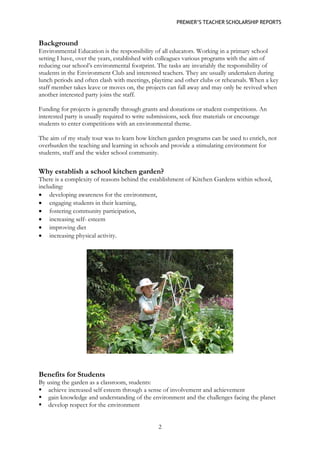
By using the garden as a classroom, students: 
 achieve increased self esteem through a sense of involvement and achievement 
 gain knowledge and understanding of the environment and the challenges facing the planet 
 develop respect for the environment
PREMIER’S TEACHER SCHOLARSHIP REPORTS 
3 
 interact in an authentic learning environment across all subject areas 
 learn new skills and knowledge catering to all learning styles 
 gain insight into new and interesting vocational pathways 
 participate in physical activity 
 foster cooperation through teamwork 
 develop leadership skills 
 gain resilience 
 experience a reduced risk of depression and obesity 
 achieve a heightened understanding of where their food comes from 
 form an holistic and healthy relationship with food 
 increase their interest in nutrition and organic eating 
 learn about food preparation 
 develop practical cooking skills utilising ingredients they have produced 
 learn about sharing space, food, knowledge and ideas 
Benefits for Teachers 
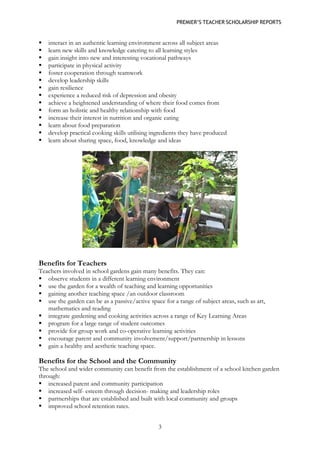
Teachers involved in school gardens gain many benefits. They can: 
 observe students in a different learning environment 
 use the garden for a wealth of teaching and learning opportunities 
 gaining another teaching space /an outdoor classroom 
 use the garden can be as a passive/active space for a range of subject areas, such as art, mathematics and reading 
 integrate gardening and cooking activities across a range of Key Learning Areas 
 program for a large range of student outcomes 
 provide for group work and co-operative learning activities 
 encourage parent and community involvement/support/partnership in lessons 
 gain a healthy and aesthetic teaching space. 
Benefits for the School and the Community 
The school and wider community can benefit from the establishment of a school kitchen garden through: 
 increased parent and community participation 
 increased self- esteem through decision- making and leadership roles 
 partnerships that are established and built with local community and groups 
 improved school retention rates.
PREMIER’S TEACHER SCHOLARSHIP REPORTS 
4 
 increased pride in their school 
 decreased vandalism 
 increased community and parent participation in the life of the school 
 developing awareness of the environment 
 engagement with students in their learning 
 fostering community participation 
 increasing self esteem 
 improved diet 
 increased physical activity 
 assisting the school to meet their sustainability targets 
 improving the school’s profile in the community 
School kitchen gardens - the outdoor classroom a meaningful and authentic place of learning 
The creation of a food garden with a diversity of plant species inevitably creates a habitat for countless species of animals. Students can see first hand the symbiotic nature that exists between species - the grub eats a plant and grows into a butterfly and the butterfly, in turn, pollinates other plants. The presence or absence of bees or birds can influence the setting of pumpkins and cucumbers. Students are not just learning to identify and label things but to understand species behaviour. 
Students who have access to a garden at school gain knowledge through interaction and observation of the natural world. Children also display a connection and a sense of responsibility for the environment when they have a role in its creation and maintenance. Hands- on experience in a garden will enhance and reinforce the study of units such as Life Cycles. 
School Visits 
Queensland 
Tewantin State School 
Sunshine Coast Grammar 
Eumundi State School 
North Arm State School 
NSW 
Byron Bay Public School 
Bangalow Public School 
Manifold Public School 
Cringila Public School 
Karonga Special Support Programs 
Cawdor Public School 
New Zealand 
Verran School 
Onerahi School 
Frankton School 
Taikura Steiner School 
Pukehou School 
Victoria 
Altona Green Primary School 
St Peter’s Primary School 
Carlsrhue Primary School 
Surfside Primary School 
The Butterfly House, Verran School, Auckland 
The children at Verran School, Birkenhead, Auckland studied the Monarch Butterfly, its population, habitat and breeding habits. As a result of research on the internet the children discovered that there was a program run through the Monarch Butterfly New Zealand Trust. Volunteers of all ages and from all walks of life track and protect the population of butterflies to ensure their survival. 
In their research, the children discovered that the Monarch Butterfly population was under threat from predators such as wasps. In order to protect the butterflies the children decided to construct a Butterfly House where they could breed and grow the butterflies. The house was
PREMIER’S TEACHER SCHOLARSHIP REPORTS 
5 
constructed by the community out of recycled material gathered from relatives who also helped to build the structure. Forage plants such as salvias and swan plants were grown in the Butterfly House to provide food for the Monarchs. 
Butterflies were caught in nets and housed until they bred. The butterflies were then tagged with tiny identification stickers and released. 
Students displayed a thorough knowledge of the habits of the Monarch butterfly. They used technical terms relating to the stages of development and used the botanical names of plants. Their teacher, Maureen, said that the students drove their own learning in response to solving problems as they arose. 
Lessons from the garden were built upon in the classroom and the students at this school displayed a deep understanding of issues relating to the environment. 
There were many other examples of this in the school e.g. students had a thorough knowledge of native flora and fauna and the biodiversity in their garden. They manage all elements including the vegetable gardens, the orchards, the shadehouse, the composts and selling surplus vegetables and worm wee to parents. The Verran School experience is an example of how children can use their learning experience to have a practical impact on the wider environment. 
The Role of Community in Kitchen Gardens in Schools 
Schools rely on the goodwill of community members to help fund, establish, support and maintain their school gardens. The community includes not just the parents of students who attend the school but also relatives, neighbours, local community groups, such as community gardener, and local businesses. Here are a number of examples which demonstrate how communities are supporting schools in their kitchen garden projects. 
Bangalow Public School, NSW 
Leah Roland, a mother of three primary students, sought to increase students’ and parents’ awareness regarding good nutrition. Five years ago she established a Kids in the Kitchen program in the school. She was supported by the local Chamber of Commerce which helped to set up kitchen facilities in a local hall. Leah has a pool of approximately 50 volunteers who help in the kitchen. She said that most helpers are not related to the students attending the school but are locals interested in the project. 
The Bangalow Chamber of Commerce has been instrumental in helping the school secure a grant from Healthy Active Schools; a one off Federal Government Grant for Community groups promoting a healthy lifestyle. Michael Molloy, its president, said his organization wished to support other local schools by giving them skills such as cooking gardening and the establishment of worm farms and helping them to start their own kitchen garden program. Raised vegetable gardens near classrooms have been established recently to supply the kitchen. 
Cringila Public School, Wollongong, NSW 
Permaculture teacher Aaron Sorensen runs a garden program at Cringila as well as several other schools in the Illawarra region of New South Wales. He enlists the help of parents and former students in garden lessons. High school students undertaking work experience placements gain valuable experience and credit toward gaining their TAFE recognized Certificate IV in Permaculture. Bluescope Steel provides ongoing funding for the school garden project. 
Pukehou School, Central Hawkes Bay, New Zealand 
There is active support for garden projects, with parents and community members giving generously of their time and resources. The community recently held a Possum Cull and raised
PREMIER’S TEACHER SCHOLARSHIP REPORTS 
6 
$20,000 NZ for the school. Possums are an environmental pest in New Zealand and the fur which is warm and lightweight, is widely used in fashion garments. 
Personnel from the Hawkes Bay Environment Centre are helping the children to propagate and grow plants for a Pekapeka Native Wetland Project. The students were involved in a project to grow potatoes and record the results as part of an international project for The Year of the Potato. 
Manifold Public School, New South Wales 
Teacher Ian Coutts has received assistance from local indigenous people in the Kyogle/ Casino region. He has established bush tucker gardens and has had help in plant selection and identifying native vegetation. Ian has also received a grant from the Northern Area Health in Lismore for projects that support healthy eating in schools. He integrates his Science units on healthy soil, water, people and environment across all subject areas. Students learn how to grow bush tucker, vegetables and fruit and how to manage a hydroponics system. 
Karonga Special Support Program New South Wales 
Karonga caters for children with special needs. The kitchen garden was recently redesigned by permaculture design students from Ryde TAFE, in consultation with the staff and school community. The space has been designed to increase yield and provide a more comfortable outdoor learning area. Recycled material was donated for the project and the Friends of Karonga and students helped to build the kitchen garden. There is now better access for students with disabilities and teachers are requesting food gardens outside their classrooms. 
North Arm, Queensland 
There is evidence throughout this school of just how committed the community is to creating a sustainable, exciting environment for the students, staff, parents and wider community. North Arm has acquired funding for a computer lab which is situated next to its kitchen. The kitchen also doubles as a canteen which is used by parents and students for cooking, publishing menus and sharing meals at special gatherings. 
There is evidence of links between the classroom and garden. Science, maths and art are exhibited in projects such as the design and making of natural pest control systems, which appear throughout the garden. Principal Mary Dowd supports teachers in integrating environmental education into their programming and teaching. 
St Peter’s, Clayton, Victoria 
The school community has enlisted the services of Edible Classrooms, a branch of Cultivating Community; a non for profit environment group, to oversee their “Growing Food for Growing Minds” project. Teachers, parents and community members assist small groups in gardening and cooking lessons. St Peter’s staff and students have incorporated animal systems into their permaculture design. Chickens not only provide food and manure but allow the students to interact and care for animals. 
St Peter’s School is striving to involve all members of the school and local community in ongoing “Earth- based education and education for a sustainable world.” Telstra, local businesses and grants have helped to fund this project. Parents assist with garden lessons, working bees and have established parent and family gardens. 
Surfside School, Queensland
PREMIER’S TEACHER SCHOLARSHIP REPORTS 
7 
Surfside School has, in a relatively short period of time, created an attractive, highly productive permaculture garden. The garden incorporates a wide variety of herbs and vegetables and an orchard, and includes artwork in the design. 
Local TAFE students have constructed beautiful and practical dry stone walls, and retaining walls. Local tradespeople have donated time and expertise to help design and construct an outdoor learning area and kitchen. Surfside has also forged strong links with the neighbouring high school and has utilised the high school kitchen for cooking lessons until the construction of their own kitchen is completed. 
To raise funds to support their garden, Surfside has put out a calendar featuring local businesses The students have produced their own chutneys and pickles and have won prizes in local agricultural shows for their culinary expertise. 
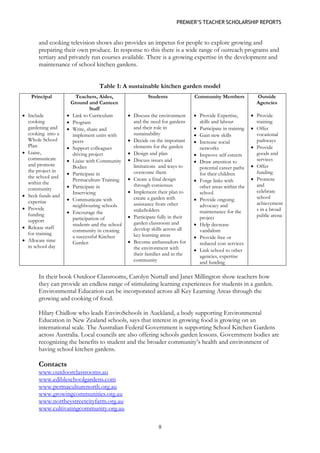
In undertaking my study tour I have seen many examples of gardens and spoken to many stakeholders. For a school garden to succeed, all stakeholders need to be involved with the project. This is an overview of the roles, benefits, challenges and issues a school community will need to address when implementing a kitchen garden. 
In undertaking my study tour I have seen many examples of gardens and spoken to many stakeholders. For a school garden to succeed, all stakeholders need to be involved with the project. Table 1 is an overview of the roles, benefits, challenges and issues a school community will need to address when implementing a kitchen garden. 
Findings 
When visiting schools I met with the supporters of school gardens, including students, teachers, parents and community members. They all agreed that the benefits of their programs were wide- ranging, impacting across every aspect of the school curriculum. 
The success of school gardens was linked to the level of involvement from the principal, staff and community members. As John Morahan (Growing Community, Brisbane a not for profit community group) argues,” gardens work best when all stakeholders work toward a common purpose”. He believes that for school kitchen garden programs to sustain themselves and thrive there must be a commitment in terms of adequate funding, professional development and practical support. It is vital that communities take ownership of kitchen garden programs through planning and design, participation in building and maintaining the garden and harvesting and enjoying the bounties of their efforts. 
Leonie Shanahan, a permaculture teacher from Edible School Gardens, Noosa employs a model where she will work with a school for two years, aiding them in the establishment of their kitchen garden and giving them the skills and knowledge required to build a successful program. The school then takes full control of their garden. 
Dr Lisa Gibbs is currently researching the outcomes of the Stephanie Alexander School Kitchen Garden Scheme, from a health perspective, in primary schools across Victoria. When talking to a large number of students, parents and teachers she found that the program had achieved far reaching benefits that were not the original objective of the program. 
Community and student interest in kitchen gardens is increasing, particularly due to the intense focus in the media on issues such as food miles, packaging, and the cost in terms of nutrition, the economy and the environment of prepackaged and fast food. The popularity of gardening
PREMIER’S TEACHER SCHOLARSHIP REPORTS 
8 
and cooking television shows also provides an impetus for people to explore growing and preparing their own produce. In response to this there is a wide range of outreach programs and tertiary and privately run courses available. There is a growing expertise in the development and maintenance of school kitchen gardens. 
Table 1: A sustainable kitchen garden model 
Principal 
• Include cooking gardening and cooking into a Whole School Plan 
• Liaise, communicate and promote the project in the school and within the community 
• Seek funds and expertise 
• Provide funding support 
• Release staff for training 
• Allocate time in school day 
Teachers, Aides, Ground and Canteen Staff 
• Link to Curriculum 
• Program 
• Write, share and implement units with peers 
• Support colleagues driving project 
• Liaise with Community Bodies 
• Participate in Permaculture Training 
• Participate in Inservicing 
• Communicate with neighbouring schools 
• Encourage the participation of students and the school community in creating a successful Kitchen Garden 
Students 
• Discuss the environment and the need for gardens and their role in sustainability 
• Decide on the important elements for the garden 
• Design and plan 
• Discuss issues and limitations and ways to overcome them 
• Create a final design through consensus 
• Implement their plan to create a garden with assistance from other stakeholders 
• Participate fully in their garden classroom and develop skills across all key learning areas 
• Become ambassadors for the environment with their families and in the community 
Community Members 
• Provide Expertise, skills and labour 
• Participate in training 
• Gain new skills 
• Increase social networks 
• Improve self esteem 
• Draw attention to potential career paths for their children 
• Forge links with other areas within the school 
• Provide ongoing advocacy and maintenance for the project 
• Help decrease vandalism 
• Provide free or reduced cost services 
• Link school to other agencies, expertise and funding 
Outside Agencies 
• Provide training 
• Offer vocational pathways 
• Provide goods and services 
• Offer funding 
• Promote and celebrate school achievements in a broad public arena 
In their book Outdoor Classrooms, Carolyn Nuttall and Janet Millington show teachers how they can provide an endless range of stimulating learning experiences for students in a garden. Environmental Education can be incorporated across all Key Learning Areas through the growing and cooking of food. 
Hilary Chidlow who leads EnviroSchools in Auckland, a body supporting Environmental Education in New Zealand schools, says that interest in growing food is growing on an international scale. The Australian Federal Government is supporting School Kitchen Gardens across Australia. Local councils are also offering schools garden lessons. Government bodies are recognizing the benefits to student and the broader community’s health and environment of having school kitchen gardens. 
Contacts 
www.outdoorclassrooms.au 
www.edibleschoolgardens.com 
www.permaculturenorth.org.au 
www.growingcommunities.org.au 
www.northeystreetcityfarm.org.au 
www.cultivatingcommunity.org.au
PREMIER’S TEACHER SCHOLARSHIP REPORTS 
9 
www.enviroschools.org.nz 
References 
Millington, J&Nuttall,C Outdoor Classrooms: a handbook for school gardens 
Alexander,S 2006 Stephanie Alexander Kitchen Garden Cooking with Kids. Penguin,Victoria 
Mollison, B & Holmgren, D. 1978 Permaculture One: A perennial agriculture for human settlement. Tagari Publications, Stanley, Tasmania 
Holmgren, D, 1996 Hepburn Permaculture Gardens 10 Years of Sustainable Living. Holmgren Design Services, Hepburn, Victoria 
Morrow, R 1993 Earth Users Guide to Permaculture. Kangaroo Press 
McCarthy, D 2004 Saving the Planet without Costing the Earth. Fusion Press Infovision Paperback Co.UK

A Food Centered Curriculum: How Permaculture Taught through School Kitchen Gardening Can Lead to More Sustainable School

  • 1.
    Premier’s EnergyAustralia EnvironmentalEducation Scholarship A food centered curriculum: How permaculture taught through school kitchen gardening can lead to more sustainable schools and communities and a more sustainable future Kathleen Gannon Carlingford West Public School Sponsored by
  • 2.
    PREMIER’S TEACHER SCHOLARSHIPREPORTS 2 Background Environmental Education is the responsibility of all educators. Working in a primary school setting I have, over the years, established with colleagues various programs with the aim of reducing our school’s environmental footprint. The tasks are invariably the responsibility of students in the Environment Club and interested teachers. They are usually undertaken during lunch periods and often clash with meetings, playtime and other clubs or rehearsals. When a key staff member takes leave or moves on, the projects can fall away and may only be revived when another interested party joins the staff. Funding for projects is generally through grants and donations or student competitions. An interested party is usually required to write submissions, seek free materials or encourage students to enter competitions with an environmental theme. The aim of my study tour was to learn how kitchen garden programs can be used to enrich, not overburden the teaching and learning in schools and provide a stimulating environment for students, staff and the wider school community. Why establish a school kitchen garden? There is a complexity of reasons behind the establishment of Kitchen Gardens within school, including: • developing awareness for the environment, • engaging students in their learning, • fostering community participation, • increasing self- esteem • improving diet • increasing physical activity. Benefits for Students By using the garden as a classroom, students:  achieve increased self esteem through a sense of involvement and achievement  gain knowledge and understanding of the environment and the challenges facing the planet  develop respect for the environment
  • 3.
    PREMIER’S TEACHER SCHOLARSHIPREPORTS 3  interact in an authentic learning environment across all subject areas  learn new skills and knowledge catering to all learning styles  gain insight into new and interesting vocational pathways  participate in physical activity  foster cooperation through teamwork  develop leadership skills  gain resilience  experience a reduced risk of depression and obesity  achieve a heightened understanding of where their food comes from  form an holistic and healthy relationship with food  increase their interest in nutrition and organic eating  learn about food preparation  develop practical cooking skills utilising ingredients they have produced  learn about sharing space, food, knowledge and ideas Benefits for Teachers Teachers involved in school gardens gain many benefits. They can:  observe students in a different learning environment  use the garden for a wealth of teaching and learning opportunities  gaining another teaching space /an outdoor classroom  use the garden can be as a passive/active space for a range of subject areas, such as art, mathematics and reading  integrate gardening and cooking activities across a range of Key Learning Areas  program for a large range of student outcomes  provide for group work and co-operative learning activities  encourage parent and community involvement/support/partnership in lessons  gain a healthy and aesthetic teaching space. Benefits for the School and the Community The school and wider community can benefit from the establishment of a school kitchen garden through:  increased parent and community participation  increased self- esteem through decision- making and leadership roles  partnerships that are established and built with local community and groups  improved school retention rates.
  • 4.
    PREMIER’S TEACHER SCHOLARSHIPREPORTS 4  increased pride in their school  decreased vandalism  increased community and parent participation in the life of the school  developing awareness of the environment  engagement with students in their learning  fostering community participation  increasing self esteem  improved diet  increased physical activity  assisting the school to meet their sustainability targets  improving the school’s profile in the community School kitchen gardens - the outdoor classroom a meaningful and authentic place of learning The creation of a food garden with a diversity of plant species inevitably creates a habitat for countless species of animals. Students can see first hand the symbiotic nature that exists between species - the grub eats a plant and grows into a butterfly and the butterfly, in turn, pollinates other plants. The presence or absence of bees or birds can influence the setting of pumpkins and cucumbers. Students are not just learning to identify and label things but to understand species behaviour. Students who have access to a garden at school gain knowledge through interaction and observation of the natural world. Children also display a connection and a sense of responsibility for the environment when they have a role in its creation and maintenance. Hands- on experience in a garden will enhance and reinforce the study of units such as Life Cycles. School Visits Queensland Tewantin State School Sunshine Coast Grammar Eumundi State School North Arm State School NSW Byron Bay Public School Bangalow Public School Manifold Public School Cringila Public School Karonga Special Support Programs Cawdor Public School New Zealand Verran School Onerahi School Frankton School Taikura Steiner School Pukehou School Victoria Altona Green Primary School St Peter’s Primary School Carlsrhue Primary School Surfside Primary School The Butterfly House, Verran School, Auckland The children at Verran School, Birkenhead, Auckland studied the Monarch Butterfly, its population, habitat and breeding habits. As a result of research on the internet the children discovered that there was a program run through the Monarch Butterfly New Zealand Trust. Volunteers of all ages and from all walks of life track and protect the population of butterflies to ensure their survival. In their research, the children discovered that the Monarch Butterfly population was under threat from predators such as wasps. In order to protect the butterflies the children decided to construct a Butterfly House where they could breed and grow the butterflies. The house was
  • 5.
    PREMIER’S TEACHER SCHOLARSHIPREPORTS 5 constructed by the community out of recycled material gathered from relatives who also helped to build the structure. Forage plants such as salvias and swan plants were grown in the Butterfly House to provide food for the Monarchs. Butterflies were caught in nets and housed until they bred. The butterflies were then tagged with tiny identification stickers and released. Students displayed a thorough knowledge of the habits of the Monarch butterfly. They used technical terms relating to the stages of development and used the botanical names of plants. Their teacher, Maureen, said that the students drove their own learning in response to solving problems as they arose. Lessons from the garden were built upon in the classroom and the students at this school displayed a deep understanding of issues relating to the environment. There were many other examples of this in the school e.g. students had a thorough knowledge of native flora and fauna and the biodiversity in their garden. They manage all elements including the vegetable gardens, the orchards, the shadehouse, the composts and selling surplus vegetables and worm wee to parents. The Verran School experience is an example of how children can use their learning experience to have a practical impact on the wider environment. The Role of Community in Kitchen Gardens in Schools Schools rely on the goodwill of community members to help fund, establish, support and maintain their school gardens. The community includes not just the parents of students who attend the school but also relatives, neighbours, local community groups, such as community gardener, and local businesses. Here are a number of examples which demonstrate how communities are supporting schools in their kitchen garden projects. Bangalow Public School, NSW Leah Roland, a mother of three primary students, sought to increase students’ and parents’ awareness regarding good nutrition. Five years ago she established a Kids in the Kitchen program in the school. She was supported by the local Chamber of Commerce which helped to set up kitchen facilities in a local hall. Leah has a pool of approximately 50 volunteers who help in the kitchen. She said that most helpers are not related to the students attending the school but are locals interested in the project. The Bangalow Chamber of Commerce has been instrumental in helping the school secure a grant from Healthy Active Schools; a one off Federal Government Grant for Community groups promoting a healthy lifestyle. Michael Molloy, its president, said his organization wished to support other local schools by giving them skills such as cooking gardening and the establishment of worm farms and helping them to start their own kitchen garden program. Raised vegetable gardens near classrooms have been established recently to supply the kitchen. Cringila Public School, Wollongong, NSW Permaculture teacher Aaron Sorensen runs a garden program at Cringila as well as several other schools in the Illawarra region of New South Wales. He enlists the help of parents and former students in garden lessons. High school students undertaking work experience placements gain valuable experience and credit toward gaining their TAFE recognized Certificate IV in Permaculture. Bluescope Steel provides ongoing funding for the school garden project. Pukehou School, Central Hawkes Bay, New Zealand There is active support for garden projects, with parents and community members giving generously of their time and resources. The community recently held a Possum Cull and raised
  • 6.
    PREMIER’S TEACHER SCHOLARSHIPREPORTS 6 $20,000 NZ for the school. Possums are an environmental pest in New Zealand and the fur which is warm and lightweight, is widely used in fashion garments. Personnel from the Hawkes Bay Environment Centre are helping the children to propagate and grow plants for a Pekapeka Native Wetland Project. The students were involved in a project to grow potatoes and record the results as part of an international project for The Year of the Potato. Manifold Public School, New South Wales Teacher Ian Coutts has received assistance from local indigenous people in the Kyogle/ Casino region. He has established bush tucker gardens and has had help in plant selection and identifying native vegetation. Ian has also received a grant from the Northern Area Health in Lismore for projects that support healthy eating in schools. He integrates his Science units on healthy soil, water, people and environment across all subject areas. Students learn how to grow bush tucker, vegetables and fruit and how to manage a hydroponics system. Karonga Special Support Program New South Wales Karonga caters for children with special needs. The kitchen garden was recently redesigned by permaculture design students from Ryde TAFE, in consultation with the staff and school community. The space has been designed to increase yield and provide a more comfortable outdoor learning area. Recycled material was donated for the project and the Friends of Karonga and students helped to build the kitchen garden. There is now better access for students with disabilities and teachers are requesting food gardens outside their classrooms. North Arm, Queensland There is evidence throughout this school of just how committed the community is to creating a sustainable, exciting environment for the students, staff, parents and wider community. North Arm has acquired funding for a computer lab which is situated next to its kitchen. The kitchen also doubles as a canteen which is used by parents and students for cooking, publishing menus and sharing meals at special gatherings. There is evidence of links between the classroom and garden. Science, maths and art are exhibited in projects such as the design and making of natural pest control systems, which appear throughout the garden. Principal Mary Dowd supports teachers in integrating environmental education into their programming and teaching. St Peter’s, Clayton, Victoria The school community has enlisted the services of Edible Classrooms, a branch of Cultivating Community; a non for profit environment group, to oversee their “Growing Food for Growing Minds” project. Teachers, parents and community members assist small groups in gardening and cooking lessons. St Peter’s staff and students have incorporated animal systems into their permaculture design. Chickens not only provide food and manure but allow the students to interact and care for animals. St Peter’s School is striving to involve all members of the school and local community in ongoing “Earth- based education and education for a sustainable world.” Telstra, local businesses and grants have helped to fund this project. Parents assist with garden lessons, working bees and have established parent and family gardens. Surfside School, Queensland
  • 7.
    PREMIER’S TEACHER SCHOLARSHIPREPORTS 7 Surfside School has, in a relatively short period of time, created an attractive, highly productive permaculture garden. The garden incorporates a wide variety of herbs and vegetables and an orchard, and includes artwork in the design. Local TAFE students have constructed beautiful and practical dry stone walls, and retaining walls. Local tradespeople have donated time and expertise to help design and construct an outdoor learning area and kitchen. Surfside has also forged strong links with the neighbouring high school and has utilised the high school kitchen for cooking lessons until the construction of their own kitchen is completed. To raise funds to support their garden, Surfside has put out a calendar featuring local businesses The students have produced their own chutneys and pickles and have won prizes in local agricultural shows for their culinary expertise. In undertaking my study tour I have seen many examples of gardens and spoken to many stakeholders. For a school garden to succeed, all stakeholders need to be involved with the project. This is an overview of the roles, benefits, challenges and issues a school community will need to address when implementing a kitchen garden. In undertaking my study tour I have seen many examples of gardens and spoken to many stakeholders. For a school garden to succeed, all stakeholders need to be involved with the project. Table 1 is an overview of the roles, benefits, challenges and issues a school community will need to address when implementing a kitchen garden. Findings When visiting schools I met with the supporters of school gardens, including students, teachers, parents and community members. They all agreed that the benefits of their programs were wide- ranging, impacting across every aspect of the school curriculum. The success of school gardens was linked to the level of involvement from the principal, staff and community members. As John Morahan (Growing Community, Brisbane a not for profit community group) argues,” gardens work best when all stakeholders work toward a common purpose”. He believes that for school kitchen garden programs to sustain themselves and thrive there must be a commitment in terms of adequate funding, professional development and practical support. It is vital that communities take ownership of kitchen garden programs through planning and design, participation in building and maintaining the garden and harvesting and enjoying the bounties of their efforts. Leonie Shanahan, a permaculture teacher from Edible School Gardens, Noosa employs a model where she will work with a school for two years, aiding them in the establishment of their kitchen garden and giving them the skills and knowledge required to build a successful program. The school then takes full control of their garden. Dr Lisa Gibbs is currently researching the outcomes of the Stephanie Alexander School Kitchen Garden Scheme, from a health perspective, in primary schools across Victoria. When talking to a large number of students, parents and teachers she found that the program had achieved far reaching benefits that were not the original objective of the program. Community and student interest in kitchen gardens is increasing, particularly due to the intense focus in the media on issues such as food miles, packaging, and the cost in terms of nutrition, the economy and the environment of prepackaged and fast food. The popularity of gardening
  • 8.
    PREMIER’S TEACHER SCHOLARSHIPREPORTS 8 and cooking television shows also provides an impetus for people to explore growing and preparing their own produce. In response to this there is a wide range of outreach programs and tertiary and privately run courses available. There is a growing expertise in the development and maintenance of school kitchen gardens. Table 1: A sustainable kitchen garden model Principal • Include cooking gardening and cooking into a Whole School Plan • Liaise, communicate and promote the project in the school and within the community • Seek funds and expertise • Provide funding support • Release staff for training • Allocate time in school day Teachers, Aides, Ground and Canteen Staff • Link to Curriculum • Program • Write, share and implement units with peers • Support colleagues driving project • Liaise with Community Bodies • Participate in Permaculture Training • Participate in Inservicing • Communicate with neighbouring schools • Encourage the participation of students and the school community in creating a successful Kitchen Garden Students • Discuss the environment and the need for gardens and their role in sustainability • Decide on the important elements for the garden • Design and plan • Discuss issues and limitations and ways to overcome them • Create a final design through consensus • Implement their plan to create a garden with assistance from other stakeholders • Participate fully in their garden classroom and develop skills across all key learning areas • Become ambassadors for the environment with their families and in the community Community Members • Provide Expertise, skills and labour • Participate in training • Gain new skills • Increase social networks • Improve self esteem • Draw attention to potential career paths for their children • Forge links with other areas within the school • Provide ongoing advocacy and maintenance for the project • Help decrease vandalism • Provide free or reduced cost services • Link school to other agencies, expertise and funding Outside Agencies • Provide training • Offer vocational pathways • Provide goods and services • Offer funding • Promote and celebrate school achievements in a broad public arena In their book Outdoor Classrooms, Carolyn Nuttall and Janet Millington show teachers how they can provide an endless range of stimulating learning experiences for students in a garden. Environmental Education can be incorporated across all Key Learning Areas through the growing and cooking of food. Hilary Chidlow who leads EnviroSchools in Auckland, a body supporting Environmental Education in New Zealand schools, says that interest in growing food is growing on an international scale. The Australian Federal Government is supporting School Kitchen Gardens across Australia. Local councils are also offering schools garden lessons. Government bodies are recognizing the benefits to student and the broader community’s health and environment of having school kitchen gardens. Contacts www.outdoorclassrooms.au www.edibleschoolgardens.com www.permaculturenorth.org.au www.growingcommunities.org.au www.northeystreetcityfarm.org.au www.cultivatingcommunity.org.au
  • 9.
    PREMIER’S TEACHER SCHOLARSHIPREPORTS 9 www.enviroschools.org.nz References Millington, J&Nuttall,C Outdoor Classrooms: a handbook for school gardens Alexander,S 2006 Stephanie Alexander Kitchen Garden Cooking with Kids. Penguin,Victoria Mollison, B & Holmgren, D. 1978 Permaculture One: A perennial agriculture for human settlement. Tagari Publications, Stanley, Tasmania Holmgren, D, 1996 Hepburn Permaculture Gardens 10 Years of Sustainable Living. Holmgren Design Services, Hepburn, Victoria Morrow, R 1993 Earth Users Guide to Permaculture. Kangaroo Press McCarthy, D 2004 Saving the Planet without Costing the Earth. Fusion Press Infovision Paperback Co.UK