© 2008 Cisco Systems, Inc. All rights reserved. Cisco Confidential
Presentation_ID 1
Introduction to XMPP
Joe Hildebrand
© 2010 Cisco Systems, Inc. All rights reserved. 2
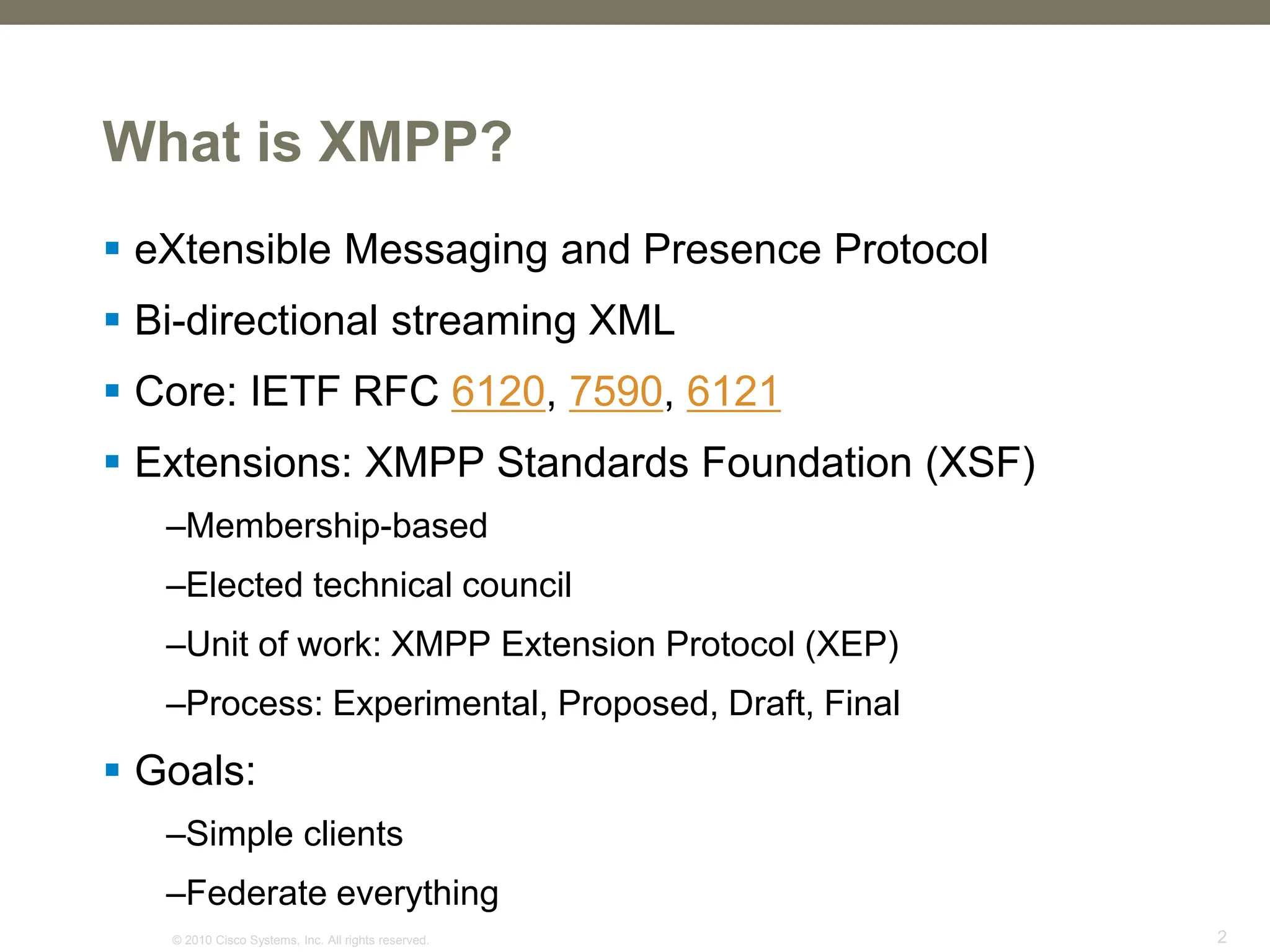
What is XMPP?
 eXtensible Messaging and Presence Protocol
 Bi-directional streaming XML
 Core: IETF RFC 6120, 7590, 6121
 Extensions: XMPP Standards Foundation (XSF)
–Membership-based
–Elected technical council
–Unit of work: XMPP Extension Protocol (XEP)
–Process: Experimental, Proposed, Draft, Final
 Goals:
–Simple clients
–Federate everything
© 2010 Cisco Systems, Inc. All rights reserved. 3
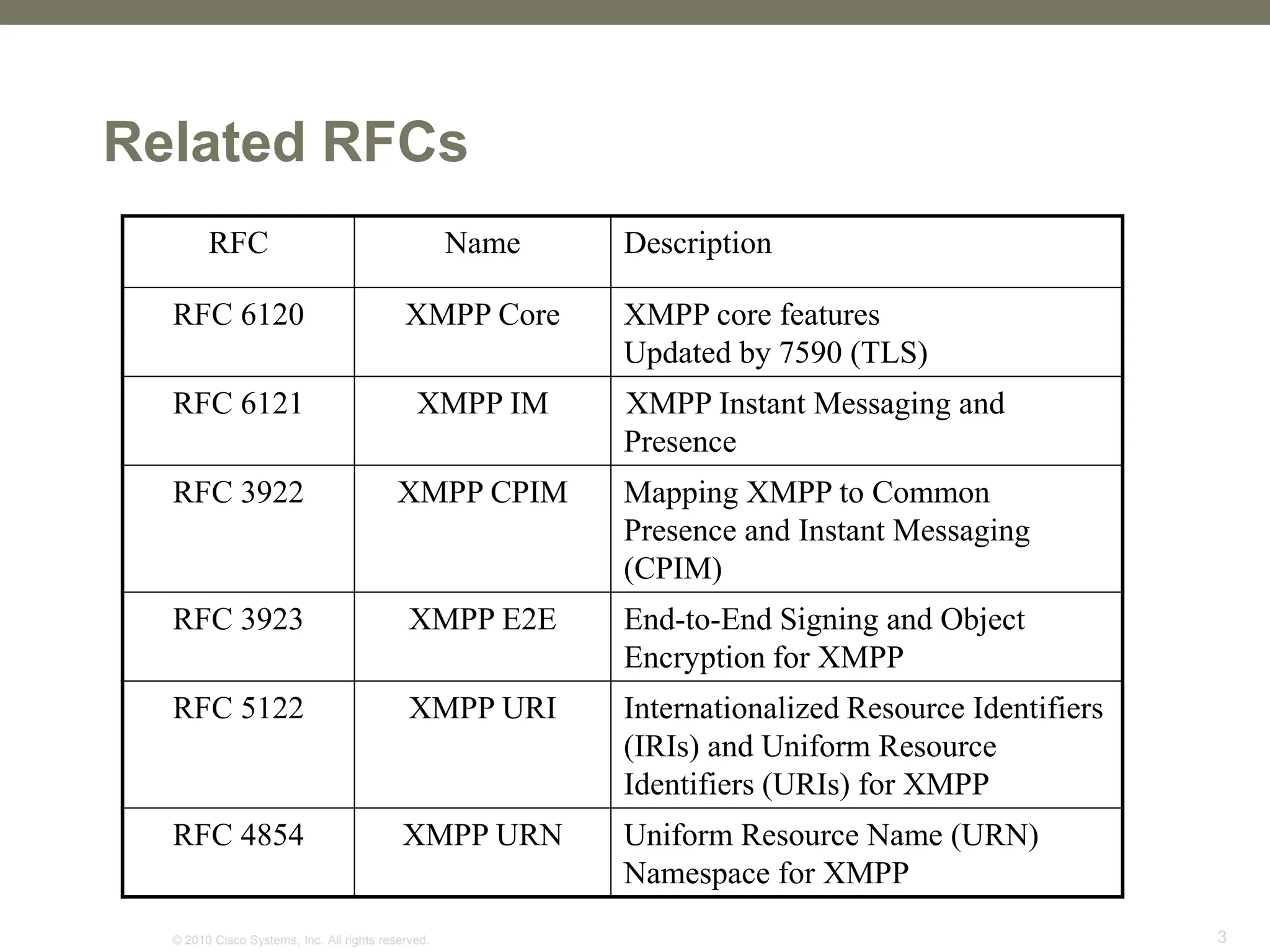
Related RFCs
RFC Name Description
RFC 6120 XMPP Core XMPP core features
Updated by 7590 (TLS)
RFC 6121 XMPP IM XMPP Instant Messaging and
Presence
RFC 3922 XMPP CPIM Mapping XMPP to Common
Presence and Instant Messaging
(CPIM)
RFC 3923 XMPP E2E End-to-End Signing and Object
Encryption for XMPP
RFC 5122 XMPP URI Internationalized Resource Identifiers
(IRIs) and Uniform Resource
Identifiers (URIs) for XMPP
RFC 4854 XMPP URN Uniform Resource Name (URN)
Namespace for XMPP
© 2010 Cisco Systems, Inc. All rights reserved. 4
4
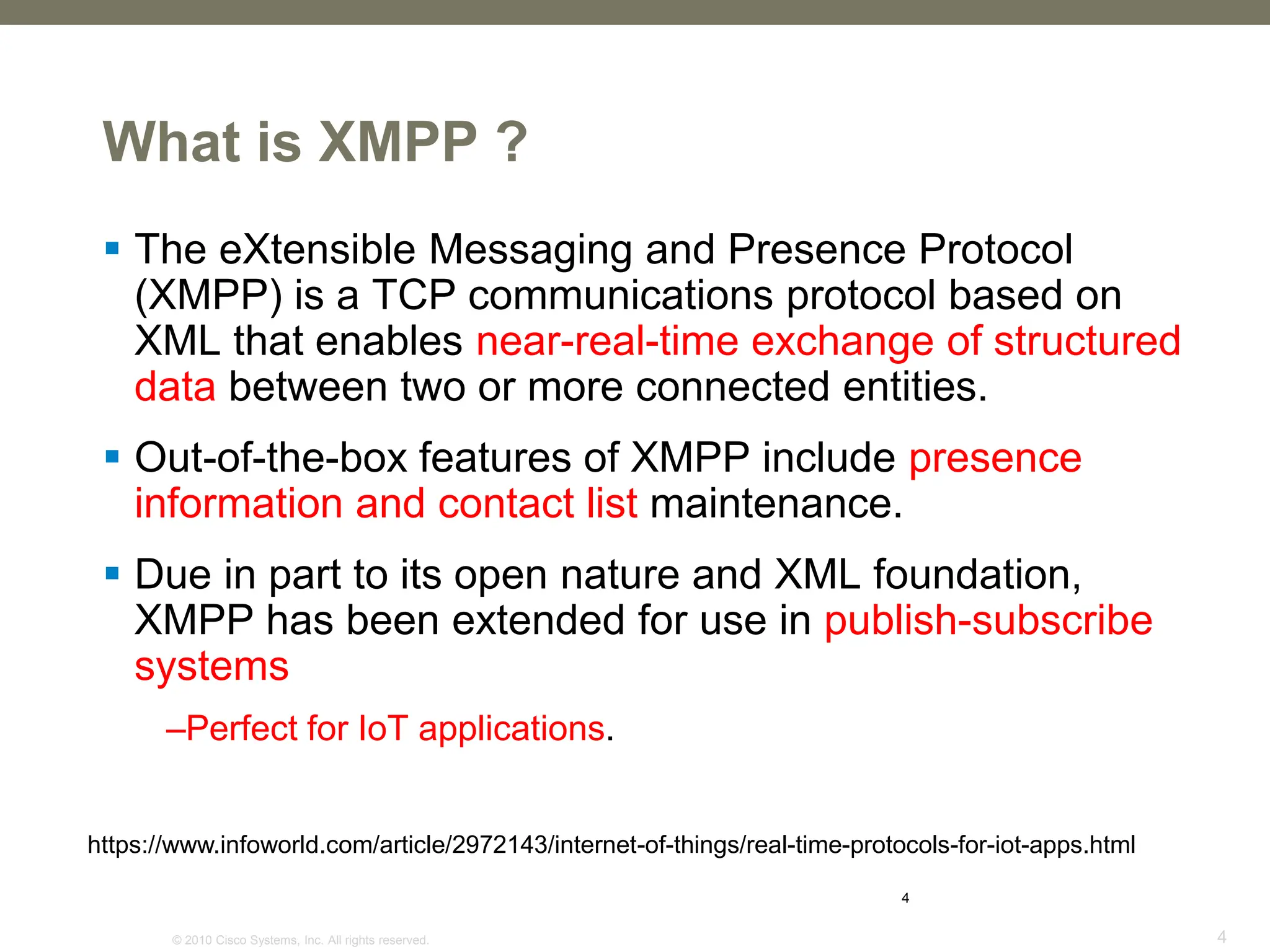
What is XMPP ?
 The eXtensible Messaging and Presence Protocol
(XMPP) is a TCP communications protocol based on
XML that enables near-real-time exchange of structured
data between two or more connected entities.
 Out-of-the-box features of XMPP include presence
information and contact list maintenance.
 Due in part to its open nature and XML foundation,
XMPP has been extended for use in publish-subscribe
systems
–Perfect for IoT applications.
https://www.infoworld.com/article/2972143/internet-of-things/real-time-protocols-for-iot-apps.html
© 2010 Cisco Systems, Inc. All rights reserved. 5
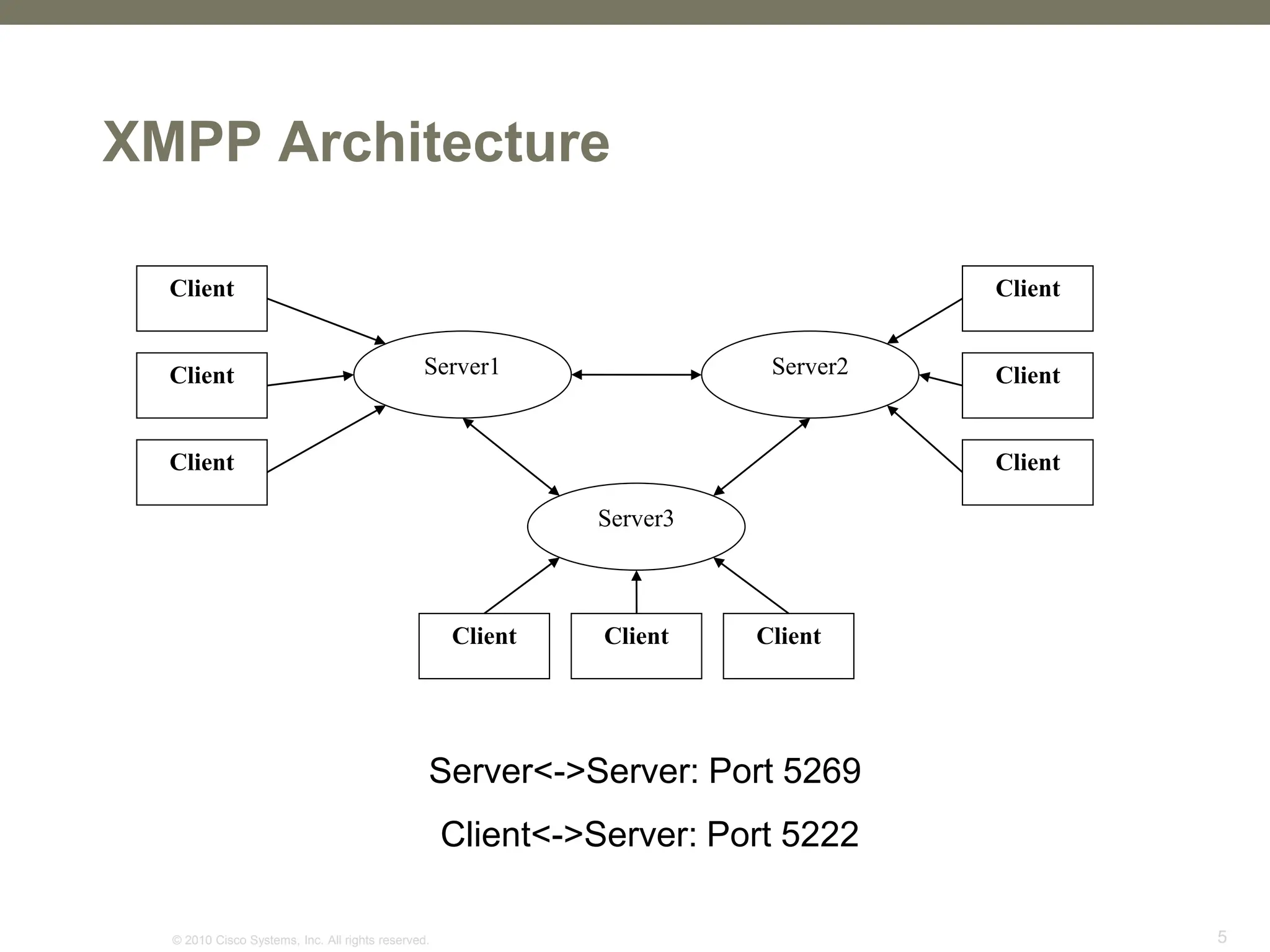
XMPP Architecture
Server1 Server2
Server3
Client
Client
Client
Client Client Client
Client
Client
Client
Server<->Server: Port 5269
Client<->Server: Port 5222
© 2010 Cisco Systems, Inc. All rights reserved. 6
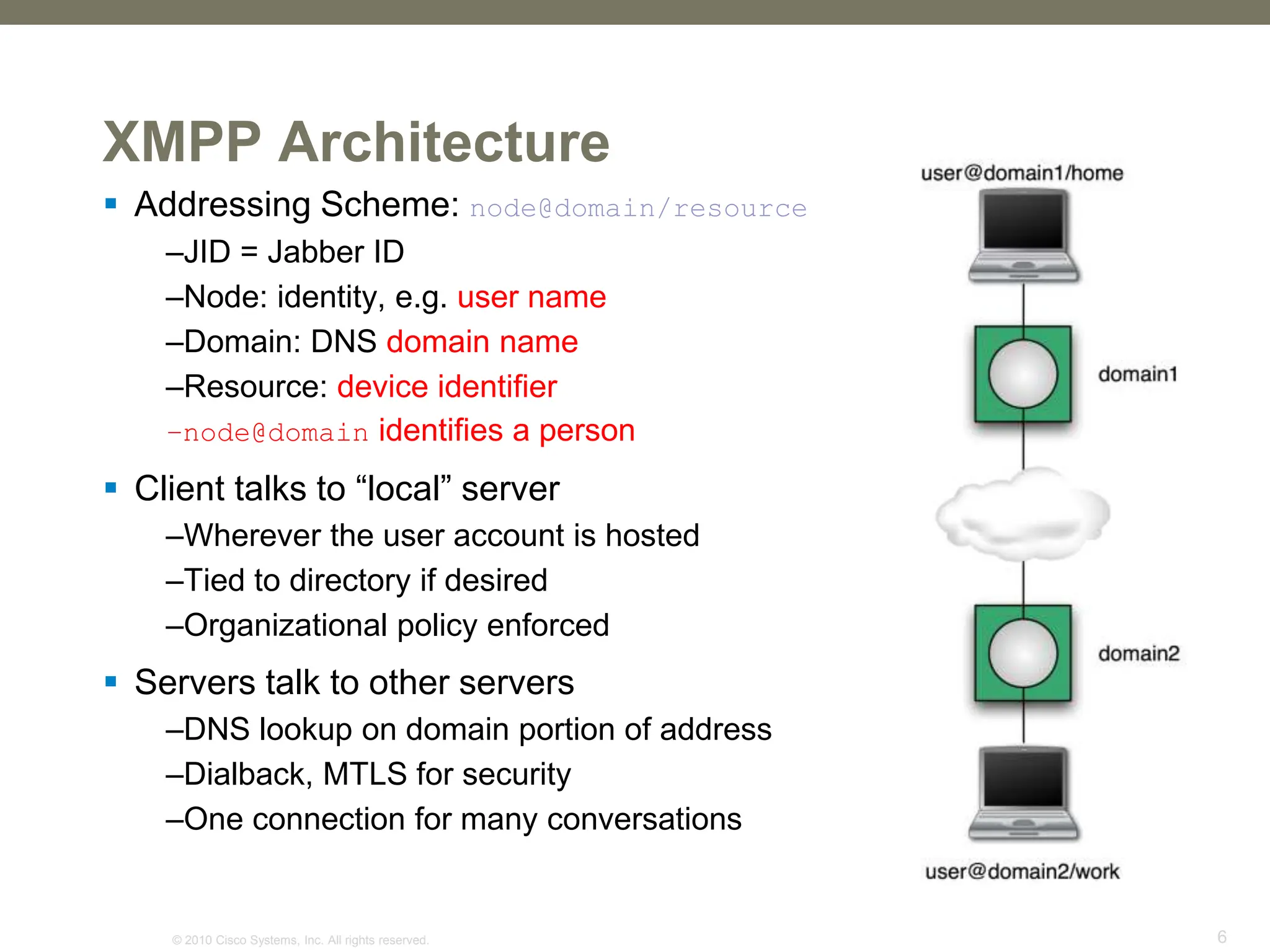
XMPP Architecture
 Addressing Scheme: node@domain/resource
–JID = Jabber ID
–Node: identity, e.g. user name
–Domain: DNS domain name
–Resource: device identifier
–node@domain identifies a person
 Client talks to “local” server
–Wherever the user account is hosted
–Tied to directory if desired
–Organizational policy enforced
 Servers talk to other servers
–DNS lookup on domain portion of address
–Dialback, MTLS for security
–One connection for many conversations
© 2010 Cisco Systems, Inc. All rights reserved. 7
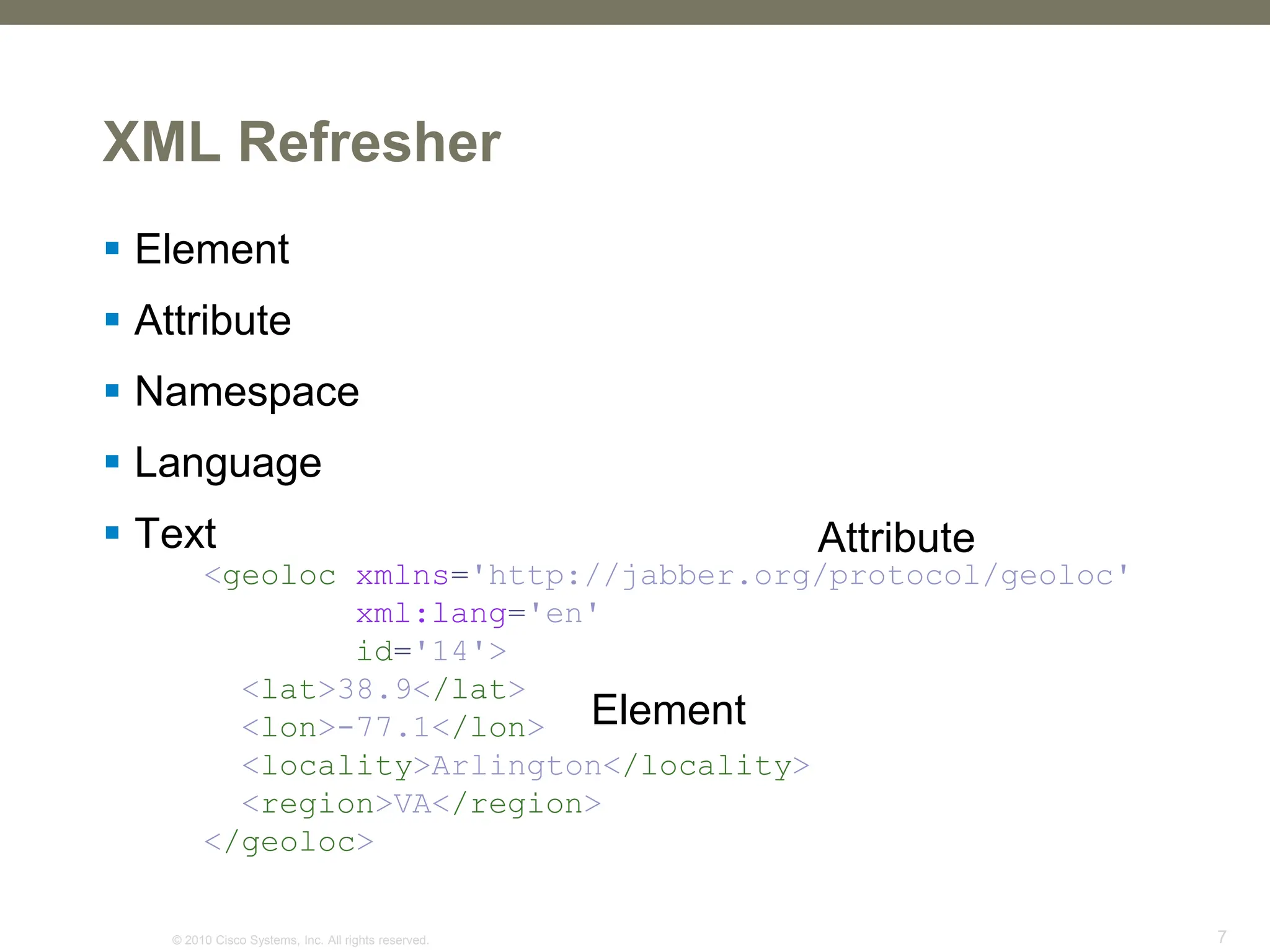
<geoloc xmlns='http://jabber.org/protocol/geoloc'
xml:lang='en'
id='14'>
<lat>38.9</lat>
<lon>-77.1</lon>
<locality>Arlington</locality>
<region>VA</region>
</geoloc>
XML Refresher
 Element
 Attribute
 Namespace
 Language
 Text Attribute
Element
© 2010 Cisco Systems, Inc. All rights reserved. 8
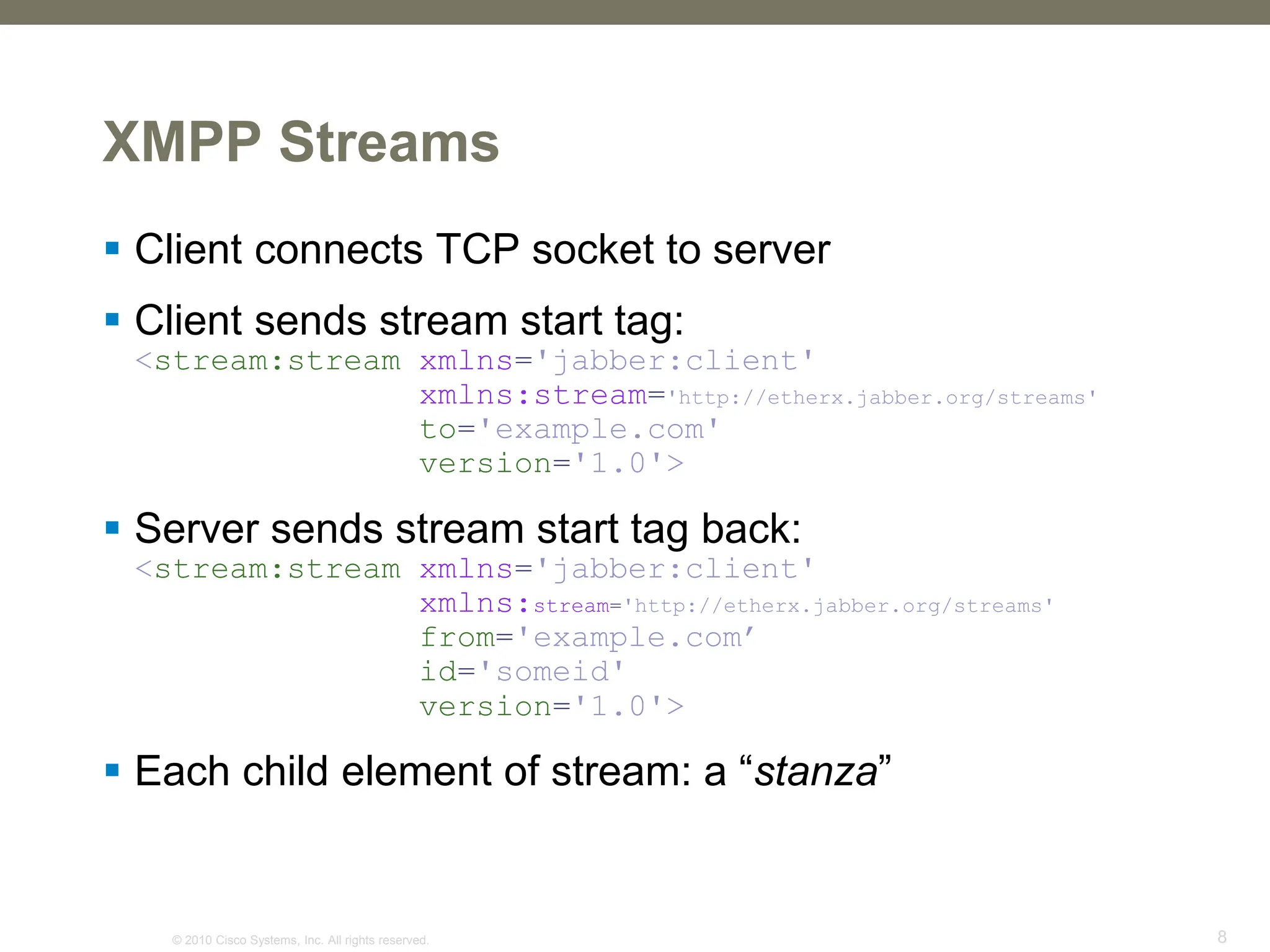
XMPP Streams
 Client connects TCP socket to server
 Client sends stream start tag:
<stream:stream xmlns='jabber:client'
xmlns:stream='http://etherx.jabber.org/streams'
to='example.com'
version='1.0'>
 Server sends stream start tag back:
<stream:stream xmlns='jabber:client'
xmlns:stream='http://etherx.jabber.org/streams'
from='example.com’
id='someid'
version='1.0'>
 Each child element of stream: a “stanza”
© 2010 Cisco Systems, Inc. All rights reserved. 9
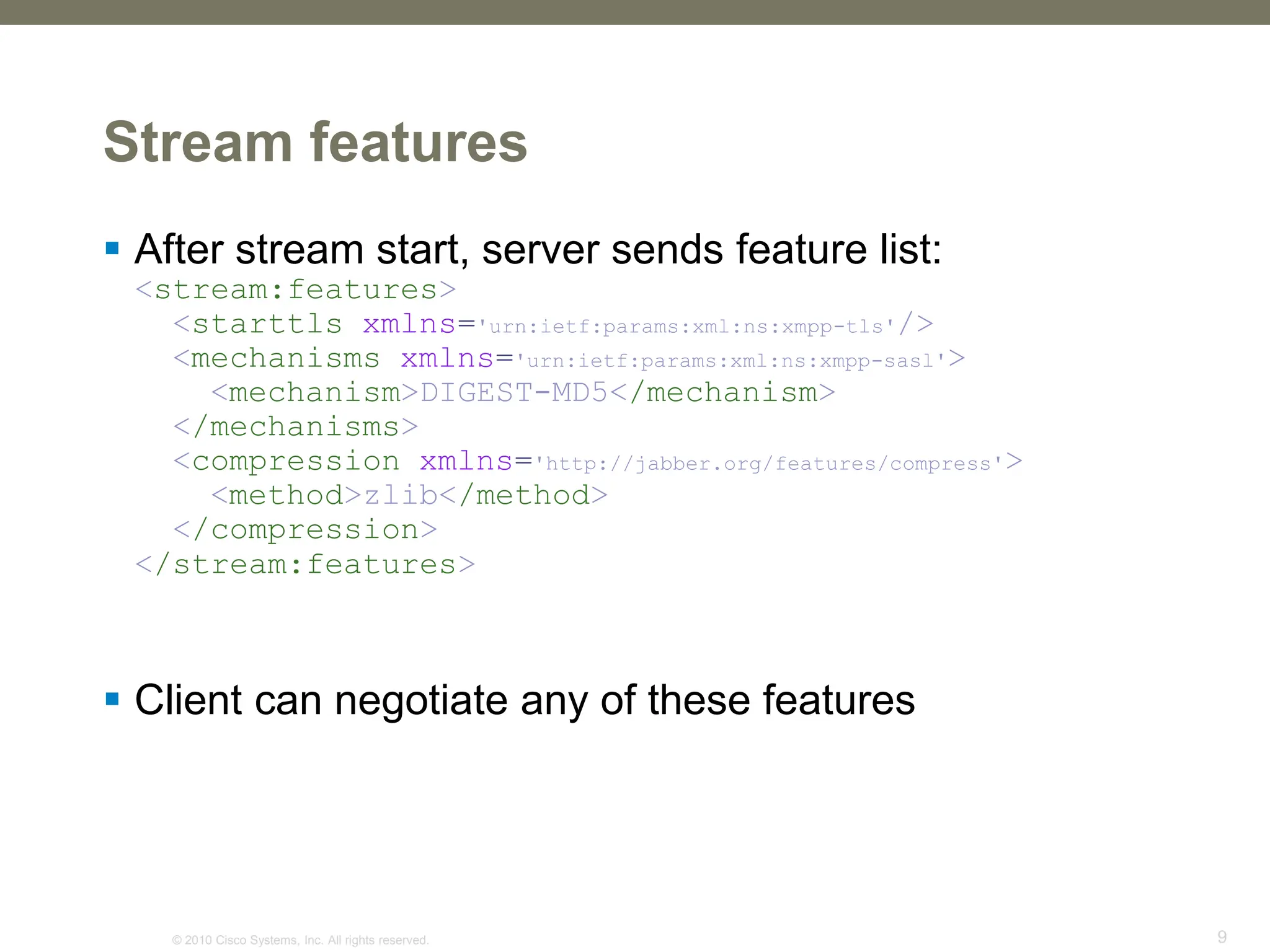
Stream features
 After stream start, server sends feature list:
<stream:features>
<starttls xmlns='urn:ietf:params:xml:ns:xmpp-tls'/>
<mechanisms xmlns='urn:ietf:params:xml:ns:xmpp-sasl'>
<mechanism>DIGEST-MD5</mechanism>
</mechanisms>
<compression xmlns='http://jabber.org/features/compress'>
<method>zlib</method>
</compression>
</stream:features>
 Client can negotiate any of these features
© 2010 Cisco Systems, Inc. All rights reserved. 10
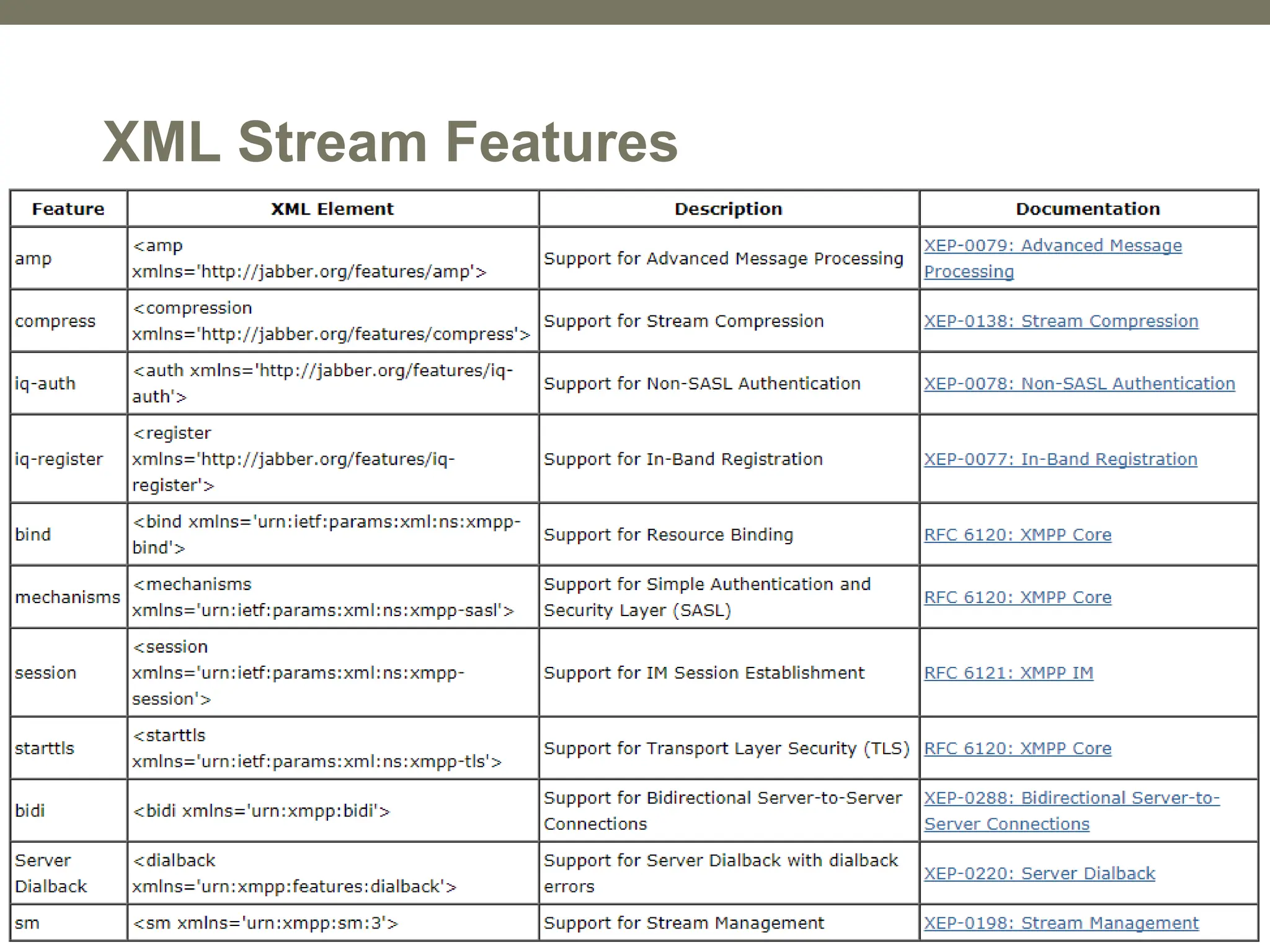
XML Stream Features
© 2010 Cisco Systems, Inc. All rights reserved. 11
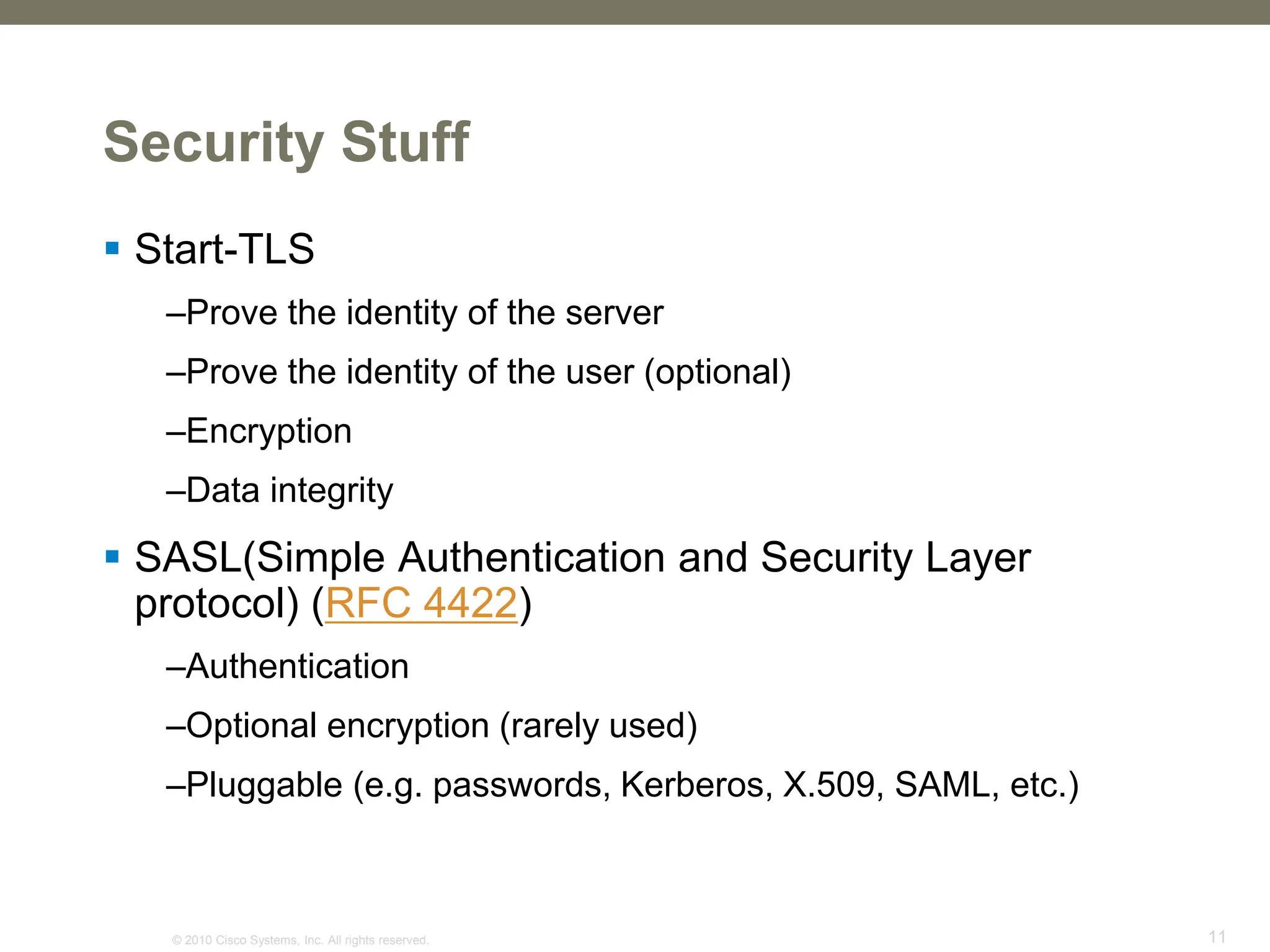
Security Stuff
 Start-TLS
–Prove the identity of the server
–Prove the identity of the user (optional)
–Encryption
–Data integrity
 SASL(Simple Authentication and Security Layer
protocol) (RFC 4422)
–Authentication
–Optional encryption (rarely used)
–Pluggable (e.g. passwords, Kerberos, X.509, SAML, etc.)
© 2010 Cisco Systems, Inc. All rights reserved. 12
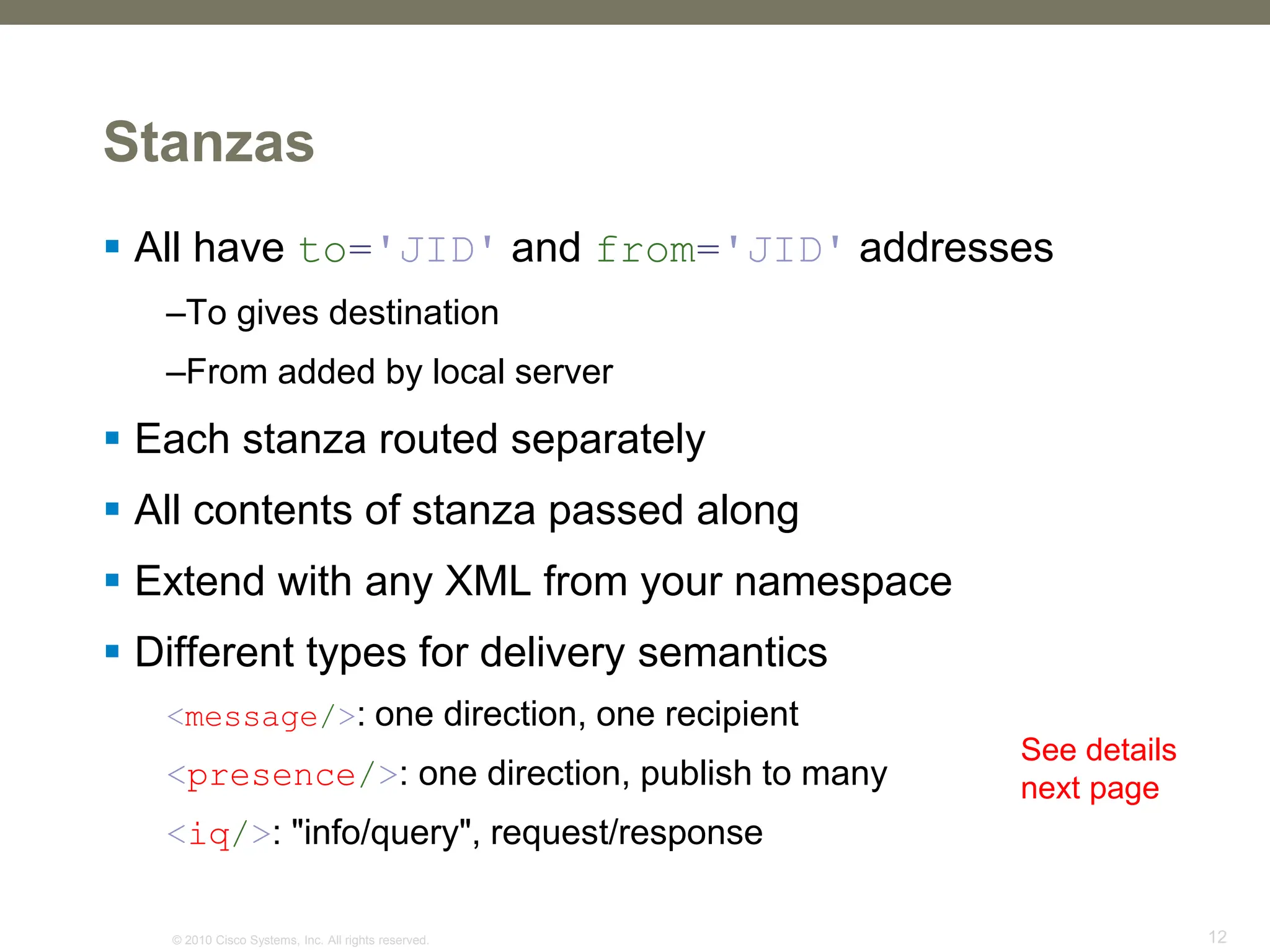
Stanzas
 All have to='JID' and from='JID' addresses
–To gives destination
–From added by local server
 Each stanza routed separately
 All contents of stanza passed along
 Extend with any XML from your namespace
 Different types for delivery semantics
<message/>: one direction, one recipient
<presence/>: one direction, publish to many
<iq/>: "info/query", request/response
See details
next page
© 2010 Cisco Systems, Inc. All rights reserved. 13
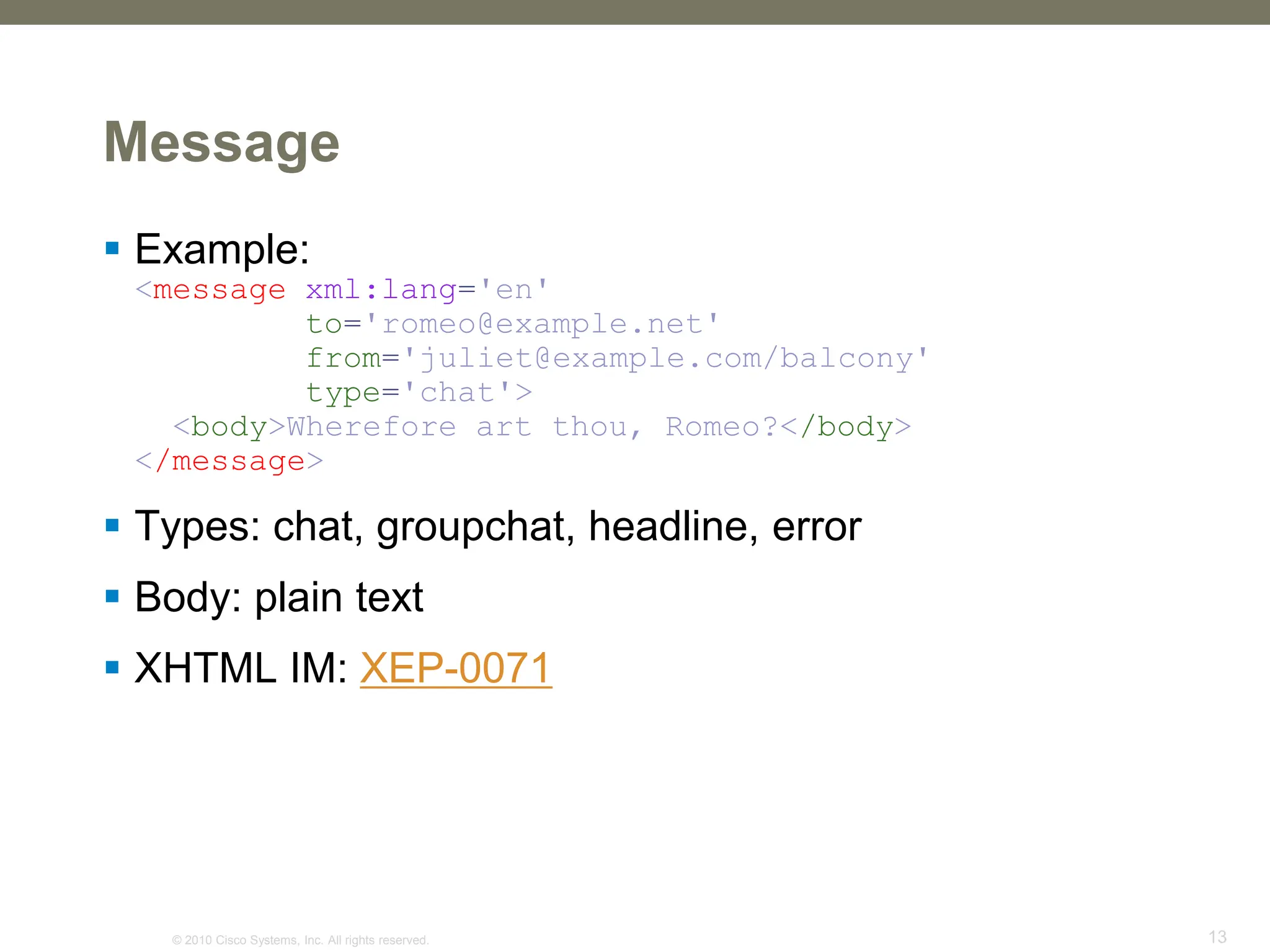
Message
 Example:
<message xml:lang='en'
to='romeo@example.net'
from='juliet@example.com/balcony'
type='chat'>
<body>Wherefore art thou, Romeo?</body>
</message>
 Types: chat, groupchat, headline, error
 Body: plain text
 XHTML IM: XEP-0071
© 2010 Cisco Systems, Inc. All rights reserved. 14
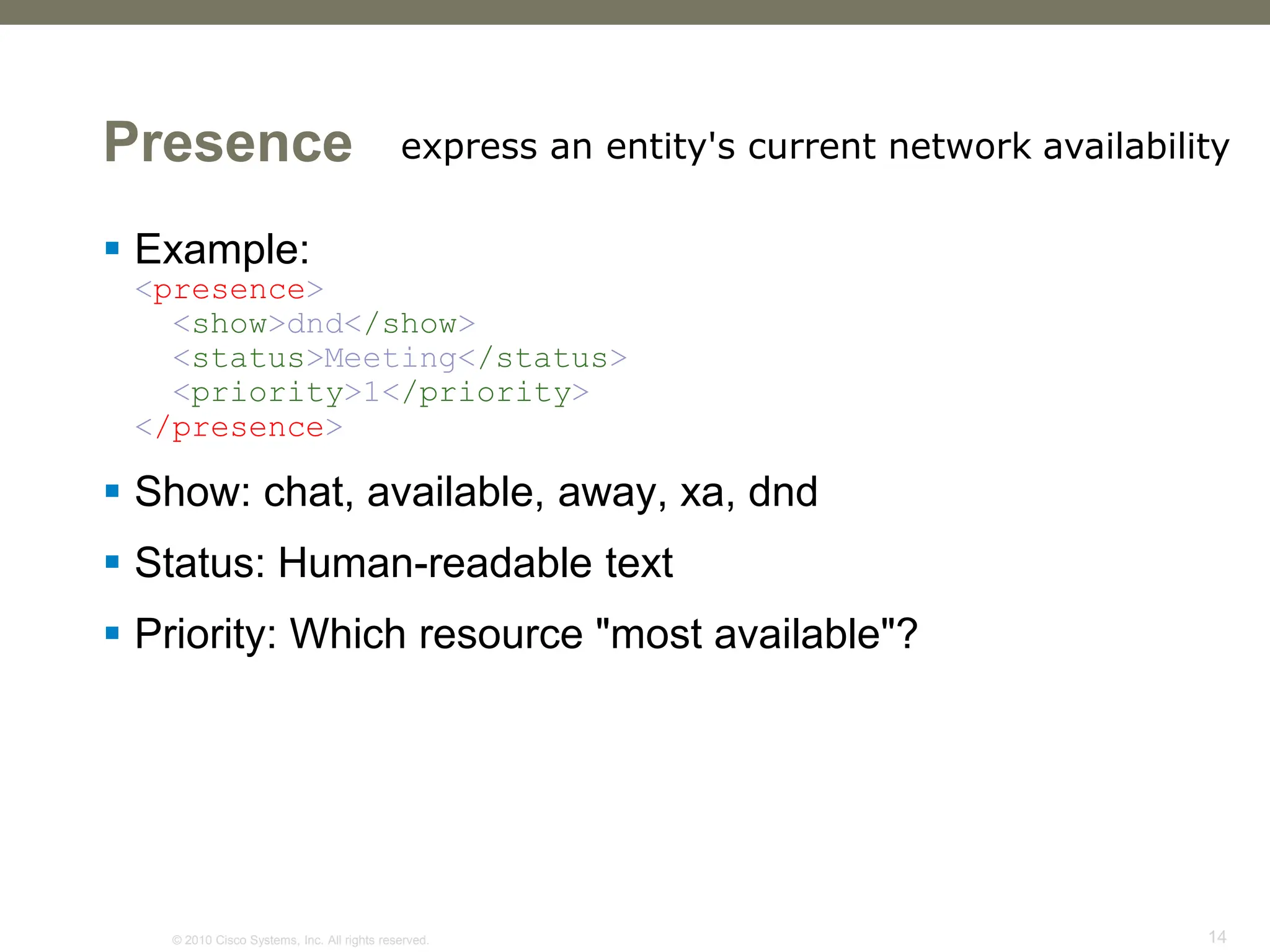
Presence
 Example:
<presence>
<show>dnd</show>
<status>Meeting</status>
<priority>1</priority>
</presence>
 Show: chat, available, away, xa, dnd
 Status: Human-readable text
 Priority: Which resource "most available"?
express an entity's current network availability
© 2010 Cisco Systems, Inc. All rights reserved. 15
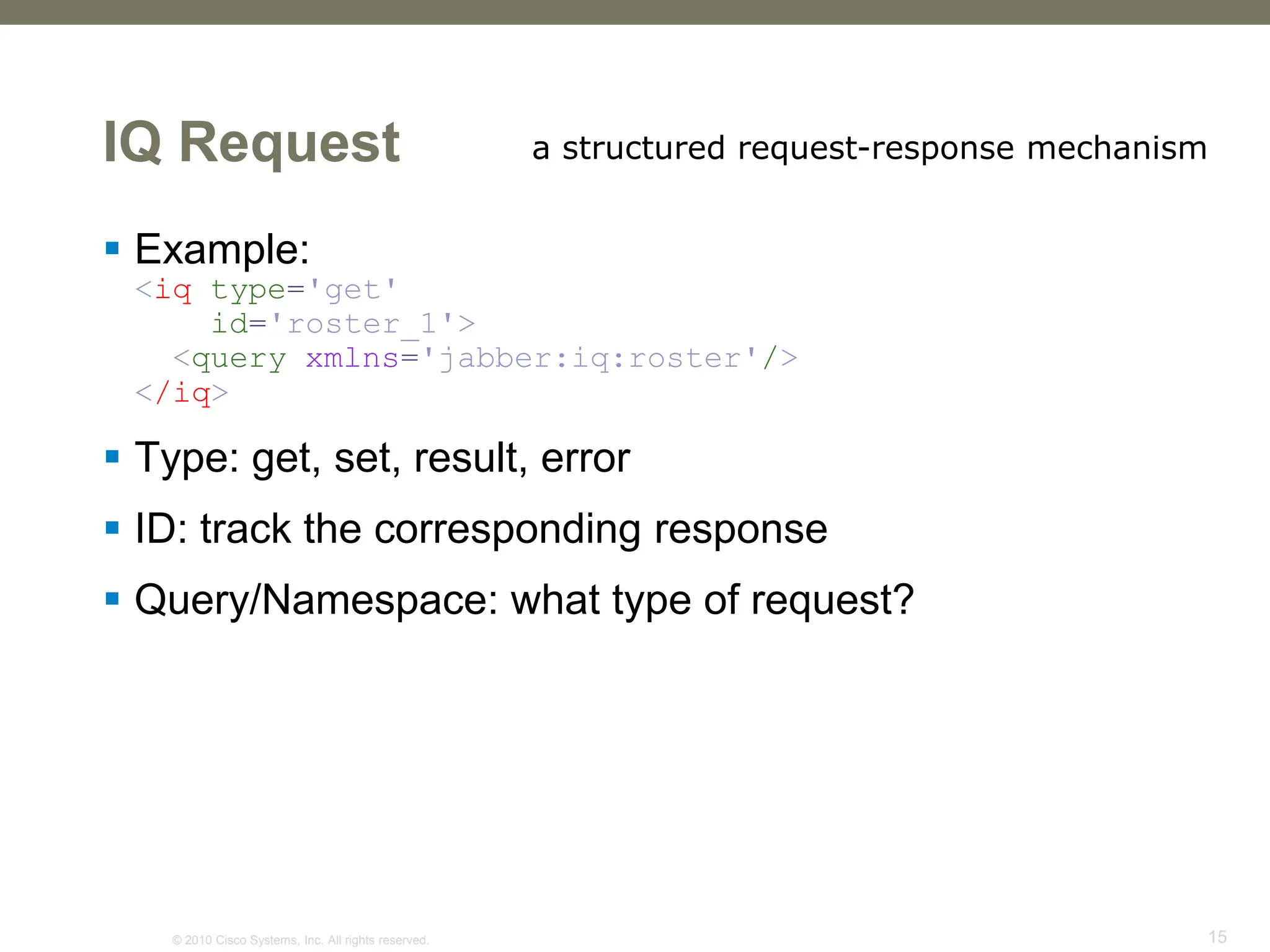
IQ Request
 Example:
<iq type='get'
id='roster_1'>
<query xmlns='jabber:iq:roster'/>
</iq>
 Type: get, set, result, error
 ID: track the corresponding response
 Query/Namespace: what type of request?
a structured request-response mechanism
© 2010 Cisco Systems, Inc. All rights reserved. 16
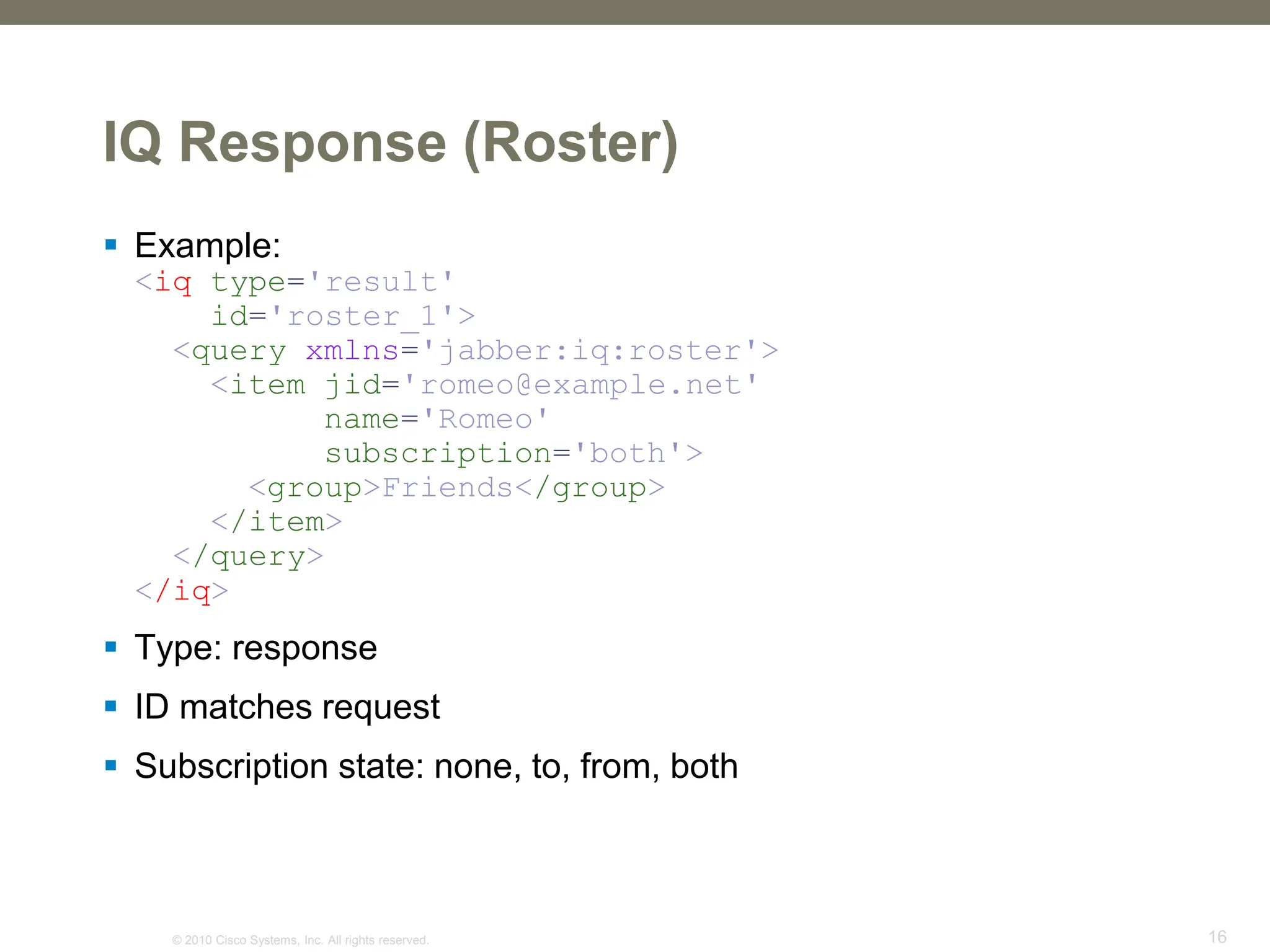
IQ Response (Roster)
 Example:
<iq type='result'
id='roster_1'>
<query xmlns='jabber:iq:roster'>
<item jid='romeo@example.net'
name='Romeo'
subscription='both'>
<group>Friends</group>
</item>
</query>
</iq>
 Type: response
 ID matches request
 Subscription state: none, to, from, both
© 2010 Cisco Systems, Inc. All rights reserved. 17
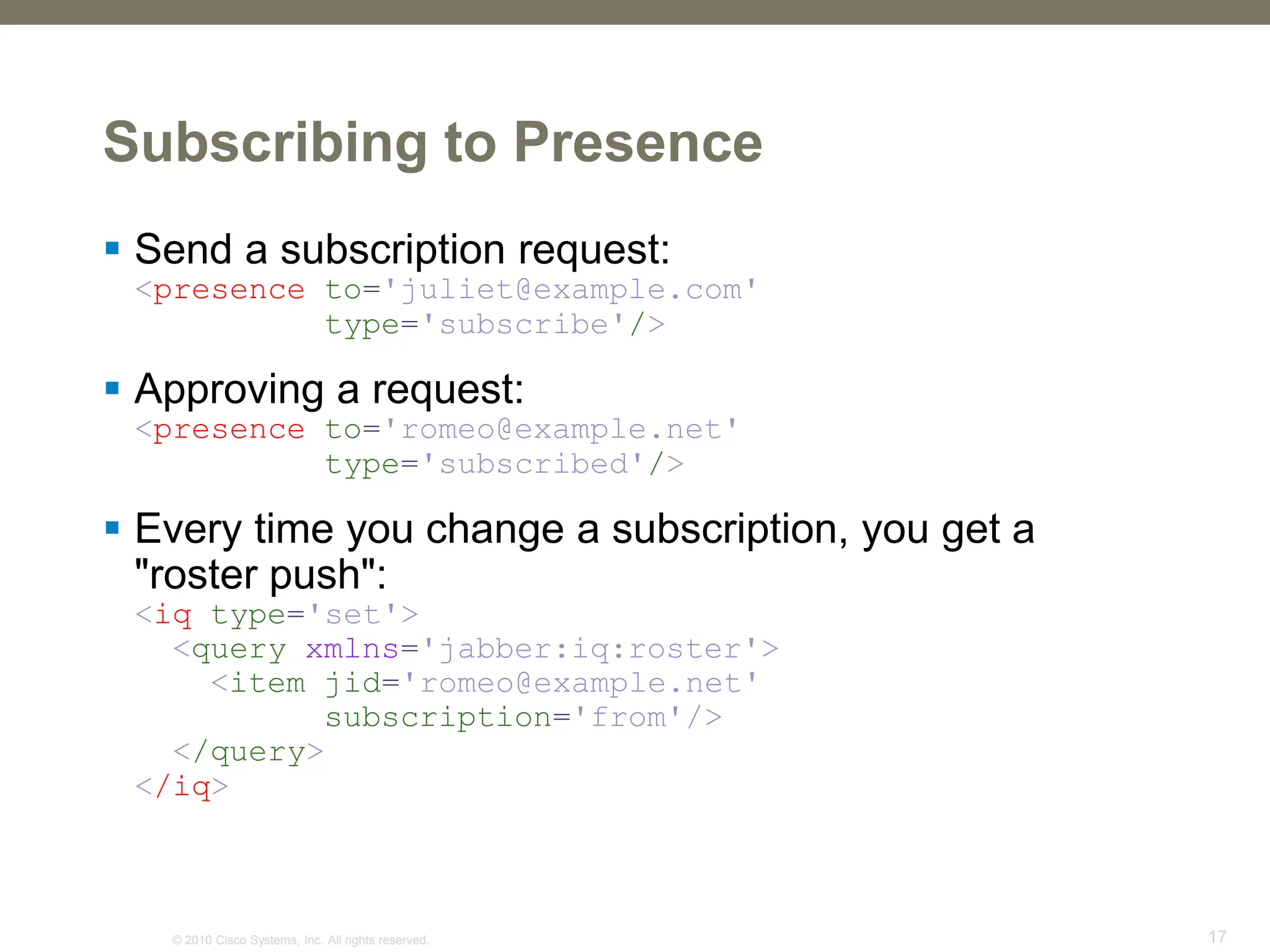
Subscribing to Presence
 Send a subscription request:
<presence to='juliet@example.com'
type='subscribe'/>
 Approving a request:
<presence to='romeo@example.net'
type='subscribed'/>
 Every time you change a subscription, you get a
"roster push":
<iq type='set'>
<query xmlns='jabber:iq:roster'>
<item jid='romeo@example.net'
subscription='from'/>
</query>
</iq>
© 2010 Cisco Systems, Inc. All rights reserved. 18
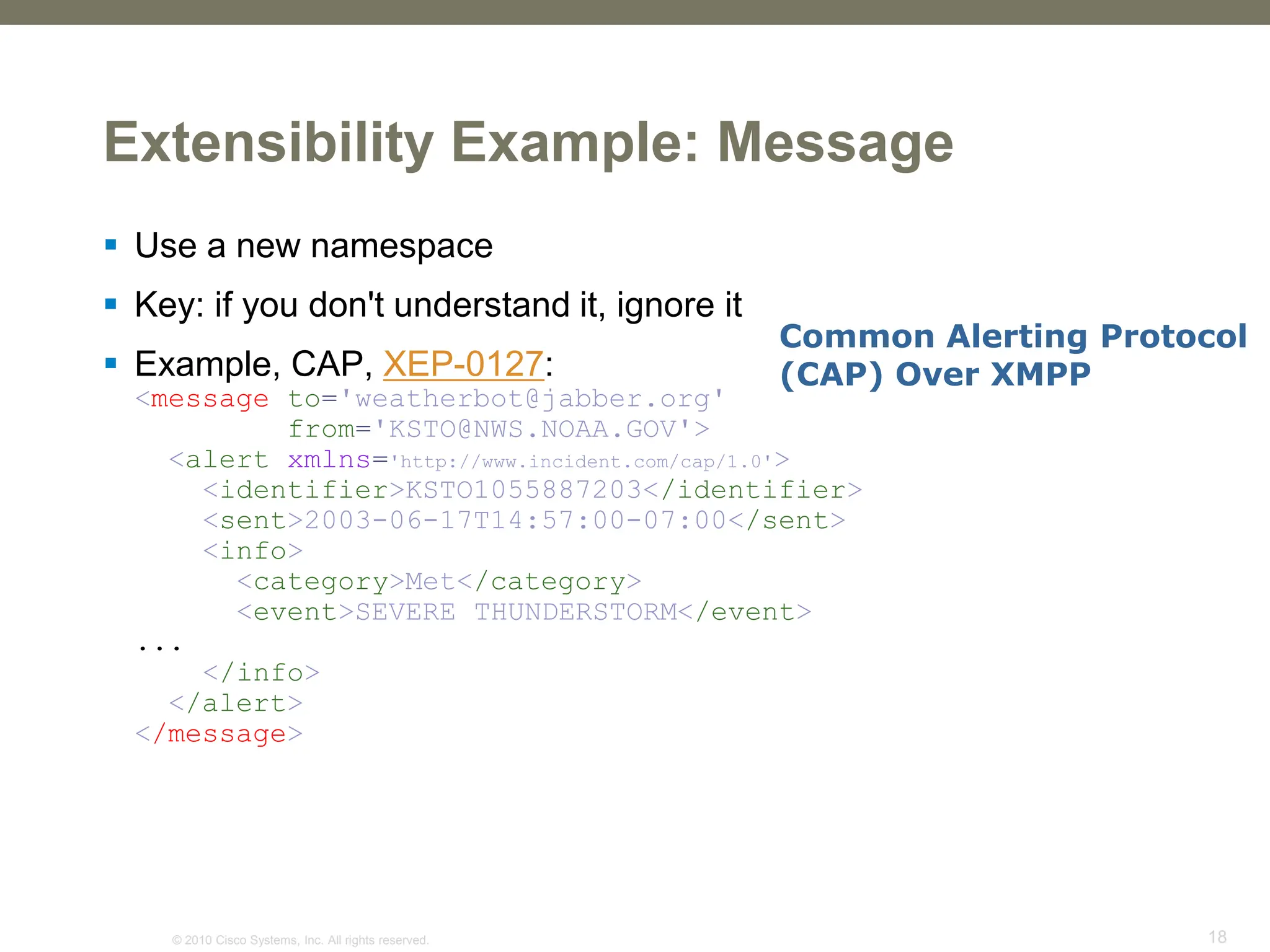
Extensibility Example: Message
 Use a new namespace
 Key: if you don't understand it, ignore it
 Example, CAP, XEP-0127:
<message to='weatherbot@jabber.org'
from='KSTO@NWS.NOAA.GOV'>
<alert xmlns='http://www.incident.com/cap/1.0'>
<identifier>KSTO1055887203</identifier>
<sent>2003-06-17T14:57:00-07:00</sent>
<info>
<category>Met</category>
<event>SEVERE THUNDERSTORM</event>
...
</info>
</alert>
</message>
Common Alerting Protocol
(CAP) Over XMPP
© 2010 Cisco Systems, Inc. All rights reserved. 19
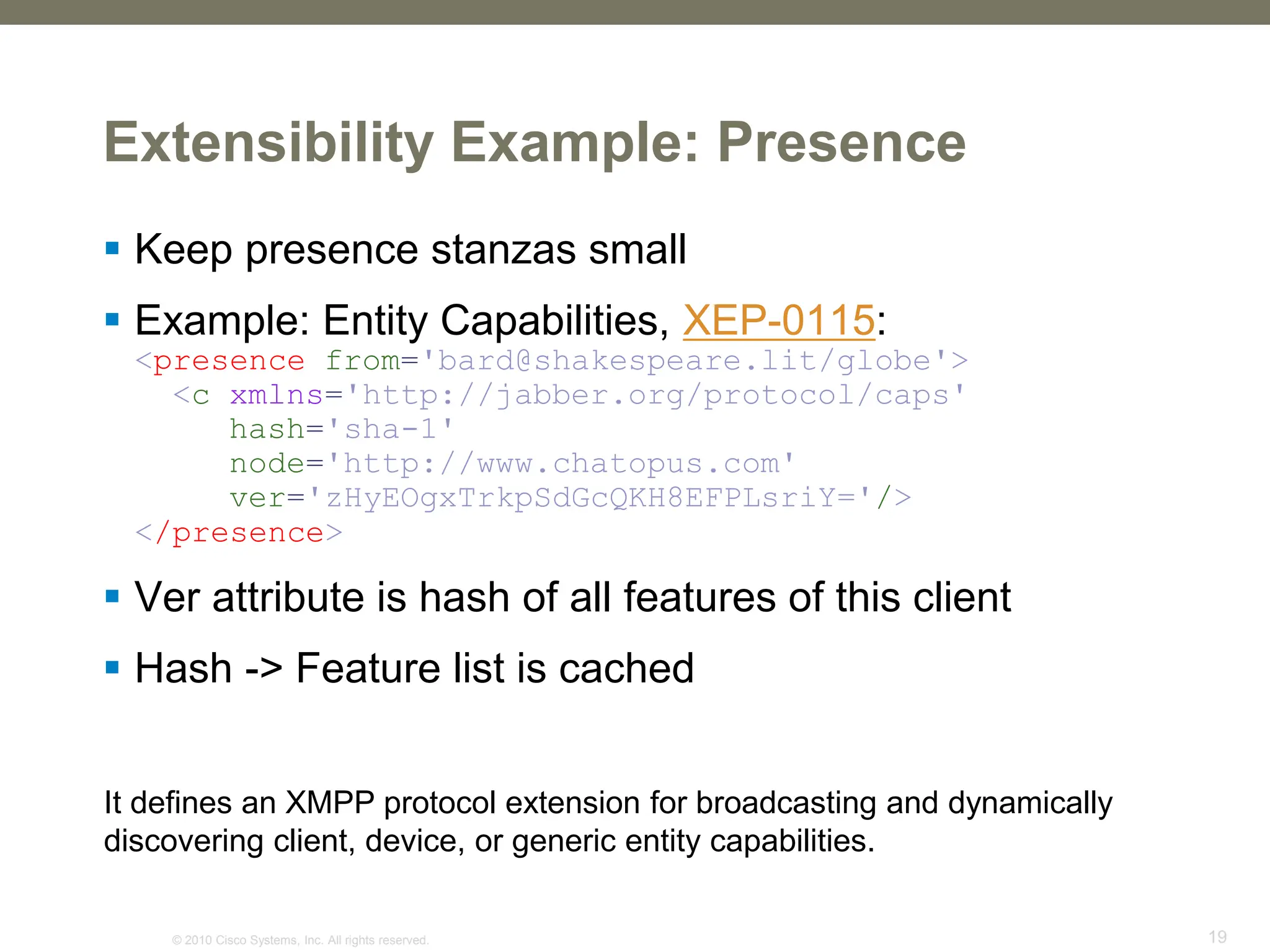
Extensibility Example: Presence
 Keep presence stanzas small
 Example: Entity Capabilities, XEP-0115:
<presence from='bard@shakespeare.lit/globe'>
<c xmlns='http://jabber.org/protocol/caps'
hash='sha-1'
node='http://www.chatopus.com'
ver='zHyEOgxTrkpSdGcQKH8EFPLsriY='/>
</presence>
 Ver attribute is hash of all features of this client
 Hash -> Feature list is cached
It defines an XMPP protocol extension for broadcasting and dynamically
discovering client, device, or generic entity capabilities.
© 2010 Cisco Systems, Inc. All rights reserved. 20
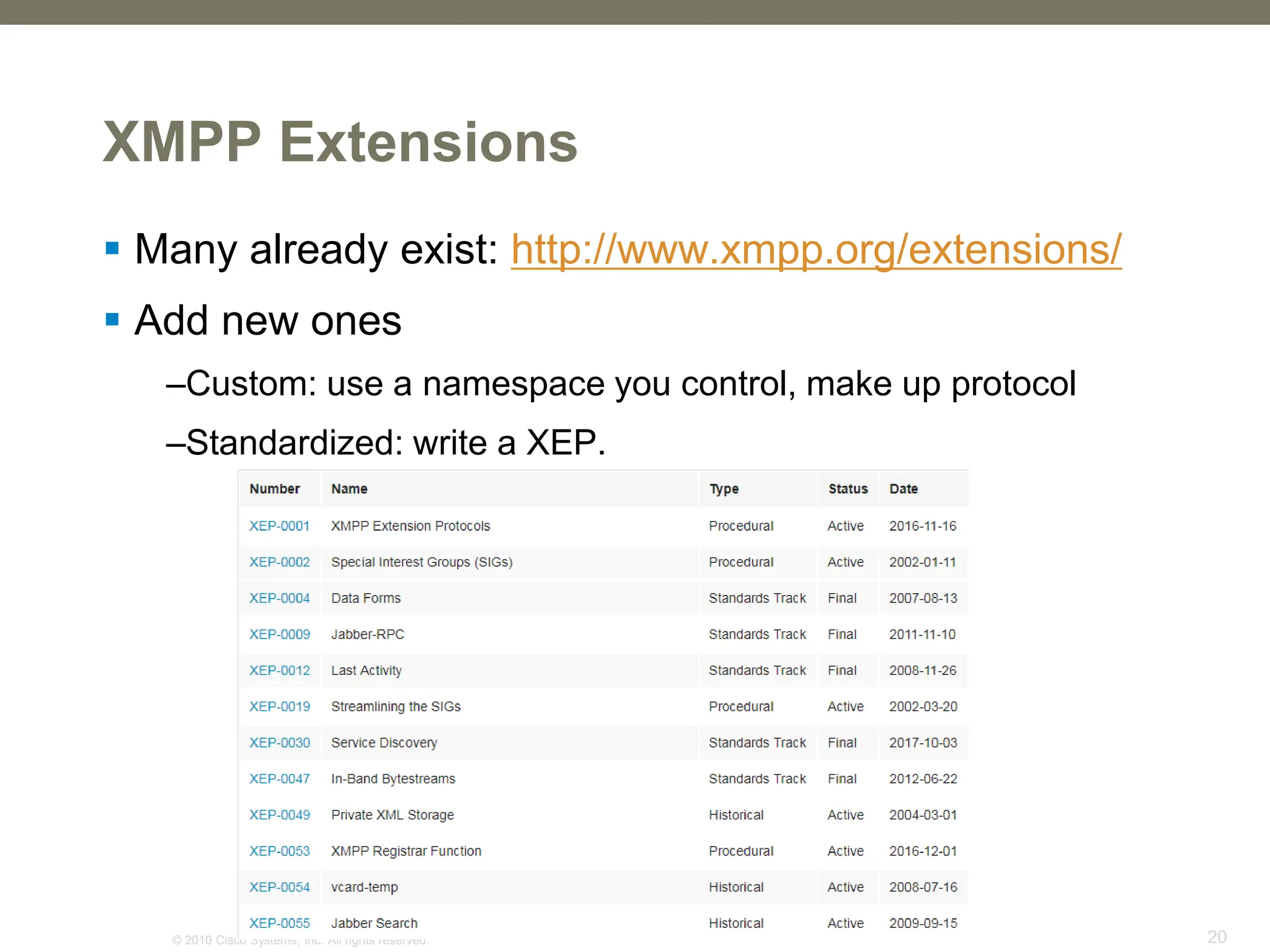
XMPP Extensions
 Many already exist: http://www.xmpp.org/extensions/
 Add new ones
–Custom: use a namespace you control, make up protocol
–Standardized: write a XEP.
© 2010 Cisco Systems, Inc. All rights reserved. 21
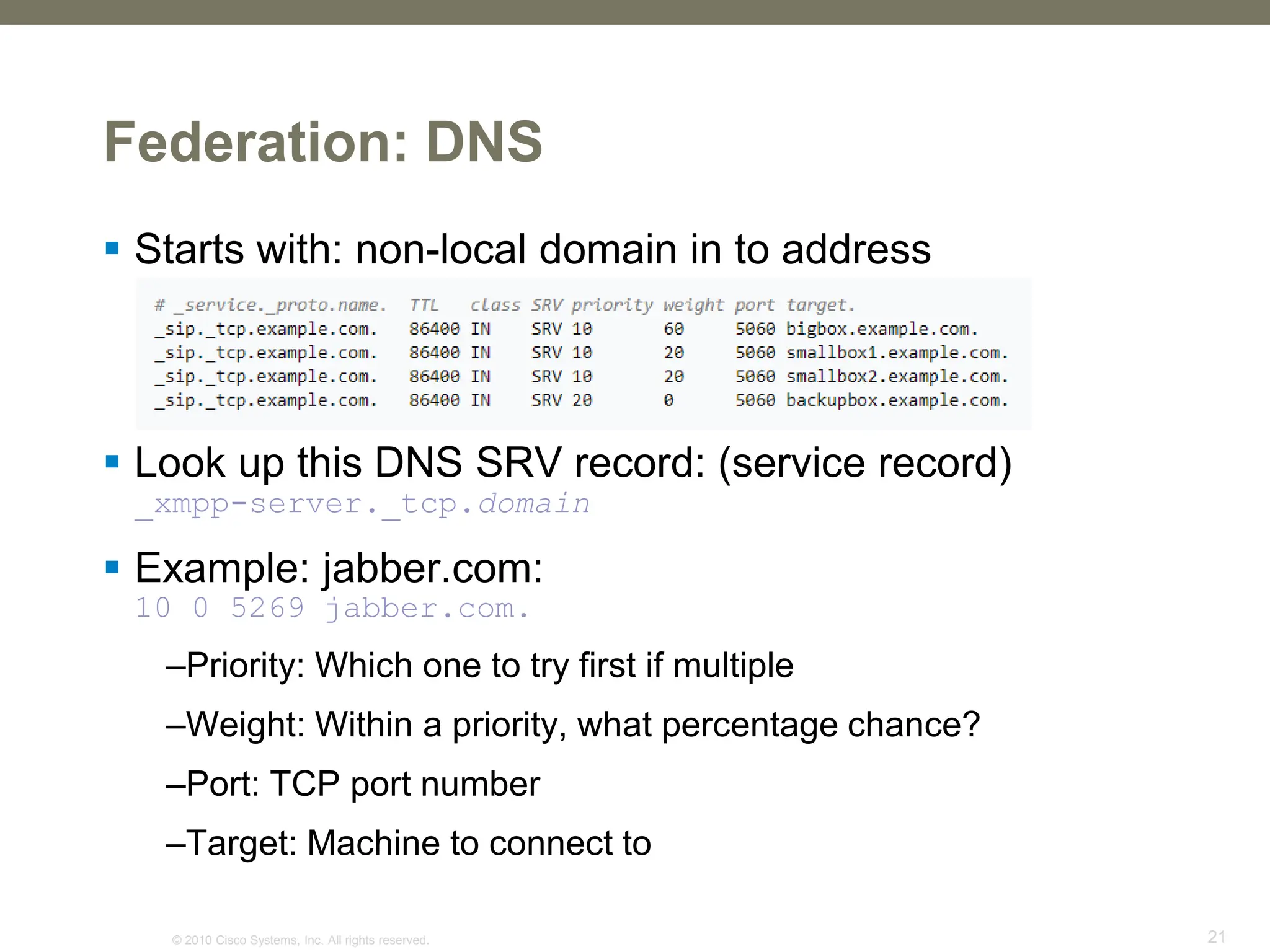
Federation: DNS
 Starts with: non-local domain in to address
 Look up this DNS SRV record: (service record)
_xmpp-server._tcp.domain
 Example: jabber.com:
10 0 5269 jabber.com.
–Priority: Which one to try first if multiple
–Weight: Within a priority, what percentage chance?
–Port: TCP port number
–Target: Machine to connect to
© 2010 Cisco Systems, Inc. All rights reserved. 22
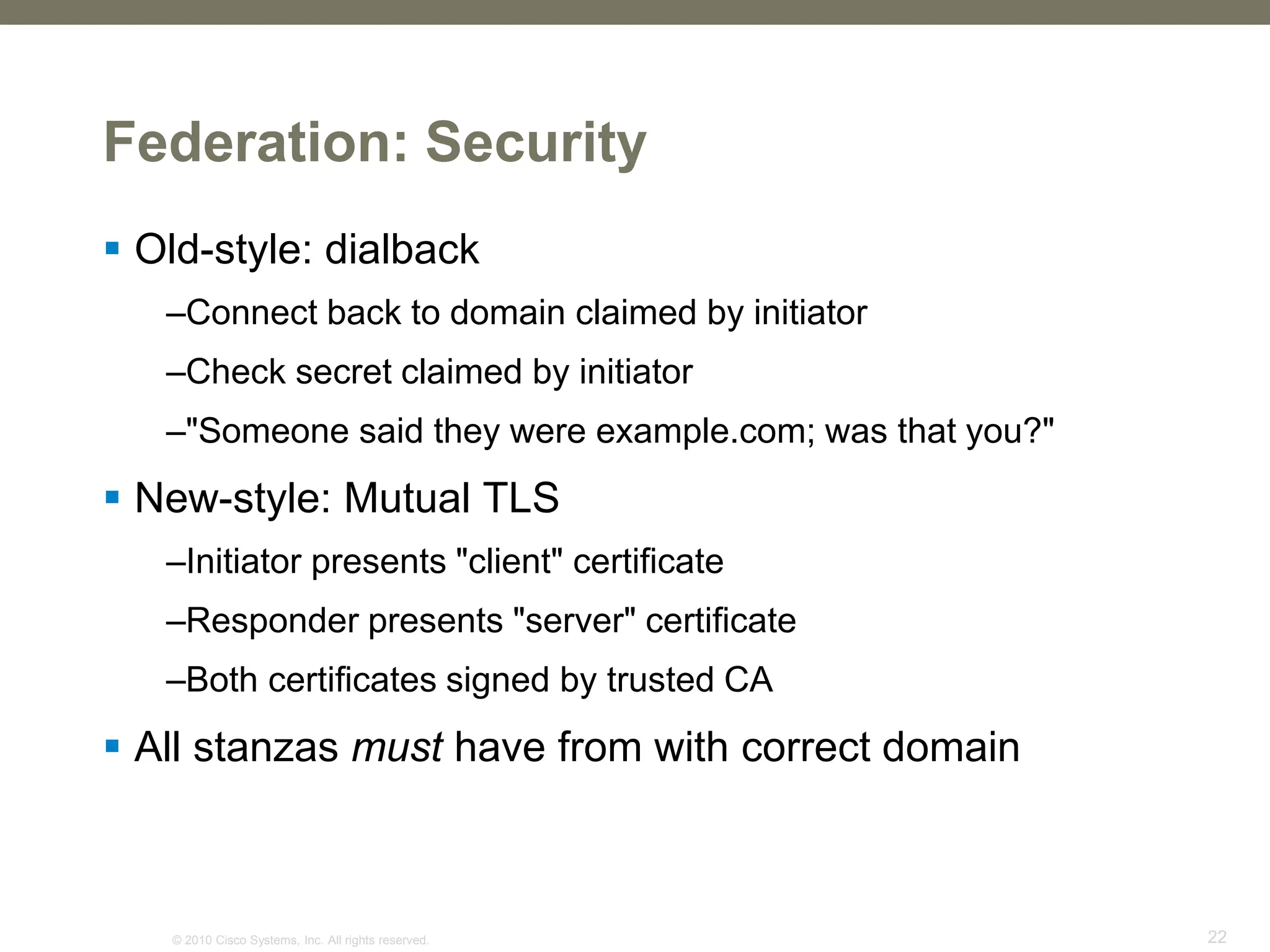
Federation: Security
 Old-style: dialback
–Connect back to domain claimed by initiator
–Check secret claimed by initiator
–"Someone said they were example.com; was that you?"
 New-style: Mutual TLS
–Initiator presents "client" certificate
–Responder presents "server" certificate
–Both certificates signed by trusted CA
 All stanzas must have from with correct domain
© 2010 Cisco Systems, Inc. All rights reserved. 23
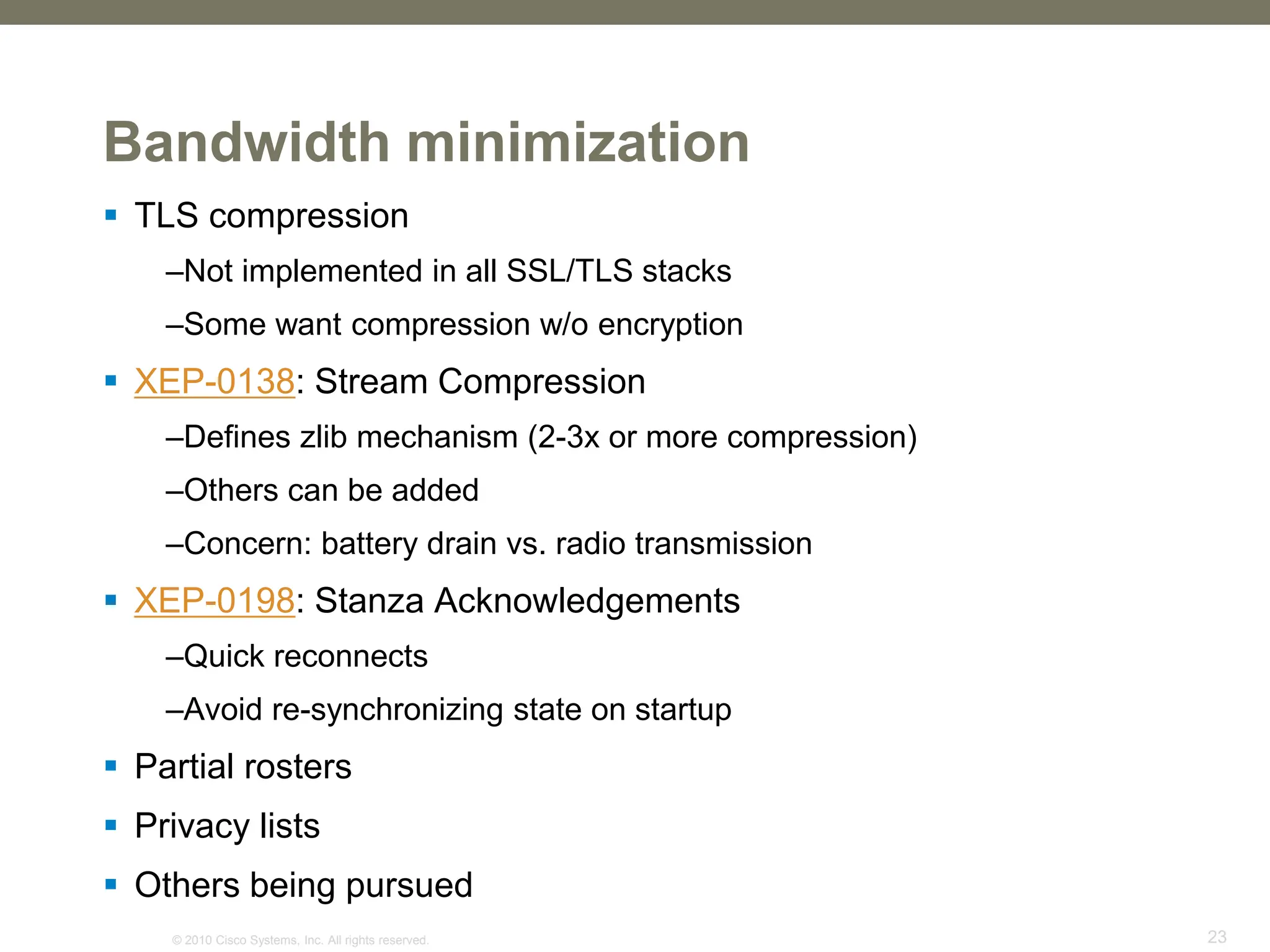
Bandwidth minimization
 TLS compression
–Not implemented in all SSL/TLS stacks
–Some want compression w/o encryption
 XEP-0138: Stream Compression
–Defines zlib mechanism (2-3x or more compression)
–Others can be added
–Concern: battery drain vs. radio transmission
 XEP-0198: Stanza Acknowledgements
–Quick reconnects
–Avoid re-synchronizing state on startup
 Partial rosters
 Privacy lists
 Others being pursued
© 2010 Cisco Systems, Inc. All rights reserved. 24
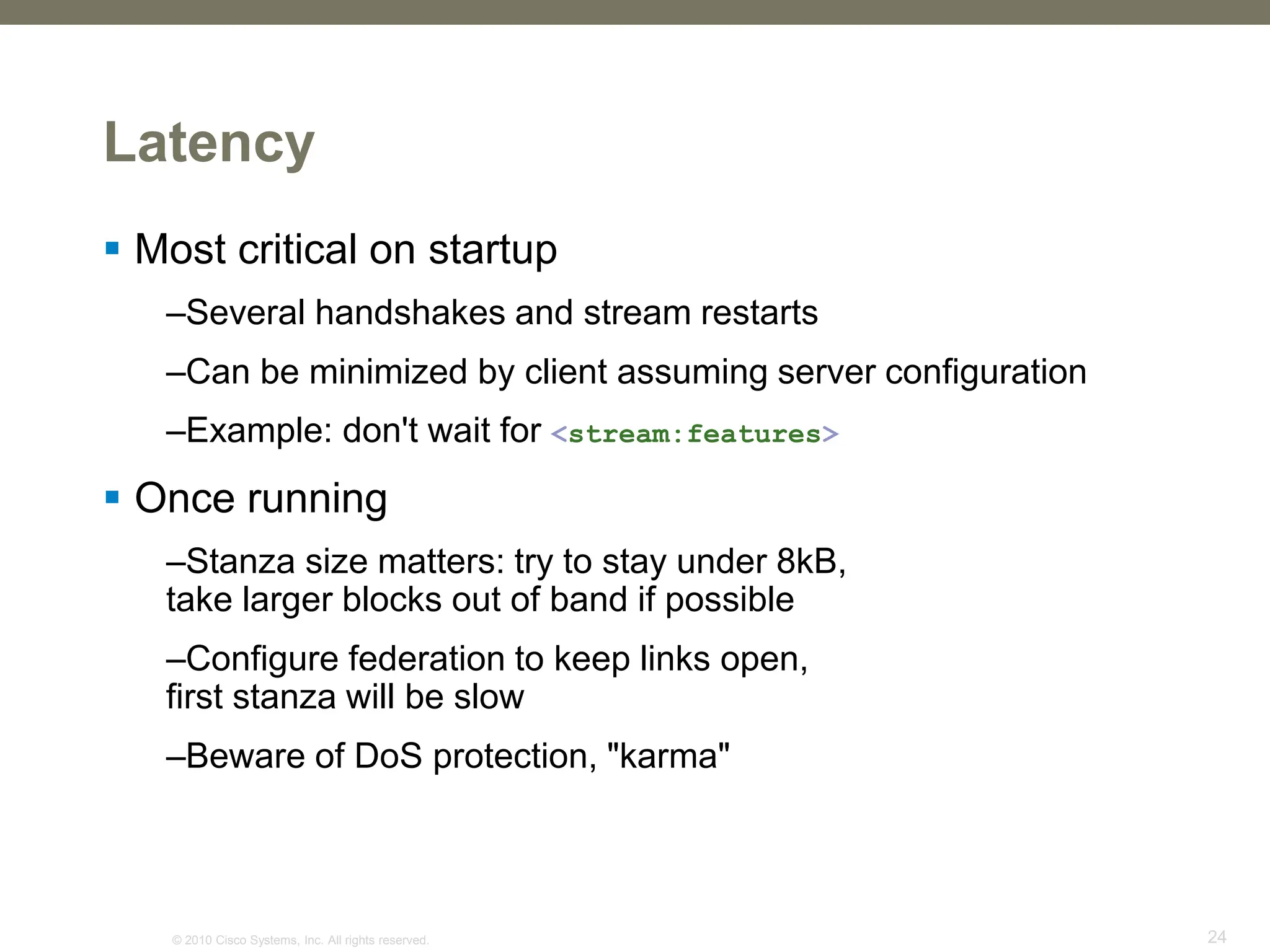
Latency
 Most critical on startup
–Several handshakes and stream restarts
–Can be minimized by client assuming server configuration
–Example: don't wait for <stream:features>
 Once running
–Stanza size matters: try to stay under 8kB,
take larger blocks out of band if possible
–Configure federation to keep links open,
first stanza will be slow
–Beware of DoS protection, "karma"
© 2010 Cisco Systems, Inc. All rights reserved. 25
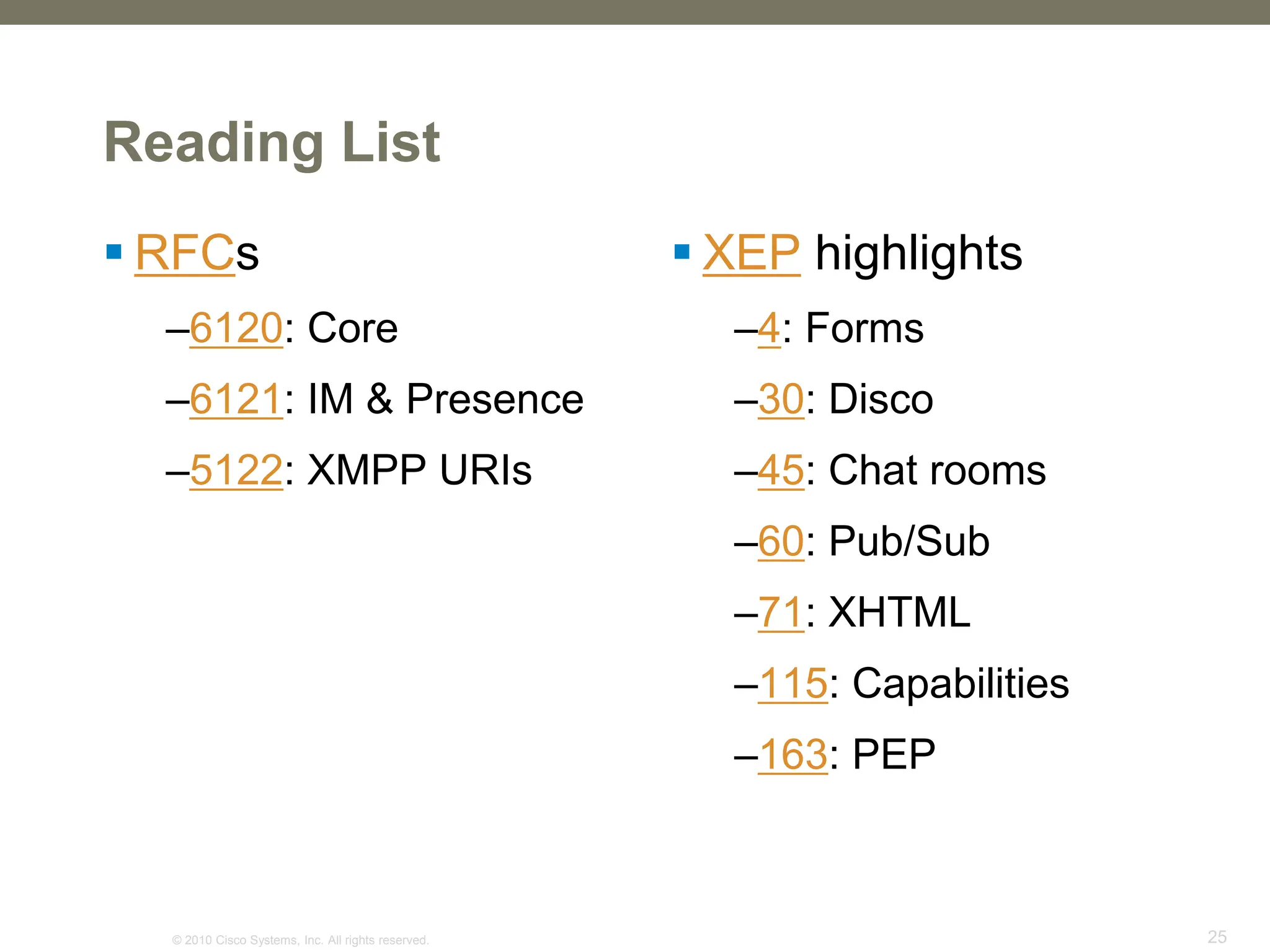
Reading List
 RFCs
–6120: Core
–6121: IM & Presence
–5122: XMPP URIs
 XEP highlights
–4: Forms
–30: Disco
–45: Chat rooms
–60: Pub/Sub
–71: XHTML
–115: Capabilities
–163: PEP
© 2010 Cisco Systems, Inc. All rights reserved. 26
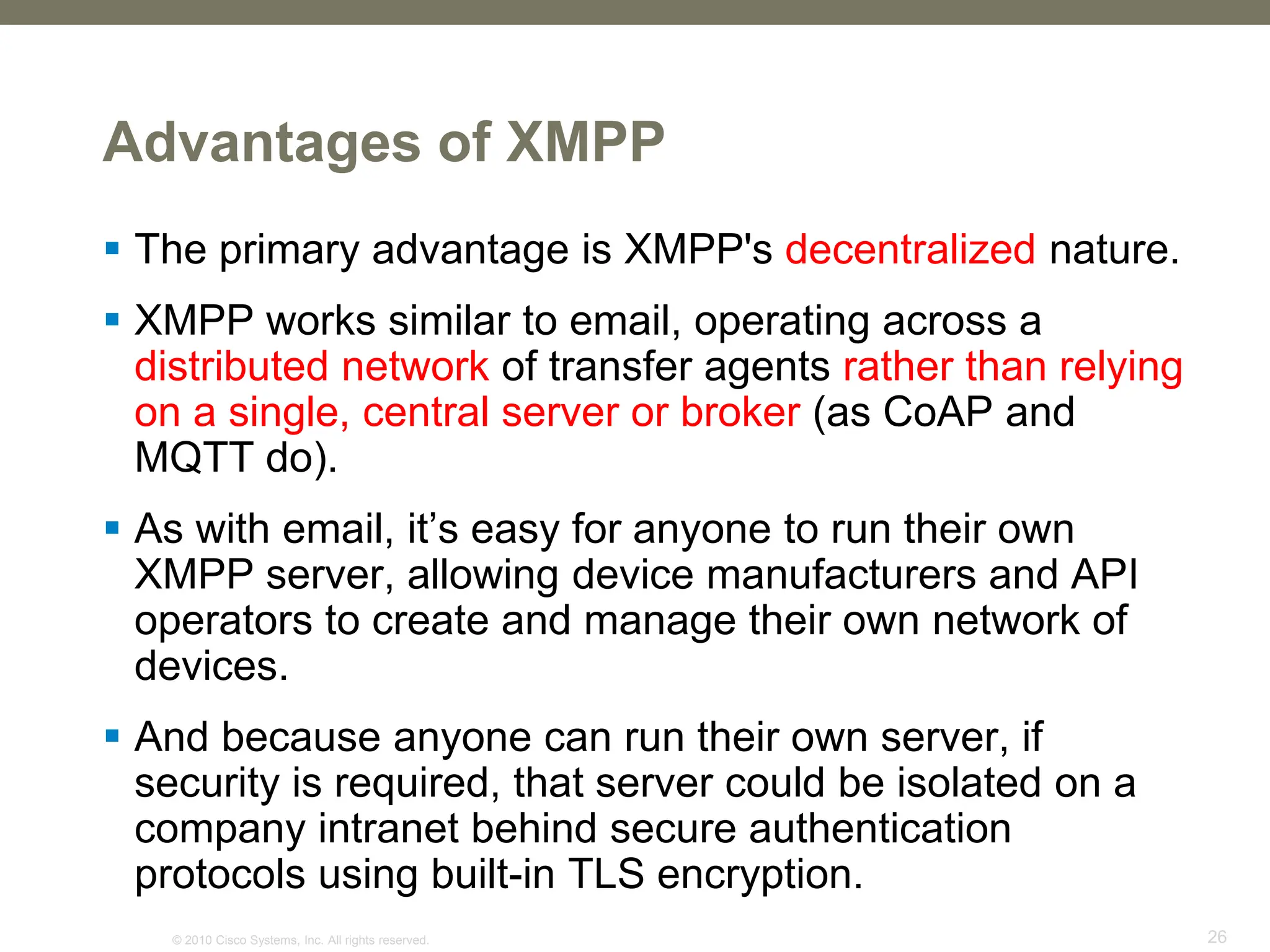
Advantages of XMPP
 The primary advantage is XMPP's decentralized nature.
 XMPP works similar to email, operating across a
distributed network of transfer agents rather than relying
on a single, central server or broker (as CoAP and
MQTT do).
 As with email, it’s easy for anyone to run their own
XMPP server, allowing device manufacturers and API
operators to create and manage their own network of
devices.
 And because anyone can run their own server, if
security is required, that server could be isolated on a
company intranet behind secure authentication
protocols using built-in TLS encryption.
© 2010 Cisco Systems, Inc. All rights reserved. 27
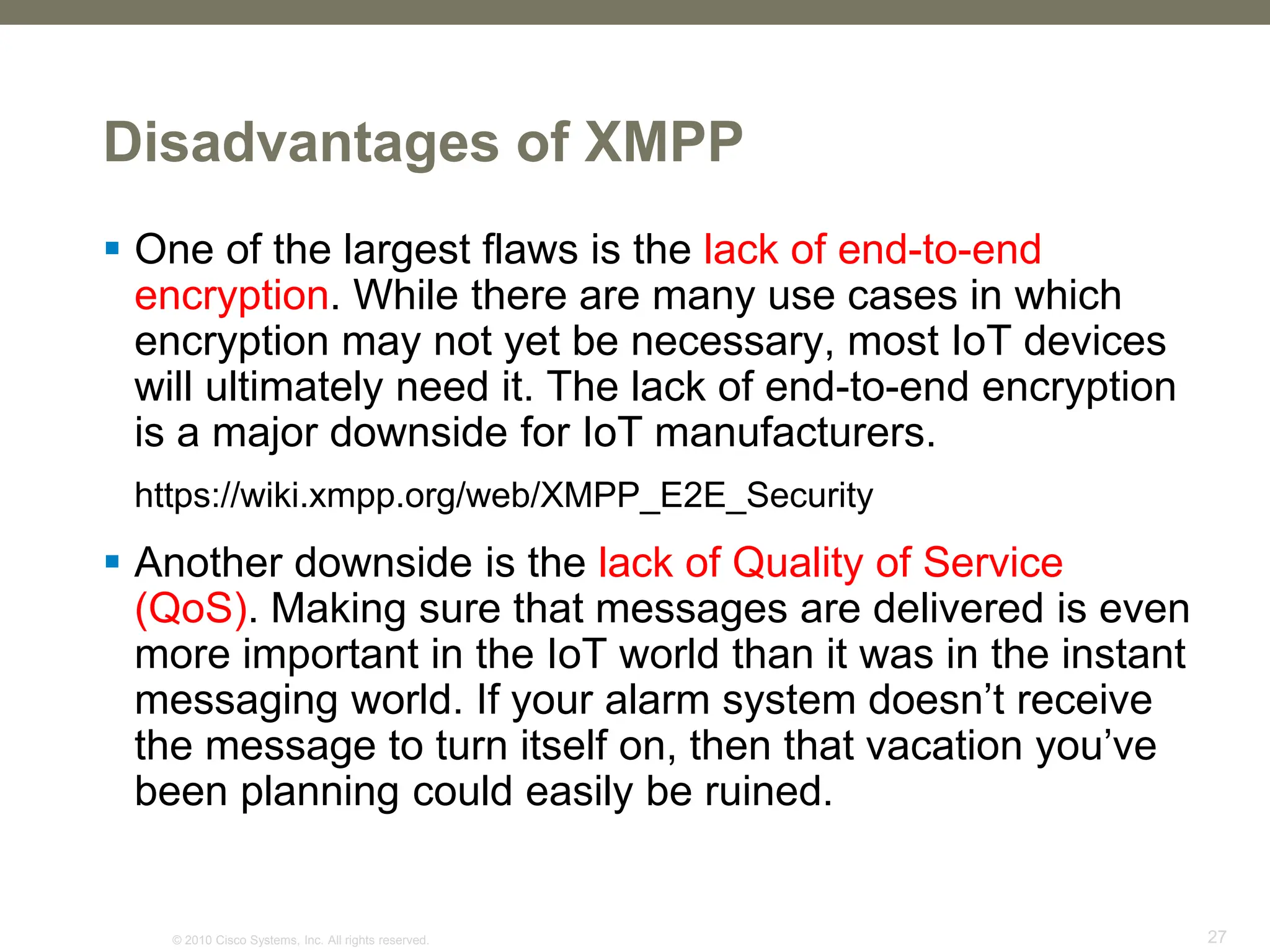
Disadvantages of XMPP
 One of the largest flaws is the lack of end-to-end
encryption. While there are many use cases in which
encryption may not yet be necessary, most IoT devices
will ultimately need it. The lack of end-to-end encryption
is a major downside for IoT manufacturers.
https://wiki.xmpp.org/web/XMPP_E2E_Security
 Another downside is the lack of Quality of Service
(QoS). Making sure that messages are delivered is even
more important in the IoT world than it was in the instant
messaging world. If your alarm system doesn’t receive
the message to turn itself on, then that vacation you’ve
been planning could easily be ruined.
© 2010 Cisco Systems, Inc. All rights reserved. 28
Q and A

XMPP-IoT Protocol designed mainly to send mesages

  • 1.
    © 2008 CiscoSystems, Inc. All rights reserved. Cisco Confidential Presentation_ID 1 Introduction to XMPP Joe Hildebrand
  • 2.
    © 2010 CiscoSystems, Inc. All rights reserved. 2 What is XMPP?  eXtensible Messaging and Presence Protocol  Bi-directional streaming XML  Core: IETF RFC 6120, 7590, 6121  Extensions: XMPP Standards Foundation (XSF) –Membership-based –Elected technical council –Unit of work: XMPP Extension Protocol (XEP) –Process: Experimental, Proposed, Draft, Final  Goals: –Simple clients –Federate everything
  • 3.
    © 2010 CiscoSystems, Inc. All rights reserved. 3 Related RFCs RFC Name Description RFC 6120 XMPP Core XMPP core features Updated by 7590 (TLS) RFC 6121 XMPP IM XMPP Instant Messaging and Presence RFC 3922 XMPP CPIM Mapping XMPP to Common Presence and Instant Messaging (CPIM) RFC 3923 XMPP E2E End-to-End Signing and Object Encryption for XMPP RFC 5122 XMPP URI Internationalized Resource Identifiers (IRIs) and Uniform Resource Identifiers (URIs) for XMPP RFC 4854 XMPP URN Uniform Resource Name (URN) Namespace for XMPP
  • 4.
    © 2010 CiscoSystems, Inc. All rights reserved. 4 4 What is XMPP ?  The eXtensible Messaging and Presence Protocol (XMPP) is a TCP communications protocol based on XML that enables near-real-time exchange of structured data between two or more connected entities.  Out-of-the-box features of XMPP include presence information and contact list maintenance.  Due in part to its open nature and XML foundation, XMPP has been extended for use in publish-subscribe systems –Perfect for IoT applications. https://www.infoworld.com/article/2972143/internet-of-things/real-time-protocols-for-iot-apps.html
  • 5.
    © 2010 CiscoSystems, Inc. All rights reserved. 5 XMPP Architecture Server1 Server2 Server3 Client Client Client Client Client Client Client Client Client Server<->Server: Port 5269 Client<->Server: Port 5222
  • 6.
    © 2010 CiscoSystems, Inc. All rights reserved. 6 XMPP Architecture  Addressing Scheme: node@domain/resource –JID = Jabber ID –Node: identity, e.g. user name –Domain: DNS domain name –Resource: device identifier –node@domain identifies a person  Client talks to “local” server –Wherever the user account is hosted –Tied to directory if desired –Organizational policy enforced  Servers talk to other servers –DNS lookup on domain portion of address –Dialback, MTLS for security –One connection for many conversations
  • 7.
    © 2010 CiscoSystems, Inc. All rights reserved. 7 <geoloc xmlns='http://jabber.org/protocol/geoloc' xml:lang='en' id='14'> <lat>38.9</lat> <lon>-77.1</lon> <locality>Arlington</locality> <region>VA</region> </geoloc> XML Refresher  Element  Attribute  Namespace  Language  Text Attribute Element
  • 8.
    © 2010 CiscoSystems, Inc. All rights reserved. 8 XMPP Streams  Client connects TCP socket to server  Client sends stream start tag: <stream:stream xmlns='jabber:client' xmlns:stream='http://etherx.jabber.org/streams' to='example.com' version='1.0'>  Server sends stream start tag back: <stream:stream xmlns='jabber:client' xmlns:stream='http://etherx.jabber.org/streams' from='example.com’ id='someid' version='1.0'>  Each child element of stream: a “stanza”
  • 9.
    © 2010 CiscoSystems, Inc. All rights reserved. 9 Stream features  After stream start, server sends feature list: <stream:features> <starttls xmlns='urn:ietf:params:xml:ns:xmpp-tls'/> <mechanisms xmlns='urn:ietf:params:xml:ns:xmpp-sasl'> <mechanism>DIGEST-MD5</mechanism> </mechanisms> <compression xmlns='http://jabber.org/features/compress'> <method>zlib</method> </compression> </stream:features>  Client can negotiate any of these features
  • 10.
    © 2010 CiscoSystems, Inc. All rights reserved. 10 XML Stream Features
  • 11.
    © 2010 CiscoSystems, Inc. All rights reserved. 11 Security Stuff  Start-TLS –Prove the identity of the server –Prove the identity of the user (optional) –Encryption –Data integrity  SASL(Simple Authentication and Security Layer protocol) (RFC 4422) –Authentication –Optional encryption (rarely used) –Pluggable (e.g. passwords, Kerberos, X.509, SAML, etc.)
  • 12.
    © 2010 CiscoSystems, Inc. All rights reserved. 12 Stanzas  All have to='JID' and from='JID' addresses –To gives destination –From added by local server  Each stanza routed separately  All contents of stanza passed along  Extend with any XML from your namespace  Different types for delivery semantics <message/>: one direction, one recipient <presence/>: one direction, publish to many <iq/>: "info/query", request/response See details next page
  • 13.
    © 2010 CiscoSystems, Inc. All rights reserved. 13 Message  Example: <message xml:lang='en' to='romeo@example.net' from='juliet@example.com/balcony' type='chat'> <body>Wherefore art thou, Romeo?</body> </message>  Types: chat, groupchat, headline, error  Body: plain text  XHTML IM: XEP-0071
  • 14.
    © 2010 CiscoSystems, Inc. All rights reserved. 14 Presence  Example: <presence> <show>dnd</show> <status>Meeting</status> <priority>1</priority> </presence>  Show: chat, available, away, xa, dnd  Status: Human-readable text  Priority: Which resource "most available"? express an entity's current network availability
  • 15.
    © 2010 CiscoSystems, Inc. All rights reserved. 15 IQ Request  Example: <iq type='get' id='roster_1'> <query xmlns='jabber:iq:roster'/> </iq>  Type: get, set, result, error  ID: track the corresponding response  Query/Namespace: what type of request? a structured request-response mechanism
  • 16.
    © 2010 CiscoSystems, Inc. All rights reserved. 16 IQ Response (Roster)  Example: <iq type='result' id='roster_1'> <query xmlns='jabber:iq:roster'> <item jid='romeo@example.net' name='Romeo' subscription='both'> <group>Friends</group> </item> </query> </iq>  Type: response  ID matches request  Subscription state: none, to, from, both
  • 17.
    © 2010 CiscoSystems, Inc. All rights reserved. 17 Subscribing to Presence  Send a subscription request: <presence to='juliet@example.com' type='subscribe'/>  Approving a request: <presence to='romeo@example.net' type='subscribed'/>  Every time you change a subscription, you get a "roster push": <iq type='set'> <query xmlns='jabber:iq:roster'> <item jid='romeo@example.net' subscription='from'/> </query> </iq>
  • 18.
    © 2010 CiscoSystems, Inc. All rights reserved. 18 Extensibility Example: Message  Use a new namespace  Key: if you don't understand it, ignore it  Example, CAP, XEP-0127: <message to='weatherbot@jabber.org' from='KSTO@NWS.NOAA.GOV'> <alert xmlns='http://www.incident.com/cap/1.0'> <identifier>KSTO1055887203</identifier> <sent>2003-06-17T14:57:00-07:00</sent> <info> <category>Met</category> <event>SEVERE THUNDERSTORM</event> ... </info> </alert> </message> Common Alerting Protocol (CAP) Over XMPP
  • 19.
    © 2010 CiscoSystems, Inc. All rights reserved. 19 Extensibility Example: Presence  Keep presence stanzas small  Example: Entity Capabilities, XEP-0115: <presence from='bard@shakespeare.lit/globe'> <c xmlns='http://jabber.org/protocol/caps' hash='sha-1' node='http://www.chatopus.com' ver='zHyEOgxTrkpSdGcQKH8EFPLsriY='/> </presence>  Ver attribute is hash of all features of this client  Hash -> Feature list is cached It defines an XMPP protocol extension for broadcasting and dynamically discovering client, device, or generic entity capabilities.
  • 20.
    © 2010 CiscoSystems, Inc. All rights reserved. 20 XMPP Extensions  Many already exist: http://www.xmpp.org/extensions/  Add new ones –Custom: use a namespace you control, make up protocol –Standardized: write a XEP.
  • 21.
    © 2010 CiscoSystems, Inc. All rights reserved. 21 Federation: DNS  Starts with: non-local domain in to address  Look up this DNS SRV record: (service record) _xmpp-server._tcp.domain  Example: jabber.com: 10 0 5269 jabber.com. –Priority: Which one to try first if multiple –Weight: Within a priority, what percentage chance? –Port: TCP port number –Target: Machine to connect to
  • 22.
    © 2010 CiscoSystems, Inc. All rights reserved. 22 Federation: Security  Old-style: dialback –Connect back to domain claimed by initiator –Check secret claimed by initiator –"Someone said they were example.com; was that you?"  New-style: Mutual TLS –Initiator presents "client" certificate –Responder presents "server" certificate –Both certificates signed by trusted CA  All stanzas must have from with correct domain
  • 23.
    © 2010 CiscoSystems, Inc. All rights reserved. 23 Bandwidth minimization  TLS compression –Not implemented in all SSL/TLS stacks –Some want compression w/o encryption  XEP-0138: Stream Compression –Defines zlib mechanism (2-3x or more compression) –Others can be added –Concern: battery drain vs. radio transmission  XEP-0198: Stanza Acknowledgements –Quick reconnects –Avoid re-synchronizing state on startup  Partial rosters  Privacy lists  Others being pursued
  • 24.
    © 2010 CiscoSystems, Inc. All rights reserved. 24 Latency  Most critical on startup –Several handshakes and stream restarts –Can be minimized by client assuming server configuration –Example: don't wait for <stream:features>  Once running –Stanza size matters: try to stay under 8kB, take larger blocks out of band if possible –Configure federation to keep links open, first stanza will be slow –Beware of DoS protection, "karma"
  • 25.
    © 2010 CiscoSystems, Inc. All rights reserved. 25 Reading List  RFCs –6120: Core –6121: IM & Presence –5122: XMPP URIs  XEP highlights –4: Forms –30: Disco –45: Chat rooms –60: Pub/Sub –71: XHTML –115: Capabilities –163: PEP
  • 26.
    © 2010 CiscoSystems, Inc. All rights reserved. 26 Advantages of XMPP  The primary advantage is XMPP's decentralized nature.  XMPP works similar to email, operating across a distributed network of transfer agents rather than relying on a single, central server or broker (as CoAP and MQTT do).  As with email, it’s easy for anyone to run their own XMPP server, allowing device manufacturers and API operators to create and manage their own network of devices.  And because anyone can run their own server, if security is required, that server could be isolated on a company intranet behind secure authentication protocols using built-in TLS encryption.
  • 27.
    © 2010 CiscoSystems, Inc. All rights reserved. 27 Disadvantages of XMPP  One of the largest flaws is the lack of end-to-end encryption. While there are many use cases in which encryption may not yet be necessary, most IoT devices will ultimately need it. The lack of end-to-end encryption is a major downside for IoT manufacturers. https://wiki.xmpp.org/web/XMPP_E2E_Security  Another downside is the lack of Quality of Service (QoS). Making sure that messages are delivered is even more important in the IoT world than it was in the instant messaging world. If your alarm system doesn’t receive the message to turn itself on, then that vacation you’ve been planning could easily be ruined.
  • 28.
    © 2010 CiscoSystems, Inc. All rights reserved. 28 Q and A