XMPP in Real-Time Applications


             Ben Weaver
               @bwvr
       http://benweaver.com/
INTRODUCTION


 + What is XMPP?
 + Why is it “real-time”?
 + How does it work?
 + Where can you use it?
 + Conclusion
WHAT: OVERVIEW


 + XMPP is the Extensible Messaging and Presence Protocol
 + Routes messages among clients.
 + Broadcasts presence (status) to interested contacts.
 + The “X” in extensible is XML.
 + Since XML has namespaces...
 + You can invent new message types any time.
WHAT: HISTORY


 + Back in 1998...
 + ICQ and AOL Instant Messenger were popular IM services.
 + Microsoft and Yahoo! were releasing their own.
 + Jeremie Miller started Jabber: community driven IM
 + Jabber standardization began in 1999
 + In 2002, an IETF working group formalized XMPP
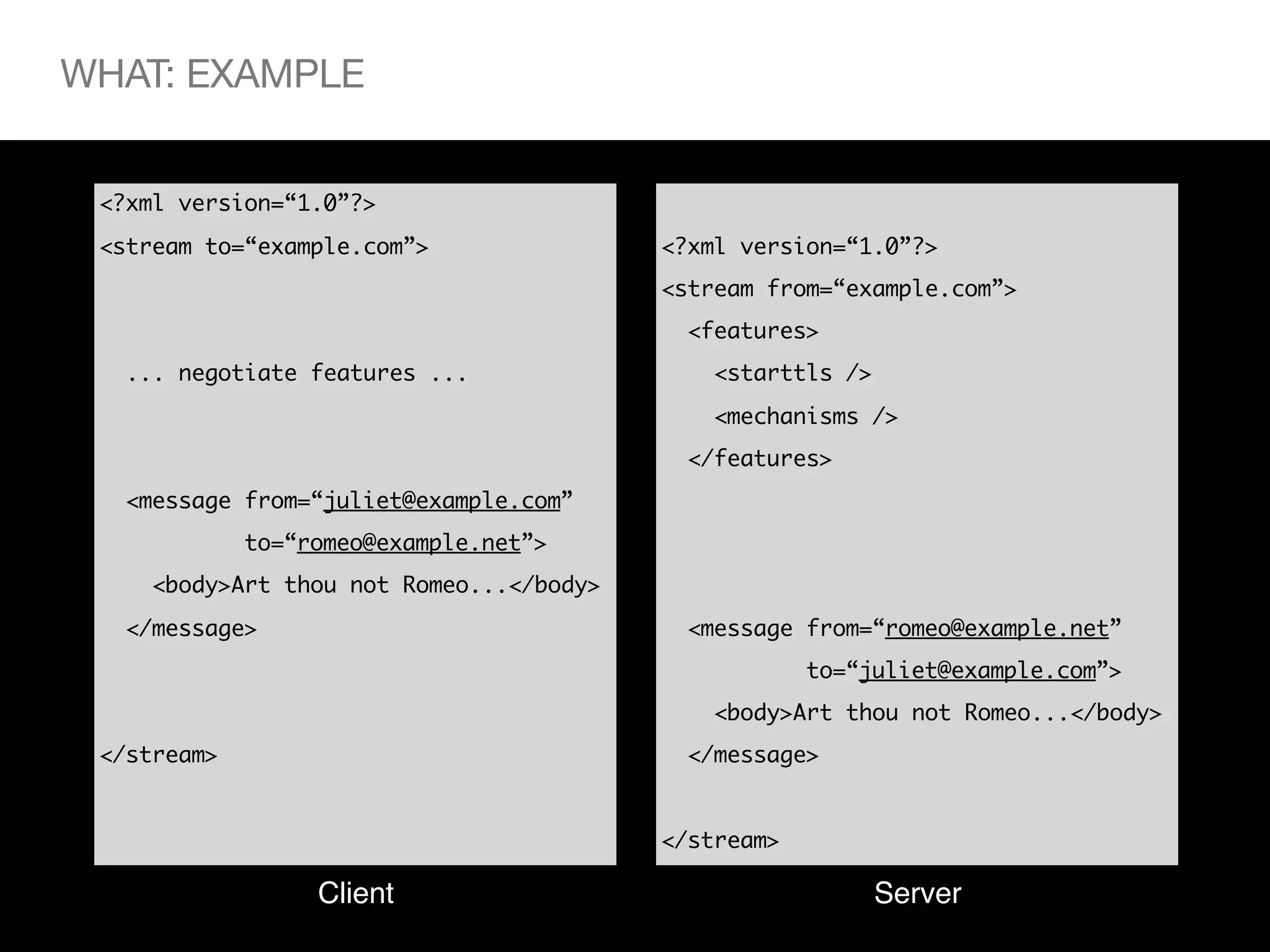
WHAT: EXAMPLE


 <?xml version=“1.0”?>
 <stream to=“example.com”>               <?xml version=“1.0”?>
                                         <stream from=“example.com”>
                                          <features>
  ... negotiate features ...                <starttls />
                                            <mechanisms />
                                          </features>
  <message from=“juliet@example.com”
             to=“romeo@example.net”>
    <body>Art thou not Romeo...</body>
  </message>                              <message from=“romeo@example.net”
                                                     to=“juliet@example.com”>
                                            <body>Art thou not Romeo...</body>
 </stream>                                </message>


                                         </stream>

                  Client                                   Server
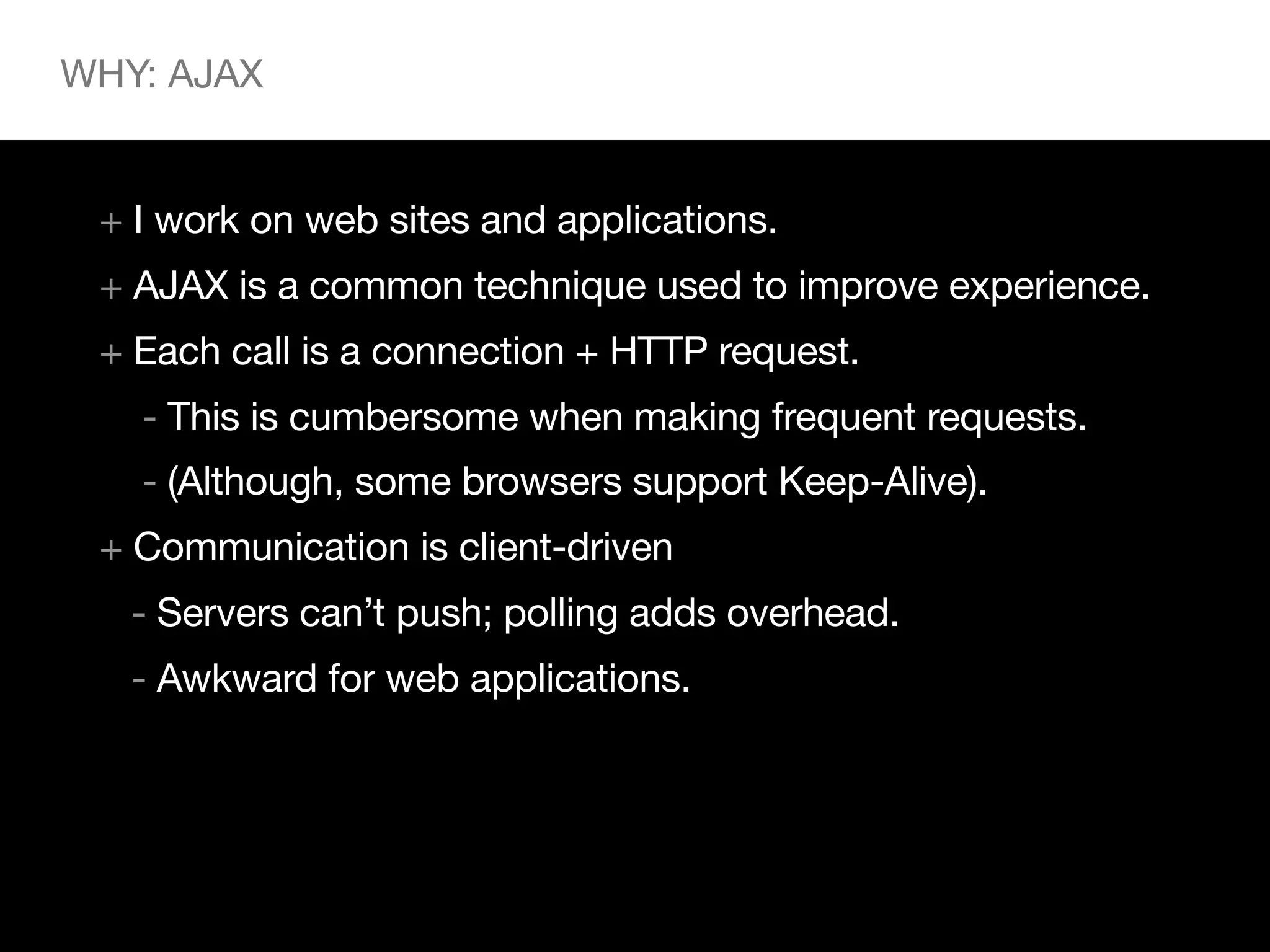
WHY: AJAX


 + I work on web sites and applications.
 + AJAX is a common technique used to improve experience.
 + Each call is a connection + HTTP request.
   - This is cumbersome when making frequent requests.
   - (Although, some browsers support Keep-Alive).
 + Communication is client-driven
   - Servers can’t push; polling adds overhead.
   - Awkward for web applications.
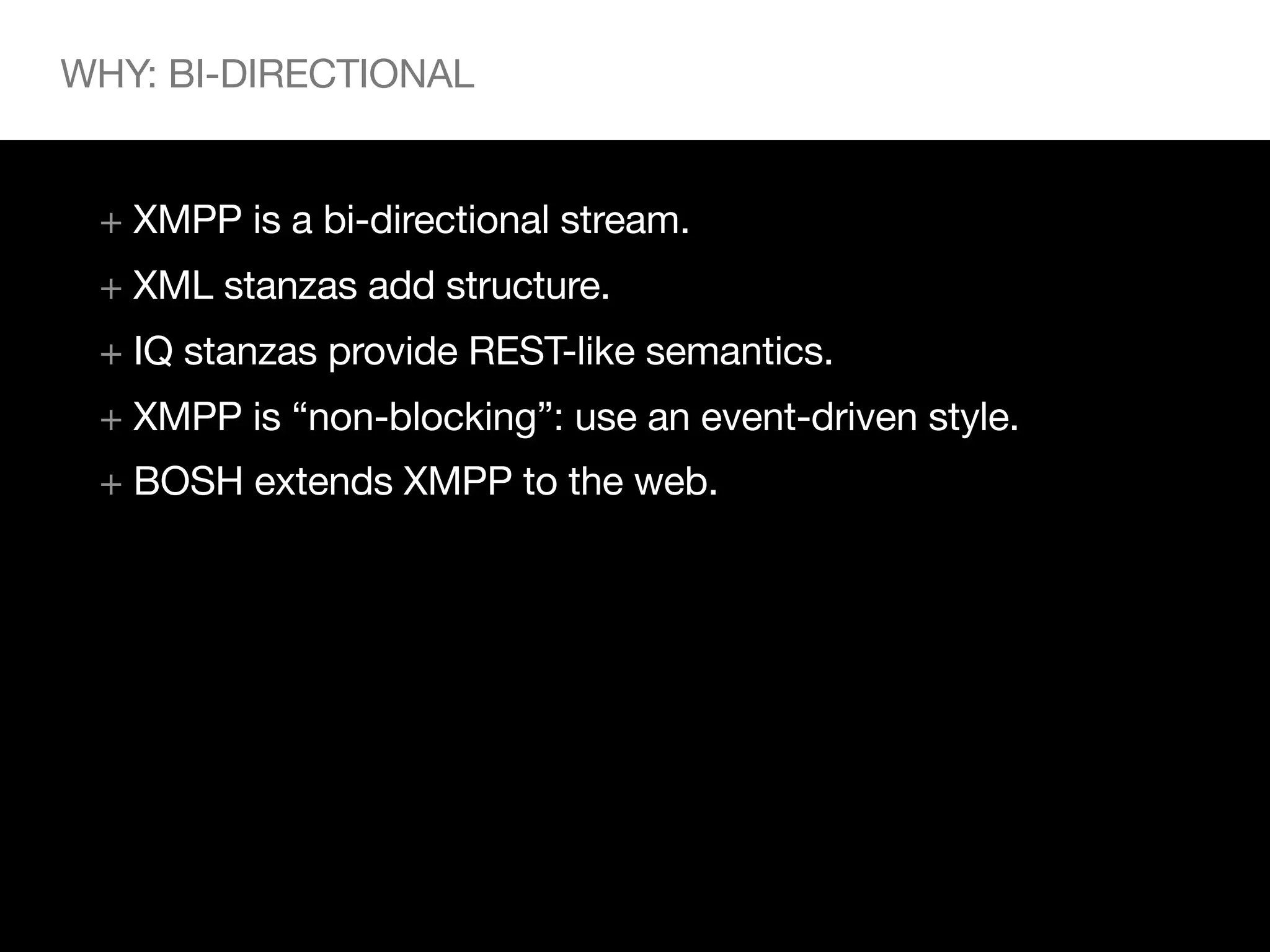
WHY: BI-DIRECTIONAL


 + XMPP is a bi-directional stream.
 + XML stanzas add structure.
 + IQ stanzas provide REST-like semantics.
 + XMPP is “non-blocking”: use an event-driven style.
 + BOSH extends XMPP to the web.
HOW: OVERVIEW


 + XMPP comes in two parts.
   - Core: stream-level semantics
   - Jabber: use the Core for IM
 + XEP: make your XMPP extensions official.
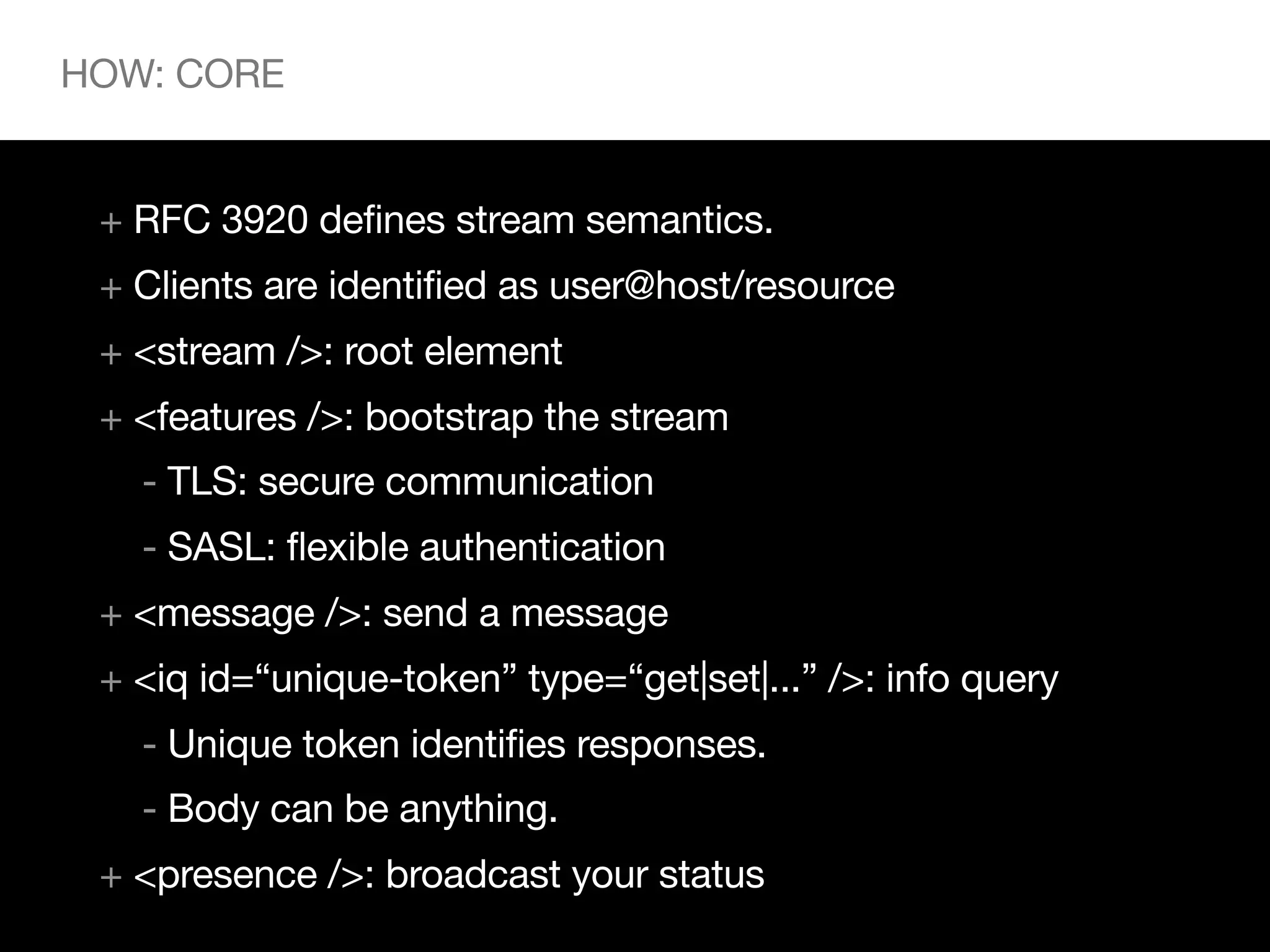
HOW: CORE


 + RFC 3920 defines stream semantics.
 + Clients are identified as user@host/resource
 + <stream />: root element
 + <features />: bootstrap the stream
   - TLS: secure communication
   - SASL: flexible authentication
 + <message />: send a message
 + <iq id=“unique-token” type=“get|set|...” />: info query
   - Unique token identifies responses.
   - Body can be anything.
 + <presence />: broadcast your status
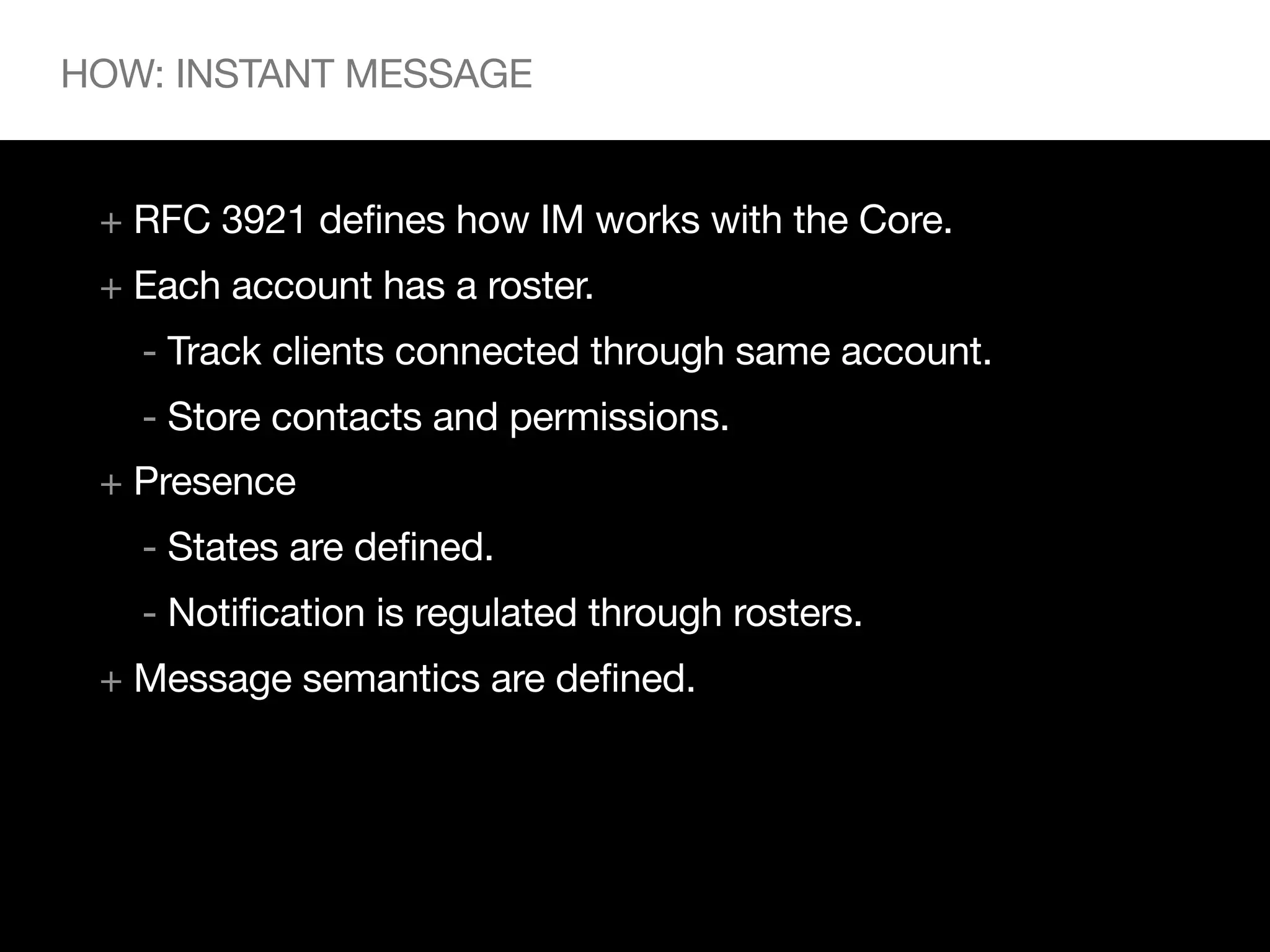
HOW: INSTANT MESSAGE


 + RFC 3921 defines how IM works with the Core.
 + Each account has a roster.
   - Track clients connected through same account.
   - Store contacts and permissions.
 + Presence
   - States are defined.
   - Notification is regulated through rosters.
 + Message semantics are defined.
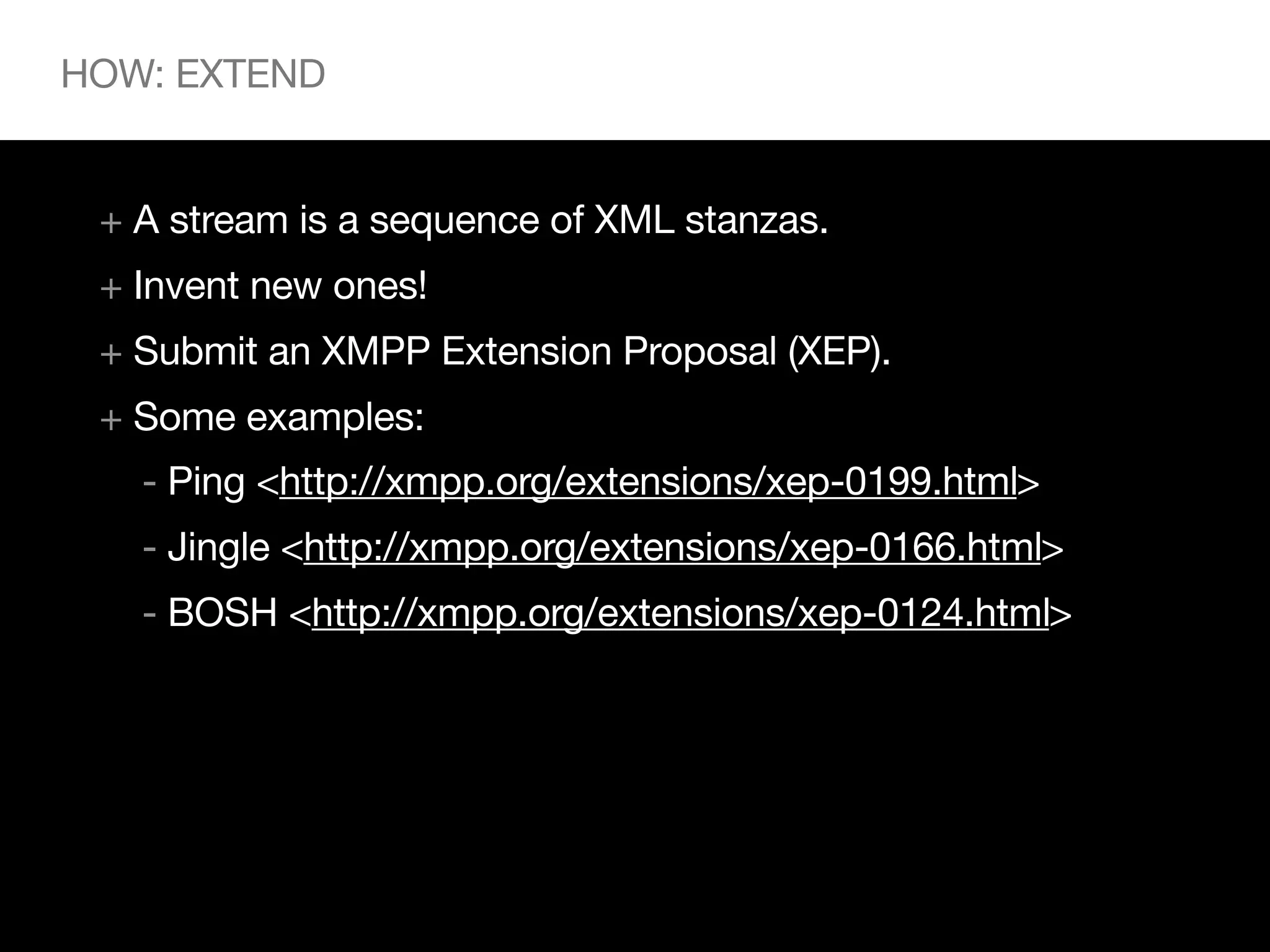
HOW: EXTEND


 + A stream is a sequence of XML stanzas.
 + Invent new ones!
 + Submit an XMPP Extension Proposal (XEP).
 + Some examples:
   - Ping <http://xmpp.org/extensions/xep-0199.html>
   - Jingle <http://xmpp.org/extensions/xep-0166.html>
   - BOSH <http://xmpp.org/extensions/xep-0124.html>
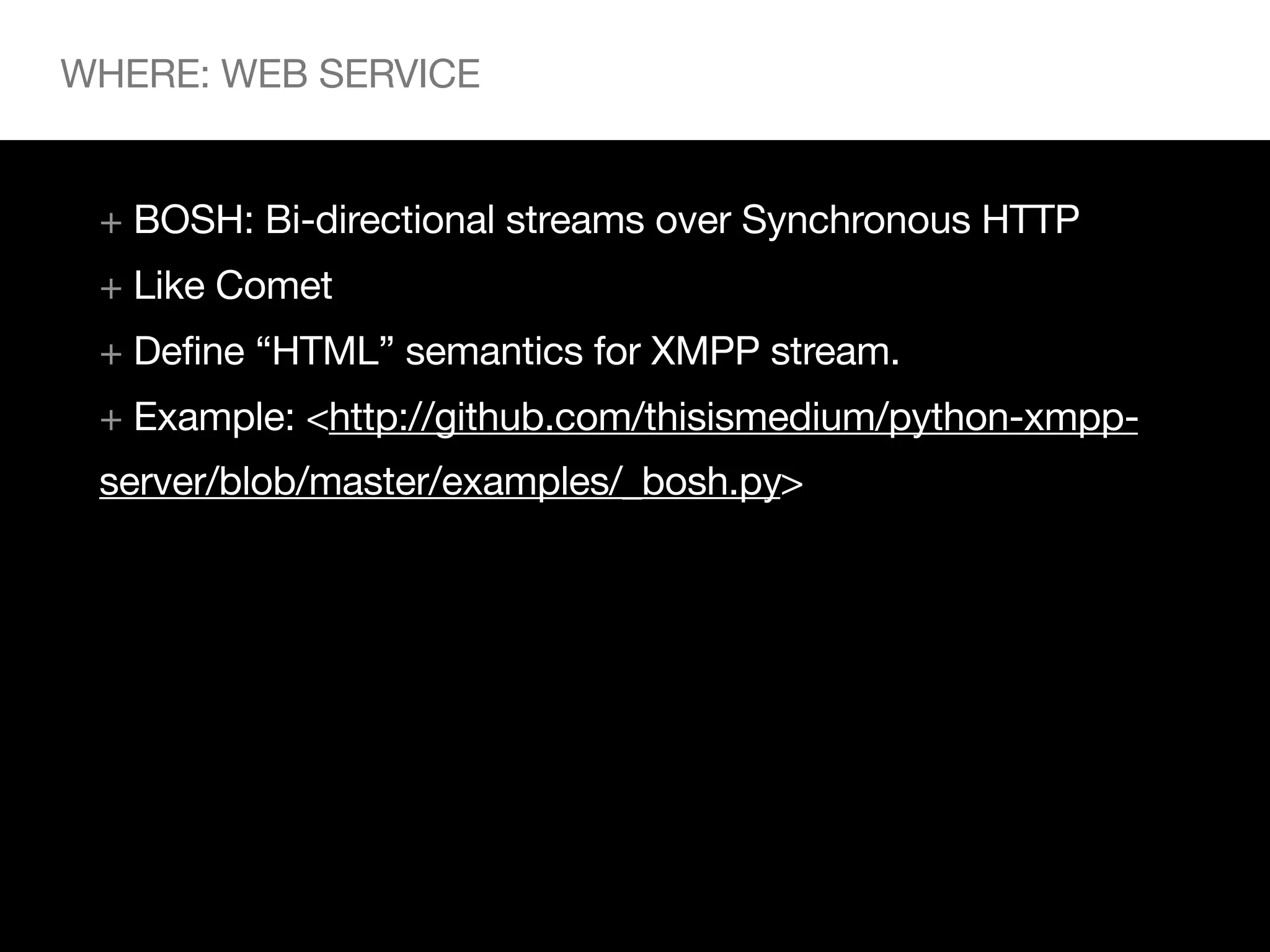
WHERE: WEB SERVICE


 + BOSH: Bi-directional streams over Synchronous HTTP
 + Like Comet
 + Define “HTML” semantics for XMPP stream.
 + Example: <http://github.com/thisismedium/python-xmpp-
 server/blob/master/examples/_bosh.py>
WHERE: CHAT


 + Chat example
 + <http://github.com/thisismedium/python-xmpp-server/
 blob/master/examples/chat-server.py>
CONCLUSION


 + Lot’s of people make clients; check it out!
 + Bi-directional
 + Event-driven
 + Works on the web
THE END


          Q&A

XMPP In Real Time

  • 1.
    XMPP in Real-TimeApplications Ben Weaver @bwvr http://benweaver.com/
  • 2.
    INTRODUCTION + Whatis XMPP? + Why is it “real-time”? + How does it work? + Where can you use it? + Conclusion
  • 3.
    WHAT: OVERVIEW +XMPP is the Extensible Messaging and Presence Protocol + Routes messages among clients. + Broadcasts presence (status) to interested contacts. + The “X” in extensible is XML. + Since XML has namespaces... + You can invent new message types any time.
  • 4.
    WHAT: HISTORY +Back in 1998... + ICQ and AOL Instant Messenger were popular IM services. + Microsoft and Yahoo! were releasing their own. + Jeremie Miller started Jabber: community driven IM + Jabber standardization began in 1999 + In 2002, an IETF working group formalized XMPP
  • 5.
    WHAT: EXAMPLE <?xmlversion=“1.0”?> <stream to=“example.com”> <?xml version=“1.0”?> <stream from=“example.com”> <features> ... negotiate features ... <starttls /> <mechanisms /> </features> <message from=“juliet@example.com” to=“romeo@example.net”> <body>Art thou not Romeo...</body> </message> <message from=“romeo@example.net” to=“juliet@example.com”> <body>Art thou not Romeo...</body> </stream> </message> </stream> Client Server
  • 6.
    WHY: AJAX +I work on web sites and applications. + AJAX is a common technique used to improve experience. + Each call is a connection + HTTP request. - This is cumbersome when making frequent requests. - (Although, some browsers support Keep-Alive). + Communication is client-driven - Servers can’t push; polling adds overhead. - Awkward for web applications.
  • 7.
    WHY: BI-DIRECTIONAL +XMPP is a bi-directional stream. + XML stanzas add structure. + IQ stanzas provide REST-like semantics. + XMPP is “non-blocking”: use an event-driven style. + BOSH extends XMPP to the web.
  • 8.
    HOW: OVERVIEW +XMPP comes in two parts. - Core: stream-level semantics - Jabber: use the Core for IM + XEP: make your XMPP extensions official.
  • 9.
    HOW: CORE +RFC 3920 defines stream semantics. + Clients are identified as user@host/resource + <stream />: root element + <features />: bootstrap the stream - TLS: secure communication - SASL: flexible authentication + <message />: send a message + <iq id=“unique-token” type=“get|set|...” />: info query - Unique token identifies responses. - Body can be anything. + <presence />: broadcast your status
  • 10.
    HOW: INSTANT MESSAGE + RFC 3921 defines how IM works with the Core. + Each account has a roster. - Track clients connected through same account. - Store contacts and permissions. + Presence - States are defined. - Notification is regulated through rosters. + Message semantics are defined.
  • 11.
    HOW: EXTEND +A stream is a sequence of XML stanzas. + Invent new ones! + Submit an XMPP Extension Proposal (XEP). + Some examples: - Ping <http://xmpp.org/extensions/xep-0199.html> - Jingle <http://xmpp.org/extensions/xep-0166.html> - BOSH <http://xmpp.org/extensions/xep-0124.html>
  • 12.
    WHERE: WEB SERVICE + BOSH: Bi-directional streams over Synchronous HTTP + Like Comet + Define “HTML” semantics for XMPP stream. + Example: <http://github.com/thisismedium/python-xmpp- server/blob/master/examples/_bosh.py>
  • 13.
    WHERE: CHAT +Chat example + <http://github.com/thisismedium/python-xmpp-server/ blob/master/examples/chat-server.py>
  • 14.
    CONCLUSION + Lot’sof people make clients; check it out! + Bi-directional + Event-driven + Works on the web
  • 15.