



Microservice Architecture
By
Rudra prasad Tripathy
29th April
Contemporary technologies
lSOA/ESB
lEAI
lLayers/tiered/component architecture
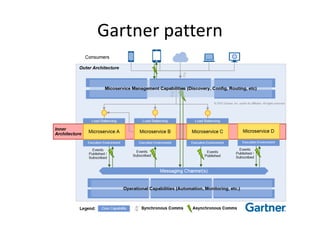
Gartner pattern
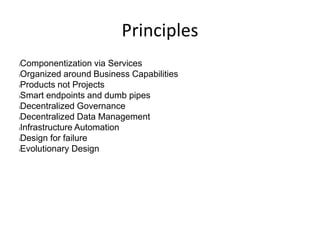
Principles
lComponentization via Services
lOrganized around Business Capabilities
lProducts not Projects
lSmart endpoints and dumb pipes
lDecentralized Governance
lDecentralized Data Management
lInfrastructure Automation
lDesign for failure
lEvolutionary Design
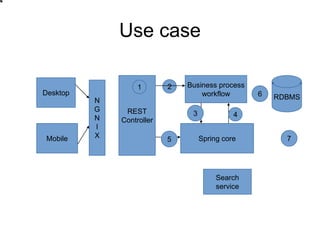
Use case
Desktop
Mobile
REST
Controller
Spring core
Business process
workflow RDBMS
Search
service
1 2
3 4
5
6
7
N
G
N
I
X
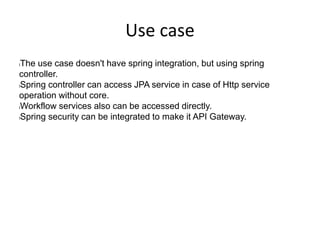
Use case
lThe use case doesn't have spring integration, but using spring
controller.
lSpring controller can access JPA service in case of Http service
operation without core.
lWorkflow services also can be accessed directly.
lSpring security can be integrated to make it API Gateway.
Contemporary technologies
lSOA/ESB
lEAI
lLayers/tiered/component architecture
Componentization via Services
•component is a unit of software that is independently replaceable and upgradeable.
•One main reason for using services as components (rather than libraries) is that
services are independently deployable
•A service may consist of multiple processes that will always be developed and
deployed together, such as an application process and a database that's only used by
that service.
Organized around Business Capabilities
•Conway's Law
•Cross team dependency
•Smaller services make it easy for small teams working on this without much
dependency on other teams. The boundry is easy to define
Products not Projects
Microservice proponents tend to avoid PROJECT model.
•The product mentality, ties in with the linkage to business capabilities
•Smaller granularity of services can make it easier to create the personal relationships
between service developers and their users.
Smart endpoints and dumb pipes
•Avoiding approaches that stress putting significant smarts into the
communication mechanism itself.
•Applications built from microservices aim to be as decoupled and as cohesive
as possible.
•Messaging over a lightweight message bus.
Decentralized Governance
•One of the consequences of centralized governance is the tendency to standardize on
single technology platforms.
•Teams building microservices prefer a different approach to standards too.
•Perhaps the apogee of decentralised governance is the build it / run it ethos
popularised by Amazon.
•Patterns like Tolerant Reader and Consumer-Driven Contracts
•Centralized governance can be achived through API GATEWAY.
Decentralized Data
Management
•At the most abstract level, it means that the
conceptual model of the world will differ
between systems.
•As well as decentralizing decisions about
conceptual models, microservices also
decentralize data storage decisions.
•Choosing to manage inconsistencies in this way
is a new challenge for many development
teams,
Infrastructure Automation
•Many of the products or systems being build with microservices are being
built by teams with extensive experience of Continuous Delivery and it's
precursor, Continuous Integration.
•Managing microservices in production.
•Promotion of working software 'up' the pipeline means we automate
deployment to each new environment.
Design for failure
•A consequence of using services as components, is that applications need to
be designed so that they can tolerate the failure of services.
•ince services can fail at any time, it's important to be able to detect the
failures quickly and, if possible
•Synthetic monitoring.
•Unified monitoring
Evolutionary Design
•Agile pattern
•Evolving architecture
Tools and techniques
lApache camel
lJboss fuse
lWSO2
Technology changes support
•Maturity in DevOp
 API management tool
 Maturity in REST approach.
 Asynchronous capability
Reference
•Martin flower.
Microservice architecture case study

Microservice architecture case study

  • 1.
  • 2.
  • 4.
  • 5.
    Principles lComponentization via Services lOrganizedaround Business Capabilities lProducts not Projects lSmart endpoints and dumb pipes lDecentralized Governance lDecentralized Data Management lInfrastructure Automation lDesign for failure lEvolutionary Design
  • 6.
    Use case Desktop Mobile REST Controller Spring core Businessprocess workflow RDBMS Search service 1 2 3 4 5 6 7 N G N I X
  • 7.
    Use case lThe usecase doesn't have spring integration, but using spring controller. lSpring controller can access JPA service in case of Http service operation without core. lWorkflow services also can be accessed directly. lSpring security can be integrated to make it API Gateway.
  • 8.
  • 9.
    Componentization via Services •componentis a unit of software that is independently replaceable and upgradeable. •One main reason for using services as components (rather than libraries) is that services are independently deployable •A service may consist of multiple processes that will always be developed and deployed together, such as an application process and a database that's only used by that service.
  • 10.
    Organized around BusinessCapabilities •Conway's Law •Cross team dependency •Smaller services make it easy for small teams working on this without much dependency on other teams. The boundry is easy to define
  • 11.
    Products not Projects Microserviceproponents tend to avoid PROJECT model. •The product mentality, ties in with the linkage to business capabilities •Smaller granularity of services can make it easier to create the personal relationships between service developers and their users.
  • 12.
    Smart endpoints anddumb pipes •Avoiding approaches that stress putting significant smarts into the communication mechanism itself. •Applications built from microservices aim to be as decoupled and as cohesive as possible. •Messaging over a lightweight message bus.
  • 13.
    Decentralized Governance •One ofthe consequences of centralized governance is the tendency to standardize on single technology platforms. •Teams building microservices prefer a different approach to standards too. •Perhaps the apogee of decentralised governance is the build it / run it ethos popularised by Amazon. •Patterns like Tolerant Reader and Consumer-Driven Contracts •Centralized governance can be achived through API GATEWAY.
  • 14.
    Decentralized Data Management •At themost abstract level, it means that the conceptual model of the world will differ between systems. •As well as decentralizing decisions about conceptual models, microservices also decentralize data storage decisions. •Choosing to manage inconsistencies in this way is a new challenge for many development teams,
  • 15.
    Infrastructure Automation •Many ofthe products or systems being build with microservices are being built by teams with extensive experience of Continuous Delivery and it's precursor, Continuous Integration. •Managing microservices in production. •Promotion of working software 'up' the pipeline means we automate deployment to each new environment.
  • 16.
    Design for failure •Aconsequence of using services as components, is that applications need to be designed so that they can tolerate the failure of services. •ince services can fail at any time, it's important to be able to detect the failures quickly and, if possible •Synthetic monitoring. •Unified monitoring
  • 17.
  • 18.
    Tools and techniques lApachecamel lJboss fuse lWSO2
  • 19.
    Technology changes support •Maturityin DevOp  API management tool  Maturity in REST approach.  Asynchronous capability
  • 20.