X-ISCKER
            Reconfigurable Platform for the Emulation of RISC and CISC Architectures


                    Jose Pablo Pinilla                                                    Alfredo Gualdrón
             Universidad Pontificia Bolivariana                                   Universidad Pontificia Bolivariana
                 Bucaramanga, Colombia                                                 Bucaramanga, Colombia
                 jose.pinilla@upb.edu.co                                            alfredo.gualdron@upb.edu.co


  Abstract—This is a project planned to illustrate the structure   debugging functionalities for the two processors, called
and operational foundations of Central Processing Units, through   RISCKER and CISCKER. A stand-alone application of the
the implementation of a configurable system with two processors,   processors is also available, without the IDE-FPGA
one RISC (Reduced Instruction Set Computing) and one CISC          communication. The final stage of development for the
(Complex Instruction Set Computing), on an FPGA (Field             platform is “Reconfiguration”. The availability of all source
Programmable Gate Array), along with a programming and             code is an invitation to modify the provided architectures.
monitoring user interface software.
                                                                       Figure 1 is a diagram of the X-ISCKER platform including
  Index Terms—Computer Architecture, RISC, CISC, FPGA,             the communication module.
Embedded Processors.
                                                                                        II. RISCKER PROCESSOR
                        I. INTRODUCTION                                A RISC processor instruction set and organization is
                                                                   designed so that it represents this architecture’s characteristics,
    Computer organization and computer architecture design         such as: A large amount of registers, few Instructions of the
courses rely mostly on commercial microcontrollers that can be     same width and logical-arithmetic operations only between
used in application projects. But being commercial implies that    registers.
those are closed designs, meaning their documentation leaves           This processor’s structure is similar to the Multi-cycle
organization details unmentioned. Another educational option       MIPS described by Patterson and Hennessy [1] in order to
is the use of simulation programs, which can be very detailed      facilitate the change between this system and a commercial
but lack the applicability of an Integrated Circuit (IC).          MIPS-based processor in terms of code compatibility and
    X-ISCKER or Reduced/Complex Instruction Set                    structural behavior. An approximation of the design is shown
Computing Key Educational Resource is a software-hardware          in figure 2, highlighting the main units and signals, while an
platform that combines the applicability of a microcontroller IC   overview of the main characteristics for its operation can be
with the detailed functionality and monitoring capabilities of a   seen on table 1.
processor simulator. It is based on the development of two
basic architectures, one RISC and one CISC, in Verilog HDL
for any FPGA, an IDE (Integrated Development Environment)
software and a thorough documentation of their functionality.


                   Fig. 1. X-ISCKER Platform.

   The user is able to emulate any of the two architectures in
an FPGA while monitoring its state during the execution of any
program written in its corresponding assembly language. The                            Fig. 2. RISCKER Observer.
IDE is capable of “assembling and linking”, programming, and
TABLE I. RISCKER PROCESSOR                      the X-ISCKER IDE main window where secondary tools can
                                                                  be accessed.

                                                                                   TABLE II. CISCKER PROCESSOR


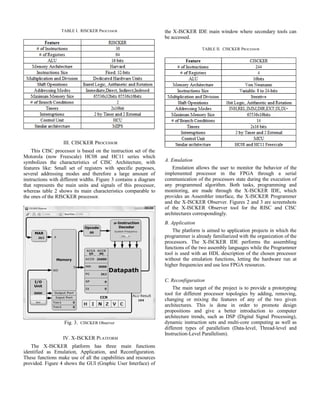
                   III. CISCKER PROCESSOR
    This CISC processor is based on the instruction set of the
Motorola (now Freescale) HC08 and HC11 series which
symbolizes the characteristics of CISC Architecture, with         A. Emulation
features like: Small set of registers with specific purposes,        Emulation allows the user to monitor the behavior of the
several addressing modes and therefore a large amount of          implemented processor in the FPGA through a serial
instructions with different widths. Figure 3 contains a diagram   communication of the processors state during the execution of
that represents the main units and signals of this processor,     any programmed algorithm. Both tasks, programming and
whereas table 2 shows its main characteristics comparable to      monitoring, are made through the X-ISCKER IDE, which
the ones of the RISCKER processor.                                provides an Assembler interface, the X-ISCKER Programmer
                                                                  and the X-ISCKER Observer. Figures 2 and 3 are screenshots
                                                                  of the X-ISCKER Observer tool for the RISC and CISC
                                                                  architectures correspondingly.
                                                                  B. Application
                                                                      The platform is aimed to application projects in which the
                                                                  programmer is already familiarized with the organization of the
                                                                  processors. The X-ISCKER IDE performs the assembling
                                                                  functions of the two assembly languages while the Programmer
                                                                  tool is used with an HDL description of the chosen processor
                                                                  without the emulation functions, letting the hardware run at
                                                                  higher frequencies and use less FPGA resources.

                                                                  C. Reconfiguration
                                                                      The main target of the project is to provide a prototyping
                                                                  tool for different processor topologies by adding, removing,
                                                                  changing or mixing the features of any of the two given
                                                                  architectures. This is done in order to promote design
                                                                  propositions and give a better introduction to computer
                                                                  architecture trends, such as DSP (Digital Signal Processing),
                   Fig. 3. CISCKER Observer                       dynamic instruction sets and multi-core computing as well as
                                                                  different types of parallelism (Data-level, Thread-level and
                                                                  Instruction-Level Parallelism).
                  IV. X-ISCKER PLATFORM
   The X-ISCKER platform has three main functions
identified as Emulation, Application, and Reconfiguration.
These functions make use of all the capabilities and resources
provided. Figure 4 shows the GUI (Graphic User Interface) of
development is posted on the Computer Architecture course
                                                                  web page for Informatics Engineers[2], and all finished and
                                                                  tested results are linked to the X-ISCKER site.
                                                                      This experience shows that the X-ISCKER platform is not
                                                                  only useful for digital circuit designers but also for software
                                                                  designers, covering a wide range of research areas where
                                                                  students can start developing their ideas.
                                                                                                VI. SUMMARY
                                                                      Today’s architectures have grown to be more complex due
                                                                  to compatibility-guided development and the addition of
                                                                  necessary advanced features, making them “difficult to explain
                                                                  and impossible to love” [1]. This demands a very solid
                                                                  introduction of computer architecture trends and evolution, by
                                                                  empirically studying the principles from which modern
                                                                  processors are ruled and allowing the designer to test its models
                                                                  according to their knowledge and application requirements.
                    Fig. 4. X-ISCKER IDE.                             The X-ISCKER platform delivers the Verilog HDL
                                                                  description of two processors, an IDE software and the
                                                                  documentation that will allow new learners to familiarize with
                   V. STUDENTES EXPERIENCE                        computer architecture foundations, and computer designers to
                                                                  come up with custom embedded processor solutions to their
    Throughout the days following the presentation of the X-      applications.
ISCKER platform to the academic evaluators and the
                                                                      The source files for the X-ISCKER platform and related
engineering community at the UPB (Universidad Pontificia
                                                                  further development will be kept available at the ADT
Bolivariana),    there was positive feedback and more
                                                                  (Advanced Digital Technologies) students’ research group of
importantly the students showed interest on the further
                                                                  the UPB website [3]..
development of this platform. According to previous definition
of future projects related to the X-ISCKER platform, the                                         REFERENCES
development of a multi-platform assembler is proposed as a
                                                                  [1]   D. Patterson and J. Hennessy, “Computer Organization and Design”,
course project for the Informatics Engineering students taking          Morgan Kaufmann Publishers, 2005.
the Computer Architecture course at the UPB. This is a            [2]   H. A. Becerra (2012, Oct 1), “Proyecto ENSAMBLADOR X-ISCKER”,
development guided by the developers of the platform where              Available:    https://sites.google.com/site/22012archcompupb/proyecto-
information voids were filled with further documentation and            ensamblador-x-iscker
where students were required to understand the operation of the   [3]   A. Gualdrón and J. P. Pinilla (2012, Jul 2), “Semillero ADT -
RISCKER processor in order to develop a fully operational               XISCKER”, Available: http://semilleroadt.upbbga.edu.co/xiscker
assembler using Java. A step by step description of this          [4]   S. G. Shiva, “Computer Organization Design and Architecture”, 4th
                                                                        Edition, CRC Press, 2008.

X-ISCKER

  • 1.
    X-ISCKER Reconfigurable Platform for the Emulation of RISC and CISC Architectures Jose Pablo Pinilla Alfredo Gualdrón Universidad Pontificia Bolivariana Universidad Pontificia Bolivariana Bucaramanga, Colombia Bucaramanga, Colombia jose.pinilla@upb.edu.co alfredo.gualdron@upb.edu.co Abstract—This is a project planned to illustrate the structure debugging functionalities for the two processors, called and operational foundations of Central Processing Units, through RISCKER and CISCKER. A stand-alone application of the the implementation of a configurable system with two processors, processors is also available, without the IDE-FPGA one RISC (Reduced Instruction Set Computing) and one CISC communication. The final stage of development for the (Complex Instruction Set Computing), on an FPGA (Field platform is “Reconfiguration”. The availability of all source Programmable Gate Array), along with a programming and code is an invitation to modify the provided architectures. monitoring user interface software. Figure 1 is a diagram of the X-ISCKER platform including Index Terms—Computer Architecture, RISC, CISC, FPGA, the communication module. Embedded Processors. II. RISCKER PROCESSOR I. INTRODUCTION A RISC processor instruction set and organization is designed so that it represents this architecture’s characteristics, Computer organization and computer architecture design such as: A large amount of registers, few Instructions of the courses rely mostly on commercial microcontrollers that can be same width and logical-arithmetic operations only between used in application projects. But being commercial implies that registers. those are closed designs, meaning their documentation leaves This processor’s structure is similar to the Multi-cycle organization details unmentioned. Another educational option MIPS described by Patterson and Hennessy [1] in order to is the use of simulation programs, which can be very detailed facilitate the change between this system and a commercial but lack the applicability of an Integrated Circuit (IC). MIPS-based processor in terms of code compatibility and X-ISCKER or Reduced/Complex Instruction Set structural behavior. An approximation of the design is shown Computing Key Educational Resource is a software-hardware in figure 2, highlighting the main units and signals, while an platform that combines the applicability of a microcontroller IC overview of the main characteristics for its operation can be with the detailed functionality and monitoring capabilities of a seen on table 1. processor simulator. It is based on the development of two basic architectures, one RISC and one CISC, in Verilog HDL for any FPGA, an IDE (Integrated Development Environment) software and a thorough documentation of their functionality. Fig. 1. X-ISCKER Platform. The user is able to emulate any of the two architectures in an FPGA while monitoring its state during the execution of any program written in its corresponding assembly language. The Fig. 2. RISCKER Observer. IDE is capable of “assembling and linking”, programming, and
  • 2.
    TABLE I. RISCKERPROCESSOR the X-ISCKER IDE main window where secondary tools can be accessed. TABLE II. CISCKER PROCESSOR III. CISCKER PROCESSOR This CISC processor is based on the instruction set of the Motorola (now Freescale) HC08 and HC11 series which symbolizes the characteristics of CISC Architecture, with A. Emulation features like: Small set of registers with specific purposes, Emulation allows the user to monitor the behavior of the several addressing modes and therefore a large amount of implemented processor in the FPGA through a serial instructions with different widths. Figure 3 contains a diagram communication of the processors state during the execution of that represents the main units and signals of this processor, any programmed algorithm. Both tasks, programming and whereas table 2 shows its main characteristics comparable to monitoring, are made through the X-ISCKER IDE, which the ones of the RISCKER processor. provides an Assembler interface, the X-ISCKER Programmer and the X-ISCKER Observer. Figures 2 and 3 are screenshots of the X-ISCKER Observer tool for the RISC and CISC architectures correspondingly. B. Application The platform is aimed to application projects in which the programmer is already familiarized with the organization of the processors. The X-ISCKER IDE performs the assembling functions of the two assembly languages while the Programmer tool is used with an HDL description of the chosen processor without the emulation functions, letting the hardware run at higher frequencies and use less FPGA resources. C. Reconfiguration The main target of the project is to provide a prototyping tool for different processor topologies by adding, removing, changing or mixing the features of any of the two given architectures. This is done in order to promote design propositions and give a better introduction to computer architecture trends, such as DSP (Digital Signal Processing), Fig. 3. CISCKER Observer dynamic instruction sets and multi-core computing as well as different types of parallelism (Data-level, Thread-level and Instruction-Level Parallelism). IV. X-ISCKER PLATFORM The X-ISCKER platform has three main functions identified as Emulation, Application, and Reconfiguration. These functions make use of all the capabilities and resources provided. Figure 4 shows the GUI (Graphic User Interface) of
  • 3.
    development is postedon the Computer Architecture course web page for Informatics Engineers[2], and all finished and tested results are linked to the X-ISCKER site. This experience shows that the X-ISCKER platform is not only useful for digital circuit designers but also for software designers, covering a wide range of research areas where students can start developing their ideas. VI. SUMMARY Today’s architectures have grown to be more complex due to compatibility-guided development and the addition of necessary advanced features, making them “difficult to explain and impossible to love” [1]. This demands a very solid introduction of computer architecture trends and evolution, by empirically studying the principles from which modern processors are ruled and allowing the designer to test its models according to their knowledge and application requirements. Fig. 4. X-ISCKER IDE. The X-ISCKER platform delivers the Verilog HDL description of two processors, an IDE software and the documentation that will allow new learners to familiarize with V. STUDENTES EXPERIENCE computer architecture foundations, and computer designers to come up with custom embedded processor solutions to their Throughout the days following the presentation of the X- applications. ISCKER platform to the academic evaluators and the The source files for the X-ISCKER platform and related engineering community at the UPB (Universidad Pontificia further development will be kept available at the ADT Bolivariana), there was positive feedback and more (Advanced Digital Technologies) students’ research group of importantly the students showed interest on the further the UPB website [3].. development of this platform. According to previous definition of future projects related to the X-ISCKER platform, the REFERENCES development of a multi-platform assembler is proposed as a [1] D. Patterson and J. Hennessy, “Computer Organization and Design”, course project for the Informatics Engineering students taking Morgan Kaufmann Publishers, 2005. the Computer Architecture course at the UPB. This is a [2] H. A. Becerra (2012, Oct 1), “Proyecto ENSAMBLADOR X-ISCKER”, development guided by the developers of the platform where Available: https://sites.google.com/site/22012archcompupb/proyecto- information voids were filled with further documentation and ensamblador-x-iscker where students were required to understand the operation of the [3] A. Gualdrón and J. P. Pinilla (2012, Jul 2), “Semillero ADT - RISCKER processor in order to develop a fully operational XISCKER”, Available: http://semilleroadt.upbbga.edu.co/xiscker assembler using Java. A step by step description of this [4] S. G. Shiva, “Computer Organization Design and Architecture”, 4th Edition, CRC Press, 2008.