
Steve Graham and 
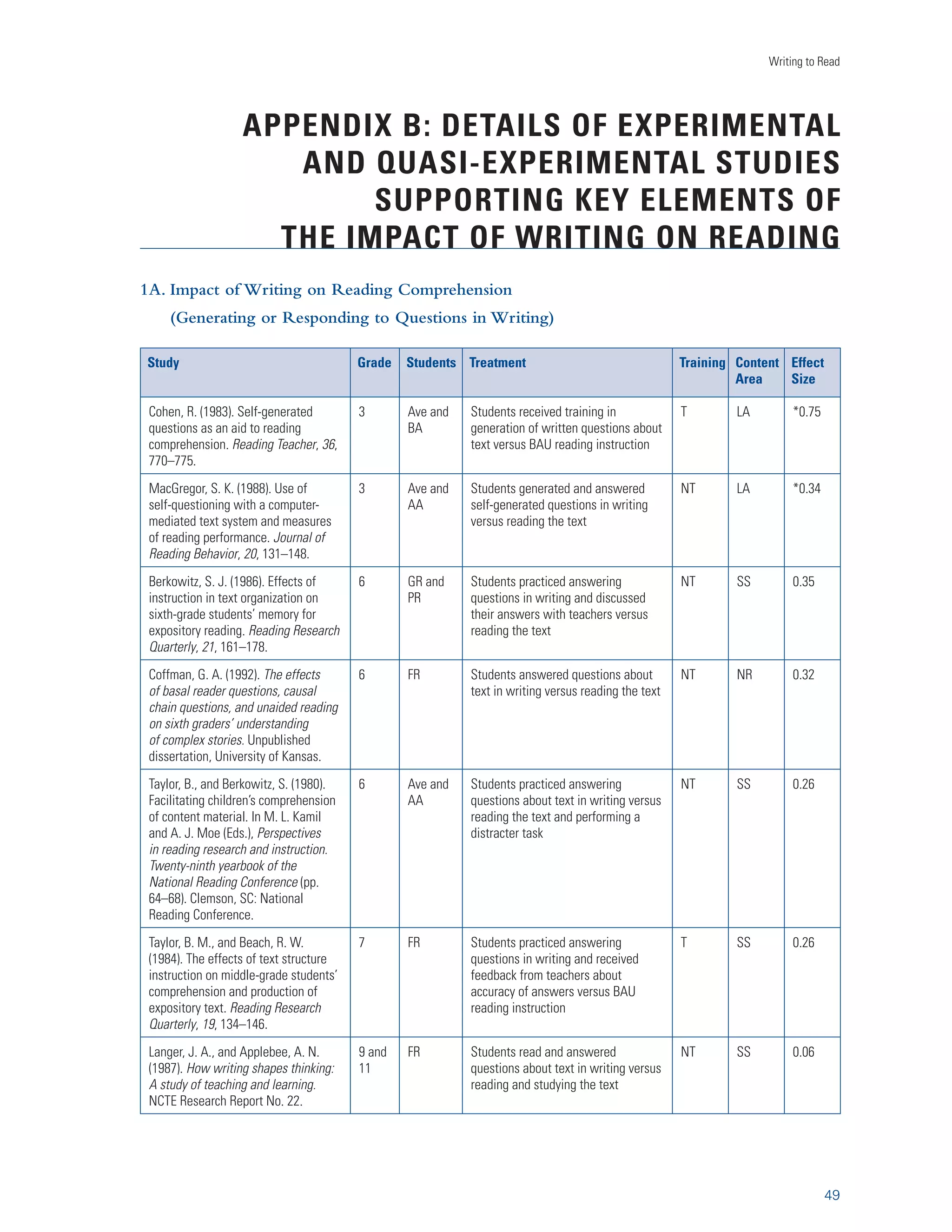
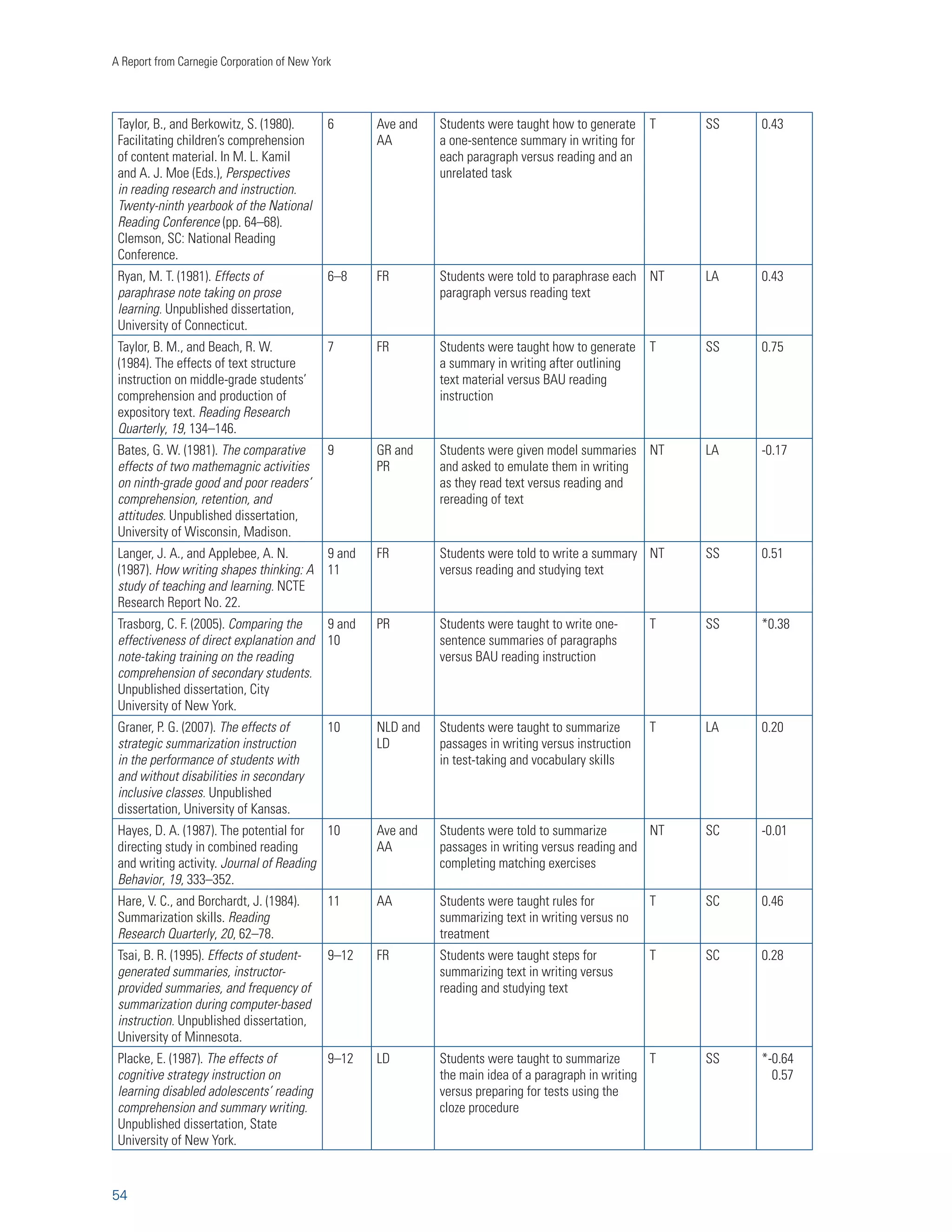
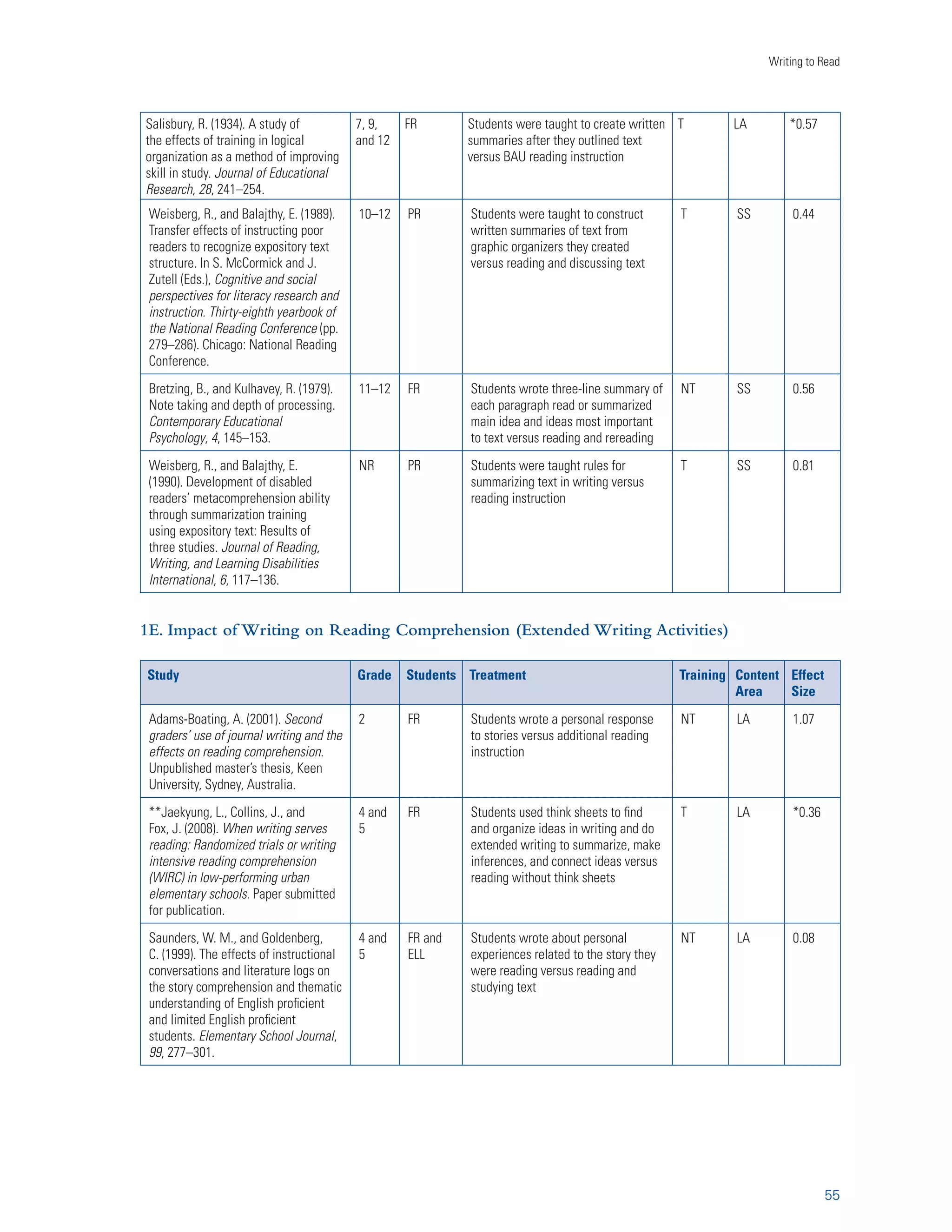
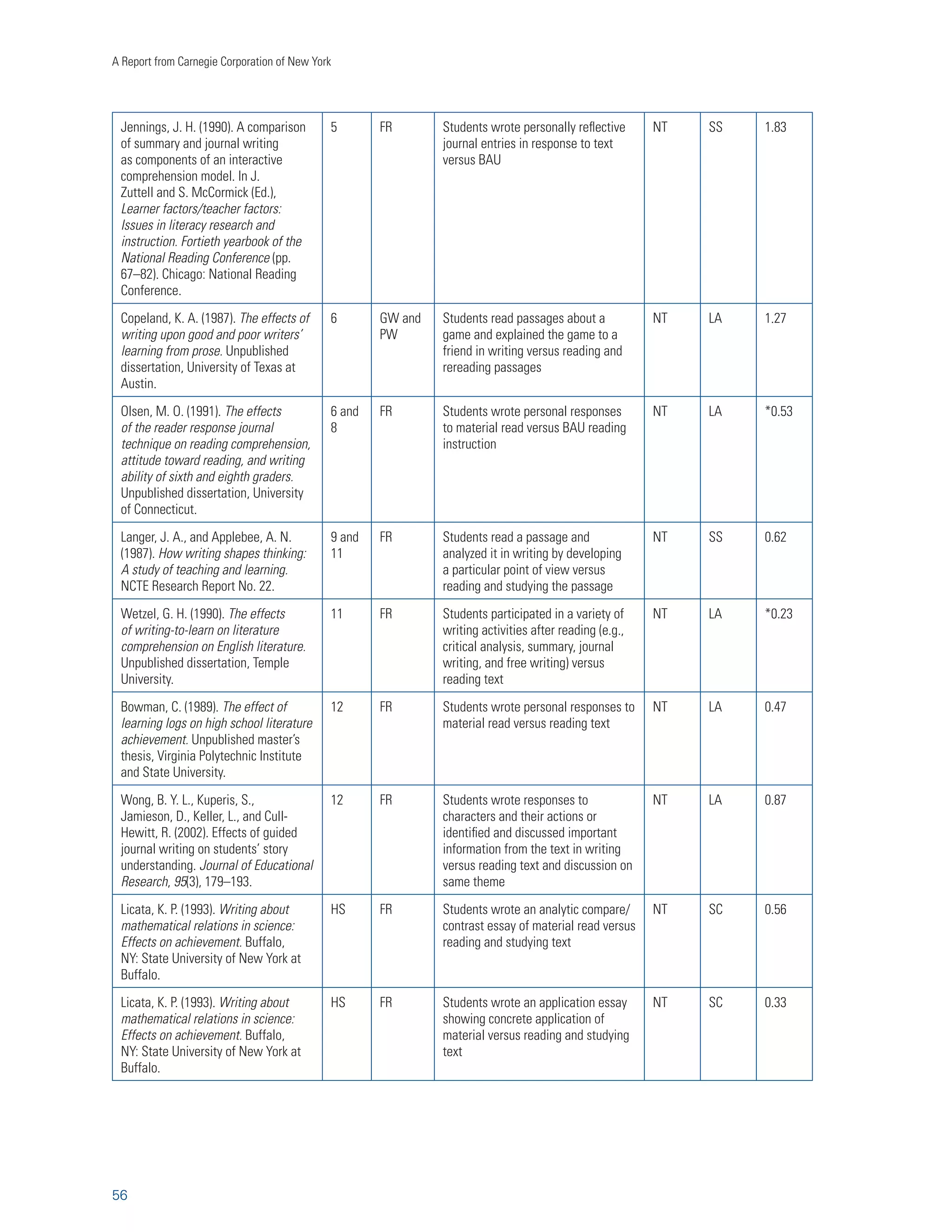
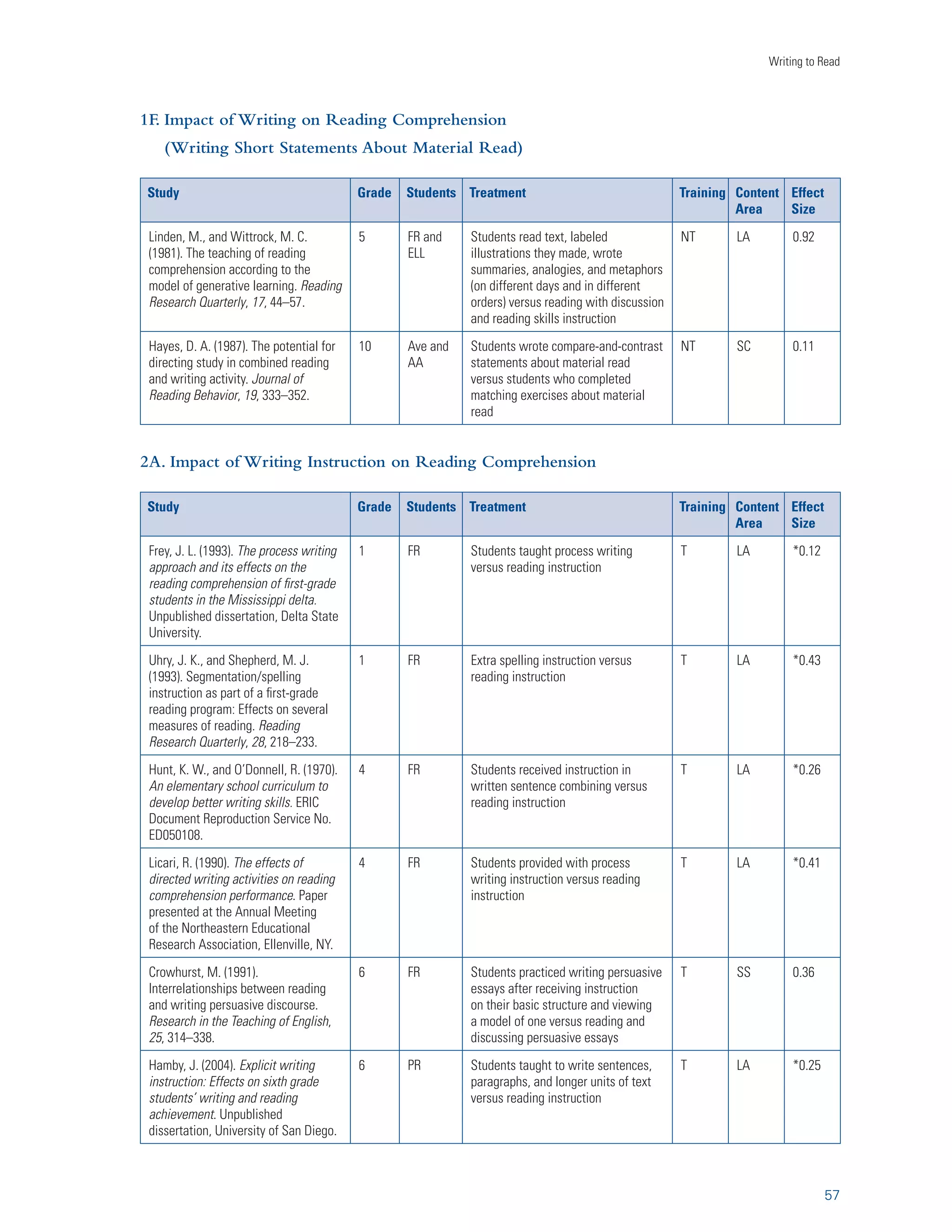
Michael Hebert 
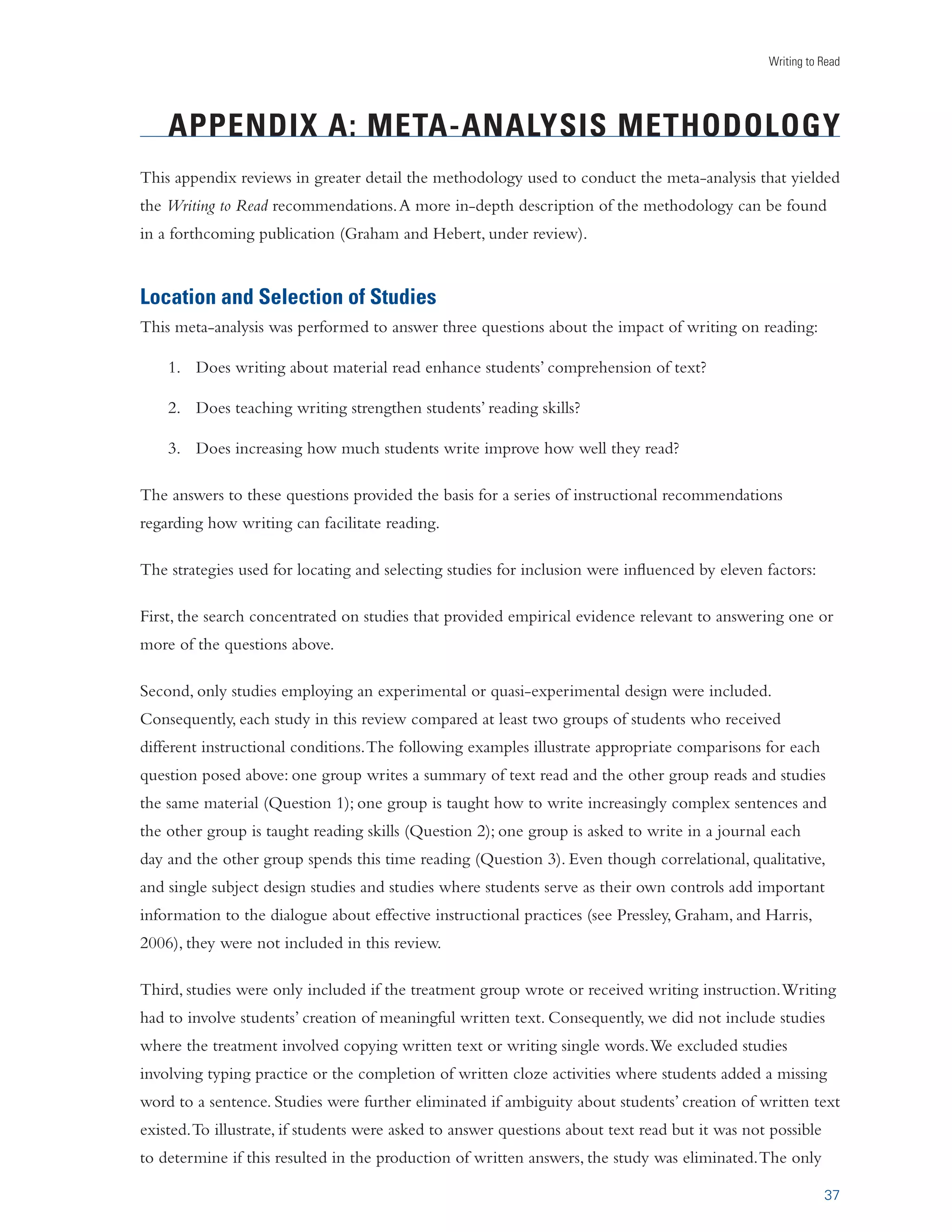
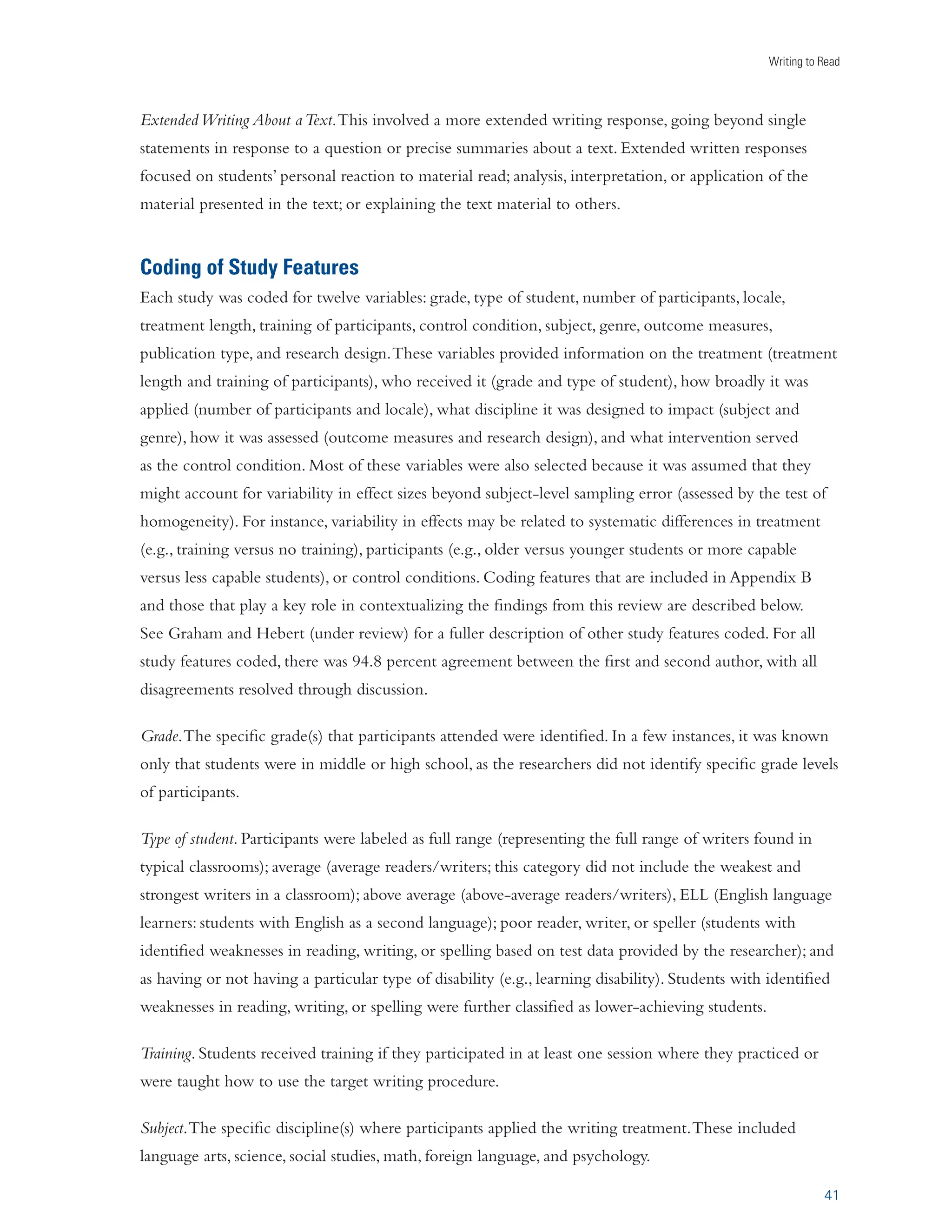
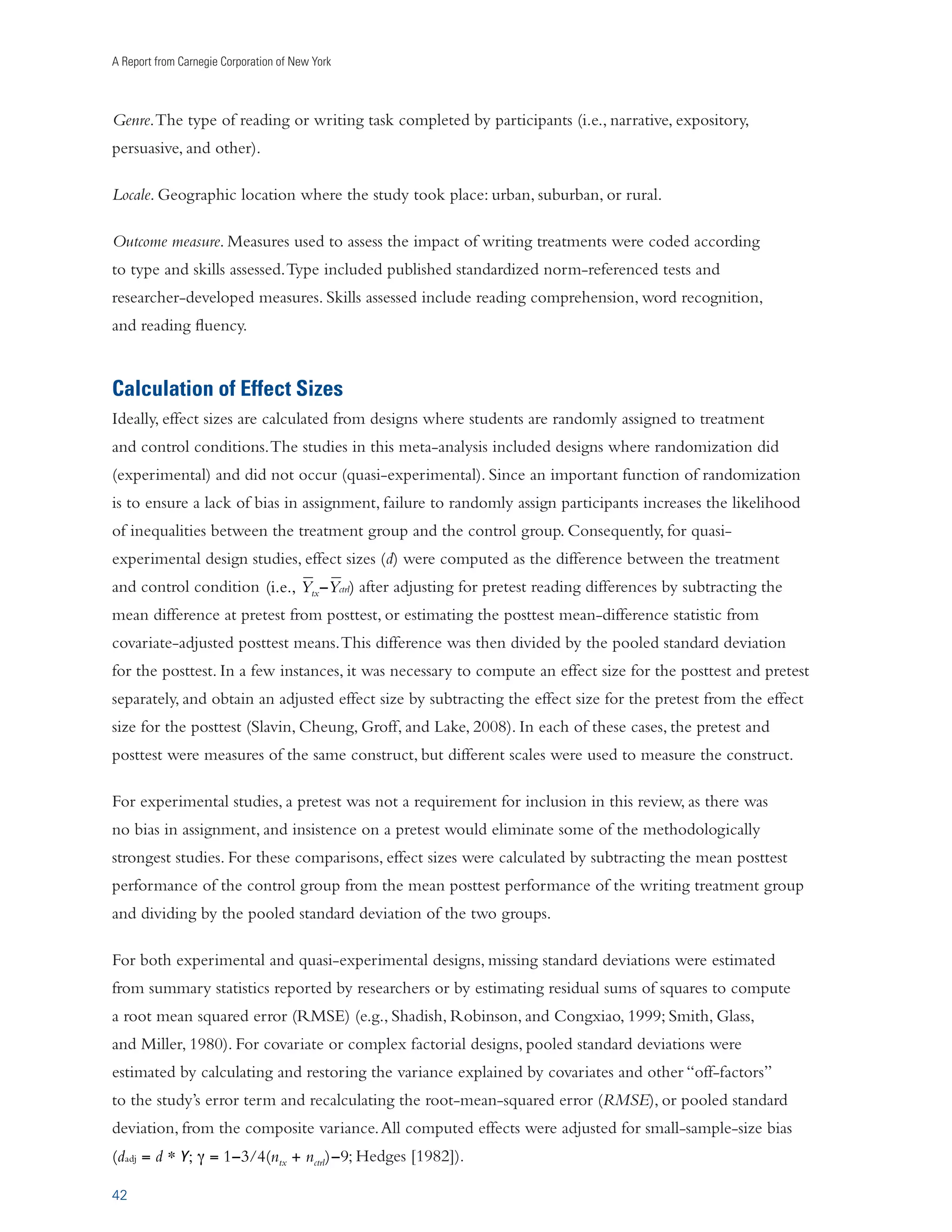
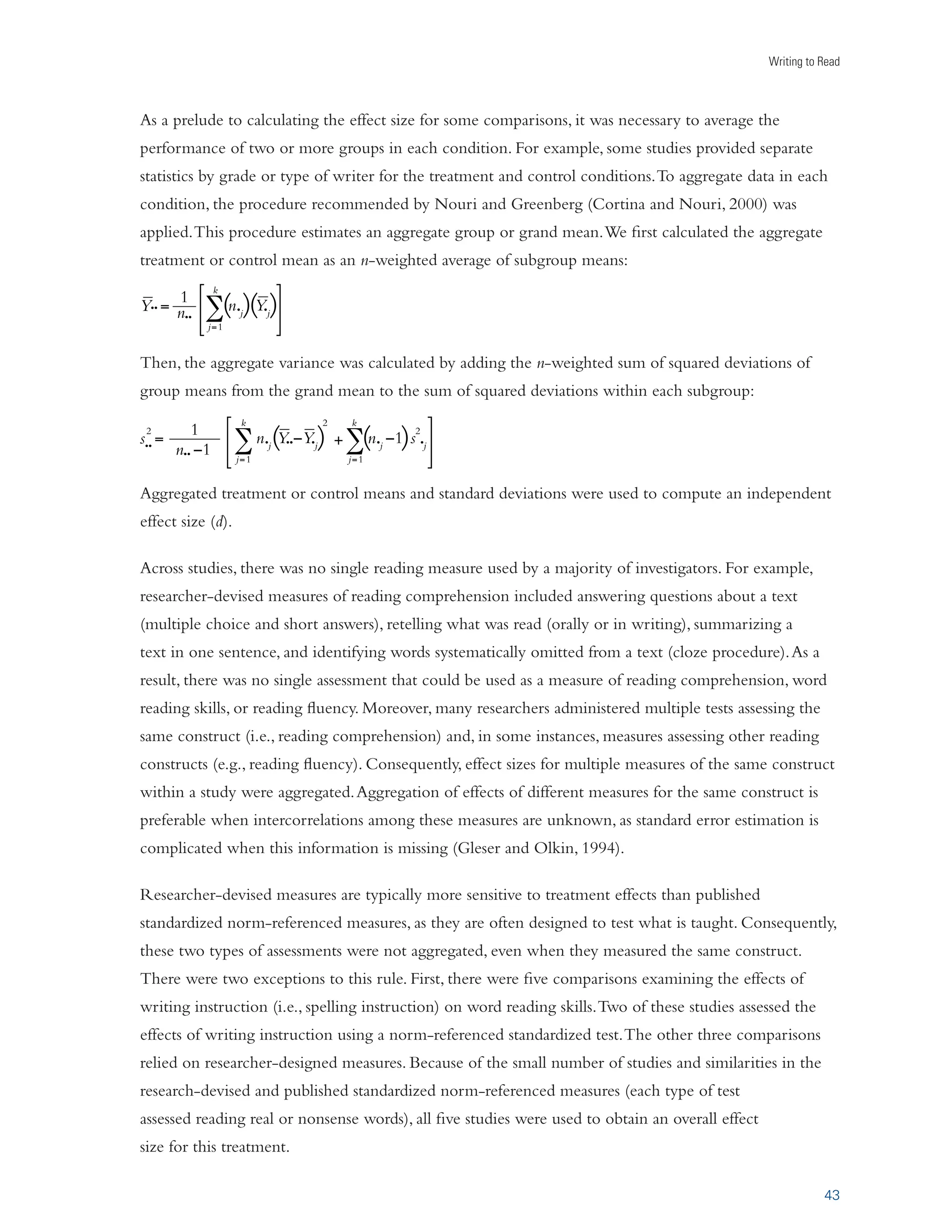
Vanderbilt University 
Writing to Read 
Evidence for How Writing 
Can Improve Reading 
A Report from Carnegie Corporation of New York
© 2010 by Carnegie Corporation of New York. All rights reserved. 
Carnegie Corporation’s Advancing Literacy program is dedicated to the issues of adolescent literacy and the 
research, policy, and practice that focus on the reading and writing competencies of middle and high school 
students. Advancing Literacy reports and the Time to Act series of publications are designed to encourage local 
and national discussions, explore promising ideas, and incubate models of practice. For more information 
visit www.carnegie.org/literacy. 
Published by the Alliance for Excellent Education. 
No part of this publication may be reproduced or transmitted in any form or by any means, electronic or 
mechanical, including photocopying, or any information storage and retrieval system, without permission 
from Carnegie Corporation of New York. A full-text PDF of this document is available for free download from 
www.carnegie.org/literacy and www.all4ed.org. Additional print copies of this report may be ordered from the 
Alliance for Excellent Education at 1201 Connecticut Avenue, Suite 901, Washington, DC 20036, (202) 828-0828. 
Permission for reproducing excerpts from this report should be directed to: Permissions Department, Carnegie 
Corporation of New York, 437 Madison Avenue, New York, NY 10022. 
Suggested citation: Graham, S., and Hebert, M. A. (2010). Writing to read: Evidence for how writing can improve 
reading. A Carnegie Corporation Time to Act Report. Washington, DC: Alliance for Excellent Education.
Writing to Read 
Evidence for How Writing 
Can Improve Reading 
Steve Graham and Michael Hebert 
Vanderbilt University 
A Report from Carnegie Corporation of New York
A Report from Carnegie Corporation of New York 
About the Alliance for Excellent Education 
The Alliance for Excellent Education is a Washington, DC-based national policy and advocacy 
organization that works to improve national and federal policy so that all students can achieve at 
high academic levels and graduate high school ready for success in college, work, and citizenship in 
the twenty-first century. The Alliance focuses on America’s six million most-at-risk secondary school 
students—those in the lowest achievement quartile—who are most likely to leave school without a 
diploma or to graduate unprepared for a productive future. 
The Alliance’s audience includes parents, educators, the federal, state, and local policy communities, 
education organizations, business leaders, the media, and a concerned public. To inform the national 
debate about education policies and options, the Alliance produces reports and other materials, 
makes presentations at meetings and conferences, briefs policymakers and the press, and provides 
timely information to a wide audience via its biweekly newsletter and regularly updated website, 
www.all4ed.org. 
About Carnegie Corporation of New York 
Carnegie Corporation of New York, which was established by Andrew Carnegie in 1911 “to promote 
the advancement and diffusion of knowledge and understanding,” is one of the oldest, largest, and 
most influential of American grantmaking foundations. The foundation makes grants to promote 
international peace and to advance education and knowledge—primary concerns to which founder 
Andrew Carnegie devoted the foundation. For more information, visit www.carnegie.org. 
ii
Writing to Read 
iii 
The Authors 
Steve Graham is the Currey-Ingram Professor of Special Education and Literacy, a chair he shares 
with Karen R. Harris, at Vanderbilt University’s Peabody College of Education. Dr. Graham’s research 
interests include how writing develops, why some students have difficulty mastering this critical skill, 
and the identification of effective writing practices. He is the current editor of Exceptional Children 
and the former editor of Contemporary Educational Psychology and has written over 250 publications, 
including Handbook of Writing Research, Best Practices in Writing Instruction, Writing Better, Powerful 
Writing Strategies for All Students, and Handbook of Learning Disabilities, and APA Handbook of Educational 
Psychology (in preparation). He is the author of the influential meta-analysis of writing interventions, 
Writing Next, funded by Carnegie Corporation of New York. Dr. Graham is the recipient of the 
Council of Exceptional Children’s Career Research Award, the Samual A. Kirk Award from the 
Division of Learning Disabilities, and the Distinguished Research Award from the Special Education 
Interest Group of the American Educational Research Association. 
Michael Hebert is a doctoral student in special education at Vanderbilt University’s Peabody College of 
Education. He is in the Experimental Education Research Training Program (ExpERT) at Vanderbilt, 
supported by the U.S. Department of Education’s Institute for Education Sciences (IES). Mr. Hebert’s 
research interests include writing development, reading development, and how writing may influence 
reading development, especially for students with reading and writing difficulties. He has several 
years of classroom teaching experience at the elementary level, including a year teaching on a Navajo 
reservation in Arizona. Mr. Hebert has several years of experience as a reading specialist in El Segundo, 
California, where he taught students with reading difficulties, and he is a National Writing Project 
Fellow through the California Writing Project at UCLA.
A Report from Carnegie Corporation of New York 
Acknowledgments 
The authors would like to thank Andrés Henríquez, program officer at Carnegie Corporation of 
New York, who offered helpful suggestions in conceptualizing and reporting the research reviewed. 
We also wish to thank Paul Morphy, who provided technical assistance in calculating some effect sizes, 
as well as Rachel Mathias, Nicole Beitler, and Angeline Clark, who helped with various aspects of the 
project, including conducting electronic searches and locating studies. A special thanks goes to Andrew 
Wilson, Gina Biancarosa, and Bob Rothman, who took our original document and reworked it so 
that it was suitable for a broad audience. Finally, we especially appreciated feedback from the National 
Writing Project on how to make the initial draft of the document better. 
Steve Graham 
Michael Hebert 
iv
Writing to Read 
CONTENTS 
Foreword by Vartan Gregorian .........................................................................................................1 
Executive Summary ..........................................................................................................................3 
Introduction ......................................................................................................................................7 
Recommendations for Using Writing to Improve Reading, as Identified by Meta-Analysis ........9 
Implementing the Recommendations ............................................................................................ 23 
A Research Agenda for the Future ................................................................................................ 27 
References ....................................................................................................................................... 31 
Appendix A: Meta-Analysis Methodology ..................................................................................... 37 
Appendix B: Details of Experimental and Quasi-Experimental Studies 
Supporting Key Elements of the Impact of Writing on Reading ................................................. 49 
v
A Report from Carnegie Corporation of New York 
vi
Writing to Read 
FOREWORD 
Around the world, from the cave paintings in Lascaux, France, which may be 25,000 years old, to the 
images left behind by the lost Pueblo cultures of the American Southwest, to the ancient aboriginal art 
of Australia, the most common pictograph found in rock paintings is the human hand. Coupled with 
pictures of animals, with human forms, with a starry night sky or other images that today, we can only 
identify as abstract, we look at these men’s and women’s hands, along with smaller prints that perhaps 
belong to children, and cannot help but be deeply moved by the urge of our ancestors to leave some 
permanent imprint of themselves behind. 
1 
Clearly, the instinct for human beings to express their feelings, their thoughts, and their experiences in 
some lasting form has been with us for a very long time. This urge eventually manifested itself in the 
creation of the first alphabet, which many attribute to the Phoenicians. When people also began to 
recognize the concept of time, their desire to express themselves became intertwined with the sense of 
wanting to leave behind a legacy, a message about who they were, what they had done and seen, and 
even what they believed in. Whether inscribed on rock, carved in cuneiform, painted in hieroglyphics, 
or written with the aid of the alphabet, the instinct to write down everything from mundane 
commercial transactions to routine daily occurrences to the most transcendent ideas—and then to 
have others read them, as well as to read what others have written—is not simply a way of transferring 
information from one person to another, one generation to the next. It is a process of learning and 
hence, of education. 
Ariel and Will Durant were right when they said, “Education is the transmission of civilization.” Putting 
our current challenges into historical context, it is obvious that if today’s youngsters cannot read with 
understanding, think about and analyze what they’ve read, and then write clearly and effectively about 
what they’ve learned and what they think, then they may never be able to do justice to their talents and 
their potential. (In that regard, the etymology of the word education, which is “to draw out and draw 
forth”—from oneself, for example—is certainly evocative.) Indeed, young people who do not have the 
ability to transform thoughts, experiences, and ideas into written words are in danger of losing touch 
with the joy of inquiry, the sense of intellectual curiosity, and the inestimable satisfaction of acquiring 
wisdom that are the touchstones of humanity. What that means for all of us is that the essential 
educative transmissions that have been passed along century after century, generation after generation, 
are in danger of fading away, or even falling silent.
A Report from Carnegie Corporation of New York 
In a recent report, the National Commission on Writing also addresses this concern. They say, “If 
students are to make knowledge their own, they must struggle with the details, wrestle with the facts, 
and rework raw information and dimly understood concepts into language they can communicate to 
someone else. In short, if students are to learn, they must write.” 
It is in this connection that I am pleased to introduce Writing to Read, which builds on Writing 
Next by providing evidence for how writing can improve reading. As both reports warn, American 
students today are not meeting even basic literacy standards and their teachers are often at a loss for 
how to help them. In an age overwhelmed by information (we are told, for example, that all available 
information doubles every two to three years), we should view this as a crisis, because the ability to 
read, comprehend, and write—in other words, to organize information into knowledge—can be viewed 
as tantamount to a survival skill. Why? Because in the decades ahead, Americans face yet another 
challenge: how to keep our democracy and our society from being divided not only between rich and 
poor, but also between those who have access to information and knowledge, and thus, to power—the 
power of enlightenment, the power of self-improvement and self-assertion, the power to achieve 
upward mobility, and the power over their own lives and their families’ ability to thrive and succeed— 
and those who do not. 
Such an uncrossable divide will have devastating consequences for the future of America. Those who 
enrich themselves by learning to read with understanding and write with skill and clarity do so not 
only for themselves and their families, but for our nation as well. They learn in order to preserve and 
enhance the record of humanity, to be productive members of a larger community, to be good citizens 
and good ancestors to those who will follow after them. In an age of globalization, where economies 
sink or swim on their ability to mine and manage knowledge, as do both individual and national 
security, we cannot afford to let this generation of ours and, indeed, any other, fall behind the learning 
curve. Let me bring us back to where we began: for all of us, the handprint must remain firmly and 
clearly on the wall. 
Vartan Gregorian 
President, Carnegie Corporation of New York 
*Note: This text originally appeared as the forward to Writing Next, and is reprinted here with minor changes. 
Our deep thanks to Vartan Gregorian for permitting us to reprint it. 
2
Writing to Read 
EXECUTIVE SUMMARY 
The Challenge 
Although some progress has been made in improving the literacy achievement of students in American 
schools during the last twenty years (Lee, Grigg, and Donahue, 2007; Salahu-Din, Persky, and Miller, 
2008), the majority of students still do not read or write well enough to meet grade-level demands. 
Poor literacy skills play a role in why many of these students do not complete high school. Among 
those who do graduate, many will not be ready for college or a career where reading and writing are 
required. These young people will find themselves at a serious disadvantage in successfully pursuing 
some form of higher education, securing a job that pays a living wage, or participating in social and 
civic activities. 
The financial and social costs of poor literacy have been well documented (Greene, 2000). The 
consequences of poor reading and writing skills not only threaten the well-being of individual 
Americans, but the country as a whole. Globalization and technological advances have changed the 
nature of the workplace. Reading and writing are now essential skills in most white- and blue-collar 
jobs. Ensuring that adolescents become skilled readers and writers is not merely an option for America, 
it is an absolute necessity. 
The Approach 
During this decade there have been numerous efforts to identify instructional practices that improve 
adolescents’ literacy skills, such as Reading Next (Biancarosa and Snow, 2004), which drew a set of fifteen 
instructional recommendations for an effective adolescent literacy program based on the professional 
knowledge and research of nationally known and respected literacy researchers. Such efforts also 
include systematic reviews of high-quality research to identify effective instructional practices for 
improving the comprehension of struggling adolescent readers (Scammacca et al., 2007), as well as 
similar analyses to identify effective practices for improving adolescent students’ writing (Graham and 
Perin, 2007a; Rogers and Graham, 2008). 
3 
Despite these efforts, educators and policymakers need additional evidence-based practices for 
improving the literacy skills of students in American schools.
A Report from Carnegie Corporation of New York 
One often-overlooked tool for improving students’ reading, as well as their learning from text, is 
writing. Writing has the theoretical potential for enhancing reading in three ways. First, reading and 
writing are both functional activities that can be combined to accomplish specific goals, such as 
learning new ideas presented in a text (Fitzgerald and Shanahan, 2000). For instance, writing about 
information in a science text should facilitate comprehension and learning, as it provides the reader 
with a means for recording, connecting, analyzing, personalizing, and manipulating key ideas from the 
text. Second, reading and writing are connected, as they draw upon common knowledge and cognitive 
processes (Shanahan, 2006). Consequently, improving students’ writing skills should result in improved 
reading skills. Third, reading and writing are both communication activities, and writers should gain 
insight about reading by creating their own texts (Tierney and Shanahan, 1991), leading to better 
comprehension of texts produced by others. 
This report provides evidence answering the following three questions: 
4 
1. Does writing about material students read enhance their reading comprehension? 
2. Does teaching writing strengthen students’ reading skills? 
3. Does increasing how much students write improve how well they read? 
Although writing is typically recommended as a part of a strong literacy program (e.g., Biancarosa and 
Snow, 2004), and several important reviews have selectively examined the impact of writing on reading 
(e.g., Applebee, 1984; Emig, 1977; Klein, 1999; Neville and Searls, 1991; Smith, 1988; Stotsky, 1982), 
the special strength of this report is that it comprehensively summarizes high-quality research using 
the powerful statistical method of meta-analysis. This technique allows researchers to determine the 
consistency and strength of the effects of an instructional practice, and to highlight practices holding 
the most promise. 
Writing Next presented the results of a large-scale statistical review of research on the effects of specific 
types of writing interventions, and identified specific teaching techniques for improving the quality of 
adolescent students’ writing. Writing to Read draws on the same type of statistical review of the research 
to highlight writing techniques shown to enhance students’ reading. 
To be successful, students today need strong literacy skills, and also need to be able to use these skills as 
tools for ongoing learning. This report builds on Writing Next by identifying writing practices found to 
be effective in helping students increase their reading skills and comprehension. We hope that besides 
providing classroom teachers with research-supported information about how writing can improve 
reading, our data will stimulate discussion and action at the policy and research levels, leading to the 
greater use of writing as a tool for enhancing reading and a greater emphasis on the teaching of writing 
in our nation’s schools.
Writing to Read 
The Recommendations 
Writing Practices That Enhance Students’ Reading 
This report identifies a cluster of closely related instructional practices shown to be effective in 
improving students’ reading. We have grouped these practices within three core recommendations, here 
listed in order of the strength of their supporting evidence. 
I. HAVE STUDENTS WRITE ABOUT THE TEXTS THEY READ. Students’ comprehension of science, 
5 
social studies, and language arts texts is improved when they write about what they read, 
specifically when they 
U Respond to a Text in Writing (Writing Personal Reactions, Analyzing and Interpreting the Text) 
U Write Summaries of a Text 
U Write Notes About a Text 
U Answer Questions About a Text in Writing, or Create and Answer Written 
Questions About a Text 
II. TEACH STUDENTS THE WRITING SKILLS AND PROCESSES THAT GO INTO CREATING TEXT. 
Students’ reading skills and comprehension are improved by learning the skills and processes 
that go into creating text, specifically when teachers 
U Teach the Process of Writing, Text Structures for Writing, Paragraph or Sentence Construction 
Skills (Improves Reading Comprehension) 
U Teach Spelling and Sentence Construction Skills (Improves Reading Fluency) 
U Teach Spelling Skills (Improves Word Reading Skills) 
III. INCREASE HOW MUCH STUDENTS WRITE. Students’ reading comprehension is improved by 
having them increase how often they produce their own texts. 
Writing to Read does not identify all the ways that writing can enhance reading, any more than Writing 
Next identified all of the possible ways to improve students’ writing. However, all of the Writing to Read 
instructional recommendations have shown clear results for improving students’ reading. 
Nonetheless, even when used together these practices do not constitute a full curriculum. The writing 
practices described in this report should be used by educators in a flexible and thoughtful way to 
support students’ learning.
A Report from Carnegie Corporation of New York 
The evidence is clear: writing can be a vehicle for improving reading. In particular, having students 
write about a text they are reading enhances how well they comprehend it. The same result occurs 
when students write about a text from different content areas, such as science and social studies. 
This result is consistent with the finding from Writing Next that writing about science, math, and other 
types of information promotes students’ learning of the material. In addition, teaching writing not only 
improves how well students write, as demonstrated in Writing Next; it also enhances students’ ability 
to read a text accurately, fluently, and with comprehension. Finally, having students spend more time 
writing has a positive impact on reading, increasing how well students comprehend texts written by 
others. Taken together, these findings from Writing to Read and Writing Next highlight the power of 
writing as a tool for improving both reading and content learning. 
6
Writing to Read 
INTRODUCTION 
Literacy Is Critical to Success in the Twenty-first Century 
Past generations of Americans with only a high school education were able to find jobs that paid 
a living wage without difficulty (Berman, 2009). Today, such jobs are becoming increasingly rare. 
Technological innovations, globalization, and changes in the workplace have increased the need for 
young people to obtain some form of higher education, whether it is in a two- or four-year college 
or involves technical or career coursework. Somewhere between one half to two thirds of new jobs in 
the future will require a college education and higher-level literacy skills (Carnevale and Derochers, 
2004; Kirsch, Braun, Yamamoto, and Sum, 2007). The largest projected area for job growth is the service 
industry, with 20.5 million new jobs added to the economy during this decade (Berman, 2001). High-level 
7 
literacy skills are almost a universal requirement for employees in this industry, as in professions 
such as finance, insurance, real estate, construction, and manufacturing. For example, almost 70 percent 
of salaried employees in these industries use writing as part of their jobs (National Commission on 
Writing, 2004). Over 90 
percent of white-collar workers 
and 80 percent of blue-collar 
workers indicate that writing 
skill is important to job success 
(National Commission on 
Writing, 2006). 
The growing demand for higher 
levels of education and literacy 
skills places new pressures on 
American schools. High schools 
must do more than graduate 
students: they must also prepare 
students for higher education 
and satisfying employment 
(Gewertz, 2009). 
CAUSE FOR CONCERN 
UÊ œÀÌÞÊ«iÀVi˜ÌÊœvÊ…ˆ}…ÊÃV…œœÊ}À`ÕÌiÃʏVŽÊÌ…iʏˆÌiÀVÞÊÃŽˆÃÊ 
i“«œÞiÀÃÊÃiiŽÊ­ ̈œ˜ÊœÛiÀ˜œÀÃÊÃÜVˆÌˆœ˜]ÊÓääx®° 
UÊ VŽÊœvÊLÈVÊÃŽˆÃÊVœÃÌÃÊÕ˜ˆÛiÀÈ̈iÃʘ`ÊLÕȘiÃÃiÃÊÃÊ“ÕV…Ê 
ÃÊf£ÈÊLˆˆœ˜Ê˜˜ÕÞÊ­Àii˜i]ÊÓäää®° 
UÊ *œœÀÊÜÀˆÌˆ˜}ÊÃŽˆÃÊVœÃÌÊLÕȘiÃÃiÃÊfΰ£ÊLˆˆœ˜Ê˜˜ÕÞÊ 
­ ̈œ˜Ê
œ““ˆÃÈœ˜Êœ˜Ê7ÀˆÌˆ˜}]ÊÓää{®° 
UÊ ˜ÞÊœ˜iÊœÕÌÊœvÊÌ…ÀiiÊÃÌÕ`i˜ÌÃʈÃÊÊ«ÀœwVˆi˜ÌÊÀi`iÀÊ­ii]ÊÀˆ}}]Ê 
˜`Ê
œ˜…Õi]ÊÓääÇ®° 
UÊ ˜ÞÊœ˜iÊœÕÌÊœvÊvœÕÀÊÌÜivÌ…‡}À`iÊÃÌÕ`i˜ÌÃʈÃÊÊ«ÀœwVˆi˜ÌÊÜÀˆÌiÀÊ 
­-…Õ‡
ˆ˜]Ê*iÀÃŽÞ]ʘ`ʈiÀ]ÊÓään®° 
UÊ ˜iÊœÕÌÊœvÊiÛiÀÞÊwÛiÊVœi}iÊvÀiÃ…“˜Ê“ÕÃÌÊÌŽiÊÊÀi“i`ˆÊ 
Ài`ˆ˜}ÊVœÕÀÃiÊ­-,
	]ÊÓääÈ®° 
UÊ  iÀÞÊœ˜iÊÌ…ˆÀ`ÊœvÊ…ˆ}…ÊÃV…œœÊ}À`ÕÌiÃÊÀiʘœÌÊÀi`ÞÊvœÀÊ 
Vœi}i‡iÛiÊ
˜}ˆÃ…ÊVœ“«œÃˆÌˆœ˜ÊVœÕÀÃiÃÊ­
/]ÊÓääx®° 
UÊ /…ÀiiÊœÕÌÊœvÊÌi˜Ê…ˆ}…ÊÃV…œœÊÃÌÕ`i˜ÌÃÊ`œÊ˜œÌÊ}À`ÕÌiÊœ˜Ê̈“iÊ 
­iÜiÀÌâ]ÊÓää™®° 
UÊ ÛiÀÊ…vÊœvÊ`ՏÌÃÊÃVœÀˆ˜}ÊÌÊÌ…iʏœÜiÃÌʏˆÌiÀVÞʏiÛiÃÊÀiÊ 
`Àœ«œÕÌÃÊ­ ̈œ˜Ê
i˜ÌiÀÊvœÀÊ
`ÕV̈œ˜Ê-Ì̈Ã̈VÃ]ÊÓääx®°
A Report from Carnegie Corporation of New York 
Yet right now our high schools are not doing nearly enough to prepare young people for the future. 
Only seven in ten American students graduate from high school in four years (Gewertz, 2009). Many 
adolescents drop out of school because of poor literacy skills. It is unlikely that high school graduation 
rates will rise, or that college- and career-readiness efforts will prove successful, unless our schools help 
adolescents learn to read and write at a higher level. 
Struggling Readers and Writers 
According to findings from the 2007 National Assessment of Educational Progress (NAEP), only 
33 percent of fourth-grade students and 31 percent of eighth-grade students perform at or above 
the “proficient” level (defined as solid academic performance) in reading (Lee, Grigg, and Donahue, 
2007). In contrast, 34 percent of fourth-grade students and 43 percent of eighth-grade students score 
at the “basic” level, denoting only partial mastery of the literacy skills needed at their grade level. The 
rest of the students (33 percent of fourth graders and 26 percent of eighth graders) scored below this 
basic level. 
As with reading, only a small percentage of students showed solid 
academic performance in writing on the 2007 NAEP (Salahu-Din, 
Persky, and Miller, 2008). Thirty-three percent of eighth-grade 
students and 24 percent of twelfth-grade students performed at or 
above the “proficient” level. This means that two thirds of eighth-grade 
8 
students and three quarters of twelfth-grade students score at 
either the basic level or below in writing. 
/…iÊŽ˜œÜi`}iʘ`ÊÃŽˆÃÊ 
˜ii`i`ÊvœÀÊ…ˆ}…iÀÊi`ÕV̈œ˜Ê 
˜`ÊvœÀÊi“«œÞ“i˜ÌÊÀiʘœÜÊ 
Vœ˜Ãˆ`iÀi`ÊÌœÊLiʈ`i˜ÌˆVÊ 
­
/]ÊÓääx®° 
Problems acquiring needed literacy skills are heightened for students who do not speak English as their 
first language, students who have a disability, or who are black, Hispanic, or Native American. Reading 
and writing performance of these groups of students on the 2007 NAEP was significantly lower than 
the literacy performance of students who were native English speakers, who did not have a disability, 
or who were white, respectively. The results from the NAEP clearly demonstrate that large numbers of 
adolescents need interventions to help them become better readers and writers.
Writing to Read 
RECOMMENDATIONS FOR USING WRITING 
TO IMPROVE READING, 
AS IDENTIFIED BY META-ANALYSIS 
Writing is often recommended as a tool for improving reading. In Reading Next (Biancarosa and Snow, 
2004), intensive writing was identified as a critical element of an effective adolescent literacy program. 
Reading Next stated that writing instruction improves reading comprehension and that the teaching of 
writing skills such as grammar and spelling reinforces reading skills. It is also believed that writing about 
a text improves comprehension, as it helps students make connections between what they read, know, 
understand, and think (Carr, 2002). 
This report provides long-needed guidance for teachers and policymakers by identifying specific 
writing practices that enhance students’ reading abilities. The special contribution of this report is that 
it draws on empirical evidence in grades 1–12 in doing so. Its findings show that having students write 
about texts they read, explicitly teaching writing skills and processes, and having students write more do 
improve reading skills and comprehension. 
9 
We set out to collect, categorize, 
and analyze experimental and 
quasi-experimental data on the 
effectiveness of writing practices 
for improving students’ reading 
skills and comprehension. 
The empirical evidence from 
this analysis resulted in the 
identification of research-supported 
writing practices for 
improving students’ reading. 
The method used, meta-analysis, 
provides a measure of 
effectiveness using the effect size 
statistic. 
A TECHNICAL NOTE ON EXPERIMENTAL AND 
QUASI-EXPERIMENTAL STUDIES 
/…iÊLi˜iwÌÊœvÊÕȘ}ÊiÝ«iÀˆ“i˜ÌÊ˜`ʵÕȇiÝ«iÀˆ“i˜ÌÊÌÞ«iÃÊ 
œvÊÃÌÕ`ˆiÃÊvœÀÊœÕÀÊÀiÛˆiÜʈÃÊÌ…ÌÊÌ…iÞʏœÜÊvœÀÊÃÌÀœ˜}iÀʈ˜viÀi˜ViÃÊ 
LœÕÌÊVÕÃi‡˜`‡ivviVÌÊÀiÌˆœ˜Ã…ˆ«ÃÊÌ…˜Ê`œÊœÌ…iÀÊÌÞ«iÃÊœvÊ 
ÃÌÕ`ˆiðʘÊLœÌ…]ÊV…ˆ`Ài˜Êˆ˜Ê˜ÊiÝ«iÀˆ“i˜ÌÊ}ÀœÕ«ÊÀiViˆÛiÊÊ 
ëiVˆwVʈ˜ÌiÀÛi˜Ìˆœ˜Ê­œÀÊÌÀiÌ“i˜Ì®Ê˜`ÊÌ…iˆÀÊ«iÀvœÀ“˜ViʈÃÊ 
Vœ“«Ài`ÊÌœÊÊVœ˜ÌÀœÊ}ÀœÕ«ÊœvÊV…ˆ`Ài˜ÊÌ…ÌÊÀiViˆÛiÃÊÊ`ˆvviÀi˜ÌÊ 
ÌÀiÌ“i˜ÌÊœÀʘœÊÌÀiÌ“i˜Ì°Ê
Ý«iÀˆ“i˜ÌÊÃÌÕ`ˆiÃÊVœ˜ÌÀœÊvœÀÊ 
«Àii݈Ã̈˜}Ê`ˆvviÀi˜ViÃÊLiÌÜii˜ÊÃÌÕ`i˜ÌÃʈ˜ÊÌ…iÊÌÜœÊ}ÀœÕ«ÃÊ 
Ì…ÀœÕ}…ÊÀ˜`œ“ÊÃÈ}˜“i˜ÌÊÌœÊÊ}ÀœÕ«]ÊÜ…ˆiʵÕȇiÝ«iÀˆ“i˜ÌÊ 
ÃÌÕ`ˆiÃÊ`œÊÜÊÌ…ÀœÕ}…ʜ̅iÀÊ“i˜Ã°ÊœÀÊÌ…iÊVÕÀÀi˜ÌʘÞÈÃ]ÊÜiÊ 
œ˜Þʈ˜VÕ`i`ʵÕȇiÝ«iÀˆ“i˜ÌÊÃÌÕ`ˆiÃÊÌ…ÌÊÃÃiÃÃi`ÊÃÌÕ`i˜ÌÃ½Ê 
Ài`ˆ˜}Ê«iÀvœÀ“˜ViÊÌÊÌ…iÊÃÌÀÌÊœvÊÌ…iÊÃÌÕ`Þ]ÊÜÊÌ…ÌÊ«œÃÈLiÊ 
«Àii݈Ã̈˜}Ê`ˆvviÀi˜ViÃÊLiÌÜii˜ÊÃÌÕ`i˜ÌÃʈ˜ÊiV…ÊVœ˜`ˆÌˆœ˜ÊVœÕ`Ê 
LiÊVœ˜ÌÀœi`° 
The Meta-Analysis 
Meta-analysis is a statistical technique for integrating, summarizing, and interpreting sets of empirical 
research that involve quantitative measures (Lipsey and Wilson, 2001). In this report, meta-analysis was 
used to investigate the effectiveness of writing about text, the effectiveness of the teaching of writing, 
and the effectiveness of having students write more.
A Report from Carnegie Corporation of New York 
This is the first meta-analysis 
examining the effects of 
different writing practices on 
students’ reading performance. 
Previous meta-analyses focused 
only on single practices, such 
as the impact of sentence 
combining on reading 
comprehension (e.g., Neville 
and Searls, 1991), aggregated 
reading measures with other 
types of outcome measures 
(Bangert-Drowns, Hurley, and 
Wilkinson, 2004), or did not 
isolate the effect of the writing 
practice (Moore and Readence, 
1984). The findings in this 
report are cumulative in that 
they build on earlier reviews 
examining the impact of writing 
on reading (e.g., Applebee, 1984; 
Emig, 1977; Graham and Perin, 
2007a; Klein, 1999; Moore and 
Readence, 1984; Neville and 
Searls, 1991; NICHD, 2000; 
Smith, 1988; Stotsky, 1982). All 
pertinent studies from these 
prior reviews were included, and 
new studies were located through an extensive search of the literature (see Appendix A for details). 
The recommendations from this review are in no way meant 
to detract from the significant contributions that other types 
of research make to the understanding of the effects of writing 
on reading. Likewise, many perspectives, including cognitive, 
sociocultural, rhetorical, cross-curricular, linguistic, and student 
centered (see Fitzgerald and Shanahan, 2000; Shanahan, 2006), 
contribute to knowledge of how writing influences reading. 
10 
A TECHNICAL NOTE ON META-ANALYSIS 
What is a meta-analysis? 
i̇˜ÞÈÃʈÃÊÊ«À̈VՏÀÞÊ«œÜiÀvՏÊÜÞÊœvÊÃÕ““Àˆâˆ˜}Ê 
À}iÊLœ`ˆiÃÊœvÊÀiÃiÀV…]ÊÃʈÌÊ}}Ài}ÌiÃÊVœ˜Vi«ÌՏÞÊÈ“ˆÀÊ 
µÕ˜ÌˆÌ̈ÛiÊ“iÃÕÀiÃÊLÞÊVVՏ̈˜}ʘÊivviVÌÊÈâiÊvœÀÊiV…ÊÃÌÕ`Þ°Ê 
/…iÊÃÌÀi˜}Ì…ÊœvÊ“i̇˜ÞÈÃʈÃÊÌ…ÌʈÌʏœÜÃÊVœ˜Ãˆ`iÀ̈œ˜ÊœvÊ 
LœÌ…ÊÌ…iÊÃÌÀi˜}̅ʘ`ÊÌ…iÊVœ˜ÃˆÃÌi˜VÞÊœvÊÊÌÀiÌ“i˜Ì½ÃÊivviVÌð 
What is an effect size? 
˜ÊivviVÌÊÈâiÊÀi«œÀÌÃÊÌ…iÊÛiÀ}iÊ`ˆvviÀi˜ViÊLiÌÜii˜Êœ˜iÊÌÞ«iÊ 
œvʈ˜ÃÌÀÕV̈œ˜Ê˜`ÊÊVœ˜ÌÀœÊVœ˜`ˆÌˆœ˜°ÊÌʈ˜`ˆVÌiÃÊÌ…iÊstrengthÊ 
œvÊÌ…iÊivviV̰Ê/…iÊvœœÜˆ˜}Ê}Õˆ`iˆ˜iÃÊ«ÀœÛˆ`iÊÊLi˜V…“ÀŽÊvœÀÊ 
ˆ˜ÌiÀ«Àï˜}ÊÌ…iÊ“}˜ˆÌÕ`iÊœvʘÊivviVÌ 
Ê ä°ÓäÊrÊsmallÊœÀÊ“ˆ`ÊivviVÌÊ 
ä°xäÊrÊmediumÊœÀÊ“œ`iÀÌiÊivviVÌÊ 
ä°näÊrÊlargeÊœÀÊÃÌÀœ˜}ÊivviVÌ 
ÊpositiveÊivviVÌÊÈâiÊ“i˜ÃÊÌ…iÊÜÀˆÌˆ˜}ÊÌÀiÌ“i˜ÌÊ…`ÊÊ«œÃˆÌˆÛiÊ 
ivviVÌÊœ˜ÊÃÌÕ`i˜ÌýÊÀi`ˆ˜}ÊÜ…i˜ÊVœ“«Ài`ÊÌœÊÌ…iÊVœ˜ÌÀœÊ 
Vœ˜`ˆÌˆœ˜° 
ÊnegativeÊivviVÌÊÈâiÊ“i˜ÃÊÌ…ÌÊÌ…iÊVœ˜ÌÀœÊVœ˜`ˆÌˆœ˜Ê…`ÊÊ 
ÃÌÀœ˜}iÀÊivviVÌÊœ˜ÊÃÌÕ`i˜ÌýÊÀi`ˆ˜}ÊÌ…˜ÊÌ…iÊÜÀˆÌˆ˜}ÊÌÀiÌ“i˜Ì° 
Ì…œÕ}…ÊÌ…iÃiÊ}Õˆ`iˆ˜iÃÊÀiÊVœ““œ˜ÞÊVVi«Ìi`]ʈÌʈÃʈ“«œÀ̘ÌÊ 
̜ʈ˜ÌiÀ«ÀiÌʘÊivviVÌÊÈâiÊ܈̅ˆ˜ÊÌ…iÊVœ˜ÌiÝÌÊœvÊÊ}ˆÛi˜Êwi`°Ê 

œ˜ÃiµÕi˜ÌÞ]ÊÌ…iÊw˜`ˆ˜}ÃÊvÀœ“ÊÌ…ˆÃÊ“i̇˜ÞÈÃÊÀiÊVœ“«Ài`Ê 
ÌœÊw˜`ˆ˜}ÃÊvÀœ“ʜ̅iÀÊ“i̇˜ÞÃiÃÊiÝ“ˆ˜ˆ˜}Ê`ˆvviÀi˜ÌÊÀi`ˆ˜}Ê 
ˆ˜ÌiÀÛi˜Ìˆœ˜ÃÊ­ˆ°i°]Ê
]ÊÓäääÆÊ,œÃi˜Ã…ˆ˜iʘ`ÊiˆÃÌiÀ]Ê£™™{ÆÊ 
-Ûˆ˜]Ê
…iÕ˜}]ÊÀœvv]ʘ`ÊŽi]ÊÓään®°Ê-ÕV…ÊVœ“«ÀˆÃœ˜ÊLiÌÌiÀÊ 
Vœ˜ÌiÝÌՏˆâiÃÊÌ…iÊ«œÜiÀÊœvÊÜÀˆÌˆ˜}ÊÃÊÊ“i˜ÃÊœvʈ“«ÀœÛˆ˜}Ê 
Ài`ˆ˜}ÊV…ˆiÛi“i˜Ì° 
Ãœ]ʈÌʈÃʈ“«œÀ̘ÌÊÌœÊÀi“i“LiÀÊÌ…ÌÊʏÀ}iʘՓLiÀÊœvÊvVÌœÀÃÊ 
Ì…Ìʈ˜yÕi˜ViÊޜ՘}ÃÌiÀýʏˆÌiÀVÞÊœÕÌVœ“iÃʘ`ÊÌ…iÊ`ˆvwVՏÌÞÊ 
œvʈ“«ÀœÛˆ˜}ÊÀi`ˆ˜}]ÊiëiVˆÞÊvœÀÊœ`iÀÊÃÌÕ`i˜ÌÃ]ÊÀi˜`iÀʘÞÊ 
È}˜ˆwV˜ÌÊivviVÌÊ“i˜ˆ˜}vՏ° 
Appendix AÊ`iÃVÀˆLiÃÊÊ 
Ì…iÊ“iÌ…œ`œœ}ÞÊÕÃi`ÊÊ 
ˆ˜ÊÌ…iÊ“i̇˜ÞÈðÊÊ 
Appendix BʏˆÃÌÃʏÊÌ…iÊ 
ÃÌÕ`ˆiÃÊÌ…ÌÊÜiÀiʘÞâi`Ê 
˜`Ê«ÀœÛˆ`iÃÊ`iÃVÀˆ«ÌˆÛiÊ 
ˆ˜vœÀ“̈œ˜ÊLœÕÌÊiV…°
Writing to Read 
11 
THE RECOMMENDATIONS 
Effective Practices for Strengthening Reading Through Writing 
I. HAVE STUDENTS WRITE ABOUT THE TEXTS THEY READ. Students’ comprehension of science, 
social studies, and language arts texts is improved when they write about what they read, 
specifically when they 
U Respond to a Text in Writing (Writing Personal Reactions, Analyzing and Interpreting the Text) 
U Write Summaries of a Text 
U Write Notes About a Text 
U Answer Questions About a Text in Writing, or Create and Answer Written Questions About a Text 
II. TEACH STUDENTS THE WRITING SKILLS AND PROCESSES THAT GO INTO CREATING TEXT. 
Students’ reading skills and comprehension are improved by learning the skills and processes 
that go into creating text, specifically when teachers 
U Teach the Process of Writing, Text Structures for Writing, Paragraph or Sentence Construction 
Skills (Improves Reading Comprehension) 
U Teach Spelling and Sentence Construction Skills (Improves Reading Fluency) 
U Teach Spelling Skills (Improves Word Reading Skills) 
II. INCREASE HOW MUCH STUDENTS WRITE. Students’ reading comprehension is improved by 
having them increase how often they produce their own texts. 
In the following sections, we discuss each of these findings in turn by discussing the theory behind 
the practices and the results of the analysis. In several places, we also elaborate the activities involved in 
implementing the practices. Results are reported in effect size statistics, which allow us to understand 
the magnitude of impact an instructional practice can have on student outcomes. 
When reading these sections, readers should keep in mind three important aspects of effect sizes. 
First, while it is tempting to regard practices that have large effect sizes as more effective than those 
with small effect sizes, effect sizes cannot be interpreted in this fashion. The effects we estimate for a 
particular practice always exist in relation to whatever practices were used in the “control” condition. 
In short, the effects for any two practices described in this report cannot be compared directly to or 
against each other. 
Second, we report the effect sizes we found for two types of tests commonly used in research: norm-referenced 
tests and researcher-designed tests (see sidebar on page 12). Norm-referenced tests generally 
yield much smaller effect sizes than researcher-designed tests do. For example, two of the most robust 
reading instructional practices for improving children’s reading comprehension, Reciprocal Teaching 
and generating questions, have effect sizes of 0.32 and 0.36 respectively when assessed using norm-referenced 
tests, and effect sizes of 0.88 and 0.86 respectively when assessed using researcher-designed
A Report from Carnegie Corporation of New York 
measures (Rosenshine and Meister, 1994; Rosenshine, Meister, and Chapman, 1996). Similar differences 
in effect sizes for different tests are found throughout our report (see graph below). 
Third, because effect sizes are statistics, we can estimate more than the average effect size—we can 
also estimate a confidence interval. The confidence interval specifies the range in which we think the 
“true” effect of a practice lies. Thus, we present confidence intervals around the effect sizes we found in 
Figure 1. In general, confidence 
intervals tend to be smaller 
when the number of studies we 
have is bigger and also when 
tests are more precise. In fact, 
readers will likely note that we 
have a few very large confidence 
intervals for some of the effects. 
These large ranges suggest that 
we are less certain of a practice’s 
real effect, but critically we are 
still quite certain that there is 
an effect because none of these 
confidence intervals extends 
as low as zero. As a result, even 
when confidence intervals are 
large, we are reasonably certain 
that these practices do affect 
students in a positive way, we are 
just less certain of how large that 
effect is. 
12 
NORM-REFERENCED VS. 
RESEARCH-DESIGNED TESTS 
 œÀ“‡ÀiviÀi˜Vi`ÊÌiÃÌÃÊÀiÊ`iÈ}˜i`ÊÌœÊÀi«ÀiÃi˜Ìʘʈ˜`ˆÛˆ`Տ½ÃÊ 
LˆˆÌÞÊÀiÌˆÛiÊÌœÊÌ…iÊÀ˜}iÊœvÊLˆˆÌˆiÃÊœvÊÊ«œ«ÕÌˆœ˜Êœ˜ÊÊ 
“iÃÕÀi`ÊÃŽˆ°Ê˜ÊVœ˜ÌÀÃÌ]ÊÀiÃiÀV…iÀ‡`iÈ}˜i`ÊÌiÃÌÃÊ}i˜iÀÞÊ 
`œÊ˜œÌÊ…ÛiÊÌ…iÊ̈“iÊœÀÊÌ…iÊÀiÜÕÀViÃÊÌœÊÓ«iÊÌ…iÊvՏÊÀ˜}iÊ 
œvÊLˆˆÌˆiÃÊœvÊÊ“iÃÕÀi`ÊÃŽˆ]ʘ`ÊÌ…iÀivœÀiÊV˜˜œÌÊ«ViÊ˜Ê 
ˆ˜`ˆÛˆ`Տ½ÃÊ«iÀvœÀ“˜Viʈ˜ÊÌ…ÌÊVœ˜ÌiÝ̰Ê
Ûi˜ÊÜ]ÊÀiÃiÀV…iÀÃÊ 
}i˜iÀÞÊÌŽiÊÃÌi«ÃÊÌœÊi˜ÃÕÀiÊÌ…ÌÊÌ…iˆÀÊÌiÃÌÊÀiÃՏÌÃÊÀiÊÃÊÀiˆLiÊ 
ÃÊ«œÃÈLi°Ê	iVÕÃiÊœvÊÌ…iÃiÊ`ˆvviÀi˜ViÃ]ʘœÀ“‡ÀiviÀi˜Vi`ÊÌiÃÌÃÊ 
Ìi˜`Ê̜ʅÛiÊӏiÀÊ“À}ˆ˜ÃÊœvÊiÀÀœÀÊÜ…i˜ÊiÃ̈“̈˜}ÊÃÌÕ`i˜ÌÊ 
LˆˆÌˆiðÊÃÊÊÀiÃՏÌ]ʘœÀ“‡ÀiviÀi˜Vi`ÊÌiÃÌÃÊÌi˜`ÊÌœÊÞˆi`ÊӏiÀÊ 
ivviVÌÊÈâiÃʘ`ÊӏiÀÊVœ˜w`i˜Viʈ˜ÌiÀÛÃ°Ê œ˜iÌ…iiÃÃ]ÊLœÌ…Ê 
ÌÞ«iÃÊœvÊÌiÃÌÃÊÞˆi`ʈ“«œÀ̘Ìʈ˜vœÀ“̈œ˜ÊLœÕÌÊÌ…iÊivviV̈Ûi˜iÃÃÊ 
œvʈ˜ÃÌÀÕV̈œ˜°Ê7…iÀiÃʘœÀ“‡ÀiviÀi˜Vi`ÊÌiÃÌÃÊ…i«ÊÕÃÊÕ˜`iÀÃ̘`Ê 
…œÜÊÜiÊÊÌÀ}iÌi`ÊÃŽˆÊ}i˜iÀˆâiÃÊ̜ʜ̅iÀÊÈ“ˆÀÊÌÃŽÃ]Ê 
ÀiÃiÀV…iÀ‡`iÈ}˜i`ÊÌiÃÌÃÊ…i«ÊÕÃÊÕ˜`iÀÃ̘`Ê…œÜÊÜiÊ˜Ê 
ˆ˜ÌiÀÛi˜Ìˆœ˜Êˆ“«VÌÃÊÊÌÀ}iÌi`ÊÃŽˆ°Ê 
WRITING TO READ EFFECT SIZES 
WITH CONFIDENCE INTERVALS 
0 0.25 0.5 0.75 1 1.25 1.5 
CORE FINDING 1: Have students write about the text they read 
Responding to reading in writing 
Writing summaries: All grades 
Writing summaries: Elementary 
Writing summaries: Middle/High 
Note-taking: With and without instruction 
Note-taking: With instruction 
Note-taking: Without instruction 
Answering Questions 
CORE FINDING 2: Teach students how to be better writers 
Teach students how to be better writers: Reading fluency 
Teach students how to be better writers: Word skills 
CORE FINDING 3: Increase how much students write 
Estimated effect size from analysis of norm-referenced tests 
Confidence interval (or range) in which true effect of a practice lies 
Estimated effect size from analysis of researcher-designed tests 
Confidence interval (or range) in which true effect of a practice lies
Writing to Read 
I. HAVE STUDENTS WRITE ABOUT THE TEXT THEY READ 
ÛiÀ}iÊ7iˆ}…Ìi`Ê
vviVÌÊ-ˆâiÊrÊä°{äÊ*ÕLˆÃ…i`Ê-̘`À`ˆâi`Ê œÀ“‡,iviÀi˜Vi`Ê/iÃÌÃÊ­	Ãi`Êœ˜Ê££Ê-ÌÕ`ˆiÃ®Ê 
ÛiÀ}iÊ7iˆ}…Ìi`Ê
vviVÌÊ-ˆâiÊrÊä°x£Ê,iÃiÀV…iÀ‡
iÈ}˜i`Ê/iÃÌÃÊ­	Ãi`Êœ˜ÊxäÊ-ÌÕ`ˆiî 
Comprehending a text involves actively creating meaning by building relationships among ideas in text, 
and between the text and one’s knowledge, beliefs, and experiences (Wittrock, 1990). Having students 
write about a text should enhance reading comprehension because it affords greater opportunities to 
think about ideas in a text, requires them to organize and integrate those ideas into a coherent whole, 
fosters explicitness, facilitates reflection, encourages personal involvement with texts, and involves 
students transforming ideas into their own words (Applebee, 1984; Emig, 1977; Klein, 1999; Smith, 
1988; Stotsky, 1982). In short, writing about a text should enhance comprehension because it provides 
students with a tool for visibly and permanently recording, connecting, analyzing, personalizing, and 
manipulating key ideas in text. 
The evidence shows that having students write about the material they read does enhance their reading 
abilities. In fact, fifty-seven out of sixty-one outcomes (93 percent) were positive, indicating a consistent 
and positive effect for writing about what is read. The impact of writing about reading applied broadly 
across different levels of schooling, as students participating in this research were in grades 2–12, with 
the majority in middle or high school. These positive effects were evident when students wrote about 
text in science and social studies as well as in English (60 percent of comparisons involved these 
disciplines; see Appendix B). 
These effect sizes compared favorably with effects obtained by other researchers examining the impact 
of specific reading approaches, such as reading programs at the secondary level, reciprocal teaching (a 
popular method for teaching comprehension), and vocabulary instruction. The effect size for writing 
about text that was read (0.40) exceeded each of these effects, providing additional validation of its 
effectiveness as a tool for improving students’ reading comprehension. 
Writing about read texts was also an effective activity for lower-achieving students. In twelve studies 
involving such students, the average weighted effect size for writing about a text was 0.63. However, 
the average weighted effect size for writing about text activities was not greater than zero when 
lower-achieving students were not explicitly taught how to use them. This was not the case when such 
instruction was provided, as was true in the other nine studies. Although these findings must be viewed 
cautiously due to the small number of studies, they suggest that having lower-achieving students write 
about text without teaching them how to do so may not be effective. Our findings are consistent 
with findings from other reviews that explicit instruction is an important ingredient in the successful 
teaching of literacy practices (e.g., Graham and Perin, 2007a; NICHD, 2000). 
13
A Report from Carnegie Corporation of New York 
Writing about a text proved to be better than just reading it, reading and rereading it, reading and 
studying it, reading and discussing it, and receiving reading instruction. These above-mentioned reading 
activities were undertaken 87 percent of the time by students in the control conditions. 
The average weighted effect sizes for writing about text read versus these control conditions was 
positive and significant (0.35 for published standardized norm-referenced tests in nine studies and 0.49 
for researcher-designed ones in forty-four studies). 
We next consider how different types of writing about reading activities influence students’ 
comprehension of text. These analyses are based on the findings from the sixty-one studies above. 
Have Students Respond to a Text (Writing Personal Reactions, Analyzing and 
Interpreting the Text) 
ÛiÀ}iÊ7iˆ}…Ìi`Ê
vviVÌÊ-ˆâiÊrÊä°ÇÇÊ,iÃiÀV…iÀ‡
iÈ}˜i`Ê/iÃÌÃÊ­	Ãi`Êœ˜Ê™Ê-ÌÕ`ˆiî 
Writing an extended response to material involves either a personal reaction to the text or analysis 
and interpretation of it. The former includes writing a personal response to narrative material read or 
writing about a personal experience related to it. Analysis and interpretation activities, in contrast, focus 
on writing an analysis of the characters in a novel, writing a paper showing how to apply material that 
was read, composing a letter to another student explaining how to play a game described in a text, and 
analyzing a text in writing to develop a particular point of view. Newer and better understandings of 
textual material are likely to occur when students write about text in extended ways involving analysis, 
interpretation, or personalization (Langer and Applebee, 1987). 
Our review of the data shows 
that extended writing has 
a strong and consistently 
positive impact on reading 
comprehension. All nine of 
the comparisons produced a 
positive outcome. Extended 
writing produced greater 
comprehension gains than 
simply reading the text, reading 
and rereading it, reading 
and studying it, reading and 
discussing it, and receiving 
reading instruction. These 
reading activities served as control conditions in all nine studies. (Note that in contrast to the other 
14 
EXTENDED WRITING: EXAMPLES 
7ˆÌ…Êguided journal writingÊÃÌÕ`i˜ÌÃÊÀi뜘`ÊÌœÊÌiÝÌÊLÞÊ 
˜ÃÜiÀˆ˜}Êœ«i˜‡i˜`i`ʵÕiÃ̈œ˜ÃÊLœÕÌʈÌʈ˜ÊÜÀˆÌˆ˜}°ÊœÀÊiÝ“«i]Ê 
ÃÌÕ`i˜ÌÃÊ“ˆ}…ÌÊLiÊÃŽi`Ê̜ʘÞâiÊÜ…ÞÊÌ…iÞÊÌ…ˆ˜ŽÊV…ÀVÌiÀÃÊ 
VÌi`ÊÃÊÌ…iÞÊ`ˆ`ʘ`ʈ˜`ˆVÌiÊÜ…ÌÊÌ…iÞÊܜՏ`Ê`œÊˆ˜ÊÌ…iÊÓiÊ 
ÈÌṎœ˜° 
-œÕÀViÊ7œ˜}]ÊÕ«iÀˆÃ]Ê“ˆiܘ]ÊiiÀ]ʘ`Ê
Տ‡i܈ÌÌÊ­ÓääÓ®° 
-ÌÕ`i˜ÌÃÊ“ˆ}…ÌʏÜÊLiÊÃŽi`ÊÌœÊVœ“«iÌiʘÊanalytic essayÊLœÕÌÊ 
Ì…iÊ“ÌiÀˆÊÌ…iÞÊÀiÊÀi`ˆ˜}°ÊœÀʈ˜Ã̘Vi]ÊvÌiÀÊÀi`ˆ˜}ÊLœÕÌÊ 
Ì…iÊ…ˆÃÌœÀÞÊœvÊÌ…iʈ˜`ÕÃÌÀˆÊÀiÛœṎœ˜]ÊÃÌÕ`i˜ÌÃÊ“ˆ}…ÌÊLiÊÃŽi`Ê 
ÌœÊÜÀˆÌiʘÊiÃÃÞʈ˜ÊÜ…ˆV…ÊÌ…iÞʈ`i˜ÌˆvÞÊÌ…iÊÌ…ÀiiÊ“œÃÌʈ“«œÀ̘ÌÊ 
ÀiܘÃÊvœÀʈ˜`ÕÃÌÀˆÊ}ÀœÜÌ…Ê`ÕÀˆ˜}ÊÌ…iʘˆ˜iÌii˜Ì…ʘ`ÊÌÜi˜ÌˆiÌ…Ê 
Vi˜ÌÕÀˆiÃʘ`ÊiÝ«ˆ˜ÊÌ…iÊÀiܘÃÊvœÀÊiV…ÊœvÊÌ…iˆÀÊV…œˆViÃ°Ê 
-œÕÀViʘ}iÀʘ`Ê««iLiiÊ­£™nÇ®°
Writing to Read 
writing about reading activities studied in this review, students were not expressly taught how to write 
extended responses. Finally, for writing a personal response to text, students applied this procedure over 
a three- to fourth-month period in several studies.) 
Have Students Write Summaries of a Text 
ÛiÀ}iÊ7iˆ}…Ìi`Ê
vviVÌÊ-ˆâiÊrÊä°xÓÊ,iÃiÀV…iÀ‡
iÈ}˜i`Ê/iÃÌÃÊ­	Ãi`Êœ˜Ê£™Ê-ÌÕ`ˆiî 
Transforming a mental summary of text into writing requires additional thought about the essence 
of the material, and the permanence of writing creates an external record of this synopsis that can be 
readily critiqued and reworked. As a result, summary writing seems likely to improve comprehension of 
the material being summarized. 
Summary writing practices studied ranged from writing a synopsis with little to no guidance (e.g., 
writing a one-sentence summary) to the use of a variety of different guided summarizing strategies 
such as writing a summary of text using a set of rules or steps; developing a written outline of text and 
converting it to a summary; locating the main idea in each paragraph and summarizing it; and creating 
a written/graphic organizer of important information and converting it to a summary. 
15 
For students in grades 3–12, 
writing summaries about 
text showed a consistently 
positive impact on reading 
comprehension. Seventeen of 
the nineteen comparisons (89 
percent) produced a positive 
outcome. While summary 
writing significantly improved 
middle and high school 
students’ comprehension of 
text (average weighted effect 
size = 0.33 based on eleven 
studies), it had an even stronger 
effect on elementary students’ 
comprehension (average 
weighted effect size = 0.79 
based on four studies). 
SUMMARY WRITING: EXAMPLES 
-ÌÕ`i˜ÌÃÊÀiÊ`ˆÀiV̏ÞÊÌÕ}…ÌÊÀՏiÃÊvœÀÊ…œÜÊÌœÊwrite a summary 
of material read.Ê/…ˆÃÊV˜Êˆ˜ÛœÛiÊÌiV…ˆ˜}ÊÌ…i“Ê…œÜÊÌœÊÜÀˆÌiÊÊ 
ÃÕ““ÀÞÊœvÊÊ«À}À«…ÊÕȘ}ÊÌ…iÊvœœÜˆ˜}Êœ«iÀ̈œ˜ÃÊ 
£®Êʈ`i˜ÌˆvÞÊœÀÊÃiiVÌÊÌ…iÊ“ˆ˜Êˆ˜vœÀ“̈œ˜Æ 
Ó®ÊÊ`iiÌiÊÌÀˆÛˆÊˆ˜vœÀ“̈œ˜Æ 
ήÊÊ`iiÌiÊÀi`Õ˜`˜Ìʈ˜vœÀ“̈œ˜ÆÊ˜` 
{®ÊÊÜÀˆÌiÊÊÃ…œÀÌÊÃÞ˜œ«ÃˆÃÊœvÊÌ…iÊ“ˆ˜Ê˜`ÊÃÕ««œÀ̈˜}ʈ˜vœÀ“̈œ˜Ê 
vœÀÊiV…Ê«À}À«…°Ê 
˜ÊÌiV…ˆ˜}ÊÌ…ˆÃÊÃÌÀÌi}Þ]ÊÌ…iÊÌiV…iÀÊwÀÃÌÊiÝ«ˆ˜ÃÊiV…ÊÃÌi«Ê˜`Ê 
ˆÌÃÊ«ÕÀ«œÃiðÊ1ÃiÊœvÊÌ…iÊÃÌÀÌi}ÞʈÃÊÌ…i˜Ê“œ`ii`]ʘ`ÊÃÌÕ`i˜ÌÃÊ 
«ÀV̈ViÊ««Þˆ˜}ʈÌ]ÊÀiViˆÛˆ˜}ÊÌiV…iÀÊ…i«Ê˜`ÊÃÈÃ̘ViÊÃÊ 
˜ii`i`°Ê 
-œÕÀViÊ,ˆ˜i…ÀÌ]Ê-Ì…]ʘ`Ê
ÀˆVŽÃœ˜Ê­£™nÈ®° 
Ê`ˆvviÀi˜ÌÊÃÕ““ÀÞÊÜÀˆÌˆ˜}Ê“iÌ…œ`ÊvœVÕÃiÃÊœ˜ÊÌ…iÊÃÕ““Àˆâ̈œ˜Ê 
œvʏœ˜}iÀÊÌiÝ̰Ê-ÌÕ`i˜ÌÃÊLi}ˆ˜ÊLÞÊVÀï˜}ÊÊÃŽiiÌœ˜ÊœÕ̏ˆ˜i]Ê 
ÃÌÀ̈˜}Ê܈̅ÊÊÌ…iÈÃÊÃÌÌi“i˜ÌÊvœÀÊÌ…iÊ«ÃÃ}i°Ê iÝÌ]ÊÌ…iÞÊ 
}i˜iÀÌiÊ“ˆ˜Êˆ`iÊÃÕL…i`ˆ˜}ÃÊvœÀÊiV…ÊÃiV̈œ˜ÊœvÊÌ…iÊÌiÝÌ]ʘ`Ê 
``ÊÌܜʜÀÊÌ…Àiiʈ“«œÀ̘ÌÊ`ïÃÊvœÀÊiV…Ê“ˆ˜Êˆ`i°Ê/…iÞÊÌ…i˜Ê 
Vœ˜ÛiÀÌÊÌ…iˆÀÊœÕ̏ˆ˜iʈ˜ÌœÊÊÜÀˆÌÌi˜ÊÃÕ““ÀÞÊœvÊÌ…iÊÜ…œiÊÌiÝÌ°Ê 
-œÕÀViÊ/ޏœÀʘ`Ê	iV…Ê­£™n{®°
A Report from Carnegie Corporation of New York 
Writing summaries about a text proved to be better than simply reading it, reading and rereading it, 
reading and studying it, and receiving reading instruction. The above reading activities served as control 
conditions in all but four studies (74 percent). The average weighted effect size decreased slightly, to 
0.48, when summary writing was compared to control conditions only involving reading activities. 
Have Students Write Notes About a Text 
ÛiÀ}iÊ7iˆ}…Ìi`Ê
vviVÌÊ-ˆâiÊrÊä°{ÇÊ,iÃiÀV…iÀ‡
iÈ}˜i`Ê/iÃÌÃÊ­	Ãi`Êœ˜ÊÓÎÊ-ÌÕ`ˆiî 
The act of taking written notes about text material should enhance comprehension (Kiewra, 1989; 
Peverly et al., 2007). This writing practice involves sifting through a text to determine what is most 
relevant and transforming and reducing the substance of these ideas into written phrases or key words. 
Intentionally or unintentionally, note takers organize the abstracted material in some way, connecting 
one idea to another, while blending new information with their own knowledge, resulting in new 
understandings of texts. 
In the studies we reviewed, taking notes about text ranged from a prompt to take notes with little or no 
direction to the use of a wide variety of structured note-taking procedures such as developing a written 
outline of text; designing a written chart showing the relationship between key ideas, details, concepts, 
and vocabulary in text; and taking notes about text and separating these notes into different columns 
related to main ideas, details, and questions. 
For students in grades 3–12, the various note-taking activities studied had a moderate and consistently 
positive impact on reading comprehension. Twenty-one of the twenty-three comparisons (91 percent) 
produced a positive outcome. 
Taking notes about text 
proved to be better than just 
reading, reading and rereading, 
reading and studying, reading 
and underlining important 
information, and receiving 
explicit instruction in reading 
practices. The above reading 
activities served as the control 
conditions in all but two studies. 
The average weighted effect 
size increased slightly, to 0.48, 
when note taking was compared 
to control conditions only 
involving reading activities. 
16 
NOTE TAKING: EXAMPLES 
Structured note takingʈ˜ÛœÛiÃÊVÀï˜}ÊÊÜÀˆÌÌi˜ÊœÀ}˜ˆâ̈œ˜Ê 
ÃÌÀÕVÌÕÀiÊvœÀÊ“ÌiÀˆÊÀi`°Ê7ˆÌ…Êœ˜iÊ««ÀœV…]ÊÃÌÕ`i˜ÌÃÊÀiÊ 
ÌÕ}…ÌÊ…œÜÊÌœÊVÀiÌiʘʜÀ}˜ˆâiÀÊÀiÃi“Lˆ˜}ÊÊyœÜÊV…ÀÌ]Ê 
`i«ˆV̈˜}ÊV…˜}iÃʈ˜ÊÌ…iÊiÛi˜ÌÃÊœvÊÊÃÌœÀÞÊœÛiÀÊ̈“i°Ê 
-œÕÀViÊ
i˜˜iÀÊ­£™nÇ®° 
Concept mappingʈÃʘœÌ…iÀÊ««ÀœV…ÊvœÀÊ…i«ˆ˜}ÊÃÌÕ`i˜ÌÃÊ 
œÀ}˜ˆâiÊÌ…iˆÀʘœÌiÃÊLœÕÌÊ“ÌiÀˆÊÀi`°Ê-ÌÕ`i˜ÌÃÊ«ViÊiV…Ê 
ˆ“«œÀ̘ÌÊVœ˜Vi«ÌÊvÀœ“ÊÌiÝÌʈ˜ÊÊVˆÀViʘ`ÊÌ…i˜ÊÃ…œÜÊ…œÜÊÌ…iÊ 
Vœ˜Vi«ÌÃʏˆ˜ŽÊÌœ}iÌ…iÀÊÕȘ}ÊÜœÀ`Ãʘ`ʏˆ˜iðʘiÊÜÞÊœvÊÌiV…ˆ˜}Ê 
Ì…ˆÃÊÃÌÀÌi}ÞʈÃÊÌœÊwÀÃÌÊ«ÀiÃi˜ÌÊÊ“œ`iÊœvʘÊexpert concept 
mapÊvœÀÊÊ«À̈VՏÀÊÀi`ˆ˜}°ÊvÌiÀÊ`ˆÃVÕÃȘ}ÊÌ…ˆÃÊ“«]ÊÃÌÕ`i˜ÌÃÊ 
Ì…i˜Ê«ÀV̈ViÊVœ“«ï˜}ʜ̅iÀÊexpert mapsÊÌ…ÌÊÀiʈ˜Vœ“«iÌi]Ê 
“œÛˆ˜}ÊvÀœ“Ê“œÀiÊ̜ʏiÃÃÊVœ“«iÌiÊ“«Ã]Ê՘̈ÊÌ…iÞÊV˜ÊVÀiÌiÊ 
Ì…iˆÀʜܘʓ«ÊvœÀÊ“ÌiÀˆÊÀi`°Ê 
-œÕÀViÊ
…˜}]Ê
…i˜]ʘ`Ê-Õ˜}Ê­ÓääÓ®°
Writing to Read 
Have Students Answer Questions About a Text in Writing, or Create and Answer Written 
Questions About a Text 
ÛiÀ}iÊ7iˆ}…Ìi`Ê
vviVÌÊ-ˆâiÊrÊä°ÓÇÊ,iÃiÀV…iÀ‡
iÈ}˜i`Ê/iÃÌÃÊ­	Ãi`Êœ˜ÊnÊ-ÌÕ`ˆiî 
Answering questions about a text can be done verbally, but there is greater benefit from performing 
such activities in writing. Writing answers to text questions makes them more memorable, as writing an 
answer provides a second form of rehearsal. This practice should further enhance the quality of students’ 
responses, as written answers are available for review, reevaluation, and reconstruction (Emig, 1977). 
For generating or responding to questions in writing, students either answered questions about a text in 
writing; received practice doing so; wrote their own questions about text read; or learned how to locate 
main ideas in a text, generated 
written questions for them, and 
then answered them in writing. 
These practices had a small but 
consistently positive impact 
on improving the reading 
comprehension of students in 
grade 6–12 when compared to 
reading or reading instruction. 
All eight of the studies resulted 
in a positive outcome for 
generating or answering 
questions in writing. 
17 
QUESTIONS: EXAMPLES 
Answering questions in writingʈ˜ÛœÛiÃÊÜÀˆÌˆ˜}ÊÀi뜘ÃiÃÊÌœÊ 
µÕiÃ̈œ˜Ãʈ˜ÃiÀÌi`ʈ˜ÌœÊÌiÝÌÊœÀÊ«ÀiÃi˜Ìi`ÊÌÊÌ…iÊi˜`ÊœvÊÊÃi}“i˜ÌÊ 
œvÊÌiÝ̰ʜÀÊiÝ“«i]ÊÃÌÕ`i˜ÌÃÊ“ÞÊLiÊÃŽi`ÊÌœÊÜÀˆÌiÊÃ…œÀÌÊ 
˜ÃÜiÀÃÊÌœÊvœÕÀʵÕiÃ̈œ˜ÃÊ­œ˜iÊ`ï]ÊÌܜʈ˜viÀi˜ViÃ]ʘ`Êœ˜iÊ 
“ˆ˜Êˆ`i®ÊvÌiÀÊÀi`ˆ˜}ÊÊÃi}“i˜ÌÊœvÊÌiÝ̰Ê/…iÞÊÌ…i˜ÊV…iVŽÊ˜`Ê 
VœÀÀiVÌÊÌ…iˆÀÊÀi뜘ÃiÃÊLivœÀiÊÀi`ˆ˜}ÊÌ…iʘiÝÌÊÃi}“i˜ÌÊœvÊÌiÝÌ°Ê 
-œÕÀViÊ*iÛiÀÞʘ`Ê7œœ`Ê­Óä䣮° 
Generating questions in writingʈÃÊÊÃÌÀÌi}ÞÊÜ…iÀiÊÃÌÕ`i˜ÌÃÊ 
VÀiÌiÊÜÀˆÌÌi˜ÊµÕiÃ̈œ˜ÃÊLœÕÌÊÌiÝ̰ʜÀʈ˜Ã̘Vi]ÊÃÌÕ`i˜ÌÃÊ 
ÀiÊÌÕ}…ÌÊÌ…iÊ`ˆvviÀi˜ViÊLiÌÜii˜ÊÊ}œœ`ʵÕiÃ̈œ˜Ê˜`ÊÊL`Ê 
µÕiÃ̈œ˜]ʘ`ÊÌ…i˜Ê«ÀV̈ViÊ}i˜iÀ̈˜}ʘ`ʘÃÜiÀˆ˜}ÊÌ…iˆÀÊœÜ˜Ê 
µÕiÃ̈œ˜ÃÊLœÕÌÊÌiÝ̰ÊvÊÌ…iÞÊV˜˜œÌʘÃÜiÀÊʵÕiÃ̈œ˜]ÊÌ…iÞÊ 
}i˜iÀÌiÊʘiÜÊœ˜iÊÌ…ÌÊV˜ÊLiʘÃÜiÀi`°Ê 
-œÕÀViÊ
œ…i˜Ê­£™nή° 
II. TEACH STUDENTS THE WRITING SKILLS AND PROCESSES THAT GO INTO 
CREATING TEXT 
While writing and reading are not identical skills, both rely on common processes and knowledge 
(Fitzgerald and Shanahan, 2000). Consequently, educators have long believed that the benefits of 
writing instruction carry over to improved reading. Our evidence shows that writing instruction does 
in fact strengthen a variety of reading skills. 
Teach the Process of Writing, Text Structures for Writing, Paragraph or Sentence 
Construction Skills (Improves Reading Comprehension) 
ÛiÀ}iÊ7iˆ}…Ìi`Ê
vviVÌÊ-ˆâiÊrÊä°£nÊ*ÕLˆÃ…i`Ê-̘`À`ˆâi`Ê œÀ“‡,iviÀi˜Vi`Ê/iÃÌÃÊ­	Ãi`Êœ˜Ê£ÓÊ-ÌÕ`ˆiÃ®Ê 
ÛiÀ}iÊ7iˆ}…Ìi`Ê
vviVÌÊ-ˆâiÊrÊä°ÓÇÊ,iÃiÀV…iÀ‡
iÈ}˜i`Ê/iÃÌÃÊ­	Ãi`Êœ˜ÊxÊ-ÌÕ`ˆiî 
Teaching patterns for constructing sentences or larger units of text should improve reading skills. The 
practice of putting smaller units of writing together to create more complex ones should result in
A Report from Carnegie Corporation of New York 
greater skill in understanding such units in reading (Neville and Searls, 1991). This is the basic premise 
behind the writing instructional strategy known as sentence combining (Saddler and Graham, 2005). 
Better understanding of even larger units in text should be facilitated by teaching students basic 
structures for writing paragraphs, or common elements included in specific types of writing, such as 
persuasive essays. 
Writing instruction did in fact show a small, but consistently positive, impact on reading 
comprehension when measured by both norm-referenced published standardized tests and researcher-designed 
18 
tests. The outcomes in all studies were positive. The control condition in most of these studies 
(79 percent) was reading or reading instruction. When only these studies were considered, the average 
weighted effect size rose slightly, to 0.23 on published standardized norm-referenced tests (based on 
nine studies) and 0.30 on researcher-designed tests (based on four studies). 
The effect of writing instruction on published standardized norm-referenced tests compares favorably 
with effects obtained in two other reviews examining the impact of a range of reading programs 
(Slavin et al., 2008) and vocabulary instruction (Elleman et al., 2009). (However, it was smaller than the 
effect of 0.32 obtained by Rosenshine and Meister [1994] for reciprocal teaching of comprehension 
strategies.) 
It is important to note that there was variability in the types of writing instruction provided to students. 
These different types of writing instruction included the process approach, where students write 
frequently for real audiences; 
engage in cycles of planning, 
WRITING INSTRUCTION: EXAMPLES 
drafting, and revising text; take 
˜iÊÜÀˆÌˆ˜}ʈ˜ÃÌÀÕV̈œ˜Ê«ÀœVi`ÕÀiÊÌ…ÌÊvVˆˆÌÌiÃÊÀi`ˆ˜}Ê}ÀœÜÌ…Ê 
ˆÃÊsentence combining°Ê7ˆÌ…ÊÌ…ˆÃÊ“iÌ…œ`]ÊÌ…iÊÌiV…iÀÊ“œ`iÃÊ…œÜÊ 
personal responsibility and 
ÌœÊVœ“Lˆ˜iÊÈ“«iÀÊÃi˜Ìi˜ViÃʈ˜ÌœÊ“œÀiÊVœ“«iÝÊœ˜iðÊ-ÌÕ`i˜ÌÃÊ 
ownership of writing projects; 
Ì…i˜Ê«ÀV̈ViÊVœ“Lˆ˜ˆ˜}ÊÈ“ˆÀÊÃi˜Ìi˜Viðʘʈ˜ÌiÀiÃ̈˜}ÊÌ܈ÃÌÊœ˜Ê 
Ì…ˆÃÊ««ÀœV…ʈÃÊ̜ʅÛiÊÃÌÕ`i˜ÌÃÊVœ“Lˆ˜iÊÃi˜Ìi˜ViÃʈ˜Ê“ÌiÀˆÊ 
interact and help each other 
Ì…iÞÊÀiÊÀi`ˆ˜}ÊœÀÊ`ˆÃÃÃi“LiÊÃÕV…ÊÃi˜Ìi˜ViÃ°Ê 
with their writing; participate 
-œÕÀViÊÕ˜Ìʘ`ʽ
œ˜˜iÊ­£™Çä®° 
in a supportive writing 
-ÌÕ`i˜ÌýÊÀi`ˆ˜}ÊÃŽˆÃÊV˜ÊÃœÊLiÊi˜…˜Vi`ÊLÞÊÌiV…ˆ˜}ÊÌ…i“Ê 
environment; and receive 
…œÜÊÌœÊÕÃiÊtext structureÊÃʘʈ`ÊvœÀÊÜÀˆÌˆ˜}ÊÌiÝ̰Ê/œÊˆÕÃÌÀÌi]Ê 
assistance and instruction as 
ÃÌÕ`i˜ÌÃÊÀiÊÌÕ}…ÌÊÌ…iÊLÈVÊii“i˜ÌÃÊœvÊ«iÀÃÕÈœ˜ÊLÞÊ 
ˆ`i˜ÌˆvÞˆ˜}ʘ`Ê`ˆÃVÕÃȘ}ÊÌ…i“ʈ˜Ê“œ`iÊiÃÃÞðÊ/…iÞÊÌ…i˜ÊÜÀˆÌiÊ 
needed (Graham and Perin, 
Ì…iˆÀʜܘʫiÀÃÕÈÛiÊÌiÝÌÃÊÕȘ}ÊÌ…iÃiÊii“i˜ÌÃ]ʘ`ÊÀiÛˆÃiÊÌ…iÊ 
2007b). Note that studies 
ÌiÝÌÃÊLÃi`Êœ˜Êvii`LVŽÊvÀœ“Ê«iiÀÃʘ`ÊÌ…iÊÌiV…iÀ° 
examining process writing were 
-œÕÀViÊ
ÀœÜ…ÕÀÃÌÊ­£™™£®° 
limited to grades 1–4. 
We also included studies where other writing skills were systematically and explicitly taught to students. 
In several studies, this practice involved teaching a variety of skills, including how to write sentences, 
paragraphs, and longer units of text. In other instances, it involved teaching students how to write
Writing to Read 
more sophisticated sentences by learning how to combine less complex sentences into more complex 
ones. It further included several studies where students learned to use the structure of specific types of 
texts as a model or tool for writing their own papers. Finally, the spelling of content words was taught 
in one investigation. Studies examining the effectiveness of these approaches (instruction in spelling; 
instruction in writing sentences, paragraphs, and longer units of text) were limited to grades 4–12. 
In these twelve studies, the average weighted effect size on norm-referenced standardized measures of 
reading was 0.16. (Although small, the effect was statistically significant and compared favorably to 
the 0.17 effect size obtained by Slavin et al. [2008] in their meta-analysis of middle and high school 
reading programs.) 
Teach Spelling and Sentence Construction Skills (Improves Reading Fluency) 
ÛiÀ}iÊ7iˆ}…Ìi`Ê
vviVÌÊ-ˆâiÊrÊä°Ç™Ê*ÕLˆÃ…i`Ê-̘`À`ˆâi`Ê œÀ“‡,iviÀi˜Vi`ʘ`Ê,iÃiÀV…iÀ‡
iÈ}˜i`Ê/iÃÌÃÊ 

œ“Lˆ˜i`Ê­	Ãi`Êœ˜Ê{Ê-ÌÕ`ˆiî 
Teaching students how words are spelled provides them with schemata about specific connections 
between letters and sounds, making it easier for them to identify and remember words in text 
containing these connections (Ehri, 1987; Moats, 2005/2006). The practice of putting smaller units 
of writing together in order to create more complex ones—from letters to words or words to 
sentences—should result in greater skill in understanding of these units in reading (Ehri, 2000; 
Neville and Searls, 1991). 
19 
In three of the four studies examining the impact of writing instruction on reading fluency, spelling 
skills were taught. In the other study, students were taught how to write more sophisticated sentences 
by combining simpler sentences into more complex ones. The overall effect size for these studies 
combined both standardized tests (two studies) and researcher-designed tests (two studies). 
Writing instruction had a strong and consistent impact on improving students’ reading fluency. 
All of the studies yielded a positive outcome. With one exception, the control condition was reading 
instruction. When the exception was eliminated, the average weighted effect size rose to 0.87. (Note 
that the studies reviewed all involved students in grades 1–7. Consequently, the impact of writing 
instruction on the reading fluency of older students is not known.) 
Teach Spelling Skills (Improves Word Reading Skills) 
ÛiÀ}iÊ7iˆ}…Ìi`Ê
vviVÌÊ-ˆâiÊrÊä°ÈnÊ*ÕLˆÃ…i`Ê-̘`À`ˆâi`Ê œÀ“‡,iviÀi˜Vi`ʘ`Ê,iÃiÀV…iÀ‡
iÈ}˜i`Ê/iÃÌÃÊ 

œ“Lˆ˜i`Ê­	Ãi`Êœ˜ÊxÊ-ÌÕ`ˆiî 
As noted above, teaching students how to spell theoretically makes it easier for them to identify and 
remember words in text (Ehri, 1987; Moats, 2005/2006). More explicitly, spelling and word reading 
rely on the same underlying knowledge, and therefore instruction and practice in one should aid 
development of the other (Ehri, 2000; Snow, Griffin, and Burns, 2005).
A Report from Carnegie Corporation of New York 
Spelling instruction had a moderate and consistent impact on improving students’ word reading skills. 
The five studies examining the impact of writing instruction on word reading skills all involved spelling 
instruction. The overall effect size for these studies combined both standardized tests (two studies) and 
researcher-designed tests (three studies). All of the studies yielded a positive outcome. These findings 
support the claim that learning to spell supports reading (Graham, 2000; Moats, 2005/2006). 
With one exception, the control condition was reading or reading instruction. Notably, when the 
exception was eliminated, the average weighted effect size rose to 0.77. (Because all studies involved 
students in grades 1–5, we cannot generalize the findings to older students.) 
III. INCREASE HOW MUCH STUDENTS WRITE 
ÛiÀ}iÊ7iˆ}…Ìi`Ê
vviVÌÊ-ˆâiÊrÊä°ÎäÊ*ÕLˆÃ…i`Ê-̘`À`ˆâi`Ê œÀ“‡,iviÀi˜Vi`Ê/iÃÌÃÊ­	Ãi`Êœ˜ÊÈÊ-ÌÕ`ˆiî 
Reading and writing are communication activities, and writers can gain insights about reading by 
creating a text for an audience to read, even when the student is the intended audience (Nelson and 
Calfee, 1998). The process of creating a text prompts students to be more thoughtful and engaged when 
reading text produced by others. By writing, students learn to make their assumptions and premises 
explicit as well as observe the rules of logic when composing a text (Applebee, 1984), making them 
more aware of such issues in the material they read. Finally, writing involves generating meaning by 
using experience and knowledge to create a text and build relationships among words, sentences, and 
paragraphs (Wittrock, 1990). 
According to the data we reviewed, increasing how much students write does in fact improve how well 
they read. The average weighted effect size on published standardized norm-referenced tests was small 
in all the studies we reviewed, but still consistently positive, as all studies yielded positive outcomes. The 
control condition in each of these experiments was either reading or reading instruction. Activities for 
increasing the amount of writing in the studies reviewed included writing about self-selected topics or 
topics chosen in collaboration with peers, setting aside fifteen extra minutes a day for sustained writing, 
using the Internet to write 
to pen pals, writing journal 
entries about daily experiences, 
interacting with others using a 
dialogue journal, and writing 
short passages using inference 
words. (Since all of the studies 
we reviewed involved students 
in grades 1–6, this finding 
cannot be generalized to older 
students.) 
20 
INCREASING STUDENTS’ WRITING: EXAMPLES 
Pen pallingʈÃÊÊ“iÌ…œ`ʈ˜ÊÜ…ˆV…ÊÌܜʜÀÊ“œÀiÊÜÀˆÌiÀÃÊ`ˆœ}ÕiÊ 
܈̅ÊiV…ʜ̅iÀÊLœÕÌÊÌœ«ˆVÃÊœvʈ˜ÌiÀiÃ̰Ê/…ˆÃÊV˜Êˆ˜ÛœÛiÊÊ 
ޜ՘}iÀÊÃÌÕ`i˜ÌÊÜÀˆÌˆ˜}Ê̜ʘʜ`iÀÊÃÌÕ`i˜Ìʘ`ÊÛˆViÊÛiÀð 
-œÕÀViÊ
˜]Ê-V…ivyiÀ]Ê,ˆV…“œ˜`]Ê-“ˆÌ…]ʘ`Ê
À«iÀÊ­£™™£®° 
Daily writing about self-selected topicsʏœÜÃÊÃÌÕ`i˜ÌÃÊÌœÊÜÀˆÌiÊ 
LœÕÌʘÞÊÌœ«ˆVÊœvÊÌ…iˆÀÊV…œˆVi°Ê/…ˆÃÊV˜ÊLiÊ`œ˜iÊÃÊʍœÕÀ˜Ê 
V̈ۈÌÞÊÜ…iÀiÊÌ…iÊÌiV…iÀÊÀi`Ãʘ`ÊÀi뜘`ÃÊÌœÊÜ“iÌ…ˆ˜}Ê 
ÜÀˆÌÌi˜ÊLÞÊÌ…iÊÃÌÕ`i˜Ìʈ˜ÊʍœÕÀ˜Ê­ÜˆÌ…œÕÌÊi`ˆÌˆ˜}ÊœÀÊVœÀÀiV̈˜}®°Ê 
-ÌÕ`i˜ÌÃÊÃ…Àˆ˜}ÊÌ…iˆÀÊÜÀˆÌˆ˜}Ê܈̅ÊÌ…iÊÌiV…iÀÊLiVœ“iÃÊœ«Ìˆœ˜Ê 
œÛiÀÊ̈“i°Ê 
-œÕÀViÊ*iÌiÀÃÊ­£™™£®°
Writing to Read 
21 
An average weighted effect size of 0.30 on published standardized norm-referenced tests compares 
favorably with effects obtained by other researchers examining the impact of specific approaches to 
teaching reading. It exceeded the overall effect of 0.17 for a range of reading programs studied by 
Slavin et al. (2008) as well as the effect of 0.10 for vocabulary instruction obtained by Elleman et 
al. (2009), and was equivalent to the effect of 0.32 obtained by Rosenshine and Meister (1994) for 
reciprocal teaching of comprehension strategies.
A Report from Carnegie Corporation of New York 
22
Writing to Read 
IMPLEMENTING THE RECOMMENDATIONS 
From its humble beginnings 5,000 years ago as a method of keeping track of stored goods, writing’s 
value has skyrocketed. Writing and the explicit teaching of writing has played a central role in 
education in many historical periods, from the ancient Greeks through much of the twentieth century. 
The Greeks valued writing for its rhetorical and persuasive powers; the Romans prized eloquence in 
writing; and the British of the eighteenth and nineteenth centuries saw it as a tool for instilling moral 
values. As scholars began to study writing systematically, it became clear that the written word is an 
indispensable tool for communication and achievement. In today’s electronic world, writing provides 
an almost instantaneous means for communicating with family, friends, and colleagues (Graham, 2006). 
People use writing to explore who they are, to combat loneliness, and to chronicle their experiences. 
Writing is beneficial both psychologically and physiologically (Smyth, 1998). Writing is also a valuable 
tool for learning (Bangert-Drowns, Hurley, and Wilkenson, 2004; Graham and Perin, 2007a), enabling 
us to gather, preserve, and transmit information with great detail and accuracy. The permanence of the 
written word makes ideas readily available for review and evaluation. Writing’s explicitness encourages 
the establishment of connections between ideas, and its active nature can foster the exploration of 
unexamined assumptions (Applebee, 1984). 
23 
This meta-analysis provides empirical support for another important role for writing: as an effective 
tool for improving students’ reading. Writing about text enhances youngsters’ comprehension of it. 
Teaching students how to write strengthens their comprehension, fluency, and word reading skills. 
Increasing how much students write improves how well they read. 
The impact of writing and writing instruction in this review was especially notable as its effects on 
published norm-referenced standardized tests rivaled the impact of directly teaching reading skills 
to students. While we are not saying that writing practices should replace reading instruction, these 
practices provide teachers and schools with another effective tool for strengthening students’ reading 
skills. (See Biancarosa and Snow [2004] and NICHD [2000] for other effective practices.) Given the 
importance of reading to young people’s social, academic, and eventual occupational success, as well 
as the large number of students who struggle with reading, this is a noteworthy finding. Yet despite 
its importance for reading, learning, communicating, self-expression, self-exploration, and future 
employment, writing is not yet a priority in many of our schools. The National Commission on 
Writing (2003) indicates that efforts to improve writing are virtually nonexistent in current attempts 
to reform schools. 
Note, however, that the effects of these writing practices on reading are likely to be minimal for 
students who write infrequently or receive little to no explicit instruction in how to write. For 
example, Weber and Henderson (1989) found that more writing instruction produced greater reading 
gains than less writing instruction.
A Report from Carnegie Corporation of New York 
In a national survey of writing practices at the high school level, Kiuhara, Graham, and Hawken 
(2009) found that students were rarely asked to complete writing assignments involving analysis and 
interpretation. Assignments that involved writing more than a single paragraph occurred less than once 
a month in 50 percent of classes. Applebee and Langer (2006) reported similar results, based on data 
from the National Assessment of Educational Progress. Kiuhara and colleagues further indicated that 
high school writing instruction was infrequent, even in language arts classes, and increasingly infrequent 
in social studies and science classes. Many teachers (60 percent of science teachers, for example) 
reported that they felt unprepared to teach writing. Although teachers in the elementary grades spend 
more time teaching writing and are better prepared to teach writing practices (Cutler and Graham, 
2008; Graham, Harris, MacArthur, and Fink-Chorzempa, 2003), most elementary students only spend 
about twenty minutes a day writing. 
Many evidence-based practices for teaching writing already exist. In Writing Next (Graham and Perin, 
2007a), eleven effective instructional practices for students in grades 4–12 were identified through 
a comprehensive meta-analysis of the writing intervention research (see Graham, MacArthur, and 
Fitzgerald [2007] for a more detailed presentation of these practices). A number of these writing 
practices, such as teaching writing processes or how to construct more complex sentences, also had a 
positive impact on students’ reading skills in this review. The challenge is helping schools and teachers 
make these and other effective practices an integral part of their literacy programs. This report proves 
that good writing instruction is vital to realizing the goal of literacy for all. 
Putting the Recommendations into Practice 
This report identifies writing practices that hold promise for improving students’ reading. For one 
of the activities involving writing about text, note taking, the impact on reading was stronger when 
students were explicitly taught how to apply this skill. Other activities, such as answering questions 
in writing and responding to text by writing a personal reaction or analyzing and interpreting 
it, may also benefit from instruction, even though they had a strong positive impact on comprehension 
even when no instruction was given. 
Writing about text 
activities had a positive 
impact on struggling students’ 
understanding of a text. An 
important key to success in 
using these activities with 
lower-achieving students was 
to provide them with ongoing 
practice and explicit instruction. 
24 
THE OPTIMAL MIX 
,iÃiÀV…iÀÃÊ`œÊ˜œÌÊŽ˜œÜÊÜ…ÌÊVœ“Lˆ˜Ìˆœ˜ÊœÀÊ…œÜÊ“ÕV…ÊœvÊÌ…iÊ 
`ˆvviÀi˜ÌÊÜÀˆÌˆ˜}ÊLœÕÌÊÌiÝÌÊ«ÀV̈ViÃÊÃ…œÕ`ÊLiÊi“«…Èâi`°Ê/…iÊ 
vœÕÀÊ«ÀV̈ViÃÊۏˆ`Ìi`Ê…iÀipµÕiÃ̈œ˜Ã]ʘœÌiÊÌŽˆ˜}]ÊÃÕ““ÀÞÊ 
ÜÀˆÌˆ˜}]ʘ`ÊiÝÌi˜`i`ÊÀi뜘ÃipÃiÀÛiÊ`ˆvviÀi˜ÌÊ«ÕÀ«œÃiÃ°Ê 

œ˜ÃiµÕi˜ÌÞ]Ê…œÜÊÌ…iÞÊÀiÊ««ˆi`Ê܈Ê`i«i˜`Êœ˜Ê}œÃÊ 
iÃÌLˆÃ…i`ÊLÞÊÌ…iʏiÀ˜iÀʘ`ÊÌ…iÊÌiV…iÀ°Ê 
ÌʈÃʏÜʏˆŽiÞÊÌ…ÌÊÃÌÕ`i˜ÌÃÊ܈Ê˜ii`Ê“œÀiÊœÀʏiÃÃÊÃÕ««œÀÌʈ˜Ê 
««Þˆ˜}ÊÌ…iÃiÊ«ÀV̈ViÃ]Ê`i«i˜`ˆ˜}ÊÕ«œ˜ÊÌ…iˆÀÊv“ˆˆÀˆÌÞÊ܈̅ÊÌ…iÊ 
«ÀV̈ViÃʘ`ÊÌ…iˆÀʜܘÊV«LˆˆÌˆið
Writing to Read 
The writing about text activities validated in this review were applied with a variety of reading 
material, including narrative and expository texts. They were also effective in a variety of different 
disciplines, including science, social studies, and the language arts. Many content-area teachers do not 
use writing to promote students’ learning (Kiuhara, Graham, and Hawken, 2009), but the findings 
from this report and Writing Next suggest that such techniques should be used more often. When 
students read texts in science, social studies, and the language arts, their comprehension of this material 
is improved by writing about it. Likewise, writing about information presented in math, science, and 
other content classes enhances their learning of this material, as was shown in Writing Next. 
While most of the research (81 percent) examining the effectiveness of writing about text activities 
was conducted with students in grade six or above, such activities had a strong and positive impact 
on reading comprehension as early as second grade (Adams-Boating, 2001). Perhaps not surprisingly, 
writing about text activities was used almost exclusively in the language arts in the earliest grades (2–4), 
but by fifth grade such activities enhanced students’ comprehension of science and social studies texts 
(see Appendix B). 
Writing instruction that 
strengthened students’ reading 
skills included both process 
˜iÊ«ÕÀ«œÃiÊœvÊÌ…ˆÃÊ“i̇˜ÞÈÃÊÜÃÊ̜ʏœœŽÊëiVˆwVÞÊÌÊ 
writing and skills instruction. 
Ì…iÊivviVÌÃÊœvÊÜÀˆÌˆ˜}ʈ˜ÃÌÀÕV̈œ˜Êœ˜ÊÀi`ˆ˜}°ÊÌÊ`ˆ`ʘœÌʏœœŽÊÌÊÌ…iÊ 
Both types of approaches to 
ivviVÌÃÊœvʈ˜Ìi}ÀÌi`ÊÀi`ˆ˜}ʘ`ÊÜÀˆÌˆ˜}ʈ˜ÃÌÀÕV̈œ˜Êœ˜ÊiˆÌ…iÀÊ 
writing instruction were found 
Ài`ˆ˜}ÊœÀÊÜÀˆÌˆ˜}°Ê	ÕÌÊÌ…ˆÃÊ`œiÃʘœÌÊ“i˜ÊÌ…ÌÊÜÀˆÌˆ˜}ʘ`ÊÀi`ˆ˜}Ê 
ˆ˜ÃÌÀÕV̈œ˜ÊÃ…œÕ`ÊLiÊÌÀiÌi`ÊÃÊÃi«ÀÌiÊi˜ÌˆÌˆiðÊ7iÊLiˆiÛiÊÌ…ÌÊ 
to promote better student 
Ài`ˆ˜}ʘ`ÊÜÀˆÌˆ˜}ʈ˜ÃÌÀÕV̈œ˜Ê܈ÊLiÊiÛi˜Ê“œÀiÊivviV̈ÛiÊÜ…i˜Ê 
writing in Writing Next. Some 
Ì…iÞÊÀiÊ`iÈ}˜i`ÊÌœÊÜœÀŽÊÌœ}iÌ…iÀÊÌœÊV…ˆiÛiÊVœ““œ˜Ê}œÃʘ`Ê 
Àiˆ˜vœÀViÊÌ…iÊÀiVˆ«ÀœVÊVµÕˆÃˆÌˆœ˜ÊœvÊVi˜ÌÀÊˆÌiÀVÞÊŽ˜œÜi`}i]Ê 
literacy experts (Freedman, 
ÃŽˆÃ]ʘ`ÊÃÌÀÌi}ˆiÃ°Ê 
1993; Smith, 1994) have argued 
that instructional approaches like 
process writing, which rely on informal and incidental learning methods, should not be combined with 
approaches that emphasize the explicit and systematic instruction of skills and processes. While there is 
very little evidence on this issue, studies have found that combining process writing with more explicit 
instructional approaches enhances students’ writing (see Graham and Perin, 2007b). Further, teachers 
overwhelmingly view combining process writing and skills instruction as a positive practice (Cutler and 
Graham, 2008; Graham, Harris, Fink-Chorzempa, and MacArthur, 2002). 
25 
COMBINING WRITING AND 
READING INSTRUCTION 
The National Commission on Writing (2003) recommended that schools double the amount of 
time students spend writing. Our finding that increasing how much students write improves their 
comprehension of texts produced by others is consistent with this recommendation (at least for 
grades 1–6). Writing time can be extended by having students use writing across the curriculum and 
write more at home.
A Report from Carnegie Corporation of New York 
Note that the fact that a writing intervention was effective in the studies we reviewed does not 
guarantee that it will be effective in all other situations. No intervention is effective with all students in 
all situations. These writing practices should be used and combined flexibly and thoughtfully. 
26
Writing to Read 
A RESEARCH AGENDA FOR THE FUTURE 
This report is the only comprehensive review applying meta-analytic procedures to determine the 
effects of multiple writing practices on students’ reading performance. Included studies date from 
the 1930s to the present. A considerable body of studies has accumulated over the years, resulting in 
ninety-three comparisons examining the effects of writing on reading. The available studies involve a 
variety of disciplines, including the language arts, science, social studies, and second-language learning, 
conducted with students in urban, suburban, and rural schools. The existing body of experimental and 
quasi-experimental research is large enough to draw conclusions and recommendations that will help 
policymakers and educators reengineer our schools to meet the goal of literacy for all. 
Unfortunately, there are a number of gaps in the research base, and areas where more evidence is 
needed. Thus, we need to create a research agenda that will strengthen the knowledge base for policy 
and practice. It appears that interest in this area of research is declining, as only ten experimental or 
quasi-experimental studies were published during the last decade. We hope this report will spur new 
research efforts into the effectiveness of writing practices in strengthening literacy, especially in the areas 
listed below. 
27 
s 4HERE IS A SPECIAL NEED FOR STUDIES CONDUCTED WITH LOW
ACHIEVING STUDENTS!CROSS THE THREE 
questions posed by our study, we were able to locate only eighteen studies where an effect 
size could be computed for such students. There were just an additional three comparisons 
involving English language learners (each focused on writing-to-learn activities). So even 
though a solid body of research into the literacy-strengthening effect of writing practices 
now exists, fewer than 25 percent of the comparisons focused on the most vulnerable students. 
This serious gap in the literature was especially evident for studies examining the effect of 
writing instruction, as well as the effect of extra writing on reading. (Also, it was not possible 
to determine if there was a relationship between student achievement level and the 
effectiveness of different writing practices.) 
s #ROSS
COMPARISONS OF THE EFFECT OF DIFFERENT WRITING PRACTICES ON DIFFERENT ASPECTS OF 
performance are also needed. Such cross-comparisons were beyond the scope of this report, but 
different writing practices most likely influence different aspects of performance (Langer and 
Applebee, 1987). 
s 3O FAR
ALMOST NO RESEARCH HAS BEEN CONDUCTED ON HOW TO BRING THE WRITING PRACTICES REVIEWED 
here to scale. More research is also needed to determine the mechanisms leading to the 
effectiveness of a specific writing practice for improving reading. The impact of writing on a 
broader array of reading outcomes should be considered also, as very few studies consider any 
reading component beyond comprehension.
A Report from Carnegie Corporation of New York 
28 
s 4HE RICH NATURE OF THE PRACTICE OF WRITING AND ITS RELATIVE NEGLECT IN INSTRUCTIONAL RESEARCH 
make it inevitable that many potentially effective practices have not yet been studied. Research 
is needed not only to verify the effectiveness of unstudied existing practices, but to develop 
and test new ones. Such research could determine whether different writing practices can be 
combined together in productive ways. For instance, a recent study by Lee and Collins (2008) 
employed a variety of writing activities to foster students’ thinking about text. It is possible that 
more complex and multi-component practices will yield stronger reading gains. 
s $IGITAL WRITING IS A RAPIDLY GROWING lELD OF INTEREST FOR MANY EDUCATORS
AND DIGITAL DEVICES ARE 
becoming more popular in the classroom. The 2011 NAEP Framework will include a digital 
platform for writing assessments in grades 8–11. Therefore, more research is needed on the 
effects of digital technologies for writing activities in our nation’s schools. 
s !N ESPECIALLY PROMISING AREA FOR FUTURE RESEARCH INVOLVES STUDYING A GREATER RANGE OF hWRITING 
about text” practices, especially those that involve conducting written analyses/interpretation 
of text or developing a written response based on personal reactions to the text. These practices 
yielded a relatively large average weighted effect size, but only a few different such activities 
were tested. 
s 4HERE ARE ALSO MANY GAPS IN OUR KNOWLEDGE ABOUT THE IMPACT OF WRITING INSTRUCTION ON 
reading. Does the “process writing” approach to writing instruction strengthen the reading 
skills of adolescent readers? Do youngsters become better readers as a result of explicit 
instruction in planning and revising? Both of these approaches improve students’ writing 
(Graham and Perin, 2007b), but it is unclear if their effects extend to reading. It is likely 
that the impact of writing instruction on reading can be strengthened if educators design 
instruction to intentionally promote such a result. Clearly, research is needed to determine 
how best to make these connections. 
s -ORE RESEARCH IS NEEDED ON THE long-term effects of writing and writing instruction on reading. 
s 4HIS REVIEW DID NOT INCLUDE STUDIES THAT WERE CONDUCTED IN SPECIAL SCHOOLS FOR STUDENTS WITH 
disabilities (such as deafness, autism, or emotional disturbance), since our purpose was to draw 
instructional recommendations for regular public and private school settings. But this omission 
should not be interpreted to mean that writing, reading, or writing to enhance reading is 
unimportant for these students. 
s ! HIGH LEVEL OF LITERACY CANNOT BE ACQUIRED DURING A FEW SCHOOL YEARS OR REST SOLELY ON THE 
efforts of individual students or teachers. Helping our nation’s students become good readers 
and writers is a collaborative effort involving all stakeholders in the educational process. 
Our shared goal is to achieve a high level of literacy for all students, thereby helping our nation’s young 
people to lead more fulfilled, productive lives. This report shows that writing practices can be used to 
make a significant contribution to the goal of literacy for all.
Writing to Read 
CONCLUSION 
Writing practices cannot take the place of effective reading practices (see Biancarosa and Snow 
[2004] and NICHD [2000] for a review of such practices). Instead, writing practices complement 
reading practices and should always be used in conjunction, with each type of practice supporting and 
strengthening the other. 
This study shows that students’ reading abilities are improved by writing about texts they have read; by 
receiving explicit instruction in spelling, in writing sentences, in writing paragraphs, in text structure, 
and in the basic processes of composition; and by increasing how much and how frequently they write. 
Our evidence shows that these writing activities improved students’ comprehension of text over and 
above the improvements gained from traditional reading activities such as reading text, reading and 
rereading text, reading and discussing text, and receiving explicit reading instruction. 
The empirical evidence that the writing practices described in this report strengthen reading skills 
provides additional support for the notion that writing should be taught and emphasized as an integral 
part of the school curriculum. Previous research has found that teaching the same writing process and 
skills improved the quality of students’ writing (Graham and Perin, 2007a; see also Graham, in press; 
Rogers and Graham, 2008) and learning of content (as demonstrated in Graham and Perin [2007a] and 
Bangert-Drowns, Hurley, and Wilkinson [2004]). Students who do not develop strong writing skills 
may not be able to take full advantage of the power of writing as a tool to strengthen reading. 
29
A Report from Carnegie Corporation of New York 
30
Writing to Read 
REFERENCES 
31 
ACT. (2005). College readiness standards. Iowa City, IA. Available at www.act.org 
Adams, M. (1990). Beginning to read: Thinking and learning about print. Cambridge, MA: MIT Press. 
Adams-Boating, A. (2001). Second graders’ use of journal writing and the effects on reading comprehension. 
Unpublished master’s thesis, Keen University, Sydney, Australia. 
Applebee, A. (1984). Writing and reasoning. Review of Educational Research, 54, 577–596. 
Applebee, A., and Langer, J. (2006). The state of writing instruction: What existing data tell us. Albany, NY: 
Center on English Learning and Achievement. 
Bangert-Drowns, R. L., Hurley, M. M., and Wilkinson, B. (2004). The effects of school-based writing-to- 
learn interventions on academic achievement: A meta-analysis. Review of Educational Research, 74, 
29–58. 
Barton, W. A. (1930). Contributions to education no. 411: Outlining as a study procedure. New York, NY: 
Columbia University Bureau of Publications. 
Bates, L., Breslow, N., and Hupert, N. (2009). Five states’ efforts to improve adolescent literacy. Washington, 
DC: IES. 
Berman, I. (2009, February 25). Supporting adolescent literacy achievement. Issue Brief, 1–15. 
Berman, J. (2001, November). Industry output and employment projections to 2010. Monthly Labor 
Review, 40. 
Biancarosa, G., and Snow, C. (2004). Reading next—A vision for action and research in middle and high 
school literacy: A report to Carnegie Corporation of New York. Washington, DC: Alliance for Excellence in 
Education. 
Bus, A., and van IJsendoorn, M. (1999). Phonological awareness and early reading: A meta-analysis of 
experimental training studies. Journal of Educational Psychology, 91, 403–414. 
Callahan, T. F. (1977). The effects of sentence-combining exercises on the syntactic maturity, quality of writing, 
reading, and attitudes of ninth grade students. Unpublished dissertation, University of New York at 
Buffalo. 
Carnevale, A., and Derochers, D. (2004). Standards for what? The economic roots of K–16 reform. Princeton, 
NJ: ETS. 
Carr, S. (2002). Assessing learning processes: Useful information for teachers and students. 
Intervention in School and Clinic, 37, 156–162. 
Chang, K. E., Chen, I., and Sung, Y. T. (2002). The effect of concept mapping to enhance text 
comprehension and summarization. Journal of Experimental Education, 71, 5–23. 
Cohen, R. (1983). Self-generated questions as an aid to reading comprehension. Reading Teacher, 36, 
770–775. 
Cortina, J. M., and Nouri, H. (2000). Effect size for ANOVA designs (Vol. 129). Thousand Oaks, CA: Sage 
Publications Inc. 
Crowhurst, M. (1991). Interrelationships between reading and writing persuasive discourse. 
Research in the Teaching of English, 25, 314–338. 
Cutler, L., and Graham, S. (2008). Primary grade writing instruction: A national survey. 
Journal of Educational Psychology, 100, 907–919.
A Report from Carnegie Corporation of New York 
Dana, M. E., Scheffler, A. J., Richmond, M. G., Smith, S., and Draper, H. S. (1991). Writing to read: Pen 
palling for a purpose. Reading Improvement, 28, 113–118. 
Denner, P. R. (1987). Comparison of the effects of episodic organizers and traditional note taking on story recall. 
ERIC Document Reproduction Service No. ED270731. 
Denner, P. R. (1992). Comparison of the effects of episodic mapping and traditional note taking on the 
recall of historical text. Paper presented at the Northern Rocky Mountain Educational Research 
Association, Rapid City, SD. 
Doctorow, M., Wittrock, M. C., and Marks, C. (1978). Generative recall and reading comprehension. 
Journal of Educational Psychology, 70, 109–118. 
Ehri, L. (1987). Learning to read and spell words. Journal of Reading Behavior, 19, 5–31. 
Ehri, L. (2000). Learning to read and learning to spell: Two sides of a coin. Topics in Language Disorders, 
20, 19–49. 
Ehri, L., Nunes, S., Stahl, S., and Willows, D. (2001). Systematic phonics instruction helps students learn 
to read: Evidence from the National Reading Panel’s meta-analysis. Review of Educational Research, 
71, 393–447. 
Elleman, A., Lind, E., Morphy, P., and Compton, D. (2009). The impact of vocabulary instruction on 
passage-level comprehension of school-age children: A meta-analysis. Journal of Research on Educational 
Effectiveness, 2, 1-44. 
Emig, J. (1977). Writing as a mode of learning. College Composition and Communication, 28, 122–128. 
Fitzgerald, J., and Shanahan, T. (2000). Reading and writing relations and their development. Educational 
Psychologist, 35, 39–50. 
Freedman, A. (1993). Show and tell? The role of explicit teaching in the learning of new genres. 
Research in the Teaching of English, 27, 222–251. 
Gewertz, C. (2009, June 11). Beyond a focus on graduation: Postsecondary work seen as key to success. 
Education Week, 28(34), 6–9. 
Gleser, L. J., and Olkin, I. (1994). Stochastically dependent effect sizes. In H. Cooper and L. V. Hedges 
(Eds.), The handbook of research synthesis (pp. 339–355). New York: Russell Sage Foundation. 
Graham, S. (2000). Should the natural learning approach replace traditional spelling instruction? Journal 
of Educational Psychology, 92, 235–247. 
Graham, S. (2006). Writing. In P. Alexander and P. Winne (Eds.), Handbook of educational psychology 
(pp. 457–477). Mahway, NJ: Erlbaum. 
Graham, S. (in press). Teaching writing. In P. Hogan (Ed.), Cambridge encyclopedia of language sciences. 
Cambridge University Press, Cambridge, UK. 
Graham, S., and Hebert, M. (under review). A meta-analysis of the effects of writing and writing instruction on 
reading. Manuscript submitted for publication. 
Graham, S., and Perin, D. (2007a). Writing next: Effective strategies to improve writing of adolescents in middle 
and high schools. New York, NY: Carnegie Corporation of New York. 
Graham, S., and Perin, D. (2007b). A meta-analysis of writing instruction for adolescent students. Journal 
of Educational Psychology, 99, 445–476. 
Graham, S., MacArthur, C., and Fitzgerald, J. (2007). Best practices in writing instruction. New York, NY: 
Guilford. 
32
Writing to Read 
Graham, S., Harris, K. R., Fink-Chorzempa, B., and MacArthur, C. (2002). Primary grade teachers’ 
theoretical orientations concerning writing instruction: Construct validation and a nationwide 
survey. Contemporary Educational Psychology, 27, 147–166. 
Graham, S., Harris, K. R., MacArthur, C., and Fink-Chorzempa, B. (2003). Primary grade teachers’ 
instructional adaptations for weaker writers: A national survey. Journal of Educational Psychology, 95, 
279–293. 
Graham, S., Morphy, P., Harris, K., Fink-Chorzempa, B., Saddler, B., Moran, S., and Mason, L. (2008). 
Teaching spelling in the primary grades: A national survey of instructional practices and adaptations. 
American Educational Research Journal, 45, 796–825. 
Greene, J. (2000). The cost of remedial education: How much Michigan pays when students fail to learn basic 
skills. Midland, MI: Mackinac Center for Public Policy. 
Hedges, L. V. (1982). Estimation of effect size from a series of independent experiments. Psychological 
Bulletin, 92, 490–499. 
Hillocks, G. (1986). Research on written composition: New directions for teaching. Urbana, IL: National 
Council of Teachers of English. 
Hunt, K. W., and O’Donnell, R. (1970). An elementary school curriculum to develop better writing skills. 
ERIC Document Reproduction Service No. ED050108. 
Kamil, M., Mosenthal, P., Pearson, D., and Barr, R. (2000). Handbook of reading research (Vol. 3). London: 
Erlbaum. 
Kelley, K. (1984). The effects of writing instruction on reading comprehension and story writing ability. 
Unpublished dissertation, University of Pittsburgh. 
Kiewra, K. (1989). A review of note-taking: The encoding-storage paradigm and beyond. 
Educational Psychology Review, 1, 147–174. 
Kirsch, I., Braun, H., Yamamoto, K., and Sum, A. (2007). America’s perfect storm: Three forces changing our 
nation’s future. Princeton, NJ: ETS. 
Kiuhara, S., Graham, S., and Hawken, L. (2009). Teaching writing to high school students: A national 
survey. Journal of Educational Psychology, 101, 136–160. 
Klein, P. (1999). Reopening inquiry into cognitive processes in writing-to-learn. Educational Psychology 
Review, 11, 203–270. 
Langer, J., and Applebee, A. (1987). How writing shapes thinking: A study of teaching and learning. Urbana, IL: 
National Council of Teachers of English. 
Lee, J., and Collins, J. (2008). When writing intensive reading comprehension (WIRC) instruction 
works: Preliminary results of a two year experiment in low-performing urban schools. Unpublished 
paper, State University of New York at Buffalo. 
Lee, J., Grigg, W., and Donahue, P. (2007). The nation’s report card: Reading 2007. National Center for 
Education Statistics, Institute of Education Sciences, U.S. Department of Education, Washington, 
DC. 
Licata, K. P. (1993). Writing about mathematical relations in science: Effects on achievement. State University of 
New York at Buffalo. 
Linden, M., and Wittrock, M. C. (1981). The teaching of reading comprehension according to the 
model of generative learning. Reading Research Quarterly, 17, 44–57. 
Lipsey, M., and Wilson, D. (2001). Practical meta-analysis. Thousand Oaks, CA: Sage. 
33
A Report from Carnegie Corporation of New York 
Moats, L. (2005/2006). How spelling supports reading—and why it is more regular and predictable 
than you may think. American Educator, 12–22, 42–43. 
Moore, D., and Readence, J. (1984). A quantitative and qualitative review of graphic organizer research. 
Journal of Educational Research, 78, 11–17. 
National Center for Educational Statistics. (2005). A first look at the literacy of America’s adults in the 21st 
century. Washington, DC: U.S. Government Printing Office. 
National Commission on Writing. (2003, April). The neglected r: The need for a writing revolution. Available 
at www.collegeboard.com 
National Commission on Writing. (2004). Writing: A ticket to work or a ticket out: A survey of business 
leaders. Available at www.collegeboard.com 
National Commission on Writing. (2005). Writing: A powerful message from state government. Available at 
www.collegeboard.com 
National Commission on Writing. (2006). Writing and school reform. Available at www.collegeboard.com 
National Governors Association. (2005). Reading to achieve: A governor’s guide to adolescent literacy. 
Washington DC: NGA Center for Best Practices. 
National Institutes of Children’s Health and Development (NICHD) (2000). Report of the national 
reading panel: Teaching students to read: An evidence-based assessment of the scientific research literature on 
reading and its implications for reading instruction: Reports of the subgroups. Bethesda, MD: National 
Institute of Child Health and Human Development, National Institutes of Health. 
Nelson, N., and Calfee, R. (1998). The reading-writing connection. In N. Nelson and R. Calfee (Eds.), 
Ninety-seventh yearbook of the National Society for the Study of Education (Part II, pp. 1–52). Chicago, IL: 
National Society for the Study of Education. 
Neville, D., and Searls, E. (1991). A meta-analytic review of the effects of sentence-combining on 
reading comprehension. Reading Research and Instruction, 31, 63–76. 
Peters, P. A. (1991). A self-generated writing program and its effects on the writing and reading growth in second-grade 
34 
children. Unpublished dissertation, Boston University. 
Peverly, S., Ramaswamy, V., Brown, C., Sumowski, J., Alidoost, M., and Garner, J. (2007). What predicts 
skill in lecture note taking? Journal of Educational Psychology, 99, 167–180. 
Peverly, S. T., and Wood, R. (2001). The effects of adjunct questions and feedback on improving the 
reading comprehension skills of learning-disabled adolescents. Contemporary Educational Psychology, 
26, 25–43. 
Placke, E. (1987). The effects of cognitive strategy instruction on learning disabled adolescents’ reading 
comprehension and summary writing. Unpublished dissertation, State University of New York. 
Pressley, M., Graham, S., and Harris, K. R. (2006). The state of educational intervention research. British 
Journal of Educational Psychology, 76, 1–19. 
Pressley, M., Yokoi, L., Rankin, J., Wharton-McDonald, R., and Mistretta, J. (1997). A survey of the 
instructional practices of grade 5 teachers nominated as effective in promoting literacy. Scientific 
Studies of Reading, 1, 1–16. 
Rinehart, S. D., Stahl, S. A., and Erickson, L. G. (1986). Some effects of summarization training on 
reading and studying. Reading Research Quarterly, 21, 422–438. 
Rogers, L., and Graham, S. (2008). A meta-analysis of single subject design writing intervention 
research. Journal of Educational Psychology, 100, 879–906.
Writing to Read 
Rosenshine, B., and Meister, C. (1994). Reciprocal teaching: A review of the research. Review of 
Educational Research, 64, 479–530. 
Rosenshine, B., Meister, C., and Chapman, C. (1996). Teaching students to generate questions: A review 
of the intervention studies. Review of Educational Research, 66, 181–221. 
Scammacca, N., Roberts, G., Vaughn, S., Edmonds, M., Wexler, J., Reutebuch, C., and Torgesen, J. 
(2007). Intervention for struggling readers: A meta-analysis with implications for practice. Portsmouth, NH: 
RMC Research Corp. 
Saddler, B., and Graham, S. (2005). The effects of peer-assisted sentence combining instruction on the 
writing performance of more and less skilled young writers. Journal of Educational Psychology, 97, 
43–54. 
Salahu-Din, D., Persky, H., and Miller, J. (2008). The nation’s report card: Writing 2007. NCES 2008–468. 
National Center for Education Statistics, Institute of Education Sciences, U.S. Department of 
Education, Washington, DC. 
Shadish, W. R., Robinson, L., and Congxiao, L. (1999). ES: A computer program for effect size calculation. 
Memphis, TN: University of Memphis. 
Shanahan, T. (2006). Relations among oral language, reading, and writing development. In C. 
MacArthur, S. Graham, and J. Fitzgerald (Eds.), Handbook of writing research (pp. 171–183). New York, 
NY: Guilford. 
Slater, W. (1982). The effects of structural organizers and rhetorical predicates on the recall of expository text. 
Unpublished thesis, University of Minnesota. 
Slavin, R., Cheung, A., Groff, C., and Lake, C. (2008). Effective reading programs for middle and high 
schools: A best evidence synthesis. Reading Research Quarterly, 43, 290–322. 
Smith, C. (1988). Does it help to write about your reading? Journal of Reading, 31, 276–277. 
Smith, C. (moderator). (1994). Whole language: The debate. Bloomington, IN: ERIC Clearinghouse on 
Reading, English, and Communication. 
Smith, M. L., Glass, G. V., and Miller, T. I. (1980). The benefits of psychotherapy. Baltimore: Johns Hopkins 
University Press. 
Smyth, J. (1998). Written emotional expression: Effect sizes, outcome types, and moderating variables. 
Journal of Consulting and Clinical Psychology, 66, 174–184. 
Snow, C., Griffin, P., and Burns, M. (Eds.). (2005). Knowledge to support the teaching of reading: Preparing 
teachers for a changing world. San Francisco, CA: Jossey-Bass. 
Southern Regional Education Board (SREB). (2006). Getting students ready for college and careers. Atlanta: 
Southern Regional Education Board. 
Stotsky, S. (1982). The role of writing in developmental reading. Journal of Reading, 31, 320–340. 
Stotsky, S. G. (1988). Commentary. Research in the Teaching of English, 22, 89–99. 
Sullivan, M. A. (1977). The effects of sentence-combining exercises on syntactic maturity, quality of writing, reading 
ability, and attitudes of students in grade eleven. Unpublished dissertation, University of New York at 
Buffalo. 
Taggart, A., et al. (2001). The national economic downturn and determining youth employment prospects: The case 
for a young adult job stimulus program. Chicago, IL: Alternative School Network. 
Taylor, B. M., and Beach, R. W. (1984). The effects of text structure instruction on middle-grade 
students’ comprehension and production of expository text. Reading Research Quarterly, 19, 134–146. 
35
A Report from Carnegie Corporation of New York 
Tierney, R., and Shanahan, T. (1991). Research on the reading-writing relationship: Interactions, 
transactions, and outcomes. In R. Barr, M. Kamil, P. Mosenthal, and D. Pearson (Eds.), The handbook 
of reading research (Vol. 2; pp. 246–280). New York, NY: Longman. 
Uhry, J. K., and Shepherd, M. J. (1993). Segmentation/spelling instruction as part of a first-grade reading 
program: Effects on several measures of reading. Reading Research Quarterly, 28, 218–233. 
Vidal-Abarca, E., and Gilabert, R. (1995). Teaching strategies to create visual representations of key ideas 
in content area text materials: A long-term intervention inserted in school curriculum. European 
Journal of Psychology of Education, 10, 433–447. 
Weber, W. R., and Henderson, E. H. (1989). A computer-based program of word study: Effects on 
reading and spelling. Reading Psychology, 10, 157–171. 
Wittrock, M. (1990). Generative processes of comprehension. Educational Psychologist, 24, 345–376. 
Wolf, I. (1986). Meta-analysis: Quantitative methods for research synthesis. Beverly Hills, CA: Sage. 
Wong, B. Y. L., Kuperis, S., Jamieson, D., Keller, L., and Cull-Hewitt, R. (2002). Effects of guided journal 
writing on students’ story understanding. Journal of Educational Research, 95(3), 179–193. 
36
Writing to Read 
APPENDIX A: META-ANALYSIS METHODOLOGY 
This appendix reviews in greater detail the methodology used to conduct the meta-analysis that yielded 
the Writing to Read recommendations. A more in-depth description of the methodology can be found 
in a forthcoming publication (Graham and Hebert, under review). 
37 
Location and Selection of Studies 
This meta-analysis was performed to answer three questions about the impact of writing on reading: 
1. Does writing about material read enhance students’ comprehension of text? 
2. Does teaching writing strengthen students’ reading skills? 
3. Does increasing how much students write improve how well they read? 
The answers to these questions provided the basis for a series of instructional recommendations 
regarding how writing can facilitate reading. 
The strategies used for locating and selecting studies for inclusion were influenced by eleven factors: 
First, the search concentrated on studies that provided empirical evidence relevant to answering one or 
more of the questions above. 
Second, only studies employing an experimental or quasi-experimental design were included. 
Consequently, each study in this review compared at least two groups of students who received 
different instructional conditions. The following examples illustrate appropriate comparisons for each 
question posed above: one group writes a summary of text read and the other group reads and studies 
the same material (Question 1); one group is taught how to write increasingly complex sentences and 
the other group is taught reading skills (Question 2); one group is asked to write in a journal each 
day and the other group spends this time reading (Question 3). Even though correlational, qualitative, 
and single subject design studies and studies where students serve as their own controls add important 
information to the dialogue about effective instructional practices (see Pressley, Graham, and Harris, 
2006), they were not included in this review. 
Third, studies were only included if the treatment group wrote or received writing instruction. Writing 
had to involve students’ creation of meaningful written text. Consequently, we did not include studies 
where the treatment involved copying written text or writing single words. We excluded studies 
involving typing practice or the completion of written cloze activities where students added a missing 
word to a sentence. Studies were further eliminated if ambiguity about students’ creation of written text 
existed. To illustrate, if students were asked to answer questions about text read but it was not possible 
to determine if this resulted in the production of written answers, the study was eliminated. The only
A Report from Carnegie Corporation of New York 
exception to the rule that treatment groups must create connected written text was spelling instruction. 
It is commonly assumed that spelling instruction has a positive impact on word reading skills (Adams, 
1990; Ehri, 1987), and such instruction typically involves copying in writing words to be learned 
(Graham et al., 2008). 
Fourth, studies were excluded if it was not possible to isolate the effect of the writing activity or 
writing instruction. This eliminated most studies that investigated integrated reading and writing 
instruction. 
Fifth, studies were excluded if students in the control condition wrote or received writing instruction. 
There were exceptions to this rule. For example, a study was included if both the treatment and control 
conditions received the same amount of writing or writing instruction as part of their typical language 
arts program, but the experimental manipulation for the treatment group involved writing or additional 
writing instruction. Furthermore, a control condition was not classified as involving writing if students 
copied text (which never occurred) or completed written cloze activities involving single words (which 
occurred once). This was consistent with the rules for identifying a writing treatment. The preferred 
control condition was some form of student reading (e.g., reading and rereading, reading and discussion, 
and reading and studying) or reading instruction. This occurred 85 percent of the time. In 4 percent 
of the studies, students in the control condition continued to receive their usual classroom instruction. 
In these business-as-usual situations, there was no evidence that students were writing or receiving 
writing instruction as defined above. Another 12 percent of studies involved a control that received oral 
practice, math instruction, mental study, or no instruction. 
Sixth, only studies that assessed reading performance were included. Examples of reading 
comprehension measures were oral and written retells, oral and written answers to questions, answers 
to multiple-choice questions, completion of cloze activities, and written summaries. Word reading 
was measured by reading real or nonsense words, whereas reading fluency was assessed by the number 
of words read correctly within a specified time frame. Reading measures included both researcher-constructed 
38 
and norm-referenced standardized tests. If a reading comprehension score for a norm-referenced 
standardized measure could not be isolated, then the more global score for that test was used 
as a proxy for reading comprehension. 
Seventh, studies were excluded if the writing treatment was identical to the reading outcome measure, 
as the treatment and assessment of the effectiveness of the treatment could not be separated one from 
the other. For example, a study was eliminated if the treatment involved instruction in how to write 
summaries of text and the only reading outcome was based on students’ summary writing performance. 
Likewise, a study was eliminated if the only reading measure involved answering text questions in 
writing and the treatment involved practice in doing just that. If either of these types of studies 
included other reading measures, they were retained, but findings from measures taught or practiced 
were not used in any analysis.
Writing to Read 
Eighth, this meta-analysis was limited to studies of students in grades 1–12. Most of the studies involved 
students in grades four and higher. 
39 
Ninth, studies of writing treatments in special schools for youngsters with deafness, autism, emotional 
disturbance, or other disabilities were not included. While writing to improve reading should be 
an important part of the curriculum for these students, the purpose of this review was to draw 
recommendations for regular public and private school settings. 
Tenth, only studies that provided the data needed to calculate appropriate statistics, including an 
effect size and a weighted average effect size, were included. For instance, if a study did not provide 
information on the number of participants involved in the experiment, it was excluded, as it could not 
be used in the calculation of an average weighted effect size. Quasi-experimental studies were excluded 
if they did not provide a reading pretest measure for both the writing treatment and control group. 
Without such a pretest, it is possible that the calculated effect is a function of initial differences favoring 
the treatment or control condition. This same stipulation was not required for experimental studies, as it 
is assumed that the process of randomization eliminates pretreatment differences between groups. 
Eleventh, a search that was as broad as possible was undertaken to identify relevant studies for this 
review (i.e., studies that provided evidence on the three questions addressed by this review). In June 
2008, 260 electronic searches were run in multiple databases, including ERIC, PsychINFO, ProQuest, 
and Education Abstracts, and Dissertation Abstracts, to identify relevant studies. For the 14,000 items 
identified through the electronic searches, each entry was read separately by both authors of this review. 
If the item looked promising, based on its abstract or title, it was obtained (there was 99.2 percent 
agreement between the two authors, with all disagreements resolved by the first author). In addition, 
hand searches were conducted for the following peer-reviewed journals: Assessing Writing, Journal of 
Literacy, Reading and Writing: An International Journal, Reading Research and Instruction, Reading Research 
Quarterly, Research in the Teaching of Writing, Scientific Studies of Reading, and Written Communication. Other 
sources for possible studies included the Report from the National Reading Panel, Teaching Children 
to Read (NICHD, 2000), as well as chapters examining the relationship between writing and reading 
in influential books on reading, such as The Handbook of Reading Research (Kamil, Mosenthal, Pearson, 
and Barr, 2000). Once a document was obtained, the reference list was searched to identify additional 
promising studies. Of 746 documents collected, we found ninety-three experiments that met the 
inclusion criteria. Reliability for selected documents was established by both authors independently 
reading all studies. There were only three disagreements between the two authors (reliability = 99.6 
percent). Disagreements were resolved by consensus.
A Report from Carnegie Corporation of New York 
Categorizing Studies According to Questions and Methods 
Each study was read and then placed into a category based on the question it answered. Studies 
assigned to Questions 1 and 2 (i.e., writing about text and impact of writing instruction) were further 
examined and placed into pre-identified instructional subcategories. For Question 1, these categories 
were answering questions in writing, taking notes, summarizing, and extended writing. For Question 
2, they were process writing and skills instruction. Studies that did not fit neatly into the pre-identified 
instructional methods categories were held apart until all studies had been read once. 
A subsequent examination of studies addressing Question 1 resulted in the creation of an additional 
category, writing short responses about text read (brief analogy, metaphor, and compare/contrast 
statement), and splitting note taking into two categories: unstructured notes and structured notes. All 
of the studies addressing Question 1 measured the effects of writing on reading comprehension. 
Reexamination of studies addressing Question 2 resulted in the development of a new set of categories. 
There were only three studies examining the effects of process writing instruction on reading, with all 
of the remaining studies involving some form of skills instruction, including the teaching of spelling 
(six studies), sentence skills (seven studies), text structure (two studies), or some combination of these 
skills (two studies). Within these studies, there were fifteen comparisons assessing the impact of writing 
instruction on reading comprehension, five comparisons assessing word effects, and four comparisons 
assessing reading fluency effects. Since there were too few process writing studies to retain the original 
process writing versus skills distinction, studies were parsed according to the impact of writing 
instruction on specific outcome measures: specifically, reading comprehension, reading fluency, and 
word recognition skills. 
For all three questions, studies were subsequently reexamined to verify that they were under the 
appropriate question and subcategory. It should be noted that reading comprehension was the outcome 
measure in all nine of the studies pertinent to Question 3 (impact of extra writing on reading). 
Descriptive information and summary effect sizes for all studies are presented for each question 
and subcategory in Appendix B. Those subcategories that were analyzed separately and included in 
Appendix B are described below. 
Generating or Responding to Questions in Writing. This included writing short answers to questions about 
a text before, during, or after reading it as well as generating in writing questions to ask about a text. 
Taking Unstructured and Structured Notes About a Text. This involved taking written notes about a text 
during or after reading it. Notes could be unstructured or organized via an outline, graphic organizer, 
column method, and so forth. 
Writing a Summary of a Text. This included self-generated synthesis of a text as well as summaries written 
with a specific example in mind or by using specific rules. In some instances, students were first taught 
how to locate or organize important information in a text before paraphrasing it. 
40
Writing to Read 
41 
Extended Writing About a Text. This involved a more extended writing response, going beyond single 
statements in response to a question or precise summaries about a text. Extended written responses 
focused on students’ personal reaction to material read; analysis, interpretation, or application of the 
material presented in the text; or explaining the text material to others. 
Coding of Study Features 
Each study was coded for twelve variables: grade, type of student, number of participants, locale, 
treatment length, training of participants, control condition, subject, genre, outcome measures, 
publication type, and research design. These variables provided information on the treatment (treatment 
length and training of participants), who received it (grade and type of student), how broadly it was 
applied (number of participants and locale), what discipline it was designed to impact (subject and 
genre), how it was assessed (outcome measures and research design), and what intervention served 
as the control condition. Most of these variables were also selected because it was assumed that they 
might account for variability in effect sizes beyond subject-level sampling error (assessed by the test of 
homogeneity). For instance, variability in effects may be related to systematic differences in treatment 
(e.g., training versus no training), participants (e.g., older versus younger students or more capable 
versus less capable students), or control conditions. Coding features that are included in Appendix B 
and those that play a key role in contextualizing the findings from this review are described below. 
See Graham and Hebert (under review) for a fuller description of other study features coded. For all 
study features coded, there was 94.8 percent agreement between the first and second author, with all 
disagreements resolved through discussion. 
Grade. The specific grade(s) that participants attended were identified. In a few instances, it was known 
only that students were in middle or high school, as the researchers did not identify specific grade levels 
of participants. 
Type of student. Participants were labeled as full range (representing the full range of writers found in 
typical classrooms); average (average readers/writers; this category did not include the weakest and 
strongest writers in a classroom); above average (above-average readers/writers), ELL (English language 
learners: students with English as a second language); poor reader, writer, or speller (students with 
identified weaknesses in reading, writing, or spelling based on test data provided by the researcher); and 
as having or not having a particular type of disability (e.g., learning disability). Students with identified 
weaknesses in reading, writing, or spelling were further classified as lower-achieving students. 
Training. Students received training if they participated in at least one session where they practiced or 
were taught how to use the target writing procedure. 
Subject. The specific discipline(s) where participants applied the writing treatment. These included 
language arts, science, social studies, math, foreign language, and psychology.
A Report from Carnegie Corporation of New York 
Genre. The type of reading or writing task completed by participants (i.e., narrative, expository, 
persuasive, and other). 
Locale. Geographic location where the study took place: urban, suburban, or rural. 
Outcome measure. Measures used to assess the impact of writing treatments were coded according 
to type and skills assessed. Type included published standardized norm-referenced tests and 
researcher-developed measures. Skills assessed include reading comprehension, word recognition, 
and reading fluency. 
Calculation of Effect Sizes 
Ideally, effect sizes are calculated from designs where students are randomly assigned to treatment 
and control conditions. The studies in this meta-analysis included designs where randomization did 
(experimental) and did not occur (quasi-experimental). Since an important function of randomization 
is to ensure a lack of bias in assignment, failure to randomly assign participants increases the likelihood 
of inequalities between the treatment group and the control group. Consequently, for quasi-experimental 
mean difference at pretest from posttest, or estimating the posttest mean-difference statistic from 
covariate-adjusted posttest means. This difference was then divided by the pooled standard deviation 
for the posttest. In a few instances, it was necessary to compute an effect size for the posttest and pretest 
separately, and obtain an adjusted effect size by subtracting the effect size for the pretest from the effect 
size for the posttest (Slavin, Cheung, Groff, and Lake, 2008). In each of these cases, the pretest and 
posttest were measures of the same construct, but different scales were used to measure the construct. 
42 
design studies, effect sizes (d) were computed as the difference between the treatment 
and control condition 
(i.e., YtxYctrl) 
after adjusting for pretest reading differences by subtracting the 
(dadj d  ;  13/4(ntx  nctrl)9 
s! 2  1 ! ! 2 
k 
Y 1  n(n)(Y) 
(k 
nYY) (n1) s  jjn 1 j j j j  j1 
j1 
k 2 
j1 
For experimental studies, a pretest was not a requirement for inclusion in this review, as there was 
no bias in assignment, and insistence on a pretest would eliminate some of the methodologically 
strongest studies. For these comparisons, effect sizes were calculated by subtracting the mean posttest 
performance of the control group from the mean posttest performance of the writing treatment group 
and dividing by the pooled standard deviation of the two groups. 
For both experimental and quasi-experimental designs, missing standard deviations were estimated 
from summary statistics reported by researchers or by estimating residual sums of squares to compute 
a root mean squared error (RMSE) (e.g., Shadish, Robinson, and Congxiao, 1999; Smith, Glass, 
and Miller, 1980). For covariate or complex factorial designs, pooled standard deviations were 
estimated by calculating and restoring the variance explained by covariates and other “off-factors” 
to the study’s error term and recalculating the root-mean-squared error (RMSE), or pooled standard 
deviation, from the composite variance. All computed effects were adjusted for small-sample-size bias 
(i.e., YtxYctrl) 
(dadj d  ;  13/4(ntx  nctrl)9 
s! 2  1 ! ! 2 
1 k 
  n(n)(Y) 
(k 
nYY) jjn 1 j j (n1) s  j j Yk 2 
; Hedges [1982]).
Writing to Read 
As a prelude to calculating the effect size for some comparisons, it was necessary to average the 
performance of two or more groups in each condition. For example, some studies provided separate 
statistics by grade or type of writer for the treatment and control conditions. To aggregate data in each 
condition, the procedure recommended by Nouri and Greenberg (Cortina and Nouri, 2000) was 
applied. This procedure estimates an aggregate group or grand mean. We first calculated the aggregate 
treatment or control mean as an n-weighted average of subgroup means: 
43 
(i.e., YtxYctrl) 
(dadj d  ;  13/4(ntx  nctrl)9 
s! 2  1 ! ! 2 
k 
Y 1  n(n)(Y) 
(k 
nYY) (n1) s  jjn 1 j j j j  j1 
j1 
k 2 
j1 
Then, the aggregate variance was calculated by adding the n-weighted sum of squared deviations of 
group means from the grand mean to the sum of squared deviations within each subgroup: 
s2  1 ! ! 2 
Aggregated treatment or control means and standard deviations were used to compute an independent 
effect size (d). 
Across studies, there was no single reading measure used by a majority of investigators. For example, 
researcher-devised measures of reading comprehension included answering questions about a text 
(multiple choice and short answers), retelling what was read (orally or in writing), summarizing a 
text in one sentence, and identifying words systematically omitted from a text (cloze procedure). As a 
result, there was no single assessment that could be used as a measure of reading comprehension, word 
reading skills, or reading fluency. Moreover, many researchers administered multiple tests assessing the 
same construct (i.e., reading comprehension) and, in some instances, measures assessing other reading 
constructs (e.g., reading fluency). Consequently, effect sizes for multiple measures of the same construct 
within a study were aggregated. Aggregation of effects of different measures for the same construct is 
preferable when intercorrelations among these measures are unknown, as standard error estimation is 
complicated when this information is missing (Gleser and Olkin, 1994). 
Researcher-devised measures are typically more sensitive to treatment effects than published 
standardized norm-referenced measures, as they are often designed to test what is taught. Consequently, 
these two types of assessments were not aggregated, even when they measured the same construct. 
There were two exceptions to this rule. First, there were five comparisons examining the effects of 
writing instruction (i.e., spelling instruction) on word reading skills. Two of these studies assessed the 
effects of writing instruction using a norm-referenced standardized test. The other three comparisons 
relied on researcher-designed measures. Because of the small number of studies and similarities in the 
research-devised and published standardized norm-referenced measures (each type of test 
assessed reading real or nonsense words), all five studies were used to obtain an overall effect 
size for this treatment. 
ctrl)9 
nj s j (YYjn )   1 (nj 1) k 
j1 
k 2 
j1
A Report from Carnegie Corporation of New York 
Second, there were four comparisons that examined the effects of writing instruction on reading 
fluency, with an equal number applying the two types of assessments. We decided to combine these 
assessments for the same reasons as for the first exception. 
Statistical Analysis of Effect Sizes 
For each question posed at the start of Appendix A, analyses were only conducted for a writing 
treatment that contained four or more independent comparisons assessing the same reading construct. 
Although both Hillocks (1986) and Graham and Perin (2007a) applied the same criteria, it must be 
recognized that small sample sizes are not very reliable, and a summary statistic is not reported with 
small samples and considerable variation in effect sizes. 
Our meta-analysis employed a weighted random-effects model. For each treatment involving four or 
more comparisons, we calculated the mean, standard deviation, and median for the unweighted effect 
sizes. We also calculated the mean and confidence interval for weighted effect sizes. While it is best to 
interpret the magnitude of an effect size in relation to the distribution of other mean effect sizes in the 
same general area (i.e., other treatments designed to influence reading performance), a widely used rule 
of thumb is that an effect size of 0.20 is small, 0.50 is medium, and 0.80 is large. 
We further conducted tests of homogeneity to determine if the various effect sizes weighted and 
averaged together in a treatment estimated the same population effect size. When variability in effect 
sizes was larger than expected based on sampling error alone (i.e., the homogeneity test was statistically 
significant), and there were at least twelve effect sizes computed for the treatment, we examined if this 
excess variability could be accounted for by identifiable differences between studies (e.g., training versus 
no training). Using a random-effects model (Lipsey and Wilson, 2001), effect sizes were partitioned to 
determine if a specific study feature accounted for a significant proportion of the excess variability in 
effect sizes. 
To avoid inflating sample size and violating the assumption of independence of data (Wolf, 1986), only 
one effect size for each study was used when conducting the analysis for each question posed at the 
start of Appendix A. For example, in answering Question 1 (impact of writing on comprehension of 
text read), there were six studies that involved multiple writing treatments. To illustrate, Langer and 
Applebee (1987) compared three different writing treatments to a reading control group. Using the 
Nouri-Greenberg procedure (Cortina and Nouri, 2000), the effect sizes for reading comprehension for 
these three writing treatments were aggregated to form a single effect size for the first level of analysis 
examining if writing about text produced significant and homogeneous effects. For any follow-up 
analyses that involved a specific writing treatment included in Langer and Applebee (1987), such as 
summary writing, the aggregated effect size was disaggregated in order to obtain the relevant effect. 
Appendix B reports the disaggregated effect size for these six studies. In addition, the effect sizes 
for studies reported by Callahan (1977) and Sullivan (1977) were aggregated, as it was clear that 
44
Writing to Read 
45 
they involved a single study that was split into two manuscripts, with each document focusing on 
different grades. 
There were some exceptions to the rule of one effect size per study. For example, when answering 
Question 1 (impact of writing on comprehension of text read) several investigators reported multiple 
studies in the same paper (Barton, 1930; Doctorow, Wittrock, and Marks, 1978; Vidal-Abarca and 
Gilabert, 1995). There were also several studies (Denner, 1987; Slater, 1982) where one version of the 
treatment was compared to a control condition and another version of the treatment was compared 
to a separate control condition. In all of these cases, the assumption of independence of data was 
maintained. Furthermore, while a single effect size was calculated for the two different extended 
writing treatments tested in Licata (1993), a separate effect size was computed for each treatment 
when follow-up analyses were conducted to determine the effectiveness of different writing about 
text activities. 
Exceptions to the rule of one effect size per study for Question 2 (impact of writing instruction on 
reading) involved Kelley (1984), where two different treatments (process writing and skills instruction) 
were compared to a single control condition, and Weber and Henderson (1989),where two different 
doses of the same treatment were compared to a single control condition. An effect size was calculated 
for each version of the treatment in these two studies. Another exception to one effect size per study 
for Question 2 involved studies that assessed multiple aspects of reading performance (e.g., reading 
comprehension and reading fluency or reading fluency and word reading). Uhry and Shepherd 
(1993) assessed reading comprehension, word reading skills, and reading fluency, whereas Weber and 
Henderson (1989) assessed reading fluency and word reading skills. Since there was an adequate 
number of effects (four or greater) to run separate analyses for each of these constructs (maintaining 
the assumption of data independence), none of the effect sizes from these investigations were 
aggregated or discarded. 
In addition, several studies (e.g., Placke, 1987) had both researcher-developed and published 
standardized norm-referenced measures of reading comprehension, and neither of these effects were 
discarded or aggregated, as analysis for the two types of assessment were run separately. As noted earlier, 
this was not the case for the effects of writing instruction on reading fluency or word reading skills. 
Note that not all of the analyses are included in this document. These can be obtained from Carnegie 
Corporation of New York or from a forthcoming article (Graham and Hebert, under review).
A Report from Carnegie Corporation of New York 
Limitations 
Readers should keep in mind several limitations and caveats of this review’s findings. 
First, only studies in which the performance of an experimental group was compared with that of a 
control group were included in this report. As a result, conclusions from this meta-analysis do not reflect 
the findings from (a) studies where students acted as their own controls; (b) the many investigations 
that measured associations between writing and reading performance; or (c) observational studies that 
examined the literacy practices of teachers, including how they apply writing to support reading. 
Second, the purpose of this report was to determine if writing and writing instruction improves 
reading. Consequently, we reviewed studies where the impact of writing or a writing activity on 
reading could be reasonably isolated. This meant that studies examining the impact of integrated 
reading and writing instruction were excluded, and the effects of different writing interventions were 
not compared one to another. Therefore, no conclusions can be drawn from this report about the value 
of combining writing and reading instruction or the relative effectiveness of different writing activities. 
Third, some writing procedures have been the focus of more research than others. For example, 
although developing short written analogies and metaphors for text read (see Linden and Wittrock 
[1981] in Appendix B) may be an effective practice for fostering comprehension, not enough research 
is available to draw even a tentative conclusion about the impact of these practices. In addition, only 
three treatments (note taking, summary writing, and writing instruction) yielded more than twelve 
effect sizes. Less confidence can be placed in the reliability of an average weighted effect size when it is 
based on a small number of studies. 
Fourth, for the writing treatments that involved twelve or fewer effect sizes, not all grade levels 
were covered. Even for the three areas (note taking, summary writing, and writing instruction) that 
received the most empirical attention, some grades received little, and in some instances no, attention. 
Interpretations of the findings from this meta-analysis must be tempered by this fact. 
Fifth, it was not possible to examine whether student type moderated outcome effects for any specific 
treatment. We did find that writing about text activities was effective for lower-achieving students, but 
this was based on a total of only twelve studies. 
Sixth, no conclusions can be drawn from this report about the long-term impact of the writing 
treatments included in our review. Fewer than ten studies assessed maintenance of the effects of 
writing about texts, for example, and these studies were not representative, as two thirds of them 
involved note taking. 
Seventh, as with prior meta-analysis of the writing intervention literature (e.g., Bangert-Drowns, 
Hurley, and Wilkinson, 2004; Graham and Perin, 2007a, 2007b; Hillocks, 1986), a host of decisions 
46
Writing to Read 
had to be made about which studies to include and exclude, what question a study answered, and 
which instructional methods category it best fit. In light of reactions to earlier reviews (e.g., Stotsky, 
1988), other researchers will undoubtedly question one or more of the decisions made in this review. 
Consequently, we tried to make our reasoning and decisionmaking processes as transparent as possible. 
Eighth, one concern with meta-analysis involves comparability of outcome measures on which the 
effect sizes are based. We addressed this problem in two ways. Effect sizes were not aggregated across 
constructs (e.g., effect sizes for reading comprehension and word reading skills were not aggregated), 
but they were aggregated for a specific construct, such as reading comprehension. Although the 
aggregated effect sizes were assumed to measure the same construct, these conceptually similar measures 
were not exactly the same. This introduces unwanted noise into the machinery of meta-analysis, and 
may mask important distinctions about which elements of a construct such as reading comprehension 
are impacted (Langer and Applebee, 1987). 
Finally, another concern with meta-analysis involves how coherent the interventions are for the 
treatment as well as the control condition, which is also a concern in the current review. For most of 
the instructional methods categories (see Appendix B), we believe that the interventions are reasonably 
coherent. The least coherent grouping involves the studies that tested the impact of writing instruction 
on reading (Question 2). This included process writing, sentence combining, spelling, text structure, 
and general writing skills instruction. Although all of these studies shared the common characteristic 
that students were taught how to write, what was taught and how it was taught differed across 
investigations. In terms of comparability of control conditions, 85 percent of the studies involved some 
form of reading or reading instruction. However, the remaining 15 percent involved a variety of control 
conditions, including oral instruction, math instruction, undefined business-as-usual, and no instruction. 
47
A Report from Carnegie Corporation of New York 
48
Writing to Read 
APPENDIX B: DETAILS OF EXPERIMENTAL 
AND QUASI-EXPERIMENTAL STUDIES 
SUPPORTING KEY ELEMENTS OF 
THE IMPACT OF WRITING ON READING 
49 
1A. Impact of Writing on Reading Comprehension 
(Generating or Responding to Questions in Writing) 
Study Grade Students Treatment Training Content 
Area 
Effect 
Size 
Cohen, R. (1983). Self-generated 
questions as an aid to reading 
comprehension. Reading Teacher, 36, 
770–775. 
3 Ave and 
BA 
Students received training in 
generation of written questions about 
text versus BAU reading instruction 
T LA *0.75 
MacGregor, S. K. (1988). Use of 
self-questioning with a computer-mediated 
text system and measures 
of reading performance. Journal of 
Reading Behavior, 20, 131–148. 
3 Ave and 
AA 
Students generated and answered 
self-generated questions in writing 
versus reading the text 
NT LA *0.34 
Berkowitz, S. J. (1986). Effects of 
instruction in text organization on 
sixth-grade students’ memory for 
expository reading. Reading Research 
Quarterly, 21, 161–178. 
6 GR and 
PR 
Students practiced answering 
questions in writing and discussed 
their answers with teachers versus 
reading the text 
NT SS 0.35 
Coffman, G. A. (1992). The effects 
of basal reader questions, causal 
chain questions, and unaided reading 
on sixth graders’ understanding 
of complex stories. Unpublished 
dissertation, University of Kansas. 
6 FR Students answered questions about 
text in writing versus reading the text 
NT NR 0.32 
Taylor, B., and Berkowitz, S. (1980). 
Facilitating children’s comprehension 
of content material. In M. L. Kamil 
and A. J. Moe (Eds.), Perspectives 
in reading research and instruction. 
Twenty-ninth yearbook of the 
National Reading Conference (pp. 
64–68). Clemson, SC: National 
Reading Conference. 
6 Ave and 
AA 
Students practiced answering 
questions about text in writing versus 
reading the text and performing a 
distracter task 
NT SS 0.26 
Taylor, B. M., and Beach, R. W. 
(1984). The effects of text structure 
instruction on middle-grade students’ 
comprehension and production of 
expository text. Reading Research 
Quarterly, 19, 134–146. 
7 FR Students practiced answering 
questions in writing and received 
feedback from teachers about 
accuracy of answers versus BAU 
reading instruction 
T SS 0.26 
Langer, J. A., and Applebee, A. N. 
(1987). How writing shapes thinking: 
A study of teaching and learning. 
NCTE Research Report No. 22. 
9 and 
11 
FR Students read and answered 
questions about text in writing versus 
reading and studying the text 
NT SS 0.06

Writing to Read - How a focus on writing can help student's become better readers

  • 1.
    Steve Graham and Michael Hebert Vanderbilt University Writing to Read Evidence for How Writing Can Improve Reading A Report from Carnegie Corporation of New York
  • 2.
    © 2010 byCarnegie Corporation of New York. All rights reserved. Carnegie Corporation’s Advancing Literacy program is dedicated to the issues of adolescent literacy and the research, policy, and practice that focus on the reading and writing competencies of middle and high school students. Advancing Literacy reports and the Time to Act series of publications are designed to encourage local and national discussions, explore promising ideas, and incubate models of practice. For more information visit www.carnegie.org/literacy. Published by the Alliance for Excellent Education. No part of this publication may be reproduced or transmitted in any form or by any means, electronic or mechanical, including photocopying, or any information storage and retrieval system, without permission from Carnegie Corporation of New York. A full-text PDF of this document is available for free download from www.carnegie.org/literacy and www.all4ed.org. Additional print copies of this report may be ordered from the Alliance for Excellent Education at 1201 Connecticut Avenue, Suite 901, Washington, DC 20036, (202) 828-0828. Permission for reproducing excerpts from this report should be directed to: Permissions Department, Carnegie Corporation of New York, 437 Madison Avenue, New York, NY 10022. Suggested citation: Graham, S., and Hebert, M. A. (2010). Writing to read: Evidence for how writing can improve reading. A Carnegie Corporation Time to Act Report. Washington, DC: Alliance for Excellent Education.
  • 3.
    Writing to Read Evidence for How Writing Can Improve Reading Steve Graham and Michael Hebert Vanderbilt University A Report from Carnegie Corporation of New York
  • 4.
    A Report fromCarnegie Corporation of New York About the Alliance for Excellent Education The Alliance for Excellent Education is a Washington, DC-based national policy and advocacy organization that works to improve national and federal policy so that all students can achieve at high academic levels and graduate high school ready for success in college, work, and citizenship in the twenty-first century. The Alliance focuses on America’s six million most-at-risk secondary school students—those in the lowest achievement quartile—who are most likely to leave school without a diploma or to graduate unprepared for a productive future. The Alliance’s audience includes parents, educators, the federal, state, and local policy communities, education organizations, business leaders, the media, and a concerned public. To inform the national debate about education policies and options, the Alliance produces reports and other materials, makes presentations at meetings and conferences, briefs policymakers and the press, and provides timely information to a wide audience via its biweekly newsletter and regularly updated website, www.all4ed.org. About Carnegie Corporation of New York Carnegie Corporation of New York, which was established by Andrew Carnegie in 1911 “to promote the advancement and diffusion of knowledge and understanding,” is one of the oldest, largest, and most influential of American grantmaking foundations. The foundation makes grants to promote international peace and to advance education and knowledge—primary concerns to which founder Andrew Carnegie devoted the foundation. For more information, visit www.carnegie.org. ii
  • 5.
    Writing to Read iii The Authors Steve Graham is the Currey-Ingram Professor of Special Education and Literacy, a chair he shares with Karen R. Harris, at Vanderbilt University’s Peabody College of Education. Dr. Graham’s research interests include how writing develops, why some students have difficulty mastering this critical skill, and the identification of effective writing practices. He is the current editor of Exceptional Children and the former editor of Contemporary Educational Psychology and has written over 250 publications, including Handbook of Writing Research, Best Practices in Writing Instruction, Writing Better, Powerful Writing Strategies for All Students, and Handbook of Learning Disabilities, and APA Handbook of Educational Psychology (in preparation). He is the author of the influential meta-analysis of writing interventions, Writing Next, funded by Carnegie Corporation of New York. Dr. Graham is the recipient of the Council of Exceptional Children’s Career Research Award, the Samual A. Kirk Award from the Division of Learning Disabilities, and the Distinguished Research Award from the Special Education Interest Group of the American Educational Research Association. Michael Hebert is a doctoral student in special education at Vanderbilt University’s Peabody College of Education. He is in the Experimental Education Research Training Program (ExpERT) at Vanderbilt, supported by the U.S. Department of Education’s Institute for Education Sciences (IES). Mr. Hebert’s research interests include writing development, reading development, and how writing may influence reading development, especially for students with reading and writing difficulties. He has several years of classroom teaching experience at the elementary level, including a year teaching on a Navajo reservation in Arizona. Mr. Hebert has several years of experience as a reading specialist in El Segundo, California, where he taught students with reading difficulties, and he is a National Writing Project Fellow through the California Writing Project at UCLA.
  • 6.
    A Report fromCarnegie Corporation of New York Acknowledgments The authors would like to thank Andrés Henríquez, program officer at Carnegie Corporation of New York, who offered helpful suggestions in conceptualizing and reporting the research reviewed. We also wish to thank Paul Morphy, who provided technical assistance in calculating some effect sizes, as well as Rachel Mathias, Nicole Beitler, and Angeline Clark, who helped with various aspects of the project, including conducting electronic searches and locating studies. A special thanks goes to Andrew Wilson, Gina Biancarosa, and Bob Rothman, who took our original document and reworked it so that it was suitable for a broad audience. Finally, we especially appreciated feedback from the National Writing Project on how to make the initial draft of the document better. Steve Graham Michael Hebert iv
  • 7.
    Writing to Read CONTENTS Foreword by Vartan Gregorian .........................................................................................................1 Executive Summary ..........................................................................................................................3 Introduction ......................................................................................................................................7 Recommendations for Using Writing to Improve Reading, as Identified by Meta-Analysis ........9 Implementing the Recommendations ............................................................................................ 23 A Research Agenda for the Future ................................................................................................ 27 References ....................................................................................................................................... 31 Appendix A: Meta-Analysis Methodology ..................................................................................... 37 Appendix B: Details of Experimental and Quasi-Experimental Studies Supporting Key Elements of the Impact of Writing on Reading ................................................. 49 v
  • 8.
    A Report fromCarnegie Corporation of New York vi
  • 9.
    Writing to Read FOREWORD Around the world, from the cave paintings in Lascaux, France, which may be 25,000 years old, to the images left behind by the lost Pueblo cultures of the American Southwest, to the ancient aboriginal art of Australia, the most common pictograph found in rock paintings is the human hand. Coupled with pictures of animals, with human forms, with a starry night sky or other images that today, we can only identify as abstract, we look at these men’s and women’s hands, along with smaller prints that perhaps belong to children, and cannot help but be deeply moved by the urge of our ancestors to leave some permanent imprint of themselves behind. 1 Clearly, the instinct for human beings to express their feelings, their thoughts, and their experiences in some lasting form has been with us for a very long time. This urge eventually manifested itself in the creation of the first alphabet, which many attribute to the Phoenicians. When people also began to recognize the concept of time, their desire to express themselves became intertwined with the sense of wanting to leave behind a legacy, a message about who they were, what they had done and seen, and even what they believed in. Whether inscribed on rock, carved in cuneiform, painted in hieroglyphics, or written with the aid of the alphabet, the instinct to write down everything from mundane commercial transactions to routine daily occurrences to the most transcendent ideas—and then to have others read them, as well as to read what others have written—is not simply a way of transferring information from one person to another, one generation to the next. It is a process of learning and hence, of education. Ariel and Will Durant were right when they said, “Education is the transmission of civilization.” Putting our current challenges into historical context, it is obvious that if today’s youngsters cannot read with understanding, think about and analyze what they’ve read, and then write clearly and effectively about what they’ve learned and what they think, then they may never be able to do justice to their talents and their potential. (In that regard, the etymology of the word education, which is “to draw out and draw forth”—from oneself, for example—is certainly evocative.) Indeed, young people who do not have the ability to transform thoughts, experiences, and ideas into written words are in danger of losing touch with the joy of inquiry, the sense of intellectual curiosity, and the inestimable satisfaction of acquiring wisdom that are the touchstones of humanity. What that means for all of us is that the essential educative transmissions that have been passed along century after century, generation after generation, are in danger of fading away, or even falling silent.
  • 10.
    A Report fromCarnegie Corporation of New York In a recent report, the National Commission on Writing also addresses this concern. They say, “If students are to make knowledge their own, they must struggle with the details, wrestle with the facts, and rework raw information and dimly understood concepts into language they can communicate to someone else. In short, if students are to learn, they must write.” It is in this connection that I am pleased to introduce Writing to Read, which builds on Writing Next by providing evidence for how writing can improve reading. As both reports warn, American students today are not meeting even basic literacy standards and their teachers are often at a loss for how to help them. In an age overwhelmed by information (we are told, for example, that all available information doubles every two to three years), we should view this as a crisis, because the ability to read, comprehend, and write—in other words, to organize information into knowledge—can be viewed as tantamount to a survival skill. Why? Because in the decades ahead, Americans face yet another challenge: how to keep our democracy and our society from being divided not only between rich and poor, but also between those who have access to information and knowledge, and thus, to power—the power of enlightenment, the power of self-improvement and self-assertion, the power to achieve upward mobility, and the power over their own lives and their families’ ability to thrive and succeed— and those who do not. Such an uncrossable divide will have devastating consequences for the future of America. Those who enrich themselves by learning to read with understanding and write with skill and clarity do so not only for themselves and their families, but for our nation as well. They learn in order to preserve and enhance the record of humanity, to be productive members of a larger community, to be good citizens and good ancestors to those who will follow after them. In an age of globalization, where economies sink or swim on their ability to mine and manage knowledge, as do both individual and national security, we cannot afford to let this generation of ours and, indeed, any other, fall behind the learning curve. Let me bring us back to where we began: for all of us, the handprint must remain firmly and clearly on the wall. Vartan Gregorian President, Carnegie Corporation of New York *Note: This text originally appeared as the forward to Writing Next, and is reprinted here with minor changes. Our deep thanks to Vartan Gregorian for permitting us to reprint it. 2
  • 11.
    Writing to Read EXECUTIVE SUMMARY The Challenge Although some progress has been made in improving the literacy achievement of students in American schools during the last twenty years (Lee, Grigg, and Donahue, 2007; Salahu-Din, Persky, and Miller, 2008), the majority of students still do not read or write well enough to meet grade-level demands. Poor literacy skills play a role in why many of these students do not complete high school. Among those who do graduate, many will not be ready for college or a career where reading and writing are required. These young people will find themselves at a serious disadvantage in successfully pursuing some form of higher education, securing a job that pays a living wage, or participating in social and civic activities. The financial and social costs of poor literacy have been well documented (Greene, 2000). The consequences of poor reading and writing skills not only threaten the well-being of individual Americans, but the country as a whole. Globalization and technological advances have changed the nature of the workplace. Reading and writing are now essential skills in most white- and blue-collar jobs. Ensuring that adolescents become skilled readers and writers is not merely an option for America, it is an absolute necessity. The Approach During this decade there have been numerous efforts to identify instructional practices that improve adolescents’ literacy skills, such as Reading Next (Biancarosa and Snow, 2004), which drew a set of fifteen instructional recommendations for an effective adolescent literacy program based on the professional knowledge and research of nationally known and respected literacy researchers. Such efforts also include systematic reviews of high-quality research to identify effective instructional practices for improving the comprehension of struggling adolescent readers (Scammacca et al., 2007), as well as similar analyses to identify effective practices for improving adolescent students’ writing (Graham and Perin, 2007a; Rogers and Graham, 2008). 3 Despite these efforts, educators and policymakers need additional evidence-based practices for improving the literacy skills of students in American schools.
  • 12.
    A Report fromCarnegie Corporation of New York One often-overlooked tool for improving students’ reading, as well as their learning from text, is writing. Writing has the theoretical potential for enhancing reading in three ways. First, reading and writing are both functional activities that can be combined to accomplish specific goals, such as learning new ideas presented in a text (Fitzgerald and Shanahan, 2000). For instance, writing about information in a science text should facilitate comprehension and learning, as it provides the reader with a means for recording, connecting, analyzing, personalizing, and manipulating key ideas from the text. Second, reading and writing are connected, as they draw upon common knowledge and cognitive processes (Shanahan, 2006). Consequently, improving students’ writing skills should result in improved reading skills. Third, reading and writing are both communication activities, and writers should gain insight about reading by creating their own texts (Tierney and Shanahan, 1991), leading to better comprehension of texts produced by others. This report provides evidence answering the following three questions: 4 1. Does writing about material students read enhance their reading comprehension? 2. Does teaching writing strengthen students’ reading skills? 3. Does increasing how much students write improve how well they read? Although writing is typically recommended as a part of a strong literacy program (e.g., Biancarosa and Snow, 2004), and several important reviews have selectively examined the impact of writing on reading (e.g., Applebee, 1984; Emig, 1977; Klein, 1999; Neville and Searls, 1991; Smith, 1988; Stotsky, 1982), the special strength of this report is that it comprehensively summarizes high-quality research using the powerful statistical method of meta-analysis. This technique allows researchers to determine the consistency and strength of the effects of an instructional practice, and to highlight practices holding the most promise. Writing Next presented the results of a large-scale statistical review of research on the effects of specific types of writing interventions, and identified specific teaching techniques for improving the quality of adolescent students’ writing. Writing to Read draws on the same type of statistical review of the research to highlight writing techniques shown to enhance students’ reading. To be successful, students today need strong literacy skills, and also need to be able to use these skills as tools for ongoing learning. This report builds on Writing Next by identifying writing practices found to be effective in helping students increase their reading skills and comprehension. We hope that besides providing classroom teachers with research-supported information about how writing can improve reading, our data will stimulate discussion and action at the policy and research levels, leading to the greater use of writing as a tool for enhancing reading and a greater emphasis on the teaching of writing in our nation’s schools.
  • 13.
    Writing to Read The Recommendations Writing Practices That Enhance Students’ Reading This report identifies a cluster of closely related instructional practices shown to be effective in improving students’ reading. We have grouped these practices within three core recommendations, here listed in order of the strength of their supporting evidence. I. HAVE STUDENTS WRITE ABOUT THE TEXTS THEY READ. Students’ comprehension of science, 5 social studies, and language arts texts is improved when they write about what they read, specifically when they U Respond to a Text in Writing (Writing Personal Reactions, Analyzing and Interpreting the Text) U Write Summaries of a Text U Write Notes About a Text U Answer Questions About a Text in Writing, or Create and Answer Written Questions About a Text II. TEACH STUDENTS THE WRITING SKILLS AND PROCESSES THAT GO INTO CREATING TEXT. Students’ reading skills and comprehension are improved by learning the skills and processes that go into creating text, specifically when teachers U Teach the Process of Writing, Text Structures for Writing, Paragraph or Sentence Construction Skills (Improves Reading Comprehension) U Teach Spelling and Sentence Construction Skills (Improves Reading Fluency) U Teach Spelling Skills (Improves Word Reading Skills) III. INCREASE HOW MUCH STUDENTS WRITE. Students’ reading comprehension is improved by having them increase how often they produce their own texts. Writing to Read does not identify all the ways that writing can enhance reading, any more than Writing Next identified all of the possible ways to improve students’ writing. However, all of the Writing to Read instructional recommendations have shown clear results for improving students’ reading. Nonetheless, even when used together these practices do not constitute a full curriculum. The writing practices described in this report should be used by educators in a flexible and thoughtful way to support students’ learning.
  • 14.
    A Report fromCarnegie Corporation of New York The evidence is clear: writing can be a vehicle for improving reading. In particular, having students write about a text they are reading enhances how well they comprehend it. The same result occurs when students write about a text from different content areas, such as science and social studies. This result is consistent with the finding from Writing Next that writing about science, math, and other types of information promotes students’ learning of the material. In addition, teaching writing not only improves how well students write, as demonstrated in Writing Next; it also enhances students’ ability to read a text accurately, fluently, and with comprehension. Finally, having students spend more time writing has a positive impact on reading, increasing how well students comprehend texts written by others. Taken together, these findings from Writing to Read and Writing Next highlight the power of writing as a tool for improving both reading and content learning. 6
  • 15.
    Writing to Read INTRODUCTION Literacy Is Critical to Success in the Twenty-first Century Past generations of Americans with only a high school education were able to find jobs that paid a living wage without difficulty (Berman, 2009). Today, such jobs are becoming increasingly rare. Technological innovations, globalization, and changes in the workplace have increased the need for young people to obtain some form of higher education, whether it is in a two- or four-year college or involves technical or career coursework. Somewhere between one half to two thirds of new jobs in the future will require a college education and higher-level literacy skills (Carnevale and Derochers, 2004; Kirsch, Braun, Yamamoto, and Sum, 2007). The largest projected area for job growth is the service industry, with 20.5 million new jobs added to the economy during this decade (Berman, 2001). High-level 7 literacy skills are almost a universal requirement for employees in this industry, as in professions such as finance, insurance, real estate, construction, and manufacturing. For example, almost 70 percent of salaried employees in these industries use writing as part of their jobs (National Commission on Writing, 2004). Over 90 percent of white-collar workers and 80 percent of blue-collar workers indicate that writing skill is important to job success (National Commission on Writing, 2006). The growing demand for higher levels of education and literacy skills places new pressures on American schools. High schools must do more than graduate students: they must also prepare students for higher education and satisfying employment (Gewertz, 2009). CAUSE FOR CONCERN UÊ œÀÌÞÊ«iÀVi˜ÌÊœvÊ…ˆ}…ÊÃV…œœÊ}À`ÕÌiÃʏVŽÊÌ…iʏˆÌiÀVÞÊÃŽˆÃÊ i“«œÞiÀÃÊÃiiŽÊ­ ̈œ˜ÊœÛiÀ˜œÀÃÊÃÜVˆÌˆœ˜]ÊÓääx®° UÊ VŽÊœvÊLÈVÊÃŽˆÃÊVœÃÌÃÊÕ˜ˆÛiÀÈ̈iÃʘ`ÊLÕȘiÃÃiÃÊÃÊ“ÕV…Ê ÃÊf£ÈÊLˆˆœ˜Ê˜˜ÕÞÊ­Àii˜i]ÊÓäää®° UÊ *œœÀÊÜÀˆÌˆ˜}ÊÃŽˆÃÊVœÃÌÊLÕȘiÃÃiÃÊfΰ£ÊLˆˆœ˜Ê˜˜ÕÞÊ ­ ̈œ˜Ê œ““ˆÃÈœ˜Êœ˜Ê7ÀˆÌˆ˜}]ÊÓää{®° UÊ ˜ÞÊœ˜iÊœÕÌÊœvÊÌ…ÀiiÊÃÌÕ`i˜ÌÃʈÃÊÊ«ÀœwVˆi˜ÌÊÀi`iÀÊ­ii]ÊÀˆ}}]Ê ˜`Ê
  • 16.
  • 17.
    ˆ˜]Ê*iÀÃŽÞ]ʘ`ʈiÀ]ÊÓään®° UÊ ˜iÊœÕÌÊœvÊiÛiÀÞÊwÛiÊVœi}iÊvÀiÃ…“˜Ê“ÕÃÌÊÌŽiÊÊÀi“i`ˆÊ Ài`ˆ˜}ÊVœÕÀÃiÊ­-, ]ÊÓääÈ®° UÊ iÀÞÊœ˜iÊÌ…ˆÀ`ÊœvÊ…ˆ}…ÊÃV…œœÊ}À`ÕÌiÃÊÀiʘœÌÊÀi`ÞÊvœÀÊ Vœi}i‡iÛiÊ ˜}ˆÃ…ÊVœ“«œÃˆÌˆœ˜ÊVœÕÀÃiÃÊ­ /]ÊÓääx®° UÊ /…ÀiiÊœÕÌÊœvÊÌi˜Ê…ˆ}…ÊÃV…œœÊÃÌÕ`i˜ÌÃÊ`œÊ˜œÌÊ}À`ÕÌiÊœ˜Ê̈“iÊ ­iÜiÀÌâ]ÊÓää™®° UÊ ÛiÀÊ…vÊœvÊ`ՏÌÃÊÃVœÀˆ˜}ÊÌÊÌ…iʏœÜiÃÌʏˆÌiÀVÞʏiÛiÃÊÀiÊ `Àœ«œÕÌÃÊ­ ̈œ˜Ê i˜ÌiÀÊvœÀÊ `ÕV̈œ˜Ê-Ì̈Ã̈VÃ]ÊÓääx®°
  • 18.
    A Report fromCarnegie Corporation of New York Yet right now our high schools are not doing nearly enough to prepare young people for the future. Only seven in ten American students graduate from high school in four years (Gewertz, 2009). Many adolescents drop out of school because of poor literacy skills. It is unlikely that high school graduation rates will rise, or that college- and career-readiness efforts will prove successful, unless our schools help adolescents learn to read and write at a higher level. Struggling Readers and Writers According to findings from the 2007 National Assessment of Educational Progress (NAEP), only 33 percent of fourth-grade students and 31 percent of eighth-grade students perform at or above the “proficient” level (defined as solid academic performance) in reading (Lee, Grigg, and Donahue, 2007). In contrast, 34 percent of fourth-grade students and 43 percent of eighth-grade students score at the “basic” level, denoting only partial mastery of the literacy skills needed at their grade level. The rest of the students (33 percent of fourth graders and 26 percent of eighth graders) scored below this basic level. As with reading, only a small percentage of students showed solid academic performance in writing on the 2007 NAEP (Salahu-Din, Persky, and Miller, 2008). Thirty-three percent of eighth-grade students and 24 percent of twelfth-grade students performed at or above the “proficient” level. This means that two thirds of eighth-grade 8 students and three quarters of twelfth-grade students score at either the basic level or below in writing. /…iÊŽ˜œÜi`}iʘ`ÊÃŽˆÃÊ ˜ii`i`ÊvœÀÊ…ˆ}…iÀÊi`ÕV̈œ˜Ê ˜`ÊvœÀÊi“«œÞ“i˜ÌÊÀiʘœÜÊ Vœ˜Ãˆ`iÀi`ÊÌœÊLiʈ`i˜ÌˆVÊ ­ /]ÊÓääx®° Problems acquiring needed literacy skills are heightened for students who do not speak English as their first language, students who have a disability, or who are black, Hispanic, or Native American. Reading and writing performance of these groups of students on the 2007 NAEP was significantly lower than the literacy performance of students who were native English speakers, who did not have a disability, or who were white, respectively. The results from the NAEP clearly demonstrate that large numbers of adolescents need interventions to help them become better readers and writers.
  • 19.
    Writing to Read RECOMMENDATIONS FOR USING WRITING TO IMPROVE READING, AS IDENTIFIED BY META-ANALYSIS Writing is often recommended as a tool for improving reading. In Reading Next (Biancarosa and Snow, 2004), intensive writing was identified as a critical element of an effective adolescent literacy program. Reading Next stated that writing instruction improves reading comprehension and that the teaching of writing skills such as grammar and spelling reinforces reading skills. It is also believed that writing about a text improves comprehension, as it helps students make connections between what they read, know, understand, and think (Carr, 2002). This report provides long-needed guidance for teachers and policymakers by identifying specific writing practices that enhance students’ reading abilities. The special contribution of this report is that it draws on empirical evidence in grades 1–12 in doing so. Its findings show that having students write about texts they read, explicitly teaching writing skills and processes, and having students write more do improve reading skills and comprehension. 9 We set out to collect, categorize, and analyze experimental and quasi-experimental data on the effectiveness of writing practices for improving students’ reading skills and comprehension. The empirical evidence from this analysis resulted in the identification of research-supported writing practices for improving students’ reading. The method used, meta-analysis, provides a measure of effectiveness using the effect size statistic. A TECHNICAL NOTE ON EXPERIMENTAL AND QUASI-EXPERIMENTAL STUDIES /…iÊLi˜iwÌÊœvÊÕȘ}ÊiÝ«iÀˆ“i˜ÌÊ˜`ʵÕȇiÝ«iÀˆ“i˜ÌÊÌÞ«iÃÊ œvÊÃÌÕ`ˆiÃÊvœÀÊœÕÀÊÀiÛˆiÜʈÃÊÌ…ÌÊÌ…iÞʏœÜÊvœÀÊÃÌÀœ˜}iÀʈ˜viÀi˜ViÃÊ LœÕÌÊVÕÃi‡˜`‡ivviVÌÊÀiÌˆœ˜Ã…ˆ«ÃÊÌ…˜Ê`œÊœÌ…iÀÊÌÞ«iÃÊœvÊ ÃÌÕ`ˆiðʘÊLœÌ…]ÊV…ˆ`Ài˜Êˆ˜Ê˜ÊiÝ«iÀˆ“i˜ÌÊ}ÀœÕ«ÊÀiViˆÛiÊÊ Ã«iVˆwVʈ˜ÌiÀÛi˜Ìˆœ˜Ê­œÀÊÌÀiÌ“i˜Ì®Ê˜`ÊÌ…iˆÀÊ«iÀvœÀ“˜ViʈÃÊ Vœ“«Ài`ÊÌœÊÊVœ˜ÌÀœÊ}ÀœÕ«ÊœvÊV…ˆ`Ài˜ÊÌ…ÌÊÀiViˆÛiÃÊÊ`ˆvviÀi˜ÌÊ ÌÀiÌ“i˜ÌÊœÀʘœÊÌÀiÌ“i˜Ì°Ê Ý«iÀˆ“i˜ÌÊÃÌÕ`ˆiÃÊVœ˜ÌÀœÊvœÀÊ «Àii݈Ã̈˜}Ê`ˆvviÀi˜ViÃÊLiÌÜii˜ÊÃÌÕ`i˜ÌÃʈ˜ÊÌ…iÊÌÜœÊ}ÀœÕ«ÃÊ Ì…ÀœÕ}…ÊÀ˜`œ“ÊÃÈ}˜“i˜ÌÊÌœÊÊ}ÀœÕ«]ÊÜ…ˆiʵÕȇiÝ«iÀˆ“i˜ÌÊ ÃÌÕ`ˆiÃÊ`œÊÜÊÌ…ÀœÕ}…ʜ̅iÀÊ“i˜Ã°ÊœÀÊÌ…iÊVÕÀÀi˜ÌʘÞÈÃ]ÊÜiÊ œ˜Þʈ˜VÕ`i`ʵÕȇiÝ«iÀˆ“i˜ÌÊÃÌÕ`ˆiÃÊÌ…ÌÊÃÃiÃÃi`ÊÃÌÕ`i˜ÌÃ½Ê Ài`ˆ˜}Ê«iÀvœÀ“˜ViÊÌÊÌ…iÊÃÌÀÌÊœvÊÌ…iÊÃÌÕ`Þ]ÊÜÊÌ…ÌÊ«œÃÈLiÊ «Àii݈Ã̈˜}Ê`ˆvviÀi˜ViÃÊLiÌÜii˜ÊÃÌÕ`i˜ÌÃʈ˜ÊiV…ÊVœ˜`ˆÌˆœ˜ÊVœÕ`Ê LiÊVœ˜ÌÀœi`° The Meta-Analysis Meta-analysis is a statistical technique for integrating, summarizing, and interpreting sets of empirical research that involve quantitative measures (Lipsey and Wilson, 2001). In this report, meta-analysis was used to investigate the effectiveness of writing about text, the effectiveness of the teaching of writing, and the effectiveness of having students write more.
  • 20.
    A Report fromCarnegie Corporation of New York This is the first meta-analysis examining the effects of different writing practices on students’ reading performance. Previous meta-analyses focused only on single practices, such as the impact of sentence combining on reading comprehension (e.g., Neville and Searls, 1991), aggregated reading measures with other types of outcome measures (Bangert-Drowns, Hurley, and Wilkinson, 2004), or did not isolate the effect of the writing practice (Moore and Readence, 1984). The findings in this report are cumulative in that they build on earlier reviews examining the impact of writing on reading (e.g., Applebee, 1984; Emig, 1977; Graham and Perin, 2007a; Klein, 1999; Moore and Readence, 1984; Neville and Searls, 1991; NICHD, 2000; Smith, 1988; Stotsky, 1982). All pertinent studies from these prior reviews were included, and new studies were located through an extensive search of the literature (see Appendix A for details). The recommendations from this review are in no way meant to detract from the significant contributions that other types of research make to the understanding of the effects of writing on reading. Likewise, many perspectives, including cognitive, sociocultural, rhetorical, cross-curricular, linguistic, and student centered (see Fitzgerald and Shanahan, 2000; Shanahan, 2006), contribute to knowledge of how writing influences reading. 10 A TECHNICAL NOTE ON META-ANALYSIS What is a meta-analysis? i̇˜ÞÈÃʈÃÊÊ«À̈VՏÀÞÊ«œÜiÀvՏÊÜÞÊœvÊÃÕ““Àˆâˆ˜}Ê À}iÊLœ`ˆiÃÊœvÊÀiÃiÀV…]ÊÃʈÌÊ}}Ài}ÌiÃÊVœ˜Vi«ÌՏÞÊÈ“ˆÀÊ µÕ˜ÌˆÌ̈ÛiÊ“iÃÕÀiÃÊLÞÊVVՏ̈˜}ʘÊivviVÌÊÈâiÊvœÀÊiV…ÊÃÌÕ`Þ°Ê /…iÊÃÌÀi˜}Ì…ÊœvÊ“i̇˜ÞÈÃʈÃÊÌ…ÌʈÌʏœÜÃÊVœ˜Ãˆ`iÀ̈œ˜ÊœvÊ LœÌ…ÊÌ…iÊÃÌÀi˜}̅ʘ`ÊÌ…iÊVœ˜ÃˆÃÌi˜VÞÊœvÊÊÌÀiÌ“i˜Ì½ÃÊivviVÌð What is an effect size? ˜ÊivviVÌÊÈâiÊÀi«œÀÌÃÊÌ…iÊÛiÀ}iÊ`ˆvviÀi˜ViÊLiÌÜii˜Êœ˜iÊÌÞ«iÊ œvʈ˜ÃÌÀÕV̈œ˜Ê˜`ÊÊVœ˜ÌÀœÊVœ˜`ˆÌˆœ˜°ÊÌʈ˜`ˆVÌiÃÊÌ…iÊstrengthÊ œvÊÌ…iÊivviV̰Ê/…iÊvœœÜˆ˜}Ê}Õˆ`iˆ˜iÃÊ«ÀœÛˆ`iÊÊLi˜V…“ÀŽÊvœÀÊ ˆ˜ÌiÀ«Àï˜}ÊÌ…iÊ“}˜ˆÌÕ`iÊœvʘÊivviVÌ Ê ä°ÓäÊrÊsmallÊœÀÊ“ˆ`ÊivviVÌÊ ä°xäÊrÊmediumÊœÀÊ“œ`iÀÌiÊivviVÌÊ ä°näÊrÊlargeÊœÀÊÃÌÀœ˜}ÊivviVÌ ÊpositiveÊivviVÌÊÈâiÊ“i˜ÃÊÌ…iÊÜÀˆÌˆ˜}ÊÌÀiÌ“i˜ÌÊ…`ÊÊ«œÃˆÌˆÛiÊ ivviVÌÊœ˜ÊÃÌÕ`i˜ÌýÊÀi`ˆ˜}ÊÜ…i˜ÊVœ“«Ài`ÊÌœÊÌ…iÊVœ˜ÌÀœÊ Vœ˜`ˆÌˆœ˜° ÊnegativeÊivviVÌÊÈâiÊ“i˜ÃÊÌ…ÌÊÌ…iÊVœ˜ÌÀœÊVœ˜`ˆÌˆœ˜Ê…`ÊÊ ÃÌÀœ˜}iÀÊivviVÌÊœ˜ÊÃÌÕ`i˜ÌýÊÀi`ˆ˜}ÊÌ…˜ÊÌ…iÊÜÀˆÌˆ˜}ÊÌÀiÌ“i˜Ì° Ì…œÕ}…ÊÌ…iÃiÊ}Õˆ`iˆ˜iÃÊÀiÊVœ““œ˜ÞÊVVi«Ìi`]ʈÌʈÃʈ“«œÀ̘ÌÊ ÌœÊˆ˜ÌiÀ«ÀiÌʘÊivviVÌÊÈâiÊ܈̅ˆ˜ÊÌ…iÊVœ˜ÌiÝÌÊœvÊÊ}ˆÛi˜Êwi`°Ê œ˜ÃiµÕi˜ÌÞ]ÊÌ…iÊw˜`ˆ˜}ÃÊvÀœ“ÊÌ…ˆÃÊ“i̇˜ÞÈÃÊÀiÊVœ“«Ài`Ê ÌœÊw˜`ˆ˜}ÃÊvÀœ“ʜ̅iÀÊ“i̇˜ÞÃiÃÊiÝ“ˆ˜ˆ˜}Ê`ˆvviÀi˜ÌÊÀi`ˆ˜}Ê ˆ˜ÌiÀÛi˜Ìˆœ˜ÃÊ­ˆ°i°]Ê
  • 21.
    ]ÊÓäääÆÊ,œÃi˜Ã…ˆ˜iʘ`ÊiˆÃÌiÀ]Ê£™™{ÆÊ -Ûˆ˜]Ê …iÕ˜}]ÊÀœvv]ʘ`ÊŽi]ÊÓään®°Ê-ÕV…ÊVœ“«ÀˆÃœ˜ÊLiÌÌiÀÊ Vœ˜ÌiÝÌՏˆâiÃÊÌ…iÊ«œÜiÀÊœvÊÜÀˆÌˆ˜}ÊÃÊÊ“i˜ÃÊœvʈ“«ÀœÛˆ˜}Ê Ài`ˆ˜}ÊV…ˆiÛi“i˜Ì° Ãœ]ʈÌʈÃʈ“«œÀ̘ÌÊÌœÊÀi“i“LiÀÊÌ…ÌÊʏÀ}iʘՓLiÀÊœvÊvVÌœÀÃÊ Ì…Ìʈ˜yÕi˜ViÊޜ՘}ÃÌiÀýʏˆÌiÀVÞÊœÕÌVœ“iÃʘ`ÊÌ…iÊ`ˆvwVՏÌÞÊ œvʈ“«ÀœÛˆ˜}ÊÀi`ˆ˜}]ÊiëiVˆÞÊvœÀÊœ`iÀÊÃÌÕ`i˜ÌÃ]ÊÀi˜`iÀʘÞÊ Ãˆ}˜ˆwV˜ÌÊivviVÌÊ“i˜ˆ˜}vՏ° Appendix AÊ`iÃVÀˆLiÃÊÊ Ì…iÊ“iÌ…œ`œœ}ÞÊÕÃi`ÊÊ ˆ˜ÊÌ…iÊ“i̇˜ÞÈðÊÊ Appendix BʏˆÃÌÃʏÊÌ…iÊ ÃÌÕ`ˆiÃÊÌ…ÌÊÜiÀiʘÞâi`Ê ˜`Ê«ÀœÛˆ`iÃÊ`iÃVÀˆ«ÌˆÛiÊ ˆ˜vœÀ“̈œ˜ÊLœÕÌÊiV…°
  • 22.
    Writing to Read 11 THE RECOMMENDATIONS Effective Practices for Strengthening Reading Through Writing I. HAVE STUDENTS WRITE ABOUT THE TEXTS THEY READ. Students’ comprehension of science, social studies, and language arts texts is improved when they write about what they read, specifically when they U Respond to a Text in Writing (Writing Personal Reactions, Analyzing and Interpreting the Text) U Write Summaries of a Text U Write Notes About a Text U Answer Questions About a Text in Writing, or Create and Answer Written Questions About a Text II. TEACH STUDENTS THE WRITING SKILLS AND PROCESSES THAT GO INTO CREATING TEXT. Students’ reading skills and comprehension are improved by learning the skills and processes that go into creating text, specifically when teachers U Teach the Process of Writing, Text Structures for Writing, Paragraph or Sentence Construction Skills (Improves Reading Comprehension) U Teach Spelling and Sentence Construction Skills (Improves Reading Fluency) U Teach Spelling Skills (Improves Word Reading Skills) II. INCREASE HOW MUCH STUDENTS WRITE. Students’ reading comprehension is improved by having them increase how often they produce their own texts. In the following sections, we discuss each of these findings in turn by discussing the theory behind the practices and the results of the analysis. In several places, we also elaborate the activities involved in implementing the practices. Results are reported in effect size statistics, which allow us to understand the magnitude of impact an instructional practice can have on student outcomes. When reading these sections, readers should keep in mind three important aspects of effect sizes. First, while it is tempting to regard practices that have large effect sizes as more effective than those with small effect sizes, effect sizes cannot be interpreted in this fashion. The effects we estimate for a particular practice always exist in relation to whatever practices were used in the “control” condition. In short, the effects for any two practices described in this report cannot be compared directly to or against each other. Second, we report the effect sizes we found for two types of tests commonly used in research: norm-referenced tests and researcher-designed tests (see sidebar on page 12). Norm-referenced tests generally yield much smaller effect sizes than researcher-designed tests do. For example, two of the most robust reading instructional practices for improving children’s reading comprehension, Reciprocal Teaching and generating questions, have effect sizes of 0.32 and 0.36 respectively when assessed using norm-referenced tests, and effect sizes of 0.88 and 0.86 respectively when assessed using researcher-designed
  • 23.
    A Report fromCarnegie Corporation of New York measures (Rosenshine and Meister, 1994; Rosenshine, Meister, and Chapman, 1996). Similar differences in effect sizes for different tests are found throughout our report (see graph below). Third, because effect sizes are statistics, we can estimate more than the average effect size—we can also estimate a confidence interval. The confidence interval specifies the range in which we think the “true” effect of a practice lies. Thus, we present confidence intervals around the effect sizes we found in Figure 1. In general, confidence intervals tend to be smaller when the number of studies we have is bigger and also when tests are more precise. In fact, readers will likely note that we have a few very large confidence intervals for some of the effects. These large ranges suggest that we are less certain of a practice’s real effect, but critically we are still quite certain that there is an effect because none of these confidence intervals extends as low as zero. As a result, even when confidence intervals are large, we are reasonably certain that these practices do affect students in a positive way, we are just less certain of how large that effect is. 12 NORM-REFERENCED VS. RESEARCH-DESIGNED TESTS œÀ“‡ÀiviÀi˜Vi`ÊÌiÃÌÃÊÀiÊ`iÈ}˜i`ÊÌœÊÀi«ÀiÃi˜Ìʘʈ˜`ˆÛˆ`Տ½ÃÊ LˆˆÌÞÊÀiÌˆÛiÊÌœÊÌ…iÊÀ˜}iÊœvÊLˆˆÌˆiÃÊœvÊÊ«œ«ÕÌˆœ˜Êœ˜ÊÊ “iÃÕÀi`ÊÃŽˆ°Ê˜ÊVœ˜ÌÀÃÌ]ÊÀiÃiÀV…iÀ‡`iÈ}˜i`ÊÌiÃÌÃÊ}i˜iÀÞÊ `œÊ˜œÌÊ…ÛiÊÌ…iÊ̈“iÊœÀÊÌ…iÊÀiÜÕÀViÃÊÌœÊÓ«iÊÌ…iÊvՏÊÀ˜}iÊ œvÊLˆˆÌˆiÃÊœvÊÊ“iÃÕÀi`ÊÃŽˆ]ʘ`ÊÌ…iÀivœÀiÊV˜˜œÌÊ«ViÊ˜Ê ˆ˜`ˆÛˆ`Տ½ÃÊ«iÀvœÀ“˜Viʈ˜ÊÌ…ÌÊVœ˜ÌiÝÌ°Ê Ûi˜ÊÜ]ÊÀiÃiÀV…iÀÃÊ }i˜iÀÞÊÌŽiÊÃÌi«ÃÊÌœÊi˜ÃÕÀiÊÌ…ÌÊÌ…iˆÀÊÌiÃÌÊÀiÃՏÌÃÊÀiÊÃÊÀiˆLiÊ ÃÊ«œÃÈLi°Ê iVÕÃiÊœvÊÌ…iÃiÊ`ˆvviÀi˜ViÃ]ʘœÀ“‡ÀiviÀi˜Vi`ÊÌiÃÌÃÊ Ìi˜`Ê̜ʅÛiÊӏiÀÊ“À}ˆ˜ÃÊœvÊiÀÀœÀÊÜ…i˜ÊiÃ̈“̈˜}ÊÃÌÕ`i˜ÌÊ LˆˆÌˆiðÊÃÊÊÀiÃՏÌ]ʘœÀ“‡ÀiviÀi˜Vi`ÊÌiÃÌÃÊÌi˜`ÊÌœÊÞˆi`ÊӏiÀÊ ivviVÌÊÈâiÃʘ`ÊӏiÀÊVœ˜w`i˜Viʈ˜ÌiÀÛÃ°Ê œ˜iÌ…iiÃÃ]ÊLœÌ…Ê ÌÞ«iÃÊœvÊÌiÃÌÃÊÞˆi`ʈ“«œÀ̘Ìʈ˜vœÀ“̈œ˜ÊLœÕÌÊÌ…iÊivviV̈Ûi˜iÃÃÊ œvʈ˜ÃÌÀÕV̈œ˜°Ê7…iÀiÃʘœÀ“‡ÀiviÀi˜Vi`ÊÌiÃÌÃÊ…i«ÊÕÃÊÕ˜`iÀÃ̘`Ê …œÜÊÜiÊÊÌÀ}iÌi`ÊÃŽˆÊ}i˜iÀˆâiÃÊ̜ʜ̅iÀÊÈ“ˆÀÊÌÃŽÃ]Ê ÀiÃiÀV…iÀ‡`iÈ}˜i`ÊÌiÃÌÃÊ…i«ÊÕÃÊÕ˜`iÀÃ̘`Ê…œÜÊÜiÊ˜Ê ˆ˜ÌiÀÛi˜Ìˆœ˜Êˆ“«VÌÃÊÊÌÀ}iÌi`ÊÃŽˆ°Ê WRITING TO READ EFFECT SIZES WITH CONFIDENCE INTERVALS 0 0.25 0.5 0.75 1 1.25 1.5 CORE FINDING 1: Have students write about the text they read CORE FINDING 1: Have students write about the text they read Responding to reading in writing Writing summaries: All grades Writing summaries: Elementary Writing summaries: Middle/High Note-taking: With and without instruction Note-taking: With instruction Note-taking: Without instruction Answering Questions CORE FINDING 2: Teach students how to be better writers CORE FINDING 2: Teach students how to be better writers Teach students how to be better writers: Reading fluency Teach students how to be better writers: Word skills CORE FINDING 3: Increase how much students write Estimated effect size from analysis of norm-referenced tests Confidence interval (or range) in which true effect of a practice lies Estimated effect size from analysis of researcher-designed tests Confidence interval (or range) in which true effect of a practice lies
  • 24.
    Writing to Read I. HAVE STUDENTS WRITE ABOUT THE TEXT THEY READ ÛiÀ}iÊ7iˆ}…Ìi`Ê vviVÌÊ-ˆâiÊrÊä°{äÊ*ÕLˆÃ…i`Ê-̘`À`ˆâi`Ê œÀ“‡,iviÀi˜Vi`Ê/iÃÌÃÊ­ Ãi`Êœ˜Ê££Ê-ÌÕ`ˆiÃ®Ê ÛiÀ}iÊ7iˆ}…Ìi`Ê vviVÌÊ-ˆâiÊrÊä°x£Ê,iÃiÀV…iÀ‡
  • 25.
    iÈ}˜i`Ê/iÃÌÃÊ­ Ãi`Êœ˜ÊxäÊ-ÌÕ`ˆiî Comprehending atext involves actively creating meaning by building relationships among ideas in text, and between the text and one’s knowledge, beliefs, and experiences (Wittrock, 1990). Having students write about a text should enhance reading comprehension because it affords greater opportunities to think about ideas in a text, requires them to organize and integrate those ideas into a coherent whole, fosters explicitness, facilitates reflection, encourages personal involvement with texts, and involves students transforming ideas into their own words (Applebee, 1984; Emig, 1977; Klein, 1999; Smith, 1988; Stotsky, 1982). In short, writing about a text should enhance comprehension because it provides students with a tool for visibly and permanently recording, connecting, analyzing, personalizing, and manipulating key ideas in text. The evidence shows that having students write about the material they read does enhance their reading abilities. In fact, fifty-seven out of sixty-one outcomes (93 percent) were positive, indicating a consistent and positive effect for writing about what is read. The impact of writing about reading applied broadly across different levels of schooling, as students participating in this research were in grades 2–12, with the majority in middle or high school. These positive effects were evident when students wrote about text in science and social studies as well as in English (60 percent of comparisons involved these disciplines; see Appendix B). These effect sizes compared favorably with effects obtained by other researchers examining the impact of specific reading approaches, such as reading programs at the secondary level, reciprocal teaching (a popular method for teaching comprehension), and vocabulary instruction. The effect size for writing about text that was read (0.40) exceeded each of these effects, providing additional validation of its effectiveness as a tool for improving students’ reading comprehension. Writing about read texts was also an effective activity for lower-achieving students. In twelve studies involving such students, the average weighted effect size for writing about a text was 0.63. However, the average weighted effect size for writing about text activities was not greater than zero when lower-achieving students were not explicitly taught how to use them. This was not the case when such instruction was provided, as was true in the other nine studies. Although these findings must be viewed cautiously due to the small number of studies, they suggest that having lower-achieving students write about text without teaching them how to do so may not be effective. Our findings are consistent with findings from other reviews that explicit instruction is an important ingredient in the successful teaching of literacy practices (e.g., Graham and Perin, 2007a; NICHD, 2000). 13
  • 26.
    A Report fromCarnegie Corporation of New York Writing about a text proved to be better than just reading it, reading and rereading it, reading and studying it, reading and discussing it, and receiving reading instruction. These above-mentioned reading activities were undertaken 87 percent of the time by students in the control conditions. The average weighted effect sizes for writing about text read versus these control conditions was positive and significant (0.35 for published standardized norm-referenced tests in nine studies and 0.49 for researcher-designed ones in forty-four studies). We next consider how different types of writing about reading activities influence students’ comprehension of text. These analyses are based on the findings from the sixty-one studies above. Have Students Respond to a Text (Writing Personal Reactions, Analyzing and Interpreting the Text) ÛiÀ}iÊ7iˆ}…Ìi`Ê vviVÌÊ-ˆâiÊrÊä°ÇÇÊ,iÃiÀV…iÀ‡
  • 27.
    iÈ}˜i`Ê/iÃÌÃÊ­ Ãi`Êœ˜Ê™Ê-ÌÕ`ˆiî Writing anextended response to material involves either a personal reaction to the text or analysis and interpretation of it. The former includes writing a personal response to narrative material read or writing about a personal experience related to it. Analysis and interpretation activities, in contrast, focus on writing an analysis of the characters in a novel, writing a paper showing how to apply material that was read, composing a letter to another student explaining how to play a game described in a text, and analyzing a text in writing to develop a particular point of view. Newer and better understandings of textual material are likely to occur when students write about text in extended ways involving analysis, interpretation, or personalization (Langer and Applebee, 1987). Our review of the data shows that extended writing has a strong and consistently positive impact on reading comprehension. All nine of the comparisons produced a positive outcome. Extended writing produced greater comprehension gains than simply reading the text, reading and rereading it, reading and studying it, reading and discussing it, and receiving reading instruction. These reading activities served as control conditions in all nine studies. (Note that in contrast to the other 14 EXTENDED WRITING: EXAMPLES 7ˆÌ…Êguided journal writingÊÃÌÕ`i˜ÌÃÊÀi뜘`ÊÌœÊÌiÝÌÊLÞÊ ˜ÃÜiÀˆ˜}Êœ«i˜‡i˜`i`ʵÕiÃ̈œ˜ÃÊLœÕÌʈÌʈ˜ÊÜÀˆÌˆ˜}°ÊœÀÊiÝ“«i]Ê ÃÌÕ`i˜ÌÃÊ“ˆ}…ÌÊLiÊÃŽi`Ê̜ʘÞâiÊÜ…ÞÊÌ…iÞÊÌ…ˆ˜ŽÊV…ÀVÌiÀÃÊ VÌi`ÊÃÊÌ…iÞÊ`ˆ`ʘ`ʈ˜`ˆVÌiÊÜ…ÌÊÌ…iÞÊܜՏ`Ê`œÊˆ˜ÊÌ…iÊÓiÊ ÃˆÌṎœ˜° -œÕÀViÊ7œ˜}]ÊÕ«iÀˆÃ]Ê“ˆiܘ]ÊiiÀ]ʘ`Ê Õ‡i܈ÌÌÊ­ÓääÓ®° -ÌÕ`i˜ÌÃÊ“ˆ}…ÌʏÜÊLiÊÃŽi`ÊÌœÊVœ“«iÌiʘÊanalytic essayÊLœÕÌÊ Ì…iÊ“ÌiÀˆÊÌ…iÞÊÀiÊÀi`ˆ˜}°ÊœÀʈ˜Ã̘Vi]ÊvÌiÀÊÀi`ˆ˜}ÊLœÕÌÊ Ì…iÊ…ˆÃÌœÀÞÊœvÊÌ…iʈ˜`ÕÃÌÀˆÊÀiÛœṎœ˜]ÊÃÌÕ`i˜ÌÃÊ“ˆ}…ÌÊLiÊÃŽi`Ê ÌœÊÜÀˆÌiʘÊiÃÃÞʈ˜ÊÜ…ˆV…ÊÌ…iÞʈ`i˜ÌˆvÞÊÌ…iÊÌ…ÀiiÊ“œÃÌʈ“«œÀ̘ÌÊ ÀiܘÃÊvœÀʈ˜`ÕÃÌÀˆÊ}ÀœÜÌ…Ê`ÕÀˆ˜}ÊÌ…iʘˆ˜iÌii˜Ì…ʘ`ÊÌÜi˜ÌˆiÌ…Ê Vi˜ÌÕÀˆiÃʘ`ÊiÝ«ˆ˜ÊÌ…iÊÀiܘÃÊvœÀÊiV…ÊœvÊÌ…iˆÀÊV…œˆViÃ°Ê -œÕÀViʘ}iÀʘ`Ê««iLiiÊ­£™nÇ®°
  • 28.
    Writing to Read writing about reading activities studied in this review, students were not expressly taught how to write extended responses. Finally, for writing a personal response to text, students applied this procedure over a three- to fourth-month period in several studies.) Have Students Write Summaries of a Text ÛiÀ}iÊ7iˆ}…Ìi`Ê vviVÌÊ-ˆâiÊrÊä°xÓÊ,iÃiÀV…iÀ‡
  • 29.
    iÈ}˜i`Ê/iÃÌÃÊ­ Ãi`Êœ˜Ê£™Ê-ÌÕ`ˆiî Transforming amental summary of text into writing requires additional thought about the essence of the material, and the permanence of writing creates an external record of this synopsis that can be readily critiqued and reworked. As a result, summary writing seems likely to improve comprehension of the material being summarized. Summary writing practices studied ranged from writing a synopsis with little to no guidance (e.g., writing a one-sentence summary) to the use of a variety of different guided summarizing strategies such as writing a summary of text using a set of rules or steps; developing a written outline of text and converting it to a summary; locating the main idea in each paragraph and summarizing it; and creating a written/graphic organizer of important information and converting it to a summary. 15 For students in grades 3–12, writing summaries about text showed a consistently positive impact on reading comprehension. Seventeen of the nineteen comparisons (89 percent) produced a positive outcome. While summary writing significantly improved middle and high school students’ comprehension of text (average weighted effect size = 0.33 based on eleven studies), it had an even stronger effect on elementary students’ comprehension (average weighted effect size = 0.79 based on four studies). SUMMARY WRITING: EXAMPLES -ÌÕ`i˜ÌÃÊÀiÊ`ˆÀiV̏ÞÊÌÕ}…ÌÊÀՏiÃÊvœÀÊ…œÜÊÌœÊwrite a summary of material read.Ê/…ˆÃÊV˜Êˆ˜ÛœÛiÊÌiV…ˆ˜}ÊÌ…i“Ê…œÜÊÌœÊÜÀˆÌiÊÊ ÃÕ““ÀÞÊœvÊÊ«À}À«…ÊÕȘ}ÊÌ…iÊvœœÜˆ˜}Êœ«iÀ̈œ˜ÃÊ £®Êʈ`i˜ÌˆvÞÊœÀÊÃiiVÌÊÌ…iÊ“ˆ˜Êˆ˜vœÀ“̈œ˜Æ Ó®ÊÊ`iiÌiÊÌÀˆÛˆÊˆ˜vœÀ“̈œ˜Æ ήÊÊ`iiÌiÊÀi`Õ˜`˜Ìʈ˜vœÀ“̈œ˜ÆÊ˜` {®ÊÊÜÀˆÌiÊÊÃ…œÀÌÊÃÞ˜œ«ÃˆÃÊœvÊÌ…iÊ“ˆ˜Ê˜`ÊÃÕ««œÀ̈˜}ʈ˜vœÀ“̈œ˜Ê vœÀÊiV…Ê«À}À«…°Ê ˜ÊÌiV…ˆ˜}ÊÌ…ˆÃÊÃÌÀÌi}Þ]ÊÌ…iÊÌiV…iÀÊwÀÃÌÊiÝ«ˆ˜ÃÊiV…ÊÃÌi«Ê˜`Ê ˆÌÃÊ«ÕÀ«œÃiðÊ1ÃiÊœvÊÌ…iÊÃÌÀÌi}ÞʈÃÊÌ…i˜Ê“œ`ii`]ʘ`ÊÃÌÕ`i˜ÌÃÊ «ÀV̈ViÊ««Þˆ˜}ʈÌ]ÊÀiViˆÛˆ˜}ÊÌiV…iÀÊ…i«Ê˜`ÊÃÈÃ̘ViÊÃÊ ˜ii`i`°Ê -œÕÀViÊ,ˆ˜i…ÀÌ]Ê-Ì…]ʘ`Ê ÀˆVŽÃœ˜Ê­£™nÈ®° Ê`ˆvviÀi˜ÌÊÃÕ““ÀÞÊÜÀˆÌˆ˜}Ê“iÌ…œ`ÊvœVÕÃiÃÊœ˜ÊÌ…iÊÃÕ““Àˆâ̈œ˜Ê œvʏœ˜}iÀÊÌiÝ̰Ê-ÌÕ`i˜ÌÃÊLi}ˆ˜ÊLÞÊVÀï˜}ÊÊÃŽiiÌœ˜ÊœÕ̏ˆ˜i]Ê ÃÌÀ̈˜}Ê܈̅ÊÊÌ…iÈÃÊÃÌÌi“i˜ÌÊvœÀÊÌ…iÊ«ÃÃ}i°Ê iÝÌ]ÊÌ…iÞÊ }i˜iÀÌiÊ“ˆ˜Êˆ`iÊÃÕL…i`ˆ˜}ÃÊvœÀÊiV…ÊÃiV̈œ˜ÊœvÊÌ…iÊÌiÝÌ]ʘ`Ê ``ÊÌܜʜÀÊÌ…Àiiʈ“«œÀ̘ÌÊ`ïÃÊvœÀÊiV…Ê“ˆ˜Êˆ`i°Ê/…iÞÊÌ…i˜Ê Vœ˜ÛiÀÌÊÌ…iˆÀÊœÕ̏ˆ˜iʈ˜ÌœÊÊÜÀˆÌÌi˜ÊÃÕ““ÀÞÊœvÊÌ…iÊÜ…œiÊÌiÝÌ°Ê -œÕÀViÊ/ޏœÀʘ`Ê iV…Ê­£™n{®°
  • 30.
    A Report fromCarnegie Corporation of New York Writing summaries about a text proved to be better than simply reading it, reading and rereading it, reading and studying it, and receiving reading instruction. The above reading activities served as control conditions in all but four studies (74 percent). The average weighted effect size decreased slightly, to 0.48, when summary writing was compared to control conditions only involving reading activities. Have Students Write Notes About a Text ÛiÀ}iÊ7iˆ}…Ìi`Ê vviVÌÊ-ˆâiÊrÊä°{ÇÊ,iÃiÀV…iÀ‡
  • 31.
    iÈ}˜i`Ê/iÃÌÃÊ­ Ãi`Êœ˜ÊÓÎÊ-ÌÕ`ˆiî The actof taking written notes about text material should enhance comprehension (Kiewra, 1989; Peverly et al., 2007). This writing practice involves sifting through a text to determine what is most relevant and transforming and reducing the substance of these ideas into written phrases or key words. Intentionally or unintentionally, note takers organize the abstracted material in some way, connecting one idea to another, while blending new information with their own knowledge, resulting in new understandings of texts. In the studies we reviewed, taking notes about text ranged from a prompt to take notes with little or no direction to the use of a wide variety of structured note-taking procedures such as developing a written outline of text; designing a written chart showing the relationship between key ideas, details, concepts, and vocabulary in text; and taking notes about text and separating these notes into different columns related to main ideas, details, and questions. For students in grades 3–12, the various note-taking activities studied had a moderate and consistently positive impact on reading comprehension. Twenty-one of the twenty-three comparisons (91 percent) produced a positive outcome. Taking notes about text proved to be better than just reading, reading and rereading, reading and studying, reading and underlining important information, and receiving explicit instruction in reading practices. The above reading activities served as the control conditions in all but two studies. The average weighted effect size increased slightly, to 0.48, when note taking was compared to control conditions only involving reading activities. 16 NOTE TAKING: EXAMPLES Structured note takingʈ˜ÛœÛiÃÊVÀï˜}ÊÊÜÀˆÌÌi˜ÊœÀ}˜ˆâ̈œ˜Ê ÃÌÀÕVÌÕÀiÊvœÀÊ“ÌiÀˆÊÀi`°Ê7ˆÌ…Êœ˜iÊ««ÀœV…]ÊÃÌÕ`i˜ÌÃÊÀiÊ ÌÕ}…ÌÊ…œÜÊÌœÊVÀiÌiʘʜÀ}˜ˆâiÀÊÀiÃi“Lˆ˜}ÊÊyœÜÊV…ÀÌ]Ê `i«ˆV̈˜}ÊV…˜}iÃʈ˜ÊÌ…iÊiÛi˜ÌÃÊœvÊÊÃÌœÀÞÊœÛiÀÊ̈“i°Ê -œÕÀViÊ
  • 32.
    i˜˜iÀÊ­£™nÇ®° Concept mappingʈÃʘœÌ…iÀÊ««ÀœV…ÊvœÀÊ…i«ˆ˜}ÊÃÌÕ`i˜ÌÃÊ œÀ}˜ˆâiÊÌ…iˆÀʘœÌiÃÊLœÕÌÊ“ÌiÀˆÊÀi`°Ê-ÌÕ`i˜ÌÃÊ«ViÊiV…Ê ˆ“«œÀ̘ÌÊVœ˜Vi«ÌÊvÀœ“ÊÌiÝÌʈ˜ÊÊVˆÀViʘ`ÊÌ…i˜ÊÃ…œÜÊ…œÜÊÌ…iÊ Vœ˜Vi«ÌÃʏˆ˜ŽÊÌœ}iÌ…iÀÊÕȘ}ÊÜœÀ`Ãʘ`ʏˆ˜iðʘiÊÜÞÊœvÊÌiV…ˆ˜}Ê Ì…ˆÃÊÃÌÀÌi}ÞʈÃÊÌœÊwÀÃÌÊ«ÀiÃi˜ÌÊÊ“œ`iÊœvʘÊexpert concept mapÊvœÀÊÊ«À̈VՏÀÊÀi`ˆ˜}°ÊvÌiÀÊ`ˆÃVÕÃȘ}ÊÌ…ˆÃÊ“«]ÊÃÌÕ`i˜ÌÃÊ Ì…i˜Ê«ÀV̈ViÊVœ“«ï˜}ʜ̅iÀÊexpert mapsÊÌ…ÌÊÀiʈ˜Vœ“«iÌi]Ê “œÛˆ˜}ÊvÀœ“Ê“œÀiÊ̜ʏiÃÃÊVœ“«iÌiÊ“«Ã]Ê՘̈ÊÌ…iÞÊV˜ÊVÀiÌiÊ Ì…iˆÀʜܘʓ«ÊvœÀÊ“ÌiÀˆÊÀi`°Ê -œÕÀViÊ …˜}]Ê …i˜]ʘ`Ê-Õ˜}Ê­ÓääÓ®°
  • 33.
    Writing to Read Have Students Answer Questions About a Text in Writing, or Create and Answer Written Questions About a Text ÛiÀ}iÊ7iˆ}…Ìi`Ê vviVÌÊ-ˆâiÊrÊä°ÓÇÊ,iÃiÀV…iÀ‡
  • 34.
    iÈ}˜i`Ê/iÃÌÃÊ­ Ãi`Êœ˜ÊnÊ-ÌÕ`ˆiî Answering questionsabout a text can be done verbally, but there is greater benefit from performing such activities in writing. Writing answers to text questions makes them more memorable, as writing an answer provides a second form of rehearsal. This practice should further enhance the quality of students’ responses, as written answers are available for review, reevaluation, and reconstruction (Emig, 1977). For generating or responding to questions in writing, students either answered questions about a text in writing; received practice doing so; wrote their own questions about text read; or learned how to locate main ideas in a text, generated written questions for them, and then answered them in writing. These practices had a small but consistently positive impact on improving the reading comprehension of students in grade 6–12 when compared to reading or reading instruction. All eight of the studies resulted in a positive outcome for generating or answering questions in writing. 17 QUESTIONS: EXAMPLES Answering questions in writingʈ˜ÛœÛiÃÊÜÀˆÌˆ˜}ÊÀi뜘ÃiÃÊÌœÊ µÕiÃ̈œ˜Ãʈ˜ÃiÀÌi`ʈ˜ÌœÊÌiÝÌÊœÀÊ«ÀiÃi˜Ìi`ÊÌÊÌ…iÊi˜`ÊœvÊÊÃi}“i˜ÌÊ œvÊÌiÝ̰ʜÀÊiÝ“«i]ÊÃÌÕ`i˜ÌÃÊ“ÞÊLiÊÃŽi`ÊÌœÊÜÀˆÌiÊÃ…œÀÌÊ ˜ÃÜiÀÃÊÌœÊvœÕÀʵÕiÃ̈œ˜ÃÊ­œ˜iÊ`ï]ÊÌܜʈ˜viÀi˜ViÃ]ʘ`Êœ˜iÊ “ˆ˜Êˆ`i®ÊvÌiÀÊÀi`ˆ˜}ÊÊÃi}“i˜ÌÊœvÊÌiÝ̰Ê/…iÞÊÌ…i˜ÊV…iVŽÊ˜`Ê VœÀÀiVÌÊÌ…iˆÀÊÀi뜘ÃiÃÊLivœÀiÊÀi`ˆ˜}ÊÌ…iʘiÝÌÊÃi}“i˜ÌÊœvÊÌiÝÌ°Ê -œÕÀViÊ*iÛiÀÞʘ`Ê7œœ`Ê­Óä䣮° Generating questions in writingʈÃÊÊÃÌÀÌi}ÞÊÜ…iÀiÊÃÌÕ`i˜ÌÃÊ VÀiÌiÊÜÀˆÌÌi˜ÊµÕiÃ̈œ˜ÃÊLœÕÌÊÌiÝ̰ʜÀʈ˜Ã̘Vi]ÊÃÌÕ`i˜ÌÃÊ ÀiÊÌÕ}…ÌÊÌ…iÊ`ˆvviÀi˜ViÊLiÌÜii˜ÊÊ}œœ`ʵÕiÃ̈œ˜Ê˜`ÊÊL`Ê µÕiÃ̈œ˜]ʘ`ÊÌ…i˜Ê«ÀV̈ViÊ}i˜iÀ̈˜}ʘ`ʘÃÜiÀˆ˜}ÊÌ…iˆÀÊœÜ˜Ê µÕiÃ̈œ˜ÃÊLœÕÌÊÌiÝ̰ÊvÊÌ…iÞÊV˜˜œÌʘÃÜiÀÊʵÕiÃ̈œ˜]ÊÌ…iÞÊ }i˜iÀÌiÊʘiÜÊœ˜iÊÌ…ÌÊV˜ÊLiʘÃÜiÀi`°Ê -œÕÀViÊ œ…i˜Ê­£™nή° II. TEACH STUDENTS THE WRITING SKILLS AND PROCESSES THAT GO INTO CREATING TEXT While writing and reading are not identical skills, both rely on common processes and knowledge (Fitzgerald and Shanahan, 2000). Consequently, educators have long believed that the benefits of writing instruction carry over to improved reading. Our evidence shows that writing instruction does in fact strengthen a variety of reading skills. Teach the Process of Writing, Text Structures for Writing, Paragraph or Sentence Construction Skills (Improves Reading Comprehension) ÛiÀ}iÊ7iˆ}…Ìi`Ê vviVÌÊ-ˆâiÊrÊä°£nÊ*ÕLˆÃ…i`Ê-̘`À`ˆâi`Ê œÀ“‡,iviÀi˜Vi`Ê/iÃÌÃÊ­ Ãi`Êœ˜Ê£ÓÊ-ÌÕ`ˆiÃ®Ê ÛiÀ}iÊ7iˆ}…Ìi`Ê vviVÌÊ-ˆâiÊrÊä°ÓÇÊ,iÃiÀV…iÀ‡
  • 35.
    iÈ}˜i`Ê/iÃÌÃÊ­ Ãi`Êœ˜ÊxÊ-ÌÕ`ˆiî Teaching patternsfor constructing sentences or larger units of text should improve reading skills. The practice of putting smaller units of writing together to create more complex ones should result in
  • 36.
    A Report fromCarnegie Corporation of New York greater skill in understanding such units in reading (Neville and Searls, 1991). This is the basic premise behind the writing instructional strategy known as sentence combining (Saddler and Graham, 2005). Better understanding of even larger units in text should be facilitated by teaching students basic structures for writing paragraphs, or common elements included in specific types of writing, such as persuasive essays. Writing instruction did in fact show a small, but consistently positive, impact on reading comprehension when measured by both norm-referenced published standardized tests and researcher-designed 18 tests. The outcomes in all studies were positive. The control condition in most of these studies (79 percent) was reading or reading instruction. When only these studies were considered, the average weighted effect size rose slightly, to 0.23 on published standardized norm-referenced tests (based on nine studies) and 0.30 on researcher-designed tests (based on four studies). The effect of writing instruction on published standardized norm-referenced tests compares favorably with effects obtained in two other reviews examining the impact of a range of reading programs (Slavin et al., 2008) and vocabulary instruction (Elleman et al., 2009). (However, it was smaller than the effect of 0.32 obtained by Rosenshine and Meister [1994] for reciprocal teaching of comprehension strategies.) It is important to note that there was variability in the types of writing instruction provided to students. These different types of writing instruction included the process approach, where students write frequently for real audiences; engage in cycles of planning, WRITING INSTRUCTION: EXAMPLES drafting, and revising text; take ˜iÊÜÀˆÌˆ˜}ʈ˜ÃÌÀÕV̈œ˜Ê«ÀœVi`ÕÀiÊÌ…ÌÊvVˆˆÌÌiÃÊÀi`ˆ˜}Ê}ÀœÜÌ…Ê ˆÃÊsentence combining°Ê7ˆÌ…ÊÌ…ˆÃÊ“iÌ…œ`]ÊÌ…iÊÌiV…iÀÊ“œ`iÃÊ…œÜÊ personal responsibility and ÌœÊVœ“Lˆ˜iÊÈ“«iÀÊÃi˜Ìi˜ViÃʈ˜ÌœÊ“œÀiÊVœ“«iÝÊœ˜iðÊ-ÌÕ`i˜ÌÃÊ ownership of writing projects; Ì…i˜Ê«ÀV̈ViÊVœ“Lˆ˜ˆ˜}ÊÈ“ˆÀÊÃi˜Ìi˜Viðʘʈ˜ÌiÀiÃ̈˜}ÊÌ܈ÃÌÊœ˜Ê Ì…ˆÃÊ««ÀœV…ʈÃÊ̜ʅÛiÊÃÌÕ`i˜ÌÃÊVœ“Lˆ˜iÊÃi˜Ìi˜ViÃʈ˜Ê“ÌiÀˆÊ interact and help each other Ì…iÞÊÀiÊÀi`ˆ˜}ÊœÀÊ`ˆÃÃÃi“LiÊÃÕV…ÊÃi˜Ìi˜ViÃ°Ê with their writing; participate -œÕÀViÊÕ˜Ìʘ`ʽ
  • 37.
    œ˜˜iÊ­£™Çä®° in asupportive writing -ÌÕ`i˜ÌýÊÀi`ˆ˜}ÊÃŽˆÃÊV˜ÊÃœÊLiÊi˜…˜Vi`ÊLÞÊÌiV…ˆ˜}ÊÌ…i“Ê environment; and receive …œÜÊÌœÊÕÃiÊtext structureÊÃʘʈ`ÊvœÀÊÜÀˆÌˆ˜}ÊÌiÝ̰Ê/œÊˆÕÃÌÀÌi]Ê assistance and instruction as ÃÌÕ`i˜ÌÃÊÀiÊÌÕ}…ÌÊÌ…iÊLÈVÊii“i˜ÌÃÊœvÊ«iÀÃÕÈœ˜ÊLÞÊ ˆ`i˜ÌˆvÞˆ˜}ʘ`Ê`ˆÃVÕÃȘ}ÊÌ…i“ʈ˜Ê“œ`iÊiÃÃÞðÊ/…iÞÊÌ…i˜ÊÜÀˆÌiÊ needed (Graham and Perin, Ì…iˆÀʜܘʫiÀÃÕÈÛiÊÌiÝÌÃÊÕȘ}ÊÌ…iÃiÊii“i˜ÌÃ]ʘ`ÊÀiÛˆÃiÊÌ…iÊ 2007b). Note that studies ÌiÝÌÃÊLÃi`Êœ˜Êvii`LVŽÊvÀœ“Ê«iiÀÃʘ`ÊÌ…iÊÌiV…iÀ° examining process writing were -œÕÀViÊ ÀœÜ…ÕÀÃÌÊ­£™™£®° limited to grades 1–4. We also included studies where other writing skills were systematically and explicitly taught to students. In several studies, this practice involved teaching a variety of skills, including how to write sentences, paragraphs, and longer units of text. In other instances, it involved teaching students how to write
  • 38.
    Writing to Read more sophisticated sentences by learning how to combine less complex sentences into more complex ones. It further included several studies where students learned to use the structure of specific types of texts as a model or tool for writing their own papers. Finally, the spelling of content words was taught in one investigation. Studies examining the effectiveness of these approaches (instruction in spelling; instruction in writing sentences, paragraphs, and longer units of text) were limited to grades 4–12. In these twelve studies, the average weighted effect size on norm-referenced standardized measures of reading was 0.16. (Although small, the effect was statistically significant and compared favorably to the 0.17 effect size obtained by Slavin et al. [2008] in their meta-analysis of middle and high school reading programs.) Teach Spelling and Sentence Construction Skills (Improves Reading Fluency) ÛiÀ}iÊ7iˆ}…Ìi`Ê vviVÌÊ-ˆâiÊrÊä°Ç™Ê*ÕLˆÃ…i`Ê-̘`À`ˆâi`Ê œÀ“‡,iviÀi˜Vi`ʘ`Ê,iÃiÀV…iÀ‡
  • 39.
    iÈ}˜i`Ê/iÃÌÃÊ œ“Lˆ˜i`Ê­ Ãi`Êœ˜Ê{Ê-ÌÕ`ˆiî Teachingstudents how words are spelled provides them with schemata about specific connections between letters and sounds, making it easier for them to identify and remember words in text containing these connections (Ehri, 1987; Moats, 2005/2006). The practice of putting smaller units of writing together in order to create more complex ones—from letters to words or words to sentences—should result in greater skill in understanding of these units in reading (Ehri, 2000; Neville and Searls, 1991). 19 In three of the four studies examining the impact of writing instruction on reading fluency, spelling skills were taught. In the other study, students were taught how to write more sophisticated sentences by combining simpler sentences into more complex ones. The overall effect size for these studies combined both standardized tests (two studies) and researcher-designed tests (two studies). Writing instruction had a strong and consistent impact on improving students’ reading fluency. All of the studies yielded a positive outcome. With one exception, the control condition was reading instruction. When the exception was eliminated, the average weighted effect size rose to 0.87. (Note that the studies reviewed all involved students in grades 1–7. Consequently, the impact of writing instruction on the reading fluency of older students is not known.) Teach Spelling Skills (Improves Word Reading Skills) ÛiÀ}iÊ7iˆ}…Ìi`Ê vviVÌÊ-ˆâiÊrÊä°ÈnÊ*ÕLˆÃ…i`Ê-̘`À`ˆâi`Ê œÀ“‡,iviÀi˜Vi`ʘ`Ê,iÃiÀV…iÀ‡
  • 40.
    iÈ}˜i`Ê/iÃÌÃÊ œ“Lˆ˜i`Ê­ Ãi`Êœ˜ÊxÊ-ÌÕ`ˆiî Asnoted above, teaching students how to spell theoretically makes it easier for them to identify and remember words in text (Ehri, 1987; Moats, 2005/2006). More explicitly, spelling and word reading rely on the same underlying knowledge, and therefore instruction and practice in one should aid development of the other (Ehri, 2000; Snow, Griffin, and Burns, 2005).
  • 41.
    A Report fromCarnegie Corporation of New York Spelling instruction had a moderate and consistent impact on improving students’ word reading skills. The five studies examining the impact of writing instruction on word reading skills all involved spelling instruction. The overall effect size for these studies combined both standardized tests (two studies) and researcher-designed tests (three studies). All of the studies yielded a positive outcome. These findings support the claim that learning to spell supports reading (Graham, 2000; Moats, 2005/2006). With one exception, the control condition was reading or reading instruction. Notably, when the exception was eliminated, the average weighted effect size rose to 0.77. (Because all studies involved students in grades 1–5, we cannot generalize the findings to older students.) III. INCREASE HOW MUCH STUDENTS WRITE ÛiÀ}iÊ7iˆ}…Ìi`Ê vviVÌÊ-ˆâiÊrÊä°ÎäÊ*ÕLˆÃ…i`Ê-̘`À`ˆâi`Ê œÀ“‡,iviÀi˜Vi`Ê/iÃÌÃÊ­ Ãi`Êœ˜ÊÈÊ-ÌÕ`ˆiî Reading and writing are communication activities, and writers can gain insights about reading by creating a text for an audience to read, even when the student is the intended audience (Nelson and Calfee, 1998). The process of creating a text prompts students to be more thoughtful and engaged when reading text produced by others. By writing, students learn to make their assumptions and premises explicit as well as observe the rules of logic when composing a text (Applebee, 1984), making them more aware of such issues in the material they read. Finally, writing involves generating meaning by using experience and knowledge to create a text and build relationships among words, sentences, and paragraphs (Wittrock, 1990). According to the data we reviewed, increasing how much students write does in fact improve how well they read. The average weighted effect size on published standardized norm-referenced tests was small in all the studies we reviewed, but still consistently positive, as all studies yielded positive outcomes. The control condition in each of these experiments was either reading or reading instruction. Activities for increasing the amount of writing in the studies reviewed included writing about self-selected topics or topics chosen in collaboration with peers, setting aside fifteen extra minutes a day for sustained writing, using the Internet to write to pen pals, writing journal entries about daily experiences, interacting with others using a dialogue journal, and writing short passages using inference words. (Since all of the studies we reviewed involved students in grades 1–6, this finding cannot be generalized to older students.) 20 INCREASING STUDENTS’ WRITING: EXAMPLES Pen pallingʈÃÊÊ“iÌ…œ`ʈ˜ÊÜ…ˆV…ÊÌܜʜÀÊ“œÀiÊÜÀˆÌiÀÃÊ`ˆœ}ÕiÊ ÜˆÌ…ÊiV…ʜ̅iÀÊLœÕÌÊÌœ«ˆVÃÊœvʈ˜ÌiÀiÃ̰Ê/…ˆÃÊV˜Êˆ˜ÛœÛiÊÊ ÞœÕ˜}iÀÊÃÌÕ`i˜ÌÊÜÀˆÌˆ˜}Ê̜ʘʜ`iÀÊÃÌÕ`i˜Ìʘ`ÊÛˆViÊÛiÀð -œÕÀViÊ
  • 42.
  • 43.
    À«iÀÊ­£™™£®° Daily writingabout self-selected topicsʏœÜÃÊÃÌÕ`i˜ÌÃÊÌœÊÜÀˆÌiÊ LœÕÌʘÞÊÌœ«ˆVÊœvÊÌ…iˆÀÊV…œˆVi°Ê/…ˆÃÊV˜ÊLiÊ`œ˜iÊÃÊʍœÕÀ˜Ê V̈ۈÌÞÊÜ…iÀiÊÌ…iÊÌiV…iÀÊÀi`Ãʘ`ÊÀi뜘`ÃÊÌœÊÜ“iÌ…ˆ˜}Ê ÜÀˆÌÌi˜ÊLÞÊÌ…iÊÃÌÕ`i˜Ìʈ˜ÊʍœÕÀ˜Ê­ÜˆÌ…œÕÌÊi`ˆÌˆ˜}ÊœÀÊVœÀÀiV̈˜}®°Ê -ÌÕ`i˜ÌÃÊÃ…Àˆ˜}ÊÌ…iˆÀÊÜÀˆÌˆ˜}Ê܈̅ÊÌ…iÊÌiV…iÀÊLiVœ“iÃÊœ«Ìˆœ˜Ê œÛiÀÊ̈“i°Ê -œÕÀViÊ*iÌiÀÃÊ­£™™£®°
  • 44.
    Writing to Read 21 An average weighted effect size of 0.30 on published standardized norm-referenced tests compares favorably with effects obtained by other researchers examining the impact of specific approaches to teaching reading. It exceeded the overall effect of 0.17 for a range of reading programs studied by Slavin et al. (2008) as well as the effect of 0.10 for vocabulary instruction obtained by Elleman et al. (2009), and was equivalent to the effect of 0.32 obtained by Rosenshine and Meister (1994) for reciprocal teaching of comprehension strategies.
  • 45.
    A Report fromCarnegie Corporation of New York 22
  • 46.
    Writing to Read IMPLEMENTING THE RECOMMENDATIONS From its humble beginnings 5,000 years ago as a method of keeping track of stored goods, writing’s value has skyrocketed. Writing and the explicit teaching of writing has played a central role in education in many historical periods, from the ancient Greeks through much of the twentieth century. The Greeks valued writing for its rhetorical and persuasive powers; the Romans prized eloquence in writing; and the British of the eighteenth and nineteenth centuries saw it as a tool for instilling moral values. As scholars began to study writing systematically, it became clear that the written word is an indispensable tool for communication and achievement. In today’s electronic world, writing provides an almost instantaneous means for communicating with family, friends, and colleagues (Graham, 2006). People use writing to explore who they are, to combat loneliness, and to chronicle their experiences. Writing is beneficial both psychologically and physiologically (Smyth, 1998). Writing is also a valuable tool for learning (Bangert-Drowns, Hurley, and Wilkenson, 2004; Graham and Perin, 2007a), enabling us to gather, preserve, and transmit information with great detail and accuracy. The permanence of the written word makes ideas readily available for review and evaluation. Writing’s explicitness encourages the establishment of connections between ideas, and its active nature can foster the exploration of unexamined assumptions (Applebee, 1984). 23 This meta-analysis provides empirical support for another important role for writing: as an effective tool for improving students’ reading. Writing about text enhances youngsters’ comprehension of it. Teaching students how to write strengthens their comprehension, fluency, and word reading skills. Increasing how much students write improves how well they read. The impact of writing and writing instruction in this review was especially notable as its effects on published norm-referenced standardized tests rivaled the impact of directly teaching reading skills to students. While we are not saying that writing practices should replace reading instruction, these practices provide teachers and schools with another effective tool for strengthening students’ reading skills. (See Biancarosa and Snow [2004] and NICHD [2000] for other effective practices.) Given the importance of reading to young people’s social, academic, and eventual occupational success, as well as the large number of students who struggle with reading, this is a noteworthy finding. Yet despite its importance for reading, learning, communicating, self-expression, self-exploration, and future employment, writing is not yet a priority in many of our schools. The National Commission on Writing (2003) indicates that efforts to improve writing are virtually nonexistent in current attempts to reform schools. Note, however, that the effects of these writing practices on reading are likely to be minimal for students who write infrequently or receive little to no explicit instruction in how to write. For example, Weber and Henderson (1989) found that more writing instruction produced greater reading gains than less writing instruction.
  • 47.
    A Report fromCarnegie Corporation of New York In a national survey of writing practices at the high school level, Kiuhara, Graham, and Hawken (2009) found that students were rarely asked to complete writing assignments involving analysis and interpretation. Assignments that involved writing more than a single paragraph occurred less than once a month in 50 percent of classes. Applebee and Langer (2006) reported similar results, based on data from the National Assessment of Educational Progress. Kiuhara and colleagues further indicated that high school writing instruction was infrequent, even in language arts classes, and increasingly infrequent in social studies and science classes. Many teachers (60 percent of science teachers, for example) reported that they felt unprepared to teach writing. Although teachers in the elementary grades spend more time teaching writing and are better prepared to teach writing practices (Cutler and Graham, 2008; Graham, Harris, MacArthur, and Fink-Chorzempa, 2003), most elementary students only spend about twenty minutes a day writing. Many evidence-based practices for teaching writing already exist. In Writing Next (Graham and Perin, 2007a), eleven effective instructional practices for students in grades 4–12 were identified through a comprehensive meta-analysis of the writing intervention research (see Graham, MacArthur, and Fitzgerald [2007] for a more detailed presentation of these practices). A number of these writing practices, such as teaching writing processes or how to construct more complex sentences, also had a positive impact on students’ reading skills in this review. The challenge is helping schools and teachers make these and other effective practices an integral part of their literacy programs. This report proves that good writing instruction is vital to realizing the goal of literacy for all. Putting the Recommendations into Practice This report identifies writing practices that hold promise for improving students’ reading. For one of the activities involving writing about text, note taking, the impact on reading was stronger when students were explicitly taught how to apply this skill. Other activities, such as answering questions in writing and responding to text by writing a personal reaction or analyzing and interpreting it, may also benefit from instruction, even though they had a strong positive impact on comprehension even when no instruction was given. Writing about text activities had a positive impact on struggling students’ understanding of a text. An important key to success in using these activities with lower-achieving students was to provide them with ongoing practice and explicit instruction. 24 THE OPTIMAL MIX ,iÃiÀV…iÀÃÊ`œÊ˜œÌÊŽ˜œÜÊÜ…ÌÊVœ“Lˆ˜Ìˆœ˜ÊœÀÊ…œÜÊ“ÕV…ÊœvÊÌ…iÊ `ˆvviÀi˜ÌÊÜÀˆÌˆ˜}ÊLœÕÌÊÌiÝÌÊ«ÀV̈ViÃÊÃ…œÕ`ÊLiÊi“«…Èâi`°Ê/…iÊ vœÕÀÊ«ÀV̈ViÃÊۏˆ`Ìi`Ê…iÀipµÕiÃ̈œ˜Ã]ʘœÌiÊÌŽˆ˜}]ÊÃÕ““ÀÞÊ ÜÀˆÌˆ˜}]ʘ`ÊiÝÌi˜`i`ÊÀi뜘ÃipÃiÀÛiÊ`ˆvviÀi˜ÌÊ«ÕÀ«œÃiÃ°Ê œ˜ÃiµÕi˜ÌÞ]Ê…œÜÊÌ…iÞÊÀiÊ««ˆi`Ê܈Ê`i«i˜`Êœ˜Ê}œÃÊ iÃÌLˆÃ…i`ÊLÞÊÌ…iʏiÀ˜iÀʘ`ÊÌ…iÊÌiV…iÀ°Ê ÌʈÃʏÜʏˆŽiÞÊÌ…ÌÊÃÌÕ`i˜ÌÃÊ܈Ê˜ii`Ê“œÀiÊœÀʏiÃÃÊÃÕ««œÀÌʈ˜Ê ««Þˆ˜}ÊÌ…iÃiÊ«ÀV̈ViÃ]Ê`i«i˜`ˆ˜}ÊÕ«œ˜ÊÌ…iˆÀÊv“ˆˆÀˆÌÞÊ܈̅ÊÌ…iÊ «ÀV̈ViÃʘ`ÊÌ…iˆÀʜܘÊV«LˆˆÌˆið
  • 48.
    Writing to Read The writing about text activities validated in this review were applied with a variety of reading material, including narrative and expository texts. They were also effective in a variety of different disciplines, including science, social studies, and the language arts. Many content-area teachers do not use writing to promote students’ learning (Kiuhara, Graham, and Hawken, 2009), but the findings from this report and Writing Next suggest that such techniques should be used more often. When students read texts in science, social studies, and the language arts, their comprehension of this material is improved by writing about it. Likewise, writing about information presented in math, science, and other content classes enhances their learning of this material, as was shown in Writing Next. While most of the research (81 percent) examining the effectiveness of writing about text activities was conducted with students in grade six or above, such activities had a strong and positive impact on reading comprehension as early as second grade (Adams-Boating, 2001). Perhaps not surprisingly, writing about text activities was used almost exclusively in the language arts in the earliest grades (2–4), but by fifth grade such activities enhanced students’ comprehension of science and social studies texts (see Appendix B). Writing instruction that strengthened students’ reading skills included both process ˜iÊ«ÕÀ«œÃiÊœvÊÌ…ˆÃÊ“i̇˜ÞÈÃÊÜÃÊ̜ʏœœŽÊëiVˆwVÞÊÌÊ writing and skills instruction. Ì…iÊivviVÌÃÊœvÊÜÀˆÌˆ˜}ʈ˜ÃÌÀÕV̈œ˜Êœ˜ÊÀi`ˆ˜}°ÊÌÊ`ˆ`ʘœÌʏœœŽÊÌÊÌ…iÊ Both types of approaches to ivviVÌÃÊœvʈ˜Ìi}ÀÌi`ÊÀi`ˆ˜}ʘ`ÊÜÀˆÌˆ˜}ʈ˜ÃÌÀÕV̈œ˜Êœ˜ÊiˆÌ…iÀÊ writing instruction were found Ài`ˆ˜}ÊœÀÊÜÀˆÌˆ˜}°Ê ÕÌÊÌ…ˆÃÊ`œiÃʘœÌÊ“i˜ÊÌ…ÌÊÜÀˆÌˆ˜}ʘ`ÊÀi`ˆ˜}Ê ˆ˜ÃÌÀÕV̈œ˜ÊÃ…œÕ`ÊLiÊÌÀiÌi`ÊÃÊÃi«ÀÌiÊi˜ÌˆÌˆiðÊ7iÊLiˆiÛiÊÌ…ÌÊ to promote better student Ài`ˆ˜}ʘ`ÊÜÀˆÌˆ˜}ʈ˜ÃÌÀÕV̈œ˜Ê܈ÊLiÊiÛi˜Ê“œÀiÊivviV̈ÛiÊÜ…i˜Ê writing in Writing Next. Some Ì…iÞÊÀiÊ`iÈ}˜i`ÊÌœÊÜœÀŽÊÌœ}iÌ…iÀÊÌœÊV…ˆiÛiÊVœ““œ˜Ê}œÃʘ`Ê Àiˆ˜vœÀViÊÌ…iÊÀiVˆ«ÀœVÊVµÕˆÃˆÌˆœ˜ÊœvÊVi˜ÌÀÊˆÌiÀVÞÊŽ˜œÜi`}i]Ê literacy experts (Freedman, ÃŽˆÃ]ʘ`ÊÃÌÀÌi}ˆiÃ°Ê 1993; Smith, 1994) have argued that instructional approaches like process writing, which rely on informal and incidental learning methods, should not be combined with approaches that emphasize the explicit and systematic instruction of skills and processes. While there is very little evidence on this issue, studies have found that combining process writing with more explicit instructional approaches enhances students’ writing (see Graham and Perin, 2007b). Further, teachers overwhelmingly view combining process writing and skills instruction as a positive practice (Cutler and Graham, 2008; Graham, Harris, Fink-Chorzempa, and MacArthur, 2002). 25 COMBINING WRITING AND READING INSTRUCTION The National Commission on Writing (2003) recommended that schools double the amount of time students spend writing. Our finding that increasing how much students write improves their comprehension of texts produced by others is consistent with this recommendation (at least for grades 1–6). Writing time can be extended by having students use writing across the curriculum and write more at home.
  • 49.
    A Report fromCarnegie Corporation of New York Note that the fact that a writing intervention was effective in the studies we reviewed does not guarantee that it will be effective in all other situations. No intervention is effective with all students in all situations. These writing practices should be used and combined flexibly and thoughtfully. 26
  • 50.
    Writing to Read A RESEARCH AGENDA FOR THE FUTURE This report is the only comprehensive review applying meta-analytic procedures to determine the effects of multiple writing practices on students’ reading performance. Included studies date from the 1930s to the present. A considerable body of studies has accumulated over the years, resulting in ninety-three comparisons examining the effects of writing on reading. The available studies involve a variety of disciplines, including the language arts, science, social studies, and second-language learning, conducted with students in urban, suburban, and rural schools. The existing body of experimental and quasi-experimental research is large enough to draw conclusions and recommendations that will help policymakers and educators reengineer our schools to meet the goal of literacy for all. Unfortunately, there are a number of gaps in the research base, and areas where more evidence is needed. Thus, we need to create a research agenda that will strengthen the knowledge base for policy and practice. It appears that interest in this area of research is declining, as only ten experimental or quasi-experimental studies were published during the last decade. We hope this report will spur new research efforts into the effectiveness of writing practices in strengthening literacy, especially in the areas listed below. 27 s 4HERE IS A SPECIAL NEED FOR STUDIES CONDUCTED WITH LOW ACHIEVING STUDENTS!CROSS THE THREE questions posed by our study, we were able to locate only eighteen studies where an effect size could be computed for such students. There were just an additional three comparisons involving English language learners (each focused on writing-to-learn activities). So even though a solid body of research into the literacy-strengthening effect of writing practices now exists, fewer than 25 percent of the comparisons focused on the most vulnerable students. This serious gap in the literature was especially evident for studies examining the effect of writing instruction, as well as the effect of extra writing on reading. (Also, it was not possible to determine if there was a relationship between student achievement level and the effectiveness of different writing practices.) s #ROSS COMPARISONS OF THE EFFECT OF DIFFERENT WRITING PRACTICES ON DIFFERENT ASPECTS OF performance are also needed. Such cross-comparisons were beyond the scope of this report, but different writing practices most likely influence different aspects of performance (Langer and Applebee, 1987). s 3O FAR
  • 51.
    ALMOST NO RESEARCHHAS BEEN CONDUCTED ON HOW TO BRING THE WRITING PRACTICES REVIEWED here to scale. More research is also needed to determine the mechanisms leading to the effectiveness of a specific writing practice for improving reading. The impact of writing on a broader array of reading outcomes should be considered also, as very few studies consider any reading component beyond comprehension.
  • 52.
    A Report fromCarnegie Corporation of New York 28 s 4HE RICH NATURE OF THE PRACTICE OF WRITING AND ITS RELATIVE NEGLECT IN INSTRUCTIONAL RESEARCH make it inevitable that many potentially effective practices have not yet been studied. Research is needed not only to verify the effectiveness of unstudied existing practices, but to develop and test new ones. Such research could determine whether different writing practices can be combined together in productive ways. For instance, a recent study by Lee and Collins (2008) employed a variety of writing activities to foster students’ thinking about text. It is possible that more complex and multi-component practices will yield stronger reading gains. s $IGITAL WRITING IS A RAPIDLY GROWING lELD OF INTEREST FOR MANY EDUCATORS
  • 53.
    AND DIGITAL DEVICESARE becoming more popular in the classroom. The 2011 NAEP Framework will include a digital platform for writing assessments in grades 8–11. Therefore, more research is needed on the effects of digital technologies for writing activities in our nation’s schools. s !N ESPECIALLY PROMISING AREA FOR FUTURE RESEARCH INVOLVES STUDYING A GREATER RANGE OF hWRITING about text” practices, especially those that involve conducting written analyses/interpretation of text or developing a written response based on personal reactions to the text. These practices yielded a relatively large average weighted effect size, but only a few different such activities were tested. s 4HERE ARE ALSO MANY GAPS IN OUR KNOWLEDGE ABOUT THE IMPACT OF WRITING INSTRUCTION ON reading. Does the “process writing” approach to writing instruction strengthen the reading skills of adolescent readers? Do youngsters become better readers as a result of explicit instruction in planning and revising? Both of these approaches improve students’ writing (Graham and Perin, 2007b), but it is unclear if their effects extend to reading. It is likely that the impact of writing instruction on reading can be strengthened if educators design instruction to intentionally promote such a result. Clearly, research is needed to determine how best to make these connections. s -ORE RESEARCH IS NEEDED ON THE long-term effects of writing and writing instruction on reading. s 4HIS REVIEW DID NOT INCLUDE STUDIES THAT WERE CONDUCTED IN SPECIAL SCHOOLS FOR STUDENTS WITH disabilities (such as deafness, autism, or emotional disturbance), since our purpose was to draw instructional recommendations for regular public and private school settings. But this omission should not be interpreted to mean that writing, reading, or writing to enhance reading is unimportant for these students. s ! HIGH LEVEL OF LITERACY CANNOT BE ACQUIRED DURING A FEW SCHOOL YEARS OR REST SOLELY ON THE efforts of individual students or teachers. Helping our nation’s students become good readers and writers is a collaborative effort involving all stakeholders in the educational process. Our shared goal is to achieve a high level of literacy for all students, thereby helping our nation’s young people to lead more fulfilled, productive lives. This report shows that writing practices can be used to make a significant contribution to the goal of literacy for all.
  • 54.
    Writing to Read CONCLUSION Writing practices cannot take the place of effective reading practices (see Biancarosa and Snow [2004] and NICHD [2000] for a review of such practices). Instead, writing practices complement reading practices and should always be used in conjunction, with each type of practice supporting and strengthening the other. This study shows that students’ reading abilities are improved by writing about texts they have read; by receiving explicit instruction in spelling, in writing sentences, in writing paragraphs, in text structure, and in the basic processes of composition; and by increasing how much and how frequently they write. Our evidence shows that these writing activities improved students’ comprehension of text over and above the improvements gained from traditional reading activities such as reading text, reading and rereading text, reading and discussing text, and receiving explicit reading instruction. The empirical evidence that the writing practices described in this report strengthen reading skills provides additional support for the notion that writing should be taught and emphasized as an integral part of the school curriculum. Previous research has found that teaching the same writing process and skills improved the quality of students’ writing (Graham and Perin, 2007a; see also Graham, in press; Rogers and Graham, 2008) and learning of content (as demonstrated in Graham and Perin [2007a] and Bangert-Drowns, Hurley, and Wilkinson [2004]). Students who do not develop strong writing skills may not be able to take full advantage of the power of writing as a tool to strengthen reading. 29
  • 55.
    A Report fromCarnegie Corporation of New York 30
  • 56.
    Writing to Read REFERENCES 31 ACT. (2005). College readiness standards. Iowa City, IA. Available at www.act.org Adams, M. (1990). Beginning to read: Thinking and learning about print. Cambridge, MA: MIT Press. Adams-Boating, A. (2001). Second graders’ use of journal writing and the effects on reading comprehension. Unpublished master’s thesis, Keen University, Sydney, Australia. Applebee, A. (1984). Writing and reasoning. Review of Educational Research, 54, 577–596. Applebee, A., and Langer, J. (2006). The state of writing instruction: What existing data tell us. Albany, NY: Center on English Learning and Achievement. Bangert-Drowns, R. L., Hurley, M. M., and Wilkinson, B. (2004). The effects of school-based writing-to- learn interventions on academic achievement: A meta-analysis. Review of Educational Research, 74, 29–58. Barton, W. A. (1930). Contributions to education no. 411: Outlining as a study procedure. New York, NY: Columbia University Bureau of Publications. Bates, L., Breslow, N., and Hupert, N. (2009). Five states’ efforts to improve adolescent literacy. Washington, DC: IES. Berman, I. (2009, February 25). Supporting adolescent literacy achievement. Issue Brief, 1–15. Berman, J. (2001, November). Industry output and employment projections to 2010. Monthly Labor Review, 40. Biancarosa, G., and Snow, C. (2004). Reading next—A vision for action and research in middle and high school literacy: A report to Carnegie Corporation of New York. Washington, DC: Alliance for Excellence in Education. Bus, A., and van IJsendoorn, M. (1999). Phonological awareness and early reading: A meta-analysis of experimental training studies. Journal of Educational Psychology, 91, 403–414. Callahan, T. F. (1977). The effects of sentence-combining exercises on the syntactic maturity, quality of writing, reading, and attitudes of ninth grade students. Unpublished dissertation, University of New York at Buffalo. Carnevale, A., and Derochers, D. (2004). Standards for what? The economic roots of K–16 reform. Princeton, NJ: ETS. Carr, S. (2002). Assessing learning processes: Useful information for teachers and students. Intervention in School and Clinic, 37, 156–162. Chang, K. E., Chen, I., and Sung, Y. T. (2002). The effect of concept mapping to enhance text comprehension and summarization. Journal of Experimental Education, 71, 5–23. Cohen, R. (1983). Self-generated questions as an aid to reading comprehension. Reading Teacher, 36, 770–775. Cortina, J. M., and Nouri, H. (2000). Effect size for ANOVA designs (Vol. 129). Thousand Oaks, CA: Sage Publications Inc. Crowhurst, M. (1991). Interrelationships between reading and writing persuasive discourse. Research in the Teaching of English, 25, 314–338. Cutler, L., and Graham, S. (2008). Primary grade writing instruction: A national survey. Journal of Educational Psychology, 100, 907–919.
  • 57.
    A Report fromCarnegie Corporation of New York Dana, M. E., Scheffler, A. J., Richmond, M. G., Smith, S., and Draper, H. S. (1991). Writing to read: Pen palling for a purpose. Reading Improvement, 28, 113–118. Denner, P. R. (1987). Comparison of the effects of episodic organizers and traditional note taking on story recall. ERIC Document Reproduction Service No. ED270731. Denner, P. R. (1992). Comparison of the effects of episodic mapping and traditional note taking on the recall of historical text. Paper presented at the Northern Rocky Mountain Educational Research Association, Rapid City, SD. Doctorow, M., Wittrock, M. C., and Marks, C. (1978). Generative recall and reading comprehension. Journal of Educational Psychology, 70, 109–118. Ehri, L. (1987). Learning to read and spell words. Journal of Reading Behavior, 19, 5–31. Ehri, L. (2000). Learning to read and learning to spell: Two sides of a coin. Topics in Language Disorders, 20, 19–49. Ehri, L., Nunes, S., Stahl, S., and Willows, D. (2001). Systematic phonics instruction helps students learn to read: Evidence from the National Reading Panel’s meta-analysis. Review of Educational Research, 71, 393–447. Elleman, A., Lind, E., Morphy, P., and Compton, D. (2009). The impact of vocabulary instruction on passage-level comprehension of school-age children: A meta-analysis. Journal of Research on Educational Effectiveness, 2, 1-44. Emig, J. (1977). Writing as a mode of learning. College Composition and Communication, 28, 122–128. Fitzgerald, J., and Shanahan, T. (2000). Reading and writing relations and their development. Educational Psychologist, 35, 39–50. Freedman, A. (1993). Show and tell? The role of explicit teaching in the learning of new genres. Research in the Teaching of English, 27, 222–251. Gewertz, C. (2009, June 11). Beyond a focus on graduation: Postsecondary work seen as key to success. Education Week, 28(34), 6–9. Gleser, L. J., and Olkin, I. (1994). Stochastically dependent effect sizes. In H. Cooper and L. V. Hedges (Eds.), The handbook of research synthesis (pp. 339–355). New York: Russell Sage Foundation. Graham, S. (2000). Should the natural learning approach replace traditional spelling instruction? Journal of Educational Psychology, 92, 235–247. Graham, S. (2006). Writing. In P. Alexander and P. Winne (Eds.), Handbook of educational psychology (pp. 457–477). Mahway, NJ: Erlbaum. Graham, S. (in press). Teaching writing. In P. Hogan (Ed.), Cambridge encyclopedia of language sciences. Cambridge University Press, Cambridge, UK. Graham, S., and Hebert, M. (under review). A meta-analysis of the effects of writing and writing instruction on reading. Manuscript submitted for publication. Graham, S., and Perin, D. (2007a). Writing next: Effective strategies to improve writing of adolescents in middle and high schools. New York, NY: Carnegie Corporation of New York. Graham, S., and Perin, D. (2007b). A meta-analysis of writing instruction for adolescent students. Journal of Educational Psychology, 99, 445–476. Graham, S., MacArthur, C., and Fitzgerald, J. (2007). Best practices in writing instruction. New York, NY: Guilford. 32
  • 58.
    Writing to Read Graham, S., Harris, K. R., Fink-Chorzempa, B., and MacArthur, C. (2002). Primary grade teachers’ theoretical orientations concerning writing instruction: Construct validation and a nationwide survey. Contemporary Educational Psychology, 27, 147–166. Graham, S., Harris, K. R., MacArthur, C., and Fink-Chorzempa, B. (2003). Primary grade teachers’ instructional adaptations for weaker writers: A national survey. Journal of Educational Psychology, 95, 279–293. Graham, S., Morphy, P., Harris, K., Fink-Chorzempa, B., Saddler, B., Moran, S., and Mason, L. (2008). Teaching spelling in the primary grades: A national survey of instructional practices and adaptations. American Educational Research Journal, 45, 796–825. Greene, J. (2000). The cost of remedial education: How much Michigan pays when students fail to learn basic skills. Midland, MI: Mackinac Center for Public Policy. Hedges, L. V. (1982). Estimation of effect size from a series of independent experiments. Psychological Bulletin, 92, 490–499. Hillocks, G. (1986). Research on written composition: New directions for teaching. Urbana, IL: National Council of Teachers of English. Hunt, K. W., and O’Donnell, R. (1970). An elementary school curriculum to develop better writing skills. ERIC Document Reproduction Service No. ED050108. Kamil, M., Mosenthal, P., Pearson, D., and Barr, R. (2000). Handbook of reading research (Vol. 3). London: Erlbaum. Kelley, K. (1984). The effects of writing instruction on reading comprehension and story writing ability. Unpublished dissertation, University of Pittsburgh. Kiewra, K. (1989). A review of note-taking: The encoding-storage paradigm and beyond. Educational Psychology Review, 1, 147–174. Kirsch, I., Braun, H., Yamamoto, K., and Sum, A. (2007). America’s perfect storm: Three forces changing our nation’s future. Princeton, NJ: ETS. Kiuhara, S., Graham, S., and Hawken, L. (2009). Teaching writing to high school students: A national survey. Journal of Educational Psychology, 101, 136–160. Klein, P. (1999). Reopening inquiry into cognitive processes in writing-to-learn. Educational Psychology Review, 11, 203–270. Langer, J., and Applebee, A. (1987). How writing shapes thinking: A study of teaching and learning. Urbana, IL: National Council of Teachers of English. Lee, J., and Collins, J. (2008). When writing intensive reading comprehension (WIRC) instruction works: Preliminary results of a two year experiment in low-performing urban schools. Unpublished paper, State University of New York at Buffalo. Lee, J., Grigg, W., and Donahue, P. (2007). The nation’s report card: Reading 2007. National Center for Education Statistics, Institute of Education Sciences, U.S. Department of Education, Washington, DC. Licata, K. P. (1993). Writing about mathematical relations in science: Effects on achievement. State University of New York at Buffalo. Linden, M., and Wittrock, M. C. (1981). The teaching of reading comprehension according to the model of generative learning. Reading Research Quarterly, 17, 44–57. Lipsey, M., and Wilson, D. (2001). Practical meta-analysis. Thousand Oaks, CA: Sage. 33
  • 59.
    A Report fromCarnegie Corporation of New York Moats, L. (2005/2006). How spelling supports reading—and why it is more regular and predictable than you may think. American Educator, 12–22, 42–43. Moore, D., and Readence, J. (1984). A quantitative and qualitative review of graphic organizer research. Journal of Educational Research, 78, 11–17. National Center for Educational Statistics. (2005). A first look at the literacy of America’s adults in the 21st century. Washington, DC: U.S. Government Printing Office. National Commission on Writing. (2003, April). The neglected r: The need for a writing revolution. Available at www.collegeboard.com National Commission on Writing. (2004). Writing: A ticket to work or a ticket out: A survey of business leaders. Available at www.collegeboard.com National Commission on Writing. (2005). Writing: A powerful message from state government. Available at www.collegeboard.com National Commission on Writing. (2006). Writing and school reform. Available at www.collegeboard.com National Governors Association. (2005). Reading to achieve: A governor’s guide to adolescent literacy. Washington DC: NGA Center for Best Practices. National Institutes of Children’s Health and Development (NICHD) (2000). Report of the national reading panel: Teaching students to read: An evidence-based assessment of the scientific research literature on reading and its implications for reading instruction: Reports of the subgroups. Bethesda, MD: National Institute of Child Health and Human Development, National Institutes of Health. Nelson, N., and Calfee, R. (1998). The reading-writing connection. In N. Nelson and R. Calfee (Eds.), Ninety-seventh yearbook of the National Society for the Study of Education (Part II, pp. 1–52). Chicago, IL: National Society for the Study of Education. Neville, D., and Searls, E. (1991). A meta-analytic review of the effects of sentence-combining on reading comprehension. Reading Research and Instruction, 31, 63–76. Peters, P. A. (1991). A self-generated writing program and its effects on the writing and reading growth in second-grade 34 children. Unpublished dissertation, Boston University. Peverly, S., Ramaswamy, V., Brown, C., Sumowski, J., Alidoost, M., and Garner, J. (2007). What predicts skill in lecture note taking? Journal of Educational Psychology, 99, 167–180. Peverly, S. T., and Wood, R. (2001). The effects of adjunct questions and feedback on improving the reading comprehension skills of learning-disabled adolescents. Contemporary Educational Psychology, 26, 25–43. Placke, E. (1987). The effects of cognitive strategy instruction on learning disabled adolescents’ reading comprehension and summary writing. Unpublished dissertation, State University of New York. Pressley, M., Graham, S., and Harris, K. R. (2006). The state of educational intervention research. British Journal of Educational Psychology, 76, 1–19. Pressley, M., Yokoi, L., Rankin, J., Wharton-McDonald, R., and Mistretta, J. (1997). A survey of the instructional practices of grade 5 teachers nominated as effective in promoting literacy. Scientific Studies of Reading, 1, 1–16. Rinehart, S. D., Stahl, S. A., and Erickson, L. G. (1986). Some effects of summarization training on reading and studying. Reading Research Quarterly, 21, 422–438. Rogers, L., and Graham, S. (2008). A meta-analysis of single subject design writing intervention research. Journal of Educational Psychology, 100, 879–906.
  • 60.
    Writing to Read Rosenshine, B., and Meister, C. (1994). Reciprocal teaching: A review of the research. Review of Educational Research, 64, 479–530. Rosenshine, B., Meister, C., and Chapman, C. (1996). Teaching students to generate questions: A review of the intervention studies. Review of Educational Research, 66, 181–221. Scammacca, N., Roberts, G., Vaughn, S., Edmonds, M., Wexler, J., Reutebuch, C., and Torgesen, J. (2007). Intervention for struggling readers: A meta-analysis with implications for practice. Portsmouth, NH: RMC Research Corp. Saddler, B., and Graham, S. (2005). The effects of peer-assisted sentence combining instruction on the writing performance of more and less skilled young writers. Journal of Educational Psychology, 97, 43–54. Salahu-Din, D., Persky, H., and Miller, J. (2008). The nation’s report card: Writing 2007. NCES 2008–468. National Center for Education Statistics, Institute of Education Sciences, U.S. Department of Education, Washington, DC. Shadish, W. R., Robinson, L., and Congxiao, L. (1999). ES: A computer program for effect size calculation. Memphis, TN: University of Memphis. Shanahan, T. (2006). Relations among oral language, reading, and writing development. In C. MacArthur, S. Graham, and J. Fitzgerald (Eds.), Handbook of writing research (pp. 171–183). New York, NY: Guilford. Slater, W. (1982). The effects of structural organizers and rhetorical predicates on the recall of expository text. Unpublished thesis, University of Minnesota. Slavin, R., Cheung, A., Groff, C., and Lake, C. (2008). Effective reading programs for middle and high schools: A best evidence synthesis. Reading Research Quarterly, 43, 290–322. Smith, C. (1988). Does it help to write about your reading? Journal of Reading, 31, 276–277. Smith, C. (moderator). (1994). Whole language: The debate. Bloomington, IN: ERIC Clearinghouse on Reading, English, and Communication. Smith, M. L., Glass, G. V., and Miller, T. I. (1980). The benefits of psychotherapy. Baltimore: Johns Hopkins University Press. Smyth, J. (1998). Written emotional expression: Effect sizes, outcome types, and moderating variables. Journal of Consulting and Clinical Psychology, 66, 174–184. Snow, C., Griffin, P., and Burns, M. (Eds.). (2005). Knowledge to support the teaching of reading: Preparing teachers for a changing world. San Francisco, CA: Jossey-Bass. Southern Regional Education Board (SREB). (2006). Getting students ready for college and careers. Atlanta: Southern Regional Education Board. Stotsky, S. (1982). The role of writing in developmental reading. Journal of Reading, 31, 320–340. Stotsky, S. G. (1988). Commentary. Research in the Teaching of English, 22, 89–99. Sullivan, M. A. (1977). The effects of sentence-combining exercises on syntactic maturity, quality of writing, reading ability, and attitudes of students in grade eleven. Unpublished dissertation, University of New York at Buffalo. Taggart, A., et al. (2001). The national economic downturn and determining youth employment prospects: The case for a young adult job stimulus program. Chicago, IL: Alternative School Network. Taylor, B. M., and Beach, R. W. (1984). The effects of text structure instruction on middle-grade students’ comprehension and production of expository text. Reading Research Quarterly, 19, 134–146. 35
  • 61.
    A Report fromCarnegie Corporation of New York Tierney, R., and Shanahan, T. (1991). Research on the reading-writing relationship: Interactions, transactions, and outcomes. In R. Barr, M. Kamil, P. Mosenthal, and D. Pearson (Eds.), The handbook of reading research (Vol. 2; pp. 246–280). New York, NY: Longman. Uhry, J. K., and Shepherd, M. J. (1993). Segmentation/spelling instruction as part of a first-grade reading program: Effects on several measures of reading. Reading Research Quarterly, 28, 218–233. Vidal-Abarca, E., and Gilabert, R. (1995). Teaching strategies to create visual representations of key ideas in content area text materials: A long-term intervention inserted in school curriculum. European Journal of Psychology of Education, 10, 433–447. Weber, W. R., and Henderson, E. H. (1989). A computer-based program of word study: Effects on reading and spelling. Reading Psychology, 10, 157–171. Wittrock, M. (1990). Generative processes of comprehension. Educational Psychologist, 24, 345–376. Wolf, I. (1986). Meta-analysis: Quantitative methods for research synthesis. Beverly Hills, CA: Sage. Wong, B. Y. L., Kuperis, S., Jamieson, D., Keller, L., and Cull-Hewitt, R. (2002). Effects of guided journal writing on students’ story understanding. Journal of Educational Research, 95(3), 179–193. 36
  • 62.
    Writing to Read APPENDIX A: META-ANALYSIS METHODOLOGY This appendix reviews in greater detail the methodology used to conduct the meta-analysis that yielded the Writing to Read recommendations. A more in-depth description of the methodology can be found in a forthcoming publication (Graham and Hebert, under review). 37 Location and Selection of Studies This meta-analysis was performed to answer three questions about the impact of writing on reading: 1. Does writing about material read enhance students’ comprehension of text? 2. Does teaching writing strengthen students’ reading skills? 3. Does increasing how much students write improve how well they read? The answers to these questions provided the basis for a series of instructional recommendations regarding how writing can facilitate reading. The strategies used for locating and selecting studies for inclusion were influenced by eleven factors: First, the search concentrated on studies that provided empirical evidence relevant to answering one or more of the questions above. Second, only studies employing an experimental or quasi-experimental design were included. Consequently, each study in this review compared at least two groups of students who received different instructional conditions. The following examples illustrate appropriate comparisons for each question posed above: one group writes a summary of text read and the other group reads and studies the same material (Question 1); one group is taught how to write increasingly complex sentences and the other group is taught reading skills (Question 2); one group is asked to write in a journal each day and the other group spends this time reading (Question 3). Even though correlational, qualitative, and single subject design studies and studies where students serve as their own controls add important information to the dialogue about effective instructional practices (see Pressley, Graham, and Harris, 2006), they were not included in this review. Third, studies were only included if the treatment group wrote or received writing instruction. Writing had to involve students’ creation of meaningful written text. Consequently, we did not include studies where the treatment involved copying written text or writing single words. We excluded studies involving typing practice or the completion of written cloze activities where students added a missing word to a sentence. Studies were further eliminated if ambiguity about students’ creation of written text existed. To illustrate, if students were asked to answer questions about text read but it was not possible to determine if this resulted in the production of written answers, the study was eliminated. The only
  • 63.
    A Report fromCarnegie Corporation of New York exception to the rule that treatment groups must create connected written text was spelling instruction. It is commonly assumed that spelling instruction has a positive impact on word reading skills (Adams, 1990; Ehri, 1987), and such instruction typically involves copying in writing words to be learned (Graham et al., 2008). Fourth, studies were excluded if it was not possible to isolate the effect of the writing activity or writing instruction. This eliminated most studies that investigated integrated reading and writing instruction. Fifth, studies were excluded if students in the control condition wrote or received writing instruction. There were exceptions to this rule. For example, a study was included if both the treatment and control conditions received the same amount of writing or writing instruction as part of their typical language arts program, but the experimental manipulation for the treatment group involved writing or additional writing instruction. Furthermore, a control condition was not classified as involving writing if students copied text (which never occurred) or completed written cloze activities involving single words (which occurred once). This was consistent with the rules for identifying a writing treatment. The preferred control condition was some form of student reading (e.g., reading and rereading, reading and discussion, and reading and studying) or reading instruction. This occurred 85 percent of the time. In 4 percent of the studies, students in the control condition continued to receive their usual classroom instruction. In these business-as-usual situations, there was no evidence that students were writing or receiving writing instruction as defined above. Another 12 percent of studies involved a control that received oral practice, math instruction, mental study, or no instruction. Sixth, only studies that assessed reading performance were included. Examples of reading comprehension measures were oral and written retells, oral and written answers to questions, answers to multiple-choice questions, completion of cloze activities, and written summaries. Word reading was measured by reading real or nonsense words, whereas reading fluency was assessed by the number of words read correctly within a specified time frame. Reading measures included both researcher-constructed 38 and norm-referenced standardized tests. If a reading comprehension score for a norm-referenced standardized measure could not be isolated, then the more global score for that test was used as a proxy for reading comprehension. Seventh, studies were excluded if the writing treatment was identical to the reading outcome measure, as the treatment and assessment of the effectiveness of the treatment could not be separated one from the other. For example, a study was eliminated if the treatment involved instruction in how to write summaries of text and the only reading outcome was based on students’ summary writing performance. Likewise, a study was eliminated if the only reading measure involved answering text questions in writing and the treatment involved practice in doing just that. If either of these types of studies included other reading measures, they were retained, but findings from measures taught or practiced were not used in any analysis.
  • 64.
    Writing to Read Eighth, this meta-analysis was limited to studies of students in grades 1–12. Most of the studies involved students in grades four and higher. 39 Ninth, studies of writing treatments in special schools for youngsters with deafness, autism, emotional disturbance, or other disabilities were not included. While writing to improve reading should be an important part of the curriculum for these students, the purpose of this review was to draw recommendations for regular public and private school settings. Tenth, only studies that provided the data needed to calculate appropriate statistics, including an effect size and a weighted average effect size, were included. For instance, if a study did not provide information on the number of participants involved in the experiment, it was excluded, as it could not be used in the calculation of an average weighted effect size. Quasi-experimental studies were excluded if they did not provide a reading pretest measure for both the writing treatment and control group. Without such a pretest, it is possible that the calculated effect is a function of initial differences favoring the treatment or control condition. This same stipulation was not required for experimental studies, as it is assumed that the process of randomization eliminates pretreatment differences between groups. Eleventh, a search that was as broad as possible was undertaken to identify relevant studies for this review (i.e., studies that provided evidence on the three questions addressed by this review). In June 2008, 260 electronic searches were run in multiple databases, including ERIC, PsychINFO, ProQuest, and Education Abstracts, and Dissertation Abstracts, to identify relevant studies. For the 14,000 items identified through the electronic searches, each entry was read separately by both authors of this review. If the item looked promising, based on its abstract or title, it was obtained (there was 99.2 percent agreement between the two authors, with all disagreements resolved by the first author). In addition, hand searches were conducted for the following peer-reviewed journals: Assessing Writing, Journal of Literacy, Reading and Writing: An International Journal, Reading Research and Instruction, Reading Research Quarterly, Research in the Teaching of Writing, Scientific Studies of Reading, and Written Communication. Other sources for possible studies included the Report from the National Reading Panel, Teaching Children to Read (NICHD, 2000), as well as chapters examining the relationship between writing and reading in influential books on reading, such as The Handbook of Reading Research (Kamil, Mosenthal, Pearson, and Barr, 2000). Once a document was obtained, the reference list was searched to identify additional promising studies. Of 746 documents collected, we found ninety-three experiments that met the inclusion criteria. Reliability for selected documents was established by both authors independently reading all studies. There were only three disagreements between the two authors (reliability = 99.6 percent). Disagreements were resolved by consensus.
  • 65.
    A Report fromCarnegie Corporation of New York Categorizing Studies According to Questions and Methods Each study was read and then placed into a category based on the question it answered. Studies assigned to Questions 1 and 2 (i.e., writing about text and impact of writing instruction) were further examined and placed into pre-identified instructional subcategories. For Question 1, these categories were answering questions in writing, taking notes, summarizing, and extended writing. For Question 2, they were process writing and skills instruction. Studies that did not fit neatly into the pre-identified instructional methods categories were held apart until all studies had been read once. A subsequent examination of studies addressing Question 1 resulted in the creation of an additional category, writing short responses about text read (brief analogy, metaphor, and compare/contrast statement), and splitting note taking into two categories: unstructured notes and structured notes. All of the studies addressing Question 1 measured the effects of writing on reading comprehension. Reexamination of studies addressing Question 2 resulted in the development of a new set of categories. There were only three studies examining the effects of process writing instruction on reading, with all of the remaining studies involving some form of skills instruction, including the teaching of spelling (six studies), sentence skills (seven studies), text structure (two studies), or some combination of these skills (two studies). Within these studies, there were fifteen comparisons assessing the impact of writing instruction on reading comprehension, five comparisons assessing word effects, and four comparisons assessing reading fluency effects. Since there were too few process writing studies to retain the original process writing versus skills distinction, studies were parsed according to the impact of writing instruction on specific outcome measures: specifically, reading comprehension, reading fluency, and word recognition skills. For all three questions, studies were subsequently reexamined to verify that they were under the appropriate question and subcategory. It should be noted that reading comprehension was the outcome measure in all nine of the studies pertinent to Question 3 (impact of extra writing on reading). Descriptive information and summary effect sizes for all studies are presented for each question and subcategory in Appendix B. Those subcategories that were analyzed separately and included in Appendix B are described below. Generating or Responding to Questions in Writing. This included writing short answers to questions about a text before, during, or after reading it as well as generating in writing questions to ask about a text. Taking Unstructured and Structured Notes About a Text. This involved taking written notes about a text during or after reading it. Notes could be unstructured or organized via an outline, graphic organizer, column method, and so forth. Writing a Summary of a Text. This included self-generated synthesis of a text as well as summaries written with a specific example in mind or by using specific rules. In some instances, students were first taught how to locate or organize important information in a text before paraphrasing it. 40
  • 66.
    Writing to Read 41 Extended Writing About a Text. This involved a more extended writing response, going beyond single statements in response to a question or precise summaries about a text. Extended written responses focused on students’ personal reaction to material read; analysis, interpretation, or application of the material presented in the text; or explaining the text material to others. Coding of Study Features Each study was coded for twelve variables: grade, type of student, number of participants, locale, treatment length, training of participants, control condition, subject, genre, outcome measures, publication type, and research design. These variables provided information on the treatment (treatment length and training of participants), who received it (grade and type of student), how broadly it was applied (number of participants and locale), what discipline it was designed to impact (subject and genre), how it was assessed (outcome measures and research design), and what intervention served as the control condition. Most of these variables were also selected because it was assumed that they might account for variability in effect sizes beyond subject-level sampling error (assessed by the test of homogeneity). For instance, variability in effects may be related to systematic differences in treatment (e.g., training versus no training), participants (e.g., older versus younger students or more capable versus less capable students), or control conditions. Coding features that are included in Appendix B and those that play a key role in contextualizing the findings from this review are described below. See Graham and Hebert (under review) for a fuller description of other study features coded. For all study features coded, there was 94.8 percent agreement between the first and second author, with all disagreements resolved through discussion. Grade. The specific grade(s) that participants attended were identified. In a few instances, it was known only that students were in middle or high school, as the researchers did not identify specific grade levels of participants. Type of student. Participants were labeled as full range (representing the full range of writers found in typical classrooms); average (average readers/writers; this category did not include the weakest and strongest writers in a classroom); above average (above-average readers/writers), ELL (English language learners: students with English as a second language); poor reader, writer, or speller (students with identified weaknesses in reading, writing, or spelling based on test data provided by the researcher); and as having or not having a particular type of disability (e.g., learning disability). Students with identified weaknesses in reading, writing, or spelling were further classified as lower-achieving students. Training. Students received training if they participated in at least one session where they practiced or were taught how to use the target writing procedure. Subject. The specific discipline(s) where participants applied the writing treatment. These included language arts, science, social studies, math, foreign language, and psychology.
  • 67.
    A Report fromCarnegie Corporation of New York Genre. The type of reading or writing task completed by participants (i.e., narrative, expository, persuasive, and other). Locale. Geographic location where the study took place: urban, suburban, or rural. Outcome measure. Measures used to assess the impact of writing treatments were coded according to type and skills assessed. Type included published standardized norm-referenced tests and researcher-developed measures. Skills assessed include reading comprehension, word recognition, and reading fluency. Calculation of Effect Sizes Ideally, effect sizes are calculated from designs where students are randomly assigned to treatment and control conditions. The studies in this meta-analysis included designs where randomization did (experimental) and did not occur (quasi-experimental). Since an important function of randomization is to ensure a lack of bias in assignment, failure to randomly assign participants increases the likelihood of inequalities between the treatment group and the control group. Consequently, for quasi-experimental mean difference at pretest from posttest, or estimating the posttest mean-difference statistic from covariate-adjusted posttest means. This difference was then divided by the pooled standard deviation for the posttest. In a few instances, it was necessary to compute an effect size for the posttest and pretest separately, and obtain an adjusted effect size by subtracting the effect size for the pretest from the effect size for the posttest (Slavin, Cheung, Groff, and Lake, 2008). In each of these cases, the pretest and posttest were measures of the same construct, but different scales were used to measure the construct. 42 design studies, effect sizes (d) were computed as the difference between the treatment and control condition (i.e., YtxYctrl) after adjusting for pretest reading differences by subtracting the (dadj d ; 13/4(ntx nctrl)9 s! 2 1 ! ! 2 k Y 1 n(n)(Y) (k nYY) (n1) s jjn 1 j j j j j1 j1 k 2 j1 For experimental studies, a pretest was not a requirement for inclusion in this review, as there was no bias in assignment, and insistence on a pretest would eliminate some of the methodologically strongest studies. For these comparisons, effect sizes were calculated by subtracting the mean posttest performance of the control group from the mean posttest performance of the writing treatment group and dividing by the pooled standard deviation of the two groups. For both experimental and quasi-experimental designs, missing standard deviations were estimated from summary statistics reported by researchers or by estimating residual sums of squares to compute a root mean squared error (RMSE) (e.g., Shadish, Robinson, and Congxiao, 1999; Smith, Glass, and Miller, 1980). For covariate or complex factorial designs, pooled standard deviations were estimated by calculating and restoring the variance explained by covariates and other “off-factors” to the study’s error term and recalculating the root-mean-squared error (RMSE), or pooled standard deviation, from the composite variance. All computed effects were adjusted for small-sample-size bias (i.e., YtxYctrl) (dadj d ; 13/4(ntx nctrl)9 s! 2 1 ! ! 2 1 k n(n)(Y) (k nYY) jjn 1 j j (n1) s j j Yk 2 ; Hedges [1982]).
  • 68.
    Writing to Read As a prelude to calculating the effect size for some comparisons, it was necessary to average the performance of two or more groups in each condition. For example, some studies provided separate statistics by grade or type of writer for the treatment and control conditions. To aggregate data in each condition, the procedure recommended by Nouri and Greenberg (Cortina and Nouri, 2000) was applied. This procedure estimates an aggregate group or grand mean. We first calculated the aggregate treatment or control mean as an n-weighted average of subgroup means: 43 (i.e., YtxYctrl) (dadj d ; 13/4(ntx nctrl)9 s! 2 1 ! ! 2 k Y 1 n(n)(Y) (k nYY) (n1) s jjn 1 j j j j j1 j1 k 2 j1 Then, the aggregate variance was calculated by adding the n-weighted sum of squared deviations of group means from the grand mean to the sum of squared deviations within each subgroup: s2 1 ! ! 2 Aggregated treatment or control means and standard deviations were used to compute an independent effect size (d). Across studies, there was no single reading measure used by a majority of investigators. For example, researcher-devised measures of reading comprehension included answering questions about a text (multiple choice and short answers), retelling what was read (orally or in writing), summarizing a text in one sentence, and identifying words systematically omitted from a text (cloze procedure). As a result, there was no single assessment that could be used as a measure of reading comprehension, word reading skills, or reading fluency. Moreover, many researchers administered multiple tests assessing the same construct (i.e., reading comprehension) and, in some instances, measures assessing other reading constructs (e.g., reading fluency). Consequently, effect sizes for multiple measures of the same construct within a study were aggregated. Aggregation of effects of different measures for the same construct is preferable when intercorrelations among these measures are unknown, as standard error estimation is complicated when this information is missing (Gleser and Olkin, 1994). Researcher-devised measures are typically more sensitive to treatment effects than published standardized norm-referenced measures, as they are often designed to test what is taught. Consequently, these two types of assessments were not aggregated, even when they measured the same construct. There were two exceptions to this rule. First, there were five comparisons examining the effects of writing instruction (i.e., spelling instruction) on word reading skills. Two of these studies assessed the effects of writing instruction using a norm-referenced standardized test. The other three comparisons relied on researcher-designed measures. Because of the small number of studies and similarities in the research-devised and published standardized norm-referenced measures (each type of test assessed reading real or nonsense words), all five studies were used to obtain an overall effect size for this treatment. ctrl)9 nj s j (YYjn ) 1 (nj 1) k j1 k 2 j1
  • 69.
    A Report fromCarnegie Corporation of New York Second, there were four comparisons that examined the effects of writing instruction on reading fluency, with an equal number applying the two types of assessments. We decided to combine these assessments for the same reasons as for the first exception. Statistical Analysis of Effect Sizes For each question posed at the start of Appendix A, analyses were only conducted for a writing treatment that contained four or more independent comparisons assessing the same reading construct. Although both Hillocks (1986) and Graham and Perin (2007a) applied the same criteria, it must be recognized that small sample sizes are not very reliable, and a summary statistic is not reported with small samples and considerable variation in effect sizes. Our meta-analysis employed a weighted random-effects model. For each treatment involving four or more comparisons, we calculated the mean, standard deviation, and median for the unweighted effect sizes. We also calculated the mean and confidence interval for weighted effect sizes. While it is best to interpret the magnitude of an effect size in relation to the distribution of other mean effect sizes in the same general area (i.e., other treatments designed to influence reading performance), a widely used rule of thumb is that an effect size of 0.20 is small, 0.50 is medium, and 0.80 is large. We further conducted tests of homogeneity to determine if the various effect sizes weighted and averaged together in a treatment estimated the same population effect size. When variability in effect sizes was larger than expected based on sampling error alone (i.e., the homogeneity test was statistically significant), and there were at least twelve effect sizes computed for the treatment, we examined if this excess variability could be accounted for by identifiable differences between studies (e.g., training versus no training). Using a random-effects model (Lipsey and Wilson, 2001), effect sizes were partitioned to determine if a specific study feature accounted for a significant proportion of the excess variability in effect sizes. To avoid inflating sample size and violating the assumption of independence of data (Wolf, 1986), only one effect size for each study was used when conducting the analysis for each question posed at the start of Appendix A. For example, in answering Question 1 (impact of writing on comprehension of text read), there were six studies that involved multiple writing treatments. To illustrate, Langer and Applebee (1987) compared three different writing treatments to a reading control group. Using the Nouri-Greenberg procedure (Cortina and Nouri, 2000), the effect sizes for reading comprehension for these three writing treatments were aggregated to form a single effect size for the first level of analysis examining if writing about text produced significant and homogeneous effects. For any follow-up analyses that involved a specific writing treatment included in Langer and Applebee (1987), such as summary writing, the aggregated effect size was disaggregated in order to obtain the relevant effect. Appendix B reports the disaggregated effect size for these six studies. In addition, the effect sizes for studies reported by Callahan (1977) and Sullivan (1977) were aggregated, as it was clear that 44
  • 70.
    Writing to Read 45 they involved a single study that was split into two manuscripts, with each document focusing on different grades. There were some exceptions to the rule of one effect size per study. For example, when answering Question 1 (impact of writing on comprehension of text read) several investigators reported multiple studies in the same paper (Barton, 1930; Doctorow, Wittrock, and Marks, 1978; Vidal-Abarca and Gilabert, 1995). There were also several studies (Denner, 1987; Slater, 1982) where one version of the treatment was compared to a control condition and another version of the treatment was compared to a separate control condition. In all of these cases, the assumption of independence of data was maintained. Furthermore, while a single effect size was calculated for the two different extended writing treatments tested in Licata (1993), a separate effect size was computed for each treatment when follow-up analyses were conducted to determine the effectiveness of different writing about text activities. Exceptions to the rule of one effect size per study for Question 2 (impact of writing instruction on reading) involved Kelley (1984), where two different treatments (process writing and skills instruction) were compared to a single control condition, and Weber and Henderson (1989),where two different doses of the same treatment were compared to a single control condition. An effect size was calculated for each version of the treatment in these two studies. Another exception to one effect size per study for Question 2 involved studies that assessed multiple aspects of reading performance (e.g., reading comprehension and reading fluency or reading fluency and word reading). Uhry and Shepherd (1993) assessed reading comprehension, word reading skills, and reading fluency, whereas Weber and Henderson (1989) assessed reading fluency and word reading skills. Since there was an adequate number of effects (four or greater) to run separate analyses for each of these constructs (maintaining the assumption of data independence), none of the effect sizes from these investigations were aggregated or discarded. In addition, several studies (e.g., Placke, 1987) had both researcher-developed and published standardized norm-referenced measures of reading comprehension, and neither of these effects were discarded or aggregated, as analysis for the two types of assessment were run separately. As noted earlier, this was not the case for the effects of writing instruction on reading fluency or word reading skills. Note that not all of the analyses are included in this document. These can be obtained from Carnegie Corporation of New York or from a forthcoming article (Graham and Hebert, under review).
  • 71.
    A Report fromCarnegie Corporation of New York Limitations Readers should keep in mind several limitations and caveats of this review’s findings. First, only studies in which the performance of an experimental group was compared with that of a control group were included in this report. As a result, conclusions from this meta-analysis do not reflect the findings from (a) studies where students acted as their own controls; (b) the many investigations that measured associations between writing and reading performance; or (c) observational studies that examined the literacy practices of teachers, including how they apply writing to support reading. Second, the purpose of this report was to determine if writing and writing instruction improves reading. Consequently, we reviewed studies where the impact of writing or a writing activity on reading could be reasonably isolated. This meant that studies examining the impact of integrated reading and writing instruction were excluded, and the effects of different writing interventions were not compared one to another. Therefore, no conclusions can be drawn from this report about the value of combining writing and reading instruction or the relative effectiveness of different writing activities. Third, some writing procedures have been the focus of more research than others. For example, although developing short written analogies and metaphors for text read (see Linden and Wittrock [1981] in Appendix B) may be an effective practice for fostering comprehension, not enough research is available to draw even a tentative conclusion about the impact of these practices. In addition, only three treatments (note taking, summary writing, and writing instruction) yielded more than twelve effect sizes. Less confidence can be placed in the reliability of an average weighted effect size when it is based on a small number of studies. Fourth, for the writing treatments that involved twelve or fewer effect sizes, not all grade levels were covered. Even for the three areas (note taking, summary writing, and writing instruction) that received the most empirical attention, some grades received little, and in some instances no, attention. Interpretations of the findings from this meta-analysis must be tempered by this fact. Fifth, it was not possible to examine whether student type moderated outcome effects for any specific treatment. We did find that writing about text activities was effective for lower-achieving students, but this was based on a total of only twelve studies. Sixth, no conclusions can be drawn from this report about the long-term impact of the writing treatments included in our review. Fewer than ten studies assessed maintenance of the effects of writing about texts, for example, and these studies were not representative, as two thirds of them involved note taking. Seventh, as with prior meta-analysis of the writing intervention literature (e.g., Bangert-Drowns, Hurley, and Wilkinson, 2004; Graham and Perin, 2007a, 2007b; Hillocks, 1986), a host of decisions 46
  • 72.
    Writing to Read had to be made about which studies to include and exclude, what question a study answered, and which instructional methods category it best fit. In light of reactions to earlier reviews (e.g., Stotsky, 1988), other researchers will undoubtedly question one or more of the decisions made in this review. Consequently, we tried to make our reasoning and decisionmaking processes as transparent as possible. Eighth, one concern with meta-analysis involves comparability of outcome measures on which the effect sizes are based. We addressed this problem in two ways. Effect sizes were not aggregated across constructs (e.g., effect sizes for reading comprehension and word reading skills were not aggregated), but they were aggregated for a specific construct, such as reading comprehension. Although the aggregated effect sizes were assumed to measure the same construct, these conceptually similar measures were not exactly the same. This introduces unwanted noise into the machinery of meta-analysis, and may mask important distinctions about which elements of a construct such as reading comprehension are impacted (Langer and Applebee, 1987). Finally, another concern with meta-analysis involves how coherent the interventions are for the treatment as well as the control condition, which is also a concern in the current review. For most of the instructional methods categories (see Appendix B), we believe that the interventions are reasonably coherent. The least coherent grouping involves the studies that tested the impact of writing instruction on reading (Question 2). This included process writing, sentence combining, spelling, text structure, and general writing skills instruction. Although all of these studies shared the common characteristic that students were taught how to write, what was taught and how it was taught differed across investigations. In terms of comparability of control conditions, 85 percent of the studies involved some form of reading or reading instruction. However, the remaining 15 percent involved a variety of control conditions, including oral instruction, math instruction, undefined business-as-usual, and no instruction. 47
  • 73.
    A Report fromCarnegie Corporation of New York 48
  • 74.
    Writing to Read APPENDIX B: DETAILS OF EXPERIMENTAL AND QUASI-EXPERIMENTAL STUDIES SUPPORTING KEY ELEMENTS OF THE IMPACT OF WRITING ON READING 49 1A. Impact of Writing on Reading Comprehension (Generating or Responding to Questions in Writing) Study Grade Students Treatment Training Content Area Effect Size Cohen, R. (1983). Self-generated questions as an aid to reading comprehension. Reading Teacher, 36, 770–775. 3 Ave and BA Students received training in generation of written questions about text versus BAU reading instruction T LA *0.75 MacGregor, S. K. (1988). Use of self-questioning with a computer-mediated text system and measures of reading performance. Journal of Reading Behavior, 20, 131–148. 3 Ave and AA Students generated and answered self-generated questions in writing versus reading the text NT LA *0.34 Berkowitz, S. J. (1986). Effects of instruction in text organization on sixth-grade students’ memory for expository reading. Reading Research Quarterly, 21, 161–178. 6 GR and PR Students practiced answering questions in writing and discussed their answers with teachers versus reading the text NT SS 0.35 Coffman, G. A. (1992). The effects of basal reader questions, causal chain questions, and unaided reading on sixth graders’ understanding of complex stories. Unpublished dissertation, University of Kansas. 6 FR Students answered questions about text in writing versus reading the text NT NR 0.32 Taylor, B., and Berkowitz, S. (1980). Facilitating children’s comprehension of content material. In M. L. Kamil and A. J. Moe (Eds.), Perspectives in reading research and instruction. Twenty-ninth yearbook of the National Reading Conference (pp. 64–68). Clemson, SC: National Reading Conference. 6 Ave and AA Students practiced answering questions about text in writing versus reading the text and performing a distracter task NT SS 0.26 Taylor, B. M., and Beach, R. W. (1984). The effects of text structure instruction on middle-grade students’ comprehension and production of expository text. Reading Research Quarterly, 19, 134–146. 7 FR Students practiced answering questions in writing and received feedback from teachers about accuracy of answers versus BAU reading instruction T SS 0.26 Langer, J. A., and Applebee, A. N. (1987). How writing shapes thinking: A study of teaching and learning. NCTE Research Report No. 22. 9 and 11 FR Students read and answered questions about text in writing versus reading and studying the text NT SS 0.06
  • 75.
    A Report fromCarnegie Corporation of New York Peverly, S. T., and Wood, R. (2001). The effects of adjunct questions and feedback on improving the reading comprehension skills of learning-disabled 50 adolescents. Contemporary Educational Psychology, 26, 25–43. 9–11 RD Students practiced writing responses to questions inserted in text or after the text versus reading the text NT LA *0.44 Bean, T. W., Singer, H., Sorter, J., and Frazee, C. (1983). Acquisition of summarization rules as a basis for question generation in learning from expository text at the high school level. In J. A. Niles (Ed.), Searches for meaning in reading/language processing and instruction. Thirty-second yearbook of the National Reading Conference (pp. 43–48). Rochester, NY: National Reading Conference. 10 AA Students were taught to generate main idea statements, write three questions for the statement, and draw conclusions versus reading and discussing the text T SS 0.27 Hayes, D. A. (1987). The potential for directing study in combined reading and writing activity. Journal of Reading Behavior, 19, 333–352. 10 Ave and AA Students wrote questions about material read versus students who completed matching exercises NT SC 0.14 Andre, M., and Anderson, T. H. (1979). The development and evaluation of a self-questioning study technique. Reading Research Quarterly, 14, 605–623. 11–12 Ave and AA Students were taught to locate the main idea and generate questions in writing or practiced generating questions with no main idea training versus reading the text T/NT PSY 0.51 1B. Impact of Writing on Reading Comprehension (Taking Unstructured Notes About Material Read) Study Grade Students Treatment Training Content Area Effect Size Leshin, C. B. (1989). Spatial representation and reading comprehension in 5th and 6th grade students. Unpublished dissertation, Arizona State University. 5 and 6 FR Students were told to take written notes about a passage versus underlining important information in the passage NT SC 0.43 Denner, P. R. (1987). Comparison of the effects of episodic organizers and traditional note taking on story recall. ERIC Document Reproduction Service No. ED270731. 7 FR Students were taught to list important written notes about text versus reading and rereading text T LA 0.50 Denner, P. R. (1992). Comparison of the effects of episodic mapping and traditional note taking on the recall of historical text. Paper presented at the Northern Rocky Mountain Educational Research Association, Rapid City, SD. 8 GR and PR Students were taught to take written notes about text versus reading and rereading text T SS 0.45 Ryan, M. T. (1981). Effects of paraphrase note taking on prose learning. Unpublished dissertation, University of Connecticut. MS FR Students were told to take written notes after each paragraph versus reading text carefully NT LA 0.53
  • 76.
    Writing to Read 51 Matthews, C. O. (1938). Comparison of methods of study for immediate and delayed recall. Journal of Educational Psychology, 29, 101–106. 9–12 FR Students were told to take written notes while they read versus reading text NT SS -0.15 Kulhavey, R. W., Dyer, J. W., and Silver, L. (1975). The effects of note taking and test expectancy on the learning of text material. Journal of Educational Research, 68, 363–365. 11 and 12 FR Students were told to read and take up to three lines of written notes for each page of text versus reading and studying text NT LA 0.37 Schultz, C. B., and Di Vesta, F. J. (1972). Effects of passage organization and note taking on the selection of clustering strategies and on recall of textual materials. Journal of Educational Psychology, 63, 244–252. 11 and 12 AA Students were told to take written notes while reading versus reading text NT SS 0.15 Walko, J. K. (1989). The effect of varied note-taking strategies on students’ ability to profit from visualized instruction as measured by tests assessing different educational objectives. Unpublished dissertation, Pennsylvania State University. 12 FR Students were told to read the passage, take notes in writing, and study their notes versus reading and studying without note taking NT SC -0.11 1C. Impact of Writing on Reading Comprehension (Taking Structured Notes About Material Read) Study Grade Students Treatment Training Content Area Effect Size Bayne, M. (1984). A study of the use of the semantic webbing technique to improve reading comprehension of third and fourth graders. Paper presented at the Annual Meeting of the Northern Rocky Mountain Educational Research Association, Laramie, WY. 3 and 4 FR Students were taught how to create a written semantic web for text read versus reading instruction T LA *0.14 Chang, K. E., and Sung, Y. T. (2002). The effect of concept mapping to enhance text comprehension and summarization. Journal of Experimental Education, 71, 5–23. 5 FR Students were taught to construct written maps of text read or constructed maps of texts without instruction versus reading text T/NT SC 0.52 Berkowitz, S. J. (1986). Effects of instruction in text organization on sixth-grade students’ memory for expository reading. Reading Research Quarterly, 21, 161–178. 6 GR and PR Students were taught to construct written maps of text versus reading and rereading text T SS 0.87 Barton, W. A. (1930). Contributions to education no. 411: Outlining as a study procedure. New York, NY: Columbia University Bureau of Publications. 7 FR Students were taught to outline text in writing versus reading text T SS 0.69
  • 77.
    A Report fromCarnegie Corporation of New York Bigelow, M. L. (1992). The effects of information processing strategies and cognitive style on achievement of selected educational outcomes. Unpublished dissertation, Pennsylvania State University. 52 7 and 8 FR Students read a text and were told to take written notes in an outline form or in a matrix form versus reading text NT SC 0.78 Denner, P. R. (1987). Comparison of the effects of episodic organizers and traditional note taking on story recall. ERIC Document Reproduction Service No. ED270731. 7 FR Students were taught how to identify and organize important written notes of text versus reading and rereading text T LA 0.77 Armbruster, B. B., and Anderson, T. H. (1980). Technical report no. 160: The effect of mapping on the free recall of expository text. Urbana-Champaign: University of Illinois, Center for the Study of Reading. 8 FR Students were taught to map passages in writing with the aid of cues and then without the aid of cues versus BAU T SC 0.43 Chang, S.-J. (1987). An application of schema theory to school learning: Learning geography with the help of a note taking schema. Unpublished dissertation, University of Texas at Austin. 8 FR Students were taught to take notes in writing using a two-column method or using a graphic organizer versus reading text T SC 0.69 Denner, P. R. (1992). Comparison of the effects of episodic mapping and traditional note taking on the recall of historical text. Paper presented at the Northern Rocky Mountain Educational Research Association, Rapid City, SD. 8 GR and PR Students were taught to map text in writing versus reading and rereading text T SS 0.54 Slater, W. (1982). The effects of structural organizers and rhetorical predicates on the recall of expository text. Unpublished thesis, University of Minnesota. 9 FR Students wrote notes about text on a structural organizer versus students who were provided with a structural organizer of material read NT SS 0.76 Slater, W. (1982). The effects of structural organizers and rhetorical predicates on the recall of expository text. Unpublished thesis, University of Minnesota. 9 FR Students read text and took notes versus students who read the passage NT SS 0.87 Faber, J. E., Morris, J. D., and Lieberman, M. G. (2000). The effect of note taking on ninth grade students’ comprehension. Reading Psychology, 21, 257–270. 9 GR and PR Students were taught to take written notes using the Cornell method versus reading text T SS 0.03 Barton, W. A. (1930). Contributions to education no. 411: Outlining as a study procedure. New York, NY: Columbia University Bureau of Publications. 9–12 FR Students were taught to identify the main points in a paragraph and turn them into a written outline versus the same instruction with no outlining T SS 0.44 Barton, W. A. (1930). Contributions to education no. 411: Outlining as a study procedure. New York, NY: Columbia University Bureau of Publications. HS FR Students received instruction and practice in outlining text in writing versus reading text T SS 0.92
  • 78.
    Writing to Read 53 Vidal-Abarca, E., and Gilabert, R. (1995). Teaching strategies to create visual representations of key ideas in content area text materials: A long-term intervention inserted in school curriculum. European Journal of Psychology of Education, 10, 433–447. 6 FR Students were taught to turn text into a written key-idea map versus BAU reading instruction T SC 0.22 Vidal-Abarca, E., and Gilabert, R. (1995). Teaching strategies to create visual representations of key ideas in content area text materials: A long-term intervention inserted in school curriculum. European Journal of Psychology of Education, 10, 433–447. 8 FR Students were taught schemas for organizing text into written maps versus BAU reading instruction T SC 0.24 1D. Impact of Writing on Reading Comprehension (Writing a Summary About Material Read) Study Grade Students Treatment Training Content Area Effect Size Jenkins, J. R., Heliotis, J. D., and Stein, M. L. (1987). Improving reading comprehension by using paragraph restatements. Exceptional Children, 54, 54–63. 3–6 LD Students were taught to write paragraph restatements versus BAU reading instruction T LA 0.68 Jennings, J. H. (1990). A comparison of summary and journal writing as components of an interactive comprehension model. In J. Zuttell and S. McCormick (Eds.), Learner factors/ teacher factors: Issues in literacy research and instruction. Fortieth yearbook of the National Reading Conference (pp. 67–82). Chicago: National Reading Conference. 5 FR Students were taught to organize information from text and then write a summary from it versus BAU reading instruction T SS 0.34 Newlun, C. (1930). Teaching children to summarize in fifth grade history: Teachers College contributions to education, no. 404. New York, NY: Teachers College, Columbia University. 5 FR Students were taught to write summaries of text versus reading and studying text T SS *0.36 Amuchie, P. M. (1983). Teaching summarization skills to bilingual elementary school children. Unpublished dissertation, University of California, Los Angeles. 5 and 6 ELL Students were taught rules for writing paragraph summaries of text versus BAU reading instruction T LA 1.36 Doctorow, M., Wittrock, M. C., and Marks, C. (1978). Generative recall and reading comprehension. Journal of Educational Psychology, 70, 109–118. 6 GW Students were told to write one-sentence summaries after each paragraph versus reading text NT NR 1.56 Doctorow, M., Wittrock, M. C., and Marks, C. (1978). Generative recall and reading comprehension. Journal of Educational Psychology, 70, 109–118. 6 PW Students were told to write one-sentence summaries after each paragraph versus reading text NT NR 0.98 Rinehart, S. D., Stahl, S. A., and Erickson, L. G. (1986). Some effects of summarization training on reading and studying. Reading Research Quarterly, 21, 422–438. 6 FR Students were taught rules for summarizing text in writing versus reading and completing worksheets T SS 0.50
  • 79.
    A Report fromCarnegie Corporation of New York Taylor, B., and Berkowitz, S. (1980). Facilitating children’s comprehension of content material. In M. L. Kamil and A. J. Moe (Eds.), Perspectives in reading research and instruction. Twenty-ninth yearbook of the National Reading Conference (pp. 64–68). Clemson, SC: National Reading Conference. 54 6 Ave and AA Students were taught how to generate a one-sentence summary in writing for each paragraph versus reading and an unrelated task T SS 0.43 Ryan, M. T. (1981). Effects of paraphrase note taking on prose learning. Unpublished dissertation, University of Connecticut. 6–8 FR Students were told to paraphrase each paragraph versus reading text NT LA 0.43 Taylor, B. M., and Beach, R. W. (1984). The effects of text structure instruction on middle-grade students’ comprehension and production of expository text. Reading Research Quarterly, 19, 134–146. 7 FR Students were taught how to generate a summary in writing after outlining text material versus BAU reading instruction T SS 0.75 Bates, G. W. (1981). The comparative effects of two mathemagnic activities on ninth-grade good and poor readers’ comprehension, retention, and attitudes. Unpublished dissertation, University of Wisconsin, Madison. 9 GR and PR Students were given model summaries and asked to emulate them in writing as they read text versus reading and rereading of text NT LA -0.17 Langer, J. A., and Applebee, A. N. (1987). How writing shapes thinking: A study of teaching and learning. NCTE Research Report No. 22. 9 and 11 FR Students were told to write a summary versus reading and studying text NT SS 0.51 Trasborg, C. F. (2005). Comparing the effectiveness of direct explanation and note-taking training on the reading comprehension of secondary students. Unpublished dissertation, City University of New York. 9 and 10 PR Students were taught to write one-sentence summaries of paragraphs versus BAU reading instruction T SS *0.38 Graner, P. G. (2007). The effects of strategic summarization instruction in the performance of students with and without disabilities in secondary inclusive classes. Unpublished dissertation, University of Kansas. 10 NLD and LD Students were taught to summarize passages in writing versus instruction in test-taking and vocabulary skills T LA 0.20 Hayes, D. A. (1987). The potential for directing study in combined reading and writing activity. Journal of Reading Behavior, 19, 333–352. 10 Ave and AA Students were told to summarize passages in writing versus reading and completing matching exercises NT SC -0.01 Hare, V. C., and Borchardt, J. (1984). Summarization skills. Reading Research Quarterly, 20, 62–78. 11 AA Students were taught rules for summarizing text in writing versus no treatment T SC 0.46 Tsai, B. R. (1995). Effects of student-generated summaries, instructor-provided summaries, and frequency of summarization during computer-based instruction. Unpublished dissertation, University of Minnesota. 9–12 FR Students were taught steps for summarizing text in writing versus reading and studying text T SC 0.28 Placke, E. (1987). The effects of cognitive strategy instruction on learning disabled adolescents’ reading comprehension and summary writing. Unpublished dissertation, State University of New York. 9–12 LD Students were taught to summarize the main idea of a paragraph in writing versus preparing for tests using the cloze procedure T SS *- 0.64 0.57
  • 80.
    Writing to Read 55 Salisbury, R. (1934). A study of the effects of training in logical organization as a method of improving skill in study. Journal of Educational Research, 28, 241–254. 7, 9, and 12 FR Students were taught to create written summaries after they outlined text versus BAU reading instruction T LA *0.57 Weisberg, R., and Balajthy, E. (1989). Transfer effects of instructing poor readers to recognize expository text structure. In S. McCormick and J. Zutell (Eds.), Cognitive and social perspectives for literacy research and instruction. Thirty-eighth yearbook of the National Reading Conference (pp. 279–286). Chicago: National Reading Conference. 10–12 PR Students were taught to construct written summaries of text from graphic organizers they created versus reading and discussing text T SS 0.44 Bretzing, B., and Kulhavey, R. (1979). Note taking and depth of processing. Contemporary Educational Psychology, 4, 145–153. 11–12 FR Students wrote three-line summary of each paragraph read or summarized main idea and ideas most important to text versus reading and rereading NT SS 0.56 Weisberg, R., and Balajthy, E. (1990). Development of disabled readers’ metacomprehension ability through summarization training using expository text: Results of three studies. Journal of Reading, Writing, and Learning Disabilities International, 6, 117–136. NR PR Students were taught rules for summarizing text in writing versus reading instruction T SS 0.81 1E. Impact of Writing on Reading Comprehension (Extended Writing Activities) Study Grade Students Treatment Training Content Area Effect Size Adams-Boating, A. (2001). Second graders’ use of journal writing and the effects on reading comprehension. Unpublished master’s thesis, Keen University, Sydney, Australia. 2 FR Students wrote a personal response to stories versus additional reading instruction NT LA 1.07 **Jaekyung, L., Collins, J., and Fox, J. (2008). When writing serves reading: Randomized trials or writing intensive reading comprehension (WIRC) in low-performing urban elementary schools. Paper submitted for publication. 4 and 5 FR Students used think sheets to find and organize ideas in writing and do extended writing to summarize, make inferences, and connect ideas versus reading without think sheets T LA *0.36 Saunders, W. M., and Goldenberg, C. (1999). The effects of instructional conversations and literature logs on the story comprehension and thematic understanding of English proficient and limited English proficient students. Elementary School Journal, 99, 277–301. 4 and 5 FR and ELL Students wrote about personal experiences related to the story they were reading versus reading and studying text NT LA 0.08
  • 81.
    A Report fromCarnegie Corporation of New York Jennings, J. H. (1990). A comparison of summary and journal writing as components of an interactive comprehension model. In J. Zuttell and S. McCormick (Ed.), Learner factors/teacher factors: Issues in literacy research and instruction. Fortieth yearbook of the National Reading Conference (pp. 67–82). Chicago: National Reading Conference. 56 5 FR Students wrote personally reflective journal entries in response to text versus BAU NT SS 1.83 Copeland, K. A. (1987). The effects of writing upon good and poor writers’ learning from prose. Unpublished dissertation, University of Texas at Austin. 6 GW and PW Students read passages about a game and explained the game to a friend in writing versus reading and rereading passages NT LA 1.27 Olsen, M. O. (1991). The effects of the reader response journal technique on reading comprehension, attitude toward reading, and writing ability of sixth and eighth graders. Unpublished dissertation, University of Connecticut. 6 and 8 FR Students wrote personal responses to material read versus BAU reading instruction NT LA *0.53 Langer, J. A., and Applebee, A. N. (1987). How writing shapes thinking: A study of teaching and learning. NCTE Research Report No. 22. 9 and 11 FR Students read a passage and analyzed it in writing by developing a particular point of view versus reading and studying the passage NT SS 0.62 Wetzel, G. H. (1990). The effects of writing-to-learn on literature comprehension on English literature. Unpublished dissertation, Temple University. 11 FR Students participated in a variety of writing activities after reading (e.g., critical analysis, summary, journal writing, and free writing) versus reading text NT LA *0.23 Bowman, C. (1989). The effect of learning logs on high school literature achievement. Unpublished master’s thesis, Virginia Polytechnic Institute and State University. 12 FR Students wrote personal responses to material read versus reading text NT LA 0.47 Wong, B. Y. L., Kuperis, S., Jamieson, D., Keller, L., and Cull- Hewitt, R. (2002). Effects of guided journal writing on students’ story understanding. Journal of Educational Research, 95(3), 179–193. 12 FR Students wrote responses to characters and their actions or identified and discussed important information from the text in writing versus reading text and discussion on same theme NT LA 0.87 Licata, K. P. (1993). Writing about mathematical relations in science: Effects on achievement. Buffalo, NY: State University of New York at Buffalo. HS FR Students wrote an analytic compare/ contrast essay of material read versus reading and studying text NT SC 0.56 Licata, K. P. (1993). Writing about mathematical relations in science: Effects on achievement. Buffalo, NY: State University of New York at Buffalo. HS FR Students wrote an application essay showing concrete application of material versus reading and studying text NT SC 0.33
  • 82.
    Writing to Read 57 1F. Impact of Writing on Reading Comprehension (Writing Short Statements About Material Read) Study Grade Students Treatment Training Content Area Effect Size Linden, M., and Wittrock, M. C. (1981). The teaching of reading comprehension according to the model of generative learning. Reading Research Quarterly, 17, 44–57. 5 FR and ELL Students read text, labeled illustrations they made, wrote summaries, analogies, and metaphors (on different days and in different orders) versus reading with discussion and reading skills instruction NT LA 0.92 Hayes, D. A. (1987). The potential for directing study in combined reading and writing activity. Journal of Reading Behavior, 19, 333–352. 10 Ave and AA Students wrote compare-and-contrast statements about material read versus students who completed matching exercises about material read NT SC 0.11 2A. Impact of Writing Instruction on Reading Comprehension Study Grade Students Treatment Training Content Area Effect Size Frey, J. L. (1993). The process writing approach and its effects on the reading comprehension of first-grade students in the Mississippi delta. Unpublished dissertation, Delta State University. 1 FR Students taught process writing versus reading instruction T LA *0.12 Uhry, J. K., and Shepherd, M. J. (1993). Segmentation/spelling instruction as part of a first-grade reading program: Effects on several measures of reading. Reading Research Quarterly, 28, 218–233. 1 FR Extra spelling instruction versus reading instruction T LA *0.43 Hunt, K. W., and O’Donnell, R. (1970). An elementary school curriculum to develop better writing skills. ERIC Document Reproduction Service No. ED050108. 4 FR Students received instruction in written sentence combining versus reading instruction T LA *0.26 Licari, R. (1990). The effects of directed writing activities on reading comprehension performance. Paper presented at the Annual Meeting of the Northeastern Educational Research Association, Ellenville, NY. 4 FR Students provided with process writing instruction versus reading instruction T LA *0.41 Crowhurst, M. (1991). Interrelationships between reading and writing persuasive discourse. Research in the Teaching of English, 25, 314–338. 6 FR Students practiced writing persuasive essays after receiving instruction on their basic structure and viewing a model of one versus reading and discussing persuasive essays T SS 0.36 Hamby, J. (2004). Explicit writing instruction: Effects on sixth grade students’ writing and reading achievement. Unpublished dissertation, University of San Diego. 6 PR Students taught to write sentences, paragraphs, and longer units of text versus reading instruction T LA *0.25
  • 83.
    A Report fromCarnegie Corporation of New York Kelley, K. (1984). The effects of writing instruction on reading comprehension and story writing ability. Unpublished dissertation, University of Pittsburgh. 58 6 FR (excludes SWD) Students taught process writing versus silent reading T LA *0.40 Kelley, K. (1984). The effects of writing instruction on reading comprehension and story writing ability. Unpublished dissertation, University of Pittsburgh. 6 FR (excludes SWD) Students taught sentence, paragraph, and story writing skills versus silent reading T LA *0.31 Neville, D. D., and Searles, E. F. (1985). The effects of sentence-combining and kernel-identification training on the syntactic component of reading comprehension. Research in the Teaching of English, 19, 37–61. 6 FR Students received instruction in written sentence combining versus reading text and cloze activities T SS * 0.06 0.32 Shockley, S. J. (1975). An investigation into the effects of training in syntax on reading comprehension. Unpublished dissertation, University of Georgia. 7 PR Students did sentence writing exercises related to fables they read versus reading and reading instruction T LA *0.30 Jones, J. L. (1966). Effects of spelling instruction in eighth-grade biological science upon scientific spelling, vocabulary, and reading comprehension; general spelling, vocabulary, and reading comprehension; science progress; and science achievement. Unpublished dissertation, University of Maryland. 8 Ave and AA Students practiced spelling science words in writing versus no instruction T SC * 0.22 0.22 Phelps, S. F. (1978). The effects of integrating sentence-combining activities and guided reading procedures on the reading and writing performance of eighth-grade students. Unpublished dissertation, Syracuse University. 8 Ave Students received instruction on combining sentences in writing for reading material versus students reading material and viewing examples of combined sentences T LA 0.32 ***Callahan, T. F. (1977). The effects of sentence-combining exercises on the syntactic maturity, quality of writing, reading, and attitudes of ninth grade students. Unpublished dissertation, University of New York at Buffalo; Sullivan, M. A. (1977). The effects of sentence-combining exercises on syntactic maturity, quality of writing, reading ability, and attitudes of students in grade eleven. Unpublished dissertation, University of New York at Buffalo. 9 and 11 FR Students received written sentence combining instruction versus BAU T LA *0.02 Baker, C. A. (1984). Effects of comparison/contrast writing instruction on the reading comprehension of tenth-grade students. Unpublished dissertation, Indiana State University. 10 FR Using a model of a compare-and-contrast essay, students practiced writing such papers versus reading and discussing these essays T LA 0.23
  • 84.
    Writing to Read 59 Gonsoulin, K. W. (1993). The effects of sentence combining curricula on descriptive writing performance, reading achievement, and writing apprehension: A study with high-risk secondary students. Unpublished dissertation, University of Florida. 10–12 PR Students received written sentence combining instruction versus reading instruction T LA *0.17 2B. Impact of Writing Instruction on Reading Fluency Skills Study Grade Students Treatment Training Content Area Effect Size Uhry, J. K., and Shepherd, M. J. (1993). Segmentation/spelling instruction as part of a first-grade reading program: Effects on several measures of reading. Reading Research Quarterly, 28, 218–233. 1 FR Students received extra spelling instruction in writing versus reading instruction T LA *0.70 Weber, W. R., and Henderson, E. H. (1989). A computer-based program of word study: Effects on reading and spelling. Reading Psychology, 10, 157–171. 3–5 FR Students received two months of extra spelling instruction in writing versus BAU reading instruction T LA 1.17 Weber, W. R., and Henderson, E. H. (1989). A computer-based program of word study: Effects on reading and spelling. Reading Psychology, 10, 157–171. 3–5 FR Students received one month of extra spelling instruction versus BAU reading instruction T LA 0.79 Hughes, T. O. (1975). Sentence combining: A means of increasing reading comprehension. ERIC Document Reproduction Service No. ED112421. 7 FR Students received sentence combining instruction in writing versus students who worked on oral language arts newspaper activities T LA *0.57 2C. Impact of Writing Instruction on Word Reading Skills Study Grade Students Treatment Training Content Area Effect Size Uhry, J. K., and Shepherd, M. J. (1993). Segmentation/spelling instruction as part of a first-grade reading program: Effects on several measures of reading. Reading Research Quarterly, 28, 218–233. 1 FR Students received extra spelling instruction in writing versus reading instruction T LA *1.78 Conrad, N. (2008). From reading to spelling and spelling to reading: Transfer goes both ways. Journal of Educational Psychology, 100, 869–878. 2 Ave Students practiced spelling words in writing versus reading the same words T LA 0.62 Graham, S., Harris, K., and Chorzempa, B. (2002). Contribution of spelling instruction to the spelling, writing, and reading of poor spellers. Journal of Educational Psychology, 94, 669–686. 2 WS Students received written spelling instruction versus math instruction T LA *0.51
  • 85.
    A Report fromCarnegie Corporation of New York Weber, W. R., and Henderson, E. H. (1989). A computer-based program of word study: Effects on reading and spelling. Reading Psychology, 10, 157–171. 60 3–5 FR Students received two months of extra written spelling instruction versus reading instruction T LA 0.54 Weber, W. R., and Henderson, E. H. (1989). A computer-based program of word study: Effects on reading and spelling. Reading Psychology, 10, 157–171. 3–5 FR Students received one month of extra written spelling instruction versus reading instruction T LA 0.34 3. Impact of Writing More on Reading Comprehension Study Grade Students Treatment Training Content Area Effect Size Bode, B. A. (1988). The effect of using dialogue journal writing with first graders and their parents or teachers as an approach to beginning literacy instruction. Unpublished dissertation, University of South Florida. 1 FR Students completed dialogue journal writing with invented spelling versus reading instruction NA LA *0.36 Healy, N. A. (1991). First-graders writing with invented or traditional spelling: Effects on the development of decoding ability and writing skill. Unpublished dissertation, University of Minnesota. 1 FR Students wrote with invented spelling throughout the entire school year versus students who did not begin writing until midyear and received reading instruction instead NA LA *0.56 Ramey, E. K. (1989). The effect of shared journal writing on the development of reading comprehension of first-grade students. Unpublished dissertation, Auburn University. 1 FR Students wrote about self-selected topics (Experiment 1) or topics they chose with peer help (Experiment 2) versus reading or being read to NA LA *0.16 Sussman, G. L. (1998). The effects of phonologically constructed spelling on first graders’ literacy development. Unpublished dissertation, Fordham University, New York. 1 WS Students spent extra time writing and were encouraged to use invented spelling versus students who read previous journal entries NA LA 0.22 Peters, P. A. (1991). A self-generated writing program and its effects on the writing and reading growth in second-grade children. Unpublished dissertation, Boston University. 2 FR Students wrote about self-selected topics versus reading text NA LA *0.31 Reutzel, D. R. (1985). Story maps improve comprehension. Reading Teacher, 38, 400–404. 3 FR Students wrote short passages using inference words as a prompt for writing versus reading instruction T LA 0.87 Soundy, C. S. (1978). Effects of writing experiences in the expressive mode on children’s reading comprehension and writing ability. Unpublished dissertation, Rutgers University. 3–6 FR Students did fifteen minutes of daily expressive writing versus daily sustained silent reading NA LA *0.42
  • 86.
    Writing to Read 61 Roy, C. P. (1991). The effects of a related reading-writing activity upon intermediate students’ reading comprehension, vocabulary, and essay writing development. Unpublished dissertation, Rutgers University. 4 and 5 FR Students kept a writing journal about daily experiences and a writing journal about what they read versus daily reading NA LA *0.01 Dana, M. E., Scheffler, A. J., Richmond, M. G., Smith, S., and Draper, H. S. (1991). Writing to read: Pen palling for a purpose. Reading Improvement, 28, 113–118. 6 FR Students wrote, edited, and rewrote papers plus wrote to college pen pals versus students who received reading instruction NA LA 0.24 * Effect sizes calculated for published standardized norm-referenced test ** Raw data means and standard deviation at student level obtained from the author *** Callahan (1977) and Sullivan (1977) combined as same study, but different grade levels LA = language arts FR = full range of students found in typical classrooms SS = social studies PW = poor writers SC = science Ave = average students only, no high or low students FL = foreign language AA = above-average students NS = not specified WS = weak spellers PSY = psychology SW = strong writers T = training GW = good writers NT = no training ELL = English language learners GR = good readers LD = students with learning disabilities BA = below-average students NLD = not learning disabled RD = students with reading disabilities SWD = students with disabilities NA = not applicable
  • 87.
    A Report fromCarnegie Corporation of New York 62
  • 90.
    Want to receivethe latest information on high school policy? Add your name to the Alliance’s mailing list! The Alliance for Excellent Education promotes high school transformation to make it possible for every child to graduate prepared for postsecondary education and success in life. A Washington, DC-based national policy and advocacy organization, the Alliance focuses on America’s six million most-at-risk secondary school students—those in the lowest achievement quartile—who are most likely to leave school without a diploma or to graduate unprepared for a productive future. To add your name to the Alliance mailing list, visit http://www.all4ed.org/whats_at_stake/mailinglist.html or fill out the following form and mail it to the Alliance for Excellent Education at 1201 Connecticut Avenue NW, Suite 901, Washington, DC 20036. You may also fax the form to 202-828-0821. If you have questions, call 202-828-0828. Name __________________________________________ Title ___________________________________________ Organization ____________________________________ Address ________________________________________ City/State/Zip ___________________________________ Phone___________________Fax ____________________ Email address ____________________________________ (Email address is required to receive Straight A’s.) Want to receive the latest information on high school policy? Add your name to the Alliance’s mailing list! The Alliance for Excellent Education promotes high school transformation to make it possible for every child to graduate prepared for postsecondary education and success in life. A Washington, DC-based national policy and advocacy organization, the Alliance focuses on America’s six million most-at-risk secondary school students—those in the lowest achievement quartile—who are most likely to leave school without a diploma or to graduate unprepared for a productive future. To add your name to the Alliance mailing list, visit http://www.all4ed.org/whats_at_stake/mailinglist.html or fill out the following form and mail it to the Alliance for Excellent Education at 1201 Connecticut Avenue NW, Suite 901, Washington, DC 20036. You may also fax the form to 202-828-0821. If you have questions, call 202-828-0828. Name __________________________________________ Title ___________________________________________ Organization ____________________________________ Address ________________________________________ City/State/Zip ___________________________________ Phone___________________Fax ____________________ Email address ____________________________________ (Email address is required to receive Straight A’s.)
  • 91.
    Place Postage Here Straight A’s focuses on education news and events in Washington, DC, and around the country. The format makes information on national education issues accessible to everyone from elected officials and policymakers to parents and community leaders. Learn about emerging research, promising practices, and policy decisions that are helping to shape secondary school reform in America. The Alliance publishes cutting-edge reports such as Reading Next that combine the best research currently available with well-crafted strategies for turning that research into practice. Alliance for Excellent Education 1201 Connecticut Avenue, NW Suite 901 Washington, DC 20036-2605 Place Postage Here Straight A’s focuses on education news and events in Washington, DC, and around the country. The format makes information on national education issues accessible to everyone from elected officials and policymakers to parents and community leaders. Learn about emerging research, promising practices, and policy decisions that are helping to shape secondary school reform in America. The Alliance publishes cutting-edge reports such as Reading Next that combine the best research currently available with well-crafted strategies for turning that research into practice. Alliance for Excellent Education 1201 Connecticut Avenue, NW Suite 901 Washington, DC 20036-2605