Migration and Development—Model
United Nations Simulation
Lesson Overview: How does the international community react to migrants and how
does it work together to manage global migratory patterns? How does a country’s
level of development affect their policy attitudes on migration? How does migration in
turn affect a country’s future development? This lesson allows students to explore
these questions by stepping into the shoes of various nation-states through a Model
United Nations simulation.
Written By: Lauren Vander Pluym, Middle School Humanities Teacher, Bernard Zell
Anshe Emet Day School
Subject(s): All Social Sciences; English
Suggested Grade Level(s): 7-12
Time Duration: 3-4 class periods
Objectives:
• Students will synthesize their knowledge of the affect of migration on development into
a position paper defending a specific country’s viewpoint.
• Students will think critically about multiple perspectives on migration and defend
specific political actions and policies.
• Students will utilize public speaking skills to negotiate a balanced United Nations
policy on migration.
Materials:
• Copies of Baylor University High School Model United Nations Background Guide on
the effect of migration on human development.
• Copies of the “Model UN Simulation Position Paper Instructions”
• Teacher copies of position paper rubrics
• Copies of “Model UN Simulation Rules of the Game”
• Placards with country names (card stock folded in half)
• Desks set up in rows
• Chalkboard
• World Map
• Sticky notes
• OPTIONAL: Projector and computer with Internet access
Activities and Procedures: Ideally, this lesson should come at the end of a unit on
migration as a culmination of student knowledge.
Preparation
1. Explain to students that they will now use all of their knowledge on migration to
participate in a Model UN Simulation in which they will defend one particular country’s
point of view on the how it affects human development. The goal of this simulation is
to make migration a viable option for global citizens that allows countries of
origin and host countries to EQUALLY benefit economically, socially, and
politically from international migration.
2. Ask students to brainstorm what the goals of this simulation might be. What does the
UN attempt to accomplish? (It may be necessary to give your students some
background on the UN if they are unaware of the organization—the Baylor University
High School Background Guide provides a short history of the General Assembly).
What is the end result? What are some actions we might take to achieve these goals?
a. Ultimately, you want to achieve cooperation among nations without
compromising national values—you should stick to reality as much as
possible—this comes from research
b. The end goal is to come up with some sort of resolution upon which all parties
can agree
3. Pull down a world map. Ask each student to write his or her name on a small sticky
note. Ask each student to go to the map and choose the country that he/she would
like to represent. Only one student per country—unless otherwise specified by the
teacher. Struggling students may be assigned in pairs to take some pressure off.
Explain that this is the country that they will represent during their simulation—better
make it an interesting one!
4. Pass out copies of the “Position Paper Instructions” and the “Background Guide.”
Explain that each student will be responsible for reading the background guide as a
homework assignment.
5. Explain to students that every individual will be responsible for using the background
guide and their own personal research to write a 1-2 page position paper outlining
their country’s stance on migration. Students will research how migration has affected
a country and that country’s current stance on the process. The goal of the simulation
is to strike a balance between “international obligations” and “national priorities,” and
to ensure that all countries benefit from migration.
a. Students MUST cite all of their research sources in MLA format and may not
copy and paste from the Internet! This may require teachers to go over proper
formatting.
b. Go over the “parts of a good position paper,” the “sample paper,” and the rubric
with students to show them exactly how their papers will be graded. The paper
will count for 40 points and their simulation participation will count for 20
points—a total of 60 points.
c. Emphasize that their position papers will serve as the backbone for their
speeches in front of the class during the simulation. The better the
paper—the better the performance!
d. Give students 1-2 days to complete position papers as a homework
assignment. Have students bring in position papers to class before the
simulation.
6. The next day, pass out the “Rules of the Game” worksheet. It is strongly
recommended to take one full day to discuss rules, since they are very complicated.
a. For more information and clarification on rules, see
http://www.unausa.org/munpreparation
7. Go over the rules sheet with the class and demonstrate all of the different protocols.
Also, be sure to stress how a resolution is written and what kind of material goes into
the document. Students will hand-write resolutions in class.
8. In preparation for the simulation, have students summarize their position papers into a
one-paragraph summary that will be read at the opening of the simulation the next
day. The opening statement should be a brief summary of the country’s viewpoint on
migration, suggestions for regulations, and wishes for negotiations with other
countries.
9. Teachers should create placards (card stock folded in half) the night before the
simulation. Placards should say the country names big enough for all delegates to
see. Teachers can also consider putting together some sort of prize for the “Best
Delegate Award” at the end of the simulation.
The Simulation
10. Before the simulation begins, go over the procedures one more time to make sure
everyone is on the same page. Also allow students 5-10 minutes to gather their
thoughts and prepare for their opening statements.
a. If students get confused about any of this, you can ask any of the students in
the class who are Model UN members to help other students with the process.
11. If a computer and projector are available, pull up a blank word document in your
Internet browser.
a. You will use the word document for the speakers’ list on which you will write the
names of the countries wishing to speak. An Internet browser should stay open
for the students to look up information during unmoderated caucuses.
12. Before beginning the simulation, have the students arrange the desks in rows in the
middle of the room and hand out their country placards.
13. During the simulation, be sure to take notes on participation of all the delegates.
Their participation counts for 20 points of their grade. Also, be on the lookout for
whomever you think is the BEST DELEGATE—the person representing his/her
country the best.
14.Start the session by asking students to volunteer themselves to be on the speakers’
list. EVERYONE MUST SHARE THEIR OPENING STATEMENTS EVENTUALLY, the
speakers list just gives them an order.
15.All students should share a 1-minute summary about their country’s point of view on
migration.
16.If there are questions at any point, delegates may raise their placards and you may
call on them. They must direct questions to other delegates by calling them by their
country names.
17.After all have shared summaries, then the students may raise their placards to be
placed back on the speakers’ list. A DELEGATE MAY ALSO MOVE TO GO INTO
INFORMAL DEBATE—a majority vote is required to make this happen and is also up
to your discretion as the chair. If it passes, YOU SIMPLY CALL ON DELEGATES TO
SPEAK and ignore the speakers’ list.
18.If you find that debate becomes unruly, you may move back to the formal debate
structure of the speakers’ list.
19.Students may also move for UNMODERATED CAUCUSES for a certain number of
minutes. During this time, they may negotiate with anyone in the room and may check
the computer for research purposes.
20.At any time, students may pass notes to other delegates regarding the simulation.
21.The objective is for the students to debate enough with other students to PRODUCE A
WORKING RESOLUTION on how to make migration a more equitable process.
22.When a resolution gains 10 signatures (can be fewer if it is a smaller class), then it can
be debated in formal debate and finally called to a vote (majority passes).
a. PLEASE REFER THE ATTACHED RULES SHEET FOR FURTHER DETAILS
ON RESOLUTIONS.
b. Resolutions should strive to create political actions between countries; i.e.
“Sudan and China resolve to protect environmental standards to decrease
degradation due to industry.”
23.It is ok if they do not finalize a resolution by the end of the period—these debates can
easily go on for several periods. Just be sure that students are saving any
uncompleted resolutions, etc.
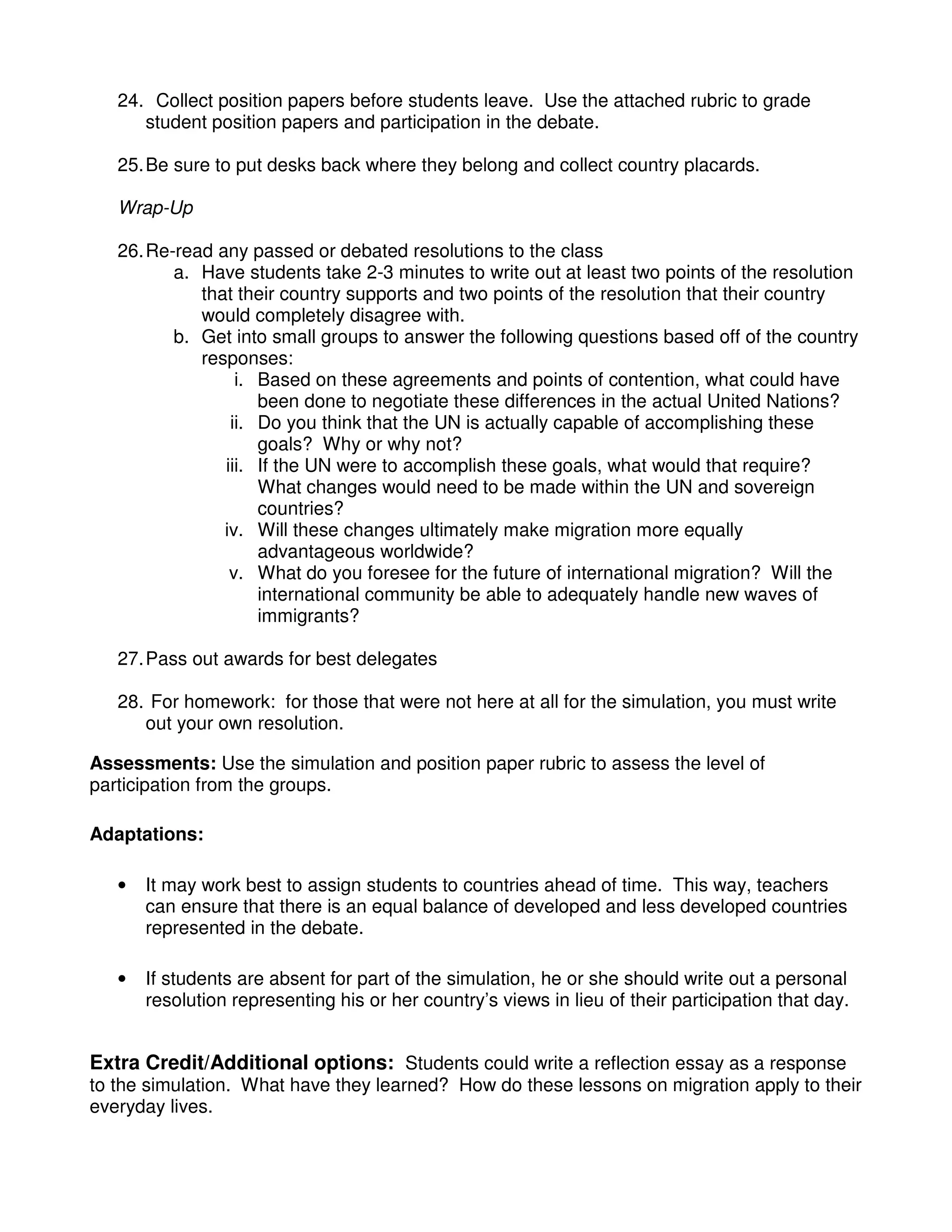
24. Collect position papers before students leave. Use the attached rubric to grade
student position papers and participation in the debate.
25.Be sure to put desks back where they belong and collect country placards.
Wrap-Up
26.Re-read any passed or debated resolutions to the class
a. Have students take 2-3 minutes to write out at least two points of the resolution
that their country supports and two points of the resolution that their country
would completely disagree with.
b. Get into small groups to answer the following questions based off of the country
responses:
i. Based on these agreements and points of contention, what could have
been done to negotiate these differences in the actual United Nations?
ii. Do you think that the UN is actually capable of accomplishing these
goals? Why or why not?
iii. If the UN were to accomplish these goals, what would that require?
What changes would need to be made within the UN and sovereign
countries?
iv. Will these changes ultimately make migration more equally
advantageous worldwide?
v. What do you foresee for the future of international migration? Will the
international community be able to adequately handle new waves of
immigrants?
27.Pass out awards for best delegates
28. For homework: for those that were not here at all for the simulation, you must write
out your own resolution.
Assessments: Use the simulation and position paper rubric to assess the level of
participation from the groups.
Adaptations:
• It may work best to assign students to countries ahead of time. This way, teachers
can ensure that there is an equal balance of developed and less developed countries
represented in the debate.
• If students are absent for part of the simulation, he or she should write out a personal
resolution representing his or her country’s views in lieu of their participation that day.
Extra Credit/Additional options: Students could write a reflection essay as a response
to the simulation. What have they learned? How do these lessons on migration apply to their
everyday lives.
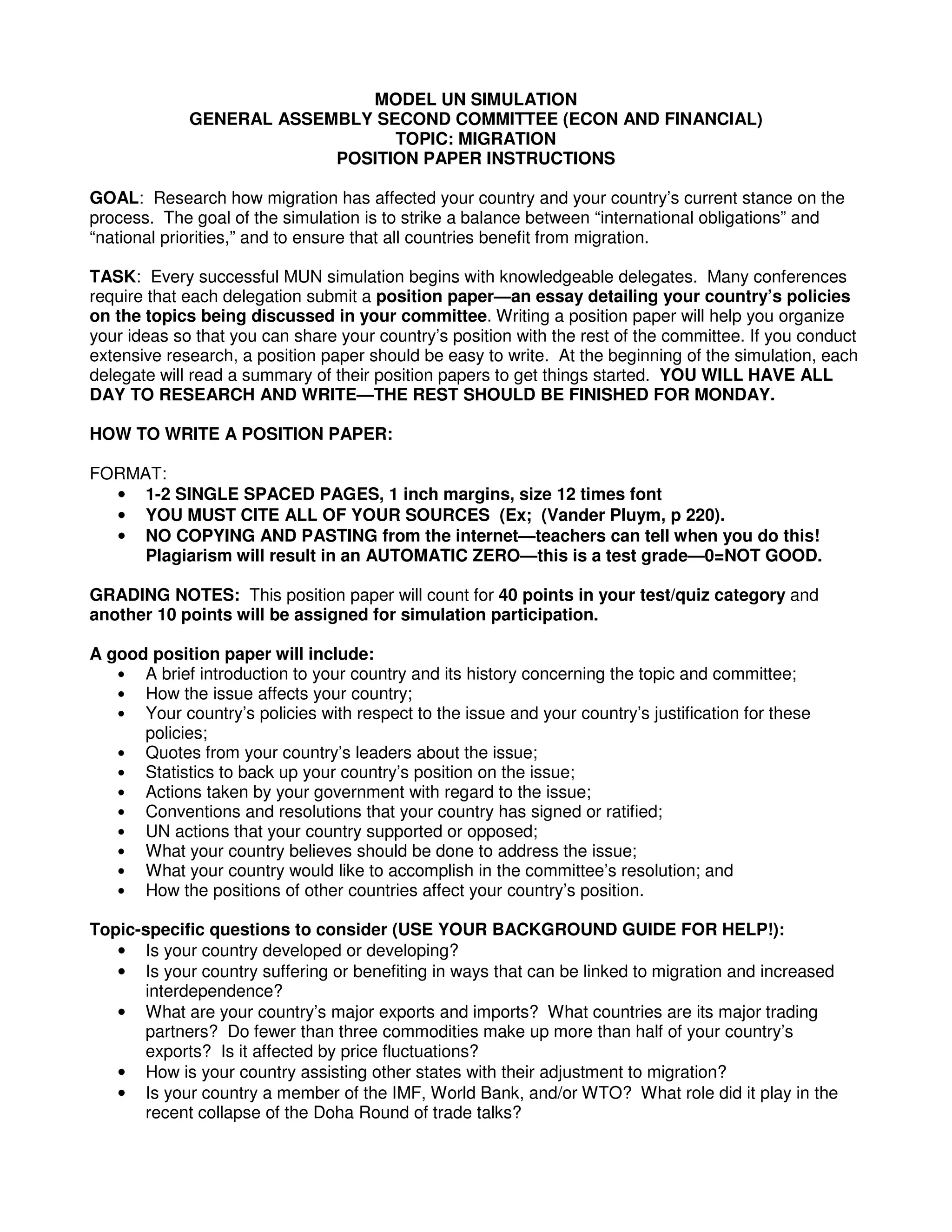
MODEL UN SIMULATION
GENERAL ASSEMBLY SECOND COMMITTEE (ECON AND FINANCIAL)
TOPIC: MIGRATION
POSITION PAPER INSTRUCTIONS
GOAL: Research how migration has affected your country and your country’s current stance on the
process. The goal of the simulation is to strike a balance between “international obligations” and
“national priorities,” and to ensure that all countries benefit from migration.
TASK: Every successful MUN simulation begins with knowledgeable delegates. Many conferences
require that each delegation submit a position paper—an essay detailing your country’s policies
on the topics being discussed in your committee. Writing a position paper will help you organize
your ideas so that you can share your country’s position with the rest of the committee. If you conduct
extensive research, a position paper should be easy to write. At the beginning of the simulation, each
delegate will read a summary of their position papers to get things started. YOU WILL HAVE ALL
DAY TO RESEARCH AND WRITE—THE REST SHOULD BE FINISHED FOR MONDAY.
HOW TO WRITE A POSITION PAPER:
FORMAT:
• 1-2 SINGLE SPACED PAGES, 1 inch margins, size 12 times font
• YOU MUST CITE ALL OF YOUR SOURCES (Ex; (Vander Pluym, p 220).
• NO COPYING AND PASTING from the internet—teachers can tell when you do this!
Plagiarism will result in an AUTOMATIC ZERO—this is a test grade—0=NOT GOOD.
GRADING NOTES: This position paper will count for 40 points in your test/quiz category and
another 10 points will be assigned for simulation participation.
A good position paper will include:
• A brief introduction to your country and its history concerning the topic and committee;
• How the issue affects your country;
• Your country’s policies with respect to the issue and your country’s justification for these
policies;
• Quotes from your country’s leaders about the issue;
• Statistics to back up your country’s position on the issue;
• Actions taken by your government with regard to the issue;
• Conventions and resolutions that your country has signed or ratified;
• UN actions that your country supported or opposed;
• What your country believes should be done to address the issue;
• What your country would like to accomplish in the committee’s resolution; and
• How the positions of other countries affect your country’s position.
Topic-specific questions to consider (USE YOUR BACKGROUND GUIDE FOR HELP!):
• Is your country developed or developing?
• Is your country suffering or benefiting in ways that can be linked to migration and increased
interdependence?
• What are your country’s major exports and imports? What countries are its major trading
partners? Do fewer than three commodities make up more than half of your country’s
exports? Is it affected by price fluctuations?
• How is your country assisting other states with their adjustment to migration?
• Is your country a member of the IMF, World Bank, and/or WTO? What role did it play in the
recent collapse of the Doha Round of trade talks?
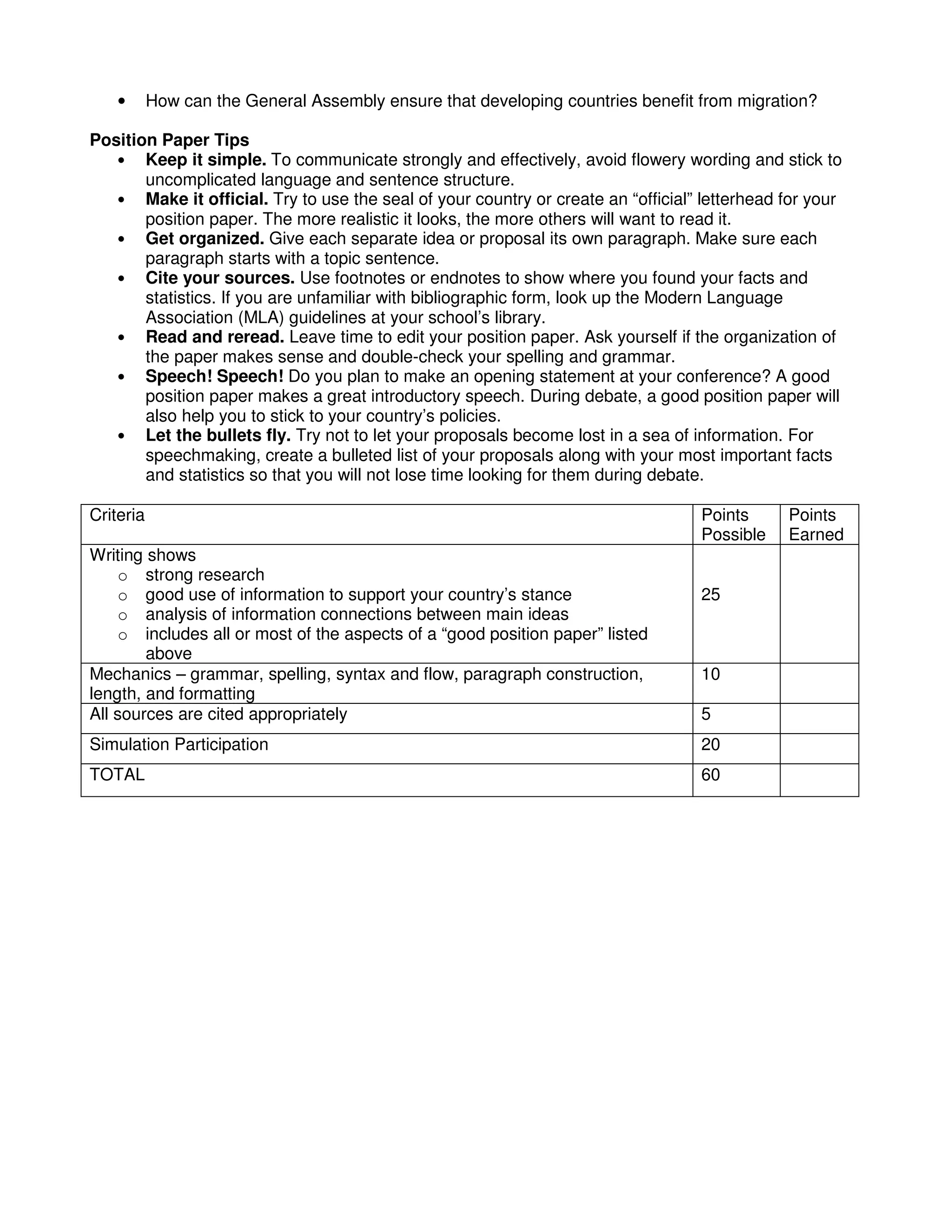
• How can the General Assembly ensure that developing countries benefit from migration?
Position Paper Tips
• Keep it simple. To communicate strongly and effectively, avoid flowery wording and stick to
uncomplicated language and sentence structure.
• Make it official. Try to use the seal of your country or create an “official” letterhead for your
position paper. The more realistic it looks, the more others will want to read it.
• Get organized. Give each separate idea or proposal its own paragraph. Make sure each
paragraph starts with a topic sentence.
• Cite your sources. Use footnotes or endnotes to show where you found your facts and
statistics. If you are unfamiliar with bibliographic form, look up the Modern Language
Association (MLA) guidelines at your school’s library.
• Read and reread. Leave time to edit your position paper. Ask yourself if the organization of
the paper makes sense and double-check your spelling and grammar.
• Speech! Speech! Do you plan to make an opening statement at your conference? A good
position paper makes a great introductory speech. During debate, a good position paper will
also help you to stick to your country’s policies.
• Let the bullets fly. Try not to let your proposals become lost in a sea of information. For
speechmaking, create a bulleted list of your proposals along with your most important facts
and statistics so that you will not lose time looking for them during debate.
Criteria Points
Possible
Points
Earned
Writing shows
o strong research
o good use of information to support your country’s stance
o analysis of information connections between main ideas
o includes all or most of the aspects of a “good position paper” listed
above
25
Mechanics – grammar, spelling, syntax and flow, paragraph construction,
length, and formatting
10
All sources are cited appropriately 5
Simulation Participation 20
TOTAL 60
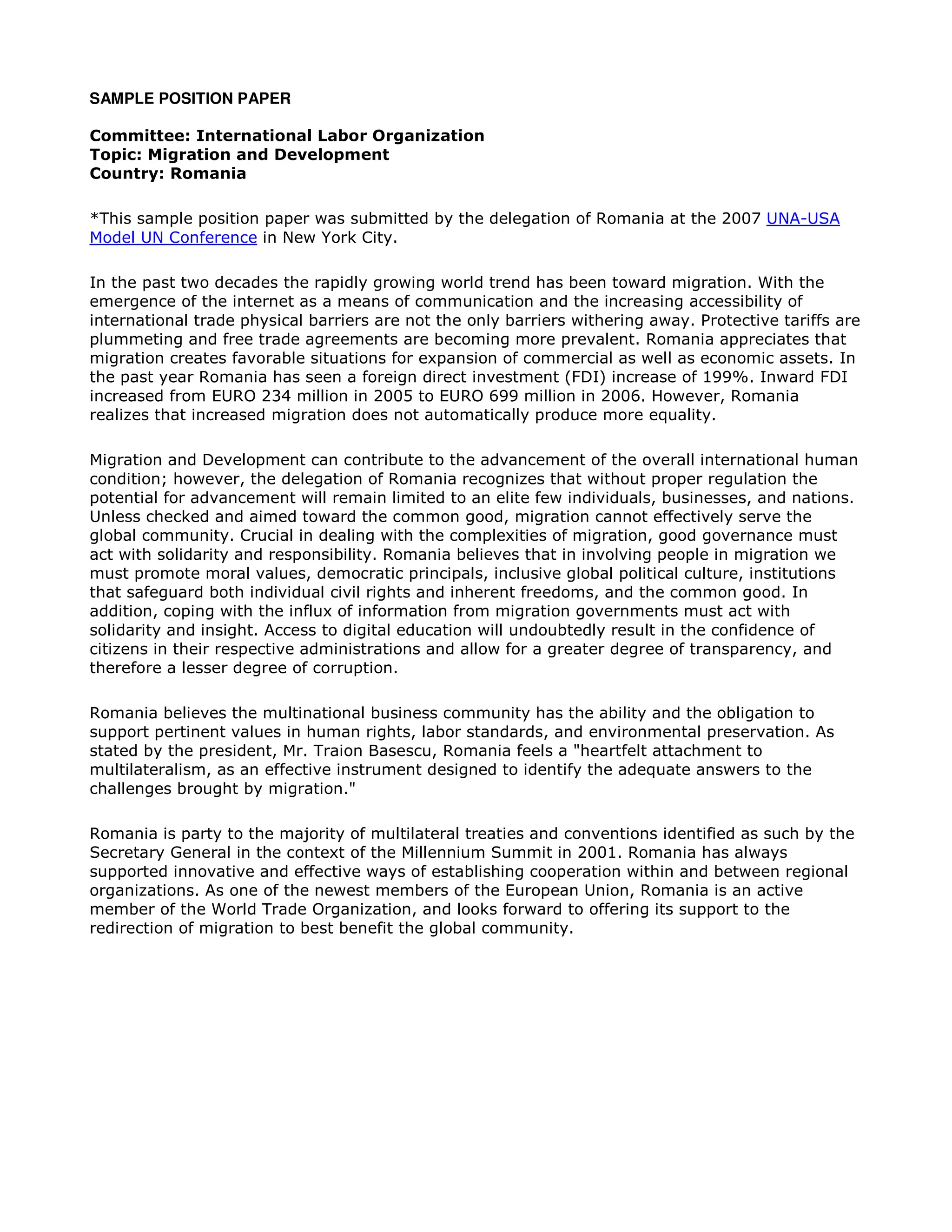
SAMPLE POSITION PAPER
Committee: International Labor Organization
Topic: Migration and Development
Country: Romania
*This sample position paper was submitted by the delegation of Romania at the 2007 UNA-USA
Model UN Conference in New York City.
In the past two decades the rapidly growing world trend has been toward migration. With the
emergence of the internet as a means of communication and the increasing accessibility of
international trade physical barriers are not the only barriers withering away. Protective tariffs are
plummeting and free trade agreements are becoming more prevalent. Romania appreciates that
migration creates favorable situations for expansion of commercial as well as economic assets. In
the past year Romania has seen a foreign direct investment (FDI) increase of 199%. Inward FDI
increased from EURO 234 million in 2005 to EURO 699 million in 2006. However, Romania
realizes that increased migration does not automatically produce more equality.
Migration and Development can contribute to the advancement of the overall international human
condition; however, the delegation of Romania recognizes that without proper regulation the
potential for advancement will remain limited to an elite few individuals, businesses, and nations.
Unless checked and aimed toward the common good, migration cannot effectively serve the
global community. Crucial in dealing with the complexities of migration, good governance must
act with solidarity and responsibility. Romania believes that in involving people in migration we
must promote moral values, democratic principals, inclusive global political culture, institutions
that safeguard both individual civil rights and inherent freedoms, and the common good. In
addition, coping with the influx of information from migration governments must act with
solidarity and insight. Access to digital education will undoubtedly result in the confidence of
citizens in their respective administrations and allow for a greater degree of transparency, and
therefore a lesser degree of corruption.
Romania believes the multinational business community has the ability and the obligation to
support pertinent values in human rights, labor standards, and environmental preservation. As
stated by the president, Mr. Traion Basescu, Romania feels a "heartfelt attachment to
multilateralism, as an effective instrument designed to identify the adequate answers to the
challenges brought by migration."
Romania is party to the majority of multilateral treaties and conventions identified as such by the
Secretary General in the context of the Millennium Summit in 2001. Romania has always
supported innovative and effective ways of establishing cooperation within and between regional
organizations. As one of the newest members of the European Union, Romania is an active
member of the World Trade Organization, and looks forward to offering its support to the
redirection of migration to best benefit the global community.
MODEL UN SIMULATION
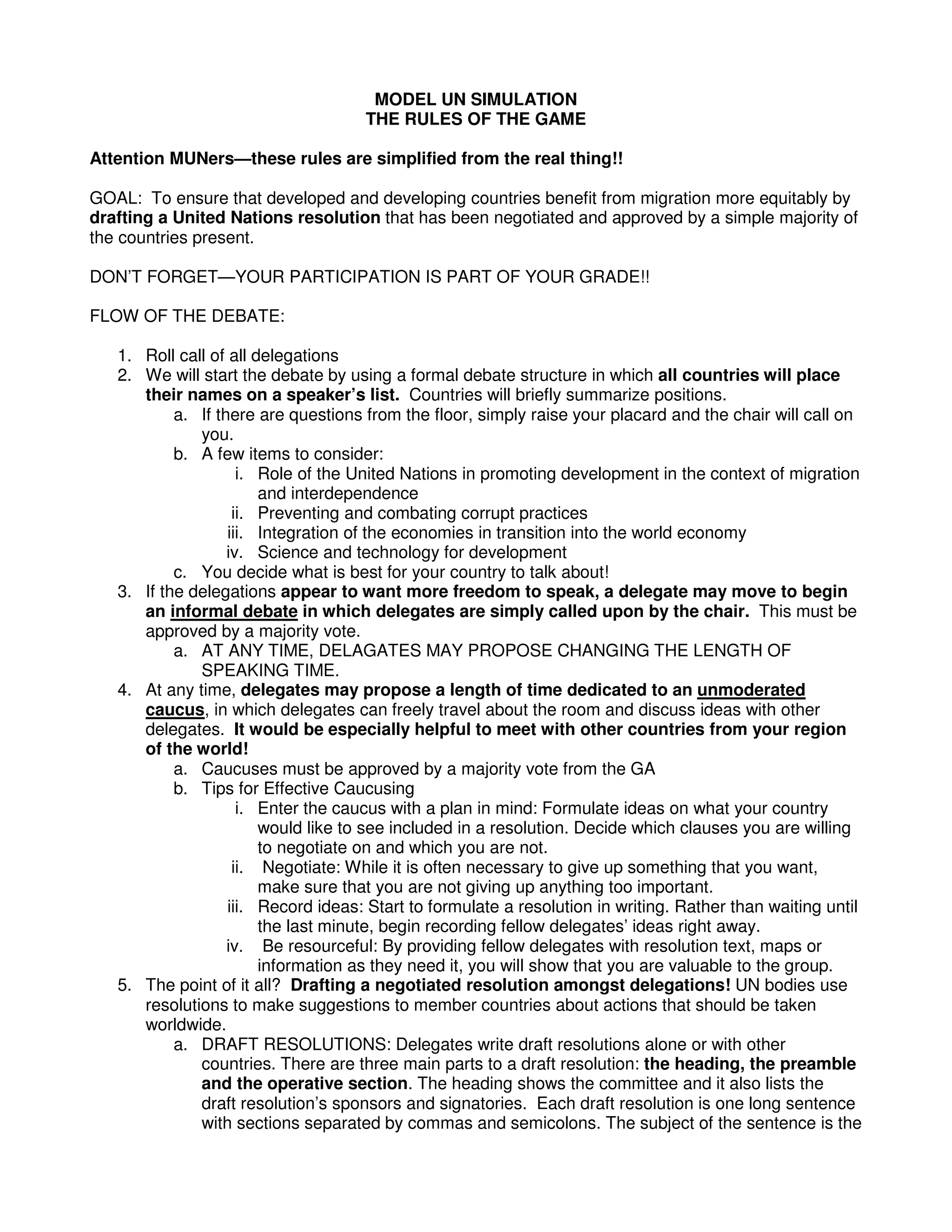
THE RULES OF THE GAME
Attention MUNers—these rules are simplified from the real thing!!
GOAL: To ensure that developed and developing countries benefit from migration more equitably by
drafting a United Nations resolution that has been negotiated and approved by a simple majority of
the countries present.
DON’T FORGET—YOUR PARTICIPATION IS PART OF YOUR GRADE!!
FLOW OF THE DEBATE:
1. Roll call of all delegations
2. We will start the debate by using a formal debate structure in which all countries will place
their names on a speaker’s list. Countries will briefly summarize positions.
a. If there are questions from the floor, simply raise your placard and the chair will call on
you.
b. A few items to consider:
i. Role of the United Nations in promoting development in the context of migration
and interdependence
ii. Preventing and combating corrupt practices
iii. Integration of the economies in transition into the world economy
iv. Science and technology for development
c. You decide what is best for your country to talk about!
3. If the delegations appear to want more freedom to speak, a delegate may move to begin
an informal debate in which delegates are simply called upon by the chair. This must be
approved by a majority vote.
a. AT ANY TIME, DELAGATES MAY PROPOSE CHANGING THE LENGTH OF
SPEAKING TIME.
4. At any time, delegates may propose a length of time dedicated to an unmoderated
caucus, in which delegates can freely travel about the room and discuss ideas with other
delegates. It would be especially helpful to meet with other countries from your region
of the world!
a. Caucuses must be approved by a majority vote from the GA
b. Tips for Effective Caucusing
i. Enter the caucus with a plan in mind: Formulate ideas on what your country
would like to see included in a resolution. Decide which clauses you are willing
to negotiate on and which you are not.
ii. Negotiate: While it is often necessary to give up something that you want,
make sure that you are not giving up anything too important.
iii. Record ideas: Start to formulate a resolution in writing. Rather than waiting until
the last minute, begin recording fellow delegates’ ideas right away.
iv. Be resourceful: By providing fellow delegates with resolution text, maps or
information as they need it, you will show that you are valuable to the group.
5. The point of it all? Drafting a negotiated resolution amongst delegations! UN bodies use
resolutions to make suggestions to member countries about actions that should be taken
worldwide.
a. DRAFT RESOLUTIONS: Delegates write draft resolutions alone or with other
countries. There are three main parts to a draft resolution: the heading, the preamble
and the operative section. The heading shows the committee and it also lists the
draft resolution’s sponsors and signatories. Each draft resolution is one long sentence
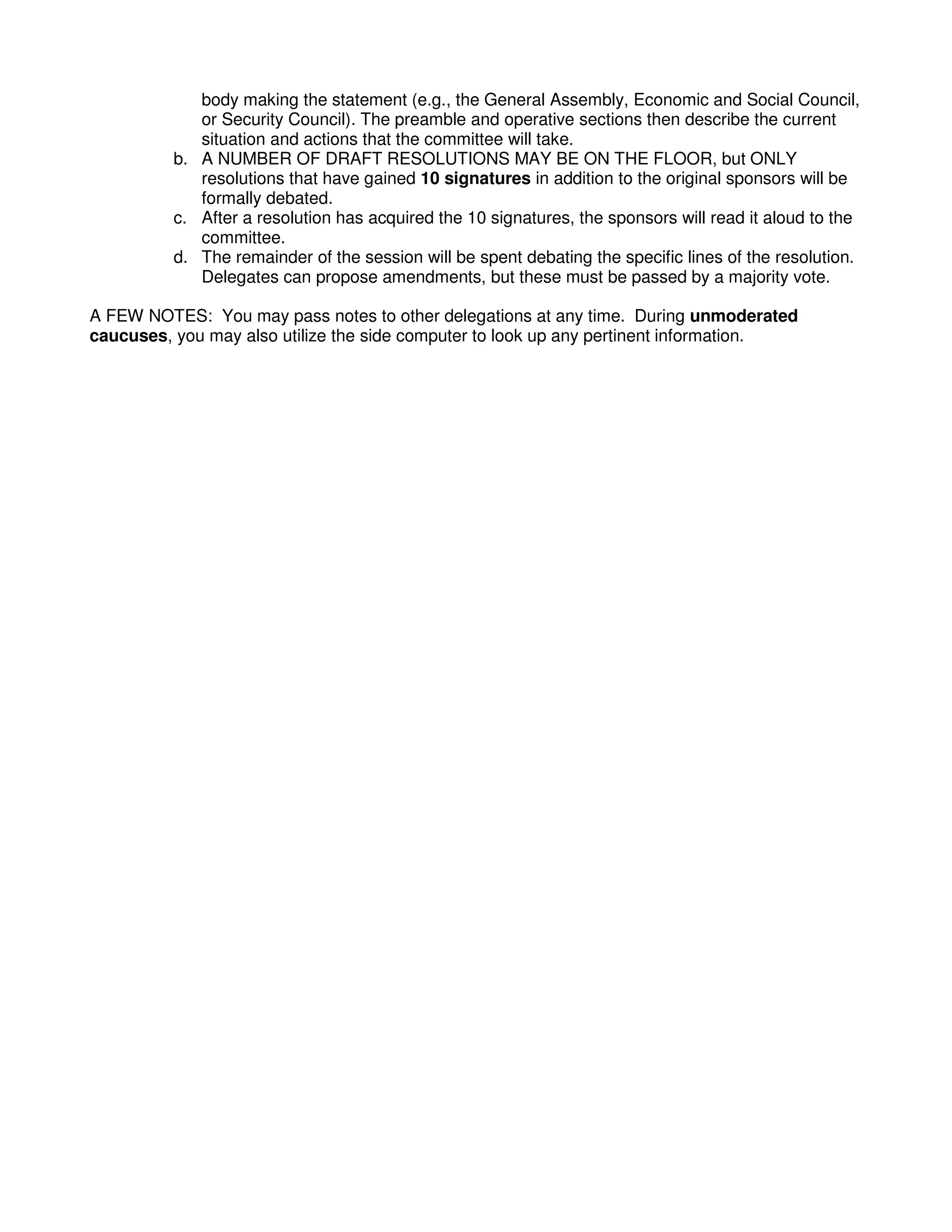
with sections separated by commas and semicolons. The subject of the sentence is the
body making the statement (e.g., the General Assembly, Economic and Social Council,
or Security Council). The preamble and operative sections then describe the current
situation and actions that the committee will take.
b. A NUMBER OF DRAFT RESOLUTIONS MAY BE ON THE FLOOR, but ONLY
resolutions that have gained 10 signatures in addition to the original sponsors will be
formally debated.
c. After a resolution has acquired the 10 signatures, the sponsors will read it aloud to the
committee.
d. The remainder of the session will be spent debating the specific lines of the resolution.
Delegates can propose amendments, but these must be passed by a majority vote.
A FEW NOTES: You may pass notes to other delegations at any time. During unmoderated
caucuses, you may also utilize the side computer to look up any pertinent information.
SAMPLE RESOLUTION:
Resolution GA/3/1.1
General Assembly Third Committee
Sponsors: United States, Austria and Italy
Signatories: Greece, Tajikistan, Japan, Canada, Mali, the Netherlands and Gabon
Topic: “Strengthening UN coordination of humanitarian assistance in complex emergencies”
The General Assembly,
Reminding all nations of the celebration of the 50th anniversary of the Universal Declaration of Human
Rights, which recognizes the inherent dignity, equality and inalienable rights of all global citizens, [use
commas to separate preambulatory clauses]
Reaffirming its Resolution 33/1996 of 25 July 1996, which encourages Governments to work with UN
bodies aimed at improving the coordination and effectiveness of humanitarian assistance,
Noting with satisfaction the past efforts of various relevant UN bodies and nongovernmental
organizations,
Stressing the fact that the United Nations faces significant financial obstacles and is in need of reform,
particularly in the humanitarian realm,
1. Encourages all relevant agencies of the United Nations to collaborate more closely with countries at
the grassroots level to enhance the carrying out of relief efforts; [use semicolons to separate operative
clauses]
2. Urges member states to comply with the goals of the UN Department of Humanitarian Affairs to
streamline efforts of humanitarian aid;
3. Requests that all nations develop rapid deployment forces to better enhance the coordination of
relief efforts of humanitarian assistance in complex emergencies;
4. Calls for the development of a United Nations Trust Fund that encourages voluntary donations from
the private transnational sector to aid in funding the implementation of rapid deployment forces;
5. Stresses the continuing need for impartial and objective information on the political, economic and
social situations and events of all countries;
6. Calls upon states to respond quickly and generously to consolidated appeals for humanitarian
assistance; and
7. Requests the expansion of preventive actions and assurance of post-conflict assistance through
reconstruction and development. [end resolutions with a period]

15-sti2011-migration_and_development-model_un_simulation

  • 1.
    Migration and Development—Model UnitedNations Simulation Lesson Overview: How does the international community react to migrants and how does it work together to manage global migratory patterns? How does a country’s level of development affect their policy attitudes on migration? How does migration in turn affect a country’s future development? This lesson allows students to explore these questions by stepping into the shoes of various nation-states through a Model United Nations simulation. Written By: Lauren Vander Pluym, Middle School Humanities Teacher, Bernard Zell Anshe Emet Day School Subject(s): All Social Sciences; English Suggested Grade Level(s): 7-12 Time Duration: 3-4 class periods Objectives: • Students will synthesize their knowledge of the affect of migration on development into a position paper defending a specific country’s viewpoint. • Students will think critically about multiple perspectives on migration and defend specific political actions and policies. • Students will utilize public speaking skills to negotiate a balanced United Nations policy on migration. Materials: • Copies of Baylor University High School Model United Nations Background Guide on the effect of migration on human development. • Copies of the “Model UN Simulation Position Paper Instructions” • Teacher copies of position paper rubrics • Copies of “Model UN Simulation Rules of the Game” • Placards with country names (card stock folded in half) • Desks set up in rows • Chalkboard
  • 2.
    • World Map •Sticky notes • OPTIONAL: Projector and computer with Internet access Activities and Procedures: Ideally, this lesson should come at the end of a unit on migration as a culmination of student knowledge. Preparation 1. Explain to students that they will now use all of their knowledge on migration to participate in a Model UN Simulation in which they will defend one particular country’s point of view on the how it affects human development. The goal of this simulation is to make migration a viable option for global citizens that allows countries of origin and host countries to EQUALLY benefit economically, socially, and politically from international migration. 2. Ask students to brainstorm what the goals of this simulation might be. What does the UN attempt to accomplish? (It may be necessary to give your students some background on the UN if they are unaware of the organization—the Baylor University High School Background Guide provides a short history of the General Assembly). What is the end result? What are some actions we might take to achieve these goals? a. Ultimately, you want to achieve cooperation among nations without compromising national values—you should stick to reality as much as possible—this comes from research b. The end goal is to come up with some sort of resolution upon which all parties can agree 3. Pull down a world map. Ask each student to write his or her name on a small sticky note. Ask each student to go to the map and choose the country that he/she would like to represent. Only one student per country—unless otherwise specified by the teacher. Struggling students may be assigned in pairs to take some pressure off. Explain that this is the country that they will represent during their simulation—better make it an interesting one! 4. Pass out copies of the “Position Paper Instructions” and the “Background Guide.” Explain that each student will be responsible for reading the background guide as a homework assignment. 5. Explain to students that every individual will be responsible for using the background guide and their own personal research to write a 1-2 page position paper outlining their country’s stance on migration. Students will research how migration has affected a country and that country’s current stance on the process. The goal of the simulation is to strike a balance between “international obligations” and “national priorities,” and to ensure that all countries benefit from migration.
  • 3.
    a. Students MUSTcite all of their research sources in MLA format and may not copy and paste from the Internet! This may require teachers to go over proper formatting. b. Go over the “parts of a good position paper,” the “sample paper,” and the rubric with students to show them exactly how their papers will be graded. The paper will count for 40 points and their simulation participation will count for 20 points—a total of 60 points. c. Emphasize that their position papers will serve as the backbone for their speeches in front of the class during the simulation. The better the paper—the better the performance! d. Give students 1-2 days to complete position papers as a homework assignment. Have students bring in position papers to class before the simulation. 6. The next day, pass out the “Rules of the Game” worksheet. It is strongly recommended to take one full day to discuss rules, since they are very complicated. a. For more information and clarification on rules, see http://www.unausa.org/munpreparation 7. Go over the rules sheet with the class and demonstrate all of the different protocols. Also, be sure to stress how a resolution is written and what kind of material goes into the document. Students will hand-write resolutions in class. 8. In preparation for the simulation, have students summarize their position papers into a one-paragraph summary that will be read at the opening of the simulation the next day. The opening statement should be a brief summary of the country’s viewpoint on migration, suggestions for regulations, and wishes for negotiations with other countries. 9. Teachers should create placards (card stock folded in half) the night before the simulation. Placards should say the country names big enough for all delegates to see. Teachers can also consider putting together some sort of prize for the “Best Delegate Award” at the end of the simulation. The Simulation 10. Before the simulation begins, go over the procedures one more time to make sure everyone is on the same page. Also allow students 5-10 minutes to gather their thoughts and prepare for their opening statements. a. If students get confused about any of this, you can ask any of the students in the class who are Model UN members to help other students with the process. 11. If a computer and projector are available, pull up a blank word document in your Internet browser. a. You will use the word document for the speakers’ list on which you will write the names of the countries wishing to speak. An Internet browser should stay open for the students to look up information during unmoderated caucuses.
  • 4.
    12. Before beginningthe simulation, have the students arrange the desks in rows in the middle of the room and hand out their country placards. 13. During the simulation, be sure to take notes on participation of all the delegates. Their participation counts for 20 points of their grade. Also, be on the lookout for whomever you think is the BEST DELEGATE—the person representing his/her country the best. 14.Start the session by asking students to volunteer themselves to be on the speakers’ list. EVERYONE MUST SHARE THEIR OPENING STATEMENTS EVENTUALLY, the speakers list just gives them an order. 15.All students should share a 1-minute summary about their country’s point of view on migration. 16.If there are questions at any point, delegates may raise their placards and you may call on them. They must direct questions to other delegates by calling them by their country names. 17.After all have shared summaries, then the students may raise their placards to be placed back on the speakers’ list. A DELEGATE MAY ALSO MOVE TO GO INTO INFORMAL DEBATE—a majority vote is required to make this happen and is also up to your discretion as the chair. If it passes, YOU SIMPLY CALL ON DELEGATES TO SPEAK and ignore the speakers’ list. 18.If you find that debate becomes unruly, you may move back to the formal debate structure of the speakers’ list. 19.Students may also move for UNMODERATED CAUCUSES for a certain number of minutes. During this time, they may negotiate with anyone in the room and may check the computer for research purposes. 20.At any time, students may pass notes to other delegates regarding the simulation. 21.The objective is for the students to debate enough with other students to PRODUCE A WORKING RESOLUTION on how to make migration a more equitable process. 22.When a resolution gains 10 signatures (can be fewer if it is a smaller class), then it can be debated in formal debate and finally called to a vote (majority passes). a. PLEASE REFER THE ATTACHED RULES SHEET FOR FURTHER DETAILS ON RESOLUTIONS. b. Resolutions should strive to create political actions between countries; i.e. “Sudan and China resolve to protect environmental standards to decrease degradation due to industry.” 23.It is ok if they do not finalize a resolution by the end of the period—these debates can easily go on for several periods. Just be sure that students are saving any uncompleted resolutions, etc.
  • 5.
    24. Collect positionpapers before students leave. Use the attached rubric to grade student position papers and participation in the debate. 25.Be sure to put desks back where they belong and collect country placards. Wrap-Up 26.Re-read any passed or debated resolutions to the class a. Have students take 2-3 minutes to write out at least two points of the resolution that their country supports and two points of the resolution that their country would completely disagree with. b. Get into small groups to answer the following questions based off of the country responses: i. Based on these agreements and points of contention, what could have been done to negotiate these differences in the actual United Nations? ii. Do you think that the UN is actually capable of accomplishing these goals? Why or why not? iii. If the UN were to accomplish these goals, what would that require? What changes would need to be made within the UN and sovereign countries? iv. Will these changes ultimately make migration more equally advantageous worldwide? v. What do you foresee for the future of international migration? Will the international community be able to adequately handle new waves of immigrants? 27.Pass out awards for best delegates 28. For homework: for those that were not here at all for the simulation, you must write out your own resolution. Assessments: Use the simulation and position paper rubric to assess the level of participation from the groups. Adaptations: • It may work best to assign students to countries ahead of time. This way, teachers can ensure that there is an equal balance of developed and less developed countries represented in the debate. • If students are absent for part of the simulation, he or she should write out a personal resolution representing his or her country’s views in lieu of their participation that day. Extra Credit/Additional options: Students could write a reflection essay as a response to the simulation. What have they learned? How do these lessons on migration apply to their everyday lives.
  • 6.
    MODEL UN SIMULATION GENERALASSEMBLY SECOND COMMITTEE (ECON AND FINANCIAL) TOPIC: MIGRATION POSITION PAPER INSTRUCTIONS GOAL: Research how migration has affected your country and your country’s current stance on the process. The goal of the simulation is to strike a balance between “international obligations” and “national priorities,” and to ensure that all countries benefit from migration. TASK: Every successful MUN simulation begins with knowledgeable delegates. Many conferences require that each delegation submit a position paper—an essay detailing your country’s policies on the topics being discussed in your committee. Writing a position paper will help you organize your ideas so that you can share your country’s position with the rest of the committee. If you conduct extensive research, a position paper should be easy to write. At the beginning of the simulation, each delegate will read a summary of their position papers to get things started. YOU WILL HAVE ALL DAY TO RESEARCH AND WRITE—THE REST SHOULD BE FINISHED FOR MONDAY. HOW TO WRITE A POSITION PAPER: FORMAT: • 1-2 SINGLE SPACED PAGES, 1 inch margins, size 12 times font • YOU MUST CITE ALL OF YOUR SOURCES (Ex; (Vander Pluym, p 220). • NO COPYING AND PASTING from the internet—teachers can tell when you do this! Plagiarism will result in an AUTOMATIC ZERO—this is a test grade—0=NOT GOOD. GRADING NOTES: This position paper will count for 40 points in your test/quiz category and another 10 points will be assigned for simulation participation. A good position paper will include: • A brief introduction to your country and its history concerning the topic and committee; • How the issue affects your country; • Your country’s policies with respect to the issue and your country’s justification for these policies; • Quotes from your country’s leaders about the issue; • Statistics to back up your country’s position on the issue; • Actions taken by your government with regard to the issue; • Conventions and resolutions that your country has signed or ratified; • UN actions that your country supported or opposed; • What your country believes should be done to address the issue; • What your country would like to accomplish in the committee’s resolution; and • How the positions of other countries affect your country’s position. Topic-specific questions to consider (USE YOUR BACKGROUND GUIDE FOR HELP!): • Is your country developed or developing? • Is your country suffering or benefiting in ways that can be linked to migration and increased interdependence? • What are your country’s major exports and imports? What countries are its major trading partners? Do fewer than three commodities make up more than half of your country’s exports? Is it affected by price fluctuations? • How is your country assisting other states with their adjustment to migration? • Is your country a member of the IMF, World Bank, and/or WTO? What role did it play in the recent collapse of the Doha Round of trade talks?
  • 7.
    • How canthe General Assembly ensure that developing countries benefit from migration? Position Paper Tips • Keep it simple. To communicate strongly and effectively, avoid flowery wording and stick to uncomplicated language and sentence structure. • Make it official. Try to use the seal of your country or create an “official” letterhead for your position paper. The more realistic it looks, the more others will want to read it. • Get organized. Give each separate idea or proposal its own paragraph. Make sure each paragraph starts with a topic sentence. • Cite your sources. Use footnotes or endnotes to show where you found your facts and statistics. If you are unfamiliar with bibliographic form, look up the Modern Language Association (MLA) guidelines at your school’s library. • Read and reread. Leave time to edit your position paper. Ask yourself if the organization of the paper makes sense and double-check your spelling and grammar. • Speech! Speech! Do you plan to make an opening statement at your conference? A good position paper makes a great introductory speech. During debate, a good position paper will also help you to stick to your country’s policies. • Let the bullets fly. Try not to let your proposals become lost in a sea of information. For speechmaking, create a bulleted list of your proposals along with your most important facts and statistics so that you will not lose time looking for them during debate. Criteria Points Possible Points Earned Writing shows o strong research o good use of information to support your country’s stance o analysis of information connections between main ideas o includes all or most of the aspects of a “good position paper” listed above 25 Mechanics – grammar, spelling, syntax and flow, paragraph construction, length, and formatting 10 All sources are cited appropriately 5 Simulation Participation 20 TOTAL 60
  • 8.
    SAMPLE POSITION PAPER Committee:International Labor Organization Topic: Migration and Development Country: Romania *This sample position paper was submitted by the delegation of Romania at the 2007 UNA-USA Model UN Conference in New York City. In the past two decades the rapidly growing world trend has been toward migration. With the emergence of the internet as a means of communication and the increasing accessibility of international trade physical barriers are not the only barriers withering away. Protective tariffs are plummeting and free trade agreements are becoming more prevalent. Romania appreciates that migration creates favorable situations for expansion of commercial as well as economic assets. In the past year Romania has seen a foreign direct investment (FDI) increase of 199%. Inward FDI increased from EURO 234 million in 2005 to EURO 699 million in 2006. However, Romania realizes that increased migration does not automatically produce more equality. Migration and Development can contribute to the advancement of the overall international human condition; however, the delegation of Romania recognizes that without proper regulation the potential for advancement will remain limited to an elite few individuals, businesses, and nations. Unless checked and aimed toward the common good, migration cannot effectively serve the global community. Crucial in dealing with the complexities of migration, good governance must act with solidarity and responsibility. Romania believes that in involving people in migration we must promote moral values, democratic principals, inclusive global political culture, institutions that safeguard both individual civil rights and inherent freedoms, and the common good. In addition, coping with the influx of information from migration governments must act with solidarity and insight. Access to digital education will undoubtedly result in the confidence of citizens in their respective administrations and allow for a greater degree of transparency, and therefore a lesser degree of corruption. Romania believes the multinational business community has the ability and the obligation to support pertinent values in human rights, labor standards, and environmental preservation. As stated by the president, Mr. Traion Basescu, Romania feels a "heartfelt attachment to multilateralism, as an effective instrument designed to identify the adequate answers to the challenges brought by migration." Romania is party to the majority of multilateral treaties and conventions identified as such by the Secretary General in the context of the Millennium Summit in 2001. Romania has always supported innovative and effective ways of establishing cooperation within and between regional organizations. As one of the newest members of the European Union, Romania is an active member of the World Trade Organization, and looks forward to offering its support to the redirection of migration to best benefit the global community.
  • 9.
    MODEL UN SIMULATION THERULES OF THE GAME Attention MUNers—these rules are simplified from the real thing!! GOAL: To ensure that developed and developing countries benefit from migration more equitably by drafting a United Nations resolution that has been negotiated and approved by a simple majority of the countries present. DON’T FORGET—YOUR PARTICIPATION IS PART OF YOUR GRADE!! FLOW OF THE DEBATE: 1. Roll call of all delegations 2. We will start the debate by using a formal debate structure in which all countries will place their names on a speaker’s list. Countries will briefly summarize positions. a. If there are questions from the floor, simply raise your placard and the chair will call on you. b. A few items to consider: i. Role of the United Nations in promoting development in the context of migration and interdependence ii. Preventing and combating corrupt practices iii. Integration of the economies in transition into the world economy iv. Science and technology for development c. You decide what is best for your country to talk about! 3. If the delegations appear to want more freedom to speak, a delegate may move to begin an informal debate in which delegates are simply called upon by the chair. This must be approved by a majority vote. a. AT ANY TIME, DELAGATES MAY PROPOSE CHANGING THE LENGTH OF SPEAKING TIME. 4. At any time, delegates may propose a length of time dedicated to an unmoderated caucus, in which delegates can freely travel about the room and discuss ideas with other delegates. It would be especially helpful to meet with other countries from your region of the world! a. Caucuses must be approved by a majority vote from the GA b. Tips for Effective Caucusing i. Enter the caucus with a plan in mind: Formulate ideas on what your country would like to see included in a resolution. Decide which clauses you are willing to negotiate on and which you are not. ii. Negotiate: While it is often necessary to give up something that you want, make sure that you are not giving up anything too important. iii. Record ideas: Start to formulate a resolution in writing. Rather than waiting until the last minute, begin recording fellow delegates’ ideas right away. iv. Be resourceful: By providing fellow delegates with resolution text, maps or information as they need it, you will show that you are valuable to the group. 5. The point of it all? Drafting a negotiated resolution amongst delegations! UN bodies use resolutions to make suggestions to member countries about actions that should be taken worldwide. a. DRAFT RESOLUTIONS: Delegates write draft resolutions alone or with other countries. There are three main parts to a draft resolution: the heading, the preamble and the operative section. The heading shows the committee and it also lists the draft resolution’s sponsors and signatories. Each draft resolution is one long sentence with sections separated by commas and semicolons. The subject of the sentence is the
  • 10.
    body making thestatement (e.g., the General Assembly, Economic and Social Council, or Security Council). The preamble and operative sections then describe the current situation and actions that the committee will take. b. A NUMBER OF DRAFT RESOLUTIONS MAY BE ON THE FLOOR, but ONLY resolutions that have gained 10 signatures in addition to the original sponsors will be formally debated. c. After a resolution has acquired the 10 signatures, the sponsors will read it aloud to the committee. d. The remainder of the session will be spent debating the specific lines of the resolution. Delegates can propose amendments, but these must be passed by a majority vote. A FEW NOTES: You may pass notes to other delegations at any time. During unmoderated caucuses, you may also utilize the side computer to look up any pertinent information.
  • 11.
    SAMPLE RESOLUTION: Resolution GA/3/1.1 GeneralAssembly Third Committee Sponsors: United States, Austria and Italy Signatories: Greece, Tajikistan, Japan, Canada, Mali, the Netherlands and Gabon Topic: “Strengthening UN coordination of humanitarian assistance in complex emergencies” The General Assembly, Reminding all nations of the celebration of the 50th anniversary of the Universal Declaration of Human Rights, which recognizes the inherent dignity, equality and inalienable rights of all global citizens, [use commas to separate preambulatory clauses] Reaffirming its Resolution 33/1996 of 25 July 1996, which encourages Governments to work with UN bodies aimed at improving the coordination and effectiveness of humanitarian assistance, Noting with satisfaction the past efforts of various relevant UN bodies and nongovernmental organizations, Stressing the fact that the United Nations faces significant financial obstacles and is in need of reform, particularly in the humanitarian realm, 1. Encourages all relevant agencies of the United Nations to collaborate more closely with countries at the grassroots level to enhance the carrying out of relief efforts; [use semicolons to separate operative clauses] 2. Urges member states to comply with the goals of the UN Department of Humanitarian Affairs to streamline efforts of humanitarian aid; 3. Requests that all nations develop rapid deployment forces to better enhance the coordination of relief efforts of humanitarian assistance in complex emergencies; 4. Calls for the development of a United Nations Trust Fund that encourages voluntary donations from the private transnational sector to aid in funding the implementation of rapid deployment forces; 5. Stresses the continuing need for impartial and objective information on the political, economic and social situations and events of all countries; 6. Calls upon states to respond quickly and generously to consolidated appeals for humanitarian assistance; and 7. Requests the expansion of preventive actions and assurance of post-conflict assistance through reconstruction and development. [end resolutions with a period]