
Pitching, writing and publishing
scientific commentaries
Ninad Bondre
Senior Science Editor and Advisor
International Geosphere-Biosphere Programme (IGBP)
Owen Gaffney
Director, International Media and Strategy
Stockholm Resilience Centre
Communications Consultant, Future Earth
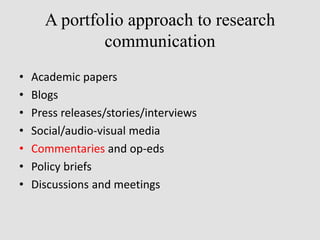
A portfolio approach to research
communication
• Academic papers
• Blogs
• Press releases/stories/interviews
• Social/audio-visual media
• Commentaries and op-eds
• Policy briefs
• Discussions and meetings
Front-half
Back-half
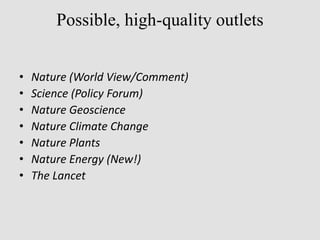
Possible, high-quality outlets
• Nature (World View/Comment)
• Science (Policy Forum)
• Nature Geoscience
• Nature Climate Change
• Nature Plants
• Nature Energy (New!)
• The Lancet
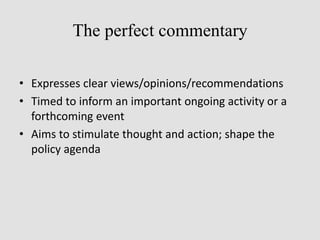
The perfect commentary
• Expresses clear views/opinions/recommendations
• Timed to inform an important ongoing activity or a
forthcoming event
• Aims to stimulate thought and action; shape the
policy agenda
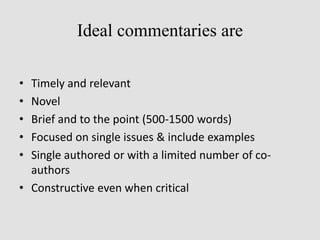
Ideal commentaries are
• Timely and relevant
• Novel
• Brief and to the point (500-1500 words)
• Focused on single issues & include examples
• Single authored or with a limited number of co-
authors
• Constructive even when critical
Agenda-setting
Provocative
Action
Road-map
Solution
Arguments
Contemporary
Personal voice
Who
What
To whom
When
How
Impact
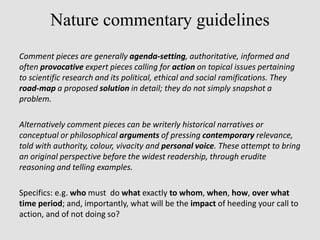
Nature commentary guidelines
Comment pieces are generally agenda-setting, authoritative, informed and
often provocative expert pieces calling for action on topical issues pertaining
to scientific research and its political, ethical and social ramifications. They
road-map a proposed solution in detail; they do not simply snapshot a
problem.
Alternatively comment pieces can be writerly historical narratives or
conceptual or philosophical arguments of pressing contemporary relevance,
told with authority, colour, vivacity and personal voice. These attempt to bring
an original perspective before the widest readership, through erudite
reasoning and telling examples.
Specifics: e.g. who must do what exactly to whom, when, how, over what
time period; and, importantly, what will be the impact of heeding your call to
action, and of not doing so?
Pitching a commentary
• Get to know the journal(s)
What has the journal published on your topic in the
recent past? When and why?
• Get to know the editors
Invite editors to conferences/workshops; seek them
out at conferences (e.g. NPG/AAAS booths)
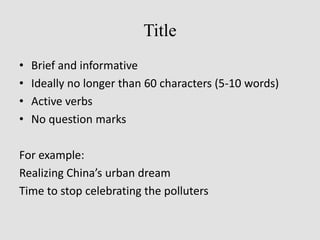
Title
• Brief and informative
• Ideally no longer than 60 characters (5-10 words)
• Active verbs
• No question marks
For example:
Realizing China’s urban dream
Time to stop celebrating the polluters
Stand-first
• Succinct summary of the recommendation(s)/main
message
• Ideally no longer than 300 characters
For example:
Planetary stability must be integrated with United
Nations targets to fight poverty and secure human well-
being, argue David Griggs and colleagues.
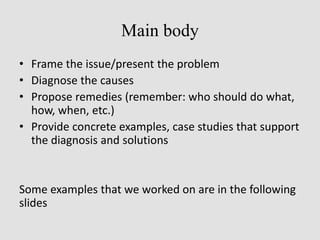
Main body
• Frame the issue/present the problem
• Diagnose the causes
• Propose remedies (remember: who should do what,
how, when, etc.)
• Provide concrete examples, case studies that support
the diagnosis and solutions
Some examples that we worked on are in the following
slides
Writing scientific commentaries

Writing scientific commentaries

  • 2.
    Pitching, writing andpublishing scientific commentaries Ninad Bondre Senior Science Editor and Advisor International Geosphere-Biosphere Programme (IGBP) Owen Gaffney Director, International Media and Strategy Stockholm Resilience Centre Communications Consultant, Future Earth
  • 3.
    A portfolio approachto research communication • Academic papers • Blogs • Press releases/stories/interviews • Social/audio-visual media • Commentaries and op-eds • Policy briefs • Discussions and meetings
  • 4.
  • 5.
    Possible, high-quality outlets •Nature (World View/Comment) • Science (Policy Forum) • Nature Geoscience • Nature Climate Change • Nature Plants • Nature Energy (New!) • The Lancet
  • 6.
    The perfect commentary •Expresses clear views/opinions/recommendations • Timed to inform an important ongoing activity or a forthcoming event • Aims to stimulate thought and action; shape the policy agenda
  • 7.
    Ideal commentaries are •Timely and relevant • Novel • Brief and to the point (500-1500 words) • Focused on single issues & include examples • Single authored or with a limited number of co- authors • Constructive even when critical
  • 8.
  • 9.
    Nature commentary guidelines Commentpieces are generally agenda-setting, authoritative, informed and often provocative expert pieces calling for action on topical issues pertaining to scientific research and its political, ethical and social ramifications. They road-map a proposed solution in detail; they do not simply snapshot a problem. Alternatively comment pieces can be writerly historical narratives or conceptual or philosophical arguments of pressing contemporary relevance, told with authority, colour, vivacity and personal voice. These attempt to bring an original perspective before the widest readership, through erudite reasoning and telling examples. Specifics: e.g. who must do what exactly to whom, when, how, over what time period; and, importantly, what will be the impact of heeding your call to action, and of not doing so?
  • 10.
    Pitching a commentary •Get to know the journal(s) What has the journal published on your topic in the recent past? When and why? • Get to know the editors Invite editors to conferences/workshops; seek them out at conferences (e.g. NPG/AAAS booths)
  • 11.
    Title • Brief andinformative • Ideally no longer than 60 characters (5-10 words) • Active verbs • No question marks For example: Realizing China’s urban dream Time to stop celebrating the polluters
  • 12.
    Stand-first • Succinct summaryof the recommendation(s)/main message • Ideally no longer than 300 characters For example: Planetary stability must be integrated with United Nations targets to fight poverty and secure human well- being, argue David Griggs and colleagues.
  • 13.
    Main body • Framethe issue/present the problem • Diagnose the causes • Propose remedies (remember: who should do what, how, when, etc.) • Provide concrete examples, case studies that support the diagnosis and solutions Some examples that we worked on are in the following slides