Albert Norström
Executive director
@AlbertNorstrm
@PECS_Project
PECS approaches
1
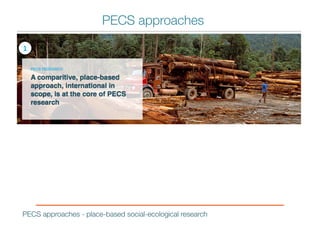
PECS approaches - place-based social-ecological research
PECS approaches
1
2
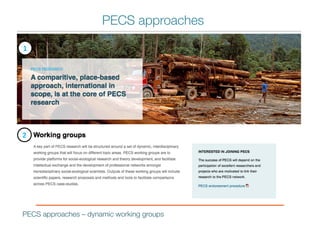
PECS approaches – dynamic working groups
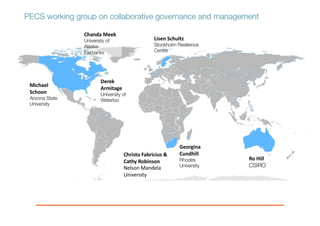
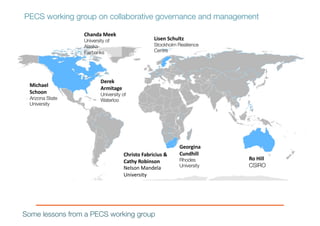
PECS working group on collaborative governance and management
Chanda Meek	
University of
Alaska-
Fairbanks
Ro	Hill
CSIRO
Derek	
Armitage
University of
Waterloo
Christo	Fabricius &	
Cathy	Robinson	
Nelson	Mandela	
University
Lisen Schultz
Stockholm Resilience
Centre
Michael	
Schoon
Arizona State
University
Georgina	
Cundhill
Rhodes
University
Balvanera et al (2016) Ecology & SocietySome lessons from all PECS cases
PECS and transdisciplinarity
Balvanera et al (2016) Ecology & Society
SURVEY to PI’s and co-PI’s of PECS-
affiliated projects using questionnaire w/
open, closed and semi-structured
questions.
Some lessons from all PECS cases
PECS and transdisciplinarity
Key	features	for	more	successful	place-based	sustainability	research	
on	social-ecological	systems
SES	research	wants	to	generate	knowledge	through	a	problem	and	solution-oriented	
and	transdisciplinary	process	that	includes	engagement	and	collaboration	with	actors	
from	outside	academia.	
Dual	challenge	of	understanding	complex	and	dynamic	SES,	while	fostering	a	true	
transdisciplinary	process	that	is	capable	of	facilitating	knowledge	exchange	across	disciplinary	
boundaries	and	between	researchers	and	users
How	is	such	research	initiated	and	framed;	how	should	practitioners	be	involved;	how	should	
the	research	be	funded;	how	are	established	academic	disciplines	integrated	with	practical	
knowledge	and	what	new	methods	are	capable	of	achieving	such	integration;	what	type	of	
outreach	and	communication	is	relevant	and	generates	impact;	and	how	should	progress	and	
success	be	generally	measured	and	defined
Successful	research	projects	are	those	that	enhance	social-ecological	understanding	amongst	
both	research	and	user	communities	while	engendering	actionable	policy	or	management	
recommendations	and	options.	
Balvanera et	al.	Ecology	&	Society	(in	press)
Key	features	for	more	successful	place-based	sustainability	research	
on	social-ecological	systems
SES	research	wants	to	generate	knowledge	through	a	problem	and	solution-oriented	and	
transdisciplinary	process	that	includes	engagement	and	collaboration	with	actors	from	outside	
academia.	
Dual	challenge	of	understanding	complex	and	dynamic	SES,	while	fostering	a	true	
transdisciplinary	process	that	is	capable	of	facilitating	knowledge	exchange	across	
disciplinary	boundaries	and	between	researchers	and	users
How	is	such	research	initiated	and	framed;	how	should	practitioners	be	involved;	how	should	
the	research	be	funded;	how	are	established	academic	disciplines	integrated	with	practical	
knowledge	and	what	new	methods	are	capable	of	achieving	such	integration;	what	type	of	
outreach	and	communication	is	relevant	and	generates	impact;	and	how	should	progress	and	
success	be	generally	measured	and	defined
Successful	research	projects	are	those	that	enhance	social-ecological	understanding	amongst	
both	research	and	user	communities	while	engendering	actionable	policy	or	management	
recommendations	and	options.	
Balvanera et	al.	Ecology	&	Society	(in	press)
Key	features	for	more	successful	place-based	sustainability	research	
on	social-ecological	systems
SES	research	wants	to	generate	knowledge	through	a	problem	and	solution-oriented	and	
transdisciplinary	process	that	includes	engagement	and	collaboration	with	actors	from	outside	
academia.	
Dual	challenge	of	understanding	complex	and	dynamic	SES,	while	fostering	a	true	
transdisciplinary	process	that	is	capable	of	facilitating	knowledge	exchange	across	disciplinary	
boundaries	and	between	researchers	and	users
How	is	such	research	initiated	and	framed;	how	should	practitioners	be	involved;	
how	should	the	research	be	funded;	how	are	established	academic	disciplines	
integrated	with	practical	knowledge	and	what	new	methods	are	capable	of	achieving	
such	integration;	what	type	of	outreach	and	communication	is	relevant	and	
generates	impact;	and	how	should	progress	and	success	be	generally	measured	and	
defined
Successful	research	projects	are	those	that	enhance	social-ecological	understanding	amongst	
both	research	and	user	communities	while	engendering	actionable	policy	or	management	
recommendations	and	options.	
Balvanera et	al.	Ecology	&	Society	(in	press)
Key	features	for	more	successful	place-based	sustainability	research	
on	social-ecological	systems
SES	research	wants	to	generate	knowledge	through	a	problem	and	solution-oriented	and	
transdisciplinary	process	that	includes	engagement	and	collaboration	with	actors	from	outside	
academia.	
Dual	challenge	of	understanding	complex	and	dynamic	SES,	while	fostering	a	true	
transdisciplinary	process	that	is	capable	of	facilitating	knowledge	exchange	across	disciplinary	
boundaries	and	between	researchers	and	users
How	is	such	research	initiated	and	framed;	how	should	practitioners	be	involved;	how	should	
the	research	be	funded;	how	are	established	academic	disciplines	integrated	with	practical	
knowledge	and	what	new	methods	are	capable	of	achieving	such	integration;	what	type	of	
outreach	and	communication	is	relevant	and	generates	impact;	and	how	should	progress	and	
success	be	generally	measured	and	defined
Successful	research	projects	are	those	that	enhance	social-ecological	understanding	
amongst	both	research	and	user	communities	while	engendering	actionable	policy	or	
management	recommendations	and	options.	
Balvanera et	al.	Ecology	&	Society	(in	press)
“…strong	and	trusted	relationships	between	researchers	
and	stakeholder	groups,	but	presents	a	time-consuming	
challenge.	There	is	a	gradient,	and	that’s	not	bad…
…emphasized	the	importance	of	building	on	a	past	legacy	
of	stakeholder	driven	research	in	a	region	and	trusted	
contacts	developed	in	this	research	as	an	important	
enabling	if	not	critical	factor	to	support	PBSESR.	
…essential	role	of	longstanding	relationships	with	strategic	
case	stakeholders	who	act	as	gatekeepers	to	other	local	
actors.	
…be	prepared	to	invest	significant	time	in	interactions	with	
stakeholders	through	different	activities.
Balvanera et	al.	Ecology	&	Society	(in	press)
“The	alignment	and	relevance	of	projects	to	focal	policy	
issues…	
…projects	should	be	solutions-oriented	and	focus	on	the	
development	of	actual	interventions,	thus	going	beyond	
basic	knowledge	generation.”
Balvanera et	al.	Ecology	&	Society	(in	press)
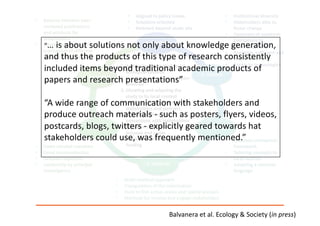
“…	is	about	solutions	not	only	about	knowledge	generation,	
and	thus	the	products	of	this	type	of	research	consistently	
included	items	beyond	traditional	academic	products	of	
papers	and	research	presentations”
“A	wide	range	of	communication	with	stakeholders	and	
produce	outreach	materials	- such	as	posters,	flyers,	videos,	
postcards,	blogs,	twitters	- explicitly	geared	towards	hat	
stakeholders	could	use,	was	frequently	mentioned.”
Balvanera et	al.	Ecology	&	Society	(in	press)
“…long	initiation	period	to	build	an	effective	team…”
“Start-up	time	is	slow	and	bumpy	and	funding	is	usually	
short-term,	e.g.	3	years…”	
“These	investments	can	often	be	viewed	as	opportunity	
costs	to	producing	conventional	research	outputs,	
commonly	resulting	in	tensions	and	competing	priorities	
within	and	between	team	members.”
"Design	can	be	time	consuming	and	move	project	away	
from	interesting	research	questions".
Balvanera et	al.	Ecology	&	Society	(in	press)
“Need	careful	navigation	to	integrate	the	different	needs	
and	perspectives	of	stakeholders.	The	co-production	of	
knowledge	implies	the	integration	of	multiple	conflicting		
beliefs,	perceptions	and	interests.”
“Conflicts	and	inequitable	power	relations	among	different	
groups	may	render	this	integration	impossible	and	perhaps	
even	undesirable”
“However,	research	can	often	perform	a	useful	role	in	
helping	to	articulate	differences	in	values,	world-views,	and	
activities.	A	common	observation	made	by	the	projects	
surveyed	in	this	study	is	that	shared	conceptual	
frameworks	can	be	enormously	useful	in	facilitating	
communication	both	within	research	teams	and	with	local	
stakeholders.”
Balvanera et	al.	Ecology	&	Society	(in	press)
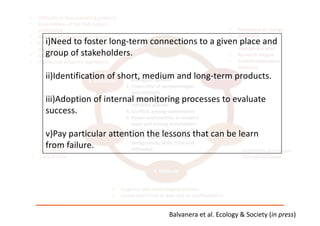
i)Need	to	foster	long-term	connections	to	a	given	place	and	
group	of	stakeholders.
ii)Identification	of	short,	medium	and	long-term	products.	
iii)Adoption	of	internal	monitoring	processes	to	evaluate	
success.
v)Pay	particular	attention	the	lessons	that	can	be	learn	
from	failure.
Balvanera et	al.	Ecology	&	Society	(in	review)
Balancing	place-based	and	global	perspectives
better	understand	the	interconnections	between	social-
ecological	systems	that	are	separated	geographically
sustainability	research	needs	to	be	tailored	to	the
particular	needs	of	each	social-ecological	context.	
international	collaborations	around	sustainability	issues	are	
fostered	in	a	way that	allows	global	and	local	perspectives	
to	be	integrated.
Chanda Meek	
University of
Alaska-
Fairbanks
Ro	Hill
CSIRO
Derek	
Armitage
University of
Waterloo
Christo	Fabricius &	
Cathy	Robinson	
Nelson	Mandela	
University
Lisen Schultz
Stockholm Resilience
Centre
Michael	
Schoon
Arizona State
University
Georgina	
Cundhill
Rhodes
University
Some lessons from a PECS working group
PECS working group on collaborative governance and management
Chanda Meek	
University of
Alaska-
Fairbanks
Ro	Hill
CSIRO
Derek	
Armitage
University of
Waterloo
Christo	Fabricius &	
Cathy	Robinson	
Nelson	Mandela	
University
Lisen Schultz
Stockholm Resilience
Centre
Michael	
Schoon
Arizona State
University
Georgina	
Cundhill
Rhodes
University
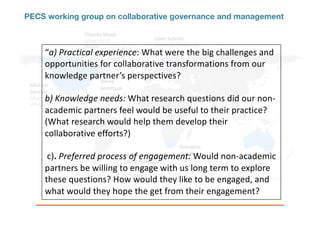
“a)	Practical	experience: What	were	the	big	challenges	and	
opportunities	for	collaborative	transformations	from	our	
knowledge	partner’s	perspectives?	
b)	Knowledge	needs: What	research	questions	did	our	non-
academic	partners	feel	would	be	useful	to	their	practice?	
(What	research	would	help	them	develop	their	
collaborative	efforts?)
c).	Preferred	process	of	engagement: Would	non-academic	
partners	be	willing	to	engage	with	us	long	term	to	explore	
these	questions?	How	would	they	like	to	be	engaged,	and	
what	would	they	hope	the	get	from	their	engagement?
PECS working group on collaborative governance and management
Chanda Meek	
University of
Alaska-
Fairbanks
Ro	Hill
CSIRO
Derek	
Armitage
University of
Waterloo
Christo	Fabricius &	
Cathy	Robinson	
Nelson	Mandela	
University
Lisen Schultz
Stockholm Resilience
Centre
Michael	
Schoon
Arizona State
University
Georgina	
Cundhill
Rhodes
University
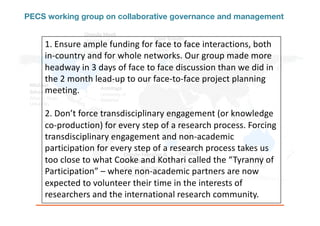
1.	Ensure	ample	funding	for	face	to	face	interactions,	both	
in-country	and	for	whole	networks.	Our	group	made	more	
headway	in	3	days	of	face	to	face	discussion	than	we	did	in	
the	2	month	lead-up	to	our	face-to-face	project	planning	
meeting.	
2.	Don’t	force	transdisciplinary	engagement	(or	knowledge	
co-production)	for	every	step	of	a	research	process.	Forcing	
transdisciplinary	engagement	and	non-academic	
participation	for	every	step	of	a	research	process	takes	us	
too	close	to	what	Cooke	and	Kothari	called	the	“Tyranny	of	
Participation”	– where	non-academic	partners	are	now	
expected	to	volunteer	their	time	in	the	interests	of	
researchers	and	the	international	research	community.
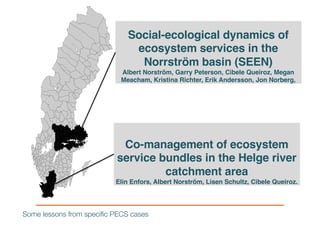
Social-ecological dynamics of
ecosystem services in the
Norrström basin (SEEN)
Albert Norström, Garry Peterson, Cibele Queiroz, Megan
Meacham, Kristina Richter, Erik Andersson, Jon Norberg,
Co-management of ecosystem
service bundles in the Helge river
catchment area
Elin Enfors, Albert Norström, Lisen Schultz, Cibele Queiroz.
Some lessons from specific PECS cases
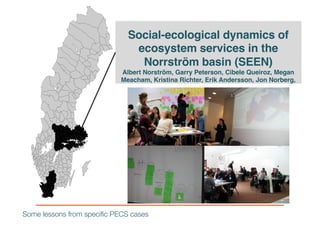
Social-ecological dynamics of
ecosystem services in the
Norrström basin (SEEN)
Albert Norström, Garry Peterson, Cibele Queiroz, Megan
Meacham, Kristina Richter, Erik Andersson, Jon Norberg,
Some lessons from specific PECS cases
Social-ecological dynamics of
ecosystem services in the
Norrström basin (SEEN)
Albert Norström, Garry Peterson, Cibele Queiroz, Megan
Meacham, Kristina Richter, Erik Andersson, Jon Norberg,
Some lessons from specific PECS cases
Social-ecological dynamics of
ecosystem services in the
Norrström basin (SEEN)
Albert Norström, Garry Peterson, Cibele Queiroz, Megan
Meacham, Kristina Richter, Erik Andersson, Jon Norberg,
Some lessons from specific PECS cases
Co-management of ecosystem
service bundles in the Helge river
catchment area
Elin Enfors, Albert Norström, Lisen Schultz, Cibele Queiroz.
Some lessons from specific PECS cases
Co-management of ecosystem
service bundles in the Helge river
catchment area
Elin Enfors, Albert Norström, Lisen Schultz, Cibele Queiroz.
Some lessons from specific PECS cases
Social-ecological dynamics of
ecosystem services in the
Norrström basin (SEEN)
Albert Norström, Garry Peterson, Cibele Queiroz, Megan
Meacham, Kristina Richter, Erik Andersson, Jon Norberg,
Co-management of ecosystem
service bundles in the Helge river
catchment area
Elin Enfors, Albert Norström, Lisen Schultz, Cibele Queiroz.
Some lessons from specific PECS cases
Stockholm case-study:
Reflect critically on the research process and roles as researchers. Researchers are not completely
objective, especially within the inherently normative field of sustainability science. Strive to continuously
write down reflections on position and assumptions and how they might shape participation.
When initiating a research project, discuss with collaborators what the different interests, goals, and
expectations are, trying to be as transparent as possible. Then explore whether project can be designed
that can meet as many of goals. This also helps to build trust in the ongoing collaboration.
Important, to keep research independent in the sense that it is not funded by the collaborating
organizations.
Different levels of evaluation are needed, both the more involved and the more detached. Evaluation by
people involved in designing and running the process is important for them to continuously refine the
process design and learn along the way, even though they are biased towards positive outcomes. The
other level of evaluation would preferably be conducted by an outsider person that follows up with key
actor interviews and observations of the process. In both cases, it is advisable to strategically select a
person to conduct the evaluation who will benefit from the opportunity to gain a lot of tacit knowledge.
Social-ecological dynamics of
ecosystem services in the
Norrström basin (SEEN)
Albert Norström, Garry Peterson, Cibele Queiroz, Megan
Meacham, Kristina Richter, Erik Andersson, Jon Norberg,
Co-management of ecosystem
service bundles in the Helge river
catchment area
Elin Enfors, Albert Norström, Lisen Schultz, Cibele Queiroz.
Some lessons from specific PECS cases
Helge Å case:
The selection of services, indicators and municipalities determines the outcome. Participatory process
used to ensure relevance of analysis
Initial consultation about which ES matter to people in the area (representatives of forest owners, farmers,
tourism sector, civil society organizations, municipalities and county board administrations)
Thank you
@AlbertNorstrm
@PECS_Project
www.pecs-science.org
Thank you
@AlbertNorstrm
@PECS_Project
www.pecs-science.org

PECS approaches: Albert Nörstrom