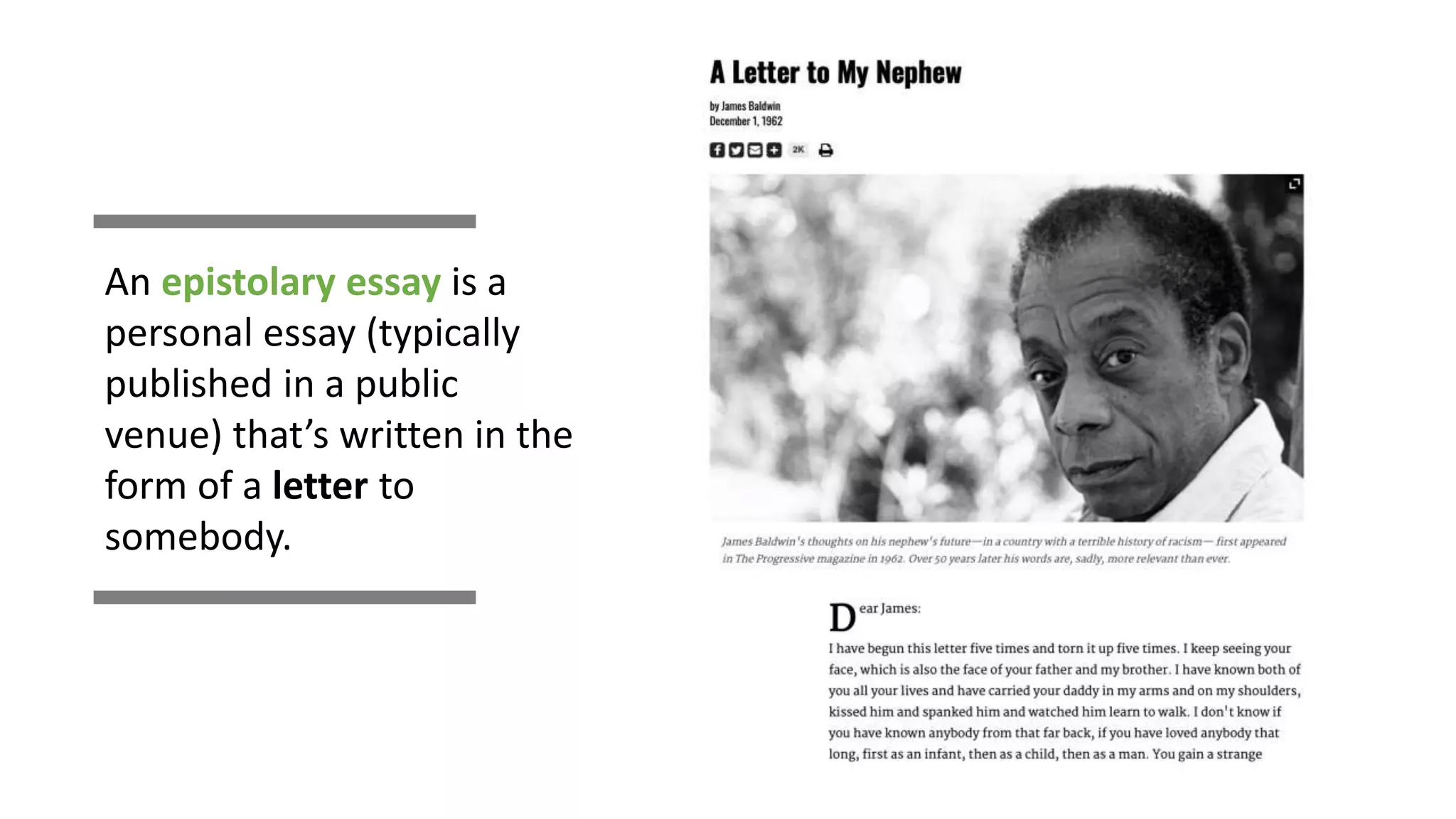
An epistolary essay is a
personal essay (typically
published in a public
venue) that’s written in the
form of a letter to
somebody.
In other words, the epistolary essay is a literary device that allows
the writer and the readers to focus on an explicit audience (the
person to whom the letter is addressed, who probably won’t actually
read this letter, because they might be dead) while secretly talking to
a much broader, implicit audience (the actual readers of the
published letter).
explicit audience
implicit audience
For readers, reading an
epistolary essay is kind of
like listening in on a
conversation – you get to
hear often intimate details
of someone’s life; but
there’s also a deeper point
to it - something that
extends beyond this
particular situation.
You could think of managing two audiences in terms of
the situation and the story, which we learned about in
Unit 1. In an epistolary essay, the situation is what you
are writing to the letter’s addressee (the explicit
audience). The story is the deeper point about the
situation that you are trying to make to the readers of
the essay (the implicit audience).
Epistolary essays use
traditional genre
conventions for letter
writing to indicate the
explicit audience (they
also sometimes do this
through the title: “A
Letter to X.”)
As with most epistolary
essays, your essay will
contain at least one story or
anecdote – this might be a
memory you have with the
person, or it might be a
significant event that has
happened to you since you
last spoke to the recipient of
the letter that you really
wish you could share with
them.
Preparing to Write Epistolary Essays
1. Decide on your audiences: your implicit audience and your explicit
audience. What can you say directly to the one that you want the other to
overhear?
2. Identify your point: what do you want to say to your explicit audience (the
person to whom the letter is addressed)? What story or anecdote (either a
memory from your time with the person or a situation that you wish you
could tell them about now) will you use?
3. Then think about the “story” you’re trying to tell - what exactly do you
want your implicit audience (the people who are actually reading your
epistolary essay) to know, feel, or understand as a result of reading your
letter?
4. Think: what kind of “voice” do you want to use for your epistolary essay?
Wistful? Blunt? Resentful? Forgiving?

Writing Epistolary Essays

  • 2.
    An epistolary essayis a personal essay (typically published in a public venue) that’s written in the form of a letter to somebody.
  • 3.
    In other words,the epistolary essay is a literary device that allows the writer and the readers to focus on an explicit audience (the person to whom the letter is addressed, who probably won’t actually read this letter, because they might be dead) while secretly talking to a much broader, implicit audience (the actual readers of the published letter). explicit audience implicit audience
  • 4.
    For readers, readingan epistolary essay is kind of like listening in on a conversation – you get to hear often intimate details of someone’s life; but there’s also a deeper point to it - something that extends beyond this particular situation.
  • 5.
    You could thinkof managing two audiences in terms of the situation and the story, which we learned about in Unit 1. In an epistolary essay, the situation is what you are writing to the letter’s addressee (the explicit audience). The story is the deeper point about the situation that you are trying to make to the readers of the essay (the implicit audience).
  • 6.
    Epistolary essays use traditionalgenre conventions for letter writing to indicate the explicit audience (they also sometimes do this through the title: “A Letter to X.”)
  • 7.
    As with mostepistolary essays, your essay will contain at least one story or anecdote – this might be a memory you have with the person, or it might be a significant event that has happened to you since you last spoke to the recipient of the letter that you really wish you could share with them.
  • 8.
    Preparing to WriteEpistolary Essays 1. Decide on your audiences: your implicit audience and your explicit audience. What can you say directly to the one that you want the other to overhear? 2. Identify your point: what do you want to say to your explicit audience (the person to whom the letter is addressed)? What story or anecdote (either a memory from your time with the person or a situation that you wish you could tell them about now) will you use? 3. Then think about the “story” you’re trying to tell - what exactly do you want your implicit audience (the people who are actually reading your epistolary essay) to know, feel, or understand as a result of reading your letter? 4. Think: what kind of “voice” do you want to use for your epistolary essay? Wistful? Blunt? Resentful? Forgiving?