1
POINTS ACT
Test Prep
Writing Slides
2
Writing Background
Test Structure – Writing (Optional)
 Prompt
 1 prompt
 Time
 40 minutes to complete
 Graded in four areas:
1. Ideas and Analysis
2. Development and Support
3. Organization
4. Language Use and Conventions
3
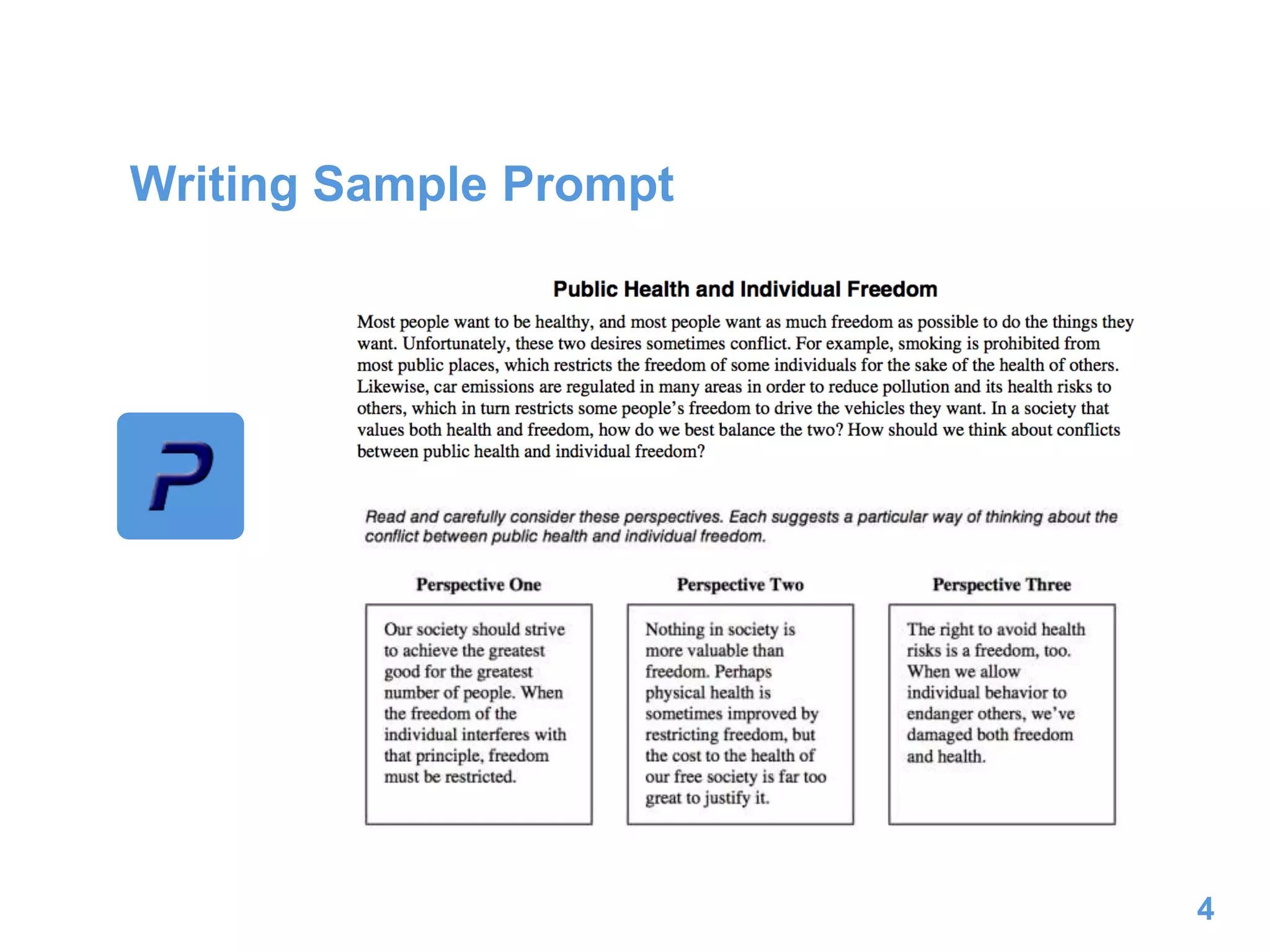
Writing Sample Prompt
4
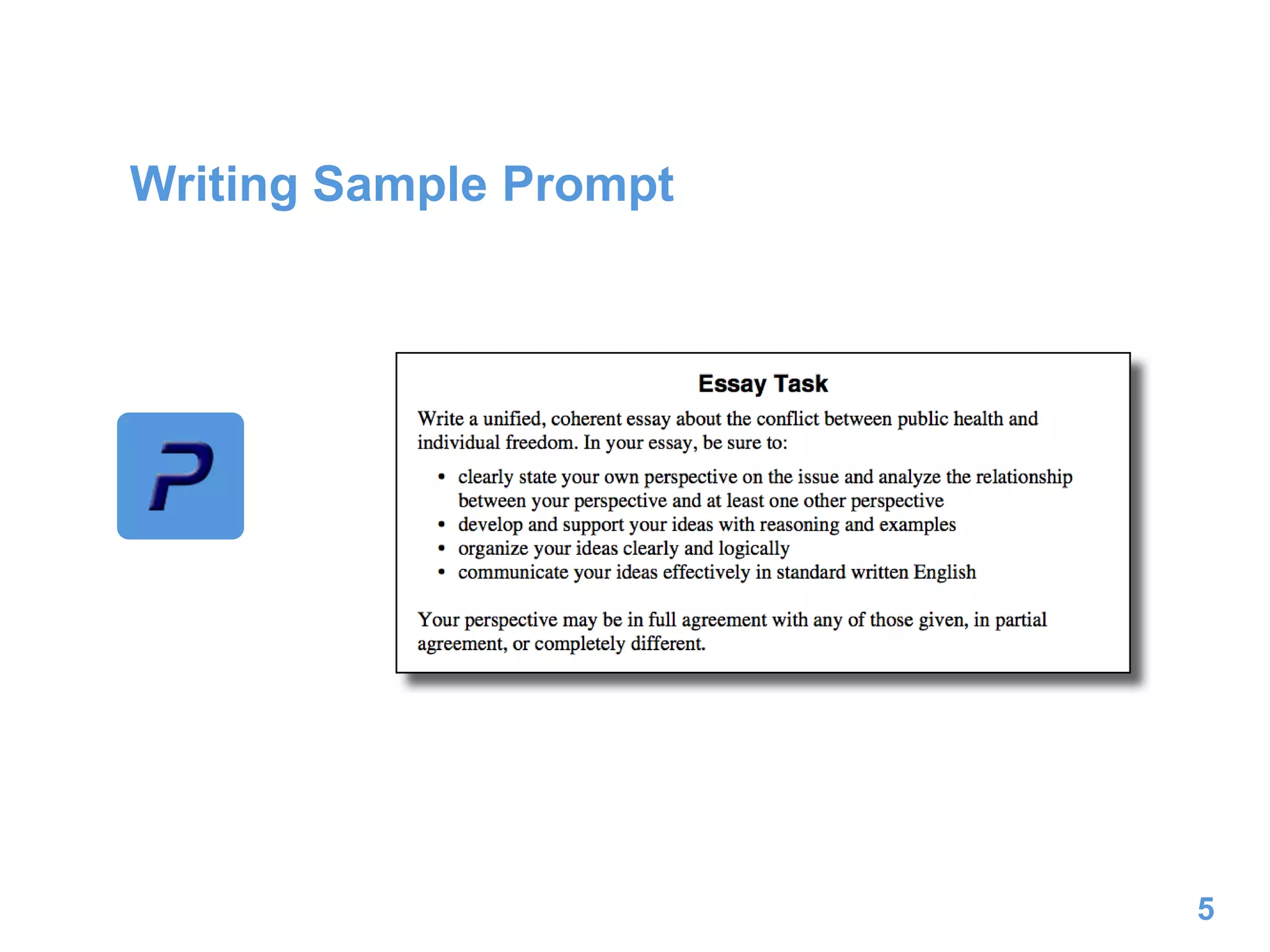
Writing Sample Prompt
5
Table of Contents
6
I. Common Questions
II. Organizing Your Time
III. Structure of the Essay
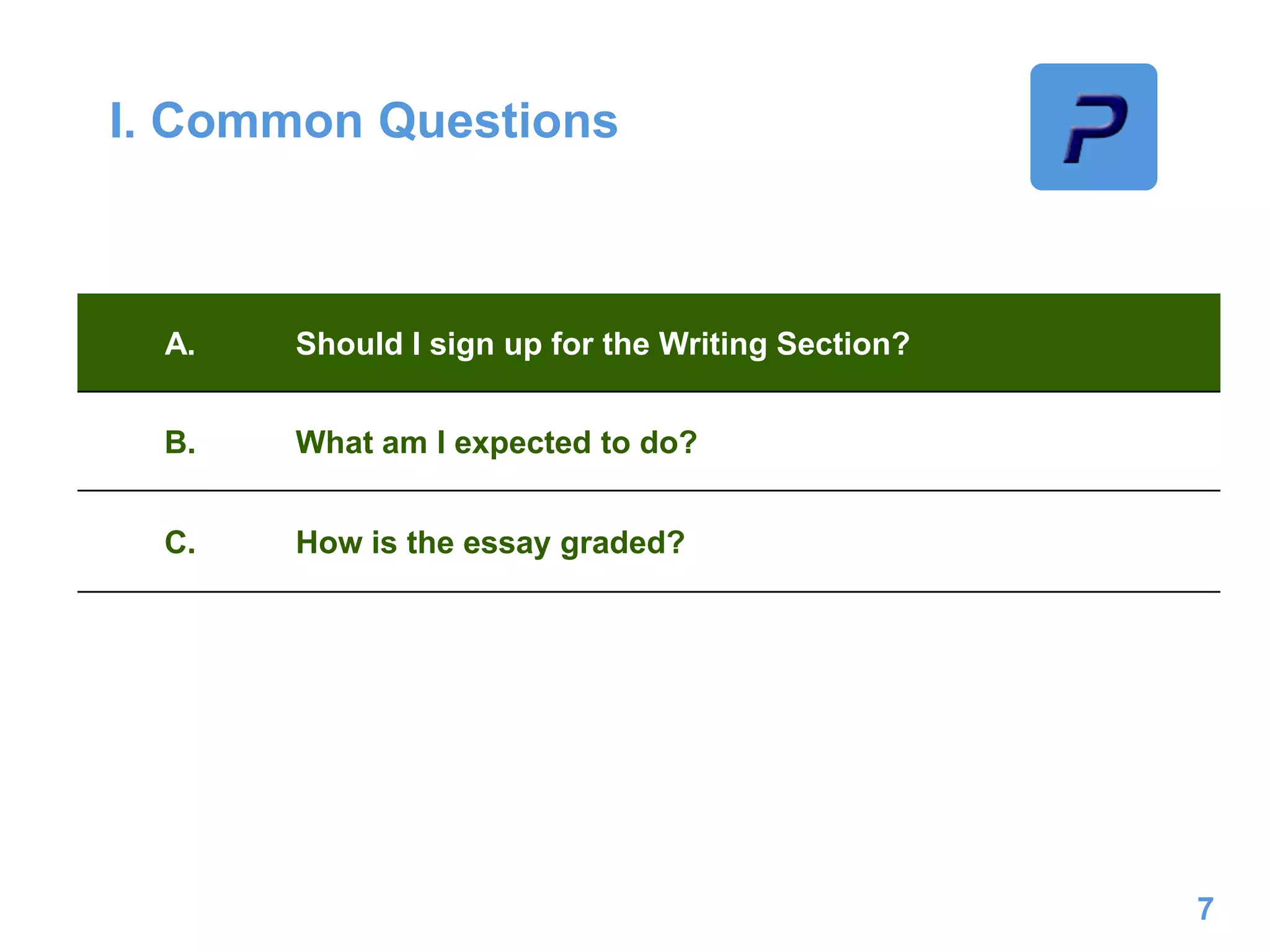
I. Common Questions
7
A. Should I sign up for the Writing Section?
B. What am I expected to do?
C. How is the essay graded?
It depends…
 Optional for the ACT
 BUT required by many
schools
 Some states also require
it for graduation
purposes
 Look at the admissions
requirements
 Talk to your college
counselor
8
I. Common Questions
9
A. Should I sign up for the Writing Section?
B. What am I expected to do?
C. How is the essay graded?
Expectations
 More than just writing an
essay
10
Expectations
 More than just writing an
essay
 You must:
1. Form a perspective
10
Expectations
 More than just writing an
essay
 You must:
1. Form a perspective
2. Brainstorm examples
and support for that
stance as well as
critiques for other
perspectives
10
Expectations
 More than just writing an
essay
 You must:
1. Form a perspective
2. Brainstorm examples
and support for that
stance as well as
critiques for other
perspectives
3. Write an essay that
supports your
perspective
10
Expectations – Length?
 No specific length required
 Both quality and quantity
are important.
 Typically, the best essays
are never less than two
written pages.
11
I. Common Questions
12
A. Should I sign up for the Writing Section?
B. What am I expected to do?
C. How is the essay graded?
Grading
13
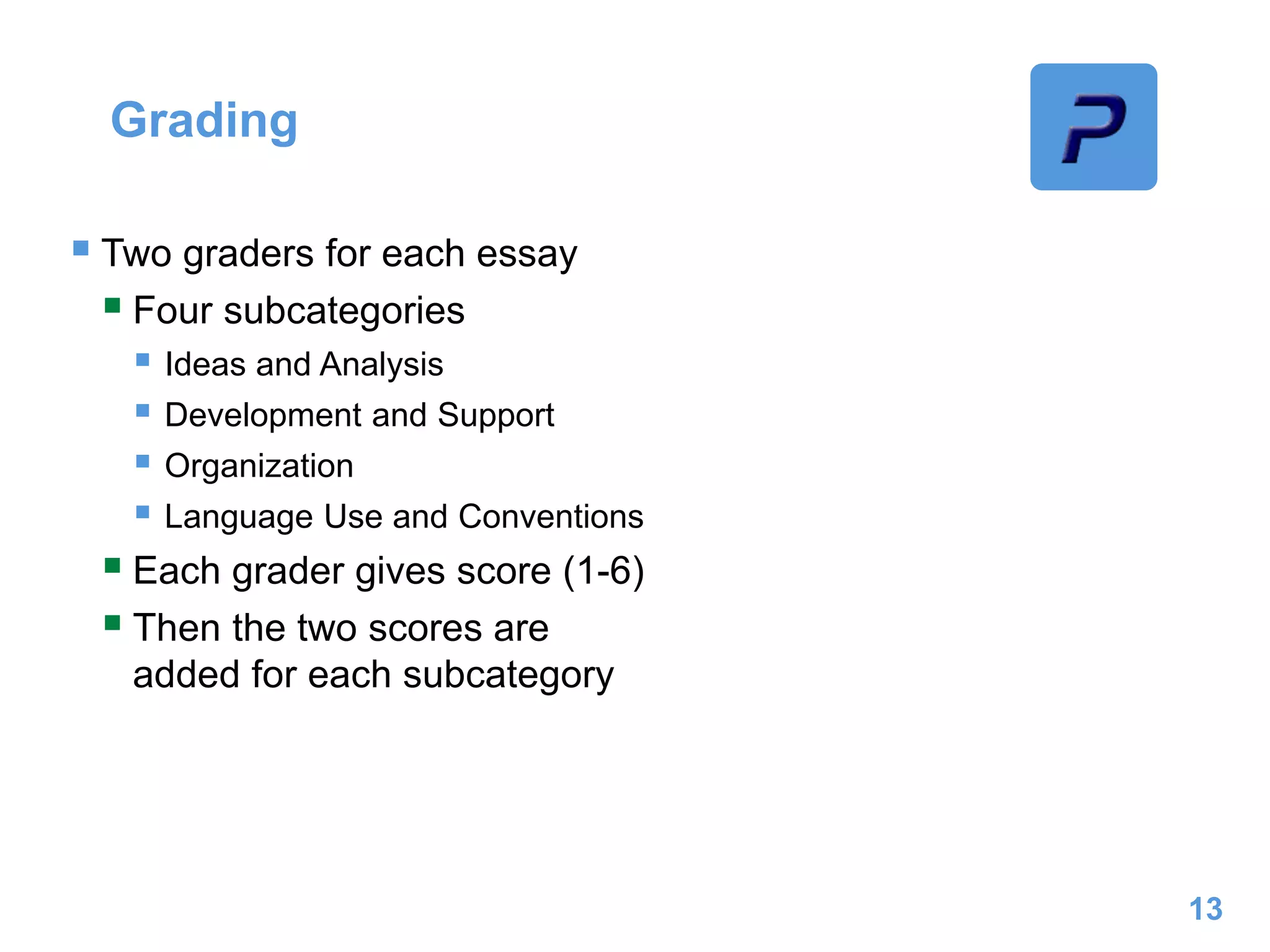
Grading
 Two graders for each essay
 Four subcategories
 Ideas and Analysis
 Development and Support
 Organization
 Language Use and Conventions
13
Grading
 Two graders for each essay
 Four subcategories
 Ideas and Analysis
 Development and Support
 Organization
 Language Use and Conventions
 Each grader gives score (1-6)
 Then the two scores are
added for each subcategory
13
Grading
 Two graders for each essay
 Four subcategories
 Ideas and Analysis
 Development and Support
 Organization
 Language Use and Conventions
 Each grader gives score (1-6)
 Then the two scores are
added for each subcategory
13
 What you will receive:
 Four subcategory
scores (2–12)
 One overall scaled
score (2–12)
Grading
 Two graders for each essay
 Four subcategories
 Ideas and Analysis
 Development and Support
 Organization
 Language Use and Conventions
 Each grader gives score (1-6)
 Then the two scores are
added for each subcategory
13
 What you will receive:
 Four subcategory
scores (2–12)
 One overall scaled
score (2–12)
 Writing Section does not
affect the Composite
Score!
Table of Contents
14
I. Common Questions
II. Organizing Your Time
III. Structure of the Essay
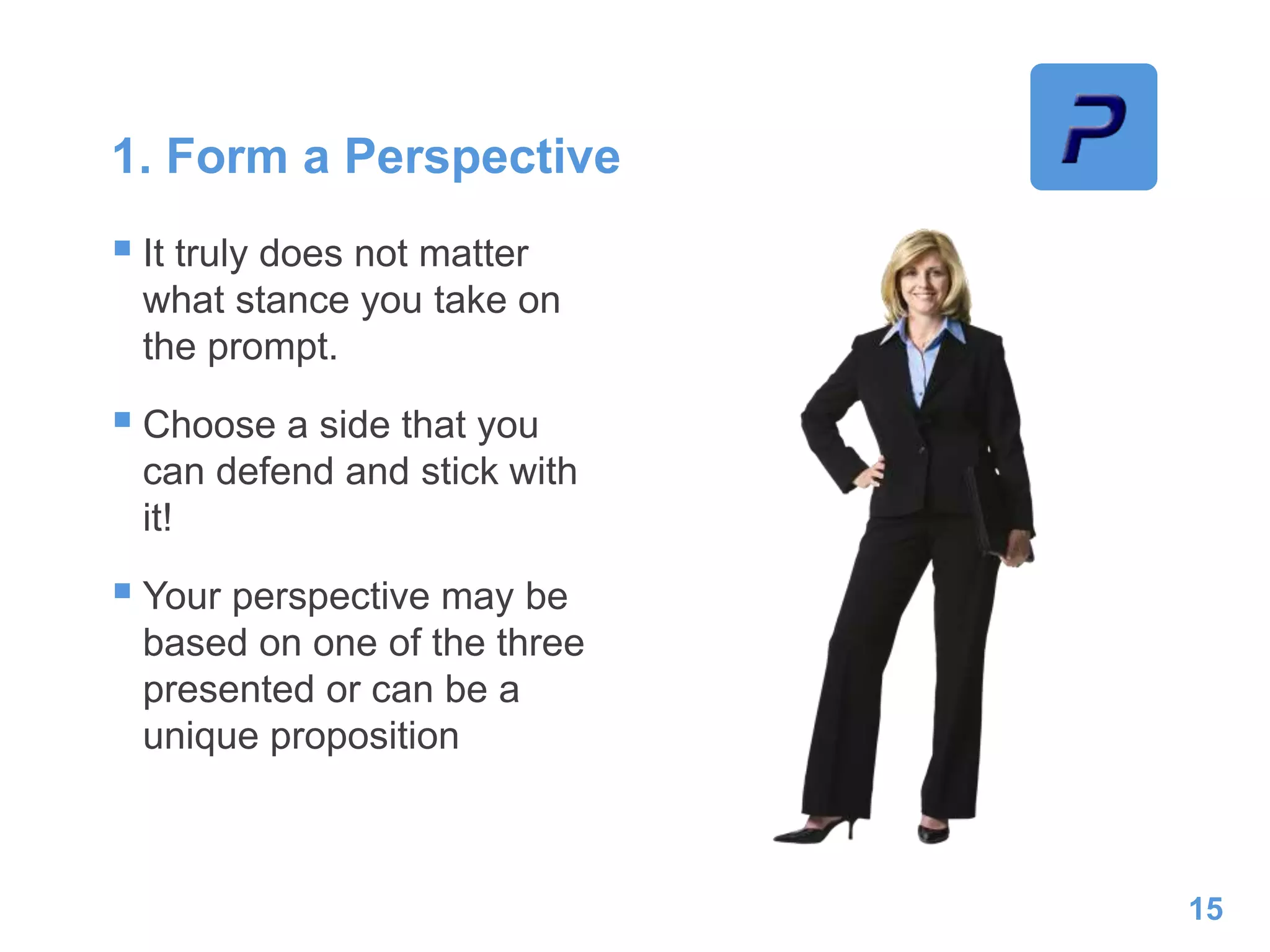
1. Form a Perspective
 It truly does not matter
what stance you take on
the prompt.
 Choose a side that you
can defend and stick with
it!
 Your perspective may be
based on one of the three
presented or can be a
unique proposition
15
ACT Brainstorming Questions
 ACT provides several questions to help you brainstorm,
such as:
 What insights do other perspectives offer, and what do
they fail to consider?
 Why might the other perspectives be persuasive to
others, or why might they fail to persuade?
 What is your perspective on this issue, and what are its
strengths and weaknesses?
 How will you support your perspective in your essay?
16
2. Brainstorm Examples and Support
for Perspective as Well as Critiques for
Other Perspectives
17
2. Brainstorm Examples and Support
for Perspective as Well as Critiques for
Other Perspectives
 Use the space provided to plan
out your essay.
 5–10 minutes
 Read the prompt
 Form a perspective
 Plan out examples
17
2. Brainstorm Examples and Support
for Perspective as Well as Critiques for
Other Perspectives
 Use the space provided to plan
out your essay.
 5–10 minutes
 Read the prompt
 Form a perspective
 Plan out examples
 We suggest making a brief outline
that would take the following format:
Intro
 Thesis
II. Body 1 Topic/Argument
 Example/Support
III. Body 2 Topic/Argument
 Example/Support
IV. Body 3 Topic/Argument
 Example/Support
V. Conclusion
17
3. Construct a Well-Written Essay
18
3. Construct a Well-Written Essay
 There are multiple “correct” formats this essay can take
 We will recommend a straight-forward method
18
3. Construct a Well-Written Essay
 There are multiple “correct” formats this essay can take
 We will recommend a straight-forward method
 Tips
1. Avoid simply restating the perspectives in lieu of actually
integrating them into your argument
2. Avoid statements such as “I think” – they are weak.
 Ex: I think red is the best color < Red is the best color.
3. Spacing between paragraphs should be clearly indicated,
and lines should be fully filled.
4. Use correct grammar (including punctuation)!
5. Check your spelling.
6. Integrate at least one other perspective.
18
3. Construct a Well-Written Essay
 There are multiple “correct” formats this essay can take
 We will recommend a straight-forward method
 Tips
1. Avoid simply restating the perspectives in lieu of actually
integrating them into your argument
2. Avoid statements such as “I think” – they are weak.
 Ex: I think red is the best color < Red is the best color.
3. Spacing between paragraphs should be clearly indicated,
and lines should be fully filled.
4. Use correct grammar (including punctuation)!
5. Check your spelling.
6. Integrate at least one other perspective.
18
AHHH!
Table of Contents
19
I. Common Questions
II. Organizing Your Time
III. Structure of the Essay
Basic Outline of Essay
 Common format
 Most important sentences:
 Opening Sentence
 Thesis
 Topic Sentences
20
Introduction
Body Paragraphs
Conclusion
Opening Sentence
Thesis
Topic Sentence
Topic Sentence
Topic Sentence
 Opening sentence
 Quote
 Question
 Philosophical statement
 Grab attention! Be unique!
 DO NOT merely restate the
prompt.
Introduction
21
Introduction
News Outlet 1
Serial entrepreneur and billionaire
Elon Musk unveiled design plans
for his Hyperloop - a superfast
transport system that could cut the
travel time from Los Angeles to
San Francisco to 30 minutes, and
cost a fraction of the currently
proposed high speed rail project.
News Outlet 2
The fevered speculation about
billionaire entrepreneur Elon
Musk's mysterious "Hyperloop"
transport system is about to come
to an end.
Most important part of the essay!
First point of contact with reader
First impression
First chance to impress
22
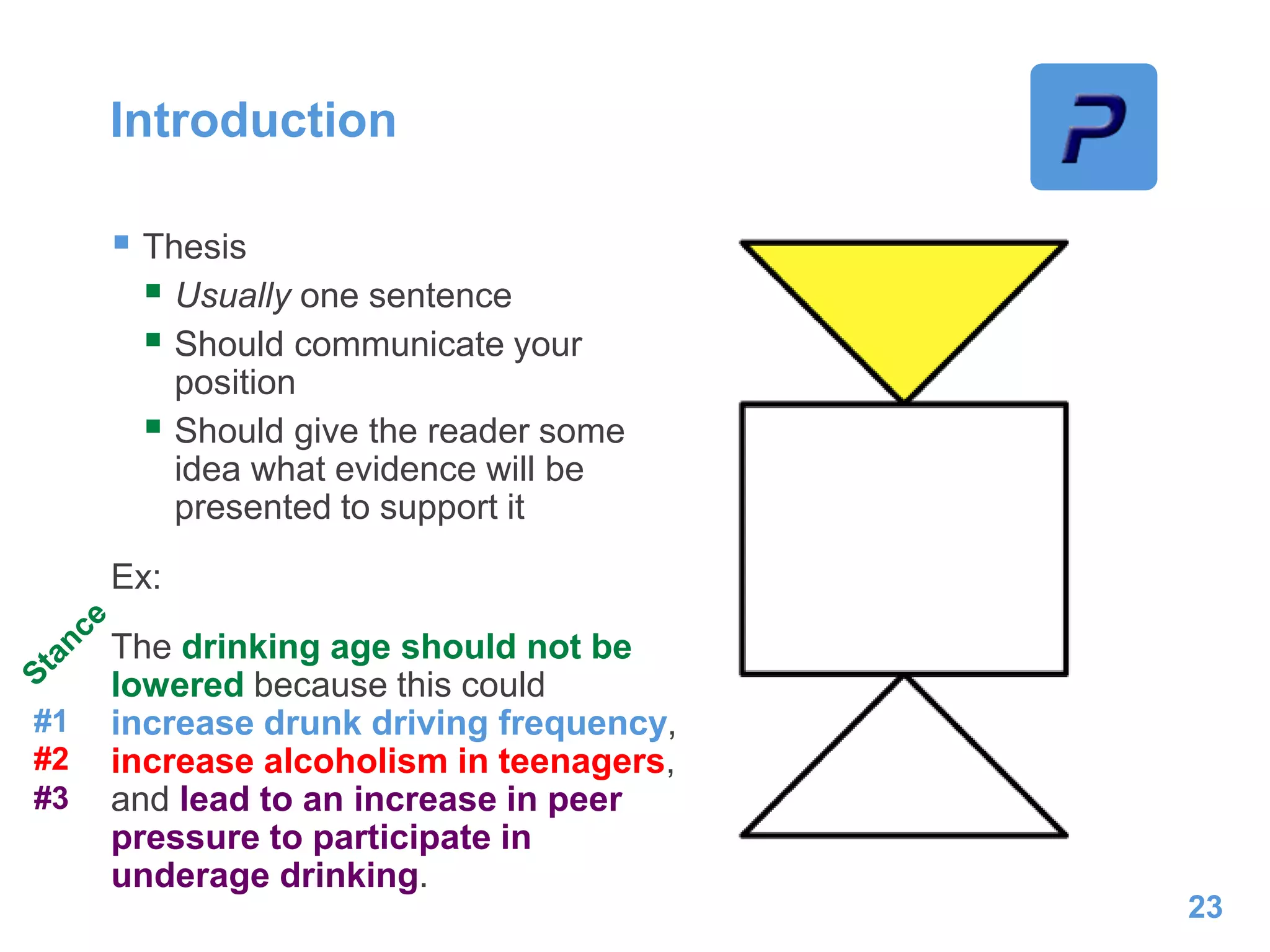
 Thesis
 Usually one sentence
 Should communicate your
position
 Should give the reader some
idea what evidence will be
presented to support it
Ex:
The drinking age should not be
lowered because this could
increase drunk driving frequency,
increase alcoholism in teenagers,
and lead to an increase in peer
pressure to participate in
underage drinking.
Introduction
23
#1
#2
#3
Body Paragraphs
24
Body Paragraphs
 Purpose of the body
paragraphs: to support the
argument you made in the
thesis
24
Body Paragraphs
 Purpose of the body
paragraphs: to support the
argument you made in the
thesis
 Each body paragraph should
begin with a topic sentence
that directly refers back to
and supports the thesis
statement.
 Each should consist of a
separate idea, example, or
argument.
24
Body Paragraphs cont.
 A common first question is
“How many body paragraphs
should I have?”
 It depends on the essay
 A general guideline: 2–4
paragraphs
 Brainstorm 3–4 paragraphs
 Can cut later!
 Keep in mind that you may
have to adjust the number due
to time constraints.
 Try to transition as smoothly
as possible between
paragraphs, connecting ideas
and reinforcing your stance.
25
What should the body paragraphs contain?
“Essay Task” Structure
1. First body paragraph should
analyze and evaluate
perspectives given
2. Second body paragraph should
state and develop your
perspective
3. Third body paragraph should
explain the relationship
between your perspective and
those given
“Integrated Analysis” Structure
1. First body paragraph should
provide an argument for your
perspective that includes any
pieces of the three
perspectives that are relevant
2. Second paragraph provides a
second (different) argument for
your perspective, still
referencing the three
perspectives
3. Third paragraph should provide
rebuttals to arguments that
could be taken against your
position, citing relevant
perspectives 26
 Begin with the specific
restating of your thesis
(reword, don’t copy!) and
progress to a broad last
sentence.
 You may summarize and/or
restate some of your major
points with one or two
sentences in the conclusion
 More importantly, you should
also expand on your ideas in
the conclusion and apply them
to the “bigger picture.”
Conclusion
27
42
Writing Section
Thank you for your attention!

Writing

  • 1.
  • 2.
  • 3.
    Test Structure –Writing (Optional)  Prompt  1 prompt  Time  40 minutes to complete  Graded in four areas: 1. Ideas and Analysis 2. Development and Support 3. Organization 4. Language Use and Conventions 3
  • 4.
  • 5.
  • 6.
    Table of Contents 6 I.Common Questions II. Organizing Your Time III. Structure of the Essay
  • 7.
    I. Common Questions 7 A.Should I sign up for the Writing Section? B. What am I expected to do? C. How is the essay graded?
  • 8.
    It depends…  Optionalfor the ACT  BUT required by many schools  Some states also require it for graduation purposes  Look at the admissions requirements  Talk to your college counselor 8
  • 9.
    I. Common Questions 9 A.Should I sign up for the Writing Section? B. What am I expected to do? C. How is the essay graded?
  • 10.
    Expectations  More thanjust writing an essay 10
  • 11.
    Expectations  More thanjust writing an essay  You must: 1. Form a perspective 10
  • 12.
    Expectations  More thanjust writing an essay  You must: 1. Form a perspective 2. Brainstorm examples and support for that stance as well as critiques for other perspectives 10
  • 13.
    Expectations  More thanjust writing an essay  You must: 1. Form a perspective 2. Brainstorm examples and support for that stance as well as critiques for other perspectives 3. Write an essay that supports your perspective 10
  • 14.
    Expectations – Length? No specific length required  Both quality and quantity are important.  Typically, the best essays are never less than two written pages. 11
  • 15.
    I. Common Questions 12 A.Should I sign up for the Writing Section? B. What am I expected to do? C. How is the essay graded?
  • 16.
  • 17.
    Grading  Two gradersfor each essay  Four subcategories  Ideas and Analysis  Development and Support  Organization  Language Use and Conventions 13
  • 18.
    Grading  Two gradersfor each essay  Four subcategories  Ideas and Analysis  Development and Support  Organization  Language Use and Conventions  Each grader gives score (1-6)  Then the two scores are added for each subcategory 13
  • 19.
    Grading  Two gradersfor each essay  Four subcategories  Ideas and Analysis  Development and Support  Organization  Language Use and Conventions  Each grader gives score (1-6)  Then the two scores are added for each subcategory 13  What you will receive:  Four subcategory scores (2–12)  One overall scaled score (2–12)
  • 20.
    Grading  Two gradersfor each essay  Four subcategories  Ideas and Analysis  Development and Support  Organization  Language Use and Conventions  Each grader gives score (1-6)  Then the two scores are added for each subcategory 13  What you will receive:  Four subcategory scores (2–12)  One overall scaled score (2–12)  Writing Section does not affect the Composite Score!
  • 21.
    Table of Contents 14 I.Common Questions II. Organizing Your Time III. Structure of the Essay
  • 22.
    1. Form aPerspective  It truly does not matter what stance you take on the prompt.  Choose a side that you can defend and stick with it!  Your perspective may be based on one of the three presented or can be a unique proposition 15
  • 23.
    ACT Brainstorming Questions ACT provides several questions to help you brainstorm, such as:  What insights do other perspectives offer, and what do they fail to consider?  Why might the other perspectives be persuasive to others, or why might they fail to persuade?  What is your perspective on this issue, and what are its strengths and weaknesses?  How will you support your perspective in your essay? 16
  • 24.
    2. Brainstorm Examplesand Support for Perspective as Well as Critiques for Other Perspectives 17
  • 25.
    2. Brainstorm Examplesand Support for Perspective as Well as Critiques for Other Perspectives  Use the space provided to plan out your essay.  5–10 minutes  Read the prompt  Form a perspective  Plan out examples 17
  • 26.
    2. Brainstorm Examplesand Support for Perspective as Well as Critiques for Other Perspectives  Use the space provided to plan out your essay.  5–10 minutes  Read the prompt  Form a perspective  Plan out examples  We suggest making a brief outline that would take the following format: Intro  Thesis II. Body 1 Topic/Argument  Example/Support III. Body 2 Topic/Argument  Example/Support IV. Body 3 Topic/Argument  Example/Support V. Conclusion 17
  • 27.
    3. Construct aWell-Written Essay 18
  • 28.
    3. Construct aWell-Written Essay  There are multiple “correct” formats this essay can take  We will recommend a straight-forward method 18
  • 29.
    3. Construct aWell-Written Essay  There are multiple “correct” formats this essay can take  We will recommend a straight-forward method  Tips 1. Avoid simply restating the perspectives in lieu of actually integrating them into your argument 2. Avoid statements such as “I think” – they are weak.  Ex: I think red is the best color < Red is the best color. 3. Spacing between paragraphs should be clearly indicated, and lines should be fully filled. 4. Use correct grammar (including punctuation)! 5. Check your spelling. 6. Integrate at least one other perspective. 18
  • 30.
    3. Construct aWell-Written Essay  There are multiple “correct” formats this essay can take  We will recommend a straight-forward method  Tips 1. Avoid simply restating the perspectives in lieu of actually integrating them into your argument 2. Avoid statements such as “I think” – they are weak.  Ex: I think red is the best color < Red is the best color. 3. Spacing between paragraphs should be clearly indicated, and lines should be fully filled. 4. Use correct grammar (including punctuation)! 5. Check your spelling. 6. Integrate at least one other perspective. 18 AHHH!
  • 31.
    Table of Contents 19 I.Common Questions II. Organizing Your Time III. Structure of the Essay
  • 32.
    Basic Outline ofEssay  Common format  Most important sentences:  Opening Sentence  Thesis  Topic Sentences 20 Introduction Body Paragraphs Conclusion Opening Sentence Thesis Topic Sentence Topic Sentence Topic Sentence
  • 33.
     Opening sentence Quote  Question  Philosophical statement  Grab attention! Be unique!  DO NOT merely restate the prompt. Introduction 21
  • 34.
    Introduction News Outlet 1 Serialentrepreneur and billionaire Elon Musk unveiled design plans for his Hyperloop - a superfast transport system that could cut the travel time from Los Angeles to San Francisco to 30 minutes, and cost a fraction of the currently proposed high speed rail project. News Outlet 2 The fevered speculation about billionaire entrepreneur Elon Musk's mysterious "Hyperloop" transport system is about to come to an end. Most important part of the essay! First point of contact with reader First impression First chance to impress 22
  • 35.
     Thesis  Usuallyone sentence  Should communicate your position  Should give the reader some idea what evidence will be presented to support it Ex: The drinking age should not be lowered because this could increase drunk driving frequency, increase alcoholism in teenagers, and lead to an increase in peer pressure to participate in underage drinking. Introduction 23 #1 #2 #3
  • 36.
  • 37.
    Body Paragraphs  Purposeof the body paragraphs: to support the argument you made in the thesis 24
  • 38.
    Body Paragraphs  Purposeof the body paragraphs: to support the argument you made in the thesis  Each body paragraph should begin with a topic sentence that directly refers back to and supports the thesis statement.  Each should consist of a separate idea, example, or argument. 24
  • 39.
    Body Paragraphs cont. A common first question is “How many body paragraphs should I have?”  It depends on the essay  A general guideline: 2–4 paragraphs  Brainstorm 3–4 paragraphs  Can cut later!  Keep in mind that you may have to adjust the number due to time constraints.  Try to transition as smoothly as possible between paragraphs, connecting ideas and reinforcing your stance. 25
  • 40.
    What should thebody paragraphs contain? “Essay Task” Structure 1. First body paragraph should analyze and evaluate perspectives given 2. Second body paragraph should state and develop your perspective 3. Third body paragraph should explain the relationship between your perspective and those given “Integrated Analysis” Structure 1. First body paragraph should provide an argument for your perspective that includes any pieces of the three perspectives that are relevant 2. Second paragraph provides a second (different) argument for your perspective, still referencing the three perspectives 3. Third paragraph should provide rebuttals to arguments that could be taken against your position, citing relevant perspectives 26
  • 41.
     Begin withthe specific restating of your thesis (reword, don’t copy!) and progress to a broad last sentence.  You may summarize and/or restate some of your major points with one or two sentences in the conclusion  More importantly, you should also expand on your ideas in the conclusion and apply them to the “bigger picture.” Conclusion 27
  • 42.
    42 Writing Section Thank youfor your attention!

Editor's Notes

  • #2 Teacher Notes 1. Of all sections, Writing is the one that tends to produce the most questions among students. Should I even take it? How is it scored? What are they looking for? … We will address these questions and many more in the slides to come.
  • #4 Teacher Notes Students have 40 minutes to write one essay in response to the prompt. Ultimately, it is graded in four areas. Note: the grade is NOT dependent on the perspective that the writer chooses but rather the way he or she supports it. This is the section that has changed the most in recent years, so if students talk to friends who have already taken the ACT, these friends may not be familiar with the new format. Should students take the writing section? It depends on the college. This question will be addressed briefly in the Writing slides. In general, most students take writing at least once. The fee for the Writing section is currently $16 in addition to the $42.50 fee charged for taking the ACT itself.
  • #5 Teacher Notes 1. Give the students a few minutes to read through this sample prompt. Though the topic and question will change each time, the structure to the prompt remains the same. As a result, it is up to us to be familiar with the format: a paragraph of background followed by three perspectives on the issue.
  • #6 Teacher Notes Like the prompt, the essay task remains consistent from test to test. In this case, the prompt clarifies that we should write about the “conflict between public health and individual freedom.” We have four tasks: Note that we must clearly state our own perspective (no fence-sitting!) and must integrate at least one other perspective; remember that it may not be to our advantage to integrate all perspectives unless we can do them well. The other tasks are fairly straightforward, but we will have to discuss how to develop ideas and support and how to organize the ideas clearly.
  • #8 Teacher Notes 1. As mentioned previously, this is one of the most common questions that we receive from both students and their parents
  • #9 Teacher Notes The ACT provides a website where students can check requirements of schools: https://actapps.act.org/writPrefRM/ Consult your guidance department for state Writing requirements It is important to note that because the Writing section does not affect the composite score, there are few reasons not to take it. Exceptions include financial limitations or the case of a student who know where he or she will be attending college and knows that the school does not require Writing.
  • #10 Teacher Notes 1. Duh, right an essay, right? Well, not entirely. Students will learn that in order to achieve a top essay, they must first form a perspective and brainstorm.
  • #11 Teacher Notes 1. Throughout the course, we will practice each of these steps. It can be intimidating for students to look around a classroom and observe their peers fervently writing from the minute the clock starts; part of our job is to become comfortable spending the first few minutes forming a perspective and brainstorming. By doing so, we can use the whole time and use it well.
  • #12 Teacher Notes 1. Throughout the course, we will practice each of these steps. It can be intimidating for students to look around a classroom and observe their peers fervently writing from the minute the clock starts; part of our job is to become comfortable spending the first few minutes forming a perspective and brainstorming. By doing so, we can use the whole time and use it well.
  • #13 Teacher Notes 1. Throughout the course, we will practice each of these steps. It can be intimidating for students to look around a classroom and observe their peers fervently writing from the minute the clock starts; part of our job is to become comfortable spending the first few minutes forming a perspective and brainstorming. By doing so, we can use the whole time and use it well.
  • #14 Teacher Notes 1. Throughout the course, we will practice each of these steps. It can be intimidating for students to look around a classroom and observe their peers fervently writing from the minute the clock starts; part of our job is to become comfortable spending the first few minutes forming a perspective and brainstorming. By doing so, we can use the whole time and use it well.
  • #15 Teacher Notes Though there are no specific length requirements, it is important for students to note that both quality and quantity matter. We learn in English classes that essays should be concise – or in other words that we should value quality over quantity; however, given the breadth of tasks that we see within the Writing section, it would be very difficult to achieve all of them in fewer than two written pages. We often tell students, “You’re not going to blow them away with a one-page essay and score perfectly.” Instead, take the time (and length) to make sure you have addressed everything.
  • #16 Teacher Notes 1. Because the Writing grade scale is different from that of the rest of the test, it is worth taking a few minutes to clarify the grading and eliminate any misconceptions.
  • #17 Teacher Notes Each essay receives two graders who assign scores between 1 and 6 in all four subcategories. The scores then get added for each subcategory, resulting in four subcategory scores and one overall scaled score – all between 2 and 12. So unlike the rest of the test, which uses a 36-point scale, the writing section score will be between 2 and 12. The Writing Section does NOT affect the Composite score (out of 36), so it can neither help nor hurt the overall score.
  • #18 Teacher Notes Each essay receives two graders who assign scores between 1 and 6 in all four subcategories. The scores then get added for each subcategory, resulting in four subcategory scores and one overall scaled score – all between 2 and 12. So unlike the rest of the test, which uses a 36-point scale, the writing section score will be between 2 and 12. The Writing Section does NOT affect the Composite score (out of 36), so it can neither help nor hurt the overall score.
  • #19 Teacher Notes Each essay receives two graders who assign scores between 1 and 6 in all four subcategories. The scores then get added for each subcategory, resulting in four subcategory scores and one overall scaled score – all between 2 and 12. So unlike the rest of the test, which uses a 36-point scale, the writing section score will be between 2 and 12. The Writing Section does NOT affect the Composite score (out of 36), so it can neither help nor hurt the overall score.
  • #20 Teacher Notes Each essay receives two graders who assign scores between 1 and 6 in all four subcategories. The scores then get added for each subcategory, resulting in four subcategory scores and one overall scaled score – all between 2 and 12. So unlike the rest of the test, which uses a 36-point scale, the writing section score will be between 2 and 12. The Writing Section does NOT affect the Composite score (out of 36), so it can neither help nor hurt the overall score.
  • #21 Teacher Notes Each essay receives two graders who assign scores between 1 and 6 in all four subcategories. The scores then get added for each subcategory, resulting in four subcategory scores and one overall scaled score – all between 2 and 12. So unlike the rest of the test, which uses a 36-point scale, the writing section score will be between 2 and 12. The Writing Section does NOT affect the Composite score (out of 36), so it can neither help nor hurt the overall score.
  • #22 Teacher Notes How do we organize our time to address all aspects of the prompt? What if I only need 25 or 30 minutes? How much time should I spend writing as opposed to brainstorming? You could receive these questions and many more from students; organizing of time is undoubtedly an important aspect to a student’s success.
  • #23 Teacher Notes The first step – form a perspective – corresponds with the ACT’s first task. It does not matter what stance we take, but it does matter that we take a stance and stick with it . The most important criteria for choosing a stance is to consider the support that we have for it. We will later have to bolster the thesis with 3+ body paragraphs of strong evidence, so that is something we should consider before even choosing a perspective. We can use the three given perspectives as inspiration for our own unique perspective, or we can choose one that was already given. Whatever the case, we want to stick with it! Have students Form a Perspective on the “Public Health” prompt
  • #24 Teacher Notes These four questions are provided to students as brainstorming questions on every ACT; as a result, we want to be familiar with them before test day. Have students write notes for each question (or share as a class) as they pertain to the “Public Health” prompt.
  • #25 Teacher Notes Why so much time to plan? The structure of the essay is very important! If students do not plan carefully and have a well-articulated stance, their essays tend to lose focus. POINTS also finds that over half of students do not even use the full time when they do not plan Students tend to skip the planning phase, but this can be one of the most crucial elements of the Writing Section. It will not be graded, but readers are able to differentiate between well-planned essays and poorly-planned essays. Give students the format (shown on the right) and let them know that it will be explained in further detail later in the slides. What should the content of the body paragraphs be? We also discuss this in detail later. Have students create an outline for the “Public Health” prompt
  • #26 Teacher Notes Why so much time to plan? The structure of the essay is very important! If students do not plan carefully and have a well-articulated stance, their essays tend to lose focus. POINTS also finds that over half of students do not even use the full time when they do not plan Students tend to skip the planning phase, but this can be one of the most crucial elements of the Writing Section. It will not be graded, but readers are able to differentiate between well-planned essays and poorly-planned essays. Give students the format (shown on the right) and let them know that it will be explained in further detail later in the slides. What should the content of the body paragraphs be? We also discuss this in detail later. Have students create an outline for the “Public Health” prompt
  • #27 Teacher Notes Why so much time to plan? The structure of the essay is very important! If students do not plan carefully and have a well-articulated stance, their essays tend to lose focus. POINTS also finds that over half of students do not even use the full time when they do not plan Students tend to skip the planning phase, but this can be one of the most crucial elements of the Writing Section. It will not be graded, but readers are able to differentiate between well-planned essays and poorly-planned essays. Give students the format (shown on the right) and let them know that it will be explained in further detail later in the slides. What should the content of the body paragraphs be? We also discuss this in detail later. Have students create an outline for the “Public Health” prompt
  • #28 Teacher Notes There’s not necessarily a right or wrong when it comes to format, but we want to structure our essay in such a way that it lends itself to the essay tasks. We will discuss two possible structures shortly. Among the “tips” that we can share as a starting point, the first is the most important. One of the biggest mistakes on the Writing section is to restate perspectives as opposed to actually integrating them into an argument. Remind students that we should not re-write the given perspectives in full during our essays!
  • #29 Teacher Notes There’s not necessarily a right or wrong when it comes to format, but we want to structure our essay in such a way that it lends itself to the essay tasks. We will discuss two possible structures shortly. Among the “tips” that we can share as a starting point, the first is the most important. One of the biggest mistakes on the Writing section is to restate perspectives as opposed to actually integrating them into an argument. Remind students that we should not re-write the given perspectives in full during our essays!
  • #30 Teacher Notes There’s not necessarily a right or wrong when it comes to format, but we want to structure our essay in such a way that it lends itself to the essay tasks. We will discuss two possible structures shortly. Among the “tips” that we can share as a starting point, the first is the most important. One of the biggest mistakes on the Writing section is to restate perspectives as opposed to actually integrating them into an argument. Remind students that we should not re-write the given perspectives in full during our essays!
  • #31 Teacher Notes There’s not necessarily a right or wrong when it comes to format, but we want to structure our essay in such a way that it lends itself to the essay tasks. We will discuss two possible structures shortly. Among the “tips” that we can share as a starting point, the first is the most important. One of the biggest mistakes on the Writing section is to restate perspectives as opposed to actually integrating them into an argument. Remind students that we should not re-write the given perspectives in full during our essays!
  • #32 Teacher Notes 1. In this section, we will give an overview of the essay outline and present two possible structures.
  • #33 Teacher Notes This “common format,” if done well, tends to receive high scores from graders. A perfect score of “6” demands reader engagement from start to finish. The best writers in your class may wish to show additional creativity, but for the average writer, this format will serve him or her well. Why are these sentences the most important? Remember that the grader will be reading a large number of essays; in order to make an essay truly stick out, these sentences must be clear, concise, and intriguing to the reader. These sentences should be explicitly planned in the “outline” phase of the essay section. A good test to see if your “most important sentences” are strong enough: If you only read these five sentences, your paper and its general arguments should still be imminently clear to the grader and any reader.
  • #34 Teacher Notes Like this triangle, the introduction should begin with the broad statement and narrow down to a clear thesis in which you take a stance on the prompt! Give students a couple minutes to brainstorm introductory sentences for the “Public Health” prompt. The introductory sentence (and paragraph) can be the most difficult and yet most important part of the essay – we have to get off to a strong start! Re-stating of the prompt is a common problem that we should avoid (i.e. There are many perspectives on why blah blah blah…)
  • #35 Teacher Notes Both News Outlets provide similar opening sentences to articles related to the Hyperloop. Ask students to provide reasons why we might consider News Outlet 2 to have a stronger opening sentence: Concise Engaging Does not give away everything Etc…
  • #36 Teacher Notes After we have caught the reader’s attention with a strong introductory sentence – one that might be broader than the topic itself – we narrow down to a specific thesis. Though there are several formats a thesis can take, one like the example above can help students organize their essays and clarify their stances. Students who are most comfortable with the Writing section may experiment with other structures. The “topic sentences” for the body paragraphs related to this thesis would be tied to each of the specified reasons that the author will use to defend his or her stance.
  • #37 Teacher Notes Begin by quizzing students on the purpose of the body paragraph. Hopefully, the students communicate that the body paragraphs should support the argument that they made in the thesis. Body paragraphs should have separate ideas, examples, or arguments. This is when students especially benefit from brainstorming! We should not have to pause and think about every sentence or paragraph because we have an outline already.
  • #38 Teacher Notes Begin by quizzing students on the purpose of the body paragraph. Hopefully, the students communicate that the body paragraphs should support the argument that they made in the thesis. Body paragraphs should have separate ideas, examples, or arguments. This is when students especially benefit from brainstorming! We should not have to pause and think about every sentence or paragraph because we have an outline already.
  • #39 Teacher Notes Begin by quizzing students on the purpose of the body paragraph. Hopefully, the students communicate that the body paragraphs should support the argument that they made in the thesis. Body paragraphs should have separate ideas, examples, or arguments. This is when students especially benefit from brainstorming! We should not have to pause and think about every sentence or paragraph because we have an outline already.
  • #40 Teacher Notes There is not a great answer to the question of how many paragraphs, but generally speaking, students should prepare 3-4, knowing that they can cut later if needed. Transitions become especially important for students who are striving for top scores. Sentences and paragraphs should logically connect, something to consider as we review a practice essay.
  • #41 Teacher Notes There are many different approaches that students can adopt when formatting body paragraphs. These are just two suggestions. Encourage students to try different approaches early on. For students who structure with the Writing section, the “Essay Task” structure can be a very straightforward way of approaching it.
  • #42 Teacher Notes Even if they are quickly running out of time toward the end of the writing section, students should attempt to formulate a basic (2-3 sentence) conclusion to wrap up their arguments. We can look at the conclusion as the “opposite” of the introduction, meaning we want to begin with a specific re-stating of the thesis and then open to a broad conclusion that connects the topic to a bigger picture.