Safer Medicine Management
amongst Older People
Living in their Own Homes
3rd workshop
04 July 2013
http://hsi.cloudapp.net/
Workshop3
2
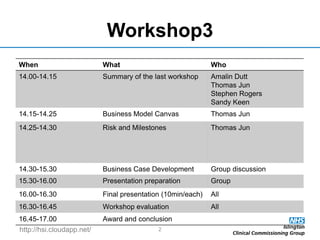
When What Who
14.00-14.15 Summary of the last workshop Amalin Dutt
Thomas Jun
Stephen Rogers
Sandy Keen
14.15-14.25 Business Model Canvas Thomas Jun
14.25-14.30 Risk and Milestones Thomas Jun
14.30-15.30 Business Case Development Group discussion
15.30-16.00 Presentation preparation Group
16.00-16.30 Final presentation (10min/each) All
16.30-16.45 Workshop evaluation All
16.45-17.00 Award and conclusion
http://hsi.cloudapp.net/
Project - Aim
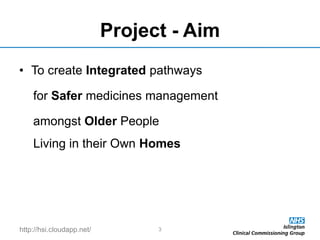
• To create Integrated pathways
for Safer medicines management
amongst Older People
Living in their Own Homes
3
http://hsi.cloudapp.net/
Three Workshops
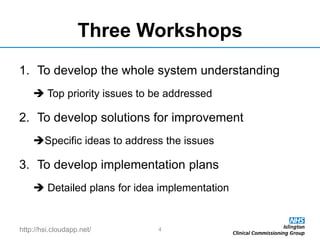
1. To develop the whole system understanding
 Top priority issues to be addressed
2. To develop solutions for improvement
Specific ideas to address the issues
3. To develop implementation plans
 Detailed plans for idea implementation
4
http://hsi.cloudapp.net/
Team
• Team A: Steve Rogers
• Team B: Leigh Sayer/Sandy Keen
• Team C: Amalin Dutt
5
Workshop 1
6
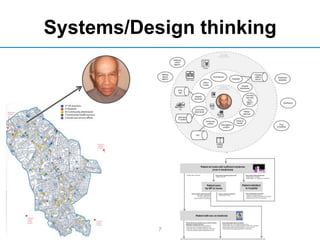
Systems/Design thinking
7
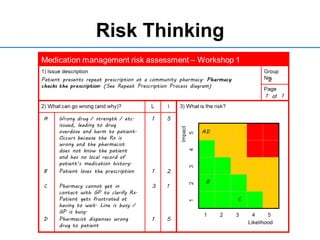
Risk Thinking
http://hsi.cloudapp.net/
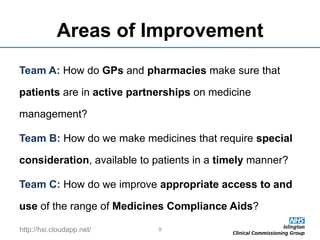
Areas of Improvement
Team A: How do GPs and pharmacies make sure that
patients are in active partnerships on medicine
management?
Team B: How do we make medicines that require special
consideration, available to patients in a timely manner?
Team C: How do we improve appropriate access to and
use of the range of Medicines Compliance Aids?
9
Workshop 2
10
http://hsi.cloudapp.net/
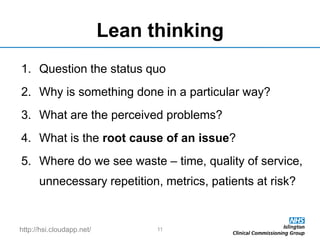
Lean thinking
1. Question the status quo
2. Why is something done in a particular way?
3. What are the perceived problems?
4. What is the root cause of an issue?
5. Where do we see waste – time, quality of service,
unnecessary repetition, metrics, patients at risk?
11
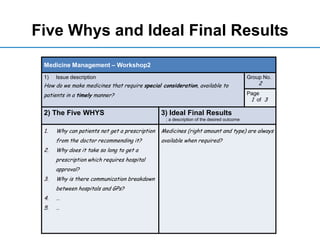
Five Whys and Ideal Final Results
Medicine Management – Workshop2
1) Issue description
How do we make medicines that require special consideration, available to
patients in a timely manner?
Group No.
2
Page
1 of 3
2) The Five WHYS 3) Ideal Final Results
; a description of the desired outcome
1. Why can patients not get a prescription
from the doctor recommending it?
2. Why does it take so long to get a
prescription which requires hospital
approval?
3. Why is there communication breakdown
between hospitals and GPs?
4. …
5. …
Medicines (right amount and type) are always
available when required?
http://hsi.cloudapp.net/
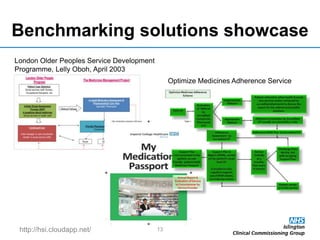
Benchmarking solutions showcase
13
London Older Peoples Service Development
Programme, Lelly Oboh, April 2003
Optimize Medicines Adherence Service
http://hsi.cloudapp.net/
Proposal - Team A
• How do GPs and pharmacies make sure that
patients are in active partnerships on
medicine management?
Teach Back
14
http://hsi.cloudapp.net/
Proposal – Team B
• How do we make medicines
that require special consideration, available to
patients in a timely manner?
 Inter-professional
Communication and Coordination
15
http://hsi.cloudapp.net/
Proposal – Team C
• How do we improve appropriate access to and
use of the range of Medicines Compliance
Aids?
 A System Change for Medicines
Optimisation in Islington
16
http://hsi.cloudapp.net/
Aim of Today’s workshop
• To develop a business case of your proposal
17
http://hsi.cloudapp.net/
Workshop - Purposes
• To develop ideas which you would never have
had if you are alone
• To challenge ourselves
• To learn new thinking and methods
• To have fun
18
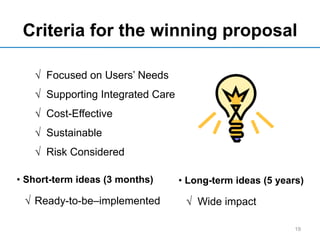
Criteria for the winning proposal
• Short-term ideas (3 months) • Long-term ideas (5 years)
19
√ Focused on Users’ Needs
√ Supporting Integrated Care
√ Cost-Effective
√ Sustainable
√ Risk Considered
√ Ready-to-be–implemented √ Wide impact
http://hsi.cloudapp.net/
Team Allocation
• Team A: Teach Back
• Team B: Inter-professional Communication
and Coordination
• Team C: A System Change for Medicines
Optimisation in Islington
20
Business Case Development
21
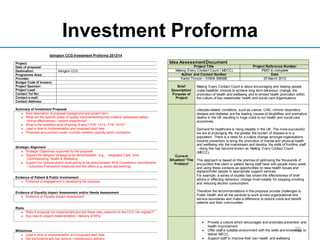
Investment Proforma
22
Islington CCG Investment Proforma 2013/14
Project:
Date of proposal:
Destination: Islington CCG
Programme Area:
Provider:
Budget Code (if known):
Project Sponsor:
Project Lead:
Contact Tel No:
Contact e-mail:
Contact Address:
Summary of Investment Proposal:
Brief description of proposal (background and project aim).
What are the specific areas of quality improvementthat this initiative addresses (safety /
clinical effectiveness / patient experience)?
What is the identified level of saving (if any)? PYE 13/14 / FYE 14/15?
Lead in time to implementation and proposed start date
Proposed procurement route / contract variation (specify which contract/s)
Strategic Alignment
Strategic Objectives supported by the proposal
Support for Islington Strategy to be demonstrated– e.g., - Integrated Care, Joint
Commissioning, Health & Wellbeing
Support for national and/or local priority to be demonstrated, NHS Constitution commitments
/ Outcomes Framework measures and five offers (e.g. seven day working)
Evidence of Patient & Public Involvement
Evidence of engagement in developing the proposal
Evidence of Equality Impact Assessment and/or Needs Assessment
Evidence of Equality Impact Assessment
Risks
Risks if proposal not implemented(and are these risks captured on the CCG risk register)?
Key risks to project implementation / delivery of KPIs
Milestones
Lead in time to implementation and proposed start date
Set out timeline with key actions / milestones to delivery
Idea AssessmentDocument
Project Title Project Reference Number
Making Every Contact Count ( MECC) PMO to complete
Author and Contact Number Date
Karen Timson – 01604 366086 25 March 2013
Brief
Description/
Purpose of
Project
Making Every Contact Count is about encouraging and helping people
make healthier choices to achieve long term behaviour change, the
promotion of health and wellbeing and to embed health promotion within
the culture of key stakeholder health and social care organisations.
Current
Situation/ ‘The
Problem’
Lifestyle-related conditions, such as cancer, CHD, chronic respiratory
disease and diabetes are the leading causes of disabilities and premature
deaths in the UK resulting in huge costs to our health and social care
economies.
Demand for healthcare is rising steadily in the UK. The more successful
we are at prolonging life, the greater the burden of disease is in a
population. There is a need for a culture change amongst organisations
towards prevention to bring the promotion of mental and physical health
and wellbeing into the mainstream and develop the skills of frontline staff
– doing this has become known as ‘Making Every Contact Count’
(MECC).
This approach is based on the premise of optimising the thousands of
encounters that client or patient facing staff have with people every week
and using these contacts as opportunities to raise health issues and
signpost/refer people to appropriate support services.
For example, a series of studies has shown the effectiveness of brief
advice in effecting behaviour change most notably for stopping smoking
and reducing alcohol consumption.
Therefore the recommendations in this proposal provide challenges to
Public Health and all the services to work across organisational and
service boundaries and make a difference to reduce costs and benefit
patients and their communities.
Provide a culture which encourages and promotes prevention and
health improvement
Offer staff a suitable environment with the skills and knowledge to
deliver MECC.
Support staff to improve their own health and wellbeing
http://hsi.cloudapp.net/
Nine Building Blocks
1. Service User Segments
2. Value Propositions
3. Channels
4. Service User Relationships
5. Outcomes
6. Key Activities
7. Key Resources
8. Key Partners
9. Expenditure
http://hsi.cloudapp.net/
1. Service User Segments
• For whom are we creating value?
http://hsi.cloudapp.net/
2. Value Propositions
• Which problems are we helping to solve?
• What propositions are we making?
http://hsi.cloudapp.net/
3. Channels
• Through which channels do our user
segments want to be reached?
26
http://hsi.cloudapp.net/
4. Service User Relationships
• What type of relationship does each of our
user segments expect us to establish and
maintain with them?
27
http://hsi.cloudapp.net/
5. Outcomes
• How much do our propositions contribute
to the NHS outcomes?
28
http://hsi.cloudapp.net/
6. Key Activities
• What key activities does our proposition
require?
29
http://hsi.cloudapp.net/
7. Key Resources
• What key resources does our propositions
require?
30
http://hsi.cloudapp.net/
8. Key Partners
• Who are our key partners?
• Which key resources are we acquiring
from partners?
• Which key activities do partners perform?
31
http://hsi.cloudapp.net/
9. Expenditure
• What are the most important costs in our
proposition?
32
http://hsi.cloudapp.net/
Business Model Canvas for Healthcare
http://prezi.com/yt_4rvu9yasi/business-
development-healthcare/
33
http://hsi.cloudapp.net/
Tips
• No more than 5 min for each block (1hr in
total)
• Use Post-it notes
• Iterative
34
http://hsi.cloudapp.net/
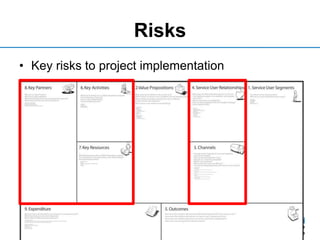
Risks
• Key risks to project implementation
35
http://hsi.cloudapp.net/
Milestones
• Timeline with key actions / milestones to delivery
36

Workshop 3: Overview

  • 1.
    Safer Medicine Management amongstOlder People Living in their Own Homes 3rd workshop 04 July 2013 http://hsi.cloudapp.net/
  • 2.
    http://hsi.cloudapp.net/ Workshop3 2 When What Who 14.00-14.15Summary of the last workshop Amalin Dutt Thomas Jun Stephen Rogers Sandy Keen 14.15-14.25 Business Model Canvas Thomas Jun 14.25-14.30 Risk and Milestones Thomas Jun 14.30-15.30 Business Case Development Group discussion 15.30-16.00 Presentation preparation Group 16.00-16.30 Final presentation (10min/each) All 16.30-16.45 Workshop evaluation All 16.45-17.00 Award and conclusion
  • 3.
    http://hsi.cloudapp.net/ Project - Aim •To create Integrated pathways for Safer medicines management amongst Older People Living in their Own Homes 3
  • 4.
    http://hsi.cloudapp.net/ Three Workshops 1. Todevelop the whole system understanding  Top priority issues to be addressed 2. To develop solutions for improvement Specific ideas to address the issues 3. To develop implementation plans  Detailed plans for idea implementation 4
  • 5.
    http://hsi.cloudapp.net/ Team • Team A:Steve Rogers • Team B: Leigh Sayer/Sandy Keen • Team C: Amalin Dutt 5
  • 6.
  • 7.
  • 8.
  • 9.
    http://hsi.cloudapp.net/ Areas of Improvement TeamA: How do GPs and pharmacies make sure that patients are in active partnerships on medicine management? Team B: How do we make medicines that require special consideration, available to patients in a timely manner? Team C: How do we improve appropriate access to and use of the range of Medicines Compliance Aids? 9
  • 10.
  • 11.
    http://hsi.cloudapp.net/ Lean thinking 1. Questionthe status quo 2. Why is something done in a particular way? 3. What are the perceived problems? 4. What is the root cause of an issue? 5. Where do we see waste – time, quality of service, unnecessary repetition, metrics, patients at risk? 11
  • 12.
    Five Whys andIdeal Final Results Medicine Management – Workshop2 1) Issue description How do we make medicines that require special consideration, available to patients in a timely manner? Group No. 2 Page 1 of 3 2) The Five WHYS 3) Ideal Final Results ; a description of the desired outcome 1. Why can patients not get a prescription from the doctor recommending it? 2. Why does it take so long to get a prescription which requires hospital approval? 3. Why is there communication breakdown between hospitals and GPs? 4. … 5. … Medicines (right amount and type) are always available when required?
  • 13.
    http://hsi.cloudapp.net/ Benchmarking solutions showcase 13 LondonOlder Peoples Service Development Programme, Lelly Oboh, April 2003 Optimize Medicines Adherence Service
  • 14.
    http://hsi.cloudapp.net/ Proposal - TeamA • How do GPs and pharmacies make sure that patients are in active partnerships on medicine management? Teach Back 14
  • 15.
    http://hsi.cloudapp.net/ Proposal – TeamB • How do we make medicines that require special consideration, available to patients in a timely manner?  Inter-professional Communication and Coordination 15
  • 16.
    http://hsi.cloudapp.net/ Proposal – TeamC • How do we improve appropriate access to and use of the range of Medicines Compliance Aids?  A System Change for Medicines Optimisation in Islington 16
  • 17.
    http://hsi.cloudapp.net/ Aim of Today’sworkshop • To develop a business case of your proposal 17
  • 18.
    http://hsi.cloudapp.net/ Workshop - Purposes •To develop ideas which you would never have had if you are alone • To challenge ourselves • To learn new thinking and methods • To have fun 18
  • 19.
    Criteria for thewinning proposal • Short-term ideas (3 months) • Long-term ideas (5 years) 19 √ Focused on Users’ Needs √ Supporting Integrated Care √ Cost-Effective √ Sustainable √ Risk Considered √ Ready-to-be–implemented √ Wide impact
  • 20.
    http://hsi.cloudapp.net/ Team Allocation • TeamA: Teach Back • Team B: Inter-professional Communication and Coordination • Team C: A System Change for Medicines Optimisation in Islington 20
  • 21.
  • 22.
    Investment Proforma 22 Islington CCGInvestment Proforma 2013/14 Project: Date of proposal: Destination: Islington CCG Programme Area: Provider: Budget Code (if known): Project Sponsor: Project Lead: Contact Tel No: Contact e-mail: Contact Address: Summary of Investment Proposal: Brief description of proposal (background and project aim). What are the specific areas of quality improvementthat this initiative addresses (safety / clinical effectiveness / patient experience)? What is the identified level of saving (if any)? PYE 13/14 / FYE 14/15? Lead in time to implementation and proposed start date Proposed procurement route / contract variation (specify which contract/s) Strategic Alignment Strategic Objectives supported by the proposal Support for Islington Strategy to be demonstrated– e.g., - Integrated Care, Joint Commissioning, Health & Wellbeing Support for national and/or local priority to be demonstrated, NHS Constitution commitments / Outcomes Framework measures and five offers (e.g. seven day working) Evidence of Patient & Public Involvement Evidence of engagement in developing the proposal Evidence of Equality Impact Assessment and/or Needs Assessment Evidence of Equality Impact Assessment Risks Risks if proposal not implemented(and are these risks captured on the CCG risk register)? Key risks to project implementation / delivery of KPIs Milestones Lead in time to implementation and proposed start date Set out timeline with key actions / milestones to delivery Idea AssessmentDocument Project Title Project Reference Number Making Every Contact Count ( MECC) PMO to complete Author and Contact Number Date Karen Timson – 01604 366086 25 March 2013 Brief Description/ Purpose of Project Making Every Contact Count is about encouraging and helping people make healthier choices to achieve long term behaviour change, the promotion of health and wellbeing and to embed health promotion within the culture of key stakeholder health and social care organisations. Current Situation/ ‘The Problem’ Lifestyle-related conditions, such as cancer, CHD, chronic respiratory disease and diabetes are the leading causes of disabilities and premature deaths in the UK resulting in huge costs to our health and social care economies. Demand for healthcare is rising steadily in the UK. The more successful we are at prolonging life, the greater the burden of disease is in a population. There is a need for a culture change amongst organisations towards prevention to bring the promotion of mental and physical health and wellbeing into the mainstream and develop the skills of frontline staff – doing this has become known as ‘Making Every Contact Count’ (MECC). This approach is based on the premise of optimising the thousands of encounters that client or patient facing staff have with people every week and using these contacts as opportunities to raise health issues and signpost/refer people to appropriate support services. For example, a series of studies has shown the effectiveness of brief advice in effecting behaviour change most notably for stopping smoking and reducing alcohol consumption. Therefore the recommendations in this proposal provide challenges to Public Health and all the services to work across organisational and service boundaries and make a difference to reduce costs and benefit patients and their communities. Provide a culture which encourages and promotes prevention and health improvement Offer staff a suitable environment with the skills and knowledge to deliver MECC. Support staff to improve their own health and wellbeing
  • 23.
    http://hsi.cloudapp.net/ Nine Building Blocks 1.Service User Segments 2. Value Propositions 3. Channels 4. Service User Relationships 5. Outcomes 6. Key Activities 7. Key Resources 8. Key Partners 9. Expenditure
  • 24.
    http://hsi.cloudapp.net/ 1. Service UserSegments • For whom are we creating value?
  • 25.
    http://hsi.cloudapp.net/ 2. Value Propositions •Which problems are we helping to solve? • What propositions are we making?
  • 26.
    http://hsi.cloudapp.net/ 3. Channels • Throughwhich channels do our user segments want to be reached? 26
  • 27.
    http://hsi.cloudapp.net/ 4. Service UserRelationships • What type of relationship does each of our user segments expect us to establish and maintain with them? 27
  • 28.
    http://hsi.cloudapp.net/ 5. Outcomes • Howmuch do our propositions contribute to the NHS outcomes? 28
  • 29.
    http://hsi.cloudapp.net/ 6. Key Activities •What key activities does our proposition require? 29
  • 30.
    http://hsi.cloudapp.net/ 7. Key Resources •What key resources does our propositions require? 30
  • 31.
    http://hsi.cloudapp.net/ 8. Key Partners •Who are our key partners? • Which key resources are we acquiring from partners? • Which key activities do partners perform? 31
  • 32.
    http://hsi.cloudapp.net/ 9. Expenditure • Whatare the most important costs in our proposition? 32
  • 33.
    http://hsi.cloudapp.net/ Business Model Canvasfor Healthcare http://prezi.com/yt_4rvu9yasi/business- development-healthcare/ 33
  • 34.
    http://hsi.cloudapp.net/ Tips • No morethan 5 min for each block (1hr in total) • Use Post-it notes • Iterative 34
  • 35.
  • 36.
    http://hsi.cloudapp.net/ Milestones • Timeline withkey actions / milestones to delivery 36

Editor's Notes

  • #3 Invite relevant stakeholders, information governance..
  • #23 Idea assessment document