Workshop
Cost of Delay In Action
Leonardo Bittencourt
linkedin.com/in/leonardokb
twitter.com/leokbittencourt
How do you prioritise?
HIPPO
LVD
LVD
Loudest Voice Dominates
HIPPO
Highest Paid Person Opinion
“If you only quantify one thing, quantify the cost of delay.” - Don Reinertsen
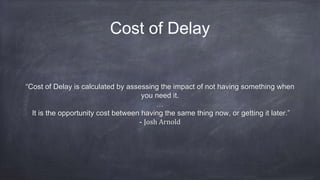
Cost of Delay
“Cost of Delay is calculated by assessing the impact of not having something when
you need it.
…
It is the opportunity cost between having the same thing now, or getting it later.”
- Josh Arnold
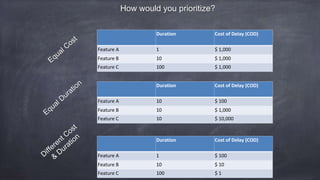
How would you prioritize?
Duration Cost of Delay (COD)
Feature A 1 $ 1,000
Feature B 10 $ 1,000
Feature C 100 $ 1,000
Duration Cost of Delay (COD)
Feature A 10 $ 100
Feature B 10 $ 1,000
Feature C 10 $ 10,000
Duration Cost of Delay (COD)
Feature A 1 $ 100
Feature B 10 $ 10
Feature C 100 $ 1
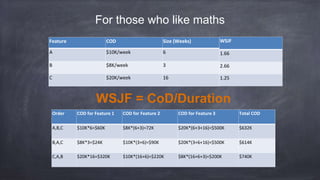
For those who like maths
Feature COD Size (Weeks)
A $10K/week 6
B $8K/week 3
C $20K/week 16
Order COD for Feature 1 COD for Feature 2 COD for Feature 3 Total COD
A,B,C $10K*6=$60K $8K*(6+3)=72K $20K*(6+3+16)=$500K $632K
B,A,C $8K*3=$24K $10K*(3+6)=$90K $20K*(3+6+16)=$500K $614K
C,A,B $20K*16=$320K $10K*(16+6)=$220K $8K*(16+6+3)=$200K $740K
WSJF
1.66
2.66
1.25
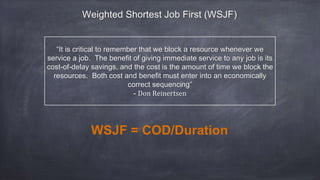
WSJF = CoD/Duration
“It is critical to remember that we block a resource whenever we
service a job. The benefit of giving immediate service to any job is its
cost-of-delay savings, and the cost is the amount of time we block the
resources. Both cost and benefit must enter into an economically
correct sequencing”
- Don Reinertsen
WSJF = COD/Duration
Weighted Shortest Job First (WSJF)
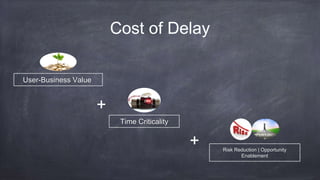
Cost of Delay
Risk Reduction | Opportunity
Enablement
User-Business Value
Time Criticality
+
+
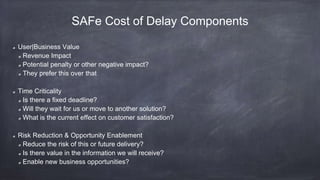
SAFe Cost of Delay Components
User|Business Value
Revenue Impact
Potential penalty or other negative impact?
They prefer this over that
Time Criticality
Is there a fixed deadline?
Will they wait for us or move to another solution?
What is the current effect on customer satisfaction?
Risk Reduction & Opportunity Enablement
Reduce the risk of this or future delivery?
Is there value in the information we will receive?
Enable new business opportunities?
Let’s build a city!
• You are a property development company, and have bought
up some farms a couple of hours commute away from the
nearest major city, bulldozed them and are planning to build
a satellite city.
• You will make money by building houses and shops and
selling them
• You have reasonable but not excessive cash reserves, so
generating cash flow will be a primary consideration
Source: www.agilenotanarchy.com/
• Your market research people have identified the first 8 major development
opportunities for the city and you have done enough research to have a view on
potential returns and effort involved
• These opportunities are “Epics” and your goal is to apply Weighted Shortest Job
First (WSJF) to prioritise them
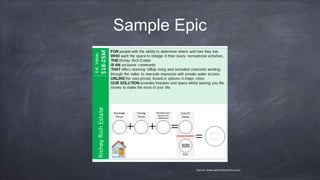
Sample Epic
Source: www.agilenotanarchy.com/
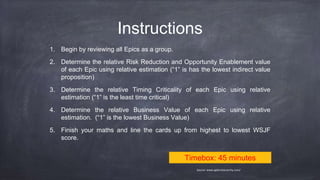
Instructions
1. Begin by reviewing all Epics as a group.
2. Determine the relative Risk Reduction and Opportunity Enablement value
of each Epic using relative estimation (“1” is has the lowest indirect value
proposition)
3. Determine the relative Timing Criticality of each Epic using relative
estimation (“1” is the least time critical)
4. Determine the relative Business Value of each Epic using relative
estimation. (“1” is the lowest Business Value)
5. Finish your maths and line the cards up from highest to lowest WSJF
score.
Timebox: 45 minutes
Source: www.agilenotanarchy.com/
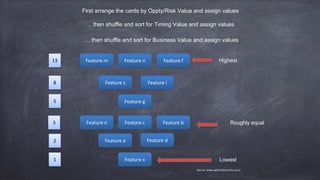
Feature x
Feature a Feature d
Feature n Feature c Feature b
Feature g
Feature s Feature i
Feature m Feature n Feature f
First arrange the cards by Oppty/Risk Value and assign values
Lowest
Highest
Roughly equal
1
2
3
5
8
13
… then shuffle and sort for Timing Value and assign values
… then shuffle and sort for Business Value and assign values
Source: www.agilenotanarchy.com/
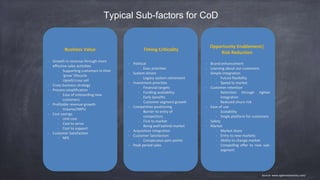
Typical Sub-factors for CoD
- Growth in revenue through more
effective sales activities
- Supporting customers in their
‘grow’ lifecycle
- Upsell/cross sell
- Cross business strategy
- Process simplification
- Ease of onboarding new
customers
- Profitable revenue growth
- Volume/ARPU
- Cost savings
- Unit cost
- Cost to serve
- Cost to support
- Customer Satisfaction
- NPS
- Political
- Exec priorities
- System driven
- Legacy system retirement
- Investment priorities
- Financial targets
- Funding availability
- Early benefits
- Customer segment growth
- Competitive positioning
- Barrier to entry of
competitors
- First to market
- Being well behind market
- Acquisition integration
- Customer Satisfaction
- Conspicuous pain points
- Peak period sales
- Brand enhancement
- Learning about our customers
- Simple integration
- Future flexibility
- Speed to market
- Customer retention
- Retention through tighter
integration
- Reduced churn risk
- Ease of use
- Scalability
- Single platform for customers
- Safety
- Market
- Market share
- Entry to new markets
- Ability to change market
- Compelling offer to new sub-
segment
Business Value Timing Criticality
Opportunity Enablement|
Risk Reduction
Source: www.agilenotanarchy.com/
References
agilenotanarchy.com
blackswanfarming.com
Thank you!!!
Questions?
Leonardo Bittencourt
linkedin.com/in/leonardokb
twitter.com/leokbittencourt

Workshop Cost of Delay In Action

  • 1.
    Workshop Cost of DelayIn Action Leonardo Bittencourt linkedin.com/in/leonardokb twitter.com/leokbittencourt
  • 2.
    How do youprioritise?
  • 3.
  • 4.
    “If you onlyquantify one thing, quantify the cost of delay.” - Don Reinertsen
  • 5.
    Cost of Delay “Costof Delay is calculated by assessing the impact of not having something when you need it. … It is the opportunity cost between having the same thing now, or getting it later.” - Josh Arnold
  • 6.
    How would youprioritize? Duration Cost of Delay (COD) Feature A 1 $ 1,000 Feature B 10 $ 1,000 Feature C 100 $ 1,000 Duration Cost of Delay (COD) Feature A 10 $ 100 Feature B 10 $ 1,000 Feature C 10 $ 10,000 Duration Cost of Delay (COD) Feature A 1 $ 100 Feature B 10 $ 10 Feature C 100 $ 1
  • 7.
    For those wholike maths Feature COD Size (Weeks) A $10K/week 6 B $8K/week 3 C $20K/week 16 Order COD for Feature 1 COD for Feature 2 COD for Feature 3 Total COD A,B,C $10K*6=$60K $8K*(6+3)=72K $20K*(6+3+16)=$500K $632K B,A,C $8K*3=$24K $10K*(3+6)=$90K $20K*(3+6+16)=$500K $614K C,A,B $20K*16=$320K $10K*(16+6)=$220K $8K*(16+6+3)=$200K $740K WSJF 1.66 2.66 1.25 WSJF = CoD/Duration
  • 8.
    “It is criticalto remember that we block a resource whenever we service a job. The benefit of giving immediate service to any job is its cost-of-delay savings, and the cost is the amount of time we block the resources. Both cost and benefit must enter into an economically correct sequencing” - Don Reinertsen WSJF = COD/Duration Weighted Shortest Job First (WSJF)
  • 9.
    Cost of Delay RiskReduction | Opportunity Enablement User-Business Value Time Criticality + +
  • 10.
    SAFe Cost ofDelay Components User|Business Value Revenue Impact Potential penalty or other negative impact? They prefer this over that Time Criticality Is there a fixed deadline? Will they wait for us or move to another solution? What is the current effect on customer satisfaction? Risk Reduction & Opportunity Enablement Reduce the risk of this or future delivery? Is there value in the information we will receive? Enable new business opportunities?
  • 11.
    Let’s build acity! • You are a property development company, and have bought up some farms a couple of hours commute away from the nearest major city, bulldozed them and are planning to build a satellite city. • You will make money by building houses and shops and selling them • You have reasonable but not excessive cash reserves, so generating cash flow will be a primary consideration Source: www.agilenotanarchy.com/ • Your market research people have identified the first 8 major development opportunities for the city and you have done enough research to have a view on potential returns and effort involved • These opportunities are “Epics” and your goal is to apply Weighted Shortest Job First (WSJF) to prioritise them
  • 12.
  • 13.
    Instructions 1. Begin byreviewing all Epics as a group. 2. Determine the relative Risk Reduction and Opportunity Enablement value of each Epic using relative estimation (“1” is has the lowest indirect value proposition) 3. Determine the relative Timing Criticality of each Epic using relative estimation (“1” is the least time critical) 4. Determine the relative Business Value of each Epic using relative estimation. (“1” is the lowest Business Value) 5. Finish your maths and line the cards up from highest to lowest WSJF score. Timebox: 45 minutes Source: www.agilenotanarchy.com/
  • 14.
    Feature x Feature aFeature d Feature n Feature c Feature b Feature g Feature s Feature i Feature m Feature n Feature f First arrange the cards by Oppty/Risk Value and assign values Lowest Highest Roughly equal 1 2 3 5 8 13 … then shuffle and sort for Timing Value and assign values … then shuffle and sort for Business Value and assign values Source: www.agilenotanarchy.com/
  • 15.
    Typical Sub-factors forCoD - Growth in revenue through more effective sales activities - Supporting customers in their ‘grow’ lifecycle - Upsell/cross sell - Cross business strategy - Process simplification - Ease of onboarding new customers - Profitable revenue growth - Volume/ARPU - Cost savings - Unit cost - Cost to serve - Cost to support - Customer Satisfaction - NPS - Political - Exec priorities - System driven - Legacy system retirement - Investment priorities - Financial targets - Funding availability - Early benefits - Customer segment growth - Competitive positioning - Barrier to entry of competitors - First to market - Being well behind market - Acquisition integration - Customer Satisfaction - Conspicuous pain points - Peak period sales - Brand enhancement - Learning about our customers - Simple integration - Future flexibility - Speed to market - Customer retention - Retention through tighter integration - Reduced churn risk - Ease of use - Scalability - Single platform for customers - Safety - Market - Market share - Entry to new markets - Ability to change market - Compelling offer to new sub- segment Business Value Timing Criticality Opportunity Enablement| Risk Reduction Source: www.agilenotanarchy.com/
  • 16.
  • 17.