SHRM
Workplace Forecast
The Top Workplace Trends According to HR Professionals
Contents
	 2	About This Report
	 3	Key Themes and Top 10 Trends	
	 6	Demographics and Society
	 13	Economics and Employment	
	 22	Science and Technology
	 30	Globalization
	 39	Public Policy and Law
	 47	Conclusion	
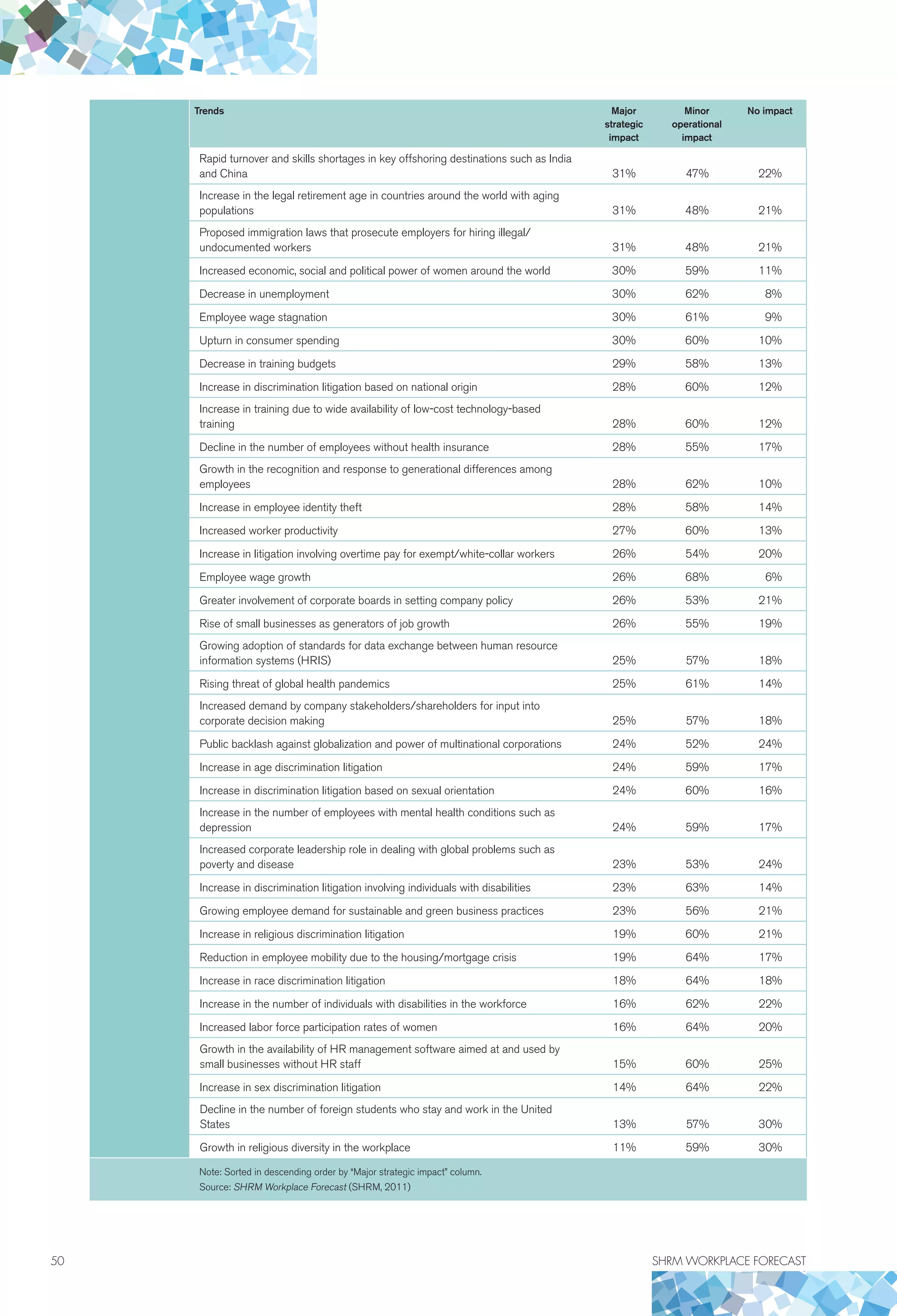
	 48	Appendix 1: Trends
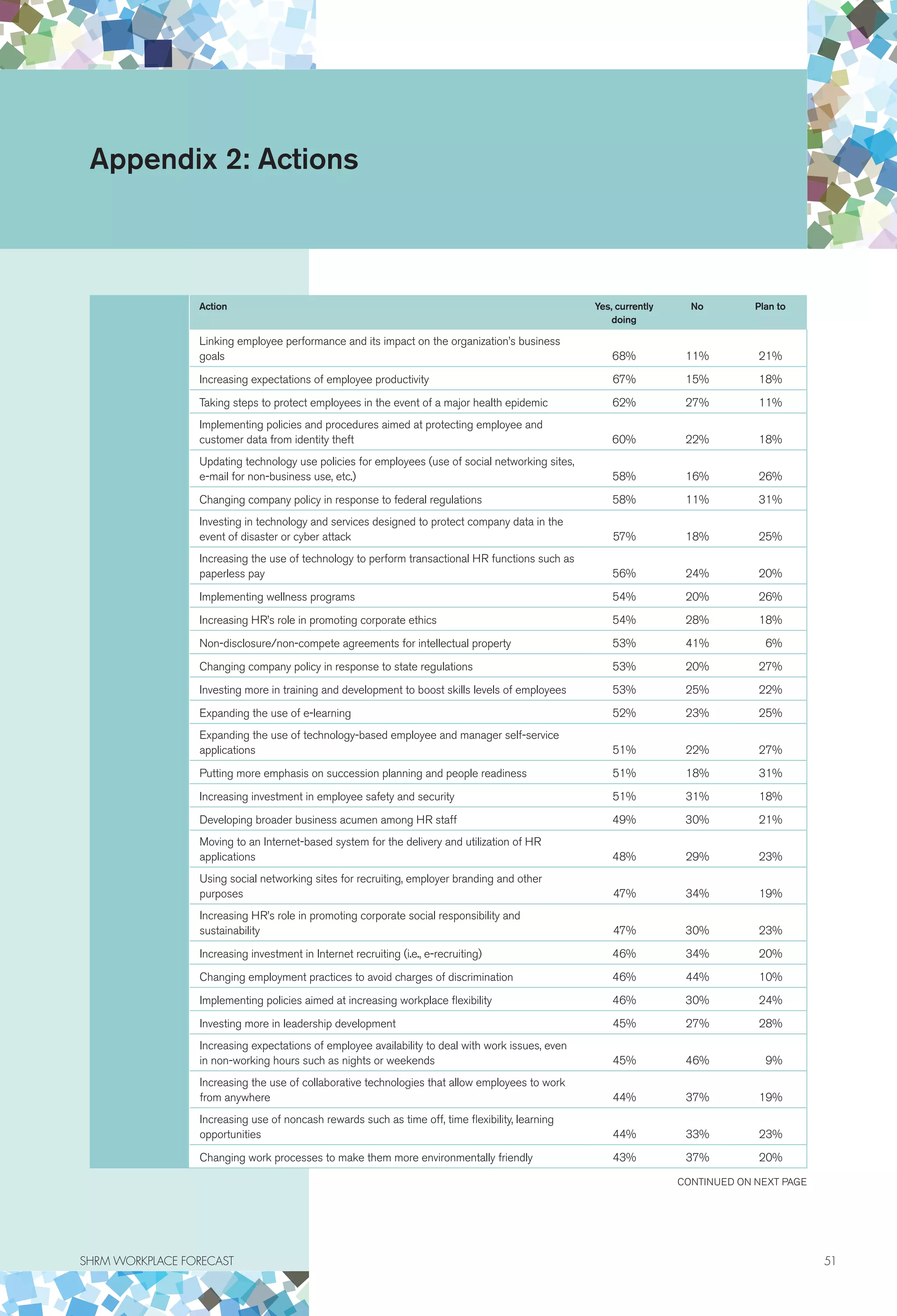
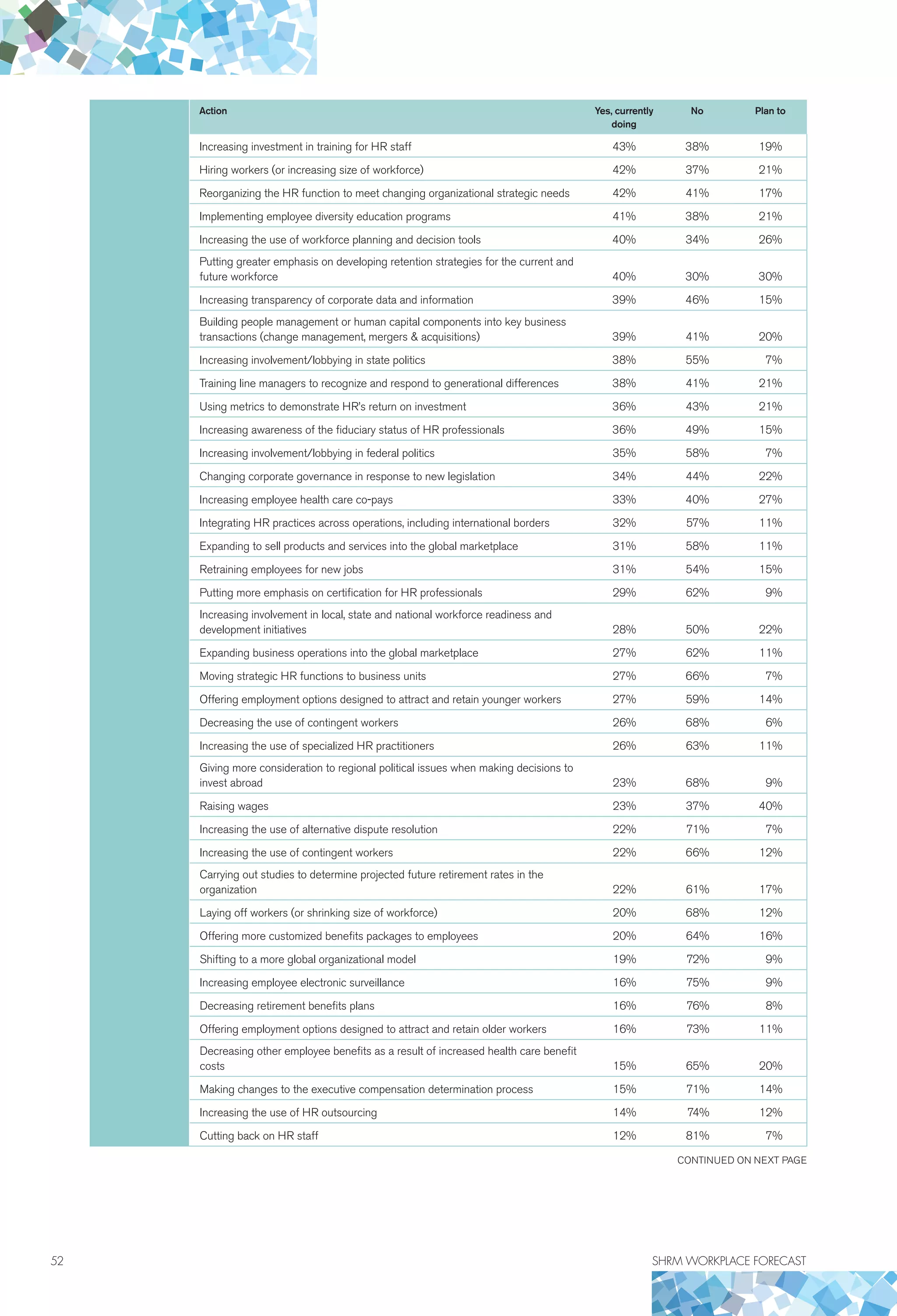
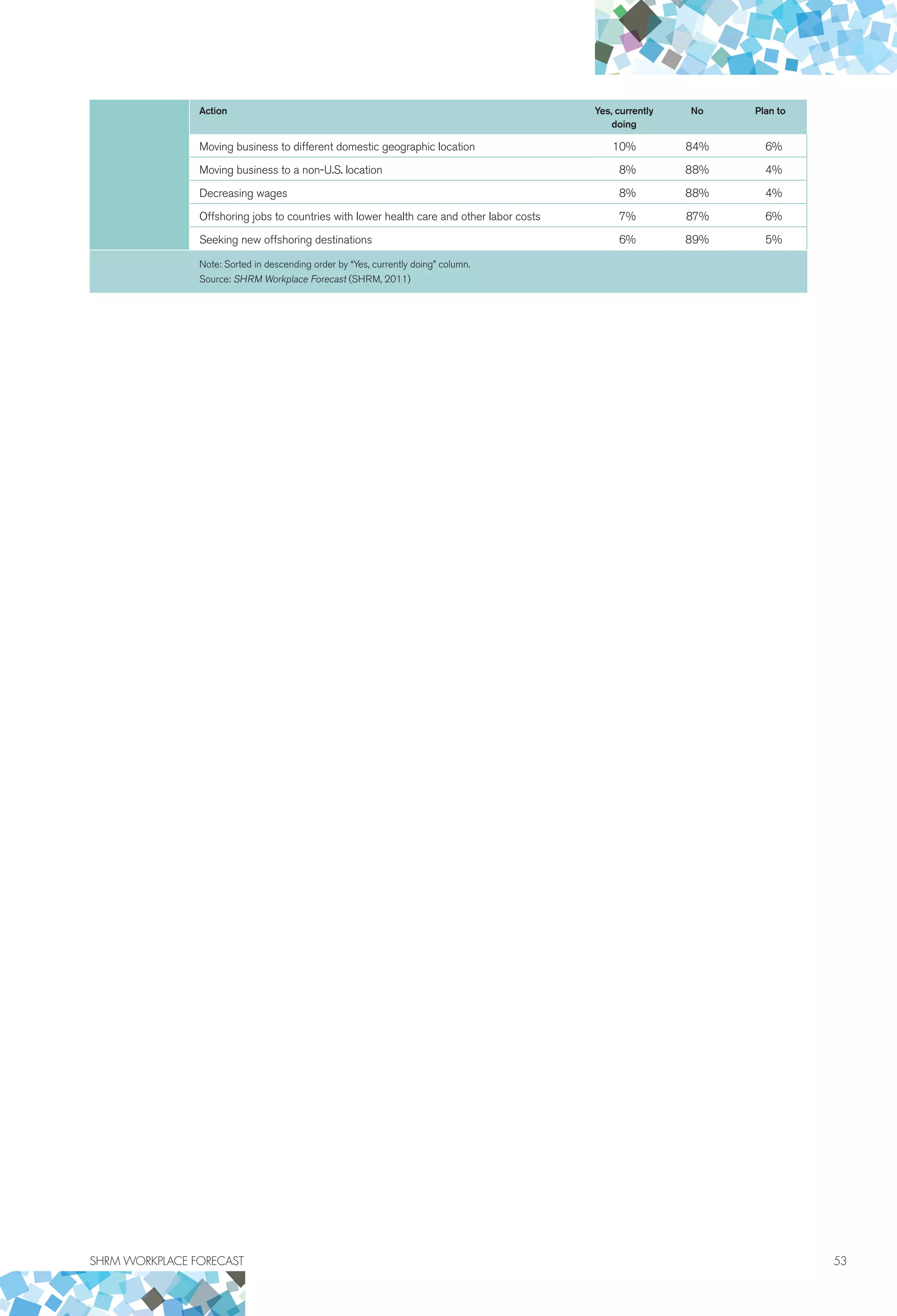
	 51	Appendix 2: Actions
	 54	Methodology
	 55	Endnotes
SHRM
Workplace Forecast
The Top Workplace Trends
According to HR Professionals
February 2011
The SHRM Workplace Forecast
is published every two years by
the Society for Human Resource
Management. The structure of
the report is based on a survey
of human resource professionals’
views on the key issues they feel
will impact the workplace in the
coming years. The report is divided
into five broad sections covering
demographics and society, eco-
nomics and employment, global
issues, public policy, and science
and technology. The survey also
asks HR professionals what actions
they and their organizations are
taking or are planning to take to
address these trends, changes and
challenges.
About This Report
2	 SHRM WORKPLACE FORECAST
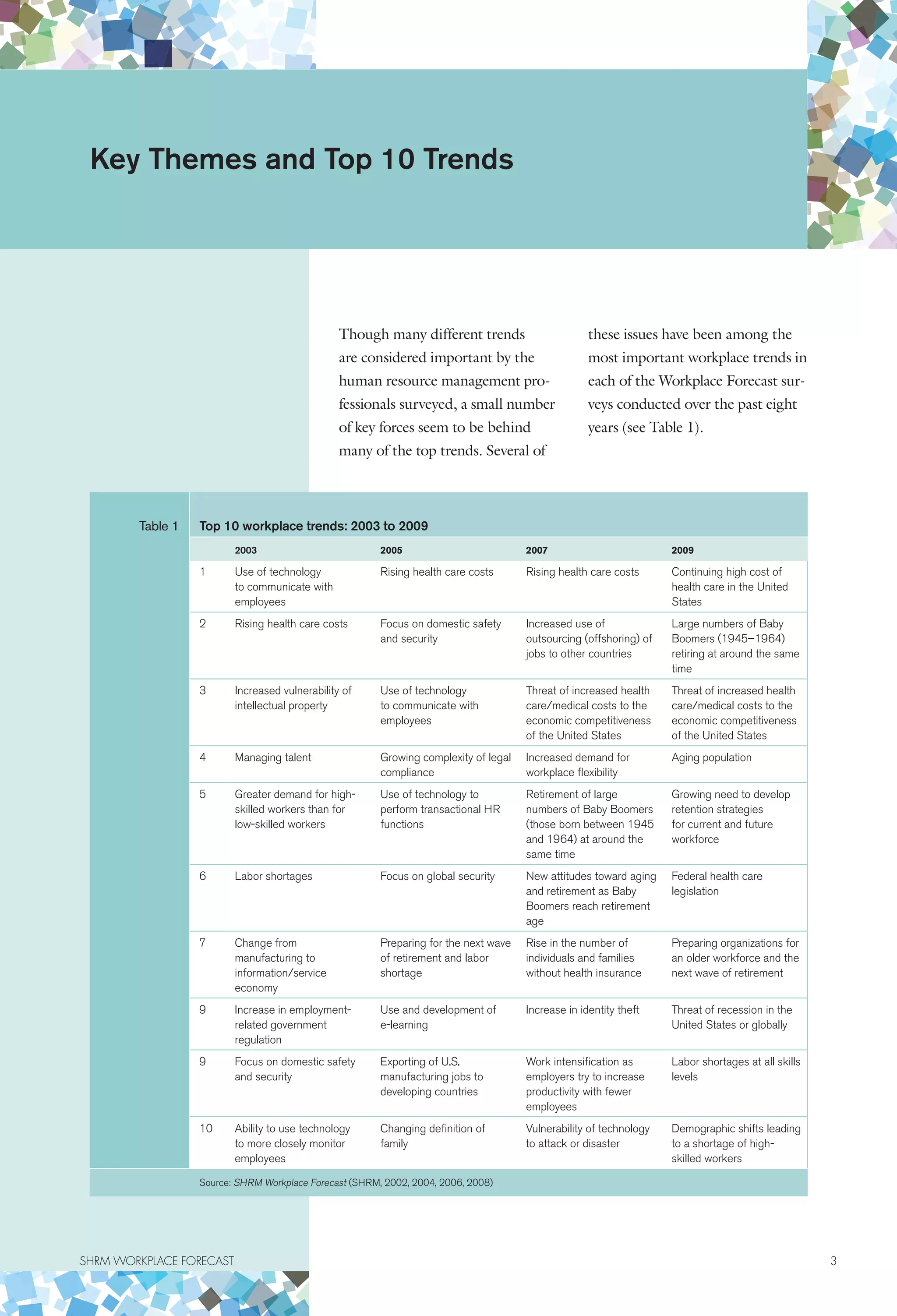
Though many different trends
are considered important by the
human resource management pro-
fessionals surveyed, a small number
of key forces seem to be behind
many of the top trends. Several of
these issues have been among the
most important workplace trends in
each of the Workplace Forecast sur-
veys conducted over the past eight
years (see Table 1).
Key Themes and Top 10 Trends
Table 1 Top 10 workplace trends: 2003 to 2009
2003 2005 2007 2009
1 Use of technology
to communicate with
employees
Rising health care costs Rising health care costs Continuing high cost of
health care in the United
States
2 Rising health care costs Focus on domestic safety
and security
Increased use of
outsourcing (offshoring) of
jobs to other countries
Large numbers of Baby
Boomers (1945–1964)
retiring at around the same
time
3 Increased vulnerability of
intellectual property
Use of technology
to communicate with
employees
Threat of increased health
care/medical costs to the
economic competitiveness
of the United States
Threat of increased health
care/medical costs to the
economic competitiveness
of the United States
4 Managing talent Growing complexity of legal
compliance
Increased demand for
workplace flexibility
Aging population
5 Greater demand for high-
skilled workers than for
low-skilled workers
Use of technology to
perform transactional HR
functions
Retirement of large
numbers of Baby Boomers
(those born between 1945
and 1964) at around the
same time
Growing need to develop
retention strategies
for current and future
workforce
6 Labor shortages Focus on global security New attitudes toward aging
and retirement as Baby
Boomers reach retirement
age
Federal health care
legislation
7 Change from
manufacturing to
information/service
economy
Preparing for the next wave
of retirement and labor
shortage
Rise in the number of
individuals and families
without health insurance
Preparing organizations for
an older workforce and the
next wave of retirement
9 Increase in employment-
related government
regulation
Use and development of
e-learning
Increase in identity theft Threat of recession in the
United States or globally
9 Focus on domestic safety
and security
Exporting of U.S.
manufacturing jobs to
developing countries
Work intensification as
employers try to increase
productivity with fewer
employees
Labor shortages at all skills
levels
10 Ability to use technology
to more closely monitor
employees
Changing definition of
family
Vulnerability of technology
to attack or disaster
Demographic shifts leading
to a shortage of high-
skilled workers
Source: SHRM Workplace Forecast (SHRM, 2002, 2004, 2006, 2008)
SHRM WORKPLACE FORECAST	 3
4	 SHRM WORKPLACE FORECAST
Ongoing themes throughout the
years include:
•	 The rising cost of health care.
•	 New technologies and greater
dependence on technology to
communicate with employees.
•	 The implications of increased
global competitiveness, espe-
cially the need for an educated
and skilled workforce.
•	 An emphasis on safety and
security from threats such as
natural disasters, terrorism,
cyber attacks, identity theft and
intellectual property theft.
•	 Issues related to demograph-
ics, especially the aging of
the workforce, the impend-
ing retirement of the Baby
Boom generation and the
greater demand for workplace
flexibility.
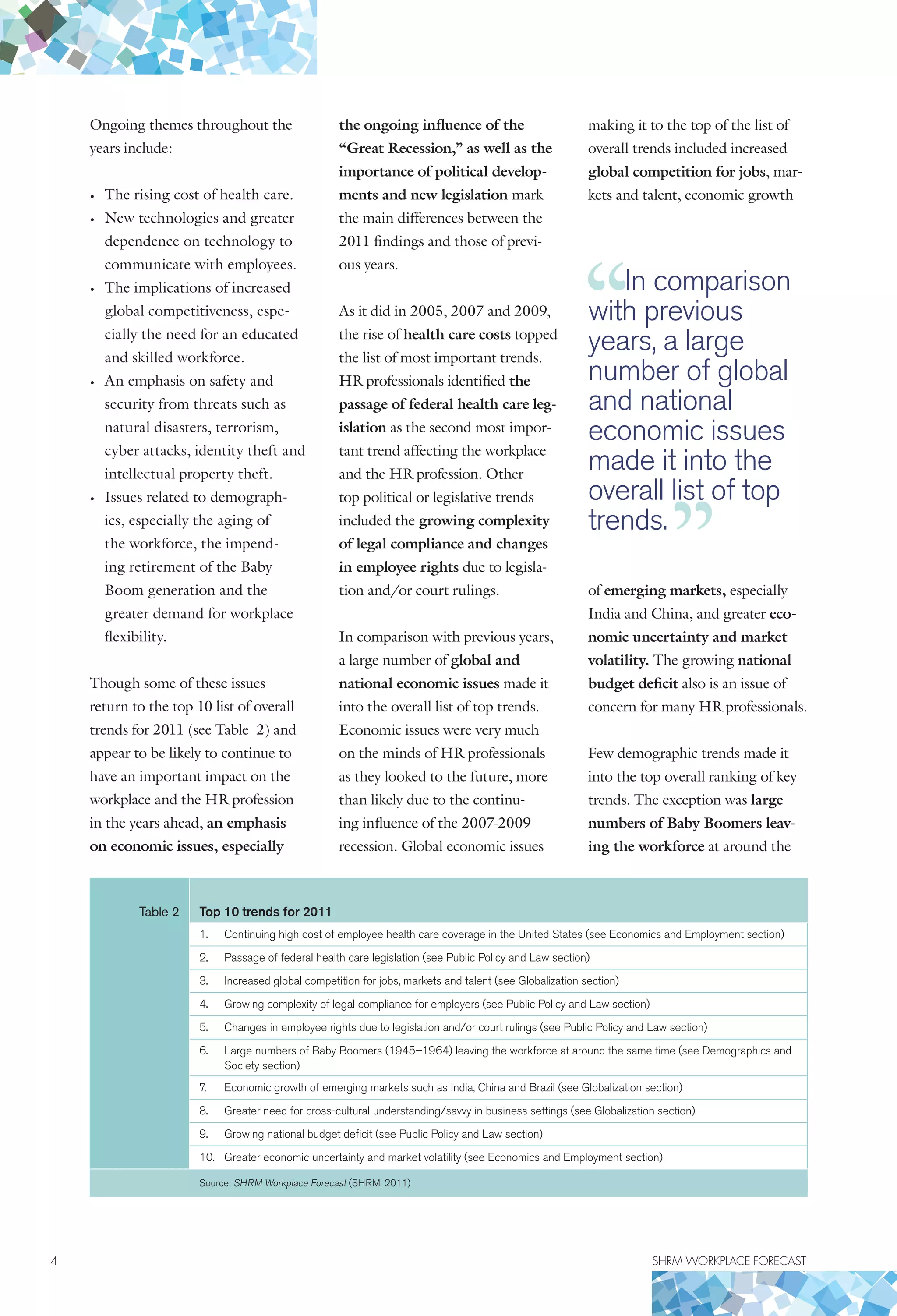
Though some of these issues
return to the top 10 list of overall
trends for 2011 (see Table 2) and
appear to be likely to continue to
have an important impact on the
workplace and the HR profession
in the years ahead, an emphasis
on economic issues, especially
the ongoing influence of the
“Great Recession,” as well as the
importance of political develop-
ments and new legislation mark
the main differences between the
2011 findings and those of previ-
ous years.
As it did in 2005, 2007 and 2009,
the rise of health care costs topped
the list of most important trends.
HR professionals identified the
passage of federal health care leg-
islation as the second most impor-
tant trend affecting the workplace
and the HR profession. Other
top political or legislative trends
included the growing complexity
of legal compliance and changes
in employee rights due to legisla-
tion and/or court rulings.
In comparison with previous years,
a large number of global and
national economic issues made it
into the overall list of top trends.
Economic issues were very much
on the minds of HR professionals
as they looked to the future, more
than likely due to the continu-
ing influence of the 2007-2009
recession. Global economic issues
making it to the top of the list of
overall trends included increased
global competition for jobs, mar-
kets and talent, economic growth
of emerging markets, especially
India and China, and greater eco-
nomic uncertainty and market
volatility. The growing national
budget deficit also is an issue of
concern for many HR professionals.
Few demographic trends made it
into the top overall ranking of key
trends. The exception was large
numbers of Baby Boomers leav-
ing the workforce at around the
Table 2 Top 10 trends for 2011
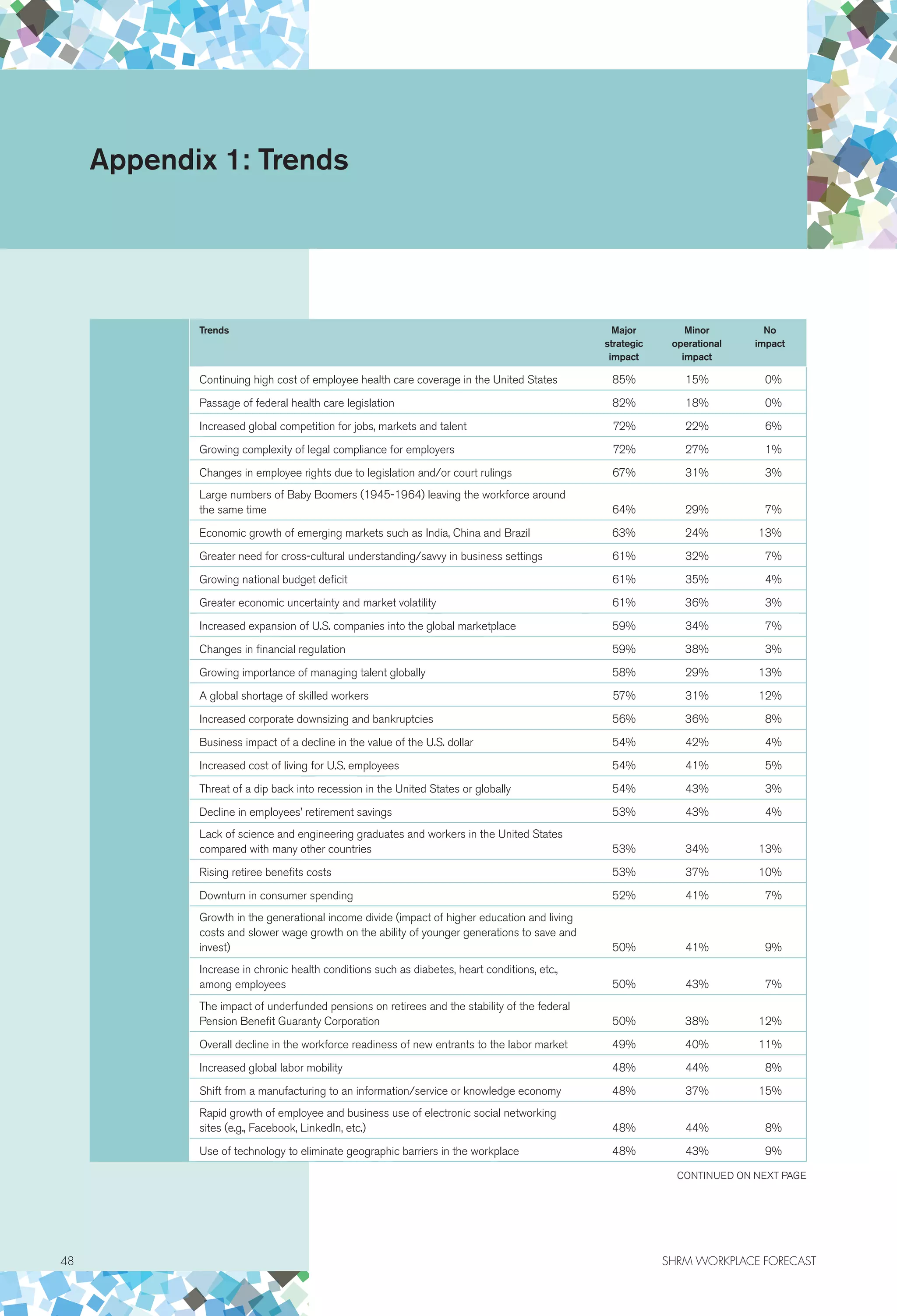
1.	 Continuing high cost of employee health care coverage in the United States (see Economics and Employment section)
2.	 Passage of federal health care legislation (see Public Policy and Law section)
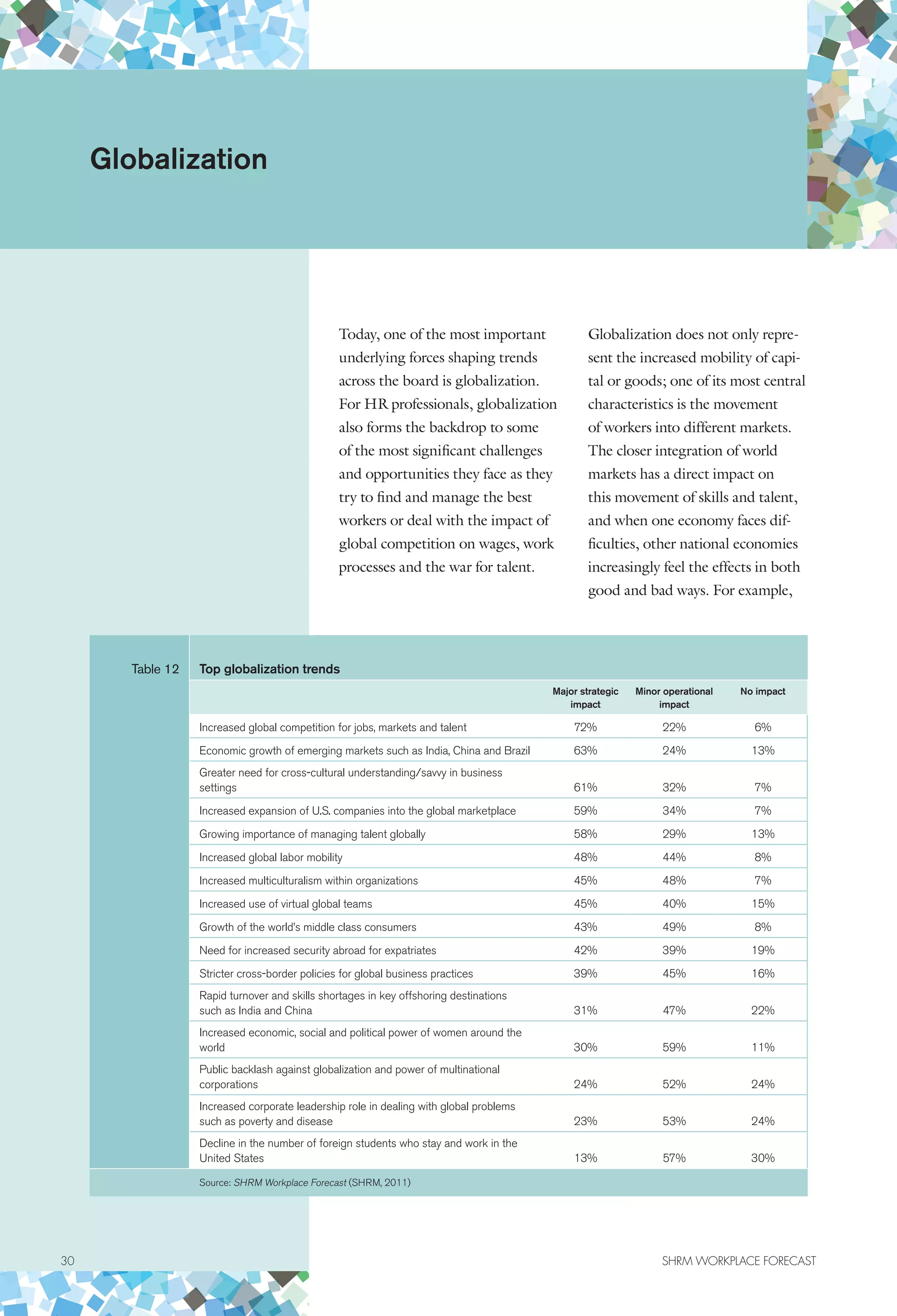
3.	 Increased global competition for jobs, markets and talent (see Globalization section)
4.	 Growing complexity of legal compliance for employers (see Public Policy and Law section)
5.	 Changes in employee rights due to legislation and/or court rulings (see Public Policy and Law section)
6.	 Large numbers of Baby Boomers (1945–1964) leaving the workforce at around the same time (see Demographics and
Society section)
7.	 Economic growth of emerging markets such as India, China and Brazil (see Globalization section)
8.	 Greater need for cross-cultural understanding/savvy in business settings (see Globalization section)
9.	 Growing national budget deficit (see Public Policy and Law section)
10.	 Greater economic uncertainty and market volatility (see Economics and Employment section)
Source: SHRM Workplace Forecast (SHRM, 2011)
In comparison
with previous
years, a large
number of global
and national
economic issues
made it into the
overall list of top
trends.
SHRM WORKPLACE FORECAST	 5
Table 3 Most common overall actions organizations have taken in response to trends
Action Yes, currently doing No Plan to
1.	 Linking employee performance and its impact on the
organization’s business goals
68% 11% 21%
2.	 Increasing expectations of employee productivity 67% 15% 18%
3.	 Taking steps to protect employees in the event of a
major health epidemic
62% 27% 11%
4.	 Implementing policies and procedures aimed at
protecting employee and customer data from identity
theft
60% 22% 18%
5.	 Updating technology use policies for employees (use of
social networking sites, e-mail for non-business use, etc.)
58% 16% 26%
6.	 Changing company policy in response to federal
regulations
58% 11% 31%
7.	 Investing in technology and services designed to protect
company data in the event of disaster or cyber attack
57% 18% 25%
8.	 Increasing the use of technology to perform transactional
HR functions
56% 24% 20%
9.	 Implementing wellness programs 54% 20% 26%
10.	 Increasing HR’s role in promoting corporate ethics 54% 28% 18%
Source: SHRM Workplace Forecast (SHRM, 2011)
same time—in 2009, the second
most important trend, but in 2011,
dropping down to number six.
The actions HR professionals say
their organizations now are taking
also are a change from those of pre-
vious years, when the emphasis was
frequently on training and educa-
tion. The impact of the economy is
clear in the top actions HR profes-
sionals reported—many focused
on how to get the most from
employees given financial and
other constraints. The top actions
included linking performance
to company goals, increasing
expectations of employee produc-
tivity (perhaps because of hiring
constraints that are making it nec-
essary for fewer employees to do
more with less). As in other years,
there remained a concern with
threats to the security of data or
the health and safety of employees
(see Table 3).
Changes in demographic and social
conditions will factor heavily into
HR professionals’ strategies for
the foreseeable future. This realm
of the workplace is focused on the
age, race, sex, geographic location
and cultural background of the
labor force (see Table 4).
The Baby Boom age group—those
born between 1946 and 1964—
was for many years the largest gen-
eration in the U.S. population, and
its members will continue to govern
many of the near-term changes in
the labor force. But the Millennial
generation now is considered to be
the largest generation in American
history and will potentially have an
even greater influence on the work-
place, politics (by 2016 Millennials
are predicted to constitute about
33% of the eligible electorate) and
society. Millions of Baby Boomers
are approaching retirement age, but
many are unprepared financially
to stop working. HR professionals
will deal with the implications of
both those who decide to stay on
the job—thus removing opportu-
nities for younger workers to enter
the fold—and those who choose to
retire and perhaps take with them
a wealth of knowledge when they
leave their companies.
The impending retirement of
the Baby Boomers may explain
why many HR professionals are
troubled about a skills shortage in
the U.S. labor force. It also may
be getting harder to import skilled
talent from other parts of the
country—poor economic condi-
tions have prevented many workers
from accepting employment in new
geographic locations, in some cases
because they are burdened with
devalued homes and cannot sell
their properties.
Also weighing on the minds of the
HR community are concerns with
the health of older employees and
workers’ increased responsibility to
care for their elderly relatives.
In response, many employers are
implementing wellness programs
and creating policies that encour-
age a more flexible workplace.
HR professionals say that more
resources are being channeled
toward training and development
to boost the skills of their employ-
ees, and that their companies also
are offering employment options
designed to attract and retain
younger workers.
Demographics and Society
6	 SHRM WORKPLACE FORECAST
SHRM WORKPLACE FORECAST	 7
Large numbers of
Baby Boomers leaving
the workforce around
the same time
Even though many older workers
are expected to stay longer on the
job, millions of others will leave
the labor force in the near future
and start their retirement. The
Bureau of Labor Statistics (BLS)
says that job openings stemming
from “replacement needs”—or
those that occur when workers
retire or otherwise leave their
occupations—are projected to be
more than double the job openings
that are created due to economic
growth from 2008 to 2018. Still,
what needs to be determined is
where exactly these retirements will
occur and if the supply of younger
workers will match specific indus-
tries. The labor force of the future
will look much different from what
it did when most Baby Boomers
started their careers. The U.S.
economy has slowly shifted from a
goods-producing entity to a service
provider. From 2008 to 2018,
service industries are expected to
add 14.6 million jobs, or 96% of
the increase in total employment.
During that same timeframe, the
manufacturing industry is expected
to shrink by 1.2 million jobs,
according to the BLS.1
A global shortage of
skilled workers
In the wake of the Great Recession,
hiring still has not become a top
priority at many businesses because
Table 4 Top demographic and social trends
Major strategic
impact
Minor operational
impact
No impact
Large numbers of Baby Boomers (1945-1964) leaving the
workforce at around the same time
64% 29% 7%
A global shortage of skilled workers 57% 31% 12%
Increase in chronic health conditions such as diabetes, heart
conditions, etc., among employees
50% 43% 7%
Growth in the number of employees with caring responsibilities
(elder care, child care, both elder care and child care at the same
time)
47% 48% 5%
Employee backlash against rising benefits costs 44% 51% 5%
Increased employee demand for workplace flexibility 43% 50% 7%
An increased proportion of older workers in the workforce 40% 48% 12%
Increased concerns about safety and security in the workplace 38% 55% 7%
Growth in the number of employees with English as a second
language
38% 51% 11%
Rise in the number of employees with untreated physical and
mental health conditions in the workplace
36% 51% 13%
Higher rates of immigration and an increase in the number of
foreign-born workers
32% 53% 15%
Decline in the number of employees without health insurance 28% 55% 17%
Growth in the recognition and response to generational
differences among employees
28% 62% 10%
Increase in employee identity theft 28% 58% 14%
Increased demand by company stakeholders/shareholders for
input into corporate decision-making
25% 57% 18%
Increase in the number of employees with mental health
conditions such as depression
24% 59% 17%
Growing employee demand for sustainable and green business
practices
23% 56% 21%
Increase in the number of individuals with disabilities in the
workforce
16% 62% 22%
Increased labor force participation rates of women 16% 64% 20%
Growth in religious diversity in the workplace 11% 59% 30%
Source: SHRM Workplace Forecast (SHRM, 2011)
8	 SHRM WORKPLACE FORECAST
of continued weak demand for
their products. Nevertheless, HR
professionals see a long-term prob-
lem with skills shortages in the
labor force. Other research con-
ducted by SHRM bears this out,
particularly a post-recession hiring
poll from the spring of 2010. Sixty-
two percent of companies that
planned to conduct hiring in 2010
were asked if their new jobs would
require different skill sets. Among
those who responded “yes,” a com-
bined 39% said they expected to
encounter some degree of difficulty
in finding qualified individuals for
those new positions (see Figure 1).2
Elsewhere, SHRM’s Leading
Indicators of National Employment
(LINE) report has a recruiting dif-
ficulty index that measures how
hard it is for companies to find can-
didates to fill positions of “great-
est strategic importance” to their
businesses. While that index dipped
sharply (i.e., companies in the man-
ufacturing and service industries
reported less recruiting difficulty)
during 2008 and early 2009, it
rose consistently every month in
late 2009, through most of 2010
and in the early months of 2011,
when compared with the previ-
ous year. Even during a time when
there are several workers available
for every open position in the U.S.
labor force, HR professionals still
are having trouble finding the right
people to match the skills required
for their job openings.3
Increase in chronic health
issues among employees
Aside from the personal risks that
many Americans with chronic
health issues face, the rise in such
ailments has a twofold negative
impact on HR professionals and
their companies. Treatment for
these illnesses can drive up the
cost of providing health care, and
productivity in the workplace is
lost when these employees need
extended time away from their jobs
to deal with their health issues.
Half of HR professionals said the
increase in long-term health issues,
such as diabetes, obesity and heart
conditions, is having a major strate-
gic impact on their operations.
This has added significance as the
labor force gets older as a whole.
The Centers for Disease Control
and Prevention (CDC) esti-
mates that 23.6 million people
in the United States have diabe-
tes, or 7.8% of the U.S. popula-
tion. The rate rises dramatically
for older persons—12.2 million
people aged 60 years or older have
diabetes, or 23.1% of all people
in that age group in the United
States.4
In 2010, the CDC esti-
mated that heart disease would cost
the United States $316.4 billion,
which includes the cost of health
care services, medications and lost
productivity at work.5
The rise of
obesity in the United States and
around the world also puts millions
of people at higher risk for other
long-term health issues. The CDC
estimates that 26.7% of the U.S.
population is obese, and again,
older persons have a higher rate of
obesity than the national average
(31.1% of those aged 50 to 59 are
obese, 30.9% of those aged 60 to
69 are obese).6
Figure 1 If your company will need a different skill set for new jobs in the post-recession workplace, how
difficult do you think it will be to find qualified individuals for those positions?
Very difficult
Somewhat difficult
Somewhat easy
Very easy
3%
36%
45%
16%
Source: Society for Human Resource Management. (2010, March). SHRM poll: Post-recession hiring. Retrieved from www.shrm.org.
HR
professionals
see a long-term
problem with skills
shortages in the
labor force.
SHRM WORKPLACE FORECAST	 9
Growth in the number of
employees with caring
responsibilities
“Workers with caring responsi-
bilities” are defined as those who
provide caregiving for children,
elderly persons or both at the same
time. These workers may require
flexible schedules, extended periods
of leave time and other accommo-
dations that can have an impact on
productivity. A 2009 study by the
National Alliance for Caregiving
in collaboration with the AARP
shows that caring responsibilities
are on the rise as the population
ages. Caregivers in 2009 were more
likely to report that they shifted
their arrival or departure times or
took time off to provide care com-
pared with respondents in 2004
(57% in 2004, 66% in 2009) as
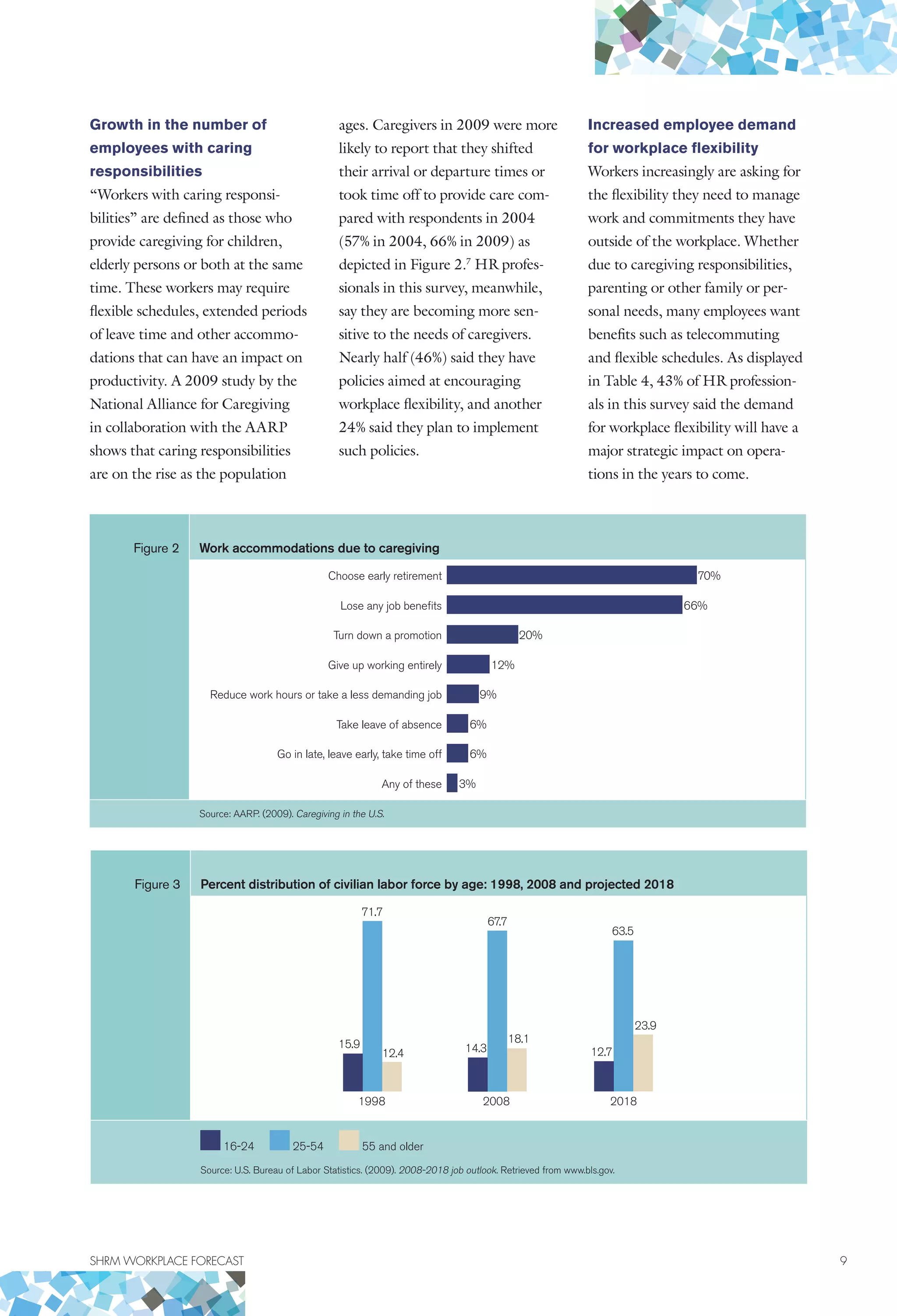
depicted in Figure 2.7
HR profes-
sionals in this survey, meanwhile,
say they are becoming more sen-
sitive to the needs of caregivers.
Nearly half (46%) said they have
policies aimed at encouraging
workplace flexibility, and another
24% said they plan to implement
such policies.
Increased employee demand
for workplace flexibility
Workers increasingly are asking for
the flexibility they need to manage
work and commitments they have
outside of the workplace. Whether
due to caregiving responsibilities,
parenting or other family or per-
sonal needs, many employees want
benefits such as telecommuting
and flexible schedules. As displayed
in Table 4, 43% of HR profession-
als in this survey said the demand
for workplace flexibility will have a
major strategic impact on opera-
tions in the years to come.
Figure 2 Work accommodations due to caregiving
Choose early retirement
Lose any job benefits
Turn down a promotion
Give up working entirely
Reduce work hours or take a less demanding job
Take leave of absence
Go in late, leave early, take time off
Any of these
70%
66%
20%
12%
9%
6%
6%
3%
Source: AARP. (2009). Caregiving in the U.S.
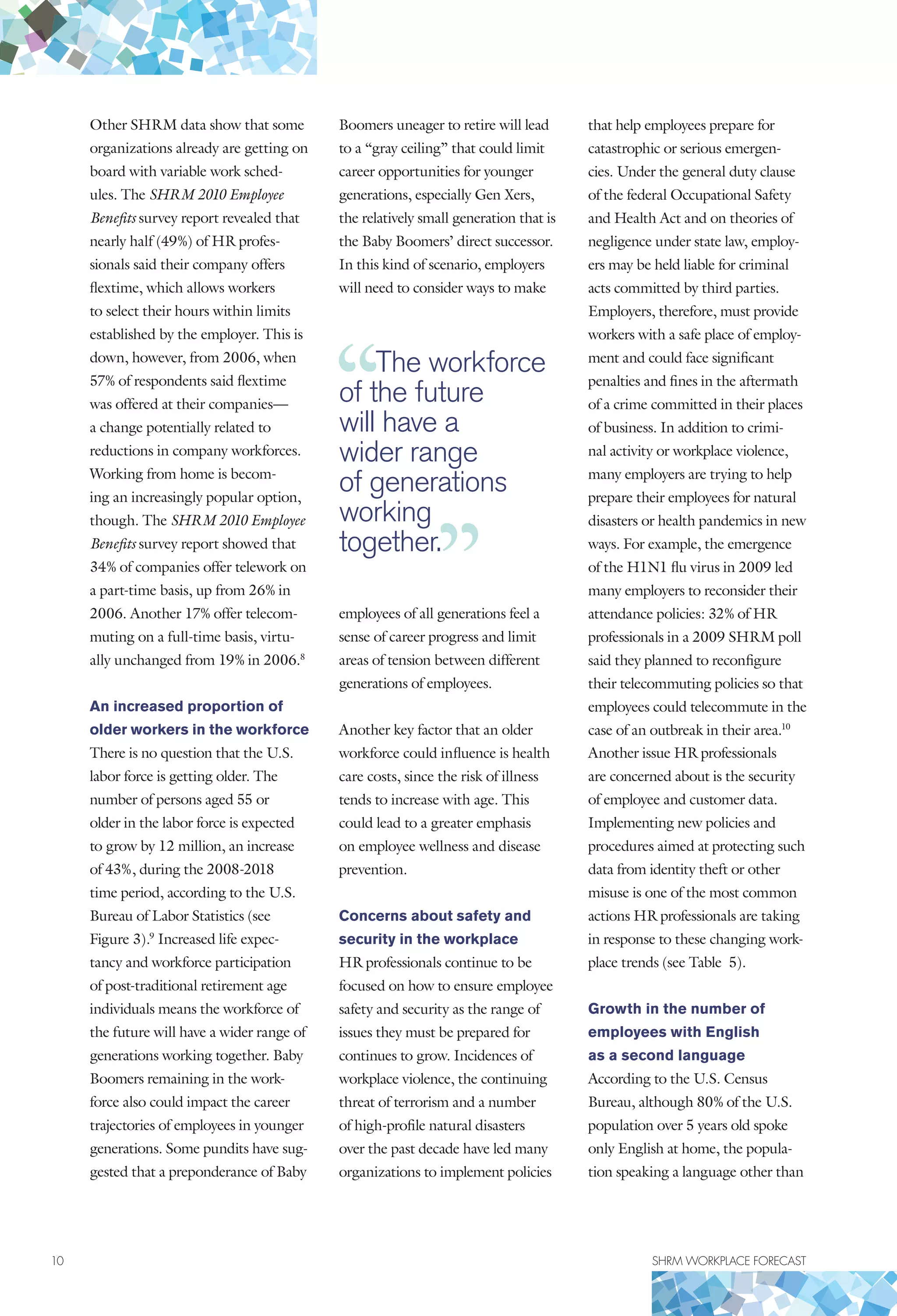
Figure 3 Percent distribution of civilian labor force by age: 1998, 2008 and projected 2018
15.9
71.7
12.4 14.3
67.7
18.1
12.7
63.5
23.9
1998 2008 2018
16-24 25-54 55 and older
Source: U.S. Bureau of Labor Statistics. (2009). 2008-2018 job outlook. Retrieved from www.bls.gov.
10	 SHRM WORKPLACE FORECAST
Other SHRM data show that some
organizations already are getting on
board with variable work sched-
ules. The SHRM 2010 Employee
Benefits survey report revealed that
nearly half (49%) of HR profes-
sionals said their company offers
flextime, which allows workers
to select their hours within limits
established by the employer. This is
down, however, from 2006, when
57% of respondents said flextime
was offered at their companies—
a change potentially related to
reductions in company workforces.
Working from home is becom-
ing an increasingly popular option,
though. The SHRM 2010 Employee
Benefits survey report showed that
34% of companies offer telework on
a part-time basis, up from 26% in
2006. Another 17% offer telecom-
muting on a full-time basis, virtu-
ally unchanged from 19% in 2006.8
An increased proportion of
older workers in the workforce
There is no question that the U.S.
labor force is getting older. The
number of persons aged 55 or
older in the labor force is expected
to grow by 12 million, an increase
of 43%, during the 2008-2018
time period, according to the U.S.
Bureau of Labor Statistics (see
Figure 3).9
Increased life expec-
tancy and workforce participation
of post-traditional retirement age
individuals means the workforce of
the future will have a wider range of
generations working together. Baby
Boomers remaining in the work-
force also could impact the career
trajectories of employees in younger
generations. Some pundits have sug-
gested that a preponderance of Baby
Boomers uneager to retire will lead
to a “gray ceiling” that could limit
career opportunities for younger
generations, especially Gen Xers,
the relatively small generation that is
the Baby Boomers’ direct successor.
In this kind of scenario, employers
will need to consider ways to make
employees of all generations feel a
sense of career progress and limit
areas of tension between different
generations of employees.
Another key factor that an older
workforce could influence is health
care costs, since the risk of illness
tends to increase with age. This
could lead to a greater emphasis
on employee wellness and disease
prevention.
Concerns about safety and
security in the workplace
HR professionals continue to be
focused on how to ensure employee
safety and security as the range of
issues they must be prepared for
continues to grow. Incidences of
workplace violence, the continuing
threat of terrorism and a number
of high-profile natural disasters
over the past decade have led many
organizations to implement policies
that help employees prepare for
catastrophic or serious emergen-
cies. Under the general duty clause
of the federal Occupational Safety
and Health Act and on theories of
negligence under state law, employ-
ers may be held liable for criminal
acts committed by third parties.
Employers, therefore, must provide
workers with a safe place of employ-
ment and could face significant
penalties and fines in the aftermath
of a crime committed in their places
of business. In addition to crimi-
nal activity or workplace violence,
many employers are trying to help
prepare their employees for natural
disasters or health pandemics in new
ways. For example, the emergence
of the H1N1 flu virus in 2009 led
many employers to reconsider their
attendance policies: 32% of HR
professionals in a 2009 SHRM poll
said they planned to reconfigure
their telecommuting policies so that
employees could telecommute in the
case of an outbreak in their area.10
Another issue HR professionals
are concerned about is the security
of employee and customer data.
Implementing new policies and
procedures aimed at protecting such
data from identity theft or other
misuse is one of the most common
actions HR professionals are taking
in response to these changing work-
place trends (see Table 5).
Growth in the number of
employees with English
as a second language
According to the U.S. Census
Bureau, although 80% of the U.S.
population over 5 years old spoke
only English at home, the popula-
tion speaking a language other than
The workforce
of the future
will have a
wider range
of generations
working
together.
SHRM WORKPLACE FORECAST	 11
English has been increasing steadily
for the last three decades. Out of
the 55.4 million people who spoke
a language other than English at
home, most (62%) spoke Spanish
(34.5 million speakers), 19% spoke
an Indo-European language (10.3
million speakers), 15% spoke an
Asian and Pacific Island language
(8.3 million speakers), and 4% (2.3
million speakers) spoke a language
not covered in the above classifi-
cations. Though the majority of
speakers across all four of the major
language groups reported speaking
English well, the number of individ-
uals for whom English is not their
first language is likely to continue
to rise in the short term.11
This,
along with a growing multilingual
customer base for many businesses,
could lead some organizations to
consider new ways of communicat-
ing with customers and employees.
It also could enhance the demand
for employees who speak multiple
languages.
Rise in the number of
employees with untreated
physical and mental health
conditions in the workplace
It may be too soon to tell precisely
what impact federal health care
legislation will have on the number
of individuals without health insur-
ance. But even with the new law in
place, HR professionals continue
to be concerned that a growing
number of employees may be going
without the needed treatments for
both physical and mental health
conditions. With health care costs
continuing to climb, many orga-
nizations may shift more health
care costs onto employees, and
this could lead some employees to
either eliminate or underuse pre-
scribed medications or to put off
some types of medical interven-
tions. HR professionals therefore
may need to consider the impli-
cations on productivity or health
and safety that changes in coverage
could have on their workforce.
HR
professionals
continue to be
concerned that a
growing number
of employees may
be going without
the needed
treatments for
both physical and
mental health
conditions.
12	 SHRM WORKPLACE FORECAST
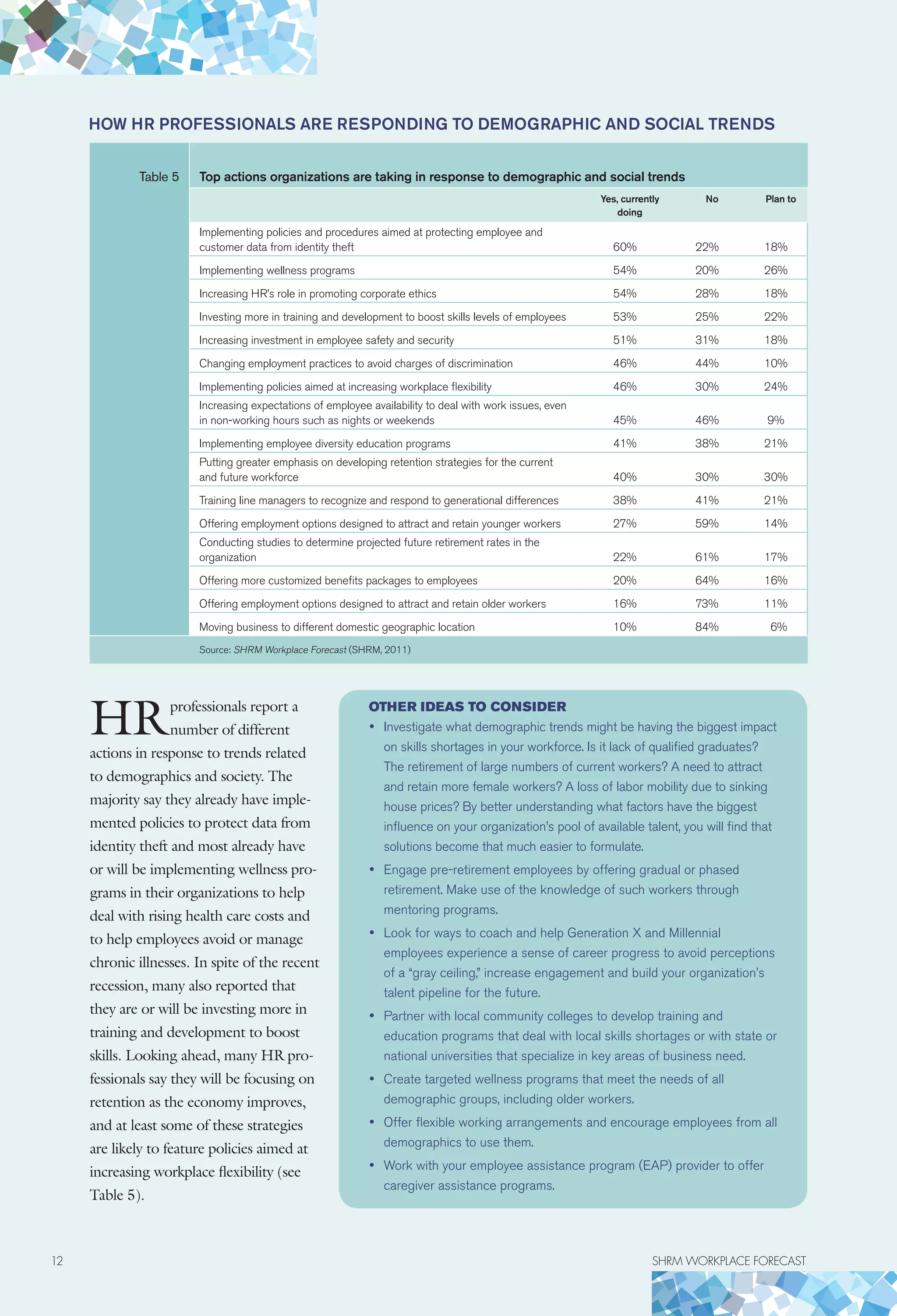
Table 5 Top actions organizations are taking in response to demographic and social trends
Yes, currently
doing
No Plan to
Implementing policies and procedures aimed at protecting employee and
customer data from identity theft 60% 22% 18%
Implementing wellness programs 54% 20% 26%
Increasing HR’s role in promoting corporate ethics 54% 28% 18%
Investing more in training and development to boost skills levels of employees 53% 25% 22%
Increasing investment in employee safety and security 51% 31% 18%
Changing employment practices to avoid charges of discrimination 46% 44% 10%
Implementing policies aimed at increasing workplace flexibility 46% 30% 24%
Increasing expectations of employee availability to deal with work issues, even
in non-working hours such as nights or weekends 45% 46% 9%
Implementing employee diversity education programs 41% 38% 21%
Putting greater emphasis on developing retention strategies for the current
and future workforce 40% 30% 30%
Training line managers to recognize and respond to generational differences 38% 41% 21%
Offering employment options designed to attract and retain younger workers 27% 59% 14%
Conducting studies to determine projected future retirement rates in the
organization 22% 61% 17%
Offering more customized benefits packages to employees 20% 64% 16%
Offering employment options designed to attract and retain older workers 16% 73% 11%
Moving business to different domestic geographic location 10% 84% 6%
Source: SHRM Workplace Forecast (SHRM, 2011)
How HR professionals are responding to demographic and social trends
HRprofessionals report a
number of different
actions in response to trends related
to demographics and society. The
majority say they already have imple-
mented policies to protect data from
identity theft and most already have
or will be implementing wellness pro-
grams in their organizations to help
deal with rising health care costs and
to help employees avoid or manage
chronic illnesses. In spite of the recent
recession, many also reported that
they are or will be investing more in
training and development to boost
skills. Looking ahead, many HR pro-
fessionals say they will be focusing on
retention as the economy improves,
and at least some of these strategies
are likely to feature policies aimed at
increasing workplace flexibility (see
Table 5).
Other ideas to consider
•	 Investigate what demographic trends might be having the biggest impact
on skills shortages in your workforce. Is it lack of qualified graduates?
The retirement of large numbers of current workers? A need to attract
and retain more female workers? A loss of labor mobility due to sinking
house prices? By better understanding what factors have the biggest
influence on your organization’s pool of available talent, you will find that
solutions become that much easier to formulate.
•	 Engage pre-retirement employees by offering gradual or phased
retirement. Make use of the knowledge of such workers through
mentoring programs.
•	 Look for ways to coach and help Generation X and Millennial
employees experience a sense of career progress to avoid perceptions
of a “gray ceiling,” increase engagement and build your organization’s
talent pipeline for the future.
•	 Partner with local community colleges to develop training and
education programs that deal with local skills shortages or with state or
national universities that specialize in key areas of business need.
•	 Create targeted wellness programs that meet the needs of all
demographic groups, including older workers.
•	 Offer flexible working arrangements and encourage employees from all
demographics to use them.
•	 Work with your employee assistance program (EAP) provider to offer
caregiver assistance programs.
SHRM WORKPLACE FORECAST	 13
Economic and employment issues
have been at the forefront of HR
professionals’ concerns since the
2007-2009 global recession began
in December 2007. HR profes-
sionals in some countries that
already are in strong growth mode
may be more focused on taking
advantage of the opportunities for
growth that their dynamic national
economies are offering. However,
many HR professionals, includ-
ing the U.S.-based respondents of
this survey, continue to see a chal-
lenging economic environment
ahead. The economic and employ-
ment facets of HR operations are
connected to everything from the
actual production of materials and
services provided by a company, to
trends in hiring and salaries and the
availability of workers. As in previ-
ous years, HR professionals cited
the high cost of health care cover-
age as having a major impact on
operations in the future. However,
the economic uncertainty brought
on by the recession and the related
volatility of corporate earnings
and the stock market also were
prevalent among HR professionals’
concerns.
The HR community is looking
ahead and studying the potential
long-term impacts of the 2007-
2009 recession. Even as fiscal
conditions improved in the first
half of 2010, some economic indi-
cators remained weak as the year
drew to a close, prompting many
HR professionals to remain wary
of the economy dipping back into
another downturn. They also are
concerned about workers who have
not saved enough for retirement
during these recent lean years and
a growing income gap between
younger and older workers that was
brought on by job losses, salary
freezes and cuts at many companies
in the past two years (see Table 6).
Continuing high cost of
employee health care
coverage in the United States
Health care reform took center
stage in Congress in 2010, and
HR professionals still are trying
to determine what it will mean for
their employers and their workers.
The rise in health care costs has
been a top concern of HR repre-
sentatives for the past several years,
and that will not change as benefits
experts navigate the changes associ-
ated with the 2010 health care bill.
According to the most recent
SHRM Health Care Benchmarking
Study, “the average annual health
care cost per covered employee
in 2009 for all industries was
$8,026, including employer-paid
Economics and Employment
14	 SHRM WORKPLACE FORECAST
premiums, administration costs
and any possible individual medi-
cal claims covered by the employer.
That is, organizations typically
paid $8,026 in health care costs
for each employee who enrolled
in an employer-sponsored health
care plan.”12
The report observes
that actual health care costs for
any organization depend on many
factors such as the “demographic
make-up of those being insured,
the actual percentage the organi-
zation contributes to health care
premiums and the history of insur-
ance claims the organization filed
in previous years.” The findings
show that publicly owned for-profit
companies had the highest average
health care premium for employee-
only coverage, at $448, and the
Table 6 Top economic and employment trends
Major
strategic
impact
Minor
operational
impact
No impact
Continuing high cost of employee health care coverage in the United States 85% 15% 0%
Greater economic uncertainty and market volatility 61% 36% 3%
Increased corporate downsizing and bankruptcies 56% 36% 8%
Business impact of a decline in the value of the U.S. dollar 54% 42% 4%
Increased cost of living for U.S. employees 54% 41% 5%
Threat of a dip back into recession in the United States or globally 54% 43% 3%
Decline in employees’ retirement savings 53% 43% 4%
Rising retiree benefits costs 53% 37% 10%
Downturn in consumer spending 52% 41% 7%
Growth in the generational income divide (impact of higher education and living
costs and slower wage growth on ability of younger generations to save and
invest) 50% 41% 9%
Overall decline in the workforce readiness of new entrants to the labor market 49% 40% 11%
Shift from a manufacturing to an information/service or knowledge economy 48% 37% 15%
Increased demand for greater transparency of corporate data and information 45% 47% 8%
Potential rise in fuel/gasoline prices in the United States and globally 44% 50% 6%
Increased use of outsourcing of jobs within the United States 43% 45% 12%
Rising higher education costs (impact on graduation rates, debt and availability of
educated workers) 43% 43% 14%
Increased mergers and acquisitions (MA) activity 42% 48% 10%
Increasing employee concerns about job security 41% 51% 8%
Greater use of contingent workers 38% 48% 14%
Increased use of offshoring 37% 45% 18%
Rise in underemployment (job seekers can only find part-time jobs or are in jobs
for which they are overqualified) 37% 53% 10%
Growth in the income divide between high- and low-paid workers 36% 54% 10%
Growth in unions in nontraditional sectors and industries 35% 44% 21%
Changes in negotiating strategies, tactics and processes used by organized labor 34% 47% 19%
Increased economic interdependence of countries and cultures 34% 50% 16%
Decrease in unemployment 30% 62% 8%
Employee wage stagnation 30% 61% 9%
Upturn in consumer spending 30% 60% 10%
Employee wage growth 26% 68% 6%
Greater involvement of corporate boards in setting company policy 26% 53% 21%
Rise of small businesses as generators of job growth 26% 55% 19%
Reduction in employee mobility due to the housing/mortgage crisis 19% 64% 17%
Source: SHRM Workplace Forecast (SHRM, 2011)
SHRM WORKPLACE FORECAST	 15
industry with the highest average
employer contribution to monthly
health care premium for employee-
only coverage was government/
public—state/local industry (see
Table 7). A key finding was that
organizations that had three or
more plans were noted to have
lower median health care costs than
those organizations that offered
only one plan type to their employ-
ees. As a result, more organizations
may begin to offer two or more
plans, including high-deductible
consumer-driven health care plans,
in order to save costs on those
employees who use health care less
frequently and are more likely to
choose a less expensive plan with
lower premiums.
Greater economic uncertainty
and market volatility
The recession that began in
December 2007 resulted in the
loss of more than 8 million jobs,
and although the U.S. labor force
began creating jobs through-
out 2010, the pace was too slow
to make a significant dent in the
unemployment rate.
To worsen matters, many of those
jobs eliminated during the eco-
nomic downturn are not expected
to return, in light of technological
upgrades that have improved pro-
ductivity or automated jobs, along
with the ongoing drive to squeeze
more productivity out of existing
staff. Many economic forecasts are
calling for slow, steady growth in
the U.S. Gross Domestic Product
(GDP) for the next two years—
the World Bank, for example, is
forecasting GDP growth in the
United States of 2.9% in 2011 and
3.0% in 2012.13
But there still are
plenty of conflicting signals in the
economy, and this is putting hiring
plans on hold for many employers.
The bottom lines at corporations,
for example, have steadily recov-
ered since the recession began, but
that has not translated into a com-
mensurate surge in hiring, accord-
ing to an examination of U.S.
Department of Commerce data
by the Economic Policy Institute,
a Washington, D.C.-based think
tank. As of the first quarter of
2010, corporate profits were 5.7%
higher than they were in the fourth
quarter of 2007, yet during the
same timeframe, the number of
jobs in the U.S. labor force fell by
5.9%.14
Increased corporate
downsizing and bankruptcies
If 2008 and 2009 will be remem-
bered for the high number of
banks, insurance and other finan-
cial companies that faced bank-
ruptcy and 2010 saw a high rate of
corporate downsizing and bank-
ruptcies continue in the private
sector, 2011 may be remembered
for the high number of federal,
state and local government jobs
that were lost.
Table 7 Employer contribution to monthly health care premium for employee-only coverage
(by organization sector)
  25th Percentile Median 75th Percentile Average
All sectors $175 $306 $405 $338
Government agency $60 $265 $338 	$284
Nonprofit organization $150 $280 $372 $306
Privately owned for-profit organization $281 $386 $472 $410
Publicly owned for-profit organization $86 $393 $530 $448
Source: Society for Human Resource Management. (2010). SHRM health care benchmarking study. Alexandria, VA: SHRM.
Table 8 Planned changes in total staff level (by organization sector)
Overall
(n = 426)
Publicly Owned
For-Profit
(n = 66)
Privately Owned
For-Profit
(n = 229)
Nonprofit
(n = 69)
Government
(n = 38)
Will increase total staff 28% 47% 27% 25% 13%
Will maintain total staff 60% 44% 62% 67% 66%
Will decrease total staff 12% 9% 10% 9% 21%
Note: Excludes responses of “not sure.”
Source: Society for Human Resource Management. (October 2010). SHRM labor market outlook Q4 2010.
16	 SHRM WORKPLACE FORECAST
As the federal stimulus funds
began to dwindle, many states
have faced serious budget short-
ages. Municipal debt has grown
significantly in the past decade, and
high levels of municipal debt along
with underfunded pensions for
government workers could mean a
wave of downsizing in the public
sector. According to the SHRM
Labor Market Outlook for the final
quarter of 2010, HR professionals
in the government sector were least
likely to say they would add staff
in the next quarter and were most
likely to say they would decrease
staff levels (21%, see Table 8).15
And in November 2010, President
Obama instituted a two-year freeze
of the salaries of some 2 million
federal workers. These reductions
and other spending measures also
could have a ripple effect on orga-
nizations outside the government
sector.
Threat of a dip back into
recession in the United
States or globally
HR professionals are very aware of
the threat of the global economy
falling back into a downward tra-
jectory. Though most economists
were not predicting a double-dip
recession as 2010 wound down,
economic anxiety has continued
across most parts of the world. In
addition to the political protests
across the Arab world, Europe
experienced a number of protests
as countries such as Greece and
Ireland looked to the European
Union and International Monetary
Fund (IMF) for bailouts, and gov-
ernments in France and the United
Kingdom introduced austerity
measures in response to spiraling
debt. High levels of debt make it
less likely that governments will
introduce additional fiscal stimu-
lus measures in 2011, and this,
too, could influence economic
conditions throughout the year
and beyond. A period of sluggish
growth, if not an actual recession,
could make workers less willing
to change jobs and more focused
on job security, while poor eco-
nomic conditions in countries with
a strong history of emigration,
such as Ireland, could increase the
number of highly educated immi-
grants seeking opportunities in
more robust economies.
Increased cost of living
for U.S. employees
Along with the cost of health care,
the cost of other goods and services
also is increasing. For example, the
U.S. Department of Agriculture’s
Annual Report on Expenditures
on Children by Families, 2009
showed that the overall cost of rais-
ing a child rose 15% in inflation-
adjusted dollars between 1960 and
2008, mainly due to increases in
health care, child care and educa-
tion costs.16
At the same time,
when adjusted for inflation, many
employees have not seen increases
in their wages for several years and
may be finding it more difficult to
make ends meet. This trend was
exacerbated during the recession.
The USDA’s calculations did not
include the cost of a college educa-
tion, which has been increasing
substantially, yet a college degree
has become ever more necessary for
workers to obtain in order to earn
the wages needed to keep up with
rising living costs. This may mean
that a higher number of employees,
especially those in Generation X
and the Millennial generation,
will carry a large college debt load
either for themselves or their chil-
dren. An increase in higher educa-
tion costs in particular could have
important future implications for
the workplace because if fewer fam-
ilies can afford the cost of higher
education, fewer educated workers
will be available to employers in the
years ahead.
Business impact of a decline
in the value of the U.S. dollar
The Federal Reserve is likely to
print more dollars to push interest
rates lower if it is seen as the only
available move to encourage lend-
ing and thus wake up a sluggish
economy. And though the dollar
continues to be the undisputed
global reserve currency, inves-
tors worry that the more dollars in
circulation, the further the value
of the dollar will decline. On the
other hand, the dollar may rise if
European sovereign debt troubles
get worse. Because many emerging
A period of
sluggish growth,
if not an actual
recession, could
make workers
less willing to
change jobs and
more focused on
job security.
SHRM WORKPLACE FORECAST	 17
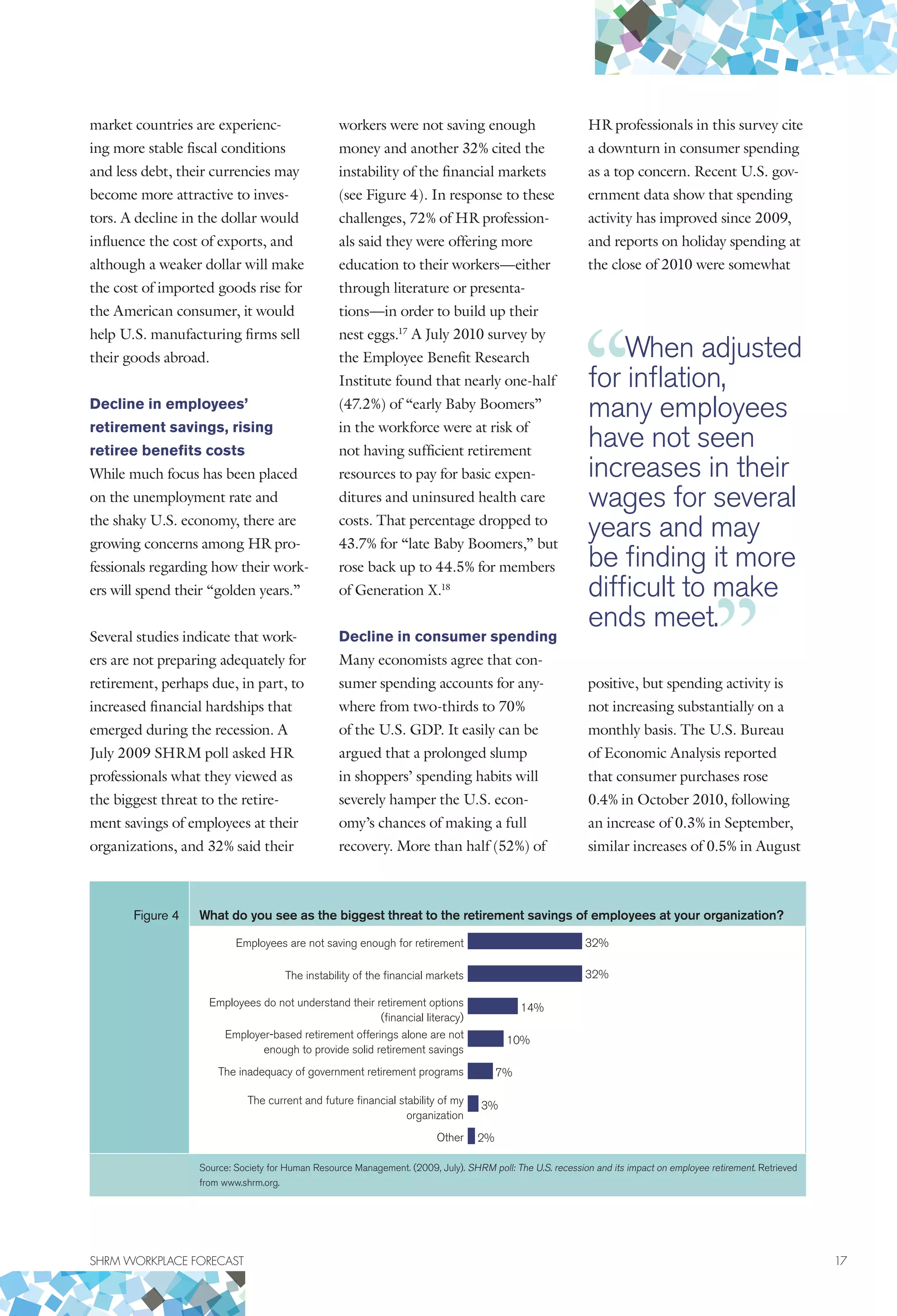
Figure 4 What do you see as the biggest threat to the retirement savings of employees at your organization?
Employees are not saving enough for retirement
The instability of the financial markets
Employees do not understand their retirement options
(financial literacy)
Employer-based retirement offerings alone are not
enough to provide solid retirement savings
The inadequacy of government retirement programs
The current and future financial stability of my
organization
Other
32%
32%
14%
10%
7%
3%
2%
Source: Society for Human Resource Management. (2009, July). SHRM poll: The U.S. recession and its impact on employee retirement. Retrieved
from www.shrm.org.
market countries are experienc-
ing more stable fiscal conditions
and less debt, their currencies may
become more attractive to inves-
tors. A decline in the dollar would
influence the cost of exports, and
although a weaker dollar will make
the cost of imported goods rise for
the American consumer, it would
help U.S. manufacturing firms sell
their goods abroad.
Decline in employees’
retirement savings, rising
retiree benefits costs
While much focus has been placed
on the unemployment rate and
the shaky U.S. economy, there are
growing concerns among HR pro-
fessionals regarding how their work-
ers will spend their “golden years.”
Several studies indicate that work-
ers are not preparing adequately for
retirement, perhaps due, in part, to
increased financial hardships that
emerged during the recession. A
July 2009 SHRM poll asked HR
professionals what they viewed as
the biggest threat to the retire-
ment savings of employees at their
organizations, and 32% said their
workers were not saving enough
money and another 32% cited the
instability of the financial markets
(see Figure 4). In response to these
challenges, 72% of HR profession-
als said they were offering more
education to their workers—either
through literature or presenta-
tions—in order to build up their
nest eggs.17
A July 2010 survey by
the Employee Benefit Research
Institute found that nearly one-half
(47.2%) of “early Baby Boomers”
in the workforce were at risk of
not having sufficient retirement
resources to pay for basic expen-
ditures and uninsured health care
costs. That percentage dropped to
43.7% for “late Baby Boomers,” but
rose back up to 44.5% for members
of Generation X.18
Decline in consumer spending
Many economists agree that con-
sumer spending accounts for any-
where from two-thirds to 70%
of the U.S. GDP. It easily can be
argued that a prolonged slump
in shoppers’ spending habits will
severely hamper the U.S. econ-
omy’s chances of making a full
recovery. More than half (52%) of
HR professionals in this survey cite
a downturn in consumer spending
as a top concern. Recent U.S. gov-
ernment data show that spending
activity has improved since 2009,
and reports on holiday spending at
the close of 2010 were somewhat
positive, but spending activity is
not increasing substantially on a
monthly basis. The U.S. Bureau
of Economic Analysis reported
that consumer purchases rose
0.4% in October 2010, following
an increase of 0.3% in September,
similar increases of 0.5% in August
When adjusted
for inflation,
many employees
have not seen
increases in their
wages for several
years and may
be finding it more
difficult to make
ends meet.
18	 SHRM WORKPLACE FORECAST
and 0.5% in July, and no increase in
June.19
Spending on retail and food
services in October 2010 totaled
$373.1 billion, an increase of just
1.2% from September, but 7.3%
higher than October 2009, accord-
ing to the U.S. Census Bureau.20
Growth in the generational
income divide
BLS data show that while older
workers are much more likely to
stay unemployed longer, younger
workers statistically are more likely
to lose their jobs. Many new gradu-
ates have yet to find good jobs at
the wages needed to repay their
student loans, thus delaying the
onset of their prime savings years.23
The Organization for Economic
Cooperation and Development
(OECD) predicts that youth unem-
ployment rates in the OECD area
of the world’s most developed
nations are expected to remain at
around 18% in 2011 and 17% in
2012. This is more than double the
total OECD unemployment rate,
which stood at 8.6% in October
2010.24
Young people are enter-
ing the job market during a time of
slow growth in new-hire compensa-
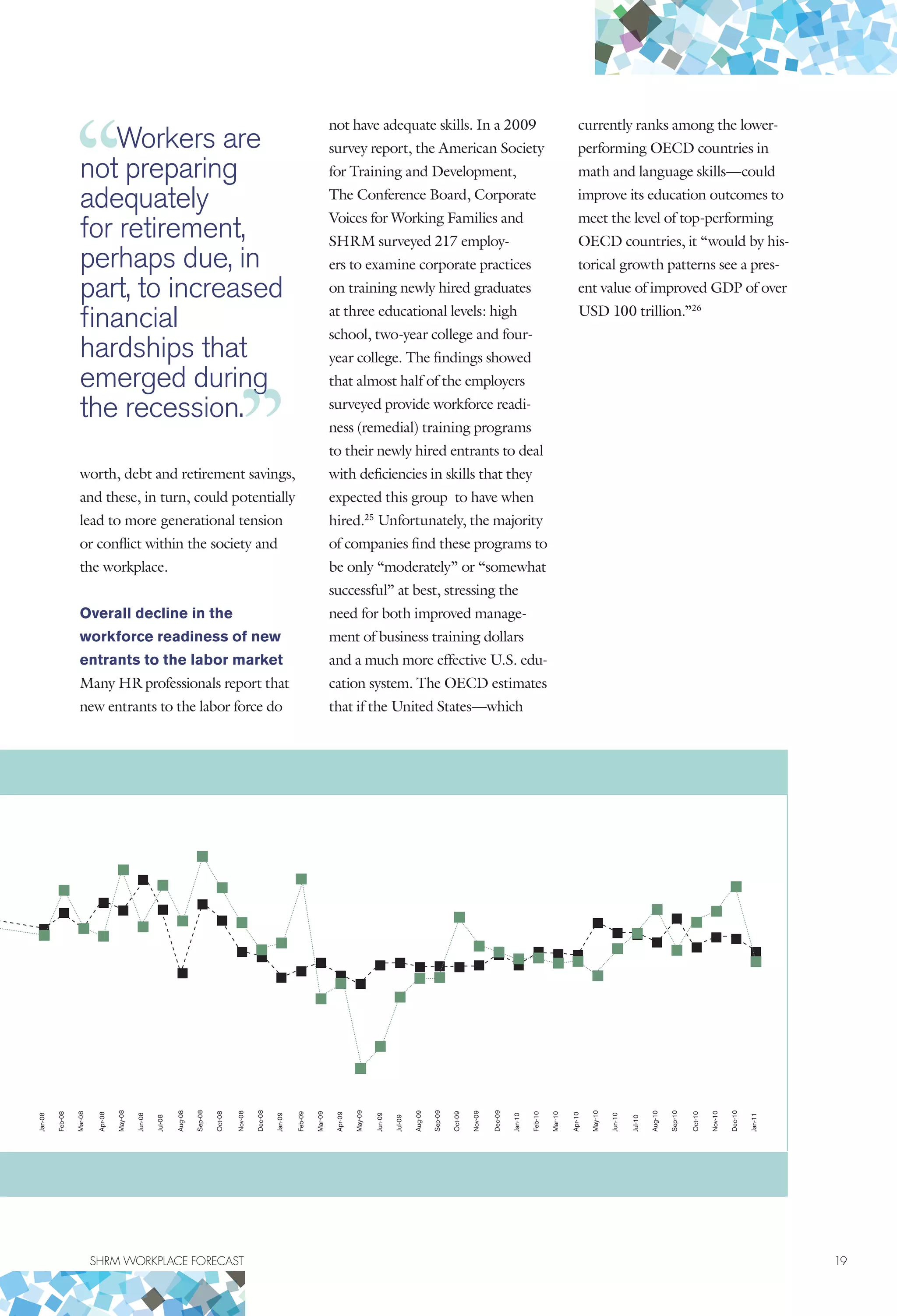
tion (see Figure 5), and the recent
unrest across the Arab world clearly
demonstrates that high rates of
unemployment among the young
can have major social and political
implications.
Wealth accumulation tends to
happen later in life. In the United
States, government safety nets such
as Social Security and Medicare
also are aimed mainly at the elderly.
Older workers are less likely to have
to shoulder some of the key living
expenses that experienced the big-
gest cost jump in recent years, such
as child care and college loans. This
may mean that in many organiza-
tions older employees could be
noticeably more stable financially
than their younger counterparts.
Demographic trends such as later
marriage and childbirth—frequently
due to uncertain finances—delay
the financial benefit of shared
household incomes and extend the
costs of child-rearing further into
prime earning years. These trends
could make it more difficult to save
while young, when compounding
interest yields the best returns. This
could result in significant genera-
tional differences in income, net
Figure 5 SHRM LINE new-hire compensation index, manufacturing and services (June 2005 to January 2011)
Jun-05
Oct-06
Feb-06
Jun-07
Oct-05
Feb-07
Jun-06
Oct-07
Aug-05
Dec-06
Apr-06
Aug-07
Dec-05
Apr-07
Aug-06
Dec-07
Jul-05
Nov-06
Mar-06
Jul-07
Nov-05
Mar-07
Jul-06
Nov-07
Sep-05
Jan-07
May-06
Sep-07
Jan-06
May-07
Sep-06
Manufacturing new-hire compensation Service sector new-hire compensation
Source: Society for Human Resource Management. SHRM Leading Indicators of National Employment (LINE) [historical data].
While older
workers are much
more likely to
stay unemployed
longer, younger
workers statis-
tically are more
likely to lose their
jobs.
SHRM WORKPLACE FORECAST	 19
worth, debt and retirement savings,
and these, in turn, could potentially
lead to more generational tension
or conflict within the society and
the workplace.
Overall decline in the
workforce readiness of new
entrants to the labor market
Many HR professionals report that
new entrants to the labor force do
not have adequate skills. In a 2009
survey report, the American Society
for Training and Development,
The Conference Board, Corporate
Voices for Working Families and
SHRM surveyed 217 employ-
ers to examine corporate practices
on training newly hired graduates
at three educational levels: high
school, two-year college and four-
year college. The findings showed
that almost half of the employers
surveyed provide workforce readi-
ness (remedial) training programs
to their newly hired entrants to deal
with deficiencies in skills that they
expected this group to have when
hired.25
Unfortunately, the majority
of companies find these programs to
be only “moderately” or “somewhat
successful” at best, stressing the
need for both improved manage-
ment of business training dollars
and a much more effective U.S. edu-
cation system. The OECD estimates
that if the United States—which
currently ranks among the lower-
performing OECD countries in
math and language skills—could
improve its education outcomes to
meet the level of top-performing
OECD countries, it “would by his-
torical growth patterns see a pres-
ent value of improved GDP of over
USD 100 trillion.”26
Apr-08
Feb-09
Dec-09
Oct-10
Aug-08
Jun-09
Apr-10
Jun-08
Apr-09
Feb-10
Dec-10
Feb-08
Dec-08
Oct-09
Aug-10
Oct-08
Aug-09
Jun-10
May-08
Mar-09
Jan-10
Nov-10
Jan-08
Nov-08
Sep-09
Jul-10
Sep-08
Jul-09
May-10
Jul-08
May-09
Mar-10
Jan-11
Mar-08
Jan-09
Nov-09
Sep-10
Workers are
not preparing
adequately
for retirement,
perhaps due, in
part, to increased
financial
hardships that
emerged during
the recession.
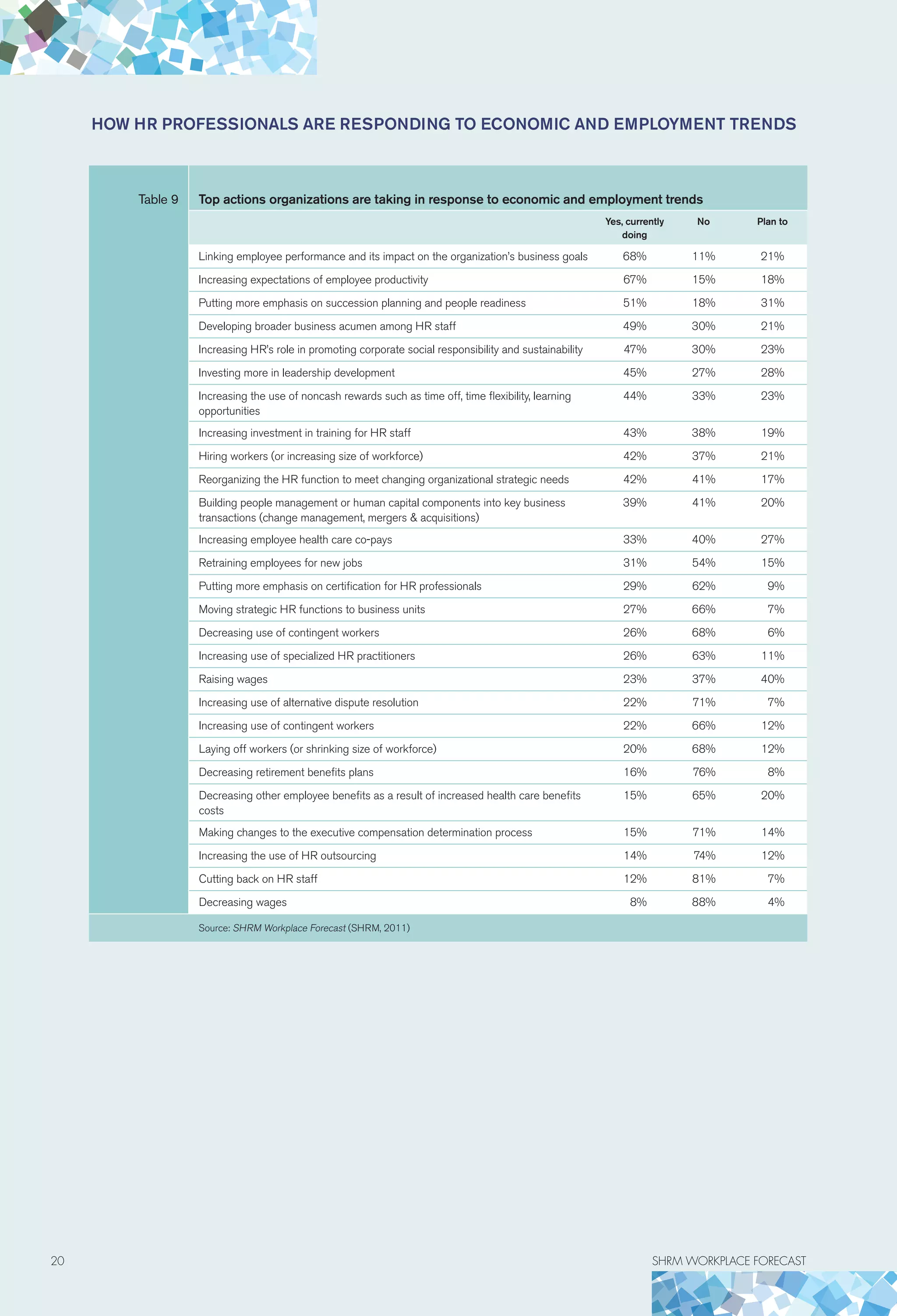
Table 9 Top actions organizations are taking in response to economic and employment trends
Yes, currently
doing
No Plan to
Linking employee performance and its impact on the organization’s business goals 68% 11% 21%
Increasing expectations of employee productivity 67% 15% 18%
Putting more emphasis on succession planning and people readiness 51% 18% 31%
Developing broader business acumen among HR staff 49% 30% 21%
Increasing HR’s role in promoting corporate social responsibility and sustainability 47% 30% 23%
Investing more in leadership development 45% 27% 28%
Increasing the use of noncash rewards such as time off, time flexibility, learning
opportunities
44% 33% 23%
Increasing investment in training for HR staff 43% 38% 19%
Hiring workers (or increasing size of workforce) 42% 37% 21%
Reorganizing the HR function to meet changing organizational strategic needs 42% 41% 17%
Building people management or human capital components into key business
transactions (change management, mergers  acquisitions)
39% 41% 20%
Increasing employee health care co-pays 33% 40% 27%
Retraining employees for new jobs 31% 54% 15%
Putting more emphasis on certification for HR professionals 29% 62% 9%
Moving strategic HR functions to business units 27% 66% 7%
Decreasing use of contingent workers 26% 68% 6%
Increasing use of specialized HR practitioners 26% 63% 11%
Raising wages 23% 37% 40%
Increasing use of alternative dispute resolution 22% 71% 7%
Increasing use of contingent workers 22% 66% 12%
Laying off workers (or shrinking size of workforce) 20% 68% 12%
Decreasing retirement benefits plans 16% 76% 8%
Decreasing other employee benefits as a result of increased health care benefits
costs
15% 65% 20%
Making changes to the executive compensation determination process 15% 71% 14%
Increasing the use of HR outsourcing 14% 74% 12%
Cutting back on HR staff 12% 81% 7%
Decreasing wages 8% 88% 4%
Source: SHRM Workplace Forecast (SHRM, 2011)
How HR professionals are responding to economic and employment trends
20	 SHRM WORKPLACE FORECAST
HRprofessionals’ actions
in response to these
concerns reflect a mix of increased
confidence in the economy and an
acknowledgment that a prolonged
economic revival is not guaran-
teed. Many HR representatives
report that their companies are
adding workers or plan to grow
payrolls in the near future, and
others are raising wages or making
plans for bigger salary budgets
down the road. At the same time,
a high proportion of respondents
are increasing expectations of
employee productivity, as well as
putting more emphasis on succes-
sion planning and people readi-
ness, perhaps as a safeguard against
future downturns in the economy.
Many of the actions HR profes-
sionals are taking involve more
strategic approaches reflecting how
important it is for organizations to
manage their human capital effec-
tively. The actions HR professionals
report they are taking suggest that
companies are looking to HR to
respond to changes in the economy
by adjusting HR strategies and
practices.
Other ideas to consider
•	 Develop a range of potential economic scenarios for your industry or
organization. What will it mean for your business and your employees if
the economic recovery is slow, stalls or, conversely, gathers steam and
is strong and robust?
•	 Think about what careers in your organization will look like five, 10 or
even 20 years from now. Futurists recommend looking at current and
potential future problems and imagining what kinds of jobs would need
to be created to tackle those problems. This can be through adding
new skills to existing jobs, combining skills and functions or addressing
business problems through the creation of entirely new jobs.
•	 Conduct a skills audit to see if your organization has pockets of
underutilized or underemployed employees that could be more
effectively deployed.
•	 Get involved in local and national efforts to promote workforce readiness
and improvements in all levels of education.
•	 Promote secure retirement through financial education classes and
automatic enrollment in defined contribution retirement plans.
•	 Consider how a rise in living costs will impact employees. Will rising
gas prices encourage employees to live closer to work or ask for
telecommuting options? Will the cost of education discourage bright
and capable young people from obtaining degrees, and could this
influence your future labor pool?
•	 Use your HR expertise to give back to the community by working with
your local employment groups/agencies, SHRM chapters or other HR
groups to help job-seekers by reviewing resumes and helping with
interview preparation.
SHRM WORKPLACE FORECAST	 21
22	 SHRM WORKPLACE FORECAST
From one perspective, advancements
in technology have streamlined
many of the tasks HR profession-
als previously spent much of their
time on, but in other ways, technol-
ogy has created layers of complexity
to the HR function by exponentially
increasing the types of data and met-
rics HR professionals are expected to
leverage, particularly in the realm of
recruiting and staffing. Though job
candidates can be vetted more easily
through the ubiquity of social media
and new software that automatically
routes applicants to hiring profession-
als based on their knowledge, skills
and abilities, many HR profession-
als report that e-recruiting also has
Science and Technology
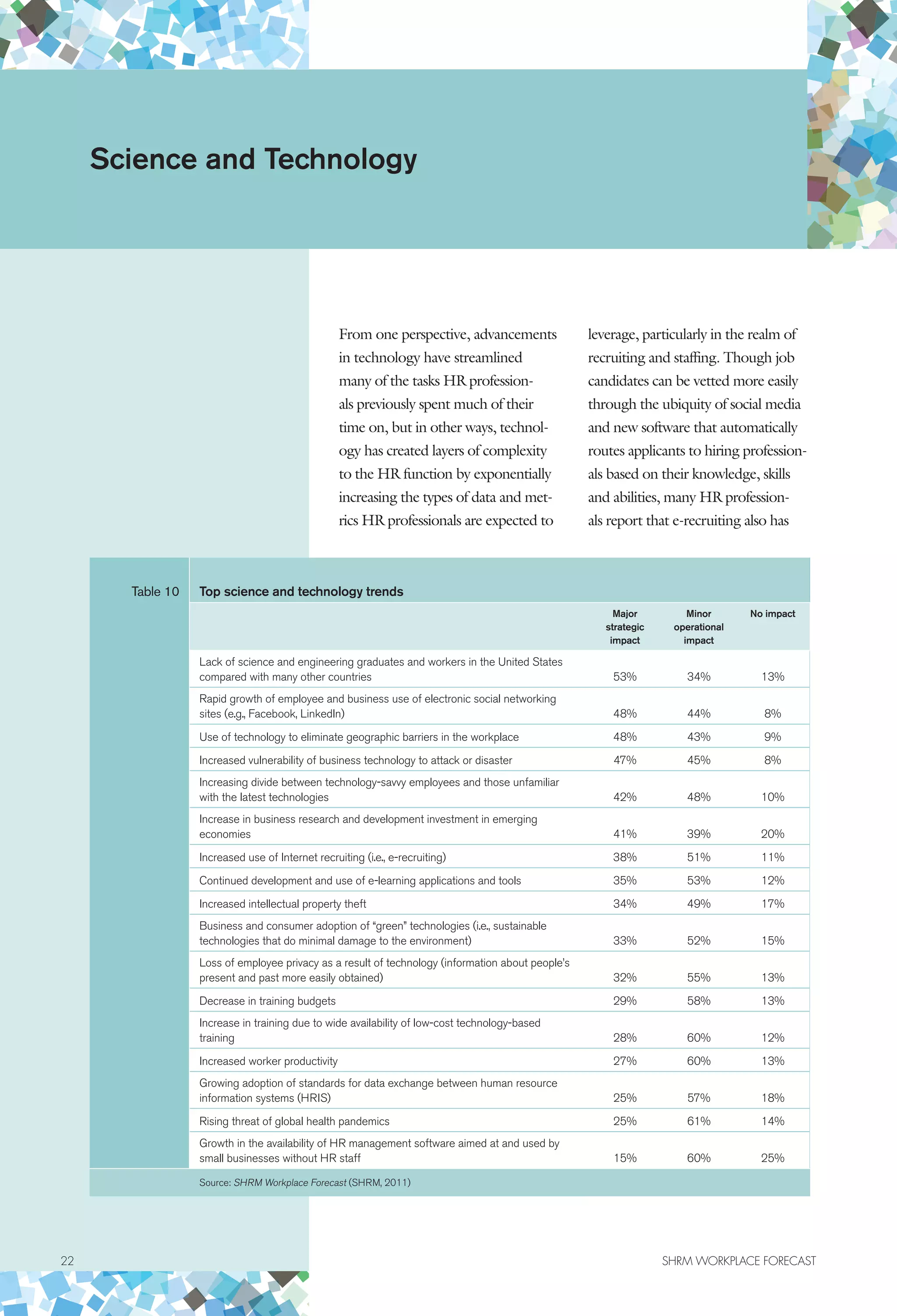
Table 10 Top science and technology trends
Major
strategic
impact
Minor
operational
impact
No impact
Lack of science and engineering graduates and workers in the United States
compared with many other countries 53% 34% 13%
Rapid growth of employee and business use of electronic social networking
sites (e.g., Facebook, LinkedIn) 48% 44% 8%
Use of technology to eliminate geographic barriers in the workplace 48% 43% 9%
Increased vulnerability of business technology to attack or disaster 47% 45% 8%
Increasing divide between technology-savvy employees and those unfamiliar
with the latest technologies 42% 48% 10%
Increase in business research and development investment in emerging
economies 41% 39% 20%
Increased use of Internet recruiting (i.e., e-recruiting) 38% 51% 11%
Continued development and use of e-learning applications and tools 35% 53% 12%
Increased intellectual property theft 34% 49% 17%
Business and consumer adoption of “green” technologies (i.e., sustainable
technologies that do minimal damage to the environment) 33% 52% 15%
Loss of employee privacy as a result of technology (information about people’s
present and past more easily obtained) 32% 55% 13%
Decrease in training budgets 29% 58% 13%
Increase in training due to wide availability of low-cost technology-based
training 28% 60% 12%
Increased worker productivity 27% 60% 13%
Growing adoption of standards for data exchange between human resource
information systems (HRIS) 25% 57% 18%
Rising threat of global health pandemics 25% 61% 14%
Growth in the availability of HR management software aimed at and used by
small businesses without HR staff 15% 60% 25%
Source: SHRM Workplace Forecast (SHRM, 2011)
SHRM WORKPLACE FORECAST	 23
led to an explosion in the number of
candidates they are fielding.
Technological improvements in
manufacturing and other sectors
are creating new challenges for HR
professionals and the employees they
represent. Specifically, tech-based
improvements in the production
process have eliminated the need
for many workers, and HR depart-
ments have been forced to change
their recruiting strategies to keep up
with the high-tech movement in the
workplace.
The rapid pace of change in technol-
ogy is viewed as a benefit and a con-
cern, based on the responses from
HR professionals. They cite a lack of
science and engineering graduates
and workers in the United States as
a detriment to the labor force, and
they also are wary of their businesses’
susceptibility to computer hackers
and other tech-related maladies. HR
professionals also acknowledge there
is a growing gap between the tech-
savvy and the tech-novice members
of their workforce.
In response, HR professionals are
expanding the use of e-learning
to better arm their workers with
tech and other skills, and they also
are updating technology policies
to reflect social media’s growing
presence.
Lack of science and
engineering graduates and
workers in the United States
As much of the developed world
shifts toward a knowledge-based
economy, where science and techni-
cal skills are paramount, the demand
for these skills has clearly increased.
HR professionals say the pending
shortage of candidates with this type
of expertise is of great concern; 53%
of respondents said this has a major
strategic impact on their operations,
and another 34% said it has a minor
strategic impact (see Table 10).
Whether or not there will be a dearth
of U.S. workers in the science and
engineering fields depends on whom
you ask. According to the Nation-
al Science Foundation (NSF), the
number of bachelor-level degrees
conferred in China in natural sciences
and engineering (NS  E), for exam-
ple, grew from 239,000 in 1998 to
807,000 in 2006. New NS  E de-
grees earned by Japanese and South
Korean students combined in 2006
was 235,000—roughly the same
amount of NS  E degrees conferred
in the United States in 2006, even
though the U.S. population is con-
siderably larger than the population
of those two countries (300 million
versus 175 million), the NSF says.
Increased globalization has opened
the doors for science and technology
workers to pursue these fields in their
home countries. Furthermore, those
who enter these fields of study in the
United States are not as likely to be
American citizens: foreign nation-
als have earned more than half of the
U.S.-based NS  E doctorates since
2006, according to the NSF.27
However, others say the United
States remains a force in science and
technology development and that
the concerns about the shortage of
NS  E workers may be overblown.
The United States accounts for 40%
of the world’s spending on scien-
tific research and development and
employs 70% of the world’s Nobel
Prize winners, according to a 2008
study by the Rand Corporation. The
flow of foreign-born science and
engineering experts into the United
States actually is to the country’s
benefit, according to Rand’s re-
search. The study did acknowledge,
however, that other nations are “rap-
idly educating their populations in
science and technology.” The Euro-
pean Union and China, for instance,
are graduating more university-edu-
cated scientists and engineers every
year than the United States.28
Rapid growth of employee
and business use of
social networking sites
With hundreds of millions of per-
sonal users on sites like Facebook,
Twitter and LinkedIn, as well as an
increasing number of companies that
sell their wares through these medi-
ums, social networking has become a
crucial segment of doing business in
the United States. Some companies
are still learning what it all means for
their operations, but HR profession-
als are keeping busy developing poli-
cies for using these websites at work.
In 2009, one out of four HR profes-
sionals said their organizations used
social networking sites to look up
candidates before inviting them for
an interview. In 2008, only 3% of or-
ganizations incorporated that practice
into their recruiting, according to a
SHRM poll from November 2009.
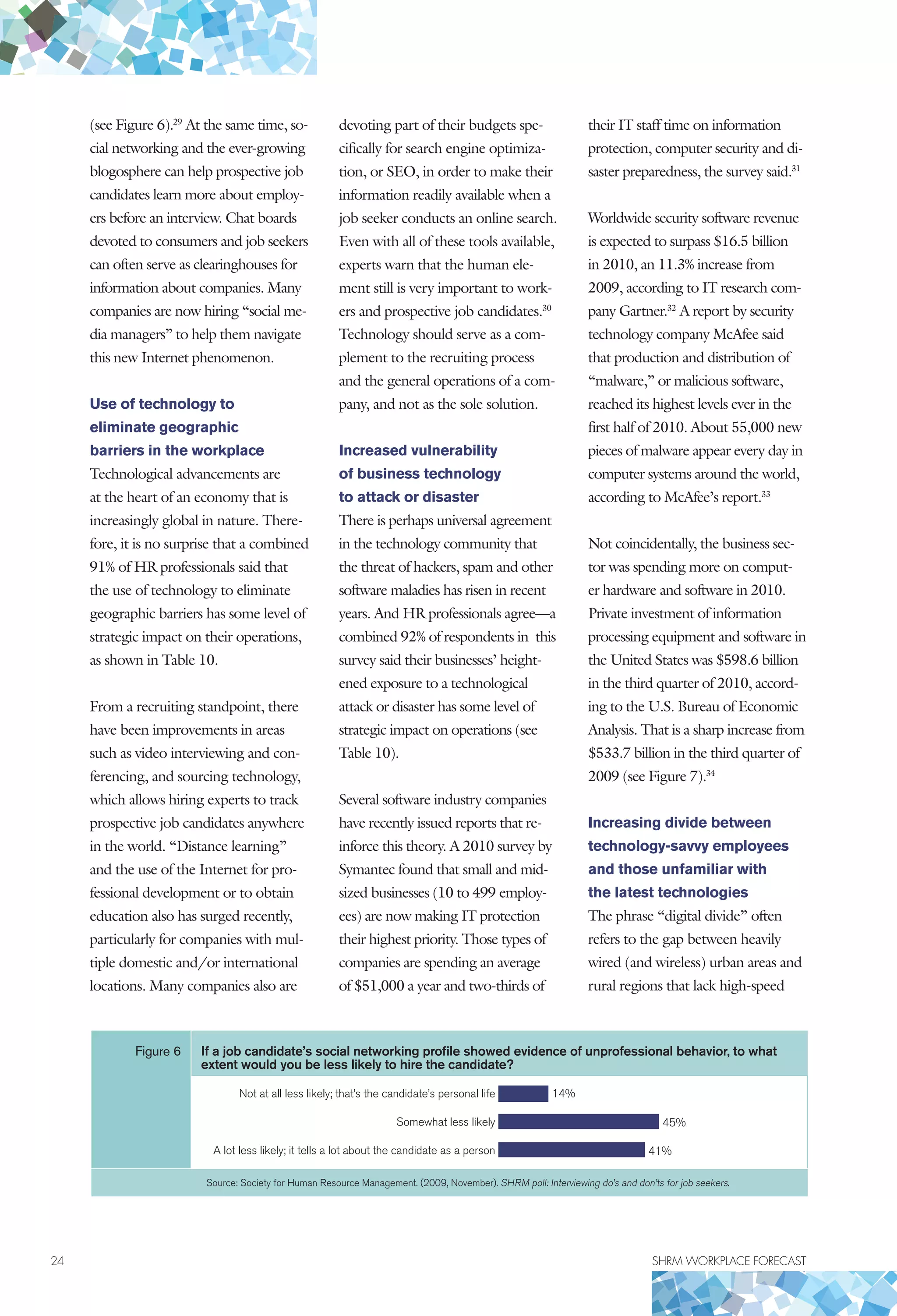
That same poll revealed that 86% of
HR professionals said they would be
less likely to hire a candidate whose
social networking profile showed evi-
dence of “unprofessional behavior”
24	 SHRM WORKPLACE FORECAST
(see Figure 6).29
At the same time, so-
cial networking and the ever-growing
blogosphere can help prospective job
candidates learn more about employ-
ers before an interview. Chat boards
devoted to consumers and job seekers
can often serve as clearinghouses for
information about companies. Many
companies are now hiring “social me-
dia managers” to help them navigate
this new Internet phenomenon.
Use of technology to
eliminate geographic
barriers in the workplace
Technological advancements are
at the heart of an economy that is
increasingly global in nature. There-
fore, it is no surprise that a combined
91% of HR professionals said that
the use of technology to eliminate
geographic barriers has some level of
strategic impact on their operations,
as shown in Table 10.
From a recruiting standpoint, there
have been improvements in areas
such as video interviewing and con-
ferencing, and sourcing technology,
which allows hiring experts to track
prospective job candidates anywhere
in the world. “Distance learning”
and the use of the Internet for pro-
fessional development or to obtain
education also has surged recently,
particularly for companies with mul-
tiple domestic and/or international
locations. Many companies also are
devoting part of their budgets spe-
cifically for search engine optimiza-
tion, or SEO, in order to make their
information readily available when a
job seeker conducts an online search.
Even with all of these tools available,
experts warn that the human ele-
ment still is very important to work-
ers and prospective job candidates.30
Technology should serve as a com-
plement to the recruiting process
and the general operations of a com-
pany, and not as the sole solution.
Increased vulnerability
of business technology
to attack or disaster
There is perhaps universal agreement
in the technology community that
the threat of hackers, spam and other
software maladies has risen in recent
years. And HR professionals agree—a
combined 92% of respondents in this
survey said their businesses’ height-
ened exposure to a technological
attack or disaster has some level of
strategic impact on operations (see
Table 10).
Several software industry companies
have recently issued reports that re-
inforce this theory. A 2010 survey by
Symantec found that small and mid-
sized businesses (10 to 499 employ-
ees) are now making IT protection
their highest priority. Those types of
companies are spending an average
of $51,000 a year and two-thirds of
their IT staff time on information
protection, computer security and di-
saster preparedness, the survey said.31
Worldwide security software revenue
is expected to surpass $16.5 billion
in 2010, an 11.3% increase from
2009, according to IT research com-
pany Gartner.32
A report by security
technology company McAfee said
that production and distribution of
“malware,” or malicious software,
reached its highest levels ever in the
first half of 2010. About 55,000 new
pieces of malware appear every day in
computer systems around the world,
according to McAfee’s report.33
Not coincidentally, the business sec-
tor was spending more on comput-
er hardware and software in 2010.
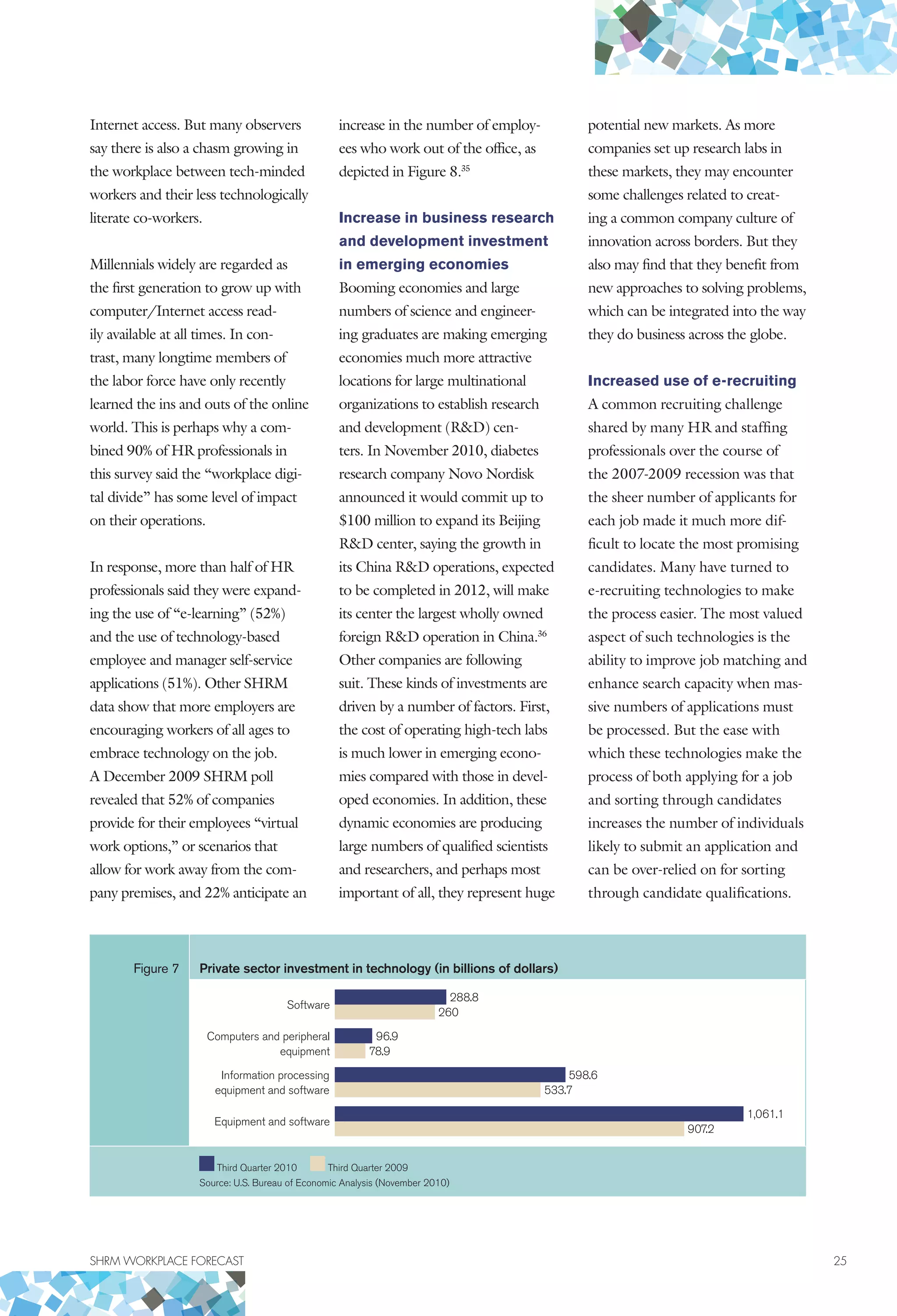
Private investment of information
processing equipment and software in
the United States was $598.6 billion
in the third quarter of 2010, accord-
ing to the U.S. Bureau of Economic
Analysis. That is a sharp increase from
$533.7 billion in the third quarter of
2009 (see Figure 7).34
Increasing divide between
technology-savvy employees
and those unfamiliar with
the latest technologies
The phrase “digital divide” often
refers to the gap between heavily
wired (and wireless) urban areas and
rural regions that lack high-speed
Figure 6 If a job candidate’s social networking profile showed evidence of unprofessional behavior, to what
extent would you be less likely to hire the candidate?
Not at all less likely; that’s the candidate’s personal life 14%
Somewhat less likely 45%
A lot less likely; it tells a lot about the candidate as a person 41%
Source: Society for Human Resource Management. (2009, November). SHRM poll: Interviewing do’s and don’ts for job seekers.
SHRM WORKPLACE FORECAST	 25
Internet access. But many observers
say there is also a chasm growing in
the workplace between tech-minded
workers and their less technologically
literate co-workers.
Millennials widely are regarded as
the first generation to grow up with
computer/Internet access read-
ily available at all times. In con-
trast, many longtime members of
the labor force have only recently
learned the ins and outs of the online
world. This is perhaps why a com-
bined 90% of HR professionals in
this survey said the “workplace digi-
tal divide” has some level of impact
on their operations.
In response, more than half of HR
professionals said they were expand-
ing the use of “e-learning” (52%)
and the use of technology-based
employee and manager self-service
applications (51%). Other SHRM
data show that more employers are
encouraging workers of all ages to
embrace technology on the job.
A December 2009 SHRM poll
revealed that 52% of companies
provide for their employees “virtual
work options,” or scenarios that
allow for work away from the com-
pany premises, and 22% anticipate an
increase in the number of employ-
ees who work out of the office, as
depicted in Figure 8.35
Increase in business research
and development investment
in emerging economies
Booming economies and large
numbers of science and engineer-
ing graduates are making emerging
economies much more attractive
locations for large multinational
organizations to establish research
and development (RD) cen-
ters. In November 2010, diabetes
research company Novo Nordisk
announced it would commit up to
$100 million to expand its Beijing
RD center, saying the growth in
its China RD operations, expected
to be completed in 2012, will make
its center the largest wholly owned
foreign RD operation in China.36
Other companies are following
suit. These kinds of investments are
driven by a number of factors. First,
the cost of operating high-tech labs
is much lower in emerging econo-
mies compared with those in devel-
oped economies. In addition, these
dynamic economies are producing
large numbers of qualified scientists
and researchers, and perhaps most
important of all, they represent huge
potential new markets. As more
companies set up research labs in
these markets, they may encounter
some challenges related to creat-
ing a common company culture of
innovation across borders. But they
also may find that they benefit from
new approaches to solving problems,
which can be integrated into the way
they do business across the globe.
Increased use of e-recruiting
A common recruiting challenge
shared by many HR and staffing
professionals over the course of
the 2007-2009 recession was that
the sheer number of applicants for
each job made it much more dif-
ficult to locate the most promising
candidates. Many have turned to
e-recruiting technologies to make
the process easier. The most valued
aspect of such technologies is the
ability to improve job matching and
enhance search capacity when mas-
sive numbers of applications must
be processed. But the ease with
which these technologies make the
process of both applying for a job
and sorting through candidates
increases the number of individuals
likely to submit an application and
can be over-relied on for sorting
through candidate qualifications.
Figure 7 Private sector investment in technology (in billions of dollars)
Computers and peripheral
equipment
96.9
78.9
Information processing
equipment and software 533.7
598.6
Equipment and software
907.2
1,061.1	
Software
288.8
260
Third Quarter 2010 Third Quarter 2009
Source: U.S. Bureau of Economic Analysis (November 2010)
26	 SHRM WORKPLACE FORECAST
Improved, more customized tech-
nologies and those that target pas-
sive job seekers will continue to try
to address these problems.
As the economy improves and
the demand for skilled workers
increases, technologies that find
potential qualified applicants—
even those not actively searching—
will be valued. The use of niche job
boards and social and professional
networking sites for recruiting also
may increase as recruiters look to
any and all ways to find the candi-
dates they need.
Continued development
and use of e-learning
applications and tools
One area of investment that was
first to experience major cost-cut-
ting when the global economy
took a nosedive was training and
development for employees. Yet at
the same time, organizations were
demanding more from leaner work-
forces. This drive to increase pro-
ductivity by improving employee
skills while still keeping training
and development costs down is
likely to have encouraged the use
of low-cost e-learning applica-
tions. Technological improvements
are poised to make the e-learning
experience much more immer-
sive and interesting for the learner.
Organizational development profes-
sionals will leverage these improved
Figure 8 Anticipated change in the number of employees who work out of office
76%
3%Decrease
Stay the same
Increase 22%
Source: Society for Human Resource Management. (2009, December). SHRM poll: Transitioning to a virtual organization. Retrieved from
www.shrm.org.
Top trends from SHRM’s Technology and HR Management Special Expertise Panel
1.	 Information and actions are increasingly portable via
mobile applications.
2.	 The availability of various social media and the
increasing complexity of intellectual property are
increasing the need to establish and improve
technology governance and policies.
3.	 The use of cloud computing (reliance on online
applications for various technology needs) is
increasing.
4.	 Organizations increasingly are adopting viral recruiting
and social media for employer brand messaging (e.g.,
Facebook, Twitter).
5.	 The economy is having a slowing effect on enterprise
projects, which, in turn, affects technology—both
now and when things shift back in recovery:
Transformation projects are decreasing, new projects
require longer decision times, cost-cutting initiatives
are increasing, organizations are breaking larger
projects into a series of smaller ones, globalization
efforts are on hold, software and implementation
prices are lower.
6.	 Talent management platforms are undergoing product
consolidation, shifting away from siloed applications
toward total solution suites that support a holistic
view of talent management.
7.	 There is growth in the area of both candidate-
management and employer-management tools.
8.	 The availability of dynamic collaboration tools is
altering the importance of organizational knowledge
versus social hierarchy.
9.	 As more companies produce various kinds of
sustainability reports (e.g., carbon disclosure
reports), employees will require training in the use
of sustainability software, carbon impact database
development, calculations of waste resource use
into carbon impact statements, as well as overall
employee training in process changes, governance,
risk and compliance.
10.	 Organizational and individual information increasingly
is transparent (e.g., profiling of hiring managers,
Japan’s mega-database of all potential employees).
Source: Society for Human Resource Management. (2009). Future insights: Top trends according to the SHRM Special Expertise
Panels. Retrieved on December 17, 2010, from www.shrm.org.
SHRM WORKPLACE FORECAST	 27
tools to create more customized
learning applications that can be
easily updated through web-based
delivery. Smartphones, tablets and
other portable electronic devices
also will make it easier to train
employees on the move and may
encourage a more “just-in-time”
approach to delivering training.
Increased intellectual
property theft
In February 2010, the U.S. Attorney
General announced the formation
of a new Department of Justice Task
Force on Intellectual Property as
part of a department-wide initiative
to confront the growing number of
domestic and international intel-
lectual property (IP) crimes. Along
with working with other bodies to
enforce intellectual property laws,
the task force also was tasked with
stepping up policy engagement with
foreign law enforcement partners,
developing a plan to expand civil
IP enforcement efforts and leverag-
ing existing partnerships with federal
agencies and independent regulatory
authorities such as the Department of
Homeland Security and the Federal
Communications Commission. In
the wake of the publication of clas-
sified documents by WikiLeaks
and other media outlets and a
wide-ranging Wall Street insider
trading probe that developed in the
second half of 2010, businesses also
are beefing up their data security
measures. This may influence how
knowledge-producing employees are
managed and, in some cases, moni-
tored. Currently, only 16% of HR
professionals say their organizations
have invested in employee electronic
surveillance, but another 9% say they
plan to do so in the coming years.
Depending on the industry, these
kinds of measures may become more
common. HR professionals will be
tasked with balancing the need to
put in place policies that protect their
organizations’ IP while maintain-
ing a culture of trust and respect for
employee privacy.
Business and consumer
adoption of “green”
technologies
According to SHRM’s recent re-
port, Advancing Sustainability: The
Role of HR, almost three-quarters
of organizations reported engaging
in sustainable workplace or busi-
ness practices. But the likelihood
of formally adopting greener, more
sustainable and socially responsible
business practices varies depending
on the type of organization. Large-
and medium-sized organizations,
publicly owned for-profit compa-
nies and firms with multination-
al operation locations were more
likely to report that they engage in
sustainable workplace or business
practices. The key drivers for invest-
ing in more sustainable and socially
responsible ways of working were:
1) contribution to society, 2) com-
petitive financial advantage, 3) envi-
ronmental considerations, 4) saving
money on operational costs, and
5) health and safety considerations.
HR professionals reported several
important positive outcomes result-
ing from their greater investment in
sustainability, including:
•	 Improved employee morale.
•	 More efficient business
processes.
•	 A stronger public image.
•	 Increased employee loyalty.
•	 Increased brand recognition.37
More and more, organizations that
are not paying attention to this issue
will be at a disadvantage from both a
cost-saving and innovation perspec-
tive. Most importantly for HR pro-
fessionals, the adoption of greener
technologies or more efficient,
greener ways of working will have
a direct impact on their employer
brand.
Figure 9 Focus on sustainability over time
32%2% 66%
2 years
1% 27% 72%
5 years
12 months
54%1% 45%
Decreased Stayed the same Increased
Source: Society for Human Resource Management. (2011). Advancing sustainability: The role of HR. Alexandria, VA: SHRM.
How HR professionals are responding to science and technology trends
Table 11 Top actions organizations are taking in response to science and technology trends
Yes,
currently doing
No Plan to
Taking steps to protect employees in the event of a major health epidemic 62% 27% 11%
Updating technology use policies for employees (use of social networking
sites, e-mail for non-business use, etc.) 58% 16% 26%
Investing in technology and services designed to protect company data in
the event of disaster or cyber attack 57% 18% 25%
Increasing the use of technology to perform transactional HR functions such
as paperless pay 56% 24% 20%
Non-disclosure/non-compete agreements for intellectual property 53% 41% 6%
Expanding the use of e-learning 52% 23% 25%
Expanding the use of technology-based employee and manager self-service
applications 51% 22% 27%
Moving to an Internet-based system for the delivery and utilization of HR
applications 48% 29% 23%
Using social networking sites for recruiting, employer branding and other
purposes 47% 34% 19%
Increasing investment in Internet recruiting (i.e., e-recruiting) 46% 34% 20%
Increasing the use of collaborative technologies that allow employees to
work from anywhere 44% 37% 19%
Changing work processes to make them more environmentally friendly 43% 37% 20%
Increasing the use of workforce planning and decision tools 40% 34% 26%
Using metrics to demonstrate HR’s return on investment 36% 43% 21%
Increasing employee electronic surveillance 16% 75% 9%
Source: SHRM Workplace Forecast (SHRM, 2011)
28	 SHRM WORKPLACE FORECAST
HRprofessionals are well
aware that in order to
succeed, they must find ways to
leverage technology to streamline
HR processes, reduce costs and
create a more productive work
environment. The development of
game-changing new technologies
continues at a rapid pace, and
technological improvements
form the backdrop to many of
the most important business
and economic trends of today.
Many of the ways HR profession-
als are responding to science and
technology trends reveal an under-
lying recognition of threats in the
environment, whether the need to
protect employees from new strains
of disease, protect company intel-
lectual property and data, or moni-
tor to make sure technology isn’t
misused. But most of the ways HR
professionals say they are respond-
ing to these trends highlight the
positive uses of technology and
how they proactively can be har-
nessed to improve the recruiting
process, help employees learn and
work collaboratively, and protect
the environment. The profession
itself also is coming to be seen in
a more scientific light, with an
emphasis on demonstrating a solid
return on investment for HR ini-
tiatives. HR professionals also are
developing and using more robust
HR metrics to further evaluate and
evolve toward greater efficiency and
effectiveness.
Other ideas to consider
•	 Analyze what impact automation and new technologies will have on job
roles and tasks in the future in your industry and organization, including
HR jobs and functions.
•	 Consider working with higher education providers to develop education
programs that explore new technologies for your industry and help
build the pipeline of future skilled technical workers.
•	 Work with the technology function in your organization to create
contingency plans in the case of data loss or theft. Get employees
involved by offering training on how to comply with data protection
regulations and prevent identity theft.
•	 Educate employees on the importance of intellectual property
and provide clarity on what kinds of information is owned by the
organization or otherwise protected.
•	 Make use of the many HR blogs, online resources and shrm.org to
access information, network with other HR professionals and stay up-
to-date.
•	 Work with local health care providers to offer employees flu shots
and create contingency plans (telecommuting, alternative work
arrangements) in the case of a major flu outbreak or other public
health emergency.
•	 Review the kinds of data captured by your organization as well as
existing HR metrics to see if this data can be leveraged in new ways to
improve workforce planning or streamline HR processes.
•	 Give back to the profession by participating in research projects (such
as the SHRM Leading Indicators of National Employment /LINE) that
leverage HR’s unique insight into the changing workplace to create
valuable data on trends in the workplace and the economy.
SHRM WORKPLACE FORECAST	 29
30	 SHRM WORKPLACE FORECAST
Today, one of the most important
underlying forces shaping trends
across the board is globalization.
For HR professionals, globalization
also forms the backdrop to some
of the most significant challenges
and opportunities they face as they
try to find and manage the best
workers or deal with the impact of
global competition on wages, work
processes and the war for talent.
Globalization does not only repre-
sent the increased mobility of capi-
tal or goods; one of its most central
characteristics is the movement
of workers into different markets.
The closer integration of world
markets has a direct impact on
this movement of skills and talent,
and when one economy faces dif-
ficulties, other national economies
increasingly feel the effects in both
good and bad ways. For example,
Globalization
Table 12 Top globalization trends
Major strategic
impact
Minor operational
impact
No impact
Increased global competition for jobs, markets and talent 72% 22% 6%
Economic growth of emerging markets such as India, China and Brazil 63% 24% 13%
Greater need for cross-cultural understanding/savvy in business
settings 61% 32% 7%
Increased expansion of U.S. companies into the global marketplace 59% 34% 7%
Growing importance of managing talent globally 58% 29% 13%
Increased global labor mobility 48% 44% 8%
Increased multiculturalism within organizations 45% 48% 7%
Increased use of virtual global teams 45% 40% 15%
Growth of the world’s middle class consumers 43% 49% 8%
Need for increased security abroad for expatriates 42% 39% 19%
Stricter cross-border policies for global business practices 39% 45% 16%
Rapid turnover and skills shortages in key offshoring destinations
such as India and China 31% 47% 22%
Increased economic, social and political power of women around the
world 30% 59% 11%
Public backlash against globalization and power of multinational
corporations 24% 52% 24%
Increased corporate leadership role in dealing with global problems
such as poverty and disease 23% 53% 24%
Decline in the number of foreign students who stay and work in the
United States 13% 57% 30%
Source: SHRM Workplace Forecast (SHRM, 2011)
SHRM WORKPLACE FORECAST	 31
countries benefit from the growth
of middle-class consumers in
emerging markets if they are able
to sell them goods and services, but
may weaken if a down economy
causes such consumer markets to
dry up. As some economies falter
or political unrest intensifies, other
countries may benefit from the
influx of educated and high-skilled
workers from these lands seeking
opportunities abroad, but the nega-
tive repercussions of these failing
economies on other nations’ eco-
nomic health also are likely to be
considerable.
Throughout the years, HR profes-
sionals have been devoting more
attention to global issues, and
many HR professionals are truly
global professionals in the scope of
their work—work that may cross
borders, cultures and markets.
This calls upon HR practitioners
to develop new competencies, pri-
marily through developing cross-
cultural understanding and a solid
foundation of knowledge in inter-
national employment legislation,
labor law and economic trends.
Increased global competition
for jobs, markets and talent
If the outcome of the opening of
markets around the world could be
summed up in one word, it might
well be “competition.” As more
players in the global marketplace
are entering the field, the level of
competition for resources, markets
and the best possible pool of talent
from which to build a workforce
inevitably increases. The rise in
emerging markets represents liter-
ally billions of new players on this
field of global economic competi-
tion. These new economic power-
houses are showing that not only
can they compete on the basis of
lower labor costs, they also can
lead the way in creating innovative
new business models and dynamic
and successful new multinational
companies.
An example of this change is
revealed in the most recent
Bloomberg BusinessWeek ranking
of the 50 most innovative compa-
nies in the world. In 2006 just five
of the companies that made the list
were located in Asia, but in 2010
that number had grown to 15, and
for the first time since the rank-
ings began in 2005, the majority
of companies on the list were based
outside of the United States. In fact,
11 of the companies ranked could
be viewed as originating from an
emerging economy; more than half
of these companies were not even
on the list in 2009 (see Table 13).38
Economic growth of
emerging markets such as
India, China and Brazil
With emerging economies, espe-
cially India and China, grow-
ing and establishing themselves
as dynamic and attractive coun-
tries to invest in, the number of
multinational organizations with
operations in emerging economies
Table 13 Highest-ranking innovative companies from emerging economies in 2010
2010 Ranking 2009 Ranking Company Headquarters Country Headquarters Continent
7 27 LG Electronics  South Korea Asia
8 NR BYD  China Asia
11 16 Samsung Electronics  South Korea Asia
17 13 Tata Group  India Asia
22 NR Hyundai Motor  South Korea Asia
28 NR Haier Electronics  China Asia
30 46 Lenovo  China Asia
33 15 Reliance Industries  India Asia
41 NR Petrobras  Brazil South America
44 NR China Mobile  China Asia
47 NR HTC  Taiwan Asia
Data: Analysis and data provided in collaboration with the Boston Consulting Group’s innovation practice and BCG-ValueScience. Reuters and
Standard  Poor’s Compustat supplied financial data; Bloomberg provided total shareholder returns.
NR: Not ranked in 2009 survey.
Source: Bloomberg/Business Week. (2010, April). World’s most innovative companies, 2010.
32	 SHRM WORKPLACE FORECAST
will grow. In fact, there is some
debate about whether to even label
countries like India and China as
“emerging” anymore, particularly
as they have come out of the most
recent recession looking much
healthier than many more estab-
lished economies.
Beginning in the 1990s, the focus of
attention has been on the so-called
BRIC economies, which stands for
Brazil, Russia, India and China,
largely because they were seen as the
countries with the most potential
to see a high return on investment.
Financial firm Goldman Sachs,
which is credited with coining the
term, reviewed the performance and
potential of the BRIC countries as
the recession started to wind down.
The conclusion: The recession has
made the BRICs even more attrac-
tive to investors because they still
are considered to be the main driv-
ers of the new global economy and
because they have a recorded com-
bined annual growth rate of 5.8%
over the past 20 years, a much faster
rate than the 2.5% growth seen in
developed economies. These four
countries have a combined total of
43% of the world’s population, while
the total population in emerging
markets overall represents a whop-
ping 80% of the world’s population.
These numbers clearly demonstrate
how a rise in these economies will
have a huge influence on the global
economy.39
Greater need for cross-
cultural understanding/
savvy in business settings
An interesting finding when com-
paring this survey’s results with
those from previous years’ SHRM
Workplace Forecast surveys is that
HR professionals are rating global
issues overall as more influential
now than they did in the past. This
is particularly true of the “greater
need for cross-cultural understand-
ing/savvy in business settings”
as a trend. In 2008, only 48% of
HR professionals said this trend
would have a major strategic impact
on the workplace. In 2011, this
number had risen to 61%. It may
be because more HR profession-
als are becoming responsible for
or are working on tasks or projects
that have multinational or multi-
cultural dimensions. This includes
HR professionals in international
organizations that must simultane-
ously recognize the need for local-
ization while harmonizing policies,
benefits and work processes across
operations in different countries.
Under these circumstances, it can
be challenging to create a common
organizational culture, but this is
precisely what many HR profes-
sionals are being called upon to
do in their organizations. As HR
professionals seek to create a shared
sense of values and a strong, unified
employer brand that spans countries
and cultures, they must inevitably
build stronger intercultural skills
and learn how to leverage the grow-
ing diversity of their workforce to
help understand and meet changing
customer needs.40
Increased expansion of
U.S. companies into the
global marketplace
Almost every organization is expand-
ing into or is influenced by the
global marketplace in one form or
another. The recession made many
organizations reconsider where to
seek out customers, and many com-
panies increasingly are looking to
growing foreign markets such as the
BRIC countries for either new con-
sumer markets or new locations for
key operations. Generally, the two go
hand-in-hand as businesses that are
looking to sell goods and services to
consumers in other countries often
establish a local business presence
to be closer to their customers in
these target nations. Those compa-
nies that are not necessarily aiming at
foreign consumer markets may still
feel the impact of foreign competi-
tion. Emerging markets operate at
an advantage when it comes to keep-
ing labor costs low. HR profession-
als in countries where labor costs are
higher therefore are under growing
pressure to find ways to reduce the
cost of benefits and other labor costs.
U.S. Department of Commerce
data indicated that international
exports were up in 2010 compared
with 2009, while a May 2010 report
from the California-based out-
sourced product fulfillment provider
Shipwire pointed to an increase
in overseas growth of small- and
medium-sized businesses in the
United States: aggregate customer
shipping data for a two-year period
(2008-2009) to uncover trends
around export and shipping found
that while 9% of total orders were
international in 2008, 20% were
international in 2009.41
Growing importance of
managing talent globally
In 2010, SHRM commissioned
the Economist Intelligence Unit
SHRM WORKPLACE FORECAST	 33
to conduct a quantitative survey
of senior executives and in-depth
qualitative interviews with senior
business leaders to assess future
global workforce management is-
sues and their impact on global
talent management. The survey
found that senior business leaders
expect a much more diverse and
international workforce in the years
ahead (see Figure 10). Some of the
key changes to the workforce that
senior executives expect to see in
the years ahead include:
•	 Increasing workforce flux
with more roles automated or
outsourced, more contingent
workers and more employees
working flexible hours.
•	 More diversity, with workers
coming from a greater range of
backgrounds, where “those with
local knowledge of an emerging
market, a global outlook and
an intuitive sense of the corpo-
rate culture will be particularly
valued.”
•	 The ascendance of soft skills
such as communication skills,
cultural awareness and corpo-
rate values that are developed
through international assign-
ments and bringing together
groups of workers from different
countries and functions to learn
and train together.
According to the report, “changes
to the organizational structure and
workforce will spell new challeng-
es for managers.” These new chal-
lenges will include:
•	 Understanding the worker.
The survey revealed a disconnect
between what companies offer to
employees and what respondents
say their direct reports actually
value, such as decision-making
responsibility and opportunities
for continued learning.
•	 Tapping into the multicul-
tural workforce. Almost 30%
of survey respondents said
their company will use IT and
social networking tools to tap
into the global talent pool over
the coming decade, and some
companies are partnering with
schools to develop curricula
“that prepare students for work
in a multinational, multicultural
company.”42
While the economic downturn
lulled some organizations into
thinking they could step down
their retention efforts, this is a risky
strategy, according to a report from
Deloitte. The report is based on
a five-part longitudinal survey of
high-ranking executives worldwide
on managing talent in a turbulent
economy. It points to the paradox
of skills shortages during a time of
high unemployment and warns that
the coming years could get even
worse for organizations that do not
actively engage their global work-
force: “Over the last decade com-
panies facing a skills shortage have
been able to tap into the vast global
talent markets such as China and
India. But as Baby Boomers retire
and skills grow scarce, there will
be no additional Chinas or Indias
coming online.”43
Increased global
labor mobility
The search for better work and
improved economic prospects
drives regional and international
labor mobility. An increase in
global labor mobility is expected
Figure 10 How will your organization’s workers change over the coming 10 years?
Our workers will have more diverse backgrounds
and experience
58%
Our workers will become more international in
composition
48%
Our workers will become more ethnically diverse 44%
Our workers will better represent the countries
where we do business
36%
Our workers will travel more frequently to our
overseas offices
21%
Our workers will relocate more frequently among
our overseas offices
20%
Our workers will have to speak an Asian language 18%
Don’t know/not applicable 9%
Source: Economist Intelligence Unit. (2010, September). Global firms in 2020: The next decade of change for organisations and workers.
34	 SHRM WORKPLACE FORECAST
from countries like Ireland, Spain
and Greece that are experiencing
high levels of unemployment due to
economic shocks or from emerg-
ing economies to more established
economies. But increasingly, labor
mobility may include the move of
skilled and educated workers away
from established economies as
they seek out new opportunities in
emerging markets that are viewed
as more dynamic and where the
chance to build a new business is
seen as most promising for aspiring
entrepreneurs.
According to an OECD report on
the mobility of the highly skilled,
“for receiving countries, the inflow
of talent has positive effects relat-
ing to knowledge flows, including
the possibility of increased RD
and economic activity owing to
the availability of additional skilled
workers, improved knowledge
flows and collaboration with send-
ing countries, increased enroll-
ments in graduate programmes,
and potential firm and job creation
by immigrant entrepreneurs.” But
while there are concerns that the
emigration of skilled workers causes
a brain drain in the sending coun-
try, “remittances are an important
source of income for many low-
and middle-income households
in developing countries.”44
Global
labor mobility may be growing
more fluid, with many immigrants,
particularly at the highest skill and
education levels, moving frequently
between countries as opportunities
present themselves and as improve-
ments in information and com-
munications technologies help to
keep individuals connected to a
Top trends from SHRM’s Global Special Expertise Panel
1.	 Talent management continues to be a high
priority and must be more efficient than before
while leveraging cost awareness and monitoring
demands for key positions. Finding and retaining
quality talent continues to be essential to business
sustainability, but is difficult in global markets that
may act differently in terms of opportunity and salary
movement: Should multinational companies treat
everyone equally or deploy different strategies in
different countries to pay for and retain talent?
2.	 The need for global organizations to work virtually
across functions and geographies increases
and intensifies, with implications for intercultural
communication, business ethics and organizational
effectiveness. A new approach is needed to develop
global workforce cultures, with a better understanding
of transnational teams, online collaboration,
globalization and business process transformation.
3.	 Global employee engagement is tentative; companies
that have implemented multiple layoffs have eroded a
sense of security in the global workforce.
4.	 The economic crisis and fewer existing business
opportunities will create a high demand on the global
HR function to demonstrate greater agility and
contribute strategic guidance.
5.	 Economic uncertainties fundamentally change the
motivators that attract and retain employees.
6.	 Human capital protectionism will continue to increase
in most countries in non-tariff, nationalistic forms (for
example, hire-local stipulations for bailouts, quotas
for nonimmigrant visas and similar restrictions),
to the detriment of organization and country
competitiveness.
7.	 The lack of visa availability and lengthy processing
times for green cards in the United States
prompt highly qualified non-U.S. nationals to seek
employment elsewhere, usually for non-U.S.-based
competitors, leaving the United States with a less
qualified, less competitive workforce.
8.	 Global mobility of high-value workers continues
as multinational companies restrict new hires and
relocate talented employees from within their existing
workforce.
9.	 Companies that originated in emerging economies
will continue to succeed in the global marketplace
(e.g., China’s Lenovo, Mexico’s CEMEX, Peru’s
AJEGROUP and others).
10.	 More government and bilateral investments in
conflict or post-conflict zones create challenges
for businesses attempting to balance their interest
in expansion with the safety of operations and
personnel.
Source: Society for Human Resource Management. (2009). Future insights: Top trends according to the SHRM Special Expertise
Panels. Retrieved from www.shrm.org.
SHRM WORKPLACE FORECAST	 35
number of different cultures. This
could create a truly global class of
in-demand workers who are able
to adapt easily and move between
cultures.
Increased multiculturalism
within organizations
Unsurprisingly, the rise of the
global workforce also is lead-
ing to increased multiculturalism
within companies. Organizations
around the world are looking for
the best ways to promote diversity
and inclusion. According to the
research study conducted by the
Economist Intelligence Unit on
behalf of SHRM, more than half
(55%) of the senior executives sur-
veyed around the world said they
have policies that promote diversity
and inclusion either “strongly” or
“very strongly,” and another 31%
promote diversity and inclusion
“moderately.” Only 3% do not pro-
mote diversity and inclusion at all.
More than one-half of respondents
from North America (59%), Asia-
Pacific (55%) and Western Europe
(55%) promote diversity and inclu-
sion “strongly” or “very strongly.”
Thirty-one percent of respon-
dents from Asia-Pacific and North
America and 28% from Western
Europe promote diversity and
inclusion “moderately.”45
Around
the world it is the HR profession-
als who are primarily responsible
for diversity and inclusion in their
organizations (see Figure 11).
The most recent recession may
have had some impact on diver-
sity efforts. A 2010 SHRM study
provided mostly encouraging news
about the state of diversity in the
workplace by revealing increases in
the “percentage of companies that
provide training on diversity issues,
the number of organizations that
have a diverse board of directors
and the percentage of organiza-
tions reporting that their diversity
practices were effective in achieving
their organization’s desired out-
comes.” It did find, however, that
between 2005 and 2010, there was
“a slight decrease in the percentage
of organizations with practices that
address workplace diversity. This
slight decline is not surprising, as it
is likely attributable to the unprec-
edented global economic downturn
that began in late 2007.”46
 Indeed,
a June 2010 poll from SHRM indi-
cated that the downturn resulted in
across-the-board cuts to many HR
initiatives and practices.47
Increased use of virtual
global teams
A more distributed, global work-
force and the need for specialized
skills are giving rise to the use of
virtual global teams. This is making
it more important for managers to
learn how to effectively lead virtual
teams and to deal with and opti-
mize cultural differences. However,
the distribution of team members
makes it more difficult to supervise
and support team members in tra-
ditional ways.48
Some organizations
Figure 11 Who has primary responsibility for diversity and inclusion in your organization?
HR/talent director 59%
Other 20%
Chief diversity officer (CDO) 6%
Corporate social responsibility head 6%
Don’t know 5%
General counsel/legal 3%
Source: Economist Intelligence Unit and the Society for Human Resource Management. (2009). Global diversity and inclusion: Perceptions, prac-
tices and attitudes. Retrieved from www.shrm.org.
Increasingly,
labor mobility
may include the
move of skilled
and educated
workers away
from established
economies as
they seek out
new opportunities
in emerging
markets.
36	 SHRM WORKPLACE FORECAST
are dealing with this challenge by
empowering virtual employees
instead of relying on management
and supervision. Multinational
and international organizations are
likely to benefit the most from team
structures that are flexible, where
team members can build the rela-
tionships that make the team most
effective. But even in a self-regulat-
ing team structure, organizations,
managers and HR leaders must
give teams clear goals and objec-
tives and provide support through
creating a culture of trust, collabo-
ration and effective communication
so that global virtual teams are able
to thrive.
HR professionals around the
world definitely are developing
a more global mindset. In the
2010 SHRM survey report, What
Senior HR Leaders Need to Know:
Perspectives from the United States,
Canada, India, the Middle East
and North Africa, senior HR pro-
fessionals from the participating
regions were presented with a list of
18 competencies identified through
previous SHRM research as most
important for senior HR lead-
ers. They were then asked to rate
these competencies based on their
overall importance. The results
showed much agreement around
several key competencies. Across
all four countries/regions, the two
most highly rated competencies
were effective communication and
strategic thinking, although the
order varied by country/region (see
Figure 12). Leading change was a
top competency in Canada and in
the emerging economies of India,
Middle East and North Africa. The
United States, India and the Middle
East and North Africa shared HR
knowledge as a top competency.
India and the Middle East and
North Africa shared all five top-
rated competencies, though not
in the same order of importance.
The HR leaders in the SHRM
study predicted that the need to
think strategically will only grow
in importance; equal proportions
of respondents across all countries/
regions indicated increasing impor-
tance for strategic thinking and
effective communication over the
next five years.49
Growth of the world’s
middle-class consumers
Research from global manage-
ment consulting firm McKinsey has
found that “middle-class consumers
span a dozen emerging nations, not
just the fast-growing BRIC coun-
tries, and they include almost 2
billion people, who spend a total of
Figure 12 Top five competencies for senior HR leaders
United States
(n = 566)
Canada
(n = 1,137)
India
(n = 348)
Middle East and
North Africa
(n = 196)
Effective
communication
59%
Strategic
thinking
70%
Strategic
thinking
57%
Strategic
thinking
70%
1
Strategic
thinking
57%
Effective
communication
48%
Effective
communication
50%
Effective
communication
50%
2
HR
knowledge
56%
Persuasiveness/
influencing
others
45%
Business
knowledge
46%
HR
knowledge
45%
3
Integrity
38%
Leading
change
42%
HR
knowledge
36%
Leading
change
44%
4
Ethical
behavior
37%
Credibility
41%
Leading
change
36%
Business
knowledge
37%
5
Source: Society for Human Resource Management. (2010). What senior HR leaders need to know: Perspectives from the United States, Canada,
India, the Middle East and North Africa. Alexandria, VA: SHRM.
SHRM WORKPLACE FORECAST	 37
$6.9 trillion annually.” The report
estimates that these middle-class
consumers will spend approximately
$20 trillion between 2010 and
2020, an amount approximately
twice the current consumption in
the United States.50
The rise of the new global middle
class will influence businesses all
over the world by creating large
numbers of new consumers of
products and services. Companies
that are able to establish them-
selves in these markets early in their
development are likely to gain the
most as this consumer base grows.
This is likely to add fuel to the
trend of organizations of all sizes
making an effort to expand and
seek out customers in the global
marketplace.
Need for increased security
abroad for expatriates
Political unrest, such as the mas-
sive wave of political protests across
the Arab world, terrorism and
other threats have emphasized the
need to consider security care-
fully when assigning employees to
jobs in other countries. In addi-
tion, after nearly a decade of war,
anti-American and, in some cases,
anti-Western views have grown
prevalent in many parts of the
world. This makes it necessary for
organizations to consider how best
to market and brand their products
and also how to ensure the safety
of their employees working in high-
conflict zones. Some organizations
require expatriate employees to live
in specific locations or communities
or undergo special training before
going on assignment. But even in
the case of international assign-
ments to countries where threats
are minimal, HR professionals will
need to continue to focus on how
to handle security issues during
the onboarding and assimilation
process.
Local needs,
laws and culture
make it impos-
sible to create
a completely
one-size-fits-all
approach.
Table 14 Top actions organizations are taking in response to globalization trends
Yes,
currently doing
No Plan to
Integrating HR practices across operations, including international borders 32% 57% 11%
Expanding to sell products and services into the global marketplace 31% 58% 11%
Expanding business operations into the global marketplace 27% 62% 11%
Giving more consideration to regional political issues when making
decision to invest abroad 23% 68% 9%
Shifting to a more global organizational model 19% 72% 9%
Moving business to a non-U.S. location 8% 88% 4%
Offshoring jobs to countries with lower health care and other labor costs 7% 87% 6%
Seeking new offshoring destinations 6% 89% 5%
Source: SHRM Workplace Forecast (SHRM, 2011)
How HR professionals are responding to globalization trends
Other ideas to consider
•	 Assessments of profitability and productivity of various parts of the
organization against the performance of similar groups in the market
can help identify where teams are not performing at the optimal level.
Learning from the highest performing teams in non-home country
operations or among foreign competitors can help boost performance
across all teams in a multinational organization.
•	 Look into the feasibility of redeploying employees from shrinking
operations to those where business is growing.
•	 Identify the locations around the globe that have the highest
concentrations of individuals with key qualifications and skills for the jobs
of most strategic importance to the organization and develop scenarios
that explore how these areas could grow to become new sources of
competition or could be leveraged to help the organization.
•	 Relationships with outsourced/offshored suppliers may be evolving to be
more of a partnership. Consider what the impact of a more collaborative,
partnership approach versus simply a low-cost provider approach could
have for employees and skills development throughout the supply chain.
•	 Work with and, if needed, provide training to leaders of global virtual
teams to ensure that they have the soft skills and cultural context
needed for intercultural communications that develop trust and rapport in
a virtual setting.
•	 Investigate carefully the human resource management practices of
suppliers and global partners to ensure they are in alignment with the
organization’s overall sustainability and corporate social responsibility
principles, policies and values.
HRprofessionals are
increasingly taking
the lead in globalizing their
organizations by integrating
HR practices across operations.
This can be challenging because
local needs, laws and culture
make it impossible to create
a completely one-size-fits-all
approach. HR professionals
therefore are balancing the
need for localized solutions
with a more universal approach
to building corporate culture
that unifies the organization
across borders and cultures.
Even organizations that are not
setting up operations overseas
are expanding into the global
marketplace. Organizations
also are considering regional
political factors when deciding
where to set up operations,
and many are offshoring
jobs to reduce labor costs.
38	 SHRM WORKPLACE FORECAST
SHRM WORKPLACE FORECAST	 39
With the cost of health care a
central concern of HR profes-
sionals across the country, it is no
surprise that the passage of federal
health care legislation was the top
public policy trend identified in the
survey. Other trends HR profes-
sionals believe will have a consid-
erable impact on the workplace
include the growing complexity
of legal compliance, changes in
employee rights due to legislation
and/or court rulings, the grow-
ing national budget deficit, changes
in financial regulations, and the
impact of underfunded pensions on
retirees.
Table 15 Top public policy and legal trends
Major strategic
impact
Minor
operational
impact
No impact
Passage of federal health care legislation 82% 18% 0%
Growing complexity of legal compliance for employers 72% 27% 1%
Changes in employee rights due to legislation and/or court rulings 67% 31% 3%
Growing national budget deficit 61% 35% 4%
Changes in financial regulations 59% 38% 3%
The impact of underfunded pensions on retirees and the stability of the
federal Pension Benefit Guaranty Corporation 50% 38% 12%
Implications of the outcome of the 2010 congressional elections 42% 49% 9%
Proposed immigration laws in relation to H-1B visas and high-skilled
foreign workers 42% 46% 12%
Increase in global environmental legislation 34% 54% 12%
Unions increasing their allocation of resources devoted to political lobbying 34% 48% 18%
Increase in the legal retirement age in countries with aging populations 31% 48% 21%
Proposed immigration laws that prosecute employers for hiring illegal/
undocumented workers 31% 48% 21%
Increase in discrimination litigation based on national origin 28% 60% 12%
Increase in litigation involving overtime pay for exempt/white-collar workers 26% 54% 20%
Increase in age discrimination litigation 24% 59% 17%
Increase in discrimination litigation based on sexual orientation 24% 60% 16%
Increase in discrimination litigation involving individuals with disabilities 23% 63% 14%
Increase in religious discrimination litigation 19% 60% 21%
Increase in race discrimination litigation 18% 64% 18%
Increase in sex discrimination litigation 14% 64% 22%
Source: SHRM Workplace Forecast (SHRM, 2011)
Public Policy and Law
40	 SHRM WORKPLACE FORECAST
Passage of federal
health care legislation
The passage of federal health care
legislation is the top public policy
trend according to HR profes-
sionals. Not only is the cost of
health care in general one of their
most pressing concerns, they are
under pressure from their orga-
nizational leaders to explain the
implications of the new law and
to make recommendations about
how their businesses should re-
spond (see Figure 13). The areas
that HR professionals currently
are most likely to be addressing to
help their organizational leader-
ship understand the new law are:
•	 Improving their overall knowl-
edge of the new health care
reform law.
•	 Determining which actions
their organizations need to take
immediately.
•	 Identifying the changes their
organizations need to make to
their current health care plan to
be compliant.
•	 Determining both the imme-
diate financial implications and
the future financial implications
beyond 2011 (see Table 16).51
The actions HR professionals are
taking or planning to take include
working with legal and/or benefits
counsel to help their organizations
understand the implications of the
new law, sending HR staff in their
organizations to classes to learn
details of the new law, partnering
with current health benefits provid-
ers to design health care plans that
will include areas affected by the
new law, developing health care
cost analysis for organization’s lead-
ers, and analyzing the short-term
financial impact of the new law and
the feasibility of offering health
care (see Table 17).52
A key question is whether organi-
zations will decide to drop health
care coverage. But even as early as
June 2010, a SHRM poll revealed
that nearly one-half of organizations
(46%) had already decided not to
drop health care coverage as a result
of the health care reform. Financial
implications aside, responding HR
professionals said the primary rea-
sons that their employers would
not drop health coverage were: 1) it
would lower employee morale and
job satisfaction, 2) it would make
the organization uncompetitive in
recruiting new employees, and 3) it
would send a message that the orga-
nization does not value the health of
its workers. Nevertheless, the uncer-
tainty surrounding the health care
bill and the increased costs associ-
ated with providing health coverage
are weighing on HR professionals
and their employers. The same poll
showed that 41% of organizations
are likely to pass increased health
care coverage costs to employees in
2011, regardless of whether those
expenses are associated with the new
law. More than one-third (34%)
of organizations are considering
alternative insurance plans for their
workers as a result of the new leg-
islation, and another 32% said they
would be likely to drop health care
coverage and pay the government’s
“opt-out fine” if it would save their
organization a substantial amount
of money (see Figure 14).53
Figure 13 Has senior management in your organization asked HR to provide an overview of the implications of
the new health care reform law for the organization?
Yes
54%
No
46%
Source: Society for Human Resource Management. (2010, September). SHRM poll: Organizations’ response to health care reform—senior
management’s requests. Retrieved from www.shrm.org.
SHRM WORKPLACE FORECAST	 41
Growing complexity of legal
compliance for employers
In addition to the new federal health
care legislation, state and federal
lawmakers continue to develop new
laws that could influence the work-
place and require HR profession-
als to be vigilant in keeping up with
their knowledge of new legislation or
regulations in order to ensure their
organizations’ compliance. Examples
include the introduction or possible
Table 17 What actions has your organization taken in response to the passage of the new health care reform
bill?
Already
doing/done
Planning
to do
Currently NOT doing and
have NO plans to do
Working with legal and/or benefits counsel to help the organization
understand the implications of the new law 80% 15% 5%
Sending HR staff to classes (e.g., attending seminars, participating
in webcasts on this topic) to learn details of the new law and its
impact on the organization 78% 14% 8%
Partnering with current health benefits provider to design a health
care plan that will include areas affected by the new law 75% 24% 1%
Developing health care cost analysis for organization’s leaders 59% 35% 7%
Analyzing short-term financial impact of the new law and the
feasibility of offering health care 57% 33% 10%
Developing a new health care strategy plan for the organization 48% 39% 13%
Developing an employee communication strategy related to the
new law 45% 46% 9%
Developing employee communication on the impact of the new law
on the organization’s health care plan and the employees 41% 54% 6%
Analyzing long-term financial impact of the new law and the
feasibility of offering health care 38% 54% 9%
Communicating impact of the new law to employees 37% 57% 7%
Communicating impact of the new law to retirees 12% 40% 48%
Source: Society for Human Resource Management. (2010, September 17). SHRM poll: Organizations’ response to health care reform—challenges
and actions. Retrieved from www.shrm.org.
Table 16 Which of the following issues has your HR team addressed or is it continuing to address in order to
help the leadership of your organization better understand the new health care reform law and its
implications?
Overall knowledge of the new health care reform law 51%
Actions your organization needs to take immediately 49%
Changes your organization needs to make to its current health care plan to be compliant 47%
The immediate financial implications 46%
The future financial implications (beyond 2011) 39%
Affordability of your health care plan for current employees 31%
Health care as part of the total compensation package 24%
Resources available to help the organization analyze, design and communicate health care plan to
stakeholders 20%
Possible penalties your organization could incur if it doesn’t comply with the new health care reform law,
decides not to offer health care to employees or makes changes to the plan 16%
Deciding who is the best resource (e.g., counsel/consultant) to explain the new health care reform law 13%
Investigating the impact of the new health care reform law on part-time employees in the organization 9%
Determining the impact on recruitment and retention strategies 7%
Developing a plan on how to figure out each employee’s household income 3%
Other 3%
Source: Society for Human Resource Management. (2010, September 17). SHRM poll: Organizations’ response to health care reform—senior
management’s requests. Retrieved from www.shrm.org.
42	 SHRM WORKPLACE FORECAST
introduction of bills related to
background and credit checks for
job applicants and workplace flex-
ibility. In 2010, U.S. Citizenship
and Immigration Services (USCIS)
also increased monitoring of H-1B
nonimmigrant visa petitions and
the number of site visits to compa-
nies petitioning for temporary work
visas on behalf of employees. And
because so many organizations are
using contingent workers until they
feel more confident about an eco-
nomic recovery, modifications in
regulations that clarify or define what
classifies a worker as an independent
contractor could influence many
employees and employers. States also
are increasingly proposing and pass-
ing wage-and-hour legislation, and
some states are choosing to provide
greater coverage than federal laws
such as the FLSA.
Changes in employee
rights due to legislation
and/or court rulings
Often state legislation expands
employee rights beyond what
is federally mandated. In some
cases, court rulings also change
how employee rights in the work-
place are interpreted. HR profes-
sionals must continue to monitor
these developments to make sure
that their organizations continue
to comply with the law and avoid
costly litigation. For multistate
employers, variation in state laws
can create even more complexity
not only in relation to compliance
but also from an employee relations
standpoint; employees in different
states may be upset by perceived
differences in employee rights that
result from different state laws.
State laws related to credit and back-
ground checks of job candidates
could be one area where changes
occur. Hawaii, Illinois, Oregon and
Washington all have enacted laws
restricting the use of credit reports
for employment-related decisions,
arguing that it could be discrimina-
tory. More states may pass similar
laws over the coming years.
Growing national
budget deficit
The national budget deficit is the
amount of money a country spends
beyond its ability to pay, and the
money a country borrows to pay
for this difference is the national
debt. Countries around the world
are experiencing both high national
budget deficits and high levels of
national debt. Increasingly, this
is resulting in austerity measures
that are aimed at reducing national
debt levels. Several countries have
attempted to lower their national
deficits by reducing some types of
government benefits, raising the
official retirement age or increas-
ing higher education tuition costs.
Many of these measures have been
met with public hostility and, in
some cases, protests, most nota-
bly in Greece, Spain, France and
the United Kingdom. Yet policy
experts and government leaders
contend that only by taking these
hard measures today can further
hardship be avoided in the future.
The U.S. government posted a
$1.3 trillion budget deficit for fiscal
Figure 14 If you decide to drop health care coverage and pay the government’s “opt-out” fine, what would be
your organization’s primary reason for doing so?
5%Other
50%Unsure at this time
10%Not applicable; would not drop health care coverage
9%Dropping coverage would ultimately lower employees’ total
contributions to their health care coverage
9%Dropping coverage would encourage employees to take
more responsibility for making sound health care decisions
14%Dropping coverage and providing equal compensation to
employees would be viewed positively by employees
32%Dropping health care coverage would save the organization
a substantial amount of money
Source: Society for Human Resource Management. (2010, June). SHRM poll: Health care reform. Retrieved from www.shrm.org.
SHRM WORKPLACE FORECAST	 43
year 2010, and as of September
2010, the Total Public Debt
Outstanding was more than $13
trillion. With federal spending out-
running income for more than two
years and with the United States
expected to post a budget deficit
of more than $1 trillion for the
third year in a row in fiscal 2011,54
the U.S. government also has been
seeking ways to reduce spending.
Many of the areas of savings being
proposed by various commissions and
concerned groups involve changes
that could impact employers. These
include changes in the taxation of
compensation such as health care
and retirement benefits and extend-
ing the age of eligibility for Social
Security. In December 2010, the final
report of President Obama’s National
Commission on Fiscal Responsibility
and Reform, led by former Senator
Alan Simpson and former White
House Chief of Staff Erskine Bowles,
called for about $4 trillion in budget
savings over a decade. The recom-
mendations included cuts in military
spending, a higher retirement age and
other reforms.55
But though many welcomed the
report as an important step in
avoiding the fate of countries such
as Greece and Ireland, where fiscal
crises are forcing sharp across-the-
board cuts, there were doubts over
whether there would be enough
bipartisan consensus to move
the recommendations forward.
Businesses and HR professionals
will feel the effects of both action
and inaction on the problem of
national deficits and debt in coun-
tries around the globe. This issue
will influence international markets
and investments, taxation in the vari-
ous countries where organizations
do business, as well as the cost of
education and retirement. Higher
Top trends from SHRM’s Labor Relations Special Expertise Panel
1.	 Labor relations expertise is diminishing within the
HR profession, due to such factors as the retirement
of more Baby Boomers and many Millennials/Gen
Xers purposefully avoiding the area. Nevertheless,
HR professionals’ interest in labor relations and
awareness of the importance of general—rather than
just specialized—HR has increased as a result of
proposed labor legislation.
2.	 The National Labor Relations Board (NLRB) is expected
to become more of an activist through rulemaking as
well as reversing prior Bush NLRB decisions.
3.	 Unions are consolidating and collaborating to
increase political leverage and market density.
4.	 Unions have an increased stake in many businesses
as a result of the government’s intervention in the
financial crisis, and unions will position themselves to
regain concessions made once the economy turns
around. The recession also has increased the role of
bankruptcy law, dramatically affecting labor relations.
5.	 Union organizing is intensifying among automotive
technicians and in the health care, nursing home,
hospitality and child care service sectors. The
noticeable relocation of many manufacturing jobs to
the South is likely to result in increased organizing
initiatives.
6.	 There has been a decline in union apprenticeship
programs, prompting a need for alternatives.
7.	 State legislatures and governors are paying more
attention to labor relations areas not pre-empted by
the National Labor Relations Act and increasingly are
targeting employers for misclassifying employees as
independent contractors.
8.	 Labor law increasingly is influenced by globalization,
trade agreements and global labor standards. In
addition, there is pressure to include labor-friendly
provisions in standardized trade agreements and
discourage offshoring through proposed tax changes.
9.	 Unions are more involved with health insurance and
retirement accounts, becoming brokers of record or
acting as brokers, which can be lucrative.
10.	 Unions of federal government workers are poised for
additional gains in the scope of bargaining matters,
and unions are seeking to broaden their penetration
rate among state and local employees.
Source: Society for Human Resource Management. (2009). Future insights: Top trends according to the SHRM Special Expertise
Panels. Retrieved from www.shrm.org.
44	 SHRM WORKPLACE FORECAST
education costs in particular may
influence the availability of needed
skills in the future workforce.
Changes in financial
regulations
More than two years after the
height of the banking and finan-
cial crisis, changes to financial
regulations still are underway. In
November 2010, the Group of 20
(G20) leading nations ratified rules
to limit risk at the world’s largest
banks, mainly by requiring compa-
nies to hold capital reserves that are
at least double what was mandated
in the past. This was done in the
hope that this more conservative
approach will make large banks
less prone to crises. There remain
areas of disagreement among coun-
tries because the economic crisis
has affected different regions of
the world in different ways, and
there is uncertainty around how
regulations could hinder eco-
nomic growth in some regions. For
example, while the G20 endorsed a
series of major reforms to banking
and financial market regulations,
Asian regulators have raised con-
cerns that some of these reforms
create difficulties for their mar-
kets.56
As Asian economies grow,
they will seek to have a greater
voice in global financial regulatory
reform, and this may make it more
difficult to arrive at a common set
of guidelines in the future.
The impact of underfunded
pensions on retirees and the
stability of the federal Pension
Benefit Guaranty Corporation
Fewer employers are offering pen-
sion plans to their employees, but for
those that do, an increasing number
are holding underfunded plans.
These plans do not have enough
money to cover all pensions owed
currently or in the future. Employees’
lack of certainty that they will be able
to access their pensions is likely to
have an impact on both employee
relations and retirement security.
Employers can terminate their
pension plans in a standard ter-
mination by either purchasing an
annuity from an insurance com-
pany or, if the plan permits, by
paying the benefit owed in another
form to each participant or benefi-
ciary. An employer can apply for a
distress termination if it can prove
that the controlled group is finan-
cially unable to support the plan.
The Pension Benefit Guaranty
Corporation (PBGC) is a federal
agency created by the Employee
Retirement Income Security Act of
1974 (ERISA) to protect pension
benefits in private-sector traditional
pension plans. While the PBGC’s
insurance program pays the benefit
provided by terminated pension
plans, a growing worry is that as
the number of underfunded pen-
sions increases, the PBGC will itself
not be able to pay out the promised
amounts to beneficiaries.57
Implications of the
2010 congressional
midterm elections
Along with changes in congres-
sional and committee control and
membership and more than 60
new members in the House of
Representatives alone, the 2010
congressional midterm elec-
tions will most likely influence
government funds at the local
level and other areas of govern-
ment spending. In addition, the
change in the balance of power is
likely to impact workplace issues.
A November 3, 2010, HR News
article reported that “with the
largest turnover of congressio-
nal seats since 1948, the changed
political landscape on Capitol
Hill will have a profound impact
on workplace-related issues and
legislative proposals. Many of the
employment-based proposals cham-
pioned by Democratic leaders and
organized labor now have virtually
no chance to advance in Congress
with Republicans seizing control
of the House of Representatives
and gaining at least six seats in the
Senate in the November 2010 mid-
term elections. Proposed workplace
legislation such as the Employee
Free Choice Act (H.R. 1409,
S. 560), the Employment Non-
Discrimination Act (H.R. 2981)
and the Paycheck Fairness Act
(S. 3772) now have little chance
of gaining approval in Congress,
according to sources familiar with
the issues.”58
Proposed immigration laws
in relation to H-1B visas and
high-skilled foreign workers
Countries around the world have
laws in relation to the number
of immigrants they will accept.
Increasingly, national governments
are tailoring these laws so that they
favor highly skilled immigrants.
The reasoning is that in those
nations where demographic and
education trends make skills short-
ages likely in the future, this worker
shortfall will need to be dealt with
SHRM WORKPLACE FORECAST	 45
by encouraging educated and
skilled foreign workers to come to
their countries to work. Employers
in industries such as high-tech,
engineering and science are most
interested in increasing the number
of skilled foreign workers who can
enter the country.
The OECD has noted that intra-
regional migration of highly skilled
postdoctoral students, research-
ers and company transferees in
Europe, the Americas and Asia
often is temporary in nature, “sug-
gesting more a pattern of ‘brain
circulation’ than one of ‘brain
drain’.”59
Increasingly, coun-
tries will be competing with one
another to attract these in-demand
workers. This could affect immi-
gration laws around the world. In
the United States, this would most
likely influence the H-1B nonimmi-
grant visa for specialty occupations
that deal with a body of highly
specialized knowledge and require
advanced degrees. There also have
been calls to ease restrictions that
discourage foreign nationals who
come to the United States to study
for advanced degrees from staying
and becoming U.S. citizens.
Increase in global
environmental legislation
In the coming years, companies
doing business around the world
may need to devote more resources
to complying with either interna-
tional or national environmental
legislation. Views on environmental
responsibility and the government’s
role in protecting the environment
vary around the world, but busi-
nesses seeking to comply with laws
in one part of the world are likely
to consider how environmentally
sustainable their business operations
are in other regions as well. Because
damage to the environment tran-
scends national borders, interna-
tional legal systems may become
more active in this sphere. But even
if international cooperation remains
limited, some influential nations’
regulatory policies are likely to have
a global reach. A good example is
China. Not only will China’s inter-
est in upgrading its environmental
standards lead to legal and techni-
cal transformation within its own
borders, it will create the founda-
tion for common approaches to
emissions trading, green labeling
and other ways of measuring envi-
ronmental impact. And because
many new green products, services
and process improvements are leg-
islatively led—meaning that the
legislative environment can encour-
age their growth—countries where
protecting the environment has
taken on the most urgency by law-
makers could be the first to estab-
lish market dominance in green
industries and technologies. Here,
too, China is predicted to take the
lead.60
Unions increasing their
allocation of resources
devoted to political lobbying
According to the AFL-CIO, there
were 15.3 million union mem-
bers in the United States in 2009.
Though the number of union
members has declined over the past
decade, union organizing activity is
on the rise in some of the fastest-
growing industries such as health
care and services. This may be why
the Service Employees International
Union (SEIU) is the fastest-grow-
ing union in North America; its
members work in health care, public
and other services. HR profession-
als identified an increase in union
resources devoted to political lob-
bying as a key trend. Other trends
that could influence unionization
are potential increases in non-tradi-
tional members such as women and
younger workers or workers in non-
traditional unionized industries or
sectors. The growth of unions in
other countries, especially emerging
economies such as India and China,
could influence labor costs in these
and other nations.
Nations where
protecting the
environment
has taken on
the most urgency
by lawmakers
could be the
first to establish
market
dominance
in green
industries and
technologies.
How HR professionals are responding to political and legislative trends
Table 18 Top actions organizations are taking in response to public policy and legal trends
Yes, currently
doing
No Plan to
Changing company policy in response to federal regulations 58% 11% 31%
Changing company policy in response to state regulations 53% 20% 27%
Increasing transparency of corporate data and information 39% 46% 15%
Increasing involvement/lobbying in state politics 38% 55% 7%
Increasing awareness of the fiduciary status of HR professionals 36% 49% 15%
Increasing involvement/lobbying in federal politics 35% 58% 7%
Changing corporate governance in response to new legislation 34% 44% 22%
Increasing involvement in local, state and national workforce readiness and
development initiatives 28% 50% 22%
Source: SHRM Workplace Forecast (SHRM, 2011)
Ina time of both economic
and political change, HR
professionals are concentrating on
making sure their organizations are
complying with the law, whether
it comes from the federal, state,
regional or global level. They also
are responding to a changing regu-
latory environment as well as grass-
roots corporate social responsibility
(CSR) and sustainability efforts
by increasing the transparency of
corporate data and information.
Though only a minority of HR
professionals say their organizations
are involved in political lobbying
efforts, those that do get involved in
lobbying tend to do so at the state
rather than federal level.
Other ideas to consider
•	 HR professionals working in the United States will need to pay careful
attention to new regulations coming out of the various U.S. federal
agencies. A number of changes to federal regulations from the
National Labor Relations Board (NLRB) and the Equal Employment
Opportunity Commission (EEOC) will be proposed in 2011.
•	 Federal agency audit activity is on the rise in a number of areas—from
the Department of Homeland Security on employment verification
issues, to IRS classification of individuals as independent contractors,
to wage-and-hour audits through the Department of Labor.
•	 HR professionals working globally also must be aware of changes in
regional and national law or regulations in the countries where they do
business.
•	 Take advantage of local SHRM chapter events or attend conferences
that explain the HR impact of changing regulations, regularly visit key
government websites for updates on regulatory issues and use SHRM
public policy resources to stay abreast of all public policy developments
that will impact HR.
•	 A long-term view of health care reform looks at it not just as a
compliance issue but as part of the organization’s overall compensation
strategy.
•	 It is imperative that front-line managers and supervisors are aware of
their obligations under the National Labor Relations Act, especially as
union activity tends to increase after downturns.
46	 SHRM WORKPLACE FORECAST
SHRM WORKPLACE FORECAST	 47
HR professionals must prioritize
those factors and trends that are
most likely to have the biggest
impact on their unique situation
and particular organization. This
may vary from industry to indus-
try and company to company. But
there are common threads that
connect HR professionals regard-
less of what industries they work in.
Following up on a 2008 research
study from the World Federation
of Personnel Management
Associations (WFPMA) and Boston
Consulting Group (BCG) that
examined the priorities HR profes-
sionals are most focused on as they
prepare for the future, the same
issues were re-examined in 2010.61
Table 19 shows that many of the
same priorities still hold.
As HR professionals look to the
future, they will be focusing on
creating the most effective talent
management strategies, including
improving leadership development
so that their pipeline of leadership
continues even as the current gen-
eration of leaders begins to retire.
They will be challenged to improve
employee engagement and build
better workforce planning models
despite a global economy that has
yet to fully stabilize. HR profession-
als will meet these challenges by
staying informed, continuing their
own learning and education and
interacting with other HR practi-
tioners to encourage, support and
learn from one another.
Conclusion
Table 19 Key priorities for HR leaders around the world: A comparison of 2008 and 2010 findings
Key priorities for HR professionals in 2008 Key priorities for HR professionals in 2010
1.	 Improving leadership development
2.	 Managing talent
3.	 Delivering on recruiting and staffing
4.	 Managing change and cultural transformation
5.	 Managing demographics (aging workforce)
6.	 Enhancing employee commitment
7.	 Transforming HR into a strategic partner
8.	 Managing work/life balance
9.	 Improving performance management and rewards
10.	 Managing diversity
1.	 Managing talent
2.	 Improving leadership development
3.	 Strategic workforce planning
4.	 Enhancing employee engagement
5.	 Transforming HR into a strategic partner
6.	 Measuring workforce performance
7.	 Managing change and cultural transformation
8.	 Becoming a learning organization
9.	 Improving employer branding
10.	 Improving performance management and rewards
Note: Data sorted in descending order.
Sources: World Federation of Personnel Management Associations  the Boston Consulting Group. (2008, April). Creating people advantage:
How to address HR challenges worldwide through 2015; World Federation of Personnel Management Associations  the Boston Consulting
Group. (2010, September). Creating people advantage 2010: How companies can adapt their HR practices for volatile times.
48	 SHRM WORKPLACE FORECAST
Appendix 1: Trends
Trends Major
strategic
impact
Minor
operational
impact
No
impact
Continuing high cost of employee health care coverage in the United States 85% 15% 0%
Passage of federal health care legislation 82% 18% 0%
Increased global competition for jobs, markets and talent 72% 22% 6%
Growing complexity of legal compliance for employers 72% 27% 1%
Changes in employee rights due to legislation and/or court rulings 67% 31% 3%
Large numbers of Baby Boomers (1945-1964) leaving the workforce around
the same time 64% 29% 7%
Economic growth of emerging markets such as India, China and Brazil 63% 24% 13%
Greater need for cross-cultural understanding/savvy in business settings 61% 32% 7%
Growing national budget deficit 61% 35% 4%
Greater economic uncertainty and market volatility 61% 36% 3%
Increased expansion of U.S. companies into the global marketplace 59% 34% 7%
Changes in financial regulation 59% 38% 3%
Growing importance of managing talent globally 58% 29% 13%
A global shortage of skilled workers 57% 31% 12%
Increased corporate downsizing and bankruptcies 56% 36% 8%
Business impact of a decline in the value of the U.S. dollar 54% 42% 4%
Increased cost of living for U.S. employees 54% 41% 5%
Threat of a dip back into recession in the United States or globally 54% 43% 3%
Decline in employees’ retirement savings 53% 43% 4%
Lack of science and engineering graduates and workers in the United States
compared with many other countries 53% 34% 13%
Rising retiree benefits costs 53% 37% 10%
Downturn in consumer spending 52% 41% 7%
Growth in the generational income divide (impact of higher education and living
costs and slower wage growth on the ability of younger generations to save and
invest) 50% 41% 9%
Increase in chronic health conditions such as diabetes, heart conditions, etc.,
among employees 50% 43% 7%
The impact of underfunded pensions on retirees and the stability of the federal
Pension Benefit Guaranty Corporation 50% 38% 12%
Overall decline in the workforce readiness of new entrants to the labor market 49% 40% 11%
Increased global labor mobility 48% 44% 8%
Shift from a manufacturing to an information/service or knowledge economy 48% 37% 15%
Rapid growth of employee and business use of electronic social networking
sites (e.g., Facebook, LinkedIn, etc.) 48% 44% 8%
Use of technology to eliminate geographic barriers in the workplace 48% 43% 9%
CONTINUED ON NEXT PAGE
SHRM WORKPLACE FORECAST	 49
Trends Major
strategic
impact
Minor
operational
impact
No impact
Increased vulnerability of business technology to attack or disaster 47% 45% 8%
Growth in the number of employees with caring responsibilities (elder care, child
care, both elder care and child care at the same time) 47% 48% 5%
Increased multiculturalism within organizations 45% 48% 7%
Increased use of virtual global teams 45% 40% 15%
Increased demand for greater transparency of corporate data and information 45% 47% 8%
Potential rise in fuel/gasoline prices in the United States and globally 44% 50% 6%
Employee backlash against rising benefits costs 44% 51% 5%
Growth of the world’s middle-class consumers 43% 49% 8%
Increased use of outsourcing of jobs within the United States 43% 45% 12%
Rising higher education costs (impact on graduation rates, debt and availability
of educated workers) 43% 43% 14%
Increased employee demand for workplace flexibility 43% 50% 7%
Need for increased security abroad for expatriates 42% 39% 19%
Implications of the outcome of the 2010 Congressional elections 42% 49% 9%
Proposed immigration laws in relation to H-1B visas and high-skilled foreign
workers 42% 46% 12%
Increased mergers and acquisitions (MA) activity 42% 48% 10%
Increasing divide between technology-savvy employees and those unfamiliar
with the latest technologies 42% 48% 10%
Increasing employee concerns about job security 41% 51% 8%
Increase in business research and development investment in emerging
economies such as India and China 41% 39% 20%
An increased proportion of older workers in the workforce 40% 48% 12%
Stricter cross-border policies for global business practices 39% 45% 16%
Increased concerns about safety and security in the workplace 38% 55% 7%
Greater use of contingent workers 38% 48% 14%
Increased use of Internet recruiting (i.e., e-recruiting) 38% 51% 11%
Growth in the number of employees for whom English is a second language 38% 51% 11%
Increased use of offshoring 37% 45% 18%
Rise in underemployment (job seekers can only find part-time jobs or are in jobs
for which they are overqualified) 37% 53% 10%
Growth in the income divide between high- and low-paid workers 36% 54% 10%
Rise in the number of employees with untreated physical and mental health
conditions in the workplace 36% 51% 13%
Growth in unions in nontraditional sectors and industries 35% 44% 21%
Continued development and use of e-learning applications and tools 35% 53% 12%
Increase in global environmental legislation 34% 54% 12%
Unions increasing their allocation of resources devoted to political lobbying 34% 48% 18%
Changes in negotiating strategies, tactics and processes used by organized labor 34% 47% 19%
Increased interdependence of countries and cultures 34% 50% 16%
Increased intellectual property theft 34% 49% 17%
Business and consumer adoption of “green” technologies (i.e., sustainable
technologies that do minimal damage to the environment) 33% 52% 15%
Loss of employee privacy as a result of technology (information about people’s
present and past more easily obtained) 32% 55% 13%
Higher rates of immigration and an increase in the number of foreign-born
workers 32% 53% 15%
CONTINUED ON NEXT PAGE
50	 SHRM WORKPLACE FORECAST
Trends Major
strategic
impact
Minor
operational
impact
No impact
Rapid turnover and skills shortages in key offshoring destinations such as India
and China 31% 47% 22%
Increase in the legal retirement age in countries around the world with aging
populations 31% 48% 21%
Proposed immigration laws that prosecute employers for hiring illegal/
undocumented workers 31% 48% 21%
Increased economic, social and political power of women around the world 30% 59% 11%
Decrease in unemployment 30% 62% 8%
Employee wage stagnation 30% 61% 9%
Upturn in consumer spending 30% 60% 10%
Decrease in training budgets 29% 58% 13%
Increase in discrimination litigation based on national origin 28% 60% 12%
Increase in training due to wide availability of low-cost technology-based
training 28% 60% 12%
Decline in the number of employees without health insurance 28% 55% 17%
Growth in the recognition and response to generational differences among
employees 28% 62% 10%
Increase in employee identity theft 28% 58% 14%
Increased worker productivity 27% 60% 13%
Increase in litigation involving overtime pay for exempt/white-collar workers 26% 54% 20%
Employee wage growth 26% 68% 6%
Greater involvement of corporate boards in setting company policy 26% 53% 21%
Rise of small businesses as generators of job growth 26% 55% 19%
Growing adoption of standards for data exchange between human resource
information systems (HRIS) 25% 57% 18%
Rising threat of global health pandemics 25% 61% 14%
Increased demand by company stakeholders/shareholders for input into
corporate decision making 25% 57% 18%
Public backlash against globalization and power of multinational corporations 24% 52% 24%
Increase in age discrimination litigation 24% 59% 17%
Increase in discrimination litigation based on sexual orientation 24% 60% 16%
Increase in the number of employees with mental health conditions such as
depression 24% 59% 17%
Increased corporate leadership role in dealing with global problems such as
poverty and disease 23% 53% 24%
Increase in discrimination litigation involving individuals with disabilities 23% 63% 14%
Growing employee demand for sustainable and green business practices 23% 56% 21%
Increase in religious discrimination litigation 19% 60% 21%
Reduction in employee mobility due to the housing/mortgage crisis 19% 64% 17%
Increase in race discrimination litigation 18% 64% 18%
Increase in the number of individuals with disabilities in the workforce 16% 62% 22%
Increased labor force participation rates of women 16% 64% 20%
Growth in the availability of HR management software aimed at and used by
small businesses without HR staff 15% 60% 25%
Increase in sex discrimination litigation 14% 64% 22%
Decline in the number of foreign students who stay and work in the United
States 13% 57% 30%
Growth in religious diversity in the workplace 11% 59% 30%
Note: Sorted in descending order by “Major strategic impact” column.
Source: SHRM Workplace Forecast (SHRM, 2011)
SHRM WORKPLACE FORECAST	 51
Appendix 2: Actions
Action Yes, currently
doing
No Plan to
Linking employee performance and its impact on the organization’s business
goals 68% 11% 21%
Increasing expectations of employee productivity 67% 15% 18%
Taking steps to protect employees in the event of a major health epidemic 62% 27% 11%
Implementing policies and procedures aimed at protecting employee and
customer data from identity theft 60% 22% 18%
Updating technology use policies for employees (use of social networking sites,
e-mail for non-business use, etc.) 58% 16% 26%
Changing company policy in response to federal regulations 58% 11% 31%
Investing in technology and services designed to protect company data in the
event of disaster or cyber attack 57% 18% 25%
Increasing the use of technology to perform transactional HR functions such as
paperless pay 56% 24% 20%
Implementing wellness programs 54% 20% 26%
Increasing HR’s role in promoting corporate ethics 54% 28% 18%
Non-disclosure/non-compete agreements for intellectual property 53% 41% 6%
Changing company policy in response to state regulations 53% 20% 27%
Investing more in training and development to boost skills levels of employees 53% 25% 22%
Expanding the use of e-learning 52% 23% 25%
Expanding the use of technology-based employee and manager self-service
applications 51% 22% 27%
Putting more emphasis on succession planning and people readiness 51% 18% 31%
Increasing investment in employee safety and security 51% 31% 18%
Developing broader business acumen among HR staff 49% 30% 21%
Moving to an Internet-based system for the delivery and utilization of HR
applications 48% 29% 23%
Using social networking sites for recruiting, employer branding and other
purposes 47% 34% 19%
Increasing HR’s role in promoting corporate social responsibility and
sustainability 47% 30% 23%
Increasing investment in Internet recruiting (i.e., e-recruiting) 46% 34% 20%
Changing employment practices to avoid charges of discrimination 46% 44% 10%
Implementing policies aimed at increasing workplace flexibility 46% 30% 24%
Investing more in leadership development 45% 27% 28%
Increasing expectations of employee availability to deal with work issues, even
in non-working hours such as nights or weekends 45% 46% 9%
Increasing the use of collaborative technologies that allow employees to work
from anywhere 44% 37% 19%
Increasing use of noncash rewards such as time off, time flexibility, learning
opportunities 44% 33% 23%
Changing work processes to make them more environmentally friendly 43% 37% 20%
CONTINUED ON NEXT PAGE
52	 SHRM WORKPLACE FORECAST
Action Yes, currently
doing
No Plan to
Increasing investment in training for HR staff 43% 38% 19%
Hiring workers (or increasing size of workforce) 42% 37% 21%
Reorganizing the HR function to meet changing organizational strategic needs 42% 41% 17%
Implementing employee diversity education programs 41% 38% 21%
Increasing the use of workforce planning and decision tools 40% 34% 26%
Putting greater emphasis on developing retention strategies for the current and
future workforce 40% 30% 30%
Increasing transparency of corporate data and information 39% 46% 15%
Building people management or human capital components into key business
transactions (change management, mergers  acquisitions) 39% 41% 20%
Increasing involvement/lobbying in state politics 38% 55% 7%
Training line managers to recognize and respond to generational differences 38% 41% 21%
Using metrics to demonstrate HR’s return on investment 36% 43% 21%
Increasing awareness of the fiduciary status of HR professionals 36% 49% 15%
Increasing involvement/lobbying in federal politics 35% 58% 7%
Changing corporate governance in response to new legislation 34% 44% 22%
Increasing employee health care co-pays 33% 40% 27%
Integrating HR practices across operations, including international borders 32% 57% 11%
Expanding to sell products and services into the global marketplace 31% 58% 11%
Retraining employees for new jobs 31% 54% 15%
Putting more emphasis on certification for HR professionals 29% 62% 9%
Increasing involvement in local, state and national workforce readiness and
development initiatives 28% 50% 22%
Expanding business operations into the global marketplace 27% 62% 11%
Moving strategic HR functions to business units 27% 66% 7%
Offering employment options designed to attract and retain younger workers 27% 59% 14%
Decreasing the use of contingent workers 26% 68% 6%
Increasing the use of specialized HR practitioners 26% 63% 11%
Giving more consideration to regional political issues when making decisions to
invest abroad 23% 68% 9%
Raising wages 23% 37% 40%
Increasing the use of alternative dispute resolution 22% 71% 7%
Increasing the use of contingent workers 22% 66% 12%
Carrying out studies to determine projected future retirement rates in the
organization 22% 61% 17%
Laying off workers (or shrinking size of workforce) 20% 68% 12%
Offering more customized benefits packages to employees 20% 64% 16%
Shifting to a more global organizational model 19% 72% 9%
Increasing employee electronic surveillance 16% 75% 9%
Decreasing retirement benefits plans 16% 76% 8%
Offering employment options designed to attract and retain older workers 16% 73% 11%
Decreasing other employee benefits as a result of increased health care benefit
costs 15% 65% 20%
Making changes to the executive compensation determination process 15% 71% 14%
Increasing the use of HR outsourcing 14% 74% 12%
Cutting back on HR staff 12% 81% 7%
CONTINUED ON NEXT PAGE
SHRM WORKPLACE FORECAST	 53
Action Yes, currently
doing
No Plan to
Moving business to different domestic geographic location 10% 84% 6%
Moving business to a non-U.S. location 8% 88% 4%
Decreasing wages 8% 88% 4%
Offshoring jobs to countries with lower health care and other labor costs 7% 87% 6%
Seeking new offshoring destinations 6% 89% 5%
Note: Sorted in descending order by “Yes, currently doing” column.
Source: SHRM Workplace Forecast (SHRM, 2011)
54	 SHRM WORKPLACE FORECAST
In conjunction with this report,
SHRM conducted a survey on
workplace trends in May 2010. The
survey explored the issues and trends
that HR professionals expected to
have the most impact in shaping
the field of HR management in the
next few years and the solutions they
were using to prepare to respond to
these trends. The survey instrument
was based on the instrument used
in the 2006 Workplace Forecast, then
updated based on current workplace
issues and trends. A sample of 9,000
HR professionals was randomly
selected from SHRM’s membership
database, which consisted of more
than 250,000 members at the time
the survey was conducted. Only
members who had not participated
in a SHRM survey or poll in the six
months preceding the survey were
included in the sampling frame.
Members who were students, con-
sultants, academics, located inter-
nationally or had no e-mail address
on file also were excluded from the
sampling frame. Each member of
the survey sample was sent an e-mail
that included a link to the SHRM
Workplace Forecast survey. Of these,
8,186 were successfully delivered to
respondents, and 1,247 HR profes-
sionals responded, yielding an overall
response rate of 15%. Because of the
length of the survey, the respondent
pool was randomly split into three
groups, with each group answering
one-third of the survey questions.
Therefore, each individual item in the
survey was seen by between 393 and
435 HR professionals. The survey
was accessible for a period of four
weeks, and three e-mail reminders
were sent to nonrespondents in an
effort to increase the response rate.
About environmental scanning
Environmental scanning is a tool
used by futurists, business trends
analysts and corporate issues manag-
ers to identify emerging issues and
trends. It involves collecting data
from a wide array of sources in order
to obtain the broadest scope of infor-
mation from which to base decisions.
Though the collection of data can
be systematic and the structures put
in place for data gathering can be
quite detailed, environmental scan-
ning always is considered a subjec-
tive exercise since it involves making
decisions about which kinds of infor-
mation are most relevant. For this
reason, many organizations that use
environmental scanning, including
SHRM, rely on teams of individuals
to collect data, so that information
is viewed from a number of differ-
ent perspectives. SHRM also solicits
views about future trends from its
membership, 12 Special Expertise
Panels and opinion leaders.
Methodology
SHRM WORKPLACE FORECAST	 55
1
U.S. Bureau of Labor Statistics. (2009,
December). 2008-2018 job outlook.
Retrieved from www.bls.gov/oco
/oco2003.htm.
2
Society for Human Resource
Management. (2010, March). Post-
recession hiring SHRM poll. Retrieved
from www.shrm.org/Research
/SurveyFindings/Articles/Pages
/PostRecessionHiring.aspx.
3
Society for Human Resource
Management. (2010). SHRM Leading
Indicators of National Employment
(LINE) [historical data]. Available at
www.shrm.org/line.
4
Centers for Disease Control and
Prevention. (2007). National estimates
on diabetes. Retrieved on November 29,
2010, from www.cdc.gov/diabetes
/pubs/references07.htm .
5
Centers for Disease Control and
Prevention (2008). Heart disease facts.
Retrieved on November 29, 2010, from
www.cdc.gov/heartdisease/facts.htm.
6
Centers for Disease Control and
Prevention. (2010, August 3). Vital
signs: State-specific obesity prevalence
among adults. Retrieved on November
23, 2010, from www.cdc.gov/mmwr
/preview/mmwrhtml/mm59e0803a1
.htm.
7
National Alliance for Caregiving in
collaboration with the AARP. (2009
November). Executive summary:
Caregiving in the U.S. Retrieved on
November 23, 2010, from http:
//assets.aarp.org/rgcenter/il
/caregiving_09_es.pdf.
8
Society for Human Resource
Management. (2010). 2010 employee
benefits: A survey report by SHRM.
Retrieved on November 19, 2010,
from www.shrm.org/Research
/SurveyFindings/Articles/Pages
/2010EmployeeBenefits.aspx.
9
U.S. Bureau of Labor Statistics. (2009,
December). 2008-2018 job outlook.
Retrieved on November 19, 2010, from
www.bls.gov/oco/oco2003.htm.
10
Society for Human Resource
Management. (2009, October 19). The
H1N1 flu virus – how prepared is your
workplace? SHRM poll. Retrieved on
November 19, 2010, from www.shrm
.org/Research/SurveyFindings
/Articles/Pages/TheH1N1Virus
Howprepared.aspx.
11
U.S. Census Bureau. (2010, April).
Language use in the United States: 2007
American community survey reports.
Retrieved on November 19, 2010, from
www.census.gov/prod/2010pubs
/acs-12.pdf.
Endnotes
56	 SHRM WORKPLACE FORECAST
12
Society for Human Resource
Management. (2010). SHRM health
care benchmarking study executive sum-
mary. Retrieved on November 22,
2010, from www.shrm.org/Research
/SurveyFindings/Documents/10-0625
_Health%20Care_FINAL.pdf.
13
The World Bank. (2010, June).
Global economic prospects. Retrieved on
November 22, 2010, from http:
//siteresources.worldbank.org
/INTGEP2010/Resources
/FullReport-GEPSummer2010
.pdf.
14
Mishel, L. (2010, July 17). Corporate
profits have recovered, but job market still
depressed. Economic Policy Institute.
Retrieved on November 30, 2010, from
www.epi.org/economic_snapshots
/entry/corporate_profits_have
_recovered_but_job_market_still
_depressed/.
15
Society for Human Resource
Management. (2010, October).
SHRM labor market outlook survey
report Q4 2010 (October – December).
Retrieved on November 22, 2010,
from www.shrm.org/Research
/MonthlyEmploymentIndices
/lmo/Documents/LMO%20Q4%20
2010.pdf.
16
Lino, M. (2010). Expenditures on chil-
dren by families, 2009. U.S. Department
of Agriculture, Center for Nutrition
Policy and Promotion. Miscellaneous
Publication No. 1528-2009. Retrieved
on November 22, 2010, from www
.cnpp.usda.gov/Publications/CRC
/crc2009.pdf.
17
Society for Human Resource Man-
agement. (2009, July). The U.S.
recession and its impact on employee re-
tirement SHRM poll. Retrieved on No-
vember 23,2010, from www.shrm
.org/Research/SurveyFindings
/Articles/Pages/RecessionImpact
onRetirement.aspx.
18
Employee Benefit Research Institute.
(July 2010). Retirement readiness
rating. Retrieved on November 23,
2010, from www.ebri.org/publications
/ib/index.cfm?fa=ibDispcontent
_id=4593.
19
U.S. Bureau of Economic Analysis.
(2010, October). BEA news release.
Retrieved on November 29, 2010, from
www.bea.gov/newsreleases/national/
pi/pinewsrelease.htm.
20
U.S. Census Bureau. (2010, October).
Retrieved on November 29, 2010, from
www.census.gov/retail/marts/www
/marts_current.pdf.
21
Society for Human Resource
Management. (2010). SHRM 2010
human capital benchmarking database
[unpublished data]. For more informa-
tion go to www.shrm.org/benchmarks.
22
Society for Human Resource
Management. (2010). SHRM Leading
Indicators of National Employment
(LINE) [historical data]. Available at
www.shrm.org/line.
23
Sok, E. (2010, March). Record unem-
ployment among older workers does not
keep them out of the job market. U.S.
Bureau of Labor Statistics. Issues in
Labor Statistics, Summary 10-04.
Retrieved on November 23, 2010, from
www.bls.gov/opub/ils/summary_10
_04/older_workers.htm.
24
Organization for Economic
Co­operation and Development. (2010,
December). Off to a good start? Jobs
for youth. Retrieved on December 16,
2010, from www.oecd.org/document
/31/0,3746,en_2649_37457
_46328479_1_1_1_37457,00.html.
25
American Society for Training and
Development, the Conference Board,
Corporate Voices for Working Families,
and the Society for Human Resource
Management. (2009). The ill-prepared
U.S. workforce: Exploring the challenges
of employer-provided workforce readiness
training. Retrieved on November 23,
2010, from www.shrm.org/Research
/SurveyFindings/Articles/Documents
/BED-09Workforce_RR.pdf.
26
Organization for Economic Cooper-
ation and Development. (2010). The
high cost of low educational perfor-
mance: The long-run economic impact of
improving PISA outcomes. Programme
for International Student Assessment.
Retrieved on November 23, 2010, from
www.oecd.org/dataoecd/11/28
/44417824.pdf.
27
National Science Foundation. (2010).
Science and engineering indicators 2010.
Retrieved on November 23, 2010, from
www.nsf.gov/statistics/seind10/pdf
/seind10.pdf.
SHRM WORKPLACE FORECAST	 57
28
Galama, T.,  Hosek, J. (2008, June).
U.S. competitiveness in science and tech-
nology. Rand Corporation. Retrieved on
November 23, 2010, from www.rand
.org/pubs/monographs/2008/RAND
_MG674.pdf.
29
Society for Human Resource
Management. (2009, November).
Interviewing do’s and don’ts for job seek-
ers SHRM poll. Retrieved on
November 23, 2010, from www.shrm
.org/Research/SurveyFindings/
Articles/Pages/InterviewingDosand
Donts.aspx.
30
Society for Human Resource
Management. (2010, July). The effect of
high-tech solutions and social networking
on the recruiting process. Retrieved on
November 29, 2010, from www.shrm
.org/Research/FutureWorkplaceTrends
/Documents/Spotlight%20Q2
%202010.pdf.
31
Symantec Corporation. (2010, June).
2010 global smb information protec-
tion survey. Retrieved on November 23,
2010, from www.symantec.com
/content/en/us/about/media/pdfs
/SMB_ProtectionSurvey_2010.pdf?om
_ext_cid=biz_socmed_twitter_2010Jun
_worldwide_SMB.
32
Contu, R.,  Cheung, M. (2010,
August). Forecast analysis: Security soft-
ware markets, worldwide, 2009-2014,
2Q10 update. Gartner Incorporated.
33
McAfee Labs. (2010, August).
Q2 2010 threats report. Retrieved
on November 23, 2010, from www
.mcafee.com/us/local_content/reports
/q22010_threats_report_en.pdf.
34
U.S. Bureau of Economic Analysis.
(2010, November). Gross domestic
product: third quarter 2010 (second esti-
mate) [press release].Retrieved on
November 29, 2010, from www.bea
.gov/newsreleases/national/gdp/2010
/pdf/gdp3q10_2nd.pdf.
35
Society for Human Resource
Management. (2009, December).
Transitioning to a virtual organi-
zation SHRM poll. Retrieved on
November 23, 2010, from www.shrm
.org/Research/SurveyFindings
/Articles/Pages/Transitioningto
VirtualOrganization.aspx.
36
Novo Nordisk press release. Retrieved
from Novo Nordisk website on
November 23, 2010, from www
.novonordisk.com/press/news/news.
asp?sShowNewsItemGUID=edec8662
-db33-43ee-b660-7b7c95e59e94
sShowLanguageCode=en-GB.
37
Society for Human Resource
Management. (2011). Advancing sus-
tainability: The role of HR. Alexandria,
VA: SHRM.
38
Arndt, M.,  Einhorn, B. (2010,
April 25). The 50 most innovative com-
panies. BusinessWeek.
39
Goldman Sachs. (2009, December
4) The long-term outlook for the BRICs
and N-11 post crisis. Global Economics
Paper No: 192. Retrieved on November
29, 2010, from www2.goldmansachs
.com/ideas/brics/brics-at-8/BRICS
-do.pdf.
40
Society for Human Resource
Management. (2010). Global talent
for competitive advantage. Research
Quarterly, 3. Retrieved on December
17, 2010, from www.shrm.org/
Research/Articles/Articles/Documents
/10-0489%20Research_Quarterly_Q3
_FNL.pdf.
41
Shipwire.(2010, May 3). Shipwire
report reveals uptick in small business
overseas growth [new release]. Retrieved
on November 29, 2010, from www
.shipwire.com/help/shipwire-report-
reveals-uptick-in-small-business-over-
seas-growth/.
42
Economist Intelligence Unit. (2010,
September). Global firms in 2020: The
next decade of change for organisations
and workers. Retrieved on November 29,
2010, from www.shrm.org/Research
/SurveyFindings/Articles/Documents
/Economist%20Research%20-
%20Global%20Firms%20in%202020.pdf.
43
Deloitte. (2010, April). Has the great
recession changed the talent game?
Retrieved on November 29, 2010, from
www.deloitte.com/assets/Dcom
-UnitedStates/Local%20Assets
/Documents/IMOs/Talent/us
_TalentPulseWrap_041510.pdf.
44
Organization for Economic
Cooperation and Development. (2008).
The global competition for talent:
Mobility of the highly skilled. Retrieved
on November 29, 2010, from www
.oecd.org/dataoecd/55/3/41362303
.pdf.
58	 SHRM WORKPLACE FORECAST
45
Economist Intelligence Unit and the
Society for Human Resource
Management. (2009). Global diversity
and inclusion: Perceptions, practices and
attitudes. Retrieved on November 30,
2010, from www.shrm.org/Research
/SurveyFindings/Articles/Documents
/Diversity_and_Inclusion_Report.pdf.
46
Society for Human Resource
Management. (2010, October).
Workplace diversity practices: How has
diversity and inclusion changed over
time? Retrieved on November 30,
2010, from www.shrm.org/Research
/SurveyFindings/Articles/Pages/
WorkplaceDiversityPractices.aspx.
47
Society for Human Resource
Management. (2010, June). SHRM
poll: Financial challenges to the U.S. and
global economy and their impact on orga-
nizations. Retrieved on November 30,
2010, from www.shrm.org/Research
/SurveyFindings/Articles/Pages
/Financialchallengespoll.aspx.
48
Society for Human Resource
Management. (2010). Successfully
transitioning to a virtual organization.
Research Quarterly, 1. Retrieved on
December 17, 2010, from www
.shrm.org/Research/Articles
/Documents/10-0024_RQ_1_2010
%20FINALInteractive.pdf.
49
Society for Human Resource
Management. (2010). What senior
HR leaders need to know: Perspectives
from the United States, Canada, India,
the Middle East and North Africa.
Retrieved on November 30, 2010,
from www.shrm.org/Research
/SurveyFindings/Articles/Pages
/WhatSrHRLeadersNeedtoKnow.aspx.
50
Court, D.,  Narasimhan, L.
(2010, July). Capturing the world’s
emerging middle class. The McKinsey
Quarterly. Retrieved on November 30,
2010, from www.mckinseyquarterly
.com/Capturing_the_worlds
_emerging_middle_class_2639.
51
Society for Human Resource
Management. (2010, September).
SHRM poll: Organizations’ response to
health care reform—senior management’s
requests. Retrieved on December 1,
2010, from www.shrm.org/Research
/SurveyFindings/Articles/Pages
/SeniorManagementsRequests.aspx.
52
Society for Human Resource
Management. (2010, September 17).
SHRM poll: Organizations’ response
to health care reform—challenges and
actions. Retrieved on December 1,
2010, from www.shrm.org/Research
/SurveyFindings/Articles/Pages
/ResponsetoHealthCareReform.aspx.
53
Society for Human Resource
Management. (2010, June 27). SHRM
poll: Organizations’ responses to health
care reform. Retrieved on December 1,
2010, from www.shrm.org/Research
/SurveyFindings/Articles/Pages
/Organizations%E2%80%99Responseto
HealthCareReform.aspx.
54
Data from U.S. Congressional Budget
Office. For more information, go to
www.cbo.gov/budget/budget.cfm.
55
National Commission on Fiscal
Responsibility and Reform. (2010,
December 1). The moment of truth:
Report of the National Commission
on Fiscal Responsibility and Reform.
Retrieved on December 1, 2010, from
www.fiscalcommission.gov/sites
/fiscalcommission.gov/files/documents
/TheMomentofTruth12_1_2010.pdf.
56
Ku, D.,  Armstrong, R. (2010,
November 29). Asia regulators say
G20 reform driven by U.S., Europe.
Reuters. Retrieved on December 1,
2010, from www.reuters.com/article
/idUSTRE6AS1CB20101129.
57
For more information about the
PBGC, go to www.pbgc.gov/index
.html.
58
Leonard, B.,  Deschenaux, J. (2010,
November 3). Midterm 2010 elections
change prospects for HR-related leg-
islation. HR News. Retrieved on
December 1, 2010, from www.shrm
.org/Publications/HRNews/Pages
/ElectionsChangeProspects.aspx.
59
Organization for Economic
Cooperation and Development. (2002).
International mobility of the highly
skilled. OECD Policy Brief. Retrieved
on November 29, 2010, from www
.oecd.org/dataoecd/9/20/1950028
.pdf.
60
Oster, S. (2009 December 15).
World’s top polluter emerges as green-
technology leader. Wall Street Journal.
Retrieved on December 1, 2010, from
online.wsj.com/article
/SB126082776435591089.html.
SHRM WORKPLACE FORECAST	 59
61
World Federation of Personnel
Management Associations (WFPMA)
 the Boston Consulting Group (BCG)
(2008, April). Creating people advantage:
How to address HR challenges worldwide
through 2015; World Federation of
Personnel Management Associations
(WFPMA)  the Boston Consulting
Group (BCG) (September 2010).
Creating people advantage 2010:
How companies can adapt their HR
practices for volatile times.
Additional Resources
American Association of Retired
Persons (AARP)
www.aarp.org
Bureau of National Affairs (BNA)
www.bna.com
Bureau of Labor Statistics
www.bls.gov
Center for Disease Control
www.cdc.gov
Employee Benefits Research Institute
www.ebri.org
General Accounting Office
www.gao.gov
International Labor Organization
www.ilo.org
Organization for Economic
Cooperation and Development
www.oecd.org
Pension Benefit Guaranty Corporation
www.pbgc.gov
SHRM Leading Indicators of National
Employment®
(LINE®
).
Monthly reports available at
www.shrm.org/line
SHRM Surveys
www.shrm.org/surveys
United Nations Global Compact
www.globalcompact.org/
United Nations Statistics Division
http://unstats.un.org/unsd/default
.htm
U.S. Census Bureau
www.census.gov
U.S. Commerce Department
www.commerce.gov
U.S. Citizenship and
Immigration Services
www.uscis.gov
U.S. Administration on Aging (AoA)
www.aoa.gov
60	 SHRM WORKPLACE FORECAST
About SHRM
The Society for Human Resource Management (SHRM) is the world’s largest professional
association devoted to human resource management. Our mission is to serve the needs of HR
professionals by providing the most current and comprehensive resources and to advance the
profession by promoting HR’s essential, strategic role. Founded in 1948, SHRM represents more
than 225,000 individual members in over 125 countries and has a network of more than 575
affiliated chapters in the United States, as well as offices in China and India. Visit SHRM at
www.shrm.org.
Project leads
Jennifer Schramm, M. Phil., GPHR, manager, Workplace Trends and Forecasting; Joseph Coombs,
specialist, Workplace Trends and Forecasting; Justina Victor, survey analyst
Project contributors
Mike Aitken, director, Government Affairs; Evren Esen, manager, Survey Programs; Lisa Horn,
manager, Health Care; Nancy Lockwood, M.A., SPHR, GPHR, project manager, Academic
Initiatives; Andrew Mariotti, strategic research analyst; and Mark Schmit, Ph.D., SPHR, director,
Research
This report is published by the Society for Human Resource Management (SHRM). All content is
for informational purposes only and is not to be construed as a guaranteed outcome. The Society
for Human Resource Management cannot accept responsibility for any errors or omissions or any
liability resulting from the use or misuse of any such information.
© 2011 Society for Human Resource Management. All rights reserved. Printed in the United
States of America.
This publication may not be reproduced, stored in a retrieval system or transmitted in whole or in
part, in any form or by any means, electronic, mechanical, photocopying, recording or otherwise,
without the prior written permission of the Society for Human Resource Management, 1800 Duke
Street, Alexandria, VA 22314, USA.
For more information, please contact:
SHRM Research Department
1800 Duke Street, Alexandria, VA 22314, USA
Phone: (703) 548-3440 Fax: (703) 535-6432
Web: www.shrm.org/research
Project Team
11-0014
Workplaceforecast
Workplaceforecast

Workplaceforecast

  • 1.
    SHRM Workplace Forecast The TopWorkplace Trends According to HR Professionals
  • 3.
    Contents 2 About ThisReport 3 Key Themes and Top 10 Trends 6 Demographics and Society 13 Economics and Employment 22 Science and Technology 30 Globalization 39 Public Policy and Law 47 Conclusion 48 Appendix 1: Trends 51 Appendix 2: Actions 54 Methodology 55 Endnotes SHRM Workplace Forecast The Top Workplace Trends According to HR Professionals February 2011
  • 4.
    The SHRM WorkplaceForecast is published every two years by the Society for Human Resource Management. The structure of the report is based on a survey of human resource professionals’ views on the key issues they feel will impact the workplace in the coming years. The report is divided into five broad sections covering demographics and society, eco- nomics and employment, global issues, public policy, and science and technology. The survey also asks HR professionals what actions they and their organizations are taking or are planning to take to address these trends, changes and challenges. About This Report 2 SHRM WORKPLACE FORECAST
  • 5.
    Though many differenttrends are considered important by the human resource management pro- fessionals surveyed, a small number of key forces seem to be behind many of the top trends. Several of these issues have been among the most important workplace trends in each of the Workplace Forecast sur- veys conducted over the past eight years (see Table 1). Key Themes and Top 10 Trends Table 1 Top 10 workplace trends: 2003 to 2009 2003 2005 2007 2009 1 Use of technology to communicate with employees Rising health care costs Rising health care costs Continuing high cost of health care in the United States 2 Rising health care costs Focus on domestic safety and security Increased use of outsourcing (offshoring) of jobs to other countries Large numbers of Baby Boomers (1945–1964) retiring at around the same time 3 Increased vulnerability of intellectual property Use of technology to communicate with employees Threat of increased health care/medical costs to the economic competitiveness of the United States Threat of increased health care/medical costs to the economic competitiveness of the United States 4 Managing talent Growing complexity of legal compliance Increased demand for workplace flexibility Aging population 5 Greater demand for high- skilled workers than for low-skilled workers Use of technology to perform transactional HR functions Retirement of large numbers of Baby Boomers (those born between 1945 and 1964) at around the same time Growing need to develop retention strategies for current and future workforce 6 Labor shortages Focus on global security New attitudes toward aging and retirement as Baby Boomers reach retirement age Federal health care legislation 7 Change from manufacturing to information/service economy Preparing for the next wave of retirement and labor shortage Rise in the number of individuals and families without health insurance Preparing organizations for an older workforce and the next wave of retirement 9 Increase in employment- related government regulation Use and development of e-learning Increase in identity theft Threat of recession in the United States or globally 9 Focus on domestic safety and security Exporting of U.S. manufacturing jobs to developing countries Work intensification as employers try to increase productivity with fewer employees Labor shortages at all skills levels 10 Ability to use technology to more closely monitor employees Changing definition of family Vulnerability of technology to attack or disaster Demographic shifts leading to a shortage of high- skilled workers Source: SHRM Workplace Forecast (SHRM, 2002, 2004, 2006, 2008) SHRM WORKPLACE FORECAST 3
  • 6.
    4 SHRM WORKPLACEFORECAST Ongoing themes throughout the years include: • The rising cost of health care. • New technologies and greater dependence on technology to communicate with employees. • The implications of increased global competitiveness, espe- cially the need for an educated and skilled workforce. • An emphasis on safety and security from threats such as natural disasters, terrorism, cyber attacks, identity theft and intellectual property theft. • Issues related to demograph- ics, especially the aging of the workforce, the impend- ing retirement of the Baby Boom generation and the greater demand for workplace flexibility. Though some of these issues return to the top 10 list of overall trends for 2011 (see Table 2) and appear to be likely to continue to have an important impact on the workplace and the HR profession in the years ahead, an emphasis on economic issues, especially the ongoing influence of the “Great Recession,” as well as the importance of political develop- ments and new legislation mark the main differences between the 2011 findings and those of previ- ous years. As it did in 2005, 2007 and 2009, the rise of health care costs topped the list of most important trends. HR professionals identified the passage of federal health care leg- islation as the second most impor- tant trend affecting the workplace and the HR profession. Other top political or legislative trends included the growing complexity of legal compliance and changes in employee rights due to legisla- tion and/or court rulings. In comparison with previous years, a large number of global and national economic issues made it into the overall list of top trends. Economic issues were very much on the minds of HR professionals as they looked to the future, more than likely due to the continu- ing influence of the 2007-2009 recession. Global economic issues making it to the top of the list of overall trends included increased global competition for jobs, mar- kets and talent, economic growth of emerging markets, especially India and China, and greater eco- nomic uncertainty and market volatility. The growing national budget deficit also is an issue of concern for many HR professionals. Few demographic trends made it into the top overall ranking of key trends. The exception was large numbers of Baby Boomers leav- ing the workforce at around the Table 2 Top 10 trends for 2011 1. Continuing high cost of employee health care coverage in the United States (see Economics and Employment section) 2. Passage of federal health care legislation (see Public Policy and Law section) 3. Increased global competition for jobs, markets and talent (see Globalization section) 4. Growing complexity of legal compliance for employers (see Public Policy and Law section) 5. Changes in employee rights due to legislation and/or court rulings (see Public Policy and Law section) 6. Large numbers of Baby Boomers (1945–1964) leaving the workforce at around the same time (see Demographics and Society section) 7. Economic growth of emerging markets such as India, China and Brazil (see Globalization section) 8. Greater need for cross-cultural understanding/savvy in business settings (see Globalization section) 9. Growing national budget deficit (see Public Policy and Law section) 10. Greater economic uncertainty and market volatility (see Economics and Employment section) Source: SHRM Workplace Forecast (SHRM, 2011) In comparison with previous years, a large number of global and national economic issues made it into the overall list of top trends.
  • 7.
    SHRM WORKPLACE FORECAST 5 Table 3 Most common overall actions organizations have taken in response to trends Action Yes, currently doing No Plan to 1. Linking employee performance and its impact on the organization’s business goals 68% 11% 21% 2. Increasing expectations of employee productivity 67% 15% 18% 3. Taking steps to protect employees in the event of a major health epidemic 62% 27% 11% 4. Implementing policies and procedures aimed at protecting employee and customer data from identity theft 60% 22% 18% 5. Updating technology use policies for employees (use of social networking sites, e-mail for non-business use, etc.) 58% 16% 26% 6. Changing company policy in response to federal regulations 58% 11% 31% 7. Investing in technology and services designed to protect company data in the event of disaster or cyber attack 57% 18% 25% 8. Increasing the use of technology to perform transactional HR functions 56% 24% 20% 9. Implementing wellness programs 54% 20% 26% 10. Increasing HR’s role in promoting corporate ethics 54% 28% 18% Source: SHRM Workplace Forecast (SHRM, 2011) same time—in 2009, the second most important trend, but in 2011, dropping down to number six. The actions HR professionals say their organizations now are taking also are a change from those of pre- vious years, when the emphasis was frequently on training and educa- tion. The impact of the economy is clear in the top actions HR profes- sionals reported—many focused on how to get the most from employees given financial and other constraints. The top actions included linking performance to company goals, increasing expectations of employee produc- tivity (perhaps because of hiring constraints that are making it nec- essary for fewer employees to do more with less). As in other years, there remained a concern with threats to the security of data or the health and safety of employees (see Table 3).
  • 8.
    Changes in demographicand social conditions will factor heavily into HR professionals’ strategies for the foreseeable future. This realm of the workplace is focused on the age, race, sex, geographic location and cultural background of the labor force (see Table 4). The Baby Boom age group—those born between 1946 and 1964— was for many years the largest gen- eration in the U.S. population, and its members will continue to govern many of the near-term changes in the labor force. But the Millennial generation now is considered to be the largest generation in American history and will potentially have an even greater influence on the work- place, politics (by 2016 Millennials are predicted to constitute about 33% of the eligible electorate) and society. Millions of Baby Boomers are approaching retirement age, but many are unprepared financially to stop working. HR professionals will deal with the implications of both those who decide to stay on the job—thus removing opportu- nities for younger workers to enter the fold—and those who choose to retire and perhaps take with them a wealth of knowledge when they leave their companies. The impending retirement of the Baby Boomers may explain why many HR professionals are troubled about a skills shortage in the U.S. labor force. It also may be getting harder to import skilled talent from other parts of the country—poor economic condi- tions have prevented many workers from accepting employment in new geographic locations, in some cases because they are burdened with devalued homes and cannot sell their properties. Also weighing on the minds of the HR community are concerns with the health of older employees and workers’ increased responsibility to care for their elderly relatives. In response, many employers are implementing wellness programs and creating policies that encour- age a more flexible workplace. HR professionals say that more resources are being channeled toward training and development to boost the skills of their employ- ees, and that their companies also are offering employment options designed to attract and retain younger workers. Demographics and Society 6 SHRM WORKPLACE FORECAST
  • 9.
    SHRM WORKPLACE FORECAST 7 Large numbers of Baby Boomers leaving the workforce around the same time Even though many older workers are expected to stay longer on the job, millions of others will leave the labor force in the near future and start their retirement. The Bureau of Labor Statistics (BLS) says that job openings stemming from “replacement needs”—or those that occur when workers retire or otherwise leave their occupations—are projected to be more than double the job openings that are created due to economic growth from 2008 to 2018. Still, what needs to be determined is where exactly these retirements will occur and if the supply of younger workers will match specific indus- tries. The labor force of the future will look much different from what it did when most Baby Boomers started their careers. The U.S. economy has slowly shifted from a goods-producing entity to a service provider. From 2008 to 2018, service industries are expected to add 14.6 million jobs, or 96% of the increase in total employment. During that same timeframe, the manufacturing industry is expected to shrink by 1.2 million jobs, according to the BLS.1 A global shortage of skilled workers In the wake of the Great Recession, hiring still has not become a top priority at many businesses because Table 4 Top demographic and social trends Major strategic impact Minor operational impact No impact Large numbers of Baby Boomers (1945-1964) leaving the workforce at around the same time 64% 29% 7% A global shortage of skilled workers 57% 31% 12% Increase in chronic health conditions such as diabetes, heart conditions, etc., among employees 50% 43% 7% Growth in the number of employees with caring responsibilities (elder care, child care, both elder care and child care at the same time) 47% 48% 5% Employee backlash against rising benefits costs 44% 51% 5% Increased employee demand for workplace flexibility 43% 50% 7% An increased proportion of older workers in the workforce 40% 48% 12% Increased concerns about safety and security in the workplace 38% 55% 7% Growth in the number of employees with English as a second language 38% 51% 11% Rise in the number of employees with untreated physical and mental health conditions in the workplace 36% 51% 13% Higher rates of immigration and an increase in the number of foreign-born workers 32% 53% 15% Decline in the number of employees without health insurance 28% 55% 17% Growth in the recognition and response to generational differences among employees 28% 62% 10% Increase in employee identity theft 28% 58% 14% Increased demand by company stakeholders/shareholders for input into corporate decision-making 25% 57% 18% Increase in the number of employees with mental health conditions such as depression 24% 59% 17% Growing employee demand for sustainable and green business practices 23% 56% 21% Increase in the number of individuals with disabilities in the workforce 16% 62% 22% Increased labor force participation rates of women 16% 64% 20% Growth in religious diversity in the workplace 11% 59% 30% Source: SHRM Workplace Forecast (SHRM, 2011)
  • 10.
    8 SHRM WORKPLACEFORECAST of continued weak demand for their products. Nevertheless, HR professionals see a long-term prob- lem with skills shortages in the labor force. Other research con- ducted by SHRM bears this out, particularly a post-recession hiring poll from the spring of 2010. Sixty- two percent of companies that planned to conduct hiring in 2010 were asked if their new jobs would require different skill sets. Among those who responded “yes,” a com- bined 39% said they expected to encounter some degree of difficulty in finding qualified individuals for those new positions (see Figure 1).2 Elsewhere, SHRM’s Leading Indicators of National Employment (LINE) report has a recruiting dif- ficulty index that measures how hard it is for companies to find can- didates to fill positions of “great- est strategic importance” to their businesses. While that index dipped sharply (i.e., companies in the man- ufacturing and service industries reported less recruiting difficulty) during 2008 and early 2009, it rose consistently every month in late 2009, through most of 2010 and in the early months of 2011, when compared with the previ- ous year. Even during a time when there are several workers available for every open position in the U.S. labor force, HR professionals still are having trouble finding the right people to match the skills required for their job openings.3 Increase in chronic health issues among employees Aside from the personal risks that many Americans with chronic health issues face, the rise in such ailments has a twofold negative impact on HR professionals and their companies. Treatment for these illnesses can drive up the cost of providing health care, and productivity in the workplace is lost when these employees need extended time away from their jobs to deal with their health issues. Half of HR professionals said the increase in long-term health issues, such as diabetes, obesity and heart conditions, is having a major strate- gic impact on their operations. This has added significance as the labor force gets older as a whole. The Centers for Disease Control and Prevention (CDC) esti- mates that 23.6 million people in the United States have diabe- tes, or 7.8% of the U.S. popula- tion. The rate rises dramatically for older persons—12.2 million people aged 60 years or older have diabetes, or 23.1% of all people in that age group in the United States.4 In 2010, the CDC esti- mated that heart disease would cost the United States $316.4 billion, which includes the cost of health care services, medications and lost productivity at work.5 The rise of obesity in the United States and around the world also puts millions of people at higher risk for other long-term health issues. The CDC estimates that 26.7% of the U.S. population is obese, and again, older persons have a higher rate of obesity than the national average (31.1% of those aged 50 to 59 are obese, 30.9% of those aged 60 to 69 are obese).6 Figure 1 If your company will need a different skill set for new jobs in the post-recession workplace, how difficult do you think it will be to find qualified individuals for those positions? Very difficult Somewhat difficult Somewhat easy Very easy 3% 36% 45% 16% Source: Society for Human Resource Management. (2010, March). SHRM poll: Post-recession hiring. Retrieved from www.shrm.org. HR professionals see a long-term problem with skills shortages in the labor force.
  • 11.
    SHRM WORKPLACE FORECAST 9 Growth in the number of employees with caring responsibilities “Workers with caring responsi- bilities” are defined as those who provide caregiving for children, elderly persons or both at the same time. These workers may require flexible schedules, extended periods of leave time and other accommo- dations that can have an impact on productivity. A 2009 study by the National Alliance for Caregiving in collaboration with the AARP shows that caring responsibilities are on the rise as the population ages. Caregivers in 2009 were more likely to report that they shifted their arrival or departure times or took time off to provide care com- pared with respondents in 2004 (57% in 2004, 66% in 2009) as depicted in Figure 2.7 HR profes- sionals in this survey, meanwhile, say they are becoming more sen- sitive to the needs of caregivers. Nearly half (46%) said they have policies aimed at encouraging workplace flexibility, and another 24% said they plan to implement such policies. Increased employee demand for workplace flexibility Workers increasingly are asking for the flexibility they need to manage work and commitments they have outside of the workplace. Whether due to caregiving responsibilities, parenting or other family or per- sonal needs, many employees want benefits such as telecommuting and flexible schedules. As displayed in Table 4, 43% of HR profession- als in this survey said the demand for workplace flexibility will have a major strategic impact on opera- tions in the years to come. Figure 2 Work accommodations due to caregiving Choose early retirement Lose any job benefits Turn down a promotion Give up working entirely Reduce work hours or take a less demanding job Take leave of absence Go in late, leave early, take time off Any of these 70% 66% 20% 12% 9% 6% 6% 3% Source: AARP. (2009). Caregiving in the U.S. Figure 3 Percent distribution of civilian labor force by age: 1998, 2008 and projected 2018 15.9 71.7 12.4 14.3 67.7 18.1 12.7 63.5 23.9 1998 2008 2018 16-24 25-54 55 and older Source: U.S. Bureau of Labor Statistics. (2009). 2008-2018 job outlook. Retrieved from www.bls.gov.
  • 12.
    10 SHRM WORKPLACEFORECAST Other SHRM data show that some organizations already are getting on board with variable work sched- ules. The SHRM 2010 Employee Benefits survey report revealed that nearly half (49%) of HR profes- sionals said their company offers flextime, which allows workers to select their hours within limits established by the employer. This is down, however, from 2006, when 57% of respondents said flextime was offered at their companies— a change potentially related to reductions in company workforces. Working from home is becom- ing an increasingly popular option, though. The SHRM 2010 Employee Benefits survey report showed that 34% of companies offer telework on a part-time basis, up from 26% in 2006. Another 17% offer telecom- muting on a full-time basis, virtu- ally unchanged from 19% in 2006.8 An increased proportion of older workers in the workforce There is no question that the U.S. labor force is getting older. The number of persons aged 55 or older in the labor force is expected to grow by 12 million, an increase of 43%, during the 2008-2018 time period, according to the U.S. Bureau of Labor Statistics (see Figure 3).9 Increased life expec- tancy and workforce participation of post-traditional retirement age individuals means the workforce of the future will have a wider range of generations working together. Baby Boomers remaining in the work- force also could impact the career trajectories of employees in younger generations. Some pundits have sug- gested that a preponderance of Baby Boomers uneager to retire will lead to a “gray ceiling” that could limit career opportunities for younger generations, especially Gen Xers, the relatively small generation that is the Baby Boomers’ direct successor. In this kind of scenario, employers will need to consider ways to make employees of all generations feel a sense of career progress and limit areas of tension between different generations of employees. Another key factor that an older workforce could influence is health care costs, since the risk of illness tends to increase with age. This could lead to a greater emphasis on employee wellness and disease prevention. Concerns about safety and security in the workplace HR professionals continue to be focused on how to ensure employee safety and security as the range of issues they must be prepared for continues to grow. Incidences of workplace violence, the continuing threat of terrorism and a number of high-profile natural disasters over the past decade have led many organizations to implement policies that help employees prepare for catastrophic or serious emergen- cies. Under the general duty clause of the federal Occupational Safety and Health Act and on theories of negligence under state law, employ- ers may be held liable for criminal acts committed by third parties. Employers, therefore, must provide workers with a safe place of employ- ment and could face significant penalties and fines in the aftermath of a crime committed in their places of business. In addition to crimi- nal activity or workplace violence, many employers are trying to help prepare their employees for natural disasters or health pandemics in new ways. For example, the emergence of the H1N1 flu virus in 2009 led many employers to reconsider their attendance policies: 32% of HR professionals in a 2009 SHRM poll said they planned to reconfigure their telecommuting policies so that employees could telecommute in the case of an outbreak in their area.10 Another issue HR professionals are concerned about is the security of employee and customer data. Implementing new policies and procedures aimed at protecting such data from identity theft or other misuse is one of the most common actions HR professionals are taking in response to these changing work- place trends (see Table 5). Growth in the number of employees with English as a second language According to the U.S. Census Bureau, although 80% of the U.S. population over 5 years old spoke only English at home, the popula- tion speaking a language other than The workforce of the future will have a wider range of generations working together.
  • 13.
    SHRM WORKPLACE FORECAST 11 English has been increasing steadily for the last three decades. Out of the 55.4 million people who spoke a language other than English at home, most (62%) spoke Spanish (34.5 million speakers), 19% spoke an Indo-European language (10.3 million speakers), 15% spoke an Asian and Pacific Island language (8.3 million speakers), and 4% (2.3 million speakers) spoke a language not covered in the above classifi- cations. Though the majority of speakers across all four of the major language groups reported speaking English well, the number of individ- uals for whom English is not their first language is likely to continue to rise in the short term.11 This, along with a growing multilingual customer base for many businesses, could lead some organizations to consider new ways of communicat- ing with customers and employees. It also could enhance the demand for employees who speak multiple languages. Rise in the number of employees with untreated physical and mental health conditions in the workplace It may be too soon to tell precisely what impact federal health care legislation will have on the number of individuals without health insur- ance. But even with the new law in place, HR professionals continue to be concerned that a growing number of employees may be going without the needed treatments for both physical and mental health conditions. With health care costs continuing to climb, many orga- nizations may shift more health care costs onto employees, and this could lead some employees to either eliminate or underuse pre- scribed medications or to put off some types of medical interven- tions. HR professionals therefore may need to consider the impli- cations on productivity or health and safety that changes in coverage could have on their workforce. HR professionals continue to be concerned that a growing number of employees may be going without the needed treatments for both physical and mental health conditions.
  • 14.
    12 SHRM WORKPLACEFORECAST Table 5 Top actions organizations are taking in response to demographic and social trends Yes, currently doing No Plan to Implementing policies and procedures aimed at protecting employee and customer data from identity theft 60% 22% 18% Implementing wellness programs 54% 20% 26% Increasing HR’s role in promoting corporate ethics 54% 28% 18% Investing more in training and development to boost skills levels of employees 53% 25% 22% Increasing investment in employee safety and security 51% 31% 18% Changing employment practices to avoid charges of discrimination 46% 44% 10% Implementing policies aimed at increasing workplace flexibility 46% 30% 24% Increasing expectations of employee availability to deal with work issues, even in non-working hours such as nights or weekends 45% 46% 9% Implementing employee diversity education programs 41% 38% 21% Putting greater emphasis on developing retention strategies for the current and future workforce 40% 30% 30% Training line managers to recognize and respond to generational differences 38% 41% 21% Offering employment options designed to attract and retain younger workers 27% 59% 14% Conducting studies to determine projected future retirement rates in the organization 22% 61% 17% Offering more customized benefits packages to employees 20% 64% 16% Offering employment options designed to attract and retain older workers 16% 73% 11% Moving business to different domestic geographic location 10% 84% 6% Source: SHRM Workplace Forecast (SHRM, 2011) How HR professionals are responding to demographic and social trends HRprofessionals report a number of different actions in response to trends related to demographics and society. The majority say they already have imple- mented policies to protect data from identity theft and most already have or will be implementing wellness pro- grams in their organizations to help deal with rising health care costs and to help employees avoid or manage chronic illnesses. In spite of the recent recession, many also reported that they are or will be investing more in training and development to boost skills. Looking ahead, many HR pro- fessionals say they will be focusing on retention as the economy improves, and at least some of these strategies are likely to feature policies aimed at increasing workplace flexibility (see Table 5). Other ideas to consider • Investigate what demographic trends might be having the biggest impact on skills shortages in your workforce. Is it lack of qualified graduates? The retirement of large numbers of current workers? A need to attract and retain more female workers? A loss of labor mobility due to sinking house prices? By better understanding what factors have the biggest influence on your organization’s pool of available talent, you will find that solutions become that much easier to formulate. • Engage pre-retirement employees by offering gradual or phased retirement. Make use of the knowledge of such workers through mentoring programs. • Look for ways to coach and help Generation X and Millennial employees experience a sense of career progress to avoid perceptions of a “gray ceiling,” increase engagement and build your organization’s talent pipeline for the future. • Partner with local community colleges to develop training and education programs that deal with local skills shortages or with state or national universities that specialize in key areas of business need. • Create targeted wellness programs that meet the needs of all demographic groups, including older workers. • Offer flexible working arrangements and encourage employees from all demographics to use them. • Work with your employee assistance program (EAP) provider to offer caregiver assistance programs.
  • 15.
    SHRM WORKPLACE FORECAST 13 Economic and employment issues have been at the forefront of HR professionals’ concerns since the 2007-2009 global recession began in December 2007. HR profes- sionals in some countries that already are in strong growth mode may be more focused on taking advantage of the opportunities for growth that their dynamic national economies are offering. However, many HR professionals, includ- ing the U.S.-based respondents of this survey, continue to see a chal- lenging economic environment ahead. The economic and employ- ment facets of HR operations are connected to everything from the actual production of materials and services provided by a company, to trends in hiring and salaries and the availability of workers. As in previ- ous years, HR professionals cited the high cost of health care cover- age as having a major impact on operations in the future. However, the economic uncertainty brought on by the recession and the related volatility of corporate earnings and the stock market also were prevalent among HR professionals’ concerns. The HR community is looking ahead and studying the potential long-term impacts of the 2007- 2009 recession. Even as fiscal conditions improved in the first half of 2010, some economic indi- cators remained weak as the year drew to a close, prompting many HR professionals to remain wary of the economy dipping back into another downturn. They also are concerned about workers who have not saved enough for retirement during these recent lean years and a growing income gap between younger and older workers that was brought on by job losses, salary freezes and cuts at many companies in the past two years (see Table 6). Continuing high cost of employee health care coverage in the United States Health care reform took center stage in Congress in 2010, and HR professionals still are trying to determine what it will mean for their employers and their workers. The rise in health care costs has been a top concern of HR repre- sentatives for the past several years, and that will not change as benefits experts navigate the changes associ- ated with the 2010 health care bill. According to the most recent SHRM Health Care Benchmarking Study, “the average annual health care cost per covered employee in 2009 for all industries was $8,026, including employer-paid Economics and Employment
  • 16.
    14 SHRM WORKPLACEFORECAST premiums, administration costs and any possible individual medi- cal claims covered by the employer. That is, organizations typically paid $8,026 in health care costs for each employee who enrolled in an employer-sponsored health care plan.”12 The report observes that actual health care costs for any organization depend on many factors such as the “demographic make-up of those being insured, the actual percentage the organi- zation contributes to health care premiums and the history of insur- ance claims the organization filed in previous years.” The findings show that publicly owned for-profit companies had the highest average health care premium for employee- only coverage, at $448, and the Table 6 Top economic and employment trends Major strategic impact Minor operational impact No impact Continuing high cost of employee health care coverage in the United States 85% 15% 0% Greater economic uncertainty and market volatility 61% 36% 3% Increased corporate downsizing and bankruptcies 56% 36% 8% Business impact of a decline in the value of the U.S. dollar 54% 42% 4% Increased cost of living for U.S. employees 54% 41% 5% Threat of a dip back into recession in the United States or globally 54% 43% 3% Decline in employees’ retirement savings 53% 43% 4% Rising retiree benefits costs 53% 37% 10% Downturn in consumer spending 52% 41% 7% Growth in the generational income divide (impact of higher education and living costs and slower wage growth on ability of younger generations to save and invest) 50% 41% 9% Overall decline in the workforce readiness of new entrants to the labor market 49% 40% 11% Shift from a manufacturing to an information/service or knowledge economy 48% 37% 15% Increased demand for greater transparency of corporate data and information 45% 47% 8% Potential rise in fuel/gasoline prices in the United States and globally 44% 50% 6% Increased use of outsourcing of jobs within the United States 43% 45% 12% Rising higher education costs (impact on graduation rates, debt and availability of educated workers) 43% 43% 14% Increased mergers and acquisitions (MA) activity 42% 48% 10% Increasing employee concerns about job security 41% 51% 8% Greater use of contingent workers 38% 48% 14% Increased use of offshoring 37% 45% 18% Rise in underemployment (job seekers can only find part-time jobs or are in jobs for which they are overqualified) 37% 53% 10% Growth in the income divide between high- and low-paid workers 36% 54% 10% Growth in unions in nontraditional sectors and industries 35% 44% 21% Changes in negotiating strategies, tactics and processes used by organized labor 34% 47% 19% Increased economic interdependence of countries and cultures 34% 50% 16% Decrease in unemployment 30% 62% 8% Employee wage stagnation 30% 61% 9% Upturn in consumer spending 30% 60% 10% Employee wage growth 26% 68% 6% Greater involvement of corporate boards in setting company policy 26% 53% 21% Rise of small businesses as generators of job growth 26% 55% 19% Reduction in employee mobility due to the housing/mortgage crisis 19% 64% 17% Source: SHRM Workplace Forecast (SHRM, 2011)
  • 17.
    SHRM WORKPLACE FORECAST 15 industry with the highest average employer contribution to monthly health care premium for employee- only coverage was government/ public—state/local industry (see Table 7). A key finding was that organizations that had three or more plans were noted to have lower median health care costs than those organizations that offered only one plan type to their employ- ees. As a result, more organizations may begin to offer two or more plans, including high-deductible consumer-driven health care plans, in order to save costs on those employees who use health care less frequently and are more likely to choose a less expensive plan with lower premiums. Greater economic uncertainty and market volatility The recession that began in December 2007 resulted in the loss of more than 8 million jobs, and although the U.S. labor force began creating jobs through- out 2010, the pace was too slow to make a significant dent in the unemployment rate. To worsen matters, many of those jobs eliminated during the eco- nomic downturn are not expected to return, in light of technological upgrades that have improved pro- ductivity or automated jobs, along with the ongoing drive to squeeze more productivity out of existing staff. Many economic forecasts are calling for slow, steady growth in the U.S. Gross Domestic Product (GDP) for the next two years— the World Bank, for example, is forecasting GDP growth in the United States of 2.9% in 2011 and 3.0% in 2012.13 But there still are plenty of conflicting signals in the economy, and this is putting hiring plans on hold for many employers. The bottom lines at corporations, for example, have steadily recov- ered since the recession began, but that has not translated into a com- mensurate surge in hiring, accord- ing to an examination of U.S. Department of Commerce data by the Economic Policy Institute, a Washington, D.C.-based think tank. As of the first quarter of 2010, corporate profits were 5.7% higher than they were in the fourth quarter of 2007, yet during the same timeframe, the number of jobs in the U.S. labor force fell by 5.9%.14 Increased corporate downsizing and bankruptcies If 2008 and 2009 will be remem- bered for the high number of banks, insurance and other finan- cial companies that faced bank- ruptcy and 2010 saw a high rate of corporate downsizing and bank- ruptcies continue in the private sector, 2011 may be remembered for the high number of federal, state and local government jobs that were lost. Table 7 Employer contribution to monthly health care premium for employee-only coverage (by organization sector)   25th Percentile Median 75th Percentile Average All sectors $175 $306 $405 $338 Government agency $60 $265 $338 $284 Nonprofit organization $150 $280 $372 $306 Privately owned for-profit organization $281 $386 $472 $410 Publicly owned for-profit organization $86 $393 $530 $448 Source: Society for Human Resource Management. (2010). SHRM health care benchmarking study. Alexandria, VA: SHRM. Table 8 Planned changes in total staff level (by organization sector) Overall (n = 426) Publicly Owned For-Profit (n = 66) Privately Owned For-Profit (n = 229) Nonprofit (n = 69) Government (n = 38) Will increase total staff 28% 47% 27% 25% 13% Will maintain total staff 60% 44% 62% 67% 66% Will decrease total staff 12% 9% 10% 9% 21% Note: Excludes responses of “not sure.” Source: Society for Human Resource Management. (October 2010). SHRM labor market outlook Q4 2010.
  • 18.
    16 SHRM WORKPLACEFORECAST As the federal stimulus funds began to dwindle, many states have faced serious budget short- ages. Municipal debt has grown significantly in the past decade, and high levels of municipal debt along with underfunded pensions for government workers could mean a wave of downsizing in the public sector. According to the SHRM Labor Market Outlook for the final quarter of 2010, HR professionals in the government sector were least likely to say they would add staff in the next quarter and were most likely to say they would decrease staff levels (21%, see Table 8).15 And in November 2010, President Obama instituted a two-year freeze of the salaries of some 2 million federal workers. These reductions and other spending measures also could have a ripple effect on orga- nizations outside the government sector. Threat of a dip back into recession in the United States or globally HR professionals are very aware of the threat of the global economy falling back into a downward tra- jectory. Though most economists were not predicting a double-dip recession as 2010 wound down, economic anxiety has continued across most parts of the world. In addition to the political protests across the Arab world, Europe experienced a number of protests as countries such as Greece and Ireland looked to the European Union and International Monetary Fund (IMF) for bailouts, and gov- ernments in France and the United Kingdom introduced austerity measures in response to spiraling debt. High levels of debt make it less likely that governments will introduce additional fiscal stimu- lus measures in 2011, and this, too, could influence economic conditions throughout the year and beyond. A period of sluggish growth, if not an actual recession, could make workers less willing to change jobs and more focused on job security, while poor eco- nomic conditions in countries with a strong history of emigration, such as Ireland, could increase the number of highly educated immi- grants seeking opportunities in more robust economies. Increased cost of living for U.S. employees Along with the cost of health care, the cost of other goods and services also is increasing. For example, the U.S. Department of Agriculture’s Annual Report on Expenditures on Children by Families, 2009 showed that the overall cost of rais- ing a child rose 15% in inflation- adjusted dollars between 1960 and 2008, mainly due to increases in health care, child care and educa- tion costs.16 At the same time, when adjusted for inflation, many employees have not seen increases in their wages for several years and may be finding it more difficult to make ends meet. This trend was exacerbated during the recession. The USDA’s calculations did not include the cost of a college educa- tion, which has been increasing substantially, yet a college degree has become ever more necessary for workers to obtain in order to earn the wages needed to keep up with rising living costs. This may mean that a higher number of employees, especially those in Generation X and the Millennial generation, will carry a large college debt load either for themselves or their chil- dren. An increase in higher educa- tion costs in particular could have important future implications for the workplace because if fewer fam- ilies can afford the cost of higher education, fewer educated workers will be available to employers in the years ahead. Business impact of a decline in the value of the U.S. dollar The Federal Reserve is likely to print more dollars to push interest rates lower if it is seen as the only available move to encourage lend- ing and thus wake up a sluggish economy. And though the dollar continues to be the undisputed global reserve currency, inves- tors worry that the more dollars in circulation, the further the value of the dollar will decline. On the other hand, the dollar may rise if European sovereign debt troubles get worse. Because many emerging A period of sluggish growth, if not an actual recession, could make workers less willing to change jobs and more focused on job security.
  • 19.
    SHRM WORKPLACE FORECAST 17 Figure 4 What do you see as the biggest threat to the retirement savings of employees at your organization? Employees are not saving enough for retirement The instability of the financial markets Employees do not understand their retirement options (financial literacy) Employer-based retirement offerings alone are not enough to provide solid retirement savings The inadequacy of government retirement programs The current and future financial stability of my organization Other 32% 32% 14% 10% 7% 3% 2% Source: Society for Human Resource Management. (2009, July). SHRM poll: The U.S. recession and its impact on employee retirement. Retrieved from www.shrm.org. market countries are experienc- ing more stable fiscal conditions and less debt, their currencies may become more attractive to inves- tors. A decline in the dollar would influence the cost of exports, and although a weaker dollar will make the cost of imported goods rise for the American consumer, it would help U.S. manufacturing firms sell their goods abroad. Decline in employees’ retirement savings, rising retiree benefits costs While much focus has been placed on the unemployment rate and the shaky U.S. economy, there are growing concerns among HR pro- fessionals regarding how their work- ers will spend their “golden years.” Several studies indicate that work- ers are not preparing adequately for retirement, perhaps due, in part, to increased financial hardships that emerged during the recession. A July 2009 SHRM poll asked HR professionals what they viewed as the biggest threat to the retire- ment savings of employees at their organizations, and 32% said their workers were not saving enough money and another 32% cited the instability of the financial markets (see Figure 4). In response to these challenges, 72% of HR profession- als said they were offering more education to their workers—either through literature or presenta- tions—in order to build up their nest eggs.17 A July 2010 survey by the Employee Benefit Research Institute found that nearly one-half (47.2%) of “early Baby Boomers” in the workforce were at risk of not having sufficient retirement resources to pay for basic expen- ditures and uninsured health care costs. That percentage dropped to 43.7% for “late Baby Boomers,” but rose back up to 44.5% for members of Generation X.18 Decline in consumer spending Many economists agree that con- sumer spending accounts for any- where from two-thirds to 70% of the U.S. GDP. It easily can be argued that a prolonged slump in shoppers’ spending habits will severely hamper the U.S. econ- omy’s chances of making a full recovery. More than half (52%) of HR professionals in this survey cite a downturn in consumer spending as a top concern. Recent U.S. gov- ernment data show that spending activity has improved since 2009, and reports on holiday spending at the close of 2010 were somewhat positive, but spending activity is not increasing substantially on a monthly basis. The U.S. Bureau of Economic Analysis reported that consumer purchases rose 0.4% in October 2010, following an increase of 0.3% in September, similar increases of 0.5% in August When adjusted for inflation, many employees have not seen increases in their wages for several years and may be finding it more difficult to make ends meet.
  • 20.
    18 SHRM WORKPLACEFORECAST and 0.5% in July, and no increase in June.19 Spending on retail and food services in October 2010 totaled $373.1 billion, an increase of just 1.2% from September, but 7.3% higher than October 2009, accord- ing to the U.S. Census Bureau.20 Growth in the generational income divide BLS data show that while older workers are much more likely to stay unemployed longer, younger workers statistically are more likely to lose their jobs. Many new gradu- ates have yet to find good jobs at the wages needed to repay their student loans, thus delaying the onset of their prime savings years.23 The Organization for Economic Cooperation and Development (OECD) predicts that youth unem- ployment rates in the OECD area of the world’s most developed nations are expected to remain at around 18% in 2011 and 17% in 2012. This is more than double the total OECD unemployment rate, which stood at 8.6% in October 2010.24 Young people are enter- ing the job market during a time of slow growth in new-hire compensa- tion (see Figure 5), and the recent unrest across the Arab world clearly demonstrates that high rates of unemployment among the young can have major social and political implications. Wealth accumulation tends to happen later in life. In the United States, government safety nets such as Social Security and Medicare also are aimed mainly at the elderly. Older workers are less likely to have to shoulder some of the key living expenses that experienced the big- gest cost jump in recent years, such as child care and college loans. This may mean that in many organiza- tions older employees could be noticeably more stable financially than their younger counterparts. Demographic trends such as later marriage and childbirth—frequently due to uncertain finances—delay the financial benefit of shared household incomes and extend the costs of child-rearing further into prime earning years. These trends could make it more difficult to save while young, when compounding interest yields the best returns. This could result in significant genera- tional differences in income, net Figure 5 SHRM LINE new-hire compensation index, manufacturing and services (June 2005 to January 2011) Jun-05 Oct-06 Feb-06 Jun-07 Oct-05 Feb-07 Jun-06 Oct-07 Aug-05 Dec-06 Apr-06 Aug-07 Dec-05 Apr-07 Aug-06 Dec-07 Jul-05 Nov-06 Mar-06 Jul-07 Nov-05 Mar-07 Jul-06 Nov-07 Sep-05 Jan-07 May-06 Sep-07 Jan-06 May-07 Sep-06 Manufacturing new-hire compensation Service sector new-hire compensation Source: Society for Human Resource Management. SHRM Leading Indicators of National Employment (LINE) [historical data]. While older workers are much more likely to stay unemployed longer, younger workers statis- tically are more likely to lose their jobs.
  • 21.
    SHRM WORKPLACE FORECAST 19 worth, debt and retirement savings, and these, in turn, could potentially lead to more generational tension or conflict within the society and the workplace. Overall decline in the workforce readiness of new entrants to the labor market Many HR professionals report that new entrants to the labor force do not have adequate skills. In a 2009 survey report, the American Society for Training and Development, The Conference Board, Corporate Voices for Working Families and SHRM surveyed 217 employ- ers to examine corporate practices on training newly hired graduates at three educational levels: high school, two-year college and four- year college. The findings showed that almost half of the employers surveyed provide workforce readi- ness (remedial) training programs to their newly hired entrants to deal with deficiencies in skills that they expected this group to have when hired.25 Unfortunately, the majority of companies find these programs to be only “moderately” or “somewhat successful” at best, stressing the need for both improved manage- ment of business training dollars and a much more effective U.S. edu- cation system. The OECD estimates that if the United States—which currently ranks among the lower- performing OECD countries in math and language skills—could improve its education outcomes to meet the level of top-performing OECD countries, it “would by his- torical growth patterns see a pres- ent value of improved GDP of over USD 100 trillion.”26 Apr-08 Feb-09 Dec-09 Oct-10 Aug-08 Jun-09 Apr-10 Jun-08 Apr-09 Feb-10 Dec-10 Feb-08 Dec-08 Oct-09 Aug-10 Oct-08 Aug-09 Jun-10 May-08 Mar-09 Jan-10 Nov-10 Jan-08 Nov-08 Sep-09 Jul-10 Sep-08 Jul-09 May-10 Jul-08 May-09 Mar-10 Jan-11 Mar-08 Jan-09 Nov-09 Sep-10 Workers are not preparing adequately for retirement, perhaps due, in part, to increased financial hardships that emerged during the recession.
  • 22.
    Table 9 Topactions organizations are taking in response to economic and employment trends Yes, currently doing No Plan to Linking employee performance and its impact on the organization’s business goals 68% 11% 21% Increasing expectations of employee productivity 67% 15% 18% Putting more emphasis on succession planning and people readiness 51% 18% 31% Developing broader business acumen among HR staff 49% 30% 21% Increasing HR’s role in promoting corporate social responsibility and sustainability 47% 30% 23% Investing more in leadership development 45% 27% 28% Increasing the use of noncash rewards such as time off, time flexibility, learning opportunities 44% 33% 23% Increasing investment in training for HR staff 43% 38% 19% Hiring workers (or increasing size of workforce) 42% 37% 21% Reorganizing the HR function to meet changing organizational strategic needs 42% 41% 17% Building people management or human capital components into key business transactions (change management, mergers acquisitions) 39% 41% 20% Increasing employee health care co-pays 33% 40% 27% Retraining employees for new jobs 31% 54% 15% Putting more emphasis on certification for HR professionals 29% 62% 9% Moving strategic HR functions to business units 27% 66% 7% Decreasing use of contingent workers 26% 68% 6% Increasing use of specialized HR practitioners 26% 63% 11% Raising wages 23% 37% 40% Increasing use of alternative dispute resolution 22% 71% 7% Increasing use of contingent workers 22% 66% 12% Laying off workers (or shrinking size of workforce) 20% 68% 12% Decreasing retirement benefits plans 16% 76% 8% Decreasing other employee benefits as a result of increased health care benefits costs 15% 65% 20% Making changes to the executive compensation determination process 15% 71% 14% Increasing the use of HR outsourcing 14% 74% 12% Cutting back on HR staff 12% 81% 7% Decreasing wages 8% 88% 4% Source: SHRM Workplace Forecast (SHRM, 2011) How HR professionals are responding to economic and employment trends 20 SHRM WORKPLACE FORECAST
  • 23.
    HRprofessionals’ actions in responseto these concerns reflect a mix of increased confidence in the economy and an acknowledgment that a prolonged economic revival is not guaran- teed. Many HR representatives report that their companies are adding workers or plan to grow payrolls in the near future, and others are raising wages or making plans for bigger salary budgets down the road. At the same time, a high proportion of respondents are increasing expectations of employee productivity, as well as putting more emphasis on succes- sion planning and people readi- ness, perhaps as a safeguard against future downturns in the economy. Many of the actions HR profes- sionals are taking involve more strategic approaches reflecting how important it is for organizations to manage their human capital effec- tively. The actions HR professionals report they are taking suggest that companies are looking to HR to respond to changes in the economy by adjusting HR strategies and practices. Other ideas to consider • Develop a range of potential economic scenarios for your industry or organization. What will it mean for your business and your employees if the economic recovery is slow, stalls or, conversely, gathers steam and is strong and robust? • Think about what careers in your organization will look like five, 10 or even 20 years from now. Futurists recommend looking at current and potential future problems and imagining what kinds of jobs would need to be created to tackle those problems. This can be through adding new skills to existing jobs, combining skills and functions or addressing business problems through the creation of entirely new jobs. • Conduct a skills audit to see if your organization has pockets of underutilized or underemployed employees that could be more effectively deployed. • Get involved in local and national efforts to promote workforce readiness and improvements in all levels of education. • Promote secure retirement through financial education classes and automatic enrollment in defined contribution retirement plans. • Consider how a rise in living costs will impact employees. Will rising gas prices encourage employees to live closer to work or ask for telecommuting options? Will the cost of education discourage bright and capable young people from obtaining degrees, and could this influence your future labor pool? • Use your HR expertise to give back to the community by working with your local employment groups/agencies, SHRM chapters or other HR groups to help job-seekers by reviewing resumes and helping with interview preparation. SHRM WORKPLACE FORECAST 21
  • 24.
    22 SHRM WORKPLACEFORECAST From one perspective, advancements in technology have streamlined many of the tasks HR profession- als previously spent much of their time on, but in other ways, technol- ogy has created layers of complexity to the HR function by exponentially increasing the types of data and met- rics HR professionals are expected to leverage, particularly in the realm of recruiting and staffing. Though job candidates can be vetted more easily through the ubiquity of social media and new software that automatically routes applicants to hiring profession- als based on their knowledge, skills and abilities, many HR profession- als report that e-recruiting also has Science and Technology Table 10 Top science and technology trends Major strategic impact Minor operational impact No impact Lack of science and engineering graduates and workers in the United States compared with many other countries 53% 34% 13% Rapid growth of employee and business use of electronic social networking sites (e.g., Facebook, LinkedIn) 48% 44% 8% Use of technology to eliminate geographic barriers in the workplace 48% 43% 9% Increased vulnerability of business technology to attack or disaster 47% 45% 8% Increasing divide between technology-savvy employees and those unfamiliar with the latest technologies 42% 48% 10% Increase in business research and development investment in emerging economies 41% 39% 20% Increased use of Internet recruiting (i.e., e-recruiting) 38% 51% 11% Continued development and use of e-learning applications and tools 35% 53% 12% Increased intellectual property theft 34% 49% 17% Business and consumer adoption of “green” technologies (i.e., sustainable technologies that do minimal damage to the environment) 33% 52% 15% Loss of employee privacy as a result of technology (information about people’s present and past more easily obtained) 32% 55% 13% Decrease in training budgets 29% 58% 13% Increase in training due to wide availability of low-cost technology-based training 28% 60% 12% Increased worker productivity 27% 60% 13% Growing adoption of standards for data exchange between human resource information systems (HRIS) 25% 57% 18% Rising threat of global health pandemics 25% 61% 14% Growth in the availability of HR management software aimed at and used by small businesses without HR staff 15% 60% 25% Source: SHRM Workplace Forecast (SHRM, 2011)
  • 25.
    SHRM WORKPLACE FORECAST 23 led to an explosion in the number of candidates they are fielding. Technological improvements in manufacturing and other sectors are creating new challenges for HR professionals and the employees they represent. Specifically, tech-based improvements in the production process have eliminated the need for many workers, and HR depart- ments have been forced to change their recruiting strategies to keep up with the high-tech movement in the workplace. The rapid pace of change in technol- ogy is viewed as a benefit and a con- cern, based on the responses from HR professionals. They cite a lack of science and engineering graduates and workers in the United States as a detriment to the labor force, and they also are wary of their businesses’ susceptibility to computer hackers and other tech-related maladies. HR professionals also acknowledge there is a growing gap between the tech- savvy and the tech-novice members of their workforce. In response, HR professionals are expanding the use of e-learning to better arm their workers with tech and other skills, and they also are updating technology policies to reflect social media’s growing presence. Lack of science and engineering graduates and workers in the United States As much of the developed world shifts toward a knowledge-based economy, where science and techni- cal skills are paramount, the demand for these skills has clearly increased. HR professionals say the pending shortage of candidates with this type of expertise is of great concern; 53% of respondents said this has a major strategic impact on their operations, and another 34% said it has a minor strategic impact (see Table 10). Whether or not there will be a dearth of U.S. workers in the science and engineering fields depends on whom you ask. According to the Nation- al Science Foundation (NSF), the number of bachelor-level degrees conferred in China in natural sciences and engineering (NS E), for exam- ple, grew from 239,000 in 1998 to 807,000 in 2006. New NS  E de- grees earned by Japanese and South Korean students combined in 2006 was 235,000—roughly the same amount of NS  E degrees conferred in the United States in 2006, even though the U.S. population is con- siderably larger than the population of those two countries (300 million versus 175 million), the NSF says. Increased globalization has opened the doors for science and technology workers to pursue these fields in their home countries. Furthermore, those who enter these fields of study in the United States are not as likely to be American citizens: foreign nation- als have earned more than half of the U.S.-based NS E doctorates since 2006, according to the NSF.27 However, others say the United States remains a force in science and technology development and that the concerns about the shortage of NS E workers may be overblown. The United States accounts for 40% of the world’s spending on scien- tific research and development and employs 70% of the world’s Nobel Prize winners, according to a 2008 study by the Rand Corporation. The flow of foreign-born science and engineering experts into the United States actually is to the country’s benefit, according to Rand’s re- search. The study did acknowledge, however, that other nations are “rap- idly educating their populations in science and technology.” The Euro- pean Union and China, for instance, are graduating more university-edu- cated scientists and engineers every year than the United States.28 Rapid growth of employee and business use of social networking sites With hundreds of millions of per- sonal users on sites like Facebook, Twitter and LinkedIn, as well as an increasing number of companies that sell their wares through these medi- ums, social networking has become a crucial segment of doing business in the United States. Some companies are still learning what it all means for their operations, but HR profession- als are keeping busy developing poli- cies for using these websites at work. In 2009, one out of four HR profes- sionals said their organizations used social networking sites to look up candidates before inviting them for an interview. In 2008, only 3% of or- ganizations incorporated that practice into their recruiting, according to a SHRM poll from November 2009. That same poll revealed that 86% of HR professionals said they would be less likely to hire a candidate whose social networking profile showed evi- dence of “unprofessional behavior”
  • 26.
    24 SHRM WORKPLACEFORECAST (see Figure 6).29 At the same time, so- cial networking and the ever-growing blogosphere can help prospective job candidates learn more about employ- ers before an interview. Chat boards devoted to consumers and job seekers can often serve as clearinghouses for information about companies. Many companies are now hiring “social me- dia managers” to help them navigate this new Internet phenomenon. Use of technology to eliminate geographic barriers in the workplace Technological advancements are at the heart of an economy that is increasingly global in nature. There- fore, it is no surprise that a combined 91% of HR professionals said that the use of technology to eliminate geographic barriers has some level of strategic impact on their operations, as shown in Table 10. From a recruiting standpoint, there have been improvements in areas such as video interviewing and con- ferencing, and sourcing technology, which allows hiring experts to track prospective job candidates anywhere in the world. “Distance learning” and the use of the Internet for pro- fessional development or to obtain education also has surged recently, particularly for companies with mul- tiple domestic and/or international locations. Many companies also are devoting part of their budgets spe- cifically for search engine optimiza- tion, or SEO, in order to make their information readily available when a job seeker conducts an online search. Even with all of these tools available, experts warn that the human ele- ment still is very important to work- ers and prospective job candidates.30 Technology should serve as a com- plement to the recruiting process and the general operations of a com- pany, and not as the sole solution. Increased vulnerability of business technology to attack or disaster There is perhaps universal agreement in the technology community that the threat of hackers, spam and other software maladies has risen in recent years. And HR professionals agree—a combined 92% of respondents in this survey said their businesses’ height- ened exposure to a technological attack or disaster has some level of strategic impact on operations (see Table 10). Several software industry companies have recently issued reports that re- inforce this theory. A 2010 survey by Symantec found that small and mid- sized businesses (10 to 499 employ- ees) are now making IT protection their highest priority. Those types of companies are spending an average of $51,000 a year and two-thirds of their IT staff time on information protection, computer security and di- saster preparedness, the survey said.31 Worldwide security software revenue is expected to surpass $16.5 billion in 2010, an 11.3% increase from 2009, according to IT research com- pany Gartner.32 A report by security technology company McAfee said that production and distribution of “malware,” or malicious software, reached its highest levels ever in the first half of 2010. About 55,000 new pieces of malware appear every day in computer systems around the world, according to McAfee’s report.33 Not coincidentally, the business sec- tor was spending more on comput- er hardware and software in 2010. Private investment of information processing equipment and software in the United States was $598.6 billion in the third quarter of 2010, accord- ing to the U.S. Bureau of Economic Analysis. That is a sharp increase from $533.7 billion in the third quarter of 2009 (see Figure 7).34 Increasing divide between technology-savvy employees and those unfamiliar with the latest technologies The phrase “digital divide” often refers to the gap between heavily wired (and wireless) urban areas and rural regions that lack high-speed Figure 6 If a job candidate’s social networking profile showed evidence of unprofessional behavior, to what extent would you be less likely to hire the candidate? Not at all less likely; that’s the candidate’s personal life 14% Somewhat less likely 45% A lot less likely; it tells a lot about the candidate as a person 41% Source: Society for Human Resource Management. (2009, November). SHRM poll: Interviewing do’s and don’ts for job seekers.
  • 27.
    SHRM WORKPLACE FORECAST 25 Internet access. But many observers say there is also a chasm growing in the workplace between tech-minded workers and their less technologically literate co-workers. Millennials widely are regarded as the first generation to grow up with computer/Internet access read- ily available at all times. In con- trast, many longtime members of the labor force have only recently learned the ins and outs of the online world. This is perhaps why a com- bined 90% of HR professionals in this survey said the “workplace digi- tal divide” has some level of impact on their operations. In response, more than half of HR professionals said they were expand- ing the use of “e-learning” (52%) and the use of technology-based employee and manager self-service applications (51%). Other SHRM data show that more employers are encouraging workers of all ages to embrace technology on the job. A December 2009 SHRM poll revealed that 52% of companies provide for their employees “virtual work options,” or scenarios that allow for work away from the com- pany premises, and 22% anticipate an increase in the number of employ- ees who work out of the office, as depicted in Figure 8.35 Increase in business research and development investment in emerging economies Booming economies and large numbers of science and engineer- ing graduates are making emerging economies much more attractive locations for large multinational organizations to establish research and development (RD) cen- ters. In November 2010, diabetes research company Novo Nordisk announced it would commit up to $100 million to expand its Beijing RD center, saying the growth in its China RD operations, expected to be completed in 2012, will make its center the largest wholly owned foreign RD operation in China.36 Other companies are following suit. These kinds of investments are driven by a number of factors. First, the cost of operating high-tech labs is much lower in emerging econo- mies compared with those in devel- oped economies. In addition, these dynamic economies are producing large numbers of qualified scientists and researchers, and perhaps most important of all, they represent huge potential new markets. As more companies set up research labs in these markets, they may encounter some challenges related to creat- ing a common company culture of innovation across borders. But they also may find that they benefit from new approaches to solving problems, which can be integrated into the way they do business across the globe. Increased use of e-recruiting A common recruiting challenge shared by many HR and staffing professionals over the course of the 2007-2009 recession was that the sheer number of applicants for each job made it much more dif- ficult to locate the most promising candidates. Many have turned to e-recruiting technologies to make the process easier. The most valued aspect of such technologies is the ability to improve job matching and enhance search capacity when mas- sive numbers of applications must be processed. But the ease with which these technologies make the process of both applying for a job and sorting through candidates increases the number of individuals likely to submit an application and can be over-relied on for sorting through candidate qualifications. Figure 7 Private sector investment in technology (in billions of dollars) Computers and peripheral equipment 96.9 78.9 Information processing equipment and software 533.7 598.6 Equipment and software 907.2 1,061.1 Software 288.8 260 Third Quarter 2010 Third Quarter 2009 Source: U.S. Bureau of Economic Analysis (November 2010)
  • 28.
    26 SHRM WORKPLACEFORECAST Improved, more customized tech- nologies and those that target pas- sive job seekers will continue to try to address these problems. As the economy improves and the demand for skilled workers increases, technologies that find potential qualified applicants— even those not actively searching— will be valued. The use of niche job boards and social and professional networking sites for recruiting also may increase as recruiters look to any and all ways to find the candi- dates they need. Continued development and use of e-learning applications and tools One area of investment that was first to experience major cost-cut- ting when the global economy took a nosedive was training and development for employees. Yet at the same time, organizations were demanding more from leaner work- forces. This drive to increase pro- ductivity by improving employee skills while still keeping training and development costs down is likely to have encouraged the use of low-cost e-learning applica- tions. Technological improvements are poised to make the e-learning experience much more immer- sive and interesting for the learner. Organizational development profes- sionals will leverage these improved Figure 8 Anticipated change in the number of employees who work out of office 76% 3%Decrease Stay the same Increase 22% Source: Society for Human Resource Management. (2009, December). SHRM poll: Transitioning to a virtual organization. Retrieved from www.shrm.org. Top trends from SHRM’s Technology and HR Management Special Expertise Panel 1. Information and actions are increasingly portable via mobile applications. 2. The availability of various social media and the increasing complexity of intellectual property are increasing the need to establish and improve technology governance and policies. 3. The use of cloud computing (reliance on online applications for various technology needs) is increasing. 4. Organizations increasingly are adopting viral recruiting and social media for employer brand messaging (e.g., Facebook, Twitter). 5. The economy is having a slowing effect on enterprise projects, which, in turn, affects technology—both now and when things shift back in recovery: Transformation projects are decreasing, new projects require longer decision times, cost-cutting initiatives are increasing, organizations are breaking larger projects into a series of smaller ones, globalization efforts are on hold, software and implementation prices are lower. 6. Talent management platforms are undergoing product consolidation, shifting away from siloed applications toward total solution suites that support a holistic view of talent management. 7. There is growth in the area of both candidate- management and employer-management tools. 8. The availability of dynamic collaboration tools is altering the importance of organizational knowledge versus social hierarchy. 9. As more companies produce various kinds of sustainability reports (e.g., carbon disclosure reports), employees will require training in the use of sustainability software, carbon impact database development, calculations of waste resource use into carbon impact statements, as well as overall employee training in process changes, governance, risk and compliance. 10. Organizational and individual information increasingly is transparent (e.g., profiling of hiring managers, Japan’s mega-database of all potential employees). Source: Society for Human Resource Management. (2009). Future insights: Top trends according to the SHRM Special Expertise Panels. Retrieved on December 17, 2010, from www.shrm.org.
  • 29.
    SHRM WORKPLACE FORECAST 27 tools to create more customized learning applications that can be easily updated through web-based delivery. Smartphones, tablets and other portable electronic devices also will make it easier to train employees on the move and may encourage a more “just-in-time” approach to delivering training. Increased intellectual property theft In February 2010, the U.S. Attorney General announced the formation of a new Department of Justice Task Force on Intellectual Property as part of a department-wide initiative to confront the growing number of domestic and international intel- lectual property (IP) crimes. Along with working with other bodies to enforce intellectual property laws, the task force also was tasked with stepping up policy engagement with foreign law enforcement partners, developing a plan to expand civil IP enforcement efforts and leverag- ing existing partnerships with federal agencies and independent regulatory authorities such as the Department of Homeland Security and the Federal Communications Commission. In the wake of the publication of clas- sified documents by WikiLeaks and other media outlets and a wide-ranging Wall Street insider trading probe that developed in the second half of 2010, businesses also are beefing up their data security measures. This may influence how knowledge-producing employees are managed and, in some cases, moni- tored. Currently, only 16% of HR professionals say their organizations have invested in employee electronic surveillance, but another 9% say they plan to do so in the coming years. Depending on the industry, these kinds of measures may become more common. HR professionals will be tasked with balancing the need to put in place policies that protect their organizations’ IP while maintain- ing a culture of trust and respect for employee privacy. Business and consumer adoption of “green” technologies According to SHRM’s recent re- port, Advancing Sustainability: The Role of HR, almost three-quarters of organizations reported engaging in sustainable workplace or busi- ness practices. But the likelihood of formally adopting greener, more sustainable and socially responsible business practices varies depending on the type of organization. Large- and medium-sized organizations, publicly owned for-profit compa- nies and firms with multination- al operation locations were more likely to report that they engage in sustainable workplace or business practices. The key drivers for invest- ing in more sustainable and socially responsible ways of working were: 1) contribution to society, 2) com- petitive financial advantage, 3) envi- ronmental considerations, 4) saving money on operational costs, and 5) health and safety considerations. HR professionals reported several important positive outcomes result- ing from their greater investment in sustainability, including: • Improved employee morale. • More efficient business processes. • A stronger public image. • Increased employee loyalty. • Increased brand recognition.37 More and more, organizations that are not paying attention to this issue will be at a disadvantage from both a cost-saving and innovation perspec- tive. Most importantly for HR pro- fessionals, the adoption of greener technologies or more efficient, greener ways of working will have a direct impact on their employer brand. Figure 9 Focus on sustainability over time 32%2% 66% 2 years 1% 27% 72% 5 years 12 months 54%1% 45% Decreased Stayed the same Increased Source: Society for Human Resource Management. (2011). Advancing sustainability: The role of HR. Alexandria, VA: SHRM.
  • 30.
    How HR professionalsare responding to science and technology trends Table 11 Top actions organizations are taking in response to science and technology trends Yes, currently doing No Plan to Taking steps to protect employees in the event of a major health epidemic 62% 27% 11% Updating technology use policies for employees (use of social networking sites, e-mail for non-business use, etc.) 58% 16% 26% Investing in technology and services designed to protect company data in the event of disaster or cyber attack 57% 18% 25% Increasing the use of technology to perform transactional HR functions such as paperless pay 56% 24% 20% Non-disclosure/non-compete agreements for intellectual property 53% 41% 6% Expanding the use of e-learning 52% 23% 25% Expanding the use of technology-based employee and manager self-service applications 51% 22% 27% Moving to an Internet-based system for the delivery and utilization of HR applications 48% 29% 23% Using social networking sites for recruiting, employer branding and other purposes 47% 34% 19% Increasing investment in Internet recruiting (i.e., e-recruiting) 46% 34% 20% Increasing the use of collaborative technologies that allow employees to work from anywhere 44% 37% 19% Changing work processes to make them more environmentally friendly 43% 37% 20% Increasing the use of workforce planning and decision tools 40% 34% 26% Using metrics to demonstrate HR’s return on investment 36% 43% 21% Increasing employee electronic surveillance 16% 75% 9% Source: SHRM Workplace Forecast (SHRM, 2011) 28 SHRM WORKPLACE FORECAST
  • 31.
    HRprofessionals are well awarethat in order to succeed, they must find ways to leverage technology to streamline HR processes, reduce costs and create a more productive work environment. The development of game-changing new technologies continues at a rapid pace, and technological improvements form the backdrop to many of the most important business and economic trends of today. Many of the ways HR profession- als are responding to science and technology trends reveal an under- lying recognition of threats in the environment, whether the need to protect employees from new strains of disease, protect company intel- lectual property and data, or moni- tor to make sure technology isn’t misused. But most of the ways HR professionals say they are respond- ing to these trends highlight the positive uses of technology and how they proactively can be har- nessed to improve the recruiting process, help employees learn and work collaboratively, and protect the environment. The profession itself also is coming to be seen in a more scientific light, with an emphasis on demonstrating a solid return on investment for HR ini- tiatives. HR professionals also are developing and using more robust HR metrics to further evaluate and evolve toward greater efficiency and effectiveness. Other ideas to consider • Analyze what impact automation and new technologies will have on job roles and tasks in the future in your industry and organization, including HR jobs and functions. • Consider working with higher education providers to develop education programs that explore new technologies for your industry and help build the pipeline of future skilled technical workers. • Work with the technology function in your organization to create contingency plans in the case of data loss or theft. Get employees involved by offering training on how to comply with data protection regulations and prevent identity theft. • Educate employees on the importance of intellectual property and provide clarity on what kinds of information is owned by the organization or otherwise protected. • Make use of the many HR blogs, online resources and shrm.org to access information, network with other HR professionals and stay up- to-date. • Work with local health care providers to offer employees flu shots and create contingency plans (telecommuting, alternative work arrangements) in the case of a major flu outbreak or other public health emergency. • Review the kinds of data captured by your organization as well as existing HR metrics to see if this data can be leveraged in new ways to improve workforce planning or streamline HR processes. • Give back to the profession by participating in research projects (such as the SHRM Leading Indicators of National Employment /LINE) that leverage HR’s unique insight into the changing workplace to create valuable data on trends in the workplace and the economy. SHRM WORKPLACE FORECAST 29
  • 32.
    30 SHRM WORKPLACEFORECAST Today, one of the most important underlying forces shaping trends across the board is globalization. For HR professionals, globalization also forms the backdrop to some of the most significant challenges and opportunities they face as they try to find and manage the best workers or deal with the impact of global competition on wages, work processes and the war for talent. Globalization does not only repre- sent the increased mobility of capi- tal or goods; one of its most central characteristics is the movement of workers into different markets. The closer integration of world markets has a direct impact on this movement of skills and talent, and when one economy faces dif- ficulties, other national economies increasingly feel the effects in both good and bad ways. For example, Globalization Table 12 Top globalization trends Major strategic impact Minor operational impact No impact Increased global competition for jobs, markets and talent 72% 22% 6% Economic growth of emerging markets such as India, China and Brazil 63% 24% 13% Greater need for cross-cultural understanding/savvy in business settings 61% 32% 7% Increased expansion of U.S. companies into the global marketplace 59% 34% 7% Growing importance of managing talent globally 58% 29% 13% Increased global labor mobility 48% 44% 8% Increased multiculturalism within organizations 45% 48% 7% Increased use of virtual global teams 45% 40% 15% Growth of the world’s middle class consumers 43% 49% 8% Need for increased security abroad for expatriates 42% 39% 19% Stricter cross-border policies for global business practices 39% 45% 16% Rapid turnover and skills shortages in key offshoring destinations such as India and China 31% 47% 22% Increased economic, social and political power of women around the world 30% 59% 11% Public backlash against globalization and power of multinational corporations 24% 52% 24% Increased corporate leadership role in dealing with global problems such as poverty and disease 23% 53% 24% Decline in the number of foreign students who stay and work in the United States 13% 57% 30% Source: SHRM Workplace Forecast (SHRM, 2011)
  • 33.
    SHRM WORKPLACE FORECAST 31 countries benefit from the growth of middle-class consumers in emerging markets if they are able to sell them goods and services, but may weaken if a down economy causes such consumer markets to dry up. As some economies falter or political unrest intensifies, other countries may benefit from the influx of educated and high-skilled workers from these lands seeking opportunities abroad, but the nega- tive repercussions of these failing economies on other nations’ eco- nomic health also are likely to be considerable. Throughout the years, HR profes- sionals have been devoting more attention to global issues, and many HR professionals are truly global professionals in the scope of their work—work that may cross borders, cultures and markets. This calls upon HR practitioners to develop new competencies, pri- marily through developing cross- cultural understanding and a solid foundation of knowledge in inter- national employment legislation, labor law and economic trends. Increased global competition for jobs, markets and talent If the outcome of the opening of markets around the world could be summed up in one word, it might well be “competition.” As more players in the global marketplace are entering the field, the level of competition for resources, markets and the best possible pool of talent from which to build a workforce inevitably increases. The rise in emerging markets represents liter- ally billions of new players on this field of global economic competi- tion. These new economic power- houses are showing that not only can they compete on the basis of lower labor costs, they also can lead the way in creating innovative new business models and dynamic and successful new multinational companies. An example of this change is revealed in the most recent Bloomberg BusinessWeek ranking of the 50 most innovative compa- nies in the world. In 2006 just five of the companies that made the list were located in Asia, but in 2010 that number had grown to 15, and for the first time since the rank- ings began in 2005, the majority of companies on the list were based outside of the United States. In fact, 11 of the companies ranked could be viewed as originating from an emerging economy; more than half of these companies were not even on the list in 2009 (see Table 13).38 Economic growth of emerging markets such as India, China and Brazil With emerging economies, espe- cially India and China, grow- ing and establishing themselves as dynamic and attractive coun- tries to invest in, the number of multinational organizations with operations in emerging economies Table 13 Highest-ranking innovative companies from emerging economies in 2010 2010 Ranking 2009 Ranking Company Headquarters Country Headquarters Continent 7 27 LG Electronics  South Korea Asia 8 NR BYD  China Asia 11 16 Samsung Electronics  South Korea Asia 17 13 Tata Group  India Asia 22 NR Hyundai Motor  South Korea Asia 28 NR Haier Electronics  China Asia 30 46 Lenovo  China Asia 33 15 Reliance Industries  India Asia 41 NR Petrobras  Brazil South America 44 NR China Mobile  China Asia 47 NR HTC  Taiwan Asia Data: Analysis and data provided in collaboration with the Boston Consulting Group’s innovation practice and BCG-ValueScience. Reuters and Standard Poor’s Compustat supplied financial data; Bloomberg provided total shareholder returns. NR: Not ranked in 2009 survey. Source: Bloomberg/Business Week. (2010, April). World’s most innovative companies, 2010.
  • 34.
    32 SHRM WORKPLACEFORECAST will grow. In fact, there is some debate about whether to even label countries like India and China as “emerging” anymore, particularly as they have come out of the most recent recession looking much healthier than many more estab- lished economies. Beginning in the 1990s, the focus of attention has been on the so-called BRIC economies, which stands for Brazil, Russia, India and China, largely because they were seen as the countries with the most potential to see a high return on investment. Financial firm Goldman Sachs, which is credited with coining the term, reviewed the performance and potential of the BRIC countries as the recession started to wind down. The conclusion: The recession has made the BRICs even more attrac- tive to investors because they still are considered to be the main driv- ers of the new global economy and because they have a recorded com- bined annual growth rate of 5.8% over the past 20 years, a much faster rate than the 2.5% growth seen in developed economies. These four countries have a combined total of 43% of the world’s population, while the total population in emerging markets overall represents a whop- ping 80% of the world’s population. These numbers clearly demonstrate how a rise in these economies will have a huge influence on the global economy.39 Greater need for cross- cultural understanding/ savvy in business settings An interesting finding when com- paring this survey’s results with those from previous years’ SHRM Workplace Forecast surveys is that HR professionals are rating global issues overall as more influential now than they did in the past. This is particularly true of the “greater need for cross-cultural understand- ing/savvy in business settings” as a trend. In 2008, only 48% of HR professionals said this trend would have a major strategic impact on the workplace. In 2011, this number had risen to 61%. It may be because more HR profession- als are becoming responsible for or are working on tasks or projects that have multinational or multi- cultural dimensions. This includes HR professionals in international organizations that must simultane- ously recognize the need for local- ization while harmonizing policies, benefits and work processes across operations in different countries. Under these circumstances, it can be challenging to create a common organizational culture, but this is precisely what many HR profes- sionals are being called upon to do in their organizations. As HR professionals seek to create a shared sense of values and a strong, unified employer brand that spans countries and cultures, they must inevitably build stronger intercultural skills and learn how to leverage the grow- ing diversity of their workforce to help understand and meet changing customer needs.40 Increased expansion of U.S. companies into the global marketplace Almost every organization is expand- ing into or is influenced by the global marketplace in one form or another. The recession made many organizations reconsider where to seek out customers, and many com- panies increasingly are looking to growing foreign markets such as the BRIC countries for either new con- sumer markets or new locations for key operations. Generally, the two go hand-in-hand as businesses that are looking to sell goods and services to consumers in other countries often establish a local business presence to be closer to their customers in these target nations. Those compa- nies that are not necessarily aiming at foreign consumer markets may still feel the impact of foreign competi- tion. Emerging markets operate at an advantage when it comes to keep- ing labor costs low. HR profession- als in countries where labor costs are higher therefore are under growing pressure to find ways to reduce the cost of benefits and other labor costs. U.S. Department of Commerce data indicated that international exports were up in 2010 compared with 2009, while a May 2010 report from the California-based out- sourced product fulfillment provider Shipwire pointed to an increase in overseas growth of small- and medium-sized businesses in the United States: aggregate customer shipping data for a two-year period (2008-2009) to uncover trends around export and shipping found that while 9% of total orders were international in 2008, 20% were international in 2009.41 Growing importance of managing talent globally In 2010, SHRM commissioned the Economist Intelligence Unit
  • 35.
    SHRM WORKPLACE FORECAST 33 to conduct a quantitative survey of senior executives and in-depth qualitative interviews with senior business leaders to assess future global workforce management is- sues and their impact on global talent management. The survey found that senior business leaders expect a much more diverse and international workforce in the years ahead (see Figure 10). Some of the key changes to the workforce that senior executives expect to see in the years ahead include: • Increasing workforce flux with more roles automated or outsourced, more contingent workers and more employees working flexible hours. • More diversity, with workers coming from a greater range of backgrounds, where “those with local knowledge of an emerging market, a global outlook and an intuitive sense of the corpo- rate culture will be particularly valued.” • The ascendance of soft skills such as communication skills, cultural awareness and corpo- rate values that are developed through international assign- ments and bringing together groups of workers from different countries and functions to learn and train together. According to the report, “changes to the organizational structure and workforce will spell new challeng- es for managers.” These new chal- lenges will include: • Understanding the worker. The survey revealed a disconnect between what companies offer to employees and what respondents say their direct reports actually value, such as decision-making responsibility and opportunities for continued learning. • Tapping into the multicul- tural workforce. Almost 30% of survey respondents said their company will use IT and social networking tools to tap into the global talent pool over the coming decade, and some companies are partnering with schools to develop curricula “that prepare students for work in a multinational, multicultural company.”42 While the economic downturn lulled some organizations into thinking they could step down their retention efforts, this is a risky strategy, according to a report from Deloitte. The report is based on a five-part longitudinal survey of high-ranking executives worldwide on managing talent in a turbulent economy. It points to the paradox of skills shortages during a time of high unemployment and warns that the coming years could get even worse for organizations that do not actively engage their global work- force: “Over the last decade com- panies facing a skills shortage have been able to tap into the vast global talent markets such as China and India. But as Baby Boomers retire and skills grow scarce, there will be no additional Chinas or Indias coming online.”43 Increased global labor mobility The search for better work and improved economic prospects drives regional and international labor mobility. An increase in global labor mobility is expected Figure 10 How will your organization’s workers change over the coming 10 years? Our workers will have more diverse backgrounds and experience 58% Our workers will become more international in composition 48% Our workers will become more ethnically diverse 44% Our workers will better represent the countries where we do business 36% Our workers will travel more frequently to our overseas offices 21% Our workers will relocate more frequently among our overseas offices 20% Our workers will have to speak an Asian language 18% Don’t know/not applicable 9% Source: Economist Intelligence Unit. (2010, September). Global firms in 2020: The next decade of change for organisations and workers.
  • 36.
    34 SHRM WORKPLACEFORECAST from countries like Ireland, Spain and Greece that are experiencing high levels of unemployment due to economic shocks or from emerg- ing economies to more established economies. But increasingly, labor mobility may include the move of skilled and educated workers away from established economies as they seek out new opportunities in emerging markets that are viewed as more dynamic and where the chance to build a new business is seen as most promising for aspiring entrepreneurs. According to an OECD report on the mobility of the highly skilled, “for receiving countries, the inflow of talent has positive effects relat- ing to knowledge flows, including the possibility of increased RD and economic activity owing to the availability of additional skilled workers, improved knowledge flows and collaboration with send- ing countries, increased enroll- ments in graduate programmes, and potential firm and job creation by immigrant entrepreneurs.” But while there are concerns that the emigration of skilled workers causes a brain drain in the sending coun- try, “remittances are an important source of income for many low- and middle-income households in developing countries.”44 Global labor mobility may be growing more fluid, with many immigrants, particularly at the highest skill and education levels, moving frequently between countries as opportunities present themselves and as improve- ments in information and com- munications technologies help to keep individuals connected to a Top trends from SHRM’s Global Special Expertise Panel 1. Talent management continues to be a high priority and must be more efficient than before while leveraging cost awareness and monitoring demands for key positions. Finding and retaining quality talent continues to be essential to business sustainability, but is difficult in global markets that may act differently in terms of opportunity and salary movement: Should multinational companies treat everyone equally or deploy different strategies in different countries to pay for and retain talent? 2. The need for global organizations to work virtually across functions and geographies increases and intensifies, with implications for intercultural communication, business ethics and organizational effectiveness. A new approach is needed to develop global workforce cultures, with a better understanding of transnational teams, online collaboration, globalization and business process transformation. 3. Global employee engagement is tentative; companies that have implemented multiple layoffs have eroded a sense of security in the global workforce. 4. The economic crisis and fewer existing business opportunities will create a high demand on the global HR function to demonstrate greater agility and contribute strategic guidance. 5. Economic uncertainties fundamentally change the motivators that attract and retain employees. 6. Human capital protectionism will continue to increase in most countries in non-tariff, nationalistic forms (for example, hire-local stipulations for bailouts, quotas for nonimmigrant visas and similar restrictions), to the detriment of organization and country competitiveness. 7. The lack of visa availability and lengthy processing times for green cards in the United States prompt highly qualified non-U.S. nationals to seek employment elsewhere, usually for non-U.S.-based competitors, leaving the United States with a less qualified, less competitive workforce. 8. Global mobility of high-value workers continues as multinational companies restrict new hires and relocate talented employees from within their existing workforce. 9. Companies that originated in emerging economies will continue to succeed in the global marketplace (e.g., China’s Lenovo, Mexico’s CEMEX, Peru’s AJEGROUP and others). 10. More government and bilateral investments in conflict or post-conflict zones create challenges for businesses attempting to balance their interest in expansion with the safety of operations and personnel. Source: Society for Human Resource Management. (2009). Future insights: Top trends according to the SHRM Special Expertise Panels. Retrieved from www.shrm.org.
  • 37.
    SHRM WORKPLACE FORECAST 35 number of different cultures. This could create a truly global class of in-demand workers who are able to adapt easily and move between cultures. Increased multiculturalism within organizations Unsurprisingly, the rise of the global workforce also is lead- ing to increased multiculturalism within companies. Organizations around the world are looking for the best ways to promote diversity and inclusion. According to the research study conducted by the Economist Intelligence Unit on behalf of SHRM, more than half (55%) of the senior executives sur- veyed around the world said they have policies that promote diversity and inclusion either “strongly” or “very strongly,” and another 31% promote diversity and inclusion “moderately.” Only 3% do not pro- mote diversity and inclusion at all. More than one-half of respondents from North America (59%), Asia- Pacific (55%) and Western Europe (55%) promote diversity and inclu- sion “strongly” or “very strongly.” Thirty-one percent of respon- dents from Asia-Pacific and North America and 28% from Western Europe promote diversity and inclusion “moderately.”45 Around the world it is the HR profession- als who are primarily responsible for diversity and inclusion in their organizations (see Figure 11). The most recent recession may have had some impact on diver- sity efforts. A 2010 SHRM study provided mostly encouraging news about the state of diversity in the workplace by revealing increases in the “percentage of companies that provide training on diversity issues, the number of organizations that have a diverse board of directors and the percentage of organiza- tions reporting that their diversity practices were effective in achieving their organization’s desired out- comes.” It did find, however, that between 2005 and 2010, there was “a slight decrease in the percentage of organizations with practices that address workplace diversity. This slight decline is not surprising, as it is likely attributable to the unprec- edented global economic downturn that began in late 2007.”46  Indeed, a June 2010 poll from SHRM indi- cated that the downturn resulted in across-the-board cuts to many HR initiatives and practices.47 Increased use of virtual global teams A more distributed, global work- force and the need for specialized skills are giving rise to the use of virtual global teams. This is making it more important for managers to learn how to effectively lead virtual teams and to deal with and opti- mize cultural differences. However, the distribution of team members makes it more difficult to supervise and support team members in tra- ditional ways.48 Some organizations Figure 11 Who has primary responsibility for diversity and inclusion in your organization? HR/talent director 59% Other 20% Chief diversity officer (CDO) 6% Corporate social responsibility head 6% Don’t know 5% General counsel/legal 3% Source: Economist Intelligence Unit and the Society for Human Resource Management. (2009). Global diversity and inclusion: Perceptions, prac- tices and attitudes. Retrieved from www.shrm.org. Increasingly, labor mobility may include the move of skilled and educated workers away from established economies as they seek out new opportunities in emerging markets.
  • 38.
    36 SHRM WORKPLACEFORECAST are dealing with this challenge by empowering virtual employees instead of relying on management and supervision. Multinational and international organizations are likely to benefit the most from team structures that are flexible, where team members can build the rela- tionships that make the team most effective. But even in a self-regulat- ing team structure, organizations, managers and HR leaders must give teams clear goals and objec- tives and provide support through creating a culture of trust, collabo- ration and effective communication so that global virtual teams are able to thrive. HR professionals around the world definitely are developing a more global mindset. In the 2010 SHRM survey report, What Senior HR Leaders Need to Know: Perspectives from the United States, Canada, India, the Middle East and North Africa, senior HR pro- fessionals from the participating regions were presented with a list of 18 competencies identified through previous SHRM research as most important for senior HR lead- ers. They were then asked to rate these competencies based on their overall importance. The results showed much agreement around several key competencies. Across all four countries/regions, the two most highly rated competencies were effective communication and strategic thinking, although the order varied by country/region (see Figure 12). Leading change was a top competency in Canada and in the emerging economies of India, Middle East and North Africa. The United States, India and the Middle East and North Africa shared HR knowledge as a top competency. India and the Middle East and North Africa shared all five top- rated competencies, though not in the same order of importance. The HR leaders in the SHRM study predicted that the need to think strategically will only grow in importance; equal proportions of respondents across all countries/ regions indicated increasing impor- tance for strategic thinking and effective communication over the next five years.49 Growth of the world’s middle-class consumers Research from global manage- ment consulting firm McKinsey has found that “middle-class consumers span a dozen emerging nations, not just the fast-growing BRIC coun- tries, and they include almost 2 billion people, who spend a total of Figure 12 Top five competencies for senior HR leaders United States (n = 566) Canada (n = 1,137) India (n = 348) Middle East and North Africa (n = 196) Effective communication 59% Strategic thinking 70% Strategic thinking 57% Strategic thinking 70% 1 Strategic thinking 57% Effective communication 48% Effective communication 50% Effective communication 50% 2 HR knowledge 56% Persuasiveness/ influencing others 45% Business knowledge 46% HR knowledge 45% 3 Integrity 38% Leading change 42% HR knowledge 36% Leading change 44% 4 Ethical behavior 37% Credibility 41% Leading change 36% Business knowledge 37% 5 Source: Society for Human Resource Management. (2010). What senior HR leaders need to know: Perspectives from the United States, Canada, India, the Middle East and North Africa. Alexandria, VA: SHRM.
  • 39.
    SHRM WORKPLACE FORECAST 37 $6.9 trillion annually.” The report estimates that these middle-class consumers will spend approximately $20 trillion between 2010 and 2020, an amount approximately twice the current consumption in the United States.50 The rise of the new global middle class will influence businesses all over the world by creating large numbers of new consumers of products and services. Companies that are able to establish them- selves in these markets early in their development are likely to gain the most as this consumer base grows. This is likely to add fuel to the trend of organizations of all sizes making an effort to expand and seek out customers in the global marketplace. Need for increased security abroad for expatriates Political unrest, such as the mas- sive wave of political protests across the Arab world, terrorism and other threats have emphasized the need to consider security care- fully when assigning employees to jobs in other countries. In addi- tion, after nearly a decade of war, anti-American and, in some cases, anti-Western views have grown prevalent in many parts of the world. This makes it necessary for organizations to consider how best to market and brand their products and also how to ensure the safety of their employees working in high- conflict zones. Some organizations require expatriate employees to live in specific locations or communities or undergo special training before going on assignment. But even in the case of international assign- ments to countries where threats are minimal, HR professionals will need to continue to focus on how to handle security issues during the onboarding and assimilation process. Local needs, laws and culture make it impos- sible to create a completely one-size-fits-all approach.
  • 40.
    Table 14 Topactions organizations are taking in response to globalization trends Yes, currently doing No Plan to Integrating HR practices across operations, including international borders 32% 57% 11% Expanding to sell products and services into the global marketplace 31% 58% 11% Expanding business operations into the global marketplace 27% 62% 11% Giving more consideration to regional political issues when making decision to invest abroad 23% 68% 9% Shifting to a more global organizational model 19% 72% 9% Moving business to a non-U.S. location 8% 88% 4% Offshoring jobs to countries with lower health care and other labor costs 7% 87% 6% Seeking new offshoring destinations 6% 89% 5% Source: SHRM Workplace Forecast (SHRM, 2011) How HR professionals are responding to globalization trends Other ideas to consider • Assessments of profitability and productivity of various parts of the organization against the performance of similar groups in the market can help identify where teams are not performing at the optimal level. Learning from the highest performing teams in non-home country operations or among foreign competitors can help boost performance across all teams in a multinational organization. • Look into the feasibility of redeploying employees from shrinking operations to those where business is growing. • Identify the locations around the globe that have the highest concentrations of individuals with key qualifications and skills for the jobs of most strategic importance to the organization and develop scenarios that explore how these areas could grow to become new sources of competition or could be leveraged to help the organization. • Relationships with outsourced/offshored suppliers may be evolving to be more of a partnership. Consider what the impact of a more collaborative, partnership approach versus simply a low-cost provider approach could have for employees and skills development throughout the supply chain. • Work with and, if needed, provide training to leaders of global virtual teams to ensure that they have the soft skills and cultural context needed for intercultural communications that develop trust and rapport in a virtual setting. • Investigate carefully the human resource management practices of suppliers and global partners to ensure they are in alignment with the organization’s overall sustainability and corporate social responsibility principles, policies and values. HRprofessionals are increasingly taking the lead in globalizing their organizations by integrating HR practices across operations. This can be challenging because local needs, laws and culture make it impossible to create a completely one-size-fits-all approach. HR professionals therefore are balancing the need for localized solutions with a more universal approach to building corporate culture that unifies the organization across borders and cultures. Even organizations that are not setting up operations overseas are expanding into the global marketplace. Organizations also are considering regional political factors when deciding where to set up operations, and many are offshoring jobs to reduce labor costs. 38 SHRM WORKPLACE FORECAST
  • 41.
    SHRM WORKPLACE FORECAST 39 With the cost of health care a central concern of HR profes- sionals across the country, it is no surprise that the passage of federal health care legislation was the top public policy trend identified in the survey. Other trends HR profes- sionals believe will have a consid- erable impact on the workplace include the growing complexity of legal compliance, changes in employee rights due to legislation and/or court rulings, the grow- ing national budget deficit, changes in financial regulations, and the impact of underfunded pensions on retirees. Table 15 Top public policy and legal trends Major strategic impact Minor operational impact No impact Passage of federal health care legislation 82% 18% 0% Growing complexity of legal compliance for employers 72% 27% 1% Changes in employee rights due to legislation and/or court rulings 67% 31% 3% Growing national budget deficit 61% 35% 4% Changes in financial regulations 59% 38% 3% The impact of underfunded pensions on retirees and the stability of the federal Pension Benefit Guaranty Corporation 50% 38% 12% Implications of the outcome of the 2010 congressional elections 42% 49% 9% Proposed immigration laws in relation to H-1B visas and high-skilled foreign workers 42% 46% 12% Increase in global environmental legislation 34% 54% 12% Unions increasing their allocation of resources devoted to political lobbying 34% 48% 18% Increase in the legal retirement age in countries with aging populations 31% 48% 21% Proposed immigration laws that prosecute employers for hiring illegal/ undocumented workers 31% 48% 21% Increase in discrimination litigation based on national origin 28% 60% 12% Increase in litigation involving overtime pay for exempt/white-collar workers 26% 54% 20% Increase in age discrimination litigation 24% 59% 17% Increase in discrimination litigation based on sexual orientation 24% 60% 16% Increase in discrimination litigation involving individuals with disabilities 23% 63% 14% Increase in religious discrimination litigation 19% 60% 21% Increase in race discrimination litigation 18% 64% 18% Increase in sex discrimination litigation 14% 64% 22% Source: SHRM Workplace Forecast (SHRM, 2011) Public Policy and Law
  • 42.
    40 SHRM WORKPLACEFORECAST Passage of federal health care legislation The passage of federal health care legislation is the top public policy trend according to HR profes- sionals. Not only is the cost of health care in general one of their most pressing concerns, they are under pressure from their orga- nizational leaders to explain the implications of the new law and to make recommendations about how their businesses should re- spond (see Figure 13). The areas that HR professionals currently are most likely to be addressing to help their organizational leader- ship understand the new law are: • Improving their overall knowl- edge of the new health care reform law. • Determining which actions their organizations need to take immediately. • Identifying the changes their organizations need to make to their current health care plan to be compliant. • Determining both the imme- diate financial implications and the future financial implications beyond 2011 (see Table 16).51 The actions HR professionals are taking or planning to take include working with legal and/or benefits counsel to help their organizations understand the implications of the new law, sending HR staff in their organizations to classes to learn details of the new law, partnering with current health benefits provid- ers to design health care plans that will include areas affected by the new law, developing health care cost analysis for organization’s lead- ers, and analyzing the short-term financial impact of the new law and the feasibility of offering health care (see Table 17).52 A key question is whether organi- zations will decide to drop health care coverage. But even as early as June 2010, a SHRM poll revealed that nearly one-half of organizations (46%) had already decided not to drop health care coverage as a result of the health care reform. Financial implications aside, responding HR professionals said the primary rea- sons that their employers would not drop health coverage were: 1) it would lower employee morale and job satisfaction, 2) it would make the organization uncompetitive in recruiting new employees, and 3) it would send a message that the orga- nization does not value the health of its workers. Nevertheless, the uncer- tainty surrounding the health care bill and the increased costs associ- ated with providing health coverage are weighing on HR professionals and their employers. The same poll showed that 41% of organizations are likely to pass increased health care coverage costs to employees in 2011, regardless of whether those expenses are associated with the new law. More than one-third (34%) of organizations are considering alternative insurance plans for their workers as a result of the new leg- islation, and another 32% said they would be likely to drop health care coverage and pay the government’s “opt-out fine” if it would save their organization a substantial amount of money (see Figure 14).53 Figure 13 Has senior management in your organization asked HR to provide an overview of the implications of the new health care reform law for the organization? Yes 54% No 46% Source: Society for Human Resource Management. (2010, September). SHRM poll: Organizations’ response to health care reform—senior management’s requests. Retrieved from www.shrm.org.
  • 43.
    SHRM WORKPLACE FORECAST 41 Growing complexity of legal compliance for employers In addition to the new federal health care legislation, state and federal lawmakers continue to develop new laws that could influence the work- place and require HR profession- als to be vigilant in keeping up with their knowledge of new legislation or regulations in order to ensure their organizations’ compliance. Examples include the introduction or possible Table 17 What actions has your organization taken in response to the passage of the new health care reform bill? Already doing/done Planning to do Currently NOT doing and have NO plans to do Working with legal and/or benefits counsel to help the organization understand the implications of the new law 80% 15% 5% Sending HR staff to classes (e.g., attending seminars, participating in webcasts on this topic) to learn details of the new law and its impact on the organization 78% 14% 8% Partnering with current health benefits provider to design a health care plan that will include areas affected by the new law 75% 24% 1% Developing health care cost analysis for organization’s leaders 59% 35% 7% Analyzing short-term financial impact of the new law and the feasibility of offering health care 57% 33% 10% Developing a new health care strategy plan for the organization 48% 39% 13% Developing an employee communication strategy related to the new law 45% 46% 9% Developing employee communication on the impact of the new law on the organization’s health care plan and the employees 41% 54% 6% Analyzing long-term financial impact of the new law and the feasibility of offering health care 38% 54% 9% Communicating impact of the new law to employees 37% 57% 7% Communicating impact of the new law to retirees 12% 40% 48% Source: Society for Human Resource Management. (2010, September 17). SHRM poll: Organizations’ response to health care reform—challenges and actions. Retrieved from www.shrm.org. Table 16 Which of the following issues has your HR team addressed or is it continuing to address in order to help the leadership of your organization better understand the new health care reform law and its implications? Overall knowledge of the new health care reform law 51% Actions your organization needs to take immediately 49% Changes your organization needs to make to its current health care plan to be compliant 47% The immediate financial implications 46% The future financial implications (beyond 2011) 39% Affordability of your health care plan for current employees 31% Health care as part of the total compensation package 24% Resources available to help the organization analyze, design and communicate health care plan to stakeholders 20% Possible penalties your organization could incur if it doesn’t comply with the new health care reform law, decides not to offer health care to employees or makes changes to the plan 16% Deciding who is the best resource (e.g., counsel/consultant) to explain the new health care reform law 13% Investigating the impact of the new health care reform law on part-time employees in the organization 9% Determining the impact on recruitment and retention strategies 7% Developing a plan on how to figure out each employee’s household income 3% Other 3% Source: Society for Human Resource Management. (2010, September 17). SHRM poll: Organizations’ response to health care reform—senior management’s requests. Retrieved from www.shrm.org.
  • 44.
    42 SHRM WORKPLACEFORECAST introduction of bills related to background and credit checks for job applicants and workplace flex- ibility. In 2010, U.S. Citizenship and Immigration Services (USCIS) also increased monitoring of H-1B nonimmigrant visa petitions and the number of site visits to compa- nies petitioning for temporary work visas on behalf of employees. And because so many organizations are using contingent workers until they feel more confident about an eco- nomic recovery, modifications in regulations that clarify or define what classifies a worker as an independent contractor could influence many employees and employers. States also are increasingly proposing and pass- ing wage-and-hour legislation, and some states are choosing to provide greater coverage than federal laws such as the FLSA. Changes in employee rights due to legislation and/or court rulings Often state legislation expands employee rights beyond what is federally mandated. In some cases, court rulings also change how employee rights in the work- place are interpreted. HR profes- sionals must continue to monitor these developments to make sure that their organizations continue to comply with the law and avoid costly litigation. For multistate employers, variation in state laws can create even more complexity not only in relation to compliance but also from an employee relations standpoint; employees in different states may be upset by perceived differences in employee rights that result from different state laws. State laws related to credit and back- ground checks of job candidates could be one area where changes occur. Hawaii, Illinois, Oregon and Washington all have enacted laws restricting the use of credit reports for employment-related decisions, arguing that it could be discrimina- tory. More states may pass similar laws over the coming years. Growing national budget deficit The national budget deficit is the amount of money a country spends beyond its ability to pay, and the money a country borrows to pay for this difference is the national debt. Countries around the world are experiencing both high national budget deficits and high levels of national debt. Increasingly, this is resulting in austerity measures that are aimed at reducing national debt levels. Several countries have attempted to lower their national deficits by reducing some types of government benefits, raising the official retirement age or increas- ing higher education tuition costs. Many of these measures have been met with public hostility and, in some cases, protests, most nota- bly in Greece, Spain, France and the United Kingdom. Yet policy experts and government leaders contend that only by taking these hard measures today can further hardship be avoided in the future. The U.S. government posted a $1.3 trillion budget deficit for fiscal Figure 14 If you decide to drop health care coverage and pay the government’s “opt-out” fine, what would be your organization’s primary reason for doing so? 5%Other 50%Unsure at this time 10%Not applicable; would not drop health care coverage 9%Dropping coverage would ultimately lower employees’ total contributions to their health care coverage 9%Dropping coverage would encourage employees to take more responsibility for making sound health care decisions 14%Dropping coverage and providing equal compensation to employees would be viewed positively by employees 32%Dropping health care coverage would save the organization a substantial amount of money Source: Society for Human Resource Management. (2010, June). SHRM poll: Health care reform. Retrieved from www.shrm.org.
  • 45.
    SHRM WORKPLACE FORECAST 43 year 2010, and as of September 2010, the Total Public Debt Outstanding was more than $13 trillion. With federal spending out- running income for more than two years and with the United States expected to post a budget deficit of more than $1 trillion for the third year in a row in fiscal 2011,54 the U.S. government also has been seeking ways to reduce spending. Many of the areas of savings being proposed by various commissions and concerned groups involve changes that could impact employers. These include changes in the taxation of compensation such as health care and retirement benefits and extend- ing the age of eligibility for Social Security. In December 2010, the final report of President Obama’s National Commission on Fiscal Responsibility and Reform, led by former Senator Alan Simpson and former White House Chief of Staff Erskine Bowles, called for about $4 trillion in budget savings over a decade. The recom- mendations included cuts in military spending, a higher retirement age and other reforms.55 But though many welcomed the report as an important step in avoiding the fate of countries such as Greece and Ireland, where fiscal crises are forcing sharp across-the- board cuts, there were doubts over whether there would be enough bipartisan consensus to move the recommendations forward. Businesses and HR professionals will feel the effects of both action and inaction on the problem of national deficits and debt in coun- tries around the globe. This issue will influence international markets and investments, taxation in the vari- ous countries where organizations do business, as well as the cost of education and retirement. Higher Top trends from SHRM’s Labor Relations Special Expertise Panel 1. Labor relations expertise is diminishing within the HR profession, due to such factors as the retirement of more Baby Boomers and many Millennials/Gen Xers purposefully avoiding the area. Nevertheless, HR professionals’ interest in labor relations and awareness of the importance of general—rather than just specialized—HR has increased as a result of proposed labor legislation. 2. The National Labor Relations Board (NLRB) is expected to become more of an activist through rulemaking as well as reversing prior Bush NLRB decisions. 3. Unions are consolidating and collaborating to increase political leverage and market density. 4. Unions have an increased stake in many businesses as a result of the government’s intervention in the financial crisis, and unions will position themselves to regain concessions made once the economy turns around. The recession also has increased the role of bankruptcy law, dramatically affecting labor relations. 5. Union organizing is intensifying among automotive technicians and in the health care, nursing home, hospitality and child care service sectors. The noticeable relocation of many manufacturing jobs to the South is likely to result in increased organizing initiatives. 6. There has been a decline in union apprenticeship programs, prompting a need for alternatives. 7. State legislatures and governors are paying more attention to labor relations areas not pre-empted by the National Labor Relations Act and increasingly are targeting employers for misclassifying employees as independent contractors. 8. Labor law increasingly is influenced by globalization, trade agreements and global labor standards. In addition, there is pressure to include labor-friendly provisions in standardized trade agreements and discourage offshoring through proposed tax changes. 9. Unions are more involved with health insurance and retirement accounts, becoming brokers of record or acting as brokers, which can be lucrative. 10. Unions of federal government workers are poised for additional gains in the scope of bargaining matters, and unions are seeking to broaden their penetration rate among state and local employees. Source: Society for Human Resource Management. (2009). Future insights: Top trends according to the SHRM Special Expertise Panels. Retrieved from www.shrm.org.
  • 46.
    44 SHRM WORKPLACEFORECAST education costs in particular may influence the availability of needed skills in the future workforce. Changes in financial regulations More than two years after the height of the banking and finan- cial crisis, changes to financial regulations still are underway. In November 2010, the Group of 20 (G20) leading nations ratified rules to limit risk at the world’s largest banks, mainly by requiring compa- nies to hold capital reserves that are at least double what was mandated in the past. This was done in the hope that this more conservative approach will make large banks less prone to crises. There remain areas of disagreement among coun- tries because the economic crisis has affected different regions of the world in different ways, and there is uncertainty around how regulations could hinder eco- nomic growth in some regions. For example, while the G20 endorsed a series of major reforms to banking and financial market regulations, Asian regulators have raised con- cerns that some of these reforms create difficulties for their mar- kets.56 As Asian economies grow, they will seek to have a greater voice in global financial regulatory reform, and this may make it more difficult to arrive at a common set of guidelines in the future. The impact of underfunded pensions on retirees and the stability of the federal Pension Benefit Guaranty Corporation Fewer employers are offering pen- sion plans to their employees, but for those that do, an increasing number are holding underfunded plans. These plans do not have enough money to cover all pensions owed currently or in the future. Employees’ lack of certainty that they will be able to access their pensions is likely to have an impact on both employee relations and retirement security. Employers can terminate their pension plans in a standard ter- mination by either purchasing an annuity from an insurance com- pany or, if the plan permits, by paying the benefit owed in another form to each participant or benefi- ciary. An employer can apply for a distress termination if it can prove that the controlled group is finan- cially unable to support the plan. The Pension Benefit Guaranty Corporation (PBGC) is a federal agency created by the Employee Retirement Income Security Act of 1974 (ERISA) to protect pension benefits in private-sector traditional pension plans. While the PBGC’s insurance program pays the benefit provided by terminated pension plans, a growing worry is that as the number of underfunded pen- sions increases, the PBGC will itself not be able to pay out the promised amounts to beneficiaries.57 Implications of the 2010 congressional midterm elections Along with changes in congres- sional and committee control and membership and more than 60 new members in the House of Representatives alone, the 2010 congressional midterm elec- tions will most likely influence government funds at the local level and other areas of govern- ment spending. In addition, the change in the balance of power is likely to impact workplace issues. A November 3, 2010, HR News article reported that “with the largest turnover of congressio- nal seats since 1948, the changed political landscape on Capitol Hill will have a profound impact on workplace-related issues and legislative proposals. Many of the employment-based proposals cham- pioned by Democratic leaders and organized labor now have virtually no chance to advance in Congress with Republicans seizing control of the House of Representatives and gaining at least six seats in the Senate in the November 2010 mid- term elections. Proposed workplace legislation such as the Employee Free Choice Act (H.R. 1409, S. 560), the Employment Non- Discrimination Act (H.R. 2981) and the Paycheck Fairness Act (S. 3772) now have little chance of gaining approval in Congress, according to sources familiar with the issues.”58 Proposed immigration laws in relation to H-1B visas and high-skilled foreign workers Countries around the world have laws in relation to the number of immigrants they will accept. Increasingly, national governments are tailoring these laws so that they favor highly skilled immigrants. The reasoning is that in those nations where demographic and education trends make skills short- ages likely in the future, this worker shortfall will need to be dealt with
  • 47.
    SHRM WORKPLACE FORECAST 45 by encouraging educated and skilled foreign workers to come to their countries to work. Employers in industries such as high-tech, engineering and science are most interested in increasing the number of skilled foreign workers who can enter the country. The OECD has noted that intra- regional migration of highly skilled postdoctoral students, research- ers and company transferees in Europe, the Americas and Asia often is temporary in nature, “sug- gesting more a pattern of ‘brain circulation’ than one of ‘brain drain’.”59 Increasingly, coun- tries will be competing with one another to attract these in-demand workers. This could affect immi- gration laws around the world. In the United States, this would most likely influence the H-1B nonimmi- grant visa for specialty occupations that deal with a body of highly specialized knowledge and require advanced degrees. There also have been calls to ease restrictions that discourage foreign nationals who come to the United States to study for advanced degrees from staying and becoming U.S. citizens. Increase in global environmental legislation In the coming years, companies doing business around the world may need to devote more resources to complying with either interna- tional or national environmental legislation. Views on environmental responsibility and the government’s role in protecting the environment vary around the world, but busi- nesses seeking to comply with laws in one part of the world are likely to consider how environmentally sustainable their business operations are in other regions as well. Because damage to the environment tran- scends national borders, interna- tional legal systems may become more active in this sphere. But even if international cooperation remains limited, some influential nations’ regulatory policies are likely to have a global reach. A good example is China. Not only will China’s inter- est in upgrading its environmental standards lead to legal and techni- cal transformation within its own borders, it will create the founda- tion for common approaches to emissions trading, green labeling and other ways of measuring envi- ronmental impact. And because many new green products, services and process improvements are leg- islatively led—meaning that the legislative environment can encour- age their growth—countries where protecting the environment has taken on the most urgency by law- makers could be the first to estab- lish market dominance in green industries and technologies. Here, too, China is predicted to take the lead.60 Unions increasing their allocation of resources devoted to political lobbying According to the AFL-CIO, there were 15.3 million union mem- bers in the United States in 2009. Though the number of union members has declined over the past decade, union organizing activity is on the rise in some of the fastest- growing industries such as health care and services. This may be why the Service Employees International Union (SEIU) is the fastest-grow- ing union in North America; its members work in health care, public and other services. HR profession- als identified an increase in union resources devoted to political lob- bying as a key trend. Other trends that could influence unionization are potential increases in non-tradi- tional members such as women and younger workers or workers in non- traditional unionized industries or sectors. The growth of unions in other countries, especially emerging economies such as India and China, could influence labor costs in these and other nations. Nations where protecting the environment has taken on the most urgency by lawmakers could be the first to establish market dominance in green industries and technologies.
  • 48.
    How HR professionalsare responding to political and legislative trends Table 18 Top actions organizations are taking in response to public policy and legal trends Yes, currently doing No Plan to Changing company policy in response to federal regulations 58% 11% 31% Changing company policy in response to state regulations 53% 20% 27% Increasing transparency of corporate data and information 39% 46% 15% Increasing involvement/lobbying in state politics 38% 55% 7% Increasing awareness of the fiduciary status of HR professionals 36% 49% 15% Increasing involvement/lobbying in federal politics 35% 58% 7% Changing corporate governance in response to new legislation 34% 44% 22% Increasing involvement in local, state and national workforce readiness and development initiatives 28% 50% 22% Source: SHRM Workplace Forecast (SHRM, 2011) Ina time of both economic and political change, HR professionals are concentrating on making sure their organizations are complying with the law, whether it comes from the federal, state, regional or global level. They also are responding to a changing regu- latory environment as well as grass- roots corporate social responsibility (CSR) and sustainability efforts by increasing the transparency of corporate data and information. Though only a minority of HR professionals say their organizations are involved in political lobbying efforts, those that do get involved in lobbying tend to do so at the state rather than federal level. Other ideas to consider • HR professionals working in the United States will need to pay careful attention to new regulations coming out of the various U.S. federal agencies. A number of changes to federal regulations from the National Labor Relations Board (NLRB) and the Equal Employment Opportunity Commission (EEOC) will be proposed in 2011. • Federal agency audit activity is on the rise in a number of areas—from the Department of Homeland Security on employment verification issues, to IRS classification of individuals as independent contractors, to wage-and-hour audits through the Department of Labor. • HR professionals working globally also must be aware of changes in regional and national law or regulations in the countries where they do business. • Take advantage of local SHRM chapter events or attend conferences that explain the HR impact of changing regulations, regularly visit key government websites for updates on regulatory issues and use SHRM public policy resources to stay abreast of all public policy developments that will impact HR. • A long-term view of health care reform looks at it not just as a compliance issue but as part of the organization’s overall compensation strategy. • It is imperative that front-line managers and supervisors are aware of their obligations under the National Labor Relations Act, especially as union activity tends to increase after downturns. 46 SHRM WORKPLACE FORECAST
  • 49.
    SHRM WORKPLACE FORECAST 47 HR professionals must prioritize those factors and trends that are most likely to have the biggest impact on their unique situation and particular organization. This may vary from industry to indus- try and company to company. But there are common threads that connect HR professionals regard- less of what industries they work in. Following up on a 2008 research study from the World Federation of Personnel Management Associations (WFPMA) and Boston Consulting Group (BCG) that examined the priorities HR profes- sionals are most focused on as they prepare for the future, the same issues were re-examined in 2010.61 Table 19 shows that many of the same priorities still hold. As HR professionals look to the future, they will be focusing on creating the most effective talent management strategies, including improving leadership development so that their pipeline of leadership continues even as the current gen- eration of leaders begins to retire. They will be challenged to improve employee engagement and build better workforce planning models despite a global economy that has yet to fully stabilize. HR profession- als will meet these challenges by staying informed, continuing their own learning and education and interacting with other HR practi- tioners to encourage, support and learn from one another. Conclusion Table 19 Key priorities for HR leaders around the world: A comparison of 2008 and 2010 findings Key priorities for HR professionals in 2008 Key priorities for HR professionals in 2010 1. Improving leadership development 2. Managing talent 3. Delivering on recruiting and staffing 4. Managing change and cultural transformation 5. Managing demographics (aging workforce) 6. Enhancing employee commitment 7. Transforming HR into a strategic partner 8. Managing work/life balance 9. Improving performance management and rewards 10. Managing diversity 1. Managing talent 2. Improving leadership development 3. Strategic workforce planning 4. Enhancing employee engagement 5. Transforming HR into a strategic partner 6. Measuring workforce performance 7. Managing change and cultural transformation 8. Becoming a learning organization 9. Improving employer branding 10. Improving performance management and rewards Note: Data sorted in descending order. Sources: World Federation of Personnel Management Associations the Boston Consulting Group. (2008, April). Creating people advantage: How to address HR challenges worldwide through 2015; World Federation of Personnel Management Associations the Boston Consulting Group. (2010, September). Creating people advantage 2010: How companies can adapt their HR practices for volatile times.
  • 50.
    48 SHRM WORKPLACEFORECAST Appendix 1: Trends Trends Major strategic impact Minor operational impact No impact Continuing high cost of employee health care coverage in the United States 85% 15% 0% Passage of federal health care legislation 82% 18% 0% Increased global competition for jobs, markets and talent 72% 22% 6% Growing complexity of legal compliance for employers 72% 27% 1% Changes in employee rights due to legislation and/or court rulings 67% 31% 3% Large numbers of Baby Boomers (1945-1964) leaving the workforce around the same time 64% 29% 7% Economic growth of emerging markets such as India, China and Brazil 63% 24% 13% Greater need for cross-cultural understanding/savvy in business settings 61% 32% 7% Growing national budget deficit 61% 35% 4% Greater economic uncertainty and market volatility 61% 36% 3% Increased expansion of U.S. companies into the global marketplace 59% 34% 7% Changes in financial regulation 59% 38% 3% Growing importance of managing talent globally 58% 29% 13% A global shortage of skilled workers 57% 31% 12% Increased corporate downsizing and bankruptcies 56% 36% 8% Business impact of a decline in the value of the U.S. dollar 54% 42% 4% Increased cost of living for U.S. employees 54% 41% 5% Threat of a dip back into recession in the United States or globally 54% 43% 3% Decline in employees’ retirement savings 53% 43% 4% Lack of science and engineering graduates and workers in the United States compared with many other countries 53% 34% 13% Rising retiree benefits costs 53% 37% 10% Downturn in consumer spending 52% 41% 7% Growth in the generational income divide (impact of higher education and living costs and slower wage growth on the ability of younger generations to save and invest) 50% 41% 9% Increase in chronic health conditions such as diabetes, heart conditions, etc., among employees 50% 43% 7% The impact of underfunded pensions on retirees and the stability of the federal Pension Benefit Guaranty Corporation 50% 38% 12% Overall decline in the workforce readiness of new entrants to the labor market 49% 40% 11% Increased global labor mobility 48% 44% 8% Shift from a manufacturing to an information/service or knowledge economy 48% 37% 15% Rapid growth of employee and business use of electronic social networking sites (e.g., Facebook, LinkedIn, etc.) 48% 44% 8% Use of technology to eliminate geographic barriers in the workplace 48% 43% 9% CONTINUED ON NEXT PAGE
  • 51.
    SHRM WORKPLACE FORECAST 49 Trends Major strategic impact Minor operational impact No impact Increased vulnerability of business technology to attack or disaster 47% 45% 8% Growth in the number of employees with caring responsibilities (elder care, child care, both elder care and child care at the same time) 47% 48% 5% Increased multiculturalism within organizations 45% 48% 7% Increased use of virtual global teams 45% 40% 15% Increased demand for greater transparency of corporate data and information 45% 47% 8% Potential rise in fuel/gasoline prices in the United States and globally 44% 50% 6% Employee backlash against rising benefits costs 44% 51% 5% Growth of the world’s middle-class consumers 43% 49% 8% Increased use of outsourcing of jobs within the United States 43% 45% 12% Rising higher education costs (impact on graduation rates, debt and availability of educated workers) 43% 43% 14% Increased employee demand for workplace flexibility 43% 50% 7% Need for increased security abroad for expatriates 42% 39% 19% Implications of the outcome of the 2010 Congressional elections 42% 49% 9% Proposed immigration laws in relation to H-1B visas and high-skilled foreign workers 42% 46% 12% Increased mergers and acquisitions (MA) activity 42% 48% 10% Increasing divide between technology-savvy employees and those unfamiliar with the latest technologies 42% 48% 10% Increasing employee concerns about job security 41% 51% 8% Increase in business research and development investment in emerging economies such as India and China 41% 39% 20% An increased proportion of older workers in the workforce 40% 48% 12% Stricter cross-border policies for global business practices 39% 45% 16% Increased concerns about safety and security in the workplace 38% 55% 7% Greater use of contingent workers 38% 48% 14% Increased use of Internet recruiting (i.e., e-recruiting) 38% 51% 11% Growth in the number of employees for whom English is a second language 38% 51% 11% Increased use of offshoring 37% 45% 18% Rise in underemployment (job seekers can only find part-time jobs or are in jobs for which they are overqualified) 37% 53% 10% Growth in the income divide between high- and low-paid workers 36% 54% 10% Rise in the number of employees with untreated physical and mental health conditions in the workplace 36% 51% 13% Growth in unions in nontraditional sectors and industries 35% 44% 21% Continued development and use of e-learning applications and tools 35% 53% 12% Increase in global environmental legislation 34% 54% 12% Unions increasing their allocation of resources devoted to political lobbying 34% 48% 18% Changes in negotiating strategies, tactics and processes used by organized labor 34% 47% 19% Increased interdependence of countries and cultures 34% 50% 16% Increased intellectual property theft 34% 49% 17% Business and consumer adoption of “green” technologies (i.e., sustainable technologies that do minimal damage to the environment) 33% 52% 15% Loss of employee privacy as a result of technology (information about people’s present and past more easily obtained) 32% 55% 13% Higher rates of immigration and an increase in the number of foreign-born workers 32% 53% 15% CONTINUED ON NEXT PAGE
  • 52.
    50 SHRM WORKPLACEFORECAST Trends Major strategic impact Minor operational impact No impact Rapid turnover and skills shortages in key offshoring destinations such as India and China 31% 47% 22% Increase in the legal retirement age in countries around the world with aging populations 31% 48% 21% Proposed immigration laws that prosecute employers for hiring illegal/ undocumented workers 31% 48% 21% Increased economic, social and political power of women around the world 30% 59% 11% Decrease in unemployment 30% 62% 8% Employee wage stagnation 30% 61% 9% Upturn in consumer spending 30% 60% 10% Decrease in training budgets 29% 58% 13% Increase in discrimination litigation based on national origin 28% 60% 12% Increase in training due to wide availability of low-cost technology-based training 28% 60% 12% Decline in the number of employees without health insurance 28% 55% 17% Growth in the recognition and response to generational differences among employees 28% 62% 10% Increase in employee identity theft 28% 58% 14% Increased worker productivity 27% 60% 13% Increase in litigation involving overtime pay for exempt/white-collar workers 26% 54% 20% Employee wage growth 26% 68% 6% Greater involvement of corporate boards in setting company policy 26% 53% 21% Rise of small businesses as generators of job growth 26% 55% 19% Growing adoption of standards for data exchange between human resource information systems (HRIS) 25% 57% 18% Rising threat of global health pandemics 25% 61% 14% Increased demand by company stakeholders/shareholders for input into corporate decision making 25% 57% 18% Public backlash against globalization and power of multinational corporations 24% 52% 24% Increase in age discrimination litigation 24% 59% 17% Increase in discrimination litigation based on sexual orientation 24% 60% 16% Increase in the number of employees with mental health conditions such as depression 24% 59% 17% Increased corporate leadership role in dealing with global problems such as poverty and disease 23% 53% 24% Increase in discrimination litigation involving individuals with disabilities 23% 63% 14% Growing employee demand for sustainable and green business practices 23% 56% 21% Increase in religious discrimination litigation 19% 60% 21% Reduction in employee mobility due to the housing/mortgage crisis 19% 64% 17% Increase in race discrimination litigation 18% 64% 18% Increase in the number of individuals with disabilities in the workforce 16% 62% 22% Increased labor force participation rates of women 16% 64% 20% Growth in the availability of HR management software aimed at and used by small businesses without HR staff 15% 60% 25% Increase in sex discrimination litigation 14% 64% 22% Decline in the number of foreign students who stay and work in the United States 13% 57% 30% Growth in religious diversity in the workplace 11% 59% 30% Note: Sorted in descending order by “Major strategic impact” column. Source: SHRM Workplace Forecast (SHRM, 2011)
  • 53.
    SHRM WORKPLACE FORECAST 51 Appendix 2: Actions Action Yes, currently doing No Plan to Linking employee performance and its impact on the organization’s business goals 68% 11% 21% Increasing expectations of employee productivity 67% 15% 18% Taking steps to protect employees in the event of a major health epidemic 62% 27% 11% Implementing policies and procedures aimed at protecting employee and customer data from identity theft 60% 22% 18% Updating technology use policies for employees (use of social networking sites, e-mail for non-business use, etc.) 58% 16% 26% Changing company policy in response to federal regulations 58% 11% 31% Investing in technology and services designed to protect company data in the event of disaster or cyber attack 57% 18% 25% Increasing the use of technology to perform transactional HR functions such as paperless pay 56% 24% 20% Implementing wellness programs 54% 20% 26% Increasing HR’s role in promoting corporate ethics 54% 28% 18% Non-disclosure/non-compete agreements for intellectual property 53% 41% 6% Changing company policy in response to state regulations 53% 20% 27% Investing more in training and development to boost skills levels of employees 53% 25% 22% Expanding the use of e-learning 52% 23% 25% Expanding the use of technology-based employee and manager self-service applications 51% 22% 27% Putting more emphasis on succession planning and people readiness 51% 18% 31% Increasing investment in employee safety and security 51% 31% 18% Developing broader business acumen among HR staff 49% 30% 21% Moving to an Internet-based system for the delivery and utilization of HR applications 48% 29% 23% Using social networking sites for recruiting, employer branding and other purposes 47% 34% 19% Increasing HR’s role in promoting corporate social responsibility and sustainability 47% 30% 23% Increasing investment in Internet recruiting (i.e., e-recruiting) 46% 34% 20% Changing employment practices to avoid charges of discrimination 46% 44% 10% Implementing policies aimed at increasing workplace flexibility 46% 30% 24% Investing more in leadership development 45% 27% 28% Increasing expectations of employee availability to deal with work issues, even in non-working hours such as nights or weekends 45% 46% 9% Increasing the use of collaborative technologies that allow employees to work from anywhere 44% 37% 19% Increasing use of noncash rewards such as time off, time flexibility, learning opportunities 44% 33% 23% Changing work processes to make them more environmentally friendly 43% 37% 20% CONTINUED ON NEXT PAGE
  • 54.
    52 SHRM WORKPLACEFORECAST Action Yes, currently doing No Plan to Increasing investment in training for HR staff 43% 38% 19% Hiring workers (or increasing size of workforce) 42% 37% 21% Reorganizing the HR function to meet changing organizational strategic needs 42% 41% 17% Implementing employee diversity education programs 41% 38% 21% Increasing the use of workforce planning and decision tools 40% 34% 26% Putting greater emphasis on developing retention strategies for the current and future workforce 40% 30% 30% Increasing transparency of corporate data and information 39% 46% 15% Building people management or human capital components into key business transactions (change management, mergers acquisitions) 39% 41% 20% Increasing involvement/lobbying in state politics 38% 55% 7% Training line managers to recognize and respond to generational differences 38% 41% 21% Using metrics to demonstrate HR’s return on investment 36% 43% 21% Increasing awareness of the fiduciary status of HR professionals 36% 49% 15% Increasing involvement/lobbying in federal politics 35% 58% 7% Changing corporate governance in response to new legislation 34% 44% 22% Increasing employee health care co-pays 33% 40% 27% Integrating HR practices across operations, including international borders 32% 57% 11% Expanding to sell products and services into the global marketplace 31% 58% 11% Retraining employees for new jobs 31% 54% 15% Putting more emphasis on certification for HR professionals 29% 62% 9% Increasing involvement in local, state and national workforce readiness and development initiatives 28% 50% 22% Expanding business operations into the global marketplace 27% 62% 11% Moving strategic HR functions to business units 27% 66% 7% Offering employment options designed to attract and retain younger workers 27% 59% 14% Decreasing the use of contingent workers 26% 68% 6% Increasing the use of specialized HR practitioners 26% 63% 11% Giving more consideration to regional political issues when making decisions to invest abroad 23% 68% 9% Raising wages 23% 37% 40% Increasing the use of alternative dispute resolution 22% 71% 7% Increasing the use of contingent workers 22% 66% 12% Carrying out studies to determine projected future retirement rates in the organization 22% 61% 17% Laying off workers (or shrinking size of workforce) 20% 68% 12% Offering more customized benefits packages to employees 20% 64% 16% Shifting to a more global organizational model 19% 72% 9% Increasing employee electronic surveillance 16% 75% 9% Decreasing retirement benefits plans 16% 76% 8% Offering employment options designed to attract and retain older workers 16% 73% 11% Decreasing other employee benefits as a result of increased health care benefit costs 15% 65% 20% Making changes to the executive compensation determination process 15% 71% 14% Increasing the use of HR outsourcing 14% 74% 12% Cutting back on HR staff 12% 81% 7% CONTINUED ON NEXT PAGE
  • 55.
    SHRM WORKPLACE FORECAST 53 Action Yes, currently doing No Plan to Moving business to different domestic geographic location 10% 84% 6% Moving business to a non-U.S. location 8% 88% 4% Decreasing wages 8% 88% 4% Offshoring jobs to countries with lower health care and other labor costs 7% 87% 6% Seeking new offshoring destinations 6% 89% 5% Note: Sorted in descending order by “Yes, currently doing” column. Source: SHRM Workplace Forecast (SHRM, 2011)
  • 56.
    54 SHRM WORKPLACEFORECAST In conjunction with this report, SHRM conducted a survey on workplace trends in May 2010. The survey explored the issues and trends that HR professionals expected to have the most impact in shaping the field of HR management in the next few years and the solutions they were using to prepare to respond to these trends. The survey instrument was based on the instrument used in the 2006 Workplace Forecast, then updated based on current workplace issues and trends. A sample of 9,000 HR professionals was randomly selected from SHRM’s membership database, which consisted of more than 250,000 members at the time the survey was conducted. Only members who had not participated in a SHRM survey or poll in the six months preceding the survey were included in the sampling frame. Members who were students, con- sultants, academics, located inter- nationally or had no e-mail address on file also were excluded from the sampling frame. Each member of the survey sample was sent an e-mail that included a link to the SHRM Workplace Forecast survey. Of these, 8,186 were successfully delivered to respondents, and 1,247 HR profes- sionals responded, yielding an overall response rate of 15%. Because of the length of the survey, the respondent pool was randomly split into three groups, with each group answering one-third of the survey questions. Therefore, each individual item in the survey was seen by between 393 and 435 HR professionals. The survey was accessible for a period of four weeks, and three e-mail reminders were sent to nonrespondents in an effort to increase the response rate. About environmental scanning Environmental scanning is a tool used by futurists, business trends analysts and corporate issues manag- ers to identify emerging issues and trends. It involves collecting data from a wide array of sources in order to obtain the broadest scope of infor- mation from which to base decisions. Though the collection of data can be systematic and the structures put in place for data gathering can be quite detailed, environmental scan- ning always is considered a subjec- tive exercise since it involves making decisions about which kinds of infor- mation are most relevant. For this reason, many organizations that use environmental scanning, including SHRM, rely on teams of individuals to collect data, so that information is viewed from a number of differ- ent perspectives. SHRM also solicits views about future trends from its membership, 12 Special Expertise Panels and opinion leaders. Methodology
  • 57.
    SHRM WORKPLACE FORECAST 55 1 U.S. Bureau of Labor Statistics. (2009, December). 2008-2018 job outlook. Retrieved from www.bls.gov/oco /oco2003.htm. 2 Society for Human Resource Management. (2010, March). Post- recession hiring SHRM poll. Retrieved from www.shrm.org/Research /SurveyFindings/Articles/Pages /PostRecessionHiring.aspx. 3 Society for Human Resource Management. (2010). SHRM Leading Indicators of National Employment (LINE) [historical data]. Available at www.shrm.org/line. 4 Centers for Disease Control and Prevention. (2007). National estimates on diabetes. Retrieved on November 29, 2010, from www.cdc.gov/diabetes /pubs/references07.htm . 5 Centers for Disease Control and Prevention (2008). Heart disease facts. Retrieved on November 29, 2010, from www.cdc.gov/heartdisease/facts.htm. 6 Centers for Disease Control and Prevention. (2010, August 3). Vital signs: State-specific obesity prevalence among adults. Retrieved on November 23, 2010, from www.cdc.gov/mmwr /preview/mmwrhtml/mm59e0803a1 .htm. 7 National Alliance for Caregiving in collaboration with the AARP. (2009 November). Executive summary: Caregiving in the U.S. Retrieved on November 23, 2010, from http: //assets.aarp.org/rgcenter/il /caregiving_09_es.pdf. 8 Society for Human Resource Management. (2010). 2010 employee benefits: A survey report by SHRM. Retrieved on November 19, 2010, from www.shrm.org/Research /SurveyFindings/Articles/Pages /2010EmployeeBenefits.aspx. 9 U.S. Bureau of Labor Statistics. (2009, December). 2008-2018 job outlook. Retrieved on November 19, 2010, from www.bls.gov/oco/oco2003.htm. 10 Society for Human Resource Management. (2009, October 19). The H1N1 flu virus – how prepared is your workplace? SHRM poll. Retrieved on November 19, 2010, from www.shrm .org/Research/SurveyFindings /Articles/Pages/TheH1N1Virus Howprepared.aspx. 11 U.S. Census Bureau. (2010, April). Language use in the United States: 2007 American community survey reports. Retrieved on November 19, 2010, from www.census.gov/prod/2010pubs /acs-12.pdf. Endnotes
  • 58.
    56 SHRM WORKPLACEFORECAST 12 Society for Human Resource Management. (2010). SHRM health care benchmarking study executive sum- mary. Retrieved on November 22, 2010, from www.shrm.org/Research /SurveyFindings/Documents/10-0625 _Health%20Care_FINAL.pdf. 13 The World Bank. (2010, June). Global economic prospects. Retrieved on November 22, 2010, from http: //siteresources.worldbank.org /INTGEP2010/Resources /FullReport-GEPSummer2010 .pdf. 14 Mishel, L. (2010, July 17). Corporate profits have recovered, but job market still depressed. Economic Policy Institute. Retrieved on November 30, 2010, from www.epi.org/economic_snapshots /entry/corporate_profits_have _recovered_but_job_market_still _depressed/. 15 Society for Human Resource Management. (2010, October). SHRM labor market outlook survey report Q4 2010 (October – December). Retrieved on November 22, 2010, from www.shrm.org/Research /MonthlyEmploymentIndices /lmo/Documents/LMO%20Q4%20 2010.pdf. 16 Lino, M. (2010). Expenditures on chil- dren by families, 2009. U.S. Department of Agriculture, Center for Nutrition Policy and Promotion. Miscellaneous Publication No. 1528-2009. Retrieved on November 22, 2010, from www .cnpp.usda.gov/Publications/CRC /crc2009.pdf. 17 Society for Human Resource Man- agement. (2009, July). The U.S. recession and its impact on employee re- tirement SHRM poll. Retrieved on No- vember 23,2010, from www.shrm .org/Research/SurveyFindings /Articles/Pages/RecessionImpact onRetirement.aspx. 18 Employee Benefit Research Institute. (July 2010). Retirement readiness rating. Retrieved on November 23, 2010, from www.ebri.org/publications /ib/index.cfm?fa=ibDispcontent _id=4593. 19 U.S. Bureau of Economic Analysis. (2010, October). BEA news release. Retrieved on November 29, 2010, from www.bea.gov/newsreleases/national/ pi/pinewsrelease.htm. 20 U.S. Census Bureau. (2010, October). Retrieved on November 29, 2010, from www.census.gov/retail/marts/www /marts_current.pdf. 21 Society for Human Resource Management. (2010). SHRM 2010 human capital benchmarking database [unpublished data]. For more informa- tion go to www.shrm.org/benchmarks. 22 Society for Human Resource Management. (2010). SHRM Leading Indicators of National Employment (LINE) [historical data]. Available at www.shrm.org/line. 23 Sok, E. (2010, March). Record unem- ployment among older workers does not keep them out of the job market. U.S. Bureau of Labor Statistics. Issues in Labor Statistics, Summary 10-04. Retrieved on November 23, 2010, from www.bls.gov/opub/ils/summary_10 _04/older_workers.htm. 24 Organization for Economic Co­operation and Development. (2010, December). Off to a good start? Jobs for youth. Retrieved on December 16, 2010, from www.oecd.org/document /31/0,3746,en_2649_37457 _46328479_1_1_1_37457,00.html. 25 American Society for Training and Development, the Conference Board, Corporate Voices for Working Families, and the Society for Human Resource Management. (2009). The ill-prepared U.S. workforce: Exploring the challenges of employer-provided workforce readiness training. Retrieved on November 23, 2010, from www.shrm.org/Research /SurveyFindings/Articles/Documents /BED-09Workforce_RR.pdf. 26 Organization for Economic Cooper- ation and Development. (2010). The high cost of low educational perfor- mance: The long-run economic impact of improving PISA outcomes. Programme for International Student Assessment. Retrieved on November 23, 2010, from www.oecd.org/dataoecd/11/28 /44417824.pdf. 27 National Science Foundation. (2010). Science and engineering indicators 2010. Retrieved on November 23, 2010, from www.nsf.gov/statistics/seind10/pdf /seind10.pdf.
  • 59.
    SHRM WORKPLACE FORECAST 57 28 Galama, T., Hosek, J. (2008, June). U.S. competitiveness in science and tech- nology. Rand Corporation. Retrieved on November 23, 2010, from www.rand .org/pubs/monographs/2008/RAND _MG674.pdf. 29 Society for Human Resource Management. (2009, November). Interviewing do’s and don’ts for job seek- ers SHRM poll. Retrieved on November 23, 2010, from www.shrm .org/Research/SurveyFindings/ Articles/Pages/InterviewingDosand Donts.aspx. 30 Society for Human Resource Management. (2010, July). The effect of high-tech solutions and social networking on the recruiting process. Retrieved on November 29, 2010, from www.shrm .org/Research/FutureWorkplaceTrends /Documents/Spotlight%20Q2 %202010.pdf. 31 Symantec Corporation. (2010, June). 2010 global smb information protec- tion survey. Retrieved on November 23, 2010, from www.symantec.com /content/en/us/about/media/pdfs /SMB_ProtectionSurvey_2010.pdf?om _ext_cid=biz_socmed_twitter_2010Jun _worldwide_SMB. 32 Contu, R., Cheung, M. (2010, August). Forecast analysis: Security soft- ware markets, worldwide, 2009-2014, 2Q10 update. Gartner Incorporated. 33 McAfee Labs. (2010, August). Q2 2010 threats report. Retrieved on November 23, 2010, from www .mcafee.com/us/local_content/reports /q22010_threats_report_en.pdf. 34 U.S. Bureau of Economic Analysis. (2010, November). Gross domestic product: third quarter 2010 (second esti- mate) [press release].Retrieved on November 29, 2010, from www.bea .gov/newsreleases/national/gdp/2010 /pdf/gdp3q10_2nd.pdf. 35 Society for Human Resource Management. (2009, December). Transitioning to a virtual organi- zation SHRM poll. Retrieved on November 23, 2010, from www.shrm .org/Research/SurveyFindings /Articles/Pages/Transitioningto VirtualOrganization.aspx. 36 Novo Nordisk press release. Retrieved from Novo Nordisk website on November 23, 2010, from www .novonordisk.com/press/news/news. asp?sShowNewsItemGUID=edec8662 -db33-43ee-b660-7b7c95e59e94 sShowLanguageCode=en-GB. 37 Society for Human Resource Management. (2011). Advancing sus- tainability: The role of HR. Alexandria, VA: SHRM. 38 Arndt, M., Einhorn, B. (2010, April 25). The 50 most innovative com- panies. BusinessWeek. 39 Goldman Sachs. (2009, December 4) The long-term outlook for the BRICs and N-11 post crisis. Global Economics Paper No: 192. Retrieved on November 29, 2010, from www2.goldmansachs .com/ideas/brics/brics-at-8/BRICS -do.pdf. 40 Society for Human Resource Management. (2010). Global talent for competitive advantage. Research Quarterly, 3. Retrieved on December 17, 2010, from www.shrm.org/ Research/Articles/Articles/Documents /10-0489%20Research_Quarterly_Q3 _FNL.pdf. 41 Shipwire.(2010, May 3). Shipwire report reveals uptick in small business overseas growth [new release]. Retrieved on November 29, 2010, from www .shipwire.com/help/shipwire-report- reveals-uptick-in-small-business-over- seas-growth/. 42 Economist Intelligence Unit. (2010, September). Global firms in 2020: The next decade of change for organisations and workers. Retrieved on November 29, 2010, from www.shrm.org/Research /SurveyFindings/Articles/Documents /Economist%20Research%20- %20Global%20Firms%20in%202020.pdf. 43 Deloitte. (2010, April). Has the great recession changed the talent game? Retrieved on November 29, 2010, from www.deloitte.com/assets/Dcom -UnitedStates/Local%20Assets /Documents/IMOs/Talent/us _TalentPulseWrap_041510.pdf. 44 Organization for Economic Cooperation and Development. (2008). The global competition for talent: Mobility of the highly skilled. Retrieved on November 29, 2010, from www .oecd.org/dataoecd/55/3/41362303 .pdf.
  • 60.
    58 SHRM WORKPLACEFORECAST 45 Economist Intelligence Unit and the Society for Human Resource Management. (2009). Global diversity and inclusion: Perceptions, practices and attitudes. Retrieved on November 30, 2010, from www.shrm.org/Research /SurveyFindings/Articles/Documents /Diversity_and_Inclusion_Report.pdf. 46 Society for Human Resource Management. (2010, October). Workplace diversity practices: How has diversity and inclusion changed over time? Retrieved on November 30, 2010, from www.shrm.org/Research /SurveyFindings/Articles/Pages/ WorkplaceDiversityPractices.aspx. 47 Society for Human Resource Management. (2010, June). SHRM poll: Financial challenges to the U.S. and global economy and their impact on orga- nizations. Retrieved on November 30, 2010, from www.shrm.org/Research /SurveyFindings/Articles/Pages /Financialchallengespoll.aspx. 48 Society for Human Resource Management. (2010). Successfully transitioning to a virtual organization. Research Quarterly, 1. Retrieved on December 17, 2010, from www .shrm.org/Research/Articles /Documents/10-0024_RQ_1_2010 %20FINALInteractive.pdf. 49 Society for Human Resource Management. (2010). What senior HR leaders need to know: Perspectives from the United States, Canada, India, the Middle East and North Africa. Retrieved on November 30, 2010, from www.shrm.org/Research /SurveyFindings/Articles/Pages /WhatSrHRLeadersNeedtoKnow.aspx. 50 Court, D., Narasimhan, L. (2010, July). Capturing the world’s emerging middle class. The McKinsey Quarterly. Retrieved on November 30, 2010, from www.mckinseyquarterly .com/Capturing_the_worlds _emerging_middle_class_2639. 51 Society for Human Resource Management. (2010, September). SHRM poll: Organizations’ response to health care reform—senior management’s requests. Retrieved on December 1, 2010, from www.shrm.org/Research /SurveyFindings/Articles/Pages /SeniorManagementsRequests.aspx. 52 Society for Human Resource Management. (2010, September 17). SHRM poll: Organizations’ response to health care reform—challenges and actions. Retrieved on December 1, 2010, from www.shrm.org/Research /SurveyFindings/Articles/Pages /ResponsetoHealthCareReform.aspx. 53 Society for Human Resource Management. (2010, June 27). SHRM poll: Organizations’ responses to health care reform. Retrieved on December 1, 2010, from www.shrm.org/Research /SurveyFindings/Articles/Pages /Organizations%E2%80%99Responseto HealthCareReform.aspx. 54 Data from U.S. Congressional Budget Office. For more information, go to www.cbo.gov/budget/budget.cfm. 55 National Commission on Fiscal Responsibility and Reform. (2010, December 1). The moment of truth: Report of the National Commission on Fiscal Responsibility and Reform. Retrieved on December 1, 2010, from www.fiscalcommission.gov/sites /fiscalcommission.gov/files/documents /TheMomentofTruth12_1_2010.pdf. 56 Ku, D., Armstrong, R. (2010, November 29). Asia regulators say G20 reform driven by U.S., Europe. Reuters. Retrieved on December 1, 2010, from www.reuters.com/article /idUSTRE6AS1CB20101129. 57 For more information about the PBGC, go to www.pbgc.gov/index .html. 58 Leonard, B., Deschenaux, J. (2010, November 3). Midterm 2010 elections change prospects for HR-related leg- islation. HR News. Retrieved on December 1, 2010, from www.shrm .org/Publications/HRNews/Pages /ElectionsChangeProspects.aspx. 59 Organization for Economic Cooperation and Development. (2002). International mobility of the highly skilled. OECD Policy Brief. Retrieved on November 29, 2010, from www .oecd.org/dataoecd/9/20/1950028 .pdf. 60 Oster, S. (2009 December 15). World’s top polluter emerges as green- technology leader. Wall Street Journal. Retrieved on December 1, 2010, from online.wsj.com/article /SB126082776435591089.html.
  • 61.
    SHRM WORKPLACE FORECAST 59 61 World Federation of Personnel Management Associations (WFPMA) the Boston Consulting Group (BCG) (2008, April). Creating people advantage: How to address HR challenges worldwide through 2015; World Federation of Personnel Management Associations (WFPMA) the Boston Consulting Group (BCG) (September 2010). Creating people advantage 2010: How companies can adapt their HR practices for volatile times. Additional Resources American Association of Retired Persons (AARP) www.aarp.org Bureau of National Affairs (BNA) www.bna.com Bureau of Labor Statistics www.bls.gov Center for Disease Control www.cdc.gov Employee Benefits Research Institute www.ebri.org General Accounting Office www.gao.gov International Labor Organization www.ilo.org Organization for Economic Cooperation and Development www.oecd.org Pension Benefit Guaranty Corporation www.pbgc.gov SHRM Leading Indicators of National Employment® (LINE® ). Monthly reports available at www.shrm.org/line SHRM Surveys www.shrm.org/surveys United Nations Global Compact www.globalcompact.org/ United Nations Statistics Division http://unstats.un.org/unsd/default .htm U.S. Census Bureau www.census.gov U.S. Commerce Department www.commerce.gov U.S. Citizenship and Immigration Services www.uscis.gov U.S. Administration on Aging (AoA) www.aoa.gov
  • 62.
    60 SHRM WORKPLACEFORECAST About SHRM The Society for Human Resource Management (SHRM) is the world’s largest professional association devoted to human resource management. Our mission is to serve the needs of HR professionals by providing the most current and comprehensive resources and to advance the profession by promoting HR’s essential, strategic role. Founded in 1948, SHRM represents more than 225,000 individual members in over 125 countries and has a network of more than 575 affiliated chapters in the United States, as well as offices in China and India. Visit SHRM at www.shrm.org. Project leads Jennifer Schramm, M. Phil., GPHR, manager, Workplace Trends and Forecasting; Joseph Coombs, specialist, Workplace Trends and Forecasting; Justina Victor, survey analyst Project contributors Mike Aitken, director, Government Affairs; Evren Esen, manager, Survey Programs; Lisa Horn, manager, Health Care; Nancy Lockwood, M.A., SPHR, GPHR, project manager, Academic Initiatives; Andrew Mariotti, strategic research analyst; and Mark Schmit, Ph.D., SPHR, director, Research This report is published by the Society for Human Resource Management (SHRM). All content is for informational purposes only and is not to be construed as a guaranteed outcome. The Society for Human Resource Management cannot accept responsibility for any errors or omissions or any liability resulting from the use or misuse of any such information. © 2011 Society for Human Resource Management. All rights reserved. Printed in the United States of America. This publication may not be reproduced, stored in a retrieval system or transmitted in whole or in part, in any form or by any means, electronic, mechanical, photocopying, recording or otherwise, without the prior written permission of the Society for Human Resource Management, 1800 Duke Street, Alexandria, VA 22314, USA. For more information, please contact: SHRM Research Department 1800 Duke Street, Alexandria, VA 22314, USA Phone: (703) 548-3440 Fax: (703) 535-6432 Web: www.shrm.org/research Project Team 11-0014