



WORKPLACE VIOLENCE
PREVENTION
Health Care and Social
Service Workers
Definition
Workplace violence is any physical
assault, threatening behavior, or verbal
abuse occurring in the work setting
A workplace may be any location
either permanent or temporary where
an employee performs any work-
related duty
Definition Cont’d
• This includes, but is not limited to, the
buildings and the surrounding
perimeters, including the parking lots,
field locations, clients’ homes and
traveling to and from work assignments
Workplace Violence Includes:
• Beatings
• Stabbings
• Suicides
• Shootings
• Rapes
• Near-suicides
• Psychological
traumas
• Threats or obscene
phone calls
• Intimidation
• Harassment of any
nature
• Being followed,
sworn or shouted at
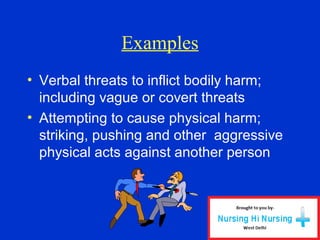
Examples
• Verbal threats to inflict bodily harm;
including vague or covert threats
• Attempting to cause physical harm;
striking, pushing and other aggressive
physical acts against another person
Examples
• Verbal harassment; abusive or offensive
language, gestures or other discourteous
conduct towards supervisors, fellow
employees, or the public
• Disorderly conduct, such as shouting,
throwing or pushing objects, punching
walls, and slamming doors
Examples
• Making false, malicious or unfounded
statements against coworkers,
supervisors, or subordinates which tend
to damage their reputations or
undermine their authority
Examples
• Inappropriate remarks, such as making
delusional statements
• Fascination with guns or other
weapons, bringing weapons into the
workplace
Types of Workplace Violence
• Violence by
strangers
• Violence by
customers or
clients
• Violence by co-
workers
• Violence by
personal relations
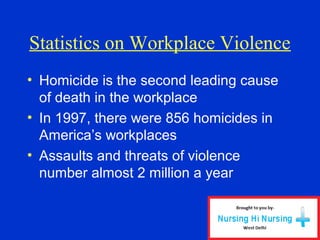
Statistics on Workplace Violence
• Homicide is the second leading cause
of death in the workplace
• In 1997, there were 856 homicides in
America’s workplaces
• Assaults and threats of violence
number almost 2 million a year
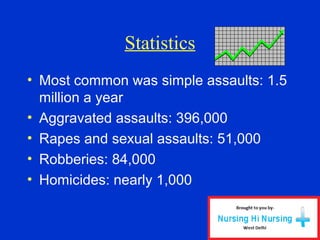
Statistics
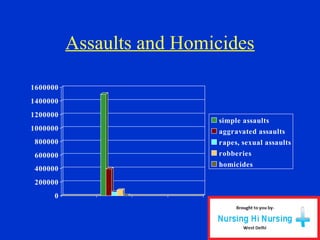
• Most common was simple assaults: 1.5
million a year
• Aggravated assaults: 396,000
• Rapes and sexual assaults: 51,000
• Robberies: 84,000
• Homicides: nearly 1,000
Assaults and Homicides
0
200000
400000
600000
800000
1000000
1200000
1400000
1600000
simple assaults
aggravated assaults
rapes, sexual assaults
robberies
homicides
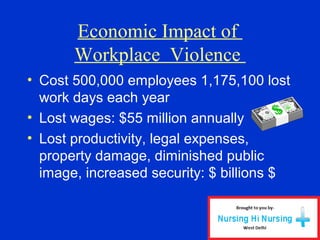
Economic Impact of
Workplace Violence
• Cost 500,000 employees 1,175,100 lost
work days each year
• Lost wages: $55 million annually
• Lost productivity, legal expenses,
property damage, diminished public
image, increased security: $ billions $
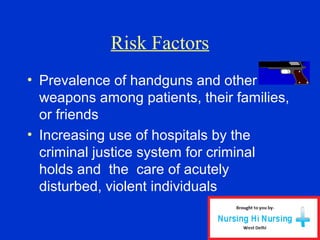
• Prevalence of handguns and other
weapons among patients, their families,
or friends
• Increasing use of hospitals by the
criminal justice system for criminal
holds and the care of acutely
disturbed, violent individuals
Risk Factors
Risk Factors (cont’d)
• Increasing number of acute and
chronically mentally ill patients being
released from hospitals without follow-up
care, who now have the right to refuse
medicine and who can no longer be
hospitalized involuntarily unless they pose
a threat to themselves or others
Risk Factors (cont’d)
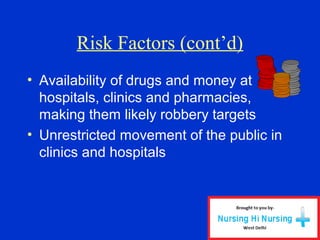
• Availability of drugs and money at
hospitals, clinics and pharmacies,
making them likely robbery targets
• Unrestricted movement of the public in
clinics and hospitals
Risk Factors (cont’d)
• Presence of gang members,
drug/alcohol abusers, trauma patients,
distraught family members
• Low staffing levels during times of
increased activity such as meal and
visiting times, transporting of patients
Risk Factors (cont’d)
• Isolated work with clients during exams
or treatment
• Solo work, often in remote locations,
high crime settings with no back-up or
means of obtaining assistance such as
communication devices or alarm
systems
Risk Factors (cont’d)
• Lack of training in recognizing and
managing escalating hostile and
aggressive behavior
• Poorly-lighted parking areas
OSHA’s Commitment
OSHA has developed guidelines to
provide information to assist employers in
meeting their responsibilities under the
OSH Act.
OSHA Guidelines
• Not a new standard or regulation
• Advisory in nature and informational in
content
• Intended for use by employers who are
seeking to provide a safe and healthful
workplace through effective workplace
violence programs
OSHA Guidelines
Based on OSHA’s Safety and Health
Program Management Guidelines
published in 1989
OSHA GENERAL DUTY CLAUSE:
SECTION 5(a)(1)
Each employer shall furnish to each of his
employees employment and a place of
employment which are free from recognized
hazards that are causing or likely to cause
death or serious physical harm
This includes the prevention and control of
the hazard of workplace violence
OSHA General Duty Clause (cont’d)
OSHA will rely on Section 5 (a)(1) of the
OSH Act for enforcement authority
Workplace Violence
Prevention Program Elements
• Management Commitment and
Employee Involvement
• Worksite Analysis
• Hazard Prevention and Control
• Training and Education
• Recordkeeping and Evaluation of
Program
Management Commitment
and Employee Involvement
• Complementary and essential
• Management commitment provides the
motivating force to deal effectively with
workplace violence
• Employee involvement and feedback-
enable workers to develop and express
their commitment to safety and health
Management Commitment
• Organizational concern for employee
emotional and physical safety and health
• Equal commitment to worker safety and
health and patient/client safety
• System of accountability for involved
managers, and employees
Management Commitment (cont’d)
• Create and disseminate a clear policy
of zero tolerance for workplace violence
• Ensure no reprisals are taken against
employees who report incidents
• Encourage employees to promptly
report incidents and suggest ways to
reduce or eliminate risks
Management Commitment (cont’d)
• Outline a comprehensive plan for maintaining
security in the workplace
• Assign responsibility and authority for
program to individuals with appropriate
training and skills
• Affirm management commitment to worker
supportive environment
• Set up company briefings as part of the initial
effort to address safety issues
Employee Involvement
• Understand and comply with the workplace
violence prevention program and other safety
and security measures
• Participate in employee complaints or
suggestion procedures covering safety and
security concerns
• Prompt and accurate reporting of violent
incidents
Worksite Analysis
• Step-by-step look
at the workplace,
to find existing or
potential hazards
for workplace
violence
Worksite Analysis (cont’d)
• A “Threat assessment
Team”, Patient
Assault Team, or
similar task force may
assess the
vulnerability to
workplace violence
and determine
appropriate actions
Worksite Analysis
Recommended Program
• Analyzing and tracking records
• Monitoring trends and analyzing
incidents
• Screening surveys
• Analyzing workplace security
Hazard Prevention and Control
• Engineering controls and workplace
adaptation
• Administrative and work practice
controls
• Post incident response
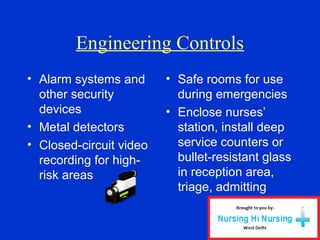
Engineering Controls
• Alarm systems and
other security
devices
• Metal detectors
• Closed-circuit video
recording for high-
risk areas
• Safe rooms for use
during emergencies
• Enclose nurses’
station, install deep
service counters or
bullet-resistant glass
in reception area,
triage, admitting
Administrative and
Work Practice Controls
• State clearly to patients, clients, and
employees that violence will not be tolerated
or permitted
• Establish liaison with local police and state
prosecutors
• Require employees to report all assaults and
threats
• Set up trained response teams to respond to
emergencies
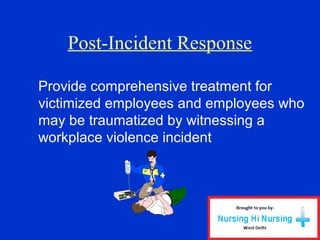
Post-Incident Response
Provide comprehensive treatment for
victimized employees and employees who
may be traumatized by witnessing a
workplace violence incident
Post-Incident Response
• Trauma-crisis counseling
• Critical incident stress debriefing
• Employee assistance programs to
assist victims
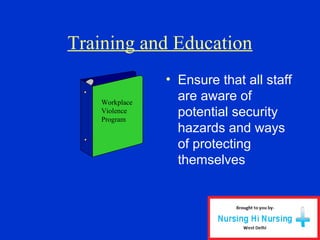
Training and Education
• Ensure that all staff
are aware of
potential security
hazards and ways
of protecting
themselves
Workplace
Violence
Program
Training and Education
• Employees should understand concept of
“Universal Precautions for Violence”, i.e., that
violence should be expected but can be
avoided or mitigated through preparation
• Employees should be instructed to limit
physical interventions in workplace
altercations unless designated emergency
response team or security personnel are
available
Training and Education
Training program should involve all
employees, including supervisors and
managers
Training and Education
• Workplace violence
prevention policy
• Risk factors that
cause or contribute
to assaults
• Early recognition of
escalating behavior
or warning signs
• Ways to prevent
volatile situations
• Standard response
action plan for
violent situations
• Location and
operation of safety
devices
Recordkeeping and Evaluation
• Recordkeeping and evaluation of the
violence prevention program are necessary
to determine overall effectiveness and
identify deficiencies or changes that should
be made
Recordkeeping
• OSHA Log of Injury and Illness (OSHA 300)
• Medical reports of work injuries assaults
• Incidents of abuse, verbal attacks, or aggressive
behavior
• Information on patients with history of violence
• Minutes of safety meetings, records of hazard
analyses, and corrective actions
• Records of all training programs
Evaluation
• Establish uniform violence reporting system
and regular review of reports
• Review reports of minutes from staff
meetings on safety issues
• Analyze trends and rates in illness/injury or
fatalities caused by violence
• Measure improvement based on lowering
frequency and severity of workplace violence
Sources of Assistance
• OSHA Consultation Program
• OSHA Internet Site www.osha.gov
• NIOSH
• Public Safety Officials
• Trade Associations
• Unions and Insurers
• Human Resource and Employee Assistance
Professionals
Contact us:- 011-25464531, 9818569476

Violence prevention

  • 1.
  • 2.
    Definition Workplace violence isany physical assault, threatening behavior, or verbal abuse occurring in the work setting A workplace may be any location either permanent or temporary where an employee performs any work- related duty
  • 3.
    Definition Cont’d • Thisincludes, but is not limited to, the buildings and the surrounding perimeters, including the parking lots, field locations, clients’ homes and traveling to and from work assignments
  • 4.
    Workplace Violence Includes: •Beatings • Stabbings • Suicides • Shootings • Rapes • Near-suicides • Psychological traumas • Threats or obscene phone calls • Intimidation • Harassment of any nature • Being followed, sworn or shouted at
  • 5.
    Examples • Verbal threatsto inflict bodily harm; including vague or covert threats • Attempting to cause physical harm; striking, pushing and other aggressive physical acts against another person
  • 6.
    Examples • Verbal harassment;abusive or offensive language, gestures or other discourteous conduct towards supervisors, fellow employees, or the public • Disorderly conduct, such as shouting, throwing or pushing objects, punching walls, and slamming doors
  • 7.
    Examples • Making false,malicious or unfounded statements against coworkers, supervisors, or subordinates which tend to damage their reputations or undermine their authority
  • 8.
    Examples • Inappropriate remarks,such as making delusional statements • Fascination with guns or other weapons, bringing weapons into the workplace
  • 9.
    Types of WorkplaceViolence • Violence by strangers • Violence by customers or clients • Violence by co- workers • Violence by personal relations
  • 10.
    Statistics on WorkplaceViolence • Homicide is the second leading cause of death in the workplace • In 1997, there were 856 homicides in America’s workplaces • Assaults and threats of violence number almost 2 million a year
  • 11.
    Statistics • Most commonwas simple assaults: 1.5 million a year • Aggravated assaults: 396,000 • Rapes and sexual assaults: 51,000 • Robberies: 84,000 • Homicides: nearly 1,000
  • 12.
    Assaults and Homicides 0 200000 400000 600000 800000 1000000 1200000 1400000 1600000 simpleassaults aggravated assaults rapes, sexual assaults robberies homicides
  • 13.
    Economic Impact of WorkplaceViolence • Cost 500,000 employees 1,175,100 lost work days each year • Lost wages: $55 million annually • Lost productivity, legal expenses, property damage, diminished public image, increased security: $ billions $
  • 14.
    • Prevalence ofhandguns and other weapons among patients, their families, or friends • Increasing use of hospitals by the criminal justice system for criminal holds and the care of acutely disturbed, violent individuals Risk Factors
  • 15.
    Risk Factors (cont’d) •Increasing number of acute and chronically mentally ill patients being released from hospitals without follow-up care, who now have the right to refuse medicine and who can no longer be hospitalized involuntarily unless they pose a threat to themselves or others
  • 16.
    Risk Factors (cont’d) •Availability of drugs and money at hospitals, clinics and pharmacies, making them likely robbery targets • Unrestricted movement of the public in clinics and hospitals
  • 17.
    Risk Factors (cont’d) •Presence of gang members, drug/alcohol abusers, trauma patients, distraught family members • Low staffing levels during times of increased activity such as meal and visiting times, transporting of patients
  • 18.
    Risk Factors (cont’d) •Isolated work with clients during exams or treatment • Solo work, often in remote locations, high crime settings with no back-up or means of obtaining assistance such as communication devices or alarm systems
  • 19.
    Risk Factors (cont’d) •Lack of training in recognizing and managing escalating hostile and aggressive behavior • Poorly-lighted parking areas
  • 20.
  • 21.
    OSHA has developedguidelines to provide information to assist employers in meeting their responsibilities under the OSH Act.
  • 22.
    OSHA Guidelines • Nota new standard or regulation • Advisory in nature and informational in content • Intended for use by employers who are seeking to provide a safe and healthful workplace through effective workplace violence programs
  • 23.
    OSHA Guidelines Based onOSHA’s Safety and Health Program Management Guidelines published in 1989
  • 24.
    OSHA GENERAL DUTYCLAUSE: SECTION 5(a)(1) Each employer shall furnish to each of his employees employment and a place of employment which are free from recognized hazards that are causing or likely to cause death or serious physical harm This includes the prevention and control of the hazard of workplace violence
  • 25.
    OSHA General DutyClause (cont’d) OSHA will rely on Section 5 (a)(1) of the OSH Act for enforcement authority
  • 26.
    Workplace Violence Prevention ProgramElements • Management Commitment and Employee Involvement • Worksite Analysis • Hazard Prevention and Control • Training and Education • Recordkeeping and Evaluation of Program
  • 27.
    Management Commitment and EmployeeInvolvement • Complementary and essential • Management commitment provides the motivating force to deal effectively with workplace violence • Employee involvement and feedback- enable workers to develop and express their commitment to safety and health
  • 28.
    Management Commitment • Organizationalconcern for employee emotional and physical safety and health • Equal commitment to worker safety and health and patient/client safety • System of accountability for involved managers, and employees
  • 29.
    Management Commitment (cont’d) •Create and disseminate a clear policy of zero tolerance for workplace violence • Ensure no reprisals are taken against employees who report incidents • Encourage employees to promptly report incidents and suggest ways to reduce or eliminate risks
  • 30.
    Management Commitment (cont’d) •Outline a comprehensive plan for maintaining security in the workplace • Assign responsibility and authority for program to individuals with appropriate training and skills • Affirm management commitment to worker supportive environment • Set up company briefings as part of the initial effort to address safety issues
  • 31.
    Employee Involvement • Understandand comply with the workplace violence prevention program and other safety and security measures • Participate in employee complaints or suggestion procedures covering safety and security concerns • Prompt and accurate reporting of violent incidents
  • 32.
    Worksite Analysis • Step-by-steplook at the workplace, to find existing or potential hazards for workplace violence
  • 33.
    Worksite Analysis (cont’d) •A “Threat assessment Team”, Patient Assault Team, or similar task force may assess the vulnerability to workplace violence and determine appropriate actions
  • 34.
    Worksite Analysis Recommended Program •Analyzing and tracking records • Monitoring trends and analyzing incidents • Screening surveys • Analyzing workplace security
  • 35.
    Hazard Prevention andControl • Engineering controls and workplace adaptation • Administrative and work practice controls • Post incident response
  • 36.
    Engineering Controls • Alarmsystems and other security devices • Metal detectors • Closed-circuit video recording for high- risk areas • Safe rooms for use during emergencies • Enclose nurses’ station, install deep service counters or bullet-resistant glass in reception area, triage, admitting
  • 37.
    Administrative and Work PracticeControls • State clearly to patients, clients, and employees that violence will not be tolerated or permitted • Establish liaison with local police and state prosecutors • Require employees to report all assaults and threats • Set up trained response teams to respond to emergencies
  • 38.
    Post-Incident Response Provide comprehensivetreatment for victimized employees and employees who may be traumatized by witnessing a workplace violence incident
  • 39.
    Post-Incident Response • Trauma-crisiscounseling • Critical incident stress debriefing • Employee assistance programs to assist victims
  • 40.
    Training and Education •Ensure that all staff are aware of potential security hazards and ways of protecting themselves Workplace Violence Program
  • 41.
    Training and Education •Employees should understand concept of “Universal Precautions for Violence”, i.e., that violence should be expected but can be avoided or mitigated through preparation • Employees should be instructed to limit physical interventions in workplace altercations unless designated emergency response team or security personnel are available
  • 42.
    Training and Education Trainingprogram should involve all employees, including supervisors and managers
  • 43.
    Training and Education •Workplace violence prevention policy • Risk factors that cause or contribute to assaults • Early recognition of escalating behavior or warning signs • Ways to prevent volatile situations • Standard response action plan for violent situations • Location and operation of safety devices
  • 44.
    Recordkeeping and Evaluation •Recordkeeping and evaluation of the violence prevention program are necessary to determine overall effectiveness and identify deficiencies or changes that should be made
  • 45.
    Recordkeeping • OSHA Logof Injury and Illness (OSHA 300) • Medical reports of work injuries assaults • Incidents of abuse, verbal attacks, or aggressive behavior • Information on patients with history of violence • Minutes of safety meetings, records of hazard analyses, and corrective actions • Records of all training programs
  • 46.
    Evaluation • Establish uniformviolence reporting system and regular review of reports • Review reports of minutes from staff meetings on safety issues • Analyze trends and rates in illness/injury or fatalities caused by violence • Measure improvement based on lowering frequency and severity of workplace violence
  • 47.
    Sources of Assistance •OSHA Consultation Program • OSHA Internet Site www.osha.gov • NIOSH • Public Safety Officials • Trade Associations • Unions and Insurers • Human Resource and Employee Assistance Professionals
  • 48.