Employee Health and
Wellbeing โ€“ London
Making the case for interventions to
improve workplace health
Local Knowledge and Intelligence Service (London) and PHE London
With grateful thanks to the GLA and ONS
January 2018
Employee Health and Wellbeing โ€“ London
This slide set provides an update of selected data presented in
Londonโ€™s business case for employee health and wellbeing, which was
published in May 2012 by the Greater London Authority.
The focus of the report was on the impact that workplace wellness
programmes can have on ill-health.
The original report is available from: https://www.london.gov.uk/what-
we-do/business-and-economy/business-and-economy-
publications/londons-business-case-employee
Health and Work, July 2017
2 Local Knowledge and Intelligence Service (London) and PHE London โ€“ January 2018
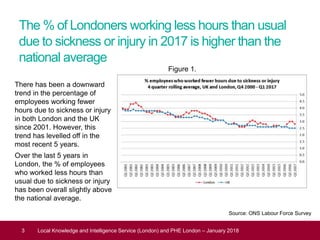
The % of Londoners working less hours than usual
due to sickness or injury in 2017 is higher than the
national average
There has been a downward
trend in the percentage of
employees working fewer
hours due to sickness or injury
in both London and the UK
since 2001. However, this
trend has levelled off in the
most recent 5 years.
Over the last 5 years in
London, the % of employees
who worked less hours than
usual due to sickness or injury
has been overall slightly above
the national average.
Health and Work, July 2017
3 Local Knowledge and Intelligence Service (London) and PHE London โ€“ January 2018
Source: ONS Labour Force Survey
Figure 1.
There is more sickness absence reported
in the public sector than the private sector
Health and Work, July 2017
4 Local Knowledge and Intelligence Service (London) and PHE London โ€“ January 2018
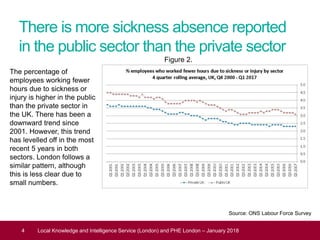
Figure 2.
The percentage of
employees working fewer
hours due to sickness or
injury is higher in the public
than the private sector in
the UK. There has been a
downward trend since
2001. However, this trend
has levelled off in the most
recent 5 years in both
sectors. London follows a
similar pattern, although
this is less clear due to
small numbers.
Source: ONS Labour Force Survey
Health and Work, July 2017
5 Local Knowledge and Intelligence Service (London) and PHE London โ€“ January 2018
The percentage of working hours lost due
to sickness absences increases with age
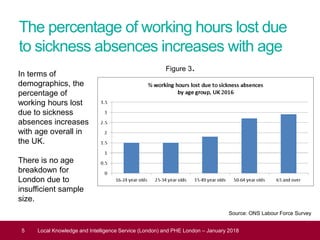
In terms of
demographics, the
percentage of
working hours lost
due to sickness
absences increases
with age overall in
the UK.
There is no age
breakdown for
London due to
insufficient sample
size.
Figure 3.
Source: ONS Labour Force Survey
6 Local Knowledge and Intelligence Service (London) and PHE London โ€“ January 2018
Source: ONS Annual Population Survey
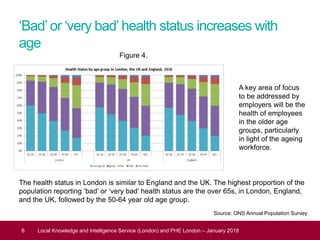
The health status in London is similar to England and the UK. The highest proportion of the
population reporting โ€˜badโ€™ or โ€˜very badโ€™ health status are the over 65s, in London, England,
and the UK, followed by the 50-64 year old age group.
โ€˜Badโ€™ or โ€˜very badโ€™ health status increases with
age
A key area of focus
to be addressed by
employers will be the
health of employees
in the older age
groups, particularly
in light of the ageing
workforce.
Figure 4.
Health and Work, July 2017
7 Local Knowledge and Intelligence Service (London) and PHE London โ€“ January 2018
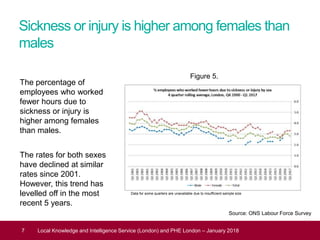
The percentage of
employees who worked
fewer hours due to
sickness or injury is
higher among females
than males.
The rates for both sexes
have declined at similar
rates since 2001.
However, this trend has
levelled off in the most
recent 5 years.
Sickness or injury is higher among females than
males
Figure 5.
Data for some quarters are unavailable due to insufficient sample size
Source: ONS Labour Force Survey
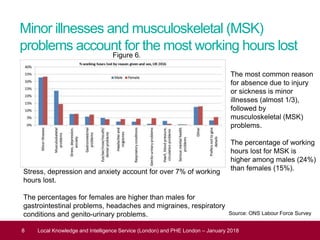
Minor illnesses and musculoskeletal (MSK)
problems account for the most working hours lost
8 Local Knowledge and Intelligence Service (London) and PHE London โ€“ January 2018
The most common reason
for absence due to injury
or sickness is minor
illnesses (almost 1/3),
followed by
musculoskeletal (MSK)
problems.
The percentage of working
hours lost for MSK is
higher among males (24%)
than females (15%).Stress, depression and anxiety account for over 7% of working
hours lost.
The percentages for females are higher than males for
gastrointestinal problems, headaches and migraines, respiratory
conditions and genito-urinary problems.
Figure 6.
Source: ONS Labour Force Survey
Useful healthy workplace resources
PHE โ€“ Workplace Health
Resources for employers, local government and commissioners on workplace health
https://www.gov.uk/government/collections/workplace-health
ROI Tool โ€“ Workplace โ€“ Wellbeing Programme/Stress Prevention
Return on investment resources to support local commissioners in designing and implementing
mental health and wellbeing support services
https://www.gov.uk/government/publications/mental-health-services-cost-effective-commissioning
MIND
Mentally healthy workplaces
https://www.mind.org.uk/media/43247/Resource1_Mentally_Healthy_workplacesFINAL_pdf.pdf
9 Local Knowledge and Intelligence Service (London) and PHE London โ€“ January 2018
Useful healthy workplace resources
London Healthy Workplace Charter
The London Healthy Workplace Charter, backed by the Mayor of London provides clear
and easy steps for employers to make their workplaces healthier and happier.
https://www.london.gov.uk/what-we-do/health/healthy-workplace-charter#acc-i-42964
Business Healthy - Supporting the health and wellbeing of City workers
Business Healthy is a community and online resource for business leaders
committed to improving the health and wellbeing of their workforce.
www.businesshealthy.org
NICE Workplace Health guidelines
This guideline covers how to improve the health and wellbeing of employees, with a focus
on organisational culture and the role of line managers.
https://www.nice.org.uk/guidance/ng13
10 Local Knowledge and Intelligence Service (London) and PHE London โ€“ January 2018
Useful healthy workplace resources
Business in the Community has partnered with Public Health England to produce
the following online interconnected suite of toolkits:
โ€ข The mental health toolkit for employers helps employers pick out the most valuable
resources relating to mental health and develop an approach to a healthy workplace
that really works. The implementation of this toolkit directly supports the 6 mental
health standards advocated by the Stevenson Farmer Review: Thriving at Work
โ€ข Musculoskeletal health in the workplace: a toolkit for employers provides
practical advice for employers regarding employee musculoskeletal health and
reducing workplace absence
โ€ข Reducing the risk of suicide: a preventative toolkit for employers provides
support and advice on how to incorporate suicide prevention into an employerโ€™s
workplace health and wellbeing framework
โ€ข Crisis management in the event of a suicide: a postvention toolkit for
employers offers practical advice and support for employers in the aftermath of an
employee suicide
11 Local Knowledge and Intelligence Service (London) and PHE London โ€“ January 2018
About Public Health England
Public Health England exists to protect and improve the nationโ€™s health and wellbeing, and reduce health inequalities. We
do this through world-leading science, knowledge and intelligence, advocacy, partnerships and the delivery of specialist
public health services. We are an executive agency of the Department of Health and Social Care, and a distinct delivery
organisation with operational autonomy. We provide government, local government, the NHS, Parliament, industry and the
public with evidence-based professional, scientific and delivery expertise and support.
Public Health England, Wellington House, 133-155 Waterloo Road, London SE1 8UG
Tel: 020 7654 8000 www.gov.uk/phe Twitter: @PHE_uk Facebook: www.facebook.com/PublicHealthEngland
Prepared by: Monica Acheampong, Public Health Support Manager.
ยฉ Crown copyright 2018
You may re-use this information (excluding logos) free of charge in any format or medium, under the terms of the Open
Government Licence v3.0. To view this licence visit:
https://www.nationalarchives.gov.uk/doc/open-government-licence/version/3/ or email: psi@nationalarchives.gsi.gov.uk
Where we have identified any third party copyright information you will need to obtain permission from the copyright
holders concerned.
Published: March 2018. PHE supports the UN Sustainable
Development Goals
PHE publications gateway number: 2017809.
12 Presentation title - edit in Header and Footer

Workplace health in_london_making_the_case_for_interventions

  • 1.
    Employee Health and Wellbeingโ€“ London Making the case for interventions to improve workplace health Local Knowledge and Intelligence Service (London) and PHE London With grateful thanks to the GLA and ONS January 2018
  • 2.
    Employee Health andWellbeing โ€“ London This slide set provides an update of selected data presented in Londonโ€™s business case for employee health and wellbeing, which was published in May 2012 by the Greater London Authority. The focus of the report was on the impact that workplace wellness programmes can have on ill-health. The original report is available from: https://www.london.gov.uk/what- we-do/business-and-economy/business-and-economy- publications/londons-business-case-employee Health and Work, July 2017 2 Local Knowledge and Intelligence Service (London) and PHE London โ€“ January 2018
  • 3.
    The % ofLondoners working less hours than usual due to sickness or injury in 2017 is higher than the national average There has been a downward trend in the percentage of employees working fewer hours due to sickness or injury in both London and the UK since 2001. However, this trend has levelled off in the most recent 5 years. Over the last 5 years in London, the % of employees who worked less hours than usual due to sickness or injury has been overall slightly above the national average. Health and Work, July 2017 3 Local Knowledge and Intelligence Service (London) and PHE London โ€“ January 2018 Source: ONS Labour Force Survey Figure 1.
  • 4.
    There is moresickness absence reported in the public sector than the private sector Health and Work, July 2017 4 Local Knowledge and Intelligence Service (London) and PHE London โ€“ January 2018 Figure 2. The percentage of employees working fewer hours due to sickness or injury is higher in the public than the private sector in the UK. There has been a downward trend since 2001. However, this trend has levelled off in the most recent 5 years in both sectors. London follows a similar pattern, although this is less clear due to small numbers. Source: ONS Labour Force Survey
  • 5.
    Health and Work,July 2017 5 Local Knowledge and Intelligence Service (London) and PHE London โ€“ January 2018 The percentage of working hours lost due to sickness absences increases with age In terms of demographics, the percentage of working hours lost due to sickness absences increases with age overall in the UK. There is no age breakdown for London due to insufficient sample size. Figure 3. Source: ONS Labour Force Survey
  • 6.
    6 Local Knowledgeand Intelligence Service (London) and PHE London โ€“ January 2018 Source: ONS Annual Population Survey The health status in London is similar to England and the UK. The highest proportion of the population reporting โ€˜badโ€™ or โ€˜very badโ€™ health status are the over 65s, in London, England, and the UK, followed by the 50-64 year old age group. โ€˜Badโ€™ or โ€˜very badโ€™ health status increases with age A key area of focus to be addressed by employers will be the health of employees in the older age groups, particularly in light of the ageing workforce. Figure 4.
  • 7.
    Health and Work,July 2017 7 Local Knowledge and Intelligence Service (London) and PHE London โ€“ January 2018 The percentage of employees who worked fewer hours due to sickness or injury is higher among females than males. The rates for both sexes have declined at similar rates since 2001. However, this trend has levelled off in the most recent 5 years. Sickness or injury is higher among females than males Figure 5. Data for some quarters are unavailable due to insufficient sample size Source: ONS Labour Force Survey
  • 8.
    Minor illnesses andmusculoskeletal (MSK) problems account for the most working hours lost 8 Local Knowledge and Intelligence Service (London) and PHE London โ€“ January 2018 The most common reason for absence due to injury or sickness is minor illnesses (almost 1/3), followed by musculoskeletal (MSK) problems. The percentage of working hours lost for MSK is higher among males (24%) than females (15%).Stress, depression and anxiety account for over 7% of working hours lost. The percentages for females are higher than males for gastrointestinal problems, headaches and migraines, respiratory conditions and genito-urinary problems. Figure 6. Source: ONS Labour Force Survey
  • 9.
    Useful healthy workplaceresources PHE โ€“ Workplace Health Resources for employers, local government and commissioners on workplace health https://www.gov.uk/government/collections/workplace-health ROI Tool โ€“ Workplace โ€“ Wellbeing Programme/Stress Prevention Return on investment resources to support local commissioners in designing and implementing mental health and wellbeing support services https://www.gov.uk/government/publications/mental-health-services-cost-effective-commissioning MIND Mentally healthy workplaces https://www.mind.org.uk/media/43247/Resource1_Mentally_Healthy_workplacesFINAL_pdf.pdf 9 Local Knowledge and Intelligence Service (London) and PHE London โ€“ January 2018
  • 10.
    Useful healthy workplaceresources London Healthy Workplace Charter The London Healthy Workplace Charter, backed by the Mayor of London provides clear and easy steps for employers to make their workplaces healthier and happier. https://www.london.gov.uk/what-we-do/health/healthy-workplace-charter#acc-i-42964 Business Healthy - Supporting the health and wellbeing of City workers Business Healthy is a community and online resource for business leaders committed to improving the health and wellbeing of their workforce. www.businesshealthy.org NICE Workplace Health guidelines This guideline covers how to improve the health and wellbeing of employees, with a focus on organisational culture and the role of line managers. https://www.nice.org.uk/guidance/ng13 10 Local Knowledge and Intelligence Service (London) and PHE London โ€“ January 2018
  • 11.
    Useful healthy workplaceresources Business in the Community has partnered with Public Health England to produce the following online interconnected suite of toolkits: โ€ข The mental health toolkit for employers helps employers pick out the most valuable resources relating to mental health and develop an approach to a healthy workplace that really works. The implementation of this toolkit directly supports the 6 mental health standards advocated by the Stevenson Farmer Review: Thriving at Work โ€ข Musculoskeletal health in the workplace: a toolkit for employers provides practical advice for employers regarding employee musculoskeletal health and reducing workplace absence โ€ข Reducing the risk of suicide: a preventative toolkit for employers provides support and advice on how to incorporate suicide prevention into an employerโ€™s workplace health and wellbeing framework โ€ข Crisis management in the event of a suicide: a postvention toolkit for employers offers practical advice and support for employers in the aftermath of an employee suicide 11 Local Knowledge and Intelligence Service (London) and PHE London โ€“ January 2018
  • 12.
    About Public HealthEngland Public Health England exists to protect and improve the nationโ€™s health and wellbeing, and reduce health inequalities. We do this through world-leading science, knowledge and intelligence, advocacy, partnerships and the delivery of specialist public health services. We are an executive agency of the Department of Health and Social Care, and a distinct delivery organisation with operational autonomy. We provide government, local government, the NHS, Parliament, industry and the public with evidence-based professional, scientific and delivery expertise and support. Public Health England, Wellington House, 133-155 Waterloo Road, London SE1 8UG Tel: 020 7654 8000 www.gov.uk/phe Twitter: @PHE_uk Facebook: www.facebook.com/PublicHealthEngland Prepared by: Monica Acheampong, Public Health Support Manager. ยฉ Crown copyright 2018 You may re-use this information (excluding logos) free of charge in any format or medium, under the terms of the Open Government Licence v3.0. To view this licence visit: https://www.nationalarchives.gov.uk/doc/open-government-licence/version/3/ or email: psi@nationalarchives.gsi.gov.uk Where we have identified any third party copyright information you will need to obtain permission from the copyright holders concerned. Published: March 2018. PHE supports the UN Sustainable Development Goals PHE publications gateway number: 2017809. 12 Presentation title - edit in Header and Footer