How A Lot Of Employees
Cheat A Little At Work
Group 8:
Elisa Jang,
Victoria Miranda,
Eliot Morrissey,
and Minxue Qiu
Production Deviance:
Wasting Resources in the Workplace
Ethics
Ethics - The degree to which behaviors of an authority are in accordance with
generally accepted moral norms.
Ethical Behavior -
Business Ethics
Business ethics is rules, standards, codes, or principles which provide guidelines
for morally right behavior and truthfulness in specific situations.
Factors that Affect Employee Ethics
Victims of interpersonal workplace deviance are more likely to suffer from stress-related
problems and show a relatively decreased productivity, lost work time and a relatively high
turnover rate (Henle et al., 2005, qtd. in Applebaum, Iaconi, Matousek)
.
Production Deviance
Counterproductive behavior directed towards an organization.
Decrease in productivity of employees and efficiency of work output.
Wasting resources:
Using to much materials for a project
Taking too many breaks during the day
Taking more time than necessary to complete a simple task
● Substance abuse:
○ Employees come to work under the influence or abuse substances on the job
○ Greatly impacts work efficiency and accuracy of output
How do Employees Cheat?
-Social Media
-Wasting Organization Resources
- Stealing organization supplies
- Prolonged breaks or Frequent breaks
- Lengthening time to complete tasks
-Stealing from the company such as materials, confidential information, software,
fraud etc.
Absenteeism
- Tardiness
- Taking too many leaves
- Abusing paid leave / sick days even if you aren't sick
- Lying about hours worked at home
Presenteeism
- Mental illness
- Decreases productivity by ⅓
- Decreases productivity -> complete tasks incorrectly or withholding
information or effort for intended tasks
- Withdrawal behaviors due to job satisfaction
Statistics
75 percent of employees have engaged in one form of the following deviant behaviors:
theft, computer fraud, embezzlement, vandalism, sabotage or absenteeism (Robinson
and Bennett, 1995 qtd. in Applebaum, Iaconi, Matousek)
The estimated impact of employee theft has been reported to be $50 billion annually on the
US economy (Henle et al., 2005 qtd. in Applebaum, Iaconi, Matousek)).
Scientific Method / Correlations
Rationalizing Unethical Behavior
Things employees might say or do to make it seem as if their actions/behaviors
are okay
Organizational Commitment
Organizational commitment refers to the employees desire to remain a member
of their organization.
Employees who act unethically or deviant in the workplace may engage in
withdrawal behavior such as exit or neglect which are two of the destructive
responses.
Withdrawal Theories
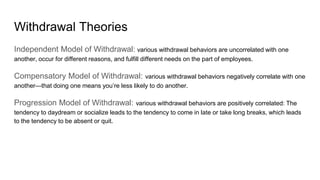
Independent Model of Withdrawal: various withdrawal behaviors are uncorrelated with one
another, occur for different reasons, and fulfill different needs on the part of employees.
Compensatory Model of Withdrawal: various withdrawal behaviors negatively correlate with one
another—that doing one means you’re less likely to do another.
Progression Model of Withdrawal: various withdrawal behaviors are positively correlated: The
tendency to daydream or socialize leads to the tendency to come in late or take long breaks, which leads
to the tendency to be absent or quit.
Value-Percept Theory
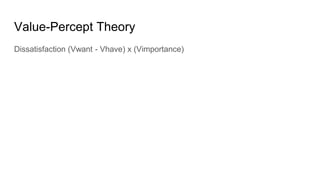
Dissatisfaction (Vwant - Vhave) x (Vimportance)
Job Characteristics Theory
How to Motivate Employees
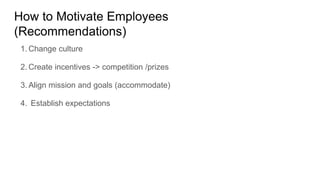
(Recommendations)
1. Change culture
2. Create incentives -> competition /prizes
3. Align mission and goals (accommodate)
4. Establish expectations
UNETHICAL BEHAVIORS BY EMPLOYEES
Bribery and kickbacks
Provision of false information
Theft practices.
Unethical Behavior that Benefits the Company
Example: Sales employee will go the extra mile in promoting organization’s products which may
involve unethical behaviors and practices in hopes of increasing profit or success for the
company.
Giving and receiving of kick backs
● Sales associates will give kick backs to customers when their products are purchased.
● Kick backs can help a sales team meet their targets set by the organization.
● Ethically giving and receiving kick backs is wrong but has a positive impact on profit for the
company.
Reinforcement theory of unethical behavior
Employees who are rewarded with a bonus after engaging in unethical behavior like giving kick backs to
customers because they met or exceeded their sales targets.
The bonus encourages employees to continue unethical behaviors as long as it benefits the company.
Between 2007 and 2010 pharmaceutical companies were fined $7 billion for paying doctors to push the
usage of unapproved drugs (Knopf & Alison 11).
7 large pharmaceutical companies in the US paid more than 17, 000 doctors for purposes of promoting
their drugs which is unethical.
Expectancy theory
An employee may engage in unethical behavior based on what they anticipate
will be the end results of their behavior.
Pharmaceutical companies are encouraged to give doctors kick backs because
they expect an increase in sales.
Theft by employees
Theft often occurs when employees feel inadequately compensated by the organization.
Study by Jack L. Hayes International reveals that in 2012, for every 40 employees one of them was
stealing from the organization (Heath & Joseph 8).
The study also showed average employees steal 5.5 times more than shoplifters $715 vs. $129 (Heath
& Joseph 8)
Many employees continue to steal from the organization because they have never been caught.
Sources
Heath, Joseph. "Business Ethics And Moral Motivation: A Criminological Perspective". J Bus Ethics 83.4
(2008): 595-614. Web.
Knopf, Alison. "Pain Clinics CEO Pleads Guilty To Arranging Drug-Test Kickbacks". Alcoholism & Drug
Abuse Weekly 26.48 (2014): 6-6. Web.
Appelbaum, Steven H., Giulio David Iaconi, and Albert Matousek. "Positive and Negative Deviant Workplace Behaviors:
Causes, Impacts, and Solutions." Corporate Governance: The International Journal of Business in Society Corporate
Governance 7.5 (2007): 586-98. Web. 2 Feb. 2016.

Workplace deviance: cheating at work

  • 1.
    How A LotOf Employees Cheat A Little At Work Group 8: Elisa Jang, Victoria Miranda, Eliot Morrissey, and Minxue Qiu Production Deviance: Wasting Resources in the Workplace
  • 2.
    Ethics Ethics - Thedegree to which behaviors of an authority are in accordance with generally accepted moral norms. Ethical Behavior -
  • 3.
    Business Ethics Business ethicsis rules, standards, codes, or principles which provide guidelines for morally right behavior and truthfulness in specific situations.
  • 4.
    Factors that AffectEmployee Ethics Victims of interpersonal workplace deviance are more likely to suffer from stress-related problems and show a relatively decreased productivity, lost work time and a relatively high turnover rate (Henle et al., 2005, qtd. in Applebaum, Iaconi, Matousek) .
  • 5.
    Production Deviance Counterproductive behaviordirected towards an organization. Decrease in productivity of employees and efficiency of work output. Wasting resources: Using to much materials for a project Taking too many breaks during the day Taking more time than necessary to complete a simple task ● Substance abuse: ○ Employees come to work under the influence or abuse substances on the job ○ Greatly impacts work efficiency and accuracy of output
  • 6.
    How do EmployeesCheat? -Social Media -Wasting Organization Resources - Stealing organization supplies - Prolonged breaks or Frequent breaks - Lengthening time to complete tasks -Stealing from the company such as materials, confidential information, software, fraud etc.
  • 7.
    Absenteeism - Tardiness - Takingtoo many leaves - Abusing paid leave / sick days even if you aren't sick - Lying about hours worked at home
  • 8.
    Presenteeism - Mental illness -Decreases productivity by ⅓ - Decreases productivity -> complete tasks incorrectly or withholding information or effort for intended tasks - Withdrawal behaviors due to job satisfaction
  • 9.
    Statistics 75 percent ofemployees have engaged in one form of the following deviant behaviors: theft, computer fraud, embezzlement, vandalism, sabotage or absenteeism (Robinson and Bennett, 1995 qtd. in Applebaum, Iaconi, Matousek) The estimated impact of employee theft has been reported to be $50 billion annually on the US economy (Henle et al., 2005 qtd. in Applebaum, Iaconi, Matousek)).
  • 10.
    Scientific Method /Correlations
  • 11.
    Rationalizing Unethical Behavior Thingsemployees might say or do to make it seem as if their actions/behaviors are okay
  • 12.
    Organizational Commitment Organizational commitmentrefers to the employees desire to remain a member of their organization. Employees who act unethically or deviant in the workplace may engage in withdrawal behavior such as exit or neglect which are two of the destructive responses.
  • 13.
    Withdrawal Theories Independent Modelof Withdrawal: various withdrawal behaviors are uncorrelated with one another, occur for different reasons, and fulfill different needs on the part of employees. Compensatory Model of Withdrawal: various withdrawal behaviors negatively correlate with one another—that doing one means you’re less likely to do another. Progression Model of Withdrawal: various withdrawal behaviors are positively correlated: The tendency to daydream or socialize leads to the tendency to come in late or take long breaks, which leads to the tendency to be absent or quit.
  • 14.
  • 15.
  • 16.
    How to MotivateEmployees (Recommendations) 1. Change culture 2. Create incentives -> competition /prizes 3. Align mission and goals (accommodate) 4. Establish expectations
  • 17.
    UNETHICAL BEHAVIORS BYEMPLOYEES Bribery and kickbacks Provision of false information Theft practices. Unethical Behavior that Benefits the Company Example: Sales employee will go the extra mile in promoting organization’s products which may involve unethical behaviors and practices in hopes of increasing profit or success for the company.
  • 18.
    Giving and receivingof kick backs ● Sales associates will give kick backs to customers when their products are purchased. ● Kick backs can help a sales team meet their targets set by the organization. ● Ethically giving and receiving kick backs is wrong but has a positive impact on profit for the company.
  • 19.
    Reinforcement theory ofunethical behavior Employees who are rewarded with a bonus after engaging in unethical behavior like giving kick backs to customers because they met or exceeded their sales targets. The bonus encourages employees to continue unethical behaviors as long as it benefits the company. Between 2007 and 2010 pharmaceutical companies were fined $7 billion for paying doctors to push the usage of unapproved drugs (Knopf & Alison 11). 7 large pharmaceutical companies in the US paid more than 17, 000 doctors for purposes of promoting their drugs which is unethical.
  • 20.
    Expectancy theory An employeemay engage in unethical behavior based on what they anticipate will be the end results of their behavior. Pharmaceutical companies are encouraged to give doctors kick backs because they expect an increase in sales.
  • 21.
    Theft by employees Theftoften occurs when employees feel inadequately compensated by the organization. Study by Jack L. Hayes International reveals that in 2012, for every 40 employees one of them was stealing from the organization (Heath & Joseph 8). The study also showed average employees steal 5.5 times more than shoplifters $715 vs. $129 (Heath & Joseph 8) Many employees continue to steal from the organization because they have never been caught.
  • 22.
    Sources Heath, Joseph. "BusinessEthics And Moral Motivation: A Criminological Perspective". J Bus Ethics 83.4 (2008): 595-614. Web. Knopf, Alison. "Pain Clinics CEO Pleads Guilty To Arranging Drug-Test Kickbacks". Alcoholism & Drug Abuse Weekly 26.48 (2014): 6-6. Web. Appelbaum, Steven H., Giulio David Iaconi, and Albert Matousek. "Positive and Negative Deviant Workplace Behaviors: Causes, Impacts, and Solutions." Corporate Governance: The International Journal of Business in Society Corporate Governance 7.5 (2007): 586-98. Web. 2 Feb. 2016.