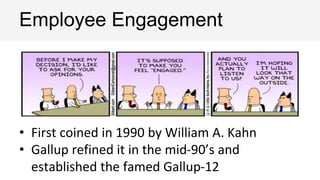
• First coined in 1990 by William A. Kahn
• Gallup refined it in the mid-90’s and
established the famed Gallup-12
Employee Engagement
• Key Measures
– The extent to which employees are likely to put forth
discretionary effort,
– The degree to which employees intend to stay with the
organization, and
– More recently, the likeliness employees are to be a “brand
advocate” for the company.
• The measure has been used extensively for decades, has
become the standard-bearer to workplace effectiveness, and
has quite nearly become a commoditized business
Gallup - 12
• I know what is expected of me at work.
• The mission or purpose of my company makes
me feel my job is important.
• I have a best friend at work.
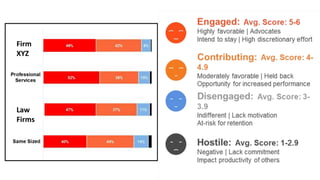
Example
Firm
XYZ
Law
Firms
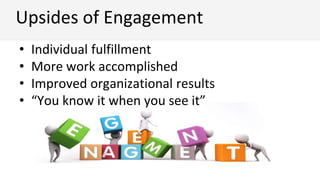
• Individual fulfillment
• More work accomplished
• Improved organizational results
• “You know it when you see it”
Upsides of Engagement
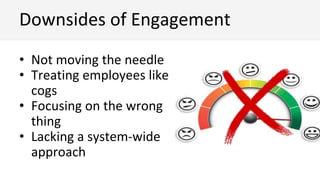
• Not moving the needle
• Treating employees like
cogs
• Focusing on the wrong
thing
• Lacking a system-wide
approach
Downsides of Engagement
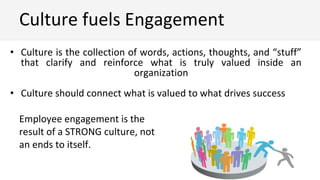
• Culture is the collection of words, actions, thoughts, and “stuff”
that clarify and reinforce what is truly valued inside an
organization
• Culture should connect what is valued to what drives success
Culture fuels Engagement
Employee engagement is the
result of a STRONG culture, not
an ends to itself.
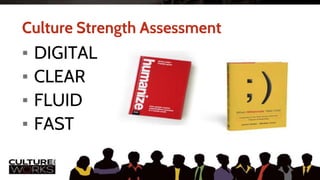
Culture Strength Assessment
â–Ş DIGITAL
â–Ş CLEAR
â–Ş FLUID
â–Ş FAST
• Understanding how your employees perceive and experience
your organization’s values, behaviors, and actions is a crucial
first step to driving alignment in your workforce.
•There is no such thing as “best place to work” or “one recipe
for success.”
• Assessing fit is a two-way street; both sides need meaningful
data to make informed decisions; and most organizations
aren’t good at sharing their true story
Employer Profiling - TruWork
• Once you know “who you are,” you’re in a much better
position to:
– Identify which aspects best represent your essence
– Share your story in a much more open, authentic, and
meaningful way with those who want to hear it
– Authenticity leads to credibility which leads to trust
– Attract those people who are drawn to your essence and
driven by the “way you work”
– Identify opportunities to tweak “who you are” toward
“who you want to be”
Understand and Share
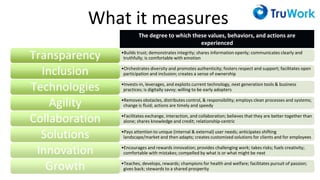
What it measures
•Builds trust; demonstrates integrity; shares information openly; communicates clearly and
truthfully; is comfortable with emotionTransparency
•Orchestrates diversity and promotes authenticity; fosters respect and support; facilitates open
participation and inclusion; creates a sense of ownershipInclusion
•Invests-in, leverages, and exploits current technology, next generation tools & business
practices; is digitally savvy; willing to be early adoptersTechnologies
•Removes obstacles, distributes control, & responsibility; employs clean processes and systems;
change is fluid; actions are timely and speedyAgility
•Facilitates exchange, interaction, and collaboration; believes that they are better together than
alone; shares knowledge and credit; relationship-centricCollaboration
•Pays attention to unique (internal & external) user needs; anticipates shifting
landscape/market and then adapts; creates customized solutions for clients and for employeesSolutions
•Encourages and rewards innovation; provides challenging work; takes risks; fuels creativity;
comfortable with mistakes; compelled by what is or what might be nextInnovation
•Teaches, develops, rewards; champions for health and welfare; facilitates pursuit of passion;
gives back; stewards to a shared prosperityGrowth
The degree to which these values, behaviors, and actions are
experienced
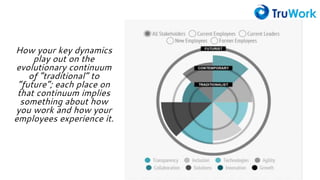
How your key dynamics
play out on the
evolutionary continuum
of “traditional” to
“future”; each place on
that continuum implies
something about how
you work and how your
employees experience it.
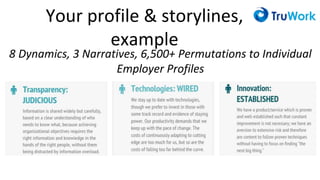
Your profile & storylines,
example
8 Dynamics, 3 Narratives, 6,500+ Permutations to Individual
Employer Profiles
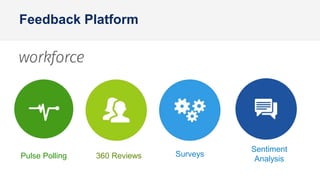
Pulse Polling
Sentiment
Analysis
Surveys360 Reviews
Feedback Platform
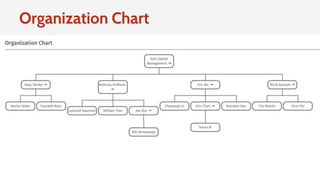
Organization Chart
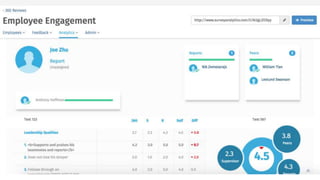
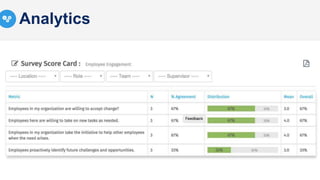
Analytics
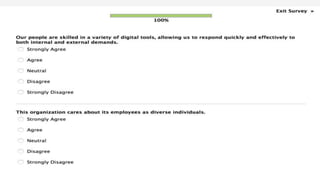
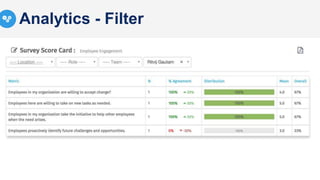
Analytics - Filter
Thank you for your time!
Questions?

Workforce webinar september 30, 2015

  • 2.
    • First coinedin 1990 by William A. Kahn • Gallup refined it in the mid-90’s and established the famed Gallup-12 Employee Engagement
  • 3.
    • Key Measures –The extent to which employees are likely to put forth discretionary effort, – The degree to which employees intend to stay with the organization, and – More recently, the likeliness employees are to be a “brand advocate” for the company. • The measure has been used extensively for decades, has become the standard-bearer to workplace effectiveness, and has quite nearly become a commoditized business Gallup - 12
  • 4.
    • I knowwhat is expected of me at work. • The mission or purpose of my company makes me feel my job is important. • I have a best friend at work. Example
  • 5.
  • 6.
    • Individual fulfillment •More work accomplished • Improved organizational results • “You know it when you see it” Upsides of Engagement
  • 7.
    • Not movingthe needle • Treating employees like cogs • Focusing on the wrong thing • Lacking a system-wide approach Downsides of Engagement
  • 8.
    • Culture isthe collection of words, actions, thoughts, and “stuff” that clarify and reinforce what is truly valued inside an organization • Culture should connect what is valued to what drives success Culture fuels Engagement Employee engagement is the result of a STRONG culture, not an ends to itself.
  • 9.
    Culture Strength Assessment â–ŞDIGITAL â–Ş CLEAR â–Ş FLUID â–Ş FAST
  • 11.
    • Understanding howyour employees perceive and experience your organization’s values, behaviors, and actions is a crucial first step to driving alignment in your workforce. •There is no such thing as “best place to work” or “one recipe for success.” • Assessing fit is a two-way street; both sides need meaningful data to make informed decisions; and most organizations aren’t good at sharing their true story Employer Profiling - TruWork
  • 12.
    • Once youknow “who you are,” you’re in a much better position to: – Identify which aspects best represent your essence – Share your story in a much more open, authentic, and meaningful way with those who want to hear it – Authenticity leads to credibility which leads to trust – Attract those people who are drawn to your essence and driven by the “way you work” – Identify opportunities to tweak “who you are” toward “who you want to be” Understand and Share
  • 13.
    What it measures •Buildstrust; demonstrates integrity; shares information openly; communicates clearly and truthfully; is comfortable with emotionTransparency •Orchestrates diversity and promotes authenticity; fosters respect and support; facilitates open participation and inclusion; creates a sense of ownershipInclusion •Invests-in, leverages, and exploits current technology, next generation tools & business practices; is digitally savvy; willing to be early adoptersTechnologies •Removes obstacles, distributes control, & responsibility; employs clean processes and systems; change is fluid; actions are timely and speedyAgility •Facilitates exchange, interaction, and collaboration; believes that they are better together than alone; shares knowledge and credit; relationship-centricCollaboration •Pays attention to unique (internal & external) user needs; anticipates shifting landscape/market and then adapts; creates customized solutions for clients and for employeesSolutions •Encourages and rewards innovation; provides challenging work; takes risks; fuels creativity; comfortable with mistakes; compelled by what is or what might be nextInnovation •Teaches, develops, rewards; champions for health and welfare; facilitates pursuit of passion; gives back; stewards to a shared prosperityGrowth The degree to which these values, behaviors, and actions are experienced
  • 14.
    How your keydynamics play out on the evolutionary continuum of “traditional” to “future”; each place on that continuum implies something about how you work and how your employees experience it.
  • 15.
    Your profile &storylines, example 8 Dynamics, 3 Narratives, 6,500+ Permutations to Individual Employer Profiles
  • 17.
  • 18.
  • 21.
  • 22.
  • 23.
    Thank you foryour time! Questions?