Engage
to retain
Mining Technology and Operations Summit
Perth, November 2013
Dr. Shane Hodgson
Enterprise Transformation Consulting
Centurion, South Africa
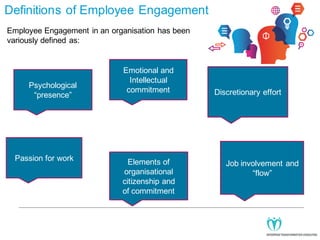
Definitions of Employee Engagement
Employee Engagement in an organisation has been
variously defined as:

Psychological
“presence”

Passion for work

Emotional and
Intellectual
commitment

Elements of
organisational
citizenship and
of commitment

Discretionary effort

Job involvement and
“flow”
Consequences of Employee
Engagement
These are generally agreed to be positive; for example
– The Gallup Organisation (2004) found critical links between employee
engagement, customer loyalty, business growth and profitability.
– Ott (2007) cites further Gallup research that found higher workplace engagement
predicts higher Earnings Per Share (EPS) in publicly-traded businesses.
– Rucci et al (1998) using data from Sears found a positive correlation between
employee engagement and enterprise-level financial performance.
– The Corporate Leadership Council found that profits grow up to three times
faster in organisations with engaged employees as compared with industry
competitors – and that “…engagement accounts for 40% of observed
performance improvements”
The Australian Experience of
Employee Engagement

Latest research shows (Gallup, 2013) only 18 per cent of Australians can say
they love their work.
Almost two thirds consider themselves to be emotionally detached from their
employer, and as such they produce the bare minimum, which does not bode
well for competitiveness.
One in five Australians has admitted to being actively disengaged, openly
disliking their workplace, performing poorly and taking unnecessary sick days.
Something that companies can’t always afford as, according to a study by the
University of Western Australia, absenteeism costs the private sector $2
billion in lost productivity a year, and $5 billion in the public sector.

4
“Yes, but…” Some Key Issues in
Engagement Research

1. There are over 50 definitions of engagement – and we’re often not sure if we
are talking about “... an attitude, a behaviour, an outcome or all three”
(Guest, 2009)
2. Conducting engagement surveys is not managing engagement – you can’t
make a pig get fat by weighing it.
3. Correlation is not the same as causality – this is very important to remember
when considering links between engagement and organisational
performance.
4. Measuring something will most likely change its nature (Heisenberg;
Observer-observed interaction; Hawthorn)
Defining our Terms – Choosing
a Definition
We can say that employees that are engaged will demonstrate:
1. A rational understanding of and support for their organisation’s goals
and values (“Think”)
2. An emotional attachment to and pride in their organisation (“Feel”)
3. The motivation / willingness to invest discretionary effort in their role to
meet the organisation’s goals (“Act”)
•(Towers Watson Global Workforce Study 2010)
Leap of Faith (Please jump off the bridge
with me, we’ll build our wings on the
way down!)

•Meta-analysis of the literature on engagement gives rise to various
organisational management and governance practices that appear to positively
affect engagement levels.
•Looking at these through the lens of the Towers Watson definition of
engagement, I have separated out what I regard as the eight most important
practices and have then assigned these to the “Think”, “Feel” and “Act”
categories.
CAVEAT: This is not a comprehensive coverage, and there is some
overlap here and there between practices.
Top 8 Management Practices for
High Engagement
A rational understanding of and support for their
organisation’s goals and values (“Think”)
•Clear Strategic Narrative
•Coherent and Congruent Corporate Values
•Conversation, not Communication
An emotional attachment to and pride in their organisation (“Feel”)
•Socially Responsible Management
•Inspirational and Trustworthy Leadership
• Dynamic Employer Brand
The motivation / willingness to invest discretionary effort in their role to meet the
organisation’s goals (“Act”)
•Robust Approach to Managing Change
•An Intentional Culture of Organisational Fairness
Clear Strategic Narrative

Leaders need to provide a clear strategic narrative that expresses the purpose
of the organisation, why it has the particular vision that it has, and how an
employee can contribute to the purpose (MacLeod Review of Employee
Engagement, 2009)
A strategic narrative is about more than facts and numbers; it can contain
stories and anecdotes. Employees can be involved in the initial creation of the
narrative, and in customising it for their departments so that they have a clear
and personal link to the strategy.
Coherent and Congruent
Corporate Values

When employees hold values that match the values of their employer, they have
higher job satisfaction, identify more closely with the organisation and seek to
maintain employment relationships (various, in Edwards & Cable 2009)
Corporate values matter to employees (Wildermuth and Pauken, 2008),
because when there is congruence between employee and corporate values,
employees experience feelings of Safety and Meaningfulness (which are
precursors to Engagement)
Conversation, not Communication

“Effective employee communication is a leading indicator of financial
performance and a driver of employee engagement – and companies that are
highly effective communicators had a whopping 47 per cent higher total return to
shareholders over the last five years, compared with firms that are the least
effective communicators” (Towers Watson 2009/2010 Communication ROI
Study)
Conversation, not Communication

Communication must be a dialogue, a two-way conversation, and must follow
some basic rules (Edelman Change, 2010)
1. Strategy is not inert and is not a holy mantra – employees must believe they
can still have input
2. The CEO must talk idea, insight and vision, not process, and Managers must
not act as parrots, but should educate, involve and listen.
3. Communications is not a set of tactics, but a living dialogue
4. Employees are not a captive audience, and we need to compete for their
attention.
Socially Responsible
Management - CSR and
Sustainability

In a survey commissioned by National Geographic magazine in February 2008,
more than 80% of U.S. workers polled said they believe it is important to work
for a company or organisation that makes the environment a top priority.
Latest research from the Kenexa Institute suggests that “...an organisation’s
business choices that support the environment such as recycling, energy
conservation and vendor selection have a significant influence on employees’
engagement levels”
Transformational Leadership

Transformational leaders inspire followers to adhere to a common vision. As a
contrast, transactional leaders focus on the employees’ immediate interests and
individual rewards (Bass, 1999).

Densten (2005) found that a leader’s inspirational motivation reduces employee
exhaustion and depersonalization. and, when clearly and compellingly
transmitted, gives followers reasons to reach goals.
Transformational Leadership

Research by the UK’s Business Enterprise group (BERR) shows that
transformational leaders show:

•Genuine shared vision
•Real confidence and trust in their teams
•Respect for employees and customers
•Commitment to developing people
•Clear standards of ethics and integrity
•Willingness to take risks
Dynamic Employer Brand

The Chartered Institute of Personnel and Development (CIPD) in the UK suggests
the following definition of an employer brand: ‘...a set of attributes and qualities –
often intangible - that makes an organisation distinctive, promises a particular kind
of employment experience, and appeals to those people who will thrive and perform
best in its culture’.
Employer branding policies of the top 100 US companies were associated with not
only stable and highly positive workforce attitudes but also performance
advantages over the broad market, and in some cases, over the matched group,
with beneficial effects on organisational performance (Fulmer et al, 2003)
CAVEAT : People join brands and leave managers...
Robust Approach to Managing
Change

The way we go about managing major business change gives an unmistakeable
message to our employees. We reveal our clarity of purpose (or lack thereof),
how much we respect and value our staff, how serious we are about the change
and more.
Projects seldom fail because software or hardware fails – projects fail because
we consistently underestimate the amount of effort we should put into
anticipating, managing and measuring the change impact on our organisations.
When we make this mistake, we reveal a lack of understanding of, and feeling
for, our employees.
Organisational Fairness

Fairness is considered to be one of the necessary conditions leading to trust
(Beugré,1998), which is essential for employee engagement. Equity, and in
essence - fairness, is a key driver of employee engagement (Kontakos,
2007). Fairness is composed of:
1.
2.
3.
4.

Distributive Justice – the distribution of outcomes is fair
Procedural Justice – the procedure used to determine the distribution
of outcomes is fair
Interpersonal Justice - Treatment with politeness, dignity, and respect
by those who execute procedures or determine outcomes
Informational Justice - The explanations of why procedures were
used in a certain way or outcomes were distributed in a certain fashion
Why Are We Complacent?

When data suggest that “… most managers are more likely to
douse the flames of employee enthusiasm than fan them, and
are more likely to frustrate extraordinary accomplishment than
to foster it?” Gary Hamel, writing in a recent Wall Street
Journal blog post

(for a more detailed version of this presentation with references, please contact
shane.hodgson@outlook.com )

Mto summit hodgson presentation

  • 1.
    Engage to retain Mining Technologyand Operations Summit Perth, November 2013 Dr. Shane Hodgson Enterprise Transformation Consulting Centurion, South Africa
  • 2.
    Definitions of EmployeeEngagement Employee Engagement in an organisation has been variously defined as: Psychological “presence” Passion for work Emotional and Intellectual commitment Elements of organisational citizenship and of commitment Discretionary effort Job involvement and “flow”
  • 3.
    Consequences of Employee Engagement Theseare generally agreed to be positive; for example – The Gallup Organisation (2004) found critical links between employee engagement, customer loyalty, business growth and profitability. – Ott (2007) cites further Gallup research that found higher workplace engagement predicts higher Earnings Per Share (EPS) in publicly-traded businesses. – Rucci et al (1998) using data from Sears found a positive correlation between employee engagement and enterprise-level financial performance. – The Corporate Leadership Council found that profits grow up to three times faster in organisations with engaged employees as compared with industry competitors – and that “…engagement accounts for 40% of observed performance improvements”
  • 4.
    The Australian Experienceof Employee Engagement Latest research shows (Gallup, 2013) only 18 per cent of Australians can say they love their work. Almost two thirds consider themselves to be emotionally detached from their employer, and as such they produce the bare minimum, which does not bode well for competitiveness. One in five Australians has admitted to being actively disengaged, openly disliking their workplace, performing poorly and taking unnecessary sick days. Something that companies can’t always afford as, according to a study by the University of Western Australia, absenteeism costs the private sector $2 billion in lost productivity a year, and $5 billion in the public sector. 4
  • 5.
    “Yes, but…” SomeKey Issues in Engagement Research 1. There are over 50 definitions of engagement – and we’re often not sure if we are talking about “... an attitude, a behaviour, an outcome or all three” (Guest, 2009) 2. Conducting engagement surveys is not managing engagement – you can’t make a pig get fat by weighing it. 3. Correlation is not the same as causality – this is very important to remember when considering links between engagement and organisational performance. 4. Measuring something will most likely change its nature (Heisenberg; Observer-observed interaction; Hawthorn)
  • 6.
    Defining our Terms– Choosing a Definition We can say that employees that are engaged will demonstrate: 1. A rational understanding of and support for their organisation’s goals and values (“Think”) 2. An emotional attachment to and pride in their organisation (“Feel”) 3. The motivation / willingness to invest discretionary effort in their role to meet the organisation’s goals (“Act”) •(Towers Watson Global Workforce Study 2010)
  • 7.
    Leap of Faith(Please jump off the bridge with me, we’ll build our wings on the way down!) •Meta-analysis of the literature on engagement gives rise to various organisational management and governance practices that appear to positively affect engagement levels. •Looking at these through the lens of the Towers Watson definition of engagement, I have separated out what I regard as the eight most important practices and have then assigned these to the “Think”, “Feel” and “Act” categories. CAVEAT: This is not a comprehensive coverage, and there is some overlap here and there between practices.
  • 8.
    Top 8 ManagementPractices for High Engagement A rational understanding of and support for their organisation’s goals and values (“Think”) •Clear Strategic Narrative •Coherent and Congruent Corporate Values •Conversation, not Communication An emotional attachment to and pride in their organisation (“Feel”) •Socially Responsible Management •Inspirational and Trustworthy Leadership • Dynamic Employer Brand The motivation / willingness to invest discretionary effort in their role to meet the organisation’s goals (“Act”) •Robust Approach to Managing Change •An Intentional Culture of Organisational Fairness
  • 9.
    Clear Strategic Narrative Leadersneed to provide a clear strategic narrative that expresses the purpose of the organisation, why it has the particular vision that it has, and how an employee can contribute to the purpose (MacLeod Review of Employee Engagement, 2009) A strategic narrative is about more than facts and numbers; it can contain stories and anecdotes. Employees can be involved in the initial creation of the narrative, and in customising it for their departments so that they have a clear and personal link to the strategy.
  • 10.
    Coherent and Congruent CorporateValues When employees hold values that match the values of their employer, they have higher job satisfaction, identify more closely with the organisation and seek to maintain employment relationships (various, in Edwards & Cable 2009) Corporate values matter to employees (Wildermuth and Pauken, 2008), because when there is congruence between employee and corporate values, employees experience feelings of Safety and Meaningfulness (which are precursors to Engagement)
  • 11.
    Conversation, not Communication “Effectiveemployee communication is a leading indicator of financial performance and a driver of employee engagement – and companies that are highly effective communicators had a whopping 47 per cent higher total return to shareholders over the last five years, compared with firms that are the least effective communicators” (Towers Watson 2009/2010 Communication ROI Study)
  • 12.
    Conversation, not Communication Communicationmust be a dialogue, a two-way conversation, and must follow some basic rules (Edelman Change, 2010) 1. Strategy is not inert and is not a holy mantra – employees must believe they can still have input 2. The CEO must talk idea, insight and vision, not process, and Managers must not act as parrots, but should educate, involve and listen. 3. Communications is not a set of tactics, but a living dialogue 4. Employees are not a captive audience, and we need to compete for their attention.
  • 13.
    Socially Responsible Management -CSR and Sustainability In a survey commissioned by National Geographic magazine in February 2008, more than 80% of U.S. workers polled said they believe it is important to work for a company or organisation that makes the environment a top priority. Latest research from the Kenexa Institute suggests that “...an organisation’s business choices that support the environment such as recycling, energy conservation and vendor selection have a significant influence on employees’ engagement levels”
  • 14.
    Transformational Leadership Transformational leadersinspire followers to adhere to a common vision. As a contrast, transactional leaders focus on the employees’ immediate interests and individual rewards (Bass, 1999). Densten (2005) found that a leader’s inspirational motivation reduces employee exhaustion and depersonalization. and, when clearly and compellingly transmitted, gives followers reasons to reach goals.
  • 15.
    Transformational Leadership Research bythe UK’s Business Enterprise group (BERR) shows that transformational leaders show: •Genuine shared vision •Real confidence and trust in their teams •Respect for employees and customers •Commitment to developing people •Clear standards of ethics and integrity •Willingness to take risks
  • 16.
    Dynamic Employer Brand TheChartered Institute of Personnel and Development (CIPD) in the UK suggests the following definition of an employer brand: ‘...a set of attributes and qualities – often intangible - that makes an organisation distinctive, promises a particular kind of employment experience, and appeals to those people who will thrive and perform best in its culture’. Employer branding policies of the top 100 US companies were associated with not only stable and highly positive workforce attitudes but also performance advantages over the broad market, and in some cases, over the matched group, with beneficial effects on organisational performance (Fulmer et al, 2003) CAVEAT : People join brands and leave managers...
  • 17.
    Robust Approach toManaging Change The way we go about managing major business change gives an unmistakeable message to our employees. We reveal our clarity of purpose (or lack thereof), how much we respect and value our staff, how serious we are about the change and more. Projects seldom fail because software or hardware fails – projects fail because we consistently underestimate the amount of effort we should put into anticipating, managing and measuring the change impact on our organisations. When we make this mistake, we reveal a lack of understanding of, and feeling for, our employees.
  • 18.
    Organisational Fairness Fairness isconsidered to be one of the necessary conditions leading to trust (Beugré,1998), which is essential for employee engagement. Equity, and in essence - fairness, is a key driver of employee engagement (Kontakos, 2007). Fairness is composed of: 1. 2. 3. 4. Distributive Justice – the distribution of outcomes is fair Procedural Justice – the procedure used to determine the distribution of outcomes is fair Interpersonal Justice - Treatment with politeness, dignity, and respect by those who execute procedures or determine outcomes Informational Justice - The explanations of why procedures were used in a certain way or outcomes were distributed in a certain fashion
  • 19.
    Why Are WeComplacent? When data suggest that “… most managers are more likely to douse the flames of employee enthusiasm than fan them, and are more likely to frustrate extraordinary accomplishment than to foster it?” Gary Hamel, writing in a recent Wall Street Journal blog post (for a more detailed version of this presentation with references, please contact shane.hodgson@outlook.com )