




Become a 
Talent 
Magnet
Jan Sysmans 
Senior Director Marketing, Saba 
@jsysmans @sabasoftware 
www.saba.com 
jsysmans@saba.com
Agenda 
• Business Challenges 
• What Is a Talent Magnet 
• Where Do You Start 
• Business Benefits of Becoming a Talent Magnet 
• Conclusion
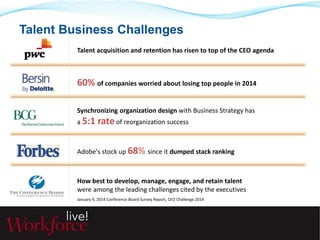
Talent Business Challenges 
Talent acquisition and retention has risen to top of the CEO agenda 
60% of companies worried about losing top people in 2014 
Synchronizing organization design with Business Strategy has 
a 5:1 rate of reorganization success 
Adobe's stock up 68% since it dumped stack ranking 
How best to develop, manage, engage, and retain talent 
were among the leading challenges cited by the executives 
January 9, 2014 Conference Board Survey Report, CEO Challenge 2014
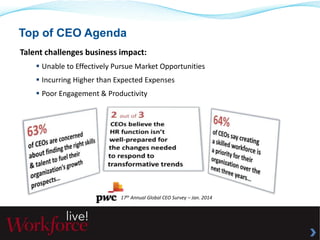
Top of CEO Agenda 
Talent challenges business impact: 
ď‚§ Unable to Effectively Pursue Market Opportunities 
ď‚§ Incurring Higher than Expected Expenses 
ď‚§ Poor Engagement & Productivity 
17th Annual Global CEO Survey – Jan. 2014
What is a Talent Magnet?
What The Experts Say 
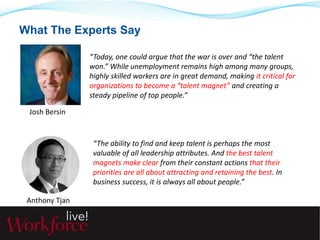
Josh Bersin 
“Today, one could argue that the war is over and “the talent 
won.” While unemployment remains high among many groups, 
highly skilled workers are in great demand, making it critical for 
organizations to become a “talent magnet” and creating a 
steady pipeline of top people.” 
“The ability to find and keep talent is perhaps the most 
valuable of all leadership attributes. And the best talent 
magnets make clear from their constant actions that their 
priorities are all about attracting and retaining the best. In 
business success, it is always all about people.” 
Anthony Tjan
“A Magnetic Culture draws 
talented employees to the 
What is a Talent Magnet 
workplace, empowers them, and 
sustains an environment in which 
they are more likely to stay. 
Such a culture is marked by 
engaged employees who share a 
strong desire to be part of the 
value the organization creates”
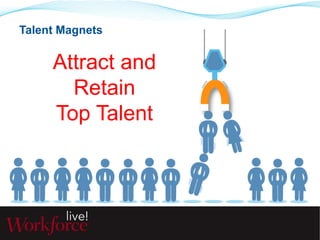
Talent Magnets 
Attract and 
Retain 
Top Talent
Where Do You Start?
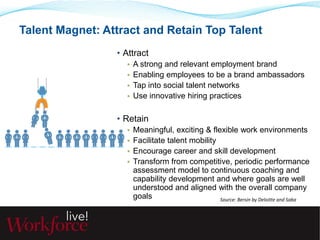
Talent Magnet: Attract and Retain Top Talent 
• Attract 
ď‚§ A strong and relevant employment brand 
ď‚§ Enabling employees to be a brand ambassadors 
ď‚§ Tap into social talent networks 
ď‚§ Use innovative hiring practices 
• Retain 
ď‚§ Meaningful, exciting & flexible work environments 
ď‚§ Facilitate talent mobility 
ď‚§ Encourage career and skill development 
ď‚§ Transform from competitive, periodic performance 
assessment model to continuous coaching and 
capability development and where goals are well 
understood and aligned with the overall company 
goals 
Source: Bersin by Deloitte and Saba
Do – Start With An Employee Centric Culture
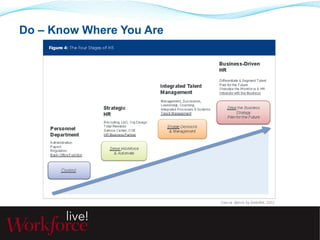
Do – Know Where You Are
Don’t – Boil The Ocean
Don’t - Technology for Technology’s Sake
Business Benefits of 
Becoming a Talent Magnet
Becoming a Talent Magnet 
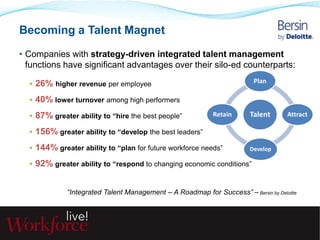
• Companies with strategy-driven integrated talent management 
functions have significant advantages over their silo-ed counterparts: 
Plan 
Talent 
Attract 
Develop 
Retain 
ď‚§ 26% higher revenue per employee 
ď‚§ 40%lower turnover among high performers 
 87%greater ability to “hire the best people” 
 156% greater ability to “develop the best leaders” 
 144% greater ability to “plan for future workforce needs” 
 92%greater ability to “respond to changing economic conditions” 
“Integrated Talent Management – A Roadmap for Success” – Bersin by Deloitte
Conclusion
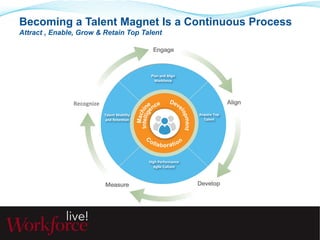
Becoming a Talent Magnet Is a Continuous Process 
Attract , Enable, Grow & Retain Top Talent 
Machine 
Intelligence 
Skills & 
Development 
Competencies 
Recognize 
Plan and Align 
Workforce 
Talent Mobility 
and Retention 
Acquire Top 
Talent 
Collaboration 
High Performance 
Agile Culture
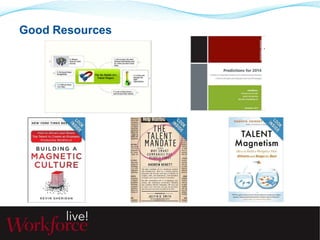
Good Resources
Thank You 
@jsysmans 
@sabasoftware 
jsysmans@saba.com www.saba.com

Workforce 2014 Saba Becomes a Talent Magnet

  • 1.
  • 5.
    Jan Sysmans SeniorDirector Marketing, Saba @jsysmans @sabasoftware www.saba.com jsysmans@saba.com
  • 7.
    Agenda • BusinessChallenges • What Is a Talent Magnet • Where Do You Start • Business Benefits of Becoming a Talent Magnet • Conclusion
  • 8.
    Talent Business Challenges Talent acquisition and retention has risen to top of the CEO agenda 60% of companies worried about losing top people in 2014 Synchronizing organization design with Business Strategy has a 5:1 rate of reorganization success Adobe's stock up 68% since it dumped stack ranking How best to develop, manage, engage, and retain talent were among the leading challenges cited by the executives January 9, 2014 Conference Board Survey Report, CEO Challenge 2014
  • 9.
    Top of CEOAgenda Talent challenges business impact:  Unable to Effectively Pursue Market Opportunities  Incurring Higher than Expected Expenses  Poor Engagement & Productivity 17th Annual Global CEO Survey – Jan. 2014
  • 10.
    What is aTalent Magnet?
  • 11.
    What The ExpertsSay Josh Bersin “Today, one could argue that the war is over and “the talent won.” While unemployment remains high among many groups, highly skilled workers are in great demand, making it critical for organizations to become a “talent magnet” and creating a steady pipeline of top people.” “The ability to find and keep talent is perhaps the most valuable of all leadership attributes. And the best talent magnets make clear from their constant actions that their priorities are all about attracting and retaining the best. In business success, it is always all about people.” Anthony Tjan
  • 12.
    “A Magnetic Culturedraws talented employees to the What is a Talent Magnet workplace, empowers them, and sustains an environment in which they are more likely to stay. Such a culture is marked by engaged employees who share a strong desire to be part of the value the organization creates”
  • 13.
    Talent Magnets Attractand Retain Top Talent
  • 14.
  • 15.
    Talent Magnet: Attractand Retain Top Talent • Attract  A strong and relevant employment brand  Enabling employees to be a brand ambassadors  Tap into social talent networks  Use innovative hiring practices • Retain  Meaningful, exciting & flexible work environments  Facilitate talent mobility  Encourage career and skill development  Transform from competitive, periodic performance assessment model to continuous coaching and capability development and where goals are well understood and aligned with the overall company goals Source: Bersin by Deloitte and Saba
  • 17.
    Do – StartWith An Employee Centric Culture
  • 18.
    Do – KnowWhere You Are
  • 19.
  • 20.
    Don’t - Technologyfor Technology’s Sake
  • 21.
    Business Benefits of Becoming a Talent Magnet
  • 22.
    Becoming a TalentMagnet • Companies with strategy-driven integrated talent management functions have significant advantages over their silo-ed counterparts: Plan Talent Attract Develop Retain  26% higher revenue per employee  40%lower turnover among high performers  87%greater ability to “hire the best people”  156% greater ability to “develop the best leaders”  144% greater ability to “plan for future workforce needs”  92%greater ability to “respond to changing economic conditions” “Integrated Talent Management – A Roadmap for Success” – Bersin by Deloitte
  • 24.
  • 25.
    Becoming a TalentMagnet Is a Continuous Process Attract , Enable, Grow & Retain Top Talent Machine Intelligence Skills & Development Competencies Recognize Plan and Align Workforce Talent Mobility and Retention Acquire Top Talent Collaboration High Performance Agile Culture
  • 26.
  • 27.
    Thank You @jsysmans @sabasoftware jsysmans@saba.com www.saba.com

Editor's Notes

  • #9 Click on PWC logo to see specifics from the latest PWC annual global CEO survey (Jan. 2014) Change in Workforce Demographics: By 2020 50% millenials
  • #10 Recent PWC Survey highlighted questions pondered by CEOs relative to developing tomorrow’s workforce:   How well-prepared is your organization to find, attract and keep tomorrow’s workforce – even as you deal with today’s talent challenges? What are you doing to make your workforce more diverse? And how will you utilize the benefits of diversity? How will you manage employees with different needs, aspirations and experiences from those of your generation? How will you address the challenges of dealing with an increasingly autonomous workforce? What will it cost your organization, if you get your talent pipeline wrong?
  • #23 Need an integrated talent management strategy to create a highly responsive, high-performance, sustainable organization that meets business targets, both today and tomorrow. An integrated talent management approach is widely recognized as key enabler for HR function becoming Strategic Business Enabler. several distinguishing characteristics: Talent Strategy and Workforce Plan Are Tied to Corporate Strategy: An integrated function is meant to help the business meet the human capital needs of the corporate strategy. As a result, an explicit talent strategy and workforce plan are key to ensuring that talent management activities are aligned with the business. Workforce planning also allows an integrated function to rapidly adjust to changing business needs. Talent Management Processes Are Aligned to the Talent Strategy: The talent strategy and workforce plan should drive all talent management activities. In an integrated function, the talent strategy and workforce plan are the puppet-master, and the talent management processes are the marionettes. Talent Management Processes Share Inputs and Outputs (see the graphic): This is a crucial piece of breaking down the siloes of talent management. All three of the examples of siloed behavior discussed above can be partly attributed to a lack of data sharing: Succession Planning not sharing bench successors with Talent Acquisition; Workforce Planning not sharing scenario-based hiring needs with Talent Acquisition, Learning & Development, and Succession Planning; Talent Acquisition not sharing hiring evaluations with Learning & Development. Competency Model as a Common Language: Each talent management process performs evaluations of talent. A consistent competency model ensures that each process can share that evaluative data with other processes by ensuring that those evaluations are using a common language. If talent acquisition is using a different competency model than Learning & Development, the value of hiring evaluations in the development planning process is greatly reduced. Technology Enablement for Talent Management: In some cases, the sharing of data across processes in Talent Management can be achieved without technology support, through cross-functional participation in meetings, or paper and email communication. However, technology support is critical to ensure these interfaces are scalable as a company grows. Change Management as a Foundation: The journey to integrated talent management is transformational, not incremental. A detailed and pervasive change management effort is absolutely essential to ensure that your business is able to follow your lead on that journey.
  • #26 Saba uniquely provides the next generation talent mgmt. platform with People at its Heart & Employee Experience boosted by Development, Collaboration, Machine Intelligence, Workforce and Organizational Planning. Let’s spend a few minutes talking about key attributes of next generation integrated talent mgmt. platform from new Hire, Onboarding, Leadership Development, Succession/Workforce Planning. “A recent survey conducted by Towers Watson shows that organizations with better-engaged employees enjoy a 19% increase in annual operating income compared to a 34% decrease in enterprises with disengaged employees.” User-centric solutions focus on employees and managers (personalized dashboard), Success Planning, Social Recognition, pQ score (gamification to indicate your level of influence in the org), rockstar nomination, crowdsourced expertise identification, TIM (the intelligent mentor) and many more features all encourage engagement…