- Enjoying School -
INDEX
1. Vocabulary p. 2
2. Grammar p. 9
3. Listening p. 15
4. Reading p. 17
5. Writing p. 19
6. Speaking p. 21
7. Grammar Reference p. 24
8. Pronunciation p. 31
9. Irregular Verbs p. 35
2
VOCABULARY
3
Classroom Objects
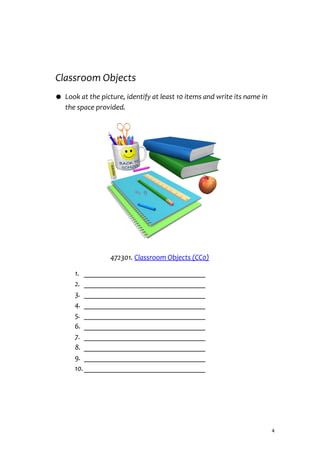
● Look at the picture, identify at least 10 items and write its name in
the space provided.
472301. Classroom Objects (CC0)
1. _________________________________
2. _________________________________
3. _________________________________
4. _________________________________
5. _________________________________
6. _________________________________
7. _________________________________
8. _________________________________
9. _________________________________
10. _________________________________
4
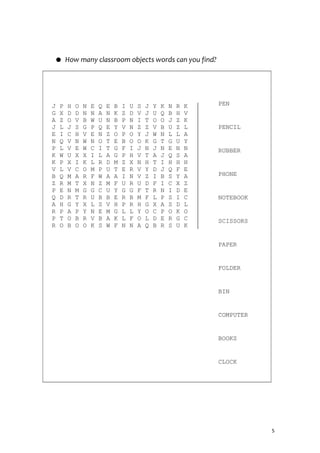
● How many classroom objects words can you find?
J P H O N E Q E B I U S J Y K N R K
G X D D N N A N K Z D V J U Q B H V
A Z O V B W U N B P N I T O O J Z K
J L J S G P Q E Y V N Z Z V B U Z L
E I C H V E N Z O P O Y J W N L L A
N Q V N W N O T E B O O K G T G U Y
P L V E W C I T G F I J N J N E N N
K W U X X I L A G P H V T A J Q S A
K P X I K L R D M Z X N H T I H H H
V L V C O M P U T E R V Y D J Q F E
B Q M A R F W A A I N V Z I B S Y A
Z R M T X N Z M F U R U D F I C X Z
P E N M G G C U Y G G F T R N I D E
Q D R T R U B B E R B M F L P S I C
A H G Y X L S V H P R H G X A S D L
R P A P Y N E M G L L Y O C P O K O
P T O B R V B A K L F O L D E R G C
R O B O O K S W F N N A Q B R S U K
PEN
PENCIL
RUBBER
PHONE
NOTEBOOK
SCISSORS
PAPER
FOLDER
BIN
COMPUTER
BOOKS
CLOCK
5
Days of the week
● Answer the questions.
1. What day comes before Monday? _________________________
2. What day comes after Wednesday? _______________________
3. What day comes before Tuesday? _________________________
4. What day comes before Thursday? ________________________
5. What day comes after Monday? __________________________
6. What day comes before Saturday? ________________________
7. What day comes after Friday? ___________________________
● Read the text and answer the questions.
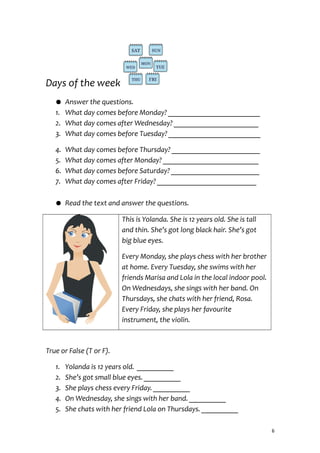
This is Yolanda. She is 12 years old. She is tall
and thin. She’s got long black hair. She’s got
big blue eyes.
Every Monday, she plays chess with her brother
at home. Every Tuesday, she swims with her
friends Marisa and Lola in the local indoor pool.
On Wednesdays, she sings with her band. On
Thursdays, she chats with her friend, Rosa.
Every Friday, she plays her favourite
instrument, the violin.
True or False (T or F).
1. Yolanda is 12 years old. __________
2. She’s got small blue eyes. __________
3. She plays chess every Friday. __________
4. On Wednesday, she sings with her band. __________
5. She chats with her friend Lola on Thursdays. __________
6
School Subjects
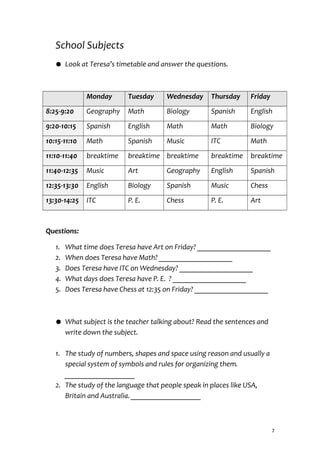
● Look at Teresa’s timetable and answer the questions.
Monday Tuesday Wednesday Thursday Friday
8:25-9:20 Geography Math Biology Spanish English
9:20-10:15 Spanish English Math Math Biology
10:15-11:10 Math Spanish Music ITC Math
11:10-11:40 breaktime breaktime breaktime breaktime breaktime
11:40-12:35 Music Art Geography English Spanish
12:35-13:30 English Biology Spanish Music Chess
13:30-14:25 ITC P. E. Chess P. E. Art
Questions:
1. What time does Teresa have Art on Friday? ____________________
2. When does Teresa have Math? ____________________
3. Does Teresa have ITC on Wednesday? ____________________
4. What days does Teresa have P. E. ? ____________________
5. Does Teresa have Chess at 12:35 on Friday? ____________________
● What subject is the teacher talking about? Read the sentences and
write down the subject.
1. The study of numbers, shapes and space using reason and usually a
special system of symbols and rules for organizing them.
___________________
2. The study of the language that people speak in places like USA,
Britain and Australia. ___________________
7
3. Classes in which students do exercise and learn to play sport.
___________________
4. The theory and practice of using computers to store and analyse
information. ___________________
5. The study of past events considered together, especially events of a
particular period, country or subject. ___________________
The Time
● Write the time in words.
1. 8:45 __________________________________________
2. 12:30 _________________________________________
3. 9:00 _________________________________________
4. 22:15 _________________________________________
5. 17:10 _________________________________________
● Write the time in numbers.
1. Quarter to three: _________________________________
2. Twenty past four: ________________________________
3. Half past eleven: _________________________________
4. Twenty-five to six: _______________________________
5. Five o’clock: ____________________________________
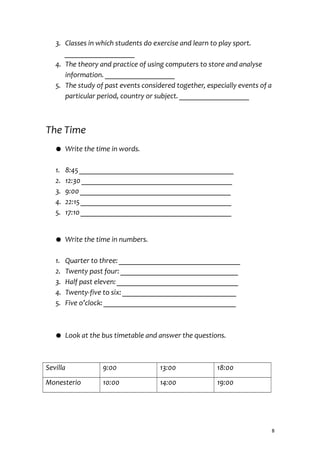
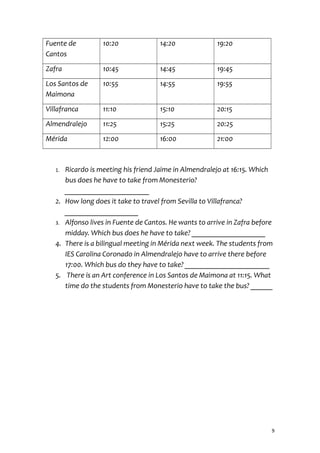
● Look at the bus timetable and answer the questions.
Sevilla 9:00 13:00 18:00
Monesterio 10:00 14:00 19:00
8
Fuente de
Cantos
10:20 14:20 19:20
Zafra 10:45 14:45 19:45
Los Santos de
Maimona
10:55 14:55 19:55
Villafranca 11:10 15:10 20:15
Almendralejo 11:25 15:25 20:25
Mérida 12:00 16:00 21:00
1. Ricardo is meeting his friend Jaime in Almendralejo at 16:15. Which
bus does he have to take from Monesterio?
_______________________
2. How long does it take to travel from Sevilla to Villafranca?
____________________
3. Alfonso lives in Fuente de Cantos. He wants to arrive in Zafra before
midday. Which bus does he have to take? ____________________
4. There is a bilingual meeting in Mérida next week. The students from
IES Carolina Coronado in Almendralejo have to arrive there before
17:00. Which bus do they have to take? _______________________
5. There is an Art conference in Los Santos de Maimona at 11:15. What
time do the students from Monesterio have to take the bus? ______
9
GRAMMAR
10
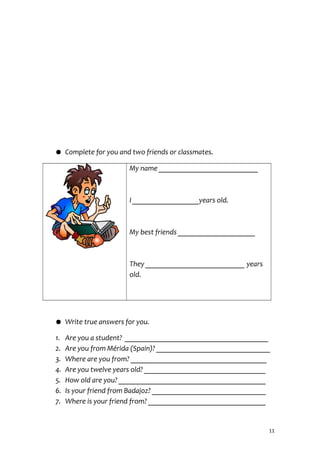
● Complete for you and two friends or classmates.
My name ___________________________
I __________________years old.
My best friends _____________________
They ___________________________ years
old.
● Write true answers for you.
1. Are you a student? _______________________________________
2. Are you from Mérida (Spain)? _______________________________
3. Where are you from? _____________________________________
4. Are you twelve years old? _________________________________
5. How old are you? ________________________________________
6. Is your friend from Badajoz? _______________________________
7. Where is your friend from? ________________________________
11
● Have got. Choose the correct answer.
1. ____________________ Geography on Tuesday. (They’ve got / She
got)
2. _________________ Chemistry this term. (Samuel and Sandra has
got / Pedro hasn’t got)
3. When ____________________ Natural Science? (have Julia and
Concha got / got we)
4. I _________________ ICT on Friday.
5. What lessons ____________________ today? (Mila has got / has
MIla got)
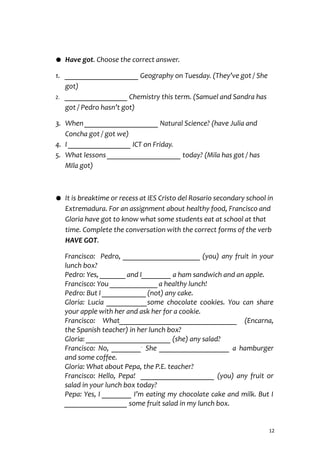
● It is breaktime or recess at IES Cristo del Rosario secondary school in
Extremadura. For an assignment about healthy food, Francisco and
Gloria have got to know what some students eat at school at that
time. Complete the conversation with the correct forms of the verb
HAVE GOT.
Francisco: Pedro, _____________________ (you) any fruit in your
lunch box?
Pedro: Yes, _______and I________ a ham sandwich and an apple.
Francisco: You _____________a healthy lunch!
Pedro: But I ____________(not) any cake.
Gloria: Lucia ___________some chocolate cookies. You can share
your apple with her and ask her for a cookie.
Francisco: What________________________________ (Encarna,
the Spanish teacher) in her lunch box?
Gloria: _______________________ (she) any salad?
Francisco: No, ________.
She ___________________ a hamburger
and some coffee.
Gloria: What about Pepa, the P.E. teacher?
Francisco: Hello, Pepa! ____________________ (you) any fruit or
salad in your lunch box today?
Pepa: Yes, I ________ I’m eating my chocolate cake and milk. But I
_________________ some fruit salad in my lunch box.
12
Gloria: Lourdes and Ángela are sharing their lunch.
_____________________ (they) any juice in those brown bags?
Francisco: Yes. Look at Santi. He __________________________a
sandwich and a banana.
● Complete the text with the correct form of the verb to be in the
simple present tense.
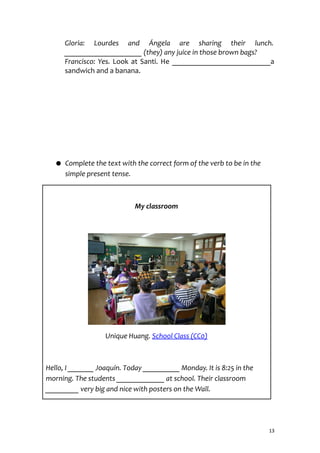
My classroom
Unique Huang. School Class (CC0)
Hello, I _______ Joaquín. Today __________ Monday. It is 8:25 in the
morning. The students _____________ at school. Their classroom
_________ very big and nice with posters on the Wall.
13
_____
There ______ lots of desks and chairs, a big door and windows. There
_______ also a big TV next to the notice board.
At the front of the he class. There are __________ students doing a
presentation and the other students _____________ listening to them.
The teacher ___________ sitting down listening to the students, her
name is Sonia and she __________ a very good teacher. There _______
posters and maps on the walls.
● Complete the sentences using each of the frequency adverbs below.
1. Richi often ______________________________________________.
2. Alfonso and Paco rarely ____________________________________.
3. Milagros never ___________________________________________.
4. Jorge always _____________________________________________.
5. I sometimes _____________________________________________.
● Translate the following sentences into English.
1. Todos los días en clase usamos “wordreference” un diccionario
online.
________________________________________________________
2. Mis clases terminan a las 14:25 todos los días.
________________________________________________________
3. A ella no le gusta el rap.
________________________________________________________
14
4. ¿Vas al instituto en coche?
________________________________________________________
5. ¿Qué hacen tus amigos después del instituto?
________________________________________________________
● Use the correct question word (who, where, what, when, why) and
the simple present tense to make information questions. The
underlined words are the answers to the questions.
e. g. Where do you usually text message your friends?
I usually text message my friends in the school and my bedroom.
1. ___________________________________________________ ?
Marisa sometimes have a cup of coffee for breakfast at 11:30 a.m.
2. ___________________________________________________?
Javier usually goes to see a film on Saturdays.
3. ___________________________________________________?
Because she is very nice and friendly.
4. ___________________________________________________?
Paco and Antonio often go out together to the park.
5. ___________________________________________________?
Paca practices Pilates in a gym every morning.
15
LISTENING
16
● Dictation. Listen and write the sentences. (Audio 1_Enjoying School)
1. _______________________________________________________
2. _______________________________________________________
3. _______________________________________________________
4. _______________________________________________________
5. _______________________________________________________
17
● Listen to Emma talking about her day and complete. (Audio
2_Enjoying School)
Everyday I ________________ at seven o'clock.
First I ________________ to the kitchen and I ________________ a
cup of milk and toast for breakfast.
Then I _______________ to the bathroom and
________________ my teeth.
After that, I ________________ dressed and ________________ my
hair.
At half five to eight I ________________ to school.
I ________________ the bus to Zafra.
It ________________ a long way from home.
I ________________ at school at twenty past eight.
At ten past eleven I ________________ lunch and at twenty-five
past two I ________________ back home.
At nine o'clock I ________________ dinner with my family and then
we ________________ TV.
At a quarter past eleven I ________________ to bed.
READING
18
● Read the text and answer the questions
My daily routine
Hi! My name is Emilio and I wake up at 7:30 in the morning. Then I get
up and I have a shower. After that, I go to the kitchen, where I
prepare breakfast for my brothers John and Einar, and I have it with
them in the dining room.
After that, we always go to the bus stop to go to school. Sometimes,
my father takes us by car when he has time. I attend classes
19
all morning and when the classes finishes at 14:25, I come home
immediately.
I often have lunch really quickly because I have extra classes. I really
love music, I study Percussion at a Conservatory. My classes usually
start at 16:00 or 17:00, at that time, my sisters Monica and Judith are
still in the school and my mum is working at home, so I haven’t got
too much time for relaxing or taking a nap.
Later, when I come back from my music classes at about 20:30, I have
dinner, I study a little bit and do my homework. Finally I go to bed.
Questions:
1. What time does Emilio wake up? ___________________________
2. Where do they eat breakfast? ______________________________
3. Who takes them to school by car? __________________________
4. What does Emilio study in the Conservatory? _________________
5. What time does Emilio have dinner? _________________________
WRITING
20
● Do you know how to make a salad? Complete the sentences with
the correct adverb of sequence.
THEN FINALLY NEXT AFTER THAT FIRST
1. ______________ buy all of the ingredients from the supermarket.
2. ______________, chop the lettuce, tomatoes, onions and carrots.
3. ______________, add some tuna, sweet corn, olives and mix well.
4. ______________, cut a small Apple into cubes and add a pinch of
salt.
5. ______________, sprinkle some olive oil and vinegar onto your
salad and … that’s all!
21
● How to make a …? Now, describe the process of another recipe you
like.
1. ________________________________________________________
______________________________________________________
2. ________________________________________________________
______________________________________________________
3. ________________________________________________________
______________________________________________________
4. ________________________________________________________
______________________________________________________
5. ________________________________________________________
______________________________________________________
SPEAKING
22
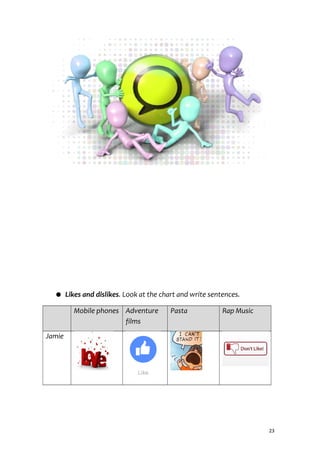
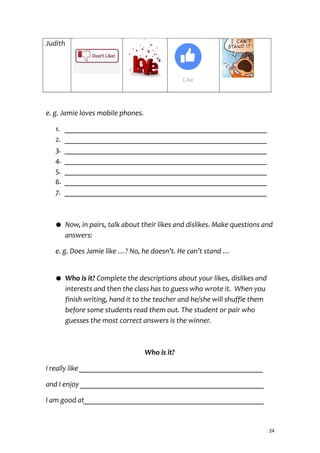
● Likes and dislikes. Look at the chart and write sentences.
Mobile phones Adventure
films
Pasta Rap Music
Jamie
23
Judith
e. g. Jamie loves mobile phones.
1. _______________________________________________________
2. _______________________________________________________
3. _______________________________________________________
4. _______________________________________________________
5. _______________________________________________________
6. _______________________________________________________
7. _______________________________________________________
● Now, in pairs, talk about their likes and dislikes. Make questions and
answers:
e. g. Does Jamie like …? No, he doesn’t. He can’t stand …
● Who is it? Complete the descriptions about your likes, dislikes and
interests and then the class has to guess who wrote it. When you
finish writing, hand it to the teacher and he/she will shuffle them
before some students read them out. The student or pair who
guesses the most correct answers is the winner.
Who is it?
I really like __________________________________________________
and I enjoy __________________________________________________
I am good at_________________________________________________
24
but I’m not very good at _______________________________________
I dislike _____________________________________________________
but I like ____________________________________________________
I hate ______________________________________________________
but I don’t mind _____________________________________________
I am crazy about ___________________________________________
and I love _________________________________________________
25
GRAMMAR REFERENCE
Present Simple
Simple present is also called present simple.
The simple present expresses an action in the present taking place
regularly, never or several times. It is also used for actions that take place
one after another and for actions that are set by a timetable or schedule.
The simple present also expresses facts in the present.
26
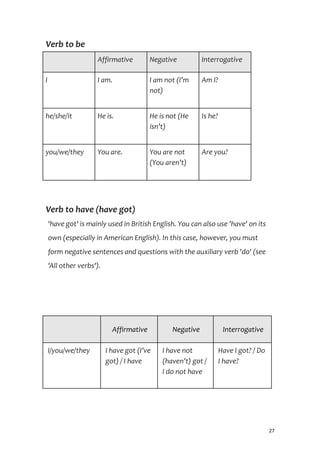
Verb to be
Affirmative Negative Interrogative
I I am. I am not (I’m
not)
Am I?
he/she/it He is. He is not (He
isn’t)
Is he?
you/we/they You are. You are not
(You aren’t)
Are you?
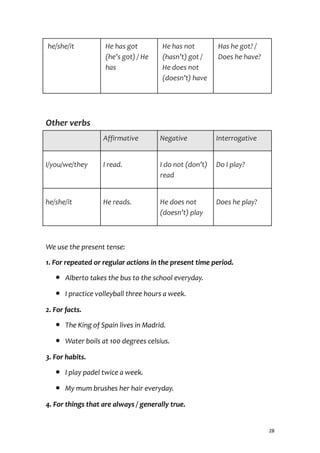
Verb to have (have got)
'have got' is mainly used in British English. You can also use 'have' on its
own (especially in American English). In this case, however, you must
form negative sentences and questions with the auxiliary verb 'do' (see
'All other verbs').
Affirmative Negative Interrogative
I/you/we/they I have got (I’ve
got) / I have
I have not
(haven’t) got /
I do not have
Have I got? / Do
I have?
27
he/she/it He has got
(he’s got) / He
has
He has not
(hasn’t) got /
He does not
(doesn’t) have
Has he got? /
Does he have?
Other verbs
Affirmative Negative Interrogative
I/you/we/they I read. I do not (don’t)
read
Do I play?
he/she/it He reads. He does not
(doesn’t) play
Does he play?
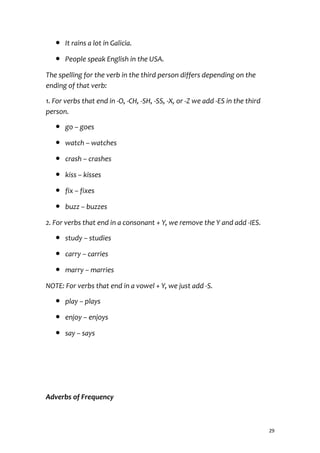
We use the present tense:
1. For repeated or regular actions in the present time period.
● Alberto takes the bus to the school everyday.
● I practice volleyball three hours a week.
2. For facts.
● The King of Spain lives in Madrid.
● Water boils at 100 degrees celsius.
3. For habits.
● I play padel twice a week.
● My mum brushes her hair everyday.
4. For things that are always / generally true.
28
● It rains a lot in Galicia.
● People speak English in the USA.
The spelling for the verb in the third person differs depending on the
ending of that verb:
1. For verbs that end in -O, -CH, -SH, -SS, -X, or -Z we add -ES in the third
person.
● go – goes
● watch – watches
● crash – crashes
● kiss – kisses
● fix – fixes
● buzz – buzzes
2. For verbs that end in a consonant + Y, we remove the Y and add -IES.
● study – studies
● carry – carries
● marry – marries
NOTE: For verbs that end in a vowel + Y, we just add -S.
● play – plays
● enjoy – enjoys
● say – says
Adverbs of Frequency
29
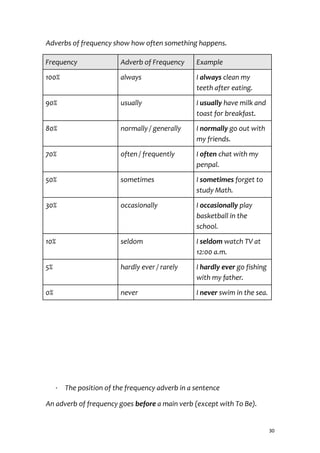
Adverbs of frequency show how often something happens.
Frequency Adverb of Frequency Example
100% always I always clean my
teeth after eating.
90% usually I usually have milk and
toast for breakfast.
80% normally / generally I normally go out with
my friends.
70% often / frequently I often chat with my
penpal.
50% sometimes I sometimes forget to
study Math.
30% occasionally I occasionally play
basketball in the
school.
10% seldom I seldom watch TV at
12:00 a.m.
5% hardly ever / rarely I hardly ever go fishing
with my father.
0% never I never swim in the sea.
· The position of the frequency adverb in a sentence
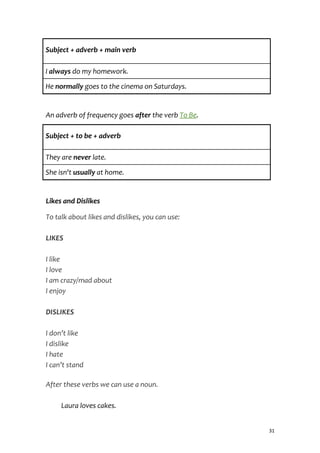
An adverb of frequency goes before a main verb (except with To Be).
30
Subject + adverb + main verb
I always do my homework.
He normally goes to the cinema on Saturdays.
An adverb of frequency goes after the verb To Be.
Subject + to be + adverb
They are never late.
She isn't usually at home.
Likes and Dislikes
To talk about likes and dislikes, you can use:
LIKES
I like
I love
I am crazy/mad about
I enjoy
DISLIKES
I don’t like
I dislike
I hate
I can’t stand
After these verbs we can use a noun.
Laura loves cakes.
31
They don't like rugby.
But we can also use a verb. When we use a verb it usually takes the form
of the gerund, that is, we add -ing to the verb.
Do they enjoy playing the saxo?
She hates singing.
32
PRONUNCIATION
Pronunciation Guide
Do you want to improve your English pronunciation? Well, you are in the
right place.
33
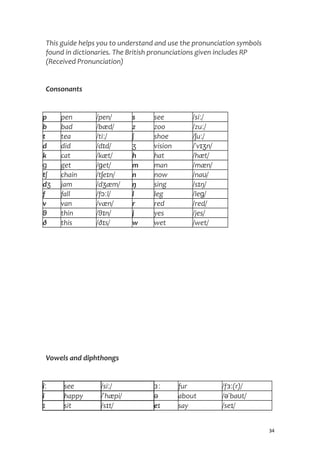
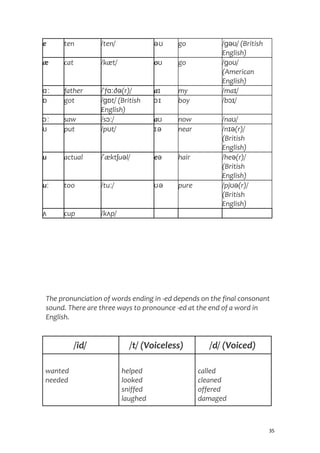
This guide helps you to understand and use the pronunciation symbols
found in dictionaries. The British pronunciations given includes RP
(Received Pronunciation)
Consonants
p pen /pen/ s see /si /ː
b bad /bæd/ z zoo /zu /ː
t tea /ti /ː ʃ shoe / u /ʃ ː
d did /d d/ɪ ʒ vision / v n/ˈ ɪʒ
k cat /kæt/ h hat /hæt/
ɡ get / et/ɡ m man /mæn/
tʃ chain /t e n/ʃ ɪ n now /na /ʊ
dʒ jam /d æm/ʒ ŋ sing /s ŋ/ɪ
f fall /f l/ɔː l leg /le /ɡ
v van /væn/ r red /red/
θ thin /θ n/ɪ j yes /jes/
ð this /ð s/ɪ w wet /wet/
Vowels and diphthongs
iː see /si /ː ɜː fur /f (r)/ɜː
i happy / hæpi/ˈ ə about / ba t/əˈ ʊ
ɪ sit /s t/ɪ eɪ say /se /ɪ
34
e ten /ten/ əʊ go / / (Britishɡəʊ
English)
æ cat /kæt/ oʊ go / o /ɡ ʊ
(American
English)
ɑː father / f ð (r)/ˈ ɑː ə aɪ my /ma /ɪ
ɒ got / t/ (Britishɡɒ
English)
ɔɪ boy /b /ɔɪ
ɔː saw /s /ɔː aʊ now /na /ʊ
ʊ put /p t/ʊ ɪə near /n (r)/ɪə
(British
English)
u actual / ækt u l/ˈ ʃ ə eə hair /he (r)/ə
(British
English)
uː too /tu /ː ʊə pure /pj (r)/ʊə
(British
English)
ʌ cup /k p/ʌ
The pronunciation of words ending in -ed depends on the final consonant
sound. There are three ways to pronounce -ed at the end of a word in
English.
/id/ /t/ (Voiceless) /d/ (Voiced)
wanted
needed
helped
looked
sniffed
laughed
called
cleaned
offered
damaged
35
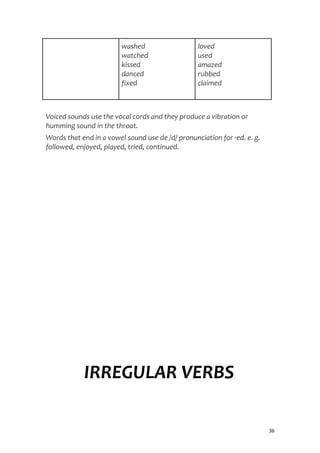
washed
watched
kissed
danced
fixed
loved
used
amazed
rubbed
claimed
Voiced sounds use the vocal cords and they produce a vibration or
humming sound in the throat.
Words that end in a vowel sound use de /d/ pronunciation for -ed. e. g.
followed, enjoyed, played, tried, continued.
IRREGULAR VERBS
36
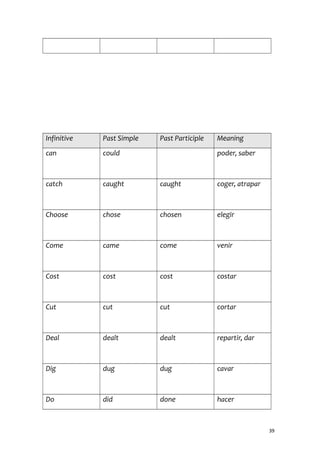
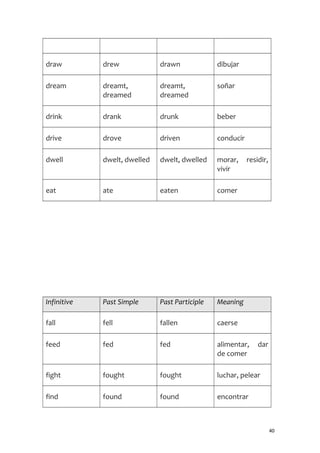
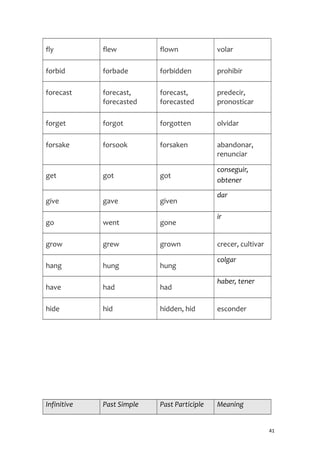
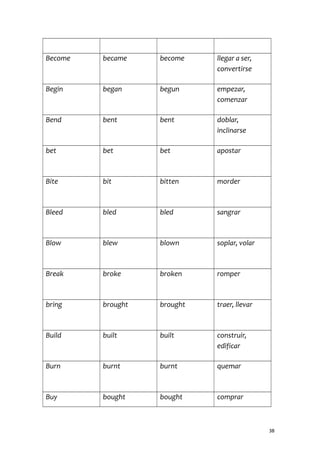
List of irregular verbs
Infinitive Past Simple Past Participle Meaning
arise arose arisen surgir,
presentarse
Be was, were been ser, estar
Beat beat beaten golpear
37
Become became become llegar a ser,
convertirse
Begin began begun empezar,
comenzar
Bend bent bent doblar,
inclinarse
bet bet bet apostar
Bite bit bitten morder
Bleed bled bled sangrar
Blow blew blown soplar, volar
Break broke broken romper
bring brought brought traer, llevar
Build built built construir,
edificar
Burn burnt burnt quemar
Buy bought bought comprar
38
Infinitive Past Simple Past Participle Meaning
can could poder, saber
catch caught caught coger, atrapar
Choose chose chosen elegir
Come came come venir
Cost cost cost costar
Cut cut cut cortar
Deal dealt dealt repartir, dar
Dig dug dug cavar
Do did done hacer
39
draw drew drawn dibujar
dream dreamt,
dreamed
dreamt,
dreamed
soñar
drink drank drunk beber
drive drove driven conducir
dwell dwelt, dwelled dwelt, dwelled morar, residir,
vivir
eat ate eaten comer
Infinitive Past Simple Past Participle Meaning
fall fell fallen caerse
feed fed fed alimentar, dar
de comer
fight fought fought luchar, pelear
find found found encontrar
40
fly flew flown volar
forbid forbade forbidden prohibir
forecast forecast,
forecasted
forecast,
forecasted
predecir,
pronosticar
forget forgot forgotten olvidar
forsake forsook forsaken abandonar,
renunciar
get got got
conseguir,
obtener
give gave given
dar
go went gone
ir
grow grew grown crecer, cultivar
hang hung hung
colgar
have had had
haber, tener
hide hid hidden, hid esconder
Infinitive Past Simple Past Participle Meaning
41
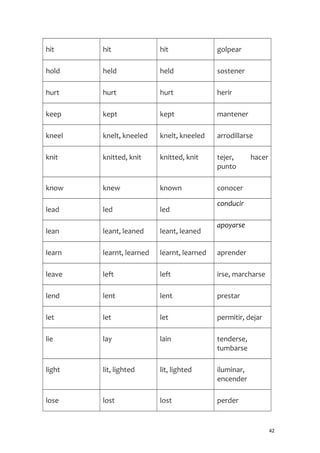
hit hit hit golpear
hold held held sostener
hurt hurt hurt herir
keep kept kept mantener
kneel knelt, kneeled knelt, kneeled arrodillarse
knit knitted, knit knitted, knit tejer, hacer
punto
know knew known conocer
lead led led
conducir
lean leant, leaned leant, leaned
apoyarse
learn learnt, learned learnt, learned aprender
leave left left irse, marcharse
lend lent lent prestar
let let let permitir, dejar
lie lay lain tenderse,
tumbarse
light lit, lighted lit, lighted iluminar,
encender
lose lost lost perder
42
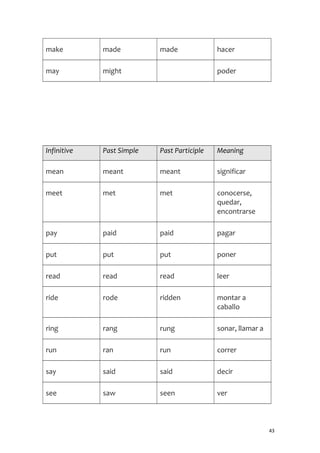
make made made hacer
may might poder
Infinitive Past Simple Past Participle Meaning
mean meant meant significar
meet met met conocerse,
quedar,
encontrarse
pay paid paid pagar
put put put poner
read read read leer
ride rode ridden montar a
caballo
ring rang rung sonar, llamar a
run ran run correr
say said said decir
see saw seen ver
43
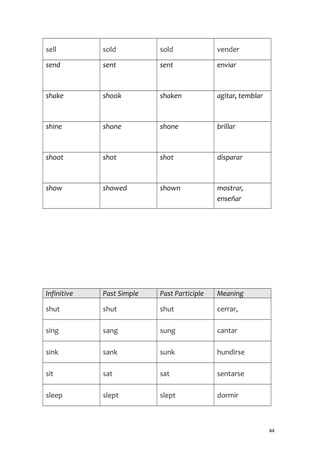
sell sold sold vender
send sent sent enviar
shake shook shaken agitar, temblar
shine shone shone brillar
shoot shot shot disparar
show showed shown mostrar,
enseñar
Infinitive Past Simple Past Participle Meaning
shut shut shut cerrar,
sing sang sung cantar
sink sank sunk hundirse
sit sat sat sentarse
sleep slept slept dormir
44
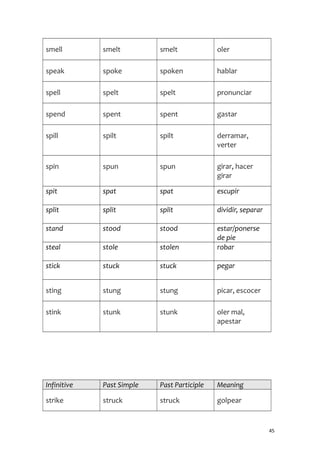
smell smelt smelt oler
speak spoke spoken hablar
spell spelt spelt pronunciar
spend spent spent gastar
spill spilt spilt derramar,
verter
spin spun spun girar, hacer
girar
spit spat spat escupir
split split split dividir, separar
stand stood stood estar/ponerse
de pie
steal stole stolen robar
stick stuck stuck pegar
sting stung stung picar, escocer
stink stunk stunk oler mal,
apestar
Infinitive Past Simple Past Participle Meaning
strike struck struck golpear
45
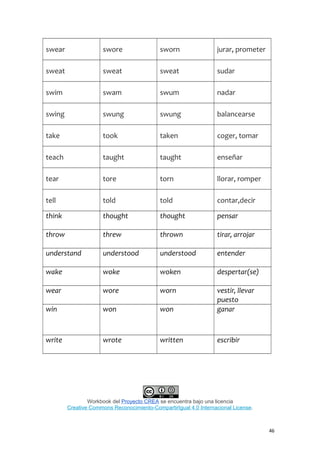
swear swore sworn jurar, prometer
sweat sweat sweat sudar
swim swam swum nadar
swing swung swung balancearse
take took taken coger, tomar
teach taught taught enseñar
tear tore torn llorar, romper
tell told told contar,decir
think thought thought pensar
throw threw thrown tirar, arrojar
understand understood understood entender
wake woke woken despertar(se)
wear wore worn vestir, llevar
puesto
win won won ganar
write wrote written escribir
Workbook del Proyecto CREA se encuentra bajo una licencia
Creative Commons Reconocimiento-CompartirIgual 4.0 Internacional License.
46

Workbook enjoying school

  • 1.
  • 2.
    INDEX 1. Vocabulary p.2 2. Grammar p. 9 3. Listening p. 15 4. Reading p. 17 5. Writing p. 19 6. Speaking p. 21 7. Grammar Reference p. 24 8. Pronunciation p. 31 9. Irregular Verbs p. 35 2
  • 3.
  • 4.
    Classroom Objects ● Lookat the picture, identify at least 10 items and write its name in the space provided. 472301. Classroom Objects (CC0) 1. _________________________________ 2. _________________________________ 3. _________________________________ 4. _________________________________ 5. _________________________________ 6. _________________________________ 7. _________________________________ 8. _________________________________ 9. _________________________________ 10. _________________________________ 4
  • 5.
    ● How manyclassroom objects words can you find? J P H O N E Q E B I U S J Y K N R K G X D D N N A N K Z D V J U Q B H V A Z O V B W U N B P N I T O O J Z K J L J S G P Q E Y V N Z Z V B U Z L E I C H V E N Z O P O Y J W N L L A N Q V N W N O T E B O O K G T G U Y P L V E W C I T G F I J N J N E N N K W U X X I L A G P H V T A J Q S A K P X I K L R D M Z X N H T I H H H V L V C O M P U T E R V Y D J Q F E B Q M A R F W A A I N V Z I B S Y A Z R M T X N Z M F U R U D F I C X Z P E N M G G C U Y G G F T R N I D E Q D R T R U B B E R B M F L P S I C A H G Y X L S V H P R H G X A S D L R P A P Y N E M G L L Y O C P O K O P T O B R V B A K L F O L D E R G C R O B O O K S W F N N A Q B R S U K PEN PENCIL RUBBER PHONE NOTEBOOK SCISSORS PAPER FOLDER BIN COMPUTER BOOKS CLOCK 5
  • 6.
    Days of theweek ● Answer the questions. 1. What day comes before Monday? _________________________ 2. What day comes after Wednesday? _______________________ 3. What day comes before Tuesday? _________________________ 4. What day comes before Thursday? ________________________ 5. What day comes after Monday? __________________________ 6. What day comes before Saturday? ________________________ 7. What day comes after Friday? ___________________________ ● Read the text and answer the questions. This is Yolanda. She is 12 years old. She is tall and thin. She’s got long black hair. She’s got big blue eyes. Every Monday, she plays chess with her brother at home. Every Tuesday, she swims with her friends Marisa and Lola in the local indoor pool. On Wednesdays, she sings with her band. On Thursdays, she chats with her friend, Rosa. Every Friday, she plays her favourite instrument, the violin. True or False (T or F). 1. Yolanda is 12 years old. __________ 2. She’s got small blue eyes. __________ 3. She plays chess every Friday. __________ 4. On Wednesday, she sings with her band. __________ 5. She chats with her friend Lola on Thursdays. __________ 6
  • 7.
    School Subjects ● Lookat Teresa’s timetable and answer the questions. Monday Tuesday Wednesday Thursday Friday 8:25-9:20 Geography Math Biology Spanish English 9:20-10:15 Spanish English Math Math Biology 10:15-11:10 Math Spanish Music ITC Math 11:10-11:40 breaktime breaktime breaktime breaktime breaktime 11:40-12:35 Music Art Geography English Spanish 12:35-13:30 English Biology Spanish Music Chess 13:30-14:25 ITC P. E. Chess P. E. Art Questions: 1. What time does Teresa have Art on Friday? ____________________ 2. When does Teresa have Math? ____________________ 3. Does Teresa have ITC on Wednesday? ____________________ 4. What days does Teresa have P. E. ? ____________________ 5. Does Teresa have Chess at 12:35 on Friday? ____________________ ● What subject is the teacher talking about? Read the sentences and write down the subject. 1. The study of numbers, shapes and space using reason and usually a special system of symbols and rules for organizing them. ___________________ 2. The study of the language that people speak in places like USA, Britain and Australia. ___________________ 7
  • 8.
    3. Classes inwhich students do exercise and learn to play sport. ___________________ 4. The theory and practice of using computers to store and analyse information. ___________________ 5. The study of past events considered together, especially events of a particular period, country or subject. ___________________ The Time ● Write the time in words. 1. 8:45 __________________________________________ 2. 12:30 _________________________________________ 3. 9:00 _________________________________________ 4. 22:15 _________________________________________ 5. 17:10 _________________________________________ ● Write the time in numbers. 1. Quarter to three: _________________________________ 2. Twenty past four: ________________________________ 3. Half past eleven: _________________________________ 4. Twenty-five to six: _______________________________ 5. Five o’clock: ____________________________________ ● Look at the bus timetable and answer the questions. Sevilla 9:00 13:00 18:00 Monesterio 10:00 14:00 19:00 8
  • 9.
    Fuente de Cantos 10:20 14:2019:20 Zafra 10:45 14:45 19:45 Los Santos de Maimona 10:55 14:55 19:55 Villafranca 11:10 15:10 20:15 Almendralejo 11:25 15:25 20:25 Mérida 12:00 16:00 21:00 1. Ricardo is meeting his friend Jaime in Almendralejo at 16:15. Which bus does he have to take from Monesterio? _______________________ 2. How long does it take to travel from Sevilla to Villafranca? ____________________ 3. Alfonso lives in Fuente de Cantos. He wants to arrive in Zafra before midday. Which bus does he have to take? ____________________ 4. There is a bilingual meeting in Mérida next week. The students from IES Carolina Coronado in Almendralejo have to arrive there before 17:00. Which bus do they have to take? _______________________ 5. There is an Art conference in Los Santos de Maimona at 11:15. What time do the students from Monesterio have to take the bus? ______ 9
  • 10.
  • 11.
    ● Complete foryou and two friends or classmates. My name ___________________________ I __________________years old. My best friends _____________________ They ___________________________ years old. ● Write true answers for you. 1. Are you a student? _______________________________________ 2. Are you from Mérida (Spain)? _______________________________ 3. Where are you from? _____________________________________ 4. Are you twelve years old? _________________________________ 5. How old are you? ________________________________________ 6. Is your friend from Badajoz? _______________________________ 7. Where is your friend from? ________________________________ 11
  • 12.
    ● Have got.Choose the correct answer. 1. ____________________ Geography on Tuesday. (They’ve got / She got) 2. _________________ Chemistry this term. (Samuel and Sandra has got / Pedro hasn’t got) 3. When ____________________ Natural Science? (have Julia and Concha got / got we) 4. I _________________ ICT on Friday. 5. What lessons ____________________ today? (Mila has got / has MIla got) ● It is breaktime or recess at IES Cristo del Rosario secondary school in Extremadura. For an assignment about healthy food, Francisco and Gloria have got to know what some students eat at school at that time. Complete the conversation with the correct forms of the verb HAVE GOT. Francisco: Pedro, _____________________ (you) any fruit in your lunch box? Pedro: Yes, _______and I________ a ham sandwich and an apple. Francisco: You _____________a healthy lunch! Pedro: But I ____________(not) any cake. Gloria: Lucia ___________some chocolate cookies. You can share your apple with her and ask her for a cookie. Francisco: What________________________________ (Encarna, the Spanish teacher) in her lunch box? Gloria: _______________________ (she) any salad? Francisco: No, ________. She ___________________ a hamburger and some coffee. Gloria: What about Pepa, the P.E. teacher? Francisco: Hello, Pepa! ____________________ (you) any fruit or salad in your lunch box today? Pepa: Yes, I ________ I’m eating my chocolate cake and milk. But I _________________ some fruit salad in my lunch box. 12
  • 13.
    Gloria: Lourdes andÁngela are sharing their lunch. _____________________ (they) any juice in those brown bags? Francisco: Yes. Look at Santi. He __________________________a sandwich and a banana. ● Complete the text with the correct form of the verb to be in the simple present tense. My classroom Unique Huang. School Class (CC0) Hello, I _______ Joaquín. Today __________ Monday. It is 8:25 in the morning. The students _____________ at school. Their classroom _________ very big and nice with posters on the Wall. 13
  • 14.
    _____ There ______ lotsof desks and chairs, a big door and windows. There _______ also a big TV next to the notice board. At the front of the he class. There are __________ students doing a presentation and the other students _____________ listening to them. The teacher ___________ sitting down listening to the students, her name is Sonia and she __________ a very good teacher. There _______ posters and maps on the walls. ● Complete the sentences using each of the frequency adverbs below. 1. Richi often ______________________________________________. 2. Alfonso and Paco rarely ____________________________________. 3. Milagros never ___________________________________________. 4. Jorge always _____________________________________________. 5. I sometimes _____________________________________________. ● Translate the following sentences into English. 1. Todos los días en clase usamos “wordreference” un diccionario online. ________________________________________________________ 2. Mis clases terminan a las 14:25 todos los días. ________________________________________________________ 3. A ella no le gusta el rap. ________________________________________________________ 14
  • 15.
    4. ¿Vas alinstituto en coche? ________________________________________________________ 5. ¿Qué hacen tus amigos después del instituto? ________________________________________________________ ● Use the correct question word (who, where, what, when, why) and the simple present tense to make information questions. The underlined words are the answers to the questions. e. g. Where do you usually text message your friends? I usually text message my friends in the school and my bedroom. 1. ___________________________________________________ ? Marisa sometimes have a cup of coffee for breakfast at 11:30 a.m. 2. ___________________________________________________? Javier usually goes to see a film on Saturdays. 3. ___________________________________________________? Because she is very nice and friendly. 4. ___________________________________________________? Paco and Antonio often go out together to the park. 5. ___________________________________________________? Paca practices Pilates in a gym every morning. 15
  • 16.
  • 17.
    ● Dictation. Listenand write the sentences. (Audio 1_Enjoying School) 1. _______________________________________________________ 2. _______________________________________________________ 3. _______________________________________________________ 4. _______________________________________________________ 5. _______________________________________________________ 17
  • 18.
    ● Listen toEmma talking about her day and complete. (Audio 2_Enjoying School) Everyday I ________________ at seven o'clock. First I ________________ to the kitchen and I ________________ a cup of milk and toast for breakfast. Then I _______________ to the bathroom and ________________ my teeth. After that, I ________________ dressed and ________________ my hair. At half five to eight I ________________ to school. I ________________ the bus to Zafra. It ________________ a long way from home. I ________________ at school at twenty past eight. At ten past eleven I ________________ lunch and at twenty-five past two I ________________ back home. At nine o'clock I ________________ dinner with my family and then we ________________ TV. At a quarter past eleven I ________________ to bed. READING 18
  • 19.
    ● Read thetext and answer the questions My daily routine Hi! My name is Emilio and I wake up at 7:30 in the morning. Then I get up and I have a shower. After that, I go to the kitchen, where I prepare breakfast for my brothers John and Einar, and I have it with them in the dining room. After that, we always go to the bus stop to go to school. Sometimes, my father takes us by car when he has time. I attend classes 19
  • 20.
    all morning andwhen the classes finishes at 14:25, I come home immediately. I often have lunch really quickly because I have extra classes. I really love music, I study Percussion at a Conservatory. My classes usually start at 16:00 or 17:00, at that time, my sisters Monica and Judith are still in the school and my mum is working at home, so I haven’t got too much time for relaxing or taking a nap. Later, when I come back from my music classes at about 20:30, I have dinner, I study a little bit and do my homework. Finally I go to bed. Questions: 1. What time does Emilio wake up? ___________________________ 2. Where do they eat breakfast? ______________________________ 3. Who takes them to school by car? __________________________ 4. What does Emilio study in the Conservatory? _________________ 5. What time does Emilio have dinner? _________________________ WRITING 20
  • 21.
    ● Do youknow how to make a salad? Complete the sentences with the correct adverb of sequence. THEN FINALLY NEXT AFTER THAT FIRST 1. ______________ buy all of the ingredients from the supermarket. 2. ______________, chop the lettuce, tomatoes, onions and carrots. 3. ______________, add some tuna, sweet corn, olives and mix well. 4. ______________, cut a small Apple into cubes and add a pinch of salt. 5. ______________, sprinkle some olive oil and vinegar onto your salad and … that’s all! 21
  • 22.
    ● How tomake a …? Now, describe the process of another recipe you like. 1. ________________________________________________________ ______________________________________________________ 2. ________________________________________________________ ______________________________________________________ 3. ________________________________________________________ ______________________________________________________ 4. ________________________________________________________ ______________________________________________________ 5. ________________________________________________________ ______________________________________________________ SPEAKING 22
  • 23.
    ● Likes anddislikes. Look at the chart and write sentences. Mobile phones Adventure films Pasta Rap Music Jamie 23
  • 24.
    Judith e. g. Jamieloves mobile phones. 1. _______________________________________________________ 2. _______________________________________________________ 3. _______________________________________________________ 4. _______________________________________________________ 5. _______________________________________________________ 6. _______________________________________________________ 7. _______________________________________________________ ● Now, in pairs, talk about their likes and dislikes. Make questions and answers: e. g. Does Jamie like …? No, he doesn’t. He can’t stand … ● Who is it? Complete the descriptions about your likes, dislikes and interests and then the class has to guess who wrote it. When you finish writing, hand it to the teacher and he/she will shuffle them before some students read them out. The student or pair who guesses the most correct answers is the winner. Who is it? I really like __________________________________________________ and I enjoy __________________________________________________ I am good at_________________________________________________ 24
  • 25.
    but I’m notvery good at _______________________________________ I dislike _____________________________________________________ but I like ____________________________________________________ I hate ______________________________________________________ but I don’t mind _____________________________________________ I am crazy about ___________________________________________ and I love _________________________________________________ 25
  • 26.
    GRAMMAR REFERENCE Present Simple Simplepresent is also called present simple. The simple present expresses an action in the present taking place regularly, never or several times. It is also used for actions that take place one after another and for actions that are set by a timetable or schedule. The simple present also expresses facts in the present. 26
  • 27.
    Verb to be AffirmativeNegative Interrogative I I am. I am not (I’m not) Am I? he/she/it He is. He is not (He isn’t) Is he? you/we/they You are. You are not (You aren’t) Are you? Verb to have (have got) 'have got' is mainly used in British English. You can also use 'have' on its own (especially in American English). In this case, however, you must form negative sentences and questions with the auxiliary verb 'do' (see 'All other verbs'). Affirmative Negative Interrogative I/you/we/they I have got (I’ve got) / I have I have not (haven’t) got / I do not have Have I got? / Do I have? 27
  • 28.
    he/she/it He hasgot (he’s got) / He has He has not (hasn’t) got / He does not (doesn’t) have Has he got? / Does he have? Other verbs Affirmative Negative Interrogative I/you/we/they I read. I do not (don’t) read Do I play? he/she/it He reads. He does not (doesn’t) play Does he play? We use the present tense: 1. For repeated or regular actions in the present time period. ● Alberto takes the bus to the school everyday. ● I practice volleyball three hours a week. 2. For facts. ● The King of Spain lives in Madrid. ● Water boils at 100 degrees celsius. 3. For habits. ● I play padel twice a week. ● My mum brushes her hair everyday. 4. For things that are always / generally true. 28
  • 29.
    ● It rainsa lot in Galicia. ● People speak English in the USA. The spelling for the verb in the third person differs depending on the ending of that verb: 1. For verbs that end in -O, -CH, -SH, -SS, -X, or -Z we add -ES in the third person. ● go – goes ● watch – watches ● crash – crashes ● kiss – kisses ● fix – fixes ● buzz – buzzes 2. For verbs that end in a consonant + Y, we remove the Y and add -IES. ● study – studies ● carry – carries ● marry – marries NOTE: For verbs that end in a vowel + Y, we just add -S. ● play – plays ● enjoy – enjoys ● say – says Adverbs of Frequency 29
  • 30.
    Adverbs of frequencyshow how often something happens. Frequency Adverb of Frequency Example 100% always I always clean my teeth after eating. 90% usually I usually have milk and toast for breakfast. 80% normally / generally I normally go out with my friends. 70% often / frequently I often chat with my penpal. 50% sometimes I sometimes forget to study Math. 30% occasionally I occasionally play basketball in the school. 10% seldom I seldom watch TV at 12:00 a.m. 5% hardly ever / rarely I hardly ever go fishing with my father. 0% never I never swim in the sea. · The position of the frequency adverb in a sentence An adverb of frequency goes before a main verb (except with To Be). 30
  • 31.
    Subject + adverb+ main verb I always do my homework. He normally goes to the cinema on Saturdays. An adverb of frequency goes after the verb To Be. Subject + to be + adverb They are never late. She isn't usually at home. Likes and Dislikes To talk about likes and dislikes, you can use: LIKES I like I love I am crazy/mad about I enjoy DISLIKES I don’t like I dislike I hate I can’t stand After these verbs we can use a noun. Laura loves cakes. 31
  • 32.
    They don't likerugby. But we can also use a verb. When we use a verb it usually takes the form of the gerund, that is, we add -ing to the verb. Do they enjoy playing the saxo? She hates singing. 32
  • 33.
    PRONUNCIATION Pronunciation Guide Do youwant to improve your English pronunciation? Well, you are in the right place. 33
  • 34.
    This guide helpsyou to understand and use the pronunciation symbols found in dictionaries. The British pronunciations given includes RP (Received Pronunciation) Consonants p pen /pen/ s see /si /ː b bad /bæd/ z zoo /zu /ː t tea /ti /ː ʃ shoe / u /ʃ ː d did /d d/ɪ ʒ vision / v n/ˈ ɪʒ k cat /kæt/ h hat /hæt/ ɡ get / et/ɡ m man /mæn/ tʃ chain /t e n/ʃ ɪ n now /na /ʊ dʒ jam /d æm/ʒ ŋ sing /s ŋ/ɪ f fall /f l/ɔː l leg /le /ɡ v van /væn/ r red /red/ θ thin /θ n/ɪ j yes /jes/ ð this /ð s/ɪ w wet /wet/ Vowels and diphthongs iː see /si /ː ɜː fur /f (r)/ɜː i happy / hæpi/ˈ ə about / ba t/əˈ ʊ ɪ sit /s t/ɪ eɪ say /se /ɪ 34
  • 35.
    e ten /ten/əʊ go / / (Britishɡəʊ English) æ cat /kæt/ oʊ go / o /ɡ ʊ (American English) ɑː father / f ð (r)/ˈ ɑː ə aɪ my /ma /ɪ ɒ got / t/ (Britishɡɒ English) ɔɪ boy /b /ɔɪ ɔː saw /s /ɔː aʊ now /na /ʊ ʊ put /p t/ʊ ɪə near /n (r)/ɪə (British English) u actual / ækt u l/ˈ ʃ ə eə hair /he (r)/ə (British English) uː too /tu /ː ʊə pure /pj (r)/ʊə (British English) ʌ cup /k p/ʌ The pronunciation of words ending in -ed depends on the final consonant sound. There are three ways to pronounce -ed at the end of a word in English. /id/ /t/ (Voiceless) /d/ (Voiced) wanted needed helped looked sniffed laughed called cleaned offered damaged 35
  • 36.
    washed watched kissed danced fixed loved used amazed rubbed claimed Voiced sounds usethe vocal cords and they produce a vibration or humming sound in the throat. Words that end in a vowel sound use de /d/ pronunciation for -ed. e. g. followed, enjoyed, played, tried, continued. IRREGULAR VERBS 36
  • 37.
    List of irregularverbs Infinitive Past Simple Past Participle Meaning arise arose arisen surgir, presentarse Be was, were been ser, estar Beat beat beaten golpear 37
  • 38.
    Become became becomellegar a ser, convertirse Begin began begun empezar, comenzar Bend bent bent doblar, inclinarse bet bet bet apostar Bite bit bitten morder Bleed bled bled sangrar Blow blew blown soplar, volar Break broke broken romper bring brought brought traer, llevar Build built built construir, edificar Burn burnt burnt quemar Buy bought bought comprar 38
  • 39.
    Infinitive Past SimplePast Participle Meaning can could poder, saber catch caught caught coger, atrapar Choose chose chosen elegir Come came come venir Cost cost cost costar Cut cut cut cortar Deal dealt dealt repartir, dar Dig dug dug cavar Do did done hacer 39
  • 40.
    draw drew drawndibujar dream dreamt, dreamed dreamt, dreamed soñar drink drank drunk beber drive drove driven conducir dwell dwelt, dwelled dwelt, dwelled morar, residir, vivir eat ate eaten comer Infinitive Past Simple Past Participle Meaning fall fell fallen caerse feed fed fed alimentar, dar de comer fight fought fought luchar, pelear find found found encontrar 40
  • 41.
    fly flew flownvolar forbid forbade forbidden prohibir forecast forecast, forecasted forecast, forecasted predecir, pronosticar forget forgot forgotten olvidar forsake forsook forsaken abandonar, renunciar get got got conseguir, obtener give gave given dar go went gone ir grow grew grown crecer, cultivar hang hung hung colgar have had had haber, tener hide hid hidden, hid esconder Infinitive Past Simple Past Participle Meaning 41
  • 42.
    hit hit hitgolpear hold held held sostener hurt hurt hurt herir keep kept kept mantener kneel knelt, kneeled knelt, kneeled arrodillarse knit knitted, knit knitted, knit tejer, hacer punto know knew known conocer lead led led conducir lean leant, leaned leant, leaned apoyarse learn learnt, learned learnt, learned aprender leave left left irse, marcharse lend lent lent prestar let let let permitir, dejar lie lay lain tenderse, tumbarse light lit, lighted lit, lighted iluminar, encender lose lost lost perder 42
  • 43.
    make made madehacer may might poder Infinitive Past Simple Past Participle Meaning mean meant meant significar meet met met conocerse, quedar, encontrarse pay paid paid pagar put put put poner read read read leer ride rode ridden montar a caballo ring rang rung sonar, llamar a run ran run correr say said said decir see saw seen ver 43
  • 44.
    sell sold soldvender send sent sent enviar shake shook shaken agitar, temblar shine shone shone brillar shoot shot shot disparar show showed shown mostrar, enseñar Infinitive Past Simple Past Participle Meaning shut shut shut cerrar, sing sang sung cantar sink sank sunk hundirse sit sat sat sentarse sleep slept slept dormir 44
  • 45.
    smell smelt smeltoler speak spoke spoken hablar spell spelt spelt pronunciar spend spent spent gastar spill spilt spilt derramar, verter spin spun spun girar, hacer girar spit spat spat escupir split split split dividir, separar stand stood stood estar/ponerse de pie steal stole stolen robar stick stuck stuck pegar sting stung stung picar, escocer stink stunk stunk oler mal, apestar Infinitive Past Simple Past Participle Meaning strike struck struck golpear 45
  • 46.
    swear swore swornjurar, prometer sweat sweat sweat sudar swim swam swum nadar swing swung swung balancearse take took taken coger, tomar teach taught taught enseñar tear tore torn llorar, romper tell told told contar,decir think thought thought pensar throw threw thrown tirar, arrojar understand understood understood entender wake woke woken despertar(se) wear wore worn vestir, llevar puesto win won won ganar write wrote written escribir Workbook del Proyecto CREA se encuentra bajo una licencia Creative Commons Reconocimiento-CompartirIgual 4.0 Internacional License. 46