CULMINATION
ACTIVITIES
FEBRUARY 19,2024
FIRE STATION CLAVERIA
WORK IMMERSION: 80 HOURS
SFO3.GEOFFREY V. RAMIREZ
OFFICER IN CHARGE
MUNICIPAL FIRE MARSHAL
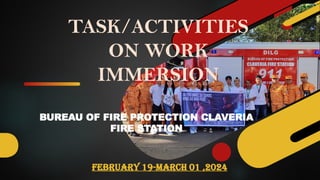
FEBRUARY 19-MARCH 01 ,2024
TASK/ACTIVITIES
ON WORK
IMMERSION
BUREAU OF FIRE PROTECTION CLAVERIA
FIRE STATION
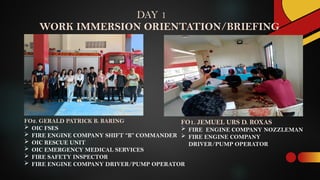
WORK IMMERSION ORIENTATION/BRIEFING
FO1. JEMUEL URS D. ROXAS
 FIRE ENGINE COMPANY NOZZLEMAN
 FIRE ENGINE COMPANY
DRIVER/PUMP OPERATOR
DAY 1
FO2. GERALD PATRICK B. BARING
 OIC FSES
 FIRE ENGINE COMPANY SHIFT “B” COMMANDER
 OIC RESCUE UNIT
 OIC EMERGENCY MEDICAL SERVICES
 FIRE SAFETY INSPECTOR
 FIRE ENGINE COMPANY DRIVER/PUMP OPERATOR
FLAG
CEREMONY
SELF
INTRODUCTION
LEARNINGS:
Skill Development: Participants develop essential business
skills, such as problem-solving, decision-making,
communication, and teamwork.
Networking Opportunities: Participants can build
professional connections and explore potential career
paths within the host organization.
Personal Growth: Participants have the opportunity to
enhance their self-awareness, confidence, and adaptability
in a business setting.
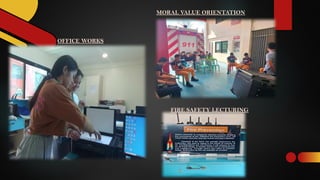
MORAL VALUE
ORIENTATION
OFFICE WORKS
FIRE SAFETY
LECTURING
20-FEB-24
DAY 2
OFFICE WORKS
MORAL VALUE ORIENTATION
FIRE SAFETY LECTURING
LEARNINGS:
 Moral Value Orientation: - Emphasized the importance of
ethics, integrity, and professional conduct in the workplace.
- Highlighted the organization's commitment to corporate
social responsibility.
 Fire Safety Lecturing: - Covered fire prevention measures,
such as proper handling of flammable materials and
equipment maintenance. - Provided training on fire alarm
systems, evacuation procedures, and the use of fire
extinguishers. - Stressed the importance of emergency
response and reporting procedures.
ADD
A
FOOTER
 Category Title
21-FEB-24
DAY 3 LECTURE ON BASIC
FIRE FIGHTING
OPERATION
FIRE FIGHTING
TECHNIQUES
HOSE ROLL,PPE
DONNING AND
DOFFING
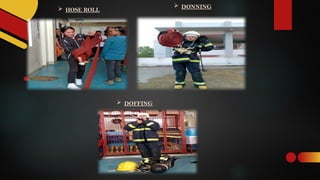
 HOSE ROLL
 DONNING
 DOFFING
ADD
A
FOOTER
11
LEARNINGS:
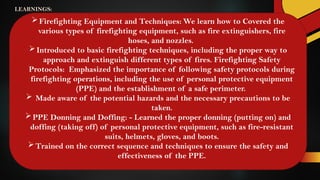
Firefighting Equipment and Techniques: We learn how to Covered the
various types of firefighting equipment, such as fire extinguishers, fire
hoses, and nozzles.
Introduced to basic firefighting techniques, including the proper way to
approach and extinguish different types of fires. Firefighting Safety
Protocols: Emphasized the importance of following safety protocols during
firefighting operations, including the use of personal protective equipment
(PPE) and the establishment of a safe perimeter.
 Made aware of the potential hazards and the necessary precautions to be
taken.
PPE Donning and Doffing: - Learned the proper donning (putting on) and
doffing (taking off) of personal protective equipment, such as fire-resistant
suits, helmets, gloves, and boots.
Trained on the correct sequence and techniques to ensure the safety and
effectiveness of the PPE.
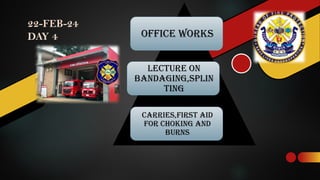
OFFICE WORKS
LECTURE ON
BANDAGING,SPLIN
TING
CARRIES,FIRST AID
FOR CHOKING AND
BURNS
22-FEB-24
DAY 4
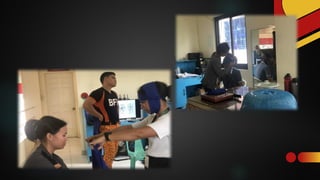
OFFICE WORKS
LECTURING
BANDAGING
CARRIES
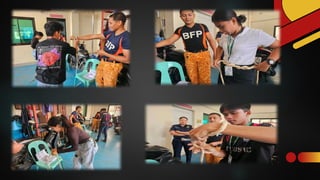
Bandaging teach us how to apply in a different types(e.g. gauze, roller,
triangular ) to control bleeding and protect wounds.
Importance of sterile wound care and dressing application
The purpose of splinting to immobilize injured limbs
Proper methods for constructing and applying rigid and soft splints
It helps for stabilizing suspected fractures or dislocations
We know how to transport injured or unconscious individuals in proper body
mechanics and teamwork for different carry techniques with one-person, two-
person carries.
Moreover, we learn the different classification of burn severity
(1st
, 2nd
, 3rd
degree) in office with the teamwork we do our responsibilities and
role to share our capabilities with the coordination, participation and
communication.
LEARNINGS:
BANDAGING
PRACTICE AND
CONTEST
OFFICE WORKS
23-FEB-24
DAY 5
LEARNINGS:
The work immersion component is a valuable part in our
lives, to be trained with the officers of fire station
claveria it allows us to apply in classroom knowledge in a
practical setting and continuously improve our critical
emergency medical skills, including bandaging
techniques.
26-FEB-24
DAY 06
OFFICE
WORKS
KNOT
TYING
LECTURE
 The goal is to become proficient in knot tying to support
the BFP activities effectively. With dedication and a
willingness to learn, we develop that is new to our mind
and it is valuable experience with the fire station claveria,
by understanding their job to participate well. We begin
with the basic knot tying first is the overhand knot, figure
eight knot, and bowline. The are building blocks for more
complex knots.
LEARNINGS:
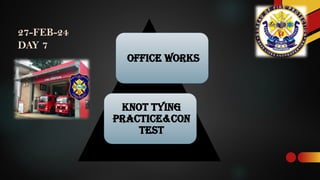
27-FEB-24
DAY 7
OFFICE WORKS
KNOT TYING
PRACTICE&CON
TEST
Knot tying is a practical that involves
creating various types of knots, it is
essential for us to know because it can be
useful in many contexts such as sailing,
camping, climbing, rescuing people and
many more. Knot tying is often taught as
part of vocational or technical training
programs.
LEARNINGS:
24
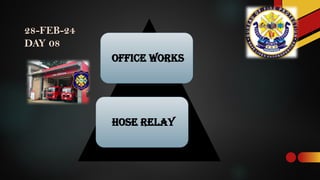
28-FEB-24
DAY 08
OFFICE WORKS
HOSE RELAY
ADD
A
FOOTER
Understanding the purpose and
function of hose relay
Inspection and maintenance
Troubleshooting and problem solving
Installation and replacement
Operational procedures
Safety and consideration
LEARNINGS:
29-FEB-24
DAY 09
OFFICE
WORKS
RAPPELlING
Equipment familiarization
Rappelling techniques
Safety protocol
Practical exercises
LEARNINGS:
KICK-OFF CEREMONY OF FIRE PREVENTION
MONTH 2024
HEADED BY SF03. GEOFFREY V. RAMIREZ, OIC
MFM
01-MARCH-24
DAY 10
LEARNINGS:
The last day of work immersion at BFP as a learners
was a culmination of practical insights, personal
connections, and a newfound sense of respect for the
noble profession of firefighting. It reinforced the
importance of continuous learning, empathy, and a
strong sense of duty towards the community. This
experience has undoubtedly shaped our perspective
and instilled in a greater sense of responsibility as
we embark on our future endeavors.
CONCLUSION&RECOMMENDATION
 Work immersion experience at the Bureau of Fire Protection
(BFP), We have come to realize the profound impact it has
had on our personal and professional development. Work
immersion is an invaluable opportunity for students to gain
practical insights, enhance their skills, and prepare for future
careers. Our experience at BFP has not only provided us with
hands-on learning but has also shaped perspective on the
importance of dedication, teamwork, and service to the
community.
Work immersion programs offer invaluable
opportunities for students to gain practical experience
and develop essential skills. In the context of the
Bureau of Fire Protection (BFP), implementing work
immersion programs can significantly benefit both the
students and the organization. This article presents a
compelling argument in favor of work immersion as a
student recommendation at BFP.
work immersion provides students with hands-on
experience in a real-world work environment. By
participating in the daily operations of BFP,
students can apply theoretical knowledge to
practical situations, thereby enhancing their
understanding of fire protection and emergency
response. This experiential learning opportunity not
only enriches their academic pursuits but also
equips them with relevant skills that are essential
for their future careers.
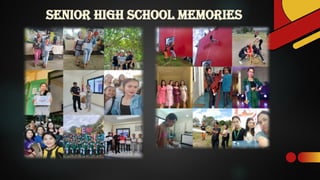
SENIOR HIGH SCHOOL MEMORIES
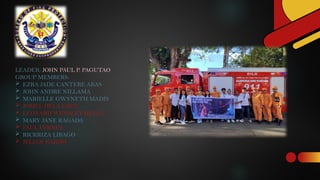
LEADER: JOHN PAUL P. PAGUTAO
GROUP MEMBERS:
 EZRA JADE CANTERE ABAS
 JOHN ANDRE NILLAMA
 MARIELLE GWYNETH MADIS
 JOMEL DELA CRUZ
 LEONARD WENSLEY HELLA
 MARY JANE RAGADA
 PAUL PERNES
 RICKRIZA LIBAGO
 JELIAN NARDO

WORK IMMERSION CULMINATION ACTIVITIES.pptx

  • 1.
    CULMINATION ACTIVITIES FEBRUARY 19,2024 FIRE STATIONCLAVERIA WORK IMMERSION: 80 HOURS SFO3.GEOFFREY V. RAMIREZ OFFICER IN CHARGE MUNICIPAL FIRE MARSHAL
  • 2.
    FEBRUARY 19-MARCH 01,2024 TASK/ACTIVITIES ON WORK IMMERSION BUREAU OF FIRE PROTECTION CLAVERIA FIRE STATION
  • 3.
    WORK IMMERSION ORIENTATION/BRIEFING FO1.JEMUEL URS D. ROXAS  FIRE ENGINE COMPANY NOZZLEMAN  FIRE ENGINE COMPANY DRIVER/PUMP OPERATOR DAY 1 FO2. GERALD PATRICK B. BARING  OIC FSES  FIRE ENGINE COMPANY SHIFT “B” COMMANDER  OIC RESCUE UNIT  OIC EMERGENCY MEDICAL SERVICES  FIRE SAFETY INSPECTOR  FIRE ENGINE COMPANY DRIVER/PUMP OPERATOR
  • 4.
  • 5.
    LEARNINGS: Skill Development: Participantsdevelop essential business skills, such as problem-solving, decision-making, communication, and teamwork. Networking Opportunities: Participants can build professional connections and explore potential career paths within the host organization. Personal Growth: Participants have the opportunity to enhance their self-awareness, confidence, and adaptability in a business setting.
  • 6.
    MORAL VALUE ORIENTATION OFFICE WORKS FIRESAFETY LECTURING 20-FEB-24 DAY 2
  • 7.
    OFFICE WORKS MORAL VALUEORIENTATION FIRE SAFETY LECTURING
  • 8.
    LEARNINGS:  Moral ValueOrientation: - Emphasized the importance of ethics, integrity, and professional conduct in the workplace. - Highlighted the organization's commitment to corporate social responsibility.  Fire Safety Lecturing: - Covered fire prevention measures, such as proper handling of flammable materials and equipment maintenance. - Provided training on fire alarm systems, evacuation procedures, and the use of fire extinguishers. - Stressed the importance of emergency response and reporting procedures.
  • 9.
    ADD A FOOTER  Category Title 21-FEB-24 DAY3 LECTURE ON BASIC FIRE FIGHTING OPERATION FIRE FIGHTING TECHNIQUES HOSE ROLL,PPE DONNING AND DOFFING
  • 10.
     HOSE ROLL DONNING  DOFFING
  • 11.
    ADD A FOOTER 11 LEARNINGS: Firefighting Equipment andTechniques: We learn how to Covered the various types of firefighting equipment, such as fire extinguishers, fire hoses, and nozzles. Introduced to basic firefighting techniques, including the proper way to approach and extinguish different types of fires. Firefighting Safety Protocols: Emphasized the importance of following safety protocols during firefighting operations, including the use of personal protective equipment (PPE) and the establishment of a safe perimeter.  Made aware of the potential hazards and the necessary precautions to be taken. PPE Donning and Doffing: - Learned the proper donning (putting on) and doffing (taking off) of personal protective equipment, such as fire-resistant suits, helmets, gloves, and boots. Trained on the correct sequence and techniques to ensure the safety and effectiveness of the PPE.
  • 12.
    OFFICE WORKS LECTURE ON BANDAGING,SPLIN TING CARRIES,FIRSTAID FOR CHOKING AND BURNS 22-FEB-24 DAY 4
  • 13.
  • 14.
    Bandaging teach ushow to apply in a different types(e.g. gauze, roller, triangular ) to control bleeding and protect wounds. Importance of sterile wound care and dressing application The purpose of splinting to immobilize injured limbs Proper methods for constructing and applying rigid and soft splints It helps for stabilizing suspected fractures or dislocations We know how to transport injured or unconscious individuals in proper body mechanics and teamwork for different carry techniques with one-person, two- person carries. Moreover, we learn the different classification of burn severity (1st , 2nd , 3rd degree) in office with the teamwork we do our responsibilities and role to share our capabilities with the coordination, participation and communication. LEARNINGS:
  • 15.
  • 17.
    LEARNINGS: The work immersioncomponent is a valuable part in our lives, to be trained with the officers of fire station claveria it allows us to apply in classroom knowledge in a practical setting and continuously improve our critical emergency medical skills, including bandaging techniques.
  • 18.
  • 20.
     The goalis to become proficient in knot tying to support the BFP activities effectively. With dedication and a willingness to learn, we develop that is new to our mind and it is valuable experience with the fire station claveria, by understanding their job to participate well. We begin with the basic knot tying first is the overhand knot, figure eight knot, and bowline. The are building blocks for more complex knots. LEARNINGS:
  • 21.
    27-FEB-24 DAY 7 OFFICE WORKS KNOTTYING PRACTICE&CON TEST
  • 23.
    Knot tying isa practical that involves creating various types of knots, it is essential for us to know because it can be useful in many contexts such as sailing, camping, climbing, rescuing people and many more. Knot tying is often taught as part of vocational or technical training programs. LEARNINGS:
  • 24.
  • 26.
    ADD A FOOTER Understanding the purposeand function of hose relay Inspection and maintenance Troubleshooting and problem solving Installation and replacement Operational procedures Safety and consideration LEARNINGS:
  • 27.
  • 29.
    Equipment familiarization Rappelling techniques Safetyprotocol Practical exercises LEARNINGS:
  • 30.
    KICK-OFF CEREMONY OFFIRE PREVENTION MONTH 2024 HEADED BY SF03. GEOFFREY V. RAMIREZ, OIC MFM 01-MARCH-24 DAY 10
  • 32.
    LEARNINGS: The last dayof work immersion at BFP as a learners was a culmination of practical insights, personal connections, and a newfound sense of respect for the noble profession of firefighting. It reinforced the importance of continuous learning, empathy, and a strong sense of duty towards the community. This experience has undoubtedly shaped our perspective and instilled in a greater sense of responsibility as we embark on our future endeavors.
  • 33.
  • 34.
     Work immersionexperience at the Bureau of Fire Protection (BFP), We have come to realize the profound impact it has had on our personal and professional development. Work immersion is an invaluable opportunity for students to gain practical insights, enhance their skills, and prepare for future careers. Our experience at BFP has not only provided us with hands-on learning but has also shaped perspective on the importance of dedication, teamwork, and service to the community.
  • 35.
    Work immersion programsoffer invaluable opportunities for students to gain practical experience and develop essential skills. In the context of the Bureau of Fire Protection (BFP), implementing work immersion programs can significantly benefit both the students and the organization. This article presents a compelling argument in favor of work immersion as a student recommendation at BFP.
  • 36.
    work immersion providesstudents with hands-on experience in a real-world work environment. By participating in the daily operations of BFP, students can apply theoretical knowledge to practical situations, thereby enhancing their understanding of fire protection and emergency response. This experiential learning opportunity not only enriches their academic pursuits but also equips them with relevant skills that are essential for their future careers.
  • 37.
  • 40.
    LEADER: JOHN PAULP. PAGUTAO GROUP MEMBERS:  EZRA JADE CANTERE ABAS  JOHN ANDRE NILLAMA  MARIELLE GWYNETH MADIS  JOMEL DELA CRUZ  LEONARD WENSLEY HELLA  MARY JANE RAGADA  PAUL PERNES  RICKRIZA LIBAGO  JELIAN NARDO