1
When sodium metal is
illuminated with light of
wavelength 4.20 × 10²
nm, the
stopping potential is found to
be 0.65 V; when the
wavelength is changed to 3.10
× 102
nm, the stopping
potential is 1.69 V. Using only
these data and the values of
the speed of light and the
electronic charge, find the work
function of sodium and a value
of Planck’s constant.
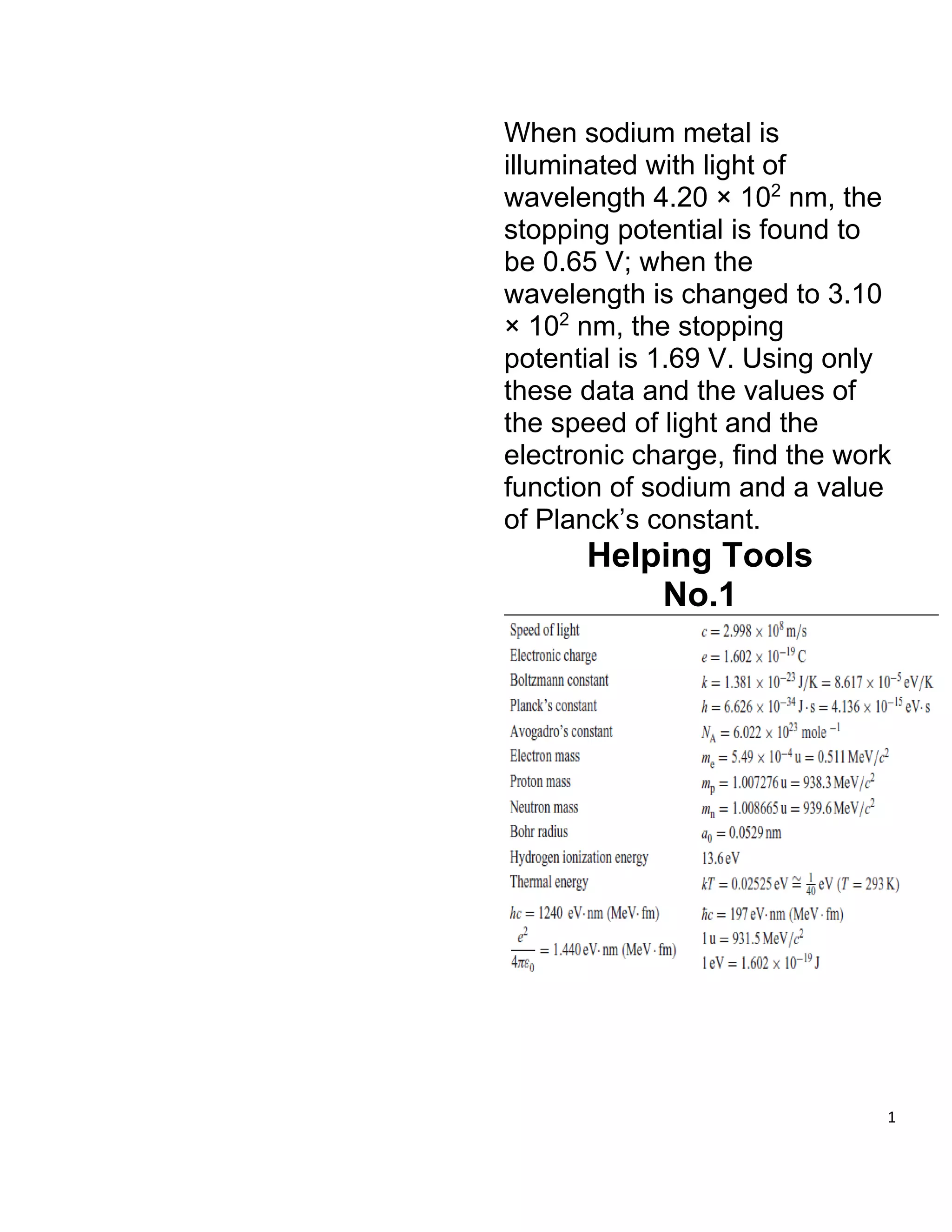
Helping Tools
No.1
2
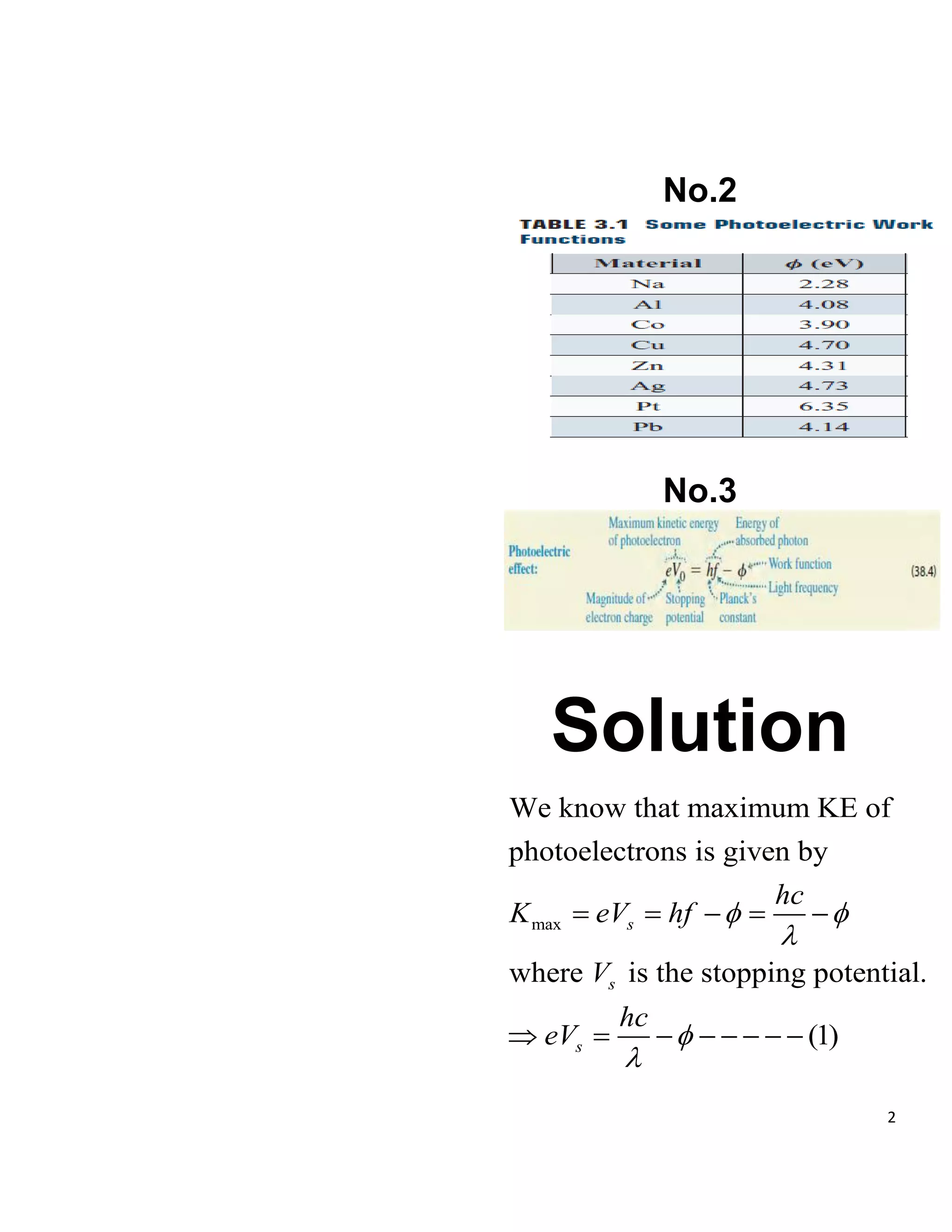
No.2
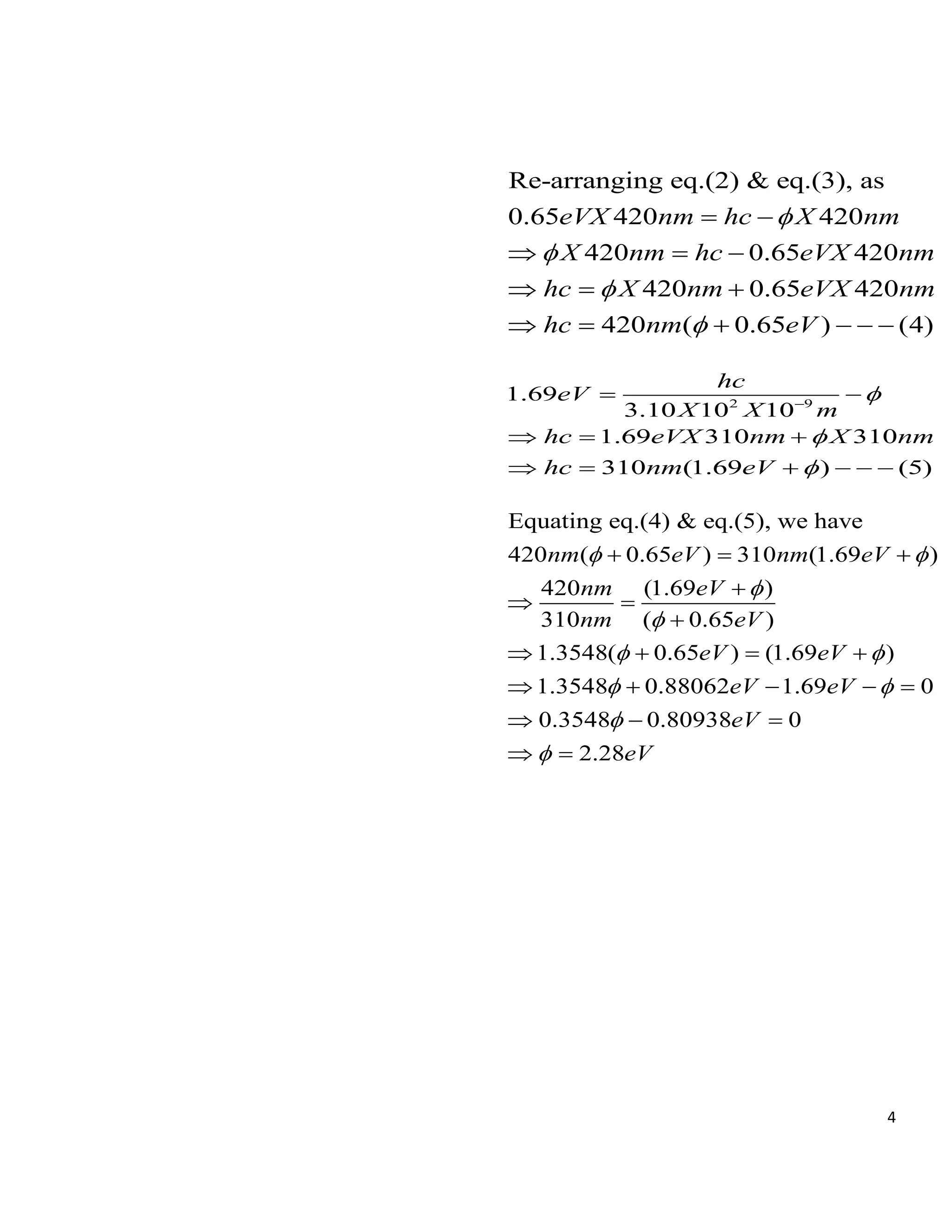
No.3
Solution
max
We know that maximum KE of
photoelectrons is given by
where is the stopping potential.
(1)
s
s
s
hc
K eV hf
V
hc
eV
 



= = − = −
 = − − − − − −
3
2 9
2 9
7 7
In accordance with given data, eq.(1)
takes the forms as:
0.65 (2)
4.20 10 10
1.69 (3)
3.10 10 10
subtracting eq.(2) from eq.(3), we get
1.69 0.65
3.10 10 4.20 10
hc
eV
X X m
hc
eV
X X m
eV eV
hc hc
X m X m


−
−
− −
= − − − −
= − − − −
−
= −
2
4 1
1 1
1.04 [ ]
310 420
420 310
1.04 [ ]
310 420
110
1.04 [ ]
130200( )
1.04eV 8.45 10 ( )
eV hc
nm nm
nm nm
eV hc
nmX nm
nm
eV hc
nm
hcX X X nm
− −
 = −
−
 =
 =
 =
4
9 4
8
13
13
13
15
1.04 1
10
8.45
1.04 1
10 10
8.45
2.998 10
1.04 . 1
10
2.998 8.45
1.04 . 10
0.041 10 .
25.33
4.1 10 .
eV
h XnmX X
c
eV
h X mX X
m
X
s
eV s
h X X
eV sX
h X eV s
X eV s
−
−
−
−
−
 =
 =
 =
 = =
=
4
Re-arranging eq.(2) & eq.(3), as
0.65 420 420
420 0.65 420
420 0.65 420
420 ( 0.65 ) (4)
eVX nm hc X nm
X nm hc eVX nm
hc X nm eVX nm
hc nm eV




= −
 = −
 = +
 = + − − −
2 9
1.69
3.10 10 10
1.69 310 310
310 (1.69 ) (5)
hc
eV
X X m
hc eVX nm X nm
hc nm eV



−
= −
 = +
 = + − − −
Equating eq.(4) & eq.(5), we have
420 ( 0.65 ) 310 (1.69 )
420 (1.69 )
310 ( 0.65 )
1.3548( 0.65 ) (1.69 )
1.3548 0.88062 1.69 0
0.3548 0.80938 0
2.28
nm eV nm eV
nm eV
nm eV
eV eV
eV eV
eV
eV
 


 
 


+ = +
+
 =
+
 + = +
 + − − =
 − =
 =

Work Function of Sodium.pdf

  • 1.
    1 When sodium metalis illuminated with light of wavelength 4.20 × 10² nm, the stopping potential is found to be 0.65 V; when the wavelength is changed to 3.10 × 10² nm, the stopping potential is 1.69 V. Using only these data and the values of the speed of light and the electronic charge, find the work function of sodium and a value of Planck’s constant. Helping Tools No.1
  • 2.
    2 No.2 No.3 Solution max We know thatmaximum KE of photoelectrons is given by where is the stopping potential. (1) s s s hc K eV hf V hc eV      = = − = −  = − − − − − −
  • 3.
    3 2 9 2 9 77 In accordance with given data, eq.(1) takes the forms as: 0.65 (2) 4.20 10 10 1.69 (3) 3.10 10 10 subtracting eq.(2) from eq.(3), we get 1.69 0.65 3.10 10 4.20 10 hc eV X X m hc eV X X m eV eV hc hc X m X m   − − − − = − − − − = − − − − − = − 2 4 1 1 1 1.04 [ ] 310 420 420 310 1.04 [ ] 310 420 110 1.04 [ ] 130200( ) 1.04eV 8.45 10 ( ) eV hc nm nm nm nm eV hc nmX nm nm eV hc nm hcX X X nm − −  = − −  =  =  = 4 9 4 8 13 13 13 15 1.04 1 10 8.45 1.04 1 10 10 8.45 2.998 10 1.04 . 1 10 2.998 8.45 1.04 . 10 0.041 10 . 25.33 4.1 10 . eV h XnmX X c eV h X mX X m X s eV s h X X eV sX h X eV s X eV s − − − − −  =  =  =  = = =
  • 4.
    4 Re-arranging eq.(2) &eq.(3), as 0.65 420 420 420 0.65 420 420 0.65 420 420 ( 0.65 ) (4) eVX nm hc X nm X nm hc eVX nm hc X nm eVX nm hc nm eV     = −  = −  = +  = + − − − 2 9 1.69 3.10 10 10 1.69 310 310 310 (1.69 ) (5) hc eV X X m hc eVX nm X nm hc nm eV    − = −  = +  = + − − − Equating eq.(4) & eq.(5), we have 420 ( 0.65 ) 310 (1.69 ) 420 (1.69 ) 310 ( 0.65 ) 1.3548( 0.65 ) (1.69 ) 1.3548 0.88062 1.69 0 0.3548 0.80938 0 2.28 nm eV nm eV nm eV nm eV eV eV eV eV eV eV           + = + +  = +  + = +  + − − =  − =  =