Work Backward Strategy
Presented by: Allysa Wong BSEd-Math III
What is the Work Backward Strategy?
Definition:
A problem-solving approach in which you start from the
desired outcome and reverse the steps to determine how
to reach that result.
This strategy can help simplify problems by thinking in
reverse order, often revealing paths or patterns that aren't
immediately obvious when thinking forward.
Steps in Work Backward Strategy
•Step 1: Identify the solution or final goal.
•Step 2: Work backward by figuring out what conditions
must have been true to reach the solution.
•Step 3: Eliminate possibilities that cannot logically lead to
the solution.
•Step 4: Simplify the problem by tracing the steps
backward and reducing complexity at each step.
Example
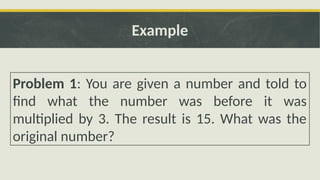
Problem 1: You are given a number and told to
find what the number was before it was
multiplied by 3. The result is 15. What was the
original number?
Solution
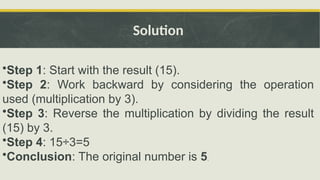
•Step 1: Start with the result (15).
•Step 2: Work backward by considering the operation
used (multiplication by 3).
•Step 3: Reverse the multiplication by dividing the result
(15) by 3.
•Step 4: 15÷3=5
•Conclusion: The original number is 5.
Example
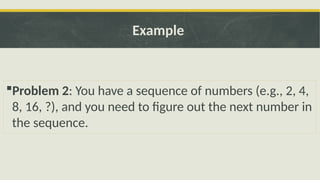
Problem 2: You have a sequence of numbers (e.g., 2, 4,
8, 16, ?), and you need to figure out the next number in
the sequence.
Solution
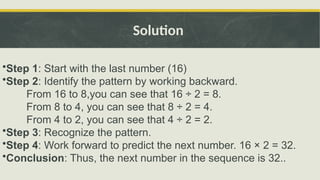
•Step 1: Start with the last number (16)
•Step 2: Identify the pattern by working backward.
From 16 to 8,you can see that 16 ÷ 2 = 8.
From 8 to 4, you can see that 8 ÷ 2 = 4.
From 4 to 2, you can see that 4 ÷ 2 = 2.
•Step 3: Recognize the pattern.
•Step 4: Work forward to predict the next number. 16 × 2 = 32.
•Conclusion: Thus, the next number in the sequence is 32..
Real-World Application of Work
Backward
•Example 1: Solving Math Equations
In algebra, when you are given the solution, you can use
backward reasoning to find the values that lead to the
equation's result.
•Example 2: Troubleshooting
If you know the final outcome of a system (e.g., a machine
working correctly), you can reverse the steps to find the
cause of failure at earlier stages.
Conclusion
Understanding how and when to apply this
method enhances your problem-solving skills
and can lead to more efficient and effective
solutions.
Thank
You!
Add a Slide Title - 4
Add a Slide Title - 5
Click icon to add picture

Work-Backward-Problem-Solving-Math-ppt.pptx

  • 1.
    Work Backward Strategy Presentedby: Allysa Wong BSEd-Math III
  • 2.
    What is theWork Backward Strategy? Definition: A problem-solving approach in which you start from the desired outcome and reverse the steps to determine how to reach that result. This strategy can help simplify problems by thinking in reverse order, often revealing paths or patterns that aren't immediately obvious when thinking forward.
  • 3.
    Steps in WorkBackward Strategy •Step 1: Identify the solution or final goal. •Step 2: Work backward by figuring out what conditions must have been true to reach the solution. •Step 3: Eliminate possibilities that cannot logically lead to the solution. •Step 4: Simplify the problem by tracing the steps backward and reducing complexity at each step.
  • 4.
    Example Problem 1: Youare given a number and told to find what the number was before it was multiplied by 3. The result is 15. What was the original number?
  • 5.
    Solution •Step 1: Startwith the result (15). •Step 2: Work backward by considering the operation used (multiplication by 3). •Step 3: Reverse the multiplication by dividing the result (15) by 3. •Step 4: 15÷3=5 •Conclusion: The original number is 5.
  • 6.
    Example Problem 2: Youhave a sequence of numbers (e.g., 2, 4, 8, 16, ?), and you need to figure out the next number in the sequence.
  • 7.
    Solution •Step 1: Startwith the last number (16) •Step 2: Identify the pattern by working backward. From 16 to 8,you can see that 16 ÷ 2 = 8. From 8 to 4, you can see that 8 ÷ 2 = 4. From 4 to 2, you can see that 4 ÷ 2 = 2. •Step 3: Recognize the pattern. •Step 4: Work forward to predict the next number. 16 × 2 = 32. •Conclusion: Thus, the next number in the sequence is 32..
  • 8.
    Real-World Application ofWork Backward •Example 1: Solving Math Equations In algebra, when you are given the solution, you can use backward reasoning to find the values that lead to the equation's result. •Example 2: Troubleshooting If you know the final outcome of a system (e.g., a machine working correctly), you can reverse the steps to find the cause of failure at earlier stages.
  • 9.
    Conclusion Understanding how andwhen to apply this method enhances your problem-solving skills and can lead to more efficient and effective solutions.
  • 10.
  • 11.
    Add a SlideTitle - 4
  • 12.
    Add a SlideTitle - 5 Click icon to add picture

Editor's Notes

  • #2 When to Use: It is used when the direct (forward) method is either too complex or unclear, allowing for a more systematic exploration of possibilities starting from the solution.
  • #4 This process of working backward simplifies the steps needed to find the solution.
  • #5 When a problem is complicated, working backward can simplify it by transforming it into smaller, more manageable sub-problems.
  • #7 By using the work backward strategy, you effectively identified that the numbers in the sequence are doubling, and this led you to the correct answer of 32.
  • #8 By starting from the solution, you gain insight into the structure of the problem. You can identify constraints and develop an understanding of the relationships between variables.